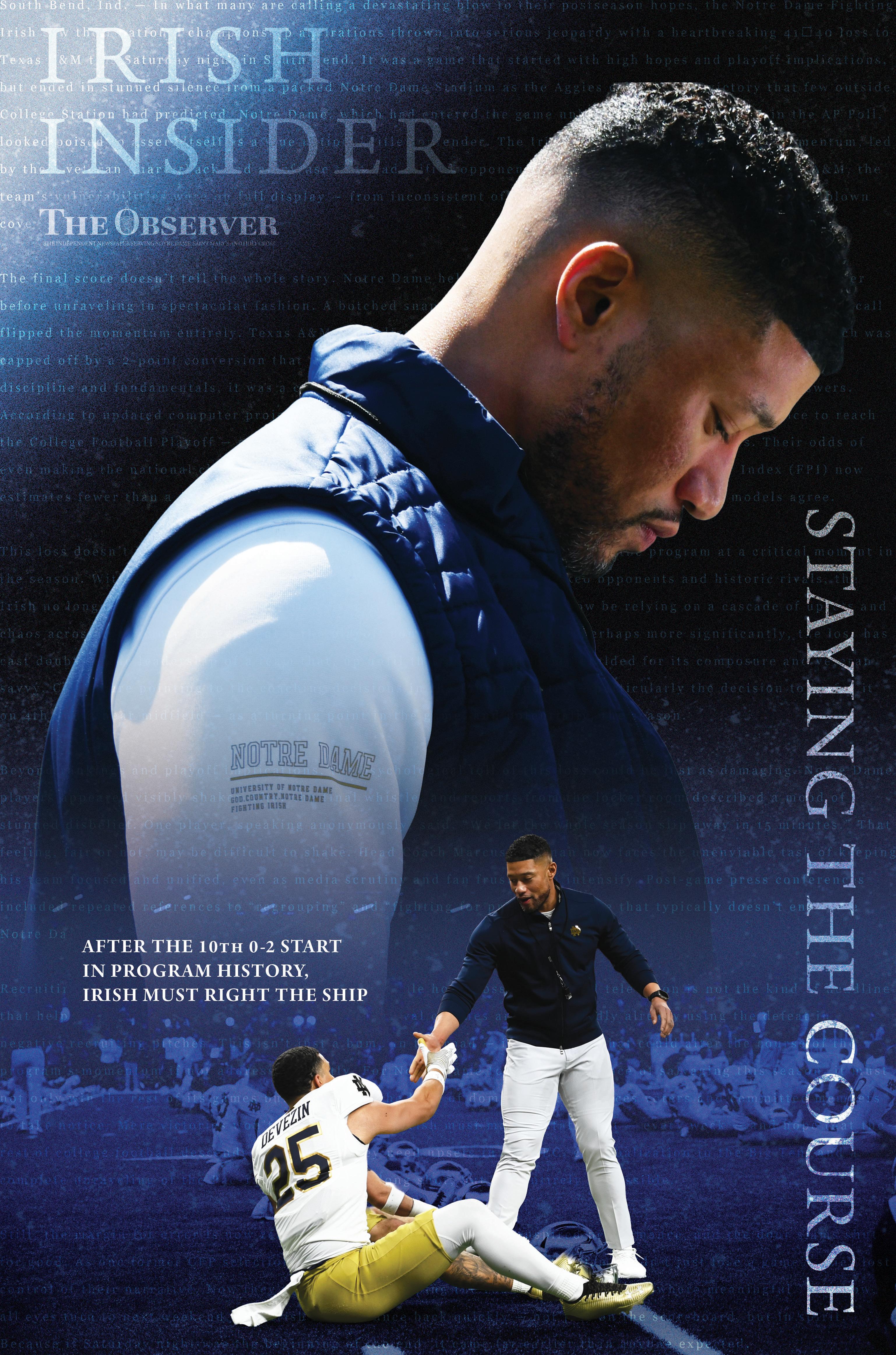
Graphic by ISABELLE RUTLAND | Photography by GABRIELLA MARTIN and GRAY NOCJAR
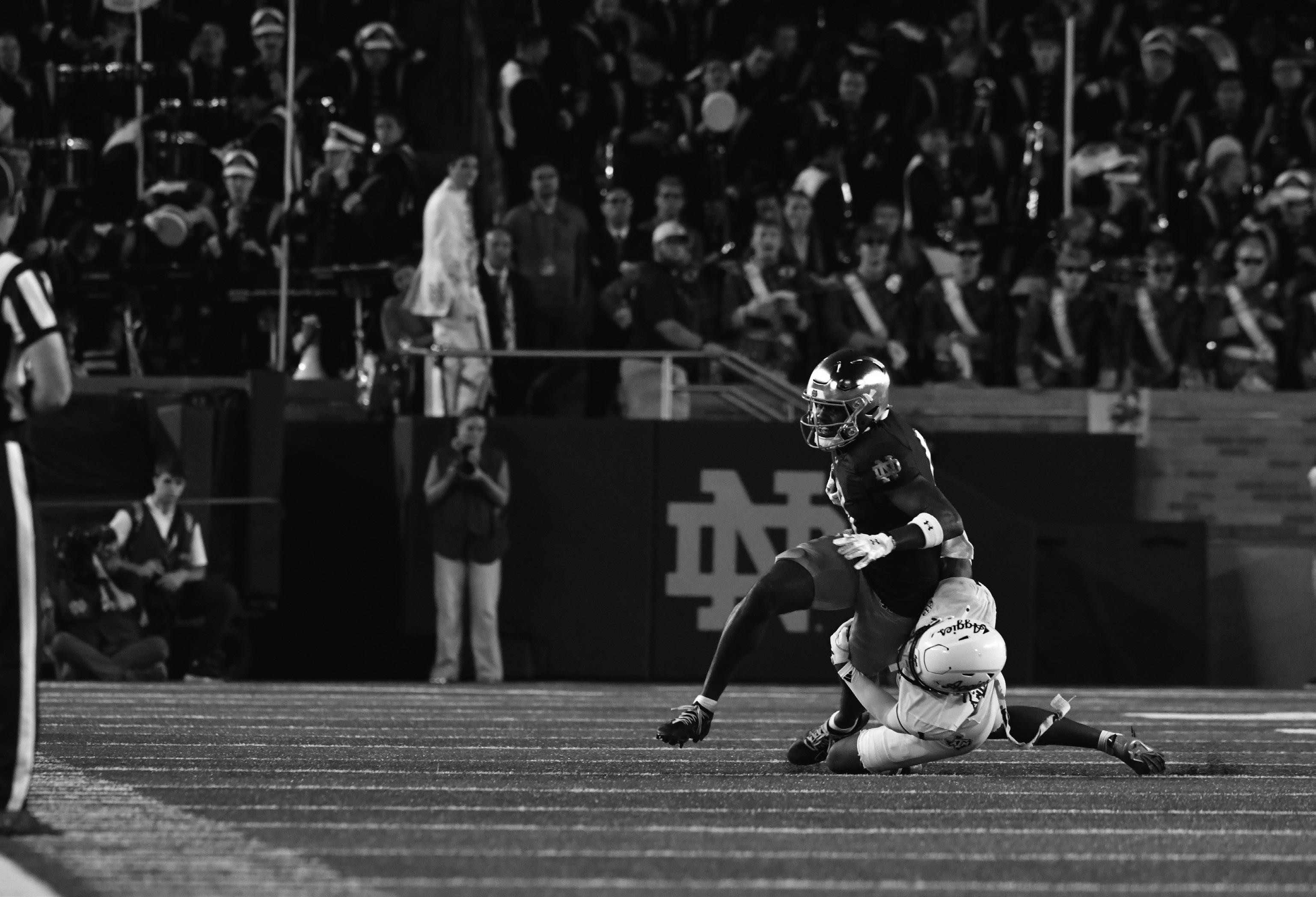
FIELDS FEATURE
FIELDS FEATURE
By Tyler Reidy Associate Sports Editor
The first catch of Malachi Fields’ Notre Dame career couldn’t have gone much worse. During the first quarter of the season opener at Miami, Fields hauled in a screen pass to kick off Notre Dame’s second drive of the gain. The simple play call shouldn’t have resulted in anything preposterous, but it did.
After gaining a couple yards, Fields fumbled just before he hit the ground, turning the ball over to Miami inside the Irish red zone. In a game where Notre Dame needed to avoid mistakes, the graduate transfer from Virginia made a big one.
However, Fields’ fumble did not prove costly. Notre Dame’s defense stalled out the Hurricanes, forcing them to try a field goal, which they botched.
Since his miscue, Fields has repaid the favor to his team, leading all Irish wide receivers with eight catches and 125 yards. Aside from playing in a venue that holds about 20,000 more people than his old stomping ground in Charlottesville, Virginia, Fields believes his game hasn’t
changed too much since arriving in South Bend.
“The biggest difference I think is just the home games,” Fields said. “The electricity in the stadium was pretty cool this weekend, but once the foot hits the ball off the first kickoff, the ball’s the ball.”
Fields arrived at Notre Dame with plenty of promise, immediately slotting in as the top boundary receiver in Mike Denbrock’s offense.
In 2023 and 2024, he posted nearly identical stat lines, catching more than 50 passes for at least 800 yards and five touchdowns in each season.
Last year, he landed on the All-ACC Third Team, tallying 81 yards in his future home of Notre Dame Stadium on Nov. 16 with the Cavaliers.
In just two games, Fields has already flashed plenty of the talent that set him apart at Virginia. Take, for example, a later moment in the Miami game, when Fields beautifully high-pointed a 26-yard catch in man-to-man coverage to set up Notre Dame’s first touchdown of the season.
“When we see man coverage one on one, we just think it’s me and [freshman quarterback CJ Carr] out there,” Fields said. “We’ve just gotta
go make a play. That’s really been the communication between us.”
Last week, when he posted an impressive 77 yards on five grabs against Texas A&M, Fields worked as more of a zone beater. In several moments against the Aggies, the veteran wideout found a soft spot in the defense near the sideline and “sat down” in it to make himself available for the quarterback. Carr, meanwhile, delivered a handful of perfect balls to him, clearing Texas A&M’s linebackers while keeping the football in front of defensive backs positioned further downfield.
Fields isn’t surprised by his early chemistry with the young quarterback, crediting Carr for his relentless work to prepare himself for the season.
“His confidence, his competitive spirit — since day one, he’s just been ready to go, ready to compete no matter what defense is out there, no matter who’s out there, no matter who’s with him,” Fields said of Carr. “He’s just a competitor, so he’s gonna go compete.”
As Fields has observed, Carr’s fearless and confident demeanor has appeared not only in his delivery of the
football, but also in the way he conducts the offensive huddle.
“He’s the guy,” Fields said.
In the larger picture, while surrounded by familiar faces like juniors Jadarian Price and Jeremiyah Love in the backfield, junior Jordan Faison and sophomore Jaden Greathouse out wide and senior Eli Raridon at tight end, Fields has carved out a major role in Notre Dame’s strongstarting offense. Through two games against ranked teams, the Irish have scored seven offensive touchdowns, an eye-opening number for a squad with a freshman at quarterback.
Fields attributes much of Notre Dame’s success on offense to its aggressiveness. Even though Denbrock has largely limited the playbook to settle Carr in out of the gate, the Irish have capitalized on moments where it’s available.
“I think we’ve been taking advantage of those one-onone shots,” Fields said. “When we see [and] when we get what we want, we’ve been taking advantage.”
But of course, Notre Dame is still winless at 0-2. That’s certainly by no fault of the Irish offense, which has done its part, perhaps even
outperforming preseason expectations.
Football remains a team game, though, and Fields won’t point the finger at any of his mates on defense or special teams, carrying out the point Love made in his postgame presser on Saturday night. Everyone in blue and gold, regardless of their performance through two weeks, is accountable, so Fields won’t be one to take his foot off the gas pedal as the Irish prepare for this week’s battle against Purdue.
“You gotta get it done,” Fields stated. “You gotta get a win, get back on track. So just going to work this week and [being] ready for the opportunity, excited for the opportunity.”
Against a Purdue defense that surrendered eight offensive touchdowns to Notre Dame just over a year ago, Fields could be primed for a productive afternoon. Regardless of his output, though, the threat No. 0 has already shown to hurt man defenses downfield or in pockets of zone defense should help the Irish offense remain active.

By Will Prisco News Writer
Notre Dame’s Office of Institutional Equity recently released the results of its seventh Sexual Conduct and Campus Climate Survey, continuing the University’s effort to assess students’ knowledge, perceptions and experiences related to sexual assault and sex-based misconduct. The 2024-25 report revealed a boost in student confidence regarding the University’s handling of sexual misconduct cases. However, the self-reported incidents of assault and harassment remained steady compared to previous years. 91% of student respondents felt that the University’s response to sexual assault was at least “somewhat effective.” This was a 10 percentage point increase from the previous survey. The percentage of students who rated the response as “mostly” or “very” effective rose by 19 points. Similar gains were seen in perceptions of the University’s response to other forms of misconduct, including a 16-point increase for dating or domestic violence and
a 17-point increase for hostile environment conduct.
However, there was a notable decline of 9% in the number of students who said they would report instances of sexual assault, other sex-based misconduct, dating violence, domestic violence, stalking, or other conduct that creates a sexually hostile environment to the University.
Lauren Mulhern, the program director for education, outreach and prevention in the Office of Institutional Equity, connected this trend of increased confidence in the University’s response to sexual assault to the recent staffing changes and increased education efforts made by the University.
“We believe this increase reflects efforts made by the Office of Institutional Equity to provide clear expectations and educational resources surrounding University policies, support services and resolution procedures,” Mulhern said. “Since
“Title IX” page 3
By Sophia Magnano News Writer
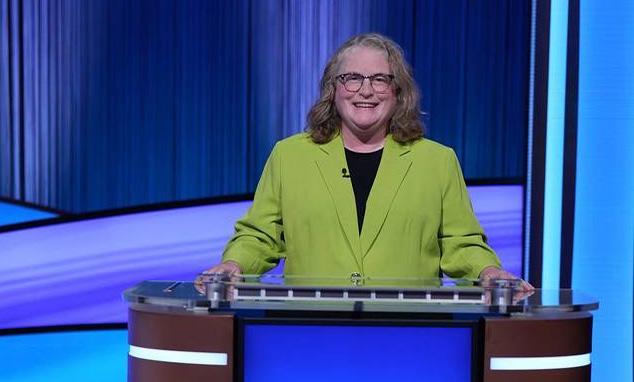
When Notre Dame English professor Susan Harris found herself behind a “Jeopardy!” podium at Sony Studios in Los Angeles, she was tasked with navigating a different type of text: a glowing gameboard of trivia clues. Her episode,
taped on Aug. 7, 2025, aired this past Tuesday. She ultimately came in second place.
For Harris, “Jeopardy!” carried a special nostalgia long before she stood at the contestant podium. As an undergraduate in the late 1980s, she and her friends
“‘Jeopardy!’” page 2
By David Murphy Associate News Writer
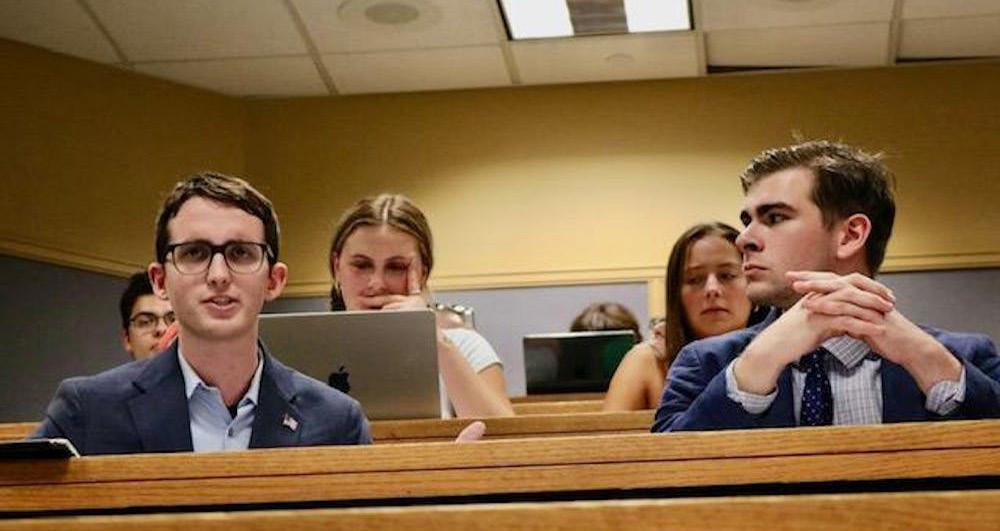
In a follow-up to the Sept. 10 vote to move forward with impeachment proceedings, the Student Senate convened on Wednesday to hold a formal hearing for St. Edward’s Hall senator Michael Heffernan. Heffernan, whose seven recorded absences violate Section 4.4 of the Student Senate bylaws, claimed that his actions were motivated by the desires of his constituents, who he said are overwhelmingly in favor of his decision. Prior to the impeachment hearing, Heffernan expressed confidence that the charges against him would be dropped.
see “Impeachment” page 4
By Mara Hall News Writer
As students return to campus and freshmen are welcomed into their new dorms, each dorm has its own events and traditions to build camaraderie. Whether it be the mini-retreat that Howard Hall residents go on each year or Carroll Hall’s first game-day tradition of bleaching their hair, these events must be approved by Notre Dame’s Student Activities Office (SAO) to ensure they comply with the University’s du Lac student handbook.
All events are required to be submitted on the University’s event organization system, ND Central, for approval by SAO, which falls under the Division of Student Affairs.
Breyan Tornifolio, director of residential life: residential education, explained in a statement to The Observer that the requirement of residence halls
to submit and receive approval for planned events has been in place for a number of years. She explained that this is because residence halls and their governing Hall Presidents Council are classified as recognized student groups and therefore bound by the University’s Standards of Conduct, Student Life Policies and Recognized Student Group Policies.
Tornifolio further explained that for residence halls and all other student groups and organizations, events must be approved by the group’s advisor as well as the group’s activities liaison. Rectors are the designated advisors for student groups, and Torinfolio serves as the activities liaison for residence halls.
“Events that are submitted in a timely manner and receive all necessary departmental approvals are confirmed and finalized through ND Central,” Torinfolio wrote.
Athena Westland, president of Howard Hall, commented positively on her experience with getting Howard Hall’s events approved. Though one of her submissions was rejected this year, she said that SAO worked with her to ensure her event could align with du Lac policies.
“[We had] a rejection for an event entering the Reflection Pool. I learned that this is against school policy, so we pivoted to an event that was permitted,” Westland wrote.
Coyle Hall president Aidan Sachs had a similar experience with SAO demanding changes to the Coyle Hall naming ceremony — an event during which first years receive an appointed nickname.
“Last year, we heard it would be completely canceled, but then over the summer I had a talk with my rector and he told us that SAO
see “Approval” page 3
The graduate transfer wide receiver has been a welcome addition to the field. SPORTS | PAGE 8
0-2 season
Dame football starts 2025 0-2 for the 10th time in their storied 126-year history.

ndsmcobserver.com
“TO UNCOVER THE TRUTH AND REPORT IT ACCURATELY”
900 Hesburgh Library, Notre Dame, IN 46556
Editor-in-Chief
Liam Kelly
Managing Editor Gray Nocjar
Asst. Managing Editor: Aynslee Dellacca
Asst. Managing Editor: Grace Tadajweski
Asst. Managing Editor: Henry Jagodzinski
Notre Dame News Editor: Sophie Hanawalt
SMC News Editor: Berhan Hagezom
Opinion Editor: Redmond Bernhold
Sports Editor: Noah Cahill
Scene Editor: Peter Mikulski
Photo Editor: Mariella Taddonio
Graphics Editor: Isabelle Rutland
Social Media Editor: Duncan Stangel
Ad Design Manager: Isabelle Rutland
Business Manager: Zack Pohlman
Systems Administrator: Jack MapelLentz
Advertising advertising@ndsmcobserver.com
Editor-in-Chief lkelly8@nd.edu
Managing Editor gnocjar@nd.edu
Assistant Managing Editors adellacca01@saintmarys.edu, gtadajwe@nd.edu, hjagodzi@nd.edu
Business Manager zpohlma2@nd.edu
Notre Dame News Desk
shanawal@nd.edu
Saint Mary’s News Desk
bhagezom01@saintmarys.edu
Opinion Desk rbernho2@nd.edu
Sports Desk ncahill2@nd.edu
Scene Desk pmikulsk@nd.edu
Photo Desk mtaddonio01@saintmarys.edu
Systems & Web Administrators
webmaster@ndsmcobserver.com
Policies
The Observer is the independent, daily newspaper published in print and online by the students of the University of Notre Dame du Lac, Saint Mary’s College and Holy Cross College. Editorial content, including advertisements, is not governed by policies of the administration of any institution. The Observer reserves the right to refuse advertisements based on content. The news is reported as accurately and objectively as possible. Unsigned editorials represent the opinion of the majority of the Editor-in-Chief, Managing Editor, Assistant Managing Editors and department editors. Commentaries, letters and columns present the views of the authors and not necessarily those of The Observer. Opinion space is available to all readers. The free expression of all opinions through letters is encouraged. Letters to the Editor must be signed and must include contact information.
Questions regarding Observer policies should be directed to Editor-in-Chief Liam Kelly.
Post Office Information The Observer (USPS 599 2-4000) is published Monday through Friday except during exam and vacation periods.
A subscription to The Observer is $130 for one academic year; $75 for one semester. The Observer is published at 900 Hesburgh Library Notre Dame, IN 46556-0779
Periodical postage paid at Notre Dame and additional mailing offices
POSTMASTER Send address corrections to: The Observer P.O. Box 779 900 Hesburgh Library Notre Dame, IN 46556-077
News Sophie Hanawalt Mara Hall
Berhan Hagezom
Scene
Peter Mikulski
Photo Elena Dertinger
By Sophie Lewandowski News Writer
Saint Mary’s hosted their annual McMahon Aquinas Lecture Wednesday, featuring Angela Knobel and her discussion, “Motherhood and the Meaning of SelfGift: Reflections on ‘The Giving Tree’”. Knobel is a philosophy professor at the University of Dallas. Her lecture centered upon the principle of giving and what distinguishes good maternal care from bad through an analysis of Shel Silverstein’s “The Giving Tree.”
“The Giving Tree” is a story of a tree who provides for a boy, giving him all he might need to achieve happiness in his life. In the beginning, this is apples to eat and shade to bask in. As the boy grows, he asks for more and more of the tree, who responds until she has nothing else to give but a stump for the boy to rest on.
Knobel explained that while Silverstein’s story is initially one of kind generosity, it develops into one which she views as far more unsettling and strange. She identified a controversy in whether the book’s message is one that is truly good, or that warns of the dangers of giving too much of oneself away. She noted that many
Continued from page 1
would gather in a campus dining hall TV lounge to watch Alex Trebek’s nightly broadcast.
“It was a cultural highwater mark,” she said. “We would sit in the TV room, yell answers at the screen and make a ritual out of it.”
That memory came full circle when, in Dec. 2023, Harris received an unexpected email from an associate producer inviting her to take the “Anytime Test,” the show’s entrance exam. Initially skeptical — “I thought, is this a hoax?,” Harris said — she soon learned the selection process was very real.
Sports Noah Cahill Claire Watson
Graphics
Isabelle Rutland
Ben Smith Opinion Redmond Bernhold
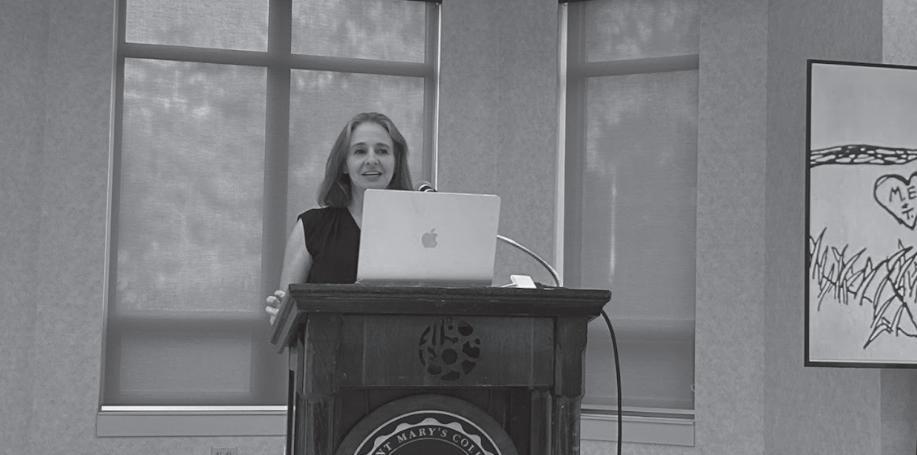
University of Dallas philosophy professor Angela Knobel presents at the annual McMahon Aquinas Lecture on “Motherhood and the Meaning of Self-Gift: Reflections on ‘The Giving Tree’” in Rice Commons at SMC.
scholars have come to reject the book altogether.
In her lecture, she argued that the book does not to be wrestled into either side. Rather, she claimed that it is better read in two parts with recognition of a shift in narrator as the tree, the maternal figure of the story, goes from giving herself in a healthy way to the boy she cares for to giving far too much of herself, to a dangerous point of not being able to give anymore.
Knobel claimed that ”The Giving Tree” is but a single example of the challenge of finding balance as a mother that she shared. Mothers, throughout history, she said, have been depicted as figures that are known to give a great deal for the sake of their children.
strangers and competitors. “You’re all there competing against each other, but you don’t know who you’ll actually face,” Harris said. “We were all nerds together, just talking and hanging out.”
From there came orientation, rehearsals with buzzers and the random assignment of podiums. Harris remembers small details — the “weird little corner” of the Sony parking garage, where a kind of “Smurf mobile” sat parked, looking “a bit cursed.” For her, those quirks became part of the larger blur of an experience where the pressure of buzzer timing eclipsed even the difficulty of the questions.
After taking the “Anytime Test” and completing Zoom audition and a mock test, she entered the contestant pool, where she remained for nearly two years before being called as an alternate in Aug. 2025.
Harris and other contestants began their day on set in a windowless green room, where phones were banned. This environment encourages camaraderie amongst, at first, merely
“A lot of winning at ‘Jeopardy!’ has to do with the buzzer,” Harris said. Unlike what audiences see on television, contestants must wait for the blue lights on the side of the board to signal when Ken Jennings has finished reading.
Ring in too early and you’re locked out. Wait too long and you miss your chance. Harris experimented with strategies in rehearsal, such as keying in on the lowest corner light, but in the heat of the game, “it was too hard to keep track of everything,” Harris said.
Despite being an English
While in many cases this can be a good thing, Knobel also pointed out multiple instances where this type of giving does not necessarily fulfill the lives of the children or the mother. She compared such giving to the kind of St. Monica for her son St. Augustine. She shared that in this Biblical story, what St. Monica desires so desperately for her son is all of what she perceives to be success in life. Yet, in her desperation to give this to him, she pushes him away. It is only when she steps away that St. Augustine is able to discover the happiness St. Monica intended for him, and for their relationship to strengthen.
Knobel asserted that a gift is ultimately appreciated in its need and not in
professor, Harris never drew a literature-focused category. Instead, she faced topics ranging from “European History” to “That’s Quite a Novel Synopsis” to “Revenge: A Dish Best Served Cold.”
But Harris pointed out that “Jeopardy!” is almost the opposite of a professor’s intentions. “In academia, we build deep knowledge in a narrow area. ‘Jeopardy!’ demands shallow knowledge across a huge range,” Harris said.
Still, Harris acknowledged that her years of reading and research equipped her with exactly the kind of cultural and historical fragments “Jeopardy!” is all about. “All the weird knowledge I’ve picked up as a scholar definitely helped,” she said.
Clues are often embedded with hints, and with enough context, contestants can work out answers even outside their specialties.
“It’s a lot like close reading,” she said, specifying that she had to recognize patterns, make connections and interpret cues.
Her preparation was deliberately light. Beyond playing trivia games with her family and quizzing herself on a geography app, she trusted her lifetime of reading more than
what is physically provided. “If we think about the things that others have given us that have proven to be the most important in our lives, we will very likely find that they are intangible,” Knobel said. Instead, she asserted that the most powerful gifts are those which inspire further giving in others, a “passing along” of sorts. According to her, is in this gift of teaching that the most goodness can spring forth.
As for “The Giving Tree,” Knobel reminded the audience importance lies in its ambiguit, resembling the complex role of mothers in the lives of their children.
Contact Sophie Lewandowski at slewandowski01@saintmarys.edu
any cram session. “You have no way of knowing what the categories will be,” she said. When the moment finally arrived, Harris found herself listening to host Ken Jennings attempt to calm her nerves. “He tries to make you feel better about the fact that you flew all the way out here, and two of you will lose,” she said. From there, everything moved quickly: lights, buzzers, questions and answers. “The show is all kind of a blur,” she said. What remained most vivid wasn’t the competition itself, but the relationships formed in the green room. Contestants, cut off from phones and outside distractions, bonded over shared nerves and shared interests.
“Honestly, my favorite thing about the experience was just hanging out with the other contestants,” Harris said. Those friendships have remained intact, with a WhatsApp group where alumni now share puzzles, games and trivia.
In the end, Harris treasures the experience not as an academic triumph or a personal victory but as an experience of connection, memory and joy.
Contact Sophia Magnano at smagnano@nd.edu
Continued from page 1
would possibly want to continue this tradition in a way that works with them … the two big things that they wanted were that they wanted the freshmen to have agency, and then they wanted the freshmen to have a waiting period of at least three weeks before they received their names, for us to get to know them, and a big thing with them was that they wanted this naming process to be an opt-in situation, instead of an
Continued from page 1
the last survey, two new full-time positions have been established within OIE to refine and enhance campus-wide prevention, education, outreach and training efforts.”
Compared to last year, the self-reported experiences of sexual assault remained consistent. The survey revealed that 3% of students overall, 6% of women and 1% of men, said they had experienced sexual assault during their time at Notre Dame.
“We view even one incident of sexual assault as an incident too many and take the stability of these rates as a critical reminder of the importance to continue to
opt-out process,” Sachs said.
John Nisbet, president of Carroll Hall, noted similar difficulties in getting their events approved. “We did have a lot of issues last year with last year’s president getting some more events approved, especially Vermin Go Gold.” That tradition involves members of the residence hall choosing to dye their hair blond to match the main building for the first home football game of the season.
Nisbet added, “When I was a freshman, it was like upperclassmen doing it, where we would just have juniors and sophomores helping to
engage in comprehensive and responsive prevention efforts,” Mulhern said.
It was reported in the survey that 47% of incidents took place between the beginning of the fall semester and Thanksgiving break. 60% of these incidents involved incapacitation due to sleep, drugs, alcohol or another reason. 34% of women and 28% of men said they experienced the use of force during their reported assault.
Students shared several reasons for not reporting these incidents to the University’s Office for Institutional Equity. The top reasons included a desire to forget what happened (61%), feelings of self-blame (52%), the belief that reporting wouldn’t lead to any change (50%) and discomfort with the reporting process
bleach whoever’s hair they wanted to. Last year we had to change it, where we had people from the university hair salon come out and do it professionally.”
However, several hall presidents also noted their appreciation for what they understood to be the balance the University is striving for between safety and tradition.
Siegfried Hall president Matthew Langenderfer said, “I think it is positive in terms of keeping Notre Dame safe and us safe if that is what it was intended for. The only negative is that it takes more time, but
(45%). Mulhern pointed out that the rise in self-blame and the wish to move on without reporting illustrates the deeper issues at play.
“Survivors often experience self-blame or a desire to put the incident behind them, which can make reporting and accessing resources difficult,” Mulhern said.
“This year’s increase suggests we must do even more to change destructive social norms that reinforce and cause internalization of victim-blaming narratives.”
The survey also revealed that most students are well-informed about the resources available to them and how to ask for help. The survey revealed that 85% of those who responded were aware of the University’s resources, while 79% knew how to report issues. Nine out of ten students also felt
it is pretty selfish to say ‘Oh I would rather save my time than put Notre Dame in any sort of legal issue or something.’”
Nisbet expressed similar thoughts. “I think it is just to keep things organized. We have, you know, 32 halls, all organizing events with different stuff in different places, and you have a university, like Notre Dame that has a reputation as a respectable institution, they are going to want to make sure that everything is in order, and especially for a school that has residences halls that pride themselves on tradition,
confident in their ability to step in as active bystanders when it’s safe to do so.
Mulhern mentioned that educational initiatives are offered through various platforms, making them accessible at different stages of students’ time at college.
“As part of new student orientation, both undergraduate and graduate students complete virtual training followed by in-person sessions with [Prevention, Outreach, Education and Training] staff,” Mulhern said. “Various forms of print resources, including posters, hand-held cards and mirror clings, are displayed and available in every residence hall, and digital resources are also made available on the OIE website.”
the University obviously wants to make sure that those traditions are safe and welcoming,” he said. “So, I think at its core it can be frustrating at times, [but] ND Central is there to help us.”
Sachs likewise emphasized his willingness to work with SAO, saying, “Obviously we want the naming ceremony to exist, so of course we would listen to them.”
Contact Mara Hall at mhall27@nd.edu
The Office of Institutional Equity highlighted the importance of customizing resources for the diverse needs of the Notre Dame community. Mulhern pointed out that the University works hand in hand with various departments, including the Gender Relations Center, International Student and Scholar Affairs and Multicultural Student Programs and Services, to make sure that the resources provided are culturally sensitive. “Students’ backgrounds, identities and experiences directly impact how they approach intimate situations, including conversations involving consent, boundaries and expectations,” Mulhern said.
Contact Will Prisco at wprisco@nd.edu


By Julia Connolly News Writer
With new club members from activities fair sign-ups and the first four weeks of classes in the books, campus political organizations are cementing their plans, both new and recurring, for the upcoming school year.
Gov. Michelle Lujan Grisham (D.) of New Mexico and Gov. Spencer Cox of Utah (R.) will speak at the University on Friday in partnership with Notre Dame’s Democracy Initiative. Following their conversation, Grisham will be meeting with College Democrats for breakfast on Saturday, sponsored by the Hesburgh Program in Public Service.
Political director Alex Funk from the College Democrats (CDems) discussed her excitement about the event. “That’s something really cool … It’s a very unique opportunity, because that one’s going to be a lot more intimate than the conversation with the two governors, because it’s specifically for Notre Dame College Democrats
Continued from page 1
Council’s evidence spun me as lazy … but I’ve worked hard for my brothers to make sure we’re heard and we’re left alone.”
Heffernan’s claim of strong public support was a contentious topic at last week’s session, where Heffernan’s inability to provide concrete evidence ultimately contributed to the Senate’s decision to move ahead with proceedings. Heffernan sought to address this point at Wednesday’s hearing, citing a petition he had initiated among St. Edward’s Hall residents as evidence of his mandate. Signatories of the petition affirmed Heffernan’s “right and responsibility to act according to [his] conscience,” as well as their “continued support for senator Heffernan’s efforts to represent [them].”
“Last week, the Judicial Council investigation claimed that I only had 25 to 30 supporters based on information that they acquired during their investigation,” Heffernan said. “During the meeting last week, I couldn’t defend myself because of the rules that were in place. But here before me, I have 121 signatures, which, if you discount myself, comes to about 80 percent of Steds.”
The impeachment hearing began shortly after the Senate convened. It would begin by allowing Heffernan to speak in his defense, granting time for senators to question his statements. Afterward, senators would move into debate amongst themselves, before finally voting on the question of impeachment. Standing before the senate,
members,” Funk said. Funk highlighted another event on Friday. Mallory McMorrow, Notre Dame alumna and Michigan senate majority whip, is hosting a book signing and meet-and-greet at the Hammes Notre Dame Bookstore from 3:30–5 p.m. The event is free and open to the public. Funk noted that McMorrow has a strong relationship with CDems.
She also noted that
Congressman Frank Mrvan of Indiana is coming to speak at Notre Dame on September 25 from 2–3 p.m., as well as
Congressman Brendan Boyle, a Notre Dame alum and representative of Pennsylvania’s 2nd District on Friday, Oct. 3, from 10–11 a.m. These will primarily be Q&A sessions with spots for students affiliated with CDems and other campus organizations.
CDems-exclusive events this year will include “spooky ‘Jeopardy!’” and “speed-friending.”
CDems will also return to D.C. this spring. Funk spoke to the value of the trip for her last year.
Heffernan provided arguments in his defense, summing it up to two major points. The first was the will of his constituents, who, he felt, based on residential feedback and petition data, didn’t want him to come to meetings. Heffernan also claimed the Judicial Council evidence presented against him at last week’s session was one-sided and false and did not accurately reflect his situation.
“When you look at the situation as it’s accurately represented today, I have represented my constituents and I don’t think anybody can argue against that,” Heffernan said. “You could say, ‘I broke the Senate laws.’ I mean, I did … but this is what my people want. So I just want you all to consider that if you vote to impeach, you’re voting against the will of St. Edwards Hall … You’re using your decision as an individual to counteract the decisions of an entire group of people – an entire family.”
After Heffernan’s statements, the floor opened for questioning. Z Zavala, the senator from Welsh Family Hall, asked Heffernan if he would ever inquire into the motivations of his constituents. Heffernan said he would not “pry into [their] lives” and that at the end of the day, he would do what they asked him to without question.
Tayo Awe, a senator from the Undergraduate Community at Fischer, questioned Heffernan’s personal intentions, asking what statement his absences made. Heffernan responded to the question by once again appealing to the desires of his constituents.
“I guess absence to all the other Stedsmen takes on a different meaning for every
“We met with a bunch of different organizations, like the environmental defense fund, and people on Capitol Hill … It was such a great way to learn about what Notre Dame has to offer for the College Democrats,” she said.
BridgeND, a political organization focused on bridging the partisan divide on campus, noted their excitement for their new column in The Observer.
“That was something that we had a couple of years back … but we’re back, we’re excited about it, and I’m working on an article right now!” Says BridgeND president Edy McCurrie.
The club’s flagship event, Converge ND, is currently scheduled for October 8 from 6:30–8 p.m. in Dahnke Ballroom. At the event, participants are paired with a partner whose political views differ from their own. McCurrie says that she’s “hoping to have some collaboration from College Democrats and College Republicans” for this event.
BridgeND’s goal “is especially important after last week’s events, so we know that what
person,” Heffernan said. “I’m not out here to prove a point. I’m really just defending St. Edward’s right to self-govern. And I think every Stedsmen took away something different, and I think they found a voice through my decisions.”
After this, the Senate moved out of questioning and into formal debate. Like the previous week, senators’ opinions on Heffernan’s case were mixed. Junior class council president Aleah Applin was the first senator to speak plainly in favor of impeachment, concerned about what it would mean for a whole dorm to lack representation in the University’s student body.
“I think it’s really important that people are represented in their dorm. Maybe they don’t mind [Heffernan] not showing up, but if they don’t understand that they’re not being represented, that’s a problem,” she said. “We talk about important issues in Senate, and if there’s over 150 people not being represented, that does present a problem in the future.”
Dunne senator Kyle Lauckner concurred with Applin, concerned that Heffernan was not meeting his duties as a duly elected representative. Lauckner highlighted that being part of the Student Senate comes with its own set of responsibilities.
“There’s a two-way stream responsibility, one to our constituents and one to the Senate. When we all decided to run for senator, we took on the implication that we would follow the rules here,” Lauckner stated. “That’s kind of what this whole impeachment is all about. It’s not a question of whether we are serving. It is a question of, ‘Are we following the rules
we are doing on campus is important and we hope that other people share our same goals,” McCurrie said.
Additionally, the organization hosts bi-weekly meetings with presentations and facilitated conversations surrounding how to bridge the political divide both on-campus and in the US as a whole.
For the College Republicans (CReps), plans are in the works for the fall.
At their next meeting Wednesday, Sept. 24, CReps is planning to honor Charlie Kirk (pending Student Activities Office approval). Co-President Shri Thakur says that it will be a social event in which students can get to know each other while mourning the loss of Kirk.
CReps is also looking to invite White House employees to campus to speak to students.
“We’re looking forward to bringing a lot of different people from the government who can talk to us about their experience, and potentially get some of our members connected in
that we all agreed on as senators and voted on within the first couple of weeks?’” Lauckner added that the continued absence of an elected senator from the Wednesday meetings set a poor precedent for other members of the body. He argued that Heffernan’s absence means that there is one less person to share the work, which makes the day-to-day work of the Senate’s various departments much more difficult.
“When he doesn’t show up, there’s one less person on the committee, so then we have to start picking up the slack … I think this issue is kind of dry,” Lauckner said. “I think you all know what side I lean on. If it were a piece of chicken – I’d choke on it.”
Max Barton of Carroll Hall rallied to Heffernan’s defense. The prior week he acted as a proxy for Carroll Hall senator Charlie Bacon and spoke strongly against proceeding to an impeachment. Although Bacon was present at Wednesday’s hearing, he was willing to yield his time to Barton. This allowed him to deliver another speech in favor of Heffernan’s position.
“What good is a constitution if it does not support its people?” Barton asked the senate. “It is blind and it is effectively illegitimate. A constitution is passed by its people. It needs to support those people. And if you vote to impeach this man, you’re making the Constitution an entity of its own, which it cannot be. He represents his constituents – there is nothing better than that. There’s nothing better than that at all. If the role of the Senate is to silence people, we cannot call ourselves just, we just can’t.”
Washington as well as build ties between ND students and the White House,” Thakur wrote in a statement to The Observer. He hopes that White House members will speak on “the conservative approach to a variety of different policy matters, whether it’s trade, immigration, or other topics.”
Thakur mentioned that there were bureaucratic difficulties from both sides necessary to bring these individuals on to campus, and that nothing is concrete just yet.
The organization plans on continuing its mission from previous years, which Thakur defined in his written statement as “educating people on a variety of different issues, providing a community where like-minded people can get to know each other … and preparing young conservatives at Notre Dame to make an impact in politics.”
Contact Julia Connolly at jconnol5@nd.edu
After debate, the Senate motioned for a formal vote on the impeachment of Heffernan, with parliamentarian Sam Robinson noting that a twothirds majority would be necessary for removal. The motion to impeach narrowly passed, with the two-thirds threshold barely reached. The final vote was 22 in favor and 11 against, “the slimmest margin possible” according to Robinson. A motion to reconsider was presented but did not garner enough support to go into effect, confirming the Senate’s decision.
With Heffernan’s impeachment, his seat in the Student Senate will be vacant for the time being. According to a written statement from Maddy Hutson, the Judicial Council vice president of elections, an election to fill the position of senator for St. Edward’s Hall will take place shortly, likely to “be held within the next two academic weeks,” as deemed by the student body’s constitution. According to Hutson, “Heffernan is ineligible to rerun ... as he has held the position during the current term.” Following the verdict, Heffernan and his supporters exited the senate chamber. Heffernan spoke briefly with The Observer following the hearing, expressing disappointment with the outcome.
“What can I say? Freedom didn’t rule today,” Heffernan said. “I think this represents a lot of un-American values, and people’s voices were silenced today. My friends and brothers, their votes didn’t count today; they were completely ignored, and their voice was not heard.”
Just over a week ago, Charlie Kirk was brutally murdered by a leftist assassin while hosting an open mic debating event at Utah Valley University in Orem, Utah. In the days following this horrific incident, many on both the left and right have responded by calling for American society to make an even firmer commitment to “free speech” and open debate. These reactions are understandable, but they miss the grim reality that the “marketplace of ideas” can no longer coexist with the increasingly dangerous and extreme ideology of the far-left. Their embrace of violence demands a stark reassessment of our approach to open discourse, lest we allow the foundations of civil society to crumble under their assaults.
One article taking the aforementioned “more free speech” position has been published in the pages of The Observer, titled “The threat to free speech on college campuses.” In this piece, the author quite reasonably argues “that citizens should settle their differences with the ballot, not the bullet,” and that “Notre Dame should strive harder to uphold the ideal of free speech that Kirk fought for.” I do not necessarily disagree. However, these
points raise a key question — what should be done when one side rejects this premise entirely? The author’s tribute to Kirk’s legacy is admirable, but the article’s logic leads to the inevitable conclusion that if the far-left wants to kill you for your ideas, all the right can do is debate them harder.
This is an obviously untenable proposition, and it exposes the fatal flaw in clinging to free speech absolutism as a solution to political violence.
The far-left’s actions prove they seek not dialogue, but destruction — a truth we can no longer afford to ignore.
Like any marketplace, the marketplace of ideas only works when its participants agree on a common set of principles, rules and boundaries that must be adhered to.
Just as a market needs honest trade to function, ideas must compete through reason and mutual respect, not violence or intimidation. When these norms are ignored, the free exchange of ideas collapses. Today it is clear that the farleft does not simply withdraw from debate but seeks to dominate and silence it. Their hostility to shared norms has transformed into a campaign against the conditions that make free expression possible, endangering the foundations of our republic.
This idea first hit me after reading a friend’s piece about how we outsource so much of our lives that we start to lose ourselves. It got me thinking — what does that look like for us as college students? Walk across any campus quad today and you’ll see it: students with phones in hand, eyes darting between TikTok recaps, reviews and Instagram story “recommendations.” Where to eat, what class to take, whether a professor is “worth it” (via Rate My Professors) — everything from our coffee order to our careers seems to require validation from someone else before we make a move. Somehow, the modern college experience — once romanticized as a time to “find yourself” — has become an exercise in outsourcing our decisions to people we don’t even know. We justify our outsourcing as “crowdsourcing wisdom,” when in reality, we might (sadly) just be losing our ability to trust ourselves — and for that matter (and on
The savage assassination of Charlie Kirk is the most recent example of this, but hardly the only one. For years, leftists have violently protested campus speakers they disagree with, assaulted attendees of Trump rallies and have engaged in vicious online censorship and doxxing of conservative voices. A recent poll showed that a plurality of young Americans, disproportionately those on the left, had a favorable view of United Healthcare CEO assassin Luigi Mangione. Another survey found that over half of self-described leftists would view the hypothetical assassination of President Donald Trump as at least “partially justified.” These chilling statistics reveal a growing tolerance for violence as a political weapon among the farleft, a trend that poisons the well of public discourse and emboldens further atrocities.
This understanding makes clear that including the farleft in a “free-speech zone” is akin to welcoming the lion into the henhouse. Open discourse can never be possible with those who take a desire for dialogue as weakness and exploit it to push their agenda of chaos and coercion. To continue to allow the farleft to operate in such public forums risks normalizing
their destructive behavior, emboldening further acts of extremism. True free speech demands accountability, not appeasement, for those who seek to dismantle it through force and fear. Failing to confront this menace head-on only invites more bloodshed and erodes the foundation of a civilized society.
Rather than vague calls for more free speech, what must be done is immediate action to politically stamp out the far-left from the public square. Individuals promoting extreme left-wing views, such as endorsing violence against figures like Charlie Kirk, should be purged from institutions and socially ostracized. Left-wing NGOs, long known to be hotbeds of agitation and incitement, should be dismantled and have their assets seized. There can no longer be tolerance for those who hijack the institutions of Western Civilization only to advocate for its destruction. These decisive measures are the only path to preserving the integrity of open discourse and ensuring that violence does not become the arbiter of ideas.
Such action would hardly be unprecedented.
During the Cold War, the U.S. Government routinely
cracked down on communist organizations and figures that posed an imminent threat to the social order. Through targeted measures, authorities curtailed the influence of those advocating for destructive ideologies, prioritizing the stability of democratic institutions. The danger posed to America by the modern left today is no different. History proves that resolute steps are necessary when ideologies threaten the very fabric of a free society, and we must heed its lessons now.
The “marketplace of ideas” as we know it died with the bullet that tore through Charlie Kirk’s neck. The attack made clear that there is no debate left to have with the far left — only to confront and politically defeat them. America must act with fierce urgency to restore a public square where ideas can flourish without the shadow of violence. To do anything less is to surrender our society to the chaos of those who would rather kill than converse, betraying the very principles Kirk died defending.
Shri Thakur, co-president of the Notre Dame College Republicans Class of 2026 Sept. 17
a deeper note) our perception of who we really are. College, once considered the start of our independence, seems no longer so. Leaving home, figuring out how to do your laundry, learning to navigate dining hall chaos and maybe even discovering your political or religious beliefs without mom, dad or your hometown best friend whispering in your ear — this was all part of a blurry unknown, one waiting to be experienced. Now? We open Instagram, we scroll through X, Reddit or TikTok. We give power to strangers’ opinions and rely on someone else’s experience to guide our own lives like a ready-made template. And, while there’s nothing inherently wrong with seeking advice — don’t get me wrong, nobody is suggesting that we stop considering others’ opinions altogether — when every decision we make must pass through the court of public opinion (our friends, followers and following), what happens to our own taste, our own instincts, our own goals and

dreams? Ultimately, what we consider our “own” thoughts and beliefs merge, instead, into a plethora of everyone else’s thoughts and beliefs, except, in the end, our own. The irony is that this outsourcing comes, for us college students, during the very years we’re supposed to be forming our identity. College is messy on purpose (spoiler: that’s okay!). You’re meant to pick the wrong class, regret the overpriced Cafe J latte, buy the textbook that you’ll never read — that’s
how you learn what fits YOU, what goes with YOU, not what fits the TikTok algorithm. In this era of outsourcing, we overlook the fact that, many times, the “wrong” choice is precisely where all the good stories come from. The bad professor might somehow turn out to be the one who actually teaches you the most, the random coffee shop might be where you meet your new best friend and going to CJ’s and not Newf’s on a Friday might be the best
night of your life. A major part of who we are is determined by what we do — and if what we do is always determined by others, then our identity is not one to call our own.
Put simply, when we prioritize others’ opinions over our own experience, we start living a secondhand life. So here’s a radical suggestion: close the app. Skip the “day in my life.” Take the class that your roommate hates if it sounds interesting to you. Eat what no one else picks in the dining hall (no, you don’t have to eat the Southwest salad because it’s Thursday). Stop letting the loudest voices drown out your curiosity. Because if we don’t? We risk graduating with someone else’s college experience, while our own gathers dust in the comment section.
The views expressed in this column are those of the author and not necessarily those of The Observer. Contact Ana Prestamo at apresta2@nd.edu
By Sienna Stephens Columnist
When I tell people I have met that I am a gold star child, the first thing people think of are those shiny gold star stickers you would get if you did well on a test or assignment back in grade school. A few people assume the term is lighthearted, meaning that I see myself as a “excelling overachiever” in my classes or “the golden goose” of my family.
But, being a gold star child has nothing to do with grades, awards or shiny gold star stickers. The label is not something anyone strives for nor is it something anyone would willingly choose for themselves or their family. A gold star child is the son or daughter of a U.S. service member who was killed in the line of duty. It’s a label that I’ve carried nearly my whole life.
On April 1, 2007, my father was killed in Afghanistan while serving in the U. S. Army. He was survived by my mother and me. I was just three months old. I don’t have any memories of him, and I only know his voice from a video he created for me before he left for what would be the final time. I never got to experience him picking me up from school to attend father-daughter dances with him, and for the rest of my life, I will miss those everyday pleasures of having a dad be there for me.
Instead, I grew up with folded flags, shadow boxes, picture albums and stories from my family. I learned who he was through

his medals, my family’s fond memories of him and the many pictures that are scattered around my house. For years, I tried to piece together the kind of man he was from the fragments he left behind for me.
To most people, April 12 is just another spring day. For me and my family, it’s the day everything changed, a day where an angel gained his wings too soon. I’ve carried that date with me my entire life, it’s not just a mark of loss, it’s a part of who I am. Growing up, I always knew I was different. I was the girl whose father would never attend those father-daughter events and the one to never see him in the stands at my volleyball
and basketball games.
When I was younger, I never wanted pity for my loss, I wanted understanding. Being a gold star child has shaped me into the person I am today, to how I see the world, how I treat people, and how I view service, sacrifice and gratitude. It has taught me that freedom is not free, that bravery doesn’t always wear a uniform, that some heroes come back to their families and some never make it home. But more than anything, it has given me a different perspective of life.
When we think about the military, we often see symbols for strength, discipline, courage and honor, which are all true. But
sometimes we forget that each member behind that uniform is a person, a human being that gave their life to protect their country and the people living in it.
A parent, spouse, son or daughter, those are who gave their life. A human being with dreams, flaws, fears and families that wait for them to return. My dad was a father, a husband, a friend and a man who loved music, cheered with his friends over football and dreamed of coming home to his wife and newborn daughter.
Service members are not just symbols of patriotism, they are people, they are human beings like us.
Real people who sacrifice more than we will ever
Far too often, it is easy to claim that if a specific issue doesn’t affect me, then I needn’t worry myself about it. Compassion has fallen by the wayside in the foregone conclusion that the self is supreme.
The end result? Debilitating isolation. Consider the fallout. According to the Newport Institute, loneliness peaks between the ages of 18 and 29, which in the past was the age range regarded as the apex of human existence, both physically and relationally. Instead, we are finding that one in every three young adults reports feeling lonely. While certainly Notre Dame presents a fantastic blueprint for building community, whether it
is through residential life, clubs, sports or any manner of events on campus, it behooves us to recognize that the Golden Dome exists partly in a vacuum in that regard. So back to the original point. The phrase “crisis of compassion” has been floated several times to describe the phenomenon of how our empathy for one another is breaking down. A likely culprit is our continual desensitization to catastrophic global events. We are at a point in the history of our globe where we have never been as intertwined as before. With only a few clicks, you can be transported anywhere on Earth to explore just about anything. Yet even though we might expect that we would have a greater understanding of others, and thus, greater empathy for others, the inverse actually happens. We may be
startled briefly while scrolling on Instagram at the devastation seen in foreign wars or at the assassination of a political figure, but with one flick of the finger it’s effectively out of our minds. This is not a call to be outraged at every news or social media notification you receive, but rather an ask for consideration, if only in your own locale.
From a Christian perspective, Jesus certainly calls us to reach out to those who are most vulnerable in our community. However, outreach and religion are not mutually exclusive. Seeing others in pain is not a good feeling for anyone, and at the risk of sounding like a hedonist, should we not try to limit our pain and that of others? The world is vast and distinct, and at Notre Dame, a living, diverse reflection of the global community, we
truly understand. When they give their lives up for us, it’s not just a name on a wall or a folded flag, it’s an empty seat at the dinner table, missed moments and a child growing up with a permanent hole in their heart. A family has to learn how to live with grief that never goes away.
As we go about our daily lives, attending classes, scrolling through social media, planning our futures, it’s easy to forget that there are people out there putting everything on the line so we can live in peace and freedom. We owe them more than a “thank you.” We owe them remembrance, respect and recognition, every single day we are alive.
Being a gold star child has taught me that the military isn’t made of warriors, it’s made up of humans who gave their life for strangers, for people they don’t know, yet they still chose to protect us.
The legacy of those who gave their lives is not just found in history books, ceremonies or holidays, but in the everyday lives of the people they left behind.
My hope as a gold star child, who is so proud of her father every day, for his love for humanity, sacrifice and strength, is that we never lose sight of that.
The views expressed in this column are those of the author and not necessarily those of The Observer.
Contact Sienna Stephens at sstephens01@saintmarys.edu
should be striving always to make life better for others.
Furthermore, we should always feel innately called to uplift each other. We know it is as simple as a compliment or a greeting. Think back to the last time you were complimented, and how great it felt. Who wouldn’t want to spread that feeling to the world?
Yet even still, a common critique in various social circles is, “If I suffered, why shouldn’t you?” This ideology can never stem from any altruistic means, or in a religious context, from any Christian doctrine. In fact, the Constitutions of the Congregation of Holy Cross outline this exactly in Constitution 2: Mission, where they state the following, “As disciples of Jesus we stand side by side with all people. Like them we are burdened by the same struggles
and beset by the same weaknesses.” We all face hardship in life, but in the 200,000 years of human existence, we know that something revolutionary occurs when we find it in ourselves to stand with each other and love each other.
The great Jesuit scientist Pierre Teilhard de Chardin may have put it best:
“Someday, after mastering the winds, the waves, the tides and gravity, we shall harness for God the energies of love, and then, for a second time in the history of the world, man will have discovered fire.”
The views expressed in this column are those of the author and not necessarily those of The Observer.
Contact Michael Doyle at mdoyle25@nd.edu
By Jackson Newton Scene Writer
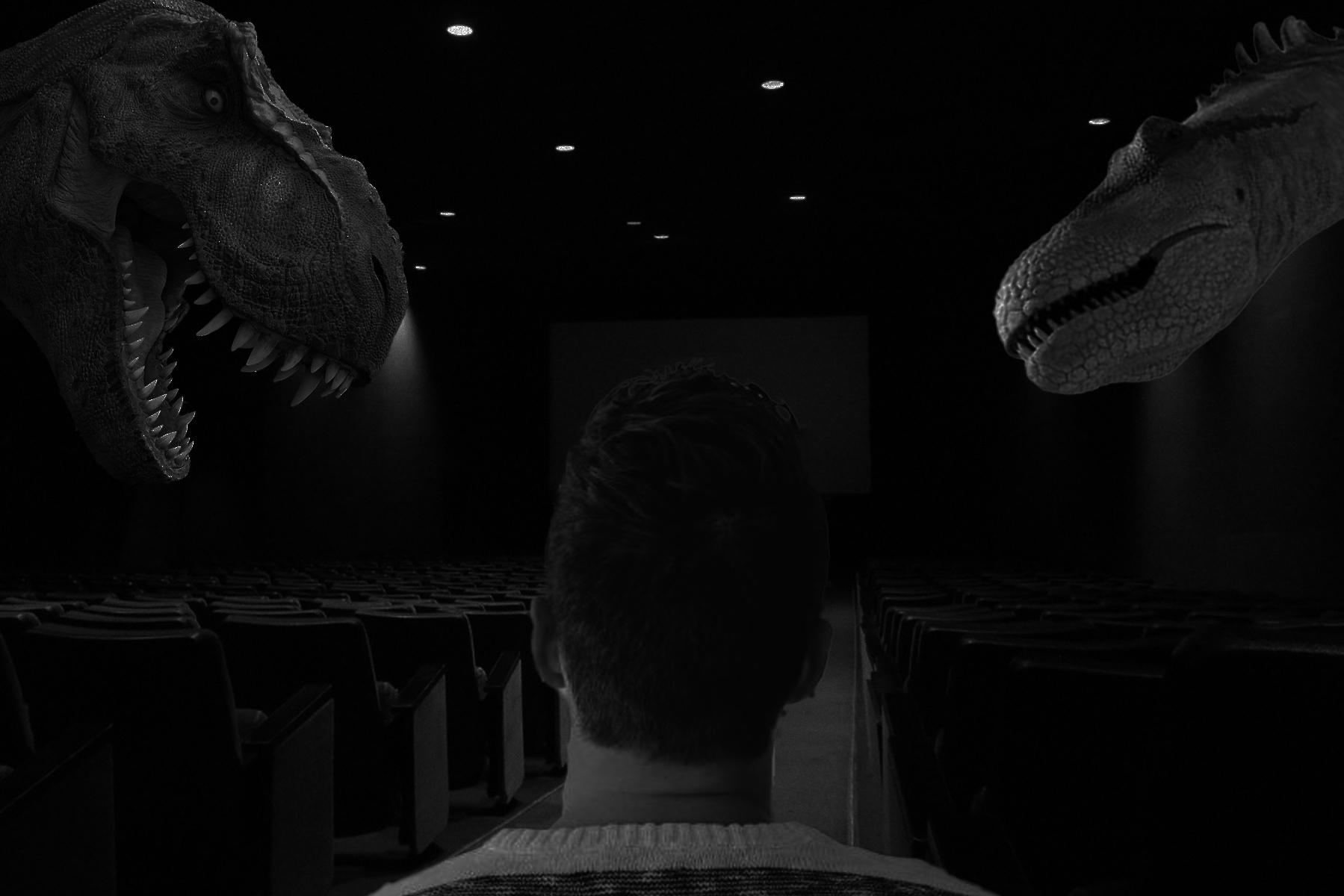
This summer I worked in a movie theater and had the misfortune of serving waves of angry children (and millennial Disney adults) who flooded in to see the hot new dino movie, “Jurassic World: Rebirth.” I worked the night shifts.
“Are the pizzas dinosaur-shaped?” one man asked. Sir, it’s 2 a.m.
You can see why I avoided the movie. Still, some masochistic part of me wanted to see what all the dino-craze was about.
I sat down, cringing, and forced myself through it. Oh boy.
There’s a lot to be said about “Jurassic World: Rebirth,” but here’s my takeaway: You shouldn’t avoid this movie because it’s particularly bad, by which I mean unenjoyable or sloppily made; you should avoid it because you’ve already seen it. If you’ve watched any Hollywood blockbusters in the last 10 years, then you’ve seen this one. If, on the other hand, you’re a grandparent trying to find entertainment for your 7-year-old grandchild or an aging middle-aged man going through a mid-life crisis, this could be the film for you.
The film is, like most modern “cinema,” just repackaged pop-culture slop. “Rebirth” plays like a stitchedtogether sequence of thrills, screams, product placements, deus ex machina
and overused tropes — all held together by the thinnest possible storyline. It’s packed with promotions for M&Ms and Altoids, which Jonathan Bailey’s character annoyingly chomps several times, but notably lacks any sign of actual artistic merit.
The movie was undoubtedly written by a committee of lawyers, PR reps, Mendoza grads and maybe, just maybe, a screenwriter or two. It’s a corporate product dressed up as a
film. It lacks any depth, originality or serious meaning. Or so I thought.
After a long post-movie nap, I couldn’t shake the feeling that maybe there was something deeper going on, just not on purpose. The more I thought about it, the more I realized: “Jurassic World: Rebirth” does have meaning — it’s just not the kind the filmmakers intended.
Let’s start at the beginning. The basic premise is that dinosaurs have
escaped from a biotech lab on the remote island of Île Saint-Hubert. This happens because a conveniently placed Snickers wrapper falls out of a scientist’s pocket, jams a security door and lets the dinosaurs out. These lab-made dinosaurs can’t survive outside tropical zones, so they stay near the equator.
The story picks up a few years later. Human society (not around the equator) is coping just fine. Parker Genix,
a pharmaceutical company, wants to develop a heart disease drug using dinosaur blood, so they send a team to Île Saint-Hubert to extract blood samples. These will be used to create a so-called “miracle drug.”
After all the action, which I’ll skip for brevity — basically, “pew pew,” “chomp chomp” — the team secures the samples. Dr. Henry Loomis, a timid dinosaur expert played by Jonathan Bailey, wants to make them publicly available, giving up Parker Genix’s chance to monopolize the drug. But the corporate villain owner of the company, Martin Krebs, wants to sell the drug for the highest possible profit.
What’s telling is this: It takes a dinosaur eating Krebs for the humans to finally do the right thing. Justice wins in the end, and the drug is made public, but it takes a literal act of the supernatural for this “justice” to happen. What does that say about us? What does it say about our ability to organize and fight for justice? Would it literally take an act of God for justice to be done in this country? For the hungry to be fed, the poor clothed? For us to move past our collective obsession with profit and finally do the right thing?
The answer from “Jurassic World: Rebirth” is a resounding yes.
Contact Jackson Newton at jnewton2@nd.edu
By Catherine Morrissey Scene Writer
Fans of the hit Amazon Prime series “The Summer I Turned Pretty” tuned in on Wednesday to watch the highly anticipated series finale, yours truly included. The phenomenon, based on the book series by Jenny Han, premiered in the summer of 2022 and centers around a seemingly never ending love triangle between Isabel “Belly” Conklin and brothers Conrad and Jeremiah Fisher.
Belly spends the whole of her young adult life desperately yearning for the day that her last name is Fisher, and the brothers seem to forget that any other female exists once they realize that Belly has turned pretty (unless, of course, they find themselves in Cabo). Belly spends years bouncing from brother to brother to a whale-crazed side character and then back to the brothers. Yet, at the end of Season 2, it seemed as though she made her ultimate choice in favor of the younger of the brothers, Jeremiah. Season 3 transported us to the spring of Belly’s junior year of college, and she and Jeremiah are still together and very much in love. Following a tragic accident, secrets revealed and “love” proclamations, Belly and Jeremiah find themselves engaged, sealed with a kiss and the world’s most expensive nub of tinfoil. Die-hard and self-proclaimed “Team Conrad” fans (once again, including yours truly) were devastated at the idea of a marriage

between Belly and a Fisher boy not named Conrad; however, all hope was not lost. Season 3 had a point. That point? Stop the wedding and break up Jeremiah and Belly. After the failed wedding, Belly flees to Paris, and at the end of the penultimate episode, Conrad is seen flying to Paris to go get his girl.
The season finale opens with Conrad embracing his inner Lonely Boy (Mr. Daniel Humphrey himself) outside of Belly’s minute Paris pad. After a night of love and clarity in Paris, Belly and Conrad ultimately confess their feelings for each other and set their intention
to fulfill the promise of being “infinity.”
Countering Conrad’s successful day, back across the pond in Cousins Beach, Jeremiah is becoming a chef? The only good part about this storyline that took up far too much screen time is the food itself. Why and how Jeremiah became a chef is honestly an anomaly to me. As much as I am a firm believer that Amazon Prime is the world’s best streaming service for book to television adaptations, this quite frankly choppy — no pun intended — and thrown together plot ruins the passion of Paris which is honestly the
whole reason I continued to tune in week after week.
At the end of the day, a majority of viewers wished this episode would be a lovefest between Conrad and Belly, and while I was fed, I am not full. The cuts between passion with a capital everything, our infinity, and our resident Food Network star made the momentum of the episode run dry — not to mention that the Food Network star is now once again in a relationship, only this time it is with Denise. Unfortunately, Denise is De-nice, the definition of mid.
The only saving grace of
Jeremiah’s new cooking show is the power couple behind the scenes. At many points over this final season, I have been rooting for two entities: Taylor and Steven for making it through, and Junior Mint (a stuffed polar bear) because I love stuffed animals. Thank God Taylor and Steven are still together. If Amazon broke them up, the Lyons Hall watch party would have heard from me far more than they would have liked.
Ultimately, this season as a whole fell flat for me. I loved to poke fun at the absurdities (marriage with no credit score and a proposal in front of the hospital, just to name a couple), but I left most episodes wanting more. Don’t get me wrong, I did in fact have my jaw on the floor when I heard Taylor Swift’s “Dress” start to play when Belly and Conrad got back together. That sequence gave me life. It was the literal wind beneath my wings.
This show has been a part of my life for four summers now. Four summers ago, Notre Dame was just my deepest hope and dream, and now, I’m over a quarter of the way through my time here. Life is too fast not to spend it doing what you love with the people you love, so even though I am ready to say au revoir to “The Summer I Turned Pretty,” I will still be sat with the popcorn in hand for the money grab of a movie they’re apparently planning to make.
Contact Catherine Morrissey at cmorri28@nd.edu
By Chris Dailey Associate Sports Editor
Notre Dame is starting 0-2 in football for only the 10th time in their 126-year history. Some seasons ended in disaster, but others flew above their early-season mishaps. Here is a look at every time the Irish started with backto-back losses.
Notre Dame began their climb into national prominence from the very bottom. 1887 marked the first time the school competed in a football game. Even then, the sport was a far cry from what it is today. Prior to the program’s inaugural game against Michigan, the Wolverine players taught the Notre Dame team how to play the sport. Captain Henry Luhn led the team in lieu of a head coach.
The game against Michigan was overcome by frigid cold weather and melting snow seeping into the ground. After just thirty minutes, the game was called. Michigan won 8-0. Notre Dame would play two rematches in the spring and lost both. Despite the 0-3 record, it was a year that changed the course of the University’s history.
On paper, Notre Dame’s 1896 season was a clear improvement from previous years. The program played more games than ever before, shut out four opponents and finished 4-3. However, those wins came after two earlyseason losses.
Notre Dame opened the
season with a 4-0 loss against the Chicago College of Physicians and Surgeons. The Chicago Tribune wrote an article the next day titled “DOCTORS DEFEAT NOTRE DAME.” Six days after their initial defeat, Notre Dame lost 18-0 to the University of Chicago. The Maroons played 18 games in 1896, and they clearly proved to be the more experienced side.
Notre Dame fell 14-9 to No. 6 Wisconsin at home and 7-6 to Purdue on the road to open the 1963 season. Those two stinging losses set the tone for one of the worst seasons in Notre Dame Football history. The Irish went on to record a dreary 2-7 record, ending with transitionary head coach Hugh Devore making way for Ara Parseghian. The following year, the Irish finished No. 3 in the country and John Huarte became the sixth Notre Dame player to win the Heisman.
Off the back of the 1977 national championship, head coach Dan Devine and quarterback Joe Montana had high hopes for the 1978 season. However, the Irish were upset at home by Missouri in week one in a low-scoring 3-0 affair. Unlike the wintry games of old, this one resembled a sauna, as the sun burned down on South Bend at 94 degrees. It was the first time in 132 games that Notre Dame suffered a shutout.
Strikingly similar to the recent loss against Texas A&M, the Irish mishandled a late
kick, though in 1978 it was a field goal rather than a PAT. Also similar to the 2025 season, the team had a bye week before losing their next game. In 1978, that game was a 2814 loss to Michigan.
Something clicked following that game. The Irish went on to notch eight consecutive wins before losing 27-25 on the road at No. 3 USC. They proceeded to beat No. 9 Houston in the famous “Chicken Soup Game”, where the Irish pulled off their largest comeback ever, 22 points, to win 35-34 in the Cotton Bowl Classic.
Lou Holtz’s first season in 1986 endured growing pains, but it laid the foundation for the 1988 team that won the national championship. The 1986 Irish’s first game of the season was a 24-23 loss at home to No. 3 Michigan. In a game pundits and fans alike were expecting the Irish to be thrashed, Notre Dame held their own. At the end of the game, the team received an ovation as they left the field.
A week later, Notre Dame lost to Michigan State. They would go on to lose two games in a row twice more, the first batch against No. 2 Alabama and Pittsburgh and the second later in the season to No. 3 Penn State and No. 8 LSU. The season did end on a joyful note, as the Irish came back from a 17-point deficit and took down No. 17 USC, 38-37. Notre Dame ended the season 5-6.
2001
The 2001 season was one
of Notre Dame’s worst in program history, perhaps because of the expectations surrounding the team. Eerily similar to the present-day team, the 2000 team had a great season and enthusiasm was high headed into the new year. Contrary to the 2025 squad, the 2001 Irish struggled to generate offense. The team lost to No. 4 Nebraska, Michigan State and Texas A&M in their first three games. They generated a combined 23 points in those losses.
The Irish did find their form in the next slate of games, beating Pitt, West Virginia and USC in a three-game homestand. They ultimately ended the season 5-6. Upon the conclusion of the season, head coach Bob Davie was fired.
2007
This was arguably the worst season in the team’s history. The Irish opened the season 0-5, and their closest loss in that stretch was by two touchdowns. The first two games were against Georgia Tech at home and away at No. 14 Penn State.
Led by Charlie Weis, the team was hurt by the loss of 2006 Maxwell Award–winner Brady Quinn. The Irish limped to a 3-9 record, dropping all three of their games against ranked opponents and falling to military outlets Navy and Air Force in backto-back weeks.
Ranked No. 16 headed into their week one clash against South Florida, there was
plenty of reason to be excited for Brian Kelly’s second season in South Bend. Those hopes were deflated when the Irish crumbled to the Bulls 23-20 at home. They lost to Michigan 35-31 at the “Big House” in week two.
What followed from there was a stretch of eight wins in nine games. The Irish eventually snuck back into the AP top 25 by late November, but they slid out of the rankings once more after losing their final two games.
The 2011 season provided valuable experience for many members of the 2012 team that soared to the National Championship, including the likes of Manti Te’o, Zack Martin and Tyler Eifert.
2022
Marcus Freeman’s first three games in charge, starting with the 2022 Fiesta Bowl, were something of a nightmare. After falling to Oklahoma State in the Fiesta Bowl on New Year’s, the No. 5 Irish started the 2022 season with a valiant 21-10 loss to CJ Stroud and No. 2 Ohio State. However, they then suffered a cataclysmic 26-21 drumming by Marshall. Ranked No. 8 at the time, the Irish fell completely out of the rankings. They eventually rebounded, highlighted by a 35-14 home win over No. 4 Clemson. The Irish ended the season as Gator Bowl Champions with a 9-4 record. Tyler Buchner was named the game’s MVP, throwing for 274 yards and three touchdowns.
Contact Chris Dailey at cdailey2@nd.edu
By Harrison Brown Sports Writer
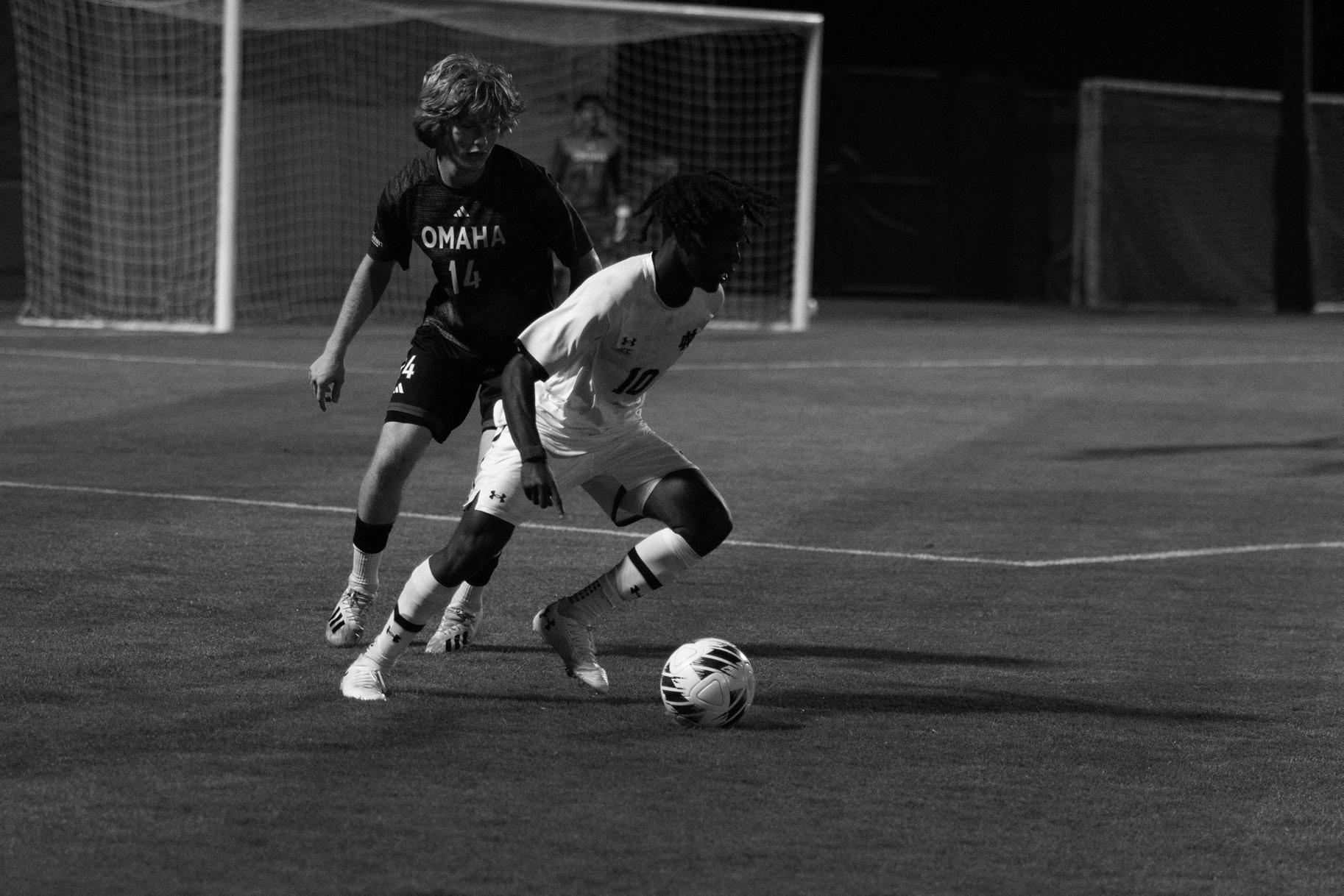
After opening conference play at 1-0, Notre Dame men’s soccer will look to add to its undefeated ACC record and defend home field as it hosts No. 12 Louisville. The Irish are entering the match with momentum building after a dominant win against Omaha a few days prior. The Louisville Cardinals have consistently proven that they are among the best teams in the nation. They hold a strong 5-1 record on the season, including an upset win over No. 1 Stanford. Furthermore, the Cardinals’ only loss came in a ranked matchup with Virginia, which was decided by one goal. Louisville has been outstanding on the defensive side of the ball, with the goal
from Virginia being the only one allowed on the season. Their 0.167 goals against average is tied for the sixth-best in the nation. On the other hand, they have been just as impressive on the offensive end, scoring 2.17 goals per game, which ties them for 21st overall. Sophomore Chase Vazquez has been the most proficient scorer for Louisville with three goals on the season. Although currently outside the top 25 in the United Soccer Coaches poll, the Irish have been making noise this season. The 11 votes they received in the previous poll were the most for any team that is not ranked. Additionally, the Irish possess a 3-1-2 record, meaning a win streak could place them in an extremely competitive position. Falling to No. 4 Indiana gave the Irish their first loss of the
season, but the team has proven they cannot be counted out against ranked teams, as they opened the season with a 1-1 tie with now-No. 8 Michigan and later defeated No. 14 Oregon State 1-0. Similar to Louisville, Notre Dame has also been one of the premier defensive teams in the nation, with only three total goals allowed. Their goals against average of 0.500 is tied for the 16th-best of any team. Moreover, sophomore goalkeeper Blake Kelly has racked up 20 saves in his six games played so far. Notre Dame has had a well-balanced offensive attack with the season’s seven goals being distributed among
five separate players. Every goal has been assisted; junior Nolan Spicer leads the team in that category with three assists. All time, the Irish lead the series 14-10-2; however, the Cardinals have gotten the best of the Irish in six of the last 10 matchups. In 2024, Notre Dame was able to overpower the Cardinals in a 2-1 victory. In the previous matchup, Spicer recorded an assist to then-senior Bryce Boneau. Then-freshman Jacob Bartlett was the other player to find the net for the Irish. Since then, both Boneau and Bartlett have gone on to play professionally in Major League Soccer.
Friday’s matchup comes at a critical time for both programs. The Irish are currently trying to climb into the top 25; a win over Louisville would almost certainly allow them to do just that. A win would also put them in a great position within the ACC and establish them as the only team without a loss or tie in conference play. On the other hand, a loss for the Cardinals would mark their secondstraight loss and could begin a downward spiral, especially with some difficult games coming up on the horizon.
Contact Harrison Brown at hbrown23@nd.edu
If you were to choose a Harry Potter house, which one would you be in?
Kaelyn Maddox senior Welsh Family Hall “Hufflepuff.”
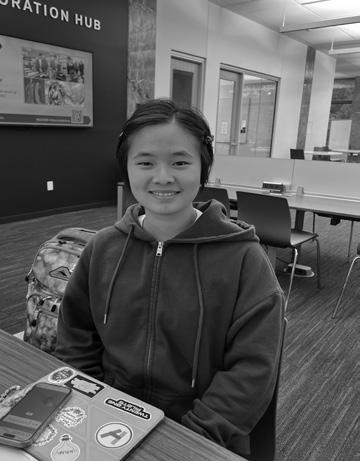
Katniss Li freshman Breen-Phillips Hall “Ravenclaw.”
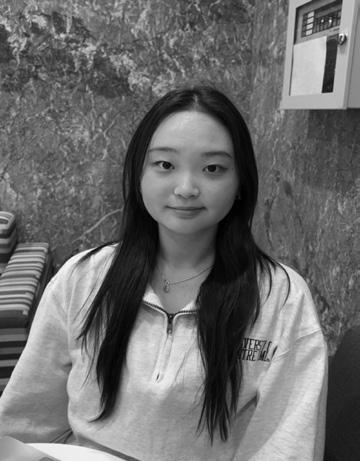
Ruby Kim sophomore Johnson Family Hall “Gryffindor.”
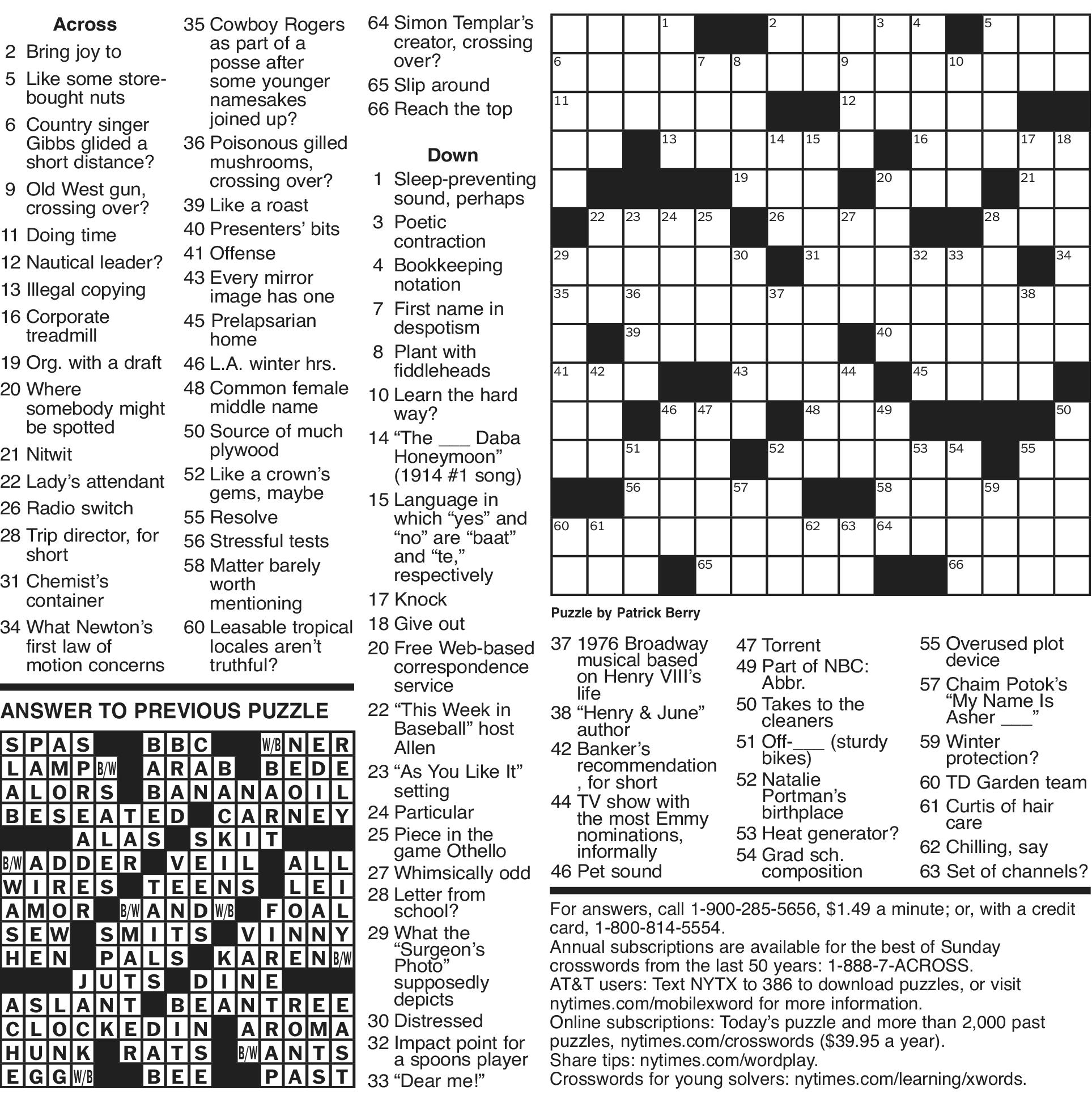
CROSSWORD | WILL SHORTZ

Nayla Hernandez senior Fischer Grad Residences “Slytherin.”
Carson Goldrick senior Coyle Hall “Ravenclaw.”
Have an idea for a poll? Email dstangel@nd.edu
How stressful has your week been?
A recent poll conducted by The Observer via Instagram received a total of 173 responses. The majority of students who responded, 42.2% with 73 votes, said that their week has been moderately stressful. Another 32.4% of students, with 56 votes, said that their week has been extremely stressful. The next group, 20.2% with 35 votes, said their week was a little stressful. The smallest group, at 5%, 9 votes, said that their week was not stressful at all.
Want your event included here? Email news@ndsmcobserver.com
Friday
‘Pragmatism Over Polarization’: Utah Gov. Cox and New Mexico Gov. Lujan Grisham speak. DeBartolo Performing Arts Center 1 p.m. - 2:30 p.m.
Saturday
Notre Dame football vs. Purdue The Fighting Irish take on the Boilermakers. Notre Dame Stadium 3:30 p.m.
Sunday
Performance: Cerus Quartet Saxophone ensemble performs classics and new works. LaBar Recital Hall 4 p.m. - 5:30 p.m.
Monday
Saint Mary’s Academic Major and Minor Fair
Students visit different tablings held by academic departments. Angela Athletic and Wellness Complex 3:30 p.m. - 4:30 p.m.
Tuesday
Notre Dame men’s soccer vs. Wright State The Fighting Irish take on the Rowdy Raiders. Alumni Stadium 7 p.m.
By Payton Dymek Sports Writer
Notre Dame volleyball is 3-3 on the season, with wins against Colorado State, Santa Clara and East Texas A&M. Although they have three losses on the season, two were tough fights, forcing fiveset matches against Villanova and Illinois.
In the win over East A&M, sophomore outside hitter Morgan Gaerte garnered 12 kills for her team, which pushed her to 115 kills on the season and a .308 attacking percentage, meaning she scores
around three points for every 10 swings she’s had on the season thus far — an extremely efficient percentage for her position. Senior outside hitter Avery Ross had a strong match with 11 kills and sophomore middle blocker Grace Langer got seven kills with two blocks.
Freshman defensive specialist and libero Maya Evens is having a strong first year with the Irish, recording 89 digs, including 10 in their game against the Lions. However, senior outside hitter Lucy Trump may have one-upped her, controlling the back row and picking up 12 digs for her team that
night. Both senior setter Harmony Sample and freshman setter Maya Baker led the team with assists, accumulating 18 and 12, respectfully. Although she’s only a freshman, Baker already has 109 assists, proving herself to be a reliable option alongside Sample. Aside from their previous game leaders, viewers should also watch for junior outside hitter Sydney Helmers, who has 37 kills and a .119 attacking percentage on the year so far; she may become a go-to player in this match.
At 8-1, Michigan has had a very successful season so far, beating big names like Wake Forest and
Cincinnati, their only loss being to Virginia in five sets. From their most recent success against Central Michigan, sophomore outside hitter Ella Demetrician led the offense with 12 kills, already adding to her 46 on season. Graduate outside hitter Allison Jacobs was close behind her with nine kills, bringing her to 140 this season and a .246 attacking percentage, showing her consistency as a Wolverine weapon. Michigan’s libero had a slow game with only four digs, which is low considering her season total of 108 . As usual, both setters for the Wolverines stacked up a total of 32
assists, adding to a pile of 295 on the season.
The Irish and the Wolverines have been competing against each other since 1999. Since then, they’ve faced off 12 times and Notre Dame has only won three of the matchups, but all have been at home. With this in mind, the Irish have the chance to keep that small success alive and defeat the Wolverine in Purcell Pavilion.
First serve is Friday, Sept. 19 at 6 p.m.
Contact Payton Dymek at pdymek01@saintmarys.edu
By Harrison Brown Sports Writer
After opening the season with a second-place finish in Grand Haven, Michigan, Notre Dame men’s golf held high hopes for the season. Recently, the Irish traveled to Oviinbyrd Golf Club in Foot’s Bay, Ontario, where they not only met but shattered expectations. During the two-day international, Notre Dame dominated, capturing first place and holding a 10-stroke lead over all other teams.
This event marked the second year of the Canadian Collegiate Invitational and the second consecutive year that the Irish team
achieved a victory in the tournament. Through three rounds, Notre Dame carded an 829. This performance placed the team 35 under par and ranked as the third-best performance in program history. The team finished with scores of -12, -13 and -10 in each of the three rounds.
Senior Calen Sanderson was the top performer, not only for the Irish but across the entire event. His performance of 19 under par secured him an individual championship at the invitational and wrote his name in the program record books. Sanderson opened the event four under par after round one; his performance only improved throughout the remainder of the event.
Through the front nine in round two, he shot a 33, sitting three under par and setting a great pace for the round. The back nine was even more phenomenal as four more birdies allowed him to finish the round carding a total of 65. Seven under par placed Sanderson in elite, tying the program record for lowest score in a round. Despite this impressive performance, simply tying the record was not the end for Sanderson. Round three saw the senior finish at eight under par and cement himself as the sole holder of the record. Ultimately, he finished the event with a total score of 197, securing another record as the first member of the Irish to score below 200 in a
three-round event.
In addition to Sanderson, the tournament saw great performances from multiple Irish golfers. Scores of three under and five under in rounds one and two, respectively, helped junior Jacob Modleski end the event tied for fifth place overall.
Pavel Tsar, a freshman for the Irish, showcased his potential with two eagles throughout the invitational, including one on the last hole of the third round. Overall, he finished three under par and 13th on the individual leaderboards.
Strong production in rounds one and two would be the catalyst that propelled junior Christopher Bagnall to cap off the event tied
for 15th. Meanwhile, shooting five under in round one would be instrumental in senior Nate Stevens claiming tying for the 18th spot. Finally, junior Rocco Salvitti would shoot 11 birdies en route to a tie for 32nd place.
The Irish will have a short rest before their next competition in Lake Forrest, Illinois, from Sept. 29-30, and will host the annual Fighting Irish Classic Oct. 6-7. With the hot start to the season, head coach John Handrigan’s team has hopes not only for the rest of their season but also for a potential postseason run.
Contact Harrison Brown at hbrown23@nd.edu
By Andy Caron Sports Writer
When Notre Dame released its official 2025 football schedule just 11 days after falling to Ohio State in the national championship game, most Irish fans knew how difficult their first two games would be. By that time, former Georgia quarterback Carson Beck had already announced his transfer to Mario Cristobal and his crew in Miami. Additionally, Texas A&M quarterback Marcel Reed had proved himself to be as dynamic as advertised in the 2024 season when he took over for injured Aggies quarterback Connor Weigman. However, I don’t think many Irish fans believed they would find themselves sitting with zero wins heading into week four. What may have surprised Irish fans even more is that quarterback Steve Angeli would not be wearing navy blue and gold for the 2025 season. Leading up to the Blue-Gold game, the New Jersey native looked to be in prime position to take the starting quarterback job for the upcoming
season. He had waited his turn and proved himself at the same time across his two years playing for the Irish. As a redshirt freshman, he threw for 232 yards and three touchdowns, leading an Irish win against Oregon State in the Tony the Tiger Sun Bowl. Following former Duke quarterback Riley Leonard’s decision to transfer to Notre Dame, Angeli opted to stay with the Irish. Despite taking a backseat to Leonard last year, Angeli was productive and efficient with his opportunities. In an away win against Purdue, he threw for 100 yards and two touchdowns. More importantly, he led a monumental drive in the College Football Playoff (CFP) Semifinal against Penn State. With 1:34 left in the first half and the Irish down 10-0, Leonard suffered a significant blow to the head which sent him into concussion protocol. Angeli stepped up and led the Irish down the field. He completed 6-of-7 passes throwing for 44 yards and setting up the Irish for a field goal attempt. Former Notre Dame kicker Mitch Jeter drained a 41-yard
field goal to put the Irish on the board. This single drive put a lot of confidence in Irish fans that he would be the starter come Labor Day weekend in Coral Gables.
The Blue-Gold game saw a trio of Irish quarterbacks displaying their talents. Current sophomore Kenny Minchey showed off his athleticism, throwing for 106 yards and rushing for a touchdown. Current redshirt freshman CJ Carr was highly efficient, throwing for 170 yards on 14of-19 passing attempts. Angeli played admirably, throwing for 108 yards on 8-of-11 passing attempts with one touchdown.
After the scrimmage, Irish head coach Marcus Freeman commented, “you got three guys that all can lead your program to a victory … and be your starting quarterback.”
The strong performances from the two underclassmen ultimately led to Angeli’s decision to move schools. Just 11 days after the Blue-Gold game, Angeli announced his transfer and commitment to ACC foe Syracuse. He had waited his turn but knew it would be
a competitive 3-man battle for the starting spot.
Five months later, Angeli is thriving under the guidance of Syracuse offensive coordinator Jeff Nixon, who worked sideby-side with former Syracuse quarterback Kyle McCord in a 2024 season that saw McCord lead all of college football with 4,779 passing yards. A similar trend is arising with Angeli. The pass-heavy attack that Nixon has engineered has helped Angeli find early success in upstate New York. The Notre Dame transfer currently leads all of college football in passing yards through the third week of the season with 1,072 yards.
Across three games, Angeli has recorded eight passing touchdowns. In addition, Angeli helped lead a comeback win against UConn in week two. Down by 11 with less than 10 minutes remaining, Angeli helped lead three separate touchdown drives in the fourth quarter and overtime for the Orange to escape with their first win. He has led the Orange to a 2-1 record with the loss being to No. 15
Tennessee. I think Irish fans and Angeli himself knew this breakout was imminent, but he just needed a bigger opportunity. He has gotten that bigger opportunity at Syracuse and delivered thus far.
As Notre Dame sits at 0-2 and looks at a favorable final 10 games, a few stand out. The Irish hope to find a win against an SEC team this year when they visit Fayetteville to play Arkansas. In addition, one of the best rivalries in college football will occur when USC visits South Bend in October. Finally, a particular ACC opponent will visit Notre Dame for the Irish’s final regular season home game of the year — Syracuse. Angeli will travel down to his old home to face off against the Irish in what will be Senior Day for Notre Dame graduates. Will Notre Dame be 8-2 and vying for a spot in the College Football Playoff? Will Angeli have the chance to play spoiler against his old team? Only time will tell.
Contact Andy Caron at acaron2@nd.edu
By Ben Hicks Associate Sports Editor
Starting under Brian Kelly and continuing through the Marcus Freeman era, Notre Dame football has developed a knack for producing NFLlevel, pass-catching tight ends. From Kyle Rudolph and Tyler Eifert, to Cole Kmet and Tommy Tremble, and most recently Michael Mayer and Mitchell Evans, the Irish have featured the tight end position in offensive schemes more prominently than just about any other program in college football. Despite numerous setbacks and injuries early in his time in South Bend, it appears that Eli Raridon is next in line for
Notre Dame tight end glory. Raridon, a senior from Des Moines, Iowa, is the son of Monogram winner Scott Raridon, who played on the offensive line in the early 2000s. As the secondranked tight end in the national recruiting class of 2022, Raridon had his choice of where to take his talents. Every so-called “Tight End U” wanted him, from the local Iowa Hawkeyes to the SEC’s Auburn Tigers. But despite the competition at position, with both the aforementioned Mayer and Evans, as well as Kevin Bauman ahead of him, Raridon chose to trace his father’s footsteps to the Golden Dome.
Raridon is no stranger to
adversity. As a freshman in Freeman’s first year, Raridon made his collegiate debut in the stunning home defeat to Marshall. He would appear in just five games that season before suffering an ACL tear. Following a long, difficult recovery, he would play just seven games in his sophomore season, collecting five receptions, 51 yards and a touchdown along the way.
Even as a key contributor on last season’s run to the national championship, Raridon was rarely featured as a primary option in the passing game. He appeared in all 16 games for the Irish, and was the starter in the opening round College Football Playoff clash
with Indiana, but he didn’t even top 100 yards receiving for the season. So how did he turn into freshman quarterback CJ Carr’s favorite target?
It’s no secret that Eli Raridon has grinded to get to where he is today as a player. He’s also learned from some of the great tight ends in Notre Dame history. That combination of work ethic and situational intelligence has forced the coaching staff to instill substantial trust in the Iowan. “I feel very grateful that [the offensive staff] thinks highly of me. It’s been a dream come true [to play here],” Raridon said.
Young quarterbacks need steady, sure-handed

targets to rely on early in their careers. That need is exacerbated when playing highly skilled and physical defenses in career starts number one and two. Although Raridon has surely been a calming influence for the young Carr throughout the ups and downs of the Miami and Texas A&M losses, it is the senior heaping praise on the freshman. “CJ is an awesome QB. It’s so impressive to see him, as young as he is, lead our offense. I think very highly of him,” Raridon said.
He continued by highlighting both Carr’s preparation and poise, adding, “He’s super competitive, encouraging and vocal. That’s everything you want out of a quarterback. Again, as young as he is, it’s super cool to see how confident he is.” The chemistry between Raridon and Carr has extended beyond soundbites thus far in the young season, with the tight end being Notre Dame’s leading receiver in both weeks one and two.
In the opener against the Hurricanes, he hauled in five receptions for 97 yards and a touchdown. His fourth quarter catch and run of 65 yards set up the Irish for the game-tying score late in the fourth. Two weeks later, he added 85 yards, as well as another explosive 43-yard gain to set up six.
Despite his individual success, Raridon is trying to put the first two weeks behind him and help the team move ahead from its 0-2 start. “That’s in the past now. We gotta come together and love each other and work even harder. Our mentality is to put [Texas A&M] aside and stick together,” Raridon said. “All of us know we can get better each and every day,” he continued.
Raridon has been through this staggering disappointment in each of hi s first three seasons at Notre Dame. He has learned how to respond, both individually and as a unit, and he knows this time is no different. “We can’t dwell on it, but we can keep the pain. Like coach Freeman said last year with Northern Illinois, it’s okay to keep the pain and use it as fuel for these upcoming games.” Just as Eli Raridon kept the pain of early-career injury and remained patient to carve out his role at Notre Dame, the Irish will have to keep the pain of early-season setback and remain patient to reach their goals in the college football landscape.