Students create magazine to publicize economic and human rights concerns in apparel industry
By ANDREA VALE news writer
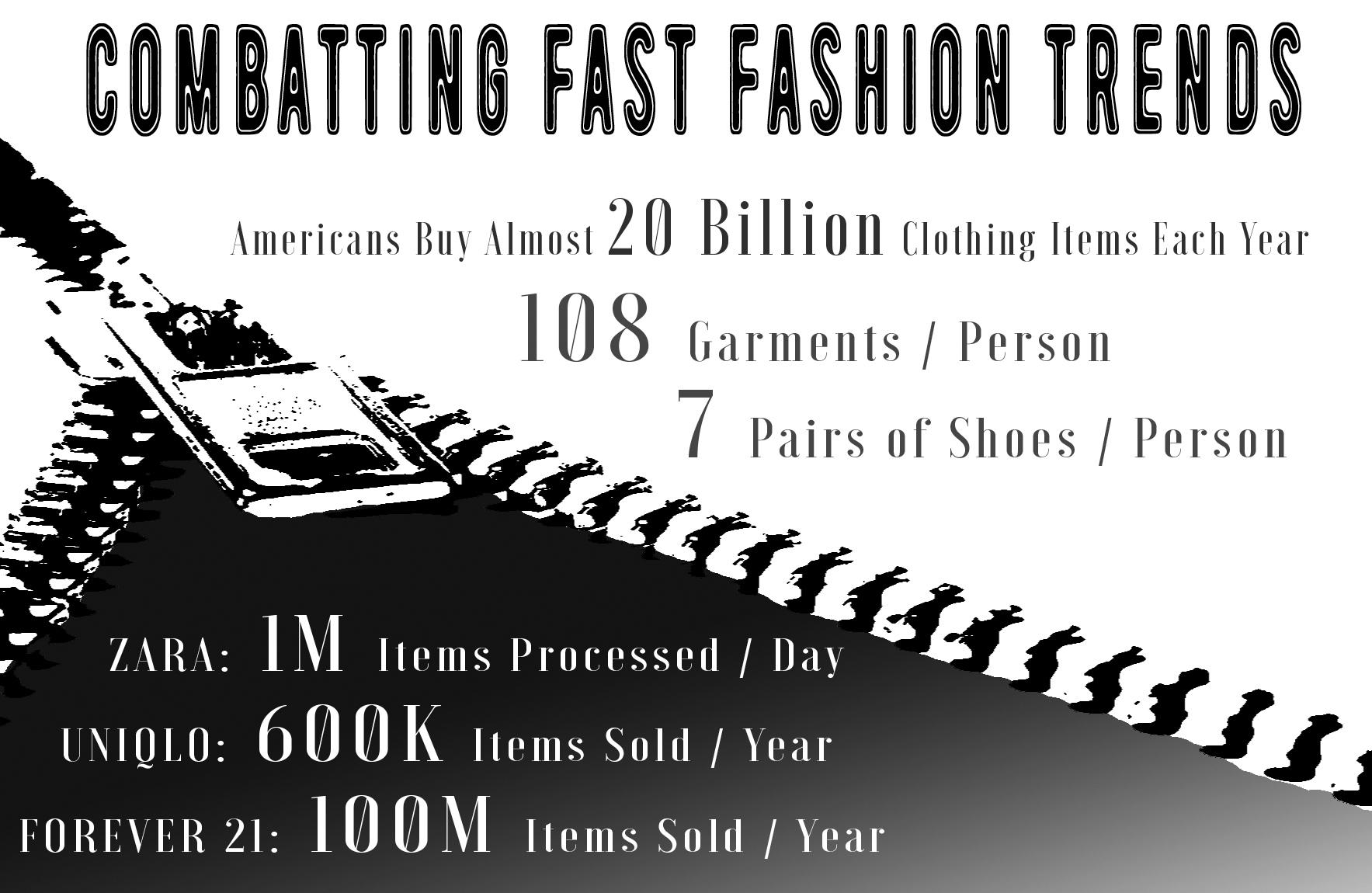
several notre dame students have come together to produce a magazine as part of a social awareness campaign combatting the fast fashion trend of buying and throwing away clothing items made in sweatshops. The magazine will promote slow fashion, fair trade, made-ina merica brands and thrift store shopping.
according to marie bourgeois, a research associate with the visual communications design ( vcd) program, the social awareness campaign is a larger project under which students create their own campaigns based on societal issues they see.
“The visual communication
design 8: design for social good class was started by professor robert sedlack, who brought a model of social design to notre dame’s vcd program,”
bourgeois said in an email.
“Throughout his seventeen years teaching at notre dame, he would have students create social awareness campaigns focusing on contemporary issues in society. i have been a guest critic on these projects for years throughout my graduate school career at notre dame, and after graduation.
“last fall, i had the joy of being able to co-teach with robert for the design for social good course, which brought me closer than ever to the brilliant projects
smc performs ‘glass menagerie’
By MARTA BROWN news writer
The saint mary’s college department of communication studies, dance and theatre is sponsoring the performance of the Tennessee williams play
“The glass menagerie” Thursday through sunday in the little Theatre of the moreau center. associate professor of theatre Katie sullivan, who will direct the play, said the story tells of a family trying to survive despite the great depression, and focuses each family member’s
Professor analyzes O’Connor
By CATHERINE OWERS a ssociate news e ditor
southern, catholic and bird lover are some of the words used most frequently to describe author flannery o’connor, the subject of a lecture delivered Tuesday afternoon by angela a laimo o’donnell, professor at fordham university and associate director of the curran center for american catholic studies.
house and the chicken yard: The life and legacy of mary flannery o’connor.” o’connor was born in savannah, and her family moved to andalusia, a rural georgia farm, a laimo o’donnell said, where the author took a great delight in raising chickens.
o’donnell touched on these three facets of o’connor’s life in her talk, entitled “between the
“o’connor’s first brush with fame occurred courtesy of her bird collection — when a pathé newsman caught word of a georgia girl who taught a bird to walk backwards, he made his way south and filmed mary
flannery and her trick chicken,” she said. “she had a hunger for fame after this, and from that day forward she began to collect chickens, though of course her fame would come from other things.”
The author received an mfa from the prestigious iowa writers’ workshop and moved to new york, actively participating in literary and intellectual circles, she said. however, o’connor was forced to return
see o’connor PaGe 5 see magaZine PaGe 3
LAUREN WELDON | The Observer
different reactions to their circumstances. a manda wingfield adheres to her southern ways to procure expectations for her two children after she is abandoned by her husband. Tom, the older son, itches to move out and follow his dreams as a writer, and laura, the younger daughter creates her own world with her collection of glass menagerie.
sullivan said she has always loved williams’ plays.
“[‘The glass menagerie’ is] a beautiful play with haunting and
l ecture explores binaries
By MEGAN VALLEY news writer
The lecture began with a brief overview of the two major reform movements: the deobandis and the barelvis. Tareen said both are sunni groups in india and that, being so similar, it made the polemics “bitter and more caustic because they were so personal.” he elaborated on the groups and explained how the two are usually assigned to a
binary with the stereotypically more law-focused deobandis on one end and the stereotypically more peaceful and mystical barelvis on the other.
Kroc institute luce visiting professor of religion, conflict and peacebuilding shera li Tareen delivered a lecture titled “beyond good muslim/ bad muslim: debating the boundaries of innovation in islam” on Tuesday afternoon at the hesburgh center for international studies. Tareen focused on polemics over the ethical question of “bid’a,” or heretical innovation, among two major modern muslim reform movements in south asia: the deobandis and barelvis.
see islam PaGe 5
“This kind of binary is intimately intertwined with the larger discourse of, which today is a very insidious and well-funded discourse, of what we might call the good muslim-bad muslim discourse,” he said. “goodness is often measured by what is most see play PaGe 5
LAUREN WELDON | The Observer
Scene
(574) 631-4540 scene@ndsmcobserver.com
(574) 631-8767 photo@ndsmcobserver.com
(574) 631-8839 Policies
Question of the Day:
Colleen Maus
junior le mans hall
“100 percent into it.”
Hannah Anderson
junior le mans hall
“i love it, but don’t over play it.”
junior
Mackenzie Griffin
sophomore holy cross hall
“i personally start listening to it in october.”
Leann Tulisiak
sophomore holy cross hall
“it’s an abomination. more than a month before c hristmas is unaceptable.”
Meghan McAleer
junior holy cross hall
“not necesary. l et Thanksgiving happen.”
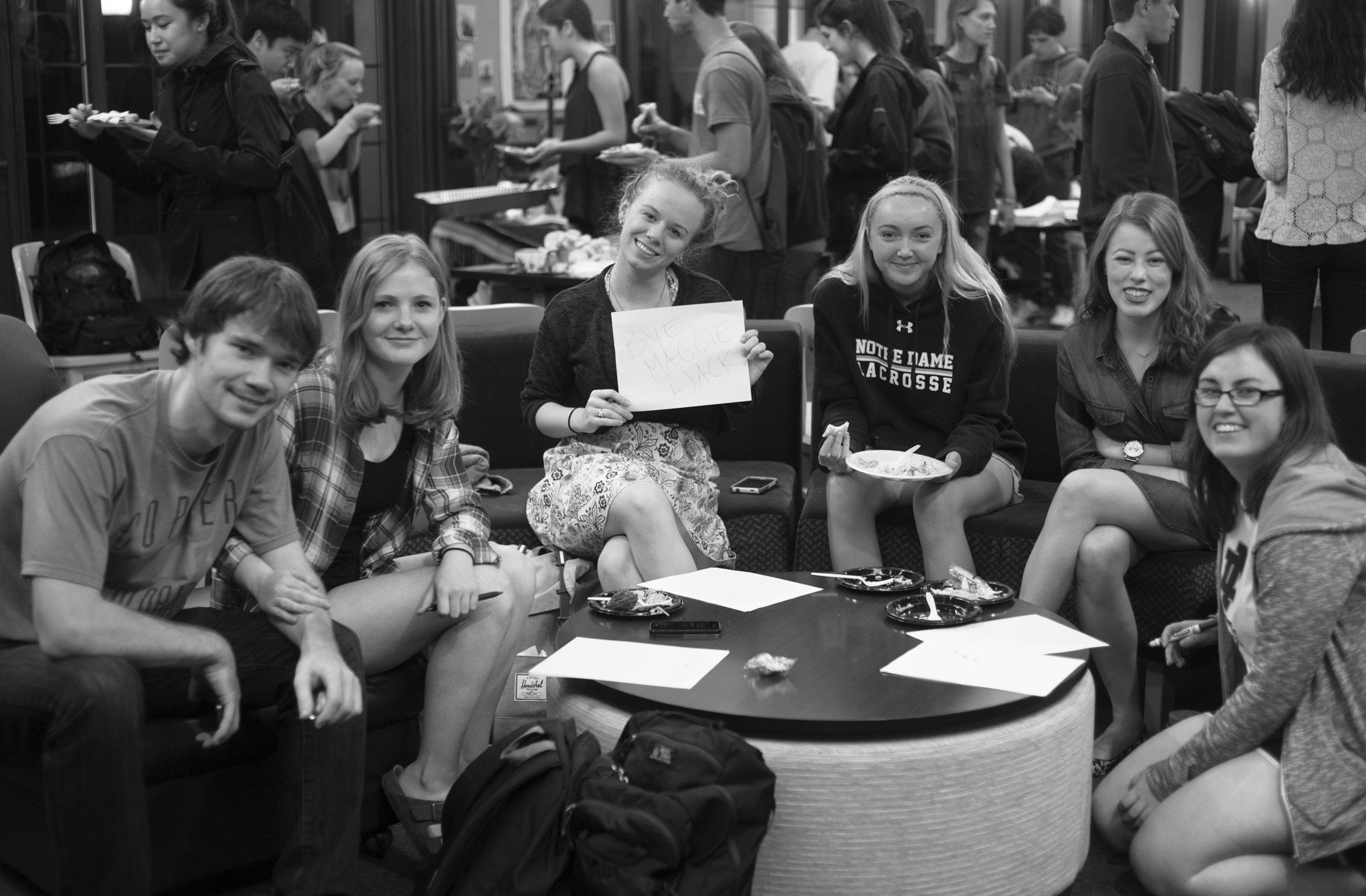
Students participate in a Junior Class Council-sponsored celebration of study abroad programs Tuesday night. The event featured a variety of multicultural foods and gave students an opportunity to write letters to friends currently studying abroad.
Today’s Staff
News
J
Corrections
The observer regards itself as a professional publication and strives for the highest standards of journalism at all times. we do, however, recognize that we will make mistakes. i f we have made a mistake, please contact us at (574) 631-4541 so we can correct our error.
7:30 p.m.-8:30 p.m.
Acclaimed fairy tale author Kate Bernheimer will read.
Student Micro Retreat LaFortune Student Center
7:30 p.m.-8:15 p.m. New micro retreat series.
Thursday
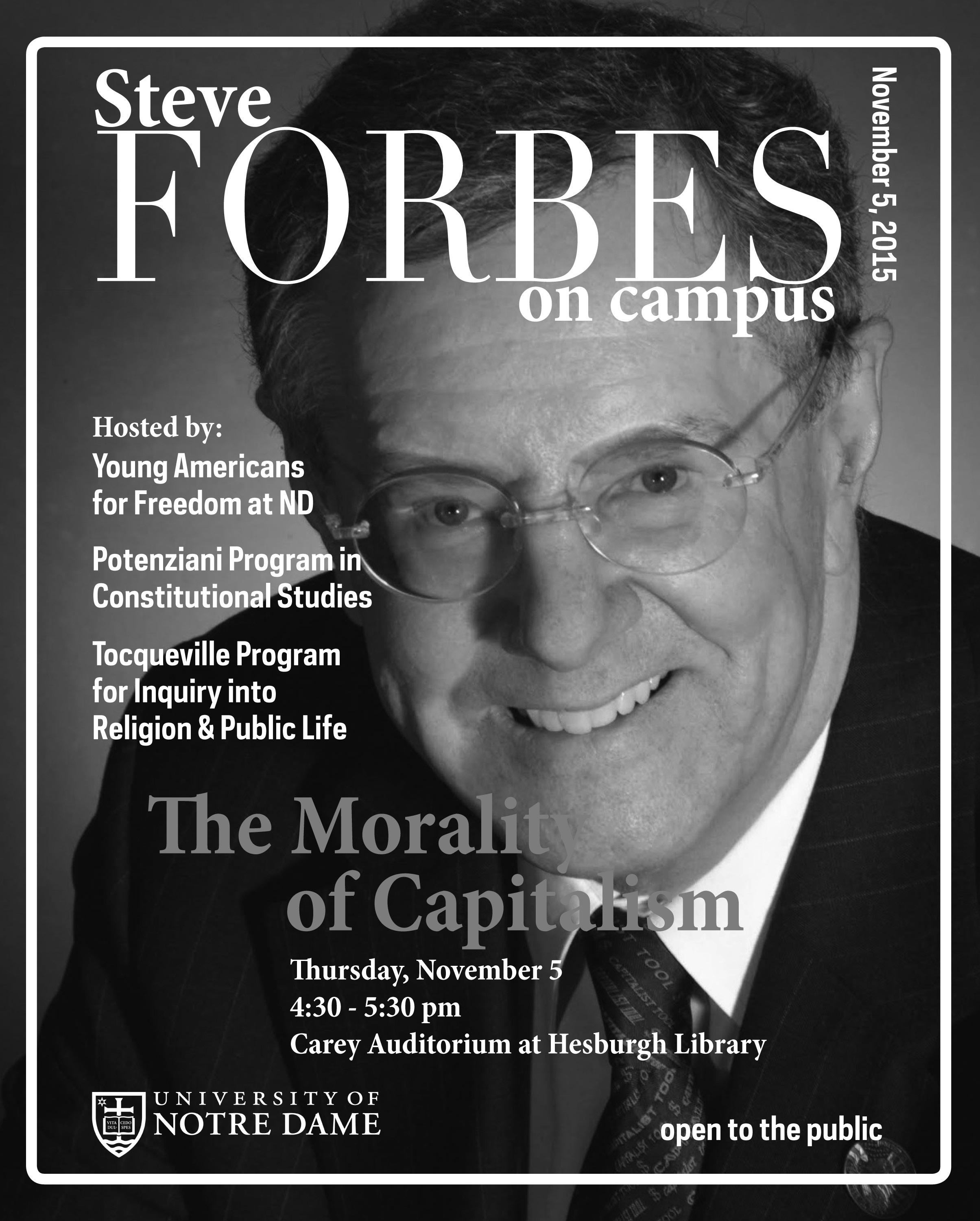
“The Morality of Capitalism” Hesburgh Library
4:30 p.m.-5:30 p.m.
Steve Forbes delivers a lecture.
Men’s Basketball vs. Caldwell Joyce Center
7 p.m.-9 p.m.
The Irish take on the Cougars.
Friday
Silent Retreat Moreau Seminary 5:30 p.m.
Retreat focused on silent prayer and reflection.
Volleyball vs. Virginia Tech
Joyce Center
7 p.m.-9 p.m.
Notre Dame squares off with the Hokies.
Saturday
Hockey vs. Minnesota
Compton Family Ice Arena
6:35 p.m.
The Gophers challenge the Irish.
“Pericles” Washington Hall
4 p.m.-6 p.m.
Production by the NotSo-Royal Shakespeare company.
Sunday
Volleyball vs. Pittsburgh Purcell Pavillion
1 p.m.
The Irish take on the Panthers.
Gesualdo Quartet
Joyce Center
7 p.m.-9 p.m.
Beethoven, performed by Notre Dame’s Quartet-In-Residence.
CAROLINE GENCO | The Observer
he had conceived and perfected. robert and i agreed last spring, before his passing, that we would teach this class together again this fall, so i have decided to keep as true to his structure for the course as possible with this semester’s class.”
“Typically, students gear their campaign toward the university community,” bourgeois said, “such campaigns have received a great deal of attention from notre dame students, faculty and staff over the years, as our design students tend to come up with creative, striking interventions that disrupt daily life on campus and cause viewers to think deeper on an issue that may not be top-of-mind.”
Juniors a my ackermann and mary Kate healey have combined forces to create a magazine to combat ‘fast
fashion,’ a trend that, according to bourgeois, has been steadily rising over the past two decades
(Editors Note: Ackermann is a photographer for The Observer).
fast fashion is “the shift within the fashion industry toward cheaper, more rapid production of items,” she said.
many of the most popular clothing companies among young adults have participated in fast fashion behavior in order to be able to offer high-fashion products at slashed prices through quick turn-around.
“one major outcome of this market trend toward fast fashion is that a style’s season is greatly shortened — what used to be six months or longer is now measured in weeks,” bourgeois said, “This is results in huge profits for companies as they are able to sell at higher volumes, encouraging consumers to buy cheaper clothing more frequently, contributing to a sense that clothing is somewhat
disposable.”
bourgeois said the fast fashion model exploits vulnerable populations in an effort to drive down the cost of goods and contributes to environmental concerns.
“w hen clothing is viewed as disposable, that is exactly what happens to it. many of these cheap garments are ending up in landfills where their synthetic fibers are releasing toxins into the atmosphere,” she said. “every step of a garment’s production, from dying to sewing, to packaging, can create harmful pollutants if the environment is not a top focus throughout the making process. The cheaper the production, the less the environment is considered.”
according to bourgeois, as found in e lizabeth l cline’s book “o verdressed:
The shockingly high cost of cheap fashion,” between 1996 and 2011, more than 500,000 a merican garment industry
paid a dverT isemen T
jobs were lost due to apparel production being outsourced to outside of the united states. finally, only 20 percent of donated clothes are sold in charity thrift shops. a round 50 percent is turned into fibers or wiping rags, and the rest is shipped overseas and used as clothing
“in high school, i spent a week helping out at a thrift store in northern m innesota,” sophomore emily schoenbauer said, “w hat i learned there was shocking. in the back room, there was a mountain of clothing ...
“i realized that all of those racks of clothing in department stores that i usually sifted though mindlessly were going to end up in someone’s closet, be worn a dozen times, go out of style, and then be brought where? places like this where they have more than they know what to do with? in the garbage? no matter where it ended up, i now know that there is an
unsustainable amount being produced. something has to be done.”
schoenbauer is serving as a model for the project.
“it simply involves having a super fun photo shoot with a my [ackermann] while wearing some of my favorite clothing items that i have bought sustainably, like a dress from a thrift store, a sweater from a garage sale, and even a couple blouses that i may or may not have permanently borrowed from my mom,” schoenbauer said.
ackermann and healey have prepared for the magazine’s production by researching fast fashion statistics and information, interviewing fellow students about their buying habits and collecting stories about ethically produced clothing items.
“Their hope for the project is to encourage our generation to start buying clothing more sustainably,” schoenbauer said, “The way the fashion world works right now requires that people who want to stay up-todate should be buying basically a new wardrobe every couple years. Think about the racks upon racks of clothing that are in every forever 21 or h & m around the country. That is not all being purchased, but they will overproduce their cheap merchandise to ensure that they make as much profit as possible.
“we have created a neverending cycle of waste through something that seems harmless, wanting to look your best. That is why … we have to begin shifting our mentality. w hile it is fun to buy the low quality, merely-for-dollars shirt from the department store, we can find even cheaper, more unique options at second-hand stores, which are everywhere.”
schoenbauer said students should know that the magazine is not calling for radical lifestyle changes.
“i still shop at the mall ... i would just like to ask people to start making small changes,” she said. “next time you’re going shopping just for fun, decide to peruse through g oodwill. if there are local garage sales happening, stop by. i guarantee that you will find something cheap and incredibly special to you.”
bourgeois said these campaigns serve to promote deeper thinking on issues surrounding our everyday life.
“w ith this particular campaign, the hope is that my students will bring more meaning and understanding to something so ubiquitous as clothing,” she said. “The reality of that garment, however, goes back to the crop that was harvested to create the fibers for the material.
w ith heightened awareness around something we as consumers encounter daily, we can begin to make choices that push the industry toward a more desirable and thoughtful means of production.”
permanently to andalusia, after she was diagnosed with lupus, an autoimmune disease.
“o’connor would endure this exile gracefully and with good humor until her death,” she said. “flannery no longer belonged to georgia, to the small-town world of milledgeville, and her mother’s friends. her childhood sense of herself as a freak returned, a preoccupying idea that appears in the stories she wrote. … o’connor’s stories often feature characters who clearly do not belong, sometimes by virtue of some physical affliction or deformity, or by virtue of a radically different way of seeing the world from those around her.”
o’connor’s fiction became her lifeline, and she drew inspiration from the people and events in her southern community, alaimo o’donnell said.
“she wrote every morning – two hours was all she could manage, despite the painful and debilitating effects of both the disease and the medication prescribed to remedy it,” she said. “against all odds, o’connor would produce two novels, 32 short stories, and many essays, reviews and commentaries and hundreds of letters.”
o’connor may not occur to many readers as a christian writer, she said, for she does not appear to
write from a particular religious viewpoint. however, although o’connor’s characters are rarely catholic, they require an experience of grace.
“o’connor’s characters, like the freak chickens she raised as a child, are grotesques of every imaginable kind. They include mass murderers, social misfits, religious zealots, moral cretins, fake bible salesmen, one-legged women with ph.d.s,” she said. “The one thing that binds all of o’connor’s characters together is the fact that they are all in need of conversion or radical change.”
implicit in her creation of characters in need of conversion, her use of violence as a means of grace and her mingling of the comic and tragic, is a deeply religious vision, she said.
“flannery sees the possibility of redemption available to humanity in all places, at all times and through the most unexpected of means,” she said.
while o’connor saw her life as utterly ordinary, alaimo o’donnell said o’connor was an author who integrated her faith and art so thoroughly that they became one practice.
“her own art becomes sign and symbol of the creative force that generates and governs the world, and so her own writing becomes, both in practice and in fact, a form of sacrament,” she said.
Contact Catherine Owers at cowers@nd.edu
Play
lyrical music, and i think it’s timeless,” sullivan said. “it’s redone on broadway so often. i’ve loved his [ william’s] plays since i was thirteen.”
sullivan said the events and scenarios in the play are somewhat parallel to Tennessee williams’ personal life. as Tom narrates the play as an older version of himself, williams is reflecting on his own perspective of leaving his family to become a writer.
“it’s like all of you guys, you’re here in college to learn and choose what you want to do,” sullivan said. “you’re ready to go out into the world. ”
sullivan said the title, like many aspects of williams’ work, is a metaphor.
“Tennessee william writes poetically — he was a poet before a dramatist,” she said. “he writes with lyrical language, using metaphors. a nd laura and the unicorn [in the play] are symbolic of each other.
“The unicorn is a beautiful mystic animal — it’s different than everyone else, than the
other horses — it has the horn. a nd she’s different than others.” notre dame senior stephen seitz said he plays the role of Jim o’connor, the gentleman caller of shy laura.
“i find it very easy to relate to Jim o’connor,” seitz said.“he’s an ambitious, happy-go-lucky fellow who is always quick with a joke and a smile. Jim introduces some much-appreciated comedy and romance to an otherwise depressing story,” seitz said.
Contact Marta Brown at mbrown04@saintmarys.edu
proximate to a modern western interpretation of what is a legitimate religion and, frankly, what is most conducive to a merican foreign policy at that moment in time.”
Tareen said innovation in islam refers to changes within islam itself.
“‘bid’a,’ or heretical innovation, is the inverse of what is known as the normative model of the prophet, or sunna,” he said. “‘bid’a’ consists of new, unsanctioned practices.”
To explain the differences in the deobandi and barelvi
paid a dverT isemen T
definitions of “bid’a,” Tareen used the definitions as defined by two hanafi muslim jurists and sufi masters who were involved in the founding of both groups.
Quoting ashraf ‘a li Thanvi, one of the founders of the deoband madrasa, Tareen said, “bid’a” is an innovated practice in religion that simulates the “sharia” in the intensity and discipline in which it is undertaken.
“in other words, such conventions were kept alive and perpetuated by the invisible pressure to societal expectations and norms, rather than to divine law and divine will,” Tareen said. he added something can be considered heretical when
it’s treated as being obligatory without a historical context to back it up.
ultimately, Tareen said that by trying to compare the two groups within the context of a binary was harmful and fails to fully explain the traditions of each.
“rather than approaching debates on normative practice through the lens of a law-sufism binary, or other binaries like good muslim-bad muslim, liberal-conservative and so forth, it might be more productive to look at the internal logics within the tradition,” he said.
Contact Megan Valley at meganvalley@nd.edu
Save the trays
Kelly McGarry s cene writer
we’re given two arguments for going trayless: reduction of food waste and waster usage. The placards in the dining hall state that going trayless saves 70 gallons of water per day. we’ll take that as true. The flow rate of an efficient showerhead is approximately two gallons per minute, so for a 10 minute shower you’re already at 20 gallons. now we have the perspective that taking away everyone’s trays is equivalent in water usage to three or four people skipping their daily shower, an inconsequential amount.
The claim was made that taking away dining hall trays reduces food waste by 32 percent, but it has no logical basis. This phenomenon is more a social/psychological experiment than a practical cause. i don’t doubt that seeing a big empty tray may compel some people to fill it with more food, but there’s no practical reason to do so. we need to consider the tray dilemma more critically. is the inconvenience of going trayless worth the benefits? is abandonment of the tray necessary to achieve these benefits?
a la national Tray a ssociation, i’ll boldly make the claim that trays don’t waste food, people waste food. every person has complete control of what goes on their tray. The banning of trays is an insult to the ability of students to take responsibility for their food waste. in the reverse, food waste is equally possible without the use of trays, so banning isn’t even an effective method of control. mindfulness is more effective as tray control, and there are other campus-wide methods that have greater potential and less negative impact. one interesting idea is serving food by the serving size to make people less likely to take too much, and if they need more they can always go back for seconds. This is the kind of food waste prevention i’d be excited to participate in. i mentioned the water usage of showering, but no one is proposing restricting showers. That’s because it’d be a huge and infringing inconvenience. The tray case isn’t as extreme, but we need to analyze it in the same way. consider the price of the meal plan and the ways we already waste much of that cost when we can’t make it to the strict meal times. most of us end up wasting meals at the end of the week, so the meals we do use should be quality.
i have breakfast in the dining hall often, and it’s notoriously a small-bowl affair: a small bowl for grapefruit, one for potatoes, maybe some oatmeal, a bagel, etc. That’s not to mention beverages — hydrate with water, coffee for the caffeine fix and a nice glass of orange juice. at north dining hall, the front tray return is never in service so all those dishes need to be carried to the back. The other thing about breakfast — you have to make it to your morning classes so you don’t have time to go back and forth to your seat multiple times. students here do not have time to deal with trayless meals.
if you’re not confident in your ability to refrain from wasting food with all that space on your tray, or you simply don’t require a tray for a particular meal, then go trayless. i care about the environment as much as anyone, but the traybanning argument is simply not logical.
Down ‘Rape Road’
Courtney Phelan e nglish major in the real world
There is one reason to attend saint mary’s: to meet and marry a man from notre dame.
no one would ever choose to attend saint mary’s based on how comparatively easy we make it to study abroad, our programs like nursing or education that aren’t offered at notre dame, the fact that some people prefer smaller classes and a calmer campus or even — gasp! — the prospect of attending a women’s college.
no, saint mary’s women live forever in the shadow of the dome. even if we are unable to find a man and get our “ring by spring,” saint mary’s women are often considered little more than sexual playthings for the men of notre dame.
as shocking and uncomfortable as that statement is to make, it’s true. some of the clearest examples of this come from the language used to describe saint mary’s, our women and our campus. as any good english major knows, everyday language is a powerful force that can shape the way think about things.
Take, for instance, the nickname of the #17 bus that runs from hesburgh library, past eddy street to the grotto, to regina hall at saint mary’s, then works its way along douglas back to “club hes.” or the #7a, which runs essentially the same route but with stops at university edge and corby boulevard. colloquially, both go by the name “The sluttle.” get it? like a shuttle full of sluts?
simply because these buses stop at saint mary’s, they are re-christened to imply moral looseness. The assumption made is that any woman on the bus is going to notre dame to drink and have sex. never mind that we smicks (a self-christened nickname for saint mary’s women, coming from “smc chicks”) sometimes go to notre dame for things other than partying, like classes or starbucks. be sure not to consider, too, that men and women from notre dame would take the #17 or #7a from notre dame to saint mary’s. “The sluttle” serves one purpose and one purpose only: to bring sluts from saint mary’s to notre dame. of course, many saint mary’s women use the term as well. most of the time, it’s regarded as a just a joke. but “The sluttle” is anything but funny. by calling the bus between campuses “The sluttle,” the idea that all saint mary’s women are sluts is subconsciously yet firmly established. by establishing us as sluts and whores, an expectation of sex is set. a ll saint mary’s
letter to the edItor
women are sluts who will have sex with you. even if they say no or try to fight you off, their ride on “The sluttle” to come party with you is evidence that they want sex. There are other examples of this subtle linguistic sexism between campuses, like the concept of ring by spring, or that every saint mary’s woman aspires to be engaged (to a notre dame man, of course) by graduation. The term “smitches”— a combination of “smick chicks” and “bitches” — is also vernacular. The freshman dorm, mccandless, is called “mcscandlous.” The most damning evidence of this trend is the nickname for saint mary’s road, the private road between campuses: rape road. saint mary’s road is rarely referred to by its real name, perhaps because of some confusion between it and the main road onto campus, The avenue. There are a million possible epithets better than this one. but the metaphorically-perfect rape road persists.
The normalization of rape and sexual assault is referred to as rape culture in feminist thought. most commonly, rape culture is defined as a culture which, through general opinions about sexuality and gender, accepts and excuses sexual assault as an inevitable part of life, and therefore promotes it. w hen someone says rape road, they imply that rape happens between campuses. a nd when they say it all the time, they imply it’s just something that happens. rape between our campuses is not startling or appalling, but simply expected.
i’m sure someone reading this would love to challenge the idea of rape culture. To you, o noble protector of men’s rights, i say this: go spend some time at a women’s college where 1 in 4 women are the victims of sexual violence and you have to walk down rape road to get a decent latte, and then we’ll talk.
The vocabulary used to talk about saint mary’s establishes us as gold diggers, bitches and (primarily) sluts or whores. Terms like “The sluttle,” “rape road,” “holy cross hoes,” “mcskanks” and even “smitches” have no business at a reputable catholic university like notre dame, and especially not from the mouths of our own saint mary’s women. describing an entire college full of women like this is dangerous.
a nd it’s leading us all straight down rape road.
Courtney Phelan is a junior English major living in Le Mans Hall. She can be contacted at cphela01@saintmarys.edu
The views expressed in this column are those of the author and not necessarily those of The Observer.
greend : good to be tray-free
This past Thursday, greend held Tray inconvenient day in conjunction with the Junior class council and notre dame food services. a day we have been planning for some time, it accomplished exactly what it was set to do. we challenged and upset the norm by generating talk around trays. we’ve only just begun on this endeavor and there are still kinks, but we’re excited to see this initiative come to fruition in the coming years.
The mission behind every greend action has always been simple. we are immensely fortunate to inhabit this planet and therefore support treating this blessing as an enormous gift, not a right. This ethic extends across all creatures, social disciplines and campaigns.
The tray free campaign is twofold. we have an ethical duty to cut waste, as less wasted food in our dining halls equates to more food that can go to hungry mouths in our local community, and an ethical duty to conserve water, as less trays means less water is used washing them. hence, Tray inconvenient day was born so people could experience going tray-free just for one day. it was a risk-free environment: try it if you like, but the trays were tucked just around the corner if you didn’t want to participate. it was low pressure, as all the trays would be back to their rightful place the next day. The goal, which is very far down the road at this point, is to move away from trays entirely. it’s important to note that getting rid of trays is not going to raise the price of the meals at the dining hall. The survey
put out last week by student government was only meant to gage interest in different kinds of pursuable dining hall initiatives. still, we were thrilled to see how many people accepted the trayless challenge.
as a catholic institution, a world-renowned university or just as moral human beings, we need to think about how our local actions contribute to global climate change. notre dame must invest much deeper into sustainable initiatives to truly do our part to mitigate climate change. This change cannot come from just students or just the administration, but needs to be the result of an integrated dialogue where all individuals involved pledge their support to change their own ways for the benefit of the whole. removing trays is a tiny action but it has a positive effect on the environment we inhabit, both socially and environmentally. even the smallest changes count.
for those in support: Thank you for going trayless, even if it was just for a day. Thank you for contemplating what role food waste and trays play at notre dame.
for those in dissent: we’d love to hear from you. This is an initiative that needs all voices and your feedback will be extremely helpful going forward. please feel free to reach out to us if you have strong feelings on the action.
Abigail Veres director of communications greend
Elizabeth Hascher d ignified response
fall break is just that for most students — a break. it gives students some much-needed time to get away from roommates, classes and responsibility in general. for more than 250 notre dame students, however, fall break was not quite as restful and leisurely. a fter the night game against usc, we made our way across campus at 7 a.m. to load into minivans and depart for locations across the appalachian region as a part of a center for social concerns seminar.
a lthough everyone has their own unique takeaways from appalachia, most people tend to encounter frustration at some point during the experience. sometimes that frustration is a result of things not going as planned or conflict between group members, but often there is an overwhelming sense of frustration with feeling helpless.
students wonder why no one seems to care about the many issues the people of appalachia face on a daily basis. They get the chance to pause to consider the injustices of poverty, drug addiction, poor healthcare and the systems that enable this status quo to continue. There is obviously much that needs to be done, but it seems impossible to find where to start or to know which direction to take.
Towards the end of our immersion, as the inequalities and maltreatment we saw and heard about began to weigh on us more and more, we made one of our final stops in west v irginia at an organization that serves the local blind community. They provide career and vocational training, vision service referrals and rehabilitation.
letter to the edItor
do the dishes
There we met Tom, one of the employees who teaches computer classes to other blind people. he told us about how one night he went to bed and then woke up the next morning suddenly without sight. w ithout warning and through no fault of his own, Tom would never be able to see again.
Tom explained how he sometimes gets so frustrated with not being able to do seemingly simple tasks sighted people take for granted that he wishes he could punch a hole in the wall. for someone with such a calm and friendly demeanor, this was quite a statement.
he went on to tell us that when he starts to feel this way, he considers the fact that if he did punch the wall, he would have to fix it. so instead, Tom makes the conscious choice to do something small that he knows he can do, like the dishes. it may not solve everything and it won’t do anything to bring his sight back, but it is something helpful that he is confident in his ability to do.
a s we consider the unfairness of life, it could do us some good to consider Tom’s message in light of the frustration we feel in our own lives. we are not all going to be able to rid the world of the injustices we see and experience, but we can start by doing small, good things we know ourselves to be capable of achieving. maybe we start by dealing with smaller frustrations, such as bad drivers or people who congregate inappropriately in busy areas. it is easy to let road rage and irritation get the best of us, but that ultimately solves nothing. we are all capable of smiling, however. w hile that might not do much to resolve the issue, at least we can prove to ourselves that we are capable of exercising muscles other than those in our middle fingers. on a more serious note, perhaps one views the university’s parietals policy as unfair and a contributor
to poor gender relations, unnecessarily reinforcing differences between sexes. This topic seems to be a source of increasing frustration on campus. it is not realistic to expect one student’s strong opinion to lead to the university’s reversal of the policy, but one can start by having intelligent, rational conversations with hall staff or administrators.
social, economic and political injustices such as poverty and oppression are among the most profound and unfathomable frustrations we will encounter in our lives. w hen comparing our own relatively comfortable lives to those who struggle to feed their families or to feel free and safe from harm, it is obvious that life is not fair.
instead of allowing ourselves to be consumed by anger when we consider these issues and metaphorically punch a hole in the wall, we can turn our efforts to small things that we know how to do. one person may not rid the world of evil overnight, but we do have the ability to vote. we have the capability of talking to one another and raising awareness of various topics. There are resources and opportunities everywhere for us to engage with those around us and turn our frustration into something productive.
u ltimately, life is always going to be frustrating and unfair, and we are powerless to resolve that completely. but that doesn’t mean we can’t at least do the dishes.
Elizabeth Hascher is a sophomore living in Lewis Hall. She hails from Grand Rapids, Michigan, and is studying political science with a minor in international development studies. She can be reached at ehascher@nd.edu
The views expressed in this column are those of the author and not necessarily those of The Observer.
Go trayless despite inconvenience
i n regards to last Thursday’s Tray i nconvenient day, there was some grumbling among students on social media platforms arguing that taking away the trays was more than inconvenient — it was an infringement on students’ rights. some conversations noted that the high cost of room and board should guarantee the use of trays. o thers objected to the idea of an environmentally sustainable agenda being forced upon students. The underpinning of all these arguments was that a right was being denied to students and it should not be within the scope of the university’s power to remove it.
however, we would like to speak on behalf of the majority of students who pleasantly cooperated with the experiment by addressing some of the concerns raised and encourage everyone to make going trayless a more regular occurrence.
seeing the issues of resource and energy overconsumption being addressed campus-wide exciting. it has a lot of potential for good not only on an environmental impact level but also on an educational level. one of the major pushbacks we’ve encountered regarding sustainability issues involves a lack of knowledge on the subject. discussing these issues (or holding thought-provoking events like Tray i nconvenient day) tends to bring to light the facts
concerning the subject.
The study of sustainability involves the relationships between the environment, the economy and the population. one of the main reasons Tray i nconvenient day is a great idea is that it encompasses all of what sustainability is about.
a few weeks ago, fr. Jenkins announced new university energy goals, including eliminating coal use and opting for more sustainable energy alternatives. fewer trays in the dining halls means less hot water, chemicals and energy being used to wash them — and less environmental degradation caused by the university and you. fewer trays also means less food waste, which in addition to being a social injustice is just plain expensive.
we would be remiss to not include pope francis’s most recent encyclical, “l audato si.’” pope francis encourages all citizens of the world (not just c atholics) to ensure the survival of our communal home. h is passionate analysis of environmental issues and each person’s duty to care for this planet should hit home at notre dame of all places.
pope francis makes it clear that securing environmental sustainability requires a serious conversion, and an ability to be vulnerable to inconvenience. Thus, none of us should really be all that concerned
about a small inconvenience when there are clear benefits to going trayless. call us tree huggers. call us hippies. a sk any of our friends and they’ll tell you how enthusiastic we are about sustainability. but you should be too. a s a university, notre dame has a proud history of fearlessly confronting social justice issues. evidenced by the number of clubs, events and courses that focus on improving the lives of those in poverty, both local and international, notre dame students tend to feel passionately about engaging in various forms of social justice movements. fundraising and educational initiatives are meant to result in action, though, so if we truly care about issues like poverty, minority rights, education and everything else catholic social Teaching exhorts us to advocate for, it is imperative to make changes in our own lives — even when inconvenient — for the good of all. bon apetit,
Rachel Ganson junior
Maria Sasso sophomore
By ROBERT WOZNIAK
s cene writer
h alloween comes and goes, but never fails to leave behind a plethora of statements about our culture, individuality and shrewd ingenuity. The annual celebration of a ll h allows’ e ve provides an opportunity to transform into whoever you want to be in the most bizarre context of the year. stepping outside and into the public notre d ame atmosphere catapults you into an idiosyncratic nightmare filled with ghouls, goblins, witches and the occasional d onald Trump. h alloween is always an incredibly fun time to observe who dressed in the most common costume, who came up with the cleverest idea and who crossed the line, going from hilarious to absolutely ridiculous and sometimes slightly offensive. it is important to reflect on what went right, what went wrong and what went somewhere in between; regardless, h alloween 2015 was surely
one for the books.
a s i hinted at, d onald Trump was everywhere this h alloween. a bsolutely everywhere. normally seeing this many d onald Trumps in one place at one time would immediately motivate me to transfer schools as soon as possible; however, the effect was quite hilarious. watching one d onald Trump spill his drink in one corner only to find another d onald Trump belting out the g hostbusters theme song in the other made his (or, rather, “their”) presence so much more tolerable. s o, d onald, thank you for yet again bringing some hilarity into my life with your everlasting absurdity and costumeworthy persona. w hat made the multitude of Trump costumes even more amusing was the amount of d rakes standing in close proximity. d ressing as d rake for h alloween is pretty great to begin with, but the best part was the amount of variations i witnessed. There was d rake-meek m ill duos (with
the occasional n icki m inaj thrown in between), “hotline bling” d rakes and absurd interpretations of d rake’s profile from his 2013 “nothing was The s ame” album cover. usually, common costumes are some of the least interesting, but the personal touches and individuality each person brought to their d rake guises made it one of the best costumes of the year. yet another hilarious common costume came with the male take on stereotypical female h alloween costumes. There’s nothing more entertaining than seeing one of your guy friends dressed as a sexy cat (equipped with cat ears, face paint and booty shorts) or m innie mouse (again, mouse ears, face paint and booty shorts). o ne of the best i saw was a man decked out in long red hair, a seashell bra and glittering mermaid tail. i’m not necessarily saying d isney should remake The l ittle mermaid and replace a riel with a merman, but i am saying it would be ingenious if they did.
o n the other hand, with countless amazing costumes come a few not-soamazing costumes. a s we embark on the journey that is h alloweekend each year, we must remind ourselves that cultures are not costumes. c ultural appropriation runs rampant when people are allowed to dress as something/someone else for the day. i’m talking about the “thug” that puts cornrows in their hair and further appropriates black culture, the “e skimo” that throws on a winter jacket in a feeble attempt to represent an entire group of indigenous people and the “i ndian” that puts a feather in their hair and runs around chanting. it’s not cool; it’s actually quite disrespectful. s o, as we continue to recover from “h alloweekend” and start brainstorming ideas for next year, let’s keep this in mind; and not gain 15 pounds from all that candy.
Contact Robert Wonziak at rwozniak@nd.edu
issuing refunds.
Happy Birthday: you can make changes this year, but don’t do so for emotional reasons. consider what will help you the most and calculate your costs mentally, physically and financially before you make a move. your beliefs, life philosophy and goals will be challenged if you don’t follow basic rules and incorporate discipline, detail and accuracy into your everyday routine. your numbers are 1, 8, 22, 24, 31, 36, and 42.
ARIES (March 21-April 19): do what you do best, and don’t give in to anyone trying to bully you. not everyone will do things the same way you do. your uniqueness will draw attention, resulting in greater recognition. a financial gain is within reach.
TAURUS (April 20-May 20): check out different cultures or philosophies that inspire you to be true to yourself and to use your skills and knowledge in a helpful and satisfying manner. make improvements that will boost your confidence.
GEMINI (May 21-June 20): make your place more comfortable and inviting. invest in the things that will benefit you. don’t lend or donate to any individuals or organizations that use emotional tactics to guilt you into giving. deception or misunderstandings can be expected. avoid overindulgence.
CANCER (June 21-July 22): host a networking event or gathering that will encourage the people you work with to get to know you better. your ability to put people at ease will lead to greater opportunities to work on interesting, attractive projects.
LEO (July 23-Aug. 22): you’ll be anxious and emotional. Try not to get into a confrontation with someone you live with over matters that you cannot change. an unpredictable situation will occur that will lead to an abrupt but long-overdue change.
VIRGO (Aug. 23-Sept. 22): revisit the past and you will find it much easier to move forward. getting together with old friends will spark new interests in projects you had put aside. communication will be your strong point, so clear up any matters that require serious discussion.
LIBRA (Sept. 23-Oct. 22): hidden matters will become apparent. ask questions if you don’t fully understand something. Take whatever information you are given and turn it into something that can strengthen your position personally or professionally. initiate change and walk away from chaos.
SCORPIO (Oct. 23-Nov. 21): observe situations closely and you will come up with solutions to ongoing problems. your insight will put you in a good position. don’t let anyone limit what you can do. a creative imagination will help you outmaneuver people with stodgy attitudes.
SAGITTARIUS (Nov. 22-Dec. 21): do your best to avoid controversy by keeping your thoughts to yourself. a moneymaking idea won’t turn out to be as good as you think. don’t let your emotions take over or lead to an impulsive decision.
CAPRICORN (Dec. 22-Jan. 19): contracts, agreements, money and health matters can all be addressed and dealt with today. a discussion about future plans with someone you want to spend more time with will turn out well and lead to a proposal or commitment.
AQUARIUS (Jan. 20-Feb. 18): don’t believe everything you hear, especially if it involves money, health or a legal settlement. someone will mislead you regarding his or her feelings. Trusting someone else to do your job for you will lead to disappointment.
PISCES (Feb. 19-March 20): generosity will be your downfall. weigh the pros and cons of whatever situation you face before you make a commitment. love will play a role in a decision you make. make sure you are clear about the motives behind your choices.
Birthday Baby: you are unique, strong-willed and practical. you are fearless and intense.
SCRAMBLED WORD GAME by David L. Hoyt and Jeff
Unscramble these four Jumbles, one letter to each square, to form four ordinary words.
OSPUY PRELUP
VERRET
Yesterday’s Jumbles:
(Answers tomorrow) DOZED NACHO AFFECTDRIVER
Answer: The politician spoke frankly to his dinner companion because he was a — CANDID DATE Now arrange the circled letters to form the surprise answer, as suggested by the above cartoon.
To receive The observer in your home, complete the form below. make checks payable to and mail to: The observer p o box 779 notre dame, in 46556 enclosed is $130 for one academic year enclosed is $75 for one semester
Knurek
Jumble | david hoyT and Jeff KnureK
sudoku | The mepham group
flInG by sPrInG | riley mccurrie
Experience wins championships i rish earn mixed results against big Ten opponents
i have been told the royals won the world series. i cannot say i’m surprised. The royals had a deeper lineup than the mets (seriously, the mets needed to put daniel murphy on a milk carton), better relief pitching and the real Johnny cueto actually stood up.
however, the most important aspect in the royals’ championship was their experience. They had been there before. in fact, they took the giants to seven games last world series and fell short on an other-worldly performance from madison bumgarner.
in other words, the royals wanted it more. They had been so close just a year before and they sure weren’t going to let another world series slip out of their grasp.
This drive, this experience was what give the royals the clutch hitting they needed. The boys from Kansas outscored the mets 15-1 after the sixth inning in the series. 15-1. That is an unbelievable statistic. a nd it is that same experience that helped them finish on top in two extra-inning games including game 1 and its power outages (spooooky).
i could spend the rest of this column praising the royals, but i won’t. They’re no 1908 cubs after all. i do, however, want to touch on the experience factor and how important it is to championship winning teams. recently, it appears that one of the biggest criteria for a championship team is if they’ve made a deep playoff run the year before, and this year’s royals team is the perfect example.
now, this may seem selffulfilling, as it can be boiled down to ‘you have to be good to be good.’ a s mentioned above though, going into the playoffs helps build chemistry, experience for younger players in close games and most importantly, losing deep in the playoffs gives a team the drive for next season. This isn’t the case just for baseball. for example, michael
Jordan’s bulls lost in the eastern conference finals of the 1990 nba playoffs. To make matters worse, it was the third year in a row they were ousted by the pistons. six championships later, it is safe to say the bulls had the drive necessary to be a dominant team.
similarly, before the blackhawks first recent stanley cup (can you tell i like chicago sports yet?), they lost in the western conference finals to the detroit red wings. That loss, however, gave the blackhawks core group (Jonathan Toews, duncan Keith etc.) the work ethic that has defined the organization ever since.
staying in the nhl , the 2013 los a ngeles Kings lost a tough western conference finals to the aforementioned blackhawks but came back the next year to win the stanley cup, knocking off chicago in the process. now, i grant that this process is not a hard and fast rule. for instance, the cleveland cavaliers would have been in the nba championships last season (looking at you Kelly olynyk) despite not making the playoffs the year before. but that’s what happens when you get lebron James in free agency. similarly, certain nfl teams like the patriots are always contenders because of Tom brady, but even the pats lost to the broncos in the afc title game in 2014 before winning it all the next season.
generally though, for sports in which one player cannot dominate the game like hockey or baseball, teams that go deep in the playoffs the year before are more likely to be championship winners in the years to come. even vegas agrees with me. currently, the odds-on favorite to win next year’s world series is the chicago cubs, who went to the nlcs so kudos to the royals and may the best loser win next year.
Contact Marek Mazurek at mmazurek@nd.edu
The views expressed in this Sports Authority are those of the author and not necessarily those of The Observer.
By RYAN KLAUS sports writer
i n a competition-packed weekend for notre d ame, the i rish beat m ichigan state on f riday before falling to p urdue and o hio state in a triple-dual meet s aturday afternoon.
The i rish hosted their p ink meet f riday night to fundraise for r iver b end c ancer s ervices. a t the meet, notre d ame defeated regional rival m ichigan state, 158-80.
The i rish won nearly every event behind strong performances from junior Katie m iller and freshman n icole s mith. m iller and s mith finished with times of 4:23.61 and 4:30.70, respectively, in the 400 individual medley. s enior l indsey streepey led the way for the i rish in diving with a 1-meter score of 294.00 and a 3-meter score of 332.80. The i rish also dominated the relays, with the a-team of juniors c atherine mulquin and d anielle m argheret, senior c atherine g alletti and freshman s ofia r evilak posting a time of 3:46.78. The b -team of freshmen a lice Treuth, meaghan o’ d onnell and n icole s mith and junior e lizabeth house finished
second with a time of 3:51.63.
The i rish jumped right back in the water s aturday to compete against the b oilermakers and b uckeyes in a triple-dual meet, hosted by p urdue. d espite the i rish’s strong performance f riday, p urdue edged the notre d ame with a 169-123 victory, while o hio state finished ahead of both teams, 176-113.
“it was an important weekend for us to learn how to properly respond to back to back competition,” said notre d ame head coach m ike l itzinger. “ we matched up well with m ichigan state and were able to take a lead, then be confident in building it. a t p urdue it was the opposite. o hio state and p urdue came out of the gate very strong, and put early pressure on us. The response was varied, and we climbed back a bit, but we needed to step forward with more confidence.”
d espite the pair of losses s aturday, the i rish had good performances across the board. mulquin finished second in the 100-yard backstroke (55.76) and fourth in the 100-yard freestyle (51.56), while Treuth placed second in the 200-yard backstroke with a time of 1:59.56.
r evilak followed suit with a fourth-place finish in the 50-yard freestyle (23.92) and second-place time in the 100-yard butterfly (56.00). streepey also had a strong diving performance for the i rish, finishing third in the 1-meter with a score of 283.20 and second in the 3-meter with a score of 300.35.
“i really enjoyed watching l indsey streepey compete in her diving events,” said l itzinger. “ s he has the potential to do well for us down the line. c atherine mulquin and fellow Junior Katie m iller stepped forward and [also] raced well this weekend. f reshman a lice Treuth is poised to do well, as she is consistently putting some great backstroke swims together.”
The i rish next head to c hristiansburg, v irginia, where notre d ame will participate in a two-day meet against p ittsburgh and v irginia Tech. The meet is set to begin f riday at 5 p.m. and then open s aturday morning at 10 a.m. at the c hristiansburg a quatics c enter.
Contact Ryan Klaus at rklaus1@nd.edu
Teague lifts balanced
Atlanta over Miami, 98-92
Associated Press
miami — The formula is clear for the atlanta hawks. plenty of balance and sticking with what works was good enough for them to win 60 games last season, and it seems to be just fine so far this year.
Jeff Teague used his speed to break down the miami defense time and again on his way to 26 points and nine assists, a l horford scored 17 points and the hawks saw what was a 15-point lead trimmed to four midway through the fourth quarter before beating the heat 98-92 on Tuesday night.
paul millsap had 12 points and 10 rebounds and Kent bazemore added 10 points for atlanta, which has won four straight following a seasonopening loss.
hassan w hiteside finished with 23 points and 14 rebounds for miami. dwyane wade scored 21 points despite spending a long stretch of the second half back in the heat locker room for reasons that weren’t immediately clear.
goran dragic scored 19 points and chris bosh grabbed 14 rebounds for the heat.
miami got within 79-75 with 8:27 left on a layup by mario chalmers, the subject of trade rumors. but on the next atlanta possession, Teague set up Justin holiday for one of atlanta’s seven 3-pointers on the night and the hawks kept at least a twopossession lead the rest of the way.
t ip-ins
hawks: Teague had more assists in the first half (five) than the heat (four). ... Kyle Korver, who made 49 percent of his 3-pointers last season, was 1 for 6 from beyond the arc and is off to a 5-for-20 start from long range through the first five games. ... The hawks are off to a 4-1 start for the first time since 2011-12.
heat: miami was without gerald green (illness), and a mare stoudemire was inactive. chris a ndersen was active and made his season debut in the third quarter. ... The heat had four left-handed shooters
together in the second quarter with bosh, Tyler Johnson, Josh mcroberts and Justise winslow. dragic, another lefty, was on the bench during that stint.
atlanta turnabout for a while, atlanta couldn’t beat miami.
The inverse is now true. between Jan. 5, 2012 and dec. 23, 2013, the hawks went 0-9 against the heat — losing by an average of 10.4 points per game. in the seven games between the clubs since, the hawks are 7-0, with four of those wins by double digits.
wade milestones
it was a night of milestones for wade.
he got his 1,000th career dunk, slamming home a missed layup by dragic in the second quarter — and grabbing the 25,000th offensive rebound in heat history in the process. he also eclipsed the 1,000-point mark in his career against the hawks; including playoffs, he’s now scored that many points against seven franchises.
nba | hawKs 98, heaT 92
Marek Mazurek sports writer
belles take fourth ahead of ncaa s
By MICHAEL IVEY, RYAN KLAUS and BENJAMIN PADANILAM sports writers
Cross Country
The belles took fourth place saturday at the miaa championship race, hosted by olivet college at broadway acres golf course in charlotte, michigan.
Junior brittany beeler, who has been the top runner for saint mary’s at all meets this season, once again ran a noteworthy race. beeler finished sixth overall and earned all-miaa first Team honors. she finished the race in 22:40.5, the second best time in program history at the miaa championship race.
senior allie danhof posted her second consecutive personal record with a time of 23:53.3, which put her in 23rd place overall.
following their efforts at the miaa championships, the belles will have this weekend off before returning to action in the ncaa regional race. That race will take place on nov. 14 in Terre haute, indiana and is set to begin at 11:00 a.m.
volleyball
saint mary’s season ended over weekend after the belles recorded two losses and a victory friday and saturday.
The belles fell, 3-1 (25-20, 25-18, 24-26, 25-22), to conference opponent alma at home friday. They split results saturday, losing 3-0, on-the-road to albion, before rebounding, 3-0, over Kenyon that afternoon. The belles closed the season with an overall record of 1513 and a conference record of 7-9. alma won the first set on friday night by a score of 25-20 and responded, 25-18, to win the second. alma capped off the match victory with a fourth-set score of 25-22. before the scots closed the match, the belles managed to win the third set, 26-24, after coming back from 15-9 deficit. Junior meaghan gibbons recorded 12 kills, 10 digs, three aces and one assist, while junior collen Kilgallon had six kills, three digs and one assist. senior Katie hecklinski had eight kills and 14 digs.
saturday saw the belles lose three straight sets to albion (25-17, 25-23, 25-16). The belles and brits were tied, 9-9, in the first set right before the brits went on a 7-0 run to that paved the way for their 25-17 win. halfway through the second half of the second set, the brits outscored saint mary’s 12-4 to close the set, while the brits never trailed in the 25-16 final set. gibbons had eight kills and eight digs for the belles, while mcmillan had one kill, eight digs and 15 assists.
The belles rebounded in their final match of the weekend, winning three straight sets to defeat Kenyon (25-11, 25-17, 25-19). The belles held
9-3 leads in both the first and second sets and maintained a cushion of four in the third set. hecklinski had 15 kills, eight digs and one assist for the belles, while grady had seven kills, 10 digs, and 19 assists in the match. Kilgallon had seven kills in the match, while gibbons had four kills and eight digs.
s occer
saint mary’s concluded its season monday, dropping its final match to alma and also falling in a match against adrian saturday.
The belles’ (2-15-1, 2-13-1 miaa) penultimate game pitted them against the bulldogs (5-9-6, 3-9-4 miaa) on saturday. after recognizing the careers of its three senior captains — defender lindsay rzepecki and midfielders maggie mclaughlin and Kathryn lueking — the belles were unable to establish any momentum on the field, and they were shutout for the 12th time this season in the 2-0 loss.
adrian opened the scoring game when sophomore forward mackenzie wilcox knocked in a rebound following a save by belles junior goalie liza felix in the 14th minute. The teams then went back and forth in goal-scoring opportunities until the 63rd minute, when bulldogs sophomore forward allyse Zondlak found senior forward Katt sutherland on a cross to secure the 2-0 victory for the bulldogs.
The belles faced the scots (9-8-1, 8-7-1 miaa) in their final game of the season. The game was a tale of two halves, with the belles controlling the first half of play before the scots dominated the second half to win 3-1.
in the first half, saint mary’s was able to outshoot alma, 10-6.
The advantage paid off early for the belles, as rzepecki scored her third goal of the season in the 14th minute to give the belles an early lead. felix also had a strong half, securing four saves to maintain the belles, 1-0, lead going into halftime.
The scots, however, came roaring back in the second half, particularly on offense. They outshot the belles 13-2 and scored three goals in 11 minutes to secure a 3-1 victory. Junior midfielder Jessica burg scored the first goal of the half in the 72nd minute. Junior midfielder megan Kalanik and senior midfielder lyndsey malson followed up with goals in the 78th and 82nd minutes, respectively, to hand the belles their 15th loss of the season.
saint mary’s ends its season with an eighth place finish in the miaa and loses all three captains from this year’s squad to graduation, including its leading scorer, rzepecki.
Contact Michael Ivey at mivey@hcc-nd.edu, Ryan Klaus at rklaus1@nd.edu and Benjamin Padanilam at bpadanil@nd.edu
mazurek
go cold, or as the miami game showed, one defensive lapse is all it takes.
also of note, the irish will most likely end up with a four or five seed, which means that to make a deep run, they will have to win two or more games away from home as the underdogs. again, the team is capable of this, but it’s hard to expect the irish to pull it off twice or three times in a row.
having senior captain midfielder glory williams back in the lineup should help the team’s continuity, but even so, the irish will rely heavily on contribution from younger members of the team like sophomore defender/midfielder sabina flores, sophomore defender monica flores and freshman forward natalie Jacobs. even junior midfielder sandra yu has not played the last two season due to injury.
These pieces have certainly contributed thus far for the irish, but whether or not they can continue in the home stretch will determine how far notre dame will go in the tournament.
Contact Marek Mazurek at mmazurek@nd.edu
The views expressed in this column are those of the author and not necessarily those of The Observer.
will be a terrific college career. a ll of us in the n otre d ame women’s basketball family will be behind a li 100 percent during her rehabilitation and give her all the resources she needs to be ready to go next season.”
p atberg will undergo surgery on her acl , a recovery process that will take 8-10 months, the release said.
b efore the injury, p atberg had been expected to contend for playing time in n otre d ame’s rotation this season. w ith the departure of guard Jewell l oyd for the wnba , m c g raw said at the team’s media day o ct. 12 that junior guard l indsay a llen would be expected to take on a greater scoring load. i n a llen’s place, p atberg would have been expected to run the point,
m c g raw said.
“ l indsay is really playing like an a ll- a merican right now. s he can pretty much play any spot,” m c g raw said.
“ i like her with the ball in her hands, but i think a li is more of a setup, traditional type of point guard.”
m c g raw also compared to p atberg to past i rish point
guard greats.
“ s he’s going to be a tremendous leader,” m c g raw said. “ i think she’s going to be one of the best leaders we’ve ever had as she matures and grows into her game. s he is very strong with the ball, and she’s a great communicator, which is something that we really need, so we’re really excited about her.”
a s an i ndiana native, p atberg was also expected to draw fan interest this season, m c g raw said.
a t media day, p atberg did not mention any specific goals for her season, but did say she was hoping to grow throughout the year.
“ it’s a learning process,” she said. “ i ’m going to play and work my hardest.”
p atberg is now the second i rish player to miss time with injury before the season has even started.
m c g raw said on media day that junior forward Taya r eimer has missed practices to rest her a chilles.
n o. 3 n otre d ame will begin its season n ov. 7 with an exhibition game against wayne s tate at p urcell p avilion.
Contact Greg Hadley at ghadley@nd.edu
his staff would be paying attention to in regards to the cfp rankings. o f n otre d ame’s four remaining opponents, only s tanford is ranked, checking in at n o. 11. “ we won’t think much about it at all, other than talking about what we need to do, what we need to do better as a football team,” he said. “There’s a lot of areas
within each group that we felt like after the Temple game that we’ve got to focus all of our time and energy on if we want to be in this conversation next week and then the week after.
“ s o our goal is to be in this conversation into d ecember. The only way we can do that is if we clean up some of the things from the Temple game. That’s how i ’ve addressed it to our team.”
red-zone struggles
w hile n otre d ame has not been exceptionally efficient in the red zone throughout the season, the team’s shortcomings were especially present against Temple on s aturday, when sophomore quarterback d e s hone Kizer threw two interceptions in that area and the i rish had to settle for a field goal on another trip.
“ it’s certainly a number that we’re aware of, that we have to really clean up the turnovers, converting field goals into touchdowns,” Kelly said of his team’s red-zone efficiency. “ … we’ll take some extra time this week. we’ve done some more self-scouting in terms of play calling, what we’re doing down there. b ut i think at the end of the day execution from everybody, a heightened awareness of where we are, then a little bit more extra practice time.”
Kelly said his staff will try to get all 11 players on the field in sync when it comes to red-zone situations instead of focusing in on the play of a single player or position group, like the offensive line.
“ w hen you get down there, it’s so game-plan centric,” he said. “Teams are really dictating down there what you do. a re they laying off in coverage? a re there eight or nine guys on the line of scrimmage? i mean, you’re in a short field, right? it’s so
game-plan oriented down there in terms of what you’re doing and how you’re doing it.
“ it really requires all players to be functioning together. That’s the real point of this relative to efficiency down there. you can’t just rely on your offensive line because they may not be able to block everybody. a back may have to run through a tackle or two. a quarterback may have to be on time to hit the corner route and be precision and precise with that throw and be on time.”
now vs. then
a fter eight games last season, the i rish also stood 7-1, with the lone loss to one of the country’s top teams in f lorida s tate. h owever, the season spiraled out of control from that point, and n otre d ame lost its last four regular-season games to finish 8-5.
b ut don’t think the 2015 squad is the same as the 2014 one because of those similarities, Kelly said.
“ i think the schedule’s a little bit different,” he said. “ we had to go out to the west c oast twice, to a rizona s tate and to usc . Then we had a b ig Ten team in n orthwestern and l ouisville — had a very tough schedule, didn’t play quite as well, obviously.
“This team is a different group, different personalities, a little bit different offensively in terms of what we’re doing, as well. l ast year is probably more of a learning experience that we have going into this n ovember than it probably is more than anything else.”
a big part of that turn came as the result of a string of injuries beginning around that time in the season. This year, the i rish suffered similar bad luck at the start of the season. Though he said he’d prefer to not have any hurt players at all, Kelly said the 2015 injuries came early enough to allow n otre d ame to adapt the rest of the way.
“ i f you start having injuries late in the year, it’s a lot more difficult, i would think, to get your guys ready,” he said. “ we’ve been able to work together and get these guys put into a very good position relative to where they are right now. To start having injuries late in the year would be very difficult.”
Quote of the day
“Totally unacceptable. it’s not what we’re about. it’s not who we are.” — Kelly on Kizer flapping his arms after scoring two touchdowns against Temple. Kelly said the backstory was Kizer, an e agles fan, was mimicking e agles players, but added, “it’s not who we are as a team or as a program. it won’t happen again.”
Contact Mary Green at mgreen8@nd.edu
Kelly discusses playoff, struggles in red zone
By MARY GREEN
a ssistant managing e ditor
p laced behind three undefeated teams and oneloss a labama, n otre d ame stands fifth in the season’s first c ollege f ootball p layoff ( cfp ) ranking, released Tuesday night.
h owever, the i rish (7-1) are seeded ahead of eight undefeated teams — b aylor, m ichigan s tate, T cu, i owa, m emphis, o klahoma s tate, Toledo and h ouston — and the only team to have defeated them, c lemson, took the n o. 1 slot.
w hile n otre d ame sits on the outside looking in at the current top four seeds, the ones who will advance to the playoff semifinals in January, head coach b rian Kelly said he believes in the strength of his team’s résumé.
“ we have to win more games, but i ’ll stand up our schedule to anybody else right now,” he said. “ we still have a loss, so that obviously counts. b ut it’s really for us what’s in front of us and what
men’s soCCer
we have to do each and every week.”
Kelly especially pointed out the most recent games n otre d ame has played against n o. 1 c lemson, n avy, usc and n o. 22 Temple, a four-game stretch in which the i rish earned three wins and one loss, a two-point defeat to c lemson.
“The last four teams we played, three were undefeated when we went into the game, and one was our natural rival in usc ,” Kelly said.
“They had a combined record of 25-6 right now. i don’t know many teams that have had that kind of record, opposition’s record, in the last four games. w hat i ’ve told them is they’ve been tested. Their mettle has been tested over the last four weeks. l et’s use that to our advantage in the way we play. d on’t worry about the score. you can’t control those things.” a long with not worrying about the score, Kelly said there wouldn’t be too much
see fooTball PaGe 15
aubrey solidifies nd’s defense
By DANIEL O’BOYLE sports writer
i n soccer, the number 10 is one of the most iconic jersey numbers of all time — from p elé to d iego m aradona to l ionel m essi, those two digits have become synonymous with exciting creative play and goalscoring. a t n otre d ame, it’s been worn by the likes of former acc o ffensive p layer of the year h arrison s hipp and 2006 mac h ermann Trophy winner Joe l apira.
s o junior b randon a ubrey, a nearly ever-present stalwart in the center of head coach b obby c lark’s i rish defense, seems like an unusual addition to that list. b ut a ubrey, a 6-foot-3 Texas native, said he had no idea he’d find himself manning the back four when he got his hands on his jersey. “ f reshman year i was playing striker,” a ubrey said “The position opened up when h arry [ s hipp] left, and they asked us what number we wanted, and i
Irish have talent, need consistency
took 10 thinking i ’d be a striker, but when i got back, they told me in the spring i ’d be a center back. b ut they let me keep it, and i was happy with that.”
s ince that moment, a ubrey’s number 10 jersey has been found in the n otre d ame backline for almost every outing, as he firmly established himself as a regular part of one of the strongest defensive units in the acc a ubrey said he found the unlikely positional adjustment to be relatively simple.
“ i didn’t think it was too difficult,” a ubrey said. “ i think the further back on the field you go the easier it is because you get to see more of the field, and really you have less pressure on you when you have the ball in the back because no one’s trying to take it off you or anything. i t was really difficult learning what positions to be in at what time, but [former players a ndrew] o ’ m alley, [ p atrick]
notre dame has been one of the most puzzling teams in the country this season. currently the irish are ranked 14th, but their season has been a roller coaster to say the least.
The irish dropped a heartbreaking, double-overtime loss to no. 11 clemson on sept. 19. five days later, the team knocked off no. 1 virginia. and when you thought the ride was over, they lost to no. 2 florida state three days after that.
Though things calmed down a bit as the irish moved into october, consistency continued to be an issue as they lost in coral gables, florida, to give miami its first acc win. Their most recent game again shows what the team is capable of as it dominated no. 5 virginia Tech, 3-0, on friday. granted, the series of games just described would be a difficult stretch for any team. and yes, the acc is far and away the most competitive conference in the nation. but the fact this team has proven it can beat the country’s best team makes the losses to clemson
and miami more painful. irish head coach Theresa romagnolo acknowledged the team’s lack of consistency after the loss to florida state and said that is an area for improvement.
“we need to be more professional in how we approach games,” romagnolo said. “we can’t choose when we’re going to play hard. we have to play hard and have composure in every opportunity that we have.”
with a 13-4-1 overall record and wins over virginia and virginia Tech, notre dame is a virtual lock for the ncaa tournament, though they won’t make the acc tournament after going 6-4-0 in conference. when the irish return to the postseason, nothing is a given.
This is a team that could win the championship. Their strong, experienced defense paired with senior forward anna maria gilbertson’s ability to score on any given run means they’re well-equipped to outlast teams with more raw talent.
but this is also a team that could lose in the second round if not careful. gilbertson could
out for season
By GREG HADLEY e ditor-in- c hief
i rish freshman guard a li p atberg will miss the entire 2015-2016 season after tearing her right acl in practice m onday, the team announced in a press release Tuesday.
The c olumbus, i ndiana, native was a m c d onald’s a lla merican and 2015 i ndiana m iss b asketball. p atberg is one of three guards who make up the i rish freshman class, along with m arina m abrey and a rike o gunbowale, both of whom were m c d onald’s a ll- a mericans as well.
“o ur hearts go out to a li, and we are disappointed she won’t be able to play this season,” head coach muffet m c g raw said in the press release. “ h owever, a li is an extremely tough young woman, both mentally and physically, and i ’m confident this is only a temporary setback and a brief delay to the start of what
ZACH LLORENS | The Observer
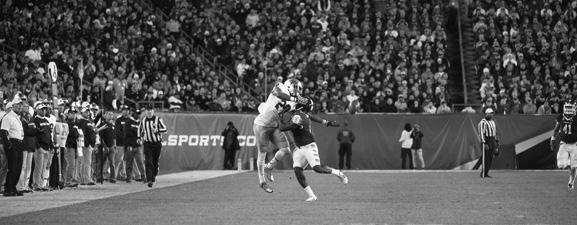
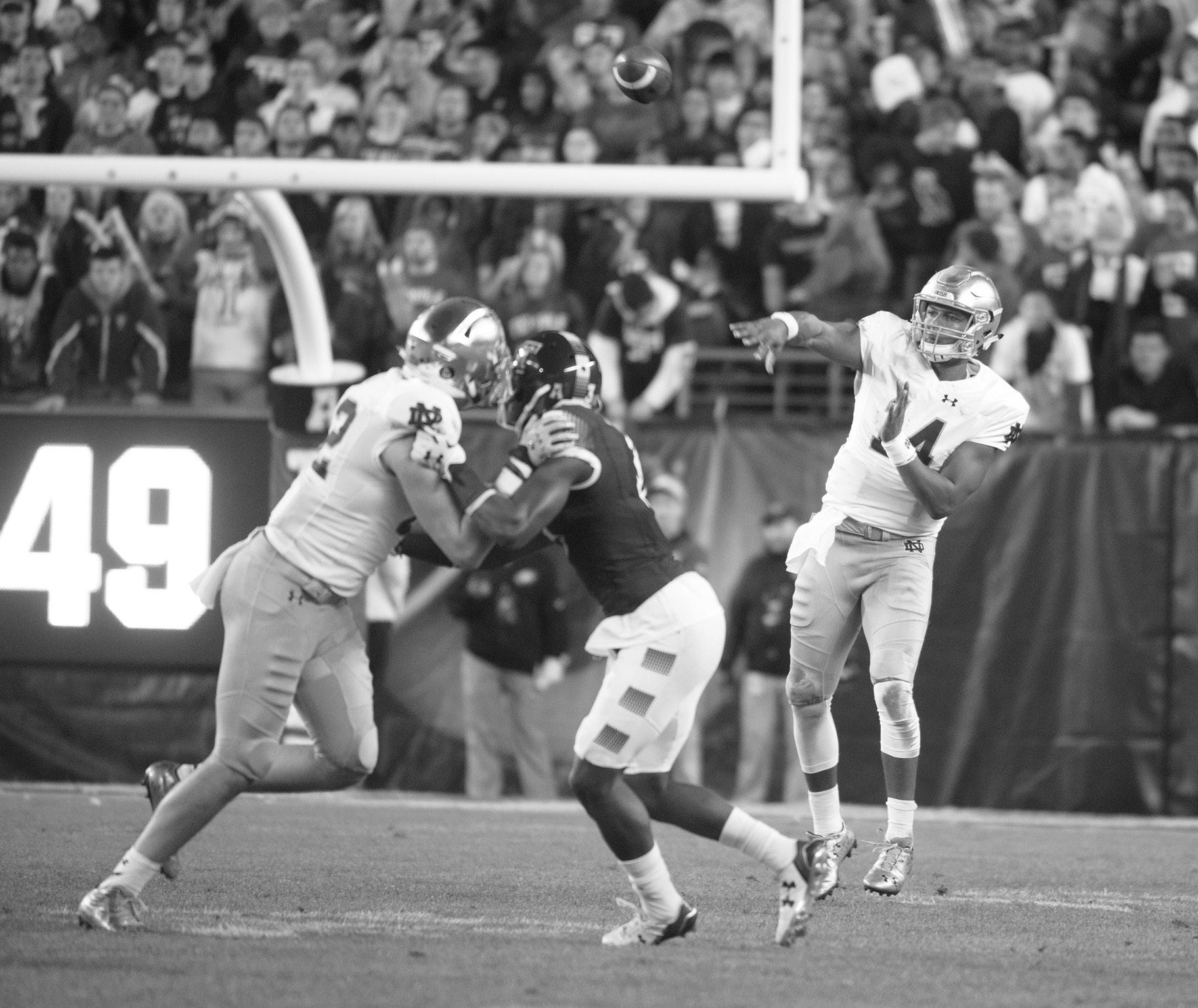
Irish sophomore quarterback DeShone Kizer throws a pass during Notre Dame’s 24-20 win over Temple on Saturday at Lincoln Financial Field. Kizer threw for 299 yards and ran for another 143 yards in the win.