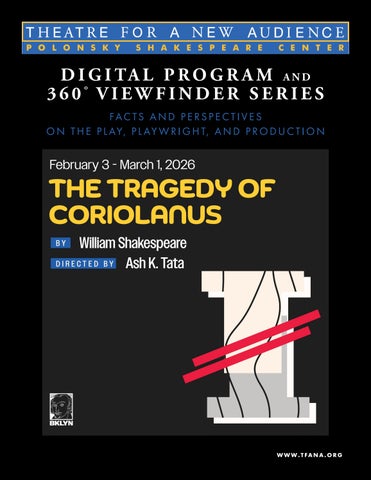
The Tragedy of Coriolanus

Page 1


Arin Arbus ARTISTIC DIRECTOR

THEATRE FOR A NEW AUDIENCE Polonsky Shakespeare Center

Robert E. Buckholz CHAIR

Jeffrey Horowitz FOUNDING ARTISTIC DIRECTOR

Present

Dorothy Ryan EXECUTIVE DIRECTOR

THE TRAGEDY OF CORIOLANUS

by WILLIAM SHAKESPEARE

directed by ASH K. TATA

On the Samuel H. Scripps Mainstage

Featuring BARZIN AKHAVAN, KEVIN ALICEA, MCKINLEY BELCHER III, WILLIAM DEMERITT, MEREDITH GARRETSON, POMME KOCH, MERLIN MCCORMICK, JASON O'CONNELL, EMMA RAMOS, ROSLYN RUFF, MICKEY SUMNER, ZUZANNA SZADKOWSKI, SARIN MONAE WEST

Scenic Designer AFSOON PAJOUFAR

Costume Designer AVERY REED

Projection Designer LISA RENKEL AND POSSIBLE

Properties Supervisor SEAN FRANK

Lighting Designer MASHA TSIMRING

Composer DAVID T. LITTLE

Production Dramaturg JONATHAN KALB

Casting JACK DOULIN

Sound Designer BRANDON KEITH BULLS

Fight Choreographer J. DAVID BRIMMER Movement Director DAN SAFER

Voice Director ANDREW WADE

Press Representative BLAKE ZIDELL & ASSOCIATES

Production Stage Manager CHARLIE LOVEJOY

General Manager CHLOE KNIGHT

First preview February 3, 2026 | Opening night February, 12 2026

Special support for audio and video components of this production is provided by 4Wall Entertainment.

The production is also supported in part by Shakespeare in American Communities, a program of the National Endowment for the Arts in partnership with Arts Midwest.

Endowment support for the production of The Tragedy of Coriolanus is provided by the Howard Gilman Foundation Fund for Classic Drama.

Deloitte and Bloomberg Philanthropies are Theatre for a New Audience’s 2025-2026 Season Sponsors.

Principal support for Theatre for a New Audience’s season and programs is provided by Alan Beller and Stephanie Neville, Robert E. Buckholz and Lizanne Fontaine, The Charina Endowment Fund, Constance Christensen, The Hearst Foundations, the Howard Gilman Foundation, the Jerome L. Greene Foundation Fund at the New York Community Trust, The SHS Foundation, The Shubert Foundation, and The Thompson Family Foundation Major season support is provided by the Arete Foundation, Sally Brody, The Harold and Mimi Steinberg Charitable Trust, The Hearst Corporation, The DuBose and Dorothy Heyward Memorial Fund, Kramer Levin Naftalis & Frankel LLP, Latham & Watkins LLP, Audrey Heffernan Meyer and Danny Meyer, The Fan Fox and Leslie R. Samuels Foundation, The Starry Night Fund, Stockel Family Foundation, Anne and William Tatlock, Kathleen Walsh and Gene Bernstein, and The White Cedar Fund. Theatre for a New Audience’s season and programs are also made possible, in part, with public funds from the National Endowment for the Humanities: Democracy demands wisdom; Shakespeare in American Communities, a program of the National Endowment for the Arts in partnership with Arts Midwest; the New York State Council on the Arts with the support of the Office of the Governor and the New York State Legislature; and the New York City Department of Cultural Affairs in partnership with the City Council. Open captioning is provided, in part, by a grant from NYSCA/TDF TAP Plus.

CAST

(in alphabetical order)

Cominius...............................................................................................................................BARZIN AKHAVAN

Adrian...........................................................................................................................................KEVIN ALICEA

Caius Martius Coriolanus........................................................................................... MCKINLEY BELCHER III

Nicanor................................................................................................................................JACK BERENHOLTZ

Sicinius Velutus..................................................................................................................WILLIAM DEMERITT

Virgilia........................................................................................................................MEREDITH GARRETSON

Senator/Lieutenant/Aedile.............................................................................................................POMME KOCH

Young Martius.................................................................................................................MERLIN MCCORMICK

Menenius Agrippa................................................................................................................JASON O’CONNELL

Valeria...........................................................................................................................................EMMA RAMOS

Volumnia........................................................................................................................................ROSLYN RUFF

Tullus Aufidius.........................................................................................................................MICKEY SUMNER

Junius Brutus..............................................................................................................ZUZANNA SZADKOWSKI

Titus Lartius......................................................................................................................SARIN MONAE WEST

Production Stage Manager......................................................................................................CHARLIE LOVEJOY

Assistant Stage Manager...........................................................................................KELLEY LYNNE MONCRIEF

Fight Captains.......................................................................................KEVIN ALICEA, SARIN MONAE WEST

This performance contains effects of haze, gun violence, and blood, as well as loud noises and flashing lights.

This Theatre operates under an agreement between the League of Resident Theatres and Actors’ Equity Association, the Union of Professional Actors and Stage Managers in the United States.

The stage managers employed in this production are members of Actors’ Equity Association, the union of professional actors and stage managers in the United States.

The scenic, costume, lighting, and sound designers in LORT Theatres are represented by United Scenic Artists, Local USA-829 of the IATSE.

The Director is a member of the Society of Stage Directors and Choreographers, Inc., an independent national labor union.

by

Notes

Front Cover: Design by Paul Davis Studio / Paige Restaino

This Viewfinder will be periodically updated with additional information. Last updated February 3, 2026.

Credits

The Tragedy of Coriolanus 360° | Edited by Zoe Donovan Resident Dramaturg: Jonathan Kalb | Council of Scholars Chair: Tanya Pollard | Designed by: Milton Glaser, Inc.

Publisher: Theatre for a New Audience, Arin Arbus, Artistic Director

The Tragedy of Coriolanus 360° Copyright 2026 by Theatre for a New Audience. All rights reserve d.

With the exception of classroom use by teachers and individual personal use, no part of this Viewfinder may be reproduced in any form or by any means, electr onic or mechanical, including photocopying or recording, or by any information or retrieval system, without permission in writing from the publishers. Some materials herein are written especially for our guide. Others are reprinted with permission of their authors or publishers. 5 Dialogues: “Romans, Remotely

The company of The Tragedy of Coriolanus. Back row (left to right): Kevin Alicea, Roslyn Ruff, McKinley Belcher III, Jack Berenholtz, Sarin Monae West, Danica Selem, William DeMeritt. Middle row: Meredith Garretson, Ash K. Tata, Zuzanna Szadkowski, Barzin Akhavan. Bottom row: Mickey Sumner, Emma Ramos, Merlin McCormick. Photo by Travis Emery Hackett. Not pictured: Jason O’Connell, Pomme Koch.

DIALOGUES “ ROMANS, REMOTELY CONTROLLED : ASH TATA’S CORIOLANUS AND THE POLITICS OF SURVEILLANCE”

“Everybody, without exception, was constantly being watched”

Does this sound like a scene from your favorite spy novel? Or the all-too-timely description of a police state from which we (might) still have time to save ourselves? In fact, these are the words of the renowned twentieth-century theatre critic Jan Kott, describing a 1950s-era production of Hamlet in Soviet-controlled Poland. Kott’s classic essay collection Shakespeare, Our Contemporary marveled at the potential of Shakespeare in performance to channel social and political currents of the day—in this case, the terror and turmoil of a repressive modern state. In this Elsinore, Kott remarked, “someone is hidden behind every curtain.” The same was true of the Kraków where it was staged. In the Rome of Ash Tata’s Coriolanus , someone is also hidden: if not behind every curtain, then behind every city gate. Soldiers, plebeians, and messengers whisper about political betrayals and scan the horizon for glimpses of enemy troops. But these Romans also conduct subtler, more eerily contemporary forms of scrutiny. They monitor their leaders’ vocal expressions

and survey their leaders’ costume choices. They stare at screens of multiple kinds, their attention pulled by the surging tides of many mediated realities. In other words, the characters in this Coriolanus live in a world that is somewhat like ours: one where surveillance is technological and pervasive, functioning not only as a means of tracking what we’ve done, but also as a way to exert control over what we’ll do next. As Projection Designer Lisa Renkel remarks, this Coriolanus investigates “how a state watches, records, edits, and ultimately weaponizes its citizens.”

Few art forms are as apt for such an exploration as theatre, which has always created spaces for watching and being watched. This inherent aspect of the art form makes the stage a potent place to consider what it means to examine someone else’s actions from the safety of anonymity and the comfort of darkness. Gathered as a temporary community, we audience members peer at the lighted stage, witnessing characters’ travails from a seemingly protected distance. Are we stand-ins for a democratic society, taking note of leaders’ excesses so that we can shape our collective response? Are we the guardians of information, amassing deeply personal data

Danica Selem and Ash K. Tata. Photo by Travis Emery Hackett.
“ROMANS,

REMOTELY CONTROLLED” MIRIAM FELTON-DANKSY

about the inhabitants of this stage world without risk to ourselves? Or, are we actually laborers in the dark: residents of a surveillance state that collects our data as we buy tickets, follow Google Maps to the theatre, and post our location to Instagram—with no control over how such information will be used, and by whom?

Any answers to questions like these would demand that we consider what it means to watch other people in the first place and how the concerns of a play written in 1608 and set in the Roman Republic might overlap with our own. Today, surveillance commonly takes the form of digital data collected without our knowledge or consent. But new technologies of control build on a long history of surveillance as a means of mastery. Shakespeare’s plays, especially those concerned with the politics of repression and control, are full of scenes of looking and listening. Coriolanus is a case in point. Shakespeare’s plot was partially inspired by the Midlands Riots of 1607-1608, when English peasant farmers rebelled against famineinducing grain shortages and continuing enclosures of “the commons”—land previously available to them that private landowners were seizing for private use and profit. (If the phrase “enclosure of the commons” rings a bell, it might be because Marx cited it as one of the key acts of mass theft that kick-started modern capitalism.)

Protesting economic dispossession didn’t go any better for the real English peasants than it does for the plebeians in Coriolanus’s Rome: King James I and his lieutenants violently suppressed the riots and executed their leaders.

Political Protest, Digital Scrutiny

Protest in public space is still—and, in our own dangerous times, increasingly—subject to government and corporate surveillance. Today, the forces tracking public assemblies look less like watching sentries or spies on horseback and more like facial recognition software or semi-invisible drones. Web sites and social media apps send gigabytes of data coursing through cables to servers controlled by government agencies or the constellation of corporate giants known as Big Tech (Apple, Google/Alphabet, Meta, and Amazon, to name a few). Monitoring our protest actions, our political speech, our buying habits, and our travel plans, surveillance as a method of prediction and control is not a paranoid fantasy in this production of Coriolanus , or in our own real-life moment.

It’s a reality. As we go about our daily routines, each of us continuously generates and updates what many scholars call “data doubles”: ever-evolving digital doppelgangers comprising our purchase histories, our viewing habits, our internet searches—even our medical

records and credit histories. This information might seem innocuous or embarrassing (do you care whether Starbucks knows that you like extra caramel on your macchiato?). Or it might have a profound impact on our everyday lives, determining whether any given person qualifies for a mortgage, how their next parole hearing goes, or whether they’re allowed to cross the U.S. border and enter the country. In turn, our data doubles contribute to an increasing imbalance of power between us and the corporations and governments who receive these vast troves of information but are rarely required to disclose what they know about us or how they’re using that data. In her landmark book The Age of Surveillance Capitalism, legal scholar and philosopher Shoshana Zuboff described the power struggle inaugurated by digital surveillance as a fight over “the right to the future tense.”

Why the future tense? As Zuboff explains, Big Tech companies don’t just want to know which groceries you bought and which television shows you enjoyed, where you traveled and what photos you snapped there. They want to shape what you’ll buy and watch and where you’ll travel next. They want to serve you an ad for your guilty-pleasure snack as you approach the chain restaurant where it’s sold, then an ad for a workout class nearby to help burn those calories off. As Big Tech gains information about our lives, Zuboff noted in a 2020 New York Times essay called “You Are Now Remotely Controlled,” it’s not only our consumption habits but also our political future at stake. “Surveillance capitalists,” she wrote, “exploit the widening inequity of knowledge for the sake of profits. They manipulate the economy, our society and even our lives with impunity, endangering not just individual privacy but democracy itself.”

Six years after Zuboff wrote those words, it’s not hard to see the threats to democracy all around us—threats bolstered by an explosion of new technology, including generative AI. These days, AI systems and tools abound in daily life, frequently serving discriminatory ends and implicitly or overtly suppressing civic dialogue and political speech. For instance: Have you participated in a Black Lives Matter protest or a Women’s March during the past four years? Did you show up for a No Kings Day rally or march in a Puerto Rican Day parade? Then it’s likely you’ve been scrutinized from above: A 2025 report by the legal nonprofit Surveillance Technology Oversight Project noted that the New York Police Department increased drone surveillance of New Yorkers by a stunning 3,200% between 2022 and 2024, including many more flights

“ROMANS,

REMOTELY CONTROLLED” MIRIAM FELTON-DANKSY

over public gatherings like these. Footage from these drone flights can be used to generate high arrest rates in over-surveilled neighborhoods, while the NYPD’s myriad cameras feed images into facial recognition softwares, which are notoriously fallible and rife with bias. Consider, then, the role of public assembly in Coriolanus—where do these plebians gather, and how do they address the most powerful among them? Do they defy autocracy, or fall for easy rhetorical posturing and slick slogans? Assembling in public space, for these Romans and for us, is a high-stakes endeavor.

This is especially true for anyone whose race, gender, or national origin might make them particularly vulnerable to AI bias and the consequences for freedom and safety that might follow. And here’s the thing about bias in technology. It’s tempting to think society could benefit from generative artificial intelligence if we could only make AI less prone to “hallucinatory” outbursts, racist ramblings, and flat-out factual error. Think of the scandals last summer when Elon Musk’s AI tool Grok readily spewed out racist and antisemitic content. Or the more recent outcry over revelations that Grok allows users to create sexualized deepfake images of real people—in practice, mostly women and some underage subjects—in revealing clothing or little clothing at all. Research shows that these violent tendencies are baked into most AI products, features and not flukes. Theatre maker Annie Dorsen—whose performance piece Prometheus Firebringer, a trenchant critique of generative AI, played at TFANA in fall 2023—noted in a recent essay that “This is the lie behind conversations about AI bias. There’s nothing but bias.” That’s because all AI products reflect their makers’ decisions about which words or images their training datasets include and how that information should be sorted and labeled (Roman or Volscian, enemy or friend?). These decisions are mostly opaque and proprietary: we plebeians would be denied the details no matter how nicely we asked. And even if you’re the kind of upright citizen who couldn’t imagine generating a deepfake or tempting Grok to speak in slurs, everyday uses of AI tools still perpetuate all kinds of harm. Maybe you’re using OpenAI’s Chat-GPT to draft a report for your colleagues, or Stable Diffusion to whip up a cool logo design for your new brand. You can’t know whether the resulting images are remixing independent artists’ work without asking or paying them, or whether the new write-up you’ve generated relies on factual error and offensive online speech.

Lies, Manipulation, and AI Erasure

With AI distorting public conversation and flooding our devices with synthetically-generated images, it’s

no wonder political discourse becomes fragmented. We’re adrift on a sea of individual realities with fewer and fewer shared perceptions of the world. As Dorsen puts it, citing Hannah Arendt, an AI-saturated public becomes a mass of confused individuals, “incapable of judgment and incapable of action,” and because of this, “increasingly susceptible to lies, manipulation, and ruthless ideology.” In Coriolanus , this is context worth bearing in mind while you watch Menenius, the Tribunes, and other leaders try to work the Roman crowd. Or, when you see characters negotiate the multiple realities generated by ever-shifting interfaces, digital distortions, and pixelated POVs. As Projection Designer Renkel says, different interfaces provoke radically different responses, especially to images of violence and war. So too, AI-generated media can warp the meaning of actions and words. “That erosion” of meaning, Renkel notes, “mirrors how political speech and identity get flattened once they’re absorbed into power structures.”

Beyond its engagement with surveillance technology, you might notice that this Coriolanus challenges gender conventions, with performers of all genders playing a variety of politically powerful roles. These themes are intertwined. Gender is an area where AI exerts harsh, sometimes violent forms of control, particularly so for trans and nonbinary people. For instance: how might a facial recognition tool categorize a nonbinary person’s face? Quite possibly, by pretending that it doesn’t actually exist. AI expert Kate Crawford has written about a 2019 IBM experiment in which the corporation tried to address criticisms over gender bias in its facial recognition software. Using a dataset drawn from the photo-sharing website Flickr, researchers asked crowdworkers to label images as “male” or “female” based on subjective visual impressions. If a face didn’t “read” as one of the two binary genders, it was removed from the dataset. In other words, anyone who didn’t conform to a normative image of male or female gender was rendered invisible. “IBM’s vision of diversity,” Crawford concluded, “emphasized the expansive options for cranial orbit height and nose bridges but discounted the existence of trans or gender nonbinary people.” In the face of such wide-ranging erasure, what kinds of battles might these contemporary Romans and Volscians be required to fight?

Classifying people according to rigid categories—and penalizing those who don’t conform—is a classic method of exerting political power, dating back well before anything like AI existed. It’s a tried-and-true tactic of

“ROMANS,

REMOTELY CONTROLLED” MIRIAM FELTON-DANKSY

imperial control, whether the empire in question is classical Rome or modern-day neocolonial nation-states. As Crawford writes, categorization was a favored tactic of early modern colonial powers, including racialized surveillance whose technologies have changed but whose presence continues on. For example, when we think of the built architectures associated with surveillance, it might be the eighteenth-century Panopticon that springs to mind— an image made famous by philosopher Michel Foucault’s 1975 book Discipline and Punish. But contemporary scholar Simone Browne argues that the transatlantic slave ship, also an architecture made to facilitate observation and violent control, is an equally essential starting point for histories of modern surveillance. For Browne, the entwined histories of surveillance and racism start with the transatlantic slave trade and continue to current-day racial profiling at airport terminals. Think of how the turn of the twenty-first century brought us new post-9/11, Patriot Act-sanctioned surveillance regimes at the same time as the neo-imperial invasions of Iraq and Afghanistan. (Oh, and the rise of social media happened right around then too.)

Coriolanus and the Politics of Production

As a play about power and control, conquest and identification, Coriolanus has long been a political Rorshach test of sorts, raising questions about conquest, power, and democracy. It’s open to interpretation as a critique of autocratic power, a testament to the necessity for strong leaders, and an argument for robust political engagement on the part of citizens. A 1933 production at the Comédie Française, following on the heels of financial scandal in the French government, provoked competing protests, pro-democracy and pro-fascism. During these uprisings, “impassible mobs of fighting citizens” crowded Parisian streets. Some sources also say that the Nazi regime taught the play in schools as a warning about the dangers of democracy and the virtues of authoritarian rule, and that American occupying forces banned it after World War II in response. Up-todate historical research can’t confirm whether this really happened, but it’s easy to see why Coriolanus might have been appealing, and dangerous, in such times.

Postwar East Germany proved another pivotal place for controversy: Bertolt Brecht developed his class-conscious Coriolanus adaptation under the watchful eyes of the GDR’s Socialist Unity Party, foregrounding the power and plight of the plebeian class even while, outside the rehearsal room, Brecht tacitly supported his new government’s repressive regime. German writer Günter Grass later indicted Brecht’s actions in a 1966 play, The Plebeians Rehearse the Uprising, which details Brecht’s failure to support a 1953 German workers’ revolt that

was unfolding in the East Berlin streets while Brecht rehearsed his Coriolanus. Grass compared the actions of Brecht—a socialist hero in the new GDR—to the ego-driven machinations of Coriolanus himself. (Brecht reportedly didn’t consider the revolt a true socialist uprising, but instead the actions of confused workers who misunderstood their class position. Snobby much? Surely—but then, he was a Marxist playwright who had found a haven in the GDR, safe from persecution for the first time in decades.)

Coriolanus continues to channel political tension and provoke protest. In 2019, Iranian director Mostafa Koushki staged a production in Tehran, that critiqued “a society in which, in Koushki’s own words, ‘power relations have deprived people of the ability to think.’” Iranian surveillance authorities required Koushki to stage the production for them three times before giving him permission to open it to the public.

It’s no wonder Coriolanus has ignited political passions for centuries and that it lends itself to a moment when surveillance has once again become a fact of everyday life. All of this is right there in the play, which, no matter your interpretation, poses powerful questions about what it means to show oneself and to be seen. Coriolanus chafes at demands that he display his wounds to the people—wounds he received fighting in the city of Corioles, which neither the plebeians nor the audience ever see. Even when revealing himself to his mortal enemy, Aufidius, he arrives in disguise, evading recognition by Volscian servants. As Shakespeare scholar Donovan Sherman eloquently puts it: “The play almost sadistically insists on simultaneously tracking and hiding him, dilating its scenography to encompass his physical displacements while habitually leaving him outside, offstage, elsewhere.

Luckily, today, Coriolanus is right here onstage, offering a renewed opportunity for TFANA’s spectators to contend together with the possibilities and the dangers of being seen .

MIRIAM FELTON-DANSKY is Associate Professor of Theater and Performance and director of Bard’s undergraduate Theater and Performance Program. Her research and teaching interests include experimental and avant-garde performance, the politics of attention and spectatorship, and theater in the digital age. Her book Viral Performance: Contagious Theaters from Modernism to the Digital Age was published by Northwestern University Press in 2018. Her articles and essays have appeared in publications such as Theatre Survey, Theatre Journal, Theater, PAJ, ASAP/J, and Artforum.com, and she was a theater critic for the Village Voice from 2009 to 2018. She is a recipient of a 2026 Andy Warhol Foundation Arts Writers Grant and is writing a book about the infrastructural history of experimental performance in New York.

THE PRODUCTION CAST AND CREATIVE TEAM

BARZIN AKHAVAN (Cominius). Broadway: Network, The Kite Runner. Off Broadway: Meet the Cartozians (2nd Stage), Fuente Ovejuna (TFANA), Macbeth (CSC), Richard II (The Public/WNYC), Hamlet (Waterwell). International: Aftermath (Melbourne, Paris, Amsterdam), A Thousand Splendid Suns (Theater Calgary). Regional companies: Seattle Rep, Guthrie, Berkeley Rep, A.C.T., Arena Stage, Baltimore Center Stage, Huntington, Cincinnati Playhouse, Folger, CATF, Virginia stage, Lake Tahoe Shakespeare, Oregon Shakespeare Festival. Film: F.A.S.T. (upcoming), Ezra, Funny Face. Select TV: “The Blacklist,” “Chicago Med,” “Girls5eva,” “Smash,” “Law & Order: CI.” MFA: University of Washington

KEVIN ALICEA (Adrian): Credits: Julius Caesar, The Comedy of Errors, All’s Well That Ends Well, Henry 6, Henry VIII, Two Gentlemen of Verona, King James (The Old Globe), Is God Is (A Red Orchid), Sweat (Asolo Repertory Theatre), Tiny Beautiful Things (Theatre SilCo), Harvey (Heritage Theatre Festival), A Raisin in the Sun (Virginia Repertory Theatre), Welcome to Fear City, Byhailia, Mississippi (Contemporary American Theater Festival), Stick Fly (Writers Theatre), Hamlet (St. Louis Shakespeare). Kevin has also made television appearances on “The Chi” (Showtime) and “61st Street” (AMC). In addition, Kevin is a director and former Co-Artistic Director of The Passage Theatre - Chicago. Training: MFA, The Old Globe/University of San Diego. kevinalicea.com, Instagram: @kevinalicea_

MCKINLEY BELCHER III (Caius Martius Coriolanus) is a BAFTA TV–nominated actor known for his standout role as ‘Detective Micheal Ledroit’ in Netflix’s “Eric,” in which he was praised by critics as “quietly magnetic” and “with a confident swagger warranted of an old Hollywood star.” He most recently appears in Netflix’s “Zero Day” opposite Robert De Niro and the indie film Other People’s Bodies Belcher’s other notable screen credits include Netflix’s “Ozark” and the film Marriage Story . On Broadway, he’s appeared in Death Of A Salesman and A Soldier’s Play . Also a writer, his screenplay Kinda Blue Burning Bright won Slamdance’s 2020 Mentorship Award and he holds an MFA from USC.

JACK BERENHOLTZ (Nicanor) Off-Broadway: Fuente Ovejuna (Theatre for a New Audience), Nantucket Sleigh Ride (Lincoln Center). Other New York theater: Public Theatre Emerging Writers Workshop, Vineyard Theatre, The New Group, FringeNYC. Regional theater: Cleveland Playhouse, Gulfshore Playhouse, Florida Studio Theatre, O’Neill Theater Center, Chautauqua Theatre Company, Williamstown. TV: “Evil” (recurring), “FBI”, “The Good Fight”, “Law & Order SVU”, “Tommy”, “The Deuce”. Film: The Black Monk , Simchas & Sorrows , Bandito (TriBeca Film Festival). Podcasts: Embrace Everything - Mahler (NPR), What Happened in Skinner. Education: RADA London, NYU Grad Acting (MFA).

WILLIAM DEMERITT (Sicinius Velutus) Broadway: The Skin of Our Teeth (Beaumont). Off-Broadway: Twelfth Night (Classical Theatre of Harlem, Yale Rep), The Death of the Last Black Man… (Signature Theatre). Regional: Henry 6 (Old Globe), Shane (Guthrie, Cincinnati Playhouse), Shakespeare In Love, Indecent (OSF), It’s a Wonderful Life (ASF), Sense & Sensibility (DTC), more. International: October in the Chair… (Amsterdam Fringe Festival). Writer, Co-creator: Origin Story (NYIT Award, Best Solo Performance). Film/Television: The Normal Heart, The Noel Diary, Playing Sam, Our Son, “The Flight Attendant”, “NCIS: NOLA”, “The Outs”, more. Education: BFA Marymount Manhattan, MFA Yale School of Drama. @demeritt, williamdemeritt.com

MEREDITH GARRETSON (Virgilia). Most recently seen on stage in Blood of the Lamb at 59e59 (Drama Desk Award nomination). Other theater credits include: Rosalind in As You Like It (The Old Globe), Maid Marian in Robin Hood (The Old Globe), Christina Mundy in Dancing at Lughnasa (Two River Theater). TV/film includes: Friendship opposite Paul Rudd, “Resident Alien” (HCA Astra Award Winner, Best Cable Series), “The Offer” (Critic’s Choice Award Nominee), “Fosse/Verdon,” “Stargirl,” “Chicago Med,” “New Amsterdam,” “Prodigal Son,” “The Good Fight,” “Elementary.” Founding member of Society Theatre Company. Education: MFA, NYU Grad Acting, Class of 2017. For Danny and Arlo, always.

POMME KOCH (Senator/Lieutenant/Aedile). Broadway: The Band’s Visit. Off-Broadway: Safety Not Guaranteed (BAM), How Long Blues (Little Island), Baghdaddy (Actor’s Temple), Becket (Gene Frankel). Select Regional: Rubicon (Denver Center), The Last Supper (South Orange Performing Arts), The Year To Come (La Jolla), A Thousand Splendid Suns (A.C.T. & Theatre Calgary), The Invisible Hand (Marin Theatre Company), The Admission (Theater J), Bengal Tiger at the Baghdad Zoo (Round House), Much Ado About Nothing (Shakespeare Theatre DC), Henry V (Folger). FILM/TV: Daddy, “WeCrashed”, “Law & Order”, “Blue Bloods”. University of Michigan. pommekoch.com. For Bligh. In memory of our dog, Karen, who (like Coriolanus) also despised the plebians.

THE PRODUCTION CAST AND CREATIVE TEAM

MERLIN MCCORMICK (he/they) (Young Martius) is an actor, singer, dancer, and screenwriter from the suburbs of Wake Forest, NC, but he is simply whatever he needs to be to tell a story. They love dancing, stunting on hoes with a clean fit, Shakespeare, history, and writing poetry. Some of his notable credits include Viola in Twelfth Night (International Black Theatre Festival), Romeo, Hamlet, and Orsino in Shake it Up: Cabaret (Shakespeare and Company), and Millie in Trouble in Mind (Clarence Brown Theatre). Merlin holds an MFA in Acting from University of Tennessee, Knoxville.

JASON O’CONNELL (Menenius Agrippa). Off-Broadway: Prosperous Fools (TFANA), Pride and Prejudice (Primary Stages), Happy Birthday, Wanda June (Wheelhouse/Duke on 42nd St), Judgment Day (Park Avenue Armory), Sense and Sensibility (Bedlam/Gym at Judson), The Light and The Dark (Primary Stages), Becomes A Woman (The Mint/City Center), The Saintliness of Margery Kempe (Duke on 42nd St), A Midsummer Night’s Dream (The Pearl), The Seagull (Bedlam/Sheen Center), and multiple incarnations of Jason’s solo show, The Dork Knight (Joe’s Pub, Abingdon Theatre Company, Primary Stages, Bedlam, etc). Regional: American Repertory Theater, Old Globe, Syracuse Stage, Two River Theater, Hartford Stage, Chautauqua Theater Company, Cape Playhouse, Hudson Valley Shakespeare, among others. TV: “Search Party,” “Law & Order: SVU,” “Law & Order: Criminal Intent.” For GW.

EMMA RAMOS (Valeria) is a bilingual Mexican multi-hyphenate. She can be seen in Alessandra Lacorazza’s 2024 Sundance Grand Jury Prize winner, In the Summers and will next be seen in Blumhouse/Atomic Monster’s Soulm8te. Previous theatre credits include Ivo van Hove’s Scenes From a Marriage , a re-imagined adaptation of The Marriage of Figaro at Little Island, and the “Brave New Shakespeare: Romeo and Juliet ” opposite Daniel Molina for The Public. Emma most recently wrote La Chef for Gaumont, with Noé Santillán-López attached to direct the feature.

ROSLYN RUFF (Volumnia). Broadway: Skin of our Teeth (Joseph A. Callaway Award), All The Way, Romeo & Juliet, Fences Select Off-Broadway: KYOTO, The Piano Lesson (Lucille Lortel Award; Audelco Award), Seven Guitars (Obie Award), X or Betty Shabazz v The Nation, Things of Dry Hours, Fairview, Death of the Last Black an in the Whole Entire Word, Macbeth, Familiar, Scenes from a Marriage, The Heart is a Lonely Hunter, and The Cherry Orchard. Select Regional: McCarter Theatre, People’s Light & Theatre Co., Yale Rep, ACT, Berkeley Rep, Indiana Rep, Two River Theatre, Long Wharf, Alliance, Geffen Playhouse, Alabama Shakespeare Festival. Film: Marriage Story, The Help, Salt, Rachel Getting Married. TV: “Evil,” “Blue Bloods,” “The Godfather of Harlem,” “Lincoln Rhyme: Hunt for the Bone Collector,” “Pose,” “Divorce.”

MICKEY SUMNER (Tullus Aufidius). Mickey Sumner’s dynamic career spans film, television, and theater. Most recently, she co-starred in “Task” (HBO) alongside Mark Ruffalo. Last year, she completed production on Blood on Snow directed by Cary Fukunaga, and Rose’s Baby with Antonio Banderas. Sumner starred in all four seasons of “Snowpiercer” (AMC) and is recognized for her standout performances in Frances Ha and A Mistake. Further film credits include Marriage Story and The End of the Tour. She co-starred in The Lying Lesson at The Atlantic Theatre in 2013. Born in England, Sumner resides in NYC and is a graduate of Parsons School of Design.

ZUZANNA SZADKOWSKI (Junius Brutus) is known for playing Dorota on “Gossip Girl.” Other credits include “The Gilded Age,” “Three Women,” “Worth,” “Bull,” “Search Party,” “The Knick,” “The Good Wife,” and “Girls.” Theater credits include Are the Bennet Girls OK? , Arcadia , and Uncle Romeo Vanya Juliet (WSJ Performance of the Year 2018) with Bedlam, Dom Juan at Bard Summerscape, queens at LCT3, The Comedy of Errors at the Public, and Coach Coach and King Philip’s Head… with Clubbed Thumb. Her writing has been published in The New York Times and Alien Nation . Her play, Fall River Fishing (co-written with Deborah Knox) was produced Off-Broadway in 2023 by Bedlam.

SARIN MONAE WEST (Titus Lartius) is an actor, writer, and co-founder of Black Artist Network. Sarin was most recently seen as Bushy in Richard II starring Michael Urie. Broadway: Skin of Our Teeth (dir. Lileana Blain-Cruz). OffBroadway: Red Bull Theater’s Medea: Reversed (Lucille Lortel Award Winner), Merry Wives at Shakespeare in the Park (dir. Saheem Ali). Other plays include Whitney White’s By The Queen (dir. Shana Cooper, Hudson Valley Shakespeare), Medea: Reversed (dir. Nathan Winklestein, Hudson Valley Shakespeare), The Scenarios (dir. Tiffany Nichole Greene, Studio Theater). TV: “The Equalizer” (CBS), “Evil” (CBS), “And Just Like That” (HBO Max), “The Other Two” (HBO Max). MFA: NYU Graduate Acting. ❤ Harold Lewter, CLA Partners. @sarinmonae

THE PRODUCTION CAST AND CREATIVE TEAM

ASH K. TATA (they/ze) (Director) is a theater and opera director whose work has appeared on stages around the world including at Miller Theater, Carnegie Hall, The Wexner, LA Opera, The Summerscape, Big Ears, Crossing the Line, Holland Festival, and The National Centre for the Performing Arts in Beijing. Tata’s online production of Mad Forest was described by Ben Brantley in The New York Times as “fervently inventive.” Zir Dom Juan was described as a production that “reaches out across the centuries and punches you in the throat” (The New York Times), with other reviews citing other stage works as “extraordinarily powerful” (LA Times), and a notable production of the decade (The New Yorker). Currently Assistant Professor and Artistic Producer of Theater & Performance at Bard College. tatatime.live

AFSOON PAJOUFAR (Scenic Designer) is a NYC based stage designer for theatre, opera and other live performances. Recent Off-Broadway: Practice (Playwrights Horizons), Five models in ruins, 1981 (Lincoln Center), Cold War Choir Practice (Clubbed Thumb), Fuente Ovejuna (TFANA). Other/Opera: The Reservoir (Berkeley Rep), Wish You Were Here (South Coast Rep), English (Studio Theatre/Barrington Stage), Cyrano de Bergerac (Pasadena Playhouse), Adoration (BMP/LA Opera), [morning//mourning] (PROTOTYPE), Lady M (HeartBeat Opera), Dom Juan (Bard SummerScape), Word. Sound. Power. (BAM), Paper Pianos (EMPAC). International: Alte Münze (Berlin), Schauspiel Köln (Cologne). She is a member of USA 829. afsoonpajoufar.com

AVERY REED (Costume Designer) is delighted to be back at TFANA! Recent theatre credits include: Well, I’ll Let You Go (Irondale); Business Ideas (Clubbed Thumb); 2025 Drama Desk Special Award to the cast and creative team of Danger & Opportunity (East Village Basement); GNIT (TFANA); On Set With Theda Bara (The Brick); Tender Napalm (Theater Lab), Patience (Second Stage); Macbeth/A Midsummer’s Night Dream (Double Feature); Buggy Baby (APAC); Ransom (Arts On Site). Opera: Marriage of Figaro (Curtis Institute); Ten Days In A Mad House (Opera Philadelphia); Bulrusher (West Edge Opera); Lysistrata (Mannes Opera). Film: Brut Force , Martin Eden , The Abandoned . IATSE USA 829, MFA NYU Tisch. www.averyreed.com

Costume renderings by Avery Reed for The Tragedy of Coriolanus. Photo by Travis Emery Hackett.

THE PRODUCTION CAST AND CREATIVE TEAM

MASHA TSIMRING (Lighting Designer). Recent projects include – Off Broadway: Practice (Playwrights Horizons); Friday Night Rat Catchers (New York Live Arts); Rheology (Bushwick Starr); Six Characters (LCT3); Cold War Choir Practice , Coach Coach , Grief Hotel (Clubbed Thumb); Staff Meal (Playwrights Horizons); Sad Boys in Harpy Land (Playwrights Horizons/Abrons Art Center). Regional: the aves (Berkeley Rep); The Inspector (Yale Rep); Primary Trust (La Jolla Playhouse). Dance/Opera: GEMS , Plenum/Anima , Me. You. We. They. (LA Dance Project); Giulio Cesare (Hudson Hall); [morning//mourning] (Prototype/HERE); Terce (Prototype); Deepe Darknesse (Lisa Fagan/Lena Engelstein/New York Live Arts); Rodelinda (Hudson Hall/Santa Fe Opera); More info at www.mashald.com .

BRANDON BULLS (Sound Designer). Sound Designer based in Brooklyn. Well, I’ll Let You Go (Irondale), NINA (TheaterLab), On Set With Theda Bara (The Brick), The Lucky Ones (TheaterLab), Scouts (The Players Theater), Phantasmagoria (The Tank), Torito (Gene Frankel Theater) (Off-Off Broadway); N/A (Barrington Stage Company), Singing In The Rain (Playhouse On Park), Cul-De-Sac (Pace University), The Pittsburgh Free Press (LSTFI), Hedda Gabler (Atlantic Theater Acting Studio), Der Ring Gott Farblonjet (Columbia University), Tempo (Williamstown Theater Festival) (Regional); BA in Theater Arts, BM in Music Composition at University of the Incarnate Word. Brandon is a member of TSDCA. www.brandon-bulls.com

LISA RENKEL AND POSSIBLE (Projection Designer). Formed in 2010 by Roy Chung, Ryan Chung, and Michael Figge - POSSIBLE was built from the ground up to create content for the world’s most extraordinary canvases. As students of diverse disciplines, their team of creatives and visual artists deploy novel approaches and bleeding-edge technology to video design for live events. Together with projection designer Lisa Renkel, they strive to author moments and manufacture awe in bringing theatrical stages to life. Learn more: psbl.co

DAVID T. LITTLE (Composer). GRAMMY®-nominated composer David T. Little is a natural musical storyteller with “a knack for overturning musical conventions” (The New York Times). Known for stage, concert, and screen works permeated with the power of the unexpected, his broad catalog probes the deep corners of human psychology, unafraid to invoke the mythical, bewitching, disturbing, surreal, or comedic in order to explore the human condition. He is currently developing a new work commissioned by the Metropolitan Opera / Lincoln Center Theater New Works Program, as well as several other new stage, film, and concert projects. Published by Boosey & Hawkes, Little holds a Ph.D. from Princeton University, and chairs the Composition program at the Mannes School of Music. www.davidtlittle.com

J. DAVID BRIMMER (He/They) (Fight Choreographer) (Fight Master SAFD) has choreographed some stuff(selected Broadway: Hangmen , American Buffalo , Pass Over , Spring Awakening , The Lieutenant of Inishmore , Be More Chill , Grace , Speed the Plow , Thérèse Raquin , Long Day’s Journey into Night , selected NY premieres: The Counterfeit Opera , Guide for the Homesick , Tambo and Bones , Socrates , Fairview , Heroes of the Fourth Turning , Is God Is , Yen , The Lying Lesson , Gloria , An Octoroon , We Are Proud To Present , Revolt. She Said. Revolt Again , Blasted , Bethany , Blackbird , Bug , Killer Joe , along with Red Bull Theatre’s productions of The Government Inspector , The Revenger’s Tragedy , The Duchess of Malfi, and The Changeling ). “Walk cheerfully over the world, answering that of God in everyone.” G. Fox

DAN SAFER (Movement Director) runs dance/theater company Witness Relocation, doing shows in the back of NYC bars, Théâtre de Chaillot in Paris, and a warehouse in Poland where a light fell off the grid during a show, almost killing him. Recent choreography includes Family by Celine Song and Winning Is Winning (Hoi Polloi); Jedermann starring Lars Eidinger (Salzburg Festival). He got kicked out of high school for a year, was a go-go dancer, and once choreographed the Queen of Thailand’s Birthday Party. Dan is a Senior Lecturer and Director of Dance at MIT. With Ash Tata, he choreographed SINS OF US, Mad Forest, and Dom Juan

SEAN FRANK (Properties Supervisor) is a Brooklyn-based props designer & set dresser. His recent Props Design/Supervision credits include Beau the Musical, Inspired by True Events (Out of the Box Theatrics), Teeth (New World Stages), and Road Kills (Good Apples Collective). Assistant Props credits include: Prince Faggot (Playwrights Horizons + Studio Seaview), Practice, The Antiquities, In the Amazon Warehouse Parking Lot, Stereophonic, Wet Brain, Teeth, Staff Meal (Playwrights Horizons). BFA Emerson College.

THE PRODUCTION CAST AND CREATIVE TEAM

JANERA ROSE (Hair & Makeup Designer).With an accredited background as a Licensed Beauty Professional, Janera Rose has over 16 years of well-versed experience within Theater, Editorial, Television, Fashion and Media. As a Juilliard-trained Wig Designer & Wig Maker, Janera’s skill sets are magnified and elevated through thoughtful storytelling that honors periodic and contemporary art.

ANDREW WADE (Resident Voice Director). NEW YORK: Broadway: Giant with John Lithgow directed by Nicholas Hytner (Voice and Dialect Coach), Harry Potter and the Cursed Child Parts One and Two (U.S. Head of Voice and Dialect), King Lear with Glenda Jackson (Voice Coach), Matilda the Musical (Director of Voice) and national tour, A Christmas Carol directed by Matthew Warchus (Voice and Dialect Director) Broadway, L.A., Tour and PAC NYC; The Public Theater: Director of Voice; NYTW: Othello with Daniel Craig; Red Bull Theater: Richard II with Michael Urie. INTERNATIONAL: Royal Shakespeare Company: Head of Voice (1990-2003). REGIONAL: The Guthrie Theater: since 2002. FILM: Shakespeare in Love. Teaching: Juilliard (Adjunct Faculty Drama Division), Stella Adler Studio (Master Teacher Voice and Speech), BADA Midsummer in Oxford. Fellow: Rose Bruford College. Workshops and Lectures: Worldwide.

JONATHAN KALB (Resident Dramaturg) is professor of theatre at Hunter College, CUNY and is TFANA’s resident dramaturg. The author of five books on theatre, he has worked for more than three decades as a theatre scholar, critic, journalist and dramaturg. He has twice won The George Jean Nathan Award for Dramatic Criticism and has also won the George Freedley Award for an outstanding theatre book from the Theatre Library Association. He often writes about theatre on his TheaterMatters blog at jonathankalb.com.

CHARLIE LOVEJOY (Production Stage Manager). TFANA: Prosperous Fools , The Swamp Dwellers , Henry IV . OffBroadway: The Burning Cauldron of Fiery Fire (Vineyard Theatre); I’m Assuming You Know David Greenspan , Kimberly Akimbo (Atlantic Theater Company); Hold On To Me Darling (WJP/Seaview); Seagull (Elevator Repair Service). Regional: Camino Real (Williamstown); Escaped Alone , The Brightest Thing in the World, Between Two Knees (Yale Repertory Theatre); The Santaland Diaries , Incendiary , graveyard shift (Goodman Theatre); Kiss Me Kate , Rossini’s Otello (Central City Opera). MFA, David Geffen School of Drama at Yale; BA, University of Chicago.

KELLEY LYNNE MONCRIEF (Assistant Stage Manager). Broadway: Some Like It Hot , An Enemy of the People , Doubt , Moulin Rouge . Off Broadway: The Swamp Dwellers , Heathers , Teeth , The Last Bimbo of the Apocalypse , Don Giovanni , Our Class , T he Christine Jorgensen Show , Henry IV , The Wild Duck. Touring: Some Like It Hot . TV/Film: “Gossip Girl”, “The Marvelous Mrs. Maisel.” MFA from Columbia University and BA from Goldsmiths, University of London. @kelleylynnem

BLAKE ZIDELL & ASSOCIATES (Press Representative) is a Brooklyn-based public relations firm representing arts organizations and cultural institutions. Clients include St. Ann’s Warehouse, Playwrights Horizons, Signature Theatre, Soho Rep, NYU Skirball, the Under the Radar Festival, Powerhouse: International, Yale Repertory Theatre and the David Geffen School of Drama, PEN America, StoryCorps, Symphony Space, the Fisher Center at Bard, Irish Arts Center, Building for the Arts, Bedlam, Ballet Tech, the Onassis Foundation, The Playwrights Realm, PlayCo, the Common Senses Festival, Catapult Opera, Noche Flamenca, and more.

ACTORS' EQUITY ASSOCIATION (“Equity”), founded in 1913, is the U.S. labor union that represents more than 50,000 actors and stage managers. Equity seeks to foster the art of live theatre as an essential component of society and advances the careers of its members by negotiating wages and working conditions and providing a wide range of benefits including health and pension plans. Actors’ Equity is a member of the AFL-CIO and is affiliated with FIA, an international organization of performing arts unions. #EquityWorks

THE PRODUCTION CAST AND CREATIVE TEAM

STAFF FOR THE TRAGEDY OF CORIOLANUS

Associate Director.......................................Danica Selem

Intimacy Coordinator/

Head Associate Fight Director.................Dan O’Driscoll

Associate Fight

Choreographers.....................Eli Meyers, Joanne DiNozzi

Deck/Props Carpenter.......................Tristan Viner-Brown

Lightboard Programmer & Operator...........Paul Kennedy

A1.................................................................Joseph Parisi

Production Assistant.....................Genevieve Dornemann

Wardrobe Supervisor....................................AB Lotspeich

Dressers............................Lauren Bretl, Calla Nelles-sager

Builder...........................................................Bethany Joy

Stitchers...........................Penelope Gerosa, Clio Gordon, Indigo Leigh, Adrianne WIlliams

Head Distressing Artist................................Lindset Eifert

Distressing.................Camille Charhara, Josh Oberlander

Assistant Video Designer...........................Emma Bittman

Video Programmers...........Tatton Jacob, Brian McMullen

Video Operator.........................................Brett Orenstein

Video Software Engineer............................Geordy van Es

Production Carpenters & Riggers.............Cory Asinofsky, Tobias Segal, Jules Conlon, Frann Mccrann, Haley Crawford, Hassan SoKhan, Killian Coffinet, Steven Cepeda, Ernest Chando, Talia Hankin, Danelle Morrow, Anthony Pascual

Scenery provided by Daedalus Design & Production. Lighting gear provided by 4Wall, audio gear and video support provided by Five OHM. Video equipment provided by 4Wall.

The company of The Tragedy of Coriolanus. Back row (left to right): Kevin Alicea, Roslyn Ruff, McKinley Belcher III, Jack Berenholtz, Danica Selem, William DeMeritt. Middle row: Meredith Garretson, Ash K. Tata, Zuzanna Szadkowski, Sarin Monae West, Bottom row: Mickey Sumner, Emma Ramos, Merlin McCormick. Photo by Travis Emery Hackett. Not pictured: Barzin Akhavan, Jason O’Connell, Pomme Koch.

THEATRE FOR A NEW AUDIENCE LEADERSHIP

ARIN ARBUS (Artistic Director). Arbus served as Associate Artistic Director at TFANA for a decade, during which time she directed: Othello, Measure for Measure, Macbeth, Taming of the Shrew, Much Ado About Nothing, King Lear, A Doll’s House, The Father, The Skin of Our Teeth (Obie). Upon leaving this post, Arbus served as TFANA’s Resident Director, directing Des Moines, Waiting for Godot, The Merchant of Venice , starring John Douglas Thompson as Shylock, also playing at Shakespeare Theatre Company in DC and Royal Lyceum Theatre, Edinburgh. Outside TFANA: Deep Blue Sound by Abe Koogler for Clubbed Thumb; The Lehman Trilogy , at Shakespeare Theatre Company and the Guthrie; Frankie and Johnny in the Clair de Lune , (Tony Nom for best revival) starring Audra McDonald and Michael Shannon; and Verdi’s La Traviata for Canadian Opera Company (8 Dora nominations), Lyric Opera of Chicago, and Houston Grand Opera.

DOROTHY RYAN (Executive Director) joined Theatre for a New Audience in 2003 after a ten-year fundraising career with the 92nd Street Y and Brooklyn Museum. Ryan began her career in classical music artist management and also served as company manager and managing leader for several regional opera companies. She is a Brooklyn Women of Distinction honoree and was a founding member of the Downtown Brooklyn Arts Alliance.

CHLOE KNIGHT (General Manager) is a graduate of the David Geffen School of Drama at Yale’s Theater Management program, and recipient of Yale’s 2024 Morris J. Kaplan Prize in Theater Management. Knight has served as Associate Managing Director of the Yale Repertory Theatre, assistant to the president of LORT, CoManaging Director of the Yale Summer Cabaret, Company Manager at Yale Rep, and Management Fellow at Lincoln Center Theater. Before earning her MFA, she held myriad fundraising positions at Page 73, consulting firm Advance NYC, and The Lark.

JEFFREY HOROWITZ (Founding Artistic Director) began his career in theatre as an actor and appeared on Broadway, Off-Broadway and in regional theatre. In 1979, he founded Theatre for a New Audience. Horowitz has served on the panel of the New York State Council on the Arts, on the board of directors of Theatre Communications Group, the advisory board of the Shakespeare Society and the artistic directorate of London’s Globe Theatre. Awards: 2003 John Houseman Award from The Acting Company, 2004 Gaudium Award from Breukelein Institute, 2019 Obie Lifetime Achievement and TFANA’s 2020 Samuel H. Scripps.

Samuel H. Scripps Mainstage. Photo © Francis Dzikowski/OTTO.

THEATRE FOR A NEW AUDIENCE STAFF, MISSION, BOARD

About Theatre for a New Audience

Founded in 1979 by Jeffrey Horowitz and led by Horowitz and Managing Director Dorothy Ryan, Theatre for a New Audience (TFANA) is a New York home for Shakespeare and other contemporary playwrights. It nurtures artists, culture, and community. On September 1, 2025 Arin Arbus succeeded Jeffrey Horowitz as Artistic Director, with Dorothy Ryan serving as Executive Director.

STAFF

Artistic Director Arin Arbus

Executive Director Dorothy Ryan

Founding Artistic Director

Jeffrey Horowitz

General Manager Chloe Knight

Director of Institutional Advancement

James J. Lynes

Finance Director Mary Sormeley

Education Director Lindsay Tanner

Director of Marketing & Communications

Eddie Carlson

Facilities Director Rashawn Caldwell

Director of Production Jeff Harris

Technical Director Ellie Engstrom

Associate Director of Development

Sara Billeaux

Artistic Associate Peter Cook

Associate Producer Allison Benko

Company Manager Molly Burdick

Theatre Manager Lawrence Dial

Box Office Manager Allison Byrum

Marketing Manager Angela Adamo

Education Manager Emma Griffone

Coordinator, Administration & Humanities Programs

Zoe Donovan

New Deal Program Coordinator Zhe Pan

Institutional Giving Associate Madison Wetzell

Finance Associate Jeramie Welch

Development Associate Suzanne Lenz

Development Associate Gavin McKenzie

Facilities Associate Tim Tyson

TFANA Teaching Artists

Matthew Dunivan, Melanie Goodreaux, Albert Iturregui-Elias, Margaret Ivey, Elizabeth London, Erin McCready, Marissa Stewart, Kea Trevett

House Managers

Denise Ivanoff, Jasmine Louis, Regina Pearsall, Nancy Gill Sanchez

Press Representative

Blake Zidell & Associates

Resident Casting Director Jack Doulin

Resident Dramaturg Jonathan Kalb

Resident Voice and Text Director

Andrew Wade

TFANA Council of Scholars

Tanya Pollard, Chair

Jonathan Kalb, Alisa Solomon, Ayanna Thompson

Concessions Sweet Hospitality Group

Legal Cleary, Gottlieb, Steen & Hamilton

Accounting: Sax LLP

With Shakespeare as its guide, TFANA explores the ever-changing forms of world theatre. TFANA has produced thirty-five of Shakespeare’s thirtyeight play canon and builds a dialogue spanning centuries between the language and ideas of Shakespeare and diverse authors, past and present. TFANA is committed to building long-term associations with artists from around the world and supporting the development of plays, translations, and productions through residences, workshops, and commissions through the Merle Debuskey Studio Program. TFANA performs for an audience of all ages and backgrounds; and promotes a vibrant exchange of ideas through its humanities and education programs.

TFANA’s productions have been played nationally, internationally, and on Broadway. In 2001, it became the first American theatre company invited to bring a production of Shakespeare to the Royal Shakespeare Company. TFANA has just partnered with Edinburgh’s Royal Lyceum Theatre for The Shakespeare Exchange in a transatlantic partnership: In spring of 2024, TFANA presented the Lyceum’s Macbeth (An Undoing). In January 2025, the Lyceum presented TFANA’s The Merchant of Venice, featuring John Douglas Thompson as Shylock and directed by Arin Arbus.

TFANA honors the Lenape and Canarsie people, on whose ancestral homeland Polonsky Shakespeare Center is built Theatre for a New Audience Education Programs Theatre for a New Audience’s education programs introduce students to Shakespeare and other classics with the same artistic integrity that we apply to our productions. Through our unique and exciting methodology, students engage in hands-on learning that involves all aspects of literacy set in the context of theatre education. Our residencies are structured to address City and State Learning Standards both in English Language Arts and the Arts, the New York City DOE’s Curriculum Blueprint for Teaching and Learning in Theater, and the New York State Common Core Learning Standards for English Language Arts. Begun in 1984, our programs have served more than 140,000 students, ages 9 through 18, in New York City Public Schools city-wide.

A Home in Brooklyn: Polonsky Shakespeare Center Theatre for a New Audience’s home, Polonsky Shakespeare Center, is a centerpiece of the Brooklyn Cultural District.

Designed by celebrated architect Hugh Hardy, Polonsky Shakespeare Center is the first New York City theatre conceived and built for classic drama since Lincoln Center’s 1965 Vivian Beaumont. The 27,500-squarefoot facility is a uniquely flexible performance space. The 299-seat Samuel H. Scripps Mainstage, inspired by the Cottesloe at London’s National Theatre, combines an Elizabethan courtyard theatre with modern theatre technology. It allows the stage and seating to be reconfigured for each production. The facility also includes the Theodore C. Rogers Studio (a 50seat rehearsal/performance studio), and theatrical support spaces. The City of New York-developed Arts Plaza, designed by landscape architect Ken Smith, creates a natural gathering place around the building. In addition, Polonsky Shakespeare Center is also one of the few sustainable (green) theatres in the country, with LEED-NC Silver rating from the United States Green Building Council. Now with a home of its own, Theatre for a New Audience is contributing to the continued renaissance of Downtown Brooklyn. In addition to its season of plays, the Theatre has expanded its Humanities offerings to include lectures, seminars, workshops, and other activities for artists, scholars, and the general public. When not in use by the Theatre, its new facility is available for rental, bringing much needed affordable performing and rehearsal space to the community.

BOARD OF DIRECTORS

Board Chair

Robert E. Buckholz

Vice Chair

Kathleen C. Walsh

Executive Committee

Alan Beller

Robert E. Buckholz

Constance Christensen

Seymour H. Lesser

Larry M. Loeb

Philip R. Rotner

Kathleen C. Walsh

Josh Weisberg

Members

Arin Arbus

John Berendt*

Bianca Vivion Brooks*

Ben Campbell

Robert Caro*

Jonathan R. Donnellan

Sharon Dunn*

Matthew E. Fishbein

Riccardo Hernandez*

Kathryn Hunter*

Jeffrey Horowitz*

Tom Kirdahy*

John Lahr*

Harry J. Lennix*

Catherine Maciariello*

Marie Maignan*

Lindsay H. Mantell*

Audrey Heffernan Meyer*

Alan Polonsky

J.T. Rogers*

Dorothy Ryan

Doug Steiner

Michael Stranahan

John Douglas Thompson*

John Turturro*

Frederick Wiseman*

*Artistic Council

Emeritus

Francine Ballan

Sally Brody

William H. Burgess III

Dana Ivey*

Caroline Niemczyk

Janet C. Olshansky

Theodore C. Rogers

Mark Rylance*

Joseph Samulski*

Daryl D. Smith

Susan Stockel

Monica G.S. Wambold

Jane Wells

THEATRE FOR A NEW AUDIENCE MAJOR SUPPORTERS

CONTRIBUTORS TO THEATRE FOR A NEW AUDIENCE’S ANNUAL FUND

May 1, 2024 – January 8, 2026

Even with capacity audiences, ticket sales account for a small portion of our operating costs. Theatre for a New Audience thanks the following donors for their generous support toward our Annual Campaign. For a list of donors $250 and above, go to www.tfana.org/annualdonors.

PRINCIPAL BENEFACTORS

($100,000 and up)

The Bay and Paul Foundations

City of New York Department of Cultural Affairs

Constance Christensen

The Ford Foundation

The Hearst Foundations

Jerome L. Greene Foundation Fund at The New York Community Trust

National Endowment for the Humanities

Robert and Donna MacNeil Charitable Trust

The SHS Foundation

The Shubert Foundation, Inc.

The Thompson Family Foundation, Inc.

LEADING BENEFACTORS

($50,000 and up)

Alan Beller

Bloomberg Philanthropies

Robert E. Buckholz and Lizanne Fontaine

The Charina Endowment Fund

Deloitte & Touche LLP

The DuBose and Dorothy Heyward Memorial Fund

The Howard Gilman Foundation, Inc.

Kathleen Walsh and Gene Bernstein

The Whiting Foundation

MAJOR BENEFACTORS

($20,000 and up)

Arete Foundation

Sally Brody

Ben Campbell and Yiba Ng

The Fan Fox and Leslie R. Samuels Foundation

Gibson, Dunn & Crutcher LLP

Matt Fishbein and Gail Stone

The George Link Jr. Foundation

The Harold and Mimi Steinberg Charitable Trust

The Hearst Corporation

Kramer Levin Naftalis & Frankel LLP

Latham & Watkins LLP

Seymour H. Lesser

K. Ann McDonald

Audrey Heffernan Meyer and Danny Meyer

National Endowment for the Arts/Arts Midwest

Caroline Niemczyk

Marcia Riklis

The Seth Sprague Educational and Charitable Foundation

Robert and Cynthia Schaffner

Kerri Scharlin and Peter Klosowicz

The Starry Night Fund

Douglas C. Steiner

The Stockel Family Foundation

Anne and William Tatlock

The White Cedar Fund

SUSTAINING BENEFACTORS

($10,000 and up)

Anonymous (1)

The Claire Friedlander Family Foundation

The Cornelia T. Bailey Foundation

Jean and Louis Dreyfus Foundation

Jill and Jay Bernstein

Natalie and Matthew Bernstein

Elaine and Norman Brodsky

Michele and Martin Cohen

M. Salome Galib and Duane McLaughlin

Ashley Garrett and Alan Jones

Penny Brandt Jackson and Thomas Campbell Jackson

The Gladys Krieble

Delmas Foundation

The Howard Bayne Fund

JKW Foundation

The J.M. Kaplan Fund

King & Spalding LLP

Larry and Maria-Luisa Loeb

Ronay and Richard Menschel

McDermott Will & Emery

Michael Tuch Foundation, Inc.

New York State Council on the Arts

Janet C. Olshansky

Orrick, Herrington & Sutcliffe LLP

Paul, Weiss, Rifkind, Wharton & Garrison LLP

The Roy Cockrum Foundation

Sarah I. Schieffelin Residuary Trust

Select Equity Group, Inc

Sidley Austin LLP

The Speyer Family Foundation

Susan Stockel

Tarter Krinsky & Drogin LLP

Julie Taymor and Elliot Goldenthal

Josh and Jackie Weisberg

PRODUCERS CIRCLE—

ARTISTIC DIRECTOR’S SOCIETY

($5,000 and up)

Anonymous (2)

Americans For the Arts

Axe-Houghton Foundation

Dominique Bravo and Eric Sloan

Hilary Brown and Charles Read

The Bulova Stetson Fund

Janel Callon

Charney Companies

Jane Cooney

Mary Beth Coudal

Christine Cumming

Katharine and Peter Darrow

Jodie and Jonathan Donnellan

Aileen Dresner and Frank R. Drury

Sharon Dunn and Harvey Zirofsky

Jennifer and Steven Eisenstadt

Therese Esperdy and Robert Neborak

Wendy Ettinger

Jenny and Jeff Fleishhacker

Cynthia Crossen and James Gleick

Debra Goldsmith Robb

Kathy and Steven Guttman

Russ Heldman

Vanderbilt University OLLI Instructor

Nora Wren Kerr and John J. Kerr

Andrea Knutson

Sandy and Eric Krasnoff

Anna and Peter Levin

Litowitz Foundation, Inc.

Diane and William F. Lloyd

Nancy Meyer and Marc N. Weiss

New York City Council

New York City Tourism Foundation

The Norwegian Consulate General in New York

Estelle Parsons

Anne Prost and Olivier Robert

Richenthal Foundation

Philip and Janet Rotner

Joseph Samulski and Cynthia Hammond

Shakespeare Center of Los Angeles

Susan Schultz and Thomas Faust

Daryl and Joy Smith

Theatre Development Fund

Ayanna Thompson

Laurie M. Tisch Illumination Fund

The Venable Foundation

Margo and Anthony Viscusi

Anna L. Weissberger Foundation

PRODUCERS CIRCLE—EXECUTIVE

($2,500 and up)

Anonymous (2)

Elizabeth Beller-Dee and Michael Dee

Lani and Dave Bonifacic

Walter Cain and Paulo Ribeiro

Dennis M. Corrado / The Breukelein Institute

The Barbara Bell Cumming Charitable Trust

DeLaCour Family Foundation

Suzan and Fred Ehrman

Foley Hoag LLP

Roberta Garza

Stuart Freedman

Linda Genereux and Timur Galen

Monica Gerard-Sharp

Pamela Givner

Lauren Glant and Michael Gillespie

Marion and Daniel Goldberg

Katherine Goldsmith

Grace Harvey

Thomas Healy and Fred P. Hochberg

Sophia Hughes

The Irwin S. Scherzer Foundation

Maxine Isaacs

Flora and Christoph Kimmich

Kirkland & Ellis Foundation

Cathy and Christopher Lawrence

Lucille Lortel Foundation

Rebecca and Stephen Madsen

Susan Martin and Alan Belzer

Marta Heflin Foundation

Kathleen Maurer

Barbara Forster Moore and Richard Wraxall Moore

Catherine Nyarady and Gabriel Riopel

Ellen Petrino

Riva and Stephen Rosenfield

Sandra and Steven Schoenbart

Jeremy T. Smith

Laura Speyer and Josef Goodman

Barbara Stimmel

PRODUCERS CIRCLE—ASSOCIATE

($1,000 and up)

Anonymous (4)

Actors’ Equity Foundation

Karim Aoun

Jackie and Jacob Baskin

Elizabeth Bass

Deborah Berke and Peter McCann

Nadia Bernstein

Cece and Lee Black

Mary Bockelmann Norris and Floyd Norris

William H. Burgess, III

Deborah Buell and Charles Henry

Joan and Robert Catell

Bonnie and David Covey

Susan Cowie

Jeff Cronin

Robert Currie

Ian Dickson and Reg Holloway

Ev and Lee

Ryan Fanek

Melinda Feinberg

Grace Freedman

Mara Goldstein and Ben Saltzman

Anne and Paul Grand

Alba Greco-Garcia and Roger Garcia

Kathleen and Harvey Guion

THEATRE FOR A NEW AUDIENCE MAJOR SUPPORTERS

Susan Hilferty

Laura and Robert Hoguet

The Holiman Hackney Family Fund

Anne and Tom Haubenstricker

Hughes Hubbard & Reed LLP

Elizabeth Humes

Denise and Al Hurley

Sally and Alfred Jones

Miriam Katowitz and Arthur Radin

Kirsten Kern

Robert Knowles

Fran Kumin

Jessie McClintock Kelly

Susan Kurz Snyder

Michael Lasky

Miyoung Lee and Neil Simpkins

Steve Levitan

Marion Leydier and Brooks Perlin

Margaret Lundin

Jeffrey and Wendy Maurer

Leslie and Jordan Mayer

Scott C. McDonald and Michael Heyward

Marlene Marko and Loren Skeist

Carol Murray

Mimi Oka and Jun Makihara

Lori and Lee Parks

Annie Paulsen and Albert Garner

Margaret and Carl Pfeiffer

Ponce Bank

Rajika Puri

Carol and Michael Reimers

Susan and Peter Restler

David A.J. Richards

Susan and William Rifkin

Joan H. Ross

Eliza and James Rossman

Dorothy Ryan and John Leitch

Cynthia and Thomas Sculco

Susan Sommer and Stephen A. Warnke

The Bernard and Anne Spitzer

Charitable Trust

Lauren and Jay Springer

Steven Statsinger

Wendy and Tom Stephenson

Danna and Harvey Stone

Kathleen and Michael Stringer

Margaret Sullivan

Sweet Hospitality Group

Giulia and Marc Weisman

Fran and Barry Weissler

Elena and Louis Werner

Tappan Wilder

Debra Winger and Arliss Howard

Carol Yorke and Gerard Conn

Jennifer Wilent

Barbara and Michael Zimmerman

Audrey Zucker

IN HONOR OF

In honor of Robert E. Buckholz

Steven and Jennifer Eisenstadt

Susan and William Rifkin

Barbara and Michael Zimmerman

In honor of Matt Fishbein

Michael Lasky

In honor of Jeffrey Horowitz

Maxine Isaacs

In memory of Barbara Faye

Peavy Howard

Debra Winger

MATCHING GIFTS

In memory of Timothy P. McCarthy, Jr.

Kathy and Chris McCarthy

In honor of Audrey Meyer

Deborah Berke and Peter McCann

Pamela Givner

Shauna Holiman and Robert Hackney

Mimi Oka and Jun Makihara

Stacy Schiff and Marc de la Bruyere

Laurie Tisch

In honor of Caroline Niemczyk

The Bernard and Anne Spitzer

Charitable Trust

In memory of Leonard Polonsky

Marion and Daniel Goldberg

Daniel Polonsky

Marcia Riklis

In memory of Steven Jackson Popkin

Susan Kurz

In honor of Dorothy Ryan

Leslie and Andrew Schultz

In honor of Gene Bernstein and Kathleen Walsh

Natalie and Matthew Bernstein

In honor of Kathleen Walsh

Jill and Jay Bernstein

Natalie and Matthew Bernstein

Michele and Martin Cohen

Melinda Feinberg

Deborah Gold

Michelle and Kevin Harrington

Anne and Thomas Haubenstricker

Denise and Al Hurley

Lesley and David Koeppel

Wendy and Jeff Maurer

Leslie and Jorden Mayer

Michael Niceberg

Sandra and Steven Schoenbart

Lisa and Mitch Solomon

Eileen Walsh

Jennifer Wilent

In memory of Ruth Winger

Debra Winger

The following companies have contributed through their Matching Gift Programs: If your employer has a matching gift program, please consider making a contribution to Theatre for a New Audience and making your gift go further by participating in your employer’s matching gift program.

Deutsche Bank Americas Foundation Bank of America

The Hearst Corporation International Business Machines JP Morgan Chase

PUBLIC FUNDS

Theatre for a New Audience’s season and programs are also made possible, in part, with public funds from the National Endowment for the Humanities; Shakespeare in American Communities, a program of the National Endowment for the Arts in partnership with Arts Midwest; the New York State Council on the Arts with the support of the Office of the Governor and the New York State Legislature; and the New York City Department of Cultural Affairs in partnership with the City Council.

THEATRE FOR A NEW AUDIENCE MAJOR SUPPORTERS

THE JEFFREY HOROWITZ LEGACY FUND

May 1,2024 – August 18, 2025

After 46 years of visionary leadership and singular accomplishments in American Theatre—and especially in American productions of Shakespeare— Jeffrey Horowitz, Founding Artistic Director of Theatre for a New Audience, stepped down on August 31, 2025. The Jeffrey Horowitz Legacy Fund was established to celebrate him as well as well as provide support for Arin Arbus, who took up the mantle as TFANA’s new Artistic Director on September 1, 2025. The resources of Jeffrey Horowitz Legacy Fund will allow Arin to maximize special opportunities and implement her artistic vision. For more information, or to make a gift, please contact James Lynes, Director of Institutional Advancement, at jlynes@tfana.org

Alan Beller

Robert E. Buckholz and Lizanne Fontaine

Katherine and Gary Bartholomaus

The Jerome and Marlène Brody Foundation

Sally Brody

Marc de la Bruyere

Ben Campbell and Yiba Ng

Constance Christensen

Charles Cunningham

Peter and Katharine Darrow

Jonathan and Jodie Donnellan

Richard Feldman

Matt Fishbein and Gail Stone

Marion and Daniel Goldberg

Norma Green

Gail Hochman

Jeffrey Horowitz

Steven Horowitz

Penny and Thomas Jackson

Michael M. Kaiser and John S. Roberts

Seymour H. Lesser

Larry and Maria-Luisa Loeb

Catherine Maciariello

Robert and Donna MacNeil Charitable Trust

Danielle Mowery

Nancy Meyer and Marc N. Weiss

Asha and D.V. Nayak

Catherine Nyarady and Gabriel Riopel

Mary Beth Peil

Ellen Petrino

The Polonsky Foundation

Anne Prost and Olivier Robert

Dorothy Ryan

Joseph Samulski and Cynthia Hammond

Kerri Scharlin and Peter Klosowicz

The SHS Foundation

Miriam Schneider

Katherine and Bill Schubart

Eugene Skowronski

Joan and Laurence Sorkin

Jennifer Shotwell

Susan Stockel*

Anne and William Tatlock

Julie Taymor and Elliot Goldenthal

Margo and Anthony Viscusi

Kathleen Walsh and Gene Bernstein

Debra Winger and Arliss Howard

SHAKESPEARE WORKS IN BROOKLYN: CULTURE, COMMUNITY, CAPITAL

Theatre for a New Audience recognizes with gratitude the following donors to Theatre for a New Audience’s Capital Campaign to support ambitious programming, access to affordable tickets and financial resiliency.

Named funds within the Capital Campaign include the Henry Christensen III Artistic Opportunity Fund, the Audrey H. Meyer New Deal Fund and the Merle Debuskey Studio Fund . Other opportunities include the Completing Shakespeare’s Canon Fund, Capital Reserves funds and support for the design and construction of New Office and Studio Spaces.

To learn more, or to make a gift to the Capital Campaign, please contact James Lynes at jlynes@tfana.org or by calling 646-553-3886.

$1,000,000 AND ABOVE

Mr.◊ and Mrs. Henry Christensen III

Ford Foundation

The Howard Gilman Foundation

New York City Department of Cultural Affairs

The Thompson Family Foundation

$250,000-$999,999

Booth Ferris Foundation

Robert E. Buckholz and Lizanne Fontaine

Merle Debuskey◊

Irving Harris Foundation

The Stairway Fund, Audrey Heffernan Meyer and Danny Meyer

The Andrew W. Mellon Foundation

Kathleen Walsh and Gene Bernstein

◊deceased

$100,000–$249,999

Alan Jones and Ashley Garrett

Carol Sutton Lewis and William M. Lewis, Jr.

Seymour H. Lesser

The Polonsky Foundation

Charlene Magen Weinstein◊

$50,000–$99,999

Bloomberg Philanthropies

Aileen and Frank Drury

Agnes Gund

The Dubose and Dorothy Heyward Memorial Fund

New York State Council on the Arts

Abby Pogrebin and David Shapiro

John and Regina Scully Foundation

Marcia T. Thompson◊

$20,000–$49,999

Peggy and Keith Anderson

Elaine and Norman Brodsky

Kathy and Steve Guttman

THE NATIONAL ENDOWMENT FOR THE HUMANITIES

Rita & Alex Hillman Foundation

Cynthia and Robert Schaffner

Kerri Scharlin and Peter Klosowicz

Daryl and Joy Smith

Susan Stockel

Anne and William Tatlock

Earl D. Weiner

$10,000–$19,999

Diana Bergquist

Sally R. Brody

New York State Energy Research and Development Authority

Linda and Jay Lapin

Janet Wallach and Robert Menschel◊

Alessandra and Alan Mnuchin

Anne Prost and Robert Olivier

Allison and Neil Rubler

Lizzie and Jonathan Tisch

Michael Tuch Foundation

Jackie and Josh Weisberg

$5,000–$9,999

Alan Beller

Katharine and Peter Darrow

Bipin and Linda Doshi

Marcus Doshi

Downtown Brooklyn Partnership

Susan Schultz and Thomas Faust

Barbara G. Fleischman

Jane Garnett and David Booth

Penny Brandt Jackson and Thomas Jackson

Miriam Katowitz and Arthur Radin

Mary and Howard Kelberg

Kirsten and Peter Kern

Susan Litowitz

Ronay and Richard Menschel

Ann and Conrad Plimpton

Priham Trust/The Green Family

Alejandro Santo Domingo

Marie and Mark Schwartz

Cynthia and Thomas Sculco

Nancy Meyer and Marc N. Weiss

A 2011 Challenge Grant from the National Endowment for the Humanities (NEH) established a Humanities endowment fund at Theatre for a New Audience to support in perpetuity the 360° Series: Viewfinders as well as the TFANA Council of Scholars and the free TFANA Talks series. Leading matching gifts to the NEH grant were provided by Joan and Robert Arnow, Norman and Elaine Brodsky, The Durst Organization, Perry and Marty Granoff, Stephanie and Tim Ingrassia, John J. Kerr & Nora Wren Kerr, Litowitz Foundation, Inc., Robert and Wendy MacDonald, Sandy and Stephen Perlbinder, The Prospect Hill Foundation, Inc., Theodore C. Rogers, and from purchasers in the Theatre’s Seat for Shakespeare Campaign, 2013-2015. Any views, findings, conclusions, or recommendations expressed in this Viewfinder or the Theatre’s Humanities programming do not necessarily represent those of the National Endowment for the Humanities.

Turn static files into dynamic content formats.

Create a flipbook
Issuu converts static files into: digital portfolios, online yearbooks, online catalogs, digital photo albums and more. Sign up and create your flipbook.