Teacher BC Teachers’ Federation
May/June 2020
Teachers at Lena Shaw Elementary share a message that resonates with us all
IN THIS ISSUE Volume 32, Number 5 May/June 2020 4 5 6 8 9
10 of firsts 12 Research fit for an (edge)ucator 14 Trauma-informed education in the COVID-19 era 16 Fighting Antisemitism Together 17 COVID-19 pandemic fuels anti-Asian racism 18 Starling Minds offers COVID-19 sessions 20 Larry Kuehn: A lifetime of activism Evaluating Indigenous 22 resources for classroom use 24 The BCTF 2050 Project 26 Green New Deal 20time: Project-based 28 learning Setting the scene for teaching 30 and learning 32 Teacher autonomy in Colombia 39 “The Teachers are here!”
REGULAR FEATURES 3 3 39
President’s message Message de la présidente Book and film reviews Classifieds
Articles reflect the views of the authors and do not necessarily express official policy of the BCTF. The BCTF does not endorse or promote any products or services advertised in the magazine. Advertisements reviewed and approved by the BCTF must reflect BCTF policy and be politically, environmentally, and professionally appropriate.
BCTF member Doni Gratton, West Vancouver, reads the March issue at home with her dog Izzy. Send pictures of you or your colleagues reading Teacher to teachermag@bctf.ca and you could be featured! Doni Gratton photo.
THIS IS
YOUR
MAGAZINE Do you enjoy writing? Have a story to tell? Know of a project at your school or in your local you want to share with colleagues? Then consider writing for Teacher, the flagship publication of the BCTF! Submission guidelines are available at bctf.ca/ newsmag. We also welcome letters to the editor. Send your letter to teachermag@bctf.ca. Teacher reserves the right to edit or condense any contribution considered for publication. We are unable to publish all submissions we receive. Deadlines Sept/Oct 2020 Nov/Dec 2020 Jan/Feb 2021 March 2021 May/June 2021
2 Teacher May/June 2020
July 31, 2020 September 18, 2020 November 6, 2020 January 8, 2021 March 26, 2021
Contact us BC Teachers’ Federation Toll free 1-800-663-9163 Email teachermag@bctf.ca Web bctf.ca/newsmag Acting Editor Jennifer Kimbley jkimbley@bctf.ca Assistant Editor/Design Sarah Young ISSN 0841-9574 BCTF Executive Committee Violette Baillargeon Teri Mooring Marjorie Dumont Jody Polukoshko Karen Edwards Robin Tosczak Rae Figursky Susan Trabant Carole Gordon Katherine Trepanier Glen Hansman Kip Wood Clint Johnston Teacher Magazine Advisory Board Back L to R: Mahima Lamba, Jennifer Fox, Renée Willock. Front L to R: Shelley Balfour, Catherine Quanstrom
PRESIDENT’S MESSAGE In challenging times, teachers pull through for students and our communities
MESSAGE DE LA PRÉSIDENTE En ces temps difficiles, les enseignant(e)s tiennent le coup pour les élèves et nos communautés
Our world is completely different since the Notre monde est complètement différent last edition of Teacher arrived at schools. For depuis la dernière édition de Teacher reçue one, this edition won’t be going to schools dans les écoles. D’une part, cette édition ne BCTF President Teri Mooring because the vast majority of us are not sera pas livrée dans les écoles, puisque la there. Many of us are working from home or in schools with grande majorité d’entre nous n’y sommes pas. Plusieurs d’entre significant physical distancing protocols in place. nous travaillent à partir de la maison ou dans les écoles avec protocoles de distanciation physique importants en place. The COVID-19 pandemic has been difficult for all of us. It has been hard on our students and their families. It has La pandémie de COVID-19 fut difficile pour nous tous et toutes. been crushing for those essential service workers doing Elle fut difficile pour nos élèves et leurs familles. Elle fut accablante everything they can to keep us all healthy, safe, and fed. pour les travailleurs et travailleuses des services essentiels, qui font tout en leur pouvoir pour nous garder tous et toutes en bonne And for teachers, it has been a real challenge. We are santé, en sécurité et nourris. all navigating uncharted waters with the COVID-19 pandemic and its impact on students, schools, and Pour les enseignant(e)s, ce fut un vrai défi. Nous naviguons tous et communities. I know your students and their families have toutes dans des eaux inconnues avec la pandémie de COVID-19 really appreciated hearing from you and are grateful for et les impacts sur les élèves, les écoles et les communautés. Je the work you did to get remote learning opportunities to sais que vos élèves et leurs familles ont apprécié recevoir de vos them. nouvelles et qu’ils sont reconnaissants pour le travail que vous avez fait afin de leur offrir des possibilités d’apprentissage à disTaking our entire public education system online with a tance. simple switch was never going to happen. But thanks to your creativity and hard work, our students—no Il ne serait jamais possible d’amener l’ensemble de notre système matter their circumstances at home—are getting some d’éducation public en ligne d’un simple clic. Cependant, grâce connection to their teachers and their school community. à votre créativité et à votre travail acharné, nos élèves bénéficient d’un certain lien avec leurs enseignant(e)s et leur commuThose connections have gone a long way in helping nauté scolaire et ce, peu importe les circonstances à la maison. students feel a sense of routine and purpose during these anxious times. Ces liens ont grandement aidé les élèves à sentir une certaine forme de routine et de motivation durant ces périodes d’anxiété. Thank you all for your patience and commitment to public education. By doing our part, we have also been Merci à tous et à toutes pour votre patience et votre engagesupporting the front-line workers keeping our province ment envers l’éducation publique. En faisant notre part, nous healthy and safe. Many of our members, along with our avons également aidé les travailleurs et travailleuses de première incredible support staff, have been in schools working ligne à maintenir notre province en santé et en sécurité. Plusieurs with the children of health care workers so they can do de nos membres, ainsi que notre incroyable personnel de soutien, their jobs. As well, BCTF and CUPE members have also ont travaillé dans les écoles auprès des enfants des travailleurs et been supporting some of our more vulnerable students in travailleuses de la santé afin qu’ils/elles puissent faire leur travail. schools. It really shows how we are all in this together. Les membres de la FECB et de CUPE ont également supporté certain(e)s de nos élèves les plus vulnérables dans les écoles. Cela Please remember to take care of yourselves and your démontre à quel point nous sommes tous et toutes impliqué(e)s loved ones. In order to support our students, we need to dans cette situation. take care of ourselves and each other. N’oubliez pas de prendre soin de vous et de vos proches. Dans You can also go to BCTF.ca/Balance to learn about the l’optique de soutenir nos élèves, nous devons prendre soin de Starling Minds program. It is a mental health and wellness nous-même et les uns des autres. tool that is designed specifically for teachers. It helps you assess, monitor, and improve your mental fitness in the Vous pouvez également visiter BCTF.ca/Balance pour en apprivacy of your home. prendre davantage sur le programme Starling Minds. Il s’agit d’un outil de bien-être et de santé mentale conçu spécialement pour It is a free resource for all BCTF members and an excellent les enseignant(e)s. Il vous aide à évaluer, surveiller et améliorer tool for all members who need some extra support during votre santé mentale dans l’intimité de votre maison. these difficult times. C’est une ressource gratuite pour tous les membres de la FECB et un excellent outil pour ceux et celles ayant besoin d’un soutien supplémentaire durant ces périodes difficiles.
May/June 2020 Teacher 3
A ratification vote like no other Using new tools to inform members and cast ballots By Rich Overgaard, BCTF staff ON MAY 1, 2020, the results of the BCTF’s firstever online collective agreement ratification vote were announced:
31,838 BCTF members voted 31,087 voted in favour 751 voted against
The ratification vote passed with 98% voting in favour. The last time the BCTF had a provincewide vote, teachers had been on the picket line for several weeks. That strike ended when 86% of members voted to ratify that collective agreement.
In 2014 31,741 BCTF members voted 27, 275 voted in favour 4,392 voted against 74 ballots were spoiled Getting to the 2020 ratification vote required a lot of patience and creativity. With the COVID-19
pandemic affecting every aspect of our lives, the BCTF had to look to new methods of member engagement and voting. No in-person general meetings, no conversations in staffrooms, and no Executive Committee members touring the province to connect with members and explain the Agreementin-Committee. It was a stark contrast to how things normally go when the BCTF reaches a tentative agreement. Usually, there’s a rush to hold a crowded news conference with the president and just a few days of organizing to pull off a vote. But when the deal was reached in the middle of the night on March 26 during a global pandemic, everyone knew things would be different. Once all the details were on the portal and emailed to members, the BCTF Executive Committee and staff—all working remotely—got to work on “Plan B” and we saw a lot of success.
In stark contrast to the buzzing press conferences of 2014, BCTF President Teri Mooring conducts a Livestream in an empty room to thousands of BCTF members watching online.
4 Teacher May/June 2020
After a lot of research, the BCTF found a safe and secure system, Simply Voting, to host the vote. And, the Federation turned to Livestream so members could see Teri Mooring give a full summary of the deal. In addition, the Federation then deployed a technology, by Canadian company Stratcom, to host telephone town halls for the first time. The platforms were a big success with thousands of members engaging, taking in information, and asking questions.
Thanks for participating! Livestream 3,834 members watched live. 5,282 people tuned in after the fact to watch a replay. Telephone town halls Day 1: 2,126 participants Day 2: 2,803 participants Day 3: 7,474 participants An impressive 12,403 BCTF members tuned in at some point over the three days.
BCTF Bargaining Team co-chairs Teri Mooring and Jody Polukoshko take questions during one of the three telephone town halls.
Rich Overgaard photos
Timeline of BCTF collective agreement gains, 2019–21 2% salary increase for all members
The increase is retroactive and will be prorated for members who were hired or retired between July 1, 2019, and the ratification date.
Effective upon ratification All of the improvements to seniority, leaves, employment equity, and the $12 million teacher mentorship fund.
Another 2% salary increase for all members
Members at the top step of their salary grid will also receive an additional 1%—for a total wage increase of 3%. That means most members will see their salaries increase by a total of 5% by July 1 of this year. Speech language pathologists and school psychologists will be able to get their annual membership association fees reimbursed every year starting July 1, 2020.
The third consecutive 2% salary increase for all members
Members in their first year who are in a temporary or continuing contract will be moved up to the second step of their salary grid. Members who accept a continuing or temporary contract will also be moved up to the second step of their salary grid for the term of the contract. There is a possibility of an additional 1% at the top of the salary grid in 2021. The parties will meet after bargaining has concluded, with the support of a Labour Relations Board mediator, to determine a new process to replace the “Best Efforts” provisions in the LOU 17 Memorandum of Agreement. The goal will be to streamline the process for class-size and composition grievances, increase compliance with collective agreement provisions, and ensure remedy staffing is in place. If this is successful, that 1% increase will be implemented. A full version of this timeline with all specific gains is available on the BCTF portal under the Bargaining 2019–20 tab.
iStock.com/keeweeboy
May/June 2020 Teacher 5
Teachers’ tweets in the first week of COVID-19 school closures Teri Mooring @TeriMooring
Teachers are uniquely equipped to be of support during this time, as we live in every community across the province. In some districts we will be providing care for the children of our indispensable hospital & health workers. #bced
Ruby Kaur @kteacher16
Spoke on the phone with some of my Kindergarteners today. One mom told her son looked “more excited than Christmas morning” after I talked to him #thisiswhyIteach #connection #sd36learn Joe Tong @teachertong
Katie Asuncion @as_teaching
When thinking about #DistanceLearning, I am considering the #Environment as the #ThirdTeacher. If they have to look at a screen, I want them to look at #nature, to hear familiar #music, to see familiar routines. I want them to feel #comfortable. #sd36learn #sd36 @RoyalHeightsBC
6 Teacher May/June 2020
So hubby is designing some long-term at-home activities for his French Immersion 5/6 class. This one asks them to keep track of chores/responsibilities. Naturally we had to have a photo shoot for examples... #bced
Dave McCristall @davemccr
We need to realize that the next 3 months is about normalizing a crazy situation not about curriculum, not about courses. It’s different than what we’re used to but different doesn’t mean bad or non-educational. It means supporting students and families as much as possible #bced Josie zahn @JosieZahn
u o y k n a Th for your nt! e m t i m m co Nicole Jarvis (She/Her/They/Them) @nico1e
Highlight of my day has been phoning my students and their families. I’m getting a lot of joy talking to them and getting to know them on another level, even in such weird times. The human connection with familiar voices feels good. #sd36learn #bced
So happy to hear the voices of my students today. Parents were so fantastic and supporting too! Looking forward to talking to the rest of you tomorrow #BeachGroveElem Div10. Now if I can just find a way to extend the battery life on my phone… Miss you! #sd37 SHANNON SCHINKEL @dramaqueenbc
3.5 hrs. That’s how long it took to personally connect with one class by phone. I received thank you’s from parents & heard great stories from kids. I’m exhausted and my voice is gravelly. It feels AWESOME!! So happy I chose to personally call. #bced
Jonina Campbell @joninacampbell
A big shout out to educators who are working hard to find new innovative & creative ways to support students & their learning. It’s going to look & feel different than our classrooms but we must continue to put relationships with our students at the center. #bced #homelearning
May/June 2020 Teacher 7
COVID-19 timeline in British Columbia December 2019 — Outbreak begins A new, infectious coronavirus, from the same family of viruses causing the common cold, is identified in the City of Wuhan in China’s Hubei province.
January 25, 2020 — First case in Canada A man who arrived in Toronto from Wuhan, China, becomes the first “presumptive” case of the new coronavirus in Canada.
February 11, 2020 — Virus named The World Health Organization (WHO) announces the respiratory disease caused by the novel coronavirus has been named COVID-19.
January 13, 2020 — Virus spreads Officials confirm a case of COVID-19 in Thailand, the first recorded case outside of China.
January 28, 2020 — First case in BC Health officials announce the first presumptive case of novel coronavirus in BC. The patient had recently been in Wuhan, China, on a business trip and tested positive after returning home.
March 5, 2020 — First care-home case An employee at the Lynn Valley Care Centre in North Vancouver is diagnosed with COVID-19.
March 7, 2020 — Social distancing Provincial Health Officer Dr. Bonnie Henry recommends “social” or physical distancing to slow the spread of the virus across BC.
March 11, 2020 — Pandemic WHO declares COVID-19 a pandemic.
March 12, 2020 — New restrictions BC gatherings with more than 250 people must be cancelled to slow the spread of COVID-19. Health officials also recommend against all non-essential travel outside of the country, including to the United States. Anyone who chooses to travel outside of the country is asked to self-isolate for 14 days once they return home. The BCTF Executive Committee postpones the 2020 AGM.
March 17, 2020 — Classes cancelled A public health emergency is declared and classes are cancelled indefinitely for BC students in Kindergarten through Grade 12. The majority of the province’s 550,000 students are already home on spring break. Officials begin looking at new methods for online learning.
March 30, 2020 — Online learning Most school districts are back from spring break/school closures. Teachers begin to make plans for online learning. Many are working from home.
April 17, 2020 — Flattening the curve Data suggests “we have flattened that curve,” Dr. Henry says. Updated COVID-19 projections could allow the province to ease some restrictions in May if active cases and hospitalizations continue to fall. Sources: CBC, www.cbc.ca/news/canada/british-columbia/covid-19-bc-timeline-1.5520943 and WHO, www.who.int/news-room/detail/08-04-2020-who-timeline---covid-19. iStock.com/AlonzoDesign and GreenTana
8 Teacher May/June 2020
Lessons from the last great global pandemic By Nancy Knickerbocker, BCTF staff IT HIT CANADA in October 1918 as soldiers returning from World War I unknowingly carried a virus that would prove far more deadly than the war itself. As they stepped off troop trains and into the embrace of sweethearts, mothers, fathers, and friends, they brought with them the “Spanish influenza.” From east to west, the disease rapidly spread and, in a world without antibiotics or vaccines, its toll was incalculable. “The Spanish flu was a strain of H1N1 virus and is estimated to have killed 50–100 million people worldwide,” according to the Vancouver Coastal Health Authority. “The virus was deadly for otherwise healthy people with strong immune systems. Most of the deaths were among those aged 20 to 40 years. The virus worked so quickly that its victims could be seemingly healthy in the afternoon and dead by the next day.” An estimated 50,000 Canadians died, about 4,000 of whom were British Columbians. The Vancouver School Board Archives report that out of 18 of North America’s largest cities, “Vancouver suffered the third-highest death rate at 23.3 deaths per 1,000 of population. (In comparison, Toronto had a death rate of 14.3; Seattle’s death rate was 11.1.) The total number of deaths in Vancouver was 795.” With hindsight, one can’t help but think that the death rate would have been much lower if Vancouverites then had practised the social distancing measures now in place on orders of Provincial Health Officer Dr. Bonnie Henry.
Dr. Frederick T. Underhill, then Vancouver’s Medical Health Officer, initially opposed measures to ban public gatherings and close schools, churches, community centres, and other public facilities. As Margaret W. Andrews wrote in Epidemic and Public Health: Influenza in Vancouver, 1918– 1919, Dr. Underhill was particularly opposed to school closures: “He believed it would be positively harmful to the health of children, who, with schools closed, would be removed from the close surveillance of teachers and school medical staff on guard for influenza symptoms, and would instead be free to roam the streets, exposing themselves to various sources of infection and neglecting early signs of the disease.” Finally, in response to public demand and the fact that many parents were already keeping their children home, the Vancouver School Board (VSB) ordered a temporary school closure on October 18, 1919. “The city Health Committee moved swiftly to convert King Edward High School into a temporary hospital capable of handling up to 1,000 cases. Strathcona Public School was also converted to a hospital for the local Japanese community. These schools soon reopened. They were not used as temporary hospitals during subsequent surges of the epidemic,” according to the VSB Archives. Schools were also closed in other BC towns and cities, but there was no province-wide co-ordination of education and public health such as we see today. Then as now, there were tensions between public health requirements and economic pressures to get back to business as usual.
A notice printed in the Kelowna Record on November 7, 1918. Image provided courtesy of the University of British Columbia Library Digitization Centre: www.doi. org/10.14288/1.0180572
In November 1918, the Nelson Daily News reported: “City schools will remain closed for the present. This was the decision finally reached by the members of the school board after a discussion which lasted for nearly an hour and in which Dr. Isobel Arthur, medical health officer, strongly advocated that the schools remain closed. The doctor pointed out that while the epidemic was on the wane and generally considered practically over, it was, nevertheless, necessary to take the greatest precaution at the present time to avoid a fresh outbreak. The trustees were of the opinion that the schools should be opened as soon as possible in fairness to the pupils from a book point of view.” You can’t help but wonder what obstacles Dr. Isobel Arthur overcame to earn her MD more than a century ago. And, if she were alive today, what conversations might she have with Dr. Bonnie Henry? Then as now, we see women physicians leading the way, advising calm and caution in the face of an invisible but deadly virus. May/June 2020 Teacher 9
First-year teacher in a year of firsts By MacKenzie Bouchard, teacher, Prince George MY FIRST YEAR as a teacher is not over yet, but wow, what a year it’s been already! Teachers did not return to their classrooms after spring break—not because of job action—but because of COVID-19. It feels odd to be so relieved that bargaining has come to a close with a new tentative agreement, yet feels so uneasy because others around us are losing their jobs and forced to apply for Employment Insurance.
“Working as a teacher has been my first experience working within a union, and I cannot believe how lucky we are to be unionized.” After everything that I have experienced so far this year, it is as if my first year as a teacher ended ages ago! I cannot help but look back to September and laugh, because I have already grown so much. Working as a teacher has been my first experience working within a union, and I cannot believe how lucky we are to be unionized. I worked in the serving industry for the seven years of schooling I needed to become a teacher. Everyone scrambled to receive the best shifts, the highest sales, and most tips. You were perceived as weak or annoying if you asked for help, and it was every person for themselves. If you had a concern brought forward to the manager, you risked losing the Saturday lounge shift that you worked to so hard to earn. I’ve since learned (and need to continue to remind myself) that teaching is the exact opposite. Teaching has been a breath of fresh air. In September 2019, I committed to a permanent teaching contract and the BCTF was still waiting on a new collective
agreement with our government. I felt that I was already drowning in unknowns. I had 29 students, many with learning plans and IEPs, and I wanted to be their perfect A+ teacher. I felt that I was failing them already. I didn’t know what help I needed, and I was not yet comfortable with reaching out for help because I felt that I should know a lot more than I did. “I was just trained for this and it’s only September… how can I be struggling already?” I had absolutely no idea how the more experienced teachers across the hall were so good at what they did. My school had a lot of staff members already committed to other projects, so I begrudgingly volunteered to be our school’s alternate staff representative. This has been one of the best decisions I’ve made this year. I was able to participate in monthly union meetings with the Prince George District Teachers’ Association, connect with leaders in my district, and learn about the factors involved in bargaining. Learning about the concerns that master teachers had about their classrooms and schools validated my own concerns and questions I was asking myself in September. I quickly learned that all teachers are concerned with meeting the needs of our very diverse learners. I started to relax and put much less pressure on myself to be “perfect.” I felt wellinformed about the issues going on in my district and province, which gave me agency to recognize and then ask for the supports I knew that I was needing as a new teacher. Learning to ask for help from other teachers and my administrator was one of the hardest pieces for me to develop, but the number one thing that I would recommend all teachers continue to do.
MacKenzie working from home during the COVID-19 crisis. Opposite: MacKenzie in her classroom in the fall of 2019. Photos provided by author.
We are living with a lot of uncertainties. COVID-19 is a very real and scary situation. This is the first time schools have been shut down province-wide. Even during the Spanish Influenza pandemic that killed fifty million people between 1918 and 1920, not all schools were closed. Teachers are being asked to continue classroom learning to the best of their abilities through online learning. Families are looking to us to maintain some form of normalcy in their children’s lives. To every educator involved in online learning: now is the time to bring yourself back to “first-year-teacher” mode. Remember that everyone who is not a flipped classroom educator or a distance learning teacher is now a firstyear teacher again. We are navigating new online classrooms, webcams, endof-year assessment, and trying to figure out how technology alone will meet the needs of our very diverse learners. Remember to be kind to yourself and to not expect that online learning is going to be a flawless process. The first-year teachers are here for you. And we know exactly how you feel!
May/June 2020 Teacher 11
Research fit for an (edge)ucator By Hilary Leighton, associate professor, Royal Roads University IN EARLY MARCH, which now seems like eons ago, I climbed aboard Pearson College’s Second Nature to sail to Race Rocks Ecological Reserve, twenty minutes south of Vancouver Island. Race Rocks is 220 hectares of rock and reef surrounded by the Salish Sea, and its centrepiece is the landmark Race Rocks Lighthouse. Boasting a unique richness of life, sea birds, orca, seals, sea lions, fish, marine invertebrates, and algae all thrive in this wildly beautiful place. Race Rocks Ecological Reserve was first established in 1980 after a passionate group of Pearson College students wrote a proposal and received approval from the government to conserve this outermost edge of Canada’s West Coast.
BCTF member living in isolation One of Royal Roads University’s graduate students is Nick Townley, an outdoor educator with Vancouver School Board’s TREK Program. He has been living on the Ecological Reserve for 100 days of what he calls “nearsolitude,” performing the role of ecoguardian. When I visited him, he had been on that small rocky island since December 21, 2019, and was no worse 12 Teacher May/June 2020
for wear; in fact, he radiated energy and good health. His plan was to leave March 30, but I got the impression leaving would be difficult for him as he had really taken to this magical place and, particularly, to living in isolation. And yet, he is far from alone! As eco-guardian, his responsibilities include counting and tracking the movements of migratory birds, California and Steller sea lions, and a languorous troupe of elephant seals who spread their great heft out over the entire island, yet, could amazingly blend into the muddy spring landscape despite their size.
Arriving at the ecological reserve A wild cacophonous chorus of sea lions bark-bark-barked as our boat made its precarious approach in choppy waters. It became immediately clear to us just whose island this was and that, as guests, we were to behave ourselves and step lightly around our flippered friends. During our tour with Nick, I got the sense that “someone” was watching us. Turning to look, I saw the enormous, saucer-sized brown eyes and impossibly long whiskers of
an elephant seal peeking up at me over the top of a small berm. There is something profoundly moving about a vis-à-vis encounter with wildlife. It’s a reminder that we are family, so closely related, in this life all together. We stayed a little over an hour exploring the island, climbing up the lighthouse for a spectacular view, touring the house Nick is living in, and hearing more about his experience. Meanwhile, fresh supplies were being unloaded, and refuse and recycling were loaded back onto the boat.
Eco-guardian duties and graduate research Nick’s main role as eco-guardian is to collect a daily census of the biodiversity of mammals and birds who frequent the island, and also to record information pertaining to wind, sea state, visibility, sky, temperature, and atmospheric CO2; however, there is another kind of data he is gathering while living at the edge of an ecologically sensitive site. Nick is also doing research for his autoethnographic thesis in fulfillment of a Master of Arts degree in Environmental Education and Communication (MAEEC) and, as such, he is keen to observe and track
the inner significance of his own life as an environmental educator whose emotional and psychological experiences on that remote island continued to inform his sense of ecological identity and a growing knowledge of how to live more harmoniously with land, sea, sky, and self. By living in intimate connection with this place, feeling the rhythms of nature and appreciating life at the edge, he hopes it will enhance his pedagogical practice and foster insights and activities he might share with other teachers too. By taking time to look deeply into in this remarkable place rather than merely at it (from both a human and more-than-human perspective), Nick has been cultivating his compassion, awareness, and understanding about how to live, work, teach, and learn as a more place-responsive outdoor educator at this critical time in our history.
COVID-19 and self-isolation As it turns out, Nick’s plans to leave at the end of March have changed. Little did he know he had been in training for what the rest of the world is now attempting to adjust to—living (and in his case, thriving) in isolation. Thanks to technology, he can work remotely now with his outdoor education students from his far-flung post on the Salish Sea, and he will
remain at least a few weeks more out at Race Rocks with his other-thanhuman companions.
FURTHER INFORMATION To learn more about Nick Townley’s experience, visit www.racerocks.ca.
And while our cities and towns are getting more desolate and our streets become quieter still, Nick reports, “The Race Rocks symphony is still going day and night, with the barking sea lions, bellowing elephant seals, whistling pigeon guillemots, squawking gulls, honking geese, twittering turnstones, piping oystercatchers, and howling wind.”
To learn more about the Master of Arts degree in Environmental Education and Communication Nick is taking through Royal Roads University, visit www.royalroads.ca/prospectivestudents/master-arts-environmentaleducation-and-communication.
I look forward to hearing more in his thesis to come. Opposite: Race Rocks Ecological Reserve. Above: Nick Townley. Photos provided by Nick Townley.
ABOUT THE AUTHOR Hilary Leighton, PhD, is associate professor at Royal Roads University, program head of the MA in Environmental Education and Communication, and a Registered Clinical Counsellor and ecopsychotherapist in private practice.
A Steller sea lion relaxes at Race Rocks Ecological Reserve (iStock.com/milehightraveler).
May/June 2020 Teacher 13
Why trauma-informed education is even more vital during COVID-19 By Kama Jones, teacher, Surrey ARE YOU FEELING overwhelmed by suddenly having to teach remotely during this global pandemic? Have you had a good ol’ ugly cry right before a videoconference with your coworkers? Please know that you’re not alone in this, and that many of our students are feeling the same way.
Trauma-informed education I teach at the South Surrey/White Rock Learning Centre, and our staff has a common goal of becoming a trauma-informed school (I say becoming as it’s an ongoing journey, not a finite destination). Trauma-informed education is an important foundational layer at my school during the best of times. It’s even more vital now that our classes are suspended indefinitely because of the COVID-19 pandemic. Last year, we worked with the Community Resilience Initiative to become certified in trauma-informed practices. Level 1 introduced the capacity-building framework for building resilience. The key objective is to provide information about identifying and responding to trauma with evidencebased resilience strategies when working with students whose trauma history may not be known. We learned about adverse childhood experiences (also known as ACES) and how to incorporate tools for resilience into our everyday interactions with students. The program taught us that teachers can’t assume what our students’ ACE scores are, and all students will benefit from learning to be more resilient. After taking trauma-informed practices training, our staff created our four school goals: belonging, resilience, hope, and learning.
A trauma-informed approach to teaching through COVID-19 Fast forward to the pandemic and our society living in self-isolation. As we began this new way of teaching and learning, a friend shared with me this article from Teaching Tolerance: “A Trauma-Informed Approach to Teaching Through Coronavirus.”1 Here are some passages that struck a chord with me and influenced how I would offer online learning: “When people are facing stress and difficult life circumstances, it can particularly affect three areas: a sense of safety, feelings of connectedness and feelings of hope. In each of these areas, educators can make an impact.” “While not all families have a history of exposure to trauma, children with identified histories of trauma may be especially vulnerable to the impact of significant changes in schedule,
14 Teacher May/June 2020
Every classroom in our school has a Resilience Trumps Aces poster from the Community Resilience Initiative. Kama Jones photo. routine and expectations that come with social distancing, canceled classes, remote learning and reliance on caregivers for academics.” “Rates of domestic violence and child abuse have increased during the COVID-19 crisis. Stress and increased isolation are risk factors for abuse.” With these words in mind, I started to consider what my own trauma-informed remote teaching could look like: • I wanted to open with a friendly, informal video message (in only one take!). • This was not the time to use words my students would need to look up in a thesaurus. • I would ditch formal writing in favour of copywriting, which breaks all the rules taught in English class. It’s more engaging and readable online. Say hello to sentence fragments, a light-hearted conversational tone, small chunks of text, and lots of contractions. • The resources would need to be easily accessed by cell phone if there’s no computer available. • It will be important to check in with the students and to incorporate humour. Corny jokes are always welcomed. • I wanted short, simple activities that can be completed in about an hour. • Topics should be current, local, and relevant to students’ own lives. • To keep a regular, predictable schedule, I would provide new content every Wednesday. This was an arbitrary day. I figured mid-week would work best for me.
“The most important thing right now is that we’re gentle with ourselves and with each other. We’re all doing the best we can.”
This is not normal work, but these are not normal times I also quickly realized that trying to plan and support students remotely without access to childcare for my son makes things extra challenging. I’m distracted every five minutes by my chatterbox son, who’s legitimately missing his friends and classmates.
Less is more right now I’m not creating my ideal lessons. Online learning is an emergency stopgap measure for teachers to keep connected with students during an unprecedented time of isolation and trauma.
Assessment I’m not using exemplars or detailed rubrics. That’s not what students need right now. However, my lessons were designed with the curricular competencies of reading, writing, listening, thinking, and speaking. There’s also a four-point proficiency scale stamped onto the bottom, outlining emerging, developing, proficient, and extending.
There’s no one right way of offering emergency, online instruction during this unique time The most important thing right now is that we’re gentle with ourselves and with each other. We’re all doing the best we can. “Remember that, as adults, we are the best predictors of how our students and children are doing; they are watching and listening to us. When we take care of ourselves, we’re showing them how they can take care of themselves, too.” – “A Trauma-Informed Approach to Teaching Through Coronavirus”
FURTHER INFORMATION To learn more about Community Resilience Initiative and trauma-informed education visit www.criresilient.org. Looking for information about the many organizations providing support and services for BC students? The BCTF has created a new resource entitled “Mental health and COVID-19: Supporting students and their families.” Download the brochure at teachbcdb.bctf.ca/permalink/resource2033. 1 www.tolerance.org/magazine/a-trauma-informed-approach-toteaching-through-coronavirus
Student responses I’m pleased to share that I got back about a dozen assignments (pretty good odds given the current crisis), and most were thoughtful and well done. To give you a glimpse, here are some of my favourite excerpts from the Week One prompts: “My current outfit is called ‘Quarantine: Day 24’ and it’s made up of sweatpants and an oversized shirt (wait, that’s what it’s been every day). I usually dedicate a day to something. It could be a painting day, a Sims 4 day, a Netflix day, anything I end up wanting to do.” “I think maybe everyone needed a little bit of a break to be introspective and change for the better. It’s a pity it took a pandemic to do it though.” “My goal is to do about an hour of physical activity every day. Whether it be playing basketball in the driveway, walking my dogs, or going for strolls in the neighbourhood. This has helped me to feel a bit better and it distracts me from whatever else is happening in the world. This good weather has really helped lift my spirits and has made my usual symptoms a lot better. This is a learning experience for all of us, but we should all remember that we are lucky to be safe at home, and that this pandemic happened during a time of technology that really helps us to stay connected with others.” “I’m very grateful to have so many people out there looking out for me. COVID-19 has opened up my eyes to the great people I have surrounded myself with over the years. Maybe once this quarantine is over, I’ll be able to get my life on the right track for the first time in a long while. Hopefully I will graduate this year, have money saved up, and have the relationships I need to progress after high school. Everything’s coming together.” “I feel a positive outcome of this could be that people might appreciate what they have more and the people around them. My goal for every day is to get some sun as it has been so nice out recently.” “With all this doom and gloom going on recently has helped me appreciate how good we have it compared to other parts of the world. I’m trying to keep a grateful perspective.”
– Grade 11/12 students from South Surrey/White Rock Learning Centre
ABOUT THE AUTHOR Since the COVID-19 pandemic suspended in-class instruction, Kama has been attempting to teach her classes online while homeschooling her Grade 2 son. The expression on her face in the photo says everything. Trying to teach from home is really hard. You can access her free weekly traumainformed resources at www.ethigalblog. com/english-resources-remote-learning.
May/June 2020 Teacher 15
Fighting Antisemitism Together
“The opposite of love is not hate; it’s indifference.” – Eli Wiesel, author/Holocaust survivor
By Jodi Derkson, BC Regional Director, Educational Programs, Fighting Antisemitism Together HAVE YOU EVER walked by a desk with a swastika scrawled on it? You may think that it’s either a student testing their boundaries through rebellion or someone with more profound issues. Regardless, what do you do? Grab an eraser, destroy the evidence, and let it go? Or, do you discuss your discovery with your class? How about when you hear a student off-handedly remark, “Don’t try to Jew me down!” Does the student understand that using Jew as a pejorative verb is antisemitic? Do they even care? Or are they ignorant to the origin of the expression? I’ve found that most young people don’t quite grasp how pervasive and hurtful these comments and actions are to the Jewish people. Students need to be called out on their racist behaviour. If we don’t discuss our observations, we run the risk of these minor infractions becoming unconscious biases, leading to prejudice, hatred, and violence. There’s a slippery slope when we accept stereotypes as truths about people “different” than ourselves. Throughout history the Jewish people have been considered outsiders, and today antisemitism is on the rise. It’s the right time to teach about the history of antisemitism so that all students learn that, as innocuous as it may seem, discriminatory speech targeting Jews can lead to heinous actions.
16 Teacher May/June 2020
Historically, Canada has not been welcoming to the Jewish people. In fact, in 1939 an immigration agent was asked how many Jews would be allowed in Canada after the war, to which he replied, “None is too many.” Antisemitism was rife last century with denial of Jews applying for jobs, club memberships, and university acceptance; and today it is rearing its ugly head again. At a recent Fighting Antisemitism Together (FAST) event, Human Rights Commissioner MarieClaude Landry reported that 2018 saw more recorded hate crimes than any other year, with over 1,129 complaints reported. Of those reported hate crimes, 19% targeted Jews—more than any other group. Michael Morstyn, CEO of B’nai Brith Canada, commented, “We are experiencing a disturbing new normal when it comes to antisemitism in this country, with expressions of anti-Jewish hatred surfacing in regions that are typically less prone to such prejudices.” Recent antisemitic incidents include a group of teens shooting fireworks at Hasidic Jews in Quebec and a group of Orthodox students being violently assaulted in Toronto. Because of incidents at York University, University of Toronto, McGill, and other institutions, Jewish students report hiding their identity as they feel unsafe on campus. Recently, I led a workshop for Jewish youth who will travel to Poland to visit Auschwitz and other Holocaust sites, a program offered by March of the Living. I learned how pervasive
antisemitism is for them. One teen revealed how a member of his baseball team told him to burn in Auschwitz with his family. We also learned of one boy who boasted about wearing a Hitler mustache at his school, and another told us about a group of boys doing a Nazi salute at a school assembly. Many mentioned becoming inured, though still hurt, by these events. Social media maximizes the hate circulating, and lonely youth are recruited by online hate groups. Considering how violent antisemitism worldwide has grown, we should take these incidents seriously. To refresh students’ memories about the Holocaust and the dangers of antisemitism, teachers can play short videos available at www. voicesintoaction.ca that explain the actions that led up to the Holocaust. Would they still draw swastikas once looking into the eyes of Holocaust survivor Max Eisen? Let’s all do more to broach this topic and to speak up when we bear witness to antisemitism occurring in our inclusive places of learning. FURTHER INFORMATION Jodi Derkson is the BC Regional Director of Educational Programs Fighting Antisemitism Together (FAST). Reach her at jderkson@fastcyv.ca. Teachers can access free, bilingual teaching resources at www.voicesintoaction.ca.
Joe Tong photos
COVID-19 pandemic fuels anti-Asian racism, but also inspires solidarity By Nancy Knickerbocker, BCTF staff “EXISTING WHILE ASIAN has never felt scarier.” That’s what teacher Joe Tong tweeted on April 26, along with photos of his designs for two different lapel pins. One shows a green medical mask under the slogan: “I am not a virus. Je ne suis pas un virus.” The other says, “Racism will not protect you from a virus.”
“The first one is for all people who appear pan-Asian. It’s for us to stand up, have a voice, and feel brave enough to say, ‘I see these injustices,’” said Tong, a Richmond teacher currently seconded to the UBC Education faculty. Since the first outbreak of COVID-19 was reported in Wuhan, China on December 31, 2019, hate crimes against people of Asian heritage have risen worldwide. Reports of people being assaulted, spat at, coughed on, shunned on transit, and racially taunted in the street and on social media have become frighteningly common. For context, UBC historian Dr. Heidi Tworek says in times of disease, human beings invariably blame others based on stereotypes that carry massive social weight. In the 14th century, Jews and Muslims were blamed for the Bubonic Plague. In the 19th century, the British blamed Indians for the “Asiatic cholera” epidemic. “And now in China, we’re seeing antiBlack racism,” Dr. Tworek said. “African people are being evicted because they’re seen as bringers of disease.”
After experiencing the 2003 SARS lockdown while living in China, Dr. Chris Lee paid close attention to the news out of Wuhan from the start. The director of the Asian Canadian and Asian Migration Studies Program at UBC kept getting a “foreboding feeling that we were heading into a terrible time.”
white supremacy” and to tackle questions such as, “Who is a Canadian?”
“It’s the Trump effect,” says Saanich teacher Elaine Ting. “Because he called it ‘the Chinese virus,’ people feel emboldened to say things.”
He said that “for many minority students public schools are crucial places for their identity formation.” For some students, however, “school is where they learn to feel singled out, different, and not part of the mainstream.”
Ting worries about her sister and elderly parents, but mostly about her nine-yearold daughter, who has both Chinese and Aboriginal heritage. Her husband recently had to call out some Facebook friends for anti-Asian comments. “He had to post ‘This is BS. You are putting my wife and child in danger!’” At age 15, young Elaine was walking home from school with her best friend when some guy threw a beer bottle at them and yelled, “Ch*nks!” “My parents taught me you just have to suck it up. I’d say it’s fine, it’s nothing. But it’s not fine!” she said. “I’ve learned that unless I say something, people will continue to do these things.” The rise in anti-Asian hatred “is very palpable for me … and for my students,” said Lee, a Vancouver social studies and law teacher who uses only one name. “We can’t move forward unless we’re willing to look at the underbelly of systemic racism in Canada.” Lee noted this is the latest chapter in a long history of legislated anti-Asian racism in Canada: the 1907 white supremacist, union-led riot in Vancouver’s Chinatown and Japantown; the Chinese Head Tax, 1885–1923; the Chinese Exclusion Act, 1923–47; the uprooting and internment of Japanese-Canadians, 1942–47. Lee challenged teachers “to acknowledge we live in a place that upholds
“I grew up learning a mainly settler history in school,” said Dr. Lee. “I learned much later that BC history is built on drawing divisions between who does, and who doesn’t, belong.”
Dr. Lee said one sensitive challenge for teachers is “figuring out how to work with students who have internalized this [racism] and helping them discover alternative ways of thinking about themselves.” Lee urged teachers to examine their “social location” to better understand their privilege due to race, class, gender, age, language, or other factors. “It takes courage and humility to unlearn racism, to decolonize.” Tong echoed that point: “With any teaching around equity and inclusion, we need to re-examine our own experience first.” Teachers must “go beyond OMG, thoughts and prayers,” to critical self-reflection and personal behaviour shift, not merely tweaking lesson plans. Even as the pandemic fuels discrimination, Dr. Tworek reminds us that COVID-19 is also sparking extraordinary generosity and compassion. She pointed to the phenomenon of “caremongering,” which has inspired countless acts of kindness like delivering groceries to the elderly or the 7:00 p.m. banging of pots and pans to thank frontline workers. “There are lots of examples of solidarity,” Dr. Tworek said, “I would advise focusing on that because it can help students feel they can make a difference.”
May/June 2020 Teacher 17
Starling Minds offers sessions on coping with COVID-19 anxiety SELF-ISOLATION, working from home, switching to online learning, childcare issues, and worrying about the health and safety of ourselves and our family members, especially elders, has made the spring of 2020 a highly stressful time for all of us. Free resources available To help with the stressors of a global pandemic, the psychologists who created the Starling Minds mental fitness program have developed five new sessions to provide education on stress and anxiety, setting boundaries for COVID-related news, and tools and strategies to manage thoughts, moods, and anxiety. This free, confidential online cognitive behaviour therapy (CBT) program is also available for your family members.
New support for COVID-19 A new program has been added to help manage the worry and anxiety caused by COVID-19. This program is presented in five short sessions to help you: 1. Understand how uncertainty, change, and disruption can increase stress and anxiety. 2. Set healthy boundaries to manage the constant stream of COVID-19 information. 3. Create realistic goals to keep your life on track during this pandemic. 4. Learn about strategies and tools to manage COVID-19 anxiety and worrisome thoughts. 5. Connect with a supportive and confidential online community for ongoing peer support.
Accessing the BCTF Member Portal and Starling Minds In order to register for this program, you need your BCTF Member ID that you use to access the BCTF Member Portal. Visit members.bctf.ca.
If it’s your first time on the portal Click “Sign Up Now” and follow the prompts. Then, please verify that your contact information is up to date under “Your Info” on the home page. If your information is not up to date, please click on “Update Your Info” and follow the prompts.
If you need your BCTF Member ID Click on “Forgot Your Member ID?” and follow the prompts. Then, please verify that your contact information is up to date under “Your Info” on the home page. If your information is not up to date, please click on “Update Your Info” and follow the prompts. Once signed into the Member Portal, find your six-digit ID number located next to your name. You can then access the Starling Minds program at www.app.starlingminds.com/ registration/bctf.
One teacher’s story: Sarah is a BCTF member diagnosed with depression who wanted to share her mental health journey. This is a story about support, recovery, and hope. I WAS FIRST diagnosed with depression during my time in a teaching program at university. I just couldn’t feel good and I didn’t know why. Since then (I’m 40 now), I’ve been in and out of it, not fully accepting that I have a serious illness. Last autumn the depression really hit me, and I had to take a leave from work. I had a complete breakdown. I don’t think I can fully attribute it to just one thing. Part of it was school, and part of it was my relationships. Another large part of it was being in a small community where everyone knows you. The depression manifested as a physical reaction to everything that was going on. I couldn’t stop crying and felt hopeless. I felt it in my whole body. When it gets to this point you know that you need to get help, or you may hurt yourself. I’m really glad that I reached out.
The challenges of living with depression It was extremely challenging to deal with the stigma surrounding mental health in a small community. It’s hard to remain anonymous, especially as a high school teacher. When I did come back to work, people had thought that I moved away. Part of me did want to run away from it by moving. Whenever I was in a mental health clinic, I was really
18 Teacher May/June 2020
Sarah’s journey with depression and Starling Minds iStock.com/narith_2527
worried about someone seeing me. Once, when I was seeing a specialist, some of my students walked by the clinic. They clearly saw me sitting in the mental health line. That really activated my sense of fight-or-flight. I’ve really had to learn to trust that people’s reactions aren’t the worstcase scenarios that race through my mind. I’ve received some really great advice from doctors and specialists who have just said, “You know what, it’s no one’s business, and you don’t have to explain yourself to anyone if you don’t want to.” It has been really empowering for me to get past that small-mindedness. I realized that, no matter where you are, there are always going to be people who judge you.
The importance of finding support Even though I don’t have actual family here in my small town, the school and the health care system have been like a second family. This really played a large role in helping me feel I’ve been taken care of and supported. My colleagues would reach out to me on a regular basis to make sure I was okay. The health care system was also amazing. I have a family doctor who knows my history and all my medical data is in the computer system. They know if I’ve been to see a specialist and what prescriptions I’m on. They’ve also done referrals for me to see a psychiatrist and a counsellor, so I don’t have to pay for therapy. Now, even though I’m back to work, I still have the support of the health care professionals who have been with me since the start of my mental health journey.
My mental wellness tools My counsellor recommended that I participate in a free dialectical behaviour therapy (DBT) group at the mental health unit. We met once a week for six months, and I found it so helpful. It’s all about being aware of your thoughts. When they are negative, I learned to focus on letting them go as opposed to trying to change them. Positive self-talk, visualization, yoga, other forms of exercise, and using the Headspace app to meditate has also been helpful. These are little things I do for myself to create a routine for self-care. I also registered for the Starling Minds program, and through it I could see comments that other members have shared about their experiences. When I first logged in to Starling, I became so overwhelmed with emotion that I almost cried. To see people just like me saying the same things and experiencing the same struggles made me realize I was not alone.
What would I share with others struggling with mental health? The most important thing I want to share with others is this: do not run away from the problem or try to escape it as soon as things get tough. Many people recommended I should move away, but I’m glad I didn’t; I realized that this is where my support system is. As a high school teacher who has learned to deal with her own mental health, I think I can recognize the signs and approach my students with empathy and compassion. It’s not that I can fix the problem, but I can definitely listen and provide support. Having experienced it myself, I have a better understanding of what a
student is going through and how confusing it can be. It feels good when people acknowledge your suffering. My biggest tip for supporting someone in your life with mental health issues is to be a good listener. Don’t try to fix it, just listen and be supportive in any way that you can. Everyone is different and it may be a quick process to recovery or a long one. Just having people I feel safe sharing my thoughts with helped me to heal. I would also encourage them to seek help from a health care provider. This helps them know that they’re not alone in their struggles. On the positive side, there are so many amazing things happening to lower the stigma surrounding mental illness! There are charity events, and kids are being taught about mindfulness in school to help lower their anxiety. When I was in school, this wouldn’t have happened. There are always going to be the naysayers who think depression is something to “just get over and you’ll be fine.” What’s important is being aware that those people are out there. It’s just a lack of understanding and education; I’d like to be someone who helps change the way people view mental health.
You deserve care. May/June 2020 Teacher 19
Larry Kuehn: A lifetime of activism
By Nancy Knickerbocker and Jennifer Kimbley, BCTF staff IT WAS 1985. Larry Kuehn was flying into Honduras with a hidden money belt on his waist. It held $10,000 Canadian dollars. “A military dictatorship had taken over the teachers’ union, including their building and their bank account, and ‘appointed’ a new executive of the minions of the military,” reminisces Larry. To keep the authentic union alive, the BCTF International Solidarity Program decided to get funds to the authentic officers, but they couldn’t risk sending the money through official channels, as it would be sure to end up in the hands of the military appointees. Larry stepped up and volunteered to transport the money into the country. “The authentic union was restored after the end of the dictatorship, and the Honduran teachers from that 20 Teacher May/June 2020
union always point out to BCTF visitors that the BCTF had saved their building and their union,” he says. Larry Kuehn’s career spans more than half a century of activism, of being at the vanguard of educational and social justice issues, and quietly and effectively contributing strategic advice and deep wisdom. Larry left his home in Oregon to begin teaching in BC in 1968. It was the deadliest year of the Vietnam War, the year Martin Luther King and Bobby Kennedy were assassinated. He was 24 years old, with a Masters degree in education. He started teaching in Kitimat, later in Midway, and finally in Kamloops, where he led the Kamloops Teachers’ Association. Larry became a member of the Executive Committee of the BC
Teachers’ Federation in 1977, and he served as president of the Federation from 1981 to 1984. “The biggest and most significant changes in the history of the BCTF came under Larry’s leadership,” says Ken Novakowski, former BCTF president. In the fall of 1983, the Social Credit Government’s Premier Bill Bennett attacked unions, women’s groups, social supports, human rights, services to families and children, and more with his infamous “restraint budget.” As the BCTF president, Larry led our spirited resistance to this devastating attack, and the union went out on an illegal three-day strike. “I was elated as more than 90% of our members joined the Solidarity Strike while I was president,” says Larry, “This was a significant change point in the nature of the BCTF as a union.” Class-size and composition language were an eventual result.
Throughout the decades, Larry has skillfully brought people together around common causes. In 1984, he served as a co-ordinator of Operation Solidarity, a group of BC labour unions committed to reversing the provincial government’s unfriendly labour policies. Larry’s contribution at that historic moment was so extraordinary that there’s now a special collection at the UBC library consisting of 71 centimetres of textual records relating to his work with the Solidarity Coalition. Since 1985 he has worked as a partner with CoDevelopment Canada, a non-governmental organization that implements the many solidarity projects funded by the BCTF and other Canadian unions working in solidarity with unions in Central and South America. Larry’s doctoral dissertation explores the history of the BCTF International Solidarity Program through the lens of intercambio, the Spanish word for interchange. It has always been important to him that our international work be rooted in mutuality and equality between the partner unions, not seen as charity from North to South. “Knowing Larry and his work with the BCTF showed me another type of unionism and social commitment,” says Maria de la Luz Arriaga, an economics professor at the National Autonomous University of Mexico, and co-ordinator of the Mexican section of the Tri-national Coalition in Defense of Public Education (a coalition of Canadian, American, and Mexican education unions concerned about the impact of trade agreements, NAFTA in particular). “Larry has embodied the fusion of wisdom with a coherent political practice throughout his life. He always looks toward the strategic, puts aside quarrels or sterile discussions, and helps us navigate a path of struggle to build paths of transformation. That is why the Mexican section of the Trinational Coalition decided to name him an emeritus member,” Maria says.
As a long-time staff member at the BCTF, Larry could always be counted on to provide background information and the history behind issues in education. “He didn’t speak often, but when he did, everyone listened,” says Novakowski. “He’s dedicated and committed to public education, the BCTF, international labour, teacher development work, and social justice.”
One of the initiatives closest to his heart was leading the Aboriginal education task force which created framework for our Aboriginal education work. “One of my favourite memories was working with the Task Force on First Nations Education,” says Larry. “Their report in 1999 was the beginning of an active role of the BCTF in what has become the process of reconciliation.”
As Director of Research and Technology, Larry’s work at the BCTF was diverse. He was among the first teacher leaders to ring alarm bells about privatization and commercialization of education, and he became widely sought out as a speaker on issues around technology in education.
In recognition of his years of advocacy for public education in BC and around the world, he was presented with the GA Ferguson Award, the highest honour the Federation bestows. Larry retired from the BCTF in 2019, and since then has been working on a book about the history of the BCTF.
Opposite: Larry Kuehn on the mic as BCTF president. BCTF archives photo. Opposite inset: Larry in his office before retiring in 2019. Jennifer Kimbley photo. Below: Larry in a media scrum during his presidency. BCTF archives photo.
Evaluating Indigenous education resources for classroom use By Sara Florence Davidson, Assistant Professor, Teacher Education Department, University of the Fraser Valley WITH THE INCLUSION of Indigenous content and perspectives in the revised curriculum in BC, educators are scrambling to find suitable resources to use in their classrooms. Because this formal shift is relatively new, many educators have expressed that they feel ill-equipped to evaluate Indigenous resources and are seeking guidance to determine what resources to bring into their classrooms. In the past, the emphasis has been placed upon including Indigenous content (information about Indigenous Peoples) without necessarily considering who created the materials, thus the inclusion of Indigenous content was prioritized over the representation of Indigenous perspectives. As a teacher-educator with experience teaching courses in Indigenous education, I am regularly asked to recommend Indigenous resources, advise educators on the “best” resources, or to provide feedback on resources that have already been selected for classroom use. Though I am glad these questions are being asked, they can put me in an uncomfortable position of gatekeeping what gets brought into other educators’ classrooms. Therefore, in the interest of supporting educators to develop their own professional judgment in this area, I have decided to share the questions I consider when I am reviewing Indigenous education resources.
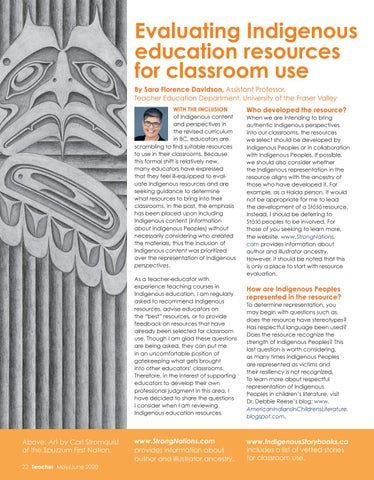
Above: Art by Carl Stromquist of the Spuzzum First Nation. 22 Teacher May/June 2020
www.StrongNations.com provides information about author and illustrator ancestry.
Who developed the resource? When we are intending to bring authentic Indigenous perspectives into our classrooms, the resources we select should be developed by Indigenous Peoples or in collaboration with Indigenous Peoples. If possible, we should also consider whether the Indigenous representation in the resource aligns with the ancestry of those who have developed it. For example, as a Haida person, it would not be appropriate for me to lead the development of a Stó:lo- resource. Instead, I should be deferring to Stó:lo- peoples to be involved. For those of you seeking to learn more, the website, www.StrongNations. com provides information about author and illustrator ancestry. However, it should be noted that this is only a place to start with resource evaluation.
How are Indigenous Peoples represented in the resource? To determine representation, you may begin with questions such as, does the resource have stereotypes? Has respectful language been used? Does the resource recognize the strength of Indigenous Peoples? This last question is worth considering, as many times Indigenous Peoples are represented as victims and their resiliency is not recognized. To learn more about respectful representation of Indigenous Peoples in children’s literature, visit Dr. Debbie Reese’s blog: www. AmericanIndiansInChildrensLiterature. blogspot.com.
www.IndigenousStorybooks.ca includes a list of vetted stories for classroom use.
“As educators, we must remain informed and continue to review the resources that we bring into our classrooms.” Does the resource contain traditional Indigenous stories? There are usually protocols associated with the use of traditional Indigenous stories in classrooms, so it is particularly important to carefully review these resources. Here are two questions to consider: does the resource indicate that permission has been given to use the story in a public context and/ or for educational purposes? And, does the resource indicate what protocols and/or guidelines (if any) should be followed when using this story for educational purposes? A place to start is the online resource www.IndigenousStorybooks.ca, which includes a list of vetted stories for classroom use in the “Resources” section.
Does the resource contain Indigenous art? It is common to include Indigenous art in Indigenous resources; but, we need to consider how the art is being credited and used. To determine this look for information about the artist to be included in the resource. Uncredited art may have been used without permission or it may not have been created by an Indigenous artist. Look to see whether information about the artist’s nation(s) has been included. Some resource creators include art that appears Indigenous for aesthetic reasons; however, it may be generic or from a nation that has not been represented in the resource. This minimizes the diversity between nations, thus reinforcing a singular (and inaccurate) Indigenous identity.
Lastly, it is worth considering whether the artist has been compensated for the inclusion of their art in the resource. This may not be immediately obvious, but if the art appears to have been copied from another source, compensation is unlikely.
Does the resource contain references to or depictions of ceremonial information? This question is particularly significant if it appears that the resource creator is not Indigenous or does not belong to the nation represented in the resource. Some examples include traditional songs and spiritual or ceremonial practices. If this content has been included in the resource, look for evidence that permission has been given to share this information. Keep in mind that if the resource has been developed by or in collaboration with someone from the same nation as the resource, they are likely familiar with the protocols associated with sharing the knowledge.
Does the resource honour the diversity of Indigenous Peoples? There is tremendous diversity between Indigenous Peoples, and this diversity must be recognized in the resources we use in classrooms. Indigenous Peoples should not be blended together to form one singular people. One way to check this is to look for references to specific nations. An exception is when the resource is referencing experiences that may be common to Indigenous Peoples, such as residential schools or colonialism.
www.AmericanIndiansInChildrensLiterature.blogspot.com provides information about respectful representation of Indigenous Peoples in children’s literature.
Does the resource portray Indigenous Peoples authentically and accurately? To determine this, you must consider the references that are being used and/or the people who have been involved in creating the resource as well as the resource itself. Do the resource creators belong to a reputable organization? Does the resource contain factual and researched information? Has the historical information been accurately portrayed? Remember that Indigenous Peoples should be presented as enduring, as opposed to vanishing, and history should not be distorted to justify European conquests. I have shared these questions in the hopes that they will help educators to feel more confident about the Indigenous education resources they bring into their classrooms. However, I must emphasize that we will still make mistakes. As educators, we must remain informed and continue to review the resources that we bring into our classrooms. We also need to be open to changing our minds when we have learned more or when additional information about a resource or author surfaces. When questions emerge, remember that you can ask for help from colleagues or the school district. It is our responsibility to educate ourselves and to learn from the people who are most affected by our mistakes so we can continue to move forward.
For free BCTF Aboriginal Education resources visit bctf.ca/ AboriginalEducation.aspx. May/June 2020 Teacher 23
The BCTF 2050 Project Project 2050 facilitator Rick Kumar, Surrey, presenting to the Winter Representative Assembly. Anne Hales photo.
New members talk teaching, union engagement, and COVID-19 By Anne Hales, BCTF staff
LAST YEAR over 2,000 teachers became first-time BCTF members. How do they feel about being in a union? Do they go to local meetings? Know their collective agreement? How will they engage with the BCTF throughout their careers— perhaps into the 2050s if they make teaching their lifelong work? A team of 20 early career BCTF members have been investigating new teachers’ professional and union experiences through the BCTF 2050 Project. The project launched in 2019 as a response to a BCTF Executive Committee recommendation to engage members in dialogue about union engagement and support. These 20 project facilitators, in collaboration with BCTF research staff, designed, conducted, and analyzed 12 provincial and local focus groups for members with fewer than five years of teaching experience. The focus groups served as some members’ “first time at the local union office” or “first union activity.” Their wide-ranging conversations provided a space for a cathartic release of questions and opinions, and even a sense of relief that other new members shared similar professional struggles or uncertainties about what being a union member means. 24 Teacher May/June 2020
Reimagining union “involvement” New members often feel too overwhelmed by complex teaching responsibilities, steep learning curves, and precarious employment situations to consider getting involved in union meetings or committees. For some, even staying on top of union emails can be hard to fit in. However, as BCTF 2050 facilitator Litia Fleming from the Kootenay Columbia Teachers’ Association suggests, it is important to communicate that “union involvement can be what you want it to be. Being involved in the union does not necessarily mean you have to add one more thing to your plate. It can mean getting advice, accessing services, or learning something new.” Kamloops 2050 facilitator Nichelle Penney explains, “Involvement could look like reading information on the BCTF portal and ensuring you’re informed about what’s going on and
what’s in your contract. Get your feet wet before you jump in to swim.” Burnaby 2050 facilitator Maria Kenward adds, “If I could tell new members one thing about union involvement it would be that there is a great group of teachers who are willing to support you in any way that they can. Becoming involved with the union allows you to meet more teachers and share your experiences and concerns. It allows you to learn about programs and services that are available for you to access that you might not otherwise be aware of.” “Don’t wait until you’re in a crisis to become involved,” advises Tess Riley from the Caribou Chilcotin Teachers’ Association. “Go to events, connect, make friends, and share in the journey of teaching!” Read the BCTF 2050 Project report to the AGM at bctf. ca/Research.aspx?id=47781.
Making personal connections New members’ first engagements with the BCTF usually happen through a teacher or union representative at the school or local level. Creating a more welcoming organizational environment and providing relevant information makes new teachers’ first union encounters less daunting and more helpful. Many new teachers shared that personal outreach and initial interactions with school and local union representatives helped them develop a positive impression of union membership and helped them stay more open to getting involved later. 2050 facilitator Kimberly Jung from the West Vancouver Teachers’ Association suggests, “Reach out to them individually to make a connection and then reveal what supports are available.” Similarly, Maria says, “I have worked on trying to connect with new teachers, whether it is making a point to
speak to new TTOCs at my school to make them feel welcome or letting new teachers know about our local’s Facebook pages and early career/ TTOC committees.”
Navigating COVID-19 The COVID-19 situation has created challenges for newer BCTF members. “Lots of new teachers are in partial and TTOC contracts. They are disproportionately affected members of our union,” Tess points out. “Additionally, new members have fewer resources and curriculum to draw on when they’re looking for ways of planning and moving forward.” Kimberley noted how “a lack of workload balance and equity in technology” leaves newer teachers “feeling overwhelmed” as they attempt to provide “continuity of learning” online. Nanaimo District Teachers’ Association Pro-D Chair and 2050 facilitator Kristin Singbeil describes how many new teachers work in partial job share
contracts and are navigating “how to split contact with families between the two teachers, making sure that they are not overwhelming families, but also not wanting to have families feel neglected by only hearing from one teacher.” For Nichelle, who has moved schools frequently since becoming a teacher, COVID-19 meant yet another transition. “I was doing great until I started packing. It was actually emotionally tough, almost a sense of grief as I sorted through things. Not knowing when we’re coming back…if we’re coming back before the end of the school year.” “I cannot begin to capture all of the challenges that teachers are facing,” says Rick Kumar, a 2050 facilitator from the Surrey Teachers’ Association. “But I can share a sentiment that is felt among all new teachers: we want to connect. Send an email and ensure our new teachers know that they’re part of one of the greatest unions this side of the Rockies.”
Members of the BCTF 2050 Project in the lobby of the BCTF building in Vancouver. Luis Isidoro photo.
May/June 2020 Teacher 25
Green New Deal A systemic overhaul to slow climate change When we least expect it, life sets us a challenge to test our courage and willingness to change; at such a moment, there is no point in pretending that nothing has happened or in saying that we are not yet ready. The challenge will not wait. Life does not look back. – Paulo Coelho By June James, BCTF staff IN THE FACE of the global struggle with the COVID-19 virus, Coelho’s words could not ring truer. This fight has taken courage and the willingness to change how we are running our society in order to save lives. The measures taken to contain the coronavirus—rethinking the economy and retrofitting industries—show us that now, more than ever, it’s possible to make the changes necessary to reverse the effects of climate change outlined in the Green New Deal. The Green New Deal is a modern mirroring and updating of some of the actions carried out in US President Roosevelt’s depression-era New Deal that helped to boost the US economy. First introduced by Alexandria Ocasio-Cortez, who at 29 was the youngest woman elected to the US Congress, the Green New Deal was developed in response to the Intergovernmental Panel on Climate Change’s call to limit global warming to 1.5 degrees Celsius over the next ten years. The Green New Deal’s bold plan aims to create a society that is truly run by and for the people and calls for drastic changes to the market-based economy that is largely responsible for the climate emergency. The goals of the deal require courage on the part of governments to bring about rapid decarbonization using a broad social and economic justice plan. 26 Teacher May/June 2020
Here’s how The Leap, a Canadian climate justice group (theleap.org), sees the way the Green New Deal will address the climate emergency while creating a much more just and equitable society: First, to achieve net-zero greenhouse gas emissions, there must be a fair and just transition for all communities and workers. In Canada the burden of paying for the transition from fossil fuel emissions to cleaner energy has been placed largely on working people. The 100 corporate and fossil fuel giants responsible for 71% of total greenhouse gas emissions since 1988 and the richest 10% of the world’s population, who produce almost half of all global emissions today, must be the ones who take responsibility for creating fairness in climate financing by being made to: • pay increased royalties on fossil fuel extraction • give up fossil fuel subsidies • pay for climate damages. In addition, to address structural inequality and the climate crisis effectively at the same time, top corporations must be made to pay their taxes at the legislated rate and stop using tax havens.
lexsl
m/a
k.co
iStoc
“The measures taken to contain the coronavirus...show us that now, more than ever, it’s possible to make the changes necessary to reverse the effects of climate change...” Second, creating good, high-wage jobs will ensure prosperity and economic security for all by investing in the infrastructure and industry that will sustainably meet the challenges of the 21st century. Studies show that investments in renewable energy and efficiency create many more jobs than investments in fossil fuels, but even more jobs can be created through the range of programs in a Green New Deal, including: • converting fossil fuel industries to renewable energy industries • electrifying mass transit in every community • constructing hundreds of thousands of new units of nonmarket and public housing • retrofitting every building in Canada • planting hundreds of millions of trees • bringing in universal daycare and rebuilding the education system with thousands of new teachers • bringing in truly universal health care. More than a million jobs will be created, and even more can be created by adding a federal $15-an-hour minimum wage, decent benefits, vacation, and pensions. Another bonus would be to double the unionization rate, which would then extend collective bargaining rights and job protections to millions of workers. Third, we have to stop the oppression of Indigenous Peoples and protect their land rights in order to ensure that all people, now and in the future, enjoy access to clean air and water, climate and community resiliency, healthy food, access to nature, and a sustainable environment.
The Global Assessment Report on Biodiversity and Ecosystem Services (www.ipbes.net/global-assessment) recognizes that Indigenous knowledge, innovations, practices, institutions, and values are key to protecting the biodiverse systems on which all life depends. Defending the health of the planet, then, depends on a society that defends Indigenous land rights and respects the Indigenous knowledge and practices that have made them the prime stewards of the land for millennia. According to The Leap, in rising to the climate crisis society must redress and make reparations by “...fully implementing the UN Declaration on the Rights of Indigenous Peoples; the principle of Free, Prior and Informed Consent; as well as the 94 Calls to Action of the Truth and Reconciliation Commission and the recommendations to the National Inquiry into Missing and Murdered Indigenous Women and Girls.” Let’s consider what Avi Lewis, Strategic Director of The Leap, wrote for The Globe and Mail: “Imagine, just for one example, if on the other side of the coronavirus pandemic, the federal government started painting Alberta in publicly owned solar panels, creating tens of thousands of jobs that paid prevailing energy industry wages, while enforcing the law of polluter pays to spark a reclamation boom cleaning up a century of oil and gas wells and infrastructure.” “The job creation per federal dollar would exponentially higher than the purchase of a white elephant pipeline. And speaking of which, once we’re all hard at work building the future together—it’ll be a lot less painful to wash our hands of the relics of the past,” he said. May/June 2020 Teacher 27
20time: Project-based learning
By Shannon Schinkel, teacher, Prince George I FELL IN LOVE with project-based learning a few years ago, when I went looking for a deeper way of doing project work with my English and humanities students. At that time, I was doing traditional project work with my classes: posters, PowerPoints, newspapers. I gave out interesting topics and lots of class time. These projects were fine and students enjoyed them, but I still relied on tests and final exams to assess students’ acquisition of the learning outcomes because that was custom. I felt a disconnect in my assessment process. Students would show me great work via the project and then do poorly on the test. I considered dropping tests, but worried about how to fit all the content into a project. That was then. With the revised curriculum’s 21st century skills focus, via curricular competencies and core competencies, I knew that students who could communicate, collaborate, and critically and creatively think would be those best served, and most of service, in the future.
The inspiration In Kevin Brookhouser’s book The 20time Project: How Educators Can Launch Google’s Formula for Future Ready Innovation (CreateSpace: 2015) he explains how Google pioneered the idea of encouraging their employees to use 20% of their work time on passion projects. The initiative caught on and others followed suit in a notable way: Gmail, Google Maps, Twitter, and Groupon all started as 20time projects. Brookhouser goes on to explain how the same philosophy can work in the classroom and how it positively affected his own students. 28 Teacher May/June 2020
aria iStock.com/Ponomariova_M
20time in the classroom Classroom 20time is the allocation of 20% of class time for students to work on a passion project. This project can be tied directly to a theme in the course, an inquiry question, or just something interesting and new a student wants to learn how to do, build, or create. In the case of my Grade 9 English class, for example, the course theme was compassion, so we used that as the platform for 20time compassion projects in which students highlighted a person or group who shows compassion. In my Humanities 8 class, students used 20time to answer a student-generated inquiry question from one of the social studies units studied. The key here is freedom to explore an idea of interest and projects that were 100% student driven. A student wants to learn to play the ukulele? Sure. Maybe build a robot? Why not? Start up a soup kitchen? Go for it. Explore what life would been like had the Black Plague not hit Europe? Awesome! The possibilities are endless. 20time is about giving students unlimited choice and 20% of class time to express their unlimited voice.
Shanno Schinkel p n
Student Camryn Frie shares a 20time project: a comic book about the SPCA.
to ho
“I am always amazed and impressed at the length and extent to which students pour so much of their hearts and souls into their work.”
Getting started Teachers can choose how much time they want to spend on 20time. I have found success in a 14-week process, reserving one day per week as the 20time day. Each 20time day is spent in a space that can serve as both a place for research and space to work on projects.
Weeks 1 and 2 I go over what 20time is and give students time to come up with an idea. In the 20time process, students must engage in hands-on or local, relevant research. This means they must speak to or meet individuals in their area. In the age of texting, Snapchat, and being able to Google pretty much anything, 20time fosters a more personal approach to communication. Students can use their phones to have phone conversations, video conferences, or to record conversations.
Weeks 3 and 4 Students prepare and present a 60-second pitch of their idea, plan, and potential setbacks. The pitch makes the project idea public. Sharing the idea brings all students together on the same journey.
Weeks 5–10 Students work on the actual project in class or at home, depending on what they are creating. At the end of each week, students write individual, weekly reflections about their 20time journey. This is a weekly check-in to share what is going well, what they are struggling with, how they are dealing with timelines/deadlines, and what their next steps are. I make comments and assist students in the process. I encourage not only growth in the project, but also how to reflect more deeply and reduce any fears or frustrations they are experiencing in their unique process.
Week 11 Every student brings in their projects, even if they are not finished, and celebrates their 20time journey! Students move from project to project, sharing their highs and lows, celebrating the uniqueness, effort, and passion of each project. There is an air of pure delight and recognition.
Weeks 12 and 13 The final step is for students to write a “TED Talk” and present it to the class. The talk synthesizes each student’s journey, emulates their writing skills from the semester, and demonstrates their speaking and presenting skills. I am always amazed and impressed at the length and extent to which students pour so much of their hearts and souls into their work.
Assessment So, if you haven’t already figured out, the project isn’t assessed—the focus skills over the 14 weeks are. The beauty of 20time is that teachers can choose subject-specific curricular competencies as the goals. A science teacher, for example, could begin with an inquiry question and have students move through the processes of predicting, planning, conducting, analyzing, evaluating, etc., ending with a talk as a form of communicating their learning. A food studies teacher could begin with ideating, and then prototyping, testing, making, etc., ending with a talk as a form of sharing and communication. A math teacher could begin with thinking creatively and wondering, moving toward inquiry, reflecting, and communicating findings in the talk. Classroom 20time is possible across all subjects. Since doing 20time projects, one key united comment from students has stayed with me: how 20time, this way of learning with freedom, with voice and choice, had such a positive impact on them. Teachers, consider what our students’ futures hold for them, how the future needs citizens who can think, be responsible, collaborate, and communicate, and consider making 20time a part of your curriculum. ABOUT THE AUTHOR Shannon Schinkel is the creator of Beyond Report Cards, a Facebook group for BC educators to support each other on their assessment journeys: www.facebook.com/ groups/beyoundreportcardsbc May/June 2020 Teacher 29
Marilou Strait photos
Shannon Hawke uses little decor and minimizes clutter to make her Grade 5/6/7 classroom a space where students can focus.
Setting the scene for teaching and learning: Options for organizing your classroom
By Kerry Richardson, retired teacher TEACHERS ARRANGE classroom furniture in much the same way a theatre director stages a play. Our classrooms reflect everything we believe about interactive and individual learning, methods of instruction, displaying student work, creating efficient traffic patterns, inclusion, quiet spaces, and a host of other things we hope to see unfold. Although, unlike directors, we often must spend our own money on our “stage productions.” We asked four Vancouver teachers, “What advice would you give to new teachers who open their doors to find empty rooms?” “Embrace the emptiness and don’t feel you need to fill it,” says Shannon Hawke, a Grade 5/6/7 teacher at Florence Nightingale Elementary, who describes herself as a minimalist. “The students should be the focal point. Bringing in connections to the outdoors can create a space that is comforting and warm. As well, add soft surfaces like pillows, couches, 30 Teacher May/June 2020
and baskets. Be thoughtful around how you want your space to function in relation to how you want to teach and learn with your students.”
given a few tree stumps for seating, as well as a bench. We offer choices: small groups, working by yourself, on a chair, or on the floor.”
There is more work to minimalism that one might think. Shannon devotes time to re-examining papers and material from previous years, keeping only the gems. Her practice is informed by her inner-city teaching experience where she found students focused better when surroundings were kept calm. The clutter of backpacks and books are kept behind a wall-length white curtain. Desktops are clear except for a plant or two.
Inclusion and offering choices are also important to Miranda Hounsell. She arranges her library at Charles Dickens Elementary for students aged 4 to 13. Her spaces include manipulatives and games, computers, a large carpet with a few beanbag pillows, and Adirondack chairs for gathering, reading, or watching something together on a large wall screen. “We don’t have everyone doing the same thing at the same time. My goal in putting it together this way is to make the library a place for everyone with a variety of seating and tables,” she says.
“You can find free material on Craigslist,” advises Karen Lam from Charles Dickens Elementary, who plans a balance of activity centres and open floor spaces for her Grade 1/2 class. “And people discard good things. In a laneway I found two tables. We cut the legs down to make them height appropriate. We were
What about the high cost of materials? “The board only gives me about $5 per student for the library, so most of the makerspace things such as the marble run and the KEVA blocks were bought with parent
advisory council money, and my own fundraising activities during the year,” explains Miranda. Secondary teachers may be more limited in their options, as the classroom may be used by other teachers or the room may be used for different grades and courses. Alain Raoul teaches Spanish and social justice at Lord Byng Secondary.
Karen Lam’s Grade 1/2 classroom combines activity centres and open spaces to give students variety.
“In both courses there’s a lot of movement. Table groups work best for dialogue, simulation games, and movement, as well as written activities, such as journal writing.” “For whole class discussions, we push tables up against the walls and place chairs in circles, which allows students to be fully present and engaged with each other. The circle embraces and celebrates the power of community,” he says. Tennis balls on the feet of chairs and desks make it possible to move them quietly on the linoleum floor. “We often have guest speakers, so then we use a U-shape, which allows the class to view the projection.” Teachers carefully consider ways to display student work. Alain explains, “The flags were an end-of-year celebration, originating from a Tibetan tradition of prayers being printed on to flags and put out to the elements to carry the message away. The students were told, “This is your legacy after you’ve completed the course. What message would you like to send out?” Students from Bosnia and Hong Kong made messages related to their wishes for their homeland.” These are hung from the ceiling so they can move in the air currents of the classroom. If BC continues to flatten the curve of COVID-19, teachers will be returning to their schools this September after one of the most extraordinary disruptions to public education in our history and setting up their classrooms for a new school year in a world changed, hopefully, for the better. Good luck to everyone.
Secondary teacher Alain Raoul keeps his space flexible, using tennis balls, so furniture can be moved quietly. Student work is celebrated in the displays.
Julia MacRae photos
What does teacher autonomy have to do with a peace process? What I learned in Colombia By Julia MacRae, First Vice-President, Surrey Teachers’ Association IT MIGHT BE impossible to overstate the beauty of the countryside in central Colombia. There are mountains, fertile valleys, bountiful farms, pasture animals, lakes and rivers with fish, gold, copper, and many precious minerals; sadly, with all this bounty of resources there is a long history of conquest and exploitation of the land and people. The 55-year civil war has left deep scars in Colombian society. A peace process is under way, but it is deeply imperfect. Armed groups are still active, and impunity for the state’s paramilitary enforcers is still a reality. According to the BCTF’s partner Federacion de Educadores de Colombia (FECODE), the government’s peace accords were not negotiated with a vision of social peace. The government wanted to offer a more stable place for international companies to invest by imposing a dictatorship of corporate interests that would degrade the rights of all workers. On top of that, the right-wing Colombian government is signing international trade agreements (including with Canada) and privatizing institutions and whole sectors of the
32 Teacher May/June 2020
Teachers are working in their schools and through their union by using their autonomy as a tool to bring about meaningful peace. government, which is not a path to stability or prosperity for the average Colombian.
individual classrooms. The BCTF sent a small delegation to Colombia to see that side of their important work in action.
Many citizens want a peaceful society, and they are doing what they can to transform a cynical situation. FECODE and other unions, student and community groups, and civil society launched strikes and walkouts in November in a massive mobilization against the inadequate official peace process, punitive pension and labour reforms, privatizations, and many other injustices, and they have kept up the pressure through legal channels and appealing to the international community for solidarity. All of this is having some effect, and the BCTF is proud to be part of the international solidarity response.
Teachers are working in their schools and through their union by using their autonomy as a tool to bring about meaningful peace. The teacher intentionally creating peaceful space in her class and using pedagogy to teach concepts that create peace in the next generation is a teacher in resistance.
However, what struck me as interesting was how FECODE also sees the importance of working at a microlevel, in
We attended provincial pedagogical encounters where teachers involved in Schools: Territories of Peace, a FECODE project, reported to their colleagues about the projects they were doing with their students. Each teacher had a different idea (philosophical focus), different way of doing it (pedagogy), different skills built among their students (curricular design), and different outcomes and successes, both short- and long-term.
Photos L to R: Verdant Colombian countryside, the streets of Bogotá, a bountiful marketplace, FECODE members and the Canadian delegates.
There is an active campaign to negate and forget the years of conflict, which benefits the powerful in society, and several teachers are leading classroom projects that prevent forgetting. Therefore, teaching about the conflict, and ensuring the tragic results of acts of violence are not forgotten (by commemorating an assassination, ensuring the site of an act of violence is memorialized, or other projects that make history visible), is working against this negation of history. Another teacher described a project about teachers’ classroom behaviour. “Our image as Colombian people is as a violent people. We teachers sometimes commit acts of violence against our students,” he said. “I recognize I am sometimes violent, but now I am learning to express myself without violence.” He explained how schools need to be places of peace, ones where students know their rights and people learn to respect each other’s differences. “We cannot say ‘peace will arrive,’ we need to construct it,” he said. While understanding and modifying his own behaviour, he was able to create his pedagogy of peace in his classroom, featuring memory, respect, rights, healthy competition, and trust. Other teachers worked seemingly more tangentially, such as having students learn more about the natural world. One teacher’s birdwatching project was particularly interesting to me. She took her students on five or six hikes over the course of a couple of months where they observed birds in the countryside. Amusingly, there is a term for skipping
school in Colombia called pajareando (birding), and some parents were complaining that she was not doing serious schoolwork with their kids if they were just “pajareando.” She responded to the parents’ hesitance by asking them to come along so they would see what their children were learning. Her students learned mapping skills as they recorded the routes of the hikes, they learned about bird species, they did bird counts and recorded these, they did art projects where they made masks of the different species, and they learned valuable details about birding and how it is a big part of international tourism. They learned about conservation, had experiences in groupbuilding and outdoor leadership, and learned from and shared bird drawings with community elders. The teacher noted that one child who was unable to behave in the classroom had blossomed in the outdoor learning environment and dramatically improved his behaviour. Students also discussed the impact that violence and war has had on the bird populations and habitats. During the conflict, people were often afraid to go on jungle hikes, where there may be guerrilla encampments or dump sites for victims of extrajudicial killings. It is part of the reconciliation process that natural and wild sites become places of peace and learning. There were many more projects explained to us, and the sheer breadth of the ideas of the teachers was astonishing. I have always thought teacher autonomy is important for
quality education, and I have promoted it here in BC as best practice. Meeting these Colombian teachers showed me how individual teacher autonomy creates and maintains a peaceful and democratic society. Working for peace through mass demonstrations, legal challenges, international appeals, diplomacy, and political pressure all are important. But in the life of one child, one class, one community, one city, and a country, a lot depends upon the work of each individual teacher acting autonomously, using their education, intelligence, critical thought, and care to bring about a better world. Our colleagues in FECODE have undergone horrors over the last several decades, including over 1,100 assassinations of teachers in recent years, most of whom were social leaders. In the 1980s and 1990s a union leader was killed almost every day. This is unimaginable to most Canadians; we don’t risk being killed for standing up and leading in our communities and schools. Threats, attempted murder, displacement, and actual assassinations are continuing and even increasing now against Colombian teachers, supposedly because of their influence on their students. I am so proud to have been a witness to these regular classroom teachers doing the work of creating a better Colombia, one student, one class, one school at a time. I congratulate them and support them.
May/June 2020 Teacher 33
Review by Catherine Quanstrom, Local President, Bulkley Valley Teachers’ Union Skids produced by Barbershop Films, 2019 SLUT. FAGGOT. RETARD. Rejects. Kids that didn’t make it. A comment from a parent dropping off her teen: “Everyone in this school is such skids!” Then apply another lens. Oppositionaldefiant disorder. Learning disabled. Intensive behaviour disorder. Anxious kids, struggling kids, kids who no longer believe anything good about themselves. So begins Skids, a documentary about a group of teenagers attending a “last chance” high school, also known as Vanguard Secondary School in Langley.
over and over, “We’re here for you. We care about you. We will help you succeed.” Charlie presents as one student who processed his early traumatic experiences by means of anger, violent outbursts, and drug use. His behaviour at school baffled Shelley Coburn, his single mom: “The child they were describing to me wasn’t the child I knew at home.” “It’s tough to invite people into your story, because you might have people judge your children,” says Shelley, viewing photos of Charlie as a chubby, blue-eyed nine-month-old.
“We get troubled kids. At-risk kids. Kids who are lost,” says Patrick Thomas, principal at Vanguard. “I can give you lots of labels. None of them match.”
“How did we get here? Nobody pictures this for their kid.”
This compassionate look into the lives of students who struggled in mainstream schools shows that the student who presents with challenging behaviour is often a child with a history of trauma. Knowing that, the staff at Vanguard, everyone from Thomas and counsellor Mindy Janzen to custodian Harold Hoffart, hold the kids close and tell them,
Yet for some kids, school is not a safe space. Many students who arrive at Vanguard are giving school one last try. Hoffart the custodian brings his two dogs, Livy and Ella, to work with him; his pets add to the welcoming, homelike atmosphere the school strives to maintain. “If you know these kids’ stories, you can give them a lot more leeway,” Hoffart notes. “Some of their stories are horrendous.”
34 Teacher May/June 2020
Knowing that, staff are committed to helping students remain in school and graduate. “We ask them: what are some of the kinds of struggles you have gone through or are going through—and still having to do school?” says counsellor Mindy Janzen. For Kaitlyn, it meant confronting her substance abuse: “I was drinking half of a 2-6 [oz. bottle of liquor] at lunch and going to all of my afternoon classes drunk.” Regular group counselling sessions as well as individual counselling and warm staff-student relationships help students relax and learn to articulate the traumas led to their inability to settle in to a regular school program. As a society, “we’re so busy these days that we are forgetting about relationships,” says Thomas. Vanguard turns that idea on its head. As Aboriginal Support Worker Sam George says, the whole staff is there for the kids. “[We’re] here to listen.”
Skids is a 38-minute documentary available at www.skidsdoc.com.
Image provided by Barbershop Films
Skids or kids?
Images provided by Portage and Main Press
Trilogy explores intricate connection between wildlife, the Gitxsan people, and BC’s Skeena River valley Review by Jennifer Kimbley, Acting Editor, Teacher Mothers of Xsan published by HighWater Press The Sockeye Mother, 2017; The Grizzly Mother, 2019; The Eagle Mother, 2020 AWARD-WINNING author Hetxw’ms Gyetxw (Brett D. Huson) and illustrator Natasha Donovan have created a series of books, Mothers of Xsan, that show the reader how the seasons, animals, and matrilineal Gitxsan people are connected in our shared ecosystem. The Sockeye Mother, The Grizzly Mother, and The Eagle Mother describe the life cycles of these animals living in and around the River of Mists (the Skeena River). Skillfully incorporating science and culture, these are beautiful books that adults and children will enjoy reading. My wish while reading was to have a word bank to help me with the pronunciation of the Gitxsan words. I wanted to honour the language by pronouncing the words properly, but instead fumbled to say key words such as Nox Lik’i’nsxw (Grizzly Mother) or Nox Xsgyaak (Eagle Mother).
During these days of working from home during self-isolation due to COVID-19, I find myself writing this review while the three boys I live with play loudly and study online. I extended their online studies by reading them these books, recommended for children aged nine to twelve, and asking for their feedback. Gavin Brandt (7), Ethan Kimbley (9), and Gabriel Brandt (12) shared their thoughts: “They have a really good vocabulary of words they use for the book. There’s some words that might be a little bit hard for kids so the book explains to them what they mean,” says Ethan Kimbley. “I didn’t know anything about eagles, so I learned a bit more,” says Gabriel Brandt. “And the artwork was nice,” to which the other two emphatically agreed. The boys have some suggestions for the publisher. “They should do one about
L to R: Gavin Brandt, Ethan Kimbley, and Gabriel Brandt. Robert Brandt photo. the beaver,” says Ethan, and, “They should do one about cougars,” says Gavin Brandt. For a thoughtful article about evaluating Indigenous resources for use in the classroom, please read Sara Florence Davidson’s article on page 22.
May/June 2020 Teacher 35
“I can’t believe I get to do this for a living!” B.C. schools are looking for passionate educators seeking new opportunities. Do you want to work in a welcoming school that values its teachers and students, and is a joy to go into each day? Across the province, there are opportunities in close-knit and diverse communities with schools that can support your professional goals and personal aspirations. Find your dream job on www.makeafuture.ca.
makeafuture.ca
ad_maf-teacher_news_magazine-bctf-2020-spring-7375x49.indd 1
2020-03-17 3:36:29 PM
WELCOME TO THE FUTURE OF DIABETES CARE CGM = Continuous Glucose Monitors
Revolutionary Glucose Sensing Technology Dr. Tom Elliott, Endocrinologist Medical Director, BC Diabetes “Every child living with Type 1 diabetes deserves Continuous Glucose Monitors (CGM): for better safety and superior control”
Contact: Bill Petrovas, B.Sc. B.Ed. M.Ed Chief of Collaborative Partnerships bpetrovas@bcdiabetes.ca
36 Teacher May/June 2020
Revolutionary Tools Dexcom G6 (CGM) Minimed 670G Insulin Pump Guardian Sensor 3 - Medtronic "The Weekly with Dr. Tom"
Help families
team up against ANXIETY
Confident Parents: Thriving Kids - Anxiety is a free program helping BC families overcome anxiety challenges in children ages 3–12. This web- and phone-based coaching service helps parents and caregivers learn effective skills and strategies for managing anxiety. It’s available by referral from physicians, teachers, school counsellors, clinicians and pediatricians.
Download referral forms at confidentparents.ca
YOU TEACH TO MAKE A DIFFERENCE. SO DO WE. Fully online TQS-approved post-graduate certificates Early Childhood Education • English Language Learners • Mathematics Education • Special Education • Teacher Librarian Each post-graduate certificate gives you advanced standing in the online Professional Master of Education program through the Queen's University Faculty of Education NEW! We now offer courses for educational support staff.
coursesforteachers.ca/bc Would you like to teach for us? To apply, visit our website.
May/June 2020 Teacher 37
Salary Indemnity Plan Are you 65 or eligible for an unreduced pension? You may be able to save about 1.36% of your salary. Why? Because you are no longer entitled to longterm disability benefits under the Salary Indemnity Plan (SIP) when you attain any of the following milestones: • 35 years of contributory service, with a minimum of age 55 • age 61, if you reach “Factor 90” before age 61 • “Factor 90” if you are between ages 61 and 65 • age 65. It’s up to you to withdraw from long-term disability. Ensure that in the event of serious illness or accident you have sufficient accumulated sick leave, which, when combined with 120 days of benefits from SIP short-term, will protect your salary to the end of the month in which you reach one of the milestones mentioned above. To apply call BCTF Income Security at 604-871-1921.
We’re better, together.
Comprehensive coverage. Superior value. Term Life Insurance Dependent Children Term Life Insurance Accidental Death & Dismemberment Insurance Critical Illness Insurance
BCTF Personal Insurance Program
Doctoral, Master’s & Diploma programs. Learn more about our diverse range of graduate program offerings.
APPLY NOW www.sfu.ca/education/grad 38 Teacher May/June 2020
For a personalized quotation or to apply online, please visit us at: solutionsinsurance.com/bctf 1.800.266.5667
Underwritten by Industrial Alliance Insurance & Financial Services Inc. iA Financial Group is a business name and trademark of Industrial Alliance Insurance and Financial Services Inc.
CLASSIFIEDS GULF ISLAND GETAWAY, Pender Island BC Website: ainsliepointcottage.com Contact Alma at 250-629-3008 NEW SOCIAL STUDIES 11 & 12 planning made easier, more cohesive with “Potlatch Blanket for a China Man” and free teaching plans - as presented at 2019 BCSSTA Conference. For specifics and free sample lessons, email AzimuthBooks@ shaw.ca.
The Teachers are here!
The Teachers are here!
Follow the BCTF on social media! @bctf www.facebook.com/ BCTeachersFederation @bcteachersfederation
Poem by Natasha Zarin School counsellor, Langley The Teachers are here! The Teachers are here! Did you hear? THEY ARE HERE! In our living rooms, on our screens In our backyards on trampolines Thumbs up and smiling, asking How are you? Singing and dancing, now we’re smiling too The Teachers are here! The Teachers are here! All the parents cheer: THEY ARE HERE!
Professional Development Calendar Visit the BCTF’s PD Calendar for professional development opportunities: bctf.ca/PDCalendar
Now we’re counting LEGO pieces Painting van Gogh masterpieces Sketching plants and local species Remembering thanks and pleases The Teachers are here! The Teachers are here! Have no fear, for THEY ARE HERE! Learning new things every day just like us Listening and helping when things get tough Making time online so we can see our friends Keeping spirits high until we meet again iStock.com/HRAUN
May/June 2020 Teacher 39
Gre wo at cla rk ss!
The teachers of BC thank the thousands of front-line workers who are providing British Columbians with access to medical care, prescriptions, food, and other essential needs. We also acknowledge our colleagues who are working in schools with the children of front-line workers. Thank you for your hard work, caring, and commitment. iStock/asantosg
Canada Post Corp. Agreement No. 40062724 Return undeliverable Canadian addresses to BCTF, 100–550 West 6th Avenue, Vancouver, BC V5Z 4P2 teachermag@bctf.ca