Teacher BC Teachers’ Federation
IN T H I S I S SU E
Jan/Feb 2026
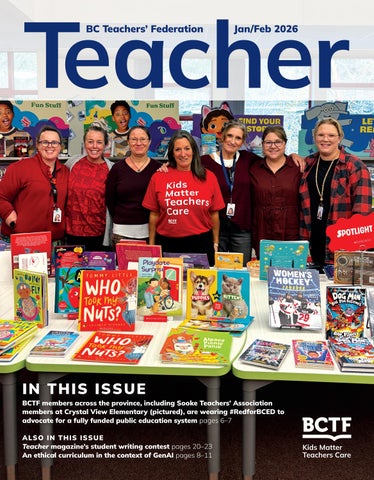
BCTF members across the province, including Sooke Teachers’ Association members at Crystal View Elementary (pictured), are wearing #RedforBCED to advocate for a fully funded public education system pages 6–7 ALS O IN TH IS ISSUE Teacher magazine’s student writing contest pages 20–23 An ethical curriculum in the context of GenAI pages 8–11
IN THIS ISSUE
6
24
12
28
Volume 38, Number 3—Jan/Feb 2026 6 8 12 16 18 20 24 27 28
Wear #RedforBCED! An ethical curriculum in the context of GenAI Bringing our learning together: Teaching inquiry in and beyond the classroom Threads of presence: Weaving Black artists into BC classrooms The importance of language in the classroom Student writing contest: People places and practices that feel like home Stories as a lens: Teaching students to navigate complexity through understandings of place Tamio Wakayama: Exhibition offers valuable history and teen programs New Japanese Canadian online history resource
2 TEACHER Jan/Feb 2026
30 32 34 36 37
From personal growth to classroom transformation: Bringing the study of self to life Developmental language disorder: Its impact on literacy and beyond Erasing racism in our schools BCTF lobbies for changes to new literacy screening mandate Culture Camp: Learning from the St’át’imc, Nlaka’pamux, and Secwépemc nations
Regular features 4 5
President’s message Message de la présidence
THIS IS YOUR
MAGAZINE Do you enjoy writing? Have a story to tell? Know of a project at your school or in your local that you want to share with colleagues? Then consider writing for Teacher, the flagship publication of the BCTF! Submission guidelines are available at teachermag.ca. We also welcome letters to the editor. Send your letter to teachermag@bctf.ca.
30 Articles reflect the views of the authors and do not necessarily express official policy of the BCTF. The BCTF does not endorse or promote any products or services advertised in the magazine. Advertisements reviewed and approved by the BCTF must reflect BCTF policy and be politically, environmentally, and professionally appropriate.
Teacher reserves the right to edit or condense any contribution considered for publication. We are unable to publish all submissions we receive.
Deadlines Contact us
March issue May/June issue
January 2026 March 2026
BC Teachers’ Federation Toll free 1-800-663-9163 Email teachermag@bctf.ca Web teachermag.ca Editor Sunjum Jhaj, sjhaj@bctf.ca Assistant Editor/Designer Sarah Young, syoung@bctf.ca Advertising teachermag@bctf.ca ISSN 0841-9574
BCTF Executive Committee
COR R E CT I O N
Teacher Magazine Advisory Board
The Nov/Dec 2025 edition of Teacher erroneously captioned a photo of Crystal Dutchak as a member of the Peace River South Teachers’ Association (PRSTA). Crystal is a member of the Peace River North Teachers’ Association (PRNTA).
Jelana Bighorn Shannon Bowsfield Brenda Celesta Adrienne Demers Carole Gordon Mary Lawrence Frano Marsic
Hallan Mtatiro Chris Perrier-Evely David Peterson Trevana Spilchen Robin Tosczak Winona Waldron
Nandini Aggarwal Alexa Bennett Fox Robyn Ladner Tamiko Nicholson Kristin Singbeil
Jan/Feb 2026 TEACHER 3
PRESIDENT ’ S MESSAGE DEAR COLLEAGUES, Welcome to the new year! I hope each of you enjoyed a restful and well-deserved winter break, filled with time to recharge, reconnect, and take care of yourselves and those you love. As we step into a new year together, I want to extend my deepest gratitude for your continued dedication and solidarity. Your commitment to wearing #RedforBCED continues to make a meaningful impact. It not only shows your support for our bargaining team but also sends a clear message to the employer that we stand united in our vision for strong public education and fair working conditions. Your unity matters, and it is seen. Turn the page and you’ll find a collection of photos celebrating members across the province proudly wearing their #RedforBCED. These images are a powerful reminder of the strength we have when we stand together. Others are wanting to join us, so welcome them to wear red in solidarity!
Carole Gordon, BCTF President Sunjum Jhaj photo
“Your commitment to wearing #RedforBCED continues to make a meaningful impact. … a clear message to the employer that we stand united in our vision for strong public education and fair working conditions.”
This past fall, events in Alberta underscored just how vital our collective advocacy is. On October 27, 2025, Premier Danielle Smith invoked the notwithstanding clause to legislate Alberta teachers back to work after three weeks on the picket line. This action was a direct attack on workers’ rights protected by the Canadian Charter of Rights and Freedoms. Across Canada, workers recognize that we cannot allow this kind of government overreach to go unchallenged. In response, delegates at the BCTF Fall Representative Assembly voted to provide the Alberta Teachers’ Association with up to $1 million in financial and legal support. Other teacher unions across the country are offering similar actions of solidarity. We urge the Alberta government to reconsider their path and to respect the fundamental rights of educators. As we continue to navigate the broader landscape of education and labour rights in Canada, this edition of the magazine creates space to highlight the meaningful work happening every day in classrooms and schools across the province. Inside, you’ll find practical teaching ideas, including lesson plans to support students preparing entries for the magazine’s new student writing contest. You can also read about BCTF Teacher Inquiry Projects and get a glimpse into a human geography class in Burnaby. These features sit alongside stories and reflections from educators that showcase the depth and diversity of teaching in our schools. I hope you find these stories encouraging and energizing as you settle into the new year. Thank you for everything you do for your students, your schools, and each other. I’m proud to stand alongside you, and I look forward to all we will accomplish in the year ahead for our union, our profession, and for kids. Wishing you a strong and inspiring start to 2026. In solidarity,
Carole Gordon, BCTF President 4 TEACHER Jan/Feb 2026
MESSAGE DE LA PRÉSIDENCE CHER·ÈRES COLLÈGUES, Bienvenue dans cette nouvelle année ! J’espère que vous avez toustes profité d’une pause hivernale bien méritée et reposante, l’occasion de vous ressourcer, de renouer des liens et de prendre soin de vous et de vos proches. Alors que nous entamons ensemble cette nouvelle année, je tiens à vous exprimer ma plus profonde gratitude pour votre dévouement et votre solidarité constants. Votre engagement à porter du rouge pour l’éducation en Colombie-Britannique continue d’avoir un impact significatif. Il témoigne non seulement de votre soutien à notre équipe de négociation, mais il envoie également un message clair à l’employeur : nous sommes unis dans notre vision d’une éducation publique de qualité et de conditions de travail équitables. Votre unité est essentielle et elle est visible. Tournez la page et vous verrez une série de photos célébrant les membres de partout dans la province qui portent fièrement du rouge pour l’éducation en Colombie-Britannique. Ces images nous rappellent avec force la puissance de notre union. D’autres veulent se joindre à nous, alors invitez-les à porter du rouge en signe de solidarité ! L’automne dernier, les événements survenus en Alberta ont mis en lumière l’importance de notre mobilisation collective. Le 27 octobre 2025, la première ministre Danielle Smith a invoqué la clause dérogatoire pour forcer les enseignant·es albertain·es à retourner au travail après trois semaines de piquetage. Cette mesure constituait une atteinte directe aux droits des travailleur·euses protégé·es par la Charte canadienne des droits et libertés. Partout au Canada, les travailleur·eues reconnaissent qu’il est inacceptable de laisser ce genre d’abus de pouvoir gouvernemental impuni. En réponse, les délégué·es à l’Assemblée représentative d’automne de la FECB ont voté pour accorder à l’Association des enseignant·es de l’Alberta jusqu’à un million de dollars en soutien financier et juridique. D’autres syndicats d’enseignant·es à travers le pays prennent des mesures de solidarité similaires. Nous exhortons le gouvernement de l’Alberta à reconsidérer sa position et à respecter les droits fondamentaux des éducateur·rices.
‹‹ Votre engagement à porter du rouge pour l’éducation en Colombie-Britannique continue d’avoir un impact significatif. … un message clair à l’employeur : nous sommes unis dans notre vision d’une éducation publique de qualité et de conditions de travail équitables. ›› Alors que nous continuons d’explorer le contexte plus large des droits des enseignant·es et des travailleur·euses au Canada, ce numéro du magazine met en lumière le travail important accompli chaque jour dans les classes et les écoles de la province. Vous y trouverez des idées pédagogiques pratiques, notamment des plans de cours pour aider les élèves à préparer leurs textes pour le nouveau concours d’écriture étudiante du magazine. Vous pouvez également consulter les projets de recherche des enseignant·es de la FECB et découvrir un cours de géographie humaine à Burnaby. Ces articles côtoient des témoignages et des réflexions qui illustrent la richesse et la diversité de l’enseignement dans nos écoles. J’espère que ces récits vous inspireront et vous dynamiseront en ce début d’année. Merci pour tout ce que vous faites pour vos élèves, vos écoles et vos collègues. Je suis fière d’être à vos côtés et je me réjouis de tout ce que nous accomplirons l’an prochain pour notre syndicat, notre profession et les enfants. Je vous souhaite une excellente et inspirante année 2026. Solidairement,
Carole Gordon, Présidence de la FECB
Jan/Feb 2026 TEACHER 5
Langley
WEAR #RedforBCED! # Redfo rBC ED BCTF members in locals across the province are wearing red to advocate for a fully funded public education system.
Share your #RedforBCED photos on social media. Chilliwack South Okanagan Similkameen
New Westminster
Nechako
Kamloops Thompson
Saanich
Vancouver Elementary and Adult Educators’ Society
Coquitlam
South Okanagan Similkameen
Nelson
Nelson
Saanich
Prince George Surrey
Surrey
Nechako
AN E THICA L CU RRI CU LUM IN TH E CONTE XT OF G e n A I By Dr. Greg Sutherland (he/him), lecturer in Indigenous pedagogies and practice, Faculty of Education, Simon Fraser University
8 TEACHER Jan/Feb 2026
HOW DO YO U V I E W G e nA I ? Earlier this year, I published a short article, “Understanding GenAI through Indigenous ways of knowing,” in Teacher.1 Since this time, many colleagues have reached out to share their thoughts on how they are working to reorient their classrooms to foreground values of ethicality, observe appropriate scholarly protocols, and guard against appropriation in the face of GenAI (generative artificial intelligence). I was deeply heartened to hear that so many educators throughout the province were asking the same kinds of questions that were near to my heart as we all explore productive ways forward in the context of this seemingly game-changing technology. One idea offered by Brianna Stusiak, a science and technology teacher in the Surrey School District, is that the advent of GenAI can be seen as a gift that invites us to move beyond teaching practices that we know to be ineffective so that we may seek out new approaches that better align with the needs of students. (As will become clear through the course of this article, it is important to acknowledge that Brianna gave me her explicit consent to share her idea in this article.) These conversations about the place that GenAI will hold in teachers’ classrooms have revealed a profound collective ambivalence in the teaching community ranging from optimism, to distrust, to excitement, to despair. What has become increasingly clear to me is that—regardless of whether we see GenAI as an agent of pedagogical change, as an unavoidable fait accompli, as a powerful means of supporting student achievement, or as a troublesome plagiarism machine—educative approaches to how this technology enters the classroom seem the best way forward.
“… regardless of whether we see GenAI as an agent of pedagogical change, as an unavoidable fait accompli, as a powerful means of supporting student achievement, or as a troublesome plagiarism machine— educative approaches to how this technology enters the classroom seem the best way forward.” W HAT ’ S AT STA K E As a Métis educator, I am particularly invested in purposeful educative approaches to this work. I believe that the careless implementation of GenAI can have dire consequences for the work of healing and reconciliation as outlined by Standard 9 of the Professional Standards for BC Educators, which asks all educators to “integrate First Nations, Inuit, and Métis worldviews and perspectives into learning environments.”2 Without careful consideration of how GenAI is being used by teachers and students, we run the risk of undermining our commitments to healing and reconciliation. Careless implementation of GenAI can result in modelling appropriation, undermining Indigenous scholarly protocols rooted in permissions and acknowledgments, damaging relationships with students, and distancing students from an understanding of their own identities as learners and of their relationships with the lands upon which they reside (see my previous article for more on this).
Davidovici/iStock
Jan/Feb 2026 TEACHER 9
THR EE QUEST I O NS FO R E DUCATO RS Teachers in all subjects and grade levels must decide how we can best equip students with the critical, ethical, and technical know-how to be successful learners when GenAI is only a click away. Accordingly, I would offer the following three questions to teachers for consideration in aligning their GenAI policies with the tenets of Indigenous scholarly ethics.
“ When st ude nts us e GenAI for the ir l ear ning, t hey are also l ear ning to take witho u t giving a ny thing i n retu r n.”
1. If GenAI wa s t ra ine d o n m a te r ia ls w it ho u t co ns e nt , can we use it w it ho u t m o d e lling d is re g a rd fo r et hic s? Numerous lawsuits have been launched by media outlets such as The New York Times, Toronto Star, The Globe and Mail, The Canadian Press, and the CBC against GenAI companies, such as OpenAI, Microsoft, and ChatGPT, for illegally accessing years of hard work by journalists and editors. This being the case, we teachers should be concerned about using GenAI in classrooms, given the incommensurability of GenAI’s genesis and the aims of teaching about Indigenous scholarly protocols, permissions, and consent. Students have a right to learn about the long history of the appropriation of Indigenous knowledges, cultures, and technologies but deserve to do so through pedagogies that do not mirror the very approaches that they are meant to be learning about. These understandings of respect are supported by Article 31 of the United Nations Declaration on the Rights of Indigenous Peoples, which states, “Indigenous peoples have the right to maintain, control, protect and develop their cultural heritage, traditional knowledge and traditional cultural expressions,”3 and these understandings of respect are foundational to the First Nations Education Steering Committee (FNESC) First Peoples Principles of Learning, which state, “Learning involves recognizing that some knowledge is sacred and only shared with permission and/or in certain situations.”4
2. If GenAI cre a te s tex t a nd im a g e s t hro u g h st a t ist ica l probabilit y, d o e s it re a lly k now w ha t it is s ay ing a nd , if not , who is re s p o ns ib le fo r w ha t it s ays? Many models of Indigenous teaching and learning foreground the importance of students learning that they have responsibilities to the world around them and that they must learn how to live up to these duties to their ecologies. The FNESC First Peoples Principles of Learning, for instance, state, “Learning involves recognizing the consequences of one’s actions.”5 Understanding the implications of our actions includes being responsible for what we say, what we write, and what we create. Given that GenAI isn’t really an “artificial intelligence” but rather an algorithm that creates through predictive probability modelling, it is fair to say that it is both authorless and unaware of what it is saying. As such, it cannot be responsible for what it says or creates. Since this is the case, we teachers should be asking ourselves how we can teach about ethical accountability if GenAI muddies foundational concepts such as authorship and responsibility.
3. If GenAI ca n c re a te sto r ie s, im a g e s, a nd id e a s t ha t a re always availa b le fo r t he t a k ing , how d o we u s e it to te a c h the spirit of re c ip ro c it y? Recognition of our responsibilities to give back to our communities and ecologies is central to Indigenous worldviews. In this understanding of ethical duty, it is the gifts with which we are endowed that define our obligations to the world that we inhabit. The Potawatomi scientist Robin Wall Kimmerer teaches us that “Enumerating the gifts you’ve received creates a sense of abundance, the knowing that you already have what you need. Recognizing ‘enoughness’ is a radical act in an economy that is always urging us to consume more.”6 In a time when we are increasingly experiencing the environmental impacts of economies that are driven by resource extraction, consumerism, and disposability, the need to teach our students gratitude and reciprocity is paramount. When GenAI produces text, images, and ideas without asking anything in return, how can teachers help young people to understand gratitude and reciprocity? When students use GenAI for their learning, they are also learning to take without giving anything in return. The relationship between concepts of reciprocity and GenAI are further problematized when we consider the deleterious impacts on the natural world resulting from the energy required to sustain the operation of GenAI.
A N E T H I CA L C U R R I C U LU M : A D I F F E R E N T WAY FO RWA R D I would like to conclude this article by circling back to the idea that Brianna Stusiak offers us: that the advent of GenAI can be understood as an invitation to approach teaching and learning differently. In my own teaching, I have come to understand the emergence of GenAI as the ideal occasion to move toward what can be called an ethical curriculum. This curriculum includes learning about the benefits and limitations of GenAI by directly addressing questions of respect, responsibility, and reciprocity. An ethical curriculum means creating opportunities for students to learn about local scholarly protocols around the sharing of traditional stories, the gifting of songs, the appropriate expectations for participating in cultural activities, and the many manifestations of appropriation. My current teaching context is in post-secondary education, but curriculum in support of this kind of teaching and learning can be found throughout the K–12 BC curriculum documents. For instance, the Mathematics 10–12 curriculum includes the competency elaboration of “Incorporate First Peoples worldviews, perspectives, knowledge [local knowledge and cultural practices that are appropriate to share and that are non-appropriated], and practices to make connections with mathematical concepts.”7 Truly teaching to this competency necessitates that students develop an understanding of what it means to be in keeping with local ethical protocols in order to begin to address concepts like appropriation and permission. Similarly, the English Language Arts 10–12 curriculum includes the curricular content item “protocols related to the ownership of First Peoples oral texts.”8 Again, it would be difficult to address this curriculum without exploring ideas of scholarly ethicality. For subject teachers who cannot find a curriculum that addresses these kinds of ethical concerns, teaching your students about protocols, permissions, consent, and appropriation is broadly supported by Standard 9 of the Professional Standards for BC Educators. An ethical curriculum means that in their daily work, my students learn to handle the ideas of others with care and respect. This ethicality includes assiduous attention to permissions and issues of copyright, such as citing permissions for sharing stories that are not their own, using only public domain images or images that they have created, and spending the time to trace ideas back to their source so proper attribution can occur. I encourage students to reach out to the creators of content, friends, classmates, and teachers to ask for permission to use ideas and images rather than assuming tacit permission simply because it appears on the internet. An ethical curriculum also
“I have come to understand the emergence of GenAI as the ideal occasion to move toward what can be called an ethical curriculum. … creating opportunities for students to learn about local scholarly protocols around the sharing of traditional stories, the gifting of songs, the appropriate expectations for participating in cultural activities, and the many manifestations of appropriation.” requires students to take the time to learn about the identities of authors and assess the appropriateness of the resource. (The Haida/Settler scholar Sara Florence Davidson offers an excellent framework for scaffolding this kind of exploration.)9
In my teaching, I am careful to model my deep regard for the work of others, as I do not use any images, frameworks, lesson ideas, or assignments without careful and respectful attribution. In my current classroom resources, I take the time to make direct reference to the material from where it was originally adapted. I also uphold this care for the intellectual property of others by making a public promise to my students that I will not put their work into GenAI for purposes of assessment or for authenticating it for academic honesty. I explain to them that my ethical duty to them and their scholarship prohibits me from sharing their work with others or with the GenAI algorithm without their express consent. In these small but important ways, I am modelling the ethicality that I hope my students apply to their own work and the work of others. In a time when GenAI can write an essay, solve a math equation, or create a historical timeline in moments, I wonder if shifting toward an ethical curriculum, where students consider questions of appropriation, respect, and consent, might be the most productive way to prepare students for what is yet to come. •
1 Greg Sutherland, “Understanding GenAI through Indigenous ways of knowing,” Teacher, January/February 2025, p. 26–27. 2 British Columbia Ministry of Education and Child Care, “Professional Standards for BC Educators,” Government of British Columbia, 2019. 3 United Nations General Assembly, United Nations Declaration on the Rights of Indigenous Peoples, United Nations, 2007. 4 First Nations Education Steering Committee, “First Peoples Principles of Learning,” 2008. 5 ibid. 6 Robin Wall Kimmerer, The Serviceberry: Abundance and Reciprocity in the Natural World, Scribner, 2024, p.12. 7 British Columbia Ministry of Education and Child Care, “Indigenous Knowledges and Perspectives: Mathematics K–12,” Government of British Columbia, n.d. 8 British Columbia Ministry of Education and Child Care, “Indigenous Knowledges and Perspectives: English Language Arts K–12,” Government of British Columbia, n.d. 9 Sara Florence Davidson, “Evaluating Indigenous education resources for classroom use,” Teacher, May/June 2020, p. 22–23.
Jan/Feb 2026 TEACHER 11
BRINGING OUR LEARNING TOGETHER Teacher inquiry within and beyond the classroom By Kristin Singbeil and Vanessa Coray, facilitators, BCTF Teacher Inquiry Program
THE MOST FASCINATING PART of teacher inquiry projects is never knowing where your curiosity will take you. Last school year, we were honoured to facilitate a Teacher Inquiry Program (TIP) project with a group of teachers from Victoria to explore six interconnected topics: exploring community, creating anti-racist classrooms, Indigenous ways of learning, cross-grade/cross-curricular learning, reciprocal relationships, and the academic impact of building connections. While our group began with a common purpose, the projects ultimately took each participant in very different directions— each shaped by their own contexts, identities, and communities. What united our group was a commitment to listen deeply, act thoughtfully, and reflect honestly on the work of creating more inclusive and responsive educational environments. Our group was made up of teachers from many different schools who taught many different subjects in both elementary and secondary school. All were seeking a way to find meaningful connections among their students, staff, and communities. Over the course of six sessions, we explored ways of creating connections between staff and students in schools with separate buildings, welcoming students and educators into Indigenous learning spaces, bringing students together across grades through art and play, learning from the land, and exploring gender-inclusion in nature-based learning. We reflected on the state of our classrooms and the learning that students were taking part in to be able to discover why we teach the way we do and whose needs are being met. We found that it was very easy to identify problems in a colonial school system but wondered, how could we co-create solutions? With a lack of space and collaboration time, it is often difficult to work together in schools to build an authentic community. We explored ways that would meaningfully include other educators in our learning journey.
BCTF TEACHE R I NQ UI RY P RO G RA M The BCTF Teacher Inquiry Program provides teachers a framework for ongoing professional inquiry and growth. It promotes continual professional development in teaching practices by fostering a structured process of investigation and reflection. Search for “Teacher Inquiry Program” at bctf.ca to learn more.
12 TEACHER Jan/Feb 2026
“… genuine inquiry spills beyond classroom walls, uncovering questions we didn’t even know we needed to ask.” Opposite: Student felting projects made as a part of Julia Thompson’s inquiry project on collective creativity.
CO LLE CTIVE CR EATIVIT Y One participant, Julia Thompson, created an Indigenous learning space from a room that had been a storage space. This allowed her to invite students into the space to learn how to felt. Needle felting, which can be a meaningful tool for self-regulation, cultural transmission, and storytelling, allowed her and her students to build a connection to traditional materials and artistic expressions. When approached with gratitude and reciprocity, it becomes a way to honour shared knowledge and resources, foster community, and promote cultural exchange through collective creativity.
B RINGIN G THE PER IPHER IES INTO FOCUS Chiana van Katwijk’s inquiry centred on the revival and expansion of her school’s Students of Colour Association. Drawing inspiration from Paulo Freire’s concept of “the peripheries” and building upon her Freirean inquiry project from last year, she reflected on the many students who exist in the in-between spaces of school life—often unseen, unheard, and disconnected. By simply opening her classroom at lunch and offering food, games, and conversation, she created a space where students of colour felt seen, safe, and empowered to lead. From organic discussions came student-driven initiatives—art projects, anti-racism resources for teachers, and dreams of future cultural exchanges. The importance of her own identity as a Black woman and teacher of colour was central; students explicitly shared how much it mattered to be led by someone who shared and understood their experiences. This inquiry reminded us that intentional spaces, grounded in care and cultural connection, have the power to transform school experiences and foster genuine community.
DE CO LO NI ZI NG P RACTI CE A ND S PACE Greater Victoria Teachers’ Association former professional development chair and TIP participant Ilana Hampton noted that she began this inquiry thinking it would guide her toward classroombased strategies to decolonize her practice as a learning support teacher; but she found that the process pushed her to think far more broadly. As she worked closely with students and their caregivers, she became more attuned to the messages school environments send—messages communicated not only through curriculum but also through visuals, language, and space. She found herself noticing which walls held Indigenous art and which still displayed colonial symbols, which announcements honoured the land and which did not. She realized that decolonizing her teaching practice wasn’t only about the materials used or the relationships nurtured—it was about her whole learning community. This shift in focus led her to create and distribute a survey to better understand how schools across the district are engaging in this work. What she learned is that meaningful change is happening in many places, but there is still much more to do. As educators, we have a responsibility to ensure that Indigenous presence is not just acknowledged but embedded, visible, and sustained across all aspects of our learning environments. We need to do this work together, and we need to create, and build, and strengthen our communities (classroom, school, and wider communities) as we engage in this work. This inquiry, titled Beyond the Bulletin Board, asked how Indigenous presence is—or isn’t—embedded in our school environments. Through observation, cross-school visits, and a district-wide survey, Ilana uncovered powerful efforts to incorporate Indigenous voices: land acknowledgments rooted in seasonal learning, Indigenous art by local artists, and innovative library practices like the Brian Deer classification system. But inconsistencies across schools pointed to a need for deeper, system-wide commitment. The inquiry also explored how school symbols—such as flags and portraits—carry implicit messages. In some schools, the quiet removal of British monarchy portraits spoke volumes. This project affirmed that reconciliation is not a checklist but a relationship—one that requires space, voice, and shared responsibility.
Jan/Feb 2026 TEACHER 13
“… any work toward student well-being must also account for the well-being of teachers.” A DDRESSI NG BE LO NG I NG Another inquiry examined belonging through the lens of queer and non-binary experiences—for both students and staff. As a queer, non-binary teacher and social justice representative, Nat Buchmann gathered stories and data from across schools and districts. What emerged was a powerful portrait of systemic gaps: unsafe or inaccessible gender-neutral bathrooms, lack of representation in curriculum, and ongoing invisibility of queer and gender-diverse identities in school culture. Yet alongside these gaps were seeds of change—peer mentorship programs for LGBTQ2IA+ student-teachers, school committees addressing inequities, and growing interest in sharing inclusive teaching resources. This inquiry highlighted how physical structures and systemic norms can create barriers to belonging—and how community, advocacy, and visibility can start to break them down.
CREAT I NG CO M M UNI T Y Claire Rogers’ inquiry delved into the question, what does community look like when your school is split between two buildings that are a kilometre apart? The inquiry uncovered the emotional and logistical challenges faced by students and staff alike—feelings of disconnection, miscommunication, and fractured identity. Through her research and reflection, she began to identify strategies for bridging these gaps: shared events, cross-building rituals, and intentional efforts to reweave the threads of belonging. Her project was a reminder that physical space can shape emotional and relational space—and that community must be actively and creatively constructed.
EXA M I NI NG BURNO UT The final inquiry in our collective, Marlena Monton’s, examined the pervasive and deeply human issue of teacher burnout. By reflecting on her own experiences and conversations with colleagues, she surfaced themes of exhaustion, systemic pressure, and emotional depletion. Yet she also highlighted the importance of carving out time for professional reflection, peer support, and mutual care. Her contribution served as a grounding reminder that any work toward student well-being must also account for the well-being of teachers.
14 TEACHER Jan/Feb 2026
B R IN GING OU R LEAR N ING TOGE THE R As an inquiry group, we all realized after working together that we needed to take our learning outside and spend some time building our own community as a group while learning from the land. Our group visited the Signs of Ləkwəŋən interpretive walkway in Victoria, where seven spindle whorls created by Songhees artist Butch Dick honour the art, history, and cultures of the Coast Salish people. These spindle whorls represent family and the foundational role of Coast Salish women. Along this journey we discovered that the seventh spindle whorl at Laurel Point, a significant historical burial site, was missing. Through further inquiry, a member of our group contacted the Songhees Nation and learned that the spindle whorl had been removed in 2020 for a remediation project, and there was still no clear plan from the city on when it would be returned. This prompted our group to write letters to Victoria City Council to advocate for its reinstalment, which has since occurred (pictured left). This was not a planned part of our inquiry, but it reflected the organic and reciprocal nature of the learning we were doing.
Our inquiry led us to discover that when we centre relationships, land, and reciprocal learning, the outcomes are often unpredictable but deeply meaningful. Our TIP cohort’s big takeaway is that genuine inquiry spills beyond classroom walls, uncovering questions we didn’t even know we needed to ask. Our group explored deep questions that uncovered surprising directions, prompted civic engagement, and helped us reimagine space, connection, and purpose in education. Whether through reactivating unused spaces, connecting with Indigenous communities, or speaking up for cultural restoration in our city, our learning didn’t just stay in the classroom—it walked out with us. •
Above left: (L to R) Julia Thompson, Marlena Monton, Claire Rogers, Ilana Hampton, Kristin Singbeil. Below left and above: Sculptures of spindle whorls by Songhees artist Butch Dick. The series of sculptures honours the art, history, and cultures of the Coast Salish people. All photos provided by Kristin Singbeil.
Jan/Feb 2026 TEACHER 15
‘
T HR EAD S OF PRES E NC E Weaving Black artists into BC classrooms
By Nikitha Fester (she/her), BCTF staff WHEN YOU WALK into an art gallery today, you’ll find works that don’t just adorn the walls—they speak. They speak of migration and memory, of joy and resistance. They speak of Black presence in a province that has often overlooked it. From Jan Wade’s soulful assemblages to Chantal Gibson’s razor-sharp installations and the legacy of Grafton Tyler Brown’s 19th century landscapes, Black artists in BC continue to shape and reshape how we understand our relationship to history and identity. Brown was part of BC’s early wave of Black migrants, arriving in the province in 1882. His primary vocation was as a lithographer, and he came here with a geological survey party. Brown, however, gained notoriety as a painter and artist. Prior to arriving in BC, he owned his own business in San Francisco, G.T. Brown and Company. Under his company name, he commissioned work for John Sullivan Deas, the Black entrepreneur and owner of one of the first salmon canneries in BC.
A student takes in a segment of Jan Wade’s Breathe, embroidery on linen, in her exhibit Soul Power at the Vancouver Art Gallery in 2022.
Upon arrival in BC, The British Colonist published “The Great Interior on Canvas” about Brown. This news article reads, “Mr. GT. Brown an artist of more than local celebrity in California and elsewhere joined Mr. Bowman’s geological survey party” and encourages readers to visit Brown’s studio at the Occidental Hotel. Later, in 1883, Brown held an art exhibition, where a newspaper noted, “Yesterday was the opening day of the exhibit from the brush of our local artist Mr. G.T. Brown. The scenes portrayed are 22 in number comprising views of Victoria, surrounding area and the mainland. Several of the paintings have already sold.”1 Brown’s story and that of Deas are lost in the pages of BC and Canadian history and their erasure contributes to the narrative that Black folks are not part of BC’s story. Yet, they are significant threads in the tapestry of our history that bind past to present and shape the contemporary presence of Black artists in BC and across Canada. Gibson and Wade have been contributing to the reimagining of Canadian art by centring Black voices and experiences within the cultural landscape of BC. Both artists work through themes related to spirituality, joy, resilience, colonial narratives, and diasporic identity. In addition to visual arts, Gibson, a poet and writer, uses text to elevate messages in her art. For example, un/settled (2021) includes the following:
16 TEACHER Jan/Feb 2026
we kn ow th e e m pt y space i n our a r m s t h a t o u r l o st c h ild re n w i l l n ever f ill t h i s i s n ot o ur lib e r t y we are n ot f re e to fo rget This short poem by Otoniya J. Okot Bitek, coupled with an image of a person cradling braided rope, as if it were their child, encourages the viewer to reflect on those very themes of diasporic identity, spirituality, and colonial narratives. The use of the braid is particularly significant as it connects to African heritage and the preservation of cultural identity despite displacement. Wade, similarly, prompts a call and response in her piece Breathe, which is a piece inspired by the quilters of Gee’s Bend, Alabama. The quilters of Gee’s Bend practice the handed-down art of quilting, initially a functional practice of stitching together scrap fabric to create insulation for homes and shoes for children, and later burned to keep the mosquitoes away. This quilting practice is now understood to be an important contribution to African American art. Wade’s interpretation, which was on display at the Vancouver Art Gallery in 2022, was inspired by the quilters of Gee’s Bend and Eric Garner’s final words: “I can’t breathe.” For Wade, “Black people are living in a society that is so unaccepting of them,” and so Breathe is a reflection and a response to this experience.2 Again, the themes of diasporic identity and colonial narratives are highlighted, and through the colour selection, calm and chaotic patterns, and the accompanying playlist, the audience also experiences the joy, resilience, and ingenuity of Black Canadian art. Art is an invitation for students to engage with complex themes like identity, belonging, race, and erasure. Providing students with the space to consider art, how they respond to it, and what it evokes within them, can provide an opportunity to have deep and important conversations. Consider a virtual gallery field trip to experience the works of Wade and Gibson. Allow senior students to listen to Wade’s playlist and have them discuss how the music affects their experience of her art. With intermediate students, you may consider the work of Brown’s alongside Carr’s. You could share both artists’ biographies and ask students to reflect on why it was difficult for them to be known for their work and why Brown’s work is seldom discussed.
Opposite and above: Author’s photos from the Jan Wade Soul Power exhibit at the Vancouver Art Gallery in 2022.
Lastly, with primary students, consider including Pearl Low’s short film Hair Love (BC artist of Jamaican Chinese descent) or read the junior novel Swim Team by Johnnie Christmas (Black Canadian graphic novelist) to have conversations about representation. Black artists in BC remind us that art is both memory and possibility. The work of Brown, Gibson, Wade, Low, and Christmas challenge erasure, celebrate identity, and invite us to imagine new futures. As educators, offering students the opportunity to engage with these voices goes beyond the art curriculum, allows for sincere engagement with core competencies, and demonstrates a commitment to truth, representation, and joy in the classroom. •
M O RE I NFO RM AT I O N Visit the online version of this article at teachermag.ca for further reading about each artist mentioned here and to find Jan Wade’s Soul Power playlist. 1 BC Black History Awareness Society, “Grafton Tyler Brown: First Professional Black Artist in the Pacific North West,” Community Stories Collection, Digital Museums Canada, 2020: www. communitystories.ca/v2/bc-black-pioneers_les-pionniers-noirs-de-la-cb/story/grafton-tylerbrown-1st-professional-black-artist-in-the-pacific-north-west/#:~:text=In%201882%20 Grafton%20Tyler%20Brown,Mr 2 Vancouver Art Gallery, “I Am Jan Wade: On Breathe,” 2022: www.youtube.com/watch?v=sEEs6njuaWo
Jan/Feb 2026 TEACHER 17
THE IMPORTANCE OF LANGUAGE IN THE CLASSROOM By Jessica Rychter (she/her), teacher, Surrey IF READING COMPREHENSION is built on language, why isn’t explicit language instruction a focus in every classroom? As a pre-service teacher, I had this idea that teaching students about the English language was only done during one subject—language arts. However, over the last few years of teaching in the classroom, I have come to the realization that this could not be further from the truth. Teaching students a language is woven into every part of our school day. From solving math problems and writing about science, to peers working collaboratively in small groups, students are continuously using language to think, learn, and communicate.
RECOMMENDED RESOURCES “High Quality Language Environments Promote Reading Development in Young Children and Older Learners” in Handbook of Reading Research V.5 “Can Scarborough’s Reading Rope Transform the Approach to Literacy Instruction” on www.reallygreatreading.com “Understanding Second Language Acquisition” Chapter 8 from Adding English: A Guide to Teaching in Multilingual Classrooms by Elizabeth Coelho What Teachers Need to Know About Language edited by Carolyn Temple Adger, Catherine E. Snow, and Donna Christian “4 Key Differences Between First and Second Language Learning” by Mango Languages on YouTube “Language Acquisition: Crash Course Linguistics #12” by CrashCourse on YouTube “The Simple View of Reading” on www.readingrockets.org
Above: Sentence-starters in Jessica’s classroom. Photo provided by author. 18 TEACHER Jan/Feb 2026
With every year I teach, I notice an increase in English language learners (ELL) in my classroom. While I am excited to teach these students and honoured that I have been given the opportunity to be a role model to them for the upcoming year, I have felt a constant worry that I do not have the proper knowledge and experience to take on such an important task. However, as I’ve connected with other teachers, along with my school team, I have come to the (unfortunate) realization that none of us have ever really been taught the strategies necessary for dealing with situations like this while we were undergoing training as pre-service teachers. Thus, over the last few years I have been trying to figure out an answer to the question, what practical steps can teachers take to make their classrooms more inclusive for English language learners?
“… over the last few years I have been trying to figure out an answer to the question, what practical steps can teachers take to make their classrooms more inclusive for English language learners?” WH Y IS LANGUAGE DE VELOPM EN T IMPORTANT ?
CLAS S RO O M ST RATE G I ES
First, let’s start off with the importance of understanding language development for teachers. While there are many reasons why we should understand this, I will (for the sake of length and time) only list and explain a few.
Throughout my journey of finding effective strategies to provide a literacy-rich classroom, I have seen how certain strategies transform student confidence and comprehension and how others hold them back. The strategies that haven’t been successful (e.g., constant corrections) are thrown out or readjusted. Here are strategies I have found to be effective.
Langu a g e i s t h e fo un d a t io n of le a r n in g Language gives children the tools they need to think, communicate, and understand the knowledge they acquire. Without this, children would not have the ability to ask questions (even if it’s the same one 100 times over), share their thoughts in their own words, or even work collaboratively with their peers.
V i s ua l s up p or ts a n d word wa l l s Having visuals (pictures and vocabulary) spread out around my classroom helps students visualize what they are thinking. It also provides context clues that support their comprehension of a subject without needing to be given a direct answer.
Improves teach er in st r uc t io n Understanding how language and reading develop helps teachers with their instruction and assessment; they can adapt their lessons in ways that are targeted toward all learners. H elps tea ch ers di a g n o s e le a r n in g d iff ic ulti es Having the ability to understand the linguistic components of language (syntax, morphology, etc.) helps teachers identify the specific areas in which students are experiencing difficulties. Cre ates a n i n cl u si ve c la s s ro o m e nv iro n m e n t Understanding how language develops equips teachers with tools and strategies that are needed to target both monolingual and multilingual learners. This ensures that teachers will not be leaving any student behind in their learning. One key idea that has reshaped my thinking is the Simple View of Reading model. This model suggests that reading comprehension is made up of two components: decoding and language comprehension. If a student is weak in either of these components, reading comprehension is difficult to reach as both of these skills are needed for it. Later, I came across another model called Scarborough’s Reading Rope, which breaks this idea down even further. This model highlights the components (strands) that make up language comprehension (background knowledge, vocabulary, etc.), as well as word recognition (phonological awareness, sight recognition, etc.). Each of these is a skill that develops individually, yet they are all so closely related in the sense that once they become “intertwined,” reading comprehension strengthens. Both of these models highlight that in order for a student to reach proficiency, it’s not just important that they can sound words out correctly. Instead, reading is about understanding just how complex language really is.
Aca d em i c l a n g ua g e Practising the use of academic language both in student writing and conversation (e.g., think-pair-share) has also allowed students to build their language skills. Encouraging students to shift between their informal talk (everyday language) and formal talk (academic language) has been especially effective in helping them develop an awareness of the way language is used in different ways and across different settings. Rea d -a l oud s Reading text aloud allows teachers to introduce students to new vocabulary, pause to model their thinking, and show them how to interact with text (e.g., asking meaningful questions) in order to help students better understand what they are reading. S en tence - st a r ters Using sentence-starters such as “I believe that ... because ...” helps to prompt student thinking while also giving them the vocabulary needed to explain their thinking and model academic language. Ultimately, I still have a long way to go when it comes to understanding how language develops and having the necessary strategies to support students’ development of reading and writing. However, even having just a brief understanding of how language develops has made me a much more intentional teacher. When teachers understand language, they don’t just teach children how to read and write for one small portion of their day. Instead, they weave this instruction into every activity and interaction a child experiences throughout the day. In this way, they are setting students up to become lifelong learners and equipping them with strategies that will help them work toward becoming proficient in their language development. • Jan/Feb 2026 TEACHER 19
STUDENT WRITING CONTEST People, places, and practices that feel like home Teacher magazine is hosting a student writing contest with the following prompt: People, places, and practices that feel like home. There are four grade categories for the contest: K–3, 4–6, 7– 9, and 10–12. The winner in each category will have their writing published in the May/June 2026 edition of Teacher. Winners will also receive certificates and $50 bookstore gift cards. You can use the lesson plans that follow to introduce this writing prompt to your students. Submissions can include personal narratives, essays, stories, or poems. Teachers can submit their students’ work by emailing it to teachermag@bctf.ca. The winner will be decided by the Teacher Magazine Advisory Board. The deadline to submit your students’ writing is March 13, 2026. Submission deadline March 13, 2026 Submission email teachermag@bctf.ca 20 TEACHER Jan/Feb 2026
Grade categories Awards published
K–3, 4–6, 7– 9, 10–12 Teacher May/June 2026
Connected to Everything
KINDERGARTEN TO GRADE 3 LESSON PLAN
GRADES 4–6 LESSON PLAN
INTRO D U CTI ON
I N TRO DUCTI O N
“Today we’re going to talk about home. What do you think of when you think about your home?”
“Today we’re going to talk about what home means. When you think of home, what do you picture? Is it a house? Is it a place? Or is it a feeling?”
“Home isn’t just a house; it can also be people, places, and things we do that make us feel happy, safe, and loved.” As a class, create a chart with three categories (people, places, activities) so students can share some of the things that make them feel at home. READ ALOU D Choose a book about home to read aloud to the class. Some book suggestions are below: • • • • •
Dear Librarian by Lydia Sigwarth Old Blue Is My Home by Lita Judge When the Stars Came Home by Brittany Luby My Heart Fills with Happiness by Monique Gray Smith You Hold Me Up by Monique Gray Smith
D ISCU SSI ON Facilitate a class discussion about your chosen read-aloud: • • •
How do you think the character feels about their home? Is the home described in the book similar or different to your home? In the story, what are some things that made the character feel at home?
Revisit the chart from the earlier discussion and ask students if they’d like to add some more examples to each category about people, places, and activities that feel like home. WRITI NG Ask students to write about a person, a place, or something you do that makes you feel at home. Encourage them to describe it so the reader can imagine and feel it. Students may use sentence-starters like the following if needed: • • • •
A place that feels like home to me is … because … … (person/pet) makes me feel at home because they … Something I do to feel at home is … Home makes me feel …
Tell students about the province-wide writing contest and that the winner will get their writing published in Teacher magazine.
R EA D A LO UD Choose a story about home to read aloud to the class. Some suggestions are below: • • • •
Dear Librarian by Lydia Sigwarth Old Blue Is My Home by Lita Judge When the Stars Came Home by Brittany Luby “Connected to Everything” by Jennifer Greene (QR code)
DI S CUS S I O N Facilitate a class discussion about your chosen read-aloud: • • •
What makes the character feel at home in the story? Is the character’s idea of home similar or different to your idea of home? Can home change over time?
Revisit the introduction question of what home means. As a class, make a chart with three categories: people, places, and practices. Ask students to list some of the people, the places, and the things they do that make them feel at home. W R I TI N G Tell students that the class discussion was a brainstorm activity for the writing prompt: people, places, and practices that feel like home. Students can choose to focus on just one aspect of the writing prompt (a person, a place, or a practice that makes them feel at home), or they may choose to weave together different pieces that contribute to feelings of home. Encourage students to use descriptive writing that will help the reader feel what they feel. Tell students about the provincewide writing contest and how the winner will be published in Teacher magazine and win a gift card. DI FFER EN TI ATI O N For students who need extra support you can provide sentence-starters or additional prompts: • • • •
I feel safe and connected when … A place that feels like home to me is … … (person/pet) makes me feel at home because they … Something I do to feel at home is … Jan/Feb 2026 TEACHER 21
GRADES 7–9 LESSON PLAN I N TRO DUCTI O N “Today we’ll be thinking about what home means and, more specifically, the people, places, and practices that make you feel you belong.” V I DE O Start by watching the introduction of the following video: Where Are All My Relations? Only the first 5 minutes and 9 seconds of part 1 (QR code below) of this 11-part docuseries is needed for this lesson plan. Videos in the docuseries contain topics such as homelessness, drug use, depression, violence, and foster care. Teachers should watch the videos before showing them in class and ensure they are prepared to support students who may be affected. DI S CUS S I O N • •
STUDENT WRITING CONTEST People, places, and practices that feel like home 22 TEACHER Jan/Feb 2026
Ask students what stood out to them from the video. Ask students to do a think-pair-share using the following guiding questions: What person or people from your life make you feel at home? How? What place gives you a sense of belonging or comfort? This could include buildings, outdoor spaces, or community spaces. What traditions or routines bring you comfort?
During the share phase of the think-pair-share, write some of the student responses under each category of people, places, and practices that feel like home. W R I TI N G Ask students to write about people, places, and practices that feel like home. Students can choose to focus on just one aspect of the writing prompt (a person, a place, or a practice that makes them feel at home), or they may choose to weave together different pieces that contribute to feelings of home. Encourage students to write freely and revisit the brainstorming board to pick strong imagery, emotions, or memories. Students can work to expand and edit their first draft into a polished draft. Tell students about the province-wide writing contest and how the winner will be published in the May/June 2026 edition of Teacher magazine and win a gift card. DI FFER EN TI ATI O N For students who need extra support, you can provide sentence-starters such as “I feel safe and connected when …” or “A place that feels like home to me is …”
Where Are All My Relations? Part 1
GRADES 10–12 LESSON PLAN INTRO D U CTI ON “What comes to mind when you hear the word home?” Ask students to share a few ideas. Normalize that home can be joyful, painful, or complex. Home isn’t always a physical structure. It can be found in people, traditions, languages, routines, or moments that help us feel we belong. VIDE O Start by watching the introduction of the following video: Where Are All My Relations? Only the first 5 minutes and 9 seconds of part 1 of this 11-part docuseries is needed for this lesson plan (QR codes below). Videos in the docuseries contain topics such as homelessness, drug use, depression, violence, and foster care. Teachers should watch the videos before showing them in class and ensure they are prepared to support students who may be affected. D ISCU SSI ON Facilitate a class or small-group discussion about home. You may use the following guiding questions: • • • • • •
How does the video define or challenge your idea of home? What role do memory, community, and culture play in shaping one’s sense of home? Can home exist in multiple places or forms? How might the concept of home change over time or through experiences like migration? How do race, class, gender, and trauma shape someone’s experience of home? What does it mean to create home in a place that doesn’t feel welcoming?
WRITI NG Ask students to write a narrative, descriptive, or reflective piece exploring people, places, and practices that feel like home. Students may choose to focus on one part of the prompt (a person, a place, or a practice) or weave together different parts of their experience of home. Encourage students to describe their chosen people, places, or practices vividly and explain why they evoke belonging and comfort. Formats can include personal or narrative essays, stories, or poems. Some prompting questions are below: • • •
Where do you feel most like yourself? Who or what makes you feel safe, seen, or grounded? What traditions or routines bring you comfort?
Tell students about the province-wide writing contest and how the winner will be published in the May/June 2026 edition of Teacher magazine and win a gift card. The class may participate in a peer-exchange after writing to provide feedback on each other’s work. Questions to consider for peer feedback: • • •
What stands out vividly? Where could the writer expand emotion or imagery? What insight about identity or belonging does this piece reveal? Where Are All My Relations? Part 1 Where Are All My Relations? Docuseries
Submission deadline March 13, 2026 Submission email teachermag@bctf.ca Grade categories K–3, 4–6, 7– 9, 10–12 Awards published Teacher May/June 2026 See page 20 for more details. Jan/Feb 2026 TEACHER 23
students to S T O R I E S Teaching navigate complexity through AS A LENS understandings of place IN A SOCIAL STUDIES CLASSROOM, the world is always closer than it seems. Maps paper the walls, and students have access to books and resources about the world around them. But the most meaningful learning about place occurs in the conversations, field trips, and stories they share and encounter together. Stories are at the centre of Alana Sawatsky’s Human Geography 12 course. She views human geography as a lens to help students navigate the world, one that blends philosophy, science, political science, culture, and anthropology. The course explores how humans interact with the planet and how the planet affects us. Alana begins each unit with stories from students’ lives, cultures, and languages. “The stories of students in the room can become our curriculum,” said Alana. “It’s a beautiful way of showing students that there are so many different ways to be in the world.” Sharing stories can be an intimidating task, so many of the discussions and storytelling aspects of Alana’s pedagogy start out in small groups to support students in building confidence. It’s also an opportunity to practise listening and holding back judgment. Practising respectful dialogue in small groups with low-stakes topics means the class is better equipped to approach more complex or polarizing topics together as the term continues. “Ms. Sawatsky teaches us to think critically and share our opinions confidently, while also really respecting the perspectives of all our classmates,” said Grade 11 student Ruby Kinkaid. 24 TEACHER Jan/Feb 2026
Clockwise from top left: Thank you, Miss Rosemary mural by artist and former student Sade Alexis, in Vancouver’s West End; two maps from Alana’s students working on their border projects; Alana (left) with family and students at Nanaksar Gurdwara Gursikh Temple in Richmond, as part of a global religions tour. Photos provided by Alana Sawatsky.
Alana draws on international news, community occurrences, and social media to spark discussions and give students a space to make sense of the stories they encounter. While working through these discussions, the class recognizes and acknowledges that disagreement is healthy when everyone is kind and respectful. Her expectations for participation and active listening, as well as her scaffolding on navigating conflicting opinions, allow for healthy and productive discussions. Students learn to use history, patterns, and contemporary examples to navigate the stories they come across—both within and outside of the classroom. Much of Alana’s teaching requires stepping outside of the classroom to find geography in the real world. For their unit on food security, they visit locally owned grocery stores and chain grocery stores to compare prices. When they learn about art and resistance, they walk through Chinatown, Hogan’s Alley, and Strathcona to see real examples from their community. Visiting Brentwood Mall is part of the urban planning unit, and during their world religions unit, they visit different places of worship. When they learn about borders, the class looks at how border spaces divide us, the history of borders, how borders are drawn around the world, and the implications of such borders. For their assignment, students are given a case study where they are part of an imaged United Nations mediation process to support different ethnic and cultural groups in gaining self-determination. They look at an imagined territory with different linguistic, religious, and geographic regions. They are tasked with drawing a border and justifying their decision. Students think about what factors are likely to unite people and which are divisive. Are people most united by religion? Class? Language? Or something else? (This border activity was inspired by Laura Kmetz, a human geography educator from the United States.) To add additional complexity, the imagined territory includes a sacred religious site that students must take into account when drawing their border. Students are asked to consider questions around protecting access and border regulations related to the religious site while balancing the needs of different groups. Jan/Feb 2026 TEACHER 25
“By studying cultures and other worldviews, we see that there is so much collective wisdom waiting for us. People have been addressing these issues for so long, and I want students to see that there is wisdom we can look to.” – Alana Sawatsky, social studies teacher This assignment includes class discussions on colonialism, historical creation of borders, violence and conflict, and what brings us together or divides us as Canadians. For each project and assignment throughout the course, students are assessed on their ability to meet the curricular competencies. Alana allows students to “bring their gifts to geography” and share their learning in ways that align with their interests and strengths. Oral communication, writing, scientific mindset, and artistic expression can be used by students to share knowledge. The value of oral storytelling and tradition in Alana’s class is one of the many ways Indigenous ways of knowing and being are incorporated into learning. For Alana, geography naturally intersects with Indigenous worldviews and perspectives. The idea that learning is experiential, relational, and rooted in place is foundational to her approach. Although the course covers global tensions, including colonialism, imperialism, climate change, and inequality, Alana believes geography ultimately offers hope. Students often come to the class acutely aware of the problems society faces: patriarchy, loss of culture, climate change, and conflict. Alana aims to show Kindred Sunsets mural, by Odera Igbokwe, located in Hogan’s Alley in Vancouver. Photo by student Thomas Chen.
26 TEACHER Jan/Feb 2026
them that we are not the first to experience these issues. “By studying cultures and other worldviews, we see that there is so much collective wisdom waiting for us,” said Alana. “People have been addressing these issues for so long, and I want students to see that there is wisdom we can look to.” Alana incorporates geography into all the classes she teaches, not just human geography. The study of place gives context to the stories and histories students use to shape their worldview, thereby enriching the social studies curriculum as a whole. “Ms. Sawatsky is the kind of teacher whose passion makes human geography not just a class but a new way of seeing the world,” said Grade 11 student Mostafa Mtakhlouf. She hopes her students leave human geography with a renewed sense of curiosity and the confidence to interpret the world rather than simply react to it. “Every student who walks into the room is curious,” she said. “Sometimes they’ve just forgotten what they’re curious about. My job is to spark that again.” And in her classroom, that spark is everywhere: in the story circles, the city streets, the sacred sites, the grocery store aisles, and in all the places where geography and humanity meet. •
TAMIO WAK AYAMA
Exhibition offers valuable history and teen programs
By Sarah Osborne (she/her), Vancouver Art Gallery THE VANCOUVER ART GALLERY’S current exhibition, Enemy Alien: Tamio Wakayama, offers teachers a rich opportunity to delve into the areas of social justice, art, and local history. The first major solo exhibition dedicated to the late documentary photographer Tamio Wakayama (1941– 2018), the exhibition spans more than five decades of Wakayama’s career, documenting social justice movements and communities across Canada and the United States. Wakayama’s images tell stories of resistance, joy, and cultural resilience in the face of injustice. Enemy Alien is curated by internationally recognized, Vancouver-based artist and independent curator Paul Wong, who knew Wakayama from the 1970s until the artist’s death in 2018. Wakayama was born in New Westminster, BC, mere months before Pearl Harbor and was soon forcibly relocated with his parents to an internment camp for Japanese Canadians. This early childhood experience of injustice would shape the rest of his life and practice. Wakayama established a photographic studio in Vancouver in the 1970s and forged deep connections with the local Japanese Canadian community. He became an integral part of the era’s dynamic cultural revitalization of the Japanese Canadian community, dedicating years to documenting cultural life. For decades, he photographed the Powell Street Festival. This fall, the gallery is extending its focus on Enemy Alien through two after-school teen programs: The Teen Art Group and Art Exchange.
The Teen Art Group, presented in partnership with Emily Carr University of Art + Design, introduces students ages 15–18 to current exhibitions at the gallery. Participants will tour Enemy Alien with Mayumi Takasaki and view Between Pictures: The Lens of Tamio Wakayama, a documentary tracing Wakayama’s life and work. The film, featured within the exhibition space alongside a musical playlist, catalogue, and other resources, offers deeper insight into Wakayama’s artistic practice. The following week, students will take part in a hands-on studio session at Emily Carr University, exploring the technical aspects of black and white photography and documentary approaches to capturing live action. Participants in Art Exchange, a program for students ages 13–15, will also tour Enemy Alien with Mayumi Takasaki and watch the accompanying film. Over the next three weeks, they will respond to the exhibition’s ideas through studio sessions at Arts Umbrella. In the fourth week, they will collaboratively curate their work for display in a month-long exhibition at the Cassils I Henriquez Exhibition Gallery at Arts Umbrella and participate in a group critique. Enemy Alien remains on view at the Vancouver Art Gallery through February 22, 2026. To book a self-guided class visit, contact learn@vanartgallery.bc.ca. Admission is always free for students 18 and under. •
M O RE I NFO RM AT I O N Visit the online version of this article at teachermag.ca for more details. Jan/Feb 2026 TEACHER 27
NEW JAPANESE CANADIAN ONLINE HISTORY RESOURCE Japanese Canadian Legacies Society HOW DO YOU break down barriers to teaching and learning about Japanese Canadian history? That’s a question that a new online resource for teachers and students, from Kindergarten to Grade 12, strives to answer. Decades of discriminatory government policies led to many historical injustices that targeted people of Japanese descent before, during, and after the Second World War. Despite the fact many of these individuals were Canadians, people of all ages, including children, experienced forced removal, displacement, incarceration, and dispossession. Yet this history has remained largely untold. Japanese Canadian Legacies Society (JCLS), established in June 2022, was set up to implement programs that honour the legacies of Japanese Canadians in BC and across Canada. On May 21, 2022, former BC Premier John Horgan acknowledged the historical wrongs that affected Japanese Canadians during the 1940s. He pledged to support a framework called BC Redress. The project, proposed by the National Association of Japanese Canadians, was led by Susanne Tabata, who later became JCLS’s founding president and CEO. One of the key programs in the project was education. A committee was formed that assembled a group of 17 BCbased K–12 teachers to create education resources. Educator Mike Perry-Whittingham led the cohort that created the first iteration of the digital learning portal: www.JapaneseCanadianHistory.com. The newly updated version of the site launched on October 24, 2025, at three provincial specialist association conferences in Metro Vancouver. The unique website is filled with an extensive selection of educational materials and useful resources developed by teachers for teachers. The content has been curated with an effort to meaningfully engage with this part of Canadian history. Clockwise from top left: Kaitlin Minato and Mike Perry-Whittingham at the BCSSTA conference; Makiko Johnston and Larissa Kondo at the myPITA conference; Jeff Chiba Stearns, Marilyn Carr, and Janis Bridger at the BCTLA conference. 28 TEACHER Jan/Feb 2026
“Our history shows the fragility of democracy. It’s important to our community that this story is told, that students in the public education system learn what happened, so that these historic injustices are never repeated. In updating the BC curriculum and supporting learning resources aimed at teachers and students, we are making sure that they have the necessary tools and teaching materials to bring this history to life.” – Susanne Tabata, JCLS founding president and CEO Because the website was created and vetted by teachers, it resonated with conference participants, said Makiko Johnston, who attended the Provincial Intermediate and Middle Years Teachers’ Association (myPITA) conference to share the website. “Many on our team are Japanese Canadian, which made the materials feel authentic, trustworthy, and meaningful.” Makiko gave out copies of Full Moon Lagoon by Monica Nawrocki, which she uses with young learners. The book connects readers to Japanese Canadian history using empowered characters and provides opportunities to discuss racist language. The team at the BC Teacher-Librarians’ Association (BCTLA) conference handed out information and copies of Obaasan’s Boots. The book, co-written by teacher-librarian Janis Bridger and her cousin Lara Okihiro, was featured in Teacher (Nov/Dec 2025). At the BC Social Studies Teachers’ Association (BCSSTA) conference, Mike facilitated an engaging online workshop about the website and answered many questions about the handouts and functionality.
The website “will allow people to enhance their existing units or build the confidence they need to teach about Japanese Canadian history for the first time,” said teacher Larissa Kondo. The website also offers sports connections to provide a relatable segue into issues of racism and geography. For example, if you and your class were captivated by the World Series and the Japanese players, the site features a lesson plan that introduces the Asahi baseball team and its roots in the Powell Street area of Vancouver. If you’re interested in teaching about resistance in the face of injustice, one lesson plan examines how Japanese Canadians resisted racist and oppressive policies enacted by the federal government during the 1940s. Another explores the impact of internment on students through the lens of Japanese Canadian high school graduates. With different ways to engage students using thought-provoking activities, there’s much to discover in this educational website. For more information, email education@jclegacies.com. •
The new website offers an easy-to-navigate platform with a variety of lesson plans to suit grade and class interests. Ready-made lesson plans focus on the internment of Japanese Canadians and introduce students to topics such as discrimination, resistance, and protest. Select handouts are available in French. Plus, an archive, reference library, and links to credible sources make it easy to delve into specific areas for further study. If you’re new to teaching history, haven’t covered this material before, or want to learn more about the subject matter, an introductory teacher course is intended to provide a basic history of Japanese Canadians from their first arrival in the 1870s to modern day. The course is divided into three selfpaced learning modules. Jan/Feb 2026 TEACHER 29
FROM PERSONAL GROWTH TO CLASSROOM TRANSFORMATION Bringing the study of self to life By Josee Perron, teacher, Abbotsford WHEN I FIRST STARTED my journey of personal development work to learn new skills, boost my confidence, and achieve goals I had set for myself, I had no idea it would have such a huge impact on my pedagogy as a teacher. Engaging in personal development work was both uncomfortable and deeply challenging. It pushed me far beyond my comfort zone, requiring me to confront my fears, manage anxiety, challenge long-held beliefs, find my voice, and embrace vulnerability. Yet, through this transformative process, I experienced significant personal growth. It led me to a powerful question: How can I bring these life-changing concepts into my Grade 8 health and career classroom? Understanding oneself, building emotional resilience, and developing social awareness are foundational skills—not just for success, but for wellbeing. While I discovered many of these skills as an adult, I often reflect on how different my path might have been had I learned them earlier. This realization inspired me to integrate these principles into my teaching, creating space for students to explore who they are, how they grow, and how they can thrive both in and beyond the classroom.
30 TEACHER Jan/Feb 2026
After years of living within the safety of my own comfort zone, I realized that many students do the same. They navigate school and life within boundaries that feel safe but often limit their potential. Inspired by the tools and insights I gained from personal development courses, books, and experiences, I felt compelled to create a space where students could begin their own journey of self-exploration throughout the ten months they spend in my class. This led to the creation of The Journey Within: The Study of Self, a program designed to help students explore who they are, develop emotional intelligence, and build the skills they need to thrive— not just academically, but as confident, compassionate individuals ready to take on the world. This term, my health and career education class began our study of personal and social development with a project titled The Nine Pieces of Me. This activity invited students to reflect on their identities, values, and lived experiences, laying the foundation for deeper selfexploration of “Who am I?”
One of the most impactful components of my program is our weekly “stretching” activities. A stretch, in the context of this activity, is a small, intentional action that pushes you slightly outside your comfort zone to help you grow personally or socially. It’s not about doing something extreme; it’s about taking a step that feels challenging but achievable. Each week, I join my students in selecting two personal stretches to focus on. Stretching is never about comparison. Each student’s challenge is unique, and we celebrate every effort equally. This practice helps students build resilience and adaptability—skills that are vital for both personal growth and career readiness. Over the course of seven days, we complete our chosen stretches then share our progress during Community Building Block, a dedicated time period set aside each week for strengthening relationships, building trust, and fostering personal growth. During our Community Building Block, students share their stretches with peers, fostering a culture of empathy, courage, and mutual support. We also use the Community Building Block to reflect on what’s going well in the class, what needs to improve, and what weekly goals to set for our whole class.
Left and below: Student work from Josee’s Pieces of Me assignment. Photos provided by author.
Opposite and left: Students share their “stretches” on leaves displayed in the classroom.
At the end of each Community Building Block, students record the stretches they’ve achieved on individual paper leaves, which we then add to our classroom’s growth tree—a vibrant visual that celebrates our shared journey of development and well-being. Throughout all of the activities in my Study of Self program, we’ve been learning to stay present and explore who we are beyond our fears and insecurities. Many students have discovered that while their comfort zones feel safe, true growth only happens when they step beyond them. Our Community Building Block has grown into much more than a weekly class; it’s become a space for meaningful reflection, personal growth, and authentic connection. Over the past eight weeks, my students have taken courageous steps toward understanding themselves and each other during our community building blocks and during our daily two minutes of connection activity, developing skills that will serve them far beyond the classroom. We’ve learned that growth doesn’t happen in isolation. It flourishes when we challenge ourselves, support one another, and step outside our comfort zones. Through weekly stretches and shared reflections, we’ve cultivated a classroom culture rooted in trust, empathy, acceptance, vulnerability, and courage. This experience has helped us build a stronger, more compassionate learning community—one where students feel seen, heard, and valued. In our classroom, asking for help is not a sign of weakness but a sign of strength, and support can come from anyone in the room. We’ve embraced the idea that learning is a shared responsibility. There isn’t just 1 teacher— there are 27. As we continue this journey, I invite you to reflect with your students: What stretch will you take this week? What growth might come from stepping outside of your comfort zone? So, how will you and your students stretch this week? •
T WO -M I NUTE CO NNE CT I O N ACT I V I T Y In our Grade 8 class, we start with two minutes of connection every class: 1.
2. 3.
Sit knee-to-knee with the person beside you, leaving a comfortable space between you. Face each other so you can make eye contact. For two minutes, take turns asking questions and sharing answers.
Early in the school year, students may need support in thinking of questions to ask their peers, so I provide sample questions, like the following: • • • • • •
What is your favourite food and why do you like it? If you could visit any country, where would you go? What is one hobby or activity you enjoy? Describe your perfect weekend. What is your favourite book, movie, or song? If you could have any animal as a pet, what would it be?
The goal? To get to know each other better, build trust, and foster a strong sense of community and connection in our classroom. Jan/Feb 2026 TEACHER 31
DE VELOPMENTAL LANGUAGE DISORDER Its impact on literacy and beyond By Michelle Mark, teacher, Vancouver; Sue Belliveau, teacher, Vancouver; Eleanor Roff, SLP, Vancouver; and Caitlin Malli, SLP, Saanich AS LANGUAGE is the medium of almost all educational instruction and communication is key for building community and belonging, it is vital that we recognize when a student may be experiencing language-based learning challenges, particularly if the concerns are severe enough to meet the criteria for developmental language disorder (DLD). Although DLD isn’t recognized as a designation in BC, statistically there may be one or two students in your class with this hidden disability. This article aims to highlight how to identify students who may have DLD as well as provide some broad steps that educators can take to support students.
W H AT IS D LD? People with DLD have difficulty, beginning in childhood, learning their first language. This is due to brain-based differences in the way they hear (perceive) speech and language. Researchers can even see these differences during brain scans. Although students with broader conditions, such as autism or intellectual disability, can have a language disorder in association with that diagnosis, those with DLD don’t have any other broad difficulties, which is why it’s called developmental language disorder. However, DLD can occur alongside other, more specific diagnoses, such as learning disorders in reading, writing, and/or math, and ADHD.
HOW DO I K NOW I F A ST UDE NT MAY HAV E DL D? Here are some observations you may make in your classroom: • Receptive language (comprehension) difficulties: a student may appear not to be paying attention, may be off topic, can’t follow directions, or doesn’t understand a story you read together in class. • Expressive language difficulties: a student may use the wrong vocabulary (or a similar word that isn’t quite right in context), use short sentences, use ungrammatical sentences, or tell stories that contain events that are out of order or difficult to follow. • They may have possible social-emotional difficulties, e.g., frustration or isolation. • Reading comprehension could be affected. The Simple View of Reading1 and the Reading Rope2 state that reading comprehension is the result of decoding and language comprehension skills. As such, screening, instruction, and intervention in decoding and in language comprehension are necessary for literacy success, both in reading and writing. There are screeners that can help identify different student profiles (language vs. sound-based/decoding difficulties), which can then lead to more specific interventions.
1 P. Gough and W. Tunmer, “Decoding, Reading, and Reading Disability,” Remedial and Special Education, 7, 6–10, 1986; W. Hoover and P. Gough, “The simple view of reading,” Reading and Writing: An Interdisciplinary Journal, 2, 127–160, 1990. 2 H. Scarborough, “Connecting Early Language and Literacy to Later Reading (Dis)abilities: Evidence, Theory, and Practice,” Handbook for Research in Early Literacy, 2001. 3 H. W. Catts, S. M. Adlof, T. P. Hogan, and S. E. Weismer, “Are Specific Language Impairment and Dyslexia Distinct Disorders?” Journal of Speech, Language, and Hearing Research, 48(6), 1378–1396, 2005: pubs.asha.org/doi/abs/10.1044/1092-4388%282005/096%29; S. M. Adlof and T. P. Hogan, “Understanding Dyslexia in the Context of Developmental Language Disorders,” 49(4), 762–773, 2018: pubmed.ncbi.nlm.nih.gov/30458538 4 S. M. Adlof and T. P. Hogan, “Understanding dyslexia in the context of developmental language disorders,” Language, Speech, and Hearing Services in Schools, 49(4), 762–773, 2018: doi. org/10.1044/2018_LSHSS-DYSLC-18-0049 5 S. M. Redmond, “Peer victimization among students with specific language impairment, attention-deficit/hyperactivity disorder, and typical development,” Language, Speech, and Hearing Services in Schools, 42(4), 520–535, 2011: doi.org/10.1044/0161-1461(2011/10-0078) 6 G. Conti-Ramsden, K. Durkin, U. Toseeb, N. Botting, and A. Pickles, “Education and employment outcomes of young adults with a history of developmental language disorder,” International Journal of Language & Communication Disorders, 53(2), 237–255, 2018: doi.org/10.1111/1460-6984.12338 7 A. Filkow, “Early intervention leads to better outcomes for kids with speech-language delays, U of A researchers say,” Faculty of Rehabilitation Medicine, University of Alberta, 15 October 15, 2020: www.ualberta.ca/en/rehabilitation/news-and-events/news/2020/october/early-intervention-leads-to-better-outcomes-for-kids-with-speech-language-delays%2C-u-of-a-researchers-say. html
32 TEACHER Jan/Feb 2026
Ultimately, there are four different profiles of student learning needs we can differentiate between using a quadrant model looking at sound-level skills (letter sounds, phonemic awareness, word reading, oral reading fluency) vs. languagelevel skills (oral language screeners, reading comprehension screeners, and conversational observations), as shown in the graphic below:
Despite how common DLD is (it’s five times more prevalent than autism), BC is the most populous province in Canada without a Ministry designation for it. Alberta, Newfoundland, Nova Scotia, Ontario, and Quebec all have education systems that legally recognize language disorders as a designation. As 7–10% of children have DLD, approximately 2 students in a classroom of 30 would likely have it.7 Teachers in BC need resources to effectively support these students.
HOW CA N I HE L P STUDE NT ( S) W I TH DL D? •
•
•
Graph showing varying student profiles of decoding vs. language needs adapted from the work of S. Adlof, H. Catts, T. Hogan, and S. Weismer.3
D E CODING SKI LLS VS. LAN GUAGE S K ILLS STU D ENT PROFILES •
•
•
•
Top right: Students who can decode and understand orally and/or when reading; continue with classroom instruction as normal. Top left: Students who can’t decode but have good oral language and/or comprehension (assessed using reading comprehension measures, such as Maze); more explicit, cumulative decoding intervention needed. Bottom right: Students who can decode but not understand orally; more explicit, structured language intervention needed. Bottom left: Students who can’t decode or understand orally; more explicit, structured language and decoding intervention needed.
WH Y IS ID E NTIF Y ING DLD IM PORTA NT ? DLD makes it difficult to access the academic curriculum because almost all areas of learning require language. It can affect reading comprehension (50% or more of students with DLD have difficulties with reading), writing composition, and even math (students with DLD are four times more likely to have math difficulties).4 There are often social-emotional impacts as well (including a higher risk of being bullied and poorer quality of friendships; 80% of children with emotional/ behavioural difficulties have language challenges).5 These difficulties change over time as children mature but they persist into adulthood; adults with DLD are more likely to have poorer employment, mental health, and quality of life outcomes.6
•
If you see signs of any language difficulties, a referral to your school speech language pathologist (SLP) via a school-based team would be warranted. SLPs assess for and diagnose DLD as well as pinpoint specific areas of language for intervention. SLPs can diagnose DLD in students as young as Kindergarten age, so we don’t have to wait for them to fail to identify their language learning needs. Don’t assume English language difficulties in English language learners (ELL) are due to their unfamiliarity with English; SLPs can informally assess students’ firstlanguage skills using an interpreter to see if students are at risk in their first language or if the difficulty is simply due to their learning an additional language. Just because a student can hold a conversation does not mean their language skills are developing as they should, especially in the intermediate years and beyond. Look for subtle challenges with learning new vocabulary, following complex directions, and mastering complex academic language, particularly if a student cannot decode at grade level and therefore misses out on vocabulary exposure through reading age-appropriate written information.
Evidence-based practices indicate that not only should decoding be taught in an explicit, systematic, cumulative way but so too should language. SLPs are members of the College of Health and Care Professionals of BC and, as such, can offer evidence-based practices. This means that SLPs have key information, strategies, and materials to support students and teachers with explicit, systematic, cumulative instruction in language, both oral and written (reading comprehension and writing composition). Connect with your school SLP for more discussion around classroom, small group, and individual student instruction for language. The new BCTF provincial specialist association, Educational Assessment, Support, and Intervention (EASI) has provided DLD advocacy materials to EASI members and non-EASI contacts in approximately 40 out of the 60 school districts in BC so far, so that teachers, administrators, and parents are more aware of this hidden disability. Keep your eye out for these by asking your school SLP about them or visiting www.easipsa.com. •
Jan/Feb 2026 TEACHER 33
ERAS ING RACI S M IN OU R S CHOO LS By Harsha Walia (she/her), Racial Equity Projects Lead, Centre for Family Equity IN JANUARY 2025, Amy McGregor, a Grade 7 student, organized a protest outside her Langley elementary school, saying that school authorities had failed to tackle racism. Amy had been dehumanized through violent anti-Black racial slurs for two months. Without adequate attention or a response from school administration to this harm, the racial bullying against her increased and compelled her and her family to speak publicly about their experiences.1
Around 58% of students in Canada say they have seen other students insulted, bullied, or excluded based on their race or ethnicity.2 Amy is one of many students who experience pervasive racism in BC’s K–12 public schools. According to a national Angus Reid survey and UBC study in 20212 with youth aged 12–17 years old: • • •
Around 58% of students in Canada say they have seen other students insulted, bullied, or excluded based on their race or ethnicity. Indigenous and racialized students are 2–3 times more likely than white students to experience race-based bullying, exclusion, or insults. Over one-third of students who directly experienced racism at their school said that teachers ignore racist behaviour or are unaware of it.
At the Centre for Family Equity (CFE), we are dedicated to eliminating family poverty in BC. Our members regularly tell us how their experiences of racism intersect with poverty in the school system, making it harder for racialized children to flourish, learn, play, and thrive. Racial inequity is not a result of individual differences but of inequitable systems that perpetuate disproportionate discrimination and exclusion. This racism must end. In the summer of 2025, CFE announced Kindergarten to Grade 12 without Racism: Families Lead the Way, a racialized parent- and caregiver-led project to address systemic racism in multiple areas of BC’s public education system. The first part of our project involves a survey, K–12 without Racism Parent and Caregiver Survey, to scope key issues of racism that Indigenous, Black, newcomer, and racialized families experience in BC’s K–12 public education system. This includes documenting experiences of interpersonal racism between children, racial harm, or erasure in school curriculum; systemic racism and colonialism in the school system; and lack of accountability from schools in responding to racism. 1 Simon Little and Emily Lazatin, “Protest at school in Langley after 12-year-old targeted with racial slurs,” Global News, January 2025: globalnews.ca/news/10956230/langley-racist-slurs-school-protest 2 Angus Reid and University of British Columbia, “Diversity and Education: Half of Canadian kids witness ethic, racial bullying at their school,” October 2021: angusreid.org/canada-school-kids-racism-diversity 3 BC Ministry of Education and Child Care, “Racial Equity Together: K–12 Anti-Racism Action Plan”: www2.gov.bc.ca/assets/gov/ erase/documents/k-12-anti-racism-strategy.pdf 4 Surrey Schools, “Racial Equity Strategic Plan 2023–2028: Our Journey Forward”: media.surreyschools.ca/media/Default/ medialib/surrey-schools-racial-equity-strategic-plan.213fac151871.pdf 5 Nikitha Fester and Milan Singh, “From language to action,” Teacher, May/June 2023: www.teachermag.ca/post/from-languageto-action-an-introduction-to-the-anti-racism-and-anti-oppression-office 6 Verna St. Denis, “Aboriginal Education and Anti-Racist Education: Building Alliances Across Cultural and Racial Identity,” Canadian Journal of Education, 30, 4 (2007), p. 1068–1092: files.eric.ed.gov/fulltext/EJ786083.pdf
34 TEACHER Jan/Feb 2026
In the first month alone, we received over 70 responses from Indigenous and racialized families from across the province. Here is some of what we heard from parents: Kids use racial words very casually, sometimes at schools for each other, not understanding that it can be hurtful to others. My children have all stated in one way or another that they don’t feel comfortable expressing culturally at school. The school communicates through emails about racism, but they don’t implement what they say when an issue about racism occurs. When I seek support, I am often treated with disregard or my concerns are not taken seriously, which I believe plays into poor learning outcomes being considered normal for my Indigenous children. I had to fight with a team of support people. My child has lost their desire to go to school and work hard. He feels targeted from racism and doesn’t engage because he knows his concerns are not taken seriously. It is clear there is more for school staff, administrators, and the provincial government to do. In 2023, the BC Ministry of Education and Child Care released the K–12 Anti-Racism Action Plan.3 This plan seeks to “help address discrimination, dismantle racism and make B.C. a more equitable, inclusive, and welcoming province for everyone,” while noting the harms of systemic racism and settler colonialism. One of the main components of this plan is to encourage school districts in BC to implement anti-racism strategic plans within their districts, with a requirement to report back to the Ministry on their progress. The Surrey School District, for example, has developed its Racial Equity Strategic Plan.4 This plan aims to respond to all forms of racism, infuse culturally responsive curriculum and resources, advance racial equity initiatives, and advance ongoing education and professional development. For the next four years, the CFE will continue to track progress on these provincial and district-wide plans, while directly engaging families across the province to share experiences and gather data on the impact of racism in schools. We will mobilize community-driven research, evidence-based data, and parent-led policy change to transform BC’s School Act and BC’s Anti-Racism Act. We know teachers and school staff also care deeply about racism and inequity in the school system, and many also experience it themselves. In an interview with BCTF’s Anti-Racism and Anti-Oppression Office, Nikitha Fester observes, “When I think about racial justice, for me, it implies an action and change. It’s no longer enough to have the knowledge, but to make these understandings practicable.”5 One of the ways teachers can join us in this work is to become collaborators by helping to spread the word and joining our action network at www.centreforequity.ca. As revered Indigenous educator and Professor of Education Dr. Verna St. Denis6 writes, “We need to join together to uncover and understand how racism and the normalizing and naturalizing of white superiority continue unabated in our schools and communities.” We look forward to uncovering and ending the harms of racism with you! •
A B O U T TH E AUTHOR Harsha Walia (she/her) leads the Centre for Family Equity’s work including the K–12 without Racism: Families Lead the Way project. Harsha has organized in feminist, anti-racist, migrant justice, and anti-colonial movements for the past two decades, is an award-winning author, and is trained in the law. Jan/Feb 2026 TEACHER 35
BCTF LOBBIES FOR CHANGES TO NEW LITERACY SCREENING MANDATE THE BC MINISTRY OF EDUCATION AND CHILD CARE is mandating new literacy screening for Kindergarten students in the 2025–26 school year and all K–3 students starting in the 2026–27 school year. While the Federation agrees that early literacy is critical to a child’s learning, this new mandate fails to acknowledge that identifying a concern is not the same thing as making the necessary investments to support learning. The government has not committed to any additional funding for essential staffing and resources to support students identified as needing support by the mandatory literacy screening. The Ministry has released an Early Literacy Screening Tools Resource document that highlights criteria for early literacy screening tools and suggests three screening tools for classroom use (DIBELS, Acadience, and Aimsweb Plus). The suggested tools each come with their own problems. The Federation, in consultation with the BC Primary Teachers’ Association, has advocated for any suggested screening tools to have Canadian versions across all grade levels, store student data securely in Canada, and be culturally and pedagogically relevant to BC learners. Unfortunately, the Ministry’s suggested screening tools do not meet all of the above. DIBELS lacks a Canadian version altogether and stores student data in the US, and Aimsweb Plus only offers a Canadian version for K–2. Additionally, both Aimsweb Plus and Acadience involve substantial in-service training costs. The BCTF’s feedback to the Ministry also advocated for the inclusion of identification of letters and sounds in the Grade 1 screening list (currently this important literacy skill is omitted) and aligning literacy screening with the BC curriculum. Despite this feedback to the Ministry, the suggested screening tools and the criteria for screening tools in the Early Literacy Screening Tools Resource remain unchanged. All school districts will be expected to move to a standardized approach for K–3 literacy screening next school year using a new provincial screening tool that will be developed in BC. 36 TEACHER Jan/Feb 2026
“A fully funded public education system is the solution to addressing gaps in early literacy.” Given the time it takes to develop such a tool, the BCTF has raised the concern that it is unlikely that it will be available before the end of this school year to allow for proper in-service training. The frequently asked questions document released by the Ministry to support the Early Literacy Screening Tools Resource discusses the government’s commitment to student literacy screening at length, but it also clearly states that school districts are responsible for the costs associated with early literacy screening tools and will not be allocated additional funding to implement these tools. The BCTF will continue to convey our concerns to the Minister of Education and Child Care about the new mandate on literacy screening. The Federation will lobby for additional funding (beyond the existing literacy grants) to address costs associated with screening; advocate for proper in-service training on the new BC-made screening tool expected to roll out next year; and make it clear that BCTF members, including more provincial specialist associations, should be involved in the development of this tool. BC teachers—like all teachers—know who is meeting milestones and who is falling behind in their classrooms. What we need is more investment in staffing and resources so we can support students who are not meeting grade-level literacy benchmarks. A fully funded public education system is the solution to addressing gaps in early literacy. •
By Anna Driehuyzen, teacher, Gold Trail
CULTURE CAMP Learning from the St’át’imc, Nlaka’pamux, and Secwépemc nations
ONE OF THE HIGHLIGHTS of the school year in the Gold Trail School District is attending what has come to be known as Culture Camp—a professional development opportunity for teachers and staff to learn about the cultures of the St’át’imc, Nlaka’pamux, and Secwépemc nations. It is a day in which participants are immersed in hands-on, experiential, cultural learning activities, within First Nations communities whose territories reach across one of the geographically largest school districts in BC. The geography of the school district and St’át’imc, Nlaka’pamux, and Secwépemc nations is a semi-arid plateau, bordered by steep mountain ranges, through which the Fraser River snakes its way toward a confluence of the Fraser and Thompson rivers in Lytton, BC. The area is marked by deep gorges, desert-like landscapes, and areas of sparse vegetation but also lush green pockets where land has been irrigated. Dry conditions give rise to a unique grassland ecosystem throughout the region. The chiselled contours of mountains, lakes, and rivers against the backdrop of frequently radiant blue skies is awe inspiring. This is the setting in which our yearly culture camps occur. For some of us, given the distances, participating in a day of Culture Camp means getting up early and setting off as the sun is rising. It can be a long journey but one full of anticipation. It is a privilege to be invited each year into the First Nations communities that are located in the proximity of various schools throughout the region. Again this year, Elders and members of the First Nations communities throughout our district carefully prepared the day’s activities. We were welcomed in the traditional languages of the territories, followed by singing and drumming. In one of the communities, an Indigenous leader shared insights about the geography and history of the region and their connection to the land, giving participants a preview of the activities to follow. After the morning’s opening remarks, participants broke into smaller groups to either take part in land-based activities or moved to other indoor spaces where workshops were held guiding participants in cultural activities. We were offered workshops in salmon preparation and canning; we took nature walks to learn the identification and medicinal uses of local plants; an Indigenous leader shared tools for body-centred, land-based approaches to counselling and relationship-building; and a young member of the local Indigenous community guided participants in the protocols and safety requirements, before launching the canoe that would carry teams of twelve across the windy waters of Kwotlenemo (Fountain) Lake. Throughout the day we were reminded of the many ways that nature nourishes and shelters us when we are in right relationship to it, and how our connection to the land can be experienced as a kind of coming home. A feeling of gratitude and reverence for the abundance of nature was a theme throughout the day and suffused the varied activities and skills that were taught. Since returning to our schools, the many lessons gained during Culture Camp continue to resonate in our classrooms. In an age of increasing digitalization and disconnectedness, we were reminded once again of how nature is itself a healer and teacher, and how when we bring ourselves and students into connection with it, balance and well-being can be restored. • Jan/Feb 2026 TEACHER 37
Engaging with Indigenous Curriculum Equipping Educators for Decolonizing Pedagogy March 18 - 20, 2026 UBC Vancouver
We’re better, together.
Comprehensive coverage. Superior value. Term Life Insurance Dependent Children Term Life Insurance Critical Illness Insurance Dependent Children Critical Illness Insurance Accidental Death & Dismemberment Insurance
A 3-day in-person institute exploring Indigenous histories, decolonization, Indigenous Knowledges, and anti-oppression frameworks. Register by March 2, 2026
BCTF Personal Insurance Program For a personalized quotation or to apply online, please visit us at: specialmarkets.ia.ca/bctf 1.800.266.5667
Underwritten by Industrial Alliance Insurance & Financial Services Inc. iA Financial Group is a business name and trademark of Industrial Alliance Insurance and Financial Services Inc.
38 TEACHER Jan/Feb 2026
opl.educ.ubc.ca/indigenous-institute/
Confident Educators, Confident Students, Confident Futures. Join Plan International Canada’s Centre of Excellence: Confidence in Classrooms, where educators inspire confidence every day.
Connect with fellow educators, explore innovative tools, and access FREE classroom resources—scan the QR code to join our Educators’ Platform and get started!
The Power
Within
MASTER’S DEGREES IN SOCIETY, CULTURE AND POLITICS IN EDUCATION EXPAND what you know with courses in philosophy of education, sociology of education, history of education, cultural studies, Indigenous education, international and comparative education. MEET TQS upgrade requirements; JOIN a community of teachers and learners committed to making more socially, ecologically, and culturally just societies; APPLY BY
February 1st, 2026 (M.Ed.) or November 15th, 2025 (M.A.) to begin classes in September 2026.
VISIT EDST.educ.UBC.ca/SCPE
Jan/Feb 2026 TEACHER 39
Prince George District Teachers’ Association members wearing #RedforBCED. See pages 6–7 to see members in locals across the province wearing red to advocate for a fully funded public education system.
Return undeliverable Canadian addresses to BCTF, 100–550 West 6th Avenue Vancouver, BC V5Z 4P2 email: teachermag@bctf.ca
Canada Post Corp. Agreement No. 40062724