TCDLA 54th Annual Members’ Board Meeting San Antonio, TX
July ............................................................................
July 3
TCDLA | Declaration Reading
July 22
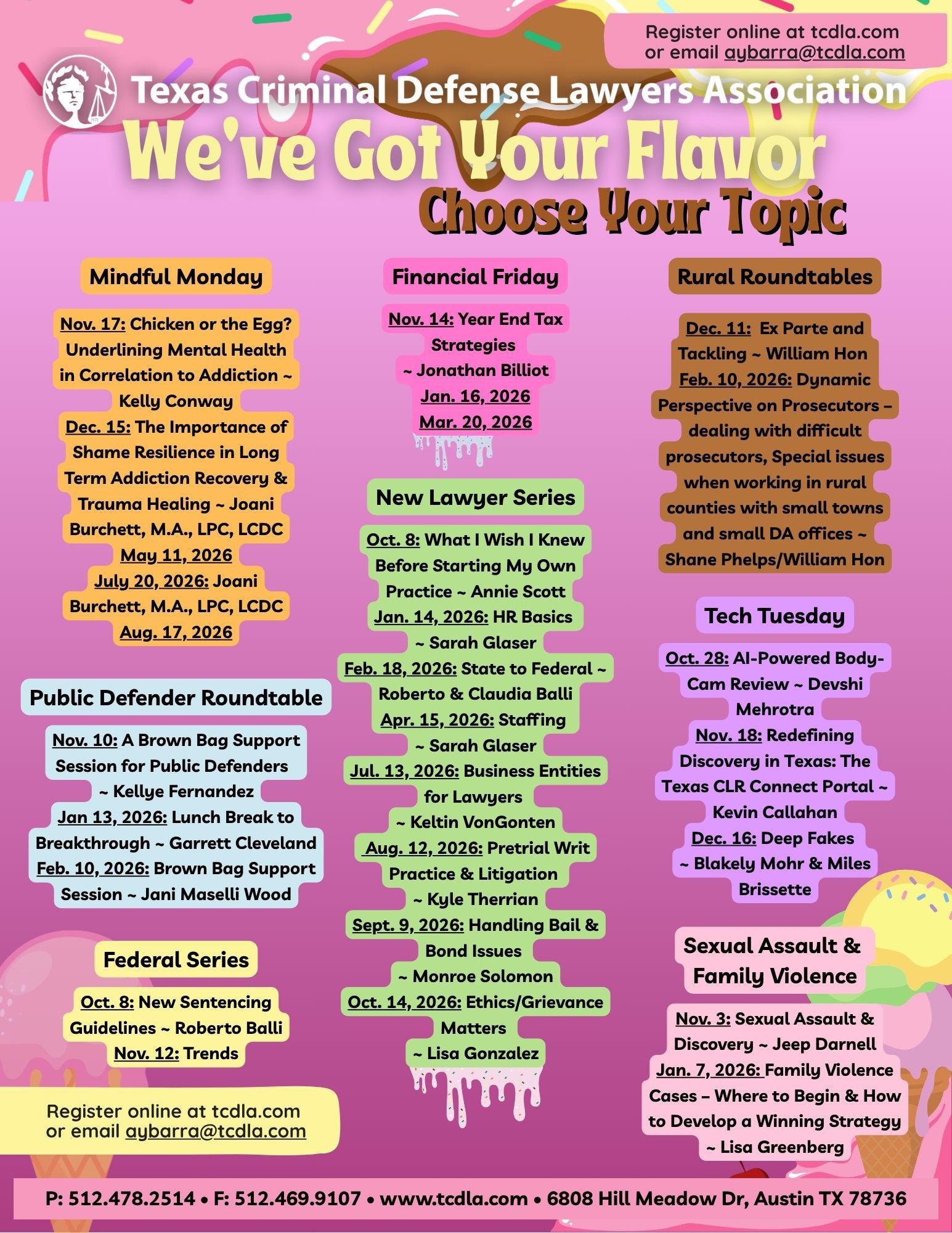
TCDLA | New Lawyer – Business Entities for Lawyers Webinar
July 20
CDLP | Mindful Monday Webinar
July 22-25
TCDLA | Member’s Trip
South Padre Island, TX
July 22
CDLP | Trainer of Trainers
South Padre Island, TX
July 23-24
CDLP | Guardians of Sacred Justice
South Padre Island, TX
July 25
CDLP | Orientation
South Padre Island, TX
Giving Thanks for a Mission that Matters
NICOLE DEBORDE HOCHGLAUBE
Have you ever noticed not a lot of criminal defense lawyers retire? They may change the nature of their practices, perhaps taking less cases or a different kind of case, plan for more adventure or visiting family and friends, or even plan an extended break with plans to return to what we do. But, it seems the rarer occasion that our brothers and sisters retire cold turkey so to speak. There are days on which it may be tempting to leap to the conclusion that this may be related to the day to day hustle to keep a practice afloat or lack of options on a financial level. As time has marched on and I have watched friends and family contemplate their own retirements, or even reach that milestone in different career worlds from ours, I have come to a different conclusion.
I believe most criminal defense lawyers do not retire because to do so would leave a piece of themselves behind. Maybe they did not start out with this plan in mind, and maybe they have not even articulated this thinking to themselves, but as their practices touch the lives of so many clients and their families, the clients, their families and the mission itself shape their purpose. In fact, I think many criminal defense lawyers may not even realize they have become part of the fabric of the mission to serve others and to defend the Constitution, the rule of law itself, and what is right and what is fair, no matter how futile that sometimes feels. I love going down to the courthouse and seeing brand new criminal defense lawyers on fire to make a difference and old friends and colleagues fighting the good fight with intense purpose. One friend, an excellent criminal defense lawyer, comes to mind on the topic of this notion of retirement. I see him down at the courthouse every few months and, for at least a decade, he has been telling me he is in the process of retiring. He next follows up with a passionate description of the new iteration of his practice in this “retirement phase” helping young, disadvantaged men in the cross hairs of the criminal justice system. I also see him a few times a year on a committee focused on the empaneling of excellent lawyers to serve the poor.
Another longtime friend from another city whom I came to know only through the TCDLA community is herself “retired” and focusing on family. Meanwhile, she still coordinates excellent educational opportunities for lawyers in her community so that our criminal defense bar continues to grow in strength. Another brilliant friend resides part time out of state in this partial “retirement” but continues to donate significant time and mental bandwidth to TCDLA whenever called upon. Hearing others talk about the elusive idea of retirement always gets me thinking about the future and what an ideal practice and life looks like. For me, and I suspect many of you, that mental exercise always comes back to the idea that I am, and will forever be, a criminal defense lawyer. You, our clients and our sometimes broken system have made me care about this mission in such a way that the gift of
participating in it with you is woven into who I want to be and what I hope to contribute.
Don’t get me wrong, there are days when I think to myself, why would anyone put themselves through this? It costs a lot, sometimes monetarily and sometimes emotionally – sometimes both. Inevitably the following days include a memorable encounter with a colleague or a victory, small or large, for a client. I will make time to do the things I love outside of this world of criminal defense, to be there to enjoy family and friends and to appreciate the gifts of the moments we are given. I will also continue to be grateful for the opportunity to stand shoulder to shoulder with you in this critical mission of defending the Constitution as we try to make a difference. I am grateful to be a part of the TCDLA mission and your companionship in the fight to defend these fundamental rights and principles. I am grateful for the difference this continuing fight has made in my life and the lives of those we serve. I am grateful that I do not attend many retirement parties for criminal defense lawyers because I am hopeful that it means you are doing what you were put here to do and finding joy and purpose in this incredibly important mission of ours. What you do matters to those who experience your work firsthand and to those who will never know of your efforts. Thank you. Happy Thanksgiving to my unrelenting, often unretiring, brothers and sisters.
BIG SKY, MT
Nicole DeBorde Hochglaube President‘s Trip
FEBRUARY 4-8, 2026
6.00 CLE, INCLUDING 1.00 ETHICS
Don’t miss out—Montana is calling!
Get ready for an unforgettable adventure as we head to the breathtaking mountains of Big Sky for the 2026 President’s Trip. Whether you ' re hitting the slopes, relaxing fireside, or soaking in the epic views, this trip promises great company, high spirits, and nonstop fun.
Sun 9 am ~ Hotel Breakfast (Paying on own): Qty____
*Open Day Suggestions:
Skiing, Solace
Snow Mobile
Skating, Boz
Call (406) 995-8002 & reference “TCDLA” to receive discounted rates.
WHERE TO FLY & HELPFUL TRAVEL TIPS
Fly into Bozeman Yellowstone International Airport (BZN), an hour away from Big Sky.
Rideshare apps like Uber and Lyft are not available in the Big Sky area Rental Cars are available at the Bozeman Airport, or search Airport Transportation at Bigskyresort.com for shuttle services.
Make sure your rental car has 4wheel or all-wheel drive with snow tires.
A Season of Gratitude
MELISSA J. SCHANK
“ The glory of justice and the majesty of law are created not just by the Constitution—nor by the courts nor by the officers of the law nor by the lawyers but by the men and women who constitute our society, who are the protectors of the law as they are themselves protected by the law.”
Robert F. Kennedy
The past few months have been difficult. With all the politics, the constant changes, and the noise around us, there are moments I want to shout in frustration. At times, it feels like my back is against the wall, powerless to change unfair rules or challenge statements that make “free speech” feel anything but free. But when I pause, take a deep breath, and center myself, I’m reminded that sometimes silence is strength and reflection brings perspective.
In those quiet moments, I think about the incredible attorneys I speak with every day. Attorneys who step into courtrooms across Texas, who fight tirelessly in a system that too often feels stacked against them. Their dedication humbles me. I ask myself, “what am I complaining about?” At the end of the day, I get to go home to a warm bed, to family, friends, and dogs who love me. Our members, on the other hand, carry the weight of their clients’ freedom and futures, and they do it with courage, skill, and resolve.
I am profoundly grateful for each of you. For our legislative team and members who testify late into the night at the Capitol, and for our members who stand beside them. For our board and committee members who dedicate hours each month to answering ethics questions, Strike Force support, creating resources, reviewing complaints, new laws, strengthening member benefits, and staying up to date with the latest AI and technology, to name a few. For our speakers who prepare tirelessly, and for every member who contributes to the Voice and makes our association stronger. Together, we are truly one voice, and we are nearly 4,000 strong.
This Thanksgiving, I want you to know how deeply valued you are. I am proud to serve as your CEO, proud of the fearless advocacy you bring to your clients, and proud of the family we’ve built together. My wish for you is a joyful season filled with laughter, full plates, and the reminder that none of what we do would be possible without you.
Happy Thanksgiving.
Pozner’s Red Book on Cross
LESSONS IN ADVANCED CROSS-EXAMINATION
This new handbook brings together over 20 of Larry Pozner’s most powerful cross-examination training articles, spanning core principles like constructive and asymmetrical cross-examination to advanced strategies for witness control, impeachment, chaptering, and framing reasonable doubt. Every page is practical, tactical, and ready for use in court. This book is not theory—it’s a field manual for lawyers in the fight.
Each lesson delivers scripting examples, real-world case scenarios, and strategic insight to make every technique actionable. You’ll learn when to drop a weak impeachment, avoid the trap of “winning” points that don’t serve your theory, and keep your cross disciplined so it moves the case—not your ego—forward. Pozner shows you when to press a witness, when to pivot, and how to ensure every question drives your theme home.
Thankful for Family, Work, and Our TCDLA Brothers and Sisters
JEEP DARNELL
As I sit back and reflect on this season of gratitude, I’m reminded how quickly life can feel overwhelming. Between running a busy law office with staff positions still unfilled, answering to judges and prosecutors on urgent matters, juggling my role as Voice editor, and spending my “free time” helping to coach both of my son’s baseball teams, there are days I feel pulled in too many directions at once.
But then, I think about family. At the end of the hardest days, I have the blessing of walking into the ballpark to coach and cheer on my sons, sitting around the dinner table with my wife, and of sharing life with my mom, dad, and brother. Like all families, we have our moments, but they are my laughter, my anchor, and my daily reminder that it’s the little things that count the most.
I also think about my extended family, our TCDLA family. When the demands of practice feel impossible, I know I can pick up the phone or send an email and someone in this association will be there. Whether it’s guidance on a case, help locating an expert, or simply a word of encouragement, I’ve never been let down. That kind of support is rare, and I am profoundly grateful for it.
As the holidays approach, I sometimes catch myself worrying about the work that will pile up while I take time away. But I remind myself: work will always be there. What matters most is the
people who make all this worth doing: our clients, our colleagues, and especially our families at home and within TCDLA.
So, what am I thankful for? I’m thankful for all of it: for the chaos, the stress, the joy, the laughter, the victories, and even the hard days that remind me why this work matters. Most of all, I’m thankful for the people who make sure none of us has to walk this road alone.
From my family to yours, I wish you a joyful Thanksgiving. And if you ever find yourself overwhelmed, remember, you’re not alone. That’s what TCDLA is: family.
Be safe,
Jeep Darnell
Fifth Circuit’s position on the Official Restraint Doctrine in Illegal Reentry Prosecutions
MARY STILLINGER & KATE GODINEZ
If you were researching the official restraint doctrine in the Fifth Circuit, and read only the most recent decision1 (which sometimes we do when we are in a hurry), you might think that the Fifth Circuit has not adopted the doctrine; because that is what the panel in Rojas states: “[W]e have never explicitly adopted the doctrine.” However, you would be wrong if you believed that statement. Unfortunately, it is a misleading phrase that has led to a great deal of confusion and possibly denied a deserved defense to individuals accused of illegal entry into the United States.
Justice Clarence Thomas recently opined that judicial precedent should not be treated as “gospel.”2 “At some point we need to think about what we’re doing with stare decisis,” he recently told an audience at an appearance at Catholic University’s Columbus School of Law. Curiously, he made this comment in connection with the Supreme Court’s jurisprudence, although the Supreme Court is less bound than any other court in the country by the doctrine of stare decisis. For the Supreme Court, the doctrine of stare decisis, means that “precedents are entitled to careful and respectful consideration . . . [b]ut as the Court has reiterated time and time again, adherence to precedent is not ‘an inexorable command.’” Dobbs v. Jackson Women’s Health Organization, 597 U.S. 215, 263 (2022) (citing Kimble v. Marvel Entertainment, LLC, 576 U.S. 446, 455 (2015)).3
The United States Courts of Appeals, however, are completely bound by the doctrine of stare decisis. 4 They are also bound by a nuanced variation of that doctrine, known as “the rule of orderliness,” which provides that panels must abide by a prior Circuit decision until the decision is overruled either by the United States Supreme Court or by the Circuit sitting en banc 5
Thus, the Fifth Circuit’s position on the official restraint doctrine has been confusing to litigants and trial courts on the
1 United States v. Rojas, 770 F.3d 366, 368 (5th Cir. 2014).
2 Interview with Professor Jennifer Mascott, Sept. 25, 2025, The Catholic University of America’s Columbus School of Law.
3 It cannot be said that the Court did not “think about what [they were] doing with stare decisis” in Dobbs. However, Justice Thomas’ concurrence in Dobbs is not a reevaluation of stare decisis, but more like the opposite of stare decisis, as he advocated for the reversal of several other precedents besides Roe v. Wade, that were not before the Court.
4 The Supreme Court has distinguished between “horizontal stare decisis,” (when the Court is considering its own precedent) versus “vertical stare decisis” which absolutely binds a court of appeals to follow Supreme Court precedent. Rodriguez de Quijas v. Shearson/American Express, Inc., 490 U.S. 477, 484 (1989).
5 See Central Pines Land Co. v. U.S., 274 F.3d 881, 893 (2001).
The Doctrine of Official Restraint
Most illegal reentry cases (violations of 8 U.S.C. § 1326) are fairly straightforward and difficult to defend. The government merely has to prove that your client is a foreign national and was previously deported, and either entered, attempted to enter, or was found in the United States without first having received consent. The great majority of these prosecutions involve defendants who are found in the country or who are arrested at the border trying to sneak into the country, after having been deported on some prior occasion. However, there is a small percentage of cases that occur at the border that do not fall into either of these categories.
Sometimes citizens of other countries come into the United States seeking asylum. Because they were often prevented from approaching the port of entry (for example, in El Paso, CBP posted an officer at the top of the international bridge to prevent asylum seekers from continuing down the bridge towards the port of entry), they would cross at some other point on the border and seek out a Border Patrol Officer to whom they could make their asylum claim. If a person crosses directly and purposely into the custody of a law enforcement officer, they may have the defense that they did not enter into the United States without “official restraint.” Also, if a person has crossed the geographic border but has not passed through the port of entry yet, they could have the defense that they had not left the official restraint of the government’s custody at the border. In these cases, an additional definition of “entry” may be warranted in the jury instructions, because a physical entry across the geographic border may not be considered an “entry” under this statute. In such a case, a definition that “entry” requires “physical presence and freedom from official restraint” would be appropriate.
Although the term “official restraint” is not mentioned in the statute (8 U.S.C. § 1326), it is a concept that arose in immigration law, because whether a person has made “entry” into the country may affect the right to relief.6 The Third Circuit, relying on a prior Second Circuit decision, has defined “freedom
6 For a fascinating read on the concept in an immigration arena, Yang v. Maugans, 68 F.3d 1540 (3d Cir. 1995), describes how immigrants who swam to shore after their boat ran aground and waited on the beach had not been free from official restraint despite the fact that they could have left the beach area before law enforcement even arrived to cordon off the area.
from official restraint” as “mean[ing] that the alien is no longer under constraint emanating from the government that would otherwise prevent her from physically passing on.” Id. at 1549 (citing Correa v. Thornburgh, 901 F.2d 1160, 1172 (2d Cir. 1990)).
The Sixth Circuit has similarly provided a plain, common sense definition of “freedom from official restraint”: “the alien’s liberty to go where he wishes and to mix with the general population.” Lopez v. Sessions, 851 F.3d 626, 630 (6th Cir. 2017).
The Fifth Circuit’s Unclear Position on Official Restraint
In United States v. Morales-Palacios, 369 F.3d 442, 446 (5th Cir. 2004), the Fifth Circuit stated that illegal reentry requires “physical presence and freedom from official restraint.” This statement seemed authoritative enough that it was included in the commentary to instruction 2.03 of the Fifth Circuit Pattern Jury Instructions.
Despite this clear and uncontroversial statement in MoralesPalacios, the Fifth Circuit later wrote in United States v. Rojas, 770 F.3d 366, 368 (5th Cir. 2014) that, “[a]lthough we have mentioned the official restraint doctrine in previous cases, we have never explicitly adopted the doctrine.” This opinion cited a prior
unpublished decision that had merely commented that there was “no published Fifth Circuit authority detailing the concept of official restraint in a § 1326 case.”7 United States v. PalomaresVillamar, 417 Fed.Appx. 437, 439 (5th Cir. 2011).
None of these cases turned on the issue of official restraint, but somehow the cases went from framing “freedom from official restraint” as a part of the definition of “illegal entry” (MoralesPalacios), to not having been officially defined (PalomaresVillamar), to not having been adopted at all (Rojas). This kind of legal erosion runs contrary to the rule of orderliness.
The Case Before the Court
The case of Lazaro Hernandez framed this issue perfectly. He was a Legal Permanent Resident (LPR) as a child, but lost that status as a young man after he was arrested while driving a stolen car. Skipping over some years of procedural history, he came across the bridge from Ciudad Juarez, Mexico to El Paso, Texas because he believed that he needed to be physically present in the United States to try to reopen his initial removal proceedings.8
7 It is not unreasonable for the Court to define the concept, because at least one other court has extended “official restraint” to include continuous surveillance.
8 This was not actually true, because he could have hired an immigration attorney and tried to reopen the removal proceedings while in Mexico. But, he thought it
He decided that he would come back to the United States, even though he knew he would have to be in custody.
Mr. Hernandez came to the port of entry and asked to be taken into custody so that he could challenge his prior removal. Rather than take him into custody, officers told him to go back to Mexico. So, Mr. Hernandez ran up a sidewalk, climbed a turnstile (because it allowed southbound passage only), and once on the north side of the primary inspection point, he waved his arms and encouraged the immigration officers to arrest him. They obliged.
At trial, the court refused an instruction that included the language from Morales-Palacios, that illegal reentry requires “physical presence and freedom from official restraint.” The trial court also did not allow defense counsel to argue that Mr. Hernandez was not guilty of illegal entry because he merely sought to go into custody, and was, essentially never free from official restraint at the port of entry.
At oral argument in United States v. HernandezAdame (Case No. 24 50533, argued June 4, 2025), Judge Elrod called the factual scenario in Mr. Hernandez’s case about as golden a hypothetical as one could find. The government argued that the Court had not and should not adopt the doctrine of official restraint, an idea that Judge Elrod directly rejected at argument. The government argued, in the alternative, that the doctrine should be limited to cases of actual physical restraint, which would provide a defense for a person brought into the country in custody (who would almost certainly never be charged with a § 1326 violation).
Mr. Hernandez argued that the concept is not so complicated that it needs to be defined, but that if it does, the common sense definitions of the Third or Sixth Circuit would give the jury adequate
information to consider the issue. Although there are few cases that discuss the parameters of the official restraint doctrine, there are fewer cases that decline to accept the concept: None.
Mr. Hernandez has served his sentence and been returned to Mexico. He did find counsel to help him reopen his removal, and the appeal from that denial is pending in the Ninth Circuit Court of Appeals. The issue of official restraint has become a mostly academic one, because the outcome will not affect his efforts to reopen his prior removal, nor his status as a convicted felon (thanks to that old conviction for driving a stolen vehicle). Still, orderliness is a good thing. It would be comforting to know that when the Fifth Circuit states a proposition of law so clearly that it ends up in the commentary to the pattern jury instructions, another panel cannot chip away at that proposition of law.
As the trial court stated in encouraging defense counsel to appeal, “we try a lot of 1326s here. We ought to know what the elements are . . .. Take it up there and let them make the call once and for all. That way we’re not shooting in the dark trying to figure out what all this means.” We await that guidance.
Important Addendum:
On Friday October 24th, the Fifth Circuit ruled in U.S. v. Hernandez-Adame, clarifying that “freedom from official restraint” is part of the definition of entry in a 1326 prosecution. Unfortunately, the Court did not find reversible error. Nevertheless this case gives the defense the right to request this instruction in future cases.
Mary Stillinger and Kate Godinez are partners in Stillinger & Godinez, a mother-daughter law firm in El Paso, Texas, with a satellite office in Dallas. They handle criminal defense cases, particularly white-collar cases, and business litigation. While they practice more frequently in federal court, they have tried cases and handled appeals in federal and state courts in Texas and New Mexico. Mary has been practicing criminal defense for over thirtyfive years and is board-certified in criminal law by the Texas Board of Legal Specialization. Kate joined her mother in practice in 2017.
When Common Sense Fails: Fighting for Justice in Rural Counties
When practicing in rural counties you quickly learn that “normal” or common sense procedures don’t often apply. While in most Texas counties prosecutors are recognizing that marijuana cases are not worth the effort to file or prosecute, in my home county we are seeing dozens of convictions per month on these cases. It can be incredibly frustrating dealing with these situations when it is clear to everyone else involved what the just result is.
My most recent memorable experience with the lack of common sense in my neck of the woods involves possession of a vape pen and a law student. My client came to me after being arrested for possession of a controlled substance following a stop for speeding. She explained to me that the officer that stopped her acknowledged that he recognized her from a previous encounter at a local community college. The officer then noticed a vape pen in her cup holder and, assuming that it contained illegal THC, placed her under arrest. Naturally, when my client told me that the THC pen did not contain THC and was purchased legally, over the counter, at a local smoke shop, I needed proof. My client did not hesitate in getting me pictures of the container it was purchased in, receipts, and pictures of identical pens still on the shelf at the local smoke shop.
After waiting months for the lab test to come back, I approached the ADA assigned to the case with the wealth of proof I had obtained demonstrating this vape pen was not, in fact, a THC pen. Although I expected the ADA to want to wait for confirmation from the DPS lab, I had hopes he would at least be willing to agree to less stringent bond conditions (considering it was pre indictment) and provide me with an update on where this case was in the backlog of testing.
Instead, I was presented with a lab test that the ADA had been sitting on for well over 2 months that showed the vape pen was negative for THC. As he slid the lab report across his desk to me, he said he would be sitting on the case until the statute of limitations ran to give himself “more time to figure out if there was a law out there that had been broken somehow.” I was shocked and appalled that he was fully aware there was no THC in the vape pen she was arrested with but still refused to let go of the case.
After consulting with the hive mind of the TCDLA Listserv, I began to draft a motion for an examining trial. I have been practicing for almost seven years and have not yet had the benefit of observing an examining trial, but with the assistance of fellow TCDLA members that were generous in lending their expertise, I felt confident in pursuing the examining trial.
Ultimately, after a year of my client being on bond for a
felony she did not commit, a year of her law school education being tainted by the shadow of this case, and a year of the stress of reporting to a bond company, we were able to secure our examining trial hearing. When the Judge called for announcements for our examining trial, the ADA presented the court with a complete dismissal, citing lack of probable cause.
While I was incredibly frustrated that I did not get the opportunity to show the Judge and the rest of the courtroom what I believe was a violation of the law and my client’s rights, my client was ecstatic about finally having that dismissal in her hands. She was able to proceed with her legal career, and I know that our legal community will be that much better served when she joins us. When faced with these frustrating situations, it is always a breath of fresh air to remember that the fight does pay off. Do not hesitate to bounce ideas around with folks in TCDLA – my experience shows people are willing and the results could be priceless!
Kyra Leal is an attorney at The Carlson Law Firm. She has been licensed in Texas for 7 years. She practices across Central Texas handling cases ranging from DWI and drug cases to cases involving death at both the State and Federal level. She is co-chair of the Rural Practice Committee and a member of the New Lawyer Committee. She can be reached at kleal@carlsonattorneys.com or 254-526-5688.
Asking for Advice Without Oversharing
LAURA POPPS
Every lawyer faces questions about ethics, strategy, and day to day dilemmas—and the answers are rarely simple. The disciplinary rules recognize that reality. Rule 1.05(c)(9)1 allows a lawyer to disclose confidential information when it is reasonably necessary to secure legal advice about the lawyer’s ethical compliance with the rules. Similarly, Rules 1.05(d)(1) and (2)2 permit disclosure of a client’s unprivileged confidential information when impliedly authorized to carry out the representation, or when the lawyer has reason to believe disclosure is necessary to represent the client effectively.
These rules give lawyers some freedom to consult informally with other lawyers for the client’s benefit without first getting express client consent. This could include online discussion groups, in person meetings, and other settings.3 However, it’s not a blank check. How much you share, and the way in which you share it, still matters. Handled carefully, this type of consultation is entirely proper; mishandled, it can quickly cross the line into an ethics violation.
First, remember that TDRPC 1.05 defines “confidential information” very broadly: it includes both privileged and unprivileged client information. Unprivileged client information means “all information relating to a client or furnished by the client, other than privileged information, acquired by the lawyer during the course of or by reason of the representation of the client.” When you stop to think about it, there is virtually nothing about a case or client that can be shared without a specific exception to the confidentiality rule.
Second, consider your audience. The risks of disclosure change dramatically depending on whether the setting is private or public. In a private exchange, you control who hears the information and can better judge the chance that your client could be identified or prejudiced. In an online forum, by contrast, the audience is broad and unpredictable. Lawyers often share extensive case details in these groups—so much so that, combined with their own identity, location and practice area, a client’s identity can be pieced together with little effort at times. The danger is compounded by the sheer number of people exposed and the uncertainty of who they are. What feels like a professional circle of peers is in reality an audience you don’t fully know and can’t control. Membership shifts, you can’t be certain who all is in the group, and once posted, information can be copied, shared, or even subpoenaed. There is a false sense of security in many of these online lawyer groups that could easily lead to oversharing and a resulting breach of confidentiality.
With these considerations in mind, there are several safeguards you can put in place to reduce the risk that your
disclosures will breach the confidentiality rules.4
• Keep the inquiry abstract when you can, and limit disclosure to what’s truly necessary to frame the question. Share unprivileged confidential information only to the extent needed for meaningful consultation, and not at all if the issue can be discussed without it.
• When context is required, use hypotheticals. Strip any facts that could point to a specific client; most of the time these details aren’t necessary to the issue anyway. If there’s any chance what you share could be matched to a specific client and/or cause them prejudice, stop and reconsider.
• Don’t reveal privileged or harmful client information without the client’s express consent. If disclosure is unavoidable, the client must be consulted about the risks, including the risk of a privilege waiver, and give their informed consent before you proceed. The only exception is the narrow carve out in Rule 1.05(c)(9), which permits disclosure when necessary to seek legal advice about your own ethical compliance. See n. 4. supra
• Honor client instructions. If a client has told you not to share confidential information, you cannot do so—even if an exception might otherwise apply.
• Consider a confidentiality agreement. Ask the responding lawyer to agree to keep anything you share confidential. If that’s not feasible (as in online forums), factor the lack of such assurances into the decision of whether disclosure is in the client’s best interest.
Consulting with other lawyers is an excellent tool for working though the hard questions we all face. Just remember to approach those conversations with caution, keeping disclosures limited and client confidentiality front and center.
Laura Popps is Vice-Chair of the TCDLA Ethics Committee and is based in Austin, Texas. Her practice is focused on attorney license defense, legal ethics consulting, and criminal appeals. Laura has been Board Certified in Criminal Law since 1999. She spent a decade at the Office of Chief Disciplinary Counsel, where she directed litigation and investigations for the Austin Region and handled some of Bar’s more complex litigation. Before that, she was a prosecutor at the Attorney General’s Office where she prosecuted cases statewide. You can contact her at laura@poppslaw.com or (512) 865-5185.
4 These safeguards are drawn from Professional Ethics Committee Opinion 673, which addressed disclosure of unprivileged confidential information under Rules 1.05(d)(1) and (2). Rule 1.05(c)(9), adopted later, goes further by permitting disclosure of privileged information when it is reasonably necessary to obtain advice about a lawyer’s own ethical obligations. The broader reach of that rule–including how far disclosure may extend–is beyond the scope of this article.
The “Other Person” in Texas Code of Criminal Procedure
Art. 38.23(a) and Texas Penal Code
Section 33.02: Suppression of Illegally Obtained Evidence
TODD DUNCAN
The Fourth Amendment protects people against unreasonable, warrantless searches and seizures by law enforcement, and such searches typically result in suppression of the evidence gathered.01 However, the Fourth Amendment protection against unreasonable searches and seizures does not extend to actions by private citizens acting in a private capacity.02
Texas statutes provide broader protection when it comes to searches by private citizens. The Texas Code of Criminal Procedure, Article 38.23(a) provides: “[n]o evidence obtained by an officer or other person in violation of any provisions of the Constitution or laws of the State of Texas, or of the Constitution or laws of the United States of America, shall be admitted in evidence against the accused on the trial of any criminal case.”03 When a computer or other electronic device is illegally searched by some “other person,” it can constitute a violation of Texas Penal Code Section 33.02 (“[a] person commits an offense if the person knowingly accesses a computer . . . without the effective consent of the owner.”).04 Under the right circumstances, when Article 38.23(a) and Section 33.02 come together, it could provide a pathway to suppression of evidence uncovered by a private person.
The term “other person” in Article 38.23(a) includes private persons and is not limited to agents of the government.05 “The Texas exclusionary rule applies to illegal searches or seizures conducted by law enforcement officers or ‘other persons,’ even when those other persons are not acting in conjunction with, or at the request of, government officials.”06
1. Illegally Seized Whiskey Resulted in Greater Protection for Texans
In April 1921, not long after the Prohibition Era began, Rudolph Welcheck was driving his vehicle when he was stopped by the sheriff of Brazoria County, accompanied by “a number of other gentlemen” who had “been waiting and looking for” Welcheck to drive down the road.07 In the car, the group found and seized three, one gallon jugs of whiskey, doing so without any kind of warrant.08 After the trial court denied a motion to suppress the evidence, Mr. Welcheck was convicted by a jury and sentenced to one year in the penitentiary.09
His case was appealed, and in 1922 the Texas Court of Criminal Appeals affirmed, holding the search and seizure provision of the Texas Constitution did not contain an implicit exclusionary rule.10 “We believe that nothing in Section 9, Article 1 of our Constitution, can be invoked to prevent the use in testimony in a criminal case of physical facts found on the person or premises of one accused of crime, which are material to the issue in such case, nor to prevent oral testimony of the fact of such finding which transgresses no rule of evidence otherwise pertinent.”11 The court specifically rejected the reasoning of United States Supreme Court cases that had imposed an exclusionary rule on federal courts under the Fourth Amendment, concluding the Texas Constitution demanded only that one whose property was unlawfully seized could challenge the admissibility under the rules of evidence and had a right to sue for return of the property.12
In response to Welchek, the Texas Legislature enacted Senate Bill 115, which stated: “No evidence obtained by an officer or other person in violation of any provision of the Constitution or
laws of the State of Texas, or of the United States of America, shall be admitted in evidence against the accused on the trial of any criminal case.”13 The bill was codified as Article 727a of the 1925 Code of Criminal Procedure (now Article 38.23). Between 1926 and 1928, at least thirty four convictions were reversed based on the new statutory exclusionary rule; thirty two of which were prohibition liquor cases.14
2. From Moonshine to Electronic Devices
One hundred years later, Texas courts are still applying Article 38.23(a). However, instead of suppressing illegal liquor, the courts are dealing with evidence illegally gathered from cell phones and computers. Take for example the following hypothetical:
Your college buddy, Dave, calls your office to say he is under arrest and his wife threw him out of the house. You immediately go to the jail, start trying to arrange bail, and talk to Dave. Upon arriving, Dave relates what happened:
He and his wife got into a heated argument about an alleged affair Dave was having. His wife demanded to see Dave’s cell phone, suspecting there were incriminating text messages on it. Dave refused to let her see the phone. Later, Dave got good and drunk, and passed out in his bed. His wife tried to access the phone, but was thwarted by the security measures Dave had put in place. She could not guess his password, but determined there was a biometric feature that would allow access to the phone via Dave’s thumb print. While he slept, his wife held Dave’s thumb to the phone and gained access. While she didn’t find any incriminating text messages about an affair, she did find a folder containing nude photographs of her 16 year old niece, taken by Dave. She turned the phone over to the police and tossed Dave to the street.
Dave is eventually charged under Texas Penal Code Section 43.26 – possession or promotion of child pornography. The question becomes whether the evidence gathered from his phone can somehow be suppressed? The answer could be “yes” according to the Austin Court of Appeals, in its decision in State v. Holloway. 15
A. State v. Holloway
In Holloway, the Austin Appeals Court faced a fact situation
similar to the one presented by Dave. The court affirmed suppression of the evidence after it was discovered by a private citizen on the defendant’s cell phone. The defendant’s wife in Holloway accessed his phone while he slept, using the biometric security feature to gain access.16 She discovered “inappropriate videos” including a video of her fourteen year old daughter sleeping and the defendant’s hand using a spatula to lift up her shirt. She used his phone to text links of the videos to her own phone. She then made a report to the police, but did not show, or attempt to show, the videos to police that night. The next day, an officer attempted to access the videos via the link the wife had sent to her phone, but found the link had been disabled.17
The defendant, who was charged with aggravated sexual assault of a child, filed a motion to suppress the evidence recovered from his cell phone, arguing his wife had violated Texas Penal Code Section 33.02(a). Due to this violation,18 he contended the evidence had to be suppressed under Article 38.23(a).19 At a hearing on the motion, the wife testified she did not have consent to use the phone.20 After considering the testimony, the trial court suppressed the evidence under Article 38.23(a).21
On appeal, relying on the Texas Family Code’s definition of community property, the State argued that the wife did not violate Section 33.02(a) because she was a co owner of the phone; thus giving her permission to view its contents.22 The State also contended the wife bought the phone and paid the phone bill; therefore, she was a co owner. As a co owner, the State argued, even if she did not have effective consent to access the phone, she still did not commit an offense because she did not knowingly access the phone without the consent of the owner.23
The Austin Appeals Court affirmed the suppression of the evidence. First, it agreed with the trial court holding the defendant had a greater possessory right to the phone than that of his wife. This conclusion was based on: 1) testimony where she admitted she did not have consent to access the phone; 2) she referred to the phone as her husband’s phone; 3) she had previously asked him to see the phone and he denied her access, but then she later accessed it anyway by using his thumb while he was asleep.24
In response to the State’s second argument, the court explained the trial court could reasonably infer from some of the
evidence that the wife did not believe she had effective consent to access the phone. One fact that weighed heavily toward lack of consent, and suppression, was that she waited until her husband fell asleep and then physically moved his finger onto his phone to gain access while he remained asleep. She did so because she had no other way of accessing his phone.25 The Austin Court affirmed the trial court’s decision, concluding: “[T]he trial court did not abuse its discretion when it determined that Holloway met his burden of establishing that Wife illegally obtained the cell phone evidence, and thus, suppressed the evidence resulting from Wife’s unauthorized search of Holloway’s phone.” 26
B. Similar Facts; Different Result
In Thomas v. State, 27 the defendant and his girlfriend, Arlene, lived together with her minor daughter. The defendant had provided Arlene with his PIN for his debit card so she could pay bills.28 After inadvertently taking the defendant’s iPhone to work, Arlene decided to look at the photos of her family and delete any “unflattering” pictures of herself.29 Although she did not know the iPhone’s passcode, and the defendant had never told her what it was, she gained access by guessing that the four digit passcode was the same as the defendant’s PIN for his debit card. After accessing the iPhone, Arlene found inappropriate photographs of her minor daughter.30
Upon seeing the photos, Arlene contacted the Harris County Sheriff’s Office and showed the deputy the photos on the iPhone. Based on information Arlene provided, the deputy obtained a search warrant to search the iPhone and its contents. Relying exclusively on Arlene’s statements to establish probable cause for the warrant, and based on Arlene’s relationship with the defendant, their living arrangements, and the sharing of finances with one another, the deputy believed Arlene had consent to access the iPhone. However, the search warrant affidavit contained no information indicating the defendant had consented to Arlene accessing the iPhone.31
The defendant was charged with possession of child pornography and sexual performance by a child. As was done in Holloway, the defendant moved to suppress the evidence obtained from his iPhone under Article 38.23(a), arguing Arlene had violated Texas Penal Code, Section 33.02, which prohibits knowingly accessing a computer without the owner’s effective consent. After the trial court denied the motion, the defendant pled guilty and received five years’ confinement on each count, to run concurrently.32
On appeal, the defendant again argued Arlene violated Section 33.02 when she accessed his iPhone.33 The 14th Court of Appeals in Houston focused on the elements of Section 33.02(a), particularly whether Arlene “knowingly” accessed the iPhone without the defendant’s consent. The court affirmed the trial court’s decision, explaining that the lower court “could have found that no violation of Section 33.02 occurred because the record supports a finding that Arlene was not aware of the surrounding circumstances that she lacked appellant’s effective consent when she accessed the iPhone’s photo application.”34 The decision was based heavily on the specific facts regarding the parties’ relationship including: the defendant taking photos of Arlene and her child, their frequent viewing the photos with each other, the defendant sharing his credit and debit card (including
the PIN) with Arlene, and the defendant never prevented Arlene from using the iPhone. “[W]e imply a finding that Arlene did not know that she lacked appellant’s effective consent, which is supported by the record from the suppression hearing. We give almost total deference to the trial court’s implied determination that Arlene did not know that she lacked consent, as would be necessary to prove a violation of section 33.02.”35
C. Other Cases Involving Article 38.23(a) and Section 33.02
Many recent cases involve a defendant invoking the suppression provisions of Article 38.23(a) where a private individual searched a cell phone, computer, or other electronic equipment. As noted above, for suppression under Article 38.23(a), the defendant must show the “other person” violated a statute or constitutional provision. In most recent cases, the most common “violated” statute cited by defendants has been Penal Code Section 33.02 (accessing a computer without consent), as was argued in Holloway and Thomas. For the most part, suppression has been denied due to consent (explicit or implied), lack of any security feature employed by the device owner and/or sharing the passcode with others, or abandonment.
(1) Consent
Taking an electronic device, such as a computer or cell phone, to be repaired or updated, without placing limitations on what actions the technician is to perform, amounts to giving consent to look at anything contained on the device. For instance, in Brackens v. State, 36 the defendant took his laptop to a store for data migration/backup and provided them an external hard drive. His instructions were to back up all music, videos, and photos. However, he claimed he did not give consent to open any files, which he contended was unnecessary to complete the migration. With that said, to complete the data transfer, the technician had to open and copy individual files onto a DVD and then transfer them to the external hard drive. While doing this, he saw files that he believed to be child pornography and notified the police.37
The defendant filed a motion to suppress under Article 38.23(a), arguing that the technician violated Section 33.02 by opening and looking at the individual files. The trial court denied the motion, and the decision was affirmed on appeal. The appellate court held the defendant “did not place any limitations on his request to back up his
computer files” and to accomplish the defendant’s request, the technician had to copy the files onto a DVD to ultimately load the files on the external hard drive.38 Once he saw the suspect file, the technician had to open it to confirm it was not illegal, as per the store’s policy. The court found that the testimony from the technician and an expert “supports an implied finding that appellant’s computer files were accessed in the course of carrying out appellant’s work order” and was not a violation of Section 33.02.39
(2) No Security and/or Shared Access
Where a defendant has no security protections in place on the device or where the passcode has been shared with someone else, courts have been loath to suppress evidence recovered from the device by some “other person.” In Runyon v. State, 40 police obtained a search warrant for the defendant’s computer based on information given them by the defendant’s girlfriend, Sally, who had been living with the defendant for about year. Sally told officers that while the defendant was at work, she noticed the computer was turned on, unlocked, and “on an ESPN page.”41 She further testified the defendant had let her use the computer and several other devices located in the home.42 She started searching through various files and found images of child pornography and reported it to the police and FBI.43
The defendant filed a motion to suppress, arguing Sally did not have his effective consent to use the computer and her use amounted to a violation of Section 33.02(a).44 The trial court denied the motion and the appeals court affirmed. It found Sally did not violate Section 33.02(a) because the defendant had
allowed Sally to use the computer and other devices without restrictions, had failed to have any security measures in place, and had never expressed any written or oral statements that Sally did not have permission to access the computer. As a result, the court held, Sally did not knowingly access the computer without the defendant’s consent.45
3. Abandonment
In Kelso v. State, 46 the defendant decided to leave her husband, Hanington, while pregnant with his second child. She took their three year old son with her. Hanington testified the defendant left with most of her personal items but left a cell phone behind. Two months later, Hanington located another cell phone in a closet, guessed the password to obtain its contents, and uncovered video recordings depicting the defendant engaging in sexual acts with their son.47
In her motion to suppress, the defendant argued Hanington had violated Section 33.02 by accessing the cell phone without her consent. The trial court and the court of appeals both held the defendant had willingly abandoned the phone and “thus, did not have a greater right to possess it.”48 Further, under Section 33.01 of the Texas Penal Code, Hanington was also considered to be an owner of the phone because he had possession of the abandoned property. Therefore, the defendant did not establish Hanington violated Section 33.02 of the Texas Penal Code.49
Conclusion
Common sense says “don’t put illegal material on your electronic devices. PERIOD!” However, common sense is rarely
a factor when it comes to criminal defense, especially where electronic devices are involved. When illegal material is found on a client’s device, look for the following factors and hope for the best: 1) whether security measures were in place; 2) the passcode wasn’t shared with anyone, including a spouse; 3) specific instructions were given regarding what files could or could not be accessed during a repair; 4) access was denied to everyone who asked; and 5) the device wasn’t abandoned where anyone could pick it up and start going through it. If most or all these factors are in place, evidence gathered from an electronic device by some “other person” could potentially be suppressed.
Todd Duncan is a partner in the law firm of Joaquin & Duncan, L.L.C. in Hurst, Texas. He graduated from Texas Wesleyan School of Law and served as an Associate Editor of the Law Review. His practice consists primarily of research and writing for other attorneys on a contract basis, particularly focusing on federal sentencing mitigation, state and federal pretrial motions and briefs, and post-conviction relief. His firm publishes Sentencing Partners, a free, monthly newsletter that offers summaries of current circuit court decisions dealing with federal sentencing issues.
Endnotes
01 Katz v. United States, 389 U.S. 347 (1967); State v. Huse, 491 S.W.3d 833, 839 (Tex. Crim. App. 2016).
02 United States v. Jacobsen, 466 U.S. 109, 113 (1984) (protection under Fourth Amendment applies “only governmental action; it is wholly inapplicable to a search or seizure, even an unreasonable one, effected by a private individual not acting as an agent of the Government or with the participation or knowledge of any governmental official.”).
03 Tex. Code Crim. Proc. Art. 38.23(a) (emphasis added).
04 To establish a violation of 33.02, “the evidence must show the person who accessed the computer did so when they knew they didn’t have the effective consent of the computer’s owner to access the device.” Runyon v. State, 674 S.W.3d 624, 633 (Tex. App. – Beaumont 2023, pet. ref’d).
45 Id. at 628. See also Vandervoort v. State, 2021 Tex. App. LEXIS 6075; 2021 WL 3205058 Tex. App. – Fort Worth 2021, no pet.) (uncle explained he accessed company laptop utilizing administrative password he and defendant had used when they set it up for company); Dipple v. State, 2013 Tex. App. LEXIS 273; 2013 WL 222277 (Tex. App. – Dallas 2013, no pet.) (defendant allowed his girlfriend to see passwords “because she told him she needed to see them in order to be able to trust him, and because he felt he had nothing to hide.”); Oseguera-Viera v. State, 592 S.W.3d 960 (Tex. App. – Houston [1st Dist.] 2019, pet. ref’d) (defendant left cell phone where anyone might pick it up; it had no password protection; officer who found phone was acting with community caretaking purpose when he accessed phone to return it to its owner).
49 Id. See also Miller v. State, 335 S.W.3d 847 (Tex. App. – Austin 2011, no pet.) (unlabeled thumb drive containing child pornography was abandoned by police officer and no illegal search occurred when another officer opened it to identify the owner).
Swords, Shields, and Suspensions: Using ALR Appeals to Attack a Loss or Protect a Win
CHRISTOPHER M. MCKINNEY
Member of the DWI Committee
Introduction
Winning an Administrative License Revocation (ALR) hearing on the merits is no small accomplishment, and more importantly, it’s almost certain to be upheld on appeal. The same is true in reverse: if you’ve lost the ALR hearing, overturning that loss through appeal is a steep climb. Still, appeals matter. Whether you’re defending your hard earned victory or exploring ways to undo a suspension, understanding the appellate process is essential for the DWI practitioner.
If you were successful at the initial ALR hearing, then congratulations! This article will help you protect that win from a challenge. If you didn’t, don’t quit yet, as there is still hope. This article will cover the procedures, deadlines, and narrow legal grounds that may offer your client a second chance to succeed.
Surveying the Battlefield: What is an ALR Appeal?
Because the underlying ALR hearing is a civil administrative proceeding, any appeal remains within the civil court system. While most civil appeals proceed to the Court of Appeals and potentially the Texas Supreme Court, ALR appeals follow a different process. The first reviewing court is the county court at law located in the county where the arrest occurred.01
Even though the appeal is filed in a trial court, it is not a new trial like you might see in a traffic court appeal. ALR hearing review is limited to the certified record from the State Office of Administrative Hearings (SOAH). 02 No new testimony is permitted.03
The county court at law evaluates whether the Administrative Law Judge’s (ALJ) decision was legally valid and supported by substantial evidence.04 But the court may only consider issues that were preserved and timely raised during the ALR hearing. Failure to do so waives those issues for appeal.05
Preserving Issues to Fight Another Day
The most common fatal flaw on appeal is failing to preserve error at the ALR hearing. Even a legally sound argument is worthless if it’s raised for the first time on appeal.
To preserve an issue for appellate review, the record must
show that the party timely and plainly made the ALJ aware of the complaint and obtained a ruling.06 This means:
• The objection must be stated with sufficient specificity, unless the specific grounds were apparent from the context.07
• The complaint must comply with the Texas Rules of Evidence, Texas Rules of Civil Procedure, or Texas Rules of Appellate Procedure.08
• The party must secure a ruling from the ALJ, whether expressly or implicitly.09
• And, if the ALJ refuses to rule, the party must object to that refusal.10
Practice Pointer: Don’t wait until closing arguments to complain. At that point it is too late.11 Object early, object often, and get a ruling.
Entering the Arena: Filing the Appeal and Obtaining a Record
The ALR appeal petition must be filed no later than the 30th day after the ALJ’s decision becomes final.12 The decision is considered final when it is issued and signed by the ALJ.13 There is no requirement to file a motion for rehearing.14 The decision is immediately appealable under the Texas Transportation Code.15 If there is no county court at law in the county where the client was arrested, the petition must be filed in the county court.16 However, if the county judge is not a licensed attorney, the case must be transferred to a district court on the motion of either party, or the court’s motion (sua sponte).17 Once filed, you must obtain a certified copy of the petition from the clerk. This certified petition must then be sent via certified mail to both the Texas Department of Public Safety (DPS) and SOAH at their respective headquarters in Austin.18
The party appealing the decision must also apply to SOAH for a certified copy of the record.19 The appellant must submit the transcript request within ten days of filing the appeal petition, using the form provided on the SOAH website.20 After payment is made, SOAH will furnish the transcript to both parties.21
This administrative record is the only evidence the reviewing court will consider on appeal, unless a party demonstrates that:
Should your client’s case be tried or pled?
Supercharge your trial prep with VerdictHub System (VHS) A.I.-powered technology. Get insights on whether your client’s case should be tried or pled and whether a jury is likely to assess probation or prison time
Three Simple Steps:
The additional evidence is material, and There were good reasons the evidence was not presented during the ALR hearing. 22
If those conditions are met, the court may order the evidence to be taken before the ALJ under conditions it sets.23
Practice Pointer: Make a complete record the first time. You probably won’t get a second chance to fix it on appeal.
Brief Reprieves: Stays of Suspensions
Filing an appeal petition stays the driver’s license suspension authorized by the ALJ, but the stay is limited in both duration and eligibility. The stay is effective for only 90 days from the date the petition is filed. 24 It is not automatic and may only be granted if the following conditions are met:
• The driver had no alcohol or drug related enforcement contact during the five years preceding the date of arrest; 25 and
• The driver had no convictions within the ten years preceding the arrest for:
Driving While Intoxicated (DWI), including with a child passenger
Boating While Intoxicated (BWI), including with a child passenger
Intoxication Assault
Intoxication Manslaughter
In a recent federal criminal trial, we used VHS on our case and it predicted an 8–4 hung jury and that’s exactly how the case turned out. After decades in this profession, I don’t impress easily, but I was struck by how fast, affordable, and accurate this tool proved to be. The insights intrigued me and I came away inspired by the edge it can give criminal defense lawyers in trial preparation
Driving Under the Influence (DUI).26
The stay is brief, conditional, and easily overlooked. If your client qualifies, filing the petition and requesting the stay can buy them valuable time. This is especially important for those facing employment consequences or commercial driver’s license (CDL) suspensions. This shield is only a temporary barrier while you prepare your real defense.
Rules for Combat: Substantial Evidence Reviews
The law provides only a narrow set of statutory grounds to challenge an ALR decision on appeal. And even when one of those limited avenues applies, the substantial evidence standard of review constrains the effort. If you prevailed at the ALR hearing, congratulations, you’re in a nearly impenetrable fortress. Barring a clear legal error or total lack of evidence, your win should withstand appeal. For those less fortunate at the initial hearing, success on appeal will require targeting legal misapplication or identifying a complete evidentiary failure. Nothing less will break through.Appealing an unfavorable decision looks different depending on which side you’re on. The law strictly limits the Department of Public Safety’s right to appeal to issues of law.27 While the respondent technically has a broader right to appeal, the scope remains narrow. The Texas Government Code defines the limited circumstances under which a court may reverse an ALJ’s decision, but only if the appellant’s rights have been
prejudiced because the ALJ’s findings, inferences, conclusions, or decisions are:
• In violation of a constitutional or statutory provision;
• In excess of the agency’s statutory authority;
• Made through an unlawful procedure;
• Affected by other errors of law;
• Not reasonably supported by substantial evidence considering the reliable and probative evidence in the record as a whole; or
• Arbitrary or capricious or characterized by abuse of discretion or clearly unwarranted exercise of discretion.28
You can group these six statutory grounds for reversal into three categories: legal error, procedural error, and lack of substantial evidence. Understanding which category your complaint falls into is critical to framing a viable ALR appeal.
Legal error may arise from a misinterpretation of statutory authority, application of an incorrect legal standard, exceeding the scope of authorized license sanctions, or a constitutional violation, such as admitting evidence that an officer obtained through an unlawful stop or seizure.
Procedural errors implicate Due Process and procedural fairness, such as holding a hearing without proper notice, the ALJ denying a statutorily allowed continuance, or conducting the proceeding in a legally defective manner that prevents the party from being meaningfully heard.
When you cannot identify legal or procedural errors, the only remaining path to reversal involves an attack on the sufficiency of the evidence. On appeal, the reviewing court evaluates the ALJ’s decision under the substantial evidence standard, applying a de novo review of the legal question, but limiting its consideration to the administrative record.29 Courts treat the existence of substantial evidence as a legal question and apply a highly deferential standard.30 A court must affirm the ALJ’s decision if the record contains more than a mere scintilla of evidence.31 That minimal requirement sets a low bar and heavily favors affirming the lower ruling.
The appellate court is not a “Monday Morning Quarterback.” It cannot substitute its own judgment for that of the ALJ, even if it believes a different outcome should have occurred.32 Importantly, the ALJ does not have to reach the correct decision.33 It must merely have a reasonable basis in the record.34 Even if most of the evidence favored the other side at the ALR hearing, the record may still contain enough evidence to support the ALJ’s ruling.35 That alone gives the court enough reason to affirm the decision on appeal.
Conclusion
Appellate review of an ALR decision is less about relitigating the issues and more about identifying legal or procedural cracks in the foundation. Your success on appeal hinges on the precision of your attacks into the narrow avenues allowed. You must raise your issues in the middle of battle, and you must preserve those errors on the record. Then you must frame and present the issue clearly on appeal. The key to winning on appeal is your understanding of how limited the battleground truly is and preparing your strategy accordingly from the moment you receive the Notice of Hearing. Whether you’re defending a favorable ruling from the ALJ or
attempting to overturn an unfavorable one, never stop fighting. Your client’s driver’s license depends on you.
Christopher M. McKinney is a partner at Murphy & McKinney Law Firm, P.C. in Houston, Texas. He is Board Certified in Criminal Law by the Texas Board of Legal Specialization. Chris is a former felony Vehicular Crimes Division prosecutor at the Harris County District Attorney’s Office, where he routinely provided training and advice to other prosecutors and law enforcement on vehicular fatalities involving alcohol. Chris was recently elected as Secretary for the Harris County Criminal Lawyers Association and serves on the TCDLA DWI Resource Committee. He also lectures frequently on DWI defense issues as a National College for DUI Defense Faculty Member. Chris can be reached at chris@ dougmurphylaw.com or 713-229-8333.
Endnotes
01 Tex. Transp. Code Ann. § 524.041(b).
02 Tex. Transp. Code Ann. § 524.043(a).
03 Id.
04 Mireles v. Tex. Dep’t of Pub. Safety, 9 S.W.3d 128, 131 (Tex. 1999).
05 See Tex. R. App. P. 33.1.
06 See State Dep’t of Highways & Pub. Transp. v. Payne, 838 S.W.2d 235, 241, 35 Tex. Sup. Ct. J. 1197 (Tex. 1992).
07 TEX. R. APP. P. 33.1(a)(1)(A).
08 TEX. R. APP. P. 33.1(a)(1)(B).
09 TEX. R. APP. P. 33.1(a)(2)(A).
10 TEX. R. APP. P. 33.1(a)(2)(B).
11 See Jaroszewicz v. Tex. Dep’t of Pub. Safety, No. 03 15 00340 CV, 2016 Tex. App. LEXIS 9418, at *6 9 (Tex. App.—Austin Aug. 26, 2016, no pet.).
12 Tex. Transp. Code Ann. § 524.041(a).
13 Tex. Transp. Code Ann. § 524.035(e).
14 Tex. Transp. Code Ann. § 524.041(a).
15 Id.
16 Tex. Transp. Code Ann. § 524.041(b).
17 Id.
18 Tex. Transp. Code Ann. § 524.041(c).
19 Tex. Transp. Code Ann. § 524.044(a).
20 See https://www.soah.texas.gov/request drivers license hearing appeal transcripts
21 Tex. Transp. Code Ann. § 524.044(b).
22 Tex. Transp. Code Ann. § 524.043(b).
23 Id.
24 Tex. Transp. Code Ann. § 524.042(b).
25 Tex. Transp. Code Ann. § 524.042(a)(1).
26 Tex. Transp. Code Ann. § 524.042(a)(2).
27 Tex. Transp. Code Ann. § 524.041(d).
28 Tex. Gov’t Code Ann. Section 2001.174(2).
29 Mireles, 9 S.W.3d at 131.
30 Tex. Dep’t of Pub. Safety v. Alford, 209 S.W.3d 101, 103 (Tex. 2006).
31 See R.R. Comm’n of Tex. v. Torch Operating Co., 912 S.W.2d 790, 792 93 (Tex. 1995).
32 Mireles, 9 S.W.3d at 131.
33 Id.
34 Id.
35 See id.
TCDLA MEMBERSHIP CONTEST
Ever y attorney deser ves the chance to grow, learn, and connec t. Your donation to TCDLEI 2025, opens the door for attorneys who might not be able to attend other wise.
Your suppor t matters! Donate to the 2025 S cholarship Drive by sending any “ TCDLEI S cholarship D rive” or by giving online at tcdla.
to S c an a QR Code: On your compatible smar t phone or tablet, open the built-in camera app. Point the camera at the QR code. Tap the banner that appears on your smar t phone or tablet to navigate to the site!
The Hidden Weakness in Criminal Defense: Why Expert Witness Vetting Can Make or Break Your Case
KATHERINE MAYER, M.A., CCDI
Member of the Capital Assistance Committee
As a criminal defense investigator and mitigation specialist, I’ve watched too many strong cases crumble not because of weak evidence, but because of inadequately vetted expert witnesses. The ongoing Karen Read retrial serves as a stark reminder of why thorough expert witness vetting isn’t just important, it’s critical.
The Wake-Up Call from Boston
The Karen Read retrial has been making headlines, but what’s particularly striking from an investigative perspective is how expert witness credibility has become a focal point. Digital forensics analyst Shanon Burgess was grilled by a defense attorney over errors in his CV and LinkedIn profile, highlighting exactly the kind of credentialing issues that can devastate a case.
This isn’t an isolated incident, it’s a symptom of a systemic problem in how we approach expert witness preparation and vetting across the criminal justice system.
The Dangerous Assumption: “Someone Else Already Checked”
Here’s the uncomfortable truth: Some attorneys operate under the assumption that expert witnesses have already been properly vetted. This creates a dangerous chain of assumptions, what I call the “expert witness bystander effect.” Everyone assumes someone else has done the heavy lifting of verification, but in reality, no one has.
The prosecution assumes the expert’s previous attorney clients have thoroughly vetted them. The defense assumes the expert was recommended for good reason. The expert assumes their credentials speak for themselves. Meanwhile, the jury is making life altering decisions based on testimony from someone whose qualifications may not withstand scrutiny.
The High Stakes of Expert Testimony
In criminal defense, particularly in mitigation cases, expert witnesses often become the entire cornerstone of your argument. They’re not just supporting players, they’re frequently the primary vehicle through which jurors understand complex evidence, psychological factors, or technical details that can mean the difference between conviction and acquittal, between life and death.
When that expert crumbles under cross examination because
they’ve overstated their qualifications, misrepresented their experience, or can’t handle the pressure of aggressive questioning, your entire case can collapse in real time.
The Comprehensive Vetting Protocol Every Defense Team Needs
1.
Credential Verification: Go Beyond the CV
Don’t just accept the expert’s resume at face value. Verify every degree, certification, and professional membership listed. Contact universities directly. Check licensing boards. Cross reference multiple versions of their CV to identify inconsistencies, just like what happened in the Read case.
2. Testimony Review: Study Their Track Record
Every expert who testifies leaves a paper trail. Get transcripts from their previous testimony, particularly in cases where they were aggressively cross examined. You need to understand not just what they’ll say, but how they’ll hold up when challenged.
3. Equal Vetting Standards for All Experts
Here’s where some defense teams make a critical error: they vet their own experts and don’t allocate any resources to researching and vetting the prosecution’s witnesses. This practice needs to change. You should be spending at least as much time, if not more, investigating the state’s experts.
4. The Pressure Test: Mock Cross-Examination
Schedule extensive interview sessions that simulate hostile cross examination. Don’t just review their opinions, challenge them. Test their composure, their ability to explain complex concepts simply, and their reaction to having their credentials questioned.
This isn’t about being adversarial with your own expert— it’s about preparing them for what they’ll face and identifying potential weaknesses before they become courtroom disasters.
Key Questions to Answer:
• How do they respond to aggressive cross examination?
• Have they changed their opinions between cases?
• Are they consistent in their methodology?
• How do they handle challenges to their credentials?
• What objections have been raised to their testimony?
The Mitigation Factor: The Weight Experts Carry
In death penalty cases, the stakes become even higher.
Often, an expert witness, such as a psychologist, psychiatrist, or social worker, carries the entire weight of explaining why your client’s life should be spared or why their circumstances warrant leniency. When that expert fails to connect with the jury or falls apart under cross examination, you don’t just lose a witness, you lose your client’s future.
This is why mitigation specialists must be particularly rigorous in selecting and preparing experts. The jury needs to not just hear from your expert, but trust them, relate to them, and find them credible enough to base a life or death decision on their testimony.
The Cost of Cutting Corners
The temptation to skip thorough vetting is understandable. Time is limited, budgets are tight, and experts come with impressive credentials and recommendations. But the cost of inadequate vetting far exceeds the investment in doing it right.
Consider what happens when an expert’s credibility is destroyed in front of a jury: your entire theory of the case may collapse, the jury loses trust in your judgment, other witnesses’ credibility becomes suspect by association, settlement negotiations become more difficult, and appeal opportunities may be limited.
The Bottom Line: Trust, But Verify Everything
The Karen Read retrial is showing us in real time what
happens when expert witness preparation falls short. Digital forensics experts faced challenges from basic credentialing issues, methodology questions that arose during testimony, and credibility became a central issue in the courtroom—these are preventable problems.
As criminal defense professionals, we owe it to our clients to assume nothing and verify everything. The expert witness who seems perfect on paper may have significant weaknesses that only emerge under scrutiny. The prosecution’s expert, who appears unassailable, may have a history of questionable testimony in similar cases.
Your client’s freedom, their future, and sometimes their life depend on the strength of the expert testimony presented on their behalf. Don’t let inadequate vetting be the weak link that brings down an otherwise strong defense.
The time to thoroughly vet your experts isn’t after they’ve been embarrassed in court—it’s months before trial, when you still have time to find better witnesses, strengthen weak ones, or adjust your strategy entirely.
In criminal defense, there are no second chances once the jury has spoken. Make sure your expert witnesses are ready for the fight of their professional lives, because that’s exactly what cross examination will be.
The opinions expressed in this article are based on professional experience in criminal defense investigation and mitigation. Every case is unique, and specific vetting procedures should be tailored to individual circumstances and jurisdictional requirements.
Katherine Mayer founded Mayer Consulting in 2012 as a holistic criminal defense consulting firm specializing in fact investigation and mitigation. Her unwavering commitment to justice has driven her to expand her services over the past decade, growing the firm to offer a comprehensive suite of criminal defense and civil solutions, including jury consulting, with specialized expertise in jury research and voir dire strategy. Katherine can be reached at katherine@ kmayerconsulting.com and (512) 829-1857.
To Incorporate or Not to Incorporate?
KELTIN VONGONTEN AND RAINISHA DODDIKINDI
Hurley, Guinn, Singh & VonGonten Lubbock, Texas
To incorporate or not to incorporate? The million dollar question holds a heavy weight on businesses across the nation, with constant modifications in state rules and the Internal Revenue Tax Code. A firm’s choice of business entity is responsible for how partners see profits for years to come, as this decision affects ownership, management, taxes, and financial liability.1 There is not an objectively “better” way to structure your business, as CPAs and tax specialists will advise. However, understanding the individual benefits and drawbacks of the five main entity structures will put you and your partners at ease, knowing that the success of your firm has a secure foundation.
From the moment you start a practice and open yourself up for business, the state of Texas views you as a sole proprietorship. Arguably the simplest entity structure, sole proprietorships are automatically applied to a one person business. Being a sole proprietor comes at no initial cost for you, but the amount of personal liability that you make yourself vulnerable to is immeasurable. As the owner, your personal assets are considered collateral for all debts of your firm, as your business is only viewed as an extension of your person rather than as a stand alone entity. This structure is only advised if your field has minimal risk potential, an anomaly for practicing attorneys.
If you’ve started a practice with a colleague and co own the company, your business is recognized as a general partnership. The number of owners is the only trait that differentiates a sole proprietorship and general partnership, unlimited personal liability reigns true for both structures. General partners carry the burden of both joint and several liability, so a poor decision by one may leave your entire team indebted.
To the IRS, both sole proprietorships and general partnerships are seen as “pass through” entities. This means that your business is not taxed on its own, but through the individual income of its respective owners. Yearly profits are allocated to owners proportional to their contributed capital and are added to their individual incomes. This “pass through” structure means that all business income is taxed at your individual tax rate ranging from 0 37%, rather than the corporate rate of 21%. If you or your colleagues choose to keep capital within the business for future use, the “phantom income” that never reaches your pockets is still taxed. Partnership agreements can mitigate these issues,
ensuring that each owner is paid minimum distributions to cover their tax liability, which is why many CPAs recommend drafting an agreement prior to forming. All “pass through” entity owners are subject to paying self employment taxes. These taxes are the same rate as your 7.65% FICA tax withheld from payroll, which effectively doubles your payments to a total 15.3%. The common assumption for these two entity structures is that they aren’t worth the hassle of endless liability, yet 86% of businesses choose these structures partly for their simplicity in calculating taxes.2
Sole proprietorships and general partnerships are advantageous only for their automatic application and lack of formalities. In the long run, these structures may crumble due to unlimited personal liability. The most effective fix? File for a separate entity structure. Texas’s Secretary of State does require specific forms and regulations to be met, but officially certifying your business as a distinct entity, equipped with its own corporate personhood, is the ideal solution to protect your and your partners’ personal assets. Many forms of these structures exist, but the most popular for attorneys are Limited Liability Partnerships, Professional Corporations, and Professional Limited Liability Companies.
Limited Liability Partnerships, or LLPs, operate identically to a general partnership. The only difference is in the name: partners are now only personally liable for their own malpractice, rather than all debts and claims on the business. LLPs are still “pass through” entities, so this structure can enjoy the ease of individual income taxes.
Professional Corporations, or PCs, are growing increasingly common for law firms due to their corporate tax structure. There are two ways that corporations can be taxed in the US: as a C Corporation or as an S Corporation, referring to Subchapters C and S in the Internal Revenue Code. As a C Corporation, profits are taxed at the fixed corporate rate of 21%. Following salary compensations, excess profits distributed to owners are subject to an unfavorable double taxation – once at the corporate rate, and again at the individual rate. On the other hand, an S Corporation is a somewhat fancier title for a “pass through” entity. With an S Corporation, owners receive the benefits of being named a corporation with the non complex nature of filing individual tax returns, just like with a general partnership or an
LLP. Consulting with a CPA may help decide which corporate tax status is more advantageous for your practice. Note that this corporate taxation treatment does not affect the legal structure of PCs: owners still hold limited liability and must follow formalities with the Secretary of State.
To file for a Professional Corporation, you will need to file a Form 203 with the Secretary of State’s Office.3 In this filing, you will need to make important decisions such as the number of Authorized Shares, and the Purpose of your professional entity. These decisions can be amended later, but it might be worth your while to consult your CPA about making the right decision the first time. You must follow the “Instructions for Form” and do exactly as they say to ensure the Secretary of State accepts your filing. Naturally, PC’s are taxed as C Corps (unfavorable double taxation), but if you want to make an election to be taxed as an S Corp (favorable pass-through taxation), you will need to file a Form 2553 with the Department of Treasury Internal Revenue Service.4 Once you have filed your Form 203, you will receive a “Certificate of Filing of (Name of your Entity)”, which you will want to save for your records. Then you can apply for an Employer Identification Number through the IRS.5 Keep in mind, you must file for your formation prior to seeking an EIN.
Perhaps the most sought after entity structure is the Professional Limited Liability Company, or PLLC. The “Professional” distinction states that the business is for a special class of licensed individuals, such as medical practitioners or attorneys. PLLCs have a growing demand in the entity market primarily because of their flexibility – owners are allowed to choose between various tax structures. While some LLCs are taxed as a C Corporation, most owners elect to be taxed as a “pass through” entity. This election is only on the federal level by request to the IRS, unrelated to the Texas Secretary of State.
To file for a Professional Limited Liability Company, you will need to file a Form 206 with the Secretary of State.6 Like the filing for a PC, you will need to make important decisions that might require the advice of a CPA. Identically to a PC, PLLC’s are naturally taxed as a C Corp, and require a Form 2553 to be taxed as an S Corp. Again, you will need to request an EIN through the IRS after filing for your formation.
It is important to keep in mind that while limited liability is valuable for a firm, it does not protect its owners against all financial claims. Malpractice, fraud, or late tax filings may result in creditors approaching you for the debts of your firm, with consequences as serious as suspension and disbarment.7 To avoid
piercing the veil of corporate limited liability, hiring a CPA or a tax specialist is the worthiest investment for your firm’s financial future. The entity structure of your business is almost always subject to change, and staying knowledgeable on your state’s options and IRS Code provisions ensures that your firm stands its ground.
In conclusion, you can see there are many options when it comes to how to incorporate, or not incorporate, your law practice. All of the necessary forms you might need can be found on the Secretary of State website.8 This decision can be overwhelming due to the impact it will have on your practice. Rest assured, you are not expected to make these decisions alone. I would encourage you to find a stable, trustworthy, and aggressive CPA who will guide you through these decisions. In hopes of assisting you in taking that first step, I reached out to my own CPA for some words of advice on this very topic. His advice is as follows: A PLLC or a PC, taxed as an S corporation (pass through taxation), would in most cases provide the most favorable tax consequences at this time.
Keltin L. VonGonten practices in Lubbock, Texas as a Partner of Hurley, Guinn, Singh & VonGonten, and he has been nominated as a Super Lawyer Texas Rising Star in 2023 & 2024. Keltin has recently been nominated to the TCDLA Board of Directors, and is a standout example of what it means to zealously represent the accused. Outside of the office, he lives with his beautiful wife Alex, a fellow Texas Tech Law grad, and their two dogs Lola and Willie.
Rainisha Doddikindi is a junior at Texas Tech University, studying Accounting, Marketing, and Legal Studies, pre-law. Working as a law clerk for Hurley, Guinn, Singh, & VonGonten, Rainisha is furthering her legal knowledge this summer as she begins her LSAT preparation. She is the Treasurer and Recruitment Officer of President’s Select, the university ambassadors’ program that runs through the Office of the President. Rainisha also works part-time as a First-Year Experience Mentor, teaching freshmen in the Honors College.
Endnotes
1 Mancuso, Anthony. LLC or Corporation? Choose the Right Form for your Business. 10th ed., NOLO, August 2023 (7 40).
2 US Census Bureau. Nonemployer Statistics. Census.Gov, 2025, www.census.gov/ programs surveys/nonemployer statistics.html.
3 State of Texas, Secretary of State. Certification of Formation for a Professional Corporation. Dec. 2021, www.sos.state.tx.us/corp/forms/203_boc.pdf
4 United States, Internal Revenue Service. About Form 2553, Election by a Small Business Corporation. Feb. 2025, www.irs.gov/forms pubs/about form 2553
5 United States, Internal Revenue Service. Get an employer identification number. Mar. 2025, www.irs.gov/businesses/small businesses self employed/ get an employer identification number
6 State of Texas, Secretary of State. Certification of Formation for a Professional Limited Liability Company. Dec. 2021, www.sos.state.tx.us/corp/forms/206_boc. pdf
7 American Bar Association. Model Rules of Professional Conduct. Center for Professional Responsibility, ABA, 2025.
8 State of Texas, Secretary of State. Business and Nonprofit Forms. www.sos.state. tx.us/corp/forms_boc.shtml
TCDLA Judicial Integrity Committee
Judicial Complaint Judge Kim
Overview
The Texas Criminal Defense Association filed a Judicial Misconduct Complaint against Juvenile Judge Alexander Kim, 323rd District Court of Tarrant County, Texas. The complaint is based on an affidavit from an attorney who, while in his courtroom on unrelated matters, observed outrageous and abusive conduct in Judge Kim’s court on April 2, 2025.
According to the attorney, on this date, Judge Kim treated a 12 year old girl, who was a courtroom spectator, and her family in an outrageous, abusive manner. He was discourteous, mocking, condescending, and belligerent to the child and the family when the child appeared in court with long shorts on, allegedly in violation of the court’s dress code (although no bailiffs or other court personnel drew it to the family’s attention or intervened). The Judge mocked the child in open court and acted in a contemptuous manner toward her grandmother and stepfather when they tried to come to the child's aid. Ultimately, Judge Kim held the 12 year old girl and her stepfather in contempt and had them both taken into custody. There was no lawful basis for Judge Kim's illegal detention of the child or her stepfather. His alleged conduct violated multiple Texas Judicial Canons, and TCDLA asks that the Commission on Judicial Conduct sanction Judge Kim.
Special thanks to the members of the Judicial Integrity Committee for their work on the complaint recently filed by TCDLA against Judge Alexander Kim out of Tarrant County. Particularly, thanks to committee member Robb Fickman, and committee co chair Craig Jett for their efforts. Also, kudos to TCDLA member Courtney Miller both for bringing this matter to the attention of the committee and having the courage to submit an affidavit of her observations of the judge's conduct.
On your compatible smart phone or tablet, open the built-in camera app. Point the camera at the QR code. Tap the banner that appears on your smart phone or tablet to navigate to the site! Scan QR to View Official Complaint Letter
How to Scan a QR Code:
Chief Executive Officer
Melissa J. Schank
mschank@tcdla.com
512.646.2724
Chief Financial Officer
Mari Flores mflores@tcdla.com
512.646.2727
Curriculum Director/Staff
Attorney Rick Wardroup rwardroup@tcdla.com 806.763.9900
Must be a licensed Texas attorney - Complete the entire application I would like to attend this training and have enclosed:
q $150 registration. Registration price includes breakfast and lunch each day, dinner two nights, and hotel double occupancy. (refunds, less 10% processing fee, only for cancellations made before February 27, 2026).
q Requested Roommate:________________________
q This application plus a letter of intent telling us your level of trial experience. Additionally, tell us why you want to attend.
q A letter of recommendation from a Texas Judge (District, County, or Federal).
q A letter of recommendation from a criminal defense attorney.
q A professional headshot for directory. (If not uploaded to TCDLA profile already)
q Single Room Option — TCDLA will provide info for off-site partner hotel (I will book my own room at my own expense)
This course is designed for all ranges of criminal defense trial experience— from new to veterans to former prosecutors and to the attorney who wants to continue improving trial skills. The College is committed to responsible racial and gender balance. You must be prepared to devote your entire week to this course.
You will be notified by January 23, 2026. Only complete applications will be considered. No onsite registration. *If you have special needs or are financially unable to pay, please contact TCDLA.* (Required)
Number of Trials (as second chair): **On a separate sheet explain your involvement #______2nd Chair Felony Jury** #______2nd Chair Misdemeanor Jury**
Type of practice and years in practice (general description):
Other Training or Experience: Law school: ________________________________________________ Date graduated:
Other trial training courses taken:
Former Prosecutor: q Yes q No
If yes, how long, when did you leave, and what experience did you have?:
Public Defender: q Yes q No
If yes, what office?:
Special Needs?: ____________________________________________________________________________________
q Vegetarian Lunch
Welcome New TCDLA Members!
August 16, 2025 - September 15, 2025
Regular Members
Judith Davila-Nelson - San Antonio
Endorsed by Armando Martinez
Sandrita Fuentes - Houston
Endorsed by Aimara Flores
Paule Jean-Pierre - Houston
Endorsed by Norwood Richardson
Eddrea McKnight - Houston
Endorsed by Damon Parrish
Alyssa Padilla - Dallas
Endorsed by Alexandria Cazares-Perez
Sean Powers - Friendswood
Endorsed by Sara Smitherman
Shannon Salmón Haas - San Antonio
Endorsed by Albert Chaires
Jonathan Stoughton - Austin
Endorsed by Veronica Chidester
Courtney Stump - New Braunfels
Endorsed by Lisa Greenberg
Cheryl Swisher - Houston
Endorsed by
Amber Wagner - New Braunfels
Endorsed by Jonathan Dodson
Chase Waterwall - Houston
Endorsed by Jonathan Zendeh Del
Travis Williamson - Leander
Endorsed by Suzanne Spencer
Public Defender Members
Brandy Gum - Houston
Endorsed by Megan Bove
David Kaldas - Bryan
Endorsed by Lane Thibodeaux
Katherine Nesser - Houston
Endorsed by Robyn Brown
Steve SearsEndorsed by Ben Votaba
Affiliate Members
Wes Parks - Fort Worth
Endorsed by Kelly Goodness, Ph.D.
Investigator Members
Eleanor Becerra - Houston
Endorsed by Jessica Graf
Tijana Krivokapic - Fort Worth
Endorsed by Joshua Graham
Christian Smith - Dallas
Endorsed by Clifford Duke
Amy Williams - Houston
Endorsed by Jessica Graf or Jeff Wax
Student Members
Lady Sarah Archer, II - Fort Worth
Endorsed by
Eden Babovec - Lubbock
Endorsed by Patrick Metze
Anthony Bomar - Lubbock
Endorsed by Patrick Metze
Ariadne Chavez Salinas - San Antonio
Endorsed by Stephanie Stevens
Michelle Coker - Dallas
Endorsed by Joshua Graham
Nicholas Fernandez - Houston
Endorsed by Robert Leon
Katherine Keathley - Saint Paul
Endorsed by Steve Keathley
Luke Keathley - San Antonio
Endorsed by Steve Keathley
Significant Decisions Report
KYLE THERRIAN
I have mad love for the lawyers representing people prosecuted on trumped up charges in the name of Operation Lone Star. Kristin Etter, Billy Pavord, Kelli Childress and others are keen to remind those who confuse the judiciary with a political branch that the normal ease with which they hastily implement their authority is privilege bestowed by non complaint. Normally, “you can’t do it that way” takes a back seat to appearing obstinate or intransigent. A trial court’s decision to dismiss dozens of cases was upheld this month under the doctrine of “ya’ll wanna be that we, we’ll be that way.” The chef’s kiss was the part where the State could have fixed their cases, but hubristically (surprised there wasn’t a red squiggly under that word) . . . hubristically ran to the court of appeals to be saved. I picture three prosecutors sitting in an office having the Burn After Reading conversation. “Boss: What did we learn Palmer?” “A: I don’t know, sir.” “Boss: I don’t f***in’ know either. I guess we learned not to do it again.” Burn After Reading. Working Title Films (2008).
TCDLA thanks the Court of Criminal Appeals for graciously administering a grant that underwrites the majority of the costs of our Significant Decisions Report. We appreciate the Court’s continued support of our efforts to keep lawyers informed of significant appellate court decisions. The selection of summarized cases and all editorial comments reflect the editor’s decisions and viewpoints alone.
Please do not rely solely on the summaries set forth below. The reader is advised to read the full text of each opinion in addition to the brief synopses provided. This publication is intended as a resource for the membership, and I welcome feedback, comments, or suggestions: kyle@texasdefensefirm.com (972) 369 0577.
Sincerely,
Kyle Therrian Editor, SDR
United States Supreme Court
The United States Supreme Court did not hand down any significant or published opinions since the last Significant Decisions report.
Fifth Circuit
The Fifth Circuit did not hand down any significant or published opinions since the last Significant Decisions report.
Texas Court of Criminal Appeals
Ex parte Wood, No. WR-45, 746-04 (Tex. Crim. App. Jul. 30, 2025)
Attorneys. Jeremy Schepers (writ), Gregory W. Wiercioch (writ)
Background. This is a subsequent writ raising an actual innocence claim (described also as a bare innocence claim— without a claim of constitutional error). The court determined that the application raised sufficient claims to warrant remand to the trial court for further development.
Concurring (Schenck, P.J.). I see two questions essential to the disposition of the case before us. [First, should bare claims of innocence failing to articulate constitutional error be cognizable? Second, what standard should govern in capital cases?]
* * *
This Court has already answered the first question in the affirmative . . . and set the applicant’s burden at “clear and convincing.”
* * *
The Texas Constitution spells out a number of important freedoms specific to the realm of criminal law, including the assurance of “effectual” habeas corpus available as a “writ of right” free from “suspension.” [The federal counterpart does not provide the same].
* * *
As a matter of logic, therefore, the framers and ratifiers of our Texas Constitution could not have expected the federal habeas or Eighth Amendment standards would somehow supply the rule of decision in Texas courts. It also bears repeating that the framers
chose to begin our Constitution by declaring their purpose as “preserv[ing] . . . self government.” * * *
Our state’s Bill of Rights was drafted in the wake of frustration over the power of central authority during the reconstruction . . . . That those same draftsmen would have embraced either the idea that their highest specialized criminal court would defer to its federal counterpart, as a matter of procedure, or that their newly formed state government was somehow reserving to itself the authority to extract the ultimate punishment from its citizens who had proven that they were probably not guilty, seems [] farcical. * * *
While it is now obvious some form of actual innocence claim is cognizable . . . it is concerning that the U.S. Supreme Court defers to us and our understanding and application of our own Constitution while we appear to defer (or least cite only) to federal decisions applying the U.S. Constitution. In the aviation business this is known as a “Crew Resource Management” issue, and often explains why airplanes fly into mountains.
* * *
[Applicant has presented a prima facie constitutional claim]. However, as stated above, of at least equal importance in our ruling on any of Applicant’s claims are the rights provided by— and concomitant judicial responsibilities assigned to this Court
(and not the Legislature) under—the Texas Constitution.
* * *
[This Court first set the standard of relief at nearly stratospheric levels through its interpretation of the U.S. Supreme Court opinion in Hererra v. Collins, 506 U.S. 390 (1993)]. A few years later, this Court’s Elizondo decision revisited the question and made several important changes. First, it extended the writ to non capital claims of bare innocence. Next, it found the Holmes standard for relief to be essentially insurmountable and instead posed the question as whether a “reasonable juror would have convicted [the applicant] in light of the new evidence.” As I recently recalled in a concurrence, Elizondo elevated that burden by appending a “clear and convincing” requirement in capital and non capital cases alike.
* * *
While I believe Elizondo was correct in rejecting Holmes’ standard, it was nevertheless incorrect in demanding “clear and convincing” evidence that reasonable jurors would acquit—or at least in applying that standard to capital and non capital cases alike. Instead, at least in this capital setting, I believe the Texas Constitution’s protection of the interest in life would at least demand preponderance standard set forth in Schlup, a variety of Texas statutes and other states’ constitutions and laws.
* * *
We would do well to recall the standards we apply here
are wholly and properly of our own making. We should forge them in ways that inspire, rather than test, confidence in our pronouncements.
* * *
Assessing deprivation of liberty claims in accordance with one standard and deprivation of life claims in accordance with another reflects our Constitution’s distinct recognition of that life interest, inspires confidence in our judgments commensurate with the reality that this interest, if erroneously deprived, is uniquely incapable of any form of remediation.
* * *
[The Texas] Constitution was crafted not just with foreknowledge of the ideas expressed in the federal Bill of Rights, but by people who remembered the execution of the surrendered at Goliad and the Alamo and who overwhelming came from a faith tradition that strongly rejected the execution of the innocent. Having just cast off a repressive state government, they crafted a new Constitution aimed at limiting state authority and assuring access to judicial relief from it. How it might be that Texas is now an outlier among the minority of states appending, by judicial decision applying federal law, a “clear and convincing” demand in
capital cases seems inexplicable.
* * *
I assume that our Texas Constitution’s prohibition on cruel and unusual punishment would foreclose his execution for that offense, that our courts would be open to hear such an argument, and that no law foreclosing access to this Court to pursue habeas corpus could survive, because our Constitution says so each step of the way.
* * *
[] I believe that the execution of someone who would “more likely than not” be acquitted is cruel, unusual, and intolerable and grossly disproportionate. E.g., Graham v. Florida, 560 U.S. 48 (2010).
Dissenting (Yeary, J.). The Court has no authority to remand for factual development a case that does not raise the statutory requirements for a subsequent writ under Article 11.071. Comment. Presiding Judge Schenck’s concurrence could mark a significant change in death sentence innocence litigation. The makeup of this court will inevitably change in the next election and, with it, new coalitions will form. It seems to me fewer are likely to subscribe to Judge Yeary’s philosophy than Presiding
Congrats to Michael King for obtaining a dismissal two weeks before a federal jury trial for False Information and Hoaxes. Client was charged with sending a false bomb threat to a company. Michael thoroughly prepared this case for trial and was gearing up to cross examine witnesses and show reasonable doubt wherever possible, but with trial right around the corner, the Government DISMISSED the case and client retains his clean criminal record. Well done!
Congratulations to Chuck Lanehart, who was presented the 2025 Distinguished Alumni award by the Texas Tech University College of Media and Communication for his decades of success as a Lubbock criminal defense lawyer and also for his books and articles which feature legal history. Bravo!
Kudos to Brent Ratekin! He just received another Not Guilty for Failure to Comply with Sex Offender Registration Requirements. This is now his 5th Not Guilty in his last 8 jury trials the last 2 years. Way to go!
Hats off to Keith Hampton! Recently, he was brought onto one of the most high-profile appeals in the region, having earned national recognition by overturning a conviction in the case of James Staley. With that same tenacious advocacy, he’s now representing Ron Burdick in his appeal. Great stuff!
Fantastic job by Patrick McCann! 16 minutes turned into a Not Guilty on capital murder. Props to you!
Cheers to Alvin Nunnery, Bryan Savoy, and Pat McCann! All received Not Guilty verdicts in the 230th Harris County 230th Criminal District Court for the offense of CAPITAL MURDER in the month of October, 2025. Keep rocking it!
Judge Schenck’s. If I’m right I may be also right to predict more “due course of law” litigation in the future. At least Doug Gladden should hope so (See Doug’s 75 page TCDLA Amicus Brief)!
Attorneys. David Schulman (appellate), Stan Schneider (appellate)(trial), Michael Davis (trial)
Issue & Answer. Can the State impute a racist motivation to the defendant based on their belief that defense counsel is dog whistling in argument to the jury? No.
Facts. The State convicted Kitchens of murder. Kitchens worked at an automotive shop next to a machine shop. The victim was a biker who was angry and looking for a machinist. He came to the automotive shop and confronted Kitchens, angrily demanding to know the whereabouts of the machinist. After Kitchens repeatedly insisted that he did not know who the angry biker was talking about, the biker began making physical threats. The biker left with a promise that “we” would come back and beat his ass. The biker walked out the door but then came back and told Kitchens that he decided to beat his ass in that moment. Kitchens pulled a handgun and shot the biker. When the biker tried to get off the ground, Kitchens shot the biker a few more times. Kitchens’ first jury convicted him and sentenced him to 15 years. This sentence was reversed for an erroneous denial of Kitchens’ request for a sudden passion instruction. Kitchens’ second jury sentenced him to 25 years.
Analysis. To show self defense, Kitchens’ lawyers emphasized the complainant’s large stature and features. They also referred to him as Hipolito instead of Tommy. In closing, the trial court permitted the State to argue over the Kitchens’ objection that defense counsel was pursuing a racist strategy because Kitchens is a racist and killed the complainant with a racist motive. The State contends that these arguments were reasonable deductions from the evidence, but they were nothing more than speculation. No
evidence suggested that Kitchens held any biases or racist beliefs about the Hispanics or the complainant. The State alternatively argued that counsel’s repeated reference to the complainant’s Hispanic first name was an attempt to “otherize” the complainant and thus the State had the right to respond and discourage the jury from accepting counsel’s invitation. Assuming the State is correct, the State’s argument was nonetheless improper when it imputed this racial motive to the defendant and admonished the jury not to let “the defendant’s own prejudices become your own.”
Comment. The State should be glad the court drew this line between speculation and reasonable inferences. Sometimes I have speculation about the State’s motives. They’re often correct (especially if I am the judge of that). If we want open litigation based on what something seems to be, I’m game.
State v. Gabaldon, No. PD-0149-23 (Tex. Crim. App. Sep. 3, 2025)
Attorneys. Felix Valenzuela (appellate)(trial), Omar Carmona (trial), Denise Butterworth (trial)
Issue & Answer. When the trial court insists on the State going to trial on its murder case unprepared, can the State file capital murder charges to get out of the trial court’s order and get a new set of downs? No. That’s totally inappropriate. But it worked, so it’s okay.
Facts. The State indicted Gabaldon in March 2021 for a murder that occurred in February 2021. Gabaldon consistently announced ready for trial, but in November 2021, the State filed a motion for continuance citing: (1) the lead prosecutor’s jury duty, (2) the DNA testing not being complete, and (3) the inability to locate material witnesses. Gabaldon objected to the State’s continuance and moved to dismiss on speedy trial grounds. At a hearing on these motions, the State announced an intention to seek a capital murder indictment. Gabaldon announced his readiness on this anticipated charge as well. The trial court granted the State’s motion to dismiss, and the State indicted
Gabaldon on capital murder instead. Upon their newly indicted capital murder charge, the State renewed their continuance with an added ground, that they were determining whether to seek the death penalty. The State ultimately filed its notice to seek the death penalty, and Gabaldon filed his motion to dismiss for prosecutorial vindictiveness. The trial court granted Gabaldon’s motion on “actual vindictiveness” grounds (capital murder charge brought as punishment for opposing the State’s motion for continuance), and the Eighth Court of Appeals affirmed.
Analysis. The State disputes the existence of a punitive motive but contends that dismissal with prejudice is not an appropriate remedy for prosecutorial vindictiveness. There is no explicit authority for courts to dismiss cases without the State’s consent, but many have been recognized in case law. Dismissal with prejudice is a drastic measure and should be commensurate with the harmful conduct it seeks to address. If there are other means for remedying the State’s improper conduct, dismissal with prejudice is not appropriate. In the case of prosecutorial vindictiveness, the questions are: (1) whether the record supports a finding of vindictiveness, and (2) whether dismissal with prejudice was necessary to neutralize the taint. Here, the record supports vindictiveness (two courts before this one found this to be the State’s motivation). Thus, neutralizing the taint requires the Court to consider what would have happened to the State’s case had the State not been vindictive. The issue before the trial court, prior to the State’s vindictive reindictment, was a speedy trial. Because Gabaldon would not have prevailed on this claim (the Barker factors would not support dismissal), a dismissal with prejudice for vindictiveness was not appropriate. It did more than remedy the State’s misconduct.
Quoted. Our case law recognizes a trial court’s authority to dismiss a case without the prosecutor’s consent in the following situations: (1) where a defendant has been denied a right to a speedy trial; (2) where there is a defect in the charging instrument; (3) where a defendant is detained and no charging instrument is presented (in violation of Texas Code of Criminal Procedure Article 32.01); and (4) to remedy certain Sixth Amendment violations to the right to counsel— where the defendant suffers demonstrable prejudice, or a substantial threat thereof, and where the trial court is unable to identify and neutralize the taint by other means. Moreover, other constitutional violations not yet identified may also support a trial court’s dismissal of a case.
[N]eutralizing the taint requires the Court to question what would have happened to the State’s case had the alleged misconduct never happened. If a neutralized condition can be achieved with reasonable ease, then this Court should take such steps to achieve it. However, if it is impossible to remove the poison from the State’s case, only then does this Court have the authority of employing the drastic remedy of dismissing with prejudice.
Comment. I’ve done some wild stuff to get out of not doing my homework on time, but I’ve never tried to kill someone. The most messed up thing is that the CCA rewards the State with exactly what the State cheated to get: more time and more preparation (at the defendant’s expense). I think the trial court
should allow this case to proceed to trial at whatever pace the parties require, but the week before the court should order Curtis Cox (who is no longer a prosecutor) to try the State’s case. That would truly restore the case to its earlier posture.
Ex parte Griffin, No. PD-0611-24 (Tex. Crim. App. Sep. 3, 2025)
Attorneys. Keith Hampton (writ)
Issue & Answer. A defendant can file an out of time appeal if, due to reasons other than his own fault, he missed his appellate deadline. One reason that would qualify is a trial court’s failure to provide the defendant with any notice of its appealable ruling. If the defendant (counsel) waits more than 30 days from the date of receiving actual notice, has he waited too long to request the out of time appeal? No.
Facts. Griffin filed an application for writ of habeas corpus alleging ineffective assistance of trial counsel pursuant to Article 11.072 (postconviction relief for probationers). The trial court denied relief, but approximately 60 days passed before anyone informed writ counsel of the ruling. 93 days after receiving actual notice of the trial court’s ruling, writ counsel filed a second application re raising ineffective assistance and requesting an out of time appeal on the first denied writ application. The trial court dismissed Griffin’s second application as frivolous and ruled that Griffin was subject to a 30 day deadline for filing an out of time appeal that began running from the date he received actual notice of the trial court’s adverse ruling. The court of appeals affirmed but focused on Griffin’s failure to allege habeas counsel’s ineffectiveness.
Quoted. Appellant has filed a petition for discretionary review complaining that the court below misapplied the concept of delay by turning its focus from the credibility of the claim into a broader idea involving the actions of writ counsel. We agree with Appellant that this conclusion by the lower court is not supported by our case law. Regardless of any delay by appellate counsel, a 93 day delay, given the absence of a statutory deadline, should not disqualify this case from being considered under Ex parte Riley, 193 S.W.3d 900, 901 (Tex. Crim. App. 2006).
Concurring (Newell, J.). The court of appeals appears to have invented a timeliness requirement for the filing of a post conviction writ. This is not supported in the law.
Dissenting (Parker, J.). This is a writ seeking relief from a prior habeas proceeding, not from a judgment imposing community supervision. Such a claim is not cognizable under Article 11.072. It is subject to more stringent rules, including the timeliness required by the court of appeals.
Comment. Riley permits an out of time appeal when the deadline is not met for reasons that are not the fault of the defendant.
Attorneys. Lisa Mullen (appellate), Elizabeth “Christy” Jack (trial), Leticia Martinez (trial), Mary “Alex” Thornton (trial) Issue & Answer. Can a lengthy factual background, combined with boilerplate statements about criminals and cell phone usage, show a necessary nexus between an offense and electronic devices only mentioned as things the officer wishes to search? No.
Facts. The State indicted Fraser for felony murder under a theory that she recklessly committed the offense of injury to a child in her day care facility by administering a fatal dose of diphenhydramine and a claim that said conduct was an act clearly dangerous to human life. Investigators obtained a warrant to search Fraser’s home and a separate warrant to conduct a forensic examination of electronic devices seized during the initial search. The affidavit seeking the forensic examination warrant used boilerplate language stating the investigator’s belief that criminals use phones.
Analysis. In Baldwin, this Court held that mere boilerplate language from a police officer regarding criminals and cell phone usage generally is insufficient to establish a nexus between the device and the offense under investigation. This case provides nothing more than what existed in Baldwin – basic boilerplate statements without linking the devices to the offense whatsoever. The State contends that the lengthy recitation of background facts provides this nexus; however, those facts still do not show the necessary nexus. If lengthy factual recitations about the offense were sufficient, the warrant affidavit in Baldwin would have been sufficient.
Concurring and Dissenting (Yeary, J.). Illinois v. Gates requires some combination of “basis of knowledge” and “veracity” or “reliability” of information. This was a rejection of a rigid test in favor of a more commonsense approach based on the totality of circumstances. Baldwin was incorrectly decided and conflicts with Gates.
Ex parte Speer, No. AP-77,119 (Tex. Crim. App. Sep. 24, 2025)
Attorneys. Donna F. Coltharp (writ)
Issue & Answer. The Texas Constitution and Article 11.05 provide jurisdiction to district courts to issue “constitutional writs” (ones that do not fit neatly in a statutory avenue for seeking habeas corpus relief. Does this include the authority to stay or enjoin an execution that could inflict significant and unnecessary pain and suffering? No.
Facts. The State is trying to kill Speer. His execution date was set for October 26, 2023. Shortly before this date, there was a fire in a TDCJ storage facility where the State keeps its execution drugs. Speer alleged that the State’s poisons were subjected to several hours of high temperatures, smoke, and water. He raises a concern that these expired and damaged substances would cause him significant and unnecessary pain and suffering in his execution. In this writ, he requested the convicting court to “Grant a temporary injunction of TDCJ’s use of expired drugs and drugs affected by the August 25, 2023, Huntsville Unit fire in his imminent execution;” “Permit discovery and factual development procedures;” and to “Hold an evidentiary hearing.” The convicting court denied relief and found that Speer’s claims were based solely on speculation.
Analysis. The Court of Criminal Appeals has exclusive jurisdiction to stay an execution. An injunction on an execution is a stay on an execution. The convicting court is not the appropriate court in which to file a constitutional writ raising a method of execution claim.
Concurring (Yeary, J.). “I do not understand the Court’s stated limitation on the availability of habeas corpus relief under the circumstances necessarily to preclude Appellant from seeking
some other form of extraordinary relief, such as by seeking an application for a writ of prohibition.”
Issue & Answer. TRAP 4.6 permits additional time to file a notice to appeal when a convicted person is untimely notified of a denied post conviction DNA testing motion (this also serves as a notice of appeal if done properly). Can a litigant keep his case alive when he fails to notarize his Rule 4.6 motion? No.
Facts. Hernandez says he first learned of the ruling denying his Chapter 64 testing motion on June 11, 2024. On July 12, 2024, he sent to the trial court a motion for additional time to file notice of appeal; the motion invoked Chapter 64 and Rule 4.6, and a copy of the motion was sent to the court of appeals. Also on July 12, Appellant sent to the court of appeals a motion for extension of time citing Rule 26.3. That motion said it was “ancillary to” the motion he had filed in the trial court under Rule 4.6. The trial court and the court of appeals received their respective motions on July 17, 2024. As far as the record shows, the trial court did not rule on the Rule 4.6 motion that it received, but the court of appeals denied its Rule 26.3 motion on August 1. It noted that the trial court had denied Appellant’s motion for forensic testing in March, and Appellant had filed his notice of appeal in July, so it dismissed the appeal for want of jurisdiction.
Analysis. “Both of Appellant’s efforts to invoke the court of appeals’ jurisdiction were ineffective.” His Rule 26 motion was out of time because it was filed more than 15 days after the original deadline. His Rule 4.6 motion was not proper because it was not sworn.
1st District Houston
Tolentino v. State, No. 01-22-00442-CR (Tex. App.—Houston [1st Dist.] Aug. 28, 2025)
Attorneys. Cheri Duncan (appellate), Matthew Perez (trial) Issue & Answer. Does a court have to provide a Nahuatl trial interpreter for a Nahuatl speaker if he kind of spoke with the detective in Spanish during the detective’s investigation? No. Spanish is good enough.
Facts. Upon the original submission, a panel found that Tolentino required a Nahuatl interpreter; one was available, but the trial court chose not to utilize that interpreter. The panel reversed Tolentino’s conviction.
Analysis. The issue before the court is whether Tolentino could understand the Spanish interpreter provided in lieu of the Nahuatl interpreter. Evidence showed that Tolentino was capable of communicating with an investigator in Spanish. This presented at least enough conflict to support the trial court’s ruling under an abuse of discretion standard.
Quoted. “The question on appeal is not whether the ‘best’ means of interpretive services were employed, but whether the services that were actually employed were constitutionally adequate such that the defendant could understand and participate in the proceedings.” Linton v. State, 275 S.W.3d 493 (Tex. Crim. App. 2009).
* * *
Here, Tolentino made a very credible claim of incapacity, and the trial court provided no findings of fact whatsoever. If the law requires further findings from the trial court, Tolentino would be entitled to receive those findings so that an appellate court can review them. Or if the law is that Tolentino’s credible claim of incapacity shifted the burden to the State to come forward with additional evidence, Tolentino would be entitled to relief on that basis.
But those kinds of innovations in the law would be better left to a court of last resort and not from an intermediate court of appeals. If Linton requires more than what was afforded here, or if it creates a burden shifting scheme that required something more from the State, we believe that such a holding should originate with the Court of Criminal Appeals and not with this Court.
Comment. “But we find that understanding simple questions like ‘where were you coming from?’ and ‘where were you going?’ is far more basic than an understanding necessary to assisting counsel and deciding whether to testify.” There, see . . . you can write an opinion that reverses this case without setting a new standard that requires the CCA to chime in.
2nd District Fort Worth
Gonzalezsarceno v. State, No. 02-25-00042-CR (Tex. App.— Fort Worth, Sep. 25, 2025)
Attorneys. Leigh W. Davis (appellate)
Issue & Answer. Can a trial court enter a finding regarding the age minority of the victim in an online solicitation case? No.
Facts. The State convicted Gonzalezsarceno of online solicitation of a minor. The trial court entered an Article 42.015 finding that the victim was younger than 17 years of age, despite the fact that Gonzalezsarceno was communicating with a detective posing as a minor.
Analysis. The legislature enumerated the offenses in which a trial court can enter an Article 42.015(a) finding regarding the victim’s age: unlawful restraint, kidnapping, and aggravated kidnapping. Online solicitation is not one of the enumerated
offenses; therefore, the trial court’s finding was erroneous. Judges lack the authority to add to a statute what the legislature left out.
3rd District Austin
State v. Nassour, No. 03-24-00535-CR (Tex. App.—Austin, Aug. 29, 2025)
Attorneys. E.G. Morris, David Botsford, Angelica Cogliano, Keith Hampton, Joseph Turner Update. The court previously remanded this State’s appeal, which claimed that the trial court had extinguished its prosecution with a ruling that the federal Privacy Protection Act (prohibiting the confiscation of journalist media) preempted the State’s prosecution for tampering with evidence (by returning media to a journalist with an evidence destruction policy). On remand, the trial court clarified that its preemption ruling was merely an evidentiary ruling subject to reconsideration and issued an explicit order stating “This Court has not ordered and does not believe that the PPA preempts this prosecution.”
Quoted. Longstanding, controlling precedent from the Court of Criminal Appeals interprets Article 44.01 as requiring a written order for the State’s appeal.
Without a written order, there is no evidence of the required finality of a ruling. Sanavongxay, 407 S.W.3d at 258. Oral rulings are subject to change after further discussion or presentation of contrary law or precedent. Id. * * *
In the absence of a written order ruling that the PPA preempts Nassour’s prosecution, we lack jurisdiction over this attempted appeal. Accordingly, the appeal is dismissed for want of jurisdiction.
Gonzales v. State, No. 03-24-00376-CR (Tex. App.—Austin, Sep. 11, 2025)
TCDLEI Memorializes, Fallen But Not Forgotten
Charles Baldwin
Quinn Brackett
Peter Bright
Jack H. Bryant
Phil Burleson
Charlie Butts
Ward Casey
Byron Chappell
Emmett Colvin
Rusty Duncan
C. David Evans
Elaine Ferguson
C. Anthony Friloux Jr.
Jim Greenfield
Richard W. Harris
Richard ‘Race -
Horse’ Haynes
David Hazlewood
Odis Ray Hill
Weldon Holcomb
Floyd Holder
Clifton “Scrappy” Holmes
W. B. “Bennie” House
David Isern
Hal Jackson
Knox Jones
Joe Kegans
George F. Luquette
Carlton McLarty
Ken Mclean
Kathy McDonald
George R. Milner
Daniel Mims
Roy Minton
Ebb Mobley
Brian E. Murray
Harry Nass
Anthony Nicholas
David A. Nix
George Roland
Travis Shelton
Randy Wilson
Robert William Tarrant
Charles Tessmer
Doug Tinker
Don R. Wilson Jr.
Philip Wischkaemper
To memorialize a loved one, email athomas@tcdla.com
Attorneys. Donald B. Edwards (appellate)
Issue & Answer. Can a child advocate testify about the features of a child’s accusation that should give the jury confidence in convicting the defendant? Yes.
Issue & Answer 2. Does the common law right to allocution (plea for mercy to the trial court) survive the codification of the Code of Criminal Procedure? Not sure. Is it forfeitable? Yes.
Facts. The State indicted Gonzales for Continuous Sexual Abuse of a Child. At trial, the State offered testimony from a child advocate (truth telling expert) who shared features of child accusations that should give the jury confidence in the child’s accusation. Gonzales challenged the expert’s testimony because she “had a problem with the scientific method,” “hasn’t published any articles,” and “doesn’t know what the potential rate of error” is for the studies she relies on.
Analysis 1. A soft science expert does not need to be versed in literature, articles, and rates of error. The witness must be qualified by knowledge, skill, training, experience, or education to discuss the topic within her competence in a manner helpful to the jury. The subject matter must be relevant and appropriate for expert testimony.
Analysis 2. Most courts have concluded that failure to assert the common law right to allocution results in forfeiture of error. “We agree.”
Quoted. [There are three conditions for expert testimony]: (1) the witness qualifies as an expert by reason of her knowledge, skill, experience, training, or education; (2) the subject matter of the testimony is an appropriate one for expert testimony; and (3) admitting the expert testimony will assist the factfinder in deciding the case.
[The truth telling expert testified to] specialized knowledge in child sexual abuse investigations and interviewing, derived from a combination of education, training, and practical experience
[The truth telling expert’s] background went to the very matter on which she was to testify. Her proposed testimony covered general concepts intrinsic to child sexual abuse investigations and interviews
[The truth telling expert’s] field of expertise was not complex but rather a soft science based on experience and training, closer to the jury’s common understanding.
In determining whether a soft science is an appropriate one for expert testimony we ask “(1) whether the field of expertise is a legitimate one, (2) whether the subject matter of the expert’s testimony is within the scope of that field, and (3) whether the expert’s testimony properly relies upon and/or utilizes the principles involved in the field.”
[The subject of the truth telling expert’s testimony met these requirements and was relevant to understanding why a child would respond differently than an adult to their victimization].
Comment. The only way to combat truth telling experts is to sponsor lie telling experts. I’m not sure what justified the publication of this opinion, unless the court is suggesting that it is breaking ground by holding that an expert like this can go beyond the features of a proper forensic interview and testify to grooming and delayed disclosure without any specific expertise in the area.
4th District San Antonio
Ex parte Sampiero, No. 04-23-00728-CR (Tex. App.—San Antonio, Aug. 27, 2025)
Attorneys. Kristin Etter (writ), Billy Pavord (writ)
Issue & Answer. Is a pretrial bond that requires a recently deported person (noncitizen without authority to enter the United States) to appear in person for a court setting an order cognizable in pretrial habeas corpus litigation? No.
Facts. Sampiero is a noncitizen arrested along the border for the offense of criminal trespass. A Zapata County judge released him on a PR bond and set a date certain for final pretrial conference. Upon Sampiero’s release, he returned (or was deported) to Mexico. Sampiero requested permission to appear by Zoom on the basis of not having legal authority to return to the United States. When the trial court denied the request, Sampiero filed the instant writ of habeas corpus.
Analysis. A criminal defendant may use a pretrial writ to challenge the probable cause to restrain him on bond, or a condition of bond that unreasonably restrains his liberty. But, here, Sampiero is not challenging a condition of his bond; he is challenging “the very purpose of the bond itself—to ensure his appearance for trial.” This is an untenable proposition.
Quoted. If this court were to treat the very purpose of the bond, securing defendant’s in person attendance for hearings and eventually at trial, as a modifiable “bond condition,” then every defendant consenting to appear in exchange for release pending trial would have a right to have their request for habeas corpus relief considered in the event they felt a trial court’s setting was unreasonable . . . . Such a holding would not only make an extraordinary remedy far too common, but it would unreasonably impose appellate review on the trial court’s control of the courtroom and its proceedings. * * *
Further, the factors considered by courts in determining cognizability weigh against allowing the challenge in this case. For example, “pretrial habeas is unavailable when the resolution of a claim may be aided by the development of a record at trial. . . .
Here, Sampiero contends that he cannot return legally to appear in person at trial because the process for advanced parole, whereby he could be granted permission by the federal government to re enter the country for the purpose of attending legal proceedings, is expensive and arduous. But, he has failed to demonstrate that he has even applied to re enter the country, that any application for advanced parole has not been considered, or that one has been rejected. He has not failed to appear and no proceedings have been instituted related to a failure to appear or bond forfeiture.
Concurring (Valenzuela, J.). Sampeiro’s claims are cognizable but without merit.
Comment. Different result if Sampiero fails to appear and the trial court revokes (or holds insufficient) his bond? How would the court do that, given that the rules of evidence apply and mandate a hearing at which Sampiero would presumably not be present?
If Sampiero challenges the resulting bond revocation, I believe it would be the State’s burden to show that his non appearance was voluntary. What’s more, what result when Sampiero files a demand and subsequent motion to dismiss for speedy trial? I believe there would be some blame for delay attributed to the State for not working with federal authorities to extradite the defendant from his foreign country in order to stand trial for . . . trespass or whatever. There is ample case law that says it is not the defendant’s job to bring himself to trial.
8th District El Paso
State v. Barrera, No. 08-24-00222-CR (Tex. App.—El Paso, Aug. 26, 2025)
Attorneys. Kelli M. Childress (appellate)
Issue & Answer. When the State obtains indictments on a misdemeanor and has the county clerk file them directly with a county court, must the county court dismiss for want of jurisdiction (because the indictment was not first filed with a district court then transferred)? Yes.
Facts. This case is one of 81 State’s appeals involving 81 individuals the State charged with participating in a riot. The opinions are identical. Barrera and others purportedly tried to enter the United States unlawfully through a barricaded entry point. According to the State:
[Texas National Guard] reported that approximately 100 defendants cut the concertina wire and then forced themselves against the additional security barrier, with the goal to destroy and breach the security barrier to make illegal entry into the U.S. TXARNG military personnel reported multiple young children were being thrown over the barrier fence by the defendants. Within the evolving unrest, multiple defendants began to push up against the fence, causing the defendants to trample one another, causing immediate danger and harm to the defendants and TXARNG military personnel.
The State claims that, due to the resulting 348 arrests, government functions were substantially obstructed. Instead of filing an information, the State took their cases to the grand jury. The resulting indictments and clerk record reflect a true bill returned by the grand jury empaneled by the 120th Judicial District Court. The county clerk filed the indictments and assigned the cases to County Court at Law No. 7. The defendants challenged the county court’s jurisdiction, arguing that there was no order from the district court transferring the prosecution to the county court. The county court dismissed the prosecutions.
Analysis. Article 21.26 requires all indictments returned to a district court and, when appropriate, transferred to a county court. Article V, Section 17 of the Texas Constitution requires the same. Nothing but a superficial remark stating that the cases were transferred from district to county court suggests this is what occurred. The indictments don’t even have a district clerk file stamp. The lack of a transfer order is a jurisdictional defect in this case. A defendant has the right to challenge a jurisdictional defect by motion to dismiss. Contrary to the State’s argument, the proper remedy of the county court is not to send the indictments back to the district court to effectuate the transfer.
Quoted. Although the district court’s May 9 order reflects that the grand jury indictments were “returned” to the district
court, there is nothing in the order itself or in the record provided to the county court to support a finding that a “case” or “cause” was opened in the district court from which a transfer could have been accomplished. As set forth above . . . the transfer order does not reference any district court cause numbers, and instead only references county court cause numbers. Similarly, the document attached to the transfer order, which identifies the cases to be transferred, lists and identifies cases solely by county court cause numbers. In short, there is nothing in the record to suggest that the district court clerk had opened a case on Barrera’s indictment. Comment. Friday, April 24, 2024, was the date of the purported offenses. The filing of an indictment tolls the statute of limitations, but I think this opinion stands for the proposition that they were never filed. I think this one might be out of time. Although not relevant to this case’s legal significance, I also wondered whether the State chose the wrong provision to prosecute. It appears their theory of rioting invokes a claim that the border crossers “substantially obstruct[ed] law enforcement or other governmental functions.” The Government function here is to prevent border crossings. I don’t think you can obstruct a government function by enabling the government to function as
it intended. Otherwise, everyone driving on Interstate 75 would be involved in a riot for making all the traffic cops enforce traffic laws.
13th District Corpus Christi/Edinburg
Hart v. State, No. 13-24-00075-CR (Tex. App.—Corpus Christi, Aug. 26, 2025)
Attorneys. Gary E. Prust (appellate)
Issue & Answer 1. When a penal statute creates an obligation to do something by a specific deadline, may the trial court instruct a jury to convict if they find the defendant failed to fulfil his obligation “on or about” a date the court believes is the deadline? Sure, why not?
Issue & Answer 2. The law requires a sex offender to report an intention to change address seven days prior to the address change. When a sex offender is arrested and issued a condition not to return to his home, does the resulting impossibility to comply with the statute render the State’s evidence insufficient? No.
Facts. Hart is a registered sex offender. He was arrested for an unrelated offense, bonded out, and left the State. Family
members tracked him down in Missouri months after his release. The State prosecuted him for failing to register (failing to report a change of address within 7 days of intending to change). The trial court’s instruction to the jury provided an “on or about date.” Specifically, the court instructed the jury to consider whether the defendant failed to report an intended change of address “on or about February 21, 2023” (7 days after his release from custody).
Analysis 1. Hart argues that the phrase “on or about” permits a jury to convict him for failing to report his address change by a deadline sooner than required by the statute. The trial court can use an “on or about date.” [no explanation given by the Thirteenth Court].
Analysis 2. Hart argues that it was impossible for him to report a change of address 7 days prior to moving because a court order resulting from his arrest barred him from returning to his registered address. Essentially, he was not to blame; his need to change address and thus his intention was not one that existed for a 7 day period. It existed in the moment a judge told him that he could not live at his registered address. He claims that the State’s focus on evidence showing he did not report when arriving in Missouri was not probative of the offense they charged (failing
to report his intention within 7 days). The fact that he simply disappeared, never to be heard from until found, supports the State’s conviction [without much explanation by the Thirteenth Court].
Comment. The Thirteenth Court’s opinion, to me, reads like “you did wrong, and we don’t really care how they alleged it or how the facts fit the allegation.” There’s an additional problem with the trial court instructing the jury to focus on February 21. This is the trial court’s determination of a date on which Hart was required to register—seven days after he bonded out from jail. The date on which a defendant intended to change address is a fact question.
Sangabriel v. State, No. 13-24-00006-CR (Tex. App.—Corpus Christi, Aug. 27, 2025)
Attorneys. Rene C. Flores (appellate), Jason Wolf (trial) Issue & Answer. When a defendant accepts an agreed concurrent punishment on multiple counts of conviction following a jury verdict, is the Defendant barred from raising double jeopardy? Yes.
Facts. A jury convicted the defendant of various counts
of domestic violence, including a count of continuous family violence with one predicate assault being on the same date as a standalone assault count. After the jury returned its verdict, the State and Sangabriel reached an agreed punishment of four years, all counts concurrent.
Quoted. Sangabriel did not raise any double jeopardy complaint in the trial court. See generally TEX. R. APP. P. 33.1(a) (regarding preservation of error for appeal). A double jeopardy violation may be raised for the first time on appeal only if (1) the violation is apparent from the face of the record, and (2) enforcement of the usual rules of procedural default would serve no legitimate state interest.
Under these circumstances, enforcement of usual rules of procedural default serves the legitimate state interest in enforcing plea and punishment agreements.
14th District Houston
Jefferson v. State, No. 14-23-00738-CR (Tex. App. Houston [14th Dist.] Aug. 28, 2025)
Attorneys. Sunshine L. Crump (appellate), John T. Kovach (trial), Angela Johnson Weltin (trial)
Issue & Answer. A person can commit injury to a child by failing to perform a duty owed to the child. Does this apply to dentists performing dental procedures on children? Yes.
Facts. The State convicted Jefferson of injury to a child by omission. Jefferson ran a dental practice. This case involves a dental procedure she performed on a 4 year old. Jefferson administered far too much nitrous oxide. The child suffered seizures and eventually reached a hypoxic state. This went on for five hours until Jefferson finally decided to call 911. The child suffered brain damage and is now unable to eat, speak, or walk, and is fully dependent on caretakers. At trial, the trial court granted the State’s request for a lesser included instruction on injury to a child by omission (by failing to call 911).
Analysis. Administrative Code § 108.7 defines the minimum standard of care for dentists, requiring them to adhere to generally accepted protocols and standards in the management of complications and emergencies. A hypothetically correct jury charge would have instructed the jury to convict if the jury found Jefferson recklessly and by omission caused serious bodily injury by not calling 911 when Jefferson had a statutory duty to do so under Administrative Code § 108.7. Here, the jury heard from the State’s expert, an oral surgeon, who discussed the kinds of certification dentists receive to administer medication, all of which require training in what to do in the case of a medical emergency. The jury also had evidence of Jefferson’s applications for permits to administer such medication, in which she acknowledged her duty to administer medications responsibly and to act in the case of an emergency. Additionally, Jefferson was certified in Pediatric Advanced Life Support, a training program that teaches medical professionals how to respond to pediatric medical emergencies. Despite this training, Jefferson did not manage a medical emergency, even when Jefferson’s office manager and the child’s parents pointed out that the child was experiencing a
seizure. Jefferson prohibited her office manager from calling 911, encouraged the parents to relax, played down the seriousness of the emergency, and insisted that she was “the boss.” This evidence was sufficient to show that Jefferson had a duty to call 911 and, at the very least, failed to do so recklessly.
The following District Court of Appeals did not hand down any significant or published opinions since the last Significant Decisions Report.
• 5th District Dallas
• 6th District Texarkana
• 9th District Beaumont
• 10th District Waco
• 11th District Eastland
• 12th District Tyler
Abbreviations
AFV: assault family violence
AFV-S: assault family violence strangulation
CCA: Court of Criminal Appeals
CCP: Texas Code of Criminal Procedure
COA: court of appeals
IAC: ineffective assistance of counsel
MTA: motion to adjudicate guilt
MTR: motion to revoke probation
SCOTX: Supreme Court of Texas
SCOTUS: Supreme Court of the United States
TBC: trial before the court
UPF: unlawful possession of firearm by a felon
Concepts
Open plea: guilty plea and trial on punishment to a judge
Slow plea: guilty plea and trial on punishment to a jury
Factor Tests
Almanza v. State (unobjected-to jury charge factors) (1) the entire jury charge, (2) the state of the evidence, (3) the final arguments, (4) other relevant information
Barker v. Wingo (Speedy Trial Factors)
(1) length of delay, (2) reason for delay, (3) assertion of right, (4) prejudice
Gigliobianco v. State (403 Factors)
(1) probative force,
(2) proponent’s need,
(3) decision on an improper basis, (4) confusion or distraction, (5) undue weight, (6) consumption of time
13.00 CLE, including 1.00 Ethics
The Defense
A Full-Spectrum CLE on Trying Sex Crime Cases — Science, Storytelling, Strategy, & Survival
Thursday, December 4, 2025
Pretrial Investigations, Expert Objections & the Budget ..................................................Sarah Roland Voir Dire ..............................................................................................................................Carrie Thomas
Opening Statements/Story Telling/Closing .................................................................Heather Barbieri Cross of Child & Outcry Witness – The Hearing ..................................................................Ryan Kreck Challenging the Forensics Interviewer ....................................................................Amanda Hernandez Why Kids Lie ....................................................................................................................Dr. Aaron Pierce Punishment .......................................................................................................................Lisa Greenberg Bring Your Case Workshop .......................................................................................................Speakers
Friday, December 5, 2025
Mitigation.............................................................................................................................Shannon Ross
Extraneous Direct of Client, Advising Client, .................................................................Molly Bagshaw Preparing Client, & Story of the Client
Delayed Outcry ................................................................................................................Dr. Quincy Miller