TOTALITY


There is no place like home during the total eclipse. Texas will be in the path of totality for the first time in 146 years on April 8.
For many in Texas this will be a once-in-a-lifetime event that they can view in their home state. The Texas Department of Transportation projects that as many as a million people will be traveling to Texas to view the eclipse.
The next total eclipse in the U.S. will be in 2044, and Tarrant County won’t be in the path of totality again until 2317.
All five TCC campuses will have viewing events and will provide glasses to students on a first-come, first-served basis.
“I’m super excited because who doesn’t love science when it has to do with something like that?” said NE student Maddie Briggs. “That’s so fascinating.”
A total solar eclipse occurs when the moon completely blocks the sun. When the moon only blocks part of the sun, it is called a partial eclipse. A total eclipse is rarer than a partial eclipse, which Texans were able to see in October.
The state is in one of the best places to view the eclipse. The Dallas-Fort Worth area will see about 3 minutes and 51 seconds of darkness, and areas in the direct path of totality will see more than 4 minutes.
“When the sunlight shines through the leaves, the little holes act like a pinhole projector, and you see little crescents of the sun all over the ground,” said NE associate professor of physics and astronomy Raymond Benge. “And then the other thing you start noticing is because you’re covering the sun, which provides us with heat, it starts getting cooler.”
The estimated start time at NE is just after noon at 12:23 p.m. The start time and duration depend on location. Around 1:15 p.m. the shadows will start to look different.
“Southeast Campus will be a little bit closer to the center of the eclipse path, and they’ll get a little bit more totality than we do. Dallas gets even more. If you go down to Ennis you get even more,” said Benge.
There will be multiple phases until totality is reached, and then at the end the phases go in reverse to bring back the sun in full.
“You’ll see just a teeny, tiny little divot taken out of the edge of the sun. That’s the beginning of the partial phase,” Benge said. “The moon starts to cover See Eclipse, Page 4


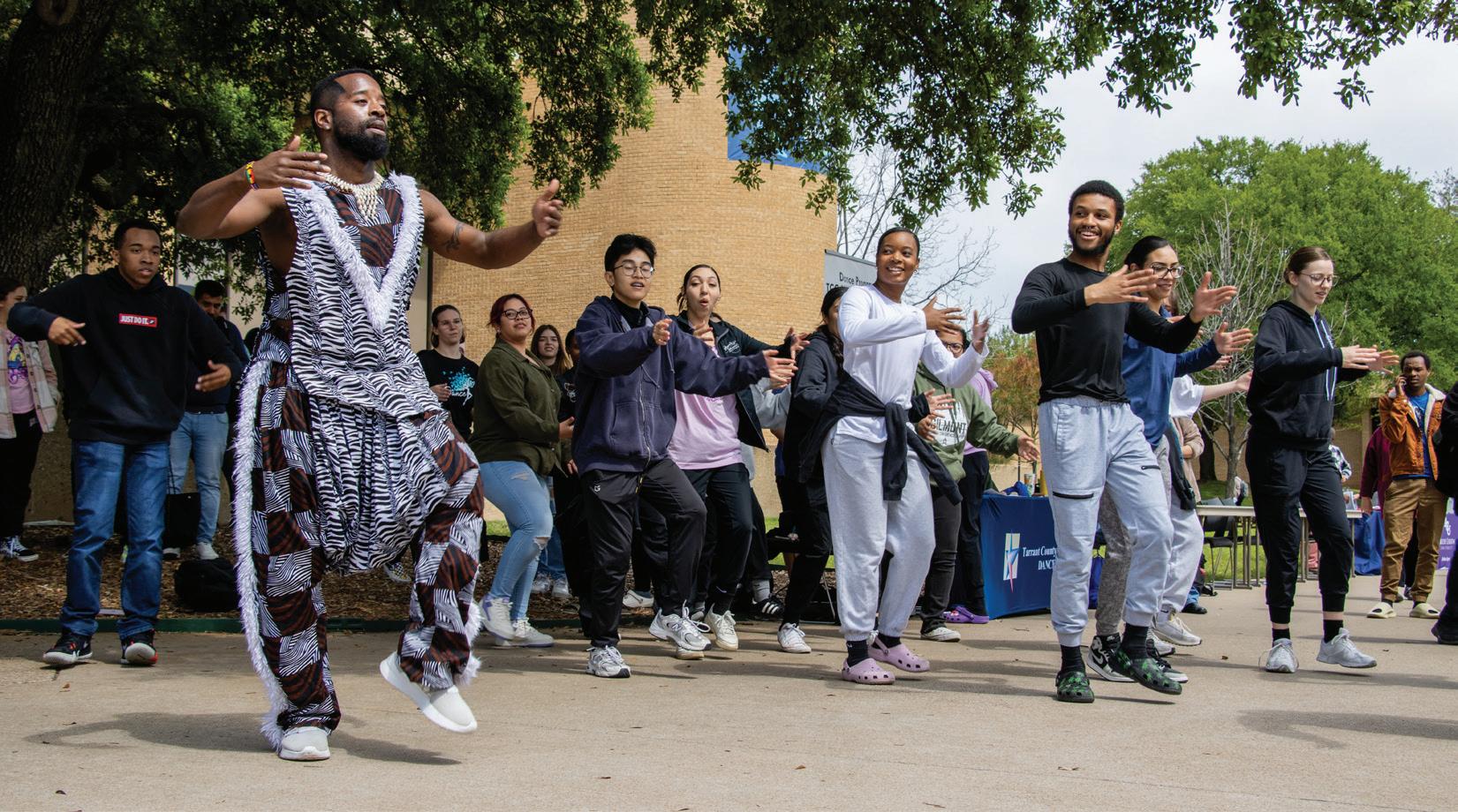
NE Campus students and employees celebrated international cultures with music, food and dancing at the annual International Festival. There were tables across the NSTU patio, trailblazer café and center corner.
“I think it's amazing that they're displaying a bunch of cultures and having that inclusivity,” said NE social work student Khadija Mohamed.
This year’s event featured a Brazilian dance and martial arts called capoeira, A fashion show put together by The Cultures of Other Languages club, “Ode to a March Hare” poetry by Dr. Perez, JK Wong academy performed kung fu and a Lion Dance, NE campus dance group Movers Unlimited performed as well as The Bandan Koro West African dance group.
Students got to dance and sing along with the performers. At one point everyone

was singing ‘Hakuna Matata’ along with the Bandan Koro. “To be able to see different people from around,” said Mohamed “different parts of the world is amazing. To see their culture being portrayed in all the awesome thank you so much appreciate it”. Students walked around between performances and checked out the tables of universities, student clubs, career services and many
others. “I finished my class, and I walked out here bumped into an old friend from high school,” said NE film student Lore Weber. “They took me over here [to the T-shirt table] and I was like, this is going to be awesome.”
Holi is an Indian Spring celebration of colors and dancing. The school provided color powder and a blank t-shirt to participants.
“My favorite part so far is honestly the community just because TCC on a whole”, said NE student Eva Wood. “it's just very bright and vibrant. And it's really cool just to like, share just these kinds of experiences with a fellow classmate.
This event is something happens on campus every spring, and students have taken part in it many times.
NE Dance group Movers Unlimited under the direction of professor Kihyoung Choi drew a large audience at the event, some members of the group have been dancing for a number of years before joining the group.
“I love dancing like just in general but the culture in the family is what gives me the most gratification,” said NE student Joshua Garcia.
The event isn’t just for entertainment but cultural education as well where students can come and learn about different cultures. The dance group performed a traditional Korean drum dancing, that many don’t get to see.
“One of the things I love about the company and is that we are also diverse, and so we get to have diversity within each other but then also bring another aspect of diversity to other people,” dancer Isabel Soto said.
The dance group is about more than just dancing, it also teaches students the different areas, such as choreography, and how to teach dance.
“My favorite thing I think is just how they give us the ability to be creative and to really like work with each other and hone our skills,” said dance education major Nathan Burgess.
HOPE SMITH editor-in-chief hope.smith393@my.tccd.edu
Those who have ever experienced an awkward bar encounter with someone all too friendly might find great relatability with “Drinking Buddies”, one of the one-act plays taking the SE theater stage come April 17th19th.
The theater department has taken on a double-feature approach to these plays, two of which are “Mother Figure” and “Drinking Buddies” from Alan Ayckbourn’s five-part play “Confusions,” and the other being “Enterprise” by Brian Parks.
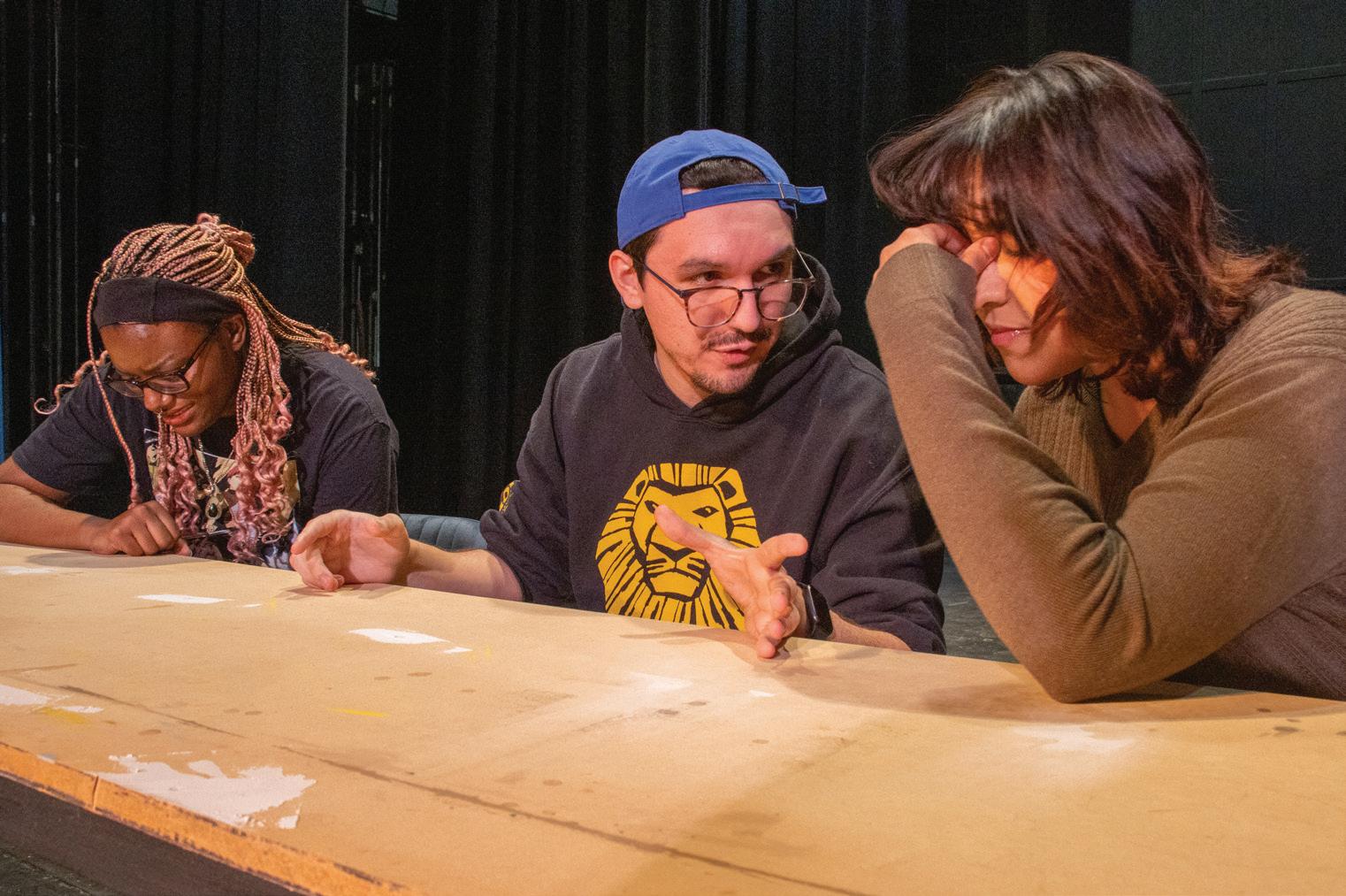
For the cast of “Drinking Buddies” they feel it best represents the companionship of women in moments where they need to unify.
Isara Al-Hilo, acting as Paula, explained that instead of the women in the play being uncomfortable with Harry, she and her costars took a different approach.
“With our characters, we're kind of just making fun of him rather than being uncomfortable,” she said. It was an emphasis from the director that Al-Hilo and Aiyana Jones, who acts as Bernice, portray their characters with this tone to uplift their strength together.
“One of the things that Drew wanted to push was we don't really want the women to feel powerless or uncomfortable,” she said. “He wanted us to play them comfortable enough to laugh at him [Harry] in his face.”
Because of this, it has strong tones of humor for the audience to laugh at as they watch Harry’s increasingly awkward attempt to hit on them.
Joshua Gonzalez, who acts as Harry, ex-
plained that getting into that role was difficult because his personality is far different from Harry and much more introverted.
“At the at the end of the day, they're making fun of me throughout the whole entire script, and it's just my job to make the audience laugh at how dorky, cringy this guy Harry is, because he's not good at picking up anybody.”
Belinda Saenz, acting as the bartender, explained that the play was first made during a time when men had more power, so it was important to have this modern take in the 21st century.
“We're kind of switching that – flipping it a little – to make it more modern and giving the women voices to actually say, ‘No, that's kind of weird.’”
Al-Hilo is also acting in “Enterprise” which focuses on the sudden financial struggles of a business as executives try to save it overnight.
She explained that it is more unsuspecting that other productions might be, and notes that the ending is interesting.
“It's very interesting, how things played out. It's definitely not a regular comedy like with this one [“Drinking Buddies”]. It's more like, ‘ha-ha funny,’ because this would probably happen in real life.”
Bradley McEntire, SE adjunct instructor of speech and drama, is the director of the production and explained that it is a satire comedy and hopes that it garners some laughs.
“I love poking fun of things that genuinely deserve mockery,” he said. “Stage comedies have a long tradition of being good for this sort of thing.”
He said that the theme of the production
is about being swept up in the “machine” of corporate culture.
“‘Enterprise’” has a sort of Kafkaesque pointlessness, this sense of hilarious futility, that appeals to me,” he said.
“Mother Figure” is a tale between a housewife who is handling a messy home by herself while her husband is away and her neighbors who pay a visit to check on her.
Drew Hampton, SE associate professor of drama, said it has much to say about domestic roles.
“I love how often we've created new, funny moments,” he said. “There's a lot of play and experimenting with ideas in our re-
hearsals.”
Like the other two productions, “Mother Figure” is a comedy, but has themes worthy of understanding.
“Through the laughter though, these plays prompt us to examine social and corporate behavior and values,” he said. “They should go deeper than comedies that are merely created for light-hearted entertainment.”
Showtimes run from 7:30 p.m. and an extra 1:30 p.m. on April 19th. Admissions are pay what you can at SE Campus’ C.A. Roberson Theatre, ESEC 1401.
NE Campus ended Women’s History Month with an event that examined the perception of women during WW2.
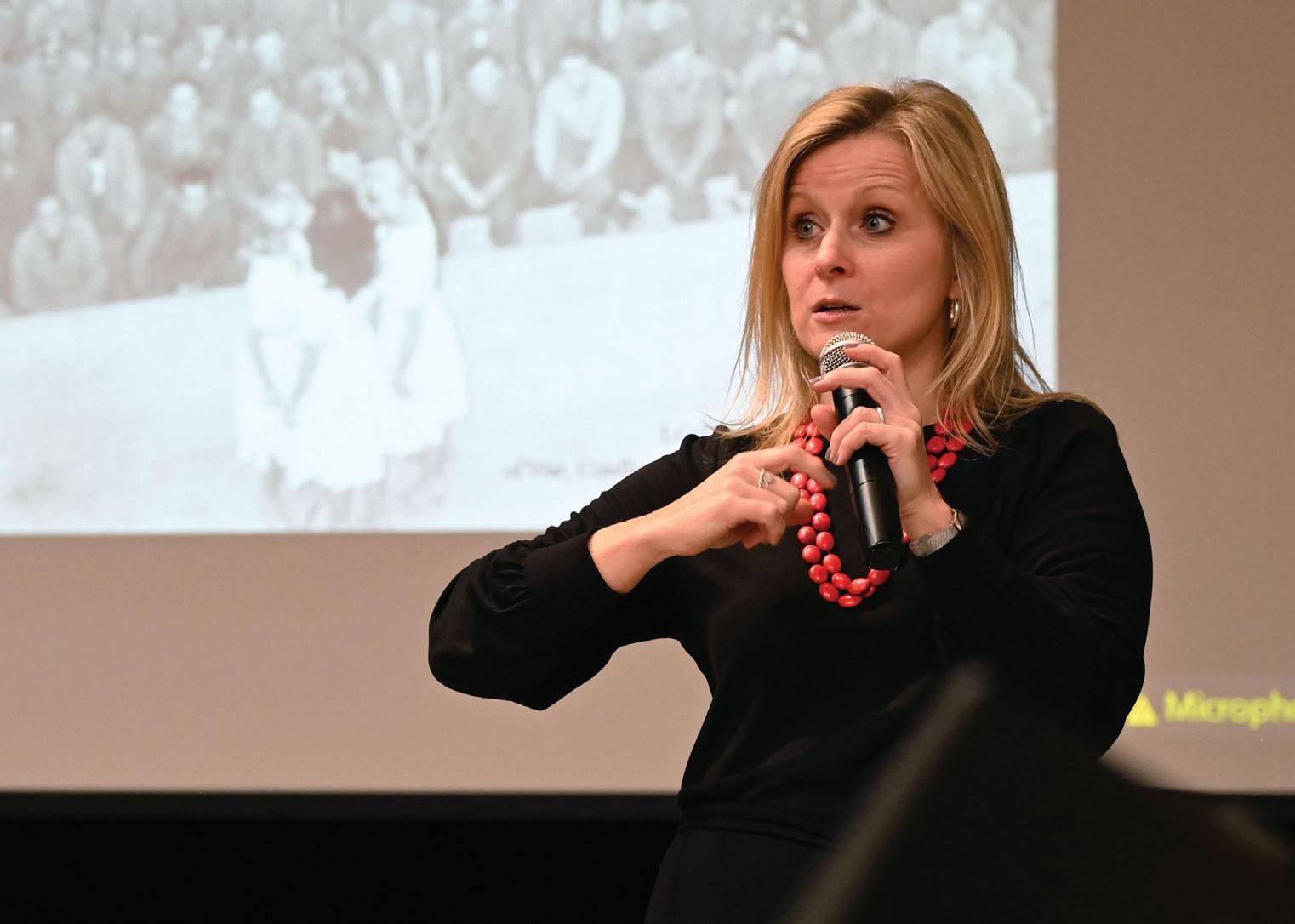
Last week’s ‘Good Girls Go to War’ was the result of a joint effort organized by associate history professor Karen Wisely, Texas Christian University historian, guest speaker Kara Dixon Vuic and NE student activities.
Over the course of the event, Vuic went over numerous ways in which women were viewed as objects for soldiers to remember and fight for while they were on the field.
A few Americans could explain with any depth what the war was about,” Vuic said. “And so, the US government spent a lot of energy explaining to Americans what the war was about.”
According to Vuic, there was significant effort by the government to explain why the war being fought was important as a means boosting morale.
“These are all an effort of the government to say here is what you are fighting for,” she said. “This is what the war is about, right. And part of what the war is about for American people is women.”
She questioned the ethics of portraying
women as rewards or “morality-boosters” for the men of the war.
“What is the expectation, right?” she said. “All of the official and unofficial ways that women's bodies are used as morale. It's a pretty complicated picture, right?”
She addressed how back then; women were solely depicted as rewards for men to strive for during the bloodshed. Women were viewed as trophies – as “pin-ups.”
“I mean, everybody's seen pin ups on planes, right?” she said during her discussion. “This is kind of the image that Americans wanted. It was that our boys, you know, they just liked girls, and they just want to get back to the girls, and all the girls are cute, and it's gonna be fine, right? It'll all be fine. But what about the women? What about those women?”
NE student Drake Schofield spoke about it in a few ways, women still are depicted as motivators for men in the form of some modern occupations.
“I can say I feel like there's a lot in the way of professions that have kind of come out in statistics, especially a lot of other things like cheerleading, for example, kind of sports to or art, whatever you want to consider it that emphasizes like increasing morale or entertainment, stuff like that,” he said. “So, I definitely think that how it was back then it was definitely built on to today's society.”
When asked, Schofield expressed interest in returning to another event such as this one to learn more about various topics.
“Oh, yeah, I definitely would [go to another event],” he said. “They're very interesting. Usually, you learn something that you haven't like the trivia. It's definitely good to know, and there are a lot of the different events and stuff that are out there.”

“We
there was no water,” Marquis said.
His interest in water as a healing force stemmed from witnessing drought and deficit. He told the audience that only 3% of the water on Earth is freshwater.
“So, to me a single glass of water, to bring a thermos of clean water with me, is a big deal,” Marquis said.
Marquis said that there will be no generation of new water even as the population of the world increases.
“Our ability to care of the water we have, to filter it and to keep it clean is upon us,” Marquis said. “That’s our job. We have to accept that responsibility.”
His passion for water led him to write his book “The River Always Wins.” In it, he uses water to explore the concepts of hope and change.
“We go through the rapids and the floods and each of us experiences the hard times when we suddenly are hurtling forward,” Marquis said. “The challenge is all around us. And yet at some point in time, we can be certain that we will come to still water.” Marquis found his place as an activist in the 60s. He engaged in protests and fought for civil rights. An audience member asked if he would ever get discouraged.
“There’s always something else to be angry about…There’s plenty to be happy about,” Marquis said. “I look at the light that comes in through the window to think, I have today, I have this moment and I think of my grandchildren. I think of my friends.”
Deaja Davis, a visual arts student at TCC, said that she found the event enlighten-
ing. “It gave me a different perspective on how to view life,” Davis said. “I’m very interested in reading the book.”
Angelina Francis, who is pursuing an associate of arts at TCC, said she liked how the event emphasized community.
“I know that we have the idea that every person matters, but he really gives you the visual and perspective with the river,” Francis said.
Marquis said that everyone has a place in the world and a job to do.
“We are making progress no matter how difficult and challenging these times are,” Marquis said. “You look back and go, we have a long way to go. But, we are making progress.”
part of the sun. Then, as more and more gets covered, the first thing people notice is it’s a little bit dimmer. So, sun’s out, but it’s not quite as bright as normal.”
Benge said wildlife may start behaving differently because of the eclipse.
“Birds will think it’s about sunset and so the day birds are going to start going off somewhere, and the birds that hunt at night like owls and so forth will start coming out,” he said. “We’ve got chickens, and last time we had an eclipse my wife said all the chickens went back to the back to the coop.”
Even humans will feel something strange happening because their brains know it’s daytime, but it will look like dusk outside.
“I’ve had some people say it almost feels like a religious experience,” Benge said.
Just before totality, the light again starts looking different, and the shadows also begin to look different.
“The shadow bands are a famous sort of thing that is happening just moments before totality or moments after totality,” Benge said. “Almost nobody notices them unless they actually know to look for them because most people are looking at the sun, and they’re not looking down here at things that are happening.”
Many tourists plan on descending on Texas in the coming days, which can present some unique challenges to smaller communi-
ties that need the infrastructure and resources for an event of this magnitude. School districts across Texas are canceling classes for the day. HEB ISD, GrapevineColleyville ISD and Fort Worth ISD will be providing glasses, along with in-class lessons on safety and the eclipse process.
Some counties, such as Travis, Burnet and Kaufman, have issued disaster declarations ahead of the eclipse so that resources will be available. Other counties are primally concerned about how this will impact traffic.
Multiple state emergency management agencies are working together to plan for traffic problems and other potential issues during and after the eclipse.
“Based on research looking at other places — Oregon, Wyoming, other states that have had this event in the past — the big thing we’ve noticed is traffic issues,” said Tarrant County Emergency Management Coordinator David McCurdy. “A lot more folks are coming into the area and then just compounding the usual traffic problems.”
There are a wide range of feelings about the eclipse, from excitement and worry about the day’s logistics to traffic concerns. Most are starting to think about what they will do.
“I haven’t made plans yet,” said SE student Edward Granados. “But now it has me thinking that I should make solid plans, so it doesn’t catch me by surprise this time.”
A total solar eclipse happens when the moon passes between the sun and Earth, completely blocking the face of the sun
A total solar eclipse will cross North America, passing over Mexico, the United States and Canada. The sky will darken as if it were dawn or dusk. Dallas will not be in the path of totality after this for 300 years.
NE Campus: 2 minutes, 40 seconds
NW Campus: 1 minute, 44 seconds
TR Campus: 2 minutes, 31 seconds
South Campus: 3 minutes, 04 seconds
SE Campus: 3 minutes, 41 seconds
On April 8 at 12:23 p.m. and depending on your location, the eclipse will last anywhere from a few seconds to 3 minutes 51 seconds, according to calculations (left) from NE associate professor of physics and astronomy Raymond Benge. The numbers can be off by a few seconds depending on just where on campus you observe. These are based on about the middle point of each campus.
Except when the moon completely blocks the sun’s bright face, it is not safe to look directly at the sun without specialized eye protection for solar viewing. Viewing any part of the bright sun through a camera lens, binoculars or a telescope without a special-purpose solar filter secured over the front of the optics will instantly cause severe eye injury. The sunlight will be very bright. It’s recommended to wear long sleeve clothing.







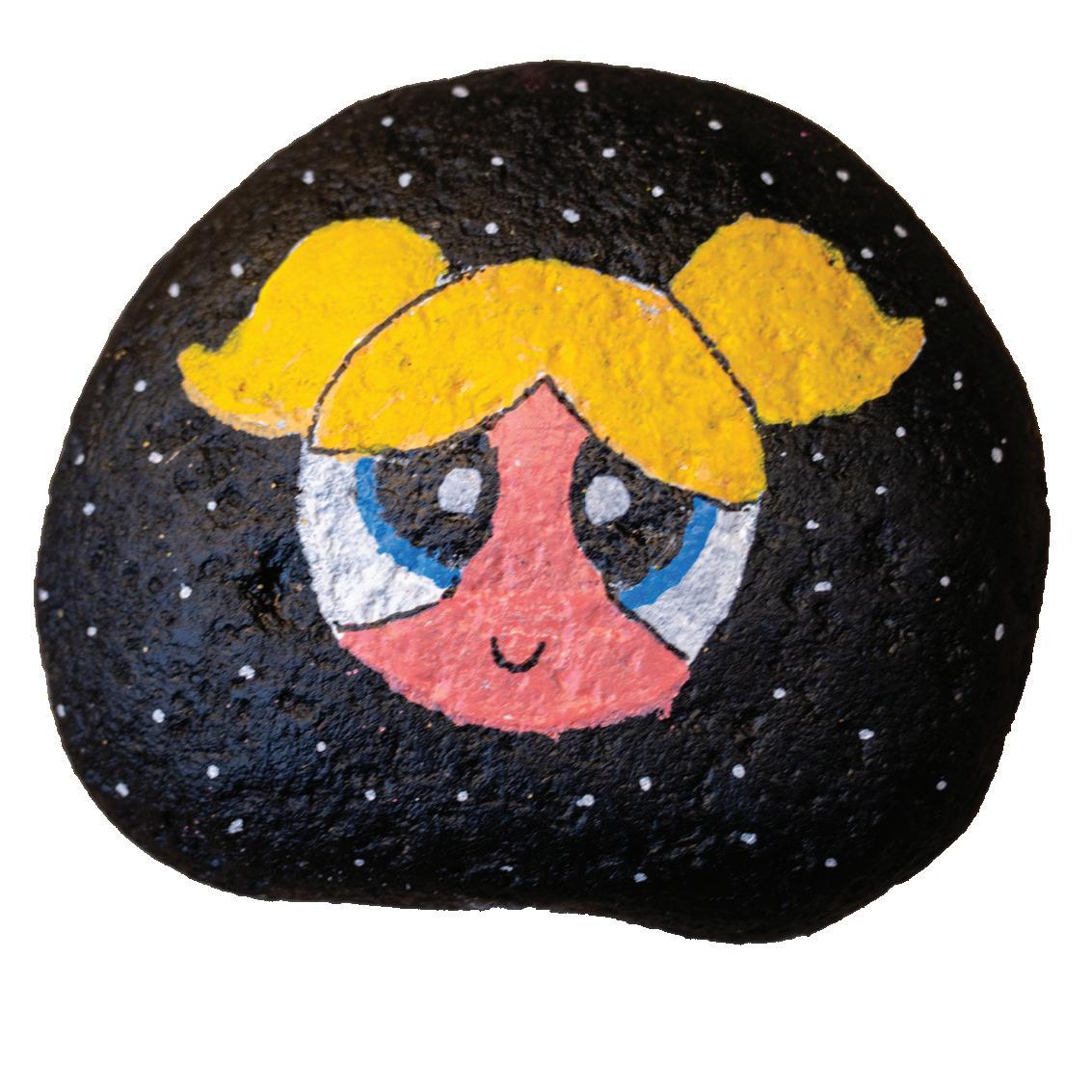
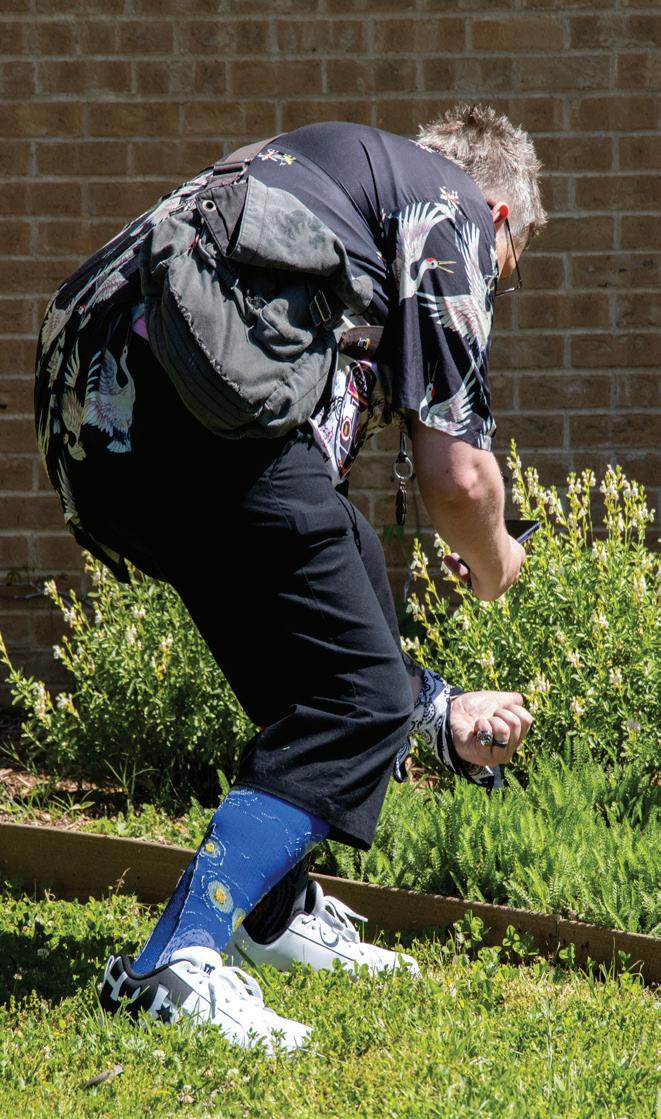
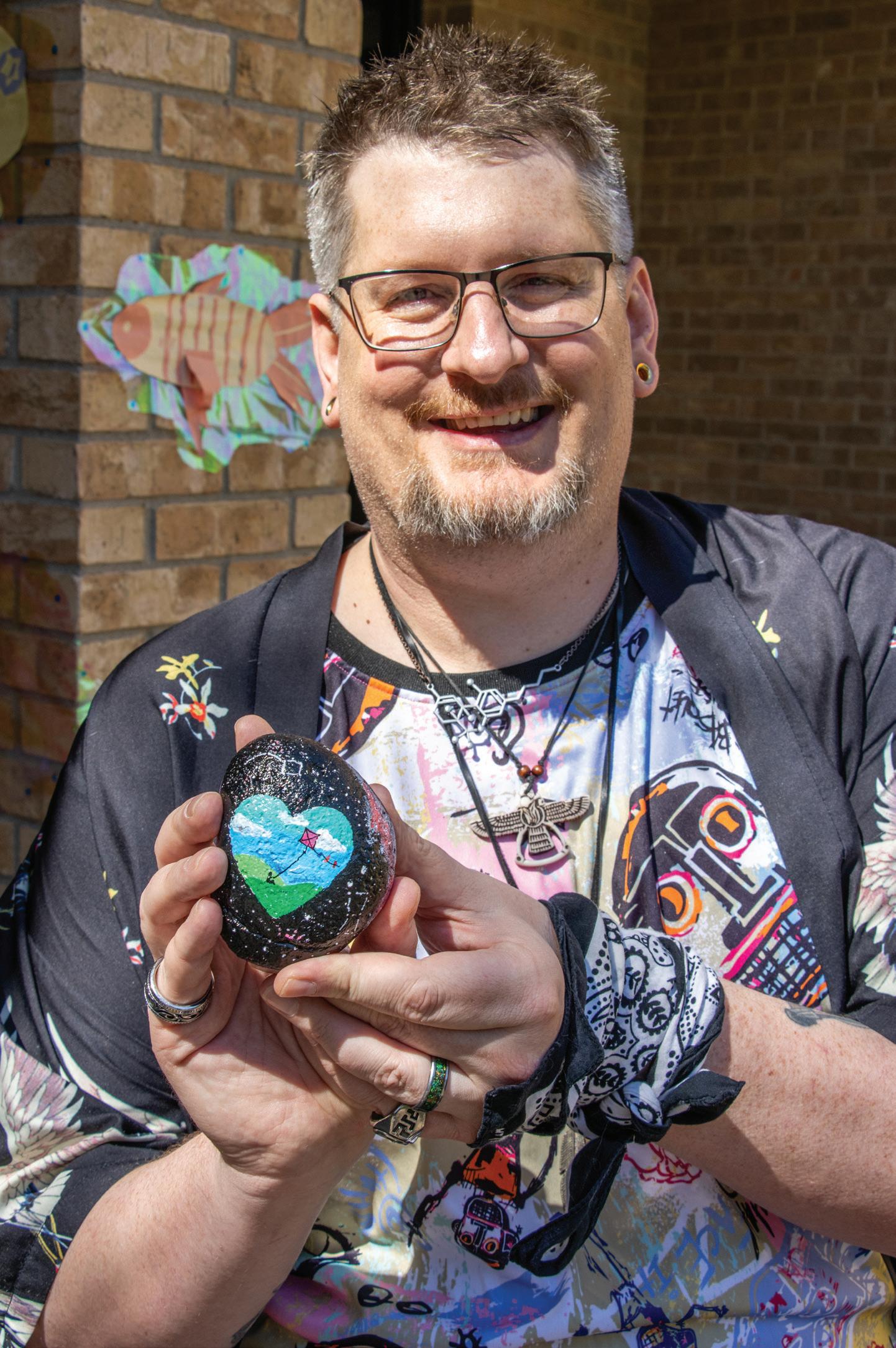
Justin Thyme started painting rocks for a class assignment. He earned an A, but felt that his project was too impactful to stop there.
Now, Thyme continues to paint rocks and hides them across NE campus for students to engage in a scavenger hunt. The NE student posts new rocks ready to be found on his Instagram, Rock Hound, a couple of times a week to inform students of when they can begin they’re search, he said.
Thyme thought of the idea from his past experience of living in Colorado Springs. Painting and hiding rocks was a big deal there, and he was disappointed that people didn’t seem to participate in Texas, he said.
The visual art student didn’t know what to expect when he began placing rocks in the nooks and crannies of campus, but to his surprise, students were participating. By week two, students were really getting into it, he said.
“As soon as I was posting, they were out hunting for them,” he said.
Thyme stays on the lookout for smooth, paintable rocks while he goes on walks outside of campus. When he sees one, he picks it up and puts it in his bag.
The painting process is simple, he said. Thyme primes all of his rocks so the paint will stick better, and he uses a bit of white to make designs pop.


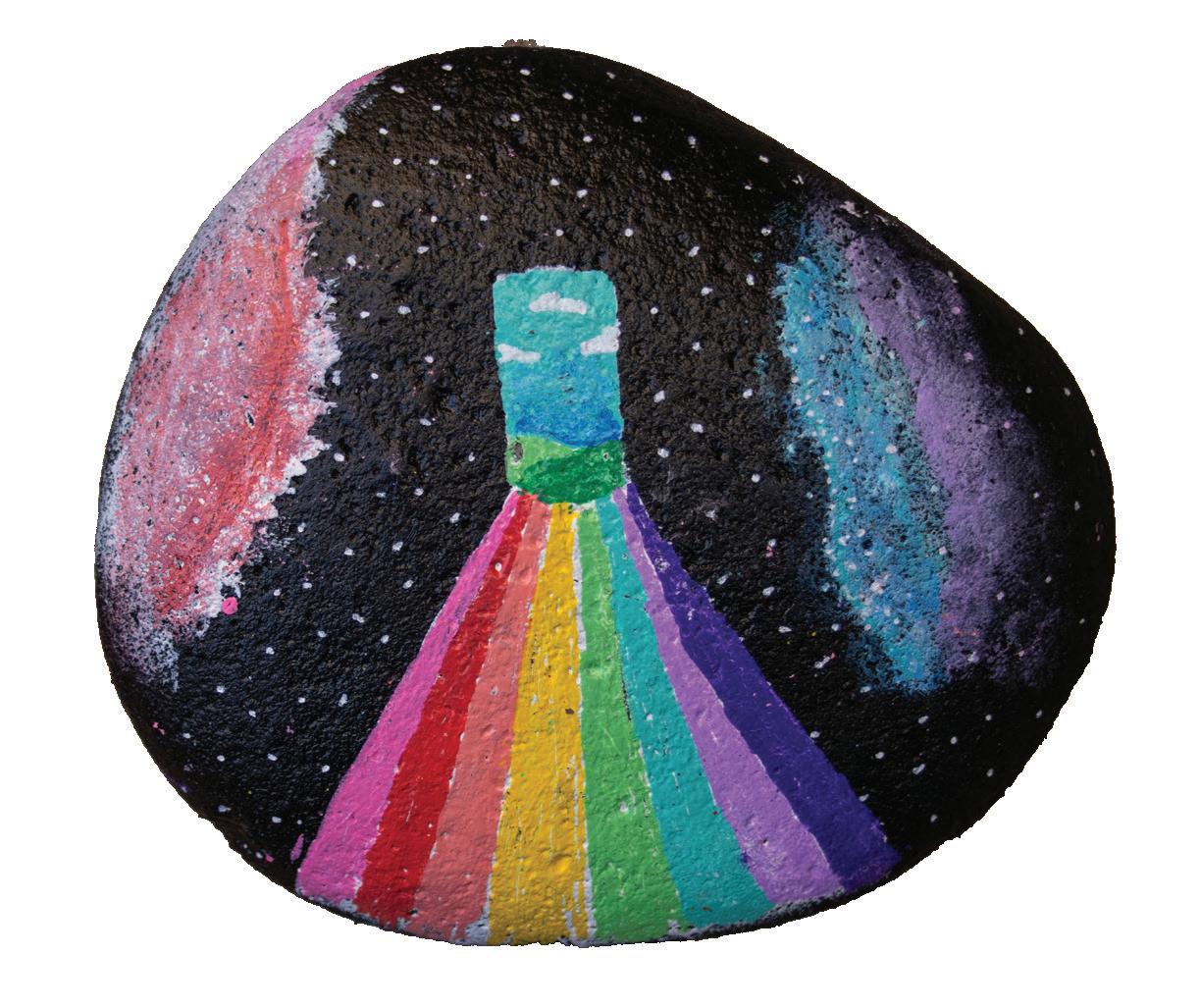
From galaxy rocks to ones with cartoon characters on them, he does his best to paint things he thinks students will enjoy. When students post that they’ve found a rock, some mention wanting to start painting their own, and that excites Thyme.
“Please start painting rocks,” he said. “Cover the campus with art.”
As a result, he’s considering posting YouTube tutorials for students who’d like to start their own projects.
The NE student was a massage therapist before enrolling at TCC to pursue art. Thyme has always loved art, but whenever he was first attending
“As soon as I was posting, they were out hunting for them,”
school twenty years ago, pursuing art wasn’t as encouraged, he said.
It took Thyme his first semester at TCC to gain con fidence in his abilities, but now he knows that it’s just about affirming oneself.
“You’ve got to tell yourself, ‘I’m an artist, so I can call myself an artist and act as one confidently,” he said.
He also finds support from the LG BTQIA community.
“I love to represent my community when possible, and the community has given me the inspiration and motivation to become an artist,” Thyme said.
For Thyme, the rock scavenger hunt is about creating fun for students.
“There’s a lot going on domestically and overseas, and it’s really easy to lose sight of joy,” he said.
So any chance you get, infuse joy into the lives of others, Thyme said.
“You absolutely have to do it right now,” he said. “It’s like our obligation, or things just get worse.”
The rock scavenger hunt may be a perk for students coming to campus. Instead of wandering from class to class, it’s like a side quest, Thyme said.
“And who doesn’t like a side quest,” he said with a smile.










on Set”
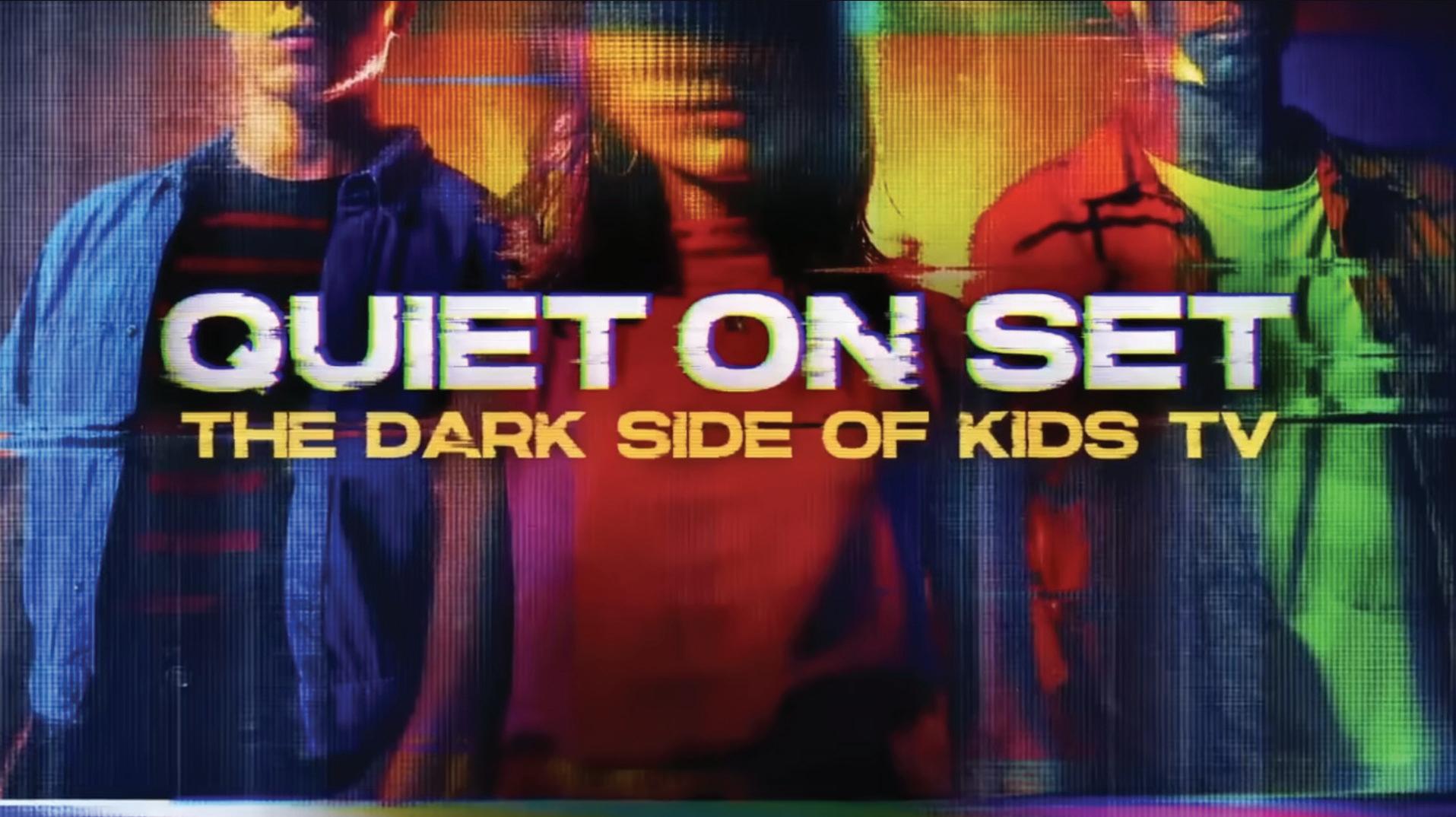
The docuseries ‘Quiet On Set: The Dark Side Of Kids TV’ is a cautionary tale about the tragic and traumatic world of child acting.
Going into this, I didn’t know what to expect. I had heard in the past through cultural osmosis that there were weird happenings on the sets of certain childhood favorites like “iCarly,” “Drake and Josh” and “Victorious” to name a few, but I had no clue it was this bad. My expectations were to be informed but not mind-blown. But I was wrong. My mind was indeed – blown. My mouth agape for most of the series’ runtime.
Were all these shows I watched as a kid
this horrific behind the scenes? How!? None of the higher-ups saw any problem with this? How did this many child molesters end up on these sets?
I know I’m moving at a mile a minute, but I can’t help it. There’s no easy way to explain how this docuseries made me feel. In times like this, a more structured approach is helpful, but like the series itself, perhaps the raw emotion and brisk pace is appropriate.
The production value of the series is spot on. Everything feels so tense. It’s so composed. There’s a feeling of uneasiness that creeps its way throughout this whole series. It’s subtle, but it’s so effective in setting the stage for the implications, investigations, realizations and revelations the series has to offer.
The information is well presented, and
the actors present were well spoken. The pieces all fall into place to make something that’s destined to be watched in one sitting if you have even an inkling of interest in nostalgic Nickelodeon children’s programming.
The series highlights the vile misconduct that happened on the sets of the aforementioned shows, among many others. It’s an enlightening watch for sure, but I imagine it could be difficult for some to sit through.
Talks of child endangerment, sexual harassment, gender discrimination, racial discrimination and child molestation are present. It’s a shocking and close examination of how child acting can leave said children scarred –both physically and emotionally.
It won’t be for everyone, but again, if you have even an inkling of interest in the industry of child acting or Nickelodeon shows
like “Sam and Cat,” “The Amanda Show” or “All That,” then you owe it to yourself to check this out.
It’s an absolutely enlightening watch that made me, as someone who grew watching many of these shows, take a step back and gasp out loud, reel back in disgust and discomfort and made say “How did they get away with that?” or alternatively, “Why did they do that?”
It was a rollercoaster from start to finish and it’s the raw, unfiltered look at the evil of the child acting industry that the world needs to hear.
Me and my three classmates sat down together at our English seminar when she said it. “Did your brother make you wear that?” said my English partner. I was 12 when I started to seriously think about wearing the hijab. I was 15 when I received that micro aggressive comment. I was 20 when I realized that though my culture and religion take pride in their attire, Hollywood certainly does not.
I am 20 now. This movie follows Paul Atreides and his mother, Jessica, after their escape from the powerful House Harkonnen. Paul and his mother managed to escape, but got right into the hands of the Fremen people.
The Fremen are skeptical and think they are spies, but ultimately start to trust him after he passes a series of tests. Eventually they start believing he is their messiah, or ‘Lisan al-Ghaib,’ the one who will guide them to paradise and save them from their mutual opressore, House Harkonnen.
“Dune: Part Two” was exceptional. Unlike the first movie there was much more action and much more Zendaya, who played the role of Chani. The first movie felt more like a lukewarm bath before a scalding hot shower.
Hollywood did it again. They took what society thought was weird and scary looking on people of color and made it seem cool on white people. They took my culture and mocked me for it, they took my mother tongue and mocked me for it too. It felt like I was being mocked for entertainment and it felt degrading.

From the traditions to the language, everything felt stolen from me and it ruined my entire experience.
While the Fremen’s language Chakobsa, is made up like many elements of the film, the origins of it are not. Many of Chakbosa’s words are from Arabic, like the word ‘mahdi,’ or messiah and the phrase “Lisan al-Ghaib” which means the voice from the outer world.
Their attire also closely resembles Bedouin and nomadic-like tradition, one that my parents are both from. Not only that, but the

way the Fremen people pray also closely resembles the way Muslim people pray and frankly I did not appreciate it.
Before the movie came out, I remember seeing Anya Taylor-Joy’s red carpet outfit for the London premiere and I had to squint at it for some time before realizing what was happening, again. She was wearing a long white dress with what looked like a long, seethrough scarf covering her head.
The film had a beautiful storyline, one that makes me want to watch the third one when it comes out. But it would’ve been more beautiful had they not stolen from my culture to create one of their own.
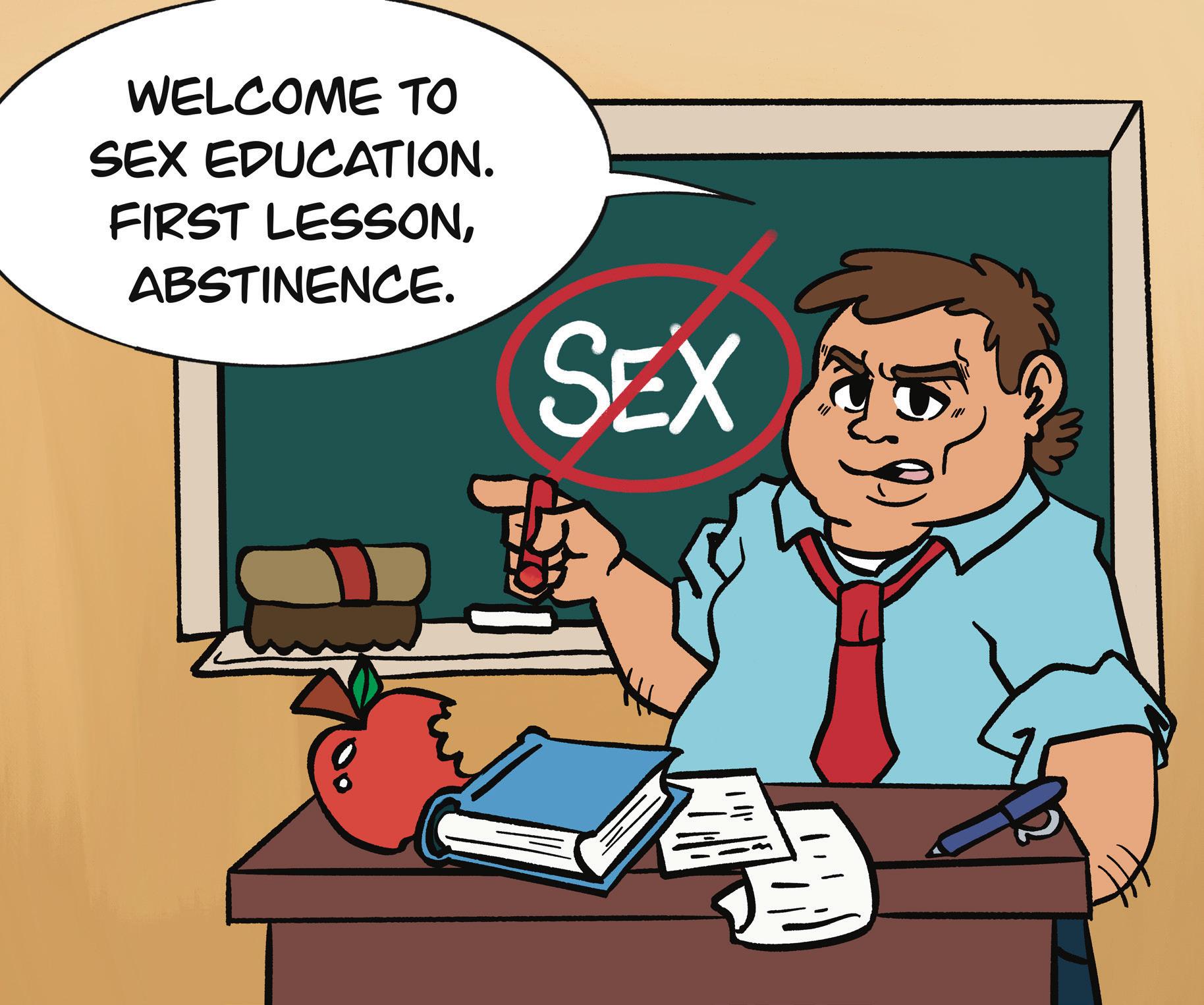
While the state is preoccupied with suspending adult websites, Texas lawmakers should offer comprehensive sex education to adolescents.
The Texas House Bill 118 requires adult websites to verify users are at least 18-years-old to view content on their sites.
Attorney General Ken Paxton filed a lawsuit in February of 2024 against Pornhub’s parent company, Aylo Global Entertainment, stating their content “harms, and continues to harm, Texas children and adolescents.”
The company responded by suspending its services for Texans.
This suspension has the potential for overwhelming good.
Pornhub has seen extensive criticism for delayed removal of child sexual abuse, revenge porn or nonconsensual porn on their website.
In the Bible Belt, where abstinence and little to no comprehensive sex education are the prescribed methods of learning about sex, many adolescents may look to adult content to close the learning gap — which can have many ramifications on youth.
Many leading medical journals have suggested that adolescents who view adult content may undergo negative side effects, such as poor mental health and incorrect strategies on how to handle sexual situations.
This suspension gives lawmak-
VIEWPOINTS
ers the opportunity to pass legislation that requires more comprehensive sex education to students across the state.
In Texas schools, health education is required up to middle school, but sex education is not required to
be taught in high schools. Paired with religious stigma around sex in the Lone Star State, the conversation of sexual health can be particularly difficult for some adolescents to even conceptualize.
Texas high school students should be able to ask questions in a controlled, safe environment. If young adults aren’t knowledgeable about sex, how can they know what the right questions are to ask, or how to protect them -
selves?
Teens may also resort to learning about sex from their peers, who may be equally uneducated about the topic.
Misinformation from friends about how to prevent unwanted pregnancies and sexually transmitted diseases can lead to compromising situations.
Though sex education is not mandated, some aspects of it are mandated through required health curriculum.
According to the Sex Education Collaborative, Texas does not have any regulations regarding teaching medically accurate sex education instruction, nor does it require to teach consent in curriculum.
In the event a school chooses to teach sex education, they must stress abstinence first.
States — like Texas — that insist on stressing abstinence first, often witness higher rates of sexually transmitted diseases.
Texas ranked in the top 20 states for rates of STDs and top 10 states for teen births, according to the U.S. Centers for Disease Control and Prevention.
While this suspension is a good first step in protecting minors from obscene material, Texas’ culture allows conversations around sex to be silenced.
Minors shouldn’t be exposed to adult content, much less having to resort to learn from it.
Introspection can limit how you interact with the world Financial literacy is pressing, important to all U.S. citizens
The widespread belief that introspection is the key to healing is misguided. In reality, overanalysis often leads to more neurosis.
Self-awareness exists on a spectrum. On one end, there is obliviousness to one’s actions and on the other, there is hyperawareness. Both of these distance you from the world and limit what it can offer you.
Introspection can be an important and helpful tool, to an extent. However, at one point, it is necessary to stop analyzing your every thought and push that energy outwards.
It isn’t possible to be fully immersed in day-to-day life unless the idea that every action must be indicative of something greater is released.
Sometimes, our actions are just us reacting to various life events the way anyone would. It doesn’t say anything about our specific character.
If you get upset because a love interest didn’t reply to your message and it made you insecure and angry, it doesn’t mean that you’re crazy, have an anxious attachment style and borderline personality disorder. It just means that you’re part of a very common human experience.
The idea that there is something to

EDITOR-IN-CHIEF Hope Smith
MANAGING EDITOR Nina Banks
PHOTO/MULTIMEDIA EDITOR
Hoben
pathologize about that only isolates us from each other.
Insecurity is a form of thinking about yourself too much. Assuming someone doesn’t like you is based on your assumptions about how you came across to them, how you look, how you talk, what you say.
These are all assumptions that require you to think solely about yourself. In therapy, this kind of thinking is targeted with introspection to explain why you may think these things about yourself.
Introspection can be useful. It’s a tool of control. However, we cannot control the external world, which means we can never fully control ourselves. Letting go of the importance of this control is key to being more easygoing and self-assured.
A different way to target insecurity is to ignore things that aren’t directly said to you. Almost always, we are insecure because of imagined scenarios and assumed slights. Sticking to what is direct and solid keeps us grounded in reality.
One way to let go of the fixation of knowing yourself is to be open to things that may change your perception of yourself. It is important to realize that self-analysis can provide insight, but it is limiting.
It should be a less of a priority to practice internal reflection. The more productive route would be to practice external action and flexible thought.
The need to control who you are will only isolate you from what the world can offer you.
We need to recognize that our personhood is always susceptible to change and that what we know about ourselves is not absolute.
Only then, will we truly become part of the world.
Financial literacy is more important than young adults realize far too late. In a state that requires personal finance courses before high school graduation, it makes you wonder where the education is going.
In light of tax season rearing its head and April being National Financial Literacy Month, I think it’s fitting to discuss the lack of urgency surrounding the importance of Tax Day –– April 15th, for the curious –– and everything else involving personal finance. Financial illiteracy does not just impact the individual, but it becomes a generational issue as well. While half of the states in the U.S. require personal finance courses in education, the other half is lacking. The problem is these states did not all agree they would teach people how to survive overnight.
To understand how financial literacy is measured in a country, a good resource to consider is the P-fin index. It’s an annual survey done by the Teachers Insurance Annuity Association of America and the Global Financial Literacy Excellence Center, with consultation by Greenwald & Associates. It measures U.S. adult’s understanding of finance and management.
According to the P-fin in 2022, 24% of surveyed U.S. adults said they typically find it difficult to make ends meet. In 2023, it rose to 30%.
Meet the Staff
This lack of financial security is a struggle for these Americans who are not only fighting to succeed in a system that is not exactly built for success, but a lack of education on top of that creates an environment that is even less successful.
This increase in struggle matches the information provided by the P-fin, which says that, “Decreased retirement saving in response to inflation was more common among workers with low financial literacy.”
If we want a society seeing increased numbers in financial success, we need to start with educating young adults and creating more accessible avenues for people to understand finances without the barrier of specific financial language.
There are multiple occasions where friends of mine did not know the functions of a credit card, debt or saving money. I can only say so much to them about it all before I myself am limited to my own knowledge, and before we know it we are essentially blind leading the blind.
Among all the very famous financial educators and millionaires of this world, you’d think there would be more emphasis on this kind of education. But those guys charge quite a bit so, there’s that. Looking at you, Dave Ramsay. It becomes a stigma that people who are put in less fortunate circumstances and do not have the means to understand personal financing cannot succeed in life, which is untrue. Knowledge is not subject to the fortunate, and a successful society can come from an educated kind. Something I’m sure I have repeatedly stated before.
The fact of the matter is, if it isn’t taken seriously there will be an unpresented number of young adults who are walking into this world blind. And it will have an adverse effect on the country.