
Former provost disputes termination
and said no interim has been appointed.
Shelley Pearson, former vice chancellor and provost, is speaking out against her Nov. 20 termination that the college based on an external review.
The decision to fire Pearson came after the administration admitted giving incorrect contractual information to Connect Campus
faculty regarding their teaching requirement for the 2025 Summer 1 semester.
“I respectfully disagree with the findings of the external review of the TCC Connect workload issue,” Pearson said. “My decision in question was made in good faith and as part of an ongoing effort to correct longstanding workload inconsistencies that existed well before my tenure.”
Vice Chancellor for Communications and External Affairs Reginald Gates confirmed Pearson is no longer with the college
“We’re all coalescing to make sure that the work continues in that area,” Gates said. “As a cabinet, we’re all making sure that happens.”
He said he couldn’t comment on why the decision was made, saying it was a personnel matter. He didn’t respond to emailed questions sent later regarding the external review Pearson said led to her termination.
“The college has isolated a single decision without considering years of inher-
ited structural problems, unclear policies and widespread stipend practices,” Pearson said. In October 2024, Pearson informed Connect Vice President of Academic Affairs Zena Jackson that the full-time workload for Connect faculty members with 10.5-month contracts required teaching a minimum of three to four-and-a-half hours during the Summer 1 semester, which is about one class. This information was then forwarded to all Connect

Parade lights up Sundance Square



TR nursing students have expressed concerns over some areas in their program they felt have not been met yet.
Last-minute scheduling changes have forced them to adjust their test and clinical schedules, which they said is difficult because the program is highly intensive.
Students at the TR East Campus said they have seen shifts in class schedules, time management and teaching approaches.
“I think we’ve been through a lot of nursing directors. That’s been changing a lot,” nursing student Ruth Judd said. “It’s kind of hard to get a solid plan out when the head — whoever’s in charge — keeps changing each year.”
When their testing schedules change at the last minute, according to Judd, it leads them to wait past their scheduled testing time.
Starting Jan. 1, full-time employees will not receive a 2% cost of living raise if they are at the top of their salary range. At its meeting Nov. 20, the board of trustees discussed the Annual Compensation Plan, which addresses the allocated budget funds for employee pay.
Inside the plan, the adjustment for a wage cap came after the shift from the original class code pay
scale to the newest salary grade system. According to Gloria MaddoxPowell, chief human resource officer, it is designed to better categorize the variety of employee wages.
To address fair wages across the board, Maddox-Powell explained that the raise limit in the grading system will allow newcoming employees to be paid the appropriate amount based on the work they are hired to do.
“We had to acknowledge the people that are outside of that range and to not use that salary and try to map people to it because it’s out of alignment already,” she said.
An example that MaddoxPowell provided was for employees at paygrade one. Their salary can be approved up to the cap of $53,100. Those at that dollar limit and above do not qualify for the cost of living 2% increase. This also applies to the other 12 grades newly created. While some board members, like Gwendolyn Morrison and Shannon Wood, questioned how the limit would impact employee wages and retention, President Jeanie Deakyne commented that understanding paygrades and workload clarifies how an employee could move from one grade to another
through applying for a different position.
“I will offer up that paygrades do not make the assumption that just because you are in a position for a longer length of time that you get more compensation,” she said.
“There are levels of work that are associated with pay grades.”
Though it would pose a limit for the employees who have or will reach the cap, Maddox-Powell said that only 74 employees would be affected by it by January.
Ultimately, the compensation plan passed, and with it the
“Today, we were taking our doses calculation quiz, and when we went to the room, they were already testing in it,” she said. “I think scheduling all the rooms for all the cohorts, it is very challenging for the people in charge.”
Nursing student Sylvia Itebalumhe said it was hard to take two exams on the same day.
“The only thing I’ve noticed really drain me, which I almost quit, was when we did pharmacology and [Adult Med Surge] together,” she said. “It was not easy.”
TR Dean of Health Science Jerry Findley who has been in his post a little over a year, said he was not aware of such student concerns, and suggested the questions be asked to TR Campus President Sean Madison, who did not respond to emails from The Collegian.
Another nursing student, Shana Smith, said she recently saw a change in professors’ attitude toward teaching.
“I feel as though it’s been different because I think that they actually like what they’re doing and you can tell they have passion in pediatrics as well as labor and delivery,” she said. “I feel like they like doing that, and I feel like they like teaching it.”
Judd said she wants to see stability in the administration.
Photos by Diego Santos/The Collegian
Student intramural sport attendance declines

Less student participation at events impacts social engagement
150% more likely to return to the university.
Participation in intramural sports at TCC is down, with organizers citing post-COVID disengagement and a lack of infrastructure to support athletics as the main factors.
“We used to have upwards of 50 participants in each intramural and now we are lucky if we get 20,” said Tiffany Selrick, a kinesiology instructional aide and adjunct instructor on NW Campus.
A flag football tournament was scheduled for Nov. 6 at TR Campus, but only one participant showed up: NE student Te’Andre Batiste.
“I think it’d be a pretty dope experience. ... I’m hoping to do more events like this in the future,” Batiste said before the tournament was officially cancelled.
The tournament was to be held at the only viable space TR Campus has to hold a sporting event: a grass area behind the build-
ing, which is public property. TR Campus lacks a gymnasium or courts of any kind. However, there is an athletic center nearby which has been utilized to hold events.
“Tournaments typically range between maybe like five to 12 students,” said Brianna Gomez, a TR student development coordinator.
NW Campus, which has a gym but not a field, saw a significant drop in participation after the outbreak of COVID-19 and still has not fully rebounded.
NW kinesiology instructors are giving extra credit to their students who attend these events, yet participation numbers struggle in comparison to the pre-COVID turnouts.
“Most of my students say they can’t attend because they work outside of class,” Selrick said.
A 2019 study conducted by Michigan State University showed that freshman who played intramural sports had, on average, a 3.25 GPA compared to a 3.07 GPA for those who didn’t play. They were also 40% more likely to move onto sophomore status and
“Students who participate in intramurals are definitely more engaged at TCC overall, frequently have improved academic success, better mental health, and enhanced social support,” said Shahzad Nazir, a SE kinesiology instructor.
The biggest challenge for SE Campus is that the swimming pool has been closed for six years, and the gymnasium has now been closed for two years. The pool was closed due to a crack in a storage closet floor. The repair has still not been made.
The gym was repurposed to make room for the library and other staff while areas of the campus were being remodeled. It is now empty, but the flooring was damaged in the two years that it was occupied, rendering it unusable for its original purpose.
The SE gymnasium is currently scheduled to be assessed next September, leaving staff with an unclear timeline of when it will be reopened for students.
“The wooden floor is ruined,” said Nazir. “If you bounce a basketball in 50 different
Faculty assist in scoring scholarships




used each year. She encouraged students to apply even if they are unsure they will qualify.
“A lot of people don’t realize how many scholarships go untouched,” Williams said.
NE Campus students learned how to stay on track academically and prepare for upcoming scholarship season during the GoalKeeper Mindset Mondays workshop Nov. 17.
The session, led by NE instructor Janjura Williams, focused on checking students’ progress toward their academic goals while introducing strategies for finding and securing scholarships. Williams said the GoalKeeper series connects each event to the next so students repeatedly build the same core skills.
“Our previous event was Protect Your GPA, and this one was about asking, ‘Did you make it, and how do you know?’” Williams said. “From there, we roll right into scholarships because this is the season to start applying.” Williams explained that many students are unaware of how early scholarship deadlines open or how many scholarships go un-
“You just have to know what makes you different and be able to write about it.”
NE Campus student Mehrangiz Paiman, who is part of the Intercultural Network, said her experience applying for scholarships showed her how competitive the process can be.
“So many scholarships exist, but I didn’t get any of the ones I applied for,” Paiman said. “People always talk about certain scholarships, but they don’t work for everyone.”
Student Freddy Espinoza said financial pressure makes scholarships crucial, and balancing school and applications can be difficult.
“I understand the need for skill and experience, but sometimes I can’t subsidize my hours for an unpaid internship,” Espinoza said. “Scholarships make a huge difference for students who are trying to stay focused.”
Intercultural Network member Ronnie Warren, who has served on scholarship review boards, told students that strong personal writing plays a central role in winning awards.
“My first line has to hook them,” Warren said. “Somewhere in the letter, I always ask directly for the money and explain what I’ll use it for, and the rest is just telling my story.”
Warren also cautioned students not to rely on generative AI to write their scholarship essays.
“Educators on scholarship boards are looking hard for AI usage because they don’t want to give money to applications that aren’t authentic,” Warren said. “Ideas are fine, but the writing needs to be your own.”
Williams closed the session by urging students to prepare early, request recommendation letters weeks in advance and to check TCC’s scholarship listings regularly. She said the GoalKeeper events are designed to give students confidence both academically and financially as they move toward future semesters.
spots, you will get a completely different bounce off the floor each time.”
NE Campus has a number of facilities including a gym, pool, soccer field, tennis court and sand volleyball court. However, NE is still experiencing inconsistent turnout numbers, with attendance ranging from five or six at some events to over 30 people showing up for a sand volleyball tournament in October where all participants got T-shirts and winners got sweatshirts, as well as engraved trophies.
Jordin Bryan, a NE student development associate, goes directly to students to promote intramural sporting events. At times she even sets up a miniature basketball hoop outside between classes, encouraging people to take shots while handing out flyers highlighting events such as basketball and even pickleball, which NE will be starting at the intramural level beginning in the spring semester.
“I do feel like socialness at TCC changed,” Bryan said. “Social interaction changed, period, after COVID.”
Salary
(continued from page 1)
approval for the chancellor’s new base salary of $551,560 and a one-time merit payment of up to $50,000 for meeting the goals the board outlined for her over the past year.
Before voting to approve the salary, however, Trustee Laura Forkner-Pritchett explained her choice to withhold her vote.
“I oppose a salary increase for the chancellor at this time. This is not a reflection of the chancellor’s performance –– rather it is opposition to an increase in spending during a
I will offer up that paygrades do not make the assumption that just because you are in a position for a longer length of time that you get more compensation.
Jeanie Deakyne Board President
period when our budget is being stretched due to challenging economic conditions,” she said at the meeting.
While property value appraisals have been frozen that limits tax revenue and tuition rates have also been frozen, the salary study restricting increases for employees at the maximum of the salary range led Pritchett to believe that voting now on the chancellor’s salary increase is not fiscally responsible.
“Our priority must be safeguarding public funds and maintaining trust in how we allocate resources,” she said.
Deakyne said that she trusts in the chancellor and her executive team, and that shows in the newest salary contract.
“I will say, as part of this discussion, that this contract does reflect the board’s faith, confidence and overall extreme pride in how you lead this institution,” she said. “We are very grateful for the work that you have demonstrated, and we look forward to your future service and continuation of making us very, very proud.”
Kelly Amtower/The Collegian
court. Participation for these events have decreased in recent years.
Illustration by Dom Martinez/The Collegian
Trans Remembrance Day honors lost lives
Students raise awareness about violence against LGBTQ+ people
think it was perfect timing in my opinion,” she said.
Levi Fortune, President of SE GSA, said that the event was created to bring light to the LGBTQ+ community on the campus.
With violence only increasing toward individuals of the LGBTQ+ community, students on SE Campus found importance in holding an event dedicated to Transgender Remembrance Day.
The Student Government Association and Gender Sexuality Alliance teamed up Nov. 20 to remember the lives that have been lost due to violence.
Students from both organizations said that this created a welcoming and inclusive environment for students of all backgrounds and orientations.
Transgender Remembrance Day occurs annually on Nov. 20 and honors members of the transgender community that were killed due to transphobia.
The number of murders of transgender people have only increased over the past few years. According to TGEU.org, in 2024 it was concluded that 350 trans individuals were killed in the U.S. between Oct. 1, 2023 and Sept. 30, 2024.
“The goal of it was to just bring more awareness, especially in today’s climate and everything that’s going on,” said SE SGA President Leslie Zacarias.
Senate Bill 17 has made it more difficult for state colleges to celebrate cultural holidays, including LGBTQ+ celebrations.
“We actually started planning this event before the Senate Bill stuff came out, so I
“Because the current political climate, everything’s being kept on the hush hush,” he said before the event. “It’s to remember our fallen transgender brothers and sisters and then we’ll have a little trivia thing about it and just kind of get our name out there and get some LGBTQ facts out there.”
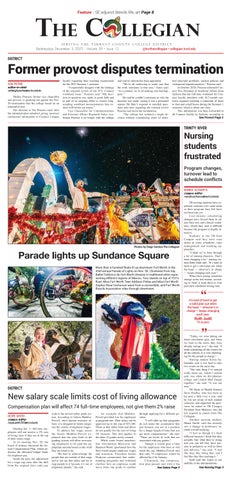
At one table, students could spin a wheel and land on a question to answer then receive a cupcake. The questions provided students with better knowledge on the LGBTQ+ community.
“The questions that we have for people, some of them are known but I think some of them are more like, ‘Wow, that’s interesting,’ especially to people who wouldn’t know anything about the LGBT community,” Zacariassaid.
Everyone involved also said that the event could help students learn about what’s going on in the world and what the LGBTQ+ community is facing.
“Part of the reason why there is a lot of transphobia is because of misunderstanding and lack of knowledge of trans people and who they are and what they represent,” she said.
Fortune said although he is not trans himself, he finds importance in celebrating Transgender Remembrance Day and educating other students about it with the event.
“To me, it’s just basically raising aware-
(continued from page 1)
an email given to The Collegian by a faculty member who asked to remain anonymous for fear of retaliation.
On Nov. 21, Jackson was placed on administrative leave. Connect Vice President of Student Affairs Deshonta Holmes is serving in her place as interim, according to an email sent by interim Connect President Kelly Willing to Connect faculty.
According to Chancellor Elva LeBlanc, Connect faculty’s 10.5-month contracts stated their required course load was supposed to be six hours, so those who didn’t meet that requirement were compensated for work she said was not completed.
“My office had been working closely with Human Resources and the campuses for months to resolve complex faculty contract issues that did not align with existing policy,” Pearson said. In TCC’s board policy, there is only guidance for nine-month and 12-month faculty contracts requiring the six-hour load for the summer. The only written guidance regard-
ing 10.5-month contracts was in the email from Pearson stating a minimum of one class was required, according to another faculty member asking to remain anonymous.
Pearson, who had served in higher education leadership for over 20 years, said she has never been accused of misconduct or knowingly violating policy.
“While I disagree with the college’s decision, I remain proud of the work accomplished during my tenure,” she said.
In 2021, Pearson started as Connect vice president for academic affairs before being hired as provost in 2023. She said throughout her time her office was consistently acknowledged for improving systems.
“The reforms I implemented, including centralized contracting, saved the college nearly $2 million in excess stipends in the past year alone,” Pearson said. “These changes supported more responsible allocation of resources to academic programs and studentfocused initiatives.”
ness for hate crimes against transgender people,” Fortune said. “It was created in 1999 over a candlelight vigil to honor Rita Hester’s murder and then it’s like most transgender
cases, it’s still not solved to this day.” Rita Hester was a trans woman from Massachusetts that was killed in a violent act of transphobia. Her death fueled the creation of Transgender Remembrance Day.
SE student Grayson Moore, who said he’s not open with everyone about being trans, was excited that the campus got to hold this event for Transgender Remembrance Day.
He said this day is meant to honor all trans people, especially the ones who have died from murder or suicide.
“This makes me really happy,” he said. “And I hope that if there’s any other closeted people that even if they don’t feel comfortable participating for whatever reason, they still feel a little bit happy that there is an effort being made.” Moore said an example of SE welcoming trans students is that the campus has some gender-neutral bathrooms and when he first discovered that he was happy about it.
Eirene Jefferson is SGA senate chair and attended the Transgender Remembrance Day event.
“It’s inclusive for all,” she said. “It stands for equity for all. That’s what I stand for in terms of making sure everybody feels welcome and feels involved with the student body.”
She said she wants everyone on campus to be treated fairly and with respect.
“And there shouldn’t be any type of reason why students should feel neglected,” she said. “We’re literally all in this world together.”
(continued from page 1)
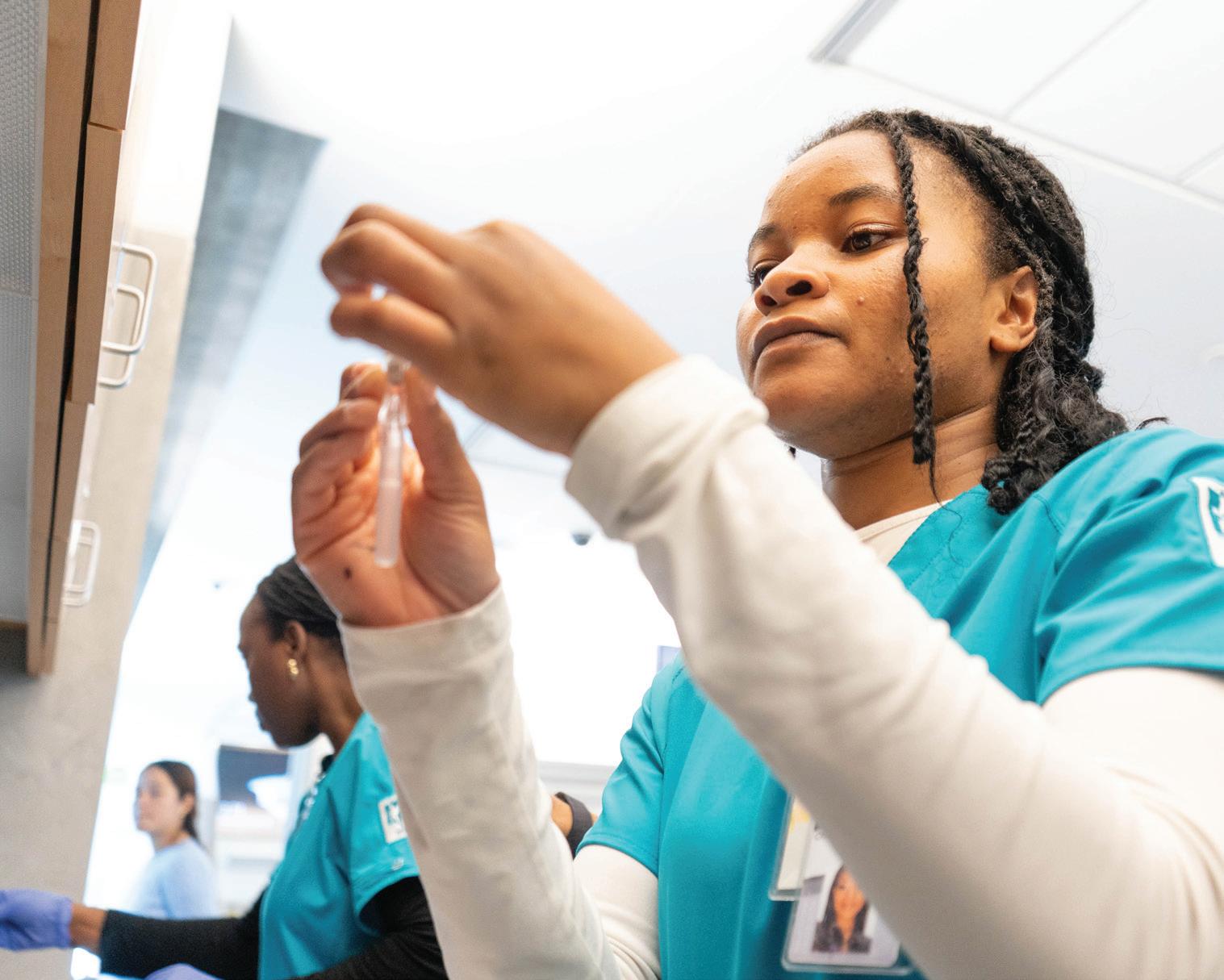
“I think if they get someone who stays for a while, they can implement a solid plan for everything. I think everything would run more smoothly,” Judd said.
Vice Chancellor for Communications and External Affairs Reginald Gates said he is not aware of any negative impacts brought on by program changes such as administrative turnover and schedule changes. “Tarrant County College remains dedicated to supporting its faculty and staff while ensuring that all employment practices are consistent with Board policy and state law,” Gates said in an email. “We recognize that faculty are central to the Tarrant County College mission of delivering accessible, highquality educational experiences that drive lasting impact.”
Smith shared how she likes the shift in professors’ teaching styles this semester. She said she prefers the professors being interactive with the students instead of going off of a PowerPoint.
“I just think that it makes the learning experience better,” she said. “They want to be there. They want to be teaching.”
Nursing instructor Karen Anderson, who is also a TCC nursing graduate, said she is excited to go through growing periods.
“Even in the workforce, whenever you see a new administration turnover, you’re going to have an employee turnover with that because people like the way that things are,” she said. “People don’t like a lot of change and not just employees, but with the admin.”
Kelly Amtower/The Collegian
Kelly Amtower/The Collegian
SE student and President of the Gender Sexuality Alliance club Levi Fortune plays trivia with students at the transgender remembrance event on Nov. 20.
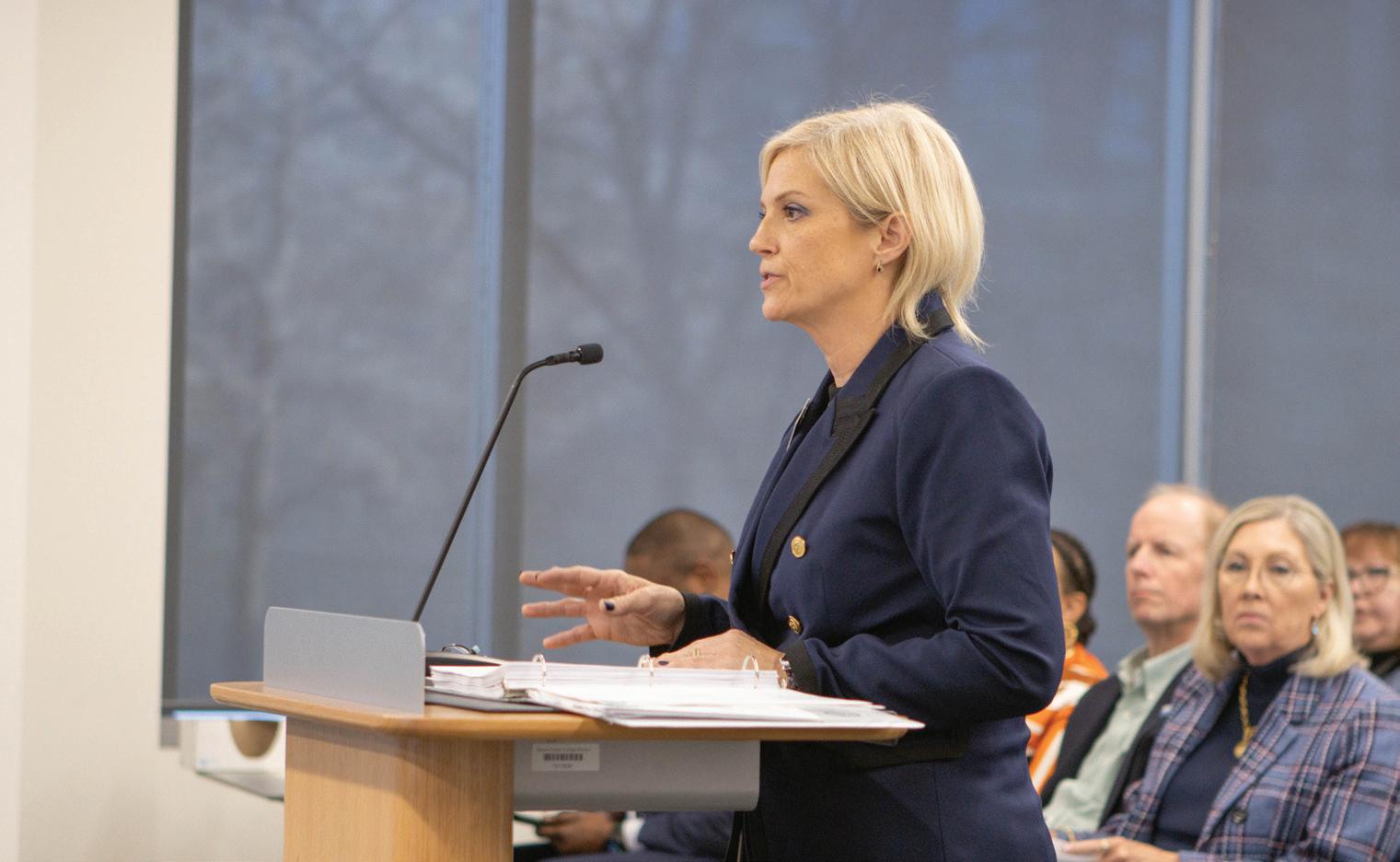
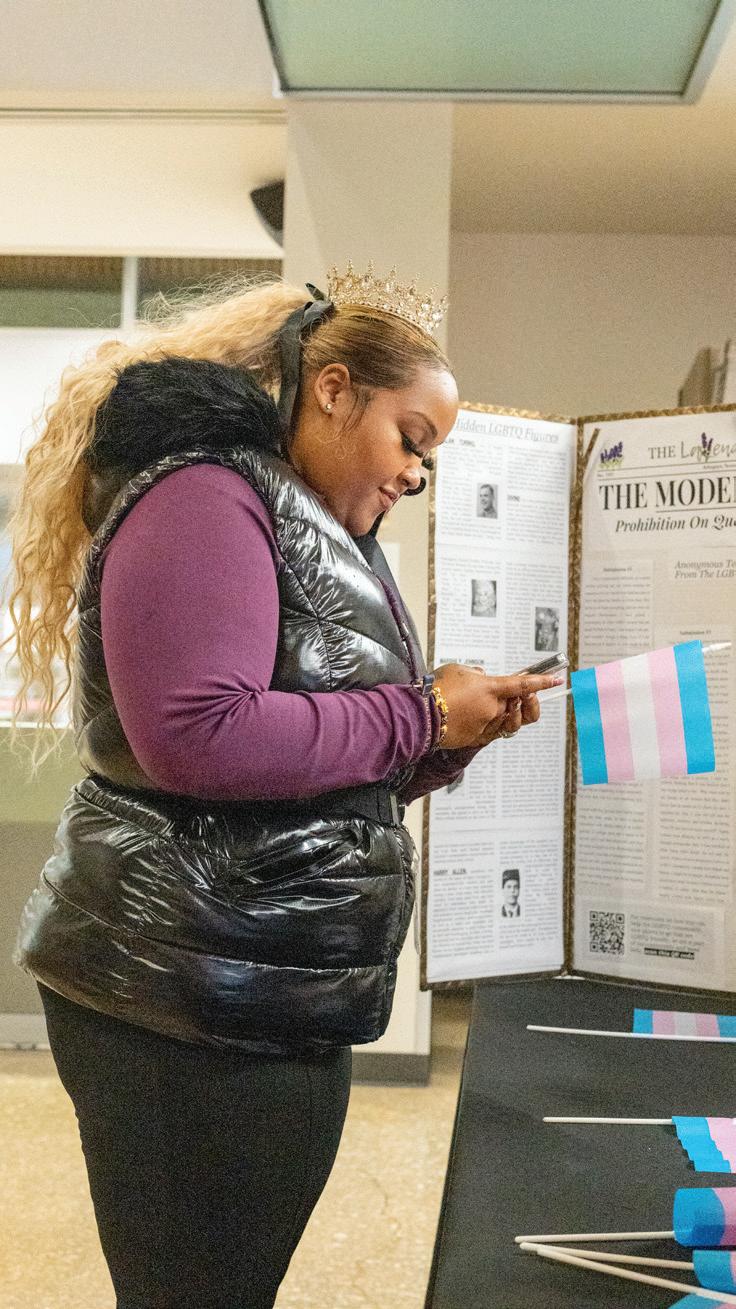
SE student Eileen Jefferson plays a transgender trivia game at the transgender remembrance event.
Diego Santos/The Collegian
Collegian file photo
TR Nursing student Synthia Mulemaryabo learns how to perform IV insertion on
model at a lab in TRHN on Oct.28.
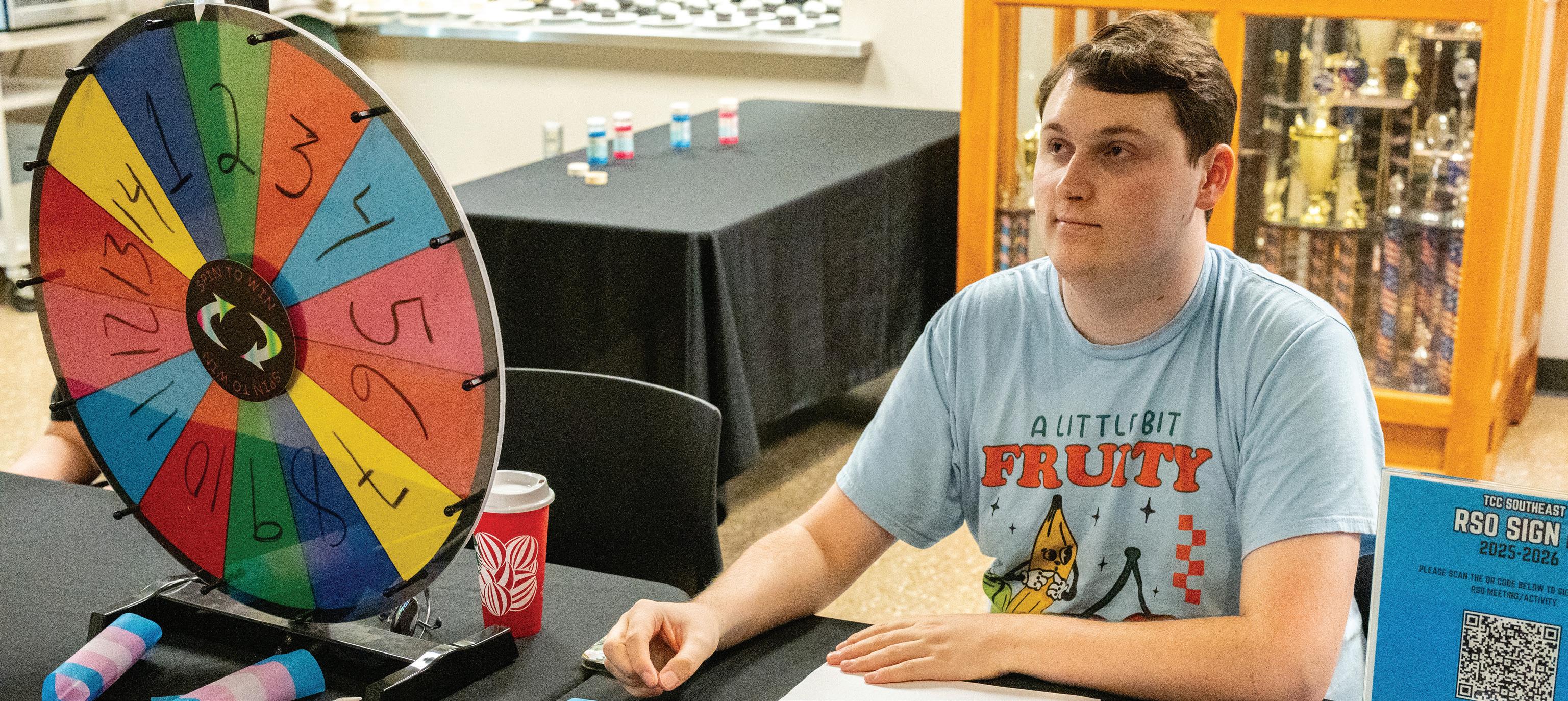
Shelley Pearson, shown in a previous board of trustees meeting, served as provost since 2023 until she was fired on Nov. 20.
Trump administration tells lower class: ‘Let them eat cake’
While President Donald Trump is living his Marie Antoinette fantasies, millions of people across the country are stressed about how they will make it through the holidays.
Antoinette was rumored to have said “let them eat cake” when told the poor had no bread. While there is no proof she said that, the saying has since symbolized the insensitivity rich people in power have towards the poor.
While Trump is drenching the Oval Office in gold, having a ballroom built in his honor and hosting elaborate parties, millions of people are struggling with food insecurity across the country he is supposed to serve.
On Halloween, Trump threw a “Great Gatsby” themed party at Mar-a-Lago, his resort in Florida, just hours before millions of Americans lost their Supplemental Nutrition Assistance Program benefits.
SNAP is a federal program that provides monthly benefits to low-income households to help them buy food. On Nov. 1, due to the longest government shutdown in American history that lasted 43 days, families in need were informed they would not receive their November benefits until the shutdown ended.
While the SNAP program resumed normal procedures after the shutdown ended on Nov. 12, the delay cost many people the right of having food on the table, including many TCC students.
Food is a human right. Trump has claimed his goal is to save money, but he has done nothing but spend Americans’ money on useless renovations instead helping feed them.
Not only has Trump threatened the wellbeing of Americans, he also has done nothing but ruin the White House since he has been in office.
VIEWPOINTS
He has paved over the rose garden, taken down former President Joe Biden’s portrait in the “Presidential Walk of Fame,” covered the interior of the White House in cheap looking gold decor and demolished the East Wing to build his ballroom even though he initially said the project wouldn’t “interfere with the current building” and would be “near it but not touching it.”
Now, what do these two aspects of the White House have in common? They were both spaces that were used by past first ladies.
The Rose Garden was created by first lady Ellen Wilson in 1913 and traditionally maintained by the first ladies. He paved it over and called it a patio.
The East Wing had served as the first ladies’ office and staff space since 1977. He demolished it.
Healthcare premiums will soon skyrocket due to the changes passed in Trump’s “Big Beautiful Bill.” In this bill, credits that have kept health care premiums affordable for millions of Americans will cease to exist, forcing many to go without insurance altogether.
Trump does not care about the people he serves. He cares more about his fancy ballroom and throwing parties than about starving children in America.
He is a self-interest-seeking leech draining the livelihood of the American people and the history of the spaces he is renting. He does not own the White House. He is only a temporary tenant of the house that the American people own.
As we learned in the French revolution, humans will only take so much persecution before they act. Violence is not the answer, so we must vote for those who will make choices for the majority of Americans, not the wealthy few.

Redistricting attempts show how far lawmakers will go to win
The push for a new congressional district map in Texas by some lawmakers and Gov. Greg Abbott is a brazen attempt to gerrymander.
Federal Judge Jeffrey Brown halted their efforts in a Nov. 18 ruling where he wrote that there was evidence showing that Texas “racially gerrymandered the 2025 map.”
“The public perception of this case is that it’s about politics,” he wrote in the 160-page ruling. “To be sure, politics played a role in drawing the 2025 Map. But it was much more than just politics.”
The move only benefits Republicans while silencing the voters who would be affected by the new map.
The new map would add new Republican seats to the House, and it’s telling that even a Trumpappointed judge would strike this idea down.
The spirit of Christmas is about showing your love and appreciation to your family and friends, not creating performative content about it for social media.
I have seen firsthand what genuine holiday excitement looks like because Christmas has been a celebratory staple in my family for decades.
I don’t doubt that families all over the world still enjoy and celebrate Christmas as mine does, but I have seen an influx of influencers take videos of themselves and children rather than being in the moment with their loved ones.
Brown gave several examples of non-White majority voting districts being redrawn to become White majority voting districts in the new map.
Furthermore, Brown pointed out how majority White districts was left relatively unchanged by the new map.
Why would the new map only change some districts but leave others alone?

The answer: The new map was drawn based on race.
It’s clear that in the scramble to consolidate power after Trump’s second inauguration, gerrymandering has emerged as a concern in Texas this year.
In Tarrant County, the Commissioners Court approved a new district map in a 3-2 vote.
The rationale for the decision, especially echoed by County Judge Tim O’Hare, is that in the years since the last U.S. Census was taken, Tarrant County has changed enough to warrant a mid-decade redrawing of maps.
This was done over the objections of the many Tarrant County residents who came before the court to express their concern.
Some public commenters said that the redistricting was a direct attack against one of the only two Democratic commissioners in the court, Alisa Simmons.
their kids participating in festivities instead of actually living in the moment.
It’s sad to witness this with my own eyes after being so used to watching it play out on social media annually.
Seeing it existing in real life is very telling of where society is going, social media-wise.
It’s one thing to build a persona for show, but for it to consume someone’s day-to-day livelihood is concerning to say the least.
Trump began urging Texas to redraw its district map earlier this year in anticipation of the U.S. House elections in 2026.
After Republicans barely retained the majority in the 2024 elections with a 220-215 split, it’s crucial for either party to win the majority and get things done under the Trump Administration.
Brown’s ruling and temporary block on the implementation of the new map was met with criticism by some Republicans, including Gov. Greg Abbott, who posted on X Nov. 20 that it was an “erroneous ruling.”
California Gov. Gavin Newsom has criticized Trump’s plan to push redistricting throughout the country.
He launched a retaliatory proposition to California voters to approve a new congressional map that would give Democrats additional seats in the U.S. House.
growing up now could experience holiday events without photos and videos being taken for disingenuous reasons, as I did as a young child.
The proposition was approved by California voters.
The political turmoil in this nation seems to be heading toward a climax next year as voters will decide who will represent them in the House.
The reason why these battles are being fought now is that politics depends on voters. These redistricting attempts seem to show that not only is the hostility between the two major parties becoming worse, but it is also having real effects on voters’ ability to have their votes and voices heard.
It’s important now more than ever to be informed on politics overall, both at a national and state level.
We must continue to hold politicians accountable for their actions to make sure gerrymandering attempts like the redrawing of maps in Texas don’t go unnoticed.
ploitation and overconsumption among people all over the world.
The more people get used to depending on their cellphones for serotonin, the worse the performative acts will get.
However, I still enjoy Christmas and look forward to it every year. It is my favorite holiday aside from Halloween, and it gives me different things to look forward to every December.

During my yearly tradition of visiting Grapevine during December, I have witnessed people filming themselves talking for content or
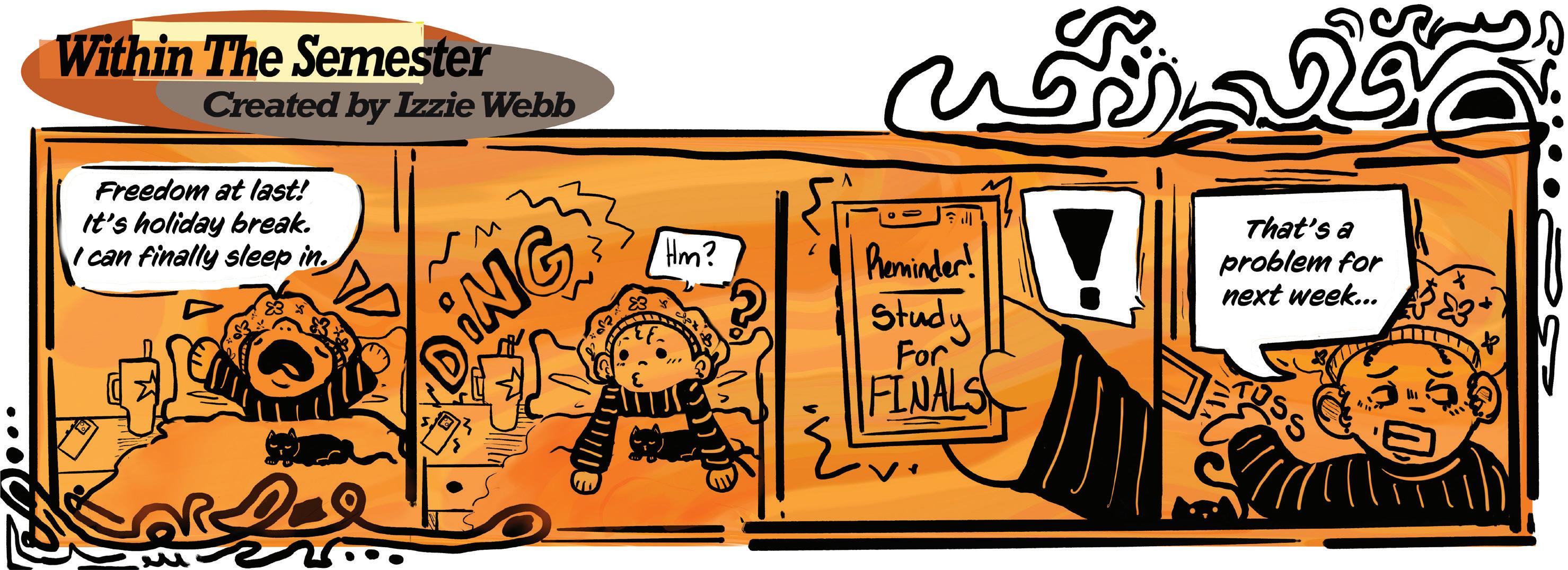
If someone is scrolling on Instagram during the months of November through December, they will likely see more posts from influencers creating content in front of Christmas lights and attractions rather than classic family holiday photos. To me, this is an example of a selfish act because the people doing this aren’t thinking about who they’re with or even who will see the content, they are focused on themselves.
I have been guilty of taking pictures for social media in the past, and I know it’s a fun thing to do during the holidays.
That being said, it’s getting more and more obvious that going to these attractions and events is just a ploy for people to get likes and attention on their posts.
I wish that the new generations
Being raised in the early 2000s, cameraphones did exist, but visiting a holiday pop-up was not for the sole purpose of making a post on social media. It was to make good memories. It is very popular among TikTok influencers to exploit their children’s lives, specifically any holiday event or birthday. Thankfully, I had the privilege of having parents that didn’t prioritize social media over memories, as do many influential parents on social media these days.
I appreciate the evolution of technology allowing society to document cherished memories.
Unfortunately, all this has done is open an uncloseable door to ex-



With the rising popularity of people posting their everyday life routines, I can infer that in the future the trend of showcasing holiday moments on social media will only worsen.
I hope that one day society can circle back to its original compassion and curiosity of the word aside from social media. There is more to living life than experiencing life through the lense of a cellphone.
Izzie Webb/The Collegian
COOL Club Club Corner
by Nanda Acharya

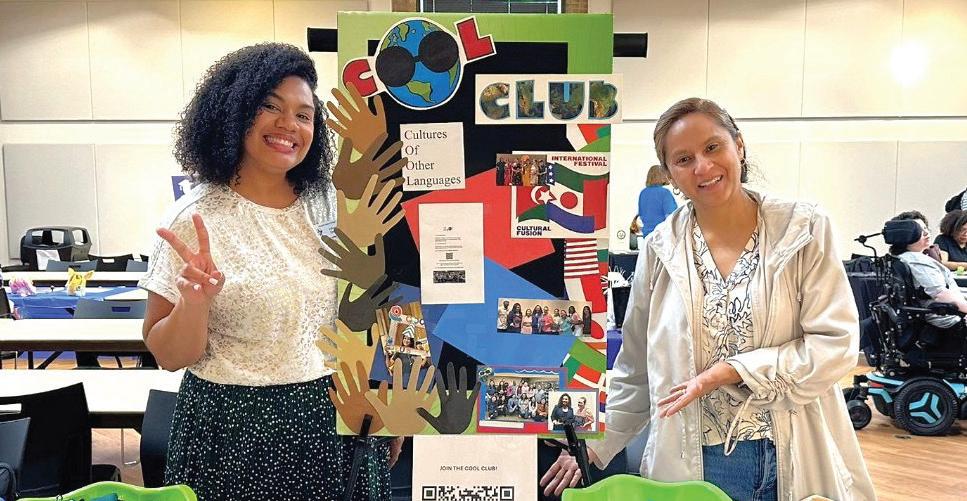
After breaking down language barriers as an international ESOL student on NE Campus, Mayra Mancera Flores became the adviser of the Cultures of Other Languages Club nearly 10 years later.
She said having come from Mexico, she felt like she belonged somewhere for the first time through this club.
“[All] cultures are welcomed and included here,” she said. “I think when we
have different cultures, it makes us strong and allows us to learn from each other.”
Senator of the club, August Foster, who initially thought the COOL Club was a club for cool party tricks, said the culture of it made them stay at the club. They have now been a member for two years.
“A lot of students there are ESOL students, so they take English as their second language in their courses,” Foster said.
“They join this club as a way to relax from class but still learn.”
Foster said their meetings, which are every other Wednesday or Friday, are comprised of different activities that are both fun and enlightening. They said the club recently had a spooky season meeting where they told stories around the world

that members learned growing up.
Likewise, the club did karaoke, and the members sung English songs.
Foster said through these activities, the members get an opportunity to learn English while having fun.
Mafe Gutierrez, the club’s president who is from Colombia, said she had her fair share of living in different states and cities in Texas, but she is glad she has now found the COOL Club.
“Sometimes, I feel scared to speak because of my pronunciation or grammar,” she said. “Now I’m president of the COOL Club, and this is such an amazing opportunity.”
She said the club values different per-

spectives, showing kindness and offering help to one another.
“We create new friends, and we learn so much from other countries and cultures,” Gutierrez said. “We are so happy to continue working hard and emphasizing an inclusive environment where a person’s English pronunciation is not a barrier to participation.”

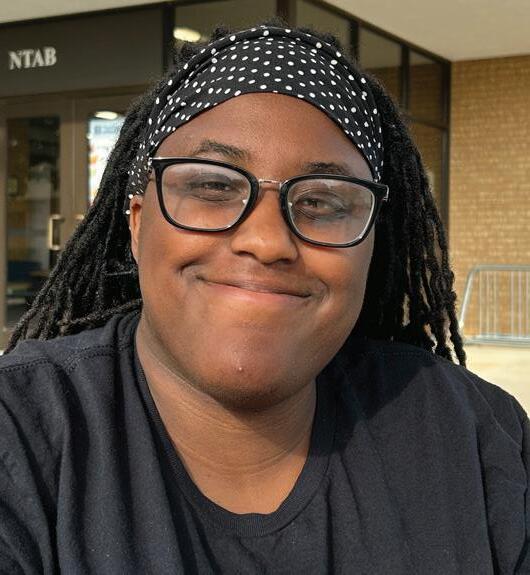
Kayla Mitchell NE Campus
“I guess it is affecting my Thanksgiving in that aspect where I have to do some studying to prep for finals and then I also work ... I’m luckily in a position where I don’t need to get SNAP benefits, but I do have a friend that it heavily affected, and I had to help her out. So, I guess, I’ve seen the impact, of I guess not having those benefits.”
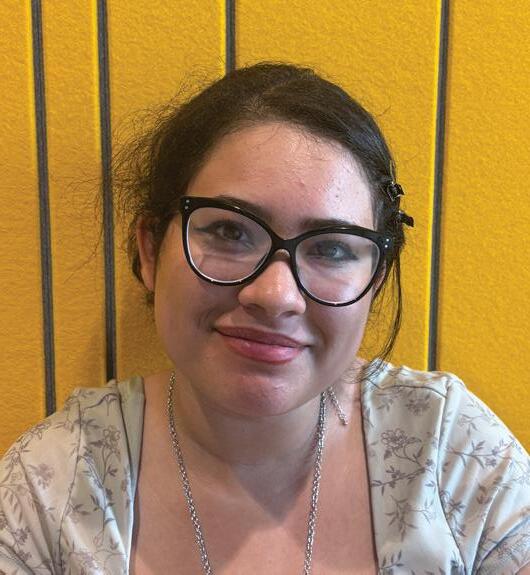
Tatiana Gray NW Campus
“I have a few in-person classes, but a lot online and they continue even through the holidays. So, I think for me, that does make it stressful. My psychology class, the due dates are back-to-back, even on the weekends, so a lot of times I’ve had to miss out on different events.”
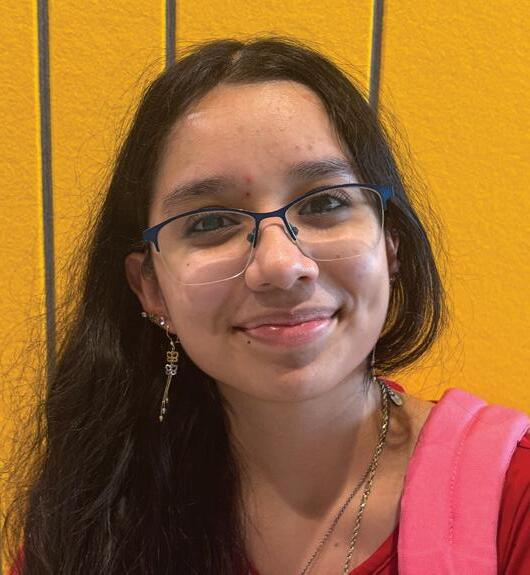
Martinez NW Campus
“I feel like I’m very restricted on my time ... I spend time studying and make sure that I learn everything for all my subjects. Because of that, I don’t spend as much time [with] my family, and I wish I could. I really wanted to spend time with my family and other relatives, but I have study sessions.”
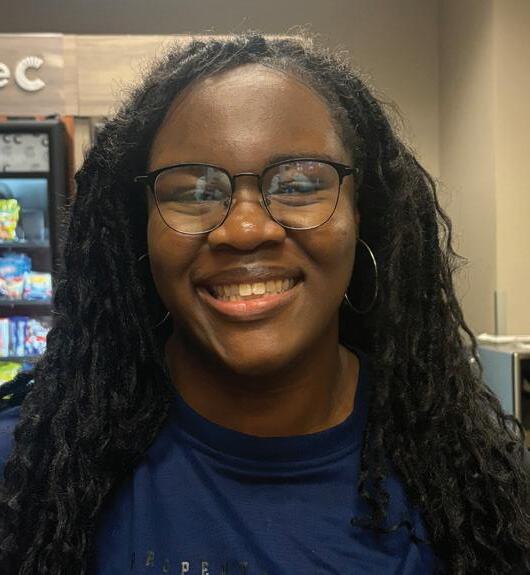








hard to keep up with it.”


Karen
Photo courtesy of COOL Club
Advisers Juliana Owuori and Mayra Mancera Flores pose during Club Rush Jan. 29 where they were recruiting members for COOL Club.
Illustrations by Rena Aquino/The Collegian


Two friends build cafe with Nepali roots
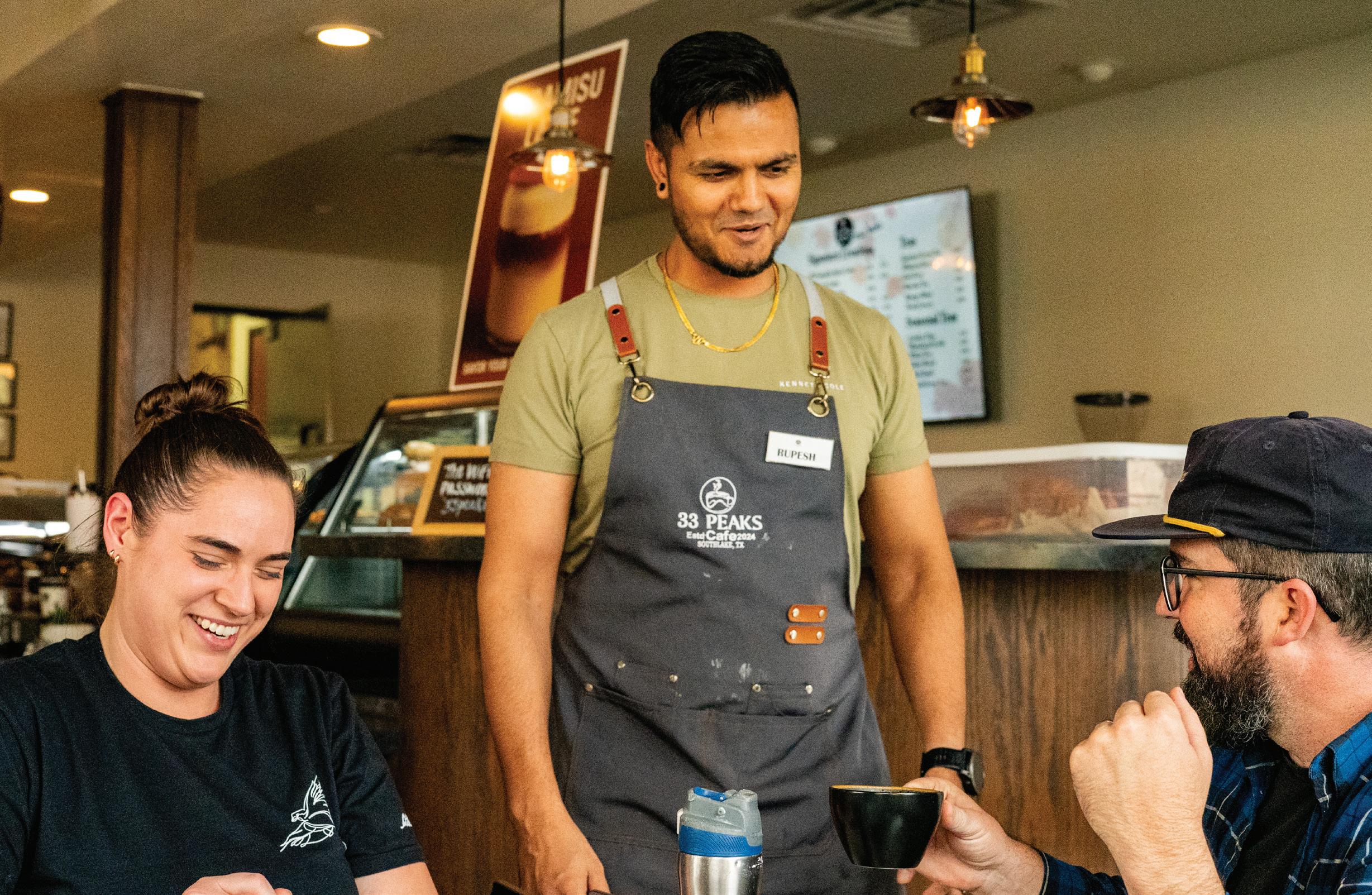
Cafe, named after the 33 mountain peaks of Nepal, is a Nepali-owned cafe that is made whole by coffee beans, teas and the community it has created.
pane and Khadge, taught him the inner workings of coffee. He said Neupane helped him gain insight into how good coffee is made.
The aroma of coffee beans from around the globe greets customers before they are met with the warmth of the owners, two friends whose journey started a decade ago two oceans away.
Rupesh Neupane, who did not have a job until his 59th interview after coming to the U.S. from Nepal, and Sunit Khadge, who has taken different career directions from being in health care to being in tech, started 33 Peaks Cafe in March.
“It’s weird in a way because starting something like this in the service industry, at our age, is completely different,” Khadge said. “Not a lot of people do this, especially working on the front face of it.”
Located in Southlake, 33 Peaks

The interactions between customers and the owners were a pathway to create stronger bonds with one another. The employees caught on as well.
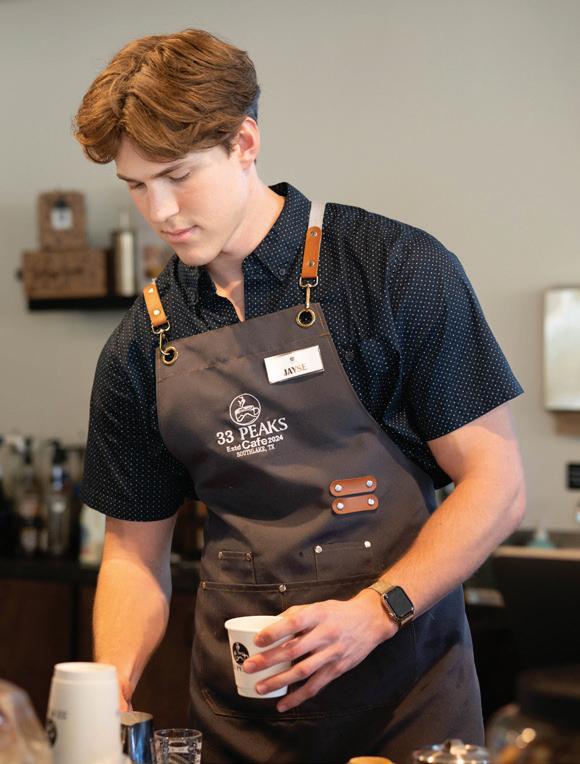
“I guess it kind of just inspired me to talk to customers the same way,” said NE student Jayse Neuse, who is a barista at the cafe. “I could talk about other things I have in common with customers. It’s always nice. It’s definitely a part of the job I enjoy a lot.”
Neuse said the caffeine that customers initially seek is just a byproduct of the cafe.
“It seems like we’re bartenders that just don’t serve alcohol,” Neuse said. “It’s the community we’ve built around the coffee.”
Neuse talked about how Neu-

“Rupesh loves coffee. He is really passionate, and so is Sunit,” he said. “Every time I come in, Rupesh has always got this inkling of knowledge he is putting on you.”
Neupane said he and Khadge play multiple roles during their shifts, which they work in halves. Neupane works from opening time to 1 p.m. when he switches with Khadge who works from 1 p.m. until closing time.
Neupane said as co-founder, his role is everything.
“I wear all kinds of hats. I am not just the owner, I am also a barista, I am also a manager, I am also a HR, I am everything I need to be as a small business owner,” he said. “There is no help. You are the help.”
Neupane, who moved to the U.S. just 10 years ago from Nepal and calls himself an adopted Texan and Khadge, a former software engineer and a New York native, quit their full-time jobs to transform the cafe into the beauty it is today. In the cafe, it is hard to find a corner without big windows that reflect the greenery outside.
The vibrance of the cafe is difficult to miss with it being surrounded by sunlight beaming from the windows. There is a secluded area in the cafe that includes cozy couches and plenty of room for a group meeting.
The beverages 33 Peaks Cafe offers get their essence from a diverse mix of international flavors.
“[Our] oolong is from Taiwan, and it is actually made by a small farmer family who has been doing it for many years,” Neupane said. “I think they are third
generation tea farmers.”
The cafe’s seasonal organic teas, golden tips, Himalayan Gold and holy basil, are from Nepal and are naturally processed. The jasmine tea is from China and the matcha is from Japan. The cafe also provides its customers with espresso made with beans from Guatemala and New Zealand.
“We also have single-origin coffee beans for pourovers and French press, and not a lot of coffee shops do French press, especially in Southlake,” Neupane said. “So, offering that to our customers to try single [single-origin beans] from Kenya, from Ethiopia, from Guatemala and El Salvador. We try to cater that to our [customers].”


Neuse said it is because of balanced efforts the cafe has a great working environment.
“Everyone is splitting up and contributing equally to everything,” he said. “Even though Rupesh and Sunit own the coffee shop, they’re putting in just as much work as I am instead of [only] managing.” Khadge said aside from the business aspects of the cafe, the team’s motive is to have a good time.
“We genuinely try to have fun ourselves, and I think maybe that plays a role in the customer experience as well,” he said. The cafe also hosts events to support local artists and create a friendly and fun environment for the customers. Khadge said the cafe is always in search of talent who want to showcase their skills.
Just recently, the cafe hosted a violinist, Jay Sriram, to play his tunes. Likewise, they have also hosted pop-up shows for newcoming artists. A Carroll High School graduate and UT student, Zac Nystrom, makes syrups used by the cafe for their Honey Lattes.
These are some of the opportunities 33 Peaks provides to bring together the community.
Khadge said he and Neupane enjoy putting the events together because they both like to socialize and meet new people. He said their goal is also to create a hub where people can come and enjoy themselves.
“A part of me sort of misses that in New York,” he said. “We want to bring the community together, and this is sort of an avenue for me to do that.”

Photos by Kelly Amtower/The Collegian
Illustration by Rena Aquino/The Collegian
33 Peaks co-owner Rupesh Neupane talks with customers over a fresh cup of coffee in Southlake, just 20 minutes away from NE.
NE student Jayse Nuese makes a hot chocolate for a 33 Peaks customer.
NANDA ACHARYA campus editor nanda.acharya@my.tccd.edu
It seems like we’re bartenders that just don’t serve alcohol.
Jayse Neuse NE student and barista







THE DIGNITY OF WORK
An artist’s homage to his family heritage
CARA COCO campus editor cara.coco@my.tccd.edu
The young man wrung water from a mop bucket, sweat clinging to his shirt and brow as he pushed the soapy water across the tile floors. It was another late night working at Michaels, and Juan Barroso just wanted to go home.
Barroso recalled feeling embarrassed by the sign on the back of his mother’s van, which read “Lucy’s House Cleaning” in an eye-catching pink.
“I used to have her drop me off a block from the school to avoid people seeing that sign,” Barroso said. “It wasn’t until I started working and it was my job to mop the floors at night, that I realized the dignity of her work.”
In his recent art exhibit on SE Campus, adjunct professor and award-winning artist Juan Barroso pays homage to his mother’s labor in the form of a stoneware mop bucket titled “Honoring the Janitor Mop Bucket.”
The sculpture is a smooth, textured brown bucket with four swivel wheels attached to the bottom.
Barroso said the sculpture worked, but it would squeak badly if used as an actual mop bucket.
While honoring his family is a core theme in his art, Barroso also emphasizes his heritage as the son of immigrants in sharing both the joys and struggles of the immigrant experience.
“Honoring Textile Labor”, a hand-painted porcelain vase featured at the exhibit, was inspired by Barroso’s mother and grandmother and the textiles they worked with in the past.
Barosso was born in Oklahoma City, but he spent some of his early childhood in the city of San Miguel de Allende, in Guanajuato, Mexico. They had moved to wait for confirmation of his mother’s residency status.
“We didn’t have a lot to eat,” Barroso said.
“My mom would sew, repair and wash clothes to provide for us. I made this vase to honor textile labor and all the stitches my mom put in to provide for my sister and me.”
The vase displays multiple paintings on its sides. The painting positioned at the center is of Barroso’s grandmother cross-stitching a cloth.
The other paintings on the vase are of several different textile tools and a mariachi violinist.
Barroso explained that the violinist had been one of the many musicians to escort his grandmother to her wedding vow renewals.
“They [his grandparents] were too poor to marry during daylight,” Barroso said. “Maybe a decade ago, they went back to marry, and at noon, the most expensive wedding time, my grandma was escorted by a mariachi group. It had shown how far the family had come since moving to the U.S.”
“Honoring the Farm Worker” is a graphite drawing depicting some Tennessee immigrant farm workers Barroso had spoken to. The drawing shows two men crouching in a softly drawn strawberry field, hands reaching for strawberries to pick and sort into a side basket.
“They told me they were trying to send money back to their families. They told me their knees were hurting, and their backs were hurting,” Barroso said. “They didn’t understand
why people were saying they were criminals.
All they did was work and try to recover from their aches and pains.”
Immigration is a topic close to Barroso’s heart, touching all of his art in some way.
“My work’s purpose is to humanize the immigrant, and I think some of you might understand why that’s really important right now,” Barroso told the audience at the opening reception of his exhibit.
According to a May survey by the KFF, formerly known as Kaiser Family Foundation, 41% of immigrants, both undocumented and legal residents, say they are worried about deportation. These concerns can harm immigrant communities, leading to mental and physical health issues.
“With the current political administration enforcing policies that dehumanize and force immigrants into the shadows, recognizing an immigrant’s humanity is vital,” Barroso says in his artist statement on his website. “Notions of us or them deteriorate, and it becomes clear that we are all working and fighting to provide a shelter and a decent meal for ourselves, and often a family.”
SE student Parmis Azambakhtiar said she really connected with Barroso’s work at the exhibit.
“I come from an immigrant family, and I’m an immigrant myself. It felt very heartwarming [seeing the exhibit]. I saw myself,” Azambakhtiar said.
Azambakhtiar works at the SE Campus as the assistant to the gallery coordinator, Penelope Bisbee.
She said she particularly connected with Barroso’s “Honoring the Janitor,” as her mother had worked hard to provide for her and her siblings when they immigrated from Iran to the U.S. in 2014.
“She worked at Walmart,” Azambakhtiar said. “I never really understood why, but I just felt a kind of shame.”
Azambakhtiar described a time her mother had been bedridden from overexerting herself, saying both her hands and feet were calloused.
“America has always shared this ‘American dream’ with everybody, but the reality is, if you are an immigrant, it is a lot harder to have a comfortable life,” she said.
The largest piece of the exhibit is an oil painting titled “Resilience of Our People,” or “Aztec Dancer”.
Alongside painting and ceramics, Barroso also has a strong interest in photography. He attributes many of his paintings to photos he has taken.
The “Aztec Dancer” began as a picture Barroso took in the streets of San Miguel during the Drunken Donkey Parade, a Saint’s Day event. Barroso said that Saint’s Day celebrations used to include a donkey with a wagon carrying assorted drinks through the streets, often followed by a line of Aztec dancers.
One particular Aztec dancer caught Barroso’s eye.
“He seemed pretty resilient to me to still be dancing, even though he was in a wheelchair,” Barroso said.
Barroso said his journey with art had started when he was a kid as an “act of spite.”
In elementary school, Barroso had an opportunity to skip a grade with an art project. The
to lab
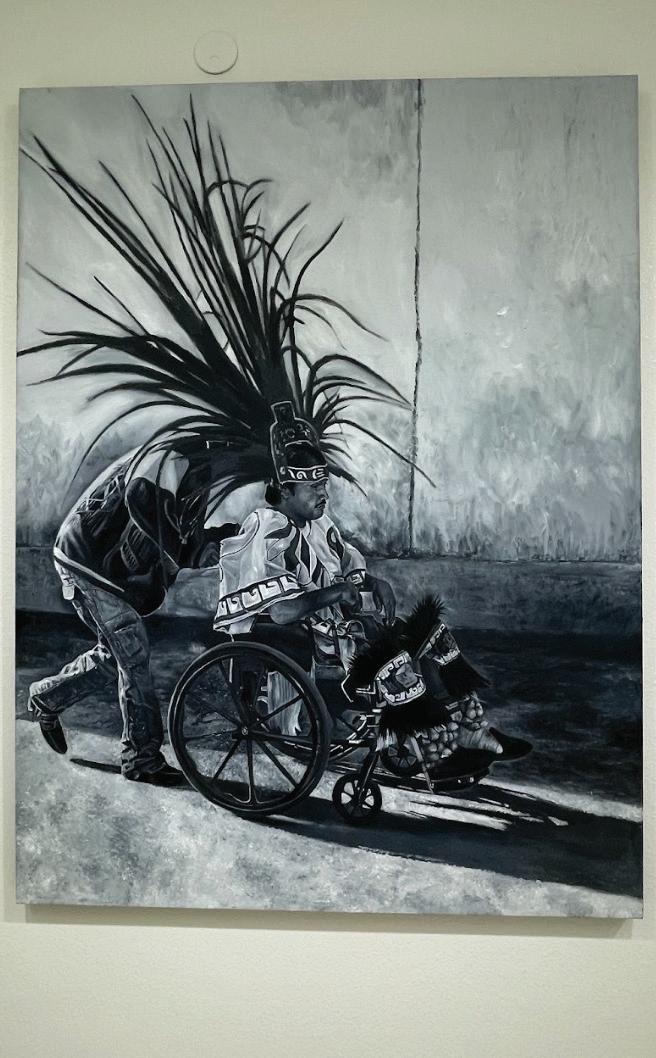
Photo courtesy of Juan Barroso
“Resilience of Our People” is a painting based on a picture Barroso took in San Miguel, Mexico.
project was drawing a detailed car. Barroso felt as if his rendition of a car wasn’t enough.
“I cried to my mom. She took me to City Hall and put me into a class with five giant high schoolers. There, I learned how to draw a onepoint perspective,” Barroso said. “Early on in the City Hall in Mexico and then in high school, I was drawing hands holding flowers for my girlfriend every time we got into a fight.”
Now, art has become so much more to him.
One of Barroso’s painting techniques, as shown in “Honoring Textile Labor” and “Aztec Dancer,” is pointillism. Pointillism is the art technique of placing tiny dots near each other to form an image.
Barroso said he chose this technique because of its time-consuming and labor-intensive process.
“The process becomes an act of devotion. I
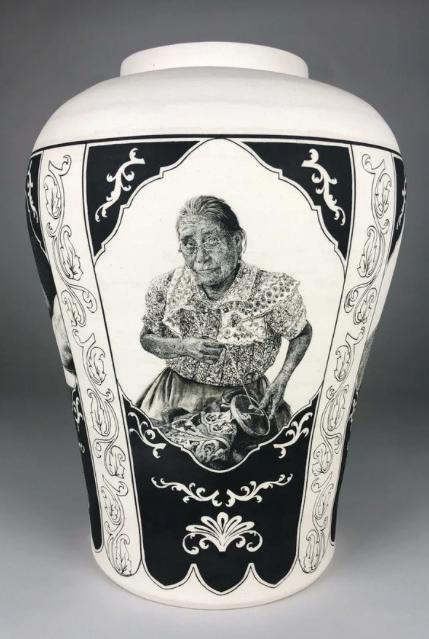
Photo courtesy of Juan Barroso
“Honoring Textile Labor” is a handpainted porcelain vase of Barroso’s grandmother handstitching.
cannot think of a better way to show my respect and admiration for my people and their will to survive than with labor of love and time invested,” Barroso says in his artist statement.
Concerns of censorship were raised during the reception.
SE student Katelyn Quenichet expressed surprise that the exhibit had been put on display on campus. Her concerns centered around the censorship of anything considered DEI related on college campuses.
“The reason why people need to share their culture is because there are cultures right now that are actively being erased,” Quenichet said.
“And the only reason they haven’t just faded into obscurity as a collective people is because of things like this.”
Kelly Amtower/The Collegian
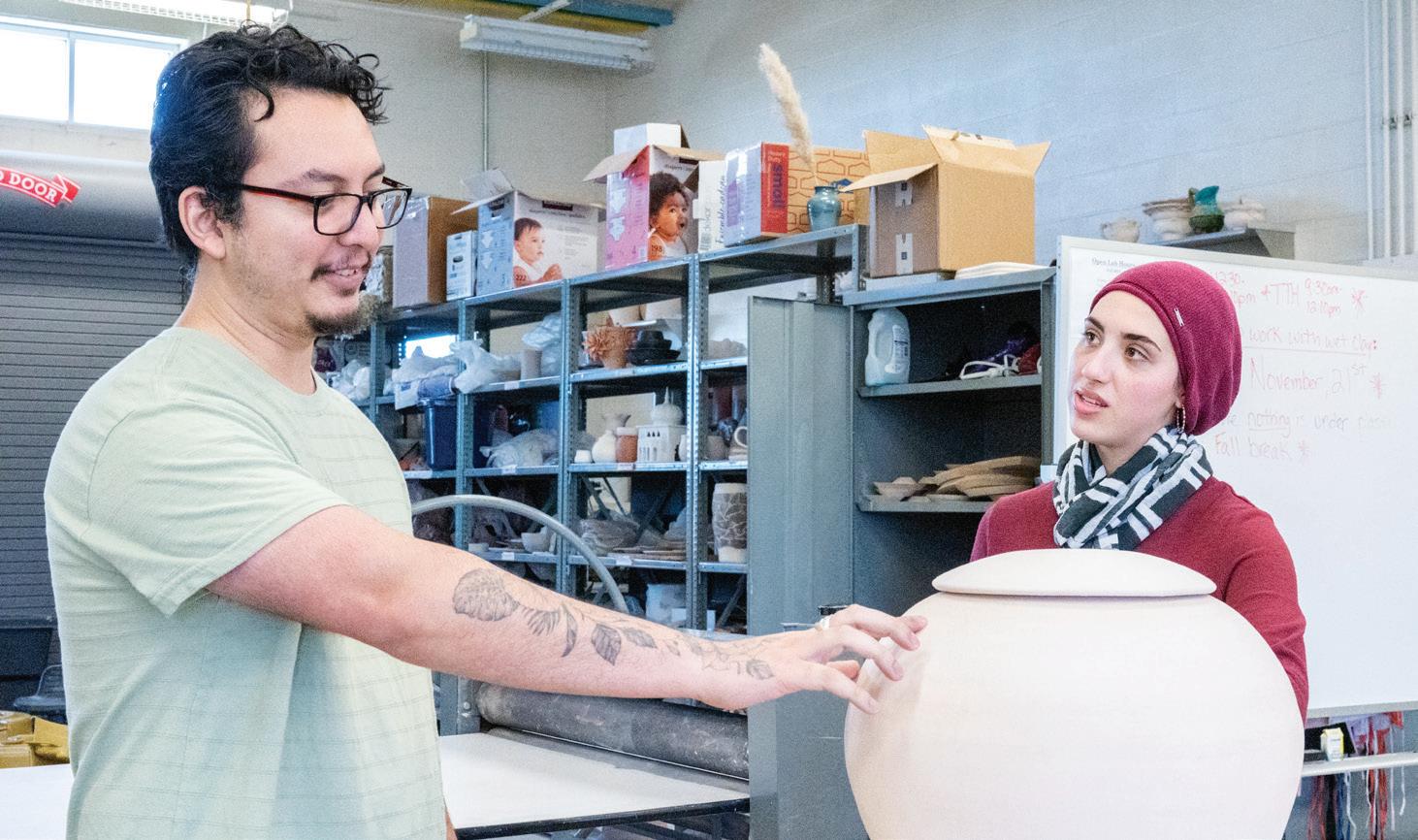
SE Ceramics instructor and artist Juan Barroso explains his plan to paint images of immigrant laborers on his handmade vase
tech Huda Dorsett.