PART VII : REVENUE
REVENUE FROM CONTRACTS WITH CUSTOMERS
REVENUE FROM CONTRACTS WITH CUSTOMERS SPECIAL TRANSACTIONS
PART VIII : INVENTORIES, EXPENSES,
42.12.1
42.12.5
ACCOUNTING FOR EMPLOYEE BENEFITS
PROVISIONS, CONTINGENT LIABILITIES AND CONTINGENT ASSETS
BORROWING COSTS
PART IX : ASSETS, DEPRECIATION, AMORTISATION AND IMPAIRMENT
47.7
Annexure
Annexure
Annexure
Annexure
DECOMMISSIONING, SITE RESTORATION
STRIPPING COST
INTANGIBLE ASSETS
50.23.1
50.23.3
INVESTMENT PROPERTY
AGRICULTURE
EXPLORATION AND EVALUATION ASSETS
LEASE ACCOUNTING
55.1
IMPAIRMENT OF ASSETS
55.7.8
55.7.9 Non-controlling interests measured initially at fair value and the related subsidiary is a standalone
55.7.10
interests measured initially at fair value and the related subsidiary is part of a larger
55.9.2
55.9.3
55.9.4
55.9.5
PART X : GOVERNMENT GRANTS AND ASSISTANCE
PART XI : MERGERS AND ACQUISITIONS
57.2.4
57.2.9
PRESENTATION OF FINANCIAL INSTRUMENTS
58.9.6
58.10.1 Classification of instruments that satisfy conditions of paragraphs 16A-16D of Ind AS 32 for consolidated financial statements
FINANCIAL INSTRUMENTS : RECOGNITION,
59.6.5
59.6.7
EMBEDDED DERIVATIVES
RECLASSIFICATION OF FINANCIAL ASSETS
IMPAIRMENT OF FINANCIAL ASSETS
HEDGE ACCOUNTING
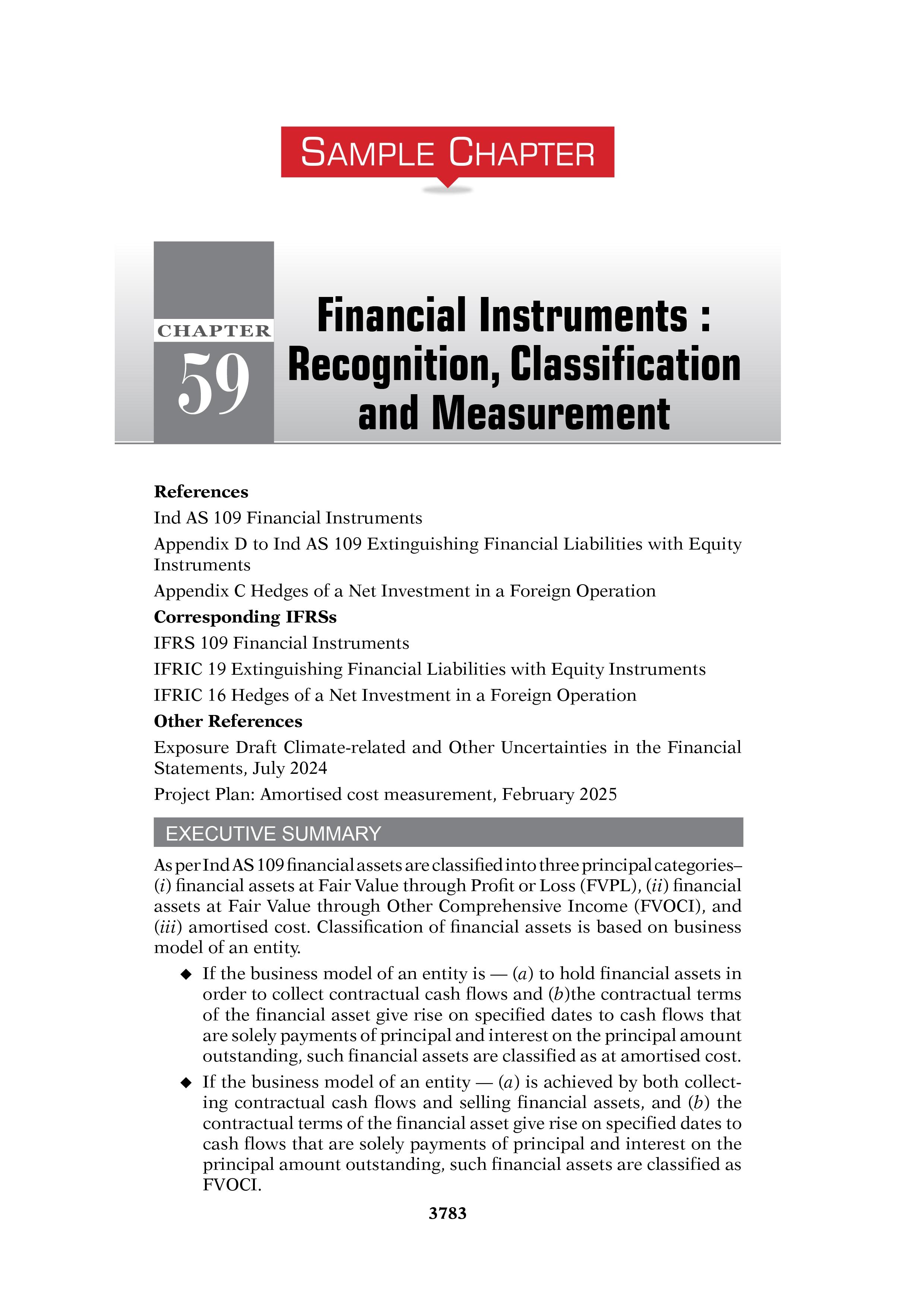
u Financial assets which are not classified as at amortised cost or FVOCI are classified as at FVPL. Also, an entity may by irrevocable choice classify financial assets on initial recognition at FVPL which can be classified as at amortised cost or FVOCI to avoid accounting mismatch.
u An entity may classify equity investments (other than held for trading investments and contingent consideration) on initial recognition by irrevocable election at FVOCI.
u If a business model of an entity is — (i) managing the financial assets with the objective of realising cash flows through the sale of the assets, or (ii) managing financial assets whose performance is evaluated on a fair value basis, financial assets are classified as FVPL.
u The contractual terms of the financial asset give rise on specified dates to cash flows that are solely payments of principal and interest on the principal amount outstanding when these terms reflect basic lending arrangement.
Ind AS 109 applies to those contracts to buy or sell a non-financial item that can be settled net in cash or another financial instrument, or by exchanging financial instruments, as if the contracts were financial instruments. An entity may make irrevocable election at initial recognition for particular investments in equity instruments (other than held for trading investment and contingent consideration) that would otherwise be measured at fair value through profit or loss to present subsequent changes in fair value in other comprehensive income.
Financial liabilities are classified into any of the six categories:
(1) financial liability as at amortised cost,
(2) financial liability as at fair value through profit or loss,
(3) financial liability arising out derecognition of financial asset that does not qualify for derecognition,
(4) financial guarantee and
(5) commitments to provide a loan at a below-market interest rate.
(6) contingent consideration recognised by an acquirer in a business combination to which Ind AS 103 applies.
As per paragraph 4.2.1 of Ind AS 109, a financial liability is classified as at amortised cost using effective rate of interest except for financial liability covered in (2)-(5) above.
At initial recognition, financial assets and liabilities are measured at fair value except for trade receivables. In respect of financial assets which are not measured subsequently as at Fair Value through Profit or Loss (FVPL), the
transaction cost is added to the fair value. For financial liabilities which are not measured subsequently as at Fair Value through Profit or Loss (FVPL), the transaction cost is deducted from the fair value. For FVPL financial assets or financial liabilities, transaction cost is expensed to profit and loss. The fair value of a financial instrument at initial recognition is normally the transaction price (i.e. the fair value of the consideration given or received) although there are exceptions to this general principle.
59.1 Evolution of IFRS 9 Financial Instruments
The predecessor Standard of IFRS 9 Financial Instruments is IAS 39 Financial Instruments: Recognition and Measurement, which was adopted in April 2001. In view of the complexities of IAS 39, the International Accounting Standards Board (IASB) had been pursuing a long-term objective of improving and simplifying the reporting for financial instruments. In March 2008, the IASB issued a discussion paper, Reducing Complexity in Reporting Financial Instruments. The global financial crisis accelerated the process of issuing a completely revamped standard on financial instruments replacing IAS 39. Following the conclusions of the G20 Summit and the recommendations of various international bodies such as the Financial Stability Board, the IASB announced an accelerated timetable for replacing IAS 39. As a result, in July 2009, the IASB published an exposure draft Financial Instruments: Classification and Measurement, followed by issuance of IFRS 9 Financial Instruments on 12 November, 2009. The new standard has inter alia changed the classification of financial assets and financial liabilities. The IASB planned improvement of IAS 39 in three main phases. It proposed to delete the relevant portions of IAS 39 and add new chapters in IFRS 9 that replace the requirements in IAS 39. It aimed to replace IAS 39 in its entirety by the end of 2010.
It had been observed that accounting difficulties during the financial crisis arose from the classification and measurement of financial assets. Accordingly, IFRS 9 covers those issues:
(i) Classification and measurement of financial assets and liabilities
(ii) Impairment methodology
(iii) Hedge accounting and
(iv) Derecognition of financial assets and liabilities.
The full version of IFRS 9 was issued in July 2014 which superseded all previous versions i.e. IFRS 9 (2009), IFRS 9 (2010) and IFRS 9 (2013), and IFRIC 9 Reassessment of Embedded Derivatives. IFRS 9(2014) version became applicable for financial statements beginning on or after 1 January, 2018.
IFRS 9 specifies how an entity should classify and measure financial assets, financial liabilities, and some contracts to buy or sell non-financial items. In the IFRS convergence process, India has adopted the latest version of IFRS 9 in the form of Ind AS 109. Appendix C to Ind AS 109 covers IFRIC 16 Hedges of a Net Investment in a foreign operation and Appendix D covers IFRIC 19 Extinguishing financial liabilities with equity.
Plan of Discussion
For ease of discussion, in this Chapter we will cover recognition, classification and measurement of financial assets and financial liabilities. Other topics of Ind AS 109 are covered as given in the Box below:
Chapter 60 Accounting for Derivatives
Chapter 61 Embedded Derivatives
Chapter 62 Reclassification of Financial Assets
Chapter 63 Impairment of Financial Assets
Chapter 64 Hedge Accounting
This chapter includes Hedges of a Net Investments in a Foreign Operation
Chapter 65 Derecognition of Financial Assets and Financial Liabilities and
Chapter 66 Extinguishing Financial Liabilities with Equity Instruments
59.2 Objective and scope of Ind AS 109
The objective of Ind AS 109 is to establish principles for the financial reporting of financial assets and financial liabilities that will present relevant and useful information to users of financial statements for their assessment of the amounts, timing and uncertainty of an entity’s future cash flows. Ind AS 109 applies to all types of entities and all types of financial instruments other than the financial instruments excluded in (1)- (12) below:
(1) Interests in equity shares of subsidiary, associate or joint venture
Accounting for investments in subsidiary in consolidated financial statements is covered in Ind AS 110 Consolidated Financial Statements and accounting for investments in associate and joint venture is covered in Ind AS 28 Investments in Associates and Joint Venture.
Accounting for investments in subsidiary, associate and joint venture in separate financial statements is covered in Ind AS 27 Separate Financial Statements.
However, all derivatives linked to interests in subsidiaries, associates or joint ventures are within the scope of Ind AS 109 except derivatives which are classified as equity instruments as per Ind AS 32. For example, derivatives used for hedging net investments in foreign operations are treated as financial
instruments. Refer to Chapter 58 for discussion on Ind AS 32 Financial Instruments: Presentation.
(2) Rights and obligations under leases as per Ind AS 116 Leases
However, the following are within the scope of Ind AS 109:
- finance lease receivables (i.e. net investments in finance leases) and operating lease receivables recognised by a lessor are subject to the derecognition and impairment requirements of Ind AS 109;
- lease liabilities recognised by a lessee are subject to the derecognition requirements in paragraph 3.3.1 of Ind AS 109; and
- derivatives that are embedded in leases are subject to the embedded derivatives requirements of Ind AS 109 – see Chapter 61 for discussion on embedded derivatives.
(3) Employers’ rights and obligations arising from employee benefit plans. Ind AS 19 Employee Benefits applies to these assets and liabilities see Chapter 43 for a discussion on employee benefits.
(4) Financial instruments that meet the definition of equity
Financial instruments issued by the entity that meet the definition of an equity instrument as per Ind AS 32 (including options and warrants) or that are required to be classified as an equity instrument in accordance with paragraphs 16A and 16B or paragraphs 16C and 16D of IAS 32 are excluded from the scope of Ind AS 109. See Paragraph 58.5 for the principles to be followed for classifying a financial instrument as equity.
However, the holder of such equity instruments would apply Ind AS 109 to those instruments, unless they meet the exception discussed in (1) i.e. they are interests in subsidiary, joint venture and associate.
(5) Rights and obligations arising under an insurance contract as defined in Ind AS 117 Insurance Contracts, or an investment contract with discretionary participation features within the scope of Ind AS 117
We have discussed accounting for insurance contracts in a separate volume – refer to author’s Illustrated Guide to Accounting for Insurance Contracts, Taxmann.
However, Ind AS 109 applies to items (i) - (v) stated below:
(
i) Embedded derivatives insurance contracts - Derivatives that are embedded in contracts within the scope of Ind AS 117, if the derivatives are not themselves contracts within the scope of Ind AS 117.
(
ii) Separated investment components - Investment components that are separated from contracts within the scope of Ind AS 117, if Ind AS 117 requires such separation, unless the separated investment component is an investment contract with discretionary participation features within the scope of Ind AS 117.
(
iii) Financial guarantee contract - An issuer’s rights and obligations under insurance contracts that meet the definition of a financial guarantee contract.
If an issuer of financial guarantee contracts has previously asserted explicitly that it regards such contracts as insurance contracts and has used accounting that is applicable to insurance contracts, the issuer may elect to apply either Ind AS 109 or Ind AS 117 to such financial guarantee contracts (see paragraphs B2.5–B2.6 of Ind AS 109). The issuer may make that election contract by contract, but the election for each contract is irrevocable.
(
iv) Rights and obligations under credit card - An entity’s rights and obligations that are financial instruments arising under credit card contracts, or similar contracts that provide credit or payment arrangements, that an entity issues may meet the definition of an insurance contract but which paragraph 7(h) of Ind AS 117 excludes from the scope of Ind AS 117.
However, if, and only if, the insurance coverage is a contractual term of such a financial instrument, the entity shall separate that component and apply Ind AS 117 to it.
(
v) Rights and obligations that are financial instruments arising under insurance contracts - An entity’s rights and obligations that are financial instruments arising under insurance contracts that an entity issues that limit the compensation for insured events to the amount otherwise required to settle the policyholder’s obligation created by the contract, if the entity elects, in accordance with paragraph 8A of Ind AS 117, to apply Ind AS 109 instead of Ind AS 117 to such contracts.
(6) Forward contract resulting in business combination - Any forward contract between an acquirer and a selling shareholder to buy or sell an acquiree that will result in a business combination within the scope of Ind AS 103 Business Combinations at a future acquisition date.
The term of the forward contract should not exceed a reasonable period normally necessary to obtain any required approvals and to complete the transaction.
(7) Loan commitments - Loan commitments other than those loan commitments described in paragraph 2.3 of Ind AS 109.
However, an issuer of loan commitments shall apply the impairment requirements of Ind AS 109 to loan commitments that are not otherwise within the scope of Ind AS 109. Also, all loan commitments are subject to the derecognition requirements of Ind AS 109.
As per Paragraph 2.3 of Ind AS 109, the following loan commitments are within the scope of Ind AS 109:
(
i) loan commitments that the entity designates as financial liabilities at fair value through profit or loss.
An entity that has a past practice of selling the assets resulting from its loan commitments shortly after origination shall apply Ind AS 109 to all its loan commitments in the same class.
(ii) loan commitments that can be settled net in cash or by delivering or issuing another financial instrument.
These loan commitments are derivatives. A loan commitment is not regarded as settled net merely because the loan is paid out in instalments (for example, a mortgage construction loan that is paid out in instalments in line with the progress of construction).
(iii) commitments to provide a loan at a below market interest rate.
(8) Financial instruments, contracts and obligations under share-based payment transactions to which Ind AS 102 Share-based Payment applies.
However, certain contracts to buy or sell non-financial items as stated in paragraph 2.4-2.7 of Ind AS 109 are within the scope of Ind AS 109. See Paragraph 59.2.2.
(9) Rights of reimbursement for settling a liability recognised as provision -Rights of reimbursement for expenditure incurred to settle a liability that it recognises as a provision in accordance with Ind AS 37 Provisions, Contingent Liabilities and Contingent Assets during the current period or an earlier period(s).
(10) Rights and obligations within the scope of Ind AS 115 Revenue from Contracts with Customers that are financial instruments:
However, rights and obligations which Ind AS 115 specifies to account for in accordance with Ind AS 109 are within the scope Ind AS 109.
(11) Contracts to buy or sell non-financial items - Contracts that were entered into and continue to be held for the purpose of the receipt or delivery of a non-financial item in accordance with the entity’s expected purchase, sale or usage requirements.
However, Ind AS 109 applies to certain contracts to buy or sell non-financial items which are discussed in paragraph 59.2.2.
(12) Strategic investment - An entity makes ‘strategic investment’ in equity instruments issued by another entity, with the intention of establishing or maintaining a long-term operating relationship with the entity in which the investment is made. The investor or joint venturer entity uses Ind AS 28 Investments in Associates and Joint Ventures to determine whether the equity method of accounting shall be applied to such an investment.
Ind AS 109 does not change the requirements relating to royalty agreements based on the volume of sales or service revenues that are accounted for under Ind AS 115 Revenue from Contracts with Customers.
59.2.1 Applicability of Ind AS 109 to special contracts
The following are within the scope of Ind AS 109 -
(i) Weather derivatives like payment based on climatic, geological or other physical variables.
If these contracts are not within the scope of Ind AS 117 Insurance Contracts, then Ind AS 109 would apply.
(ii) Financial guarantee - Ind AS 109 applies to certain financial guarantee contracts. Refer to Paragraph 59.2.4 for a detailed discussion.
(
iii) Asset recognised under Ind AS 115 - Cost incurred to fulfil a contract with customers is recognised as an asset under Ind AS 115 (unless recognised as an asset under Ind AS 2, Ind AS 16 & Ind AS 38). This asset is subject to impairment requirements of Ind AS 109.
(iv) Ind AS 109 applies to financial assets and financial liabilities of insurer other than rights and obligations which are accounted for in accordance with Ind AS 117. Items that are within the scope of Ind AS 109 are covered in paragraph 2.1(e) (i) - (v) of Ind AS 109.
[Paragraphs 2.1, B2.1 & B2.4, Ind AS 109]
59.2.2 Contracts to buy or sell nonfinancial items
Ind AS 109 applies to those contracts to buy or sell a non-financial item that can be settled net in cash or another financial instrument, or by exchanging financial instruments, as if the contracts were financial instruments.
Contracts that were entered into and continue to be held for the purpose of the receipt or delivery of a non-financial item in accordance with the entity’s expected purchase, sale or usage requirements are not within the scope of Ind AS 109. However, Ind AS 109 applies to those contracts that an entity designates as measured at fair value through profit or loss.
u Irrevocable designation of contract to be measured at fair value through profit or loss - A contract to buy or sell a non-financial item that can be settled net in cash or another financial instrument, or by exchanging financial instruments, as if the contract was a financial instrument, may be irrevocably designated as at fair value through profit or loss even if it was entered into for the purpose of the receipt or delivery of a non-financial item in accordance with the entity’s expected purchase, sale or usage requirements.
u Accounting mismatch - This designation is available only at inception of the contract and only if it eliminates or significantly reduces a recognition inconsistency (sometimes referred to as an ‘accounting mismatch’) that would otherwise arise from not recognising that contract because it is excluded from the scope of Ind AS 109.
[Paragraph B2.5, Ind AS 109]
In Paragraph 58.1.3 we have discussed various ways by which a contract to buy or sell a non-financial item can be settled net in cash or another financial instrument or by exchanging financial instruments:
(i) Net settlement as per the contractual term - The terms of the contract may permit either party to settle it net in cash or another financial instrument or by exchanging financial instruments.
(ii) Net settlement by practice -The net settlement in cash or another financial instrument, or by exchanging financial instruments is not explicitly stated in the terms of the contract.
But the entity has a practice of settling similar contracts net in cash or another financial instrument or by exchanging financial instruments (whether with the counterparty, by entering into offsetting contracts or by selling the contract before its exercise or lapse).
(iii) Practice of selling within a short period after taking delivery - When, for similar contracts, the entity has a practice of taking delivery of the underlying and selling it within a short period after delivery for the purpose of generating a profit from short-term fluctuations in price or dealer’s margin.
(iv) Non-financial item readily convertible into cash - The non-financial item that is the subject of the contract is readily convertible to cash.
u A contract to which (ii) or (iii) applies is not entered into for the purpose of the receipt or delivery of the non-financial item in accordance with the entity’s expected purchase, sale or usage requirements and, accordingly, is within the scope of Ind AS 109.
u Other contracts to which paragraph 2.4 of Ind AS 109 applies are evaluated to determine whether they were entered into and continue to be held for the purpose of the receipt or delivery of the non-financial item in accordance with the entity’s expected purchase, sale or usage requirements and, accordingly, whether they are within the scope of Ind AS 109.
[Paragraph 2.6, Ind AS 109]
Written option to buy or sale non-financial items - A written option to buy or sale non-financial items falls within the scope of Ind AS 109.
- These contracts cannot be entered for the purpose of the receipt or delivery of the non-financial items in accordance with the entity’s expected purchase, sale or usage requirements.
- In written call option, the entity shall be obliged to sell only when the option buyer exercises.
- In written put option, the entity is obliged to buy only when the put buyer exercises this option. The action of the counterparty cannot fulfil the entity’s expected purchase, sale or usage requirements.
[Paragraph 2.7, Ind AS 109]
Example 59.1 [Fixed priced forward contract] XYZ Ltd. enters into a fixed price forward contract to purchase 10 ton of copper in accordance with its expected usage requirements. The contract permits XYZ to take physical delivery of the copper at the end of 12 months or to pay or receive a net settlement in cash, based on the change in fair value of copper. Is the contract accounted for as a derivative?
Analysis
A derivative is a financial instrument or other contract within the scope of Ind AS 109 if all three of the following characteristics:
u its value changes in response to the change in a specified interest rate, financial instrument price, commodity price, foreign exchange rate, index of prices or rates, credit rating or credit index, or other variable, provided in the case of a non-financial variable that the variable is not specific to a party to the contract (sometimes called the ‘underlying’).
u it requires no initial net investment or an initial net investment that is smaller than would be required for other types of contracts that would be expected to have a similar response to changes in market factors.
u it is settled at a future date.
A fixed price forward contract meets the definition of a derivative instrument because –
u there is no initial net investment,
u the contract is based on the price of copper, and
u it is to be settled at a future date.
But this contract is not necessarily accounted for as a derivative.
If XYZ intends to settle the contract by taking delivery and has no history for similar contracts of settling (a) net in cash or (b) by taking delivery and selling copper within a short period after delivery for the purpose of generating a profit from short-term fluctuations in price or dealer’s margin,
the contract is not accounted for as a derivative under Ind AS 109. Instead, it is accounted for as an executory contract.
However, XYZ Ltd. may irrevocably designate the contract at fair value through profit or loss in accordance with paragraph 2.5 of Ind AS 109. This designation is available only at inception of the contract and only if it eliminates or significantly reduces a recognition inconsistency (sometimes referred to as an ‘accounting mismatch’).
Example 59.2 [Option to put a non-financial item]
ABC Ltd. enters into a put option contract with an investor (I) to put a building owned by it to the investor for `100 crores. The current value of the building is `100 crores. The option expires in 3 years. The option, if exercised, may be settled through physical delivery or net cash, at the option of ABC Ltd. (the option buyer). How do both ABC Ltd. and the investor (I) account for the option?
Analysis
Although the contract meets the definition of a derivative instrument, the accounting of ABC Ltd. depends on its intention and past practice for settlement. ABC Ltd. would not account for it as a derivative if it intends to settle the contract by delivering the building and also there is no history of settling this type contract on net basis in cash or exchanging other financial assets.
Applying paragraph 2.4 of Ind AS 109, ‘contracts that were entered into and continue to be held for the purpose of the receipt or delivery of a nonfinancial item in accordance with the entity’s expected purchase, sale or usage requirements’, ABC Ltd. would classify the contract as an executory contract.
Paragraph 10 of Ind AS 32 and paragraph 2.7 of Ind AS 109 state that ‘a written option to buy or sell a non-financial item that can be settled net in cash or another financial instrument, or by exchanging financial instruments’ is classified a financial instrument. Such a contract cannot be entered into for the purpose of the receipt or delivery of the non-financial item in accordance with the entity’s expected purchase, sale or usage requirements. In the given case, the investor has to account for the contract as a derivative. Regardless of past practices, the investor’s intention does not affect whether settlement is by delivery or in cash. The investor has written an option, and a written option in which the holder has a choice of physical settlement or net cash settlement can never satisfy the normal delivery requirement. Thus, the investor would account for the transaction as a derivative.
However, if the contract is a forward contract instead of an option, and if the contract required physical delivery and the reporting entity had no past practice of settling net in cash or of taking delivery of the building and
selling it within a short period after delivery for the purpose of generating a profit from short-term fluctuations in price or dealer’s margin, the contract would not be accounted for as a derivative. But the investor has the option to account for the transaction as at fair value through profit or loss as per paragraph 2.5 of Ind AS 109.
59.2.3 Contracts to buy nature-dependent electricity
Contracts referencing nature-dependent electricity are defined as ‘contracts that expose an entity to variability in the underlying amount of electricity because the source of electricity generation depends on uncontrollable natural conditions (for example, the weather)’. These contracts include both contracts to buy or sell nature-dependent electricity and financial instrument that has reference to such electricity.
Paragraphs B2.7 & B2.8 and paragraphs 6.10.1 & 6.10.2 of IFRS 9 apply only to contracts referencing nature-dependent electricity. They are not applied to other contracts by analogy. [Paragraph 2.3A, IFRS 9]
Paragraphs 6.10.1 & 6.10.2 of IFRS 9 cover hedge accounting contracts in which referencing nature-dependent electricity are designated as hedging instruments in hedges of forecast electricity transactions. These paragraphs are not yet included in Ind AS 109.
Contracts referencing nature-dependent electricity require an entity to buy and take delivery of the electricity when it is generated. By virtue of these contracts -
u The entity exposes to the risk of buying electricity during a delivery interval in which the entity cannot use the electricity.
u The entity might also have no practical ability to avoid making sales of unused electricity because the design and operation of the electricity market in which the electricity is transacted under the contract require any amounts of unused electricity to be sold within a specified time. This type of contract is consistent with the category of ‘buy or sell nonfinancial item that were entered into and continue to be held for the purpose of the receipt or delivery of a non-financial item in accordance with the entity’s expected purchase, sale or usage requirements’ as stated in paragraph 2.4, Ind AS 109.
- Net purchaser position: An entity entered into and continues to hold such a contract in accordance with its expected electricity usage requirements if the entity has been, and expects to be, a net purchaser of electricity for the contract period. An entity is a net purchaser of electricity if it buys sufficient electricity to offset the sales of any unused electricity in the same market in which it sold the electricity.
Rs. 9,995/-
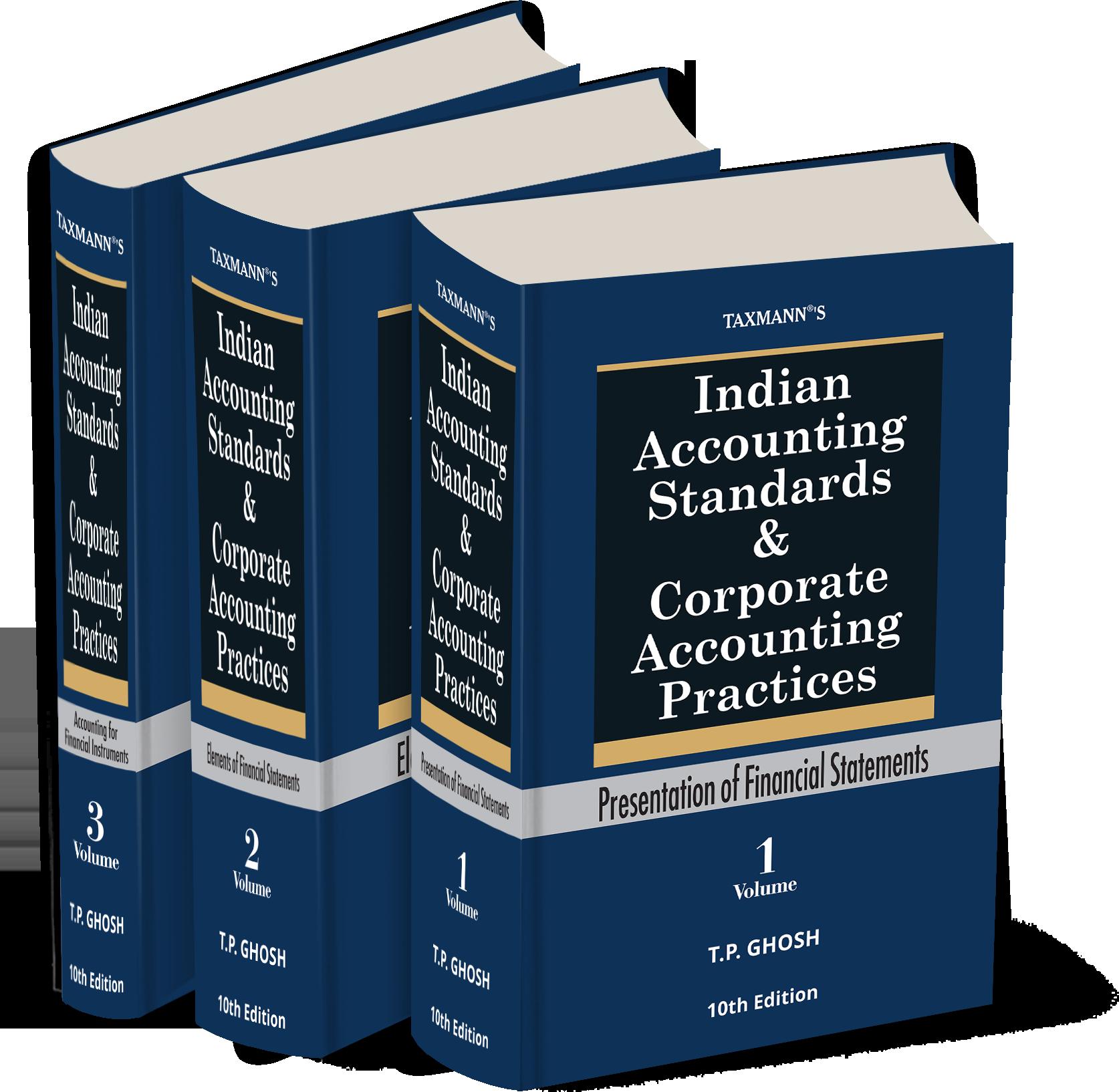
INDIAN ACCOUNTING STANDARDS & CORPORATE ACCOUNTING PRACTICES
AUTHOR PUBLISHER
DATE OF PUBLICATION
EDITION
ISBN NO NO. OF PAGES
BINDING TYPE
: T P Ghosh
: Taxmann Publications
: November 2025
: 10th Edition
: 9789371269148
: 4668
: HARDBOUND
DESCRIPTION
Indian Accounting Standards & Corporate Accounting Practices is recognised as India's most comprehensive and practice-oriented commentary on the Ind AS framework. Spanning over 5,000 pages across three volumes, Prof. (Dr) T.P. Ghosh provides a definitive resource that:
•Interprets every Ind AS conceptually, explaining both principles and rules
•Aligns Ind AS with key IFRS developments (IFRS 16, 17, IFRIC 22, 23 and forthcoming IFRS 18 & 19)
•Integrates Schedule III Division II & III requirements
•Demonstrates practical application through:
o400+ corporate disclosure extracts
o700+ numerical and interpretative examples
oDiagrams, flowcharts and decision trees for clarity
What sets this work apart is its emphasis on why standards operate the way they do, how companies apply them, and where judgment becomes critical. Each chapter follows a structured flow—principle interpretation computation practice regulatory context disclosure template—making the set a complete learning and implementation framework. This book is intended for the following audience:
•Corporate & Professional Users
•Advisory, Consulting & Technical Specialists
•Academics & Examination Candidates
•Corporate Accountants & Finance Teams
The Present Publication is the 10th Edition, authored by Prof. (Dr) T.P. Ghosh, with the following noteworthy features:
•[The Only Indian Work Fully Integrating Ind AS, IFRS & Schedule III]
oUnified treatment of Ind AS, IFRS developments and Schedule III formatting
oClear mapping of global changes to Indian requirements
•[Deep Commentary Across All 67 Chapters]
oInd AS 113 – Valuation approaches, hierarchy, Level 3 inputs, MPEEM
oInd AS 115 – Expanded five-step model with industry issues
oInd AS 109/32/107 – Full coverage of financial instruments, ECL, hedging and disclosures
•[Unmatched Practical Insight]
o700+ worked examples
o400+ real corporate disclosures
oSector-spanning illustrations across major industries
•[Complete Financial Reporting Coverage]
oStandalone and consolidated statements
oOCI, EPS, SOCIE and Cash Flow examples
oSegment reporting and related party disclosures
•[Coverage of Judgment-Heavy Areas]
oComponent accounting, useful life assessment
oECL modelling and SICR evaluation
oVariable consideration, financing components
oUnquoted equity valuation and calibration
oLease modifications and business combination mechanics
•[Fair Value Measurement Guide]
oMarket multiples, DCF models, matrix pricing
oSwap valuation and SOFR-based bootstrapping
oMulti-period excess earnings modelling
•[Sector- and Transaction-Specific Insights] Power PPAs, service concessions, telecom, real estate, NBFC ECL, mining, agriculture, pharma
•[Comprehensive Disclosure Templates] Ind AS 107-ready risk, maturity, hedge, transfer and derecognition templates