







An Act to provide for the registration of architects and for matters connected therewith.
BE it enacted by Parliament in the Twenty-third Year of the Republic of India as follows:—
Short title, extent and commencement.
1. (1) This Act may be called the Architects Act, 1972.
(2)It extends to the whole of India.
(3) It shall come into force on such date2 as the Central Government may, by notification in the Official Gazette, appoint.
Definitions.
2. In this Act, unless the context otherwise requires,—
(a)“architect” means a person whose name is for the time being entered in the register;
(b) “Council” means the Council of Architecture constituted under section 3;
(c)“Indian Institute of Architects” means the Indian Institute of Architects registered under the Societies Registration Act, 1860 (21 of 1860);
(d)“recognised qualification” means any qualification in architecture for the time being included in the Schedule or notified under section 15;
(e) “register” means the register of architects maintained under section 23;
(f) “regulation” means a regulation made under this Act by the Council;
(g) “rule” means a rule made under this Act by the Central Government.
1. Dated 31-5-1972.
2. With effect from 1-9-1972.
Definition of “Architect” – Applicability to Firms and Juristic Entities - The Delhi High Court interpreted section 2 of the Architects Act, 1972, particularly in relation to the definition and legal identity of an “architect,” holding that the term applies exclusively to individuals who possess a recognized qualification and are registered with the Council of Architecture. The Court emphasized that the Act does not envisage a juristic person such as a company, LLP, or partnership firm to be registered as an “architect,” nor does it allow such entities to hold themselves out as such. However, it clarified that this statutory limitation pertains only to the use of the title “architect,” and not to the rendering of architectural services. Therefore, while firms cannot call themselves “architects,” they may still engage in the business of architectural consultancy if at least one registered architect is involved and there is no misrepresentation. The judgment upheld the legislative intent to protect the sanctity of the professional designation and rejected Council of Architecture circulars that sought to restrict practice by firms, finding them contrary to the statute – Sudhir Vohra v. Union of India AIRONLINE 2018 DEL 51.
Constitution of Council of Architecture.
3. (1) The Central Government shall, by notification in the Official Gazette, constitute, with effect from such date as may be specified in the notification, a Council to be known as the Council of Architecture, which shall be a body corporate, having perpetual succession and a common seal, with power to acquire, hold and dispose of property, both movable and immovable, and to contract, and may by that name sue or be sued.
(2) The Head Office of the Council shall be at Delhi or at such other place as the Central Government may, by notification in the Official Gazette, specify.
(3) The Council shall consist of the following members, namely:—
(a) five architects possessing recognised qualifications elected by the Indian Institute of Architects from among its members;
(
b) two persons nominated by the All India Council for Technical Education established by the Resolution of the Government of India in the late Ministry of Education No. F.16-10/44-E. III, dated the 30th November, 1945;
(
c) five persons elected from among themselves by heads of architectural institutions in India imparting full-time instruction for recognised qualifications;
(
d) the Chief Architects in the Ministries of the Central Government to which the Government business relating to defence and railways has been allotted and the head of the Architectural Organisation in the Central Public Works Department, ex officio;
(
e) one person nominated by the Central Government;
(f) an architect from each State nominated by the Government of that State;
(g) two persons nominated by the Institution of Engineers (India) from among its members; and
(h) one person nominated by the Institution of Surveyors of India from among its members.
Explanation.— For the purposes of this sub-section,—
(a) “Institution of Engineers (India)” means the Institution of Engineers (India) first registered in 1920 under the Indian Companies Act, 1913 (7 of 1913) and subsequently incorporated by a Royal Charter in 1935;
(b) “Institution of Surveyors of India” means the Institution of Surveyors registered under the Societies Registration Act, 1860 (21 of 1860).
(4) Notwithstanding anything contained in clause (a) of sub-section (3), the Central Government may, pending the preparation of the register, nominate to the first Council, in consultation with the Indian Institute of Architects, persons referred to in the said clause (a) who are qualified for registration under section 25, and the persons so nominated shall hold office for such period as the Central Government may, by notification in the Official Gazette, specify.
(5) Notwithstanding anything contained in clause (f) of sub-section (3), the Central Government may, pending the preparation of the register, nominate to the first Council, in consultation with the State Governments concerned, persons referred to in the said clause (f), who are qualified for registration under section 25, and the persons so nominated shall hold office for such period as the Central Government may, by notification in the Official Gazette, specify.
Election of Council Members – Role of Indian Institute of Architects and No Mandate on Central Government - The Madras High Court clarified that under section 3(3)(a) of the Architects Act, 1972, the election of five architects to the Council of Architecture is to be conducted solely by the Indian Institute of Architects (IIA) from among its members, without any obligation on the part of the Central Government to appoint a Returning Officer. The petitioners had sought a writ of mandamus directing the Central Government to appoint a Returning Officer for this election, alleging abuse and irregularities in the election process. The Court, however, held that while Rule 6 of the Council of Architecture Rules, 1973 mandates a Returning Officer only for elections under section 3(3)(c) (by heads of institutions), there is no such requirement for elections under section 3(3)(a). The responsibility for conducting these elections lies entirely with the IIA, and any grievance related to the election process must be addressed through the statutory remedy provided under section 5(2) of the Act. The Court expressly dissented from a contrary Bombay High Court view and emphasized the legislative intent of segregating responsibilities for different electoral categories –Ar. Vijay Garg v. Ar. P. Satheeshkumar AIR 2009 MADRAS 135.
President and Vice-President of Council.
4. (1) The President and the Vice-President of the Council shall be elected by the members of the Council from among themselves:
Provided that on the first constitution of the Council and until the President is elected, a member of the Council nominated by the Central Government in this behalf shall discharge the functions of the President.
(2) An elected President or Vice-President of the Council shall hold office for a term of three years or till he ceases to be a member of the Council, whichever is earlier, but subject to his being a member of the Council, he shall be eligible for re-election:
Provided that—
(
a) the President or the Vice-President may, by writing under his hand addressed to the Vice-President or the President, as the case may be, resign his office;
(
b) the President or the Vice-President shall, notwithstanding the expiry of his term of three years, continue to hold office until his successor enters upon office.
(3) The President and the Vice-President of the Council shall exercise such powers and discharge such duties as may be prescribed by regulations.
Mode of elections.
5. (1) Elections under this Chapter shall be conducted in such manner as may be prescribed by rules.
(2) Where any dispute arises regarding any such election, the matter shall be referred by the Council to a Tribunal appointed by the Central Government by notification in the Official Gazette in this behalf, and the decision of the Tribunal shall be final:
Provided that no such reference shall be made except on an application made to the Council by an aggrieved party within thirty days from the date of the declaration of the result of the election.
(3) The expenses of the Tribunal shall be borne by the Council.
Terms of office and casual vacancies.
6. (1) Subject to the provisions of this section, an elected or nominated member shall hold office for a term of three years from the date of his election or nomination or until his successor has been duly elected or nominated, whichever is later.
(2) An elected or nominated member may, at any time, resign his membership by writing under his hand addressed to the President, or in his absence, to the VicePresident, and the seat of such member shall thereupon become vacant.
(3) A member shall be deemed to have vacated his seat—
(i) if he is absent without excuse, sufficient in the opinion of the Council, from three consecutive ordinary meetings of the Council; or
(ii) if he ceases to be a member of the body referred to in clause (a), clause (g) or clause (h) of sub-section (3) of section 3 by which he was elected or nominated, as the case may be; or
(iii) in the case where he has been elected under clause (c) of sub-section (3) of section 3, if he ceases to hold his appointment as the head of an institution referred to in the said clause.
AUTHOR : TAXMANN’S EDITORIAL BOARD
PUBLISHER : TAXMANN
DATE OF PUBLICATION : DECEMBER 2025
EDITION : 2026 EDITION
ISBN NO : 9789371261012
NO. OF PAGES : 112
BINDING TYPE : PAPERBACK
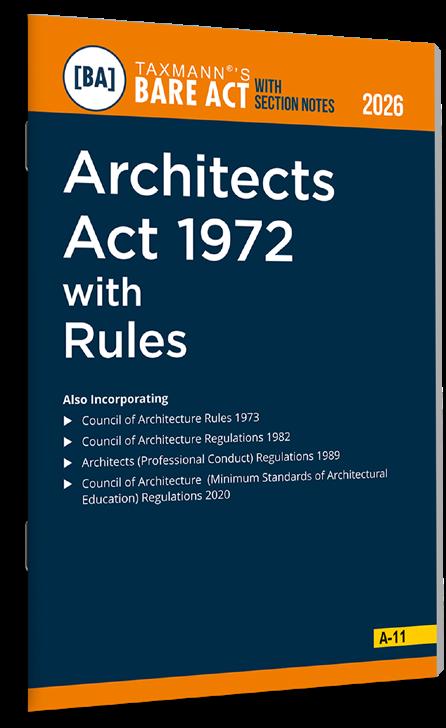
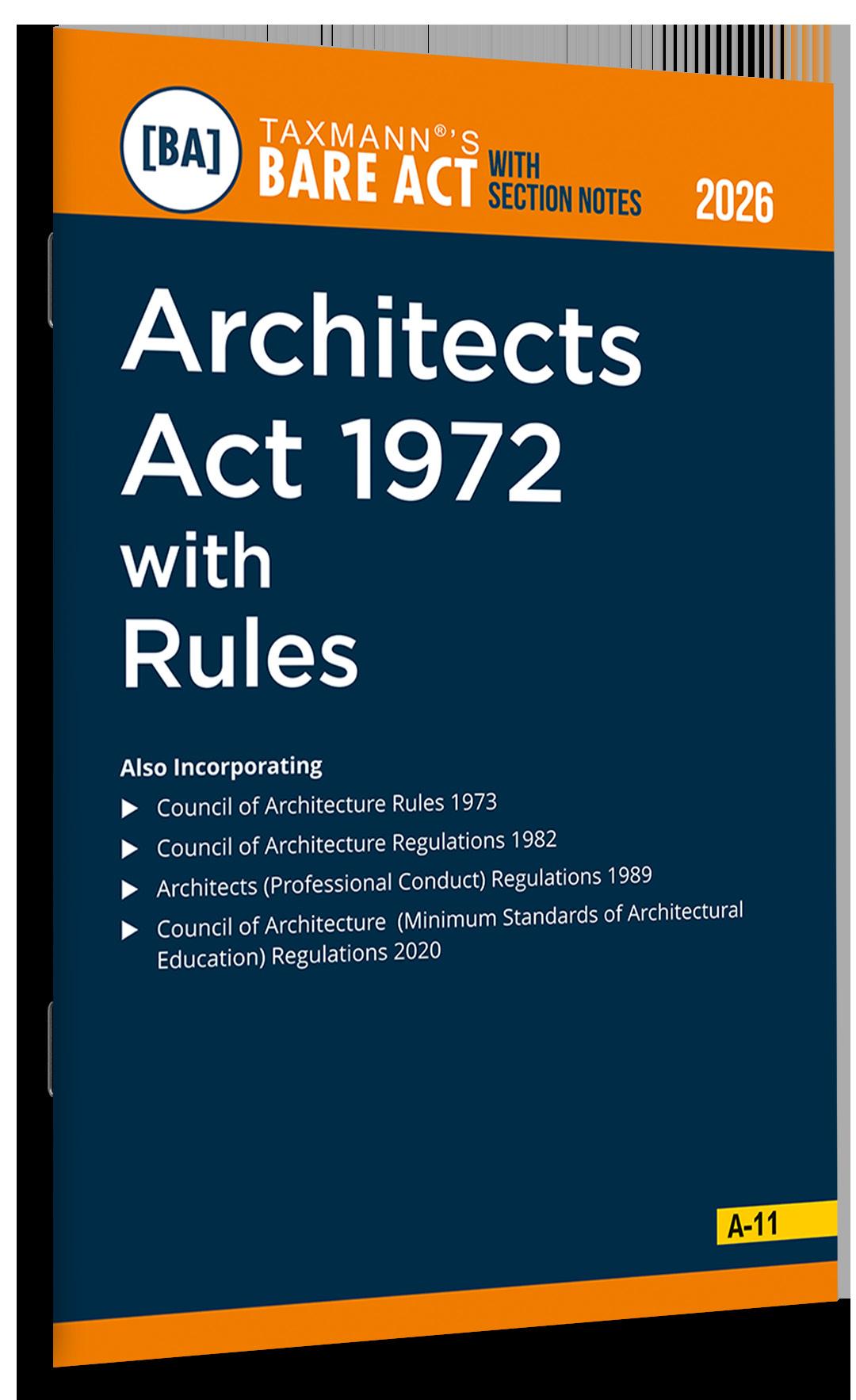
Architects Act 1972, with Rules [Bare Act with Section Notes], by Taxmann is a concise, updated, and systematically organised statutory reference that brings together the principal Act, allied Rules & Regulations, and clear Section Notes. It offers a dependable and practice-focused understanding of India’s regulatory framework for the architectural profession, covering the Council of Architecture (CoA), registration norms, professional conduct, educational standards, and restrictions on the use of the title ‘Architect.’ This Edition incorporates all amendments and notifications updated to date, ensuring complete accuracy and relevance.
This book is intended for the following audience:
• Registered Architects & Architectural Firms
• Architecture Students & Educators
• Lawyers, Legal Consultants & Litigators
• Government Bodies & Urban Local Authorities
• Construction & Real Estate Professionals
• Regulatory & Administrative Authorities
The Present Publication is the 2026 Edition, covering the amended and updated text of the Architects Act [Act No. 20 of 1972] and Rules, with the following noteworthy features:
• [Complete Statutory Compilation] Updated text of the Act, Rules, and all notified Regulations consolidated in a single reference
• [Pre-amendment Footnotes] Includes earlier versions of amended provisions to enable comparison and historical understanding
• [Section-wise Notes] Concise explanations, interpretative insights, and key case law for major sections, including Sections 2, 3, 14–17, 21, and 37
• [Updated Case Law] Notable judicial rulings on title usage, CoA’s regulatory scope, registration eligibility, recognition of qualifications, professional misconduct, and firm-level restrictions
• [User-friendly Presentation] Structured headings, clean formatting, and systematic statutory sequencing for quick navigation
• [Integrated Educational Norms] Includes the complete Minimum Standards of Architectural Education Regulations 2020 with curriculum, credits, faculty norms, infrastructure requirements, and admission criteria
• [Professional Conduct Rules] Incorporates the binding Architects (Professional Conduct) Regulations 1989 with ethical and disciplinary guidelines
• [Recognised Qualifications] Comprehensive list of all Indian and foreign degrees recognised for registration