STRENGTHENING LAND BANK SALES PROGRAMS
TO STABILIZE
DETROIT NEIGHBORHOODS
Michelle Bennett, Maximilius Cupp, Alexander Hermann, Braden Mitchell, Mengwei Sun, Wenting Yin, Mikah Zaslow, Xueman Zhao April 2016
Cover photo: Google Maps, 2016
Strengthening Land Bank Sales Programs to Stabilize Detroit Neighborhoods
Michelle Bennett, Maximilius Cupp, Alexander Hermann, Braden Mitchell, Mengwei Sun, Wenting Yin, Mikah Zaslow, Xueman Zhao
Urban and Regional Planning Program
Taubman College of Architecture + Urban Planning University of Michigan, Ann Arbor April 2016
Acknowledgements
First and foremost, we would like to thank our faculty advisors Margi Dewar and Libby Levy for their guidance and support over the course of the semester.
We would like to extend a special thanks to Sarah Carlson of the Detroit Land Bank Authority, who, in addition to serving as member of our advisory committee, was key in the creation of this project.
We would like to thank our entire advisory committee, whose insight and feedback proved invaluable in the development of this plan:
• Mike Brady, Detroit Land Bank Authority
• Payton Heins, Center for Community Progress
• Linda Smith, U-SNAP-BAC
• Kenyetta Campbell, Cody Rouge Action Alliance
• Nina Rodriguez, Cody Rouge Action Alliance
• Barb Matney, Warrendale Community Organization
• Joe Matney, Warrendale Community Organization
• Sylvia Santana, Warrendale Community Organization
• Mona Ali, City of Detroit, Department of Neighborhoods District 7
We would like to thank the following individuals and organizations for their help over the course of the semester:
•Detroit Land Bank Authority, specifically:
o Charity Dean
o Rochelle Smith
o Darryl Earl
o Megan McGreal
•Eric Dueweke, University of Michigan
•Susan Landfried, University of Michigan
•Erin Kelly, Detroit Future City
•Victoria Olivier, Detroit Future City
•Raquel Garcia Anderson, Global Detroit
•Cuyahoga Land Bank staff
•Genesee County Land Bank Authority staff
We would also like to thank all the interviewees whose experiences contributed to the recommendations in this plan.
We would specifically like to thank Rob Linn at the Detroit Land Bank Authority for his assistance in gathering data and his seemingly limitless patience in answering our many questions.
Finally, we would like thank the Center for Community Progress for their funding to cover expenses during this project.
Chapter
Chapter
Table
Chapter
Chapter
Chapter
Chapter
Figure
Table
Chapter
Table 7.1
Chapter
Figure 8.1
Figure
Figure
Figure 8.4 Identified Areas for New Park Locations
Figure 8.5 Housing and Revitalization Areas Targeted for Multi-Family Housing in
Figure 8.6
Figure 8.7
Figure 8.8 Genesee County e-newsletter
Figure
Chapter 9
Figure 9.1 Scenario for MorningSide implementation of auction and direct sale recommendations
Figure 9.2 Scenario for Warrendale implementation of auction and direct sale recommendations
Figure 9.3 Scenario for MorningSide implementation of side lot & community partner recommendations
Figure 9.4 Scenario for Warrendale implementation of side lot & community
Executive Summary
The Strengthening Land Bank Programs to Stabilize Detroit Neighborhoods plan proposes ways to scale up the Detroit Land Bank Authority’s (DLBA) programs to return vacant properties to productive use while stabilizing neighborhoods. Between 2014 and early 2016, the DLBA’s inventory grew from 1,000 properties to nearly 100,000—more than a quarter of Detroit’s parcels. Furthermore, the Wayne County Treasurer will transfer properties to the DLBA each year after tax-foreclosure auctions fail to sell.
As the DLBA’s inventory increases, Detroit’s vacant land and structures remain underproductive and threaten to further destabilize neighborhoods. This plan presents recommendations to scale up four property disposition programs in a way that stabilizes neighborhoods and turns vacant property into an asset. This plan also recommends improving communication and collaboration between the DLBA, community organizations, and city departments.
Auction
The DLBA owns about 30,000 residential structures. As of early 2016, the Auction Program has been the DLBA’s primary means of selling homes—moving nearly 1,000 properties through the program since 2014. The auction is one of the more visible and significant efforts in Detroit to combat blight and improve neighborhood livability.
Improving the Auction Program requires providing more information to homebuyers, recognizing homebuyers’ struggles obtaining compliance, and acknowledging the constraints—the higher cost and moderate auction failure rate especially—of the auction program.
Move more properties into productive use
• Notify neighbors and neighborhood organizations when offering a home at auction through mailings and Detroit Dashboard so that residents can help monitor and market properties.
• Allow prospective buyers to privately tour auction homes as they can Direct Sales properties. These tours can provide more opportunities for prospective homebuyers to view homes and ultimately increase sales and provide more information about costs.
• Elicit feedback from purchasers via survey to provide the DLBA with information on auction process strengths and weaknesses that it can use to improve the program, and allow homebuyers to feel heard.
Stabilize neighborhoods
• Enable auction homebuyers to make better decisions by providing more information about the cost of rehabilitation and the likelihood of obtaining financing. Providing additional information about costs and financing can improve compliance outcomes.
• Work with homeownership training programs to assure that homebuyers learn about construction. Rehab dollars represent the largest share of costs to DLBA homebuyers.
• Reduce number of auction properties in some areas while selling more through Direct Sales. This will permit the DLBA to shift resources into more cost-effective disposition programs.
• Increase auction starting bid to $3,000 to cover the DLBA’s average costs of preparing a home for auction.
• Professionalize the open houses to provide more information to homebuyers and facilitate more home sales.
• Increase compliance period to nine months, if not longer. Homebuyers face considerable difficulties reaching compliance. This change would reflect the fact that the DLBA routinely approves extensions to the compliance period.
Move more properties into productive use and stabilize neighborhoods
• Host housing fairs to market auction properties and to connect homebuyers to housing resources
Direct Sales
Given the high cost and time-intensive nature of the Auction Program, the DLBA could sell more properties through Own It Now—the lower-cost Direct Sales program. Direct Sales also allows the DLBA to move homes more quickly back to market. Improving Direct Sales requires growing the program while safeguarding against the indiscriminate sale of property that reduces neighborhood livability.
Move more properties into productive use
• Scale up the Own It Now program to reduce the DLBA’s costs and move properties more quickly to market and productive reuse.
• Consider alternative sales programs, including programs that sell homebuyers systems-ready homes, or prioritize exterior improvements especially. These programs recognize the limitations of existing sales methods and allow the DLBA to pilot new programs.
Stabilize neighborhoods
• Include cost of clear title in the purchase price of home to improve the likelihood that buyers will be able to secure financing and reach compliance.
• Create a Fast-Track program for neighbors that prioritizes -- at intake review requests to purchase DLBA property from nearby renters and homeowners. This would increase the number of sales to homebuyers already invested in the neighborhood.
Side Lots
As of April 19, 2016, the DLBA had 27,016 side lots for sale, representing about 28 percent of its overall inventory. Since the program’s inception in July 2014, the DLBA has sold 3,994 side lots. Improving the side lot program requires lowering barriers to side lot purchasing, encouraging positive uses of side lots, and addressing the oversupply of side lots.
Move more properties into productive use
• Provide property tax information for a side lot purchase to give buyers more confidence in determining costs associated with purchase.
• Provide liability information to assuage fears that buyers have regarding liability in purchasing a side lot.
Stabilize neighborhoods
• Encourage side lot purchasers to submit plans when purchasing side lots to jump-start the creative process for side lot purchasers, resulting in more varied uses. Most side lots show no signs of reuse.
• Improve access to side lot care resources to increase the number of lots that are maintained and improved.
• Implement a Clean and Green program for side lots and other vacant lots that do not sell to help maintain the large number of vacant lots, while supporting community organizations.
Move more properties into productive use and stabilize neighborhoods
• Collaborate with neighborhood groups to promote side lot purchasing. Neighborhood groups can be more persuasive and provide targeted marketing for side lot purchasers.
Community Partners
Since its inception in 2014, the Community Partners program has resulted in 50 Community Partners acquiring 234 properties. Of those, 181 are lots and 53 are structures. Only 11 structures have reached compliance. The Community Partners program has the potential to expand the reach of the DLBA, as organizations have direct access to neighborhood residents. Expanding the Community Partner program and streamlining the application process for stronger dispositions can have a profound impact on Detroit neighborhoods, city departments, and nonprofit organizations.
Move more properties into productive use
• Create seven-step program to communicate internal and program processes and deadlines to Community Partners to allow Community Partners to become more successful in acquiring property and reaching compliance.
• Communicate process for extensions of compliance period to assuage fears that properties will be taken back, and organizations will be more willing to acquire properties.
Stabilize Neighborhoods
• Hold regular meetings to update community organizations and gain feedback on DLBA programs. Meetings between the DLBA, Community Partners, District Managers, and other city departments and organizations would allow for greater collaboration and information sharing.
• Partner with organizations to develop capacity of community organizations. Organizations that offer resources to Community Partners, such as U-SNAPBAC or Community Development Advocates of Detroit, can provide information to build organizational capacity.
Move more properties into productive use and stabilize neighborhoods
• Further develop Endorsement Partnership This partnership offers a 20 percent discount to DLBA homebuyers with letters of reference from Community
Partners. This program can encourage Community Partners to market DLBA properties.
Communication and Collaboration
While the DLBA tests cutting-edge practices under challenging circumstances, residents and community organizations remain confused about processes, report a lack of coordination, and often have a negative reaction to the DLBA. The following recommendations aim to improve communication and transparency between the DLBA, its partners, and the public.
Move more properties into productive use
• Publicize improvements made to properties that the DLBA has sold. Case studies of success and instructional videos can make processes easier for homebuyers and increase sales.
Stabilize neighborhoods
• Create a system for public feedback on condition of DLBA properties such as Improve Detroit to allow the DLBA to quickly address issues with property.
Both scale up program and stabilize neighborhoods
• Provide a public, up-to-date list of DLBA-owned properties to facilitate the development of ideas for property reuse, while also providing more transparency about DLBA plans and operations.
• Align sales with other city department and community plans to enable larger-scale disposition of DLBA property.
• Align sales with a larger vision for the city to alleviate uncertainty among residents and others looking to invest.
Implementation
This plan lastly considers how the DLBA’s implementation of these recommendations would impact two Detroit neighborhoods in particular.
Implementation in MorningSide
The foreclosure crisis hit MorningSide, located on Detroit’s eastside, especially
hard, necessitating a plan for the neighborhood’s large amount of DLBA-owned property. By implementing this plan’s recommendations for the Auction and Direct Sales programs, the DLBA could reduce the number of auction homes and sell more through Direct Sales. Community partners—including Habitat for Humanity and U-SNAP-BAC—have concentrated their efforts on renovating homes. The DLBA could make these community partners aware of inventory that becomes available in areas where they have been working. On the western side of MorningSide, U-SNAP-BAC, the MorningSide neighborhood organization, and Habitat for Humanity are developing plans for a greenway. The DLBA could hold side lots in this proposed area for the greenway.
Implementation in Warrendale
Similar to MorningSide, Warrendale—on Detroit’s west side—suffered from the foreclosure crisis, leaving an abundance of vacant and DLBA-owned property. A neighborhood plan for Warrendale considering this plan’s recommendations would likely confine auction attempts to the area south of Whitlock Avenue, and sell other structures north of Whitlock through Direct Sales. Several community partners in Warrendale have considered redeveloping the area surrounding the closed school near Tireman and Heyden. The DLBA could provide information to these partners about properties available nearby. North of Sawyer Avenue, the DLBA can work with the Detroit Water and Sewerage Department by assisting in converting side lots for green infrastructure projects. Additionally, the DLBA could market nearby vacant lots to businesses along the Warren Avenue commercial corridor.
The DLBA and its partners can implement these recommendations individually or in combination to have a greater impact on neighborhood stabilization.
CHAPTER 1:DETROIT LAND BANK
AUTHORITY GOALS AND CHALLENGES
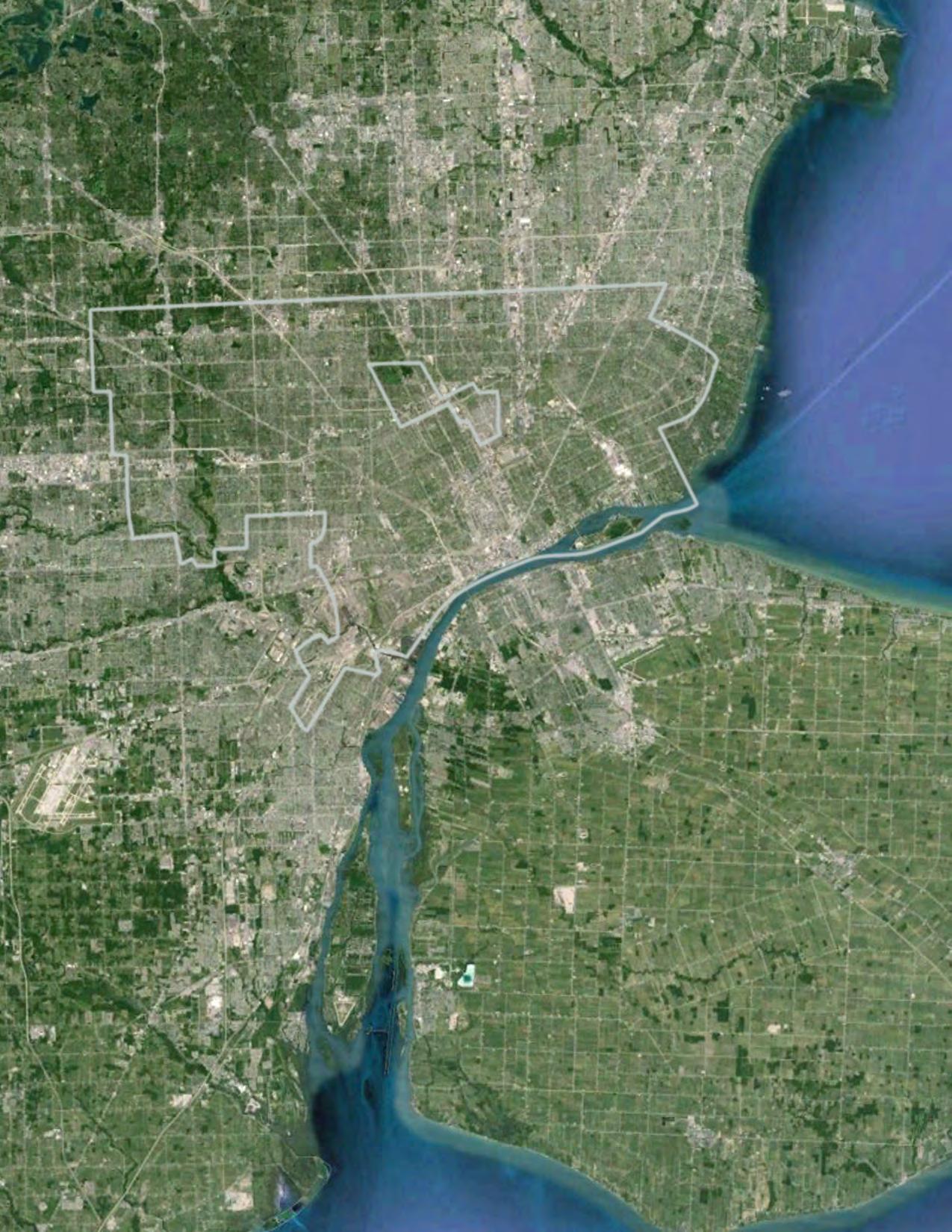
Source: Google Earth
deTroiT land bank auThoriTy goals and Challenges
The Detroit Land Bank Authority (DLBA) is addressing the challenges of vacant and abandoned property using innovative programs based on best practices and policy analysis. While the DLBA is making progress towards returning properties to productive use, the scale of the challenge is unprecedented. The DLBA is the largest land bank in the country, owning over 96,000 properties, about one fourth of the city’s parcels.
Figure 1.1 Properties Owned by DLBA, 2003-2005
96,281
Source: Detroit Land Bank Authority, 2016.1
Because the scale of property acquisition is so large and the DLBA cannot match disposition with supply, the University of Michigan was asked to provide the DLBA this plan which assesses the results of DLBA sales programs. This plan suggests ways to improve procedures and strengthen the impact of sales to stabilize neighborhoods. Recommendations take into consideration community input, and feasibility.
This plan examines ways to increase the impact of the DLBA’s major property disposition programs:
• Auctions
• Direct sales
• Side lot sales
• Community Partners
This plan does not examine programs such as Rehabbed and Ready and Occupied Homes as these programs are too new to evaluate.
The goals of this plan are to strengthen DLBA programs for the purposes of returning property to productive use and stabilizing neighborhoods.
Strengthening DLBA programs would include adjusting internal processes to increase sales and better meet the needs of potential purchasers. Through these adjustments, the DLBA could increase the volume of properties sold and the capacity of individuals and organizations to return properties to productive use.
This plan examines ways to increase the scale of the four major sales programs while reinforcing property markets. Additionally, in response to requests from neighborhood partners, this plan assesses resident engagement and strategies related to holding and maintaining property.
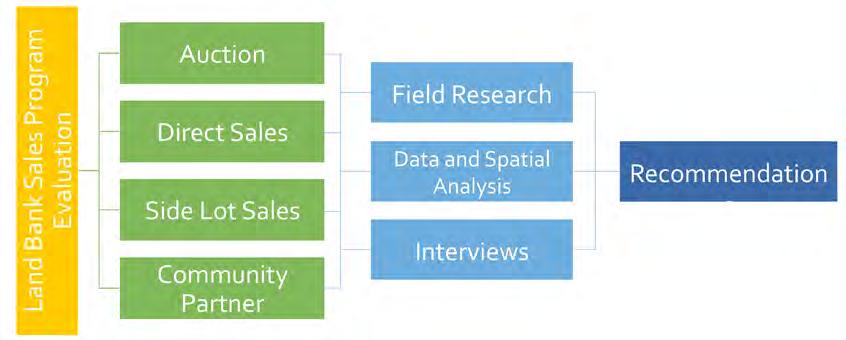
First, the outcomes of the four sales programs are assessed across the city. Second, the plan provides a deeper assessment of outcomes in two similar Detroit neighborhoods: MorningSide and Warrendale. Third, this plan makes recommendations that could be implemented in these two neighborhoods and other neighborhoods with similar market conditions. The program evaluation includes:
• Field Research: Analysis of sold properties’ condition
• Data and Spatial Analysis: Housing market analysis, analysis of DLBA sales and compliance
• Interviews: Residents, representatives from community groups, nonprofit organizations, District Managers and other land banks
1.2 Land Bank Disposition Program Evaluation Methods
Figure
The remainder of the plan is organized as follows:
Chapter 2: The State of the Detroit Land Bank Authority – Overview of DLBA programs and holdings.
Chapter 3: The Demand for Housing in Detroit: MorningSide and Warrendale –Condition of the housing market and its influence on DLBA and MorningSide and Warrendale
Analysis and recommendations pertaining to the DLBA’s four major sales programs:
o Chapter 4: Auction Program
o Chapter 5: Own It Now Program
o Chapter 6: Side Lots
o Chapter 7: Community Partner Sales
Chapter 8: Communication and Collaboration – Recommendations for building partnerships and engaging and increasing communication with the public and other organizations.
Chapter 9: Implementation – Apply recommendations to MorningSide and Warrendale and display all recommendations in a matrix.
Notes
1. Detroit Land Bank Authority. 2016. Inventory Report 3/15/2016. Received from Detroit Land Bank Authority.
CHAPTER 2: THE STATE OF DETROIT LAND BANK AUTHORITY
The sTaTe of deTroiT land bank auThoriTy
The Detroit Land Bank Authority (DLBA) was established in 2008, but owned a small share of publicly owned properties and operated with minimal resources until 2014. The DLBA is empowered through the Land Bank Fast Track Act, MCL 124.751, to own, accept, acquire, and hold property through gift, transfer, or other conveyance methods.1 Additionally, the DLBA can manage, sell, exchange, lease, option, renovate, develop, and demolish properties within its inventory.2 The majority of the DLBA’s properties have come from the Wayne County Treasurer following tax foreclosure and from the City of Detroit’s Planning and Development Department along with other sources such as the Michigan Land Bank Fast Track Authority.
As of January 2016, the DLBA had 96 part-time and full-time employees, which represents an increase of 20 employees from the previous year. As of March 2016, the DLBA had 96,281 parcels in its inventory. This represents an increase from 35,533 parcels in January, 2015.3
Chapter 2 Table
Table 2.1 Comparison of Transactions among Land Banks, as of April 2016
Table 2.1. Comparison of Transactions among Land Banks, as of April 2016 Detroit Genesee County Cuyahoga County Year Established:
Average Annual Dispositions 509
for Community
The DLBA has the largest inventory of properties in the United States. The next largest are the Genesee County Land Bank, which had more than 11,000 properties in 2015, and Cuyahoga County Land Bank with just over 1,000 properties. The scale of the DLBA’s holdings thus requires large-scale intervention to increase property disposition.
The majority of DLBA properties are vacant lots. Approximately 31 percent (30,068) of the parcels contain structures.
Sources: Center
Progress. 2014;4 Detroit Land Bank Authority. 2016a;5 Detroit Land Bank Authority, 2016b;6 Genesee County Land Bank Authority, 2014.7
Source: Detroit Land Bank Authority. 2016b.8
As of January 2016, the DLBA sold 2,889 side lots, sold and closed 589 properties at auction, and sold 234 properties to Community Partners. As of March 15, 2016, the DLBA had 27,420 side lots for sale, 33 properties for sale through auction, 33 in the auction pipeline, 45 held for Community Partners, and 67 properties for sale through the direct sale program (Own It Now). The DLBA would like to increase sales through these programs.
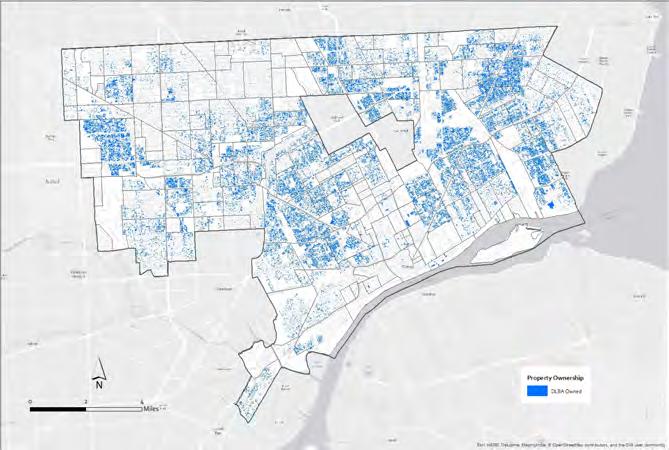
The map below shows DLBA-owned parcels of property as of April, 2016. There are several areas which have concentrations of DLBA owned properties, but as the map indicates, vacant property is a city-wide problem.
2016
Figure 2.1 Numbers of DLBA Properties, March
Figure 2.2 Map of all DLBA Owned Properties
The four DLBA programs this plan aims to strengthen are Auctions, Direct Sales, Side Lot Sales, and Community Partnerships.
• The Auction Sales program sells vacant homes online. The DLBA cleans out and secures homes for auctions. The Auction program began by offering one home per day, five days a week, and is now offering three houses per day, seven days a week.
• The Direct Sales program sells homes “as is.” The DLBA does not clean out or secure direct sale properties. Title to the properties may not be clear.
• The Side Lots program makes vacant lots available to owners of property adjacent to side lots. Side lots are available for $100 and are sold online through a pre-pay option followed by a visit to the Land Bank to acquire the deed, or in person at side lot fairs.
• The Community Partners program encourages faith- and community- based organizations to transform the neighborhoods that they serve through projects such as home rehabilitation, deconstruction, new construction, lot beautification, community gardens, and pocket parks. Community Partners can endorse residents who they believe would be a good fit in their neighborhood so that the resident can purchase an auction home with a 20 percent discount.
After January 1, 2016, the Wayne County Treasurer’s office transferred 15,392 properties which did not sell at their auction to the DLBA. With the number of DLBAowned properties increasing due to tax foreclosures, the DLBA needs to develop strategies to increase the scale of disposition and return properties to individuals and organizations for productive use that also strengthens neighborhoods.
Notes
1. Land Bank Fast Track Authority. 2014. Report of the Michigan Land Bank Fast Track Authority of the State of Michigan. Retrieved from https://www.michigan.gov/documents/landbank/FINAL_DRAFT.ALLDOCS. v6.093014_491480_7.pdf
2. Land Bank Fast Track Authority. 2014. Report of the Michigan Land Bank Fast Track Authority of the State of Michigan. Retrieved from https://www.michigan.gov/documents/landbank/FINAL_DRAFT.ALLDOCS. v6.093014_491480_7.pdf
3. Detroit Land Bank Authority. 2015. January 2016 Quarterly Report. Retrieved from http:// webcache.googleusercontent.com/search?q=cache:KPIxheojjJ8J:www.buildingdetroit.org/ wp-content/uploads/2014/08/January-2015-Q4_City-Council-Report-Final-Draft_01142015. docx+&cd=1&hl=en&ct=clnk&gl=us&client=safari
4. Center for Community Progress. 2014. Take it to the Bank: How Land Banks are Strengthening America’s Neighborhoods.
5. Detroit Land Bank Authority. 2016. Retrieved from www.BuildingDetroit.org.
6. Detroit Land Bank Authority. 2016. Inventory Report 3/15/16. Received from Detroit Land Bank Authority.
7. Genesee County Land Bank Authority. 2014. Celebrating the First Ten Years: 2004-2014.
8. Detroit Land Bank Authority. 2016. Inventory Report 3/15/16. Received from Detroit Land Bank Authority.
9. Detroit Land Bank Authority. 2016. Property Inventory and Activity 4/19/16. Received from Detroit Land Bank Authority.
DETROIT: MORNINGSIDE AND
CHAPTER 3: THE DEMAND FOR HOUSING IN
Source: Detroit Future City
The demand for housing in deTroiT: morningside and Warrendale
The Detroit Land Bank Authority’s (DLBA) success in selling residential property is dependent on housing demand. In Detroit, mortgage foreclosures and the recession worsened demand for housing, which was already weak due to decades of population loss. MorningSide and Warrendale were working-class and lowermiddle-class neighborhoods when mortgage foreclosures rose. An examination of these neighborhoods shows the barriers that the DLBA faces in selling property, and opportunities to strengthen neighborhoods such as these.
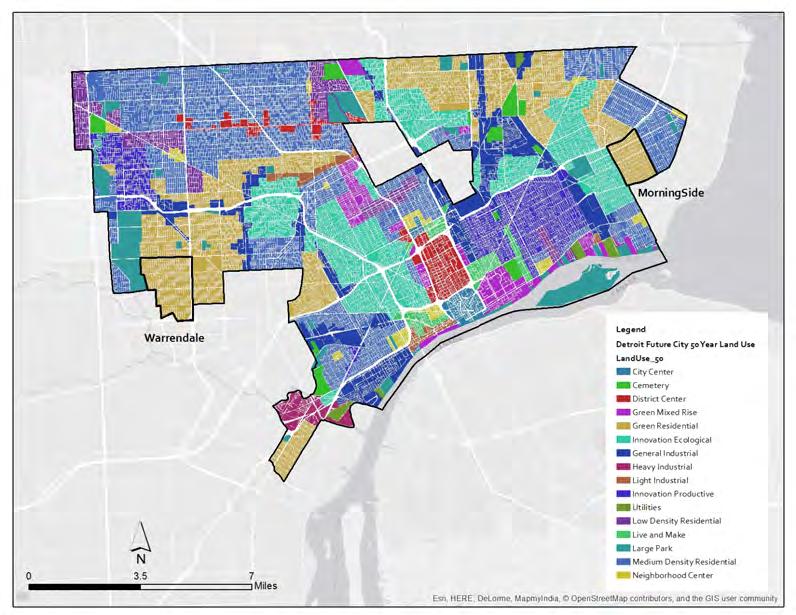
MorningSide and Warrendale are both designated in the Detroit Future City Framework as Green Residential (Figure 3.1). They are neither Detroit’s strongest markets nor its weakest, and as such they represent a major portion of Detroit’s neighborhoods that have modest housing demand. The similarities between MorningSide and Warrendale can serve as a basis for recommendations for other neighborhoods with similar market conditions. This chapter reviews changes in the housing market since the early 2000s in the two neighborhoods and city-wide.
Source: Detroit Future City, 2012.1
Figure 3.1 50-year Land Use Scenario, showing Warrendale and MorningSide as Green Residential
Changes in Population, Vacancy, and Income
In 2014, Detroit consisted of about 680,000 residents who lived in 368,000 housing units.2 Approximately 23 percent of habitable homes were vacant in 2010, representing an increase of 13 percentage points since 2000.3 According to the Blight Task Force Report published in November 2014, of the 380,000 properties in Detroit, 40,077 structures were “blighted” and recommended for immediate removal, 38,429 structures had “blight indicators” and needed further evaluation, and 6,135 vacant lots required immediate attention.4
As of January 2016, the DLBA had demolished 8,166 structures.5 The demolition program through the DLBA and other demolition initiatives have removed vacant structures that are not suitable for occupancy.
Chapter 3 Table
Pop Change
Sources: U.S. Census 2000, 1-year ACS Survey 2014, and 5- year ACS Survey 2009-2014.
MorningSide and Warrendale experienced an increase in vacant properties of 17 and 19 percentage points between 2000 and 2010 (Figure 3.2). Over the same time period, the city’s vacancy rate increased by approximately 13 percentage points.
Table 3.1 Population Change
Source: Social Explorer Tables (SE), Census 2000, Census 2010 U.S. Census Bureau and Social Explorer .
Source: Social Explorer Tables (SE), Census 2000, Census 2010 U.S. Census Bureau and Social Explorer.
Owner-occupancy of homes decreased over all geographies from 2000 to 2010 (Figure 3.3). Warrendale lost 13 percentage points of its owner-occupied housing, MorningSide lost 6 percentage points, and Detroit lost 4 percentage points over this time period.
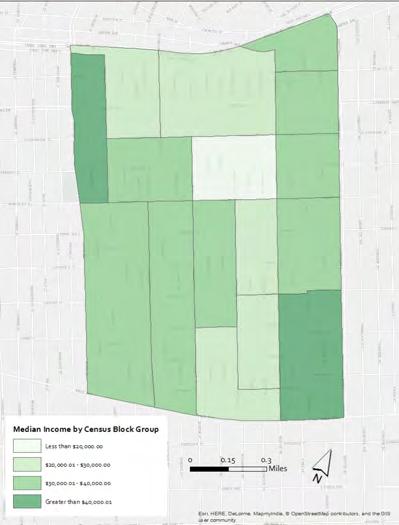
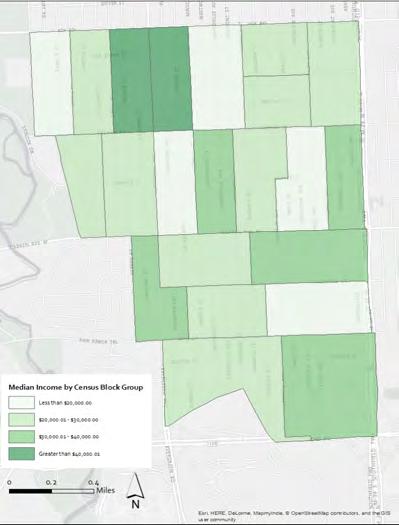
Detroit’s low household median income contributes to a lack of housing demand. Income change also contributed to loss of housing demand, as Detroit’s median household income decreased from $29,526 in 2000 to $28,357 in 2010.6
Figure 3.3 Percentage of Owner-Occupied Housing Units,
Figure 3.2 Percentage of Vacant Housing Units, 2000-2010
Source: 2015 Tiger Geodatabases, ACS 5-year data for 2010-2014.
Mortgage Foreclosures
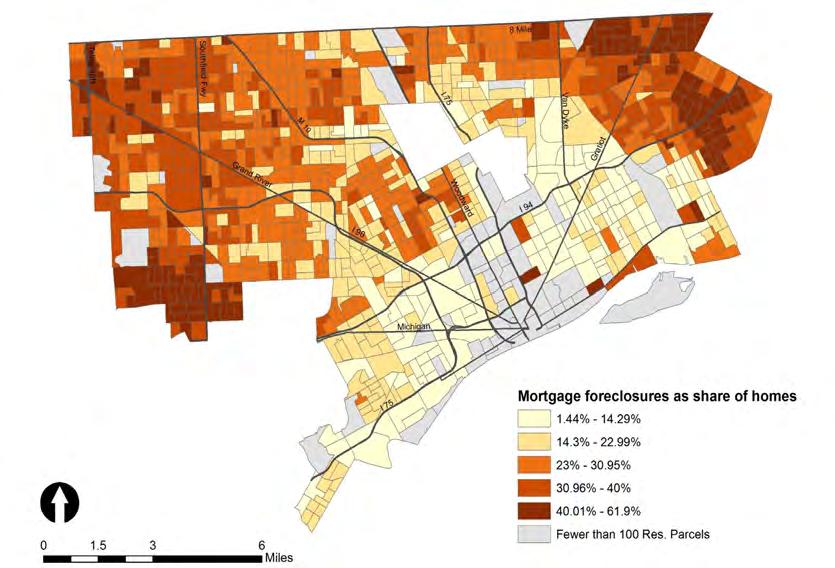
Mortgage foreclosures hit Detroit especially hard after 2005, further contributing to neighborhood destabilization. Foreclosures, the recession, and drop in housing values accounted for weak housing markets by the later 2000s. Figure 3.4 shows the percentage of mortgage foreclosures from 2005 to 2013 as a share of all onefour unit residential structures in Detroit. From 2005 to 2013, there were over 78,000 mortgage foreclosures.7
Warrendale and MorningSide, like other similar neighborhoods in Detroit, experienced especially severe levels of mortgage foreclosures, resulting in many vacant homes.
Figure 3.4 Median Income in MorningSide (left) and Warrendale (right), 2010-2014
Figure 3.5 Mortgage Foreclosures as a Share of 1-4 Unit Residential Structures 2005-2013, by census block group, Detroit, Michigan
Source: Prepared by Eric Seymour for “Saving Detroit Neighborhoods from the Destruction of Mortgage Foreclosures,” presentation at the University of Michigan, March 2016.
Figure 3.6 Mortgage Foreclosures in MorningSide & Warrendale, 2005-2014
Sources: Social Compact. 2011. Mortgage foreclosures in Detroit 2005-10. Received from Michigan Community Resources; Wayne County Register of Deeds. 2008-13.Selected property transactions [data file].
Source: Detroit Board of Realtors, http://www.mirealtors.com/Housing-Statistics.
Figure 3.7 Year to Date Average Home Sales Price in Detroit
Source: Wayne County Register of Deeds. 2008-13. Selected property transactions [data file]. Received from Michigan Community Resources and from Data Driven Detroit.
Figure 3.8 Average Housing Price for Warranty Deed Sales in MorningSide and Warrendale
There were a total of 4,227 residential structures in MorningSide and 7,915 in Warrendale in 2014. Thus at their peak in 2007, mortgage foreclosures affected 11 percent of MorningSide residential structures and almost 9 percent of those in Warrendale.
The mortgage foreclosures and the recession caused a decrease of 85 percent in Detroit home sales price between 2002 and 2009. As of 2014, sales prices have recovered to about 59 percent of their 2002 value (Figure 3.8).
Figure 3.9 Number of Tax Foreclosures in Detroit, 2002-2013
Source: Data Driven Detroit, 2002 - 2013.
Source: Detroit Land Bank Authority. 2016. Property Inventory and Activity Report 4/19/16. Received from Detroit Land Bank Authority.
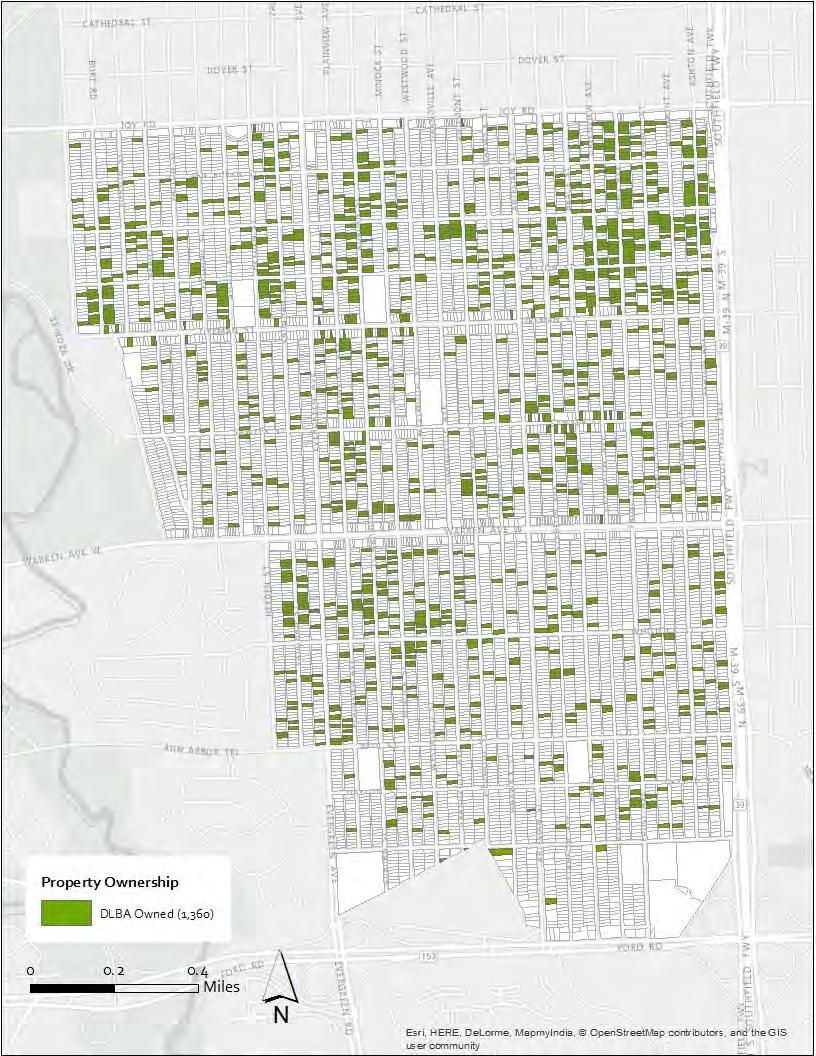
3.10 Detroit Land Bank-owned properties in
Figure
Warrendale
Source: Detroit Land Bank Authority. 2016. Property Inventory and Activity Report 4/19/16.
Figure 3.11 Detroit Land Bank-owned Properties in MorningSide
Housing prices fell considerably in MorningSide and Warrendale over the past decade (Figure 3.8). Properties sold through warranty deeds represent the strongest part of the housing market (1,369 out of 6,581 units in Warrendale and 833 out of 1,976 units in MorningSide). These sales do not include 1,435 units in Warrendale and 410 structures in MorningSide that sold at much lower prices through quit claim deeds.
Tax foreclosures have severely affected Detroit, and large numbers of property owners have stopped paying their property taxes. In fall of 2015 alone, there were 24,950 properties up for sale through the Wayne County Tax Foreclosure Auction.8
In Warrendale, there were 620 tax foreclosures in 2015. Of those, 251 were sold at the Wayne County Auction, and the remaining 369 were transferred to the DLBA. In MorningSide, there were 363 tax foreclosures in 2015. Of those, 118 were sold at the Wayne County Auction, and the remaining 245 were transferred to the DLBA. 9
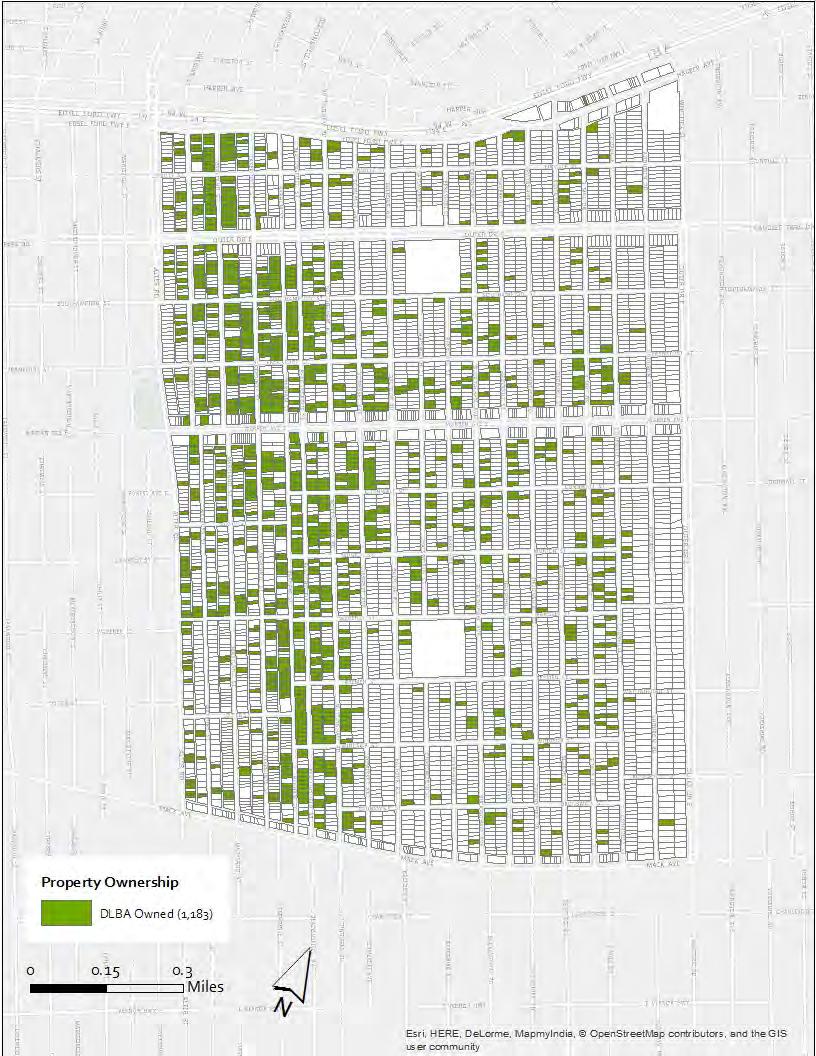
The DLBA’s inventory continues to grow with increasing foreclosures. As of April 2016, the DLBA owned 1,183 properties in MorningSide and 1,360 properties in Warrendale.10 These holdings represent 21 percent of the parcels in Morningside and 15 percent in Warrendale.
Implications for the Detroit Land Bank Authority
Following the 2015 Wayne County tax auction, the DLBA received 15,392 unsold properties.11 There were 175 properties transferred to the DLBA in MorningSide after 2015 and 370 in Warrendale in the 2015 auction alone. The next chapters suggest ways to strengthen the sales of four DLBA programs in this type of neighborhood so that the DLBA can keep up with the growing supply of properties.
Notes
1. Detroit Future City. 50 Year Land Use Map. 2014. Retrieved from http://detroitfuturecity.com/wp-content/ uploads/2014/02/DFC_LandUse_2ndEd.pdf
2. Social Explorer Tables: ACS 2014 (1-Year Estimates) (SE), ACS 2014 (1-Year Estimates), Retrieved from Social Explorer; U.S. Census Bureau
3. Social Explorer Tables: ACS 2014 (1-Year Estimates) (SE), ACS 2014 (1-Year Estimates), Retrieved from Social Explorer; U.S. Census Bureau; Social Explorer Tables (SE), Census 2000, U.S. Census Bureau and Social Explorer
4. Detroit Blight Removal Task Force. 2014. Detroit Blight Removal Task Force Plan. Retrieved from http:// report.timetoendblight.org/know/
5. Detroit Land Bank Authority. 2016. Property Inventory and Activity Report 1/7/2016. Received from Detroit Land Bank Authority
6. U.S. Census. 2000 Census, Profile of Selected Economic Characteristics: 2000 Census 2000 Summary File 3 (SF 3) - Sample Data, U.S. Census Bureau; 2010 Census, Income in the Past 12 Months (In 2010 InflationAdjusted Dollars) 2006-2010 American Community Survey 5-Year Estimates.
7. Lan Deng, Eric Seymour, Margaret Dewar, and June Thomas. April, 2016. “Saving Strong Neighborhoods from the Destruction of Mortgage Foreclosures,” unpublished paper. Received from author.
8. N. Kaffer September 20, 2015. Despite foreclosure auction, how can city help homeowners stay? Detroit Free Press. Retrieved from http://www.freep.com/story/opinion/columnists/nancy-kaffer/2015/09/19/ despite-foreclosure-auction-how-can-city-help-homeowners-stay/72408292/
9. Detroit Land Bank Authority. 2016. Property Inventory and Activity Report 4/19/16. Received from Detroit Land Bank Authority.
10. Detroit Land Bank Authority. 2016. Property Inventory and Activity Report 4/19/16. Received from Detroit Land Bank Authority.
11. Detroit Land Bank Authority. 2016. Wayne County Treasurer unsold transfer list 1/7/2016. Received from author.
CHAPTER 4: AUCTION PROGRAM
auCTion Program
Of the approximately 97,000 properties in the Detroit Land Bank Authority’s inventory, nearly 30,000 have residential structures. Due to high vacancy rates and low market demand, many of these structures have fallen into disrepair. The Detroit Land Bank Authority (DLBA) created the auction program in 2014 to sell vacant homes and return them to productive use, provide homeownership opportunities to Detroit residents, and reduce blight in neighborhoods. This chapter discusses the DLBA's auction process, program outcomes, and recommendations for improvement.
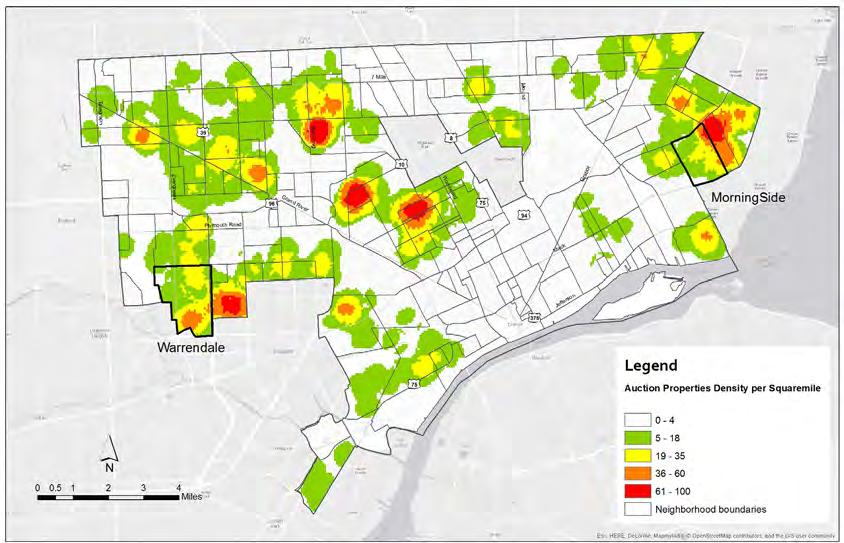
Figure 4.1 shows the geographic distribution of auction properties. The DLBA has auctioned properties in many parts of the city, and areas in red indicate a higher density of auction properties. Portions of MorningSide and Warrendale have seen significant auction activity relative to many parts of the city.
By January 2016, the DLBA auctioned over 900 individual properties. The recommendations below suggest how the auction program could be improved at each stage of the auction process, considering feedback from auction homebuyers, DLBA staff, and other partners as well as analysis of auction data and interviews with staff at the Cuyahoga and Genesee County Lank Banks.
Figure 4.1 Auction Property Density by Neighborhood, 2016
Source: Detroit Land Bank Authority, January 2016.
The following recommendations are organized by stages of the process:
Pre-Sale
• Enable auction purchasers to make better home-buying decisions by providing more information about the cost of rehabilitation and the likelihood of obtaining financing
• Notify neighbors and neighborhood organizations when offering a home at auction
• Host housing fairs to market Own it Now and auction properties
• Work with homeownership training programs to assure that homebuyers learn about construction and security
• Allow prospective buyers to tour auction homes as they can in Direct Sales properties
Sale
• Reduce number of auction properties in MorningSide and Warrendale and move more properties through Direct Sales
• Increase auction starting bid to $3,000
• Professionalize the open houses
Post-Sale Compliance
• Increase compliance period to nine months, if not longer
• Elicit feedback from purchasers via survey
Auction Process
Below is a truncated timeline that shows the ideal process for every auction transaction. However, as discussed later, obstacles prevent homeowners and the DLBA from completing this process within the intended timeframe.
•Sign-in visitors
• Allow visitors to tour house
(1 day)
• Openonline bidding
• Confirm winning bid
• Collect deposit
days)
•Sign Purchaser Agreement in DLBA office Compliance (180 days)
• Review monthly progress reports
• Confirm BSEED Certificate of Approval
Source: Detroit Land Bank Authority 2016. “Rules for Bidding on and Purchasing Properties” at BuildingDetroit.org.
Figure 4.2 Auction Sales Process
After DLBA staff reviews properties to determine if they are suitable for the Auction Program, staff then cleans out and posts the property information to buildingdetroit.org. The DLBA then holds an open house to allow prospective buyers to view the property before accepting bids on the auction date. In order to bid on a property, a potential purchaser must:
• Be either a Michigan resident, a non-Michigan resident who will live in the property after rehab, or a corporation registered in Michigan
• Have no unresolved blight or code violations in Detroit
• Have no unpaid delinquent property taxes on any properties within Wayne County (nor have lost a property to tax foreclosure in Wayne County within the last three years). 1
The minimum bid for auction properties is $1,000 but because many are in poor condition, auction properties often require substantial rehabilitation funds. After a property goes up for auction, there are four possible outcomes:
• Failed Auction: The property does not receive a bid
• Sold/Closed: The homebuyer successfully buys and closes on the property
• Failed Closing: The homebuyer wins the bid for a home but cannot close on it, often due to lack of financing
• Delayed Closing: The homebuyer receives an extension from the DLBA while seeking financing to close on the property
If the property fails at auction and if the buyer fails to close, the property remains under DLBA ownership. City of Detroit employees and retirees and first-time homebuyers who attend a course with a certified home-buying counseling agency receive a discount on successful bids.
When purchasers successfully close on a property, they have six months to bring the property up to code as stipulated by the City of Detroit’s Buildings, Safety Engineering and Environmental Department (BSEED); this six-month timeframe is the DLBA’s standard compliance period. The homebuyer signs a Purchaser Agreement stating that the property owner is responsible for providing evidence to the DLBA that he or she is progressing on rehabbing the property.
During the compliance period, the DLBA classifies properties into the following categories:
• Compliance Review: The property is in the renovation process and is being monitored by the DLBA compliance team
• Compliance Achieved: The owner successfully brought the home up to code according to BSEED
• Potential Reconveyance: The property owner is approaching or has surpassed the compliance deadline without making adequate progress on renovations
• Reconveyance Complete: The property reverted to DLBA ownership because the owner did not meet the stipulations in the Purchaser Agreement
Recommendations
While one of the DLBA’s main goals is to scale up disposition programs, some programs cannot both expand and stabilize neighborhoods concurrently. The auction program has lost some momentum since it launched. In order to prepare potential homebuyers to be responsible neighbors, the recommendations focus on educating them, and ultimately reducing the auction program to improve the effectiveness of the auction sales therefore improving the overall neighborhood.
Pre-sale
The following recommendations address several challenges experienced by the DLBA, auction homebuyers, and community organizations, including:
• Persistent problems achieving compliance
• Homebuyers’ lack of information about the cost of rehab and available resources
• Community organizations’ desire for more involvement and transparency with the auction process
Enable auction homebuyers to make better decisions by providing more information about the cost of rehabilitation and the likelihood of obtaining financing
Providing more precise cost estimates and financing prospects to auction homebuyers up-front could improve closing rates and compliance outcomes. This recommendation would especially assist the numerous first-time homebuyers with limited construction and home rehabilitation experience.
The DLBA can provide homebuyers with more information through either:
• Information about the average rehabilitation costs for auction homebuyers (see Figure 4.3)
• Specific information to homebuyers, including the costs broken down by type of repair and square footage
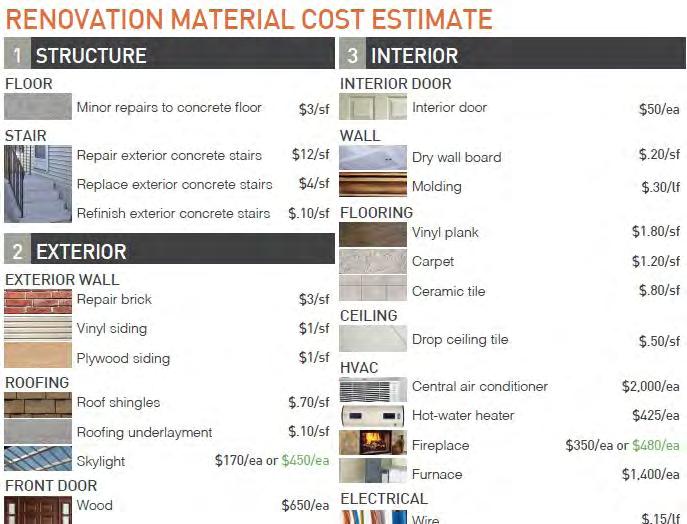
Source: Bails et al., Stabilizing MorningSide, University of Michigan, 2015.
The DLBA provided detailed cost estimates for over 80 properties in the city. Homes with cost estimates sold for less than properties without such estimates in the same neighborhoods. In Boston Edison, for example, homes with cost estimates sold for over $11,630 on average while homes without cost estimates sold for about $36,000. In East English Village, homes with cost estimates sold for nearly $11,000 compared to $13,670 for homes without cost estimates. 2 This might indicate that once homebuyers understand the cost of rehabbing a home, they reduce their bids to ensure they can also cover the rehab costs. However, homes with cost estimates were also less likely to close after sale across the city.
The inability to close on a property could be linked to financing barriers. Interviewees often expressed frustration over their inability to obtain financing for their home rehabilitation projects. In MorningSide and Warrendale, homebuyers often expected additional assistance from the DLBA to secure financing, including access to mortgage products offered in partnership with financial institutions. Even as these partnerships offer increasingly innovative products, the DLBA website could explicitly state that purchasing a DLBA home does not guarantee homebuyers a mortgage . According to an auction homebuyer in Warrendale:
Figure 4.3 Example of cost estimates for home renovations
“I did seek some support from every place that’s listed on the website, none of which I had any success with at all.… It was very, very frustrating because the advertisements make it sound like ‘we’re here to help you,’ but that’s not what I got from it. The answers that I got were ‘we can’t help you.’ I think that they should advocate a little bit more for you being able to finance your project yourself, instead of advocating that we have these different facilities that are here to help you, because for me they weren’t.”
Although many other land banks nationally also have no formal income or credit requirements to purchase homes, many provide more detailed information about costs and ensure homebuyers can afford the rehabilitation. The Cuyahoga County Land Bank, for example, provides prospective homebuyers with detailed “spec sheets” that include cost estimates for rehabilitation.
Notify neighbors and neighborhood organizations when offering a home at auction
The Cuyahoga County Land Bank sells properties through two means primarily—by renovating and then selling homes or by selling homes for homebuyers to renovate. When sold before rehabilitation, Cuyahoga provides prospective homebuyers with detailed “spec sheets” that include cost estimates for rehabilitation. These spec sheets can exceed 25 pages in length, and examine an extensive number of potential home repairs by room, including:
• Carpentry
• Roofing
• HVAC
• Electrical
• Paint and wallpaper
• Plumbing
• Flooring
• Ceramic
• Drywall
Cuyahoga provides spec sheets to ensure that homebuyers have the resources to rehabilitate homes. Additionally, Cuyahoga conducts walk-throughs with potential buyers to further facilitate cost awareness.
Neighbors and neighborhood organizations are an underused asset for the DLBA. Residents and leaders of neighborhood organizations want to be involved in the auction process. Notifying neighborhood organizations about an upcoming auction sale a month before an auction would accomplish several things, including:
• Allow neighbors and community organizations to market auction homes to responsible homebuyers
• Broaden the DLBA’s marketing reach in a cost-effective way
• Provide residents with more information about DLBA properties
Auction mailings could contain information about the open house and auction date, and provide instructions for how to bid on the property. Neighbors and community organizations can then communicate that information to potential buyers, as they are most invested in the success of the neighborhood. For example, according to a MorningSide neighborhood organization member, the organization has 400-500 members on their email listserv. With one email, potentially hundreds of residents can promote auction properties and protect
Source: Cuyahoga Land Bank staff, April 2016
homes against vandalism. Additionally, interviewees in MorningSide and elsewhere mentioned a willingness to provide information at open houses that the DLBA contractors who operate the open houses cannot, including details on the neighborhood’s assets, history, and organizations.
Host housing fairs to market Own it Now and Auction properties
The DLBA could host housing fairs to provide information about homes for sale through the DLBA and connect residents with homebuying resources, especially those residents less comfortable with the DLBA’s web-based auction interface.
To accomplish these goals, the DLBA could either:
• Host its own housing fair by council district
• Partner with existing housing fairs
Host own housing fair
DLBA staff could host housing fairs by council district to provide a venue for potential homebuyers to learn about the different stages of the auction process. These housing fairs could:
• Specifically address DLBA sales process
• Operate in conjunction with the auction open house
Partnering with organizations that could be involved in every stage of the sales process could allow interested homebuyers to learn what is necessary to be a successful homeowner. If partners are available in pre-sale, sale, and compliance periods, then homebuyers could learn the auction process step-by-step, including:
• Pre-sale: Financing options and the cost of rehab
• Sale: Bidding and closing
• Compliance: Permitting process, home rehabilitation, and contractor protocol
Possible partners include:
Pre-sale: housing counselors, lenders, the City of Detroit


Sale: Neighborhood Associations
Compliance: home repair retail stores, community rehabbers, historic preservationist


Join an existing housing fair
Similar housing fairs already exist in Detroit. The 8-Mile Boulevard Association, for example, will host a housing expo in May 2016. The expo features vendors and seminars to educate interested homebuyers. The DLBA would benefit from this model if they held their own housing fair or attended an existing housing fair.
Work with homeownership training programs to assure that homebuyers learn about construction
Many homebuyers need ongoing housing education. While auction homebuyers are often responsible for home rehabilitation, a significant number have no previous experience. The homeownership training curriculum often does not include home rehabilitation. Homeownership training programs could incorporate information about dealing with contractors, obtaining bids, and other construction basics. The Planning and Development Department website provides a list of approximately 34 contractors that can be provided to homeowners.
The University of Michigan Detroit Center runs a real estate essentials course through the Technical Assistance Center (TAC) with the goal of equipping residents with the skills to “use real estate investment as a tool for neighborhood stabilization.” The course is open to anyone and costs $100 for five, 3-hour classes. The course teaches students to:
• Create a pro forma that includes renovation costs • Develop a common vocabulary for working with contractors, and • Obtain resources to rehab a home.
During class, more experienced students share estimates and information that they learned from working with contractors. The TAC also provides both insession and ongoing technical assistance to participants. In 2015, 34 students graduated from the program, and at least five have purchased homes. However, TAC staff determine success not only by how many students buy homes, but also by how many learned that they do not have the financial means to make such a commitment. Housing counseling agencies can learn from this model and replicate it, either in part or in its entirety, in their workshops.
Allow prospective buyers to privately tour auction homes as they can Direct Sales properties
Most auction homebuyers interviewed lamented being unable to see the homes that they purchased as open houses are offered only once per property. Additionally, they mentioned that they had trouble visiting all of the open-house homes in one day as the properties were spread throughout the city. Homes purchased through the Direct Sales program are available to view via private tour three times per week, at a cost of $35 to viewers. Following the open house but before the auction date, potential auction homebuyers could tour auction homes under the same terms.
Sales
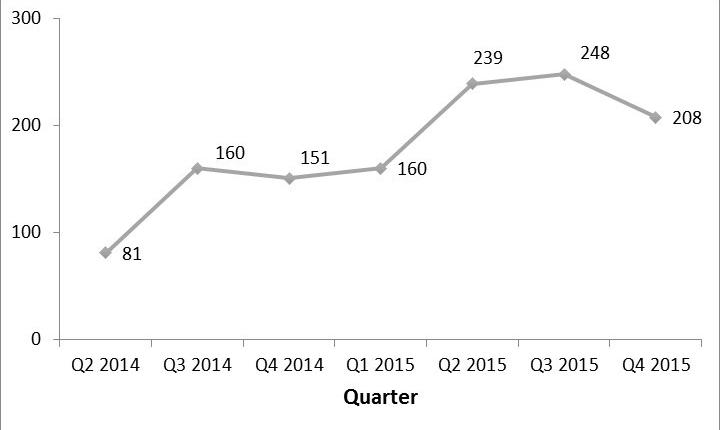
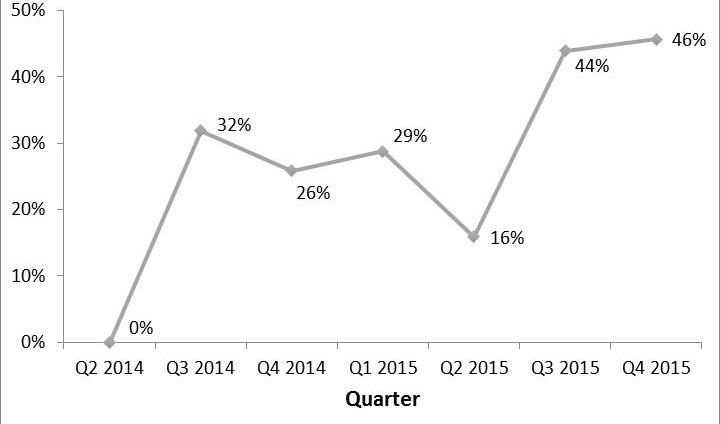
As the DLBA’s capacity has increased, so have the number of properties that have been put up for auction. However, the percentage of auctions that fail has increased with sale attempts. Notably, auction properties received zero bids roughly 45 percent of the time in the third and fourth quarters of 2015.
Source: Detroit Land Bank Authority, January 2016.
Source: Detroit Land Bank Authority, January 2016.
Auction properties put up for auction across the city sold 70 percent of the time, but this varied by neighborhood. By January 2016, the DLBA had put a total of 1,251 properties up for auction, with 29 in MorningSide, and 61 in Warrendale. MorningSide properties saw considerably more interest than the city on average, with all but one property (93%) receiving a successful bid. In contrast, Warrendale homes received bids only 52.5 percent of the time.
Figure 4.4 Number of DLBA Auction Attempts by Quarter, 2014-2015
Figure 4.5 Percent of Failed DLBA Auctions by Quarter, 2014-2015
Detroit#MorningSide#Warrendale# Sold/Closed# Failed#Closing# Delayed#Closing# Failed#Auction#
Sources: DLBA Salesforce, January 2016
Reduce number of auction properties in MorningSide and Warrendale and sell more properties through Direct Sales
Due to the high cost of the auction program, low numbers of sales, and high rates of failed sales and failed closings in certain neighborhoods, the DLBA could focus the Auction Program to areas of the city with greater market strength, and move more properties in other neighborhoods to Direct Sales (see Chapter 5).
Forty-one percent of auctions in MorningSide and 56 percent in Warrendale were failed auctions or failed closings. This resulted in most of these homes going up for auction again. Across the city, properties fail to sell at auction about 30 percent of the time , and fail to close nearly 18 percent of the time.
Combined with the low sale prices, this suggests that the DLBA is likely not breaking even on auction sales in these two neighborhoods.
Two property characteristics in particular determine whether or not a home sells: • Condition • Size
In determining which homes to move to auction, the DLBA could consider how property and block condition influence sales price. Table 4.1 shows that properties in good condition on good blocks sold at higher prices. In MorningSide the
Figure 4.6
DLBA Auction Results by Neighborhood, 2014-2016
Chapter 4 Tables
Table 4.1: MorningSide Sale Information by Property and Block Condition
Chapter 4 Tables
Condition (Property/Block)
average sale price for a good property on a good block is six times more than a fair home on a good block. On average in Warrendale, a good home on a good blocks sells for three times as much as a fair home on a good block. 3
Table 4.1: MorningSide Sale Information by Property and Block Condition Condition (Property/Block)
Table 4.1 MorningSide Sale Information by Property and Block Condition
Table 4.2: Warrendale Sale Information by Property and Block Condition
Source: Field Work, February 6th, 2016
(Property/Block)
Table 4.2: Warrendale Sale Information by Property and Block Condition
Source: Field Work, February 6th, 2016 4
Condition (Property/Block) Number Sold Percent Sold Average Sale Price Good/Good 12 50 $6,408
Table 4.3. Auction Sales Prices for Detroit, MorningSide, and Warrendale
In addition to housing condition, larger home size and a higher owner neighborhood occupancy rate were associated with a greater likelihood of sale and a higher sale price. 5 For example, in Warrendale a home with 850 square feet and average neighborhood conditions was likely to sell 58 percent of the time at first auction whereas a 1,200 square-foot home was likely to sell 69 percent of the time. By January 2016, the DLBA had offered seven homes that were over 1,200 square feet for auction in Warrendale. These factors also significantly influenced the sale price for auction properties. For example, a 100-square-foot increase in the size of a home was associated with a $128 increase in the home’s sale price, holding constant the home’s condition and neighborhood characteristics. Homes in good condition sold for $4,281 more than homes in poor condition, holding constant the home’s size and other characteristics.
MorningSide Warrendale
Table 4.2 Warrendale Sale Information by Property and Block Condition
P
Table 4.3. Auction Sales Prices for Detroit, MorningSide, and Warrendale
Detroit MorningSide Warrendale Average Sale Price $6,982 $5,693 $3,815 Percent Sold for $2,500 or Less 42 73 50
Percent Sold for $1,000 or Less 26 60 25
Table 4.4: DLBA Sold/Closed Properties in Compliance Process, January 2016
Increase auction starting bid to $3,000
Number of Closed Properties 587 15 24
MorningSide Warrendale
Average time (in days) in compliance process
Increasing the minimum auction bid accomplishes two goals:
Percent of properties in compliance process:
• Recover the average cost of $2,500 of preparing a home for auction • Signal to purchasers that buying an auction home requires substantial investment immediately after purchasing
Table 4.4: DLBA Sold/Closed Properties in Compliance Process, January 2016
Detroit MorningSide Warrendale
Average time (in days) in compliance process
of properties in compliance process:
According to DLBA staff, it costs $2,500 on average to prepare a property for auction, including cleaning the interior and exterior of the home, holding the open house, and quieting title. In MorningSide and Warrendale, 73 and 50 percent of properties, respectively, sold for under $2,500 (see Table 4.3). Forty-two percent of properties across the city sold for less than $2,500.
Table 4.3 Auction Sales Prices for Detroit, MorningSide, and Warrendale
Figure 4.7 DLBA Auction Properties Sale Price for Sold and Closed Homes, 2014-2016
Table 4.3. Auction Sales Prices for Detroit, MorningSide, and Warrendale
Source: Detroit Land Bank Authority, January 2016
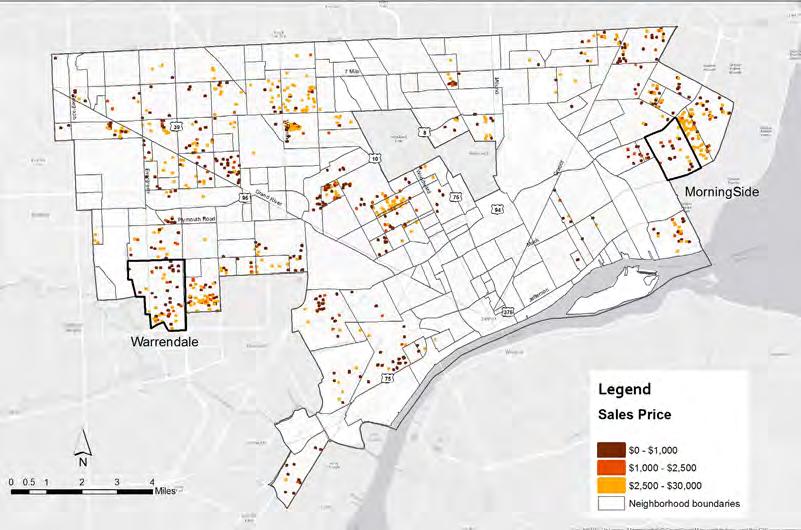
Source: Detroit Land Bank Authority, January 2016
Increasing the minimum bid to $3,000 would allow the DLBA to recover the money used to prepare the home for auction. An increased price may reduce demand, however, it will also send a signal that this home requires a larger investment and discourage buyers who are unable to afford the high cost of renovation. Many purchasers can afford the $1,000 minimum bid but are surprised that the home requires costly repairs, and thus they are unable to complete renovation. If a bidder invests more in the home from the start, then he or she may be more likely to complete the renovation.
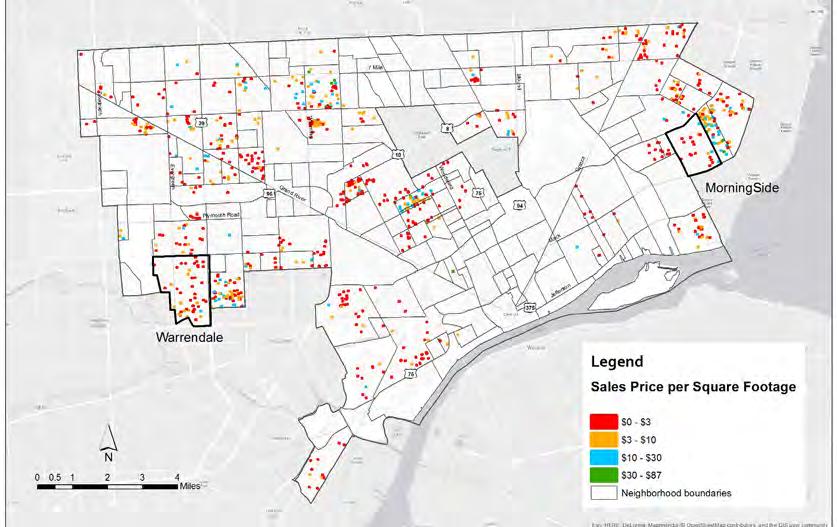
As shown in Figure 4.8, most auction properties in MorningSide and Warrendale sell for less than $3 per square foot. The average price per square foot for auction properties in MorningSide and Warrendale is $3.60 and $3.80 respectively, while the citywide average price per square foot is $4.80.
Source: Detroit Land Bank Authority, January 2016
Professionalize the open houses
The DLBA pays contractors to attend open houses and collect contact information from visitors . The DLBA could expand contractors’ responsibilities to align more closely with those of a real estate agent in the private market. Real estate agents do extensive research on the home’s “specs” and on neighborhood assets to increase interest in the homes and encourage bids. Their job includes answering prospective homebuyers’ questions and concerns, highlighting strong institutions and networks in the neighborhood, and following up with visitors. DLBA contractors are not well-informed about the properties, the neighborhood or the auction process, and they dress unprofessionally and do not engage visitors. The DLBA inventory team could provide contractors with the following information:
• Year home was built
• Lot dimensions
• Construction materials
• Auction process details
• Square footage
• Nearby schools and parks
• Neighborhood organizations
Answering prospective buyers’ questions and addressing concerns in a professional manner may entice them to bid.
Figure 4.8
DLBA Auction Sales Price Per Square Foot, 2014-2016
Figure4.9 DLBA Compliance Process Status for Sold/Closed Auction Properties
Chapter 4 Tables
Compliance
Table 4.1: MorningSide Sale Information by Property
Among properties that sold and closed, the majority remained in compliance review as of January 2016. Only 40 auction properties in Detroit had achieved compliance by that time (Figure 4.9).
Because of the difficulty rehabbing homes within the six-month compliance period, the DLBA frequently grants extensions to homebuyers. One DLBA staff member estimated that more than half of homebuyers received an extension. Nearly all interviewees had difficulty achieving compliance due to problems with financing, security, and cost of rehabilitation. Throughout the city, 60 percent of auction homebuyers were in the compliance process for over 6 months, as of January 2016 (Table 4.4). Properties that reached compliance did so in about 293 days on average.
Table 4.4 DLBA Sold/ Closed Properties in Compliance Process, January 2016
Source: Detroit Land Bank Authority, January 2016.6
Table 4.4: DLBA Sold/Closed Properties in Compliance Process, January 2016
Source: Detroit Land Bank Authority, January 2016.
Homebuyers who closed on their properties faced numerous obstacles to achieving compliance within six months. Though not exhaustive, the list of recurring obstacles discussed in interviews includes:
• Difficulties self-financing the purchase and home rehab projects
• Minimal reliance on contractors to keep costs down
• Vandalism and theft
• Unanticipated renovation costs
Interviewees in MorningSide and Warrendale used a combination of student loans, credit card debt, savings, and other personal income to finance their projects. To keep costs down, purchasers rehabbed the property on their own or enlisted the help of close associates . Unanticipated setbacks in the rehab process exacerbated these obstacles. According to one respondent in Warrendale:
“I didn’t anticipate having to completely redo the plumbing and the drain out to the sewer.… There have been numerous setbacks since the additional issues with the plumbing. I mean, a contractor I hired to do the masonry work fell ill and ended up in the hospital. So yeah there have been a number of setbacks, such that it doesn’t look like it’s going to be possible any more to get it done in that [six month required] timeframe. ” According to one DLBA staff member, “The only way you can do it in 6 months [obtain compliance] is if you have the money and you already have a contractor” lined up at closing.
Increase compliance period to nine months if not longer
The many obstacles to achieving compliance within 6 months likely deter auction homebuyers, especially when paired with the strong language of the purchase agreement. One Warrendale homebuyer stated, for example:
That the six-month compliance deadline “was my biggest concern buying the house. That was the number one reason I almost didn’t.… Even walking into the closing, somebody could’ve said just about anything, and I would’ve turned around and let the deposit go and walk away. If they said you would have a year to do it I would have jumped on it enthusiastically and said okay I can do that. But constraining it to six months I knew that would be a challenge. It did really just about prevent me from buying the house.”
The 6-month compliance period exists to accelerate the rehabilitation process and ultimately benefit neighborhoods. However, the DLBA weakly enforces the deadline. Some homebuyers are aware of this lax enforcement and act accordingly, while others are left unaware. The proposed extension of the compliance deadline reflects how the compliance process functions in practice, while removing disincentives for purchasers.
Elicit feedback from purchasers via survey
Interviewees frequently expressed a desire for more consistent communication with the DLBA and the opportunity to provide feedback on their experiences. Mailed and emailed surveys at closing and upon achieving compliance would allow homebuyers to be heard and provide the DLBA with information about homebuyers’ experiences that can improve the auction process.
Surveys could ask homebuyers about their:
Costs and Renovations: to gauge whether or not the estimates of rehab costs and actual costs are aligned. If not aligned, the DLBA could consider better ways to communicate renovation costs
• Anticipated rehab costs at purchase
• Actual rehab costs to date
• Unanticipated setbacks
Detroit residents and community organizations value owner-occupant over investor auction homebuyers due to a long history of absentee landlords and harmful speculation. In MorningSide, 73 percent of auction purchasers are owneroccupants compared to 62 percent in Warrendale. However, across the city, investors and homeowners close on properties and maintain homes at similar rates. The only notable difference is the larger percentage of properties purchased by investors that have been in the compliance process for over one year.
Overall Experience: to gauge what parts of the auction process are working and which can be improved and whether satisfaction varies by homebuyer experience
• Satisfaction with the program and the home
• Recommendations for improvement
• Whether they are first-time homebuyers
Notes
1. Detroit Land Bank Authority “Rules for Bidding on and Purchasing Properties.” Retrieved from http:// auctions.buildingdetroit.org/TheRules.
2. Detroit Land Bank Authority. 2016. Property Inventory and Activity Report 4/19/16. Received from Detroit Land Bank Authority.
3. Rankings based on Motor City Mapping checklist. See Appendix B.
4. Between 70 and 100 percent of properties on “good” blocks were in good condition, between 40 and 70 percent were in good condition for “fair” blocks, and under 40 percent of homes on “poor” blocks were in good condition.
5. Estimates of likelihood of sale were derived from a probit model that evaluated what measurable factors best predicted whether or not auction properties sold. The model considered both property and neighborhood characteristics, and used neighborhood fixed effects to control for unobservable variation at the neighborhood level that does not change over time. The sales model regressed sale price on the same set of independent variables and using the same neighborhood fixed effects.
6. Other categories include reconveyance complete, community partner hold, direct sale review, and auction pipline.
CHAPTER 5: OWN IT NOW PROGRAM
oWn iT noW Program
From 2014 to 2016, auctions have been the Detroit Land Bank Authority’s (DLBA) main program to return homes to productive use. However, as the previous chapter noted, the DLBA could limit the Auction program in mid-market areas like MorningSide and Warrendale while scaling up other sales programs like Own It Now – the Direct Sales program. The DLBA has nearly 30,000 residential structures in its inventory, but offers about three properties per day through the Auction program.1 Direct Sales is both less time-intensive and less costly to the DLBA than the Auction program, and as such is attractive for its potential to move properties more quickly back to the market. As Direct Sales is still in its infancy, an evaluation of the program must consider the program’s potential long-term impact, strengths, and weaknesses.
By March 2016, the DLBA had sold and closed on only 58 Direct Sales properties2 but has the potential to expand the program rapidly over the next several years. This chapter presents the following recommendations:
• Include the cost of clear title in the purchase price of the home
• Prioritize property inquiries from neighbors by moving those properties more quickly through intake review
• Scale up the Own It Now program
• Consider alternative sales programs
Source: Detroit Land Bank Authority. 2016. “Rules for Bidding on and Purchasing Properties” Retrieved from BuildingDetroit.org.
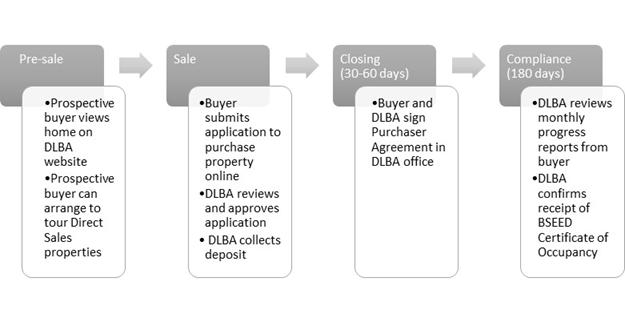
Own It Now: Direct Sales Process
Figure 5.1 Timeline of Direct Sales Process
Pre-Sale
Direct Sales properties are available to purchase as soon as the DLBA moves the property through intake, sets a price, and posts the property information online. The DLBA offers properties through Direct Sales if the neighborhood and property condition, which is determined at intake, make them unlikely to sell at auction. The DLBA also places priority on:
• Resident requests to purchase a property
• Resident requests to purchase a property slated for demolition
For Direct Sale properties, the DLBA does not clean the house, hold an open house, or guarantee clear title. To view a Direct Sales property, prospective homebuyers may contact the DLBA and arrange a $35 private showing.
Sale
The DLBA aims to offer 60 new properties per month, or 720 per year, through Own It Now on their website. Purchasers may pay the DLBA $125 for a title search to see if any interests or liens against the home would cloud the title. Purchasers have the option to “quiet title,” meaning the title holder initiates a lawsuit to clear any “outstanding claims” on the title.3 A successful quiet title action eliminates competing interests or claims on the property, outstanding non-federal liens, or back taxes owed, and is necessary to qualify for a mortgage from most banks. An unsuccessful quiet title action identifies other interests in the property 4 If a property came to the DLBA after going through tax foreclosure, the back taxes, utility bills, and non-federal liens should already be extinguished.
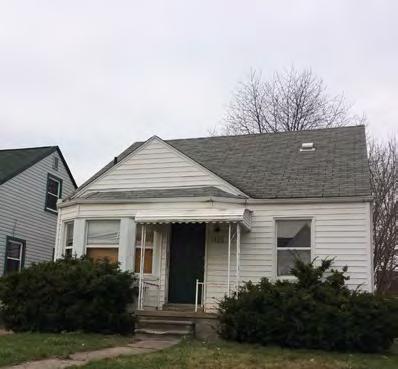
Figure 5.2 Example of a Direct Sale Home
Direct Sales purchasers must meet the same eligibility requirements as the Auction program. These requirements seek to ensure that the DLBA confers property to responsible homebuyers and investors. For example, Direct Sales purchasers must:
• Be either a Michigan resident, a non-Michigan resident who will live in the property after rehab, or a corporation registered in Michigan
• Have no unresolved blight or code violations in Detroit
• Have no unpaid delinquent property taxes on any properties within Wayne County (nor have lost a property to tax foreclosure in Wayne County within the last three years)5
Post-Sale
To ensure homebuyers adequately rehabilitate Direct Sales properties after purchase, the DLBA requires the property’s rehabilitation within six months. Otherwise, the property reverts to DLBA ownership. The DLBA and the city’s Buildings, Safety Engineering and Environmental Department (BSEED) specify and communicate these standards through the Purchaser Agreement.6
As of March 2016, properties purchased through Direct Sales were in one of several compliance categories:
• Compliance Review: The property is in the renovation process and is being monitored by the DLBA compliance team
• Compliance Achieved: The owner successfully brought the home up to code according to BSEED
• Potential Reconveyance: The property owner is approaching or has surpassed the compliance deadline without making adequate progress on renovations
• Reconveyance Complete: The property reverted to DLBA ownership because the owner did not meet the stipulations in the Purchaser Agreement
The State of Direct Sales
The Direct Sales program has operated at a small scale. Between June of 2014 and March 2016, the DLBA sold and closed on 58 Direct Sales properties for just over $1,500 on average. Half of those properties sold for $1,000 or less, while only eight properties sold for over $2,500. Eighteen additional properties had delayed closings or were still in the process of closing.
By March 2016, 52 of the properties that sold and closed remained in compliance review while three had achieved compliance. Properties still in the compliance process had been in the compliance process for nearly 274 days, on average. Thirtynine of the 52 properties (75%) had been in the compliance process for more than six months. Direct Sales homebuyers likely have similar issues as auction purchasers in obtaining compliance within the six month timeframe.
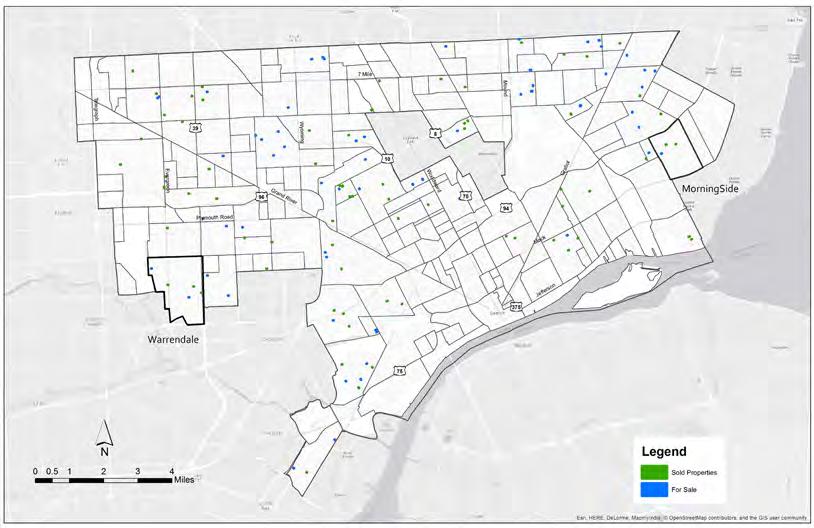
The DLBA also had 64 Own It Now properties available for sale as of March 2016. These properties are not highly concentrated in any one neighborhood. Figure 5.3 shows the distribution of properties for sale and those sold across Detroit. In Warrendale and MorningSide, only two and four properties sold, respectively, while only one property was available for purchase in each neighborhood.
Sources: Detroit Land Bank Authority, March, 2016
Figure 5.3 Direct Sale Properties Sold and For Sale, March 2016
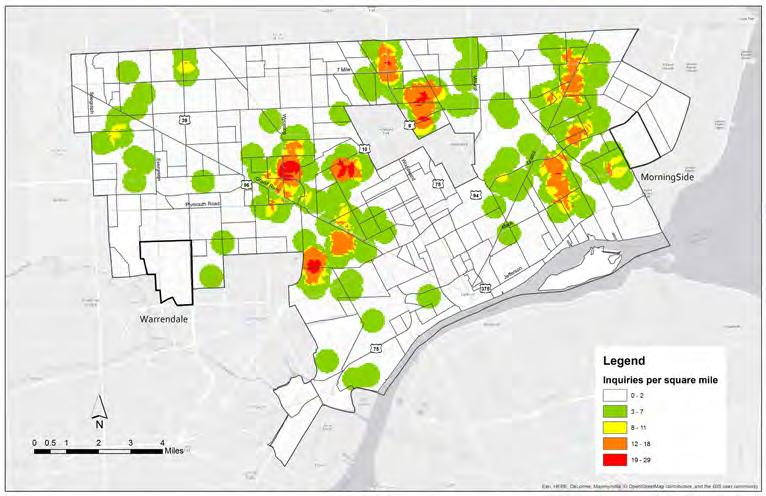
By April 2016, potential purchasers had inquired about 288 residential structures owned by the DLBA but not immediately available for sale, in most cases because the properties had not gone through intake review. These inquiries, or the DLBA’s tracking of inquiries, have increased over time; there were 123 inquiries in 2015 and 165 in the first quarter of 2016. Figure 5.4 shows the distribution of properties that someone has inquired about. The Northwest Community, Dexter-Linwood and Cadillac Heights are among the neighborhoods with the most inquiries about properties. There were no inquiries about properties in MorningSide or Warrendale.
Sources: Detroit Land Bank Authority, April 2016.
Figure 5.4 Density of Direct Sales Inquiries, Per Square Mile, 2015-2016
When prospective homebuyers call the DLBA about a property that the land bank owns, the DLBA records the date, contact information of the caller, and nature of the phone call, creating a list of inquiries. According to DLBA staff, when they consider properties for intake review likely to be sold through Direct Sales, they pull about 50 percent of the properties from this list of inquiries. Additionally, if the property is already on the DLBA’s demolition list, the DLBA will offer to sell the home to those who inquire about the property. To purchase a home on the demolition list, the homebuyer agrees to demolish the home on their own or rehabilitate the property if possible, at their discretion. The DLBA has sold 22 homes through Direct Sales from the demolition list.
Interested buyers have inquired about properties located near the site of the new international trade crossing, the Coleman A. Young Municipal Airport runway buffer, and other public projects. The DLBA’s review has the task of assuring that properties in the path of public and community projects are sold (or held) in a way that enhances future development opportunities and neighborhood livability. The importance of the coordination of sales with public plans is described in more detail in Chapter 8.
Recommendations
Pre-sale
Include the cost of clear title in the purchase price of the home
As the Direct Sales program grows, the DLBA could improve the likelihood that homebuyers achieve compliance by including the cost of clearing title in the purchase price and providing clear title before closing. While the resulting increase in the minimum price could deter purchasers, the benefits to a clear title for home purchasers include accelerated compliance processes and reduced risk of lawsuits from previous owners with an interest in the property. Banks often require property owners to have clear title to obtain home mortgages. The DLBA can clear title for $645 for the purchaser, whereas Direct Sales purchasers would pay almost double independently. If the Direct Sales program increases in scope, providing clear title might prevent problems for purchasers, help the homebuyer achieve compliance, and contribute to strengthening neighborhoods.7
Prioritize property inquiries from neighbors by moving those properties more quickly through intake review
Interviews with residents, including some auction homebuyers, revealed a desire to purchase the DLBA-owned home next door, across the street, or down the block. The DLBA provides no means for neighbors to purchase these properties, unless the DLBA has moved the property through intake review already and offered the home for sale via Direct Sales or Auction. The DLBA could allow homeowners and renters that live near DLBA-owned properties to purchase these homes more easily by prioritizing the homes at intake review.
For example, after a neighbor inquires about a property, the DLBA could request proof of residence, which can include a mortgage payment, utility bill, or stateissued ID After confirming residency, the DLBA could accelerate the review of the property, meaning the DLBA determines (based on location and property condition primarily) whether or not the home is appropriate for demolition, hold for another project, Direct Sales, or Auction. The DLBA would then notify the inquiring neighbor that the property is for sale and under what conditions.
Neighbor inquiries into a property represent an interested buyer who is also invested in the neighborhood’s success. As a result, prioritizing neighbor inquiries at intake review may help the DLBA sell more homes through Direct Sales, and ultimately help stabilize neighborhoods if the neighbors make productive use of the property.
Sales
Scale up the Own It Now program
Both the Cuyahoga and the Genesee County Land Banks rely primarily on direct sale programs, and they do not have an auction program. As stated in Chapter 4, narrowing the Auction program to higher value properties means increasing the Own It Now inventory. Because the Direct Sales program moves property directly to market without cleaning, clearing overgrowth, and other preparation, it could benefit neighborhoods by speeding up the sales process. Direct Sales also expands the amount of time a buyer has to view a home prior to sale as the buyer is not constrained to visiting a home the day of an open house. At the same time, we know that indiscriminate selling harms rather than helps neighborhoods, so purchasing and compliance requirements remain important.
To increase scale, the Direct Sale program could be marketed in a new way. The DLBA lists available properties by address on the Building Detroit website. Hosting or joining existing housing fairs (as recommended in Chapter 4) and expanded
marketing efforts, like providing a map of available properties on the website so prospective homebuyers can search more easily by neighborhood, could provide additional exposure to Direct Sale properties.
Expanding Own It Now has several possible disadvantages. For example, homebuyers may have difficulties obtaining financing, closing, and fully rehabilitating these homes, as they do when purchasing through auction. Direct Sales properties also sell for less and shift more of the cleanup and rehab burden to homeowners. For these reasons, the DLBA could consider alternative sales programs.
Consider alternative sales programs
Because of Direct Sales’ possible disadvantages, the DLBA could explore alternative sales methods for select properties. For example, residents and leaders of community-based organizations have suggested a possible new program that sits between Direct Sales and Rehabbed and Ready.8 This program would not fully rehabilitate homes like Rehabbed and Ready, but could renovate some of the major systems necessary to occupy the property as scrappers have vandalized many of these major systems, including HVAC, water heaters, appliances, bathroom tubs, and sinks. This systems-ready sales program makes renovation less daunting for purchasers who want to renovate homes but cannot take on the full cost of rehabilitation.
These renovations would likely cost between $15,000 and $25,000, which better aligns with values in mid-market areas.9 For instance, the average price for a warranty deed was just over $28,000 in MorningSide and $19,000 in Warrendale in 2013, as noted in Chapter 3.
The systems-ready program, however, shifts more costs to the DLBA which would need to obtain additional grant funding, as this would entail clearing out the property, securing it, and paying for systems installation. The DLBA will also learn more about the effectiveness of Rehabbed and Ready over time, and this will suggest whether a systems-ready program is necessary or viable.
Additionally, although major systems are often the highest-cost obstacle for new owners, neighbors highly value immediate improvements to the exterior. The DLBA could also consider a program that improves the exterior of the home before sale, including painting the home, installing new windows, and making minor façade improvements. Considering the analysis in Chapter 4 that shows that better home condition predicted a greater likelihood of sale, this exterior-improvement program might also result in more sales. This strategy would also cost significantly less for the DLBA relative to a systems-ready program.
The DLBA could pilot one or both of these programs in varied market and neighborhood contexts to determine if such programs improve property sales, compliance, and ultimately neighborhood livability.
Notes
1. Detroit Land Bank Authority April 14, 2016. “Detroit Land Bank Authority, Quarterly Report.” Retrieved from http://www.buildingdetroit.org/reports/city-council-quarterly-report/
2. Detroit Land Bank Authority. March 2016. Property Inventory and Activity Report. Received from Detroit Land Bank Authority.
3. Coenen, et al. April 2011. “From Revenue to Reuse: Managing Tax-Reverted Properties in Detroit.” Retrieved at https://taubmancollege.umich.edu/urbanplanning/students/student-work/master-urban-planning/ revenue-reuse-managing-tax-reverted
4. Alexander, Frank. July 1, 2011. “Land Banks and Land Banking.” Retrieved at http://action. communityprogress.net/p/salsa/web/common/public/signup?signup_page_KEY=7641
5. Detroit Land Bank Authority. “Rules for Bidding on and Purchasing Properties.” Retrieved at http:// auctions.buildingdetroit.org/TheRules.
6. For more details, see Chapter 4.
7. Alexander, Frank. July 1, 2011. “Land Banks and Land Banking.” p. 37.
8. Rehabbed and Ready is the DLBA’s new program where the land bank fully rehabs the property before the selling the move-in ready home. For more information see BuildingDetroit.com.
9. Johnson, Larry. April 2016. Interview with LifeBUIDLERS.
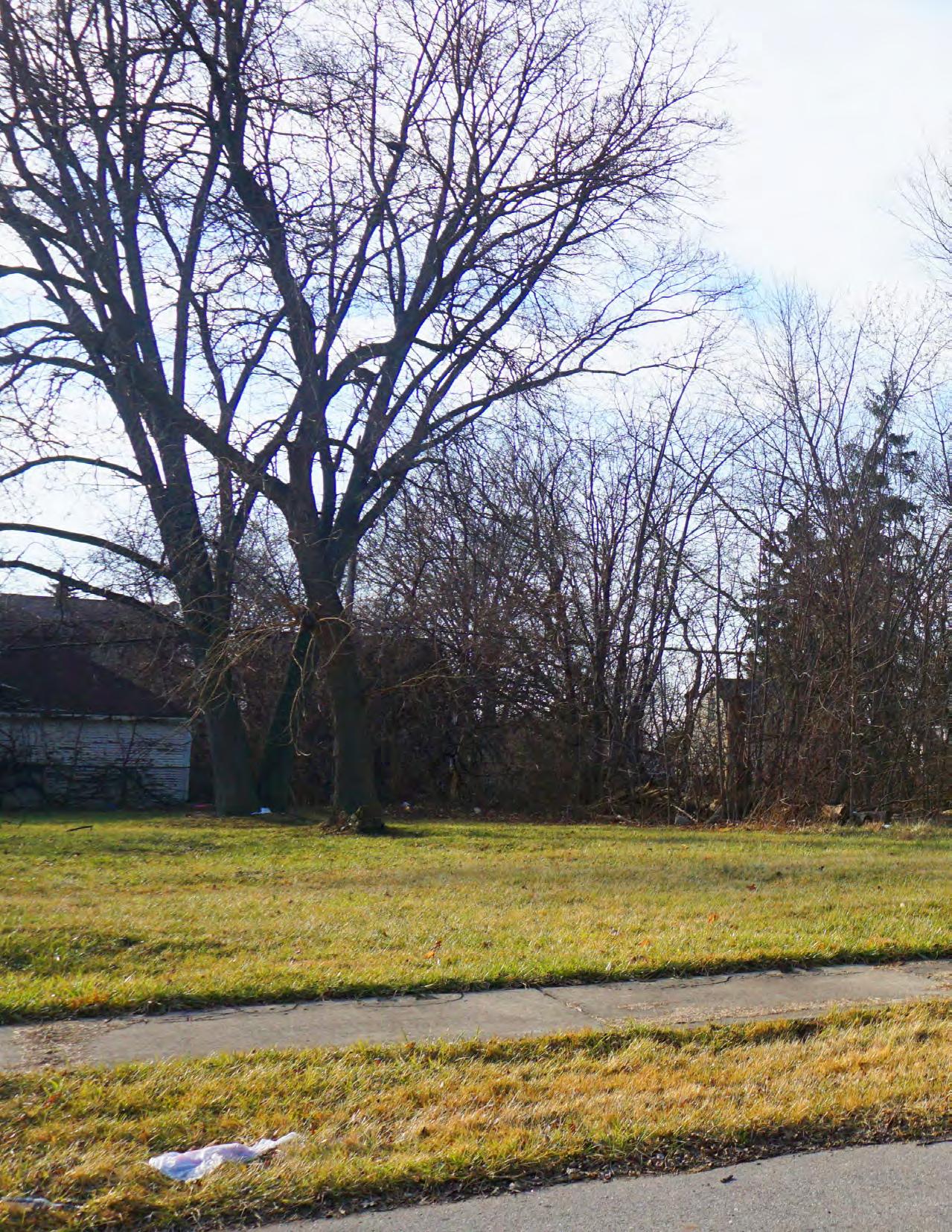
CHAPTER 6: SIDE LOT PROGRAM
As of April 19, 2016, the Detroit Land Bank Authority (DLBA) had 27,016 side lots for sale, representing about 28 percent of its overall inventory.1 Due to high vacancy rates, abandonment, and supported by a new allocation of Hardest Hit Funds, more structures will be demolished and converted into vacant lots, further increasing the number of lots available for sale. In order to return vacant lots to productive use, the DLBA created the Side Lot program to put vacant land back in the hands of residents. This chapter provides an overview of the DLBA’s Side Lot Program, an evaluation of the Side Lot sales process, and recommendations for returning these properties to productive use. All recommendations are presented by stage of the acquisition process: Pre-sale, Sale and Post-sale:
Pre-Sale
• Collaborate with neighborhood groups to promote side lot purchasing
Sale
• Provide property tax information
• Provide liability information
• Encourage side lot purchasers to submit plans when purchasing side lots
Post-Sale
• Improve access to side lot care resources
• Implement a clean and green program for side lots that do not sell
The DLBA sold the largest number of side lots (1,055) in the third quarter of 2015.2 Even if the DLBA consistently reproduced its best quarter, they would still need six and a half years to sell all side lots, assuming no new side lots went up for sale. However the speed of sale could decrease due to shrinking demand. For the March 19, 2016 Side Lot Fair in the west side of Detroit, a sample of 204 eligible purchasers in Warrendale received two postcards from the DLBA and one letter from the Warrendale Community Organization. However only three of those 204 eligible purchasers came to the Side Lot Fair and purchased side lots. As sales numbers are low, supply will continue to outpace demand. In light of this, recommendations were designed for achieving three goals:
• Lower the barriers to side lot purchasing
• Encourage positive uses of side lots
• Address an oversupply of vacant lots
Side Lot Program Process
Through the DLBA’s Side Lot program, owners of occupied residential properties can purchase adjacent side lots that are under 5,000 square feet for $100 (the price of lots over 5,000 square feet is determined at the discretion of the DLBA). Owners can live next to or across an alley from a side lot to be an eligible purchaser. The only requirement is that the two properties share at least 75 percent of a common boundary line on one side. In addition to owning an adjacent residential property, purchasers must be in good standing with their property side loTs
taxes, which means that the resident is either current on their property taxes or are on a payment plan.3
Residents purchase side lots in two ways:
1. Online at www.buildingdetroit.org: The DLBA posts side lots that are eligible for purchase on its website, where interested residents can search for side lots and purchase them. The DLBA alerts homeowners once when a lot next to their property becomes available by sending a postcard with side lot purchasing instructions to the property address.
2. At a Side Lot Fair: The DLBA hosts Side Lot Fairs on select Saturdays and the DLBA uses postcards to advertise these fairs to a few districts of Detroit at a time. Before the fair, residents who can prove that they have maintained their adjacent lot may purchase the lot before the fair through an online process. Figure 6.1 details the sales process at the side lots fairs. Third party resources from organizations like Detroit Future City are available at the fair. Side Lot Fairs are popular among residents and city administration, and the fairs have assisted in building goodwill between the DLBA and residents.
•

• Eligibility to Purchase
• Eligibility to Purchase
o Own the property adjacent to the side lot
o to the side lot
o Be in “good standing” with taxes
o taxes
• AvailableSideLots
o Visit website: http://www.building detroit.org/ourprograms/side-lot-sales/
o Call DBLA: 1-844-BUY-DLBA


• Maintain lot Sale Post-Sale Pre-Sale
Online:
Online:
• Complete application
• Submitpurchasing application
• Pay onlineorsend moneyorder
• Receive deed in mail or pick up at office
• application application Pay moneyorder or pick up at office
Fair:
Fair:
• Receivepostcard
• Attendfair
UseTransferring:
• Access resources
• Receive verification of eligibility
• Submit payment
• Attendfair of eligibility Receiveapplication
• Receiveapplication approval
Receive deed in mail
• Receive deed in mail or pick up at office
• Make improvements Maintenance
• Maintenance Maintain lot
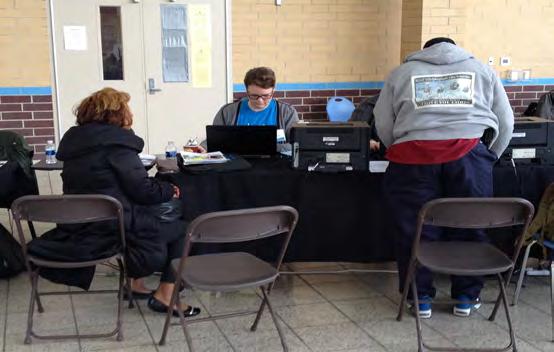
6.2 Residents waiting for application approval at March 19, 2016, side lot fair
Figure 6.1 DLBA Side Lot Sales Process
Figure
Figure 6.3 Number of Side Lots Sold by Month since Inception
The State of Side Lots in Detroit
From the program’s inception in July 2014 through mid-April 2016, the DLBA has sold 3,994 side lots citywide.4 Figure 6.3 shows the breakdown of side lot sales by month. As of April 19, 2016, the DLBA had 27,016 side lots for sale and an additional 30,699 vacant lots moving through DLBA review to determine if they should be sold as side lots.5 Figure 6.4 shows side lots sold, side lots for sale, and the vacant lots in the DLBA’s review process city-wide as of April 19, 2016.
Source: Detroit Land Bank Authority, April 2016.
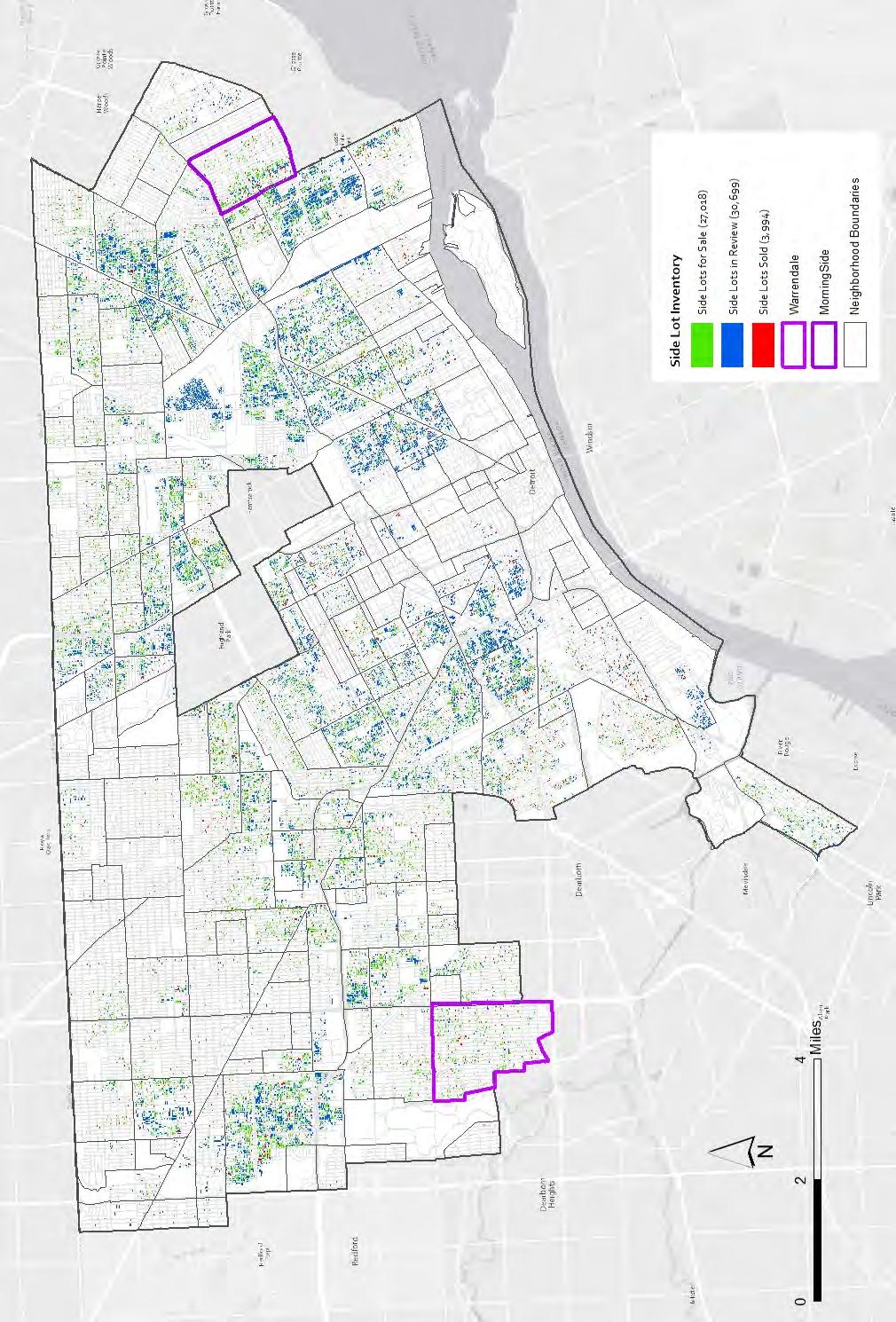
6.4 Detroit Land Bank’s Citywide Side Lot Inventory, as of April 19, 2016
Source: Detroit Land Bank Authority, Property Inventory and Activity Report 4/19/16; ESRI; City of Detroit Open Data Portal; U.S. Census Bureau. See Appendix A for full citations.
Figure
The State of Side Lots in MorningSide
Since 2014, the DLBA has sold 105 side lots in MorningSide. As of April 19, 2016, the DLBA had 468 side lots in MorningSide for sale in its inventory. Figure 6.5 shows the side lots sold, side lots for sale, and the side lots in the DLBA’s review process for MorningSide. The DLBA’s side lot activity in MorningSide has been concentrated in the western part of the neighborhood, where they own the most lots.
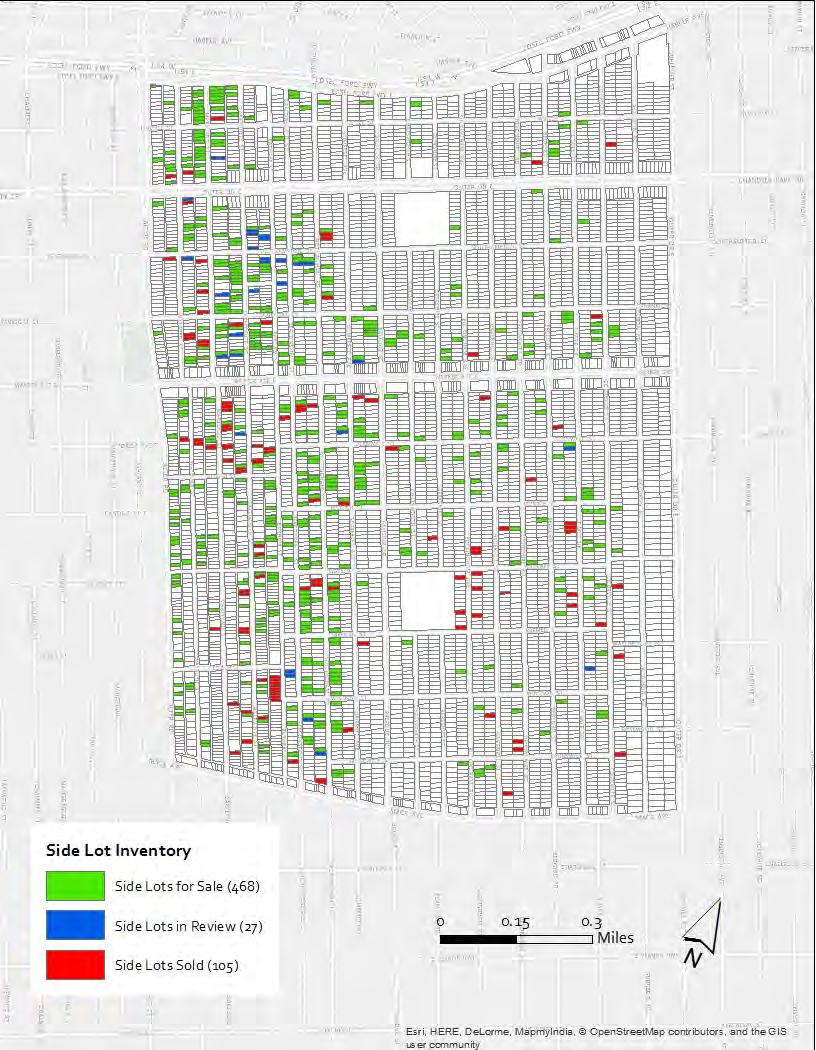
Source: Detroit Land Bank Authority, Property Inventory and Activity Report 4/19/16; ESRI; Motor City Mapping, 2014. See Appendix A for full citations.
Figure 6.5 Detroit Land Bank’s MorningSide Side Lot Inventory, as of April 19, 2016
The State of Side Lots in Warrendale
Since 2014, the DLBA has sold 76 side lots in Warrendale. As of April 19, 2016, the DLBA had 551 side lots in Warrendale for sale in its inventory. Figure 6.6 shows the side lots sold, side lots for sale, and side lots in the DLBA’s review process for Warrendale. In Warrendale, the DLBA’s side lot activity does not show a distinct pattern, however there is a slight concentration of activity north of Tireman Avenue.
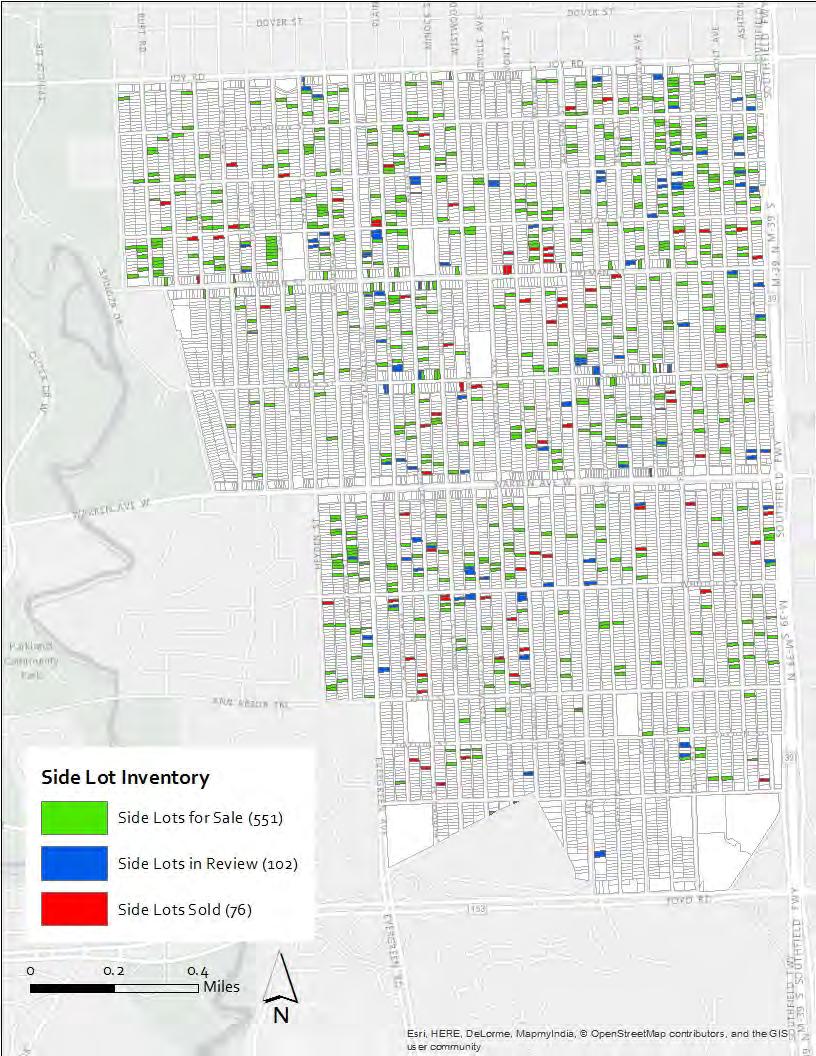
Source: Detroit Land Bank Authority, Property Inventory and Activity Report 4/19/16; ESRI; Motor City Mapping, 2014. See Appendix A for full citations.
6.6 Detroit Land Bank’s Warrendale Side Lot Inventory, as of April 19, 2016
Figure
Recommendations
While the Side Lot program has seen some success, the DLBA could continue to develop the program to address its immense task. This plan offers the following recommendations:
Pre-sale
Collaborate with neighborhood groups to promote side lot purchasing.
According to surveys collected at three Side Lot Fairs in early 2016, most purchasers find out about the Side Lot Fair through postcards, and over 55 percent of respondents reported that they never or rarely visited the website Buildingdetroit.org (see Appendix D for the survey).
The DLBA could improve side sale numbers by collaborating with neighborhood groups to promote side lot purchasing. While the DLBA partners with District Managers, they have limited capacity to deal with individual side lot purchasers. Neighborhood groups like block clubs, neighborhood associations, and community development organizations could assist with outreach and marketing for side lots.
Through these partnerships, a community organization could send out a mailing for a Side Lot Fair. The DLBA could supply the neighborhood organization with the address list of eligible side lot purchasers, and the neighborhood organization could send out a mailing to residents and landlords. Alternatively, the DLBA could give community group leaders a list of eligible purchasers for that fair and a brief training session about how to engage their neighbors in the Side Lot program. Members of neighborhood organizations then could go door-to-door the week before the fair to remind residents of the event, encourage them to attend, and answer questions about the program.
Sales
Online
Overall, the online sale process is user-friendly as purchasers can buy a side lot online in just a few steps of searching, submitting an application, and paying for the side lot. For the February 20, 2016 Side Lot Fair, about 60 of the 165 lots sold (36%) were sold during the fair’s online pre-sale period.6
Fair
Surveys from the three side lot fair analyzed showed that over 90 percent of respondents were satisfied with their experience. Even though Side Lot Fair attendees are generally satisfied with the fairs, attendees stated that they would benefit from more information from the DLBA. The following recommendations address this gap in information.

Source: Detroit Land Bank Authority, Side Lot Fair Surveys 2016
Provide property tax information
Uncertainty about the additional property taxes due on a side lot is often a deterrent to purchasers. The DLBA estimates that the property tax on most side lots sold is under $100, but staff direct questions to the City Assessor 7 On the City Assessor’s website, property owners can look up their property’s assessment, but have to pay to look at the bills for side lots in their neighborhood. The DLBA could encourage more sales by providing this information to purchasers.
Using tax assessor data, the DLBA could develop an estimate of property taxes associated with side lots to share with potential purchasers. This could be developed on a neighborhood-basis for different areas. Table 6.2 shows an estimated average property tax bill for MorningSide and Warrendale. Even with the caveat that the DLBA is not the taxing authority nor can it guarantee that the property taxes will be less than $100, by providing this information the DLBA can eliminate concerns about having to pay high property taxes.

Source: Detroit Land Bank Authority, Side Lot Sales 1/7/16.; Loveland Technologies, Parcel Information, 2014
Provide liability information
Uncertainty about the liability a purchaser would be assuming is another deterrent to purchasing side lots. For example, a resident in MorningSide lives next door to a side lot which he maintains and has improved with planters, and it serves a meeting place for residents when the weather permits. Even though this resident maintains the lot, he does not want to purchase it for fear of the liability associated with someone getting hurt or there being illegal activity on the property.
The DLBA provides some liability information on their website, more complete information would allow purchasers to better understand the liability they would assume. Additionally, DLBA could provide a list of insurance companies that provide policies that insure against liability.
Table 6.1 Attendees’ Satisfaction with Side Lot Fairs
6.2 Property Tax Estimates for MorningSide and Warrendale
Table
Figure 6.7 Improved but unpurchased lot for community use
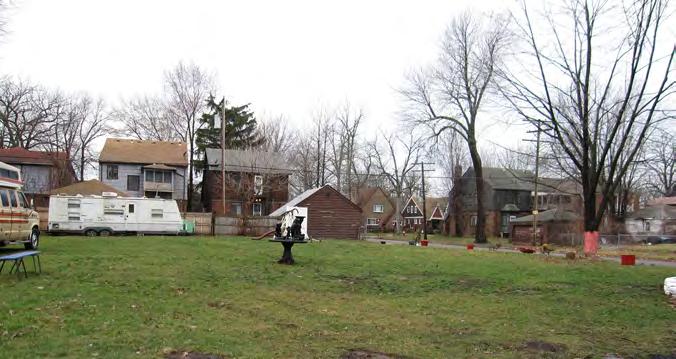
Encourage side lot purchasers to submit plans when purchasing side lots
The DLBA does not require purchasers to submit plans for their side lot at the time of purchase, and many Side Lot Fair attendees did not have a plan for their new lots. Asking purchasers what they plan to do with their lot could spur creativity and result in more varied uses. This plan for intended use is not binding as not having a plan should not prevent a resident from purchasing a lot. Several other land banks, such as Genesee County and Cuyahoga County, ask about the purchaser’s plans for the side lot as part of the application.8 Figure 6.8 shows the language that the Cuyahoga County Land Bank uses in its side yard application.
6.8 Question from Cuyahoga County Land Bank’s Side Yard Application
Source: Cuyahoga County Land Bank,2016. 9
Figure
Post-sale
The improved sold side lots were compared to their 2013 conditions using Google Street View to learn whether residents who had previously improved adjacent side lots were taking advantage of the chance to formalize their ownership. This revealed that two-thirds of the improved lots in MorningSide had already been improved by 2013. From Warrendale, out of the 11 improved lots, five (45%) had already been improved by 2013.
Analysis of side lot conditions also revealed that among side lots sold more than a year before February 6, 2016, a higher proportion were improved compared to those sold less than a year before February 6, 2016, in both Warrendale and MorningSide. Figure 6.9 and Figure 6.10 show the decrease in “no evident use” over time for these sold side lots. This analysis also revealed uses among sold side lots:
• Parking
• Improved, meaning any indication that the lot is used and cared for beyond occasional mowing and trash removal. The most common improvement was the addition of fencing.
• No evident use
Thus far, side lot sales have resulted in little positive change in neighborhood condition. Field work using a random sample of sold side lots and side lots still in DLBA ownership revealed that sold properties are only slightly more likely to be improved than side lots in the DLBA’s inventory. In MorningSide, there were nine (23%) improved sold side lots out of the forty sampled compared to three (8%) improved lots in the DLBA’s inventory. In Warrendale, the difference was smaller with 10 (25%) improved lots in the DLBA’s inventory and 11 (28%) improved sold lots.
While there was a decrease in “no evident use” between the side lots that were sold less than a year ago and those sold over a year ago, a large proportion of lots have “no evident use.” In MorningSide, about 70 percent of sampled sold side lots had “no evident use” over a year after sale. In Warrendale, the proportion was lower with around 45 percent of sampled side lots with “no evident use.” For the purposes of this plan, “no evident use” was not considered a neighborhood stabilizing use.
Parking can either be a positive or negative use. If a side lot purchaser improves a lot with a paved driveway, it is considered a positive use, but if a purchaser chooses to park on a grassy side lot, this does not contribute to the stabilization of the neighborhood, and is considered a negative use. Parking is thus often a negative use as purchasers rarely paved driveways for parking. When parking is included in “no evident use,” the proportions of lots not contributing to neighborhood stabilization increase to about 90 percent in MorningSide and about 55 percent in Warrendale.
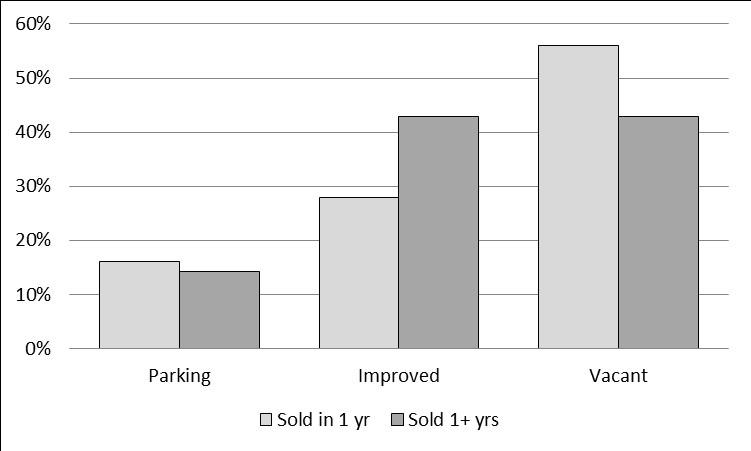
Source: Field work, February 6, 2016.
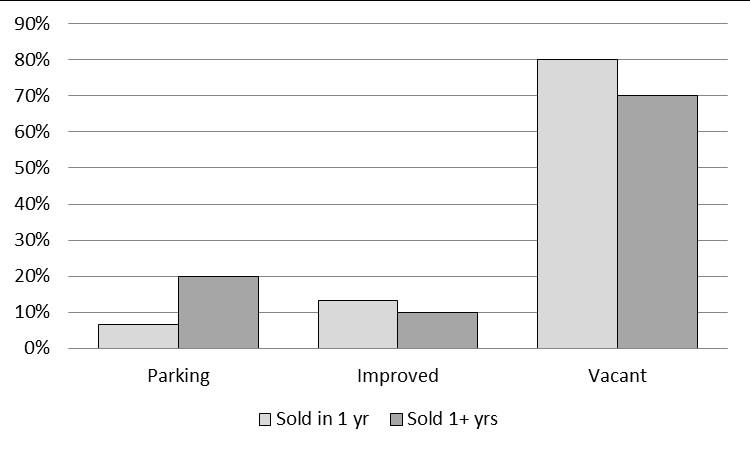
Source: Field work, February 6, 2016.
Figure 6.9 Side Lot Use by Time Sold in MorningSide
Figure 6.10 Side Lot Use by Time Sold in Warrendale
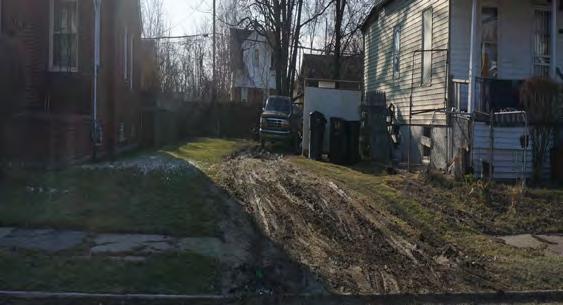
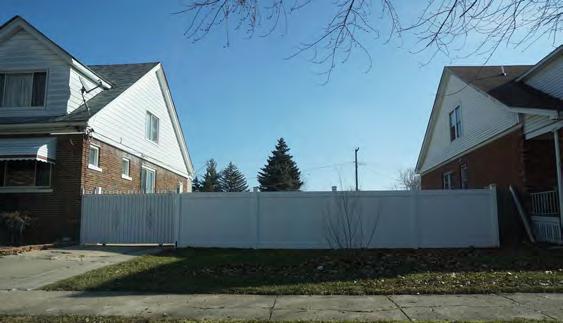
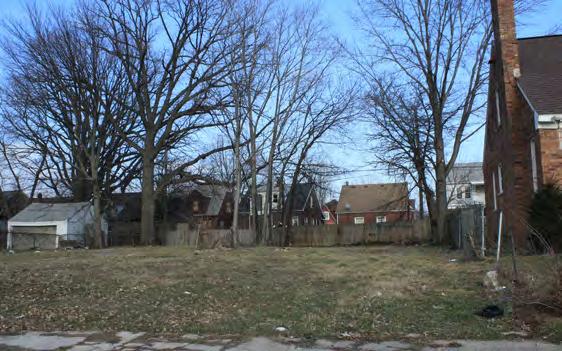
6.11 Example of Negative Parking
6.12 Example of Improved Side Lot
6.13 Example of No Evident Use
Figure
Figure
Figure
Unlike the Auction program, the DLBA’s Side Lot program does not have a compliance element, nor should it. Adding a compliance element would make the process more complex and could deter purchasers. Therefore, this plan recommends ways to encourage people to improve their side lots without explicitly requiring them to do so.
Improve access to side lot care resources
While the DLBA connects side lot purchasers and resources at Side Lot Fairs, this connection could become more deliberate. The DLBA could partner with nonprofits that provide resources for side lot reuse. Partnering with the DLBA would lend more credibility to these nonprofits, and it would also connect side lot purchasers with the resources that these nonprofits provide. This could also encourage nonprofits to develop resources devoted to DLBA side lot purchasing and improvement.
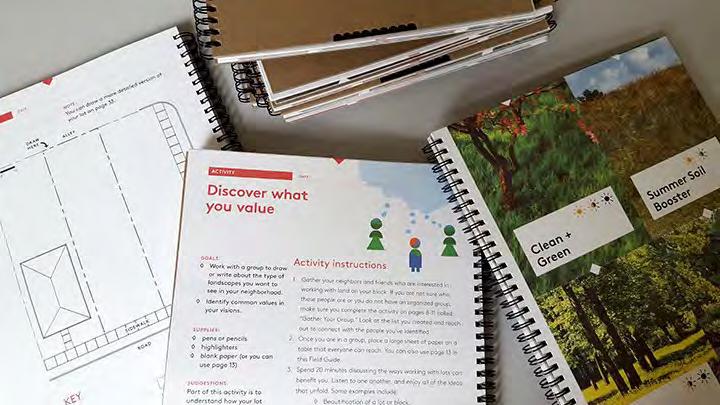
Source: The Work Department, 2016.10
Detroit Future City (DFC) has produced a guidebook that includes ideas and plans for vacant lots, and DFC often has a table at the Side Lot Fairs. The DFC Field Guide to Working with Lots is also available upon request at DLBA headquarters. A stronger partnership between the DLBA and DFC could include giving all side lot purchasers a copy of the DFC Field Guide upon purchase of their side lots, and the DLBA could provide a link to the Field Guide on their website. The DLBA could also request that DFC give a mini-workshop at a Side Lot Fair, or the DLBA could provide DFC with a list of side lot purchasers to contact with further information.
Figure 6.14 The Detroit Future City Field Guide to Working with Lots
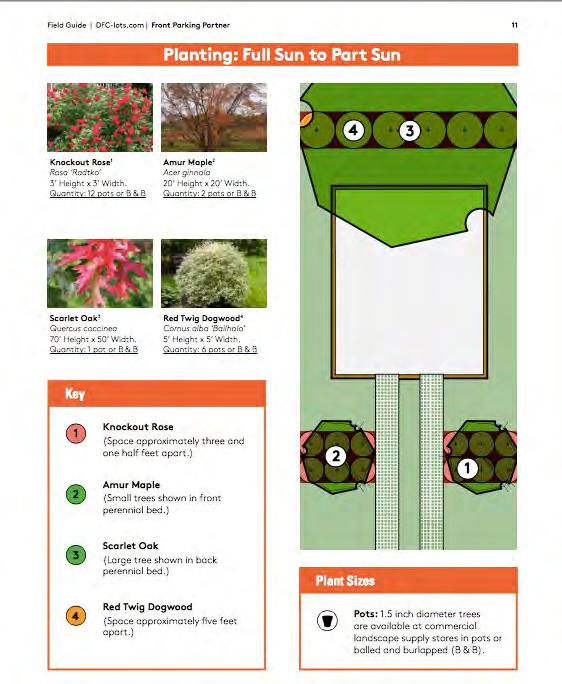
Source: Detroit Future City,2016.11
Several other nonprofits might also help side lot purchasers improve their lots:
• Michigan Community Resources
• Greening of Detroit
• Keep Growing Detroit
To promote side lot improvements, the DLBA could also provide a list of organizations that offer mini-grants to side lot purchasers. The DLBA could make other resources available through links on the DLBA website and at Side Lot Fairs as well, such as information on code enforcement.
Implement a Clean and Green program for side lots that do not sell
Side lot supply more than meets demand as many lots go unsold, and there are few plans for unsold side lots. Additionally, even if all side lots are sold, there remains a large amount of vacant land in Detroit. As outlined in Chapter 8, plans for this land could be coordinated with plans of various city departments and community organizations. In addition, this land may not be sufficiently maintained for neighborhood stabilization.
A Clean and Green program could help the DLBA manage these lots. Clean and Green programs offer community groups stipends for maintaining vacant lots. The DLBA could set maintenance requirements and requirements concerning the number of lots that each community group maintains. Grant funding or a portion of Hardest Hit maintenance funds could be used to support this program.
Figure 6.15 The Detroit Future City Front Parking Partner Design
The Genesee County Land Bank has operated the Clean and Green program since 2004, with funding from the Ruth Mott Foundation and the Michigan Youth Violence Prevention Center The Genesee County Land Bank requires community groups to maintain at least 25 lots and requires community groups to mow each lot at least once every three weeks. Each community group receives a stipend of at least $3,000 for their work. The program now includes 57 community partners that cared for about 3,400 lots during the summer of 2015. A study conducted with assistance from Genesee County Land Bank found that 87 percent of program participants felt that the program had inspired others to take better care of their neighborhoods.12 The same study also found that 84 percent of participants felt that their neighborhood was safer after the program was enacted.
Notes
1. Detroit Land Bank Authority. 2016. Property Inventory and Activity Report 4/19/16
2. Detroit Land Bank Authority.2016. Side Lot Sales Report 4/8/16. Retrieved from http://www.buildingdetroit. org/reports/completed-side-lot-sales/
3. Detroit Land Bank Authority. March 2016. Side Lot Disposition Policies. Retrieved from http://www. buildingdetroit.org/wp-content/uploads/2014/07/Side-Lot-Policy-_-Revised-_-Final-031516.pdf
4. Detroit Land Bank Authority. Property Inventory and Activity Report 4/19/16
5. Ibid.
6. Dean, Charity. February 24, 2016. Personal communication.
7. Dean, C. Detroit Land Bank Authority. February 12, 2016. Phone interview.
8. Cuyahoga Land Bank. Cuyahoga Land Bank Side Yard Program Application. Retrieved from http://www. cuyahogalandbank.org/forms/sideyard_program_application.pdf; Genesee County Land Bank Authority. July 2014. Residential Property Interest Application. Retrieved from http://www.thelandbank.org/downloads/ residential_application_732014.pdf
9. Ibid.
10. The Work Department. 2016. Retrieved from www.theworkdepartment.com
11. Detroit Future City. 2016. Field Guide to Working with Lots. Retrieved from www.dfc-lots.com
12. R. C. Sadler& N. K. Pruett, Mitigating blight and building community pride in a legacy city: lessons learned from a land bank’s clean and green programme, Community Development Journal (2015): bsv052.
Source: https://www.thechildrenscenter.com/get-involved/volunteer-opportunities/community-partners/
CommuniTy ParTner Program
The Community Partners program began in November, 2014. The Detroit Land Bank Authority (DLBA) created this program to encourage faith and communitybased organizations to join the DLBA’s mission of transforming neighborhoods. 1 As of January, 2016, the DLBA sold 208 vacant lots and 48 structures to 50 Community Partners. This chapter makes recommendations to clarify the program’s process, encourage more organizations to make use of the program, and for the DLBA to work with Community Partner organizations to help strengthen capacity.
Table 7.1 Community Partner Holdings*
Source: Detroit Land Bank Authority, February 2016
*All numbers are as of February 2016
**A Community Partner has achieved compliance when they have obtained needed permits and made the renovations agreed upon in their purchase agreement with the DLBA. Non-compliant structures are in the process of achieving compliance but owners have not yet satisfied their agreement with the DLBA.
This chapter makes the following recommendations:
Pre-Sale
• Enact a seven-step program to communicate internal program processes and deadlines to Community Partners
• Further develop the Endorsement Partnership
Sale
• Hold regular meetings to update community organizations and gain feedback on DLBA programs
• Partner with organizations to develop the capacity of community organizations
• Communicate the process for extensions on reconveyance period
Total number of Community Partner organizations that have acquired properties 50
Total Community Partner Holdings 234
Community Partner Process
Compliant structures ** 11
Non compliant structures** 42
Total lots (not subject to compliance) 181
The Community Partners program aims to transfer properties to organizations with the capacity to transform and stabilize neighborhoods. Community Partners can acquire DLBA properties for property rehab projects, urban gardening, green space projects, and other uses that will enhance the quality of life for residents .
Six requirements to become a community partner
An organization must:
1. Be located in the City of Detroit
2. Have federal tax exempt status
3. Be current on property taxes
4. Have not lost title to property through tax foreclosure within the past three years
5. Not have any blight violations or fines
6. Have a defined geographic target area as agreed upon by the Community Partner and the DLBA. The size and boundaries of an organization’s target area will be based on the organization’s history of service and will not exceed five square miles.
Source: Detroit Land Bank Authority Community Partners application, 2016. There are three categories of Community Partnerships:
Building Condition Number of properties Yard Condition Number of properties Good 12 Good
1. Purchase for projects using nine or fewer properties: A Community Partner may buy nine or fewer properties for “fair-market value” (as determined by the DLBA) less 20 percent. The purchase price may be further reduced by the expected cost of blight removal and remediation.
2. Purchase for projects using 10 or more residential or commercial properties: A Community Partner may acquire 10 or more properties based on an agreement that the DLBA can enforce any conditions pertaining to the development or use of the property. DLBA staff and Community Partners negotiate price based on different valuation methods, including appraisals, Broker’s Price Opinions, two times the State Equalized Value, or a price as established by the City Economic Development Offices. Community Partners that propose an acquisition of 10 or more DLBAowned properties must receive approval of the DLBA Board and comply with any review requirements established by the Detroit City Council.
Property Condition Number of Properties Yard Condition
of Properties
3. Endorsement: A Community Partner can identify prospective homeowners who have the ability to renovate and maintain a house that is offered at auction. Endorsed bidders must live in the house for at least three years, and these homebuyers will receive a 20 percent discount on homes up for auction in the Community Partner’s service area. 2
Table 7.2 Community Partner Requirements
The State of the Community Partners Program
During this planning effort, Community Partner properties were surveyed in MorningSide and Warrendale. The majority of the Community Partner homes were occupied and in good condition. Community Partners purchased 12 homes in MorningSide, and one Community Partner in MorningSide purchased nine lots without structures. One Community Partner purchased a home in Warrendale. The average sale amount across Detroit was about $1,400. The DLBA sells all vacant lots for $100.
See Appendix B for rating of property conditions.
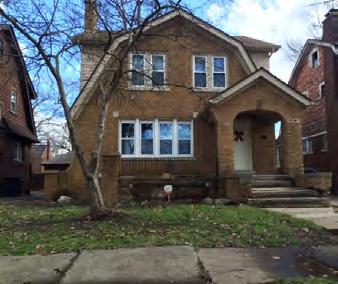
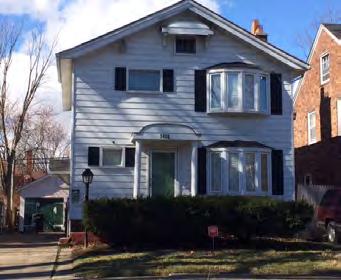
Figure 7.1 4358 Three Mile Drive (left)
Figure 7.2 3485 Courville Street (right)
Table 7.4 Community Partner Property
in Warrendale
Table 7.3 Community
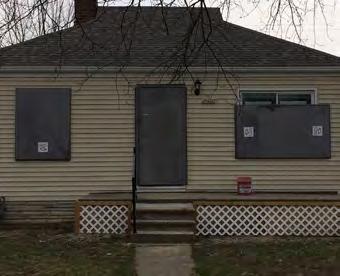
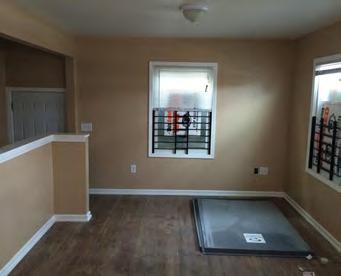
Recommendations
While the Community Partner properties noted above show program success, there are still only 11 compliant structures, and not all vacant lots have been improved. To scale up the amount and quality of property improvement, the DLBA and Community Partners must address standing barriers to development. Through interviews, commonly stated areas for improvement include the need for:
• increased communication
• additional information about the application process
• additional benefits for becoming a Community Partner
Community Partner sales are sold “as is,” so the DLBA does not incur similar costs as the Auction program where the DLBA must prepare a home for sale. Given the success of Community Partner investment, the DLBA could place further emphasis on transferring properties to Community Partners.
Pre-Sale
Community Partners were often unsure of the steps required to participate in the program. According to the DLBA, applicants who meet the requirements are automatically accepted to the program. However, Community Partners were not aware that the DLBA does not reject groups from the program, as long as they are 501(c)(3) federally tax-exempt organizations. Community Partners consistently reported that they would benefit from increased communication with the DLBA in the application process, and in the time following their initial meeting with the DLBA. Additionally, many Community Partners lacked the capacity to undertake
Figure 7.3 8490
Evergreen Road (left)
Figure 7.4 8490
Evergreen Road, inside (right)
projects on their own, and some were not interested in redeveloping properties but were interested in providing resources to others who would be.
Enact a seven-step program to communicate internal program processes and deadlines to Community Partners.
The DLBA could communicate the structure of the program and set internal DLBA deadlines for the application process to become a Community Partner. This would help mitigate the often-reported, “if you know someone at the land bank, you can get things done” feeling. Additionally, DLBA managers felt that they were spending too much time with Community Partners in the application process and in vision meetings. Having a process which moves vision meetings further along in the acquisition process to when a sale is likely to occur will help create time for the DLBA to work on other capacity building activities.
The DLBA could develop and communicate a more comprehensive application and acquisition process through community meetings and the DLBA website that would better ensure successful completion of development projects.
Possible Community Partner seven step program for acquiring a property
1. Download pre-application kit from website (see Appendix E for preapplication kit).
2. Send in Community Partner application. Expect a response within one week.
3. Receive Welcome Kit with development plan template included (see Appendix E).
4. Send in first draft of development plan.
5. Receive feedback on development plan from DLBA and make revisions. Expect response to initial submission within one week.
6. Attend a property acquisition meeting for proposed development set up by DLBA with BSEED in attendance.
7. Close on property and begin work on development in accordance with compliance team requirements.
Step 1: To implement this seven step process, the DLBA would update their website with community partner information and options for types of Community Partnerships, including the preapplication kit which lists the documentation required at the time of application. The pre-application kit could also include:
• Template for project proposal
• List of documentation needed for submitting application
• Motor-City Mapping information for how to use and find potential DLBA owned property
Required Documentation
A. Copy of IRS Tax Exempt Letter
B. Letter of recommendation from District Manager or City Council representative of district where organization operates
C. Authority documents for persons who will transact with DLBA on behalf of organization
Step 2: The DLBA would insure that an applicant receives an acceptance letter and a Welcome Kit within a specified amount of time. When an organization receives this acceptance status, the DLBA could then encourage them to market their status as a DLBA Community Partner.
Step 3: The Welcome Kit could include (See Appendix E):
• Contact information for DLBA departments
• Template for Development Plan
• Pro forma examples/template
• Case studies of successfully completed Community Partner projects
• Available DLBA-owned properties in the Community Partners’ district
• Contact information for District Managers, council members and staff, and other city departments
• List of Community Partners
• Links to Detroit Comprehensive Plan, Detroit Future City plans, and other neighborhood plans
• List of possible resources for funding
Steps 4 and 5: Review the submitted proposal and make suggestions within a stated amount of time (i.e. three weeks) through email and/or a phone call.
Step 6: Arrange an Acquisition Meeting after receipt of the revised development plan. In the Acquisition Meeting, the DLBA and Community Partner can negotiate sales prices and final paperwork for acquisition can be administered (BSEED requires a similar meeting in their process, these two could possibly be combined). After this meeting, Community Partners could have all the paperwork they need to complete the acquisition process.
Step 7: Upon receiving the Letter of Intent and final closing papers from the Community Partner, the DLBA can establish communication between the Community Partner and the compliance team, who the Community Partner would communicate with for the completion of the project.
Communicate process for extensions on reconveyance period
Community Partners expressed concern about the strong language in the purchase agreement as they were unsure if they would complete their project within the nine-month period. This was especially a cause for concern among Community Partners completing a project for the first time. While the DLBA must keep the reconveyance period in place in order to encourage timely development, the DLBA could add language stating the ease with which Community Partners can receive an extension, as long as Community Partners have made attempts toward development and Community Partners are communicating their progress and challenges with the DLBA. The DLBA could communicate this flexibility to potential Community Partners in the application process and in the Welcome Kit.
Further develop Endorsement Partnership
The DLBA launched the Endorsement Partnership program in March, 2016. This program has the potential to increase sales in the Auction and Direct Sales programs by better connecting residents’ demand for housing to the supply of housing available through the DLBA. This would create a matchmaker process that leverages relationships that Community Partners have established.
Interviews with potential Community Partners suggests that they know of potential homebuyers, but they do not know what property the DLBA owns so they are unable to connect potential buyers with homes. Two examples of such organizations include:
Global Detroit helps immigrant families by strengthening local economic and community development initiatives targeting those populations. While Global
Detroit does not purchase, renovate and resell homes to immigrants, they want to help connect immigrants and non-native English speakers with home-buying resources. They are connected to immigrant families new to the area who have found jobs and are interested in investing in a home and neighborhood in Detroit. Global Detroit is interested in supporting DLBA work in mid-market areas with immigrant populations such as Southwest Detroit, Benglatown, and Warrendale. Global Detroit has developed a list of immigrant families in Southwest Detroit looking for homes and has provided them with addresses of DLBA homes in their neighborhood of interest. As an endorsement partner, Global Detroit could help facilitate the purchase between these immigrants and the DLBA.
U-SNAP-BAC provides home ownership training and is an intake office for the city’s Zero Percent Interest Home Repair Loan. U-SNAP-BAC maintains a list of families who have undergone homeownership training and the organization wants to connect program participants to homes. However, U-SNAP-BAC does not know what the DLBA owns. As an Endorsement Partner, U-SNAP-BAC could connect these potential homeowners with Auction or Direct Sale homes in MorningSide or similar neighborhoods. However, financing may continue to be a barrier for many of these families who do not qualify for the Zero Percent Interest Home Repair Loan because either the home must be occupied by the owner for at least six months prior to accessing the loan, potential home-buyers do not meet the 560 minimum credit score requirement, or the potential home-buyers’ monthly income does not cover the cost of the loan.
This new matchmaker model could be replicated with other community development organizations across the city to significantly increase Auction sales and Direct Sales.
Sales
Many Community Partners were not in regular contact with the DLBA and did not maintain interest in other DLBA programs. Additionally, many did not have the capacity to undertake a development on their own. Due to lack of capacity, many partners were concerned that their property might be reconveyed should they not be able to develop their property in the timeline established with the DLBA.
Hold regular meetings to update community organizations and gain feedback on DLBA programs
While many groups attend vision meetings and communicate with the DLBA, there
is no avenue for networking between Community Partners, and no established way to quickly share information with many organizations. Community Partners are listed in DLBA Quarterly Reports, but many Community Partners do not know of this resource. Many groups expressed the desire to connect with other Community Partners to leverage resources and learn of additional neighborhood stabilization efforts but are unable to do so. The DLBA could host these resource-sharing meetings in several ways:
• Partner with Department of Neighborhoods to host meetings by district
• Partner with organizations that hold regular meetings with community organizations such as Community Development Advocates of Detroit (CDAD) and/or Michigan Community Resources (MCR)
• Provide a Community Partner component to either Side Lot Fairs or the proposed Home Repair Workshops
• Host a separate workshop series focusing solely on the Community Partners program
The goals of these meetings are:
• Provide updates regarding the Community Partner program and Community Partner progress
• Provide information regarding the Community Partner application process
• Provide Community Partners with marketing material about DLBA programs for distribution
• Connect Community Partners to each other and other community organizations for increased capacity-building and knowledge-sharing
• Streamline the District Manager’s process of connecting with Community Partners
• Receive feedback regarding the Community Partner program and other DLBA programs
• Provide a list of available properties in the area and other organizations’ area plans
These meetings could keep Community Partners and organizations informed and create more time for DLBA staff to provide resources to Community Partners who need help achieving their development plans.
Partner with organizations to develop capacity of community organizations
Mid- to large-scale projects are often difficult to complete due to varying levels of Community Partner capacity. Some may need to partner with more advanced organizations, and some may need training to boost capacity. The DLBA can help introduce community partners to one another to enable them together to undertake projects that could strengthen neighborhood stabilization.
Community Partners expressed interest in an information sheet with estimated project costs. Other land banks, such as the Cuyahoga County Land Bank in Ohio, provide a “Renovation Work Required” sheet along with a home listing on their website. Cuyahoga County Land Bank staff indicate that this resource helps individuals and organizations to establish funding needs before undertaking a project for development. Therefore, the DLBA can provide resources on project financing and case studies of successful projects which other Community Partners have implemented as noted in the Welcome Kit (see Appendix E).
The DLBA is developing a capacity-building curriculum, however this may be time consuming to administer. To increase efficiency, the DLBA could partner with a number of organizations to administer such a curriculum.

Through increased coordination with Community Partners, and by providing Community Partners with greater capacity to complete their projects, the DLBA could increase the number of successful sales and create greater interest in DLBA programs.
Notes
1.Detroit Land Bank Authority. 2016. Community partner overview. Retrieved from http://www. buildingdetroit.org/community-partnership-overview/
2.Detroit Land Bank Authority. 2016. Types of Community Partnerships Retrieved from http://www. buildingdetroit.org/community-partnership-overview/
CHAPTER 8: COMMUNICATION AND COLLABORATION
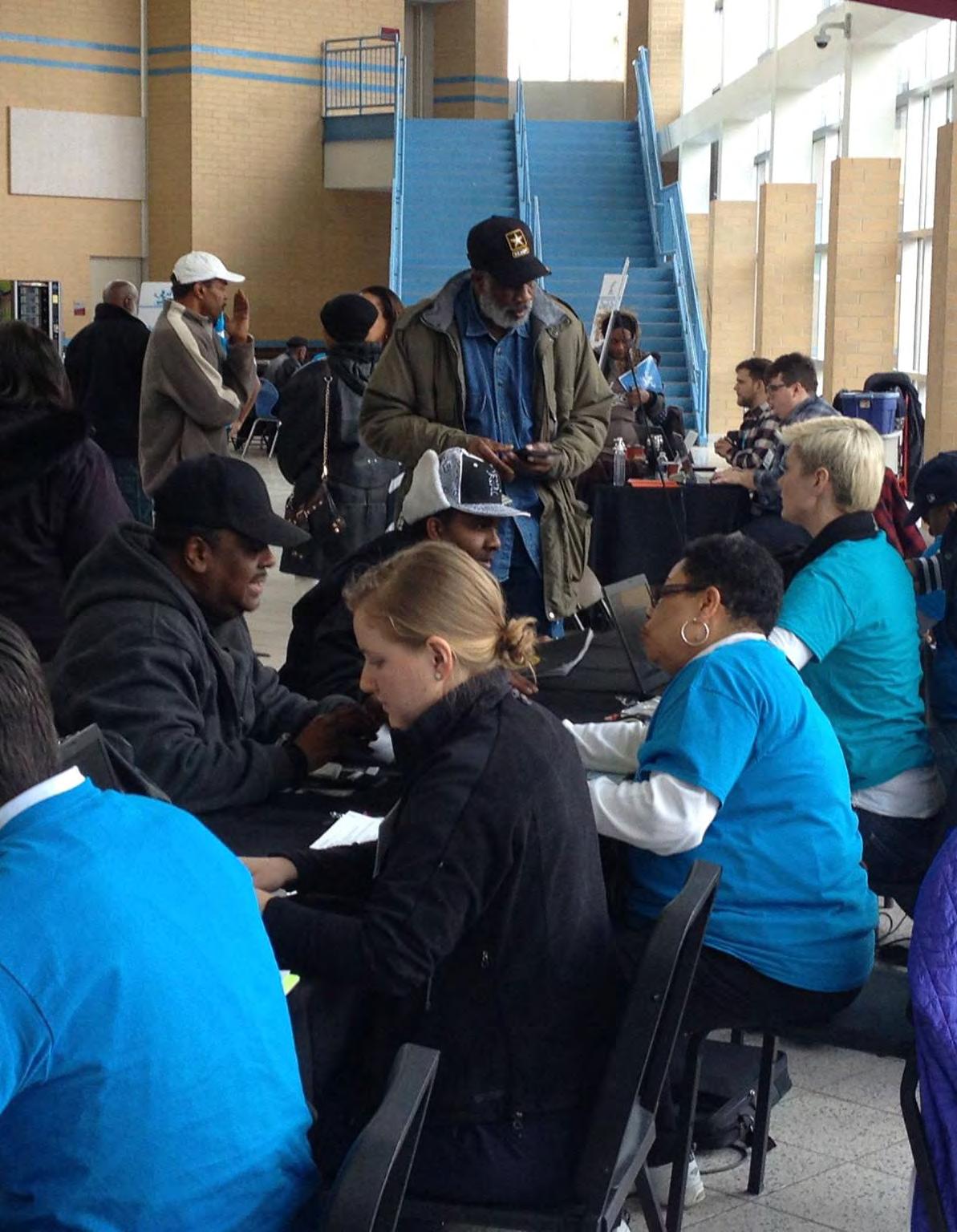
Communication and Collaboration
Several overarching themes emerged around communication and collaboration through evaluation of the four sales programs. While the Detroit Land Bank Authority (DLBA) is making great strides testing cutting-edge practices under challenging circumstances, residents and community organizations were still confused about processes, reported a lack of coordination, and often have a negative reaction to the DLBA. This chapter aims to address these challenges with five recommendations:
• Provide a public, up-to-date list of DLBA-owned properties
• Work with Improve Detroit to create a system for public feedback on condition of DLBA properties.
• Align sales with other city department and community plans
• Align sales with a larger vision for the city
• Publicize property improvements that the DLBA has sold
Recommendations
Provide a public, up-to-date list of DLBA-owned properties
Lack of a property list is the most-frequently expressed complaint in interviews with various stakeholders. The DLBA aims to sell more property, but potential customers cannot determine which properties are available without considerable effort. Thus far, the DLBA has not made property information public due to concerns about:
• Speculation: The DLBA wishes to avoid having individuals buy and hold land until property values increase, or to obstruct other development.
• Vandalism: Scrapping is a threat in Detroit, and when a property is advertised as DLBA-owned and therefore vacant, there is greater potential for scrapping.
• Squatting: When a house is advertised as DLBA-owned and therefore vacant, squatters may move into the house, causing damage or complicating sale.
While the DLBA may not wish to offer all their property for sale due to the uncertainty about future plans of the Planning & Development Department and others, they could make the inventory known and indicate that certain properties are on hold, as the Genesee County Land Bank does.
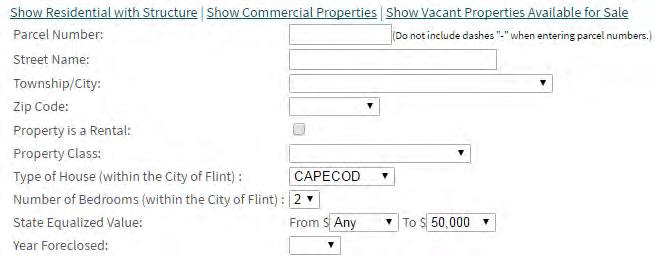
Source: Genesee County Land Bank. April, 2016.
The DLBA could either use their website as the portal for the public to access a list of DLBA-owned properties, as the Genesee County Land Bank has done, (shown in figure 8.1) or they could collaborate with an existing data management organization. These include:
City of Detroit Open Data Portal
The Open Data Portal has an interactive map function that allows for data visualization, searches, and filtering. When city departments upload their data, residents can download, search, and analyze these data. For example, interactive mapping through the Demolitions Data Lens on Open Data Portal was built in a partnership with the DLBA and offers simple visualization and allows the public to access information about demolition across the city. Another section of the Open Data Portal could be built out to show the DLBA inventory.
Data Driven Detroit
Data Driven Detroit is a “low-profit limited liability company (L3C) in Detroit that provides accessible, high-quality information and analysis for informed decisionmaking.” 1 Should the DLBA be interested in building inventory function on their website, they could work with an organization such as Data Driven Detroit, which oversaw Motor City Mapping, and has their own Open Data Portal with datasets for the City of Detroit.
Loveland Technologies
Loveland has a well-designed interactive platform with data from various sources where interested parties can easily access property information. Motor City Mapping and data layers on the Loveland website are the most commonly used sources of property information by residents and community organizations. However, property ownership data is about two years out-of-date on Loveland’s
8.1
Figure
Example of Inventory Search Form on Genesee County Land Bank Website
website. As Loveland is a for-profit company, it is unclear if the data will remain accessible. As of April 2016, a Loveland-user needs to subscribe to Site Control and pay a monthly fee to download and map data. The DLBA could request that Loveland update data within thirty days of receipt and list the date that the data were received. This would likely require a contract between Loveland and the DLBA and possibly a DLBA-paid fee. However, with this updated information the DLBA would not have to pay the greater costs associated with developing their own system of data-sharing through their website. Additionally, the DLBA would have increased exposure to their properties which are available for sale.
Cuyahoga and Genesee County Land Bank officials stated in interviews that providing information about property could increase sales and enhance transparency about land bank operations. Additionally, they stated that these advantages outweighed any problems a public list might have caused.
“We make lists of all properties available for sale by the Genesee County Land Bank because we value transparency. If someone is determined to scrap a house, they are likely to do so with or without knowing that it is owned by the Land Bank.”
– Christina Kelly, Director of Planning and Neighborhood Revitalization Genesee County Land Bank Authority
Create a system for public feedback on condition of DLBA properties
DLBA staff are concerned about vandalism and squatting in their properties, but they do not have a way to receive real-time, up-to-date information about their properties other than through phone calls to the main office. Online and mobile applications could allow the public to report vandalism, dumping, suspected squatting, and failure to comply with rehabilitation requirements. As the first to see break-ins, scrapping, etc., residents could report issues to the DLBA for faster response. Existing platforms could be modified to offer paths for Detroit residents to report issues related to property and infrastructure across the city.
Improve Detroit – Immediate feedback
The Improve Detroit mobile application offers a means for residents to report a broad range of issues to the City of Detroit, including broken street lamps, illegal dumping, and broken water pipes. Improve Detroit could add a drop-down menu to allow residents to report issues with all exterior code violations of DLBA-owned properties in real-time. Improve Detroit would need to add more categories to the app specific to properties owned by the DLBA, such as:
• Squatting
• Roofing issues
• Broken areas of entry
• Drug sales
• Abandoned cars
To enact this updated model of Improve Detroit, the DLBA would need to make its inventory public for Improve Detroit to identify which property information reports should be routed to the DLBA.
Using this information, the DLBA could then either address issues as they arise themselves, or work with relevant city departments. Publicizing this app through collaboration with community partners, especially Radio Patrols, could increase the number of the users monitoring DLBA-owned property. Improve Detroit could also act as a marketing partner for selling DLBA properties, as the app creates greater visibility of DLBA properties.
Example: Baltimore CitiTrac Service System (311)
The City of Baltimore’s CitiTrac Service System includes reporting options for different city agencies, including housing information. The system works by routing inquiries to the relevant department that can address the reported issue. Baltimore’s system is linked to a broader range of issues and city departments than Improve Detroit. For example, Figure 8.2 shows Baltimore’s system which includes inquiry boxes for 10 different potential housing issues, including the home vacancy. Improve Detroit could include these options and then route issues with DLBA-owned homes to the DLBA.
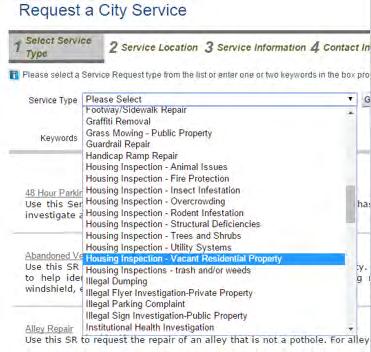
Source: City of Baltimore. 2016. Request a city service.
Figure 8.2 City of Baltimore 311 Program to Request City Services
Blexting & Online Survey - Long-term Survey
Loveland’s “Blexting” mobile application and their online survey are easy to understand and visualize, as they use Google maps and Google Earth and make it easy for the public to report property condition. A formalized partnership between the DLBA and Loveland would ensure that data reported by residents was delivered in real time to DLBA staff. However, if Loveland charges a fee for residents to then access the information that they reported, they may be less inclined to report issues.
Align sales with other city department and community plans
The DLBA takes direction from the Mayor’s Office and Planning and Development Department (P&DD) on specific areas to hold land. However, there is a lack of additional coordination efforts between the DLBA and community organizations and other city departments that have created plans. The DLBA could work with city departments and neighborhood organizations to ensure that sales are aligned with plans, and that plans reflect the reality of sales.
This plan does not prioritize one plan over another. However, it acknowledges that better coordination between area plans may help direct growth and support the stabilization of Detroit’s neighborhoods, and could create more sale of DLBAowned land.
Cuyahoga County Land Bank uses Memoranda of Understanding (MOU) in order to establish how relationships between city departments will work. This could be as simple as assuring agencies that they have the right of first refusal in certain areas of the city, which the DLBA could implement in their partnerships with other city organizations.
Water and Sewerage Department
The Detroit Water and Sewerage (DWSD) website states:
“To prevent more overflows without expensive investments in more collection facilities, DWSD is working to reduce the amount of storm water that enters the combined sewer system through investments in Green Infrastructure approaches. This is part of DWSD’s Alternative Rouge River CSO Control Program, a 25-year phased plan that focuses on Green Infrastructure solutions and right-sized CSO control facilities.” 3
The extensive amount of vacant land in the DLBA inventory allows for opportunities for the installation and management of green infrastructure. The DLBA could continue work with the Detroit Water and Sewerage Department (DWSD) to invest in green infrastructure zones, especially in the Upper Rouge River watershed, which is the priority area for DWSD’s blue and green infrastructure projects.
DWSD can purchase DLBA properties strategically to implement these projects and reduce the strain on the Detroit storm water system. This could help address Detroit’s sewer overflows and flooding problems, while also transforming vacant land into assets.
Figure 8.3 shows DWSD’s high priority areas for green infrastructure in Warrendale and surrounding areas. The DLBA could hold vacant lots in this area in coordination with community input, and give right of first refusal to DWSD to ensure that these lots are available for green infrastructure projects.
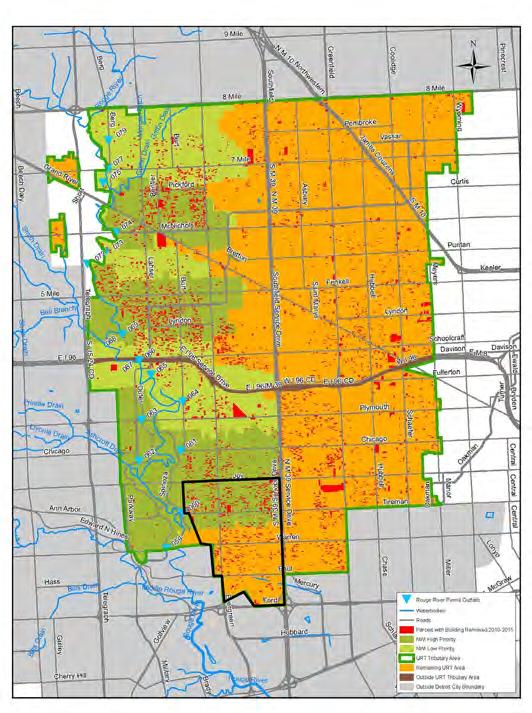
Source: DWSD. 2015. Green Infrastructure Program Progress Report.
Figure 8.3 Priority Areas for Green Infrastructure in the Upper Rouge Tributary
Recreation Department
The Detroit Recreation Department manages city-owned parks and marinas. In 2016 they released a parks master plan update, which included recommendations for areas that may need new park space and recreation facilities. The DLBA could work with the Recreation Department to assemble the needed land for these purposes. Figure 8.4 shows that DWSD has identified MorningSide as an area that needs a new park. DLBA could hold vacant land near these parks and the Recreation Department could be given right of first refusal for these areas in coordination with community input.
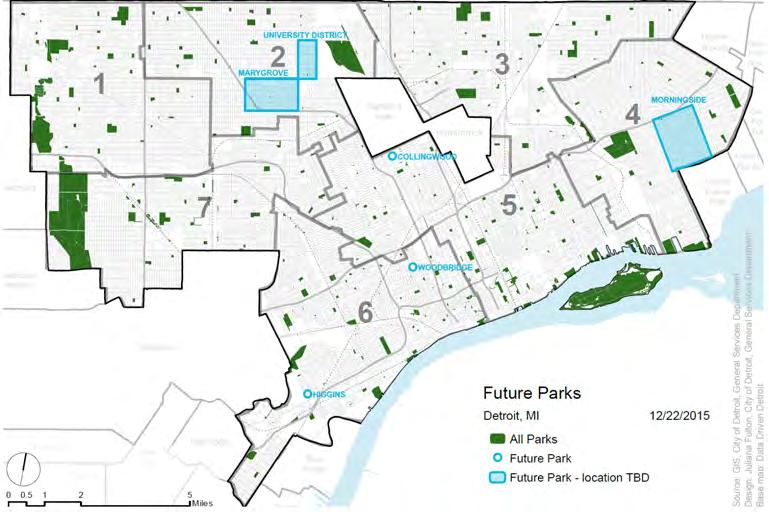
Housing and Revitalization Department
The Housing and Revitalization Department (HRD) has targeted areas of the city for multi-family housing (Figure 8.5). Warrendale is noted as a planning study area. DLBA sales strategies could coordinate with HRD to assemble larger tracts of land for development or redevelopment.
Figure 8.4 Identified Areas for New Park Locations
Source: Recreation Department. 2015. Parks and Recreation Improvement Plan.

Source: Detroit Housing and Revitalization Department. 2015.
Figure 8.5 Housing and Revitalization Areas
Targeted for MultiFamily Housing in 2016
Community-based Plans
Foundations fund community-based planning in order to support equity in planning, engage residents in their futures, and address the absence of effective public agency planning. These range from planning efforts supported by intermediaries like Community Development Advocates of Detroit (CDAD), Michigan Community Resources (MCR), and Local Initiatives Support Corporation (LISC), to those run by neighborhood organizations such as Jefferson East, Inc., and Grandmont Rosedale Development Corporation. The DLBA could incorporate these plans into their long-term sales strategies and adjust their programs accordingly.
One such example is the MorningSide Greenway plan shown in Figure 8.6
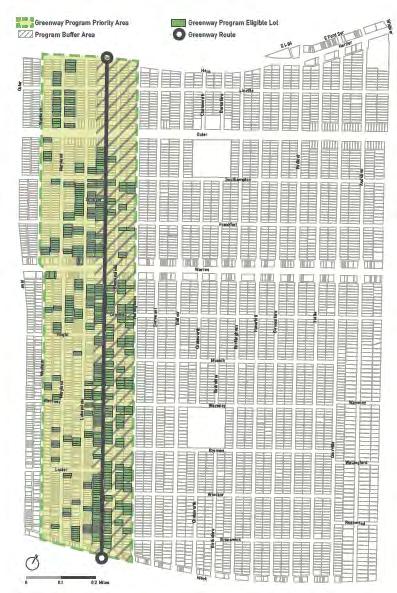
Source: Bails et. al. 2015. Stabilizing Morningside. 4
Figure 8.6 Greenway Program Priority Area in MorningSide
While aligning with neighborhood and other city agency plans is important, there also needs to be coordination with Planning and Development Department (P&DD) and Detroit Future City planning efforts regarding an overall vision for Detroit.
Align sales with a larger vision for the City
An updated Master Plan and zoning code outlining the types and locations of development could provide clarity and investment confidence to residents, developers, and other departments or agencies. This provides assurances to residents that they can invest in properties, and would help to coordinate and direct new investment. This is particularly important for the vast amount of vacant property that the DLBA owns. Residents of areas such as North Corktown, MorningSide, and Brightmoor are uneasy about plans for their areas and want to ensure that their community plans align with those of DLBA, P&DD, Water and Sewerage, Recreation, and others.
Detroit Future City Framework
The Detroit Future City (DFC) Strategic Framework provides a larger vision for the city, but it is not an officially-adopted document. Philanthropic organizations continue to make investments based on this DFC framework, but it is unclear if, or how, it is used by the DLBA or city departments. An official statement and corresponding policies would clarify the DLBA’s strategies according to, or in spite of, DFC.
Planning and Development Department
The DLBA looks to P&DD to provide planning direction, and residents and businesses desire a transparent approach to city-wide development. An updated master plan of policies could address this uncertainty. The DLBA and community development organizations could advocate for an updated plan that helps to bring plans created in silos into alignment.
Publicize
improvements made to properties the Land Bank has sold
Residents and activists are unaware of the various DLBA programs and their impact on neighborhoods. The DLBA could provide case studies and instructional videos to tell the story about how they are improving neighborhoods, and to further increase the number of potential purchasers.
The two types of potential stories include:
Success Stories: The DLBA can interview and profile successful home renovations and creative side lot improvements. These can be publicized in print and video format. Success stories show potential purchasers that there are opportunities for investment, and to contribute in stabilizing Detroit neighborhoods through redeveloping a home or lot. Figure 8. 7 displays a Genesee
Source: Genesee County Land Bank. 2015.
County Land Bank flyer that has highlighted successes through an instructional video.
Instructional Videos: The DLBA can create videos to outline how to apply to various DLBA programs.
The DLBA relies heavily on people visiting their Building Detroit website to find information. To increase readership and clarity of DLBA processes, information needs to reach residents where they are. The DLBA could promote new content through the following outlets:
• Traditional Media Outlets: Continue to develop stories with newspapers, magazines, and radio stations
• Online Media Outlets: Share profiles and videos with online real estate blogs and outlets such as Model D Media, Curbed Detroit, and StreetEasy.
• Community Partner Cross-Promotion: Provide links to other resources such as the Detroit Future City guide to working with lots, the Garden Resource Collaborative, and workshops on homeownership education and housing renovations. In addition, the DLBA could host a table at community events to market their programs to the public and work with citywide organizations such as Michigan Community Resources (MCR) and the Community Development Advocates of Detroit (CDAD) for greater resource education.
• Newsletters and/or E-Newsletters: Direct marketing through a monthly newsletter would provide updates on DLBA initiatives that Community
Figure 8.7 Genesee County Land Bank Movie Premier Flyer Highlighting Their First 10 Years
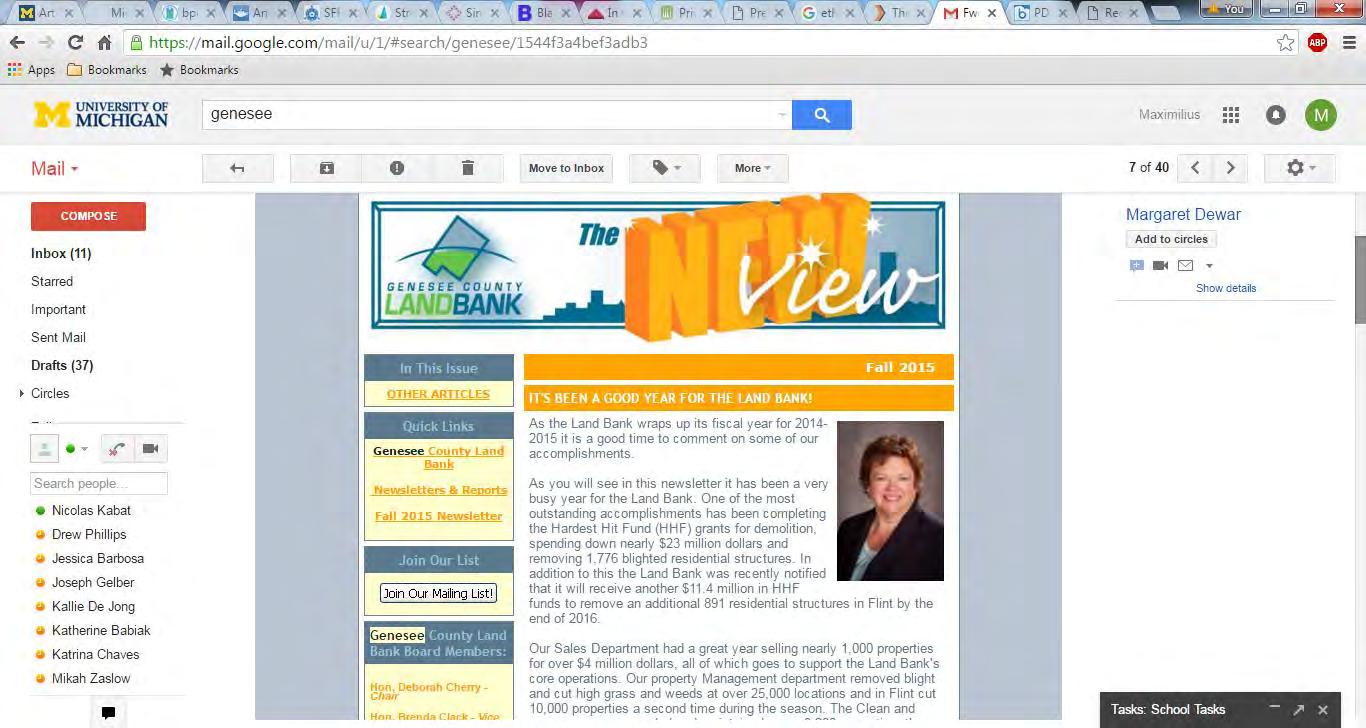
Source: Genesee County Land Bank, 2015.
Building Detroit Website:
The DLBA coud showcase success stories similar to the city of Detroit’s use of Capital Building Detroit Improvements Projects maps from 2015, shown in Figure 8.9. Showing maps including where properties have been improved, and linking them to successful stories of development or reuse, could encourage others to take on their own projects and encourage more sales and redevelopment.
Source: City of Detroit, 2015 Construction Projects on website, 2015.5
Notes
1. Data Driven Detroit. 2016. About Data Driven Detroit. Retrieved from http://datadrivendetroit.org/about/
2. City of Baltimore. 2016. Request a City Service. Retrieved from https://baltimore-csrprodcwi. motorolasolutions.com/ServiceRequest.mvc/SRIntake
3. Detroit Water and Sewerage Department. 2015. How is DWSD managing storm water? Retrieved from http://www.detroitmi.gov/How-Do-I/Find/Storm-Water
4. Bails et. al. 2015. Stabilizing MorningSide. Retrieved from https://taubmancollege.umich.edu/sites/default/ files/files/mup/capstones/2015_Stabilizing-MorningSide.pdf
5. City of Detroit. 2015. 2015 Sidewalk Projects. Retrieved from http://www.detroitmi. gov/2015-Construction-Projects
Figure 8.9 2015 Sidewalk Projects Undertaken by Detroit Public Works
CHAPTER 9: IMPLEMENTATION
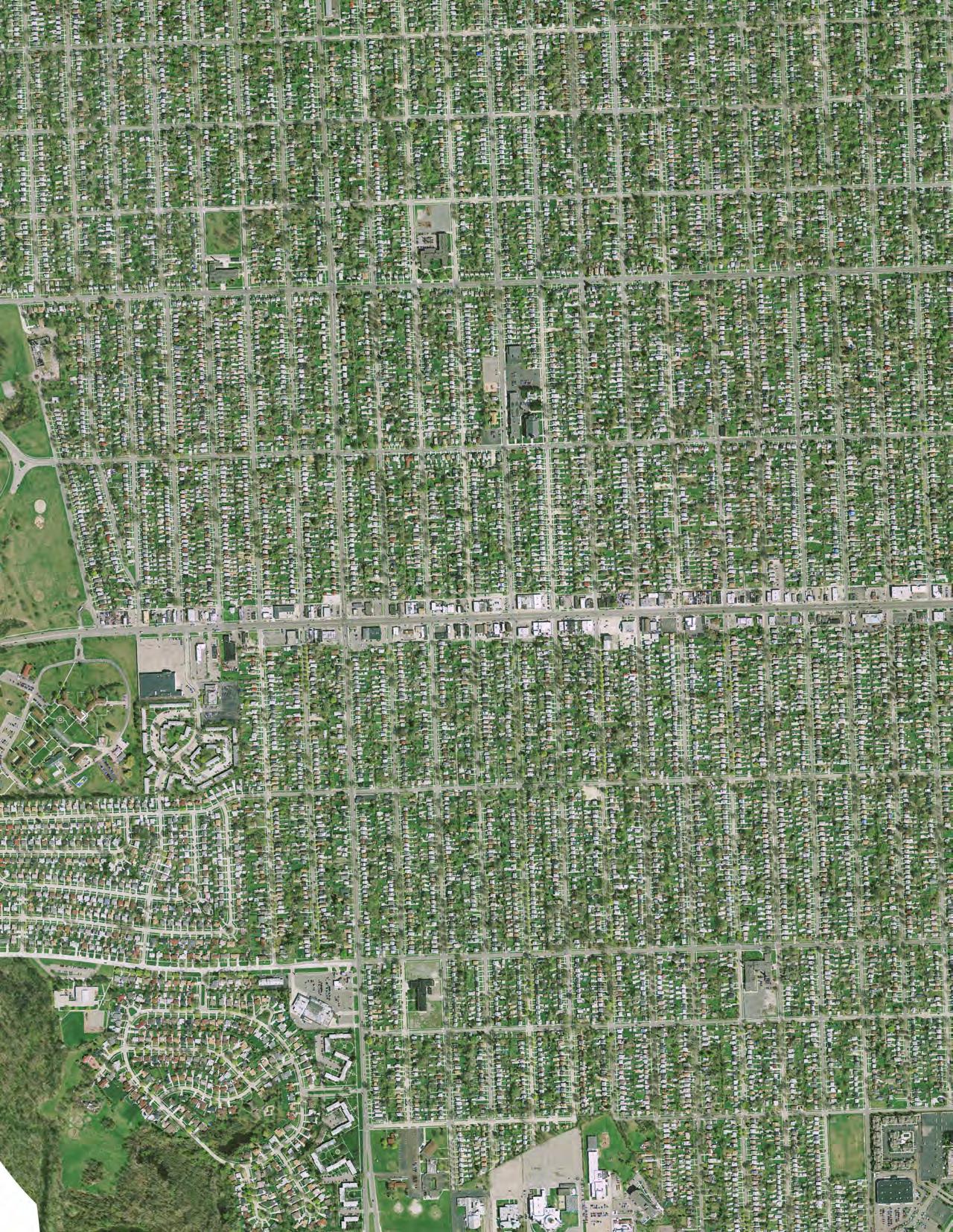
Source:
Google Earth
imPlemenTaTion
The Detroit Land Bank Authority (DLBA) and partners can implement the recommendations to:
• Impact a particular neighborhood
• Increase impact at reasonable time and cost
• Put land back into productive use while also stabilizing neighborhoods
This chapter shows:
• A vision for how the DLBA could use the recommendations of this plan and how the recommendations could affect MorningSide and Warrendale, as displayed through a series of maps. These scenario maps show how coordinating disposition programs at a broader scale, as opposed to parcel by parcel, might increase overall sales while also promoting neighborhood stabilization .
• A matrix of the proposed recommendations with an understanding of their impact, time, cost and relationship to the goals of this plan: increase disposition while stabilizing neighborhoods through returning land to productive use.
Auction and Direct Sales
Chapter 4 recommends scaling back the auction program to areas within a neighborhood where the properties are in good condition, the homes are larger, and the owner occupancy (by census tract) is higher. Chapter 5 recommends moving the remaining inventory to the Own it Now program.
The areas outlined in black In Figures 9.1 and 9.2 show where auctions could take place based on the three conditions noted above. These blocks outlined generally represent the strongest blocks. However, not every property that falls within the auction boundaries is in good condition and should be analyzed further to determine if they are appropriate for auction. Focusing on these areas would reduce the auction inventory in MorningSide from 19 homes to 5, and in Warrendale from 50 homes to 23.
The remaining auction inventory can be moved into Direct Sales and the Own it Now program. Properties in areas with less demand, outlined in gray, could also go into Direct Sales. Because these properties are less likely to sell, they could go directly to market, bypassing the more costly, time-intensive auction process. This would result in approximately 14 homes in MorningSide and 27 homes in Warrendale being sold through direct sales.
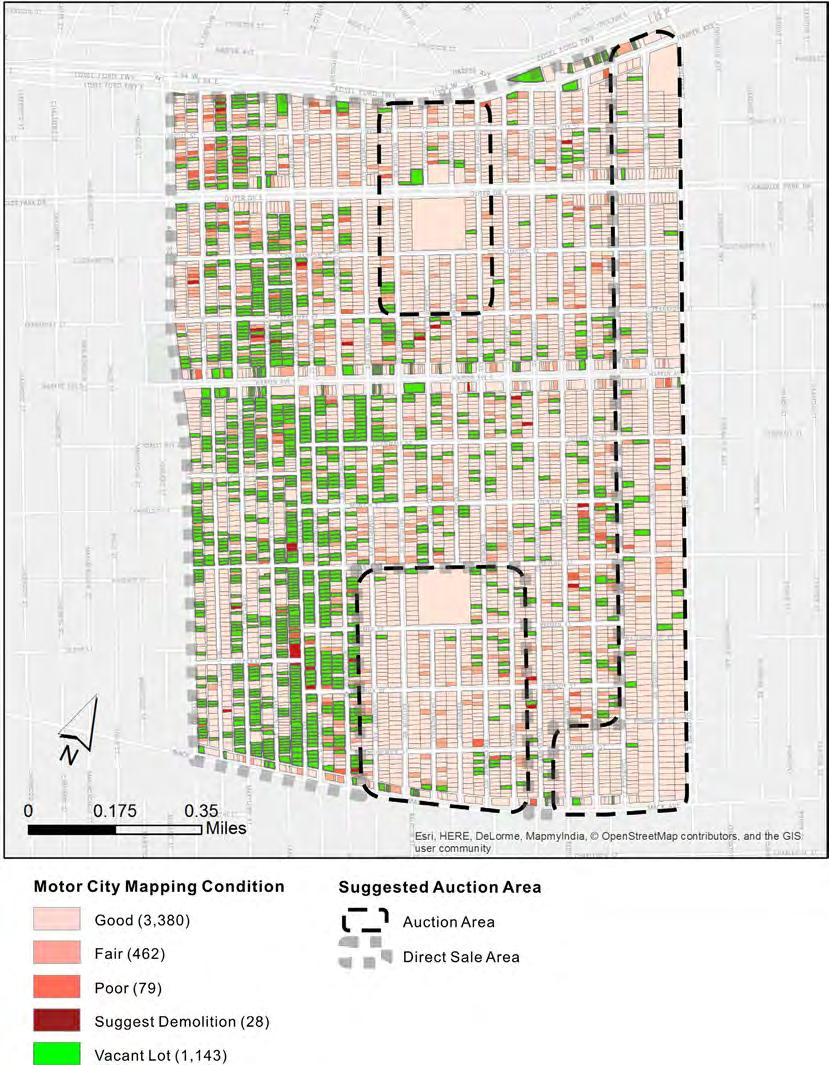
Source: ESRI Base Map, Motor City Mapping, 2014
Figure 9.1 Scenario for MorningSide Implementation of Auction and Direct Sale Recommendations
9.2 Scenario for Warrendale
Implementation of Auction and Direct Sale Recommendations
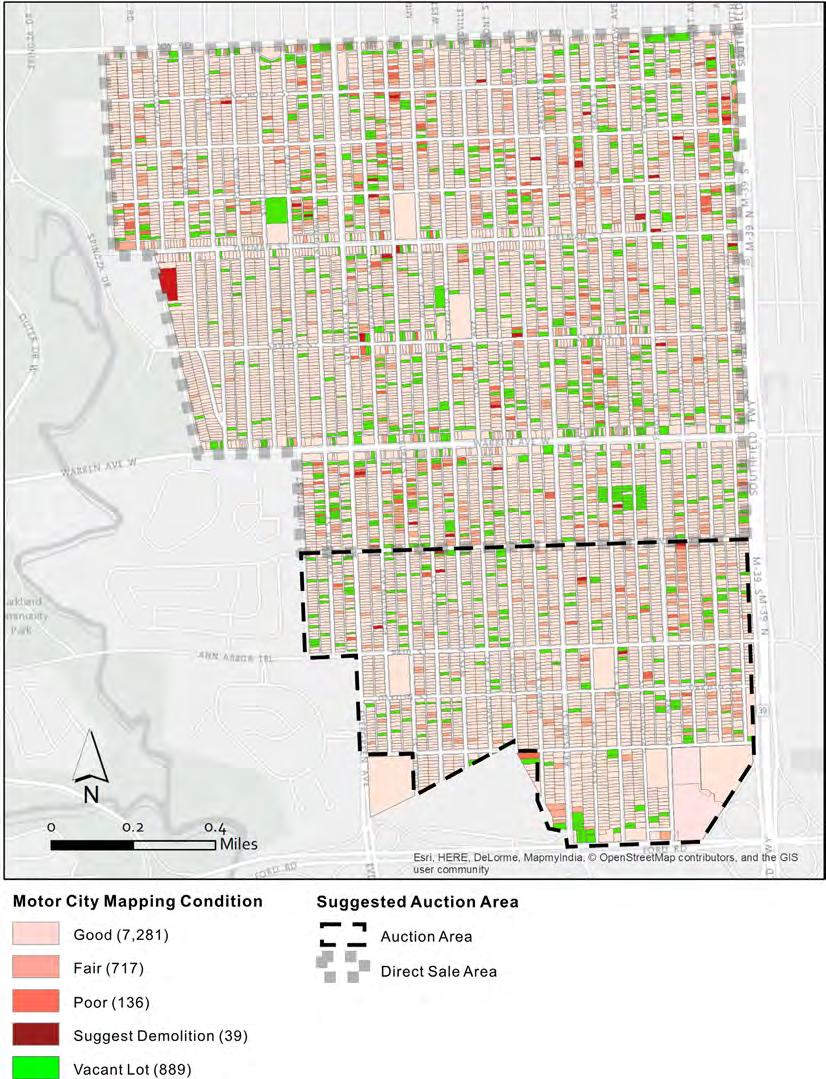
Source: ESRI Base Map, Motor City Mapping, 2014
Figure
Community Partners and Side Lot Sales
If the DLBA coordinated with community organizations when working to scale up the disposition programs, they could simultaneously sell more properties and prioritize community organizations’ plans for neighborhoods. Figures 9.3 and 9.4 highlight areas of opportunity to coordinate auction, direct sales, side lot sales, and economic development with community organizations.
The MorningSide map (Figure 9.3) highlights areas where community organizations are already active. Habitat for Humanity is a Community Partner and U-SNAP-BAC is a community organization, and both focus on stabilizing neighborhoods through property rehabilitation, new construction, and place-making. These community organizations and the MorningSide community organization are working together to convert vacant land into an area for green recreation and business ventures (as seen in the greenway area in Figure 9.3). The DLBA can use community plans as a guide, and can work with these organizations to secure larger swaths of land to benefit their neighborhoods.
9.3 Scenario for MorningSide Implementation of Side Lot & Community Partner Recommendations
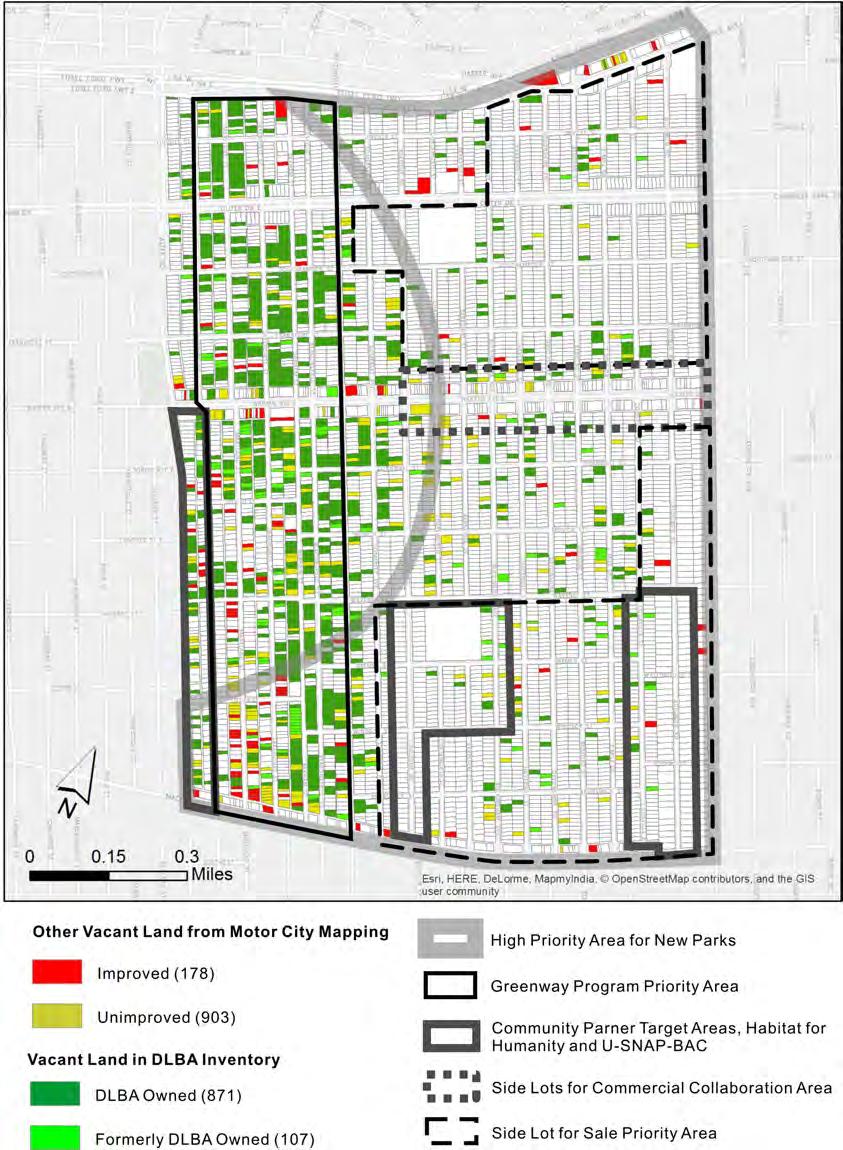
Source: ESRI Base Map, Detroit Land Bank Authority, Property Inventory in Activity, Report 4/19/16; Motor City Mapping, 2014; Detroit Water and Sewerage Department, Green Infrastructure Progress Report Upper Rouge Tributary Area, 2015.
Figure
There are fewer Community Partners buying property in Warrendale than in MorningSide. In Warrendale the DLBA could instead focus on coordinating with other city department plans such as the storm water interventions for the northern portion of Warrendale as proposed by Detroit Water and Sewerage (DWSD).
Figure 9.4 highlights the area that DWSD has prioritized in Warrendale (north of Sawyer Street) as an area for green infrastructure improvements. Combining vacant lots with side lots offers an opportunity for DWSD to implement large-scale green storm water infrastructure projects. There are approximately 564 vacant side lots owned by the DLBA in this area, which represents a significant portion of their inventory which could be made available for large-scale projects.
Figure 9.4 Scenario for Warrendale Implementation of Side Lot & Community Partner Recommendations
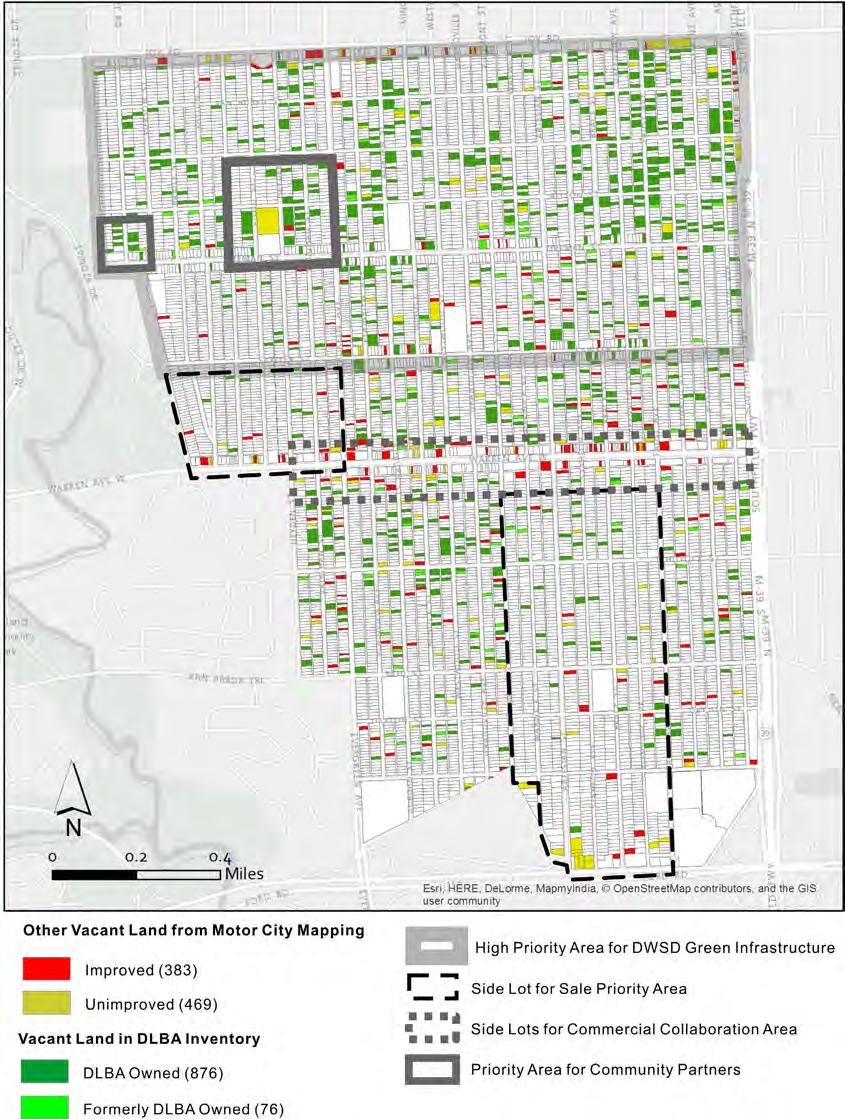
Source:ESRI Base Map, Detroit Land Bank Authority, Property Inventory in Activity, Report 4/19/16; Motor City Mapping, 2014; Detroit Water and Sewerage Department, Green Infrastructure Progress Report Upper Rouge Tributary Area, 2015.
The areas marked “Side Lot for Sale Priority Area” are the areas where DLBA could focus their side lot sales. These areas were determined by level of housing density. If the block is densely populated, then there likely is higher demand for side lots. In these areas, the DLBA could employ targeted marketing initiatives. For example, the DLBA could collaborate with a Community Partner and other neighborhood associations and block clubs to knock on doors and ensure that eligible side lot purchasers are aware of the side lot purchasing process.
Along the principal commercial corridors, the DLBA could contact businesses, which can purchase adjacent lots to expand their business, offer parking, or use the land in another way. The Planning and Development Department and the Housing and Revitalization Department have not designated these sections of Warren Avenue as commercial focus areas, so they are unlikely to receive attention that encourages reinvestment.
Implementation Matrix
The DLBA can consider several factors related to the implementation of the recommendations outlined in this plan. These matrices show the action item, potential partners for collaboration, expected impact, cost, and timeframe. Each action item relates to at least one of the major goals. This matrix can be used to prioritize implementation of the recommendations in this plan.
Key:
✓ = low impact
✓✓ = moderate impact
✓✓✓ = high impact
���� = low cost, uses current resources
�������� = moderate cost, requires a shift in funding or new funding
������������ = high cost, requires new funding
neighborhoods
✓✓ : Homebuyers can buy homes they can afford
Enable auction homebuyers to make better decisions by providing more information about the cost of rehabilitation and the likelihood of obtaining financing Home Depot, Lowe's, Brick + Beam, Michigan Historic Preservatiion Network
Pre ‐sale
x Scale up program/Stabilize neighborhoods
✓✓ : Increases marketing outreach for auction properties
Notify neighbors and neighborhood organizations when offering a home at auction Neighborhood organizations: i.e. Cody Rouge Community Action Alliance, MorningSide Community Organzation, Detroit Dashboard
Host housing fairs to market auction properties Lenders, contractors, housing counselors, BSEED, PDD ✓✓✓ : Informs buyers of their responsibilities at each stage of process
Pre ‐sale
Pre ‐sale
✓✓ : Educates homebuyers on basics for rehabbing homes
Work with homeownership training programs to assure that homebuyers learn about construction U ‐SNAP ‐BAC, Eco ‐Detroit, Construction Association of Michigan, UM Real Estate Certificate
Pre ‐sale
x Scale up program
xStabilize neighborhoods
Stabilize neighborhoods
✓✓ : Increases the number of people who view homes
✓✓ : Increases occupancy in neighborhoods
✓✓ : Signals to buyer to commit to investment in the neighborhood
Contractors
Allow prospective buyers to privately tour auction homes as they can Direct Sales properties
Pre ‐sale
Reduce number of auction properties in MorningSide and Warrendale and sell more properties through Direct Sales ‐
Increase auction starting bid to $3,000 ‐
Sale
Sale
Community Organization, MorningSide organization, Cody Rouge Community Action Alliance, etc.
with neighborhood groups to promote side lot purchasing
neighborhoods
neighborhoods
neighborhoods
✓✓ : Increases better uses of vacant land
✓✓ : Increases improved side lots with more varied uses
Greening of Detroit, DFC, MCR, CDAD, Keep Growing Detroit
Encourage side lot purchasers to submit plans when purchasing side lots
Improve access to side lot care resources
Post-sale
Implement a clean and green program for side lots and other vacant lots that do not sell Community Partners, Community Organizations ✓✓✓ : Provides well maintained neighborhoods
Post-sale
Community Partners
Scale up program
up program/Stabilize neighborhoods
Stabilize neighborhoods
Stabilize neighborhoods
✓✓✓ : Increases access to information and sets standards for DLBA follow-up
✓✓✓ : Increases the number of potential home-buyers reached
Global Detroit, U-SNAP-BAC, and other organizations that assist potential home-buyers
Create seven-step program to communicate internal program processes and deadlines to Community Partners
Pre-sale
Further develop Endorsement Partnership
Pre-sale
✓✓ : Gives Community Partners opportunity to gain more information and make suggestions to improve process
Department of Neighborhoods, Community Development Advocates of Detroit, Michigan Community Resources, neighborhood organizations
Hold regular meetings to update community organizations and gain feedback on DLBA programs
Sale
✓✓ : Creates stronger networks for Community Partners to complete projects
Partner with organizations to develop capacity of community organizations MCR, Black Family Development, CDAD
Sale
Scale up program
✓ : Removes deterrent for less experienced buyers
Communicate process for extensions on reconveyance period
Sale
Communication and Collaboration
Scale up program/Stabilize neighborhoods
x Stabilize neighborhoods
Scale up program/Stabilize neighborhoods
Scale up program/Stabilize neighborhoods
Scale up program
✓✓✓ : Enables potential purchasers to know what is available and increases sales
Provide a public, up-to-date list of Land Bank-owned properties City of Detroit Open Data Portal, Data Driven Detroit, Loveland Technologies
Pre-sale
✓✓✓ : Improves public image and provides more eyes on DLBA-owned property
Improve Detroit, Planning and Development
Create a system for public feedback on condition of DLBA properties
Pre-Sale -
Post-Sale
✓✓✓ : Addresses large areas of vacant land that DLBA owns
Align sales with other city department and community plans Water and Sewerage, Recreation, Housing and Revitalization, community-based organizations
Pre-Sale
✓✓✓ : Makes productive use in the future more likely
Align sales with a larger vision for the City Detroit Future City, Planning and Development, Housing and Revitalization
Pre-sale
✓✓✓ : Provides ideas about potential of reinvestment
Publicize property improvements made to properties the DLBA has sold Print, radio, and online resources
Post-sale
APPENDICES: A-E
APPENDIX A: MAP SOURCES
Josh Bails et. al. 2015. Stabilizing MorningSide, University of Michigan. Retrieved from https://taubmancollege.umich.edu/sites/default/files/files/mup/capstones/2015_Stabilizing-MorningSide.pdf.
City of Detroit. 2015. Department of Neighborhoods, Detroit Neighborhoods [shapefile]. Retrieved from Detroit Open Data Portal.
City of Detroit. 2015. Water and Sewerage Department, Green Infrastructure Progress Report Upper Rouge Tributary Area. Retrieved from http://www.detroitmi.gov/Portals/0/docs/DWSD/GI_StormWater/gi_progress2015.pdf.
City of Detroit. 2015. Office of the Assessor, Parcel shapefiles [datafile]. Received from Detroit Land Bank Authority.
City of Detroit. 2016. Office of the Assessor, Residential Floor Area 2/23/16 [datafile]. Received from Detroit Land Bank Authority.
Detroit Future City. 2016. Achieving an Integrated Open Space Network in Detroit. Retrieved from http://detroitfuturecity.com/wp-content/uploads/2016/02/Final_ DFC_open_space-_02_17_16-2.pdf.
Detroit Land Bank Authority. 2016. Auction Transactions as of January 7, 2016 [datafile]. Received from Detroit Land Bank Authority.
Detroit Land Bank Authority. 2016. Bidder Data as of February 18, 2016 [datafile]. Received from Detroit Land Bank Authority.
Detroit Land Bank Authority. 2016. Direct Sales as of February 18, 2016 [datafile]. Received from Detroit Land Bank Authority.
Detroit Land Bank Authority. 2016. Own It Now Sales Inquiries as of April 2, 2016 [datafile]. Received from Detroit Land Bank Authority.
Detroit Land Bank Authority. 2016. Property Inventory and Activity Report as of April 19, 2016 [shapefile]. Received from Detroit Land Bank Authority.
Detroit Future City. 2012. 50-year Land Use Scenario [shapefile]. Received from Susan Landfried.
ESRI, HERE, DeLorme, MapmyIndia.2016 (Grey Base Map from ESRI).
Motor City Mapping. 2014. Property Conditions [datafile]. Received from Data Driven Detroit.
United States Census Bureau, 2010-2014 American Community Survey Estimates, Form B19013. Retrieved from American Factfinder.
United States Census Bureau. 2015. TIGER/Line Shapefiles, Detroit Roads. Retrieved from United States Census Bureau.
United States Census Bureau. 2015. TIGER/Line Shapefiles, United States Zip Code Tabulation Areas. Retrieved from United States Census Bureau.
United States Census Bureau. 2015. TIGER/LINE Shapefiles, Wayne County Census Block Groups. Retrieved from United States Census Bureau.
APPENDIX B: FIElD RESEARCh ChECklISt
This was the checklist, adapted from the Motor City Mapping housing condition checklist, that was used for field research for assessing auction and direct sales properties, and community partner properties.
This was the checklist used for field research for assessing auction and direct sales properties, and community partner properties.
Building Frame/Structure
Minor: Building is not leaning, but foundation is in need of minor repairs or is missing materials
Major: The building is not straight – leans or tilts
No problems
Roof/Chimney/Gutters:
Minor: Minor deterioration, improper roof repair; Some mortar missing from chimney; gutters in need of repair
Major: A lot of deterioration, missing material, holes in roof, or sagging roof
A lot of mortar missing from chimney or chimney is leaning. No problems
Windows/Doors:
Minor: Window frames need replacing or paint is peeling
Major: Windows missing, doors missing or rotted
No problems
Siding/Paint:
Minor: Some peeling or cracking paint
Major: (brick building) Building missing many bricks (frame building) Wood siding is rotted
No problems
Porch:
Minor: Separation of the porch from the building, paint needed
Major: Significant deterioration; steps missing, porch sagging, supports holding up porch are rotted
No problems
Select definition of housing condition that matches what you have checked above:
Good: Building looks structurally sound and well maintained. It needs no more than two minor repairs. It is not leaning or tilted and the foundation is in good shape. The building may need some general maintenance, such as the replacement of window frames or painting.
Fair: House is structurally sound, and may need three or more minor repairs, but no more than one major repair. The building could be rehabilitated fairly inexpensively to improve its rating.
Poor: The house may not be structurally sound, and needs two or more major repairs. The building may have broken windows or the porch may look as if it is falling off the structure. Major repairs need to be made for this building to be safe, adequate housing.
Should be Demolished: This house is not structurally sound and should not be lived in. It may have fire damage, or it may be leaning. If the building has not been secured and boarded up, make sure to indicate that the house is “open and dangerous.”
Vacant lot: No structure stands in the lot although there may be debris
APPENDIX C: AUCtION BIDDER MAP
The map below shows DLBA auction bidders credit card registration counts by zip code from 2014-2016.An advisory committee member asked whether auction properties were sold to Detroiters or out-of-state residents. Forty-three percent of all auction bidders used credit cards with a Detroit zip code
Among 780 properties for which data was available, 78 percent of bidders used credit cards with Michigan zip codes, while 43 percent of all bidders used credit cards with Detroit zip codes.
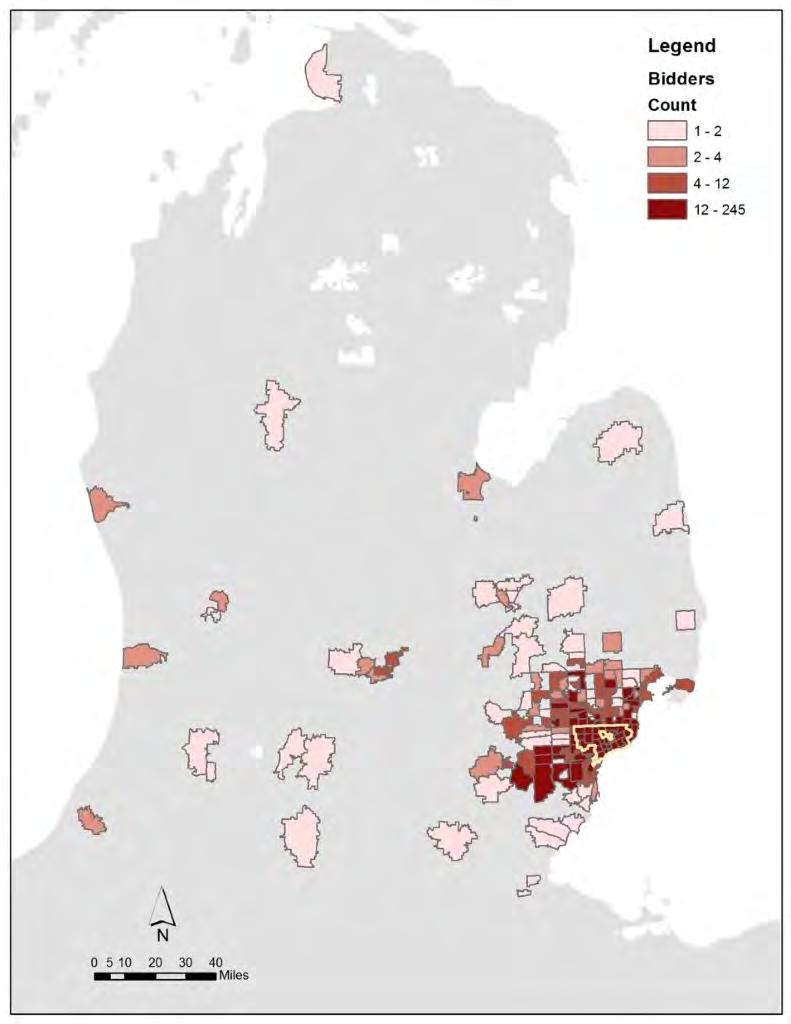
Source: Detroit Land Bank Authority, 2016.
APPENDIX D: SIDE lOt FAIR SURvEy
The Detroit Land Bank Authority administers this survey at the Side Lot Fair. Recommendations in this plan are in part based on information gathered from this survey.
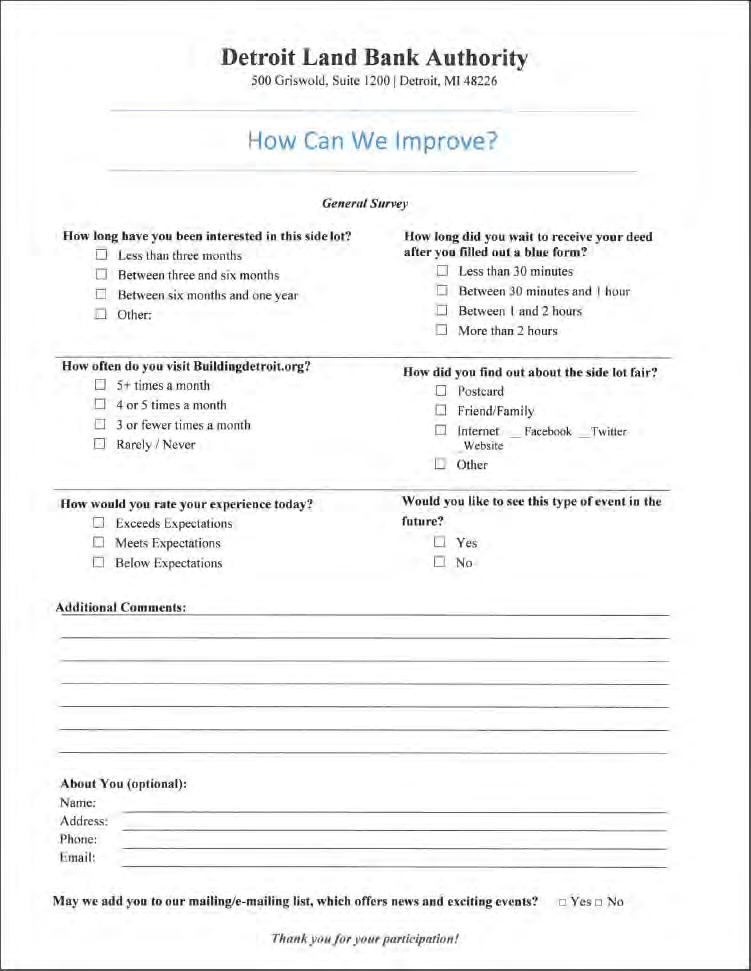
Source: Detroit Land Bank Authority, 2016
PRE-APPLICATION KIT
Included in this sample Pre-Application Kit is the following:
• Pre-application letter with information relating to the benefits of becoming a Community Partner,
• Overview of the seven-step application process, and
• Listing of required documents for application.
Before releasing this Pre-Application Kit, the Detroit Land Bank Authority (DLBA) would add the following:
• Contact information for District Managers and information about how to receive a letter of recommendation, and
• Authority documents for transacting with the DLBA.
Pre-application letter
Thank you for considering a partnership with the Detroit Land Bank Authority! The Detroit Land Bank Authority (DLBA) Community Partner program assists non-profit and faith-based organizations in building capacity for project completion and connects your organization’s target population and area to the DLBA.
After joining the program, representatives from your organization will be invited to attend quarterly Community Partner meetings where you can connect to other organizations, District Managers, Councilmembers and their staff, and city departments. These meetings also serve to provide you and your organization with information which can assist in completing projects and endorsing potential home buyers. These meetings are intended to create a collaborative space where nonprofits and city staff can work together towards a larger vision for the city.
Community Partners also enjoy opportunities to purchase properties that are not offered through other DLBA programs.
The seven steps to becoming a Community Partner are as follows:
1. Download Pre-Application Kit off website and prepare documentation (listed below)
2. Send in Community Partner application available on the web site (Expect a response within one week)
3. Receive Welcome Kit with development plan template included
4. Send in first draft of development plan
5. Receive feedback on development plan from DLBA and make revisions (expect response within three weeks)
6. Set up and attend a property Acquisition Meeting for proposed development
7. Close on property and begin work on development in accordance with compliance team requirements
Prior to application, please be sure you will have access to the following documents:
• IRS Tax Exempt Letter
• Letter of recommendation from District Manager or City Council representative of district where organization operates
• Authority documents for persons who will transact with the DLBA on be half of your organization (included in this document)
Thank you again for considering a partnership with the DLBA. Should you have any questions, please do not hesitate to contact your Community Partner program managers.
Best,
Darryl Earl
Community Relations Manager
Detroit Land Bank Authority
Megan McGreal
Disposition Manager
Detroit Land Bank Authority dearl@detroitlandbank.org
mmcgreal@detroitlandbank.org
313-502-5342 (313) 502 5230
WELCOME KIT
Included in this sample Welcome Kit are the following:
• Welcome letter
• Instructions for using Motor City Mapping
• Cost estimate for renovating homes/pro forma template
• Development Plan sample outline
• Acquisition meeting instructions
• Vision meeting instructions (included in the event that the DLBA does not implement the recommendation to switch from Vision Meetings to Acquisition Meetings)
Before releasing this Welcome Kit, the DLBA would add the following:
• Contact information for relevant DLBA departments
• Case studies of successfully completed Community Partner projects
• Available DLBA-owned properties in the Community Partners’ district
• List of current Community Partners
• Links to Detroit Comprehensive Plan, Detroit Future City plans, and other neighborhood plans
• List of possible resources for funding projects
• A statement about receiving extensions on the six month recon veyance period
• Contact information for District Managers, council members and staff, and other city departments
Welcome Letter
On behalf of the Detroit Land Bank Authority (DLBA), congratulations on becoming a Community Partner! We look forward to a productive partnership intended to bring your vision for your neighborhood improvement projects to reality. Megan McGreal and I will be your points of contact for any questions or concerns regarding obtaining DLBA-owned properties.
This Welcome Kit is designed to help you through the acquisition process. The kit includes:
• Instructions for using Motor City Mapping
• Cost estimate for renovating homes/pro forma template
• Development Plan sample outline
• Acquisition meeting instructions
Your next step is to submit your Development Plan for review using the attached resources. Please do not hesitate to contact us with questions.
Once again, congratulations, and we look forward to working with you and your organization as a Community Partner with the Detroit Land Bank Authority.
Respectfully,
Darryl Earl
Megan McGreal
Community Relations Manager Disposition Manager
Detroit Land Bank Authority Detroit Land Bank Authority dearl@detroitlandbank.org mmcgreal@detroitlandbank.org 313-502-5342 (313) 502 5230
Instructions for using Motor City Mapping to identify available properties
Identifying properties is one of the first steps to achieving your organization’s vision as a Community Partner. Motorcitymapping.org is a free online tool which allows a better understanding of property ownership and condition.
How to use Motorcitymapping.org:
Note: Use of Motor City Mapping would be greatly improved by updating the condition of the DLBA property holdings and the list of what DLBA owns, as outlined in chapter 8. Use of Motor City Mapping is contingent upon updated property information.
Access the site and click on the “Explore” tab, located on the right side of the screen:
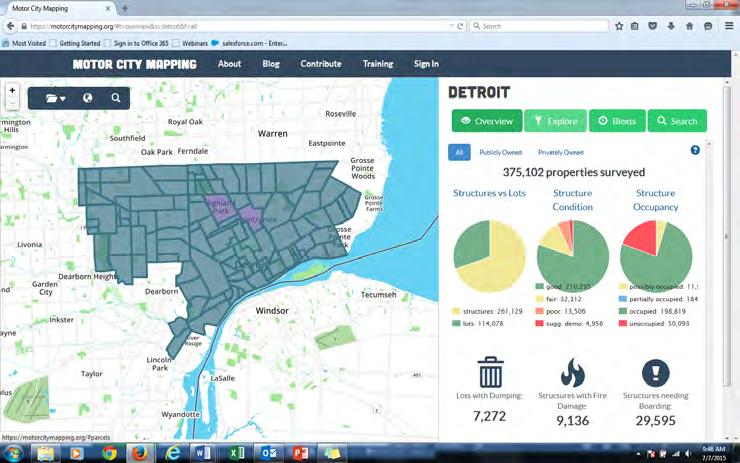
Once you have entered the “Explore” tab, click on the “Publicly owned structures vs. lots” under the “Try these citywide layers”:
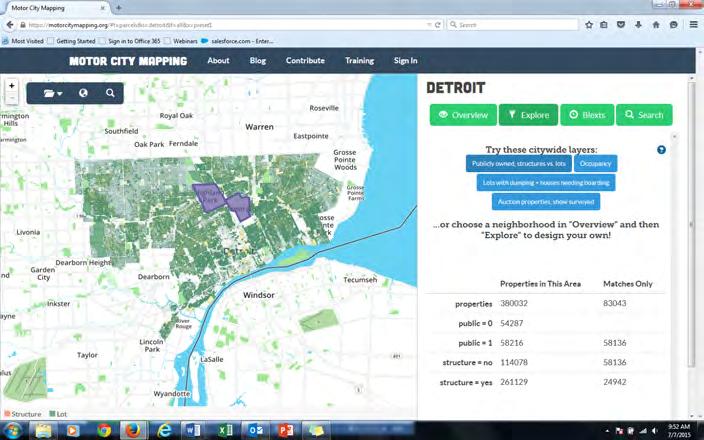
This will give you a city-wide map of publicly owned structures and lots (outdated, however) All publicly owned structures are indicated in a tan/yellow color and all publicly owned lots are represented in green. All properties without color under this layer are privately owned. Now you can type in an address in your organization’s target area and begin to find out whether the property may be owned by the DLBA.
Cost Estimates for Renovating Homes
Once you have identified a property, you can consider how much additional renovation work is required to bring properties up to compliance. While DLBA homes are often inexpensive, our inventory contains properties that require varying levels of work. Using this sheet, you can determine a cost estimate for your scope of work.
Development Plan Sample Outline
1. Executive Summary
a. Overview of your recent accomplishments
b. Overview of your vision and project plan
c. Any other information important to the project
2. Brief explanation of your project
a. Market analysis - highlight the community need and explain your solution
3. Project phasing
a. Detailed description of timeline for each phase
4. Map
a. List of requested parcels
b. Map of phasing
c. Bird’s eye view of the area with your buildings or lots future use
5. Project partners
a. Other participating organization’s background and role
b. Money or materials donated
6. Funding types/budget
a. How much will the total vision cost to complete?
b. Current resources for project - what funding do you have now?
i. Equity
ii. Commitments for grants and loans
iii. Other assets (furniture, equipment, etc…)
c. Future assets for project - what funding are you seeking?
i. Projected construction debt financing
ii. Projected permanent debt financing
iii. Projected income from your project
iv Projected grants & other funding sources
Acquisition Meeting Instructions
On behalf of the Detroit Land Bank Authority, thank you for committing to becoming a Community Partner! We look forward to an Acquisition Meeting with you to review your property reuse plan, provide feedback, determine next steps, and review prices for the properties for your intended development(s). This meeting will last about one hour, and DLBA staff, including the Community Partners program managers,Inventory staff, and BSEED staff will also attend this meeting to provide information regarding property acquisition and the benefits associated with being a Community Partner.
This meeting will take place after someone from your organization has completed a development plan and sent it to Community Partners staff to review. DLBA staff will contact you within three weeks after submittal to provide feedback on your development plan and arrange the Acquisition Meeting. We also ask that you submit all additional documentation, prior to this meeting, as outlined in this Welcome Kit.
At the Acquisition Meeting, you and DLBA Inventory staff will determine the approximate sales price for the properties that your organization is interested in acquiring. We ask that you review the sample cost estimates included in this Welcome Kit when determining potential properties to acquire. This will help to better determine your price point for a property in the acquisition meeting.
We recognize that organizations like yours are creating change in Detroit on a neighborhood-level, and we look forward to working with you towards these efforts.
Detroit Land Bank Authority
500 Griswold Street, Suite 1200, Detroit, MI, 48226
Main DLBA phone: 1-844-BUY-DLBA
Community Partner Coordinator: Darryl Earl
Email: dearl@detroitlandbank.org Phone: 313-502-5342
Note: If the Community Partners Program does not switch from the Vision meeting to the Acquisition meeting, the DLBA should include the following letter instead.
Vision Meeting Instructions
We look forward to our first meeting with you as a Community Partner! This meeting will last about one hour and we will learn more about your organization and your ideas for future projects. Before the meeting we ask that you prepare the following:
• Define your project boundaries: The Detroit Land Bank Authority encourages community partners to concentrate projects within a defined area. The work area must be within five miles of your organiza tion. Please use Google Maps (Search for “My Maps – Google” to use a mapping tool that allows you to measure distances and areas) to define your focus area.
• Search for specific parcels or properties: By using sites like MotorCity Mapping.org and accessing its “Vacant properties vs. lots” function un der the “Explore” tab, your organization can better understand which properties are vacant and currently held by the Detroit Land Bank Au thority, although the site is not up to date.
• Submit a “Formal Property Request” to DLBA: After comparing in formation on Motorcitymapping.org with the needs for your proj ect, you will submit a “Formal Property Request.” With your formal property request, DLBA requests that you create a map of your target area with the properties being requested highlighted along with any properties that the organization currently owns. When received, a DLBA representative will research this “Formal Property Request” with internal database systems and return an updated list to your organi zation within 48 hours. Once your organization receives this updated list, you may choose to re-submit a new list or select from the DLBA owned properties identified.
• Understand your short and long term vision: Speak with others in your organization and your neighborhood to define your short and long term goals. Come to the Community Partners Vision Meeting with a clear and concise understanding of your organization’s mission so that we can better understand how the Land Bank can assist you to reach your goals.
• Questions Regarding Process and Property Requests: If questions arise about how to use motorcitymapping.org or how to submit requested information, please reach out to your Community Partner contact at DLBA. This program intends to provide you with ample resources to ensure your project’s success.
This meeting is the first in a partnership that we hope will help your organization to increase your impact on the community and neighborhood. Organizations like yours are creating change in Detroit on a neighborhood-level, and we look forward to working with you towards these efforts.
Detroit Land Bank Authority
500 Griswold Street, Suite 1200, Detroit, MI, 48226
Main DLBA phone: 1-844-BUY-DLBA
Community Partner Coordinator: Darryl Earl
Email: dearl@detroitlandbank.org
Phone: 313-502-5342