MARINA DISTRICT RIVERFRONT ACCESS PLAN
Taubman College of Architecture and Urban Planning
University of Michigan may 2016
MARINA DISTRICT RIVERFRONT ACCESS PLAN
Authors
Jenya Abramovich, Jacqueline Austin, Alison Carey, Yuexuan Hu, Kaleah Mabin, Lesley Rivera, Dan Sommerville, Yuxiao Xu, Yiting Yao, Baihe Yang
Advisors
Eric Dueweke, Wendy Rampson
May 2016
ACKNOWLEDGEMENTS
MECC
Michigan Engaging Community through the Classroom (MECC) is a multidisciplinary initiative at the University of Michigan in which graduate and undergraduate students from different colleges within the university collaborate on community-oriented professional projects. MECC aims to simultaneously improve the learning opportunities for the students involved and the outreach service provided to the communities involved.
The Winter 2016 MECC project focused on addressing challenges and opportunities along the riverfront on Detroit’s East Side. Participating units included the Taubman College of Architecture and Urban Planning, and the College of Engineering.
THE ACCESS BLUE PROJECT TEAM
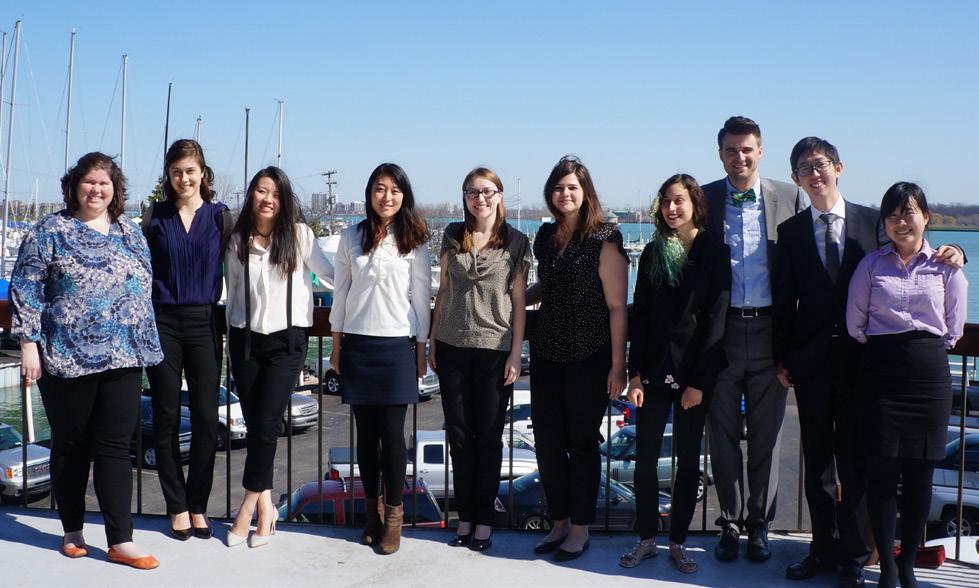
This plan was produced for Jefferson East, Inc. by a team of Master of Urban Planning students from Taubman College, led by faculty advisors Eric Dueweke and Wendy Rampson. It was developed within the University of Michigan’s Winter 2016 semester, from January through April 2016. The student team included:
Jenya Abramovich
Jacqueline Austin
Alison Carey
Yuexuan Hu
Kaleah Mabin
Lesley Rivera
Dan Sommerville
Yuxiao Xu
Yiting Yao
Baihe Yang
EXECUTIVE SUMMARY
Detroit’s Marina District covers nearly 1200 acres along the Detroit River five miles east of downtown. The district’s unique mix of land uses — including commercial, residential, industrial, and recreational — give it a distinct character, yet presents several challenges. Thousands of vehicles traverse the district daily along East Jefferson Avenue while historic assets such as the Conner Creek Power Plant and the river itself remain hidden. Local residents and business leaders, along with the nonprofit economic development umbrella group Jefferson East Inc. (JEI), seek a more cohesive identity for the district, as well as increased connectivity to/from the district.
This Marina District Riverfront Access Plan follows up on JEI’s 2013 Marina District Vision document by presenting strategies aimed at achieving two goals: first, to enliven the public experience of the Marina District; and second, to enhance transportation connections in the Marina District, especially through intermodal linkages. This new plan is produced by “Access Blue,” a team of urban planning graduate students from the University of Michigan. Team members from Access Blue reviewed several previous plans and initiatives, in addition to the Marina District Vision, to inform this plan. The team then engaged area residents and business leaders through focus group meetings and individual stakeholder interviews. The resulting recommendations, based on input and feedback from community stakeholders, support each of the plan’s two goals.
Toward the goal of enlivening the experience of public space, recommendations include:
• Install gateway, wayfinding, and informational signage to help people navigate, and brand the Marina District;
• Enhance the district’s curb appeal through landscaping with green infrastructure and installing public art;
• Promote public parks as community assets by increasing access to Reid Memorial Park, create trash and maintenance programs for the Marina District, and partner with animal welfare organizations to address the issue of stray dogs in the area; and
• Create opportunities for three activity hubs throughout the Marina District, featuring innovations such as food trucks and bait carts at Reid Memorial Park, as well as repurposing the decommissioned Conner Creek Power Plant for public use.
Toward the goal of enhancing the connectivity of the Marina District, current transportation networks were analyzed to inform recommendations including:
• Improve non-motorized transportation connections through better sidewalk conditions, more bicycle lanes, developing a rail-by-trail, and creating a multi-modal bridge over Conner Creek;
• Improve motorized transportation connections by extending local bus service, designating a truck route, opening up the cul-de-sac on Old St. Jean Street, and converting one-way streets to two-way streets; and
• Create a water transportation connection by establishing a water taxi service connecting Reid Memorial Park to Belle Isle.
Accommodating the varied land users in the Marina District makes collaboration on a unified strategy a daunting task. Through continued community engagement and adoption of the recommendations in this plan, JEI and other stakeholders can achieve the goals of a lively, well-connected and more attractive district.
INTRODUCTION CHAPTER 1:
Detroit’s Marina District contains many assets that contribute to a vibrant and unique neighborhood with potential to become a destination in the city of Detroit and greater region. The Detroit River is the district’s most important asset, serving as the focal point of future development and activity. Canals and marinas along the river provide water access for boating. In addition, the district provides opportunities for recreation in four parks, as well as the Conner Creek Greenway, which runs eastward along East Jefferson Avenue and southward on Clairpointe Street.
A mix of land uses adds to the unique character of the district and presents unique challenges. A number of heavy industrial properties neighbor residential properties and park space. The high contrast of these adjacent land uses is the signature of the Marina District, but it also contributes to lack of clarity over which spaces are open to the public. The mix of land uses also requires creative strategies to optimize appearance and safety in the district.
The Marina District is poised for significant change on the horizon. DTE Energy currently is planning what will come next for the Conner Creek Power Plant site, and a new residential community is being envisioned for the vacant parcels south of Jefferson Village. In addition, many residents and business leaders have expressed interest and support for promoting name recognition for the Marina District both on the riverfront and in the City of Detroit.
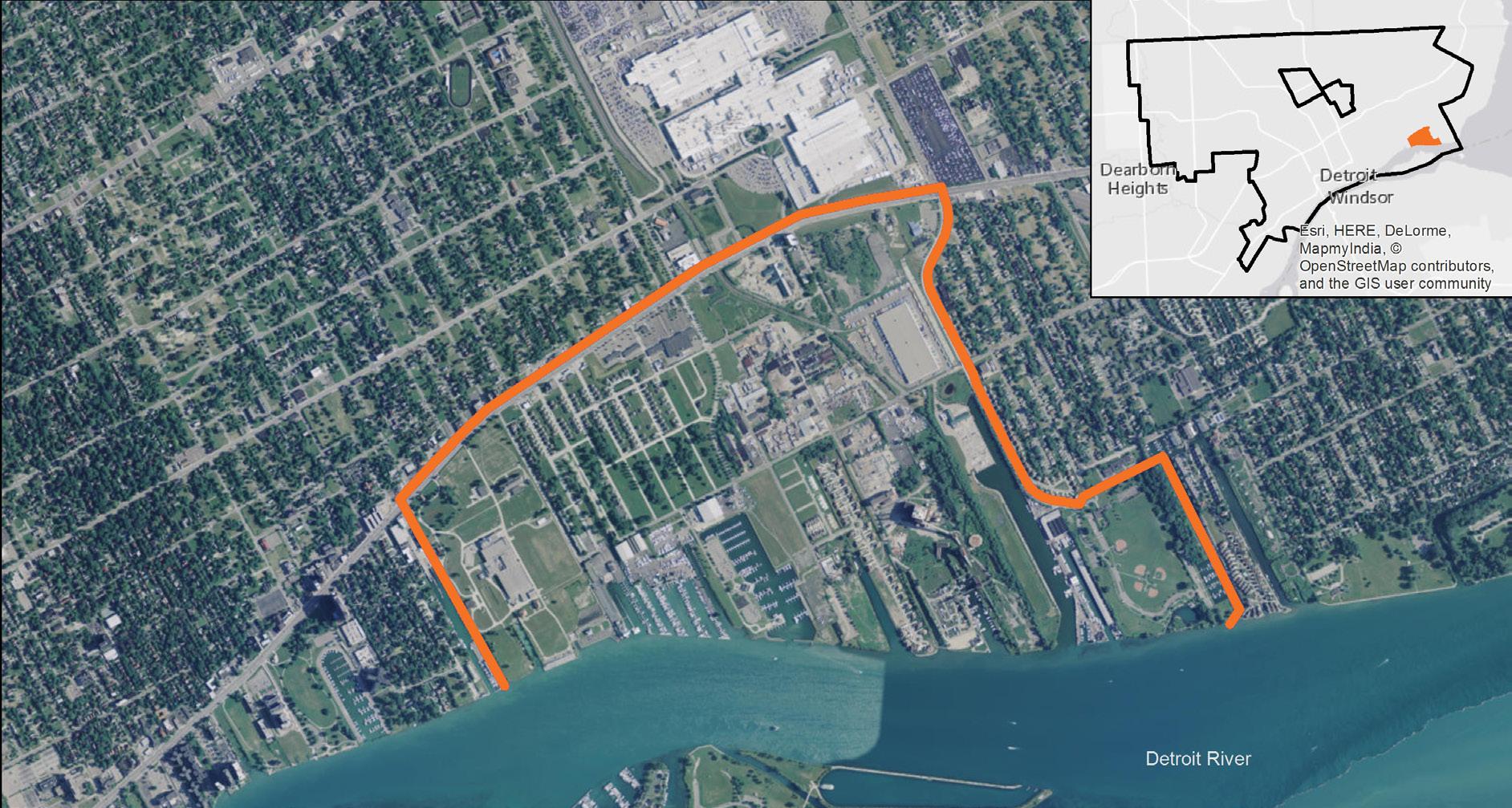
FIGURE I-1. STUDY AREA
This plan builds on the Marina District Vision plan, produced for Jefferson East, Inc. by SmithGroup JJR in 2013.1
CLIENT
The Marina District Riverfront Public Access Plan effort was sponsored by Jefferson East, Inc. (JEI). JEI works to cultivate new development in the East Jefferson Avenue corridor, east of downtown Detroit. JEI serves its members in five districts along the corridor: Lafayette Park, Rivertown, The Villages, Marina District, and Jefferson-Chalmers. At the outset of this project, JEI requested that the project team build upon the 2013 Marina District Vision, particularly in the interest of improving public access to the riverfront.
STUDY AREA
The project study area, known as the “Marina District,” is located in the east side of the city of Detroit, approximately five miles from downtown. The study area contains approximately 1,178 acres, or 1.84 square miles, bounded by Marquette Drive to the west, Clairpointe Street to the east, East Jefferson Avenue to the north, and the eastern shore of the Detroit River to the south. These boundaries align with the study area in the 2013 Marina District Vision plan.2 Waterworks and Maheras-Gentry Parks are also included in the study area for this plan, as both are well-known sites with the potential to provide more public access to the riverfront and become even greater assets to the surrounding community.
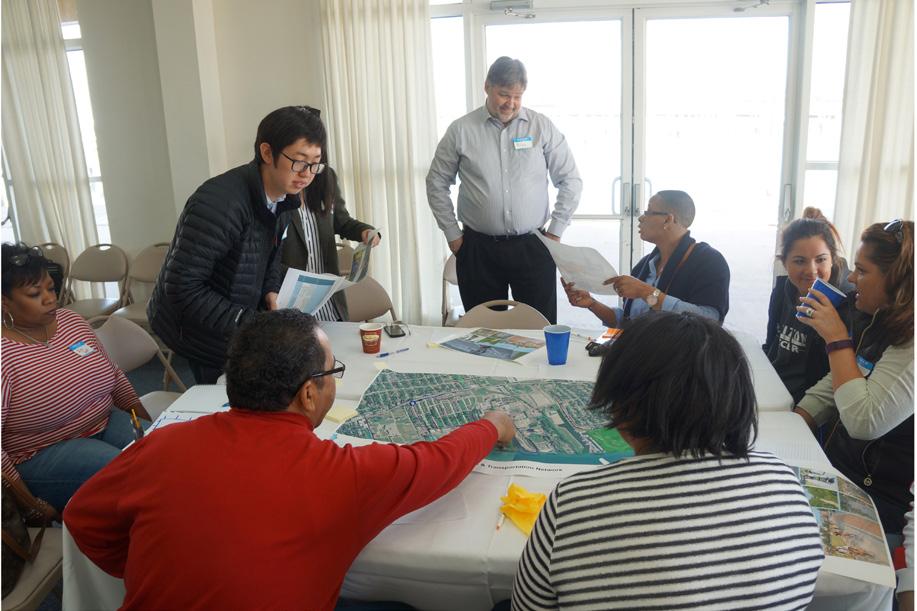
FIGURE I-2. RESIDENT FOCUS GROUP 1
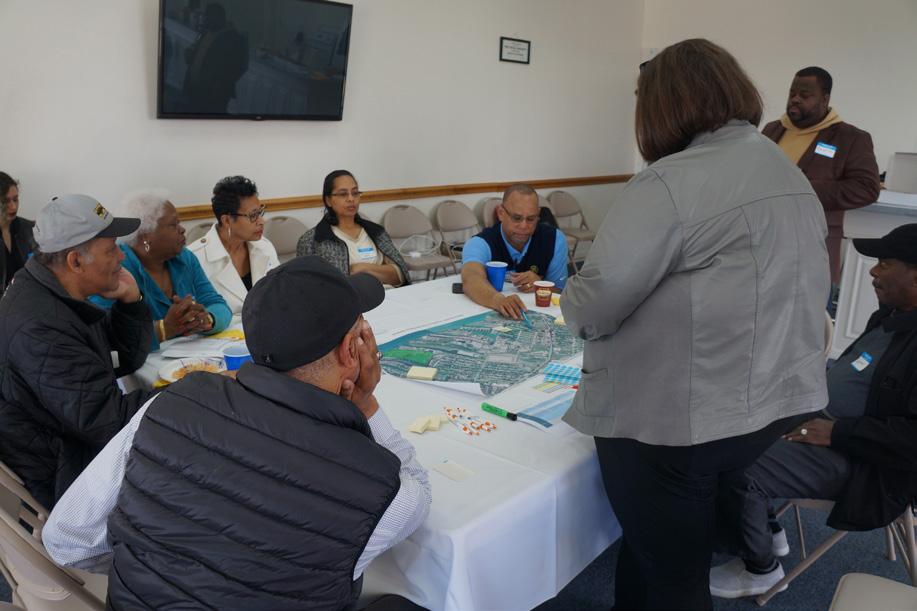
FIGURE I-3. RESIDENT FOCUS GROUP 2
PLAN PROCESS
This plan began with research of local history, existing plans and initiatives, and zoning and parcel data for and including the Marina District. Additionally, case studies of public access plans for other similar waterfront communities were reviewed. Publicly available demographic and geospatial data were gathered to produce maps of existing and planned district conditions. These data were supplemented with primary data collection on street and sidewalk conditions. Chapters 2 and 3 summarize the findings from this research.
After development of preliminary recommendations, community stakeholders were consulted to determine if the potential strategies were desirable and realistic. Two focus groups were conducted, one for residents of the district and one for businesses, in addition to individual interviews with representatives of organizations with involvement in the district. The project team collaborated with student teams in MECC to connect with additional local stakeholders and coordinate with the Architecture and Engineering team recommendations. Chapter 3 presents community engagement findings and the Appendix includes detailed focus group meeting notes.
Plan recommendations build on the 2013 Marina District Vision plan and are influenced by other plans connected to the district, as well as the existing conditions of local infrastructure and the input of local residents and business representatives. Feedback from residents,
business representatives, other local stakeholders, and JEI collectively shape the final form of this plan. Recommendations and implementation guidance are provided in Chapter 4.
PURPOSE AND GOALS
In 2013, the Marina District Vision plan sought to develop the district into a more distinguished destination with its own branded identity, along with easing transitions between adjacent land uses within the district. Additionally, the plan sought to improve safe access to connect newcomers to this burgeoning destination.3
Following up on the 2013 plan, the purpose of this planning effort is to improve the public experience of and access to community amenities via land and water in Detroit’s Marina District. The following two goals of this plan hone in on the roots of the 2013 goals, giving implementation of the vision a strong base from which to grow.
GOAL ONE: GOAL TWO:
Enliven the public experience of the Marina District.
Enhance transportation connections in the Marina District.
REFERENCES
1 Smithgroup JJR. (2013). Marina District Vision. Detroit.
2 Smithgroup JJR. (2013). Marina District Vision. Detroit.
3 Smithgroup JJR. (2013). Marina District Vision. Detroit.
HISTORY AND PLANNING BACKGROUND CHAPTER 2:
The Marina District is comprised of a unique mix of land uses that is distinguished by its high contrast within an area of only 1.84 square miles. The mix of industrial, commercial, residential, and recreation space is the result of different pockets of the district taking shape at different points in its history. Likewise, many parcels sit inactive today, no longer occupied by former owners or users. This chapter will cover some of the relevant history that led the Marina District to its current shape, as well as the many plans that have been produced to change it, whether directly, or as part of larger regional projects.
HISTORY OF THE MARINA DISTRICT
Waterworks Park, the western bookend of today’s Marina District, officially opened and began operations in 1879.1
The 110-acre park was both the site of Detroit’s public water works system and an active public park, featuring a
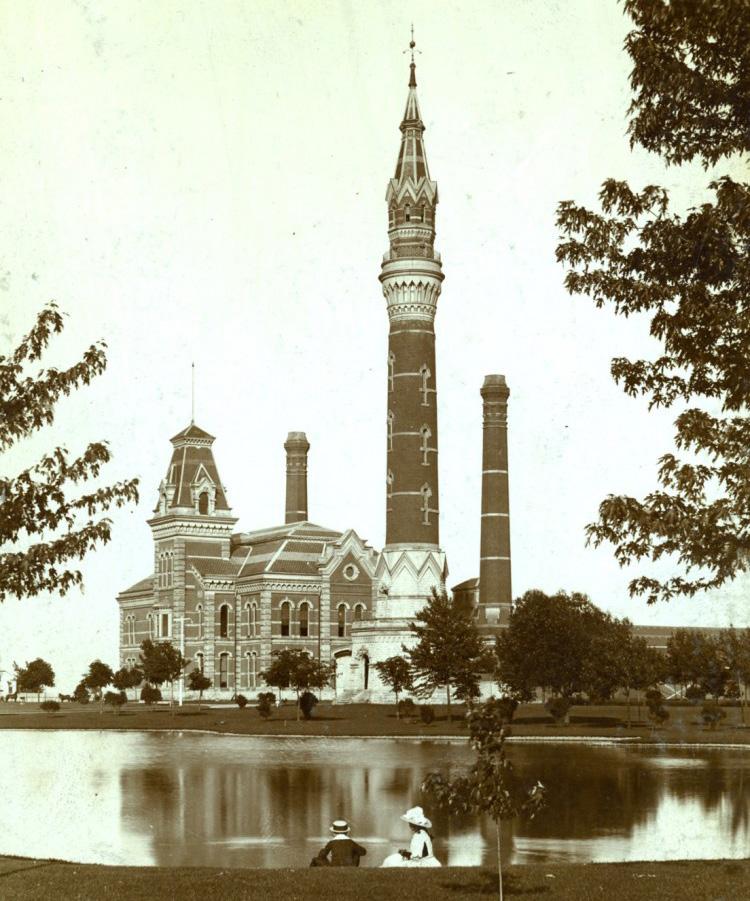
park library, swimming areas, a wading lagoon, and canal. The park’s 185-foot tall water tower, shown in Figure II-1, stood as a prominent fixture of the city’s skyline until it was demolished in 1945.2
In the early years of the 20th century, Henry Ford raced his automobiles at the Detroit Driving Club’s Grosse Pointe Track,3 located on the land that is today known as Maheras-Gentry Park, shown in Figure II-2.4
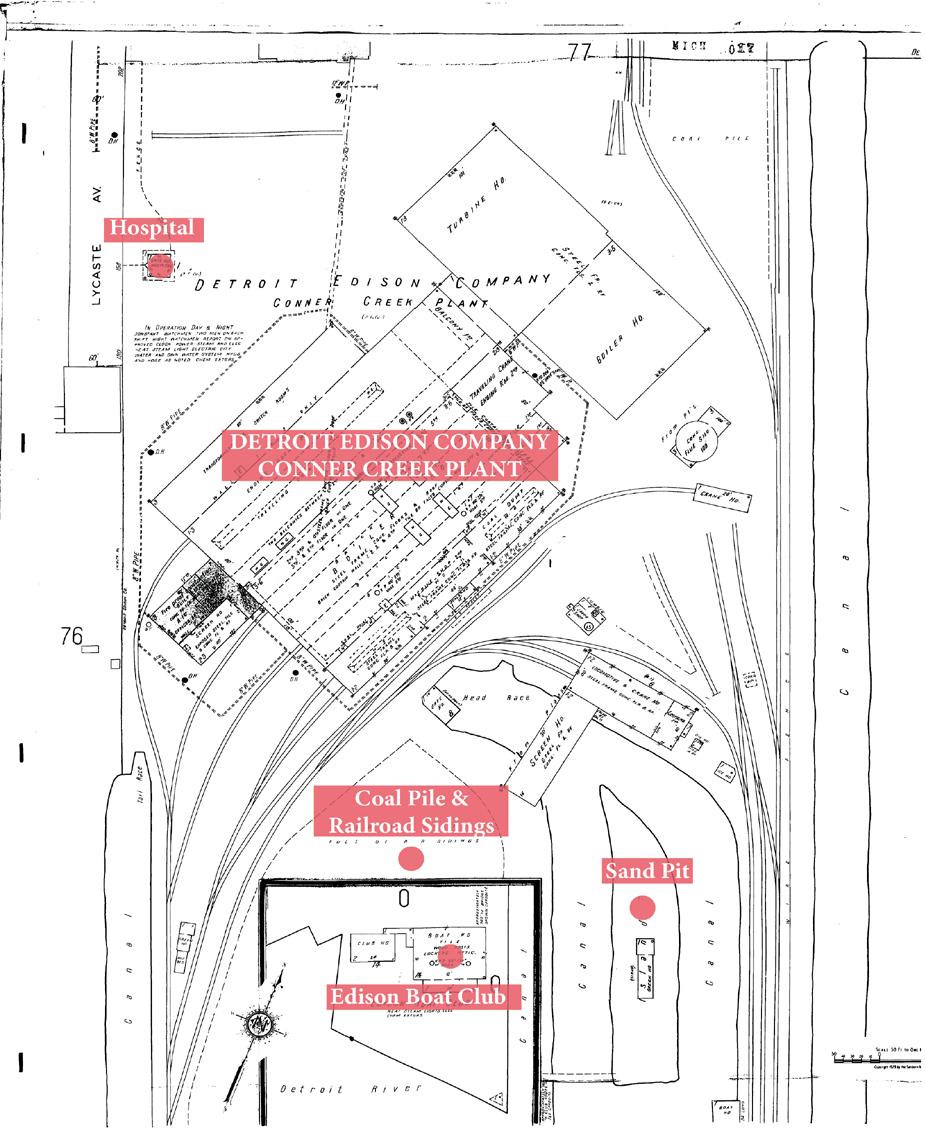
In 1913, DTE purchased 26 acres of land just west of Conner Creek to begin building the Conner Creek Power Plant.5 Shortly after that, in 1915 several yacht clubs were established in the area, including both the Bayview and the Edison Yacht Clubs.6 By 1929, the coal-fired power plant property had expanded to 66 acres in size, to house
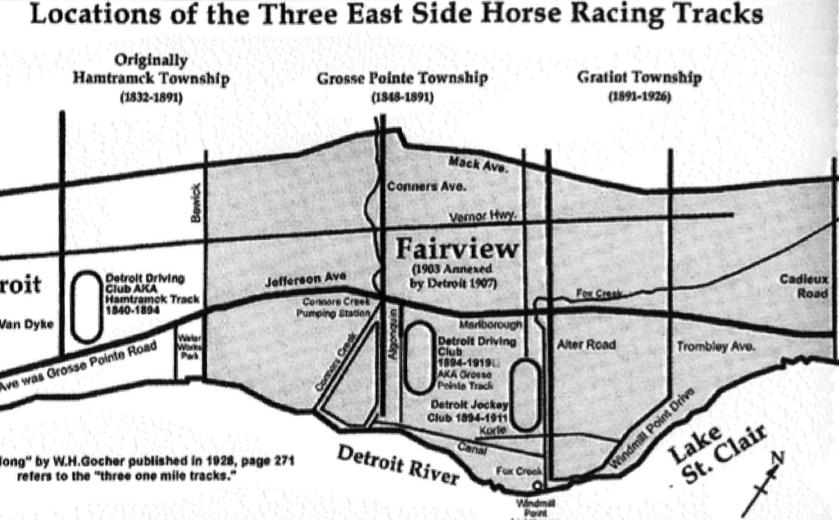
FIGURE II-1. WATERWORKS PARK TOWER, 1870S | SOURCE: BURTON HISTORICAL COLLECTION (2016). RETRIEVED FROM: HTTP://HISTORICDETROIT.ORG/GALLERIES/WATER-WORKS-PARK-TOWER-OLD-PHOTOS/
FIGURE II-2. HORSE RACING TRACK LOCATIONS, 1928 | SOURCE: SINACORI ET AL. (2012). “HORSE POWER, MEN & MACHINES,” PP. 15
the “Seven Sisters” smokestacks, which were the tallest structures in the Detroit area at the time.7
By the end of World War II, the East Jefferson Avenue had grown into a lively commercial corridor, just north
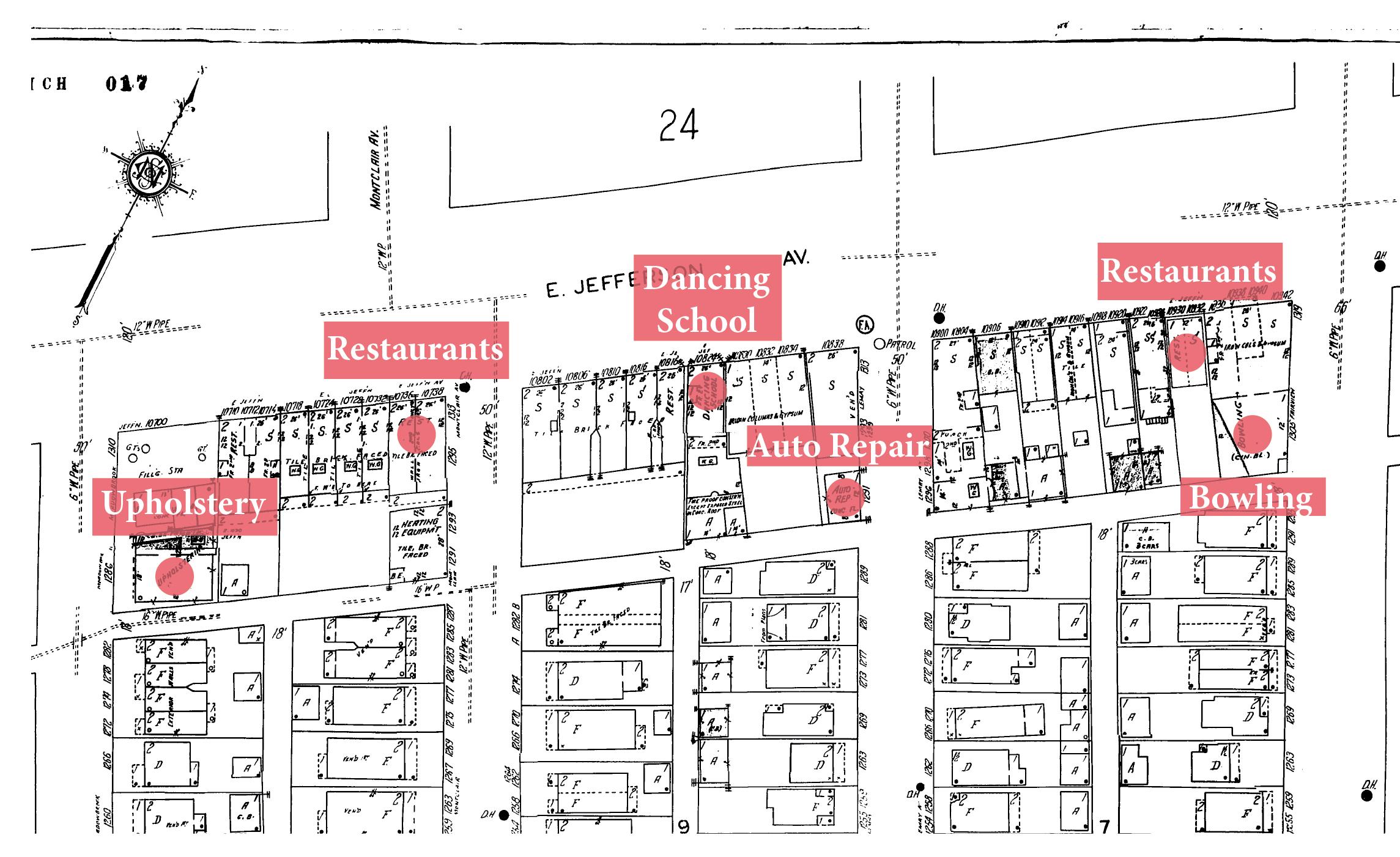
of what is today the Jefferson Village residential neighborhood. The sanborn maps from 1949 in Figure II-3 and Figure II-4 show many businesses were active at that time, including the Fairview Bowling alley, as well as an upholstery store, auto repair shop, fire department, and a dancing school. The Chateau Frontenac Apartment
FIGURE II-3. SANBORN MAPS, 1949 | SANBORN MAPS. DETROIT [WAYNE CO.]; 1910-JULY 1951; VOL. 11, 1929-APR. 1949
Hotel, filling stations, and restaurants were also active on Marquette Drive. From East Jefferson Avenue to the riverfront, many more businesses operated industrial facilities, including Chrysler’s Jefferson North Assembly Plant, which is one of the few businesses from this time period that remain active to this day.8
In 1951, an addition to the Conner Creek Power Plant was constructed, which included the “Two Brothers” smokestacks.9 In that same year, Waterworks Park was closed to the public due to national security concerns during the Korean War. While similar closures had also taken place during World War I and II, the park has not been reopened to the public since its closure in 1951.10 As the latter half of the 20th century progressed, much of the district went through de-industrialization, with many industrial businesses closing or relocating their operations.
At the close of the 20th and beginning of the 21st century, the Marina District went through a few key changes that bring it to its current shape. In 1996, “the Seven Sisters” portion of the Conner Creek Power Plant was demolished.11 A year later, the Detroit Economic Development Corporation initiated the Jefferson Village project, building market-rate single-family detached houses just south of East Jefferson Avenue.12 In 2006, Morgan Waterfront Estates began its work building
out a gated residential community on the riverfront, adjacent to the Conner Creek Power Plant.13 DTE Energy decommissioned the power plant in December 2011.14
FIGURE II-4. SANBORN MAPS, 1949 | SANBORN MAPS. DETROIT [WAYNE CO.]; 1910-JULY 1951; VOL. 11, 1929-APR. 1949
EXISTING PLANS AND INITIATIVES
Over the last decade, many organizations have conducted public engagement, planning, and project implementation focused on the Marina District and surrounding communities. These efforts provide valuable insight on current community assets and needs, offering an opportunity for this plan to build upon existing initiatives.
This section identifies existing plans and initiatives and some of their elements that have implications for riverfront public access in the Marina District, and provides a summary table of recommendations relevant to the Marina District. Since this plan most directly follows the 2013 Marina District Vision, this plan is described first, with all other plans following in chronological order by the year they were published.
MARINA DISTRICT VISION (2013)
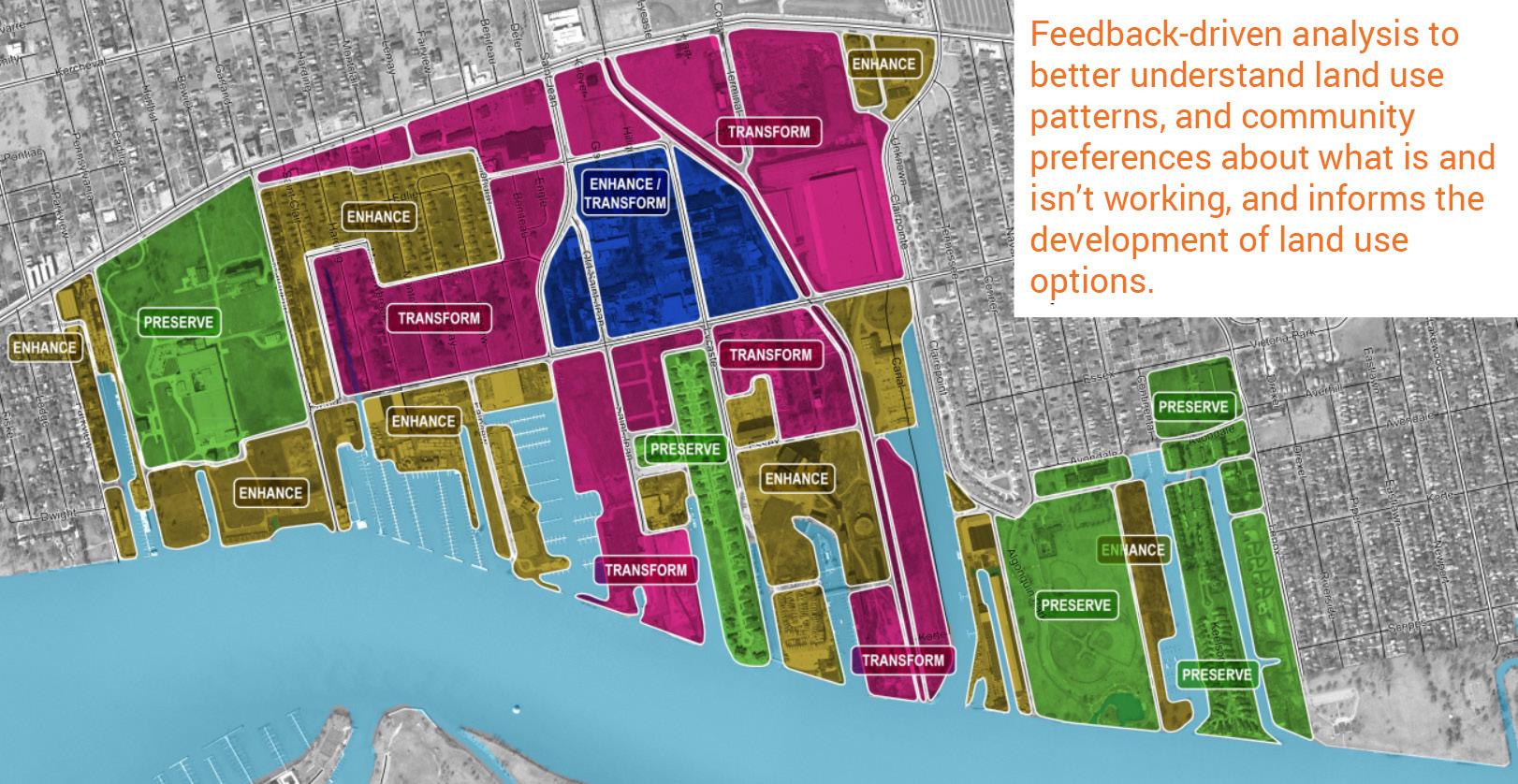
Jefferson East Business Association (now Jefferson East, Inc.) contracted with Smithgroup JJR in 2013 to create a plan for the Marina District. The purpose of this plan was to develop a vision to provide guidance for future development. Stemming from the area’s previous lack of clear future land use direction and its present unique mix of land uses, the plan’s PET Analysis (Preserve, Enhance, Transform) map, Figure II-5, shows where improvements
and transformation can and should be made as the district’s vacant or underutilized areas are developed.
The Marina District Vision places emphasis on improving the riverfront as a unique attraction. In addition, it recommends establishing greenways and buffer zones between commercial lands and residential areas. There is also a great need expressed to create a balance between the existing industry and other land uses in the Marina District in a way that minimizes the existing industrial properties’ negative impacts on the surrounding communities. Additionally, this balance is expressed to both support industry, while at the same time maintaining an attractive, inviting area for people to enjoy.
ADDITIONAL EXISTING PLANS AND INITIATIVES:
The following plans are in chronological order by the year they were published.
Non-Motorized Urban Transportation Master Plan (2008)
The Non-Motorized Urban Transportation Master Plan, prepared in 2006 by Giffels-Webster Engineers, CarterBurgess, ArchiveDS, and Brogan & Partners, was adopted by the City of Detroit in 2008. The goal of the plan is to create a connected pedestrian and bicycle system with
Feedback-driven analysis to better understand land use patterns, and community preferences about what is and isn’t working, and informs the development of land use options.
detailed locations and types of non-motorized facilities recommended for the City as a whole to “improve every citizen’s quality of life, creating a more sustainable environment, and reducing traffic congestion, vehicle exhaust emissions, noise, and energy consumption.”15 The plan suggests a bicycle system with five levels of connectors, including: regional connectors, city connectors, neighborhood connectors, downtown-
midtown connectors, and city loops. Additionally, it provides recommendations for pedestrian and bicycle facility improvements throughout the whole city, along with design guidelines. The completed projects comprise 170.03 miles of non-motorized pathways. Projects approved for funding or in process make up 25.46 miles of active transportation routes.
FIGURE II-5. MARINA DISTRICT VISION: PET ANALYSIS | SOURCE: JEFFERSON EAST BUSINESS ASSOCIATION. (2013). MARINA DISTRICT VISION: FINAL DRAFT.
Inner Circle Greenway (2008)
The Inner Circle Greenway, nicknamed the “mother of all non-motorized projects,” is a part of the City of Detroit’s Non-Motorized Transportation Plan. It is a 26mile planned greenway that connects non-motorized projects within the city with various neighborhoods and destinations in the cities of Detroit, Hamtramck, Highland Park, and Dearborn. Additionally, the Detroit Greenways Coalition and the City of Detroit investigated obtaining 8.3 miles of abandoned Conrail railroad property. To do this, the Detroit Greenways Coalition wrote $4.5 million worth of grants for the City to cover the railroad’s appraised property value. The Coalition also joined forces with the Community Foundation for Southeast Michigan, the Kresge Foundation, and the EPA to find additional funding for this project. The City of Detroit has been involved in the completion of due diligence work for the property. This project is currently in progress, and will take approximately $25 million to complete its construction. As of 2016, half of the trail has been completed.16
Lower Eastside Action Plan (2012)
In 2012, the Eastside Community Network published the Lower Eastside Action Plan (LEAP), which synthesizes the results of community engagement focused on transforming vacant property into productive uses in the area from the Detroit River (South) to Interstate-94 (North) and Mt. Elliott Street (West) to Alter Road (East). Recommendations include urban farming and forestry,
greenways and green alleys, nuisance abatement, open space maintenance agreements, neighborhood benefits agreements, green development, and form-based zoning.17 Many of the proposed projects have been implemented or are underway.
Neighborhood Stabilization Plan: JeffersonChalmers (2012)
In 2012, a collaboration among five organizations –Creekside Community Development Corporation, Hope Community Outreach and Development, JeffersonChalmers Citizens’ District Council, Jefferson East Business Association (now Jefferson East, Inc.), and Southeast Waterfront Neighborhood Association –resulted in a plan to address neighborhood instability in Jefferson-Chalmers. The plan recommendations fall into several categories: preserving and enhancing community assets (e.g., parks, greenways), improving safety and cleanliness, and encouraging investment from stakeholders.18
Visions of Greenways for the Greater Riverfront East District of Detroit (2012)
The Greater Riverfront East Environmental Network (GREEN) Task Force, and consultant Smithgroup JJR, published this greenway plan in 2012. The project area extends from St. Aubin (West), Alter Road (East), the Detroit River (South), and Mack Avenue (North). According to this plan, some of the streets connecting to
East Jefferson will be regulated as “greenways,” including Conner Street and the riverfront area.19 This plan has detailed instructions about design and policies for the greenways. It also includes considerations about possible flooding conditions. Some of the parts of this plan are already constructed, such as the Conner Street Greenway. Moreover, there are examples to inform rails-to-trails conversions.
Detroit Future City: Land Use (2012)
In 2010, the Detroit Works Long Term Planning Steering committee was appointed in an effort to create a unified vision for the future of Detroit.20 This steering committee set out to create a framework for decision making in Detroit in the form of the Detroit Future City Plan. As a part of this plan, the Detroit Future City Land Use plan focuses on addressing vacant land and non-permeable
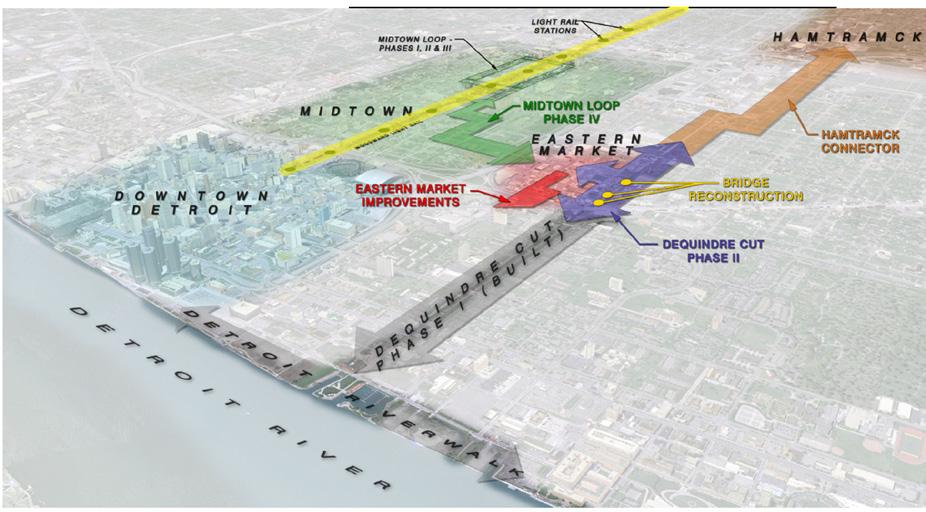
FIGURE II-6. PROJECT MAP OF LINK DETROIT! | SOURCE: CITY OF DETROIT. (2013). LINK DETROIT! DETROIT, MI. RETRIEVED FROM HTTP://PLACEMAKING.MML.ORG/WP-CONTENT/UPLOADS/2013/05/DQ_GRANT-APPLICATION.PDF
surfaces by incorporating green/blue infrastructure with various proposals. For the area including the Marina District, the plan proposes implementing a “green mixed-rise” take on land use, which involves incorporating green/blue infrastructure with commercial and residential activity; incorporating green/blue infrastructure with transportation improvements; and, capitalizing on physical assets. The plan also encourages the use of multifunctional landscapes contributing to health and recreation.
Link Detroit! (2013)
The Link Detroit! initiative helped the City of Detroit receive $10 million of federal TIGER funding to focus on non-motorized projects to connect multiple destinations in the City. There are 5 major projects listed in the plan: the Riverwalk, Downtown, Eastern Market, Midtown and surrounding neighborhoods, including phase II of Dequindre Cut; Midtown Loop Greenway Phase IV; Hamtramck Connector Greenway; and, Eastern Market District Improvements.21 The extended Dequindre Cut, renovated Eastern Market and Midtown connector will open in Spring 2016. A map of the project is shown in Figure II-6.
Non-motorized Plan for Southeast Michigan (2014)
The Southeast Michigan Council of Governments produced a plan in 2014 that benchmarks the current
non-motorized transportation system in Southeast Michigan and provides actions to achieve a vision for improved pedestrian and bicycle travel. The recommended actions range from encouraging design that reduces pedestrian and bicycle crashes to enhancing connections between different modes of transportation and providing education/technical assistance to regional stakeholders.22 The plan provides support and justification for public access initiatives by outlining a vision for greater connectivity across transportation modes and improved non-motorized transportation facilities throughout the region.
Blue Infrastructure Pilot in Jefferson Village (2015)
The Detroit Economic Development Corporation is working with a property owner in Jefferson Village to implement a “blue infrastructure” pilot project. The goal of the pilot project is to manage stormwater using natural systems to save money for the City and business owners. The project will divert stormwater from commercial parking lots to man-made wetlands, rain gardens and usable parks and paths. As of mid-2015, planning for the pilot project was underway.23
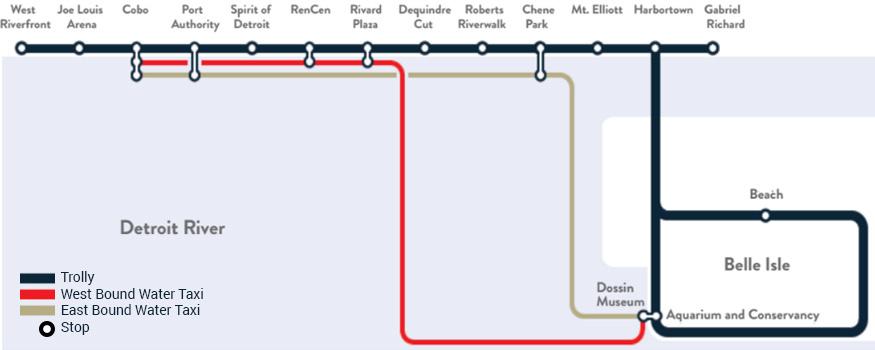
FIGURE II-7. PROPOSED RIVER BELLE ROUTES | SOURCE: FRESHWATER TRANSIT. (2015). TRANSIT FEASIBILITY STUDY & IMPLEMENTATION PLAN. DETROIT.
Transit Feasibility Study and Implementation Plan (2015)
The Detroit Riverfront Conservancy commissioned Freshwater Transit to determine the feasibility of implementing a multi-modal transportation system along the Detroit River, serving people who have historically lacked access to the riverfront. The study depicts three phases in which a water taxi and complimentary bus trolley services increase in each phase. Shelters and vehicle storage also have to be taken into consideration in this study’s cost-analysis. The water taxi service extending from Cobo Hall to Belle Isle, as shown in Figure II-7, is planned to be fully ADA-compliant, showcase businesses and activities along the riverfront, and attract visitors to Belle Isle.
City-Wide Street Lighting Update (2016)
The Public Lighting Authority (PLA), a state-created authority, has embarked on a project to “improve, modernize and maintain the street lighting infrastructure in the City of Detroit,” starting with neighborhoods streets and concluding with major thoroughfares, including Jefferson Avenue.24,25 As of mid-2015, the PLA had completed its updates on neighborhood streets in the east side of Detroit, in zip codes 48214 and 48215, and planned to complete its work along Jefferson Avenue by the end of 2015.26, 27, 28
Amendments
to the Detroit City Master Plan (2001, 2005, 2007)
There have been three amendments to the Detroit City Master Plan that affect the Marina District, shown in Figure II-8. The first amendment, in 2001, rezoned the property bounded by East Jefferson, Edlie, St. Jean, and Montclair Streets from B4 (General Business District) and R2 (Two-Family Residential District) to PD (Planned Development District) for a neighborhood shopping center. Six one-story commercial structures were erected to contain a combination of retail and restaurant uses.29
The second amendment, in 2005, rezoned the property located in the area of Freud, Lycaste, and St. Jean Streets to the Detroit River from M4 (Intensive Industrial District) to PD (Planned Development District).30 This amendment
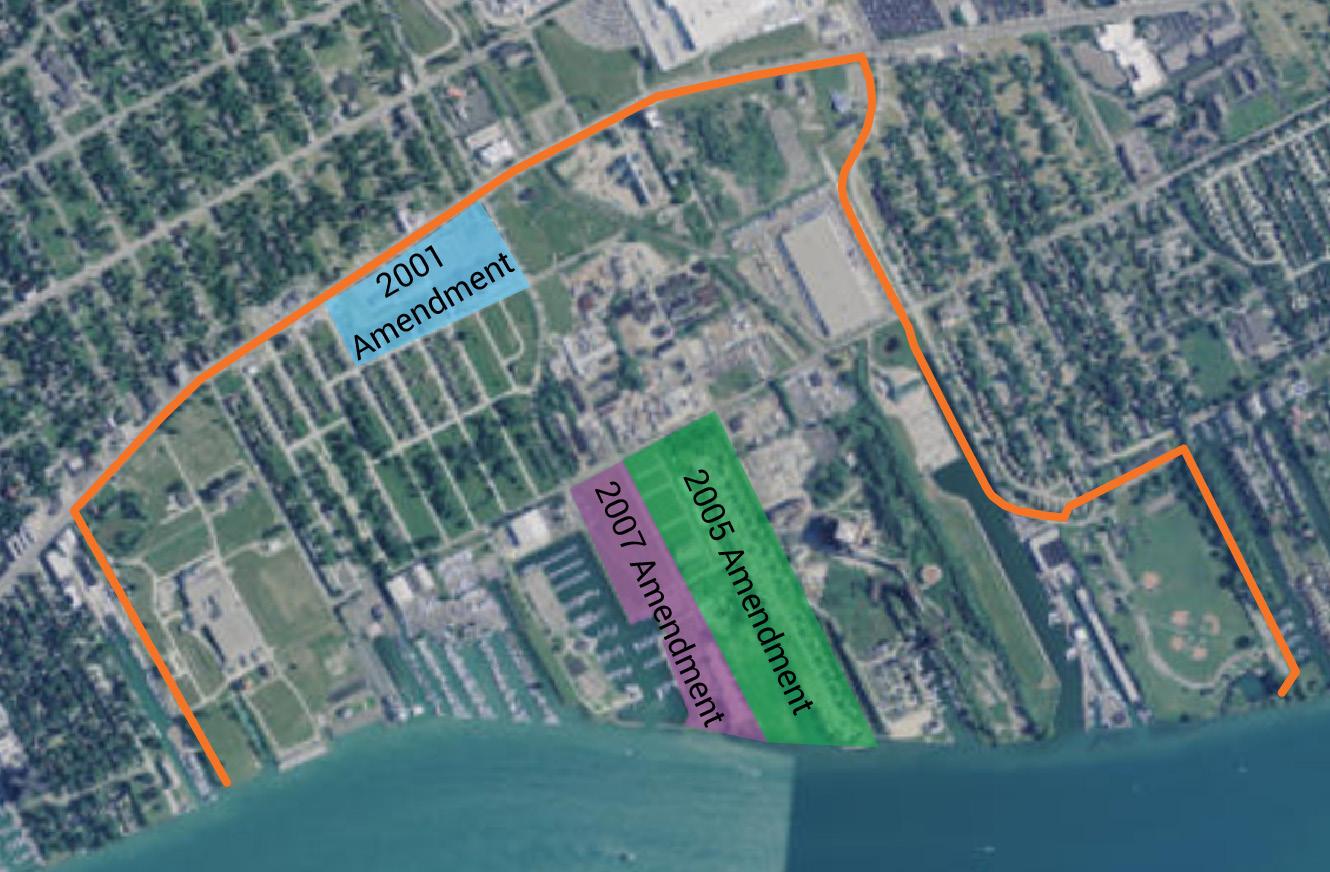
FIGURE II-8. AMENDMENTS TO THE DETROIT CITY MASTER PLAN
allowed for the construction of Morgan Waterfront Estates. Regulations call for buffering to be added to the Freud Street boundary of the site to block visual and noise intrusions, as well as to help capture pollutants from the industry and trucks. Additionally, there shall be public access to Detroit River on the site (St. Jean side).31
In 2007, the City Council terminated a lease and development agreement with Porterfield Wilson/John Carlo Development Corporation because the company failed to comply with the terms and conditions in agreement. Morgan Development LLC purchased Parcel 474B, which is located on the west side of St. Jean Street between Freud and the Detroit River. The land was zoned as M4 (Intensive Industrial District).32
SUMMARY OF EXISTING PLANS:
The following, Table II-1, is a summary of the existing plans and initiatives relevant to this plan. Selected recommendations and initiatives were chosen based on relevance to riverfront public access in the Marina District. Additional actions and more detail are included in the original plan documents.
2008 Non-Motorized Urban Transportation Master Plan
• Giffels-Webster Engineers
• Carter-Burgess
• ArchiveDS
• Brogan & Partners
2008 Inner Circle Greenway
• Detroit Greenways Coalition
• City of Detroit
City of Detroit
• Jefferson as regional connector
• St. Jean as neighborhood connector
• Conner Creek Greenway as outer city loop
INITIATIVES
• Facilities recommendation (for both bicycles and pedestrians)
• Design guideline (bike path, bike lane, bike parking)
• Implementation strategies: role of city government, maintenance, construction management, citywide bicycle parking, transit, intermodal connections, city sponsored project priorities
To “make use of other existing and planned paths, including the Detroit RiverWalk, Dequindre Cut, Southwest Detroit Greenlink, and the Iron Belle Trail.”
2012 Lower Eastside Action Plan (LEAP) Eastside Community Network Detroit River to I-94, Mt. Elliott Street to Alter Road
• Connects non-motorized projects within the city, particularly other greenways
• Completing the acquisition of 8.3 miles of abandoned Conrail (abandoned part of Detroit terminal railroad) to convert to greenway
• Identifies sources of funding that would be useful for the study area
2012 Neighborhood Stabilization Plan: JeffersonChalmers
• Creekside Community Development Corporation
• Hope Community Outreach and Development
• Jefferson-Chalmers Citizens’ District Council
• Jefferson East Business Association
• Southeast Waterfront Neighborhood Association
Jefferson-Chalmers
• Future Directions (Recommended typologies by parcel)
• Stormwater Infiltration Forests
• Horticultural and Hydroponic Commercial Farm
• Open Space Maintenance Agreements
• Voluntary Relocation Advocates
• Community Advisory Councils
• Greenway Plan for the Greater Riverfront East District
• Dendroremediation
• Green Alleyway Pilot Project
• Nuisance Abatement Program
• Neighborhood Benefits District
• Exploratory Form-Based Code
• Green Development Zone
• Preserve and Enhance Current Assets
• Encourage volunteerism and sense of community
• Preserve and improve parks / greenways
• Make the Neighborhood Safer
• Advocate for demolition
• Board up vacant homes
• Coordinate local safety patrols
• Make the Neighborhood Cleaner
• Reduce blight
• Improve streetscapes
• Maintain open land
• Encourage Investment from New and Existing Stakeholders
• Provide small business resources
• Build housing capacity
2012 Vision of Greenways for the Greater Riverfront East District of Detroit
Smithgroup JJR et al. East District of Detroit
• Build greenways along the riverfront and several streets near Jefferson (see maps).
• Improvement of cross-sections
• Enhancement and connection with Conner Creek Greenway and the riverfront area.
TABLE II-1. SUMMARY OF
YEAR NAME LEAD ORGANIZATION
GEOGRAPHIC SCOPE
2012 Detroit Future City: Land Use Detroit Works Long Term Planning Steering committee City of Detroit
2013 Marina District Vision - Final Draft Smithgroup JJR Marina District
SELECTED RECOMMENDATIONS/ INITIATIVES
• 50 years scenario: mixed-use and industrial
• Future open space network
• Increase jobs and economic vitality.
• Repurpose vacant land towards land uses that generate jobs, innovation, and a more resilient economy.
• Create a unique destination in the city for everyone.
• Create a ‘draw’ and a reason to come to the marina district.
• Increase visibility from E. Jefferson.
• Rectify existing and potential land use conflicts.
• I.e. residential adjacent to heavier industrial land.
• Strengthen the vitality and level of amenities within the marina operations.
• More slip utilization + leases.
• More seasonal and transient boaters.
2013 Link Detroit! City of Detroit Project specific locations.
“the Riverwalk, Downtown, Eastern Market, Midtown and surrounding neighborhoods”
• Improving multi-modal transportation options to major employment centers, universities and hospitals while providing increased access for surrounding neighborhood residents to strategic Detroit destinations
• Incorporating sustainable strategies into the city, through the use of street tree plantings, landscaping, stormwater management, and LED lighting while, at the same time, creating an attractive and inviting pedestrian environment.
• Cultivating a unique sense of place by improving major corridors within vital city districts—streetscaping, signage, lighting, and landscaping will allow these districts to fulfill their potential.
• include an increase in green, landscaped areas. This will provide opportunities for implementing Low Impact Design stormwater management strategies, which promotes infiltration while improving air quality and the carbon sequestration capacity in the urban environment.
2014
Southeast Michigan
• Reduce the number and severity of pedestrian and bicycle crashes.
• Better accommodate bicycles and pedestrians on roads that do not restrict bicycles/ pedestrians and that link the non-motorized system.
• Enhance connectivity and reduce conflicts between automobile, transit, rail, and nonmotorized modes of travel.
• Educate bicyclists, pedestrians, motorists, transportation and planning professionals, and elected officials regarding non-motorized issues.
• Provide technical assistance to communities in assessing the walkability and bikeability of their roadway network.
• Increase connectivity of the non-motorized system, linking local and regional facilities, to better connect the public to essential services, the national and state bicycle routes, downtowns, and Southeast Michigan’s green infrastructure network.
• Coordinate bicycling and pedestrian facilities with other regional and community goals, including green streets, community and economic development strategies, public transit, and placemaking.
• Focus on enhancing the regional non-motorized network through use of limited transportation funding such as the Transportation Alternatives Program (TAP).
• Evaluate the non-motorized system to ensure connectivity and determine its impact for community and regional placemaking and economic vitality.
• Coordinate with other stakeholders, including communities, county road agencies, advocacy groups, and others, as appropriate, to ensure the physical and operational sustainability of the non-motorized network.
• (see maps)
Non-motorized Plan for Southeast Michigan Southeast Michigan Council of Governments
2015 Blue Infrastructure Pilot in Jefferson Village
2015 Transit Feasibility Study & Implementation Plan
Detroit Economic Development Corporation
SELECTED RECOMMENDATIONS/ INITIATIVES
Jefferson Village • “Divert the rainwater and snowmelt from [owner’s] parking lot to ... a series of modest man-made wetlands, rain gardens, and other small systems”
Freshwater Transit Detroit Riverfront
2016 City-Wide Street Lighting Update
Public Lighting Authority City of Detroit
• Proposed water taxi service in “Phase One” was to run May 23rd (Memorial Day weekend) through September 6th (Labor Day weekend) in addition to any special event service
• Serving six stops and its frequency being once per hour
• Hours were expanded in “Phase Three” to be from April through November, and the frequency would be every hour on weekdays and every half-hour on weekends
• The trolley can be used on an ad-hoc basis to make pre-scheduled trips to various neighborhoods throughout the city to pick up families at specific times and take them to the riverfront at low to no cost
• Relight neighborhood streets
• Relight collector streets
• Relight major thoroughfares
• Remove nonworking alley lights
REFERENCES
1 Austin, Dan. (2016). Water Works Park Tower. Retrieved from: http://www. historicdetroit.org/building/water-works-park-tower/
2 Austin, Dan. (2016). Water Works Park Tower. Retrieved from: http://www. historicdetroit.org/building/water-works-park-tower/
3 Austin, Dan. (2016). Water Works Park Tower. Retrieved from: http://www. historicdetroit.org/building/water-works-park-tower/
4 Sinacori, Nicholas P., Mikulak, Ronald, and Steinhauer, Susan. 2012. “Horse Power, Men & Machines.” P. 15
5 Curtis, Raymond. (1957). Kilwatts at Work: A History of the Detroit Edison Company. Wayne State University Press.
6 Bayview Yacht Club. (n.d.). Club History. Retrieved March 25, 2016, from http://www.byc.com/Default. aspx?p=DynamicModule&pageid=305847&ssid=192959&vnf=1
7 Curtis, Raymond. (1957). Kilwatts at Work: A History of the Detroit Edison Company. Wayne State University Press.
8 Sanborn Maps. Detroit [Wayne Co.]; 1910-July 1951; vol. 11, 1929-Apr. 1949
9 Detroit Edison. (2008). Detroit Edison’s Conners Creek Power Plant Earns ISO 14001 Certification. Retrieved from: http://www.prnewswire.com/ news-releases/detroit-edisons-conners-creek-power-plant-earns-iso14001-certification-57280072.html
10 Austin, Dan. (2016). Water Works Park Tower. Retrieved from: http://www. historicdetroit.org/building/water-works-park-tower/
11 Detroit Edison. (2008). Detroit Edison’s Conners Creek Power Plant Earns ISO 14001 Certification. Retrieved from: http://www.prnewswire.com/ news-releases/detroit-edisons-conners-creek-power-plant-earns-iso14001-certification-57280072.html
12 Detroit Economic Growth Corporation. (2016). Jefferson Village. Retrieved April 14, 2016, from http://www.degc.org/businesses/jefferson-village-1
13 Morgan Waterfront Estates. (2016) Retrieved from http:// morganwaterfront.com/
14 DTE Energy Company. (2012). Form 10-K: Annual Report Pursuant to Section 13 or 15(d) of the Securities Exchange Act of 1934 - For the Fiscal Year Ended December 31, 2011. Detroit, MI. Retrieved from http:// www.sec.gov/Archives/edgar/data/936340/000093634012000004/ dteenergy2011123110k.htm
TABLE II-1. SUMMARY OF EXISTING PLANS AND INITIATIVES RELEVANT TO CURRENT PLAN
15 Giffels-Webster Engineers, Carter-Burgess, ArchiveDS, & Partners, B. &. (2006). Non-Motorized Urban Transportation Master Plan: City of Detroit, (June), 1–65.
16 Detroit Greenways Coalition (Oct. 2015): http://detroitgreenways.org/tag/ inner-circle-greenway/
17 Eastside Community Network. (2012). Reinventing Detroit’s Lower Eastside: A Summary Report of the Lower Eastside Action Plan— Phase I and II.
18 Creekside Community Development Corporation, Hope Community Development and Outreach, Jefferson-Chalmers Citizens’ District Council, Jefferson East Business Association, S. W. N. A. (2012). Neighborhood Stabilization Plan: Jefferson-Chalmers. Detroit.
19 Meroni, A., Simeone, G., & Trapani, P. (2012). A Vision of Greenways.
20 Detroit Collaborative Design Center (2012). Detroit Works Project Long Term Planning. Retrieved April 14, 2016, from http://www.dcdc-udm.org/ projects/strategies/dwltp/
21 City of Detroit. (2013). Link Detroit! Detroit, MI. Retrieved from http:// placemaking.mml.org/wp-content/uploads/2013/05/DQ_GrantApplication.pdf
22 Southeast Michigan Council of Governments. (2014). Nonmotorized Plan for Southeast Michigan.
23 Gallagher, J. (2015, May 16). Detroit to test innovative ’ blue infrastructure ’ project. Detroit Free Press, pp. 0–1. Detroit.
24 Public Lighting Authority. (n.d.). Construction Schedule. Retrieved January 31, 2016, from http://www.pladetroit.org/construction-schedule/
25 Public Lighting Authority. (n.d.). Our Plan. Retrieved January 31, 2016, from http://www.pladetroit.org/our-plan/
26 Ferretti, C. (2015, June 15). Detroit relights neighborhoods at blazing pace. The Detroit News. Detroit.
27 Public Lighting Authority. (2015, July 29). Public Lighting Authority Begins Construction for Street Lights on Jefferson Avenue. Detroit: Public Lighting Authority.
28 Reindl, J. C. (2014, December 4). Detroit streetlight repairs ahead of schedule. Detroit Free Press. Detroit.
29 City of Detroit. (2001). Journal of the City Council: City Planning Commission - Proposed Development (January 16), 540-541. Retrieved from http://www.detroitmi.gov/Portals/0/docs/City%20Clerk/2001%20 Council.pdf
30 City of Detroit. (2005). Journal of the City Council: City Planning Commission (June, 10), 1813-1815. Retrieved from http://www.detroitmi. gov/Portals/0/docs/City%20Clerk/2005%20Council.pdf
31 City of Detroit. (2005). Journal of the City Council: City Planning Commission (June, 10), 1813-1815. Retrieved from http://www.detroitmi. gov/Portals/0/docs/City%20Clerk/2005%20Council.pdf
32 City of Detroit. (2007). Journal of the City Council: City Planning Commission (June 28), 1805-1806. Retrieved from http://www.detroitmi. gov/Portals/0/docs/City%20Clerk/2007%20Council.pdf.
CURRENT CONDITIONS CHAPTER 3:
A thorough analysis of current conditions provides the foundation for a comprehensive and achievable plan. This plan explores six aspects of the current conditions in the Marina District, including demographic characteristics, land use, natural features, community assets, transportation networks, and community engagement. These elements provide context for the key challenges and opportunities in the district to clarify which recommendations are most feasible and appropriate to achieve the plan goals. In particular, analysis of community assets and transportation networks identifies strengths upon which to build, as well as gaps to fill, to make the Marina District a unified and vibrant destination, and input from community engagement shapes the recommendations that emerge from this analysis.
DEMOGRAPHIC CHARACTERISTICS
The analysis of demographics for this plan includes a study of the population, income, housing, and commuting characteristics of Marina District residents. Data on these characteristics come from the U.S. Census Bureau American Community Survey (ACS) five-year estimates covering 2010 to 2014. The Marina District consists of three census tracts and four census block groups. The majority of the area falls within one census tract (5137) and block group (5137001).
POPULATION
The Marina District houses a population of approximately 836, with a density of 987.4 people per square mile. As seen in Figure III-1, this population density is more than five times lower than the City of Detroit and the neighboring block groups directly east of the Marina District (census block groups 5137002 and 5137003, named Block Group 2 and Block Group 3), in part because the district contains numerous non-residential parcels.1
Although the majority of parcels (66.8 percent, or 818 of 1,225 parcels) are residential, these parcels account for only 7.4 percent of the total land area in the Marina District (77.1 of the 1,038 total acres).
The majority of the population (87.4 percent) is nonwhite, similar to other block groups in the City. In addition, residents of the Marina District are generally older than Detroit residents as a whole, with a median age
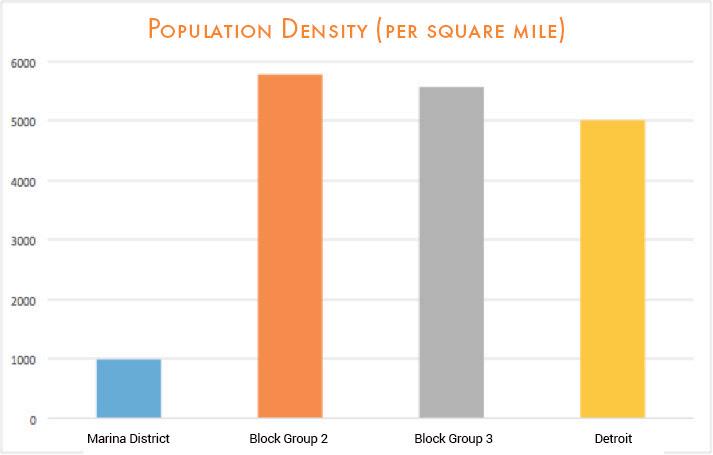
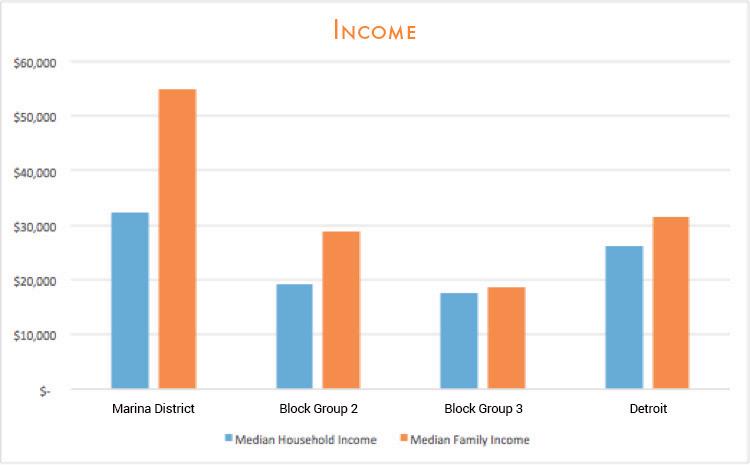
FIGURE III-1. POPULATION DENSITY IN THE MARINA DISTRICT, COMPARED TO NEIGHBORING AREAS AND THE CITY OF DETROIT
FIGURE III-2. MEDIAN HOUSEHOLD AND FAMILY INCOME IN THE MARINA DISTRICT, COMPARED TO NEIGHBORING AREAS AND THE CITY OF DETROIT
of 41 years old (5.9 years older than the median age for Detroit). Only a quarter of the households have children under 18 years old.2
INCOME
Residents of the Marina District report higher household and family income than residents in the rest of the City, as shown in Figure III-2. A household refers to any group of people sharing a housing unit regardless of relationship, whereas family refers to people living in the same unit who are related by birth, marriage, or adoption. The median household income is $32,212, over $6,000 higher than the median for Detroit. Similarly, the median Marina District family income is $54,875, over $23,000 higher than the median for the City.3
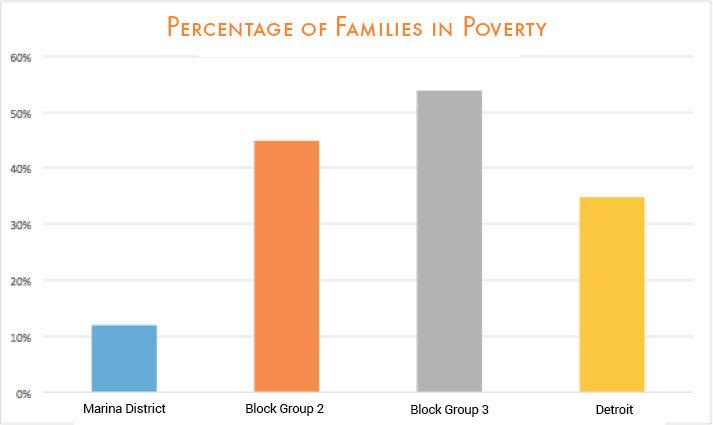
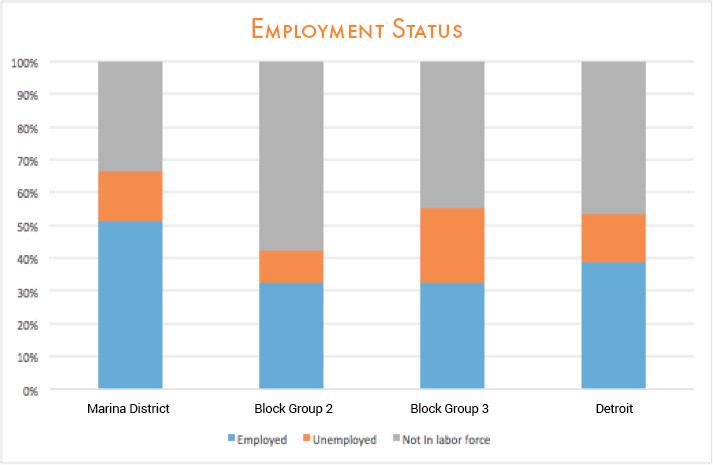
Marina District residents also have a higher employment rate than the City of Detroit, as seen in Figure III-3. Two-thirds of the population 16 years and older is in the labor force, compared to one-half in Detroit. Of those in the labor force, 23.1 percent are unemployed, whereas 27.1 percent of the Detroit labor force lacks employment. Moreover, as shown in Figure III-4, the share of families in poverty in the Marina District is also lower than in the neighboring block groups and the rest of the City (12.0 percent in the Marina District compared to 34.8 percent in the City of Detroit).4
HOUSING
The majority of the housing units in the Marina District are new and owner-occupied. A large majority of the
FIGURE III-3. EMPLOYMENT STATUS IN THE MARINA DISTRICT, COMPARED TO NEIGHBORING AREAS AND THE CITY OF DETROIT
FIGURE III-4. POVERTY STATUS OF FAMILIES IN THE MARINA DISTRICT, COMPARED TO NEIGHBORING AREAS AND THE CITY OF DETROIT
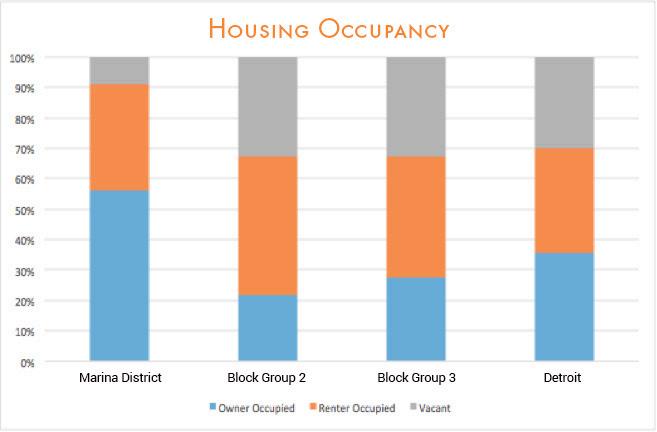
structures (88 percent) were built after 2000 and the rest were built before 1959. The median year built is 2004, compared to the Detroit median year of 1947. As shown in Figure III-5, 91.2 percent of the housing units in the Marina District are occupied, compared to 70.0 percent citywide. The district has a lower vacancy rate than surrounding areas.5
Median housing value of all owner-occupied houses in the block group is $158,700, over three times higher than the median housing value in Detroit ($45,100). With regard to gross rent, defined as contract rent plus utilities, the median in this block group ($1,661) is also more than double the median of the City ($756) and the State of Michigan ($780).6
COMMUTING
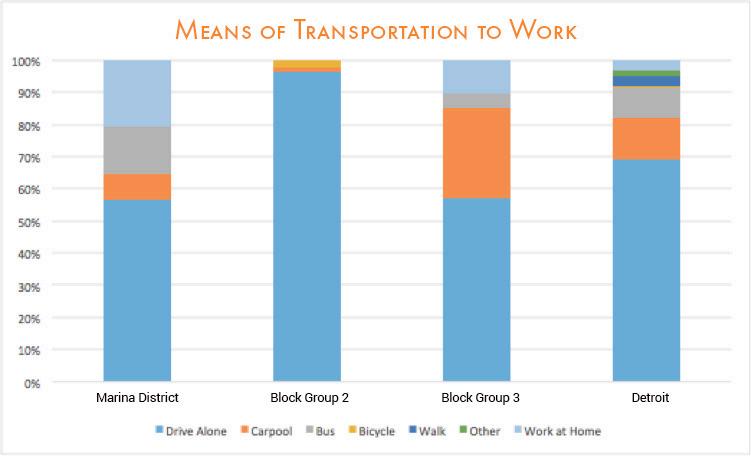
The majority (64.5 percent) of workers in the Marina District drive alone or carpool to work, while 14.8 percent commute by bus and 20.7 percent work from home. However, as seen in Figure III-6, these proportions are more distributed than in Detroit as a whole, where 82.5 percent of workers drive alone or carpool. This may correspond to the larger share of households in the district without access to a vehicle (33.6 percent) compared to the City (24.6 percent).7
The majority of people who commute to work from the Marina District travel less than 30 minutes. However, as seen in Figure III-7, the share of workers (14.8 percent) that spend more than one hour to travel to work is more
FIGURE III-5. HOUSING OCCUPANCY IN THE MARINA DISTRICT, COMPARED TO NEIGHBORING AREAS AND THE CITY OF DETROIT
FIGURE III-6. COMMUTING PATTERNS IN THE MARINA DISTRICT, COMPARED TO NEIGHBORING AREAS AND THE CITY OF DETROIT
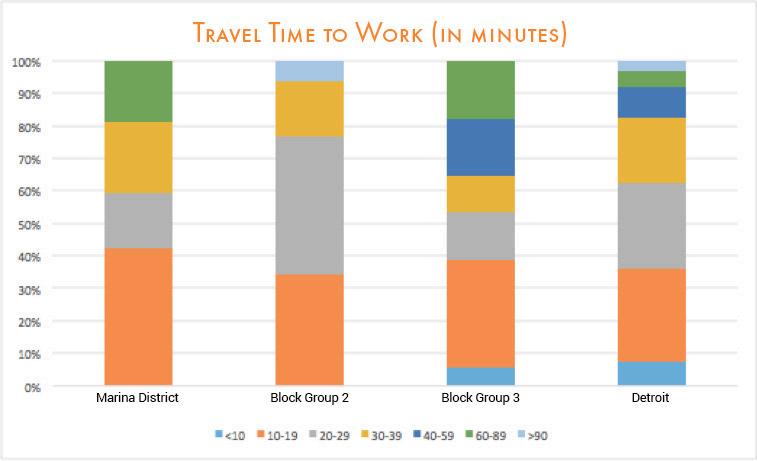
than double the corresponding share of commuters citywide (7.8 percent).8
LAND USE
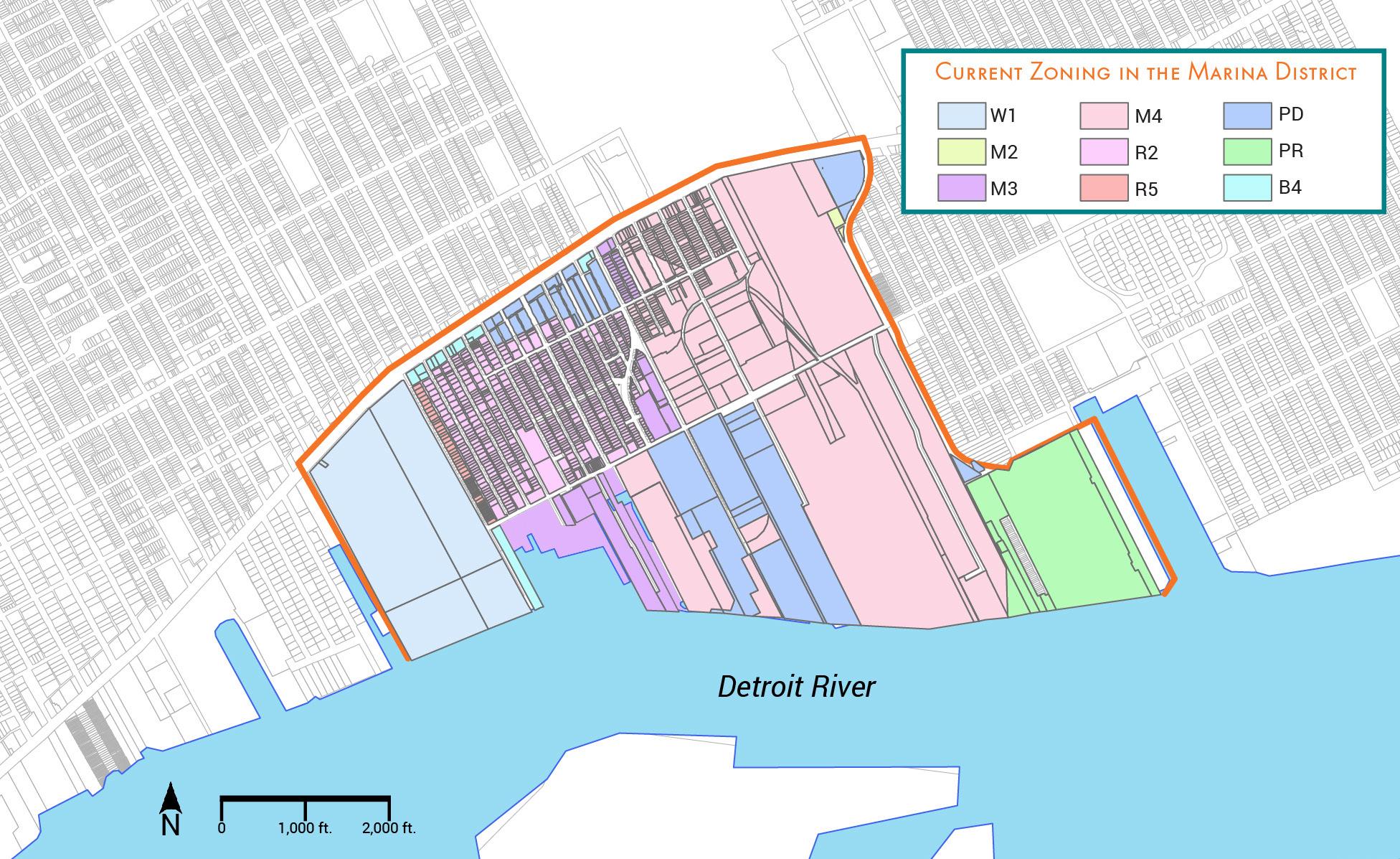
City zoning regulates the way in which property can be developed and used. Zoning restricts the allowable dimensions for development, including height, setbacks, density, and other characteristics. It also specifies what uses are permitted on a site.
The Marina District contains approximately 1,225 parcels spread across 1,178 acres of land, as shown in Table 1. Current zoning divides the Marina District into nine zones, plus 15 unzoned parcels.9 The Marina District
is unique in that it contains a diversity of zone types, resulting in a mix of land uses in the area and a stark contrast in intensity and density between neighboring parcels.
The contrast in land use intensities is reflected in the proportions of acreage and parcels per zone. Intensive Industrial comprises 45 percent of the district by land area, while Two Family Residential includes 62 percent of the total number of parcels. The density of residential parcels differs greatly from the density of industrial parcels, as shown in Figure III-8.
Zoning can differ from actual land use. However, in the Marina District, the zoning corresponds to actual land uses, which include an interesting mix of industrial, commercial, residential, and recreational uses.
The Detroit Water and Sewerage Department occupies the western border of the Marina District, including the five parcels from East Jefferson Avenue to the Detroit River, west of Marquette Drive. Also known as Waterworks Park, these parcels are zoned Waterfront Industrial.
General Business parcels, which include convenience stores, a gas station, churches, and empty lots, act as a bookend on the south side of Jefferson Avenue, east of Marquette Drive, at the northwest corner of the Marina District. The Roostertail event venue also occupies a General Business parcel on the riverfront at the southwest corner of the district.
FIGURE III-7. COMMUTE TIME IN THE MARINA DISTRICT, COMPARED TO NEIGHBORING AREAS AND THE CITY OF DETROIT
CATEGORY ZONING AND PARCELS
Business B4 - General Business - 6.1 acres, 14 parcels
Industrial M2 - Restricted Industrial - 1.4 acres, 3 parcels
M3 - General Industrial - 51.7 acres, 62 parcels
M4 - Intensive Industrial - 467.2 acres, 261 parcels
W1 - Waterfront Industrial District - 191 acres, 5 parcels
Residential R2 - Two Family Residential - 72.7 acres, 758 parcels
R5 - Medium Density Residential - 4.4 acres, 60 parcels
Other PD - Planned Development - 140.5 acres, 32 parcels
PR - Parks and Recreation - 114.1 acres, 15 parcels
No Code - [Unzoned] - 128.5 acres, 15 parcels
TABLE III-1. ZONING AND PARCELS IN THE MARINA DISTRICT | SOURCE: GILCHRIST II, G. (2015). ZONING MAP. RETRIEVED FEBRUARY 27, 2016, FROM HTTPS://DATA.DETROITMI.GOV/GOVERNMENT/ZONING-MAP/IECW-APWI
The east side of Marquette Drive houses all 60 Medium Density Residential parcels, featuring many houses dating back to the first half of the twentieth century. With many houses and parcels on one continuous block from Jefferson Avenue to Freud Street, Marquette Drive is home to the densest block in the neighborhood, with an average of over 10 parcels per acre.
The Jefferson Village neighborhood sits between Marquette Drive and St. Jean Street and encompasses 62 percent of the total parcels in the Marina District, all zoned as Two Family Residential. Jefferson Village was built in the early 2000s as detached single-family housing and was planned to fill parcels from south of
the General Business parcels on Jefferson Avenue to Freud Street. However, development stalled with the onset of the Great Recession.10 The neighborhood today ends at Lisette Street as its southern border. The blocks bounded by Lisette Street and Freud Street, between Meadowbrook Street and St. Jean Street, and also those bounded by Edlie Street and Lisette Street, between Lillibridge Street and St. Jean Street remain vacant today. Plans are underway to build out the remaining land in the development.11
Parcels zoned General Industrial form a loose southwestnortheast diagonal extending from the riverfront to Jefferson Avenue. This zone contains the marinas along the riverfront on Freud Street, light industry in the curved block between St. Jean Street and Old St. Jean Street, including the headquarters of Royal Transportation, and empty lots along the east side of St. Jean Street, between East Jefferson Avenue and Edlie Street.
Parcels zoned as Intensive Industrial make up the majority of the east side of the Marina District, including most parcels east of St. Jean Street and the parcel that contains Riverside Marina. Other Intensive Industrial parcels include those operated by Stericycle and DTE Energy, including the Conner Creek Power Plant site, as well as the eastern terminus of the former Detroit Terminal Railroad.
Maheras-Gentry Park, the only part of the Marina District zoned as Parks and Recreation, bounds the district on its
III-8. CURRENT ZONING IN THE MARINA DISTRICT | SOURCE: GILCHRIST II, G. (2015). ZONING MAP. RETRIEVED FEBRUARY 27, 2016, FROM HTTPS://DATA.DETROITMI.GOV/GOVERNMENT/ZONING-MAP/IECW-APWI
east end, at the riverfront between Avondale Street and the riverfront.
The Marina District currently includes 140.5 acres of parcels zoned as Planned Development, which is a project-specific zoning designation tied to a development
agreement. Approximately two dozen of these Planned Development parcels line the northern face of the Marina District, along East Jefferson Avenue. Today, grocer Parkway Foods anchors a shopping plaza in these parcels. The remaining parcels zoned as Planned Development include the Morgan Waterfront Estates residential community and
FIGURE
Reid Memorial Park, although the latter is owned by the City of Detroit.
The Marina District has significant opportunity for redevelopment given the availability of vacant or underutilized private property. Most of the land in the Marina District (917 acres, or 78 percent) is privately owned. Future redevelopment in these spaces could align with activity desired by community members and could contribute to a unified identity and brand for the district.
NATURAL FEATURES
The Marina District contains several distinctive natural features, including the Detroit River, a series of canals, and wildlife. These features present opportunities for residents and visitors to enjoy scenic views and waterfront activities while spending time in the Marina District.
The Detroit River runs approximately 24 nautical miles from Lake St. Clair to Lake Erie and serves as the international border between the United States and Canada.12 The Detroit River ranges in width between 0.5 miles and 2.5 miles, providing views of Canada from the Detroit riverfront. 13 In the stretch along the Marina District, the river width ranges from just under one mile to approximately 1.75 miles. The widest portion includes Belle Isle, an island with a 985-acre State park, whose northern shore is approximately one-quarter mile south
of the Marina District shoreline.14 The river flows more slowly on the north side of Belle Isle closer to the Marina District, compared to the dredged channel on the south side of Belle Isle.15 The Detroit River was listed as a binational area of concern in 1987, as a result of urban and industrial pollution, but past and ongoing remediation efforts have made progress toward addressing these concerns.16
Conner Creek, named in 1840 after local landowner Henry Conner, runs along the eastern edge of the district. The creek originally flowed south from the current City of Warren to the Detroit River. The Detroit Terminal Railroad, constructed parallel to the creek, attracted industries to build around and over the creek. Today, the creek flows below ground to the Jefferson Avenue Conner Creek Pumping Station of the Detroit Water and Sewerage Department and above ground from Freud Street to the Detroit River.17 Several other canals run parallel to Conner Creek along St. Clair Street, Morgan Waterfront Estates, and Engel Memorial Park. These historic canals offer unique opportunities for water recreation in the area.
In 2001, the Wyandotte National Wildlife Refuge was absorbed into the larger Detroit River International Wildlife Refuge, which is a cooperative effort between the United States and Canada to preserve the area as an ecological refuge. Although the refuge is not located within the Marina District, the river cleanup effort has brought back a growing number of bird and fish species along the riverfront, including beavers, bald eagles, and
peregrine falcons, providing additional opportunities for wildlife viewing in the district. The return of the beaver to the Detroit River, evidenced by a sighting in Conner Creek, has provided hope for the return of the beaver and other species that had been lost as a result of pollution.18
According to the National Flood Hazard map from the U.S. Federal Emergency Management Agency (FEMA), nearly all of the Marina District lies within a zone designated as an “area of minimal flood hazard zone X,” defined as areas outside the 500-year floodplain. This means that the high elevation will protect against flooding even in a 500-year flood (i.e., a flood that has a 0.2-percent chance of occurring in any given year). Only a small portion of the Marina District, around the Detroit Edison Boat Club, lies within the 100-year floodplain and minimal areas lie within the 500-year floodplain (primarily around the Bayview Yacht Club).19 Due to the high elevation of the shoreline, the river rarely presents flooding concern for the Marina District area. When flooding does occur, the high elevation creates a barrier that prevents overland flow, containing flooding in areas of low elevation.20
ASSETS
Assets are key places or entities that are valued by a community and draw people to a neighborhood. Asset mapping is the process of identifying these resources and locating them on a map to visualize how many assets
Reasons neighbors love the Marina District:
• Neighbors
• Atmosphere
• Freeway access
• Urban
• Convenient
• Quiet
• Well maintained
• Landscaping
• Mature
• Family friendly
Interests of neighbors in the Marina District:
• Church
• Movies
• Biking
• Music
• Reading
• Friends
• Walking
• Politics
• Art
• Genealogy
SOURCE: NEXTDOOR. (2016). MARINA DISTRICT. RETRIEVED MARCH, 2016, FROM HTTPS://NEXTDOOR.COM
exist and how they connect. Asset mapping can reveal gaps in these connections, or “networks,” and help define ways to address missing links. Mapping the Marina District assets informed the recommendations in the plan.
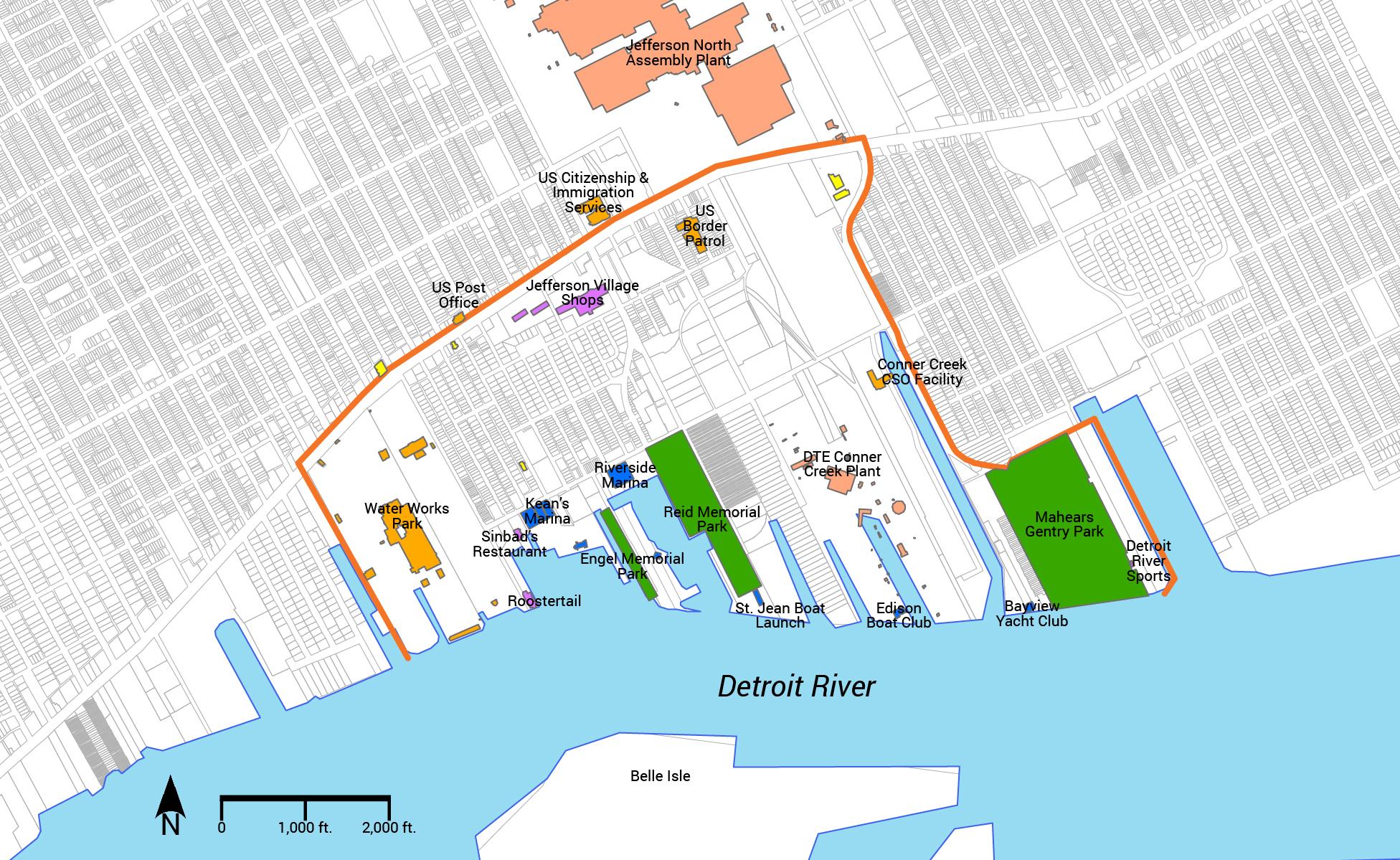
The Marina District contains a variety of assets, including restaurants, stores, parks, marinas and boat clubs, schools, churches, government buildings, and employment centers. Figure III-9 shows the assets identified in the Marina District, described in more detail below.
MARINAS AND WATER-BASED ASSETS
According to existing plans and feedback from local stakeholders, the primary asset that draws residents and businesses to the Marina District is the Detroit River. The riverfront is used primarily for recreational activities.
The Marina District contains several access points to the Detroit River, including five private boat clubs and marinas and two public boating access sites.
The Michigan Natural Resources and Environmental Protection Act defines a marina as a facility owned or
FIGURE III-9. ASSETS IN THE MARINA DISTRICT
operated by a person that extends into or over a lake or stream and provides docking, loading, or other servicing of recreational watercraft.21 The following list describes the five boat clubs and marinas in the district:22
• Kean’s Marina, founded in 1931, with 374 slips including transient dockage available for rent.23
• Sinbad’s Restaurant and Marina, founded in 1949, with seasonal rental and guest boat wells.24
• Riverside Marina, owned by the City of Detroit Department of Recreation, with 475 slips for members and transient boaters.25
• Edison Boat Club, founded in 1914, with 110 memberonly slips. Edison Boat Club is an employee-operated club of the DTE Energy Company with members who are related to current or retired employees.26
• Bayview Yacht Club, founded in 1915, with 100 memberonly slips.27
In addition to private marinas and boat clubs, two sites in the Marina District provide public boating access. Maheras-Gentry Park, located at the foot of Conner Creek, offers a free boat launch, with parking, that can accommodate small boats like kayaks. 28
The St. Jean Boat Launch, at the southern end of Reid Memorial Park, accessed from St. Jean Street, provides a second launch site. Owned by the City of Detroit and operated by Riverside Marina, the site features a hardsurface ramp directly onto the river and a parking lot with 75 spaces.29 As the only public launch site in the
City with the capacity to handle large boats, the St. Jean Boat Launch draws boaters from across the region. Recent investment, including dock upgrades in 2015, has further enhanced the appeal of the site.30 The St. Jean Boat Launch is already a significant asset for the Marina District and has the potential to serve as a major destination on the riverfront.
The Marina District also includes other water-related recreational establishments. Detroit River Sports is a privately-owned company located adjacent to the Maheras-Gentry Park that offers kayak rentals and tours. Tours begin on a canal with access to the Detroit River.31 Currently rentals and tours are available on weekends and must be booked in advance. The Grayhaven Sail Club of Detroit, founded in 1992, promotes the sport of sailing among Detroiters. Many club members store their boats at Kean’s Marina. The Club runs the Challenge the Wind Youth Sailing Program for local teens.32
LAND-BASED RECREATIONAL ASSETS
Three public parks exist within the Marina District. In addition to serving as a boat launch site, MaherasGentry Park provides fishing access and expansive views of the river. Other amenities within the park include picnic areas, baseball fields, basketball courts, and the southern terminus of the Conner Creek Greenway. Engel Memorial Park and Reid Memorial Park are also public parks, but they are currently gated and/or fenced, with
limited public access. These two parks have potential to be opened up to the public and used for community activities, as described later in this plan.
In addition to the three public parks, the Marina District includes the historic Waterworks Park, which provided 110 acres of open parkland in its heyday.33 The park was gated and closed to the public in response to perceived security threats to the City water supply. A gated entrance from the Roostertail’s parking lot allows access to an additional parking lot and a set of grandstands facing the river, used for special events held on the Detroit River, such as the American Power Boat Association’s Gold Cup race and the Red Bull Air Races.34 Despite being gated, the property remains a major landmark in the Marina District, with significant open space along the river.
COMMERCIAL ASSETS
Several well-known restaurants also enjoy a prime location on the riverfront. Sindbad’s Restaurant and Marina, first opened in 1949, offers free guest wells for diners who arrive by boat and rental wells for other visitors.35 Roostertail, another local favorite on the waterfront, opened in 1958 and has hosted many social gatherings ranging from weddings and high school proms to celebrity performances.36 Other restaurants, businesses, and shopping plazas line the northern boundary of the Marina District along the East Jefferson Avenue corridor, which also has a large cluster of commercial assets.
GOVERNMENTAL ASSETS
Several government buildings are located in and around the Marina District as well, including the U.S. Post Office, U.S. Citizenship and Immigration Services, and U.S. Border Patrol. The recent arrival of the U.S. Department of Homeland Security in the neighborhood has improved the security presence in the Marina District.
INDUSTRIAL ASSETS
Historically, many companies have located in the Marina District because of the proximity to the Detroit River and the local railroad. The largest industrial landmark on the east side of Detroit is the Chrysler Jefferson North Assembly Plant (JNAP), just north of East Jefferson Avenue. The JNAP is the largest employer on the east side of Detroit, with approximately 4,800 employees.37 Although outside the Marina District, the plant is a major asset because it provides a large customer base for commercial and recreational activities within the district.
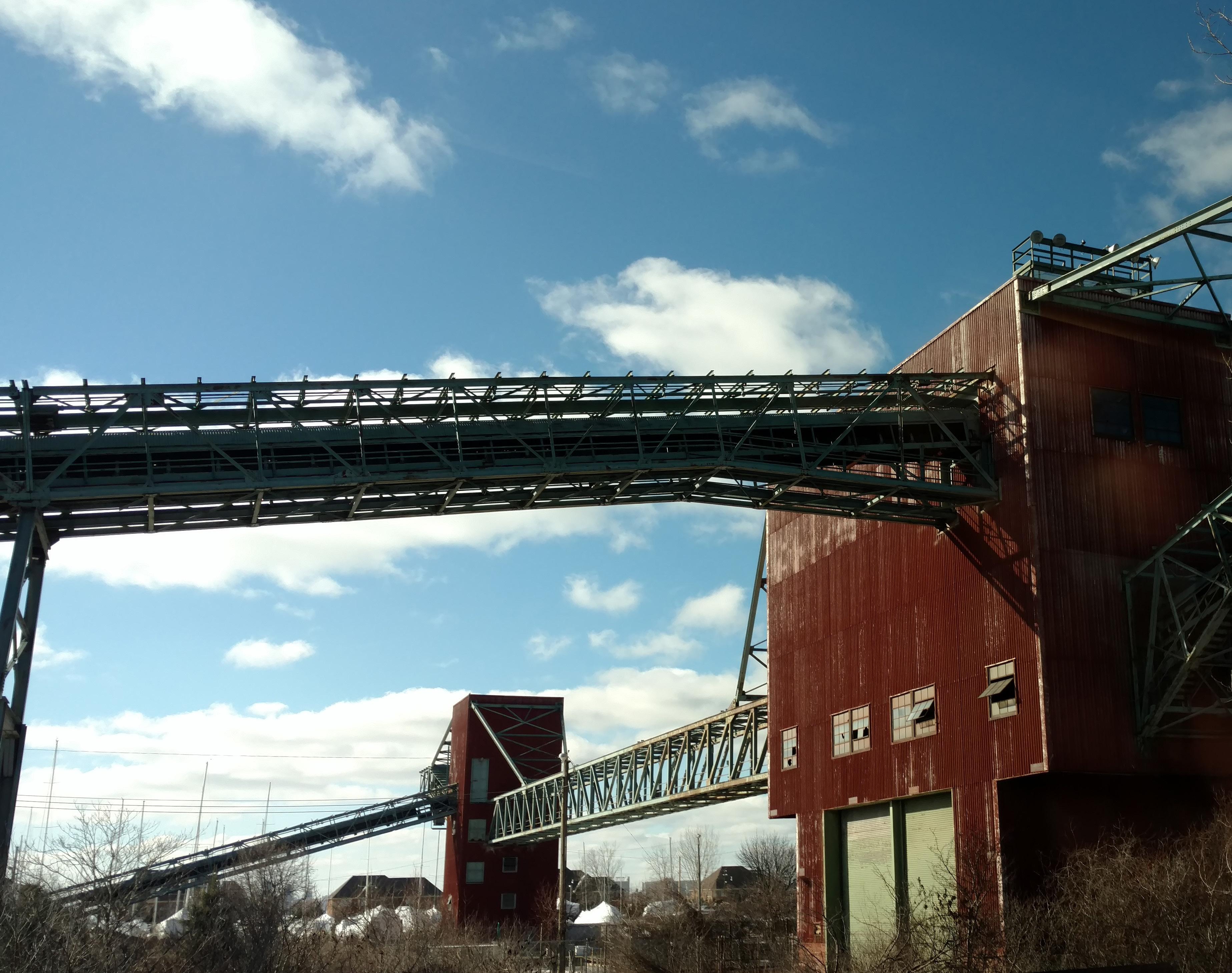
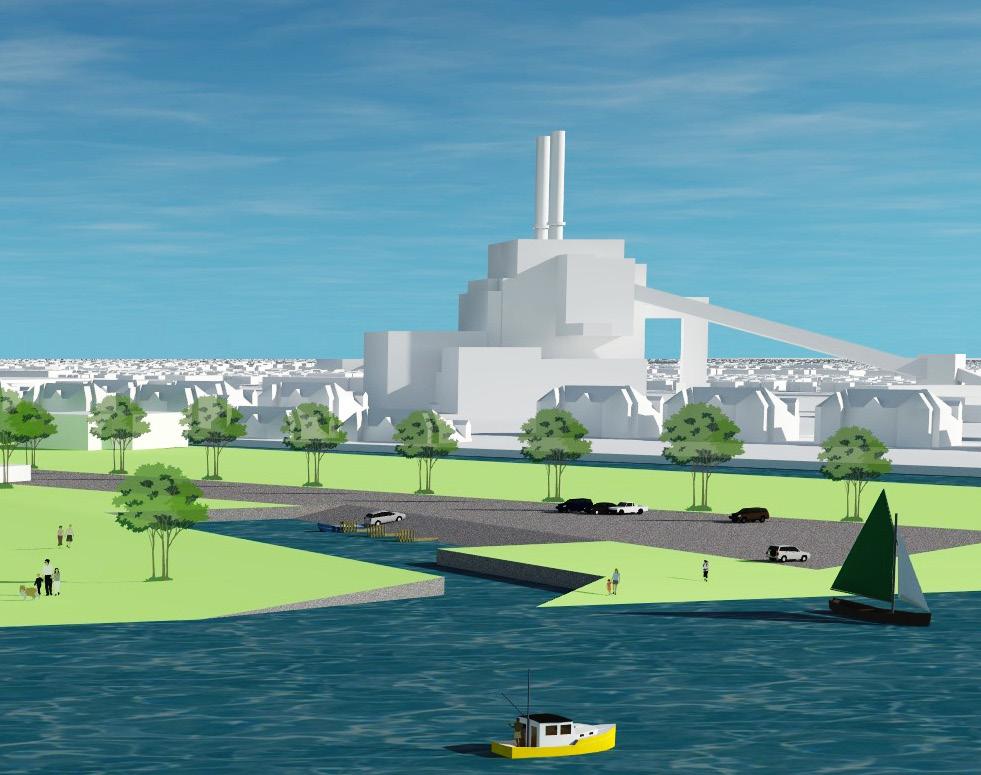
Another major industrial asset is the DTE Conner Creek Power Plant site. Although the plant has been decommissioned and the original “Seven Sisters” smokestacks have been demolished, the remaining “Two Brothers” plant still stands and serves as an iconic visual landmark in the Marina District, visible on the horizon throughout the district and beyond. Although its future is uncertain, the site has the potential to be repurposed in a way that adds another community asset along the riverfront.
TRANSPORTATION NETWORKS
Comparing the assets in the Marina District with the current transportation network reveals opportunities to
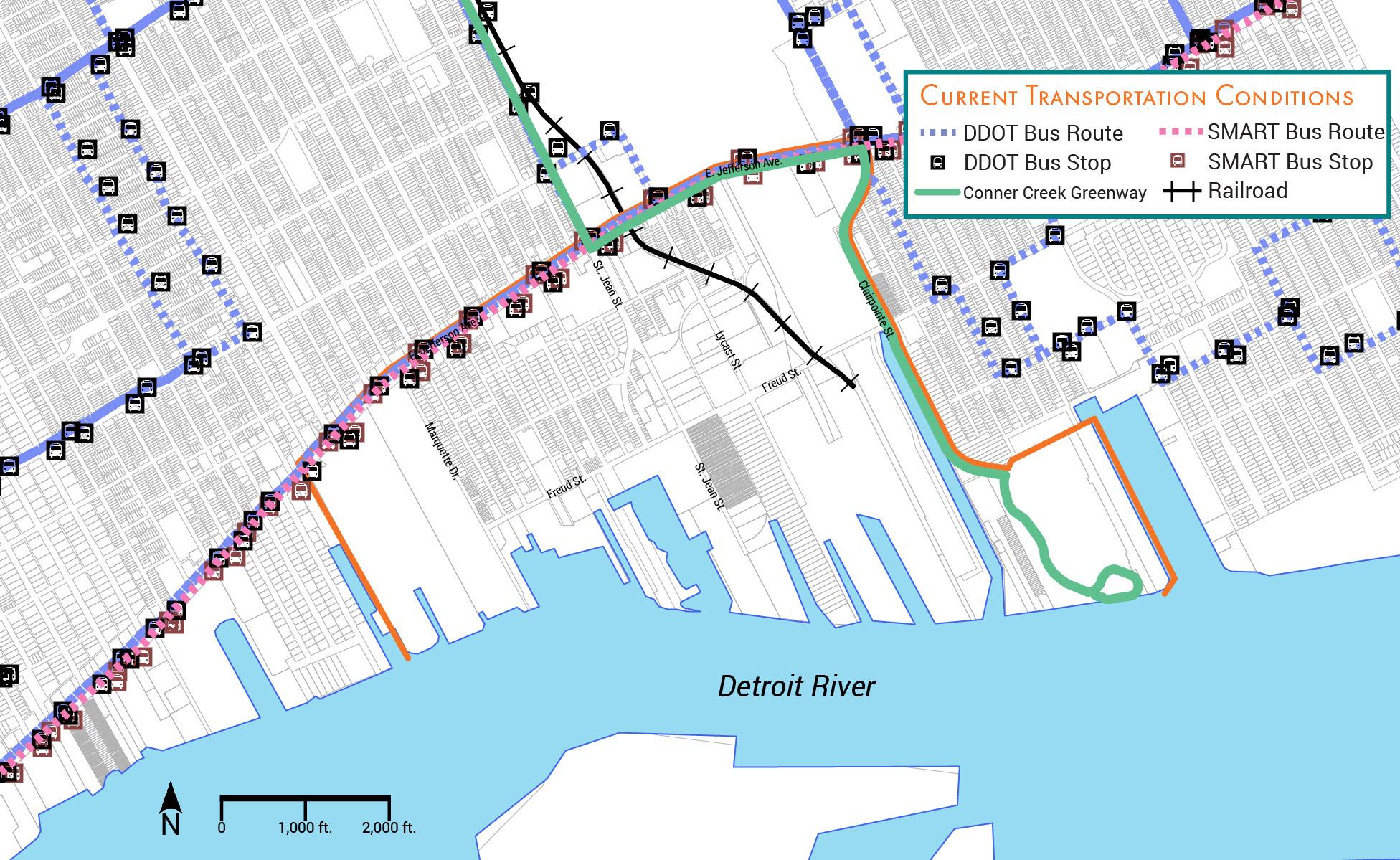
enhance connections within the district. An analysis of transportation networks includes an examination of the routes and parking facilities for motor vehicles, as well as non-motorized transportation options (e.g., walking, biking), mapped in Figure III-10.
FIGURE III-10. CURRENT TRANSPORTATION CONDITIONS IN THE MARINA DISTRICT
MOTORIZED TRANSPORTATION
Overall, the Marina District is fairly accessible by motor vehicle. On average, approximately 18,000 vehicles travel on East Jefferson Avenue per day. Within the Marina District, the average daily traffic count is approximately 1,100 vehicles on Clairpointe Avenue, 1,000 on St. Jean Street, and 750 on Freud Street.38 Traffic in the Marina District includes trucks and buses traveling to industrial businesses. As of April 2016, there seem to be no designated truck routes governing traffic patterns in the area.39
The main roadway connection from east to west within the district is Freud Street. East-west routes closer to the riverfront are discontinuous, interrupted by the canals running perpendicular to the riverfront, many of which are now used by marinas. Freud Street also serves as the dividing line between distinctly different land uses in the district, separating heavy industry from residential, industry from park, and marina from residential. Several characteristics of the environment on Freud Street reinforce this divide, including a lack of sidewalks and eyes on the street (i.e., the neighborhood watch effect that occurs when there are many people in an area), as well as barbed wire fence guarding private properties. In February 2016, the condition of the street pavement averaged 7 out of 10, measured using the Pavement Surface Evaluation and Rating (PASER) Manual from the University of Wisconsin-Madison Transportation Information Center, where 10 represents best condition and one represents worst condition. This score implies
that the average road segment in the Marina District needs routine maintenance.
The Marina District provides plentiful public parking for cars, including off-street parking lots throughout the district and on-street parking on all neighborhood streets, with the exception of St. Clair Street. Public parking is also available for those visiting Maheras-Gentry Park, within the park. Customer parking is available in front of Jefferson Village Shops, Riverbend Plaza Shopping Center, and other retailers along East Jefferson Avenue.
Regarding public transit, two bus operators serve the Marina District, with more than 15 stops along East Jefferson Avenue in the Marina District. As of October 2014, the route operated by the Detroit Department of Transportation (DDOT), Route 25, transported 3,360 riders on an average weekday, making it the ninth most used route in Detroit. The other routes, Routes 615 and 635, run by SMART, had an average of 187 and 114 riders per weekday, respectively.40 Aside from the stops along East Jefferson Avenue, the Marina District is not well-served by public transit.
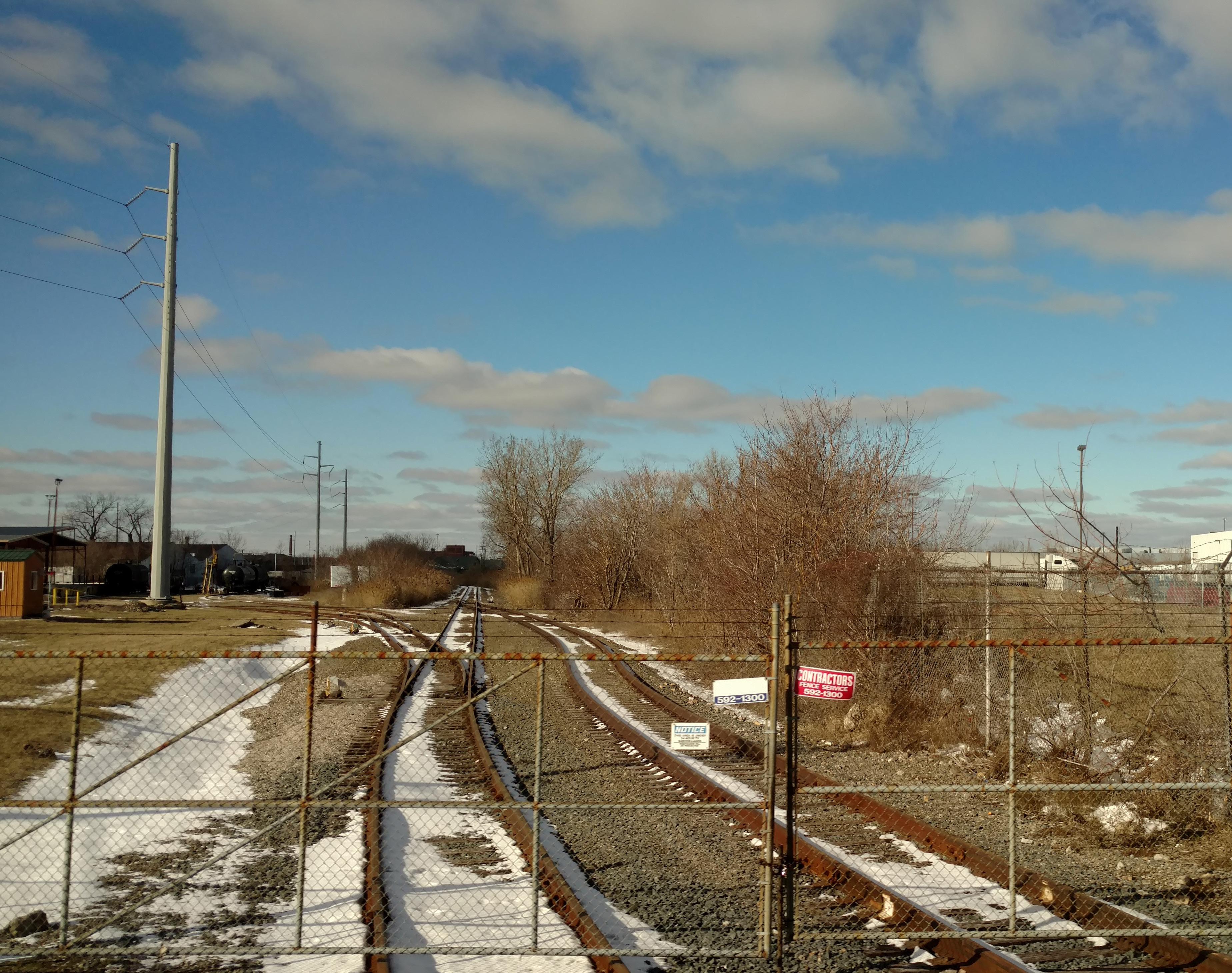
The Marina District contains one freight railroad, running south and north in the Conner Creek Industrial neighborhood. The railroad lies at the eastern end of the former Detroit Terminal Railroad, now owned by Conrail.41 Conrail maintains active freight service for JNAP, just north of the district across East Jefferson Avenue, as well as for two clients south of East Jefferson Avenue in the
Marina District. As of March 2016, Michigan Department of Transportation (MDOT) staff report one to four trains per day, three to four days per week, on the railroad south of East Jefferson Avenue.42 This freight traffic is reported to be slow-speed movement of one locomotive and occasionally a few rail cars.
NON-MOTORIZED TRANSPORTATION
Bicyclist and pedestrian paths exist around and within the Marina District. The Conner Creek Greenway, a nonmotorized path running on and off roads at different points, stretches from 8 Mile Road south to the Detroit
FIGURE III-11. CONDITION OF SIDEWALKS IN THE MARINA DISTRICT
River. The Detroit Eastside Community Collaborative initiated the greenway development to connect the east side of Detroit to the Detroit River. The greenway borders the Marina District along East Jefferson Avenue and Clairpointe Street extending to Maheras-Gentry Park by the River.
Protected bike lanes are planned for the stretch of the East Jefferson Avenue corridor bounding the Marina District, extending the protected bike lanes currently installed east of the district.43 Within the district, there currently are no on-road bicycle facilities.
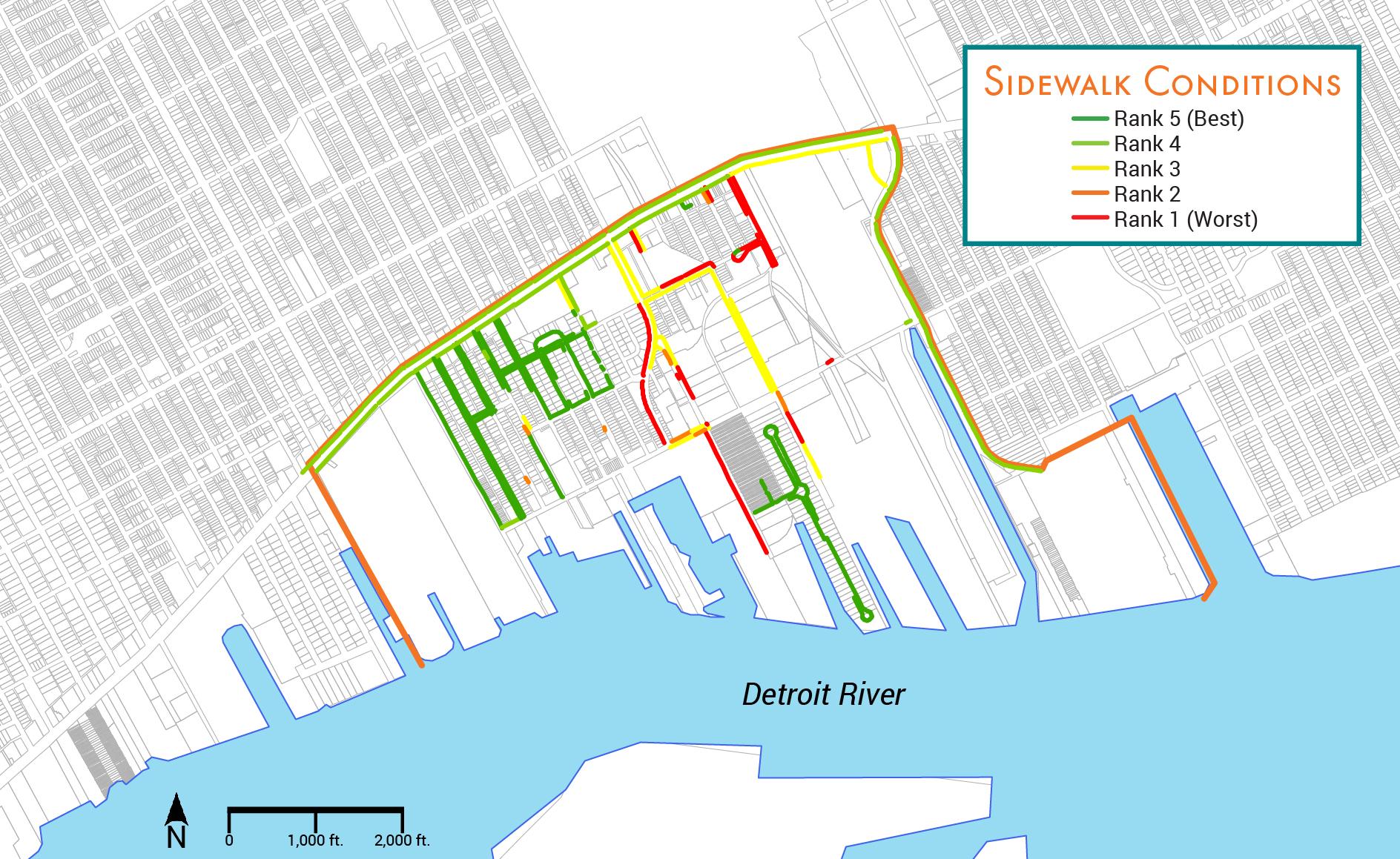
The Marina District contains over 10 miles of paved public sidewalks. Figure III--11 shows the condition of these sidewalks as of early 2016. The average observed condition of sidewalks in February 2016 is approximately 3.8 out of 5, measured on a five-point scale where five represents best condition and one indicates worst condition. This average score indicates that the sidewalks in the Marina District need routine maintenance. Although the new housing developments (i.e., Jefferson Village and Morgan Waterfront Estates) have recently constructed sidewalks, gaps exist throughout those developments where homes are not yet built. Some of these sidewalks also lack curb ramps that comply with accessibility standards in the Americans with Disability Act. In addition, sidewalks in the industrial portion of the Marina District, east of St. Jean Street, have deteriorated and become overgrown. Altogether, approximately half of the streets in the Marina District lack usable sidewalks.
COMMUNITY ENGAGEMENT
Public engagement provides critical input for the development of recommendations that align with the needs and preferences of the community. For this plan, two focus group sessions were held in March 2016, including one focus group with residents and one focus group with business owners. In addition, individual interviews contributed ideas and feedback that have been incorporated throughout the plan. The Appendix provides more detailed information about the community engagement process and findings.
RESIDENTS
On March 12, 2016, residents from the neighborhoods within the Marina District participated in a community engagement focus group hosted at Riverside Marina. Residents from Jefferson Village and Morgan Waterfront Estates attended the meeting and shared their interests and concerns regarding the district overall. Residents explained that they do not currently identify with the name “Marina District” but would like to identify with this name through improved branding of the district. Common concerns among the participating residents included litter, unleashed dogs, and perceived lack of access to public parks in the area, such as Reid Memorial Park and Engel Memorial Park. Common interests included adding and improving infrastructure for bicycling and walking throughout the district; bringing more businesses to the area, such as coffee shops, restaurants, and hardware
stores; and establishing new formalized activities in the area, such as a water taxi at the St. Jean Boat Launch.
BUSINESS OWNERS
Another stakeholder session took place at Sinbad’s Restaurant and Marina on March 15, 2016. Nine representatives from businesses in the Marina District participated, sharing their experiences and ideas about the area. Similar to the residents, business stakeholders expressed an interest in more branding of the “Marina District” name. The business owners shared many of the concerns raised by residents, such as lack of access to public parks and the Detroit River, sanitation issues, and stray dogs. Some businesses have already taken action to manage these issues, scheduling regular litter cleanups events for neighborhood streets. They also shared interests with the residents and expressed willingness to improve the curb appeal of their properties.
REFERENCES
1 U.S. Census Bureau. (2014). 5-Year Estimates. Retrieved March 17, 2016, from http://factfinder.census.gov
2 U.S. Census Bureau. (2014). 5-Year Estimates. Retrieved March 17, 2016, from http://factfinder.census.gov
3 U.S. Census Bureau. (2014). 5-Year Estimates. Retrieved March 17, 2016, from http://factfinder.census.gov
4 U.S. Census Bureau. (2014). 5-Year Estimates. Retrieved March 17, 2016, from http://factfinder.census.gov
5 U.S. Census Bureau. (2014). 5-Year Estimates. Retrieved March 17, 2016, from http://factfinder.census.gov
6 U.S. Census Bureau. (2014). 5-Year Estimates. Retrieved March 17, 2016, from http://factfinder.census.gov
7 U.S. Census Bureau. (2014). 5-Year Estimates. Retrieved March 17, 2016, from http://factfinder.census.gov
8 U.S. Census Bureau. (2014). 5-Year Estimates. Retrieved March 17, 2016, from http://factfinder.census.gov
9 Gilchrist II, G. (2015). Zoning Map. Retrieved February 27, 2016, from https://data.detroitmi.gov/Government/Zoning-Map/iecw-apwi
10 Detroit Economic Growth Corporation. (2016). Jefferson Village. Retrieved April 1, 2016, from http://www.degc.org/businesses/jefferson-village-1; Detroit Economic Growth Corporation. (2016b). Jefferson Village Updates. Retrieved from http://www.degc.org/businesses/jefferson-village-updates
11 Detroit Economic Growth Corporation. (2016). Jefferson Village Updates. Retrieved from http://www.degc.org/businesses/jefferson-village-updates
12 U.S. Geological Survey. (1980). Feature Detail Report for: Detroit River. Retrieved February 1, 2016, from http://geonames.usgs.gov/apex/ f?p=gnispq:3:0::NO::P3_FID:624587
13 U.S. Geological Survey. (1980). Feature Detail Report for: Detroit River. Retrieved February 1, 2016, from http://geonames.usgs.gov/apex/ f?p=gnispq:3:0::NO::P3_FID:624587
14 Michigan Department of Natural Resources. (2016). Belle Isle Park.
15 Derecki, J. A. (1984). Detroit River Physical and Hydraulic Characteristics. Ann Arbor. Retrieved from http://www.glerl.noaa.gov/pubs/ fulltext/1984/19840013.pdf
16 U.S. Environmental Protection Agency. (2015). About Detroit River AOC. Retrieved April 16, 2016, from https://www.epa.gov/detroit-river-aoc/ about-detroit-river-aoc#buis
17 Detroit Eastside Community Collaborative. (n.d.). History of Conner Creek. Retrieved April 16, 2016, from http://www.connercreekgreenway. org/history/
18 Associated Press. (2013, March 18). Detroit River Again Becoming Home To Beaver. CBSDetroit. Detroit. Retrieved from http://detroit.cbslocal. com/2013/03/18/detroit-river-again-becoming-home-to-beaver/; Hartig, J. (2009). Return of the Detroit River’s Charismatic Megafauna. Retrieved April 16, 2016, from http://www.humansandnature.org/return-detroitrivers-charismatic-megafauna
19 National Geospatial-Intelligence Agency, Delta State University, & ESRI. (2015). FEMA’s National Flood Hazard Layer (Official). Retrieved April 18, 2016, from http://fema.maps.arcgis.com/home/webmap/viewer.html
20 Kaminski, M., Li, R., Bu, J., Haarer, R., Liu, P., & Zhen, Y. (2014). Stormwater Management in Southeast Detroit: Adaptive and Contextually Informed Green Infrastructure Strategies. Ann Arbor. Retrieved from https:// deepblue.lib.umich.edu/bitstream/handle/2027.42/106566/2014 Master Project 701-242.pdf?sequence=1
21 Natural Resources and Environmental Protection Act: Act 451 of 1994 (1994). Michigan Legislature. Retrieved from http://legislature.mi.gov/doc. aspx?mcl-Act-451-of-1994
22 Jefferson East, Inc. (2015). Marina District.
23 Kean’s Marina. (n.d.). Retrieved March 25, 2016, from http://www.yelp. com/biz/keans-marina-detroit
24 Sindbads Restaurant and Marina. (n.d.). Boat Wells & Marina. Retrieved March 25, 2016, from http://sindbads.com/boat-wells-and-marina
25 Riverside Marina. (2016). Phone call. Detroit.
26 Edison Boat Club. (n.d.). About Edison Boat Club. Retrieved March 25, 2016, from http://www.edisonboatclub.org/about_ebc.html
27 Bayview Yacht Club. (n.d.). Club History. Retrieved March 25, 2016, from http://www.byc.com/Default.
28 Jefferson East Inc. (2015). Maheras-Gentry Park. Retrieved March 25, 2016, from http://goeastjefferson.org/maheras-gentry-park/
29 Michigan Department of Natural Resources. (n.d.). Boating Access Site Detail. Retrieved January 31, 2016, from http://www.mcgi.state.mi.us/ mrbis/BASDetail.aspx?basid=A-82-001
30 Michigan Department of Natural Resources. (2015). Recreational Fishing Report: April 9, 2015. Retrieved from https://www.michigan.gov/ documents/dnr/2015MIFishingReports-April-May-June_486611_7.pdf
31 Detroit River Sports. (n.d.). Tours. Retrieved February 1, 2016, from http:// www.detroitriversports.com/tours/
32 Grayhaven Sail Club of Detroit. (n.d.). Retrieved March 25, 2016, from http://www.grayhavensailclubdetroit.org
33 Austin, D. (n.d.). Water Works Park Tower. Retrieved February 10, 2016, from http://www.historicdetroit.org/building/water-works-park-tower/
34 Detroit Riverfront Events Inc. (2016). Event Map. Retrieved from http:// www.detroitboatraces.com/event_map.php
35 Sindbads Restaurant and Marina. (n.d.). Retrieved February 1, 2016, from http://sindbads.com/
36 History - Roostertail. (n.d.). Retrieved February 10, 2016, from http:// roostertail.com/history
37 Fiat Chrysler Automobiles. (2016). Jefferson North Assembly Plant. Retrieved April 1, 2016, from http://media.fcanorthamerica.com/ newsrelease.do?&id=327&mid=50
38 SEMCOG. (n.d.). SEMCOG Volume Map. Retrieved February 28, 2016, from http://maps.semcog.org/TrafficVolume/
39 Elling, J. (2016). Meeting. Detroit.
40 Regional Transit Authority. (2015). Regional Master Transit Plan: State of the System and Transit Market Analysis Report. Detroit. Retrieved from http://www.rtamichigan.org/wp-content/uploads/BEST-RMTP_ StateOfTheSystem_2015-10-23_reduced.pdf
41 Michigan Center for Shared Solutions. (2015). Michigan’s Railroad System. Michigan Department of Transportation.
42 Foondle, K. (2016). Email.
43 Elling, J. (2016). Meeting. Detroit.
RECOMMENDATIONS CHAPTER 4:
The history and assets of the Marina District make the area unique in the city of Detroit. Given the public parks, boat launches, marinas, restaurants, and historic industrial buildings along the riverfront, the district could become a destination for both residents and visitors wanting to enjoy river views and engage in water-related recreational activities.
This plan seeks to improve public access to the riverfront through two goals: enlivening the public experience and enhancing transportation connections in the Marina District. This chapter provides recommendations to achieve these goals, explains the need for each recommendation, and specifies action steps to implement the recommendations. The guidance for implementing the recommendations is based on input from community
members, research on best practices, and examples from other cities. Case studies of successful projects in other communities help to demonstrate the potential impact of proposed projects in the Marina District and provide guidance as to how local leaders might implement these projects. In the recommendation summary, this chapter also identifies organizations to champion each recommendation and proposes a phasing timeline and estimated cost level.
GOAL ONE: ENLIVEN THE PUBLIC EXPERIENCE OF THE MARINA DISTRICT
Enlivening the public experience of the Marina District means making the district more safe, pleasant, and interesting to explore. Achieving this goal would provide the public with greater opportunity to access and enjoy the Detroit River and would make the Marina District a destination in the city of Detroit.
INSTALL SIGNAGE FOR NAVIGATION AND BRANDING
Unless they know the area, people traveling along the East Jefferson Avenue corridor have no way of knowing how close they are to the Detroit River or what assets exist in the Marina District. For example, visitors and workers might not know that parks line the riverfront,
that marinas provide access to the water, and that restaurants provide views and good food near the river. Similarly, it might not be clear that many opportunities for recreation exist in the Marina District, including trails, bike lanes, fishing piers, boat ramps, and sports fields. In community meetings, some residents shared that they were unaware that public parks existed in the neighborhood.
Providing distinctive and consistent signage would promote the Marina District identity and make the area easier and more interesting for both residents and visitors to explore. In public engagement meetings, residents and business leaders expressed enthusiasm for branding the Marina District (i.e., cultivating a unified identity and increasing name recognition for the district). Several types of signage could improve navigation and branding: gateway, wayfinding, and informational signage.
Install gateway signage
Gateway signage identifies entry points to a neighborhood, highlighting the area as a distinctive place to visit. In addition to branding the neighborhood, gateway signage also helps with navigation by indicating when visitors have reached their destination and clarifying the recommended access points into a neighborhood. During community engagement meetings, residents found it important that traffic into the Marina District be directed down St. Jean Street, Marquette Drive,
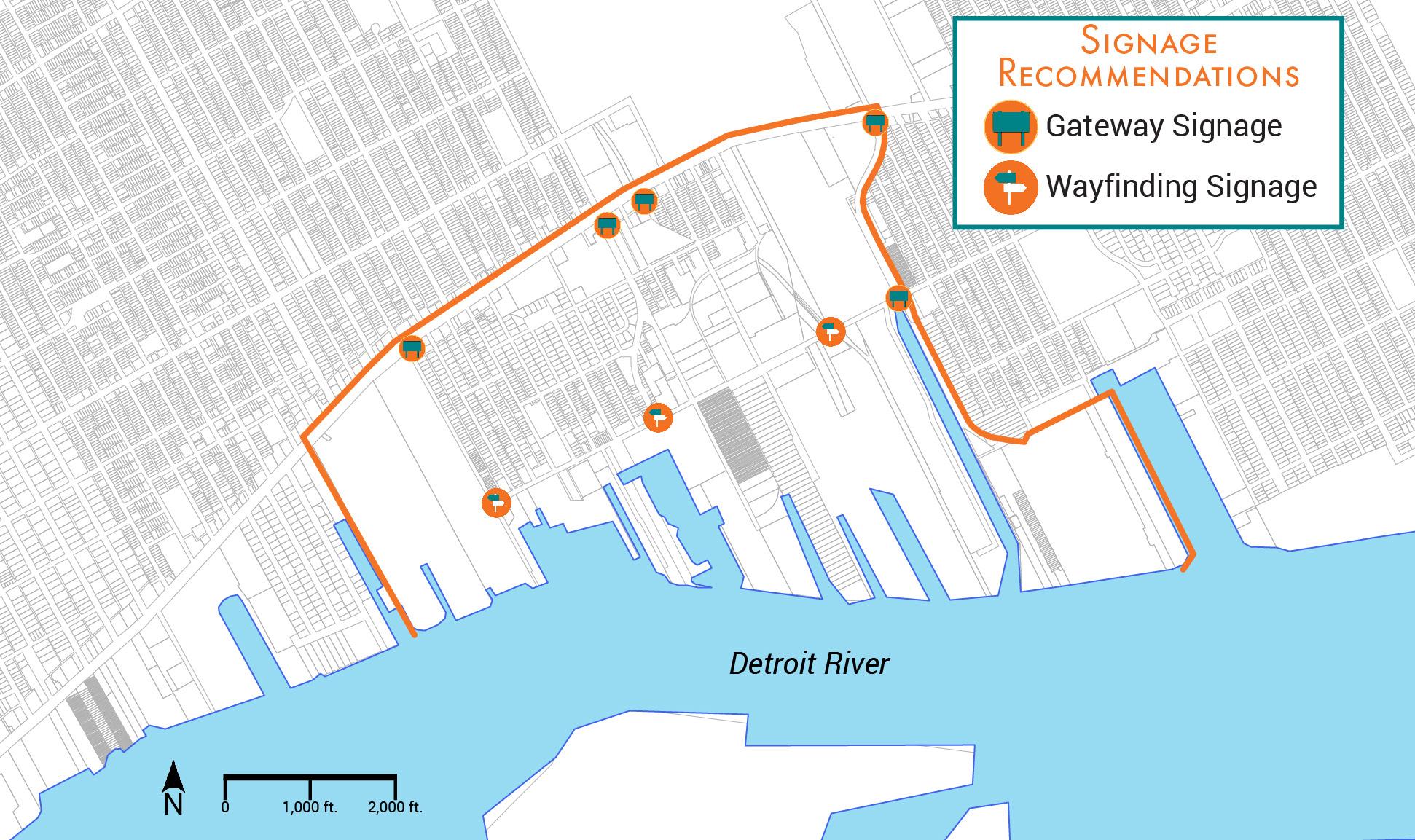
and Clairpointe Street, rather than through residential streets. Gateway signage could help to facilitate these preferred traffic routes. Figure IV-1 presents possible locations for gateway signage in the Marina District, including four entrance points along East Jefferson Avenue.
Gateway signage could take many forms, ranging from a banner to a post to an archway, with an associated range in cost. One option is to install a low-cost banner in the short term and design a more permanent structure for the future. Figure IV-2 shows an iconic example of gateway
FIGURE IV-1. PROPOSED LOCATIONS FOR GATEWAY AND WAYFINDING SIGNAGE IN THE MARINA DISTRICT
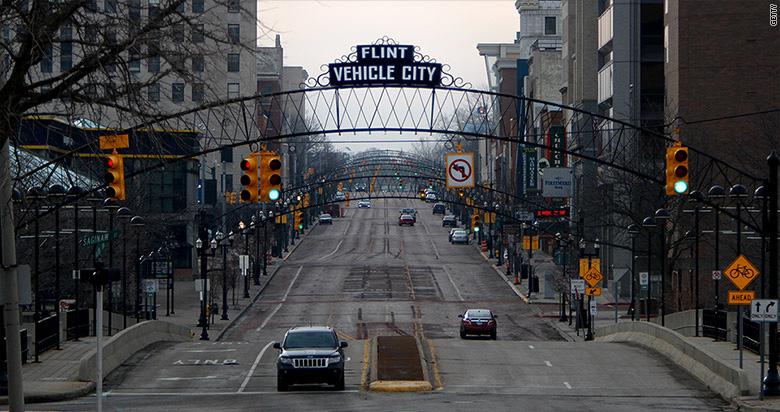
IV-2. GATEWAY SIGNAGE IN FLINT, MICHIGAN | SOURCE: RICE, S. (N.D.). SAGINAW STREET IN DOWNTOWN FLINT ON FEBRUARY 7. FLINT, MI: GETTY IMAGES. RETRIEVED FROM HTTP://WWW.CURBED. COM/2016/2/17/11028606/FLINT-MICHIGAN-HOUSING-MARKET-WATER-CRISIS
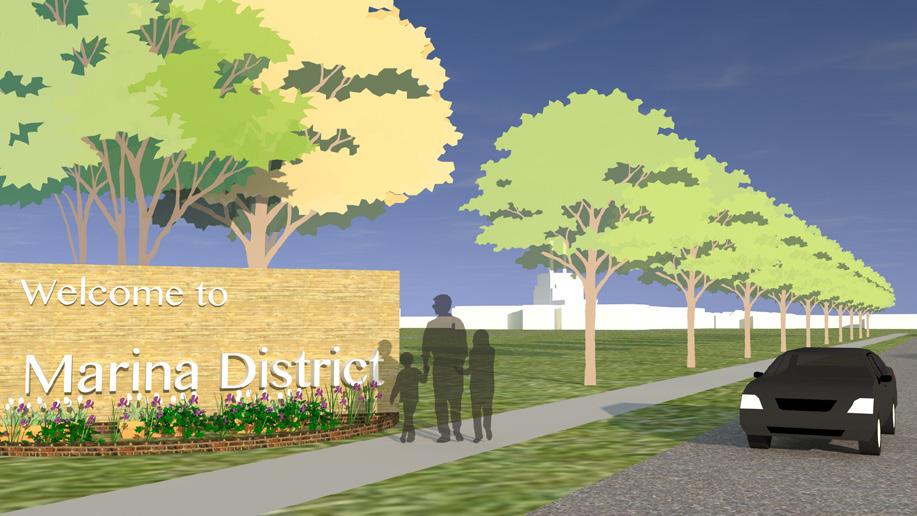
Install wayfinding signage
Wayfinding signage serves a directional purpose, helping travelers navigate to specific destinations. It also helps travelers to form a mental map of a place and make the area more memorable. The signage can improve public access by reducing the uncertainty that travelers might face when considering whether to explore an unfamiliar area.
Wayfinding signage can include signs with names of key destinations, arrows pointing toward those destinations, and information about time or distance to those destinations. Figure IV-4. Wayfinding Signage in Detroit, Michigan | SOURCE: Wayne State University. (2016). Walk [Wayne State] Returns to Midtown. Retrieved April 27, 2016, from http://economicdevelopment.wayne.edu/news/ walk-wayne-state-returns-to-midtown-19034 presents an example of wayfinding signage in Detroit.
Figure IV-1. Proposed Locations for Gateway and Wayfinding Signage in the Marina District includes suggested locations for wayfinding signage in the Marina District, which might point toward the following destinations:
• Engel Memorial Park
signage over a downtown street in Flint, Michigan and Figure IV-3. Vision for Gateway Signage in the Marina District presents a vision for gateway signage in the Marina District.
• Riverside Marina
• Reid Memorial Park
• Edison Boat Club
• Bayview Yacht Club
• Maheras-Gentry Park
FIGURE
FIGURE IV-3. VISION FOR GATEWAY SIGNAGE IN THE MARINA DISTRICT
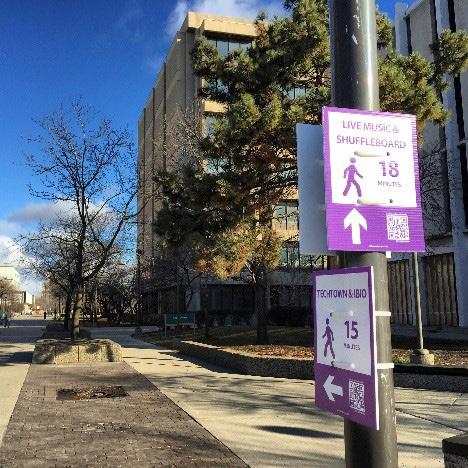
FIGURE IV-4. WAYFINDING SIGNAGE IN DETROIT, MICHIGAN | SOURCE: WAYNE STATE UNIVERSITY. (2016). WALK [WAYNE STATE] RETURNS TO MIDTOWN. RETRIEVED APRIL 27, 2016, FROM HTTP://ECONOMICDEVELOPMENT.WAYNE. EDU/NEWS/WALK-WAYNE-STATE-RETURNS-TO-MIDTOWN-19034
Should the following sites become more publicly accessible per the recommendations in this plan, they could also be highlighted in wayfinding signage:
• Waterworks Park
• DTE Conner Creek Power Plant site
Additionally, should bus routes change in the future, as recommended by this plan, bus stops could also display wayfinding signage to direct transit riders to assets in the district.
Install informational signage
A third type of signage that could improve public access and the experience of the Marina District is informational signage. Informational signage helps pedestrians or cyclists understand their surroundings and helps preserve and share knowledge about the area.
Informational signage in the Marina District might provide historical facts about a location or feature within the district or might offer interesting facts about the current conditions. Here are some ideas for informational signage that could enhance the experience of traveling through the Marina District:
• Signs explaining the history of the Marina District and important sites within the Marina District, such as Waterworks Park, the DTE Conner Creek Power Plant, the Conner Creek Greenway, the railroad, MaherasGentry Park, and the marinas. The signs could include historical photographs to accompany the text.
• Signs describing the source of Detroit drinking water and efforts taken to protect water resources in the area. These signs could be installed on water fountains, along the Waterworks Park fence, at boat launches, or in Maheras-Gentry Park.
• Signs describing the natural features and ecosystems in the district, including the river, creeks, plants, and green infrastructure installations.
An example from Orlando, Florida shows how installing informational signage along an urban path, such as the
CASE STUDY: INFORMATIONAL SIGNAGE ON AN URBAN TRAIL IN ORLANDO, FLORIDA
Orlando, Florida embarked on a project to install an urban trail along railroad tracks to tie into existing biking and walking paths in the city. The urban trail connects historic rail stations, the central business district, and a cultural park. Goals for the trail include revitalizing a public park into a regional cultural arts destination and providing a safe amenity that improves quality of life for residents.
Signage is an integral part of the project. As shown in Figure IV-5. Informational Signage on an Urban Trail in Orlando, Florida | Source: Great Job, Orlando! (2012). Retrieved April 20, 2016, from http://commuteorlando. com/wordpress/2012/07/23/great-job-orlando-2/, the first portion of the trail completed, called the “Dinky Line,” includes wayfinding signs that direct trail users, including walkers, bicyclists, and skaters, and informational signs that provide historical information about the area, including information about important industries that had operated on the site.
The project has garnered positive reviews from the community. The opening ceremony for the trail in 2012 involved a community run and walk event with hundreds of participants, and users have shared positive reviews of the trail.1
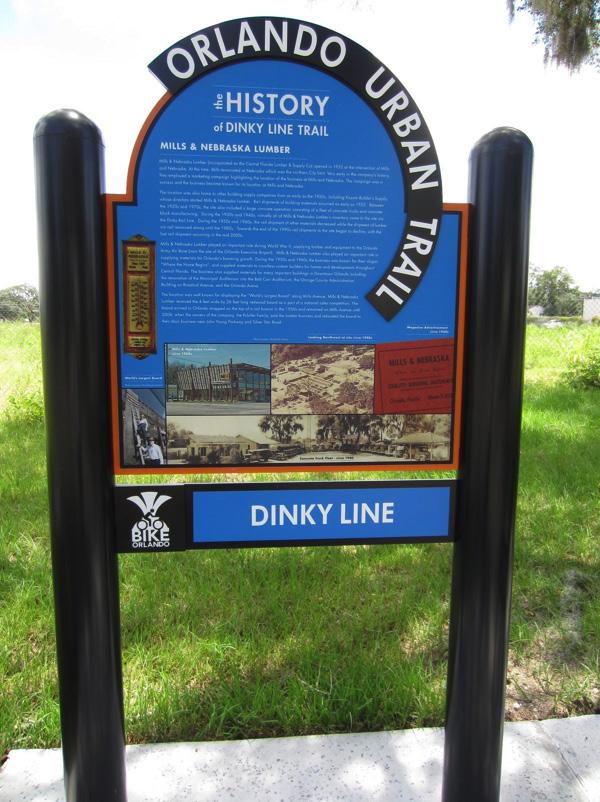
FIGURE IV-5. INFORMATIONAL SIGNAGE ON AN URBAN TRAIL IN ORLANDO, FLORIDA | SOURCE: GREAT JOB, ORLANDO! (2012). RETRIEVED APRIL 20, 2016, FROM HTTP://COMMUTEORLANDO.COM/WORDPRESS/2012/07/23/ GREAT-JOB-ORLANDO-2/
signage proposed for the Marina District, can improve the experience for the user.
PROMOTE PUBLIC PARKS AS COMMUNITY ASSETS
The study area includes three public parks: Engel Memorial Park, Reid Memorial Park, and Maheras-Gentry Park. According to input received at public engagement meetings, the parks are currently underutilized by local residents for several reasons. Some residents were unaware that any parks existed in the area. Other residents knew that the parks existed but believed that the parks were not open to the public and that water access was only available to marina members. In particular, Reid and Engel have fences and lack informational signage to indicate how people might enter the park, sending the message that the parks are
inaccessible, and some residents have been turned away by security personnel. Moreover, Reid and Engel do not have parking for visitors and only allow entry by foot.
With regard to safety, a particular concern among community members is the presence of stray dogs in the area. According to data from the World Animal Awareness Society, there are about 3,000 stray and abandoned dogs in the city of Detroit.2 This is a citywide problem that presents challenges for public access to the riverfront in the Marina District.
Facilitate access to public parks, particularly Reid Memorial Park
With improved public access, the public parks could be tremendous assets in the Marina District. Residents and business owners in the Marina District agreed that
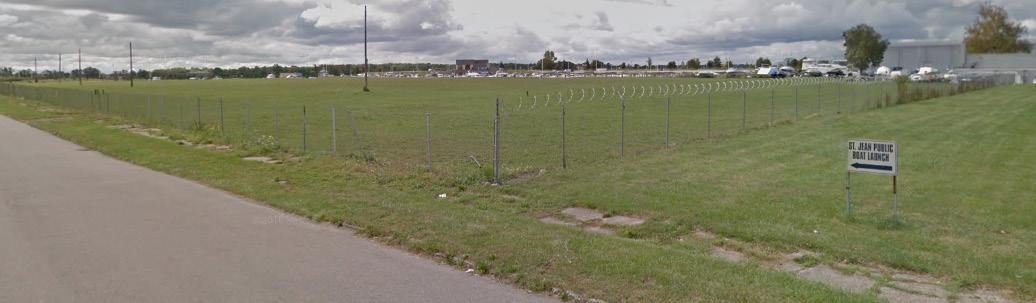
FIGURE IV-6. NORTH PART OF REID MEMORIAL PARK
increasing access to the Detroit River and creating destination areas would improve their neighborhood. They expressed desire for better access to public parks and offered a range of ideas for ways to activate the parks, including providing activities for children, water sports and boat rentals, places to walk dogs, seating to watch fireworks or have picnics, and areas to enjoy views of the Detroit River and wildlife.
Reid Memorial Park makes an ideal focal point for efforts to improve public access for several reasons, including its size, central location, and current appeal. The St. Jean Boat Launch in the southern portion of Reid Memorial Park is already a destination for boaters throughout the region. In addition, recent investment in the park has improved the physical quality of the space and resulted in positive community feedback. A security camera system also helps to maintain a safe environment at the park.
Reid Memorial Park could become a lively community hub, programmed with activities described elsewhere in this plan, such as educational programs and field trips for children, seasonal markets, and community competitions and festivals. In addition to programs and events, the park could provide a space for residents to play. Figure IV-6 presents a photograph of the north part of Reid Memorial Park that could serve as a hub of community activities should it become more accessible.
Shifting the fence surrounding the north end of Reid Memorial Park toward the water would free the majority
of the park for community activities, while maintaining security around the docked boats. In addition to moving the fence, clearer signage and revised entry rules could facilitate public access. The park entrance could include signs that clarify that the park is public and specify the hours of operation, as well as the steps for entry.
Engel Memorial Park and Maheras-Gentry Park would also benefit from clearer signage and improved public facilities, such as benches, as outlined in the streetscape recommendation elsewhere in this plan. In addition, at Engel Memorial Park, park operators could make it easier for people to enjoy the park by permitting drivers to drop off members of their party and supplies rather than requiring groups to park nearby and carry supplies into the park, potentially using a sticker system to identify frequent users of the park. As of April 2016, Reid Memorial Park and Engel Memorial Park are managed by the same operator, making it easier to coordinate these recommended changes to increase public access.
Partner with animal welfare organizations
Addressing safety concerns, including the presence of stray dogs, can improve access to public parks. Residents and organizations can report dog sightings to local animal welfare organizations, such as those listed in the Appendix.
Neighborhood organizations can help residents understand their options by listing resources on their
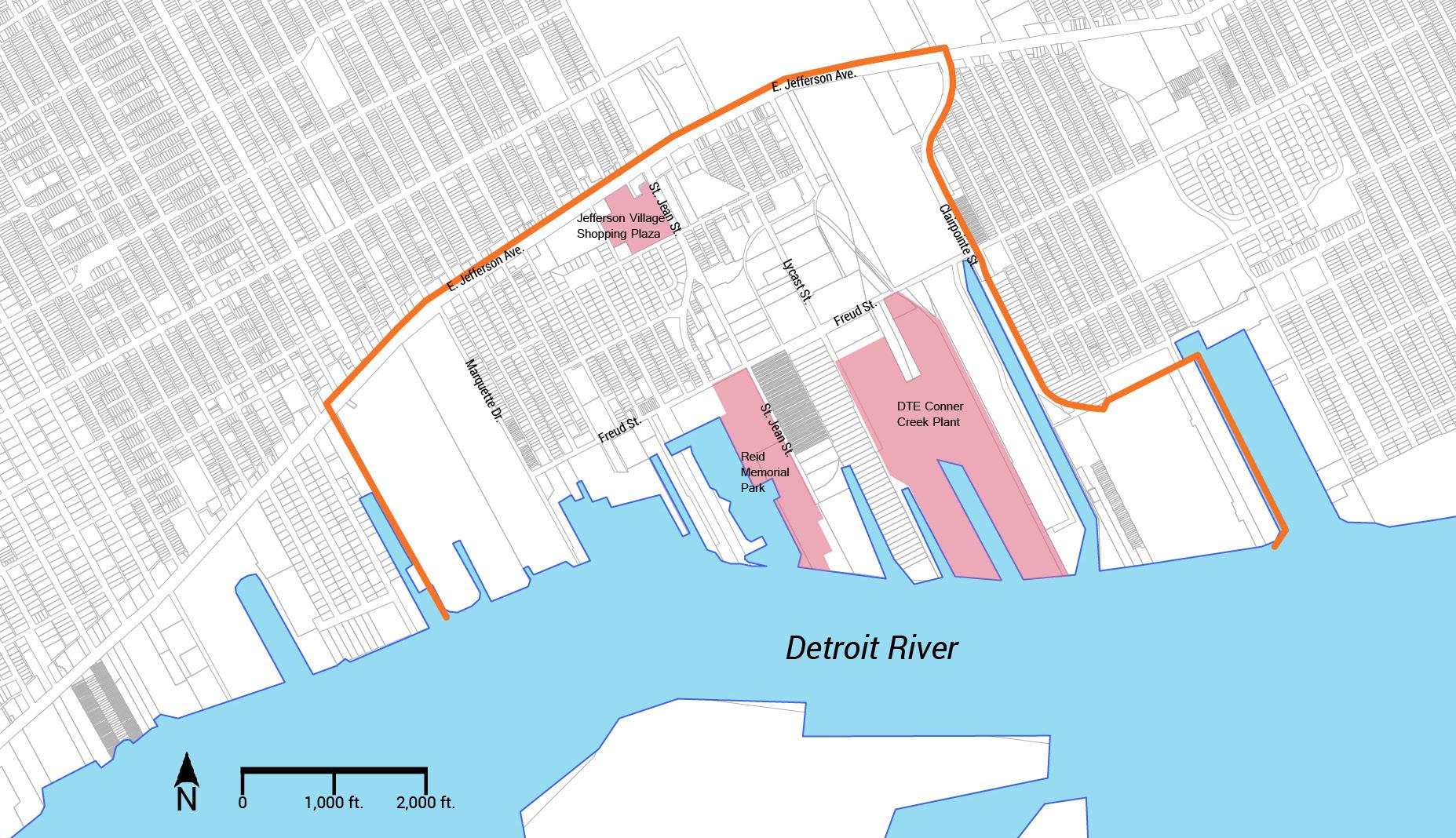
websites and circulating or posting flyers that state, “Find out how to report a stray dog,” with directions to an informational website. To help eliminate the problem citywide, residents can spay and neuter their pets and promote awareness among friends and family about the importance of doing so.
GENERATE YEAR-ROUND ACTIVITY
Public spaces in the Marina District demonstrate great potential to serve the community but are currently underused. Creating activity in public spaces will draw people to the district to take advantage of one of the most significant assets in the area: the Detroit River. Moreover, having people enjoying activities in all seasons will
FIGURE IV-7. PROPOSED ACTIVITY HUBS IN THE MARINA DISTRICT
increase the sense of safety of the area and create job opportunities for local residents, such as coordinating activities or maintaining and managing facilities and businesses.
In addition to the existing shopping plaza on East Jefferson, this plan proposes potential hubs of activity at the south part of Reid Memorial Park (which includes the St. Jean Boat Launch), the north part of Reid Memorial Park, and the decommissioned DTE Conner Creek Power Plant site, as shown in Figure IV-7. Proposed Activity Hubs in the Marina District. This section includes specific recommendations to generate activity at these proposed hubs.
Establish a base for educational activities at St. Jean Boat Launch
The south part of Reid Memorial Park, which includes the St. Jean Boat Launch, contains empty green space with direct access to the Detroit River and sufficient size to accommodate activities with small groups. As one option, this site can serve as an outpost for organizations like the Detroit Outdoor Activity Center (OAC) to host waterrelated educational programs.
OAC holds a series of water-related educational programs for children, including “F is for Fish,” “Keep It Clean,” “Life in a Pond,” “Something’s Fishy,” and “Wonders of Wetlands,” which might benefit from having a base on the riverfront.3 OAC also organizes field trips, and the
proposed outpost can serve as a potential destination. The distance from the OAC building on Atwater Street to the St. Jean Boat Launch is 4.8 miles, which can be covered by shuttle buses or vans. In the event that public bus service is increased in the area, OAC and the St. Jean Boat Launch could be potential new bus stops, ensuring safe and convenient transportation of children and adults to and from school, homes, OAC, and Marina District.
It is also important for children and adults to learn about water and boating safety, considering the opportunities for water access in the city. The St. Jean Boat Launch can serve as a base for safety education programs, where people can access the Detroit River directly and instructors can conduct live demonstrations. Employees from the St. Jean Boat Launch and professionals from Edison Boat Club, Bayview Yacht Club, and nearby marinas can contribute their expertise to teach participants based on their experience.
Provide dedicated space for fishing activities on the riverfront
Fishing is a common activity along the canals in the Marina District. Creating a dedicated space for fishing in the south part of Reid Memorial Park, at the St. Jean Boat Launch, would improve access for residents to the Detroit River. One option for dedicated fishing space involves building a boardwalk along the river’s edge near the St. Jean Boat Launch, connecting to a future bike path on St. Jean Street. The boardwalk could also serve as an
observation spot for visitors enjoying the views of the river and Belle Isle.
Construction of a six-foot-wide boardwalk costs an estimated $100 per linear foot.4 The Conservation Alliance could potentially provide funding for this project as part of larger land and water conservation grant in the Marina District.
Attract businesses to Reid Memorial Park
Local residents and businesses communicated interest in having more commercial activity in the Marina District. Specifically, residents noted the lack of coffee shops and showed interest in hardware shops, groceries, and restaurants, as well as temporary businesses like food trucks. The district does not currently have sufficient demand to support extensive commercial activity5 so a practical solution might involve building interest and demand over the next five years through periodic pop-up events that increase in regularity and eventually transition to more permanent businesses.
Pop-up events in the north part of Reid Memorial Park can help test the market and provide publicity for the Marina District. For example, a weekly or monthly market could serve residents, boaters, marina members, and other users of the riverfront during the boating season. The frequency of the events could adapt to demand. The pop-up businesses should cater to local preferences and attract people from outside of the district. Ideas
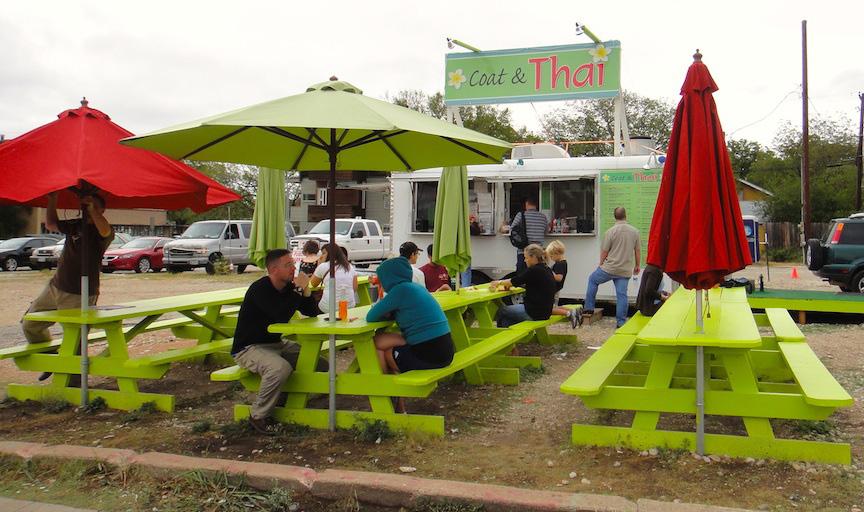
HTTP://WWW.NOMADWITHCOOKIES.COM/AUSTIN-OR-BUST/
for businesses consistent with local preferences and synergistic with other activities in the Marina District might include bait vendors and coffee stands. Pop-up events could provide opportunities for new entrepreneurs or established Detroit businesses interested in expanding publicity through a satellite location. In community engagement meetings, local business leaders indicated potential interest in setting up a coffee stand in the Marina District.
In addition to pop-up businesses, residents conveyed interest in food-related businesses. Active food truck businesses operating in other parts of Detroit might include the Marina District in their rotations. Currently, local workers bring their lunch to eat at Reid Memorial Park, indicating that food trucks at this site could meet a need during the weekday lunch time. Existing businesses
FIGURE IV-8. FOOD TRUCK AND PICNIC TABLES IN AUSTIN, TEXAS | SOURCE: NOMAD WITH COOKIES. (2011). AUSTIN OR BUST. RETRIEVED APRIL 20, 2016, FROM
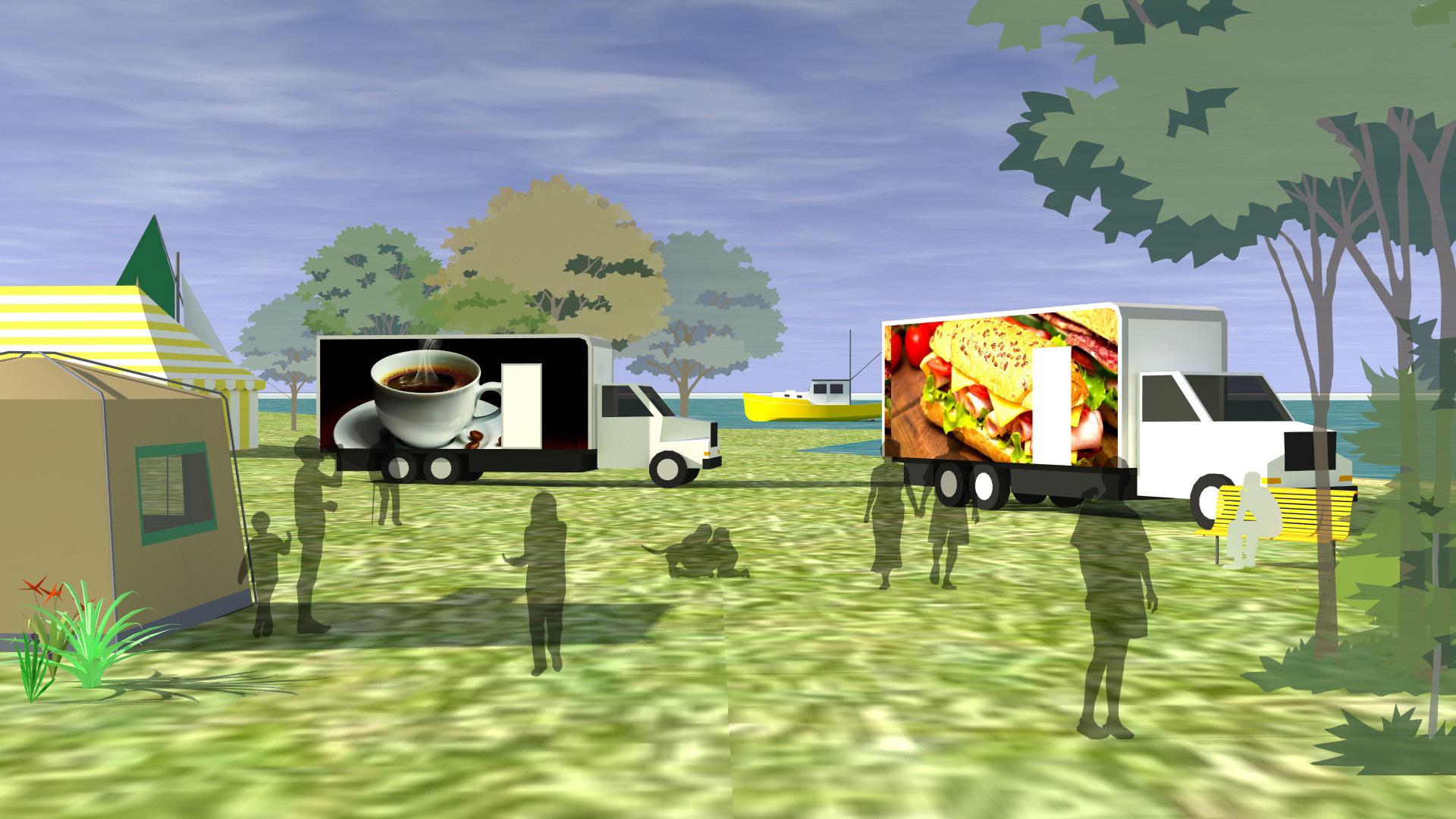
in the Marina District and nearby areas offer a large customer base, including the significant employment at the Chrysler Jefferson North Assembly Plant, just north of East Jefferson Avenue. Because successful food truck businesses can influence social media, they can also bring awareness of the Marina District to a larger audience. Figure IV-8. Food Truck and Picnic Tables in Austin, Texas | Source: Nomad with Cookies. (2011). austin or bust. Retrieved April 20, 2016, from http://www.
nomadwithcookies.com/austin-or-bust/8 shows a food truck complemented by picnic tables, creating a fun and informal outdoor dining experience.
A 2013 plan focused on job creation, “Marina District Vision,” proposed designating the intersection of St. Jean Street and Freud Street as a “100% active corner” with business activities in each corner of the intersection.6 This proposal would require reserving space at
FIGURE IV-9. VISION OF COMMERCIAL ACTIVITY AT REID MEMORIAL PARK
CASE STUDY: POP-UPS IN DETROIT, MICHIGAN
“Tashmoo Biergarten is a European-style, outdoor beer garden that activated a vacant lot in West Village with a series of five pop-up events. With their first event in September 2011, Tashmoo helped spark a movement in West Village. They showcased the vibrancy of the neighborhood, while demonstrating tremendous demand for a new business.”7 A pop-up event like the Tashmoo Biergarten, pictured in Figure IV-10, provides a model for bringing activity to the public spaces in Reid Memorial Park and vacant land along Freud Street as a pilot and testing the local market demand and capacity of business owners in the Marina District.
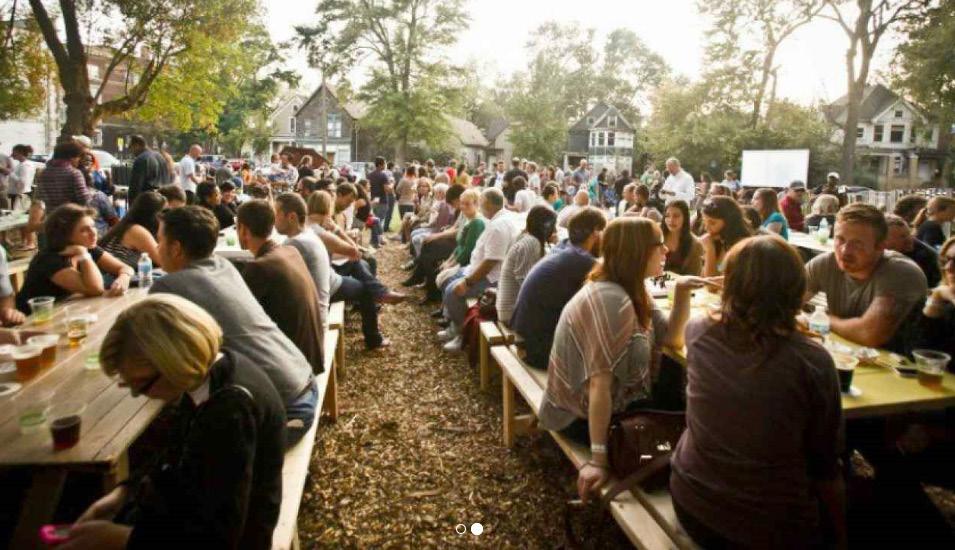
FIGURE IV-10. TASHMOO BIERGARTEN IN DETROIT | SOURCE: DRINKADVISOR. (2015). TASHMOO BIERGARTEN. RETRIEVED APRIL 20, 2016, FROM HTTPS://WWW.DRINKADVISOR.COM/EN/BARS/DETROIT/11868-TASHMOOBIERGARTEN.HTML
that intersection for retail in addition to residential development. Building upon the 2013 plan, this plan proposes phasing the 100% active corner proposal by focusing business activities in the north part of Reid Memorial Park in the short term, visualized in Figure IV-9. Vision of Commercial Activity at Reid Memorial Park. Once the market in the Marina District has matured enough to support more and longer-term businesses, the community can work with JEI to attract and select popups to open permanent businesses at the “100% corner” and along Freud Street. Community members who are interested in entrepreneurship can also consider working with JEI to open a pop-up in the Marina District. The Appendix has additional information about starting a pop-up.
Host events year-round in Reid Memorial Park
Hosting events throughout the year in the Marina District provides the potential for many benefits, including an opportunity to increase the customer base for businesses, enhance the sense of safety through the presence of people, and build a brand and name recognition for the Marina District.
Organizing event activities could also provide an opportunity for greater communication among residents and local businesses. During the focus groups, residents and businesses expressed numerous shared interests and concerns, some of which became apparent for the first time during the meetings. Brainstorming and planning
events as a community could help generate ideas that meet the preferences of local residents and businesses, while identifying other areas for partnerships and building a sense of community.
The following list identifies a sampling of activities that can help to both promote active living for local residents and attract visitors from across the Detroit region.
Marina District festival
A Fish Fest to kick off the boating and fishing season could showcase the Marina District brand to the greater Detroit community. The festival could include food and music, activities for families, and stands for businesses and local community groups to share information about their work. One possible location for a Fish Fest is the large grassy area in the north portion of Reid Memorial Park, although this event could also include activities at parks and restaurants throughout the Marina District or could rotate between venues from year to year. This event could draw visitors from across the Detroit region to enjoy the unique riverfront assets in the Marina District.
Holiday markets and events
During fall and winter, holiday markets and events can bring people together. For example, the north part of Reid Memorial Park could feature pumpkin-carving events in October and markets with trees, lights, and other holidaythemed decorations and treats in December. The marinas could also collaborate to host a New Year’s Celebration
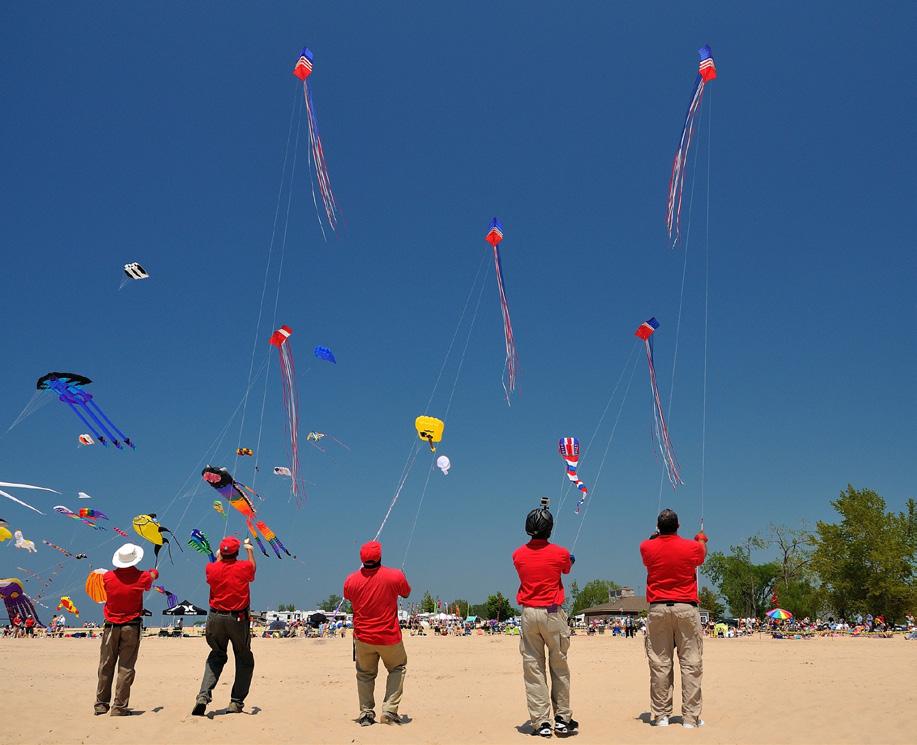
WINDJAMMERS: INTERNATIONAL KITE PERFORMANCE TEAM. RETRIEVED APRIL 21, 2016, FROM HTTP://WWW. WINDJAMMERSKITETEAM.COM
on the docks in the south part of Reid Memorial Park. Holiday markets and events can enliven the riverfront, providing both residents and visitors with entertainment and opportunity for community-building throughout the year.
Kite-flying competition
With the availability of open space and the breeze from the Detroit River, Reid Memorial Park could be a wonderful location for flying kites. To encourage people to use the open space beyond the boating season, an annual kite-flying competition could take place during
FIGURE IV-11. WINDJAMMERS PERFORMANCE TEAM FLYING KITES | SOURCE: WINDJAMMERS. (2016).
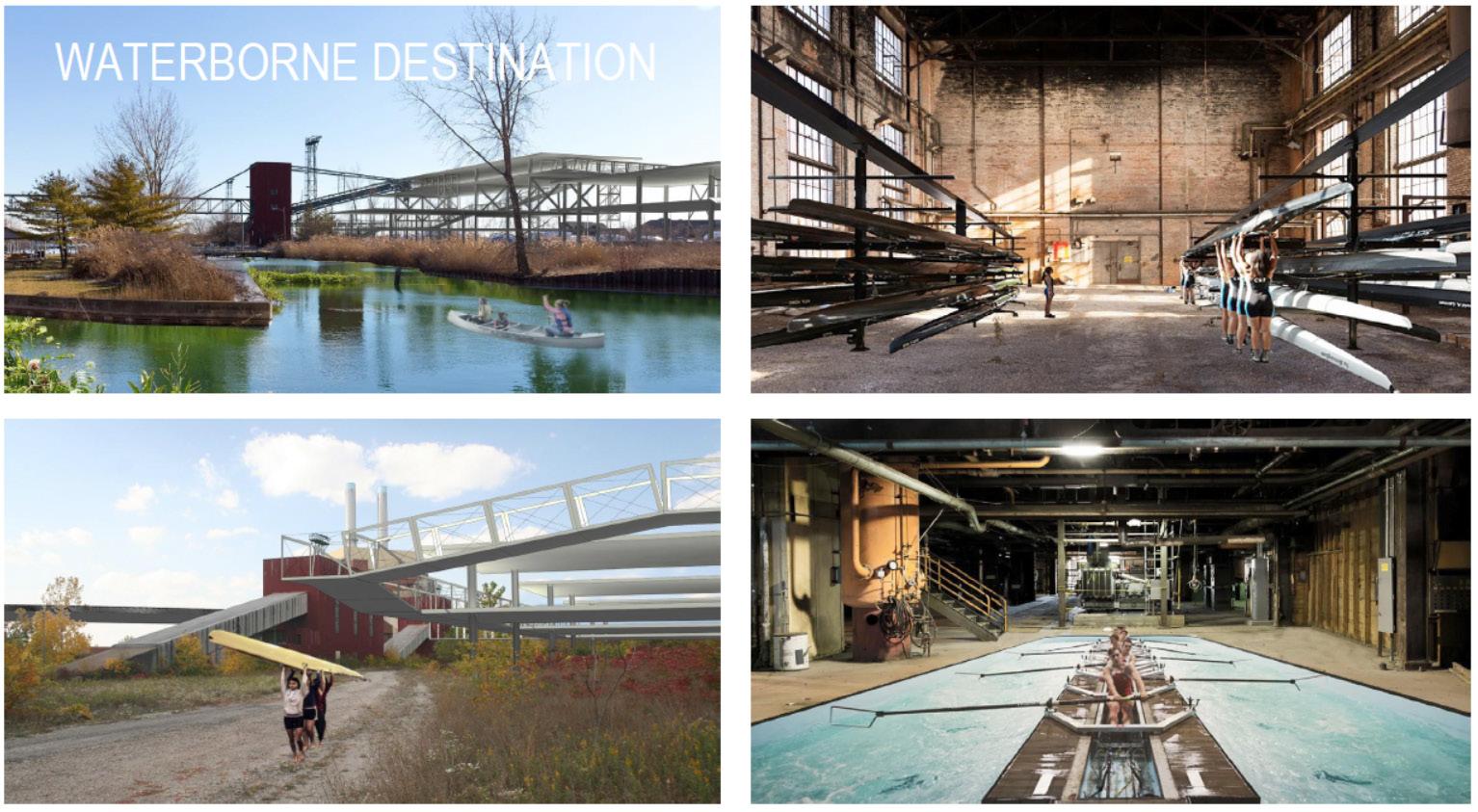
the off-season. The event could attract families, as well as professional kite-flyers, from across the City of Detroit and might include performances by sport kite teams, such as the Windjammers of Southeast Michigan, as in Figure IV-11.8 Until 2013, the City of Detroit Recreation Department sponsored an annual Kite Day on Belle Isle involving prizes and kite-building supplies. Staff could provide insight into the process of organizing such an event.9
Repurpose
the DTE Conner Creek Power Plant site
The DTE Conner Creek Power Plant is an iconic visual landmark, visible from outside the Marina District and representative of the industrial heritage of the Detroit riverfront. Although the future of the decommissioned DTE Conner Creek Power Plant site is uncertain, restoring
FIGURE IV-12. VISION OF WATER-BASED RECREATION AT A DECOMMISSIONED POWER PLANT SITE | SOURCE: UNIVERSITY OF MICHIGAN “POWER PROLOGUE” ARCHITECTURE STUDIO (2016)
and repurposing the historic structure and incorporating public access could transform the site into a regional destination that adds value and excitement to the Marina District.
Residents and businesses would like the site to serve as an additional point of public access to the Detroit River, while preserving the natural features and wildlife that have returned to the area. Residents and businesses are also interested in the potential for the site to become an attractive amenity to the area through water-themed commercial activity.
In a 2016 studio, architecture students at the University of Michigan explored ways to repurpose decommissioned power plant sites in Michigan, such as the DTE Conner Creek Power Plant site. The studio focused on four types of reuse: “ecological recovery,” using landscaping to remediate the site; “creative enterprise,” using the existing structure as a site of large-scale art production and display; “energy and research,” integrating renewable energy generation with a research facility; and “waterborne interests,” leveraging the facilities and water access for recreational activities, as demonstrated in Figure IV-12.10 The studio demonstrated the variety of reuse possibilities, complementing the recommendation in this plan that the site be repurposed as a community amenity with public access.
ENHANCE NEIGHBORHOOD CURB APPEAL
Properties in the Marina District have a variety of uses and varying levels of maintenance. Promoting investment and maintenance in properties throughout the district can enhance neighborhood curb appeal, supporting public access to the riverfront by making the area more attractive and comfortable to explore. This section identifies several ways to enhance curb appeal by encouraging maintenance and investment in public and private properties.
Create a trash management and maintenance program
During focus groups for this project, both residents and business owners identified trash as a significant issue in their area. While they look forward to having more people come to the Marina District, they also want to plan for ways to reduce litter.
One way to address litter is to expand existing trash pickup programs in the east side of Detroit. Jefferson East, Inc. (JEI) has a “Clean Jefferson” initiative, which hires local residents to remove litter, mow vacant lots, maintain trees, and remove weeds from sidewalks. JEI also offers support to local businesses and neighborhoods with tools for cleanup efforts within their area. The Clean Jefferson
program focuses on Jefferson Avenue to maintain clean entries into the neighborhoods but could be expanded to cover the public space along key corridors within the district, such as St. Jean Street and Freud Street.11
In addition to expanding the Clean Jefferson initiative, residents and business owners can organize to participate in cleanup programs run through the city. The City of Detroit Keep Detroit Beautiful program supports neighborhood cleanup efforts and promotes national and local cleanup events.12 The Keep Detroit Beautiful website offers tips that could be used in neighborhood association newsletters or emailed to Marina District businesses and residents to encourage participation. In addition, the City of Detroit Motor City Makeover program has annual cleanup events scheduled by council districts each May. Once a neighborhood registers on the website, the group receives supplies and a schedule for additional trash pick-up in the area.13
Individual residents and business owners in the area can also promote cleanliness throughout the year by maintaining their property and ensuring that curbs and gutters are clean, storm drains are clear, and sidewalks are swept. With regard to sidewalk sweeping, efforts could focus on approximately 0.8 miles on Lycaste Street and Terminal Street to help remove trash and debris. Some business owners have already organized to clean portions of the neighborhood on a regular basis and showed interest in coordinating to keep the area clean and safe.
Improve the streetscape
Streetscape refers to the features of a street that give it character and create a desirable environment. Improving the streetscape can include planting trees, removing weeds and overgrowth, upgrading the street lighting, and adding amenities like benches can help to improve the pedestrian experience in the Marina District. The installation and maintenance of these features can improve the perception of safety in the area and encourage the use of parks, trails, and pathways. Encouraging walking and biking in the Marina District will increase activity and bring more people out of their homes and into the area.
Trees could be planted on private properties along Freud Street, where they will not interfere with installation of sidewalks as proposed elsewhere in this plan, and in the area between the curb and the sidewalk along St. Jean Street and throughout Jefferson Village. Phasing the tree plantings could help to minimize costs by starting with high-traffic areas and then filling in neighborhood streets. Street lighting throughout the Marina District appears to be in working condition. Additional street lights could help to improve the streetscape along the south side of Freud Street, west of St. Jean Street.
The more industrial areas of the district could benefit from weed and overgrowth removal, which obstructs paths for pedestrians and cyclists, particularly on Edlie Street between St. Jean and Lycaste Street and on Freud Street from St. Jean Street to Clairpointe Street.
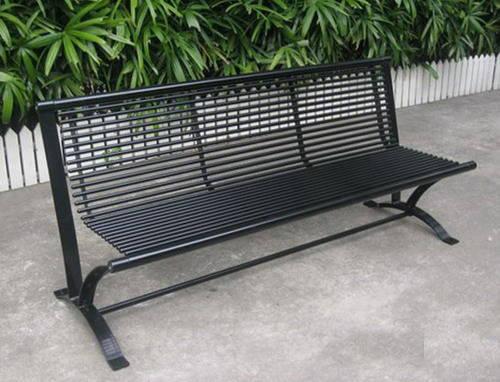
FIGURE IV-13. EXAMPLE OF STREET FURNITURE THAT COULD IMPROVE THE STREETSCAPE IN THE MARINA DISTRICT |SOURCE: LUMAR METALICA CONTRUCCIONES. (2016). BANCAS. RETRIEVED APRIL 21, 2016, FROM HTTP:// LUMARMETALICA.COM/BANCAS-HERRERIA-Y-SOLDADURA-CHIHUAHUA/
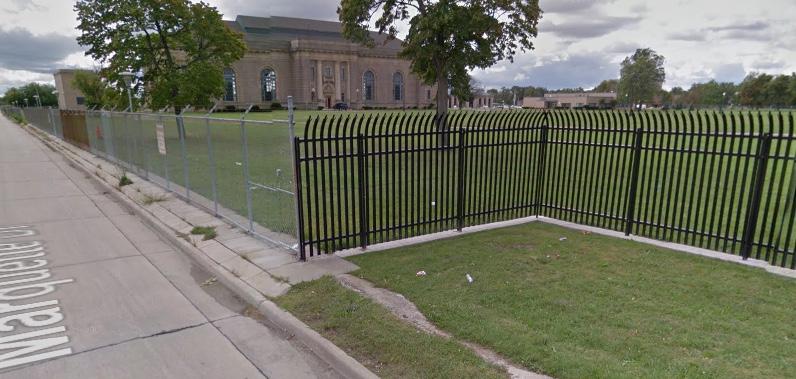
Providing amenities such as benches (like the one shown in Figure IV-13), picnic tables, bike parking, and trash cans can enhance the experience for people using the parks and trails throughout the Marina District. These amenities would add value if placed in Maheras-Gentry Park, Engel Memorial Park, and Reid Memorial Park and along new trails as proposed in this plan. Basic black metal benches, tables, and trash cans would coordinate with the recommended fencing in the area. One way to support maintenance of these amenities would be to engage local businesses as sponsors in exchange for the opportunity to advertise on the sponsored pieces.
Enhance the Waterworks Park fencing
As one of the main entryways into the Marina District, Marquette Drive would benefit from improvements to the streetscape. The west side of the street runs along Waterworks Park. For security purposes, the City has installed perimeter fencing, including a mix of wroughtiron and chain-link fencing, as shown in Figure IV-14. The chain-link fencing, in particular, leaves little room along the street for pedestrians.
Several improvements could make this entrance more welcoming. In the short term, incorporating a series of banner flags along the wrought-iron fencing could welcome visitors to the neighborhood and build the Marina District brand. These banners could also identify assets in the area. Figure IV-15 presents an example of banner flags along a property fence that add interest and orient the viewer.
FIGURE IV-14. FENCE ALONG WATERWORKS PARK | SOURCE: MARQUETTE DRIVE. (N.D.). GOOGLE STREETVIEW.
The chain-link fencing could also incorporate art. Stringing ribbons or fabric through the links could add visual appeal without blocking the views of the park, as demonstrated by the example of crocheted flowers woven into a fence in Downtown Denver, Colorado in Figure IV-16.
In the long term, the Detroit Water and Sewerage Department (DWSD) could replace the chain-link fence with a consistent wrought-iron fence and set the fence back an additional five to 10 feet from the street. During the focus group, business owners noted that snow along the fence blocks Marquette Drive in the winter. Setting the fencing back would make space for pedestrians to walk along the property and enjoy the views into the park and create the opportunity to convert the street to twoway traffic.
In addition, JEI could develop recommended fencing standards for the district. Encouraging residents and business owners to use black wrought-iron fencing, for example, would provide a uniform appearance to the properties in the area and help to create a pleasant scenic entrance to the district. Typically, fencing is installed for security purposes so the fencing standards should include options for higher security locations.
Incorporate art into public and private space
Creating and displaying art that is visible to the public can engage citizens of different backgrounds and skills
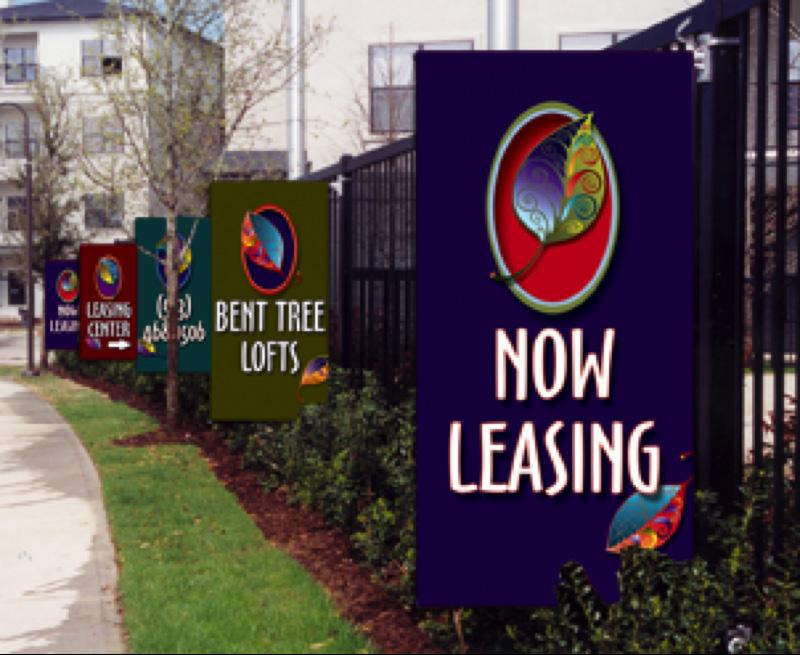
HTTP://POLEBANNER.INFO/2011/09/STREET-BANNERS-ONA-FENCE/
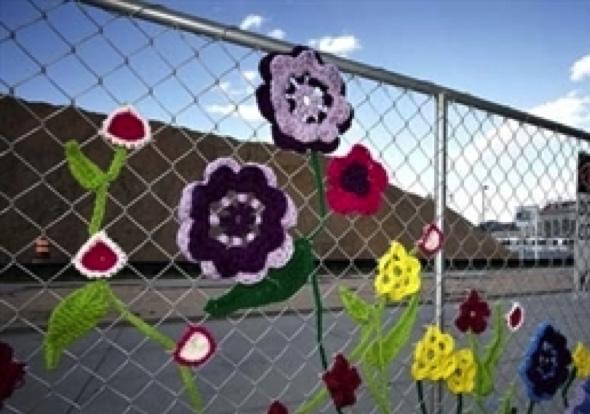
FROM HTTP://WWW.REALTOR.ORG/ ARTICLES/OVERVIEW-PLACEMAKING-AND-PUBLIC-SPACES
FIGURE IV--15. BANNERS PLACED PERIODICALLY ALONG FENCING CAN ADD INTEREST | SOURCE: STREET BANNERS ON A FENCE. (2011). RETRIEVED APRIL 21, 2016, FROM
FIGURE IV--16. ARTWORK INTEGRATED INTO FENCING CAN CREATE VISUAL APPEAL | SOURCE: DUNCAN, J. (2015). PUTTING VACANT SPACE TO USE IN DENVER. RETRIEVED APRIL 21, 2016,
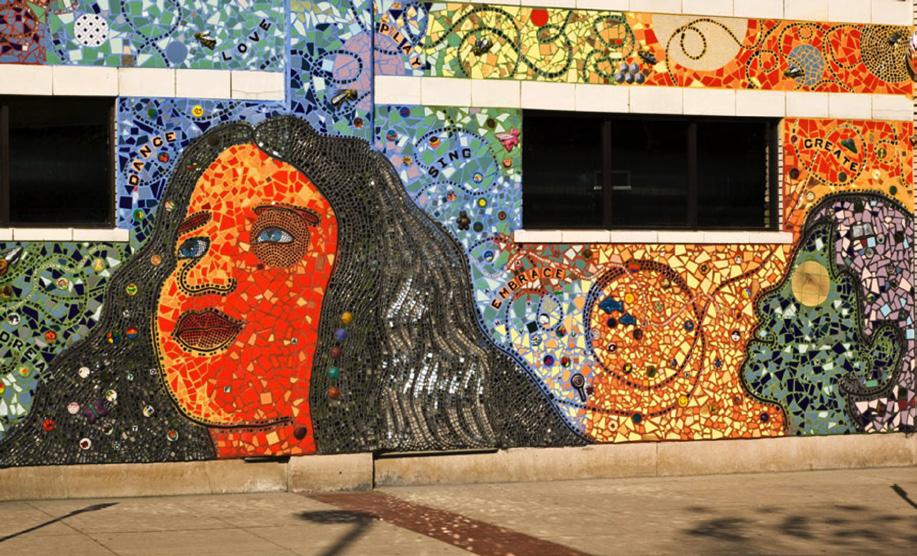
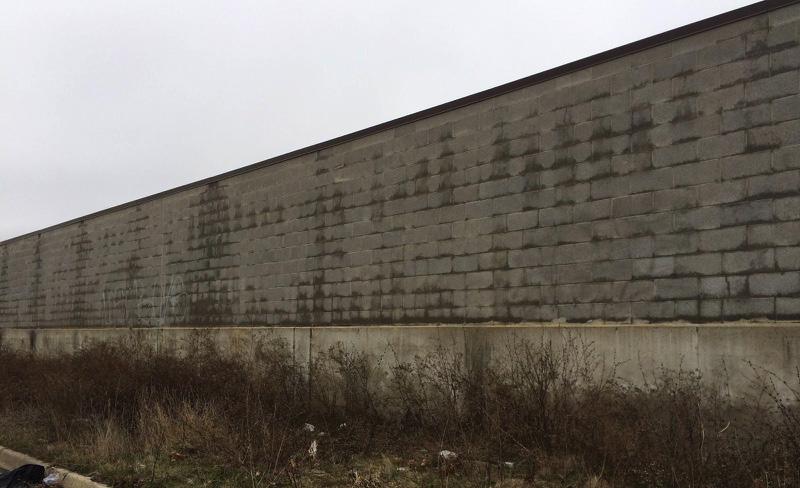
MOSAIC IN GRAND RAPIDS, MICHIGAN | SOURCE: GRAND RAPIDS HISTORICAL COMMISSION. (2009). ARTPRIZE, “IMAGINE THAT!” RETRIEVED APRIL 21, 2016, FROM HTTP://WWW.HISTORYGRANDRAPIDS.ORG/ PHOTO/1300/ARTPRIZE-IMAGINE-THAT
in neighborhood beautification, bringing together local artists with business and building owners. Detroit and other cities have many examples of murals and mosaics that transform blank walls into visual landmarks, such as the example from Grand Rapids, Michigan, shown in Figure IV-17. Featuring eye-catching artwork can also contribute to the identity of an area and attract positive publicity.
The wall located behind the Jefferson Village Shopping Center on Edlie Street, shown in Figure IV-18, is an example of a space that could be transformed into a vibrant, colorful scene with a mural and landscaping, as depicted in Figure IV-19.
In addition to the Edlie Street wall, art installations on industrial properties in the Marina District can help make
the interfaces between properties and public spaces more interesting and inviting. Industrial buildings are ideal in that they typically have large, single-color exterior walls.
To encourage engagement with neighbors, a local arts association like Summer in the City could hold a contest where property owners invite artists to submit drawings for potential murals.14 Nearby residents and the building owner could judge the entries and the winning artist could bring the piece to life with a commission from the property owner.
Beautify with green infrastructure
One way to enhance curb appeal in the Marina District is to install green infrastructure throughout the district. Green infrastructure refers to low-maintenance
FIGURE IV--17.
FIGURE IV--18. EDLIE STREET WALL
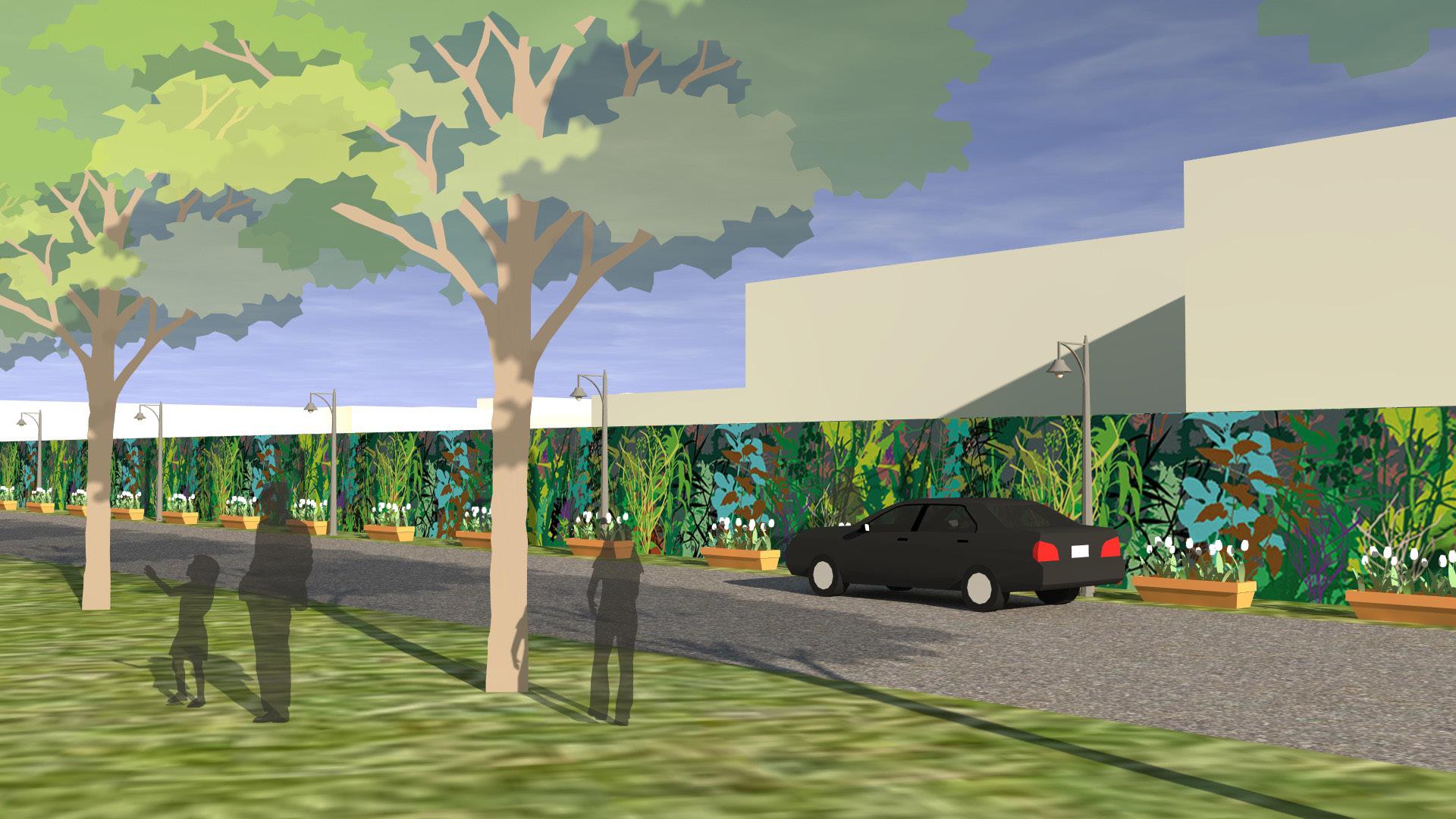
landscaping and other design features that allow for stormwater to infiltrate into the soil rather than draining into underground sewers. Installing green infrastructure can improve the appearance of an area and reduce flooding. These benefits can also facilitate public access in the long term by making the district more appealing for development, creating additional opportunities for people to visit and enjoy the area.
In addition to the benefits for public access, green infrastructure can provide other benefits, such as reducing water pollution and demand on traditional infrastructure. The Marina District is served by a Combined Sewer Overflow (CSO) system that combines stormwater and sewage. Heavy rains can overwhelm the system, resulting in sewage overflow into the Detroit River. A historic flood occurred in Detroit in August 2014
FIGURE IV--19. VISUAL OF A MURAL PAINTED ON EDLIE STREET WALL
where CSO overflow raised serious concerns about the water quality in the Great Lakes.15
Recent plans and initiatives have stressed the importance of stormwater management. DWSD is in the process of implementing a stormwater credit system, which will allow residents and businesses to lower their stormwater bills by installing green infrastructure on their properties.17
Examples of green infrastructure include bioswales, rain gardens, and green parking lots. Bioswales, or landscaped gutters, can complement the proposed greenways and bike lanes in the Marina District, such as the example shown in Figure IV-20. Rain gardens, or sunken gardens like the one shown in Figure IV-21, can be installed in areas likely to collect stormwater on public and private properties. Green parking lots can include bioswales and rain gardens and can use a permeable surface, such as pavers, pervious concrete, or porous asphalt, to infiltrate stormwater and prevent runoff. As demand increases in the future, property owners can use green parking lots to provide temporary or permanent parking. Figure IV-22 shows an image of a green parking lot with a bioswale. Green infrastructure works best when it uses low-maintenance, perennial, native, and salt- and floodtolerant plants. The Appendix has a list of recommended plants for the Marina District.
Green infrastructure can range in cost, depending on the types of plants and design. The following list includes potential funding sources for green infrastructure:
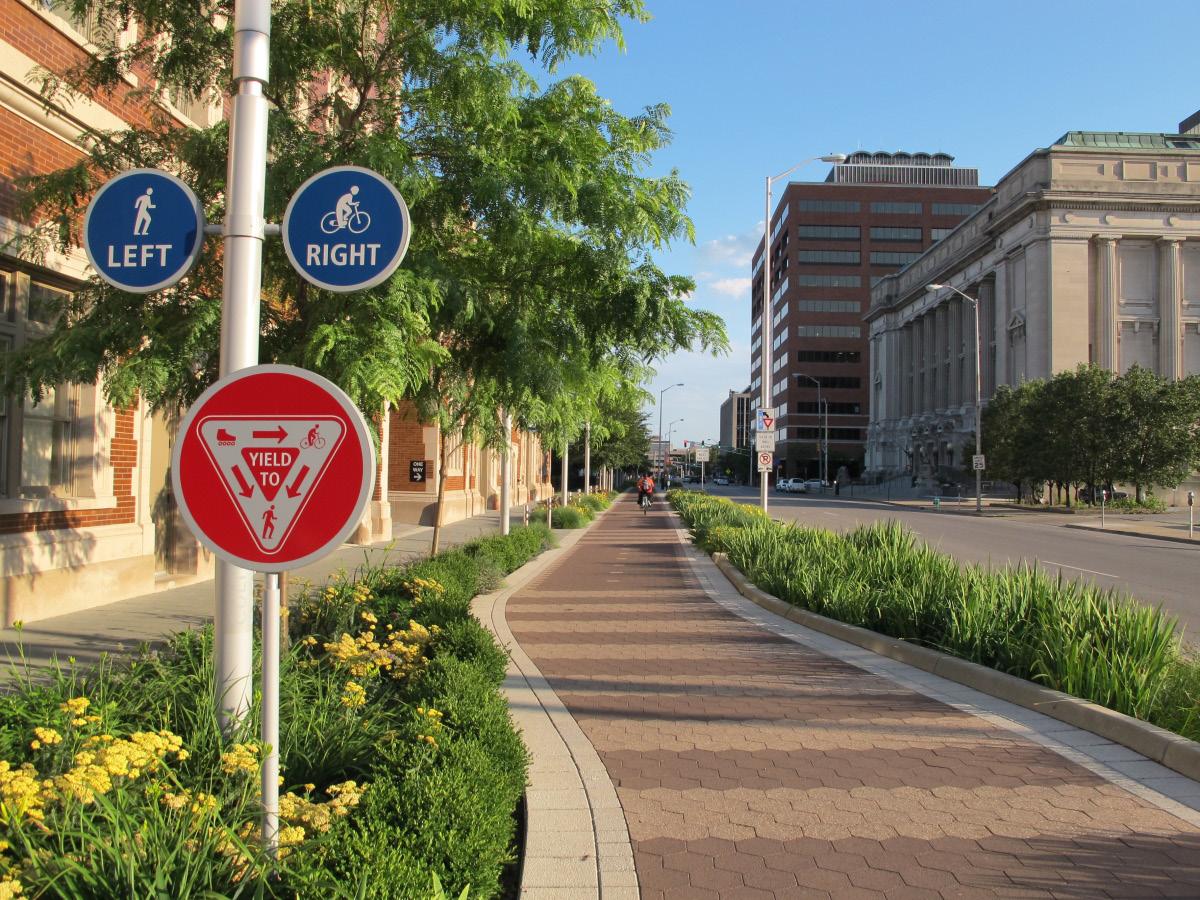
HTTPS://BIKEOKC.WORDPRESS.COM/2014/01/
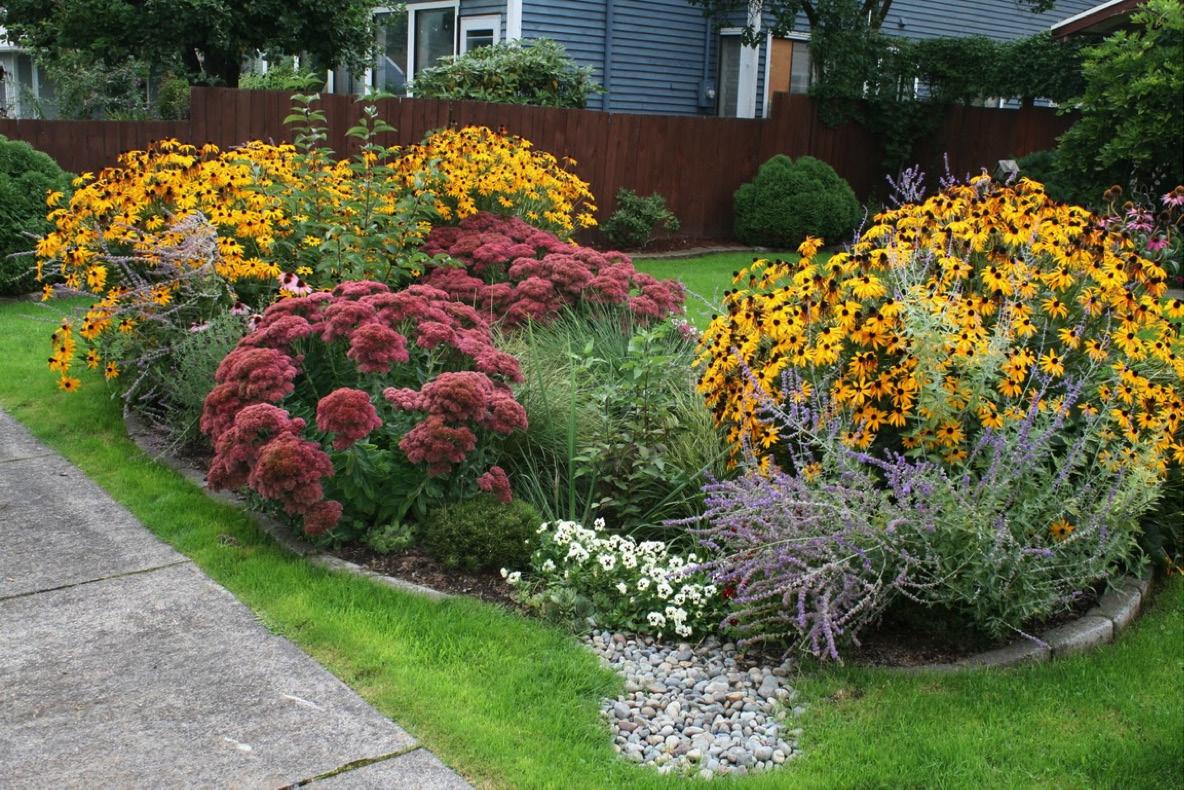
21, 2016, FROM HTTP://WWW.THISOLDHOUSE.COM/TOH/HOW-TO/INTRO/0,,20517496,00.HTML
FIGURE IV--20. BIOSWALES ALONG A BIKE LANE | SOURCE: BIKE OKC. (2014). BIOSWALES ALONG CYCLE TRACKS ON THE INDIANAPOLIS CULTURAL TRAIL. RETRIEVED FROM
FIGURE IV--21. RAIN GARDEN WITH FLOWERS | SOURCE: HYMEL, D. (N.D.). HOW TO BUILD A RAIN GARDEN. RETRIEVED APRIL
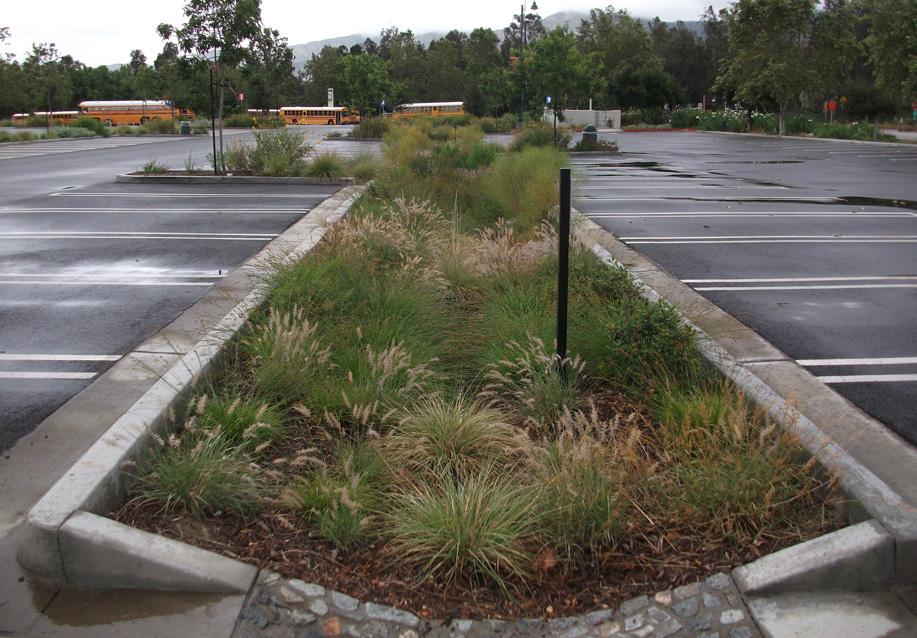
FIGURE IV--22. LANDSCAPING ISLAND IN A GREEN PARKING LOT | SOURCE: GONZALEZ, C. (2011). L.A. ZOO’S NEW WATERSHED-FRIENDLY PARKING LOT. RETRIEVED APRIL 21, 2016, FROM HTTPS://LACREEKFREAK.WORDPRESS. COM/2011/05/21/L-A-ZOO’S-NEW-WATERSHED-FRIENDLY-PARKING-LOT/
• Water Pollution Control Revolving Fund and Clean Water State Revolving Fund loans – U.S. Environmental Protection Agency and the Michigan Department of Environmental Quality (DEQ)
• Strategic Water Quality Initiatives Fund loans – DEQ
• Stormwater, Asset Management, and Wastewater grants and loans – DEQ
• Michigan Transportation Alternatives Program –Michigan Department of Transportation
• Stormwater Credit Exchange/Water Quality Trading
• Non-governmental organization grants – The Nature Conservancy, the Sierra Club, the Conservation Fund, Trust for Public Land
To access these funding sources, local property owners and non-profits could partner with the City of Detroit and
Wayne County to develop applications. These projects could also be proposed for the City’s capital improvement program (CIP) public hearing process.
Encourage private property improvements
The Marina District is unusual because it has mix of land uses including residential, retail, commercial, and industrial in close proximity to one another. For example, the single-family homes in the Morgan Waterfront Estates development sit adjacent to the DTE Conner Creek Power Plant site. Using screens or buffers at the interfaces between different uses, especially between residential and commercial or industrial properties, can help to make the district more attractive and make it more comfortable to both visit and live in the area.
The City of Detroit provides development standards for landscaping, screening, and fencing intended to “reduce potential nuisances by requiring a visual screen.”17 These standards include the installation of trees and greenery along parking lots. Hedges, masonry walls, and berms can also reduce the visibility of parking lots and industrial buildings.
These standards are not required for existing commercial and industrial properties unless they undergo major construction, but encouraging property owners to meet and exceed these standards offers an opportunity to create more harmony between land uses. Implementation of these changes would require the cooperation of the
property owners who bear the cost and responsibility for the changes. However, in addition to enhancing neighborhood curb appeal, landscaping modifications can provide other benefits, such as flood and pollution control.
JEI could work with business owners to make changes to properties that will have high impact in beautifying the area. This might involve conducting outreach to engage property owners and raise awareness about the individual and community-wide benefits of enhancing curb appeal, as well as identifying high-priority properties, notifying property owners about City requirements, and encouraging code enforcement. Additionally, JEI could offer support to the private property owners in pursuing financial assistance programs that may be available for large-scale improvements.
GOAL TWO: ENHANCE TRANSPORTATION CONNECTIONS IN THE MARINA DISTRICT
Enhancing transportation connections in the Marina District involves extending existing networks and adding new routes that connect residents, works, and visitors to destinations along the riverfront. It also entails providing linkages between transportation networks and improving route conditions for travelers across various modes of transportation, including car, bus, bicycle, foot, and boat. Achieving this goal would build upon ongoing initiatives in Detroit to make it easier for the public to access the river regardless of their method of transportation and
would provide more options to reach the assets in the Marina District.
IMPROVE NON-MOTORIZED TRANSPORTATION CONNECTIONS
There is no direct path from East Jefferson Avenue to the Detroit River or from the east boundary to west boundary of the Marina District along the riverfront, regardless of an individual’s mode of transportation. With bike lanes only on Clairpointe Street and many gaps in the sidewalk network, the Marina District could benefit from a more connected non-motorized transportation network. Marina District residents have expressed interest in improving cycling and walking infrastructure throughout the district. Improvements to active transportation infrastructure in the Marina District also have been proposed in previous plans for the district.18 Enhancing non-motorized connections will increase overall connectivity to riverfront destinations and increase the options for healthy and active travel. This section identifies ways to improve non-motorized connections in the district, summarized in Figure IV-23.
Add bike lanes to Freud Street and St. Jean Street
Residents expressed interest in creating better options for bicycling in the Marina District. In addition, adding bike lanes to a street and narrowing its vehicle lanes can help to lower vehicle speeds, or “calm” traffic, addressing
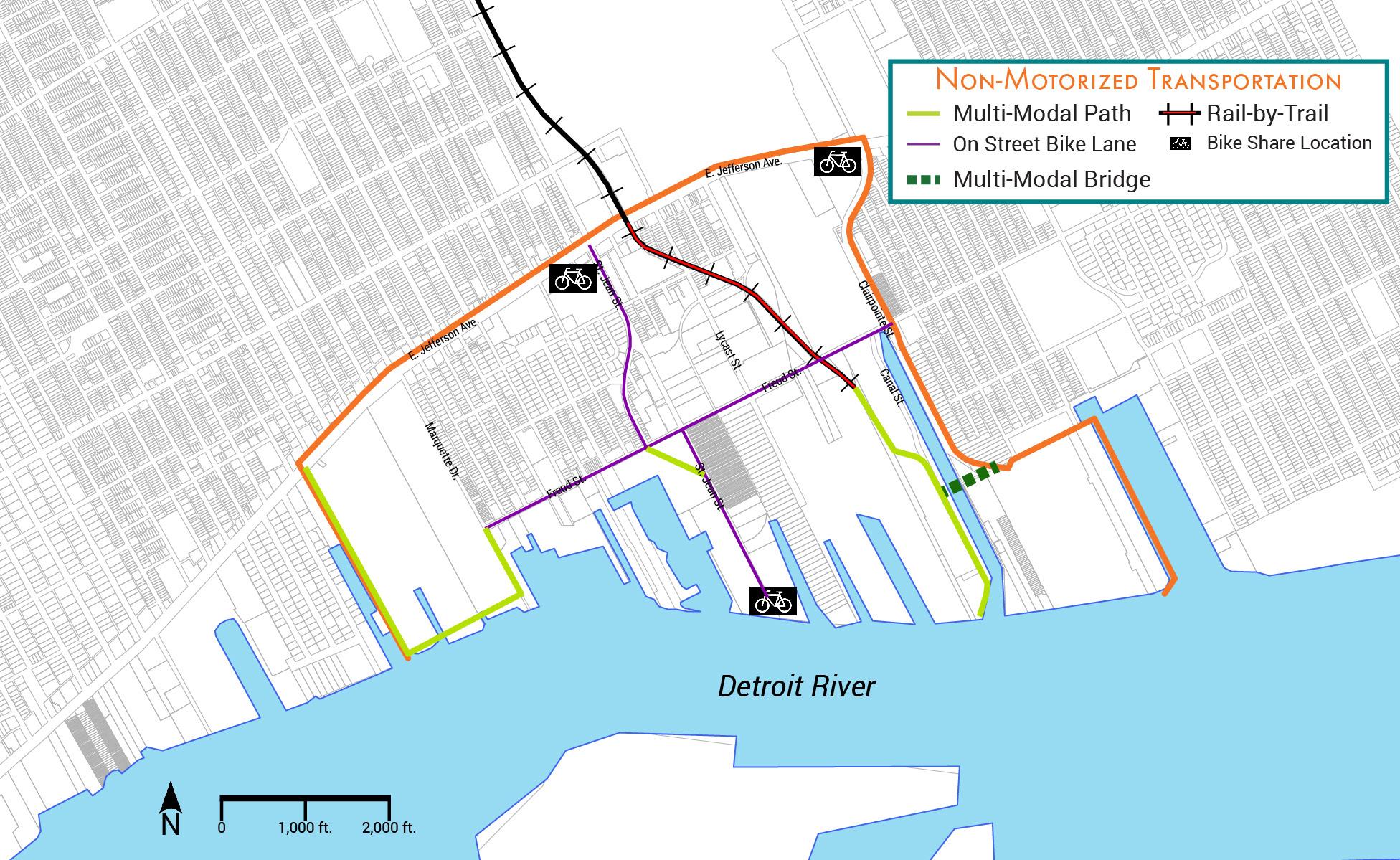
a concern held by neighborhood residents. Proposed bike lane locations include Freud Street, between Harding Street and Clairpointe Street, and St. Jean Street, between East Jefferson Avenue and the riverfront. This update to Freud and St. Jean Streets would entail restriping
the roads to outline a bike lane in both directions. As shown in Figure IV-23, these lanes could join with other proposed paths for walkers and bicyclists to make the riverfront and the district’s assets more accessible via non-motorized travel.
FIGURE IV--23. NON-MOTORIZED TRANSPORTATION RECOMMENDATIONS
Install bike share locations in the Marina District
The Detroit Bike Share system is planned to start with 35 stations in and around greater downtown Detroit.19 Bike share refers to a system that allows individuals to borrow a bicycle for a short period of time and return it to any station within the system. Bike share stations in the first round of expansion outside of downtown Detroit could include a station at either or both the entry points to the Marina District and the St. Jean Boat Launch. The investment would entail installation of one to two station units and purchase of a pre-set number of bicycles per new station. This incremental addition to the Detroit Bike Share system would not likely warrant additional staff. Inclusion of bike share locations in the Marina District would increase accessibility of the neighborhood and the Detroit River by bicycle.
Add a multi-modal path through Reid Memorial Park
Although Reid Memorial Park currently is fenced and relatively inaccessible to the public, the property is owned by the City of Detroit and could be converted into an asset for the area. A multi-modal path, defined in this plan as a walking and biking path, from Freud Street to St. Jean Street would help to smooth the transition from Old St. Jean Street to St. Jean Street, through Reid Memorial Park to the St. Jean Boat Launch.
Connect a multi-modal path around Waterworks Park to East Jefferson Avenue
The Waterworks Park is a beautiful campus with a significant role in Marina District history. Although the park is now fenced, non-motorized access around the park can be improved with a few modifications, including connecting the sidewalk along Marquette Drive with the entrance to Waterworks Park from the Roostertail parking lot, adding a pedestrian railing in front of the Waterworks Park grandstands to make the area safe for regular pedestrian and bicycle traffic, adding a multi-modal bridge for walkers and bikers across the creek west of the grandstands, and extending the pathway in front of and behind the grandstands along the riverfront to the Waterworks trail along Motor Boat Lane. Depending upon
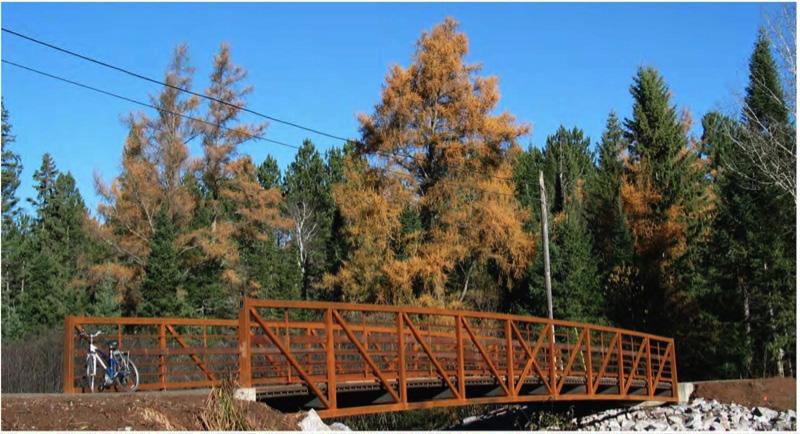
2016, FROM HTTP://WISCONSINBIKEFED. ORG/2015/12/16/NEW-TRAILS-IN-EXPANDING-IN-EASTERN-VILAS-COUNTY/
FIGURE IV-24. MULTI-MODAL BRIDGE IN CONOVER, WISCONSIN | SOURCE: CURRIE, J. (2015). MOVING TOWARD A BIKE-FRIENDLY EASTERN VILAS COUNTY. RETRIEVED APRIL 21,
participation from Gregory Boat Company and the Great Lakes Water Authority, the trail could also extend north to East Jefferson Avenue, as pictured in Figure IV-24. This recommendation was originally proposed in the Marina District Vision plan.20
Add a multi-modal bridge over Conner Creek
Between Maheras-Gentry Park and the DTE Conner Creek
Power Plant site is Conner Creek. Adding a multi-modal bridge for walking and biking between these two sites would connect the proposed path on Canal Street and the existing Conner Creek Greenway, as shown in Figure IV-23. Placing the path to the north of the Bayview Yacht Club would minimize the impact on private property.
Figure IV-24 shows an example of a multi-modal bridge that would be appropriate for this location. This recommendation was originally proposed in the Marina District Vision plan.21
In addition to providing access across the creek, this path would provide visual access to the open space surrounding the Conner Creek CSO and would also offer a direct connection to the DTE Conner Creek Power Plant site, should the site be developed in the future.
Add a trail to the riverfront along the rail line
Community members have suggested that the railroad through the Marina District be transformed into a greenway. Although the railroad maintains some active
service, a “rail-by-trail” is possible, with a trail running along the west side of the rail line.
The trail could begin adjacent to the railroad at 11530 East Jefferson Avenue and run south to the riverfront along the path of the active Conrail railroad and the abandoned railroad south of Freud Street. This trail would extend the Riverfront Extension greenway route proposed in the Marina District Vision plan.22
Conrail owns a wedge-shaped parcel of land at 11000 Freud Street, about an acre in size, adjacent to the end of its active service railroad south of Freud Street. A sale including this or a portion of this parcel along with
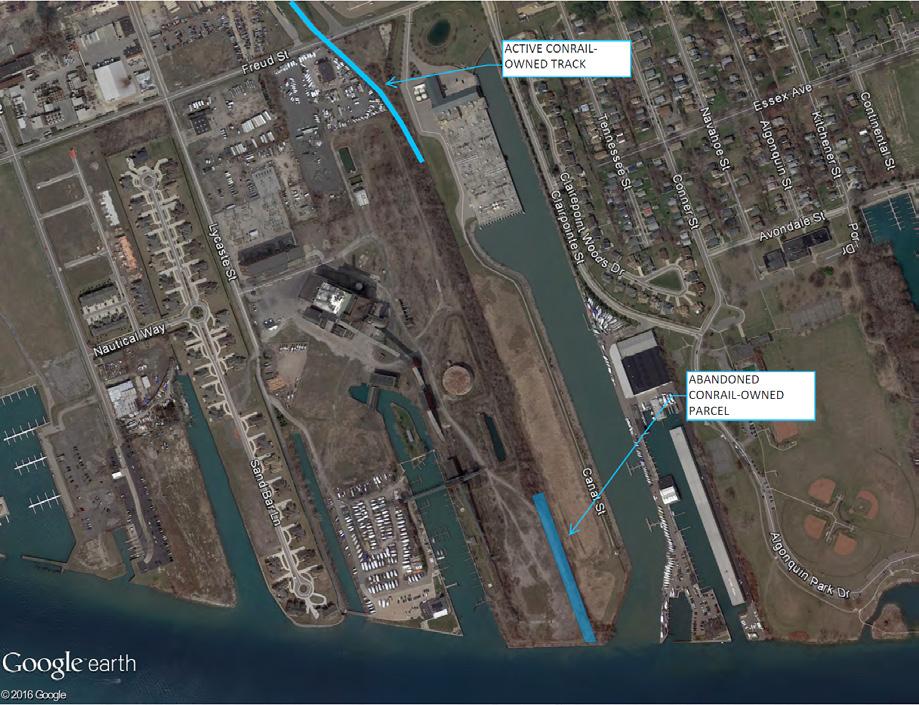
FIGURE IV-25. MAP OF ABANDONED CONRAIL RAIL | SOURCE: CONSOLIDATED RAIL CORPORATION. (2016). [UNTITLED MAP OF LAND OWNED BY CONRAIL]. PHILADELPHIA, PA.
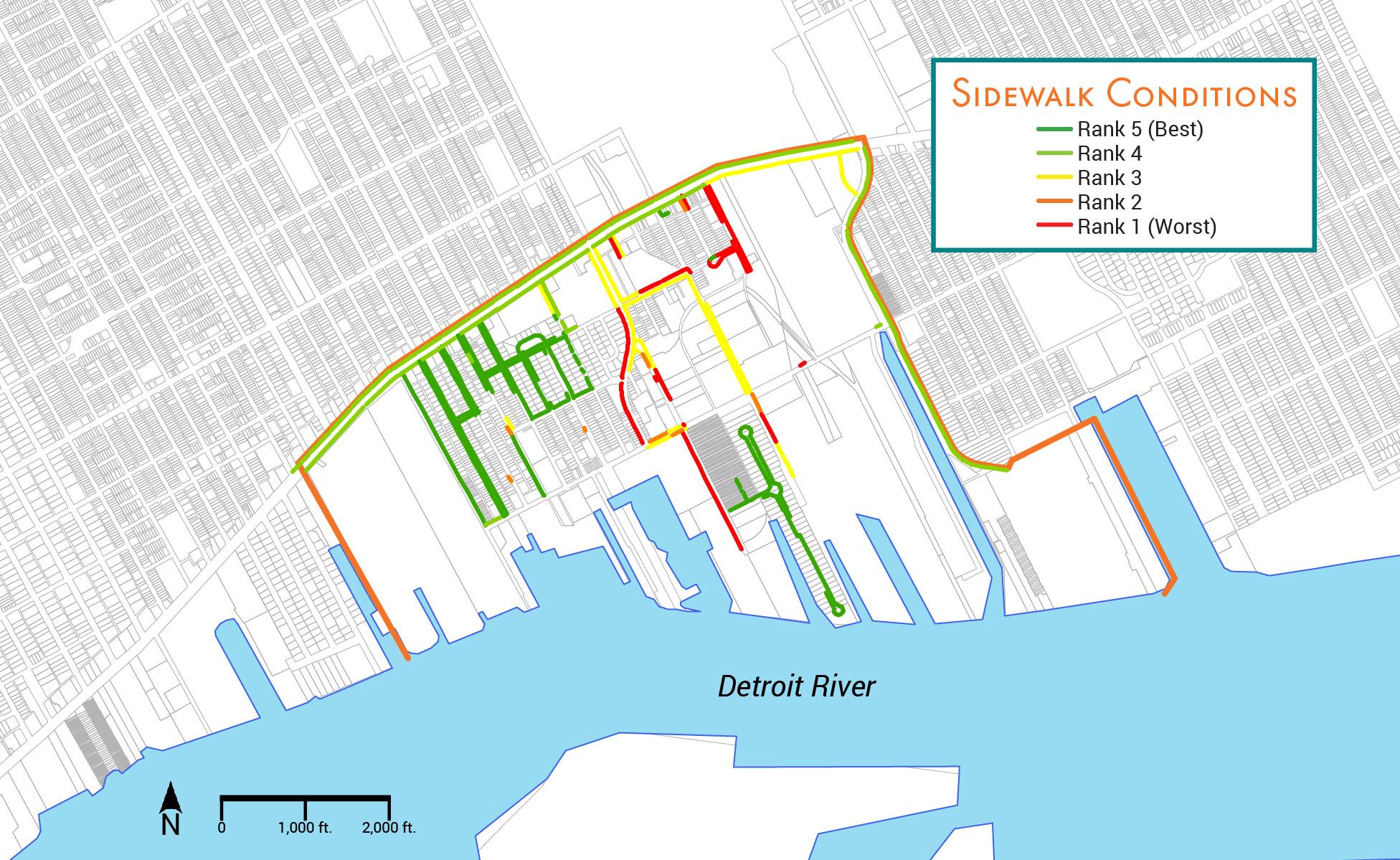
Conrail’s property closer to the riverfront, between the DTE Conner Creek and the CSO properties, could provide additional land for a trail.
The Michigan Department of Transportation rail standards specify a “minimum clear space” of 8.5 feet from the center of railroad tracks within which
no “bridges, structures, poles, or obstructions” may be located.23 To comply with these specifications, a paved off-road trail could begin at 11530 East Jefferson Avenue, run parallel to the remainder of Conrail’s active service rail, and continue on the path of the abandoned railroad south of Freud Street through to the riverfront. This pavement would require earth infill alongside the
FIGURE IV-26. CURRENT SIDEWALK CONDITIONS
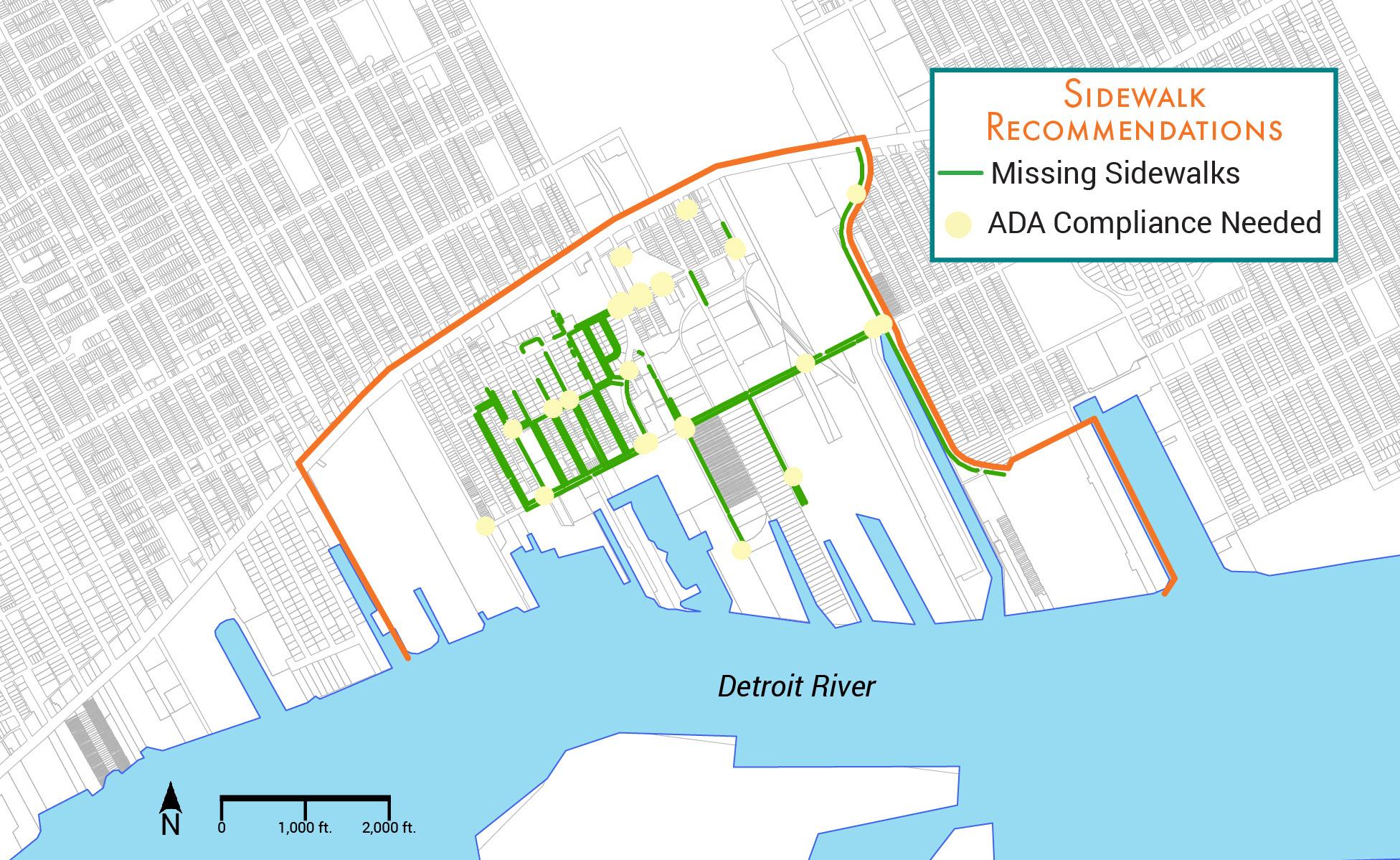
railroad berm. Vegetation or a grade differential between the rail and trail can serve as a low-cost and natural barrier between the rail and the trail. This is a common approach; approximately 45 percent of rail-with-trail cases in the United States use vegetation as the barrier between the rail and trail (Pack and Tomes, 2013). The
Detroit Eastside Community Collaborative (DECC) could lead this initiative and maintain the trail as part of their ongoing maintenance for the Conner Creek Greenway.
Conrail staff has indicated that the company is interested in a possible sale of the property that has already been
FIGURE IV-27. PROPOSED SIDEWALK AND CURB ADDITIONS
formally abandoned south of the former railroad rightof-way, adjacent to the DTE Conner Creek Power Plant site, as shown in Figure IV-25. They also have stated that environmental remediation of railroad land is not to take place prior to the land transitioning to a new owner. Implementation of this recommendation is contingent upon a transfer of property ownership from some or all of Conrail’s property south of Freud Street to a new owner.
Improve sidewalk conditions and connections
As shown in Figure IV-26, the majority of the sidewalks that need maintenance are on the east side, in the industrial segment of the Marina District. An estimated 7.1 miles of new sidewalks need to be installed to fill in gaps and create new paths throughout the Jefferson Village neighborhood and along Freud Street. The district also would benefit from replacing approximately 2.2 miles of existing cracked or overgrown sidewalks and installing 31 new curb ramps at existing sidewalks, so that they are compliant with the Americans with Disabilities Act (ADA). These improvements, shown in Figure IV-27, would help pedestrians, especially those with physical impairments, travel throughout the district.
Provide safe street crossing locations for pedestrians
Providing safe street crossing locations would make the Marina District feel more comfortable and safe for walkers. Restriping 29 existing standard crosswalks with continental crosswalks (as shown in Figure IV-28) would

IV-28. CROSSWALK MARKING PATTERNS | SOURCE: AASHTO STRATEGIC HIGHWAY SAFETY PLAN. (N.D.). RETRIEVED MARCH 19, 2016, FROM HTTP://SAFETY.TRANSPORTATION.ORG/HTMLGUIDES/PEDS/DESCRIPTION_ OF_STRAT.HTM
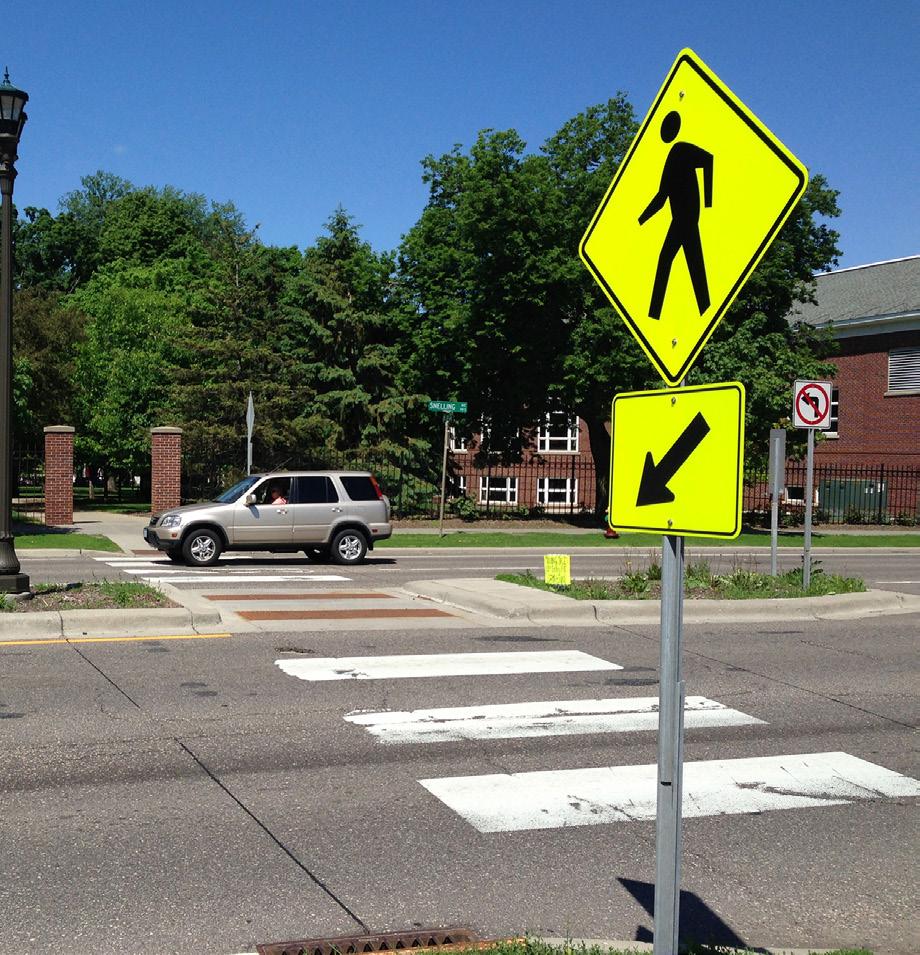
IV-29. CROSSWALK WARNING SIGN | SOURCE: GILLESPIE, S. (2014). WHEN CROSSWALKS BECOME DEATHTRAPS. RETRIEVED APRIL 28, 2016, FROM HTTP://WWW.STARTRIBUNE.COM/WHEN-CROSSWALKS-BECOMEDEATHTRAPS/262181941/
FIGURE
FIGURE
Solid Standard Continental Dashed Zebra Ladder
make the crosswalks more visible and easier to identify for drivers.24 The existing standard sidewalks are located along East Jefferson Avenue (24), at Clairpointe Street and Freud Street (4), and at Clairpointe Street and Algonquin Park Drive (1). New continental crosswalks could be installed at all other intersections in the Marina District, in phases based on traffic volumes. The first phase could include installation of 11 crosswalks on Freud Street (between Lycaste Street and St. Jean Street) and on St. Jean Street (between Freud Street and Edlie Street). The second phase could include installation of 53 crosswalks throughout Jefferson Village. Crosswalk warning signs, such as the one shown in Figure IV-29, should also be installed at every crosswalk, to warn drivers of pedestrian crossings ahead. ADA-compliant crosswalks should also be installed for all new sidewalks.
IMPROVE MOTORIZED TRANSPORTATION CONNECTIONS
Public access to the riverfront depends on convenient and well-maintained transportation networks, including options for travel by bus and personal vehicle. In addition, public access also depends on a well-managed traffic flow that provides safe spaces for all road users. The existing networks and traffic flow could be improved with the suggestions below.
Create a truck route plan
Managing truck traffic to and from the industrial businesses is an ongoing concern for the Marina District.
Residents expressed concerns with trucks driving near and through their neighborhoods. Establishing a designated truck route would help to divert truck traffic from the residential areas. One potential truck route to Jefferson Avenue is Freud Street to Lycaste Street to Edlie Street to St. Jean Street, as shown in Figure IV-30. The northeast corner at Freud Street and Lycaste Street may need to be widened to accommodate a truck’s wide turning radius. The final route plan should take into account the needs of the businesses and their existing practices.
Convert St. Clair Street into a two-way street
According to feedback received at public engagement meetings, some community members prefer that St. Clair Street be converted from a one-way to a two-way street between Freud Street and Lisette Street. In winter, snow piles on Marquette Drive make it difficult for visitors to reach Roostertail and Sindbad’s near the river. Converting St. Clair Street into a two-way road would allow for easy access to those assets year-round and would enable neighborhood residents to drive to Sinbad’s without crossing East Jefferson Avenue. The conversion can be accomplished with a simple lane re-striping, with no reconstruction needed, because the road is 24 feet wide. Preserving St. Clair Street as one-way between Lisette Street and East Jefferson Avenue would help to keep through-traffic out of the residential neighborhood.
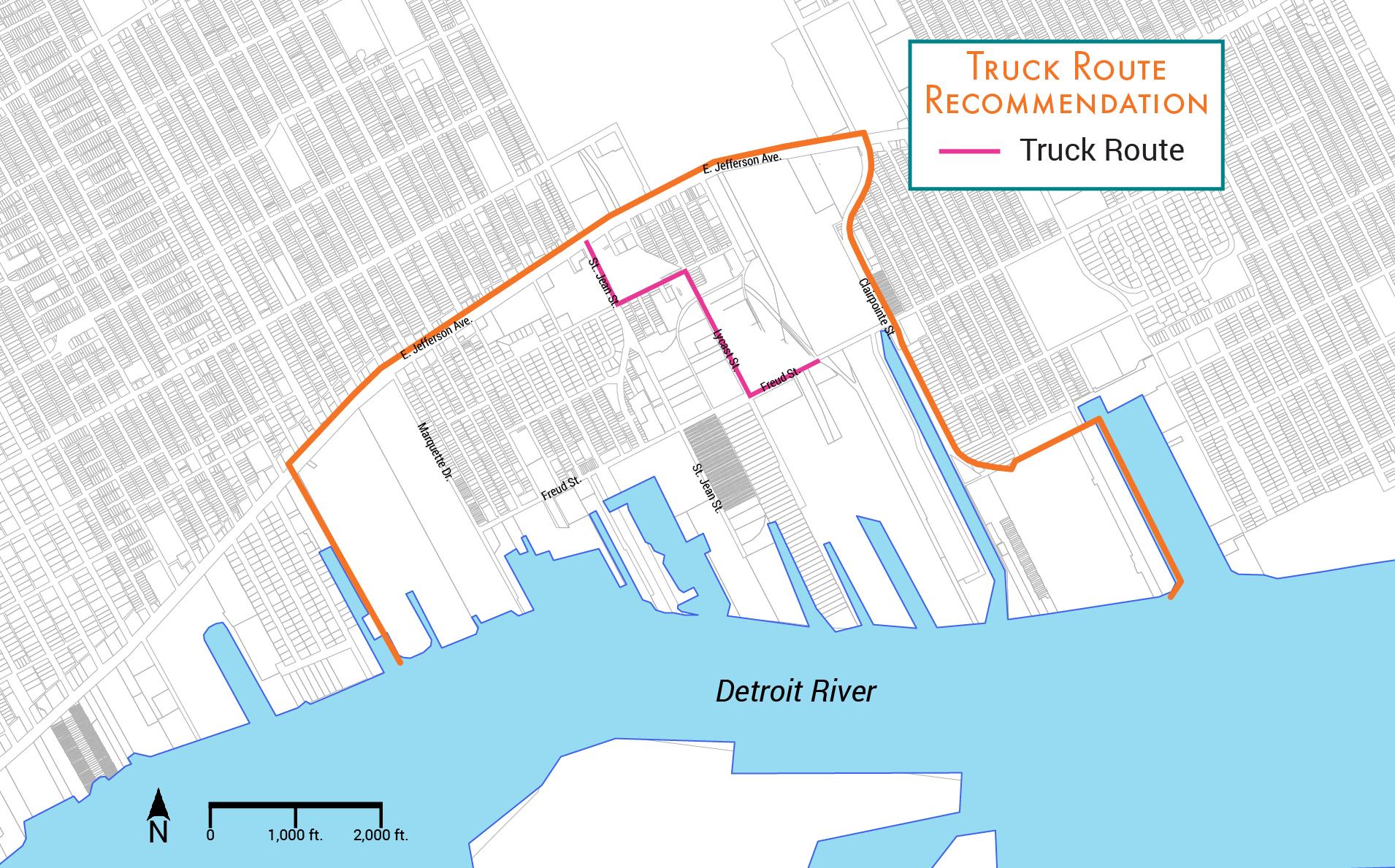
Extend bus service into the Marina District
The existing DDOT and SMART bus routes run along East Jefferson Avenue. Both residents and business owners have expressed the need for an additional bus route to serve the Jefferson Village neighborhood and the
businesses located off Freud Street, especially given the planned expansion of several businesses. The existing Detroit Department of Transportation (DDOT) Route 11, which runs down St. Jean Street, or Route 25, which runs along East Jefferson Avenue, could be extended south of East Jefferson Avenue to serve the current residents and
FIGURE IV-30. PROPOSED TRUCK ROUTE IN THE MARINA DISTRICT
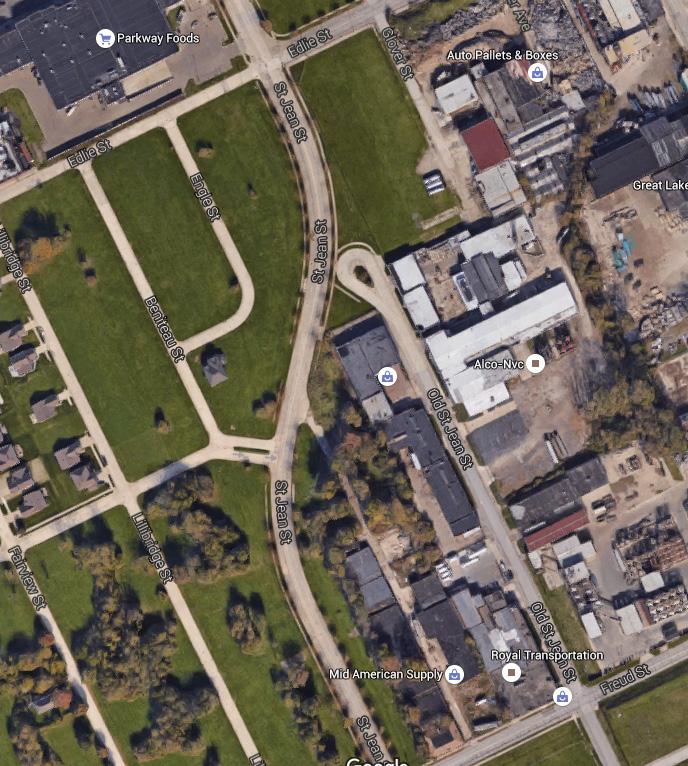
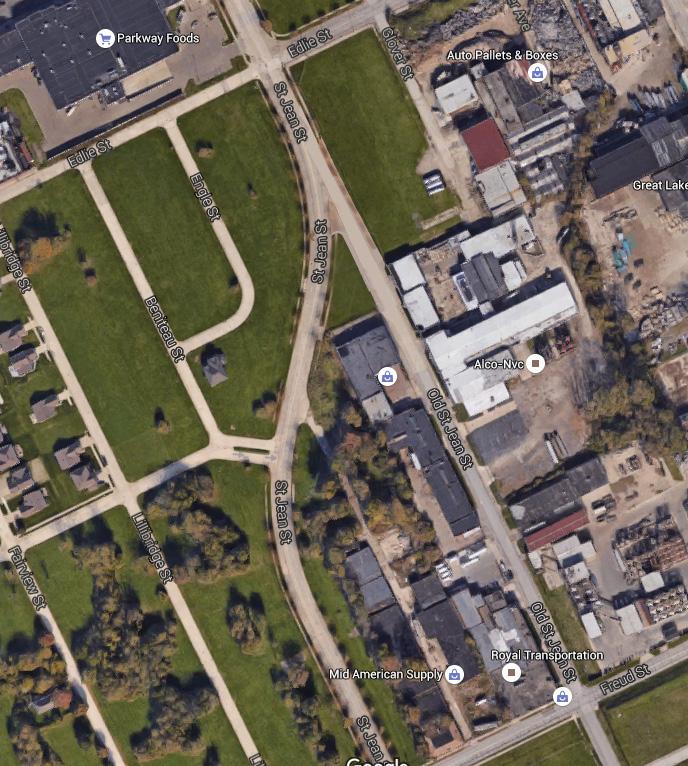
employers before looping back up to continue the route.25
Extending one of these routes would also help visitors access the future commercial and recreational assets along the riverfront.
Open the cul-de-sac on Old St. Jean Street
Opening the cul-de-sac on Old St. Jean Street, as shown in Figure IV-31 and Figure IV-32, would create a direct
route for trucks to access the industrial businesses located east of St. Jean Street. This serves a dual purpose: creating a more direct link for businesses and diverting traffic from the residential neighborhood west of St. Jean Street. During community engagement, business owners expressed their support for this conversion. Residents also supported measures to ease truck traffic through their neighborhoods.
FIGURE IV-31. CUL-DE-SAC ON OLD ST. JEAN STREET
FIGURE IV-32. PROPOSED OPENING OF CUL-DE-SAC ON OLD ST. JEAN STREET
DEVELOP WATER TRANSPORTATION CONNECTIONS
Currently, public transportation does not exist along the Detroit River in the Marina District. Providing waterbased public transportation would add another way to access the river, supplementing land-based travel options (i.e., car, bus, walking, and biking). In addition to increasing transportation connections to the district, water transportation could also serve as a tourist attraction, allowing riders to enjoy beautiful views of the river. In public engagement meetings, residents and business owners indicated strong support for a water taxi with a stop in the Marina District and were particularly interested in linking Reid Memorial Park and Belle Isle.
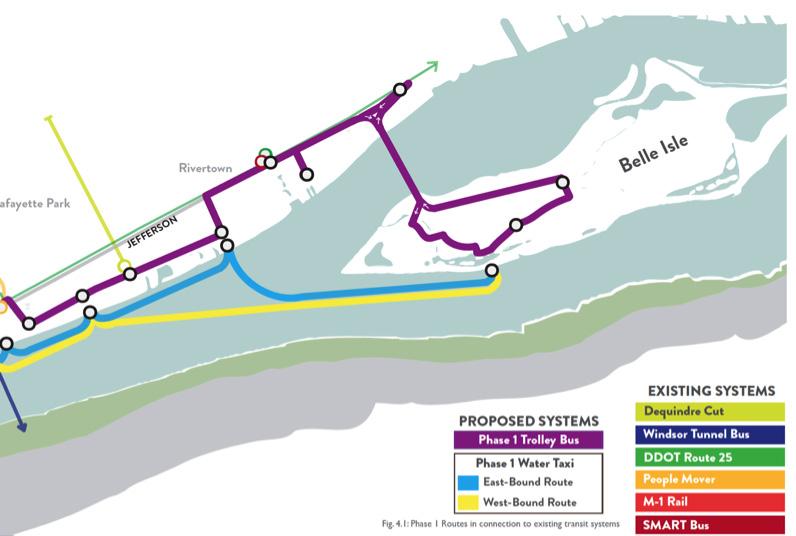
A precedent exists for water transportation on the Detroit River. A water ferry operated from 1840 to 1957 between the Detroit riverfront and Belle Isle.26 More recently, the Detroit / Wayne County Port Authority operated a water ferry service during the Detroit Belle Isle Grand Prix races in 2012, 2013, and 2015.27
A 2015 Transit Feasibility Study and Implementation Plan assessed the feasibility of a water taxi for the Detroit River and proposed a route near the Marina District, as shown in Figure IV-33.28 Following up on the 2015 study, this plan recommends implementing a water taxi between Reid Memorial Park and the Detroit Yacht Club on Belle Isle, a distance of about 2,500 feet, as shown in Figure IV-34, to strengthen transportation and tourism in the Marina District.
An organization or vendor taking the lead on water taxi implementation could engage the Belle Isle Conservancy as a partner and develop a plan for the service, including location of boarding docks, ticket centers and prices, service schedules, staffing, and vessel characteristics. Given that a ferry formerly operated in this area, a vessel may be available to redeploy for a water taxi service.29 Because the Michigan Department of Natural Resources (DNR) leased Belle Isle Park from the City of Detroit in 2014, DNR could also be a partner in developing and promoting the service.30 One strategy to promote a new service might involve advertising an official opening in alignment with new, proposed pop-up businesses at Reid Memorial Park during a large planned event, such as the
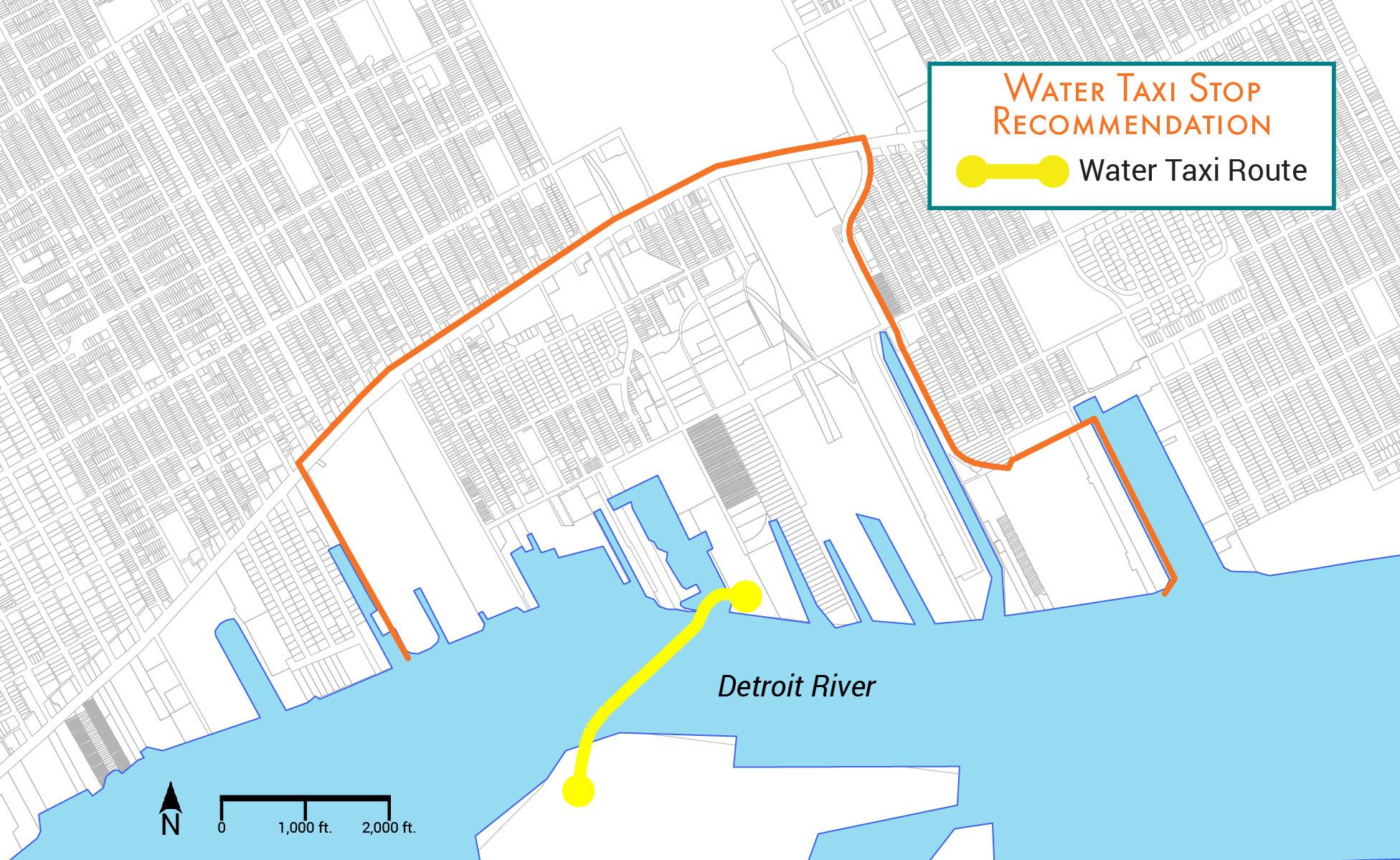
Detroit Belle Isle Grand Prix. Designing the service should involve estimating potential ridership based on a range of factors, including the number of people attracted to existing and proposed destinations in the Marina District, such as pop-ups and events, and to activities in Belle Isle, as well as accessibility of the water taxi launch site. To
account for uncertainty in these variables, the program could begin with a pilot, allowing for adjustment after an observation period. After a water taxi from Reid Memorial Park to Belle Isle has demonstrated success, the taxi route could be expanded to connect to other locations along the Detroit River, such as those proposed in the 2015 study.
FIGURE IV-34. PROPOSED WATER TAXI ROUTE BETWEEN MARINA DISTRICT AND BELLE ISLE
CASE STUDY: WATER TAXI IN CHICAGO, ILLINOIS
Water taxis operating successfully in other cities can provide models for a Detroit River water taxi. For example, a water taxi began in Chicago in 1962 and serves as a commuting and tourist attraction that has carried an estimated 14 million commuters since its inception. From March to December, the Chicago Water Taxi shuttles passengers on a closed loop route on the Chicago River.31 Figure IV-35 shows another example of a water taxi at its dock in Rotterdam.
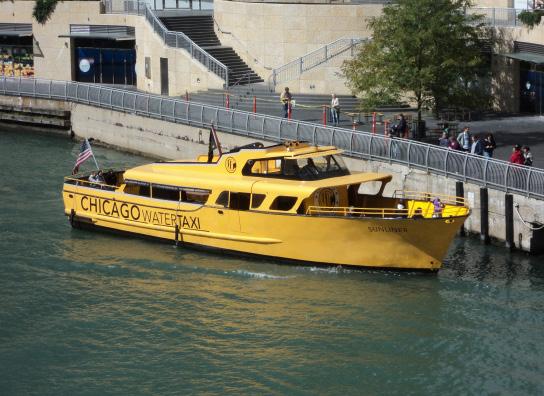
SUMMARY OF RECOMMENDATIONS AND IMPLEMENTATION DETAILS
This section summarizes the recommendations in map form in Figure IV-36 and in checklist form in Table IV-1. The table provides additional details about implementation, including potential lead organizations and proposed timeframes, with short-term defined as within 12 months, mid-term defined as within five years, and long-term defined as more than five years. The table also presents an estimated cost level using a scale of one ($) to five ($$$$$), ranging from low-cost (e.g., reporting stray dog sightings) to highly capital-intensive (e.g., repurposing the DTE Conner Creek Power Plant site). These cost labels serve as a general guide regarding the relative ease of implementation. Actual cost estimates would require recommendation-specific financial analysis. This table can serve as a checklist for making progress on these recommendations.
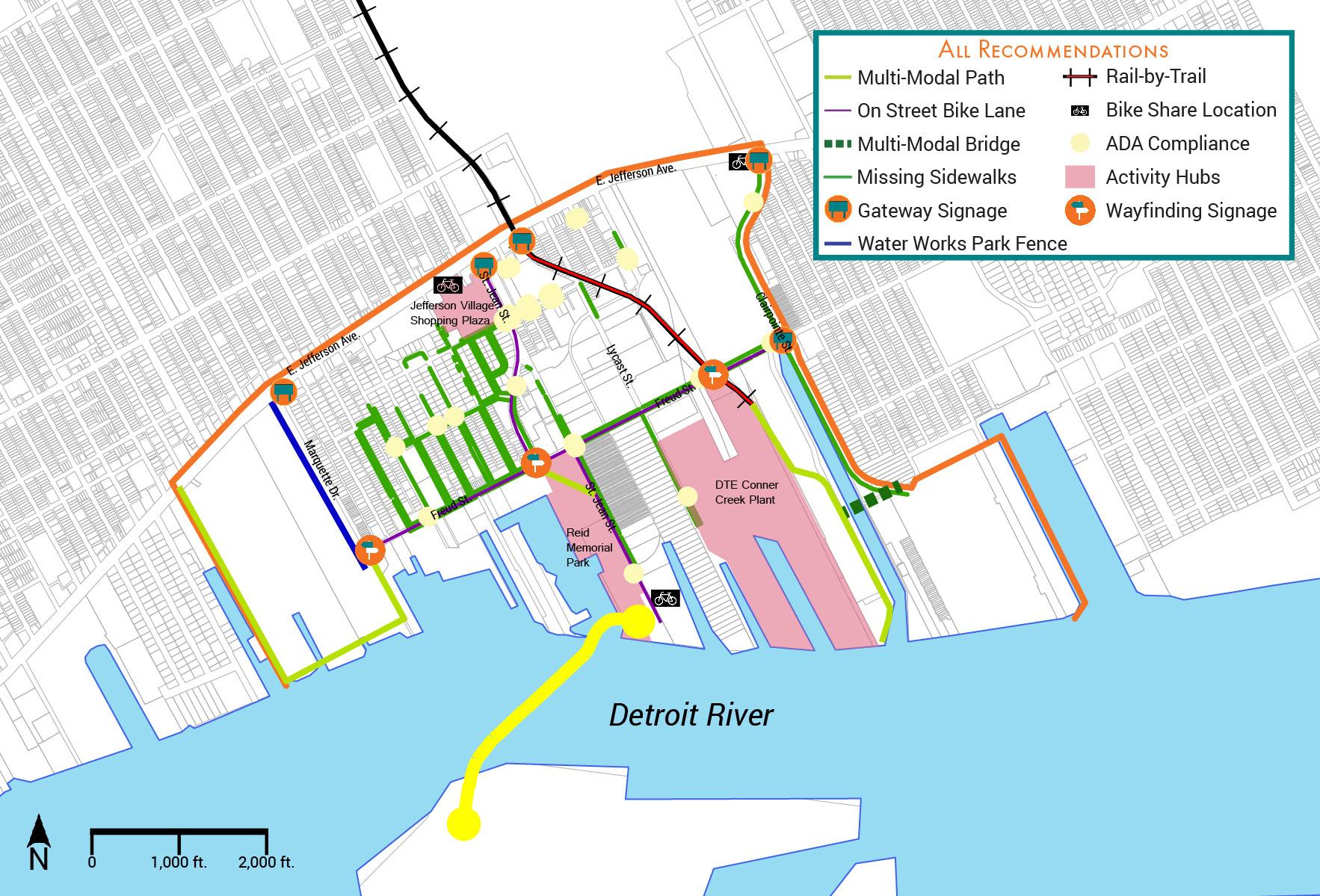
FIGURE IV-36. SUMMARY OF RECOMMENDATIONS
GOAL 1: Enliven the public experience of the Marina District.
Install gateway signage.
Install signage for navigation and branding.
Promote public parks as community assets.
Generate year-round activity.
Facilitate access to public parks.
Partner with animal welfare organizations.
Establish base for educational activities. Attract businesses.
Provide dedicated space for fishing.
Host events year-round.
Repurpose DTE site.
Improve the streetscape (maintain/install new).
Create trash management / maintenance program. Enhance Waterworks Park fencing (decorate/change).
Enhance curb appeal. Beautify with green
Incorporate art into public and private space.
Riverside Marina, Outdoor Adventure Center (OAC), Detroit Public Schools
Detroit Parks and Recreation Department, Riverside Marina
MARINA DISTRICT IMPLEMENTATION TABLE
GOAL 2: Enhance transportation connections in the Marina District.
Add bike lanes to Freud and St. Jean.
Install bike share locations.
Add path through Reid Memorial Park.
Connect path around Waterworks Park to East Jefferson Avenue.
Improve non-motorized transportation connections.
Add bridge over Conner Creek.
Add trail to riverfront along rail line.
Improve sidewalks (repair and fill gaps/install new and fill gaps in industrial area).
Provide safe street crossing locations.
Create truck route plan.
Improve motorized transportation connections.
Detroit Bike Share
Collaborative
Develop water transportation connections.
Convert St. Clair Street to two-way.
Extend bus service.
Open Old St. Jean Street cul-de-sac.
Provide water taxi to Belle Isle. Belle Isle Conservancy, DNR, Riverside Marina, Detroit Yacht Club
MARINA DISTRICT IMPLEMENTATION TABLE
/
REFERENCES
1 Orlando Urban Trail. (2016). Retrieved from http://www.otowncycling. com/trails/item/199-orlando-urban-trail#.VvfPq8eE6PE; Orlando Urban Trail. (2016). Retrieved March 27, 2016, from http://www.yelp.com/biz/ orlando-urban-trail-orlando-2; Orlando Urban Trail, Florida. (2016). Retrieved March 27, 2016, from http://www.traillink.com/trail/orlandourban-trail.aspx
2 Wells, K. (2015). MSU researchers want to figure out how many stray dogs are really roaming Detroit.
3 Michigan Department of Natural Resources. (2016). GLCEs for Classroom Experiences. Retrieved April 20, 2016, from http://www.michigan.gov/ oac/0,5736,7-329-68732_71915-366451--,00.html
4 Kusler, J. (n.d.). Constructing Wetland Boardwalks and. New York.
5 Forsyth, M. (2016). Interview. Ann Arbor.
6 Smithgroup JJR. (2013). Marina District Vision. Detroit.
7 REVOLVE. (2014). Guide to Detroit’s Retail Evolution. Detroit Economic Growth Corporation, 1–38.
8 Windjammers. (2016). Windjammers: International Kite Performance Team. Retrieved April 21, 2016, from http://www.windjammerskiteteam. com
9 Children aim for the sky at annual Kite Day on Belle Isle. (2012, May 12). Detroit Free Press. Retrieved from http://detroit-news-now.blogspot. com/2012/05/children-aim-for-sky-at-annual-kite-day.html
10 Kincaid, D. (2016). Conversation and email. Ann Arbor.
11 Elling, J. (2016). Meeting. Detroit.
12 City of Detroit. (2016). Keep Detroit Beautiful. Retrieved March 28, 2016, from http://www.detroitmi.gov/How-Do-I/Volunteer/Keep-DetroitBeautiful
13 City of Detroit. (2016). Motorcity Makeover Information. Retrieved April 20, 2016, from http://www.detroitmi.gov/How-Do-I/Volunteer/MotorCityMakeover-Information
14 Summer in the City. (2016). Summer in the City Detroit. Retrieved April 21, 2016, from http://www.summerinthecity.com/
15 Lawrence, E. D. (2014). Sewer overflows during storm hit 10 billion gallons. Retrieved April 21, 2016, from http://www.freep.com/story/news/ local/michigan/2014/10/26/august-storm-dumped-billions-gallonssewage/17907335/
16 Tetra Tech. (2015). Green Infrastructure Progress Report Upper Rouge Tributary Area. Detroit.
17 City of Detroit Planning Commission. (2016). City of Detroit Zoning Ordinance. Retrieved from http://www.detroitmi.gov/Government/ Boards/City-Planning-Commission-Information
18 Smithgroup JJR. (2013). Marina District Vision. Detroit.
19 Lawrence, E. D. (2015, August 24). Public bike sharing coming to Detroit. Detroit Free Press. Retrieved from http://www.freep.com/story/news/ local/michigan/detroit/2015/08/23/semcog-awards-millions-bikesharing/29966255/
20 Smithgroup JJR. (2013). Marina District Vision. Detroit.
21 Smithgroup JJR. (2013). Marina District Vision. Detroit.
22 Smithgroup JJR. (2013). Marina District Vision. Detroit.
23 Michigan Department of Transportation. (n.d.). Required Clearances Near Railroad Tracks. Lansing, MI. Retrieved from http://www.michigan.gov/ documents/rcbook_55515_7.pdf
24 City of Detroit. (2006). Non-Motorized Urban Transportation Master Plan: City of Detroit.
25 City of Detroit. (2016). Bus Schedules. Retrieved April 22, 2016, from http:// www.detroitmi.gov/How-Do-I/Locate-Transportation/Bus-Schedules
26 City of Detroit. (2016). Belle Isle. Retrieved April 20, 2016, from http://www. detroitmi.gov/How-Do-I/Find-Detroit-Archives/Belle-Isle
27 Associated Press. (2015, May 21). Water ferry returns for Detroit Belle Isle Grand Prix. Detroit Free Press. Detroit. Retrieved from http://www.freep. com/story/news/local/michigan/detroit/2015/05/21/water-ferry-returnsfor-2015-detroit-belle-isle-grand-prix/27722817/
28 Freshwater Transit. (2015). Transit feasibility study & implementation plan. Detroit.
29 Elling, J. (2016). Meeting. Detroit.
30 City of Detroit. (2016). Belle Isle. Retrieved April 20, 2016, from http://www. detroitmi.gov/How-Do-I/Find-Detroit-Archives/Belle-Isle
31 Chicago Water Taxi. (2016). About Us. Retrieved April 20, 2016, from https://www.chicagowatertaxi.com/about-us/
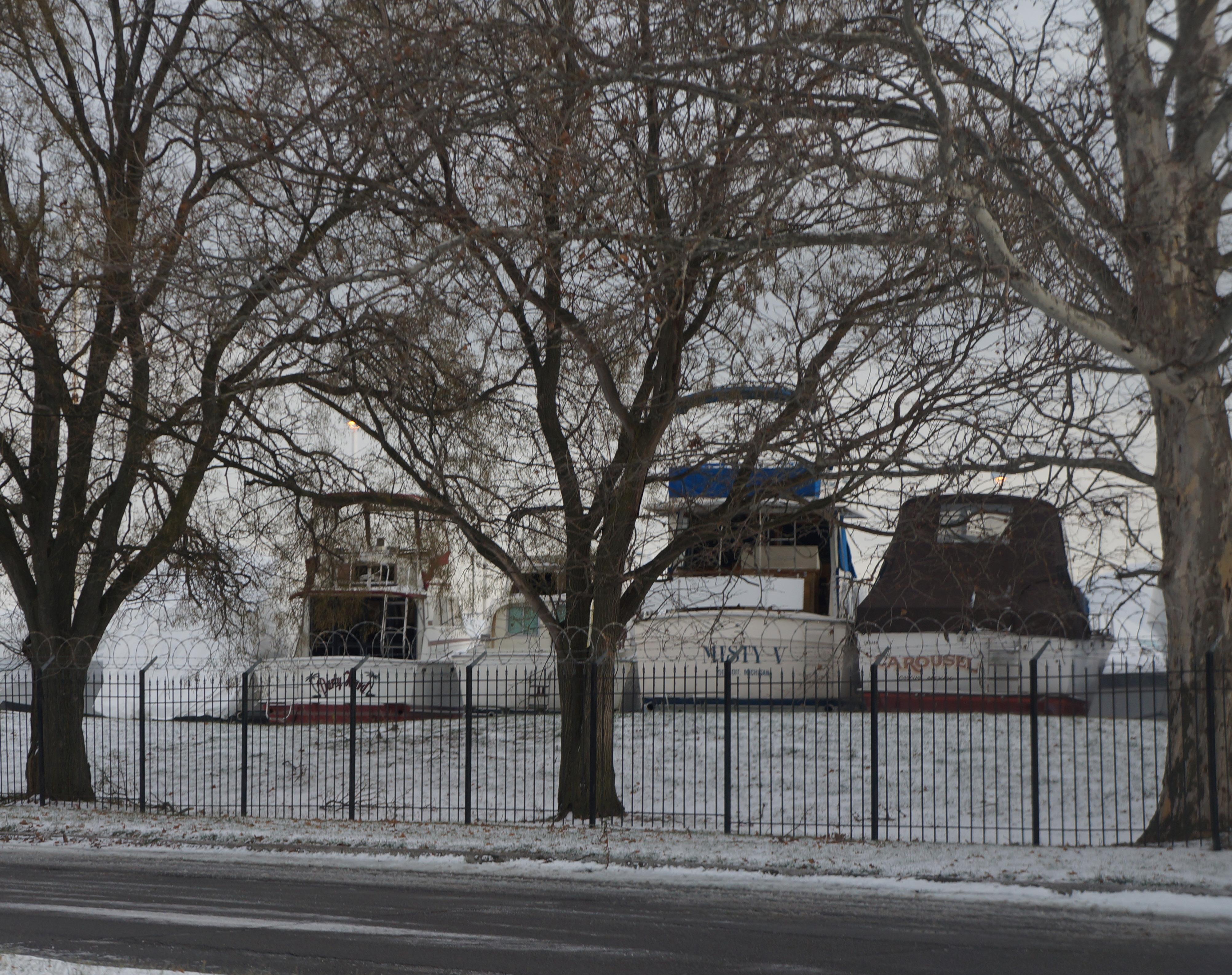
APPENDIX A: COMMUNITY ENGAGEMENT
Two focus group sessions held in March 2016 – one with residents and one with business owners – provided insight into community needs and preferences, guiding plan recommendations.
RESIDENTS FOCUS GROUP
On Saturday, March 12, 2016, residents from the neighborhoods within the Marina District participated in a focus group at Riverside Marina. A total of 25 residents from Jefferson Village and Morgan Waterfront Estates attended the meeting and shared their interests and concerns regarding the Marina District. Residents contributed ideas by drawing on maps that displayed existing and proposed transportation routes and providing opinions and suggestions regarding printed images of murals, water taxis, and pop-up businesses. In addition, children participated by drawing and discussing what they would like to see in their neighborhoods. The following summary captures comments from this focus group:
Have you heard of the Marina District? Would you consider yourself part of the Marina District? Do you identify with the name Marina District?
• No. I’m four blocks from the Marina District and how many people know the Marina District?
• I would like to get to know it better. There was once a flyer available to us, we tried to find it at this restaurant but did not feel comfortable rolling around looking for it, so we never found it.
• It is not like that name has been prevalent. Jefferson East tried to identify this area, and invented this name. Before that, I would not know what the Marina District is.
• Feels belonging in the Marina District because they live here but does not feel belonging because access to water is members only.
• Wants to know the population growth/development trend/plan for the district.
• Heard of the Marina District a couple of days before.
• Identifies more with Morgan Estates than Marina District.
• People who don’t live here don’t recognize the name.
• Heard of the name Marina District when looking for houses.
[Referencing the Asset map] Which of these spaces do you currently use? How do use these public spaces? If you do not go to these places, what keeps you from going there now? Where do you go in this area that we missed?
• Sinbad’s.
• Use the St. Jean boat launch twice a year.
• Use restaurants but not the parks.
• Use Maheras-Gentry Park 8 times / 2 weeks to launch kayak and walk dog.
Which public space do you use (e.g., park, riverfront, boat launch)?
• I was not aware of a park in this area.
• I have never visited this park within Riverside Marina because it’s within the gate here and guards don’t let us in here! So the park is fenced off, and there are boats here, and this is not a private park, it’s owned by the city and you always have difficulty getting in here.
• I never knew that it was open.
• You can’t get back to Waterworks Park either, there’s a path and you can’t utilize that either. You know where they have the boat races? You can’t get back there.
• Would really want access to the parks around St. Jean (Reid, Engel) even if access is just for residents around the area.
• When I moved here 10 years ago, I was told that the parks (Reid and Engel) are owned by the city, but if residents want to use the park they would have to talk with the guards of the boat club and are always turned away.
• If I need to go to parks, I would just drive to Belle Isle.
What else would you like to do in the area? Have you all been to Maheras-Gentry Park?
• I know Maheras-Gentry Park has baseball diamonds, some picnic tables… Some green space.
• I went there because of the baseball.
• Didn’t know it (Maheras-Gentry Park) was there!
• Would love to have places/activities for kids, dogs.
• Would love to have place to go in the district to just walk and sit, and picnic.
• Would love to have Jefferson Village built out to raise property values.
What would draw you to use these parks?
• Security. More please, just to know it’s a secure environment. I know there was a lot of congregating of other activities over there (Maheras-Gentry Park), and that it’s not safe.
• Exactly! Maheras Park!
• I would like to know its availability and what facilities are there. I’ve never been there.
• I haven’t been there in a long time, it’s (Maheras-Gentry Park) getting kind of nasty. There’s so much bird stuff in there that we didn’t stay. I wanted to go there to watch the fireworks, but there were not enough places to sit.
• When you drive, it’s just a strip! There’s just a strip of land that goes to the river.
• Would love to see activities going on in Reid Park and would just want to use Engel Park for the view.
What ideas do you have? What is your most prevalent way of getting around the neighborhood. Do you bike, walk, drive (or some other method) to get to these places?
• I want to start biking.
• I bike, but I don’t bike in the neighborhood. No reason, I just don’t. I bike towards Belle Isle down Jefferson.
• I was walking, but I don’t feel comfortable because sometimes there are loose dogs.
• Yeah, the dogs are a big issue.
• I walk and drive.
• If there was another thing like the Dequindre Cut (rail-to-trail/rail-by-trail), that would be great.
• What I would like to see is a bike trail, so we can bike and not cart our bikes and ride to Belle Isle.
• Even within the area having more trails would be good!
• Are you all planning to extend the Riverwalk?
• How would it (rail-to-trail) impact us (financially), and how would it be funded?
Other ideas? Other places along the river where you would like to have access to the river?
• (People agreed that more signage is important to make it generally more accessible).
• How do we use this park?
• You can use the park from 9am-dusk and the guard will let you in to use the park.
• Is it accessible by vehicle?
• Only pedestrian.
• Where would you expect people to walk to get in?
• There’s no parking lot for the park.
• Isn’t there parking on the right side?
• There’s no park and reserve for people who want to use the park.
• That seems inconvenient.
• Security cars tend to turn us away because apparently they’re not clear that it’s city-owned in here.
• So we can park the car at the entrance and then take our things to the park?
• Yes.
• Could you drive in, drop your things off, then drive out to park?
• As the operator of the Riverside Marina, we just need to monitor who’s coming into the park. Usually security works with people.
Part of our goal is to make the riverfront more accessible for all people of Detroit. What are your feelings on more people coming to the area?
• That’s a problem. With Jefferson Village, we petitioned to put up signage on Jefferson to state “no through traffic” from supposedly Marquette through St. Jean. The concern is the amount of traffic that will come through the residential area. Our biggest complaint is speeding and traffic.
• Speeding through the neighborhood (in cars) trying to get to the marina is a concern.
• If the parks are open to the public, more facilities like restrooms and benches are needed.
• My biggest issue, they come to the Marina and stop at this liquor store on Jefferson, discard trash, urinate around the building. I talked to City Council and they talked about making it No Parking there around 50 feet.
How would you feel if the waterfront area were more open to the public and attracted people from outside the area? (e.g., Making St. Jean Boat Ramp more active and inviting). If problematic, would designating a specific route to the water help alleviate this problem?
• (Shaking heads “no” to more traffic)
• Having more people coming to the district would not cause the crowd in Reid and Engel because I think they are going to be community pocket parks.
• Traffic is already an issue in the district that people are driving 40 miles per hour and throwing trash out of the window.
• Don’t see an issue with bicycle and pedestrians.
How do people feel about the industrial buildings in the neighborhood?
• It’s an eyesore!
• The problem is the chemical smells.
• The smell from Stericycle can be a problem. Happened twice last year.
• Some people I’ve heard complaining about smells.
• There’s a noise at night. Maybe it’s coming from that plant back there…
• Not bothered too much by the industrial buildings because they were already here when I moved in.
• Not that concerned with industrial buildings because most of them already existed when I moved in.
Would you rather see the DTE plant reused as something other than a power plant or demolished?
• Is the plant closed? What’s going to happen to the building? I want it removed. But if it could be reused for recreation or restaurants, that would be nice.
• Would love to have access to the water through DTE plant and have water sports.
• Would love to see redevelopment of DTE plant and have commercial or parks there.
• YWCA, that building has been sitting there, it should be revamped. Somebody should do something about it (at Garland and Jefferson).
• But that building has already been stripped. The roof is gone… I don’t know how sturdy it is now since it’s been neglected for so long.
• I think that building is a gem. I think if it’s brought to the attention of developers, they’d be all over it. Like Chicago, it has boarding schools like that, it could be used for that, maybe Wayne State dorms.
• Next door, Edison had a building there next door (to the YWCA), it seems to be in good shape because it’s been boarded up.
• It’d be a nice restaurant or a coffee shop.
• Or offices.
We have been working on some ideas to include in our proposal [bring out example pictures and point out proposed locations on map]. What are your thoughts on:
• Water Taxi
• Bike and Walking paths/routes, converting the rail to a trail
• Activities at the St. Jean Boat Ramp
• (General interest in and support of these recommendations)
Has anybody been to the St. Jean Boat Ramp?
• You can’t get in. There’s a gate there.
• Yes! More activities, the water taxi would be awesome.
• I accept all of this. No problem! Regarding the well, it should be very connected.
• The trucks on St. Jean and Conner are tearing up our streets. They should go up Conner, not St. Jean.
• The trucks are a problem.
• Are there plans to do bike lanes and stops that are protected?
• We just need the mindset of the community to accept. We have the issue of loose dogs, and I wouldn’t want to ride anywhere. We’re not trying to get any more people, but we want to capitalize on this identity better.
• I would be interested in super-wide sidewalks from St. Jean to Belle Isle. Riding in the street (on Jefferson) is okay, but sometimes you get a little paranoid. A wider sidewalk would encourage me to ride my bike to Belle Isle.
• Let’s talk about the dogs. You have to watch out, you have to lock your small dogs up because the unleashed ones will fight them.
• The dog issue is extremely serious. Unfortunately we don’t react to it until some kid gets snatched under our gate and eaten alive. We know it’s an issue, certainly we can have some action to deal with the dogs aside from me carrying a pistol, because I don’t want to shoot someone trying to shoo the dogs? It’s scary. I was out there with my granddaughter a couple of summers ago. There are no cars, there’s nowhere for you to go. It’s you and the dog. It’s a real issue. We got a gun permit to deal with dogs.
• The owners are irresponsible. It’s nice to have access to the public land that’s gated off from the dogs.
How much would people pay to ride the water taxi from St. Jean to Belle Isle?
• Just Belle Isle would be nice. That would be awesome. I would say anywhere from $15-$20.
• Round trip? $5.
• But diesel’s expensive. You know!
• $10-$15.
• (If there’s a lot of people) you would need at least two.
• We used to have a ferry that went to Belle Isle, it cost a dime back in the day. (Laughs)
What about the businesses in the area?
• We don’t need anymore dollar stores.
• No more marijuana places.
• Just so you understand Detroit and how the economics work, we don’t have a RedBox (DVD rental vending machine) in the city limits.
• We don’t have a Red Lobster in the city. We have to go all the way to Warren.
• You know why Staples closed? They went up in rent.
• How long are the dollar stores going to keep the Grand Opening sign? City Council’s going to say it’s time to take it down soon.
Other conveniences that you want to see in your area?
• We could get a Whole Foods down here.
• Hardware store.
• But there’s a hardware store on Jefferson. You can go over there and hang out with them all day.
• Down there, going to Grosse Pointe.
• It would be nice to have something small in the area.
• Security issues at the hardware store, which is why it’s somewhat hidden.
• Reality is that security is just another obstacle to overcome if you want to have that business. It’s all in your attitude, if you just have to tackle that, you have to do it. On another note, take a look at the sidewalk! We don’t have a large sidewalk like that, and Jefferson would be ideal.
• I like the idea of extending the protected bike path that’s already started.
• All the money for the sidewalk is probably federal money just sitting there, all you have to do is ask for it! I’ve worked for the city for a long time. Ehrlich, City Council, JEI are good people to talk to about your plans (to get support).
General Consensus:
• Greenery is better than mural to cover the fence and walls because mural is more industrial.
• Trash is a huge problem in the district.
• They like to have public use in the district. Bike lanes and pedestrian paths are good.
• Love water taxi. Would love to have the station around St. Jean Boat Launch.
• Love pop-ups. Would love to have a coffee shop in the district.
• They are fine with industrial buildings because they were already there when they moved in.
• Want to have access to Reid and Engel.
BUSINESS OWNERS FOCUS GROUP
Local business owners from the Marina District attended a business engagement focus group at Sinbad’s Restaurant and Marina on Tuesday, March 15, 2016. A total of 10 business representatives attended the meeting to share their thoughts on development in the Marina District. The facilitator asked several questions to understand local business owners’ interests and concerns. The following is a summary of comments from the business focus group:
How would you describe your customer base? Where are they coming from?
• One company serves 17,000 people a day in the metro area.
• One company has trucks coming into the Marina District and the owner would love to see the area to be clean and safe.
• One company has customers from everywhere and has trucks come through St. Jean. The representative would love to have the Old St. Jean cul-de-sac opened.
• One company’s customers are mainly locals who usually use St. Jean and Freud to access the company.
• One company has 47 acres land and their customers are mostly DTE employees.
What types of activities or changes to transportation networks (e.g., streets, walking and biking connections) could positively impact your business?
• Would like to see Freud more connected with the Riverwalk.
• Would love to have St. Jean open to allow the loop and two-way traffic in and out.
• Thinks the DTE plant should be connected to the bike path.
• Change the one-way street to two-way street (Marquette Drive - Freud Street - St Clair Street).
• Make St Jean Street and Clairpointe Avenue the main roads for trucks.
• Complete the St Jean loop to allow trucks to go around.
• St Clair from Lisette to Freud should be a two-way street, because Marquette gets blocked with snow.
How would you feel if the waterfront area were more open to the public and attracted people from outside the area? (e.g., making St. Jean Boat Ramp more active and inviting)
• St. Jean Boat Launch and Riverside Marina should be open to the public.
• Would love to see more activities, especially water sports in the area.
• Would love to see more retail on the riverfront.
• Marina by Maheras-Gentry Park is state owned, and Maheras-Gentry Park is city owned.
• Would like to have activities for kids.
We have been working on some ideas to include in our proposal [bring out example pictures and point out proposed locations on map]. What are your thoughts on: bike and walking paths/ routes (converting the rail to a trail), activities at the St. Jean Boat Launch, water taxi?
• There are hundreds of bikers on Freud Street now when it’s warm.
• Encourage different water access tools to direct people to Belle Isle.
• Create destination areas.
• Water-themed business (e.g., bait shops).
• Would like Conner to also be one of the gateways to welcome people from Grosse Pointe.
• Commercial development along Freud Street to attract people to the neighborhood.
• Would love to have the infrastructure in the area fixed and upgraded to draw more people into Marina District and to increase property value.
How do you feelW about private property improvements in the district? (e.g. murals, green infrastructure)
• Bringing in green infrastructure.
• Large wall next to vet often full of graffiti. Would like greenery and maybe mural.
• Organize businesses to keep the district clean.
• Has been paying employees to clean and maintain St. Jean for the last 5 years.
• Fences on St Clair Street need to be nicer (install black fences).
• Reuse the billboard on East Jefferson Ave (things underneath the billboard would be cheap).
Consensus:
• Strong support for water taxi, pop-up businesses, and rail-to-trail.
• River is the biggest asset in the area and it should be open to the public.
• Support for the branding of the Marina District.
• Positive opinion of attracting more people to the riverfront (more people, more business).
• Boat parking.
• Green barriers between industrial and residential uses.
• Animals are coming back to the plant.
• One representative suggested researching the floodplain because the area around the canal in Jefferson Village was said to be in the floodplain and it has been a stigma to invest and develop in that area.
APPENDIX B: ANIMAL WELFARE ORGANIZATIONS IN DETROIT
To address the presence of stray dogs, residents and organizations can report dog sightings to local animal welfare organizations, such as the following:
• Detroit Dog Rescue: To report or surrender a dog, call (313)-458-8014 (detroitdogrescue.com)
• Detroit Pit Crew: To report a dog, call (248)-906-9022 (detroitpitcrew.com)
• Detroit Animal Welfare Group (D.A.W.G.): To report animal abuse or stray dogs, please use the form on their website: http://dawghous.com/contact-us/#
• Detroit Bully Corps: A private 501(c)(3) non-profit organization aimed at rescuing and rehabilitating the American Pit Bull Terrier and related breeds (dbcdogs.org)
• HomeFurEver: A non-profit, no-kill, foster-based canine rescue organization. To contact this organization, please use the form on their website: http://www.homefurever.com/about-us.html
• Paws for Life: A 501(c)(3) non-profit organization aimed at rescuing homeless, neglected, abused, and abandoned animals from overflowing shelters. To contact this organization, please use the form on their website: http://www. adoptapet.com/paws-for-life-rescue/contact/
• Providing for Paws: An organization aimed at educating pet owners to keep their animals in the home. The organization occasionally accepts rescue animals. To contact this organization, please use the form on their website: http://providingforpaws.org/contact-us.html
APPENDIX C: RECOMMENDED PLANTS FOR GREEN INFRASTRUCTURE
Green infrastructure works best when it uses low-maintenance, perennial, salt- and flood-tolerant plants that are native to a region. The following table identifies plants native to Michigan that are recommended for green infrastructure in the Marina District.
GREEN INFRASTRUCTURE: NATIVE MICHIGAN PLANTS
Skye Blue Aster (Aster oolentangiensis)
Black-Eyed Susan (Rudbeckiahirta) Purple Coneflowers (Echinacea purpurea)
Common Milkweed (Asclepias syriaca)
Blue-Joint Grass (Calamagrostis canadensis)
Joe-Pye Weed (Eupatorium maculatum)

Oldfield / Common Cinquefoil (Potentilla simplex)
Elderberry (Sambucus canadensis)
Quart-sized $6
Quart-sized $6 ~$7 for 5k seeds ~$7 for 5k seeds
Branching blue flowers
Salt-tolerant, attracts butterflies and hummingbirds
Salt-tolerant, attracts butterflies and hummingbirds
Quart-sized $6 ~$8 for 400 seeds
Quart-sized $6 ~$50 for 280k seeds
Quart-sized $6 ~$4 for 200 seeds
Attracts monarch butterflies Perennial grass
Quart-sized $6
Gallon pot $18
PRESENTED BY:

Jenya Abramovich, Jacqueline Austin, Alison Carey, Yuexuan Hu, Kaleah Mabin, Lesley Rivera, Dan Sommerville, Yuxiao Xu, Baihe Yang, Yiting Yao, with Eric Dueweke & Wendy Rampson