S TORMWATER SOLUTION S
Revising Toledo’s Stormwater Credit Program
University of Michigan
Taubman College of Architecture + Urban Planning December 2013
Revising Toledo’s Stormwater Credit Program
University of Michigan
Taubman College of Architecture + Urban Planning December 2013
Prepared By:
Yohan Chang, Ashlee Grace, Diego Horna Munoz, Katie Knapp, Megan McPhilimy, Christian Roadman, Katy Ryan, Katie Wholey
Academic Advisors: Eric Dueweke, Larissa Larsen
Urban and Regional Planning
Taubman College of Architecture + Urban Planning University of Michigan
December 2013
Special thanks to Patekka Pope Bannister, Lorie Haslinger and Beatrice Miringu from the City of Toledo Department of Public Utilities for providing knowledge, feedback and support throughout this project.
We also thank the following individuals for contributing their time and expertise to our research and analysis:
Chuck Campbell, City of Toledo Department of Public Utilities
Danielle Coats, City of Toledo Department of Public Utilities
Thomas Crothers, City of Toledo Department of Public Utilities
John Damico, Environmental Rate Consultants, Inc.
Kelly DeBruyn, City of Toledo Department of Public Utilities
Chad Johnson, City of Toledo Department of Public Utilities
Ed LaBo, J.M. Smucker Company
Tim Murphy, City of Toledo Department of Public Utilities
Mike Rizzo, City of Toledo Department of Public Utilities
Katie Rousseau, American Rivers
Scott Sibley, City of Toledo Department of Public Utilities
Thank you to the University of Michigan’s Graham Sustainability Institute and its Great Lakes Adaptation Assessment for Cities (GLAA-C) program for inviting us to be a part of this project and for the funds to cover project expenses. Special thanks to Elizabeth Gibbons for her expertise and guidance on the project background, direction and scope.
Finally, we thank our faculty advisors Eric Dueweke and Larissa Larsen for providing support, guidance, and expertise throughout the project.
Executive Summary
Section I: Current Program
Introduction
Toledo’s Environmental Challenges
Toledo’s Structural Challenges
Stormwater Utilities & Credit Programs
Analysis of Current Credit Program
Case Studies
Analysis Summary
Section II: Proposed Approach
Introduction
Revisions to the Credit Program
Property & Fixed Fee
Streamlining Credits: Quantity & Quality
Priority Zones with Maps
Recommendations
Conclusion
Section III: Stormwater Credit Manual
Credit Program Basics
Overview
Definitions
Eligible Stormwater Management Practices
Priority Zones
General Crediting Policies
Application Procedures
Appendix A: Application
Appendix B: Credit Calculation Examples
Appendix C: Stormwater Management Practice Resources
Appendix D: Stormwater Management Practice Examples
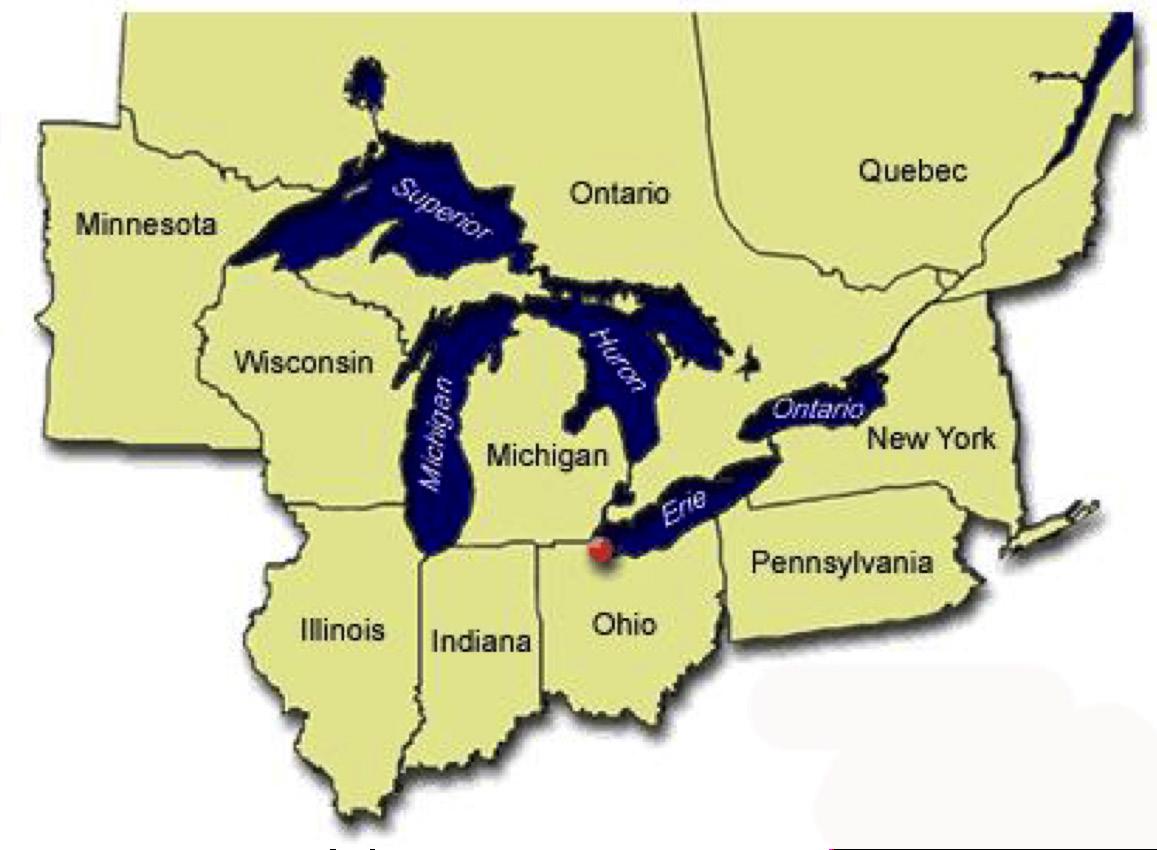
The city of Toledo faces significant stormwater challenges. Within the city, the Maumee River, Ottawa River, and Swan Creek empty into the southeastern corner of Lake Erie. Additionally, approximately 20% of Toledo’s existing sewer system is a combined sewer and stormwater system. During intense precipitation events, combined systems release untreated sewage overflows directly into the receiving waters, resulting in significant water quality concerns. Recently, the City initiated several proactive measures to combat the increasing stormwater concerns, including: expanding its wastewater treatment capacity, decoupling portions of the sewer and stormwater system, and building holding tanks to reduce the frequency of these undesirable overflow events. However, increasing precipitation due to climate change, aging infrastructure, unimproved streets, and Toledo’s downstream location within the regional watershed, combine to make flooding a growing challenge.
In an effort to mitigate these stormwater concerns, the City adopted a stormwater utility and associated credit program. In 1999 the City of Toledo established a stormwater utility to generate funding for citywide stormwater management activities through the collection of stormwater utility fees. Property owners pay a stormwater utility fee based on the amount of impervious area on their property. In conjunction with the establishment of the stormwater utility, the City created a stormwater credit program in 2001. This program allows non-residential property owners to apply for credits for installing on-site stormwater management practices. The purpose is to reward non-residential property owners for taking an active role in stormwater management by implementing management practices that will either reduce the quantity or improve the quality of stormwater runoff.
However, significant challenges have arisen since the creation of the program. Only 93 non-residential properties from a potential pool of over 20,000 non-residential properties are currently enrolled in the credit program. The City of Toledo asked us to revise the current stormwater credit program to update its stormwater management practices and recommend strategies to increase the program’s effectiveness.
Section I of this report summarizes the condition of the existing stormwater credit program in Toledo and identifies innovative municipal stormwater management practices active in cities throughout the United States. The goal of this section is to
analyze the existing program and its associated challenges while also identifying stormwater program innovations from cities that share similar characteristics to Toledo.
Section II summarizes proposed revisions to the credit manual and future recommendations for more effective stormwater management. We propose three major revisions:
1. Streamlined credit categories. To streamline the program, we divide credits into two main categories: quantity and quality. Categorizing stormwater management practices into quantity and quality simplifies the credit program and allows nonresidential property owners the flexibility to implement stormwater management practices best suited to their property, needs, and financial circumstances.
2. Identified priority zones. Priority zones are areas that are particularly susceptible to flooding events of combined sewer overflows (CSOs); these areas are considered priorities because they will benefit the most from implementation of stormwater management practices. We identified four priority zones in Toledo.
3. Established fixed fees and property fees. We divide the stormwater utility fee into two parts, a fixed fee and a property fee. The fixed fee portion covers the administrative and maintenance costs of managing the stormwater utility. The property fee covers the costs of managing stormwater runoff from an individual property and should be based specifically on the property’s impervious surface area. Together, the fixed fee and the property fee comprise the stormwater utility fee. Stormwater credits can only be applied to the property fee portion of the stormwater utility fee.
In addition to these major revisions, we also offer additional strategies to improve the efficiency and effectiveness of the stormwater utility credit program: targeted outreach and communication strategies will inspire more active participation in the program; a residential incentive program will encourage community-wide involvement in stormwater management; and, leveraging partnerships with local community organizations will support the program’s mission to build a strong community response
Executive Summary - 4
for dealing with stormwater issues in Toledo. Finally, the document concludes with the revised stormwater credit manual in Section III.
The City of Toledo took a proactive step in addressing its stormwater management issues when it established the stormwater utility in 1999 and its corresponding stormwater utility credit program in 2001. However, over the past 13 years the program’s strengths and weaknesses have been identified, necessitating a revision to the existing credit program. The proposed revisions and recommendations to the City of Toledo’s stormwater credit program incorporates both staff knowledge and innovative stormwater management approaches from similar programs across the country. By updating this program and extending its efforts in the future, the City of Toledo continues its commitment to serving its residents by strengthening the built environment’s resilience and preserving its natural resources.
This document is organized into three sections. Section I contains the results of our research analysis, including a discussion of the current environmental concerns in Toledo. This is followed by an analysis of the existing Stormwater Credit Manual and its associated stormwater management initiatives, utility billing and overall cost structure. This section ends with an overview of identified best practices from case studies of other cities that employ stormwater credit programs. Section II describes our proposed revisions to the stormwater credit manual as well as future recommendations for more effective community engagement and efficient program management. Section III is the revised Stormwater Credit Manual.
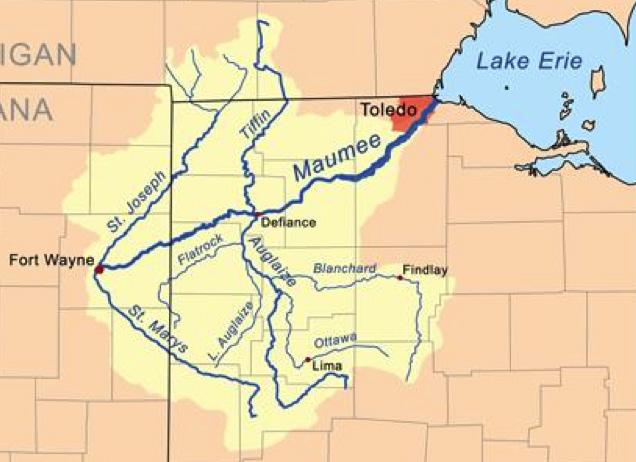
The City of Toledo is located where the Ottawa River, Maumee River and Swan Creek empty into Lake Erie. In presettlement times, much of the area was a large wetland. As a result, the terrain is relatively flat with some areas of poor draining soils. The settlement of Toledo along with the construction of the harbor and canals forever altered the area’s natural hydrology. Toledo’s location at the base of the Ottawa River and Maumee River watersheds means that upstream runoff eventually flows through the city. Although our research and recommendations focus on strategies for adequately managing stormwater within the City of Toledo, it is vital to recognize that Toledo’s location within the larger regional watershed systems exacerbates stormwater challenges.
Approximately 20% of Toledo’s existing sewer system is a combined sewer and stormwater system.1 During intense precipitation events, combined sewer and stormwater systems release
untreated sewage overflows directly into the receiving waters, resulting in significant water quality concerns. A consent decree with the US EPA, in 2001, led to an investment of hundreds of millions of dollars in infrastructure to reduce the frequency and severity of these combined sewer overflow (CSO) events.2 These investments include expansion of the City’s wastewater treatment capabilities, separation of sewer and stormwater systems, and constructing holding tanks to retain combined sewage before it is treated.3
Three water bodies are currently affected by the CSO events: the Maumee River, the Ottawa River, and
Section I - 10
Swan Creek.4 Thirty-three annual CSO events were estimated in 2003, with 26 affecting the Ottawa River, 33 affecting the Maumee River, and 11 affecting Swan Creek. After completion of the city’s sewer system improvements in 2020, the estimated number of CSO events affecting each water body will be approximately 0, 3, and 4, respectively.5
While this progress represents a major step forward for local water quality, it does not address all of Toledo’s water quantity concerns relative to aging infrastructure. Approximately 1,100 miles of sewer serve the City of Toledo, of which roughly 200 miles are aging brick sewers.6 Some of these date to the late 19th and early 20th centuries.7 Heavy rain events can contribute to stress on this aging infrastructure.8 The age and vulnerability of the system was dramatically displayed in a 2013 event when a car fell into a sinkhole that formed around a damaged brick water line that was constructed in 1891.9
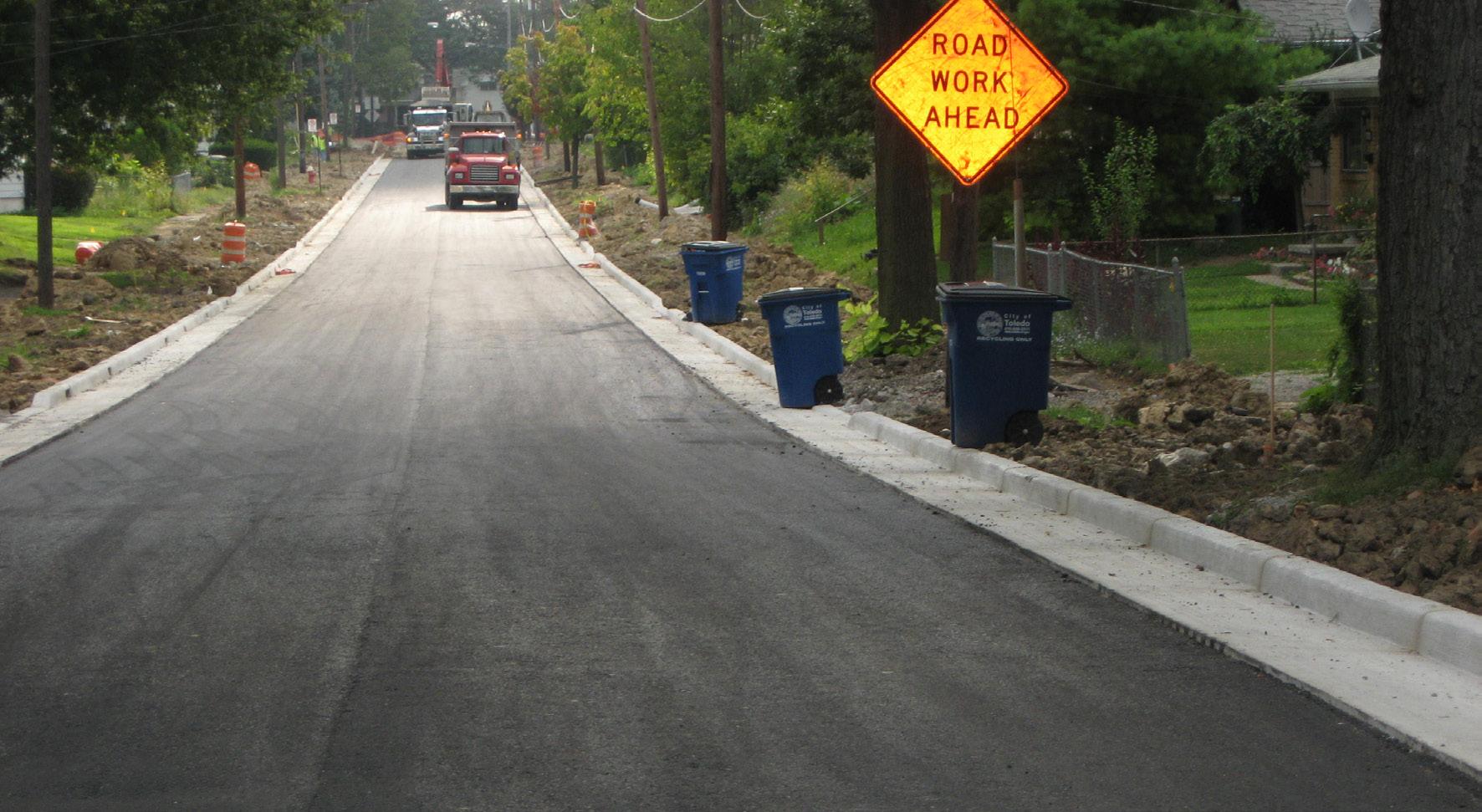
Adding to these issues are areas within the city that contain unimproved streets. Unimproved streets lack curbs and gutters and contribute to flooding problems. Approximately 200 miles of unimproved streets exist in Toledo.10
Additionally, an area in the Northeast of Toledo, along the Maumee River, has never been served with modern sewer infrastructure.11 Without appropriate infrastructure, there is little the Division of Sewer and Drainage can do to assist in the event of flooding.
While many cities face major infrastructure challenges in the coming years, the effects of climate change are likely to exacerbate the problem. As a result of climate change, precipitation has increased by 4% in the spring, 8.4% in the fall, and 4% in the winter. In the 1950s, Toledo received approximately 28 inches of rain per year. By the 2000s, this had increased to approximately 38 inches annually.12 The increasing intensity and frequency of storm events as a result of climate change will lead to recurrent large-scale flooding events and increased pollutant loads in local water bodies due to stormwater runoff as well as CSO events. Toledo’s aging infrastructure is largely unprepared to deal with these stresses, raising concerns for both water quantity and water quality.
One way to proactively address the stresses placed on stormwater systems is through the implementation of a stormwater utility and corresponding stormwater credit program. A stormwater utility is “a utility established to generate a dedicated source of funding for stormwater pollution prevention activities where users pay a fee based on land-use and contribution of runoff to the stormwater system.”13 Toledo’s stormwater utility was created in 1999 as a means to provide reliable and consistent funding for the repair, replacement, planning, improvement, operation, regulation, and maintenance of the existing and future stormwater system.14 Subsequently, the City developed its stormwater credit program to encourage non-residential property owners to reduce the impacts of stormwater runoff generated by their property.15 Generally, stormwater credit programs offer a reduction in a property owner’s stormwater utility fee contingent upon the property owner installing an approved stormwater management practice on-site. These stormwater management practices
reduce the volume of and/or improve the water quality of stormwater runoff generated on-site (and subsequently flowing into the municipal stormwater system).
In the fall of 2013, the City of Toledo requested that their current program be revised to reflect new and improved approaches to stormwater management and to address challenges that have arisen since its establishment in 2001. In the following paragraphs, we explain our analysis and identify key challenges that guided our recommended changes.
The goal of the stormwater credit program is to encourage non-residential property owners to take an active role in citywide stormwater management.18 Toledo’s current stormwater credit program provides non-residential property owners with an opportunity to reduce their stormwater utility fee. We use the definitions laid out in the current Stormwater Credit Manual to define residential and non-residential properties. Residential properties are defined as single family or duplex
Section I - 12
dwelling units; all others are considered non-residential. Non-residential property owners that install specified stormwater management practices are eligible for a reduction in their stormwater utility fee.
Understanding the effects of impervious surface on stormwater runoff is an important aspect of the credit program. Impervious surfaces, such as streets, sidewalks, driveways, and buildings, prevent water from infiltrating into the ground and thus create increased stormwater runoff that carries pollutants through citywide stormwater infrastructure to local water bodies.16

This intensifies erosion and flooding due to significant amounts of runoff entering the water body at the same time.17
The current credit program strategically focuses on non-residential properties. Non-residential properties are often much larger than residential properties with a significant amount of impervious surface.
Ninety-three non-residential properties are currently enrolled in the stormwater utility credit program. Most applied
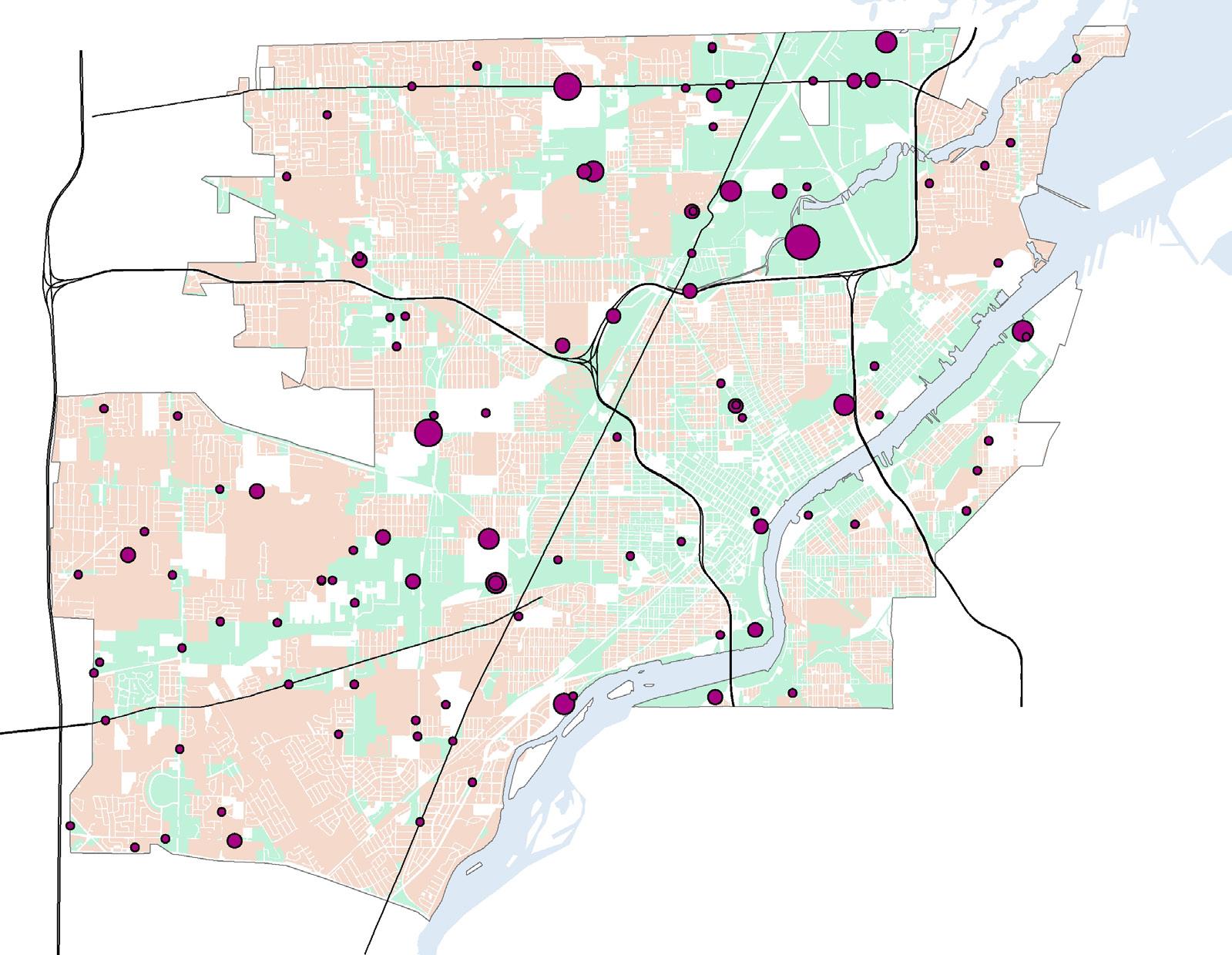

within the first year of the program. City staff indicated that there were some early marketing efforts for the credit program, but minimal or no promotion after the first year. Participating properties were generally enrolled in the program because they were city-owned properties or because a developer notified the property owner about the credit program during construction. This credit program update presents an opportunity to reintroduce the program to the public and to encourage participation.
In Toledo, stormwater utility fees are based on equivalent residential
units (ERUs). An ERU is a unit of measurement for average impervious surface. The average residential property in Toledo has 2,500 square feet of impervious surface; thus, one ERU equals 2,500 square feet of impervious surface. All residential properties are charged for one ERU, or $3.80, per month ($45.60 annually). Non-residential properties are billed depending on the number of ERUs they contain. For example, a non-residential property with 5,000 square feet of impervious surface would be charged for two ERUs, or $7.60 per month.
Among non-residential properties currently participating in the credit program, there are a variety of
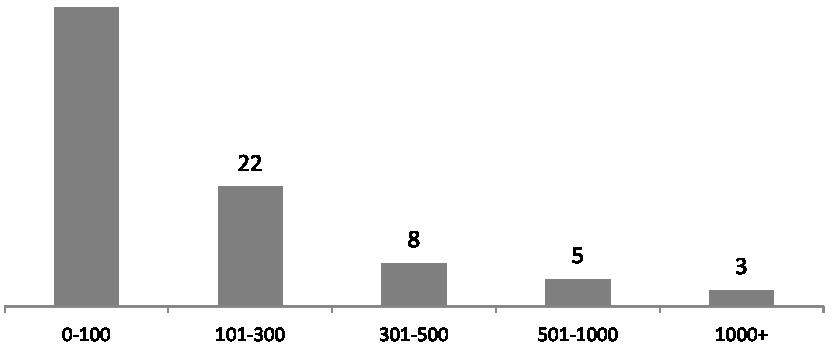
I-4. Properties enrolled by ERU and acres
Section I - 14
parcel sizes and relative amounts of impervious surface. Fifty-five of the enrolled properties contain less than 100 ERUs (100 ERUs equals 5.7 acres of impervious surface). The three largest enrolled properties contain more than 1000 ERUs (1000 ERUs equals 57.4 acres of impervious surface). These three properties collectively account for a larger area of impervious surface (519 acres total) than the 55 small property participants combined (145.7 acres total). This highlights an important consideration: initially enrolling a few big properties may yield greater benefit to Toledo’s overall stormwater initiatives than enrolling many smaller properties. Subsequent efforts can target smaller non-residential properties.
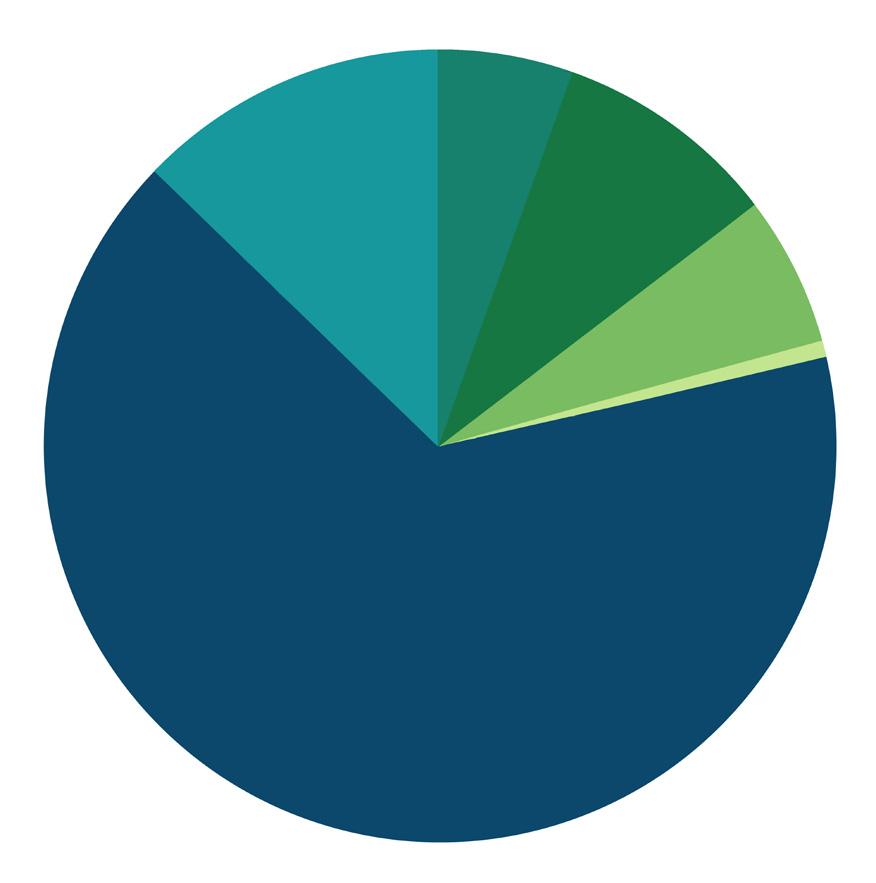
Toledo’s current program offers credit for the following management practices: brownfield reuse, detention/ retention, direct discharge, forested buffer/grass filter strip, industrial NPDES, open-channel maintenance, sediment pond, swale, and wet pond/ extended detention. The top three credits utilized are: detention/retention ponds (43% of total credits), the direct discharge credit (19%), and the forested buffer/grass filter strip buffer (11%). To date, no properties have received the sediment pond or the wetpond/ extended detention credits.
Figure I-5. Participants by type of stormwater management practice credit receivedD
Section I - 15
When we reviewed the enrolled properties, we noticed some inconsistencies with the existing program. There were discrepancies between billing records and administration records for several properties. Additionally, we were informed that City staff were not always able to follow up with all participants to inspect the stormwater management practices after the initial application approval. Therefore, it is difficult to understand how well the stormwater management practices are performing or being maintained. Additionally, program participants who received credits with specified expiration dates have generally continued to receive those credits after the time limit expired. For example, a property that received a five-year temporary credit for brownfield redevelopment continued to receive the credit seven years after the credit was set to expire. All of these instances indicate the need for a streamlined process that can be easily managed.
There are both direct and indirect costs associated with managing stormwater.
Ultimately, we were unable to produce exact figures regarding the costs and revenues associated with managing the stormwater utility and credit program. The following paragraphs detail the information we uncovered through our research and highlight areas for program improvement.
In the fall of 1999, after a year of planning, the Toledo City Council voted unanimously to implement a stormwater utility. Revenues were estimated to be about $9,480,000 annually, based on a calculation of approximately 250,000 total ERUs within Toledo. At that time, the City hired a consulting firm, Environmental Rate Consultants Inc., to estimate these figures. The consultants recommended a stormwater utility fee of $3.82 per ERU per month; however, Toledo City Council ultimately implemented a utility rate of $3.16. Stormwater billing began on October 2, 2000.
On August 29, 2000, City Council also approved the stormwater credit program; the Stormwater Credit Manual was first made available on the City’s website in January 2001.
Section I - 16
Stormwater utility fees are charged to customers as part of their total water bill; the utility fee appears as a line item on the customer’s water bill. To process all their billings, the City of Toledo uses a computer system called SAP, which was implemented in 2008. Bills are generally issued on a quarterly basis, while larger accounts are billed monthly.
The revenues generated by stormwater utility fees are divided between five divisions: Division of Sewer and
Drainage, Division of Environmental Services, Division of Engineering Services, and Division of Water Reclamation in the Department of Public Utilities, and Division of Streets, Bridges and Harbor in the Department of Public Services. In 2013, the total stormwater operating budget was $8,589,035.19 In addition to maintenance and other stormwater projects, this budget funded 68.6 full-time equivalent employees in 2013.20 Figure I-6 illustrates how the stormwater operating budget is divided between the five divisions. Section I - 17
Moving forward, efforts to identify the true costs of stormwater treatment and infrastructure operation, maintenance and future construction is essential to implementing proactive planning efforts.
Since the creation of the program, the stormwater utility fee was raised twice, as illustrated in Table 1. In total, the stormwater utility fee per monthly ERU has only risen by 64 cents over the last 13 years.
As described previously, the stormwater utility fees for non-residential properties in Toledo are calculated based on a site’s total number of ERUs. To determine how many square feet one ERU should equal, the previous consultant measured the impervious
area for a randomly generated sample of 400 residential properties as seen in aerial photographs. Through this process, the consultant identified the average residential impervious area to be 2,500 square feet. Non-residential property owners can determine their utility fees by multiplying the number of ERUs on their property by the approved stormwater ordinance rate, currently set at $3.80 per ERU per month.
During the approval process for the stormwater utility, the consultants and project team recommended an ordinance rate of $3.82 per ERU per month, a number reached through a “cost of service” analysis. However, the City Council instead chose to adopt a rate of $3.16 per ERU per month, a monthly loss of 66 cents per ERU. Discussion with City of Toledo employees indicated the City Council felt a fee of $3.82 was too high for Toledo’s citizens to pay.
Table 1: Changes in Toledo’s Stormwater Rate, 2000 – Present
2, 2000
1, 2008
1, 2009
Section I - 18
The current stormwater fee in Toledo is $3.80 per ERU per month, an amount slightly less than the consultant’s original recommendation of $3.82. Accounting for inflation, the suggested rate of $3.82 per ERU per month in the year 2000 would currently amount to a rate of $5.19 per ERU per month. The difference between the recommended rate accounting for inflation and the current ordinance rate is $1.39 per ERU per month. Using the current monthly rate of $3.80 per ERU, annual revenues are estimated at $11,400,000. However, if the rate had increased to match inflation, the stormwater utility would be accruing approximately $15,570,000 in annual revenues. This suggests a current
shortfall of $4,170,000 in potential annual revenues, as displayed in Table 2. The expected revenues were based on the original consultant’s estimates. With finer scale land cover images, the City could refine its estimate.
In 2012, the total revenue from stormwater utility fees equaled approximately $10.3 million, approximately $1.1 million less than expected revenues.21 Additionally, the stormwater utility received revenues of $76,000 in interest, $175,000 in intergovernmental grants, and $13,000 from other services in 2012.22
Table 2: Estimated and potential revenues from Toledo’s stormwater utility program, 2000 –Present
• 2000: [($3.16 per ERU per month) * 12 months] * (250,000 ERUs in Toledo) = $9,480,000 annually
• 2013: [($3.80 per ERU per month) * 12 months] * (250,000 ERUs in Toledo) = $11,400,000 annually
• Suggested 2000 Rate with Inflation: [($5.19 per ERU per month) * 12 months] * (250,000 ERUs in Toledo) = $15,570,000 annually
Based on our analysis of the current stormwater program and the associated cost structure in Toledo, we analyzed existing stormwater credit programs in comparable cities throughout the United States. Case studies were examined as a means to inform our suggestions for Toledo’s revised stormwater credit program.
To identify the most useful stormwater credit program examples for the City of Toledo, we focused our research on the following:
1. Cities of similar size to Toledo
2. Cities in the Great Lakes region
3. Cities with innovative stormwater credit programs (regardless of location or size)
Section I - 20
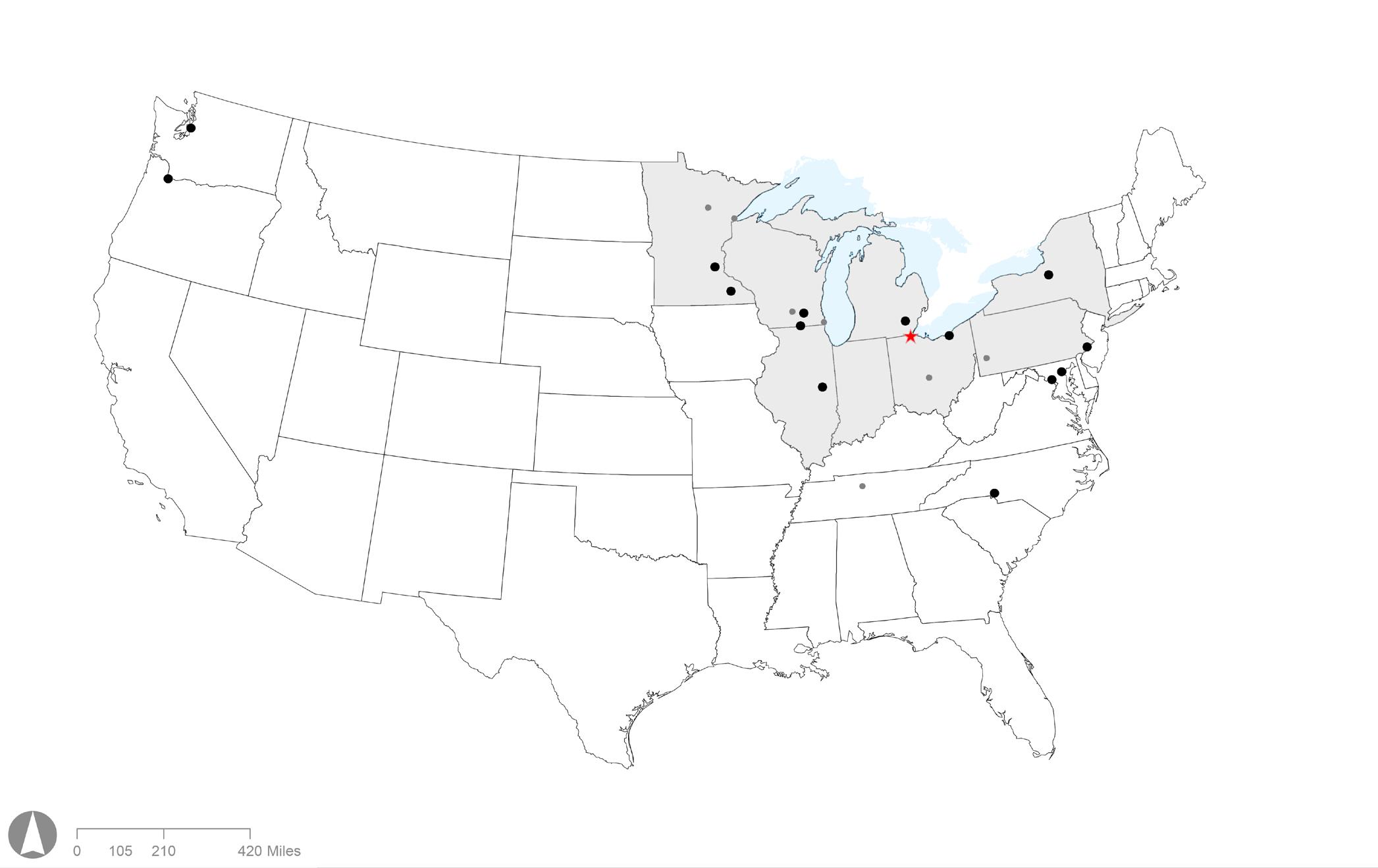
Figure I-7 identifies case studies that we reviewed. The cities with credit programs that are the main focus of our analysis are identified by black dots. The credit programs that were considered but deemed less relevant to Toledo are identified by gray dots.
Many programs have effective and innovative practices that could be beneficial in Toledo. Therefore, we have summarized the case studies by each city’s specific innovative approach. We introduce some of these innovations in the revised Stormwater Credit Manual (Section III). Other programs are
Jefferson, WI
Minneapolis, MN
Philadelphia, PA
Syracuse, NY
Baltimore, MD
Ann Arbor, MI
Beloit, WI
Charlotte/ Mecklenberg, NC
Rochester, MN x
NEORSD, OH
Seattle, WA
Montgomery County, MD
Urbana, IL x
included because they provide useful guidance for future improvements to stormwater management practices in Toledo (Section II). The identified practices fall within six focus areas:
1. Accounting for Revenue Loss
2. Streamlined Credits
3. Priority Zones
4. Incentive Programs
5. Renewal/Reapplication Process
6. Outreach
The following table identifies the cities that we researched and the focus areas that are most applicable from that city’s program.
Portland, OR x
By allowing property owners to receive credit on their stormwater bills, stormwater credit programs may initially result in loss of revenue to a stormwater utility. However, many cities have adjusted the billing structure of their stormwater credit programs in order to account for this anticipated revenue loss. One opportunity to mitigate for revenue loss includes apportioning the stormwater bill into an administrative fee and an operations/ maintenance fee. Customers can only apply for credits to the operations/ maintenance portion of the bill. Another approach is increasing all customers’ stormwater utility fees to account for anticipated revenue loss.
Ann Arbor, Michigan charges a quarterly customer service fee of $6.77 to both residential and non-residential property owners, for a total of $27.08 per property annually. This customer service fee is an additional charge beyond the quarterly fee determined by the square footage of impervious area on any property. In order to ensure that the City has the revenue necessary to operate the stormwater management
system, credits cannot be applied to the customer service fee.23
Beloit, Wisconsin employs a similar approach to maintaining the revenue necessary for operating its stormwater program. The City determined that 10% of each customer’s stormwater utility fee is needed to cover administrative costs. Therefore, a participant can only earn up to 90% credit on his/her stormwater utility fee. This ensures that the City has enough revenue to operate its stormwater system regardless of the amount of credit earned by customers.24
Jefferson, Wisconsin divides its stormwater utility fee into three sections: administrative; operation and maintenance; and, capital improvement and debt services. The administrative component includes the utility’s annual system-wide administrative and management costs and other costs not included in the other two component costs. The operation and maintenance component includes the utility’s annual cost of operating and maintaining the stormwater management system. The capital improvement and debt services component includes the estimated future capital improvement costs and
Section I - 22
Some cities account for anticipated revenue loss in their initial stormwater utility fee calculations. Because granting credit to customers diminishes the revenue earned by the stormwater utility, cities factor anticipated revenue loss into the budget of the stormwater utility program. All customers have a slightly increased utility fee in order to offset the revenue lost from allowing customers to earn credits on their stormwater bills. Programs adhering to this approach include those of the Northeast Ohio Regional Sewer District (NEORSD)26 and Montgomery County, Maryland. 27 debt service payments for Jefferson’s stormwater management system.25
Several cities simplify their credit manual by identifying two or three main credit categories, rather than assigning credit values to every acceptable stormwater management practice. Minneapolis, Minnesota awards credit for management practices that effectively reduce quantity or improve quality of stormwater. Property owners can earn up to 50% credit on their
stormwater utility fee by employing stormwater quality management practices, and up to 100% credit by implementing stormwater quantity management practices. Maximum credits are cumulative and customers cannot exceed 100% credit. The quantity credit is further divided into a standard quantity reduction credit and an additional quantity reduction credit. The standard quantity reduction credit is a 50% credit for implementing a management practice that meets the basic standard of retaining a 10-year, 24-hour storm event. The additional quantity reduction credit allots 100% credit for implementing a management practice that retains a 100-year, 24hour storm event. The purpose of the tiered quantity credits is to reward participants who dramatically exceed

the basic standards required for obtaining credit and thus, substantially reduce the volume of runoff from their properties. A wide variety of stormwater management practices can be employed to meet the quality and quantity credit standards.28
Charlotte-Mecklenburg, North Carolina uses a technique similar to Minneapolis. Their credit system focuses entirely on encouraging reductions in stormwater quantity by dividing credits into peak flow reduction and runoff volume reduction. Participants can receive up to 40% credit on their stormwater bill for peak flow reduction and up to 60% credit for runoff volume reduction. The peak flow reduction is based on the 10-year, 6-hour storm event and the runoff volume reduction is measured as the total accumulated runoff at the 12th hour of the 2-year, 6-hour storm event. The percentage is calculated based on a formula analyzing the undeveloped site conditions, the fully developed site conditions without stormwater management practices, and the fully developed site conditions with management practices. To receive maximum credit in each respective category the stormwater management practices must essentially return
the property to its undeveloped site conditions in regards to peak flow reduction and runoff volume reduction. Using these calculations, the percentage reduction of peak flow on the property is then multiplied by 40% to determine the credit percentage received on the stormwater bill. Similarly, the percentage reduction of runoff volume is multiplied by 60% to determine the percentage reduction on the overall stormwater bill. Customers can receive both peak flow reduction and runoff volume reduction credits.
Several cities identify priority zones to encourage residents to install stormwater management practices in identified problem areas. Priority zones are areas that are particularly susceptible to flooding events or CSOs; these areas are considered priorities because they will benefit the most from implementation of stormwater management practices.
Syracuse, New York has a Green Improvement Fund, which provides financial incentives to commercial, business or not-for-profit property owners who incorporate green
Section I - 24

Figure I-9. Stormwater priority zones in Syracuse, New YorkH
infrastructure into their privately sponsored development or redevelopment projects. Projects are eligible for reimbursement of design and engineering costs and labor and material construction costs. Funding is based on the amount of annual stormwater reduction (measured by gallons captured) as well as location within an identified priority zone. The City identifies high, medium, and low priority areas. In the high priority zone, participants receive a reimbursement based on $0.30 per gallon of annual volume reduction; medium priority receives $0.20 per gallon; and, low
priority receives $0.10 per gallon.29 The project is sponsored by Onondaga County’s Department of Water Environment Protection.
Similarly, Seattle, Washington developed the RainWise Rebates Program, which is a targeted CSO incentive program. To reduce the amount of overflow entering water bodies after heavy rain events, the City offers up to 100% rebate for the cost of installing a cistern or rain garden in target CSO basins. To qualify, work must be completed by a city-approved, trained and licensed contractor; preand post-construction inspections must be completed by a Seattle Public Utilities inspector; and, rebate request forms must be received within 90 days of approval of the green infrastructure installation. Residents can easily determine whether they are eligible for the rebate by verifying their address on the RainWise website. A database of approved contractors can also be found on the website.30
Montgomery County, Maryland employs a system similar to priority zones. The RainScapes Neighborhood Program identifies target neighborhoods for increased
stormwater control measures. Eligible neighborhoods include those near a watershed restoration project, those with significant drainage problems, and those with either an active watershed or a community group seeking involvement in improving stormwater control measures. The County’s goal is to obtain a critical mass of at least 30 percent of property owners within identified areas to participate in reducing stormwater runoff within their neighborhood. The Department of Environmental Protection determines which properties fit the needs of the program and identifies appropriate stormwater management practices. Once these practices have been identified, the County installs the green infrastructure and the property owner signs an agreement accepting responsibility for maintenance.31
Incentives
Incentive programs offer an alternative to the stormwater utility fee and credit model. Incentives typically take the form of grants, tax credits, or rebates to property owners for installation of stormwater management practices.
Grants and rebates function in a similar manner; in either case, money is
dedicated to assisting property owners with the costs of installing appropriate stormwater management techniques. The City of Ann Arbor, Michigan provides funding for the core work associated with the cost of a footing drain disconnection; this typically amounts to approximately $4,100 in reimbursement.32 In Montgomery County, Maryland rebates are available for a variety of projects on residential and commercial properties through their RainScapes Rewards Rebates Program. The maximum rebate for commercial, multi-family, and institutional properties is $10,000 and the highest residential rebate is $2,500. These rebates may be applied to multiple RainScapes projects up to the maximum allotted rebate amount. A variety of stormwater management practices qualify.33
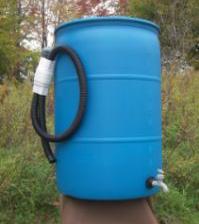
On a smaller scale, Urbana, Illinois provides a maximum incentive amount of $300 per property every 10 years. Properties are eligible for $50 towards the purchase of up to 2 rain barrels, and up to $250 for the installation of a rain garden or a stormwater management practice that provides a reduction in rate or volume or improves water quality. These incentives are provided
Section I - 26
as reimbursements after installation of approved stormwater management practices.34 In Rochester, Minnesota, property owners can benefit from a 50% cost share towards the installation of a rain garden; the maximum reimbursement is $750.35
Philadelphia, Pennsylvania is notable for its combination of available incentives. A grant program through the Philadelphia Industrial Development Corporation offers incentives to commercialproperty owners to install stormwater management practices. The Philadelphia Water Department provides grant funding for feasibility studies to assess the most efficient stormwater management practices in
business improvement districts. A city tax credit is available to businesses that install green roofs. Applicants can claim a credit equal to 25% of the installation costs of the green roof to be applied to their Business Privilege Tax for the year in which the green roof is completed, up to $100,000.36
To ensure that only those customers who properly maintain their stormwater management practices receive credit, credit programs must establish clear guidelines concerning when credits expire and how both administrators and participants handle the expiration and reapplication process. Of the cities we researched, Baltimore, Maryland, Jefferson, Wisconsin, and Philadelphia, Pennsylvania utilize effective strategies for addressing these issues.
To avoid overburdening program administrators with frequent credit renewal applications, several cities established streamlined reapplication processes. Under Philadelphia’s credit program, credits expire every four years. Thirty days before the credit expiration, customers must
submit a renewal application.37 This window of time means that program administrators are not burdened with overly frequent reapplication duties, while still ensuring that stormwater management practices receiving credit are inspected for proper maintenance at least once every 4 years. Similarly, Baltimore requires the submission of a renewal application 30 days prior to the credit expiration; credits expire every three years.38
Jefferson utilizes a different approach by allowing all credits to last perpetually. Participants are required to submit yearly inspection reports and may be subject to random city inspections; however, they are not required to reapply for credit as long as the stormwater management practices are properly maintained. In addition to yearly reports and random inspections, the direct discharge credit may trigger reapplication if the participant regrades or redevelops its property.39
Another approach to reducing the administrative burden of credit renewal procedures is by placing the onus on the participant. Jefferson requires participants to submit yearly
inspection reports in order to maintain their credits, but does not enforce any reapplication procedures.40 In both Philadelphia41 and Baltimore, 42 it is the participant’s responsibility to recognize when the credit expires and submit a reapplication form within the allotted time frame. In both cities, the stormwater utility bill includes a statement informing the participant of the pending credit expiration and reminding him/her to reapply 30 days prior to credit expiration or risk losing the credit.
One of the most important elements of a credit program is having a strong and comprehensive set of communication and outreach strategies. These strategies inform people how they can save money on their stormwater utility bill as well as teach them about stormwater issues and appropriate management practices. Credit programs use a variety of methods to advertise and teach the public about their programs. These include encouraging participation in community events; offering free administrative assistance; and, creating a highly visible, streamlined web presence.
The City of Baltimore, Maryland encourages participation in public projects specifically targeted at improving water quality, including trash cleanup, tree planting, and depaving. Residents earn a $10 credit for every eight hours of participation in a public project, up to a maximum of $30 annually.43
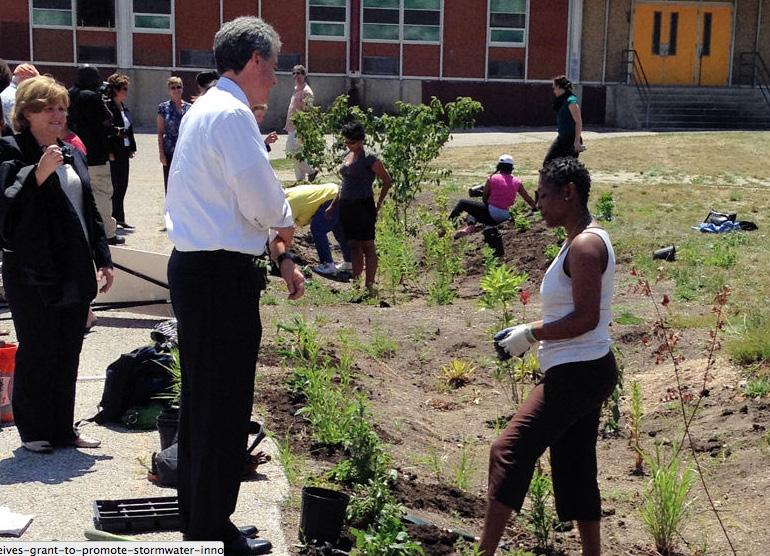
I-12. Volunteers planting a rain garden in Baltimore as part of the City’s stormwater volunteer programJ
Philadelphia, Pennsylvania provides free assistance to residents considering green retrofits that would qualify them for stormwater credits. Free consulting provided by the City consists of site inspections and design recommendations that minimize
up-front costs to customers.44 The Northeast Ohio Regional Sewer District provides businesses with free assistance to identify and apply for credit opportunities.45
Montgomery County, Maryland has several webpages dedicated to its stormwater credit program and rebate initiatives, complete with links to flyers that advertise the individual programs. The County also manages an online calculator tool that allows residential property owners to calculate potential savings opportunities related to their stormwater utility fees.46
The credit program in Portland, Oregon is notable for its high participation rate: roughly 10% of non-residential customers and 19% of residential customers participate in the Clean River Rewards program. Portland attributes this success to a major public outreach campaign at the inception of the program. Promotional efforts included: temporary extra credit for participants who signed up within the first fiscal year of the program; bill inserts about the program; advertising; and, targeted mailings to customers deemed eligible
for discounts. The City also offers free workshops introducing the credit program and free customer assistance to new applicants.47
During our analysis, we identified significant challenges facing the City of Toledo’s existing stormwater credit program. We also looked at case studies from innovative stormwater credit programs across the country to find potential solutions to these challenges. Our case study research helped us identify six effective approaches to improving the credit program:
• addressing revenue loss will help ensure the fiscal viability of Toledo’s stormwater credit program, elucidating the true costs of the City’s stormwater system;
• designing a streamlined credit system will simplify the program, making it easier for customers to understand, more transparent to the public and more efficient for the city to administer;
• identifying priority zones within Toledo will allow the City to encourage the implementation of stormwater management practices
in particularly vulnerable areas;
• implementing an efficient credit expiration and reapplication process will reduce the administrative burden of the stormwater credit program, help to ensure appropriate billing, and encourage routine inspections of stormwater management practices;
• developing more pointed outreach and communication strategies will encourage more active participation in the program and allow the City to target large properties with significant amounts of impervious surface in order to maximize impact on stormwater quantity and quality; and,
• incentivizing residential properties to implement stormwater management practices through grants and rebates will increase community-wide involvement in stormwater management and allow the City to target customers who are not eligible for the existing credit program.
One challenge Toledo faces that we did not address in our case study analysis is the importance of a regional approach to stormwater management. While this topic is beyond the scope of our project,
Section I - 30
we believe that regional cooperation with communities throughout Lucas County and the Maumee River watershed is crucial to ensuring safe and healthy water resources throughout the Great Lakes region.
The following section details our proposed implementation strategies and future recommendations for revising Toledo’s stormwater credit program, focusing on the challenges and potential solutions identified throughout this analysis. Specifically, the revisions to the current credit program include identified priority zones within Toledo, a more streamlined credit approach, suggestions for addressing cost discrepancies, a streamlined application and reapplication process, and outreach and education strategies to help increase program participation.
from Text
1. Toledo Waterways Initiative. “The Reason.” Accessed December 7, 2013. http://www. toledowaterwaysinitiative.com/about/reasons-for-the-initiative/.
2. Patch, David. “Sewer work starts as part of $521M plan: 11 major projects lead 20-year effort.” The Toledo Blade, May 1, 2012. http://www.toledoblade.com/local/2012/05/01/Sewer-workstarts-as-part-of-521M-plan. Toledo Waterways Initiative. “Executive Summary.” Long Term Control Plan Report - Addendum Final LTCP (2009): 1-36. http://www.toledowaterwaysinitiative.com/wpcontent/uploads/2010/07/00-Executive-Summary.pdf.
3. Ibid.
4. Ibid.
5. Ibid.
6. McCray, V. and R. Nguyen. “Sinkholes, old sewers not new Toledo problem: Record rain strains aging brick sewer systems.” The Toledo Blade, July 14, 2013. Accessed December 7, 2013. http://www. toledoblade.com/local/2013/07/14/Sinkholes-old-sewers-not-new-Toledo-problem.
7. Ibid.
8. Ibid.
9. Ibid.
10. City of Toledo. “Surface Treatment.” http://toledo.oh.gov/services/public-service/streets-bridgesharbor/surface-treatment/.
11. Personal communication via meeting with City of Toledo Sewer & Drainage Services, 2013.
12. Great Lakes Integrated Sciences and Assessments (GLISA) for GLAA-C (Great Lakes Adaption Assessment for Cities). “Historical Climatology: Toledo, Ohio.” (2013).
13. National Resources Defense Council. “Stormwater Strategies: Community Responses to Runoff Pollution.” Accessed December 9, 2013. http://www.nrdc.org/water/pollution/storm/gloss.asp.
14. Haslinger, Lorie. “Updating the City of Toledo’s Stormwater Credit Manual.” Presentation at the Stormwater Systems for Climate Change Workshop, Monroe, MI, October 10, 2013. Accessed December 9, 2013. http://graham.umich.edu/media/files/GLAA-C/Monroe/Haslinger_ StormwaterCreditsToledo.pdf.
15. Ibid.
16. Clean Water Education Partnership. “Impervious Surfaces Increase Runoff.” Accessed December 9, 2013. http://www.nccwep.org/stormwater/stormwater101/runoff.php.
17. Ibid.
18. Haslinger, Lorie. Ibid.
19. City of Toledo, City of Toledo 2013 Amended Proposed Operating Budget (Toledo: City of Toledo, 2013), 209. http://toledo.oh.gov/media/27446/Amended-2013-Budget-Book.pdf.
20. Email message to City of Toledo Stormwater Department Accountants, November 21, 2013.
21. City of Toledo, City of Toledo Stormwater Fund Budget for FYE 2012 (Toledo: City of Toledo, 2012), 3.
22. Email message to City of Toledo Stormwater Department Accountants, November 21, 2013.
23. City of Ann Arbor. “Stormwater Rates and Credits.” Last Modified July 2, 2013. Accessed October 15, 2013. http://www.a2gov.org/government/publicservices/systems_planning/waterresources/ Stormwater/Pages/StormWaterRates.aspx.
24. City of Beloit, Wisconsin, City of Beloit Stormsewer Utility Adjustment and Credit Policy (Beloit, 2007).
25. City of Jefferson, Wisconsin, Stormwater Credit Manual: City of Jefferson, Wisconsin (Jefferson: Town & Country Engineering, Inc., 2007).
26. Email message to Northeast Ohio Regional Sewer District, November 6, 2013.
27. Phone call to Montgomery County Stormwater Facility, October 4, 2013.
28. City of Minneapolis. “Minneapolis Stormwater Utility Fee.” Last Modified March 12, 2013. Accessed December 2, 2013. http://www.minneapolismn.gov/publicworks/stormwater/fee/index.htm.
29. Onondaga County Department of Water Environment Protection, Green Improvement Fund: Program Description and Application, by Joanne M. Mahoney and Tom Rhoads, P.E. (Syracuse: 2013), 15.
30. City of Seattle, Washington. https://rainwise.seattle.gov/city/seattle/overview.
31. Ogden Environmental and Engineering Services, Inc., Charlotte Mecklenburg Storm Water Services Credit Application Instruction Manual (Charlotte: 2012).
32. City of Ann Arbor, Michigan, Footing Drain Disconnection Program Homeowner Information Packet (Ann Arbor: 2013).
33. Montgomery County, Maryland Department of Environmental Protection. “RainScapes Rewards Rebates Program.” http://www6.montgomerycountymd.gov/dectmpl.asp?url=/content/dep/water/ rainrebate.asp.
34. City of Urban, Illinois, City of Urbana Stormwater Utility Fee Credit and Incentive Manual (Urbana: 2012).
35. City of Rochester, New York, City of Rochester Storm Water Utility Fee Credit and Incentives Manual (Rochester: 2009).
36. City of Philadelphia, Pennsylvania, City of Philadelphia Storm Water Management Service Charge: Credits and Adjustments Appeals Manual (Philadelphia: 2013).
37. Ibid.
38. City of Baltimore, Maryland, Maryland Stormwater Fee Reductions Baltimore City Customer Guidance Document: Non-Single Family Property (Baltimore: 2012).
39. City of Jefferson, Wisconsin, Stormwater Credit Manual: City of Jefferson, Wisconsin (Jefferson: Town & Country Engineering, Inc., 2007).
40. Ibid.
41. City of Philadelphia, Pennsylvania. Ibid.
42. City of Baltimore, Maryland. Ibid.
43. Ibid.
44. City of Philadelphia, Pennsylvania. Ibid.
45. Northeast Ohio Regional Sewer District, Stormwater Fee Credit Manual (2012).
46. Montgomery County, Maryland Department of Environmental Protection. “RainScapes Program.” http://www6.montgomerycountymd.gov/dectmpl.asp?url=/Content/dep/water/Rainscapes.asp.
47. Email message to City of Portland, Oregon Environmental Services, October 14, 2013.
A. Wikipedia. “Maumee River Map.” http://upload.wikimedia.org/wikipedia/commons/2/2e/ Maumeerivermap.png.
B. City-Data. “Toledo, Ohio.” http://www.city-data.com/zips/43605.html.
C. City of Toledo. 2013. “Landuse and Streets geodatabase”; and, U.S. Census Bureau. 2013. “2013 TIGER/Line Shapefiles: Water - Area Hydrography”; and, U.S. Census Bureau. 2013. “2013 TIGER/Line Shapefiles: Counties (and equivalent)”
D. “Stormwater Credit Manual Participants.” Unpublished raw data, City of Toledo Department of Public Utilities, Toledo, OH, September 26, 2013.
E. Ibid.
F. City of Toledo, City of Toledo 2013 Amended Proposed Operating Budget (Toledo: City of Toledo, 2013), 209. http://toledo.oh.gov/media/27446/Amended-2013-Budget-Book.pdf.
G. Esri Data & Maps for ArcGIS 10. 2012. “States basic.” Bureau of the Census. 2006. http://www. arcgis.com/home/item.html?id=f7f805eb65eb4ab787a0a3e1116ca7e; and, Bureau of the Census. 2006. “Great Lakes state boundaries.” http://gis.glin.net/ogc/services.php#gl_state_boundaries; and. National Weather Service. 1998. “Cities.” http://www.nws.noaa.gov/geodata/catalog/national/ cities.htm; and, Made with Natural Earth. “Ne 10m lakes.” http://www.naturalearthdata.com/ downloads/10m-physical-vectors/10m-lakes/
H. Matthews, Brenda. “Help Plant Trees For The Creek ReLeaf Program Saturday!” CBSLocal K104.7FM, November 18, 2013. Accessed December 18, 2013.
I. Onondaga County Department of Water Environment Protection (WEP). “Prioritization Map.” Accessed October 6, 2013. http://savetherain.us/wp-content/uploads/2010/10/STR_GIFPrioritization-Map_June-2013.pdf.
J. Prairie Rivers Network. “Clean Water Starts in Your Own Backyard.” http://prairierivers.org/ articles/2009/03/clean-water-starts-in-your-own-backyard/.
K. WEF Highlights. “WEF Receives Grant To Promote Stormwater Innovation.” http://news.wef.org/wefreceives-grant-to-promote-stormwater-innovation/
Section I - 34
The following section offers revisions and recommendations to the City of Toledo’s stormwater credit program. The revisions should be implemented in conjunction with the proposed credit manual found in Section III. The recommendations relate to the long-term health of the program.
The revisions section addresses the fundamental concepts behind our proposed update to the City’s credit program, how stormwater utility fee credits are calculated, and which stormwater management practices are eligible. It also identifies priority zones in which credit program participants may receive additional credit for implementing stormwater management practices. These revisions are intended to make the credit program more accessible and attractive to potential participants by emphasizing performance-based rewards.
The recommendations section covers a broader range of strategies and initiatives that the City can implement to bolster the program’s effectiveness and participation rate. We begin by emphasizing the need for rigorous analysis of stormwater utility revenues and costs in addition to regular updates to the program. We then highlight the importance of reaching out to and partnering with area organizations and businesses to raise awareness about the program. Many strategies are intended to reach nonresidential stormwater utility customers. Trainings, events, and other programming also demonstrate the importance of stormwater management to homeowners, children, and other community members. Finally, we suggest that the Department of Public Utilities consider including residential property owners in its stormwater management initiatives through a residential incentives program.
To improve the City of Toledo’s credit program, we suggest a number of immediate revisions. Revisions include: providing credit based on the performance of stormwater management practices; separating the stormwater utility fee into a property fee and fixed fee; removing credit for non-structural and temporary management practices; and, establishing priority zones for stormwater management.
Our update calls for the separation of the stormwater utility fee into a fixed fee and a property fee. The fixed fee should include administrative costs for running the stormwater utility and stormwater credit program as well as some costs of maintaining Toledo’s citywide stormwater management system. The property fee should cover the costs of managing stormwater runoff from individual properties and should be based specifically on the property’s amount of impervious surface, as measured by ERUs.
Stormwater credits will only apply to the property fee portion of the stormwater utility fee.
The maximum potential credit is 100% of the property fee portion of the stormwater utility fee. Even if property owners manage 100% of their stormwater runoff, they still benefit from a broader citywide stormwater management system and must contribute to the maintenance costs for that system by paying the fixed fee.
Because of the complicated nature of stormwater utility billing, we cannot suggest an appropriate amount for the fixed fee. The City of Toledo must determine an appropriate rate based on the actual costs of managing the stormwater utility.
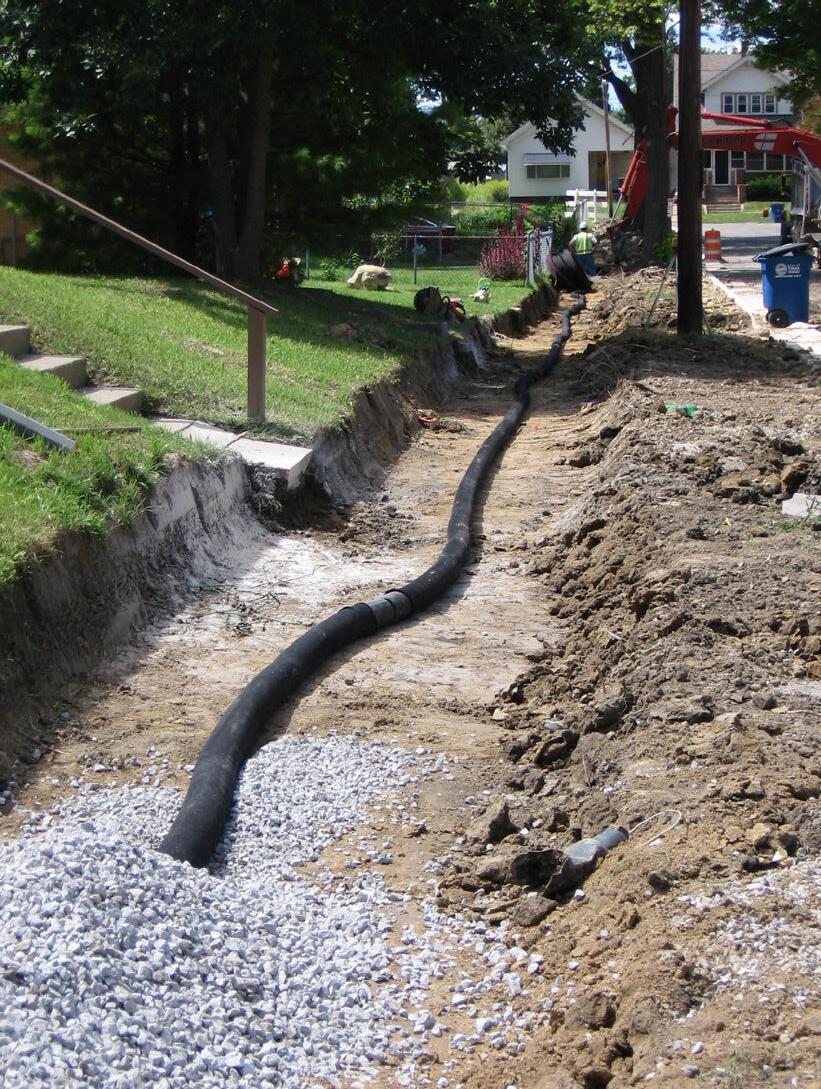
Stormwater management includes structural and non-structural management practices. Structural practices include constructed, excavated, planted, or manufactured elements designed to physically retain, detain, or filter stormwater. Non-structural practices include minimizing earthwork,
protecting watersheds with land use planning or conservation of natural areas. While all approaches are important to successful stormwater management, only structural stormwater management practices are eligible for credit in the proposed revision. This represents a departure from the City of Toledo’s existing credit manual, which includes both non-structural (brownfield reuse) and construction site management practices (sediment ponds).
Non-structural stormwater management practices should be encouraged and regulated through planning and zoning regulations.
We recommend focusing on structural stormwater management practices that clearly link to reductions in runoff quantity or improvements in runoff quality as stormwater utilities have recently come under legal scrutiny.1
The Department of Public Utilities should “grandfather” credits for properties that are currently enrolled in the credit program. Grandfathering these credits gives property owners sufficient time to understand the new credit program before they are required to reapply. While all grandfathered property owners will be required to reapply five years from the adoption of the new credit manual, they have the option to reapply sooner. Upon reapplication, grandfathered properties will be required to comply with all aspects of the updated credit program. Current time-specific credits that should have expired will be terminated with the adoption of the new credit program.
To streamline the program, we divide credits into two main categories: quantity and quality. Quantity credits are awarded for stormwater management practices that reduce the amount of stormwater entering the system. Quality credits reward practices that reduce the amount of pollutants and sediment found in the stormwater runoff from the property. Categorizing stormwater management practices into quantity and quality simplifies the crediting process and allows non-residential property owners the flexibility to implement stormwater management practices best suited to their property, needs, and financial circumstances.
The volume of runoff controlled by a stormwater management practice is the main variable in the quantity credit calculations for the revised credit program. The quantity credit is based on the design storm for which the management practice was designed, so that a larger credit is given to management practices designed to a handle a larger design storm.
The maximum potential quantity credit is 100% of the property fee whereas the maximum potential quality credit is 50% of the property fee. The purpose of prioritizing quantity control measures and offering a higher credit for quantity than quality is to encourage effective on-site management of runoff from large storm events.
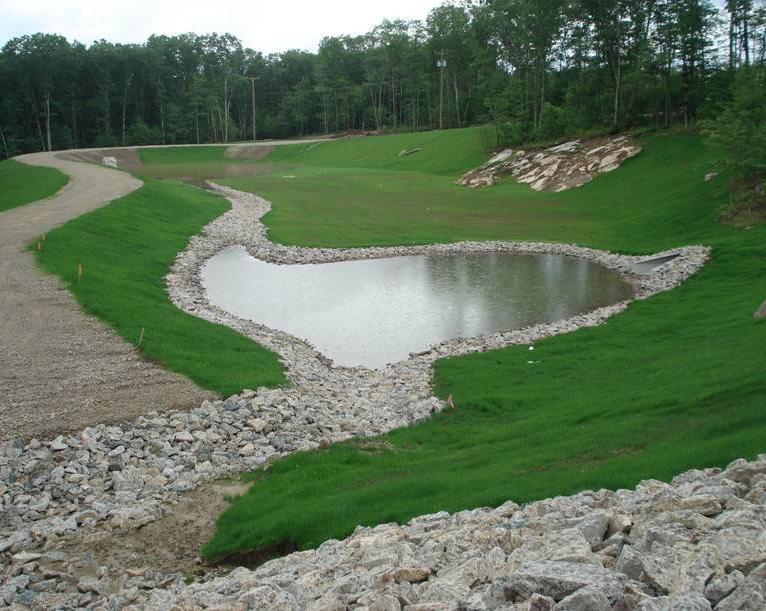
Figure II-3. A detention pond would be one of many stormwater management practices eligible for a quantity credit.C
A design storm refers to the amount of expected precipitation from a given storm event that a stormwater management practice is designed to handle. Extreme precipitation events are captured with this approach. Therefore, a 100-year design storm is designed to
handle stormwater runoff from a 100year storm as well as any lesser storm. Storm events are also categorized by duration. For the purposes of Toledo’s Stormwater Credit Program, design storm credits are based on a 24-hour period.
Improving the quality of stormwater runoff is also important. Pollutants in stormwater runoff contaminate the regional water supply. This is particularly citical in Toledo where Lake Erie supplies the city’s drinking water.
Some stormwater management practices are more effective at eliminating toxins than others. For this reason, stormwater quality management practices are classified based on two categories: filtration and sediment removal (Category A) or only sediment removal (Category B). This categorization is based on the “EPA Stormwater Menu of BMPs” assessment of management practice effectiveness.2 Stormwater management practices that are classified in Category A are characterized by efficient filtration techniques, which remove greater than 50% of soluble toxins, including
nitrogen, phosphorous, and metals. Category B identifies management practices that are effective at removal of sediment and oils. Our categorization gives customers greater incentive to implement Category A stormwater management practices that are more effective at toxin removal.
Table 1 identifies the approved stormwater management practices and whether they address quantity concerns, quality concerns or both. Additional management practices not noted in this list can also receive credit upon approval from City staff.
Management Practices that Address Quantity and Quality
Stormwater management practices that qualify as both quantity and quality practices may receive credit under both classifications. Also, non-residential property owners can implement multiple management practices to earn credits for both quantity and quality management. As previously noted, the maximum allowable credit is 100% of the property fee portion of the participant’s stormwater utility fee; participants cannot receive credit beyond that amount.
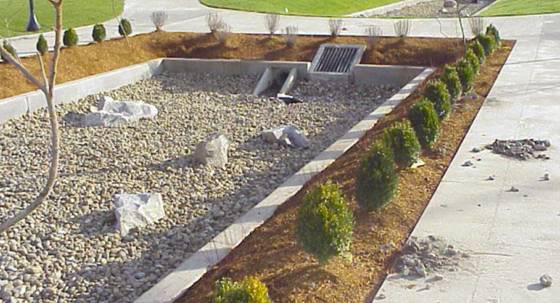
Table 1: Approved Stormwater Practices by Quantity and Quality
Expiration and Reapplication
All credits will be awarded for five years. This minimizes the administrative burden placed on City staff while ensuring that credits are not awarded indefinitely. Credits should not be awarded indefinitely because stormwater management practices require appropriate maintenance to functioning properly. Three months prior to credit expiration, participants
should be notified and encouraged to reapply for the credit. If the stormwater management practice or the impervious surface controlled by the management practice remains unchanged, the owner may submit a simple reapplication form. However, if changes are made to the stormwater management practices or to the impervious area controlled by the management practice, a new application must be submitted.
Similar to the initial application, all management practices should be inspected to ensure their compliance.
In addition to inspection upon (re)application, all stormwater management practices should be subject to random inspection at the discretion of City staff. By ensuring that management practices undergo regular maintenance to maintain proper functionality, staff will also ensure that the overarching goals of the credit program are achieved: reduction of the quantity and improvement of the quality of stormwater runoff.
Under the City of Toledo’s development guidelines, new developments must be designed to manage stormwater runoff from a 25-year, 24-hour design storm. Newly developed properties will, therefore, be eligible for a stormwater utility fee credit. Their eligibility is beneficial for two reasons. First, it may lessen the long-term costs of new development by reducing a property owner’s stormwater utility fee. Second, the inspection requirements described above will encourage
appropriate maintenance of stormwater management practices that will be implemented regardless of the property owner’s participation in the credit program. Thus, by allowing participation in the credit program, the City can also ensure proper maintenance of the installed stormwater management practices. If management practices do not function properly or are not maintained they will not be eligible for stormwater credits.
Section II - 44
Stormwater challenges are not evenly distributed throughout the City of Toledo. Land use, imperviousness, topography, and sewer system type all affect the quality and quantity of stormwater runoff. Because different areas of Toledo display different conditions, some will benefit more than others from implementation of stormwater management practices.

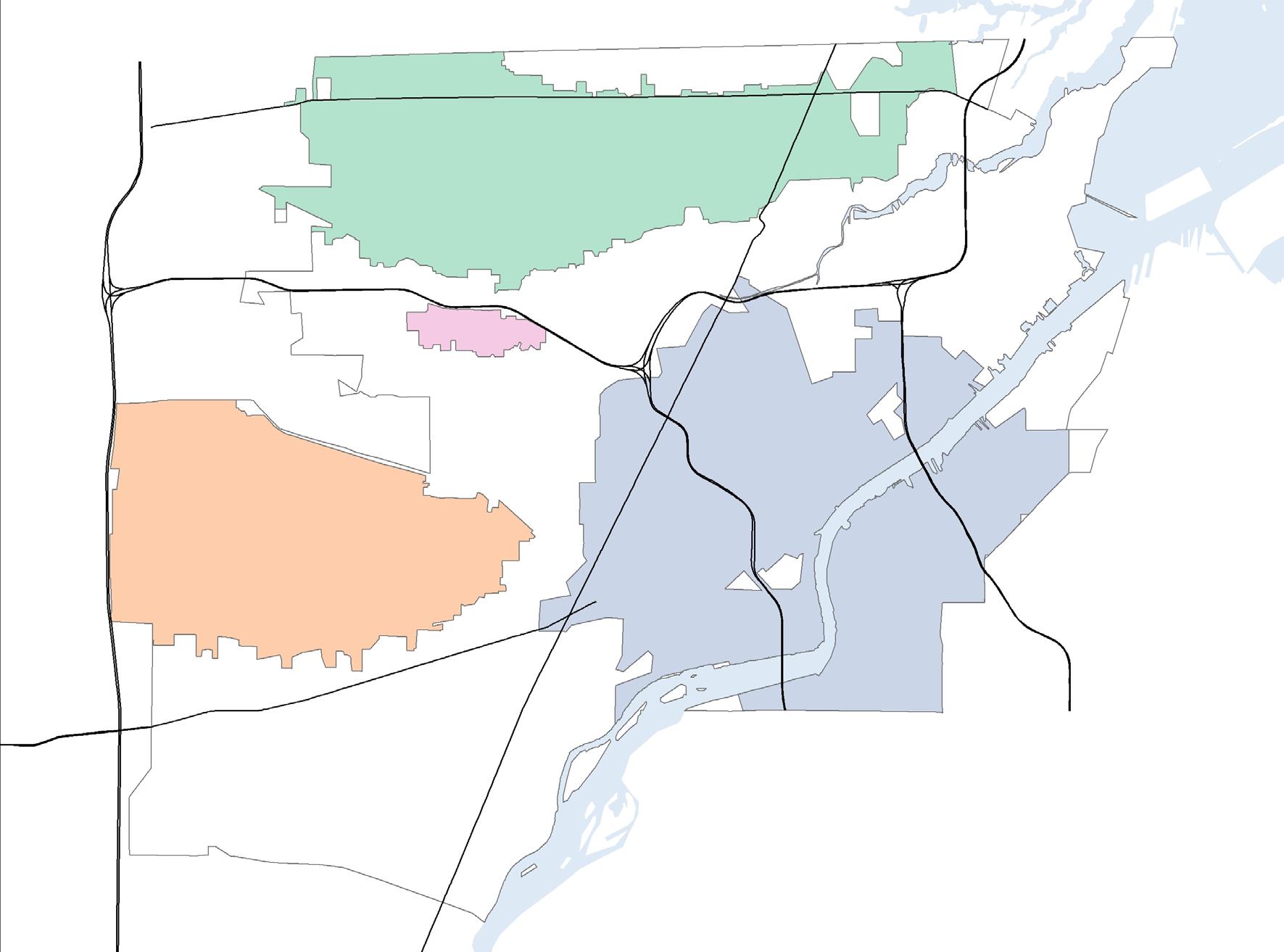
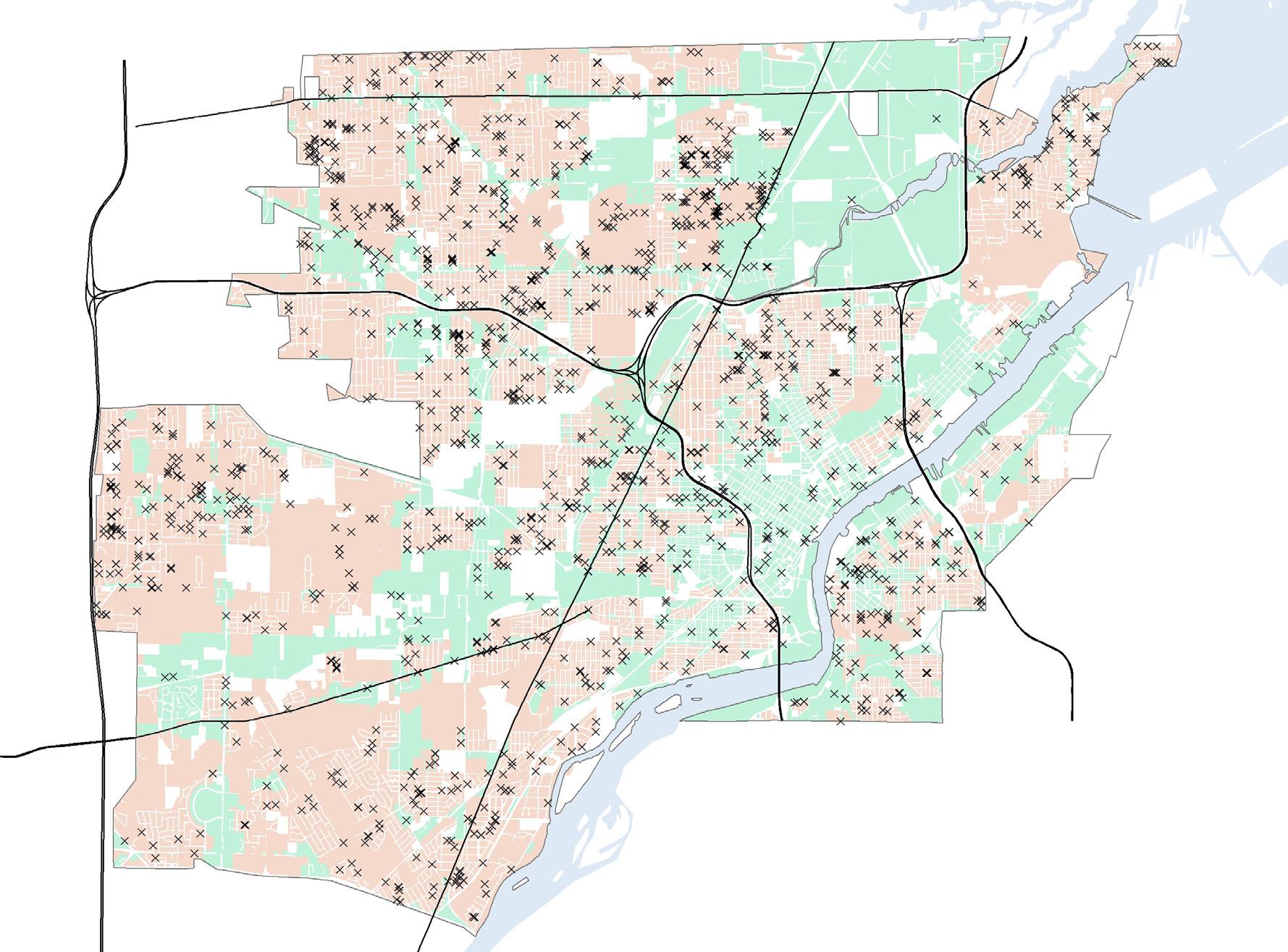
By analyzing these conditions, we identified four priority zones in which stormwater management practices should be encouraged. Priority zones are depicted in Figure II-5.
The concept of a drainageshed was key to the determination and delineation of the priority zones. A drainageshed is similar to a watershed: stormwater that falls into a given drainageshed runs into the same drainage system. To reduce


the volume of stormwater runoff in specific areas prone to flooding or vulnerable to combined sewer overflow (CSO) events, it is useful to target the entire drainageshed that encompasses that area.


Flood events Jan ‘05 to Feb ‘11 X
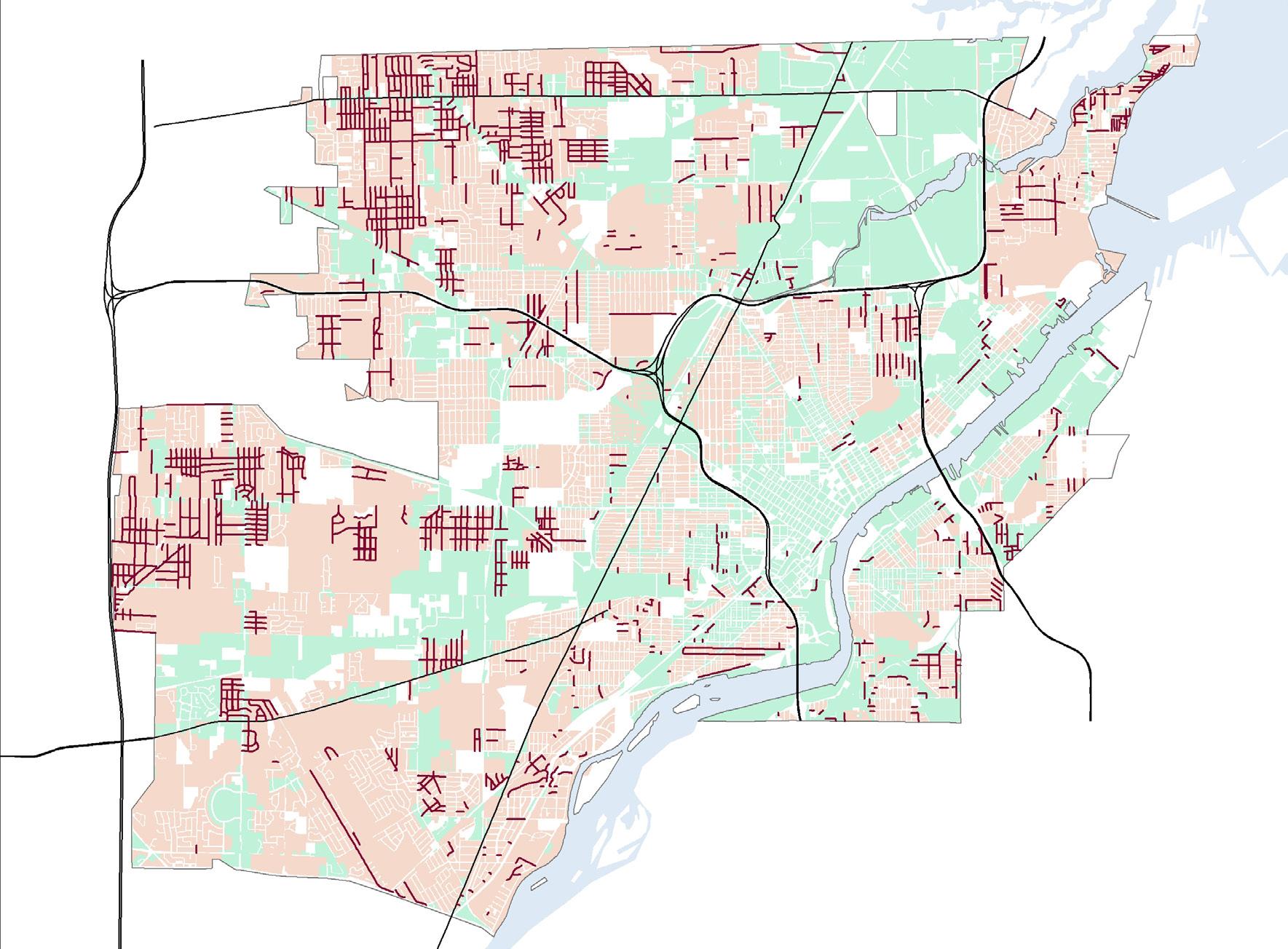
As an area’s impervious land cover increases, it will produce more stormwater runoff. We used impervious land cover from the National Land Cover Database, the location of flooding events, and unimproved streets, as well as the location of the City’s combined sewer and stormwater system to identify our proposed priority zones.4
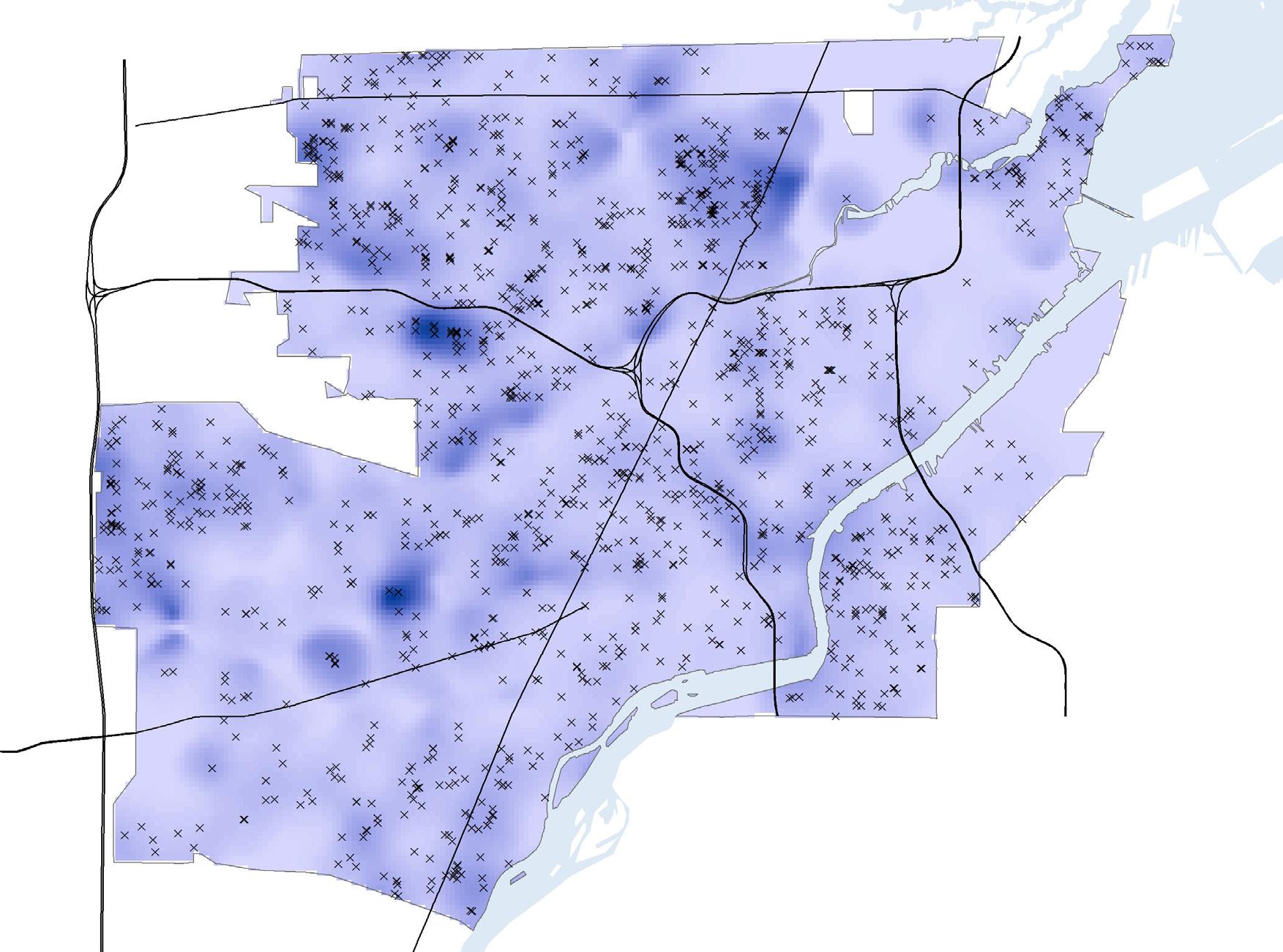
We identified areas of flooding concern by analyzing past flooding events and the location of unimproved streets. Flood event locations are mapped in Figure II-6, and normalized by parcel density in Figure II-7. Unimproved streets are especially vulnerable to flooding because these areas lack drainage infrastructure. Figure II-8 identifies unimproved streets.
Figure II-9 illustrates the land use pattern of the City, specifically differentiating residential and non-residential land uses. This data allows for assessment of the spatial pattern of impervious area and flood events in relation to targeted credit program participants. Impervious areas throughout Toledo are depicted in Figure II-10.
Several areas in Toledo are prone to flooding events. Areas of particular concern are located downtown and in the northern, northwestern, and western parts of Toledo. Specific sections within these areas have flood event densities close to 150 flood events per 1000 parcels. This is ten times higher than the City’s average of 15 flood events per 1000 parcels.
Combined sewer and stormwater systems can result in CSO events that negatively impact local water bodies. The area in Toledo served by a combined sewer system is also identified as a priority zone. This area is identified in Figure II-11.

II-7. Flood event locations in Toledo normalized by parcel densityG
0 2 mi. 4 mi.
Flood Events Jan ‘05 to Feb ‘11 X
Flood events per parcel

High: 0.16
Low: 0
Section II - 48
2 mi. 4 mi.

Unimproved Streets
Non-residential
Residential
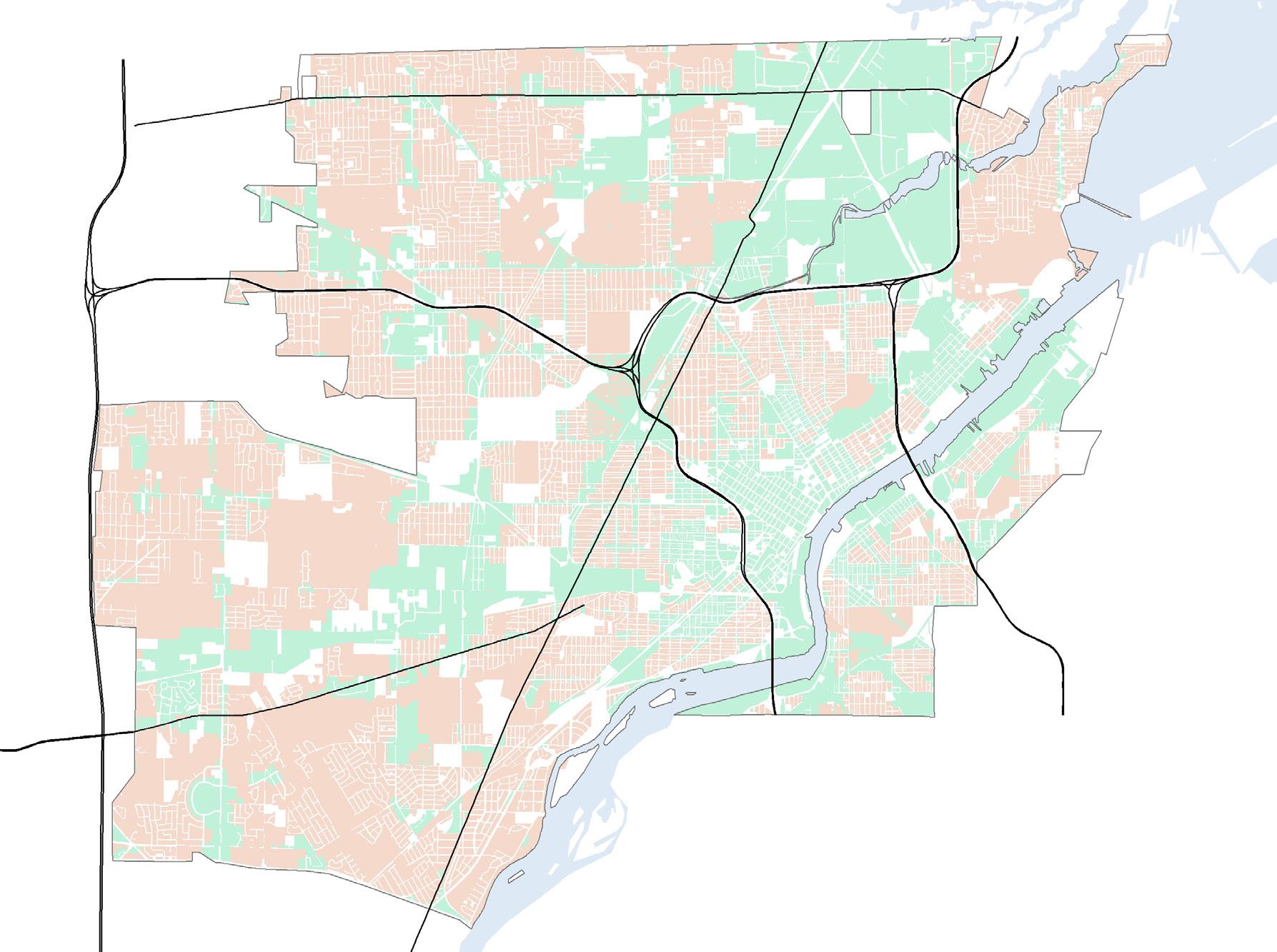
II-9. Residential and non-residential land use patterns in ToledoI

Section II - 50
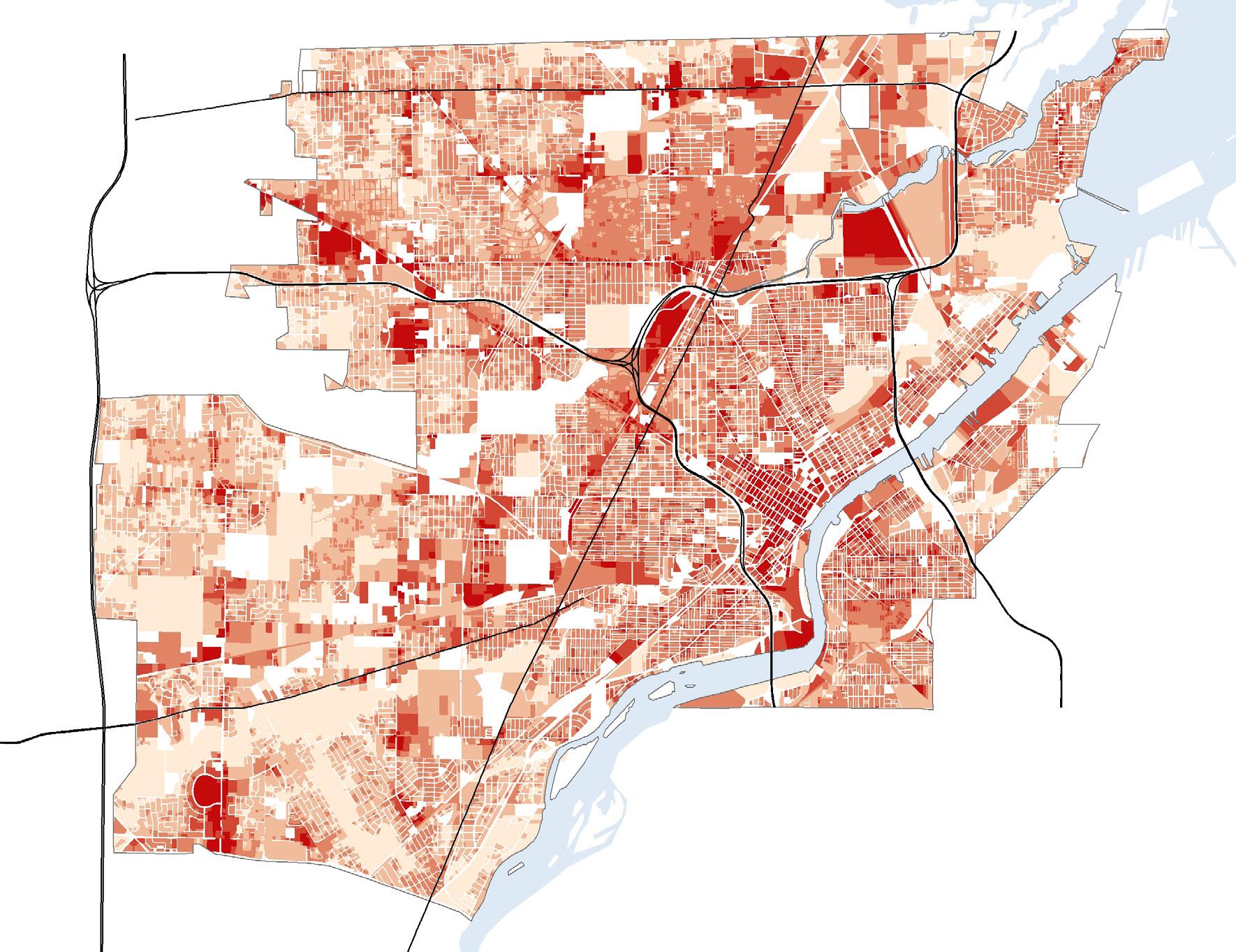
0 2 mi. 4 mi.
Imperviousness (%) in Toledo

0 - 20
21 - 40
41 - 60
61 - 80
81 - 100
Section
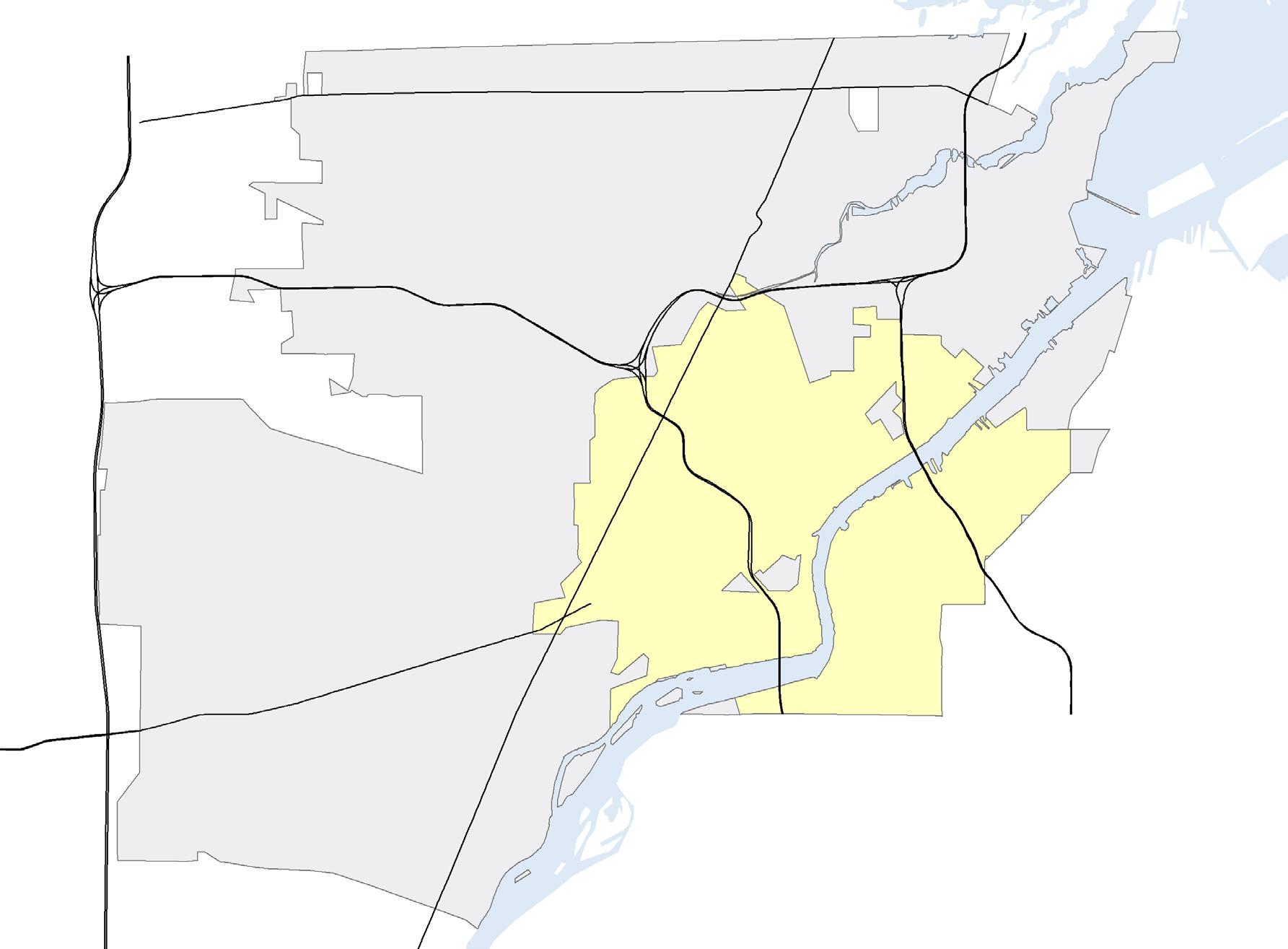

Major Roads
Combined Sewer System
City of Toledo
Section II - 52
Table 2 depicts the characteristics of each priority zone in comparison with the average figures for the City of Toledo.
The priority zones are described in detail below.
Table 2: Characteristics of Each Priority Zone in Toledo Section
The West area is a priority zone because of its susceptibility to flooding events. It has a higher than average flood event density throughout the zone and contains an especially dramatic flood event “hot spot” that can be seen by the dark spot in Figure II-13.

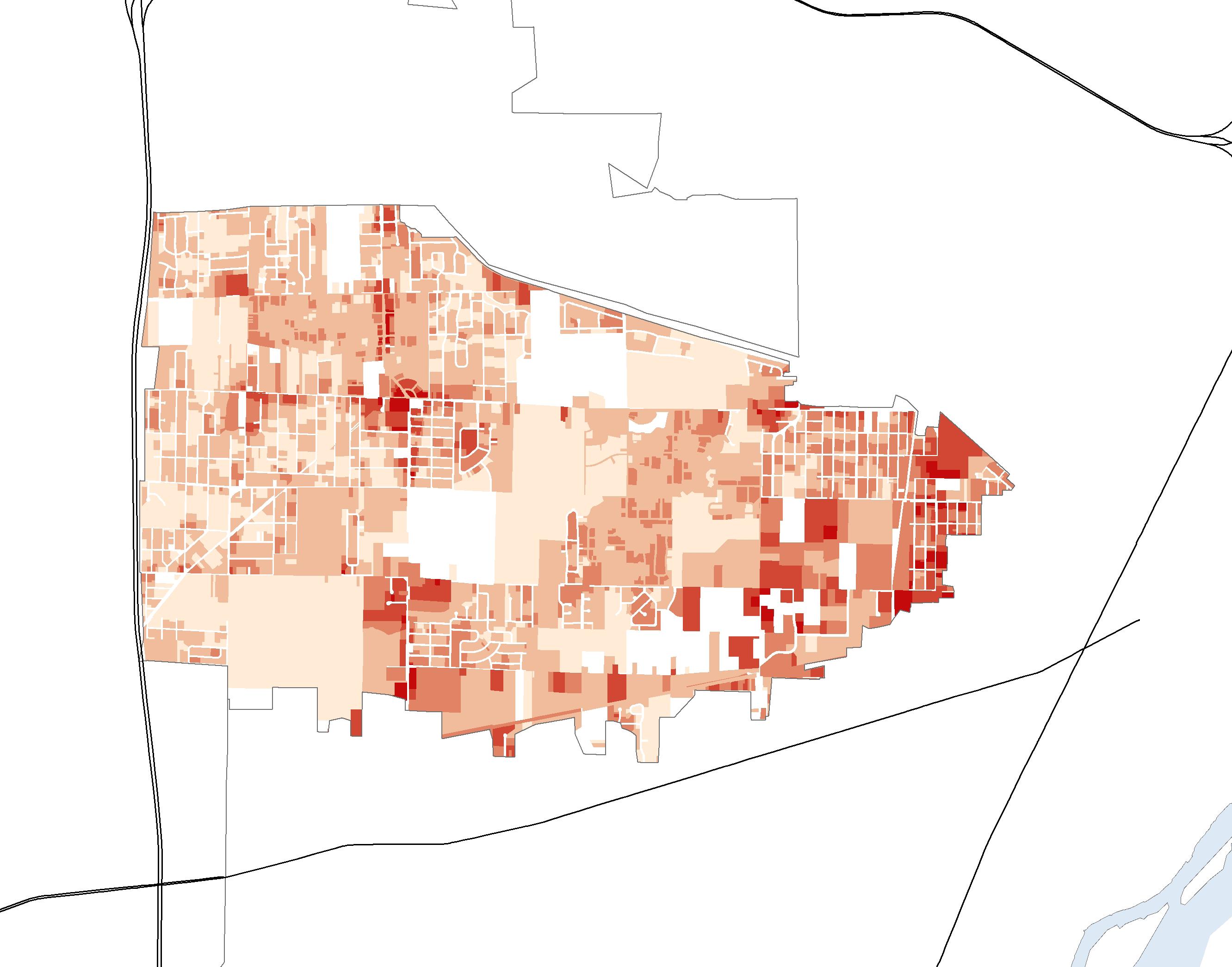
Imperviousness (%) in West Priority Zone
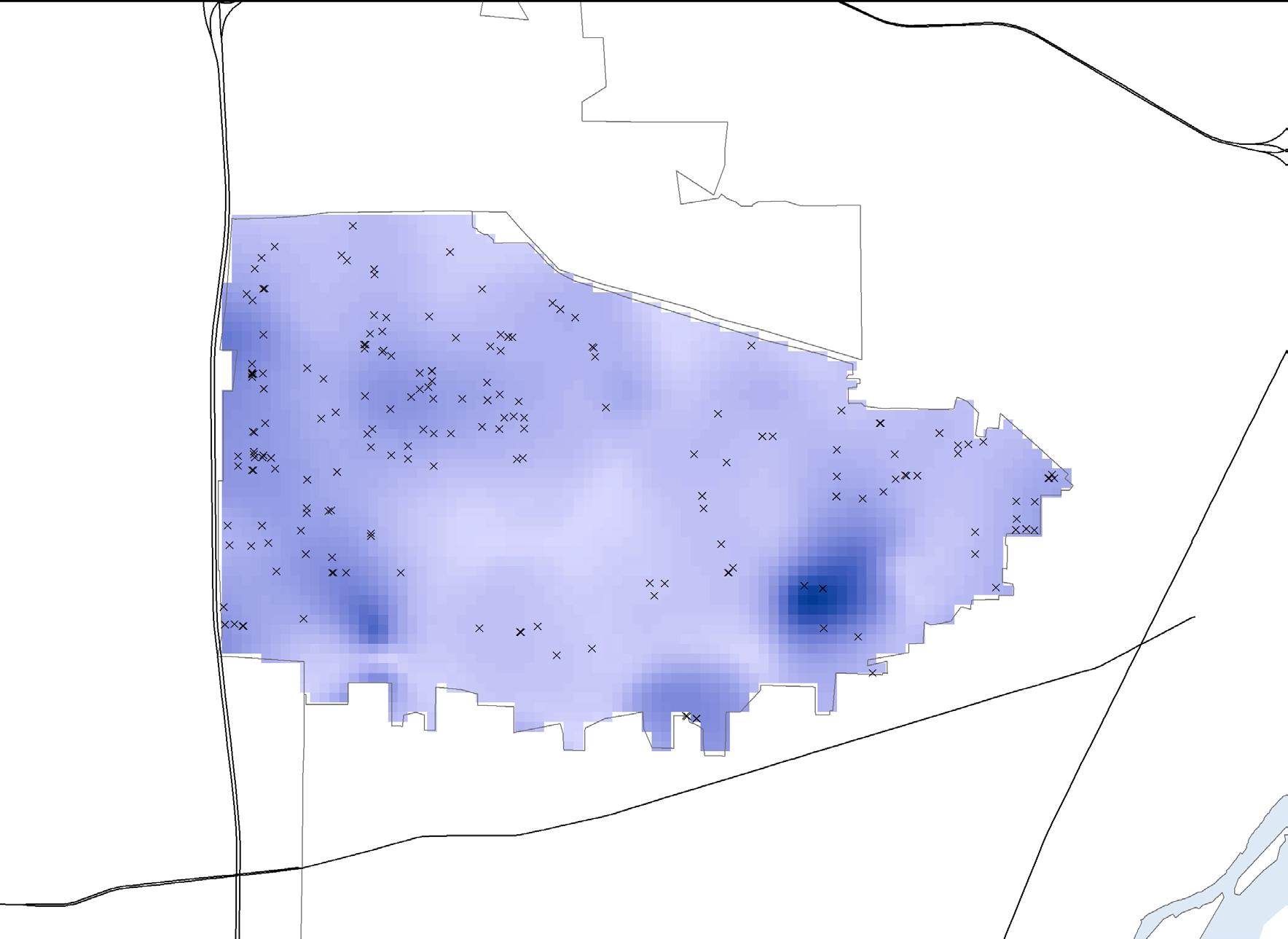
Figure II-13. Flood event locations in the West Priority Zone normalized by parcel densityG
1 mi. 2 mi.
Flood Events Jan ‘05 to Feb ‘11 X
Flood events per parcel High: 0.16 Low: 0
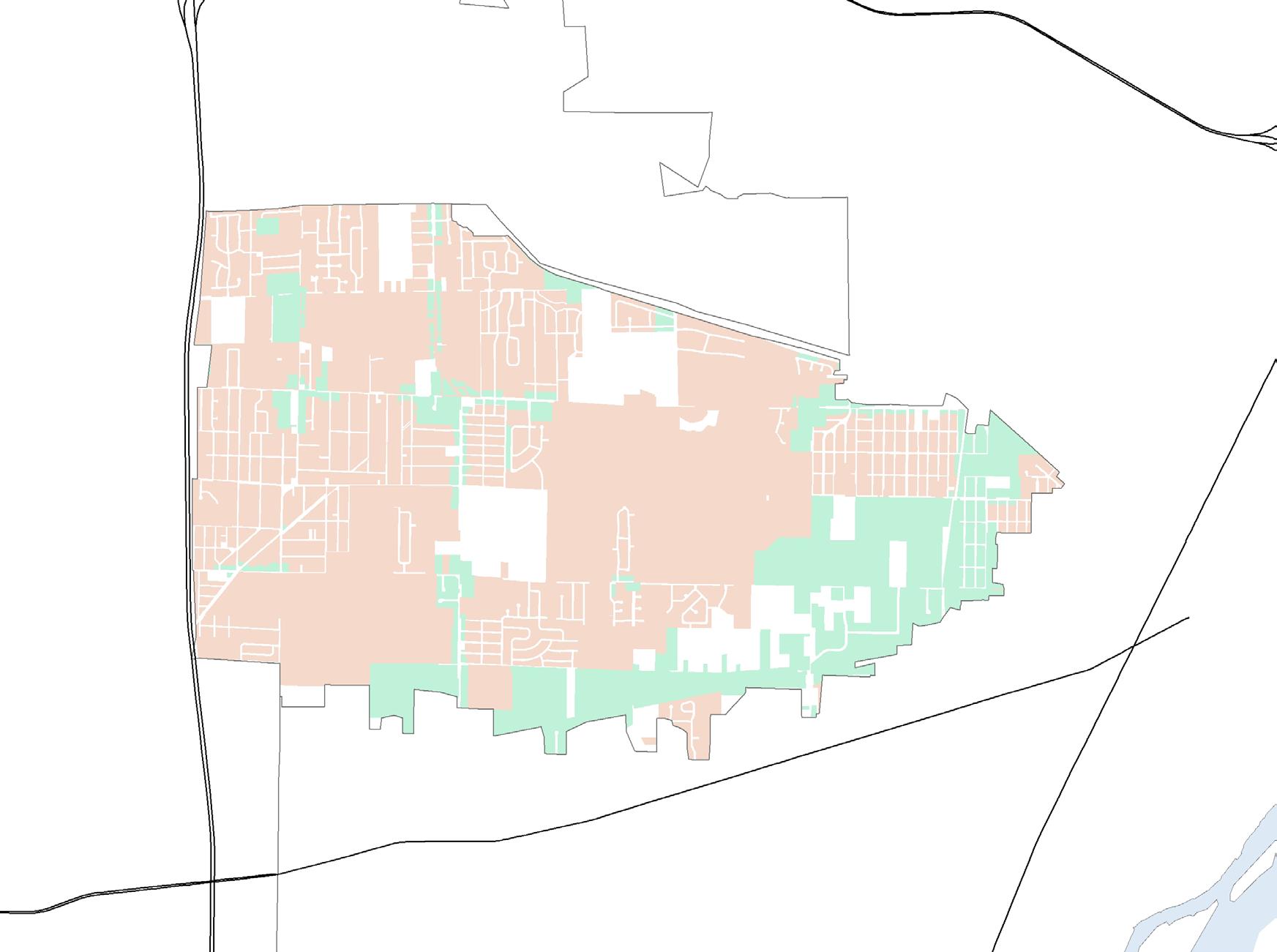
II-14. Residential and non-residential land use patterns in the West Priority ZoneI
Section II - 56
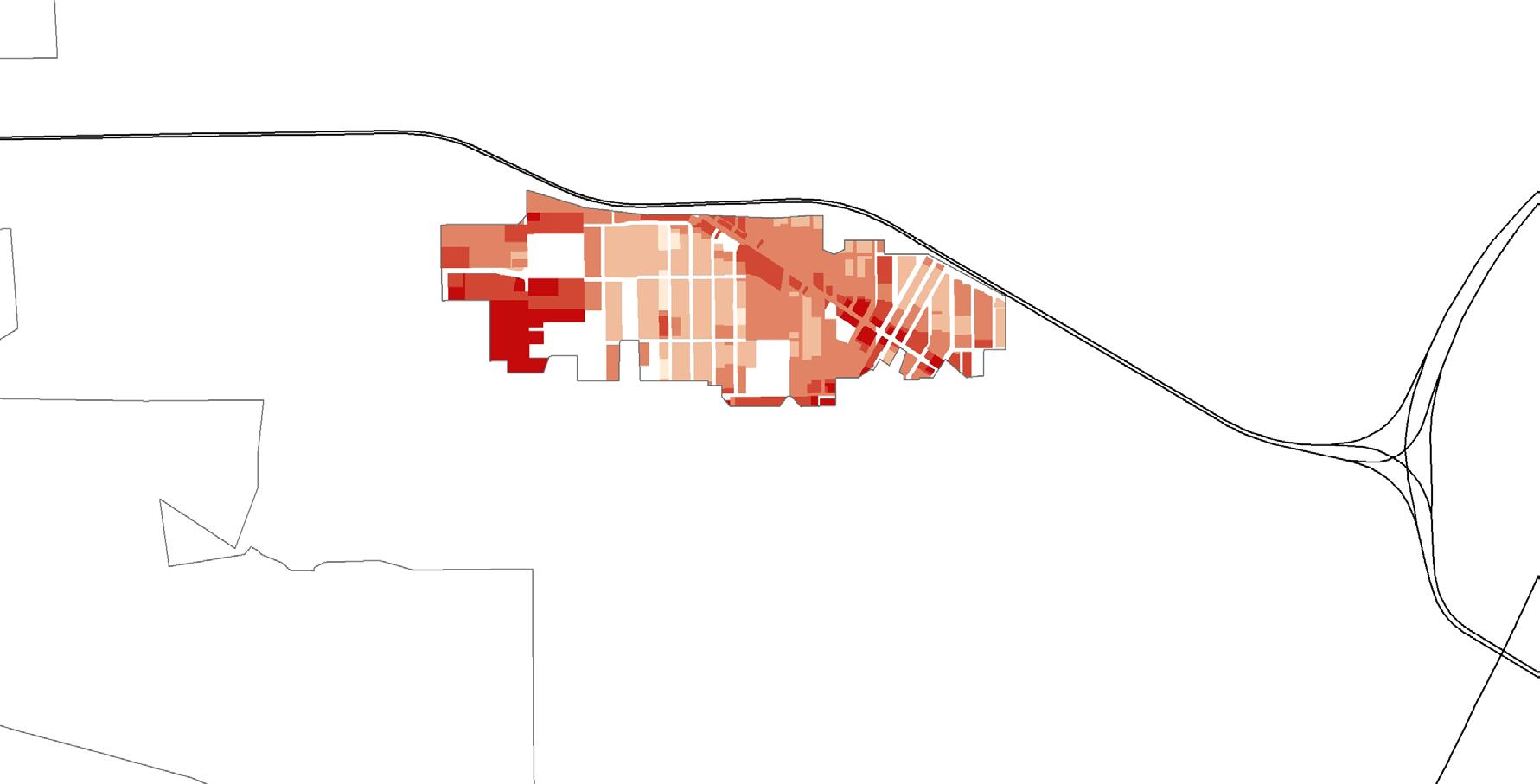
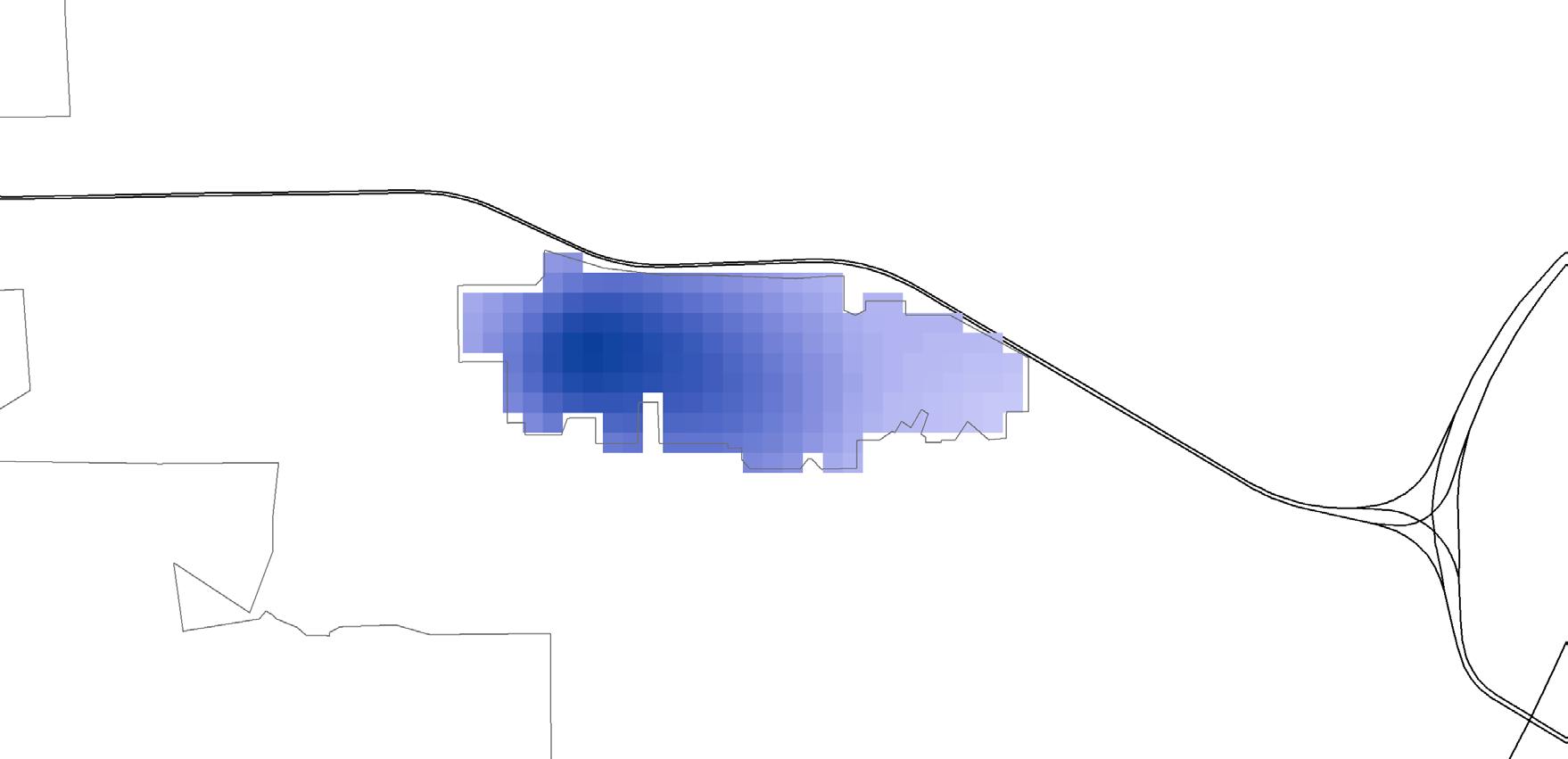
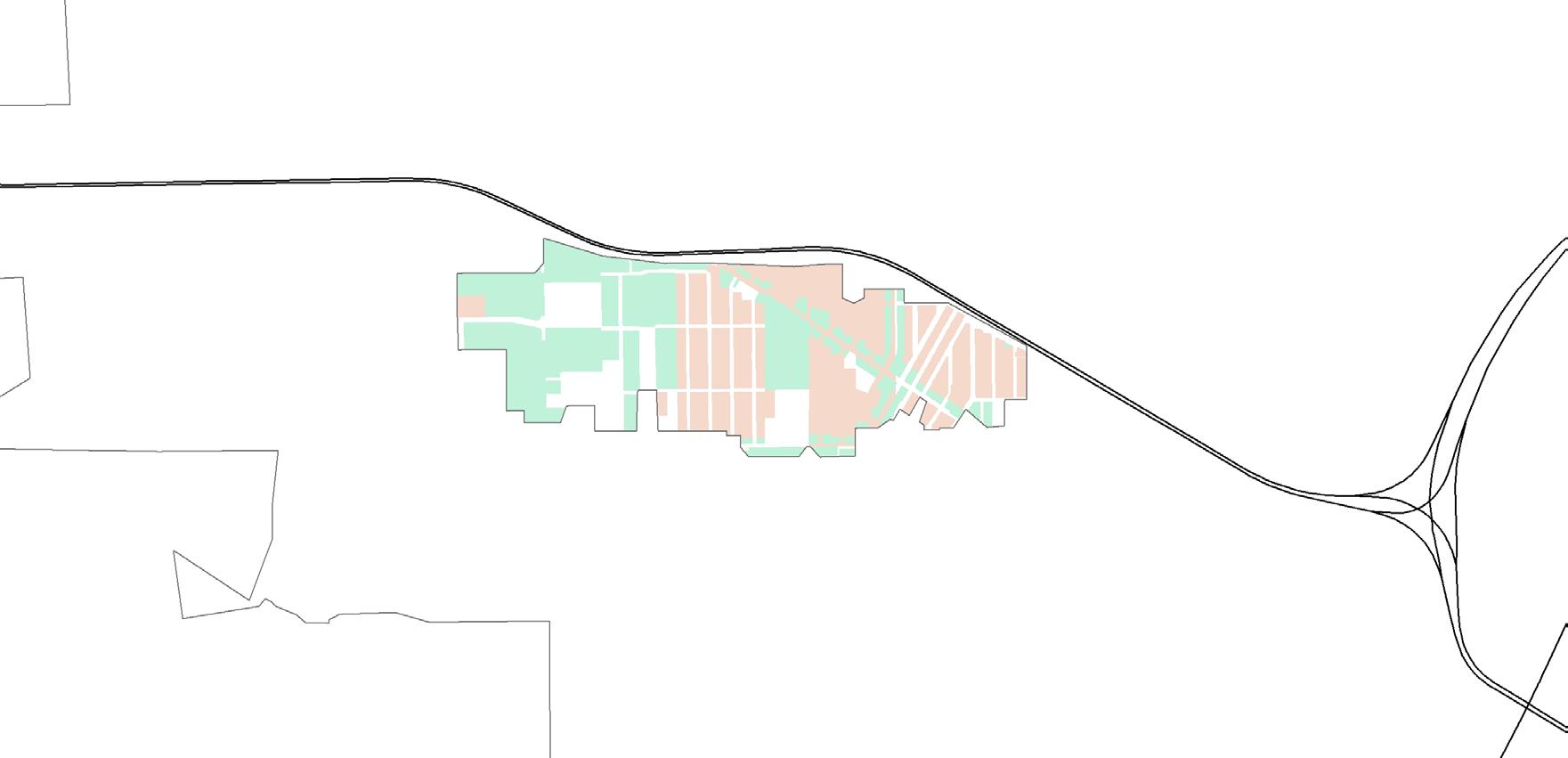
The Mid-North Priority Zone also displays an extremely high flood event density. Additionally, the average percentage of impervious land cover is higher than that for the city and it is in one of the city’s lowest elevation points.

Flood Events Jan ‘05 to Feb ‘11 X
Flood events per parcel
High: 0.16
Low: 0
II-16. Flood event locations in the Mid-North Priority Zone normalized by parcel densityG
Non-residential
Residential
II-17. Residential and non-residential land use patterns in the Mid-North Priority ZoneI
Section II - 58
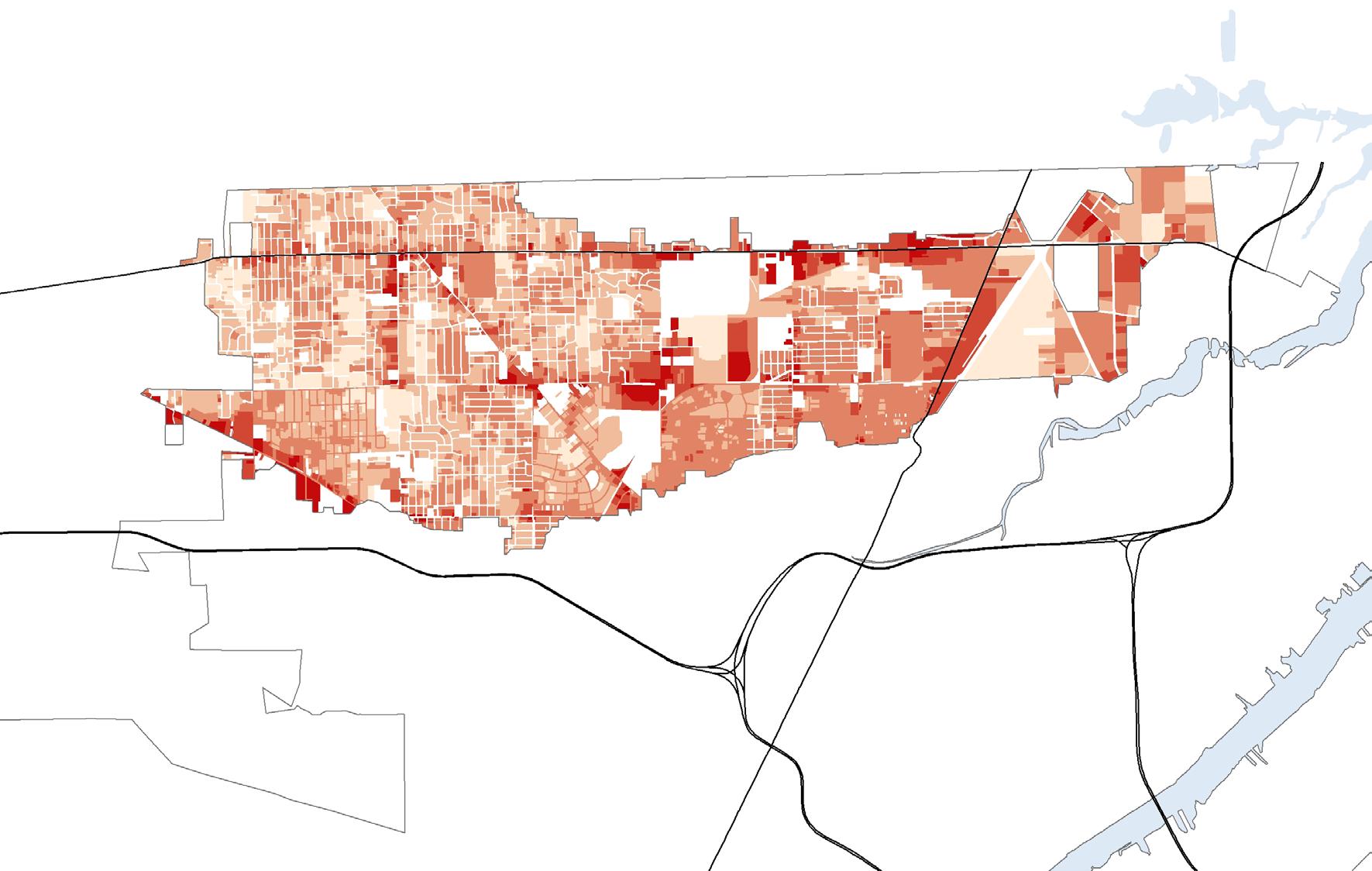
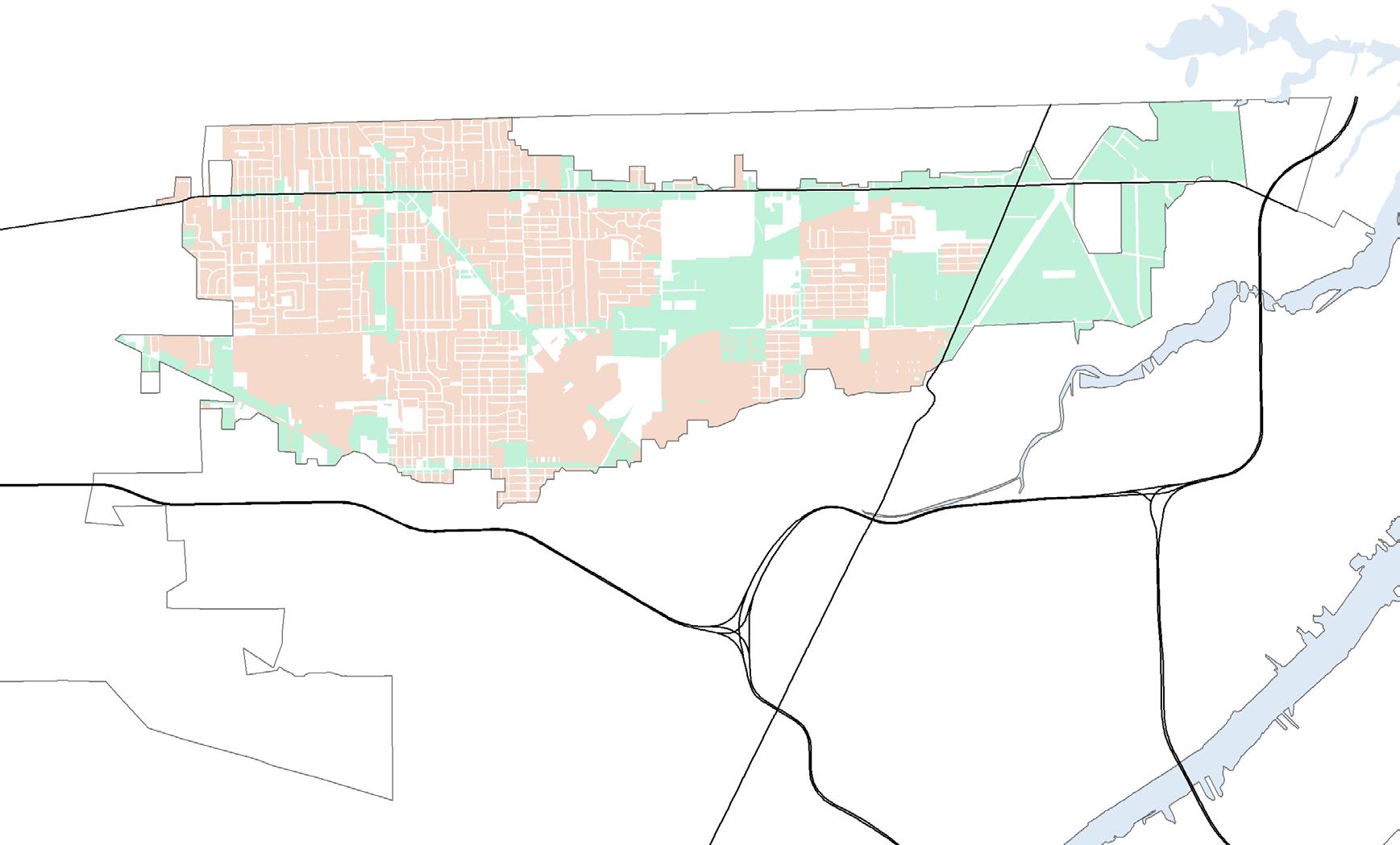
The North Priority Zone has a higher than average flood density and higher than average impervious land cover when compared to city averages.
Flood Events Jan ‘05 to Feb ‘11 X
Flood events per parcel
High: 0.16
Low: 0
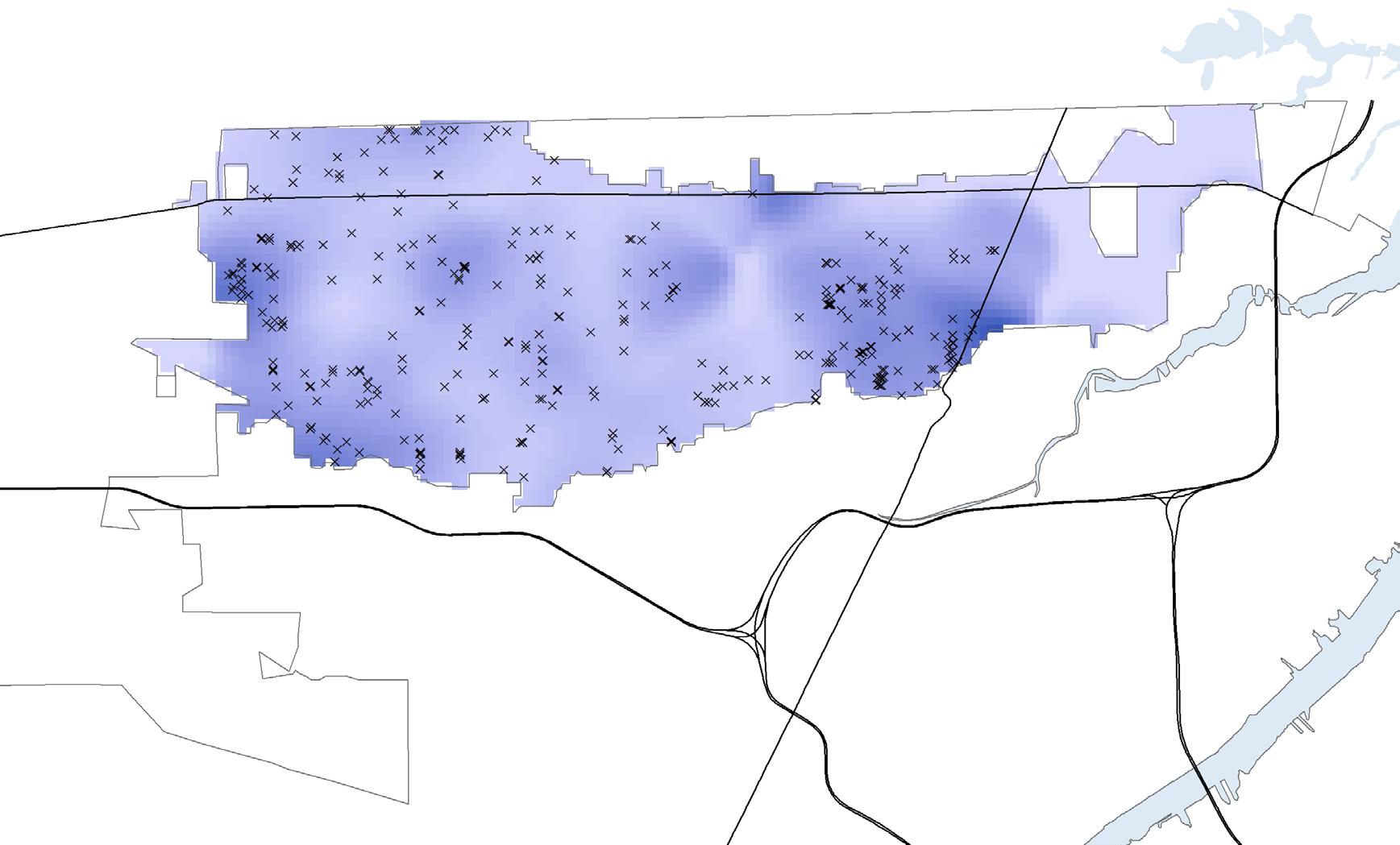
Figure II-19. Flood event locations in the North Priority Zone normalized by parcel densityG
Non-residential Residential
Figure II-20. Residential and non-residential land use patterns in the North Priority ZoneI
The Combined System Priority Zone is the area of Toledo that contains the combined sewer and stormwater system. Overload of this system during intense storm events results in discharge of untreated sewage into local water bodies. Average flood event density and average impervious land cover are also higher in this area than citywide averages.

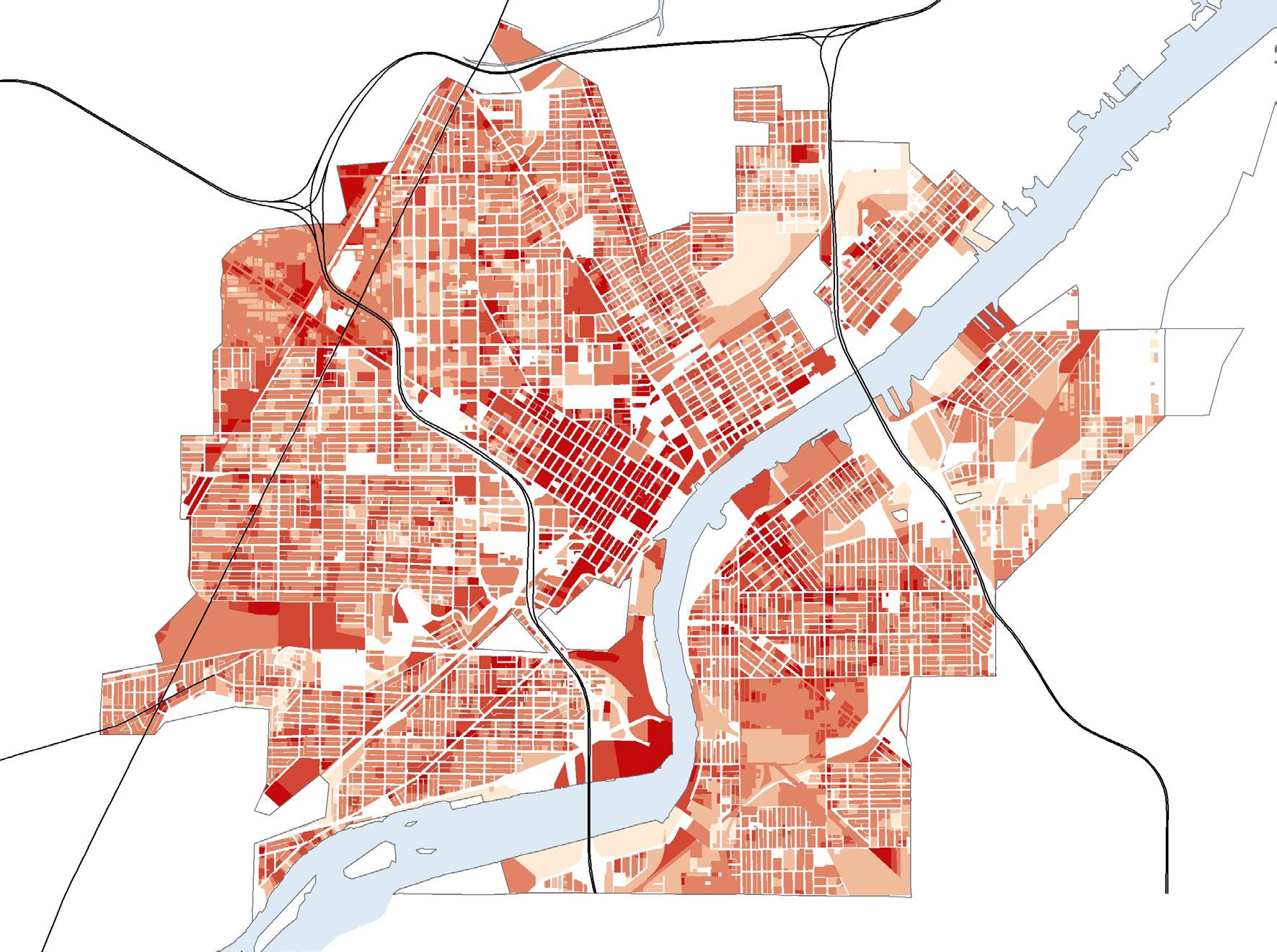
Imperviousness (%) in Combined System Priority Zone
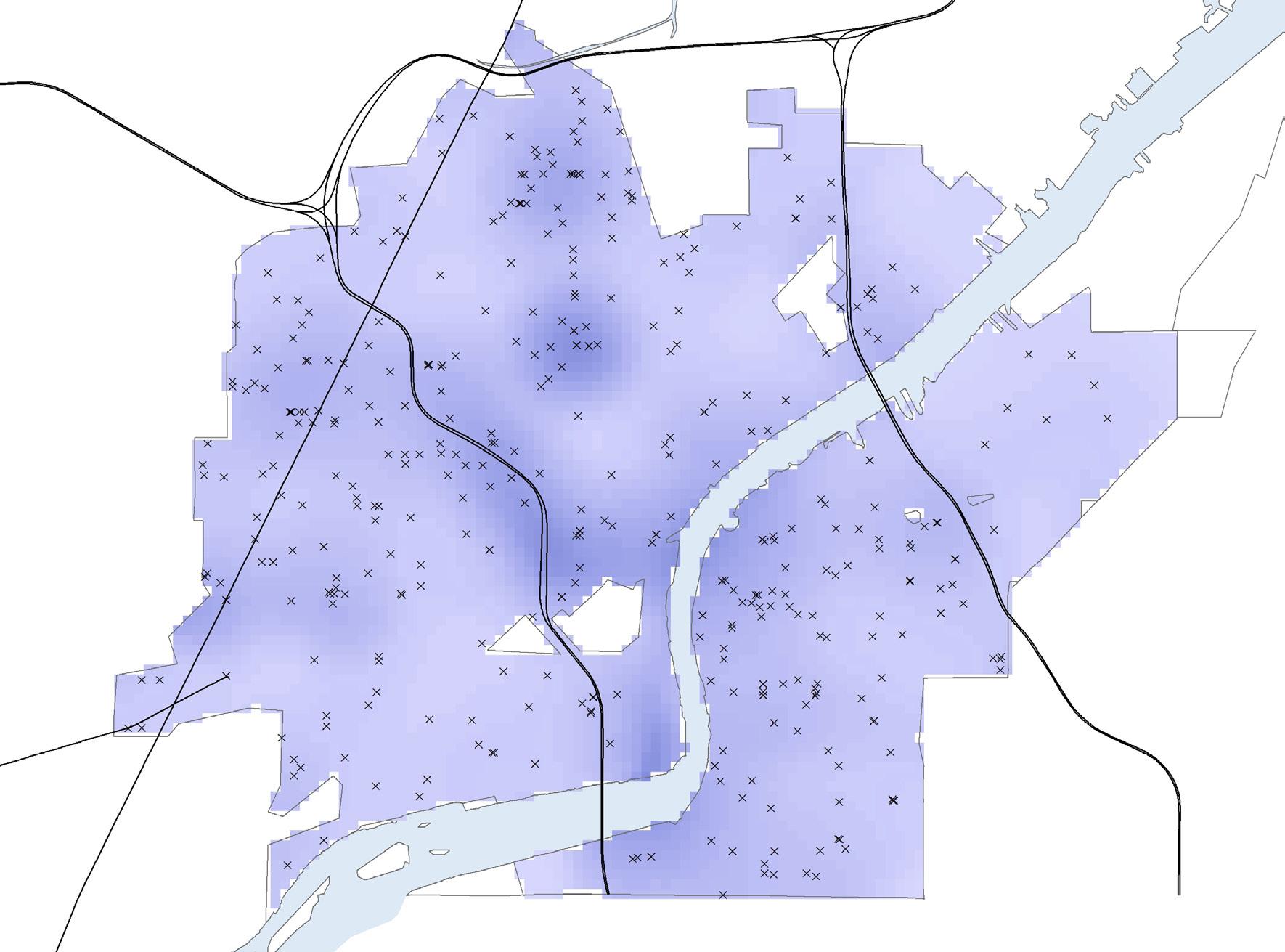
Figure II-22. Flood event locations in the Combined System Priority Zone normalized by parcel densityG
Flood Events Jan ‘05 to Feb ‘11 X
Flood events per parcel
High: 0.16
Low: 0 0 1 mi. 2 mi.
Section II - 62
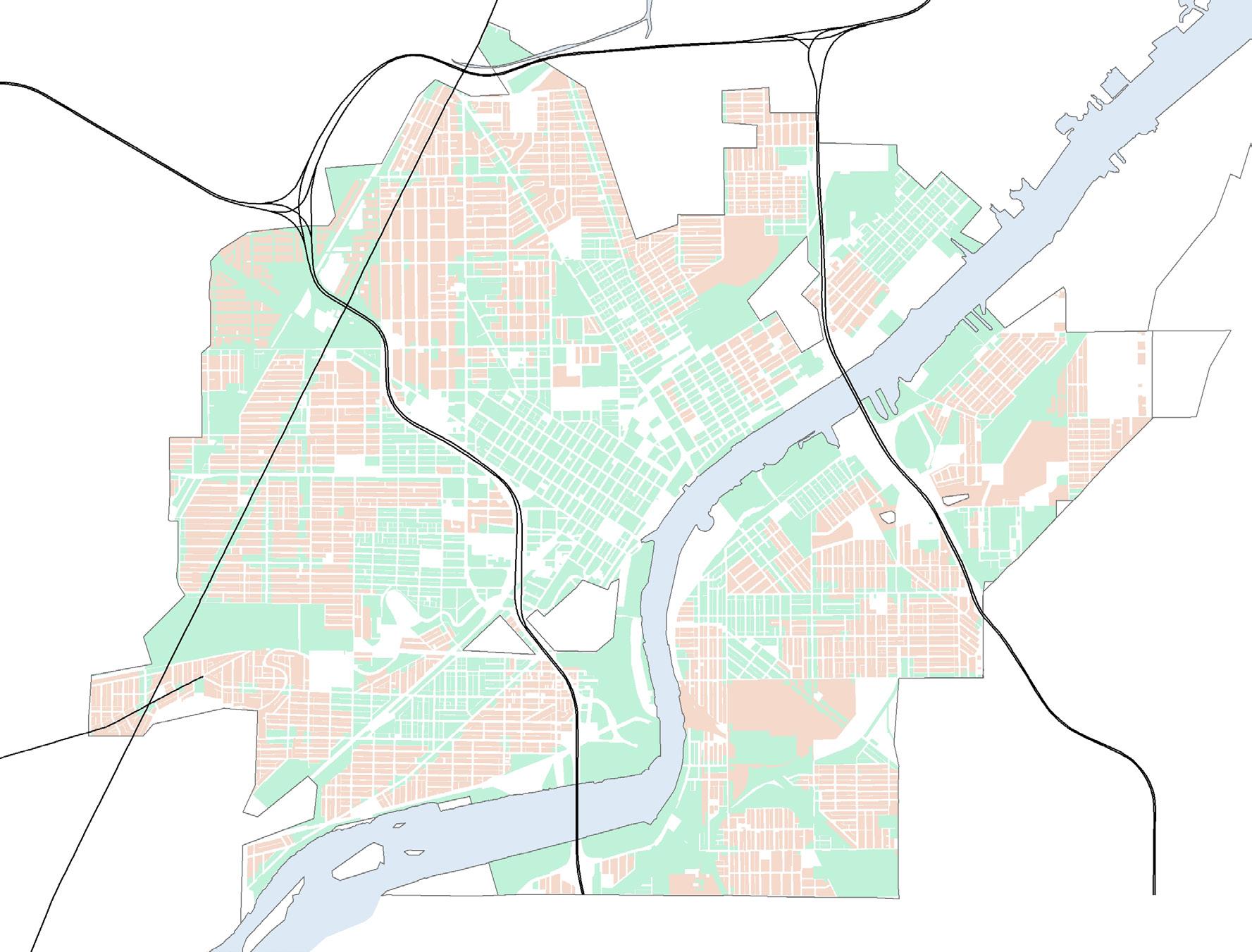
Figure II-23. Residential and non-residential land use patterns in the Combined System Priority ZoneG
Each priority zone was selected because it contains some of the City’s greatest flooding. The implementation of stormwater management practices in these areas will yield the greatest stormwater quantity and quality benefits.
Below is a checklist for implementing the proposed changes to the stormwater credit program. This is a general checklist and is by no means a comprehensive and final list. Certain action items should be customized or changed when and where appropriate based on staff and software capacity, existing systems, and priorities.
_____ Set “Fixed fee” cost: This is a flat fee that all non-residential property owners will have to pay, regardless of the credits they receive. This should be set based on administrative/overhead costs for the stormwater utility.
_____ Update customer utility bill to include:
_____ Separate fees: Fixed fee, Property Fee (based on ERUs) and Total Stormwater Utility Fee
_____ An ERU line (Line that says “Property ERUs= XX”)
_____ A credit expiration date (“Credit expires XX/XX/XXXX“ on bills of credit participants)
_____ A savings awareness line (“You are saving $XX” – this should include amount of money being saved through the credit program. This will read $0 if not using the credit program)
_____ Set up system (Campaign/Project/Fields within non-residential property owner records or whatever record keeping system works best) that will specifically indicate what non-residential property owners are participating in the credit program. The goal is to make it easier for credit program managers to run reports on program participants and metrics).
_____ Important fields to include:
_____ Application date
_____ Approval date
_____ Expiration date (can change if/when reapplication occurs)
_____ Reapplication date
_____ Credit receiving:
_____ Quantity (%)
_____ Quality (%)
_____ Priority Zone (%)
_____ Area controlled by BMP(s)
_____ Total Credit
_____ Grandfathered (Yes/No check box)
_____ Description of grandfathered credits (This can be a text box with attachments allowed)
_____ Expiration date
_____ Supporting documents (It should be easy to attach important documents, such as applications, etc.)
_____ Other notes (A text box for miscellaneous notes)
_____ Inspection dates (There should be a way for City staff to record the date that the property was inspected, record any notes and any follow up. These fields should be coordinated with the Division of Engineering Services)
_____ Tasks should be assigned to these records
_____ EXAMPLE: Work with billing to take credits off when they expire
_____ Verify Priority Zones are aligned with parcel data so it is clear what properties fall within each zone
_____ Update impervious surface/ERU information and make sure it aligns with billing
_____ Create interactive map of priority zones to be displayed on the City website
_____ Make credit manual easily available on website with unique URL
_____ Make application and reapplication documents easily downloadable on their own
_____ Future Website updates
_____ Turn manual pages/sections into website pages
_____ Build application page into website so applications (and supporting documents) can be easily submitted electronically
_____ Ensure environmental service contact information (phone and email) is easy to find
_____ Over the course of first year of implementation, efforts should be made to contact existing users of the credit program to notify them of changes and of the grandfathering clause .
_____ The Divisions of Engineering Services and Environmental Services should coordinate a strategy to spread awareness about the newly revised program.
Recommendations are divided into two main categories. The first category pertains to suggestions and strategies for strengthening the effectiveness of the stormwater utility and credit program. These include: refined calculations of stormwater revenues and costs; improvements to the stormwater utility billing process; and, a schedule of regular updates to the stormwater credit program. The second category of recommendations focuses on building awareness and participation in the City of Toledo’s stormwater credit program. Increased program participation, especially by large non-residential properties, could significantly impact the quantity of stormwater runoff and the quality of local water bodies. Participation will also enhance visibility and awareness of stormwater management concerns among the business community in Toledo.
We recommend that members of the Toledo community should be educated about the importance of stormwater management and encouraged to participate in watershed stewardship. We suggest the City pursue outreach
and education programs for both residential and non-residential property owners. Partnerships with local water quality organizations can help establish stormwater and watershed management as a local priority. Finally, given Toledo’s large amount of residential land use, we encourage the City to implement a residential incentive program to offer all property owners the opportunity to actively engage in stormwater management.
Accurate accounting is crucial to the long-term success and fiscal health of the stormwater credit program and the overall stormwater management system. Stormwater utility fees should cover the maintenance, repair, and replacement of stormwater infrastructure in addition to costs associated with the expansion and improvement of the overall stormwater system. As a result, we strongly recommend that the Department of Public Utilities reassess its stormwaterrelated revenues, costs, and billing.
Section II - 66
It is critical for City administrators to understand exactly how much revenue is generated by stormwater fees. Accuracy is particularly important to reduce the potential for litigation as stormwater utilities have recently come under increasing legal scrutiny.5
Appropriate City departments should determine per gallon costs of stormwater management and treatment. These costs should be used to determine current and future stormwater rates. Identifying the precise cost of stormwater treatment and operation ensures that stormwater utility fees cover the reliable operation and expansion of the stormwater management system.
Transparency
Clarifying how revenues from stormwater utility fees are distributed amongst City departments and divisions would improve the transparency of the stormwater utility program.
Based on our initial review of the existing credit program participants,
there appear to be inconsistencies in customer billing. Future changes in the billing system (possibly in conjunction with the new CityWorks program) may help rectify previous billing problems and improve the billing process moving forward.
To encourage participation in the stormwater credit program and to provide transparency to participants, the Department of Public Utilities should include information about stormwater credits on stormwater utility bills. Alterations to the bill format could display the amount of credits and savings customers receive due to participation in the credit program. This suggestion is detailed further in Outreach and Education section below
Regular updates should be built into the administration process. Regular updates to the program will allow unsuccessful elements of the program to be improved upon or phased out with adequate notice to credit program participants. Below is a recommended schedule of updates for the stormwater credit program.
The credit manual should be updated any time stormwater utility fees are changed or contact information needs to be updated.
Credit program records should be reconciled with billing department records to ensure the proper allocation of credits to participants.
The list of recommended stormwater management practices should be reviewed and updated to include any new practices that the Department of Public Utilities wishes to add to the recommended list.
The entire credit program should be evaluated for its effectiveness at least every ten years. Areas to consider include how many property owners applied and/or reapplied for credits, what management practices were implemented, and whether the program continues to meet identified stormwater management goals.
In addition, regular updates to ERU calculations should occur as revised impervious surface data becomes available. Within the next several years, the City of Toledo will have access to data that identifies impervious land cover at a resolution of 3 inches. The Department of Public Utilities should refine its ERU calculations upon receiving this data.
Before the Division of Environmental Services invests time and resources into creating new stormwater programming and education initiatives, it should partner with organizations already engaged in stormwater management programs. The City should increase its involvement in programs run by the TMACOG Stormwater Coalition. The City should also strengthen existing partnerships and develop new partnerships to implement a wide variety of effective community outreach strategies. The following is a list of suggested partners:
• American Rivers
• Rain Garden Initiative
• Waterkeepers Alliance
• Lucas County Green Corps
• Partners for Clean Streams
• University of Toledo
• TMACOG Stormwater Coalition
• Ohio EPA and US EPA
• NOAA Coastal Services Center
• Great Lakes Adaptation Assessment for Cities (GLAA-C)
• Old Woman Creek NERR
The success of the stormwater credit program will largely depend on the Department of Public Utilities’ ability to market the program and educate residents about the importance of stormwater management. The organizations listed above have existing materials and resources of which the Department should take advantage. Pooling resources and forging partnerships will be the most powerful way to reach a wider audience and develop holistic outreach strategies.
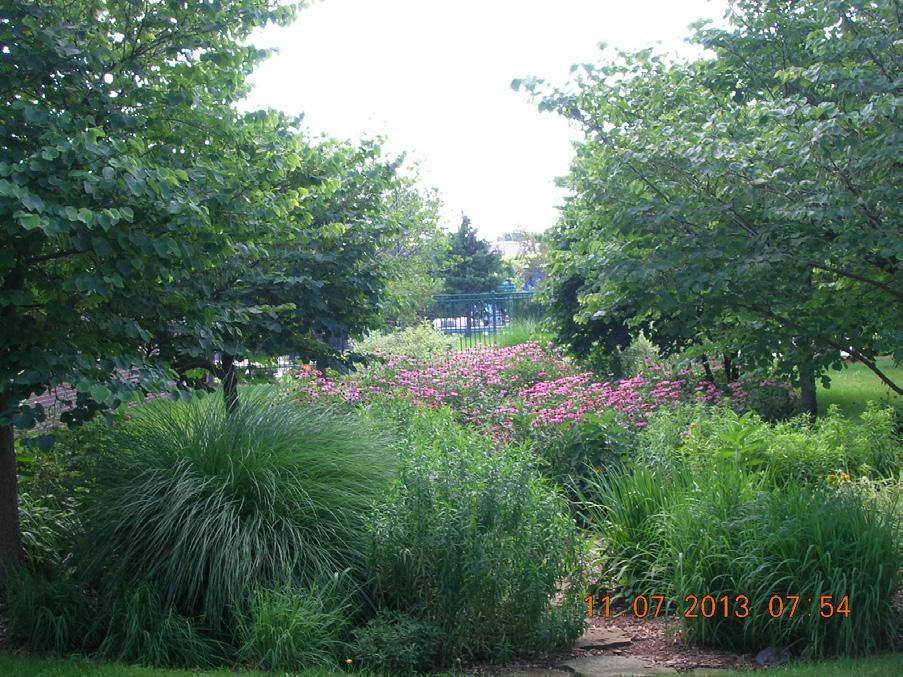
Providing residents with helpful, easily accessible information is the first step towards increasing awareness about the importance of responsible stormwater management. These strategies are described in more detail below. Many residents will learn about stormwater management for the first time through these educational materials. It is essential that resources are accessible and inspiring, encouraging non-residential customers to participate in the credit program and residential customers to invest in stormwater management practices.
Dedicated Stormwater Credit Program Webpage
The Department of Public Utilities should establish a user-friendly webpage on the City’s website. This site should include information about stormwater challenges in Toledo, explain the credit program, and identify desirable stormwater management practices for both commercial and residential customers. Interactive features could inform customers whether their property is located in a priority zone and help calculate potential savings for credit
The Department of Public Utilities should work with relevant partners to provide a “how to” guide for customers who wish to implement stormwater management practices. The guide should include technical requirements, proper installation procedures, a summary estimated costs and benefits, and required maintenance. Information for this document can be compiled from existing guides provided by other city and state stormwater management programs.
The Department of Public Utilities should develop a basic informational pamphlet that describes the importance of a stormwater utility, the purpose of the stormwater credit program, and how customers can participate. The pamphlet should be available online and be distributed at stormwater and environment-related events. Partner program participants. The webpage should also include a decision matrix to assist property owners in choosing an appropriate stormwater management practice. organizations should also distribute these pamphlets.
The long-term viability of the stormwater credit program relies on a healthy level of participation. In order to increase participation, the Department of Public Utilities should implement strategies that increase awareness of the program throughout the business community, and emphasize benefits associated with participation. These strategies are described in detail below.
Incorporating a line at the bottom of the stormwater utility bill that identifies how much money customers are saving through the credit program is an easy way to advertise the program. This reminds program participants how much they are saving while informing customers who are not participating in the program about potential savings. This addition to the utility bill would reinforce the monetary benefits of implementing stormwater management practices.
Having a dedicated staff member who can visit properties and work with customers to identify applicable stormwater management practices would be an excellent outreach strategy. Although administratively demanding, such a program would be especially beneficial to small businesses. Small businesses often do not have internal knowledge about green infrastructure or the resources to spend money on the
upfront costs of site inspections and initial design recommendations.
An easy way to notify customers about the stormwater credit program is through public service announcements in print, over email, and on the web. Announcements should also be made shortly after flooding events. These are the critical moments when citizens are ready and willing to work towards improved stormwater management.
The larger the property, the larger its potential impact on Toledo’s stormwater system and watersheds. The Department of Public Utilities should prioritize recruitment of large properties for participation in the stormwater credit program. Personal staff outreach to properties with large impervious surface areas could lead to major reductions in stormwater runoff.
The direct benefit of implementing stormwater management practices is reflected in accrued savings in the property owner’s stormwater bill. As awareness of water quality
issues increases, businesses may benefit from community support for their investments in stormwater management. Advertising stormwater management practices allows the public to identify and support businesses that participate in the credit program.
For many large businesses in Toledo, environmental compliance is a complicated and confusing task. As a result, many businesses hire engineering consultants to help them ensure that their business is up to code. In addition, consultants often assist with identifying cost saving measures. Frequently these engineering consultants fill out the credit application on behalf of their client. Thus, we recommend that City staff reach out to engineering consulting firms to promote the credit program. Major engineering consulting firms in Toledo include:
• Black & Veatch
• Civil & Environmental Consultants, Inc. (CEC)
• SSOE Group
• Tetra Tech
Economic Development Agencies
Economic development agencies are organizations that specifically work to attract and promote business growth within the region. Informing these agencies about the credit program will provide them with an additional tool to attract businesses to Toledo. Some of the economic development agencies in northwest Ohio include:
• Downtown Toledo Improvement District
• Toledo Chamber of Commerce:
• Toledo Port Authority’s Economic Development Initiative
• The Lucas County Economic Development Corporation
• Regional Growth Partnership
Together, these approaches will act as marketing strategies, simultaneously spreading the word about the program and encouraging participation. These strategies will provide the necessary tools and resources for implementing stormwater management practices while emphasizing their economic and environmental benefits.
Section II - 72
To complement non-residential strategies that are primarily aimed at increasing participation in the credit program, we recommend residential strategies to encourage homeowners to implement stormwater management practices. Such strategies are designed for residents of all ages and emphasize that managing stormwater requires individual efforts. These strategies promote responsible and sustainable stormwater management as a community priority. They are described in detail below
The City can hold events or partner with other organizations that already hold stormwater-related events, such as Clean Your Stream Day held by Partners for Clean Streams, TMACOG Stormwater Coalition’s Student Watershed Watch Summit, or Earth Day at the Toledo Zoo. These events can showcase stormwater improvements made by the City, teach community members about the importance of capturing and cleaning stormwater runoff, and encourage involvement in additional stormwater management events and activities.
Training sessions and workshops focused on stormwater, watersheds, water quality, or green infrastructure should be provided for various age and interest groups. Youth-focused camps and workshops can teach children about how to improve the environment and water quality. An example of this is the Junior Watershed Academy run by RGI. Technical workshops and trainings can teach residents about specific stormwater issues or individual management practices. These programs raise awareness about stormwater and reach a diverse array of Toledo residents. Educational efforts can also be coordinated with the University of Toledo for additional programming such as a lecture series.
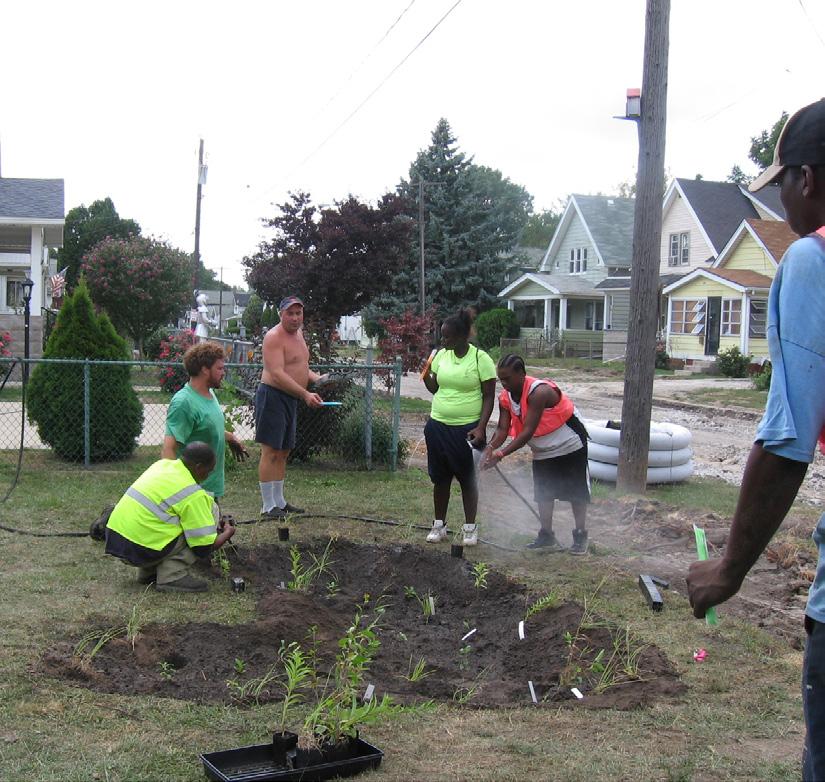
The following checklist identifies recommended actions discussed in Section II of this document. These recommendations should be implemented by City staff whenever appropriate.
We recommend the Stormwater Utility pay special attention to these considering that Stormwater Utilities are under increased legal scrutiny, and costs and revenues tend to be the first area of a stormwater utility program that is examined for legitimacy.
_____ Revenues: Account for stormwater utility annual revenue
_____ Total revenue
_____ Revenue by Division
_____ Costs: Account for stormwater utility annual costs
_____ Total cost
_____ Cost by Division
_____ Transparency: Develop methods to build more transparency into the costs/ revenue identification process
_____ BIlling and program coordination: Develop a system that facilitates easy interaction between CityWorks records and and SAP billing records
Maintaining and building new partnerships with community organizations is a simple and strategic way to communicate the newly revised credit program to the broader public.
_____ Host meeting(s)/workshop(s) with leading community organizations in which City staff explain the program and answer questions
_____ Webpage: Build dedicated stormwater credit program webpage
_____ Stormwater management practice installation guide: Either build new guide or promote Ohio DNR/TMACOG guides on website and in promotional materials
_____ Promotional materials: Create stormwater credit program handouts and marketing materials that can be easily distributed (sent to potential participants, handed out at events, etc.)
Section II - 74
_____ Utility bills: Update non-residential bill layout to communicate credit program savings and credit expiration date
_____ Free assistance program: Appoint staff person to be main point of contact for program. This should be a person who can discuss stormwater management practices that are best suited for a specific property and help walk potential participants through the stormwater credit program.
_____ Public service announcements: Create and send out periodic web, email, and mail announcements about the program
_____ After the revised program is first introduced
_____ After any major storm events as a reminder that the program exists
_____ Personal outreach
_____ Existing users: Set-up meetings/workshops with existing users (those that are grandfathered in) to explain changes and answer questions
_____ Large properties: Set-up meetings/workshops with large property owners who are not in the program to explain credit opportunities and process
_____ Engineering consultant: Set up meetings/workshops with major engineering consulting firms that assist large properties with environmental compliance
_____ Economic development agencies/organizations: Set up meetings/ workshops with major economic development agencies
_____ Awareness Days: work with partners to identify and/or create stormwater awareness days where the City can provide information and assistance to residents about how they can reduce their impact on the stormwater system
_____ Residential Incentive program:
_____ Funding: Identify funds from stormwater utility program that can be spent on residential incentive program
_____ Program: Work with partners to determine which incentives would be most appropriate for Toledo residents (grants, rebates, etc.)
_____ Develop an incentive program
Currently, only non-residential property owners may participate in the City of Toledo’s stormwater credit program. Engaging residential property owners in stormwater management is an important future step. Residential properties comprise a large portion of Toledo’s land area: 44.8% of the city’s total land area and 44.9% of the land area within the identified priority zones. To encourage stormwater management on residential properties, we recommend that the Division of Engineering Services implement a residential incentive program. Monetary incentives, in the form of grants, tax credits, or rebates provide residential property owners with financial encouragement to install stormwater management practices.
Several cities currently use incentive programs to encourage implementation of residential stormwater management practices. The most common incentives are grants or rebates for implementing specific management practices. Philadelphia, PA, Ann Arbor, MI, Montgomery County, MD, Urbana IL,
and Rochester, MN all provide monetary incentives to residential property owners in the form of rebates and grants. Philadelphia, PA employs an extensive incentive program utilizing both grants and tax credits targeted at commercial properties.6 Ann Arbor reimburses residential property owners for footing drain disconnections, usually amounting to $4,100.7 Montgomery County provides rebates up to $10,000 for commercial properties and $2,500 for residential properties for a variety of approved stormwater management practices.8 Urbana provides a maximum incentive amount of $300 per residential property every 10 years.9 In Rochester, residential property owners can benefit from a 50% cost share program for installation of a rain garden, up to $750.10 Both Montgomery County and Urbana raise the funds for their incentive programs through their stormwater utility fees. This provides a steady revenue stream for the incentive programs.
Baltimore, MD provides a unique incentive program where residential customers can earn up to $30 off their stormwater bill by participating in public events. These include stream cleanups, community cleanups, tree plantings,
Section II - 76
de-pavings, and other stormwater management events. For every 8 hours of participation in an approved event, residents earn $10 off their stormwater bill, up to a maximum of $30 annually. Once the maximum has been reached, residents can continue to participate in community service events and donate their additional credits to a friend or neighbor. By incentivizing residents to participate in these stormwater management events, the City receives the benefits of the work performed by the residents while raising awareness of the importance of stormwater management.11
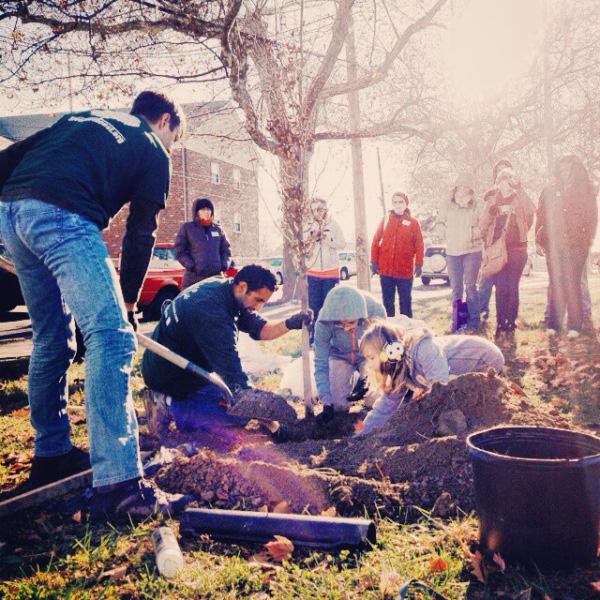
Several cities leverage partnerships with local non-profits and community groups in order to implement and administer incentive programs. The City of Philadelphia partners with TreeVitalize to encourage tree planting throughout the city. The City also partners with the Philadelphia Industrial Development Corporation to provide grants for nonresidential customers who implement approved green infrastructure technologies.12
Incentive programs provide an important opportunity for the City of Toledo to engage with community groups. Utilizing the resources and expertise of community partners minimizes the administrative burden placed on City employees. Suggested community partners include American Rivers, the Rain Garden Initiative, and TMACOG Stormwater Coalition. Additional community groups are listed above in Outreach and Education.
Several stages of analysis informed our revisions and recommendations for the City of Toledo’s stormwater credit program. We analyzed Toledo’s current program to ensure proposed changes were appropriate to Toledo’s specific needs. We considered a wide array of case studies, focusing on cities in the Great Lakes region and those with innovative credit programs. These case studies and our research on Toledo both informed the recommended changes to the credit program.
Toledo’s stormwater credit program represents a bold commitment to responsible watershed stewardship. In the spirit of renewing this commitment, we propose recommendations that will increase the program’s economic vitality and environmental impact. We hope these recommendations result in a successful update to the City of Toledo’s stormwater credit program.
Our proposals include immediate revisions crucial to the implementation of the revised credit program and general recommendations to improve the overall stormwater management program moving forward. We also emphasize the importance of increasing awareness of and participation in stormwater management through community education and outreach. Stormwater management is crucial to the health of local watersheds, and everyone in the community should be encouraged to do their part. Successful stormwater management requires community-wide support and action. Section
Notes from Text
1. Michigan League of Conservation Voters. “Court Invalidates Lansing Storm Water Pollution Control Fee.” Accessed December 13, 2013. http://www.michiganlcv.org/greengavels/ cases/court-invalidates-lansing-storm-water-pollution-control-fee.
2. United States Environmental Protection Agency. “Post-Construction Stormwater Management in New Development and Redevelopment.” http://cfpub.epa.gov/npdes/ stormwater/menuofbmps/index.cfm?action=min_measure&min_measure_id=5.
3. United States Environmental Protection Agency. “Post-Construction Stormwater Management in New Development and Redevelopment.” http://cfpub.epa.gov/npdes/ stormwater/menuofbmps/index.cfm?action=min_measure&min_measure_id=5.
4. Marsh, W. “Chapter 11.” Landscape Planning: Environmental Applications. Hoboken, NJ: John Wiley & Sons, Inc., 2004) 230.
5. Michigan League of Conservation Voters. “Court Invalidates Lansing Storm Water Pollution Control Fee.” Accessed December 13, 2013. http://www.michiganlcv.org/greengavels/ cases/court-invalidates-lansing-storm-water-pollution-control-fee.
6. City of Philadelphia, Pennsylvania, City of Philadelphia Storm Water Management Service Charge: Credits and Adjustments Appeals Manual (Philadelphia: 2013).
7. City of Ann Arbor, Michigan, Footing Drain Disconnection Program Homeowner Information Packet (Ann Arbor: 2013).
8. Montgomery County, Maryland Department of Environmental Protection. “RainScapes Rewards Rebates Program.” http://www6.montgomerycountymd.gov/dectmpl.asp?url=/ content/dep/water/rainrebate.asp.
9. City of Urban, Illinois, City of Urbana Stormwater Utility Fee Credit and Incentive Manual (Urbana: 2012).
10. City of Rochester, New York, City of Rochester Storm Water Utility Fee Credit and Incentives Manual (Rochester: 2009).
11. City of Baltimore, Maryland, Maryland Stormwater Fee Reductions Baltimore City Customer Guidance Document: Single Family Property (Baltimore: 2012).
12. City of Philadelphia, Pennsylvania, City of Philadelphia Storm Water Management Service Charge: Credits and Adjustments Appeals Manual (Philadelphia: 2013).
Image Notes
A. The Rain Garden Initiative. “Photographs: MaywoodConstructionViewfromMulberry81110.” Accessed December 16, 2013. http://photos.raingardeninitiative.org.
B. The Rain Garden Initiative. “Photographs: MaywoodConstructionPhotosPostCurbs030.” Accessed December 16, 2013. http://photos.raingardeninitiative.org.
C. KMT. “Detention Pond Demucking, Pond Cleanout & Maintenance.”http://www. kenmarkturf.com/2011/03/09/ken-mark-turf-provides-retention-and-detention-pondsmaintenance/.
D. City of Sandy. “Sand Filters.” http://www.ci.sandy.or.us/index.asp?Type=B_ BASIC&SEC=%7BA9D3CDDE-3BA0-42DE-BE30-4E321A155AA8%7D&DE=%7B40CA8091277E-4F97-81D4-671A67CD701F%7D.
E. City of Toledo. 2013. “Landuse and Streets geodatabase”, City of Toledo. 2013. “Stormwater study geodatabase”, City of Toledo. 2012. “Watersheds 2012 shapefile”, U.S. Census Bureau. 2013. “2013 TIGER/Line Shapefiles: Water - Area Hydrography”, U.S. Census Bureau. 2013. “2013 TIGER/Line Shapefiles: Counties (and equivalent)”
F. City of Toledo. 2013. “Landuse and Streets geodatabase”, U.S. Census Bureau. 2013. “2013 TIGER/Line Shapefiles: Water - Area Hydrography”, U.S. Census Bureau. 2013. “2013 TIGER/Line Shapefiles: Counties (and equivalent)”, Division of Sewer and Drainage Services - City of Toledo. 2013. “Flood events”
G. City of Toledo. 2013. “Landuse and Streets geodatabase”, U.S. Census Bureau. 2013. “2013
TIGER/Line Shapefiles: Water - Area Hydrography”, U.S. Census Bureau. 2013. “2013
TIGER/Line Shapefiles: Counties (and equivalent)”, Division of Sewer and Drainage Services
- City of Toledo. 2013. “Flood events”
H. City of Toledo. 2013. “Landuse and Streets geodatabase”, City of Toledo. 2013. “Unimproved strees shapefile”, U.S. Census Bureau. 2013. “2013 TIGER/Line Shapefiles: Water - Area Hydrography”, U.S. Census Bureau. 2013. “2013 TIGER/Line Shapefiles: Counties (and equivalent)”
I. City of Toledo. 2013. “Landuse and Streets geodatabase”, U.S. Census Bureau. 2013. “2013
TIGER/Line Shapefiles: Water - Area Hydrography”, U.S. Census Bureau. 2013. “2013
TIGER/Line Shapefiles: Counties (and equivalent)”
J. City of Toledo. 2013. “Landuse and Streets geodatabase”, U.S. Census Bureau. 2013. “2013
TIGER/Line Shapefiles: Water - Area Hydrography”, U.S. Census Bureau. 2013. “2013 TIGER/Line Shapefiles: Counties (and equivalent)”, U.S. Geological Survey. 2011. “National Land Cover Database 2006: Percent Developed Imperviousness”
K. City of Toledo. 2013. “Landuse and Streets geodatabase”, City of Toledo. 2013. “Stormwater study geodatabase”, U.S. Census Bureau. 2013. “2013 TIGER/Line Shapefiles: Water - Area Hydrography”, U.S. Census Bureau. 2013. “2013 TIGER/Line Shapefiles: Counties (and equivalent)”
L. The Rain Garden Initiative. “Photographs: TESRG713.” Accessed December 16, 2013. http://photos.raingardeninitiative.org.
M. The Rain Garden Initiative. “Photographs: LucasCtyGreenJobsCorpsMaywoodResidentialInstall.jpg.” Accessed December 16, 2013. http://photos.raingardeninitiative.org.
N. Tree Philly. “Tree Philly.” http://treephilly.org/.
Section
This manual has been created to provide guidance about stormwater utility fee credits available to non-residential property owners in the City of Toledo.
The City of Toledo’s stormwater credit program provides non-residential property owners an opportunity to reduce the property fee portion of their overall stormwater utility fee. The intent of the program is to reduce the impact of impervious area on the quantity and quality of stormwater runoff in Toledo. The program offers nonresidential property owners an opportunity to reduce their monthly stormwater bill by minimizing their property’s impact on the stormwater system. The original credit program was adopted in 2001 and was updated in 2014 based on research and evaluation of the best stormwater management programs and practices at the time.
• Credit can only be applied to non-residential properties within the City of Toledo service area.
• Credit will only apply to the property fee portion of the total stormwater utility fee. (The total stormwater utility fee includes the property fee and the fixed fee. See the “Definitions” section for further explanation).
• Credit is awarded based on the performance of the implemented stormwater management practice. (Performance specifically relates to the management practice’s ability to reduce the quantity of stormwater runoff and/or improve stormwater runoff quality from the property.)
• Special credit is awarded for management practices that are implemented in any of the identified Priority Zones (Section 5).
• Credit cannot exceed 100% of the property fee portion of the total stormwater utility fee. Regardless of credit, all non-residential property owners are responsible
for paying the fixed fee portion of the stormwater utility fee.
• Property owners participating in the program prior to the revisions implemented in 2014 are ‘grandfathered in’ according to the policies described in Section 6.J (“Grandfathering Current Credit Users”).
This manual was created to provide guidance about stormwater utility fee credits available to non-residential property owners in the City of Toledo. Many cities in the Midwest and Northeastern United States are challenged with aging infrastructure systems that are unable to reliably handle stormwater flows after heavy rainfall. Compounding the issue, many of these cities still operate combined sewer and stormwater systems, which utilize the same pipes to carry both stormwater and sewerage to wastewater treatment plants. When combined sewer and stormwater systems are overloaded during large storm events, they result in the direct release of effluent to the nearest water body. The predicted effects of climate change, including increased frequency and intensity of storm events and increased water pollution1 will
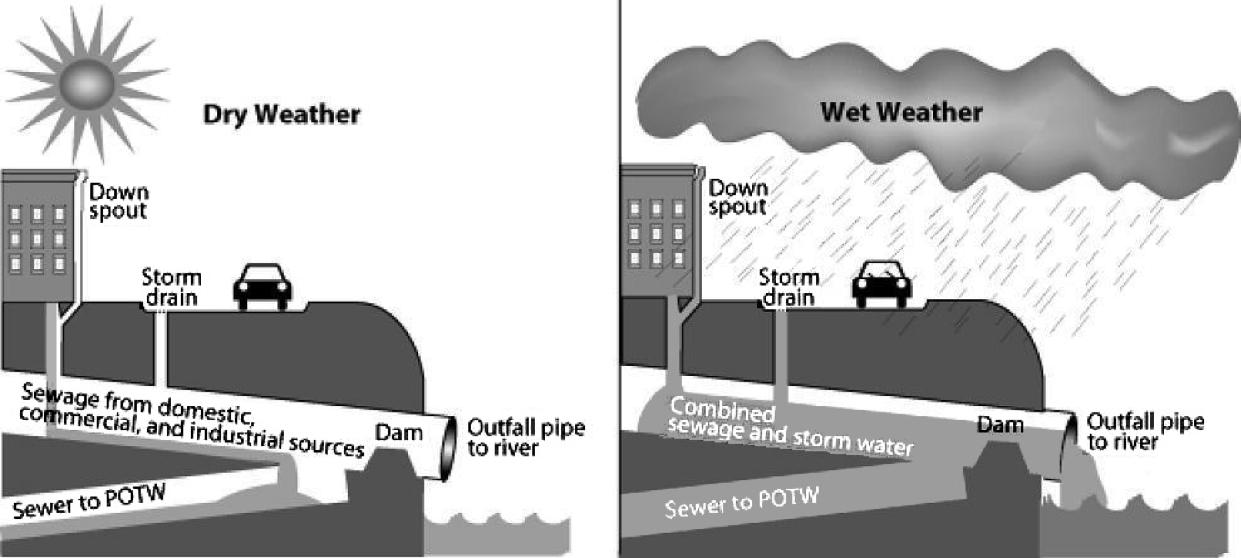
further exacerbate these issues. Predicted stresses on global water supplies, including decreased water levels in the Great Lakes and continued struggles with algal blooms in Lake Erie, intensify the need for effective stormwater management and water protection in the Great Lakes region.2
In an attempt to mitigate these challenges, many cities, including Toledo, have created stormwater utilities. A stormwater utility is a dedicated fund used to support a citywide stormwater management system; essentially, the stormwater utility is a municipal fee for service charged to property owners. The fee typically supports all aspects of the management of the municipal stormwater system, including administration, operations, maintenance and repairs. Supplementary measures, such as stormwater credit programs, encourage private initiatives to help improve stormwater management. Stormwater credit programs offer property owners the opportunity to reduce their stormwater utility fee by implementing stormwater management practices. These practices reduce the burden on the overall stormwater system.
Aquifer: Geologic stratum containing groundwater useful for human purposes.3
Basin: Geographical area drained by a river and its tributaries. It is characterized by all runoff being conveyed to the same ‘outlet.’4
Berm: man-made barrier of compacted earth.5
Best Management Practices (BMPs): Methods or techniques found to be the most effective and practical means for achieving a certain objective. In this context, they refer to stormwater management practices.
Bioswale: Also known as a biofiltration swale, this is a vegetated ditch designed to filter pollutants from stormwater. It has a long and gentle slope.6
Buffer: Designated area adjacent to a stream or wetland that protects the stream or wetland ecosystem from pollutant runoff.7
Catch Basin: Underground structure that holds surface stormwater runoff.8
Catch Basin Inserts: Devices installed underneath a catch basin inlet to treat stormwater through filtration, settling, adsorption, absorption, or a combination of these.9
Channel: Long, narrow excavation or surface feature open to the air that conveys surface water.10
Combined Sewer Overflow (CSO): Overflow from sewers that are designed to collect sewage and stormwater runoff in the same sewer system. During intense storm events, combined sewage and stormwater systems can overflow directly into the receiving waters.11
Detention Pond: A pond with an outlet that slows stormwater.12
Environmental Protection Agency (EPA): Federal executive agency in charge of protecting human health and the environment.13
Equivalent Residential Unit (ERU): Unit of measurement for average impervious surface area. It usually represents the impervious surface area of a typical residential property. In Toledo, OH, an ERU is equivalent to 2,500 square feet.
Erosion: Soil or rock fragments transported by water, wind, ice, etc.
Filter Strips: Gently sloping, usually densely vegetated buffer strips. They remove pollutants by filtering, slowing and providing some infiltration of stormwater.14
First Flush: Initial surface runoff of a rainstorm, typically characterized by a large concentration of pollutants in comparison to the average concentration encountered throughout the rest of the storm or season.
Floodplain: Land area susceptible to being inundated by floodwaters.15
Green Roof: Stormwater management practice that consists of a vegetative layer grown on a rooftop. Reduces and slows stormwater runoff, and could filter pollutants from rainfall. A green roof also has other benefits such as reducing cooling and heating energy use.16
Groundwater: Water found in aquifers below ground level.17
Impervious Surface: Hard surface area which prevents or strongly retards the entry of water into the soil, in comparison to natural undisturbed conditions. Common impervious surfaces include roads, roof tops, walkways, patios, driveways and parking lots.18
Infiltration: Process by which water infiltrates into the subsurface soil and rock. The rate of infiltration will depend on precipitation, soil characteristics, soil saturation, land cover, slope of the land, and evapotranspiration.19
Nonpoint Source Pollution: Pollution that results from non-discrete sources, such as land runoff, precipitation, atmospheric deposition, drainage, seepage or hydrologic modification. Nonpoint source pollution can include excess fertilizers, herbicides and insecticides from agricultural lands and residential areas, oil, grease and toxic chemicals from urban runoff, among others.20
Outfall: Point where a municipal stormwater sewer system discharges to a larger water body.21
Permeability: Property of a material that describes the rate at which a given liquid moves through it.
Rain Garden: Landscaping feature that provides stormwater runoff treatment. Shallow, vegetated basins that collect and absorb stormwater runoff from rooftops, sidewalks, and streets.22
Retention Basin: A basin built to treat and store stormwater runoff. It generally does not have an outlet. A retention pond holds a pool of standing water which eventually drains into the subsoil.23
Runoff: Water originating from rainfall and other precipitation that eventually flows into drainage facilities, rivers, streams, ponds, lakes, and wetlands, as well as shallow groundwater.24
Sand Filter: Stormwater management practice that consists of a forebay and underdrained sand bed. Stormwater runoff entering the sand filter is conveyed first through the forebay, which removes trash, debris, and coarse sediment, and then through the sand bed to an outlet pipe. Sand filters use solids settling, filtering, and adsorption processes to reduce pollutant concentrations in stormwater.25
Sanitary Sewer Overflow (SSO): Sewage and stormwater systems have separate pipes in a separated sewer system. Only sewage is treated at the wastewater treatment plant. SSOs are overflows of stormwater runoff, discharging directly into receiving water bodies.26
Storm Flow: Part of streamflow that occurs in direct response to precipitation.27
Stormwater: Generated when precipitation from rain and snowmelt events flows over land and impervious surfaces, not percolating into the ground.28
Stormwater Management Practices: Method or technique found to be the most effective and practical means for managing stormwater, either in terms of its quantity or quality.
Swale: Shallow drainage conveyance with relatively gentle side slopes, usually with a depth less than one foot.29
Vegetated Channel: Vegetated, long, narrow excavation or surface feature open to the air that conveys surface water.30
Water Table: Level below which the ground is saturated with water.
Watershed: An area of all land where all of the water that is under it or drains off of it goes into the same place. Watersheds may cross county, state, and national boundaries.31
Under the credit program, non-residential property owners earn credits based on the effectiveness of the implemented stormwater management practice. Stormwater management practices that reduce the amount of stormwater entering the system qualify for quantity credits. Management practices will receive quantity credits based on the 24-hour design storm that the management practice was designed to handle (design storm is explained below). Stormwater management practices that treat and/or reduce the pollutants and sediment found in the stormwater runoff from the property can qualify for quality credits. Management practices will receive quality credits based on whether they rely both on sedimentation and filtration methods or primarily sedimentation (explained below). Many stormwater management practices address both quantity and quality and may qualify for both kinds credits.
A design storm refers to the amount of expected precipitation from a given storm event that a stormwater management practice is designed to handle. Particularly extreme precipitation events occur infrequently, which is reflected in their classification. Therefore, a 100-year storm event is designed to handle stormwater runoff from a 100-year storm as well as any storm event of lesser intensity. Design storms are incorporated into the credit manual as a way to encourage customers to implement stormwater management practices that are designed to handle large storm events. Storm events are also categorized by their duration, frequency, and intensity. For the purposes of this credit program, the design storm credits are based on a 24hour period.
Some stormwater management practices are more effective at eliminating pollutants than others. For this reason, stormwater quality management practices are classified based on two categories: high level of pollutant removal through sediment removal and filtration (Category A) or basic pollutant removal through sediment removal (Category B). This categorization is based on the “EPA Stormwater Menu of BMPs” assessment of management practice effectiveness.32
Table 1: Approved Stormwater Practices by Quantity and Quality
Stormwater management challenges are not evenly distributed throughout the City of Toledo. Land use, impervious cover, topography, and sewer system type all affect the quality and quantity of stormwater runoff. As conditions across Toledo vary, some areas will benefit from the implementation of stormwater management practices more than others. Four areas of Toledo are identified as priority zones in which stormwater management practices are particularly encouraged. Stormwater management practices within a priority zone will have a greater impact on the quantity or quality of stormwater runoff than in other areas of Toledo. (If you are applying for a credit but are unsure about whether your property fits within a priority zone, contact Toledo’s Senior Stormwater Engineer by emailing lorie.haslinger@toledo.oh.gov or calling (419) 245-3221.
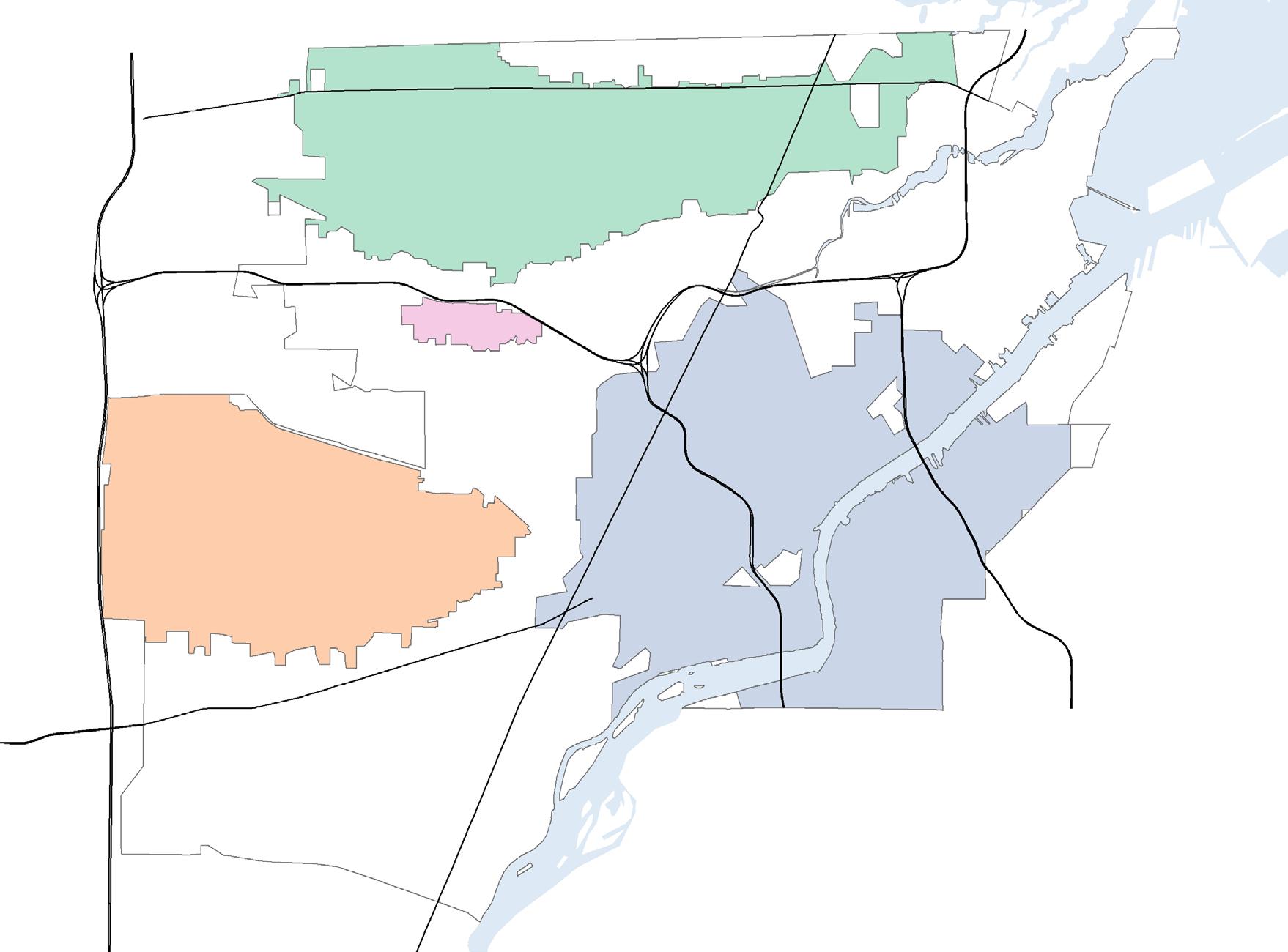
The City of Toledo’s stormwater credit program is a simple and effective method for non-residential property owners to reduce their stormwater utility fee. The overall intent of the program is to reduce the impact of impervious area on the quantity and quality of stormwater runoff in Toledo.
Toledo’s stormwater credit program offers non-residential property owners the opportunity to reduce their stormwater utility fees by implementing stormwater management practices. These practices reduce the burden on the overall stormwater system. Property owners are eligible to receive credits based on the effectiveness of the implemented management practice in managing the quantity or in improving the quality of stormwater runoff from their property.
Credit will be allowed for all non-residential properties in the City of Toledo. Nonresidential is defined as any property use other than single-family or duplex. No credit will be allowed for any property that is not currently paying a stormwater utility fee. Credits will only be applied to the property fee portion of the stormwater utility fee.
The maximum possible credit is 100% of the property fee portion of the stormwater utility fee. The maximum potential quantity credit is 100% of the property fee. The maximum potential quality credit is 50% of the property fee. Credits can be combined. However, the combination of quality credits, quantity credits, and, if applicable, priority zone credits cannot exceed 100% of the property fee.
Credits will only be awarded to fully constructed, functioning management practices. The Department of Public Utilities reserves the right to inspect any management practice prior to the awarding of credit. The credit will apply only to that portion of the impervious area that is controlled by the management practice.
Management practices implemented on properties located completely or partially within an identified priority zone, as outlined in Section 5, will receive an additional 25% credit towards their property fee. This credit is in addition to any other credits received. Total credits awarded cannot exceed 100% of the property fee.
An inspection of the management practice by the Department of Public Utilities is required upon application for stormwater credits. In addition, the Department of Public Utilities will conduct random inspections of stormwater management practices to ensure they are working properly.
One application is required per stormwater management practice. Please refer to the below checklist in Section 6 to ensure all necessary documents are submitted.
Applications will be reviewed by the Division of Engineering Services. Approval or denial responses will be issued within 30 days of receipt of the application. The credit will become effective at the next billing cycle following approval of the application.
All credits expire five years from the date of approval. The property owner will be notified three months prior to the expected credit expiration. Property owners may reapply for the same credit at that time. If the stormwater management practice or the impervious surface controlled by the management practice remains unchanged, the property owner may submit a one-page reapplication form. If changes have been made to the management practice or the impervious surface controlled by the management practice, a new application must be submitted.
Any transfer of property requires credit reapplication by the new property owner. This is necessary to ensure that the new property owner is aware of the existence of the management practice on the property, and the necessary maintenance standards required for its successful performance.
Appeals of credit decisions will be made to the Department of Public Utilities, Division of Engineering Services. The appeal will be reviewed by the Rate Appeals Committee.
Existing credit holders at the time of adoption of the revised credit program will continue to receive their stormwater credit for the subsequent five years from the date of adoption of the new credit manual. Credit amounts will remain the same during that five-year period. The Division of Public Utilities reserves the right to inspect management practices of grandfathered credit holders to ensure that they are functioning properly. At the time of expiration, grandfathered credit holders will be subject to all aspects of the new credit policy should he/she choose to reapply.
Existing credit holders can reapply under the revised credit program at any point before the five-year grandfathering period expires, if they so choose.
This section outlines the necessary documents and steps required for credit application. Please review carefully.
Before getting started, please note:
• If you are not familiar with the City of Toledo’s Infrastructure Design and Construction Guidelines, please obtain a copy at: http://toledo.oh.gov/services/ public-utilities/div-engineering-services/plan-review-process/.
• If you need help with specific guidelines for designing, implementing, and maintaining stormwater management practices, the City of Toledo’s Division of Environmental Services recommends the following resources:
• The Ohio Department of Natural Resources’ guidelines: “Rain Water and Land Development.” This document is available online at: http://www.dnr.state. oh.us/tabid/9186/default.aspx.
• The Toledo Metropolitan Area Council of Government’s guidelines, available online at: http://www.tmacog.org/Environment/TMACOG_Stormwater_ Standards_Manual_.pdf
• Please refer to Appendix C for a matrix of stormwater management practice resources.
• The maximum credit that may be received is 100% of the property fee.
• Length of review by City staff will be 30 days.
• If you have any questions about the application process, please contact:
Senior Stormwater Engineer
Department of Public Utilities, Division of Engineering Services
One Lake Erie Center
600 Jefferson, Suite 300 Toledo, OH 43604
Email: lorie.haslinger@toledo.oh.gov
Phone: (419) 245-3221
Fax: (419) 936-2850
STEP 1: Obtain a credit application form from:
• The last pages of this credit manual
• Online at http://toledo.oh.gov/
• Senior Stormwater Engineer
• Email: lorie.haslinger@toledo.oh.gov
• Phone: (419) 245-3221
STEP 2: Assemble Data
a. Vicinity maps that illustrate site drainage features
____ Site and location of all stormwater structures (based on up-to-date site plan)
b. Perform hydrologic and hydraulic calculations
____ Hydrologic calculations for undeveloped and developed land uses
____ Hydraulic calculations stage-discharge relationships of controls
c. Construction details
____ Record drawings
____ Construction drawings and details of proposed controls
d. Maintenance
____ Maintenance Management Plan
____ Maintenance schedule of all operations that affect the efficiency of the structural management practice including mowing, sediment removal, cleaning, planting, monitoring, watering, and channel restoration
e. Other Data
____ Please describe
a. Calculate the estimated impervious area of the property:
• Obtain the number of “ERUs” from the property’s billing statement.
• Multiply ERUs by 2,500 square feet to determine the amount of impervious surface on-site.
• Examples of credit calculations can be found in Appendix B.
b. Identify the area available for credit:
• Determine the percentage of impervious area controlled on-site by the stormwater management practice.
• Divide the controlled impervious area by the total impervious area of property.
c. Determine quantity credit using quantity worksheet equation in Appendix A.
d. Determine quality credit using quality worksheet equation in Appendix A.
e. Determine if the property is eligible for a priority zone credit using the map in Section 5:
• If you are unsure about whether your property fits within a priority zone, contact Toledo’s Senior Stormwater Engineer at lorie.haslinger@toledo.oh.gov or by calling (419) 245-3221.
f. Determine the total credit by adding up the quantity credit and quality credit and multiplying the sum by the percentage impervious area controlled by the stormwater management practice. Add an additional 25% credit to the total if the property is eligible for a priority zone credit.
• NOTE: Maximum total available credit is 100% of the property fee portion of the stormwater utility fee; the credit calculations worksheet will be checked by the Division of Engineering Services upon application submission.
• Priority zone credit is granted only if the implemented stormwater management practice controls stormwater runoff for 10% or more of the property’s impervious surface.
4: Complete the Toledo Stormwater
a. Applicant Information
• Name, street address, email address and phone number of the person or persons responsible for paying the stormwater utility bill
• Account Number from stormwater billing statement
b. Site Information
• Location (within your property) where stormwater management practice will be implemented
• Final credit calculations from credit calculation worksheet located in Appendix A
c. Engineer of Record
• Name, street address, email address and phone number of Certifying Engineer
• Certification, including Engineer stamp
d. Data Submittal Check-List
• Check-off materials submitted
STEP 5: Submit application, credit calculation worksheet, data, and fee via email, mail or fax to:
Senior Stormwater Engineer
Department of Public Utilities, Division of Engineering Services
One Lake Erie Center
600 Jefferson, Suite 300
Toledo, OH 43604
Email: lorie.haslinger@toledo.oh.gov
Phone: (419) 245-3221
Fax: (419) 936-2850
Application Fee: $100: This is a director’s fee and checks are to be made payable to the City of Toledo Department of Public Utilities (DPU).
a. Construct the eligible stormwater management practice in accordance with the approved plans, specifications and design calculations
b. Obtain an inspection of the management practice by the Department of Public Utilities. Credits will become effective when the structure is completed and the inspector verifies that it is operating properly
c. Provide regular maintenance for your specific stormwater management practice in accordance with your maintenance management plan
Credits expire five years from the date of approval. The property owner will be notified three months prior to the credit’s expiration date. Property owners may reapply for the same credit at that time. If the management practice or the impervious surface controlled by the management practice remains unchanged, the owner may submit a one page reapplication form that can be obtained by emailing Toledo’s Senior Stormwater Engineer at lorie.haslinger@toledo.oh.gov. If changes have been made to the management practice or the impervious surface controlled by the management practice, a new application must be submitted.
At the discretion of Division of Engineering Services staff, inspections may be performed in order to confirm the effective operation and maintenance of the applied management practice.
TOLEDO STORMWATER CREDIT APPLICATION FORM
Name: Address: City: State: Zip: Phone: ( ) Fax: ( ) Email: Account Number: __ __
Name:
Stormwater Billing Account No: Location:
From credit calculation worksheet:
Impervious Area:
Stormwater Quantity Credit:
Impervious Area Controlled:
Stormwater Quality Credit: Priority Zone Credit: Total Credit
Name: Company: Address: City: State: Zip:
Phone: ( ) Fax: ( ) Email:
CERTIFICATION
Type of data
Mapping (i.e. plat, record drawing, site plan, auditor’s map)
Design calculations
Construction drawings (as built, proposed construction)
Maintenance agreement and manual
Easement or deed restrictions
Other information
Submitted
Accepted
Section III - 102
TOLEDO STORMWATER CREDIT APPLICATION FORM: CALCULATION WORKSHEET
STEP 1: CONTROLLED AREA CALCULATIONS
Property owners who currently receive a stormwater utility bill start at #1. New developments, or properties not receiving a stormwater utility bill, start at #3.
1. Your ERU = _________________ (Your property’s ERU can be determined by looking at your stormwater bill.)
2. Your Impervious Area (I.A.) = Your ERU x 2500 sq.ft. = _______ x 2500 sq.ft. = __________________ (Your ERU from Bill) (Your I.A.)
3. I.A. controlled by management practice: ______________________ (from site engineer or product specifications)
4. Controlled Area Calculation = I.A. controlled by management practice / Your I.A. = _________________/ _________________ = _________________ (I.A. controlled) (Your I.A.) (Controlled Area Calculation)
STEP 2: STORMWATER QUANTITY CREDIT CALCULATIONS
Quantity Credit = Design Storm (≤ 100) / 100 = _________________ / 100 = __________________ (Design Storm*) Your Quantity Credit
* Design storm refers to the flooding from a storm event that the management practice is designed to handle. Credits will be given for design storms up to 100 years.
Section III - 103
STEP 3: STORMWATER QUALITY CREDIT CALCULATIONS
Quality Credit = 0.5 for Category A Management Practice Or 0.25 for Category B Management Practice* = __________________ Your Quality Credit
*See management practice examples to determine whether management practice is Category A or B
STEP 4: PRIORITY ZONE CALCULATIONS
Priority Zone Credit = 0.25 if your property is in one of the priority zones outlined in Section 5 (“Priority Zones”) = __________________ (Your Priority Zone Credit)
STEP 5: TOTAL CREDIT CALCULATIONS
Total Credit = [(Quantity Credit + Quality Credit) x Controlled Area Calculation by Management Practice + Priority Zone Credit] x 100 = [( ___________ + ___________) x ___________ + ___________] x 100 = ___________ (Quantity) (Quality) (Controlled Area) (Priority Total Credit % Calculation Zone) (≤100)
Section III - 104
Example 1: Calculating Stormwater Credits Based on Quantity Management Practices
Figure III-3. Hypothetical property
Scenario: In this example, a commercial property owner implements a management practice that reduces the quantity of stormwater runoff. The property has an overall impervious surface area of 500,000 sq. ft. The property owner installs a retention pond, which treats 200,000 sq. ft. of the impervious area on the property and is designed for a 25-year (24-hour) design storm. The property is not in a priority zone.
STEP 1: CONTROLLED AREA CALCULATIONS
I.A. controlled by management practice: 200,000 sq. ft.
Controlled Area Calculation = 200,000 sq. ft / 500,000 sq. ft = 0.40 (I.A. controlled) (Total I.A.) Controlled Area
STEP 2: STORMWATER QUANTITY CREDIT CALCULATIONS
Quantity Credit = Design Storm (≤ 100) / 100 = 25 / 100 = 0.25 (Design Storm) Quantity Credit
STEP 3: STORMWATER QUALITY CREDIT CALCULATIONS
Quality Credit = 0.5 for Category A Management Practice or 0.25 for Category B Management Practice = NA
Quality Credit
STEP 4: PRIORITY ZONE CALCULATIONS
Priority Zone Credit = 0.25 if your property is in one of the priority zones outlined in Section 5 (“Priority Zones”) = NA Priority Zone Credit
STEP 5: TOTAL CREDIT CALCULATIONS
Total Credit = [(Quantity Credit + Quality Credit) x Controlled Area Calculation by Management Practice + Priority Zone Credit] x 100
= [( 0.25 + 0 ) x 0.40 + 0 ] x 100 = 10% (Quantity) (Quality) (Controlled Area) (Priority Total Credit % Calculation Zone) (≤100)
TOTAL CREDIT = 10%
Section III - 106
Figure III-4. Hypothetical property
Scenario: In this example, a commercial property owner implements a management practice that improves the quality of stormwater runoff from the site. The property owner installs a sand filter, which treats 600,000 sq. ft. of impervious area on the property, out of a total of 1,000,000 sq. ft. of impervious area. The sand filter is categorized as a Group A quality credit. The property is not in a priority zone.
STEP 1: CONTROLLED AREA CALCULATIONS
I.A. controlled by management practice: 600,000 sq. ft.
Controlled Area Calculation = 600,000 sq. ft / 1,000,000 sq. ft = 0.60 (I.A. controlled) (Total I.A) Controlled Area
STEP 2: STORMWATER QUANTITY CREDIT CALCULATIONS
Quantity Credit = Design Storm (≤ 100) / 100 = NA / 100 = NA (Design Storm) Quantity Credit
STEP 3: STORMWATER QUALITY CREDIT CALCULATIONS
Quality Credit = 0.5 for Category A Management Practice or 0.25 for Category B Management Practice = 0.5 Quality Credit
STEP 4: PRIORITY ZONE CALCULATIONS
Priority Zone Credit = 0.25 if your property is in one of the priority zones outlined in Section 5 (“Priority Zones”) = NA Priority Zone Credit
STEP 5: TOTAL CREDIT CALCULATIONS
Total Credit = [(Quantity Credit + Quality Credit) x Controlled Area Calculation by Management Practice + Priority Zone Credit] x 100
= [( NA + 0.5 ) x 0.60 + 0 ] x 100 = 30% (Quantity) (Quality) (Controlled Area) (Priority Total Credit % Calculation Zone) (≤100)
TOTAL CREDIT = 30%
Section III - 108
III-5. Hypothetical property
Scenario: In this example, a commercial property owner implements a stormwater management practice that addresses both the quantity and quality of stormwater runoff discharged from her property. The property owner installs a retention pond that captures and treats 2,000 sq. ft. of impervious surface, out of a total of 5,000 sq. ft. of impervious area. The retention poind is a Category B (0.25) stormwater management practice and was built to a 50 year (24-hour) design storm standard. The property is located within a priority zone.
STEP 1: CONTROLLED AREA CALCULATIONS
I.A. controlled by management practice: 2,000 sq. ft.
Controlled Area Calculation = 2,000 sq. ft / 5,000 sq. ft = 0.40 (I.A. controlled) (Total I.A) Controlled Area
STEP 2: STORMWATER QUANTITY CREDIT CALCULATIONS
Quantity Credit = Design Storm (≤ 100) / 100 = 50 / 100 = 0.50 (Design Storm) Quantity Credit
STEP 3: STORMWATER QUALITY CREDIT CALCULATIONS
Quality Credit = 0.5 for Category A Management Practice or 0.25 for Category B Management Practice = 0.25 Quality Credit
STEP 4: PRIORITY ZONE CALCULATIONS
Priority Zone Credit = 0.25 if your property is in one of the priority zones outlined in Section 5 (“Priority Zones”) = 0.25 Priority Zone Credit
STEP 5: TOTAL CREDIT CALCULATIONS
Total Credit = [(Quantity Credit + Quality Credit) x Controlled Area Calculation by Management Practice + Priority Zone Credit] x 100
= [( 0.50 + 0.25 ) x 0.40 + 0.25 ] x 100 = 55% (Quantity) (Quality) (Controlled Area) (Priority Total Credit % Calculation Zone) (≤100)
TOTAL CREDIT = 55%
Section III - 110
The matrix on the following page was designed to assist property owners interested in learning more about stormwater management practices. The listed resources address management practice benefits, as well as installation and maintenance practices. This matrix also lists the name variations for the stormwater management practices used in outside resources.
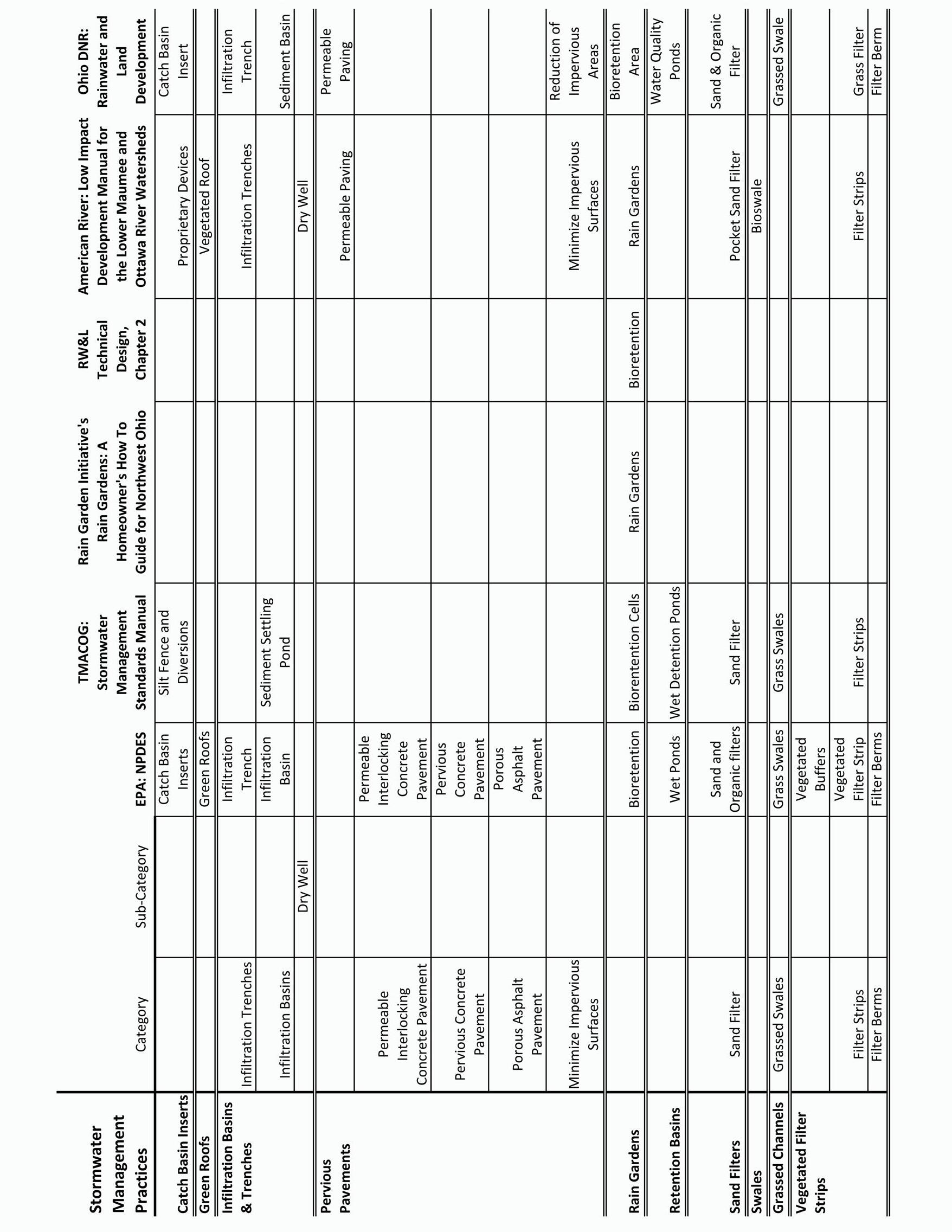
The following is a list of recommended stormwater management practices that are eligible to receive stormwater credits under Toledo’s stormwater credit program. Each practice includes a brief description, its quality/quantity eligibility, and an illustration. For more specific and extensive guidelines for designing, implementing, and maintaining stormwater management practices, please see:
• The Ohio Department of Natural Resources’ guidelines: “Rain Water and Land Development,” available at: http://www.dnr.state.oh.us/tabid/9186/default.aspx.
• The Toledo Metropolitan Area Council of Government’s guidelines, available online at: http://www.tmacog.org/Environment/TMACOG_Stormwater_Standards_ Manual_.pdf
Key Terms
• Stormwater Management Practices: structures that slow the flow, reduce the volume, or reduce pollutant loads and/or concentrations of stormwater runoff leaving a site
• Stormwater Quantity Management Practices: reduce the volume of stormwater runoff
•
Stormwater Quality Management Practices: reduce the pollutants in stormwater runoff Section III - 113
Table 1: Approved Stormwater Management Practices by Quantity and Quality
Management Practices
Section III - 114
Catch Basin Inserts
Quantity: No
Quality: Category B (25%)
Catch basin inserts are devices installed under a stormdrain grate that provide water quality treatment through filtration, settling, or adsorption. They are a low-cost stormwater management practice that is commercially available. They are typically designed to remove one or more of the following contaminants: coarse sediment, oil, grease, litter and debris. They may have a framework made from wire or plastic and typically rely on a geotextile fabric to improve filtration. Inserts should be routinely maintained to achieve maximum pollutant removal efficiency. Maintenance should follow product instructions and may vary depending on the type of pollutant targeted. Inserts are best suited for catch basins with grates that can be lifted without the need of a machine and have easy access.33
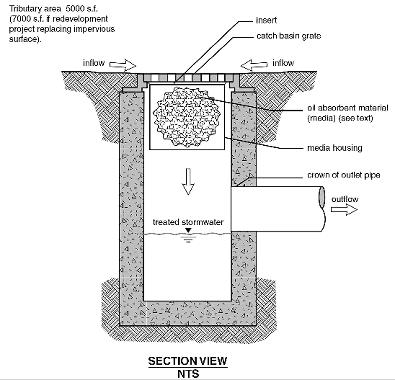
Section III - 115
Quantity: Yes
Quality: Category B (25%)
Green roofs are an umbrella term for a number of greening systems that can be constructed on the top of certain structures. An “extensive” green roof is a thin-profiled system with a growing medium of six inches or less. An “intensive” green roof allows for landscaping over structures and requires a greater growing medium depth. Roof gardens and roof parks are examples of “intensive” green roofs. Green roofs typically slow and/or detain stormwater runoff. Depending on the size of the implemented area and growth of vegetation, green roofs can also provide shade, reduce solar heat gain or loss, and lower energy consumption.34
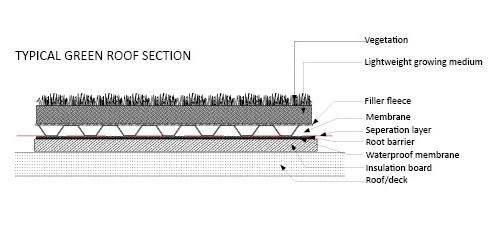
Section III - 116
Quantity: Yes
Quality: Category A (50%)
An infiltration basin (sometimes referred to as a detention basin) is a facility constructed within highly permeable soils that provides temporary storage of stormwater runoff. Infiltration basins do not have a structural discharge outlet. Outflow occurs through the surrounding soils. An infiltration basin may be combined with an extended detention basin to provide additional runoff storage for stormwater quality and quantity management.35
An infiltration trench is a rock-filled trench with no outlet. This management measure is also known as an infiltration gallery. Stormwater runoff usually passes through some combination of pre-treatment measures (such as swales or detention basins), and then travels into the trench. Stormwater runoff is stored in the void space between the stones and infiltrates to the bottom of the trench, and then into the soil below.36
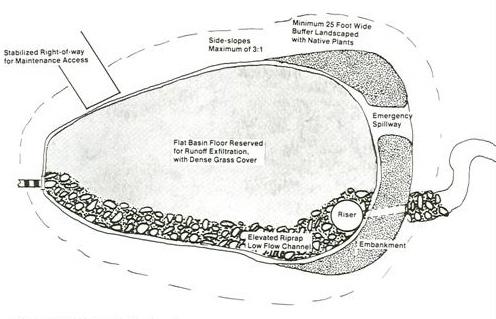
Pervious Pavement
Quantity: Yes
Quality: Category A (50%)
Pervious (or porous) pavement replaces traditional impervious pavement. They can be used in sidewalks, walkways, residential roads, or parking lots. Pervious pavement includes three categories: pervious asphalt, porous concrete, and permeable interlocking concrete pavers (PICPs). All function and perform similarly but have varying characteristics or benefits. Pervious asphalt tends to be the least expensive of the three options. Porous concrete has several indirect benefits, including an enhanced albedo effect that helps reduce surface temperatures in urban settings. PICPs are modular, and can be replaced relatively easily.37 Pervious pavement requires regular street sweeping to maintain porosity.
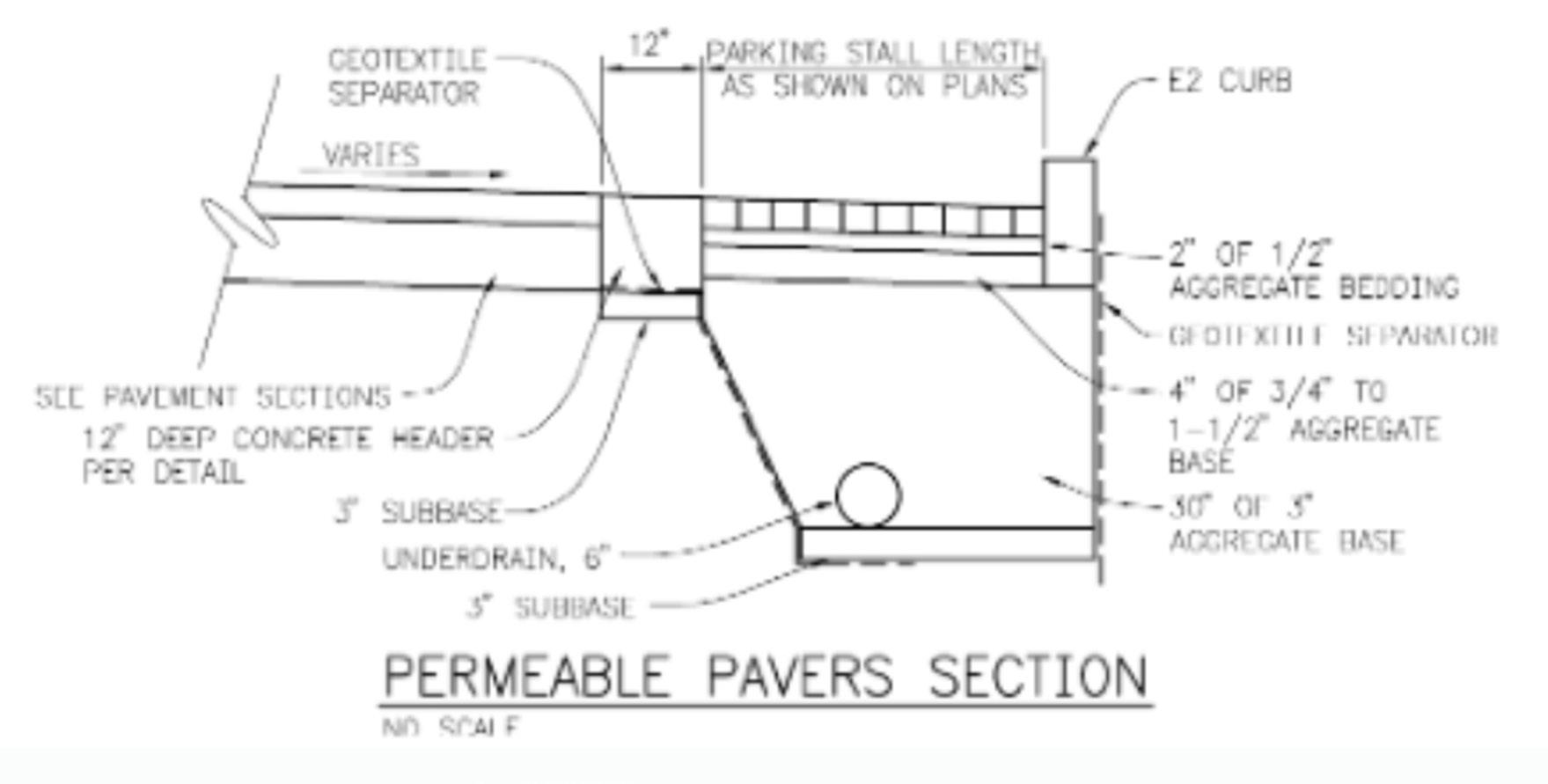
Section III - 118
Rain Gardens
Quantity: Yes
Quality: Category A (50%)
Rain gardens (bioretention) are depressed areas of land that provide on-site treatment to stormwater runoff. Directing stormwater into rain gardens is an effective way to remove pollutants such as suspended solids, heavy metals, organic compounds, bacteria and nutrients. Pollutant removal occurs by filtering runoff through the layers of mulch and soil mixes.38
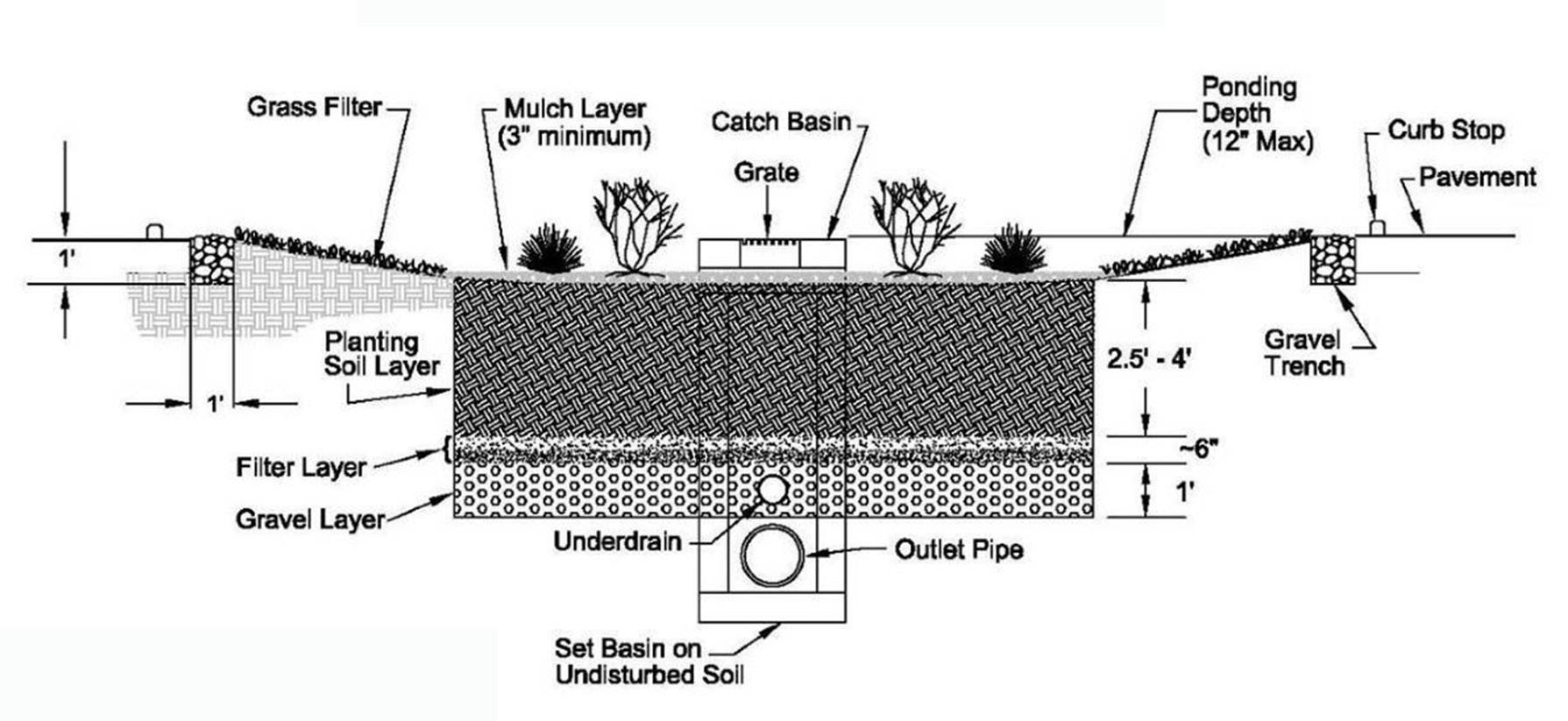
Quantity: Yes
Quality: Category B (25%)
Retention basins are permanent pools of standing water that hold stormwater for extended periods of time after storm events. This reduces the amount of runoff entering the drainage system during the storm events and also allows pollutants to settle out, thus addressing stormwater quantity and water quality. Stormwater is held in a retention pond until it is displaced by runoff from the next storm event. Additional benefits to constructing retention ponds include enhanced aesthetic appeal of a property, increased biodiversity and wildlife habitat available on-site, and minimized erosion.
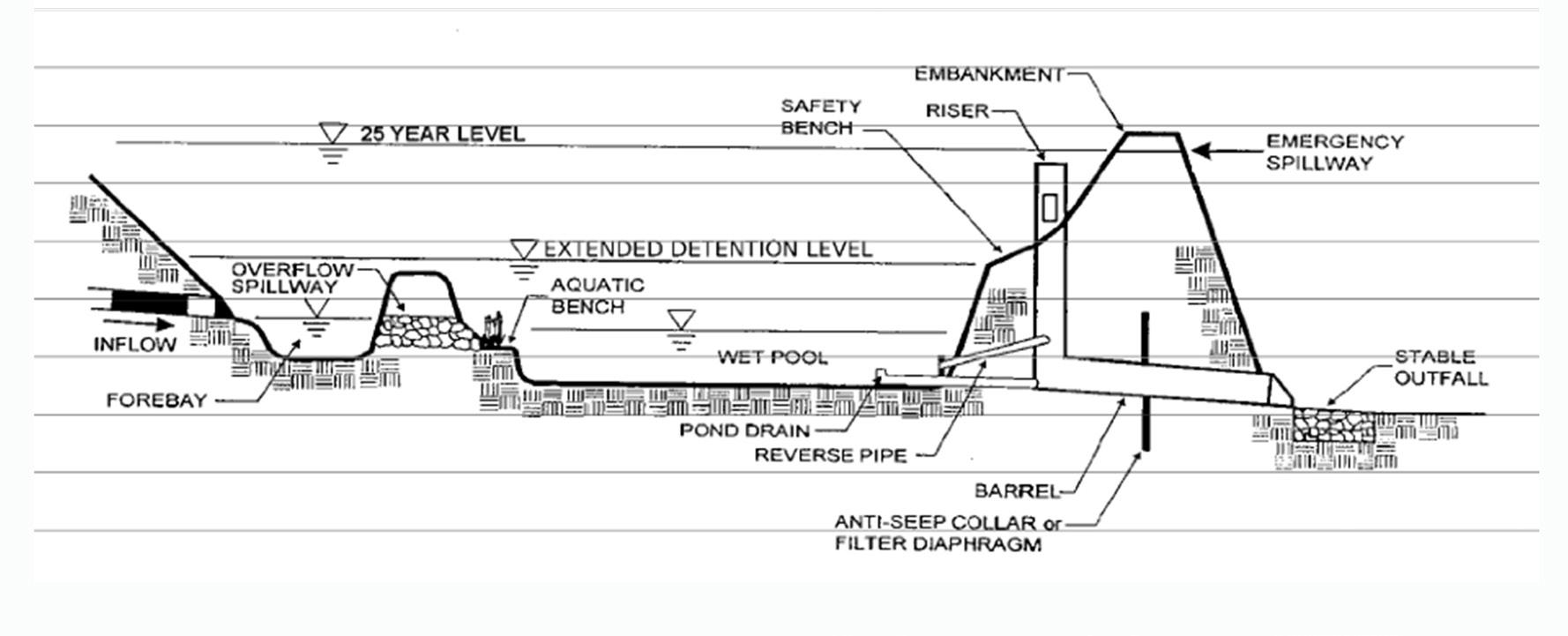
III - 120
Quantity: Yes
Quality: Category A (50%)
Sand filters primarily serve water quality treatment purposes. Stormwater is directed through an initial filtering screen and then through a thick layer of sand. Depending on design, stormwater may then travel through additional layers of gravel, geotextile, or peet for the purposes of further pollutant filtration. After traveling through the different layers of filtration, pipes collect the water and pass it either into the stormwater system or to an approved discharge point. Three main types of sand filters exist: surface, underground, and perimeter.39
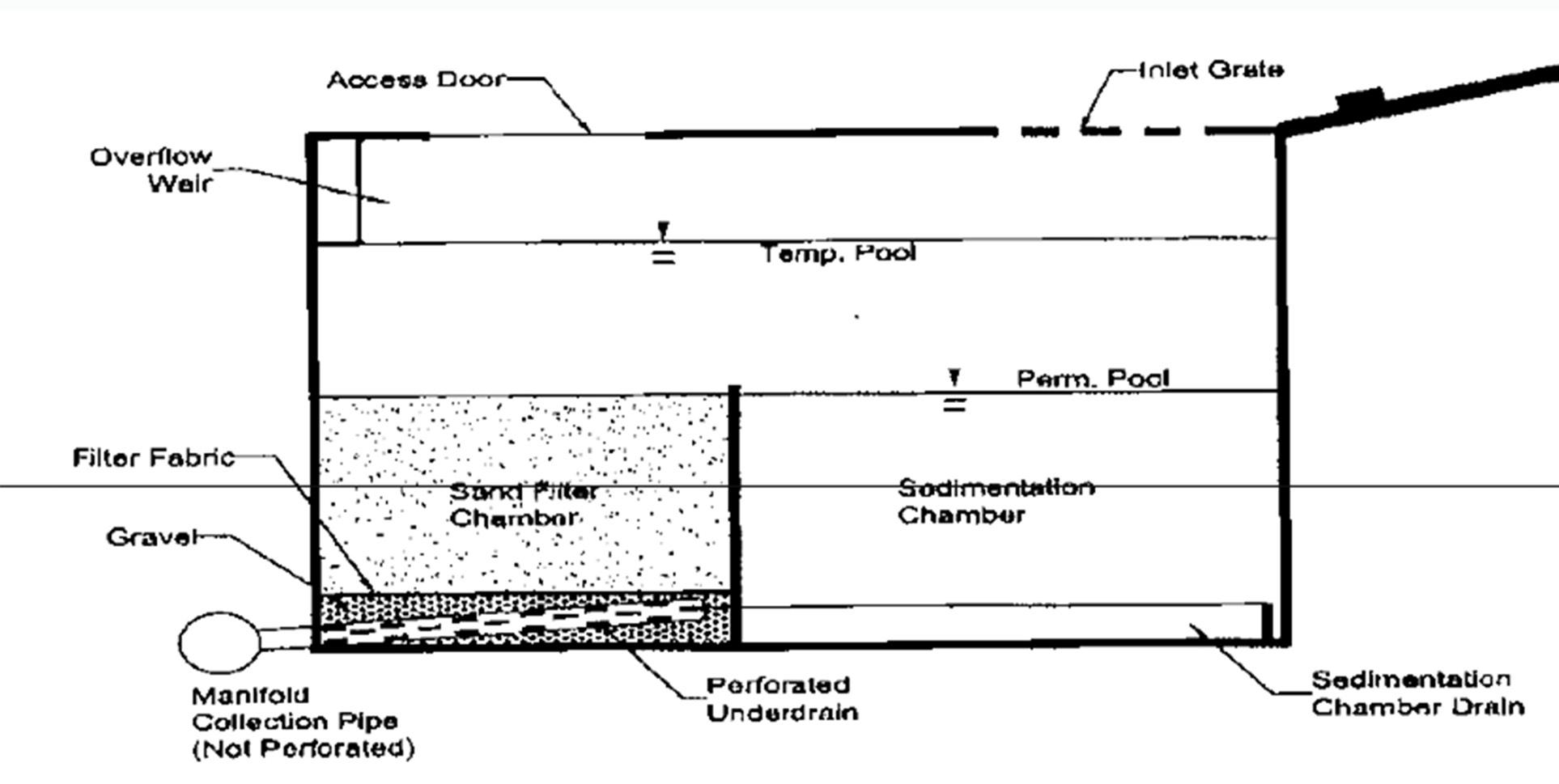
Quantity: Yes
Quality: Category A (50%)/Category B (25%)
Swales and grassed channels are management practices designed to treat and reduce stormwater runoff. Vegetation within swales and grassed channels slows stormwater velocities, allowing for sediment removal and infiltration into the underlying soils. Swales differ from grassed channels by the addition of carefully selected, highly permeable soil (usually sandy loam), check dams, and an underdrain system. These design features enhance stormwater’s ability to infiltrate into the soil below the swale.40 Grassed channels do not typically include these additional features and thus are not as effective at removing contaminants from stormwater runoff. Because grassed channels are not usually designed to control peak runoff loads by themselves, they are often used in combination with other stormwater management practices.
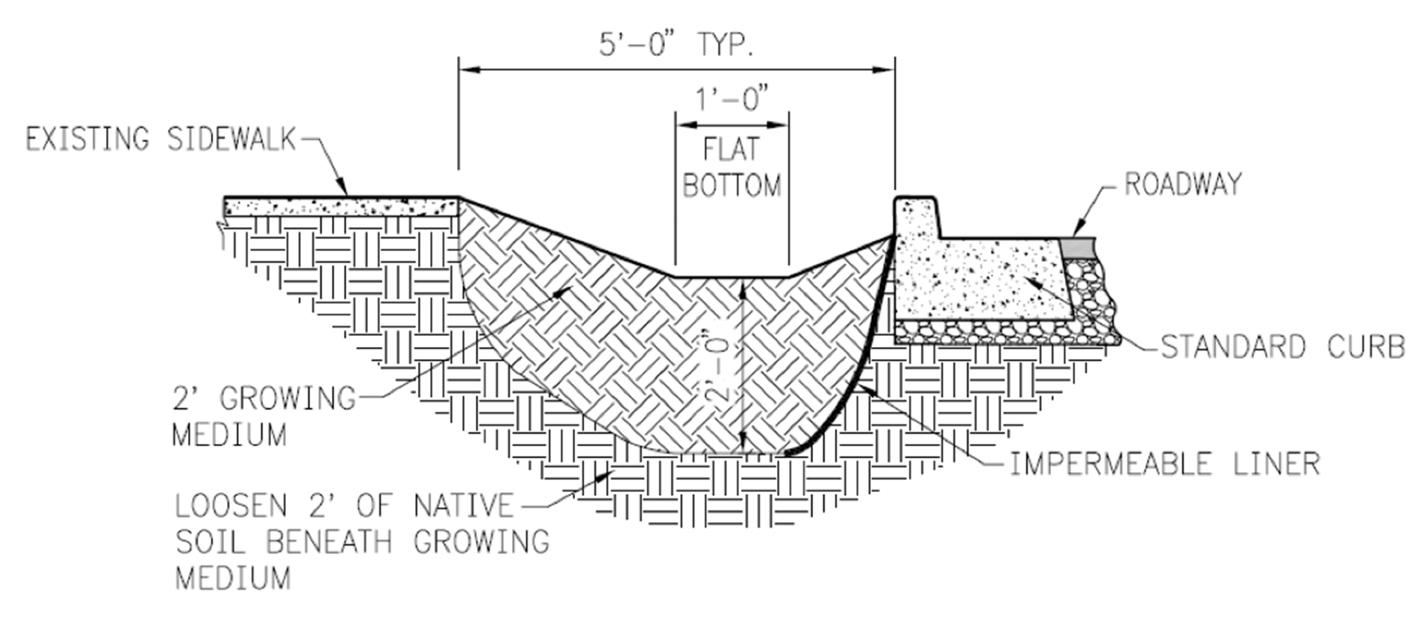
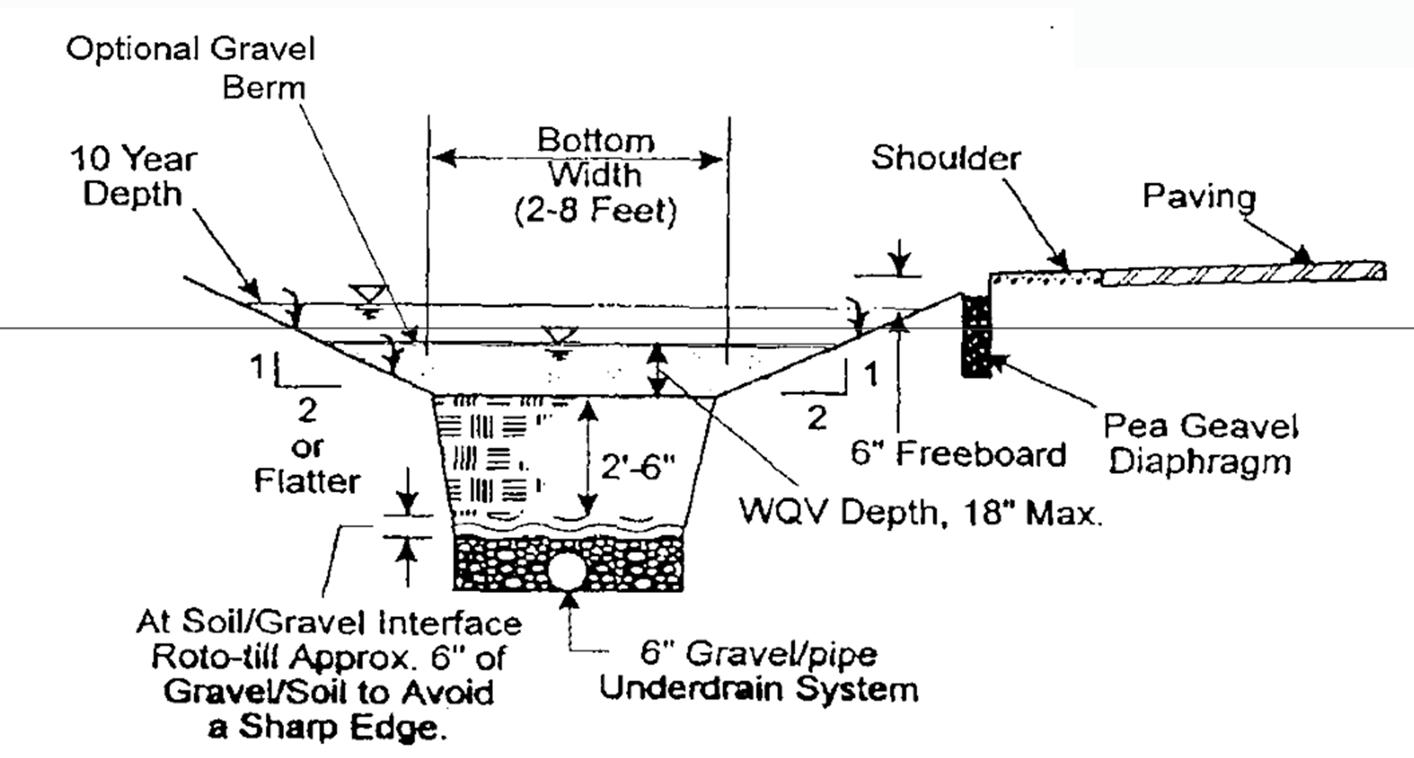
Figure III-13. Technical drawing of swaleK
Figure III-14. Technical drawing of grassed channelL
Section III - 122
Quantity: No
Quality: Category B (25%)
Vegetated filter strips are herbaceous grasses, sedges, and rushes that treat stormwater runoff from adjacent areas. Filter strips slow stormwater runoff while filtering out sediment and other pollutants.
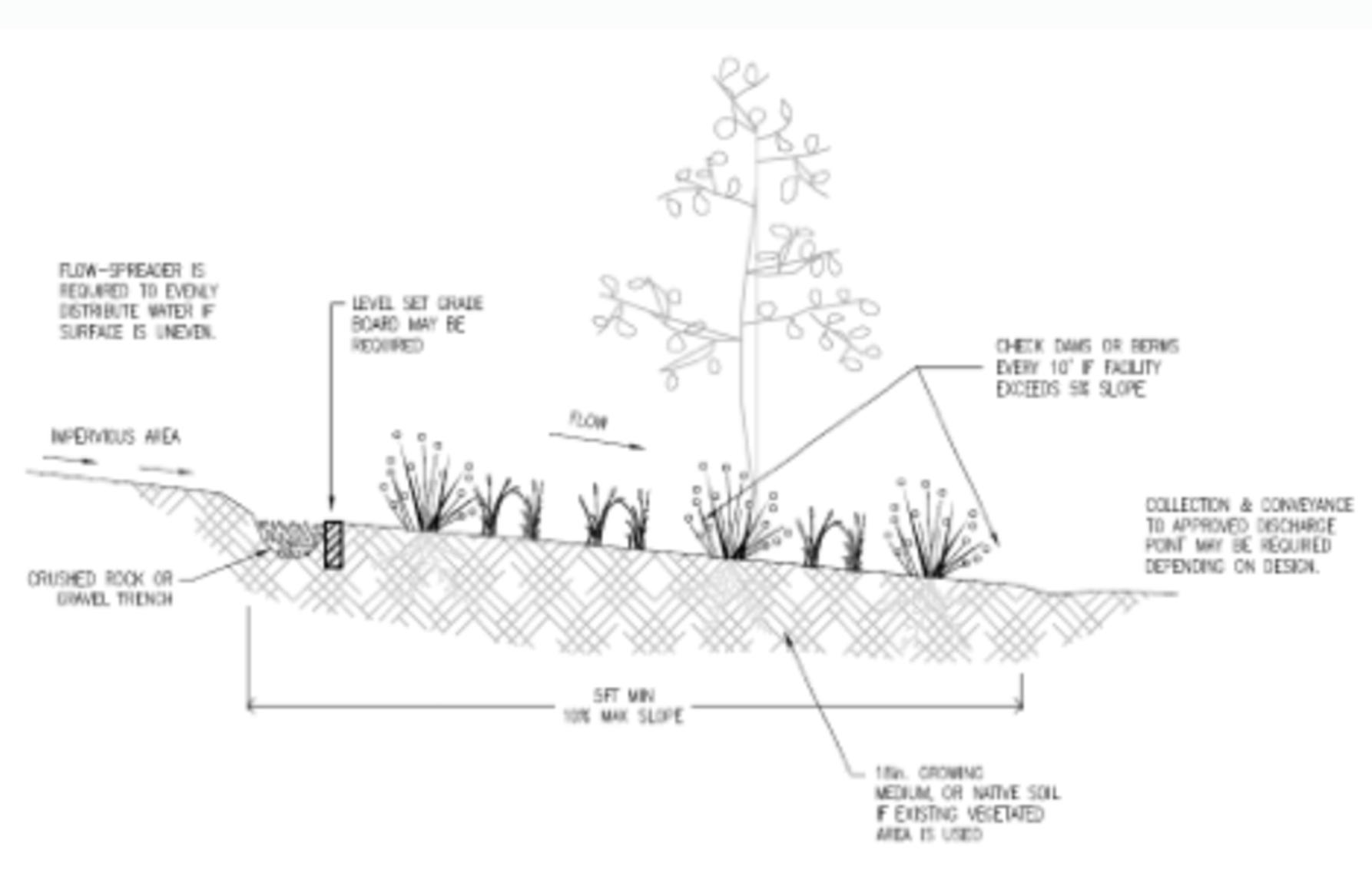
Section
Section III - 124
1. Marsh, W. “Chapter 11.” Landscape Planning: Environmental Applications. Hoboken, NJ: John Wiley & Sons, Inc., 2004) 230.
2. NOAA Office of Ocean and Coastal Resource Management, Adapting to Climate Change: A Planning Guide for State Coastal Managers – A Great Lakes Supplement by T. Cruce and E. Yurkovich (Silver Spring, MD: 2011).
3. King County. “Stormwater glossary of terms and abbreviations.” http://www.kingcounty. gov/environment/waterandland/stormwater/glossary.aspx.
4. Iowa DNR. “Baseflow: Where Groundwater Meets Surface Water.” http://www.igsb.uiowa. edu/browse/baseflow/baseflow.htm.
5. King County. Ibid.
6. Ibid.
7. Ibid.
8. Ibid.
9. Ibid.
10. Ibid.
11. United States Environmental Protection Agency. “Municipal Storm Water: Combined Sewer Overflows, Sanitary Sewer Overflows Compliance Monitoring.” http://www.epa.gov/ compliance/monitoring/programs/cwa/csos.html
12. King County. Ibid.
13. United States Environmental Protection Agency. “Our Mission and What We Do.” http:// www2.epa.gov/aboutepa/our-mission-and-what-we-do.
14. Association of Washington Cities and Washington State Department of Ecology. “Stormwater Management Program Effectiveness Literature Review.” http://www. ecy.wa.gov/programs/wq/psmonitoring/ps_monitoring_docs/SWworkgroupDOCS/ TradBMPFilterStripsWhitePaperFinalApril2013.pdf.
15. Flood Smart. “Resources: Glossary.” http://www.floodsmart.gov/floodsmart/pages/ glossary_A-I.jsp.
16. United States Environmental Protection Agency. “Green Roofs.” http://www.epa.gov/hiri/ mitigation/greenroofs.htm.
17. King County. Ibid.
18. Ibid.
19. Ibid.
20. United States Environmental Protection Agency. “What is Nonpoint Source Pollution?” http://water.epa.gov/polwaste/nps/whatis.cfm.
Notes from Text Section
21. United States Environmental Protection Agency. “Storm water discharges.” http://www. gpo.gov/fdsys/pkg/CFR-2011-title40-vol22/pdf/CFR-2011-title40-vol22-sec122-26.pdf.
22. United States Environmental Protection Agency. “Bioretention (Rain Gardens).” http://cfpub.epa.gov/npdes/stormwater/menuofbmps/index.cfm?action=factsheet_ results&view=specific&bmp=72; and, United States Environmental Protection Agency. “What is Green Infrastructure?” http://water.epa.gov/infrastructure/greeninfrastructure/ gi_what.cfm#raingardens.
23. Sustainable Cities Institute. “Stormwater Management: Retention Ponds.” http://www. sustainablecitiesinstitute.org/view/page.basic/class/feature.class/Lesson_Retention_ Ponds_Overview; and, King County. Ibid.
24. King County. Ibid.
25. New Jersey Stormwater Management Practices Manual. “Chapter 9.9: Standard for Sand Filters.” http://www.njstormwater.org/bmp_manual/NJ_SWBMP_9.9.pdf.
26. United States Environmental Protection Agency. “Municipal Storm Water: Combined Sewer Overflows, Sanitary Sewer Overflows Compliance Monitoring.” http://www. epa.gov/compliance/monitoring/programs/cwa/csos.html; and, Texas Commission on Environmental Quality. “Municipal Separate Storm Sewer System (MS4).” http://www.tceq. texas.gov/permitting/stormwater/WQ_ms4_definition.html.
27. Society of American Foresters. “Stormflow.” http://dictionaryofforestry.org/dict/term/ stormflow.
28. United States Environmental Protection Agency. Accessed December 15, 2013. “Stormwater Program.” http://cfpub.epa.gov/npdes/home.cfm?program_id=6.
29. King County. Ibid.
30. Ibid.
31. United States Environmental Protection Agency. “What is a Watershed?” http://water.epa. gov/type/watersheds/whatis.cfm.
32. United States Environmental Protection Agency. “Menu of BMPs.” http://cfpub.epa.gov/ npdes/stormwater/menuofbmps/index.cfm?action=min_measure&min_measure_id=5.
33. Idaho Department of Environmental Quality. “Catch Basin Inserts.” Accessed November 15, 2013. http://www.deq.idaho.gov/media/618062-6.pdf.
34. United States Environmental Protection Agency. “National Menu of Stormwater Best Management Practices. Accessed December 18, 2013. http://cfpub.epa.gov/npdes/ stormwater/menuofbmps/
35. New Jersey Stormwater Management Practices Manual. “Chapter 9.5: Standard for Infiltration Basins.” Accessed November 15, 2013. http://www.nj.gov/dep/stormwater/
Section III - 126
bmp_manual/NJ_SWBMP_9.5.pdf.
36. United States Environmental Protection Agency. “Infiltration Trench.” Accessed December 18, 2013. http://cfpub.epa.gov/npdes/stormwater/menuofbmps/index. cfm?action=browse&Rbutton=detail&bmp=70&minmeasure=5.
37. United States Environmental Protection Agency. “Pervious Concrete Pavement.” Accessed November 15, 2013. http://cfpub.epa.gov/npdes/stormwater/menuofbmps/index. cfm?action=factsheet_results&view=specific&bmp=137&minmeasure=5.
38. United States Environmental Protection Agency. “Bioretention (Rain Gardens).” Accessed November 15, 2013. http://cfpub.epa.gov/npdes/stormwater/menuofbmps/index. cfm?action=factsheet_results&view=specific&bmp=72&minmeasure=5.
39. United States Environmental Protection Agency. “Sand & Organic Filters.” Accessed November 15, 2013. http://cfpub.epa.gov/npdes/stormwater/menuofbmps/index. cfm?action=factsheet_results&view=specific&bmp=73&minmeasure=5.
40. United States Environmental Protection Agency. “Grassed Swales.” Accessed December 18, 2013. http://cfpub.epa.gov/npdes/stormwater/menuofbmps/index. cfm?action=browse&Rbutton=detail&bmp=75&minmeasure=5.
Section III - 127
Image Notes
A. United States Environmental Protection Agency. “Report to Congress on the Impacts and Conrtol of CSOs and SSOs.” Accessed October 9, 2013. http://www.epa.gov/npdes/pubs/ csossoRTC2004_chapter02.pdf.
B. City of Toledo. 2013. “Landuse and Streets geodatabase”, City of Toledo. 2013. “Stormwater study geodatabase”, City of Toledo. 2012. “Watersheds 2012 shapefile”, U.S. Census Bureau. 2013. “2013 TIGER/Line Shapefiles: Water - Area Hydrography”, U.S. Census Bureau. 2013. “2013 TIGER/Line Shapefiles: Counties (and equivalent)”
C. United States Environmental Protection Agency. “Vegetated Filter Strip.” Accessed November 15, 2013. http://cfpub1.epa.gov/npdes/stormwater/menuofbmps/index. cfm?action=factsheet_results&view=specific&bmp=76&minmeasure=5; and, Toledo Metropolitan Area Council of Governments. “TMACOG Stormwater Management Standards Manual, 3rd Edition.” Accessed November 15, 2013. http://www.tmacog. org/Environment/TMACOG_Stormwater_Standards_Manual_.pdf; and, The Rain Garden Initiative. “Rain Gardens: A Homeowner’s How to Guide for Northwest Ohio.” Accessed November 15, 2013. http://www.raingardeninitiative.org/documents/pdfs/ NW_Ohio_Manual.pdf; and, The Rain Garden Initiative. “Technical Design: RW&L.” Accessed November 15, 2013. http://www.raingardeninitiative.org/documents/pdfs/ rwld_bioretention_2006.pdf; and, American Rivers. “Low Impact Development Manual for the Lower Maumee and Ottawa River Watersheds.” Accessed November 15, 2013. http://www.raingardeninitiative.org/documents/pdfs/nwo_lid_manual.pdf; and, Ohio Department of Natural Resources, Division of Soil and Water Conservation. “Rainwater and Land Development: Ohio’s Standards for Stormwater Management Land Development and Urban Stream Protection, 3rd Edition.” Accessed November 15, 2013. http://www.dnr. state.oh.us/Portals/12/water/rainwater/8_30_2012RLDFiles/10-21-13RLD_All.pdf.
D. United States Environmental Protection Agency. “Vegetated Filter Strip.” Accessed November 15, 2013. http://cfpub1.epa.gov/npdes/stormwater/menuofbmps/index. cfm?action=factsheet_results&view=specific&bmp=76&minmeasure=5.
E. Landscapeisdonovan2’s Blog. “Typical Green Roof Section.” Accessed December 17, 2013. http://landscapeisdonovan2.wordpress.com/focus-week-2010-green-roofs/.
F. Iowa-Cedar Watershed Interagenc Coordination Team. “Figure 1: Infiltration Basin Schematic.” Accessed December 17, 2013. http://iowacedarbasin.org/runoff/images/2E/ image054.jpg.
G. American Rivers. “Low Impact Development Manual for the Lower Maumee and Ottawa River Watersheds.” Accessed November 15, 2013. http://www.raingardeninitiative.org/
Section III - 128
documents/pdfs/nwo_lid_manual.pdf.
H. American Rivers. “Low Impact Development Manual for the Lower Maumee and Ottawa River Watersheds.” Accessed November 15, 2013. http://www.raingardeninitiative.org/ documents/pdfs/nwo_lid_manual.pdf.
I. Toledo Metropolitan Area Council of Governments. “TMACOG Stormwater Management Standards Manual, 3rd Edition.” Accessed November 15, 2013. http://www.tmacog.org/ Environment/TMACOG_Stormwater_Standards_Manual_.pdf.
J. Ibid.
K. Ibid.
L. Ibid.
M. Toledo Metropolitan Area Council of Governments. Ibid.
Section III - 130