From Needs to Opportunities: Strategies for the West
MECC Initiative
Taubman

University
MECC Initiative
Taubman
University
We would like to thank the community members from the New West Willow Neighborhood Association whose dedication to improving their neighborhood is inspiring.
We would also like to thank Paul Fontaine and the MECC initiative, as well as several Washtenaw County and Ypsilanti Township employees for providing their expertise, feedback, and support.
Lastly, we want to extend our gratitude to our faculty advisors, Ana Paula Pimentel Walker and Eric Dueweke, for their guidance throughout the semester as well as their dedication to this project.
Client New West Willow Neighborhood Association
Community Stakeholders
Deborah Gordon-Gurfinkel, Telling It (University of Michigan)
Stephen Wade, Washtenaw County Office
Sarah Teare, Habitat for Humanity of Washtenaw County
Brenda Stumbo & Joe Lawson, Ypsilanti Township
Elke Tucker, MichiganWorks!
Roy Townsend, Washtenaw County Road Commission
MECC Participating University of Michigan Units
College of Engineering:
Industrial and Operations Engineering
Multidisciplinary Design Program
Taubman College of Architecture and Urban Planning: Urban and Regional Planning Program
Faculty Members
Ana Paula Pimentel Walker
Eric Deweke
Students
Mohamad Diab, Nelida Escobedo Ruiz, Arielle Fleisher, Yu-Hung Hsiung, Elsa Ibarra Albizu, Brandon Kovnat, Cheng Kuan Kan, Albert Lee, Matthew
Lonnerstater, Terra Reed, Elise Ross, Danielle Thoe, Sara White.
From Needs to Opportunities: Strategies for the West Willow Neighborhood provides answers to three questions in order to stimulate positive change in the West Willow neighborhood in Ypsilanti Township.
What do we know about West Willow?
What opportunities exist for development in and around West Willow? How can West Willow move from needs to opportunities?
Neighborhoods change through a dynamic interplay of internal and external forces. In the West Willow neighborhood of Ypsilanti Township, Michigan the dedicated volunteers of the New West Willow Neighborhood Association (NWWNA) work to help their neighborhood grow and thrive from within. Meanwhile, the nearby Willow Run plant site is poised for development that may bring jobs and resources to the area, which will undoubtedly impact neighborhood residents. This change could mark the start of a new, inspiring era for West Willow.
The goal of this report is to help West Willow residents productively address change by clearly describing existing conditions and needs, and identifying opportunities for enhancement. The bulk of the report is designed as a set of mini-manuals, which are meant to help the NWWNA move from needs to action by seizing opportunities to improve quality of life for neighborhood residents.
Pre-Assessment and Assessment Research
To identify the needs and desires of neighborhood residents, the Urban Planning Team worked with the NWWNA to conduct a needs assessment. The goal was to gain an understanding of existing conditions, which provide the foundation for the strategies, recommendations, and actions described in Chapters 4-7. Sources include previous neighborhood assessments, program websites, strategic planning documents, newspaper articles, interviews with key stakeholders, and a randomized door-to-door survey of West Willow households conducted by the Urban Planning Team and the NWWNA. The survey focused on programming, retail options, services, and transportation behaviors and was completed by 91 neighborhood residents.
This report was prepared by 13 Masters of Urban Planning students (Urban Planning Team) from University of Michigan and is based on their assessment of the neighborhood, guided and inspired by the NWWNA.
Chapters 2-3
• Services
• Economic Development
• Physical Improvements Chapter 4
Key takeaways from the survey and research include:
• West Willow is a relatively stable, quiet, and calm neighborhood.
• Youth make up a higher percentage of West Willow’s population than in Ypsilanti, Washtenaw County, and Michigan overall.
• The unemployment rate in West Willow is significantly higher than in Washtenaw County.
• Crime rates in West Willow are steadily decreasing.
• The housing stock is old and potentially in need of weatherization improvements.
• Residents are satisfied with local amenities but would appreciate additional retail options nearby.
• West Willow residents are eager to see more youth programming, job training, and crime prevention.
• The car dominates both life and attitudes in West Willow. Residents who do use the bus would appreciate more frequent bus service.
Although West Willow is relatively stable and quiet, the NWWNA is pursuing exciting projects and there are opportunities for neighborhood enhancement with regard to services and resources, economic development, and physical improvement. These are the “areas of action” referred to in this report that can guide the NWWNA’s efforts to improve West Willow.
Few opportunities exist in or around the neighborhood for West Willow residents to access the resources they may need, like health care, childcare, or other human services. Neighborhood statistics indicate that some residents may need or benefit from improved access to certain services. The survey confirmed this need: many West Willow residents believe services such as youth development, crime prevention, recreation, and job training might be beneficial to the community. There are many service providers in the Washtenaw County area, but residents may not realize that they have access to them.
Chapter 4 presents goals and strategies that would allow the NWWNA to work with service providers to improve access to the services that residents need and want.
Vision: Goals to guide future actions for the NWWNA: Human services should be accessible to West Willow residents to improve quality of life and promote a safer and healthier neighborhood for all residents.
• Provide comprehensive youth development programming.
• Increase access to workforce development and job training.
• Strengthen neighborhood leadership.
West Willow is purely residential; no retail development exists within the neighborhood. The survey indicated that residents consider nearby retail accessible, but they believe additional retail nearby would be beneficial to their neighborhood. A basic market analysis revealed that additional neighborhood-oriented retail in or around West Willow is not very feasible, but the NWWNA can advocate for better access and improvements to existing retail along Ecorse Road by working closely with the Washtenaw County Road Commission and Ypsilanti Township. A new development at the Willow Run plant site may increase demand for retail, although in order for additional retail to be viable, extensive improvements to Wiard Road are necessary.
Chapter 5 outlines opportunities for economic development and improved access to existing retail with specific strategies that the NWWNA can pursue.
Vision:
West Willow residents should advocate for increased pedestrian access to existing retail and a greater variety of neighborhood-oriented retail options in order to improve the general quality of life for West Willow residents, while preserving the neighborhood’s residential character.
Goals to guide future actions for the NWWNA:
• Advocate for increased access to existing retail.
• Advocate for a greater variety of neighborhood-oriented retail options.
Several opportunities exist to enhance the physical environment in West Willow, including better lighting, sidewalks, bus stops, benches, park equipment, and traffic signs. Improvements to the neighborhood streetscape may improve the neighborhood’s image and could also foster social cohesion. Improved connections between West Willow and adjacent areas could facilitate pedestrian safety and allow residents to access nearby destinations more easily.
Chapter 6 presents recommendations for enhancements that address aesthetics, safety, and connectivity. These recommendations focus on Tyler Road, Service Drive, the intersection of Dorset Avenue and US-12, and Wiard Road. Any major changes to infrastructure will require close collaboration between the NWWNA, Ypsilanti Township, and the Washtenaw County Road Commission. As the future of the Willow Run plant site and Ecorse Road become clearer, the NWWNA should advocate for connections and physical improvements to West Willow.
Chapter 5
Chapter 6
Chapter 7
Vision: Goals to guide future actions for the NWWNA:
The physical conditions in West Willow should promote safety and access to services and retail to improve quality of life for neighborhood residents, while also creating an appealing aesthetic character.
• Improve streetscapes within the neighborhood.
• Develop automobile and pedestrian access across Wiard Road.
• Improve pedestrian access to Ecorse Road.
Redevelopment of the Willow Run plant site provides a unique opportunity for the residents of West Willow to advocate for benefits such as funding for streetscape improvements or local hiring preferences. There are multiple ways for communities like West Willow to approach a developer to ensure neighborhood benefits. Two common options are development agreements and community benefits agreements. A development agreement is routinely drawn up between a local government like Ypsilanti Township and a property owner or developer before a project is approved, and can include provisions for community benefits. A community benefits agreement is an agreement between a community organization like the NWWNA and a developer that outlines desired improvements.
Chapter 7 describes and assesses these two options and provides guidance to the NWNNA should it decide to pursue an agreement. This chapter includes draft CBA language that lists and explains several elements that could be included in either agreement. For either approach, the NWWNA should build relationships with Ypsilanti Township, the developer, and other local non-profits that might be impacted or can lend their support to NWWNA.
Each chapter in this report takes a different approach to answering the question:
How can the NWWNA promote community building, development, and neighborhood enhancement in West Willow in order to improve quality of life for neighborhood residents?
Together, these chapters provide a comprehensive framework that can help the NWWNA build on existing assets and seize available opportunities. The recommendations in each chapter include actions that the NWWNA can implement in the short-, middle-, and long-term so that the residents can start taking action now, but keep the future of the neighborhood in mind. With hard work and collaboration, the residents of West Willow can leverage opportunities and advocate for positive changes.
Acknowledgements
Executive Summary
Chapter 1 - Introduction
Overview
History
Stakeholder Analysis
Chapter 2 - Assessing Needs, Finding Gaps
What is a Needs Assessment?
How to conduct a Needs Assessment
West Willow Needs Assessment
Pre-Assessment
Chapter 3 - Digging Deeper, Gaining Insights
Assessment: West Willow Survey Analysis
Conversation with Key Stakeholders
Conclusions: Assessment
Chapter 4 - Services
Introduction Case Study
Goals, Strategies, Action/Implementation
Directory of Services
Directory of Funding Sources
Home Weatherization and Rehabilitation Programs
Grant Template
Chapter 5 - Economic Development
Introduction
Market Gap Analysis
Additional Issues Impacting Retail Development
Discussions, Goals, and Strategies
Chapter 6 - Physical Improvements
Introduction Goals, Strategies, and Discussion Conclusion
Chapter 7 - Addressing Development at the Willow Run Plant Site
Introduction Case Studies Strategies & Discussion Items to include in a CBA
Chapter 8 - Conclusions
Conclusions
Scenario With Development Scenario Without Development
Overview
History
Stakeholder Analysis
Neighborhoods and the cities they occupy provide many of the resources required to ensure quality of life: schools, recreation, food, employment, and social networks. Yet every neighborhood is a dynamic entity, subject to fluctuations in the housing market, changes in industry, evolving tax bases, and demographic shifts. The neighborhood of West Willow is no exception.
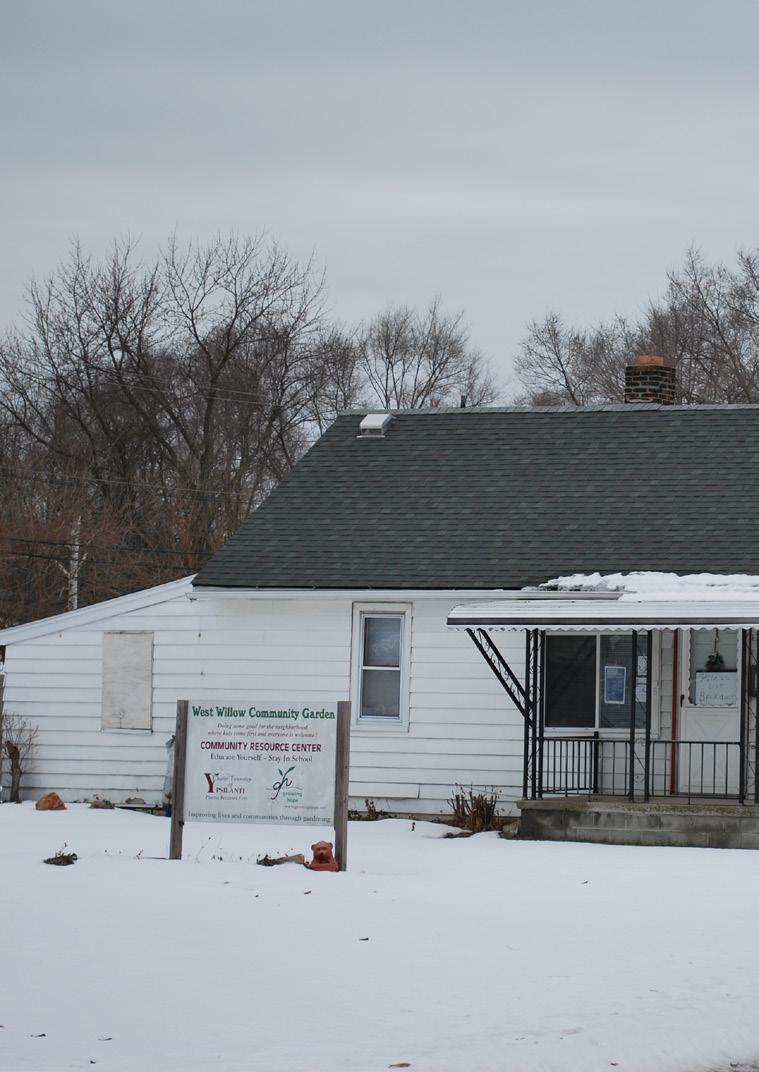
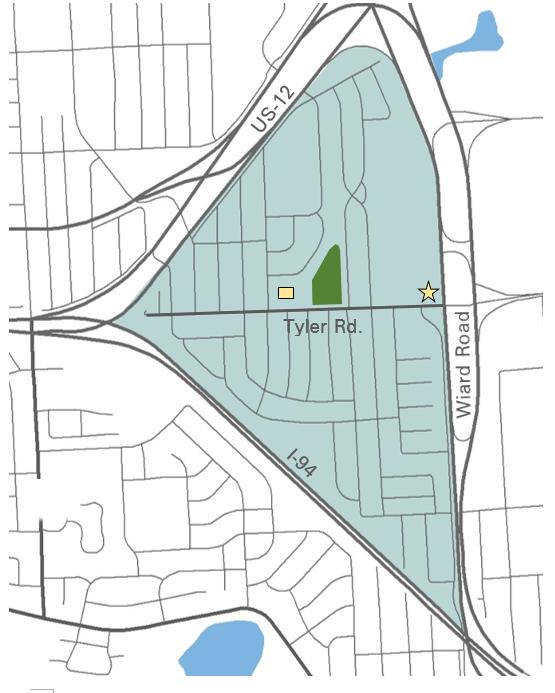
West Willow, located in Ypsilanti Township near the eastern border of Washtenaw County, just west of the Willow Run Airport in neighboring Wayne County (Figure 1.1: Map of Willow Run), is now poised for change. Resident members of the all-volunteer New West Willow Neighborhood Association are actively working to improve their neighborhood. They hold monthly community meetings and sponsor small-scale activities in their Community Resource Center, which occupies a small house on the neighborhood’s main street. Because of its proximity to an important industrial site, the transformation West Willow confronts is more dynamic and holds more potential than the usual change that confronts neighborhoods. Directly across the road, the 5 million square-foot Willow Run plant that 70 years ago produced a bomber every hour and that until five years ago housed a General Motors manufacturing plant, is being demolished.1
The dismantling of the industrial and manufacturing sector threatens the stability of many neighborhoods in Southeast Michigan: gone are the jobs, the sense of purpose work provided and the tax base; in its place is a lack of resources and stability, reflected in the abandoned homes, poorly maintained streets and increased rates of neighborhood crime, the symptoms of this larger shift.2, 3 With redevelopment, gentrification looms as a possibility.4
Neighborhood change, whether in terms of gentrification and displacement or increasing crime and deterioration, can be stressful for long-time residents who feel unable to control the events surrounding them.5
Resident members of the all-volunteer New West Willow Neighborhood Association are actively working to improve their neighborhood.
For West Willow change could mean the start of a new, inspiring era. Although the future of the former plant site is currently uncertain, it is poised for major development that may bring jobs and resources into the area. If these jobs come to fruition, they could impact neighborhood residents in a wide variety of ways. What does this potential new development mean for the residents of West Willow? How will the residents of West Willow benefit from whatever development rises from the dust of this historically significant site? Working with neighborhood residents, urban planners can help a community harness its assets, address its deficiencies, and grow into a place where residents can more successfully live, work, and play. A needs assessment, an analysis of existing conditions in a community, provides the basis for strategies and policy recommendations that can be used to inform decision making and action plans.6 The needs assessment asks: Where are we? What do we know? And, importantly, where do we want to go?
To help the residents of West Willow productively confront change, a team of 13 Urban Planning students from the Urban and Regional Planning Program at the University of Michigan conducted a needs assessment of the West Willow neighborhood. The New West Willow Neighborhood Association requested help understanding the needs, wants, and desires of West Willow residents. For example, what services are available to residents? Do residents feel there is adequate shopping in the area? What do residents like about West Willow? What are their concerns? The answers to these and other questions are detailed in this report, which provides recommendations and action plans that aim to help the neighborhood move from needs to concrete action.
This report is organized as a series of mini-manuals. Chapters 2 and 3 detail the pre-assessment and needs assessment and provide an overview of West Willow. Chapters 4-7 are designed to provide residents of West Willow with concrete information as to how they can improve their community. Chapter 4 provides strategies for community development and Chapter 5 details opportunities for economic growth. Chapter 6 discusses physical improvements that could benefit the neighborhood. Chapter 7 discusses Community Benefit Agreement, Development Agreement and how West Willow residents could utilize these tools to advocate for specific improvements within their community.
The Urban Planning Team participated in this project as a part of the Michigan Engaging Communities in the Classroom (MECC) Initiative. MECC provides a practice-oriented collaborative learning experience for student teams from the URP, Public Health,
Engineering, and Public Policy programs. In 2013, students from these programs worked with Washtenaw County, the City of Ypsilanti, Ypsilanti Township, Racer Trust, Willow Run Airport, and the New West Willow Neighborhood Association to conduct a health impact assessment of the West Willow neighborhood, an analysis of various potential uses for the former bomber plant site and ways to modernize the Willow Run airport. Building upon the success of last year’s MECC work, the Winter 2014 projects again focused on the Willow Run area. The 2014 projects include this report by the Urban Planning Team, as well as two projects from the College of Engineering: the design of a wetland in the former bomber plant area and the development of a multimodal transit plan for West Willow.

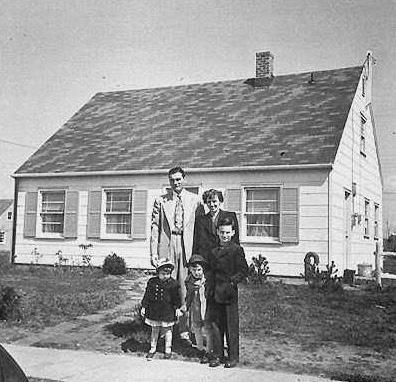
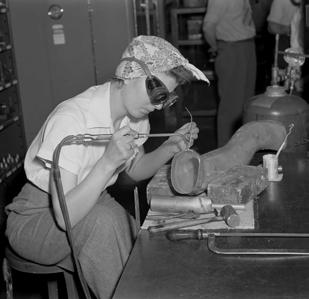
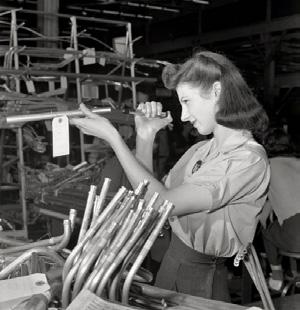
1939
1941
1942
1943
Second World War Begins
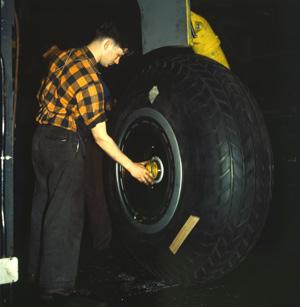
Ford Motor Company starts the construction of Willow Run Bomber Plant
WPB and NHA agree that public war housing can de built to temporary standards
Willow Run Bomber Plant produces its first bomber
Willow Run Bomber Plant employment peaks at 42,506 workers, and Willow Village war population peaks at 1728 families only a few months after the first family apartments at Willow Village open
1944
1945
1946
Production peaks at one bomber every 63 minutes in the month of March. By December employment falls to 28,422 workers
Bomber production ceases after the construction on 8685 units
Kaiser-Fraizer Corporation buys the plan for automobile production
A few hangars are sold to U of M to operate the Michigan Aeronautical Research Center
1953 The complex is leased to GM for a Powertrain factory and engineering center, it will eventually be bought 1970
In the 70’s the plant hired around 14,000 workers
Home to the Yankee Air Museum
In the early 2000’s the New West Willow Neighborhood Association is created
In the early 2000’s the New West Willow Neighborhood Association is created
A team of public and private actors developed a neighborhood improvements strategy for West Willow
GM declares bankrupcy and Racer Trust acquires most part of the site, excluding the airport and some smaller buildings
Racer Trust and the Yankee Air Museum negotiate to preserve a small portion of the original plant to house the musseum. Meanwhile demolition starts.

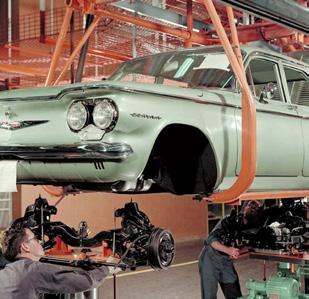
1.2 Housing Development from 1950 to 1959
Figure 1.3 Housing Development from 1960 to 1969
Figure 1.4 Housing Development from 1970 to 2005
The NWWNA is actively working to improve and enhance the West Willow neighborhood and many individuals and organizations are central to this effort. These stakeholders are invested in West Willow as residents, government officials, community members, academics, church leaders and concerned citizens. Though each has a unique role, they share the same goal: that West Willow become a thriving neighborhood where residents can successfully live, work and play.
Washtenaw County, Ypsilanti Township and the local chapter of Habitat for Humanity are all very invested in West Willow. These entities attend NWWNA meetings and are working alongside residents to improve the quality of the built environment in the neighborhood, to provide more services for neighborhood residents, and to enhance economic activity in the area. Churches, too, are key stakeholders, as they serve residents of the West Willow community and provide youth programming. The University of Michigan, through the MECC program, is becoming a new stakeholder, invested in the future of the neighborhood; other universities in the area are also likely enthusiastic to see West Willow thrive and may be interested in working with the NWWNA. Some stakeholders such as Ann Arbor Spark and RACER Trust have interest in the area related to the Willow Run plant site--especially the future site developer. The AAATA, surrounding communities and businesses will all experience the impact of development at the Willow Run plant site.
Each of these stakeholders has their own voice, agenda, and capacity, and their own means—economically, politically or socially— through which they shape the area. The NWWNA should continue working with these stakeholders, intensifying efforts and seeking new partnerships where necessary. Awareness of these various stakeholders and how they may influence the neighborhood’s future represents a key first step toward improvements.
Potential stakeholders for the NWWNA include neighboring communities, potential industries, local or regional business groups, academic/ research institutions, and government agencies.
Awareness of these various stakeholders and how they may influence the neighborhood’s future represents a key first step toward improvements.
1.5 Stakeholders
Watsonia Neighborhood Communities
West Willow
Turtle Creek
Michigan State University Academia
University of Michigan
Eastern Michigan University
Wayne State University
RACER Trust
(Current property holder)
Government Agencies
Local government
Ypsilanti Township
Wasthtenaw County
State and federal government
Environmental Protection Agency
Michigan Department of Environmental Quality
Michigan Department of Transportation
New West Willow Neighborhood Association
Business and non-profit
Potential Developer
Walbridge Development LLC
(Potential powertrain plant developer)
International Turbine Industries
(Purchased a former GM factory nearby)
Yankee Air Force
(Contracted site demolisher)
Devon Industrial Group
(Bomber plant museum)
Nearby Industry
Willow Run Airport
CSX
Ann Arbor Area Tranport Authority
Other car industries
Habitat for Humanity
Church groups:
Daughters of Zion Women’s Missionary
New Covenant Missionary Baptist
Spiritual Israel Church & it’s Army
Trinity Free Will Baptist
West Willow Church of God
Business Coalitions
Ann Arbor SPARK
Ann Arbor-Ypsilanti Chamber of Commerce
Eastern Leaders Group
Peterson, S. Jo. (2013). Planning the home front: building bombers and communities at Willow Run. Chicago: University of Chicago Press.
Sugrue, T.C. (1996) details in impacts of deindustrialization on Detroit and, more broadly, neighborhoods, in his seminal work, “The origins of the urban crisis: race and inequality in post war Detroit.”
Keenan, P., Lowe, S., & Spencer, S. 1999. “Housing abandonment in inner cities—the politics of low demand for housing.” Housing Studies, 14(5), 703-716.
Newman and Ashton (2004) define gentrification as a “class-based process of neighborhood upgrading, with residential displacement generally used as the litmus test to separate it from other types of reinvestment” (p.1153). Morckel (2013) further argues that neighborhood instability is a key variable in the gentrification process, as it creates a landscape of real estate speculation from large developers and/or individuals who have enough capital to take advantage of the situation (See: Morckel, V.C. (2013). Empty neighborhoods: Using constructs to predict the probability of housing abandonment. Housing Policy Debate, 23(3), 469-496.) Detroit is arguably currently experiencing such a situation.
Baum, F., & Palmer, C. (2002). “Opportunity structures:” Urban landscape, social capital and health promotion in Australia. Health Promotion International, 17(4), 351.
Kelly, E. D., & Becker, B. (2000). Community planning: an introduction to the comprehensive plan. Washington, D.C.: Island Press; Sanoff, H. (2000). Community participation methods in design and planning. New York: J. Wiley & Sons.
What is a Needs Assessment?
How to Conduct a Needs Assessment
West Willow Needs Assessment
Pre-assessment
To identify the needs, wants and desires of residents, the Urban Planning Team worked with the New West Willow Neighborhood Association to conduct a needs assessment of the West Willow neighborhood. The first step in a needs assessment is the preassessment. During this stage, available data are collected and gaps in knowledge are identified. This chapter provides an overview of the needs assessment process and presents pre-assessment findings, including research on demographics, crime and safety, available resources, transportation options and physical conditions. The information detailed in this chapter sets the foundation for the rest of the report; it represents the first step in the “where are we” identification process.
A needs assessment (NA) strives to help a community identify its assets and determine the potential issues it faces.1 Using a systematic set of procedures to analyze community conditions, the NA helps a community set priorities and make informed decisions about future actions.2 At its core, the NA is a discrepancy analysis, helping communities identify where they are, versus where they want to be, so they can then take steps to successfully move to where they want to go.3
There are three phases to a Needs Assessment: Phase 1: Preassessment, Phase 2: Assessment, and Phase 3: Post-assessment.4
The first phase, Pre-assessment, is the exploration stage. During this phase, the general purpose, scope, and focus of the assessment are determined, including why the NA is being conducted and who will use the results. Available data is collected, which helps the researchers identify “gaps in knowledge” or unknown but likely important information and determine potential sources and methodologies that could be useful for future data gathering efforts. This phase represents the foundation of the needs assessment. What data should be collected in the pre-assessment phase? (Kelly & Becker, 2000)
• Demographic information
• Employment status
• Neighborhood conditions
• Location of stores, shops and business
• Transportation options
• Natural Resources
• Crime and safety
• Medical services, such as hospitals, health clinics, and pharmacies
• Park and open spaces
• Schools
• Housing occupancy and vacancy rates
The Assessment phase is the data gathering phase, during which the context and scope of the NA are refined. In this phase, additional data—that is, data that was not easily available in the preassessment stage-- is collected, analyzed and synthesized; the root causes of the needs are then explored; and the needs are prioritized.
Pre-assessment
Information collected during this phase, helps set priorities for the action plans, recommendations, and solutions generated in Phase 3.
Phase 3, Post-assessment, concerns the development of actions and recommendations to address the needs identified and prioritized in Phases 1 and 2. Needs are multifaceted and complex; proposed solutions should acknowledge this complexity and be clearly designed to serve stated goals. Feasibility is an important focus of this stage—it is necessary to identify opportunities that are possible and to eliminate from consideration directions or activities that are not feasible.5 The community should actively be involved in this phase, as the solutions ultimately impact community members. The actions and recommendations developed during this phase are meant to inform an action plan which provides strategies and suggestions for realizing the recommendations.
Figure 2.1 Basic Steps for Gathering Data in an Existing Conditions Analysis6
Identify the subjects for which data is needed
Assemble all existing reports and studies that include such data
Check with libraries, universities, research center, and appropriate federal, state, and local agencies for other pertinent data.
Review cross-check and validate the data
Identify missing data
Develop methodologies for gathering missing data
Assessment
Gather data on outstanding needs.
Analyze and synthesize the data.
Prioritize needs
Post-assessment
Develop an action plan for addressing the prioritized needs that makes the information easily accessible to the planning body and community members.
To conduct a needs assessment of the West Willow neighborhood, the Urban Planning Team first compiled available information about the neighborhood. The goal of this initial research effort, or the pre-assessment, was to develop a basic understanding of community demographics, and other data as described above. For the assessment phase, we conducted a door-to-door survey to gather more specific information about the needs and wants of residents. To further our understanding of how the neighborhood might benefit from external resources, we interviewed key stakeholders from the public and private sectors, including representatives from Washtenaw County and Ypsilanti Township, as well as directors of programs in the West Willow area. Summaries of these interviews are provided in Chapter 3. The information gathered from the pre-assessment and assessment provides the foundation for the strategies, recommendations and actions detailed as part of the post-assessment in Chapters 4-7 of this report.
The Pre-assessment phase is the exploration stage. During this phase available data is collected and gaps in knowledge are identified. This phase represents the foundation of the needs assessment.
To conduct the pre-assessment, the Urban Planning Team first identified research topic areas and gathered data on each of these topics. To choose the topics for the pre-assessment, we consulted needs assessment best practices found in planning literature and took into account suggestions from community members and students’ own knowledge of planning approaches. We identified “gaps in knowledge,” information that was not directly accessible but potentially important, and thus necessary for the next phase of research. Sources included previous assessments of the neighborhood, program websites, strategic planning documents, and newspaper articles.
• Demographics
• Economy and Employment
• Crime and Safety
• School Districts
• Resources and Services
• Parks and Recreation
• Transportation
• Land Use
• Physical Conditions
• Natural Resources
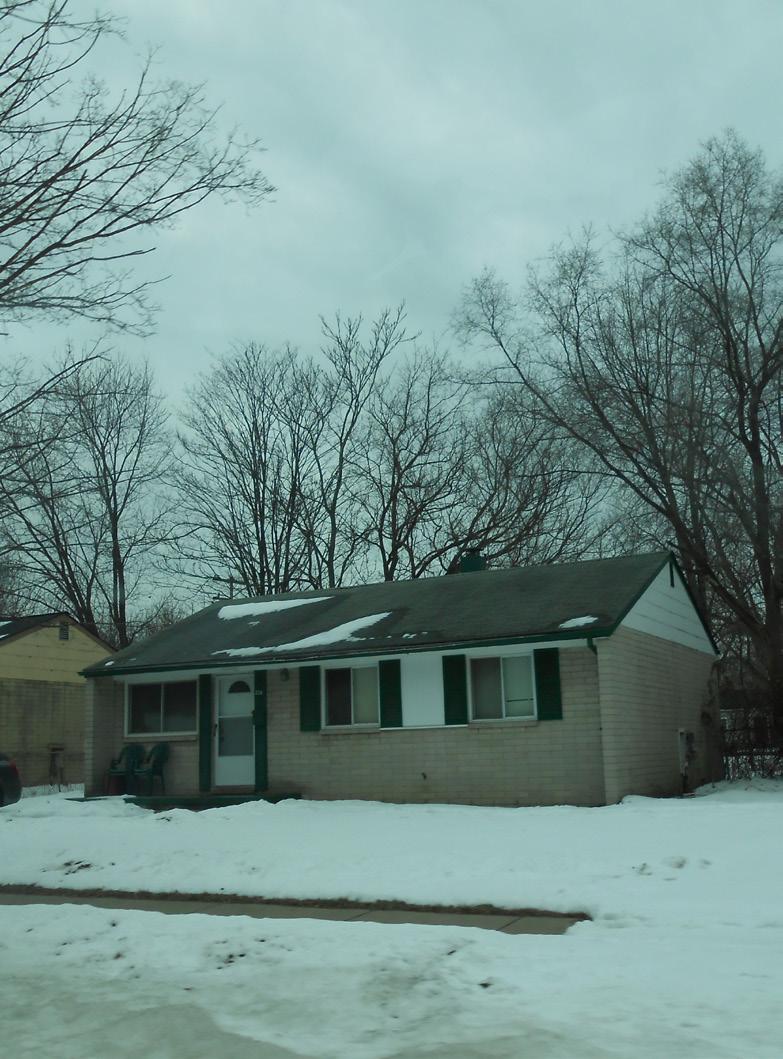
The West Willow neighborhood is located in the northeastern corner of Ypsilanti Township, near the eastern border of Washtenaw County. The neighborhood lies west of Willow Run Airport, which is in neighboring Wayne County. Major roads and highways bound the neighborhood, with Interstate-94 to the southwest, U.S. Route-12 to the northwest, and Wiard Road running along the eastern border of the neighborhood; the unique configuration of freeways and major thoroughfares physically isolates the West Willow neighborhood from the rest of the Township. The neighborhood is primarily residential, with 1,160 small single-family homes built in the mid1950s.7
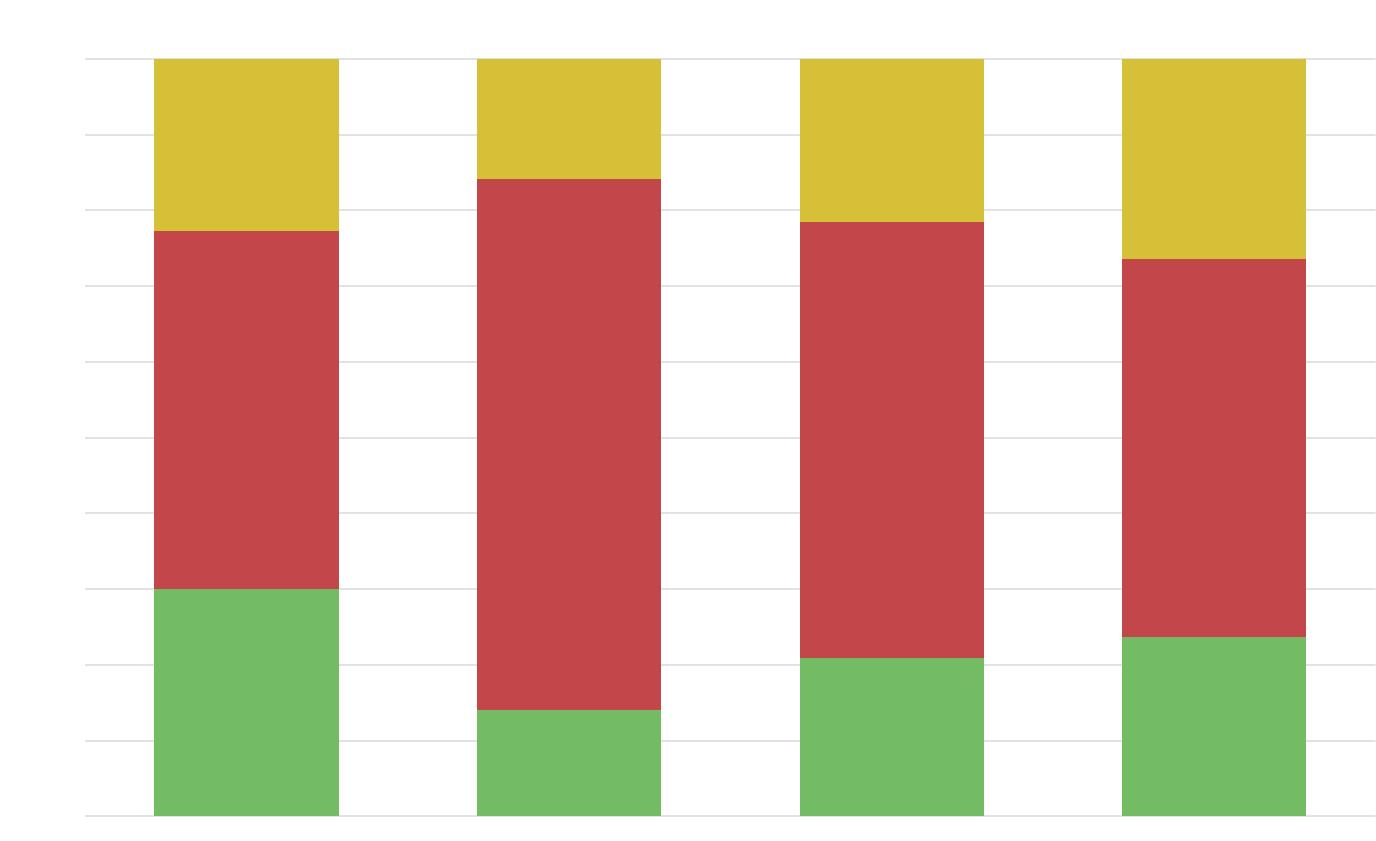
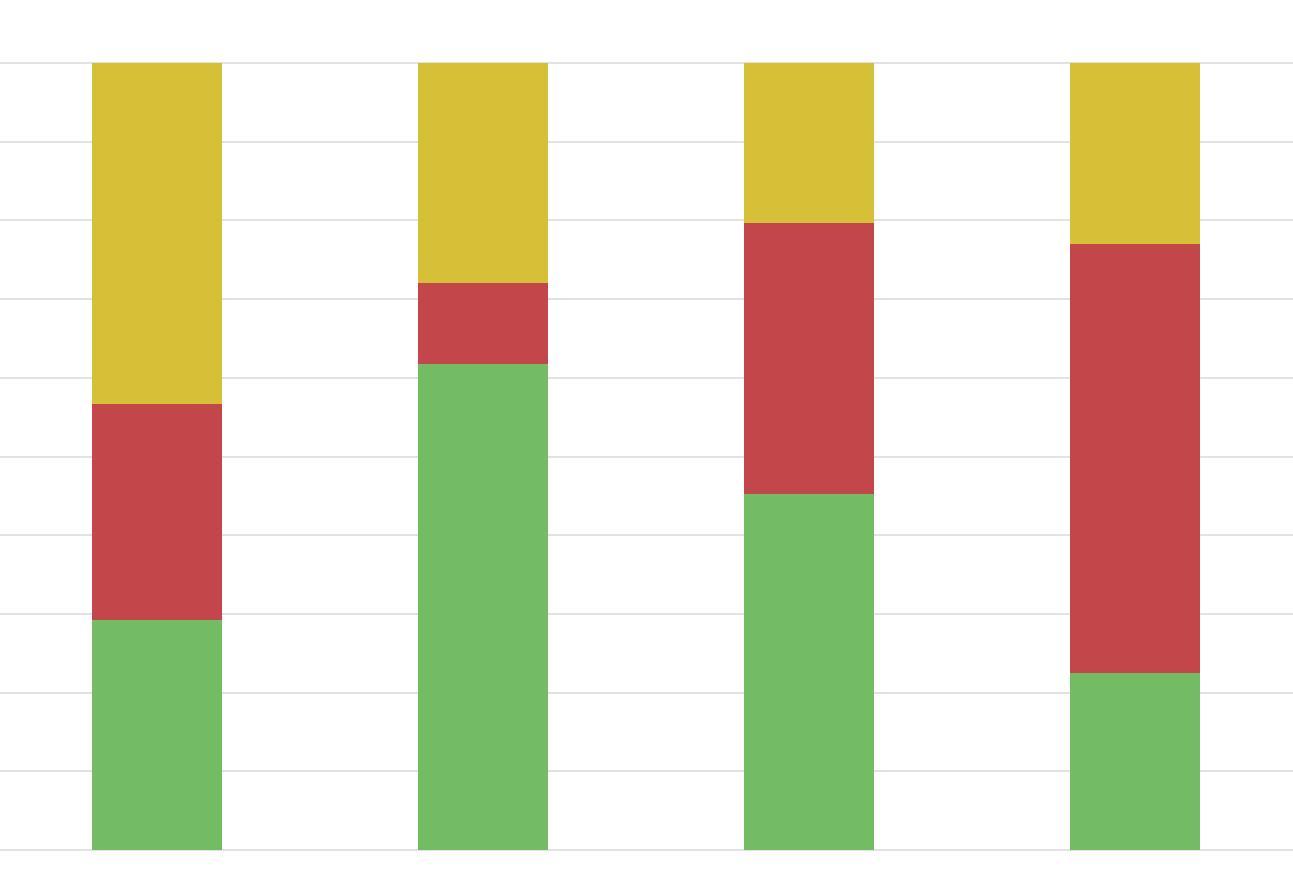
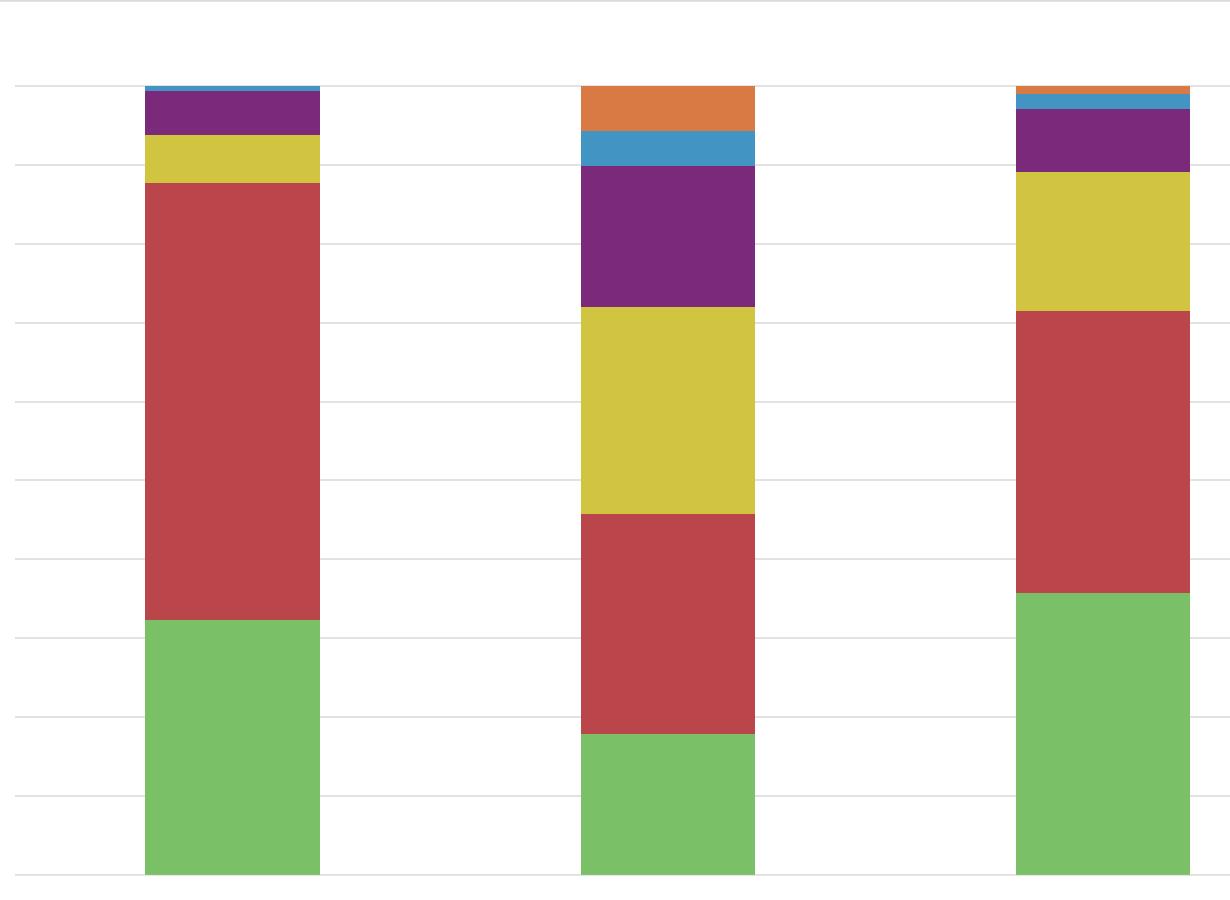
West Willow is home to nearly 3000 residents, the majority of whom are African-American (Figure 2.2 Gender; Figure 2.3 Race). Children, dominate life in West Willow: 30% of the residents in West Willow are under 18—a percentage similar to that of Ypsilanti and not dramatically different from the county or the state (Figure 2.4 Age). However, the rate of children per household, at double that of Ypsilanti and far exceeding that of the county and the state, makes West Willow stand out. Another standout statistic is the rate of females who head households: at nearly 36%, household life in West Willow is dominated by women as compared to Ypsilanti (12.2%), the county (9.9%) and the rest of the state (13.2%).8
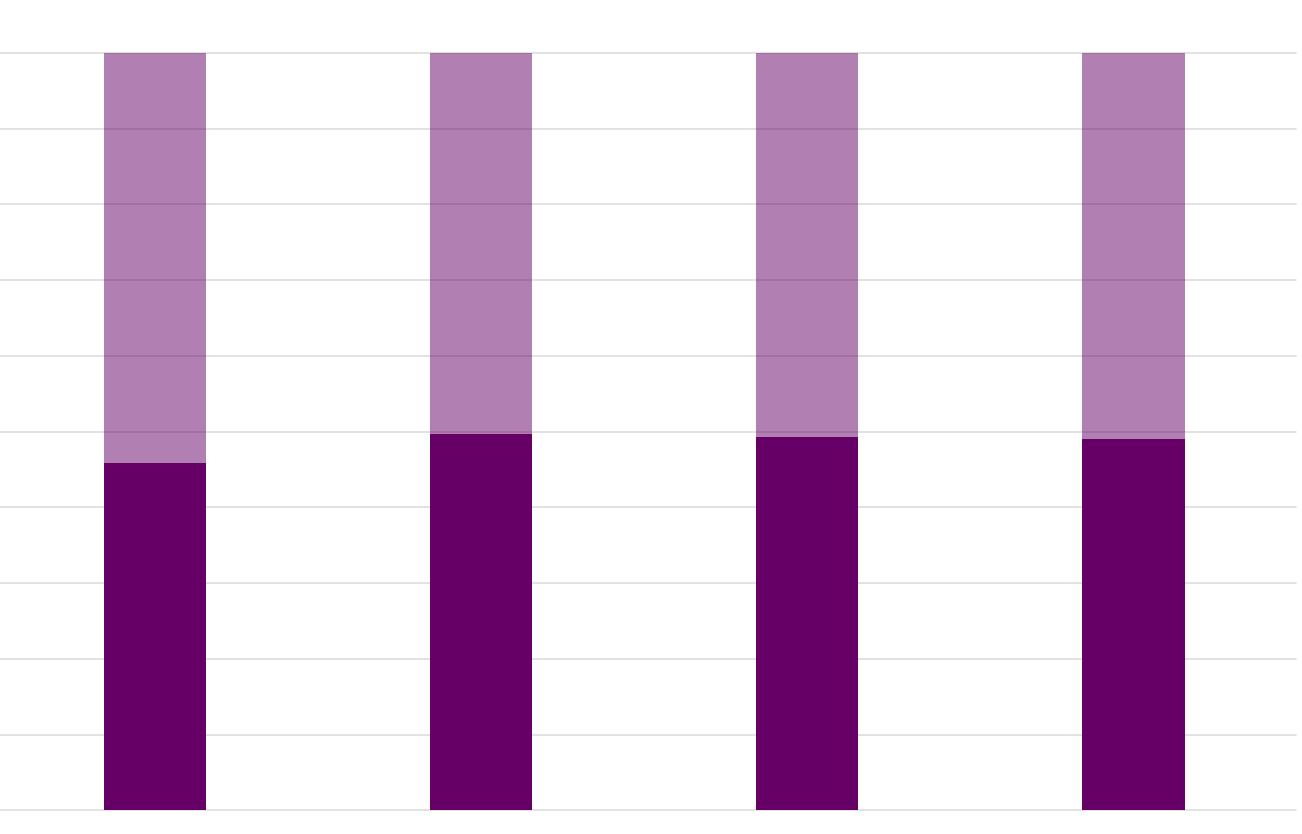
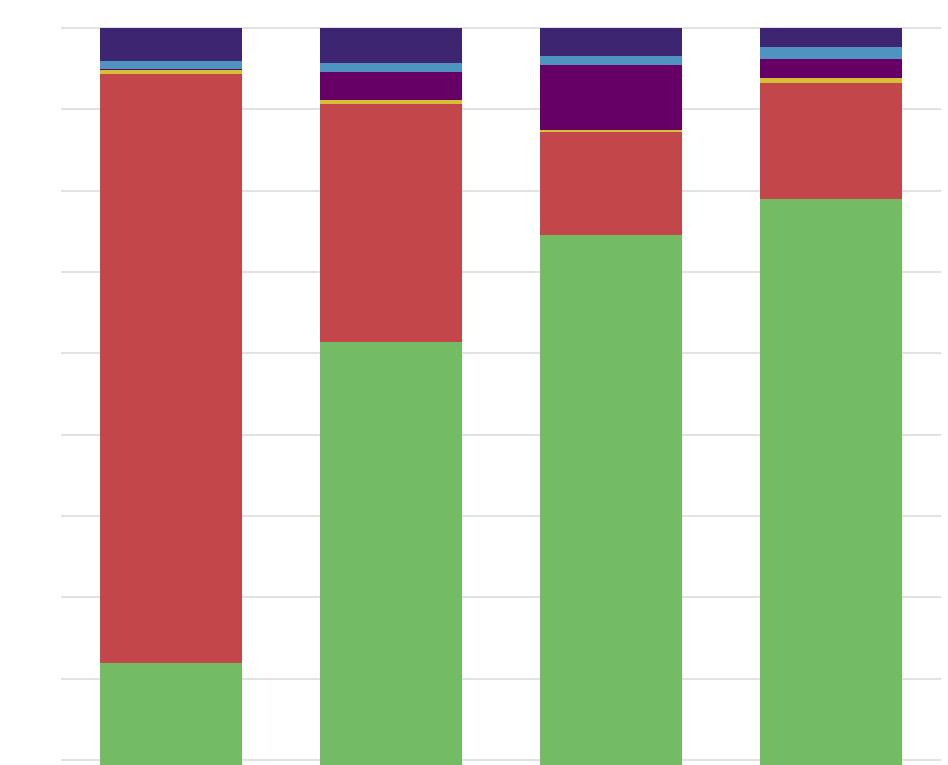
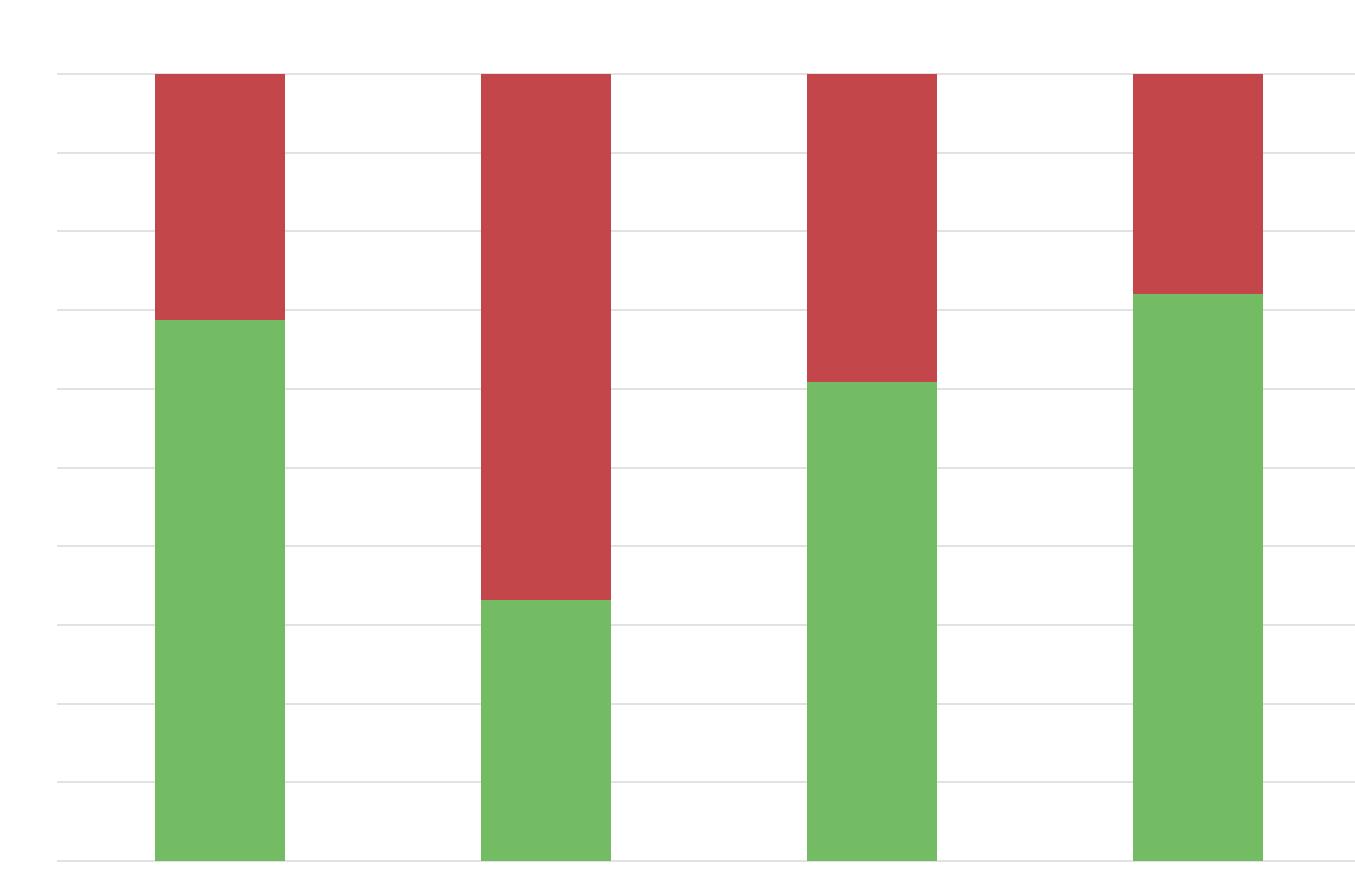
When it comes to housing, West Willow’s vacancy rate is lower than the statewide figure, but higher than the county’s (Figure 2.5 Vacancy Status). The ratio of homeowners to renters in West Willow is roughly similar to that of the county, but at 31% it is nonetheless higher than desirable as renters often introduce instability into a neighborhood (Figure 2.6 Tenure).9, 10
West Willow contains a higher percentage of students who attend high school but do not graduate as compared to the county and state. In comparison with the state, West Willow also has nearly twice the percentage of residents over 25 who did not complete high school (Figure 2.7 Educational Attainment for Population 25 Years And Over).Yet the neighborhood does have a higher percentage of residents with some college education (44%) than the Township (33%).11
While statistics cannot tell the whole story, they suggest certain trends that may influence residents’ needs. The low high school attainment rates, for example, suggest a need to provide services to keep youth in school and to help those with less education find jobs. The high prevalence of single parent, female headed households and youth under 18 further suggests a need for enhanced youth programming in West Willow.
• Community concerns related to youth development, e.g. crime, substance abuse, school performance, recreation and sports, lack of job opportunities.
• Programs available for youth.
We addressed these pre-assessment gaps in knowledge through a neighborhood survey and subsequent research on community programming (see Chapters 3 and 4).
Two or More Races Some Other Race Native Hawaiian and Other Pacific Islanders Asian Alone
Other Vacant For Sale Only For Rent
The median household income in West Willow is $37,700, which is lower than the surrounding county and state, but higher than the nearby City of Ypsilanti (Figure 2.8 Median Household Income). Almost 15% of households in West Willow earn an income that places them below the poverty line; this is double the county’s household poverty rate (7%) (Figure 2.9 Families in 2010 living below the poverty level). Particularly distressing is the percentage of children in West Willow who live in poverty: four out of every ten or 40% of children under 2.8 in West Willow live below the poverty line. This number far exceeds that of the county (13%), state (21%) and the City of Ypsilanti (26%) (Figure 2.10 Children living in Poverty).18
Unemployment in West Willow (17%) is more than double that in Washtenaw County (8%) as well as higher than the State of Michigan overall (12%) (Figure 2.11 Employment Status). It is also significantly higher than the national unemployment rate (7.9%). Common occupations for West Willow residents include administration, maintenance, transportation, and healthcare assistance (Figure 2.12 Top 3 Occupations in West Willow) 19 Finally, 24.5% percent of West Willow residents receive Supplemental Nutrition Assistance Program (SNAP) funding.20
• Where do most residents work? Is lack of public transportation a reason why such a high percentage of residents are unemployed?
• As such a high percentage of children live in poverty, how is this manifesting itself e.g. is it impacting school performance? What services exist for low-income children in West Willow?
To address these gaps in knowledge, we included questions about transportation and services, including job training, in the survey (see Chapter 3); researched services available to West Willow residents (See Chapter 4 for a directory of services available to West Willow residents); and interviewed numerous community stakeholders whose thoughts on jobs and youth development informed much of the recommendations detailed in Chapter 4.
Figure 2.8 Median Household Income in Inflation Adjusted $1,00021 $34.7 $37.7
Ypsilanti Willow Run Washtenaw Michigan $59.0 $48.4
Figure 2.9 Families in 2010 Living Below the Poverty Level, % Below Poverty22
Ypsilanti Willow Run Washtenaw Michigan
Figure 2.10 Children Living in Poverty, % Living in Poverty23
2.11 Unemployed as % of the Labor Force24
Run
2.12 Top 3 Occupations in West Willow25
Crime has decreased in West Willow in recent years.26 This reduction may be attributed to efforts by the Washtenaw County Sheriff’s Office as well as measures taken by neighborhood residents. The West Willow Citizen Patrol was formed in 2010 to regularly monitor the neighborhood and report suspicious activity to the police.27 In 2011, the Ypsilanti Township Board of Trustees approved the installation of security cameras in West Willow to monitor activity near the entry points to the neighborhood. These wireless cameras, which record whenever they detect motion, were a $30,000 investment for the community.28 NWNNA meetings serve as a forum for police, residents, and the citizen patrol to share information and concerns. In addition, the Sheriff’s Office runs a Community Action Team, which works directly with community members and organizations and has achieved great success in completing open investigations.29 The Sheriff’s Office also aims to further facilitate communication with the community through channels such as Crime Mapping, Crime Alerts, Crime Stoppers of Michigan, and a confidential telephone tip line.30
• Residents’ perception of crime and safety within the neighborhood.
• Measures, such as programming, that may counter criminal activity.
Citizens’ efforts to reduce crime are noteworthy and deserving of praise. Yet the Urban Planning Team wanted to know if residents were aware of this work and indeed felt safer. We therefore included questions about neighborhood concerns in the survey (see Chapter 3) and researched the relationship between youth programming and crime prevention (see chapter 4).
Two separate school districts service West Willow. In 2013, the Willow Run School District, which services residents who live north of Tyler Road, merged with Ypsilanti School District to create the Ypsilanti Community School District (YCSD).31 The goal of the merger was to improve student academic performance, as well as channel funds and resources into a single entity so as to offer improved services. The school district consolidation also led to the closing of Kaiser Elementary School, located in West Willow, and the students were relocated to other schools in the area.32 The Kaiser school building is now being repurposed for a church related facility.
Whereas the northern half of the neighborhood is serviced by the YCSD (formerly the Willow Run School District), the portion of the neighborhood south of Tyler Road is serviced by the Van Buren Independent School District (VB ISD), which is a district primarily within Wayne County.
Resources available to West Willow residents through two school districts, Ypsilanti Township and Washtenaw County are uneven and geographically spread out. The neighborhood also borders Wayne County, so some residents access resources there. Thus many services may be difficult to access or residents may have difficulty determining where to turn for those resources. Many of the agencies that provide services are struggling financially, which puts pressure on service providers and spreads resources fairly thin.33
Washtenaw County provides a variety of services and administers a number of federal programs to help residents. County resources cover a variety of needs, including youth programming, work force training, financial management classes, housing resources and services, and neighborhood safety.34 In some cases, the County provides services, but also may connect residents to the appropriate service providers. Ypsilanti Township serves a similar purpose, but with more of a focus on direct service provision than on connecting residents with resources.
• What services do residents know about and/or take advantage of?
• How do residents find out about available services?
• How much of the resources available from the County, Township, School District, or other providers are used in the neighborhood?
As services can promote and ensure community well-being, the Urban Planning Team conducted more research on this topic. We made services a main focus of the survey (see Chapter 3); engaged in several conversations with service delivery organizations (see Chapter 4); and developed a directory of services available to the residents of West Willow (see Chapter 3)
West Willow has limited recreation options. There is one large township park located in the neighborhood. West Willow Park contains play equipment, ball fields, basketball, shelters, picnic tables, benches, grills, and trails.35 Ford Lake is close to West Willow, but due to the somewhat isolated nature of the neighborhood, getting there can be difficult, especially without a car.
Ypsilanti Township offers sports and recreation programming through a fee-based program run primarily from the Township Community Center, located fairly far away from West Willow. Activities include basketball, softball, soccer and volleyball, among others, run for about five weeks and range in price from $50 to $70 per participant.36 The NWWNA, in conjunction with the Sheriff’s department, hosts a yearly basketball tournament, Ballin’ in the Willow, in the summer for neighborhood youth. The tournament has proven extremely successful in recent years.37
• Do neighborhood residents take advantage of the recreation programming offered by the Township? How do they get to the activities? If they do not use them, why don’t they?
Addressing these gaps in knowledge required that the Urban Planning Team better understand the type of recreation residents desire. We accomplished this by including questions on youth programming and desired services the survey (see Chapter 3). This topic was also the subject of many of the stakeholder interviews; learnings from these conversations are detailed in Chapter 4.
As a consequence of its unique perimeter of freeways and major roads, West Willow is isolated from retail and employment centers, making life difficult without a car. An overwhelming majority of households in the neighborhood (84.1%) do own at least one vehicle. However, West Willow has a greater percentage of households with no available vehicles (15.9%) as compared to the county (7.2%) and state (7.2%) (Figure 2.13 Households with no available vehicle). Lacking a car in such a car oriented area makes for difficult access to health care services, grocery shopping, and job opportunities.38
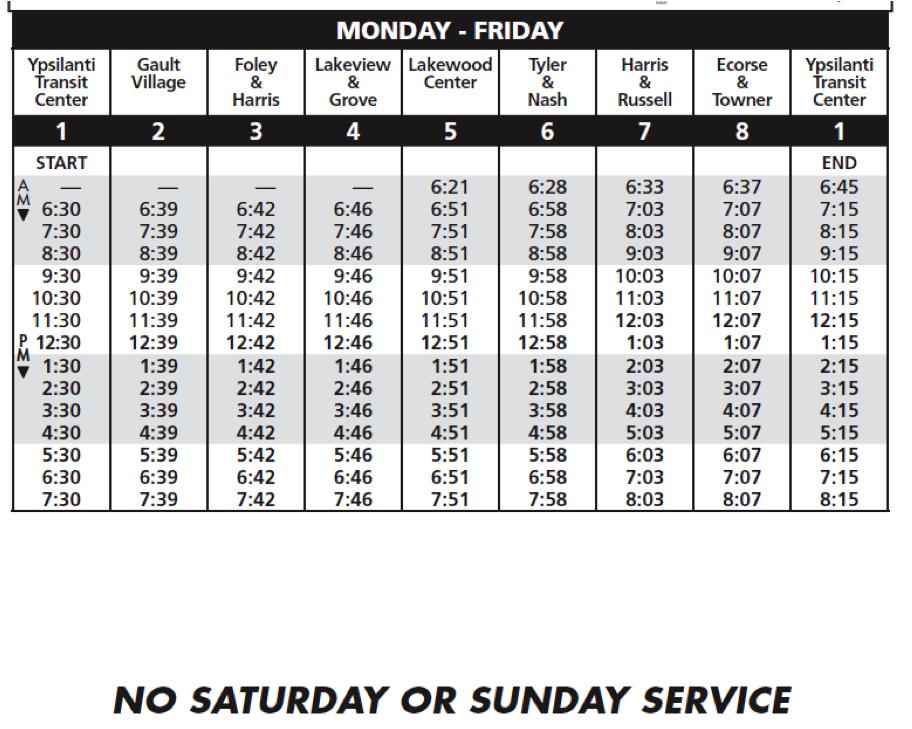
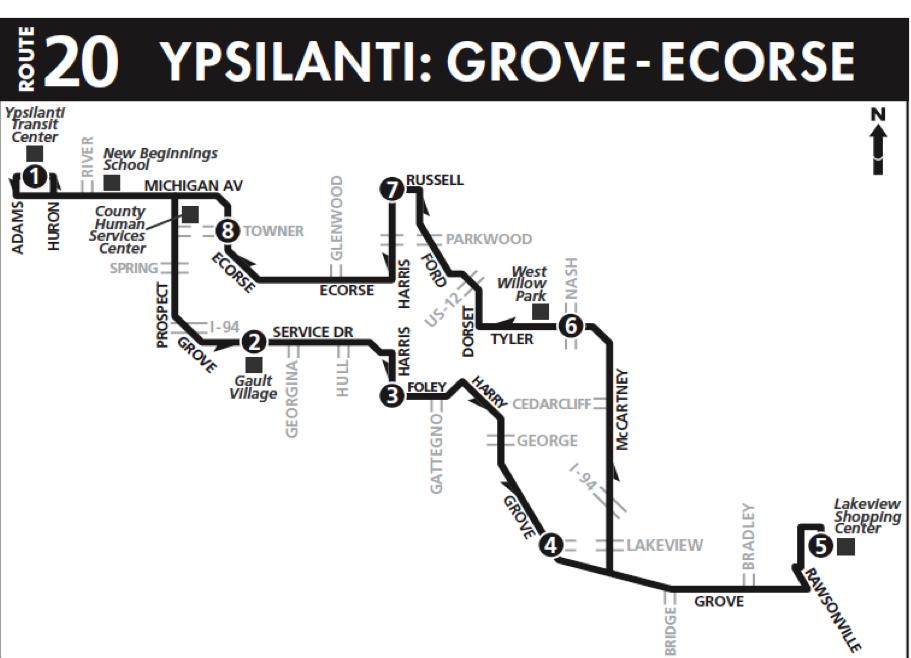
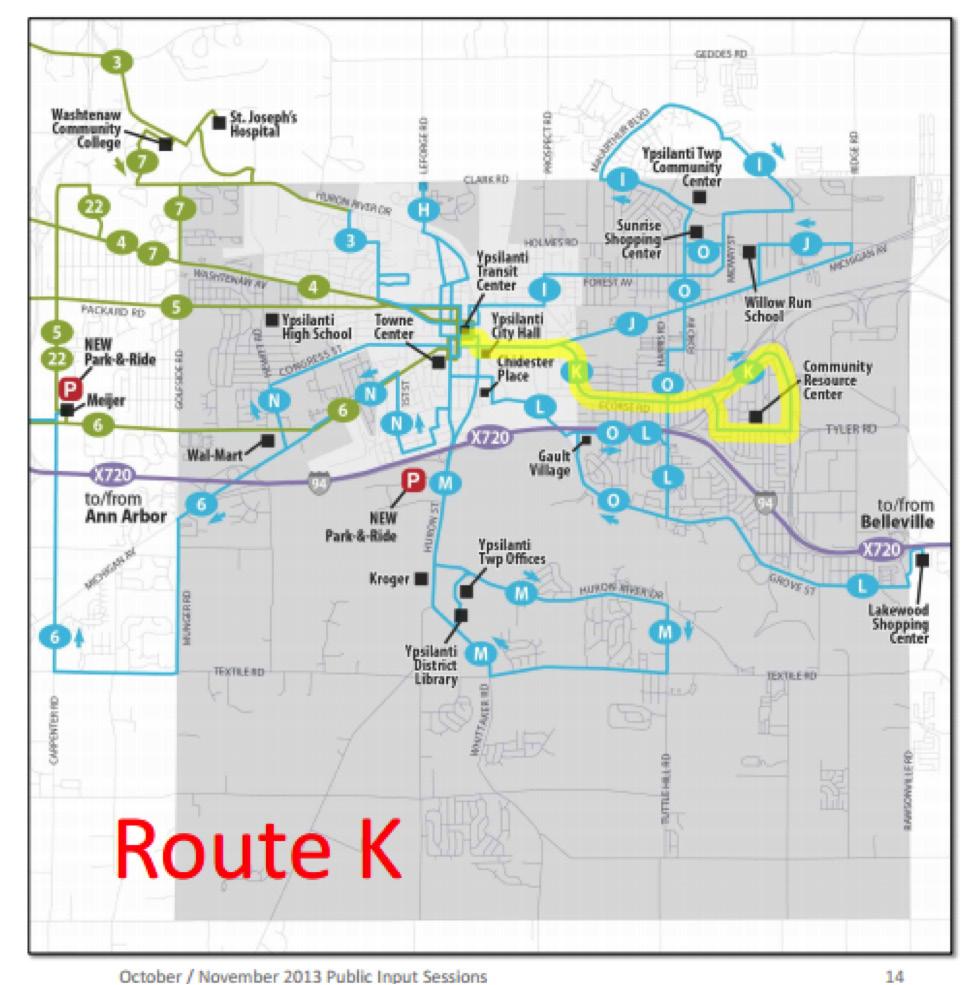
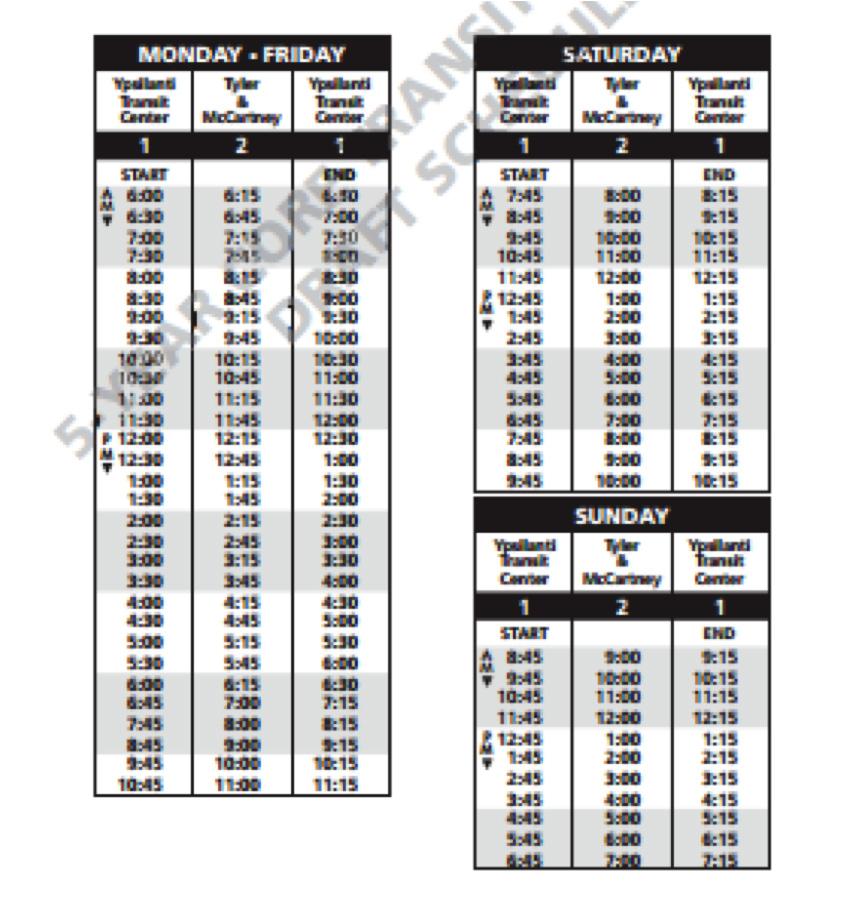
The area is served by a single Ann Arbor Area Transportation Authority (AAATA) bus route. Route 20 provides very limited service, confined only to weekdays and the buses run only once an hour (Figure 2.14: Timetable, Route 20). Buses stop only along Tyler and Wiard Roads, a long walk for many residents (Figure 2.15: Route 20 Map). Although a new bus route, Route K, is slated for the area, it will not be operational until 2017 at the earliest (Figure 2.16 Map, Route K; Figure 2.17 Timetable, Route K).39 The lack of a robust public transportation system in West Willow makes having a car a necessity—and makes life especially problematic for the nearly 16% of residents who are without one.
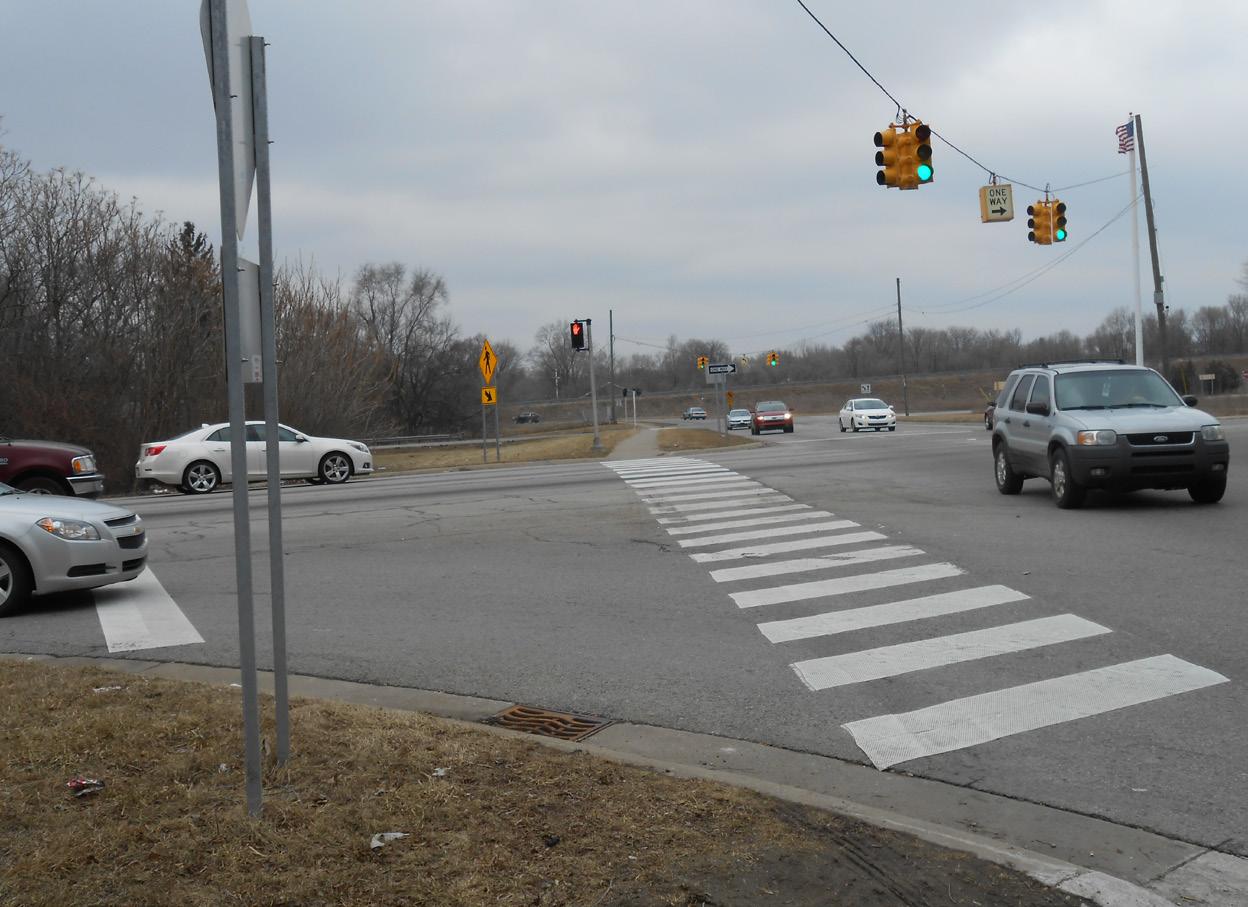
Walking to accomplish an errand outside of the neighborhood is difficult, if not impossible. There are few destinations within walking distance (the nearest grocery store, for example, is 2.4 miles away). Residents can exit the neighborhood as a pedestrian through only one of three paths. Only the pedestrian exit on Dorset Avenue leads to an actual destination (the shops along Ecorse Avenue), although getting to these shops requires crossing M-12, a highspeed thoroughfare. (Figure 2.18 Dorset).40
Streets in West Willow run along a grid pattern, which is amenable to biking; however, the neighborhood lacks the bike infrastructure, such as bike lanes, that make it safe to bike. Residents also expressed concern about bike theft and the lack of safe space to store bikes.41
• What are the prevailing attitudes and beliefs towards biking and walking among West Willow residents?
• What are prevailing attitudes and beliefs towards public transit among West Willow residents?
• How do the 16% who do not own a car navigate West Willow and the surrounding area? Does an informal ridesharing network currently exist in West Willow?
To address these gaps in knowledge, the Urban Planning Team partnered with the students in the Industrial Operations and Engineering (IOE) team, who, also as part of the MECC Initiative, studied opportunities to increase biking, walking and public transit use in West Willow. We included questions in the survey that assessed the travel behavior of West Willow residents. The IOE team used the answers to these questions, as well as the learnings from a transportation themed focus group and conversations with transportation experts, to inform their plan for how to improve transportation in West Willow.
Aside from presenting the results of the transportation questions included in the survey, and the suggestions for streetscape improvements for Tyler and Wiard Road, which can be found in Chapter 6, this report does not include a discussion on transportation. For a copy of the IOE’s transportation report, please contact Paul Fontaine: paulfont@umich.edu.
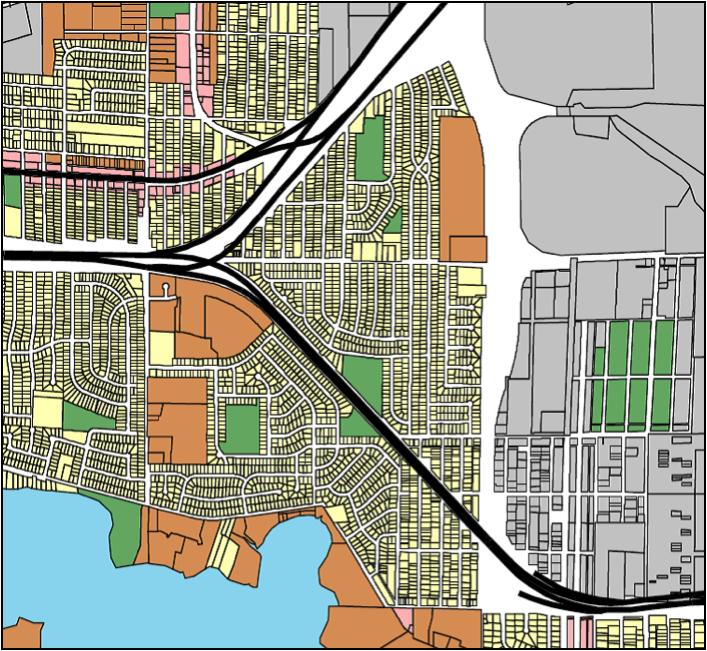
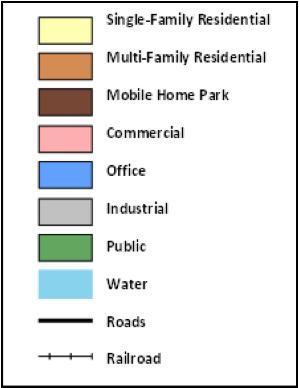
Most of the houses in West Willow are single-family detached homes; a few multi-family residences also exist. Although the neighborhood itself currently lacks shopping or retail amenities, it does contain several civic and institutional amenities, including West Willow Park, the Community Resource Center, the former Kaiser Elementary School, and several churches (Figure 2.19 Existing Land Use).
The neighborhood is bordered by heavy industrial land to the east, including the former plant site, and single and multi-family residential to the north and south. The closest commercial land uses are located northwest of the neighborhood, along Ecorse Road (Figure 2.20 Commercial Uses along Ecorse Road).
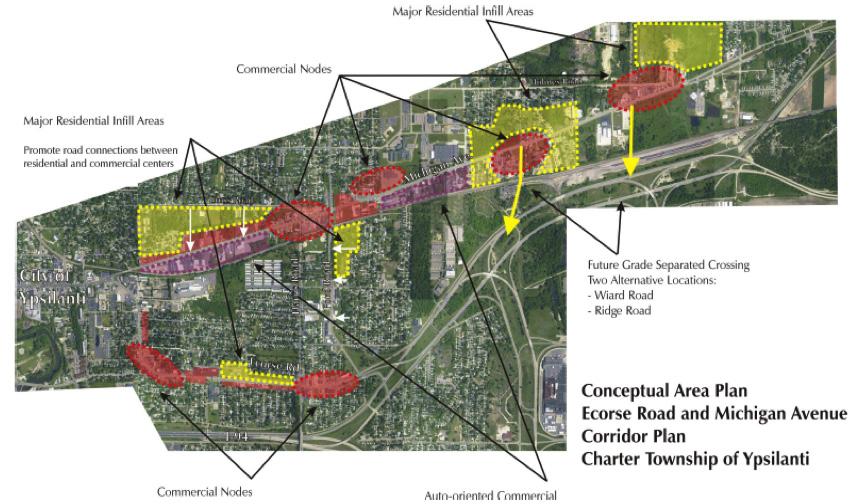
The commercial section of Ecorse Road directly northwest of West Willow could become a more vibrant area. The 2014 Ypsilanti Master Plan designates this area an “Urban Commercial Corridor,” meaning that future development should include vibrant, mixed-use districts that feature pedestrian and transit-friendly design.42 The Master Plan also references a previous study, the Ecorse Road and East Michigan Avenue Corridor Plan, which also recommends that the portion of Ecorse Road closest to the West Willow neighborhood be designated as a “commercial node.” These plans suggest that new development and retail are well suited for the area (Figure 2.21 Ecorse Road Urban Corridor Plan - Commercial Nodes).43
• Popularity of businesses along Ecorse Road among West Willow residents
• Popular shopping destinations for West Willow residents
Although the 2014 Ypsilanti Master Plan and supporting documents provide a good overview of the current and potential land uses for the West Willow area, the Urban Planning Team sought to understand residents’ feelings towards local shops and stores. We included a series of questions about the local stores in the survey (for the results see: Chapter 3). These results, as well as the market analysis detailed in chapter 5, provide the basis for the economic development action plan detailed in that Chapter.
Service shops
Used auto sales/show rooms
Car wash
Gasoline station
Automotive Related Uses
Subway
Fast food establishments
Bar and Grill
Ice cream shop
Food & Entertainment
Party/convenience stores
Cell phone store
Barber
Chiropractor
General Service, Retail and Office
A 2007 effort to assess West Willow’s physical conditions involved NWNNA, the Washtenaw County Office for Community Development, and the Ypsilanti Township working with Hamilton Anderson Associates to develop a neighborhood improvement strategy, the West Willow Strategic Plan. The 2013 University of Michigan (MECC) Physical Planning team also surveyed the physical conditions in the neighborhood.
These assessments suggest that some physical conditions in the neighborhood need improvement. Most houses in West Willow are in fairly good condition, but public infrastructure is often not well maintained. For example, the sidewalk on Service Road (parallel to US - 12) is unkempt and not continuous. The landscape and sidewalks along both US – 12 and Wiard Road could benefit from streetscaping improvements such as the addition of grass strips with trees. The neighborhood’s walk score, a measure that calculates how easy it is to live “car-free,” is low, at 14 out of a possible 100.44
Bus stops, benches, park equipment, traffic signs, and sufficient lighting, among other amenities, are also lacking in the neighborhood. To address the lack of public lighting infrastructure, many houses maintain their own exterior lighting devices.45
The main connection between the West Willow neighborhood and Willow Run plant is the intersection at Wiard and Tyler Roads. This intersection is characterized by both high speeds and a lack of walkability. The speed limits on Wiard and Tyler are 55 mph and 45 mph, respectively; both are too fast to safely accommodate pedestrians.
• Issues with noise from the freeways that surround the neighborhood.
• Residents’ perceptions of how their neighborhood looks and the type of improvements (trees, flowers, etc.) they would like.
Many opportunities exist to improve the physical conditions within West Willow. With the former plant site slated for development, we concentrated on Tyler and Wiard Roads, those closest to the site. Chapter 6 offers suggestions on how these two roads could better accommodate pedestrians and bicycles, aesthetic street improvements, and ways to facilitate these improvements.
West Willow is a fully developed residential neighborhood with few natural areas remaining. Because the neighborhood was developed in the 1960s, it now features a well-developed, mature tree canopy consisting of tree-lined streets and trees in backyards. The two most significant remaining natural areas nearby are the Huron River to the south and Willow Run to the east. The numerous industrial properties and high-traffic roadways near West Willow make the neighborhood vulnerable to environmental pollutants. The soil and groundwater under the former Willow Run GM Powertrain Plant and other nearby properties have been contaminated with volatile organic compounds (VOCs), polychlorinated biphenyls (PCBs), and inorganic metals.46,47 Remediation is ongoing on some of these properties, with contaminated soils moved to the nearby Wayne Disposal Site #2 Landfill,48 the only commercial hazardous waste landfill in Michigan.49
• Since most West Willow homes were built in the 1960s, they may not be very energy efficient, due to poor insulation, windows, etc. Are residents aware of programs that can assist them at making low-cost energy efficiency improvements to their homes?
We addressed these gaps in knowledge through secondary research focused on retrofitting homes to make them more energy efficient. Residents may benefit financially from energy upgrades. For the discussion on weatherization, see Chapter 4.
Pre-assessment is the exploration phase. During this phase, available data is collected and gaps in knowledge, as well as the means to identity the missing information, are identified. Information gathered during the pre-assessment phase sets the foundation for the remainder of the needs assessment. It tells what do we do and do not we know.
The West Willow pre-assessment research revealed strengths and weaknesses, assets and deficiencies. Key takeaways include: children call West Willow home at a higher rate than Ypsilanti, the county, and state; the neighborhood’s unemployment rate dwarfs that of the county; crime rates are steadily decreasing; bus service is poor; programs are available, but funding is insufficient; the housing stock is old and potentially in need of weatherization programs.
Pre-assessment also revealed questions requiring further exploration: What type of services do West Willow residents want? Are they aware of what is already available to them? What about the neighborhood youth and those who are unemployed? Are they eager for recreation programs or job training opportunities? Are residents content with the stores in the area, or would they like to see a hardware store or restaurant in the neighborhood itself? How do they get from Point A to Point B?
The next chapter, “Digging Deeper, Gaining Insights” details our efforts to answer these and other questions.
Sharma, A., Lanum, M., & Suarez-Balcazar, Y. (2000). A community needs assessment guide: A brief guide on how to conduct a needs assessment. Center for Urban Research and Learning, Department of Psychology: Loyola University Chicago.
Altschuld, James W., & Witkin, Belle Ruth. (2000). From needs assessment to action: Transforming needs into solution strategies. Sage Publications. Kelly & Becker (2000). Community planning: an introduction to the comprehensive plan. Washington, D.C.: Island Press.
Altschuld & Witkin, 2000 . Kelly & Becker (2000).
This list is adopted from basic steps in gathering data for an existing conditions analysis (p. 64) in Kelly and Becker (2000).
U.S. Census Bureau. (2013). 2008-2012 American Community Survey 5-year Estimates, Table B25001, Housing Units. Retrieved from American FactFinder, http:// factfinder2.census.gov.
U.S. Census Bureau. (2011). 2010 Census Summary File 1, Table DP-1, Profile of General Population and Housing Characteristics. Retrieved from American FactFinder, http:// factfinder2.census.gov. Ibid.
U.S. Census Bureau. (2011). 2006-2010 American Community Survey 5-year Estimates, Table SE:T25, Educational Attainment for Population 25 Years and Over. Retrieved from Social Explorer, http://www.socialexplorer.com/.
U.S. Census Bureau. (2011). 2010 Census Summary File 1, Table DP-1, Profile of General Population and Housing Characteristics. Retrieved from American FactFinder, http:// factfinder2.census.gov.
13 Ibid.
14 Ibid.
15 Ibid.
16 Ibid.
U.S. Census Bureau. (2011). 2006-2010 American Community Survey 5-year Estimates, Table SE:T25, Educational Attainment for Population 25 Years and Over. Retrieved from Social Explorer, http://www.socialexplorer.com/.
U.S. Census Bureau. (2011). 2006-2010 American Community Survey 5-year Estimates, Table DP03, Selected Economic Characteristics. Retrieved from American FactFinder, http://factfinder2.census.gov.
U.S. Census Bureau. (2011). 2006-2010 American Community Survey 5-year Estimates, Table SE:T25, Occupation for Employed Civilian Population 16 Years and Over. Retrieved from Social Explorer, http://www.socialexplorer.com/.
U.S. Census Bureau. (2013). 2008-2012 American Community Survey 5-year Estimates, Table DP03, Selected Economic Characteristics. Retrieved from American FactFinder, http://factfinder2.census.gov.
U.S. Census Bureau. (2011). 2006-2010 American Community Survey 5-year Estimates, Table DP03, Selected Economic Characteristics. Retrieved from American FactFinder, http://factfinder2.census.gov.
Ibid.
Ibid.
Ibid.
U.S. Census Bureau. (2011). 2006-2010 American Community Survey 5-year Estimates, Table SE:T25, Occupation for Employed Civilian Population 16 Years and Over. Retrieved from Social Explorer, http://www.socialexplorer.com/.
Perkins, T. (2012, December 31). Statistics Show Drastic Drop In Crime In Ypsilanti’s West Willow Neighborhood. AnnArbor.com. Retrieved January 22, 2014, from http:// www.annarbor.com/news/ypsilanti/statistics-show-drastic-drop-in-westwillowcrime/
Higgins, L. (2010, October 27). West Willow Neighborhood Residents Form Citizen Patrol To Prevent Crime. AnnArbor.com. Retrieved January 22, 2014, from http:// www.annarbor.com/news/west-willow-residents-form-citizen-patrol-to-detercrime/ Perkins, T. (2011, April 6). Ypsilanti Township To Test Public Surveillance Cameras In West Willow Neighborhood. AnnArbor.com. Retrieved January 22, 2014, from http:// www.annarbor.com/ypsilanti-township-high-crime-neighborhoods/ Perkins, T. (2012, October 8). Addressing Violent Crime: Sheriff’s Office Team Makes Progress In Neighborhoods. AnnArbor.com. Retrieved January 22, 2014, from http:// www.annarbor.com/news/ypsilanti/sheriffs-departments-community-actionteammakes-progress-in-addressing-violent-crime/ Police Services. (n.d.). YTown.Org. Retrieved January 22, 2014, from http://ytown. org/index.php/police-services
Ypsilanti Community Schools. (2013). Retrieved March 2014 from http://www. ycschools.us/about-us/
Kaiser Elementary School Information. (2013). Retrieved March 2014from http:// www.publicschoolstats.com/?state=MI&schoolid=263645007232
Graham, D’Real. (2014, 31 January). [Personal interview]. Also, see, for example, Hodgkin, D., & Karpman, H. (2010). Economics crises and public spending on mental health care. International Journal of Mental Health, 39(2), 91–106.
Washtenaw County. (2014). County Government Departments. Retrieved March 17, 2014 from http://www.ewashtenaw.org/government/departments
Ypsilanti township park amenities. (2013). Retrieved March 2014 from https://ytown. org/images/Recreation-And-Parks/Park-System/Park-Amenities.pdf
Ypsilanti township parks and recreations. (2014). Retrieved March 2014 from https:// ytown.org/index.php/recreation-parks
Washtenaw County Sheriff’s Office. (n.d.) Ballin’ in the Willow. Retrieved March 2014 from http://www.ballininthewillow.com/
U.S. Census Bureau. (2011). 2006-2010 American Community Survey 5-year Estimates, Table DP04, Selected Housing Characteristics. Retrieved from American FactFinder, http://factfinder2.census.gov.
AAATA. (2013) Proposed Five Year Transit Improvement Program for the Urban Core ofWashtenaw County: Public Input Session. [PDF] Retrieved March 2013 from: http:// www.theride.org/Portals/0/Documents/5AboutUs/Moving%20You%20Forward/ FYPMapSched/Oct-%20Nov%202013%205YTIP%20Public%20Outreach%20ver%20 11-4-13%20Ypsi%20YT%20version.pdf
Urban Planning Capstone Team
Koman, T. et al. (2013). Preliminary Health Impact Assessment of Willow Run. University of Michigan School of Public Health. Ypsilanti Township Planning and Zoning Department (2014). Master Plan - 2014 Update. Ypsilanti Township, MI.
Ibid.
Walk Score (2014). Walk Score: West Willow. Retrieved March 2014 from http://www. walkscore.com/score/west-willow-michigan Hamilton Anderson Associates (2007). West Willow Neighborhood Improvement Strategy. Detroit, Michigan.
Biolchini, A. (2013, April 29). Demolition of Willow Run Powertrain Plant could affect environmental remediation. The Ann Arbor News. Retrieved January 20, 2014 from http://www.annarbor.com/news/demolition-of-willow-run-powertrain-plant-couldaffect-environmental-remediation/ Michigan Department of Community Health. (2009, November 20). Public Health Assessment, Willow Run Sludge Lagoon. Agency for Toxic Substances and Disease Registry. Retrieved January 21, 2014 from http://www.atsdr.cdc.gov/docid=479&pg=0 Stafford, K. (2013, September 29). GM Willow Run plant facility environmental remediation work begins. The Ann Arbor News. Retrieved January 20, 2014 from http://www.mlive.com/news/ann-arbor/2013/remediationwork_begins_at_for.html The Environmental Quality Company. (n.d.). Wayne Disposal, Inc. Site #2 Landfill. Retrieved January 21, 2014 from https://www.eqonline.com/Locations/WayneDisposal-Inc.aspx
Assessment: West Willow
Survey Analysis
Conversation With Key Stakeholders
Conclusions: Assessment
The Assessment phase involves data gathering. During this stage additional data—that is, data that was not easily available in the pre-assessment stage—is collected, analyzed and synthesized. The Urban Planning Team gathered information about neighborhood needs through a door-to-door survey. To further our understanding of the forces at play in West Willow, we interviewed numerous individuals who work with or on behalf of the neighborhood. This chapter provides the results of the survey, discusses the significance of the findings and includes summaries of our conversations with key stakeholders.
The New West Willow Neighborhood Association (NWWNA) was eager to conduct a survey of neighborhood residents in order to better understand and serve its constituency. The NWWNA further wanted to increase awareness about the neighborhood association among residents. Our survey aimed to help fill the gaps in knowledge identified through the pre-assessment phase, in addition to filling these complimentary goals for the NWWNA.
Several important questions for West Willow became the basis of our door-to-door survey:
• The demographic information, specifically the low median income and high unemployment rate, percentage of singlefamily households and proportion of children living in the neighborhood, suggested a need to learn more about residents’ needs and desires for youth programming and job training.

• The lack of nearby retail, poor bus service, high rate of car ownership, as well as a significant rate of no vehicle ownership, suggested a need to understand how residents navigate their community, including where residents shop, if their shopping needs are met and what new retail, if any, they might want for their neighborhood.
• The transportation information also suggested a need to understand how residents travel as well as their attitudes and beliefs toward public transit, walking, and biking.
• Overall, the data and the conversation with neighborhood residents highlighted the need to have more information about residents’ feelings toward their community, including what about their community they enjoy and what about their community causes them concern.
The Urban Planning Team developed the survey by including input from students, professors, survey development experts and community members, as well as research into survey development best practices.1 The survey questions were finalized with the assistance of the University of Michigan Center for Statistical Consultation and Research (CSCAR). The Urban Planning Team was also trained in survey administration and we had to pass a survey administration quiz before going out into the field. Several members of the NWWNA pre-tested the survey. Resident feedback was critical to the survey—it not only helped streamline questions for suitable language, but further confirmed that the topics covered in the survey were appropriate and relevant.
The survey consisted of 12 questions that focused on programming, retail options, services, and transportation behaviors. Most questions were multiple-choice, some were openended or asked residents if they agreed or disagreed with a series of statements. The Urban Planning Capstone Team created a quarter sheet with the answers to the multiple choice questions and handed the sheet to the respondents during survey administration to ensure their ability to take in all the possible answers. For a copy of the survey see Appendices. There are 1,040 households within the boundaries of the West Willow neighborhood.2 The Urban Planning Capstone Team determined that sampling 10% of the households was both feasible given our resources and sufficient to be able to better understand
the needs and desires of neighborhood residents. This led us to a goal of surveying 120 households over two survey days—February 8 and 15, 2014. With the assistance of community members from the NWWNA, we surveyed the West Willow neighborhood on Saturday, February 8 from 10:30 am to 2:30 pm and again on Saturday, February 15 from 11:00 am to 2:30 pm. As much as possible, when conducting the survey, NWWNA members introduced students to the residents to help establish familiarity and trust between the student and potential survey respondent.
Time constraints precluded a survey of every household in West Willow. We chose who to sample by using cluster and simple random sampling methods because these methods allowed us to generalize from the individual level to the neighborhood level. Thus even though we did not survey everyone, our results can be interpreted to be representative of the thoughts, feeling and beliefs of West Willow residents. For the cluster sampling, to help ensure that we covered the whole neighborhood geography, we divided the neighborhood into six clusters with approximately 200 households in each cluster (see figure 3.1: Neighborhood Sample Clusters). Based on our goal of 120 responses and the amount of time we planned to spend surveying, we determined that we should knock on at least 240 doors on the first day—or 40 houses per cluster— knowing that we would not get responses from every house we visited. Fr the random sampling, from each cluster, we randomly chose 40 addresses to visit for the first day of surveying on February 8, 2014. For the second day of surveying, February 15, we removed any households that refused to respond, were vacant, or completed the survey on February 8 from the list and then randomly chose another 40 houses per cluster to be sampled. By randomly selecting residents from within each cluster, we increased the likelihood that those surveyed are representative of the entire population of West Willow, which is why we can generalize from the individual response to the community overall.3
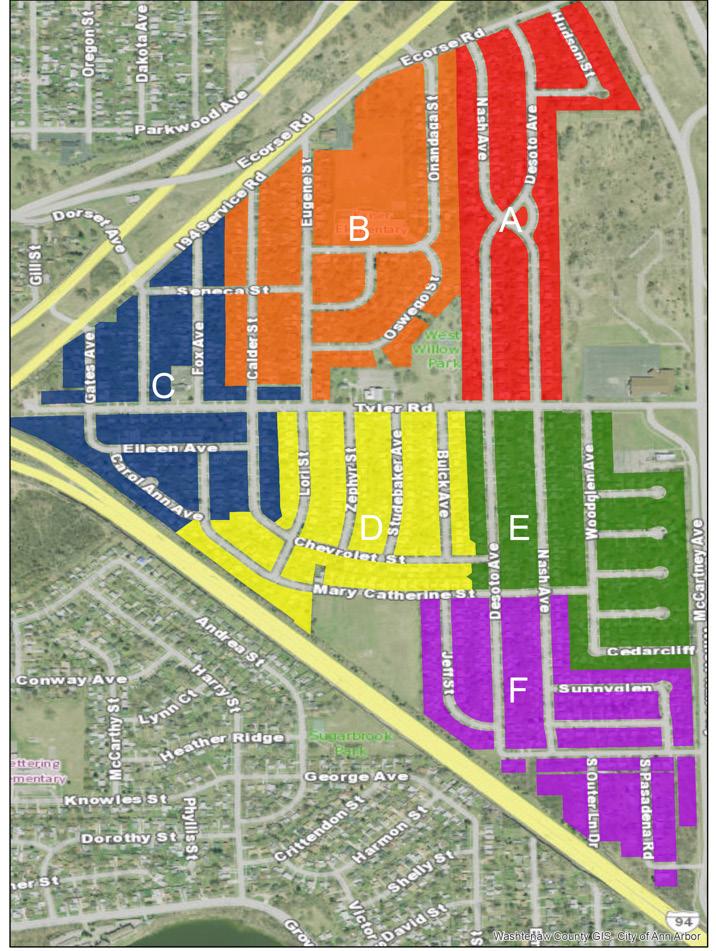
The Urban Planning Capstone Team completed 91 surveys of West Willow residents. Four residents started, but did not complete the survey; we did not include these incomplete surveys in the survey findings and analysis. As discussed above, the urban planning team systematically selected a random sample of residents from each of six sectors. Sectors A and B, both located in the northern part of
West Willow (north of Tyler Road), had a higher response rate than the other four sectors. Table 3.1 Number of Completed Surveys by Sector, provides a breakdown of the survey responses by sector.
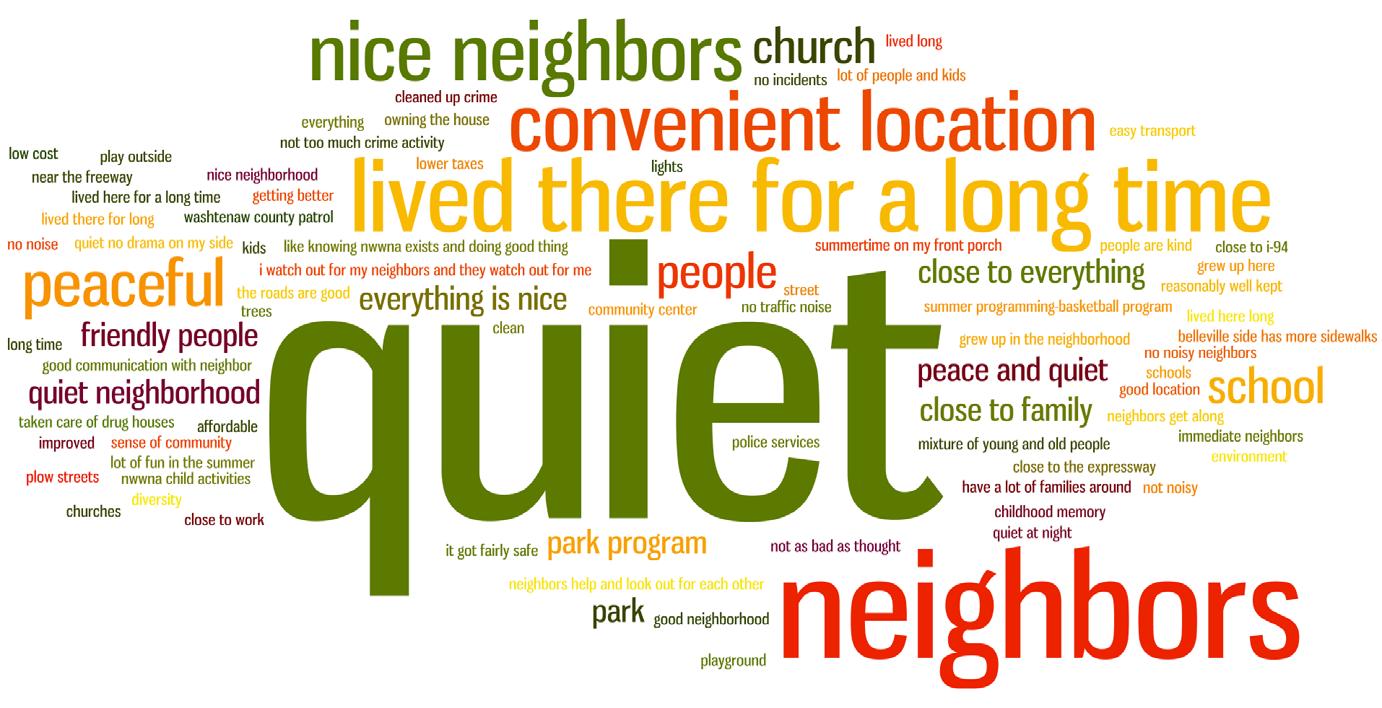
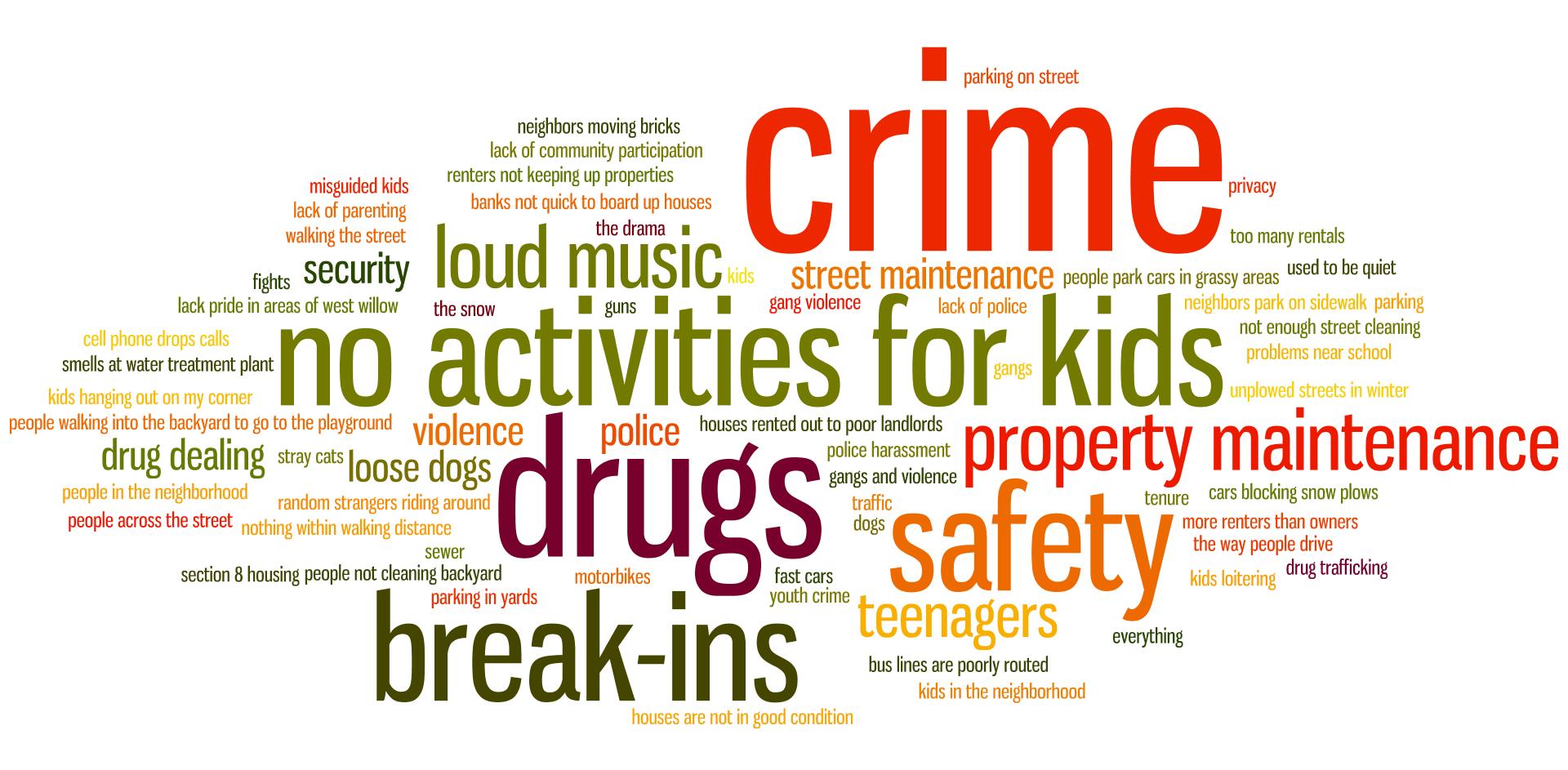
The urban planning team asked residents what they enjoyed most about living in West Willow and their main concerns about the neighborhood. The most common factors respondents enjoyed were that the neighborhood is quiet, their neighbors are nice, and that they had lived there for a long time. The most common concerns of respondents were related to crime, safety, and drugs. Figures 3.2 and 3.3 display these responses and other less common responses as word clouds, where more common responses are distinguished by larger words.
Respondents considered sports, tutoring, and work and career development as the three most beneficial programs outside of school for neighborhood youth. Figure 3.4 shows these results, in addition to the other possible responses for youth programs. Note that respondents could only choose one answer.
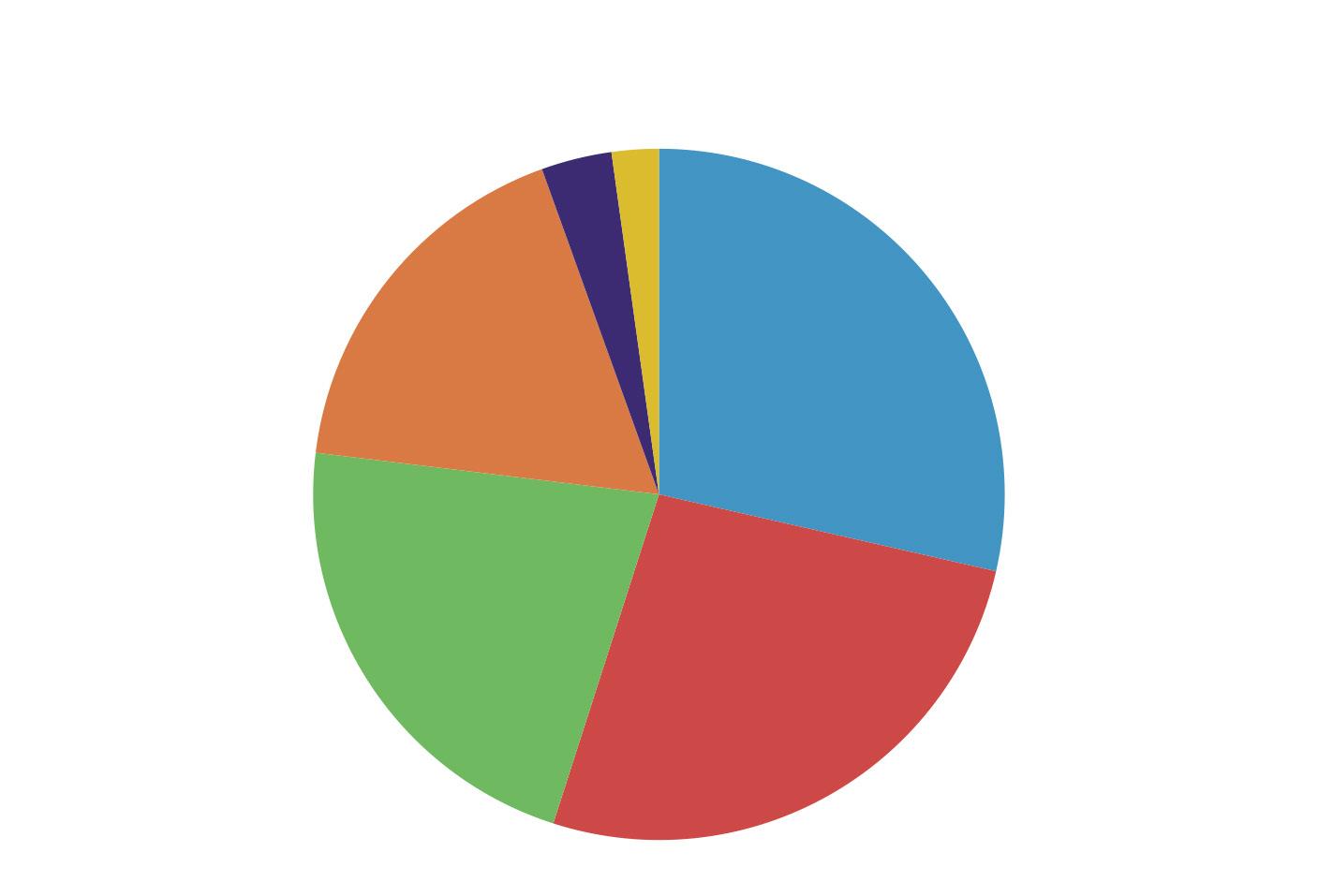
The Urban Planning Capstone Team asked residents four questions about their shopping habits, satisfaction of nearby retail, and accessibility to local stores. Approximately 27% of the respondents indicated that they purchase most of their groceries at Kroger on Michigan Avenue (approximately 2.3 miles from West Willow via automobile), while another 11% purchase most of their groceries at Walmart on Belleville Road (approximately 5.8 miles from West Willow via automobile). Table 3.2 shows a list of store locations that respondents most frequently purchase groceries from.
Approximately 76% of respondents indicated that the stores near the neighborhood met most of their shopping needs, and 84% agreed that the stores near the neighborhood are easy to access. However, 63% of the respondents agreed that the neighborhood would benefit from additional stores located nearby, and the majority of these residents would like to see additional grocery stores or big-box retail stores, such as Walmart or Meijer, near the neighborhood. Figure 3.5 shows respondent satisfaction with and perceived accessibility of nearby retail options. Figure 3.6 shows the variety of stores that respondents would like to see nearby the neighborhood.
“My
neighborhood would benefit from additional stores nearby.”
“Stores near my neighborhood are east to access.”
“Stores near my neighborhood meet most of my shopping needs.”
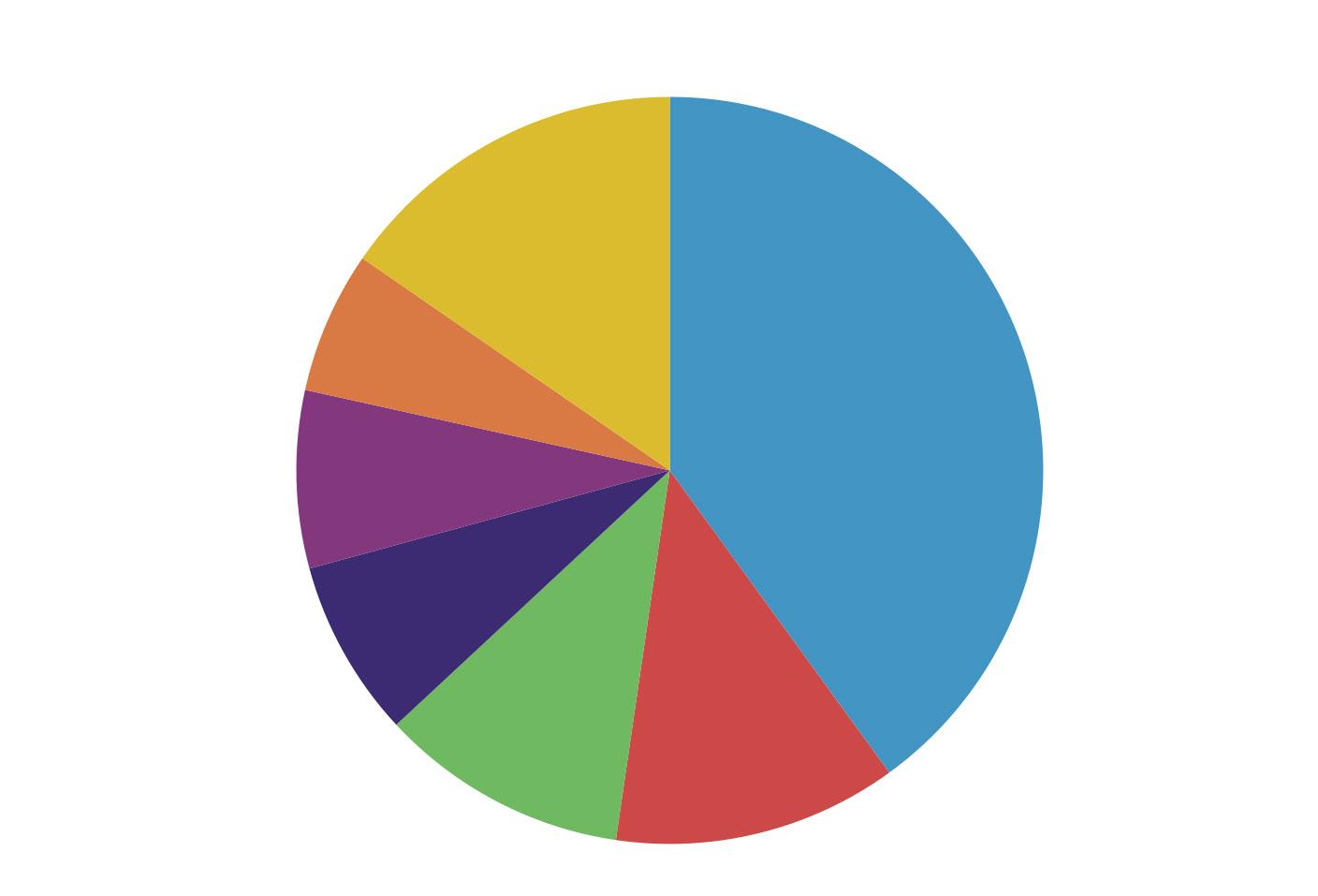
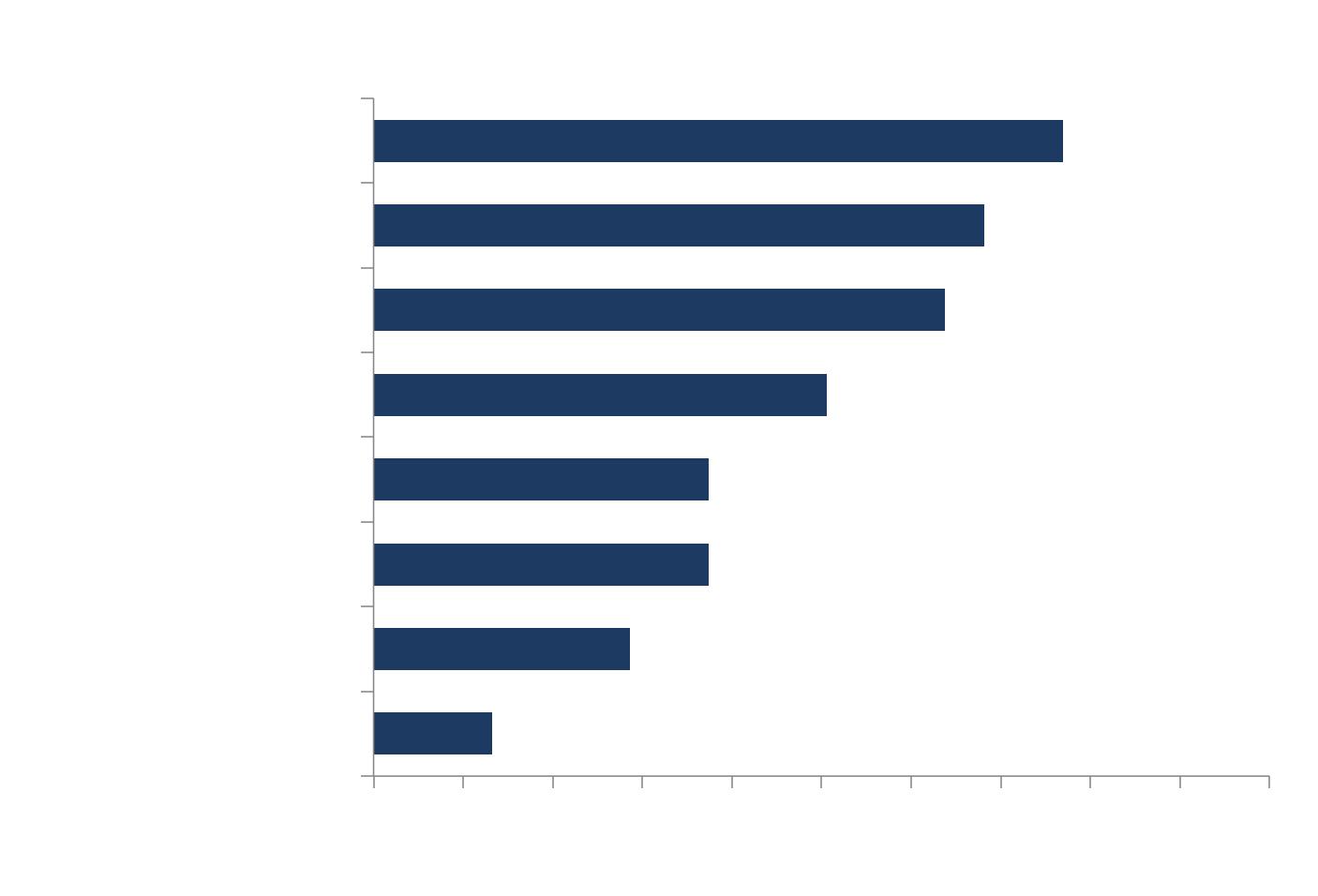
The Urban Planning Capstone Team asked three questions to determine what services are available, used, and needed by neighborhood residents (Figures 3.7, 3.8, and 3.9). We presented respondents with a list of seven services; multiple answers were allowed. The top three services that respondents felt were available nearby the neighborhood were recreation services, crime prevention services, and health/wellness services, as shown in Figure 3.7. Notably, 25% of respondents indicated that none of the services were available nearby.
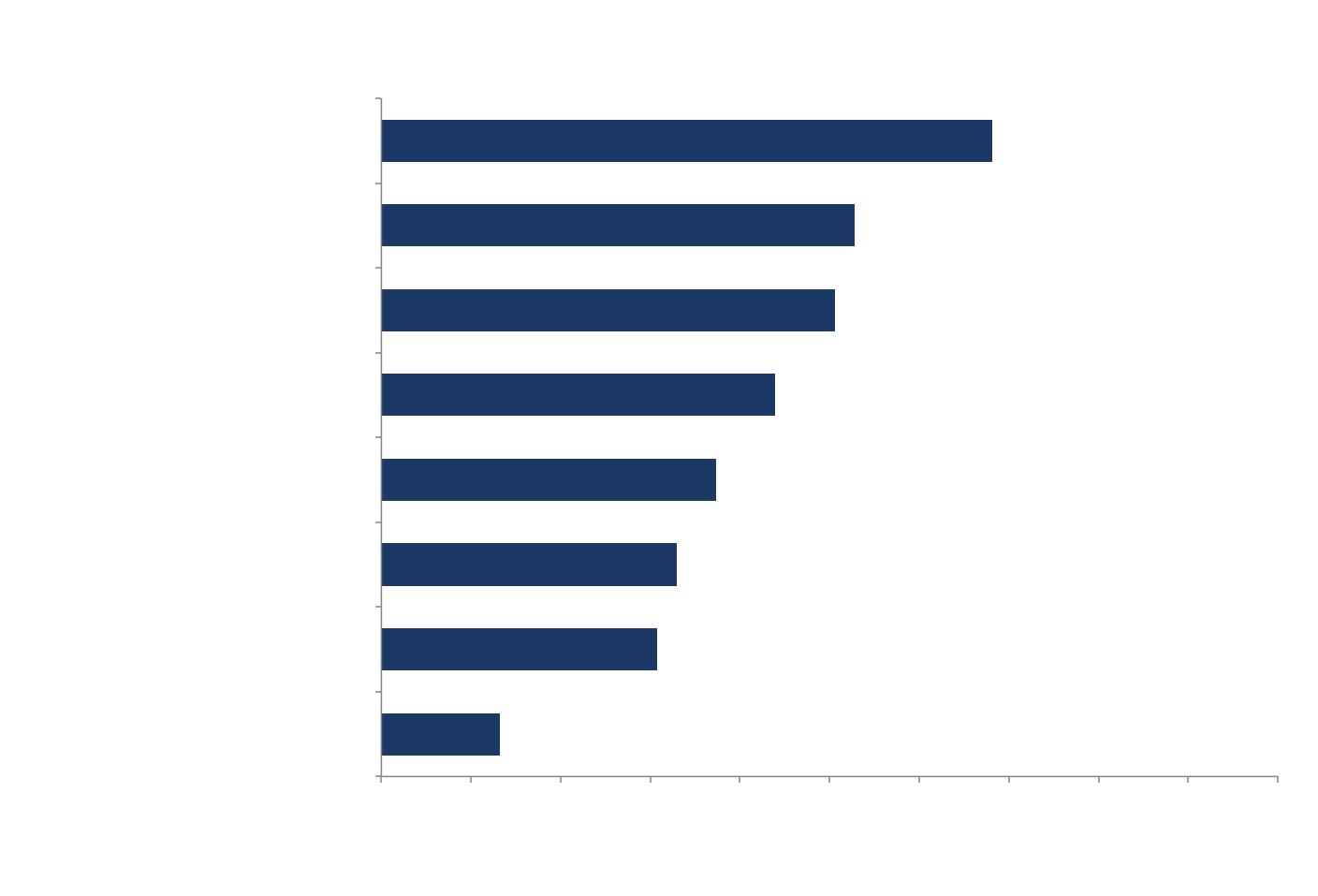
Regarding the services most used by residents, respondents indicated health/wellness, recreation, and youth development services as their most used services, as shown in Figure 3.8. Importantly though, 45% of respondents indicated that they do not use any of the services.
Figure 3.8 Results: “What types of services do you use the most?”
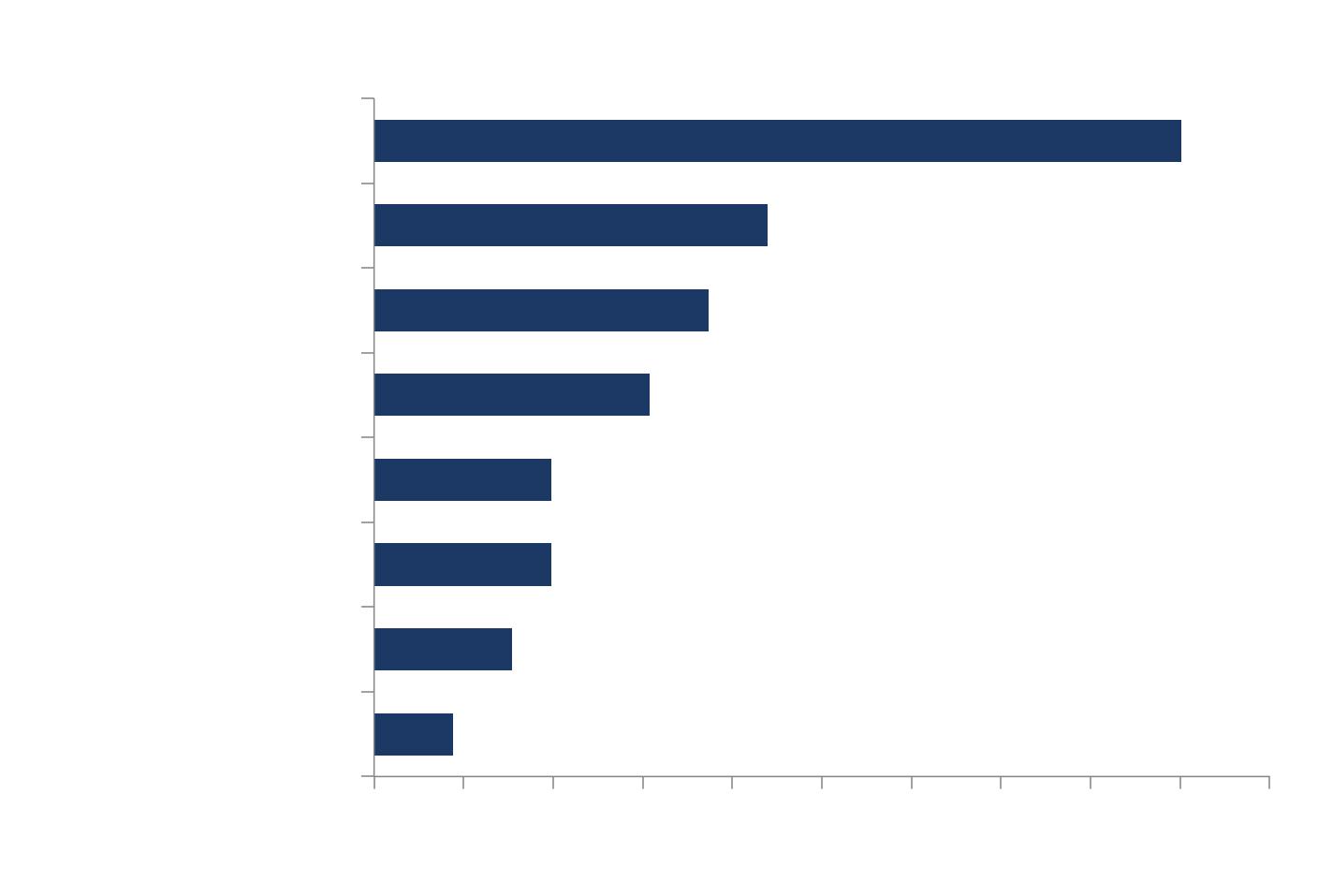
When we asked respondents about services the neighborhood needs most access to, they indicated that youth development services, crime prevention, and recreation were the most needed services, as indicated in Figure 3.9
3.9 Results: “Which services does the neighborhood need most access to?”
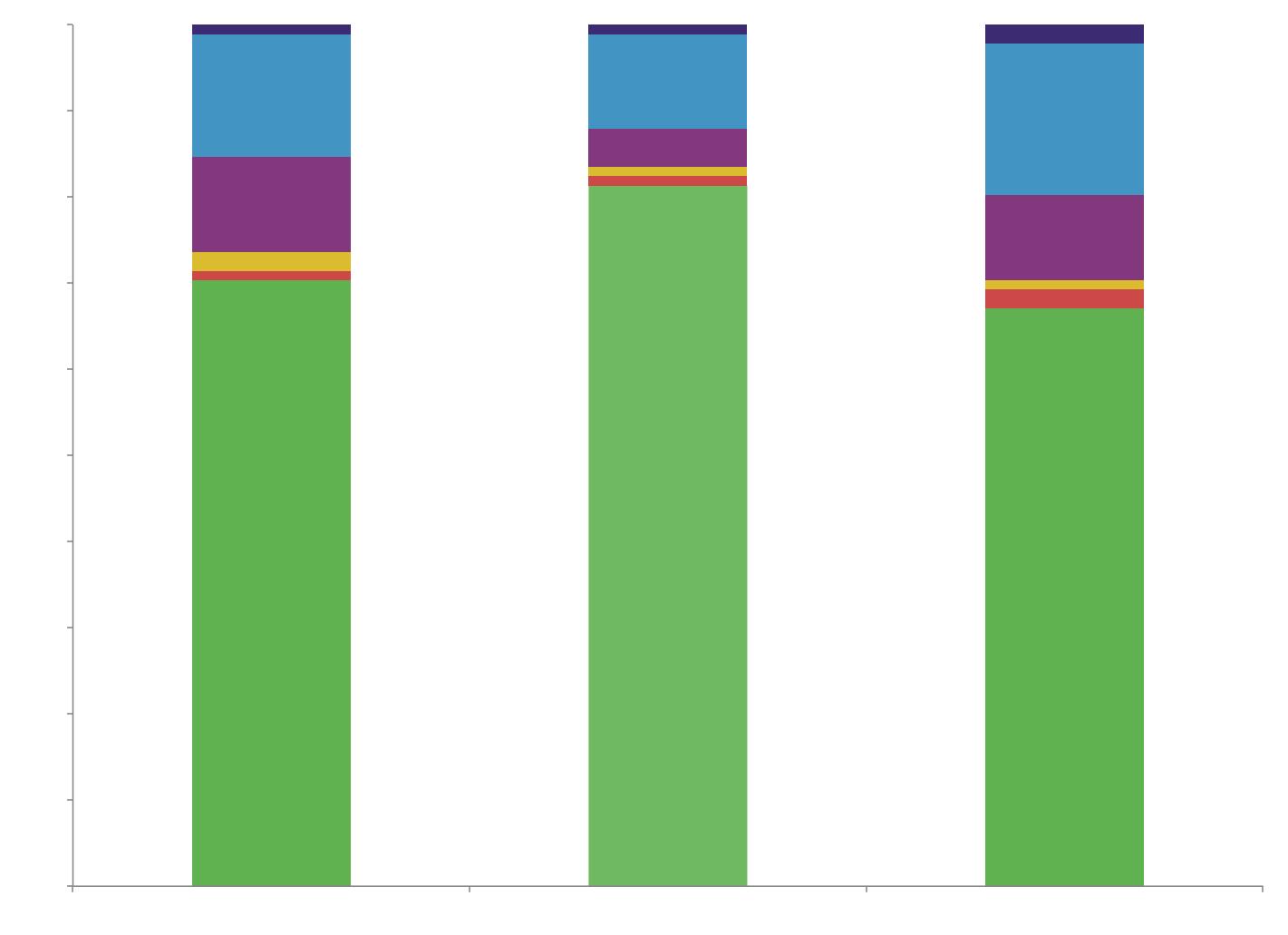
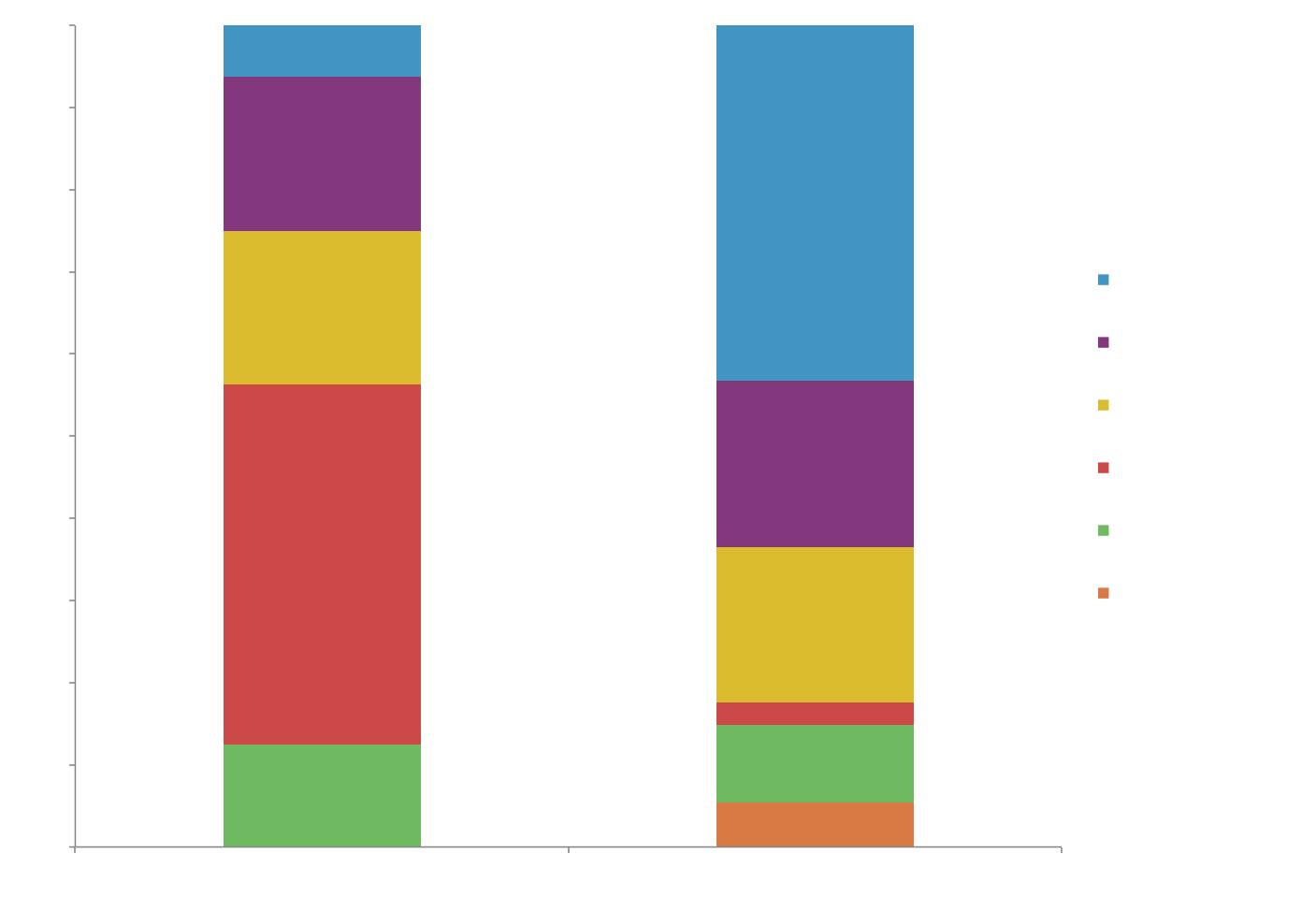
The Urban Planning Capstone Team asked residents four questions about their use of transportation. Approximately 70% of the respondents never rideshare or carpool, while 81% never use the bus, and 67% never bike or walk to reach a destination. However, the second largest groups of respondents were regular users of these modes of alternative transportation. Approximately 14% of respondents rideshare or carpool four or more times a week, 11% use the bus four or more times a week, and 18% bicycle or walk to reach a destination four or more times a week. Figure 3.10 displays the frequency of uses for these alternative transportation modes. Regular bus users had somewhat different preferences than non-bus users in factors that would encourage greater bus ridership. Approximately 44% of regular bus users indicated that more frequent service would likely make them ride the bus more often, while 43% of non-bus users stated that no improvement would make them take the bus more often. However, approximately 20% of both groups believed that shorter distance from their homes to bus stops would encourage greater bus ridership, while almost 20% of both groups stated that access to more destinations would encourage greater bus ridership. Figure 3.11 displays these differences and similarities in respondents’ opinions.
days/week
days/week 1-3 days/month
than once/month
After the urban planning team completed the survey sampling, we entered responses from the filled surveys into a spreadsheet, for numerical analysis and the creation of graphical figures. We included partially completed surveys on the spreadsheet, but did not include them in the survey analysis. We analyzed the survey questions with a defined set of choices for respondents in a straightforward manner, by tabulating and counting responses to calculate percentages. We analyzed open-ended survey questions in a similar manner; however, they required creating categories of related responses. The analysis methodology for these open-ended questions is detailed below.
Survey questions #1 and #2 were open-ended questions that allowed for multiple responses (up to three) about residents’ overall neighborhood impressions. Due to the variability of responses, we created a list of twelve categories for each question that encompassed all of the responses. Table 3.3 lists these categories in order of frequency, with more common responses near the top. We grouped infrequent or stand-alone responses into an “other” category.
Table 3.3 Categories of Neighborhood Likes and Concerns
Neighborhood Likes
Quiet
Nice neighbors
Lived here for a long time
Other
Convenient location
Neighborhood amenities
Nothing
Neighborhood programs
Low crime
Neighborhood is well-maintained
Everything
Don’t know
Neighborhood Concerns
Crime and safety
Other
Drugs
No activities for kids and teens
Cars parked in wrong places
Property maintenance
Renters and rental properties
Loud music
Road maintenance
Loose dogs and stray cats
Bad neighbors
Don’t know
Similarly, question #5c was also an open-ended question and it asked the type of store respondents would most like to see nearby, if they thought the neighborhood would benefit from additional stores located nearby. We created an initial list of eleven store types that included all responses. We then reduced this list to seven categories, grouping infrequent responses into an “other” category. Figure XX displays these store categories and their frequency of response. Several respondents listed multiple store types that they would like to see nearby. However, the analysis only counted their first response, to avoid bias in counting additional responses.
Question #4 asked residents where they get most of their groceries from. Although this question was open-ended, responses were somewhat constrained by the locations available to purchase groceries. However, a given grocery retailer could have multiple locations, such as Kroger. In addition, many respondents listed multiple grocery stores that they regularly shop at. In this case, we analyzed the first two stores mentioned by a respondent and weighted each of those two stores as half a response. Thus, each respondent counted as one response, regardless of how many grocery stores they had listed. Finally, we combined the name of each grocery store with its location and appropriate weighting, and determined the most frequent parings.
Survey Analysis Limitations
The Urban Planning Capstone Team encountered limitations typical of survey methodology in analyzing questionnaire results. The limitations included quantifying open-ended questions, confusion of respondents while answering some of the survey questions, and the method of survey delivery.
The categorization process used to analyze open-ended responses to questions #1 and #2 made it possible for the urban planning team to observe patterns and create an overall picture of what people liked and were concerned about in the neighborhood. However, the process meant sacrificing some of the details and explanations given by respondents.
The three questions on neighborhood services may have caused confusion to some respondents. Questions #6 and #8 asked residents about available and needed services nearby the neighborhood, while Question #7 asked residents about services used in general, not requiring the services to be located nearby. Better clarification among these questions could have helped avoid that confusion.
The door-to-door method of survey administration limited the number of questions we could ask and the level of detail and complexity of the survey questions. Finally, door-to-door survey responses can be impacted by the presence of the surveyor. Alternative survey formats, such as mail or online surveys, would be less impacted by these limitations. Yet these formats have their own limitations that we wanted to avoid, such as internet access and self-selection of residents more involved in the neighborhood.
The urban planning team conducted a door-to-door survey to gain a better understanding of the average West Willow resident, who may not be involved in the NWWNA or other public outreach activities. The cluster and simple random sampling design allowed us to fulfill these goals.
Key Findings:
• West Willow is stable, quiet, relatively calm neighborhood; residents are not eager to leave.
• Residents are satisfied with the local amenities but would appreciate additional retail nearby.
• West Willow residents are eager to see more youth programming, such as sports and tutoring, as well as job training and crime prevention activities.
• The car dominates both life and attitudes in West Willow. Bus users would appreciate more frequent bus service.
The results of the survey reveal that the overwhelming majority of West Willow residents are content with their neighborhood. West Willow is a calm, quiet place, where residents successfully go about their daily business. Residents are not eager to leave; the neighborhood is a place where many people are making a home for themselves. Residents are satisfied with the shopping options in the general vicinity. They do not feel isolated or concerned about their ability to access the services like grocery stores that allow for a good quality of life. Residents, however, would welcome additional shops, such as a hardware store or family dining establishment or a corner store that sold groceries. In addition, residents are eager to see more programming for youth, such as sports and tutoring, as well as job training and crime prevention activities. Of particular importance are the results from the questions about transportation. The car dominates both life and attitudes in West Willow. This is not surprising considering that the neighborhood is located next to the former General Motors Powertrain Plant, in the historically
auto-centric state of Michigan. The overwhelming majority of respondents never use the bus, nor do they carpool or walk or bike to destinations. Moreover, many seemed almost incredulous when asked questions about their transportation habits. Residents often cut students off when asked the question about what would make them take the bus more often, as if the suggestion that travel options other than the car were inconceivable. But there are residents who do carpool on a daily basis and who do use the bus and who, based on the survey results, would benefit from more frequent bus service in West Willow.
To increase our understanding of the activities happening in West Willow, we conducted interviews with key stakeholders. These individuals were identified as key stakeholders because they either work in or on behalf of West Willow or are connected with the neighborhood as an advocate for its improvement.
Deborah Gordon-Gurfinkel Director & Founder
Telling It
(University of Michigan, College of Literature, Science and the Arts)
Interview date: March 28, 2014
The goal of this interview was to learn more about the “Telling It” program, which is a program for at-risk youth in West Willow Neighborhood. The mission of the program is to promote youth expression through literature, painting and other artistic activities via partnerships with local artists and university students. Gordon-Gurfinkel noted that although they have several participants in the program, they anticipated larger enrollment and feel that the program is underutilized; she hopes more youth enroll. Gordon-Gurfinkel was receptive to collaborating with the NWWA to develop a workshop that would engage youth in NWWNA activities.
Stephen Wade
Management Analyst
Community Challenge Planning Grant
Office of Community and Economic Development
Washtenaw County
Interview date: March 14, 2014
The goal of this meeting was to learn about how Washtenaw County intends to use the money it has reserved for the West Willow neighborhood. Wade noted that there are some funds from a Housing and Urban Development grant available for West Willow and that the funds must be used by the end of 2014. These funds and can be put towards organization-building and planning related costs only; the fund cannot be used for capital expenses. The county has quite a few departments working in West Willow; Wade suggested that one way to spend the money could be to bring all of these groups together in something like a “Harlem Children’s Zone.”
Wade also provided some insight into the summer youth program. He acknowledged that it is a great program and hopes that operating funds can be found, lamenting that the County does not currently have this money.
Sarah Teare
Community Development Director
Habitat for Humanity of Washtenaw County
Interview date: Ongoing Dialogue
The goal of this meeting was to learn more about Habitat for Humanity’s (HFH) upcoming efforts in West Willow. HFH intends to invest fairly heavily in West Willow. Teare noted that HFH is looking to do five critical repair and weatherization and five exterior facade and landscaping projects in the neighborhood by June 30 (the end of the 2014 fiscal year). HFH also wants to purchase, repair, and resell five homes through their traditional homeownership program. Their next step is to gather demographic and community profile data, as well as investigate whose input might have been missed in planning efforts thus far. HFH hired a resident of West Willow to lead their efforts in the neighborhood.
Brenda Stumbo Supervisor
Ypsilanti Township
Joe
Lawson Director of Planning
Ypsilanti Township
Interview date: March 24, 2014
The goal of the meeting was to get a better idea about what the township’s plans are overall, how these plans affect the West Willow neighborhood, and to gain insight into the current state of the redevelopment of the Willow Run Plant. Stumbo and Lawson informed us that the newly updated master plan for the township does not have any recommendations for West Willow specifically; however, it does include overall goals, such as complete streets and green infrastructure strategies that will benefit the entire township. Stumbo and Lawson directed us to the road commission to find out more information about a proposed roundabout at Wiard and Tyler roads. We were also informed that the bridge over Tyler road is in need of replacement as it is failing.
At the time of the meeting, the township was still in discussions with RACER Trust and Walbridge (the potential developer) to get a preliminary site plan for the plant submitted. The township regularly enters into development agreements with new tenants and is required to enter into one for this project. The development agreement may be good means through which the West Willow community can advocate for benefits.
The township’s main priority that they would like to see come out of a either a Community Benefits Agreement or Development Agreement is a way to increase home ownership in the West Willow neighborhood; however, they are open to other community benefit suggestions. Lawson indicated that there is very little possibility to sustain retail in the neighborhood due to both economic and zoning issues. He suggested exploring possibilities such as a food co-op or something of the like.
Elke Tucker
Management Information System Technician MichiganWorks!
Interview date: March 18, 2014
The goal of the meeting was to gain a better understanding of the services that MichiganWorks! provides to Washtenaw County residents and how those services might benefit West Willow residents.
Tucker provided us with a very clear overview of the different workforce programs MichiganWorks! offers, including who can take advantage of them, what specific services are included, and how they help individual clients. Staff at MichiganWorks! expressed interest in working with the leadership of the NWWNA to provide services for West Willow residents. MichganWorks! is open to any job seeker. Job seekers have access to MichganWorks’! computers, phone, workshops, and job fairs. MichiganWorks! staff also review resumes and help job seekers with their job search.
MichiganWorks! has a number of targeted programs for those who meet income restrictions or receive federal assistance, like Temporary Assistance for Needy Families (TANF) or food assistance from the Department of Human Services (DHS). Among these is a program that specifically serves youth between the ages of 14 and 21. Along with their job seeker programs, MichganWorks! helps area employers recruit talent. This includes linking those employers to existing MichiganWorks! clients, posting jobs, and hosting job fairs or interviews.
Roy Townsend Managing Director Road Commission Washtenaw County
Interview date: April 2, 2014
The goal of this interview was to learn more about potential changes to Wiard Road. The Road Commission is considering removing the bridge at Wiard and Tyler and replacing it with an intersection as early as 2016. Townsend clarified and explained rules and procedures pertaining to speed limits, street parking, lighting, bike lanes, sidewalks, plants, and street furniture. He also clarified that US-12, as it is state-owned road, is maintained by both the County Road Commission and the Michigan Department of Transportation (MDOT). The Road Commission is also responsible for giving permits to install road signs, sidewalks, and bike lanes.
The pre-assessment, survey and conversations with key stakeholders revealed a West Willow, though far from perfect, that is a quiet and content neighborhood. At the same time, our research suggests that challenges remain in West Willow—challenges that can be opportunities. Crime may be lower than it has been in the past, but it is still high, and remains a concern among neighborhood residents. Residents may be content with the available shops, but that does not mean they would not benefit economically and socially from restaurants, cafes, or additional retail located nearby. The neighborhood school closed last year. The poverty rate in West Willow of 14% dwarfs the county rate of 7%. There are few activities for youth and safety concerns constrain time spent outside; residents want to see more youth programing and job training. They want crime to continue to decrease. The closest stores sell liquor, cigarettes, and junk food, which contribute to poor health outcomes. The bus may be an afterthought for most residents, but considering the environmental and economic benefits, improved public transportation could greatly enhance the neighborhood.
The combined research from the pre-assessment, survey and conversations with key stakeholders, enables us to plan how neighborhood residents can harness their community’s assets, address its deficiencies, and help the neighborhood grow into a place where residents can more successfully live, work, and play. The following chapters use the results of the Assessment to answer future-oriented questions: In what ways can this relatively stable neighborhood be enhanced? What are the opportunities for growth, for development, for community building? Where can West Willow go?
Kinder, K. (2014, February). In class interview about work surveying Detroit residents. see: Witkin, B. R. Altschuld. J.W. (1995). Chapter 6: Surveys, interviews, and the critical incident technique. In planning and conducting needs assessments: a practical guide. Pp: 128-152. Sage Publications: London.
U.S. Census Bureau. (2011) 2010 Census Summary File 1, Table DP-1, Profile of General Population and Housing Characteristics. Retrieved from American FactFinder, http:// factfinder2.census.gov.
Fowler, F. J. (2002). Survey research methods. 3rd ed. Thousand Oaks, Calif.: Sage Publications.
Distance was calculated using Google Maps to determine the shortest driving distance between the Community Resource Center and the store.
Introduction
Case Study
Goals, Strategies, Action/Implementation
Directory of Services
Directory of Funding Sources
Home Weatherization and Rehabilitation Programs
Grant Template
A quick drive through the West Willow neighborhood reveals that the neighborhood is primarily residential—the 1,040 households1 fill almost the entire neighborhood and roads, parks, and churches take up any non-residential areas. Few opportunities exist in or around the neighborhood for residents to access the resources they may need, like health care, childcare, or other human services. If they need to access these types of services, residents must travel outside of their neighborhood. As discussed in the preassessment (see Chapter 2), neighborhood statistics indicate that some residents may need or benefit from access to certain services:
46% of neighborhood families are led by a single parent.2
30% of the neighborhood population is under 18.3
17% of neighborhood residents are unemployed.4
25% percent of households receive Supplemental Nutrition Assistance Program (SNAP) funding.5
These numbers suggest that neighborhood residents may need access to youth services, job training, workforce development, and other human services. We included questions in the neighborhood survey (see Chapter 3) about what services residents use and what services may be lacking in the neighborhood and surrounding area. Survey results showed that many West Willow residents believe certain services might be beneficial to the community, with youth development, crime prevention, recreation, and job training as the four most needed types of services. In an effort to help residents and neighborhood leadership identify ways to provide or improve access to these resources, we studied services available primarily within the boundaries of Washtenaw County.
Typically, community services include: healthcare, crime prevention, youth development, education, workforce development, nutrition, childcare, and fitness.
Before finalizing these goals, we consulted with neighborhood leadership to ensure that the goals were appropriate for the neighborhood.
Later in this chapter, we provide a more detailed discussion of currently available services and the ways that the NWWNA might be able to take advantage of them.
Beneficial services are often connected to one another (see Figure 4.1). For example, when residents spoke about crime, they often described neighborhood youth as the most common perpetrators. Programming that keeps youth engaged in after school activities and that creates a positive, peer-oriented, and collaborative environment has been shown to be effective in reducing crime and violence in communities.6 Efforts to employ both youth and adults in a community can have a similar impact on crime.7 For these reasons, we focused our research on programs that serve youth and job seekers.
Several local, state, and federal service providers and funding sources are available and could be useful to the NWWNA for expanding youth development and job training/workforce options for West Willow residents. In addition to researching these options, we met with a number of local agencies and organizations to better understand the services they offer (for a detailed list of these service providers, see the Directory of Services later in this chapter (page 99). The result of this research was twofold: Based on our assessment of the neighborhood, we developed
• We developed and prioritized goals and strategies based on both the needs of neighborhood residents and on their feasibility based on existing NWWNA resources.
• We identified specific actions that the NWWNA can take to help residents and strengthen the neighborhood as a whole.
Location: Salinas and Monterey Counties, California.
Description: Community-based coalition that includes local government officials and leaders of 30 organizations working to reduce gang-related crime and violence while promoting children and positive youth development.
CASP organized their action strategy based on four key principles:9
1. A single operational structure manages action and monitors progress.
2. Action is based on research and data-driven.
3. Strategy centered on youth.
4. Work based on deep and meaningful engagement with the community.
In 2009, when homicide rates in Salinas County, California stood at four times the national average, Salinas residents decided that they had to take immediate action to reverse the situation. Although the residents did not have many economic resources, they addressed gang violence and youth delinquency by harnessing existing resources and building partnerships with local government, faith-based organizations and local businesses to create the Community Alliance for Safety and Peace or CASP. After three years of operation, the City of Salinas saw a decrease in homicides from 145 per year to 49. Furthermore, CASP was able to engage over 30 organizations in their work and in support of their Comprehensive Strategy of Communitywide Violence Reduction.
A key element of the coalition’s success was the alliance between CASP and the local police department. To pilot their model, they chose the Hebbron Heights neighborhood – one of Salinas’ most dangerous neighborhoods. There they approached violence prevention not through punishment, but through an attempt to understand residents’ needs. CASP turned the delinquent juveniles into allies in their crime prevention efforts, responsible for watching the neighborhood, educating their peers, and coordinating the program’s efforts in conjunction with CASP staff.
Additionally, CASP partnered with Salinas Parks and Community Services to use the Hebbron Family Center as their operational base. Fourteen services are provided at the Center, including computer training classes from the Salinas Public Library, nursing staff available 4-5 days a week from the Monterey County Public Health Department, and parental and substance abuse counseling from Sun Street Center.
CASP, by educating residents about the services available at the local, county, and state level succeeded in reducing crime, engaging the community, building partnerships, and empowering residents.
Goal: A statement that describes, usually in general terms, a desired future condition.
Strategy: A statement that describes a specific future condition that is to be attained within a stated period of time.
Action: A course of action or rule of conduct to be used to achieve the goals and objectives of the plan.
the following vision for services in West Willow that represents the needs and desires of the community:
“Human services should be accessible to West Willow residents to improve quality of life and promote a safer and healthier neighborhood for all residents.”
The following three goals support this vision and guide future actions for the NWWNA:
• Provide comprehensive youth development programming.
• Increase access to workforce development and job training.
• Strengthen neighborhood leadership.
Because these goals are closely linked and because the impacts of each in combination are greater than the sum of their parts, they are not listed in preferential order. For each goal, we provide and describe possible strategies, prioritized based on the order they should be approached. Aspects of each strategy are likely to overlap. The goals and strategies are intentionally broad because they set the stage for the detailed action items presented at the end of this chapter.
This chapter provides a detailed discussion of goals and strategies that can guide the NWWNA as they work to strengthen the West Willow neighborhood. In the description of each strategy, we list actions that the NWWNA can pursue to reach the goals.
As residents conveyed in the survey (see Chapter 3), youth development is a top priority among their perceived needs. They also expressed a concern with crime and violent activities carried out largely by local youth.10 Moreover, based on our pre-assessment findings (see Chapter 2), West Willow youth are taking advantage of only a limited amount of programming such as Telling It (led by University of Michigan faculty) and a summer camp (provided by the NWWNA in partnership with Washtenaw County). In order to address these issues, it is important for the NWWNA to improve the quality and amount of youth-related services, engage young people in meaningful community activities, and create partnerships with other organizations to secure the long-term viability of those programs.
Public and non-profit organizations promote youth development as an effective strategy to reduce crime and create safer and healthier communities.11 Recent research shows that the most effective youth development strategies include social, behavioral, and cognitive skill development, especially if they come from peers.12 Additionally, successful strategies show the importance of addressing youth development programs from a three way perspective: assessing risk, identify protection agents, and building resilience. The three-way model approach suggests first identifying
Goal 1
“Successful strategies show the importance of addressing youth development programs from a three way perspective: assessing risk, identify protection agents, and building resilience”
and assessing youth population risk and protective factors, and then classifying them in individual, interpersonal and environmental categories. This assessment would inform later programming by identifying and prioritizing the issues to be addressed, thus laying the ground for strategic goals and specific interventions.13 See Figure 4.2 for an example of how risk, protection, and resilience concepts are used in a community-based program for improving school performance.
From the implementation point of view, this theoretical model for youth development can only be successful if community partnerships are supportive. Although the NWWNA has already created alliances with several local organizations such as the Washtenaw County Sheriff’s Office and various schools and programs at the University of Michigan, we recognize the importance of using these alliances as the foundation for more integrated and strategic youth development efforts. In order to do so, we propose a series of strategies that would channel current activities to create a more long-term, sustainable youth development strategy.
Individual:
• Poor impulse control
• Attention deficits
• Hiperactivity
Interpersonal:
• Poor familiy communication
• Poor parenting
• School failure
• Substance abuse
• Association with antisocial peers
Environmental :
• Limited economic opportunity
• Low neighborhood attachment
Individual:
• Positive attitude
• Temperament
• Low childhood stress
Interpersonal:
• Attachment to parents
• Caring relationship with family
• High levels of commitment to school
Environmental:
• Opportunities for education, employment and other social activities
Children and youth will engage in positive behaviors in school, at home, and in community settings
School-based programs
Social, cognitive and behavioral skills training Adult mentoring and tutoring
Reduce risk and increase protection
Long-term outcomes
Positive behaviors Academic achievement
Identify and create partnerships with existing youth development agencies, programs and services accessible to the NWWNA
Building partnerships is a fundamental strategy to secure the long-term sustainability of any program. Strong partnerships are a tool for consolidating existing resources, maximizing community assets, and aligning community efforts with other local initiatives.
Although the NWWNA has reached out to several youth development programs in the area, its current approach needs to be aligned with a youth development plan. This plan should be built on a list of goals and action priorities, determined with community input. For instance, CASP used a participatory process to determine its top priorities: reduce crime, promote positive youth development, and engage the community. In its search for strategic partners, CASP identified organizations that were aligned with these goals, including local police, education centers, and other local youth development organizations. Having a youth development strategic plan also eases the process of gathering funds because it shows potential sponsors that the community already has an action plan that dictates how it will spend its resources.
The Directory of Services provided later in this chapter is a tool for identifying organizations that the NWWNA can engage as strategic partners. The organizations listed in the directory have goals and resources that could benefit West Willow. It is important to note that the success of any partnership will be determined by the leadership role that the NWWNA has in identifying, establishing, and maintaining those alliances in the long-term.
• Identify a list of goals for youth development; for example: education attainment, health, and crime and violence prevention.
• Rank and prioritize these goals.
• Identify which organizations in the Directory of Services are best aligned with the youth development goals.
• Contact these organizations and present them the set of goals.
• Organize and implement communication strategies for neighborhood youth.
• Keep track of actions taken. An inventory of past action will help identify best practices for future programs and may be useful to support grant applications
Community Alliance for Safety and Peace (CASP) in Salinas, CA, is described in the Case Study on page 81.
Participation in community activities is vital for youth development because it is an opportunity to discover their role in improving society while learning leadership and responsibility values.15 According to some comments received from NWWNA members and West Willow residents, engaging young people in community activities is an important part of the long-term sustainability of NWWNA activities. Communication and outreach then become an important strategy for reaching a young audience. We found that, even though the NWWNA offers some youth development programs, residents are often not aware of these programs—or even of the neighborhood association itself.
Promoting youth participation in the NWWNA and community activities is a key strategy in a community like West Willow. Youth outreach projects have been most successful when they engage young people in the design, development, and implementation processes. Youth respond better when peers they admire and respect invite them to participate. Therefore, the NWWNA needs to identify the active, engaged young people in the community by talking with schools teachers or other community leaders.
• Organize a NWWNA meeting devoted to coming up with youth engagement goals; define a person within the NWWNA who will be the leader of this strategy; and establish a timeline for specific actions.
• Interview Ypsilanti Community School teachers to identify youth who might be interested in organizing youth-focused projects in West Willow.
• Identify community activities that youth can lead.
• Establish a plan for youth engagement in collaboration with other youth development organizations. For example, a home repair and neighborhood physical planning workshop with Habitat for Humanity could be beneficial for neighborhood youth.
• Organize a youth summer event in partnership with local artists and musicians and use this as an opportunity to advertise resources and programs available to neighborhood residents.
• Keep track of actions taken. An inventory of past action will help identify best practices for future programs and may be useful to support grant applications.
The unemployment rate in West Willow is almost double that of surrounding Washtenaw County—17.3% in West Willow and 8.9% in the County.16 The result is that approximately one in every six West Willow residents does not have an income with which to pay for necessities like shelter, food, and water. These individuals and their households may, therefore, depend on friends and extended family for support. During the survey, we spoke with one woman who explained that she often took care of her grandchildren—taking them to school and doctor visits, and making sure they did their homework. When there is a single head of household, as is the case for many West Willow families, the impacts of unemployment are exacerbated as there is not a second parent to bring in income.
Unemployment is also detrimental to the community’s general health and well-being.17 It not only deprives individuals of their income, but also deprives them of daily structure, contact with others, and the status and identity that are associated with a career.18 The negative impacts of unemployment extend beyond those without jobs and their families—when unemployment is high within a particular community, it diminishes the well-being of the entire community.19
In order to curb unemployment in West Willow, the NWWNA should strive to promote workforce development activities and opportunities. The benefits reach far beyond just helping individuals gain an income—community-led workforce development programs would give neighborhood residents access to more resources, increase the overall well-being of the neighborhood, and potentially have a positive impact on area crime rates. First steps could involve developing an understanding of the skills that neighborhood residents possess and working with existing workforce development agencies to focus programming for both adults and youth in West Willow.
West Willow is not alone in facing issues associated with unemployment. The economic recession caused increases in unemployment across the country. Some argue that most job seekers simply do not have the appropriate training for available jobs. Fully addressing unemployment, however, requires a comprehensive approach that addresses the many factors that contribute to
Goal 2 “Approximately one in every six West Willow residents does not have an income with which to pay for necessities like shelter, food, and water. These individuals and their households may, therefore, depend on friends and extended family for support.”
unemployment. Workforce development is an approach that activates multiple stakeholders and integrates numerous measures, including:20
• Employer engagement
• Community connections
• Career advancement
• Human service supports
• Contextual and industry-driven training
• Networking
• Community college reforms
The workforce development approach acknowledges that providing people with a skill does not guarantee them a job. They may also need help searching and applying for jobs.
Engaging with employers is an important distinction of workforce development. Rather than putting the impetus on individuals to develop the necessary skills and apply for jobs, the workforce development approach puts some of the responsibility on employers to train incoming workers and to retain employees over the long term.21 Working with employers to engage with surrounding communities and support employment programs for local residents helps maximize community benefit.22
Neighborhood residents can access a number of workforce development resources to help them connect with and prepare for jobs that are available nearby. Many of these services are available to anyone—including those who have jobs that do not allow them to support themselves or their families. Many of the service providers emphasize programs for people who receive assistance like Temporary Assistance for Needy Families (TANF) or unemployment.23 The NWWNA can help spread the word about these services and coordinate the efforts of the organizations within the neighborhood, rather than leaving people to seek out the resources themselves.
Identify and partner with agencies and organizations that provide workforce development services
Several agencies and organizations in Washtenaw County work with individuals, communities, and employers to connect local talent to job opportunities. These entities provide different types of assistance, from working with individuals who need help finding
and applying for jobs to helping businesses establish themselves in the area to identifying the right talent. The NWWNA has worked with some of these entities in the past.
Developing such partnerships would have both long- and short-term benefits. In the short-term, these partnerships could help increase employment for adults and youth by having resume and interview workshops and job fairs, and by helping residents take advantage of resources such as monetary assistance for clothing or transportation. In the long-term, the NWNNA may be able to use partnerships with workforce development providers to benefit from future development at the Willow Run plant site.
We have identified several agencies and organizations that may be able to help provide workforce development services to West Willow residents. MichiganWorks! is one of the more comprehensive options, and it has offices near the neighborhood in Ypsilanti. It offers a wide array of services, including providing computers and phones for job searching, as well as classes that teach vital skills for a variety of professions. When we visited their offices, we were able to meet most of the leadership, all of whom were open to opportunities to increase the services available to West Willow residents (for an overview of what we learned from this meeting, see Chapter 3).24
• Organize a subcommittee to work on workforce development and job training programming for the neighborhood. Reach out to residents who represent some of the related needs of the committee to join this committee.
• Identify a list of goals for workforce development and job training. These should be as specific as possible as they will help guide implementation.
• Rank the above list to identify the most vital actions.
• Meet with a MichiganWorks! staff member, as well as representatives of other workforce development service providers to learn more about available programming. Use the Directory of Services to identify valuable agencies or organizations.
• In collaboration with these organizations, identify workforce development programming to implement in the neighborhood and schedule a series of community events.
The NWWNA can help spread the word about these services and coordinate the efforts of the organizations within the neighborhood, rather than leaving people to seek out the resources themselves.
• Advertise these events to the community. Where possible, target these events to those who would benefit the most (i.e. youth, residents receiving federal benefits like TANF). If needed, this can be done before or in conjunction with goal development and prioritization, as it may be useful for this process.
See Chapter 7
• Keep track of actions taken. An inventory of past action will help identify best practices for future programs and may be useful to support grant applications.
Compile an inventory of skills contained within the neighborhood and skills that are needed from area employers to facilitate matching residents to jobs
Any organization or community like West Willow should know what its assets are and be able to connect those assets to the appropriate opportunities. This is true for many different aspects of community enhancement, including workforce training. With information about what types of jobs residents are prepared for and a good sense of the types of jobs in the area, the NWWNA could do a lot to connect residents’ skills to employment opportunities. This data may also be useful for some grant applications, as well as for developers of nearby properties, like the Willow Run plant site. The NWWNA could use their knowledge of residents to guide negotiations about local hiring practices.
During the neighborhood survey, a number of residents mentioned that they would appreciate having someone come to their home and help with daily tasks like shoveling snow, mowing the lawn, or minor maintenance work. The NWWNA could help connect residents to each other for these types of jobs if they had a list of people looking for work and their skills. Such an inventory would not only help residents get the help they need while helping other residents find work, but it would also build stronger ties between residents, many of whom do not know each other. Further, this resource may help strengthen the NWWNA by bringing residents into the Community Resource Center.
The partnerships identified in Strategy 1 could be useful for developing an inventory of skills. MichiganWorks! keeps records of their clients so that they can quickly connect employers to local talent.25 The NWWNA could partner with MichiganWorks! to develop and maintain a database of local talent as well as to identify employer needs in the area.
Actions/Implementation
• Work with MichiganWorks! or another workforce development agency or organization to develop a strategy for developing and maintaining this inventory.
• Organize an event or opportunity for neighborhood residents to share information about their skills and qualifications. Someone should be available to help them record their information on paper or digitally.
• During this process, identify residents looking for work who have skills that may be useful to other residents for maintenance work. With their permission, make their contact information available to residents in need of assistance.
• Through an agency like MichiganWorks!, develop a list of available jobs with qualification that match the skills of neighborhood residents.
• Organize a job fair to bring together neighborhood job seekers and potential employers.
• Keep track of actions taken. An inventory of past action will help identify best practices for future programs and may be useful to support grant applications.
Identify and partner with agencies and organizations that promote youth-focused workforce development to support other youth services
The pre-assessment and assessment process identified workforce development as an important issue for the neighborhood as a whole, but especially for neighborhood youth. Some workforce development programs directly target youth to teach them skills and prepare them to enter the workforce. Youth workforce training helps prepare young people for adulthood, while also reducing atrisk and self-destructive behavior.26
Workforce development programs that target youth are particularly beneficial for West Willow due to the large number of young people in the neighborhood (see Chapter 2). The NWWNA partnered with local organizations like MichiganWorks! in the past to provide summer employment to neighborhood youth;27 according to neighborhood residents, this program was very successful. The NWWNA should pursue similar programs that teach youth specific skills, give them work experience, and prepare them to enter the workforce. This strategy could be implemented alongside other youth development programs as well as other workforce development programs.
The Directory of Services identifies a number of workforce development resources that have youth-specific programs.
Strategy 3
• Follow the same steps for Strategy 2, but with a focus on youth development. This may be done in conjunction with implementation for Strategy 2, as well as with actions taken to support Goal 1.
• Keep track of actions taken. An inventory of past action will help identify best practices for future programs and may be useful to support grant applications.
The NWWNA is a volunteer-based organization and involved residents are its greatest assets. Support from active neighborhood leadership is key to a thriving community. The NWWNA is currently taking the lead to improve the quality of life of the residents, as well as to connect them with services outside the neighborhood’s boundaries. However, like many organizations in small communities, they face capacity, outreach and funding challenges.
To tackle their challenges, NWWNA members should seek out trainings in leadership, writing, and non-profit finance, as well as information about neighborhood association best practices. In particular, positive results could occur if NWWNA members received trainings on specific skills such as grant writing and program development. The better prepared NWWA members are, the better they will be equipped to successfully develop and implement plans, and reach out for help when needed.
Building partnerships and coalitions with government agencies, local service providers and church leaders will multiply the efforts of the NWWNA, enabling them to reach goals that otherwise might be unattainable. Community goals should guide all partnerships. For example, if job training is a community priority, then the Ypsilanti’s MichiganWorks! office would be the ideal partner.
Funding for the association is critical to making things happen. Although the NWWNA has been reaching out to some entities, not having a consistent source of funding impedes their ability to offer programming. To bridge this gap, leaders should focus on grants that could support NWWNA activities.
Develop skills and capacity of the NWWNA leadership through collaboration and input from local resources
What kinds of leadership will effectively sustain NWWNA efforts to improve West Willow? What basic skills do leaders of the organization need to learn and cultivate? These are fundamental questions that the NWWNA should consider as it works to build the organization and develop stronger leadership.
Collaborative leadership is the most appropriate type of leadership for community initiatives.28 In a collaborative process, the leader guides and mediates rather than dictating the direction of the organization. It is a difficult task because the leader needs to ensure that everyone has a voice and that all options and opinions are considered without slowing the decision making process. It is a role that requires personal as well as technical skills and it can be useful to seek training when approaching this position. This approach to leadership sustains the collaboration process without directing others or advocating for a particular outcome.
For support, the NWWNA can harness the work of local agencies such as the Institute for the Study of Children, Families and Communities (ISCFC) at Eastern Michigan University. The institute has a program called The non-profit capacity building program, which helps organizations build a stronger community by training their leaders and serving as an advisory and consulting board. Another potential resource in the area is the Community Foundation for Southeast Michigan. The Foundation provides workshops and training for community leaders as well as funding.
• Contact the Washtenaw County Office of Community and Economic Development and/or Ypsilanti Township to learn about capacity building opportunities.
• Organize a series of workshops to help the NWWNA leadership build their capacity as leaders. These workshops may focus on facilitation and mediation, grant writing, and social media and outreach.
• Identify members of the NWNNA leadership who would most benefit from these workshops, as well as other community members whose input and participation may benefit the Association.
Strategy 1
Strategy 2
• Engage youth in these workshops and capacity building exercises (see Goal 1, Strategy 2 for more information about youth involvement in the NWWNA).
• Keep track of actions taken. An inventory of past action will help identify best practices for future programs and may be useful to support grant applications.
Build coalitions with local government agencies, support and service providers, and neighborhood churches
Reaching out to and partnering with different entities requires varied approaches and will lead to different results depending on the specific partnership. Building strong coalitions with organizations that have extensive experience and powerful positions can lead to more effective community revitalization efforts. Collaboration cultivates strong relationships and mutual interests in solving neighborhood problems and pushes coalition members to work toward a shared vision for the future.29
Connecting the NWWNA to agencies and organizations that provide a service that could benefit neighborhood residents is a common theme in this chapter, and it is a common theme throughout this report. Though NWWNA has a track record of assisting neighborhood residents, it does not need to “reinvent the wheel” when other agencies and organizations have already developed successful strategies. Neighborhood partnerships with agencies like the Washtenaw County Sheriff’s Office and the Ypsilanti Township Parks and Recreation Commission have already proven to be effective at addressing many neighborhood concerns, and set the stage for future collaboration.
Through our interactions with both County and Township representatives, we learned that they are open to supporting enhancements in West Willow and to targeting resources to the neighborhood. The Washtenaw County Office of Community and Economic Development (OCED) is a partner that the NWWNA should prioritize, as the OCED has identified West Willow as a neighborhood they intend to focus on developing.30 This office may possess the ability to provide services or funding to the neighborhood, as well as connect the NWWNA to other useful resources.
West Willow contains six churches; these churches are the only non-residential uses in the neighborhood. Churches can play an important role in communities because they have resources, such as meeting space, which is otherwise difficult to find. Good relationships with local church leadership may open up doors for the NWWNA to provide more effective services. Some of West Willow’s churches already host events that support community residents, such as youth events in the summer. If the NWWNA and the churches increased their collaboration both could be more effective and avoid overlapping programming. The NWWNA should foster relationships with the churches and encourage their leadership to participate in regular NWWNA meetings, as well as identify ways that the NWWNA can support the different churches in their missions.
The NWNNA can establish beneficial relationships by reaching out to government agencies and non-profit organizations and, where possible, attending their meetings and events. The NWWNA can also invite these entities to attend neighborhood events including NWWNA meetings. This approach has already proven successful, as the County, Township, and Habitat for Humanity already participate in NWWNA meetings. Neighborhood leaders should also familiarize themselves with the types of support that each agency can provide so that when they have a project in mind, they know who to contact and what to request. The Directory of Services below includes information about several organizations and agencies.
• Identify the agencies and organizations that will be most beneficial to the neighborhood, based on services provided, location, and/or past participation in the community.
• Meet with the leadership of these agencies and organizations individually to discuss their capacity and interest in working with the NWWNA.
• Invite these organizations to attend a regular NWWNA meeting or hold a town hall style meeting to interact and build relationships with residents.
• Maintain ongoing relationships with these agencies and organizations by including them in events to the extent that they are able and willing to participate.
• Keep track of actions taken. An inventory of past action will help identify best practices for future programs and may be useful to support grant applications.
Three basic elements of a grant proposal:
1) Why the funds are needed;
2) What the funds will be used for; and
3) How the funds will be managed.
Identify and apply for grant funding opportunities that can help the NWWNA make services more effective for local residents
Grants are an important way the NWWNA can obtain funding to increase the availability of services and programs in West Willow. While the grant process can seem overwhelming, it is possible to navigate. Grant funders include foundations, corporations and government agencies (federal, state, and local). Most grants are either for general purpose or operating support, or for a specific project or program. General purpose grants typically support an organization’s general operating expenses, such as the heating bill or the cost of materials, whereas program grants typically support a specific set of activities with a predetermined start and end date and cost.31
Grants can be submitted by a non-profit organization like the NWWNA, or in partnership with a local government agency or another non-profit. Partnerships strengthen a grant proposal, because they demonstrate wider community support for the proposed initiative and a commitment to see it through. Some funders even require that the grant be submitted with a partner. There is no “right” way to partner on a grant application. A partnership can be as simple as technical assistance, equipment donation or providing space for meetings and activities, or it can be more involved and include financial assistance or full collaboration on project development and implementation. Because there are many benefits to partnering on a grant proposal, the NWWNA should try to partner, if possible, with academic, political, professional, faith- or community-based organizations on grant applications and should try to get the support in writing (this is known as a “letter of support” and is usually included in the appendix of a grant).
Grant making organizations typically receive many applications, so proposals should be persuasive. NWWNA must articulate why they, rather than other organizations submitting a grant proposal, should receive funding. To help ensure success, NWWNA volunteers will need to research the funding organization and make sure that the grant proposal matches the funder’s goals and mission.
• Use the Directory of Funding Sources and resources from supportive agencies and organizations to identify funding sources that are appropriate for the NWWNA.
• Identify grant writing courses that NWWNA leadership can attend. The Washtenaw County Office of Community and Economic Development and the Ypsilanti Township may be able to help the NWWNA find appropriate courses.
• Monitor funding opportunities over time. As the NWWNA develops and expands programming and project ideas, more funding opportunities may become available.
• Keep track of actions taken. An inventory of completed grant applications will help identify best practices and may be useful for applying for future grants.
Here, we provide an annotated list of local, regional, and state service providers that the NWWNA and West Willow residents may be able to take advantage of. These agencies and organizations provide a wide variety of services, including but not limited to youth and workforce development. For each entry, we provide the following:
• Brief description of the organization, including, where applicable, how the NWWNA might benefit from their services.
• Location and contact information.
• Service categories, expressed in the form of icons that show the multidisciplinary nature of the services and help the NWWNA identify organizations that fit their needs at a given time.






Economic development
Workforce development
Youth development
Senior services
Capacity building
Health





Education
Disability services
Recreation
Housing
Environment
Category:
Provides support to local businesses to “foster economic success and improve quality of life for the Ann Arbor/Ypsilanti region.”32 The Chamber primarily focuses on programming that serves its local business membership, but it also works to support the broader community through the A2Y Chamber Foundation. The Foundation has two programs--the Business-Education Honor Roll and the E3 Award Program--that foster partnerships between the business community and youth in the region. They also partner with other local business organizations like Ann Arbor SPARK to coordinate services.
The NWWNA could work with the A2Y Chamber to ensure that West Willow youth benefit from the mentoring and educational programs provided by the A2Y Chamber Foundation. A2Y also posts job opportunities from member businesses that West Willow residents can access.
Contact information:
Location: 115 W. Huron St., Ann Arbor, MI 48104
Phone: 734-665-4433
http://www.annarborchamber.org
Category:
Category:
Supports innovation in business throughout the Ann Arbor region, including Ypsilanti. Their goal is to establish, “the area as a desired place for business expansion and location by identifying and meeting the needs of business at every stage, from those that are established to those working to successfully commercialize innovations.”33 They provide services to job seekers, employers, and entrepreneurs and they also host career events.
Contact information:
Location: 201 S. Division, Suite 430, Ann Arbor, MI 48104
Phone: 734-761-9317
http://www.annarborusa.org
Multi-agency collaboration that offers a database for services, grants, and local data. This organization targets Washtenaw County’s senior population and seeks to understand their needs in order to better serve them.
Contact information:
Location: 4925 Packard Rd., Ann Arbor, MI 48108
Phone: 734-926-4655
http://blueprintforaging.org
Organization that offers a wide variety of youth development programs as well as sporting activities, events, and a safe space for youth and children ages 6-18. This program has 11 locations throughout southeast Michigan; the closest site to West Willow is located in the Huron Valley Club.
Contact information:
Location: Adams STEM Academy, 503 Oak St., Ypsilanti, MI 48198
Phone: 734-481-0266
http://www.bgcsm.org/; www.myclublife.com
Helps non-profits, businesses and individuals reach their funding and operational goals by providing them with tools and resources. This resource would be worthwhile to explore as they have experience working with non-profits as well as an extensive network.
Contact information:
Location: 333 West Fort St., Suite 2010, Detroit, MI 48226
Contact: 313-961-6675
https://cfsem.org
Network of three non-profits working mostly in Washtenaw County that provides services to people with disabilities. Two of the partner organizations, the Community Residence Corporation and Community Living Network, provide residential services for people with disabilities. Community Housing Alternatives is the third partner, and they provide housing to low-to moderate-income households through down payment assistance, rehabilitation services, and low-cost rental options.
Contact information:
Location: 1851 Washtenaw Ave., Ypsilanti, MI 48197
Contact: 734-482-3894
http://www.communityalliance.com
Non-profit organization that provides people ages 12-21 with primary health care, mental health counseling and education. The Corner staff includes physicians, nurses, psychiatrists, social workers, nutritionists and health educators.assistance, rehabilitation services, and low-cost rental options.
Contact information:
Location: 47 N. Huron St., Ypsilanti, MI 48197
Contact: 734-484-3600
http://www.cornerhealth.org
Category:
Category:
Category:
Category:
Non-profit organization that provides educational resources for seniors, including class in art, architecture, politics, economics, law, theater, history, and culture. They offer membership enrollment discounts. Contact information:
Location: Cleary University, 3601 Plymouth Rd., Ann Arbor, MI 48105
Phone: 734-929-9097
www.elderwiselearning.org
Builds homes to help low-income households move toward homeownership. They also provide weatherization and repair programs to improve existing homes. Habitat has identified West Willow as an important neighborhood to focus rehabilitation projects and recently hired a neighborhood resident to oversee programs in West Willow. Contact information:
Location: 170 Aprill Drive, Suite A, Ann Arbor, MI 48103
Contact: Shataura Clayborne - WW Community Development Coordinator sclayborne@h4h.org
Phone: 734-478-6331
Institute for the Study of Children, Families and Communities (ISCFC), Eastern Michigan University
Research and services resource for community development that offers programs in the Ypsilanti area such as Bright Futures, Gear up and the Non-profit capacity building workshop.
Contact information:
Location: Eastern Michigan University, 203 Boone Hall, Ypsilanti, MI 48197
Phone: 734-487-0372
http://www.iscfc.emich.edu
Provides a variety of services to women in southeast Michigan, including job coaching. Their services primarily serve women with some college education who have insufficient incomes and lack adequate support from family, friends, or their community.34 Aside from career services, they also provide or help clients find counseling, healthcare, housing, legal, and other necessary services.
In our study of the demographics of West Willow, we found that women make up a majority of the population and that 36% of households are led by a female single parent.35 Based on these statistics, the Women’s Center may be an important resource for some West Willow residents to receive career and other support services.
Contact information:
Location: 510 S. Maple Road, Ann Arbor, MI 48103
Phone:734-973-6779
http://www.womenscentersemi.org/
Has a website devoted to workforce development, where job seekers can upload their resume and find available jobs.36 MEDC also hosts job fairs and provides useful information about the types of jobs that are currently available and how to prepare for them. Many of the job fairs and hiring opportunities they advertise target specific job types, like general labor, restaurant/service industry, or recent college graduates. MEDC programming is statewide and many of their services are online.
Contact information:
Location: 300 N. Washington Square, Lansing, MI 48913
Phone: 1-888-522-0103
http://www.mitalent.org
Michigan Shifting Gears
Program through the Michigan Economic Development Corporation that provides services to “seasoned mid- and late-career professionals going through, or preparing to go through, a career transition.”37 The program targets individuals who have worked in corporate environments and management and are looking to transition to a small business environment. Michigan Shifting Gears provides 4-month intensive programs that consist of classes, workshops, and networking opportunities. Each program is made up of a cohort that is organized around a specific geographic area, and the cost to participate in the program is $575.
Contact information:
Location: 300 N. Washington Square, Lansing, MI 48913
Phone: 1-888-522-0103
http://www.mitalent.org/michigan-shifting-gears-program
Category:
Category:
Category:
Category:
Category:
Offers training and workshops to individuals, businesses and non-profits throughout Michigan.
Contact information:
Location: Go to website for specific contact information and locations
Contact: http://msue.anr.msu.edu/
Statewide system of 25 regional workforce development agencies that helps local communities respond to the needs of employers. Their regional One-Stop Service Centers evaluate the strengths and skills of interested applicants and provide resume and interview preparation. The agencies are well-connected with employers, so they can help residents prepare for the kinds of jobs that are available.38 Michigan Works! centers are open to the public and provide a variety of different programs. Some of their programs specifically target residents who receive unemployment, SNAP, or other federal financial assistance, while others are available to any job seeker.
There has been collaboration between Michigan Works! and West Willow residents in the past--for example during the summer of 2007, 50 youth from the neighborhood were connected with jobs and other skills to increase their employability.39 MichiganWorks! staff expressed an interest in collaborating with the NWWNA to help disseminate their services to the community.
Contact information:
Location: 304 Harriet St., Ypsilanti, MI 48197
Phone:734-714-9814
http://www.michiganworks.org/
Direct contact: Elke Tucker, MIS Technician, tuckere@ewashtenaw.org; Johnny Epps, Building Coordinator and Program Coordinator for PATH and WIA Youth, eppsj@ewashtenaw.org
Youth-driven teen center, created to be a platform for education, arts, leadership and self-expression. Its main objective is to provide a space where teens can interact and become active in their communities and find a place where there voices can be heard.
Contact information:
Location: 310 E. Washington, Ann Arbor, MI 48104
Phone: 734-214-9995
http://www.neutral-zone.org
Is the largest church in the neighborhood. Located on the northwest corner of Tyler Road and Wiard Road, it was built from the ground up by residents and members in the late 1980s. The church owns 33 acres of land, including the current building and parking lot, as well as a large plot of vacant land directly north of the church. Current facility includes a sanctuary, fellowship hall (the original sanctuary), 8 classrooms, a library, and a nurse’s station, which is occasionally staffed by volunteer nurses. In addition to regular Sunday services, the church offers Bible study, youth classes, and several different ministries. The church has two vans that it uses to pick up residents for church on Sundays and neighborhood children for their Wednesday classes, where K-12 students can come in and get help with homework, reading, and computers. Two 501(c)(3) organizations are affiliated with the church—Helping Hands Charity, Inc., and Partnership in Economic Alliance fore Community Empowerment (P.E.A.C.E.)—giving it with the opportunity to provide additional services to the community
Contact information:
Location: 2345 Tyler Rd., Ypsilanti, MI 48198
Phone:734-483-5730
http://newcovenantypsi.org/
Community-based non-profit organization that provides support and intervention services to at risk youth population and their families. Among the services provided are housing, crisis counseling, outreach, and community education.
Contact information:
Location: 102 N. Hamilton, Ypsilanti, MI 48197 or 1705 Washtenaw, Ann Arbor, MI 48104
Phone: 734-485-2222 (Ypsilanti) or 734-662-2265 (Ann Arbor); Crisis line: 734- 485-2222
http://ozonehouse.org/index.php
Collaborative of over 30 youth and children related organizations in Washtenaw area. Their mission is to improve communication and coordination between agencies to improve outcomes for youth.
Contact information:
Location: 4125 Washtenaw, Ann Arbor, MI 48108
Phone: 734-973-4359
http://wacy-washtenaw.org
Category:
Category:
Category:
Category:
Promotes the wellbeing of children and youth in the Washtenaw Area. They focus on at-risk populations and offers programs such as Cyber Safety, Anti-Bullying Prevention, and Stewards of Children.
Contact information:
Location: 3075 West Clark Road, Suite 110, Ypsilanti, MI 48197
Phone: 734-434-4215
http://www.washtenawchildren.org
Washtenaw County Office of Community and Economic Development (OCED)
Category:
Provides and coordinates many services for county residents--from administering federal assistance programs to providing grants and other direct services. This office is also very well connected to other service providers in the area and can be a vital resource to any organization looking to improve their community.
OCED is a critical resource for the NWWNA to work with to build capacity and provide services to neighborhood residents. OCED has collaborated with NWWNA in the past to help administer services and is currently working with Habitat for Humanity and NWWNA to coordinate their efforts to ensure that their efforts are as effective as possible. OCED also has US Department of Housing and Urban Development (HUD) Sustainable Communities grant funding that can be used to help NWWNA build organizational capacity and conduct planning processes.
Contact information:
Location:110 N. 4th St., Ann Arbor, MI, 48104
Phone:734-622-9025
http://www.ewashtenaw.org/government/departments/community-andeconomic-development
Direct contact: Stephen Wade, Management Analyst, wades@ewashtenaw. org
Washtenaw County Office of Community & Economic Development Housing and Rehabilitation Program
Category:
Provides services for owner-occupied and small rental properties, with a particular focus on serving low-income homeowners. The program provides assistance or low-interest loans to help residents perform housing rehabilitation and emergency repairs; install energy efficient improvements including appliances, lighting, windows, doors, heading and cooling systems, insulation, and water saving devices; and install accessibility ramps for those in need.
Contact information:
Location: 110 N. 4th St., Ann Arbor, MI, 48104
Phone: 734-622-9025
http://www.ewashtenaw.org/government/departments/community-andeconomic-development
YMCA of Ann Arbor
Recently expanded their work to a new Ypsilanti facility. They offer youth development programs and have an extensive year-round calendar of activities.
Contact information:
Location: 120 North Huron St., Ypsilanti, MI 48197 (within the St. Luke’s Episcopal Church building) http://www.annarborymca.org/
Ypsilanti Community School
Ypsilanti Community School is the school district that resulted from a merger between Ypsilanti and Willow Run School Districts into one. This school district is an important strategic partner to collaborate with to create and implement youth development programs.
Contact information:
Location: 1885 Packard Rd., Ypsilanti, MI 48197
Phone: 734-221-1210
http://www.ycschools.us/
Ypsilanti Senior/Community Center
Ypsilanti’s senior-focused recreational and educational center. The center offers space for socializing, fitness classes in partnership with Washtenaw Community College, intergenerational programs and nutrition services.
Contact information:
Location: 1015 North Congress, Ypsilanti, MI 48197
Phone: 734-483-5014
http://www.ypsiseniorcenter.org
Category:
Category:
Category:
Below is a non-exhaustive list of grants and low-interest loans for which the NWWNA and West Willow residents could apply. Be sure to check the individual websites for more information including specific information on deadlines and funding requirements. Many agencies and organizations across the country offer funding for community programs and it would be impossible to provide a complete list here; the NWWNA should be diligent about seeing out new funding sources throughout the year.
Economic development
Workforce development
Youth development
Senior services
Capacity building
Health
Disability services
Recreation
Housing
Environment
Education
Category:
The Baiardi Family Foundation funds a broad spectrum of philanthropic pursuits, primarily in Michigan. Their grants support and effect positive change within several main categories of giving including education, the arts and community resources.
Website: http://www.baiardifoundation.org/
Funding: No minimum or maximum amount specified
Eligibility: Does not specify Deadline: Rolling; requests accepted throughout the year Requirements: Interested applicants must first review and complete the Initial Contact Form which can be found on the Foundation’s website. The Foundation utilizes the Common Grant Application, a link to which can also be found on their website
Category:
Category:
The Carls Foudnation provides grants in support of children’s Welfare (primarily in Michigan). Specifically, the Foundation provides support for recreational, educational and welfare programs that support children who are disadvantaged for economic reasons.
Website: http://www.carlsfdn.org/
Funding: Grants of $5,000 and over
Eligibility: 501(c)(3) nonprofit organizations may apply for a grant Deadline: Rolling; requests accepted throughout the year Requirements: The Carls Foundation has no formal application for grant requests. A letter of inquiry is not required and phone calls are welcome. A request for funds should, at a minimum, include the following:
• Cover letter signed by the chief executive officer briefly stating the reason and the amount requested;
• Project description and budget;
• Organization history;
• Pertinent financial data for the organization;
• Amount requested;
• Evidence of tax status; copy of the Internal Revenue Service exemption letter.
The Comerica Charitable Foundation giving priorities include: economic self-sufficiency for low- and moderate- income individuals and families; neighborhood revitalization; financial literacy programming; and access to health care including preventive care for the uninsured and underinsured.
Website:: http://www.comerica.com/about-us/communityinvolvement/Pages/Charitable-Giving.aspx
Funding: No minimum or maximum amount specified
Eligibility: 501(c)(3) nonprofit organizations may apply for a grant
Deadline: March 15; June 15; September 15; November 15
Requirements: In addition to filing out the online application, applicants are required to submit the following:
• IRS Determination Letter proving 501(c)(3) status;
• Most recent annual report or other information about current programs;
• Description of leadership;
• Organization’s budget and the budget for the program for which funding is being requested.
The Community Foundation for Southeastern Michigan funds programs and projects that can improve life in Southeast Michigan. The Foundation focuses its support for projects and programs in the areas of arts and culture, civic affairs, health, human services, neighborhood and regional economic development, work force development, environment and land use. Low priority is given to requests for ongoing operational costs, capital campaigns, annual fund drives, conferences or other one-time events.
Website:http://cfsem.org/apply-grant
Funding: No minimum or maximum amount specified
Eligibility: 501(c)(3) nonprofit organizations may apply for a grant
Deadline: March 15; June 15; September 15; November 15
Requirements: In addition to filing out the online application, applicants are required to submit the following:
• IRS Determination Letter proving 501(c)(3) status;
• Most recent annual report or other information about current programs;
• Description of leadership;
• Organization’s budget and the budget for the program for which funding is being requested.
The Detroit Auto Dealers Association Charitable Foundation Fund provides broad support for projects that benefit youth.
Website: http://www.dada.org/index.php?option=com_ content&task=view&id=15&Itemid=30
Funding: Grants typically range from $10,000 to $50,000
Eligibility: 501(c)(3) nonprofit organizations may apply for a grant
Deadline: April
Requirements: No specific format is required. Rather, proposal format and length should be as needed to address issues specific to the proposed program or project. Most importantly, the proposal should provide the rationale for the proposed project, why it is worthwhile and how the project will be sustained in the long run.
Category:
Category:
Category:
The General Motors (GM) Foundation provides support for programs in education, health and human services, environment and community development. The Foundation give primary consideration to requests that exhibit a clear purpose and defined need in one of the Foundation’s four key focus areas, implement innovative approaches to address the defined need, and that demonstrate efficiency and the ability to follow through on the proposal.
Website: http://www.gm.com/company/aboutGM/gm_foundation.html
Funding: No minimum or maximum amount specified
Eligibility: The GM Foundation supports only those organizations with a verified IRS 501(c)(3) status
Deadline: Rolling; requests accepted throughout the year
Requirements: The following information must be provided as part of the application:
• Federal employer identification number (EIN) for verification of IRS 501(c)(3) status
• Legal name of organization, address
• Current operating budget
• Organization history/mission statement
• Project name
• Purpose of grant/project (Statement of Requested Support)
• Project time frame
• Amount requested
• Total project cost
• Demographic information
• Communications strategy and recognition of the GMF’s support
• Other organizations to which you are submitting requests
• Information on projected impact of the contribution
Category:
The Hagen Family Foundation is a private family foundation that provides grants to non-profit organizations. The Foundation provides funding for programs in the arts, education, environment, religion, and social services.
Website: http://www.hagenfamilyfoundation.org
Funding: Grants range from $1,000 to $20,000
Eligibility: 501(c)(3) nonprofit organizations may apply for a grant
Deadline: April
Requirements: Interested applicants are required to submit a letter of intent by the date indicated on the application timeline which can be found on the foundation’s website. If asked to submit a full grant, proposals should include the following:
• Brief background of the organization applying for funding
• Description of the project for which the organization is seeking funds
• Qualifications of the people who will be directing the project
• Explanation of how the success of the project will be measured
• Roles of the other organizations you will be working with to accomplish your objectives
• Plans for the future sustainability of the project
• Specific dollar amount being requested from the foundation
• Operating budget for the project showing what the organization and other appropriate parties are committing to the effort
• Listing of the organization’s board of directors
• Copy of the organization’s IRS 501(c)(3) determination letter.
The James A. and Faith Knight Foundation is dedicated to improving communities by providing grant support to qualified nonprofit organizations including, but not limited to, those that address the needs of women and girls, animals and the natural world, and internal capacity.
Website: http://www.knightfoundationmi.org
Funding: Does not specify minimum or maximum funding amount.
Eligibility: Does not specify; primarily serves Washtenaw and Jackson counties.
Deadline: Rolling; requests accepted throughout the year
Requirements: The Foundation utilizes the Community Grants online application system; specific application requirements are not specified.
The Lowe’s Charitable and Educational Foundation funds nonprofit organizations and public agencies that support its charitable goals: K-12 public education and community improvement. Within these areas, Lowe’s foundation is primarily committed to supporting projects that have the greatest impact on communities and align with its core business, home improvement.
Website: http://www.knightfoundationmi.org
Funding: Does not specify minimum or maximum funding amount.
Eligibility: Does not specify; primarily serves Washtenaw and Jackson counties.
Deadline: Rolling; requests accepted throughout the year
Requirements: The Foundation utilizes the Community Grants online application system; specific application requirements are not specified.
Category:
Category:
Category:
The Michigan Department of Natural Resources offers Recreation Passport grants for park improvements. The funds are awarded to cities, counties and townships and support a broad range of public recreation projects, including playground development and renovations, picnic areas and pavilions, replacement of bathroom facilities, and improved access for those with disabilities. The grant does not fund programs; it is for infrastructure improvements only.
Website: http://www.michigan.gov/dnr/0,4570,7-153-58225_58701--,00.html
Funding: Grants range from $7,500 - $45,000; required minimum 25% match.
Eligibility: Only local units of government with the legal authority to provide public recreation (cities, townships, counties, etc.) are eligible
Requirements: Grants must include the following elements:
• Project narrative
• Site development plan
• Project location map
• Site control documentation
• Certified resolution of support from the governing body
• Documentation of the local match
• Expected project budget
• Current approved annual capital improvement plan or 5 year
• Recreation plan that includes the project
Category:
The Community Foundation’s Youth Leadership and Civic Engagement grants support projects that aim to increase the leadership skills and encourage civic engagement among youth ages 14-24 in Southeast Michigan. The program specifically desires to enhance young people’s knowledge of critical issues facing southeast Michigan; strengthen existing partnerships or promote new partnerships that bring together young people of different backgrounds; raise the level of civic leadership skills and capacities of young people; and increase young peoples’ engagement in their communities
Website: http://cfsem.org/sites/cfsem.org/files/yac_grant_guidelines. pdf
Funding: Grants range in size from $20,000 to $50,000 and are awarded twice each year
Eligibility: Any 501(c)(3) nonprofit organization in southeast Michigan may apply for a grant.
Deadline: Grant awards are typically announced twice a year in June and December. Applications received by February 15 will receive a decision no later than June. Applications received by August 15 will receive a decision no later than December.
Requirements: No specific format is required. Rather, proposal format and length should be as needed to address issues specific to the proposed program or project. Most importantly, the proposal should provide the rationale for the proposed project, why it is worthwhile and how the project will be sustained in the long run.
Most of the homes in the West Willow neighborhood were constructed during the 1950s and 1960s when energy-efficiency was not a priority in home construction. Many West Willow residents could thus benefit from home weatherization and other energy-efficiency improvements, such as reducing air leaks, installing appropriate insulation, and upgrading old appliances. A more energy-efficient home can improve indoor comfort levels by eliminating unwanted air drafts and cold spots, and ultimately save residents money by reducing monthly electricity and natural gas utility bills.
A common obstacle that many homeowners encounter before making weatherization or rehabilitation improvements is simply awareness of existing programs and the long-term benefits of energyefficiency home improvements. To help overcome this obstacle, we compiled a list of several existing weatherization, rehabilitation, and energy-efficiency improvement programs accessible to West Willow residents.
DSIRE (Database of State Incentives for Renewables and Efficiency)
Summary of financial incentive programs and policies for renewable energy systems and energy-efficiency programs in the residential, commercial, and industrial sectors. A list of resources for Michigan can be found at:
Website: http://www.dsireusa.org/incentives/index. cfm?re=0&ee=0&spv=0&st=0&srp=1&state=MI
Provides weatherization and repair programs to improve existing homes, in collaboration with DTE Energy’s Energy Efficiency Assistance Program. This program includes air sealing, insulation installation, furnace replacement, and energy audits. In addition, they are offering a free refrigerator replacement program for a limited time (until June 15, 2014) and a free furnace test and tune program for low-income homeowners. Website: http://h4h.boxcarstudiodev.com/
Funding:
• Refrigerator Replacement Program: Qualified households receive a new Energy Star™ certified refrigerator.
• Furnace Test & Tune Program: Qualified households receive furnace tune-up service from a qualified HVAC technician, along with installation of additional energy saving measures (programmable thermostat, pipe insulation, and low-flow water saving devices).
Eligibility: Residents in Washtenaw County, Michigan living in a singlefamily home. Rental units are not eligible for the Furnace Test & Tune Program. Must have DTE Energy for your gas/electrical service. Annual household income limits are listed on the Habitat for Humanity website. Deadline: The Refrigerator Replacement Program is currently available through June 15, 2014. These programs are offered on a first-come, firstserve basis and may end at any time.
Requirements: Apply online at the Habitat for Humanity website.
Michigan Department of Human Services (DHS) - State Emergency Relief
Assists low-income homeowners with home repairs to correct unsafe conditions and restore essential services. Eligible home repairs may include repair or replacement of a non-functioning furnace, hot water heaters, or septic systems.
Contact: DHS Washtenaw County Office , 734-481-2000 Website: http://www.michigan.gov/dhs/0,4562,7-1245453_5531_62129---,00.html
Funding:
• Energy-Related Furnace Repairs: A lifetime maximum grant of $4,000 per family group. All energy-related repairs approved since 1/1/1978 count toward this maximum.
• Non-Energy-Related Repairs: A lifetime maximum grant of $1,500 per family group. All non-energy-related repairs approved since 12/1/1991 count toward this maximum.
Eligibility: Payments are made only if the repair is essential to remove a direct threat to health or safety or is required by law. The repair must restore the home to a safe, livable condition. This program does not pay for improvements or non-essential repairs. Eligibility is based on the number of individuals in the household, monthly income, other assets, and homeownership status. Other restrictions apply. Please contact the DHS Washtenaw County Office for more information.
Deadline: None specified
Requirements: Interested residents can check eligibility and apply online using MI Bridges, https://www.mibridges.michigan.gov/access/
Non-profit, government-funded program that provides reduced cost comprehensive home energy assessments.
Website: http://www.mihomeenergy.org
Funding: A qualified contractor will provide an energy audit for $100 (typical cost is $350). After the audit, residents can access rebates and incentives from DTE if they choose to make home improvements. Residents can receive financing from the MI Saves - Home Energy Loan Program (see below) for this home improvement work.
Eligibility: Anyone who owns a single-family home or a house with 1-4 units in Southeast Michigan (Macomb, Oakland, Washtenaw or Wayne Counties)
Deadline: None specified
Requirements: Apply online at http://www.mihomeenergy.org
Provides financing to homeowners for weatherization, energy efficiency, and renewable energy improvements, such as new windows and doors, new air conditioners or furnaces, new appliances.
Website: http://michigansaves.org/homeowners#primary
Funding: Participating lenders offer an unsecured loan for amounts between $1,000 and $30,000, at a fixed annual percentage rate (APR) of 7%, with no prepayment penalty. Loan terms are one year for every $1,000 up to $4,999. For loans $5,000 and higher, 10-year terms are an option.
Eligibility: Loans are available for owner-occupied, single-family homes (can be secondary home), or for 1-4 unit properties where one unit is owner-occupied. Rentals are not eligible. All borrowers must meet the lender’s underwriting criteria, including a credit score above 640 (680 in some areas) and a debt-to-income ratio less than 50 percent. Check with individual lenders for details.
Deadline: None specified
Requirements: Find a Michigan Saves authorized contractor to get an estimate. Get a discounted energy audit from the MI Home Energy program (see above) or pick from a list of pre-qualified energy improvements at http://michigansaves.org/homeowners-improvement
Complete the loan application. Your authorized contractor will help you, and you will get a decision within minutes. If the loan is approved, your contractor makes the energy improvements and your contractor is paid directly by the lender after the work is done to your satisfaction.
Michigan State Housing Development Authority (MSHDA) –Property Improvement Program (PIP)
Provides loans to homeowners and landlords for home improvements that substantially protect or improve the basic livability of their property, such as major system repairs or replacement and energy efficiency improvements.
Website: http://www.michigan.gov/mshda/0,4641,7-141-49317---,00. html
Funding:
• For Homeowners: Loan amounts up to $50,000, loan terms up to 20 years. No appraisal required and no out of pocket costs. No lien requirement on loans under $7,500. Interest rates vary between 4% and 8%, based on household income.
• For Landlords: Loan amounts up to $25,000 for a single-family rental property. Loan terms up to 20 years. No appraisal required and no out of pocket costs. Lien requirement for all landlord loans. Minimum 8% interest rate.
Eligibility: For Homeowners: Homeowners with an annual household income of up to $105,700 and with a credit score of at least 620. Larger loan amounts require a minimum credit score of 660. The home must be the borrower’s primary residence, either single-family or manufactured home, located in Michigan. There must be equity in the property. Combined Loan-to-Value (CLTV) is 105% for loans under $25,000 and 100% CLTV for loans over $25,000.
For Landlords: No household income limit for landlords. However, the property and landlord must be located in Michigan. Investment property owners must have a credit score of at least 620. Larger loan amounts require a minimum credit score of 660. There must be equity in the property. CLTV is 105% loans for under $25,000 and 100% CLTV for loans over $25,000.
Deadline: Not specified
Requirements: PIP loans are offered only through a MSHDA-approved Participating Lender or a Community Agent.
Washtenaw County Office of Community & Economic Development (OCED) Housing Rehabilitation Program
Provides loans to homeowners and landlords for home improvements that substantially protect or improve the basic livability of their property, such as major system repairs or replacement and energy efficiency improvements.
Website: http://www.ewashtenaw.org/government/departments/ community-and-economic-development/housing-and-communityinfrastructure/housing-rehab
Funding:
• Owner-Occupied Housing Rehabilitation Program: Provides lowinterest deferred payment loans up to $25,000 to rehabilitate or repair owner-occupied homes, in order to comply with building codes or to improve the accessibility or energy-efficiency of homes.
• Emergency Repair Program: Provides a grant up to $3,000 to make minor repairs for urgent conditions that threaten the health or safety of the occupants
• Accessibility Ramp Program: Provides a grant up to $5,000 to eligible low-income homeowners for the installation of accessibility systems such as wheelchair ramps, battery powered stairway lifts and long-tread, and low-riser steps, providing greater independence and mobility for physically challenged individuals.
• Energy Efficiency Program: Provides a low-interest, deferred loan up to $15,000 for owner-occupied single family houses and a lowinterest deferred loan up to $ 7,500 per unit for rental units in an owner-occupied house. Eligible costs include energy audits, Energy Star™ appliances, energy-efficient lighting, windows, doors, heating and cooling systems, air sealing, insulation, and water saving devices.
Eligibility: Income limits apply for some programs, please contact the OCED for details.
Deadline: Funding is available on a first-come, first-serve basis, as funds permit. If the number of qualified applicants exceeds the amount of funding available, the OCED places applicants on a waiting list for the next funding cycle.
Requirements: Interested residents can fill out a Housing Rehabilitation Pre-Application form found at the website below or call the OCED to apply over the phone.
http://www.ewashtenaw.org/government/departments/communityand-economic-development/housing-and-community-infrastructure/ housing-rehab/pre-app.pdf
Grant applications vary by funder, but most grant applications include a series of questions or topics that the funder expects the applicant to answer in a formal proposal. The grant proposal is the written document that an organization prepares when requesting or applying for funding. The following section presents a general overview of the sections that should be included in most grant applications, as well as suggestions for how the NWWNA might approach each section. The descriptions include a suggested length for each section.
Grant requirements vary widely from one grant to another, so it is important to read the directions for each grant. In most cases, the application will provide specific guidance for each required section.. Even disregarding simple instructions such as “staple” versus “do not staple” can disqualify a grant application. It is useful to review the instructions before and after writing a grant proposal to ensure that the application meets all length and content requirements.
Executive Summary (1 paragraph): This summary should be one short paragraph and should provide a general description of the program, how the funds will be used, and the total amount requested. Writing the executive summary once the entire grant has been completed is the best way to ensure that it includes all the right elements and reflects the proposal.40
Description of Project (1-3 pages, varies by program): The goal of this section is to show the funder that the program is well planned and can be successfully implemented. This step is very important— if the funder does not understand what the project is, they will not fund it.41
The description should include the program’s duration, target population, location, frequency and time frame, and what staff support is needed. It is also important to include the proposed
Questions to answer in a grant proposal: Who is the NWWNA? What will the NWWNA do with the grant funding? Why is the NWWNA a good fit for the grant?
Refer to Chapter 2 and 3
program’s goals and objectives and how both will be achieved. A goal is what the project sets out to accomplish and should be broad and general. Objectives, on the other hand, are specific, measurable steps that can be taken to meet the goal. The goal asks, what will this program achieve? The objectives clarify how the program will make a difference to the residents of West Willow.42
Statement of Need (2 pages): After explaining the proposed program or project, discuss why the program is necessary to West Willow. The statement of need is where the NWWNA should explain why the program or service is so important, using evidence, facts, and statistics to support this claim. How will the program meet the community’s needs? What issue(s) does the program intend to solve? The statement should also describe why the NWWNA is the right organization to fill this need.43
The information collected in the needs assessment (Chapter 2) and gathered through the survey (Chapter 3) will be useful for demonstrating need. For example, if the NWWNA applies for funding for a youth-oriented program, such as after-school tutoring or sports equipment for a summer recreation program, it would be helpful to highlight in the statement of need that there is a high concentration of youth under 18 in the neighborhood and that youth programming and sports were two of the main services survey respondents felt would benefit the neighborhood. Below is an example of how the NWWNA could frame this section in a grant application. The first paragraph utilizes in information from the pre-assessment (Chapter 2); the second paragraph shows how the NWWNA could include the results of the survey (Chapter 3) in a grant proposal.
After-school programs available to youth in West Willow are currently inadequate. This is particularly unfortunate as there is a high concentration of children under 18 in the neighborhood who could benefit from such programming. An after-school program that includes homework assistance would be very valuable to West Willow youth, as graduation rates in the neighborhood are low compared to neighboring Ypsilanti and the state overall. In addition, an after-school program that includes job training could help address the area’s particularly high unemployment rate, which, at 17%, is nearly double the rate in the U.S. overall.44
In 2014, University of Michigan Masters of Urban Planning students conducted a randomized surveyed of West Willow residents to assess their needs and desires for the
neighborhood. The results indicated that youth programming is a high priority for neighborhood residents. The majority of survey respondents indicated that the neighborhood would benefit from youth development services. Further, respondents singled out sports, tutoring, and career development as the three most beneficial programs outside of school for neighborhood youth.
Project Timeline (1 page): A timeline informs the funder when activities will begin and end during the grant’s funding period. The timeline should show the key tasks or activities to be carried for a successful program. The timeline should be realistic, include the party that will be responsible for the activity, and inform the funder when the funds will be spent to support each activity. See Figure 4.1 for a sample timeline.
Figure 4.1 Time table example45
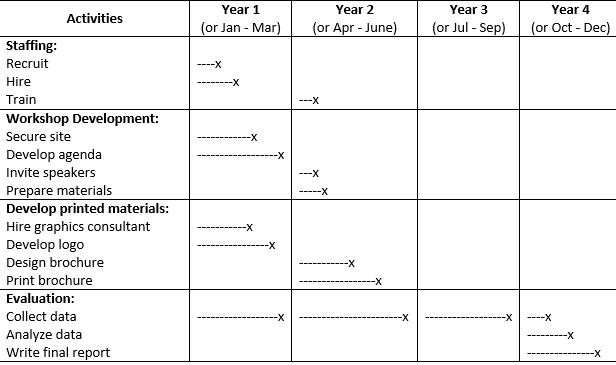
Evaluation (1-2 pages): Funders want to know that their money went to a worthwhile endeavor, so it is important to include an explanation of what records and data will be kept and how the will be used to assess the program’s success. Many programs hire an outside evaluator for this step; if the NWWNA is interested in this, funding for an outside evaluator should be included in the budget (see box: “Program Evaluation Help” for information on local project evaluation resources).46
Budget (1 page): The budget should discuss the estimated cost of the project and the costs should be grouped by categories (for example, personnel, materials, and equipment). The budget should include everything listed in the project description that could possibly
Program Evaluation Help: The University of Michigan Schools of Social Work and Public Health offer courses in program evaluation and often have students partner with communitybased organizations to draft evaluation plans. The NWWNA should look into utilizing their services for help with evaluation. For more information visit: www. sph.umich.edu or www.ssw. umich.edu
cost any money. Items listed in the budget should be detailed and justified with supporting documentation (like evidence that shows how much the requested item typically costs). The budget should also address any items that will be paid for by another source, whether it is the NWWNA or another organization.47
Organization (1 page): The organization section should provide a brief overview of the NWWNA including its mission and history, programs, and board and staff information.48
Conclusion (1 paragraph): The conclusion wraps up the grant proposal and should restate what the NWWNA thinks the project will accomplish, why it is important, and who will benefit. This paragraph should be thought of as the final appeal for the project. Tell the funder one last time why they should decide to fund the project!49
Appendix: Not all grants allow for an appendix, but for those that do, the appendix is where to put supporting documentation and any other materials that do not fit in the proposal itself. Additional documents could be letters of support from community organizations with whom the NWWNA would partner if granted funding, images, forms, maps, or biographical statements.
1. Read grant guidelines and instructions carefully.
2. Know your audience, and write with them in mind.
3. Clearly state the need or problem you’re addressing.
4. Be compelling.
5. Emphasize why the problem and your solution to it matter.
6. Explain why your organization is a good investment.
7. Always include a clearly labeled, reasonable budget.
8. Carefully review your proposal before submitting.
9. Did you include each element of the grant guidelines?
- Are you within the page length limit?
- Are your application materials formatted for easy reading?
- Have you proofread your proposal?
U.S. Census 2010, Households by Household Type, Total Households, Census Tract 4123, Washtenaw County, Michigan.
U.S. Census 2010, Households by Household Type, Census Tract 4123, Washtenaw County, Michigan.
U.S. Census 2010, Age Census Tract 4123, Washtenaw County, Michigan. American Community Survey, 2008-2012, 5 year estimates, DP 03 Selected Economic Characteristics, Census Tract 4123, Washtenaw County, Michigan.
U.S. Census Bureau, 2008-2012 5 year estimates, Census Tract 4123, American Community Survey.
Gottfredson, D., Gerstenblith, S., Soulé, D., Womer, S. & Lu, S. (2004). Do afterschool programs reduce delinquency? Prevention Science, 5 (4), 253-266.
Morris, A. (2002). The social costs of unemployment. Economic and Labour Relations Review, 13(2), 207-226.; Scantlebury, J., Brown, D., O’Sullivan, K, and Thakur, M. (2005). Preparing vulnerable youth for adulthood through youth workforce development. Clearinghouse Review, 39(4), 229-243.
Graebner, L. (2012). Salinas launches pilot program for peace. California Health Report, retrieved from: http://www.healthycal.org/archives/7128
Community Alliance for Safety and Peace. (2011). Retrieved from www.future-futuro. org
Perkins, T. (2012). Statistics show drastic drop in crime in Ypsilanti’s West Willow neighborhood. Ann Arbor News. Retrieved from http://www.annarbor.com/news/ ypsilanti/statistics-show-drastic-drop-in-west-willow-crime/ Gottfredson, Gerstenblith , Soulé, Womer, & Lu, 2004.
Jenson, J., Alter, C., Nicotera, N., Anthony, E., and Forrest-Bank, S. (2012). Risk, resilience, and positive youth development: Developing effective community programs for at-risk youth: Lessons from the Denver bridge project. New York, NY: Oxford University Press, p. 7.
Ibid, pp. 15-18.
Ibid, p. 7.
Mullaney, R., Susskind, Y. and Checkoway, B. (1999). Youth participation in community planning. American Planning Association Planning Advisory Service Report Number 486, pp. 1-3.
American Community Survey, 2008-2012, 5 year estimates, DP 03 Selected Economic Characteristics, Census Tract 4123, Washtenaw County, Michigan. Green, F. (2010). Unpacking the misery multiplier: How employability modifies the impacts of unemployment and job insecurity on life satisfaction and mental health. Journal of Health Economics, 30, 265-76.; Morris, A., 2002.
Clark, A., Knabe, A., and Ratzel, S. (2010). Boon or bane? Others’ unemployment, well-being, and job insecurity. Labour Economics, 17(1), 52-61).
Ibid.
Giloth, R. (2000). Learning from the field: Economic growth and workforce development in the 1990s. Economic Development Quarterly, 14(4), 340-359.
Ibid.
Sutton, S. (2004). Corporate-community workforce development collaborations. In E. Melendez, Communities and workforce development (pp. 439-471). Kalamazoo, MI: W. E. Upjohn Institute for Employment Research. E. Tucker, personal communication, March 18, 2014. [Personal Interview]
Ibid.
Ibid.
Scantlebury, J., et al., 2005.
New West Willow Neighborhood Association. (2007). West Willow Community Plan: Working together for positive change [Presentation to Washtenaw County Board of Commissioners]. Retrieved March 16 from http://www.ewashtenaw.org/ government/boc/agenda/ws/year_2007/2007-10-18ws/2007-10-18ws1
The W.K. Kellog Foundation and the Healthcare Forum. Developing community capacity. Sustaining community-based initiatives. Module one.
Gittell, R., and Vidal, A. (1998). Community organizing: Building social capital as a development strategy. Thousand Oaks, CA: SAGE Publications, Inc. S. Wade. (2014, March 14). [Personal Interview]. Minnesota Council on Foundation. (n.d.). “Common Types of Grants.” Retrieved April 2014 from http://www.mcf.org/nonprofits/common-types-of-grants A2Y Chamber. (N.D.). About Us. Retrieved March 2014 from http://www.a2ychamber. org/About-Us.aspx
Ann Arbor Spark. (n.d.) About Us. Retrieved March 2014 from http://www. annarborusa.org/about-us
Jean Ledwith King Women’s Center of Southeast Michigan. (2014). Who we help. Retrieved March from http://www.womenscentersemi.org/who_we_help Social Explorer Tables, U.S. Census Bureau (2010). Michigan Economic Development Corporation. (2014). Michigan Talent Connect. Retrieved March 2014 from http://www.mitalent.org/ Michigan Shifting Gears. (2014). Michigan Shifting Gears. Retrieved March 15, 2014 from http://www.mitalent.org/michigan-shifting-gears-program/ Michigan Works! (2013). About: Michigan Works! Retrieved March 15, 2014 from http://www.michiganworks.org/about-michigan-works/ New West Willow Neighborhood Association. (2007). West Willow Community Plan: Working together for positive change [Presentation to Washtenaw County Board of Commissioners]. Retrieved March 16 from http://www.ewashtenaw.org/ government/boc/agenda/ws/year_2007/2007-10-18ws/2007-10-18ws1
Goetz, J. & Varallyay, L. (2008). How to write a grant proposal. USDA Rural Development Cooperative Programs. Retrieved April 2014 from http://www.rurdev. usda.gov/SupportDocuments/tn13GrantProposal.pdf
Grant Proposal Template (n.d.) Retrieved April 2014 from http://www.lac.org/doc_ library/lac/publications/Grant_Proposal_Template.pdf Foundation Center. (n.d.) Proposal Writing Basics. Retrieved April 2014 from http:// www.grantspace.org/Classroom/training-courses/Proposal-Writing-Basics Goetz & Varallyay, 2008.
American Community Survey 2006-2010
Adapted from Community Toolbox (n.d.) Retrieved Apil 2014 from http://ctb.dept. ku.edu/sites/default/files/chapter_files/example%20timeline%20chart.png Foundation Center. (n.d.) Proposal Writing Basics. Retrieved April 2014 from http:// www.grantspace.org/Classroom/training-courses/Proposal-Writing-Basics; Goetz & Varallyay, 2008.
Goetz & Varallyay, 2008. Foundation Center, n.d.
Ibid.
Cooper, J. (2014). “What’s in a grant proposal?” Grant Development Series lecture.
Introduction
Market Gap Analysis
Additional Issues Impacting Retail Development
Discussions, Goals, and Strategies
Economic development considerations are an integral component of any neighborhood planning effort. Assessing the multiple components of economic development can be challenging. In particular, the West Willow neighborhood may undergo noticeable transformation if the Willow Run plant site is redeveloped, which will have an impact on economic development in the area.
Currently, retail development is non-existent within the boundaries of West Willow. Survey results indicate that, while residents consider nearby retail accessible by car, they also believe their neighborhood would benefit from additional nearby retail. Additionally, during several NWWNA meetings and personal interviews, residents expressed a desire for improved pedestrian access to existing retail establishments, especially along Ecorse Road.1 The mixed viewpoints revealed by the survey, meetings, and personal interviews warranted further investigation to determine the viability of new neighborhood-oriented retail and the potential for improved access to existing retail.
The purpose of neighborhood-oriented retail is to provide convenient commercial options for the day-to-day needs of local consumers.2 Retail establishments along Ecorse Road (such as the existing fast-food restaurants, barber shop, and convenience store) represent the closest existing neighborhood-oriented commercial options to West Willow. While these retail establishments along Ecorse Road complement the residential character of West Willow, consumers should be able to comfortably reach them through a variety of transportation modes. Unfortunately, this is currently not the case because they are only accessible by car.
Planning for the viability of new development is only feasible if the local market can sustain further growth. In addition, physical conditions such as automobile and pedestrian accessibility must
be conducive to business. In order to analyze the existing market conditions near the neighborhood, we conducted a preliminary analysis of economic conditions consisting of:
1.
A market gap analysis of current market conditions near West Willow to determine the feasibility of future retail, and An analysis of additional issues that impact the success of retail development.
2. This chapter discusses the preliminary analysis, and concludes with a discussion of challenges and opportunities for retail development within and adjacent to West Willow. The chapter concludes with a list of goals and strategies for improving the retail environment.
A market gap analysis is a method used to estimate how well the existing retail within a community or trade area meets the needs of its residents.3 A gap analysis is purely numbers-based; that is, it offers a snapshot of existing market conditions based on socioeconomic figures, sales data, and square footage.
Note that a gap analysis is not a final recommendation for action—it is only a single part of a larger comprehensive market analysis and should be treated as a preliminary guide for future discussions and studies.4 In addition, the market gap analysis process makes several basic assumptions, the most important of which is that families within a trade area will choose to make their purchases within that trade area.5
A retail gap analysis typically involves the following steps:6
1. Identify the categories of retail to focus on
2. Establish a trade area boundary
3. Create a profile for the trade area that analyzes retail demand and supply
4. Calculate the retail gaps for each category (difference between demand and supply)
Convenience goods
Items needed on a frequent basis and purchased frequently.
Comparison goods
Specialty products purchased infrequently.
Within the neighborhood survey, residents identified grocery stores, restaurants, and hardware stores as the types of additional retail they believe would most benefit their neighborhood. Food (from a grocery store or restaurant) and hardware items can be categorized as convenience goods because they are typically needed on a daily basis and are purchased frequently.7 The opposite of a convenience good is a comparison good. Comparison goods are specialty products that are purchased less frequently than convenience goods, such as large electronic items or furniture.8
Since we analyzed the feasibility of neighborhood-oriented retail within West Willow, our focus is on convenience goods. We expanded our market gap analysis from the retail identified by residents to include a wider range of convenience goods typically found in residential neighborhoods in order to ensure a more comprehensive analysis. We also included personal services, which, like convenience goods, are services that people typically need to access frequently. Our Market Gap Analysis examined the following types of convenience retail and personal services:
• Hardware stores
• Supermarkets and grocery stores
• Full- and limited service restaurants (including coffee shops)
• Pharmacies and drug stores
• Personal services (such as barbers, laundromats, dry cleaners, and nail salons)
A trade area is a geographic area from which a neighborhood or community draws a majority of its customers.9 Similar to retail goods, there are two major classifications of trade areas: convenience trade areas and retail trade areas. Convenience trade areas are typically geographically smaller than comparison trade areas because they provide a smaller array of goods.10 Because the focus of our market analysis is convenience retail, we selected a convenience trade area as the basis for the gap analysis.
A trade area can be geographically defined in a variety of ways. Boundaries can be drawn using simple distance radii, drive time, public input, or a combination of these.11 Market analyses often use radii between one and three miles for convenience trade areas.12
We used a trade area with a simple 2-mile radius as it follows common practice and is reasonable considering the size of the
neighborhood. However, Ford and Belleville Lakes define the southern boundaries as they represent physical barriers to access into the trade area (see Figure 5.1). We selected the corner of Tyler Road and Wiard Road as the center of the trade area because it is accessible from both the West Willow neighborhood and the Willow Run plant site. The vacant parcel on Wiard Road adjacent to the New Covenant Missionary Baptist Church, shown in Figure 5.2, is a potential site for new retail development. The church currently owns this parcel and has indicated that they plan to develop the twenty-seven-acre vacant parcel for future expansion;13 Therefore, the Church must be included in any discussions relating to retail development on this site.
The purpose of a market gap analysis is to find the “gap” between potential sales (demand) and actual retail sales (supply) within the trade area. In the analysis, the existing “buying power,” or median household income, of households within the trade area represents the demand. Table 5.1 summarizes the relevant demographic information for the convenience trade area. Meanwhile, the amount of existing retail within the trade area, measured as a function of leasable square footage, represents supply.14 Table 5.2 includes the supply for the West Willow trade area.
Supply - Demand = Retail Gap
Table 5.1 Trade Area Demographic Data15
Population Households
Median Household Income
Median Household Income Adjusted for Inflation
Mean Household Income
Per Capita Income
Source: American Community Survey
In order to obtain the market gap for each retail category, we translated demand and supply figures for the trade area into a common variable: gross leasable floor area, measured in square feet (GLA-SF).16 The market gap can then be calculated as supply minus demand. If the demand is greater than the supply, then the market gap is negative and there is a leakage of retail, meaning that there is potential for new retail within the trade area. If the supply is greater than the demand, then the market gap is positive and there is a surplus of retail, meaning that the market may not be able to sustain new retail. Table 5.2 shows the final market gap calculations.
The retail gap analysis reveals that the convenience trade area around West Willow could support four hardware stores, but no other category of convenience retail. While four hardware stores within a two-mile radius is somewhat excessive, the large leakage does warrant discussion regarding the feasibility of a new hardware store within the area. It is also aligned with the survey responses, which showed interest in this type of retail among residents.
A number of data and procedural limitations inhibited the extent of our market gap analysis. These limitations are explained below. As a result, the market gap analysis is not meant to be exhaustive. Rather, the NWWNA should treat this gap analysis as a preliminary assessment of existing market conditions near West Willow and use it as a framework for more detailed discussions regarding economic development.22
Our analysis did not incorporate the potential impact of more area employees on retail demand figures. Residential buying power in itself is often cited as an adequate means of analyzing market demand for a given trade area,23 but any future discussions of retail feasibility should analyze area employees, as daytime employees could potentially be converted into new consumers within the trade area. While future development at the Willow Run plant site could support a large number of employees and visitors, the scale of the development is currently unknown.
A lack of access to recent and relevant data further limited the scope of the market gap analysis. Accurate and detailed sales data can be expensive, and was unfortunately outside of the scope of this study. Additional information regarding consumer spending patterns would have helped refine the convenience trade area, giving a more accurate representation of supply and demand. We were reliant on neighborhood survey responses to inform our analysis, making it less precise.
The inflexible boundary of the convenience trade area is a limitation because it fails to recognize retail locations directly outside of its perimeter. For example, many residents indicated in the survey that they typically shop for convenience needs at the Walmart and Meijer on Belleville Road. While these establishments are located only a half of a mile outside of the trade area boundary, they were not counted as “supply” within the market gap analysis.
While successful retail development relies upon a favorable commercial market, a number of additional factors can have an impact on long-term commercial viability. These factors range from perceptions of the neighborhood to its physical conditions. The following text offers analysis on some of the prevailing issues impacting retail development in West Willow.
Although the majority of properties and streets in West Willow are well-maintained, the neighborhood could benefit from physical improvements that would add to its unique character. An increase in inviting qualities would attract both developers and consumers to the area.
Although West Willow consists solely of single-family homes, the neighborhood’s rental occupancy rate is 31.3%.24 A higher rate of rentals may concern homeowners and officials, as it tends to be indicative of an impermanent residential population. In addition, higher rental rates often suggest weakened social cohesion or indifference toward a neighborhood.25 Furthermore, West Willow’s vacancy rate of 10.3% may also be suggestive of fragmentation.26 In our survey, most residents expressed an affinity toward their neighbors and the neighborhood. However, outside perception of West Willow may vary. Ypsilanti Township representatives that we spoke to expressed concern about the rental rates and indicated that they are interested in initiatives to increase homeownership.27 A developer may be hesitant to invest in a neighborhood without a stable population.28
See Chapter 6 for some design recommendations from the Urban Planning Capstone team.
This is the same parcel described in the market gap analysis. See Figure 5.1.
In recent years, crime in West Willow has decreased, which may be attributed to efforts by the County Sheriff’s Office as well as measures taken by neighborhood residents. Despite the change in actual crime rates, perceptions of the neighborhood may be slower to change. Crime can deter development, whether actual or perceived.
New construction requires significant financial investment. Although national chain retailers may have more readily available financing, their executives require strict performance standards. Therefore, national chains are usually less accommodating to local expectations. Alternatively, an independent retailer may be more flexible, but would typically have to overcome financial hurdles to establish a new development.29
Other than the vacant parcel on Wiard Road north of Tyler Road (see Figure 5.1), the neighborhood currently lacks sufficient space for new development. Geographically, this site could be an ideal location for retail use by both West Willow residents and employees of the future development at the Willow Run plant site. As noted earlier in this chapter, the New Covenant Missionary Baptist Church owns the property, which is zoned for multi-family residential use. The Church has a plan to develop this parcel for future expansion, so retail development at this site would require collaboration with the church. A developer would also need to apply for a rezoning and transfer of ownership, which could be a lengthy and challenging process.
In a meeting with West Willow residents, one resident pointed out that she would walk to the developments on Ecorse Road if she felt safer exiting the neighborhood, but that traffic speeds are too high and there is not enough lighting.
A transportation network can either facilitate or inhibit access to retail development. Due to West Willow’s boundary of highways and major thoroughfares, its residents rely on motorized transportation to access retail centers outside the neighborhood. Furthermore, these retail centers are essentially inaccessible by foot, due to the current lack of pedestrian infrastructure. Dorset Avenue is the only road that a pedestrian could use to exit West Willow (see Figure 5.3). However, high vehicular speeds and unaccommodating design contribute to an unsafe environment for pedestrians once they leave the neighborhood.
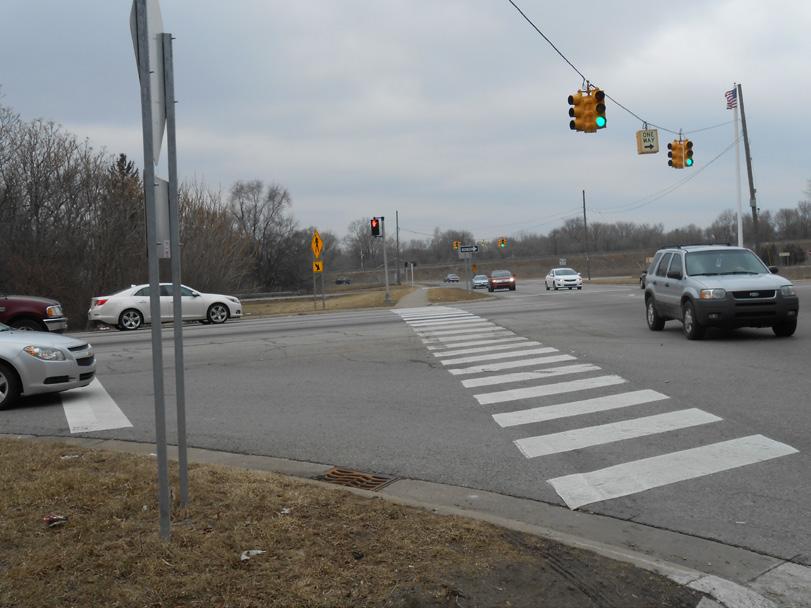
In order to reach the retail establishments along Ecorse Road, pedestrians must cross six total lanes of traffic on US 12. While there is an established crosswalk, the speed limit on US 12 is very high, and there are no features to buffer pedestrians. Additionally, cars are allowed to turn right during red lights, increasing the hazard to pedestrians attempting to cross.
In this regard, retail within the boundaries of West Willow would be ideal so that residents would not need to exit the neighborhood. Since new development at the Willow Run plant site may increase demand for neighborhood-oriented retail, easy travel between the neighborhood and plant site would be necessary to support retail development. However, the design of Wiard Road currently serves as a barrier between these locations. Without significant modification, Wiard Road would prohibit the viability of a shared development.
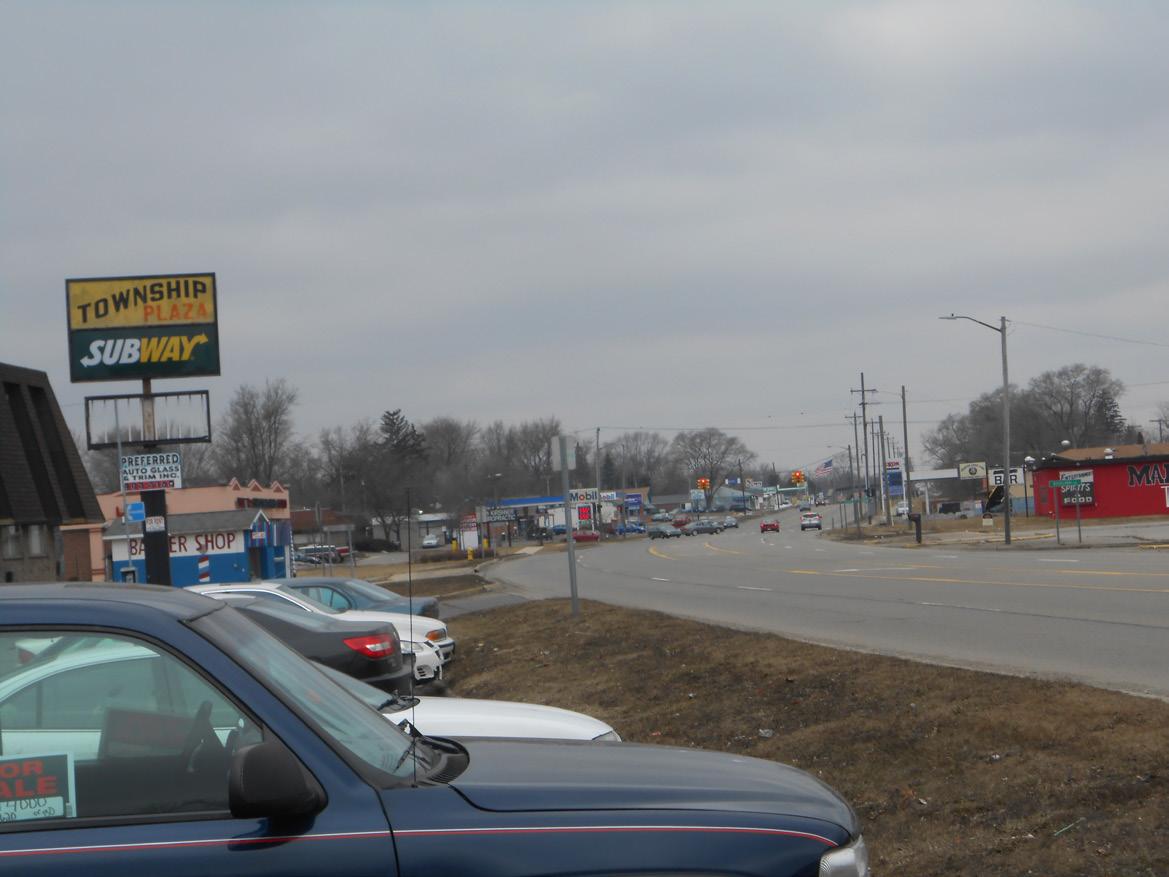
The 2014 Ypsilanti Township Master Plan identifies Ecorse Road and Michigan Avenue to the northwest of West Willow as urban commercial corridors.30 The purpose of the Ecorse Road and Michigan Avenue Corridor Plan is to revitalize existing business establishments along these corridors by improving their aesthetics, identity, and accessibility. Under the corridor plan, the Township recommends physical improvements that will make circulation easier and safer for pedestrians, bicyclists, and transit users. In addition, the plan recommends infill development consisting of multi-family residences to transform these corridors into lively, mixed-use destinations. As illustrated in Figure 5.4, the plan supports commercial nodes at key intersections as centers of activity, each with its own distinct character.31 As township efforts focus on implementing the plan’s recommendations, generating outside interest in potential West Willow retail development will be challenging.
Figure 5.4 Ecorse Road and Michigan Avenue Corridor Plan - Conceptual Plan32
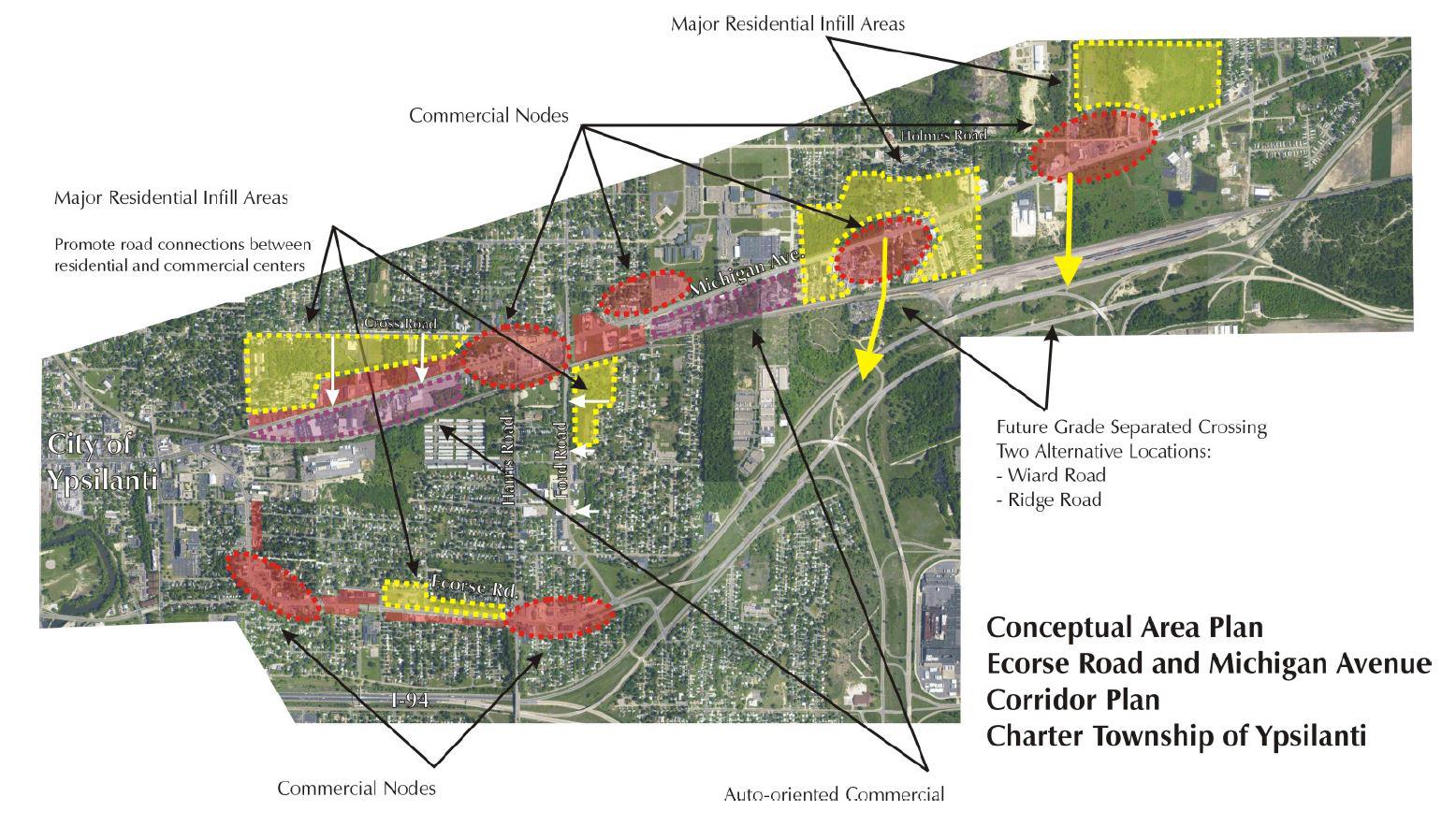
Source: 2014 Ypsilanti Township Master Plan
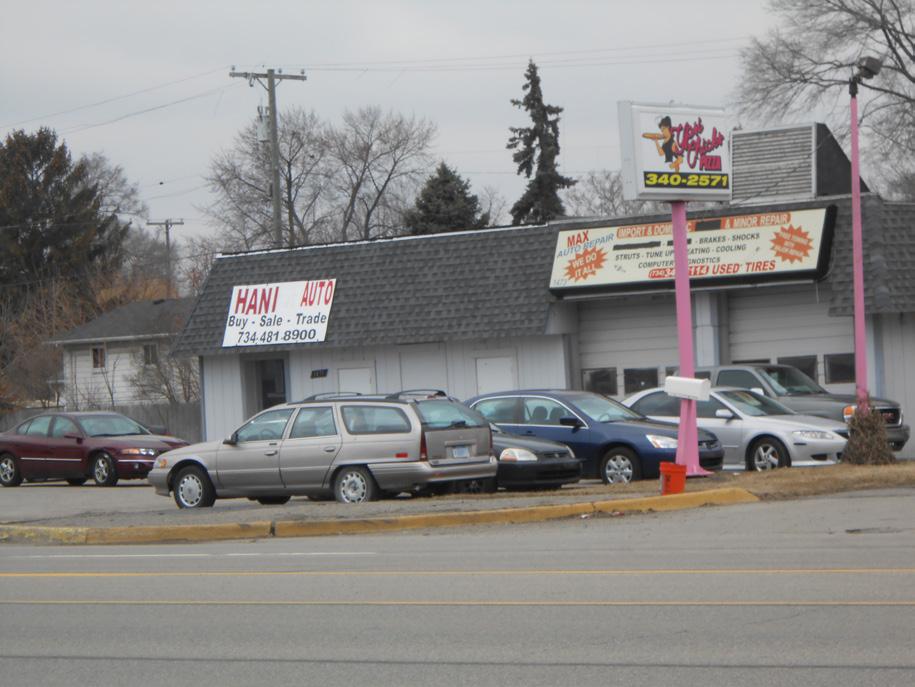
The strip of Ecorse Road closest to West Willow contains a cluster of automobile sales and repairs establishments. While such uses are important, the clustering of these establishments detracts from the attractiveness of the retail corridor.
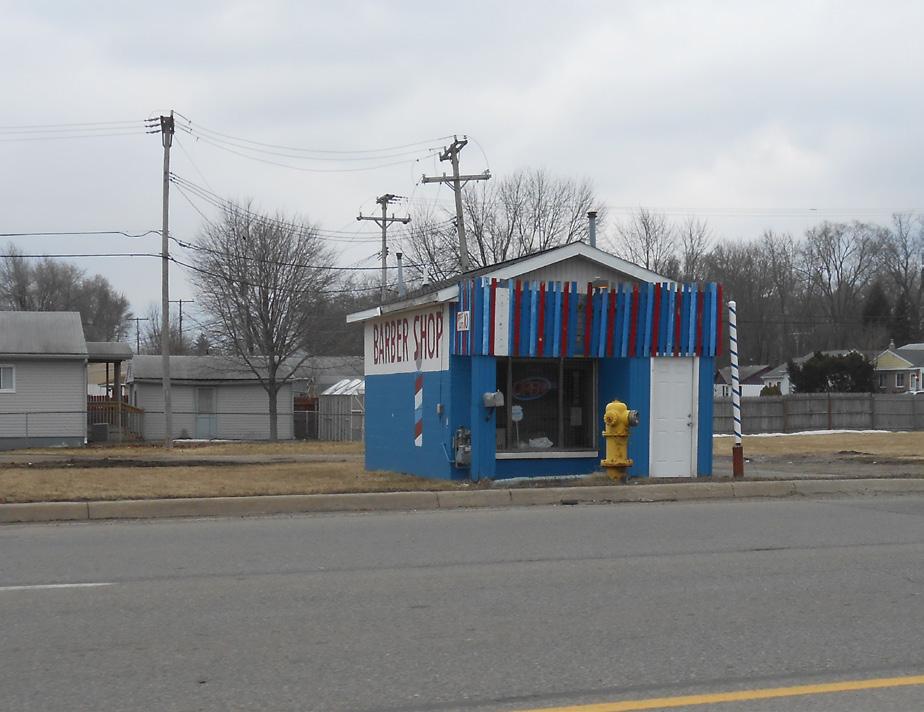
Small-scale personal service shops are appropriate for this stretch of Ecorse Road and, with appropriate design, could become commercial assets to West Willow residents.
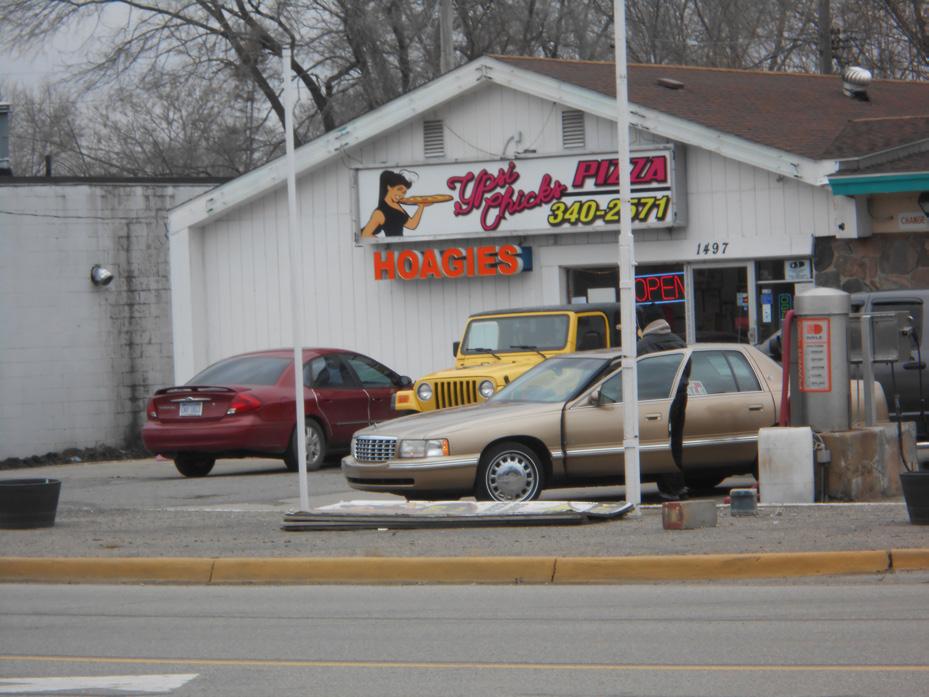
If restaurants incorporate pedestrian-friendly design and attractive features, they could become an asset to West Willow residents and improve the desirability of the neighborhood. A restaurant located inside a gas station, however, adds minimal benefit to the corridor.
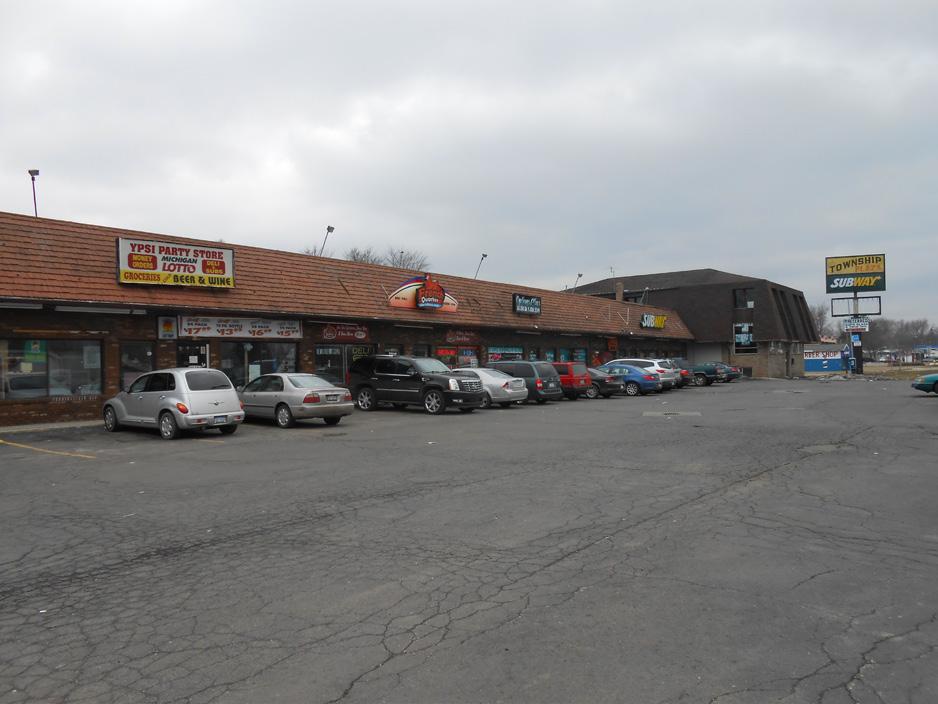
While the existing retail uses along Ecorse Road are neighborhood-oriented, they are not pedestrianfriendly. Design improvements, such as facade renovations, could visually enhance their appeal.
Our market analysis reveals that a new convenience retail development within the West Willow neighborhood is not very feasible given current conditions. While the market gap analysis suggested that the trade area around West Willow could support a hardware store, any development would have to overcome barriers to become viable, ranging from poor site accessibility to unfavorable neighborhood perceptions. However, the prospect of future development at the Willow Run plant site has the potential to increase demand for retail and serve as a catalyst for further development. Employees, clients, and museum visitors could add to the existing residential consumer base. The details of future development at the Willow Run plant site are unknown, making it difficult to project future retail demand. However, as significant details emerge, the NWWNA may wish to revisit and discuss retail feasibility.
While successful retail within or directly adjacent to West Willow is likely contingent upon a variety of long-term factors, the NWWNA has the opportunity to benefit from improvements to existing area retail in the short-term. Neighborhood-oriented retail development along Ecorse Road is the closest existing retail to West Willow. Unfortunately, West Willow residents cannot easily reach Ecorse Road by foot. The Ypsilanti Township Master Plan identifies this portion of Ecorse Road as a future mixed-use commercial node, which may stimulate more pedestrian-friendly design changes (see Figure 5.4 above). Neighborhood residents have a great opportunity to provide the Township with input regarding their visions for retail along Ecorse, especially with regards to improved pedestrian connectivity, given the potential for improvements.
Goal: A statement that describes, usually in general terms, a desired future condition.
Strategy: A statement that describes a specific future condition that is to be attained within a stated period of time.
Action: A course of action or rule of conduct to be used to achieve the goals and objectives of the plan.
Based on our analysis, we developed the following vision economic development vision for West Willow that represents the needs and desires of neighborhood residents:
“ West Willow residents should advocate for increased pedestrian access to existing retail and a greater variety of neighborhoodoriented retail options in order to improve the general quality of life for West Willow residents, while preserving the neighborhood’s residential character.”
In support of this vision, we identified two goals to guide future actions for the NWWNA related to economic development:
• Advocate for increased access to existing retail.
• Advocate for a greater variety of neighborhood-oriented retail options.
For each goal, we provide and describe strategies and actions that the NWWNA can follow as opportunities arise for the neighborhood to impact change.
Identify and promote opportunities for additional pedestrian and bicycle access to retail along Ecorse Road.
Neighborhood-oriented commercial development along Ecorse Road represents the closest existing retail to West Willow. However, these commercial establishments are not easily accessible by foot or bicycle. In order to improve quality of life within, and the desirability of West Willow, neighborhood residents should be able to easily and comfortably access these retail establishments by various modes of transportation.
• Gain resident input with regards to existing pedestrian/ bicycle connections to Ecorse Rd. Public input should be sought during NWWNA meetings, additional open forums, focus groups
and resident surveys. In particular, the NWWNA should gain an understanding of residents’ opinions on pedestrian crossings at Dorset Ave and Gates Ave.
• Establish a clear vision for new pedestrian/bicycle connections through various forms of brainstorming sessions. Specifically, the NWWNA should ask residents what improvements should be made to existing crosswalks, bike paths and sidewalks. It is also useful to learn where residents would like to see new crosswalks, bike paths, and sidewalks, and how they should be designed.
• Promote the established vision for pedestrian and bicycle connections to relevant policy makers. The NWWNA should encourage West Willow residents to attend and speak at Township Planning Commission Meetings, Township Board meetings, master planning hearings, and Washtenaw County Road Commission meetings. Additionally, the NWWNA should attempt to set up private meetings with representatives from these commissions and boards. Representatives from these commissions and boards should also be encouraged to attend regular NWWNA meetings.
Advocate for a more interconnected transportation network. Strategy 2
The existing road network limits pedestrian and automobile access to adjacent commercial uses. Given the current road layout, West Willow residents can only enter and exit the neighborhood at a limited number of points. An increase in the number of neighborhood entrance/exit points will improve access to existing and future commercial uses outside the neighborhood and improve the desirability of uses within the neighborhood.
• Gain resident input with regards to their existing travel behavior. Public input should be sought during Association meetings, additional open forums, focus groups and resident surveys. In particular, NWWNA should gain an understanding of the travel routes that residents currently take to enter and exit the neighborhood.
• Establish a clear vision for new road network connections and design through various forms of brainstorming sessions. Specifically, the NWWNA should determine where new entrance/ exit points could be built and how the existing road network could be redesigned to promote increased automobile and connectivity to adjacent commercial areas.
• Promote the established vision for the transportation network to relevant policy makers. The NWWNA should encourage West Willow residents to attend and speak at Township Planning Commission meetings, Township Board meetings, master planning hearings, and Washtenaw County Road Commission meetings. Additionally, the NWWNA should attempt to set up private meetings with representatives from these commissions and boards and encourage these representatives to attend NWWNA meetings. The success of this strategy relies particularly heavily on conversations with the Washtenaw County Road Commission, which is responsible for many decisions related to the road network.
Advocate for a greater variety of neighborhoodoriented retail options
Establish and communicate a neighborhood vision for the Ecorse Road Corridor Strategy 1
Neighborhood-oriented commercial development along Ecorse Road represents the closest existing retail to West Willow. West Willow residents would thus benefit from a successful and attractive Ecorse Road commercial area. The Ypsilanti Township Master Plan identifies this portion of Ecorse Road as a future mixed-use commercial node. If the Township hears a strong and consistent voice from West Willow residents with regards to the intent and design of this node, it may feel more inclined to work towards incorporating such feedback into its plans. A cohesive neighborhood vision for Ecorse Road is only useful if it is communicated effectively.
• Determine more information about West Willow residents’ existing retail choices through additional surveys, public
meetings, and personal interviews. Expand upon the questions and results of the Urban Planning Capstone Team survey to determine how frequently residents visit retail establishments along Ecorse Road and why they choose whether or not to shop at these establishments.
• Identify additional types of commercial uses that West Willow residents would like to see along Ecorse Road. Expand upon the questions and results of the Urban Planning Capstone Team survey to answer the following questions: What types of new retail along Ecorse Road would benefit West Willow residents and complement the residential character of the neighborhood? How should these retail establishments be designed (i.e., building facades, landscaping, signage, pedestrian features, and parking location)?
• Promote the established vision for the Ecorse Road commercial node to relevant policy makers. The NWWNA should encourage West Willow residents to attend and speak at Township Planning Commission meetings, Township Board meetings, and master planning hearings. Additionally, the NWWNA should attempt to set up private meetings with representatives from these Commissions and Boards. Representatives from these Commissions and Boards should also be encouraged to attend NWWNA meetings. This success of this strategy relies particularly heavily on conversations with the Ypsilanti Township Planning Department.
See Chapter 3 for a detailed discussion of the Urban Planning Capstone Team survey.
Maintain an awareness of West Willow’s retail climate. Strategy 2
Like all neighborhoods, West Willow is constantly evolving. The NWWNA must understand the realities of their changing environment if they wish to create an appropriate neighborhood vision. In particular, the West Willow neighborhood may be undergoing noticeable transformation if the Willow Run plant site is redeveloped. Additional capacity for retail may accompany this transformation. While the market gap analysis discussed in this chapter provides a basic understanding of West Willow’s current retail climate, we conducted it with limited capacity and resources, so it should be treated as a preliminary study. In order to make informed judgments and guide the neighborhood vision, the NWWNA and neighborhood residents should stay informed of changing economic variables.
• Contract the services of a retail analyst or consultant to obtain a more detailed analysis of current and projected market conditions.
• Maintain an ongoing analysis and understanding of the factors identified within the “Further Issues Impacting Retail Development” section earlier in this chapter.
Develop and maintain a healthy relationship with existing and future businesses at Willow Run.
A healthy relationship with neighboring businesses creates opportunity for collaborative and mutually beneficial decisions.
• Organize private meetings with representatives from existing and future businesses adjacent to the neighborhood. Representatives from these businesses should also be encouraged to attend NWWNA meetings.
While the NWWNA may find some of the action items relatively easy to accomplish without assistance, other actions, such as those that involve focus groups or surveys, may be more complicated. However, the NWWNA does not have to accomplish these tasks alone. If necessary, the NWWNA can build a variety of partnerships to support these actions. Chapter 4 includes a directory of organizations and programs that can help achieve these goals. In addition, the NWWNA can always reach out to local universities, government agencies, or consultants for additional guidance. As outlined in Chapter 4, grants may be available to fund specific studies or consultant fees. With the proper resources, West Willow can improve connectivity to retail options and can grow one step closer toward a higher quality of life.
Based on conversations with neighborhood residents.
International Council of Shopping Centers. (1999). ICSC shopping center definitions: Basic configurations and types. ICSC
City of Bothell. (2008). Retail site assessment. Bothell, WA: Buxton Company.
Ibid.
Independence Township. (2008). Independence Township Vision 2020: Commercial market analysis. Independence Township, MI.
There is no “one-size-fits-all” process for conducting a market gap analysis. We compiled this list of steps drawing from Green Oak Township. (2008). Commercial market analysis. Green Oak Township, MI: Carlisle/Wortman Associates and Vartivarian, T. (1997). West Village neighborhood commercial development potential: A preliminary market analysis. [Unpublished Report]. Ann Arbor, MI: University of Michigan College of Architecture and Urban Planning.
Bennett, J., & Pesch, R. (2012). Forest Lake market area profile. St. Paul, MN: University of Minnesota Extension Center for Community Vitality.
Ibid.
Ibid.
Ibid.
Ibid.
Independence Township, 2008.
New Covenant Missionary Baptist Church. (n.d.) Church History [Website]. Retrieved 12 April 2014 from http://newcovenantypsi.org/about-the-church/church-history/ Green Oak Township, 2008.
U.S. Census Bureau. (2013). 2008-2012 American Community Survey 5-year Estimates, Table DP02, Selected Social Characteristics in the United States, Table DP03, Selected Economic Characteristics. Retrieved from American FactFinder, http://factfinder2.census.gov.
Green Oak Township, 2008.
Reference USA. (2014). Selected categories of U.S. businesses within a selected 2-mile buffer. Retrieved March 22, 2014 from http://www.referenceusa.com/Static/Home; Urban Land Institute. (2004). Dollars & cents of shopping centers: 2004. A study of receipts and expenses in shopping center operations. Washington D.C: Urban Land Institute.
Urban Land Institute. (2004). Dollars & cents of shopping centers: 2004. A study of receipts and expenses in shopping center operations. Washington D.C: Urban Land Institute.
Ibid. The Dollars & cents report lists the average GLA-SF for different types of retail uses. For example, it states that the median GLA for restaurants is 2,010 s.f. Because there are 57 restaurants in the trade area, we multiplied 57 restaurants by 2,010 s.f. to get the approximate supply of existing restaurants in GLA-SF within the trade area. In order to convert demand to GLA-SF, we calculated the median annual household income for the trade area ($43,680) by averaging those incomes of the all census tracts within the boundaries of the trade area. The Bureau of Labor Statistics provides retail statistics for spending in all retail categories based on income brackets. For example, households who make around $43,000 annually spend approximately 3.10% of their income before taxes annually on hardware (.0310 * $43,000 = $1,350). We multiplied the $1,315 by the number of households in the trade area (7,719) to obtain potential annual retail sales for hardware in the trade area. ($1,350 * 7,719 = $10,452,143.52). The Dollars & Cents of Shopping Centers report lists the median sales per GLA-SF for each retail type. For example, the report states that hardware stores sell $140.51 per square foot of GLA annually ($174.64 adjusted for inflation). Dividing potential sales for hardware by the median sales per square foot gives the the GLA-SF that could be supported by the neighborhood ($10,452,143/$174.64 = 59,849 s.f.).
Reference USA, 2014.; Urban Land Institute, 2004.
T., 1997.
Green Oak Township, 2008.
U.S. Census Bureau. (2011). 2010 Census Summary File 1, Table DP-1, Profile of General Population and Housing Characteristics. Retrieved from American FactFinder, http:// factfinder2.census.gov.
Martindale-Brightwood Community Development Corporation. (2002). MartindaleBrightwood Neighborhood Retail Market Study. Indianapolis, IN: Development Concepts, Inc.
Ibid.
Lawson, J., & Stumbo, B. (2014, March 24). [Personal Interview].
Martindale-Brightwood CDC, 2002.
Ibid.
Ypsilanti Township. (2014). 2014 Master Plan Update. Ypsilanti Township, MI.
Ibid.
Ibid, pp. 6-14.
Introduction
Goals, Strategies, and Discussion
Conclusion
The last major effort to assess West Willow’s physical conditions was in 2007 when the NWWNA, Washtenaw County, and Ypsilanti Township worked with Hamilton Anderson Associates to develop a neighborhood improvement strategy, the West Willow Neighborhood Improvement Strategy.1 The 2013 University of Michigan Physical Planning Capstone also surveyed the physical conditions in the neighborhood.2 These assessments suggest that houses in West Willow are in fairly good condition, but public infrastructure is not well-maintained and physical conditions in the neighborhood need improvement.
Several streets in West Willow need physical improvement. Tyler Road is an important road to focus on in the short term, as it is a major connector in the neighborhood. Residents explained that they often walk along Service Drive, so it would be valuable to address pedestrian safety conditions along that road in the short term as well. Development at the Willow Run plant site may lead to improvements on Wiard Road and better linkages between the plant site and the neighborhood in the longer term. The intersection of Dorset Avenue and US-12 is also considered dangerous for pedestrians, and thus needs special consideration.
The West Willow Neighborhood Improvement Strategy suggests physical improvements for the neighborhood and neighborhood residents expressed interest in making these improvements happen. However, identifying improvements and developing designs are only the first steps toward implementation. In order to ensure that desired changes occur, the NWWNA needs to identify funding sources and government support. Given constrained government resources, the NWWNA may need to identify creative strategies for supporting physical improvements.
Physical conditions are the physical elements that make up a neighborhood, such as streets, sidewalks, landscaping, building exteriors, and infrastructural elements.
See Directory of Services and Funding Sources in Chapter 4 to identify possible partnerships to support physical improvements.
A Community Benefits Agreement, described in Chapter 7, may be a strategy for funding physical improvements in West Willow.
Locations of major recommended physical improvements.
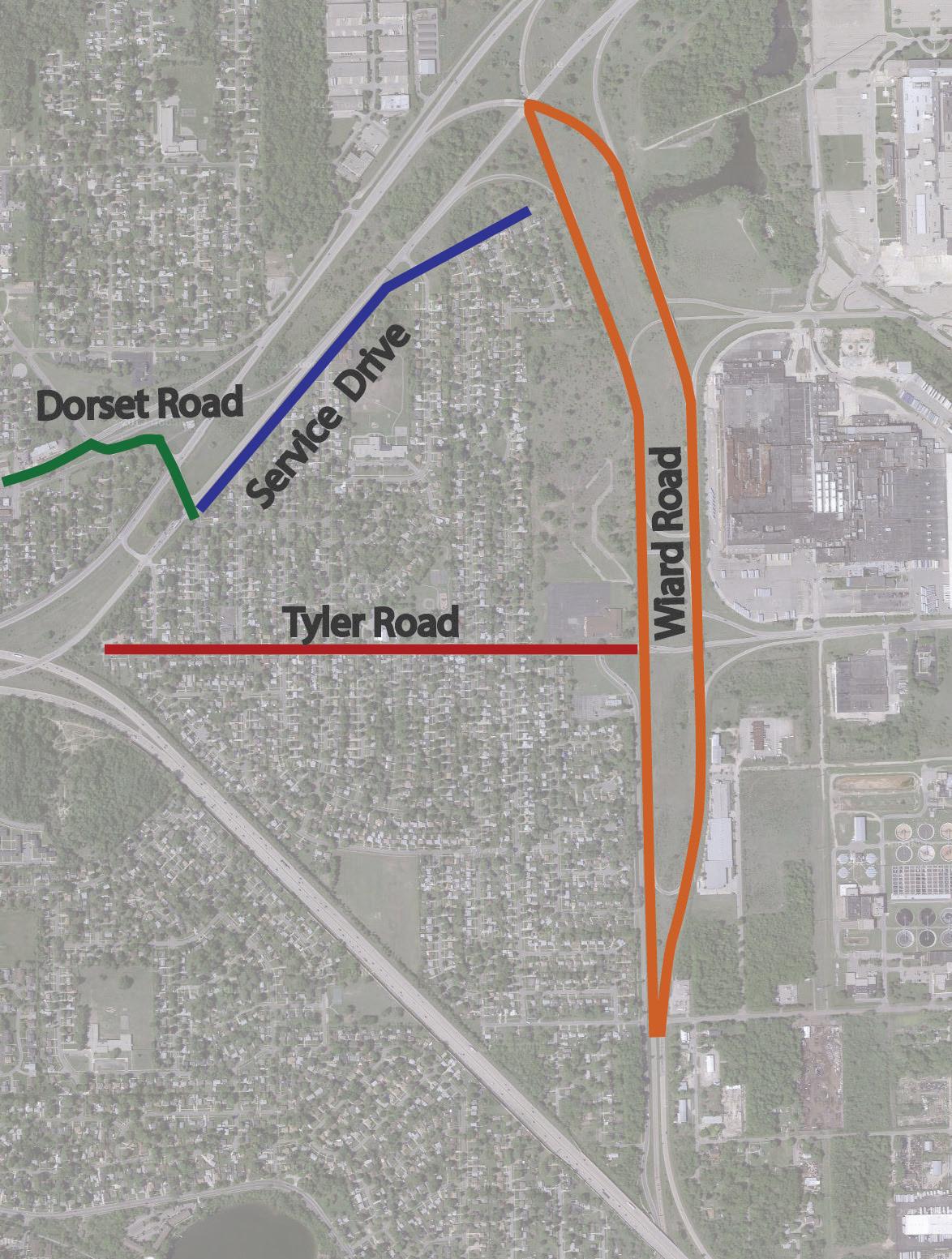
Based on residents’ interest in improving physical conditions in the neighborhood, we developed the following vision statement for enhancing physical conditions in West Willow
“The physical conditions in West Willow should promote safety and access to services and retail to improve quality of life for neighborhood residents, while also creating an appealing aesthetic character.”
The following three goals support this vision and guide future actions for the NWWNA:
• Improve streetscapes within the neighborhood.
• Develop automobile and pedestrian access across Wiard Road.
• Improve pedestrian access to Ecorse Road.
The remainder of this chapter discusses these goals in more detail and provides strategies and action items that the NWWNA can pursue to improve the physical conditions in the neighborhood. Figure 6.1 shows the locations of major improvements that we propose. We supplement these major improvements with minor improvements that the NWWNA can attain in the short-term.
Goal: A statement that describes, usually in general terms, a desired future condition.
Strategy: A statement that describes a specific future condition that is to be attained within a stated period of time.
Action: A course of action or rule of conduct to be used to achieve the goals and objectives of the plan.
Streetscape refers to the physical appearance of a street and includes natural and man-made elements along the street. Streetscape improvements generally seek to increase the aesthetic quality of a street.
Recommendations for Service Drive:
• Improved sidewalks
• Streetlights
• Cleanup
• Plantings
• Bike lanes
Improving streetscapes can increase cyclist and pedestrian safety, improve the neighborhood’s image, and enhance overall neighborhood safety. In our pre-assessment, we identified a need for better streetscape on Tyler Road and Service Drive, as well as a concern for safety in the neighborhood. In this chapter, we provide recommendations for improvements to Tyler Road and Service Drive, which are important roads within the neighborhood, as well as suggestions for safety sign improvements.
The I-94 Service Road, generally referred to as Service Drive, is on the northern edge of neighborhood, parallel to US-12 Expressway. The West Willow Neighborhood Improvement Strategy mentioned a lack of pedestrian pathways (i.e. sidewalks) on Service Drive, forcing pedestrians to walk on the road alongside cars. West Willow residents explained that many people in the neighborhood use Service Drive to walk their dogs, despite the lack of sidewalks.3
In order to make Service Drive more pedestrian friendly, we recommend improving and connecting the sidewalks, installing new streetlights for safety, cleaning up the trash, planting more trees and shrubs, and potentially incorporating bike lanes. Some of these suggestions, such as trash clean up and beautification can be done by the NWWNA fairly easily, while the major improvements will require collaboration with government agencies.
Recommendations for Tyler Road:
• Bicycle lanes
• Crosswalks
• Reduced speed limit
• Call stand and bulletin board for bus stop
• Improved signage
Tyler Road is the main road running through the neighborhood from east to west and is the site of the West Willow Community Resource Center (CRC) and three churches. The intersection of Tyler Road and Wiard Road, on the east edge of the neighborhood, is one of the main entrance and exit points for West Willow. Keeping Tyler Road in good condition is, therefore, a priority. The Township Master Plan contains a Complete Streets component, which calls for pedestrian- and bicycle-friendly streets.4
We recommend bicycle lanes and visible pedestrian crosswalks on Tyler Road, and the speed limit should be reduced to 25 mph to enhance pedestrian safety. At the bus stop on Tyler Road, in front of the CRC, we suggest installing a bulletin board for neighborhood information sharing and a call stand in case of emergency. We also suggest making the signs for major destinations, such as the CRC and the three churches, more visible. An easily identifiable sign for the CRC would be an especially effective addition to the neighborhood because it would draw residents and visitors to the center. See Figure 6.2 for examples of recommended physical improvements along Tyler Road.
In addition to improving the major roads through West Willow, there are a number of other streetscaping approaches that the NWWNA may be able to pursue to enhance the safety, accessibility, and aesthetics of the neighborhood. The two major improvements that we recommend are increased and better-marked street parking, and more Neighborhood Watch signs.
Residents expressed concern about the street parking regulations along Tyler Road.5 They explained that they are uncertain about whether they are allowed to park on Tyler Road, and, if so, whether they should park on the north or south side of the road. In our interview with Roy Townsend from the Washtenaw County Road Commission (WCRC), we learned that, because there are no signs restricting parking on Tyler Road, residents and visitors can park on either side.6 Because the CRC and three churches are on Tyler Road, there is sometimes a need for additional street parking. Mr. Townsend explained that it might be possible to add more street parking by modifying the sidewalk curb in front of the park on Tyler Road to allow more people to park there. This type of change would need to be done in collaboration with the WCRC.
In the survey and in conversations with residents, we learned that safety is an important concern in West Willow. Although safety has improved in recent years, many residents are still concerned about neighborhood youth wandering around at night and committing petty crimes. We recommend installing more Neighborhood Watch signs in strategic areas where crimes may occur, such as near parks. These signs remind residents and visitors that there is an active Neighborhood Watch group and may deter them from committing crimes.
Recommendations:
• Street parking improvements
• Neighborhood Watch signs
See Chapter 2 for more information about improved safety.
For Neighborhood Watch sign installation, please contact the Washtenaw County Sheriff’s Office.
Phone: (734) 222-4357 Website: www.ewashtenaw. org
Community Center
Burning Bush Church of God
B A A C C A
A
Insert crosswalks: We suggest the West Willow Neighborhood to insert crosswalks at important intersections on Tyler. The intersections in front of the community center , Burning Bush Church of God, and West Willow Park are the most important intersections of all
B
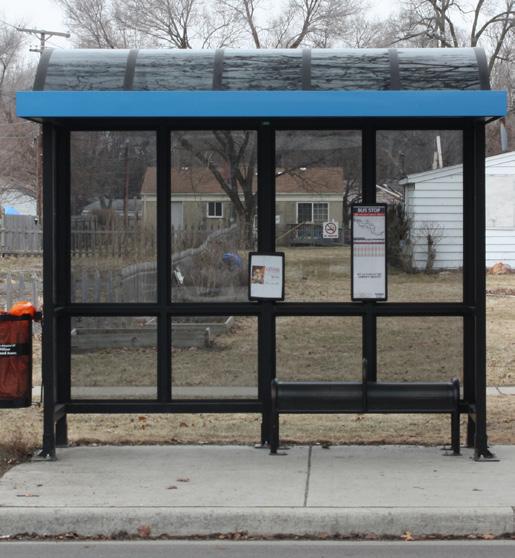
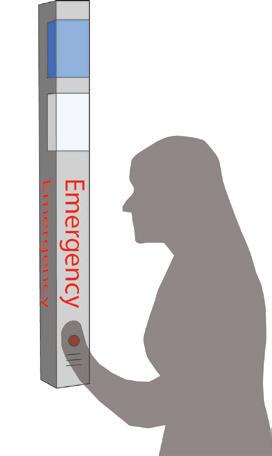
C
Insert parallel parking: Although residents and visitors can park on either side of the road, it is possible to add more street parking by modifying the sidewalk curb in front of the park and the church on Tyler.
In Chapter 5, we recognized the potential need to strengthen the linkage between West Willow neighborhood and the Willow Run plant site, as development there may bring more people to the area. This increased activity may create an opportunity for retail stores or restaurants in the area. In order to maximize the impact of this type of development, should it occur, a simple, pedestrian-friendly, and economically feasible link across Wiard Road between West Willow and the plant site would benefit the neighborhood. Such a linkage across Wiard Road could be developed at the intersection of Wiard Road and Tyler Road or between the northern part of the neighborhood and the plant site.
We identified three possible strategies for this linkage across Wiard Road, which are defined by the time frame in which they might be completed:
• Short-term: minor change
• Mid-term: moderate change
• Long-term: major change
Our overall suggestion for the pathway across Wiard is to start with the minor change (Strategy 1), which is a relatively feasible strategy. Later, as the future of the Willow Run plant site becomes clearer, the NWWNA can determine whether to pursue the moderate or major change strategies (Strategies 2 and 3).
We identified this site as a potential location for retail development in Chapter 5, which is why we use it here for a possible linkage.
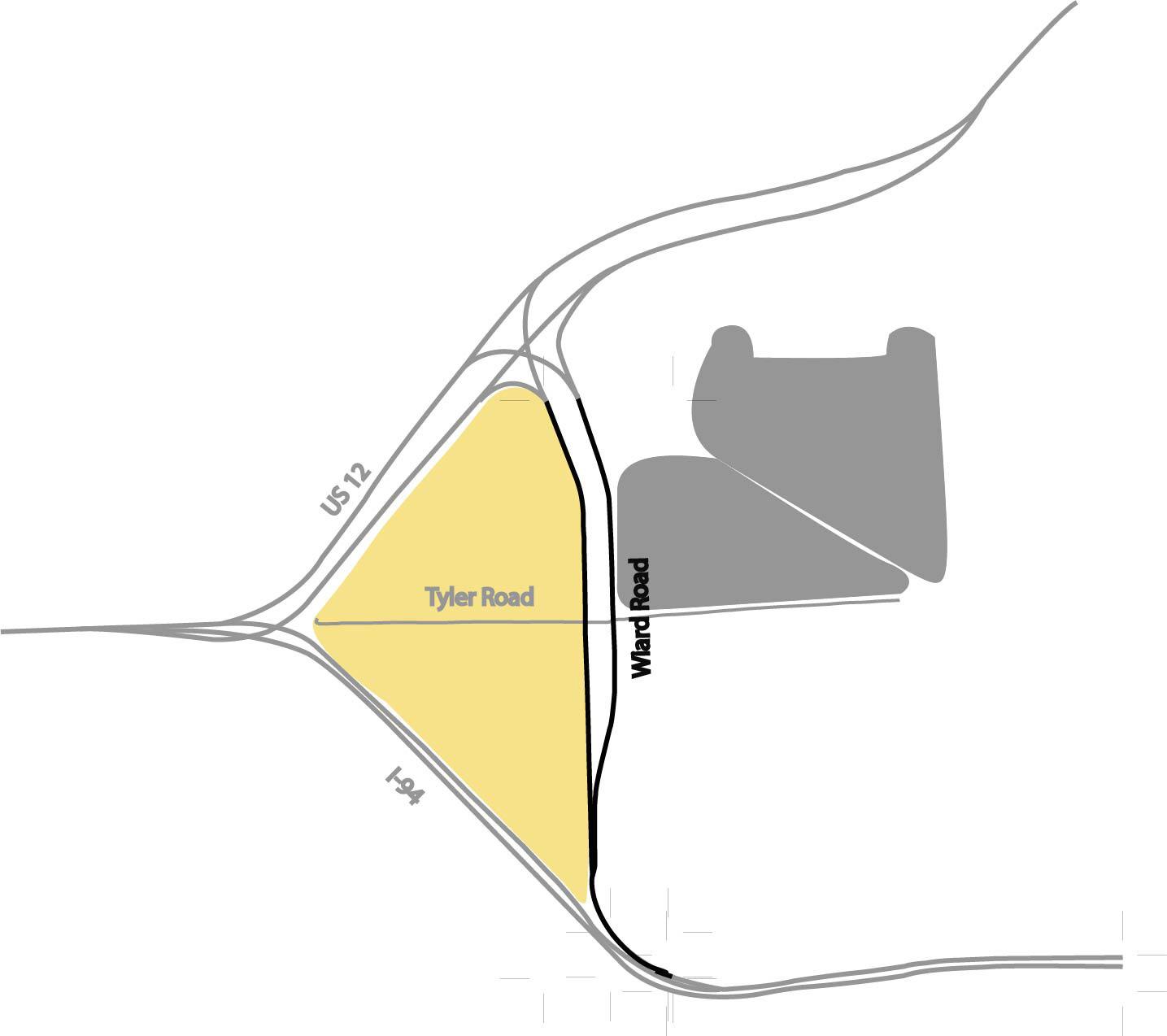
In this strategy, our recommendations mostly include alterations to existing paths. There are two options for converting existing linkages between the neighborhood and the Willow Run plant site (see Figure 6.4 for a graphical representation of both options):
• A link from the vacant lot north of the New Covenant Missionary Baptist Church to the entrance of the Willow Run plant site
• A link that would essentially extend Tyler Road across Wiard Road and create a cohesive pathway
In the first option, we recommend adapting the existing turnarounds on Wiard Road north of Tyler Road to accommodate a pedestrian crosswalk between the northbound and southbound turnarounds. The cost for this would be minimal, as the required infrastructure would largely consist of a pathway for pedestrians and stop signs for vehicles.
Currently, there is no pedestrian pathway along Tyler Road across Wiard Road. To the west of West Willow, Tyler Road and southbound Wiard Road intersect, while northbound Wiard Road is elevated, crossing Tyler Road on a bridge and leaving no space for pedestrians to walk. The WCRC considers this northbound bridge to be failing and has targeted it for removal. This construction is not yet scheduled, but it will likely be started as early as 2016.7 In that case, the WCRC would remove the bridge and run northbound Wiard Road at the same elevation as Tyler Road. As part of this process, the WCRC would install traffic signals where Tyler Road intersects with both southbound and northbound Wiard Road. These intersections would then have crosswalks allowing pedestrians to safely cross Wiard Road.
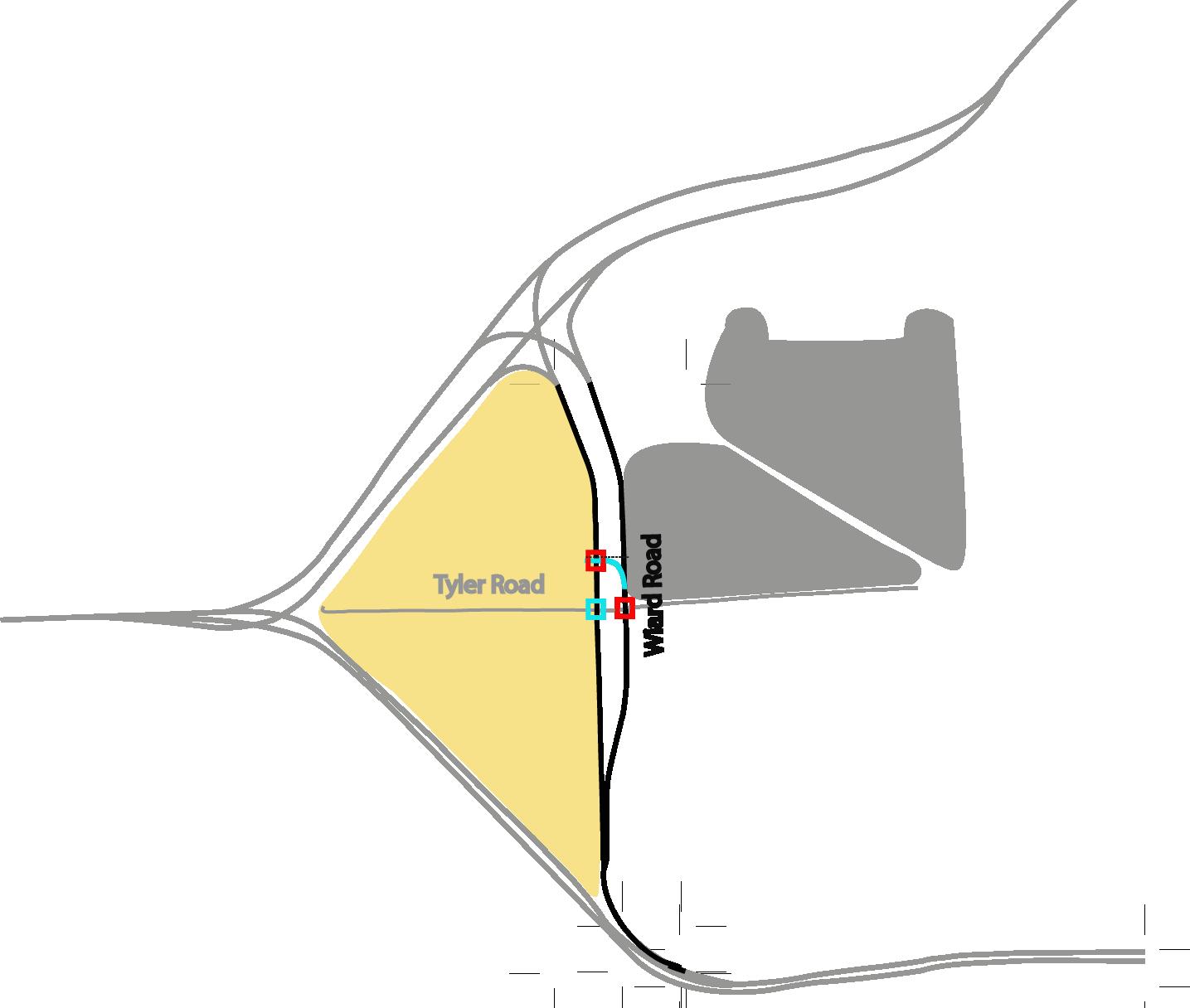
The WCRC has a budget of $1.5 million to remove and level the northbound Wiard Road bridge. It needs to spend the money before the end of FY 2017 to meet their budgetary calendar. We recommended that NWWNA follow up with the WCRC on the progress of this project.
Roy D. Townsend, P.E., Managing
Director/County
Highway Engineer Washtenaw County Road Commission
Phone: (734) 327-6662
Email: townsendr@wcroads. org
Wiard Road was originally constructed to meet the needs of the industrial area to its east, including the Willow Run plant and Willow Run Airport. Today, it is underused—only 2,000 to 3,000 cars use it daily.8 Combining the north- and southbound sections of Wiard Road into a single road and reducing the number of lanes would significantly reduce maintenance costs9, reduce travel speeds, and make pedestrian crossings easier (see Figure 6.5).
This cost is a rough estimate provided by the WCRC. According to Michigan Department of Transportation (MDOT), state freeways cost $1.1 million on average, while local freeways cost about $700,000. These costs may vary.
This strategy allows for either of the two possible pedestrian linkages between the neighborhood and the Willow Run plant site identified in Strategy 1. Pedestrian crossing in this strategy will be easier because there will be only one road to cross at one intersection, as well as fewer lanes. A narrower road may also slow down traffic to create a more welcoming environment for development along Wiard Road, while the narrowed road frees up space for future development.
The cost of construction is an important obstacle for pursuing this strategy. On average, building a road in Michigan costs $1 million per mile per lane.10 Based on this number, combining both sections of Wiard Road into one road would cost over$2 million in addition to the cost of the northbound Wiard bridge. However, the single intersection will reduce some of the infrastructure costs.
Combine north- and southbound Wiard Road and add a roundabout at Tyler Road.
As in Strategy 2, this we recommend combining north- and southbound Wiard Road into one road. For this strategy, though, we suggest a roundabout at the intersection of Wiard Road and Tyler Road, instead of a signaled intersection (see Figure 6.5). Roundabouts increase flexibility for both vehicular and pedestrian traffic. Cars do not need to stop as often, which saves energy and reduces emissions. Meanwhile, pedestrians can cross more easily because the roundabout slows down cars.
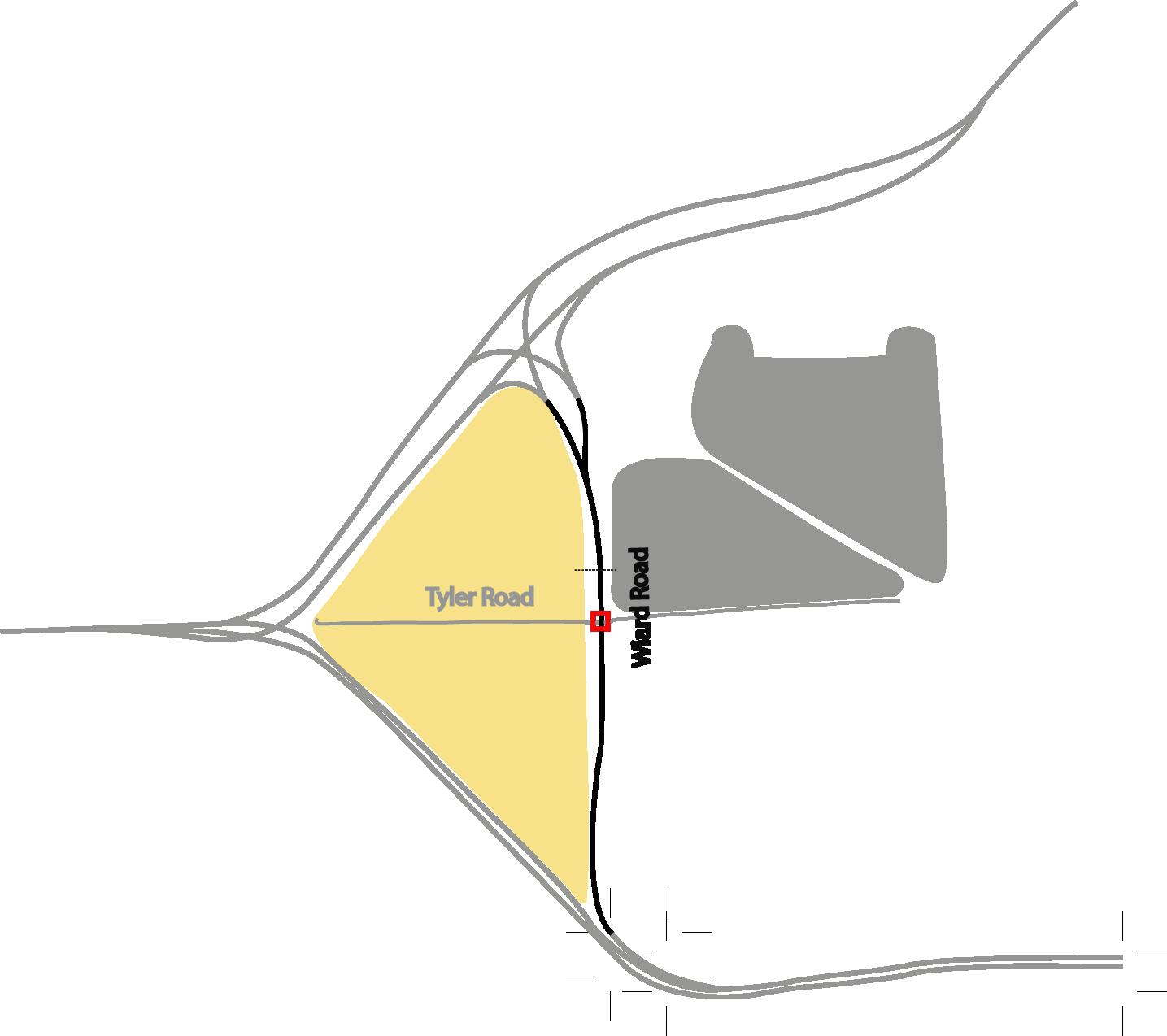
The cost of this strategy is higher than it would be for Strategy 2 because a roundabout is more expensive to build than a signaled intersection—about $1 million on top of the cost of reconstructing Wiard Road.11 If the resources to combine the two sections of Wiard Road become available, the NWWNA should consider the financial feasibility of Strategies 2 and 3, as well as the practicality of each, and should engage the WCRC in discussions about the options for redeveloping Wiard Road.
Developments along Ecorse Road, northwest of West Willow, provide grocery and retail options to residents. The neighborhood is connected to Ecorse Road via Dorset Avenue, which is lined with sidewalks. At the intersection of Dorset Avenue and US-12, one of the main entrance and exit points in the neighborhood, there is a signaled pedestrian crossing.
Despite these amenities, some residents explained that they do not feel safe crossing US-12 at this intersection.12 Cars do not pay attention to pedestrians at the intersection—in part because cars are traveling so fast entering this intersection that they often do not see pedestrians in time to stop. In addition, there is no street lighting at this intersection, so it is unsafe for pedestrians to travel this route at night.
Additional pedestrian-oriented signage and street lighting at the intersection would make it much safer for residents to travel to Ecorse Road on foot (see Figure 6.7). Pedestrian crossing signs would alert drivers to be aware of pedestrians and street lights would make pedestrians more visible. Street lights have the added benefit of discouraging crime. If the NWWNA chooses to pursue these types of improvements, it would need to work closely with WCRC to better understand the feasibility of the different options.
Street lights for pedestrian crossings on Dorset and US-12
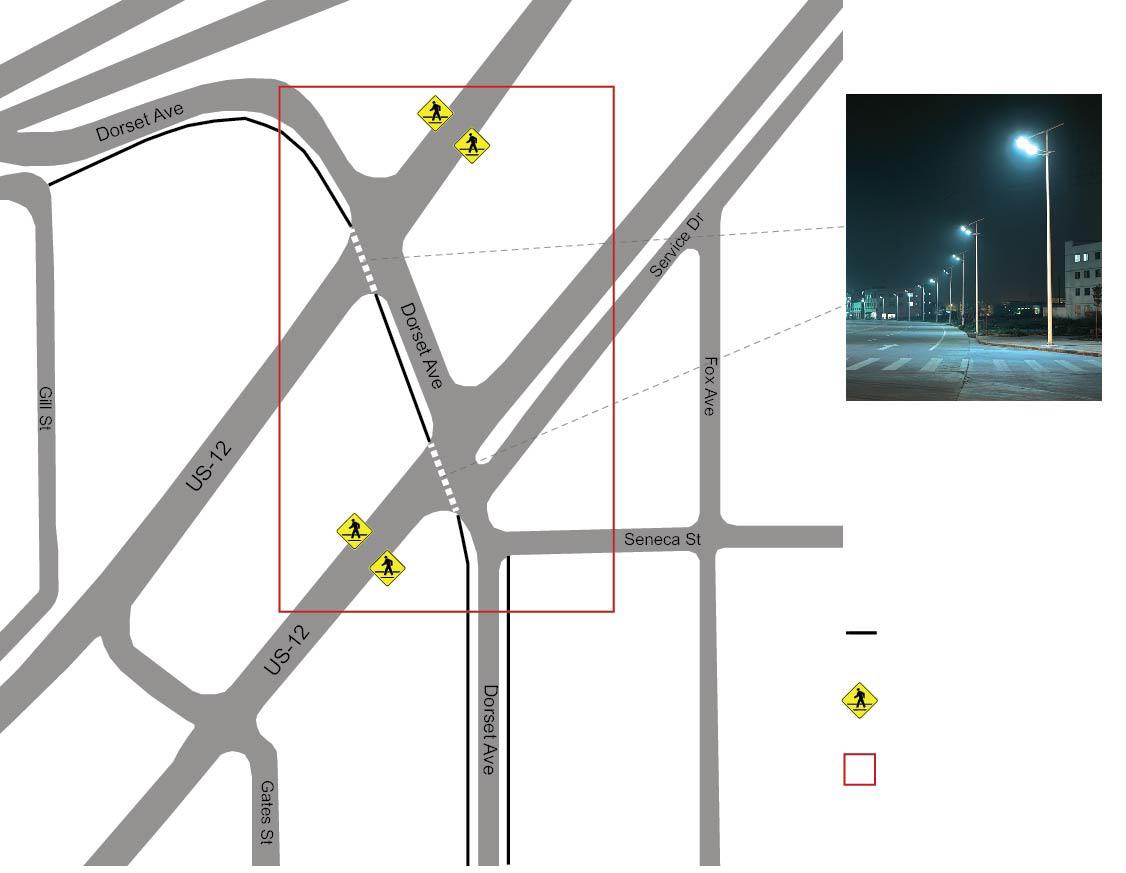
New pedestrian sign Area of focus
In general, West Willow lacks physical amenities, such as enhanced bus stops, benches, park equipment, traffic signs, and sufficient lighting. Physical improvements within the neighborhood may enhance the neighborhood’s image and social cohesion. Meanwhile, improved connections between West Willow and adjacent properties would improve pedestrian safety and access to nearby developments.
Many of the improvements that we have discussed in this chapter depend on financial support and initiative on the part of government agencies, such as the WCRC and MDOT. We have identified necessary government support where possible, as well as existing support for these recommendations:
• The West Willow Neighborhood Improvement Strategy calls for aesthetic improvements to Tyler Road
• WCRC has targeted Wiard Road for major construction due to the bridge condition
• The Ypsilanti Township Master Plan Update contains provisions to improve the Ecorse Road corridor
The NWWNA can use their knowledge of these plans to develop relationships with the appropriate governing bodies and advocate for positive change in West Willow. Such relationships, combined with a better understanding of its options, will be invaluable to the NWWNA if it is to successfully improve the aesthetics and pedestrian safety in the neighborhood.
Washtenaw County, New West Willow Neighborhood Association, & Ypsilanti Township. (2007). West Willow Neighborhood Improvement Strategy. Detroit, MI: Cprek, J., Davis, L., Gehler, C., Jin, C., Luongo, S., Ravindran, R., Shen, Q., Dewi, L., Tan, M., Van de Fliert, N., Wang, T., & Zhon, W. (2013). Envision Willow Run. Ann Arbor, MI: Urban and Regional Planning Program, University of Michigan. New West Willow Neighborhood Association. (2014, 29 March). [Meeting]. Charter Township of Ypsilanti. (2014).Ypsilanti Township Master Plan Update. New West Willow Neighborhood Association. (2014, 29 March). [Meeting].
Townsend, R. (2014, 2 April). Washtenaw County Road Commission. [Personal Interview].
Ibid.
Ibid.
Olson, R & Schmidt, R. (2011). Michigan’s Roads Crisis: What Will It Cost to Maintain Our Roads and Bridges? Lansing, MI: House of Representatives Transportation Committee.
Ibid.
Townsend, R. (2014, 2 April). Washtenaw County Road Commission. [Personal Interview].
New West Willow Neighborhood Association. (2014, 29 March). [Meeting].
Introduction
Case Studies
Strategies and Discussion
Items to Include in a CBA
West Willow sits adjacent to the Willow Run plant site; this proximity brings both challenges and opportunities. The plant has been inactive for over a decade and sits idly as a contaminated industrial site. It is currently owned by Revitalizing Auto Communities Environmental Response (RACER) Trust whose task is to mitigate hazards on previous automotive sites and prepare them to be sold for redevelopment. As West Willow is so close to the Willow Run plant site it is in a position to benefit from whatever development occurs there. The plant site will likely become a 21st Century Hub for automotive research and development, although, at the time of publishing, this has yet to be confirmed. Nonetheless, whatever development comes to the site has the potential to bring jobs—among other services and benefits—to an area that is currently lacking in economic opportunity.
A Community Benefit Agreement (CBA) or other development agreement between the developer and the New West Willow Neighborhood Association (and possibly Ypsilanti Township) can help make sure that the West Willow neighborhood receives some benefits of development, which can include local hiring preferences, streetscape and transit improvements, and retail investments. As discussed in previous chapters, there is a need and a want for services, resources, and physical design improvements in West Willow, as well as a need for more economic opportunities (see Chapters 3-6). A CBA or another type of development agreement is a means through which these needs and wants can be fulfilled—although it is important to note that an agreement is not a guarantee but rather a lever that the NWWNA leadership can utilize to advocate for improvements to their community. A strong neighborhood coalition, like the NWWNA, working in collaboration with other organizations to ensure that West Willow is not negatively affected by the new development and instead gains from it is key to the success of a CBA or other like agreement.
The purpose of any development agreement is to specify the standards and conditions that will govern development of the property.
Agreement Type
Public CBA
Initiator
Government entity in response to CBA campaign
Community
Private CBA
Development Agreement
Government entity
Involved Parties
Government Entity, Developer
Community groups, non- profits,
developers
Government Entity, Developer
Enforcement Power
Government entity in response to CBA campaign
Varies depending on coalitions. Legal capacity less restricted, but usually weaker agreement.
Strong, but very restricted by legal limitations on government
Based on residents’ interest in improving their neighborhood, we developed the following vision statement for the NWWNA should they pursue a CBA or like agreement:
“Vision: A CBA in West Willow will ensure the redevelopment of the Willow Run plant site involves inclusionary development that benefits the West Willow community through economic growth, employment opportunities, and community empowerment.”
The following three goals support this vision and guide future actions for the NWWNA:
• Empower the NWWNA to better position themselves in the changing economy
• Achieve mutually beneficial development at the Willow Run plant site
• Utilize the agreement to help fulfil the needs and wants of neighborhood residents
A CBA is a specific type of development agreement. It is a legal document between a private developer and a coalition of community groups and is a way for a community to specify what it desires from the developer/development and for the developers to build support and relationships with the community. The benefit of a CBA is that, if agreed upon by all parties, the community organizations and the local government will support the project. This helps the developer avoid problematic situations such as protests, litigation, or other potentially oppositional actions community members could take to stall or prevent the construction of a new development if they felt it was harming their community. When done well, CBAs allow for transparent negotiations and provide a legal mechanism for enforcing the terms outlined in the document.
Over the years, the concept of a CBA has evolved to have two specific purposes:
• to ensure that affected communities are connected to anticipated benefits of development, or
• to ensure that affected communities are compensated for the anticipated burden from a locally unwanted land use.1
CBAs are typically split into two different types: public and private (see Figure: 7.1). Private, community-initiated CBAs are enforceable agreements between developers and communitybased organizations. Public CBAs are enforceable agreements between governmental entities and developers and result from a CBA campaign.2
Multiple stakeholders are involved in the redevelopment of the Willow Run plant site, not limited to RACER Trust, the developer, local governments and the NWWNA. The type of agreement the NWWNA can work towards depends on which of these stakeholders are willing and able to enter into the agreement. Below we provide an overview of the three types of agreements, Public CBA, Private CBA, and development agreement, including the technical and enforcement differences between each.
Both a public CBA and a development agreement are negotiated between a municipal government and a property developer. A public CBA is different, however, because it results from community input.3 This input typically comes from neighborhood groups (like the NWWNA), individual property owners, surrounding neighborhood associations, and local non-profits. The items included in a public CBA may be written into a development agreement, permit or other document related to the development and thus public CBAs are not always considered to be a standalone document. Additionally, public CBAs can only include those things on which a public entity may legally take action. A government entity may not violate laws (its own or those of higher levels of government), land use policies, or development codes.
A public CBA may be difficult for Ypsilanti Township, because the Township does not typically enter into CBAs, let alone neighborhood specific CBAs. In fact, officials at the township were unsure if it was even legal for them to negotiate benefits particular to a segment of the Township, as opposed to the Township overall.4 In addition, existing legal limitations on content and direction of public CBAs may prevent West Willow-specific benefits; such benefits could be interpreted as exclusionary in that they do not include the rest of the population that the township has a responsibility to.
A private CBA is an agreement between a community and the developer; the local government is not invovled. These “community-initiated” CBAs are likely to need a strong collaboration for implementation. The neighborhood association must work alongside other local nonprofits and community organizations to build a coalition of stakeholders. This is critical to successful acquisition of a CBA because the community is responsible for enforcement of the commitments, as well as final approval of the CBA language. Since the local government is not one of the parties to the agreement, these types of development agreements are also “not subject to the wide range of legal strictures on governmental action”5 that are of concern with a public CBA.6, 7 For example, whereas a private CBA may include a provision that directs support to a specific church in the community, a public CBA would not be allowed to do that.
Although community-initiated CBAs do not involve the local government directly, the municipality will likely want to be involved in reviewing and evaluating the CBA for possible impacts and to
offer edits and suggestions. It is important that the NWWNA is aware of this and consults planners early in the process. Doing so will help avoid any conflicts during implementation. If the local officials determine that the CBA is not in the best interest of the community, they may make arrangements to oppose the agreement.8 For a small organization like the NWWNA, this opposition would be difficult to overcome. The opposite could also happen. The NWWNA could pursue a private, community-initiated CBA and it could feasibly become a public-CBA, with the support of the local government.
When considering developing a community-initiated CBA, it is important that the NWWNA understand that it is difficult to organize a campaign and to get the developer to review to the document; is it also difficult to actually enforce the document, even if approved. That is not to say that the NWWNA should not pursue a private CBA; rather the NWWNA should partner with other non-profits in the area as doing so will help ensure support for the CBA and assistance enforcing it if needed. Since this can be challenging, especially for a small organization like the NWWNA, it may be better to consider a modified CBA or to work collaboratively with the township to implement a more traditional development agreement.
Smaller organizations should team with other non-profits to ensure appropriate support and enforcement
A development agreement is a document that is routinely drawn up between a municipality and a property owner/developer in order for the developer to get approval for a development. Note that a development agreement does not result from community initiation, but that the community can be invovled in determining what should be in the development agreement.9
Ypsilanti Township regularly enters into development agreements and will do so with the purchasers of the Willow Run plant site.10 Because RACER Trust received funding from federal government agencies, including the Environmental Protection Agency and Department of Labor, it is obliged to work towards “increases in tax revenue, reduction of blight, and providing a sense of renewal.”11 RACER Trust is also required to take into consideration “the views of the local communities, the Tribe or the state.”12 This requirement means that RACER Trust will not sell a mitigated industrial site without 1) a development agreement in place between the municipal government and the purchaser and 2) site plan approval. The NWWNA should take advantage of this unique opportunity and lobby their local government for neighborhoodspecific benefits to be written into this development agreement.
It is important to consult township planners early in the CBA process to avoid any conflicts later in implementation
Previous Ypsilanti Township development agreements have lacked focus areas within the township. We acknowledge that an agreement specific to West Willow is not a guarantee, simply because this is not how development agreements typically function. However, low-income communities of color in other municipalities in southeastern Michigan and elsewhere have fought for equity alongside economic growth,13 so there is precedent for the benefits to specifically reach the West Willow neighborhood. Whatever ideas the community develops as part of the CBA process could inform or become part of the development agreement. Whether the end result is labeled a Community Benefits Agreement or a development agreement is less important as either has the potential to have a positive impact on the future of the West Willow neighborhood.
In June 2002, Cherokee Investment Partners announced a $1 billion plan to redevelop a Brownfield (i.e. contaminated) site with mixed office-retail-housing in Denver, Colorado, next to the Baker neighborhood. The 50-acre site previously belonged to the Gates Rubber Company, who, until 1992, used it as a factory for the automotive industry. The Denver Urban Renewal Authority (DURA) supported this plan and announced tax benefits for the development, which included the creation of a TIF district.
In response to this, the Front Range Economic Strategy Center, along with the Central Labor Council for the Denver metropolitan area, created a Campaign for Responsible Development (CRD) which stated that “any project receiving that magnitude of public support should meet principles of responsible development and provide community benefits.” They, along with other smaller organizations such as the Baker Neighborhood Association, pressed Cherokee with a series of commitments. These commitments ranged, but special interest was put into affordable housing and hiring preferences for local residents such that the new development benefited the nearby low-income Baker neighborhood.
The parties formed an initial agreement, but Cherokee failed to meet it when they became aware that they could get the tax benefits offered by DURA without following the CDR’s agreement. Because of this, no formal CBA was reached. However, further pressure from the CRD lead to some benefits, which could be similar to the ones the NWWNA could seek through a CBA:
• Housing: Commitment to a far-reaching inclusionary housing plan
• Job opportunities: Commitment to pay prevailing wages to workers hired for remediation and infrastructure; commitment to work with the city’s office of economic development on local hiring.
• Community engagement: Pledge to involve neighborhood residents closely in the campaign.
Other more costly measures, such as project labor agreements for vertical construction and agreements to require retail tenants to offer living wages and benefits, were not included. This case study is relevant to the West Willow neighborhood as it was developed in a similar context (automotive industry near an underserved neighborhood) and entails a similar scale of investment in development.
The principal take away from this case study is that CBAs are very difficult to negotiate. However it is possible to achieve a “middle ground” where some sort of agreement is made in the absence of an enforceable CBA. This occurs primarily through strong partnerships with other organizations that may have more economic, political and personal resources.
In 2004, Yale University announced a multimillion-dollar expansion of its Cancer Center. Community members were concerned that the proposed expansion would have an impact on “The Hill,” an adjacent low-income community. Specifically, they were concerned about the expansion’s impact on employment, the environment, gentrification, and traffic, i.e. that it would increase congestion. In response, community members formed the Community Organized for Responsible Development (CORD) to a campaign for a CBA. The Service Employees International Union (SEIU) of the hospital workers were invovled in this effort, as were smaller neighborhood associations with less capacity to act independently. These organizations collaborated to develop a framework for social and economic justice in the New Haven that they billed as a “new social contract.” The collation surveyed 800 households in the hospital area in a comprehensive door-to-door effort to identify the needs of neighborhood residents; the results were used to inform the social contract.
The University needed permits from the local and state governments for the expansion, and both entities agreed that the community’s needs had to be taken into account if approval was to be granted. As such, the University had to work with the community and the unions. In March 2006, after a long negotiation between the community representatives, the unions, New Haven and the University, a final agreement on the CBA was reached. The final CBA had seven major areas; some of them are very similar to the benefits West Willow can get from a similar process:
• Housing: Affordable housing with a $1.2 million investment by the developer
• Job opportunities: Job training and local hiring with 500 local jobs in a 5-year period.
• Youth: Contribution of $100,000 per year over a 5-year period to the city’s youth initiatives.
• Access to health care: Funding for two outreach positions for asthma and uninsured children in the local health department.
• Environmental issues and comprehensive planning: Registration for LEED (Leadership in Environmental and Energy Design) designation and pledge that future planning efforts will engage the community and involve them in decision-making efforts.
This case study is relevant as it is similar to West Willow in two major ways. First, the expansion impacted a low-income neighborhood with a demographic profile similar to West Willow and second, the institution involved in the development is an elite university with economic and social power and influence in the area.
There are few important takeaways from this case study. The first is that although the CBA process is challenging and difficult, it is possible to carry out a CBA in an area with high unemployment and poverty. The second is that the CBA was one piece of a larger strategy to develop a new social contract between institutions, employees and communities in New Haven. The NWWNA could consider how its effort might complement other efforts happening in the community. Finally, it is important to note that the presence of a very engaged and active community was crucial for pushing the agreement forward. In this case, the involvement of different unions had a clear effect on the community’s capacity to bring forward a large campaign to support the CBA.
In 2003, the City of Milwaukee demolished a downtown highway built in the 1950s. Many citizens saw this demolition as an opportunity to connect the neighborhoods the highway separated and to recover valuable land for new development. Initially, city officials and developers saw new development in the area as an opportunity to “bring young professionals, empty nesters and high-end service employers back into central Milwaukee after a long decline;” they did not take into account the low-income African American communities who lived near the highway who saw in the demolition the opportunity to reconnect the once-vibrant neighborhoods that were torn apart when the highway was built.
Their voices soon emerged and once they did, a coalition of groups started to form. The most important groups in the coalition were the Institute for Wisconsin’s Future, the Milwaukee County Central Labor Council and the Milwaukee Inner-City Congregations Allied for Hope. However, over 30 other groups, including religious congregations, neighborhood associations and labor organizations, were involved in the process.
In this case, relations between the City and County governments were tense. Nonetheless, with the support of the County Government, in December 2004, the Milwaukee County Board of Supervisors approved a CBA. Several public and private actors were put in charge of ensuring its implementation. The major benefits this CBA reached that could apply to West Willow are:
• Job opportunities: Local hiring to make sure that residents from adjacent communities benefited from the job creation that the development would bring.
• Sustainability: Preference in the land sale for green building proposals as a way to attract sustainable development.
• Affordable housing: Sponsorship by Milwaukee County of new affordable housing for at least 20% of the total units built in the area.
The CBA was unable to achieve everything it wanted as a result of the slowing of the economy in Milwaukee and the area’s small real estate market. The NWWNA should note that context will impact the parameters of a CBA. Also, this case study shows that working with different scales of government is helpful as it make the process easier, and that while having the support of just one governmental entity may be enough to get benefits, it can make the implementation process more difficult.
Many options are available to the West Willow neighborhood to make sure it is included in the redevelopment plans taking place at the Willow Run plant site. This section, however, focuses on the CBA. While a fully fleshed out CBA cannot be written until more is known about who will operate the West Run plant site, below we offer some suggestions that the NWWNA, Ypsilanti Township, Washtenaw County, and RACER Trust should keep in mind if the NWWNA chooses to write a CBA or if their ideas are incorporated into the development agreement. Each of the case studies previously mentioned are context specific; thus the bargaining situation in West Willow will also be unique to the specifics of the situation.
Negotiating a CBA will involve considering what all sides are looking to gain from the agreement.17 In order for West Willow to benefit from the process, the NWWNA should work with the township and county. Both entities are supportive of a redevelopment project that has the West Willow neighborhood in mind.18 Having local government officials on the side of the neighborhood is a good sign, as it suggests a willingness to advocate for West Willow. Ensuring community engagement and the remediation of potential social injustices are the goal of a CBA. As such, the end result matters more than who is at the bargaining table and signs the legal document.19 When working with the Township and the county, it is important that all parties involved have a mutual understanding of what specific issues and challenges exist in West Willow and how to go about solving these issues. Answers should come from conversations attended by all parties. The NWWNA needs to identify the specific improvements it desires, and communicate these wishes to everyone invovled in the CBA process. At the same time,
the NWWNA must also think through how these improvements would benefit the local governments and RACER Trust as well; improvements that are mutually beneficial are more likely to be looked favorably upon by Racer Trust and the city and the township and thus easier to enforce.
The NWWNA can also use the site plan approval process as a space to articulate what it wants to see from the development. RACER Trust contracted the Willow Run plant site’s development rights to Walbridge, a construction company headquartered in Detroit. The rights will be transferred once the environmental cleanup is complete. Before the sale becomes official however, the Township must approve the site development proposal put forth by Walbridge. Staying in contact with the township and communicating to them what issues and challenges exist in West Willow and the ways they can be addressed, is a way that the NWWNA can ensure that the site plan reflects the needs and wants of West Willow residents. Local government officials should also be aware that neighborhood members are concerned and engaging in this process. To make sure that the voice of the NWWNA is heard, NWWNA leadership should consider making official public statements to the media throughout the development agreement process.
5 things to keep in mind when considering a Community Benefit Agreement :
1. Stay in touch with the local government
2. Have a clear understanding of what the NWWNA wants to gain from a CBA
3. Propose benefits that will help the community, the township and RACER Trust; the more mutually beneficial the benefits, the better.
4. Get invovled in the site plan review process.
5. Be vocal and don’t be afraid to contact the local media with your story. l
The process of negotiating and then writing a CBA or being part of a development agreement can be a long one. To successfully do this, West Willow residents cannot simply provide their input; rather they must make themselves heard throughout the redevelopment process. While RACER Trust and Ypsilanti Township do have an interest in the success of the West Willow neighborhood, that interest
will never be as great as that of the residents who actually live there. The steps that follow are intended to provide a rough outline of the CBA and development agreement process.
Short-term actions refer to those action should be done immediately to ensure that the county and township are both on the same page with regards to the type of benefits West Willow would receive from a CBA or development agreement. Members of the NWWNA and the larger West Willow community must maintain consistent contact with those in the government who will be negotiating with Walbridge and RACER Trust. The NWWNA should utilize the results of the neighborhood survey (Chapter 3), the CBA item recommendations listed below, and other concerns and issues residents have expressed, to put together a list of the most important requests they would like to see come from the CBA or development agreement. Awareness by local government officials that neighborhood members are watching and engaging will be especially important during this stage. NWWNA should send members to any public meetings that involve design review or where the Planning Commission or City Council will be discussing the site’s redevelopment.
Medium-term actions are those actions the NWWNA could engage in between the end of June and October 2, 2014, the deadline Walbridge has with RACER Trust to formalize a development agreement with Ypsilanti Township. If Walbridge is to take ownership of the Willow Run site, their development site plan must also be approved by the Township prior to this data. Since the neighborhood will already have expressed what they want from the new development, during this stage the NWWNA should continue to put pressure on both sides to ensure that as many their requests as possible make it into the development agreement.
Once the development agreement between Ypsilanti Township and Walbridge has been signed, the neighborhood must work to ensure that the agreement is carried out. Key to doing this will be staying in contact with RACER Trust, Walbridge’s development managers, the Township Supervisor and Planner, and whomever Walbridge potentially sells the site to. The NWWNA should contact the township immediately if it notices that Walbridge is not following through with any element it agreed to in the development agreement; the township has the capacity to enforce the legal contract that both groups signed.
If the Willow Run plant site is not redeveloped, neither a CBA nor a development agreement will be necessary. That said, as the NWWNA will already have put a lot of effort into determining community improvements that could benefit West Willow, the NWWNA should stay in contact with county and township officials. This consistent contact will ensure that West Willow is on the mind of officials if and when future developments begin taking shape at the site, or when money becomes available for neighborhood improvements.
The draft CBA below takes into consideration the needs and desires of the West Willow community, which were gathered through the pre-assessment research (Chapter 2), neighborhood survey (Chapter 3), and conversations with key stakeholders (Chapter 3). This is a non-exhaustive list and the NWWNA is not obliged to include everything on this list in their CBA. Rather, the NWWNA should see this as list of items that could be included in a CBA, and should prioritize which items best meet their needs and revise the requests as needed.
The Urban Planning capstone group that worked with West Willow in 2013, as well as the 2007 Neighborhood Improvements Strategy Plan, both developed physical improvement recommendations for the West Willow neighborhood.20 These recommendations would improve both mobility within and the appearance of the West Willow neighborhood. Members of the NWWNA have expressed interest in seeing these physical elements carried through to completion. Funding and/or employee involvement as a corporate responsibility project for the RACER Trust site developer would be of great benefit to the community. Some of their proposed recommendations include: enhancing the attractiveness of neighborhood entrances, installing community gardens, improving the streetscape of US12 and Wiard Road, improving the landscape, and conducting a neighborhood cleanup events. The recommendations listed in the previous work, as well as any recommendations that come from community planning efforts, could be integrated into a CBA.
The Washtenaw County Habitat for Humanity chapter recently dedicated themselves to their first yearlong project in West Willow. Financial support for their work was provided by both the county and township. Both these entities have a great interest in Habitat’s success as they are concerned about dwindling homeownership rates in West Willow. Habitat’s homeownership program aim to slowly help reverse this trend. Financing to continue Habitat’s work in West Willow would be a great benefit to the neighborhood and could be provided by whoever purchases the Willow Run plant site.
Local hiring requirements entail requiring either a certain number or certain portion of new jobs created by a development be filled by area residents. Ypsilanti Township has experience with local hiring requirements. If the NWWNA were to include such a requirement in their CBA, they should specify in detail expectations for short-term/construction hiring as well as long-term hiring. Additionally, defining “local” will be key. Local hiring reporting and enforcement mechanisms, ideally at the developer’s cost, should also be included in the CBA.
There are a number of resources for job training services in Ypsilanti Township and Washtenaw County that would benefit the employer of the new development, as well as the potential employees (see Chapter 4 for a discussion on workforce development). Agreeing to an On The Job (OTJ) training program through MichiganWorks!, for example, will allow the site developer to gain a quality workforce that has the whatever expertise they may need. Working with MichiganWorks! to conduct interviews or for the developer to do so at the local MichiganWorks! office would be a means to help ensure that neighborhood residents are employed at the new development.
Non-automobile connection between West Willow and the surrounding area is poor. Reconfiguring Wiard Road so that it is pedestrian friendly and provides a connection to the new development would allow safer access for all modes in and out of the neighborhood.
If the new development includes shops or employment centers that West Willow residents would likely access frequently, it would be great if they were able to do so via multiple modes of transportation (e.g. walking, biking, transit, and car).
If the market analysis shows there is potential to support commercial operations within the neighborhood, request the site owner take on pre-development site costs. Doing so will make new retail development economically feasible.
Businesses are often required to do corporate responsibility projects. One such project could be for the new employer to help maintain and pay for the upkeep of the bus shelter on Tyler Road that the NWWNA currently maintains. The new employer could, in addition, pay for the installation of a second bus shelter.
Larsen, L. S. (2009). The pursuit of responsible development: Addressing anticipated benefits and unwanted burdens through Community Benefit Agreements. Working Papers Series No. 9. CLOSUP – Center for Local, State, and Urban Policy: The University of Michigan: Ann Arbor.
Gross, J. (2007). Community benefits agreements: Definitions, values, and legal enforceability. Journal of Affordable Housing and Community Development Law, 17(1-2), 45.
Gross, J. (2007). Community benefits agreements: Definitions, values, and legal enforceability. Journal of Affordable Housing and Community Development Law, 17(1-2), 47.
Lawson, J. & Stumbo, B., (2014, March 24). [Personal Interview].
Gross, 2007.
These restrictions include Takings Clause, Equal Protection Clause, Privileges and Immunities Clause, statutory preemption concerns, or state and local land use laws. Gross, 2007.
Wolf-Powers, L. (2010). Community benefits agreements and local government: A review of recent evidence. Journal of the American Planning Association, 76(2). Gross, 2007.
Lawson, J. & Stumbo, B., (2014, March 24). [Personal Interview].
RACER Trust Settlement Agreement. Albany, New York, October 2010. RACER Trust Settlement Agreement. Albany, New York, October 2010.
Parks, W. (2008). The politics of economic justice: Community benefits agreements as tactic and strategy of the New Accountable Development Movement. Havens Center for the Study of Social Justice.
Gates Rubber. (2003). Community Benefits Agreement. Denver, Colorado. Yale Cancer Center Community Benefits Agreement. New Haven, Connecticut, 2006. Wolf- Powers, 2009.
Lawson, J. & Stumbo, B., (2014, March 24). [Personal Interview].
Wade, Stephen, (14 March 2014 ). [Personal Interview].
Larsen, 2009.
Washtenaw County. West Willow: Neighborhood Improvement Strategy. Hamilton Anderson. 2007
The New West Willow Neighborhood Association is a motivated group of people who are passionate about their community. They have been working with local government agencies and local organizations to support and enhance their neighborhood. The NWWNA frequently coordinates youth programs and is working with Habitat for Humanity to improve neighborhood houses and promote home ownership. Members of the NWWNA aim to increase community outreach, understand the needs of West Willow residents, and enhance quality of life in their neighborhood. In response, the urban planning team developed a collaborative needs assessment (Chapters 1-3), which informed into four interrelated action plans (Chapters 4-7).
Chapter 1 provides an overview of the project, as well as basic information about West Willow and its history. Chapters 2 and 3 detail the pre-assessment and assessment research, presenting an overview of life in West Willow. The former provides current data on West Willow socio-demographic indicators from government sources, such as the United States Census. Chapter 3 describes the door-to-door survey and assesses neighborhood needs identified by residents. The information from Chapters 2 and 3 can be used to support grant applications and to encourage organizations and government agencies to work with the NWWNA.
Chapters 4 through 7 provide strategic action plans for the NWWNA to respond to residents’ needs. In crafting these action plans, which are complementary mini-manuals, the urban planning team considered potential new development at the Willow Run plant site adjacent to West Willow. Although the future of this site is currently uncertain, whatever new development comes has the potential to bring jobs and resources to the area. The NWWNA should be prepared to leverage this development to benefit neighborhood residents, while continuing to promote positive incremental change.
Vision: Chapter 4
These mini-manuals identify opportunities for neighborhood action independent of the development, as well as specific actions that the NWWNA can take in preparation for and in response to that development.
The Directories of Services and Funding Opportunities in Chapter 4 provide a wealth of information about available agencies, organizations, and resources. The chapter also provides strategies for leveraging these resources, as well as to strengthen the leadership of the NWWNA. The chapter includes relevant resources, strategies, and best practices.
Human services should be accessible to West Willow residents to improve quality of life and promote a safer and healthier neighborhood for all residents.
Chapter 5 discusses opportunities for the NWWNA to advocate for additional neighborhood-oriented retail and increased access to existing economic opportunities. From new amenities supported by development at the Willow Run plant site to enhancements to the existing retail along Ecorse Road, the NWWNA is poised to advocate for projects that will bring opportunities for residents.
Vision: Chapter 5
Vision: Chapter 6
West Willow residents should advocate for increased pedestrian access to existing retail and a greater variety of neighborhoodoriented retail options in order to improve the general quality of life for West Willow residents, while preserving the neighborhood’s residential character.
Chapter 6 presents recommendations for physical design improvements and how the NWWNA can go about bringing these changes to the area. These include internal neighborhood enhancements as well as concepts for major infrastructural changes to the major roads around West Willow. Streetscaping, signs, and road improvements in and around West Willow can enrich the overall experience of living in West Willow.
The physical conditions in West Willow should promote safety and access to services and retail to improve quality of life for neighborhood residents, while also creating an appealing aesthetic character.
Chapter 7 describes two tools—Development Agreements and Community Benefits Agreements—that the NWWNA may be able to leverage to advocate for specific improvements in and near their neighborhood, if new development occurs across the street.
Each of these different chapters takes a different approach to answering the question:
How can the NWWNA promote community building, development, and enhancement in West Willow in order to improve quality of life for neighborhood residents?
While each approach is slightly different and provides strategies that may be implemented individually, together they provide a comprehensive framework for West Willow to move in a positive direction, regardless of outside forces that may impact the neighborhood. With hard work, collaboration, and a strategic approach, the NWWNA is well situated to build on its existing efforts to enhance West Willow into the future.
The following pages provide an overview of actions the NWWNA can pursue, organized by short-, middle-, and long-term strategies. The tables show that there is a lot to be done now, and that opportunities for improvement will continue into the future. These strategies also highlight the importance of collaboration with local government and other non-profits, which will be critical to the success of West Willow. Future development at the Willow Run plant site is an important catalyst for change—there are many opportunities for the NWWNA to leverage its proximity to the site to benefit from the development. Strategies that are dependent on that development are in a separate table, but it is important to recognize that all of these strategies will impact one another, and should be approached from a holistic perspective, keeping in mind the overall well being of West Willow residents.
Identify key stakeholders and begin to build relationships with these entities
Work with Washtenaw County OCED to identify capacity building and leaderhip programs for NWWNA leaders
Expand neighborhood outreach efforts by standardizing newsletter and building social media presence
Support coordinated efforts for summer youth programming with neighborhood churches and nearby organizations
Train or hire a grant writer
Gather additional information about West Willow residents’ retail choices through public meetings, personal interviews, and surveys
Organize private meetings with representatives from existing and future businesses adjacent to the neighborhood. Encourage Gather resident input about travel behavior and existing pedestrian/bicycle connections to Ecorse Road
Create a new sign and improve landscaping at the Community Resource Center to draw more residents and create a landmark for the neighborhood
Develop a relationship with the Washtenaw County Road Commission to better understand options for street improvements in and around West Willow
Choose a neighborhood road (i.e. Tyler Road or Service Drive) to focus neigborhood cleanup efforts on.
A CBA is dependent on a developer and planned project at the Willow Run plant site. Until these decisions have been made, the NWWNA can meet with Ypsilanti Township to learn more about a
Continue to build these coalitions to ensure lasting programming and support in the neighborhood
Continue to identify and support new members and leadership. Regular opportunities for leadership workshops, community visioning exercises, and community outreach events will help ensure that leadership is dynamic and consistent into the future
Continue to build relationships with youth-oriented organizations and seek funding for programs that can continue into the long term
Apply for funding for programs/services
Identify additional types of commercial uses that West Willow residents would like to see along Ecorse Road
Promote the established vision to relevant policy makers representatives from these businesses to attend NWWNA meetings.
Establish a clear vision for new pedestrian/ bicycle connections and road network connections using public input
Promote attractive landscaping and amenities like benches, signage, etc throughout the neighborhood
Promote the established visions to relevant policy makers
Suggest placement of pedestrian crossing sign across Ecorse and US-12 to the County Road Commission
Maintain this relationship and include the WCRC in all efforts to improve roads and internal streets
Identify priority improvements to neighborhood roads and work with Ypsilanti Township and the Washtenaw County Road Commission to better understand feasible options and advocate for positive improvements
possible development agreement and/or develop a list of desired amenities to request from the developer
Short (in preparation for development)
Services
Collaborate with MichiganWorks! to identify ways to encourage potential developer to hire within community
Identify programs that a potential developer could be asked to support (i.e. youth programming, housing rehabilitation, and workforce development)
Economic Development
Physical Improvement Developement Agreement/ Community Benefits Agreement
Follow up with the County Road Commission with the status of improvements to Wiard Road
Maintain consistent contact with Ypsilanti Township as it negotiates with the Willow Run plant site developer and contribute to plans for the development agreement between the Township and developer
Send residents to public meetings and make public statements to learn about the development and advocate for West Willow
Middle (once developer has been determined) Long (ongoing work with the developer and government)
Help MichiganWorks! connect with developer and develop a program for local hiring and onthe-job training
Develop relationship with the developer and work with service providers to advocate for and encourage maximum support for these programs into the future
Maintain an ongoing analysis and understanding of the elements that may impact retail development in response to the development at the Willow Run plant site
Contract the services of a retail analyst or consultant to obtain a more detailed analysis of current and projected market conditions
Engage with developer and WCRC to advocate for improvements to Wiard Road that will provide maximum benefit to West Willow
Maintain this relationship with the Township to ensure that requests made in development agreement are carried out to the benefit of West Willow
Maintian contact with developer, Township Supervisor, Township Planner, and other elected officials. If the developer fails to follow through with any element of the agreement, the Township should be notified in order to enforce the contract
Stakeholder Analysis
Survey Questionaire
Survey Results
Responsible for finding new users for GM sites and cleaning up pollution
Potential Developer These are groups that can potentially offer job oppertunities
Interetsed in the GM Powertrain Plant; Walbridge wants businesses to come in without exessive opposition
in preserving part of the former bomber plant and making it a museum
Ann Arbor
Ann Arbor-Ypsilanti Chamber of Commerce
Ann Arbor SPARK can be a potential job trainer or a potential job seeker resource
Ann Arbor-Ypsilanti Chamber of Commerce is also a non-profit organization
ELG is a partnership between EMU and Washtenaw County for improving economic and quality of life
Habitat for Humanity HfH are working on housing improvements in West Willow
WACY has a database for NPOs for youth development. They applied a fund at the County with the Sheriff’s Office for youths
Government Agencies:
Local governments
Ypsilanti Township
Eastern Leaders Group
Environmental Protection Agency
Michigan Department of Environmental Quality
Michigan Department of Transportation
Academia:
Interest in the tax revenue the development brings and the investment to improve the surrounding neighborhood
to the Township
Ensure the development is meeting the federal environmental standards
Ensure the development is meeting the federal and state environmental standards
Ensure the transportation system in the area is in good health
Besides MECC, UM also has a non-profit management center; UM is interested in giving its students real life projects
EMU has a Institute for the Study of Children, Families, and Communities that may be useful
MSU Extension has offered some instructions for the neighborhood to improve landscapings at home
Intro from WW resident : Hi my name is ____________ and I live on ____________ Street. I am a part of the New West Willow Neighborhood Association, have you heard of the New West Willow Neighborhood Association? [pause for answer, circle one] YES NO
We have asked some students from UM to help us with a neighborhood survey to find out what residents need. We’d like to ask you a few questions that will take less than 10 minutes . I am going to leave you with ____ and I’ll be across the street with another student
Intro from Capstone Student: Hi, my name is _________ thank you for doing this. I am going to ask you a few questions about your neighborhood, which includes all of West Willow.
1. What are the top 2 or 3 things you enjoy about living in the neighborhood?
2. What are the top 2 or 3 things that concern you about the neighborhood?
3. Of the following, which type of program outside of school is most beneficial for the neighborhood youth? Please choose just one.
Õ substance abuse prevention
Õ sports
Õ arts & culture
Õ work & career development
Õ tutoring
5 I am going to read three statements about local stores. Please tell me if you agree or disagree
a) The stores near my neighborhood meet most of my shopping needs. AGREE DISAGREE
b) The stores near my neighborhood are easy to access AGREE DISAGREE
c) My neighborhood would benefit from additional stores located nearby.
AGREE DISAGREE
Which type of store would you most like to see nearby?
4. Where do you get most of your groceries ?
[Pause to give them an opportunity to name something specific and write it down, but if they are unsure, read them the list and have them choose]
[List: Kroger, Kmart, Meijer, gas station/convenience store, food bank, party store, other]
Where is it?
The next couple of questions are about nearby services.
6. Which of the following services are available nearby?
Õ early childhood (up to age 5)
Õ youth development (ages 6-18)
Õ recreation
Õ health/wellness
Õ financial education
Õ job training
Õ crime prevention
7. What types of services do you use the most?
Õ early childhood (up to age 5)
Õ youth development (ages 6 18)
Õ recreation
Õ health/wellness
Õ financial education
Õ job training
Õ crime prevention
9. How many times a week do you share a ride or carpool?
Õ 4 7 days/week
Õ 1 3 days/week
Õ 1 3 days/month
Õ less than once a month
Õ I never use share a ride or carpool
11. Of the following, what would make you take the bus more often? Please choose just one.
Õ lower price
Õ shorter travel times
Õ more frequent service
Õ access to more destinations
Õ shorter distance from home to the bus stop
Other
8. Which services does the neighborhood need the most access to?
Õ early childhood (up to age 5)
Õ youth development (ages 6 18)
Õ recreation
Õ health/wellness
Õ financial education
Õ job training
Õ crime prevention
10. How many times a week do you take the bus ?
Õ 4 7 days/week
Õ 1 3 days/week
Õ 1 3 days/month
Õ less than once a month
Õ I never take the bus
12. How many times a week do you bike or walk to reach a destination?
Õ 4 7 days/week
Õ 1 3 days/week
Õ 1 3 days/month
Õ less than once a month
Õ I never bike or walk
Based on the information we gather today, we may want to conduct focus groups on specific subjects ( such as transportation, youth services, etc .) to get more information. Would you be willing to participate in further research in the next month?
[If they say yes, do not mark on the survey sheet. Have them write their contact on a separate page, which will be provided].
1. What are the top 2 or 3 things you enjoy about living in the neighborhood?
Lived here for a long time
Other
Convenient location
Neighborhood
Neighborhood
Neighborhood is well-maintained EVERYTHING
Don’t know
2. What are the top 2 or 3 things that concern you about the neighborhood?
3. Of the following, which type of program outside of school is most beneficial for the neighborhood youth? Please choose just one. Quiet Nice neighbors
4. Where do you get most of your groceries
5a. The stores near my house meet most of my shoping needs
5b. The stores near my house are easy to access
5c. My neighborhood would benefit from additional stores located nearby
5d. Which type of store would you most like to see nearby?
6. Which of the following services are available nearby?
7. Which type of services do you use the most?
8. Which services does the neighborhood need most access to?
9. How many times a week do you share a ride or carpool?
10. How many times a week do you take the bus?
11. Of the following, what would make you take the bus more often? Please chose just one
12. How many times a week do you walk or bike to reach a destination?