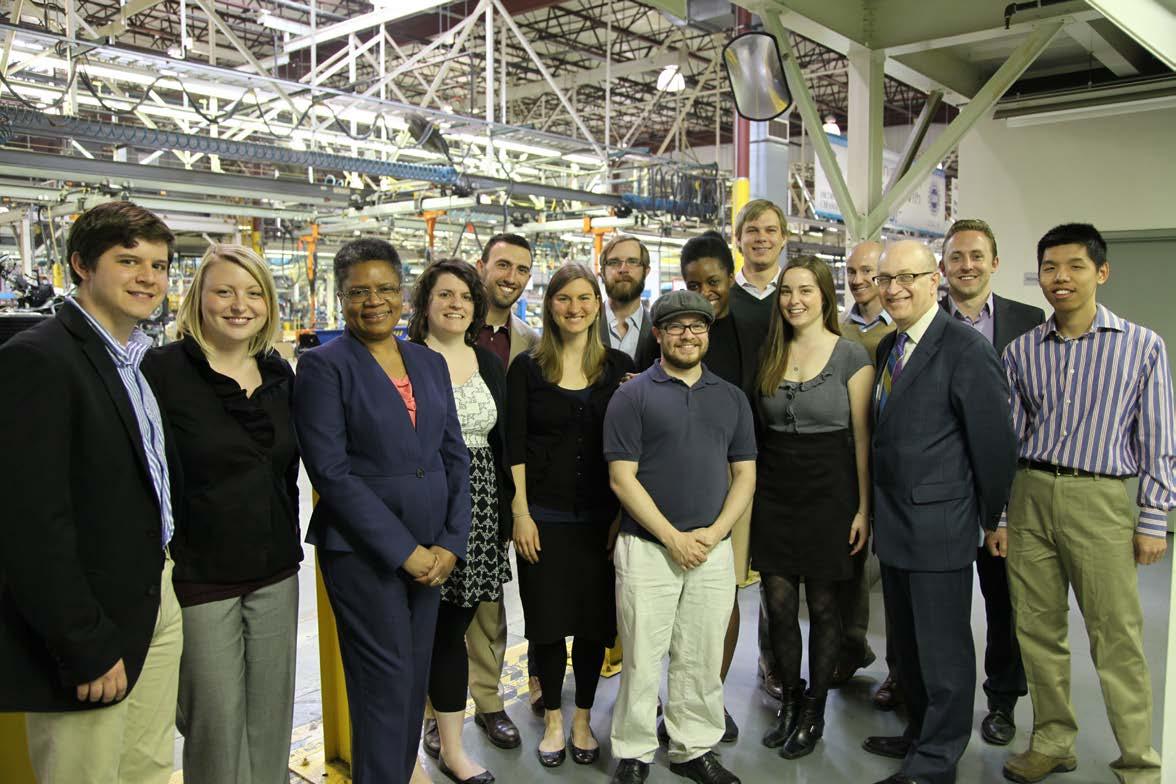
Photo credit: Bryan Ranallo 2014
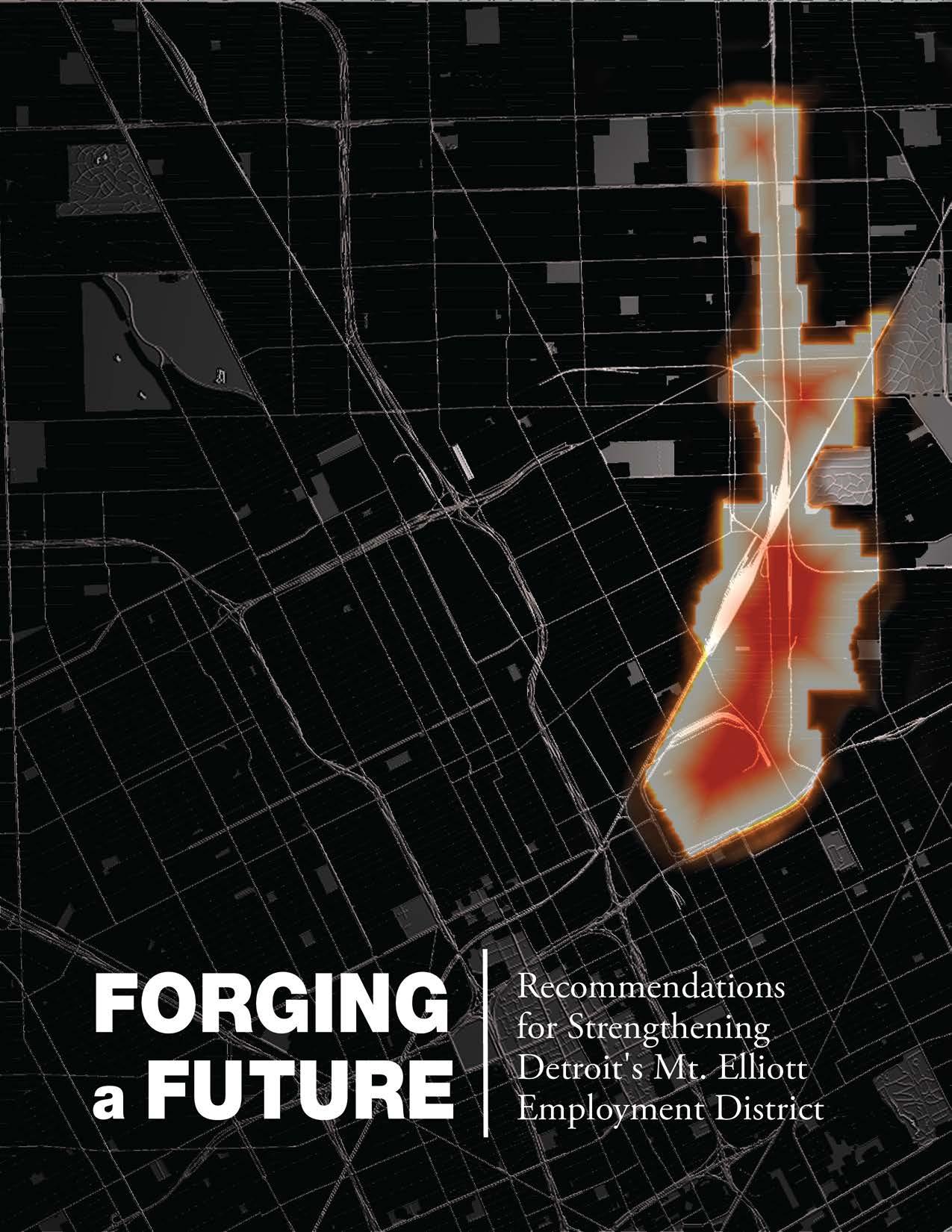
Recommendations for Strengthening Detroit’s Mt. Elliott Employment District
May 2014
Authors
Aly Andrews • Aja Bonner • James Carpenter • Cassie DeWitt
Colin Dillon • Myles Hamby • Dustin Hodge • Evan Johnson • Kevin Shelton
Brian Smyser • Allison Sponseller • Liz Treutel • Cheng Wang
Advisors
Dr. June Manning Thomas • Eric Dueweke

The students and faculty of the Taubman College of Architecture and Urban Planning who were involved in this project extend our gratitude to our sponsor and client as well as the businesses, community leaders, real estate experts, and workforce development specialists that helped us along the way. This learning experience would not have been possible without their support and participation.
Michigan State University, EDA University Center for Regional Economic Innovation (Center for Community and Economic Development)
Detroit Economic Growth Corporation
• Kenyetta Bridges
• Bill Dillon
• Catherine Frazier
• Olga Savic-Stella
• Tracie Tillinger
• Detroit Chassis
• Fairmont Sign Company
• Federal Pipe and Supply
• Global Titanium
• Hantz Group
• Milton Manufacturing
• Park Metal
• PTI Quality Containment Solutions
• Ross Structural Steel
• Tranor Industries
• East Outer Drive Block Club
• Georgia Street Block Club
• HELCO Block Club
• Mt. Olivet Neighborhood Watch
• Nortown Community Development Corporation
• Restore Northeast Detroit
• St. John Neighborhood Health Association
• We Care About Van Dyke Seven Mile Inc.
• Detroit Employment Solutions Corporation
• Detroit Jobs Alliance
• Focus: HOPE
• Workforce Intelligence Network
• Center for Community Progress
• Detroit Economic Growth Corporation
• Detroit Land Bank Authority
• Ford Land
• Michigan Community Resources
• Michigan Economic Development Corporation
• Warren/Conner Development Coalition
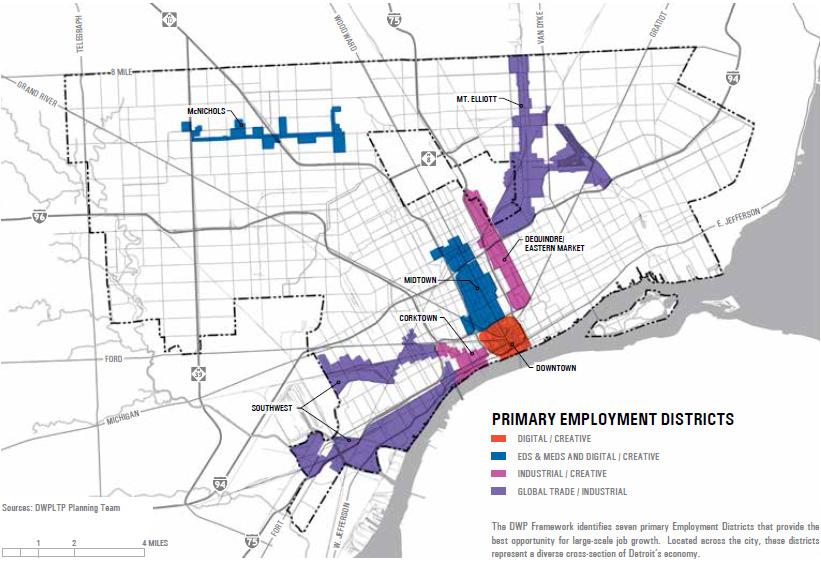
The Detroit Future City Strategic Framework Plan (DFC), published in 2012, articulates a long-range vision for the City of Detroit and addresses six key planning elements: economic growth, land use, City services, neighborhoods, land and building assets, and civic capacity.1 One of DFC’s foundational recommendations for growing the city’s economy is to create seven primary and six secondary “core investment and employment corridors” in geographically defined areas of the city.2 DFC selected these employment districts in areas that already possess a foundation for economic development.3 The rationale for guiding public, private, and philanthropic investment into employment districts is to increase economic assets and create greater employment density throughout the city.4 Chief among the objectives of the employment districts is to create jobs that provide a living wage for Detroit residents.
The Mt. Elliott employment district, illustrated in Figure es-1, is defined by DFC as an area for global trade and industrial growth. Of Detroit’s seven primary employment districts, Mt. Elliott currently has the highest number of jobs outside of Downtown and Midtown. However, unlike the Southwest, Midtown, Downtown, and Dequindre/ Eastern Market employment districts, it lacks a supporting organization charged with marketing its identity and leveraging its assets in order to attract investment and employers.
Forging a Future: Recommendations for Strengthening Detroit’s Mt. Elliott Employment District presents an economic development plan for the Mt. Elliott
employment district. The Detroit Economic Growth Corporation asked our team -- 13 urban planning graduate students from the University of Michigan -- to develop recommendations for improving the economy and increasing jobs within this specific geographical area. Our goal is to support DFC’s vision to develop the Mt. Elliott employment district into “an intense and attractive industrial area designed to accommodate modern, large-format industrial development; provide ample employment opportunities for Detroiters; and reinforce the region’s role as a global hub for manufacturing.”5 Given the large size of DFC’s Mt. Elliott district and the complexities surrounding Detroit City Airport, the project team chose to focus on the western portion of the DFC district as illustrated in Figure es-2. In this report, we refer to this area as the “Mt. Elliott employment district” or “the district.” When we refer to the complete, DFC-defined employment district, we call it the “DFC employment district” or “DFC district.” Our findings and recommendations are based on the geographical area we studied, but we believe they remain valid for much of the DFC-defined district as well.
Forging a Future addresses the cross-section of DFC’s six key planning elements in the context of the Mt. Elliott employment district. We recognize that
es-2: Our definition of Mt. Elliott (note: does not include City Airport)B
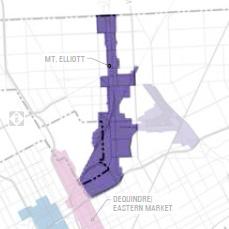
Our goal is to support DFC’s vision to develop the Mt. Elliott employment district.
an action plan for economic development should detail how to leverage real estate assets, improve the business environment, develop workforce talent, and collaborate with the community. Therefore, this project focuses on:
• Real estate development, which includes understanding industrial real estate development practices and the district’s property conditions, land use patterns, and industrial land availability
• Business analysis, which involves both the district’s business environment and the region’s economic conditions
• Workforce development and community engagement, which encompass interactions with workforce talent and workforce development organizations in the overlapping residential community and Detroit at-large
The following sections introduce visions for these three overarching topics and briefly highlight some of our findings. See the “Findings” chapter for a full description of these and additional points.
To better understand land use patterns, property conditions, and transportation accessibility in the district, we gathered parcel-level data from the City
of Detroit assessor database and CoStar, conducted a real estate site survey, and analyzed road and rail infrastructure maps. We supplemented this research with academic literature and reports related to industrial real estate development in other cities. This information provided a useful foundation for engaging professionals working on various real estate and industrial development issues in metropolitan Detroit.
• The district boasts an excellent regional location, expansive transportation infrastructure, and good access to means of ingress and egress, but has poor road conditions.
• The presence of strong anchor businesses, vacant land, vacant buildings, and underutilized properties within three key areas in the district provides opportunities to channel investment and target property redevelopment.
Real estate improvements in the Mt. Elliott employment district will help prime business growth and job creation that, in turn, could help fuel a revitalization of industrial-based business in Detroit. Real estate is the medium through which economic development is physically realized and can serve as a catalyst to business success when businesses are matched with development sites that can maximize a property’s employment density.
A significant portion of our business analysis took place through interviews with a sample of business owners in the district. Our team asked respondents about industry supply chains, workforce demands, the city and state regulatory environment, supporting infrastructure, and their characterization of outside perception of the district. We also conducted a literature review on business clusters, supply chain management, and ways to improve economic conditions in industrial districts and we gathered regional and district-level cluster data from the Initiative for a Competitive Inner City.
• The district is home to a diverse set of businesses that are stable and, in many cases, optimistic about future business growth prospects.
• An improved relationship between Mt. Elliott businesses and the City of Detroit could help foster a healthier business environment.
People rely on business to earn a living and, in a similar fashion, businesses rely on people to achieve a profit; therefore, developing a skilled workforce and improving the business climate must go handin-hand. The relationship between business and real estate is also important because properly pairing businesses with suitable properties helps maximize business productivity and space utilization.
As a first step in learning more about the community and workforce conditions, our team gathered data from the U.S. Census and Bureau of Labor Statistics, workforce development institutions, community-based organizations, and residents. In the “Current Conditions” chapter we provide a statistical summary of demographic data to give a snapshot of some of the realities related to workforce development in residential areas overlapping the district. To present a more complete narrative, we supplemented these data with qualitative information garnered from interviews, a focus group, and literature on workforce development.
• With increased coordination between workforce institutions and businesses, the district could provide jobs for a significant number of jobseekers residing in and around the district.
• Community residents and business leaders bring strong local knowledge to address safety, perception, and quality of life challenges.
A well-prepared local workforce is vital to increasing the number of Detroit residents employed by businesses in the Mt. Elliott employment district and to increasing businesses’ growth and productivity. In addition, as a strategy to increase local hiring, those working to attract businesses to the district should find companies whose employment needs match the skill set of the local population.
Overall, we found that the intricate connections among real estate, workforce, and business issues necessitate a comprehensive approach.
Overall, we found that the intricate connections among real estate, business, and workforce issues necessitate a comprehensive approach that weighs each of these three elements when implementing solutions. Our recommendations provide a strategy for enabling that comprehensive approach.
The culmination of our research, analysis and subsequent recommendations for each of these components of economic development leads to an important question: who has the capacity to implement these recommendations effectively, comprehensively, and quickly? Though many organizations are involved in improving this industrial corridor, their scope of work extends beyond the district’s boundaries and they may be unable to give the district the attention it needs. The Mt. Elliott employment district lacks a supporting organization tasked with marketing its identity and developing its economy.
We believe establishing a district team with a focus on real estate, business, workforce, and community engagement would best support the district to become a stable, job-producing industrial corridor. In the “Recommendations” chapter, we provide justifications for establishing this team and detail strategies for implementing our recommendations, divided into three main roles:
1. Real Estate Facilitator
Help businesses to acquire a suitable property, assist with appraisal process, manage environmental remediation projects, find relevant tax incentives, and work with the Detroit Land Bank Authority.
2. Business Collaboration Coordinator
Advocate on behalf of businesses, assist with resource sharing and coordination, identify opportunities for new inter-business relationships, foster a shared district identity, and eventually transform the district team into a self-sustaining business association.
3. Workforce Liaison
Connect district businesses to existing workforce development services, facilitate an external evaluation of workforce-business partnerships, and launch a marketing campaign to connect Detroit residents to district jobs.
We believe these three roles would be best performed by a unified team that is eventually established as a staffed, nonprofit business association.
1. Detroit Future City, Detroit Future City: 2012 Detroit Strategic Framework Plan (Detroit: Inland Press, 2012), 18.
2. Ibid., 49.
3. Ibid., 49.
4. Lynch, Teresa M., Scott Page, Kyle P. Polk, Bryan Lobel, Thomas Goff, Rachel Rochat, Timothy J. Sturgeon, Ezequiel Zylberberg, “An Industrial Strategy for the City of Detroit” (working paper, Initiative for a Competitive Inner City, 2014), 23.
5. Detroit Future City, Detroit Future City, 63.
A. Detroit Future City, Detroit Future City: 2012 Detroit Strategic Framework Plan (Detroit: Inland Press, 2012), 20.
B. Ibid.
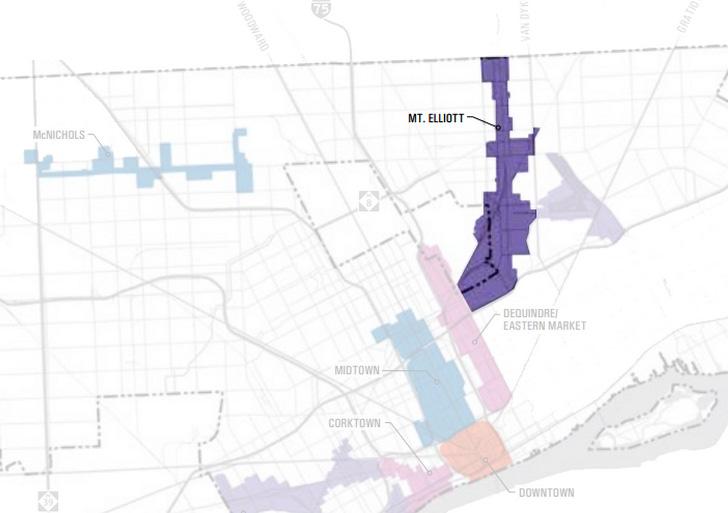
Forging a Future oFFers suggestions to increase the number and the quality of opportunities for Detroiters to make a living in the Mt. Elliott employment district. This district is one of seven primary employment districts outlined in the Detroit Future City Strategic Framework Plan (DFC). 1 The Mt. Elliott employment district currently has the third highest number of jobs of DFC’s employment districts, trailing only Downtown and Midtown, and the most jobs of any industrial corridor in the City of Detroit. Unfortunately, decades of disinvestment have led to severe maintenance and reinvestment challenges for today. Inadequate City services, dilapidated structures, crime, and lack of workforce preparedness are just some of the issues afflicting this area.
Despite its challenges, the Mt. Elliott employment district has a strong foundation that provides a compelling case for substantially investing in its economic growth. The district boasts many anchor businesses, excellent access to transportation infrastructure, a strategic regional location, and a wealth of underutilized industrial land. Moreover, many industrial jobs offer sustainable, well-paying employment opportunities that are accessible without requiring a four-year college degree. Industrial occupations often offer opportunities for on-the-job training or apprenticeship programs that are especially important in Detroit, where just 12.3 percent of the population has attained a level of education beyond an associate’s degree.2 Thus, the success of this industrial corridor is a key component of any effort to increase the employment rate within Detroit’s city limits, which is DFC’s primary objective.
In recognition of the importance of this district, Detroit Economic Growth Corporation (DEGC) asked our team of advanced master’s students in urban planning to develop an economic development plan for the Mt. Elliott employment district. We recognized that a fully realized action plan for economic development should detail how to leverage real estate assets, improve the business environment, develop workforce talent, and collaborate with the community. As a foundation for engaging stakeholders in each of these topics, we reviewed relevant literature, researched current practices for industrial development in other cities, and analyzed parcel, Census, and business sector data. We conducted structured interviews with business owners, convened a focus group of local residents, interviewed representatives from relevant economic and community development organizations, and conducted a property survey.
From our research, we gathered several key findings pertaining to real estate, business, and workforce conditions. Assessment of the property conditions revealed that the district’s northern portion contains a greater density of active businesses and less blight than in the south, while the southern portion is home to major employers but has less business density, more vacant land, and more dangerous buildings. The parcel survey, property information databases, and literature review informed our decision to identify three areas to focus development within the district. Focusing investment can help stabilize areas already exhibiting strength and establish a foundation for positive spillover effects. Interviews with business leaders and residents revealed commitment to the district and strong local knowledge of safety, perception, and quality of life challenges. Business interviews further indicated that opportunities exist to improve business-City relationships and strengthen business connections across industries. These businesses, primarily in manufacturing, logistics, assembly, and retail sectors, also reported stability and optimism about future growth prospects. Training for new workers could be provided by a network of workforce institutions that offer services in and near the district. Workforce agencies can streamline and scale-up their services by forging stronger bonds with businesses, with a special focus on serving jobseekers from the neighborhoods surrounding the district.
We learned that many businesses and organizations invested in revitalizing this industrial corridor in the last several years, yet the district lacks a localized, development-focused organization. Several business owners spend their own dollars to improve infrastructure and safety; DEGC has assembled over 1,400 parcels totaling 189 acres to form the
I-94 Industrial Park; and organizations such as Focus: HOPE and Detroit Employment Solutions Corporation (DESC) have invested in improving workforce preparedness.3 Though the work of these organizations and others continues today, district supporters lack the capacity to leverage its assets and overcome its challenges effectively, comprehensively, and quickly. Unlike Detroit’s Southwest, Midtown, Downtown, and Dequindre/ Eastern Market employment districts, the Mt. Elliott employment district does not have a team of people or an organization solely dedicated to marketing the area and enhancing its assets in order to attract investment and employers.
Establishing a location-specific team that is familiar with the assets and limitations of the Mt. Elliott employment district could help it become a stable, productive industrial center that provides jobs for Detroit residents. We focus on three core components for this district team to address: real estate development, business support, workforce development, and and community engagement.
Recognizing that it may take time to garner resources to form an official organization for the district, we recommend that Detroit Economic Growth Corporation, Detroit Employment Solutions Corporation, Detroit Future City, Detroit Regional Chamber of Commerce, and other relevant organizations channel resources and personnel to form a district team dedicated to the Mt. Elliott district. The district team would consist of three roles: a real estate facilitator; a business collaboration coordinator; and a workforce liaison. This report presents detailed action steps for each of these roles in the “Recommendations” chapter.
Initially, the contributing organizations may need to
fill these roles and facilitate interactions among them. We recommend the eventual creation of a formal business association that performs all three roles. With buy-in from existing businesses, a business association is the natural next step in the district’s evolution into a thriving employment district. A staffed, nonprofit business association could absorb the three roles of the district team, as well as market the Mt. Elliott district to external audiences.
Forging a Future provides an in-depth examination of the current conditions of the employment district, presents our research process and findings, and offers a set of recommendations that we believe will address the challenges of the employment district and leverage its assets. The future we see for the Mt. Elliott employment district is a bright one but will require diligent efforts from a dedicated team of businesses, residents, and institutions.
An overview of real estate assets and liabilities in the district, demographic information related to workforce preparedness, and industrial clusters.
Process and Methods
The project team’s research processes, methods, and resources.
Six key findings that serve as the foundation for our recommendations.
Recommendations
A proposal for a district team, suggestions of duties for the three roles, and vision for a future Mt. Elliott Business Association.
Implementation
Proposed timeline to implement recommendations in the short, medium, and long term.
Interview questions from structured business interviews and informational interviews, property profiles for potential redevelopment sites in the district, memo to DEGC.
The report also contains the following features interspersed throughout each chapter:
Spotlights feature examples of innovative projects, policies, or data.
Call Outs highlight key ideas or statements.
We assigned to each topic -– real estate development, business analysis, and workforce development and community engagement –- an icon in order to draw connections and facilitate understanding among various sections and chapters throughout the document.



1. Detroit Future City, Detroit Future City: 2012 Detroit Strategic Framework Plan (Detroit: Inland Press, 2012), 20.
2. U.S. Census Bureau, ACS 2008 - 2012 (5-Year Estimate), C24050, generated by Aja Bonner, using Social Explorer, <http://www.socialexplorer.com>, (28 April 2014).
3. Tracie Tillinger, phone interview by Myles Hamby, 28 March 2014.
increasing emPloyment and business activity in Detroit are critical to the city’s future and form the basis for recommendations in the Detroit Future City Strategic Framework Plan (DFC). One of the most important recommendations of DFC is the formation of distinct employment districts in areas throughout the city where assets and targeted investment could spur economic revitalization.1 One of these areas is DFC’s Mt. Elliott employment district. Despite Detroit’s economic struggles and population loss over the past several decades, the city still possesses many of the components crucial for a healthy urban economy, including developable land, strong businesses, and a viable workforce. Understanding how these assets can be strengthened to increase employment in Detroit is essential to actualizing the DFC’s employment district concept and achieving economic stability for the city’s future.
This chapter provides a summary of current conditions within the focus area of this report, which is represented in Figure cc-1, identified as “Mt. Elliott employment district” and abbreviated as “employment district,” and “district.” This chapter also summarizes current conditions within DFC’s Mt. Elliott employment district, the 15 census tracts surrounding the district (aPPendix cc-1), which we will refer to as the “Mt. Elliott surrounding area,” and the City of Detroit. We used multiple geographies in our research to be able to collect various data. For example, we used the census tracts to collect demographic data on the residents in and around the district.
This chapter identifies current conditions in the district and will describe:
• Land use, physical environment, and infrastructure
• Industrial activity
• Employment opportunities and demographics
• Transportation and commuting patterns
In general, the conditions in the employment district reflect many of the issues impacting Detroit at large, such as deteriorating buildings and gaps in workforce readiness. The employment district also contains many positive features such as an abundance of vacant industrial land – an asset no longer present in many cities – and a strong base of stable industrial businesses that supply a diverse set of buyers.
While DFC’s Mt. Elliott employment district is made up of primarily industrial uses, it also includes residential, retail, and special uses. With over 15,000 residential units within Mt. Elliott surrounding area, remnants of Detroit’s development history -- single-family homes built in close proximity to manufacturing plants to accommodate the workforce -- are still visible. Today, however, these residential areas experience high levels of vacancy.2
Retail shops and restaurants are sparse throughout the district, with the highest concentrations on major arterial roads such as Van Dyke Avenue, 7 Mile Road, and 8 Mile Road. Additionally, the DFC’s Mt. Elliott employment district also contains two cemeteries, as well as a system of transportation infrastructure – including roads, freeways, rail, and an airport – which support industrial activity in the area and connect the district to cities throughout the Midwest.

Like many other parts of Detroit, areas throughout the employment district exhibit noticeable vacancy and blight. In 2014, the Initiative for a Competitive Inner City published a report called “An Industrial Strategy for the City of Detroit,” which contains industrial vacancy and site utilization data. According to this report, over 2,800 acres of land throughout the city are deemed abandoned, empty, or partially vacant.3 The number of active but underutilized buildings adds to the perception of abandonment. Following declines in production, firms often scale back their workforce and therefore need less space.
While not a primary focus of Forging a Future, residential vacancy is also apparent in and around the Mt. Elliott employment district and is important
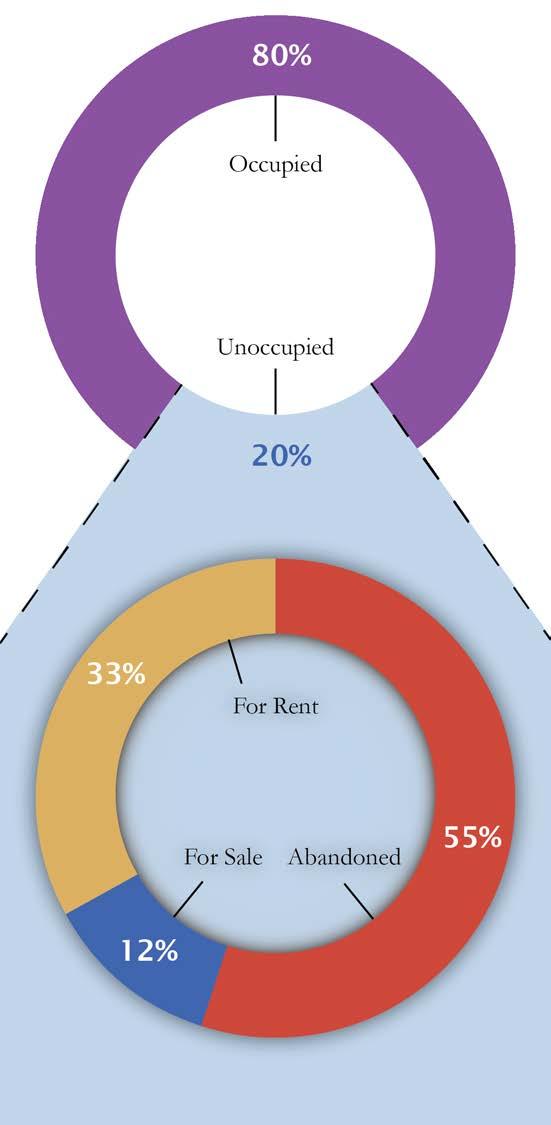
to consider. As shown in Figure cc-2, an estimate from the 2008-2012 American Community Survey identified that, of the 15,320 residential units present in the Mt. Elliott surrounding area, 80 percent were occupied and 20 percent were vacant.4
Of those vacant units, 33 percent are for rent, 12 percent are for sale, and 55 percent are vacant and not on the market.5 The public ownership of many of the vacant residential lots and dilapidated houses provides an opportunity for future expansion of industrial businesses or space for natural buffering between industrial and populated residential uses.6 The repurposing of select areas could increase quality of life and commerce for current and future residents and businesses.
High vacancy rates and infrastructure deterioration contribute to a generally negative popular perception of Detroit. While vacant land and buildings are often associated with crime, danger, and disinvestment, the abundance of vacant industrial land and buildings in the district also represents an opportunity. Available land, when utilized in combination with efforts to strengthen Detroit’s foundation of industrial businesses and workforce, represents great potential for the future of the district.
The employment district contains properties that vary widely in condition, use, and size. The quality of structures ranges from occupied and well maintained to heavily dilapidated and structurally defunct. Parcels and structures range in size from small, residential-sized lots to large parcels spanning entire city blocks with active businesses. Additionally, as seen in Figure cc-3, local residential neighborhoods generally fall outside of the Mt. Elliott
employment district, with the exception of a few homes scattered within the district.
A brief windshield survey -- an observational tour we conducted while driving through the employment district -- revealed some notable trends. In the northern area of the employment district, we saw many well-maintained industrial and commercial properties. The central area of the district, the region between East Nevada Street and East McNichols Road, is also home to several active businesses but encompasses comparatively higher levels of vacant and under-maintained properties. The southern area of the district, between Lynch Road and Interstate-94 (I-94), contains fewer active businesses than the region to the north and primarily consists of a few active businesses that occupy large parcels. Another key aspect of this southern portion is the residential neighborhood situated directly east of the railroad tracks and directly west of the I-94 Industrial Park. Many of these homes are dilapidated, abandoned, and likely in need of deconstruction.
Detroit is geographically well situated within an industrial region in the Midwest. Many of the nearby cities, such as Warren to the north, Windsor to the east, and Toledo to the south, are deeply connected to the supply chains of business in the employment district. Their proximity and location are depicted in Figure cc-4. Moreover, two major regional and interstate highways, I-94 and Interstate-75 (I-75), connect the district to major cities around the country. I-94 connects Detroit to western Michigan; Chicago, IL; Milwaukee, WI; and Minneapolis, MN. I-75 runs from Michigan’s Upper Peninsula through Detroit and down through Toledo, OH; Cincinnati, OH; Chattanooga, TN; and





General Business District
General Industrial District
Intensive Industrial District
Local Business and Residential District
Low Density Residential District
Medium Density Residential District
Open Parking District
Planned Development District
Restricted Industrial District
Shopping District
Single-Family Residential District
Two-Family Residential District
Figure cc-3: Zoning in and around the Mt. Elliott employment district. Note the residential neighborhoods nearby and the infrequency of residential zones within the district.E
cc-4: Mt. Elliott employment district is well situated within the Midwest industrial region.F
West toward Lansing
West toward West Michigan, and Chicago.
South toward Toledo
could also enter into Ontario, Canada from I-75 via the Ambassador Bridge -- the highest-volume commercial port of entry in the United States.7
Detroit’s massive transportation infrastructure is both an asset and a challenge to the district and to the city as a whole. First, it offers advantages of scale, connectivity, capacity, and quality that do not exist within other major U.S. metropolitan areas; however, this robust system also requires significant maintenance and reinvestment that city and state governments are already struggling to meet.8 As a result, decision-makers and planners are working to prioritize the most valuable infrastructure assets to maintain and invest in, aiming to identify areas that would be better suited for leaner infrastructure that better fits the needs of modern industry in the city and region.9
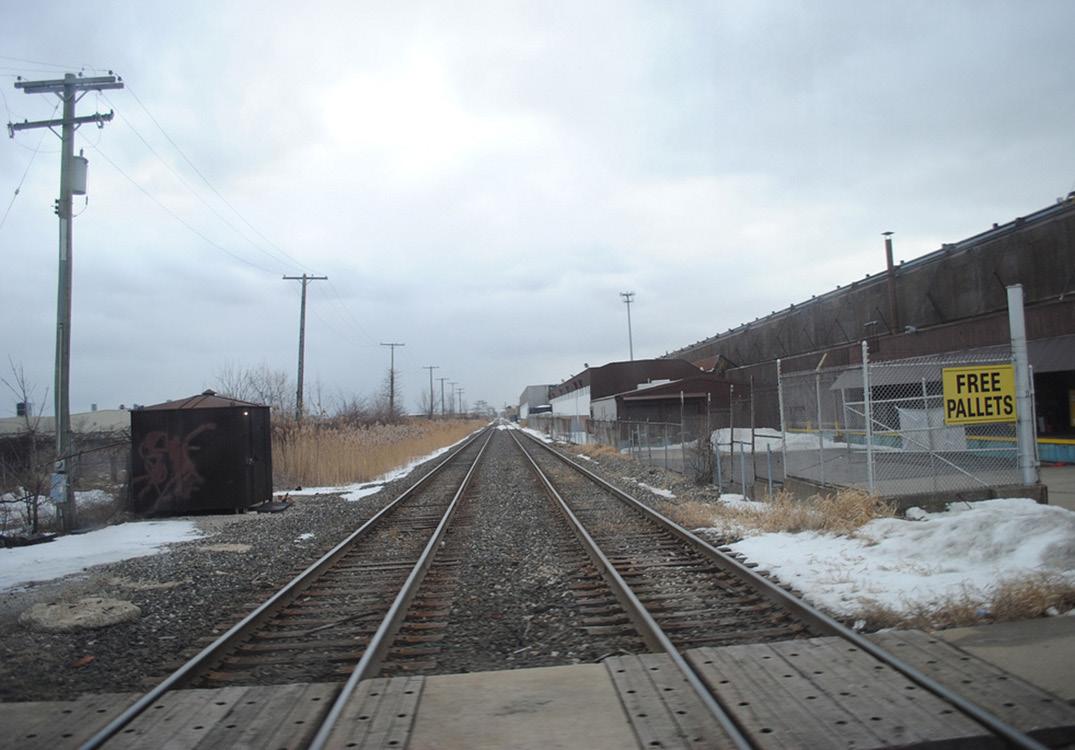
DFC’s Mt. Elliott employment district also has access to rail spurs and an airport. A large rail yard is located west of the I-94 Industrial Park, and at least five properties have direct on-site access to rail spurs.10 The “Detroit Industrial Strategy Report” cites chemical manufacturers, auto manufacturers, scrap and salvage yards, concrete plants, and steel processors as the typical users of rail spurs in Detroit in recent years. The region’s major metropolitan airport, Detroit Metropolitan Wayne County Airport, is approximately 30 miles from the district. Additionally, the Coleman A. Young International Airport, also called City Airport, lies within DFC’s Mt. Elliott employment district boundaries. This airport is only used for private and cargo flights; however, it does have the capacity to support small commercial aircraft.
The availability of land, the varying conditions of buildings and parcels, and the accessible location
of the employment district present significant challenges and great opportunities. The next section examines the current economic conditions within the Mt. Elliott employment district, DFC’s Mt. Elliott employment district, and the City of Detroit.
Atlanta, GA before ending in Fort Lauderdale, FL. A truck departing from the employment district

Detroit’s economy is historically rooted in manufacturing. DFC’s Mt. Elliott employment district has a similar foundation, which has helped it to emerge as the third largest employment district, in terms of workforce size, in the city. Most industrial activity in Detroit is categorized as either urban legacy manufacturing or urban industrial. The “Industrial Strategy” and Detroit Future City reports identify four industrial clusters as key targets for industrial redevelopment in Detroit:11
• Automotive
• Metals
• Transportation, Distribution, and Logistics (TDL)
• Construction, Deconstruction or Demolition, Engineering, and Repurposing (CDER)
Industrial clusters are a collection of businesses and related firms that are located in close proximity to one another and that interconnect through their supply chains, both competing and cooperating within a given industrial sector.12
Urban legacy manufacturers in DFC’s Mt. Elliott employment district include those linked to the automotive and metals industries, including businesses such as Detroit Chassis, Alro Steel, Milton Manufacturing, and Global Titanium.13 As
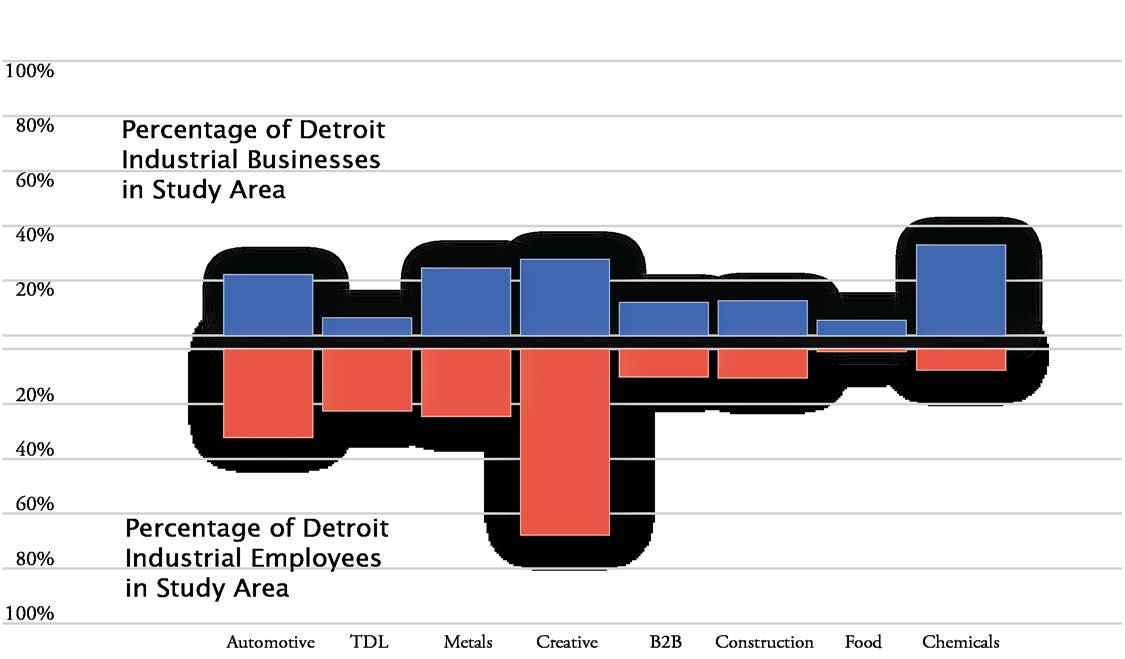
major urban legacy manufacturing sites, the General Motors Detroit-Hamtramck Assembly plant and the Chrysler Group LLC Mount Elliott Tool & Die Facility anchor the district’s business environment. Of Detroit’s automotive sector businesses located on industrial parcels, DFC’s Mt. Elliott employment district contains 22 percent of the city’s automotive firms and 32 percent of its automotive jobs.14 Additionally, DFC’s Mt. Elliott employment district hosts 24 percent of Detroit’s metals sector businesses and jobs.15 (Figure cc-5.)
Urban industrial firms are those that gain specific advantages by being located in dense urban districts, allowing them to use location and inter-business links to offer services that support the supply chains of neighboring businesses.16 Businesses in the Transportation, Distribution, and Logistics (TDL)
and business-to-business sectors offer services that improve efficiency and cost-effectiveness for nearby industries. In DFC’s Mt. Elliott employment district, businesses such as Exel Logistics and PTI Quality Containment Solutions provide services -- such as logistics and storage -- to businesses within the district and around the globe. While the DFC’s Mt. Elliott employment district’s industrial businesses only comprise six percent of the city’s TDL business on industrial parcels, these firms account for more than 22 percent of Detroit’s TDL employment.17 Twelve percent of Detroit’s industrial business-to-business firms are located in DFC’s Mt. Elliott employment district, comprising 10 percent of the city’s employment in this sector.18
In line with one of Forging a Future’s main themes -job creation -- our analysis of the district’s industrial
businesses focused primarily on sectors with the most active roles in future job creation, such as those in the automotive, metals, business-to-business, and TDL sectors. Together these sectors represent employment levels that surpass 4,300 jobs and account for nearly 90 percent of DFC’s Mt. Elliott employment district’s total employment numbers.19 Automotive and TDL firms on industrial parcels in DFC’s Mt. Elliott employment district have high average employment levels with about 300 and 140 employees per business, respectively. While metals and construction firms both have low employment levels per business -- averaging 24 and 14 jobs, respectively -- total metals jobs in DFC’s Mt. Elliott employment district are more than three times the job total for the construction industry.20 A large number of smaller firms, such as metals businesses in DFC’s Mt. Elliott employment district, can lead to greater product diversification and specialization to meet the needs of local buyers.
Detroit’s automotive sector is currently experiencing a shift from a focus on manufacturing to a focus on research and development. Investments from both American and foreign automakers have transformed Metro Detroit into “North America’s premier automotive research, design, and vehicle development (RDD) hub.”21 This shift has diversified the types of automotive companies locating in Metro Detroit and has led to accelerated investment in the region. Despite vehicle production levels that are lower than past automotive manufacturing outputs, the region has strengthened its position as a key global automotive design hub.22
Concurrently, the automotive industry is undergoing
a significant shift away from vertical integration, or the combined operation of several stages of production by one company, toward design and development of automotive subsystems. In order to accommodate this shift, Tier 1 automotive suppliers, or the firms that supply directly to Original Equipment Manufacturers (OEMs) (e.g., Ford, Chrysler, and General Motors), are increasingly absorbing responsibility for the manufacturing of automotive components.23 Due to the iterative nature of a collaborative design process, co-location of the design and manufacturing processes is beneficial. This shift in supply chain responsibilities has led Tier 1 suppliers to increasingly locate in Metro Detroit.24
The shift in supplier roles and the increasing importance of proximity for vehicle design presents an opportunity for a district with significant land and transportation assets, such as the Mt. Elliott employment district, to attract further investment. While many of the businesses that are currently located in the district are not classified as automotive, the relocation of Tier 1 suppliers to Metro Detroit could provide an opportunity to attract new businesses and for the district’s existing Tier 2 and Tier 3 suppliers to grow, connect to new supply chains, and exploit the district’s land assets.
DFC’s Mt. Elliott employment district contains one of the city’s highest concentrations of metals firms. Connected to the city’s prominent automotive sector and to other industries, the metals industry also plays a major role in the economies of the city and district. Detroit’s metals cluster contains mainly metals and
machinery manufacturers that produce a wide range of products spanning finished goods and supply chain intermediaries.25 As metals firms’ products become increasingly interlinked with the equipment needs of other firms, close proximity to clients often becomes increasingly important.26
While the close relationship between the automotive and metals industries in Detroit provides opportunities for stable contracts for metals firms, it also makes metals firms particularly susceptible to downturns in the automotive sector. Many of Detroit’s metals firms that survived the recent economic recession are, however, in a strong position for the future because they became more efficient and competitive to survive the downturn.27
Most metals firms in DFC’s Mt. Elliott employment district are located north of East McNichols Road.28 The variety of metals firms in the district is representative of the metals cluster’s diversity. Large-scale tool and die firms, such as Detroit Edge Tool Company and Tranor Industries, are located in the district along with raw materials and retail firms, such as Alro Steel and Federal Pipe and Supply. Some firms in the district also focus on specific metals supply chains, such as Global Titanium, which purchases and processes scrap titanium for reuse. All of these businesses, and the many others like them in DFC’s Mt. Elliott employment district, rely on trucks for transport needs across supply chains. As Detroit’s automotive sector continues its transformation, the metal firms in the employment district have an opportunity to use their close proximities to automotive clients to expand their involvement in
equipment and parts production linked to growing investment in vehicle research and development.
In addition to its transportation infrastructure assets, location near the U.S. - Canada border, and proximity to large population centers, Detroit is an international hub for the TDL industry. The region has connections to wide supply chains networks, particularly related to the automotive sector, that enable it to actively participate in large-scale transportation and shipping. The city’s TDL cluster includes long-haul trucking, rail, storage, distribution, design, and management services.29
With stable businesses and growing investment in the automotive sector, DFC’s Mt. Elliott employment district is well positioned to take advantage of new opportunities for business connectivity. DFC’s Mt. Elliott employment district is also attractive to trucking firms because road weight restrictions here are minimal and streets are wide.30
One of the largest TDL firms in Detroit, Exel Logistics, is located in the I-94 Industrial Park at the southern end of the district.
Over the next few decades, the physical transformation of Detroit’s land and buildings is expected to drive the Construction, Deconstruction or Demolition, Engineering, and Repurposing (CDER) cluster in the city.31 The Mt. Elliott employment
district will also have a strong need for deconstruction and demolition in the near future. Additionally, business attraction efforts are likely to require the construction of new industrial facilities and the upgrading or repurposing of existing facilities. As the “Industrial Strategy” report indicates, jobs associated with the CDER cluster are generally wellpaying, have low formal education requirements, and provide opportunities for foreign-born workers. Many CDER firms in Detroit are Minority Business Enterprises (MBEs).32 The district is currently home to only a few CDER businesses, such as Ampro Insulation and Crawford Door Sales, but its proximity to future business attraction targets could make it attractive to CDER firms in the future.
Along with the removal and replacement of blighted properties in DFC’s Mt. Elliott employment district, Detroit Future City also advocates for the creation of blue-green infrastructure throughout Detroit. Blue infrastructure is that which captures and cleans stormwater, while green infrastructure improves air quality by filtering airborne pollutants.33 DFC identifies a number of locations throughout the employment district where such infrastructure could help contain and eliminate the harmful byproducts of industrial activity. Blue-green infrastructure is particularly important in areas where residences are in close proximity to industrial activities, such as in the southern portion of the employment district.
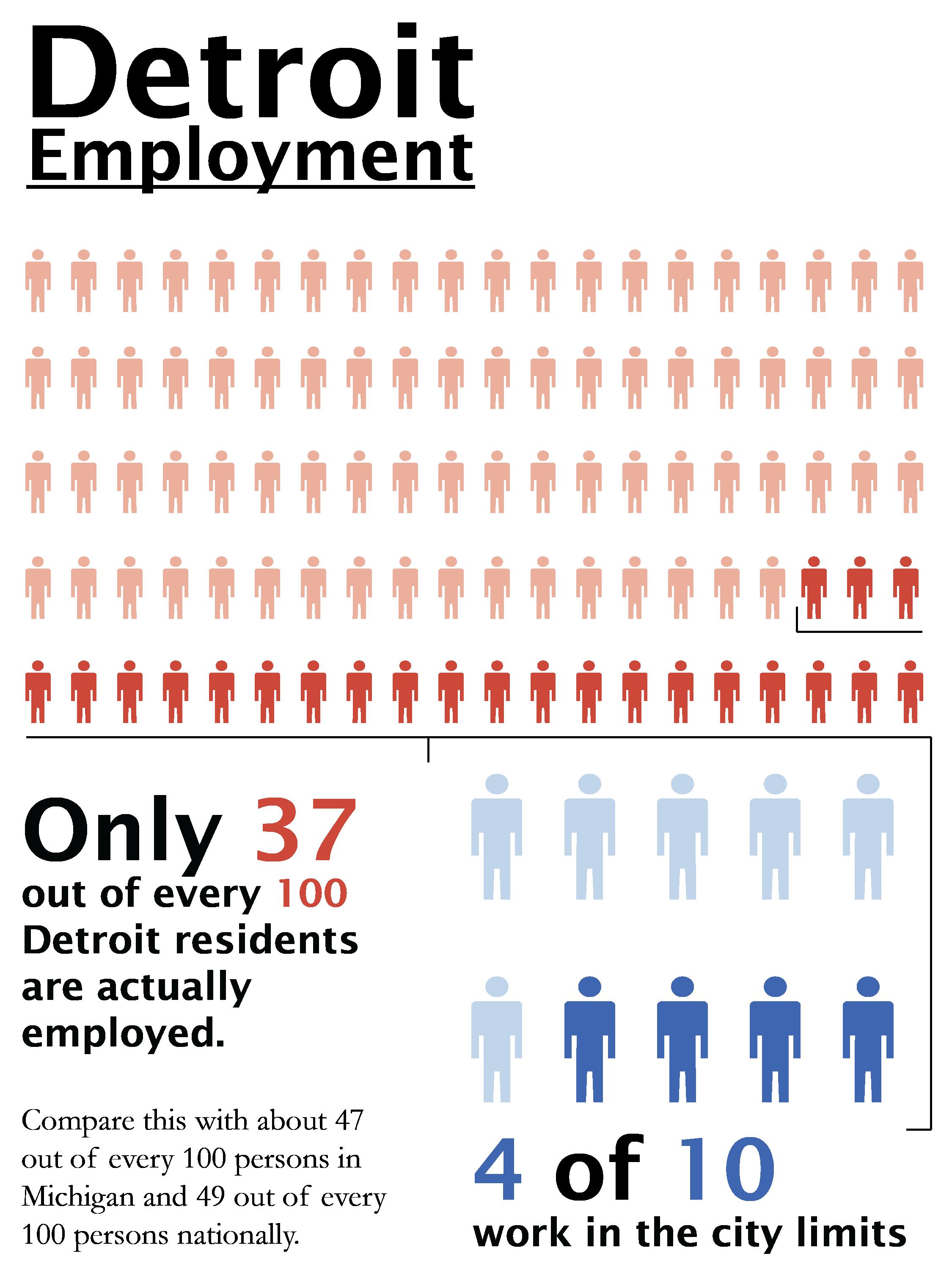
Labor force participation, workforce readiness, and access to reliable transportation are major challenges that prevent Detroit residents from filling Detroit jobs (Figure cc-6). Despite DFC’s Mt. Elliott employment district being the single largest industrial corridor in the city by
employment, it faces many of the same problems that employment areas around the city face.34 As of 2010, DFC’s Mt. Elliott employment district was host to approximately 15,000 employees.35 Within the 15 census tracts overlapping our defined Mt. Elliott employment district, the total residential population is 37,000.36 This computes to roughly 40 jobs in DFC’s Mt. Elliott employment district per 100 residents in the 15 census tracts overlapping the district as defined in aPPendix cc-1 of this report.37 This is considerably greater than the 27
* adults over the age of 16
jobs per 100 resident ratio for the city as a whole.38
While there are many jobs located in DFC’s Mt. Elliott employment district, unemployment rates are staggeringly high in Detroit as well as in the area directly surrounding DFC’s Mt. Elliott employment district. Figure cc-7 shows only slight differences in employment data for the Mt. Elliott surrounding area and for Detroit as a whole.39 Both have high percentages of residents ages 16 and older who are either unemployed or not in the labor force -- individuals of working age who are unemployed and not looking for work.40 Fifty percent of the residents living in the census tracts overlapping the district are not in the labor force.41 The portion of Detroit’s population not in the labor force is modestly better at 45 percent.42 There is near parity in the percentage of the population unemployed and looking for work at 16 percent of surrounding area residents and 17 percent for Detroit. The employment rate for the surrounding area census tracts is slightly lower than for the Detroit, at 33 percent and 36 percent, respectively.43
Figure cc-8 shows the five industries with the highest total employment in Detroit in comparison with employment in those industries in the district and in the United States as a whole. Manufacturing represents a significant percentage of the employment share for Detroit and is especially strong in DFC’s Mt. Elliott employment district. For
all three geographies, the lead employing industry is in Educational, Health, and Social Services.44
In general, the population of the Mt. Elliott surrounding area demonstrates lower educational attainment than the overall Detroit population. As Figure cc-9 shows, the district has a greater percentage of the population that has not completed high school and a lower percentage of college graduates when compared to Detroit overall. Interestingly, a lower percentage of residents have completed high school or equivalency in Detroit than in the census tracts overlapping the employment district, at 33 and 37 percent, respectively. Residents in both geographic areas lag in educational achievement compared to national averages, which is consistent with trends in other industrial legacy cities.
Educational attainment is strongly correlated with employment and income. As illustrated in Figure cc-10, the unemployment rate for those with less than a high school education is considerably higher than for those with more education. In Detroit, those who have not completed high school earn nearly three times less than college graduates earn. The spread in median income between those who have not completed high school and college graduates is narrower for the Mt. Elliott surrounding area; the median income for college graduates is $34,358 and the median income for those without a high school diploma is $18,631. The annual median income for these census tracts is $25,109, compared to $26,955 for Detroit. Outside
cc-7: Detroit and Mt. Elliott surrounding area: Employment status for total population 16 years and older I
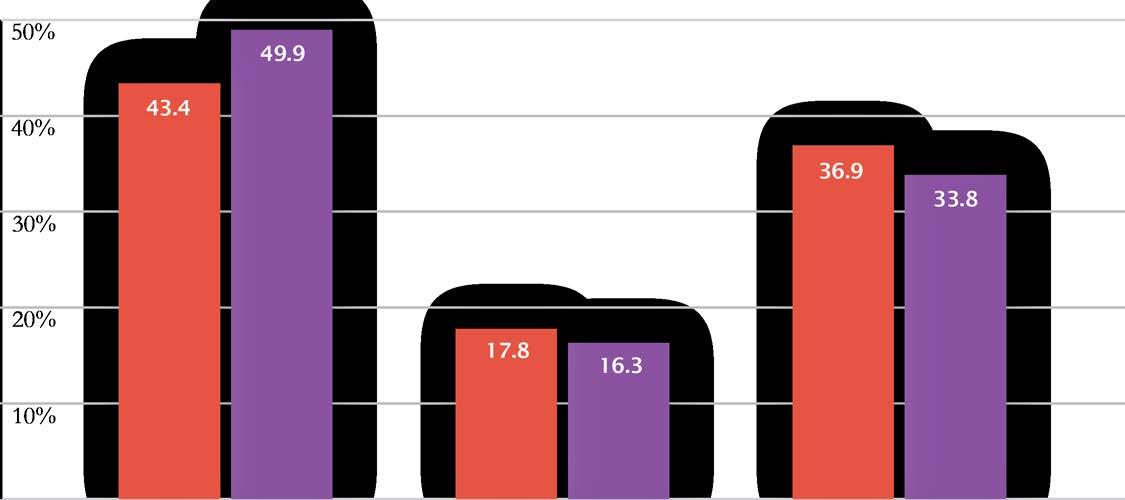
Figure cc-8: Three geographic areas: Industry by occupation for employed civilian population 16 years and older J
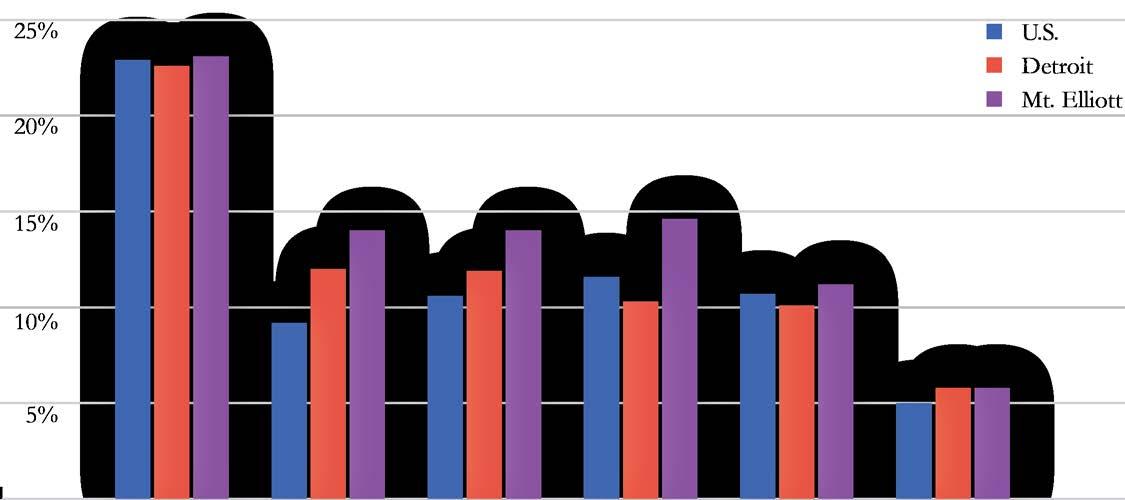
Figure cc-9: Educational attainment in Mt. Elliott surrounding area, juxtaposed with Detroit and national figures K
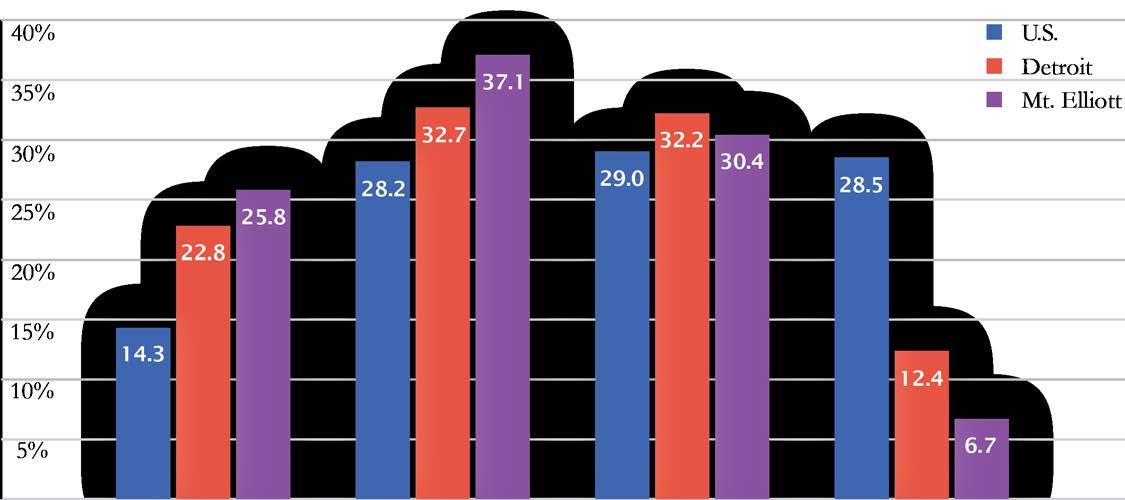
Figure cc-10: Educational attainment and employment in Mt. Elliott surrounding area, juxtaposed with Detroit and national figures L
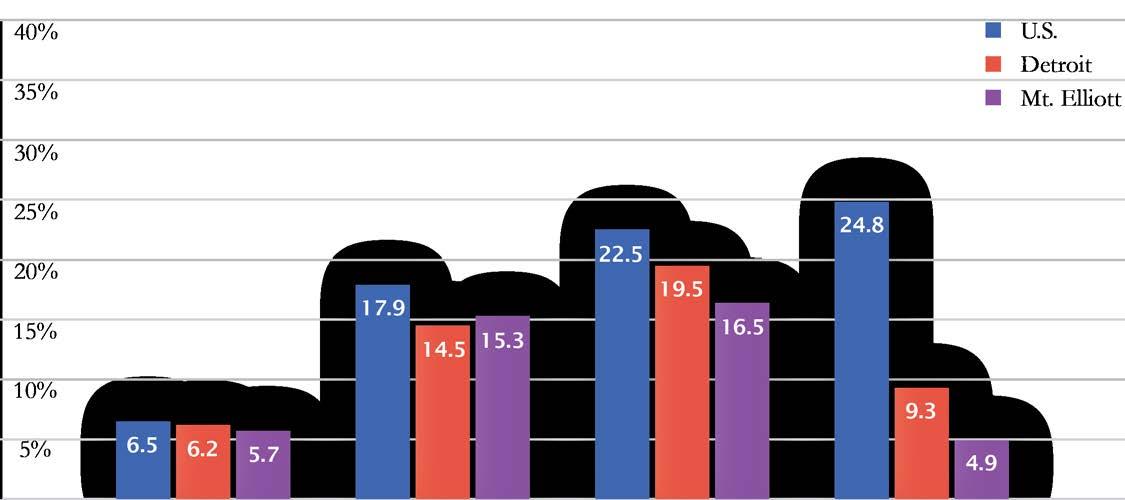
of Detroit, earnings and educational attainment tend to be much higher. For example, the median income for the Detroit-Warren-Livonia Metropolitan Statistical Area is $51,903, with 28 percent of residents having attained a bachelor’s degree or higher.45
Proficiency in subjects taught at the primary and secondary educational levels is important for all employment industries. Common academic and workplace competencies expected in each of the industries listed in Figure cc-5 include: reading, writing, math, and problem solving. In addition, for manufacturing, the industry-wide competencies include: production, maintenance, supply chain logistics, and quality assurance, among others. For example, common tasks for a Computer Numerical Controller (CNC) Operator include measuring dimensions, using precision measuring instruments, and reviewing program specifications or blueprints to set machine operations.46

The lack of access to reliable and efficient transportation options can exacerbate employment issues and negatively impact business activity. Detroit residents face three major barriers when it comes to access to transportation:
• Low rates of car ownership
• Lack of a reliable and efficient public transportation system
• Job sprawl
First, car ownership is uniquely unaffordable in Detroit, due to a combination of high auto insurance premiums and a low median income. One source, based on an estimate from 2008-2012, has noted that 10.9 percent of Detroit households do not have access to a vehicle, and 40.3 percent of households have access to just one vehicle. In contrast, just 2.6 percent of households statewide do not have access to a vehicle and about 20 percent have access to just one vehicle.48
Insurance rates in Detroit pose additional hurdles to car ownership. According to the Detroit Free Press, annual insurance rates in the City of Detroit can cost up to $8,403 annually.49 That means it could cost $666 per month to insure one vehicle.50 These costs make it impossible for many residents to insure and thereby own a vehicle in Detroit, where the median household income is $26,955 per year.51
Second, metropolitan Detroit lacks a dependable public transit system. Currently, the two major public transit service providers, the Detroit Department of Transportation (DDOT) and the Suburban Mobility Authority for Regional Transportation (SMART) bus systems, are notoriously underfunded and unreliable. According to a report from Wayne State University, Detroit spent $19 per capita on public transit in 2010, which is the
In Detroit, those who have not completed high school earn nearly three times less than college graduates earn.
21st highest among the top 25 major metropolitan areas.52
The map below highlights bus stop locations (Figure cc-11) in the Mt. Elliott employment district. While stops are frequent, they are generally inaccessible in that they lack shelters and signage, are not maintained in the winter and are often not paved, making wheelchair use difficult. A recent report in the Wall Street Journal revealed that only 20 percent of Metro Detroiters can reach their job via public transit in less than 90 minutes53; however, 8.8 percent of Detroiters depend on public transit to get to work 54 The problems associated with a lack of a dependable public transit system, combined with the hurdles to car ownership, are compounded when considering how dispersed jobs are across the Detroit region.
As these current conditions illustrate, the Mt. Elliott employment district faces significant challenges, such as low educational attainment, vacancy and blight. The district also has many opportunities for economic growth, including vacant land and successful businesses.
Vacant, available land represents many opportunities for growth within the district, both from existing businesses and from potential new businesses. Future growth is supported by a strong foundation of truck and freight transportation infrastructure and the district’s strategic location within the region. At the same time, under-maintained and under-utilized properties create a major challenge for the district’s prosperity. Private ownership of these parcels represents a deeper challenge, while public ownership provides opportunities for the City or a related organization to categorize, market, and develop these properties.
The continued development of automotive, metals, logistics, business-to-business, and construction clusters will play a central role in the revitalization of the economies of Detroit and the district. Their activity alone, however, cannot guarantee growth and redevelopment. Business development efforts can help to ensure that the unique assets of the district are properly leveraged, taking advantage of the automotive industry’s dynamic presence to attract suppliers designed to service higher tier and OEM firms. The metals, TDL, business-to-business, and construction industries, with their links to the automotive sector, represent opportunities to form strong connections and grow jobs in the district across often-disjoined industries.
The district and the City of Detroit face the serious barriers of high unemployment, low educational attainment, and lack of access to transportation. In the “Findings” and “Recommendations” chapters, we explore the role that workforce institutions can play to address these challenges.
First, the following chapter, “Process and Methods,” describes how we approached our research efforts
to learn more about the real estate, business, and workforce characteristics of the employment district.
1. Detroit Future City, Detroit Future City: 2012 Detroit Strategic Framework Plan (Detroit: Inland Press, 2012), 20.
2. Detroit Assessor Data [computer file], Detroit, Michigan: City of Detroit Assessor’s Office, 2012.
3. Lynch et al., “An Industrial Strategy for the City of Detroit” (working paper, Initiative for a Competitive Inner City, 2014), 12.
D. U.S. Census Bureau, American Community Survey 2008-2012 (5-year Estimate), generated by Liz Treutel, using American FactFinder, <http://factfinder2.census.gov/faces/tableservices/jsf/pages/productview.xhtml?pid=ACS_12_5YR_ S0801>, (15 April 2013).
5. U.S. Census Bureau, Census 2010, Table 71, generated by Evan Johnson using Social Explorer, <http://www.socialexplorer. com>, (30 January 2014).
6. Detroit Assessor Data [computer file], Detroit, Michigan: City of Detroit Assessor’s Office, 2012.
7. Lynch et al., “Industrial Strategy,” 24.
8. Lynch et al., “Industrial Strategy,” 23.
9. Lynch et al., “Industrial Strategy,” 22.
10. Detroit Economic Growth Corporation, Costar Realty Information, (2014), 7 March 2014.
11. Lynch et al., “An Industrial Strategy for the City of Detroit,” (working paper, Initiative for a Competitive Inner City, 2014), 5.
12. Michael Porter, “Location, Competition, and Economic Development: Local Clusters in a Global Environment,” Economic Development Quarterly 14, (2000): 15.
13. Lynch et al., “Industrial Strategy,” 24.
14. Interface Studio, Detroit Land Use Survey, (2009).
15. Ibid.
16. Lynch et al., “Industrial Strategy,” 5.
17. Interface Studio, Detroit Land Use Survey, (2009).
18. Ibid.
19. Ibid.
20. Ibid.
21. Lynch et al., “Industrial Strategy,” 32.
22. Ibid.
23. Ibid., 34.
24. Ibid., 35.
25. Ibid., 53.
26. Ibid., 54.
27. Ibid., 66
28. Ibid., 64.
29. Ibid., 74.
30. Ibid., 84.
31. Ibid., 104.
32. Ibid.
33. Detroit Future City, Detroit Future City, 185.
34. Detroit Future City, Detroit Future City: 2012 Detroit Strategic Framework Plan (Detroit: Inland Press, 2012), 63.
35. Lynch et al., “An Industrial Strategy for the City of Detroit,” (working paper, Initiative for a Competitive Inner City, 2014), 24.
36. U.S. Census Bureau, Census 2010, Table 1, generated by Evan Johnson, using Social Explorer, <http://www.socialexplorer. com>, (30 January 2014).
37. Ibid. (Note: there are two different areas so ratios are not exact.)
38. Detroit Future City, Detroit Future City, 42.
39. U.S. Census Bureau, ACS 2008-2012 (5-Year Estimate), Table 33, generated by Aja Bonner, using Social Explorer, <http:// www.socialexplorer.com>, (2 February 2014).
40. U.S. Census Bureau, ACS 2008-2012 (5-Year Estimate), Table 37, generated by Aja Bonner, using Social Explorer, <http:// www.socialexplorer.com>, (2 February 2014).
41. U.S. Census Bureau, ACS 2008-2012 (5-Year Estimate), Table 33 and 37, generated by Aja Bonner, using Social Explorer, <http://www.socialexplorer.com>, (2 February 2014).
42. U.S. Census Bureau, ACS 2008-2012 (5-Year Estimate), C24050, generated by Aja Bonner, using Social Explorer, <http://www.socialexplorer.com>, (28 April 2014).
43. U.S. Census Bureau, ACS 2008 - 2012 (5-Year Estimate), B23006, generated by Aja Bonner, using Social Explorer, <http://www.socialexplorer.com>, (28 April 2014).U.S. Census Bureau, Census 2010, Table 71, generated by Evan Johnson using Social Explorer, <http://www.socialexplorer.com>, (30 January 2014).
AR. U.S. Census Bureau, Census 2010, Table 71, generated by Evan Johnson using Social Explorer, <http://www.socialexplorer. com>, (30 January 2014).
45. U.S. Department of Labor, O-Net Online, “Computer Controlled Machine Tool Operators Metal and Plastic Summary Report,” (2012), accessed April 1, 2014, http://www. onetonline.org/link/summary/51-4011.000.
46. U.S. Census Bureau, American Community Survey 2008-2012 (5-year Estimate), generated by Liz Treutel, using American FactFinder, <http://factfinder2.census.gov/faces/tableservices/jsf/pages/productview.xhtml?pid=ACS_12_5YR_ S0801>, (15 April 2013).
47. U.S. Census Bureau, American Community Survey 2008-2012 generated by Liz Treutel, using American FactFinder, <http://
factfinder2.census.gov/faces/tableservices/jsf/pages/ productview.xhtml?pid=ACS_12_5YR_S0801>, (15 April 2013).
48. Nancy Kaffer, “No Relief in Sight for Sky-High Car Insurance Rates,” Detroit Free Press, April 7, 2013, accessed April 12, 2014, http://www.freep.com/article/20130407/COL43/304070085/ Nancy-Kaffer-No-relief-in-sight-for-sky-high-car-insurancerates.
49. Ibid.
50. U.S. Census Bureau, American Community Survey 2008-2012 generated by Liz Treutel, using American FactFinder, <http:// factfinder2.census.gov/faces/tableservices/jsf/pages/ productview.xhtml?pid=ACS_12_5YR_S0801>, (15 April 2013).
51. Carsten Applegate, “Transit in Metro Detroit: An Analysis of Problems and Solutions,” (Wayne State University, 2011), 3.
52. Matthew Dolan, “Detroit’s Broken Buses Vex a Broken City,” The Wall Street Journal, March 8, 2014, accessed February 25, 2014, http://online.wsj.com/news/articles/SB1000142405270 2303546204579439283523949194.
53. U.S. Census Bureau, American Community Survey 2008-2012 generated by Liz Treutel, using American FactFinder, http:// factfinder2.census.gov/faces/tableservices/jsf/pages/ productview.xhtml?pid=ACS_12_5YR_S0801, (15 April 2013).
54. U.S. Census Bureau, American Community Survey 2007-2011, (5-year estimates).
Framework Plan (Detroit: Inland Press, 2012), 20.
H. U.S. Census Bureau, Census 2010, Table 70, generated by Evan Johnson using Social Explorer, <http://www.socialexplorer. com>, (30 January 2014).
I. U.S. Census Bureau, Census 2010, Table 71, generated by Evan Johnson using Social Explorer, <http://www.socialexplorer. com>, (30 January 2014). Mt. Elliott district data genearted from 15 different cnesus tracts overlapping the district as shown in aPPendix cc-1.
J. U.S. Census Bureau, Census 2010, Table 71, generated by Evan Johnson using Social Explorer, <http://www.socialexplorer. com>, (30 January 2014). Mt. Elliott district data genearted from 15 different cnesus tracts overlapping the district as shown in aPPendix cc-1
K. U.S. Census Bureau, Census 2010, Table 71, generated by Evan Johnson using Social Explorer, <http://www.socialexplorer. com>, (30 January 2014).
L. U.S. Census Bureau, Census 2010, Table 71, generated by Evan Johnson using Social Explorer, <http://www.socialexplorer. com>, (30 January 2014).
M. Detroit Industrial Parcels Survey, ICIC, 2009 GTFS Data, DDOT, 2014.
A. Detroit Future City, Detroit Future City: 2012 Detroit Strategic Framework Plan (Detroit: Inland Press, 2012), 20.
B. Team photo.
C. Detroit Future City, Detroit Future City: 2012 Detroit Strategic Framework Plan (Detroit: Inland Press, 2012), 20.
D. U.S. Census Bureau, American Community Survey 2008-2012 (5-year Estimate), generated by Liz Treutel, using American FactFinder, <http://factfinder2.census.gov/faces/tableservices/jsf/pages/productview.xhtml?pid=ACS_12_5YR_ S0801>, (15 April 2013).
E. Detroit Economic Growth Corporation, Costar Realty Information, (2014), 7 March 2014.
F. Team map generated in part based on informal icon found in: Detroit Future City, Detroit Future City: 2012 Detroit Strategic Framework Plan (Detroit: Inland Press, 2012), 20.
G. Detroit Future City, Detroit Future City: 2012 Detroit Strategic

as a Foundation For engaging stakeholders and understanding their visions for the district, we conducted in-depth background research to shape our conversations with local actors. This research prepared our team to understand the context and conditions of the district through a lens of current practices and theory applied throughout the United States. We also used this background research to identify active organizations in Mt. Elliott and Detroit and worked with them to frame our recommendations within the district’s local context.
We completed a literature review to increase our understanding of issues related to industrial real estate development, business clusters, economic growth, and the alignment of workforce initiatives across jobseekers and businesses. We analyzed academic articles and professional reports that outline strategies for engaging stakeholders.
We also reviewed literature on methods of industrial real estate analysis and the factors that drive real estate markets. From this information, we laid the groundwork for analyzing industrial property issues based on physical characteristics in the district.
To understand existing initiatives actively targeting revitalization in industrial districts, we reviewed examples of industrial real estate development programs in several cities to enable us to recommend strategies for Mt. Elliott. We analyzed industrial redevelopment and real estate plans in Cleveland, Buffalo, Detroit, Los Angeles, New York City, Philadelphia, and Vancouver.
We also researched Detroit’s business incentives and liabilities and compared them to others in neighboring municipalities. We used business and community surveys to connect jobseeker and employer needs within the context of local real estate. Additionally, we researched current practices implemented by real estate, business, workforce development, and community engagement initiatives throughout the United States. We applied our findings from this
research to the district to develop recommendations that could be useful for engaging stakeholders to collectively address blight, vacancy, ownership, and public perception issues in the district.
The Detroit Future City Strategic Framework Plan (DFC) presents a useful set of demographics as a foundation for considering the economic climate of the Mt. Elliott employment district. Because intensifying our investigation of the district required more in-depth information, we aggregated data from a variety of sources. We used data from the U.S. Census Bureau, its OnTheMap tool for community analysis, and the American Community Survey to understand the demographic composition of Mt. Elliott and its surroundings. We also used data from the Initiative for a Competitive Inner City to understand the district’s business, economic, and employment contexts.
To conduct these analyses, we identified the census tracts within and surrounding our Mt. Elliott study area. We used tract data to inform our understanding of the district’s diverse business context and the active and ongoing uses of its industrial properties. By reviewing data on local businesses, we investigated clusters, employment rates, and business sizes in the district. We gathered population data on the demographics, employment situation, housing context, and vacancy rates in the residential areas in and surrounding the district. This helped to build our knowledge of the local community and served as a guide for identifying information gaps while shaping the questions we asked stakeholders in our surveys.
Expanding our findings based on the population and housing data we collected, we assessed the district’s physical conditions by analyzing real estate data from the City of Detroit Assessor, the CoStar Group property database, and the “Why Don’t We Own This” (Loveland Technologies) website. We also gathered infrastructure data from the Michigan Department of Transportation (MDOT) and the Southeast Michigan Council of Governments (SEMCOG) to best understand the conditions and spatial dimensions of local road, interstate, and railroad networks. Applying this information to the district’s local context, we mapped data using Geographic Information Systems (GIS). Mapping helped us to understand business-community relationships, parcel conditions and ownership, property tax statuses, transportation networks, and infrastructure quality.
We used these methods of analysis throughout our research process to uncover and understand the district’s complex real estate, business, and community dimensions. Data analysis was instrumental in defining nodes of focus in the district, creating strategic recommendations, and providing prescriptive strategies for strengthening parceland district-level real estate resources, business environment, and workforce preparedness.
Having identified key real estate, business, and community actors during data collection, we investigated relevant community and workforce development organizations to best understand their methods of community support, engagement, and workforce training. We investigated strategies that could be replicated and applied to Mt. Elliott and
combined this with research on inter-business collaboration practices. Informed by the methods and models of initiatives nationwide, we used Google Earth, observational surveys, networking, and Internet queries to understand Detroit organizations active in the workforce development, business, and real estate spaces. Interviewing leaders of many of these organizations, we learned more about the district’s context while expanding our network of stakeholders.
We conducted interviews to inform our findings with the viewpoints of local real estate, business, and workforce development stakeholders in the Mt. Elliott employment district and Detroit. Using a structured interview format, we met with business leaders from throughout the district to learn about its economic context, the internal strengths and weaknesses demonstrated by local businesses, and the external opportunities and threats presented by the district’s business environment. We used informational interviews to understand the efforts of Detroit’s workforce and economic development stakeholders. We also investigated the perspectives of public and private real estate professionals. Their collective lessons guided the development of our recommendations for the district. These recommendations focused on how stakeholders’ actions and initiatives could best align with the district’s business context to ultimately support economic growth and job creation.
We interviewed local business leaders whose input would reflect the district’s prominent automotive; metals; transportation, distribution and logistics (TDL); and business-to-business clusters. The health of the district is closely linked to that of local businesses because its firms are the major local drivers of economic activity, job creation, and stability. We interviewed leaders of ten businesses to guide our understanding of industry in Mt. Elliott (table Pm-1). While these ten represented a broad mix of commerce in the district, our results are not a comprehensive viewpoint of all businesses in Mt. Elliott.
Our interview template (aPPendix Pm-1) followed
a structured format modeled after a survey used in the City of Minneapolis’ “Industrial Land Use Study and Employment Policy Plan.1” This format, allowing for standardized answers with space for comments, enabled us to easily aggregate responses while gaining an in-depth understanding of the perspectives of business leaders in the district. The structured interview format contained questions investigating four main categories of local business issues:
• Location and infrastructure
• Regulatory environment
• Business relations and suppliers
• Employment outlook and workforce relations
We sought businesses’ perspectives on the district’s surroundings and infrastructure. By posing questions about property use, neighborhood interactions, crime, blight, and the quality of local infrastructure, we collected responses that could help us to identify physical barriers to business activity and opportunities to promote business growth.
To understand the impacts of the regulatory climate facing the district’s businesses, we asked questions about firms’ experiences with government administrations and agencies. Business leaders discussed the quality of incentives, permitting processes, and utility services available to local businesses. With this information, we assessed barriers and opportunities for improved relationships in the district.
The business leaders we interviewed also offered insights into their firms’ supply chains and financial conditions. We asked questions to learn about business relationships in the district and to reveal operational synergies across businesses’ product and service lines. Their responses helped us to
table Pm-1: Mt. Elliott employment district businesses interviewed
Detroit Chassis
Fairmont Sign Company
Federal Pipe and Supply
Global Titanium
Hantz Group
Milton Manufacturing
Park Metal
PTI Quality Containment Solutions
Ross Structural Steel
Tranor Industries
Note on Description categories:
Large automotive sector employer with high revenue
Mid-sized creative sector employer with medium revenue
Small business-to-business employer with low revenue
Large metals sector employer with high revenue
Small agriculture sector employer with low revenue
Large manufacturing employer with high revenue
Mid-sized manufacturing employer with medium revenue
Large logistics employer with medium revenue
Mid-sized metals employer with medium revenue
Mid-sized automotive sector employer with low revenue
Employers: Small – Fewer than 35 staff; Mid-sized – 35 to 90 staff; Large – 90 or more staff
Revenues (annual): Small – $10 million or less, Medium - $10-$20 million, High - $20 million or more
understand their finances, business strategies, and visions for the future.
Through our interview questions, we also secured the perspectives of employers on the quality and preparedness of the district’s labor pool. This inquiry informed a vision of how the district might strategically develop its local human capital assets. Business leaders identified the skills they seek, their outlooks for job growth, and their strategies for managing employee-company relationships.
After aggregating the responses from business interviews, we highlighted major themes as key priorities for the continued promotion of both business stability and attraction to the district. We compared the perspectives of business owners with practices being implemented in Detroit and other
Business leaders identified the skills they seek, their outlooks for job growth, and their strategies for managing employeecompany relationships.
cities to devise a series of recommendations that could improve business retention and attraction efforts in the district.
Similar to the structured interviews we conducted with business leaders, we used informational interviews as a way to understand the activities, outlooks, and perspectives of the district’s actors involved in local real estate management, workforce development, and business collaboration. table Pm-2 lists the organizations with which we conducted informational interviews to examine
what attracts businesses to the district and how they collaborate with real estate and economic growth teams.
To better understand how jobseekers, especially those residing in the district, access employment opportunities with area businesses, we also conducted informational interviews with four organizations that offer workforce development services for the City
table Pm-2: Economic growth and/or collaboration organizations interviewed
Center for Community Progress
Detroit Economic Growth Corporation
Detroit Land Bank Authority
Ford Land
Local real estate brokers
Michigan Community Resources
Michigan Economic Development Corporation
Rivertown Detroit Association
Warren / Conner Development Coalition
A national nonprofit organization dedicated to assisting communities with blight, vacancy, and other property problems
Detroit’s public-private economic development organization
A public land bank that focuses on the acquisition, management, and disposition of tax-reverted and vacant properties
The real estate development arm of Ford Motor Company
Property salespersons operating within the Mt. Elliott employment district
A nonprofit organization providing resources for low-income communities and communitybased organizations in Michigan
A statewide, public-private economic development organization
A business-based organization working in Southeast Detroit
A community-based organization working to improve quality of life in East Detroit
of Detroit. We investigated how they and other workforce institutions currently support local businesses and economic development in the city (table Pm-3). More narrowly, we examined the ways that these institutions are partnering with businesses in the district and identified additional means through which workforce institutions might help meet the skills needs of businesses in the district.
We developed informational interview questions (aPPendix Pm-2 through Pm-6) and adapted prompts to address specific aspects of each organization. We also sought to answer new questions that arose as our research progressed. To better understand the partnerships among workforce
institutions in Detroit, we asked each interviewed organization to weigh in on an evolving list of workforce development institutions operating in the city (aPPendix Pm-7).
Investigating each organization’s place in the city’s larger workforce development context, we discussed the nature of each institution’s relationship to other institutions. Additionally, these organizations helped us to expand our network of institutions and stakeholders, wherever possible. When compiling informational interview results, we identified and tracked recurring themes found in the collection of responses.
table Pm-3: Workforce development institutions interviewed
Focus: HOPE
Detroit Employment Solutions Corporation (DESC)
Detroit Jobs Alliance (DJA)
Workforce Intelligence Network (WIN)
A community-based organization that provides job training and employment assistance
An administrative and fiscal agent for workforce development initiatives in the City of Detroit
A coalition of nonprofit organizations and community partners aimed at increasing the number of employed Detroit residents
A consortium of community colleges and workforce institutions that provides labor analysis for Southeast Michigan
The Mt. Elliott employment district is adjacent to several residential neighborhoods. To learn more about the perspectives of these neighborhoods’ residents, we convened a focus group to ask about their relationships with businesses in the district and to hear about their visions for local workforce development. We considered several social research methodologies before selecting a focus group process, which we decided would best allow us to hear from a range of community leaders and to document the similarities and differences in their local perceptions.
We developed a list of seven questions to facilitate the focus group (aPPendix Pm-8) and moderated group discussion by asking questions followed by prompts and clarifications. We provided supporting
table Pm-4: Organizations represented at the focus group meeting
Georgia Street Community Collective
HELCO Block Club
Residents Empowered, Strengthened and Transforming Our Residential Environment (RESTORE) Northeast Detroit
We Care About Van Dyke Seven Mile Inc.
Healthy Neighborhoods Detroit - St.
John Health Association
Nortown Community Development Corporation
East Outer Drive Block Club
Mt. Olivet Neighborhood Watch
materials (an agenda and a map of the Mt. Elliott employment district), recorded the discussion after gaining consent to do so, and took in-depth notes for analysis of the focus group’s outcomes. The group consisted of eight participating leaders of local block clubs, community businesses, and activist organizations (table Pm-4).
Similar to our process for analyzing workforce institution informational interviews, we reviewed written and recorded documentation of the meeting and identified key themes across participants’ responses to our prompts. We summarized these responses to create a list of general themes for further analysis.
Resident group in the Georgia St. area near Gratiot Ave. and Harper Ave.
Resident group along Helen St. and Concord St.
Collaboration of community organizations in the Northeast Detroit community
Resident group in the Van Dyke Ave. / 7 Mile Rd. / Hoover St. area
Program that supports economic and neighborhood revitalization near Conner Creek Village
Organization that fosters affordable housing, business attraction, education, and job opportunities
Resident group along East Outer Dr. between Sherwood St. and Van Dyke Ave.
Resident group east of Van Dyke Ave. and south of McNichols Rd.
To visually evaluate the conditions of land parcels in the Mt. Elliott employment district, we conducted real estate site surveys. Due to the large geographic scope of the district, we focused on three specific yet representative nodes within the district to consider its variety of parcel conditions. We assessed land parcels that were perceived to be inactive within the nodes in order to form property-specific recommendations for issues that arise from underutilization. Using site surveys, we evaluated parcels based on a set of qualitative standards. We investigated the following basic attributes of targeted real estate parcels in the district:
• Structural stability and overall maintenance of structures on the parcel
• Condition of the neighboring parcels directly adjacent to the parcel being studied
• Quality of roads and other public infrastructure directly surrounding a parcel
• Accessibility for trucks entering and exiting the parcel
We assessed land parcels that were perceived to be inactive within the nodes in order to form propertyspecific recommendations.
We evaluated each parcel for the above attributes on a scale of one to four, ultimately attributing overall ratings to parcels as described in table Pm-5. Our site survey format (aPPendix Pm-8) also included a section for open-ended notes about a given parcel, allowing us to capture other observable variables that were not accounted for within the rating system.
We completed site surveys over two days during which we traveled throughout the corridor by car, recorded qualitative assessment data, and took photographs. This process increased our knowledge of the district at the parcel level and helped to inform our recommendations for local industrial real estate.
To build upon our interviews and focus group meeting and to receive stakeholder feedback, we presented our preliminary findings to a collection of stakeholders gathered at the office of the Detroit Economic Growth Corporation (DEGC). Organizations represented at the consultation included the DEGC, DESC, and Detroit Chassis. Facilitating a wider conversation among organization leaders present at the meeting, we used the consultation to inform our targeted recommendations and to identify gaps in our study.
The stakeholder consultation served as a platform for sharing the findings we synthesized from the interviews, focus group, and site surveys we conducted. We used the comments and conversations of business, economic development organization, and workforce institution leaders to calibrate our interpretations of data and to guide our findings.
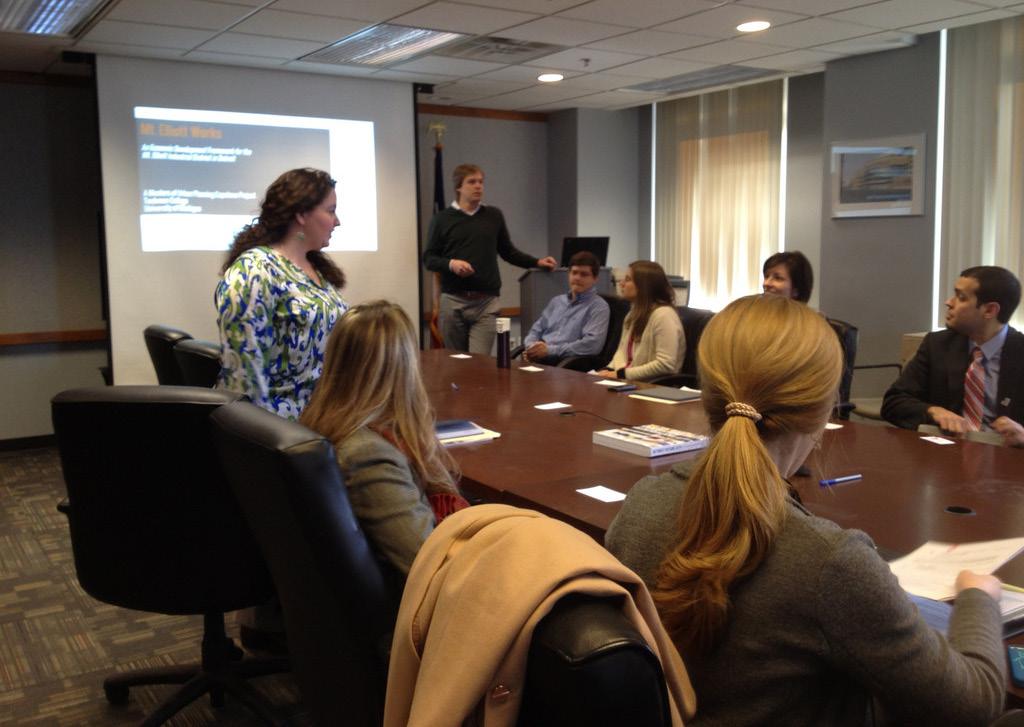
We employed a series of investigative methods to analyze the Mt. Elliott employment district and to learn from its real estate, business, and workforce stakeholders. We conducted background research on real estate theory, stakeholder engagement techniques, and property data to set the foundation upon which we conducted interviews, a focus group, site surveys, and a stakeholder consultation.
We condensed the lessons we learned from the district’s stakeholders into a collection of findings on the district – described in the following “Findings” chapter of Forging a Future – that addresses Mt. Elliott’s complex economic environment and diverse stakeholder relationships.
1. Maxfield Research Inc., “Industrial Land Use Study and Employment Policy Plan,” Industrial Planning Survey, (Minneapolis: City of Minneapolis, 2006).
A. Team photo.
B. Team photo.
C. Team photo.
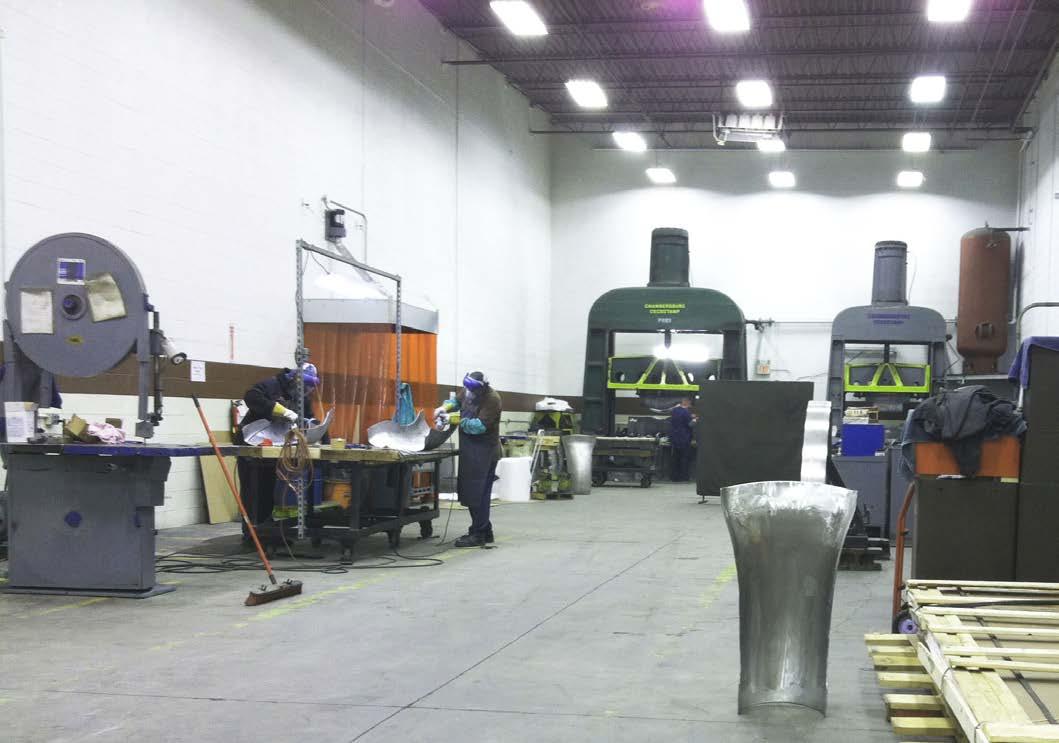
using the methods described in the previous “Process and Methods” chapter, we uncovered lessons that led to six overarching findings about the district. These key findings, listed on the following page, identify both challenges and opportunities for the Mt. Elliott employment district.
Varying standards for the appraisal, remediation, and marketing of industrial properties limit the district’s competitiveness and incentives
Mt. Elliott has many businesses that are stable or growing, a strategic location, and a wealth of underutilized industrial land.
Opportunities exist to strengthen business connections across industries and to improve business-city relationships.
Residents and business leaders are committed to the district and bring strong local knowledge to address safety, perception, and quality of life challenges.
Jobseekers in the district’s neighborhoods, if effectively trained, represent a largely untapped resource for local businesses.
Workforce institutions offer many services, but they need stronger bonds to support job creation and economic development at a large scale in the district.
Varying standards for the appraisal, remediation, and marketing of industrial properties limit the district’s competitiveness and incentives have had limited impact in attracting business investment.
Background research and stakeholder interviews illustrated the limited degree of coordination for property assessment and marketing in the Mt. Elliott employment district. Local efforts seek to improve the quality of information available on industrial real estate, but business incentives have attracted only limited investment in the district’s land assets.
Economic development stakeholders have expressed concerns that appraised property values in the district often appear to be artificially low. Property and building appraisals have displayed a negative gap between the price of new construction and the appraised value of a site. Stakeholders also noted the City’s overall lack of a consistent appraisal process and protocol.1 In general, economic development and real estate actors seem to lack local understanding of what causes this gap and the intricacies of how an appraiser values an industrial property.
Local appraisers indicated that the inherent value of an industrial site is different from its market value. Certain industries mandate that facilities meet explicit specifications, such as high ceilings or extra-thick concrete floors for certain manufacturing processes. These attributes are valuable for initial building tenants because they are necessary
The effectiveness of incentive programs, and the participation of businesses in them, has generally been low
for a company to operate and are generally reflected in building construction costs. Such attributes, however, may not increase appraised property values to the degree of installation costs because attributes sometimes meet only narrow purposes to enable certain industrial processes.
If a building with certain improvements were placed on the market, these enhancements may not be equally valued all prospective buyers. As such, the value of a property to a prospective tenant and its intended use are reflected in purchase offers. For example, a buyer planning to use a building for materials storage would likely have limited interest in structural reinforcements that might be necessary for a manufacturing tenant. A buyer would likely undervalue such attributes despite the scale of the initial investment. The initial value of these infrastructure improvements, therefore, would be best retained when a potential buyer intends to use a property similarly to that of the property’s previous tenant.2 For-sale and for-lease properties in the district can be seen in Figure F-1.
Figure F-1: Map
Businesses have access to a variety of incentives rooted in both state and local funding. Most prominently, incentives from the Tool and Die subset of the Michigan Renaissance Zone Program are available in some parts of the district. For employers, the Community Ventures program incentivizes the hiring of local jobseekers. These and other incentives are available through application processes and are, at times, limited to businesses in specific areas. It is very rare, however, that businesses can apply directly for many funding programs because they lack the necessary status to be considered for direct funding.
Instead, many incentives must be accepted by a municipally-formed organization that has been created to channel state or federal funds to final recipients. The Detroit Land Bank Authority (DLBA) and the Detroit Brownfield Redevelopment Authority are among the organizations that fill this role in Detroit. Other nonprofit organizations like Focus: HOPE are also eligible to receive funds from state and local incentive programs.
Other state- and federally-funded incentives often go untapped due to complex application processes. Many smaller business owners view the level of care needed to navigate applications to these programs as prohibitive to their involvement, mainly because of insufficient staff. Furthermore, the Mt. Elliott employment district currently lacks an explicit district representative with the capacity to work closely with the City and incentive-giving organizations. This does not mean that all programs are necessarily ineffective, but suggests a need to improve funding strategies to make program benefits more widespread.
For these reasons, the effectiveness of incentive programs, and the participation of businesses in them, has generally been low. In 2013, the state Auditor General assessed the Michigan Economic Development Corporation’s (MEDC) Renaissance Program, concluding that compliance with development agreements is under-monitored and that procedures to address noncompliance are missing. In many instances, non-monetary benefits like job creation and the economic impact factors promised by the businesses that benefited from the program have not been evaluated, though beneficiaries still receive tax breaks. The Auditor General recommended that the State of Michigan reevaluate the Renaissance Program to determine the public benefit rendered from nearly $820 million in abated taxes allowed by the program.3
The Detroit Land Bank Authority (DLBA) is focused on restructuring its property management efforts. It is pursuing new strategies that include expanding options for land acquisition, checking the financial backgrounds of prospective buyers of land, ensuring clear title for purchasers, and centralizing land bank efforts in the city.4
Through its new efforts, the DLBA has sought to improve Detroit’s real estate environment by expanding its options for acquiring land. In Michigan, a land bank can form contracts for property management, rent collection, and sale of its owned inventory.5 As such, a land bank operates differently than a conventional market where properties are bought and sold privately, or go into foreclosure and are sold at auction. Land
bank properties can be marketed and sold to willing investors, decreasing vacancy rates while ensuring that purchasers add value to the property. Land banks can also form a variety of contracts that seek to maintain property value.
In addition to its new land acquisition strategies, the DLBA also has instituted a background investigation process for prospective land purchasers. It requires that any buyer of a land bank-owned property not have faced property tax foreclosure in the past. Residential and commercial developers must demonstrate evidence for financial, organizational, and real estate development capacity prior to obtaining a property from the DLBA.6 As such, a land bank transaction offers some advantages that a normal land sale does not since the transaction process eliminates buyers with foreclosure histories. Furthermore, a buyer is required to consider the Detroit Future City Strategic Framework Plan (DFC) when purchasing property that is identified as key to the plan.7 These measures could strengthen property ownership, but they also risk limiting the number of prospective investors in the district. A map of publicly owned properties can be seen in Figure F-2.
In preparing these land transactions, a land bank also has the ability to clear and quiet title for a parcel of land in order to free itself of any claims against a property.8 This prevents a third party from claiming a property after a transaction has taken place, creating an attractive market for buyers by ensuring that acquired properties and business assets are ready for further investment.9
F-2: Map of publicly owned parcels in the districtC
Mt. Elliott has many businesses that are stable or growing, a strategic location, and a wealth of underutilized industrial land.
Business interviews and real estate analyses revealed that the district’s current business strength, infrastructure, and land resources are critical to attracting firms and retaining those already present. The district’s business community contains firms that represent a breadth of industrial activities, ranging from the automotive and metals sectors to business-to-business and logistics services. Businesses perceive land to be a major asset for the Mt. Elliott employment district. Its diverse property uses, parcel sizes, and property conditions create both opportunities and challenges for increasing the density of jobs in the district.
Real estate in the district displays a variety of property conditions ranging from occupied and well-maintained to vacant with safety hazards that require immediate attention. The strengths of the district are accentuated by its strategic access to highways, rail spurs, and airports, in addition to the large extent of available land shown in Figure F-3. Weaknesses include its poor road conditions and the presence of obsolete and sometimes dangerous buildings.
Strengths:
• Strategic access to transportation infrastructure
• Large amounts of available land
• Stable or growing businesses
• Several large anchor businesses
• Many active businesses committed to the district
• Underutilized properties with opportunities for growth
Weaknesses:
• Poor road conditions
• Obsolete and potentially hazardous buildings
• Limited real estate considered “move-in ready”
• Dilapidated structures, graffiti, and accumulated trash
• Several properties listed as tax foreclosure candidates in 2014
• Significant maintenance needed on some properties
• Large amounts of available land at risk of being repurposed for non-industrial uses, which would eliminate Detroit’s robust industrial land assets
While the district’s firms struggled during the recent recession in the United States, all businesses interviewed offered a stable or growing outlook for their futures. Most acknowl-
F-3:
edged on revenue declines during the recession, but all businesses suggested that they are currently experiencing stabilization near pre-recession levels, or growth. While having similar experiences recovering from recession, businesses in the district vary widely
in their employment levels and the scale of their revenues. Seven of ten businesses interviewed currently have 35 or more employees, while three have more than 100 staff. All of the business owners interviewed indicated that all of their
Academic literature about industrial redevelopment was foundational in characterizing the district’s real estate. We used such literature to better understand specific findings and to translate them into recommendations for action. In “Sticky Places in Slippery Space: A Typology of Industrial Districts,” Ann Markusen described industrial district types to determine their prospects for quality economic growth and sustainability.10 Markusen described three industrial land typologies: hub-and-spoke, satellite, and state-anchored.
The Mt. Elliott employment district fits Markusen’s characterization of hub-and-spoke land. In such an industrial space, employment structure revolves around one or several major corporations in few industries. Core firms are embedded in regional, national or international markets with substantial links to suppliers and competitors outside the area. With the hub-and-spoke typology, business turnover rates are often low except among the Tier 3 firms with more limited supply chains than larger businesses.11 These Tier 3 firms typically have lower revenue streams and are more often family-owned than higher-tiered firms, supplying parts and services to manufacturers that produce end-user products.12 The prospects for growth of hub-and-spoke corridors are dependent on the strength of industry and the health of the dominant firms in a corridor.13
Employment structure [in the district] revolves around one or several major corporations in few industries.
The Mt. Elliott employment district fits the hub-andspoke typology because automotive-related businesses dominate with many firms linked to the supply chains of the region’s core firms, the “Big Three” American automotive manufacturers: Ford Motor Company, General Motors Company, and Chrysler Group. Other prominent industries in the district include the metals, business-to-business, and logistics sectors. Many firms in the district have links to suppliers and competitors outside the district. The hub-and-spoke trend of highturnover rates for Tier 3 businesses has plagued the Mt. Elliott employment district’s numerous Tier 3 firms in the past, reflected in high levels of current vacancy. Since Mt. Elliott is characterized as hub-and-spoke industrial land, its stability and growth is expected to depend on the future prospects of the automotive, metals, and logistics sectors.
employees are full-time hires, rather than temporary workers. Nearly all businesses interviewed have revenues exceeding $2 million, with three of ten firms exceeding $25 million.
Signifying the presence of prospective anchors for economic development in the district, all businesses also indicated that they are unlikely to move from their current location. Business leaders cited stable property ownership and ideological commitments to Detroit as reasons for their commitment to the district. Because many businesses in the district also own their properties, relocating business operations is costly and requires new land acquisition, remediation, or deconstruction, in addition to meeting the costs of shifting capacity to new facilities and losing production time.
Among the businesses interviewed, underused facility space did not seem to be a major area of concern. Contrary to the underutilization trends for land in the district documented in the “Industrial Strategy” report, all businesses indicated that they use at least half their available facility space, while half of those interviewed use all of their property. Multiple businesses indicated that they have recently pursued new real estate acquisitions to facilitate planned expansions.
Business leaders also highlighted the Mt. Elliott employment district’s economic potential by describing its strategic location for transportation. As major Midwestern trucking routes flow through Metro Detroit,
The strengths of the district are accentuated by its strategic access to highways, rail spurs, and airports, in addition to the large extent of available land.
businesses in the district see proximity to the city’s major highways as advantageous for local growth because of the national scopes of their supply chains. The map in Figure cc-4 illustrates the easy trucking access into and out of the district.
None of the businesses interviewed are limited to the Metro Detroit area as suppliers or for their procurement needs. Access to major transportation routes is, therefore, an essential and strategic asset of the district.14 Accessibility to freeways and rail, as in Mt. Elliott, is essential to site selection for many industrial businesses. The district’s close proximity to Detroit’s international border crossing with Canada is also a prospective asset for an international company. Although business owners indicated that they almost exclusively use trucking for transportation, the existence of rail lines and spurs throughout various sites in the district provides an option for industrial land users, like large automotive manufacturers, who prefer to transport goods via rail freight. Specific details about the district’s connections within the region, including a list of cities that are easily accessible from the district’s freeway connections, can be found in the “Current Conditions” chapter of this report.
The benefits of easy access to regional highways are accompanied by the risks of high reliance on truck transportation, such as high traffic volumes or shipping delays due to severe weather. These risks are exacerbated by the infrastructure limitations of the district, particularly road quality. Nearly all business leaders indicated concern for road quality and stressed the impact that poor roads have had on business operations. Businesses have found it necessary, at times, to use their own resources to clear roads during snow events and even to repair roadways. Multiple business owners have faced challenges with suppliers who are unwilling to deliver goods to their facilities as a result of large potholes or other under-maintained road conditions. For some businesses, repair and maintenance expenditures on publicly-owned roads have exceeded $100,000, accumulated over recent years.
All businesses suggested that they are currently experiencing stabilization near pre-recession levels or growth.
Focusing economic development on key nodes can stabilize locations with already strong anchor businesses, while concentrating public and private investment efforts, coordinating stakeholders, and catalyzing growth. Strong nodes can establish a foundation for positive spillover effects to areas outside of
nodes of focus.15 Conducting early site visits and specific property tours, we defined Mt. Elliott’s northern, central and southern nodes - three distinct sections of the district that are representative of the greater district and centered at major intersections - identified in Figure F-4. Focusing on nodes that reflect the diversity of conditions in the Mt. Elliott employment district, we processed site surveys to develop recommendations that would:
• Offer guidance to economic development actors on where to focus funds, personnel, and other resources
• Identify key properties for reinvestment, blight abatement, and business attraction
• Recommend methods for addressing a range of real estate issues (i.e. dangerous buildings, tax foreclosure, title issues, properties with immediate potential)
Through our research process, we analyzed each node and focused on its strengths, weaknesses, opportunities and threats (SWOT analysis). This ultimately informed our continued research and the development of recommendations for the district. Combining background research from several sources with our site survey results, we created a database with detailed information as of April 2014 about each parcel within the three nodes of focus. This database included details such as ownership status, physical characteristics (informed by our parcel survey results in aPPendix F-1), potential for tax foreclosure, parcel condition, and current business information. This database is a tool for understanding the nodes of focus, creating plans for their parcels, and marketing properties within the nodes.
Northern Node
Central Node
Southern Node
Figure F-4: The three nodes of focus we have identified in the Mt. Elliott employment district.F
The district’s northern node is characterized by many strong businesses and few vacant properties. Most of the vacant properties that do exist within this node are well maintained, with several properties for sale. The node has a strong presence of private land owners and has few parcels at risk of property tax foreclosure. Although parcels are relatively small in the northern node, a clear pattern of stable businesses and well maintained properties is evident. Several opportunities exist for new construction on vacant parcels currently listed for sale. Businesses found in the district’s northern node include:
• Fairmont Sign Company
• Global Titanium, Inc.
• Greening Associates, Inc.
• Chrysler Corporation
• Tranor Industries, LLC
The central node is characterized by higher levels of vacancy than the northern node. Many of these vacant parcels are under-maintained and instances of blight are common. There are few strong businesses in this node, although its strategic location along McNichols Avenue provides opportunities for easy access to freeways. Studying property ownership, we found that many, but not all, parcels that are perceived to be vacant are actually privately owned and not at risk of property tax foreclosure. Private owners who are paying taxes but not investing in their properties can, however, be major barriers to community redevelopment efforts by perpetuating issues of blight. The central
node also has some properties at risk of property tax foreclosure which could provide opportunities for redevelopment. Businesses found in the district’s central node include:
• Gallagher-Kaiser Corporation
• Paint Tech International Quality
• Federal Pipe and Supply
• Fitzgerald Finishing, LLC
• Detroit Edge Tool
The district’s southern node is unique compared to the northern and central nodes. The southern node is largely comprised of land within the I-94 Industrial Park and a residential neighborhood. The number of parcels in this node and the complex ownership situations within the I-94 Industrial Park combined to prevent a complete parcel condition survey. Site visits and background research, however, revealed that this node has the highest rate of vacancy and blight among the nodes of focus in Mt. Elliott. While many challenges exist in the southern node, its high rate of public ownership and the node’s large land size create unique opportunities for revitalization. Businesses currently found in the district’s southern node include:
• Detroit Chassis, LLC
• Exel Global Logistics
• Goodwill
• Motor City Electric Company
SWOT analyses for all three nodes of focus were completed and can be found in tables F-1, F-2, and F-3 for the north, central, and southern nodes, respectively.
• Anchor business: Chrysler
• Strong businesses: Global Titanium, Fairmont Sign Company
• Dense set of businesses along Mt. Elliott St. and Sherwood St.
• Easy access to Outer Dr. for trucks
• Nearby bus stops
• Recent purchase of 69,000 sq. ft. property (19460 Mt. Elliott) in February 2014 Few properties facing tax foreclosure
• Lower business density on southern portion of the node near 7 Mile Rd.
• Limited supply of buildings
• Unused properties are not City-owned
• Marketing the fact that little major investment is needed to make the node attractive, allowing for a quick win
• Stabilizing the area to retain key businesses
• Easing the transition of new tenant at 19460 Mt. Elliott
Helping small businesses find small buildings that fit their needs
• Limited potential for job creation because most vacant buildings in moderate condition are small
• Vacant land is not owned by City and may delay processes for mitigating problems caused by vacancy or repurposing land for productive use
• Anchor businesses: J Fons, Federal Pipe and Supply, and Fitzgerald Finishing
• Easy accessibility to 6 Mile Rd. for trucking links to the Davison Freeway and I-75
• Attracting businesses with vacant and underused parcels
• Mitigating blight issues with simple strategies
• Improving security, perhaps with a neighborhood security guard
• Addressing property tax foreclosure risks by using the City or a land bank to take ownership of the property and manage blight
• Several residential houses along Mt. Elliott St. across from Hantz Woodlands limit the scope of available industrial land
• Unsecured and blighted properties on Filer Ave. just north of 6 Mile Rd. increase opportunities for crime
• Vacant property exists on the corner of Davison Freeway and Mt. Elliott St.
• Complex ownership situations, especially for blighted or seemingly vacant properties, reduces the ability of a public entity to mitigate issues
• Low quality for road infrastructure and city services (such as snow removal), which are dependent on City budgets
• Strong Anchors: Detroit Chassis, City of Detroit, Exel Logistics, and US Ecology
• DEGC-assembled I-94 Industrial Park could be used to attract a large tenant
• Establishing a blue/green infrastructure buffer between industrial land and residential land on the western strip of Mt. Elliott St. from Lynch Rd. to Domine St.
• Harnessing spillover economic benefits coming into Detroit from neighborhood development in Hamtramck
• Over 20 parcels of land of I-94 Industrial Park still have title issues (March 2014)
• Residential blight along Mt. Elliott St.
• Vast majority of residential homes north of Domine St. and east of the railroad tracks require maintenance work or demolition
• Poor safety for the few current residents living west of Mt. Elliott St.
• High residential vacancy and blight west of Mt. Elliott St.
• Insufficient incentives to attract a single, large corporation to the I-94 Industrial Park
• Diminished industrial real estate assets if I-94 Industrial Park were repurposed for nonindustrial uses in the future
• Potential neighborhood development between industrial land and rail spurs would result in low-quality residential property development
• Decreased business interest could result should residential development spread north of Domine St. and prevent a buffer zone along Mt. Elliott St.
Opportunities exist to strengthen business connections across industries and to improve business-City relationships.
The business leaders we interviewed do not see their businesses as members of a local business community, but rather as firms operating independently in the district. Additionally, they do not feel directly connected to business partnerships due to the lack of an active, broad-membership business association. Business leaders also feel generally disconnected from the City of Detroit with nearly all businesses suggesting that they perform services that would typically be expected of the City.
In its current business context, the district does not offer a major comparative advantage over other nearby industrial districts, like those in Detroit’s northern suburbs. The business leaders we interviewed feel that, with a mix of industries similar to neighboring, competitive counties, and with higher employee income tax and insurance rates, the district has few advantages attractive for new investment.
Businesses in Mt. Elliott also tend to connect regionally and nationally to their supply chains, which has largely resulted in only minor connections among businesses in the district. Many products produced in the district, however, could supply nearby businesses that operate in other sectors. These supply chain synergies have not yet been
exploited in high volume by the district’s businesses. As such, opportunities exist for additional connections among Mt. Elliott’s businesses, linking firms across sectors and creating diverse supply chains that promote local business stability.
In working with City offices, businesses struggle, at times, with permitting processes and often find Detroit’s employment and income taxes to be financial challenges. However, they commended many City agencies for their effective work, including the City’s fire department and water and sewerage department. Nearly all business leaders interviewed indicated that their businesses perform services that the City is obligated to fulfill, such as plowing snow and repairing roads. As such, businesses perceive a mismatch between the fee and tax payments they make to the City and the services they receive. Business leaders in the district also indicated concerns over the limited scope of City inspections compared to what they pay and the speed of permit approvals. Reflecting on property challenges in the district, businesses indicated that firms interested in scaling up activities struggle, at times, to acquire property that meets their operational needs without necessary environmental remediation or challenges in securing clear title.
The district’s firms and organizations expressed general interest in a business association, particularly one that would focus on universal business concerns. Nearly all business leaders interviewed indicated that they were open to the idea of business collaboration in the district in some form. Some of these leaders expressed skepticism about the efficacy of a standard-format, dues-paying business association structure, and hesitancy to pay dues without experiencing major benefits.
In the focus group, community leaders generally supported the idea of increased business collaboration but expressed views that communities should still maintain a voice in economic development decisions in the district. Block group leaders suggested that their groups could play a role in linking residents and businesses to help businesses meet their employment needs while scaling up job opportunities for local residents.
Overall, businesses articulated the possible value of inter-business collaboration that could follow other local models that focus on broad areas of business
Businesses perceive a mismatch between the fee and tax payments they make to the City and the services they receive.
interest. Identifying key themes that an association might target, business leaders suggested addressing explicit topics of concern to all the district’s businesses:
• Blight
• Security and crime
• City permitting matters
• Workforce relations
• Roadway management
New York City created Industrial Business Zones (IBZs) to protect existing manufacturing districts and encourage industrial growth throughout the city. Among these zones, several Business Improvement Districts (BIDs) have been created including the West Shore BID in Staten Island and the East Brooklyn BID in Brooklyn. A BID is a legislatively-enabled community development tool where businesses levy a special assessment on themselves to fund programs and services that benefit their neighborhood and businesses. While many BIDs in U.S. cities are found in commercial districts, a BID can also be a useful tool to stimulate revitalization efforts and to present a unified voice for property owners within a city’s industrial area. The West Shore and East Brooklyn BIDs both focus on providing core maintenance and support services to the area such as improving roads, lighting, and connecting businesses to workforce development resources.


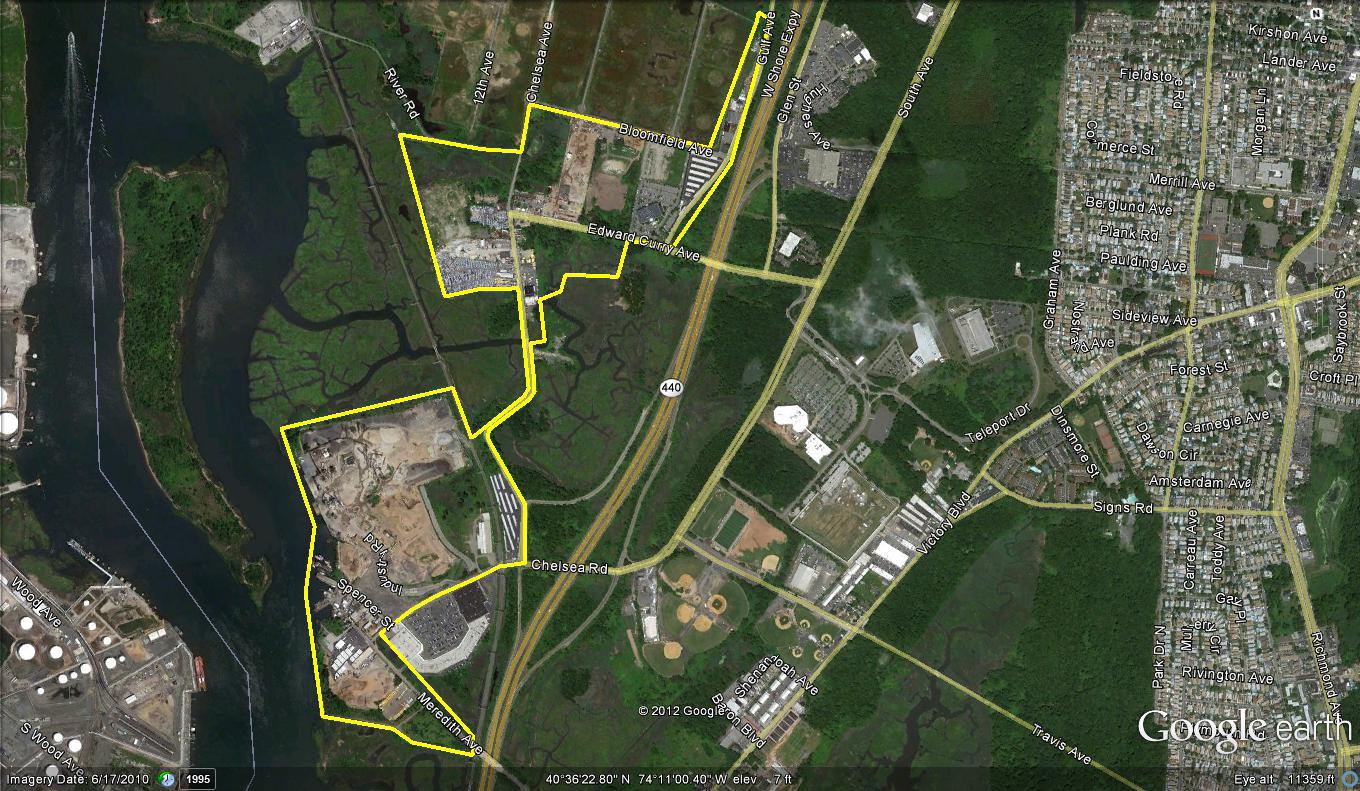

Residents and business leaders are committed to the district and bring strong local knowledge to address safety, perception, and quality of life challenges.
Diverse actors in the Mt. Elliott employment district – residents, business leaders, and community advocates – see the district’s reputation and lack of safety as potential barriers to economic revitalization and jobs creation. As stakeholders expressed their concerns and visions for the district, we developed a fuller understanding of the local context of Mt. Elliott and the major areas of concern surrounding its safety, public perception, and quality of life.
Business leaders and residents expressed concern about the public perception of the Mt. Elliott employment district and the impacts that crime and blight have on local business operations. All businesses interviewed indicated that crime and blight had impacted their businesses and their employees. Local business leaders expressed three major areas of concern for the district:
• Attracting and retaining staff
• Attracting business partners
• Attracting new investment to the district
Some business leaders indicated that many of their workers feel unsafe traveling to work, even
while living in close proximity to their places of employment. Businesses leaders also said that many skilled laborers are not interested in working for their organizations because of the district’s perceived safety threats. Other firms have avoided routing prospective business partners into the district from the south, preferring a northern entrance perceived to be more aesthetically pleasing and less hostile in appearance.
Business leaders suggested that police response times were inadequate to fully respond to property vandalism. They expressed, however, an understanding of the City’s limited police budget and its need to prioritize responses. Nonetheless, businesses in the district have experienced losses due to theft on the scale of hundreds of thousands of dollars in some cases. After costs for raw materials and labor, property insurance rates, driven by crime and area perception, are the largest expenses for some businesses in the district.
Since most businesses interviewed do not identify their presence in Detroit as being within an explicit district or community, their dialogue with community stakeholders has been largely infrequent. Concerns of crime and vandalism in
the district have exacerbated businesses’ security concerns leading to prominent use of razor-wire fencing and minimal community contact beyond some local hiring. While business leaders indicated that the district’s crime is not necessarily rooted in its communities, a lack of interaction and mutual support limits opportunities for problem solving across stakeholder groups.
Community representatives have a mix of experiences with businesses in the district. During the focus group, they suggested that opportunities exist for collaboration with businesses. They do, however, feel that the public perception of the district has led businesses to distrust local neighborhoods. Community block group leaders indicated that communities and businesses have never communicated expectations. They identified this disconnect as a fuel for the negative perceptions of the district. Stakeholders are concerned that the district’s reputation has become rooted in mistrust and security issues rather than collective action and stakeholder support.
To address concerns of district perception, businesses have acted independently to counter vandalism, theft, and illegal dumping. Some of the businesses interviewed handle security incidents on their own and hire independent security staff to patrol their premises. Other Detroit business corridors have hired off-duty law enforcement officers to scale up security efforts on their properties. Business leaders suggested that collaboration and inter-business support through a
business association could be an effective means of uniformly improving the perception of the district. All businesses interviewed expressed their ideological commitment to being in Detroit and being part of the district’s rejuvenation.
Matching the commitment of local businesses to the district, community members expressed broad interest in collaborating to improve conditions in the district. During the focus group, community stakeholders indicated that more active engagement among community members and local businesses might help improve relationships and area perception. Community leaders expressed hopes that businesses could expand their stakes in community partnerships and embrace their presence in the district as being part of a larger community. Community members see expanded collaboration as a prospective remedy to neighborhood problems. They feel that this could lead to quality-of-life improvements in the district.
Supporting the concept of a business association to bolster local economic prospects, community leaders also expressed an interest in having such an association work as a partner with the district’s communities. They would like to see a business association that collaborates with block groups to address key neighborhood development issues. Block group leaders also expressed the importance of an open relationship with economic development stakeholders such as DEGC. Block groups would like to expand opportunities for dialogue and to create a forum to exchange community improvement ideas with economic development organizations.
Collaboration that links businesses and community organizations could serve as an effective means of
overcoming mutual misconceptions and skepticism in the district. We also identified the Detroit Land Bank Authority’s Nuisance Abatement Program, currently being reintroduced in Detroit, as a possible tool to mitigate blight in residential areas
surrounding the district. The Program works with property owners to encourage parcel maintenance, taking blight-mitigating actions when needed.18
In the aftermath of the 2008 economic recession, the Environmental Protection Agency (EPA) issued a report, “Roadmap for Auto Community Revitalization,” to provide local officials a set of recommendations for revitalizing places formerly reliant on the auto industry’s economic contributions. The recommendations included the formation of a multi-stakeholder team to provide location-specific leadership and advocacy. The report showcased Twinsburg, Ohio as a place that employed this technique in response to the closure of a large stamping plant operated by Chrysler.
Upon hearing that Chrysler would close the plant in 2009, the mayor of Twinsburg quickly assembled a task force to address the issue. By 2011, Twinsburg announced that a developer had purchased the site and, with the support of federal and state grants, would create an industrial park with new employment opportunities.
The task force included local businesses, citizens, academics, state economic development officials, federal agency officials, and state and federal elected representatives. Through discussions, the task force
came up with a plan to support displaced workers and repurpose the site.19
The task force method is issue-driven and works particularly well as an entity that can quickly be assembled and then dissolved upon implementing a viable solution. For issues that require ongoing attention, however, a more permanent organizing body would be better suited. The Twinsburg task force demonstrates how collaboration among community stakeholders can address the localized impacts of economic loss following specific events such as the closure of a major employer.
Jobseekers in the district’s neighborhoods, if effectively trained, represent a largely untapped resource for local businesses.
With a variety of employer sizes, the Mt. Elliott employment district remains a major jobs center in Detroit both for the local labor pool and for the metropolitan Detroit area. About half of the businesses interviewed have secured one-third or more of their workforces from areas neighboring the district. Three of ten businesses interviewed have a majority of their workforces living within 10 miles of their facilities. This is consistent with commuting patterns revealed in census data. Focus group members indicated their belief that, in order to increase the rate of hiring of district residents, business owners need more incentives. They pointed to the state-based Community Ventures program as a prospective model for replication.
While businesses in the district hire a mix of skilled and unskilled laborers, multiple business owners indicated at least some desire to see employment opportunities increase for the residents of the district. They also articulated a number of challenges they face in hiring from the district, with residents at times requiring a unique degree of employee support. Businesses indicated that many employees have challenging personal pasts, transportation difficulties, and childcare needs that require a careful balance of personal and work responsibilities. Businesses indicated that their concerns about employees’ personal histories and sometimes-lacking soft skills are drivers of their own challenges in hiring and retaining a committed workforce. While most businesses have engaged
workforce development programs in the past, fewer than half remain actively engaged. Local jobseekers, however, could become a valuable set of employees for the district’s businesses should workforce development services more effectively align with the skill sets that businesses desire.
Workforce development stakeholders highlighted the district’s manufacturing focus and emphasized the large number of information technology jobs available in Detroit relative to the small number of city residents who have the training to fill such positions. Similarly, focus group members called for more training programs in computer- and information-based skills. These groups also want to see training that equips jobseekers with the soft skills that might aid district-area residents to secure and maintain employment.
Business interviews revealed a variety of methods through which local firms have sought to assist their employees with personal and professional challenges and to retain those employees most committed to their jobs. Businesses have considered informal carpool scheduling programs to help mitigate the safety concerns of workers walking to work and the intermittency of public buses in the area.
One business keeps a social worker on staff as a method of assisting employees to manage personal and work responsibilities while maintaining stable employment.
Funding reductions for workforce development programs also have consequences for employers that need workers with certifiable skills in order to meet set quality standards for their products. Stakeholders noted that problems can arise if jobseekers are unclear about or misrepresent their qualifications for related, but narrowly defined, positions such as machinists and machine operators. While both jobs rely on similar skills, the difference between levels of expertise can amount to substantial losses for a firm if a job is performed below standard. As such, effective workforce institutions are those able to match employment opportunities with jobseekers qualified for a position. To do this, workforce institutions need to work closely with employers to ensure that training programs are developed based on precise descriptions of the skills needed for a given firm’s workforce.
The business leaders interviewed expect that future hiring will be based on skills similar to those demanded currently.
The business leaders interviewed expect that future hiring will be based on skills similar to those demanded currently. Many businesses have worked with workforce institutions in the past, but fewer than half of the businesses interviewed currently engage workforce development programs. This highlights the uncertainty of businesses about the preparedness of institution graduates to contribute to their firms. The City’s public school system has also been unable to produce graduates that meet local businesses’ skills needs. Additionally, businesses expressed their own shortcomings in finding an adequately trained workforce. They struggle at times to find people that meet their skills needs and exhibit motivation and interest in working in the Mt. Elliott employment district.
Business leaders expressed reluctance to pay for workforce training, preferring instead to focus on hiring workers already prepared to take on all job requirements. Because businesses in the district are predominantly Tier 2 and Tier 3 firms, with smaller revenue and employment bases than very large manufacturers, they have limited capital to expend on wages being paid to employees not actively producing a product. Business leaders indicated that they are generally averse to funding workforce training services on a large scale. As a result, business owners -- particularly those hiring locally – indicated that they have used the references of existing, reliable employees as avenues for finding new employees, even though this method limits firms’ opportunities to attract the best-trained candidates, at times.
Funding shortages notwithstanding, the workforce institutions interviewed each described the strategies they are implementing to increase employment in the district and in Detroit. In accordance with research findings, these agencies have all adopted an employer-centered approach to their work.20
By focusing on the workforce needs of businesses, these institutions develop training programs and services -- often free of charge or through state-based incentives for local hiring -- that prepare jobseekers to fill existing positions. In addition to equipping jobseekers with the necessary skills for jobs in industries such as advanced manufacturing and information technology, Focus: HOPE and DESC further support jobseekers by coordinating apprenticeship opportunities.
Branded as a partner of the Michigan Works! program, the Detroit Employment Solutions Center (DESC) helps jobseekers and employers connect. As a Michigan Works!-designated organization, DESC receives state and federal funds to link Detroit employers and jobseekers to a network of supportive services, employment data, and resources.
Mt. Elliott jobseekers, whether entering or returning to the workforce, can access DESC services at the three One-Stop Shop Centers located in different parts of the city. Located at 5555 Conner Ave, the
DESC office at the Samaritan Center is the Michigan Works! One-Stop Shop Center that is closest to the district. It is co-located with other employment and social service providers. Jobseekers can discover new hiring announcements, apply for open positions, learn about in-demand skills for leading industries, develop both basic and sector specific skills, and receive oneon-one career counseling. The office is open Monday through Friday from 9:00 a.m. to 5:00 p.m. Upcoming recruitment events are posted on the “Jobseekers” page of the DESC website (http://www.descmiworks. com/). The calendar includes the date, time, location, and description of positions for which recruitment is taking place.
Supplementing the services offered at the One-Stop Shop Centers, DESC has a number of Neighborhood Access Points embedded in community- and faithbased institutions. Designed to offer job-seekers convenient access to employment services within walking distance, these centers are equipped with computers that contain DESC’s job search databases and information about the full services offered at the One-Stop Shop Centers.
The businesses we interviewed identified some of the challenges that Detroit jobseekers often face. These challenges are often related to a lack of reliable transportation, difficulty in finding childcare, and inexperience in a job setting. Though significant, these challenges could be overcome by expanding internal efforts to offer employee support -- like enlisting the help of a social worker -- and the external soft skills efforts of workforce institutions.
Detroit’s workforce institutions already support their students in developing soft skills -- whether arriving to work on time or dressing in professional attire -- that are crucial to a future of stable employment. Social workers provide support that makes it possible for many jobseekers to complete training programs and to find and maintain employment. These services have, at times, included childcare and transportation vouchers. Connecting workforce training to district residents at an early age, workforce institutions also articulated the importance of the youth training initiatives currently taking place in schools and training programs across the city. One notable example is Focus: HOPE’s College Bound, Career Ready program through which high school students spend half of each school day at Focus: HOPE building a strong foundation in science, technology, engineering, and mathematics, while pursuing training in machinist or information technology skills.
While an expansive effort, training and preparation programs for low skill jobseekers do not always lead to more local hires.20, 21 With a wealth of program graduates spanning training disciplines, this fact suggests that many Mt. Elliott firms are missing important opportunities to benefit from the skills and assets of local jobseekers. These
missed hiring chances are likely driven by the past experiences businesses have had after hiring workforce graduates who were unprepared for their workplaces. Business leaders expressed a general distrust of inexperienced workers and articulated the importance of hiring jobseekers who are both prepared to contribute and committed to reliable attendance. Businesses also indicated that, while a jobseeker’s skill set is the key criterion for a hiring decision, it is sometimes difficult to find workers who will reliably show up to work, no matter one’s degree of skill.
Understandably, many Mt. Elliott business owners are reluctant to hire local jobseekers because they have committed to them in the past with unsatisfactory results. However, local jobseekers represent a potentially valuable asset to Mt. Elliott businesses. Training institutions like Focus: HOPE are eager to prepare jobseekers for the specific positions that businesses are looking to fill. Additionally, hiring locally has the potential to relieve some of the transportation barriers that workers face, particularly the attendance risks of hiring workers with long commute times.
Social workers provide support that makes it possible for many jobseekers to complete training programs and to find and maintain employment.
While businesses approach growth and workforce interactions in a variety of ways, one business in the Mt. Elliott employment district has identified workplace respect and employee support as critical elements that drive high rates of attendance and high productivity among employees. Originally considering a mix of locations for its establishment, Detroit Chassis -confident that a high performance workforce could be developed locally -- chose the district as means of demonstrating that business and labor could collaborate efficiently to run a successful Detroit-based operation.
Understanding that people visit the district with preconceived notions about the area’s safety and conditions, Detroit Chassis seeks to incorporate community elements and reflect community pride into its presence in the district. These innovative methods include addressing how it manages security
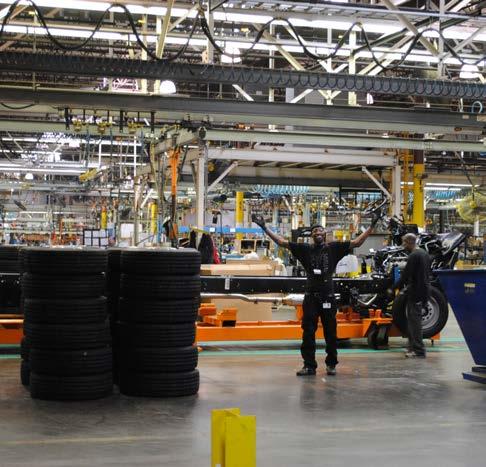
at its facility and how it works with its employees. Leveraging a mix of resources and incentives, a staffed social worker serves as a key supporter of Detroit Chassis’ employees. With workers coming from a mix of challenging backgrounds, with concerns for transit to work, childcare responsibilities, housing, and other personal challenges, the in-house social worker provides individualized support to employees, reinforces a culture of mutual respect in the workplace, and helps Detroit Chassis achieve attendance rates among the highest of any manufacturer its size.
Collaborating with workforce development programs, Detroit Chassis has given oft-overlooked employees a chance at employment, hired a large portion of their employees from neighborhoods within the district, and offered the support necessary for employees to feel empowered and embraced by their employer.23
Workforce institutions offer many services, but they need stronger bonds to support job creation and economic development at a large scale in the district.
During our interviews, workforce institutions consistently articulated the importance of partnerships with other institutions. These partnerships are central to their efforts and allow them to leverage the strengths of each respective partner institution for the collective expansion of workforce programs. For example, Workforce Intelligence Network (WIN) focuses on convening partner institutions and gathering and sharing data, while institutions
Focus: HOPE is a nationally recognized organization with a mission to address “hunger, economic disparity, inadequate education, and racial divisiveness” in Detroit.24 As part of its mission, Focus: HOPE offers job training programs built around skills that industrial businesses require of their employees, including basic skills and life skills. At its training facility just west of Highland Park - the closest of its training centers to the district - students are trained on a range of equipment and mechanical systems that are similar to ones they would use at many business facilities in the district. Focus: HOPE offers services to all jobseekers and businesses in Detroit. Although Mt. Elliott is the third largest employment district in Detroit, Focus: HOPE does not currently provide training programs specifically targeting the district.
Focus: HOPE maintains relationships with many businesses and works to adapt its training programs to meet businesses’ workforce needs. The organization
such as Focus: HOPE work to tailor their training programs to better fit workforce needs and support participants to graduate and find work.
While these partnerships are a major asset for the work that these institutions do, they also represent a complex and often confusing web of relationships and services. We investigated each organization’s network with other workforce institutions in

also helps businesses connect with graduates who may be a good match for open positions. Focus: HOPE identified transportation as among the most pressing issues for jobseekers in the district; public transit between Focus: HOPE and the Mt. Elliott employment district is often unreliable and inefficient.
No institutions had an organizational document describing the role of each agency or the nature of their relationships.
Detroit and asked about their relationships with these groups. No institutions had an organizational document describing the role of each agency or the nature of their relationships. Many suggested that a document mapping institution networks in Detroit could be useful. While no institutions interviewed had organized their relationships within the City of Detroit, the Detroit Jobs Alliance does have an interactive web-based tool allowing for workforce institution searches. All organizational leaders interviewed acknowledged that many groups are involved in workforce services and that keeping track of these institutions and the services they provide is an ongoing challenge. If such an organizational task poses a challenge for workforce institutions themselves, businesses and workers likely have little awareness of the scope of workforce development services in the city. We have created a matrix listing major workforce institutions in the city (aPPendix Pm-7) and a graphic depicting relationships among these institutions (Figure F-5).
Business interviews and the focus group confirmed the lack of awareness and connection to active workforce
institutions among firms and residents. Businesses have engaged workforce training programs with varying rates of satisfaction, with the highest degree of participation having occurred in the past. Their partner workforce institutions ranged from community colleges to nonprofits such as Focus: HOPE. Few businesses have current arrangements with workforce institutions, with most existing partnerships driven by incentive opportunities and the need to retain skilled workers.
Institutional stakeholders indicated that, with so many organizations providing workforce services in the City, there is some duplication of services. While duplicate services might be necessary to meet a large scale need, it is also possible that these services are, at times, redundant. Stakeholders identified external evaluation as important to improving workforce institutions and their linkages. With so many institutions offering training, placement, and other jobs services, it is difficult for institutional partners, businesses, and workers to know which institutions are most effective at providing certain services. Each institution may successfully provide a given service, but this service may not be appropriate for all jobseekers or businesses. External evaluation could help to clarify what role each institution plays best.
It is difficult for institutional partners, businesses, and workers to know which institutions are most effective at providing certain services.
F-5: Relationships among organizations in the Detroit workforce ecosystem
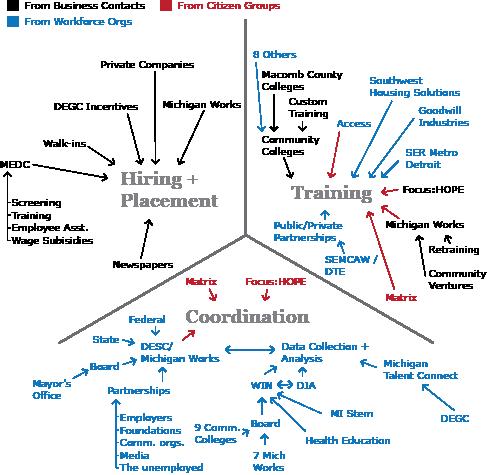
Since the financial situations of the businesses interviewed have stabilized since the recent recession, businesses in the district have also seen their employment levels stabilize. Some expect slight increases in hired staff and expect that future hiring will emphasize
the same mechanical skills currently sought, with an additional desire for employee reliability. Many of the skills expected of employees in the district include the operation of mechanical equipment, whether welding, operating press brakes, inspecting for quality, driving forklifts, or working on an assembly line.
National trends show a decline of more than 70 percent since 1979 in federal spending through the Workforce Investment Act.
Linking workforce institutions to firms that are hiring is challenging for the district’s stakeholders. Businesses have had some struggles in finding an adequately trained workforce with both technical skills and soft skills. With attendance a major issue for employers running near-constant manufacturing lines, businesses expressed concern about the preparedness of workforce institution trainees to meet attendance requirements.
Striving to grow a more robust understanding of linkages among workforce institutions, we represented existing relationships in Figure F-5. With a degree of economic stabilization in the district, and the prospect of some future hiring, strengthening relationships among workforce institutions could position these institutions – with their strong knowledge of the district’s labor base – to advance job opportunities for residents in the Mt. Elliott employment district.
Intricacies within Detroit’s expansive network of workforce institutions are further complicated as employment services organizations compete over a shrinking pool of available funds. One workforce development stakeholder that we interviewed estimated an annual decrease in federal funding of 15 percent over recent years. This reflects national trends showing a decline of more than 70 percent since 1979 in federal spending through the Workforce Investment Act.25 Stakeholders also identified, as a secondary factor contributing to tighter budgets, a shift in philanthropic support away from workforce programs and towards high-profile investments in Detroit.
Some training providers have reduced the length and depth of the courses they offer. Workforce trainings are often expensive and require large facilities. Some organizations have recently adjusted course lengths and content for their information technology and machinist certificate programs to match new, lower levels of funding. A training for information technology support roles, for example, was reduced from 31 to 15 weeks and now prepares graduates to pursue entry-level rather than mid-level positions in that field. A machinist course, which is 12 weeks in length, has shifted in recent years from preparing skilled machinists to graduating competent machine operators.
The difference between a skilled machinist and an adequate machine operator -- or a program graduate receiving 31 versus 15 weeks of technical training -- has important implications for jobseekers in terms of their earnings potential and employment opportunities. Michigan is among the top five states with the highest number of machinists employed, with machinists earning an annual average wage of $41,110. Machine operators on average earn $10,000 less and are much less versatile in their skill sets, narrowing the number of positions for which recently trained jobseekers might be eligible.26
The difference in earnings potential between an abbreviated information technology course and its more in-depth counterpart is even greater than disparities between machinist roles. There are, however, far fewer jobs expected to require the advanced skills taught in a longer-term information technology course. The national average annual salary for an entry-level customer service specialist was $30,580, with nearly one million available jobs projected in 2012 for the United States. The annual salary for an information technology technical support specialist -- a mid-level position -- was $46,420, with just under 200,000 jobs projected in 2012 for the United States.27, 28
Our findings reflect the viewpoints and experiences shared by a wealth of stakeholders in the Mt. Elliott employment district and the city of Detroit. Many district stakeholders have active initiatives focused on addressing the challenges they face. These various stakeholder efforts have the potential to be replicated and applied throughout the district to strengthen its economic and employment prospects. We identified a wealth of committed actors – business leaders, residents, and workforce trainers – who see much opportunity to leverage Mt. Elliott’s real estate, business, labor, and strategic assets. Challenges remain, however, in expanding successful initiatives and addressing remaining concerns like security, perception, incentives, and city services.
Through our research, we found that Mt. Elliott already contains many elements that, if replicated, could contribute to the district’s revitalization. Real estate stakeholders are seeking to improve information on local real estate to strengthen business attraction efforts where incentives have attracted only limited investment. Businesses in the district are generally stable or growing, and they identify Mt. Elliott’s location and available land as key assets of the district. Building upon these assets, opportunities exist to connect businesses across industries and to improve their relationships with the City.
Community and business leaders also have strong knowledge of local issues that can be used to build partnerships and address the district’s challenges. Furthermore, local jobseekers are a resource that, if effectively trained, could become valuable to businesses in the district. Workforce institutions could be better connected to leverage the district’s jobseekers as a local resource and to contribute to
continued economic growth and job creation in Mt. Elliott.
Building off these findings, the following “Recommendations” chapter of Forging a Future – our recommended actions – suggests ways that district stakeholders can collaborate to overcome challenges and to move toward a strengthened industrial corridor in Mt. Elliott.
1. Tracie Tillinger, phone interview by Myles Hamby, 28 March 2014.
2. Andrew McCloskey, interview by James Carpenter, 28 March 2014.
3. Michigan Office of the Auditor General, Michigan Economic Development Corporation, Performance Audit of the Renaissance Zone Program, by Thomas C. Tavish CPA, Auditor General (Lansing, Michigan, 2013), 17.
4. Detroit Land Bank Authority, “Priorities and Policies for Property Acquisition and Disposition As approved by the Board of Directors,” (Detroit, MI, 2013), 1.
5. Land Bank Fast Track Act, State of Michigan Code 258 (2003), section section 124.751 et seq.
6. Detroit Land Bank Authority, “Priorities and Policies,” 3.
7. Ibid., 7.
8. Ibid., 9.
9. Land Bank Fast Track Act, section 124.756.
10. Ann Markusen, “Sticky Places in Slippery Space: A Typology of Industrial Districts,” Economic Geography, (1996): 73.
11. Ibid., 298.
12. Lynch et al., “An Industrial Strategy for the City of Detroit” (working paper, Initiative for a Competitive Inner City, 2014), 23, 29, 49.
13. Markusen, “Sticky Places,” 298.
14. Metro Vancouver Metropolitan Planning, Environment and Parks, “Discussion Paper: Best Practices for the Intensive Use of Industrial Land, “(Vancouver, 2012), <http://www. metrovancouver.org/planning/development/EconomyIndustrialLands/EconomyIndustrialDocs/BestPracticesfortheIntensiveUseofIndustrialLandDiscussionPaper29Oct2012.pdf> accessed March 13, 2014.
15. Lynch et al., 18.
16. “NYC Industrial Business Zones,” New York City Economic Development Corporation, accessed February 20, 2014, http://www.nycedc.com/industry/industrial/nyc-industrial-business-zones.
17. West Shore Industrial Business Improvement District, “West Shore Industrial Business Improvement District: Vision Plan,” Staten Island Economic Development Corporation, accessed February 21, 2014, http://www.wsibid.org/vision-plan.html.
18. Michael Brady, interview by Cassie DeWitt, Myles Hamby and Elizabeth Treutel, 3 March 2014.
19. Environmental Protection Agency (EPA), “Roadmap for Auto Community Revitalization,” (2013). <http://www.epa.gov/ brownfields/pdfs/draft-roadmap-toolkit.pdf> Sep. 18, 2013, 24-25.
20. Elsie Harper-Anderson, “Measuring the Connection Between Workforce Development and Economic Development,” Economic Development Quarterly, 22 (2008): 119.
21. Margaret Dewar, “Paying Employers to Hire Local Workers in Distressed Places,” Economic Development Quarterly, (2013): 27.
22. Greg Schrock, “Reworking Workforce Development: Chicago’s Sectoral Workforce Centers,” Economic Development Quarterly, (2013): 27.
23. Michael Guthrie, interview by Kevin Shelton and Brian Smyser, 12 February 2014.
24. “Focus: HOPE,” Focus:HOPE, accessed April 20, 2014, http://www.focushope.edu.
25. “Workforce Development,” The Urban Institute, accessed March 13, 2014, www.urban.org/work/job.cfm.
26. U.S. Department of Labor, Bureau of Labor Statistics, “Employment of Machinist, by State: Occupational Employment and Wages,” May 2013, accessed April 23, 2014, http://www.bls.gov/oes/current/oes514041.htm#st,
27. U.S. Department of Labor, O*Net Online, “Summary Report for 43-4051.00 - Computer User Support Specialists,” 2013, accessed April 29, 2014, http://www.onetonline.org/link/ summary/43-4051.00.
28. U.S. Department of Labor, O*Net Online, “Summary Report for 15-1151.00 - IT Technical Support Specialists,” 2012, accessed April 29, 2014, http://www.onetonline.org/link/ summary/15-1151.00?redir=15-1041.00.
A. Team photo.
B. Detroit Economic Growth Corporation, Costar Realty Information, (2014), 7 March 2014.
C. Detroit Assessor Data [computer file], Detroit, Michigan: City of Detroit Assessor’s Office, 2012.
D. Detroit Assessor Data [computer file], Detroit, Michigan: City of Detroit Assessor’s Office, 2012.
E. Detroit Future City, Detroit Future City: 2012 Detroit Strategic Framework Plan (Detroit: Inland Press, 2012), 20.
F. Detroit Assessor Data [computer file], Detroit, Michigan: City of Detroit Assessor’s Office, 2012.
G. East Brooklyn BID, http://www.eastbrooklynbid.org/home. html.
H. West Shore Industrial Business Improvement District, “West Shore Industrial Business Improvement District: Vision Plan,” Staten Island Economic Development Corporation, accessed February 21, 2014, http://www.wsibid.org/vision-plan.html.
I. The Plain Dealer, accessed May 10, 2014, http://www. cleveland.com/business/index.ssf/2011/07/former_chrysler_ twinsburg_stamping_plant_sold_to_developers.html.
J. “Detroit Employment Solutions Corporation,” last modified 2014, http://www.descmiworks.com/.
K. Team photo.
L. Team photo.
M. “Focus: HOPE,” Focus:HOPE, accessed April 20, 2014, http://www.focushope.edu.
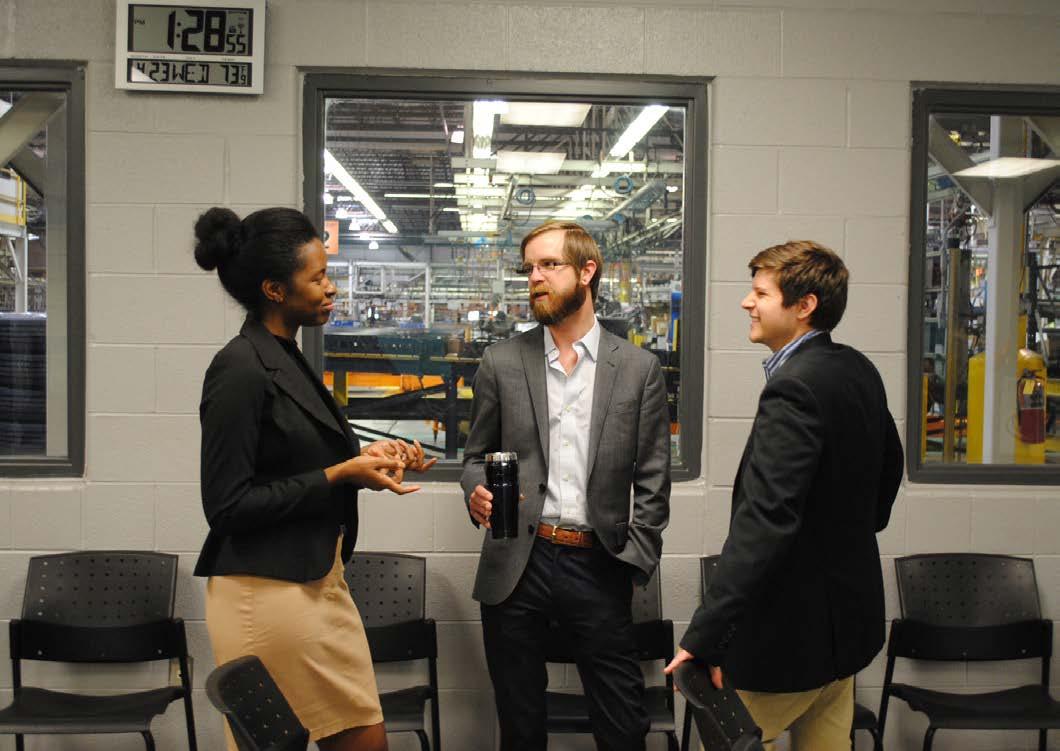
through a careFul synthesis of our findings and a review of the district’s current conditions and relevant literature, our project team formed a set of recommendations. These recommendations present action-oriented, realistic opportunities for organizations working in the district to make physical and institutional improvements for Mt. Elliott stakeholders. We hope they can build a strategic foundation for the district to retain, grow, and attract businesses; create quality jobs; and connect available workers to opportunities. The following sections describe these recommendations, which are followed by an implementation chart that outlines a time frame for next steps.
Though the Mt. Elliott employment district possesses a range of assets, it suffers from a lack of targeted resources and coordination to leverage those assets for economic development and job growth. We believe establishing a location-specific team that is intimately familiar with the assets and limitations of the Mt. Elliott employment district could help it become a stable, productive industrial center that provides jobs for Detroit residents. To address the urgent needs that we have identified within the district, we suggest that DEGC and other partner organizations jointly staff and fund an economic development team for the employment district, hereinafter referred to as the “district team.” The district team could help develop a unifying identity for the district, promote its assets, advocate on behalf of the district’s businesses and residents to improve City services, and assist in connecting local jobseekers to district businesses.
Three main functions for the district team could include:
1. real estate facilitator
2. business collaboration coordinator
3. workforce liaison
Each of these roles is connected and interdependent; therefore, we imagine that the individuals who would fulfill these roles would work together closely. Ideally, they would work in an office(s) located within the employment district, where they could most easily interact with developers, businesses, and the workforce. Locating the team within the district would demonstrate a high level of commitment to its success, reinforce connections, and build a sense
of dependability and trust between the district team and district stakeholders.
We propose that, in order to sustain the functions performed by a fledgling district team, these roles eventually become part of a business association, perhaps after operating under the support and guidance of DEGC and partner organizations for a few years. We envision that a business association would be independently funded and staffed and operate as a nonprofit organization. As a nonprofit, the business association would be able to receive funding from public, private, and philanthropic organizations.
A district team would fill a gap in the existing efforts aimed to bolster economic development in the Mt. Elliott employment district. Discussions with individuals from the various public and private organizations involved in developing the district suggest that these entities may lack the capacity to adequately support the development of the district’s economy.
In Mt. Elliott, DEGC staff work to attract and retain industrial businesses, connect industrial businesses to workforce resources, monitor the City’s portfolio of properties, and facilitate companies’ real estate acquisition processes.1 However, DEGC also provides these services for the entirety of Detroit’s industrial sector in manufacturing, automobile, defense, and renewable energy, amongst others. The number of staff hours
dedicated to Mt. Elliott may be insufficient to meet the comprehensive real estate, business, and workforce development needs in the employment district.
A district team is also needed because, as noted in “Findings,” the district currently lacks a coordinating organization that can strategically tackle local issues and advocate for services to be provided by the City. Individual businesses have neither the financial nor personnel capacity to provide the services needed to address public safety and other issues in the district.
The district also lacks a workforce development strategy that responds to the needs of businesses and jobseekers. Detroit Employment Solutions Corporation (DESC) has an office located near the Mt. Elliott employment district’s boundaries that provides resources and support for jobseekers. DESC also has staff dedicated to building relationships with firms throughout the city and across all economic sectors. Given the high concentration of manufacturing employers in the district and the complexity of workforce challenges, we believe Mt. Elliott would benefit from a targeted workforce strategy that could be pursued by the proposed district team. One of the team’s purposes would be to connect businesses to relevant resources offered by DESC and other workforce institutions.
Our proposal for a localized district team gains credibility from “An Industrial Strategy for the City of Detroit.” The report calls for a city-wide “one-stop shop” to provide resources to businesses, which could build upon several district-level coordination efforts already taking place in various locations in the city.2 These kinds of neighborhood-level efforts can be seen in the work done by
the Downtown Detroit Partnership, Eastern Market Corporation, Grandmont Rosedale Development Corporation, Jefferson East Inc., Midtown Detroit Inc., and Southwest Detroit Business Association (SDBA), among others. The SDBA Spotlight presents a detailed review and analysis of the work done by the SDBA; we believe this organization could provide a model for a future business association in the Mt. Elliott business district.
Without a local champion institution, the Mt. Elliott district lacks a coordinating advocate to push the district’s agenda forward. While the district certainly benefits from the community organizing efforts of various block clubs and community development organizations, a geographically-based organization has yet to take responsibility for the economic development of the Mt. Elliott employment district, whose employees comprise the third largest workforce among the DFC employment districts.
We believe establishing a location-specific team that is intimately familiar with the assets and limitations of Mt. Elliott could help it become a stable, productive industrial center that provides jobs for Detroit residents.
Detroit Future City has designated Southwest Detroit as an employment district specializing in the Global/ Transportation, Distribution and Logistics (TDL) industries. In addition to light to heavy industry, the area also hosts small retail, restaurant, and commercial businesses. The Southwest Detroit Business Association (SDBA) serves as a community and economic development body for the district and manages a Business Improvement District (BID)--a geographically defined area wherein businesses pay an additional assessment to fund beneficial projects--to address dwindling City services.3
Streetscape project
After raising $6.3 million in public and private investment, in April 2014 SDBA began construction on 2.3 miles of street improvements along a major commercial and retail corridor. The improvements include new LED lighting and light poles, underground wiring, sidewalks, and landscaping.4
SDBA also assists businesses in garnering funds for facade improvements and ensuring businesses meet exterior code requirements. These efforts promote safety and beautification which support and attract residents, businesses, and customers.5
SDBA has been a lead advocate for local businesses and residents seeking employment opportunities in advance of the New International Trade Crossing bridge construction project connecting Detroit to Windsor, Canada. SDBA partnered with the area agency, Michigan Works!, to host a job fair marketing apprenticeship and employment opportunities related to the project.6
SDBA sponsored an advisory panel led by the Urban Land Institute (ULI) which brought together national experts in real estate and urban design. These experts conducted a market study to explore strategies to redevelop a 6.9-acre site at the mouth of a very busy intersection. The findings from the study identified a $100 million gap in the retail market which supported their proposal of a 25,000 square foot retail center development.7
Established in 2007, the West Vernor and Springwells BID was the first of its kind in Michigan. The BID provides a range of services that help area businesses and keep the community a safe, attractive place to live and shop. These services include police patrol, street cleaning, graffiti removal, litter baskets, and landscaping.8
SDBA consists of a small staff of full-time employees and interns, a board of directors, and a BID board. As a nonprofit organization, SDBA is eligible to receive grants. SDBA draws membership from over 100 area businesses and community organizations.9
SDBA shows how a business association can successfully address real estate, business, and community needs and workforce development issues. Additionally, SDBA offers tangible examples of the benefits of businesses working collaboratively and sharing resources. Establishing a business association can help to create a district identity, advance an advocacy agenda, and strengthen partnerships across stakeholder groups. A BID allows neighborhoods to tackle shared and recurrent problems by pooling financial resources.
We believe that a district team solely dedicated to this geographical area will most effectively support the development of the Mt. Elliott employment district’s economy. If political and resource limitations prevent the creation of such a team, DEGC and other organizations could collaborate to discuss how to perform the roles we have suggested – real estate facilitator, business collaboration coordinator, workforce liaison – with their current capacity and personnel. The roles we present could be performed by staff members of various organizations.
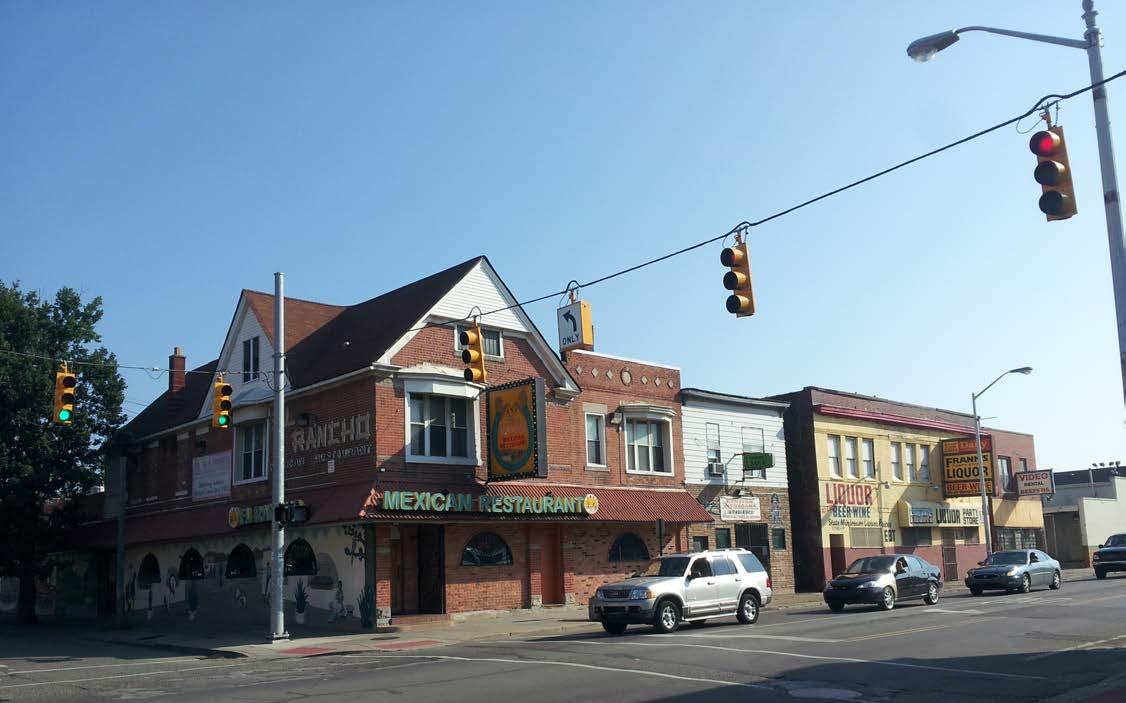
The main task associated with the real estate facilitator would be to match businesses with appropriate industrial properties. To help a user acquire property, the role of the facilitator or staff -- two words we will use to refer to a person or a percentage of a person’s time, depending on how this role is implemented -- would be to manage potential environmental remediation projects, assist developers with permit approvals, match companies with relevant incentives, and work with the Detroit Land Bank Authority when appropriate. A closely-related effort could be to help acquire, develop, and activate City-owned property to maximize its employment density. We have highlighted five development prospects in the district – three in the northern node and two in the central node, which are detailed in aPPendix r-1 of this document. Section 1.4 below describes a plan for the southern node which focuses on blight abatement, residential safety, and improving aesthetics in order to complement DEGC’s work on the I-94 Industrial Park. A facilitator could help carry out such strategies and keep associated data updated.
As mentioned in Finding 1 (in “Findings”), the cost to build an industrial structure is often higher than the appraised value determined soon after
construction ends. Similarly, a price gap can arise when a building is sold for a different use than for which it was built. The failure of a building to hold its value during appraisals in the Mt. Elliott employment district – but also in Detroit at-large – deters investment. Our research findings indicate that organizations working to develop the district currently lack sufficient knowledge and awareness of the appraisal process, specifically for industrial land.
A real estate facilitator could become familiar with the process of appraising industrial property and with the appraisal needs of the Mt. Elliott employment district. The facilitator role could include these primary tasks:
• Serve as an expert on the general appraisal process and the protocol for determining the market value of industrial properties. Conducting a regional- and national-scale study of properties comparable to those within the Mt. Elliott district would support these efforts, since industrial appraisals favor function over location. This extra knowledge will help the facilitator challenge inaccurate appraisals on an as-needed basis.10
• Recommend future uses of properties to prevent under- or over-valuing a building sold for a different use than for which it was built.
• Establish a relationship with one or two trusted appraisal firms. This could help ensure consistency for industrial appraisals in the Mt. Elliott employment district.11
The Detroit Land Bank Authority (DLBA) is actively pursuing new strategies for the rehabilitation of vacant and tax-foreclosed property. The DLBA works to expand options for land acquisition, check the financial backgrounds of prospective purchasers of land, ensure clear title for purchasers, and centralize land bank efforts within the City of Detroit.12
One task associated with the facilitator role would be to form a partnership with the DLBA to acquire vacant and tax-foreclosed properties and assist businesses in acquiring real estate from the DLBA. This partnership could help to quicken the process of transferring possession of a property to an industrial end-user. Local knowledge of the district would be useful in identifying properties that the land bank could acquire and manage until a suitable business is found to develop the property.
Working with businesses seeking to acquire DLBA-owned real estate could open up many new opportunities for development. Familiar with the procedure and requirements to acquire a DLBA property, staff could prepare paperwork and generally advise a prospective business through the
acquisition process.
We chose three distinct nodes to target our real estate research and recommendations. Development within each node could stabilize the economy of the node, retain current businesses, and provide positive spillover effects to the district as a whole.
A task of the facilitator could be to investigate the ownership status of 2014 tax foreclosure candidates in the northern and central nodes, as these properties may qualify as good candidates for DLBA acquisition. If the property owner facing foreclosure does not wish to maintain control of the property, staff could be valuable in communicating with DLBA about acquiring this property. However, if the owner does wish to retain ownership and pursue a productive use of the property, staff could assist this owner in maintaining ownership status. The parcel information memorandum located in aPPendix r-2 includes a table identifying which properties in the I-94 industrial park area currently face tax foreclosure.
In the northern and central nodes, a facilitator could help match properties with end-users. It is essential to match building and land characteristics with industrial users that would find them most favorable and, therefore, pay the most competitive price. Strategic match-making also prevents underutilization, maximizes employment density per acre, and protects appraisal values.
The following list outlines preparation guidelines for marketing a property to potential end-users:
• Understand zoning restrictions
• Assess location and transportation infrastructure
• Identify appropriate property or properties
• Research building and/or land attributes
• Assess potential environmental remediation concerns
• Gather property ownership information
• Research regional industry clusters and possible linkages within those clusters
• Match property with possible industry or industries
• Estimate and analyze employment density per acre
• Find potential tax incentives and other financing opportunities
• Develop property information packets
These steps are part of an iterative process in which some steps could come before or after others. The publications “Characteristics of an Industrial Site” and “Roadmap for Auto Community Revitalization” include several of these steps as advice for attracting industrial manufacturers.13 We added one important guideline to these reports: assessing the employment density per acre potential. This parameter, from ICIC’s “An Industrial Strategy for the City of Detroit,” provides a reasonable way to measure industrial land’s “intensity of use.”14
These steps informed our development of property information profiles for five key sites in the northern node and three key sites in the central node. “An Industrial Strategy for the City of Detroit” served as a key resource in matching
properties with appropriate industrial sectors.15 aPPendix r-3 contains a brief summary and justification for choosing each of the eight sites. aPPendix r-1 contains property information packets that could be used to develop a targeted marketing strategy to reach out to particular businesses.
Our recommendations for the southern node aim to complement DEGC’s efforts to assemble the I-94 Industrial Park, increase safety in the residential neighborhood, and eliminate blight and dangerous buildings, thereby transforming the node into a more attractive place for current businesses to remain and to attract new businesses.
DEGC is working to assemble the remaining parcels of the I-94 Industrial Park. As of January 2014, DEGC lacked control of about 20 parcels out of nearly 1,400, which are already assembled.16 Of the remaining parcels, we identified eleven 2014 tax foreclosure candidates for which we recommend DEGC investigate the ownership status. See aPPendix r-2 for a list of these properties. Another buyer’s acquisition of these properties through the Wayne County foreclosure auction could delay the
development of this land. With the support of a facilitator, DEGC could contact the Wayne County Treasurer’s Office and chart a course of action to bring these properties under the control of DEGC.
One of the district’s short-term needs is to incorporate a green buffer zone, about 20 to 30 feet in width along the west side of Mt. Elliott Street, extending as far north as Brockton Street and as far south as Miller Street, with the exception of any active businesses and the small playground. DEGC or the City of Detroit would need to take ownership of the parcels along the west side of Mt. Elliott Street so that it could clear the area of dilapidated structures and install the natural buffer.
This buffer zone would mitigate the blight on parcels along Mt. Elliott Street, increase attractiveness to industrial tenants, and provide a natural and mutually beneficial barrier between residential and industrial uses. A local landscape architect could offer specific vegetation and design options that consider pedestrian safety and environmental sustainability.
The residential neighborhood north of Domine Street, west of Mt. Elliott Street, and east of the railroad track lacks residential density and includes a number of residential structures that are burnt, dilapidated, or abandoned. An effective strategy to address the residential blight in this area would be to repurpose the residential neighborhood as “blue/ green infrastructure,” effectively transitioning the
“buffer” into an area with vegetation. This recommendation comes directly from DFC’s 50-year land use plan. DFC defines “blue infrastructure” as a landscape feature that captures and holds storm water and “green infrastructure” as a farm or forested area.17
The high vacancy rates and undesirable location between industrial use and a large rail yard make it unlikely that this neighborhood will be repopulated. Additionally, if businesses locate to the I-94 Industrial Park, air and noise pollution could compromise the health of neighborhood residents. Repurposing the neighborhood would require the City to gradually assemble the parcels, clear the land of its structures, and install the blue/green infrastructure. This plan could effectively increase the safety and quality of life of the remaining residents as the land transitions away from residential use.
The installation of both the green buffer and green/blue infrastructure require the demolition of structures and necessitate that the City obtain control of parcels. The DLBA can serve as a support to realize these goals. The facilitator could work with the DLBA to acquire possession of the parcels in this area, clear the land of the structure, transfer ownership to the City, and facilitate the process of repurposing the land for blue/green infrastructure.
The main purpose of the business collaboration coordinator would be to support existing businesses to remain and expand in the district. The staff person associated with this role could enable advocacy, assist with resource sharing and coordination, identify opportunities for new business-to-business relationships, foster a shared district identity, and, eventually, transform a district team into a permanent, self-sustaining business association.
While many of the business leaders we interviewed expressed deep commitment to Detroit and to remaining in the district, dissatisfaction with some City services – particularly security and road maintenance – was nearly universal. To address this complaint, staff could advocate for cost compensation programs for businesses, advocate for stronger City services, and help businesses use incentives.
Some of the businesses we interviewed indicated that they pay for services that they expect the City to perform, such as snow removal. A cost compensation program would minimize costs incurred
by these businesses. The program would include a “low-service area” designation, in which planning officials determine the geographic boundaries where the quality of municipal services falls below a predetermined threshold. Officials would then select eligible services such as snow plowing, pothole repair, or security to determine what percentage of “business-provided” services might count towards a given business’s tax burden.
The compensation program is meant to be a short-term solution aimed towards strengthening relationships between the staff coordinator and businesses. Based on the City’s financial state, businesses will likely not be fully compensated for the cost of business-provided services. While the monetary value of the compensation program to businesses may be minimal, businesses may see the program as an accomplishment and be more likely to support future district team efforts, such as the formation of a business association.
Our interviews with business owners indicated that City services, such as proper lighting, trash removal and visible police service are as important, if not more important, as any tax incentive that may be available to a business. City services, when active and efficient, make the area more desirable and livable to current and prospective businesses and residents. We believe that getting input from
businesses is a key component to advocating for better services.
Our findings indicate that some monetary incentives go untapped due to businesses’ lack of information and discomfort with the complex application process. The coordinator staff could serve as a communication line between businesses seeking incentives and the organizations that provide incentives, including the Detroit Land Bank Authority, the Detroit Brownfield Redevelopment Authority, and the Michigan Economic Development Corporation. Staff support would be
valuable for businesses in all stages of the complex incentive process. In addition, the person in the business coordinator role would be well-positioned to give valuable feedback to the incentive sponsors.
Finally, we envision new incentives that attract businesses focused on environmentally sustainable products or production practices; currently, the district lacks a focused strategy to attract such businesses.
See the Spotlight on New York’s “Green Zone” and on “Eco Industrial Parks” for examples of places seeking to attract sustainable businesses. Further research on these projects happening in New York and around the country could help to determine what practices would be most applicable to the Mt. Elliott employment district.
In New York, the Staten Island Economic Development Corporation (SIEDC) is currently working to create a “Green Zone” designation for a 5,000+ acre site in Staten Island’s West Shore to specifically target businesses that produce environmentally sustainable goods and services. Their strategy is to develop a cluster of green businesses to increase Staten Island’s competitiveness in the green market. SIEDC developed legislation to provide 30 percent tax credits to companies located within the Green Zone. New York State has yet to approve the bill, but the bill has received endorsement from several legislators. Other tax credits are set to accompany SIEDC-constructed incentives. The Governor’s Regional Council Initiative, for example, allocated 1.6 million dollars to companies that invest in this Green Zone.18
In addition, several cities around the United States have constructed “Eco Industrial Park” sites to foster cluster development of businesses with a focus on environmental sustainability.19 In California, for example, a Native American tribe set up a “Resource Recovery Park” to utilize biomass to generate electricity and recycle used tires.20
Business interviews revealed that, while many businesses and their products are embedded within the supply chains of only one sector, opportunities exist for the products and services to cut across sectors. Such supply chain diversification would expand the businesses’ consumer bases and grow the district’s economic assets. A coordinator could identify and help diversify the supply chain portfolios of businesses in the district by facilitating information sharing.
Our interviews also demonstrated that opportunities exist for businesses – whether focused on aerospace, automotive, logistics, or defense clients –to connect their supply chains and meet the product and service needs of other businesses in the district. Cross-sector links among business supply chains in the district are few, so opportunities for growth from expanding business synergies could be large.
Emerging opportunities for energy-efficient and self-driving vehicles have also expanded the prospects for supply chain diversification, technological upgrading, and new employment. To position businesses to take advantage of these emerging opportunities, staff could assist businesses with planning for technological upgrades to their operations.
With a historical concentration on automotive manufacturing, the Mt. Elliott employment district has an industrial legacy of metal processing and machinery manufacturing that has since been replaced and outsourced by international manufacturers. The transformation of the automotive industry in Southeast Michigan into a comprehensive Research, Design, and vehicle Development (RDD) hub will require the district to retain and upgrade its industrial assets and integrate with the region’s growing role as a global RDD center.21 Such upgrades could create continued opportunities to connect Detroit’s industries and diversify the inter-business exchanges already underpinning the city’s industrial base.
As part of the district team, a coordinator could promote cluster-based, interconnected business opportunities, using existing industrial assets and production capacities to grow new business relationships. This work could be supported by a database that contains profiles of businesses, their products, production capacities, and supply chains. Additionally, the database could interface with real estate data to capture the type of land, facility, and infrastructure requirements necessary to support a given type of operation. This would be used for internal purposes to help inform business recruitment.
With the buy-in of existing businesses, the creation of a business association may be a natural next step in Mt. Elliott’s evolution into a thriving employment district. In the same way that a staff coordinator would target resources and shift administrative burdens away from existing businesses, a staffed, nonprofit business association could shift the administrative burdens away from the district team. This could allow the resources provided by DEGC and other partner organizations to be directed elsewhere.
A business association would build on the successes of our proposed roles related to real estate, business collaboration, and workforce development and amplify the district’s brand to external audiences to attract new investment and collaboration. A business association could also build on the laudable efforts of existing partnerships between businesses, while promoting continued information sharing and engagement from community development partners and residents. To ensure important stakeholder input informs the work of the business association, it could be led by a board of directors with membership from DEGC, DESC, Detroit Future City, and the Detroit Regional Chamber of Commerce, an organization that provides advocacy and support to businesses in the city. Additionally, a community advisory board could be established to represent community partners and residents.
Once established, a business association could evaluate whether a more formal structure for financial resource-sharing needs to be implemented in the form of a Business Improvement District (BID). A BID is an economic development tool used to collect additional taxes from businesses within its defined geographic boundaries and then uses these funds to address the maintenance, security and operation of that district. Businesses that fall within the Springwells-West Vernor BID in Southwest Detroit pay an assessed fee that goes towards police patrols, graffiti removal, street cleaning and more, as noted in the Spotlight on the SDBA. Given the additional financial burden BID assessments can place on businesses, BIDs require considerable buy-in from the business community. Based on the reluctance expressed by some of the businesses we interviewed, the business association will likely need to conduct a detailed study of whether a BID is the best strategy for implementing district improvements.
To ensure that Detroit residents are employed in jobs generated from new or expanding businesses in Mt. Elliott, we recommend establishment of the role of workforce liaison, with flexible iterations of this role as noted above. Such a staff person would help target workforce development resources to the Mt. Elliott employment district. Already, the City of Detroit contains a rich array of workforce development resources. The emphasis of this recommendation is to increase the connectivity between Mt. Elliott businesses and workforce institutions. Our hope is that, with the liaison role in place, Mt. Elliott businesses will take greater advantage of resources available to assist with the recruitment, hiring, training and retention of qualified Detroit residents.
In light of our findings (see “Findings”) pointing to the complexity of workforce relationships, the liaison could focus on increasing communication and coordination between businesses and workforce development institutions. In keeping with the employer-centered approach that is widely accepted among workforce development practitioners, the focus of these efforts could be to support Mt.
Elliott businesses to:
• Develop long-term workforce plans
• Train jobseekers in industry specific-skills, and
• Recruit, hire, and retain high-quality employees.
Organizations such as the Workforce Intelligence Network (WIN) have collected vast data on industry and occupation-specific national and regional labor trends. With access to this information, Mt. Elliott businesses could better forecast their short and long-term staffing needs, which would help them to operate competitively as the manufacturing industry evolves. For instance, WIN has noted an increased integration of information technology functions in advanced manufacturing, yet our interviews reveal that many businesses expect future hiring will emphasize the same basic and mechanical skills currently needed. With assistance to develop workforce plans that identify required knowledge, skills, and abilities over time, Mt. Elliott businesses can retain or develop a competitive workforce that is able to adapt to industry change.
In order to maintain an apt and agile workforce, Mt. Elliott businesses could benefit from closer collaboration with workforce institutions in developing trainings that build the skills that employers need. While some Mt. Elliott businesses have worked with workforce institutions to hire training graduates or to develop custom trainings for employees, the liaison staff could increase the utilization of these programs and employer satisfaction. (See aPPendix
Pm-7 for a list of major workforce institutions in Detroit).
Through increased collaboration with workforce institutions, businesses could inform the development of training programs and apprenticeships to better meet their specific needs. Additionally, by focusing on the needs of the district, workforce institutions can better identify opportunities for cross trainings among Mt. Elliott businesses. This type of cooperation could alleviate some of the cost burdens for businesses that currently offer in-house training and for workforce training organizations that face shrinking budgets.
With increased communication with workforce institutions, businesses would be able to take advantage of incentives that promote hiring Detroit residents and support jobseekers to overcome barriers to sustained employment, such as insufficient transportation or childcare options. In the case of the Chicago Renaissance Manufacturing Council, detailed in the next Spotlight, a partnership between business, government, community organizations, and workforce institutions along with closer connections between employers and support services have led to “more progressive human resource practices” and more “equitable labor market outcomes.”22 Connecting businesses to incentives is vital to meet the needs of the many Detroit residents that are unemployed.
We believe that DESC is well-positioned to provide support for the liaison role. As an agency charged with providing workforce solutions for the City of Detroit, DESC is invested in helping connect Detroit jobseekers to employment. Additionally, the agency is emerging as a leader in workforce development in the city and is supported by federal
funding. DESC already operates a MichiganWorks! office near Mt. Elliott that offers direct services to jobseekers. While the liaison role could be connected with this office, liaison staff would mostly interface with businesses, workforce training institutions, and strategic partners.
As described in detail in the related Spotlight, in this chapter, the Southwest Detroit Business Association (SDBA) has demonstrated how an organization focused on local economic development and business support can effectively champion local hiring and workforce development opportunities. Similarly, the sector-based partnership model established by the Chicago Renaissance Manufacturing Council has proven successful and can be a useful example of how to work collaboratively across multiple stakeholders around workforce development issues, as is described in the next Spotlight. It allows leaders from a variety of backgrounds to become familiar with the needs of a particular industry.23
The Chicago Manufacturing Renaissance Council (MRC) is “a coalition of business, labor, government, education, and community leaders working to make Chicago the global leader in advanced manufacturing.”24 Following a series of manufacturing plant closings in the 1970s, MRC was initially formed (under a different name) as a research organization to provide recommendations to address industrial decline. In the early 1990s, MRC began to focus on manufacturing changes in Chicago’s Austin neighborhood. MRC has since expanded its scope to include advocacy and the operation of programs.
MRC provides research and advocacy in four policy areas: advanced manufacturing, secondary education, workforce development, and green production. Organizations worldwide recognize MRC for its signature programs that include a career program, manufacturing training facility, and an innovation park. Additionally, MRC works with the local workforce department to provide workforce services for manufacturers.
In our interviews, both a business owner and a service provider suggested a need for more external evaluation of workforce development programs in Detroit. Another service provider cautioned us about the danger of comparing across workforce institutions with varying services and jobseeker populations. In light of this recommendation, we acknowledge that an effective evaluation effort
MRC is advised by a board of directors and operated by a four-person staff centered on policy, programs, and management of the training academy. The organization receives funding from a mix of corporate, public and philanthropic donors.
MRC demonstrates how cooperative partnerships can evolve from providing technical assistance to managing location-specific programming to performing sectorwide advocacy. MRC also offers useful case models of workforce initiatives that focus on career pipeline development and state-of-the-art sector based training.
would entail the skill of a seasoned evaluator, as well as significant time and resources. Nonetheless, the results could be invaluable for jobseekers, service providers and business owners.
Currently, limited information is available about past and existing partnerships between Mt. Elliott businesses and workforce institutions. A third-party evaluation of these efforts would start a running record of this work and provide data on the successes and weaknesses of these partnerships. An evaluator could work with the businesses and workforce institutions to define their goals and to
establish metrics for success. Initially, the liaison staff could identify or facilitate the hire of an evaluator for a short-term contract position to work with as few as two or three Mt. Elliott businesses that already have partnered with workforce institutions. The results of these evaluations could be shared with other businesses in Mt. Elliott to demonstrate both the advantages and challenges associated with partnering with workforce institutions. Eventually, the evaluation could be expanded to measure success over the course of several years and to include additional businesses in the Mt. Elliott district.
An evaluator might consider the indicators applied to Per Scholas, a leading workforce training institution based in New York City. During an interview, the Workforce Intelligence Network (WIN) identified Per Scholas as a leader in workforce training best practices. In a 2003 impact study, the organization was evaluated based on the success of their program graduates in finding and retaining employment. The evaluation metrics included total earnings and number of hours worked. This report could serve as a resource for the evaluator to consider the success of workforce institution-business partnerships.25
Additionally, the evaluator may wish to compare partner workforce institutions to a metric of other successful workforce institutions. Corporation for a Skilled Workforce (CSW), based in Ann Arbor, MI, consults with the Detroit Jobs Alliance (DJA). In a 2005 report, CSW identified a list of traits of a “good” one-stop shop center. These include “satisfies employers” and “markets itself effectively.” Again, the evaluator may wish to consult the full report to guide her work.
Interviews revealed that some Mt. Elliott businesses are reluctant to hire local Detroit jobseekers and are equally disinclined to partner with workforce institutions. Likewise, due to national attention to Detroit’s high unemployment rates, many Detroit jobseekers may not believe that jobs are available in the city. These perceptions play a role in maintaining distance between Detroit jobs and jobseekers. To address these perceptions, we suggest the liaison staff oversee the launch of a marketing campaign that promotes local training, hiring, and employment opportunities. The audience for this campaign would include local businesses and jobseekers. For businesses, the campaign would highlight the advantages of partnering with workforce institutions and attracting local talent. For jobseekers, the campaign would promote the services offered by workforce training programs, advertise the availability of jobs in particular sectors in Detroit, and highlight important data points such as wages and skills required.
Although a marketing campaign alone cannot turn the tide of business-workforce-jobseeker relationships, we believe that it can play a useful role in changing negative perceptions that keep these entities separate. The Hire Detroit campaign led by DESC, which consists of local media spotlights, a web page, and a host of outreach efforts, has a citywide focus. We suggest a similar campaign in connection with Hire Detroit that has an emphasis on Mt. Elliott-based businesses and success stories.
With a skilled district team dedicated to the three roles we have outlined – real estate facilitator, business collaboration coordinator, and workforce liaison – we believe that the Mt. Elliott employment district will be able to build the support, resources, and momentum needed to develop the district’s businesses and workforce. In the absence of a district team, these roles might still be performed effectively with existing staff capacity at DEGC and partner organizations.
Creating these roles will not quickly solve all the issues that businesses and jobseekers face in the Mt. Elliott employment district. Some issues, such as insufficient City services, rest outside of the control of DEGC and other organizations interested in Mt. Elliott’s success. However, we believe that the staff in our proposed roles can help to address, facilitate dialogue about, and propose solutions for the issues identified through our research. Such issues include neighborhood blight and shrinking budgets facing workforce institutions.
Ultimately, these roles will prove most valuable if a district team is able to adapt to the changing needs of the Mt. Elliott workforce and businesses and to provide current information, needed resources, and consistent support to address these needs.
In the following section, an implementation matrix suggests the sequence and timing of activities associated with the three roles that we have proposed. The nascent district team could use this matrix to guide its initial efforts.
meet with Stakeholder organizationS and buSineSSeS to diScuSS the creation of a diStrict team
diScuSS location of diStrict team office
Select diStrict team memberS with proficiencieS in each of the three overall roleS
eStabliSh office location
Secure funding SourceS
launch diStrict team
communicate the team ’ S role aS the diStrict-level economic development team 1 year 3+ years
identify and propoSe propertieS to the dlba
reach out to dlba to form a Strategic partnerShip for the mt. elliott employment diStrict
become an expert at the appraiSal proceSS
identify target propertieS and create property information packageS
market i-94 induStrial park
eStabliSh relationShipS with truSted appraiSal firmS and utilize them for appraiSalS in the diStrict
advocate for adjuSted appraiSalS
aSSemble remainder of propertieS in i-94 induStrial park
uSe dlba to acquire propertieS along mt. elliott Street to prepare area for green buffer
recommend current and future uSeS for propertieS
market propertieS to Suitable induStrieS
maintain up-to-date recordS of the typeS of induStrieS that move in and out of the diStrict
demoliSh propertieS along mt. elliott Street and inStall green buffer zone continue to market i-94 induStrial park
adviSe buSineSSeS through property acquiSition proceSS
partner with dlba to market propertieS & locate buSineSSeS for vacant buildingS
collaborate with city of detroit and other organizationS to improve city-wide proceSS for conducting induStrial appraiSalS
clear blighted propertieS for remainder of reSidential neighborhood north of domine Street, weSt of mt. elliott, and eaSt of the railroad track
repurpoSe area aS blue/ green infraStructure
1 year 3+ years
conduct preliminary reSearch on where a green zone could be eStabliShed within the diStrict
track economic impact of incentiveS
advocate for city ServiceS aS key method to incentivize inveStment
encourage croSScluSter collaboration of buSineSSeS in and out of the mt. elliott diStrict aSSeSS regional financial, educational, and inStitutional reSourceS and gapS
create an integrated platform for exiSting regional financing reSourceS and buSineSS
pair incentiveS with reSpective buSineSSeS and propertieS
promote Shared training opportunitieS to exiSting buSineSSeS
leverage intergovernmental reSourceS to Support induStrial development
leverage technical aSSiStance programS to mitigate buSineSS and workforce gapS
form regional partnerShipS to further integrate mt. elliott diStrict aS part of the SoutheaSt michigan technology hub
Support potential buSineSS collaborationS and cluSter-baSed working groupS
identify exiSting buSineSSworkforce partnerShipS in mt. elliott to evaluate
identify Staff member to guide the launch of a local hire marketing campaign
identify organizational capacity and potential funding SourceS for a workforce liaiSon role
develop training or connect buSineSSeS to training provider
educate buSineSSeS about workforce development initiativeS
identify and aSSign Staff memberS that might play thiS role
connect with deSc to learn more about hire detroit campaign
publiSh initial, SmallScale campaign materialS
identify funding and reSourceS to evaluate buSineSS-workforce partnerShipS
identify the training needS of mt. elliott buSineSSeS
Survey buSineSSeS and jobSeekerS to eStabliSh baSeline perceptionS, commonly-uSed media SourceS (optional)
Survey buSineSSeS and jobSeekerS to learn about expoSure to campaign materialS, perceptionS (optional)
develop long-term workforce planS for participating mt. elliott buSineSSeS
launch Short-term evaluation (1-2 yearS) with a Small number (3-4) buSineSSworkforce partnerShipS in mt. elliott
launch a fullScale campaign
Share reSultS of evaluation with mt. elliott buSineSSeS, workforce inStitutionS acroSS the city, and other community partnerS
Survey buSineSSeS and jobSeekerS to learn about expoSure, perceptionS (optional)
1 year
3+ years
create a deSignated training center for the diStrict
1. Ibid.
2. Lynch et al., “An Industrial Strategy for the City of Detroit” (working paper, Initiative for a Competitive Inner City, 2014), 9.
3. Southwest Detroit Business Association (SDBA), accessed May 10, 2014, http://www.southwestdetroit.com/.
4. Ibid.
5. Ibid.
6. Ibid.
7. Ibid.
8. Ibid.
9. Ibid.
10. Andrew McCloskey, interview by James Carpenter, 28 March 2014.
11. Ibid.
12. Detroit Land Bank Authority, “Priorities and Policies for Property Acquisition and Disposition As approved by the Board of Directors,” (Detroit, MI, 2013), 1, accessed February 27, 2014, http://www.detroitlandbank.com/nsp/adpolicy.pdf.
13. Environmental Protection Agency (EPA), “Roadmap for Auto Community Revitalization,” (2013). <http://www.epa.gov/ brownfields/pdfs/draft-roadmap-toolkit.pdf> Sep. 18, 2013.; Bill Grunkemeyer, “Industry Attraction Series: Characteristics of an Industrial Site,” (Columbus, OH), accessed March 2, 2014, http://ohioline.osu.edu/cd-fact/1525.html.
14. Lynch et al., “An Industrial Strategy for the City of Detroit” (working paper, Initiative for a Competitive Inner City, 2014), 9.
15. Ibid.
16. Tracie Tillinger, phone interview by Myles Hamby, 28 March 2014.
17. Detroit Future City, Detroit Future City: 2012 Detroit Strategic Framework Plan (Detroit: Inland Press, 2012).
18. Staten Island Economic Development Corporation, 19942013 Impact Report, (2013): 1–12.
19. “Existing and Developing Eco-Industrial Park Sites in the U.S.,” retrieved on April 5, 2014 from http://gei.ucsc.edu/ eco-industrial_parks.html.
20. United States Department of Energy, Cabazon Band of Mission Indians - 2011 Project, <http://apps1.eere.energy. gov/tribalenergy/projects_detail.cfm/project_id=201> 28 April 2014.
21. Interface Studio, Detroit Land Use Survey, (2009): 36-37.
22. Greg Schrock, “Reworking Workforce Development: Chicago’s Sectoral Workforce Centers,” Economic Development Quarterly, 27 (2013): 163-178.
23. Ibid.
24. Sheila Maguire et al., “Tuning into Local Labor Markets: Findings from the Sectoral Employment Impact Study, “(Public Private Ventures: Philadelphia, 2010), 37, accessed March 21, 2014, https://www.nationalserviceresources. gov/files/m4018-tuning-in-to-local-labor-markets.pdf.
25. “Mission,” Manufacturing Renaissance, accessed March 19, 2014, http://www.mfgren.org/who-we-are/mission/.
A. Team photo.
B. Team photo.
C. “Mission,” Manufacturing Renaissance, accessed March 19, 2014, http://www.mfgren.org/who-we-are/mission/
Applegate, Carsten. “Transit in Metro Detroit: An Analysis of Problems and Solutions.” Wayne State University, 2011.
Brady, Michael, interview by Cassie DeWitt, Myles Hamby and Elizabeth Treutel, 3 March 2014.
Detroit Assessor Data [computer file]. Detroit, Michigan: City of Detroit Assessor’s Office, 2012.
Detroit Economic Growth Corporation. Costar Realty Information. 2014. Accessed 7 March 2014.
Detroit Future City. Detroit Future City: 2012 Detroit Strategic Framework Plan. Detroit: Inland Press, 2012.
Detroit Land Bank Authority. “Priorities and Policies for Property Acquisition and Disposition As approved by the Board of Directors.” Detroit, MI, 2013. Accessed February 27, 2014. http://www.detroitlandbank.com/ nsp/adpolicy.pdf.
Dewar, Margaret. “Paying Employers to Hire Local Workers in Distressed Places.” Economic Development Quarterly, 27 (2013): 284-300.
Dolan, Matthew. “Detroit’s Broken Buses Vex a Broken City.” The Wall Street Journal, March 8, 2014. Accessed February 25, 2014. http://online.wsj.com/news/articles/SB10001424052702303546204579439283523949194.
Environmental Protection Agency. “Roadmap for Auto Community Revitalization,” (2013). <http://www.epa. gov/brownfields/pdfs/draft-roadmap-toolkit.pdf> Sep. 18, 2013.
Focus:HOPE. “Focus: HOPE.” Accessed April 20, 2014, http://www.focushope.edu.
Lester Graham. “How Detroit Manufacturing Systems Hired Hundreds of Workers in the City.“ Michigan Radio, February 3, 2014. Accessed March 12, 2014. http://michiganradio.org/post/how-detroit-manufacturing-systems-hired-hundreds-workers-city.
Grunkemeyer, Bill. “Industry Attraction Series: Characteristics of an Industrial Site.” Columbus, Ohio. Accessed March 2, 2014. http://ohioline.osu.edu/cd-fact/1525.html.
Guthrie, Michael, interview by Brian Smyser, 12 February 2014.
Harper-Anderson, Elsie. “Measuring the Connection Between Workforce Development and Economic Development.” Economic Development Quarterly, 22 (2008): 119-135.
Interface Studio, Detroit Land Use Survey, (2009).
Kaffer, Nancy. “No Relief in Sight for Sky-High Car Insurance Rates.” Detroit Free Press, April 7, 2013. Accessed April 12, 2014. http://www.freep.com/article/20130407/COL43/304070085/Nancy-Kaffer-No-relief-insight-for-sky-high-car-insurance-rates.
Land Bank Fast Track Act, State of Michigan Code 258 (2003), section section 1 et seq.
Lynch, Teresa M., Scott Page, Kyle P. Polk, Bryan Lobel, Thomas Goff, Rachel Rochat, Timothy J. Sturgeon, Ezequiel Zylberberg. “An Industrial Strategy for the City of Detroit.” Unpublished working paper, Initiative for a Competitive Inner City, 2014.
Maguire, Sheila, Joshua Freely, Carol Clymer, Maureen Conway and Deena Schwartz. Tuning into Local Labor Markets: Findings from the Sectoral Employment Impact Study. Public Private Ventures: Philadelphia, 2010. Accessed March 21, 2014. https://www.nationalserviceresources.gov/files/m4018-tuning-in-to-local-labormarkets.pdf.
Manufacturing Renaissance. “Mission” Accessed March 19, 2014. http://www.mfgren.org/who-we-are/mission/
Markusen, Ann. “Sticky Places in Slippery Space: A Typology of Industrial Districts.” Economic Geography, 73 (1996), 293-313.
Maxfield Research Inc. “Industrial Land Use Study and Employment Policy Plan.” Industrial Planning Survey. Minneapolis: City of Minneapolis, 2006.
McCloskey, Andrew, interview by James Carpenter, 28 March 2014.
Metro Vancouver Metropolitan Planning. Environment and Parks. Discussion Paper: Best Practices for the Intensive Use of Industrial Land. Vancouver, British Columbia, Canada, 2012. Accessed March 13, 2014. http:// www.metrovancouver.org/planning/development/EconomyIndustrialLands/EconomyIndustrialDocs/BestPracticesfortheIntensiveUseofIndustrialLandDiscussionPaper29Oct2012.pdf.
Michigan Office of the Auditor General. Michigan Economic Development Corporation. Performance Audit of the Renaissance Zone Program. By Thomas C. Tavish CPA, Auditor General. Lansing, Michigan, 2013. 17. Accessed February 18, 2014. http://audgen.michigan.gov/finalpdfs/12_13/r271042511.pdf.
New York City Economic Development Corporation. “NYC Industrial Business Zones.” Accessed February 20, 2014. http://www.nycedc.com/industry/industrial/nyc-industrial-business-zones.
Porter, Michael. “Location, Competition, and Economic Development: Local Clusters in a Global Environment.” Economic Development Quarterly, 14 (2000): 15-34.
Schrock, Greg. “Reworking Workforce Development: Chicago’s Sectoral Workforce Centers.” Economic Development Quarterly, 27 (2013): 163-178.
Staten Island Economic Development Corporation. 1994 - 2013 Impact Report. Staten Island Economic Development Corporation (2013), 6. Accessed February 21, 2014. http://siedc.org/wp-content/uploads/2013/12/2013ImpactReport.pdf.
Tillinger, Tracie, phone interview by Myles Hamby, 28 March 2014.
The Urban Institute. “Workforce Development.” Accessed March 13, 2014. http://www.urban.org/work/job.cfm.
U.S. Census Bureau; ACS 2008 - 2012 (5-Year Estimate),C24050; generated by Aja Bonner; using Social Explorer; <http://www.socialexplorer.com>; (28 April 2014)
U.S. Census Bureau; ACS 2008 - 2012 (5-Year Estimate), B23006; generated by Aja Bonner; using Social Explorer; <http://www.socialexplorer.com>; (28 April 2014).
U.S. Census Bureau; ACS 2008-2012 (5-Year Estimate),C24050; generated by Aja Bonner; using Social Explorer; <http://www.socialexplorer.com>; (28 April 2014)
U.S. Census Bureau; ACS 2008-2012 (5-Year Estimate), Table 33; generated by Aja Bonner; using Social Explorer; <http://www.socialexplorer.com>; (2 February 2014)
U.S. Census Bureau; ACS 2008-2012 (5-Year Estimate), Table 37; generated by Aja Bonner; using Social Explorer; <http://www.socialexplorer.com>; (2 February 2014)
U.S. Census Bureau; ACS 2008 -- 2012 (5-Year Estimate), Table 66; generated by Aja Bonner; using Social Explorer; <http://www.socialexplorer.com>; (21 April 2014).
U.S. Census Bureau; Census 2010, Table1; generated by Evan Johnson; using Social Explorer; <http://www.socialexplorer.com>; (30 January 2014)
U.S. Department of Energy. Tribal Energy Program: Cabazon band of Mission Indians - 2011 Project, 2013. Accessed March 14, 2014. http://apps1.eere.energy.gov/tribalenergy/projects_detail.cfm/project_id=201
U.S. Department of Labor. Bureau of Labor Statistics. Employment of Machinist, by State: Occupational Employment and Wages, May 2013. Accessed April 23, 2014. http://www.bls.gov/oes/current/oes514041.htm#st.
U.S. Department of Labor. O*Net Online. Summary Report for 15-1151.00 - IT Technical Support Specialists, 2012. Accessed April 29, 2014. http://www.onetonline.org/link/summary/15-1151.00?redir=15-1041.00
U.S. Department of Labor. O*Net Online. Summary Report for 43-4051.00 - Computer User Support Specialists. 2013. Accessed April 29, 2014. http://www.onetonline.org/link/summary/43-4051.00.
U.S. Department of Labor. O*Net Online. Summary Report for 51-4011.00 - Computer Controlled Machine Tool Operators Metal and Plastic. 2012. Accessed April 1, 2014. http://www.onetonline.org/link/summary/51-4011.000.
West Shore Industrial Business Improvement District. “West Shore Industrial Business Improvement District: Vision Plan.” Staten Island Economic Development Corporation. Accessed February 21, 2014. http://www. wsibid.org/vision-plan.html.
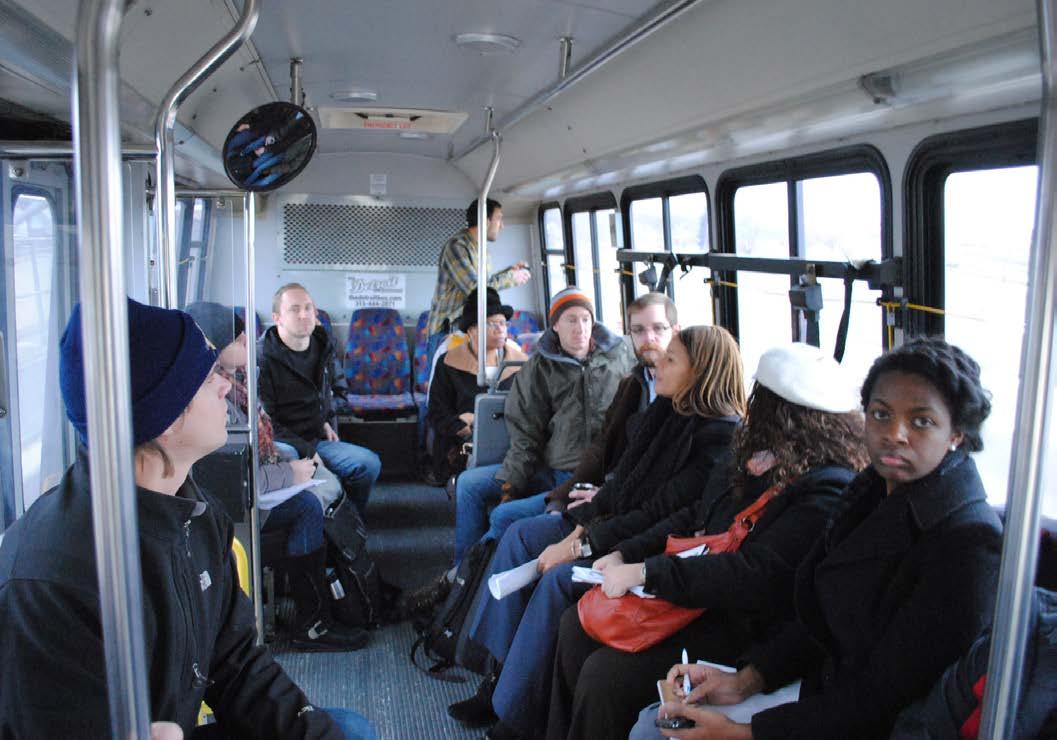
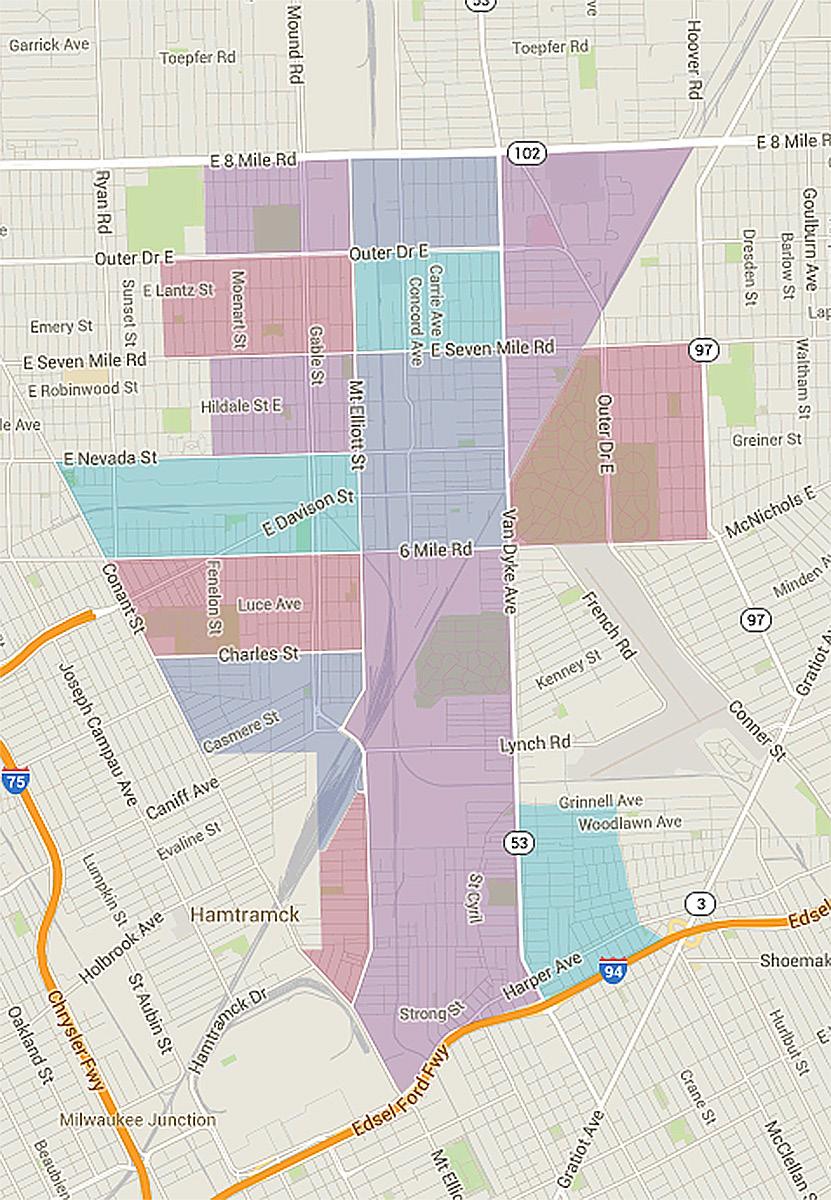
U.S. Census Bureau, ACS 2008-2012 (5-Year Estimate), Table 33, generated by Aja Bonner, using Social Explorer, <http://www.socialexplorer.com>, (2 February 2014).
Date:
Business name:
Name and Title:
Contact Information:
Mt. Elliott Business Interview Form
In Person or By Phone:
Interviewer(s):
Introduction:
∙ We’re interested in what lessons you could share about business opportunities, barriers and relationships in the district, and how these lessons might be applied to improve local businesses and grow Mt. Elliott’s economic presence in Detroit.
You are not required to answer any questions that you don’t want to answer.
If you share information that you would like to be kept confidential, we will honor that.
We will not publicize information we do collect about your firm but rather will aggregate it in our report, along with responses from other businesses.
Overview
1 Where are your suppliers located?
Mt. Elliott area Detroit Within Metro Detroit Midwest National International Comment:
2 Do you have any suppliers located in the Mt. Elliott corridor? Yes No Comment:
3 How are your suppliers’ products transported to your site? Rail Truck Plane Comment:
4 Where do your products and services most commonly go?
Mt. Elliott area Detroit Within Metro Detroit Midwest National International Comment:
5. Do you supply any businesses located in the Mt. Elliott corridor? Yes No Comment:
6. How are your products transported? Rail Truck Plane
Comment:
7 What is the scale of your annual revenues?
Less than $1 million
$1.1 – 5 million $5.1 – 20 million $20.1 – 50 million More than $50 million
Comment and record exact figure given:
8 What segments of your supply chain could improve through local industry growth?
9 Confirm employment figure About 35
10. What is the breakdown of temporary versus fulltime workers? Record exact. Round off to nearest option.
:
Comment and record exact figure given:
11. How easy is it to find the workforce that you need? Never have problem s Someti mes have problem s Continui ng challeng e None of the above
Comment:
12. Have you worked with any training programs or temp agencies to meet workforce needs? Which ones? For what roles? Yes No Which ones? Which roles?
Comment:
13. Where does most of your workforce live?
Mt. Elliott area Detroit Hamtramck Warren Metro Detroit
Comment:
14. On what skill sets do you anticipate future hiring to focus?
15. Does Mt. Elliott meet the infrastructure requirements of your business? Water Power Transit Liability
Comment:
16. Does your business participate in a business association? Yes No
Comment:
Other:
17. From where does your largest competition come?
Mt. Elliott area Detroit Within Metro Detroit Midwest National International
Comment:
18. How much of your existing space do you use? Record exact. Will be rounded to nearest option. Do you know whether neighboring properties are still in use?
Comment and record exact figure given:
19. If your company moves from its current location, how soon might that happen?
Less than 2 years 2 to 3 years 3.1 to 5 years More than 5 years Unlikely to move
Comment and record exact figure given:
20. How does being located in Mt. Elliott appeal to or turn away businesses compared to other nearby options like Warren and Hamtramck?
21. What is your business’ forecast for the short and long terms?
22. How has blight impacted your business? Has vandalism or crime impacted your site?
23. What taxes (labor, profits or municipal) do you face? How do they impact your business?
1. We know that you are nested within Corporation for a Skilled Workforce. But we have heard you spoken about as if you worked for Detroit Jobs Alliance. Could you explain the relationship between the two organizations and your role in them?
2. Can you describe your role within workforce development in the Detroit area? What is your relationship to other workforce institutions?
3. (If not answered) We’re trying to better understand the landscape of these various workforce institutions in Detroit. How is your role unique and different from the work of other institutions? W hat is the role of the DJA steering committee?
4. Who would you say are the major players in delivering workforce development services? Do you have any data that speaks to the efficacy of these different programs?
How are they evaluated?
5. Do you have relationships with firms in the Mt. Elliott district? Elsewhere in Detroit? (refer to map of district)
6. We presented our midterm progress on the project on Monday. One deliverable we suggested that we are interested in including in our final report is a diagram showing the relationships between various workforce institutions in the Detroit area. Another deliverable idea is a chart listing the major institutions and what services they provide. Has something like this already been created? We heard that you might be creating a database that accomplishes this second deliverable. [See interactive map on the website.]
7. What programs or services are needed that are not being offered (at all or adequately) in Detroit to support a stronger workforce?
8. What do you think are the major elements needed in a long-term employment strategy for Detroit? (more training, more funding, K-12 programs, etc.)
Are these elements being addressed by existing institutions?
9. We’ve heard feedback about the need for external evaluation of workforce institutions in Detroit. Does DJA use an external or internal evaluation plan? Do other institutions? What do you think are the most important indicators?
Relationship with Businesses
• What Mt. Elliott businesses do you work with (refer to list)?
• How do you work with employers to coordinate trainings, internships, or job placements?
• We’ve been able to meet with a few business owners in the area and are hoping to gain input from others. Do you have any suggestions for who we might contact?
• What types of activities take place at the Samaritan One Stop Shop Center and Neighborhood Access Center at Marion Academy?
• What types of services are jobseekers most interested in/ in need of at these locations?
For employers
• How many business liaison officers do you have on staff? Please describe the nature of their work.
• How do you collect feedback from employers about their satisfaction with new hires from your programs?
• Other members of our project team met with Michelle Elder with MEDC and she mentioned state-based employer incentives available through the Community Ventures program to hire “at-risk” employees. Does DESC assist employers in obtaining these and other Workforce Investment Act (WIA) incentives?
For Jobseekers (most of the services are pretty well described online)
• How many career guidance advisors do you have on staff?
• Please describe the type of soft-skills programming you offer.
• Is information available about the rates of job placement and retention for participants?
• In our previous interviews, participants have mentioned youth and young adults are uninformed about which industries are likely grow and offer jobs at decent wages. Please describe your work in public schools introducing workforce forecasting and career pathways.
• How many schools do you work with?
Roles/ Partnerships
• Please take a look at the list of workforce development programs we’ve identified. Do you partner with any of these or others not listed? Among your key partners, what is the nature of the partnership?
• Your website notes that at the end of last year DESC began hosting quarterly meetings with community workforce partners. Can you describe the purpose of these meetings and what type of topics are discussed?
• We are interested in understanding how DESC initiatives align with citywide and regional strategic planning. More specifically, can you describe if and how planning guides such as the Detroit Future City Framework inform the work at DESC?
• During our focus group, participants highlighted the challenge of sharing information about various programs with community groups, individual residents and employers. What are some of the ways you are working to spread the word about your work?
• We’ve read about Focus: HOPE’s education and training programs on your website. It would be great to hear about these programs in your words. Could you give us an overview of your education and training programs?
• What specific skills do you offer training in?
• How does Focus: HOPE support participants to find employment?
• How did Focus: HOPE develop its workforce training programs?
• Were they approached by an employer?
• How did they assess skill gaps?
• How did you identify targeted industries and develop curriculum based on that speculation?
• Have you looked at any other models around the country? Which?
• How did you recruit teachers? Is there a gap of skilled trainers?
• How are your training and education programs funded?
• Would Focus: HOPE be willing to expand the size and scope of any of their programs? Would they consider offering any programs at another site? If so, what would you need to make this possible (eg what kinds of resources)?
One of our goals is to help identify what types of training and education are needed and who might be able to offer it.
• What do you see as the major education and training needs for potential and current employees in Detroit?
• Which of these needs are not being met by Focus: HOPE or a similar organization?
• How do you work with area businesses to coordinate placements for your program participants?
• What are some of your business relationships in the Mt. Elliott area? (show map of the area and DEGC list of businesses)
• What are the major concerns that you heard from businesses in the Mt. Elliott area?
• What are the major difficulties for your participants to find a job?
• We’ve done some research into organizations in Detroit that offer education and/or training programs for adults seeking employment. Which organizations do you suggest that we focus on? In other words, which are doing the most effective work?
• In what ways, if any, do Focus: HOPE and these organizations coordinate their efforts?
• Do you work together to decide who will offer what services (and to avoid unnecessary overlap)?
• Do you ever meet to talk about the ‘big picture’ - eg, what are the needs of employers and potential employees in Detroit?
• We’d like to hold a focus group for residents of the Mt. Elliott neighborhood to learn more about their interests regarding potential new businesses and job opportunities in the immediate area. Do you have any suggestions or ideas for how we might identify and invite residents to participate in a focus group?
• When talking to neighborhood residents, we want to be careful about the way that we frame sensitive issues.
• Do any potentially sensitive issues related to workforce and economic development come to mind?
• Do you have any suggestions for how to present these issues?
1. Can you describe your role within workforce development in the Detroit area? What is your relationship to other workforce institutions?
2. Who would you say are the major players in delivering workforce development services? Do you have any data that speaks to the efficacy of these different programs? How are they evaluated?
3. Do you have relationships with firms in the Mt. Elliott district? Elsewhere in Detroit? (refer to map of district)
4. When I talked to Lisa on the phone, I mentioned that we are interested in including in our final report a diagram or map showing various workforce institutions in the Detroit area. Has something like this already been created?
5. What programs or services are needed that are not being offered (at all or adequately) in Detroit to support a stronger workforce?
6. You have focused on “hard to serve” groups of potential employees. What do you think are the biggest barriers to employment for low-skill and chronically unemployed individuals? What can be done to help these individuals find and keep employment?
7. What is your relationship, if any, to Detroit Public Schools? How do you collect information from them about student readiness for work?
Meeting with Tracie Tillinger
Date/Time: Saturday, March 29, 2014 - 10:30 AM
Location: Phone Interview
Interviewer: Myles Hamby
• How do you organize your work at the DEGC? By function? Location?
• Macomb county - has a designated person to match the Industrial users with buyers. We are going to look into how they exactly do this. Would DEGC consider having a designated employee serve the Mt. Elliott district to pair users with real estate, liaison to the City, oversee business association, and link businesses with workforce organizations?
• After meeting with an appraiser, he said it is very important to have a good, honest appraiser. Especially for industrial, comps are hard because people mistake proximity for a good comparable when Chicago and Florida could be good examples if they have similar building types. He said it is hard to use Capitalization approach because it is difficult to know what a space is renting for - at best, usually a well-crafted assumption. Hard to appraise for cost to build because buildings are built for specific user and you can’t cut corners like on residential structures. What causes appraisals to go low? What is DEGC doing to adjust these appraisals?
• Have you asked either GM or Chrysler what supplier they would like to have close by?
• When we met last time, you told me that there were about 24 properties in the I-94 that still had title issues. Is there any progress on those parcels?
Meeting with Andy McCloskey
Date/Time: Friday, March 28, 2014 - 7:15 AM
Location: Northside Grill, 1015 Broadway Ann Arbor, MI 48104
Interviewer: James Carpenter
• Why are appraisal values too low to obtain financing in Detroit? - we heard about the financing gap in Detroit because of appraisal values that are too low - One example: an $18 million project that already has a $5 million gap and construction is not finished
• What elements impact an appraisal value?
• What elements go into choosing comparable properties?
• What could Detroit / DEGC / businesses do to improve this issue?
• How do appraisals differ between commercial / residential / industrial buildings?
• Do you look at DFC ‘districts’ when valuing property? If so, why? If not, why?
Meeting with Michael Brady
Date/Time: Monday, March 3, 2014 8:00 AM
Location: Roasting Plant, Woodward Avenue, Detroit, MI
Interviewer: Liz Treutel
• Does the new NAP take into account both residential and commercial buildings?
• What is the process to go from blight to well maintained buildings?
• How is the new NAP different from the past one(s)?
• What would a partnership look like between a BID/business cooperative in Mt. Elliot, DEGC, and the Detroit Land Bank Authority?
• What would a partnership look like between DEGC and the Detroit Land Bank Authority that transferred property (vacant) to the Detroit Land Bank?
Meeting with Rob Cory
Date/Time: February 4, 5:00 PM
Location: Taubman College of Architecture and Urban Planning, 2000 Bonisteel Blvd. Ann Arbor MI, 48109
Interviewer: Cassie DeWitt
• What are the biggest difference between industrial real estate development and commercial/retail real estate development?
• How are cap rates different?
• What’s your experience: rent / owner-operated?
• What’s HOT in industrial real estate development?
• Can you send us any case studies, examples that we could look at?
•
5 https://www.accesscommunity.org/
4.4 http://www.descmiworks.com/ 9.7 http://www.swsol.org/adult_learning_lab
8.8 http://detroittraining.com/ 11 http://www.dwej.org/
10.1 http://www.ecoworksdetroit.org/
5.2 http://www.focushope.edu/
N/A http://itindetroit.org/ 14.5 http://www.jvsdet.org/who-we-serve/job-seekers.html
N/A http://www.michigan.gov/mdot/0,1607,7-151-9625-214452--,00.html
5.4 http://www.mitalent.org/community-ventures/
16.2 http://www.michigan.gov/documents/dleg/wsh_cet0160_285859_7.pdf
N/A http://www.mitalent.org/
10.5 http://www.sermetro.org/SMD/index.php?option=com_content&view=featured&Itemid=435
9.5 http://www.swsol.org/
4.4 http://www.vanguardcdc.org/
3.9 http://detroitk12.org/admin/academic_affairs/adult_ed/
12.1 http://www.svsfcenter.org/adult-education-experience
N/A http://www.blackgirlscode.com/
8.4 http://www.liveunitedsem.org/
8.9 http://www.cityconnectdetroit.org/collaboratives/detroit-youth-employment-consortium
N/A http://centraldetroitchristian.org/employment/
9.3 http://www.youngdetroitbuilders.com/
6.2 http://www.ydcdetroit.org/
N/A http://detroitjobsalliance.org/
N/A http://innostatemi.com/
N/A http://win-semich.org/
N/A http://www.skilledwork.org/
6.9 http://www.globaldetroit.com
N/A http://migreenmobility.com/education-and-training/
12 http://www.readingworksdetroit.org/
24.4 http://www.semca.org/index.html
8.7 http://www.semcog.org/
*Driving distance was calculated using Google Maps. Distance was measured from the corner of McNichols and Mt. Elliott to the program office. For programs with multiple locations, the location closest to the corner of interest was used.
1. What types of jobs are needed for residents in the neighborhood?
2. What types of skills, training, and education opportunities are needed for residents in the neighborhood?
3. Where would you send a community resident that is interested in attending a job training program? [If not mentioned: Do you or members of your community interact with Focus: HOPE?]
4. Do you know of any businesses in the Mt. Elliott area that hire from the neighborhood?
5. In what ways could local businesses improve relationships with the neighborhood?
6. In what ways could community organizations improve relationships with local businesses?
7. Do you have any other ideas or concerns related to businesses and jobs in the neighborhood?
1. Good: Structure and foundation appear to be sound + highly maintained
2. Fair: Average condition [not great but not poor] + structure and foundation appear to be sound + evidence of some maintenance issues
3. Poor: Building appears to not be regularly maintained + some structural and foundational issues +/or some fire damage Building is not maintained
4. Dangerous: Building is vacant and not boarded up + major structural and foundation issues
Q. 1: On a scale of 1 to 4 (Good; Fair; Poor; Dangerous) rate the average building condition of the building
Q. 2: On a scale of 1 to 4 (Good; Fair; Poor; Dangerous) rate the average building condition of the businesses to the right, left, and across
Q. 3: On a scale of 1 to 4 (Good; Fair; Poor; Dangerous) rate the quality of roads around the building.
Q. 4: On a scale of 1 to 4 (Good; Fair; Poor; Dangerous) rate the building’s access to main egress and ingress.
Q. 5: Notes and other observations
• Were there neighbors with whom you had conversations that provided vital information on the buildings?
• What stood out? What would be helpful for the real estate development team to know?
• Are there maintenance concerns?
• Are there landscape/utility concerns?
• Are there any signs of obvious environmental contamination?
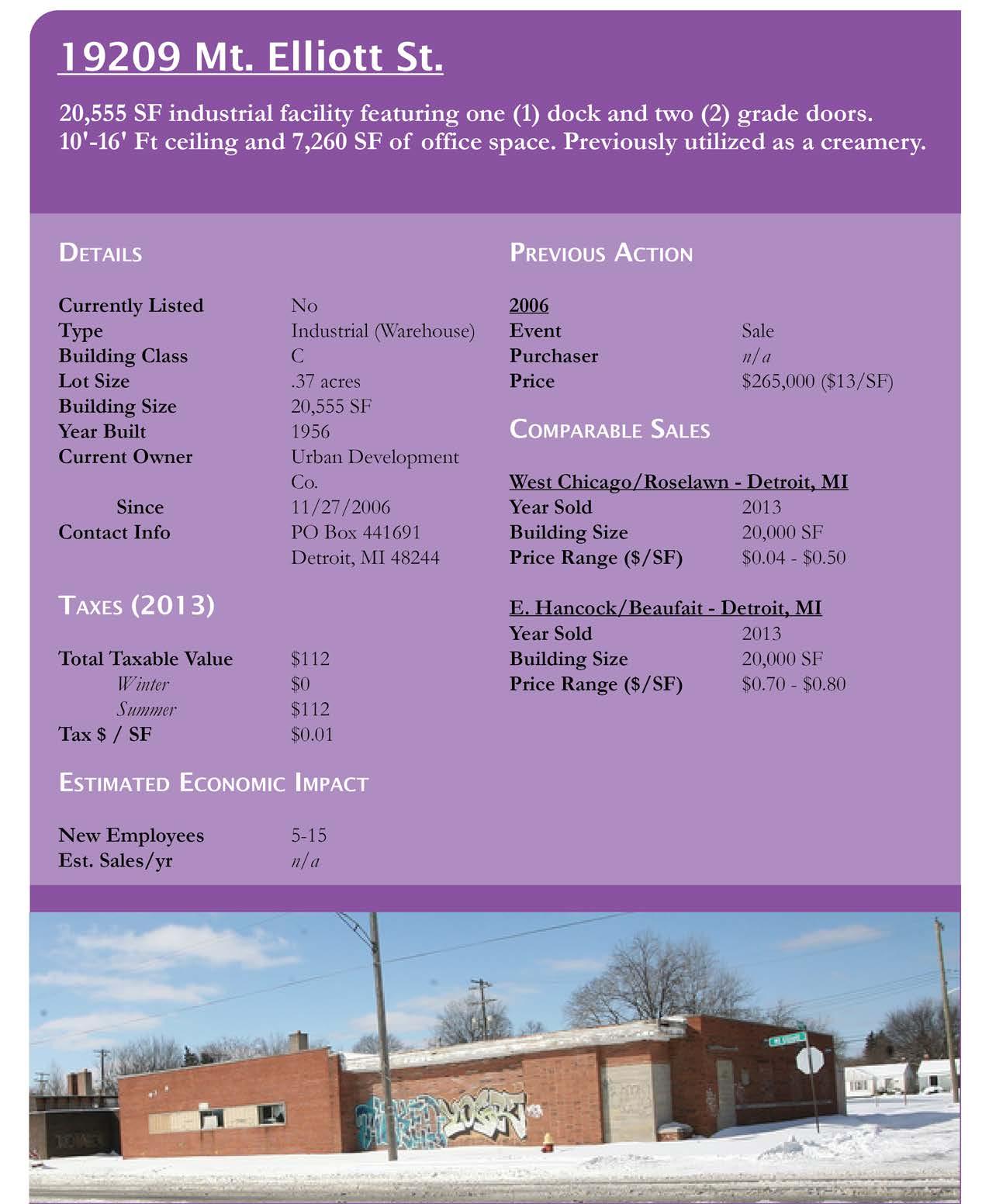
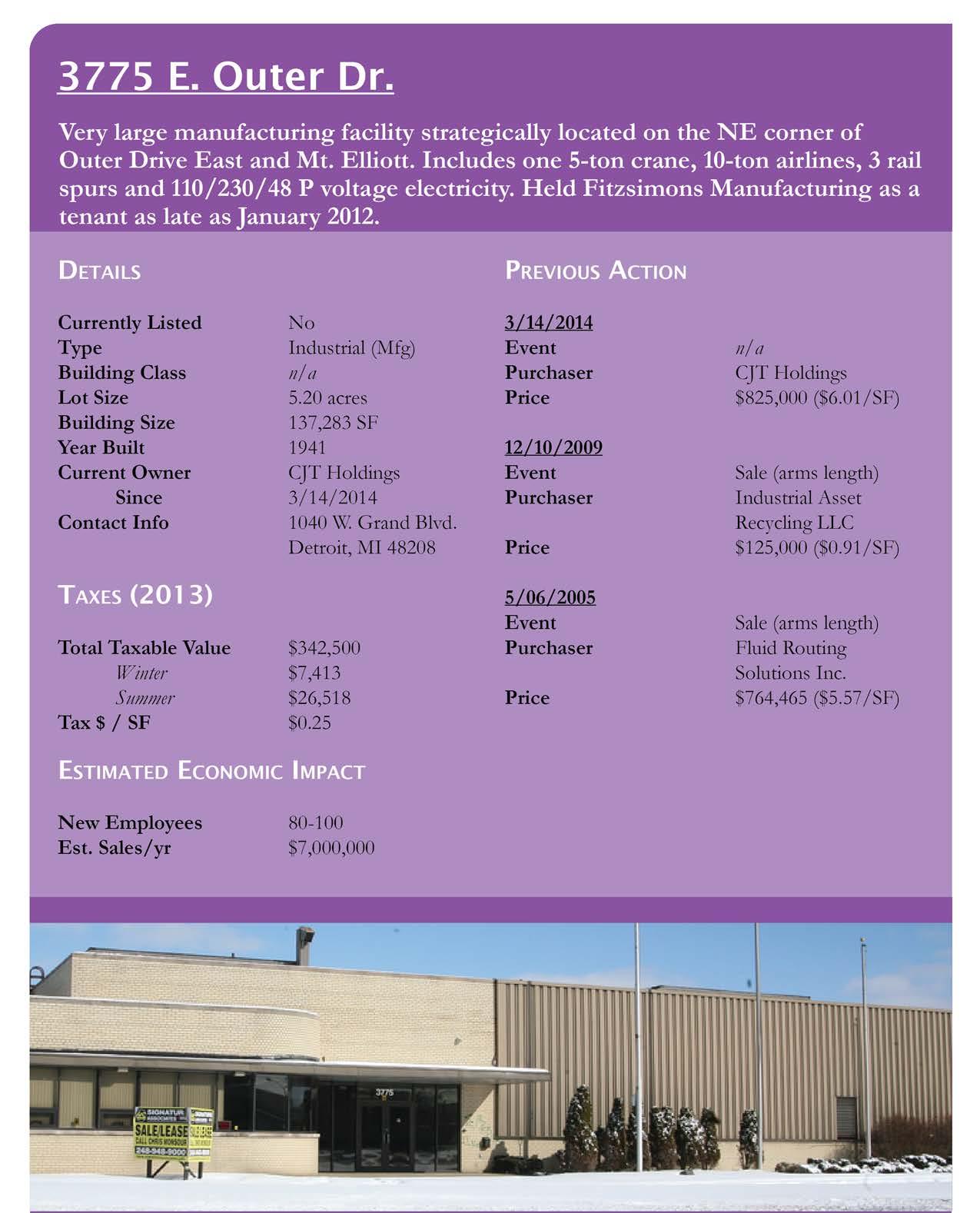
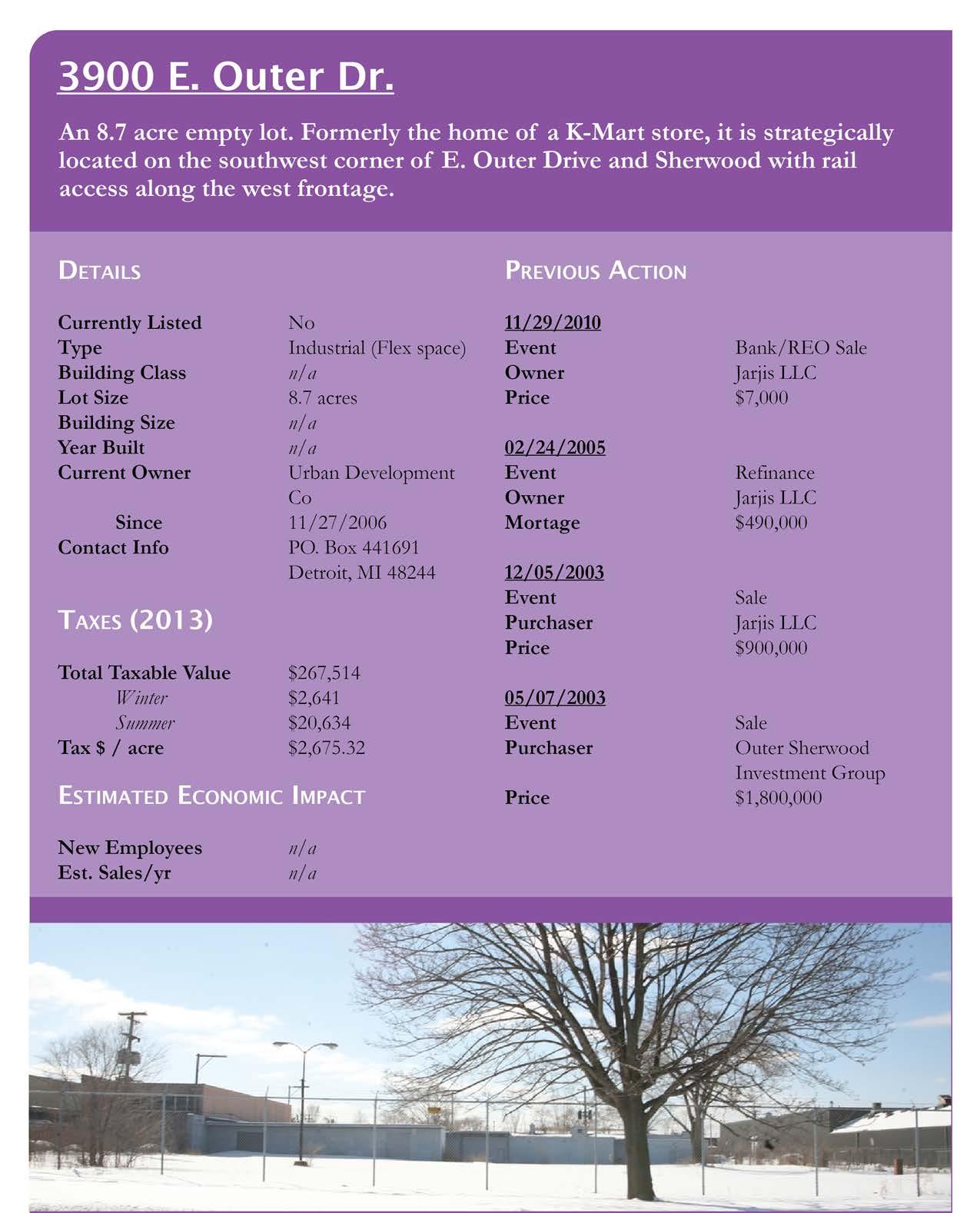
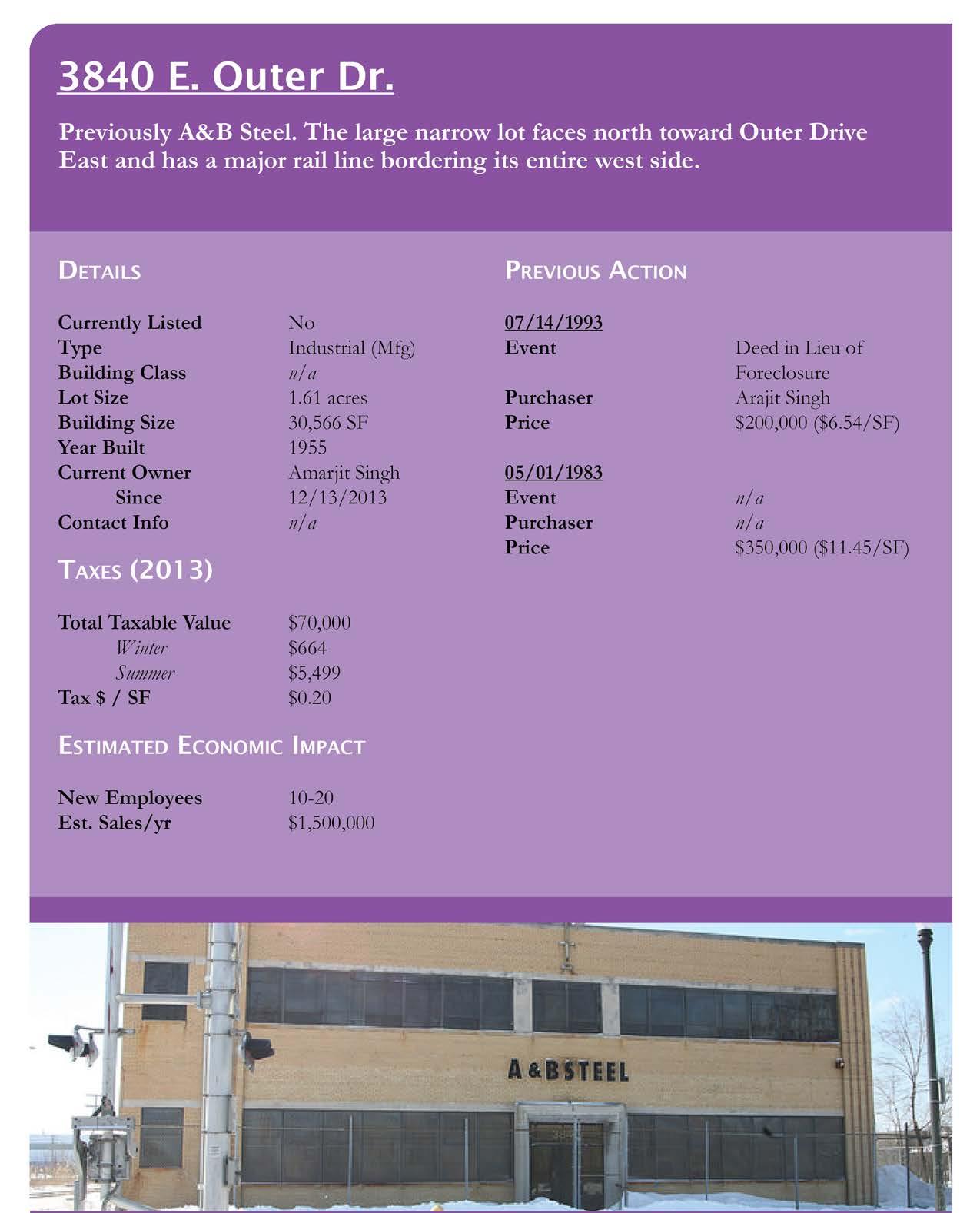
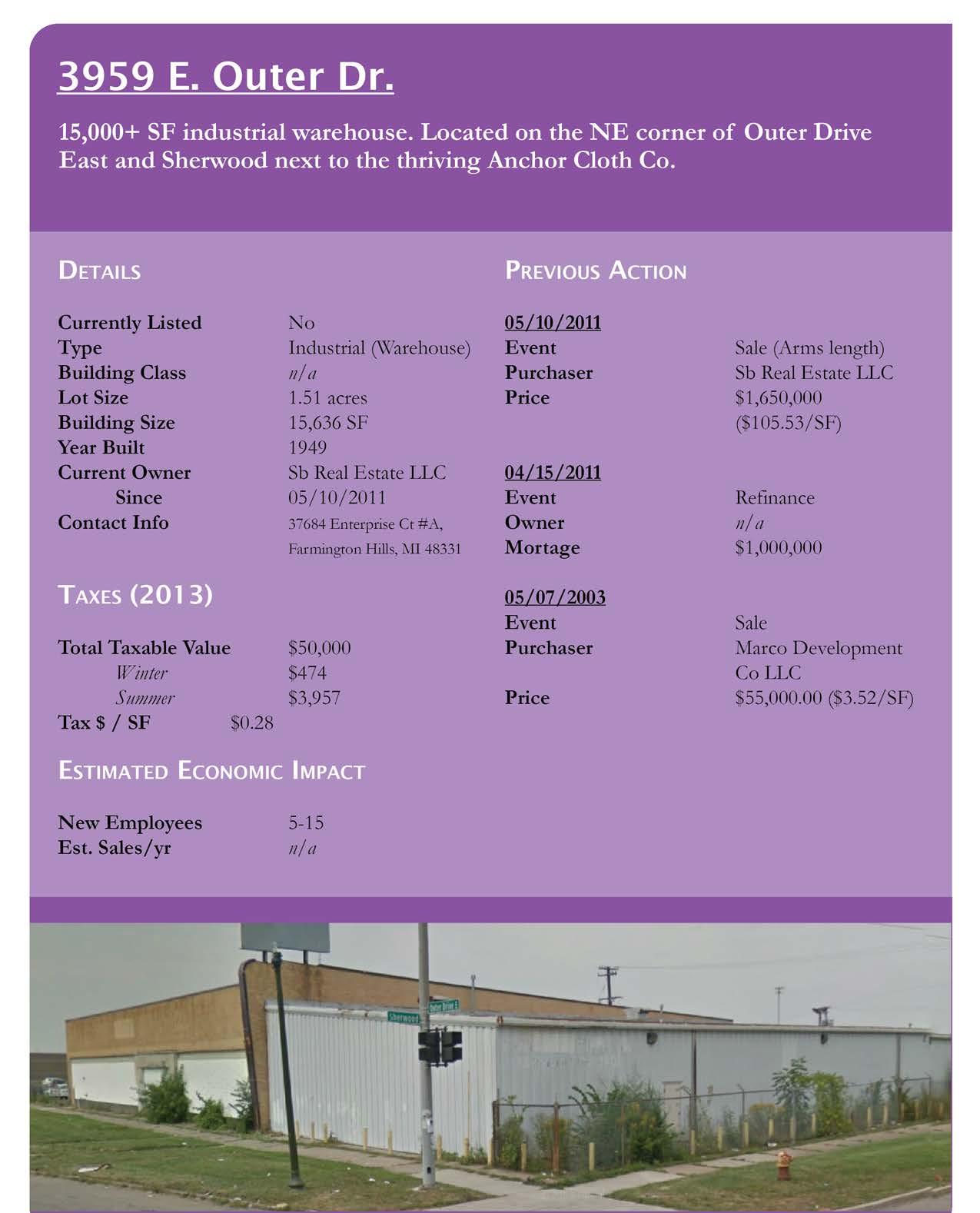
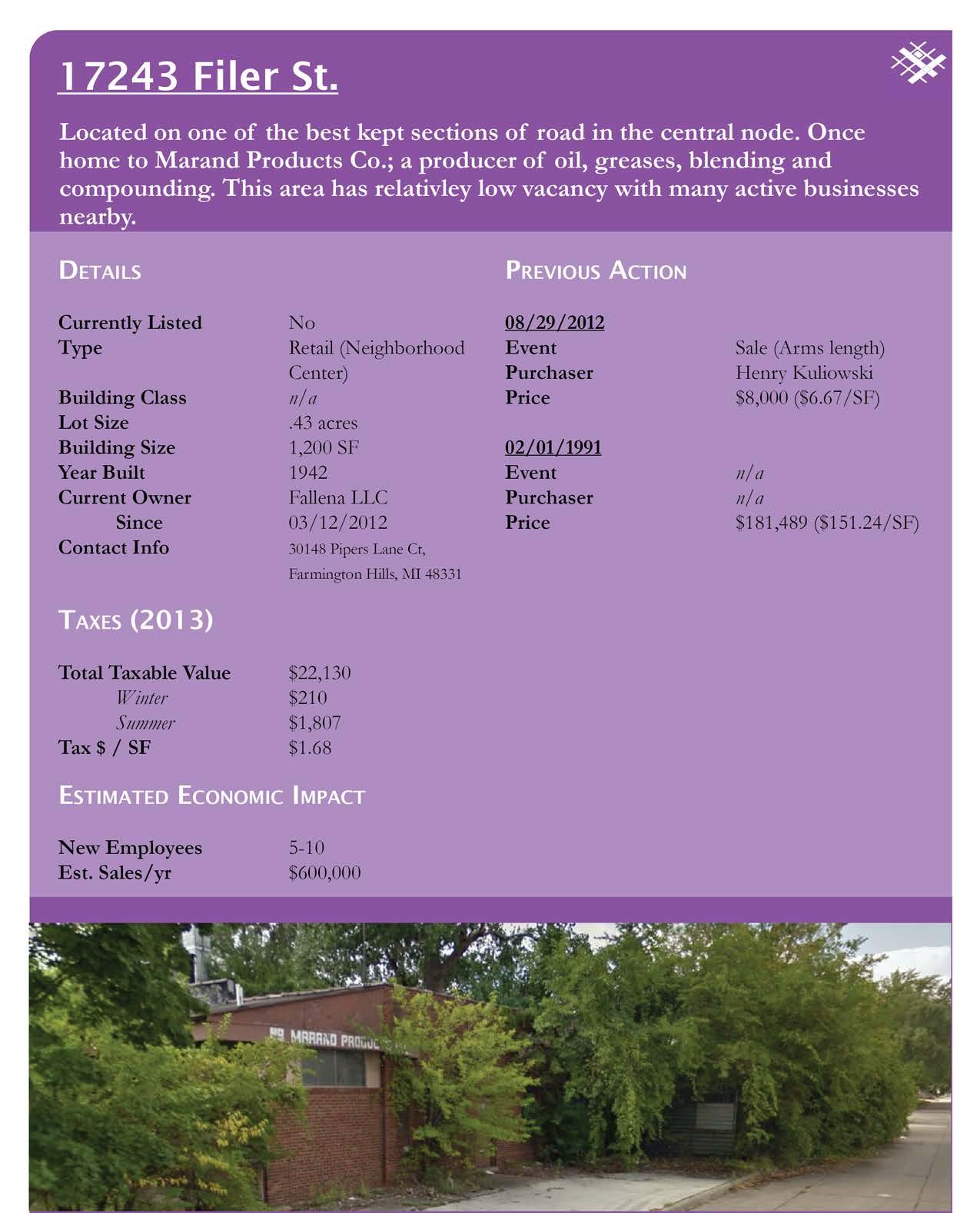
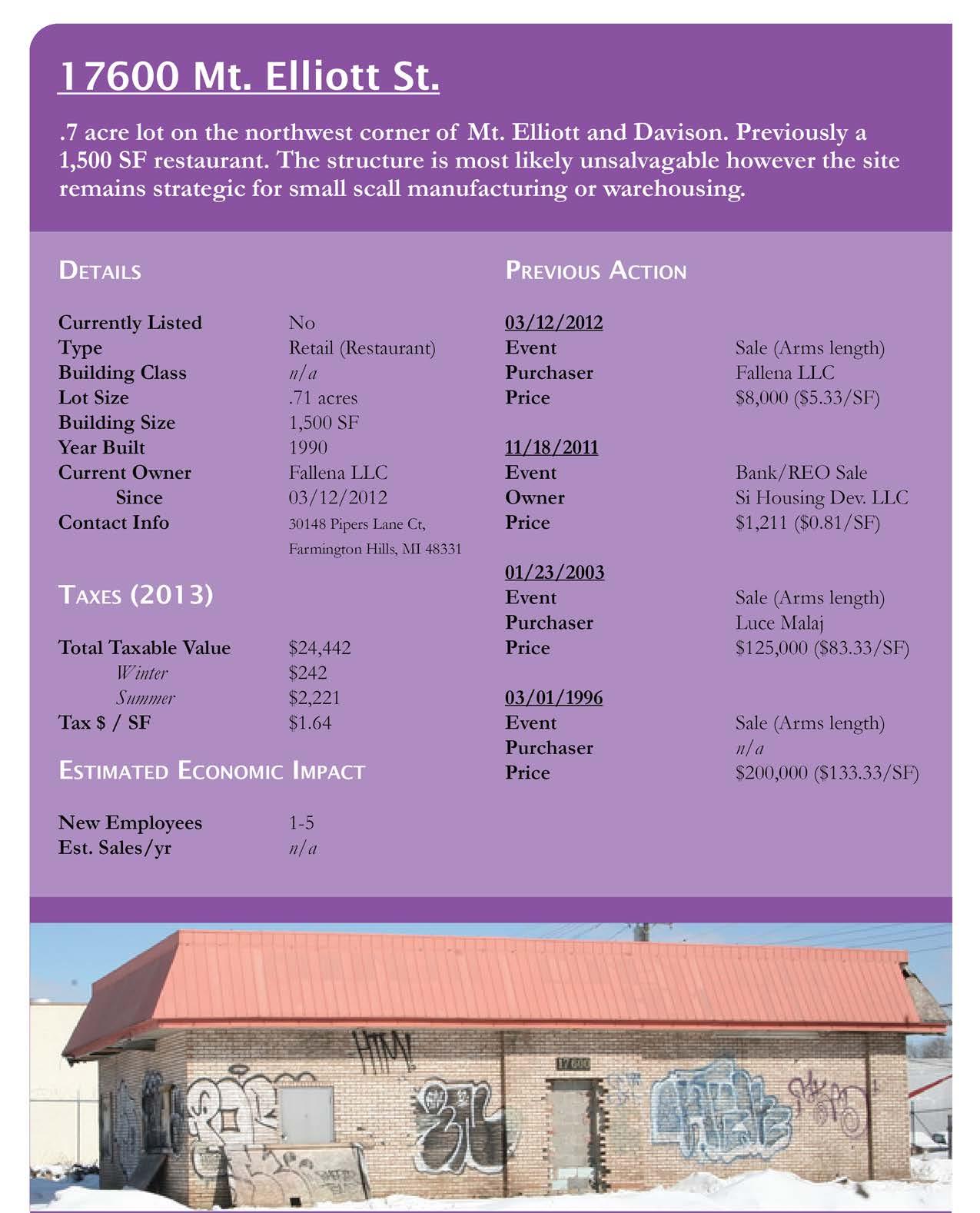
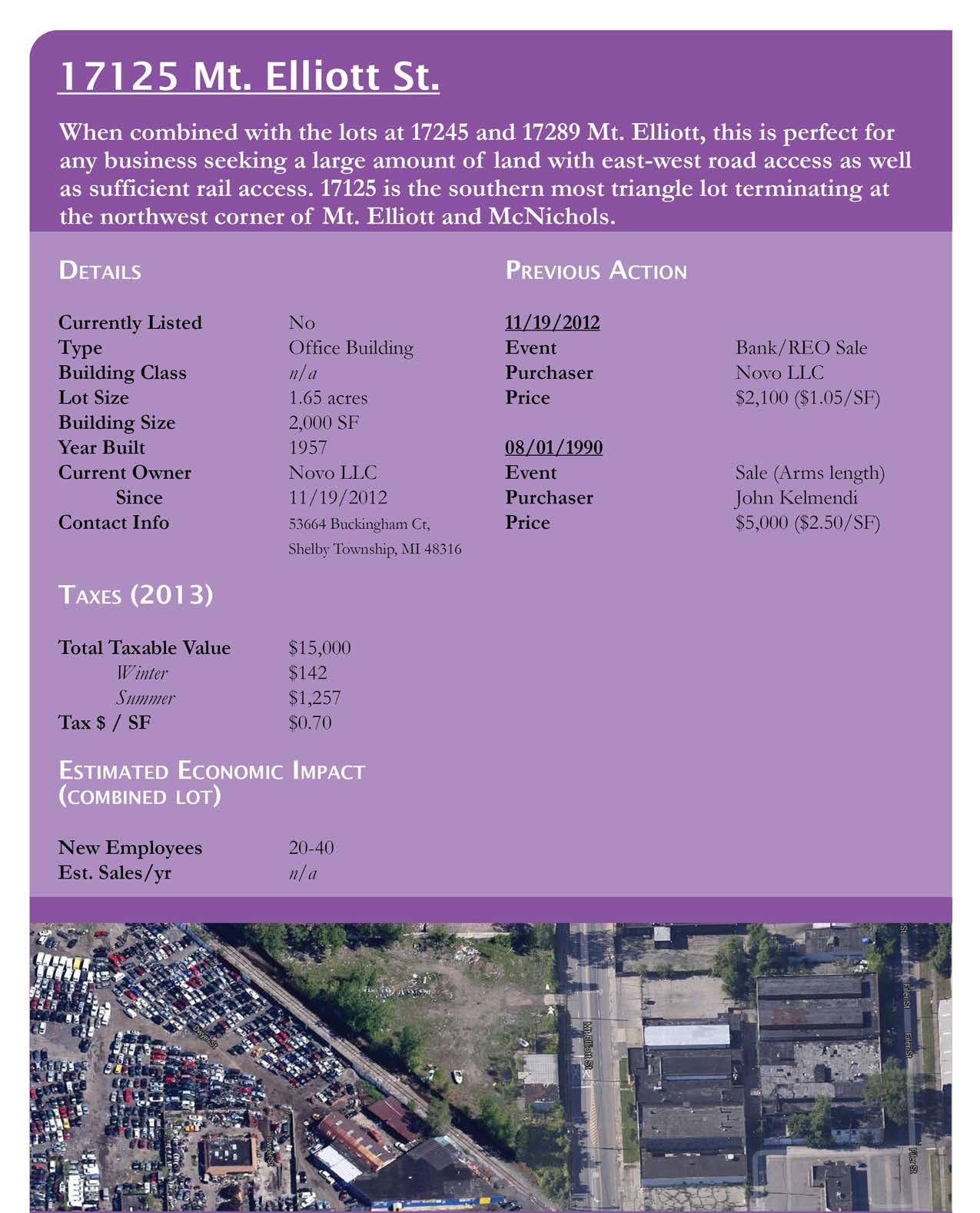
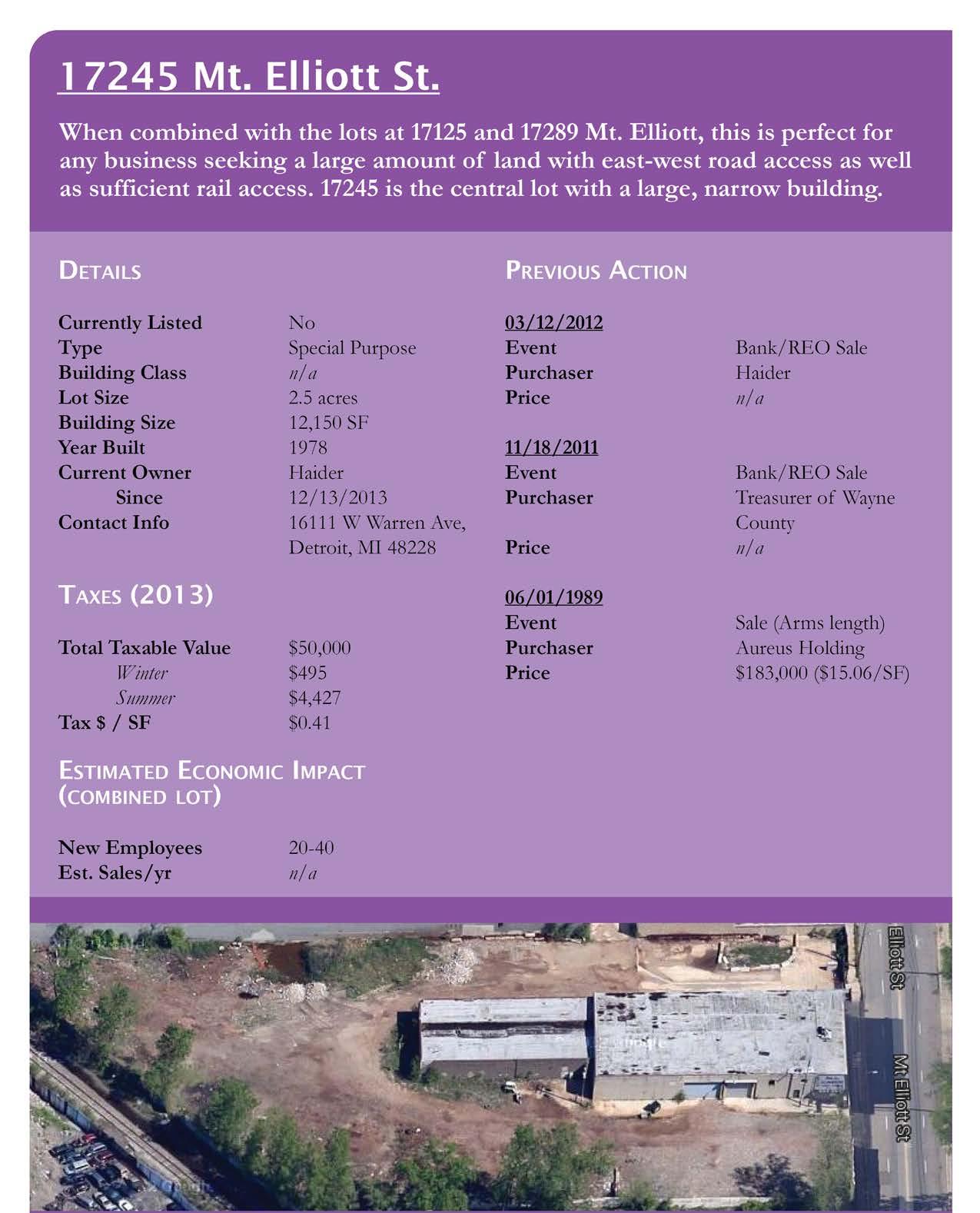
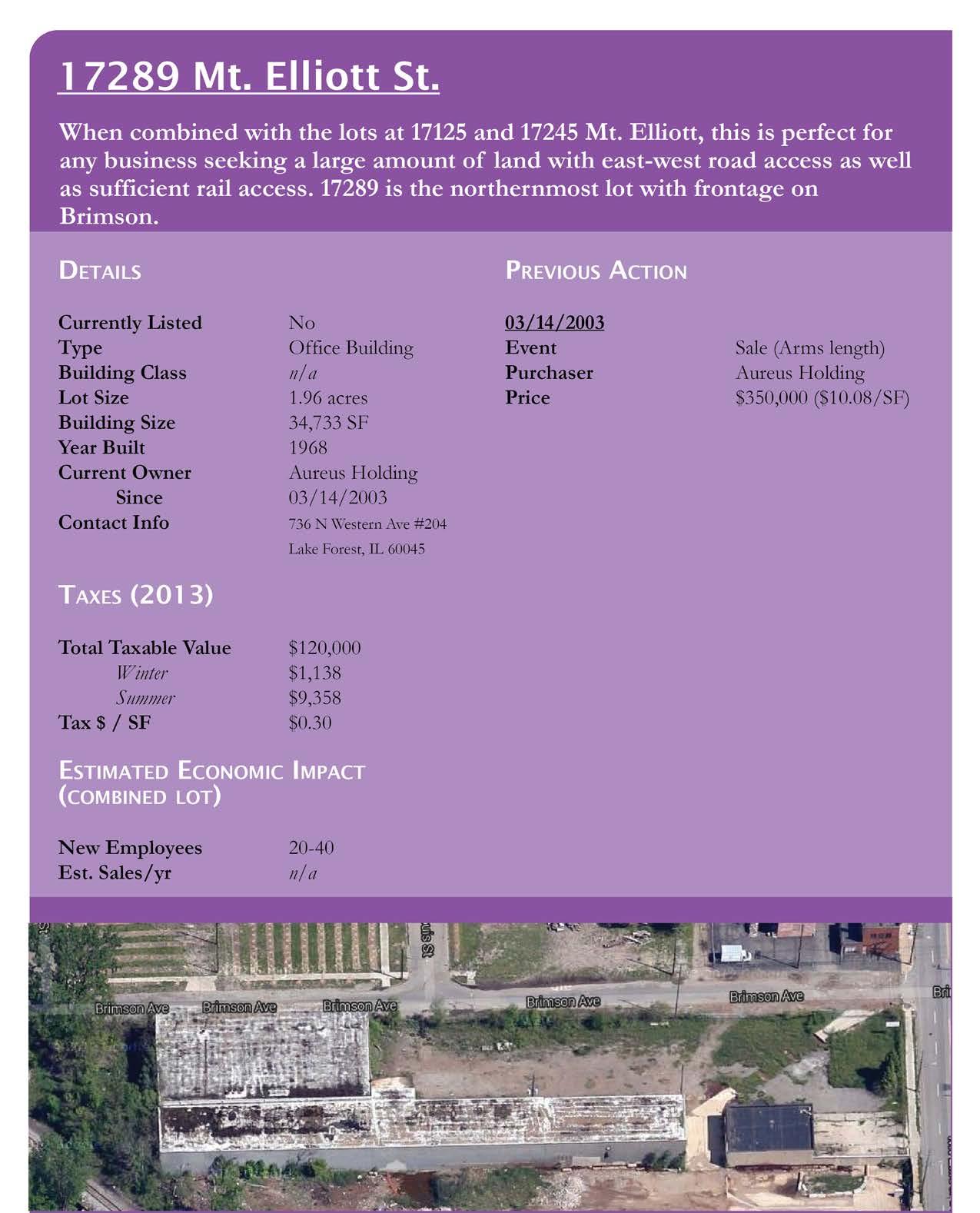
To: Catherine Frazier, Tracie Tillinger
From: Myles Hamby
Cc: Eric Dueweke; June Thomas, Ph.D.
Date: April 2, 2014
Re: 2014 Tax Foreclosure Candidates in the I-94 Industrial Park
This memorandum addresses a concern regarding the ownership status of several parcels within the I-94 Industrial Park. While researching property data on the Mt. Elliott Employment District for the capstone project through the University of Michigan Taubman College of Architecture and Urban Planning (TCAUP), I found eleven properties within the Industrial Park on the 2014 Tax Foreclosure Candidate list.1 Below is a list and a map of the properties:
2014 Tax Foreclosure Candidates in I-94 Industrial Park
Address
9116 MT ELLIOTT
9145 PEASE
9113 PEASE
6403 NEWHALL
6361 RUGG
8621 ST CYRIL
8539 CARRIE
8551 CONCORD
8532 SHERWOOD
7139 MILLER
7243 MILLER
Zip Owner Name2
48211 GORSKI, MARTIN/CITY OWNED AVAILABLE 48211 B-JIL TRANSPORT CO INC
48211 HARON METALS &EQUIP. CO. 48211 WELLS, EARSELL/CITY OWNED AVAILABLE 48211 MCANELLY PROPERTIES LLC/CITY OWNED AVAILABLE 48213 LUCIDO, STEVEN J/CITY OWNED AVAILABLE 48211 ROSCOE, LILLIE ANN/CITY OWNED NOT AVAILABLE 48211 HILL, CORTEZ LORENZO/CITY OWNED AVAILABLE 48211 LEWIS, VELMA/CITY OWNED AVAILABLE 48213 WILCOX, MARTHA/CITY OWNED NOT AVAILABLE 48213 WILCOX, MARTHA/CITY OWNED NOT AVAILABLE
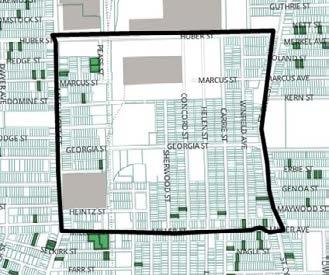
Source: Why Don’t We Own This (Loveland Technologies), retrieved on March 31, 2014. http://whydontweownthis.com/2014/neighborhoods/1380#16/42.3942/-83.0321
1 Why Don’t We Own This (Loveland Technologies), retrieved on March 31, 2014. http://whydontweownthis. com/2014/neighborhoods/1380/list.
2 Ownership data verified at the City of Detroit Assessor database: http://www.detroitmi.gov/
Detroit Economic Growth Corporation (DEGC) spent a considerable amount of time and resources assembling the parcels on this land for a job-creating development. Another buyer’s acquisition of these properties through the Wayne County foreclosure auction could delay the transfer of this land to a new user. I recommend the DEGC contact the Wayne County Treasurer’s Office and chart a course of action to bring these properties under the control of the DEGC. My apologies if you are already aware of the status of these properties or for duplicating research previously conducted by the DEGC. After I relayed this information to TCAUP faculty members Eric Dueweke and June Thomas, they advised me to write a memorandum in case the DEGC was unaware of this information.
We chose three nodes to focus our real estate research and recommendations. Development within each node could stabilize the economy of the node, retain current businesses, and provide positive spillover effects to the district as a whole. Because the Detroit Economic Growth Corporation has already been working to redevelop the I-94 Industrial Park in southern node, we chose to focus our suggestions for property development on the northern and central nodes. Our recommendations for the southern node pertaining to the Industrial Park and blight mitigation can be found in Recommendation 1.4.
Below are suggested sites to target for redevelopment in the northern and central node. We aimed to find a mix of properties with varying potential uses and redevelopment requirements. There are five sites in the northern node and three sites in the central node. This appendix contains a brief summary and justification for choosing each of sites, while aPPendix r-1 contains property information packets that could be used to develop a marketing strategy. We estimated several employment figures from information retained during interviews with local businesses. “An Industrial Strategy for the City of Detroit” served as a key resource in matching properties with appropriate industrial sectors. City of Detroit Assessor Data, CoStar, Loopnet.com, and the team’s site survey served as resources for property-specific information.
We selected this property on the southwest corner of Mt. Elliott and Emery because it is seemingly vacant, in good external condition, near a recently purchased building, and near other active businesses. Developing this property would bring further stability to the northern node. As the previous site of a creamery, it could once again serve as a smaller warehousing operation in the food service industry. Although national averages indicated that this building is too small for Automotive, Metals, or Transportation, Distribution, Logistics (TDL), it may also suit a light fabrication shop. A food service company or light fabrication shop could occupy the building with few structural changes. A similar building sold recently in Detroit between $10,000-20,000 (Loopnet.com). This site, at full operational potential, could produce 5-15 full-time jobs.
This property is a very large manufacturing facility strategically located on the northeast corner of Outer Drive East and Mt. Elliott, across from Chrysler’s Tool & Die plant and from Fairmont Signs. It includes one 5-ton crane, one 10-ton airline, 3 rail spurs and 110/230/48 P voltage electricity. Fitzsimons Manufacturing was a tenant in January 2012. It is currently on the market and would be best suited with a use in the automotive cluster. It has 137,000+ SF of building space. Based on data from Milton Manufacturing, an operation with a similar size to 3775 East Outer Drive, this building has the capacity to employ at least 80-100 workers.
We chose this site because it is a large, cleared property with a greater location on Outer Drive. This property, the former site of a Kmart shopping center, is large enough to support businesses in the Automotive, Metals, or Transportation, Distribution, Logistics (TDL) industries. With 8.7 acres located on the southwest corner of Sherwood and Outer Drive East, it has the potential to be home one large business or several smaller ones. Developers could possibly redevelop this site as a brownfield. Potential job creation is indeterminable, as the final use will depend on what is built. However, a manufacturing or metals business would generate a significant number of jobs.
Although taxes are up to date, the occupancy and operational status of this building is uncertain. We believe its location along Outer Drive, access to rail, and the general condition of the building warrant further research. This 45,000 SF building is most recently the home of A&B Steel. The building seems to be in solid condition and could be utilized again as a metals facility. It has the added benefit of a rail line running north to south along the east side of the building. A metals or manufacturing operation could produce 10-20 full time workers.
This 15,000 + SF building sits directly across from 3900 East Outer Drive and was previously used as a warehouse facility. It also shares the benefits of the Outer Drive truck routes and is next to an active business, Anchor Wiping Cloth Co. The structure could be reinforced to support higher uses besides warehousing. If brought up to specifications for light manufacturing or metals or automotive this lot could yield 5-15 jobs.
These are three separate parcels that could potentially be assembled into one contiguous parcel. We chose this site because it is an underutilized piece of land in a well-occupied area with access to rail. The site does not have any dilapidated structures, effectively lowering the cost of construction. Redeveloping this site could help stabilize the intersection at McNichols and Mt. Elliott St., which is home to several businesses including Federal Pipe, Fitzgerald Finishing, and J Fons Transfer Station.
Together the parcels form a triangle lot that begins at the northwest corner of Mt. Elliott and McNichols, and sites adjacent to the Hantz farming operation on its northernmost end. Its access to a rail spur, which runs along the western edge of the property, makes this site suitable for the metals industry. It is large enough to support the metals or automotive cluster. 17245 is currently the site of All Aluminum and would either have to relocate to a more suitable site in the district or remain on the site and work out an agreement to lease part of a new development. An environmental analysis would most likely be necessary, and brownfield redevelopment funds may also be possible. 17125 and 17289, categorized as office, may qualify for the Obsolete Property Rehabilitation Act (OPRA).
When the lots are fully assembled, the land totals approximately six acres. While the existing vacant structures do not seem salvageable, the land could easily hold a building or buildings suitable for the Automotive, Metals, or Transportation, Distribution, Logistics (TDL) industries. The employee impacts of these industries could be 20-40 based on similar operations in the area like the former A&B Steel or the currently operating Ross Steel in Hamtramck.
Previously the Moonlight Coney Island restaurant, this property sits at the intersection of Mt. Elliott and E Davison St. The buildings on the four corners of this intersection all seem occupied with the exception of this property. We believe eliminating this unsightly, unutilized structure and having a business occupy this property could help stabilize this intersection. Due to its small size, this property could be acquired in a side lot disposition program to serve as expansion space for one of the neighboring metals or fabrication businesses seeking to construct an entirely new building on the lot. The Detroit Land Bank Authority could acquire this property and transfer ownership to a nearby business. As a former retail/restaurant facility, the new owner should investigate the use of OPRA. Though this property has a low job growth potential, we believe the opportunity to stabilize the intersection and support current businesses warrants the investment.
This 1200 SF building is along one of the best-kept roads in the central node. Though it is near a few vacant, unsecured buildings to the south, it shares the street with many vibrant businesses, including Fitzgerald Finishing, Eutectic Engineering, and J Fons Transfer Station. This is also near to Federal Pipe, Hantz, and the proposed redeveloping of the three properties above. Although now assumed vacant, the site and possible adjacent lots were once home to Marand Products Co., a producer of oils and greases. If occupied by another business in the food industry, it could produce 5-10 jobs. OPRA would also apply to this parcel as it is typed as Retail/Neighborhood Center. An environmental analysis would most likely be necessary, and brownfield redevelopment funds may also be possible.