DESIGN
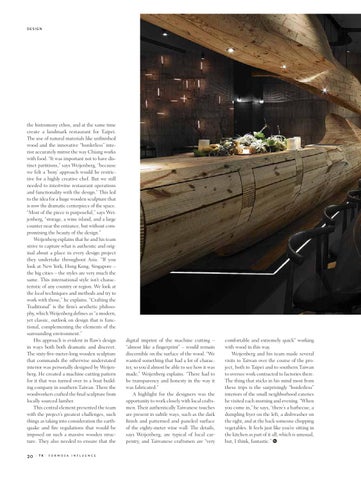
the bistromony ethos, and at the same time create a landmark restaurant for Taipei. The use of natural materials like unfinished wood and the innovative “borderless” interior accurately mirror the way Chiang works with food. “It was important not to have distinct partitions,” says Weijenberg, “because we felt a ‘boxy’ approach would be restrictive for a highly creative chef. But we still needed to intertwine restaurant operations and functionality with the design.” This led to the idea for a huge wooden sculpture that is now the dramatic centerpiece of the space. “Most of the piece is purposeful,” says Weijenberg, “storage, a wine island, and a large counter near the entrance, but without compromising the beauty of the design.” Weijenberg explains that he and his team strive to capture what is authentic and original about a place in every design project they undertake throughout Asia. “If you look at New York, Hong Kong, Singapore – the big cities – the styles are very much the same. This international style isn’t characteristic of any country or region. We look at the local techniques and methods and try to work with those,” he explains. “Crafting the Traditional” is the firm’s aesthetic philosophy, which Weijenberg defines as “a modern, yet classic, outlook on design that is functional, complementing the elements of the surrounding environment.” His approach is evident in Raw’s design in ways both both dramatic and discreet. The sixty-five-meter-long wooden sculpture that commands the otherwise understated interior was personally designed by Weijenberg. He created a machine cutting pattern for it that was turned over to a boat building company in southern Taiwan. There the woodworkers crafted the final sculpture from locally sourced lumber. This central element presented the team with the project’s greatest challenges, such things as taking into consideration the earthquake and fire regulations that would be imposed on such a massive wooden structure. They also needed to ensure that the
20
|
TK | formosa influence
digital imprint of the machine cutting – “almost like a fingerprint” – would remain discernible on the surface of the wood. “We wanted something that had a lot of character, so you’d almost be able to see how it was made,” Weijenberg explains. “There had to be transparency and honesty in the way it was fabricated.” A highlight for the designers was the opportunity to work closely with local craftsmen. Their authentically Taiwanese touches are present in subtle ways, such as the dark finish and patterned and paneled surface of the eighty-meter wine wall. The details, says Weijenberg, are typical of local carpentry, and Taiwanese craftsmen are “very
comfortable and extremely quick” working with wood in this way. Weijenberg and his team made several visits to Taiwan over the course of the project, both to Taipei and to southern Taiwan to oversee work contracted to factories there. The thing that sticks in his mind most from these trips is the surprisingly “borderless” interiors of the small neighborhood eateries he visited each morning and evening. “When you come in,” he says, “there’s a barbecue, a dumpling fryer on the left, a dishwasher on the right, and at the back someone chopping vegetables. It feels just like you’re sitting in the kitchen as part of it all, which is unusual, but, I think, fantastic.”