TASA’s mission is to promote, provide and develop leaders who create and sustain studentcentered schools and develop future-ready students.
We envision innovative, future-focused leaders for every public school student.
OFFICERS
Chris Moran, President, San Angelo ISD
Roosevelt Nivens, President-Elect, Lamar CISD
Jeannie Meza-Chavez, Vice President, San Elizario ISD
Martha Salazar-Zamora, Past President, Tomball ISD
EXECUTIVE COMMITTEE
Alejos Salazar, Jr., Region 1, Lasara ISD
Sharon McKinney, Region 2, Port Aransas ISD
Robert O’Connor, Region 3, Edna ISD
Walter Jackson, Region 4, La Porte ISD
Stacey Brister, Region 5, Little Cypress-Mauriceville CISD
Darol Hail, Region 6, New Waverly ISD
Carnelius Gilder, Region 7, West Sabine ISD
Jason McCullough, Region 8, Mount Vernon ISD
Brad Owen, Region 9, Burkburnett ISD
John “JJ” Villarreal, Region 10, Rockwall ISD
DesMontes Stewart, Region 11, Gainesville ISD
Bobby Ott, Region 12, Temple ISD
Mark Estrada, Region 13, Lockhart ISD
Bryan Allen, Region 14, Clyde CISD
Aaron Hood, Region 15, Robert Lee ISD
Greg Brown, Region 16, Perryton ISD
Scott Harrell, Region 17, Sudan ISD
Jay McWilliams, Region 18, Big Spring ISD
Diana Sayavedra, Region 19, El Paso ISD
Burnie Roper, Region 20, Lackland ISD
AT-LARGE MEMBERS
Sanée Bell, Katy ISD
Tory Hill, Channelview ISD
Nicole Poenitzsch, Bellville ISD
Tiffany Spicer, Waco ISD
COMMITTEE CHAIRS
Lauralyn Arterbury, Advocacy
Dana Bashara, Professional Learning
Donny Lee, Member Engagement
Roland Hernandez, Legislative
EDITORIAL ADVISORY COMMITTEE
Jeannie Meza-Chavez, San Elizario ISD, Chair
Lauralyn Arterbury, New Braunfels ISD
Dana Bashara, Alamo Heights ISD
Roland Hernandez, Corpus Christi ISD
Donny Lee, Wichita Falls ISD
Michael O'Malley, Texas State University
TASA Professional Learning Calendar
Chris Moran
PRESIDENT’S MESSAGE
The students and staff in our districts are depending on us to demonstrate strength and tenacity when faced with adversity. They deserve our very best each and every day.
PROVIDING HOPE, LEADING WITH STRENGTH
G. Michael Hopf’s observation — “hard times create strong men, strong men create good times, good times create weak men, and weak men create hard times” — is a stark reminder of the cycles of human endeavor. My father, Dale Moran, was one of those strong men who created good times. His work ethic, self-discipline, unwavering conviction, and drive to do things the right way, without compromise, were unmatched. When we lost him to Parkinson’s Disease five years ago, it was a tremendous loss for not only our family but also the community he served faithfully.
My father possessed a toughness characteristic of those born in the 1940s. I recall the stories he told of navigating incredibly difficult situations, yet the result was often spectacular: Relationships deepened, new skills were learned, and a profound camaraderie was formed around having to struggle through the tough times.
I have found this same truth in public education. Some of the most rewarding experiences I have had have resulted from working through situations I initially dreaded and found extremely difficult. The irony is clear: Those hard times are precisely what make this profession one of the most rewarding and enjoyable.
Many scenarios public administrators are charged with resolving are not the result of their own making, but rather, the actions or decisions of others. Superintendents and school administrators often find themselves in the unenviable position of saying, “I didn’t create this mess, but I have to clean it up.”
Your position of leadership is no accident. School administrators should be encouraged that when we face tough times — and that will be often — we are uniquely positioned to navigate difficulty, find win-win results, and make decisions that provide genuine hope for our students and staff.
As Anne Frank wisely observed, “Where there is hope, there is life. It fills us with fresh courage and makes us strong again.” As a Christian, I am similarly encouraged by Romans 5:3-4, which reminds us that “suffering produces perseverance; perseverance, character; and character, hope.”
Our profession desperately needs leaders willing to endure tough times with strength and expertise. It is not always easy or enjoyable, but we must be encouraged to press on. The students and staff in our districts are depending on us to demonstrate strength and tenacity when faced with adversity. They deserve our very best each and every day.
We must remember the fundamental truth: Progress demands struggle. Frederick Douglass stated it best:
“If there is no struggle, there is no progress. Those who profess to favor freedom and yet deprecate agitation, are men who want crops without plowing up the ground, they want the rain without thunder and lightning.”
Thank you for leading with strength through hard times!
Chris Moran TASA President Superintendent, San Angelo ISD
Bringing Literacy Within Reach for All Students
Kevin Brown EXECUTIVE DIRECTOR’S VIEW
The Texas Promise calls for leadership grounded in integrity, systems built on trust, and classrooms alive with learning, innovation and human connection.
ROCKETS, VISION AND REMARKABLE RESULTS
In my first year as a superintendent in 2008, our community engaged in a major strategic planning initiative that included 250 community members, businesspeople, parents, staff and students. It gave us a clear direction for the district.
One result was an understanding that our main purpose was to “design engaging experiences that result in profound learning for life.” For the next 10 years, that was the focus for nearly everything we did. It gave us something to be “for.” It was aspirational, inspiring and motivational.
Two years into it, however, Texas made devastating cuts to public education funding. We had to downsize our staff through attrition, increase class sizes, freeze salaries, and ask our community to pay higher M&O taxes to prevent even more drastic reductions.
The Story of Mr. Lang and His Life-Changing Rockets
Around this time a teacher, Mr. Lang, came to me asking for $1,000 to start an after-school rocketry club. We had hired him the year before to help students who had failed high school courses to get back on track.
As he asked for the money, I thought, “You have got to be kidding me! Are you not aware of the major budget cuts we are making?” But before any words came out of my mouth, he followed up with: “I know how committed you are to every child in our district, and how we are designing engaging experiences that result in profound learning for life. I work with the most at-risk kids in the district, and they aren’t part of anything after school. This club is perfectly aligned to what we say are committed to.” Not surprisingly, I said “yes” and found the money.
In the program’s first year, students built small rockets they shot off in the parking lot, and I witnessed some of our most at-risk students showing excitement for learning. The next year, Mr. Lang asked if he could teach a rocketry class for a science credit in which the students designed and built larger rockets they launched at a ranch. These broke the sound barrier, the students seemed so proud, and I knew we had something special.
Year after year, Mr. Lang added to the complexity of his rocketry classes, getting students to work in teams to design and build a 22-foot-long rocket that weighed 600 pounds and was designed to travel 100,000 feet at Mach III (three times the speed of sound). When I visited the class, I saw students walk in and go straight to work, working in teams on different parts of the rocket. Mr. Lang didn’t do any direct teaching; he asked thoughtful questions to guide his students’ thinking. Sometimes he let them go down a wrong path so they could learn for themselves that a different path was needed.
The students did their own research, secured donations for a machine shop, invited NASA engineers to do critical design reviews, and traveled to White Sands Missile Range in New Mexico to launch their rocket. The military base closed off 900-square miles of air space for the occasion. It was perhaps the most amazing educational experience I have ever witnessed.
Ultimately, Mr. Lang became a full-time science teacher, and his program became so successful that our community supported a bond to build a new facility for rocketry. We even added a middle school STEM building to build a pipeline of students.
One year, Mr. Lang arranged for his students to have an uplink with the International Space Station (ISS) where they could interview American astronauts. About 100 students gathered around a large screen to watch three astronauts float in the ISS and pepper the astronauts with smart questions. It was amazing.
As the event concluded, a student named Erick Castillon came up to me and enthusiastically told me that he wanted to be the first in his family to attend college, that he wanted to be an aerospace engineer, and that one day he wanted to work on the largest rocket in human history, which eventually became the Space Launch System (SLS). The way he said it, I knew he meant it. It was January of his junior year, and I asked him where he had applied to college. His answer was, “I don’t know; when do we do that?” We quickly got Erick to a school counselor to begin college planning and testing.
A couple of years earlier, Erick had told this same counselor that he wanted to
drop out of school. He didn’t like it and was planning to work doing landscaping. The counselor informed him that he wasn’t old enough to drop out, and she put him in rocketry. It changed his life.
He was accepted by UT San Antonio on an engineering scholarship. The summer after his freshman year, he contacted Mr. Lang to tell him he got a paid summer internship at NASA. Tears flowed for all of us.
The next year he called Mr. Lang to report another paid internship with the promise of working at NASA after graduation. More tears on our end.
But the most tissues were needed on the day Erick called to say: “Mr. Lang, I graduated, and I am now working for the International Space Station and the moon rocket at NASA. I will see you on Mars.”
Folks, that is the power of public education and giving a great teacher the space to innovate. And that is also the power
of having a clear vision as a school community about what you are “for.”
A new vision for TASA’s next century — and Texas students’ future
What I didn’t tell you before is that when I was a new superintendent back in 2008, my board of trustees and I studied a newly published document, Creating a New Vision for Public Education in Texas, which would later be called the TASA visioning document. So many aspects of that document inspired us, and we used it to launch the strategic planning effort I mentioned before.
The result was a vision for our district that was customized to our community’s goals and needs but grounded in the forward-looking principles articulated in the visioning document. The rocketry program is just one of many examples of the ways our clear vision made a difference in the lives of students in our district.
Mr. Lang and his Alamo Heights ISD students at the rocket launchpad in White Sands, New Mexico
But as future-focused as the principles in that original visioning document were, times are different than they were in 2008. The last two decades have changed the educational environment and what our students need to flourish now and in their futures. So, we at TASA have launched a new “TASA visioning document.”
The Texas Promise: A Vision for Public Education is an aspirational document — a refresh of the original visioning document that represents the collective wisdom of educational leaders from across Texas. It doesn’t contain all the answers, and it doesn’t pretend to tell local school districts or communities how to manage their own affairs.
What it does is set out some bold thinking that will hopefully inspire you and your community to innovate and create something special that serves YOUR children and community. We also hope that it will inspire lawmakers to create policy that best serves children.
The Texas Promise calls for leadership grounded in integrity, systems built on trust, and classrooms alive with learning, innovation and human connection.
Learn more about it on pages 12-15 and at tasanet.org/the-texas-promise.
There are so many Ericks out there who thirst for engaging experiences that inspire learning, and there are plenty of Mr. Langs who need the space and support of administrators and lawmakers. We have the privilege of serving them exceptionally well when we stand together, plant our flag for what we are “for,” and work collectively on behalf of our children and local communities. The future of our children, our communities, our democracy, our economy, and our freedoms lies in innovative public schools.
I got to reconnect with Mr. Lang when writing this story. He retired recently but sang the praises of the new teacher. In an important side note, Erick’s younger brother is following in his footsteps in the rocketry program and now studying engineering in college. The success continues because the vision belongs to the community, the teachers and even the students.
As I travel all corners of Texas, I see great work happening in schools. Your inspirational stories don’t always get told publicly, but they are so powerful. My hope is that your collective wisdom, reflected in The Texas Promise, will inspire even greater innovations for all the children of Texas.
Let’s make it happen!
Kevin Brown TASA Executive Director
Alamo Heights ISD rocketry program alumnus Erick Castillon at work at NASA
Erick Castillon, Colin (Mr.) Lang, and Erick's brother Jaziel Varela, who is currently following in his brother's footsteps studying engineering
The Texas Promise TASA Launches
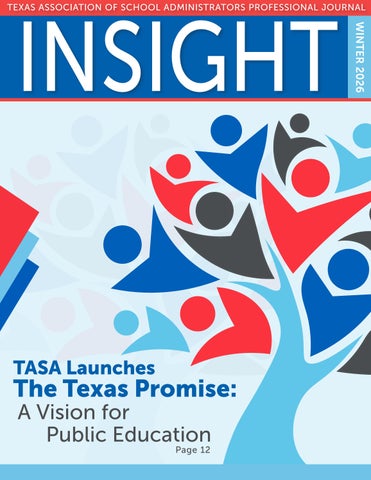
As TASA begins its second century as an organization, it's time for a bold new vision, and that's exactly what TASA launched at the 2026 Midwinter Conference in January. Attendees of the first general session were the first to be introduced to "The Texas Promise: A Vision for Public Education," a new visioning document that will guide TASA's strategic planning efforts over the next year and the organization's evolution for years to come.
The launch was the culmination of a year of work, led by Executive Director Kevin Brown and TASA President Chris Moran, that engaged nearly 100 TASA members in the refresh of the "visioning document," which has influenced legislation, district innovation, and TASA’s growth and progress as an organization since 2008.
A Little History
That original document, "Creating a New Vision for Public Education in Texas," was the result of two years of work by a group of 35 Texas superintendents who came together as the Texas Public Education Visioning Institute to articulate a bold, locally driven vision for 21st century learning.
Published 17 years ago, the document informed the creation of the Texas High Performance Schools Consortium and sparked new learning networks within TASA — including the School Transformation Network, the Future-Ready Superintendents Leadership Institute and Network (FRSLI/FRSLN), and later the Texas Performance Accountability Consortium (TPAC) and the Small Schools Network — all designed to advance the principles originally set forth by the document.
The Visioning Refresh
For nearly two decades, the visioning document helped TASA and school leaders reimagine systems, assessment, learning, and leadership across Texas. But as TASA celebrated its 100th year as an organization, it became clear it was time to update and expand the ideas in the document for a new era. The result, "The Texas Promise: A Vision for Public Education," honors the groundbreaking work of the Public Education Visioning Institute while offering a renewed, forward-looking vision that reflects the needs, challenges, and aspirations of Texas public schools today.
TASA Honorary Life 2025-26 Class
Each year, TASA recognizes the organization's newest class of Honorary Life Members at the TASA Midwinter Conference. On January 26, 2026, the following retired school leaders, who have at least 10 years of membership in TASA, at least 25 years of experience in education, and a record of outstanding service to the education profession, were honored. Together, they represent 1,456 years of service to public education.
Celebrating the 2026 Texas Teacher of the Year winners & finalists
On October 17, TASA named Vickiela Wright, a fifth-grade English language arts teacher at McWhirter Elementary School in Clear Creek ISD, 2026 Texas Elementary Teacher of the Year. Timothy Fails, a geography teacher at Flower Mound 9th Grade Campus in Lewisville ISD, was named the 2026 Texas Secondary Teacher of the Year. Wright was chosen to represent the state in the National Teacher of the Year competition, making her official title 2026 Texas Teacher of the Year.
Both state-level winners received a cash award and a commemorative trophy. Both will also receive a full scholarship toward their next level of education, either a master’s or a doctorate, courtesy of Abilene Christian University, a program sponsor, should they choose to continue their education.
Also honored during the October luncheon were the 40 Regional Teachers of the Year and the six finalists for Texas Teacher of the Year: Taylor Adame, Waco High School, Waco ISD; Miryam Gonzalez, Sarah King Elementary School, San Antonio ISD; Pooja Mulgaonker, Kiker Elementary School, Austin ISD; and Carlos Perez, Judith Resnik Middle School, Southwest ISD.
“I congratulate Vickiela and Timothy on this achieve ment. Texas Teacher of the Year is the highest honor the State of Texas bestows upon its teachers,” said Kevin Brown, executive director of TASA, which has facilitated the program on behalf of the state since 2011. “They have distinguished themselves among thousands of outstanding, dedicated teachers across our state and nation who have answered the call to serve others.”
2026 Texas Teacher of the Year
Vickiela Wright
Margaret S. McWhirter Elementary School, Clear Creek ISD
Vickiela Wright is a National Board-Certified educator with 14 years of experience across multiple grade levels. Wright serves as a fifth-grade English language arts teacher, grade level instructional coach, and team lead at Clear Creek ISD’s McWhirter School in Webster, Texas. In these roles, she is a link between administration and grade-level teams, collaborating to enhance instructional practices and improve student achievement.
Inspired by teachers and her great-grandmother who believed in her potential, Wright says she is devoted to fostering supportive, empowering environments for students and educators alike. Beyond the classroom, she leads extracurricular initiatives such as mentoring, student council, and volunteers with her sorority and Clear Creek Education Foundation.
She holds a BA in Education and a Master of Education in Reading from Benedictine University in Lisle, Illinois, and an Education Specialist certificate in Educational Leadership from Concordia University Chicago.
See Wright's "Teacher Perspective" article on page 40
Timothy Fails has 18 years of experience in the classroom, currently teaching geography at Flower Mound 9th Grade Campus (FM9) in Lewisville ISD. He was part of the inaugural staff that transitioned from Flower Mound High School to FM9 in 2014 and has served as the social studies department chair since then. Fails says that understanding the relationship between people and the planet is essential, and his classroom serves as a space to “shrink the world” for 90 minutes a day.
Outside the classroom, Fails has taken on many roles from assistant tennis coach, student council sponsor, cricket club sponsor, to even a brief stint as the ping pong club sponsor. He says that his time as “Coach Fails” on the tennis courts remains one of the highlights of his career, having allowed him to form lifelong relationships with players, their families, and fellow coaches.
Fails is a graduate of Krum High School and the University of North Texas, where he became the first in his family to earn a college degree. In 2007, he earned a BA in social sciences and holds a Social Studies 8-12 teaching certificate.
Texas Elementary Teacher of the Year Finalists
Miryam Gonzalez Sarah King Elementary School, San Antonio ISD
Miryam Gonzalez teaches dual language preschool at Sarah King Elementary in San Antonio. She says she is committed to fostering a joyful and inclusive classroom where students’ home languages and cultural identities are celebrated. Gonzalez emphasizes active, hands-on learning that invites children to fully engage with lessons through meaningful experiences.
Her responsive, play-based approach supports language development, critical thinking, and social-emotional growth in both English and Spanish. Gonzalez is a Texas Education Agency Master Teacher with an Exemplary Designation who was named Distinguished Elementary Teacher of the Year for 2023-24 and received the Dual Language Linguistically Responsive Teacher of the Year Elementary award for the same school year.
In 2025, she was honored with the Trinity Prize for Excellence in Teaching from Trinity University’s Department of Education and the Center for Educational Leadership. Gonzalez is also a National Board Certification teacher candidate. She holds a BS in biology from Allegheny College in Meadville, Pennsylvania, and an MA in teaching in education from Relay Graduate School of Education in San Antonio.
Pooja Mulgaonker
Kiker Elementary School, Austin ISD
Pooja Mulgaonker is a special education teacher at Kiker Elementary School in Austin, where she has served for the past 19 years. For 14 of those years, she taught in the Early Childhood Special Education program. Now, she serves as a SCORES, inclusion, and resource teacher, supporting students in kindergarten through fourth grade.
Mulgaonker specializes in developing students’ social communication skills and academic abilities, focusing on math and writing in a resource setting. She was honored with the Lori Tullos Barta Educator of the Year Award by the Down Syndrome Association of Central Texas in 2017. In addition to her work in the classroom, for the past 15 years, Mulgaonker has developed and managed a summer camp program designed to support and engage students with varying learning needs.
She also led the planning and renovation of a sensory room at her school — an innovative space created to enhance learning and emotional regulation for children with disabilities. She holds a master’s degree in special education from Boston College and a postgraduate degree from Mumbai, India, with a specialization in teaching children with physical disabilities.
Texas Secondary Teacher of the Year Finalists
Taylor Adame Waco High School, Waco ISD
Taylor Adame teaches 11th grade U.S. history at Waco High School. She says she is passionate about connecting historical events to contemporary issues, creating a rigorous and engaging learning environment. By presiding over multiple student support initiatives, Adame has been able to extend her dedication beyond the classroom. Through Link Crew, she facilitates connections between incoming freshmen and senior mentors.
Within Navegando, Adame guides new-to-country students toward otherwise unknown resources. She also champions Advancement Via Individual Determination (AVID), a program focused on college and career readiness to ensure students’ longterm goals are within reach.
Adame has completed Waco ISD’s Teacher Leadership Academy, contributes to the Campus Decision-Making Committee and Waco High’s Individual Graduation Committee, and serves as the social studies department chair. She says that her BA in psychology from McMurry University provides insight into human behavior and cognition that allows her to incorporate varied perspectives and critical thinking into her lessons.
Carlos Perez
Judith Resnik Middle School, Southwest ISD
Carlos Perez teaches sixth and seventh grade social studies and reading language arts in the dual language program at Judith A. Resnik Middle School in San Antonio. He says he prioritizes culturally relevant pedagogy and the Universal Design for Learning framework to create differentiated and individualized activities for each dual language student. His instructional approach combines evidence-based practices with cultural responsiveness to foster inclusive learning environments where all students can thrive.
He was named the 2024-25 San Antonio Area Association for Bilingual Education Teacher of the Year and a finalist for the H-E-B Excellence in Education Lifetime Achievement award. He is also a recipient of the prestigious Trinity Prize for Excellence in Education and a Texas Commission on the Arts grant winner. He holds a BA in Interdisciplinary Studies and an MA in Bicultural-Bilingual Studies from the University of Texas at San Antonio (UTSA), as well as a Master of Education in Leadership from Concordia University at San Antonio. Perez is pursuing a Doctor of Philosophy in Interdisciplinary Learning and Teaching with a focus on Special Education at UTSA.
As a Doctoral Scholars Implementing Socially Valid Evidence-Based Practices and Research for Improving the Language, Literacy, and Linguistically Diverse Exceptional Learners (DIVERSE) program scholar, Perez’s research focuses on empowering secondary teachers to better serve culturally and linguistically diverse exceptional learners, particularly students with dyslexia.
Historical schools have been a part of Texas school districts for years, often in need of renovation or reuse, as more modern and contemporary facilities have been built to replace them. However, these architectural gems represent a significant opportunity for connecting school districts to the communities they serve and support, and investment in them can enhance the school district’s campus portfolio. Over the years, these facilities have played an essential role in educating young students, frequently serving as landmarks and community beacons in their areas. They connect emotionally to the past, filled with memories of generation after generation of local students.
by Irene Nigaglioni
However, thinking of giving these schools a new role often comes with concerns over cost, and challenges over building codes and new expectations for innovative learning environments. These facilities often represent past educational practices, societal beliefs, and architectural trends, which are no longer considered relevant.
What is interesting is that often, newer school buildings will have a shorter life expectancy, whereas many older structures were built to last, with strong structural elements and quality materials. Retaining these historic buildings and renovating them to meet modern building codes and adapting to new learning objectives and expectations can make good economic sense.
So, we must ask, what if we could look at preserving the past, while building for the future? What if the importance of community connection and tradition can be married with innovation, and new, future ready environments can be housed in these community landmarks? What if the investment was sound, with reuse of the existing shell and structure allowing for true modernization and innovation to take place?
That is exactly what two local school districts successfully did, earning them three Caudill Award designations at this year’s Exhibit of School Architecture. Armed with creativity and innovation, but anchored in the beauty of the past, these projects were able to provide exciting learning environments for their community and future generations of students.
The first of these projects is Cameron ISD’s Old Yoe High School, a vacant building for more than 20 years converted into a cutting-edge CTE. The design partner for this project was Huckabee Architects. The design focused on direct, real-world learning environments specially designed to prepare students for in-demand careers. Utilizing elements from the existing 1919 building, such as salvaged wood from the existing structure, the district and design team were able to preserve key architectural features, integrating thoughtful restoration. This building, gifted to the district by the Yoe family more than a century ago, was renovated to respect the community’s heritage while adapting to modern educational needs.
Essential to this renovation was a collaborative process and continued dialogue with the community, so goals and expectations were clearly defined. Historic preservation was a core goal, guiding decisions that maintained the building’s character while integrating the more challenging code compliance, accessibility, and system needs.
This transformation activates the space as a living classroom itself, where exposed mechanical systems become teaching tools and adaptable learning spaces accommodate diverse CTE pathways. The project provides an exciting backdrop that motivates educators and learners by honoring the past while embracing the future, setting a new standard for educational environments that are both rooted in community and poised for ongoing growth and innovation.
Ensuring true value for the community was also a goal of the project. Rather than demolishing and rebuilding, the original structure was reinforced, all mechanical, electrical, and plumbing systems were replaced with state-of-the-art systems, and energy-efficient windows, lighting, and HVAC systems were included to reduce long-term operating costs. Replacement of the facility would have resulted in a more costly, less durable solution, while the renovation preserved the cultural and emotional value of a beloved local landmark, strengthening community ties and reducing the carbon footprint of new construction.
The other two Caudill winners are both in Dallas ISD. These are the Career Institute North, designed by WRA Architects, and Geneva Heights Elementary, designed by BRW Architects. Both projects successfully included the community in dialogue about design, including heavy participation in design charrette to discuss adaptability and flexibility, while enhancing the overall community central goals to provide new life to aging facilities in well-established neighborhoods.
The Geneva Heights Elementary School project reimagined a beloved community school built in 1931 in the Art Deco architectural style. Originally slated for full replacement, as it was not officially designated a historical building, the conversation quickly shifted given the community’s overwhelming response during early design. Residents viewed the school as a vital thread in the fabric of their neighborhood. Located in a historic neighborhood in Dallas, the final addition and renovation aimed at creating a modern, equitable school environment while preserving the unique identity of the campus and community it served.
Balancing community desires to preserve the historic structure with the need to meet new district standards for innovative and flexible learning environments proved challenging. In addition, significant site challenges, including an exceedingly small school lot, heavy traffic, and very close proximity to neighboring properties made vehicle access and pedestrian safety critical concerns. Preserving the existing structure was not easy, but its community value was too important to overlook.
Modern classrooms and exciting outdoor learning environments are now housed in the enlarged renovated campus. The design team maintained existing elements of the campus, such as the school’s terracotta-colored brick façade as it complements the neighborhood’s character, bridging historic and modern elements together in a cohesive palette. Value wise, the renovated facility meets the district’s
sustainability and energy efficiency goals, overall reducing energy usage by 25-30%. The final design also has improved indoor air quality and reduced artificial lighting dependence with plentiful daylight and modern HVAC systems.The design also aligns to WELL design standards, enhancing overall health and wellness for its users.
The new Career Institute North also has a storied past, which when coupled by mother nature, provided a unique opportunity for the district and design team. Originally serving as Walnut Hill Elementary School, the campus was hit in October 2019 by an EF3 tornado. Rather than demolish the site, the district transformed the campus into Career Institute North, which opened in 2023. The stateof-the-art facility now serves students from five nearby high schools throughout the day in block schedules.
Through a highly collaborative process that included numerous community meetings, input from parents, workforce partners, and local stakeholders helped shape the programs offered. By prioritizing CTE pathways that lead directly to high-paying, high demand jobs, the school reflects community values and addresses regional economic needs. Courses such as health sciences, drone piloting and robotics are now offered in the renovated facility, affording new opportunities to district students.
The additions and renovations were not simple, but the design team overcame significant constraints, including multiple damaged structural systems and urban site limitations. The strategy to go to multiple stories helped maximize the small site. In addition, the commitment to reconfigure outdated interior spaces, and reuse existing materials wherever possible, represented a value-driven approach that connects educational outcomes with innovative design solutions. The final design embodies a shift in educational philosophy, where students engage in real-world, direct learning within flexible, high-tech environments. The decision to reuse the damaged facility represents the district’s commitment to turn tragedy into opportunity and serve its students through preservation of the past.
Renovating older facilities is not simple, and often not considered exciting. However, the ties that bind these buildings to older generations of students help connect future generations to their past. Building on community can always represent a worthwhile investment, and these campuses are representative of this. Preserving the old can help build a solid foundation for the future. n
Irene Nigaglioni AIA, ALEP, is president IN2 of Architecture and chair of the Association for Learning Environments (A4LE) – Southern Region Foundation.
HIGHER EDUCATION
From school hallways to campus pathways: building authentic university-district partnerships
by Sharonda Pruitt
After spending many years working in a large, urban school district in Texas, I transitioned into higher education — a move that allowed me to support students and communities from an entirely new vantage point. Although research is now a central part of my professional life, I am, and always will be, a practitioner at heart. The years I spent as a teacher and administrator inform every decision I make, and I can never fully step away from that practitioner’s lens. As a scholar, I interpret theory and data through lived experience. Truthfully, much of higher education rests on the work that happens in PK-12 schools; none of us arrive at college without the tireless commitment of educators and school leaders. My journey took another pivotal turn as I moved from working primarily in urban settings to collaborating selectively and intensively with rural school districts. In my current role, these rural districts have become my sounding board, my source of unfiltered wisdom, and trusted partners for grants, innovation, and authentic problem-solving. When I need insight into what truly matters in schools, or guidance on a challenge grounded in reality rather than abstraction, these are the leaders I call. Their honesty has pushed me to listen more deeply, think more critically, and ensure that my university work remains relevant and responsive.
In higher education, my work with schools differs markedly from my previous role as a campus administrator. Rather than leading schools directly, I now engage with districts as an authentic partner. This shift enables me to support schools as they articulate their own needs — free from mandates, compliance pressures, or hidden agendas — and creates space for candid dialogue. As districts speak honestly about their challenges, I can listen with greater intentionality and responsiveness. This partnership-oriented approach reflects a commitment to reciprocity and shared ownership, core principles of effective university-community collaboration (Epstein 2011). When relationships are built on trust rather than hierarchy, schools are more willing to surface real concerns, and universities are better positioned to offer meaningful, contextually grounded support.
One of the initiatives I valued most was a summer enrichment camp developed in partnership with a local school district for elementary students. The camp brought local students onto the university campus and immersed them in spaces and experiences they may not have otherwise encountered. Students visited the campus radio station, explored the agricultural research farm, and spent time in the recreation complex. These intentionally designed experiences helped transform college from an abstract concept into a tangible, welcoming, and attainable place. One moment from the camp remains especially powerful. As students enthusiastically picked blueberries — many for the first time — I joked that I hadn’t managed to collect one. A small camper quietly reached into his pocket and handed me his last berry, saying, “Here, Dr. Pruitt — this one is for you.” That simple gesture captured the essence of this work: generosity, inclusion, curiosity, and a developing sense of belonging. In that moment, those students were no longer visitors. They were beginning to see themselves as members of the university community, imagining futures that included college and opportunity (Tinto, 1993).
Another cornerstone of my work is organizing a dual credit program that brings together students from multiple rural, geographically distant districts to take college-level courses on our campus. This program extends far beyond earning transcripted credit. Students learn alongside peers from other communities, navigate campus routines, and develop confidence in academic spaces that once felt intimidating. The experience demystifies higher education and challenges internalized assumptions about who belongs in college. For many students, it marks the first time they genuinely believe that success in higher education is possible (Fink and Yanagiura, 2017).
Over time, this program has expanded and matured through intentional collaboration with rural school leaders. Every adjustment, innovation, and improvement has been guided by their candid feedback. They are quick to tell me what works, what does not, and what schools actually need — not what sounds good in theory. Their honesty, paired with consistent support from university leadership, has allowed these initiatives to evolve into models of sustainable, authentic partnership rather than short-term outreach efforts.
After eight years in higher education — and through the collaborative experiences described above — I have identified several best practices for school districts seeking effective partnerships with universities, informed by both professional experience and research. First, districts must be strategic and specific in their requests. As I often reminded teachers when I served as a principal, specific requests yield specific results. If you need scholarship support, ask for scholarships. If you need tutors, ask for tutors. Vague requests frequently result in vague support.
Second, it is essential to understand the university timeline. Universities and school districts operate on different calendars, with distinct cycles for budgeting, staffing, and decision-making. Advance planning and calendar awareness increase the likelihood that requests can be met. Third, districts should identify an entry point — a person at the university who can serve as a connector and advocate. This individual can help navigate institutional structures, make introductions, and translate needs across systems. Making bold requests is encouraged; even if the answer is no, clarity opens doors to alternative solutions.
Fourth, partnerships should be grounded in research-based practice. Vincent Tinto’s theory of student integration emphasizes the importance of academic and social belonging in supporting persistence and success. Initiatives such as summer enrichment programs and dual credit experiences foster these forms of integration by helping students envision themselves as capable college learners (Tinto, 1993). Finally, effective partnerships require an ongoing commitment to reciprocity and reflection. Regular evaluation, open dialogue, and attention to student voice ensure that partnerships remain responsive and impactful.
When universities and school districts intentionally unite their resources, expertise, and vision, the benefits extend far beyond institutional gain. Students gain access, confidence, and opportunity — and communities are strengthened through relationships rooted in trust and shared purpose. n Sharonda Pruitt is a Junior Provost fellow and assistant professor at East Texas A&M University.
References
Epstein, J.L. (2011). School, Family, and Community Partnerships: Preparing Educators and Improving Schools (2nd ed.). Routledge. https://doi.org/10.4324/9780429494673
Fink, J., Jenkins, D., & Yanagiura, T. (2017). What happens to students who take college courses in high school? Community College Research Center, Teachers College, Columbia University. https:// ccrc.tc.columbia.edu/publications/collegecourses-high-school.html
Tinto, V. (1993). Leaving college: Rethinking the causes and cures of student attrition. Taylor & Francis.
Leadership Summit
February 25-27, 2026 • Austin, TX
Each spring school and district leaders come together for three days of impactful learning, meaningful connection, and authentic community building. Designed to cultivate leadership mindsets and advance educational innovation, New Tech Network’s Leadership Summit offers a tailored program addressing key challenges and opportunities in educational leadership. Through collaborative sessions and shared experiences, leaders gain practical insights and innovative strategies to guide towards lasting impact.
Registration Fee: $1,400, includes breakfast, snacks, and access to session materials. Hotel Information:
AT&T Hotel and Conference Center • 1900 University Ave. Austin, TX 78705
“This is probably a summit that is different than any other conference that I’ve attended because it’s providing us the time to do that reflection and do the work.”
Naomi Conner Young Women’s STEAM Research and Preparatory Academy
Friday, February 27
6:30 - 7:45 - Breakfast
8:00 - 8:45 - Whole Group Reflection
9:00 - 11:45 - Concurrent choice sessions
Please plan your travel to ensure your attendance at Wednesday’s whole group opening session. Plus our Welcome Reception is not one to miss! Please reach out to ntnevents@newtechnetwork.org with any questions.
Strategic Messaging & Branding
by Joel Weckerly
Whether they like it or not, public school districts in Texas are competing in a school choice environment and have been for quite some time. The urgency of this climate has changed due to the passage of Senate Bill 2 in the 89th Texas Legislature, which will give families about 85% of average funding per student in average daily attendance for school vouchers. The law went into effect Sept. 1, and the program is expected to launch in late 2026.
Once considered a mainstay of urban areas, charter schools have expanded into suburban communities, where “choice” was previously not a consideration for parents in high-performing districts. A new Harmony Science Academy, for example, is opening in the affluent Bridgeland community of northwest Harris County, home to Texas’s third-largest district, Cypress-Fairbanks ISD.
Foreseeing the school choice expansion and potential legislation, CFISD signed an outside marketing contract and launched a campaign ahead of the 2017-18 school year. Using the tagline “Something to Cheer About” and the #CFISDspirit hashtag, CFISD began crafting strategic messaging to help the district stand out in a crowded marketplace.
Launching with a commercial on local TV stations featuring successful alumni and recognizable business leaders, the initial campaign featured newspaper and magazine ads, social media and website posts and even billboards proclaiming why CFISD is the best choice for families: strong academics and extracurriculars, low taxes, high property values, etc.
CFISD leaned into the “choose” verb (that may have previously been a dirty word for public ed lifers) with its 2019-20 campaign, “Choose CFISD.” The essence of this messaging was simple: we know you, the parent, have multiple options. Here is why ours is the best! Since the momentum of this campaign was largely disrupted by the COVID-19 outbreak in the spring of 2020, CFISD is planning to revisit “Choose” as a marketing keyword in 2025-26.
This refocusing of messaging will be important after focusing on a series of smaller campaigns to address the pressing needs facing the district (and many others) in the wake of COVID: teacher retention, student enrollment, bus driver hiring, pre-K and more. All these are necessary, but the strategy to add the “Choose CFISD” umbrella unifies that decision for potential staff, parents and taxpayers alike.
School districts can effectively market this kind of “choice” by sharing the experience of families who chose them — and thrived. CFISD highlighted Cy-Fair HS student Peyton Mac Caraway in a video feature, interviewing both her and her mom, Jamie, about their decision to join CFISD from private school. The sound bite from Jamie, “… if I knew then what I know now, I would have started Peyton Mac in kindergarten in public school,” was more effective coming from a fellow parent and district ambassador than it was from the district itself.
Sharing these types of values, student experiences and success stories in a strategic and creative way can help districts tell the whole story of public education. n
Joel Weckerly is the director of communication for Cypress-Fairbanks ISD and the TSPRA vice president for the Houston/ Beaumont region. Follow him at @cyfairjoel.
TECH TAKE
Choose your path in public education: student technician programs
by Kim Bowlin, Justin Lascsak, and Mindy Montano
The Texas Education Savings Account (ESA) program, set to launch in the 2026-27 school year, will provide taxpayer-funded stipends to families for private school tuition, homeschooling, and other educational expenses. With a $1 billion allocation, eligible students will receive approximately $10,000 annually, with additional funds available for students with disabilities and for homeschooling. Notably, private schools are not required to accept voucher students. The program is designed to expand parental choice and foster increased competition among schools.
In contrast, Texas public schools remain powerful engines of opportunity, preparing students for both college and meaningful careers. This article highlights four public school computer technician programs: Amarillo, Cypress-Fairbanks, Mineral Wells, and Spring ISDs. These programs provide hands-on training in hardware, software, operating systems, networking, and IT security, often leading to CompTIA A+ certification and equipping students to be employment-ready upon graduation.
According to the U.S. Bureau of Labor Statistics (2025), computer technicians in the United States earn an average salary of $61,550, with a median hourly wage of $29.59. Salaries vary by location, experience, and role. In Texas, ZipRecruiter (2025) reports that entry-level computer technicians earn an average of $19.43 per hour.
Amarillo ISD (AISD), located in the Texas Panhandle, serves nearly 30,000 students across 34 elementary schools, 12 middle schools, four traditional high schools, one alternative high school, and one career academy. AISD’s student technician program was initiated in 2018 by Richard McGowan, librarian at Tascosa High School, in collaboration with the campus Digital Learning Specialist and school PC technician. According to Trevor Wagner, the current coordinator, the program has grown and now requires significant dedication and commitment from participating high school students. The program is available at all four traditional high schools, but students must first enroll in the Student Practicum Course at AmTech Career Academy and then apply to become a student technician as juniors or seniors. This pathway provides hands-on experience, allowing students to work with high school technicians to repair Chromebooks and address other technical issues.
At the start of each school year, Wagner identifies elite student technicians and coordinates with AISD technicians to allocate students based on campus needs. Students return to their home campuses during class time at AmTech to assist technicians, while on other days, they remain at AmTech to study for their CompTIA A+ Certification.
Caprock High School stands out for its student technician program, which mirrors the Amarillo ISD PC Technicians' business model. Tim Matthews, the technician at Caprock, currently mentors five student technicians, meeting three times per week for about two hours. He assigns each student a specific job related to Chromebook repair, rotating responsibilities weekly to ensure comprehensive experience. This approach provides real-world training and prepares students for future roles as PC technicians.
Each student technician at Caprock is assigned a distinct role: Customer Service (assisting peers with Chromebook issues and documenting problems), Troubleshooter (inspecting devices and verifying customer service reports), and Repair (executing repairs, requesting parts, and reporting on completed
work). Matthews reviews and signs off on all repairs. Beyond technical skills, he emphasizes critical thinking, troubleshooting unfamiliar issues, and teamwork.
Cypress-Fairbanks ISD (CFISD), serving northwest Harris County, is the third-largest district in Texas, with 114,820 students, 19,000 employees, and 96 schools. CFISD offers a Student Technician Practicum class that blends classroom instruction, handson technical training, and real-world industry experience. The practicum is a collaboration between the Technology Services department, the Career and Technology Department, and various vendor and manufacturer partners.
Students gain expertise in computer technologies — including hardware installation, software troubleshooting, operating systems, networking, and cybersecurity — and receive specialized training in classroom technologies such as Promethean boards, Hoover cams, Lightspeed systems, inventory management, and project oversight. The curriculum prepares students for industry-recognized certifications like CompTIA A+ and Network+.
Students also shadow Technology teams throughout the district to gain practical insight. Demetria Hargrove, Service Technician Manager, coordinates the practicum, working closely with instructors, technology teams, and business partners to provide engaging, real-world experiences.
A key feature of CFISD’s program is its strong collaboration with global and local business partners, offering students career exposure through virtual and in-person field trips. Students work alongside district technicians to service equipment and resume assistance and mock interviews are integrated into the coursework. The department also partners with
vendors to provide summer internship opportunities.
Mineral Wells ISD (MWISD), located in Mineral Wells, serves approximately 3,321 students with a staff of around 218 teachers and 45 staff members. Establishing and maintaining a computer technician program in a smaller district presents unique challenges. MWISD addressed this by leveraging its CTE program’s audio and visual curriculum, which incorporates Adobe products. In the summer of 2023, the CTE department secured grant funding to employ up to 20 students across various district departments.
However, only one student expressed interest in technology or communications (the initial goal was four for Technology and two for Communications; most students chose Maintenance, Food Service, or other CTE fields such as auto mechanics, welding, or agriculture). As a result, the Technology and Communications departments jointly mentored this student.
This student, already certified in Adobe Photoshop, Illustrator, and Premiere Pro, focused on digital media content creation for the district. Projects included filming athletic summer camps for promotional materials and capturing drone footage, skills supported by the student’s Part 107
Commercial Drone Pilot certification and CTE coursework. After the district installed its first videoboard at the football stadium, the student attended training and immediately began producing content, including advertisements, for the upcoming football season. The student became a key operator for video production during home and playoff football games.
Following the summer, the district hired the student as a part-time digital media intern, working the last hours of each school day during their senior year as part of the CTE practicum. The student continued to create content, contributed to the annual Veterans’ Day program, taught peers to use stadium A/V equipment, and began learning stage lighting with the High School Theatre Director. Upon graduating in 2024, the student was hired full-time as MWISD’s first digital media specialist, working in the Technology department and closely collaborating with the Communications department. The student is also pursuing an online degree in computer networking.
In 2024-25, another senior practicum student, inspired by the previous intern, joined as an unpaid digital media intern, fulfilling practicum requirements. This student focused on content creation, including writing and directing a video
Special Ed Core ELL
Supplemental Enrichment
for the biannual TASB video contest, and later chose communications as a college major. This year, a new practicum student is interning in digital media, having already worked with the football video production team and now gaining broader experience with the campus technician. Despite limited resources, MWISD recognizes that internships and CTE coursework — often leading to industry certifications — significantly enhance students’ college and job applications.
The MWISD program develops skills in communications, public relations, marketing, advertising, content creation and editing, as well as audio, video, and lighting setup, configuration, and production.
Spring ISD (SISD), serving more than 32,000 students across 43 campuses north of Houston, offers robust internship opportunities in three academic areas and has an established Computer Technician Practicum at Wunsche High School. Overseen by Ben Leung, executive director of technology services, the practicum places students with Technology Services for eight weeks each spring, where they job-shadow field technicians and gradually take on tasks such as diagnosing and repairing hardware and software, managing inventory, and training teachers on equipment use.
SISD also operates a student Chromebook repair program at Wunsche High School, running throughout the school year in partnership with Technology Services. The district’s Pathway in Technology Early College High School (P-Tech) program allows students to intern at all four comprehensive high schools, with internships scheduled in either the fall or spring semester. These interns shadow field technicians and progressively assume responsibilities in hardware and software support and inventory management.
Technology Services collaborates with the Special Education Department to tailor work experiences to students’ abilities, including inventorying equipment, diagnosing and sorting devices, and repairing and cleaning Chromebooks. Flexible schedules, typically one hour twice a week, accommodate students’ needs, with transportation and supervision provided by Special Education staff.
SISD also offers 10 paid summer internships (40 hours per week), with interns selected through a resume and interview process led by field technicians. Students receive coaching on resumes and interviewing, and work alongside technicians to prepare schools for the new semester. Tasks include diagnosing and repairing hardware, inventorying equipment, imaging computers, managing cables, cleaning Chromebooks, and checking projectors and interactive panels. After summer, graduates may continue as parttime interns (20 hours per week) while attending school, with flexible schedules and ongoing support from Technology leadership.
Texas public schools are demonstrating innovation through programs such as those in AISD, CFISD, MWISD, and SISD. These technician programs equip high school students with hands-on experience in device repair, network management, and classroom technology support, while preparing them for certifications such as CompTIA A+. Beyond technical skills, these programs foster confidence, teamwork, and problem-solving abilities that benefit students throughout their lives.
Public education in Texas is dedicated to empowering students to innovate, lead, and succeed. Technician programs exemplify how schools can blend classroom learning with industry partnerships to produce career-ready graduates. When communities invest in public education,
students gain the confidence, skills, and vision to shape the future of technology and the Texas workforce. n
Kim Bowlin is the assistant director of technology support services/purchasing for Cypress-Fairbanks ISD.
Justin Lascsak is the director of technology for Mineral Wells ISD (MWISD) since 2019. LinkedIn: https:// www.linkedin.com/in/justin-a-lascsak/
Mindy Montano is the digital learning specialist at Amarillo ISD.
References
Bureau of Labor Statistics, U.S. Department of Labor, Occupational Outlook Handbook, Computer Support Specialists,
At https://www.bls.gov/ooh/computerand-information-technology/ computer-support-specialists.htm (visited August 28, 2025).
ZipRecruiter. (September 10, 2025). Entry-level computer technician salary in Texas. ZipRecruiter. Retrieved September 17, 2025, from https:// www.ziprecruiter.com/Salaries/ Entry-Level-Computer-TechnicianSalary--in-Texas#Yearly
MATH SUCCESS
Starts
with STRONG SUPPORT
Texas Math & YOU is a customized K–12 math program designed to empower Texas educators and support student learning growth through:
✓ Tailored teaching support at point of use
✓ Research-based instructional strategies
✓ Full alignment with TEKS
Make a positive impact in Texas math education. Spark curiosity, close learning gaps, and accelerate student learning across Texas classrooms with Cengage School and Big Ideas Learning.
Make math their favorite subject!
Learn more about Texas K–AP® math solutions
None of us arrives fully formed, we grow because someone poured into us, and we continue to pour into others because we have witnessed the transformative power of that investment.
It takes a village: pouring into educators so they can pour into students
by Vickie Wright
As school leaders, you already know what it looks like when educators empty themselves daily for children: the extra hours, the carefully crafted lessons, the quiet encouragements that shape confidence and futures. Every child deserves a village, and at the center of that village stands an educator who has been poured into, supported, and strengthened so they can pour into their students in turn. The question for administrators is not simply how to honor educators’ commitment, but how to build the conditions that help it grow stronger over time.
A testimony to the village that formed me
My own “why” as an educator is woven from the people who poured into me long before I ever considered stepping foot into a classroom. Mama, my great-grandmother, chose to raise me and my younger sibling. Even though she did not have a formal education and left school early, she made sure we honored education, believing it was the key to the world. She taught me, protected me, and showed me what commitment looks like. First Sergeant Harper, my JROTC instructor, believed in me throughout high school when I did not yet believe in myself. He challenged me to define how I wanted the world to see me and made sure I understood that college was not a distant dream but something within reach. Their belief in me gave me a solid foundation.
The next “pour” happened when I began teaching. My mentor teacher pushed me to try new things in the classroom and to reach students in ways that best met their needs, helping me build confidence in my voice, trust my instincts, and grow into a more responsive and reflective educator. In the classroom, Rotary members and community volunteers showed up with books, encouragement, and their presence. Each of these people poured something essential into my growth, shaping not only how I taught, but how I understood the power of support and shared responsibility in education.
This is the foundation of every strong educator and every thriving classroom — someone recognized potential and chose to invest. None of us arrives fully formed, we grow because someone poured into us, and we continue to pour into others because we have witnessed the transformative power of that investment.
Pouring into teachers so teachers can pour into students
When students walk into our classrooms carrying hunger, grief, homelessness, or instability, I recognize those burdens because I carried many of them myself. On most days, what I needed was someone to tell me it was going to be okay or to remind me of my purpose and of what I was capable of becoming. That is why teachers so often become first responders, offering reassurance, stability, and hope. But no teacher can pour from an empty cup. Administrators hold the responsibility of ensuring that this essential work is sustainable.
To truly fill a teacher’s cup, every decision we make must be an act of pouring.
• We pour through purposeful recruitment by bringing in educators with resilience, cultural competency, and a heart for high need communities, while building local pipelines that widen and diversify who gets to teach.
• We pour through retention by creating mentorship, collaboration, and professional cohorts that lift teachers up, I know this pour firsthand. Being supported to participate in National Board Certification filled my cup by reminding me of the power of truly knowing my students and by empowering me as a teacher in ways that deepened my practice and expanded my impact.
• We pour through practical support by ensuring stocked classrooms, refreshed libraries, and community partners who meet non-academic needs, because in a Title I school even one donated book can anchor a child’s sense of belonging. I remember that some of my very first books came
from community members who believed every student should have something to read, and that simple act of generosity shaped both my love for literacy and my understanding of what a village can provide.
• We pour through social emotional systems that keep teachers from carrying trauma alone by embedding counseling, restorative practices, and coordinated supports that respond to the full range of needs within a school community.
• We pour into systems that help teachers truly know their students because you cannot reach a child that you do not understand. This pour looks like protected collaborative planning time where teachers make sense of student work together, professional learning communities that translate data into actionable support, and encouraging daily student check-ins that surface emotional and cognitive needs before learning even begins.
A village for every school
My life is proof of what a village can do. I was a little girl with big hopes and dreams and many barriers to success, however, people recognized potential in me that at times I did not even know I had. They stepped in to support me, pouring into me so I could grow, learn, and ultimately pour into others.
We are all stewards of potential, every superintendent, every principal, every educator. And stewardship requires investment. Texas students need passionate, well supported teachers now more than ever. Commitment alone is not enough. It must be matched with structure, resources, and collaboration.
When we pour with intention into teachers, into students, and into community partnerships, we do more than teach. We build the village every child deserves. And in doing so, we transform lives n
Vickie Wright is the Texas State Teacher of the Year and a fifth-grade ELA teacher in Clear Creek ISD. She champions teacher mentorship, literacy access, and community partnerships across the state.
Helping Schools Achieve Their Goals
210 Spaces—Designed & Installed in Three Weeks
To support their growing student population, Sherman Independent School District in Sherman, Texas, built three new elementary schools. However, with only three weeks to install furniture across all three campuses, they needed a partner who could act fast—on top of providing mobile tables and desks that allow for easy transitions and withstand years of use.
At the end of the project, all 210 learning spaces were outfitted with the versatile furniture they needed, providing students and educators with ultimate flexibility for teaching and learning.
It has truly been an awesome experience working with Lakeshore. It started with a great design experience...and concluded with great customer service. ... I definitely plan to reach out to them again for our future projects.
Brannon Kidd, Director of Capital Projects, Sherman ISD
The illusion of solutions: leading through trade-offs
by Quintin Shepherd
The room is quiet except for the faint sound of a clock. A chessboard sits between two players … 32 pieces, 64 squares, infinite possibility. One player studies the board, eyes moving from pawn to bishop to knight. Every move opens something and closes something else. There are no perfect paths, only better ones. The novice searches for solutions. The master studies trade-offs.
At first glance, chess appears to be a game of answers. Solve the problem, checkmate the opponent, claim the win. But anyone who has played beyond the surface knows it is not about solutions at all. Every advance carries a cost. Every gain creates exposure. To move is to choose, and to choose is to sacrifice. The longer you play, the more you realize that mastery lies not in solving the puzzle, but in managing the consequences of your decisions. We could probably end this article here, but let’s dive deeper.
For school leaders, January is our chessboard moment. The optimism of August has given way to the arithmetic of winter. The numbers are coming in, the projections are tightening, and the boardroom grows heavy with expectation. Trustees hope to expand programs. Teachers hope for raises. Families hope for smaller class sizes. Communities hope the district will balance the budget, repair facilities, improve outcomes, and do it all without asking for more.
This is the season when every administrator feels the press of reality … the finite nature of time, people, and resources. It is not cynicism to acknowledge this; it is stewardship. We can see the board as it truly is. The budget cycle forces us to confront not just what we can do, but what we must give up in order to do it.
Yet somewhere along the way, many of us were conditioned to believe that leadership means finding solutions. We talk about “solving” the deficit, “fixing” attendance, “resolving” staffing shortages as though these were solvable equations. But public education does not exist in a world of solutions. It exists in a world of trade-offs.
The truth is that very few of our challenges can be solved in any final or absolute sense. We can reduce them, reframe them, and redistribute them, but rarely eliminate them. The sooner we accept this, the more honest and effective our leadership becomes.
Solutions are comforting because they imply closure. They suggest that if we simply work hard enough, think long enough, or meet often enough, we can bring the matter to a clean conclusion. Trade-offs are harder. They require us to live in tension, to hold competing goods in both hands, and to accept that progress often comes at a cost.
When we talk about trade-offs, we shift the conversation from right and wrong to this and that. We acknowledge that improving one area may constrain another. Investing in new programs might mean fewer capital projects. Expanding pre-K access might delay the hiring of specialists. The work becomes less about defending a decision and more about clarifying what values will guide it.
This is where leadership becomes art. It is not simply about balancing the books or meeting performance metrics. It is about helping people see that every decision, like every move on a chessboard, reshapes the entire game. It invites transparency, dialogue, and shared ownership. When communities understand that leadership is an act of prioritization rather than perfection, they begin to engage more constructively. This, in turn, creates a deeper sense of trust.
Trade-offs also require a certain kind of courage … the courage to disappoint people in service of the greater good. The courage to say not now instead of never. The courage to stand in ambiguity when others crave certainty.
This is non-canonical leadership, the kind that defies the unwritten rulebook of tidy solutions. It refuses to simplify what is complex or rush what must unfold slowly. It recognizes that leadership in public education will never be clean or conclusive, but it can be deeply human.
If we are wise, we teach our teams and our communities to see the beauty in that complexity. We help them understand that success is not measured by how many problems we “solve,” but by how skillfully we navigate the inevitable trade-offs that define our work.
As the chessboard of this year’s budget season comes into view, let us play like masters. Let us see beyond the illusion of solutions and focus on positioning our districts for the long game. Because leadership, like chess, is not won by those who find the perfect move. It is won by those who understand what must be given to make progress possible. n
Dr. Quintin Shepherd is the superintendent of Pflugerville ISD. He works as an adjunct professor at University of HoustonVictoria and has served as superintendent for the past 19 years in three states.
BE SMART ABOUT HAIL. KNOW YOUR ZONE.
If your campus is located in a hail-prone zone, installing the right roofing system is one of the best protections against hail-related damage. Let us help you select the right roofing system for your hail-prone zone.
N2 Learning and TASA are excited to partner to help districts transform the learning experiences for students, teachers, and administrators.
Our strategic initiatives in partnership with TASA are designed to create learning opportunities for school leaders across Texas. These initiatives cultivate purposeful networks of leaders engaged in meaningful work that advances the principles in the New Vision for Public Education.
Scan the QR code or visit N2Learning. org for information, testimonials and registration for our institutes with TASA.
N2P
New 2 Principalship
#TXN2P
New principals will collaborate to share leadership strategies, explore innovative solutions, and build strong, accountable professional networks across diverse districts.
$2,500 * per principal 10 SESSIONS
Ten, 90-minute online coaching sessions
Assistant Principal Leadership Academy APL
#TXAPL
APL equips assistant principals with the skills and inspiration to become transformative leaders, preparing them for principal roles through targeted learning and leadership development.
$1,000 * per assistant principal
6 SESSIONS
Six, four-hour sessions during the school year
*Pricing excludes travel expenses.
Executive Leadership Institute
#TXELI
ELI empowers district leaders to drive system-wide improvements in teaching and learning, offering strategic development sessions and year-round support from an Executive Coach.
$4,500 * per administrator
4 SESSIONS
Four, two-day sessions during the year rotating between Austin, Dallas, and Houston
Principals’ Institute
#TXPVI
The Principals’ Institute is a year-long professional development series that equips principals with the knowledge and skills to lead and sustain transformative change in public education.
$6,000 * per principal
6 SESSIONS
Six, two-day sessions during the year rotating between Austin, Dallas, and Houston
TLI
Teacher Leadership Institute
#TXTLI
The boundary-breaking Teacher Leadership Institute empowers teachers to collaborate, move beyond traditional accountability standards, and create innovative, student-engaging classrooms.
$800 * per teacher
6 SESSIONS
Six sessions during the year customized for individual or regional consortium of districts
TASA Corporate Partners
TASA is grateful to our 2025–26 corporate partners for their support. Each level of the Corporate Partner Program is designed to offer our partners quality exposure to association members. Partners at the President’s Circle, Platinum, and Gold levels may customize special events and opportunities.