America's Longleaf Strategic Priorities And Actions 2025-2029
America's Longleaf Restoration Initiative Strategic Priorities and Actions Plan
Writing Team
Kathryn Smith (Lead)
Ryan Bollinger (Co-Lead)
Tim Albritton
Shan Cammack
Colette DeGarady
Carol Denhof
Shelby Diehl
Jason Dockery
Jennifer Fawcett
Dan Frisk
Kyle Jones
Katrina Koning
Lisa Lord
Ad Platt
Matthew Vandersande
Contributors & Reviewers
Jimmy Bullock
Sarah Crate
Jamelle Ellis
Ricky Lackey
Brandon Rutledge
Tiffany Woods
Texas A&M Natural Resources Institute
The Longleaf Alliance
USDA Natural Resources Conservation Service
Georgia Department of Natural Resources
The Nature Conservancy
The Longleaf Alliance
National Wildlife Federation
Alabama Forestry Commission
North Carolina State University
U.S. Fish and Wildlife Service
USDA Forest Service
National Wildlife Federation
The Longleaf Alliance
The Longleaf Alliance
USDA Natural Resources Conservation Service
Resource Management Service
The Longleaf Alliance
Theodore Roosevelt Conservation Partnership
The National Wild Turkey Federation
The Jones Center at Ichauway
National Wildlife Federation
The Writing Team is extremely grateful to all those who provided reviews and comments in preparation of this document.
Strategic Priorities and Actions Plan: 2025 - 2029
Since the release of the initial Range-wide Conservation Plan for Longleaf Pine (Conservation Plan) in 2009, which identified an ambitious goal of increasing longleaf acreage to eight million acres, a diverse partnership of natural resource management agencies, non-governmental organizations, institutions of higher learning, forest industry, and private landowners have joined forces to promote longleaf conservation and restoration in an effort referred to as the America’s Longleaf Restoration Initiative (America’s Longleaf). The Longleaf Partnership Council (LPC), which includes representation from these stakeholder groups, was formed in 2011 to increase communication, collaboration, and leverage for the implementation of the initial Conservation Plan. America’s Longleaf has gained national recognition as a model of collaborative landscape-scale conservation.
This 5-Year Strategic Priorities and Actions (SPA) Plan outlines the focused actions needed to advance the goals and objectives of the new Range-wide Conservation Plan for Longleaf Pine (2025-2040). The intent of this document is to serve as the first of three iterative SPA Plans to effectively and efficiently implement the updated Conservation Plan. The SPA Plan 2025-2029 will:
• Identify strategic priorities and recommend actions over the next five years that continue progress of America’s Longleaf toward the restoration goals in the updated Conservation Plan;
• Integrate the latest technology, science, and knowledge into our landscape-scale approach;
• Provide mechanisms and metrics to track, measure, and demonstrate progress toward these goals;
• Provide outreach information describing America’s Longleaf accomplishments to LPC members and other interested parties;
• Affirm and expand the roles and contributions of current LPC members and supporters; and
• Identify opportunities to engage additional partners in the longleaf conservation effort and opportunities to align with and leverage complementary conservation efforts beyond America’s Longleaf.
The LPC considers SPA Plans vital to achieving the objectives and key recommendations presented in the Conservation Plan. This document seeks to more explicitly describe priorities and clearly outline specific actions for the next five years while also identifying the entities within America’s Longleaf that will facilitate or carry out the actions.
Changes from Previous SPA Plans
This SPA Plan differs from previous SPA Plans in several ways. First, it is organized by the six strategies presented in the updated Conservation Plan. Each strategy, listed below, has objectives and associated key recommendations that address issues, opportunities, and challenges.
• Public Lands Strategy
• Private Lands Strategy
• Longleaf Ecosystem Restoration Strategy
• Prescribed Fire Management Strategy
• Economic and Market-based Financial Strategy
• Climate Resilience and Co-benefits Strategy
By carefully evaluating progress and outcomes, America’s Longleaf can determine if actions are implemented successfully and biologically meaningful. The SPA Plan details the steps that will be taken from 2025 to 2029 to improve longleaf restoration monitoring, track improvement and maintenance activities, and develop metrics that provide a baseline of the current extent and condition of longleaf pine and outline how both traditional accomplishment metrics (acres), non-traditional accomplishment metrics, and conservation outcomes will be measured and reported moving forward (see Section II).
Another addition to the SPA Plan is the designation of entities that will carry out actions. Entities are limited to people and groups that are recognized America’s Longleaf stakeholders including working groups, the LPC, Federal Coordinating Committee (FCC), other America’s Longleaf partners, and Local Implementation Teams (LITs). Working groups (WG) include Longleaf for All (LFA), Public Lands (PLWG), Mapping WG, Policy WG, Communications (Comms WG), Groundcover (GCWG), and Tree Improvement (TIWG). See Glossary in Appendix A for descriptions for these action entities as well as other terms used in the SPA Plan.
In addition to the changes listed above, the SPA Plan also establishes methods to measure and report on the progress towards the listed priorities and actions for each strategy. This first 5-year SPA Plan intends to serve as a proactive working plan, provide process for the LPC to annually review identified strategies and actions, track progress, and generate a SPA Plan Report at the end of the five-year time frame. The SPA Plan Report will help the LPC analyze successes and challenges, adapt as needed, and consider any adjustments needed in subsequent years.
II.Overarching Priorities
Under the updated Conservation Plan, the goals of America’s Longleaf remain steadfast: to maintain, improve, and restore longleaf in the Southeast U.S. As of 2023, total longleaf acreage was approximately 5.2 million, an increase from 3.4 million acres in 2009 when the partnership was established (see 2009 Conservation Plan). As the partnership moves toward reaching its 8 million acre goal, it is imperative that newly established acres enhance and improve upon existing accomplishments and contribute to functional, healthy, and sustainable longleaf ecosystems. The overarching priorities of the SPA Plan are to ensure that the efforts of the last 15 years continue to expand upon that work with new information and understanding of what is needed to restore longleaf across its native range. Another priority for America’s Longleaf in the next 5 years and beyond is to increase our cultural competencies and pursue growth, learning, and inclusion of and from tribal nations and other potential Indigenous partners.
Monitoring and Evaluating Progress of America’s Longleaf
The Conservation Plan identifies a need for careful evaluation of progress and outcomes to support informed management and decision-making at all levels of America’s Longleaf. The Southeast Longleaf Ecosystem Occurrences Geodatabase (LEO) and Longleaf Sustainability Analysis (LSA) are essential resources and tools that will require ongoing maintenance and updating to optimize usefulness in documenting the extent and condition of the longleaf ecosystem over time and prioritize the best use of limited restoration resources. With the current LSA Version 1 available and future iterations coming soon, the next step is to identify the most important monitoring and research questions and invest resources to ensure prioritization of the “right work” in the “right places”. The Conservation Plan also identifies a need to invest in the development of an effective and informative monitoring program that will enable assessment of changes in range-wide extent and condition, allow for integration of new technologies, assess action outcomes, and support improved prioritization of restoration efforts for America’s Longleaf.
Actions to support the Conservation Plan’s Monitoring and Evaluating Progress objectives are as follows:
I. The Mapping WG will develop a Range-wide Longleaf Monitoring Plan in 2025 to support America’s Longleaf with a strategy for tracking acreage goals for longleaf occurrence and condition.
II. Florida Natural Areas Inventory and The Longleaf Alliance will maintain, update, and publish a LEO Version 3 in 2026. Version 3 will include additional field surveys and enhancements to be used as a central source for longleaf spatial data and as a critical tool for longleaf conservation planning and monitoring by partners.
III. Florida Natural Areas Inventory will use new and revised input datasets (e.g., longleaf soils, LEO, SE FireMap v.2) and analyses to improve the longleaf suitability and habitat quality datasets, publish a Version 2 of the LSA, and create a web map tool to improve access and use by partners.
IV. The Mapping WG will guide a Historical Land Use Assessment (Change Analysis) to identify trends and land use change dynamics through an assessment of historical satellite imagery over the past 5 years.
V. The Mapping WG will analyze the status of longleaf and the opportunities for restoration and management in each of the longleaf ecoregions using the LSA and present a report to the LPC (2025).
VI. The Mapping WG will identify priority acres to maintain, improve, and restore by ownership (state, federal, private, conservation land) in each state, each LIT boundary, and ecoregion.
VII. The LPC will provide recommendations on ways to increase resources to ecoregions and LITs based on need so that all ecoregions are maintaining, improving, and restoring longleaf in ways that will ensure healthy longleaf ecosystems (2026).
VIII. The Mapping WG and LPC partners will provide LITs with data and support to draft new, or update existing, conservation plans for their zones (20252029).
IX. The Mapping WG will identify potential needs and/or opportunities in areas not within LIT boundaries and the LPC partners will create a plan to address those needs.
Technical Assistance and Outreach
A common priority across all strategies is the need for continued and increased technical assistance and outreach to landowners and land managers. The following is information that should be emphasized to managers and landowners as well as guidance from America’s Longleaf— by strategy—on the most important practices and ideas to convey during training and outreach programs.
Longleaf Ecosystem Restoration
l The importance of using an ecosystem approach to longleaf establishment and management.
l Guidance on maintaining existing high-quality longleaf forests to reduce continued loss of habitat.
l The best site-specific approaches for transitioning nondominant stands to longleaf dominant.
l Emphasize forest ecosystem management practices, layering of ecosystem benefits, and all values of a forest.
l Continue to provide the Longleaf Resilience documents for information on how to market the advantages of the longleaf ecosystem.
l Promote the values, benefits, and estimated cost of restoring native groundcover in longleaf pine forests.
l Educate on best management practices for groundcover collection and planting.
Prescribed Fire Management
l Increase communication on methods the public can use to protect their health during smoke events, such as from wildland fire smoke.
l Increase understanding, acceptance, and application of prescribed fire including, but not limited, to smoke management.
Economics and Market-based Financial Incentives
l Grow and advance the knowledge and understanding of economic and financial-based markets.
l Provide landowners and managers with new economic and market-based financial opportunities and models for longleaf.
Climate Resilience and Co-benefits
l Promote climate-smart management of longleaf and utilize the Longleaf Pine Climate-Smart Guide as an education tool.
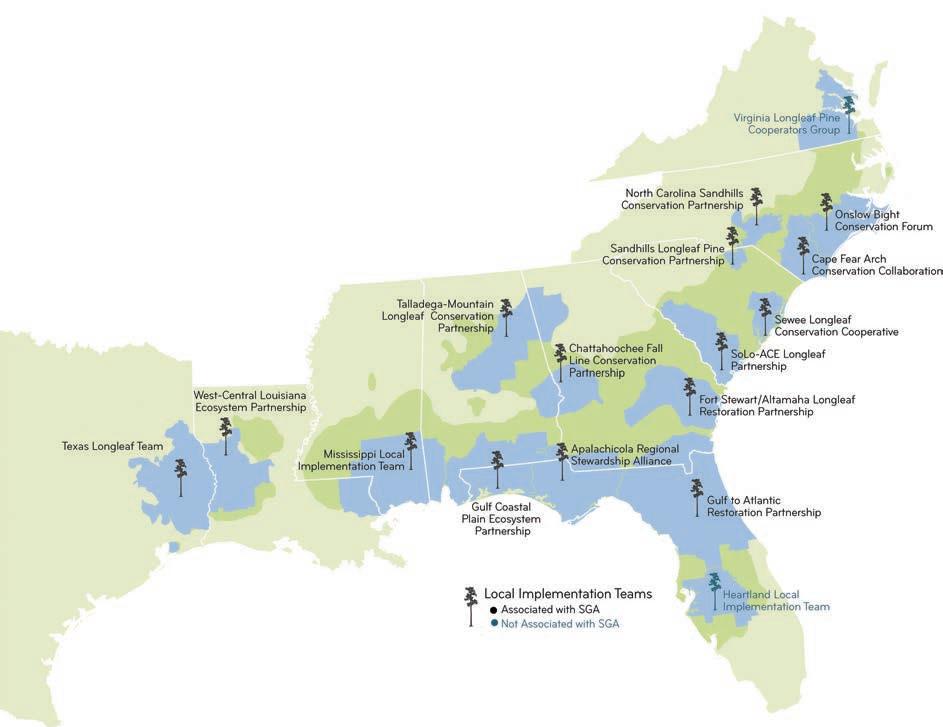
Local Implementation Teams with the Historical Range of Longleaf Pine
Significant Geographic Areas (SGAs) serve as the framework for America's Longleaf's landscape level approach to the conservation of longleaf pine ecosystems, prioritizing resources in areas with the potential to sustain functional landscapes and populations of target species into the future.
Local Implementation Teams (LITs) organized around these SGAs and defined larger landscape boundaries surrounding them in which to work. It is anticipated that the bulk of restoration efforts will be carried out by Local Implementation Teams.
III.Priorities and Actions Public Lands
Public lands, referred to in this document as any lands that are not privately owned, are often core areas and can contribute to substantial gains in longleaf conservation within National Forests (USFS), Department of Defense (DoD) lands, State Forests and Wildlife Management Areas, National Wildlife Refuges (NWR), and lands owned and managed by other government agencies. In 2017, the LPC assembled the Public Lands Task Force to explore the
potential for increasing longleaf ecosystem restoration on public lands. As a result, restoration on suitable public lands has accelerated, including a commitment from the USFS to put one million additional National Forest system acres on the path to longleaf. It remains a priority of America’s Longleaf to continue to identify and encourage establishment of longleaf on public lands through 2029 and beyond.
Objective A Land management agencies (local, state, and federal) support longleaf pine ecosystem restoration on public lands and invest in appropriate management structures to accomplish work consistent with their mission.
Priorities Actions Year
A.1. Promote inclusion of longleaf restoration in management planning for lands administered by state wildlife and forestry agencies (i.e., State Wildlife Action Plans (SWAPs) & State Forest Action Plans (SFAP). (Key Recommendation 1)
A.2. Engage with states to restore longleaf on state-owned lands by 2040. (Key Recommendation 2 & 3)
A.1.1. Reassemble a PLWG to execute actions.
A.1.2. PLWG will gather each state's SWAP & SFAP and evaluate each plan's inclusion of longleaf, longleafdependent species, fire and smoke BMPs, and other longleaf-related details.]
A.1.3. The best examples of SWAPs and SFAP and other information identified by LPC (e.g., fire and smoke management) and the PLWG will be recommended for inclusion in each state's SWAP and SFAP.
A.2.1. Mapping WG and LPC Partners will use LSA to assess and quantify potential restoration acres on state lands for each state in the longleaf range (see Monitoring and Evaluating Progress section).
A.2.2. PLWG and LPC will utilize Mapping WG assessment to bring to states and make state-specific plan(s) for engagement with the appropriate contacts in one or two pilot states.
A.2.3. LPC Partners will seek specific acreage goals from each pilot state(s) for restoring longleaf on state lands by 2040 including conversion of mixed stands with a minor manageable component of longleaf to longleaf-dominant stands. (Key Recommendation 4)
A.2.4. PLWG will assess successes and failures with pilot state(s) (see above Action) and make state-specific plans for remaining states.
A.3 Expand training resource professionals in management and restoration techniques for longleaf. (Key Recommendation 5)
A.3.1. FCC Leadership will encourage new agency staff to seek out local training in longleaf management and restoration. (i.e. Longleaf Academies and other courses taught by The Longleaf Alliance and Ecological Forestry Longleaf Pine training at the Jones Center). 2025-2029
Priorities Actions
A.4. Engage federal agencies to assess and commit to specific longleaf acres for restoration on their lands by 2040. (Key Recommendation 3)
A.4.1. LPC Leadership will formally request each federal agency assess potential suitable longleaf acres on their respective lands, analyze the cost and resources needed, and provide an assessment of potential acres to restore to longleaf by 2040 including but not limited to conversion of existing mixed stands with a minor manageable longleaf component to longleaf-dominant stands. (Key Recommendation 4)
A.4.2. FCC Leadership will work within their agencies to address the requests of the LPC.
A.4.3. LPC Leadership will seek specific acreage commitment from each agency for restoring longleaf on federal lands by 2040. 2025 2025-2029
2028-2029
Objective B Public land managers and local representatives in Significant Geographic Areas (SGAs) play a leadership role in implementing collaborative planning and management of longleaf pine ecosystems at the landscape scale.
Priorities Actions Year
B.1. Continue to Support Local Implementation Teams (LITs) by 2030. (Key Recommendation 1)
B.1.1. FCC Leadership will work within agencies to ensure field units are associated with LITs
B.1.2. FCC will seek to ensure federal agencies play a leadership role in supporting LITs.
B.1.3. LPC Partners and FCC will partner with and support LITs’ development of NFWF Longleaf Landscape Stewardship Grants and other funding opportunities.
B.1.4. LPC Partners will encourage inclusion of LITs in state-specific plans (SWAPs/SFAPs) to ensure field units are associated with LITs.
2025-2029
2025-2029
2025-2029
2025-2029
B.2. Ensure federal agencies have the appropriate authorities to help conduct management activities on other public or private lands. (Key Recommendation 2)
B.3. Ensure top leadership in each state is engaged with America’s Longleaf. (Key Recommendation 2)
B.2.1. PLWG will identify current programs that could be utilized or leveraged in new or different locations and report findings and recommendations to the LPC.
B.2.2. PLWG will identify where there is a need for a new program or amendments to existing programs.
B.3.1. LPC Partners will promote the goals and objectives of America’s Longleaf within SERPPAS.
B.3.2. Utilize existing relationships of LPC members.
B.3.3. LPC will designate a state representative from each state on the PLWG
2025/2026
Objective C Land management agencies (local, state, and federal), longleaf partners, policymakers, and the general public understand the importance and role of public lands to longleaf restoration and the associated cultural, ecological, economic, and social values.
Priorities
C.1. Assess and share accomplishments that are not centered around acres of longleaf. (Key Recommendation 1 & 2)
Actions Year
C.1.1. FCC Leadership will create and maintain a list of measurable outcomes that encompass the goals that are important to each of the federal agencies and provide to LPC and Comms WG.
C.1.2. FCC Leadership Team will develop a document that summarizes the status of each item (from the list created above) that will be measured to provide a baseline and outline of how each will be measured going forward.
C.1.3. Comms WG will include list of outcomes alongside acres in reports and other communications that are meant to promote the accomplishments of America’s Longleaf.
C.2. Promote access to longleaf forests. (Key Recommendation 4)
C.2.1. LFA and LPC Partners will engage with community leaders and universities to restore longleaf on community-owned forests and campus-owned lands.
C.2.2. LFA and LPC Partners will provide opportunities for community members to participate in conservation activities on publicly accessible lands and communityowned forests such as volunteering, cultural practices, and citizen science.
C.2.3. LFA and LPC Partners will incorporate all historical aspects of longleaf ecosystems into education materials and signage that highlights the significance of these ecosystems to various cultural groups.
C.2.4. Comms WG will promote communication of the benefits and opportunities offered by community forests, drafted by the LFA.
Privately owned lands account for approximately 86% of all forested land in the South. Private forest owners can be divided roughly into two groups: small forest owners and large forest owners. For this discussion, small forest owners can be considered those that own less than 100 acres; they represent approximately two-thirds of the privately held forests in the region (see Conservation Plan for more information). Given the prevalence of private lands in the longleaf pine range and limited resources available to restore and manage these lands, identifying where to conduct activities for the greatest benefit requires a coordinated approach to prioritize needs by the partners.
Small private forest landowners exhibit a wide diversity of interests, capabilities, and goals for their properties. Large private landowners offer opportunities to advance America’s Longleaf objectives at scale. Reaching all private landowners within longleaf priority areas requires a collaborative approach of outreach, education, and support. This section lays out how America’s Longleaf plans to continue previous efforts and take steps towards new actions to address the Key Recommendations laid out in the updated Conservation Plan for this strategy with a focus on priorities and actions that will take place from 2025 through 2030.
Objective A Small private forest owners are prioritized in strategic locations for financial assistance.
Priorities Actions Year
A.1. Prioritize financial assistance to private forest owners in locations that have existing site conditions most suitable for restoration, can support desirable plant or wildlife species, will be managed in the long term as high-functioning longleaf pine ecosystems, or connect two or more established high-functioning longleaf pine forest stands. (Key Recommendation 1)
A.1.1. LPC will ask partners to gather information on their past investments on private lands across the range. Information should include agency or organization, county, dollars invested, and type of activity.
A.1.2. Mapping WG will create a geospatial layer of past investments with defined categories (e.g., high, medium, or low investment) for inclusion with existing geospatial datasets and tools for analysis.
A.1.3. LPC will review available information on past investments on private lands in relation to existing geospatial tools (e.g., LSA, LEO, Climate Atlas) and identify a listing of potential targeted areas for outreach, education, and investment.
A.2. Encourage coordination between financial assistance and other incentive programs to offer alternatives to private forest owners seeking to restore longleaf pine ecosystems (e.g., Farm Bill programs vs. private carbon markets). (Key Recommendation 5)
A.2.1. LPC partners will collaborate on creating a handout for landowners that summarizes the range of available financial assistance providers, a guide to find a professional forester, and options for long-term protection of their property. The handout should serve as a template so that local partners can tailor the local resources section to their location. This should be updated annually for field staff and customers to ensure the best information is being provided.
A.2.1. LITs and the respective state Forestry Working Groups will develop a comprehensive reference of current financial assistance and other incentive programs for landowners in their respective states to be reviewed and updated annually for the handout (above).
2026/2027
2026/2028
Objective B The scope and scale of outreach and education to small private forest owners and forestry service providers is expanded.
Priorities Actions Year
B.1. Encourage engagement between locally led organizations (e.g. LIT and private forest owners).
(Key Recommendation 1)
B.2. Strategically focus outreach efforts on geographic places.
(Key Recommendation 4)
B.3. Continue to improve upon approaches to providing delivery of outreach and education to all landowners.
(Key Recommendation 5)
B.1.1. LITs will each designate a private lands lead who will help increase communication and coordination across the LIT organizations that provide private landowner outreach and education.
B.1.2. LIT Private Lands Lead will assess technical assistance capacity within their LIT boundary, identify gaps in coverage, and secure financial resources to increase capacity within deficient areas.
B.2.1. Each LIT will incorporate information provided by the Mapping WG (see Monitoring and Evaluating Progress section above) into their LIT Conservation Plans including ways to increase outreach to areas that are currently underserved.
B.3.1. LPC Partners and LFA will collaborate with institutions and organizations to leverage their existing outreach and education resources with underserved forestry producers.
B.3.2. LFA, LITs, and LPC Partners will continue to develop and expand upon outreach and education tools for landowners across the range with a goal of holding at least one outreach, education, or training event within each LIT.
B.3.3. LFA and LPC Partners will develop and expand upon outreach and education tools for resource professionals to expand their knowledge and expertise to provide delivery of technical assistance to all clients. Examples include peer-to-peer outreach, mentorships, The Longleaf Alliance's “Longleaf and the Landowner Academy”, and National Wildlife Federation’s “Grow More” forestry trainings.
B.3.4. LFA will coordinate with Comms WG to develop networking tools of available resources including landowner groups, community leaders, and other resources to assist landowners.
2025 2026
2028/2029
2025-2029
2025-2029
2025-2029
2025-2029
Objective C The scope and scale of technical assistance to small private forest owners interested in longleaf pine ecosystem conservation is expanded.
Priorities Actions Year
C.1. Encourage the development of forest management plans that consider the range of landowner objectives and contribute to the Conservation Plan goals. (Key Recommendation 1)
C.2. Engage with forestry professionals (e.g., certified, registered, licensed and consulting foresters) about the benefits and tradeoffs of longleaf pine forests when writing forest management plans. (Key Recommendation 2)
C.1.1. LPC leadership will form a task force to develop a Land Management Plan (LMP) template. Collect example LMPs and identify a funding source to contract writing the template.
C.1.2. The task force (above) will develop an LMP template for each state that can be used to help private forest owners develop forest management plans and estate plans.
C.2.1. LPC partners will develop and host annual training events tailored for forestry professionals on restoring and managing longleaf pine forests (e.g., forestry professionals, Technical Service Providers).
C.2.2. LITs and LPC Partners will engage with forest products companies, wood suppliers, and other professionals within the forestry sector and supply chain in their respective service areas to engage private landowners on available opportunities to restore longleaf pine.
C.3. Promote long-term estate planning for family forest owners that support the Conservation Plan goals (e.g., marketable carbon sequestration and water supply). (Key Recommendation 5)
C.3.1. LFA will continue to engage and partner with legal counsel organizations and professionals, such as the Georgia Heirs Property Law Center, and the Center for Heirs’ Property Preservation, to assist more landowners with property ownership challenges.
C.3.2. LPC Partners and the LFA will increase the number of workshops and other educational opportunities for landowners and professionals to learn about property rights topics including estate planning and management plans.
Objective D Longleaf pine ecosystem restoration goals are coordinated with other federal, state, and local governments during strategic planning processes.
Priorities Actions
D.1. Encourage stakeholders to participate in NRCS State Technical Committees, related subcommittees, or local work groups. (Key Recommendation 1)
D.2. Facilitate cross-boundary demonstration site visits on public lands to show landowners what can and is being done to restore healthy longleaf pine ecosystems. (Key Recommendation 5)
D.1.1. FCC Leadership will create a resource to communicate opportunities for participation at upcoming State Technical Committee meetings and associated forestry subcommittee meetings. Each LITs will provide the current contact information for their private lands lead to the respective NRCS State Conservationist.
D.1.2. The Comms WG will ensure that the state and local versions of the landowner handouts are shared with LIT coordinators, State Technical Committees, and other interested parties.
D.2.1. LITs will produce a listing of publicly accessible lands (e.g., on national forests, state forests, community forests, state universities) within each LIT boundary that offers the greatest opportunity to showcase high-quality longleaf pine ecosystems to be used for outreach and education to local private forest owners.
D.2.2. Comms WG will work to promote demonstration days and other events across the range.
2026/2027
2026/2028
Objective E Investments in longleaf pine ecosystems are protected and preserved through expanded use of conservation easements.
Priorities
E.1. Engage with large private forest owners to develop innovative conservation easement or land trust opportunities to support working lands and advance plan goals. (Key Recommendation 2)
Actions
E.1.1. LPC will engage with large private forest owner representatives and encourage development of innovative strategies and opportunities for easements on large private forest lands.
Objective F Participation in longleaf restoration by large private forest owners is expanded through the development of new approaches.
Priorities (Key Recommendation)
F.1. Actively engage large private forest owners as partners in America’s Longleaf. (Key Recommendation 1)
F.1.1. Mapping WG will develop maps on different future scenarios with and without large private forest owner participation. These maps will be used in a future workshop (below).
F.1.2. America’s Longleaf partners will host a workshop focusing on engagement with Large Private Landowners to address misconceptions, discuss participation needs, hear about lessons learned, and identify opportunities for collaboration with large landowners, state forestry associations, and agencies.
Longleaf Ecosystem Restoration Strategy s
Reaching the longleaf acreage goals set forth in the Conservation Plan is contingent upon successful reforestation (or afforestation) of an additional 2.8 million acres of land across the range with a focus on using an ecosystem approach. This holistic approach to longleaf establishment and management includes planting longleaf seedlings in appropriate sites across the range, restoring or enhancing groundcover along with trees, and managing and conserving existing longleaf forests with an eye on
maintaining ecosystem function. The Priorities and Actions outlined below are organized by the following objectives: (A)Increasing awareness of longleaf ecosystem restoration and management; (B) Addressing bottlenecks in the longleaf seedling production supply chain and improving longleaf genetics; and (C) Promoting native groundcover seed and plant material production and use in longleaf ecosystem restoration.
Objective A Awareness and involvement among resource managers and landowners in efforts to manage and restore functioning longleaf pine ecosystems is increased.
Priorities
A.1. Provide technical assistance, outreach, and training to landowners that align with the Key Recommendations outlined in Objective A of the Conservation Plan. (Key Recommendation 1, 2, & 4)
Actions Year
A.1.1. Designated LPC partner(s) will produce a Guide to BMPs for longleaf ecosystem restoration by ecoregion.
A.1.2. Provide LITs and other groups performing outreach/training with game changer approach of converting non-longleaf dominant pine stands to longleaf dominant.
A.2. Promote longleaf for reforestation following disaster-related events and work with funding agencies to offer flexible, cross-boundary incentives to offset expensive costs of cleanup. (Key Recommendation 5)
A.3. Support workforce development for critical restoration contractors (i.e., planting crews, prescribed fire applicators, site prep contractors). (Key Recommendation 7)
A.2.1. LPC members will engage with federal and state agencies to guide timely implementation of disaster assistance programs for private landowners.
A.2.2. LPC members, Policy WG, and other government relations partners will promote the inclusion of forestry in the same category as agriculture following disasters.
A.2.3. America’s Longleaf partners will support and promote disaster-related research that provides guidance on BMPs for managing longleaf stands for storm resilience.
A.3.1. America’s Longleaf partners and LFA will support development and support of forestry mentor and intern programs.
A.3.2. LITs and America’s Longleaf partners will host field days at nurseries and seed orchards.
A.3.3. America’s Longleaf partners and LFA will participate in and encourage participation in college/university career events.
A.3.4. America’s Longleaf partners will endorse and support the distribution of scholarships for selected contractors to attend longleaf restoration training.
2025-2029
2025-2029
2025-2029
2025-2029
2025-2029
Objective B Tree seedling quality and quantity are substantially increased to meet the planting goals of the Conservation Plan while ensuring that financial assistance and incentives for landowners, agencies, and those in the private sector are maintained or increased.
Priorities Actions Year
B.1. Leverage public-private partnerships and funding to build nursery capacity and confidence, expand longleaf tree seedling production capacity, improve the genetic quality of longleaf seed and seedlings, increase seed production capacity, and increase capacity and locations for seed processing and storage.
(Key Recommendation 1, 2, 3, 4, 5)
B.2. Increase skilled workforce capacity in public and private sectors for all stages of seed and seedling production. (Key Recommendation 6)
B.3. Identify and utilize appropriate private lands for longleaf seed collection. (Key Recommendation 7)
B.1.1. LPC and America’s Longleaf partners will promote funding to address nursery bottlenecks and seedling enhancement.
B.1.2. LPC and America’s Longleaf partners continue to support progress in the Longleaf Tree Improvement Cooperative (restarted in 2024).
B.1.3. LPC and America’s Longleaf partners promote and provide funding for maintenance of existing orchards to boost production of improved seed.
B.1.4. LPC and America’s Longleaf partners will promote the expansion of the number of seed processing locations and nursery capacity
B.2.1. LPC and America’s Longleaf partners will promote mentoring opportunities and apprentice programs.
B.3.1. LPC and America’s Longleaf partners will identify suitable sites across the range based on annual cone assessment/need and facilitate connections between private landowners and seed collectors for collections of seeds and distribution to nurseries.
Objective C Native groundcover seed and plant material production capacity is expanded and supported to meet increased demand for affordable, diverse, and ecologically appropriate materials for restoration. Information is communicated to landowners, managers, and agencies to promote the importance of groundcover restoration in longleaf management.
Priorities Actions Year
C.1. Provide communication on the values, benefits, and estimated cost of restoring the native groundcover in longleaf pine forest targeting landowners and policymakers. (Key Recommendation 1)
C.1.1. Policy WG will develop a cost/benefit analysis of restoring native groundcover.
C.1.2. America’s Longleaf partners will use analysis to promote the importance of groundcover maintenance.
C.1.3. Policy WG and gover nment relations partners will convey the importance of groundcover maintenance to Climate Smart Practices.
Priorities Actions
C.2. Expand financial assistance programs to provide greater support for groundcover restoration on private lands. (Key Recommendation 2)
C.3. Support the further development of a native groundcover seed market. (Key Recommendation 3, 4, 5, 7)
C.2.1. America’s Longleaf partners will participate in State Technical Committee meetings to advance support for groundcover restoration on private lands.
C.2.2. GCWG will poll states on groundcover cost-share activities and report outcomes.
C.2.3. GCWG will develop a decision support tool to provide information to producers and forest owners on varying levels of groundcover restoration.
C.3.1. America’s Longleaf partners will leverage relationships between large nurseries and each state's Department of Transportation to promote increased capacity for approved list of species for revegetation on roadsides.
C.3.2. America’s Longleaf partners will continue promotion of commercial partners engaged in groundcover seed and plant production.
C.3.3. America’s Longleaf partners will promote the implementation of successful programs (e.g., Texas Natives) as a model for other states.
C.3.4. America’s Longleaf partners will promote the creation of additional seed collection sites within LIT landscapes.
C.3.5. America’s Longleaf partners will encourage LITs to enroll with Department of the Interior’s (DOI) Seeds of Success Program, a national native seed collection program led by the Bureau of Land Management in partnership with USFWS, USDA Agricultural Research Service, National Park Service, Tribal Nations, and many non-federal partners.
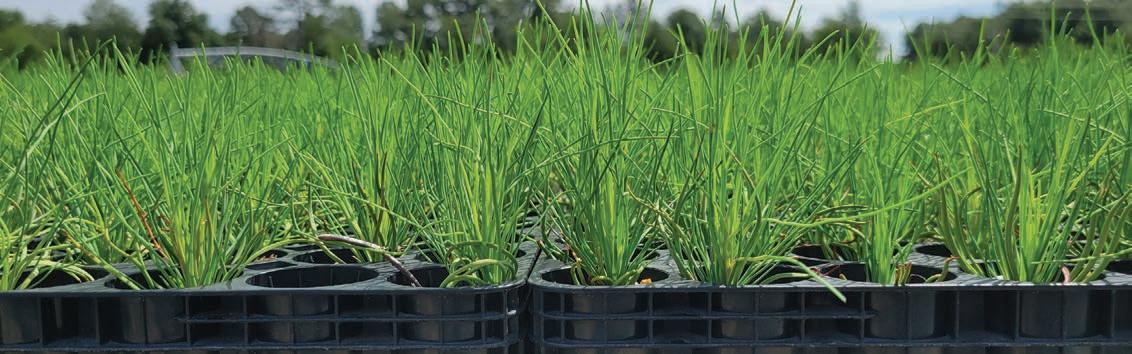
Longleaf pine seedlings – Credit: Carol Denhof
Prescribed Fire Management Strategy
Fire shapes the longleaf pine ecosystem and its ecological processes, playing a crucial role in its maintenance. Although the use of prescribed burning in longleaf ecosystems has been increasing, current activities still fall short of what is necessary to sustain healthy longleaf ecosystems across the Southeast. The recommendations in this strategy aim to restore and enhance the role of fire in managing and maintaining longleaf during the next five years while aligning with the objectives of the Conservation Plan. By implementing prescribed fire and promoting best
fire management practices, the Conservation Plan addresses critical aspects of habitat restoration, species conservation, and ecosystem resilience, ensuring the long-term sustainability of the longleaf pine ecosystem. America’s Longleaf prioritizes encouraging the continued and increased fire use across the longleaf range through 2029 and beyond. This section outlines the plan to continue these efforts based on the Key Recommendations in the updated Conservation Plan, focusing on priorities and actions from 2025 through 2029.
Objective A Ample institutional capacity is available for prescribed burning, particularly in Significant Geographic Areas.
Priorities
A.1. Expand the number and coverage area of Prescribed Burn Associations (PBAs) and Cultural Burn Associations (CBAs) and increase membership across the longleaf range. (Key Recommendation 3)
Actions
A.1.1. LITs will share information about local PBAs and associated activities
A.1.2. America’s Longleaf partners will promote funding needs and opportunities for PBAs and CBAs.
A.1.3. America’s Longleaf partners will work with state agencies to promote the inclusion of PBAs and CBAs in State Fire Mitigation and SFAPs.
A.1.4. America’s Longleaf partners will promote the bolstering and expansion of existing fire strike teams, seasonal burn crews, and fire equipment in focal areas.
A.1.5. LFA will leverage opportunities for all landowner burn teams, PBAs, and CBAs.
Year
2025-2029
2025-2029
2025-2029
2025-2029
2025-2029
A.2. Improve practitioner safety, smoke management, and increase areas burned by promoting and increasing the use of new technologies. (Key Recommendation 3).
A.2.1. America’s Longleaf partners will encourage USFS, DOD, DOI, and state agencies to expand their use of UAS (unmanned aircraft systems) and other emerging technologies such as next generation fuel, fire, and smoke modeling.
A.2.2. America’s Longleaf partners will promote UAS aerial ignition by sharing prescribed fire success stories and seeking funding opportunities for new systems.
2025-2029
2025-2029
with their stakeholders.
Priorities Actions
A.3. Increase training and educational opportunities to build additional capacity and expand the prescribed fire workforce.
(Key Recommendation 3)
A.4. Encourage partnerships to increase onthe-ground collaboration between federal, state, and private entities.
(Key Recommendation 4)
A.3.1. America’s Longleaf partners will encourage increases in National W ildfire Coordinating Group (NWCG) and non-NWCG prescribed fire-related training opportunities, including experiential and UAS training across the longleaf range.
A.3.2. America’s Longleaf partners will expand educational opportunities related to prescribed fire for students, landowners, and members of underrepresented communities.
A.3.3. LFA and America’s Longleaf partners will facilitate opportunities for collegiate forestry, wildlife, and burn clubs and intern opportunities. 2025-2029
A.4.1. FCC and LPC will work to facilitate more interagency agreements that promote prescribed burning.
A.4.2. FCC and LPC will work to facilitate locally based interagency meetings to promote prescribed burning.
A.4.3. LPC will work with LITs to create a list of partnerships and groups (e.g., PBAs and CBAs) within SGAs to address opportunities and needs for collaboration.
A.4.4. LPC will encourage America’s Longleaf partners to begin or continue utilizing the Interagency Prescribed Fire Training Center (PFTC) when appropriate.
A.4.5. LPC will encourage LITs to increase the use of localized Memorandum of Understandings or other agreements with PFTC.
Objective B Prescribed burning is conducted at the levels needed to maintain, improve, or restore the longleaf pine ecosystem on private lands.
Priorities
B.1. Improve burner awareness and knowledge of practices, science, and technology related to prescribed burning. (Key Recommendation 2)
Actions Year
B.1.1. LPC will encourage LITs and America’s Longleaf partners to promote prescribed fire council meetings to private landowners.
B.1.2. FCC and LPC will provide support for and encourage participation in prescribed fire councils.
B.2. Increase landowner access to available, experienced certified burn managers to meet their prescribed fire needs. (Key Recommendation 3)
B.2.1. America’s Longleaf partners will engage with state forestry agencies to assess whether there are enough Certified Burn Manager Courses to meet the needs of consulting foresters and private landowners and to encourage reciprocity between states.
B.2.2. America’s Longleaf partners will emphasize the importance of recruiting experienced practitioners who become Certified Burn Managers to join PBAs and CBAs.
Objective C Regulatory and land management agencies and other prescribed fire stakeholders will effectively collaborate to facilitate the continued use of prescribed fire as a land management tool.
Priorities
C.1. Build upon existing and create new outreach campaigns to increase understanding, acceptance, and application of prescribed fire by the public and regulatory bodies. (Key Recommendation 1)
Actions
C.1.1. LPC will encourage LITs to support the growth of existing fire festivals and encourage development of new fire festival events to broaden their reach.
Year
C.1.2. America’s Longleaf partners will engage with state agencies, NGOs, universities, Prescribed Fire Councils, and PBAs to grow and promote new fire festival events. 2025-2029 2025-2029
C.2. Develop unified messaging about prescribed or wildland fire smoke. (Key Recommendation 3)
C.2.1. Comms WG will work with LPC Fire Representative to create and execute a plan to disseminate unified messaging about wildland fire smoke health concerns, and protection measures as it relates to longleaf management to educate the public to protect human health and the social license to burn.
C.2.2. FCC and LPC will seek to convey a unified message through their networks with guidance that helps private landowners and other fire practitioners navigate emerging issues around recent changes in the PM2.5 standards. 2025-2029 2025-2029
Objective D Models and tools are used to better target where and how prescribed burning resources should be invested.
Priorities Actions Year
D.1. Encourage states to collect consistent burn data, including tracking where and when agencies, organizations, and individuals have burned.
(Key Recommendation 2)
D.2. Use smoke models or other tools to investigate the expansion of burn windows, including growing season and night burning considerations, where applicable.
(Key Recommendation 3)
D.1.1. America’s Longleaf partners will share results of the Fire & Air Quality Surveys and identify areas where LPC can help with Exceptional Events Demonstrations for prescribed fire.
D.1.2. LPC and FCC will encourage tracking of pertinent burn data and work to streamline data sharing with permitting agencies.
D.2.1. LPC partners will provide information needs to funding agencies and model/tool developers for planning burns and smoke management.
D.2.2. America’s Longleaf partners will promote emerging air quality tools and encourage expansion of existing tools, such as Georgia Winds and Air Quality tool, to benefit the southeast.
2026/2027
2026/2028
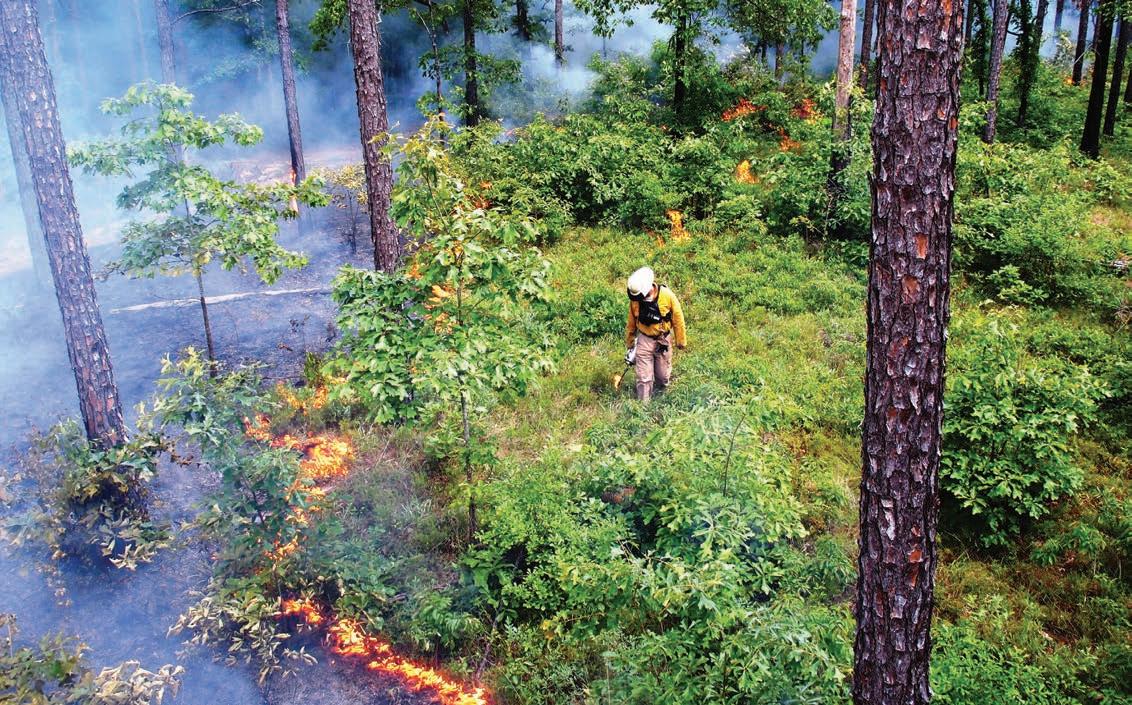
Burn crew member laying fire on private land – Credit: Randy Tate
s
Economics and Market-based Financial Incentives Strategy
Economic considerations and market-based financial incentives are fundamental to the success of long-term longleaf pine conservation. They influence landowner decision-making, engagement in longleaf restoration and conservation, and the broader adoption and implementation of desirable and sustainable management practices. This section of the SPA Plan outlines America’s Longleaf interest in leveraging existing and emerging economic opportunities to advance longleaf pine
restoration, increasing landowner participation and awareness in markets, supporting the development of new opportunities and innovative financial models that are compatible with America’s Longleaf Conservation Plan goals. From 2025 through 2029, our strategies will focus on integrating economic opportunities with conservation priorities to drive meaningful progress in longleaf pine restoration and management.
Objective A Awareness and understanding of current and new financial-based market opportunities for longleaf forests and products among communities and sectors of interest including private landowners.
Priorities Actions Year
A.1. Share information on market opportunities and economic incentives with landowners, land managers, consulting foresters, resource service providers, public audiences, and other communities of interest to increase understanding.
(Key Recommendation 1)
A.2. Continue to support studies, assessments, and research to understand financial-based market opportunities and the economic interests of landowners and communities that are key to sustaining longleaf restoration.
(Key Recommendation 2)
A.1.1. Encourage LITs and America’s Longleaf partners to grow and advance technical service providers’, consulting foresters’, landowners’, and others' knowledge of existing and emerging markets and financial-based market opportunities through outreach and training.
A.1.2. Encourage LITs and America’s Longleaf partners to connect smaller and underserved landowners with available resources by providing outreach, training, technical assistance, and resources on existing and new market opportunities and models for longleaf.
A.1.3. Comms WG will help to guide the development of communication resources and strategies to reach target audiences effectively.
A.2.1. Designated America’s Longleaf partners will build knowledge about the economic value of longleaf pine, including recreational value, to inform and communicate future needs:
• Assess economic opportunities, impact, and contribution of existing and emerging markets for longleaf forests and products and understand knowledge gaps.
• Evaluate where higher market value can be realized to incentivize longer rotations and retain mature longleaf forests.
• Perform a Recreational Value Assessment on activities connected to longleaf forests by synthesizing existing studies to determine the impact and benefits of longleaf in the recreation sector, including health and wellness and local economic impact.
A.2.2. LPC and FCC partners continue to support the development of the Growth and Yield model for longleaf to inform economic models and decision-making in all parts of the range.
2025/2029
2025/2029
2025/2029
2026/2029
2025/2029
Objective B Opportunities and access to new and existing markets for longleaf forest products for landowners, communities, and society.
Priorities Actions Year
B.1. Promote the development, acceptance, and application of new economic markets and models that incentivize longleaf restoration and provide long-term stability for restoration. (Key Recommendation 1, 2 & 3)
B.1.1. Comms WG will update fact sheets with new information and studies to include relevant economic data to continue to promote the resilience and economic benefits of longleaf pine.
B.1.2. Comms WG and America’s Longleaf partners will disseminate best practices, innovative approaches, and practical guidance for implementing new economic models for longleaf restoration through consistent messaging.
B.1.3. Comms WG, Policy WG, and America’s Longleaf partners will share success stories from pilot projects and case studies with stakeholders, landowners, and policymakers to build awareness of the benefits and opportunities of new markets for longleaf (i.e. climatesmart forestry and nature-based markets).
B.1.4. America’s Longleaf partners will continue to engage with both small and large private landowners and forestry consultants on longleaf pine market opportunities to promote and develop the application, implementation, and acceptance of new economic markets for longleaf.
2027-2029
B.2. Assess developing and emerging industries, impacts on longleaf restoration, and opportunities to increase compatibility. (Key Recommendation 4)
B.2.1. Designated America’s Longleaf partners will assess the compatibility of new markets and industries as they emerge and develop, promoting research where needed, including but not limited to pine straw production BMPs, transportation of noxious weeds, renewable energy, and nature-based markets).
B.2.2. Designated America’s Longleaf partners will evaluate the opportunities in emerging markets to create financial incentives for landowners that align with longleaf restoration goals.
B.2.3. Encourage LITs and other existing partnerships, such as Sentinel Landscapes and PBAs, to explore collaborative forest management models, such as bundling, to make smaller properties economically viable for restoration activities, thereby encouraging small landowners to participate in longleaf restoration efforts.
2026-2027
2026-2027
2026-2027
Priorities Actions Year
B.3. Remove barriers to market access and provide increased assistance and resources for historically underserved landowners. (Key Recommendation 5)
B.4. Maintain or expand financial incentives for longleaf restoration, including longer rotations and stands of High Conservation Value. (Key Recommendation 6)
B.3.1. America’s Longleaf partners, LITs, and LFA members will help to prepare landowners to enter forest product markets and build financial sustainability by stimulating and developing supply chains, including for small businesses and entrepreneurs.
B.3.2. LFA will assess and identify bottlenecks in the supply chain for landowner participation in longleaf markets and develop strategies to reduce barriers to longleaf market entry and increase participation.
B.3.3. LFA will work with America’s Longleaf partners and other partners and community leaders to encourage and increase participation through learning opportunities and hands-on training to increase landowner access to longleaf markets.
B.4.1. Policy WG will work towards sustaining existing and developing new financial or market-based incentives for longleaf, including stands for high conservation value.
2025/2029
2025/2029
2025/2029
2026/2028
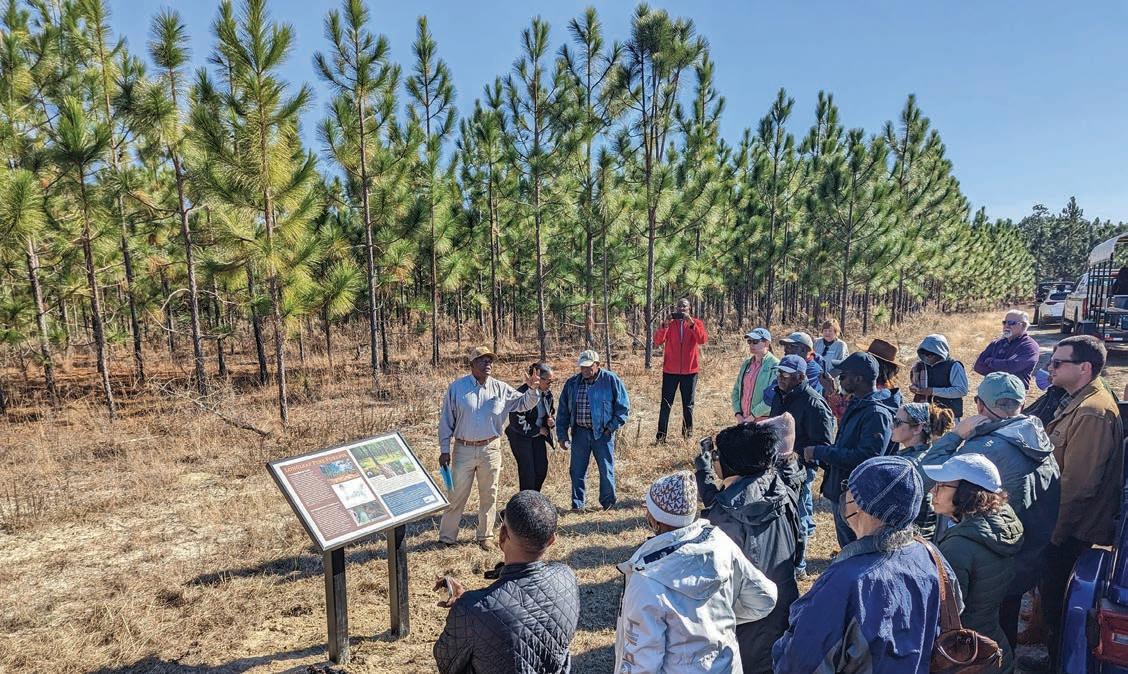
The Hodges Model Farm was established to demonstrate sound stewardship practices and provide landowner-to-landowner learning experiences – Credit: Tiffany Woods
Climate Resilience and Co-benefits Strategy
As hurricanes, floods, wind events, and droughts increase in the southeast, the resilience of longleaf forests has become more well-known. Restoring the ecosystem with fire and other climate-smart practices is ecologically and economically important to prepare southern forests and the human communities that depend on those forests for a
challenging climate future. Longleaf pine forests are not only climate resilient but also provide a variety of other cobenefits. As new science, knowledge, and resources emerge on these topics, it is important that the information be dispersed and used in practice across land ownership for the long-term benefit of people and nature.
Objective A The effects of climate change on the longleaf pine ecosystem and the role longleaf restoration can play in mitigating climate change or adapting to it are better understood.
Priorities
A.1. Promote more extensive scientific study of the potential effects of climate change on the longleaf ecosystem, including the tree species, plants and animals, movement of longleaf, and the importance of intact ecosystems to resilience. (Key Recommendation 1)
Actions
A.1.1. LPC Leadership Team will include representatives on the LPC engaged in longleaf climate research to encourage learning and share questions that can help shape needed research.
A.1.2. A designated LPC member will maintain a list of research questions and those scientists/researchers currently conducting studies involving longleaf pine and climate. Determine if there are gaps and promote needed research.
A.1.3. Designated LPC partner will coordinate with the TIWG to identify the traits we are seeking for longleaf in the face of a changing climate (i.e. drought tolerance).
Year
2025/2029
2025/2029
2025/2029
A.2. Promote further study of the contributions that longleaf restoration and management (including prescribed fire) could play in carbon sequestration and adaptation to climate change. (Key Recommendation 2)
A.2.1. LPC members and LFA will encourage the inclusion of silviculture practices consistent with America’s Longleaf priorities in carbon, biodiversity, and water market protocols.
A.2.2. LPC and America’s Longleaf partners will encourage and facilitate coordinated, network-designed research experiments that span the longleaf range to address priority research questions through workshops (Jones Center, Biennial Longleaf Conference) and targeted funding.
A.2.3. LPC and America’s Longleaf partners will encourage researchers to leverage existing products like the LEO, International Tree Ring Databank, and USFS Forestry Inventory and Analysis (FIA) databases to understand longleaf productivity and resilience.
2025/2029
2025/2029
2025/2029
Objective B TA long-term vision of the beneficial role that longleaf forests play in ecosystem health and adaptation is well understood in the face of a changing climate.
Priorities Actions Year
B.1. Promote the resilience and co-benefits of longleaf pine forests. (Key Recommendation 1)
B.1.1. Comms WG will update America’s Longleaf Fact Sheets with any new information about resiliency and cobenefits.
B.1.2. LPC partners and LFA will provide updates to the Longleaf Pine Climate-Smart Guide from long-term studies that have intentionally adapted forests to climate change (i.e. Adaptive Silviculture for Climate Change project).
2026
B.2. Monitor and communicate federal legislative proposals to assess opportunities (as well as constraints) presented to private landowners and the landscape-level initiative to restore longleaf. (Key Recommendation 2)
B.3. Understand which corporations align with America’s Longleaf goals and incorporate as champions/supporters. (Key Recommendation 3)
2025/2029
B.2.1. Policy WG reviews current funding opportunities linked to climate smart practices for landowners and summarizes opportunities for the LPC. 2025
B.4. Provide consistent messaging and resources regarding the resilience, cobenefits, and adaptation value of longleaf forests. (Key Recommendation 4)
B.3.1. America’s Longleaf partners encourage NGOs and research institutions to leverage the Longleaf Pine Climate-Smart Guide and other works as a tool to attract corporations to support the work of America’s Longleaf partners in relation to their sustainability goals.
2025/2029
B.4.1. Comms WG will support messaging of timely climate-related publications through America’s Longleaf website and assemble relevant climate-related research and guiding materials. 2025
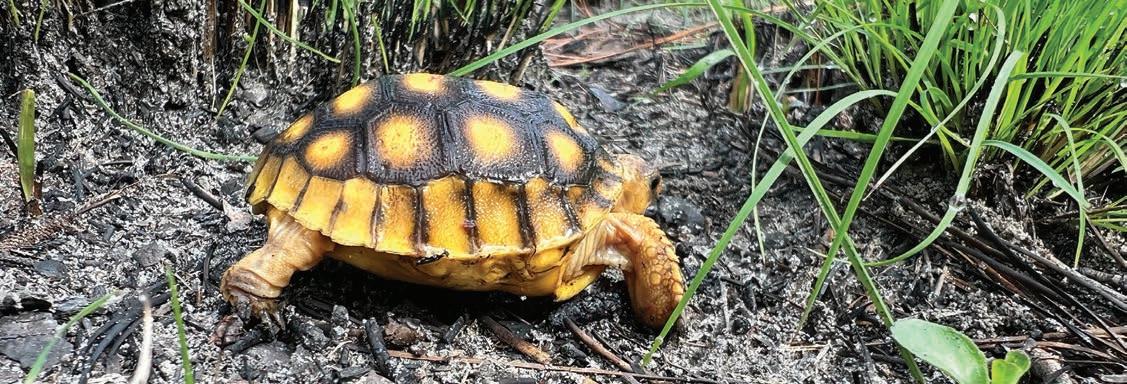
Young gopher tortoise in recently burned habitat – Credit: Reese Thompson
Appendix A: Glossary
America’s Longleaf Partners: A collaboration of multiple public and private sector partners that actively support range-wide efforts to restore and conserve longleaf pine ecosystems.
Communications Working Group (Comms WG): A working group of the Longleaf Partnership Council made up of an ad hoc set of partners whose goal is to advance the mission of America’s Longleaf by securing and increasing engagement and support from a range of key external and internal decision-makers and allies, enabling communication and coordination within the partnership, supporting individual partners, demonstrating the successes of America’s Longleaf and its partners, and increasing understanding of who we are and what we do.
Cultural Burn Association (CBA): A group of tribal members (and sometimes other interested citizens) that collaborate to conduct cultural burns.
Cultural Fire: The indigenous practice of using fire to clear areas for crops and travel, manage the land for specific species, hunt game, and many other reasons.
Federal Coordinating Committee (FCC): A committee made up of the Departments of Agriculture, Defense, and the Interior that coordinates efforts to restore the longleaf pine ecosystem. The commitment and collaboration by these agencies provide a clear message of dedication that enables federal resources and policy to be mobilized to help achieve America’s Longleaf’s stated goals and objectives.
Groundcover Working Group (GCWG): A working group of the Longleaf Partnership Council that seeks to address barriers and expand groundcover restoration, management, seed sourcing, and production of plant materials across the range of longleaf.
Landscape Management Plan (LMP): Forest management plan developed by diverse stakeholders that considers all significant forest types and associated plant and animal
species, water bodies, and conservation concerns. Trained natural resource professionals utilize this tool in combination with specific land management recommendations to provide landowners with a perspective on how their management activities contribute to the regional landscape.
Local Implementation Teams (LITs): Teams developed at the local level by those interested in longleaf restoration. Each group defines the range and scope of actions they will undertake with an emphasis on convening multiple local area stakeholders, meeting resource needs, and implementing on-the-ground conservation/restoration actions. It is anticipated that the bulk of restoration efforts will be carried out by Local Implementation Teams.
Longleaf Ecoregions: Six longleaf pine vegetation ecoregions that are derived from existing Environmental Protection Agency (EPA) ecoregions: Atlantic Coastal Plain, Fall-line Sandhills, Southern Coastal Plains, Eastern Gulf Coastal Plain, Western Gulf Coastal Plain, and Piedmont and Montaine Uplands. Each ecoregion encompasses varying biotic (e.g., plant and animal species) and abiotic (e.g., soil, moisture, topography).
Longleaf for All Working Group (LFA): A working group of the Longleaf Partnership Council founded in 2020 that complements management and restoration efforts by creating a space of belonging for everyone in the longleaf community, as well as accelerating opportunities for all landowners, students, professionals, colleges, and communities.
Longleaf Partnership Council (LPC): Members representing America’s Longleaf partners within nongovernmental organizations, state and federal agencies, implementation teams and other collaborative efforts, private industry, universities/research extension, and private landowners. The purpose of the LPC is to promote effective communication and collaboration among the large number of America’s Longleaf partners working to conserve longleaf pine ecosystems across the South.
Appendix A: Glossary continued
Longleaf Sustainability Analysis (LSA): A longleaf-centric spatial analysis designed to facilitate the strategic, transparent, and evidence-based identification of the “right work” in the “right places” across the historic range of the longleaf pine ecosystem.
Mapping Working Group: A working group of the Longleaf Partnership Council that works to address mapping needs to better understand extent and condition of longleaf pine.
Policy Working Group: A working group of the Longleaf Partnership Council made up of an ad hoc set of partners working to identify and address state and federal policy challenges and opportunities.
Prescribed Burn Association (PBA): A group of landowners and other interested citizens that collaborate to conduct prescribed burns by pooling their knowledge, time, resources, and equipment to help others in their PBA conduct prescribed burns.
Public Lands Working Group (PLWG): A working group of the Longleaf Partnership Council focused on supporting actions and needs under the public lands strategy in the updated Conservation Plan.
Southeast Longleaf Ecosystem Occurrences
Geodatabase (LEO): An inventory of known and potential longleaf pine forest acreage maintained by the Florida Natural Areas Inventory.
Southeast Regional Partnership for Planning and Sustainability (SERPPAS): A voluntary collaboration among State leaders from natural resources, working lands, and environmental protection agencies; regional leaders from their federal agency counterparts; and the Department of Defense and the military services in the Southeast. The partnership harnesses strategic planning and promotes
collaborative decision-making between public and private partners to support the military mission, conserve key habitats and species, sustain rural economies and industries, and foster better coordination among local, state, and federal stakeholders in the region.
Significant Geographic Areas (SGAs): A framework for a landscape level approach to the strategic, science-based conservation of longleaf pine ecosystems and their component species created in the original Conservation Plan. A foundational premise was that, given limited resources, expertise, partners, and policy implementation should be prioritized in areas with aggregations of extant longleaf ecosystems of sufficient size, integrity, protected status, and connectivity potential to sustain functional landscapes and populations of target species into the future. LITs organized around these SGAs and defined larger landscape boundaries surrounding them in which to work.
State Forest Action Plans (SFAP): A plan developed by each state that includes in-depth analysis of forest conditions and trends with the goal of conserving working forest landscapes, protecting forests from harm, and enhancing public benefits from trees and forests.
State Wildlife Action Plan (SWAP): A plan developed by each state that describes habitats important to Species of Greatest Conservation Need, key threats, needed conservation actions, and research and monitoring plans. State agencies are required to coordinate with state, federal, tribal, and local agencies.
Tree Improvement Working Group (TIWG): A working group of the Longleaf Partnership Council made up of an ad hoc set of partners seeking to address needs and challenges in longleaf tree improvement and seedling production and availability.
Appendix B: List of Acronyms
BMPs Best Management Practices
CBA Cultural Burn Association
Comms WG Communications Working Group
FCC Federal Coordinating Committee
FIA Forestry Inventory and Analysis
DoD Department of Defense
DOI Department of the Interior
GCWG Groundcover Working Group
LEO Longleaf Ecosystem Occurrence Geodatabase
LFA Longleaf for All
LIT Local Implementation Team
LMP Land Management Plan
LPC Longleaf Partnership Council
LSA Longleaf Sustainability Analysis
NWCG National Wildfire Coordination Group
NWR National Wildlife Refuge
PBA Prescribed Burn Association
PFTC Prescribed Fire Training Center
PLWG Public Lands Working Group
SERPPAS Southeast Regional Partnership for Planning and Sustainability
SFAP State Forest Action Plan
SGA Significant Geographic Area
SPA Strategic Priorities and Actions
SWAP State Wildlife Action Plan
TIWG Tree Improvement Working Group
UAS Unmanned Aircraft Systems
USFS U.S. Forest Service
WG Working Group
The America's Longleaf Restoration Initiative is a collaborative effort of multiple public and private sector partners that actively supports range-wide efforts to restore and conserve longleaf pine ecosystems.