Suwannee Valley
Suwannee Valley
Being a member of an electric cooperative has always meant something bigger than just being able to flip on a light switch and trust that the power will be there. It’s true that delivering safe, affordable and reliable electricity has always been the core of what we do. It’s the very reason this community created SVEC decades ago.
But what sets a cooperative apart from other power providers is the relationship we share with the people we serve. Our consumer-members aren’t just customers for us. You’re owners of this system, and that ownership comes with tangible benefits — like having a voice in how the co-op is governed through elected trustees and annual meetings, or the work and local contributions SVEC does to strengthen the community we call home.
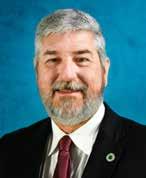
Executive VP/CEO
MICHAEL S. McWATERS
One meaningful way we put that commitment into practice is through Operation Round Up®, a program of our Suwannee Valley Foundation. What started as a simple idea has already had a powerful impact in just a few years. By allowing consumer-members to round up their monthly bills to the nearest dollar and pooling that spare change, we have been able to fund grants that have been transformative for local classrooms.
Individually, the average monthly contribution to that fund is about 50 cents. But collectively, it becomes an investment that can truly make a difference. Since its launch in 2019, our consumer-members have contributed more than $765,000 to Operation Round Up®. That money has translated into thousands of grants that support hands-on learning across our service area.
Some teachers have used them to buy books that capture students’ imaginations and spark a love for reading. Others have purchased lab equipment that can bring science lessons to life or materials that make their classroom a more welcoming and effective place to learn.
In this issue, you can read about a recent example at Suwannee High School, where a team of teachers put their grant toward establishing the allied health program. The program helps educate students on common health practices and skills, introduces them to career opportunities in the medical field and even prepares them for the certified nursing assistant exam at the end of their senior year.
I’m continually impressed by the generosity and community spirit of our consumer-members. This is just one example of the many grants that have helped open doors for students throughout our region. And it is another reminder that when we come together as a cooperative, we’re not only powering homes and businesses but helping shape the next generation of leaders in our community.
I can’t wait to see what more this program can do for our community in the coming years. As always, we will continue to work hard each day to bring you the affordable and reliable power you expect from your cooperative. ■
February 2026
Suwannee Valley Currents is a monthly newsletter published by Suwannee Valley Electric Cooperative, © 2026. It is distributed without charge to all consumermembers of the cooperative.
Drive-thru Kiosk: Open 24 hours 24/7 Power Outage Reporting: 800-752-0025
SVEC is an equal opportunity provider and employer. svec-coop.com instagram.com/sveccoop
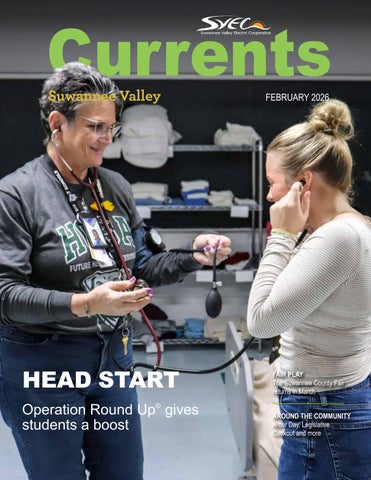
With some help from SVEC’s Operation Round Up® Foundation, the allied health program at Suwannee High School is preparing students for medical careers with hands-on experience. Read more on Page 4.
SVEC is awarding up to 11 scholarships of $1,500 to deserving high school seniors. To be eligible, students must graduate in spring 2026 from a public high school, homeschool, accredited private school or charter school in SVEC’s service territory. Applicants must have a cumulative, unweighted high school GPA of at least 3.5 and plan to attend an accredited postsecondary or vocational education institution this fall.
Applying students must submit two letters of recommendation and a 250- to 500-word essay. They also must be a dependent of an SVEC member, but they cannot be a child or grandchild of a current SVEC employee or trustee.
Applications are due on Friday, March 20, by 5 p.m. For more details or to apply, visit svec-coop.com/community/scholarships.
Enjoy more balance in your life with a MyChoice account, SVEC’s pay-as-you-go plan that lets consumer-members take charge of their electricity costs. Choose how much prepaid power to buy, and your usage will be deducted daily from your account. With MyChoice, you will:
• Say goodbye to monthly bills by purchasing your electricity in advance.
• Receive a notice when your MyChoice balance runs low and needs a refill. Then, similar to putting gas in your vehicle, you can add small amounts to your account to last a few days or “fill up the tank” to possibly last several months. It’s up to you.
• Never pay a late charge or reconnect fee.
• Track your usage in the SmartHub app, which helps you save by learning about your energy habits.
When you switch to MyChoice, your existing security deposit can be put toward paying for your electricity usage.
For details on how to get started, visit svecmychoice.com, or call our Member Service Department at 800-447-4509.




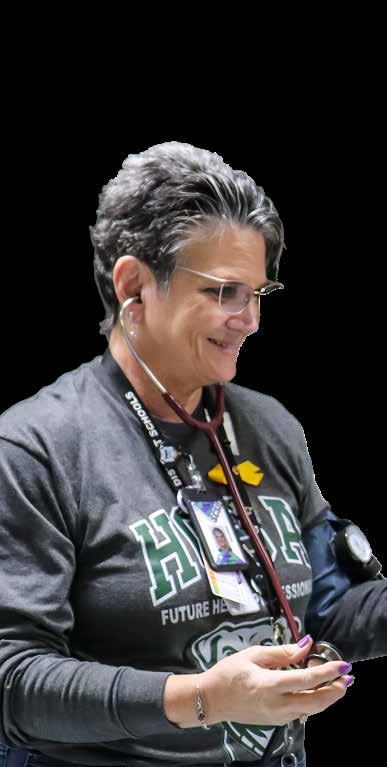
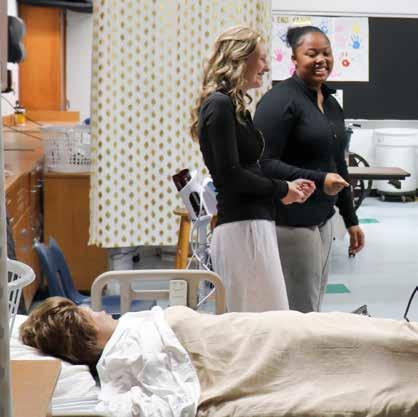
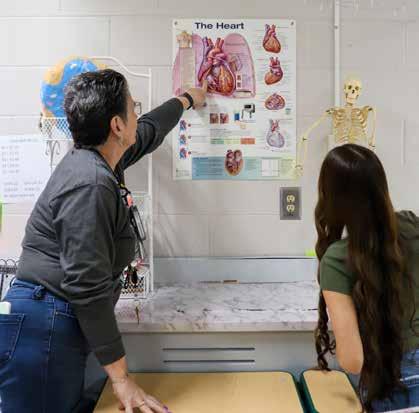
When students step into the allied health classroom at Suwannee High School, it’s immediately clear that this is not just a traditional class, but the first stop on a medical career path. Posters chart heart rhythms and pain scales. Medical terminology lines the walls. Hospital beds sit ready for hands-on application. Students learn to use equipment more often found in clinics than classrooms, learning skills many don’t touch upon until college or much later in life.
For second-year instructors Lori Abbott and Keri Koehn, that early exposure is exactly the point. “This is a golden opportunity,” Lori says. “These students are learning things now that most people don’t see until they’re adults.”
The allied health program at Suwannee High is a four-year pathway that introduces students to the breadth of health care while building real-world skills along the way. Beginning in ninth grade with basic medical skills, students progress through anatomy and physiology, health foundations and
ultimately certification-focused coursework as seniors, including certified nursing assistant, or CNA, and EKG training. Starting in the next school year, the program will expand to include emergency medical responder coursework, opening the door to even more career options.
The program isn’t just about training future nurses, though many students do pursue that path. It’s designed to help students discover where they fit within the medical field, whether that’s direct patient care, emergency services, diagnostics or beyond.
“They graduate high school with a board-certified credential,” Lori says. “Even if they never work as a CNA long term, they have an ace in their pocket.”
Learning by doing
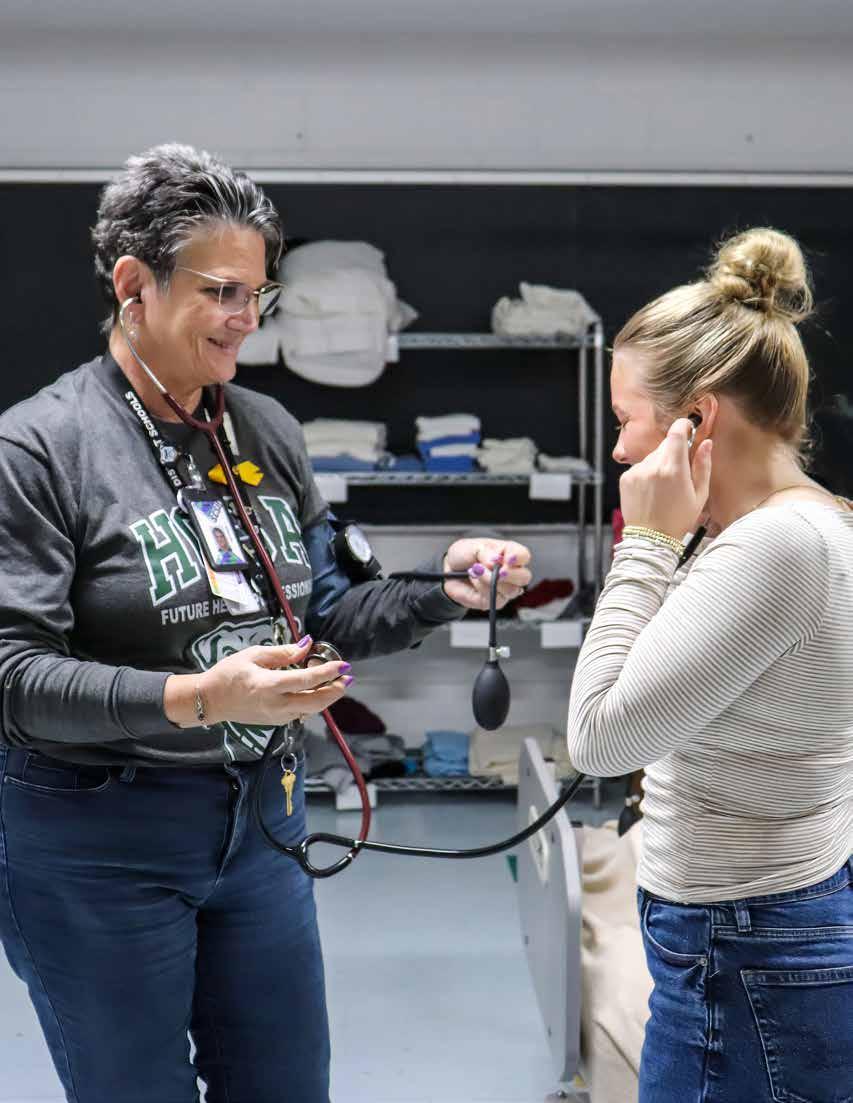
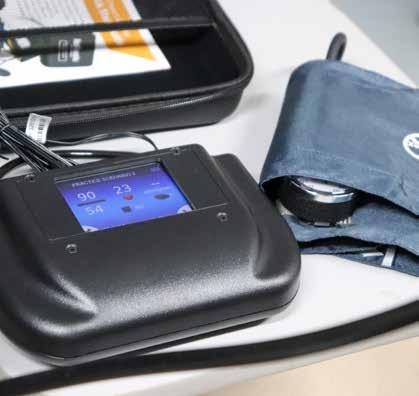
Hands-on learning is central to everything that happens in the allied health classroom. Ongoing support from throughout the community helps fund new, critical equipment that allows students to practice skills instead of just hearing about them. Recently, the program added new stethoscopes, including a dual-headed model that lets instructors hear exactly what students hear, blood pressure simulators and a hand-hygiene visualization kit. The equipment was purchased with funds from Operation Round Up®
As a result, students learn how to operate real medical devices. Using the latest technology, they gain a deeper understanding of concepts like infection control through visual demonstrations that reveal how germs spread and how proper handwashing stops them.
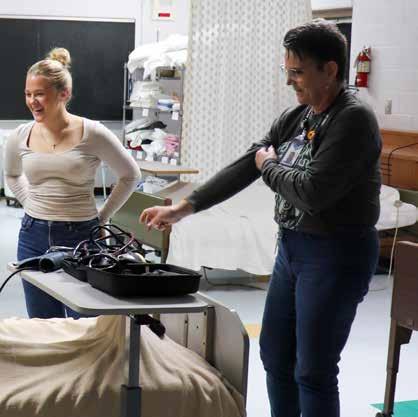
“They don’t realize how many things they touch every day,” Lori says. “Seeing it makes it real.”
The impact shows up quickly. Students become more confident, more careful and more aware of their own health habits with knowledge that often spreads beyond the classroom to families and peers.
Allied health students are also encouraged to build leadership and service skills through the Health Occupations Students of America, a national organization that combines competition, community service and professional development. More than 100 Suwannee students are members.
Through HOSA, students complete service hours, learn how to run meetings, practice public speaking and compete in health care-related events. They’re learning professionalism, accountability and teamwork — skills they can benefit from no matter where their careers lead.
“These kids are learning how to show up, how to follow through, how to work together,” Lori says. “Those are life skills.”
The program also works with River Oak Technical College across the street, allowing students to move seamlessly into additional training after graduation. Many leave high school already employed as CNAs, while others continue into nursing, emergency services or related fields with a significant head start.
One former student recently returned to share her story, having worked as a CNA while pursuing nursing after discovering her passion through the program.
Allied health students practice with actual medical equipment in a realistic setting.
“That’s when you know it’s working,” Lori says. “They find their confidence.”
Keeping the program current requires creativity and community partnerships. Funding for certification testing comes from the school, but updated equipment and expanded learning tools often depend on local support and grants like those from Operation Round Up®. It’s necessary to fill critical gaps, ensuring students train with equipment that mirrors what they’ll encounter in real, modern-day health care settings.
“It’s about giving students access,” Lori says. “They deserve to learn with the same tools they’ll see on the job.”
Lori credits Suwannee High School Principal Laura Williams, the school’s administration and district leadership for supporting the program’s growth, along with community partners like SVEC who see the value in preparing the next generation of health care professionals.
For Lori, a nurse with more than 40 years of experience, teaching has become a way to give today’s students what she never had when she was attending Suwannee High — direction, confidence and early exposure to meaningful career paths.
“When you see that moment where it clicks,” she says, “that’s everything.”
Inside this classroom-turned-clinic, students aren’t just learning about health care. They’re discovering who they can become and stepping into the future with skills, confidence and opportunity already in hand. ■
The program gives students the chance to apply what they learn about classroom topics like anatomy.
2 large russet potatoes
(about 1½ pounds total)
2 tablespoons extra-virgin olive oil
Salt and pepper to taste
1 cup cheddar cheese
3 slices thick bacon, cooked and chopped ½ cup cooked corned beef, chopped or shredded
2 green onions, thinly sliced Sour cream or similar dip
Heat oven to 400 F. Line a baking sheet with parchment paper or foil sprayed with nonstick oil for the initial bake. Set aside an additional ovenproof dish or skillet for the finishing bake.
Wash, dry and cut the unpeeled potatoes into ¼-inch-thick rounds with a sharp knife or mandoline. Put the slices in a large bowl, add the olive oil, salt and pepper and toss to coat. Place the slices in a single layer on the lined baking sheet. Bake the potatoes for 20-25 minutes, flip them over and cook for another 20-25 minutes until golden. Remove the potatoes from the oven and arrange them in overlapping layers in an ovenproof skillet or dish. Sprinkle them with cheese, bacon, corned beef and green onions. Increase
the oven temperature to 450 F and bake the layered potatoes for 4-5 minutes or until cheese is fully melted. Serve immediately with sour cream or a favorite dip. This recipe serves about six, so double the amounts if desired. ■

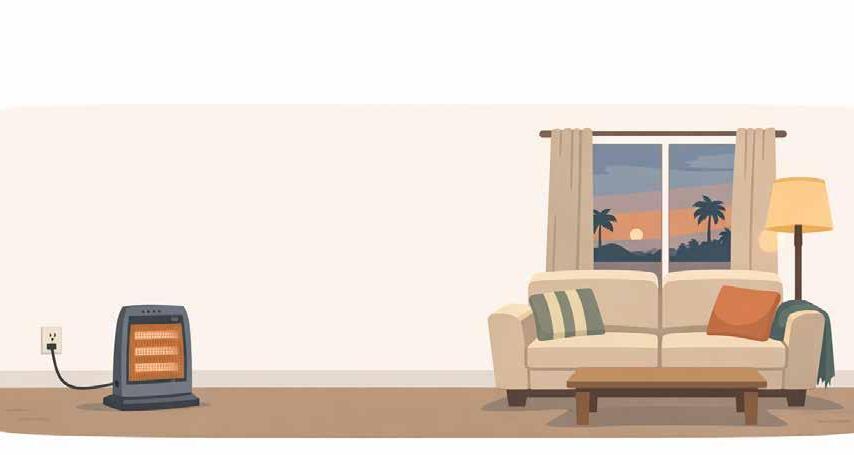
Electricity powers modern life, but it is dangerous if not handled carefully. Check back here each month for new tips on how to stay safe around electric power at your home or business. February is normally the last month of the winter season, as far as average temperatures go. But it’s still a time to take cold-weather precautions.
• Be extra careful when using portable heating devices inside. Plug them directly into an outlet, do not leave them running unattended, and keep them away from water and combustible sources.
• Check all ground fault circuit interrupter outlets, both indoors and outside, using the test
and reset buttons. This should be done monthly. If a GFCI outlet fails to trip or reset, it needs to be inspected by a licensed electrician.
• Outdoor lighting also needs attention. Check fixtures for corrosion, replace bulbs as needed and make sure wiring is not exposed to the elements.
To learn more about building safe electric habits, click the Outages & Safety tab on svec-coop.com, and follow us on social media. /sveccoop @sveccoop

For more than a century, the Suwannee County Fair has been a treasured tradition for the people of Live Oak and surrounding communities. It’s a nine-day showcase for food, entertainment, business, music, innovation, agriculture, art, education and the popular Livestock Show and Sale, all in keeping with its motto — Celebrating Fair, Family and Freedom.
The colorful lights of the midway are the backdrop for a variety of rides, which fairgoers can enjoy all evening with the purchase of a $25 armband, as well as the aromas of delicious fair fare and the laughter of those vying for prizes at game booths. Inside the exhibition hall, the talents of people of all ages and backgrounds are on display.
After the 5:45 p.m. ribbon-cutting on Friday, March 20, opens the fair, the peewee goat and dairy shows get underway. Saturday brings the dairy
shows, Sunday is the open youth goat show and Monday features hog showmanship. From 11 a.m. to 3 p.m. on Tuesday, March 24, senior adults get their own day at the fair, complete with entertainment and a free lunch at noon.

Hogs are the stars on Tuesday evening, then Wednesday brings the steer and heifer show. The focus turns to sheep on Thursday, and then the livestock sale takes place on Friday. Saturday, March 28, is the fair’s action-packed closing day. At 7:30 p.m., the roar of engines will echo through the fairway as the demolition derby gets underway in the covered arena. Powerful vehicles kick up dust as they smash into each other or take a turn in the exciting Figure 8 race.

Although the Suwannee County Fair Association was officially chartered with the state on Oct. 15, 1960, for the “encouragement
and promotion of agriculture and livestock development in Suwannee County,” the fair’s origins date back to November 1914. It had a few different Live Oak locales before moving to its current home at the Suwannee County Coliseum in 1956. The fair was always held in the fall, but in 1993, it began its run as a spring event.
• The 2026 Suwannee County Fair takes place March 20-28 at 1302 11th St. SW, Live Oak.
• Admission at the gate is $10 for adults and youths 36” or taller. Ride armbands are $25. Transactions for each are cash only.
• Fair hours are 6-10 p.m. daily. Senior Citizens Day is from 11 a.m. to 3 p.m. on March 24.
• Demolition Derby Night is Saturday, March 28.
• Go to suwanneecountyfair.com for details or call 386-362-FAIR (3247).
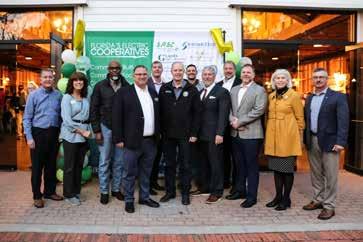
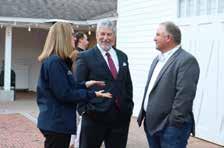
SVEC and many other Florida electric cooperatives met with state lawmakers and leaders at the annual Legislative Cookout in Tallahassee on Jan. 21.
The popular event, coinciding with Rural Counties Day’s legislative networking gathering, is a chance to advocate for our members and to show elected officials we are grateful for their continual support and recognition of the vital role electric cooperatives play in serving communities across Florida.
SVEC urges community members to roll up their sleeves alongside our employees to help save lives as we host a blood drive on Tuesday, March 3, from 10 a.m. to 4:30 p.m. at our main office, 11340 100th St., Live Oak.
Since its first stop at SVEC in March 2004, the LifeSouth Community Blood Centers mobile donation vehicle has visited quarterly to give our employees and the community the chance to give the gift of life. Hundreds of units of blood have been donated over the past 22 years, helping save thousands of lives.
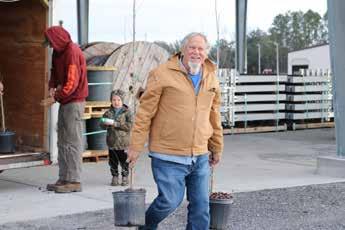
In celebration of Florida Arbor Day, SVEC held a tree giveaway on Jan. 17. We invited members to visit the office and take home one of the 150 available Florida elms, which are beautiful, vase-shaped shade trees that can grow up to 80 feet tall. Florida Arbor Day is the third Friday in January to take advantage of prime planting season.