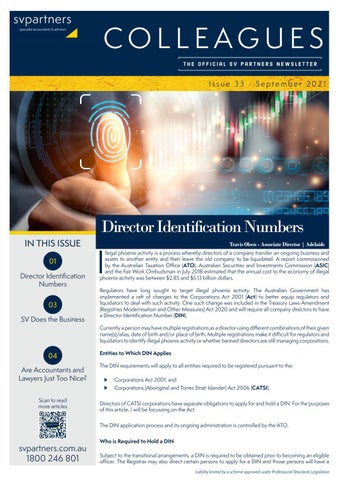
Director Identification Numbers IN THIS ISSUE 01 Director Identification Numbers 03 SV Does the Business
Travis Olsen - Associate Director | Adelaide
I
llegal phoenix activity is a process whereby directors of a company transfer an ongoing business and assets to another entity and then leave the old company to be liquidated. A report commissioned by the Australian Taxation Office (ATO), Australian Securities and Investments Commission (ASIC) and the Fair Work Ombudsman in July 2018 estimated that the annual cost to the economy of illegal phoenix activity was between $2.85 and $5.13 billion dollars. Regulators have long sought to target illegal phoenix activity. The Australian Government has implemented a raft of changes to the Corporations Act 2001 (Act) to better equip regulators and liquidators to deal with such activity. One such change was included in the Treasury Laws Amendment (Registries Modernisation and Other Measures) Act 2020 and will require all company directors to have a Director Identification Number (DIN). Currently a person may have multiple registrations as a director using different combinations of their given name(s)/alias, date of birth and/or place of birth. Multiple registrations make it difficult for regulators and liquidators to identify illegal phoenix activity or whether banned directors are still managing corporations.
04 Are Accountants and Lawyers Just Too Nice? Scan to read more articles
Entities to Which DIN Applies The DIN requirements will apply to all entities required to be registered pursuant to the: ►
Corporations Act 2001; and
►
Corporations (Aboriginal and Torres Strait Islander) Act 2006 (CATSI).
Directors of CATSI corporations have separate obligations to apply for and hold a DIN. For the purposes of this article, I will be focussing on the Act. The DIN application process and its ongoing administration is controlled by the ATO.
svpartners.com.au 1800 246 801
Who is Required to Hold a DIN Subject to the transitional arrangements, a DIN is required to be obtained prior to becoming an eligible officer. The Registrar may also direct certain persons to apply for a DIN and those persons will have a Liability limited by a scheme approved under Professional Standards Legislation
2
SV Partners
certain application period based on that direction.
Offences
Eligible officer is defined to include a person appointed to the position of a director or an alternative director regardless of the name that is given to that position.
There are a number of offences that may be breached where an eligible officer:
Note that director is broadly defined in the Act to include a person who is acting as a director or that the directors act in accordance with their directions (defacto/shadow directors) even where they are not formally appointed as such. The Act is not clear as to whether the DIN framework will apply to defacto/shadow directors. Given the penalties that will apply, any person acting in such a position ought to seek legal advice to clarify their position. Other officers may also be required to hold a DIN, however at this stage, there does not appear to be any clarification in the legislation as to what positions these other officers may hold. Transitional provisions are currently in place whilst the requirements of the legislation are implemented. Advisors should continue to monitor the ATO’s webpage for updates and details of various legislative instruments. Based on the legislation the transitional periods are as follows: Existing and New Eligible Officers (prior to 31 October 2021) Have until 30 November 2022 to obtain a DIN. New Eligible Officers (between 1 November 2021 and 4 April 2022) Will have 28 days from becoming an eligible officer to obtain a DIN New Eligible Officers (from 5 April 2022) Must have a DIN before becoming an eligible officer. Please note that these timeframes may change at the discretion of the Registrar. Applying for a DIN The application process is expected to be completed via an online form produced by the ATO and accessed via MyGovID. The legislation does not allow for another person to apply for a DIN on behalf of an individual (unless that individual is unable to do so). A person who expects to become an eligible officer within 12 months may apply for a DIN (if they do not already hold a DIN). Once registered, an individual has 12 months to be appointed as an eligible officer or their DIN will be cancelled. A person may only apply for and hold one valid DIN at a time. Updating Eligible Officer’s Details An eligible officer must inform the Registrar of any errors or corrections to their information attached to the DIN, however it does not appear that the legislation provides any timeframe for doing so.
►
fails to hold a DIN;
►
fails to comply with a direction from the Registrar;
►
applies for multiple DINs;
►
provides a false DIN;
►
misrepresents their DIN; or
►
provides false or misleading information.
Committing an offence may result in an infringement notice being issued or possible civil and/or criminal prosecution. The penalties can range between 60 penalty units ($13,320 at the current penalty unit rate of $222) and 1 year imprisonment. Certain offences may also be applied against to those involved in a contravention, which could include the eligible officer’s advisors. We recommend that advisors, particularly those who assist their clients with setting up new companies, update their checklists to ensure that the DIN requirements are met. In Practice Directors/Eligible Officers The changes required for the implementation of the DIN legislation will add additional compliance costs for eligible officers. The legislation requires the eligible officer makes the DIN application themselves and therefore their advisor is unable to do it on their behalf. Advisors Advisors should ensure that they inform their clients of the requirements to hold a DIN to ensure that they themselves are not liable for any breaches of the Act. Advisors’ checklists for appointing new directors/eligible officers and forming new entities registered under the Act should be updated to include the new DIN requirements. Regulators The implementation of a DIN will assist regulators with tracking individual directors, especially in relation to their former corporate history. ASIC have in the past utilised director banning as a method to prevent illegal phoenix activity. The implementation of DIN and the ATO’s data matching abilities will further strengthen the banning enforcement process. Legal Advice The above information is not intended to be legal advice and no reliance should be placed on the information (or dates) contained above. We recommend that advisors and their clients undertake their own enquiries as to their requirement to hold a DIN and seek legal advice where appropriate.
Liability limited by a scheme approved under Professional Standards Legislation
SV Partners
SV Does the Business When a company is placed into liquidation, many people make an assumption about the company’s affairs and the ability to make any realisations from the company’s business. This assumption is typically that there is no prospect the liquidator could achieve a sale of business. Because of this assumption directors of companies often continue trading businesses (frequently at a loss) until they believe there is no prospect of achieving a business sale; only at this point will they seek help from their advisors. This strategy can put directors at risk as they are disregarding their duties to the company and may be exposing themselves to claims such as insolvent trading. If a company is facing financial difficulty and is exploring a sale of business as a method to liquidate assets to pay debts or simply as a strategy to exit, a few items to keep in mind are: ►
Has a plan been developed to attend to the business sale? •
►
Does the company have sufficient cash resources to complete a business sale? •
►
Ensuring a company has developed a plan with a timeframe to complete a sale and preparing a cashflow for the business for this timeframe will help the company understand if it has sufficient available resources to complete the sale process. There is no point starting a sale process if the company doesn’t have the resources to finish it.
Assessing pressure from creditors and the need to communicate. •
►
This is critical, as it will help the company understand the costs associated with completing a sale, the steps to be undertaken to achieve a sale and how long it may take to achieve a business sale.
If a company is facing financial difficulty and has outstanding debts owing to its creditors it is important to consider the enforcement action these creditors may take. News of a business sale will spread rapidly, so it is important to consider the need to communicate any proposed business sale with creditors. The last thing a company trying to sell its business needs, is a stop supply or further demands being issued by its creditors.
Avoid deviating from the plan. •
If the business sale does not occur in line with the initial plan and the company’s financial position has not improved, it is
3
Michael Jeston Associate Director | Brisbane
time for the company to speak with its advisors and consider a new strategy. At SV Partners we regularly complete business sales under a number of different formal appointments (voluntary administrations, deed of company arrangements, receiverships and liquidations). Example Scenario In a recent liquidation SV were appointed to a company which operated a long-standing retail and wholesale business. Prior to SV’s appointment the company was experiencing financial difficulty and with the assistance of its advisors, had attempted to sell its business. Efforts by the company and its advisors continued for over 6 months with no success. Unfortunately, the company’s turnover and available cashflow continued to fall during this period and SV were appointed as liquidators to wind up the company’s affairs. Following the appointment, SV immediately began discussions with key stakeholders associated with the business to determine if a sale could be achieved. SV was successful in securing the support of the landlord and was able to secure the company’s intellectual property which were key to achieving a business sale. SV received significant enquiries from interested parties and within two weeks of the appointment had secured a business sale which dramatically reduced the creditors in the liquidation as it ensured an assignment of the lease for the premises occurred (a new 5 year lease had recently been entered into which gave rise to a significant claim by the landlord) and a number of key suppliers’ accounts were paid in full. This had the added benefit for the company’s director of eliminating numerous personal guarantees which would otherwise have been called upon and could have resulted in him becoming bankrupt. The takeaways from this recent business sale SV completed in a liquidation are: ►
Appointing an insolvency practitioner who can see the big picture and act swiftly is critical;
►
Involving insolvency practitioners who deal with business sales regularly can turn what appears to be a difficult sale process into a simple one;
►
A liquidation is a catalyst which will bring interested parties to the table; and
►
Business sales in liquidations can be achieved and can aid in reducing director’s personal exposure. Liability limited by a scheme approved under Professional Standards Legislation
4
SV Partners
Are Accountants and Lawyers Just Too Nice?
Monika Stefani Director | SmartFee
Depending on which professional fence you sit on, you could perhaps argue for or against. You could be the most ruthless lawyer in court or an accountant that critically assesses financials to point zero of a cent. But why is it so difficult to get paid for a service you’ve already provided?
for SMEs is the same. SMEs need professional services, however according to statistics, they want alternative payment options.
Accountants and lawyers tell us quite often that they continue to provide months, sometimes even years, of legal or accounting services without seeing a cent in return. The predicament: You know your client needs the service, you need the business, yet most professionals we speak to don’t want to get into ‘that’ conversation with their client. You know the one. That awkward conversation that can create friction and even put pressure on your clients when they just don’t have the money to pay you.
With the stresses that we hear from professionals and their clients, we can see both parties are equally strained. The good news is that all these situations can be prevented in the first place.
Some accountants decide to give clients an ultimatum: “We won’t lodge your Business Activity Statements until you pay us”. This can increase the probability of being paid, however there are some underlying issues which often go unaddressed. Let’s take a look at the common small medium enterprise (SME) client. Research shows that the average amount an SME will spend on legal fees each year is $39,000 with 75% of these clients preferring fixed fee billing arrangements. Unfortunately, this is a primary reason that 35% of SMEs have changed their lawyer in the past 12 months. Unfortunately, the story is similar for accountants with 23% of SME clients believing that their accountant’s fees are unaffordable. The client stories and statistics present a common issue. Perhaps the problem is not necessarily with the fees directly, but rather that the situation creates a communication issue. I’m not one for hypotheticals but let’s say for instance, you need an expensive medical operation and you have to pay for this service up front. After paying for the operation in one lump sum, you later find out that the medical practice could have offered the same medical operation but on an affordable payment plan. The likelihood is, if they had offered you a payment plan up front, you may have preferred this option. More importantly, you are probably thinking “it would have been nice if I was offered this option in the first place”. Months have passed and unfortunately you need another operation, do you go back to the same medical practice or perhaps shop around? Whilst the example above is of a different profession, the dilemma
Experience has also shown that the longer you leave outstanding invoices, the harder it becomes to collect on the payments.
Smartfee provides a free service to accountants and lawyers to ensure they are being paid for their professional fees up front and in full. We also ensure that the SME client is on an affordable payment plan so they are able to obtain services when they need it from their accountant or lawyer. We manage this process on behalf of the professional firm allowing both parties the timely cashflow they need without the hassle. How do we know this process works? Smartfee has been servicing professionals and funding their clients for over 20 years. We understand the needs of professionals and the importance of client relationships. Our personal approach may be old fashioned, but it means professionals and their clients not only know us on a first name basis, but we also manage all accounts to ensure payments are on track. How does it work? Your client pays a flat monthly instalment in order to pay off their invoices issued by you. You get paid for your invoice up front and in full (after the first instalment clears), and then your client repays the invoice to SmartFee over monthly instalments. SmartFee also provides this service completely free of charge for accountants and lawyers. If we refer back to our original question of whether accountants and lawyers are just too nice, at the risk of being referred to as ‘fence sitters’, the argument really speaks for itself. The facts are that professionals simply do not have the time to be chasing payments, and small businesses which are often dealing with cashflow issues need payment options which are business friendly. SmartFee is both. Please contact our team on 1300 723 243 or visit us at www.smartfee.com.au for more information. SmartFee is an affiliate business of SV Partners. Liability limited by a scheme approved under Professional Standards Legislation