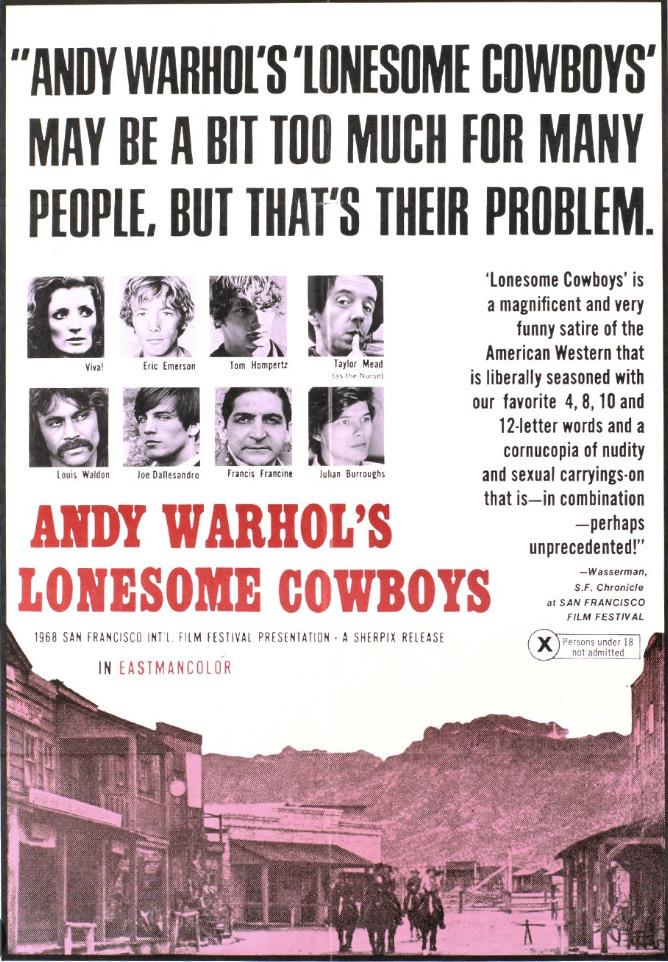
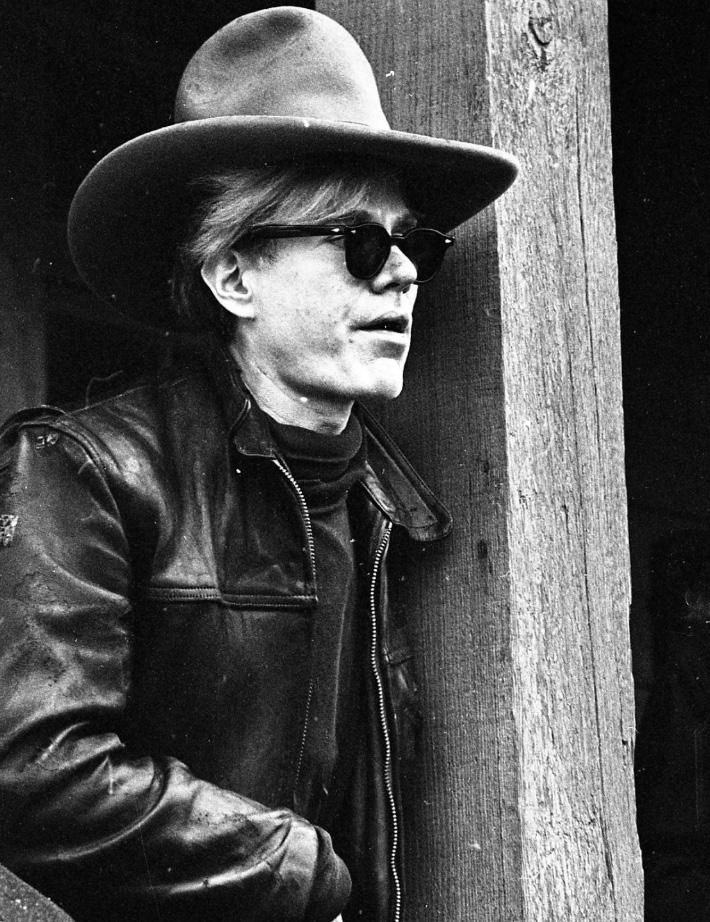
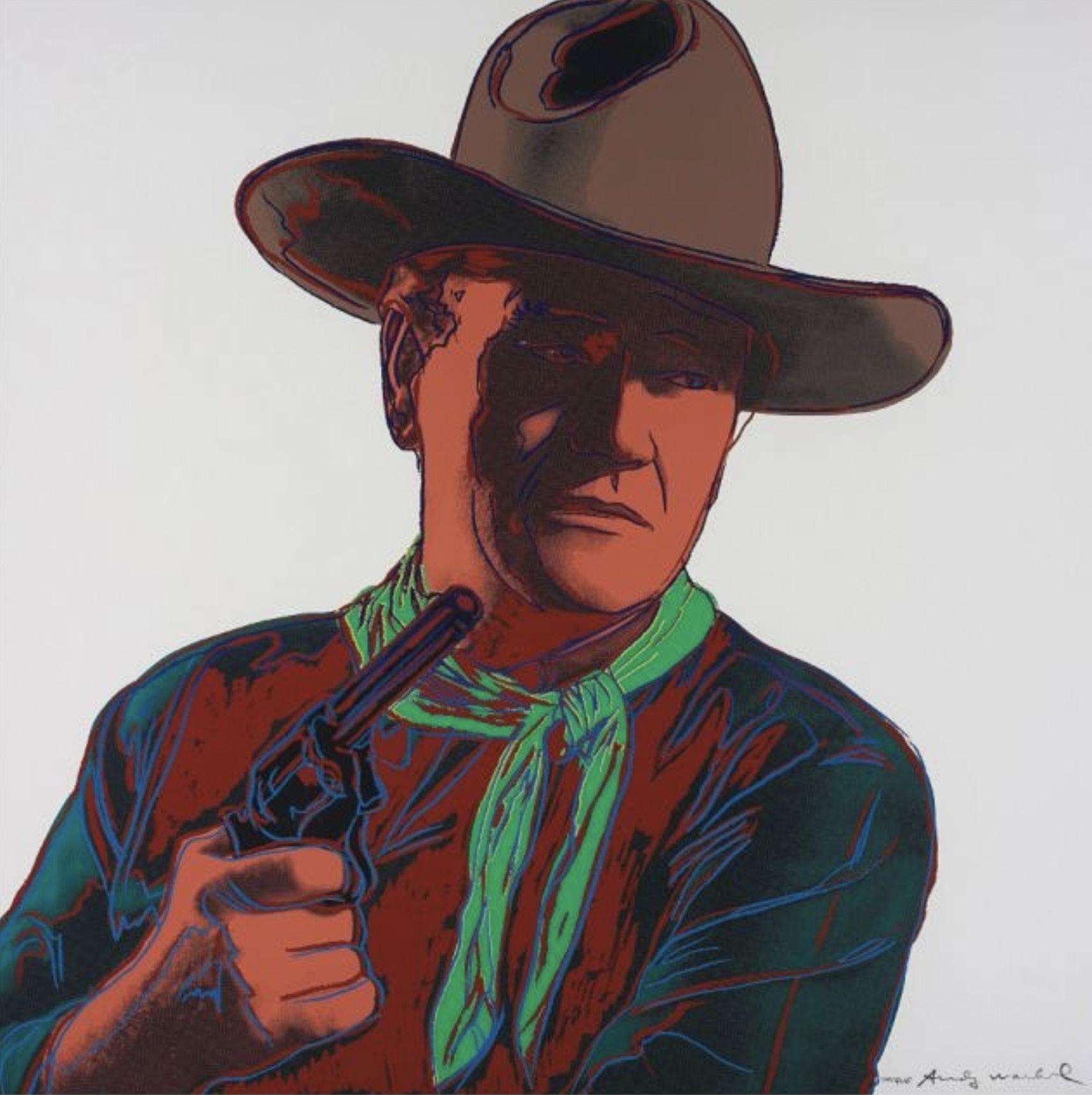
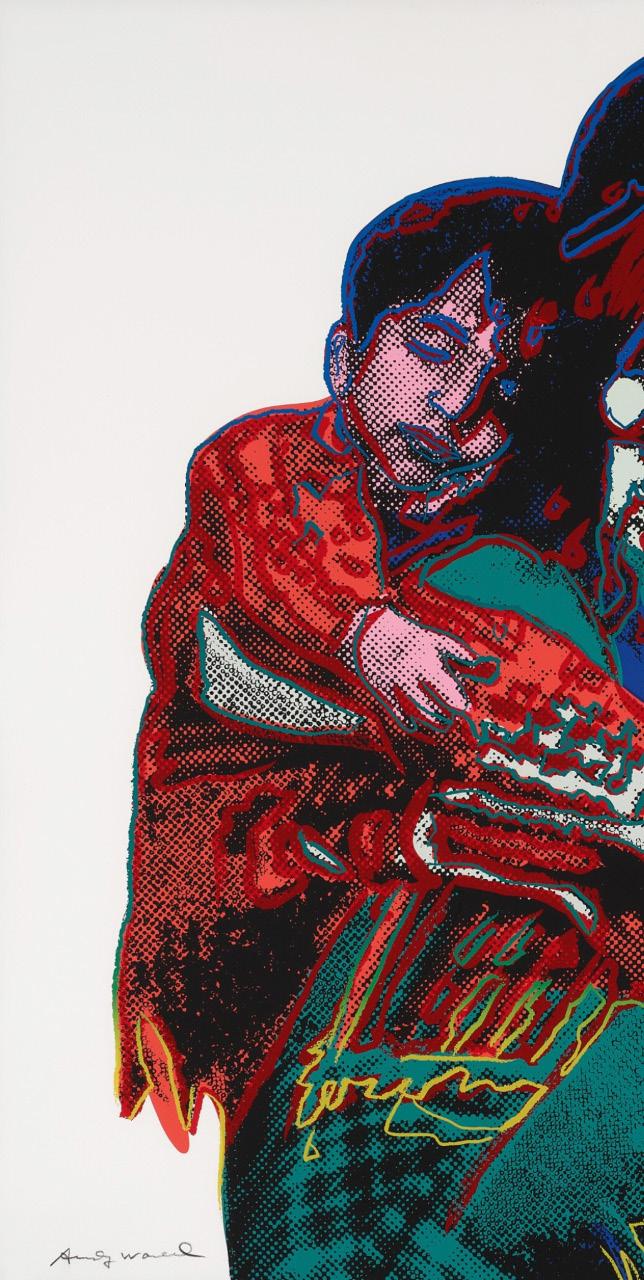
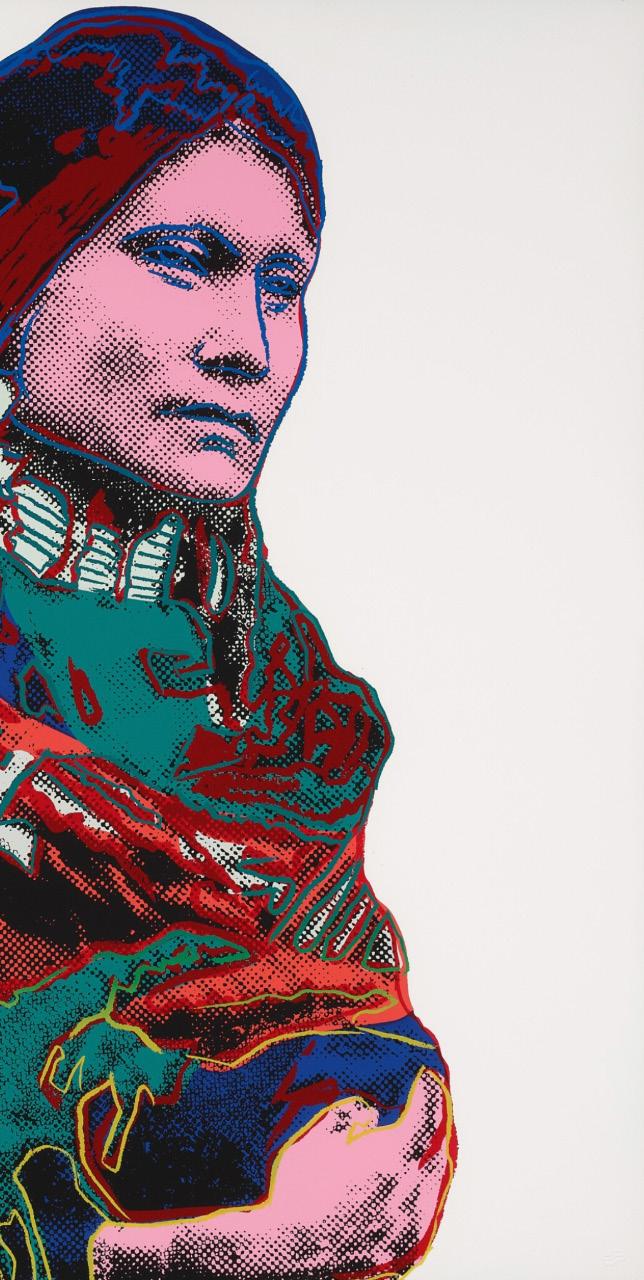
The Wild West emerged as a popular trope in modern visual culture in the 20th century. It flourished in film and television, where creative license granted a particular dramatization of the history of westward expansion in the United States. The Western, as the genre came to be known, was defined by frontier fantasies of lawlessness and conflict. A “Cowboys and Indians” narrative was common, and supplied a hero-versusvillain dynamic in the form of settlers against Native Americans. This mythology was an enduring source of fascination for Andy Warhol: he collected Native American crafts, wore cowboy boots, and directed his own Western, Lonesome Cowboys (1968), which satirized the genre’s machismo with a homoerotic portrayal of the cowboy and prompted an FBI investigation into the artist.
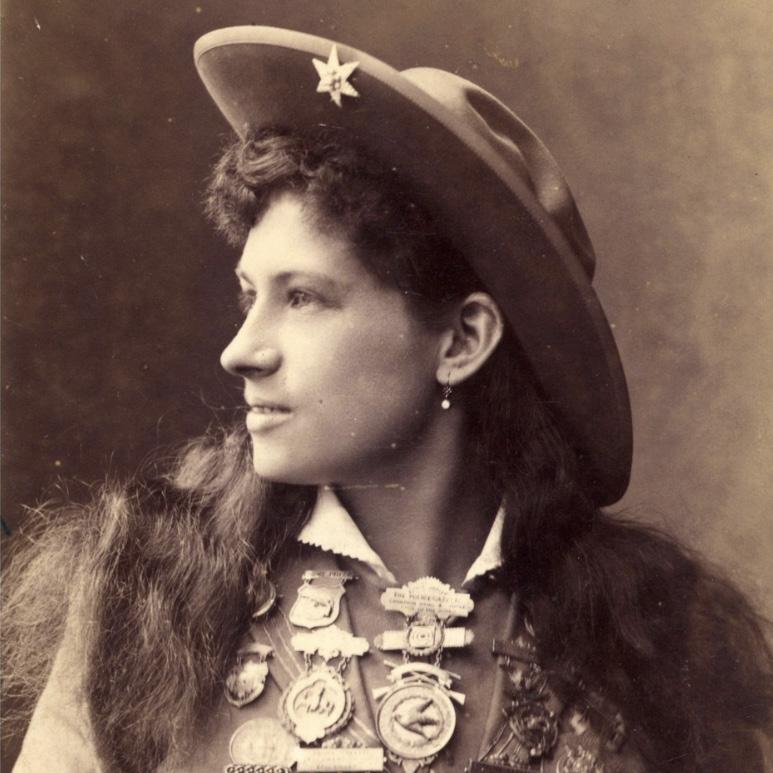
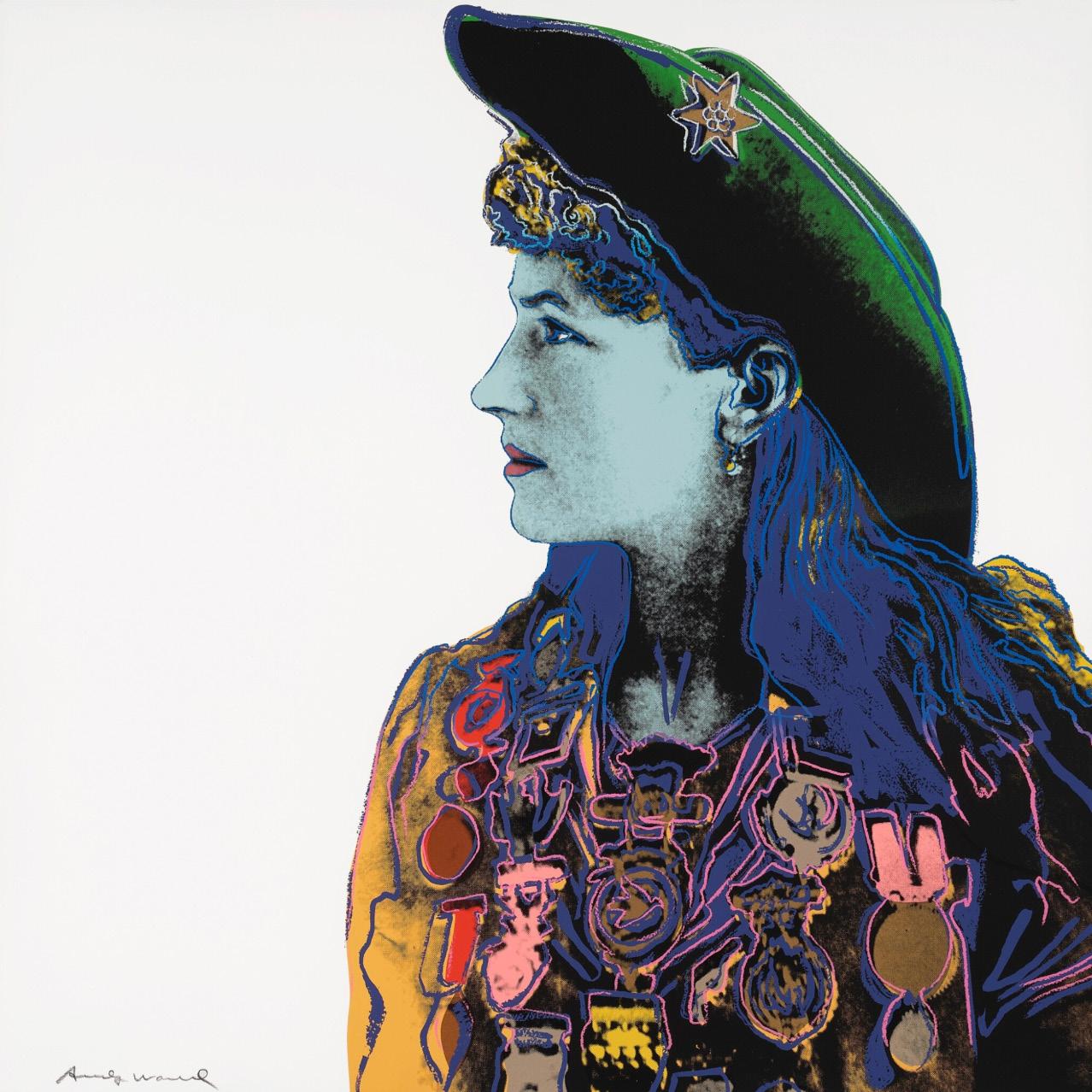
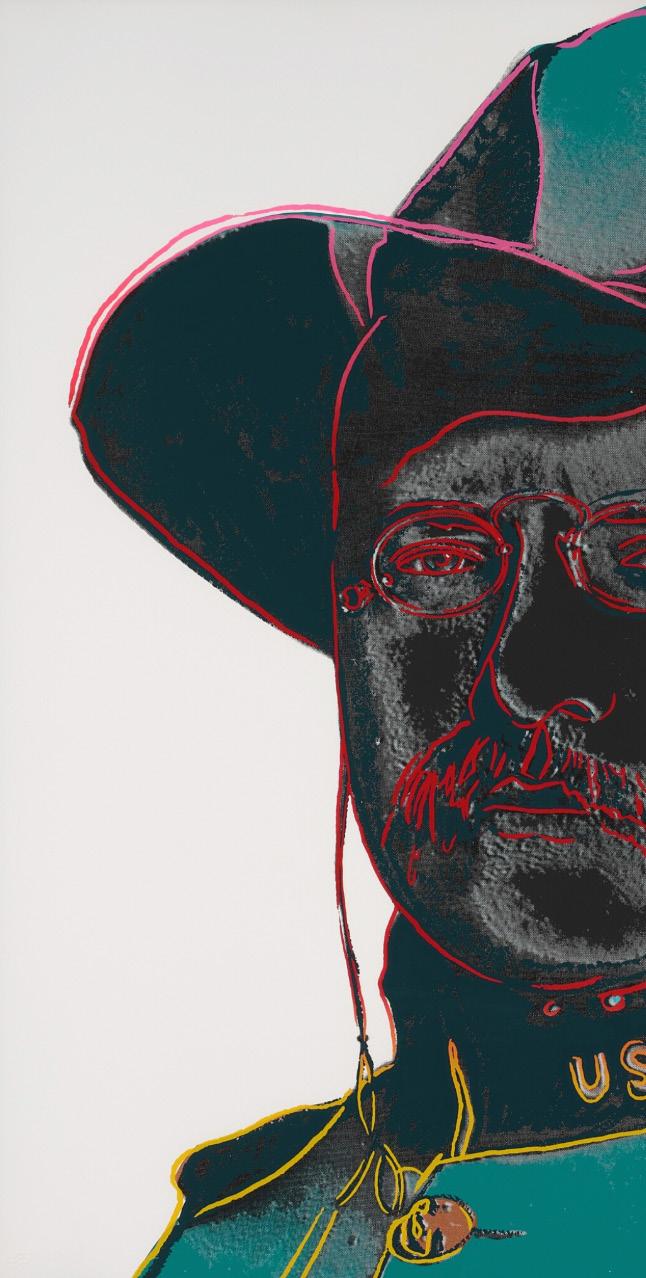
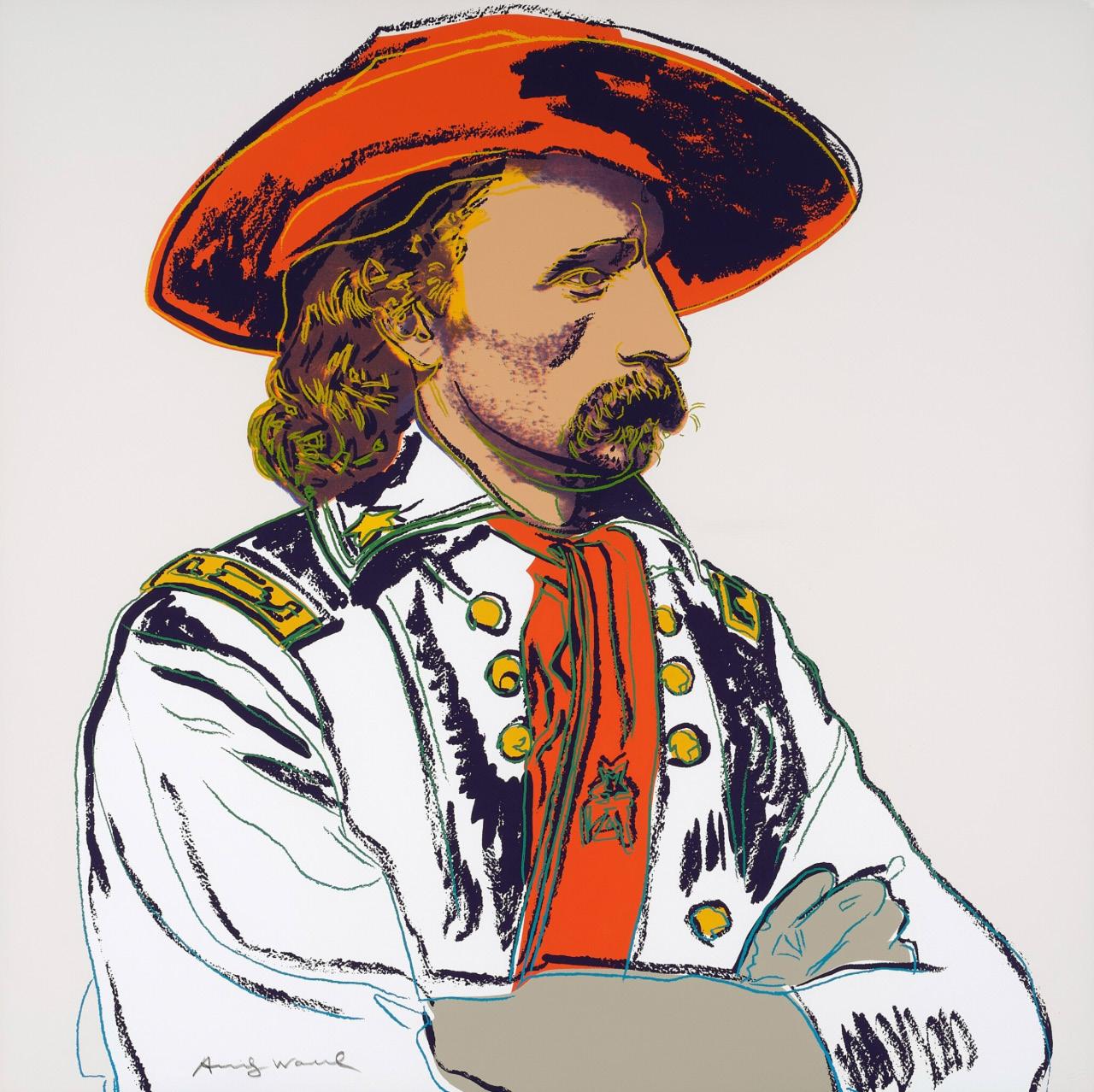
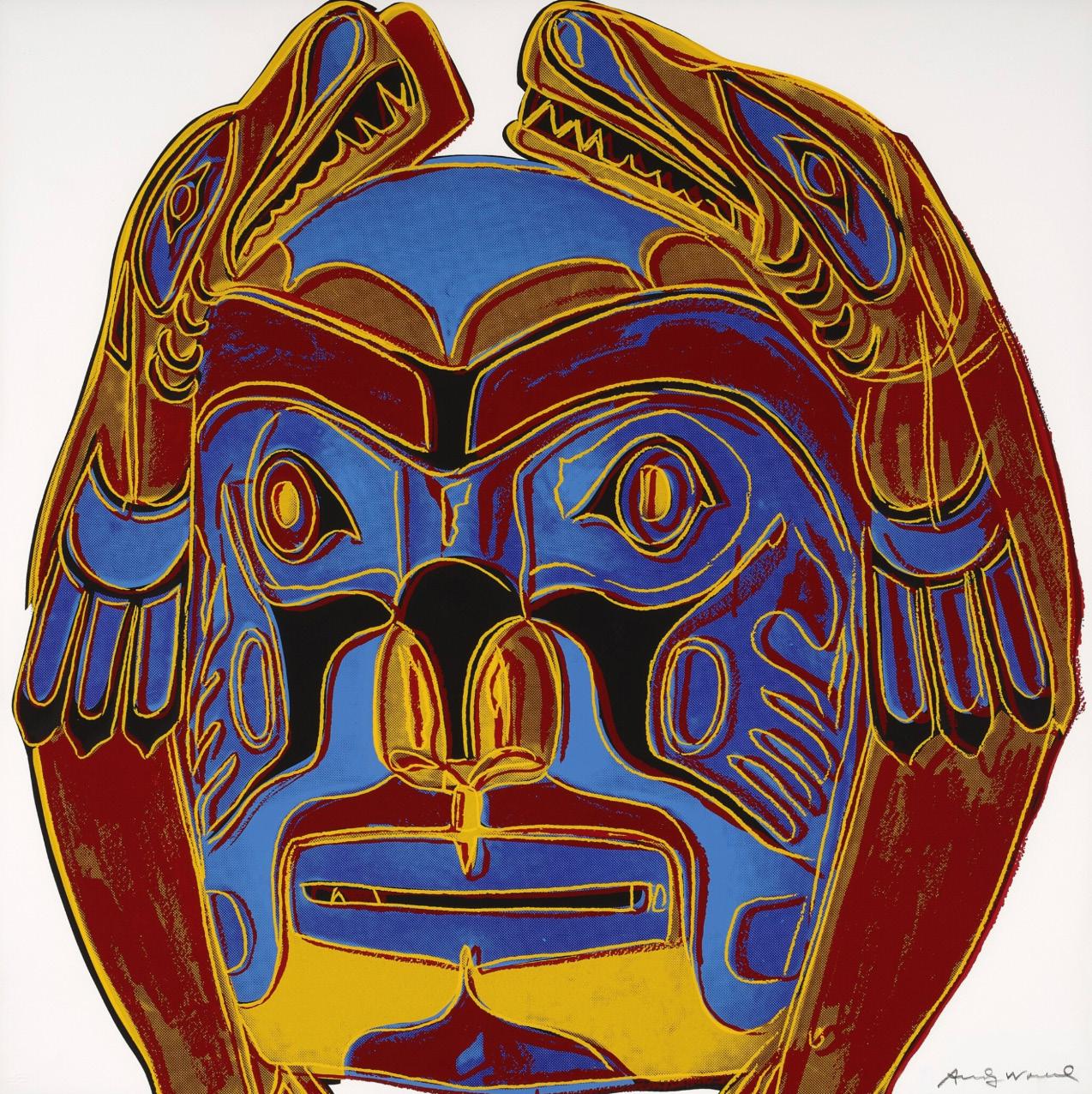
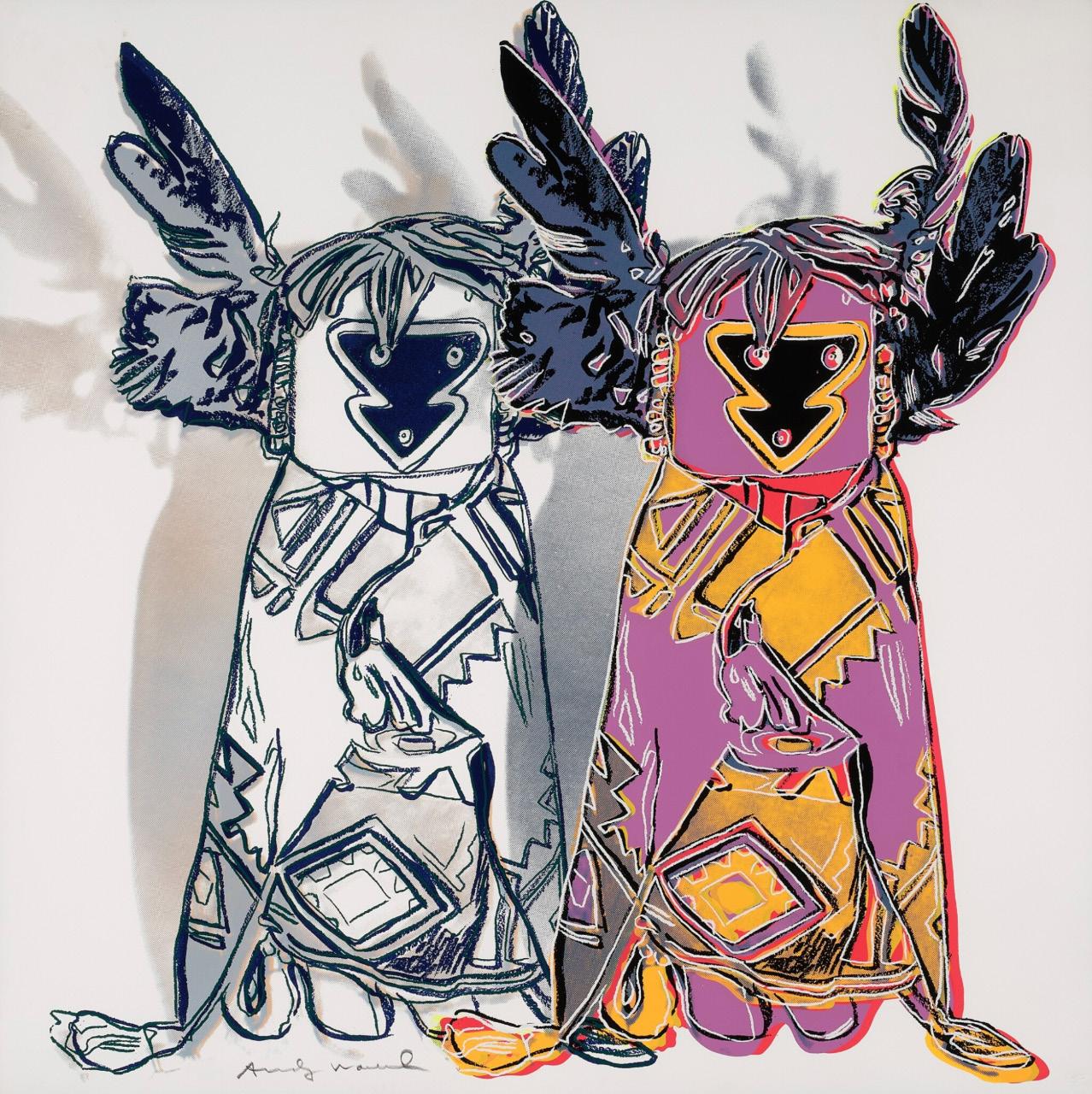
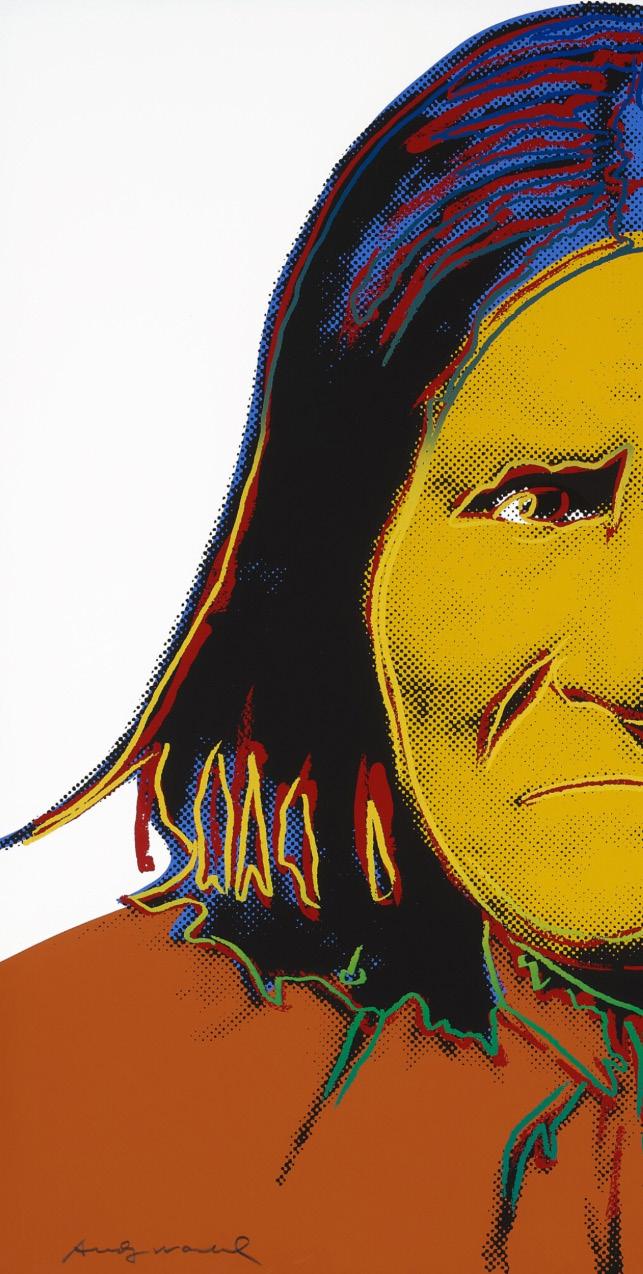
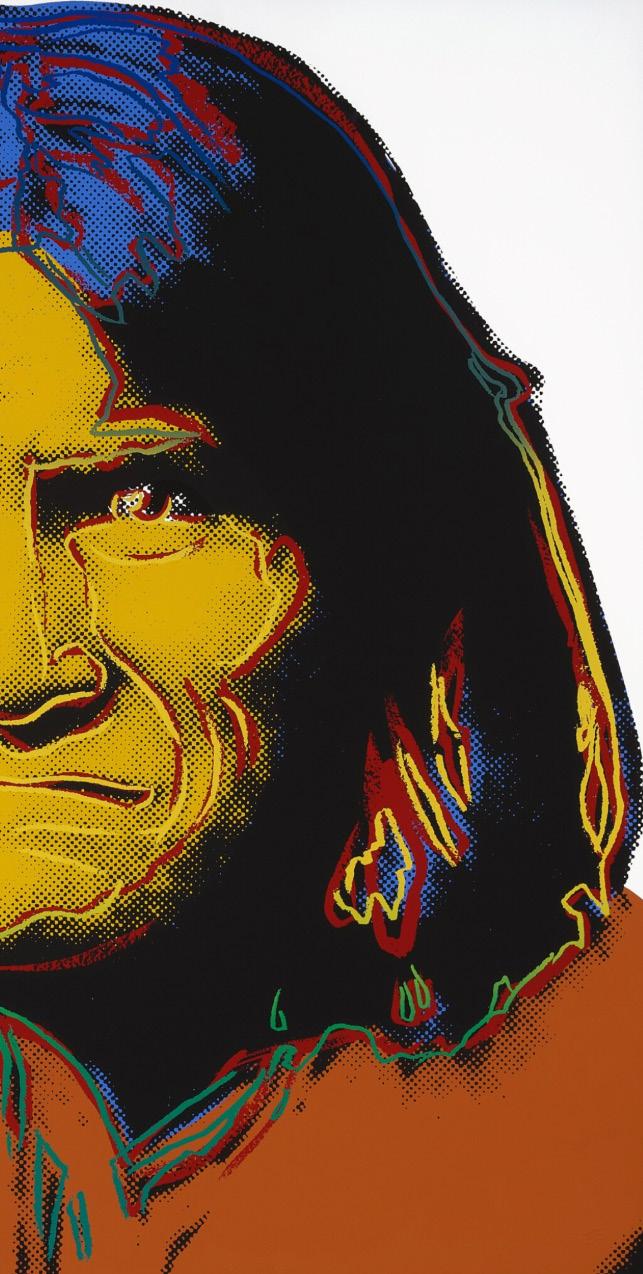
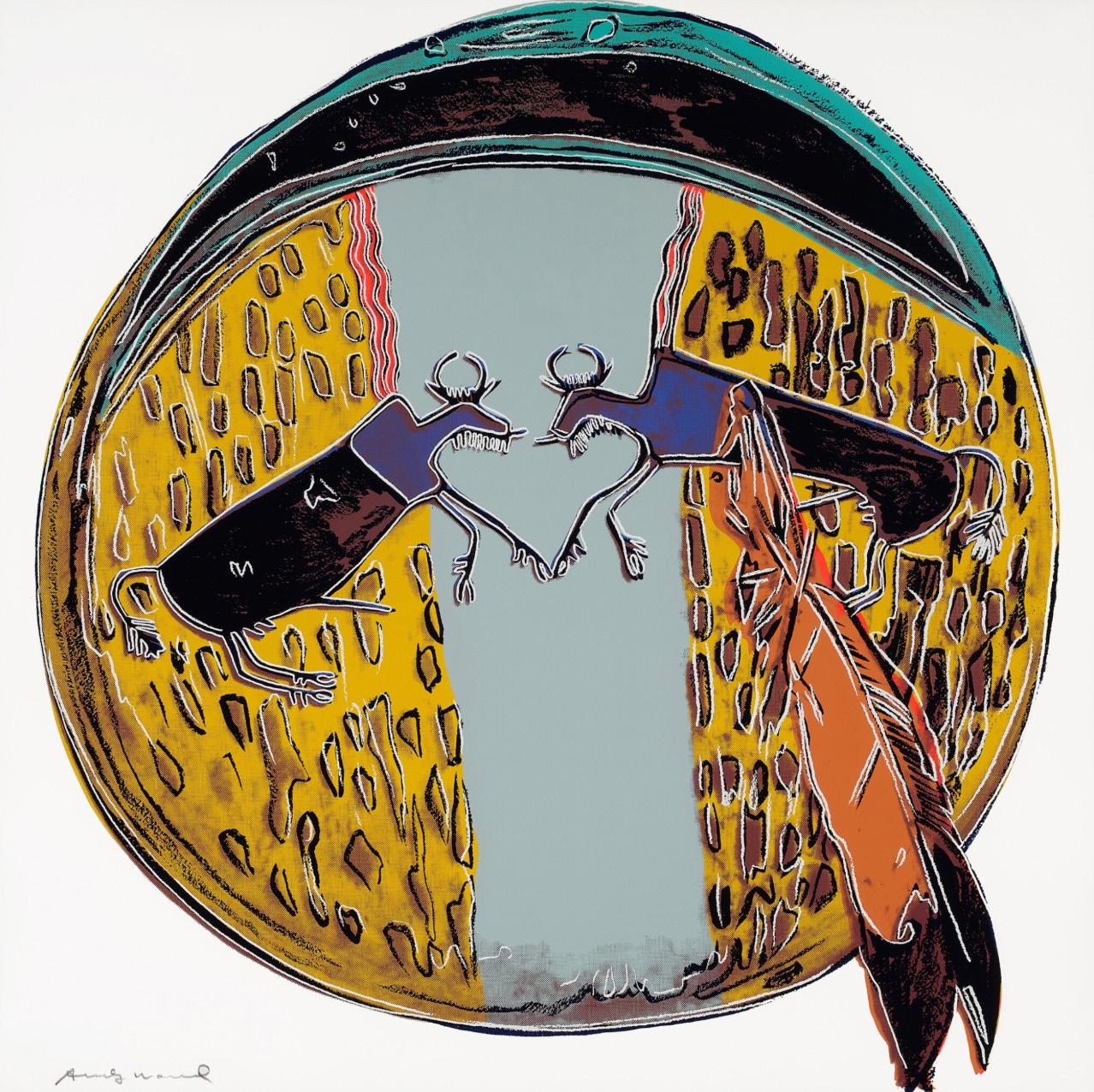
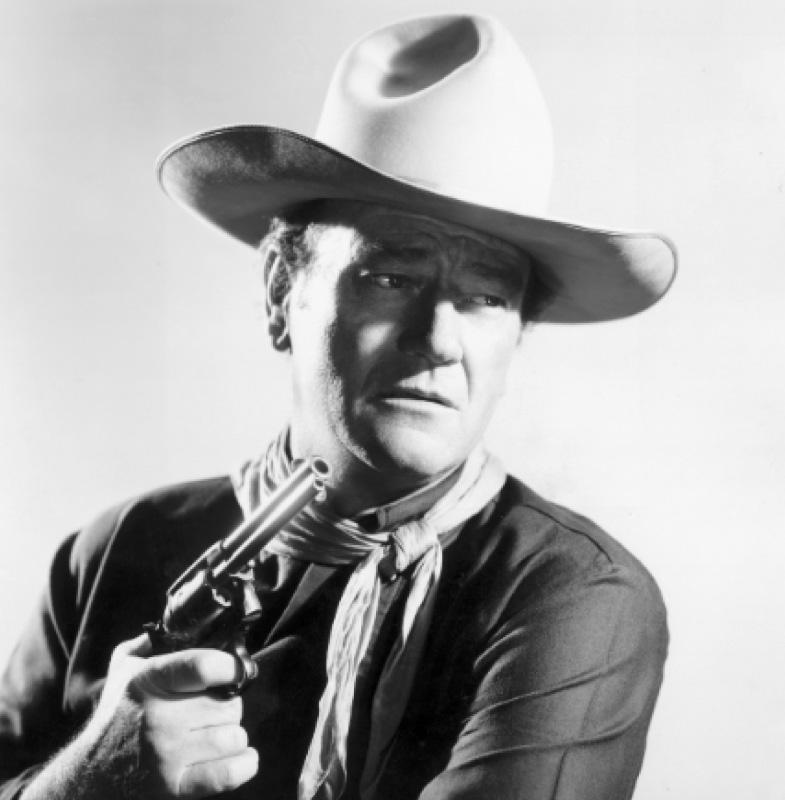
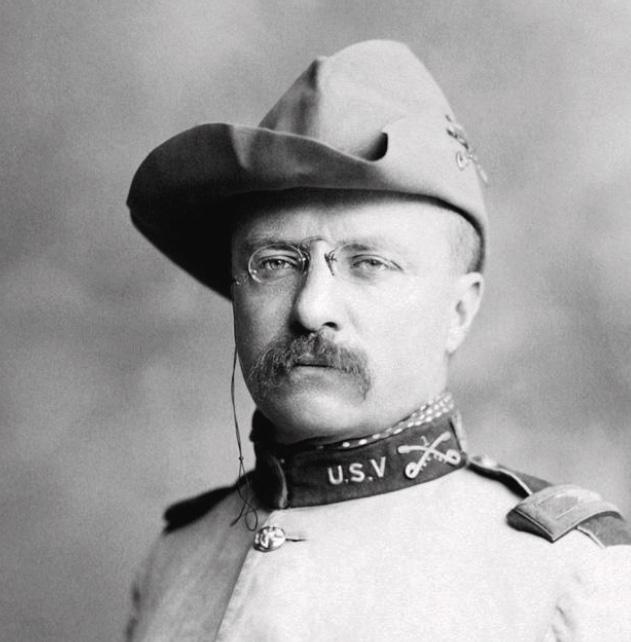
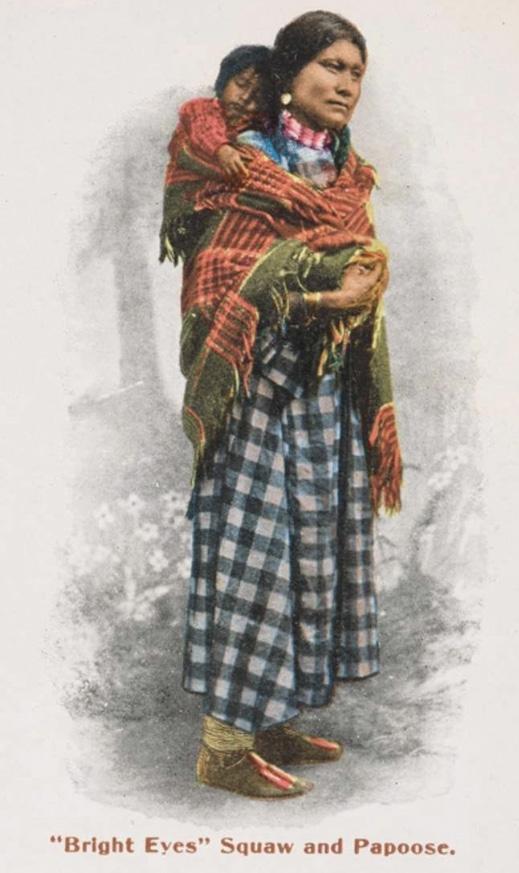
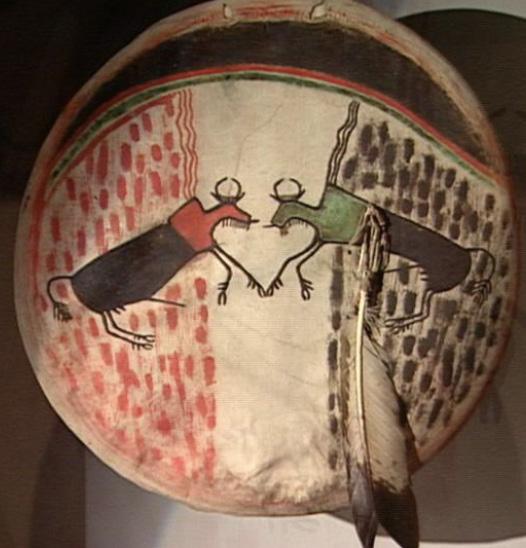
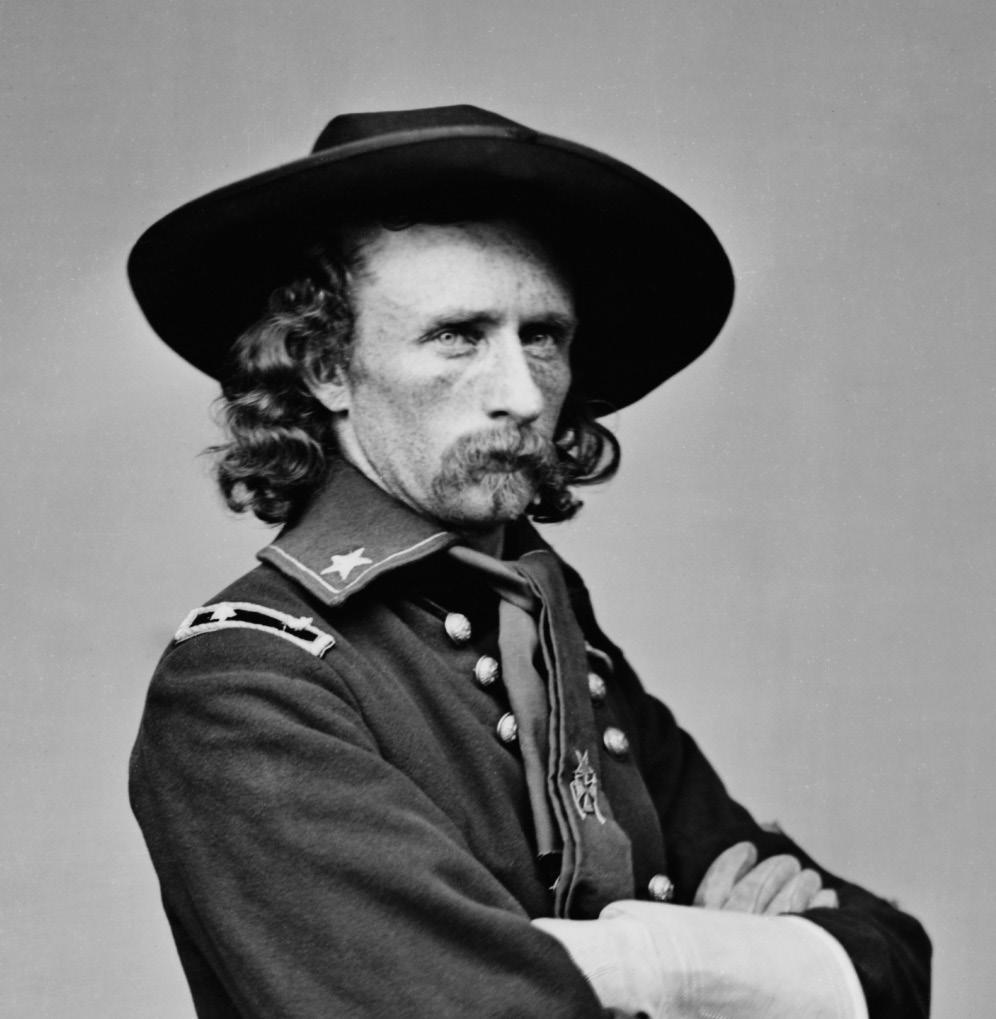
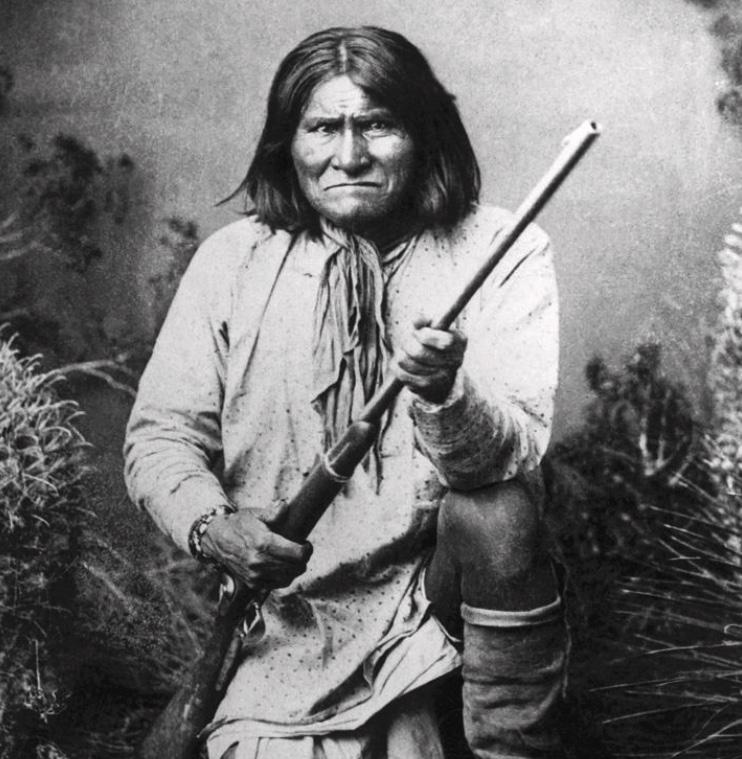
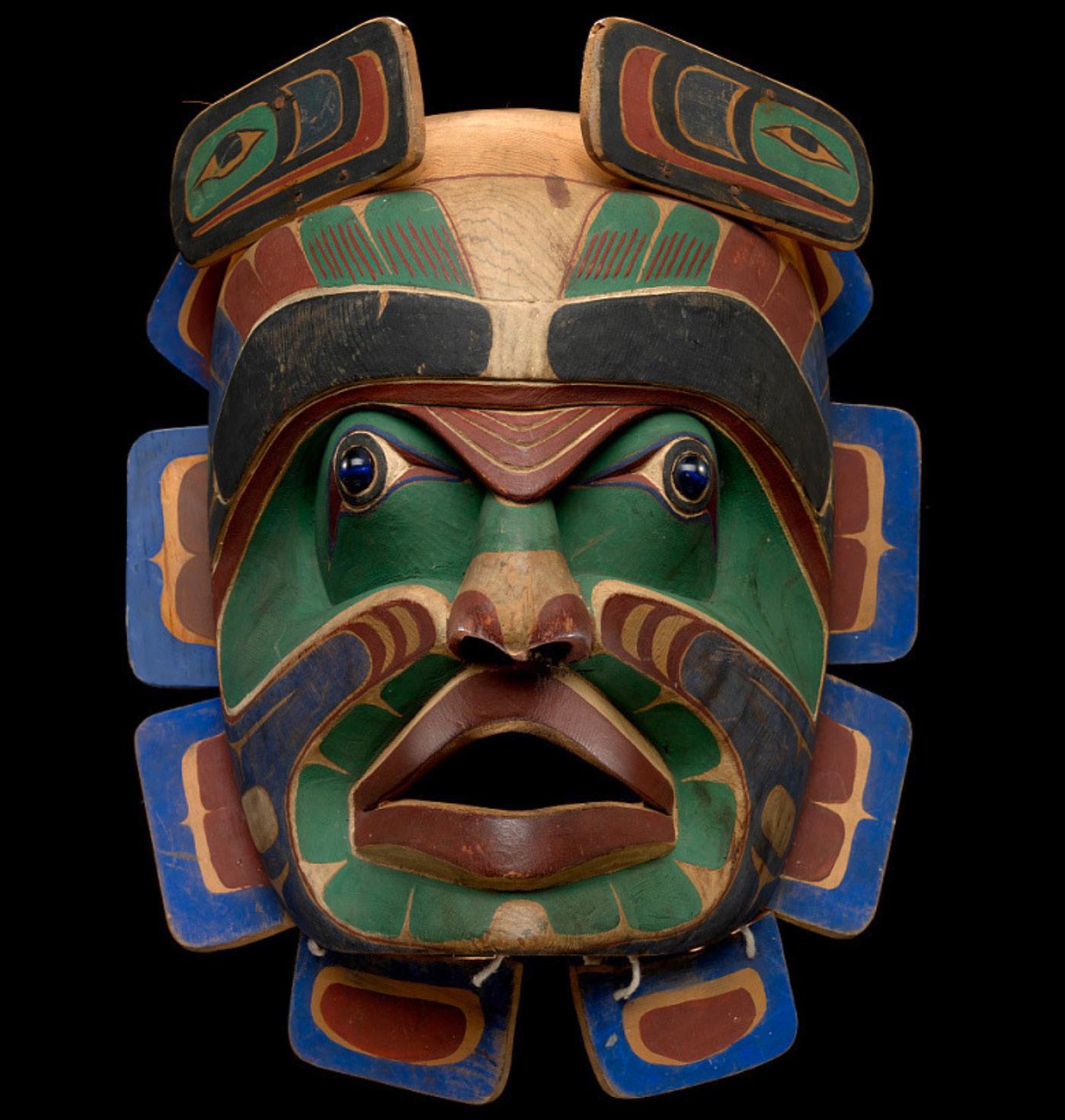
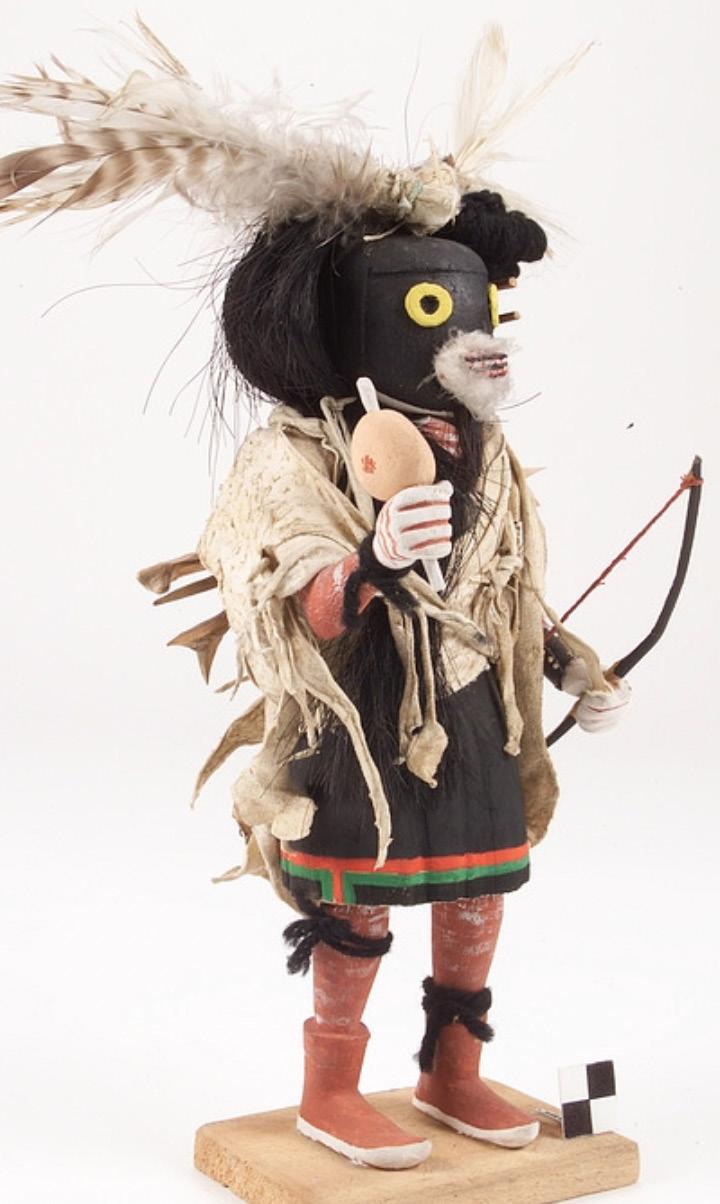
In Cowboys and Indians, one of Warhol’s last major printmaking projects before his death in 1987, he returned to the mythology of the American West. The portfolio of ten screenprints brings figures from Western cinema and American history together with objects of Indigenous culture. Warhol’s images have various sources. Kachina Dolls, Plains Indian Shield, and Northwest Coast Mask are Native American artifacts that Warhol photographed at the Museum of the American Indian, Heye Collection in New York, now the Smithsonian National Museum of the American Indian, while Teddy Roosevelt, General Custer, and Geronimo are appropriated from archival photographs. For Western film icon John Wayne and sharpshooter-turned-vaudeville star Annie Oakley, Warhol used promotional images from Wayne’s 1962 film The Man Who Shot Liberty Valance and Oakley’s advertisements for Buffalo Bill’s Wild West show. Warhol’s equal manipulation of each image suggests that there is little distinction between the stereotypes we maintain and the heroes we uphold.
The portfolio’s publication landed Warhol in legal trouble when the partnership licensed to use John Wayne’s name and image, managed by his descendants, filed a lawsuit alleging copyright infringement. Warhol responded by recalling each editioned John Wayne, erasing the number and re-coloring Wayne’s neck scarf or pistol to make each print unique and evade copyright laws.
Left: Poster for Warhol’s 1968 film Lonesome Cowboys
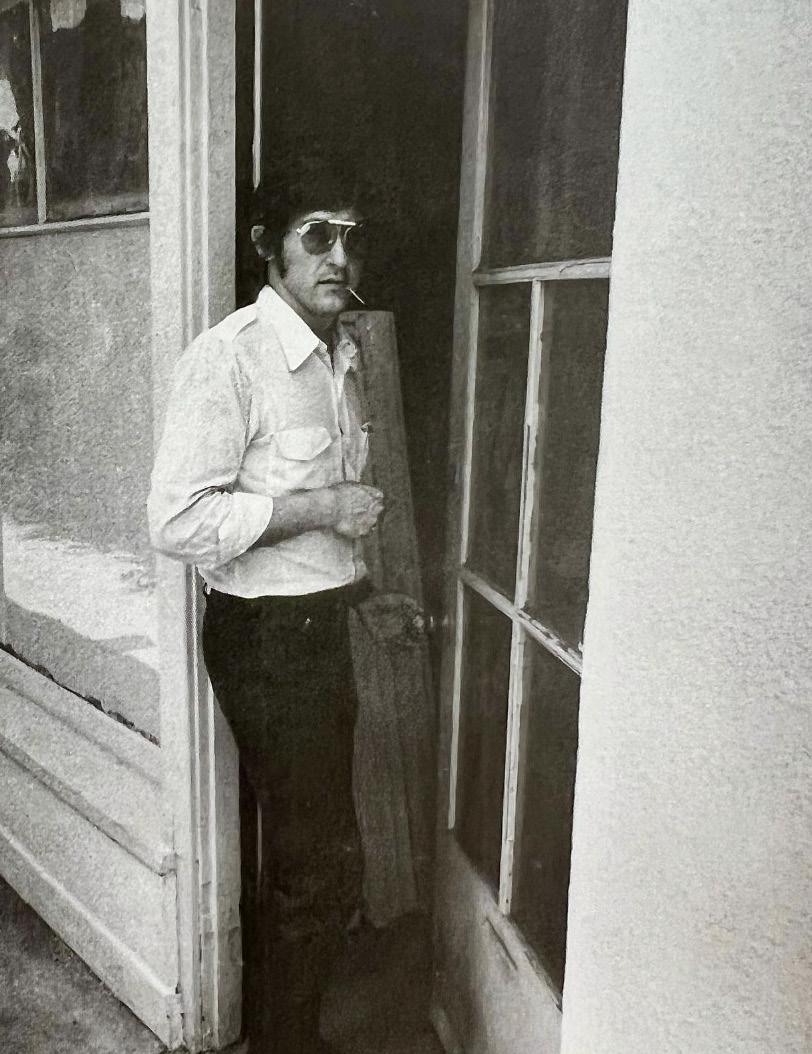
Warhol filming Lonesome Cowboys, Arizona, 1968
Andy
Warhol
Cowboys and Indians, 1986
Screenprints
Sheet size: 36 x 36 inches (91.4 x 91.4 centimeters)
Printer: Rupert Jasen Smith, New York
Publisher: Gaultney, Klineman Art, Inc., New York
Edition size: 250, plus proofs
Catalogue Raisonné: Feldman and Schellmann II.377-386
Each print is signed and numbered; John Wayne is signed and inscribed “UNIQUE”
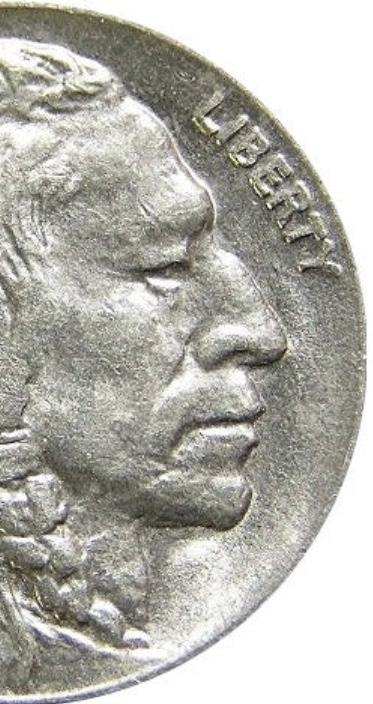
The complete portfolio of ten screenprints including Annie Oakley, John Wayne Teddy Roosevelt, General Custer, Indian Head Nickel, Mother and Child, Northwest Coast Mask, Kachina Dolls, Geronimo, and Plains Indian Shield. Annie
Oakley, 1890
John Wayne in The Man Who Shot Liberty Valance, 1962
Colonel Theodore Roosevelt Jr., c. 1900
“Bright Eyes” Postcard, published by E.C. Kropp Co.
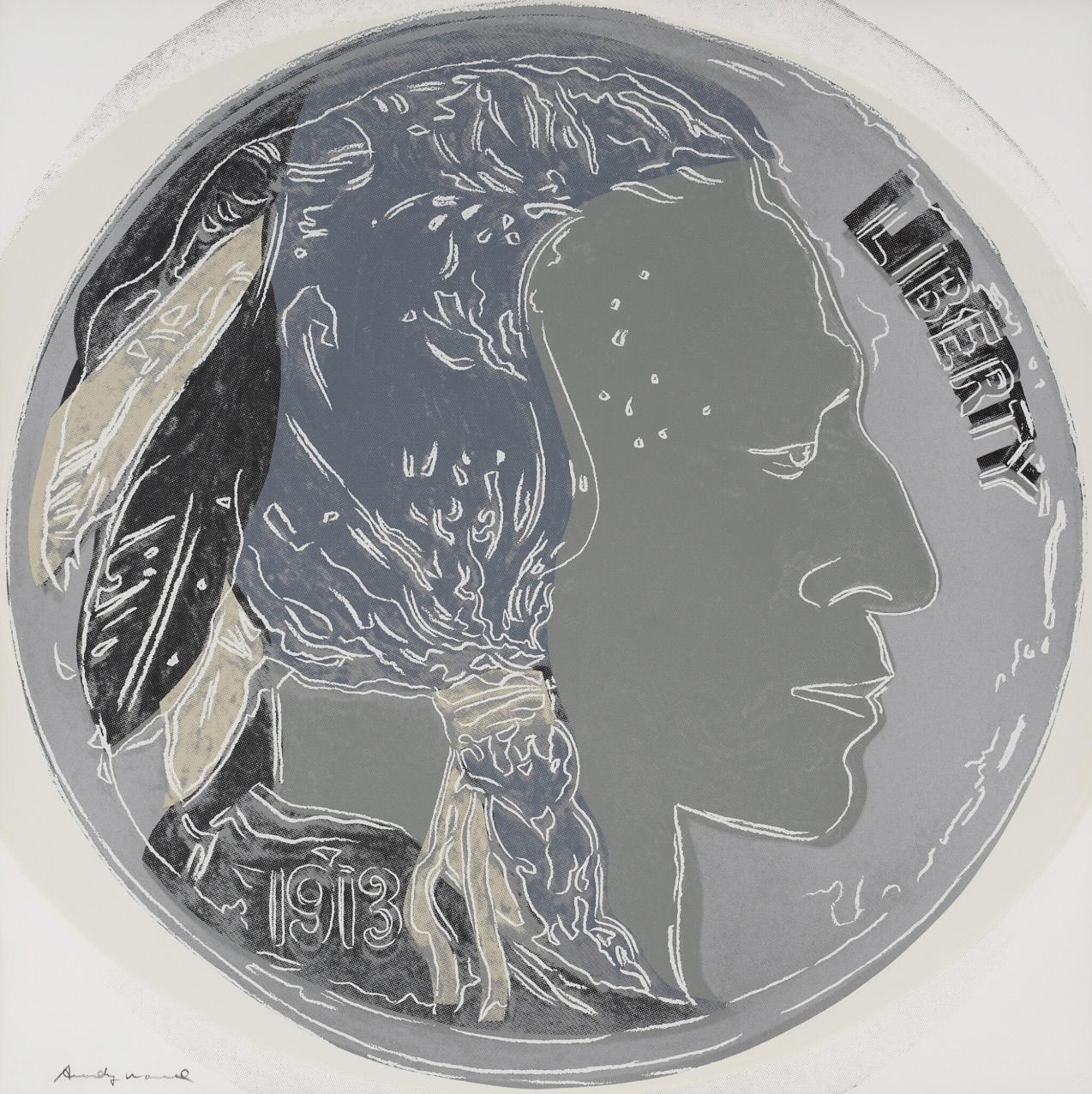
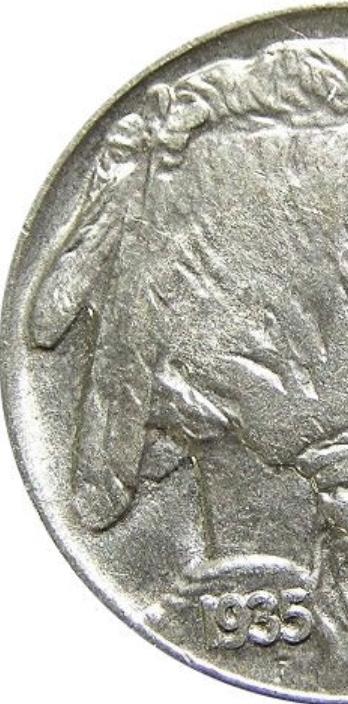
Indian Head
Native American Shield
General George Armstrong Custer, c. 1860s
Geronimo, 1886
He’e’e Kachina Doll, 1970
Kwakiutl Mask, c. 1900
Head Nickel, 1935
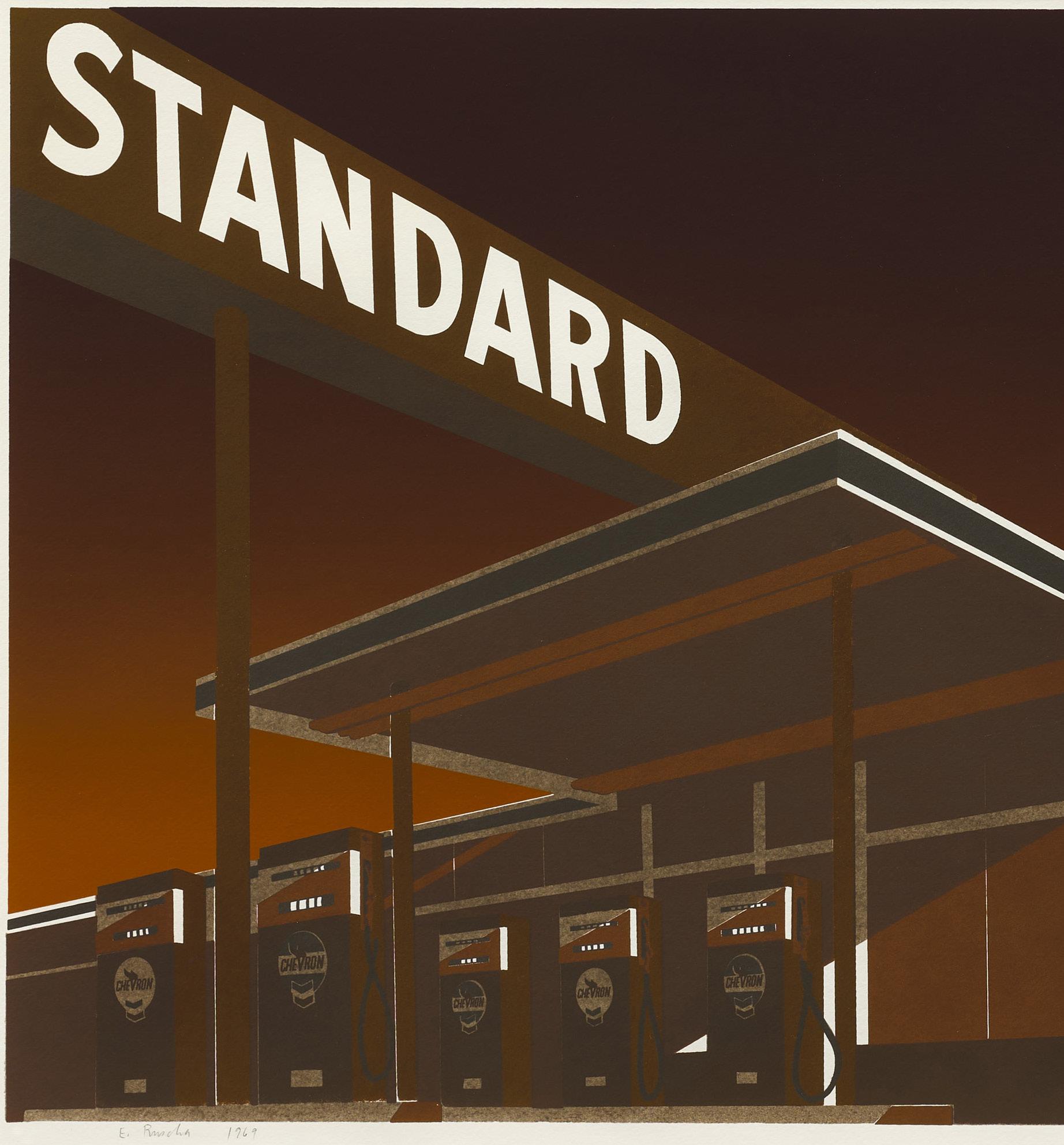
Ed Ruscha
Mocha Standard, 1969
Screenprint
Sheet size: 25 5/8 x 40 inches
(65.1 x 101.6 centimeters)
Printer: Jean Milant and Daniel Socha
Publisher: The Artist
Edition size: 100, plus proofs
Catalogue Raisonné: Engberg 30
Signed, dated, and numbered
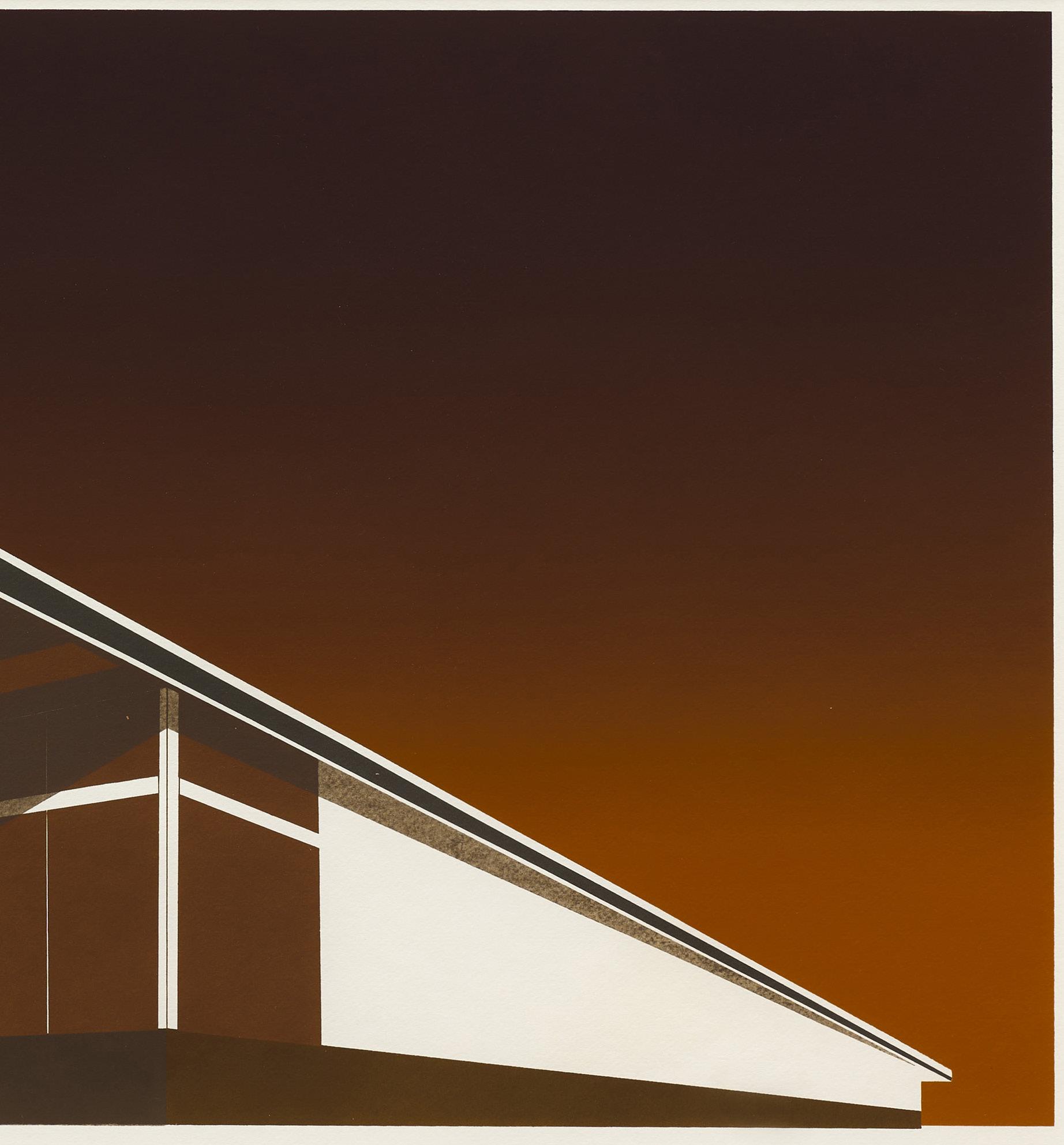
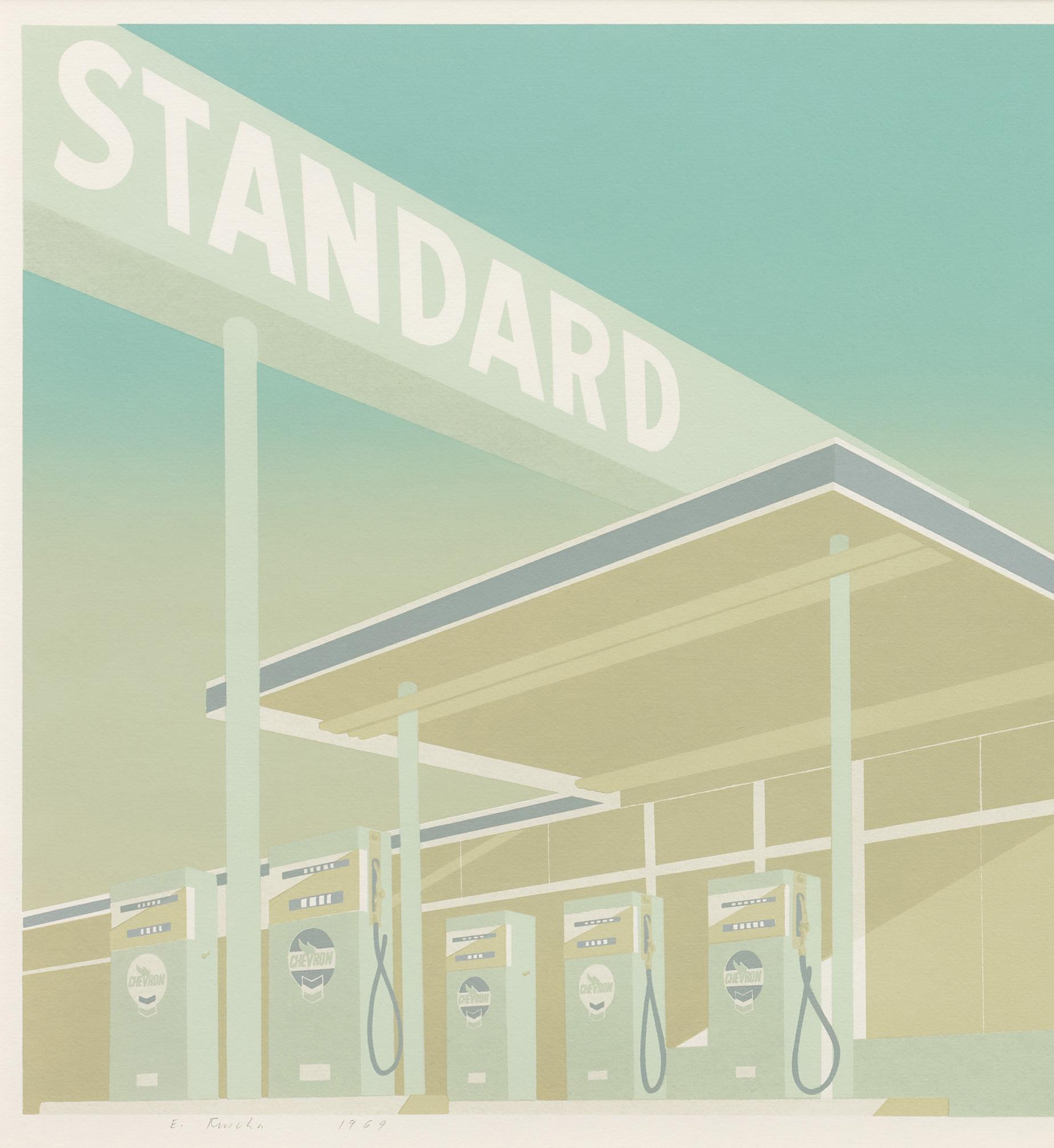
Ed
Ruscha
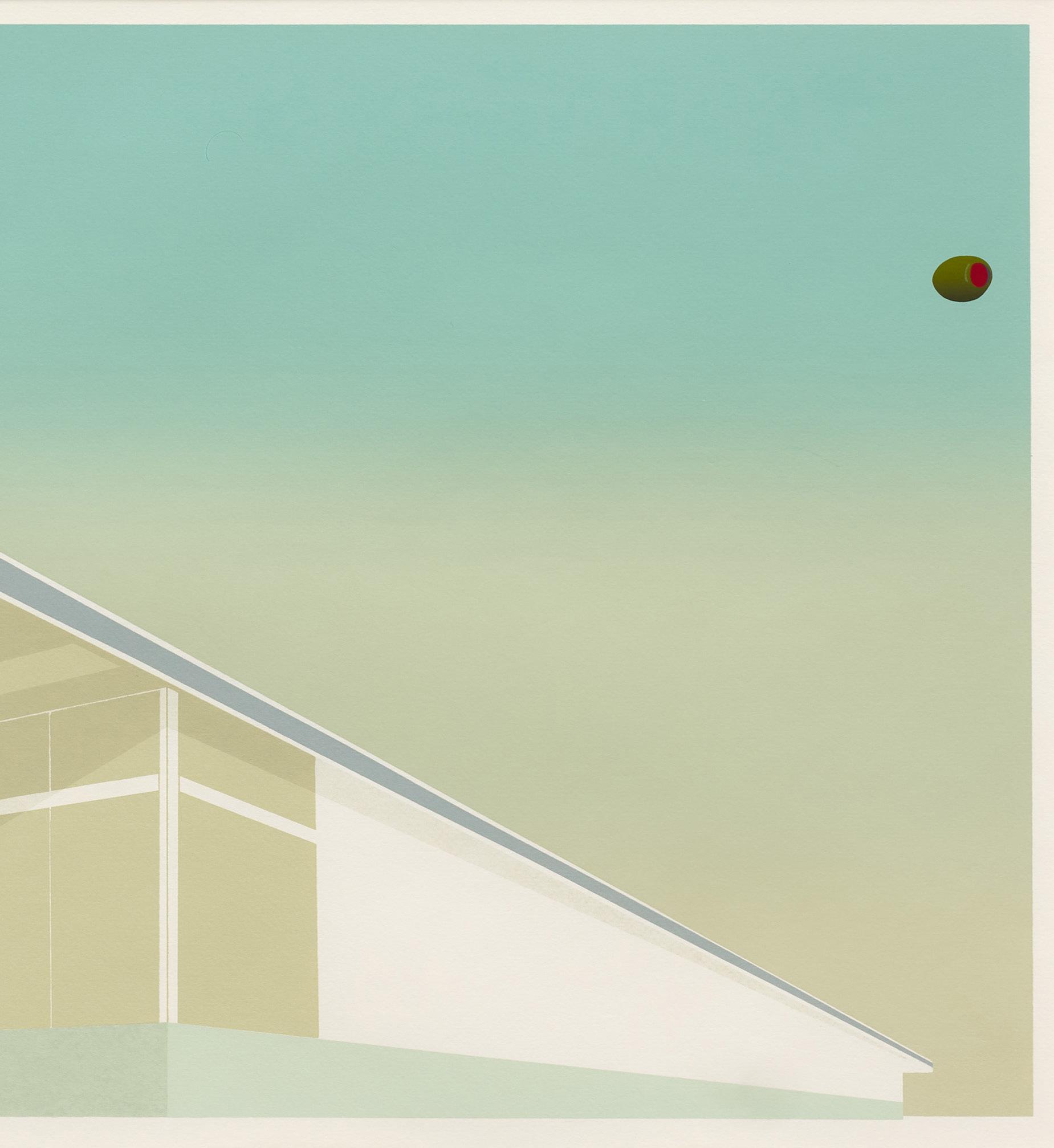
Cheese Mold Standard with Olive, 1969
Screenprint
Sheet size: 25 5/8 x 40 inches
(65.1 x 101.6 centimeters)
Printer: Jean Milant and Daniel Socha
Publisher: The Artist
Edition size: 150, plus proofs
Catalogue Raisonné: Engberg 31
Signed, dated, and numbered
Edward Ruscha
When Edward Ruscha arrived in Los Angeles, California, in 1958, the Golden Age of Hollywood was coming to an end. The Supreme Court’s 1948 ruling in United States v. Paramount Pictures, Inc. had dismantled Hollywood’s centralized system of film production, ending the dominance of major studios such as Paramount Pictures, Warner Brothers, and 20th Century Fox. A “New Hollywood” emerged in its wake. Characterized by the rise of independent, experimental filmmaking, the Hollywood of the late 1960s rejected the thematic conventions of classic cinema in favor of critical confrontations with the realities of contemporary life.
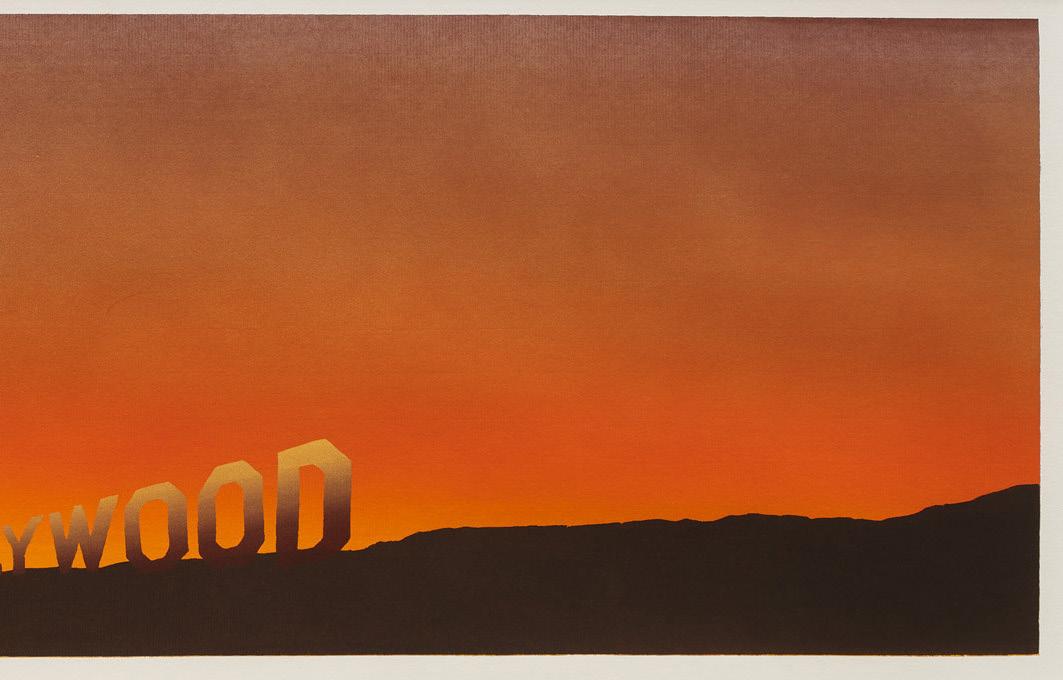
Amidst this changing landscape, Ruscha’s vision of Hollywood remained consistent—it was less a site of ideological import than a symbol of fantasy for the artist. It is not incidental that he took the city’s foremost monument as a subject. The Hollywood Sign, first erected as Hollywoodland in 1923 as an advertisement for a real-estate company and later shortened to Hollywood in 1949, is situated on Mount Lee in the Hollywood Hills neighborhood of Los Angeles. Ruscha could see the sign from his studio on Western Avenue, where he worked from 1965 to 1985, and he claimed to use it as an indicator of the city’s smog levels. This functional use of the sign perhaps prompted Ruscha to contemplate its hidden significance, and in his Hollywood prints, he brings together his myriad associations of the sign and the city.
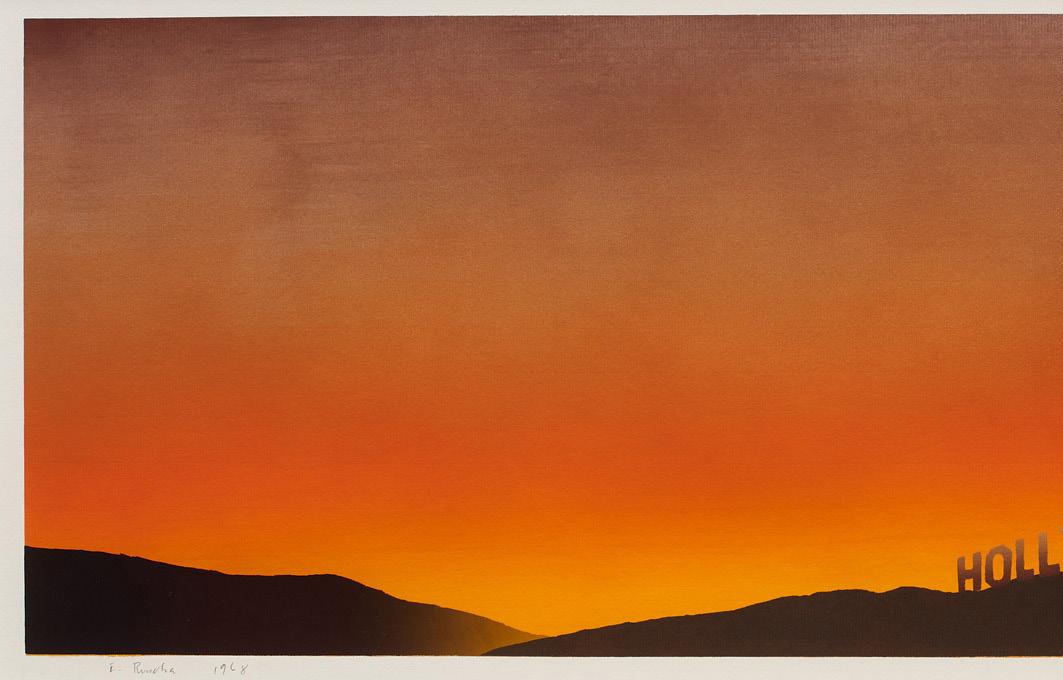
The artist’s 1968 Hollywood screenprint presents the landmark in a wide-lens landscape format, influenced by the panoramic movie screen and Ruscha’s experience driving west to Los Angeles from his native Oklahoma. The background’s fading sunset references Ruscha’s identification of California with what he describes as “space, sunrises, and sunsets.” Ruscha employs false perspective to emphasize the sign’s cresting letters, as the sign is actually nestled within the mountain.
Ed Ruscha at his Western Avenue studio, Los Angeles, California, c. 1970
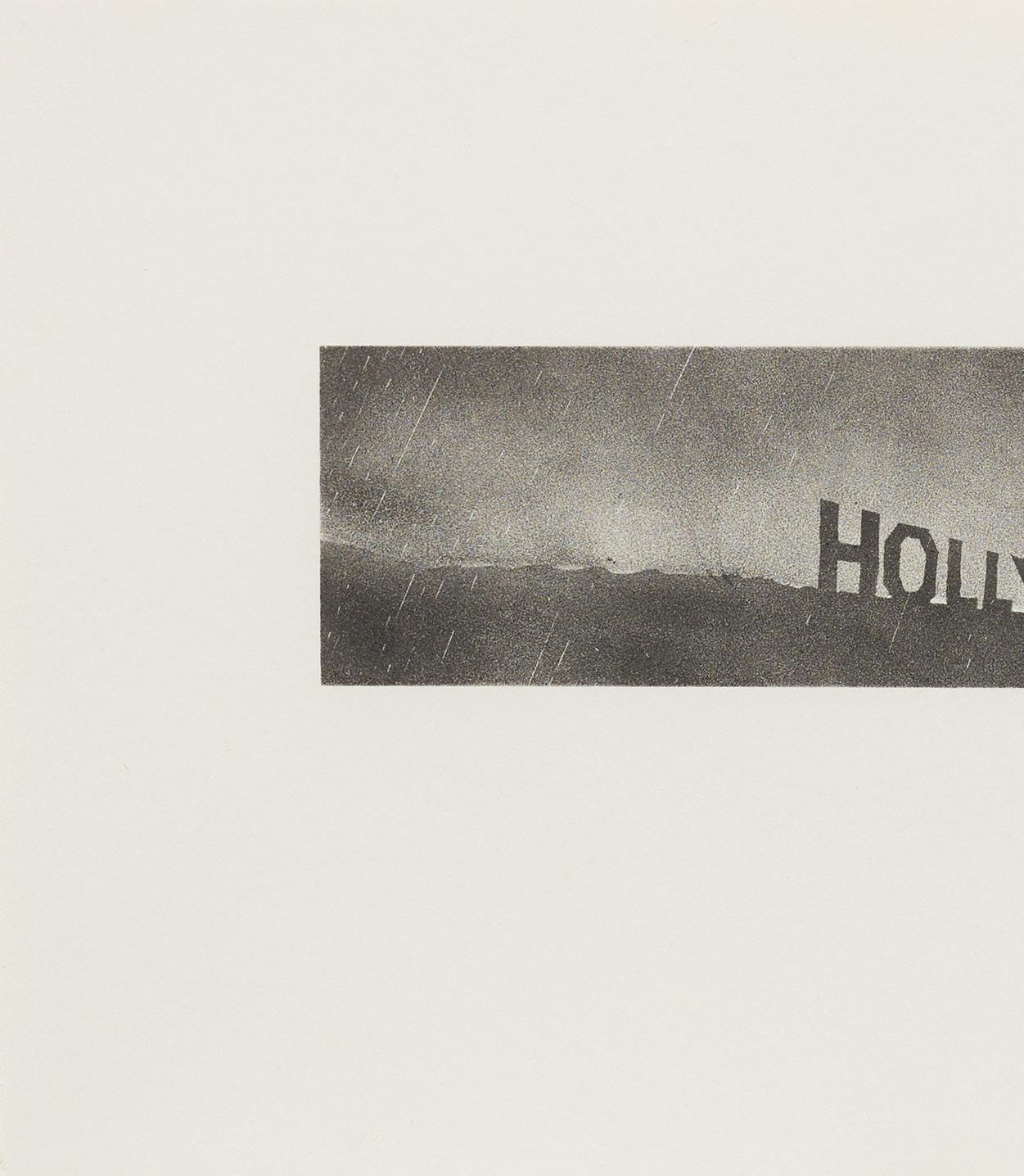
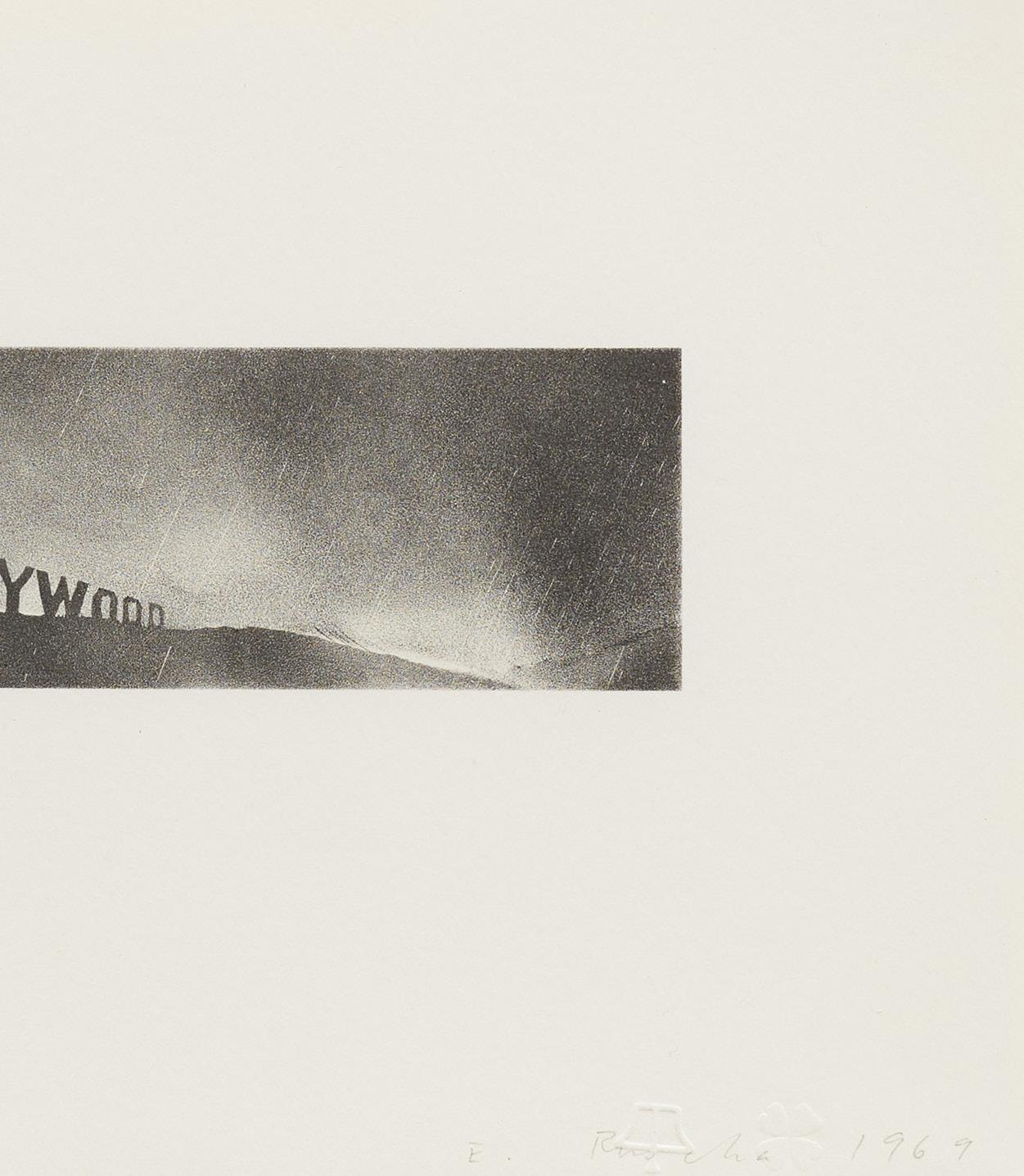
When Ruscha was awarded a fellowship at Tamarind Lithography Workshop in 1969, he continued to explore Hollywood as a subject. Working closely with master printer Donald Kelley, he executed Hollywood in the Rain and Hollywood with Observatory, two rare black-and-white lithographs of the landmark. Like Hollywood, Hollywood in the Rain utilizes a sunken perspective, yet the lithograph assumes an uncharacteristically film-noir aesthetic that highlights Ruscha’s embrace of printmaking as a means to formally experiment with his recurring themes.
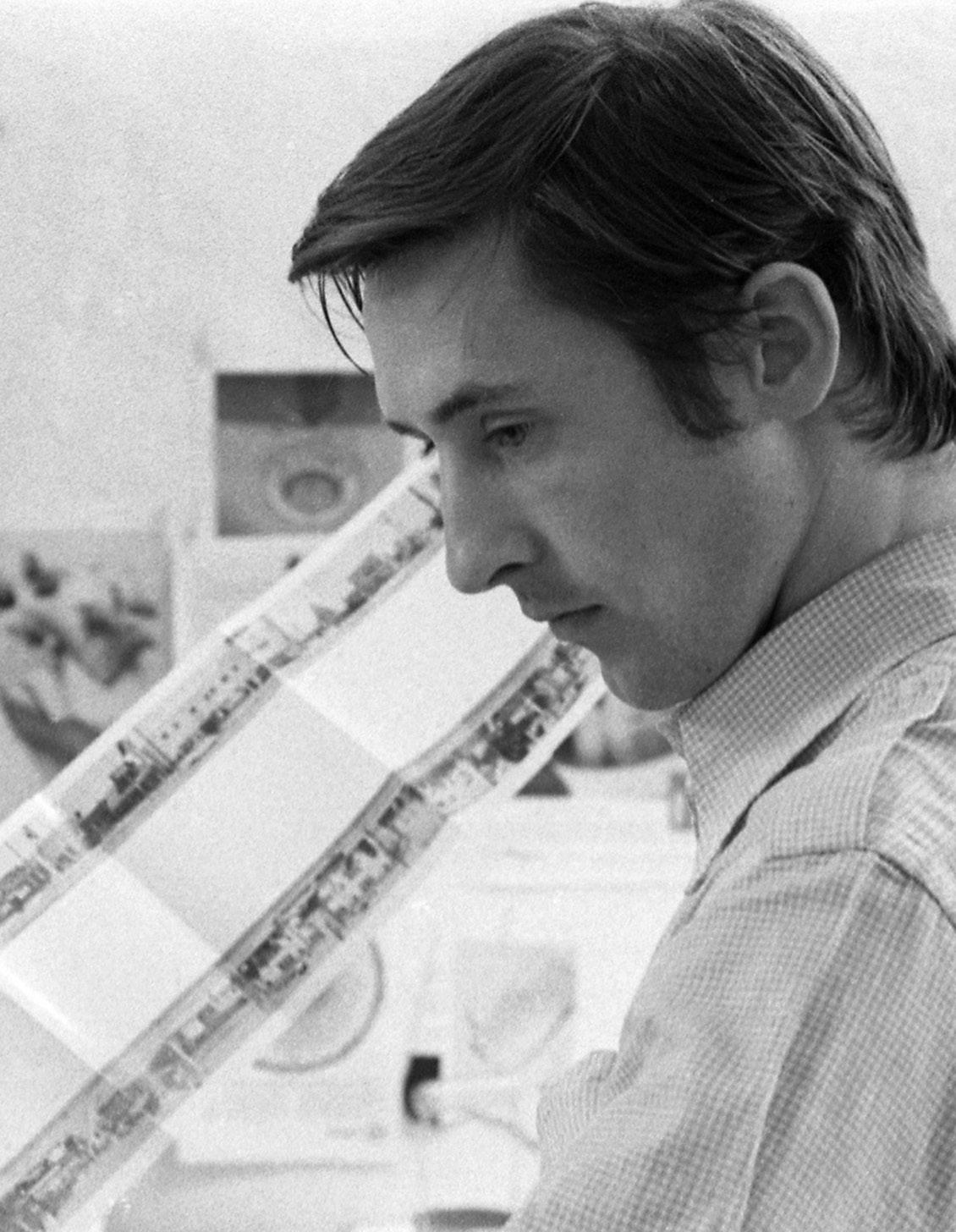
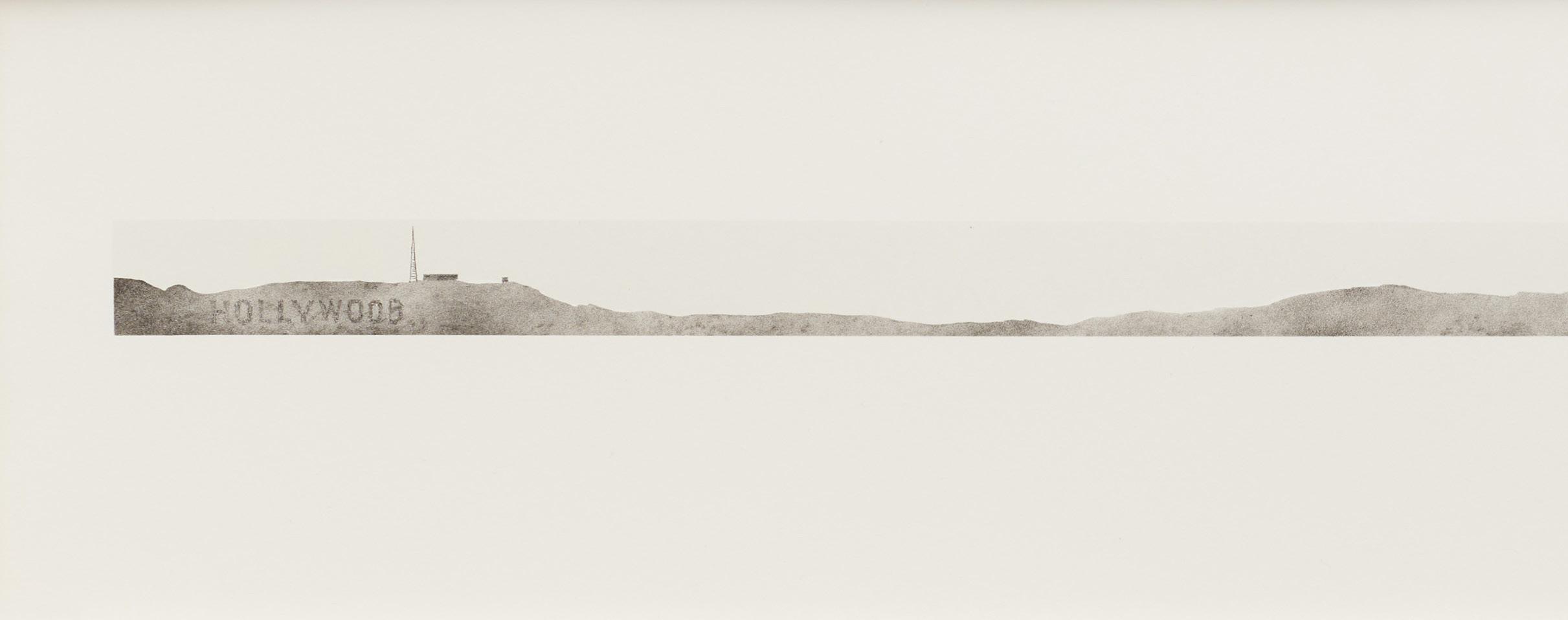
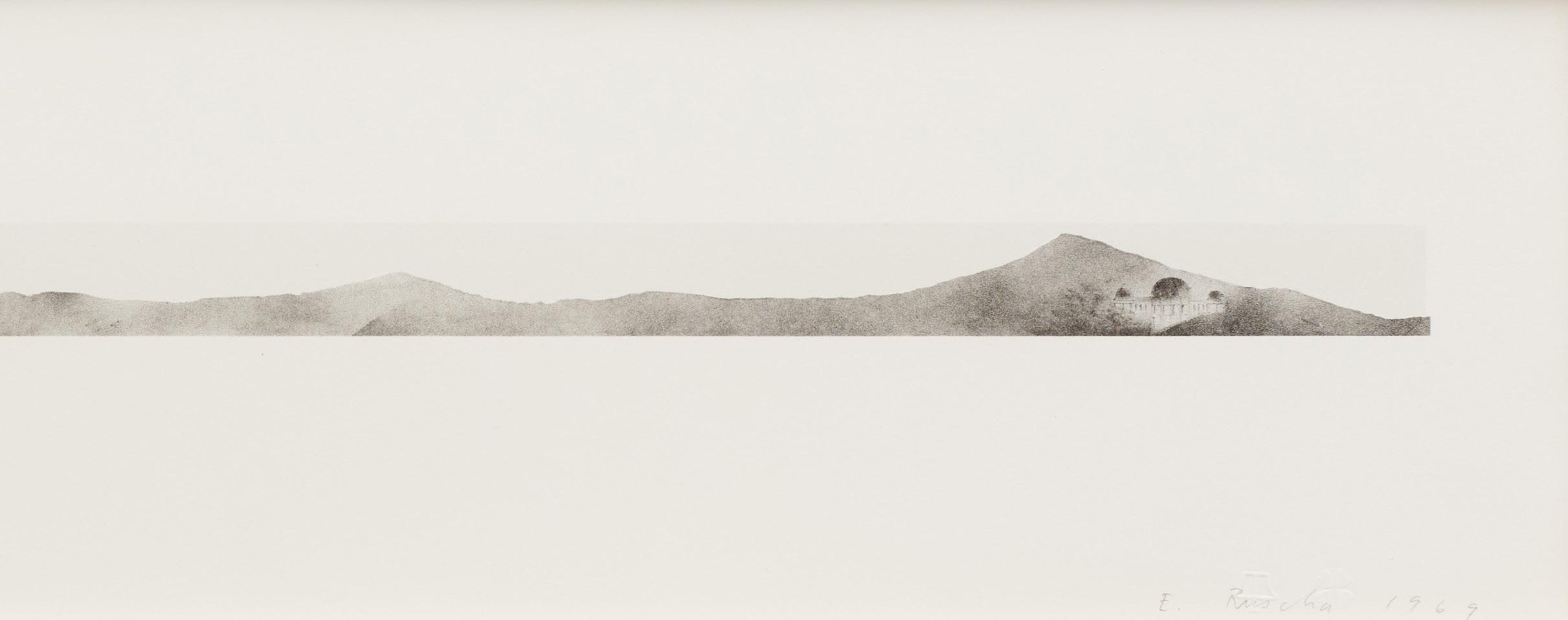
Hollywood with Observatory, which features both the Hollywood Sign and the Griffith Observatory, is Ruscha’s only print that correctly situates the Hollywood Sign. Here, he employs an exaggerated horizontal format to highlight the mountainous topography of Los Angeles in a strip-like composition that recalls his 1966 book Every Building on the Sunset Strip. In the book, Ruscha photographed every storefront on the two-mile strip from a moving truck, creating a continuous reel of images.
Ed Ruscha holding his book Every Building on the Sunset Strip, 1967
Ed Ruscha
Hollywood, 1968
Screenprint
Sheet size: 17 1/2 x 44 3/8 inches
(44.5 x 112.7 centimeters)
Printer and Publisher: The Artist
Edition size: 100, plus proofs
Catalogue Raisonné: Engberg 7
Signed, dated, and numbered
Ed Ruscha
Hollywood in the Rain, 1969
Lithograph
Sheet size: 7 x 12 1/8 inches
(17.8 x 30.8 centimeters)
Printer and Publisher: Tamarind Lithography Workshop, Los Angeles
Edition size: 8, plus proofs
Catalogue Raisonné: Engberg 17
Signed, dated, and editioned
Provenance:
The Collection of Donald and Maggie Tomshany Kelley, Cincinnati
Donald Kelley (1939-2025) was an artist and master printer at Tamarind Lithography Workshop from 1968 to 1970. He worked closely with artists including Ed Ruscha, Ken Price, and Sam Francis.
Ed Ruscha
Hollywood with Observatory, 1969
Lithograph
Sheet size: 6 1/2 x 32 1/8 inches (16.5 x 81.6 centimeters)
Printer and Publisher: Tamarind Lithography Workshop, Los Angeles
Edition size: 17, plus proofs
Catalogue Raisonné: Engberg 15
Signed, dated, and editioned
Provenance:
The Collection of Donald and Maggie Tomshany Kelley, Cincinnati
Ed Ruscha
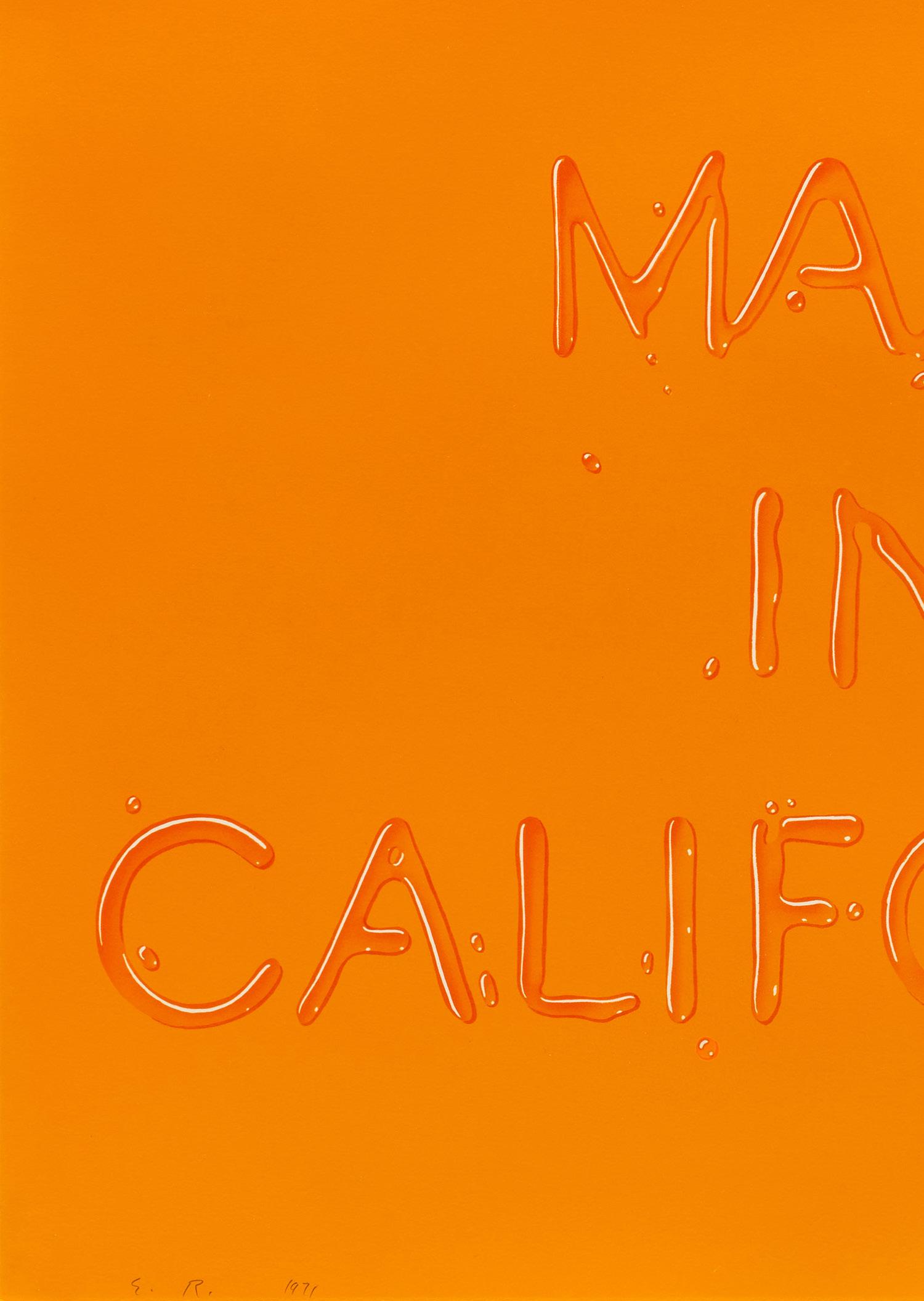
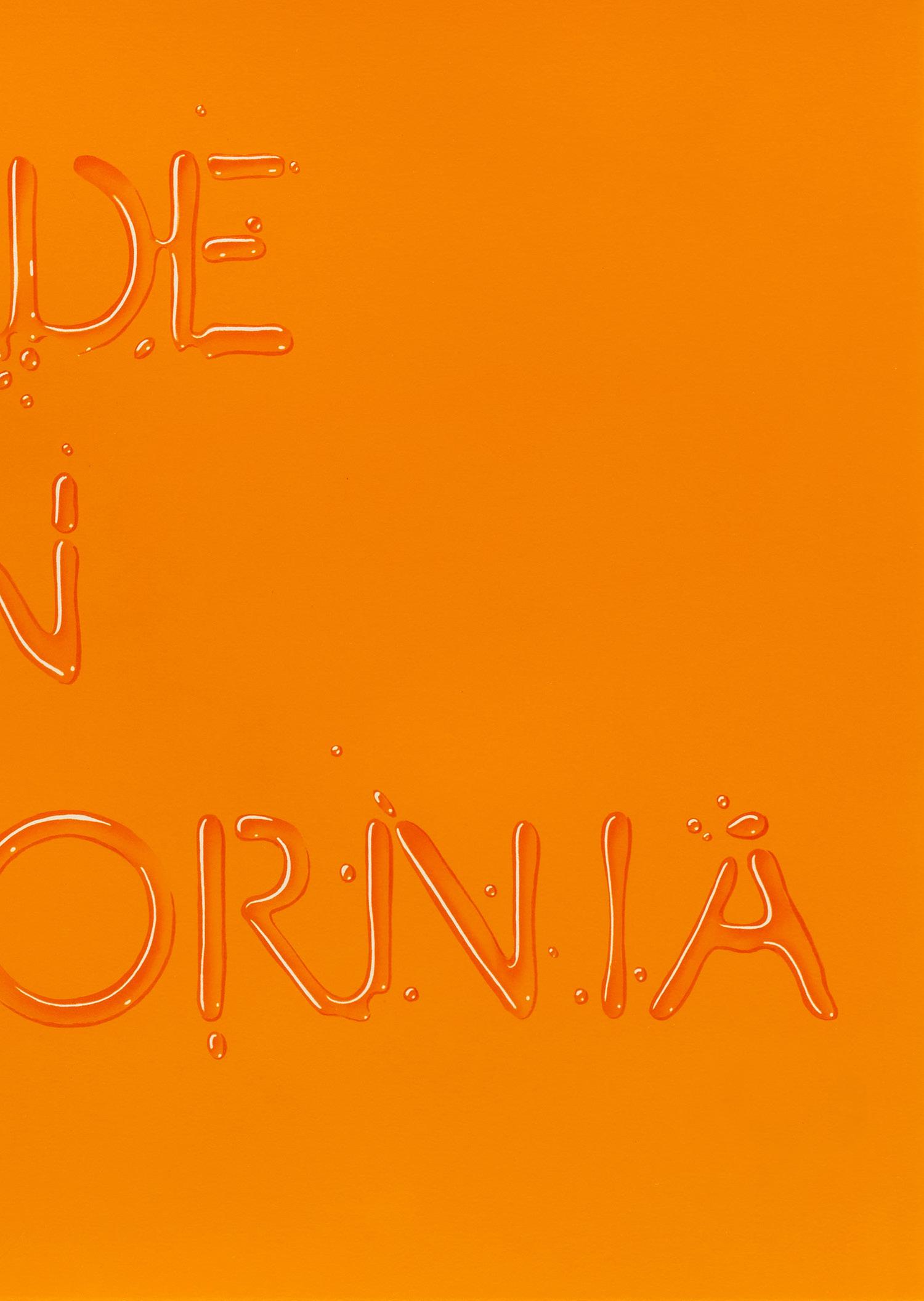
Made in California, 1971
Lithograph
Sheet size: 19 7/8 x 28 inches
(50.5 x 71.1 centimeters)
Printer: Cirrus Editions, Los Angeles
Publisher: Grunewald Graphic Arts Foundation, University of California, Los Angeles
Edition size: 100, plus proofs
Catalogue Raisonné: Engberg 52
Initialed, dated, and numbered
Ed Ruscha
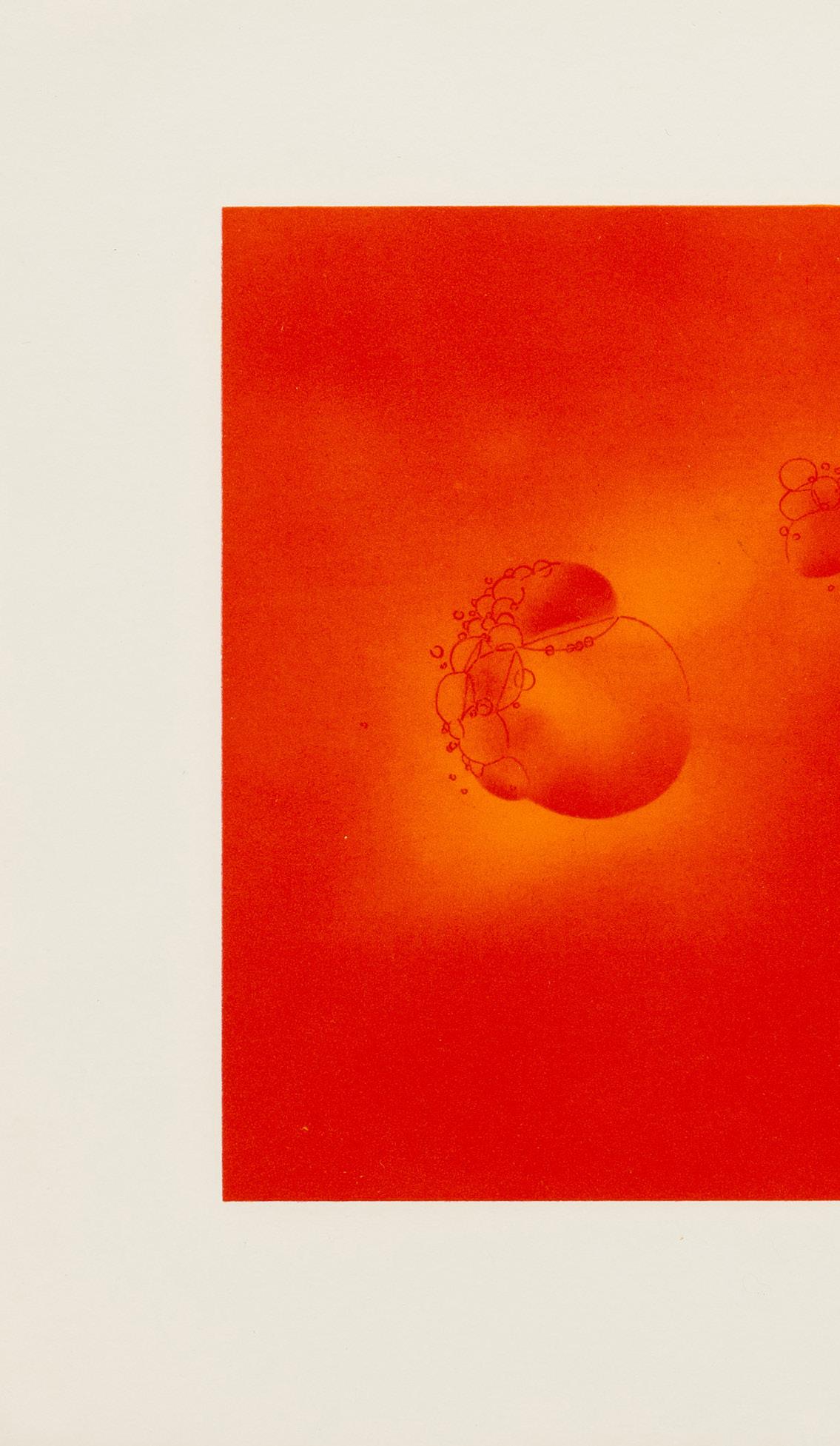
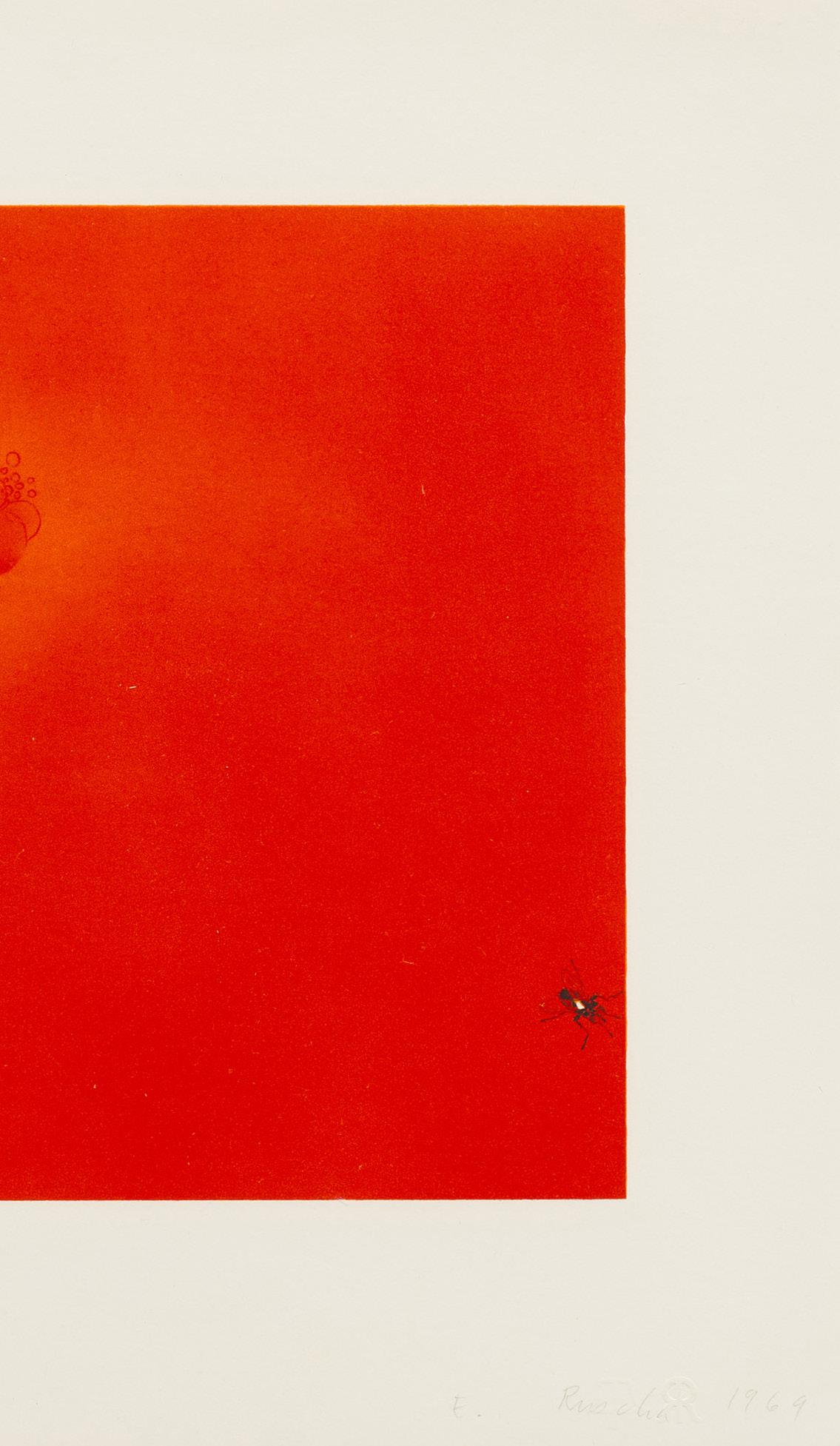
Boiling Blood, Fly, 1969
Lithograph
Sheet size: 12 x 13 5/8 inches
(30.5 x 34.6 centimeters)
Printer and Publisher: Tamarind Lithography Workshop, Los Angeles
Edition size: 20, plus proofs
Catalogue Raisonné: Engberg 27
Signed, dated, and numbered
Ed Ruscha
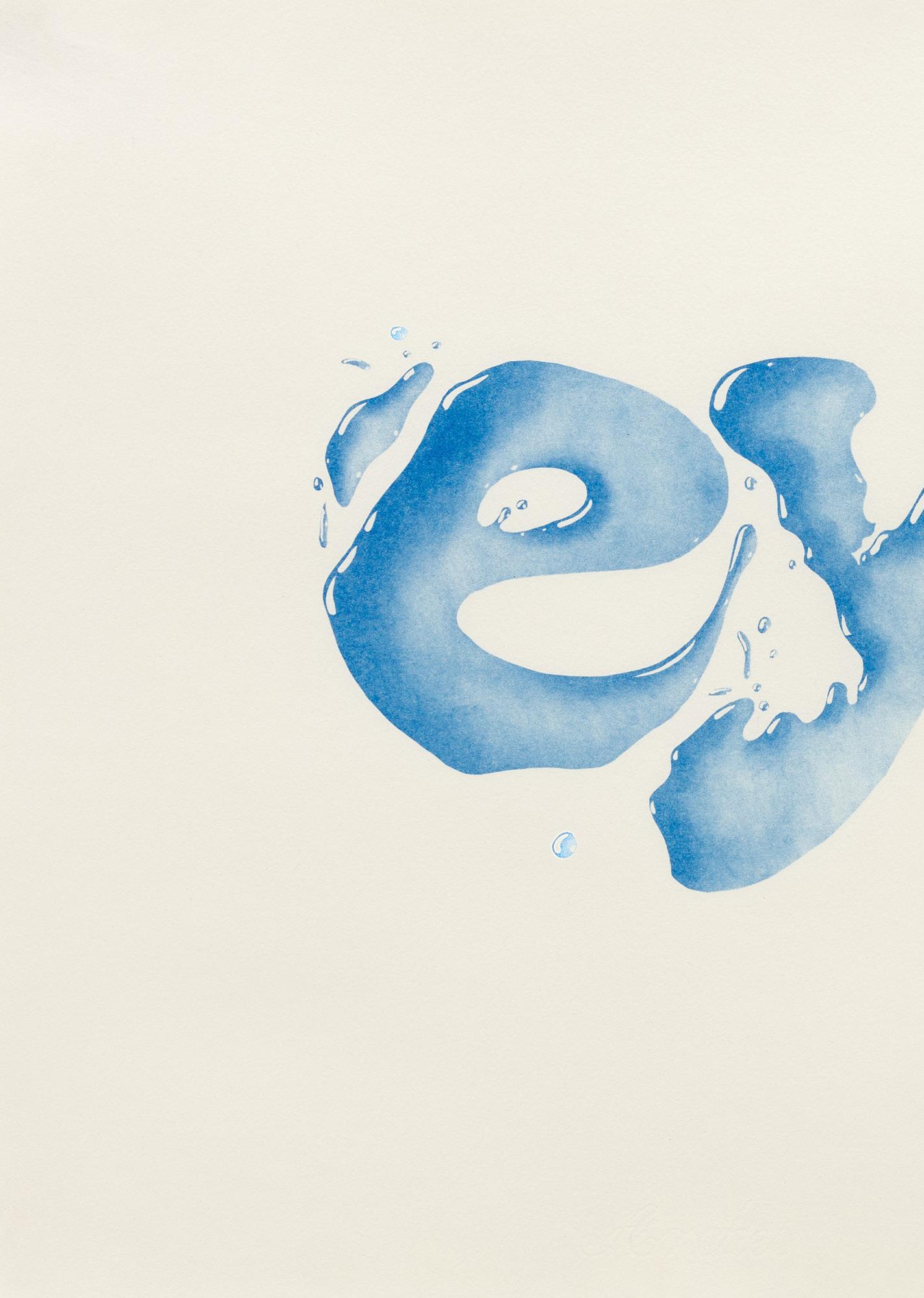
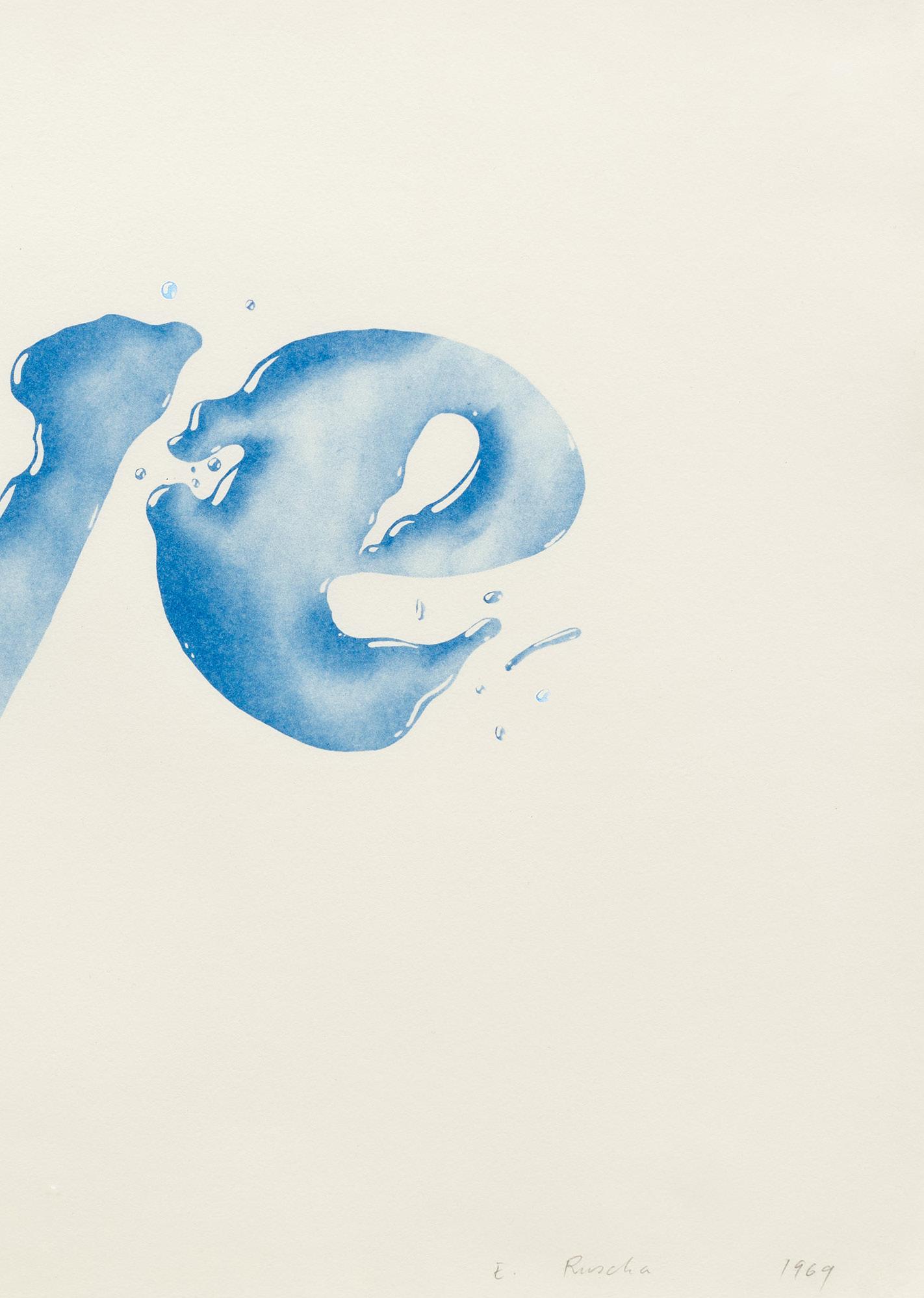
Eye, 1969
Lithograph
Sheet size: 17 x 24 inches (43.2 x 61 centimeters)
Printer and Publisher: Tamarind Lithography Workshop, Los Angeles
Edition size: 20, plus proofs
Catalogue Raisonné: Engberg 12
Signed, dated, and numbered
Ed
Ruscha
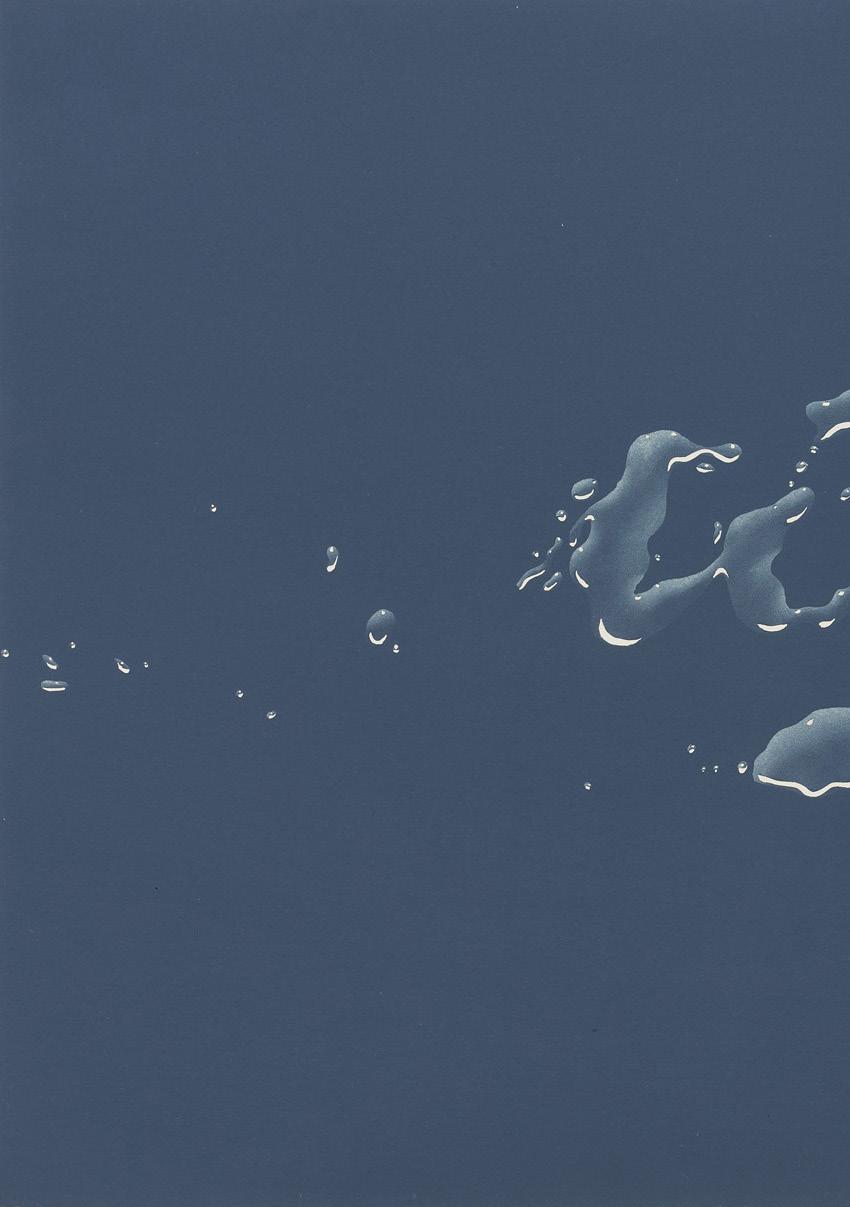
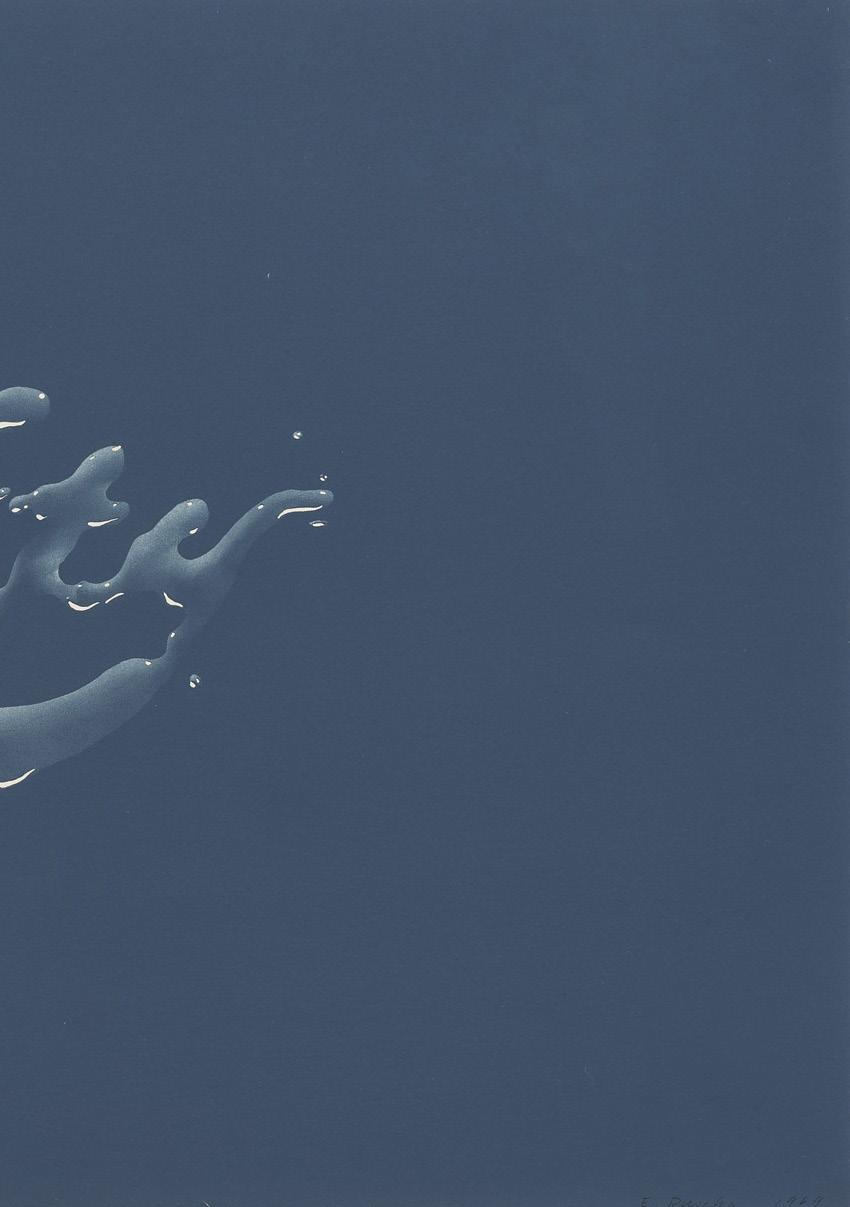
City, 1969
Lithograph
Sheet size: 17 x 24 inches
(43.2 x 61 centimeters)
Printer and Publisher: Tamarind Lithography Workshop, Los Angeles
Edition size: 20, plus proofs
Catalogue Raisonné: Engberg 19
Signed, dated, and editioned
Provenance:
Robert Rogers, printer at Tamarind Lithography Workshop, Los Angeles
Ed Ruscha
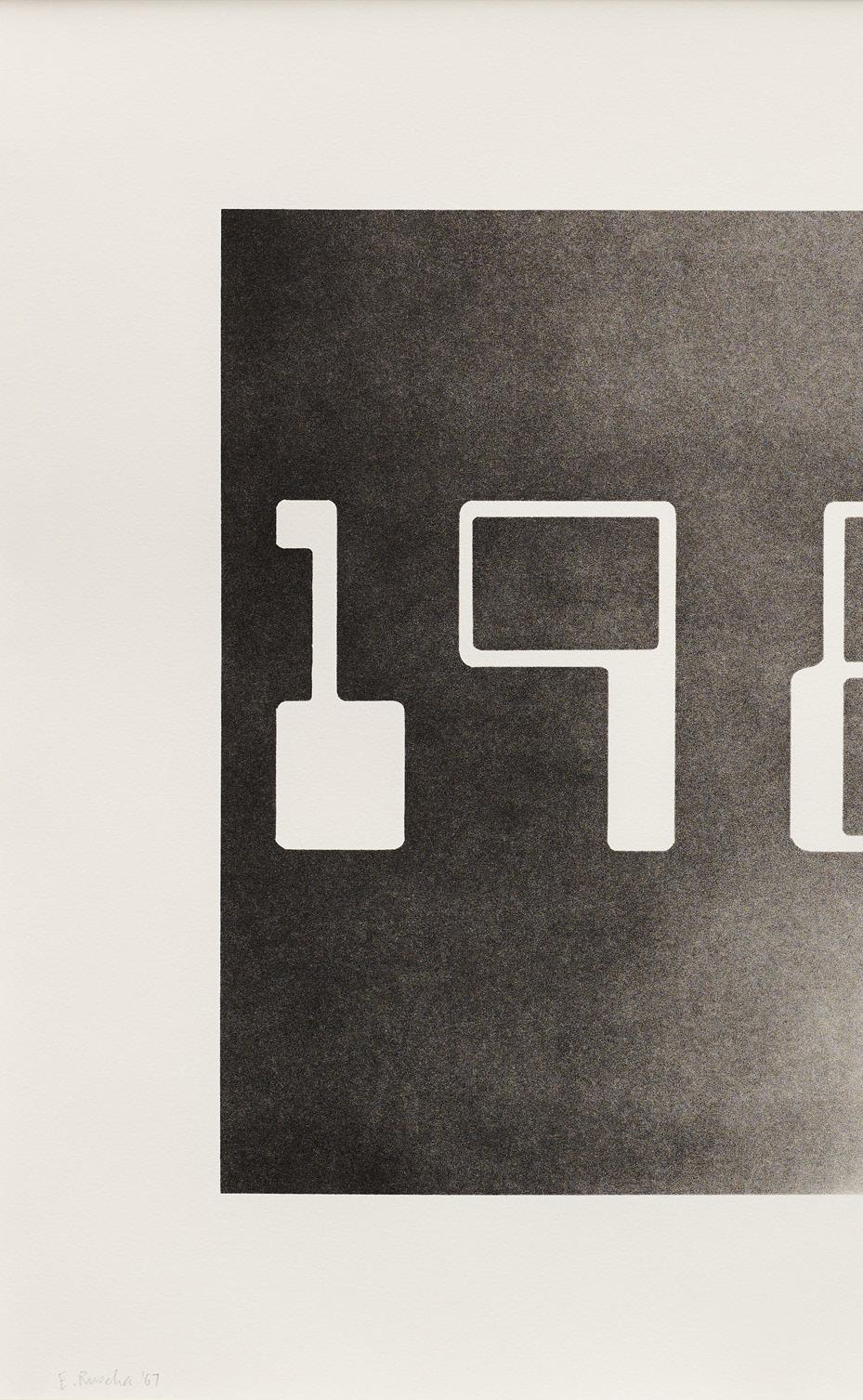
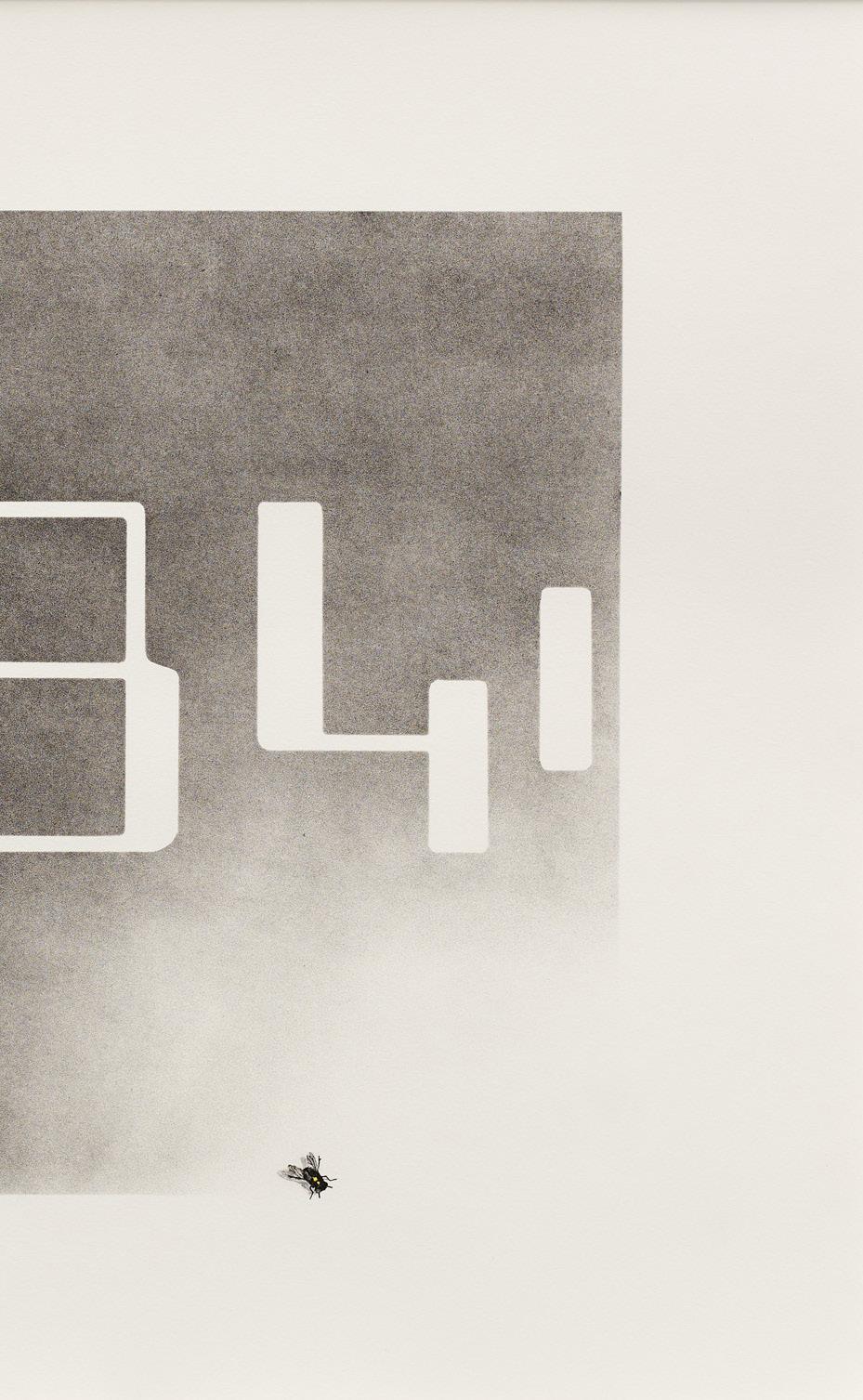
1984, 1967
Lithograph with hand-coloring
Sheet size: 20 x 25 inches
(50.8 x 63.5 centimeters)
Printer and Publisher: Gemini G.E.L., Los Angeles
Edition size: 60, plus proofs
Catalogue Raisonné: Engberg 6
Signed, dated, and numbered
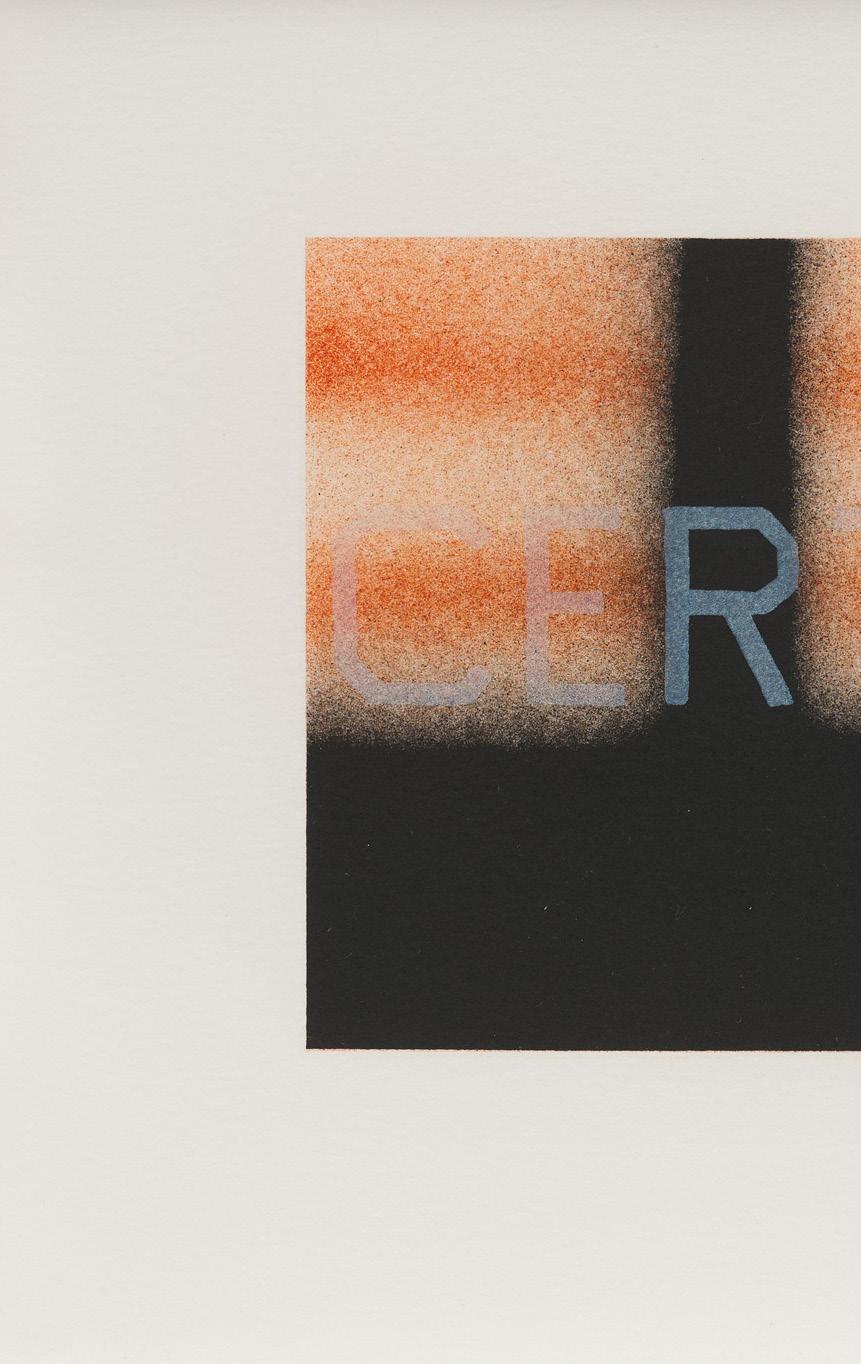
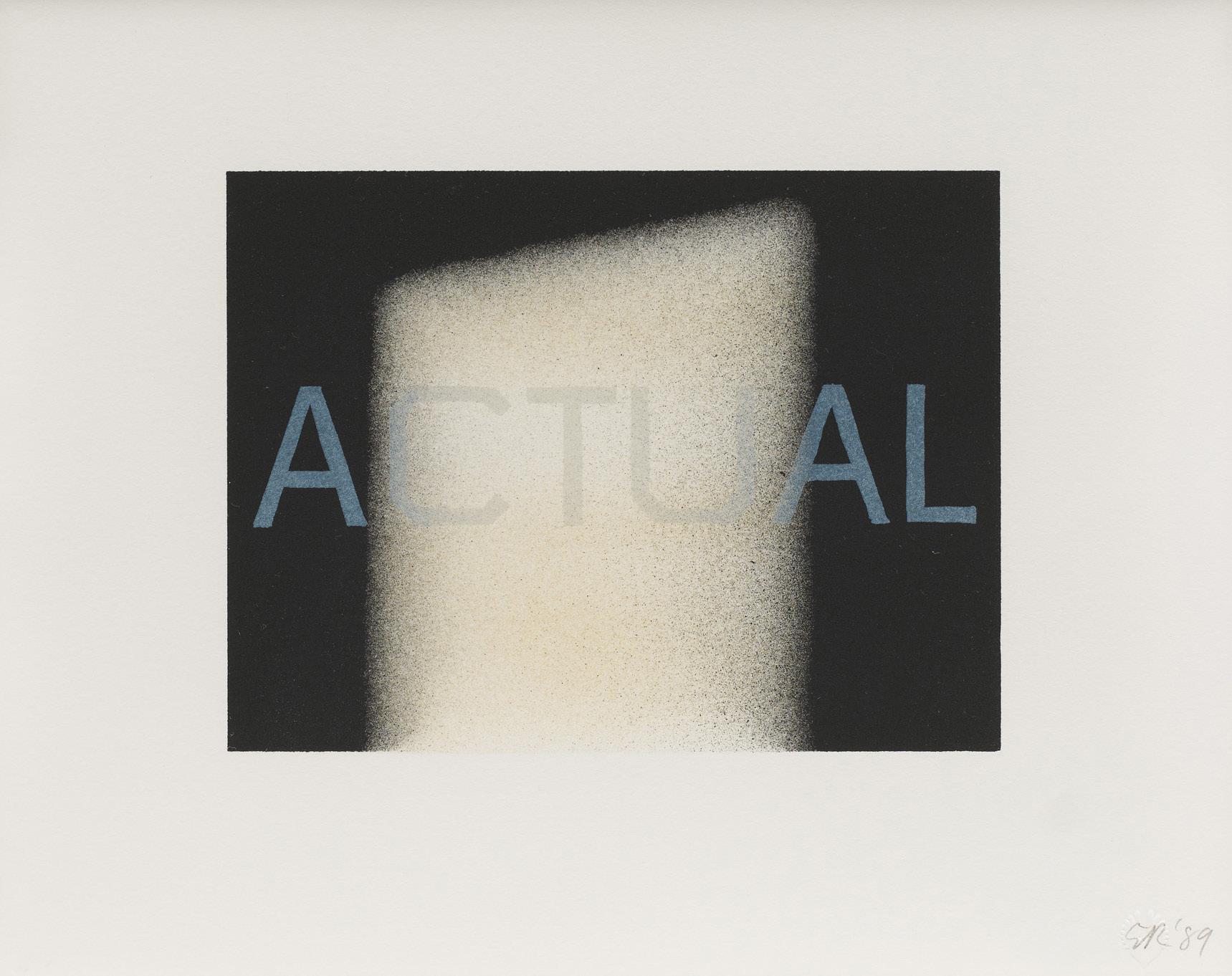
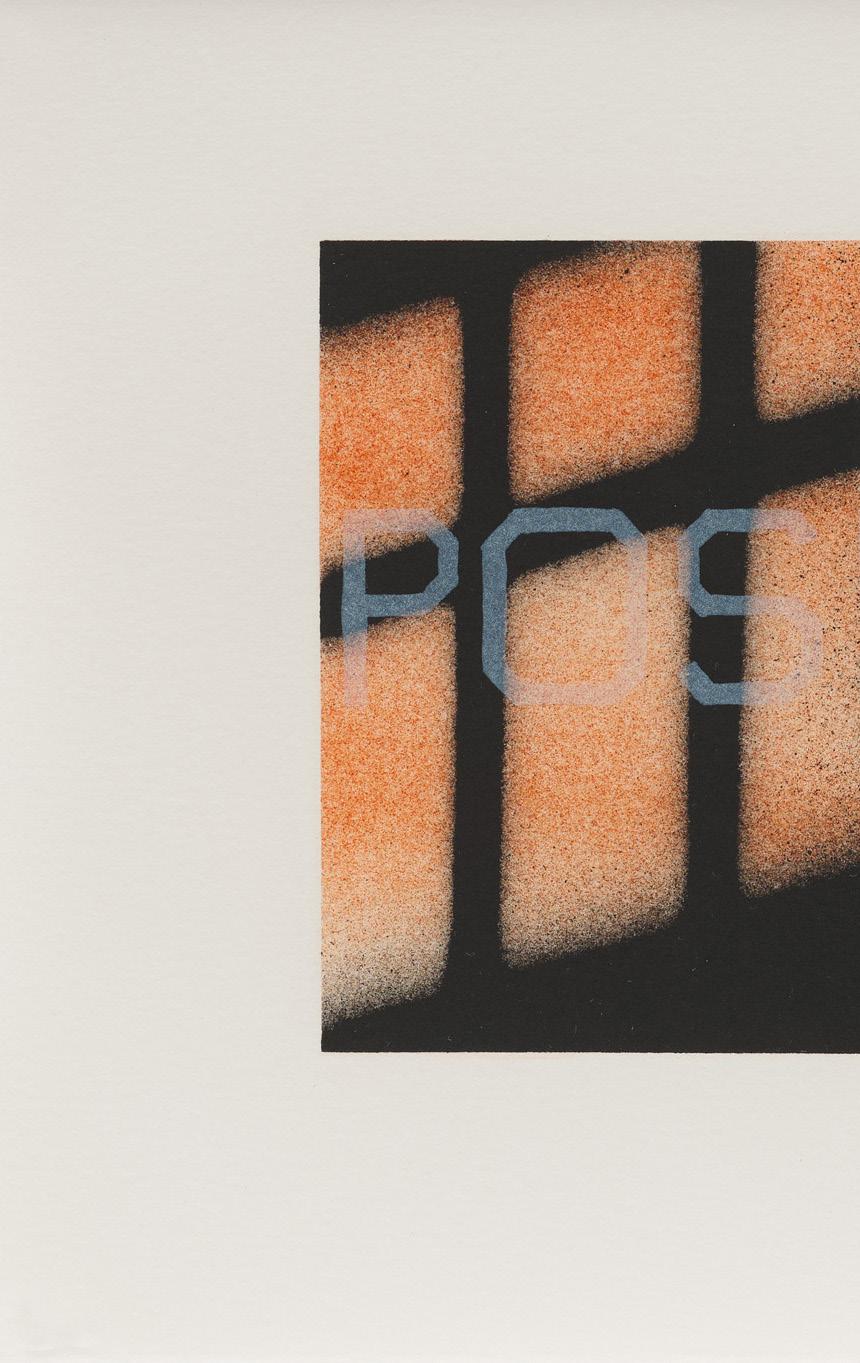
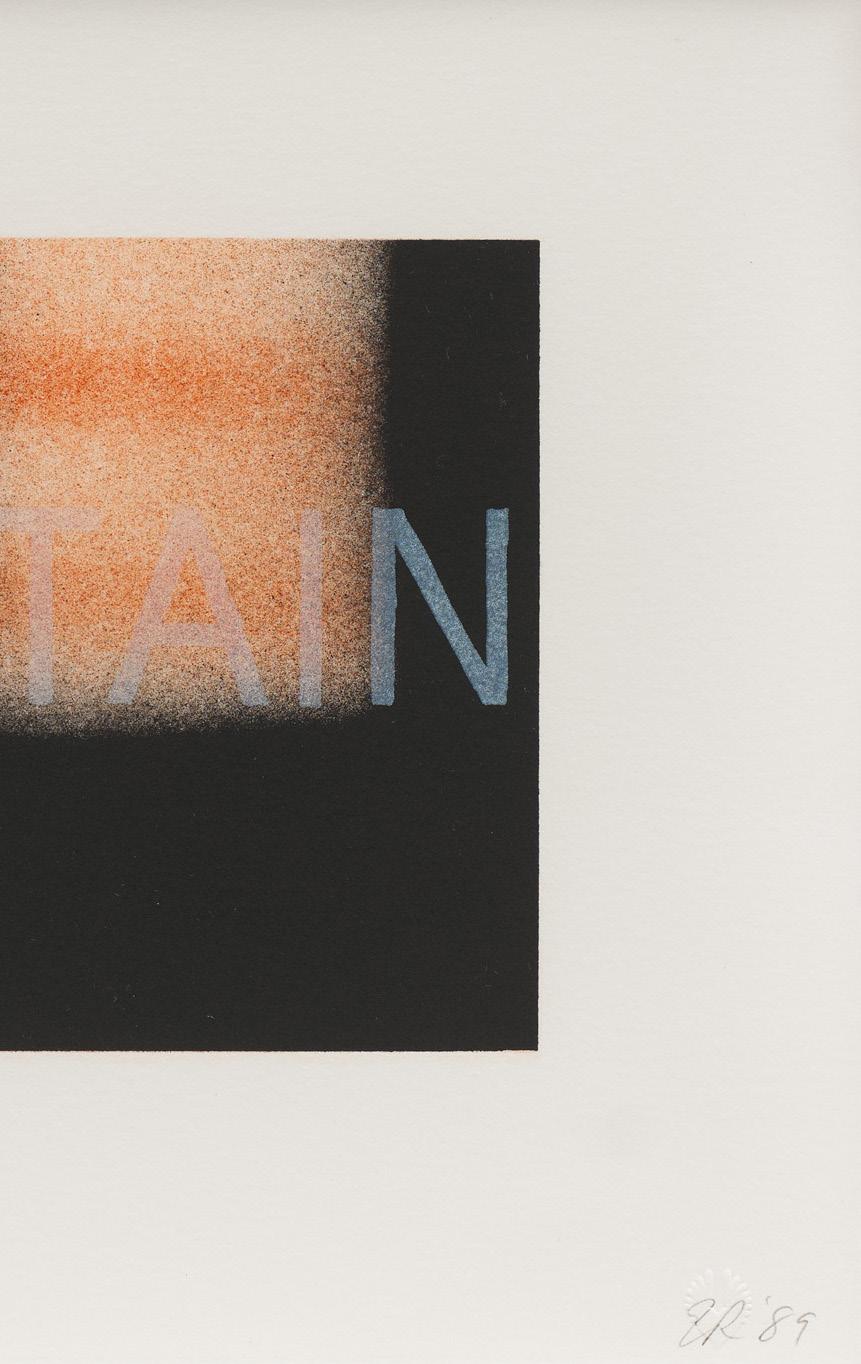
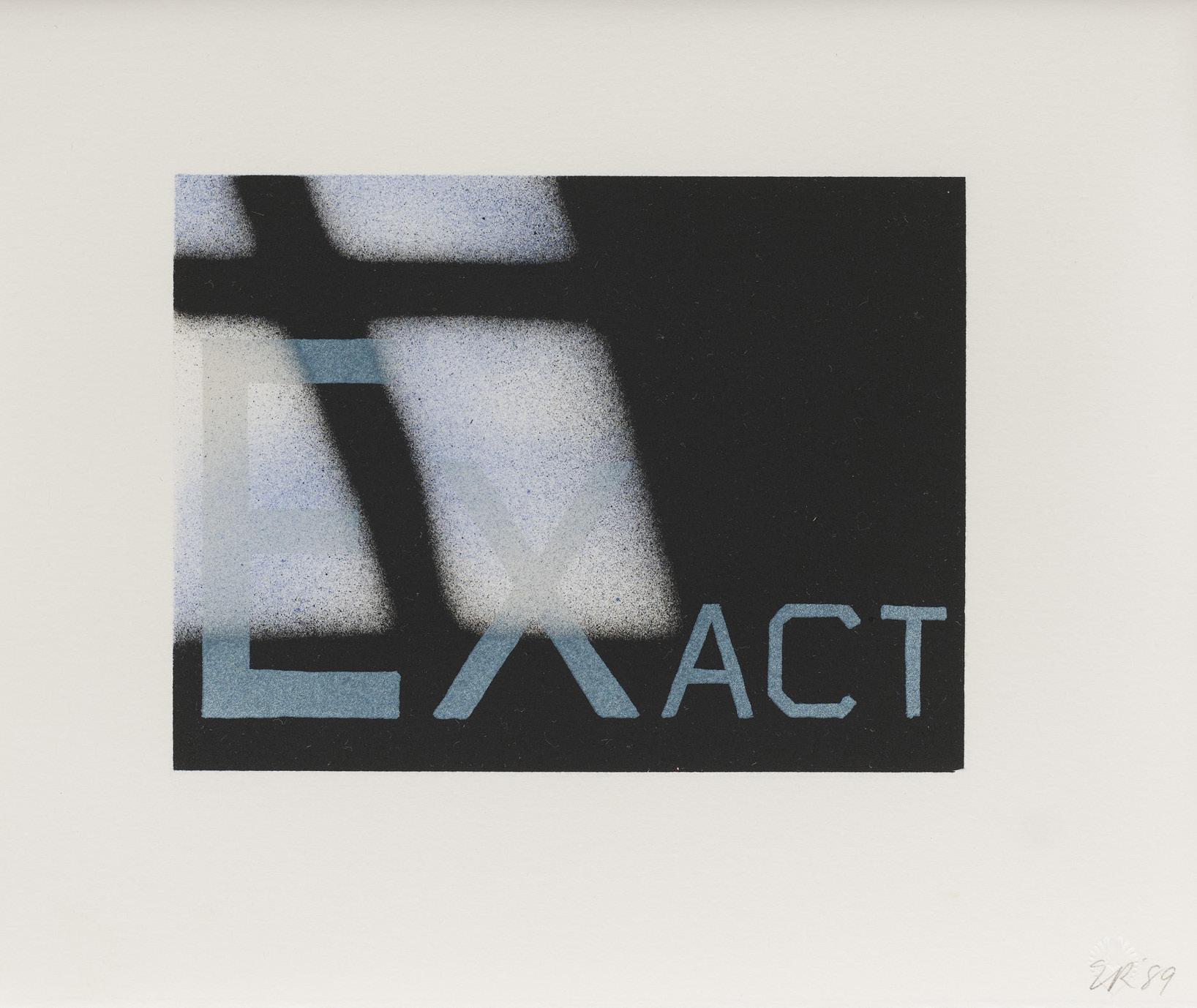
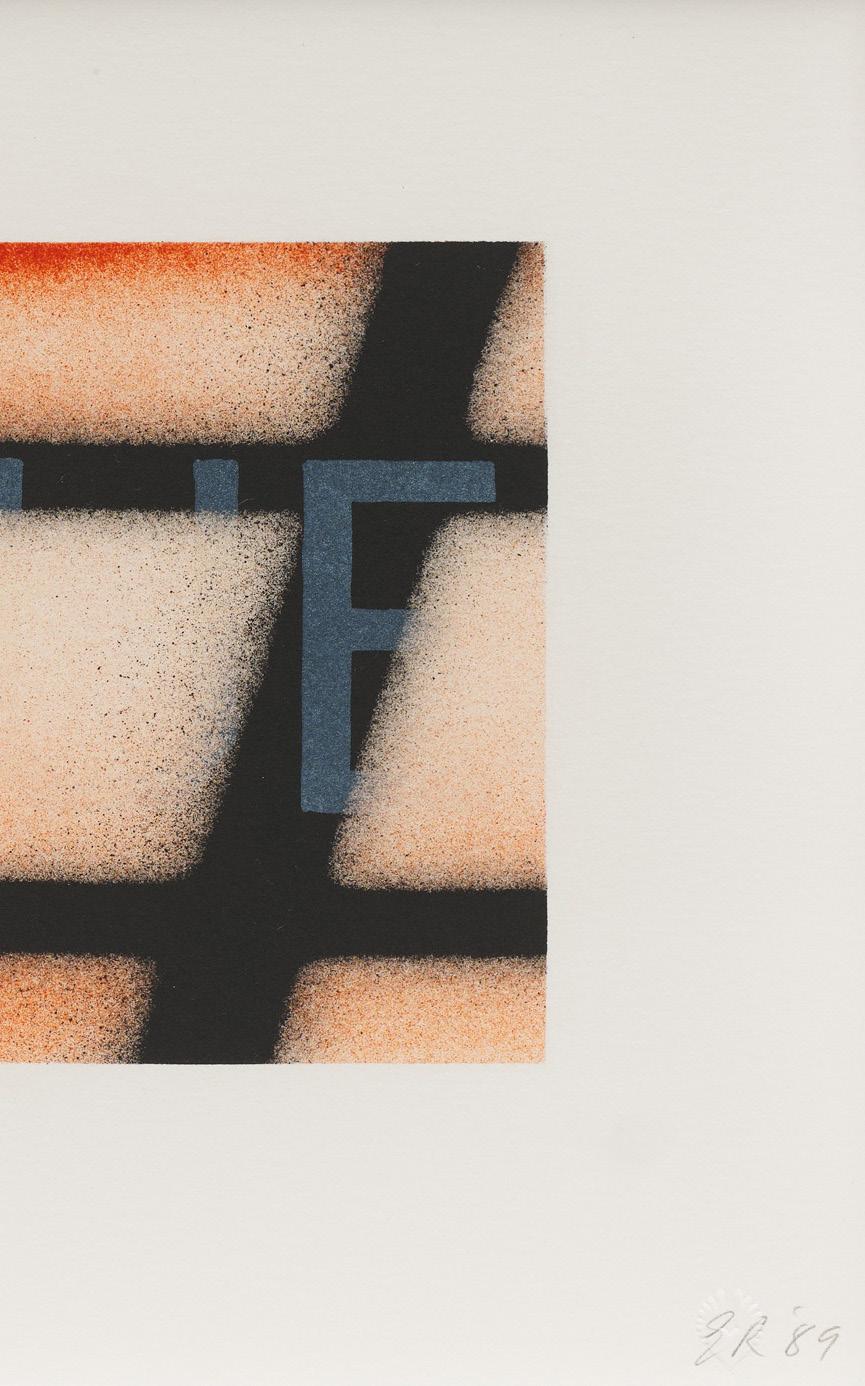
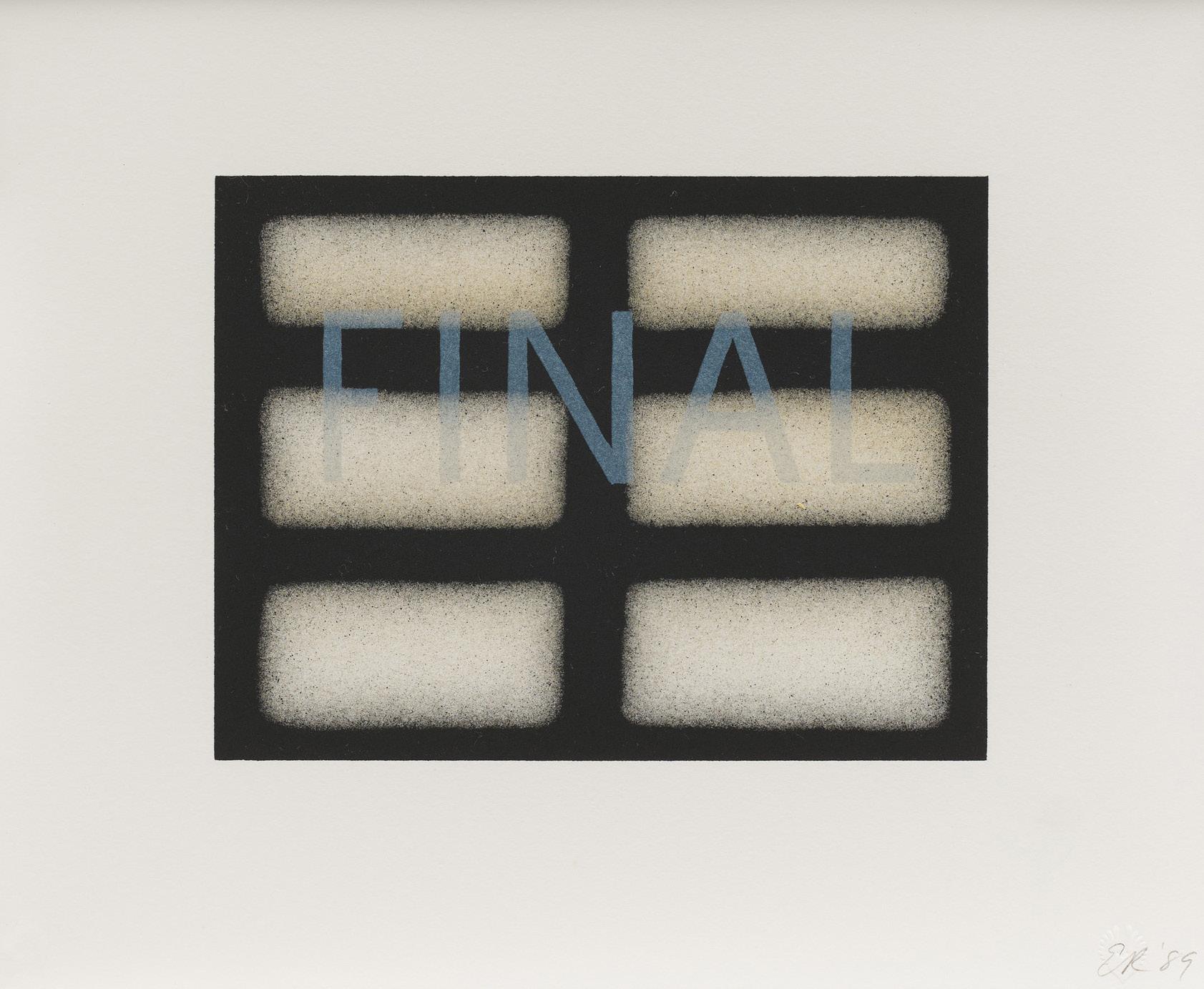
Ed Ruscha
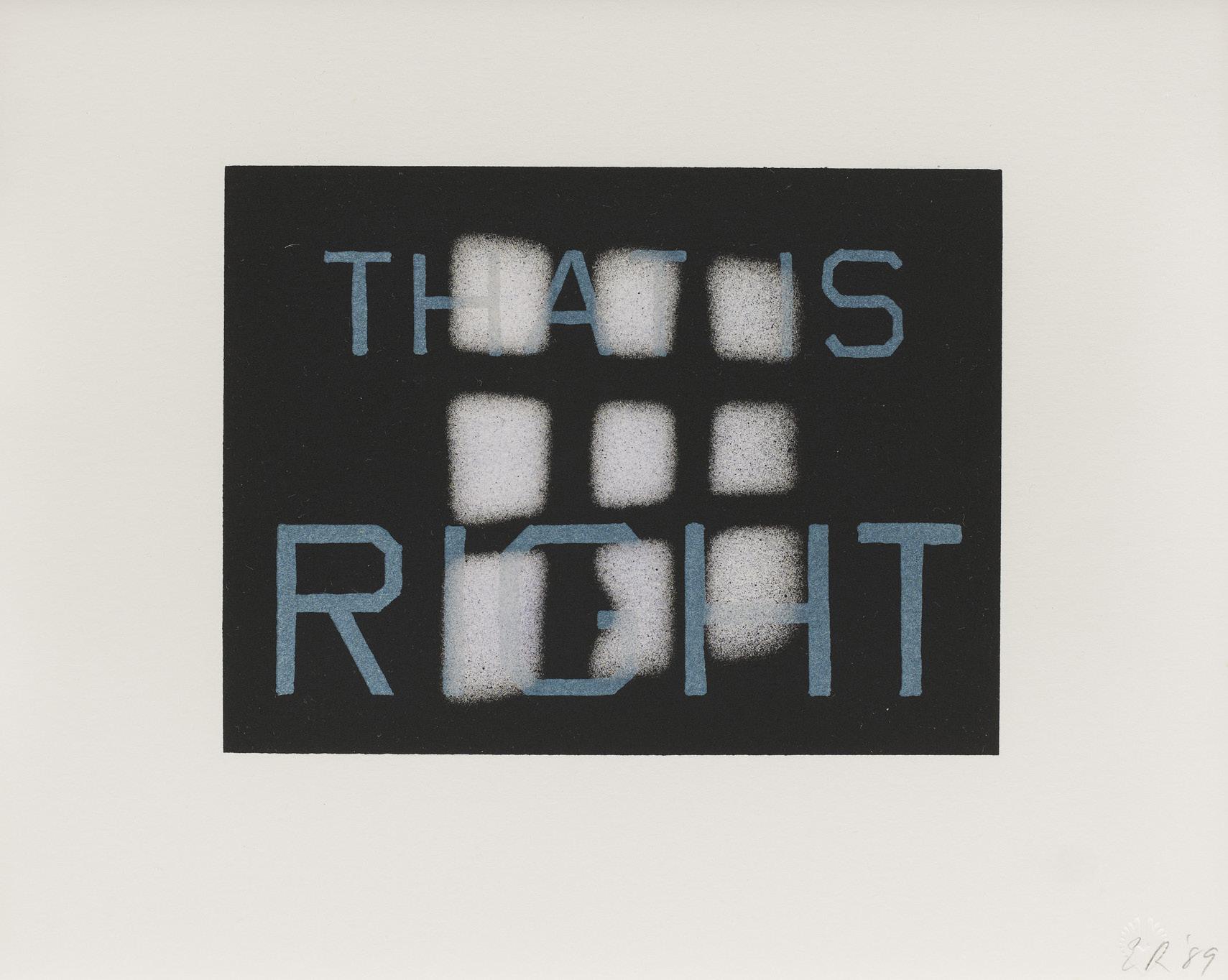
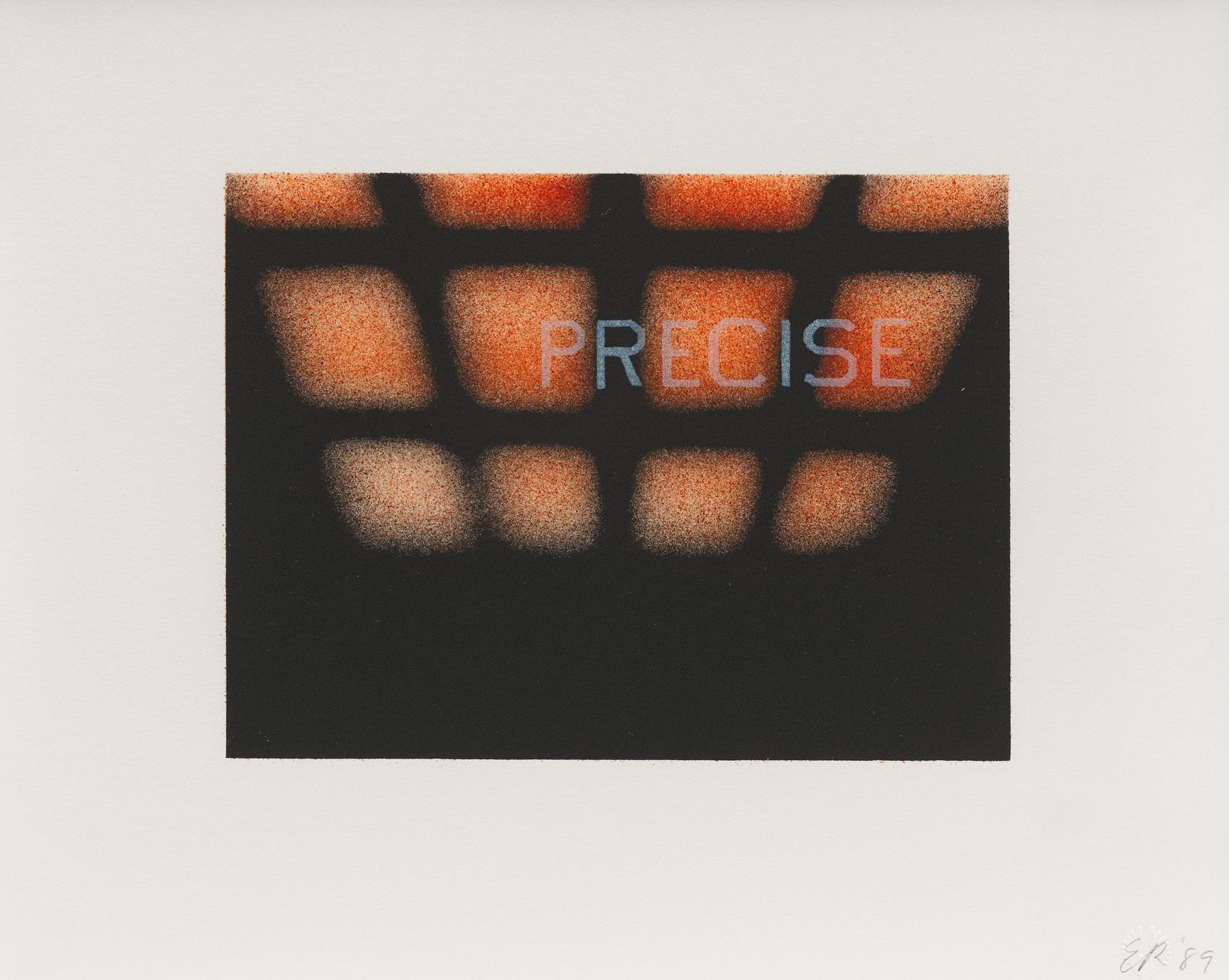
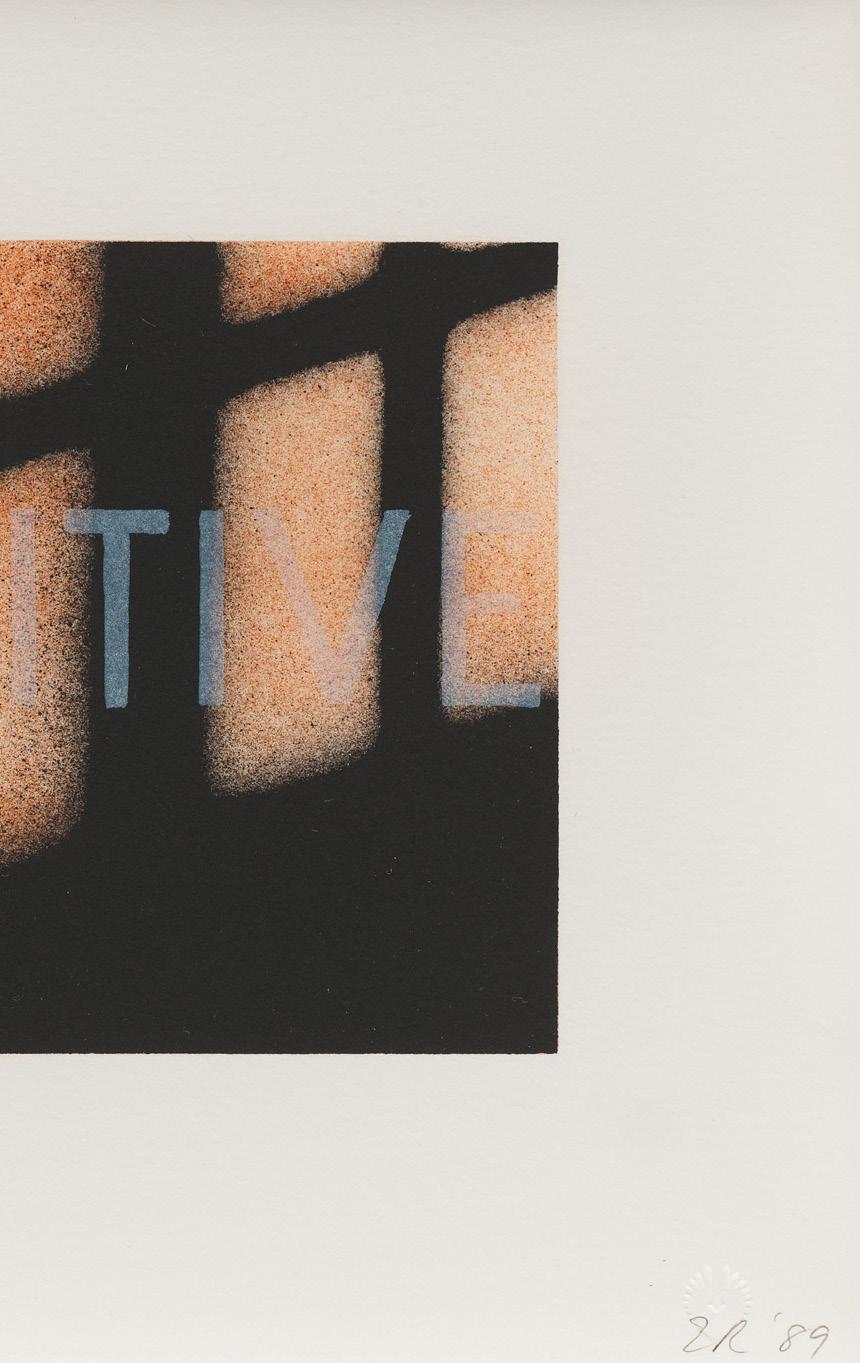
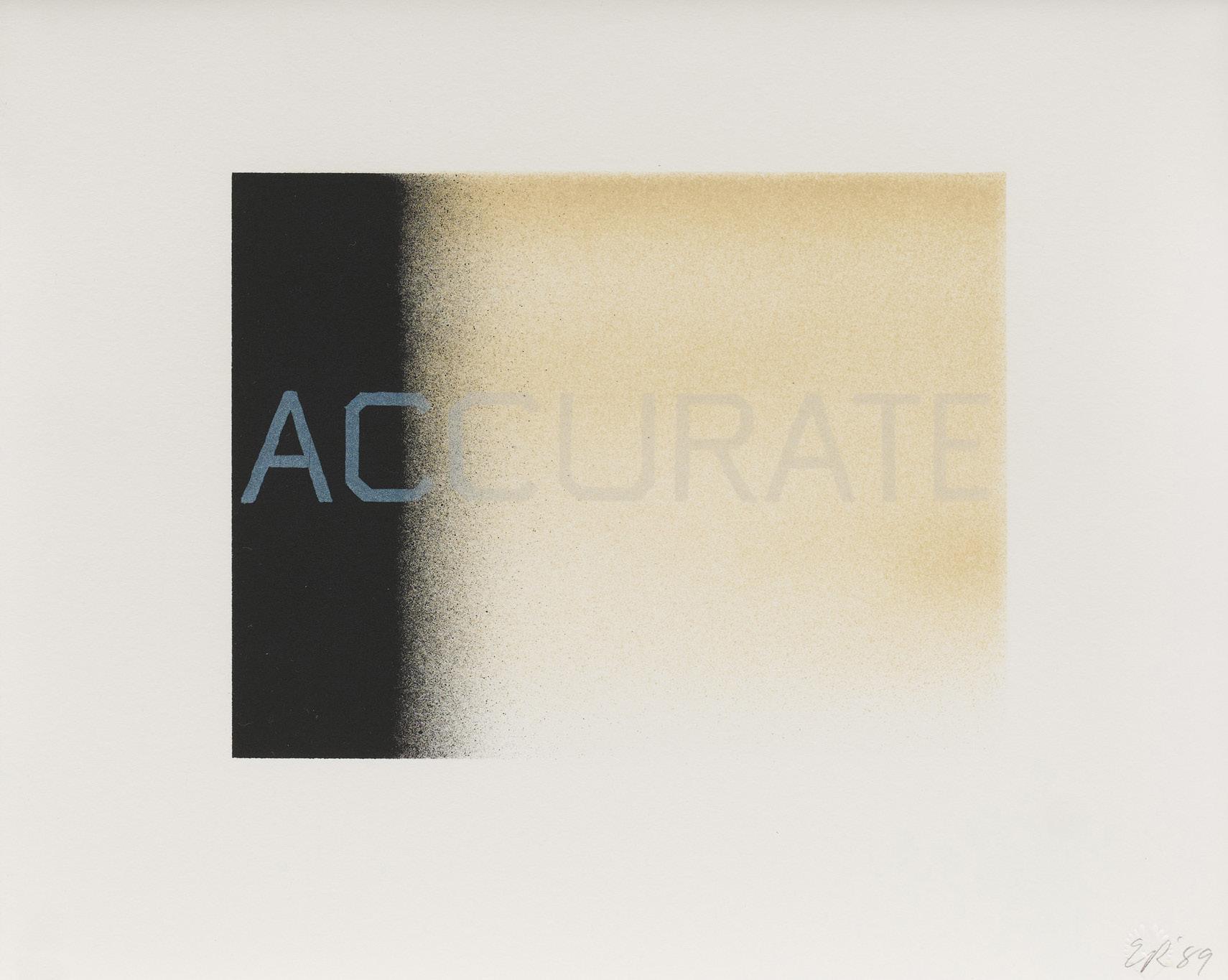
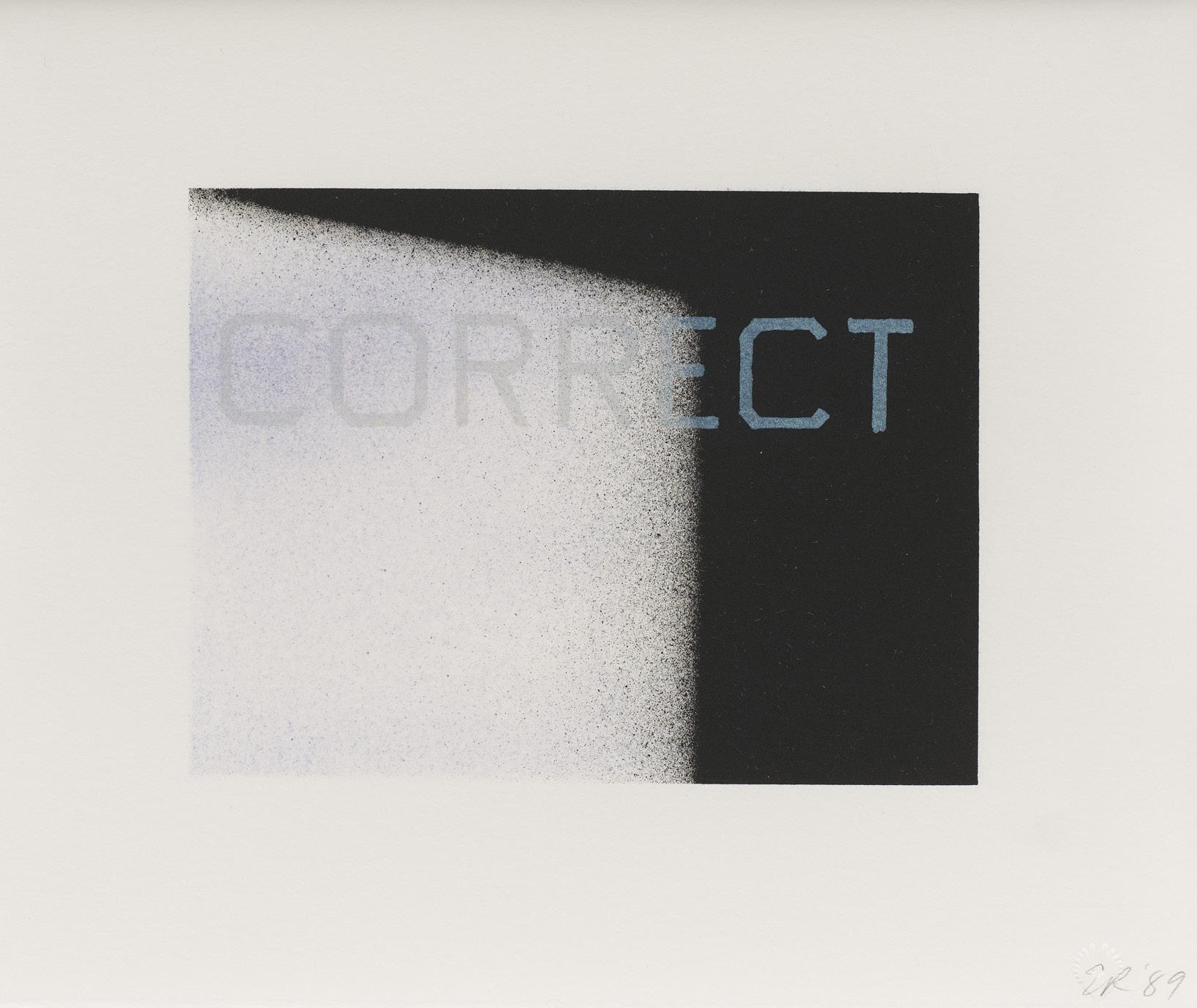
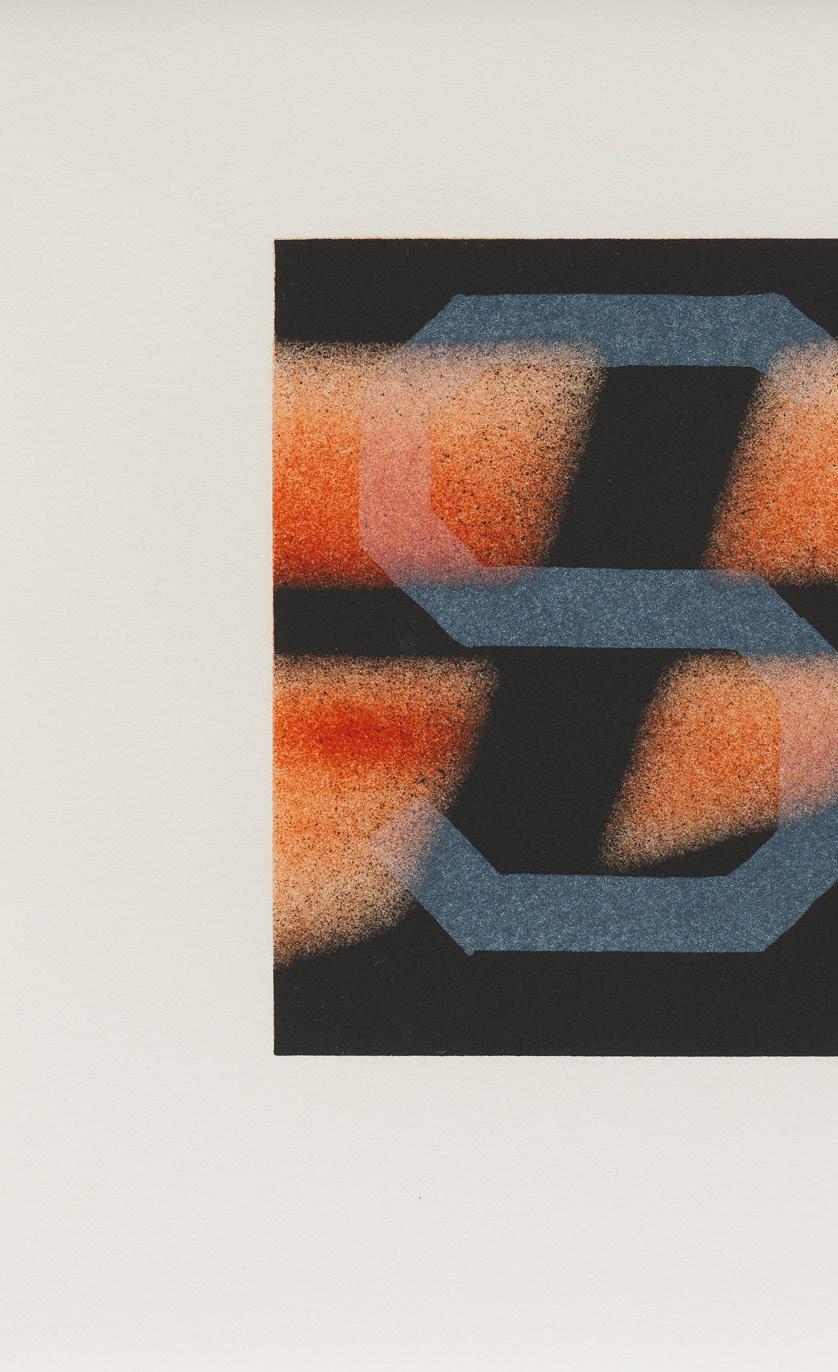
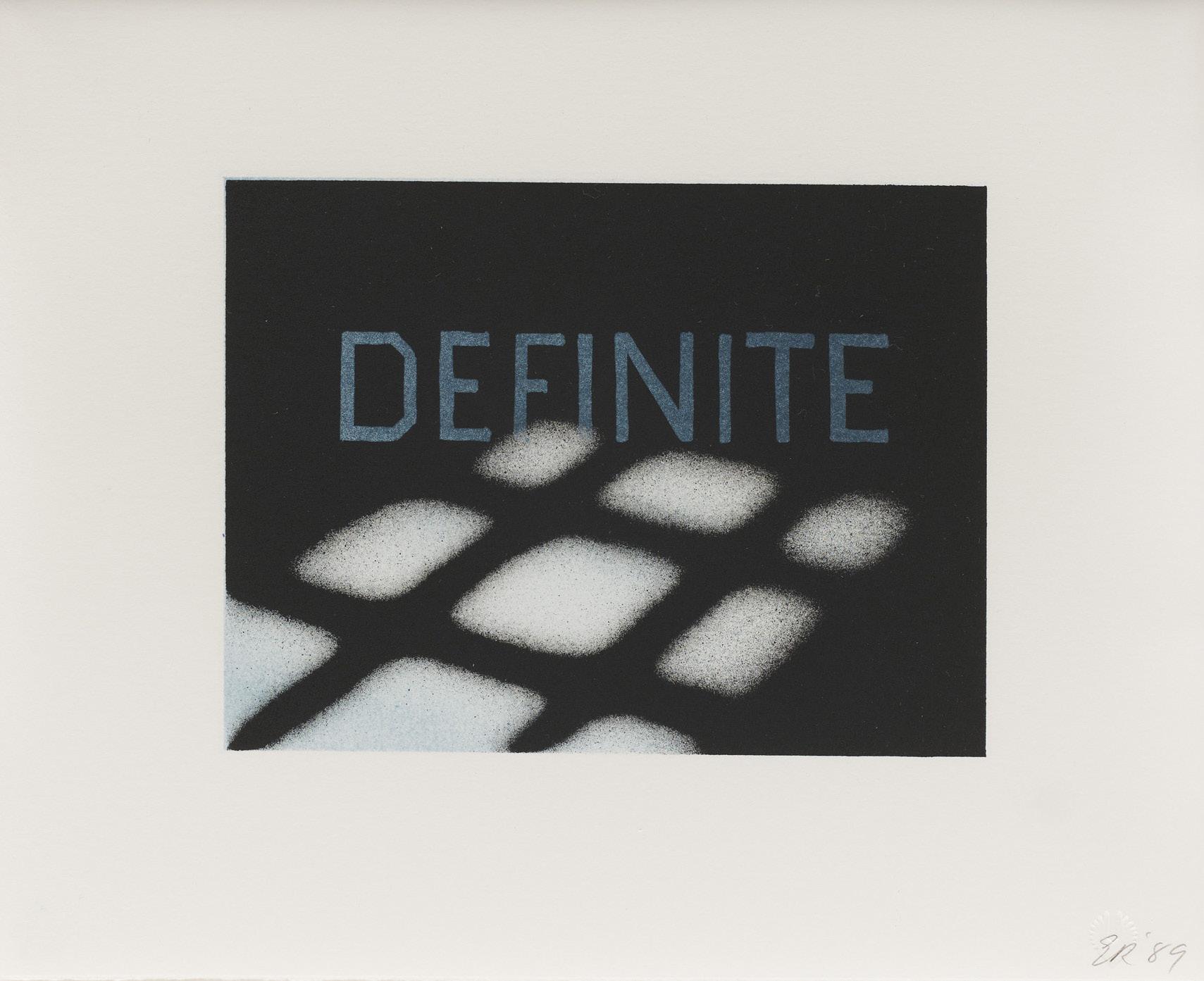
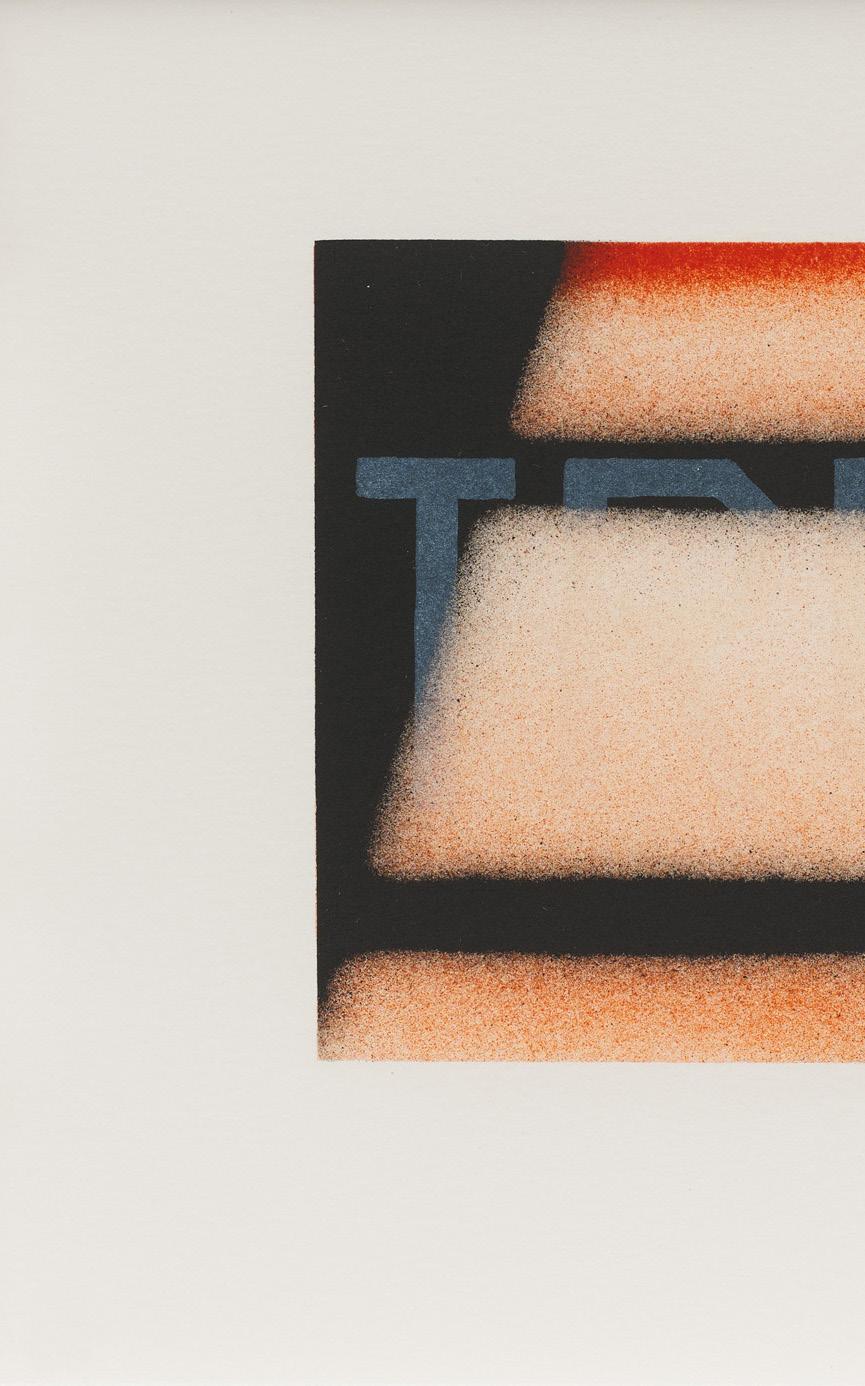
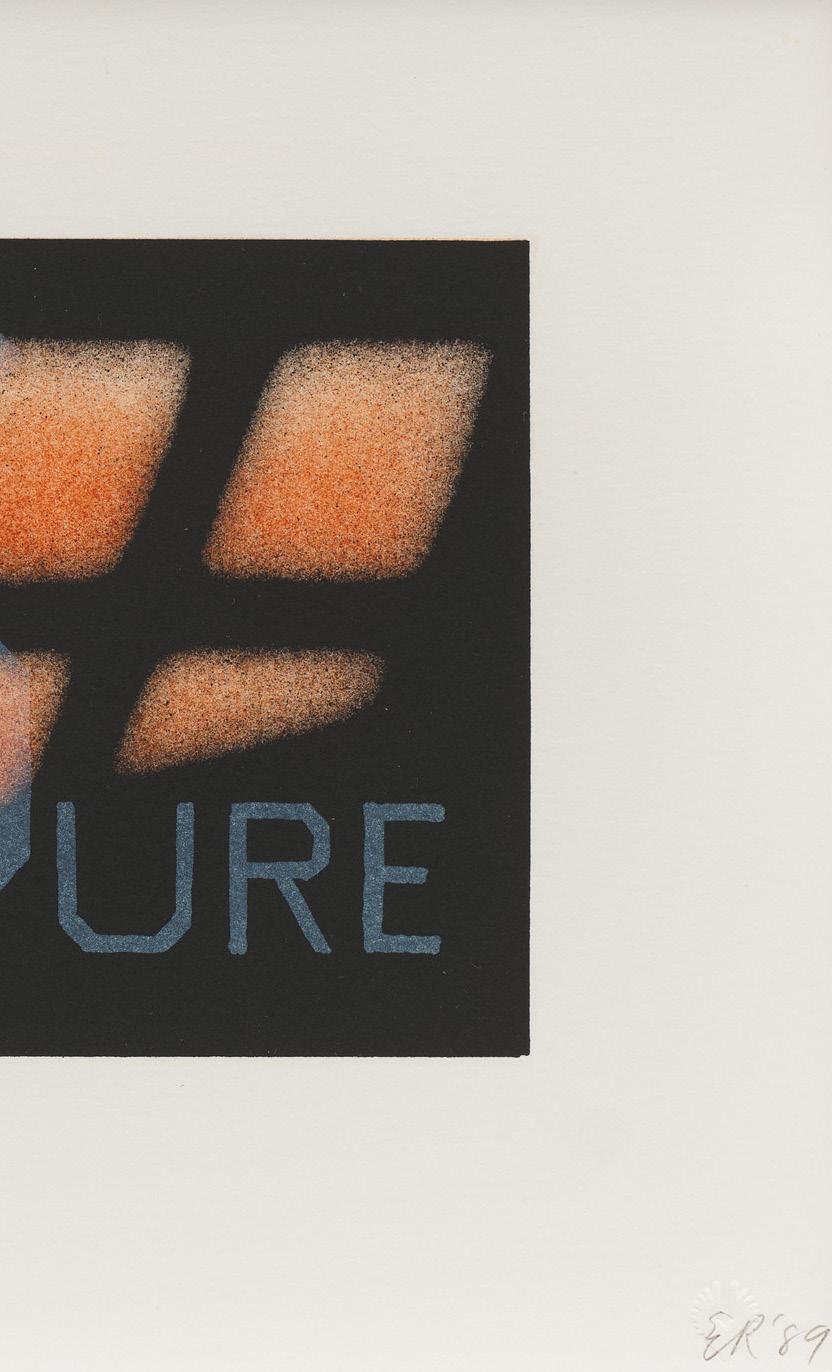
That is Right, 1989
Lithographs
Sheet size: 9 1/8 x 11 inches, each
(23.2 x 27.9 centimeters, each)
Printer: Ed Hamilton, Hamilton Press, Venice, California
Publisher: The Artist
Edition size: 30, plus proofs
Catalogue Raisonné: Engberg 173-184
Each print is initialed, dated, and numbered
The complete portfolio of twelve lithographs
Frank Stella
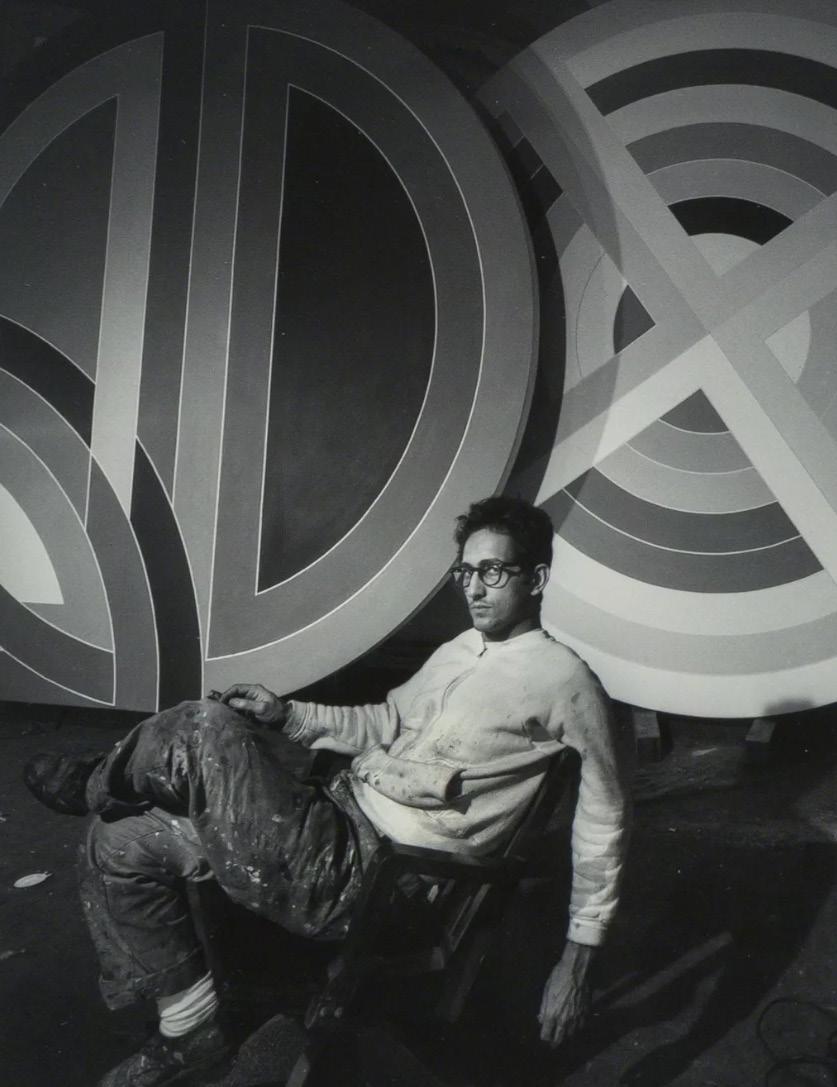
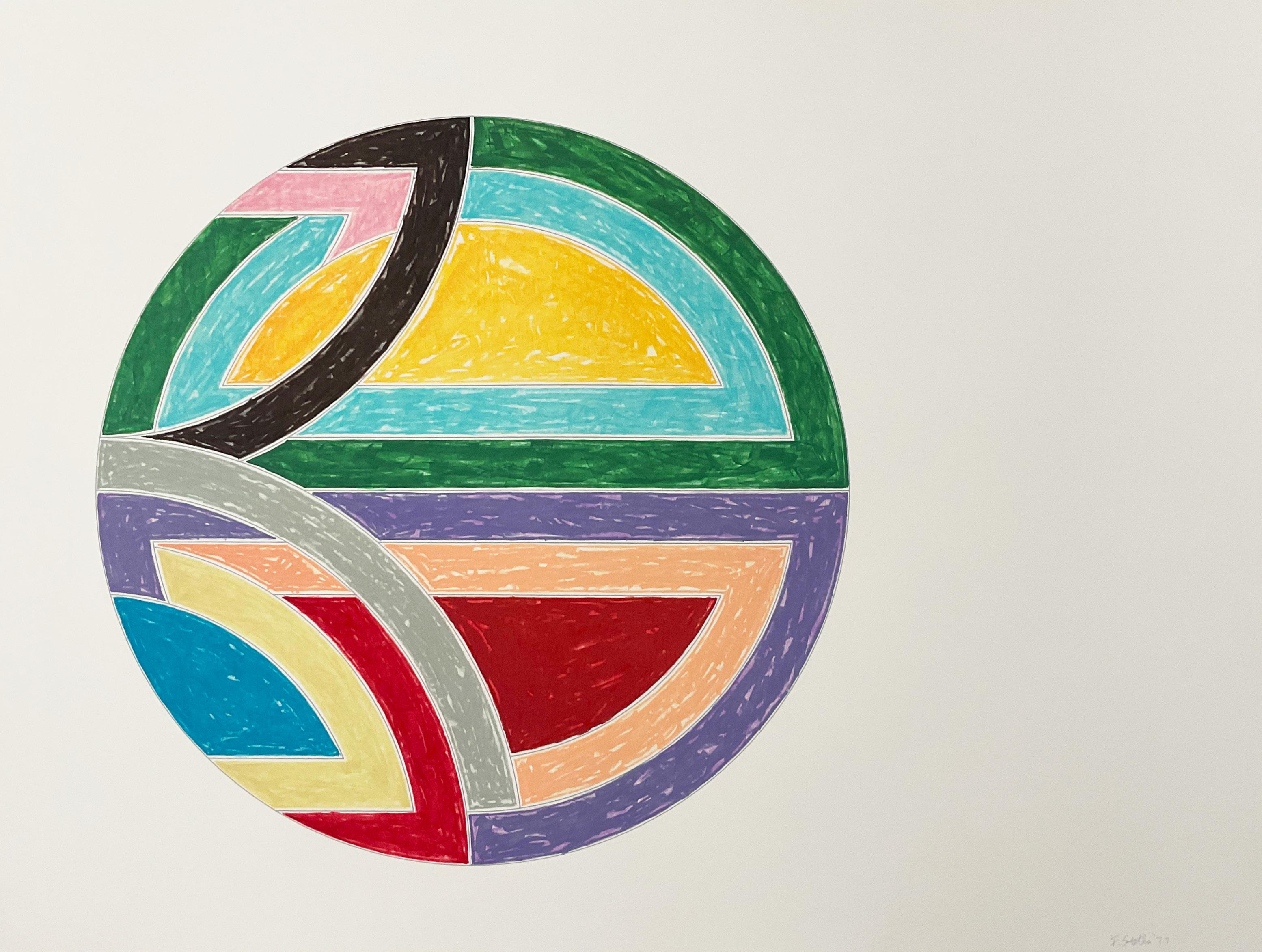
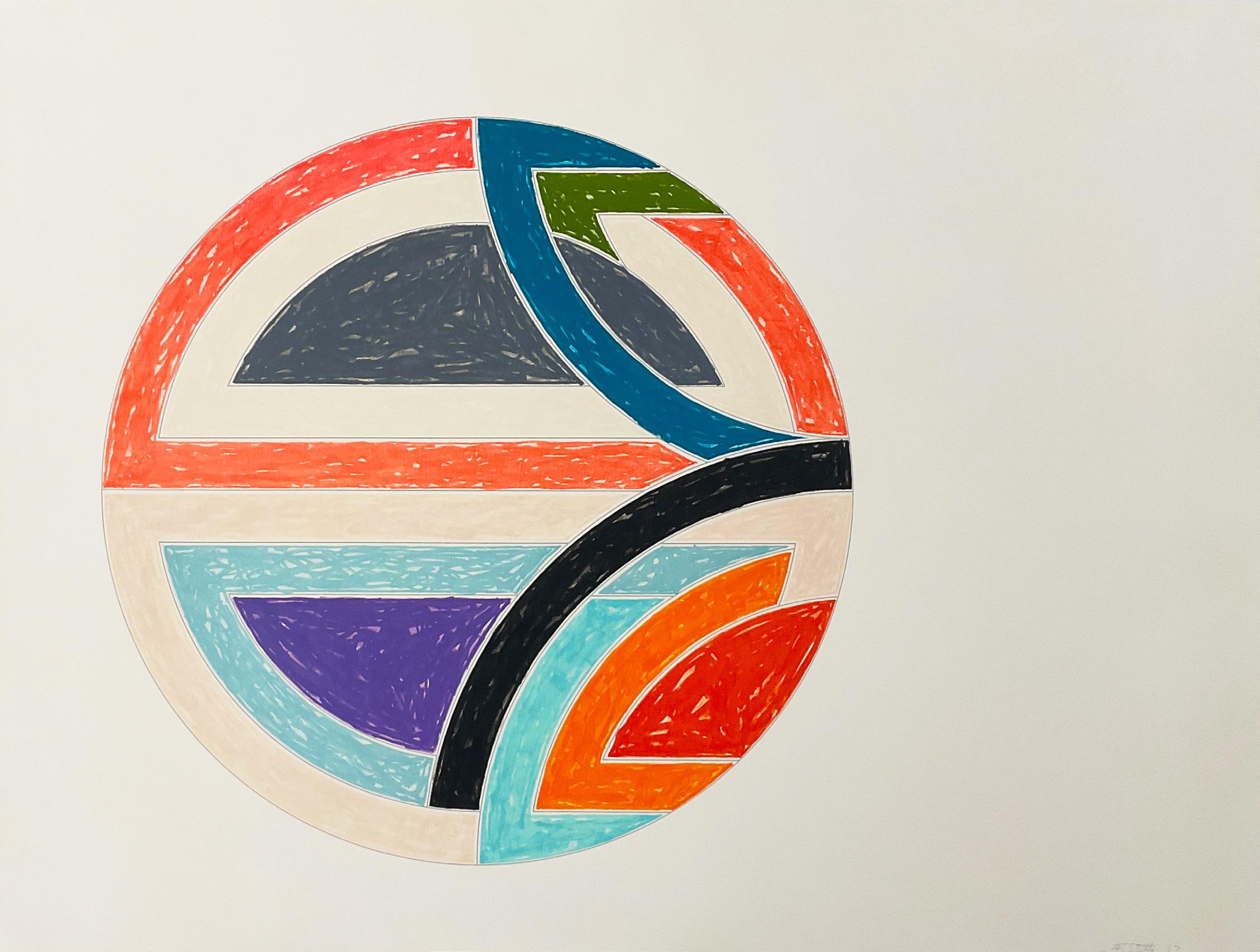
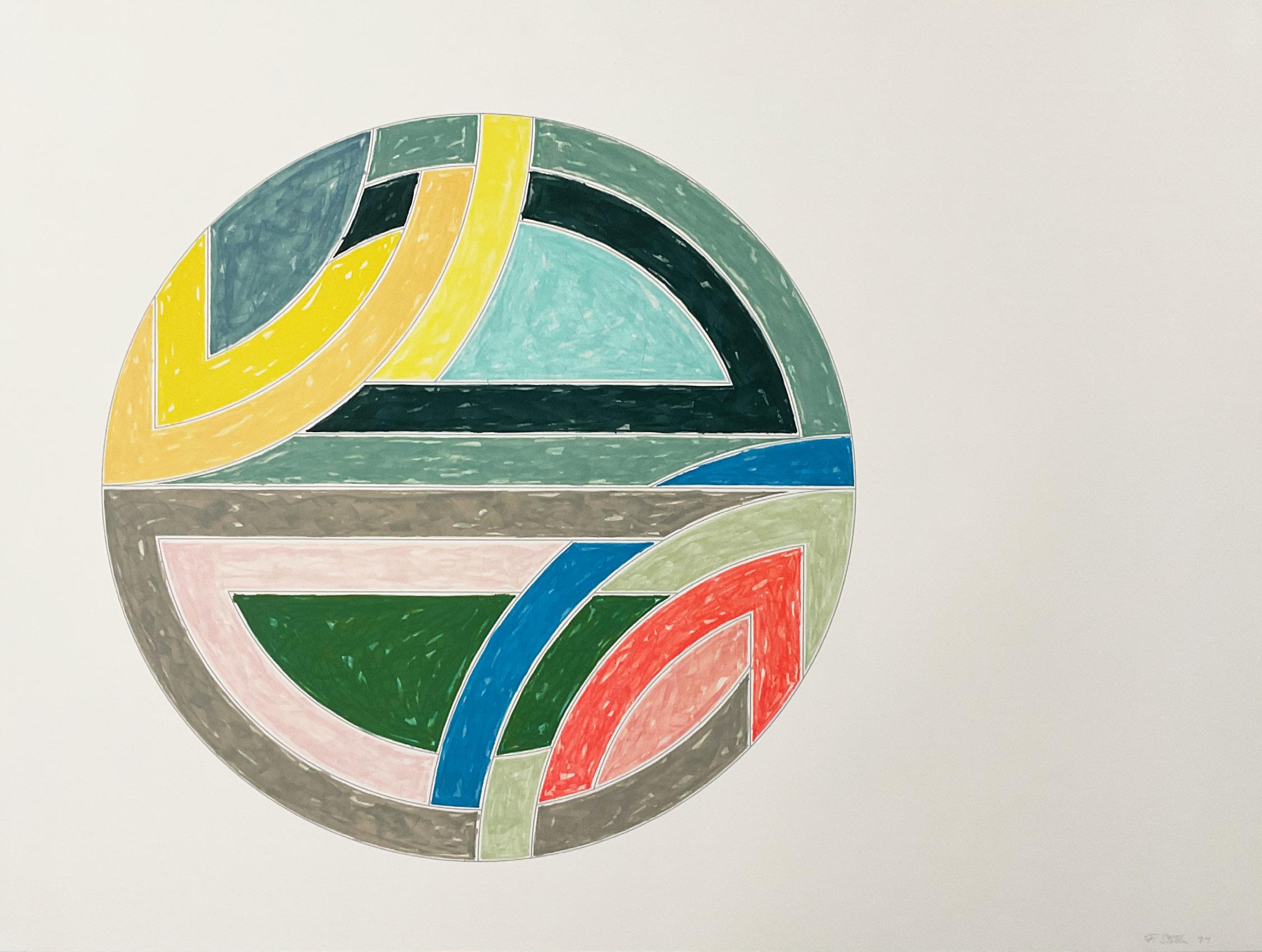
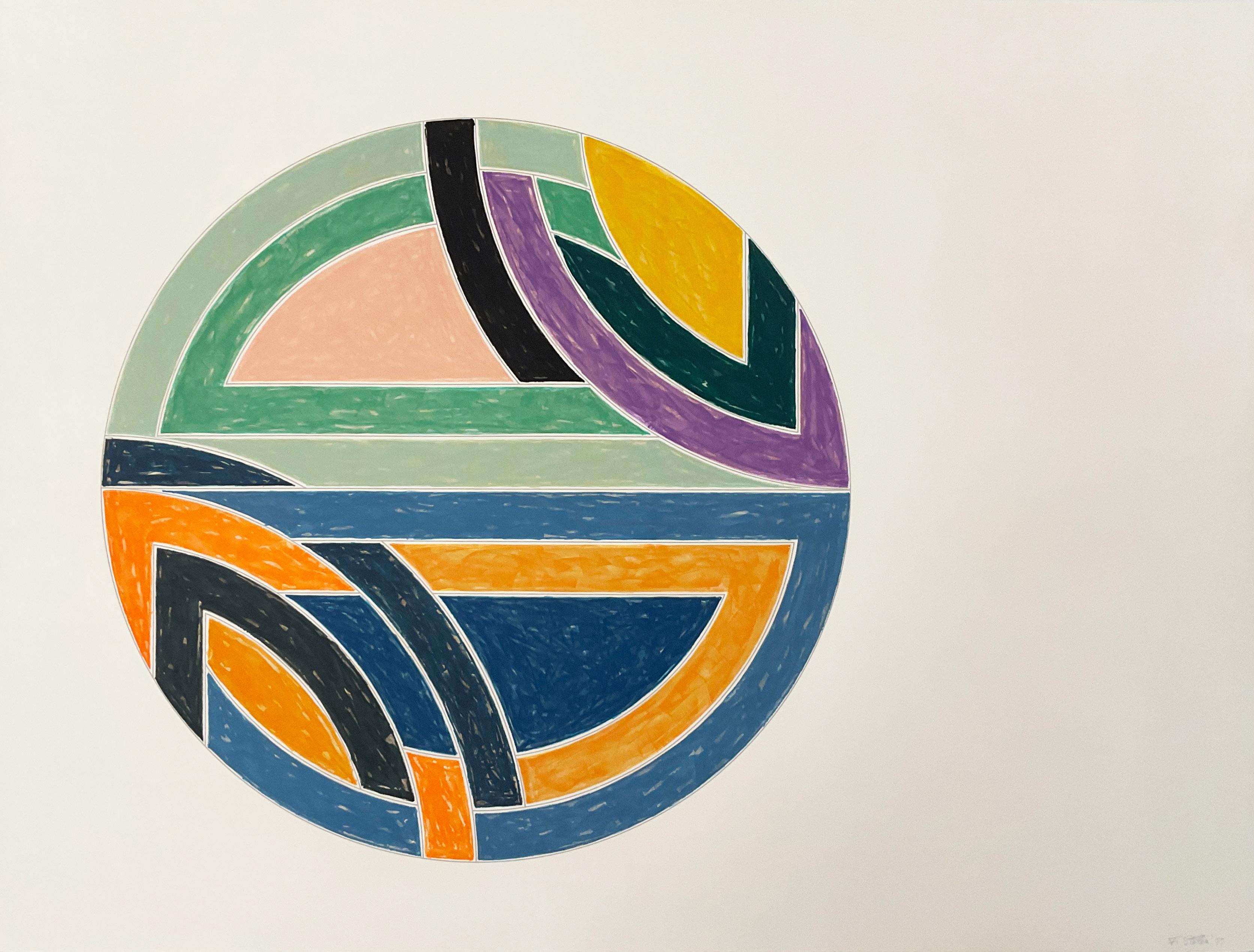
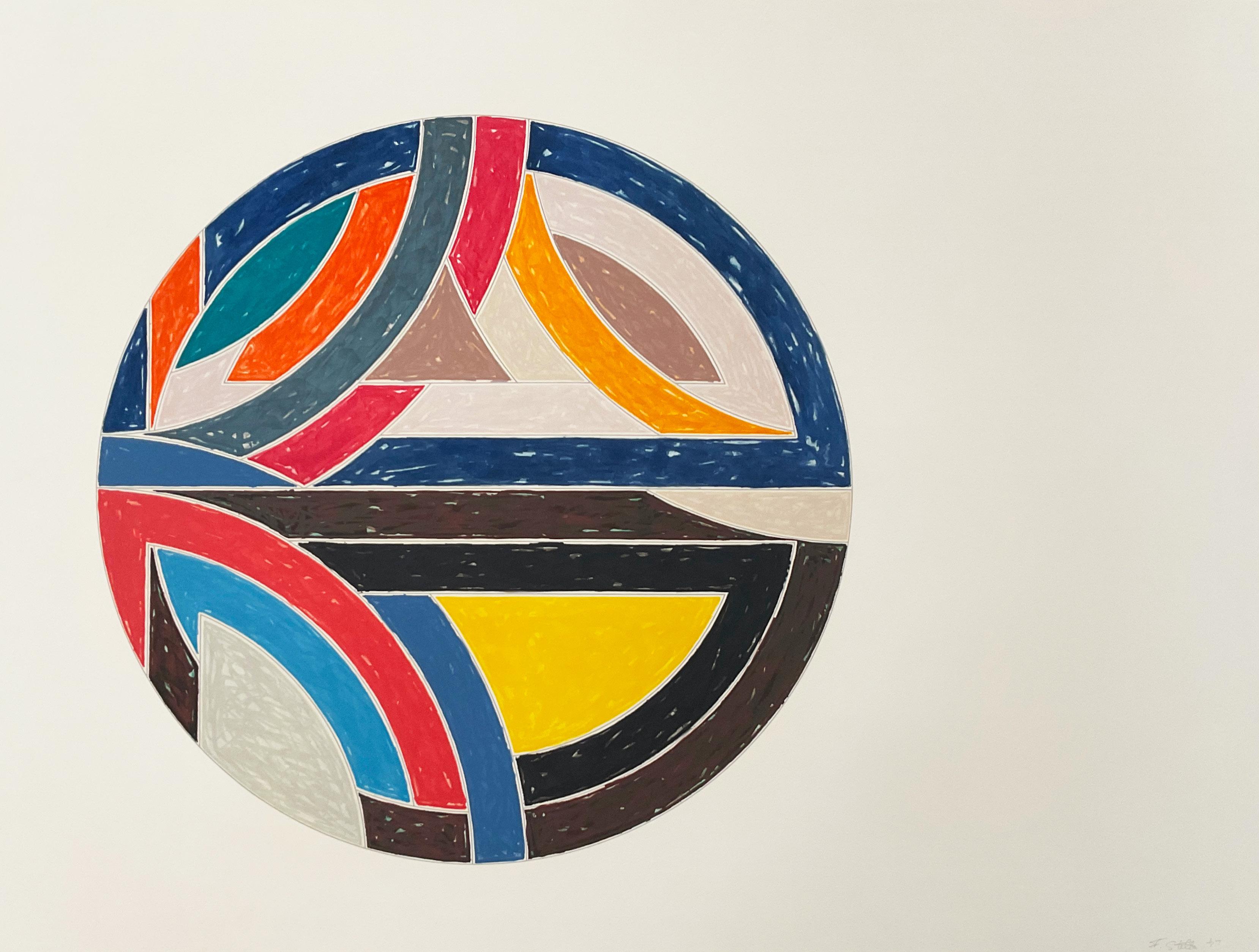
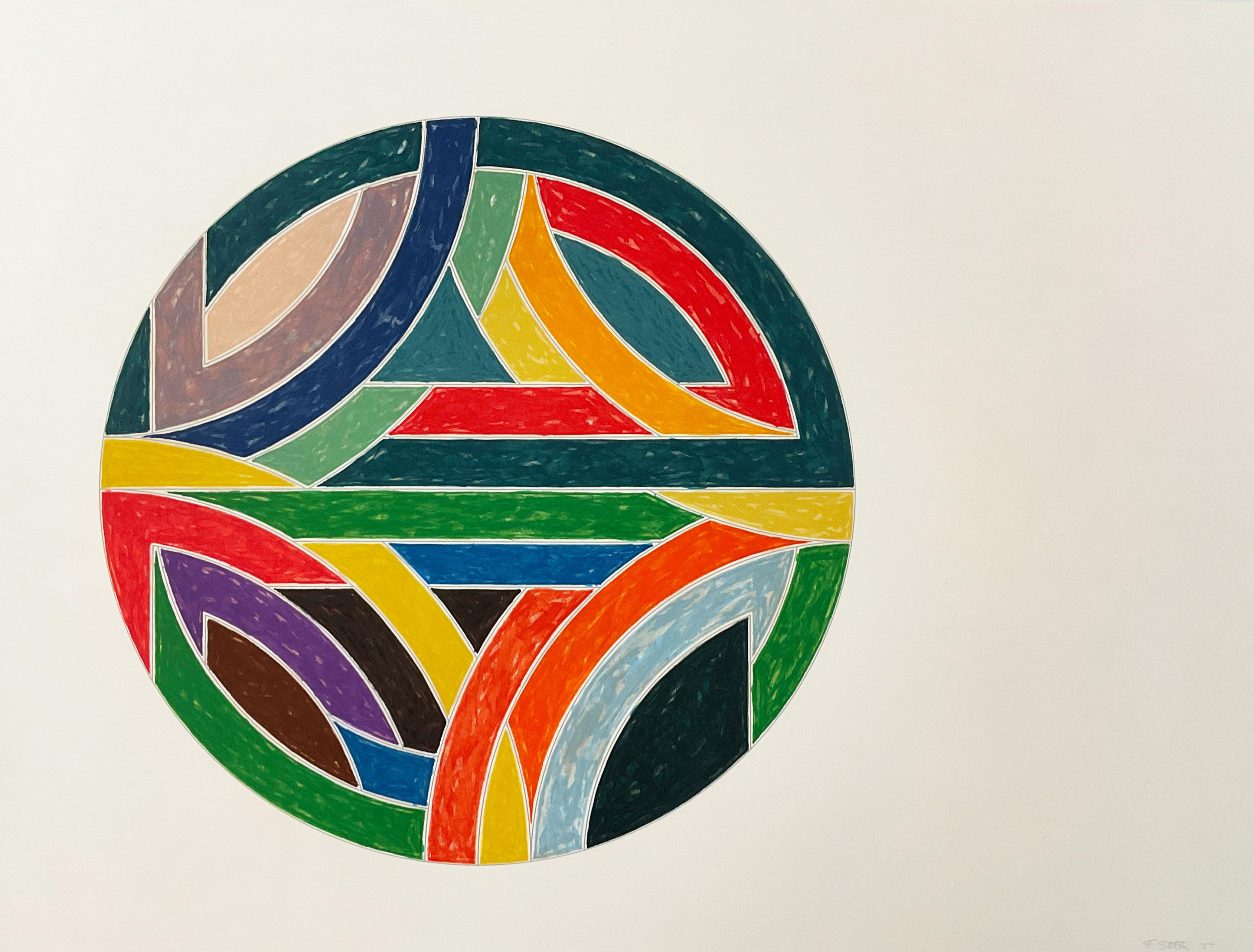
From 1967 to 1971, Frank Stella created his Protractor series, a group of ninety-three paintings that explored the titular shape through various geometries and color combinations. He approached the visual language of the series in print on three occasions: Newfoundland Series (1971), Sinjerli Variations (1977), and Polar Coordinates (1980). Typical of Stella’s early printmaking practice, each portfolio takes a single painting from the Protractor series as its point of departure. The 1968 painting Sinjerli, Variation I lays the compositional groundwork for Sinjerli Variations: a concentric form outlined by two half-circle bands. The set of six lithographs with screenprint then expands on its painted counterpart, offering alternative formations and colorways that echo Stella’s interest in the translation of a painted subject into print.
The concentric geometry of Sinjerli Variations emerged during an important transitional period for the artist. In the fall of 1963, Stella traveled to Iran with Henry Geldzahler and Stanley and Shirley Woodward. Geldzahler, the first curator of contemporary art at the Metropolitan Museum of Art, was advising the Woodwards on their collection. The group toured sites across the country, and Stella closely recorded his observations of local art and architecture.
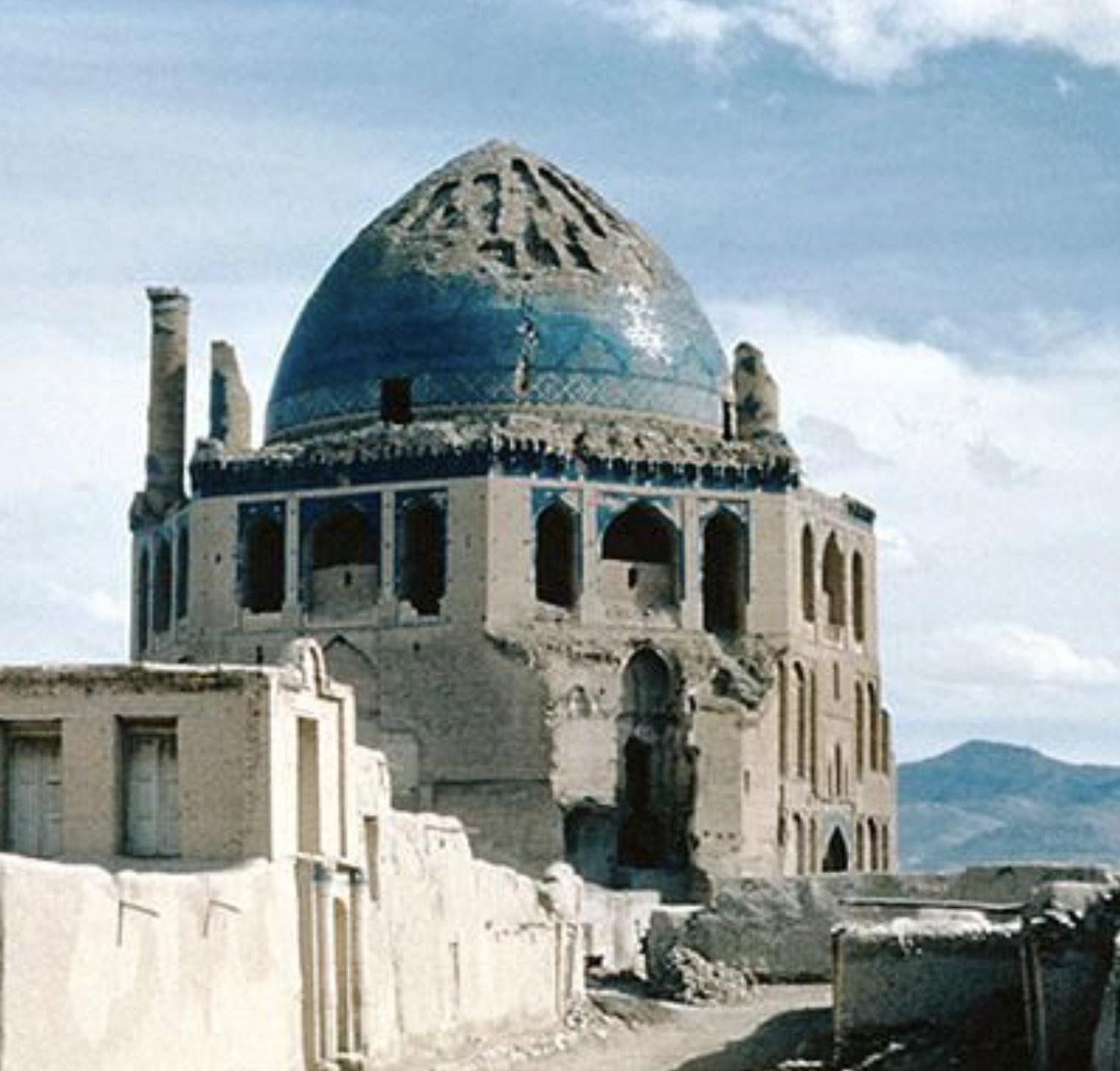
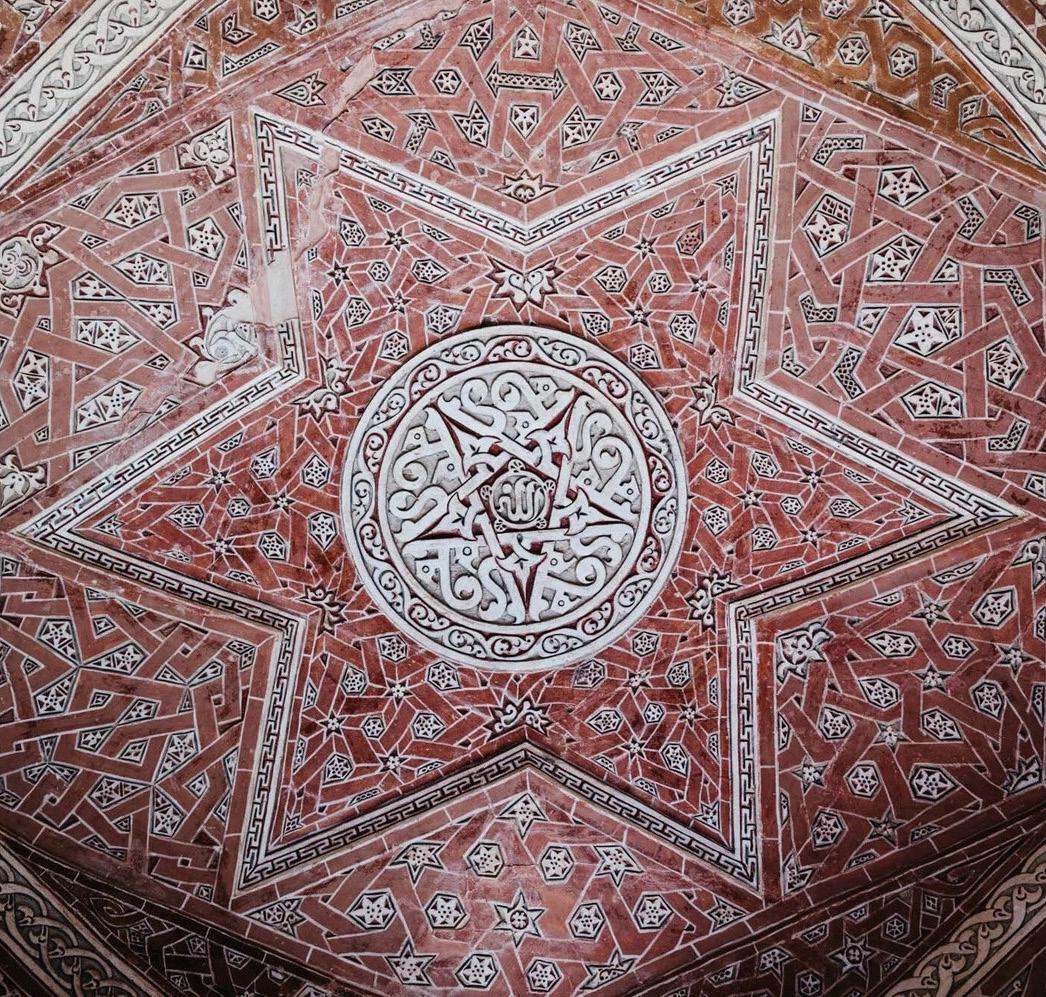
At the Dome of Soltaniyeh, a 14th-century tomb that served as the burial place of the Ilkhanid ruler Oljaytu, Stella found inspiration in the mausoleum’s decorative design elements. The exterior of the dome is finished in distictive turquoise-blue faience tiles and the interior brickwork features calligraphic inscriptions of the names Allah, Muhammed, and Ali, three central holy figures in Islam. Stella was drawn to the evenly spaced bands of equal width in the patterns, and, in his notebook, sketched a similar design. The sketch marked the beginning of Stella’s experimentation with the band as a form, which first appeared in his 1965–66 Irregular Polygons series and developed into the interlocking forms on display in Sinjerli Variations
The title of the series is derived from the archaeological site of an ancient Hittite city in southern Turkey, known for its concentric, double-walled citadel. For Stella, who often drew inspiration from international travel, Sinjerli Variations reflects his engagement with Middle Eastern culture and precipitates his turn toward maximalism in the 1970s.
Frank Stella, 1967
The Dome of Soltaniyeh before its restoration in the early 1970s
Ceiling details in the The Dome of Soltaniyeh, photo by Christopher Wilton-Steer.
Frank Stella
Sinjerli Variations, 1977
Lithographs with screenprint
Size: 31 7/8 x 42 1/4 inches, each
(81 x 107.3 centimeters, each)
Printer and Publisher: Petersburg Press, New York
Edition size: 100, plus proofs
Catalogue Raisonné: Axsom 113-118
Each print is signed, dated, and numbered
The complete set of six lithographs with screenprint
David Hockney
David Hockney met Kenneth Tyler in 1965 in Los Angeles, where the master printer had just opened a new workshop, Gemini Ltd. Shortly after, Tyler joined forces with Sidney Felsen and Stanley Grinstein to form Gemini G.E.L., which would become a powerhouse publisher focusing on technically advanced printmaking.
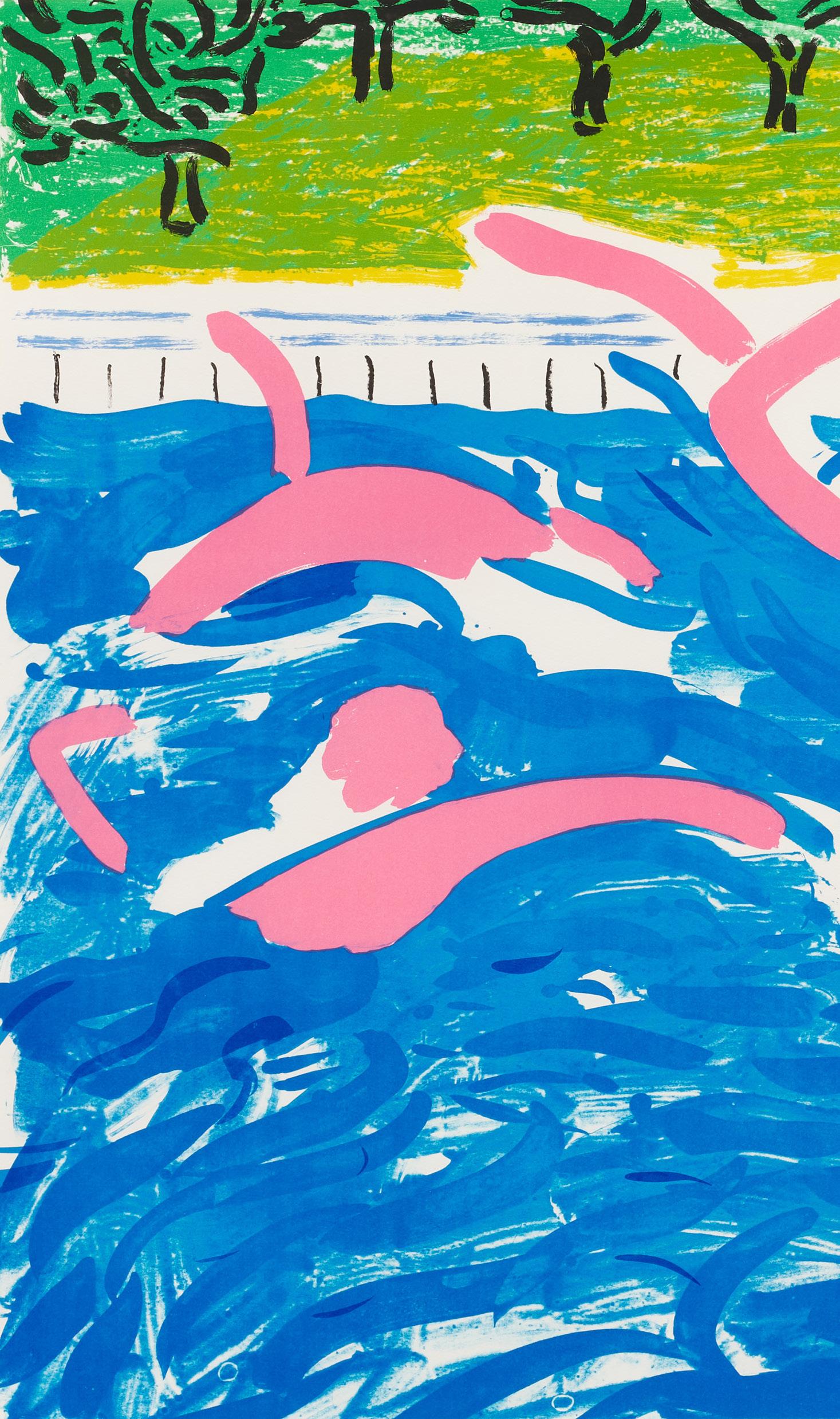
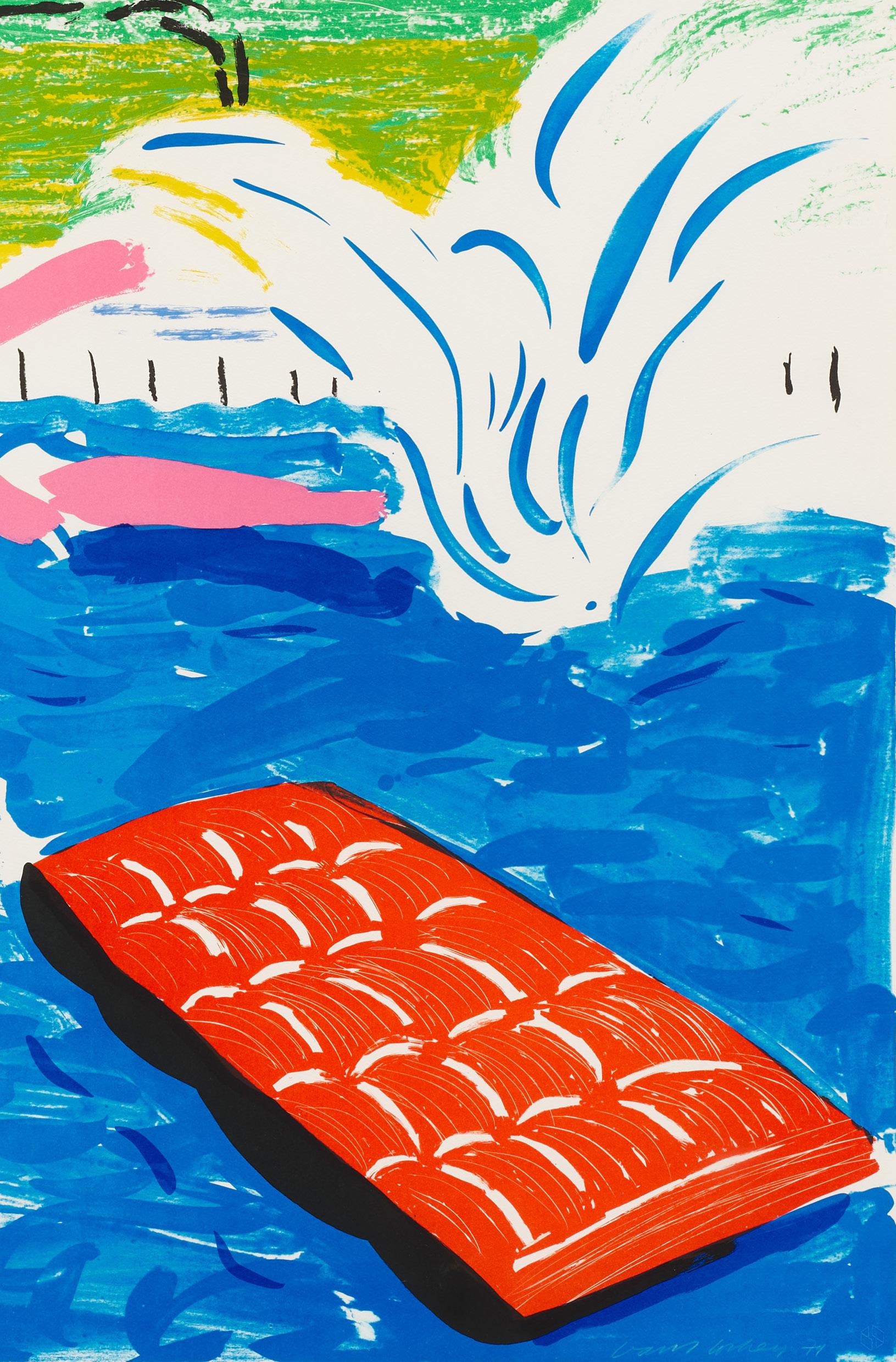
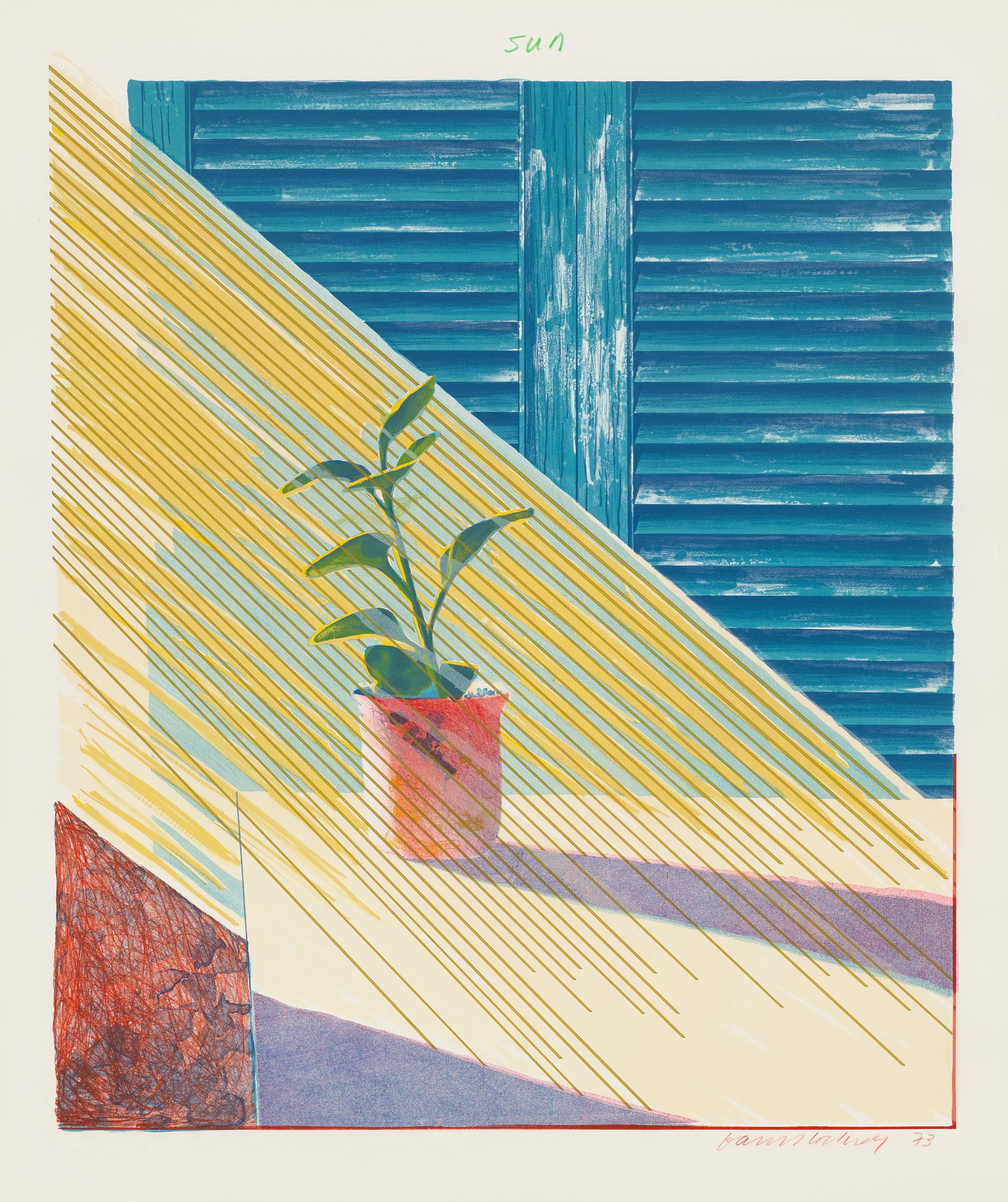
In 1973, Tyler and Hockney began work on the Weather Series, a set of six intricate lithographs with screenprints influenced by stylized Japanese woodblock prints. Sun was laboriously rendered in vivid color using seven lithographic plates and a gold silkscreen layer, resulting in a shimmering example of Hockney’s naturalist style. Shortly after the completion of the Weather Series, Tyler parted with Gemini G.E.L. to found his own workshop, Tyler Graphics Ltd., in Bedford, New York. It was here that Hockney created his Lithographic Water and unique Paper Pools series. Afternoon Swimming is unusual among the pool prints of this period due to the inclusion of the human figure. Abstracted pink limbs are presented in joyous motion, echoing the splashing water and speaking to the influence of Matisse’s late cut-outs.
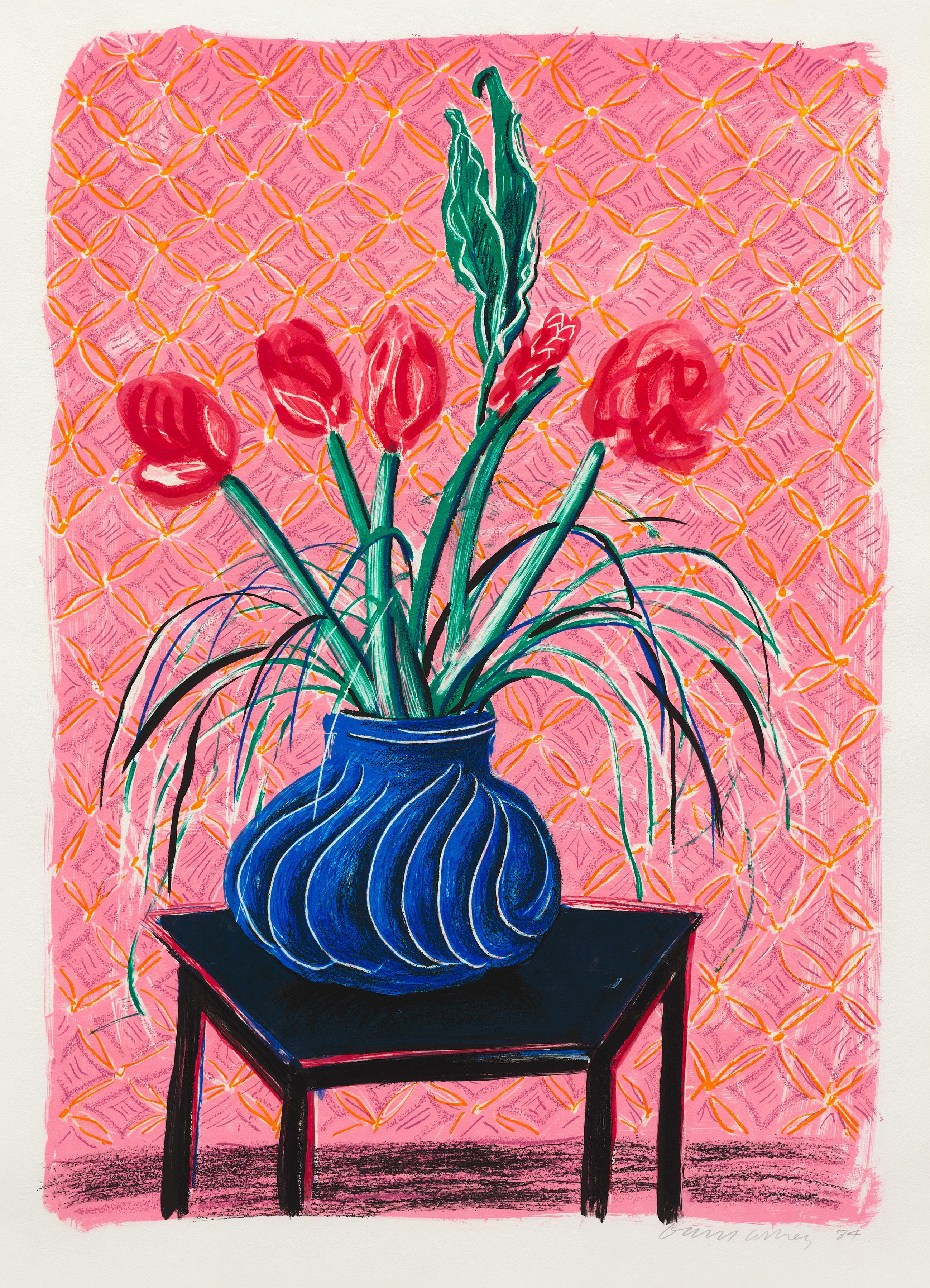
By the 1980s, Hockney had grown weary of the constraints of traditional lithography, which confined the artist to the workshop. Tyler proposed a solution known as the “Mylar method,” in which the artist creates drawings for each individual plate on transparent sheets of thin Mylar that are overlaid to visualize the final composition. Hockney used this technique to create Moving Focus, a series of twenty-nine lithographs, many of which were drawn on site during a visit to Mexico. Moving Focus embodied Hockney’s resistance to one-point perspective, which he likened to “looking at the world from the point of view of a paralyzed Cyclops—for a split second.” Amaryllis in a Vase presents reverse perspective in tight framing and monumental scale.
David Hockney
Afternoon Swimming, 1979
Lithograph
Sheet size: 31 3/4 x 39 1/2 inches (80.6 x 100.3 centimeters)
Printer and Publisher: Tyler Graphics Ltd., Bedford, New York
Edition size: 55, plus proofs
Catalogue Raisonné: MCAT 233
Signed, dated, and numbered
Provenance:
Andre Emmerich Gallery, New York Private Collection
David Hockney
Amaryllis in Vase, 1984
Lithograph
Sheet size: 50 1/4 x 36 3/8 inches (127.6 x 92.4 centimeters)
Printer and Publisher: Tyler Graphics Ltd., Bedford, New York
Edition size: 80, plus proofs
Catalogue Raisonné: MCAT 266
Signed, dated, and numbered
From Moving Focus, a series of twenty-nine color lithographs created in collaboration with master printer Kenneth Tyler from 1984 to 1986.
David Hockney
Sun, 1973
Lithograph and screenprint
Sheet size: 37 1/4 x 30 5/8 inches (94.6 x 77.8 centimeters)
Printer and Publisher: Gemini G.E.L., Los Angeles
Edition size: 98, plus proofs
Catalogue Raisonné: MCAT 127
Signed, dated, and editioned
From the 1973 Weather Series, Hockney’s first major print project at Gemini G.E.L., which also includes Rain, Mist, Lightning, Snow, and Wind. This edition is a rare unique trial proof printed before the sixth color plate in magenta.
Richard Pettibone
Richard Pettibone first encountered the work of Andy Warhol in 1962, when Warhol debuted his series of Campbell’s Soup Cans at the Ferus Gallery in Los Angeles. Pettibone admired the polarizing paintings. “Many, many of the artists who saw it really hated it,” he recalled. “I told them, this may be the worst art you’ve ever seen. But it’s art.” Two years later, Pettibone produced his first replicas: two screenprinted and hand-painted miniatures of soup cans from Warhol’s series. The exactitude and scale of these works came to define his appropriative practice, which he extended to works by Roy Lichtenstein, Jasper Johns, Frank Stella, and other contemporary artists of the 1960s.
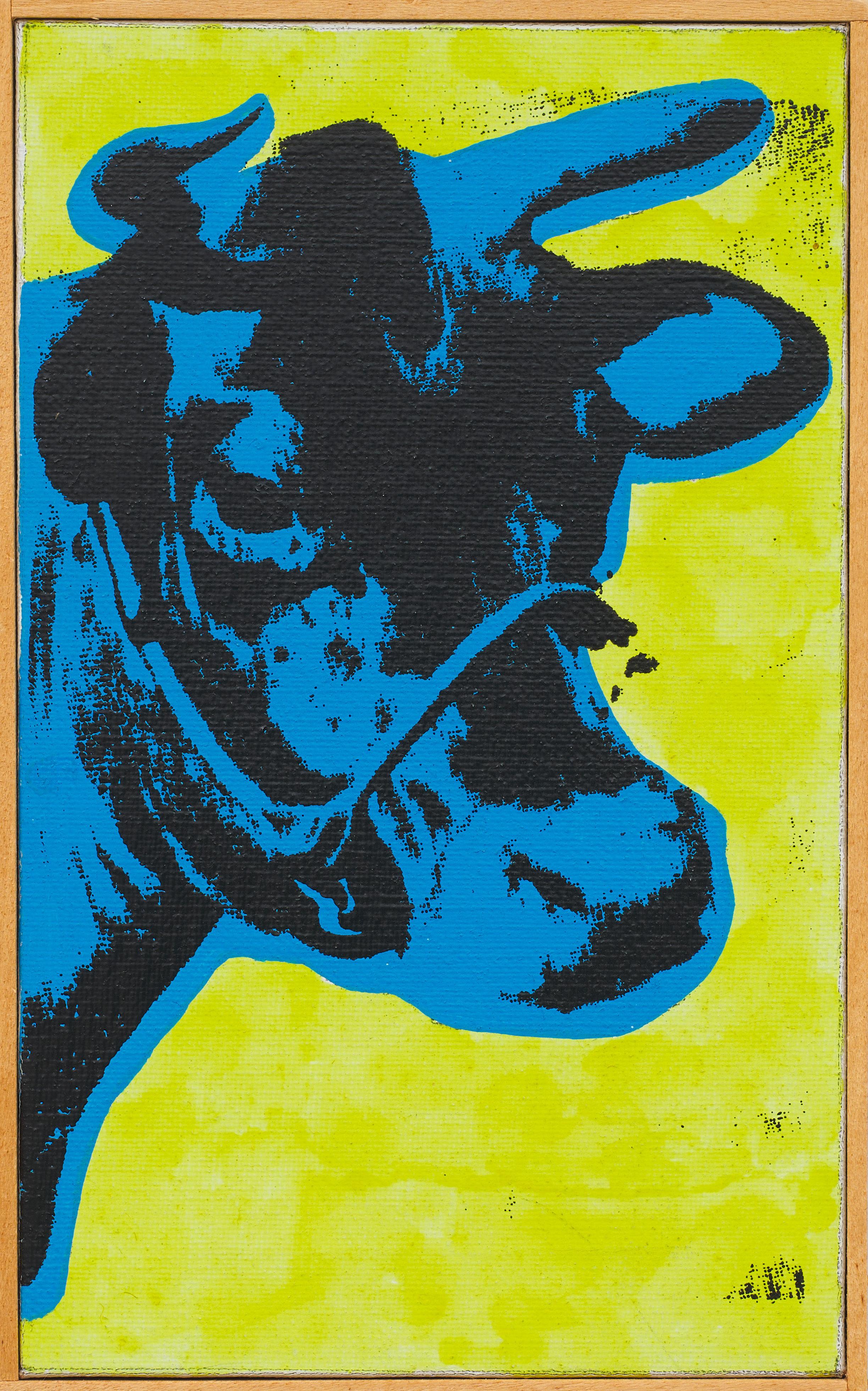
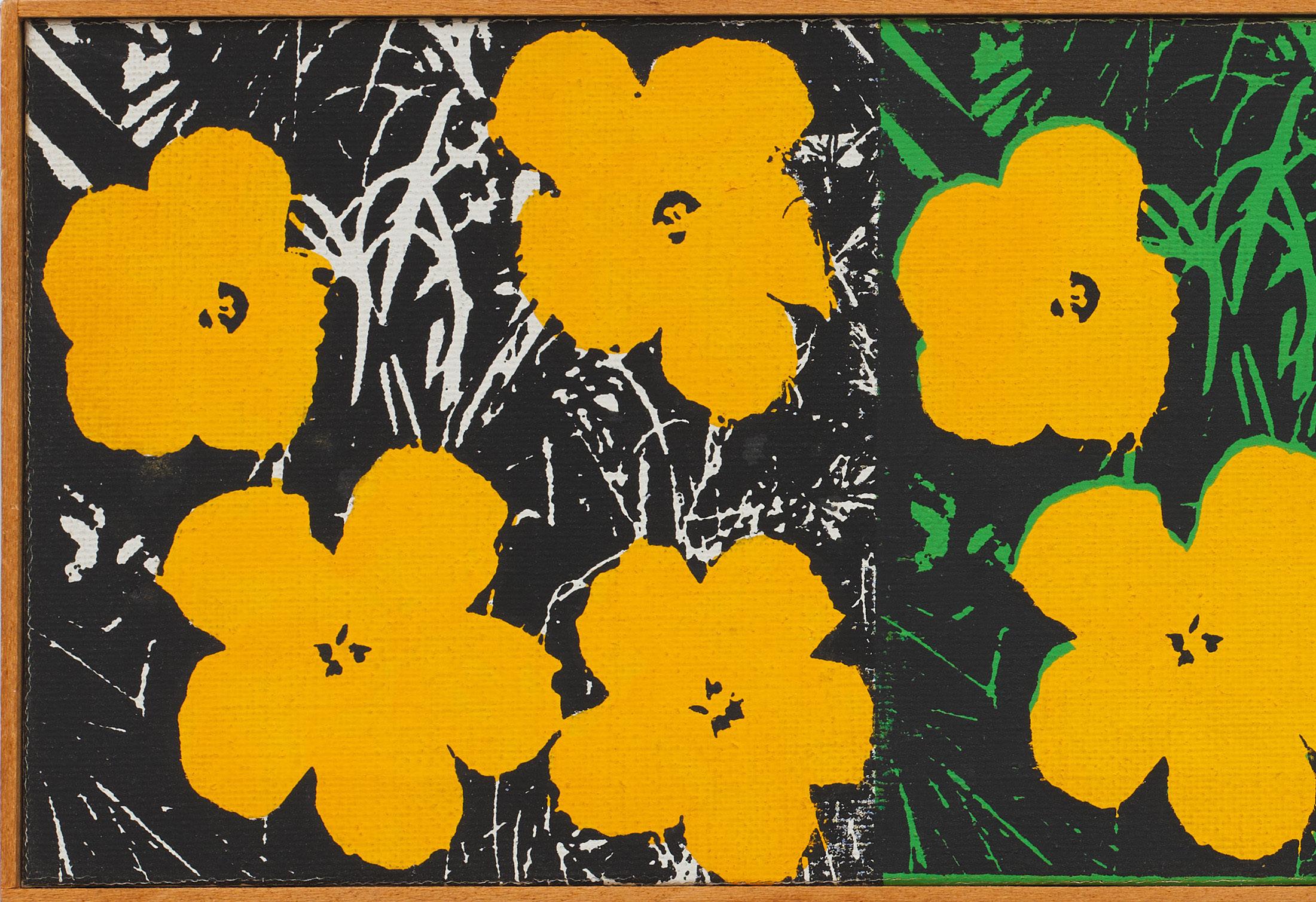
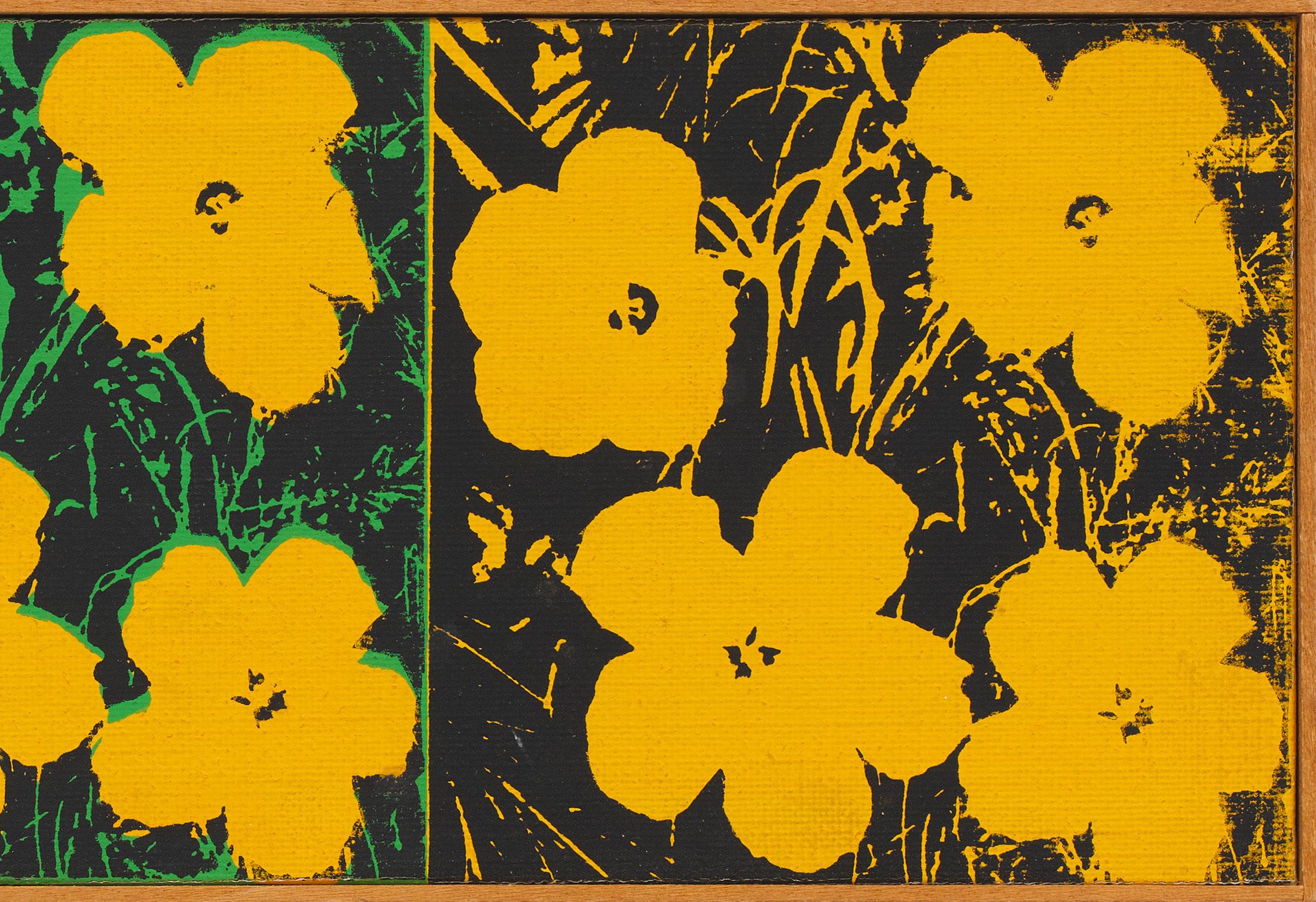
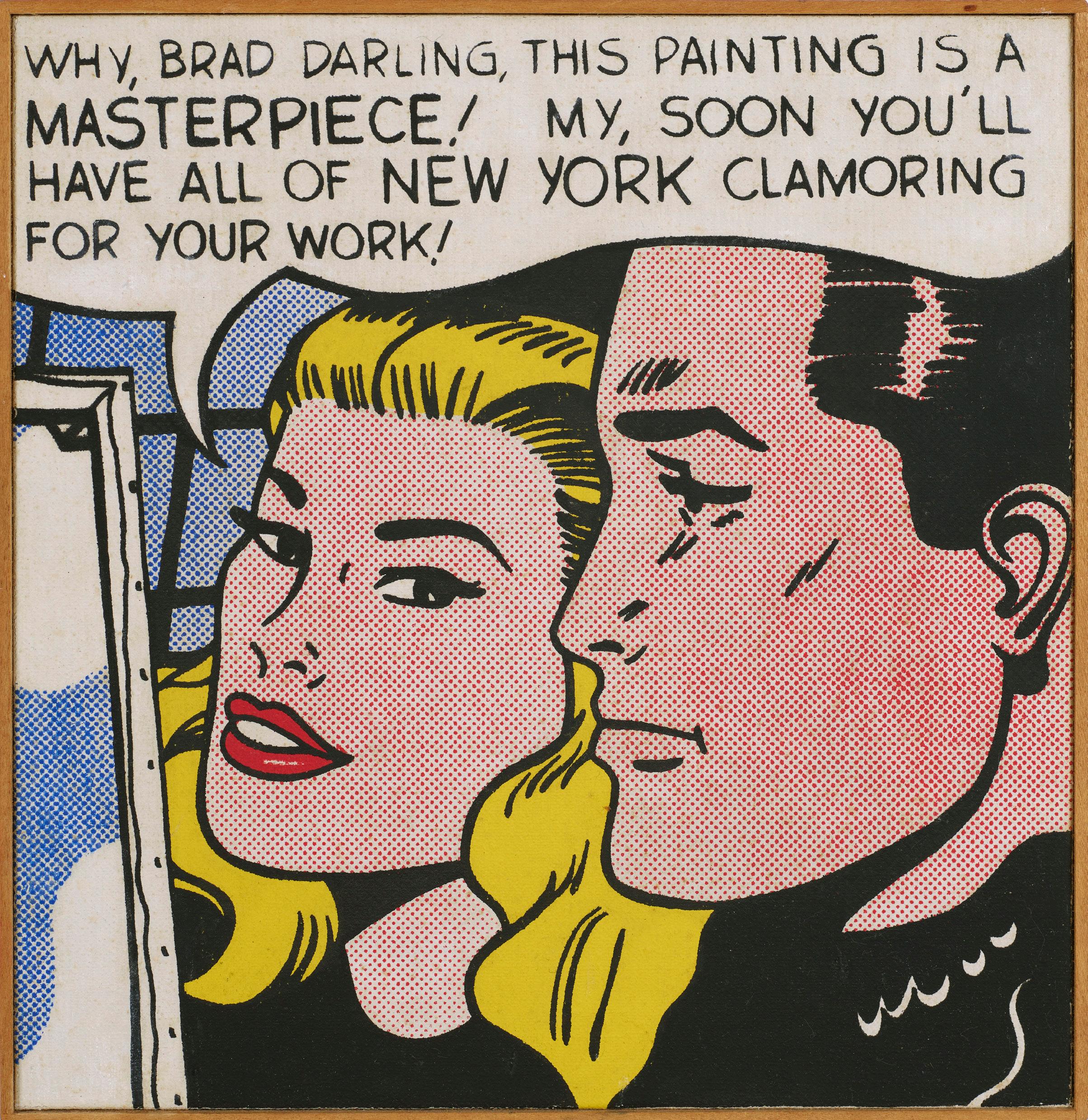
Though Andy Warhol, “Cow,” 1966, Andy Warhol “Flowers”, and Roy Lichtenstein, “Masterpiece,” 1962 borrow imagery from iconic Pop art works, replication was not just homage for Pettibone, who insisted that his works were not miniatures. Instead, the unique scale of his paintings—derived from reproductions in printed media, allegedly Artforum advertisements—situates Pettibone at the forefront of appropriative art, an artistic strategy that rose to prominence in the 1980s and posed questions about authorship and originality.
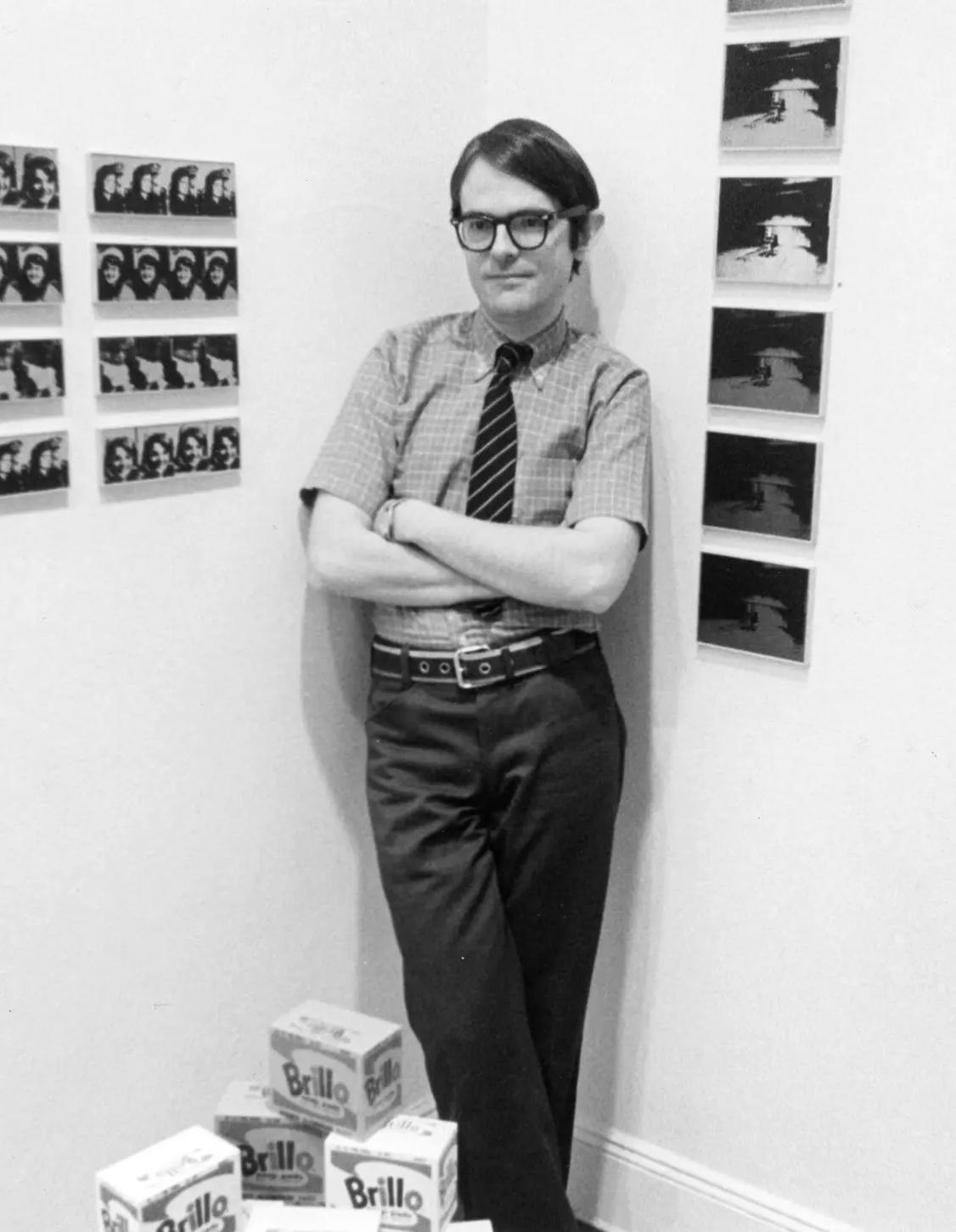
Richard Pettibone at Leo Castelli Gallery, New York, 1969
Richard Pettibone
Andy Warhol, “Cow,” 1966 (Blue on Yellow), 1971
Acrylic and silkscreen ink on canvas
Size: 6 x 3 3/4 x 1/2 inches, overall
(15.2 x 9.5 x 1.3 centimeters)
Signed and dated ‘1971’ on verso
The work retains its original hand-made wood frame.
Richard Pettibone
Andy Warhol, “Flowers,” 1971
Acrylic and silkscreen ink on canvas Size: 3 1/8 x 9 1/4 x 3/8 inches, overall (7.9 x 23.5 x 1 centimeters)
Signed and dated on verso
The work retains its original hand-made wood frame.
Richard Pettibone
Roy Lichtenstein, “Masterpiece,” 1962, 1975
Acrylic and silkscreen ink on canvas
Size: 7 3/4 x 7 1/2 x 5/8 inches, overall
(19.7 x 19.1 x 1.6 centimeters)
Signed, dated, and titled on verso
The work retains its original hand-made wood frame.
Richard Pettibone created a very small but unknown number of paintings with this image for a fundraiser at the The Institute of Contemporary Art, Philadelphia in 1975.
Claes Oldenburg
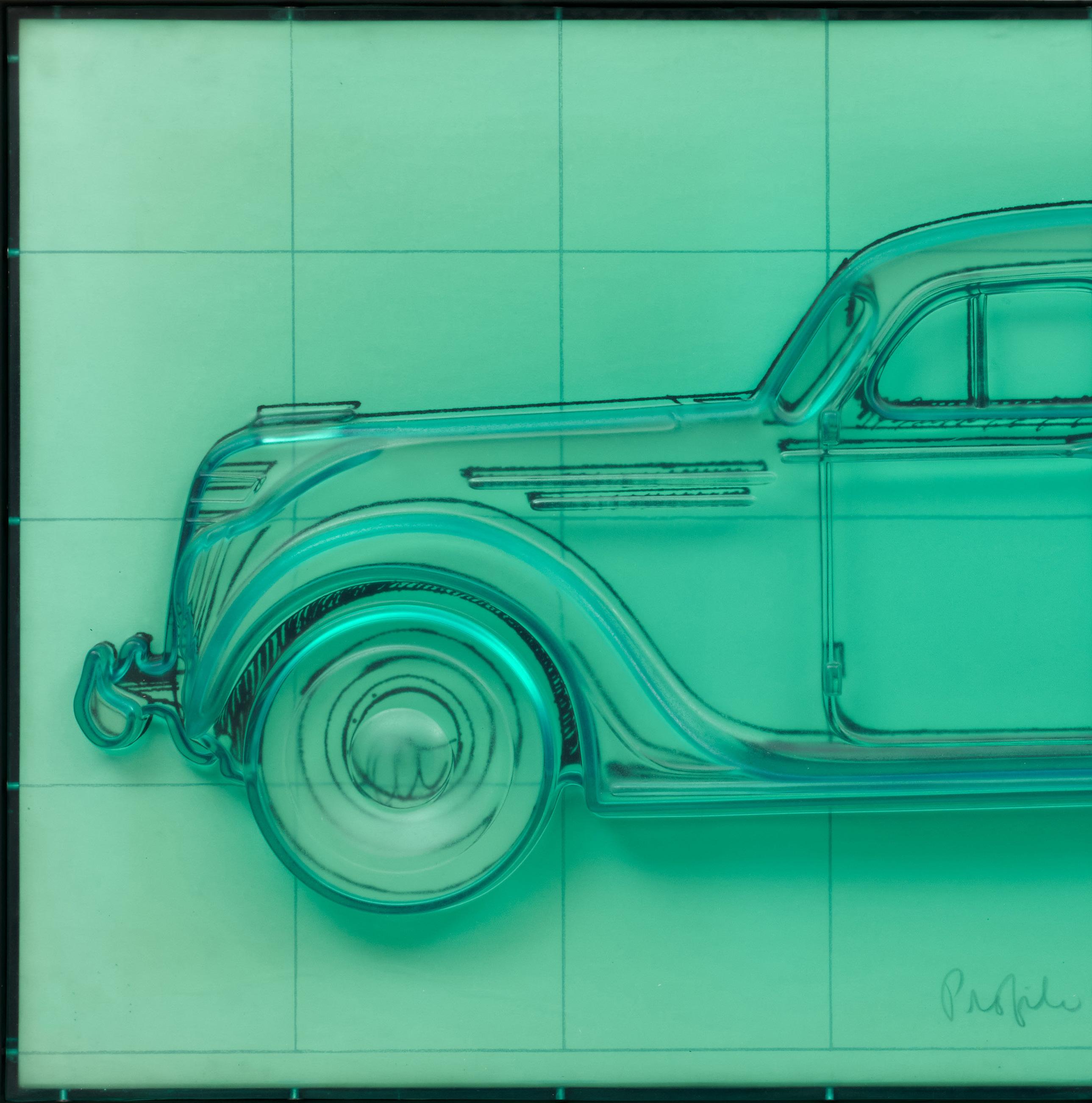
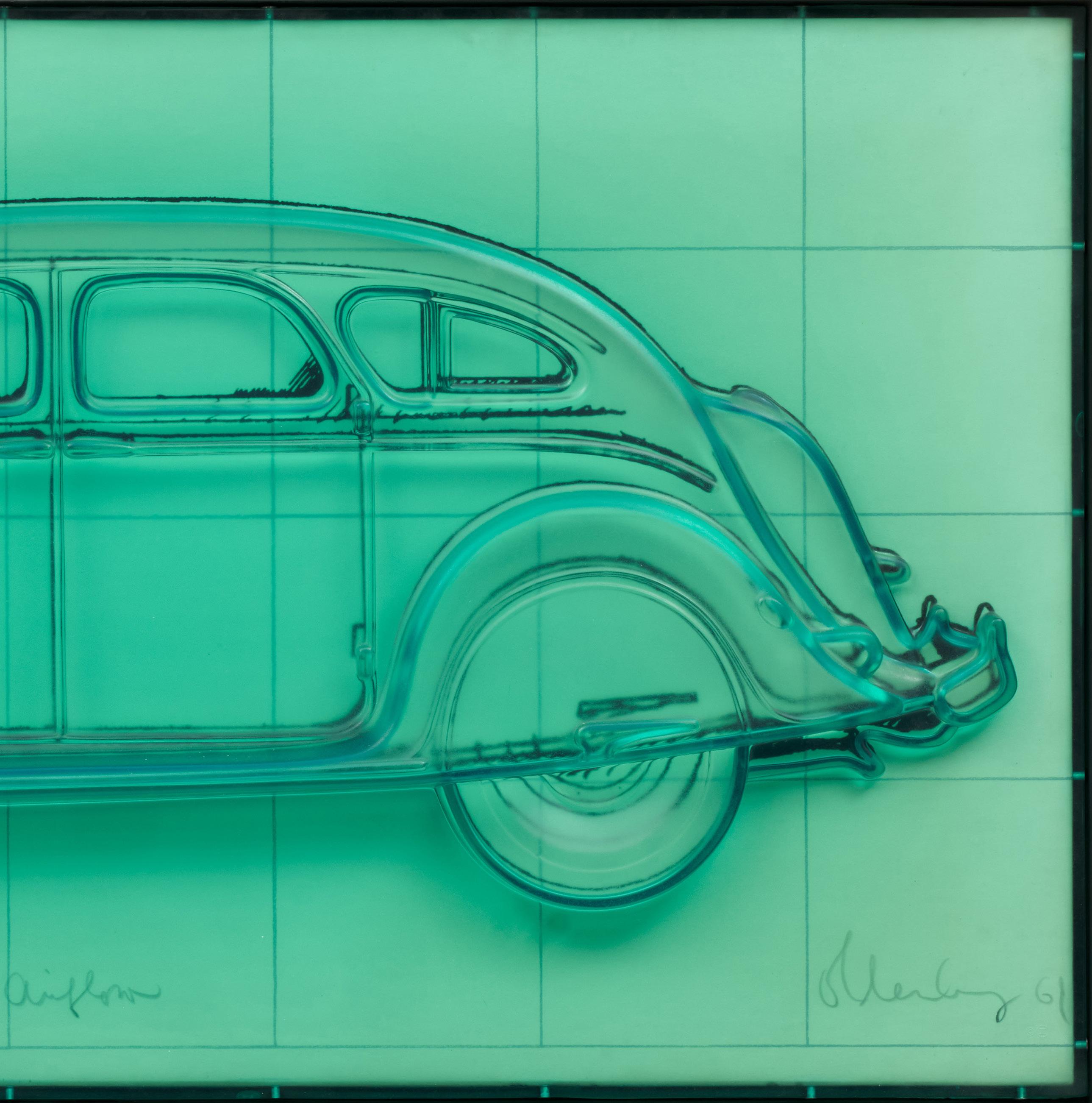
One of Claes Oldenburg’s most treasured childhood toys was a miniature version of the Chrysler Airflow automobile. Designed in the 1930s by Carl Breer in collaboration with famed aviator Orville Wright, the Airflow was the first full-sized American car to prioritize streamlining. Although production was plagued by delays and the car was ultimately a commercial failure, the Airflow had an enduring cultural impact on automotive design.
In New York in the early 1960s, Oldenburg began creating soft sculptures—sagging textile interpretations of everyday objects. During this period, he formed a friendship with filmmaker Robert Breer, the son of Carl Breer. Together, they visited Carl’s home in Chicago to see an early Airflow model, reigniting Oldenburg’s childhood fascination. A distinguished draftsman, Oldenburg sketched the vehicle and studied its components for a planned sculpture. Although he never realized the large-scale work, the artist exhibited a series of small-scale models along with life-sized canvas tires, radiators, and engines at Sidney Janis Gallery in 1966.
When the artist revisited the subject at Gemini G.E.L. in Los Angeles later that year, it marked a transformative period in Oldenburg’s practice, bridging the human-scale soft sculptures of the 1960s and the monumental works that defined his later career. His first sculptures were partially deflated and muted in color, reflecting the worn character of Lower Manhattan. Oldenburg’s Profile: Airflow multiple was designed to embody the sleek, industrial nature of Los Angeles. In the artist’s own words, it was to “be clear in colour, transparent like a swimming pool but with a consistency like flesh.”
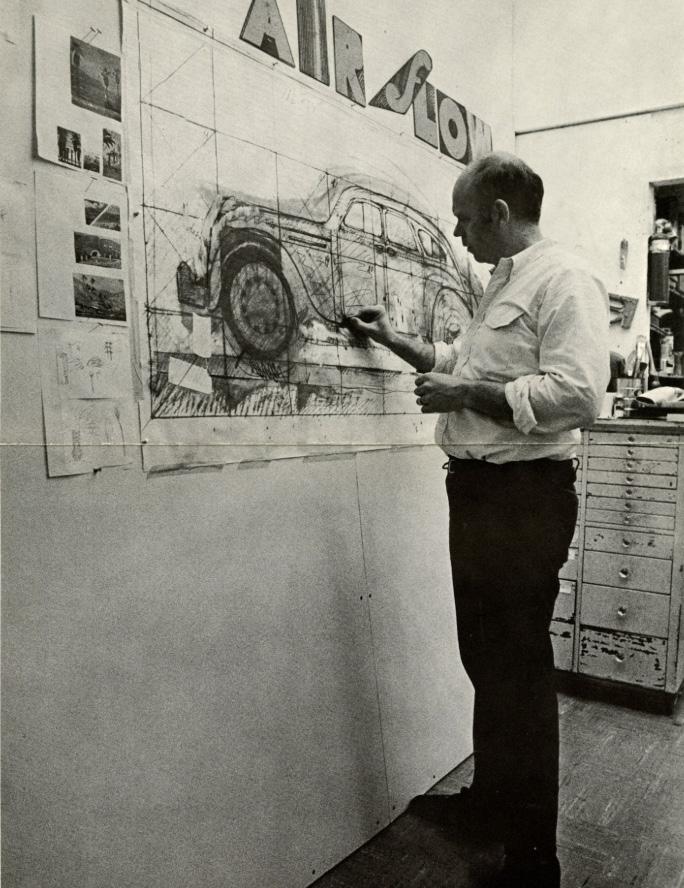
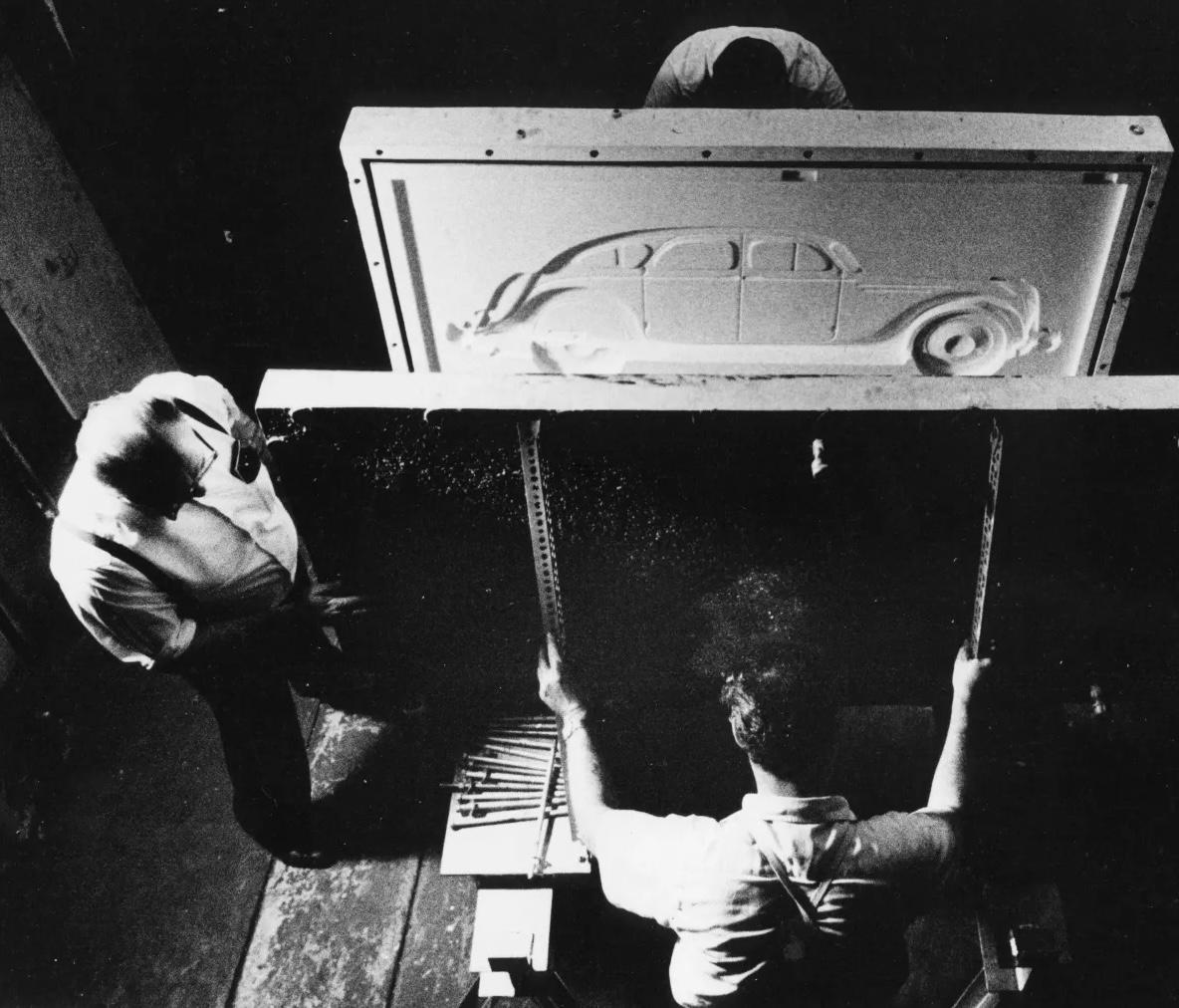
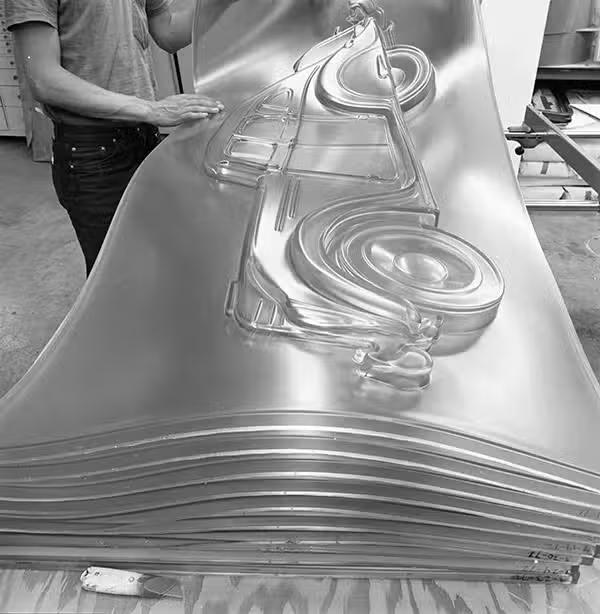
Though Gemini G.E.L. was on the cutting edge of printmaking technology, Oldenburg’s vision presented an immense challenge for the studio’s master printer, Kenneth Tyler. In all, the project took over two years of experimental labor. Oldenburg spent an entire year carving the wooden model for the mold, and the formulation of the polyurethane overlay had to be outsourced to industrial chemists. When the work was first published, the plastic quickly shifted in color, and the entire edition had to be recalled and reconstructed to achieve a lasting teal hue.
Left: Mould for polyurethane overlay of Profile Airflow, 1969
Right: Gemini G.E.L. workers quality checking the reissued overlay, 1972
Photos via the Kenneth E. Tyler Collection at National Gallery of Art Australia
Claes Oldenburg
Profile Airflow, 1969
Cast-polyurethane relief over lithograph
Size: 33 1/2 x 65 1/2 x 2 1/2 inches, overall
(85.1 x 166.4 x 6.4 centimeters)
Printer and Publisher: Gemini G.E.L., Los Angeles
Edition size: 75, plus proofs
Catalogue Raisonné: Axsom and Platzker 59
Signed, dated, numbered, and titled
The work retains its original welded aluminum frame.
Andy Warhol
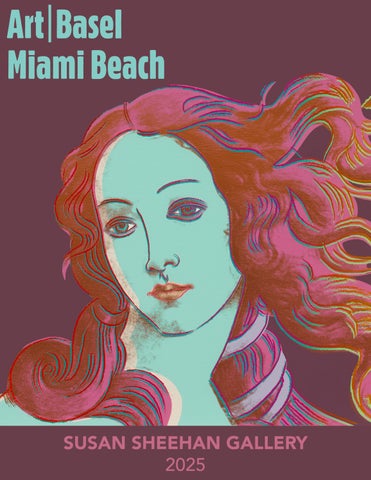
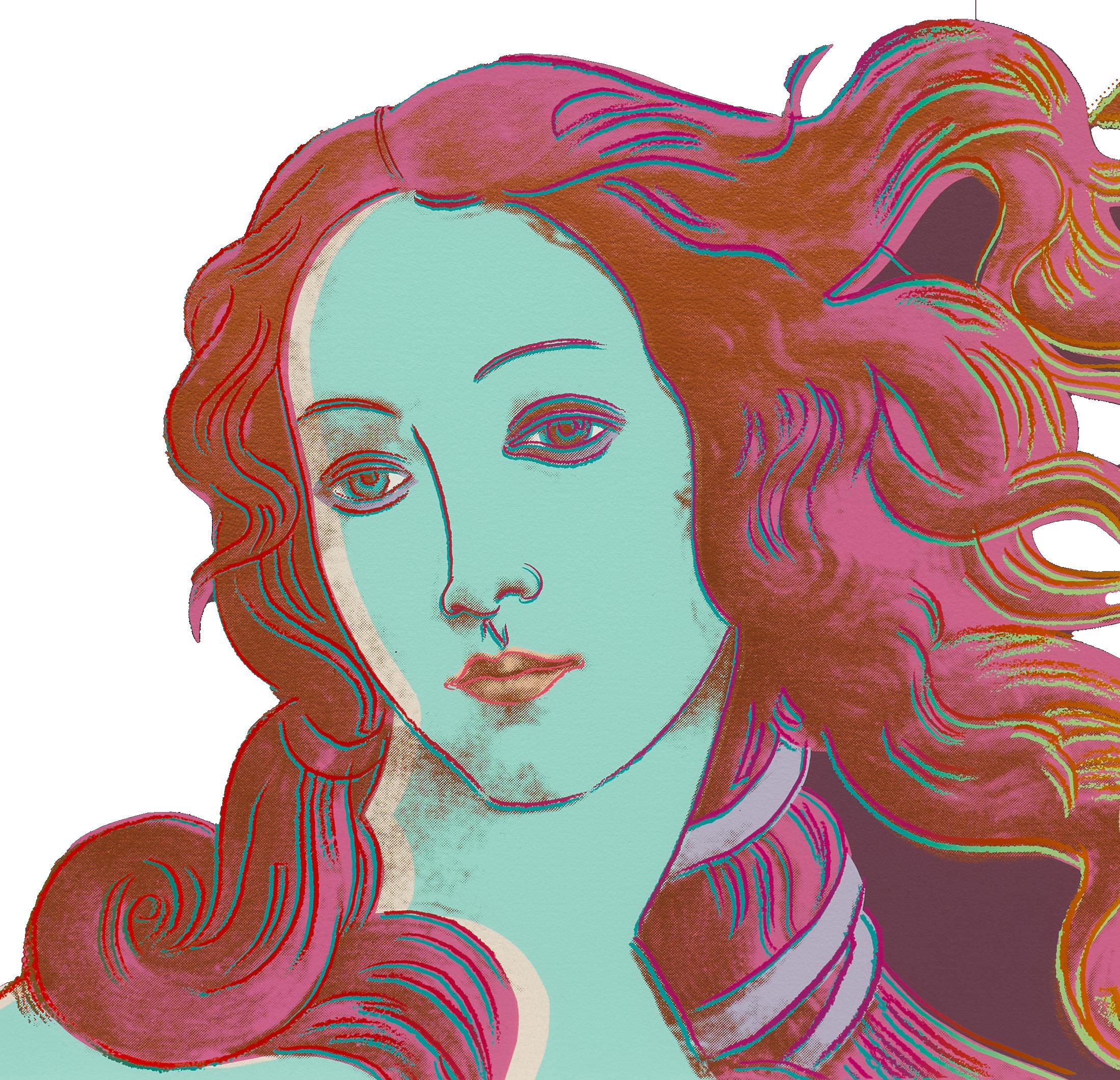
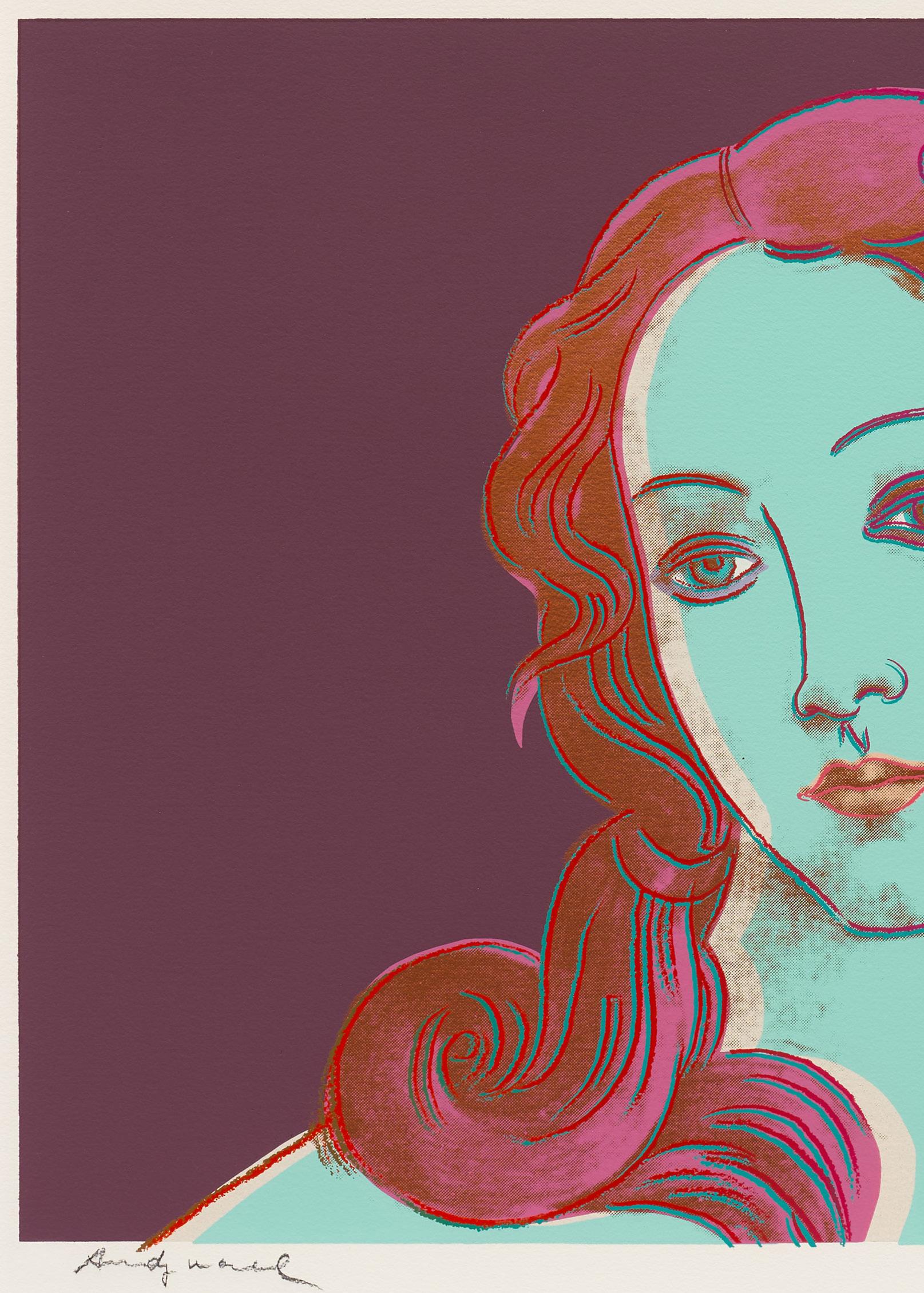
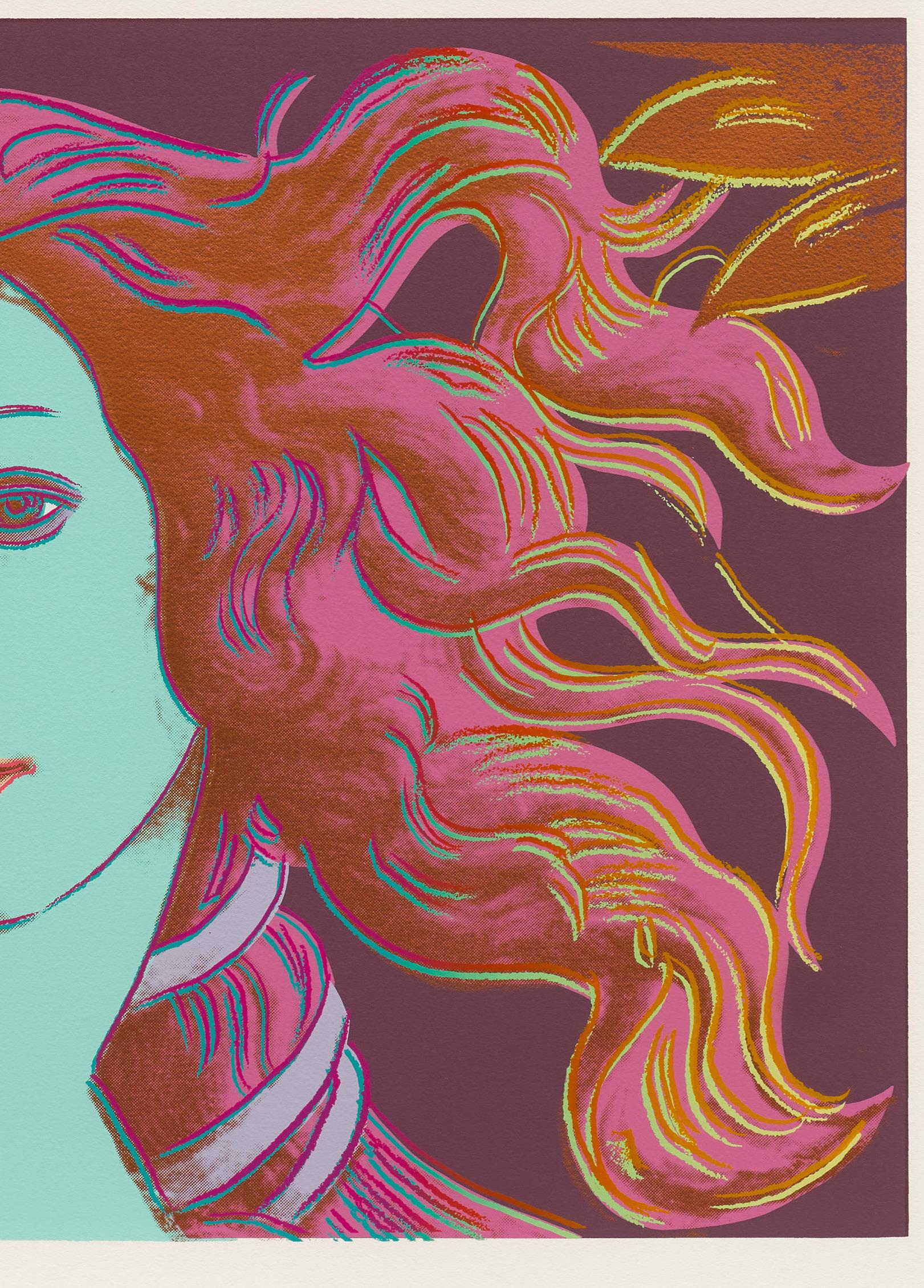
Details of Renaissance Paintings (Sandro Botticelli, Birth of Venus, 1482), 1984
Screenprint
Sheet size: 32 x 44 inches (81.3 x 111.8 centimeters)
Printer: Rupert Jasen Smith, New York
Publisher: Editions Schellman & Klüser, Munich/New York
Edition size: 70, plus proofs
Catalogue Raisonné: Feldman and Schellmann II.317
Signed and numbered
From the 1984 portfolio Details of Renaissance Paintings, a series of sixteen screenprints that appropiate imagery from paintings by Renaissance masters including Sandro Botticelli, Piero della Francesca, Leonardo da Vinci, and Paolo Uccello.
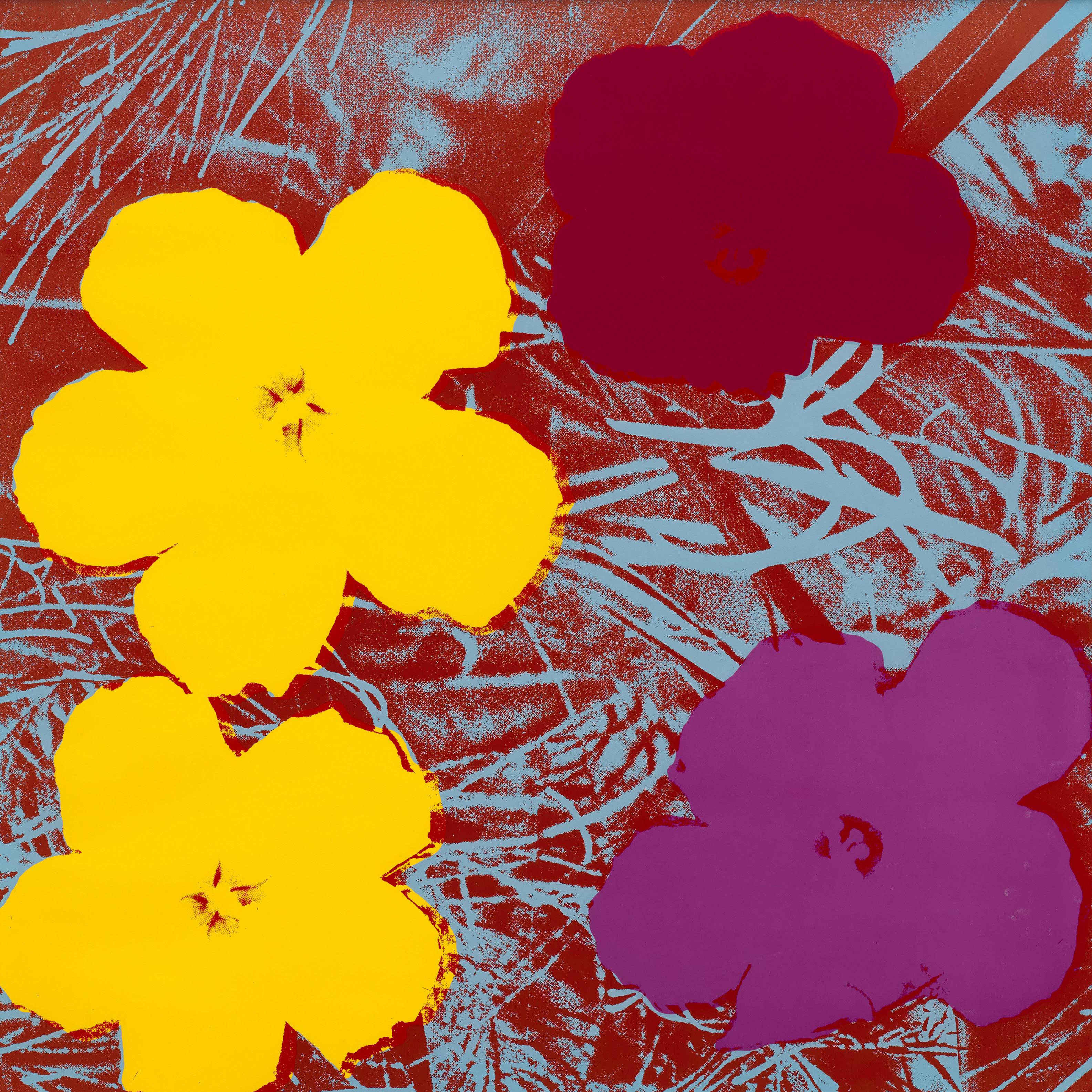
Flowers, 1970
Screenprint
Sheet size: 36 x 36 inches
(91.4 x 91.4 centimeters)
Printer: Aetna Silkscreen Products, Inc., New York
Publisher: Factory Additions, New York
Edition size: 250, plus proofs
Catalogue Raisonné: Feldman and Schellmann II.71
Signed and numbered on verso
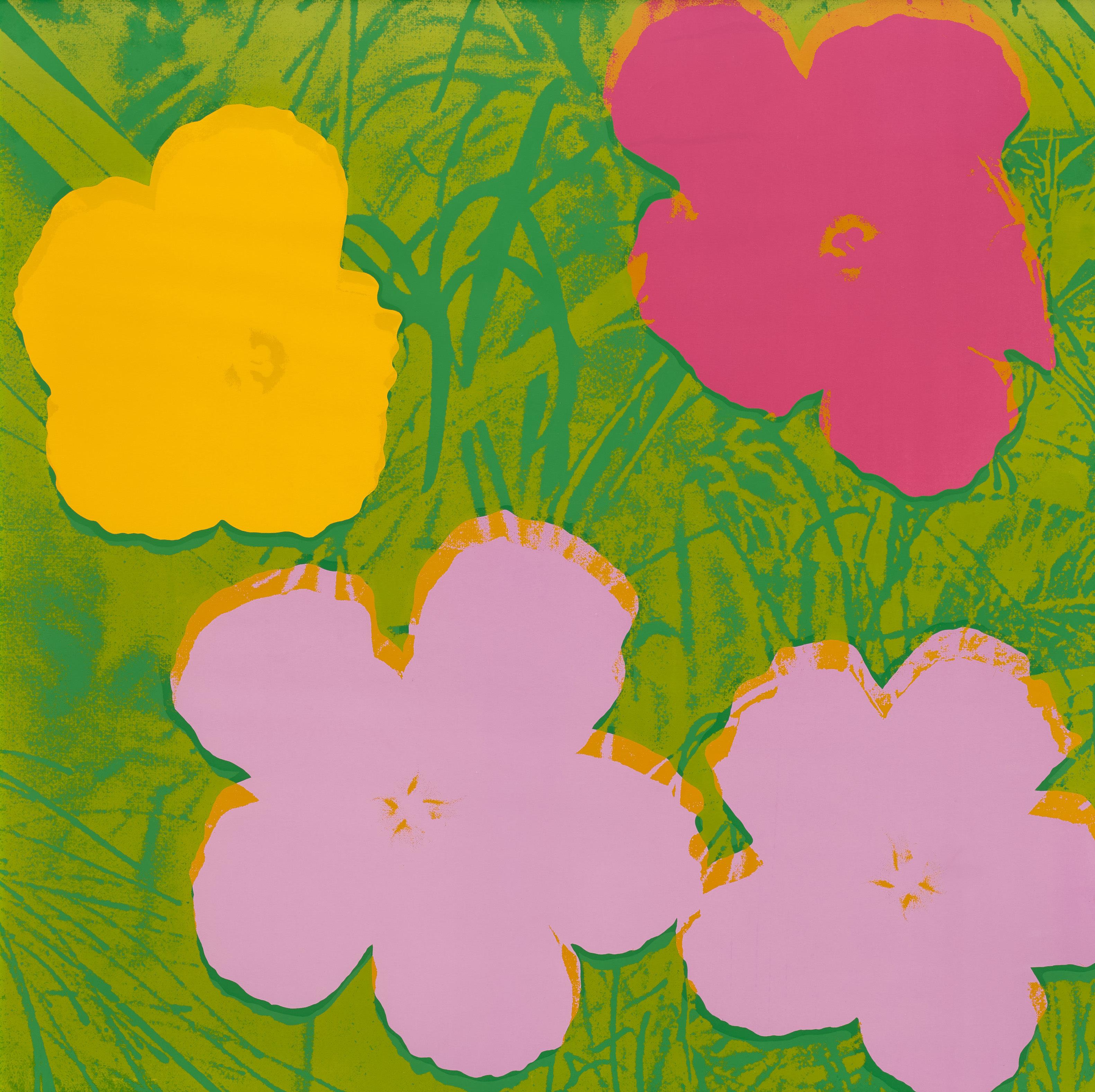
Andy Warhol
Flowers, 1970
Screenprint
Sheet size: 36 x 36 inches
(91.4 x 91.4 centimeters)
Printer: Aetna Silkscreen Products, Inc., New York
Publisher: Factory Additions, New York
Edition size: 250, plus proofs
Catalogue Raisonné: Feldman and Schellmann II.68
Signed and numbered on verso
Andy Warhol
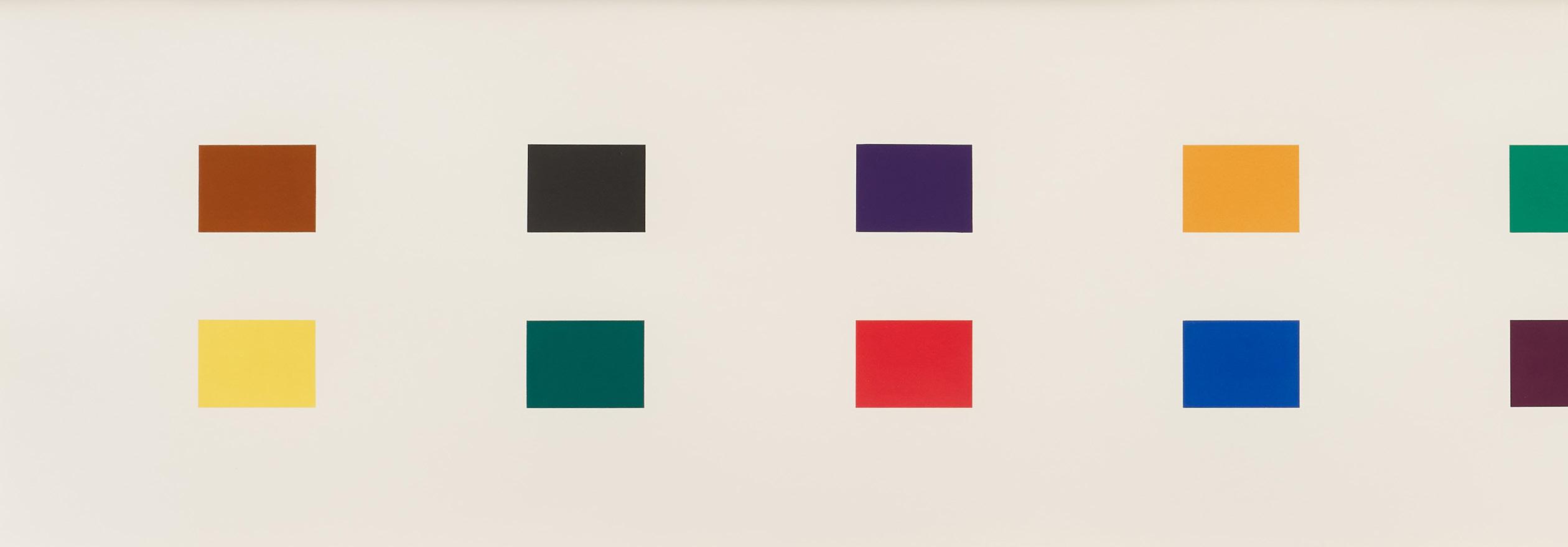
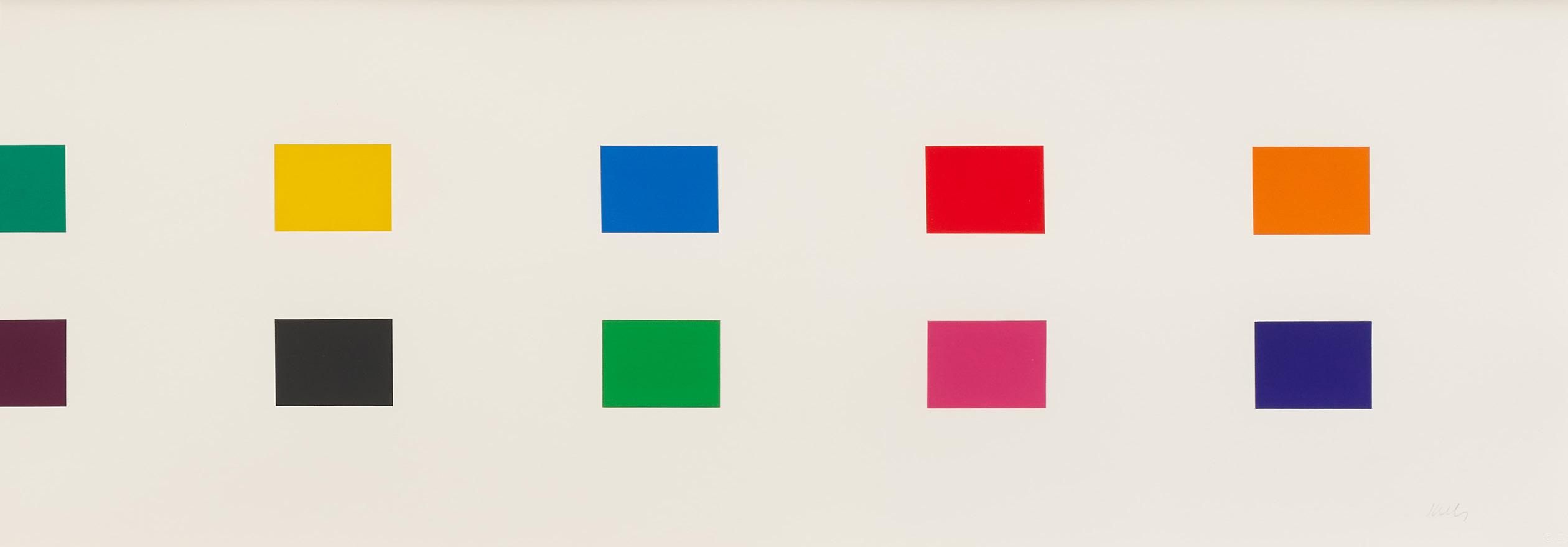
Ellsworth Kelly
18 Colors (Cincinnati), 1979-82
Lithograph
Sheet size: 16 x 90 1/4 inches (40.6 x 229.2 centimeters)
Printer and Publisher: Gemini G.E.L., Los Angeles
Edition size: 57, plus proofs
Catalogue Raisonné: Axsom 193
Signed and numbered
Roy Lichtenstein
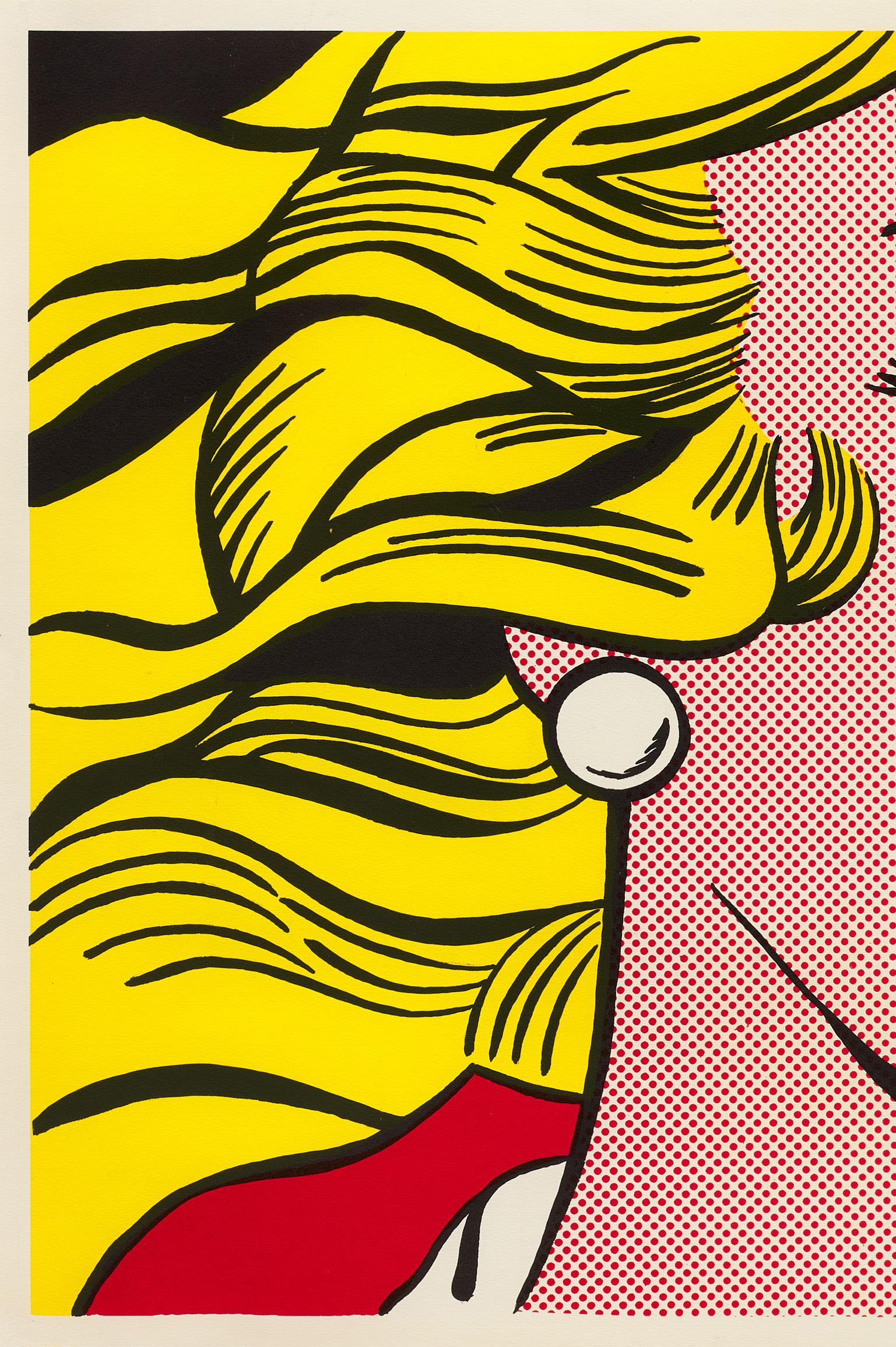
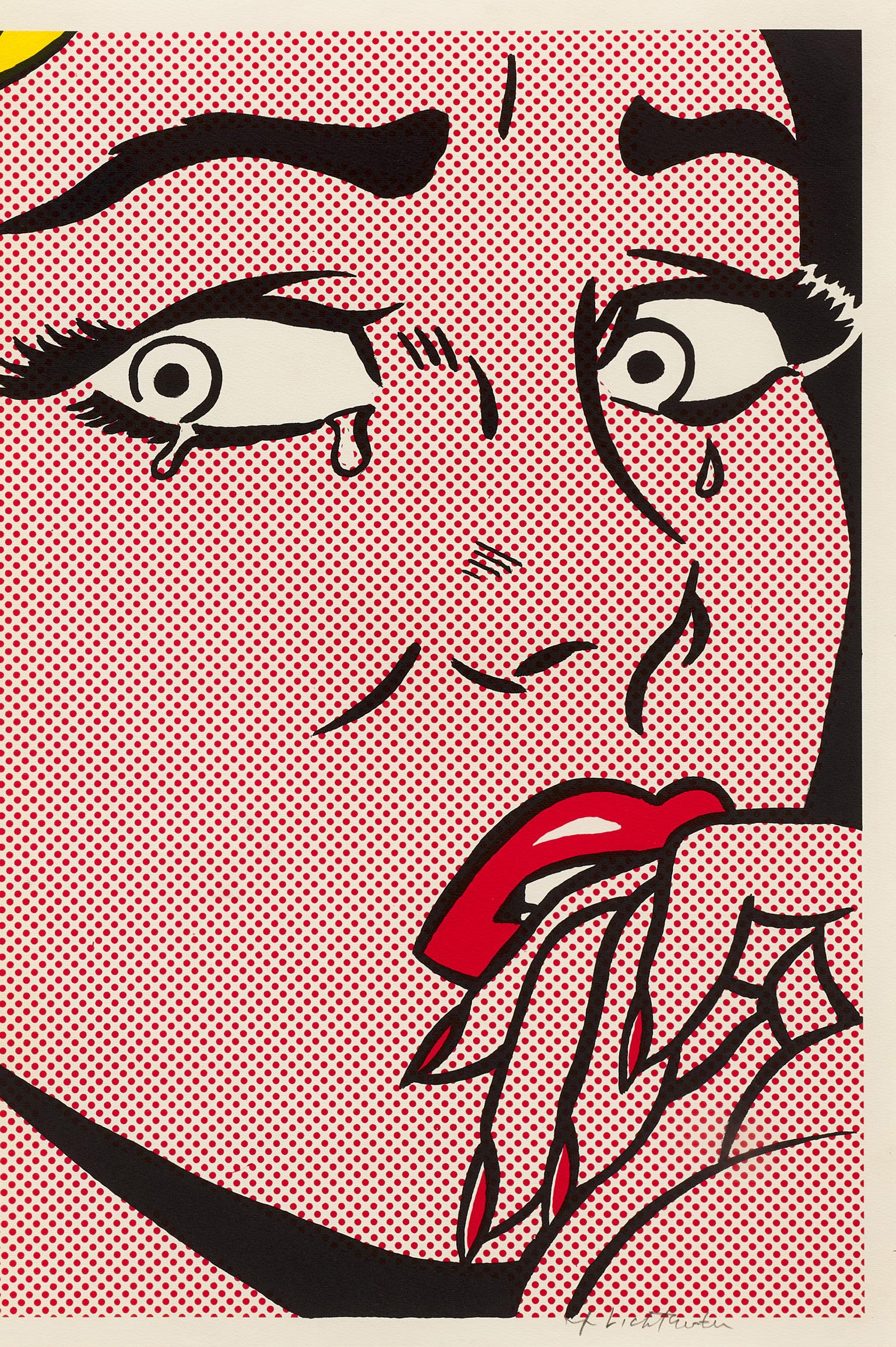
Crying Girl, 1963
Offset lithograph
Sheet size: 18 1/4 x 24 1/8 inches (46.4 x 61.3 centimeters)
Printer: Colorcraft, New York
Publisher: Leo Castelli Gallery, New York
Edition size: Approximately 300
Catalogue Raisonné: Corlett II.1, RLCR 759
Signed
Provenance:
Alfred H. Barr Jr.
By descent to his daughter, Victoria Barr, New York
Roy Lichtenstein
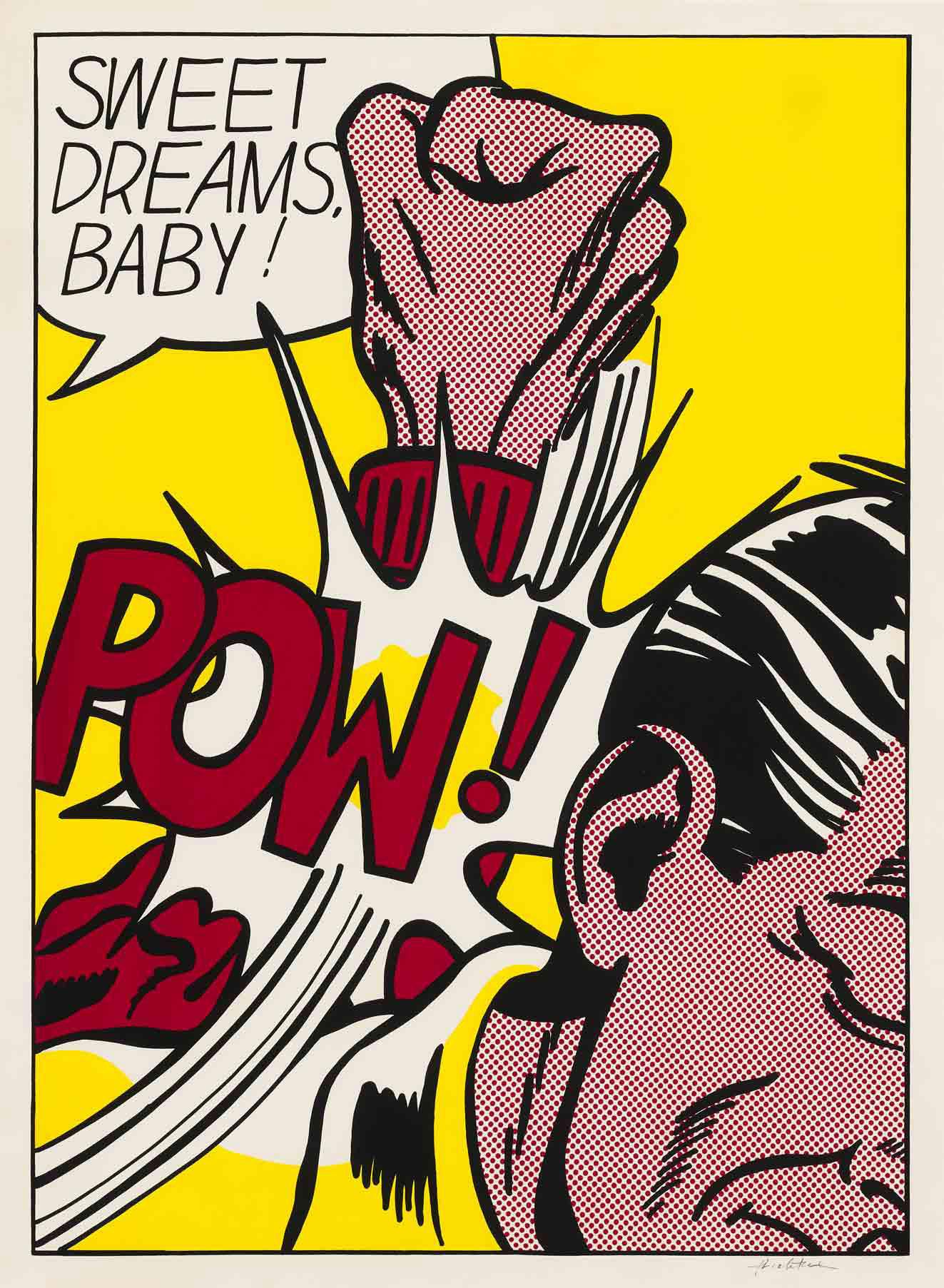
Sweet Dreams, Baby!, 1965
Screenprint
Sheet size: 37 5/8 x 27 5/8 inches
(95.6 x 70.2 centimeters)
Printer: Knickerbocker Machine and Foundry Inc., New York
Publisher: Original Editions, New York
Edition size: 200, plus proofs
Catalogue Raisonné: Corlett 39, RLCR 1172
Signed and numbered
Provenance:
Galerie Ileana Sonnabend, Paris
Purchased directly from the above at the time of publication By descent to the previous owner
From the portfolio 11 Pop Artists III, Volume II, which also includes prints by Allan d’Arcangelo, Jim Dine, Allen Jones, Gerald Laing, Peter Phillips, Mel Ramos, James Rosenquist, Andy Warhol, John Wesley, and Tom Wesselmann.
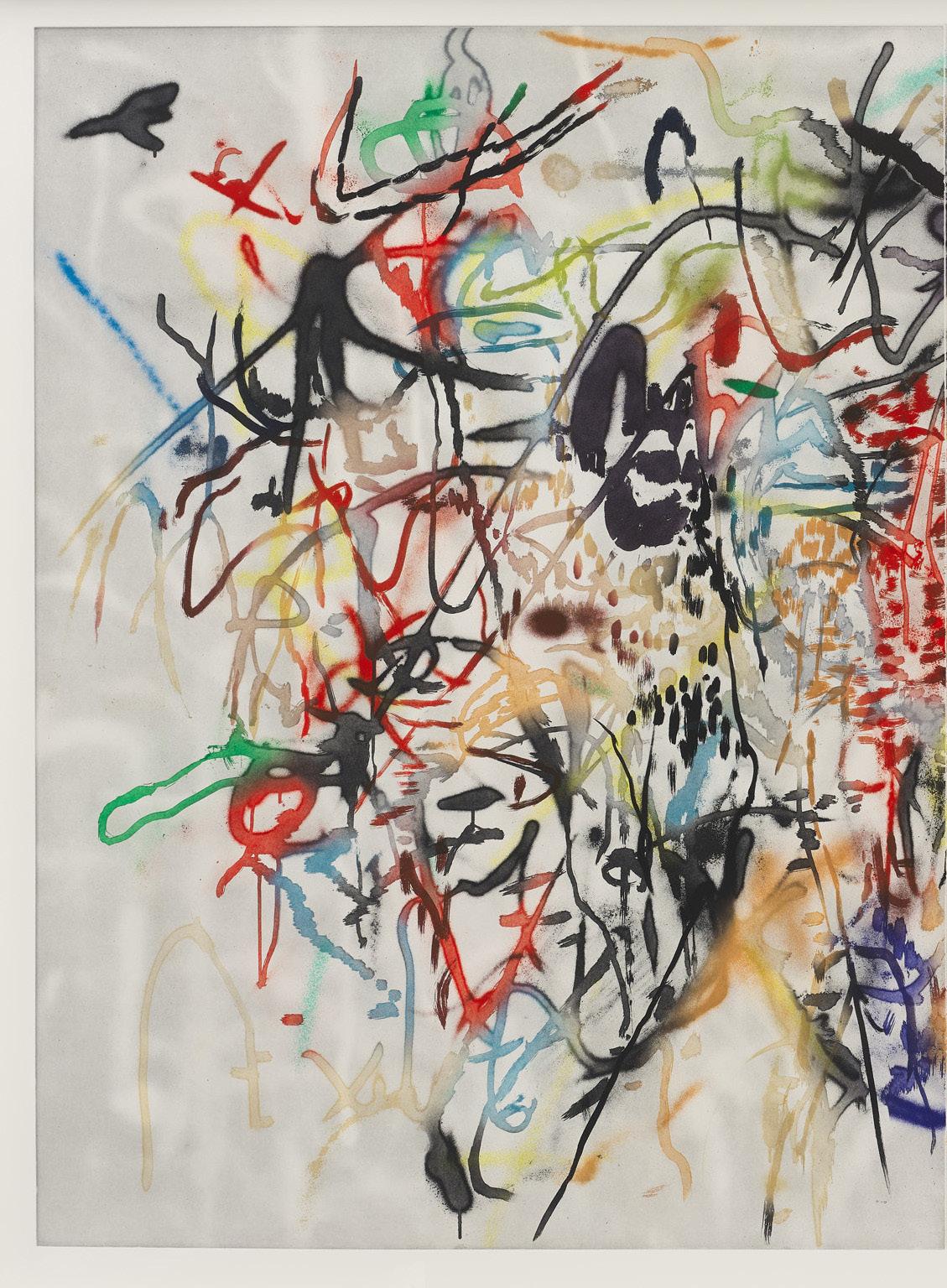
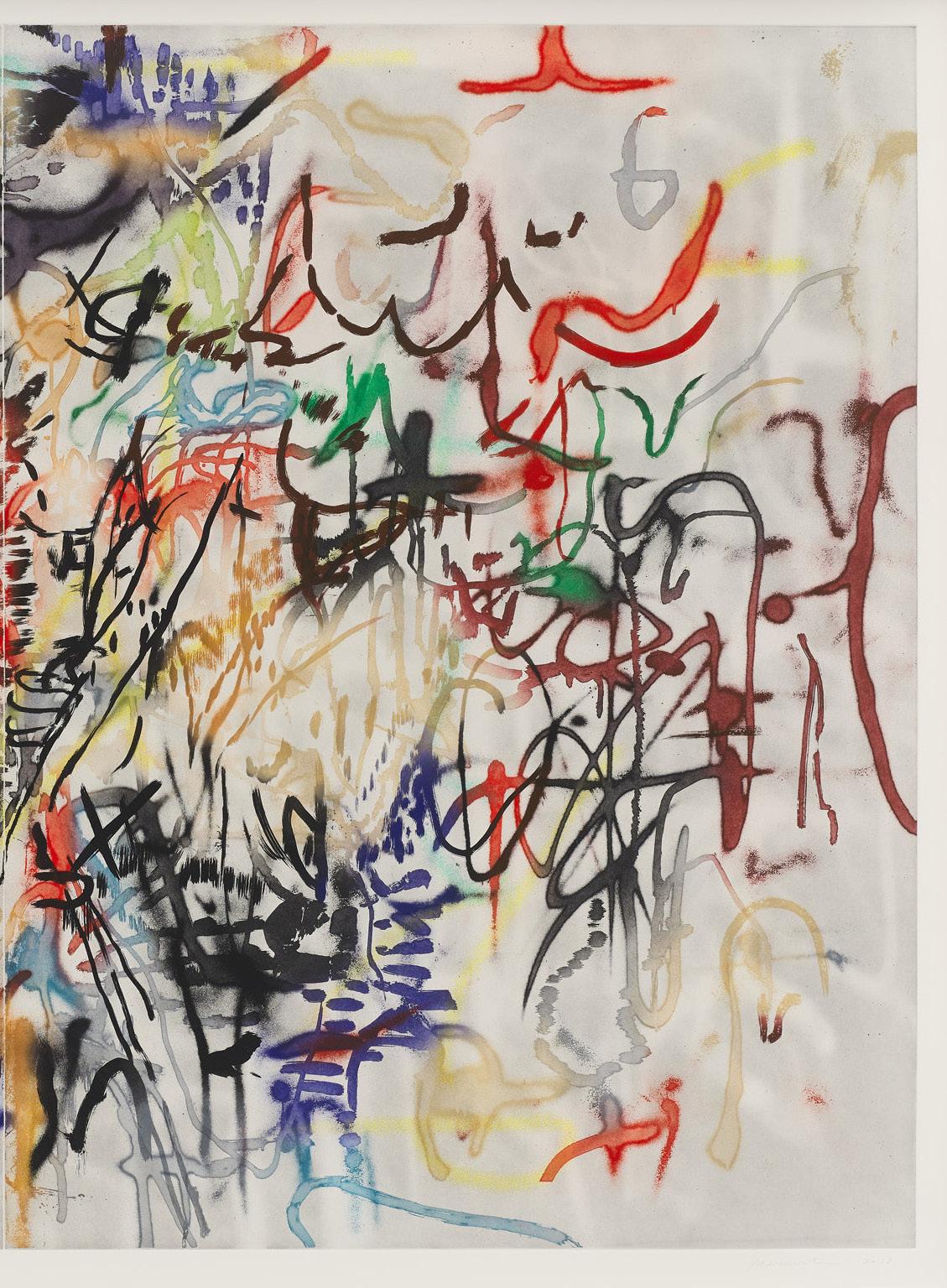
Six Bardos: Hymn (Behind the Sun), 2018
Sheet size: 50 3/8 x 73 1/4 inches (128 x 186 centimeters)
Printer and Publisher: Gemini G.E.L., Los Angeles
Edition size: 45, plus proofs Signed, dated, and numbered
Julie Mehretu
Aquatint
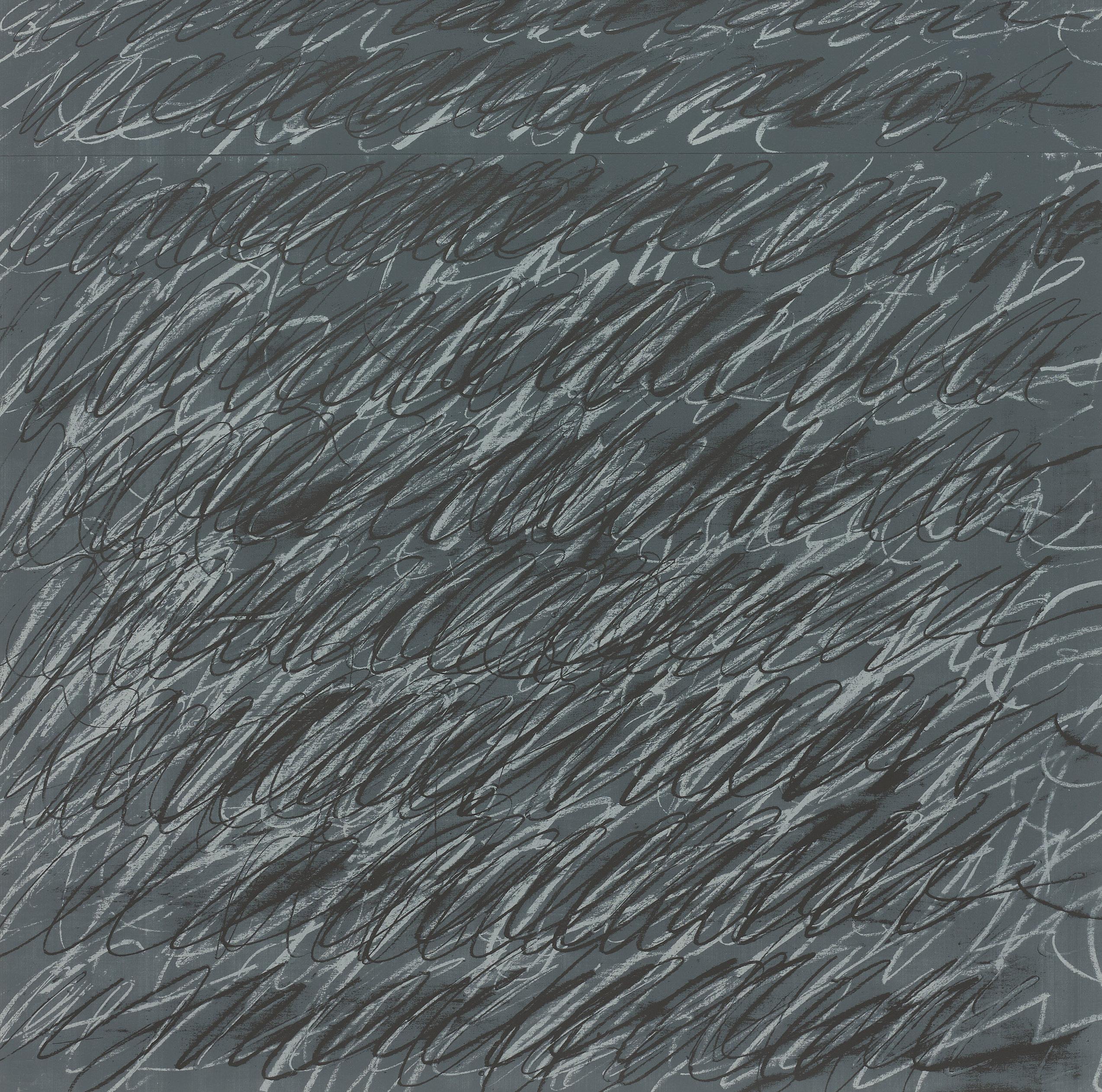
Cy Twombly
Untitled, 1969-71
Screenprint
Sheet size: 25 1/2 x 25 1/2 inches (64.8 x 64.8 centimeters)
Printer and Publisher: Edition Domberger, Filderstadt, Germany
Edition size: 100, plus proofs
Catalogue Raisonné: Bastian 27
Signed and numbered on verso
From the portfolio On the Bowery, edited by William Katz, which also includes screenprints by John Giorno, Charles Hinman, Robert Indiana, Will Insley, Gerald Laing, Les Levine, Robert Ryman, Richard Smith, and John Willenbecher.
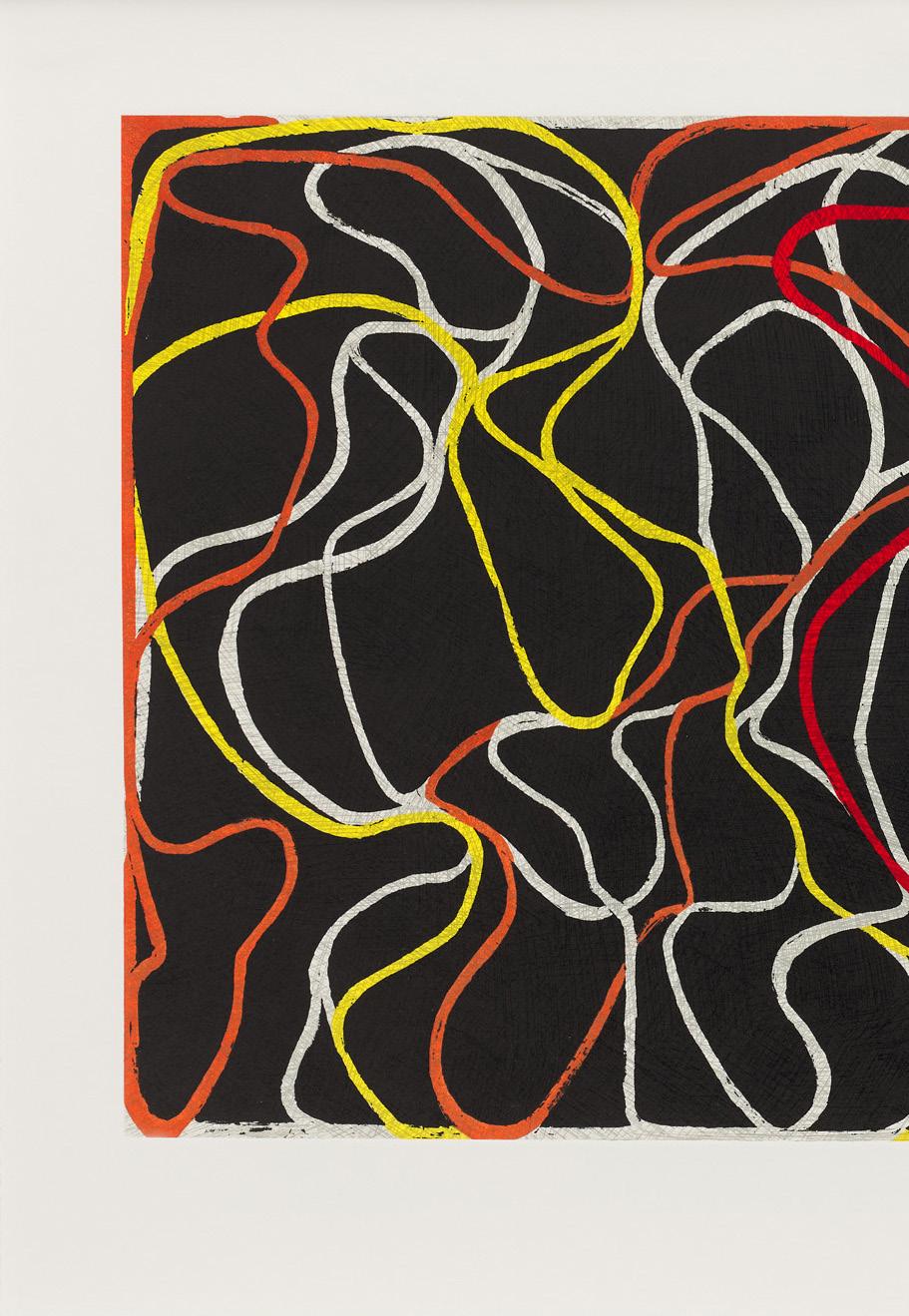
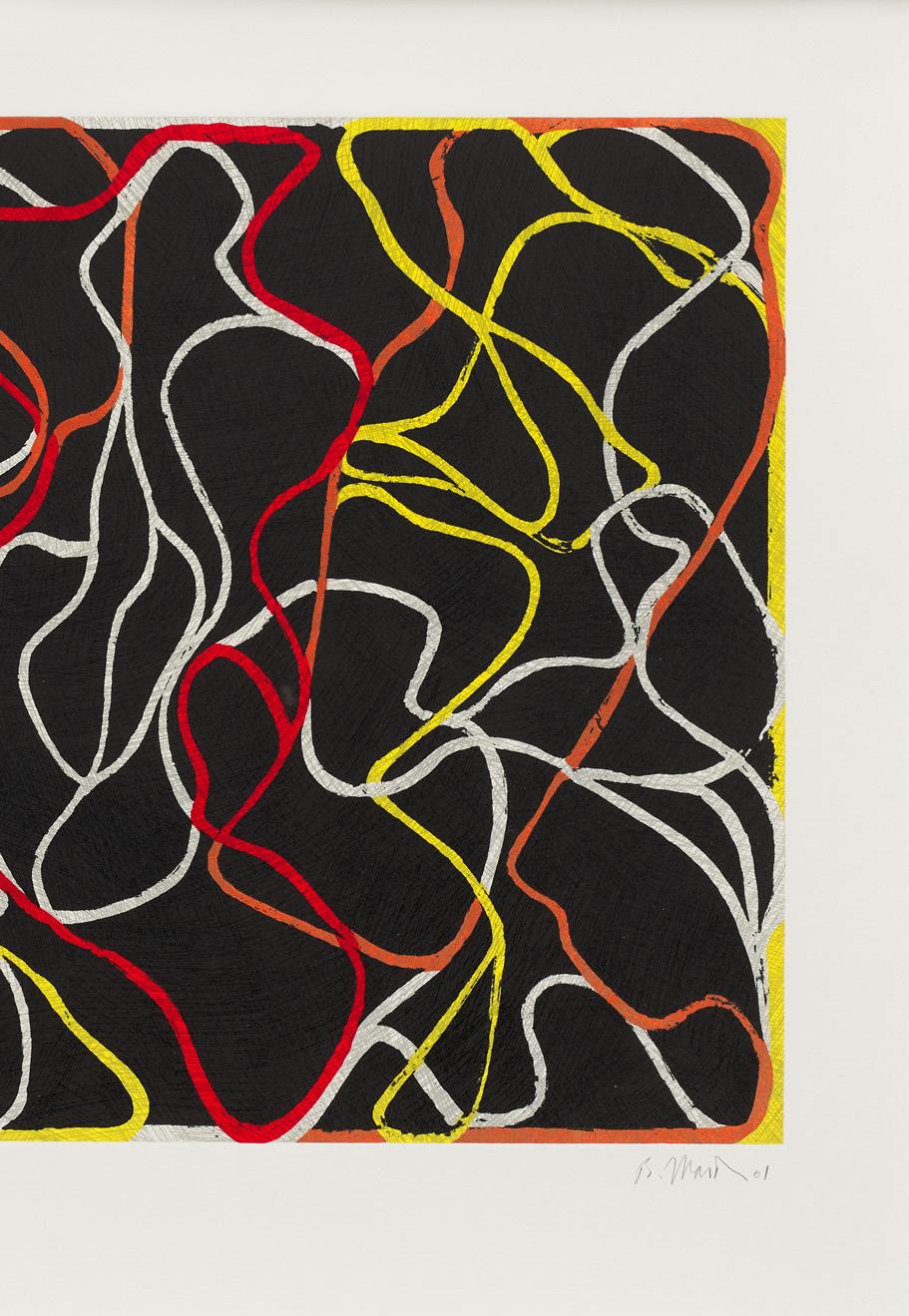
Brice Marden
Beyond Eagles Mere 2, 2001
Etching and lithograph
Sheet size: 22 x 30 1/8 inches (55.9 x 76.5 centimeters)
Printer and Publisher: Gemini, G.E.L., Los Angeles
Edition size: 45, plus proofs
Signed, dated, and numbered
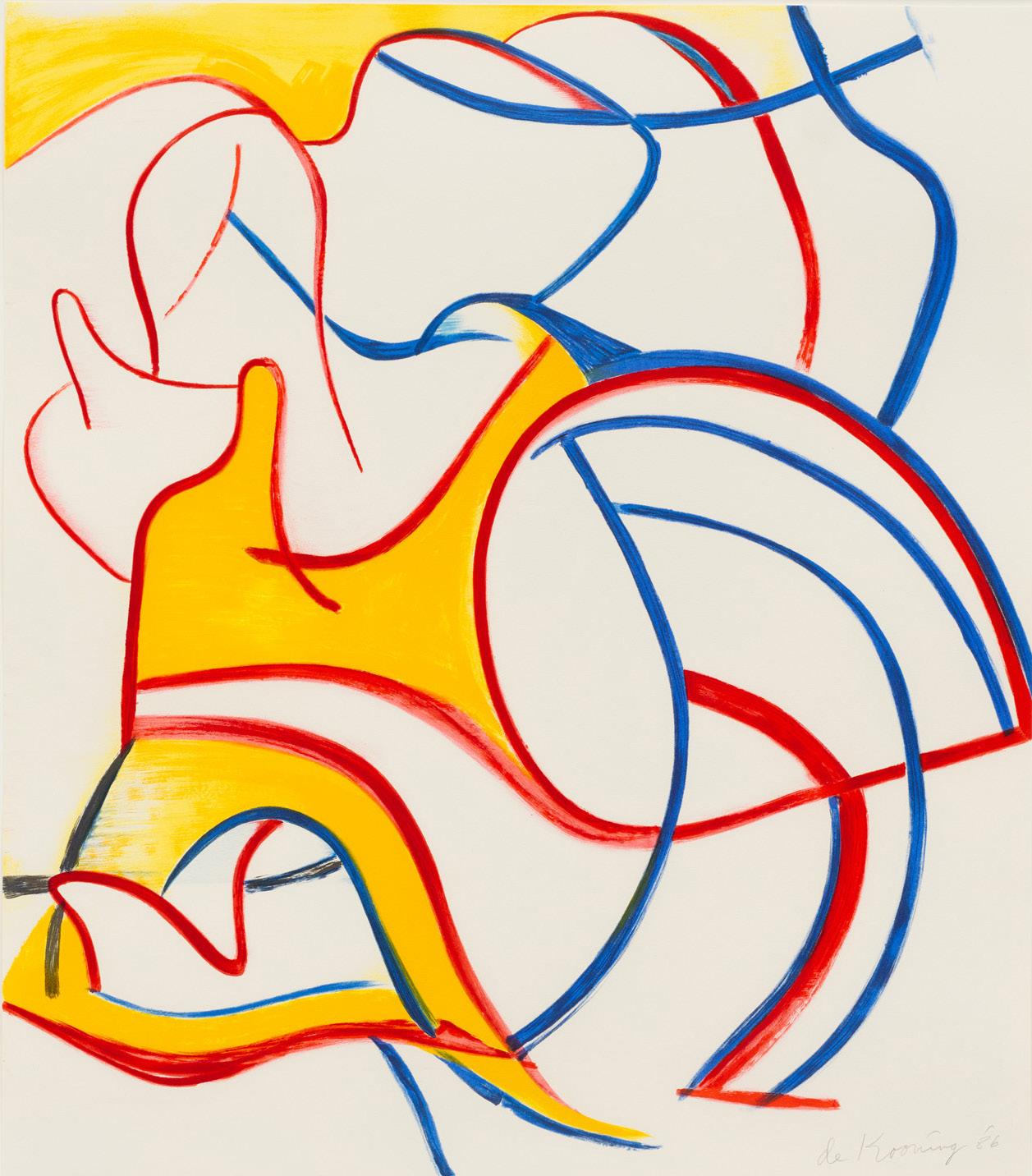
Willem de Kooning
Untitled (from the Quatre Lithographies series), 1986
Lithograph
Sheet size: 28 1/4 x 24 5/8 inches (71.8 x 62.6 centimeters)
Printer: Art Estampe, Paris
Publisher: Éditions de la Différence, Paris
Edition size: 100, plus proofs
Signed, dated, and numbered
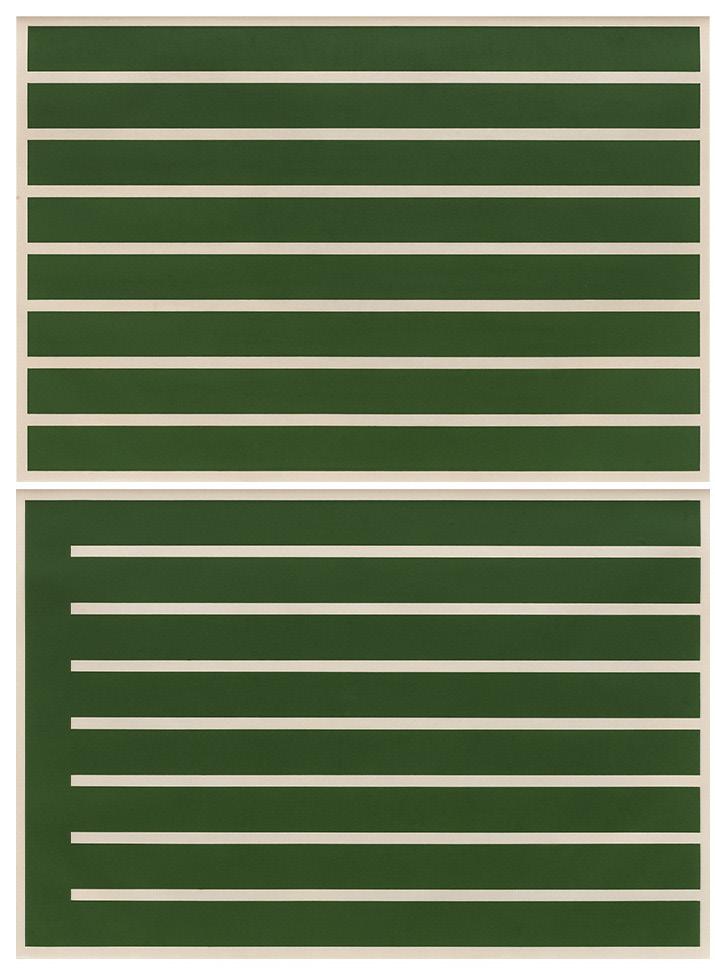
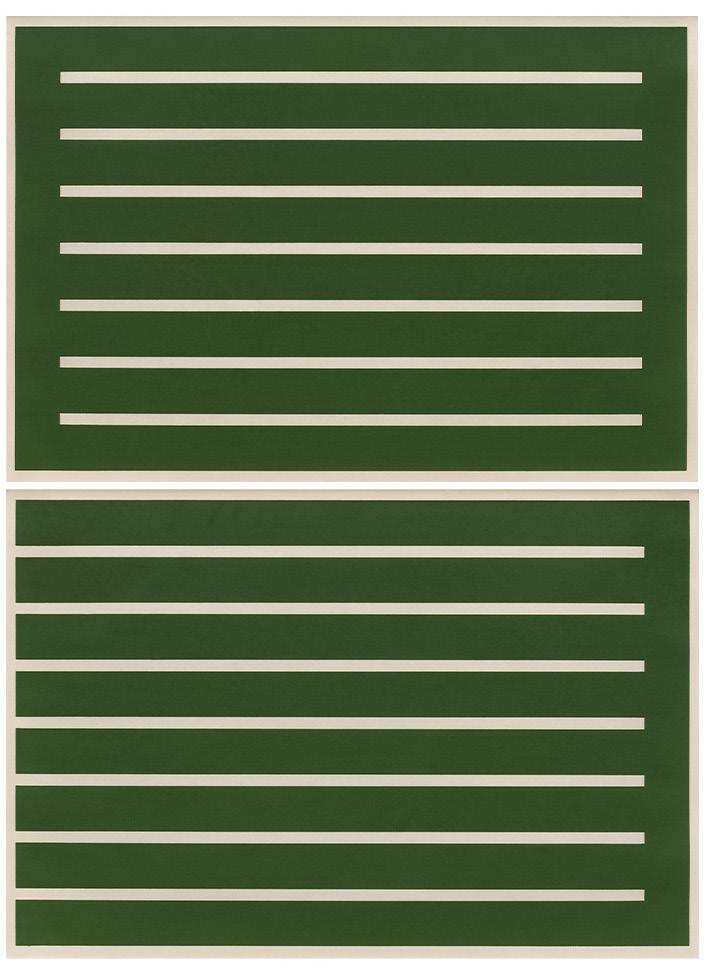
Untitled, 1992 Woodcuts
Sheet size: 26 3/8 x 39 inches, each (67 x 99.1 centimeters, each)
Printer: Derrière l’Etoile Studios, New York
Publisher: Brooke Alexander Editions, New York
Edition size: 25, plus proofs
Catalogue Raisonné: Schellmann 211-214
Each print is signed and numbered on verso
The complete set of four woodcuts
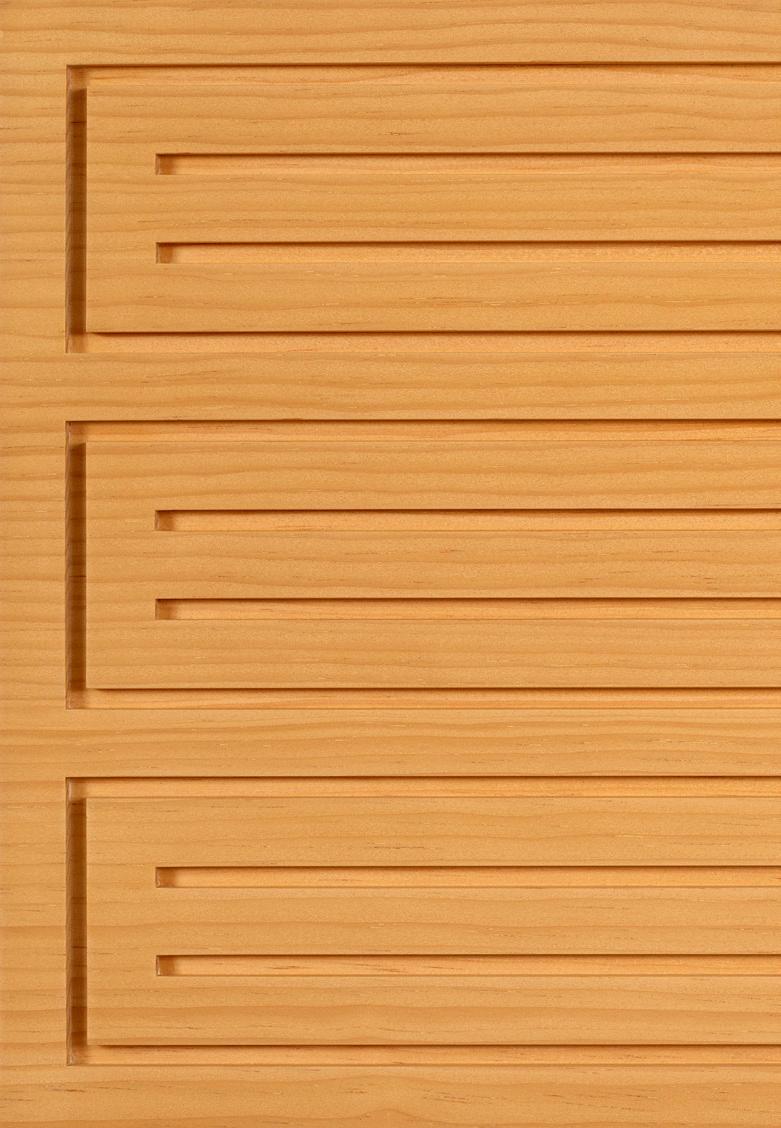
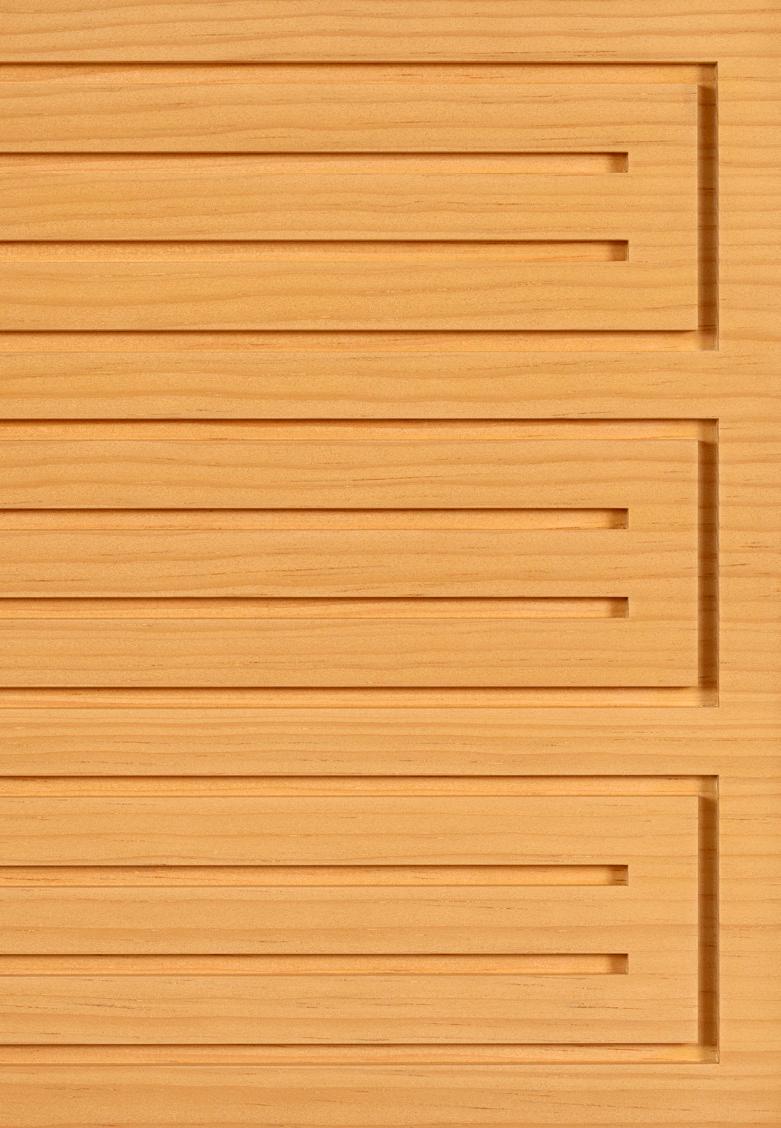
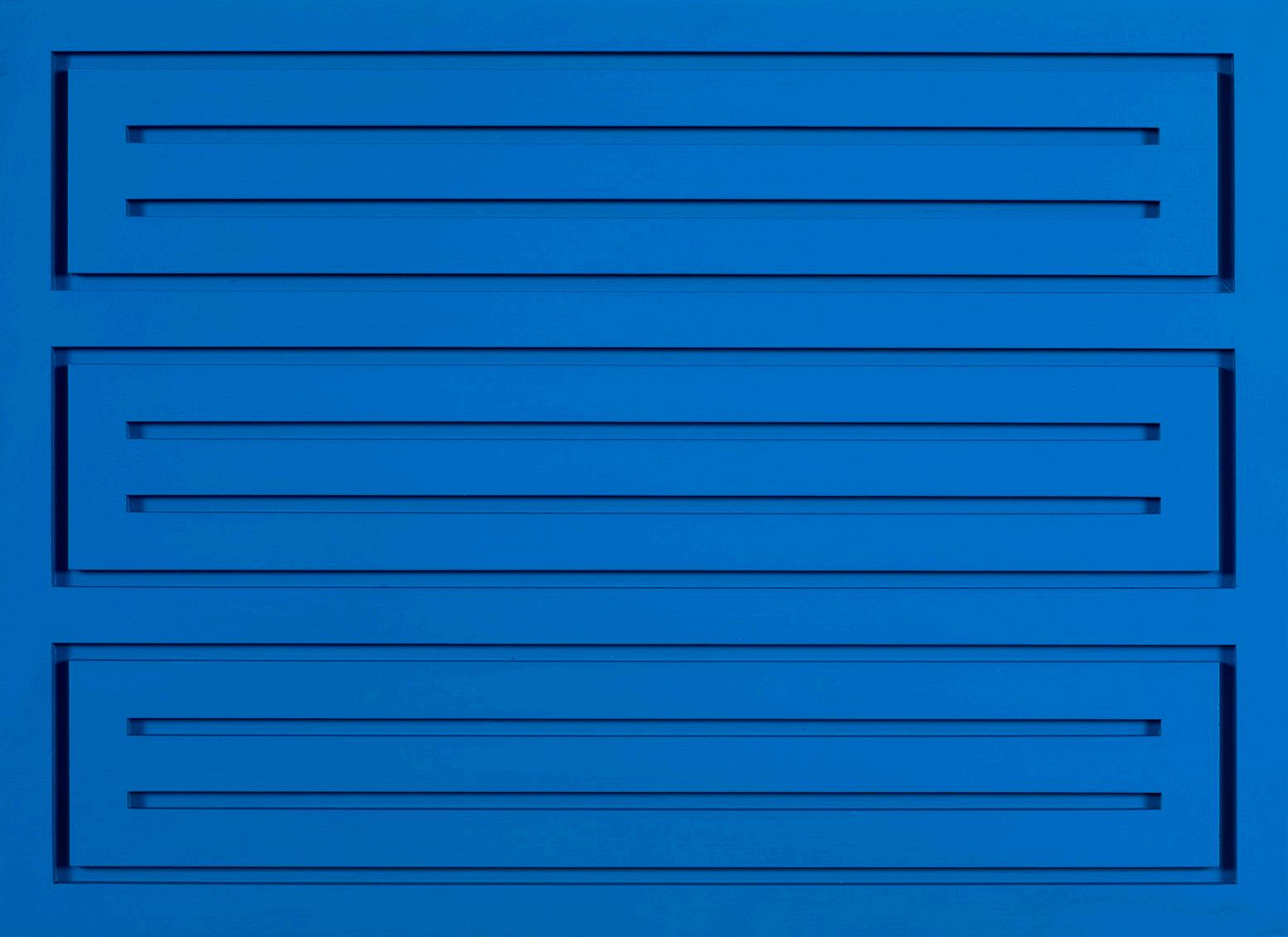
Donald Judd
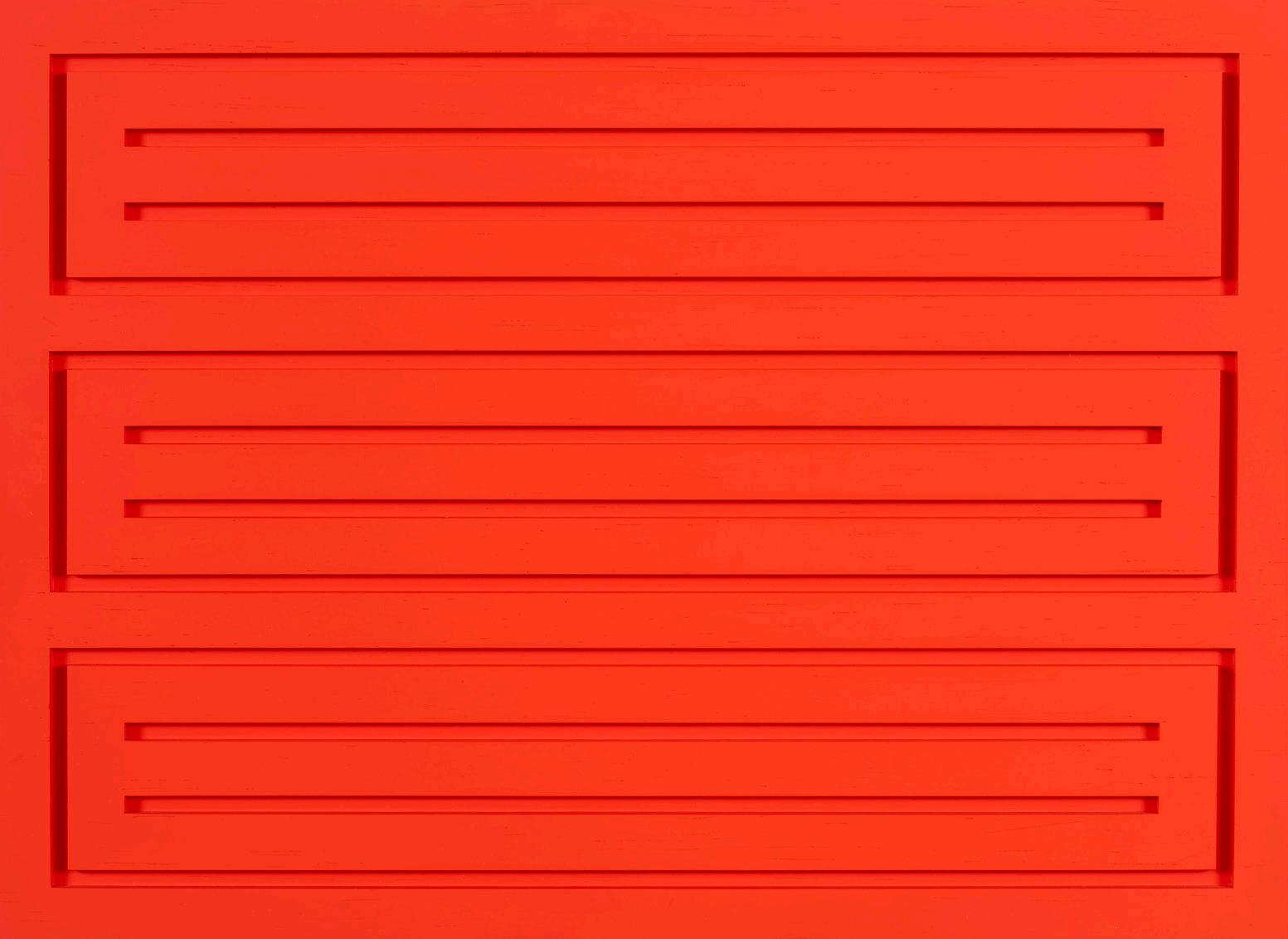
Donald Judd
Untitled, 1991
Woodblocks
Size: 14 3/8 x 19 5/8 x 2 inches, each
(36.5 x 49.9 x 5.1 centimeters, each)
Fabricator: Jim Cooper, New York
Publisher: Peder Bonnier, New York
Edition size: 20, plus proofs
Catalogue Raisonné: Schellmann 14-16
Each woodblock is signed ‘Judd’ by the artist, verso
Stamp-signed ‘JUDD,’ numbered, and dated, verso
The complete set of three woodblocks that retains its original three wooden boxes fabricated by Jim Cooper. Each box is stamped with the corresponding edition number.
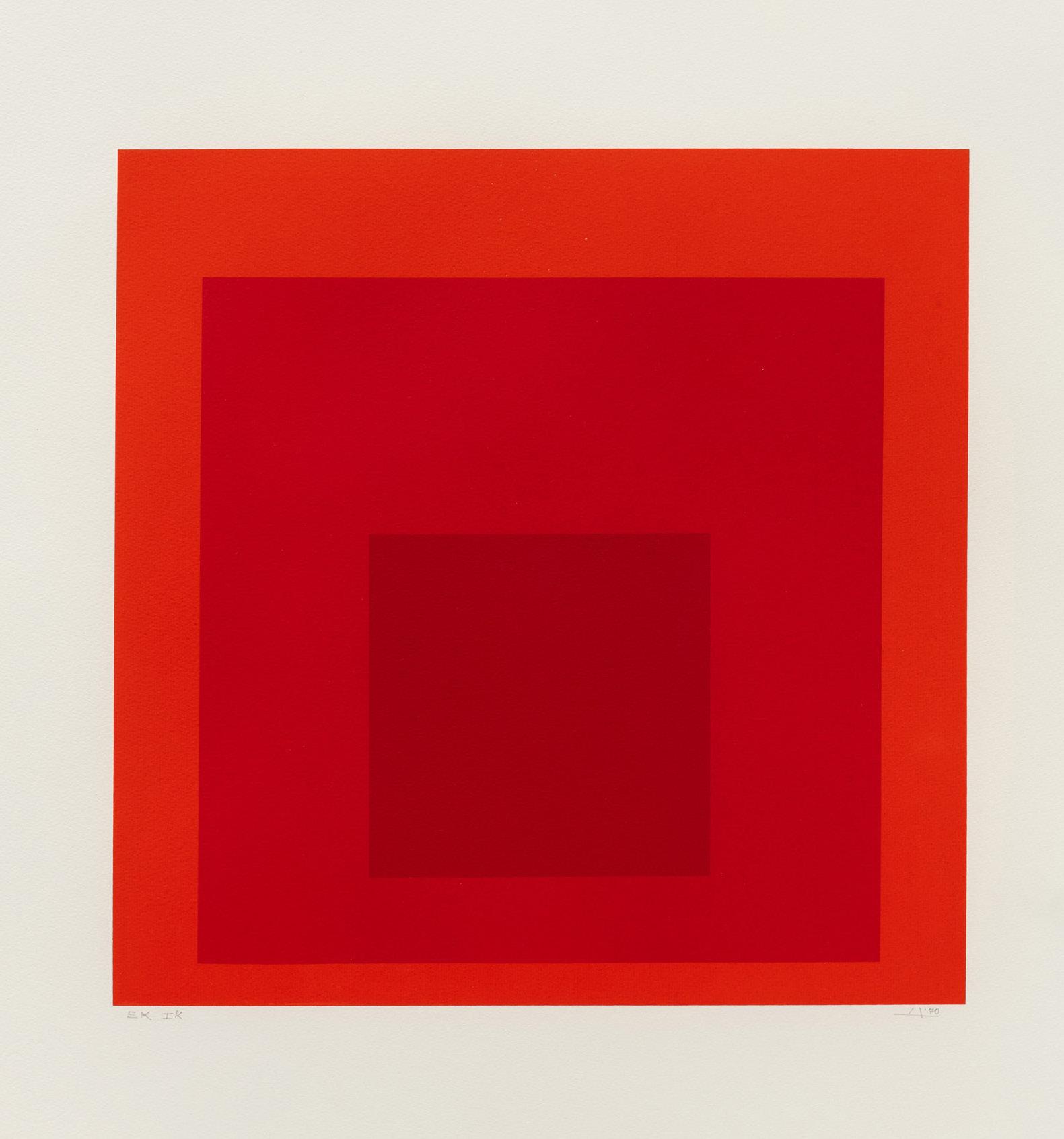
Homage to the Square: Edition Keller Ik, 1970
Screenprint
Sheet size: 21 1/2 x 21 1/2 inches (54.6 x 54.6 centimeters)
Printer: Herbert Geier, Ingolstadt, Germany
Publisher: Josef Keller Verlag, Starnberg, Germany
Edition size: 125
Catalogue Raisonné: Danilowitz 203.10
Initialed, dated, numbered, and titled
Josef Albers
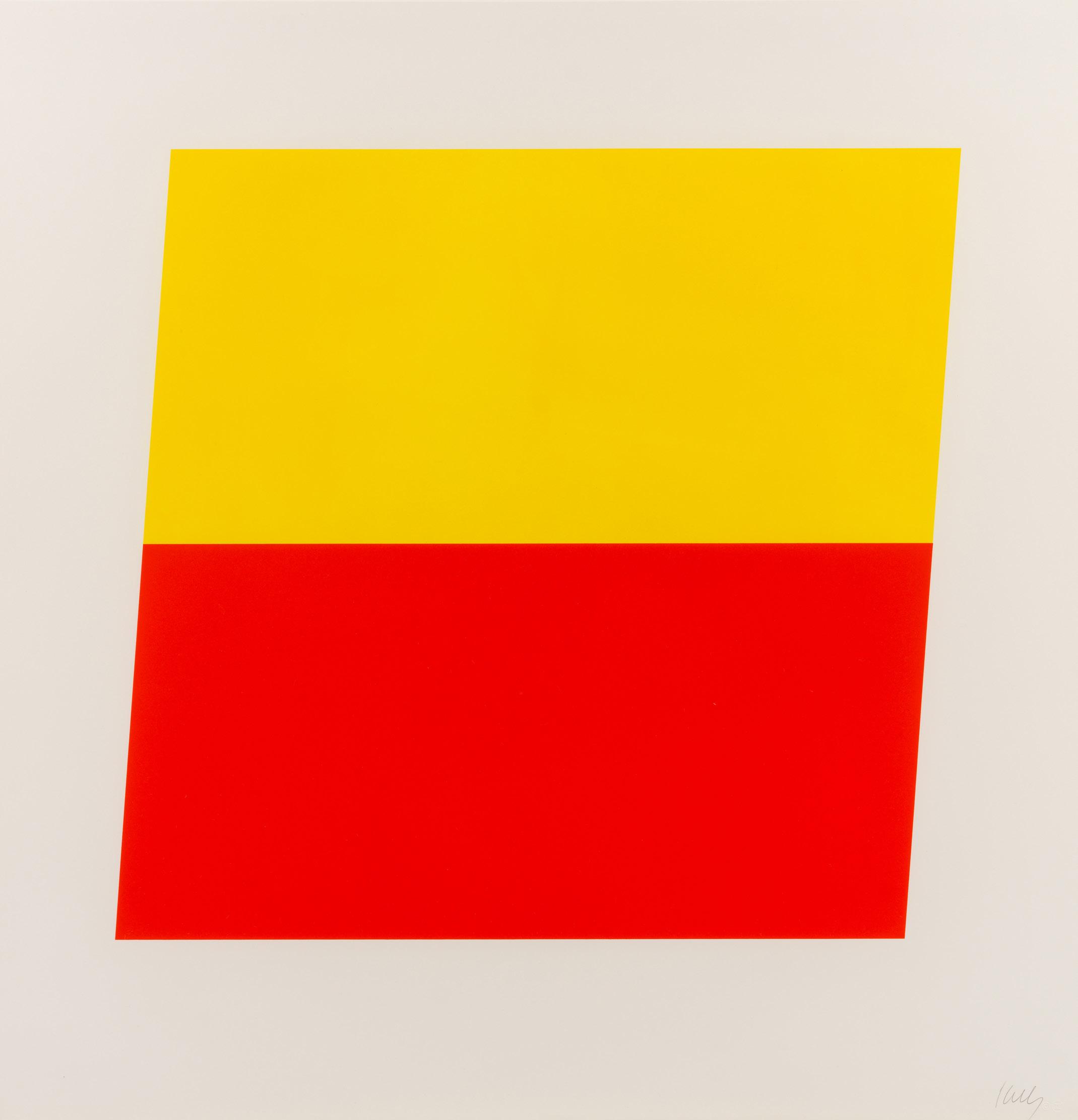
Ellsworth Kelly
Yellow Red-Orange, 1970
Lithograph
Sheet size: 35 1/4 x 36 1/4 inches
(89.5 x 92.1 centimeters)
Printer and Publisher: Gemini G.E.L., Los Angeles
Edition size: 75, plus proofs
Catalogue Raisonné: Axsom 66
Signed and numbered
Provenance:
The Estate of Ellsworth Kelly
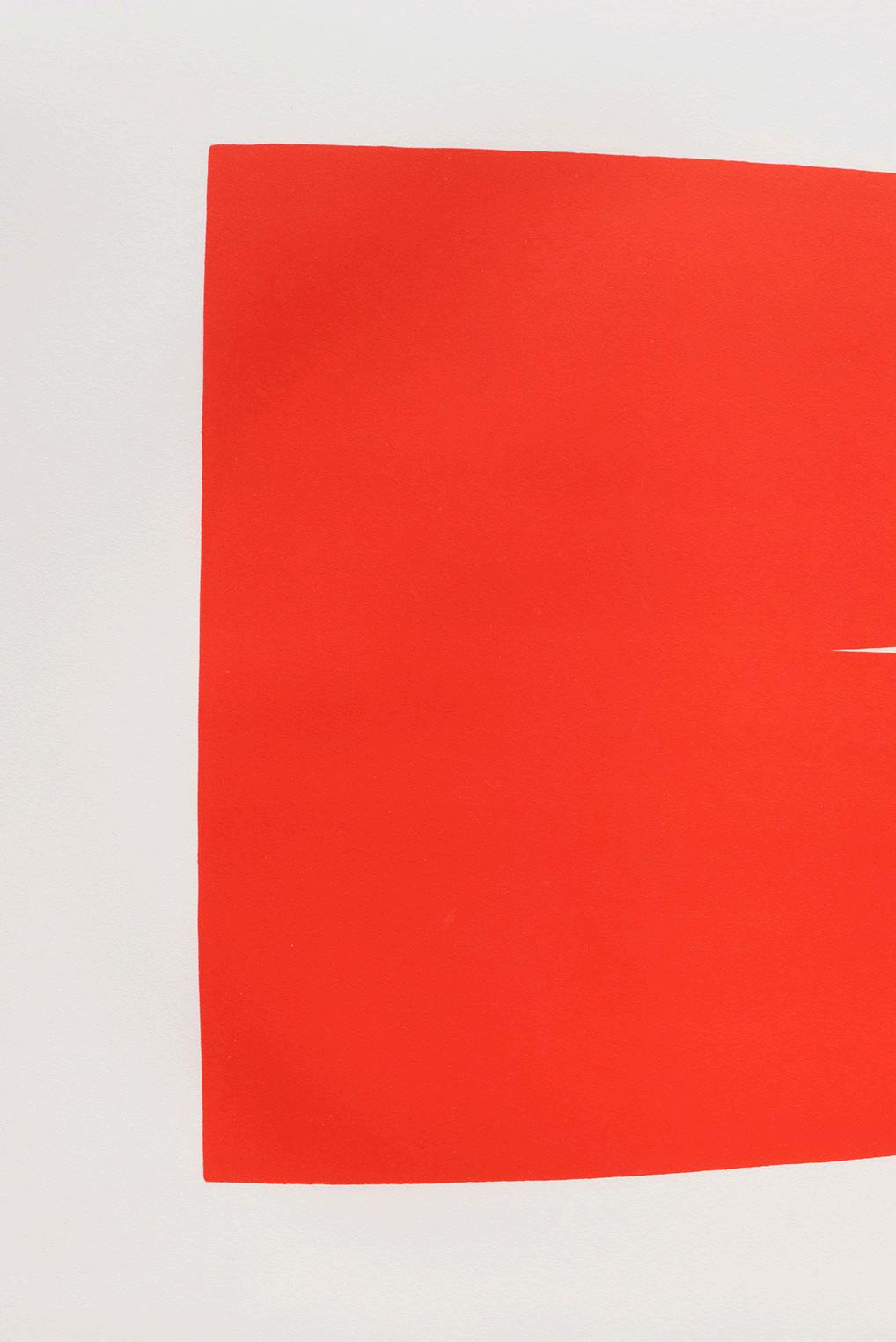
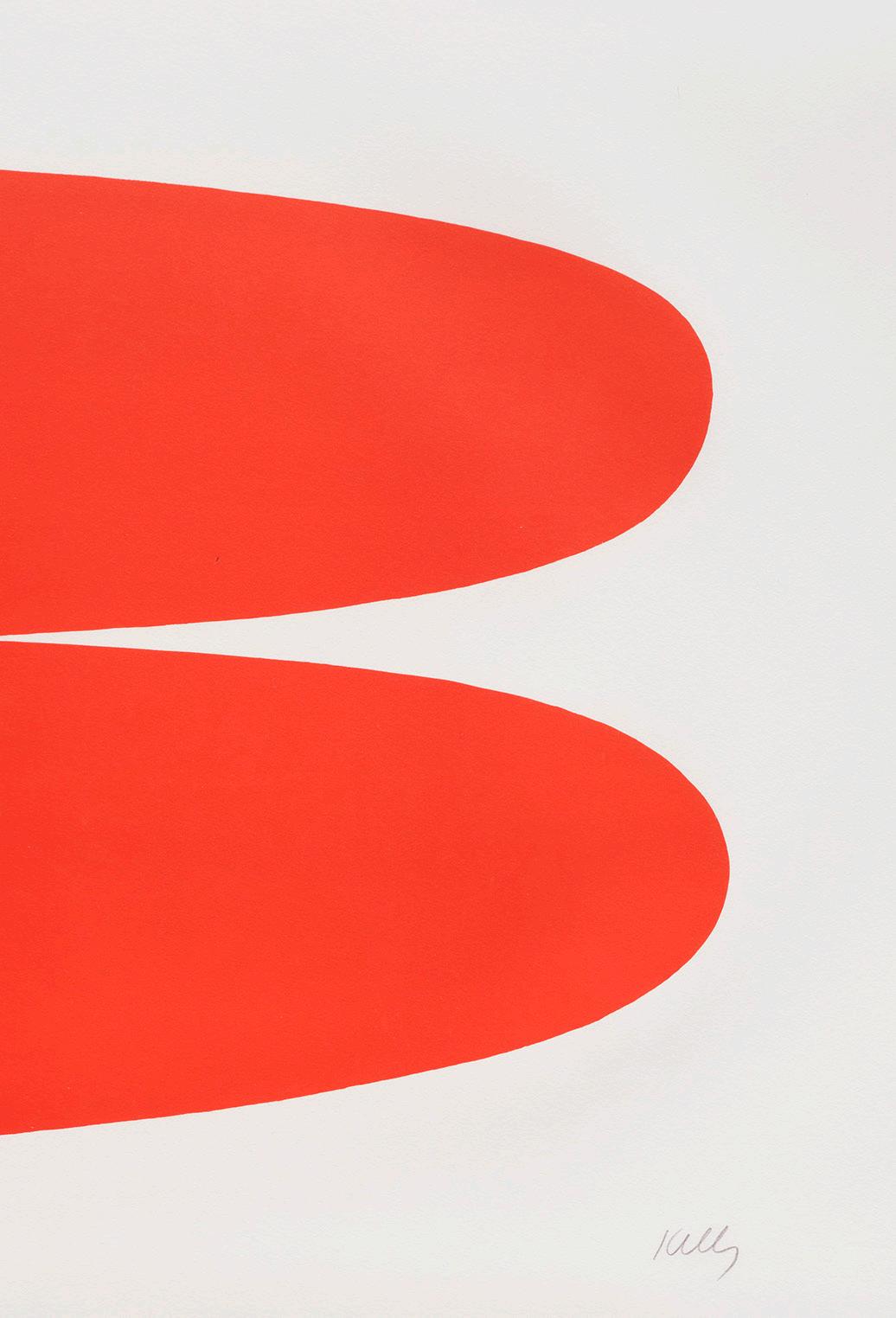
Ellsworth Kelly
Red-Orange, 1964-65
Lithograph
Sheet size: 23 5/8 x 35 1/4 inches
(60 x 89.5 centimeters)
Printer: Imprimerie Maeght, Levallois-Perret, France
Publisher: Maeght Editeur, Paris
Edition size: 75, plus proofs
Catalogue Raisonné: Axsom 6
Signed and numbered
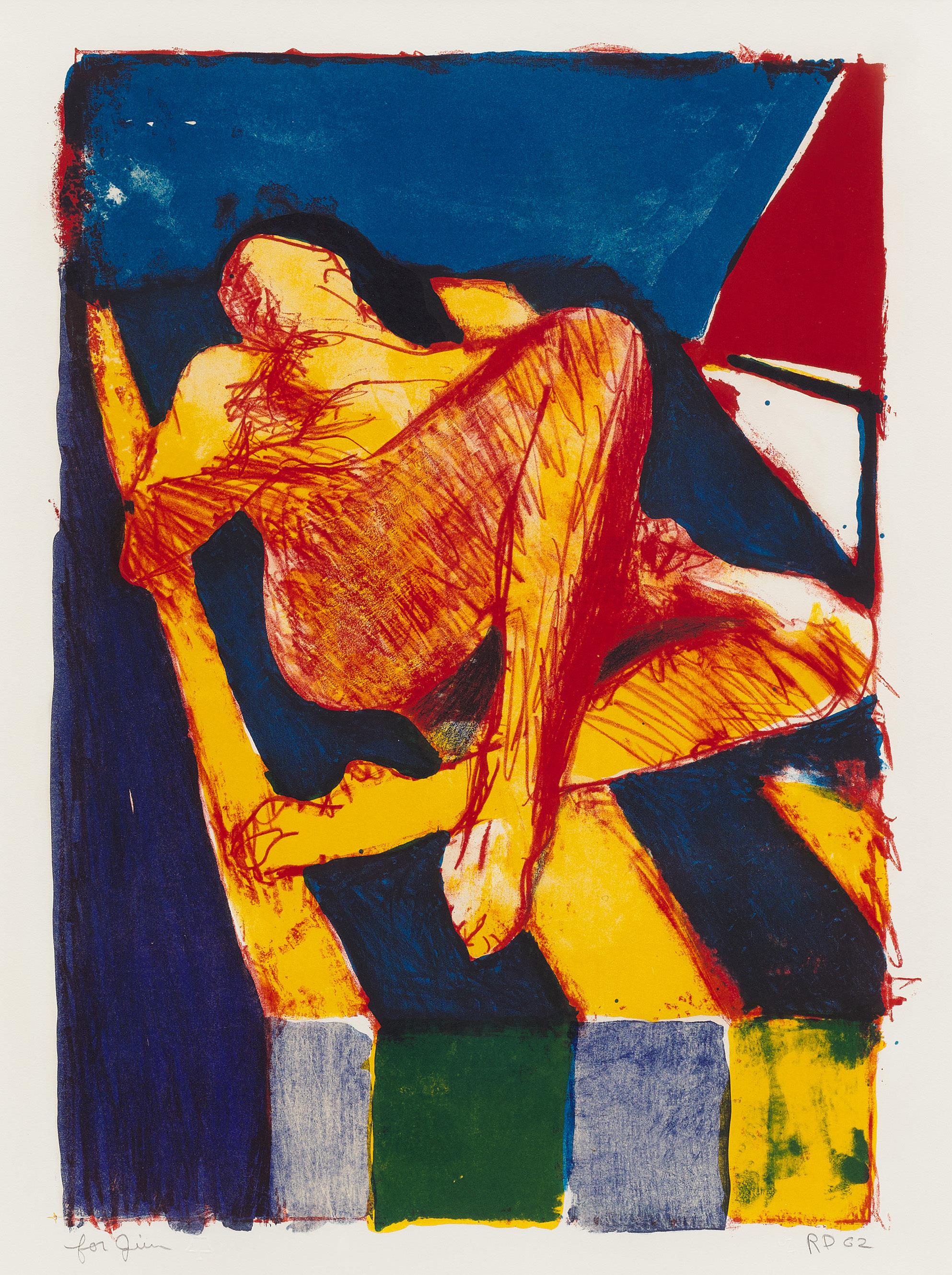
Richard Diebenkorn
Reclining Figure II, 1962
Lithograph
Sheet size: 26 x 19 5/8 inches (66 x 49.9 centimeters)
Printer and Publisher: Tamarind Lithography Workshop, Los Angeles
Edition size: 20, plus proofs
Catalogue Raisonné: Liguori 153
Signed, dated, and inscribed
Provenance:
The Collection of Jim Demetrion
Jim Demetrion (1930 - 2020) was the former director of the Hirshhorn Museum and Sculpture Garden, Washington D.C., (1984 - 2001), the Des Moines Art Center (1969 - 1984), and the Pasadena Art Museum (1964 - 1966).
Richard Diebenkorn
Touched Red, 1991
Etching, aquatint, and drypoint
Sheet size: 35 5/8 x 26 3/8 inches (90.5 x 67 centimeters)
Printer and Publisher: Crown Point Press, San Francisco
Edition size: 85, plus proofs
Catalogue Raisonné: Liguori 341
Initialed, dated, and numbered
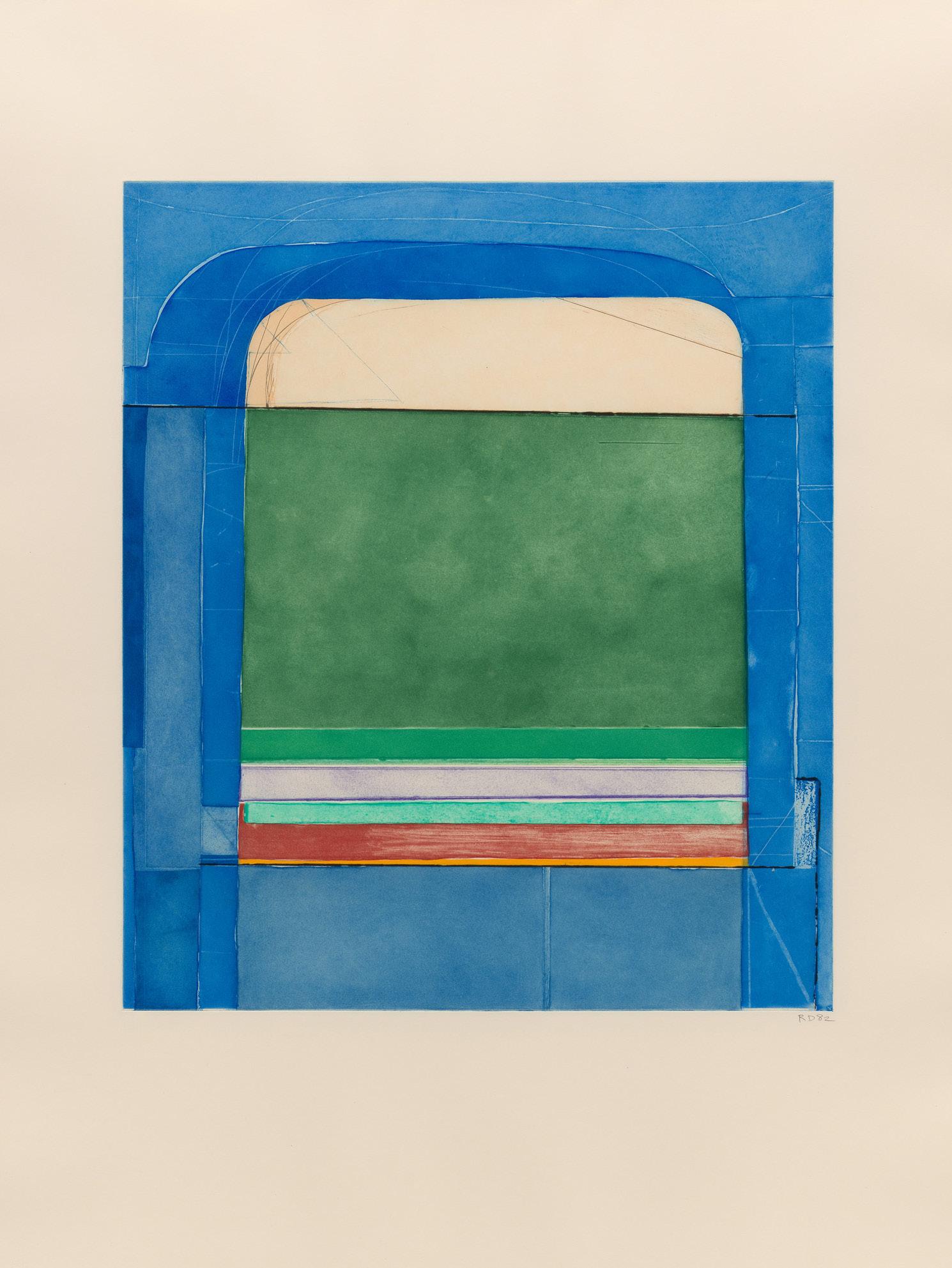
Richard Diebenkorn
Blue Surround, 1982
Aquatint with etching and drypoint
Sheet size: 35 x 26 1/2 inches (88.9 x 67.3 centimeters)
Printer and Publisher: Crown Point Press, San Francisco