Metro
CAGAYANLifestyle TIMES Weekly DE ORO
Volume 8 | No. 46 | Cagayan de Oro City | June 28 - July 4, 2021
Because a picture paints a thousand w ords:
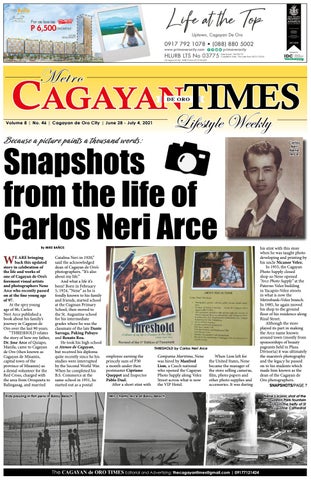
Snapshots from the life of Carlos Neri Arce By MIKE BAÑOS
W
E ARE bringing back this updated story in celebration of the life and works of one of Cagayan de Oro’s foremost visual artists and photographers Nene Arce who recently passed on at the fine young age of 97. At the spry young age of 86, Carlos Neri Arce published a book about his family’s journey in Cagayan de Oro over the last 90 years. “THRESHOLD relates the story of how my father, Dr. Jose Arce of Quiapo, Manila, came to Cagayan de Oro (then known as Cagayan de Misamis, capital town of the province of Misamis) as a dental volunteer for the Red Cross, charged with the area from Oroquieta to Balingasag, and married
Catalina Neri in 1920,” said the acknowledged dean of Cagayan de Oro’s photographers. “It’s also about my life.” And what a life it’s been! Born in February 5, 1924, “Nene” as he is fondly known to his family and friends, started school at the Cugman Primary School, then moved to the St. Augustine school for his intermediate grades where he was the classmate of the late Dante Sarraga, Paking Pabayo and Renato Roa. He took his high school at Ateneo de Cagayan, but received his diploma quite recently since he his studies were interrupted by the Second World War. When he completed his B.S. Commerce at the same school in 1951, he started out as a postal
Kids playing in fish pens in Baloy Beach
THRESHOLD by Carlos Neri Arce
employee earning the princely sum of P30 a month under then postmaster Cipriano Queppet and Inspector Pablo Dael. After a short stint with
Compania Maritima, Nene was hired by Manfred Lion, a Czech national who opened the Cagayan Photo Supply along Velez Street across what is now the VIP Hotel.
When Lion left for the United States, Nene became the manager of the store selling cameras, film, photo papers and other photo supplies and accessories. It was during
Mrs Charito Arce at Baloy Beach
The CAGAYAN de ORO TIMES Editorial and Advertising: thecagayantimes@gmail.com | 09177121424
Carlos Neri Nene Arce
his stint with this store when he was taught photo developing and printing by his uncle Nicanor Velez. In 1955, the Cagayan Photo Supply closed shop so Nene opened “Arce Photo Supply” at the Paterno Velez building in Yacapin-Velez streets in what is now the Metrobank-Velez branch. In 1985, he again moved his shop to the ground floor of his residence along Rizal Street. Although the store played its part in making the Arce name known around town (mostly from sponsorships of beauty pageants held in Plaza Divisoria) it was ultimately the maestro’s photography and the legacy he passed on to his students which made him known as the dean of the Cagayan de Oro photographers. SNAPSHOTS/PAGE 7 Nene’s iconic shot of the Gaston Park fountain shot from the belfy of St Augustine Cathedral
2
Metro
CAGAYANTIMES Lifestyle Weekly DE ORO
June 28 - July 4, 2021
URC Cavite Plant Employees
URC weathers challenging times with people-first approach UNIVERSAL Robina Corporation (URC) has weathered a very difficult year by putting its employees on top of its priorities. “We left no stone unturned in our efforts to help and guide our employees in the transition to the so-called new normal,” said Lisa Abalajon, URC’s
Chief Human Resources Officer. The company has adjusted ensure all its workers are safe and still productive, whether they are working from home or on site. This has allowed URC, one of the Philippines’
Metro
CAGAYANTIMES Lifestyle Weekly DE ORO
CAGAYAN TIMES/Sudaria Group of Companies Publisher MIKE BAÑOS Editor-in-Chief SUSAN P. DENNIS GEAN T. CESAR RANDY FAMACION MAI MAI SISON KLAUS DORING ANNIE GORRA RAGO WENDY RAMOS-GARCIA Contributing Editors
largest food and beverage firms, to overcome headwinds caused by the COVID-19 pandemic. It reported a 15 percent growth in net income to P11.6 billion last year from 2019. Abalajon said URC already had guidelines in place on employee safety and health as early as February last year, a full month before the World Health Organization declared a global pandemic. These measures included working from home. Some URC staff were allowed to work flexibly anywhere, at any time, for one day a week. When the government announced a sweeping lockdown in March last year, the scheme became a five-day, work-from-home
arrangement. “In the months since the remote work system was implemented, it’s been proven that URC employees remain highly productive,” said Abalajon. She added that the company is now considering keeping this arrangement post-pandemic. URC gave temporary lodging for some 600 employees who had to be on site, including machine operators, technicians and other skilled workers. “Apart from easing the workers’ burden of commuting between their homes and URC’s plants, it also provided them an extra layer of safety as their outside exposure to the virus was minimized,” said Abalajon. For those who had to
travel daily, URC provided around 100 free shuttle services. The focus on implanting safety guidelines and proper hygiene as a means to prevent COVID-19 was emphasized and communicated early on to the employees. Each one received a hygiene kit containing face masks, a face shield, alcohol and packs of Vitamin C. When face shields were not yet commonly available, one of URC’s factories was converted into facility that produced face shields, which were handed out to employees and frontliners. “Human resources noticed that employees seem to be working even harder than usual during this pandemic,” said Abalajon.
URC has also rolled out programs that allow its workforce to retain office bonds even while working remotely, and to cope with pandemic-related stresses. It set up URCircle, a private Facebook group where employees can keep a tab on each other and to celebrate life events online. URCFit, meanwhile, allows employees to look after their mental health and improve their physical fitness via online yoga and Zumba classes and webinars. “By putting people first – taking care of its workforce in every possible way – the company has found a winning formula. More importantly, it proves that people truly are at the heart of everything URC does,” said Abalajon.
Asialink extends loan services via DiskarTech ‘SUPER APP’
CLIFFORD SANTILLAN Layout Artist PINKY DOMINGO Marketing KHRISTHA RIVA FELICILDA Advertising ATTY. MARIO T. JUNI Legal Counsel The Metro CAGAYAN de ORO TIMES newspaper is published weekly at Tanleh Bldg., Abellanosa Street, Consolacion, Cagayan de Oro City. It is registered with the Department of Trade and Industry (DTI) Region 10 with Certificate No. 01801884, and with Business Registration Plane No. 17211 with Business License Certificate 2014-00691. TIN No. 311-982-549-000 Tele/Fax #: (088) 856-3344 Find us on Facebook: http://www.facebook.com/CagayandeOroTIMES email us at thecagayandeorotimes@gmail.com Member: Cagayan de Oro Chamber of Commerce and Industry Foundation, Inc. (Oro Chamber)
facebook.com/CagayandeOroTIMES
Asialink Finance Corporation (AFC), in partnership with the Rizal Commercial Banking Corporation (RCBC) through its digital banking app DiskarTech, strengthens its commitment to assist in the economic recovery of Filipinos, particularly the underserved and unbanked sector affected by the current pandemic. The memorandum of agreement between the two premier homegrown companies makes AFC the pioneer partner of DiskarTech for the Philippines’ first loans marketplace. "Asialink and RCBC, both proudly Filipinoowned companies, have been serving the financing
needs of our country for years. Thus, getting into this partnership comes with ease and gratitudeinnovation, the RCBC DiskarTech app, we can both expand our mission digitally to assist more families and communities," said Ruben Y. Lugtu II, Chairman and President of AFC. For 24 years, as one of the leading and fastest-growing finance companies, AFC has been at the forefront of making loans accessible even to low-income, underserved and unbanked Filipinos. “We welcome Asialink joining forces with DiskarTech in providing valuable loan services in our super app. With
the uncertainty of the pandemic weighing on Filipinos, RCBC is a reliable partner in providing users tools they can depend on in these trying times,” said Eugene Acevedo, President and Chief Executive Officer of RCBC. DiskarTech aims to make banking services more accessible especially to those who live in grassroots communities. It is the first Tagalog-English financial inclusion app in
the Philippines. Plans to offer the Cebuano dialect in the app are upcoming, to cater to the Cebuano speaking market estimated at over 25 percent of total Philippine population, mostly in Visayas and Mindanao. DiskarTech, touted as a “Super App” for its financial inclusion offerings, has about 4 million mobile downloads and 2.8 million registered users. The app is popular in the provinces and among millennials.
Metro
ARTS & CULTURE | HEALTH | EVENTS | TRAVEL & TOURISM | PEOPLE
CAGAYANTIMES Feature DE ORO
June 28 - July 4, 2021
Page 3
A German Expat in the Philippines
WITH BEETHOVEN UNDER PALMS
By Klaus Döring
Chapter XXI: Epilogue and Preface to my Expat Life
O
VER the past few years we had flown to the Philippines with various airlines such as Lufthansa, Thai Airways, or Emirates. This time everything was different. Singapore Airlines took us direct from Berlin via Singapore and Cebu and then SilkAir to Davao City. All three of us had oneway-tickets. At the same time, our two containers were on their way to Davao by ship via Hamburg and Singapore. The containers were packed with many memories. We decided before, we could take everything from both our households with us. Maybe a little crazy or funny. At the beginning we thought that when we woke up in the morning, we would still be in Germany. Only the car was not allowed. Everything was in the name of Rossana because during this
time a Filipino citizen was allowed to send everything back to the Philippines tax-free once in a lifetime. When we arrived in Davao, we were amazed. Our house looked almost finished from the outside. But there was still a lot to do inside. The greeting was exuberant. We lay in each other’s arms and cried for joy. Rossana’s brothers Archie and Ricardo had taken over the building supervision last year. They had already lived on the property with their families and had also laid out the small garden. A small swimming pool was there and my greatest wish had come true: dogs. Everything seemed perfect down to the last. We lived wall to wall with our American Ninong Maurice and his Filipina wife, our Ninang Alicia. They had bought the property right next to us already
in 1959. In the next few days and weeks there was a lot for us to do. Unpacking suitcases, arranging the interior fittings and doing paperwork after paperwork. Rossana, my mother and I hardly got time to think about Germany. Homesickness did not arise. Not yet. Rossana was especially busy sorting out the dance group costumes from Berlin. Maybe there will be another chance to perform in Davao City as a New Manisan (To be continued) Cultural Dance Troupe? Well, that should ‘Klaus Doring was become reality faster born in Spenge, a than we thought. I little village near thought about my music Bielefeld in North library and several Rhine-Westphalia, thousand books. former West Germany. And then events A publishing house rolled over! One manager and journalist telephone call from by profession, i.e. the Davao City Port managing editor for Customs Office in law magazines in particular kept us in Berlin, New York and suspense. Our knees Amsterdam, radio and shook. TV host.’
The CAGAYAN de ORO TIMES Editorial and Advertising: thecagayantimes@gmail.com | 09177121424
4
Metro
CAGAYANTIMES Lifestyle Weekly DE ORO
June 28 - July 4, 2021
This Week in Oro Heritage and History
THE WATER TOWER CENTENNIAL 1922-2022
Valuing the past to grasp a sustainable future The Construction The construction of the Cagayan Waterworks Tank, or the Water Tower as we know it today, began in 1919. Its pipes were ordered from the US a year prior. Budget for the construction of the structure was projected at P33,000, and shared between the US Insular Government and the Municipal Government of Cagayan de Misamis. The water tower was completed in 1922 to the tune of P50,408.22. The Source With water pumped from the Mahuganaw Spring in Sitio Malasag, Barangay Cugman, the Bureau of Public Works reported that the Water Tower’s reservoir could supply up to 3,000 households in the Poblacion. Interestingly, the pipes still exist today. The Water Tower over the Years
From Mahuganaw spring in Malasag to the Water Tower in the poblacion, water coursed through these 8.8 cm diameter steel pipes
Water Tower-On the Roof, oil on canvass, by Michael E. Bacol (2010)
The Water Tower survived World War II and continued to supply water to the community until the 1960s. As the City grew rapidly in the 1950s under the leadership of Mayor Justiniano Romulo D. Borja, three more water sources were developed. By the 1970s additional water sources were built, slowly replacing the Water Tower’s function. Cagayan de Oro’s Fire Department also sourced their water from the Water Tower until more fire hydrants were put up around the fastdeveloping city.
From storing water to storing history In 1994, the Water Tower was used as the office of Barangay 1 up until the early 2000s when a new barangay hall was built near the tennis court at the corner of Capistrano and Gaerlan Streets. Next to use it were the photographers of Gaston Park who turned part of the Water Tower into a dark room where they developed films and printed photographs. In 2008, the city government under the leadership of Mayor Constantino G. Jaraula, turned the Water Tower
Mahuganaw Spring at Mapawa Nature Park.
Cagayan de Oro City Museum
into the City Museum of Cagayan de Oro and Heritage Studies Center. References (n.d.) Quarterly Bulletin. Bureau of Public Works 1917-1930. Vols 6-19. Manila. Accessed from http://archive.org/details/
Cagayan Waterworks Water Tower under consruction in 1921 (CDO Museum)
quartertly-bulletin/page/ n3/mode/2up. Retrieved March 21, 2021. Compiled by Stanford University Libraries and digitized by Google Books. Pacamalan, Laarni P.; Panes, Carlito C.; and Yaptengco, Herminia
Pre-war group photo of the Misamis Provincial Treasury Force with the Municipal Treasurers.
Q. (2004-2005). The Mayors of Cagayan de Oro, 1950-Present. Xavier University Book Center. Baños, Rene Michael D., (2019, August 3). The Origins of Cagayan de Oro’s Water Supply. Mindanao Daily News. Retrieved May 28, 2021, from https:// mindanaodailynews.com/ news/front-page/todaystop-stories/the-origins-ofcagayan-de-oros-watersupply. Photo Credits City Museum of Cagayan de Oro Maia Fortich Nery Poblete Benjiemar Gula Dagala Cover Slide Michael E. Bacol Water Tower: On the Roof ”, Oil on Canvas, 2010
Rizal Monument at Plaza Divisoria marks 104 years F ive score and four years ago, the patriot Porfirio Chaves and his wife Fausta Vamenta turned over on June 19, 1917 one of the earliest monuments in the country of national hero Dr. Jose Rizal which still graces the center of the plaza today.
The city appropriately celebrated its centennial on June 19, 2017 with the installation of a centennial marker commemorating its first 100 years, and two marble plaques with Bisaya ang English translations of the original Spanish inscribed in marble. The late Dr. Erlinda
Rizal Monument at Plaza Divisoria before World War II. (from Glimpses of Mindanao)
Burton, then chairman of the Cagayan de Oro Historical and Cultural Commission (Hiscom), and Mayor Oscar S. Moreno led the unveiling of the Centennial Marker which was installed just below the original marble dedication written in Spanish at the statue’s pedestal.
The two marble plaques with Bisaya and English translations of the original Spanish dedication were installed on two nearby plant boxes. The English translation was done by Ana Maria Villaranda while Henry Lasola of the Knights of Rizal did the Bisayan translation.
Ana Maria Villaranda did the English translation & Henry Lasola did the Bisayan translation of the original Spanish dedication of the Rizal monument.
Mayor Oscar Moreno and Hiscom Chair Erlinda Burton unveils the centennial marker at the Rizal Monument at Plaza Divisoria 19 June 2017
Henry Lasola of the Knights of Rizal did the Bisaya translation of the monument’s original inscription installed during its centennial 19 June 2017.
The CAGAYAN de ORO TIMES Editorial and Advertising: thecagayantimes@gmail.com | 09177121424
Feature
Metro
CAGAYANTIMES Lifestyle Weekly DE ORO
June 28 - July 4, 2021
This Week in World War II History
5
The Mindanao Death March By ROBERT JOHN A. DONESA
D
URING World War II, there were two (2) death marches in the Philippines that were presented at the Tokyo War Crimes Trials as evidence of the inhuman treatment of prisoners of war (POWs). These were the “Bataan Death March” and the “Iligan Death March”, also referred to as the “Mindanao Death March” or the “Dansalan Death March” in some accounts. While the commemoration of the Bataan Death March is commemorated annually with the Araw ng Kagitingan (Day of Valor) national highway every April 9 th, very few people know about the Iligan Death March. On the 4 th of July 1942, surrendered Filipino and American soldiers in Mindanao were made to march on a rocky dirt road and under the blazing tropical sun, from Camp Keithley in Dansalan to Iligan in Lanao – a distance of about thirtysix (36) kilometer (25 miles) prior to their transfer with the rest of the Mindanao POWs to
committed against the Filipino and Foreign Prisoners of Wars (POWs) and civilians. Each of these incidents is a bundle of gruesome stories and tales of human suffering. The Bataan Death March, notorious as it was, overshadowed all the other
Brig Guy O. Fort, Commanding General, 81st Division (Philippines) courtesy of Philip Garcia
Lt. William A. Knortz escaped from Dansalan ang joined the Mindanao Guerrillas.
Camp Casisang, Malaybalay, Bukidnon. Transport trucks, although available, were denied the POWs. Without food and water, one by one the soldiers fell down due to exhaustion. Those who fell were shot in the forehead to prevent them from joining the guerrillas in the event they recover. But the story did not end there. The Tokyo War Trials On January 19, 1946, the victorious Allied powers— France, the Soviet Union, the United Kingdom, and the United States of America— established the International Military Tribunal for the Far East (IMTFE) in Tokyo, Japan. The IMTFE had the jurisdiction to try individuals for Crimes Against Peace, War Crimes, and Crimes Against Humanity that were committed during the World War II. The subsequent trials held were collectively known as the Tokyo War Crimes Trials. The Tokyo War Crimes Trials were held between May 1946 to November 1948. The Philippine Prosecution Team presented and proved before the IMTFE at least sixteen (16) incidents of indignities, torture and barbarities
incidents in history books. In fact, of the 16 incidents, only the Bataan Death March appeared in history textbooks. All the others remained unknown. Because the evidence against the accused were overwhelmingly strong, the Iligan Death March, along with others, were only summarily presented and proven during Tokyo War Crimes Trials. Guests of the Emperor The Japanese landed in the Southern part of Mindanao, in Parang, Maguindanao. From there, they began advancing northwards to the Province of Lanao. The Philippine Troops and Moros formed the Bolo Battalion under 81 st Division commander Brigadier General Guy O. Fort. The plan was to defend Ganassi, Bacolod Grande on the southern end of Lake Lanao and stop the advancing Japanese troops. Gen. Fort planned for guerrilla warfare. However, on May 6, 1942, Lt. Gen. Jonathan M. Wainwright IV, the Allied commander in the Philippines, surrendered the Filipino and American Forces on Bataan and Corregidor. Gen. Homma threatened to kill the American
St. Michael’s Academy circa 1938 when it was still named St. Michael’s School, the Anglicized version of the original Escuela de San Miguel, when it was taken over by American Jesuits in 1915 from the former catechetical center in 1914 administered by the last Spanish Jesuit in Iligan. The POWS of the Iligan Death March were probably kept in the rickety building to the left on July 4, 1942. (Photo courtesy of Prof. Ricardo Jorge S. Caluen from his magazine “Vignettes of Iligan History”) surrenderers from Bataan and Corregidor unless all American and Filipino forces surrendered. Subsequently, on May 10, 1942, Gen. Wainwright ordered Maj. Gen. William F. Sharp to surrender all his US and Filipino troops in Mindanao. He complied. At Bubong, Lanao del Sur, a large number of Filipino troops escaped to the hills. The Americans were ordered not to desert or face court martial. While Gen. Sharp officially surrendered the Mindanao-Visayan Force on May 10th, 1942, the final surrender of units in Lanao under Brig adier Gen. Guy C. Fort did not take place until May 28th, 1942. On May 26, 1942, soldiers walked 6 miles from Bubong to Dansalan, where they surrendered their arms. The Japanese Commanding Officer declared them to be “guests of the emperor” and not “prisoners of war.” There were 46 Americans and some 300 Filipinos under General Fort who surrendered. While awaiting instructions from Lt. Masaharu Homma, the POWs were billeted in an abandoned building once used as a mint for producing provincial money. Soon, the Japanese soldiers guarding the POWs were replaced with extremely young men who slapped them if they failed to count in Japanese. Beginning in June 10, 1942, the young Japanese guards invaded the POW sleeping quarters. During these nightly invasions, the Japanese looted the POWs of their belongings, beat and abused them physically. These incidents resulted in hushed talks about escaping. To avert possible escape, the Japanese guards adapted the Honor System, that is, for every soldier who escaped, their officers would be executed. On July 1, 1942, Cpl. William Knortz, Pvt. Robert Ball, Seamen Jas S. Smith and William Johnson escaped. Under the Honor System, Col. Robert Hale Vesey, Captain A.H. Price and Sgt. John L. Chandler paid the price. When asked about the whereabouts of the abovementioned officers, the Japanese interpreter only remarked: “They died like soldiers.” The Japanese were very
angry with the escape. As punishment, all POWs were required to walk instead of riding to Iligan. The Iligan Death March At 8:00 A.M., July 4, 1942, the POWs lined up for the march at Dansalan (now Marawi), Lanao. The Americans were arranged four abreast and strung together in columns by a gauge wire through their belts. The Filipino POWs, though unwired, were to walk barefooted. As it was the fourth of July, the march was mockingly
Colonel Wendell Fertig, was the highest ranked guerrilla leader of Mindanao’s 10th Miltiary District buried by Filipino civilians; and Lt. Robert Pratt, Finance Officer, 81st Division, who died of exhaustion in Iligan after the march; The Filipino soldiers, being resilient people, started the march at a lively pace. They weren’t tied together. But unlike their American counterparts who wore military shoes, they walked barefooted. A few hours into the walk, the hot rocky dirt road started to burn their feet, which was so unbearable that some of them started crawling. One was left behind. The Japanese guard, tired of prodding him to walk, bayoneted him to death. One Filipino POW from
American prisoners of war in Camp Casisang, Malaybalay, Bukidnon celebrate the Fourth of July, 1942 at risk of discovery and death at the hands of their captors, unaware that their fellow soldiers from the 81st Division were struggling through the Mindanao Death March from Dansalan to Iligan. (courtesy of the MacArthur Memorial, Norfolk, Va.) dubbed the “Independence Day March.” A truckload of Japanese soldiers with a mounted machine gun followed the prisoners, ready to shoot anybody who tried to escape. As the day progressed, the midday tropical sun became unbearable. Without food and water, one by one the soldiers fell down due to exhaustion. Those who fell were left behind after they were first shot at the forehead to prevent them from joining the guerrillas in case they recover. Among the more prominent deaths recorded during the march were those of Mr. Childress ( or in other documents – Kildritch) an American civilian who owned a coconut plantation in Mindanao, shot by a Japanese guard for failing to keep up with the other marchers; Major Jay J. Navin, Commanding Officer, 84th Regiment, who had received severe injuries and was una ble to continue, was shot at Momungan, and was later
Dansalan was forced to walk on crutches with a broken leg. He was later rescued by the MacMichael family and nursed back to health. Filipinos who attempted to give the prisoners fruit or food were slapped or kicked and their food thrown away. As the march continued, the Japanese killed four more Filipinos, including a Medical Officer with a Red Cross band on his arm. By the end of the day, Fullerton, Jr. estimated some ten or twelve Filipino soldiers were killed by bayoneting or shooting. At St. Michael’s Academy, Iligan By mid-afternoon, when the throng was about 3 kilometers from Iligan, the gauge tie was removed. They arrived in Iligan at around 7:00 P.M. in the evening. All were tired, thirsty, hungry and were at the point of complete exhaustion. The POWs, both Filipinos and Americans, were housed in a rickety two-story school building of St. Michael’s
The CAGAYAN de ORO TIMES Editorial and Advertising: thecagayantimes@gmail.com | 09177121424
Academy, located across the St. Michael’s Church in Iligan. The Filipino POWs occupied the first floor while the Americans were locked at the second floor. Off to Camp Casisang, Malaybalay, Bukidnon The POWs stayed in Iligan for two (2) days before they were ferried away to Cagayan de Misamis. The Japanese, every now and then, confiscated the POWs’ money, valuables, gold rings, wristwatches, etc. on the pretext that the POWs had to purchase their own food or transportation. Afraid of another dreaded march, the POWs gave whatever they had of value to the Japanese. On July 6, 1942, the POWs boarded a canon boat and sailed a hundred miles east along the shore of Mindanao to Cagayan de Misamis, the capital town in Northern Mindanao. From there, trucks took them to Camp Casisang, Malaybalay, Bukidnon where they joined other POWs from Mindanao. Conclusion The story of the Mindanao Death March, through all these years, has remained relatively unknown. This speck of Philippine History was neither available nor accessible to the Filipino reading public until online primary sources became available. Triangulating and verifying these online primary sources with other available printed and nonprint sources made possible the admissibility of these sources as historical records to be used as evidence for the writing of this historic fact the Mindanao Death March. As shown, it was a tragic story of how the American and Filipino POWs experienced undue brutalities and indignities during the WWII in Mindanao. They surrendered and thus, under the existing laws of war, they expected civil treatment from the Japanese victors. It is now time to rewrite the Philippine History textbooks and create more space for the participation of Mindanao in WWII. Aftermath On the Fourth of July, 1942, Lt. Col. Wendell W. Fertig sat on a high hill near Dansalan looking down on the National Road. Below him the Japanese paraded a long line of ragtag and malaria ridden POWs, in hopes of impressing the citizens of Mindanao. At the head of the
MARCH/PAGE 6
6
Metro
CAGAYANTIMES Lifestyle Weekly DE ORO
June 28 - July 4, 2021
DIRECTORY
MSU-Naawan NICER enhances natural stocks of high-value sea cucumber
The Mindanao State University-Naawan is enhancing natural stocks of high-value sea cucumbers through a thorough study of their habitat and characteristics to promote sea ranching by local communities in selected sites in Northern Mindanao. Sea cucumbers are sea creatures collectively known as “echinoderms”, or “spiny skin” marine invertebrates that include starfish, sea urchin, sand dollars and sea lilies, among others. They are expensive, exotically fished, ecologically important and some are endangered. MSU-Naawan implemented the Sea Cucumber Research and Development Center Program with funding from the Department of Science and Technology. The program studies conditions of sea cucumber fisheries in Mindanao, the habitat profile, reproductive biology, and genetic diversity, particularly of the white teatfish (Holothuria fuscogilva), to develop hatchery protocols for brood stock maturation, and mass production of sandfish (Holothuria scabra) using ocean nursery systems for sea ranching. Sandfish is one of the highest-valued sea cucumber and is currently listed as endangered in the International Union for Conservation of Nature (IUCN) Red List of Threatened Species. The center also envisions to enhance the natural stocks of white teatfish and sandfish
Stocking of juveniles in floating hapas for ocean nursery in Lopez Jaena, Misamis Occidental
through responsible restocking practices. The recently completed program identified 58 sea cucumbers occurring in 33 surveyed municipalities of which 34 are commercially gathered and traded topped by Holothuria and Stichopus species. The collected sandfish breeders produced a total of 181,200 first-stage juveniles (<1g). Hatcheryproduced juveniles are turned over to project sites in Misamis Occidental, and Camiguin for ocean nursery rearing for 2 months in floating hapas. After growing these in the ocean nursery, the juveniles are distributed to 35 pre-selected beneficiaries for grow-out in modular pens. Overall, the program was able to
Reconnaisance survey at the coral reef areas in Capayas Island Marine Sanctuary, Lopez Jaena
March... from page 5
A PUBLIC SERVICE BY:
Metro
CAGAYANLifestyle TIMES Weekly DE ORO
column they placed Brigadier General Guy Fort in an open truck. The POWs shambled forward tied together foot and hand with telephone wire. Whenever they lagged, Japanese guards beat them or jabbed them with bayonets fixed on their long rifles. When they fell they were stabbed. Watching from above, Fertig decided he would never surrender. He would fight. (from They Fought Alone, by John Keats, pp 82-83) By late 1944, Fertig commanded the 10th Military District of the US Forces in
the Philippines (USFIP) a guerrilla force estimated at 36,000—the equivalent of an Army Corps—with 16,500 of them armed. Fertig also created and helped administer the civilian government of Mindanao while at the same time conducting the guerrilla war against the Japanese. The USFIP killed at least 7,000 Japanese soldiers and, while a constant drain on Japanese resources, they also prevented the Japanese from fully utilizing Mindanao’s resources in support of its war efforts. At one time, the Japanese committed approximately 60,000 troops in an attempt to crush guerrilla resistance on Mindanao, troops that were desperately needed
Medium-Large-sized sandfish juveniles reared inside the university fishpond.
seed a total of 21,000 sandfish juveniles in Camiguin and Misamis Occidental for stock enhancement. The program is being
coordinated and monitored by the DOST-Philippine Council for Agriculture, Aquatic and Natural Resources Research and Development (PCAARRD).
Release of Sandfish juveniles in Taguines Lagoon, Benoni, Camiguin.
elsewhere. Throughout the entire Philippines, the guerrillas managed to tie down a Japanese army of 288,000 troops, of which approximately 43,000–60,000 were on Mindanao, depending on the time period. While the Bataan Death March is a widely known indignity to WWII POWs, there seemed to be only scanty accounts of the Iligan Death March. It is fortunate that at least four (4) of the American POWs who participated in the said death march eventually survived the gruesome war and narrated their ordeals before they died. They were: Victor L. Mapes, Herbert L. Zincke, Richard P. Beck and Frederick M. Fullerton,
The CAGAYAN de ORO TIMES Editorial and Advertising: thecagayantimes@gmail.com | 09177121424
Jr. These narratives, however, can only be found online. After validating these sources, it is now possible to retell the story of the Mindanao Death March for present and future generations. (with additional reportage by Mike Baños) Additional info from the 108th Division Unit History, Chapter 1The Surrender of the MindanaoVisayas Force (1944), page 43-44, 108th Division, Philippine Archives Collection, Philippine Veterans Affairs Office; MacArthur: The Guerrilla War. (PBS, 2009). Retrieved March 30, 2021; and Schmidt, Larry. (1982); and American Involvement in the Filipino Resistance on Mindanao During the Japanese Occupation, 1942–1945
Metro
CAGAYANTIMES Lifestyle Weekly DE ORO
June 28 - July 4, 2021
Snapshots...
Republic of the Philippines SUPREME COURT REGIONAL TRIAL COURT,BRANCH 21 12th Judicial Region Kapatagan, Lanao del Norte
from page 1
It was Junie Manlapig, then known as one of the Top 10 photographers of Davao City, who awakened the photographic “bug” in him when they went out to their Baloy Beach property one day. While walking around the beach, Junie suddenly borrowed his camera and shot a picture. What a waste of film, I thought, Nene recalls. “I’ve been through that same place many times and I thought there was nothing worth shooting there.” However, when he developed the roll later that same evening, Nene noted he missed seeing five things that Junie shot in the picture: the ripple of the wind across the water, the beauty of the coconut and nipa palms in the background, the contrast of the kaingin patterns in the mountains in the distance, the beautiful cloud formations above the hills, and the overhanging branches of the siniguelas tree laden with fruit in the foreground. From then on, there was no stopping the budding Ansel Adams from shooting everything in sight…with his camera, that is. When Manlapig came visiting three years later, Nene showed him his album of photos and the amazed visitor “raised both hands and feet in surrender.” Nene describes his photos as “conservative, nature’s realism” and his favorite shots were taken at the beach and along the river banks. By his count, he reckons he must have shot more photographs of beaches in his lifetime than anyone else in the country. His criteria for a good photograph: “It must tell a thousand and one words.” Although he entered a number of photo competitions at his prime, Nene modestly claims he only won “consolation prizes” and never a major one. His pride and joy, however, are his students who have won a barrel full of awards including a
GINALYN VERGARA DE ASIR, Petitioner.
- versus -
PETITION FOR LEGAL SEPARATION COMES NOW, the PETITIONER, through the undersigned counsel and unto this Honorable Court, most respectfully avers that: PARTIES 1. Petitioner GINALYN VERGARA DE ASIR (hereinafter referred to as “Ginalyn” for brevity) is of legal age, Filipino, married and a resident of Sitio Boongonan, Brgy. Lanipao, Lala, Lanao del Norte. 2. Respondent REY DANAOTO DE ASIR (hereinafter referred to as “Rey” for brevity) is also of legal age, Filipino, married and a resident of Purok-4, Brgy. San Isidro Lower, Lala, Lanao del Norte, whereat he may served with summons and other processes of this Honorabel Court. CAUSE OF ACTION
Nene Arce and wife Charito
sweep of all the major prizes at a major photographic competition in Davao City. “Unlike some of my contemporaries who hold back their trade secrets, I teach my students everything, including the short cuts to a good photograph,” Nene said. “I know I cannot take my trade secrets to the grave, so I pass them on to my students without any reservations.” In 1965, at the ripe “old age” of 40, Nene tied the knot with Charito Roa Pelaez of Balingasag, who was fifteen years his junior when they were married. It was his colleague and fellow photographer Goñong Sala of the same town who introduced him to the three sisters since “it was way past the time he got married.” The couple has been blessed with four sons (Carmelo, Christopher, Cedric and Constantine) and two daughters (Christine and Cecile), who now have 14 grandchildren between them. Carmelo was born on the feast day of Carmen barangay so they decided
Nene and wife Charito Arce with the whole Kit and Kaboodle.
3. Sometime in April 2021, petetioner Ginalyn applied for work as a teacher at the Department of Education (“DepEd” for brevity). There at the Lala North District Office, she met her fellow teacher-applicant named Rey, herein respondent . Although he was not handsome, she liked him because he was very friendly to everyone.
to christen all the following children with names starting with C. That’s why their building at Hayes-Rizal streets is named the 8C’s Building. When he came to his seventies and taking photographs were increasingly becoming a chore, Nene turned to painting. One of his techniques was taking one of his favorite photographs and then painting it with colors the way he remembered the original image. Then, as he took the final turn in what he called a “beautiful life,” Nene was determined to pursue a new career once again as an author of what he says is his heritage and legacy in the book about his parents and his family. “Threshold,” is variously defined as “a place or point of beginning; the outset” or more appropriately perhaps, as “the boundary beyond which a radically different state of affairs exists.” At an age when he’s virtually “knocking on heaven’s door,” Nene Arce dares to try something new, maybe perennially on the lookout for “the picture that tells a thousand and one words.” As the German-American philosopher and psychoanalyst Erich Fromm aptly puts it: “Let your mind start a journey through a strange new world. Leave all thoughts of the world you knew before. Let your soul take you where you long to be... Close your eyes let your spirit start to soar, and you'll live as you've never lived before.”
4. Thereafter, whenever Rey plans to go to DepEd Division Office in Tubod, Lanao del Norte to follow up on his application, he usually asks Ginalyn to come with him because they are co-applicants. After two (2) months of friendship, Rey started courting Ginalyn and the two eventually became a couple a few months afterwards. 5. At first, petitioner's close friends were against their relationship for the simple reason that he already had a daughter in a previous relationship and had many girlfriends at that time. In short, respondent Rey was a certified “chick boy” and they fear that he will just treat Ginalyn like his previous girlfriends. However, despite her friend's objections, love prevailed and they continued their relationship. 6. Sometime in July 2010, petitioner received her job Order and Appointment as a teacher of the Department of Education stating that she will be assigned at Lanipao Central School. She was very happy because it was near her house in Barangay Lanipao also. However, a teacher assigned at Antonio Lim Sr. Elementary School requested for a “swap” due to health reasons. Since the latter school was located near the house of herein respondent, petitioner accepted the request so that she can also be near to him. Thus, petitioner was eventually assigned at Antionio Lim Sr. Elementary School at Brgy. San Isidro Lower, Lala, Lanao del Norte. Marriage: 7. On January 15, 2011, petitioner and respondent got married at Sto. Nino Parish Church at Lanipao, Lala, Lanao del Norte. It was one day before the Fiesta Celebration of Lanipao. A copy of their Marriage Certificate is hereby attached and made an integral part hereof marked as Annex “A”. 8. After the marriage, the couple decided to live in the respondent parents' house in “Kawayan” or more specifically at Brgy. San Isidro Lower, Lala, Lanao del Norte. Peitioner was working as a teacher at Antonio Lim Sr. Elementary School while respondent worked as a contractual Kindergarten Teacher at Pacita Elementary School. 9. Months have passed after their wedding and petitioner was not yet pregnant. Thus, in October 2011 petitioner decided to study for Masteral's degree at the Extention Center of Bukidnon State University located at Iligan City. The couple mutually agreed that she will study first for master degree. However, petitioner got pregnant with their child by November 2011. And on 21 August 2012, petitioner gave birth to their only child, a daughter named “Trizria”. A copy of Trizria”s birth certificate is hereby attached and made an integral part hereof marked as Annex “B”. 10. After only one (1) semester of masteral studies, petitioner decided to stop her schooling. This is partly because of her pregnancy and also because respondent was overtly showing signs of JEALOUSY. He alleged that the baby inside the tummy of the pettioner was not his child but a child of her ex-boyfriend whom petitioner had no communication for a long time. Respondent would often get angry and threw tantrums whenever he remembers his wife”s ex-boyfriend during their conversations. 11. Sometime in May 2012, petitioner and respondent started building their conjugal house/home at the back of the house of repondents's parents in Brgy. San Isidro Lower. The funds came from the proceeds of petitioner's salary loan from GSIS. At first, petitioner did not inform her own parents because the latter wanted them to construct the house in a lot given to her by her father. But when her father and mother learned about it, they acceded to her decision. 12. During the time when they were living together as husband and wife, respondent had inflicted several physical and psychological injuries againts the pettioner. One time, when respondent became angry at petitioner, he pushed her head onto the cabinet twice causing deep pain and bruises on her head. In another incident, he threw newly bought cooking oil in cellophane pack and it hit their room door. There was even one time she was wounded by their confrontation and blood came out from her wounded right hand. However, petitioner did not tell her parents about this because she was hoping that respondent's behavior will change. 13. There were also many times when petitioner notice that respondent was not behaving normally but was apparently “high” or have use prohibited drugs. Her suspicion was confirmed one day when he promised her by saying: “Dovz, dili nako moinom. Dili nako mosuyop”. After that incident, she recalled many instances when respondent went to ther school and asked for money worth Five Hundred Pesos (500) in order to pay for an old man he accidentally sideswiped. The next time he asked for One Thousand Pesos (P1,000) to pay for a child he again accidentally sideswiped by his motorcycle. Again, he asked P500 after he was allegedly caught by the LTO riding a motorcycle without a helmet. And so many other reasons wherein during those times respondent acted paranoid and erratic and becomes angry at the petitioner without any valid reason. 14. At home, respondent is always checking on their clothes that maked petitioner irritated because she has to arrange their cabinet every day. Later on , she realized that he was looking for any money hidden in their clothes and stealing it from her. Thus, from that day that she found that he was stealing her money, she would automatically buy groceries and things that they need at home every time she receives her salary and SPL. bonus so that he will not have the chance to steal from her. This made him angry at her again.
Left photo: American Lady in Baloy Beach Right photo: 1968-69 Nancy Gaane at Baloy Beach
15. Everyday is a suspicious day. Suspicious because he always asked her the things she did not do. Everyday, respondent asks petitioner if she has a lover or someone else aside from him. She would reply that she has no one else but him. He even made a story that every Saturday when petitioner goes to school, she has another man with her. Every time she was late in going home from work, she has been raped by four or more men in school. That every Satruday she goes to school to write Lesson Plan and make Weekly Summative Test, she has sex with another man inside the school comfort room or on top of the broom box inside her classroom. He never ran out of bad things he suspected her of doing without any proof or evidence. They were all a product of a paranoid mind due to the effects of drug addiction and/or abuse. 16. The foregoing facts render the reconciliation of the parties highly improbable and entitle Petitioner to a decree of legal separation from respondent due to the following grounds: REPEATED PHYSICAL VIOLENCE & DRUG ADDICTION. PRAYER WHEREFORE, it is most respectfully prayed that, after trial on the merits, a Decree of Legal Separation be ordered in favor of the herein Petitioner. Other reliefs just and equitable under the premises are likewise prayed for.
Left photo: Bancas in Baloy Beach Right photo: 1968-69 Carmelo & Friend fishing in Baloy Beach
ATTY. PEPITO G. CADAVOS Counsel for the Petitioner CADAVOS LAW OFFICE 1st Floor-Plaza Arcade Maranding, Lala, Lanao del Norte Roll of Attorney No. 49346/TIN: 196-731-754 PTR No. 4558812-Lala, LDN-Jan 4, 2021 IBP No. 138102-Lanao del Norte-Jan. 4, 2021 MCLE Compliance No. VI-0016300-until 14 April 2022 Office landline: (063-227-8654: email: petecadavos@yahoo.com
CIVIL CASE NO. 21-604 For: Legal Separation
REY DANAOTO DE ASIR, Respondent. x---------------------------------------/
Respectfully submitted, Maranding, Lala for Kapatagan, Lanao del Norte, January 24, 2020.
7
PROOF OF SERVICE/EXPLANATION (Pursuant to Sec 11, Rule 13 of the 1997 Rules of Civil Procedure) I hereby certify that a copy of the foregoing Verified Petition is served thru registered mail in view of the distance from the office of the undersigned and for lack of staff to personally serve the same, to wit (please disregard this when service is done personally) to the following recipients, viz; Hon. Solicitor General Office of the solicitor General (OSG) 134 Amorsolo Street, Legaspi village Makati City Hon. Provincial Prosecutor Office of the Provincial Prosecutor Province of Lanao del Norte 1st Floor, Hall of Justice Building Tubod, Iligan cioty 9200
(Signed) ATTY. PEPITO G. CADAVOS
VERIFICATION AND CERTIFICATION OF NON-FORUM SHOPPING I, GINALYN VERGARA DE ASIR, of legal age, Filipino, married and a resident of Sitio Boongonan, Brgy. Lanipao, Lala, Lanao del Norte, Philippines, after having been duly sowrn to n accordance with law, hereby depose and say: 1. that I am the petitioner in this instance Petition for Legal Separation; 2. That, I have caused the preparation and filing of the foregoing Petition, and all the allegations contained therein are true and correct to the best of my own personal knowledge and base on authentic records; 3. That I hereby certify under oath that, I have not commenced any other action, complaint or proceeding against the same party in any other tribunal or agency. I also undertake that if there is any such other action or proceeding which is either pending or may have been terminated, I will state the status thereof; and 4. That I likewise undertake that if I should thereafter learn that a similar action or proceeding thas been filed or is pending before the Supreme Court, the Court of Appeals, or any other tribunal or agency, I will undertake to report the fact within five (5) days therefrom to the court or agency wherein the original pleading and sworn certification in compliance with the provisions of the 1997 Rules of Civil Procedure, as amended, specifically Section 4, par.3 Rule 47. IN WITNESS WHEREOF, I hereunto affix my signature this 02 Mar 202 in Maranding, Lala, Lanao del Norte, Philippines. SGD GINALYN VERGARA DE ASIR Affiant/Petitioner SUBSCRIBED AND SWORN to before me this 02 March 2020 in Maranding, Lala, Lanao del Norte.
Sgd. ATTY. ELEUTERIO M. OBIAL, JR. NOTARY PUBLICATION MY COMMISSION EXPRIES ON 12-31-20 PTR NO. 4207693/1-06-20/BAROY/LANAO DEL NORTE IBP NO. 101174/1/06-20/PASIG CITY ROLL NO. 39386 KAPATAGAN, LANAO DEL NORTE
Doc. No. 491 Page No. 99 Book No. CXVI Series of 2020
Republic of the Philippines Supreme Court REGIONAL TRIAL COURT, Branch 21 12th Judicial Region Kapatagan, Lanao del Norte GINALYN VERGARA DE ASIR, Petitioner. - versus -
CIVIL CASE NO. 21-604 For: Legal Separation
REY DANAOTO DE ASIR, Respondent. x- - - - -- - - -- - - - - - - - - - - - - - - -/ SUMMONS
TO:
REY DANAOTO DE ASIR Purok-4, Brgy. San Isidro Lower, Lala, Lanao del Norte
G R E E T I N G S: You are required to enter your appearance in the above-entitled case within THIRTY (30) DAYS after the service of the summons upon you, exclusive of the day of such service, and to answer the Petition of the Petitioner which is hereto attached and herewith served upon you within the time fixed by the Rules of Court. If you fail to answer within aforesaid time, the hearing will proceed for the relief applied for in said petition. WITNESS the HON. ALBERTO P. QUINTO, Acting Presiding Regional Trial Judge of this Court this 4th day of MARCH 2020.
Kapatagan, Lanao del Norte.
(Signed) ATTY. BERNARDINO M. BERING Clerk of Court VI
Republic of the Philippines SUPREME COURT Regional Trial Court, Branch 21 12th Judicial Region Kapatagan, Lanao del Norte GINALYN VERGARA DE ASIR, Petitioner. - versus -
CIVIL CASE NO. 21-604 For: Legal Separation
REY DANAOTO DE ASIR, Respondent. x- - - - -- - - -- - - - - - - - - - - - - - - -/ ORDER The motion for leave of Court to serve summons by publication dated March 15, 2021 and filed on March 17, 2021 by the petitioner, is hereby granted. Let the summons, including the copy of petition, be served upon the respondent by way of publication in a newspaper of general circulation for three consecutive weeks, all at the expense of the petitioner. SO ORDERED. Kapatagan, Lanao del Norte. March 30, 2021. (Signed) ALBERTO P. QUINTO Acting Presiding Judge
The CAGAYAN de ORO TIMES Editorial and Advertising: thecagayantimes@gmail.com | 09177121424
Metro
ARTS & CULTURE | HEALTH | EVENTS | TRAVEL & TOURISM | PEOPLE
CAGAYANTIMES Feature DE ORO
June 28 - July 4, 2021
Page 8
Sustainability and Green Building in Focus at POCB Anniversary Event I
N AN extraordinary session of the Philippine Overseas Construction Board's 44th Anniversary event, held on June 24 2021, an incredible line-up of speakers has delivered a memorable sequence of presentations underlining the necessity and new awareness about sustainable development and green building with the preservation of our ecosystem as the priority. This exclusive afternoon session was held in partnership with the Infrastructure and Construction Focus Group led by Italian entrepreneur and public relations expert, Mr. Lorens Ziller. His speech opened the webinar and reminded the audience of the opportunity this particular moment in history is giving us: to reshape, reorganize and review our relationship with nature towards a more sustainable future. The Focus Group has years of history in organizing events and conferences within the construction industry and provides strategic information and business opportunities to its partners and sponsors. Arch. Felino Palafox, the country's most famous urban planner and sustainable development advocate was one of five speakers all aligned on defending the importance of a green mindset. He also pointed out how connectivity has surpassed location as the most important metric for real estate development. This means the underlying infrastructure is the essence of what comes next and when the dots are connected economic growth and the wellbeing of the citizen are guaranteed. Another speaker and thought leader of green and sustainable design
in the Philippines was the Italian Architect Romolo Valentino Nati, Chairman and CEO of Italpinas Development Corporation who recalled how, when he came to the Philippines in 2008, green architecture was still a niche market and how he dared to start his first mixed-use green building project in the southern city of Cagayan de Oro, in Northern Mindanao. Both Primavera Residences and the Primavera City project are now a landmark of the capital of Misamis Oriental. After more than 10 years and several projects under construction that have been very well received by the community, he has proven that green
inspiration for the many young design professionals who are looking at “Green” as their 'leitmotif '.
what is termed “socially responsible investors.” Ablaza firmly believes that energy efficiency will guarantee an
He asserted that “the new competitiveness is sustainability, data and creating value for communities.” In
architecture with passive green design features are a new strategic asset for new homeowners as they offer a healthier living environment within the framework of a green lifestyle. Italpinas's upcoming project, Miramonti Residences in Sto Tomas, Batangas is yet another example of green building inspired by nature with passive green design features as well as solar panels for energy savings. As an inspiring thought leader in the field of green design Arch. Nati is a true
The President of the Energy Efficiency Alliance, Mr. Alexander Ablaza introduced and explained the energy efficiency law that came into effect this very April 2021. With his vast experience in Asia and with the World Bank as well as with ADB he underlined that there are a lot of investments flowing towards ESGinspired developments. ESG is the acronym for Environmental, Social, and (Corporate) Governance, the three broad categories, or areas, of interest for
enormous amount of jobs for Filipinos in the near future as this topic is going to play a big part in the planning and maintenance of infrastructure and construction developments. Sylvester Wong, a masterplanner and the Vice-President for Cities of AECOM, one of the world's leading engineering and design companies, excited the audience with a truly distinguished talk about how planning and design is modelled around people and data.
Asia other than the regulatory framework it is the values of the people that are the most important together with the outcomes of sustainable planning. Nature has become the new center of gravity and connectivity enables designers to create revenue generating capabilities with the planning of communities. Digital infrastructure and data, together with new technologies are multipliers for value, revenue and opportunity for the citizens of these
The CAGAYAN de ORO TIMES Editorial and Advertising: thecagayantimes@gmail.com | 09177121424
spaces. During the following Q&A session, moderated by the former executive director of the Construction Industry Authority of the Philippines, Arch. Ramon Abiera all parties convened on the necessity to turn to a green economy and about the great opportunities that this is bringing to SMEs and young professionals in the Philippines, especially those who are willing to jump on the train of a sustainable future. Finally, many countries will turn to Filipino companies to outsource professional help and consultancies in the field of the green economy provided that the know-how and technologies are acquired at this fertile time. The event was closed by the executive director of POCB Doris Gaucho thanking for the vibrant 2 hours that brought together knowledge, ideas, inspiration and hope for a brighter future for Filipino SMEs. The replay of the event can be watched on the facebook page of the Philippine Overseas Construction Board as well as the one of the Infrastructure and Construction Focus Group.