a brief look into the ways the world is put together
The world around us is shaped from nano-scale up. The infinitesimal smallness of the nanoscale hides it from our everyday views, … but it is always there, defining the universe we are in. Each nanoStory collected in this booklet tells of how our everyday experiences are shaped by what happens at the nanoscale.
Each story guides the reader in how to experience the nanoscale, or simply appreciate it, … so we can build from these simple insights the next advancement.
The collection starts with an orientation session that welcomes you to the nanoscale and is followed by a set of nanoStories that describe:
1. Gold and Silver : Ancient nanoTechnology with a Modern Twist
2. Medieval nanoTechnologists
3. Detecting Disease with Colorful nanoScale Tools
4. Medicines, Molecules, and the Blueprints of Life
5. Discovering DNA, the nanoScale Code in Our Bodies
6. How do geckos walk up walls?
8. Soap: A nanoscale defender against germs and grime
7. How does hot-cocoa heat up a mug?
9. Follow Your Nose, to the nanoScale
10. A Picture is Worth a Million Words- seeing the nanoscale
11. How many transistors fit on your pinky nail?
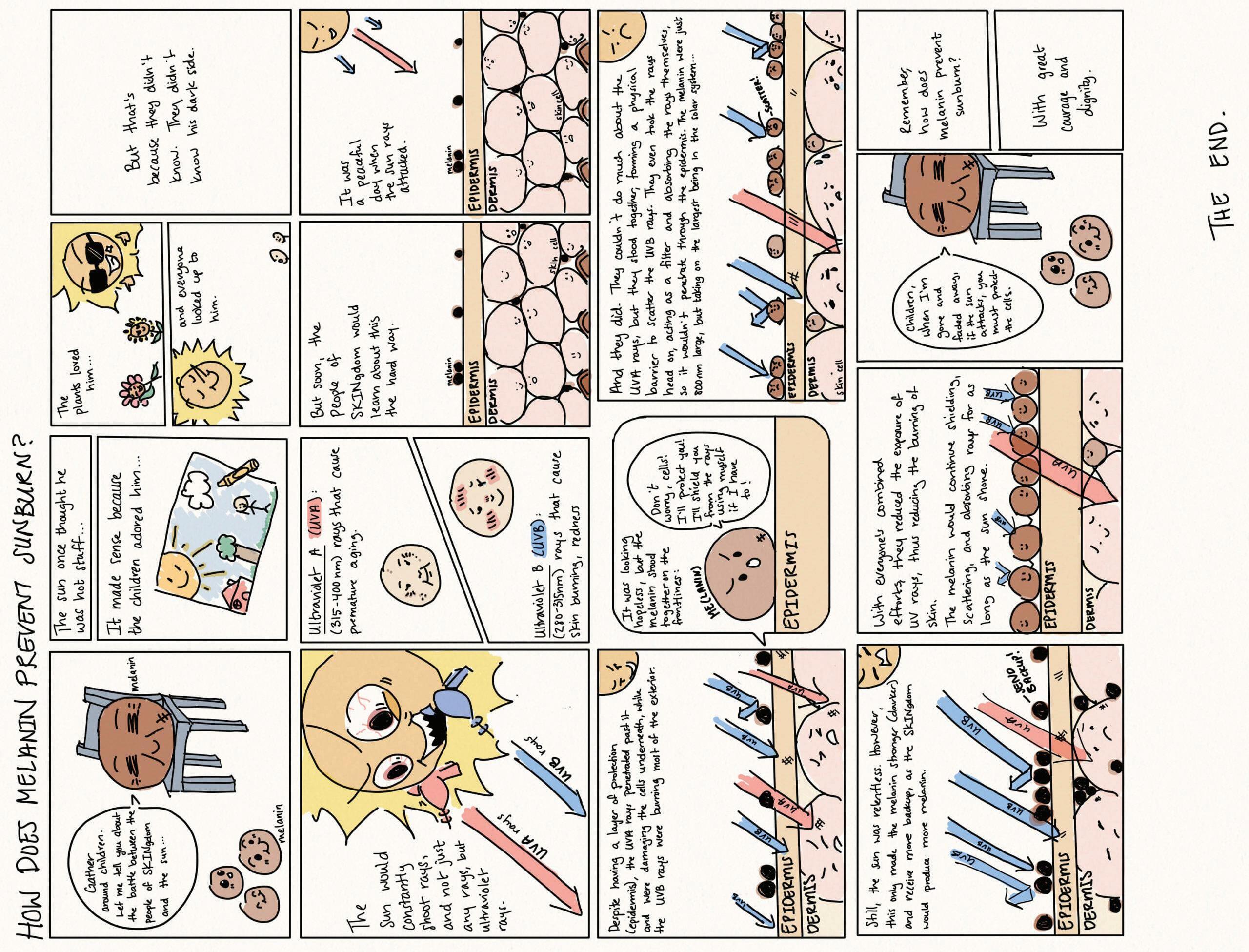
12. How does melanin prevent sunburn?
These are but a glimpse into the vast nanoWorld. Many more nanoStories can follow the ones collected here. To shape the next collection, start by reading these, and then send us a question that the next nanoStory could answer. See the QRcode at the end of the book.
- Staff and Friends of OctoberMIT.nano 9, 2025 nanoStories: nano 101:
Enjoy devouring these nanoStories. They just might add a new perspective on how to experience and build an even better World for us all.
Welcome to the nanoScale
To measure a distance from here to there, one can use inches, feet, yards, or meters (or a number of other units of distance). You have probably heard of a “meter”. It is about the same length as a “yard”. Put ten meters together, and you reached the width of a typical house.
That house might be made of bricks or maybe planks of wood. Those bricks are made of even smaller parts we call molecules; and molecules are made of tiny pieces called atoms.
Atoms make every part of the world we live in, … and how the atoms in the brick are put together shapes the molecules that will lock with each other to give the strength to the brick. Everywhere we look we will find more molecules that shape what we experience: For example, scents we smell come from scent molecules, that determine the aroma of the cup of your hot-cocoa. Dye molecules, set the vivid color of your t-shirt. Drug molecules, give the potency to your medicine … The nanoStories that follow will go back and forth between the macroWorld we experience and the nanoWorld of atoms and molecules that shapes these experiences.
Molecules are very small. Each is about one billionth of a meter in size. To quickly say “one-billionth-of-a-meter” you can say a “ nanometer .” Therefore, a molecule is about one nanometer wide, while a 10-meter-wide house is 10 billion nanometers in width. Both tiny and huge worlds can be built from nanoscale building blocks. (Fig 1)
House Width = 10 meters
Hair = 100 micrometers
Molecule = 1 nanometer
In labs at MIT, and at research centers across the globe, we can now work at the nanoscale almost effortlessly. Today, making structures that measure a few nanometers across is routine.
These latest advancements are but the next step in a centuries-long journey, as humans have been shaping and experiencing the nanoscale since time immemorial. Back then, we simply did not have the tools and knowledge to recognize it.
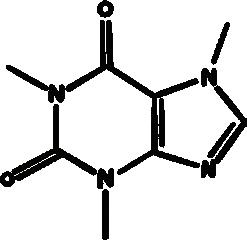
Here is an example from times past.
Caffeine
Fig 1.
Human
Gold and Silver Ancient Tech with a Modern Twist
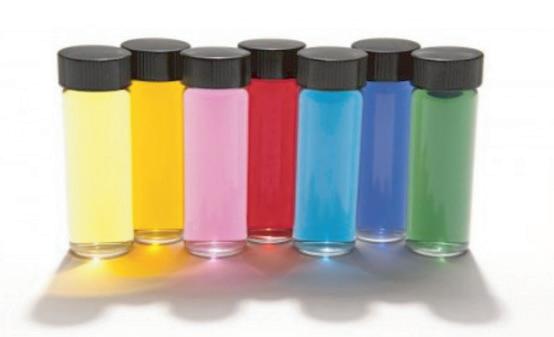
nanoSpecks of Gold and Silver swim inside these vials
Fig 2.
How would a piece of gold look, if you made it very small? Start with a piece, and split it in half, then do it again, then again, and again, until we arrive at a nano-sized s speck of gold. (Fig 2)
Something magical happens at this scale: If you take enough of these gold specks and suspend them in a liquid, they begin to play with light. Shine light on a vial of floating gold specks, and instead of reflecting the solid yellow sheen of a wedding band, they glow in shades of yellow, orange, or deep red!
Silver behaves just as strangely. We know that a silver bracelet is bright, metallicwhite in appearance. But nanoscale specks of silver no longer reflect all colors equally. Instead, vials of silver specks shimmer with unexpected hues: brilliant blues, vibrant greens.
What you are seeing are not dyes or pigments. These colors emerge because the particles are small: small enough that electrons within them dance differently with light. When you shrink gold or silver down to the nanoscale, something unexpected happens. The particles stop reflecting all light equally. Instead, their ability to absorb and reflect light changes, simply because of their size.
Fig 3.
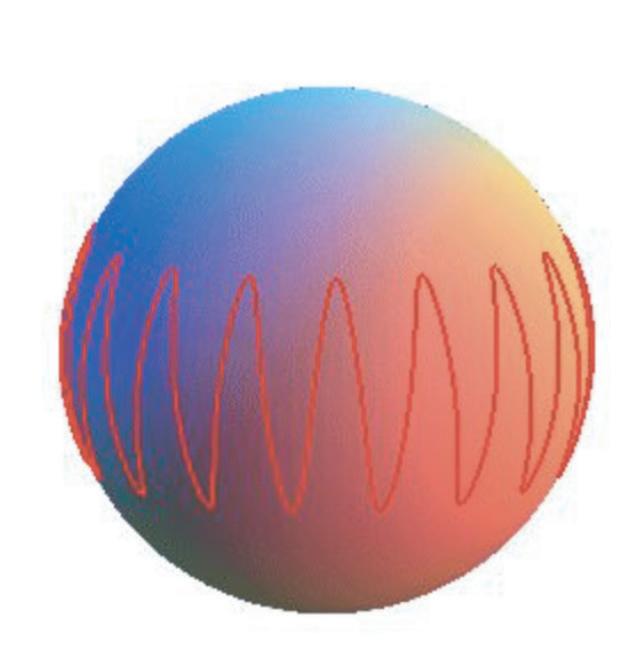
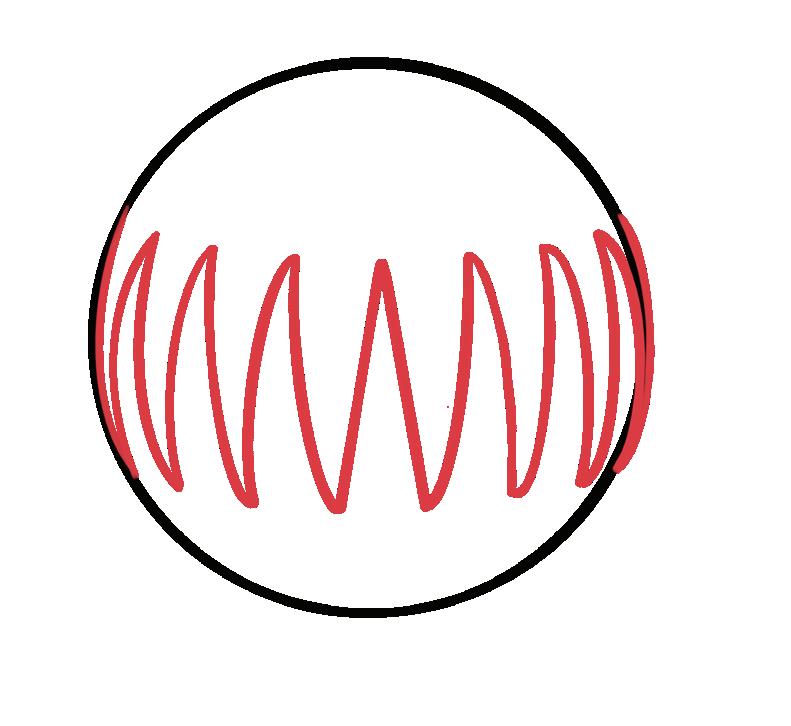
Here’s why: When we describe light, we can say that it is made of waves, and sometimes we say that it is made of particles, called photons. Electrons share that same dual identity, though we don’t usually think of them that way. Electrons are certainly particles, but they can also be described as waves, with wavelengths that are incredibly short, on the scale of just a few nanometers. (Fig 3)
Now imagine placing an electron on a nanos speck of silver. Shine light on it and see what happens. Excited by the energy of the incident light the electron will start to wiggle across the surface of the nanopart . Its waviness must wrap neatly around that particle, meeting its own tail exactly where it started. In this way the size of the na determines what is the wavelength of the electron that resides on it. The shorter the wavelength, the higher the energy of the electron. Only electrons with energies that match the particle size will be excited by light, so the particle size sets the color of light that can be absorbed or reflected.
Medieval nanoTechnologists
nanotechnologist
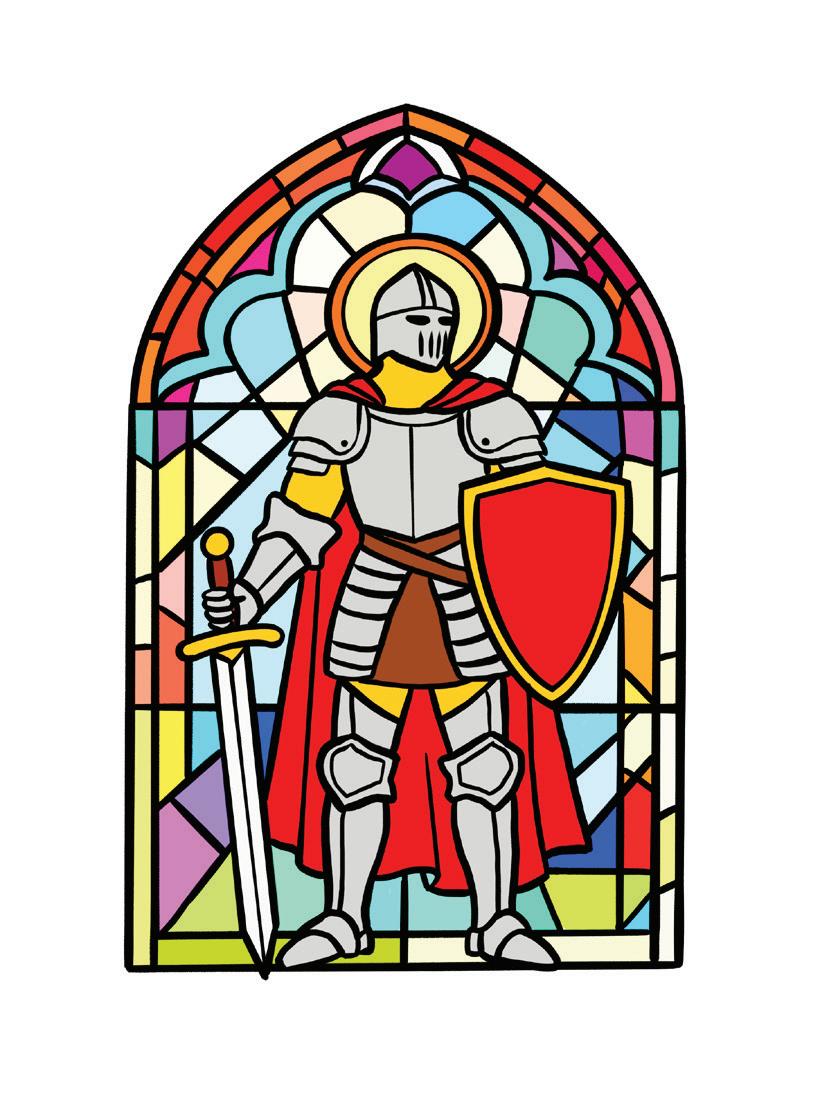
If you were a “ nanotechnologist” of the Middle Ages, you worked not in a laboratory, but in a glassmaker’s shop. You might have followed your grandmother’s recipe that might say: “walk to a hillside outside your town, collect a particular stone, grind it down, stir it into molten glass, add a splash of goat’s milk or few leaves of fresh clover, make sure the moon is full, perform a little dance for good measure … and then keep cooking the molten glass until the first light of the morning comes. Then pour the glass melt onto a cold flat stone, forming a flat glass pane. Let it cool down before you touch it.”
When it was cool, you lifted it up and looked through it at the morning light, and the view was dazzling as the now colored glass pane was passing the stunningly vivid and shimmering blue, green, or red light.
What you had unknowingly created were stained-glass windows colored by gold, silver, or other colorful specks of metal that were in those stones you ground, and were now melted into metal specks that got embedded in glass. (Fig 4) These windows keep their color for centuries, because they are built of materials that do not fade: glass, infused with metal nanoparticles that got formed as you followed your grandmother’s recipe.
nanoparticles
Fig 4.
Detecting Disease with Colorful nanoScale Tools
Today, in the labs at MIT, the very same silver nanoparticles that give stained glass its color are being used to detect some of the world’s most dangerous diseases—Ebola, West Nile, Dengue Fever, Zika, even COVID-19.
How do nanoparticles help with disease detection?
Recall that silver nanoparticles change color depending on their size. A change in size of just a nanometer or two can produce a new color. Now imagine coating the surface of each nanopartic with a molecule designed to bind to a specific protein, say, the spike protein of COVID-19. That molecule acts like velcro. If a piece of the viral protein drifts by, it sticks. The nanopartic grows ever so slightly in size, and, in turn, changes color. (Fig 5)
That shift in color is the signal of infection. And the test is astonishingly simple: prick your finger, place a drop of blood onto a treated strip of paper, and wait. The liquid spreads naturally through the fibers of the paper, just as coffee or tea does when spilled. Along the way, the blood meets rows of nanoparticles. If the viral proteins are present, the nanoparticles bind them, grow larger, and change color.
In just minutes, the result on the nanop -painted paper is visible to the naked eye.
Contrast that with the old method for testing for West Nile virus in a remote village: First trek through the jungle to reach the remote village, and ask the people who live there if you can draw their blood to test it for West Nile virus. Put the collected blood samples into a portable refrigerator, and carry the refrigerator on your back to a laboratory that is miles away. Analyze the samples and then trek back to deliver the results … a process that could take days.
With nano -painted paper test strips, the hard work of times passed is replaced by a lightweight package of paper that is carried to the remote village (not-refrigerated) and a few drops of blood from the villagers are collected on the spot. The diagnosis is fast, reliable, and delivered right away. This diagnostic is inexpensive and accessible, even in the most remote corners of the world, and entirely enabled by our understanding of the wonders of nanoscale ! nanoscale
Medicines, Molecules, and the Blueprint of Life
Nanoscale is the scale of medicine itself.
To measure the sizes of drug molecules that cure us, we will compare them to benzene, one of chemistry’s most famous molecules: six carbons and six hydrogens arranged in a perfect hexagonal ring. Drawn carefully, each corner is a carbon with its hydrogen attached. Drawn quickly, it’s simply a hexagon, and it measures just a third of a nanometer across. (Fig 6)
Common drugs, such as aspirin and ibuprofen are only a few times larger than benzene. That puts them at roughly one nanometer in size. So the next time you swallow an aspirin, remember: the nanoscale molecules are making you feel better!
Vitamins—A, B, C, D—are similar, each about one or two nanometers across. And not just the helpful molecules. Dangerous ones too: cocaine, LSD, and other drugs all operate at the nanoscale . These tiny molecules can profoundly affect us, sometimes for good, sometimes for harm. (Fig 7)
However, it’s not just medicine that is measured in nanomet ers.
Our senses are designed to work from the nanoscale up: to smell a rose, or to appreciate the delicious taste of a cookie, is thanks to our bodies remarkable ability to detect nanoscale phenomenon. Your nose is a nano-detector . You can read more about that in a nanoStory to follow.
Fig 6.
Fig 7.
Discovering DNA, the nanoScale Code in Our Bodies
nanometers
Inside every human cell are nanoscale structures that serve as a code that programs the operation of our cells. The most famous of these is DNA (deoxyribonucleic acid). Each strand of DNA is just two nanometers wide. In the 1950s, Rosalind Franklin captured an unusual image of X-rays bouncing off a crystalline sample of DNA that looked like an X-shaped pattern of spots. No one knew of DNA at that time, but the strange pattern of diffraction spots hinted at something never imagined: a twisted molecular helix that resides in every cell that makes us.
When Watson and Crick saw Franklin’s data, they proposed that DNA must be a double helix. At the time, the idea seemed outrageous. No one had ever seen a twisted molecule like that. Yet over the years, evidence mounted, and eventually the discovery was recognized with the Nobel Prize. (Fig 8)
It had taken nearly a century of experiments, conducted by hundreds of scientists, to arrive at the idea and proof that there is a very special molecular structure inside human cells. Now we know to call it DNA.
The long time to reach this discovery was because the tools of the time could not see the nanoscale as clearly as we can see it with tools of today. If we only had nanoscale
DNA width = 2.5 nanometers wide
more powerful tools back then, the nano-horizons of human health would have been recognized much sooner.
Today, with a scanning tunneling microscope, we can place DNA on a flat surface and see its helical form in exquisite detail. Within a few hours, certainly within a week, we can capture an image that confirms its twisted ladder-like shape. Work that once took decades and generations can now be accomplished by a single researcher in days.
That is the revolution of nanoscale science: what was once invisible, uncertain, and nearly unimaginable and now is directly observable.
Welcome to the Nano Age
Today, we finally have the tools to see the nanoscale world clearly. Now that we can see it, we can begin to design with it, which leads us to confidently state that “The future will be measured in nanometers.”
From medical cures to more nutritious food, from materials for energy efficient electronics to novel paradigms in quantum communication and sensing, innovations of tomorrow will be built with nature’s tiniest building blocks.We are at the dawn of the Nano Age, an era in which we will reimagine matter itself, and use it to solve humanity’s greatest challenges.
If you’d like to see this future firsthand, come visit us at MIT.nano, right in the heart of the MIT campus. We would be delighted to show you what we are building, one nanomete at a time.
May the Van der Waals force be with you!
How do geckos walk up walls?
Have you ever wished that you could be like Spider-Man, scaling a wall or clinging upside-down to the ceiling? Although Spider-Man’s powers exist only in the movies, there is a real-life superhero with gravity-defying abilities enabled by nature and science: the gecko!
Geckos are a group of lizards known for their loud mating calls, excellent night vision, and licking their own eyeballs to clean them. Most geckos also possess adhesive toepads which allow them to scale walls and walk upside down! To understand these toepads, we first need to talk about the physics of the super-small world that exists all around us—a world we call the nanoscale.
Everything, from your own body to the air we breathe to the planets and stars, is made up of tiny atoms, the building blocks of the universe. Atoms are surrounded by clouds of even smaller electrons, which act like the glue that holds atoms together. When atoms get very, very close to one other, these clouds of electrons interact, creating a force of attraction which we call the Van der Waals force (named after a Dutch physicist who won the Nobel prize in 1910!). This is a very weak force, and it only
Attached Foot
Free Foot
makes a big difference when surfaces get VERY close to one another. Try pressing your hands together as hard as you can—you will never be able to get your hands close enough to stick together by the Van der Waals force, because the texture of your skin will always allow a little bit of air to get in between!
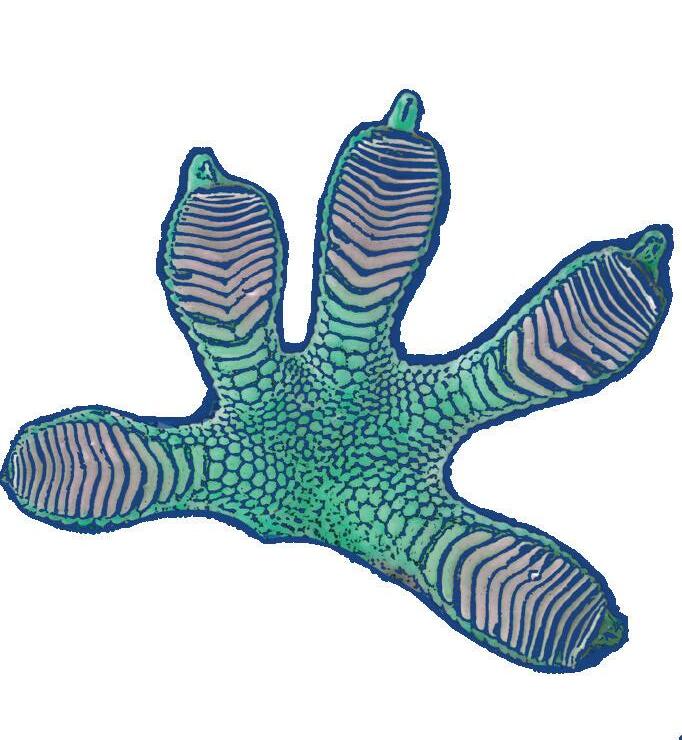
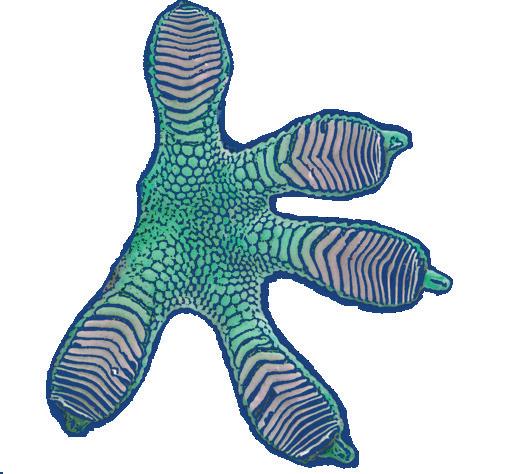
Now, let’s return to the gecko. The texture of a gecko foot might not look so different from human skin to the naked eye, but with a little help from a very powerful microscope, major differences start to appear. Gecko toe pads are covered in a sea of setae, or tiny hairs, each one of which branches into even smaller fibers called spatulae.
Setae are up to 1300 times thinner than a human hair, and each seta can branch into up to 1000 spatulae! So, how do gecko feet stick? It all comes back to the Van der Waals force—remember, it only works when two surfaces can get very, very close to one another. The setae and spatulae on a gecko foot act like a super-fine carpet, conforming to the exact shape of the surface they’re touching, meaning those two surfaces get extremely close and the Van der Waals force causes them to stick!
How strong is this force, exactly? If every single spatulae on a gecko’s foot was interacting with a surface at once, scientists estimate that the gecko could support up to 293 pounds—that means you could lift up a an NFL football player with a single gecko! The adhesive powers of the humble gecko have inspired researchers to try to mimic nature, creating synthetic materials in the lab which copy the gecko foot to create super-strong tape. Nature has so much to teach us, and we can only take full advantage of its power by understanding the science that governs the natural world around us.
Attached Foot
Lamella
Toe
Free Foot
How does hot- cocoa heat up a mug?
1. Cocoa Molecules Wiggling with Mug Molecules
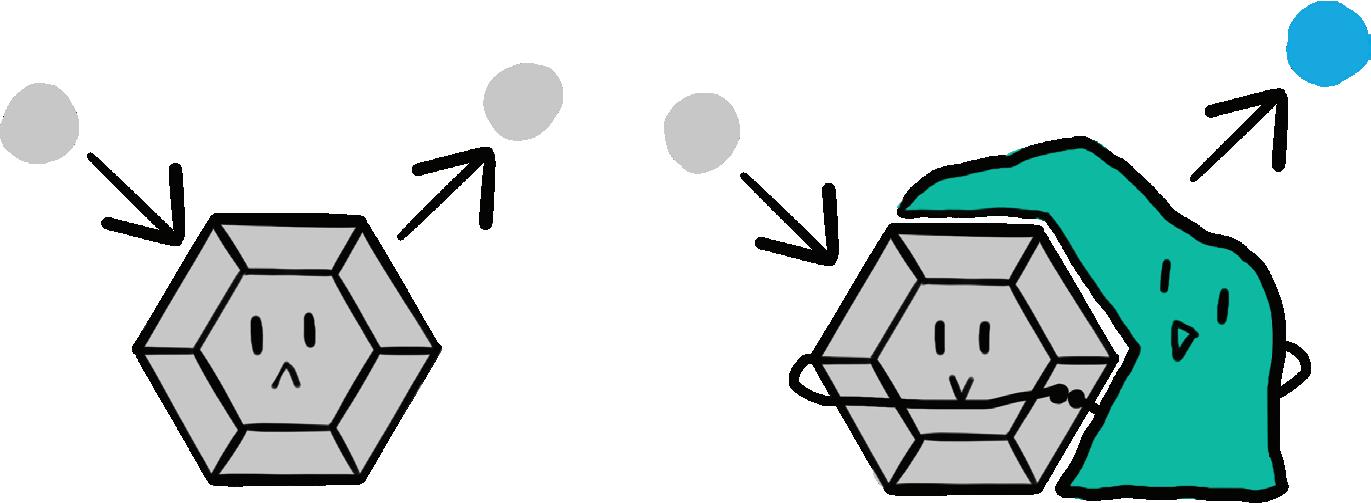
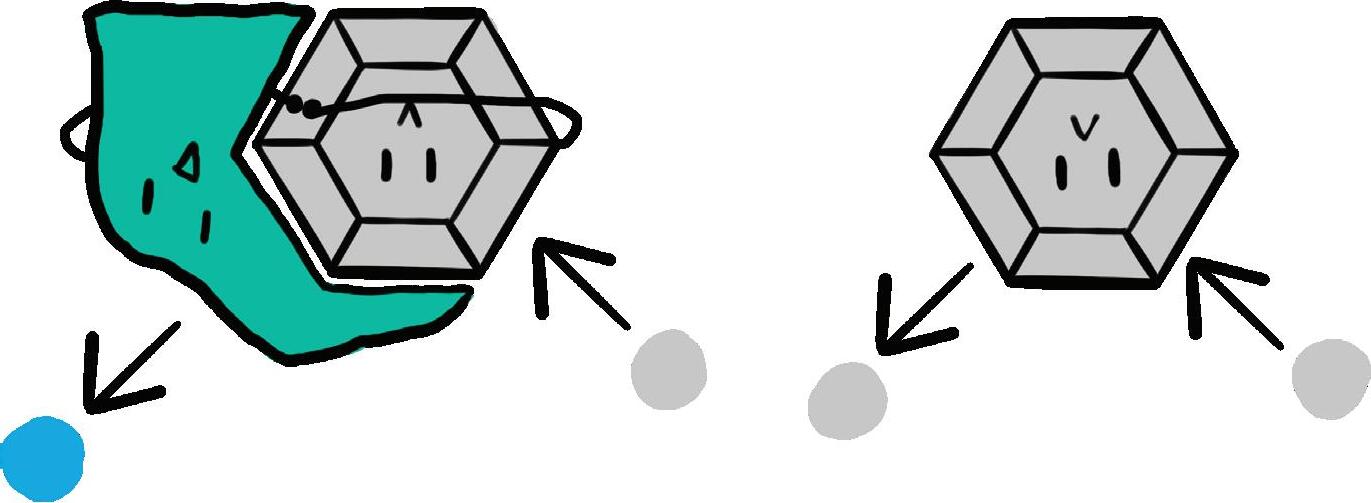
Pour a hot liquid into a ceramic mug and you will notice that the surface of the mug quickly heats up. Watch your fingers to not get burned, and then take a peak at the nanoscale to find out what makes us feel the heat.
If you were to examine your mug through a powerful microscope, you would see that it is built from a bunch of teeny-tiny particles we call atoms. The diameter of each atom in your mug could be only a tenth of nanometer — roughly a million times thinner than a single sheet of paper. These atoms work together to make up absolutely everything in our world, and they are never still. They always wiggle. How fast they wiggle determines the temperature of your mug and of everything else you touch. The faster those atoms wiggle, the warmer your mug will feel. (Fig 1)
Fig
The liquid that constructs your hot-cocoa is made of its own wiggling atoms that get together in groups of two or more to form wiggling molecules. The hot-cocoa molecules slam into the atoms that make up your mug. As a result of these collisions, the hot-cocoa molecules “donate” some of their motion to the mug atoms. The mug atoms then start shaking more vigorously, and the collisions
The real superpower of soap is hidden in its molecular structure, which shapes soap molecules so they are able to attach themselves to both water and oil. Oil and water just don’t mix. (Fig 1) Try mixing them in a cup if you don’t believe me. (Spoiler: it won’t work!) Yet soap molecules found a way to link to both, which is the key to getting your hands germ free.
Fig 1. Oil and Water Don’ t Mix
Tail is hydrophobic (hates water) and liphophilic (loves fat) Head is Lipophobic and hydrophilic (friendly with water)
Fig 2. the Chemistry of Soap
With your naked eye, you might be able to spot something that is as small as the width of a human hair—about 100,000 nanometers ( or 100 micrometers) across. But objects just a few nanometers in size, are 100,000 times smaller than that! Too tiny to see, yet your nose can detect them. In fact, your nose is your very own built-in nano-detector!
Think of the sweet perfume of a ��ower, the minty bite of toothpaste, or the vanilla aroma of a freshly baked cookie. Everything that smells is constantly releasing little pieces of itself, tiny scent molecules. These nanoscale particles drift into the air, bounce around among oxygen and nitrogen molecules, and, if your nose is in the way, slip inside to tickle your smell sensors. That’s how you know the cookie is ready to eat. (Fig 1)
Follow Your Nose ,
the nanoScale
Why are scent molecules so small?
Scent molecules need to be very small to easily break free and ��oat away from the item they came from. At room temperature, all the molecules in the cookie you would like to eat, wiggle a little, pushing and showing the neighboring molecules that wiggle as well. The larger molecules have many spots that attach them to their neighbors, holding them in place. However, the smaller molecules can have just a few points of attachment, and if the molecular wiggling near them increases they can detach, ��ung
Fig 1. Smelling Cookie
into the air above. Once released into the air, these molecules are jostled around by the constantly moving air molecules (of oxygen and nitrogen). Each bump pushes them farther, spreading the scent molecules outward, as they ��nd their way to you. Scent molecules need to be nano-scale in size to reach your nose.
Why do different things smell different?
Di�ferent items release di�ferent scent molecules. These scent molecules are collections of atoms that are stuck to each other in di�ferent ways, forming nano-sized shapes. In the labs today we have the tools to see the details of these small objects, allowing us to draw their shapes, each with a distinguishing structure, and each about one nanometer across.
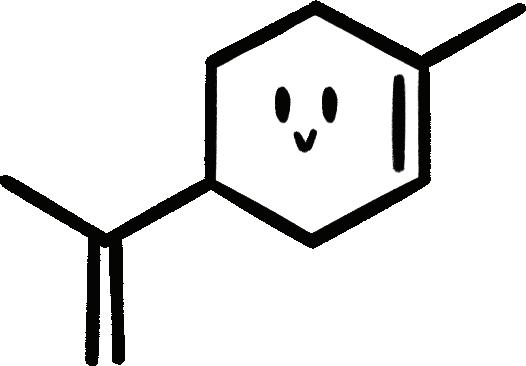
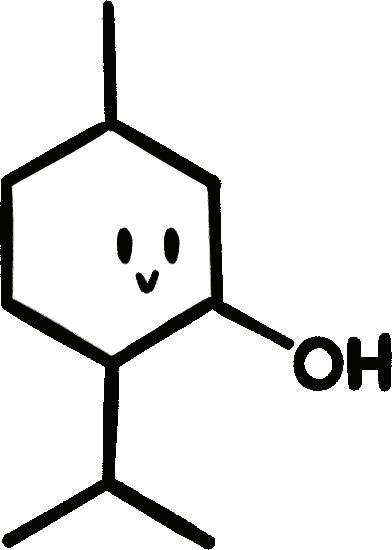
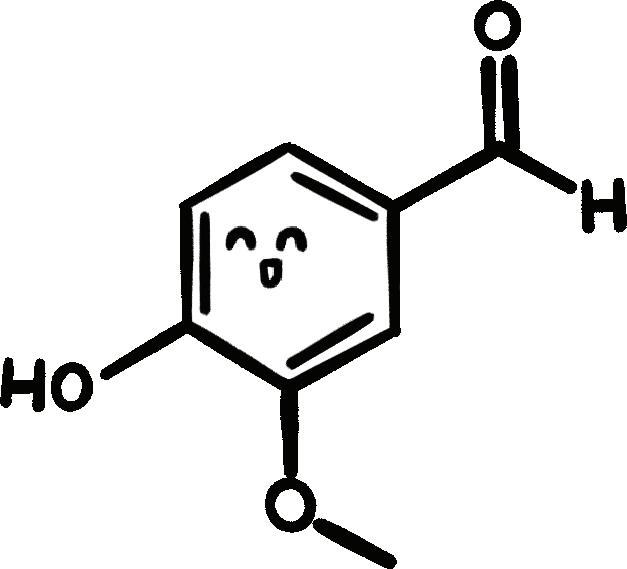
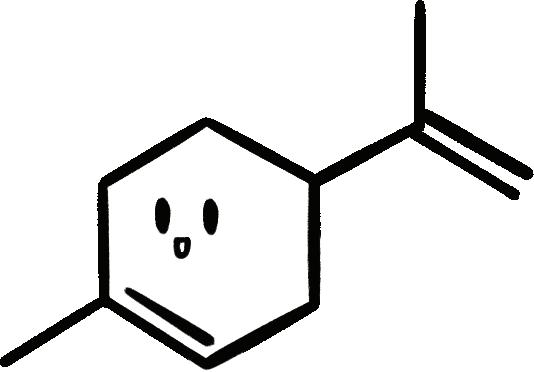
Look at the chemical structures of the two scent molecules drawn below. Floating out of mint toothpaste is a molecule we named Menthol. Rising out of vanilla cake is a molecule we call Vanillin. Not only does your nose sense the presence of these molecules, but you can look at the drawing of their molecular structures and tell that their atoms are placed in di�ferent places. They are di�ferent objects … on the nanoscale, … and your nose knows it! (Fig 2 +3 )
Fig 2. Menthol (Minty Scent)
Orange Fishy
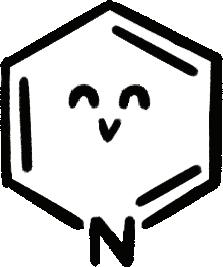
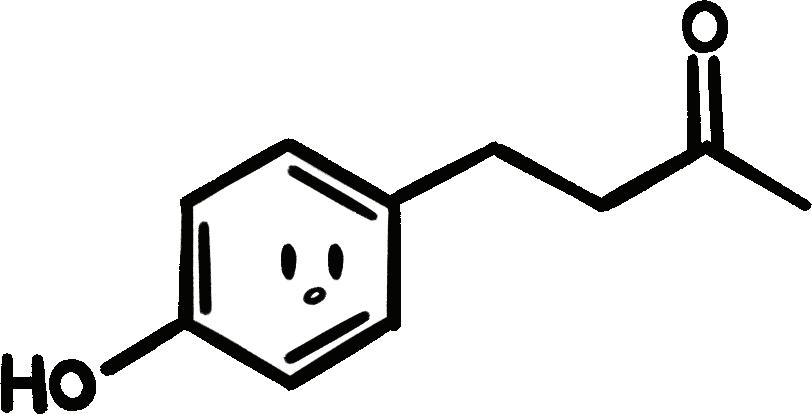
Remember benzene, that tiny hexagonal molecule just a third of a nanometer across? Now look at molecules that carry familiar scents: lemon, raspberry, orange, vanilla. Each of them is only a few benzene units long. Just one or two nanometers in size.
How does my nose recognize so many smells?
Inside your nose are millions of nanoscale receptors, each tuned to a particular molecular shape. When scent molecules bind to some of these receptors, the nerves behind them quickly signal your brain. Your brain compares the pattern of activated receptors with its memory of past experiences. It ��ips through the catalog of smells it has stored over a lifetime of smelling so it can tell you that: “That combination of receptor signals means that you are about to have a vanilla cake!” It is the nanoscale detectors in your nose that alert you to the smell of that tasty desert. So next time you catch the sweet scent of baked cookie, or a cup of hot-coco, remember that you are actually following your nose to the nanoscale!
Can insects smell the world around them?
Yes they can, and they can make smells too. Bees, for example, are not particularly talkative, … at least not in the way we are used to talking to each other, … but they can still tell each other of the best ��owers near their hive by releasing a scent that tells other bees where to go.
Can bananas smell the world around them?
Yes they can, and that sometimes tells them it is time to turn from green to yellow. As bananas and other fruits ripen, they produce sweet-smelling molecules called Ethylene. Ripe and over-ripe bananas produce more and more ethylene until they eventually spoil. Scientists and engineers have created a kind of electronic nose that can sense the presence of the ethylene gas molecule. With this sensor, they hope to be able to monitor fruits and vegetables as they are shipped and stored in order to prevent early spoilage and food waste.
Can robots smell?
They could if they had a nose. We can build them one. Nature gave us a built-in nano-detector in our nose, but nanoscientists and nanoengineers are working to create man-made synthetic nano-detectors of smell. These are known as the arti��cial nose, and can help robots record and respond to the scents that surround them.
Lemon
Vanilla
Mint
In the 5th century BC, ancient Greek philosophers speculated that everything was made of tiny building blocks of matter. They called them atomos, meaning “uncuttable,” or “indivisible.”
For the next 2,000 years, people wondered: were atomos, or atoms as we now call them… real? Scientists guessed at their existence and used the tools of their time (beakers, test tubes, mathematics, chemistry, physics, simulations) to refine the idea, and even built whole theories around them. But for the longest time no one had actually seen an atom. So when do you think we first saw one? 200 years ago? 100 years ago? Nope…not even close. The first clear images of atoms did not appear until the 1980’s!
A Picture is Worth a Million WordsSeeing the Nanoscale Seeing the Nanoscale
That breakthrough happened at IBM Research Labs in Zurich, Switzerland. Scientists used an ultra-sharp metal tip, sliding it across a surface. The tip bounced back as it hit the “bumps” of individual atoms, not unlike running your fingers over Braille. For the first time in history, the atom came into view. The instrument they built is called a Scanning Tunneling Microscope (STM), and it launched the nanoAge!
But why is seeing the nanoscale so important?
You have heard the phrase, “a picture is worth a thousand words.” At MIT, a Nobel Prize winning biology professor said “a picture is worth a million words,” because life is built from molecules of staggering complexity. To truly understand them, you have to see them. (Fig 1)
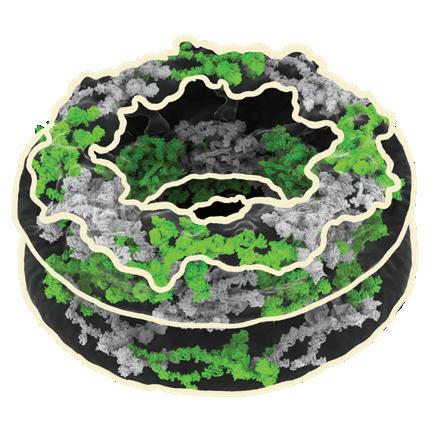
That is where cryogening transition electron microscopy (cryo-TEM) comes in. This remarkable tool, perfected in recent years, allows us to image rapidly frozen biological samples with such accuracy that we can pinpoint the position of individual atoms.
Look at a protein inside your cell through a cryo-TEM, and you don’t just see a blur. You see every nodule, every atom, folding and bending into the intricate shape that gives the protein its function. (Fig 2)
Why does that matter? Because every medicine works like a key fitting into a lock. To design the key, you first need to understand the lock, down to the atomic scale. Knowing the exact structure of proteins allows us to imagine new medicines with unprecedented precision.
And here’s the best part: these tools aren’t hidden away in a single lab. At MIT.nano, state-of-the-art instruments like the cryo-electron microscope are available to researchers across disciplines. With training and a clear project, students and researchers from across the world can harness this capability to pursue their next grand discovery.
Across the millennia, humanity has imagined atoms. Only recently with tools such as STM, TEM, and many others, have we acquired the ability to see them and each new image opens up a whole new world of wonder and possibility.
How
many transistors fit on your pinky nail?
The smartphones in our pockets process data over 1,000 times faster than the computers that landed Apollo astronauts on the Moon. Even the USB chargers, that we use to power our electronics, contain microcontrollers (smaller, simpler computers) many times more powerful than the Apollo flight computer. How can a simple device like a USB charger outperform the computers of the missions to the Moon?… It all started with the invention of the transistor in 1947.
In 1975, Gordon Moore, co-founder of Intel Corporation, projected that the number of transistors in computer chips would double every two years. Now this observation is known as the Moore’s Law as it held true for decades that followed! The chip named Intel 4004, released in 1971, was the first commercially sold Central Processing Unit (CPU for short), having 2,300 transistors packed on a 12 mm2 chip area. Fast forward 53 years, and Apple’s recent CPU, the M4, has over 20 billion transistors packed on 167 mm2 chip area! In other words, the area occupied by one transistor in Intel 4004 is now occupied by 620,000 transistors in Apple M4!
The area of the Apple M4 chip would spread over about four pinky nails, which still means that you can pack billions of transistors on the tip of your finger, with each of them covering an area just 10’s of nanometers in size. Through the advancements of nanoscale fabrication, computer chips
Transistors in this chip are 20 nm apart!
CHIP
Notes from the nanoscale explorer:
Produced by STUDIO.nano
Graphic Design by Joy Wu
Illustrated by Yuezhi Chen
Thanks to all the remarkable students of the MIT nanoStories IAP workshop, with special thanks to:
Shelly Ben-David
Lainie Beauchimen
Daniel Gorbunov
Sarah Spector
Titus Roesler
Ngoc Jodie Nguyen
Vladimir Bulovic, Annie Wang,
Samantha Farrell + STUDIO.nano
Everyone can tell a nanostory. The collection you just read was crafted by the imagination and excitement of students who took part in MIT.nano’s “nanoStories” workshop from 2021 to 2023.
Many more stories could be told. We invite you to suggest topics that could be part of the next collection.