Holy Light – Improvisations on the stories of the stained glass windows in the nave of the Cathedral of St. Philip Patrick A. Scott The selected windows on which the organ improvisations are based, have been matched with hymn texts and tunes that help tell the story of each of these windows. The exquisite colors and detail of each of these windows mixed with these texts and tunes will provide the inspiration for each improvisation.
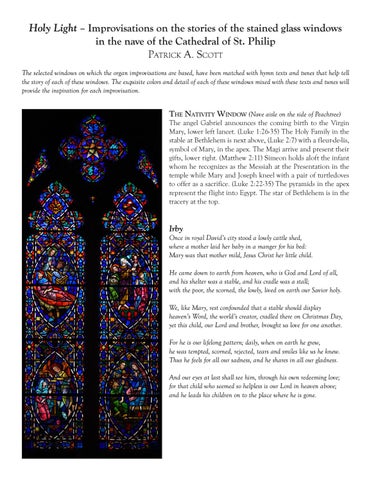
The Nativity Window (Nave aisle on the side of Peachtree) The angel Gabriel announces the coming birth to the Virgin Mary, lower left lancet. (Luke 1:26-35) The Holy Family in the stable at Bethlehem is next above, (Luke 2:7) with a fleur-de-lis, symbol of Mary, in the apex. The Magi arrive and present their gifts, lower right. (Matthew 2:11) Simeon holds aloft the infant whom he recognizes as the Messiah at the Presentation in the temple while Mary and Joseph kneel with a pair of turtledoves to offer as a sacrifice. (Luke 2:22-35) The pyramids in the apex represent the flight into Egypt. The star of Bethlehem is in the tracery at the top.
Irby Once in royal David’s city stood a lowly cattle shed, where a mother laid her baby in a manger for his bed: Mary was that mother mild, Jesus Christ her little child. He came down to earth from heaven, who is God and Lord of all, and his shelter was a stable, and his cradle was a stall; with the poor, the scorned, the lowly, lived on earth our Savior holy. We, like Mary, rest confounded that a stable should display heaven’s Word, the world’s creator, cradled there on Christmas Day, yet this child, our Lord and brother, brought us love for one another. For he is our lifelong pattern; daily, when on earth he grew, he was tempted, scorned, rejected, tears and smiles like us he knew. Thus he feels for all our sadness, and he shares in all our gladness. And our eyes at last shall see him, through his own redeeming love; for that child who seemed so helpless is our Lord in heaven above; and he leads his children on to the place where he is gone.
1
The Discipleship Window (Nave aisle on the side of Peachtree) Scenes here show Christ inviting His companions to follow Him. He calls Peter and Andrew, lower left, to leave their nets (Mark 1:16-17) He invites Matthew, a publican to leave his desk, top. (Matthew 9:9) In the apex is Nathaniel (Bartholomew) asleep under the fig tree where he is seen by Christ. (John 1:48) The rich young man turns away from Christ unable to accept the challenge of a total discipleship, lower right. (Mark 10:21-22) Andrew and Philip bring Greeks who asked to see Jesus, upper right. (John 12:20-22) A pilgrim’s staff and purse superimposed on a cross, reminiscent of all Christian missionaries, is in the apex. The tracery contains a basket of fish with two other fish drawing near to enter. This particular symbol is derived from a ring stone of Arnulf, Bishop of Metz, and is symbolic of the disciples as “fishers of men.”
Georgetown They cast their nets in Galilee just off the hills of brown; Such happy, simple fisherfolk, before the Lord came down. Contented, peaceful fishermen, before they ever knew the peace of God that filled their hearts brimful, and broke them too. Young John who trimmed the flapping sail, homeless in Patmos died. Peter, who hauled the teeming net, head-down was crucified. The peace of God, it is no peace, but strife closed in the sod. Yet let us pray for but one thing—the marvelous peace of God.
2
The Triumphal Entry Window (The Chancel) Jesus rides into Jerusalem and is welcomed by the multitude waving green palm branches. (John 12:12-13) In the smaller scene, Mary of Bethany anoints his feet with precious ointment and wipes them with her hair. Judas protests that the cost of the ointment should have fed many poor. Jesus presages his impending death and burial with “Let her alone: against the day of my burying hath she kept this.” (John 12:3-7) A palm branch is shown at the top.
Valet will ich dir geben All glory, laud, and honor to thee, Redeemer, King! To whom the lips of children made sweet hosannas ring. Thou art the King of Israel, thou David’s royal Son, who in the Lord’s Name comest, the King and Blessed One. (refrain) The company of angels is praising thee on high; and we with all creation in chorus make reply. (refrain) The people of the Hebrews with palms before thee went; our praise and prayers and anthems before thee we present. (refrain) To thee before thy passion they sang their hymns of praise; to thee, now high exalted, our melody we raise. (refrain) Thou didst accept their praises; accept the prayers we bring, who in all good delightest, thou good and gracious King. (refrain)
3
The Last Supper Window (The Chancel) Only Peter and John are shown with Christ at the Last Supper (because of the narrowness of the panel) as he holds the bread and wine of the ritual Passover meal. (Matthew 26:26-28) Vignetted below, Judas is seen leaving to betray him. Below this, Jesus washes Peter’s feet. (John 13:5-6) Wheat and grapes representing bread and wine are at the top.
Ubi caritas (Murray) God is love, and where true love is God himself is there. Here in Christ we gather, love of Christ our calling. Christ, our love, is with us. Gladness be his greeting. Let us fear and love him, holy God eternal. Loving him, let each love Christ in one another. (refrain) When we Christians gather, members of one Body, let there be in us no discord but one spirit. Banished now be anger, strife and every quarrel. Christ, our God, be always present here among us. (refrain) Grant us love’s fulfillment, joy with all the blessed, when we see your face, O Savior, in its glory. Shine on us, O purest Light of all creation, be our bliss while endless ages sing your praises. (refrain)
4
The Crucifixion Window (The Chancel) Christ dies on the cross. Weeping for him are Mary his mother; John, into whose care he commended her; (John 20-27) the other holy women; and the centurion who said: “Truly this was the Son of God.” (Mark 15:39) Below, Joseph of Arimathea, attended by Mary and John, lays Christ’s body into the tomb. (Mark 15:43-47) Three nails of the crucifixion are at the top.
Pange lingua Sing, my tongue, the glorious battle; of the mighty conflict sing; tell the triumph of the victim, to his cross thy tribute bring. Jesus Christ, the world’s Redeemer from that cross now reigns as King. He endures the nails, the spitting, vinegar, and spear, and reed; from that holy body broken blood and water forth proceed: earth, and stars, and sky, and ocean, by that flood from stain are freed. Bend thy boughs, O tree of glory! Thy relaxing sinews bend; for a while the ancient rigor that thy birth bestowed, suspend; and the King of heavenly beauty gently on thine arms extend. Praise and honor to the Father, praise and honor to the Son, praise and honor to the Spirit, ever Three and ever One: one in might and one in glory while eternal ages run.
5
The Resurrection Window (The Chancel) Christ rises from the tomb, clothed in light, carrying the banner of victory over sin and death. A tri-radiant nimbus shines over his head and, at his feet, the phoenix, ancient symbol of the resurrection, rises from the flames of its own consuming fires. On either side, small figures of watching centurions fall back in awe; far in the distance, three empty crosses stand on Calvary’s hill. (Matthew 28:4) Below, he is shown in one of his earliest appearances after the Resurrection. Mary Magdalene in the garden discovers that he is not the gardener as she thought, but her beloved master, and she sings to her knees before him. (John 20:15-16) At the top is another resurrection symbol – a bursting pomegranate.
Ellacombe The day of resurrection! earth, tell it out abroad; the Passover of gladness, the Passover of God. From death to life eternal, from earth unto the sky, our Christ hath brought us over with hymns of victory. Our hearts be pure from evil, that we may see aright the Lord in rays eternal of resurrection light; and, listening to his accents, may hear so calm and plain his own “All hail!” and, hearing, may raise the victor strain. Now let the heavens be joyful, let earth her song begin, the round world keep high triumph, and all that is therein; let all things seen and unseen their notes together blend, for Christ the Lord is risen, our joy that hath no end.
6
The “Benedicite” Rose Window The great façade rose window on the north wall in the balcony is fraught with decorative and meaningful symbols from Benedicite, omnia opera Domini – “O Ye Works of the Lord, Bless Ye the Lord, Praise him and Magnify Him Forever” – a canticle found in The Order for Morning Prayer in The Book of Common Prayer (p.88). The origin of this is found in the Apocryphal book of Daniel. It is the song of praise sung by Shadrach, Meshach and Abednego in the fiery furnace. In the center medallion the Triune of God is united on the throne of heaven represented by the creative Hand of God the Father; the Chi Rho for Christ; and the tongues of fire of the Holy Spirit. Palms of victory over death and sin are surmounted by the Trinity composed of two triangles. “Let us bless the Father, and the Son and the Holy Ghost; praise him and magnify him forever.” The small petals around the central circle present alternately symbols of the four major prophets and the four Evangelists. The winged man represents Matthew; the winged lion, Mark; the winged ox, Luke; the eagle, John. The tongs with a burning coal represent Isaiah; a cistern, Jeremiah, a turreted gateway, Ezekiel; a lion, Daniel. The long petals contain angels of prayer (swinging censer) and praise (those playing the horn, pipe, zither, cymbals, dulcimer, etc.). The circular medallions at the end of the petals contain symbols of some of the verses of the Benedicite. Starting at the top and proceeding clockwise are: Sun and Moon, Stars of Heaven, Showers and Dew, Winds of God, Fire and Heat, Lightnings and Clouds, Mountains and hills, Green Things, Wells, Whales and all that move in waters; Fowls of the air, Beasts and Cattle. At the outer edge of the circle are symbols of the Apostles: Peter, crossed keys; James the Greater, three Scallop shells; John, chalice with serpent; Andrew crossed fish; Philip, basket and tau cross; Bartholomew (Nathaniel), three flaying knives; Thomas, leather girdle and three stones; James the Less, saw: Matthew, three purses; Jude, ship; Simon, fish impaled on boat-hook; Matthias, open Bible and double battle-ax. The window is a memorial to the 130 persons, chiefly Atlantans, who lost their lives in the Orly plane crash, Paris, in 1962.
Lasst uns erfreuen All creatures of our God and King, lift up your voices, let us sing: Alleluia, alleluia! Bright burning sun with golden beams, pale silver moon that gently gleams, O praise him, O praise him, Alleluia, alleluia, alleluia! Great rushing winds and breezes soft, you clouds that ride the heavens aloft, O praise him, Alleluia! Fair rising morn, with praise rejoice, stars nightly shining, find a voice, (refrain) Swift flowing water, pure and clear, make music for your Lord to hear, Alleluia, alleluia! Fire, so intense and fiercely bright, you give to us both warmth and light, (refrain) Dear mother earth, you day by day unfold your blessings on our way, O praise him, Alleluia! All flowers and fruits that in you grow, let them his glory also show: (refrain) Let all things their creator bless, and worship him in humbleness, O praise him, Alleluia! Praise God the Father, praise the Son, and praise the Spirit, Three in One: (refrain)
7
The description of each window is taken from the Cathedral’s book, “The Windows of St. Philip’s Cathedral” first printed in 1973 to commemorate the 125th anniversary of the Cathedral of St. Philip, observed from May 1972 – May 1973. It was sponsored by the Episcopal Churchwomen of the Cathedral. The text was compiled by Elizabeth M. Sawyer. With special thanks to Dan Murphy for the photographs of the Cathedral windows. With special thanks to Jean Morris for her knowledge of these Cathedral windows and her dedication as a Cathedral tour guide. September 8, 2019 8