MEDIA CONTACT MICHELE RONSISVALLE 321.917.1458 MICHELE@STOCKWORTH.COM
Award-Winning Attorney Behind Largest Civil Rights Case Ever Shares How to Seek Justice for All in New Book Former U.S. Sec of Agriculture Mike Espy: “Greg Francis Is Most Important Civil Rights Leader You’ve Never Heard Of”
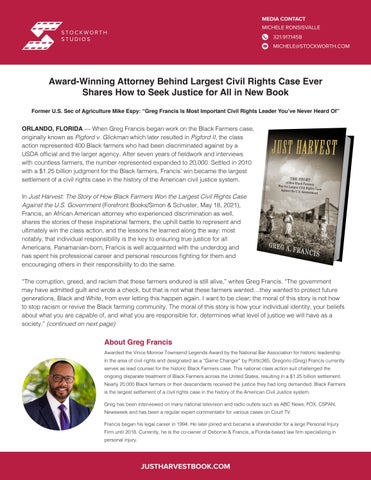
ORLANDO, FLORIDA — When Greg Francis began work on the Black Farmers case, originally known as Pigford v. Glickman which later resulted in Pigford II, the class action represented 400 Black farmers who had been discriminated against by a USDA official and the larger agency. After seven years of fieldwork and interviews with countless farmers, the number represented expanded to 20,000. Settled in 2010 with a $1.25 billion judgment for the Black farmers, Francis’ win became the largest settlement of a civil rights case in the history of the American civil justice system. In Just Harvest: The Story of How Black Farmers Won the Largest Civil Rights Case Against the U.S. Government (Forefront Books/Simon & Schuster, May 18, 2021), Francis, an African American attorney who experienced discrimination as well, shares the stories of these inspirational farmers, the uphill battle to represent and ultimately win the class action, and the lessons he learned along the way: most notably, that individual responsibility is the key to ensuring true justice for all Americans. Panamanian-born, Francis is well acquainted with the underdog and has spent his professional career and personal resources fighting for them and encouraging others in their responsibility to do the same. “The corruption, greed, and racism that these farmers endured is still alive,” writes Greg Francis. “The government may have admitted guilt and wrote a check, but that is not what these farmers wanted…they wanted to protect future generations, Black and White, from ever letting this happen again. I want to be clear; the moral of this story is not how to stop racism or revive the Black farming community. The moral of this story is how your individual identity, your beliefs about what you are capable of, and what you are responsible for, determines what level of justice we will have as a society.” (continued on next page)
About Greg Francis Awarded the Vince Monroe Townsend Legends Award by the National Bar Association for historic leadership in the area of civil rights and designated as a “Game Changer” by Politic365, Gregorio (Greg) Francis currently serves as lead counsel for the historic Black Farmers case. This national class action suit challenged the ongoing disparate treatment of Black Farmers across the United States, resulting in a $1.25 billion settlement. Nearly 20,000 Black farmers or their descendants received the justice they had long demanded. Black Farmers is the largest settlement of a civil rights case in the history of the American Civil Justice system. Greg has been interviewed on many national television and radio outlets such as ABC News, FOX, CSPAN, Newsweek and has been a regular expert commentator for various cases on Court TV. Francis began his legal career in 1994. He later joined and became a shareholder for a large Personal Injury Firm until 2018. Currently, he is the co-owner of Osborne & Francis, a Florida-based law firm specializing in personal injury.
JUSTHARVESTBOOK.COM
MEDIA CONTACT MICHELE RONSISVALLE 321.917.1458 MICHELE@STOCKWORTH.COM
-continued from first page“The one thing I learned from that case is that all those farmers wanted was a chance,” Francis said. “They didn’t ask for anything extra. They just wanted to be treated, and to be given the same opportunities, as everyone else. That’s all any of us want.” The historic case: In 1910, there were 925,000 Black farms; today, there are fewer than 18,000. And as Francis notes, every American has a responsibility to remember and honor their stories and sacrifice. Just Harvest details the plight of Black farmers in America: how so many were promised 40 acres and a mule as retribution after the abolition of slavery, but instead faced and continue to face decades of systemic discrimination due to the color of their skin. Tens of thousands of Black farmers allegedly suffered systematic discrimination at the hands of the United States Department of Agriculture between 1981 and 1996. During that period and as part of the discrimination, the USDA allegedly denied Black farmers loans, subsidies, and other benefits provided to white farmers. As part of the settlement, more than 33,000 individual Black farmers or their heirs received payments of $50,000, plus an additional payment of $12,500 paid to the Internal Revenue Service to cover the taxes owed on the awarded amount. This marks the largest civil rights settlement in U.S. history. Since the lawsuit was won in 2010, the United States has seen a 9% increase in Black-owned farms, an 88% increase in Native American farm operators, and a 14% increase in Hispanic farm operators. Against all odds, Francis and his team of lawyers were determined to do something about the deep-seated, infuriating injustices Black farmers faced. Readers will be inspired by their years of hard work, outraged by the heartbreaking stories of generations of Black farmers, and encouraged to reflect on their responsibility to fight injustice and live in a manner that promotes liberty and justice for all. “My hope is the dreams of ‘entrepreneurial freedom’ that those Black farmers fought for will never die and you will find the courage to replant the seeds that God has given all of us. For there is nothing sweeter or more fulfilling than a just harvest.” Greg wants to start a conversation in America that goes way beyond reparations and instead addresses the very foundations of our culture. He has created the Greg A. Francis Just Harvest Foundation which is built on 3 pillars that he believes will set us on the path to true justice and ensure an end to racial discrimination… 1. Investing in the infrastructure of the American family, 2. Creating educational opportunities, 3. Encouraging the creation of new Black-owned businesses and more support of those already existing. Greg is available for interviews and can speak to: · How an African American attorney won the largest civil rights case in history · The underdog: why it’s always worth the fight · 5 lessons I learned from Black farmers · How our identity is directly connected to injustice in America · Justice for all or justice for you? It’s everyone’s responsibility · How to start down the path to true justice through the pillars of his foundation
JUSTHARVESTBOOK.COM
Suggested Interview Questions
1. You were one of the lead attorneys in the landmark civil rights case Pigford v. Glickman, more commonly known as Black Farmers. For those who are unfamiliar, give us a high level overview of that case and what made it so historic. 2. This case took a long time to prepare. Tell us about how you got involved, and the process of seeing it reach a settlement. 3. Everyone is familiar with America’s history with slavery, to one extent or another. How did slavery, its abolishment, and history play out to set up the system by which Black farmers were so heavily discriminated against? Why is this history important? 4. You spoke with thousands upon thousands of Black farmers and heard their stories firsthand. Can you share one you found to be particularly impactful with us? 5. With a settlement of $1.25 billion for Black farmers, this case was the largest of its kind in the history of the justice system as we know it. Were you happy with that settlement? Were the Black farmers? 6. As a Black undergraduate and then law student at university, you faced your own challenges. Tell us about those and how your experiences have shaped the direction of your personal and professional life. 7. You write about how each of us has a personal responsibility when it comes to justice in our country. Talk to us about how identity plays into that responsibility, and what that responsibility should look like in our daily lives. 8. What do you hope people will take away from reading your book? How do you hope their lives or behavior will change in light of what they read? 9. Tell us about some of the other ways you actively advocate for Black families and communities. What initiatives are you working on now? 10. Where can people pick up a copy of Just Harvest?
Pigford Case Timeline
August 28, 1997
April 14, 1999
•
Pigford v. Glickman filed -- A Black farmer named Timothy Pigford and 400 other plaintiffs filed a federal suit against the USDA and the then-Secretary of Agriculture Dan Glickman alleging racial discrimination against African Americans in the agency’s allocations of farm loans and assistance between 1983 and 1997. The suit was filed by several law firms, most notably Chestnut, Sanders, Sanders, and Pettaway LLC, the largest Black law firm in the state of Alabama and one of the largest Black law firms in the U.S.
•
After the case was filed, it was thought that 2,000 Black farmers were discriminated against, not just the original 400 plaintiffs.
•
Pigford v. Glickman settled -- Under the consent decree, a two-tiered mechanism for dispute resolution was established: °
Track A: claimants who could successfully provide the basic evidence required by the DOJ and the USDA would receive $50,000, as well as relief in the form of loan forgiveness and offsets of tax liability.
°
Track B: claimants who could prove their claims and actual damages with a preponderance of evidence could have their documentation reviewed by a third-party arbitrator and the relief could be more or less than the relief provided in Track A.
•
The claims of more than 22,000 Track A applications wer heard and decided. Fewer than 200 farmers opted for Track B, and nearly 66,000 petitions were filed late and thus notheard.
•
The $50,000 amount per farmer wasn’t adequate enough to qualify as justice, because when you take a farm away from people, you take away their livelihood.
Pigford Case Timeline
2008
•
Pigford II filed -- With the help of Barack Obama, Black farmers were given a second chance to become part of the Pigford settlement through a provision in the 2008 Farm Bill Obama and U.S. Senator Chuck Grassley (R-Iowa) championed the provision that allocated an additional $100 million in restitution for Black farmers who were previously denied opportunities to join the class action because they’d missed the deadline for filing.
•
At a disadvantage because his firm didn’t participate in the original Pigford case, Greg Francis got to work finding clients for Morgan & Morgan to sign on as claimants in the Pigford II suit. Francis and his friend, Mike Espy, a former secretary of the USDA and the first Black person to hold that role, began holding rallies in an effort to inform Black farmers of the reopening of the class-action and to identify eligible claimants.
•
Because Congress had only set aside $100 million for the Pigford II claims, attorneys argued voraciously for additional funds to be set aside in order to provide restitution to the additional Black farmers who were seeking at least $50,000 in damages and $12,500 to cover their federal taxes.
September 2011
•
September 2011 -- When issued approval 10 months later, Greg Francis of Morgan & Morgan was named one of the three lead class attorneys, along with Andrew Marks of Crowell & Moring in Washington D.C., and Henry Sanders of Chestnut, Sanders, Sanders, Pettaway and Campbell LLC in Selma, Alabama.
November May 2012
•
Claims Submitted - The attorneys working Pigford II submitted approximately 40,000 claim forms, of which 32,587 were completed and filed on time. A court-appointed adjudicator and claims administrator reviewed those claims and determined there were nearly 17,000 Track A claimants who were eligible to receive $62,500 each, totaling almost $1.1 billion in awards. About 1,200 of those claimants were Morgan & Morgan clients.
Pigford Case Timeline
2014
•
After all Pigford II claims were paid, there was about $9.5 million left in the money the federal government had appropriated which can be distributed to organizations that help further class members’ rights.
Present Day
•
Attorneys are still working through plans for the remaining money, with intentions to seed some type of financial institution that can loan money to Black farmers when they can’t otherwise find funding.