This salon celebrates Black locs
@stlouisamerican
@stlouisamerican
St. Louis American See page B1
The
Serving, empowering and advocating for equity in St. Louis since 1928
CAC Audited JULY 31 – AUG. 6, 2025
Vol. 97 No. 17 COMPLIMENTARY
stlamerican.com
Minority contracting programs in jeopardy By Sylvester Brown, Jr. St. Louis American St. Louis officials are weighing whether to scrap a decades-old program that steered contracts to minority- and women-owned businesses, replacing it with a “race-neutral” initiative. The city already had paused the work
of CertifySTL, the program started in 2023 under former Mayor Tishaura Jones that certified businesses as “minority owned.” The actions appear to be part of a broader response to the Trump administration’s efforts to dismantle diversity, equity and inclusion programs nationwide. Meetings have flowed back and forth
between Mayor Cara Spencer, the city’s development chief, contractors and minority hiring advocates. Several of the latter, according to the St. Louis PostDispatch, are urging the city to restart its existing minority contracting program while figuring out a legally defensible path forward. Otis Williams, director of the St. Louis
Development Corporation (SLDC), said no final decision has been made, adding: “We’re trying to come up with a program that’s best for the city.” Similarly, Spencer said she’s working to build consensus with city officials and minority and women contractors.
See CONTRACTING, A6
Regaining hope after tornado Car show, backpack giveaway help O’Fallon Park residents cope with aftermath of storm By Ashley Winters St. Louis American
compassion by St. Louis’ Black community. David L. Steward, founder and chairman of World Wide Technology, and the Steward Family Foundation immediately offered support to tornado relief efforts, including the Herculean response of the Urban League of Metropolitan St. Louis. “We are committed to establishing an Eternal Return on Investment,” Steward said. “As Jesus told us in Matthew 25:40, ‘Truly, I say to you, as you did it to one of the least of these my brothers, you did it to me.’
Derrick Walker says the upcoming annual Rides N’ School Supplies Charity Car & Bike Show is about more than giving away backpacks and pencils. It’s also about helping residents of St. Louis’ O’Fallon neighborregain a sense n “I want the hood of hope following the kids to feel devastating May 16 tornado. energized The signature for the new event, now in its school year. seventh year, rolls I want faminto O’Fallon Park ilies to feel YMCA on Saturday, offering free school community supplies, fresh again.” haircuts from local barbers and hands— RNSS on STEM activities Founder Derrick Walker led by Washington University students. “I want the kids to feel energized for the new school year,” says Walker, who founded the giveaway. “I want families to feel community again.” A live DJ will set the festive mood, and the aroma of food from local vendors will fill the air for a park filled with community organizations and small businesses that will show up to support students across the city. The day is a gateway to a celebration where families can gather resources, find support and soak in an
See COMMUNITY, A7
See GIVEAWAY, A6
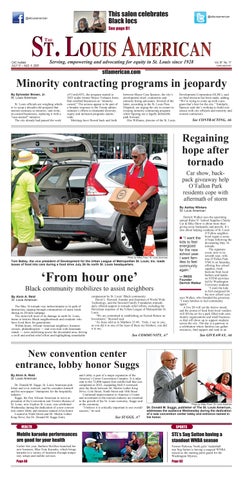
Photo by Wiley Price / St. Louis American
Tom Bailey, the vice president of Development for the Urban League of Metropolitan St. Louis, Inc. loads boxes of food into cars during a food drive July 26 its north St. Louis headquarters.
‘From hour one’ Black community mobilizes to assist neighbors By Alvin A. Reid St. Louis American The May 16 tornado was indiscriminate in its path of destruction, ripping through communities of many kinds during its 20-mile rampage. The storm left most of its damage in north St. Louis, home to historic Black neighborhoods and residents who have lived there for generations. Within hours, African American neighbors, business owners, philanthropists — and even kids with lemonade stands — were mobilizing across the devastated area, driving a swift and unified relief effort and highlighting remarkable
New convention center entrance, lobby honor Suggs By Alvin A. Reid St. Louis American Dr. Donald M. Suggs, St. Louis American publisher and civic stalwart, said he considers himself and his newspaper “champions for the hospitality industry.” Suggs, the first African American to serve as president of the Convention and Visitors Bureau of St. Louis, now Explore St. Louis, was celebrated Wednesday during the dedication of a new convention center lobby and entrance named in his honor. Located at Ninth Street and Dr. Martin Luther King Drive, the Dr. Donald M. Suggs Entry
HEALTH
and Lobby is part of a major expansion of the America’s Center Convention Complex. It is adjacent to the 72,000-square-foot exhibit hall that was completed in 2022, expanding Hall 4 westward onto the block between Dr. Martin Luther King Drive, Cole Street, Ninth Street and 10th Street. Continued improvements to America’s Center and investment in the tourism industry are essential to the growth of the St. Louis economy, Suggs said at the ceremony. “I believe it is critically important to our overall success,” he said.
See SUGGS, A7
Photo by Wiley Price / St. Louis American
Dr. Donald M. Suggs, publisher of The St. Louis American, addresses the audience Wednesday during the dedication of a new convention center lobby and entrance named in his honor.
SPORTS
Mobile karaoke performances are good for your health
STL’s Sug Sutton having a standout WNBA season
Earlier this year, Barbara McGhee launched her new business, Blue Note Karaoke, which brings karaoke to a variety of locations through temporary setups and mobile services.
Former Parkway North girls’ basketball star Sug Sutton is having a magical WNBA season as the starting point guard for the Washington Mystics.
Page A8
Page B3
A2
ST. LOUIS AMERICAN • JULY 31 - AUG. 6, 2025
Beyoncé gifts STL woman tickets in response to viral request St. Louis’ own Ida Mae Macklin asked – and Beyoncé made sure the grandmother received. A clip of Macklin pleading with Queen Bey for concert tickets to attend the “Cowboy Carter Tour” was viewed by more than seven million on Instagram and TikTok. “Look, Beyoncé, we have supported you so much… we have followed you, and I’m 80-something years old,” Macklin said in the video. “I can’t afford to see you no more. I hate this. We need some tickets, we in hard times. I used to have a lot of money.” The moment was filmed by Macklin’s granddaughter, Gabrielle – who films the videos to document Ms. Macklin’s journey with dementia. Macklin’s message reached Beyoncé, who gifted her floor seats to one of the Washington, D.C., shows over the Fourth of July weekend. Black Enterprise reported that during the concert, the
singer even gave Macklin a special shoutout from the stage. While performing “Boots On The Ground x HEATED,” Beyoncé was said to have called out over the crowd, “I love you grandma, wherever you are.”
She surrendered to the Forsyth County Jail on Tuesday and was released shortly after on a $22,260 bond.
Burglary at GloRilla’s home leads to rapper’s arrest
The death of Malcolm-Jamal Warner has been confirmed as accidental drowning, according to Costa Rica’s Judicial Investigation Agency (OIJ). Warner, 54, was pulled under by a strong rip current on Sunday afternoon while swimming at Cocles Beach, a popular but often dangerous stretch of coastline near Puerto Viejo in the South Caribbean. According to The Tico Times, the OIJ released autopsy findings on Tuesday, July 22 that confirmed the cause of death as asphyxia by submersion. While scenic, Cocles Beach is said to be known locally for its strong rip currents and the tragedy has reignited concerns about water safety and calls for better signage and trained personnel on Costa Rica’s Caribbean coast.
Rapper GloRilla, whose real name is Gloria Hallelujah Woods, is facing charges after a burglary occurred at her metro Atlanta home. The Forsyth County Sheriff’s Office confirmed to WSBTV Channel 2 Action News that deputies were called to a home owned by Woods at 1:30 a.m. last Saturday morning. Investigators told the television news outlet that three suspects went into the home when Woods wasn’t there and were stealing things when someone inside the home fired at them. The burglars ran off and investigators don’t believe they were injured. While investigating the burglary, some of the deputies smelled drugs and found a “significant amount of marijuana” in the master bedroom closet. Woods was then charged with possession of marijuana and possession of a controlled substance. Glorilla
Cause of death confirmed for Malcolm-Jamal Warner
New accuser comes forward against Smokey Robinson A fifth woman has reportedly come forward with sexual battery accusa-
PRICES GOOD WED., JUL. 30 THRU TUES., AUG. 5, 2025
tions against music legend Smokey Robinson. According to TMZ, the woman has officially filed a report. Law enforcement sources told the celebrity news and gossip site that the woman spoke with a deputy last Wednesday at the Los Angeles County Sheriff’s Department’s Malibu/Lost Hills station, where she formally reported her allegations. The outlet said that all five accusers have filed reports with LASD. Robinson’s attorney Christopher Frost issued a statement that vehemently denied the allegations. “It’s not surprising to us that in the context of very public allegations by the four interconnected Jane Does and their shared attorneys, no matter how untrue, news like this might emerge,” the statement read. “It’s one of the risks of being a celebrity, that others will take the same approach. Our focus is on exposing the falsity of the Doe lawsuit, where the Does and their lawyers have taken a hit and run approach – making allegations against a beloved 85-yearold cultural icon and subsequently refusing to reveal their identities or unequivocally sit for a deposition, where the truth can actually be determined.” Sources: Blackenterprise.com, WSBTV.com, TikTok.com, TMZ. com, Ticotimes.net
SCHNUCKS.COM
“I love this state, its people, and its promise. It is my home. But after deep reflection, I’ve decided that I will not run for governor in this election.” — Former Vice President Kamala Harris on not running for California governor
News
ST. LOUIS AMERICAN • JULY 31 - AUG. 6, 2025
Dangerous heat and storms hammer U.S. cities, putting 200 million under alerts
St. Louis temperature fall after a week languishing in the 90s Nearly two-thirds of the U.S. population — close to 200 million people — are under extreme heat warnings, watches or advisories as a dome of high-pressure traps sweltering air across the Midwest, South and East Coast. Cities including Chicago, New York, Atlanta, Dallas and St. Louis are experiencing oppressive temperatures, with heat indexes approaching or exceeding 110 degrees. “This is not normal July heat,” warned Max Holmes, president and CEO of the Woodwell Climate Research Center. “We’ve always had heat waves, but now they’re hitting harder, lasting longer and coming more often.” From Mississippi to Michigan and from Texas to New York, states are activating emergency measures. Cooling centers are open in New York City and Newark, where a Code Red hot weather health warning was issued through Wednesday, July 30. Meanwhile, officials in Arizona responded to multiple heat-related rescues over the weekend
Missouri refugee service providers adjust financial strategies amid federal funding uncertainty By Saurav Rahman Missouri Business Alert
By Stacy M. Brown Black Press USA Photo courtesy of iStockphoto/NNPA.
Residents across the country have been grappling with oppressive heat. In St. Louis, temperatures hit the 90s every day during the past week, reaching 97 Thursday, July 24, and 95 on Tuesday. A cool-down began Wednesday, with temperatures falling 10-15 degrees lower than in past weeks. As the heat builds across the country, a separate but equally dangerous threat is brewing. Thunderstorms forming over South Dakota were expected to evolve into a derecho — a widespread, fast-moving windstorm capable of producing hurricane-force gusts. The National Weather Service warned that wind speeds could exceed 90 mph, with isolated gusts hitting 115 mph. The Interstates 29 and 90 corridors are especially vulnerable, with AccuWeather forecasting potential damage to infrastructure and travel disruptions from Chicago to Minneapolis. “Several wind gusts in excess
of 75 mph, a few line-embedded tornadoes and instances of severe hail are also probable,” said meteorologist Mussie Kebede of the Storm Prediction Center. The heat is expected to ease slightly in the Midwest and Northeast by Thursday, but not before records are challenged in cities like Tampa, Charlotte and Philadelphia. Meanwhile, the South will likely remain gripped by extreme heat well into the weekend. According to NASA data, extreme heat stress events have more than doubled in the past 40 years — a trend that climate scientists say will only worsen without major environmental interventions. “This is exactly what scientists have warned about,” Holmes said. “It’s not a one-off anymore. It’s the new reality, and we have to prepare for it.”
A3
Nonprofit organizations that provide refugee services in Missouri are pivoting to diversified financial strategies to reduce their dependency on government funding. These organizations are now focusing more on expanding community-based crowdfunding and scaling up revenue-generating programs to address anticipated financial gaps and ensure continued support for refugees. City of Refuge, a Columbiabased nonprofit that provides services for refugees resettled in mid-Missouri, was notified that 40% of its federal and state funding might dry up by October 2026. Jackson Efuta, a former refugee and now a staff member at City of Refuge, said witnessing the ongoing funding cuts is deeply painful. “I have personally experienced how vital these resources are during the most vulnerable time in a person’s life, when they are trying to adjust, heal and survive in a completely new environment,” Efuta said. “It is life-changing, providing emotional, practical and community-based help that
gives individuals the chance to thrive, not just survive.” Garrett Rucinski, director of engagement at City of Refuge, said the organization is making plans in case its funding dries up. “We already have a plan now,” Rucinski said. “It’s to grow the revenue producers, grow the monthly donors.” Hilary Cohen Singer, executive director at Jewish Vocational Service of Kansas City, said it’s hard to determine a specific number of funds lost, as some programs have been discontinued permanently, others temporarily paused and some funding has fluctuated between being frozen and unfrozen. “We are increasingly looking to our local community to help provide the vital services for refugees and immigrants to help them integrate into the community,” Cohen Singer said. “We are certainly affected in significant ways by the loss of federal funding.” David Gonzalez, vice president of development at the International Institute of St. Louis, thinks the future for these service providers is See Refugee, A10
Editorial/Commentary ST. LOUIS AMERICAN • JULY 31 - AUG. 6, 2025
Guest Editorial
A4
Commentary
Political ineptitude Black, Latino spending idles pool project power packs a punch in East St. Louis
dom, anti-democracy crusade that is being waged to try to suppress information and suppress shareholders from having the “Who will try to blend communities disclosure and the information they need of color during a time the administration to make good fiduciary decisions,” Behar would like to see it kept apart? A strong said. combined effort would turn politics and the economy on its head by creating a Without calling for a boycott or sinsingle voice of people tired of being relegling out any particular business, the gated to society’s second class. Who will NAACP earlier this year issued a Black step up?” — Ray Marcano Consumer Advisory, encouraging people to spend their money where they’re They may not be making as much noise respected, to support Black-owned busias the extremists who boycott LGBTQ nesses, and to demand that businesses + inclusive brands, but communities of prioritize people over profit. color are quietly flexing their economic But it turns out that prioritizing people muscle against companies who actually is profitable. And the abandon diversity, equity, and financial consequences of failing inclusion policies. to do so are potentially enorThe combined spending mous. power of and Latino Americans DEI strategist Joseph Santana — who make up more than 30% wrote, “CEOs that cut DEI iniof the U.S. population — is $6 tiatives miscalculated the market trillion. That’s larger than the impact, incurring costly conseeconomies of every nation on quences in a business landscape earth except the United States where talent, consumers, and and China. investors demand alignment with Companies who kowtow to modern values.” Columnist extremist demands to abandon During the Essence Festival Marc their commitments to diversity, of Culture in New Orleans Morial equity, and inclusion policies are earlier this month, a panel sacrificing their bottom line for titled “We Drive Prosperity: political expediency. Even though there’s Impact of Black and Brown Businesses been no call for communities of color on the Economy” brought together to join forces in a large-scale, organized Robert Hartwell, host of HBO Max’s boycott, companies who backtracked are “Breaking New Ground;” Juan Proaño, losing out to companies who stood firm in CEO of League of United Latin American Citizens, and Elis Clementino, head of their commitments. strategic relationships at NVH Studios. As shareholder activist Andrew Behar Their message: “Black and Brown recently told Fortune magazine, the communities already have the economic Trump administration’s crusade against power—they just need to use it together.” diversity, equity, and inclusion is forcing Marc Morial is president and CEO of companies to underperform. the National Urban League “This is an anti-capitalist, anti-freeBy Marc Morial
ment. Yet, East St. Louis City Councilman Courtney Hoffman II chose to engage in For over a decade the children of East some preemptive butt coverage, on his St. Louis have endured the blistering heat Facebook page, assuring citizens that no and humidity of summer with no public money has been stolen and that “I’m sure pool, splash pad or aquatic recreational it’s going to be a clean audit” and “I have facility. no doubts we will be swimming soon.” However, this summer was to be very First, it’s always good news when poldifferent, with the construction of a $8.9 iticians assure us that they’ve not stolen million pool project in Lincoln Park, in any money, especially when they’ve not the city’s south end. yet been accused. With a pool, water slides, a splash pad The question here is how can an audit and pool in full view behind a be nearly one year late and fortress of padlocked chain-link those in charge fail to have the fencing, the community looked foresight to secure an auditor to forward to its grand opening, ensure that the project stays on just as 100-degree temperatures schedule? invaded the St. Louis region. The other issue is with But to their extreme disapHoffman’s certainty that the pointment, work was halted back children “will be swimming in June, when most other area soon.” “Soon” is the operative pools were opening for the sumword here because, in less than mer season. a month, East St. Louis youth Guest Columnist The reasons? Well, that will return to school, missing yet James T. depends on what you believe. another summer of cool memoIngram The East St. Louis Parks ries at their local pool. District, led by director Michael That’s unfortunate for the Collins, initially said of the shutyouth of East St. Louis, who are down that the State of Illinois has frozen a shining light, in an otherwise forsaken funding until the Park District completes community through their championship an independent audit. performances in track, football and basAccording to the Illinois Department ketball. They deserve to have a quality of Commerce, that audit was due back on public aquatic facility. August 29, 2024. That was nearly a year Unfortunately, no amount of promises ago! from “MIA Mike” (a felon convicted of Meanwhile, Collins claims that, tax evasion and vote fraud back in 2010) because of the frozen funds, contractors or spin from “Councilman Courtney” for the project were sent home until the are reassuring at this juncture. Summer matter is resolved. His expectation is that is winding down, and their political the audit will be completed by Aug. 1. excuse-making is ramping up. That contradicts a story by Chris It’s poli-tricks as usual on steroids, Hayes of Fox 2 News, in which contracin East Boogie, and every parent and tors claim that it was they who threatgrandparent of a heat-exhausted child in ened and, ultimately, walked off the job, East St. Louis should be outraged and leaving the project in its current state of remember this pool-free summer the next incompletion. time that Collins, who is also the East And, while I’ve left messages for a St. Louis Democratic Central Committee status update from Collins, at press time Chair, asks you to vote for any of his he remains MIA and without further com- political cronies and sycophants. By James T. Ingram For the St. Louis American
Commentary
Attempting to erase MLK Holiday to the post, Dr. Hayden is an esteemed champion of access, literacy, and the preservation of marginalized voices. Let’s call this what it is. Yet, in a sudden and unexplained The sudden release of over 230,000 move, her leadership was pushed aside pages of FBI files on Dr. Martin Luther under pressure from those who claimed King Jr. — two years ahead of schedule her stewardship was “too political”— — is not about transparency. It’s a code, in many circles, for being too inclucalculated, racially motivated campaign sive. Too committed to truth. Too willing to tarnish the legacy of one of America’s to tell the full story. greatest moral leaders. Discredit the man. If they can quietly sideline Dr. Carla Discredit the movement. Then, discredit the holiday. Hayden… This latest move unfolds amid a broadIf they can erase Fort Gregg-Adams… er reactionary wave: voter suppression, If they can ban books by Black authors book bans, attacks on civil rights — all and call it curriculum reform… aimed at rewriting history. Dr. King, the If they can target AP African American moral backbone of nonviolent protest, Studies and claim it lacks “educational is the latest target. First comes character value”… assassination via selective FBI leaks, next If they can question the legitimacy of comes “debate” over whether the Civil Rights Act… he deserves a day on the federal If they can tell lies about Dr. calendar. King and expect no accountabilLet’s talk timing — or rather, ity… twisted purpose. Charlie Kirk, What makes us think they’ll a far-right activist and founder stop short of dismantling MLK of Turning Point USA, recently Day? declared, “MLK was awful … Legally, repealing the holiday not a good person.” His real would require an act of Congress. issue? That King helped usher in It’s never been done before. But the Civil Rights Act of 1964 — a in an era when cultural memory law Kirk now calls “a huge mis- Guest Columnist is increasingly shaped by ideoltake.” Other right-wing voices ogy and outrage, the unthinkable suggest replacing MLK Day with Frances becomes possible. “Toni” Juneteenth, calling him “heiLet’s be clear: Dr. King didn’t Draper nous” and using long-debunked march for a day off. He marched allegations to justify erasing him for justice — for a multiracial from memory. democracy that still struggles to be realThese aren’t just fringe opinions — ized. The holiday is not a handout. It is a they’re test balloons. Once public trust moral marker. That’s precisely why it’s in frays, the question becomes: Why honor the crosshairs. him at all? These attacks are not about the past. We have a stark warning from Fort They’re about controlling the future. About silencing symbols that inspire Gregg-Adams, recently renamed back progress. About rewriting American to Fort Lee. The base, once named for memory in ways that serve fear, not freea Confederate general, was renamed in dom. 2023 to honor two distinguished Black The AFRO has always been on the military heroes: Lt. Gen. Arthur Gregg and Lt. Col. Charity Adams, commander frontlines of the fight for equality — of the 6888th Central Postal Battalion. speaking truth to power, exposing injustice, and amplifying Black voices. We’ve Two years later, the base was renamed again — this time after Pvt. done it for more than 130 years, and we’re not stopping now. Fitz Lee, a Buffalo soldier. A symbolic We must heed the warning signs. walk-back dressed in careful language, Because if they can do all this in plain but make no mistake: it was a retreat. A sight, imagine what they’ll try to do next. retreat from reckoning with history. A retreat from centering Black excellence. A retreat that reeks of political calculation. Frances “Toni” Draper is the pubThe same playbook applies elsewhere. lisher of the AFRO-American Newspaper Take the recent removal of Dr. Carla (the AFRO), with offices in Baltimore, Maryland, and Washington, D.C. Hayden as Librarian of Congress. The first Black and first female appointee By Frances “Toni” Draper
EMERITUS LEADERSHIP Nathan B. Young (1894-1993) • Founder N.A. Sweets (1901-1988) • Publisher Bennie G. Rodgers (1914-2000) • Executive Editor Melba Sweets (1909-2006) • Editor
STAFF Donald M. Suggs Publisher
Zaria Mac — RAC St. Louis reporter Taylor Marrie — RAC St. Louis Photographer/ Videographer
ADMINISTRATION
CONTRIBUTING EDITORS
Dina M. Suggs — Senior Vice President Julie Erickson — Chief Operating Officer Raven Whitener — Director, St. Louis American Foundation and Special Events Alfred Wilson — Executive Administrative Coordinator
Fred Sweets • Ellen Sweets PRODUCTION Mike Terhaar — Art Director Melvin Moore — Graphic Designer DIGITAL
EDITORIAL Rod Hicks — Executive Editor Alvin A. Reid — City Editor Kenya Vaughn — Arts and Entertainment Editor Earl Austin Jr. — Sports Editor Denise Hooks — Anderson, M.D. Medical Accuracy Editor Wiley Price — Photojournalist Sylvester Brown Jr. — Deaconess Advocacy Fellow Ashley Winters — Assistant Editor, Community Editor Wendy Todd — Report for America Reporter
Dawn Suggs — Digital Director James LeBine — Multimedia Specialist Courtney Thompson — Digital Editor SALES Pam Simmons — Senior Account Executive Angelita F. Houston — Classified Manager Janice Brown — Account Executive
2315 Pine Street, St. Louis, MO, 63103 Phone: 314-533-8000
• The largest weekly newspaper in Missouri •
100% Independently owned, operated and continuously published without interruption since 1928
ST. LOUIS AMERICAN • JULY 31 – AUG. 6, 2025
Running for the money
State Treasurer Vivek Malek testifies in a Senate committee in January 2024, fielding questions about the oversight of the MOScholars program.
By E. Faye Williams
Photo by Annelise Hanshaw / Missouri Independent
Donors to private school voucher program removed from Missouri transparency site By Annelise Hanshaw Missouri Independent Who’s funding a state’s tax credit program for private school tuition is no longer available through Missouri’s transparency portal, following a decision by the State Treasurer’s Office to permanently remove the information. Donors and their contribution amounts were available July 2, 2024, when The Independent accessed the information and published a report three days later showing the largest donors to the program at the time were a Fortune 500 healthcare corporation, a cable company and the founding family of the Kansas City Chiefs. When the article was released, the State Treasurer’s Office called The Independent to ask how the information was accessed. The office didn’t seem to be aware that the list was available on a state-run website detailing state spending. According to Internet Archive’s Wayback Machine, donor information was wiped by the end of the month. Jackson Bailey, chief of staff to Missouri Treasurer Vivek Malek, chalked the situation up to a “clerical error,” saying the office never intended the information to be posted in the first place. The office declined to answer further questions on the removal, including whether or not the information is available upon request.
A5
In 2022, Missouri lawmakers passed a law to shield nonprofits from being forced to disclose donor information. And it was quickly used to conceal public records, such as then-Gov. Mike Parson redacting the names of donors and attendees of his holiday gala. A year later, lawmakers approved a fix to the law clarifying how it should be implemented. Missouri’s tax-credit scholarship program, called MOScholars, is set up using state-approved nonprofits. Donors apply for a tax credit through the State Treasurer’s Office and donate to the nonprofits, which are called educational assistance organizations. At tax time, they are able to deduct the donation amount from their state tax obligations, so long as it’s less than half of their total bill. Because the program is set up using private nonprofit organizations as an intermediary, the state might be barred, or at least exempt, from disclosing the donation information, according to Dave Roland, director of litigation at the Freedom Center of Missouri. Programs like MOScholars, Roland said, are “specifically designed to have the funding treated as private money rather than public money.” The demand for more oversight of MOScholars has accelerated, with state lawmakers passing a $51 million direct appropriation to the program.
Some run for office to serve the people — to help them make their lives better. Trump never got that message. He spent a lot of money those years he was sitting on the sidelines thinking about the damage he could do for the not-sowell-off if he got back in the White House. He hired Elon Musk to figure things out for him with DOGE. That caused the firing a lot of people from jobs they’d held for years. He didn’t help anyone I know in his first term, and he’s doing even less now. Democracy is threatened and political violence is a major problem under his watch. He did everything he could to make some quick money for himself and his family. Instead of allowing Elon to do all of his destruction in the field, he brought him to the White House to run a car sales lot on the lawn with Tesla cars. After Trump got his Tesla, it seems the friendship began falling apart and they began hurling insults at each other. The insults grew once Elon left the White House and took his boy, who Trump didn’t seem to like hanging around his desk. With all the boy saw, I don’t think any of it influenced him to want to be president of anything! By the time Elon left, I think some were beginning to prefer Elon to Trump! They’d begun to see what would happen to them once Trump’s bill passed. In those few days before the vote on the Big Ugly Bill, critics were invited to E. Faye the White House and when their dear leader finished, I don’t Williams know what he promised, but they were whipped into shape! They came running out with their dear leader’s demand to pass the bill with their little gifts and whatever promises he made to them, with no change in the fact that among the 17 million Americans were many of their constituents losing their healthcare coverage or Medicaid. Many will have community hospitals wiped out causing them to travel up to 100 miles for healthcare. GOP representatives were seen cheering about all the losses to their constituents they’d been elected to support. Their dear leader was so satisfied that he flew off on a victory tour to the Iowa State Fair and returned to spend an hour on the phone with his dear friend Vladimir Putin, who went on to bomb Ukraine the same night! With endless immunity, dear leader continues profiting from the presidency by advertising Teslas, and selling Bibles, gold watches, tennis shoes, MAGA products, cologne, perfume, cell phones, influence, and God only knows what else from the White House! The bill will make poor people poorer without healthcare, jobs, food, and more. All of this is shameful. Now their dear leader has bragged that he now has more power and gravitas than before! Hakeem Jeffries reminded his GOP colleagues that draining the swamp looks a lot like them and the tax scam that was jammed through Congress would undermine the quality of life of everyday Americans. He called the budget an “immoral document” and said “We’re getting chaos and corruption. It’s shameful and reckless. People will die due to cuts in this bill. All of us should question what deals were cut in those backrooms.” Jeffries said Democrats are a “Hell no on the big ugly bill, and it will continue to be, but we must press on for the victory for those who need us to do so.” Meanwhile, GOP’s dear leader and DeSantis were laughing about people being eaten by alligators off the coast of Florida! Don’t forget J.D. Vance cast the vote that could have killed this Big Ugly Bill! Once he called Trump practically everything but a child of God, but did an about-face and gave Trump the victory. He now argues Trump’s case better than Trump himself! E. Faye Williams is president of The Dick Gregory Society.
A6
ST. LOUIS AMERICAN • JULY 31 – AUG. 6, 2025
Giveaway
Continued from A1 atmosphere of encouragement and unity. RNSS has handed out 8,000 backpacks since 2019. “This event is about more than giving away supplies — it’s about giving people inspiration, support and a sense of unity,” Walker says. The nonprofit started with the mission to support youth through education, mentorship and access to essential resources. It focuses on reducing barriers that can block academic achievement. In partnership with NASCAR, Walmart and other businesses and nonprofits, RNSS brings together cars, culture and education. Walker describes it as a movement built on unity, empowerment and purpose. The community-led event and car show will
Contracting
Continued from A1
The city’s 25% minority- and 5% women-owned business (M/WBE) participation goals came about in the late 1980s after an attempt by then-Mayor Vincent C. Schoemehl Jr. to set minority participation goals by executive order. A lawsuit filed by a minority contractors group in 1990 accusing the city of engaging in racial discrimination led to the minority- and women-owned businesses percentages the city relied on until recently.
Attendees to last year’s RNSS backto-school giveaway sort through backpacks.
Photo courtesy of Derrick Walker
pull out all the stops with “jaw-dropping rides,” Walker says, describing the cars on display at this year’s car show. The first 25 students to arrive will receive a free JanSport backpack and lunchboxes. Latonya Annor, a Walmart community relations executive, says the big box retail store is helping amplify the work
RNSS already is doing by offering gift cards, healthy snacks and backpacks. “We want to make sure kids aren’t feeling adult problems, especially after the recent tornado,” Annor says. “Walmart is ensuring kids have a lasting impression. St. Louis needs it.” The inspiration behind Walker’s organization took root during his time
with 100 Black Men of Metropolitan St. Louis. On a visit to a juvenile detention center, he saw a group of young boys who needed a steady, positive role model in their lives. Hoping to be a mentor and a positive presence, Walker found common ground through a shared passion for cars. “After seeing their lack
of inspiration, this is my way of helping them,” Walker said, adding that he hopes to break the cycle of young people returning to the detention center. While the school supply giveaway draws the crowds, Walker says the heart of his work lies in something deeper — opportunity. His
Virvus Jones, who was elected St. Louis comptroller in 1988 and played a key role in launching the city’s minority contracting guidelines, said the program faced resistance from white contractors and politicians from the start. “They didn’t want to do it,” Jones said. “The Association of General Contractors — which were all white contractors — offered a course for their members on how not to comply with DEI rules and regulations. I had to file lawsuit after lawsuit because they (white contractors) were not complying with the executive order.”
Ironically, the city is “pausing” or considering ending programs aimed at minority participation, even after a study it commissioned found that minority- and women-owned firms weren’t getting the mandated percentage of work from the city. The study disclosed that M/WBE firms that should have gotten 43% of city contractor dollars, only received 29% between the years 2016 and 2021.
re-elected President Donald Trump signed an executive order titled “Ending Illegal Discrimination and Restoring Merit-Based Opportunity,” effectively rescinding President Lyndon B. Johnson’s 1965 executive order that barred federal contractors from discriminating based on race, color, religion, sex or national origin. Trump’s Justice Department has moved to dismantle the Disadvantaged Business Enterprise Program, a nearly $37 billion affirmative action initiative that for decades guaranteed minority- and wom-
en-owned firms at least 10% of federal transportation contracts — a move that, if approved, would essentially neuter the program. At the same time, Trump signed an executive order targeting the Minority Business Development Agency, the only federal agency devoted solely to supporting minority-owned businesses. Under President Biden, the MBDA helped secure over $3.2 billion in contracts and $1.6 billion in capital for entrepreneurs of color, creating or preserving more than 23,000 jobs, according to BlackPressUSA.
Rolling back the clock on racial justice In January, newly
proudest achievement through Rides N’ School Supplies are scholarships. To date, the organization has awarded more than $55,000 to local students heading to college. And this year, RNSS is donating $10,000 in college scholarships to local students. Last year’s recipient, Stephon Riggins, told The American last year that before the scholarship, he wasn’t sure how he’d pay for school. “The scholarship came at the right time,” he said. “When the community pours into young people, it makes us want to be successful in our future”. Riggins, a sophomore at the time, was studying communications at Harris-Stowe State University. “I want those who invested in me to get a return on their investment, he said.”
In May, the Justice Department issued a memo saying it could use a law intended to punish corruption to go after anyone else getting public money while engaging in diversity, equity and inclusion programs. That memo, widely perceived as a threat from federal officials, panicked political leaders across the country, with many dismantling programs perhaps prematurely. Aldermanic President Megan Green, who was at the meeting with city leaders and minority business advocates, said the city “shouldn’t ditch a decades-old program just because of a letter” from Trump’s Justice Department. Jones agreed, leveling charges of cowardice on local politicians. “St. Louis is the only city with a large Black population in this country that’s even pondering doing this. No other Democratic mayor — white or Black — is bending over to appease Trump,” Jones said. In addressing the president’s “wholesale attempt to roll back the clock on racial justice,” the American Civil Liberties Union, created an online space titled “Trump on DEI and Anti-Discrimination Law.” Asserting that “many components of Trump’s radical ‘antiDEI’ agenda violate the Constitution and federal laws,” the ACLU is urging state and local officials to defend democracy and preserve civil rights gains, calling on governors and mayors to issue executive orders protecting DEI programs at the state and local levels. Jones reiterated that point. “These are goals, not quotas, so all (a mayor or governor) needs is an executive order to create and maintain equity. Trump can only impact federal money, not local, city taxpayer money. ... He can’t prohibit us from setting aspirational goals for diversity. He simply can’t. Jones is the father of former Mayor Tishaura Jones, whom Spencer beat in this year’s mayoral election. Biased perhaps, he accused Spencer of kowtowing to the billionaire white developers who funded her campaign. “Mark my words, this is no accident. They didn’t like affirmative action back then, and they don’t like it now,” Jones said. Sylvester Brown Jr. is the Deaconess Foundation Community Advocacy Fellow.
A7
ST. LOUIS AMERICAN • JULY 31 – AUG. 6, 2025
Suggs
Continued from A1 “We owe it to St. Louis to continue this vital project and build the outdoor event space and connectivity that will make us competitive. We want to keep jobs coming for our citizens.” Suggs said the importance of the tourist industry and its impact are “under-appreciated.” “The industry employs tens of thousands of workers on a year-round basis. Many of those workers are people in our community who need help the most to get year-round jobs. Unlike sports venues that offer only seasonal employment, “convention centers operate all year,” Suggs said. “They (provide) consistent employment, are attended by people from across the country, and in some cases, from around the globe, showcasing our city to new audiences — but get relatively meager public financial support.
Community
Continued from A1
“These devastating and life-altering disasters have affected so many in our community. We are called to do our part to help those in need.” Steward and other philanthropists partnered with the St. Louis Symphony Orchestra and Fox Theater to present a benefit concert featuring BeBe Winans on June 29. The concert, which included the IN UNISON and SLSO Choruses, and a related online donation effort raised $350,000 for the Urban League Disaster Relief Fund. All funds raised are assisting the Urban League in its ongoing effort to
The audience included Suggs’ daughters, Dawn and Dina Suggs, his granddaughter Delali SuggsAkaffu, and dozens of his friends and fellow civic and business leaders. “Everyone tells me my grandfather is an influential man. To me he is just my Papa,” Delali said during the ceremony. “He taught me the most important things in life are family, giving back to the community — and art.” She thanked him for “flying four hours to see one of my performances,” when she lived on the West Coast, and “for the hours you spent with me on weekends teaching me how to drive.” Suggs dabbed tears from his eyes as he remembered his parents and the sacrifices they made for him as a boy in East Chicago, Indiana. “We all must realize how things came to be. How someone with ordinary ability could go on to have a very interesting life,” he said as his voice quivered. “I grew up a Black
boy in a Black world,” he said, crediting his parents, Morris and Elnora Suggs, for making sacrifices for him. “They gave me more than they had. ... For that, I will always be eternally grateful.” Michael P. McMillan, president and CEO of the Urban League of Metropolitan St. Louis, first met Suggs as a teenager. Over the years,
Suggs became instrumental in McMillan’s political rise — from St. Louis alderman to license collector. “Dr. Suggs had nothing to gain from taking this teen under his wing,” McMillan said. “My father died at a young age, and Dr. Suggs has been a father figure to me for many years.” McMillan applauded
Suggs for the St. Louis American Foundation’s use of the convention center for many of its Salute to Excellence celebrations over the last 30 years. “No one has brought more people to this facility than you have with your galas. And your foundation has given tens of millions of dollars in scholarships. “This is truly a historic day for a historic man.”
Carol Daniel, a longtime KMOX news anchor who now serves as a director of the Urban League’s Save Our Sisters program, said “if you know Dr. Suggs, you know he has never liked the spotlight being put on him.” “During the Ferguson Uprising, I wanted to interview him. He refused, saying, ‘talk to the young people.’ He is a wise man, a humble man.” “He quietly, yet loudly, expanded our minds. He taught us that we can be leaders, we can demand more, we can do better.” Ed Skapinok, Explore St. Louis chief commercial officer, called Suggs, “a remarkable leader, visionary,and friend of St. Louis.” “This new entry is more than a doorway. It celebrates a man who has opened doors for many people.” Suggs’ closing statement may have summed up his commitment to the region he serves in many ways. “St. Louis is my city. It will always be my home.”
support the most immediate needs of people displaced or impacted in north St. Louis. A portion of the funds went directly to partner churches damaged by the tornado in the SLSO’s IN UNISON program, which has connected congregations primarily in north St. Louis to the orchestra for more than 30 years. “While we realize nothing can take the place of a loved one, we pray these donations will help bring comfort to those who have lost so much,” Steward said. “All who are suffering from the May 16 tornado’s destruction remain in our prayers for the peace and solace only God provides.” Michael P. McMillan, Urban League president and CEO, witnessed
the Black community’s immediate response and willingness to support one another. “The way the people have mobilized over the past 10 weeks has been amazing,” said McMillan, whose organization has been the anchor of the region’s tornado response effort. “Every level of African American organization, as well as individuals, have stepped up. Donations have come from the Divine 9 Black Greek organizations, the St. Louis Metro Links, Coalition of Black Trade Unionists, Jack and Jill, churches, block units and many more groups. “Right down to kids in city neighborhoods with lemonade stands raising money for relief. It has just been sensational.”
The Urban League held its 10th large-scale food and resources distribution event last Saturday at its North Kingshighway headquarters, three of which were Food Truck Saturdays. The events have served up to 3,000 people, and back-to-school resource distribution events are planned for August 9 and 16. “So many people and organizations have been with us, and I can say that the Black community has been supporting us from day one, really hour one after the storm,”McMillan said . Michelle Tucker, the African American president and CEO of the United Way of Greater St. Louis, said volunteers are crucial during this time.
“Our Volunteer Center continues to be at the forefront of connecting over 5,900 individuals, corporate partners and organizations with meaningful disaster-related service opportunities,” Tucker said. “And as always, it is so amazing to see how our community unites during challenging times. Shortly after the storm, United Way activated a Storm Relief Fund, and thanks to countless individuals and organizations throughout our communities, United Way has allocated more than $2 million to nonprofits who are on the frontlines of disaster recovery efforts. “Among the UW support received, record producer Metro Boomin and Rodney Boyd, Nexus
Group founder and partner, personally donated and secured additional funding to provide free hot meals to storm victims.” Tucker said her organization’s 211 team “quickly transitioned into crisis response mode to ensure individuals and families were aware of available shelters, hotel options, and other critical resources.” United Way 211 connects people to services, from basic needs to childcare to disaster relief to counseling. “So far, our 211 team has assisted 2,400 storm victims with navigating resources,” Tucker said. She added that United Way is partnering with the Evolution Festival on Sept. 27-28 in Forest Park to support the storm relief fund.
Dr. Donald M. Suggs, center, attends a ceremony in his honor at America’s Center in St. Louis. He’s joined by longtime friends Virvus Jones, left, a former St. Louis city comptroller, and Mike Jones, a former St. Louis alderman.
Photo by Wiley Price / St. Louis American
HealthMatters your
‘Taking Care of You’ ST. LOUIS AMERICAN • JULY 31 – AUG. 6, 2025
A8
Singing, sipping and socializing
STL gas stations now sell morningafter pill
Therapist says mobile karaoke performances are good for your health
By Olivia Mizelle St. Louis Public Radio
locations through temporary setups and mobile services. The business, she said, offers a “unique service that combines entertainment with emotional wellness.” In nearly 20 years as a clinical social worker, McGhee has worked in a wide range of settings — from institutional to educational to medical. But throughout her career, she was always looking for new ways to connect with clients of all ages. Researching the health benefits of singing set her on an interesting
St. Louis residents can now find a morning-after pill on convenience store shelves next to the condoms. California-based Cadence OTC began selling its over-the-counter emergency contraceptives, The Morning After Pill, in convenience stores and gas stations in Missouri this year. Its products are available in 24 locations statewide and 30 in the St. Louis n “About a including third of all con- area, Illinois. doms are sold “Those in convenience convenience stores. And so stores and gas stations tend to our goal was be in regular to say, well, neighborhoods. if this conThey’re open later. They’re traceptive is sold here, let’s community bound,” said make sure that Kate Voyten, the emergency senior vice president of comcontraceptive is available as mercial operations at Cadence well.” OTC. “So we were looking for – Kate Voyten, a place to offer Cadence OTC a solution that wasn’t available today.” It costs $25 in store and $19.95 online. It contains levonorgestrel, which is not an abortion pill. It needs to be taken 72 hours after sex to work, but the company says the sooner the more effective. Voyten said it can be found next to the condoms in most locations. Some locations might have a card to bring to the cashier, who will give it to the customer at the counter. “Fun fact is that about a third of all condoms are sold in convenience stores,” Voyten said. “And so our goal was to say, well, if this contraceptive is sold here, let’s make sure that the emergency contraceptive is available as well.” Emergency contraception has been
See KARAOKE, A9
See PILL, A9
Photo by Wiley Price / St. Louis American
Barbara McGhee, a licensed clinical social worker and mental health therapist and owner of Blue Note Karaoke, feels the interactive entertainment genre has more to offer than just fun. It can be downright therapeutic. By Sylvester Brown, Jr. St. Louis American Karaoke aficionados instinctively know there’s something liberating about getting up in front of a crowd of strangers and belting out a favorite tune. Singing something like Bobby McFerrin’s “Don’t Worry, Be Happy” can make everyone, well … happy. Barbara McGhee, a licensed clinical social worker and mental health therapist and owner of Blue Note Karaoke, feels the interactive entertainment genre has more to offer than just fun.
n “There’s a science to singing,” McGhee said. “With senior citizens for example, it helps with memory, recall and is an actual mood enhancer. It can be downright therapeutic. Earlier this year, McGhee launched her new business, Blue Note Karaoke, which brings karaoke to a variety of
Lawmakers, celebs raise awareness about fibroids
Dr. Faith Ohuoba, an OBGYN, says stress, processed foods and obesity increase the risk of developing fibroids, non-cancerous tumors that grow in or around the uterus.
Black women more likely to have them
Word in Black Up to 80% of women develop fibroids of some size in their womb by age 50. Black women are up to three times more likely to have them and often at a younger age. The non-cancerous tumors can range from as small as a blueberry to as large as a watermelon. Actor Lupita Nyong’o was diagnosed with the condition in 2014, the same year she won her Academy Award. She is now partnering with six Black congresswomen to fight for more research funding and
increased early detection. “We are really calling on many of our agencies — NIH (National Institutes of Health) in particular and others — to increase the amount of funding available in states to study and eventually also to treat fibroids,” Democratic Sen. Angela Alsobrooks of Maryland said on her Instagram account. Fibroids can cause symptoms like weight gain, heavy menstrual bleeding and infertility. However, some women do not experience symptoms.
See FIBROIDS, A9
Missouri Foundation for Health is building a more equitable future through collaboration, convening, knowledge sharing, and strategic investment. Working in partnership with communities and nonprofits, MFH is transforming systems to eliminate inequities within all aspects of health and addressing the social and economic factors that shape health outcomes.
Photo courtesy of Dr. Faith Ohuoba
Your Health Matters is provided in partnership with
HealthMatters your
‘Taking Care of You’
ST. LOUIS AMERICAN • JULY 31 – AUG. 6, 2025
Major study produces good news in Alzheimer’s fight
A9
Researchers find structured lifestyle changes key to improved brain function By Stacy M. Brown Black Press USA A major clinical trial has found that structured lifestyle changes can lead to greater improvement in brain function for older adults at risk of cognitive decline, compared to less intensive, self-directed approaches. The peer-reviewed study was published this week in The Journal of the American Medical Association and presented at the Alzheimer’s Association International Conference in Toronto. It provides a large measure of hope against an illness that has long had many in fear. Researchers enrolled 2,111 participants between the ages of 60 and 79 who were at elevated risk for cognitive decline and dementia due to factors such as sedentary behavior, poor diet, cardiometabolic conditions and family history of memory loss. Participants were randomly assigned to one of two lifestyle interven-
tions, either a structured, high-intensity program or a lower-intensity, self-guided version, and followed for two years. Both groups focused on improving physical activity, nutrition (through the MIND diet), cognitive stimulation, social interaction, and cardiovascular health. However, the structured group attended 38 facilitated meetings over two years and followed detailed activity plans, while the self-guided group attended six meetings and was encouraged to pursue goals independently without coaching. Both groups in the study — those who followed a structured lifestyle program and those who made changes on their own — showed improvement in overall brain function. However, the group that followed the structured plan improved more over the two years. Researchers measured this improvement using a standard scoring meth-
od that looks at multiple aspects of thinking, such as memory, attention and speed. On that scale, the structured group improved by 0.243 points per year, while the self-guided group improved by 0.213 points per year. The difference between the two groups — 0.029 points — was small but statistically meaningful, meaning it’s unlikely to have happened by chance.
The structured group also did better when it came to executive function, which involves planning, decision-making and self-control. Their scores improved slightly more each year — by 0.037 points — compared to the self-guided group. The structured group also had slightly better scores in processing speed, or how quickly the brain handles information, but
Karaoke
singing, drinking and eating parties on wheels. So she and her partner, Harold Coleman, developed a business plan and bought a bus. They had it repainted jet black with floating musical notes on the exterior, then customized the interior with black leather seats, a groovy yet soothing 1970s vibe, a large TV screen for lyrics
and a high-quality studio stereo system. Blue Note Karaoke officially hit the road in January. In just a few months, the concept has grown exponentially. McGhee now offers karaoke experiences for tourists, outings to wineries, rolling business meetings where the TV screen is used for presentations, and pop-up events for parties, festivals, community events, fundraisers, churches and senior citizen and veterans facilities. She also wants to partner with companies to offer endof-week karaoke pop-ups as a fun way to promote team building. McGhee hopes a grant she recently submitted will be funded soon. The idea, she said, is to host pop-up mental health events where clinical social workers and other professionals will talk to youth from age 6 to 19 “about bullying, managing anxiety and social connections,” and karaoke will be used as part of a “group therapy hug,” she said. McGhee hosted her first karaoke pop-up at
Homer G. Phillips Senior Apartments last month and, she emphasized, there was no greater joy than watching senior citizens singing or listening to songs from their youth. “As a therapist, I see the benefits of working with seniors,” she said. “Often they are very isolated, so the connection and social work pieces are very important to me.” With a maximum busload of 14 people at around $30 per person, karaoke enthusiasts can skip the crowds and long wait times of traditional clubs and enjoy a more intimate experience where they can sing, sip and socialize with a group of their choosing. McGhee concisely described a Blue Note Karaoke evening: “It’s a unique experience for a common interest with the people you know and love.” Sylvester Brown Jr. is the Deaconess Foundation Community Advocacy Fellow. For more information visit: Https:// Bluenotekaraoke.com
are urging researchers to develop more minimally invasive treatments. Some current treatments are not covered by insurance. Doctors may recommend a hysterec-
tomy or another surgery to remove the fibroids. Nyong’o had 30 fibroids removed. But they can grow back. “The real issue is awareness and educa-
tion and having these real conversations. … Women deserve better at this point,” says Ohuoba.
Continued from A8 path. “There’s a science to singing,” McGhee said. “With senior citizens for example, it helps with memory, recall and is an actual mood enhancer. It increases dopamine, the feel-good hormone, and decreases that stress hormone, cortisone. “For children, it can aid in building confidence and self-esteem as well helping them promote their thoughts and desires through musical choices. I learned how the joy of singing connects, engages and uplifts people.” In a Fox 2 News interview a few months ago, McGhee shared how her own positive experience with karaoke inspired her to start the business. “I love karaoke and use it as a self-care tool at the end of a busy week to unwind and destress, and it went from there,” she said. That comment seemed to have resonated with the TV hosts, Blair Ledet and
Pill
Continued from A8 available over the counter for years, but in health care or contraceptive deserts, there often aren’t any retailers that sell it within a 5-mile radius, Voyten said. Even at locations that do sell it, customers may have to go up to the pharmacy counter to purchase it. “I think it is helpful to decrease some of those additional barriers that are still there,” said Melissa
Fibroids
Continued from A8 “Fibroids can grow with increasing stress, pro-
Photo by Wiley Price / St. Louis American
Ric Louis, left, sings a song on the Blue Note Karaoke bus while owners Barbara McGhee and Harold Coleman participate. John Pertzborn, who delivered an impromptu version of Tina Turner’s “Proud Mary.” McGhee has degrees in criminal justice administration and psychology, but, she said, she always wanted to add “entrepreneur” to her portfolio. She’s always liked to sing, had visited karaoke venues and even hosted parties
at the W Karaoke Lounge in University City. But, she became intrigued with the thought of adding a twist to typical party bus services. She saw an opportunity in a service that was designed to keep the karaoke party going from venue to venue or even having karaoke enthusiasts host their own private
Tepe, an OBGYN who is Affinia Healthcare’s chief medical officer. Affinia is not involved with Cadence OTC. Cadence OTC plans to eventually sell birth control pills over the counter in convenience stores as well. Voyten said the company is “at the tail end” of the process, and it is working with the Food and Drug Administration to finish its final study. Cadence OTC’s main partners are 7-Eleven and Circle K, but it works with many other stores.
Some of the St. Louis locations that offer the product are the 7-Elevens on Southwest Avenue and Mackenzie Road. The company’s website has a store finder that shows the locations closest to a certain ZIP code. Tepe said emergency contraception is safe, and she supports increased access to it. “Any type of safe access that people can have for their reproductive health care needs, as long as it’s safe, is a positive thing,” Tepe said.
cessed foods, [and] obesity,” said Dr. Faith Ohuoba, an OBGYN with an upcoming book about what she calls the fibroid crisis. She says women should think of the condition as a
red flag to make healthier choices. “You have to think about some of these diseases from a holistic perspective,” she adds. Advocates like Nyong’o
that difference wasn’t strong enough to be considered significant. When it came to memory, there was no clear difference between the two groups. The participants included 68.9% women, and 30.8% identified as part of a racial or ethnic minority group. Thirty percent were carriers of the APOE-e4 gene, a known genetic risk factor for Alzheimer’s disease.
Retention was high, with 89% completing the final two-year assessment. Researchers reported that the structured intervention produced benefits regardless of sex, age, race, cardiovascular health or APOE-e4 status. The cognitive improvement was more pronounced in participants with lower baseline cognitive scores. The study was conducted at five clinical sites across the United States from 2019 to 2025, with oversight by Wake Forest University School of Medicine and approval from a centralized institutional review board. It is registered at ClinicalTrials.gov under identifier NCT03688126. “Among older adults at risk of cognitive decline and dementia, a structured, higher-intensity intervention had a statistically significant greater benefit on global cognition compared with an unstructured, self-guided intervention,” the researchers wrote.
Missouri Foundation for Health is building a more equitable future through collaboration, convening, knowledge sharing, and strategic investment. Working in partnership with communities and nonprofits, MFH is transforming systems to eliminate inequities within all aspects of health and addressing the social and economic factors that shape health outcomes.
Your Health Matters is provided in partnership with
A10
ST. LOUIS AMERICAN • JULY 31 - AUG. 6, 2025
Refugee Continued from A3 going to be less reliant on government funding, and that is the direction his organization is moving in. The Missouri Office of Refugee Administration reported 3,272 refugee arrivals in Missouri during the 2024 fiscal year, which extended from Oct. 1, 2023 to Sept. 30, 2024 — the highest number in the past eight years. According to the American Immigration Council, the total number of refugees in Missouri is estimated to be around 24,600. Expanding revenuegenerating services City of Refuge launched a campaign to recruit 1,000 donors contributing $50 per month. According to Rucinski, it has reached 20% of that goal within just a couple of months. The organization is also focusing on its three revenue-generating initiatives — City Boutique, City Cuisine and City Preschool. City Boutique is a thrift shop that sells goods from local donors and refugee artisans; City Cuisine operates a food truck and provides catering services; and the preschool program supports young children’s social and language development. Together, these initiatives help fund the larger organization, with revenue from the boutique funding 15% of the total annual budget, Rucinski said. “We are knocking on every door possible, asking for monthly gifts, asking for end-of-year gifts. That’s what every nonprofit is doing right now,” Rucinski said. “We have the benefit of having those three revenue generators, and those revenue generators are
going to help us.” Amid news of future funding cuts, an unexpected opportunity arose for City of Refuge — the building next to its location was listed for sale. The organization purchased it using previously awarded American Rescue Plan Act funds to expand on its services. “When the building came up, we realized that we could put down the down payment,” Rucinski said. “With tenants still in the building next door, we can continue to operate as we were, while affording the building next door to us, so it is self-sustaining.” City of Refuge is now planning to use the remaining space in that new building for youth programming and a commercial kitchen, which it hopes will generate additional revenue for the organization, Rucinski said. “If we keep getting more monthly donors and end-of-year donors, if we keep getting more visitors to the Boutique, Cuisine and people attending our preschool, more sponsors and we continue on the pace that we are at, I feel very positive about October 2026,” Rucinski said. Leaning on community support Jewish Vocational Service of Kansas City continues to support refugees despite the ongoing challenges caused by the federal funding cuts. The organization has adapted by reducing staff and expanding its search for alternative funding sources. Katie Norman, communication manager at JVS, said that the organization supports approximately 7,500 refugees and immigrants each year, with community integration, health and
Submitted photo via Missouri Independent
Jewish Vocational Service of Kansas City helps refugees integrate into the local community.
education. “We do receive quite a bit of funding from the federal government, so we have been impacted by the cuts and freezes to federal funds,” Norman said. “But we also receive funding from private foundations and the state as well.” Due to federal funding cuts, JVS has already reduced its services and is now seeking and has received new funding to continue much of its work, Cohen Singer said. “We did have to make staff reductions, and so we have done that,” Cohen Singer said. “We anticipate being able to continue with our operations at the size and scale that we are certainly into next fiscal year, and that is probably as far as we are able to plan for.” Agencies like JVS have traditionally been closely involved in the initial resettlement period of refugees. That program has now stopped, and there are no new arrivals associated with it. Following that,
there is no funding available for refugee resettlement, said Cohen Singer. “But that doesn’t mean that our work stops, because the work that we do provides support to people who have been here one year, but also three years or five years or 10 years, depending on what their needs are,” she said. According to Cohen Singer, the organization now reaches the local community, individuals, foundations, and state and local governments that have programs to support people’s wellbeing, even if the funding is not specifically for refugees and immigrants. “The people that we serve can benefit from funding that is targeted towards employment or education or youth services or mental health, or any number of things,” Cohen Singer said. “So we are talking to folks that provide funding in all of those areas so that we can bring additional resources
into the organization.” Less reliance on government funding The International Institute of St. Louis, a nonprofit organization dedicated to helping refugees, has been forced to make staff reductions and a renewed push for community and privatesector support to adapt to the federal funding cuts. The organization has been a government contractor since the 70s, working to safely and legally bring refugees to the area and support them by providing housing, education and employment. Last year, the organization served over 3,500 individuals. However, since January, things have been tough due to a roughly $500,000 funding cut. Gonzalez said that even when federal funding was frozen, the organization still had an agreement with the federal government to bring refugees to the St.
Louis region and provide support. To continue that support, the International Institute of St. Louis launched a campaign in February called Keeping Our Promise, aiming to raise $500,000. The organization also made workforce reductions in areas that didn’t have much direct client access, Gonzalez said. The annual budget of the International Institute of St. Louis is roughly $24 to $25 million, with 70% to 80% of that coming from federal funding, Gonzalez said. “That is not a longterm solution for funding, particularly when our funding is at the whims of whoever’s in the White House,” he said. “So we have looked at re-establishing or establishing alternative sources of funding.” Gonzalez outlined three key strategies for future financing: increasing support from the corporate sector by making them understand the importance of new people in the local economy; uncovering new grant opportunities from organizations that are new but interested in the program outcomes; and engaging the broader community, which values the long-term impact of this work. “They understood the cuts, they understood what was happening. And so we had a tremendous response to the Keeping Our Promise campaign,” Gonzalez said. “I will say now we’ve had more individual donors already, at this point, halfway through the year, than we had all of last year.” Last year, the International Institute of St. Louis increased its nongovernmental fundraising by 33%, which amounted to over a million dollars, Gonzalez said.
URBAN LEAGUE
LIHEAP of Metropolitan Saint Louis
Lorem Ipsu
Up to
Household Size
Monthly Income
1 2 3
$2,751 $3,598 $4,445
$300
Energy Savings
Utility Assistance with LIHEAP
The Urban League has received additional support for the LIHEAP program from the Missouri Family Support Division, Ameren, Spire, Heat Up St. Louis, Inc. and Cool Down St. Louis, Inc.
UL LIHEAP: 314.615.3632
By Mail: 1408 N. Kingshighway Blvd. - St. louis, MO 63113
Disconnect Hotline: 314.615.3696
By Fax: 314.615.3632
www.ulstl.com
Business
B1
JULY 31 – AUG. 6, 2025
This salon celebrates Black locs
And a new Missouri law protecting natural hair
Cornelius Mitchell gets his locs retwisted by Your Natural Image stylist Mishelle Rice.
People on the Move Westbrook named Lincoln U. Agriculture dean Lincoln University of Missouri has hired Johnnie Westbrook as dean of the College of Agriculture, Environmental and Human Sciences. He comes to Lincoln after serving as associate dean and director for Extension Service at West Virginia State University. Westbrook will be chief academic officer of the colJohnnie lege, manage its Westbrook resources, and help lead development and fundraising efforts as well as recruitment and retention of faculty, staff, and students. Westbrook received a Ph.D. in career and technical education in 2010 from Virginia Tech with a concentration in agricultural and extension education.
Dr. Smith addresses national education forum
Photo by Brandon Azim / KCUR
By Brandon Azim KCUR It is just after noon inside Your Natural Image hair salon in South Kansas City, Missouri, on a Thursday in July. The 16-year-old Cornelius Mitchell has just come from under the dryer. Mitchell, a student at RaymorePeculiar High School, wears locs. They’re black with brown tips that extend just below his broad shoulders. Locs run in Mitchell’s family, he said. “My sister started growing her locs since she was a toddler,” Mitchell said, as his stylist pulled tight on one loc. “And my mom has locs too. She has really long locs.” Mitchell has been growing his hair for about three years now, investing a lot of time and effort. But during the course of those three years, he has noticed many others were put off by natural Black hair styles. He said he, and many of his Black peers, have faced bullying at their
n “I was hesitant to go into an interview environment with my fresh new locs, although I loved them. I debated about whether I should wear a wig in one interview. I did wear a wig, and I did not feel comfortable in my own skin.” – Rhonda Beene
predominantly white school, and what feels like discrimination elsewhere. “I’ve seen at work some of my friends didn’t get hired because their hair don’t be maintained,” he said. “Some kids didn’t get accepted to college because of their long hair.” Mitchell has played for his school football team and said he’s never been kept off the field for wearing locs. While he’s seen this happen to others, he’s never been asked to cut his off.
“I’d be so mad,” said Mitchell. “I took however many years (to grow them out) just to end it because somebody else said so.” New Missouri Law Mitchell and others KCUR spoke to at Your Natural Image salon are pleased that Missouri recently became the 28th state in the country to pass what’s known as the Crown Act. The Missouri Crown Act protects those attending publicly funded educational institutions from discrimination based on hair styles. Sen. Barbara Washington of Kansas City, a Democrat, sponsored the bill. “They (children) have so many stressors before they get to the schoolhouse, the last thing they need is someone judging them based on the way their hair grows out of their head,” she said. Legislation prohibiting discrimination based on hair texture and style gained traction after a 2018 case involving a See SALON, B2
Making beer and Black history
Maryland couple talks about owning first Black brewery in their area By James Wright Jr. Washington Informer After a hard day of work, many people head to their local convenience store to pick up beer so they can go home, relax and drink their favorite brand while reflecting on their lives. The most popular beers in the U.S., according to a November 2024 Forbes, are Modelo Especial, Bud Light, Michelob Ultra, Coors Light, and Corona Extra. In addition, a Statista survey reveals that Bud Light is a favorite among Black beer drinkers. However, Andrew and Jasmine Dill, co-owners of Liquid Intrusion Brewing Co. based in Brandywine, Maryland, are hoping people consider their brand when hoping to unwind to a tasty craft beer. “We make a great beer,” Andrew Dill, 35, told The Informer. “When we create beer we use quality ingredients such as yeast, hops, malts and water. Our philosophy is that everyone likes beer, you just may not know your brand.” The couple own and operate the first Black-owned brewery in Prince George’s County. The husband and entrepreneur noted that while they are the first, they are not the only African
Dr. Shonta Smith, a native St. Louisan and professor and chair in the Elementary, Early and Special Education Department at Southeast Missouri State University, delivered the opening address of the Association of Teacher Educators national conference at the Hyatt Regency at The Dr. Shonta Arch on July 28, Smith 2025. Smith has served as a teacher, department head, coach, and principal with the respective St. Louis Public Schools, Normandy School District, and the FergusonFlorissant School District.
Walehwa returns to WashU leadership staff Josh Walehwa was recently appointed associate vice chancellor and chief of staff for Nichol Luoma, executive vice chancellor for administration and chief administrative officer at Washington University St. Louis. Walehwa had served as executive chief of staff to the executive vice presJosh ident for administraWalehwa tion and finance at the Georgia Institute of Technology, advising executive leadership, managing communications, and overseeing cross-campus collaboration.
Raevyn Ferguson, former prep star, lands acting role
Photo courtesy of Liquid Intrusion Brewing Co.
Maryland Gov. Wes Moore listens as Jasmine Dill, co-owner of the Liquid Intrusion Brewing Co. in Prince George’s County, explains her product. American-owned breweries in the county, noting Black Beauty in Bowie and knowledge of a third that is in formation. He said there are about 10,000 craft
breweries in the U.S. and fewer than 1% (86) are Black owned. Of the 86, 12 are Black women-owned, and that includes See BEER, B2
St. Louisan Raevyn Ferguson, a former girls’ basketball standout at MICDS and Lutheran South, is starring in a short film named “24/7,” which is airing on YouTube. She plays a former high school basketball star who is adjusting to college while also tryRaevyn ing to recover from Ferguson a serious knee injury. Ferguson, who was named a 2018 YWCA Metro St. Louis Future Leader, is also building her production and directing skills and is writing her own short film. Following her high school career, she attended Washington University St. Louis. Promotion, board appointment, new hire, award... please submit your People on the Move item (including photo) to areid@stlamerican.com.
B2
Salon
Continued from B1 Black New Jersey high school wrestler named Andrew Johnson. Johnson was forced to cut off his locs or forfeit his match. He cut his hair but later filed a discrimination lawsuit. The referee, Alan Maloney, was banned from officiating for two years. The following year, California became the first state to file what has become known as the Crown Act. Kansas City and St. Louis have passed ordinances against hair discrimination. They go farther than the Missouri law, which covers cases in K-12 schools and colleges. Rep. Washington said the struggle for protection like that offered by the Crown Act is a long time coming. Black hair, she said, has always been seen as unbecoming outside black spaces. “Afros in the 70s were
Beer
Continued from B1
Liquid Intrusion Brewing Co., co-owned by Dill and his wife. Both 35, the Dills are high school sweethearts who attended Suitland High School in Suitland, Maryland, and Johnson C. Smith University in Charlotte, North Carolina, together. When they graduated from college, they came back to Prince George’s County to begin their life together. “My wife worked in IT, and I worked for various beer distributors in the Adams Morgan and
ST. LOUIS AMERICAN • JULY 31 – AUG. 6, 2025 considered militant, braids and dreadlocks are considered less elevated than one who wears a chemical or permanent in their hair,” she said. In a small room opposite Mitchell, Lashaun Gleese Briggs, the owner of Your Natural Image, is braiding a female client’s locs. Briggs has been in the hair business for about 20 years and has seen an evolution in styles. In cosmetology school, Briggs said she straightened a lot of Black hair with chemicals to accommodate the European standards her clients preferred. “In school, we had to do everyone’s hair with relaxers, perms, Caucasian perms, curly perms,” she said, as she twisted an 18-inch long loc on her client’s head. “And then, once I got out of school, I specialized in natural hair.” That’s because she saw what the products did to her clients’ hair over time. She made a decision to only style natural hair, giving up the chemicals. But
Gallery Place neighborhoods of Washington,” said Dill. “I also worked for Anheuser-Busch in Richmond, the World of Beer in Bethesda, Maryland, and a Belgian Beer company. I have always been around beer.” The coronavirus pandemic in March 2020 “changed everything,” Dill said. He was laid off from his job at the Belgian Beer company, and his wife transitioned her work duties from the office to home. “It was then that I decided to hone my brewing skills,” said Dill. “With the support of my wife, we decided to start the business, Liquid Intrusion Brewing Co., and we had
the shift took some time to catch on with her clientele. She heard over and over that people were afraid of pushback if they were to show up with braids, locs, or other Black styles. Rhonda Beene, 59, said
she has made accommodations in the past so as not to be judged for wearing a natural hair style. “I was hesitant to go into an interview environment with my fresh new locs, although I loved
them,” said Beene. “I debated about whether I should wear a wig in one interview. I did wear a wig, and I did not feel comfortable in my own skin.” Whenever she would embrace her natural curls rather than use relaxers and straighteners, she faced embarrassing and uncomfortable questions from her white peers. “How do you make it stand up the way that it does?” people would ask her. Or “Can I touch your hair?” Beene said her journey to natural hair was largely about embracing her culture and heritage — a kind of self-love. But it was also a matter of health. In 2022, the National Institutes of Health published the results of a study about the risk of uterine cancer for women who regularly used chemicals to straighten their hair. The National Institute of Environmental Health Sciences, part of NIH, studied 33,497 women over the course of 11
the support of our family and friends.” Liquid Intrusion Brewing Co. officially launched in September 2022. While the Liquid Intrusion Brewing Co. prides itself on being a Prince George’s County product, its reach goes beyond the borders of the majority-Black jurisdiction. The company’s beer can be purchased in Washington, D.C., other parts of Maryland and Delaware, where Dill is proud to have reach in the First State. “We tend to focus on self-distribution of our beer, but we do have partnerships,” he said. “Delaware is where we
partner with a distributor so that people can sample our product. We can be found in places like Rehoboth Beach, which is close to Ocean City, Maryland and in Wilmington that gives access to that area close to Pennsylvania. The Liquid Intrusion Brewing Co. scored a major win when it secured a spot in the BaltimoreWashington Thurgood Marshall International Airport. Airports tend to be difficult venues for small and minority businesses to set up or have their products sold due to cost of operations, but the Dills persisted. Like many Black busi-
nesses, access to capital is an issue for the Liquid Intrusion Brewing Co. The business has been advised and consulted by professionals at Prince George’s County Economic Development Corp., and that relationship has opened other doors. One door that has opened and worked well so far is SEED SPOT, a nonprofit with operations in Phoenix, Arizona, and Washington, D.C., that educates socially conscious entrepreneurs on business practices through instruction and mentoring. Tristan Gandolfi, vice president of programs at SEED SPOT, spoke
Photo by Brandon Azim / KCUR
Lashaun Briggs giving longtime client Rhonda Beene a retwist on her locs.
years. Over that time 1.6% of the women who did not have chemical hair treatments developed uterine cancer. But for the women who frequently used chemicals to straighten their hair over the same time period, the percentage bumped up to 4%. Another 2019 study by the National Cancer Institute confirms that uterine cancer presents in Black women at significantly higher rates than non-Hispanic white women, Hispanic women and Asian-Pacific Islander women. Mitchell says, he may be done, for now, with locs. “To be honest, at the end of senior year, I’m gonna probably cut them going to college, just a fresh new start,” said Mitchell. But as he heads off to college in Missouri, he says, again, how glad he is there is a new law that protects him and his friends, whatever hair style they choose.
highly of the Dills as participants in the program. “The Dills work relentlessly on their company, and they have made so much progress,” Gandolfi said. Gandolfi said her organization educates its participant-entrepreneurs on finding resources and mentors for their businesses. “We do offer a stipend in our program for entrepreneurs to get certifications such as being a CBE (Certified Business Enterprise),” she said. The Dills plan to open a brick-and-mortar store, in Brandywine, Maryland. They view beer as the glue to help people be more relaxed to connect.
n “He should get paid. Sooner rather than later.” – Cowboys QB Dak Prescott on All-Pro Micah Parson contract talks
Sports
B3
JULY 31 – AUG. 6, 2025
Inside Sports With Earl Austin Jr.
STL’s Sug Sutton having a standout WNBA season
Hoops recruiting heats up
Former Parkway North Nike EYBL Peach Jam. girls’ basketball star Sug Both players started Sutton is having a magithe grassroots seasons as cal WNBA season as the reserves on the team, but starting point guard for injuries pressed them into the Washington Mystics. starting roles, where they In her third WNBA camboth shone brightly at the paign, the 5’9” Sutton Peach Jam. is averaging 7.6 points, In addition to cele3.1 assists and one steal brating the coveted Peach a game for the Mystics, Jam title, the respective who entered the week in players have also seen seventh place in the league their recruiting stock rise and in playoff conto prime-time level. tention. Both players have received numerous Sutton is shootoffers from solid ing 47% from the mid-major programs field, 42% from around the country. 3-point range and The 6’3” 70% from the free Coleman received throw line. She has new offers from also provided steady Earl Austin Jr. Wake Forest, and consistent play Kansas State, for a Mystics team Illinois, Virginia, and that starts two rookies in Iowa. The 6’8” White Kiki Iriafen and Sonia received new offers from Cintron. Penn State and Vanderbilt. Sutton had one of the WNBA’s top scoring perBoth Coleman and formances last week when White were members of she registered 13 points in the St. Louis American a victory over the Seattle “Fab Five” First Team Storm. She also scored All-Stars after the 2025 14 points against the season. Los Angeles Sparks this month. Earl’s World She was a former McDonald’s All-American Rising junior volleyball during her career at star Shaye Witherspoon Parkway North and starred of Lafayette recently gave during her collegiate a commitment to national career at Texas. powerhouse Nebraska. Witherspoon, a 6’3” outPeach Jam side hitter, is ranked as bears fruit the No. 10 recruit in the nation by the volleyball St. Louis area prep bas- website PrepDig. As a ketball standouts Quentin sophomore, she helped Coleman of Principia and lead the Lancers to the Jamison White of East St. Class 5 state championLouis were instrumental ship. Last season, she in Brad Beal Elite’s run to teamed with her older the championship of the sister Maya Witherspoon
Photo courtesy of WNBA / Washington Mystics
Now in her third WNBA season, St. Louis native Sug Sutton is growing into one of the league’s top point guards with the Washington Mystics. on the Lancers’ state championship team… John Burroughs girls basketball standout Moriyah Douglass has committed to Texas Tech. The 6’3” Douglass is ranked among the top five prospects in the Class of 2026 by the basketball website Prep Girls Hoops Missouri. As a junior, Douglass was a Class 6 All-State selection after averaging 18 points and 10 rebounds a game. She helped the Bombers to the Class 5 state championship as a sophomore in 2024.
She is the granddaughter of former Saint Louis University great Monroe Douglass and daughter of former Chaminade College Prep standout Monroe “Money” Douglass… The Napheesa Collier Elite 17U team, coached by Jordan Olufson, won the national championship at the E40 National Tournament in Louisville. It was the third consecutive E40 championship by this talented Phee Elite squad. The Phee Elite team features several players from a powerful
Incarnate Word Academy program in guards: Peyton Olufson, Savannah Stricker, Addi Owen, and forward Nevaeh Lucious. Other top contributors include Lutheran St. Charles teammates Kennedy Stowers and Kyrii Franklin, forward Brooke Blankenship of Festus St. Pius, and guard Olivia Christopher of O’Fallon (IL)… The Phee Elite program also won a couple of other championships in Louisville. Their 16U team, coached by Aqua Bradley won
the NE2K championship and their 17U/Adams team won a Platinum Division title…On the boys’ side, the GatewayKnights brought home a couple of championship trophies as the 15U and 16U teams won their respective age groups at the National P32 League Championships in Memphis. The Southwest Illinois Jets won the 16U championship at the Recruit Looks Chicago Bracket championship last week.
Sports Eye With Alvin A. Reid
A banner day for Black players at Cooperstown “In the 80’s and early It might happen again, 90’s when I first started but what occurred on watching baseball and Sunday July 27, 2025, Dave Parker was crushing in Cooperstown, New homers, the number of York, could join a list Black players in the Major of “unbreakable” Major Leagues was at its highest, League Baseball records. about 18%. Three Black players “Me and my were inducted into friends played the the Baseball Hall of game because we Fame on the same saw those guys hot afternoon outon TV. There was side of baseball’s always somebody Mecca. who looked like me Denied their in a baseball uniproper place in the form.” Hall of Fame for Alvin A. On Opening years, the late Dave Reid Day 2025, accordParker and Dick ing to Major League Allen finally were inductBaseball, 6.2% of players ed. Parker passed away on were African American. June 18, just over a month That was up from 6% in before his induction cer2024. emony. Allen passed on “Baseball has always Dec. 7, 2020. been great for Black CC Sabathia was the athletes, but baseball culthird of the Black players ture has not always been enshrined. He praised great for Black people,” Parker in his acceptance Sabathia said. speech and reminded the Through his and other audience that baseball is Black players’ work with falling short in development of future Black stars. the Players Alliance and Commissioner’s Office, “It’s an extra honor to Sabathia said he hopes be part of Dave’s Hall of “we’re starting to turn that Fame Class. He was ‘The around.” Cobra,’ but also became “I don’t want to be the ‘Pops;’ a father figure to a generation of Black stars,” final member of the ‘Black Aces,’ a Black pitcher to said Sabathia.
From left, CC Sabathia, Willa Allen, wife of the late Dick Allen, and Dave Parker II, son of the late Dave Parker, display the plaques that will be in the Baseball Hall of Fame.
Photo courtesy of the Baseball Hall of Fame
win 20 games in the Big Leagues. And I don’t want to be the final Black pitcher standing here giving a Hall of Fame speech.” Parker’s son, Dave Parker II, shared that his father was working on his acceptance speech when he died. Parker II said his father had written a poem that he wanted him to deliver. “The Cobra. 39. It’s about damn time,” was among the stanzas. It noted Parker’s uniform number and his dissatisfaction with being passed over for enshrinement for decades.
With a touch of humor, Parker praised himself posthumously for his fashion taste, his being a “sex symbol,” his “rocket arm,” and joy for “running over any catcher.” Allen, who played for the St. Louis Cardinals in 1970 after being traded by the Philadelphia Phillies, won the American League Most Valuable Player Award in 1972 with the Chicago White Sox. His widow, Willa Allen, remembered her husband’s kindness during his 15-year career. “Whether it was taking
time to speak with children who were fans of his or his simple ‘Thank you,’ when the Phillies told him that they were going to retire his number, [Dick] never took the fact that he got to play baseball for a living for granted.” Willa Allen said when her husband was a child, a teacher asked her students what they wanted to be when they grew up. “Dick said he was going to be a Major League Baseball player. The kids all laughed because at that time there were no Black players in
baseball. Well, look at him now,” she said. The Reid Roundup Bubba Wallace won NASCAR’s Brickyard 400 last Sunday at the Indianapolis Motor Speedway, becoming the first Black driver to win a major race at the historic home of the Indianapolis 500. The victory guarantees Wallace a spot in the NASCAR playoff series, which now includes the Enjoy Illinois 300 at World Wide Technology Raceway in Madison, Ill., on Sept. 7… 2025 could be the best in history for Black drivers on major racing circuits. Rajah Caruth won the NASCAR Craftsman Truck Series Rackley Roofing 200 on May 31 in Nashville. Myles Rowe became the first Black driver to win an Indy NXT race when he took the first checkered flag of his career at the Iowa Grand Prix on June 12…Now, if only Lewis Hamilton could race to a victory during the remaining Formula 1 schedule, this will indeed be the Year of the Black Driver.
ST. LOUIS AMERICAN • JULY 31 – AUG. 6, 2025
Affinia partners with MSD on Biddle Street location ‘rainscaping’
Affinia Healthcare will soon break ground on two amended soils areas, one pervious concrete area, and four rain gardens at its 1717 Biddle Street location. St. Louis Project Clear Large Stormwater Grants Program, a Metropolitan Sewer District initiative, is funding the project, which includes installing ‘rainscaping’ site improvements that reduce local flooding and manage stormwater runoff. Rainscaping is the use of natural vegetation and systems to manage rainwater. The improvements are to amended soil areas, pervious concrete, and rain gardens. Rain gardens are bowlshaped gardens that capture and clean rainwater using native plants and special soils. The amended soils areas are mixed with compost and planted with native vegetation. The pervious concrete area will provide a location for parking the mobile medical and dental units. “This project is an opportunity to improve our property by offering access to beautiful natural spaces on-site and contribute to
B4
The Affinia Healthcare location at 1717 Biddle Street will soon have two amended soil areas to help reduce local flooding and manage stormwater runoff.
Photo courtesy of Affinia
citywide efforts to be better stewards of our environment,” said Chris Overmann, assistant vice president of operations and new business devel-
opment. The project was developed by Greenprint Partners, which has assisted other organizations with similar proj-
ects. “Rainscaping reduces local flooding, manages stormwater runoff and helps reduce pollution that would otherwise flow into
the Mississippi River,” said Greenprint Partners Associate Engineer Lucy Kopchak. “The amended soil areas and rain gardens help
absorb rainwater, allowing it to drain directly into the soil.” Construction is expected to be completed by October 2025.
Metro East record low unemployment rate St. Louis Public Radio The Illinois section of the St. Louis metropolitan area reported a 3.5% unemployment rate for June — setting a record low for the Metro East.
The unemployment rate decreased 1.3 percentage points from June 2024, when it stood at 4.8%, according to data from the U.S. Bureau of Labor Statistics and the Illinois Department of
Employment Security. The news of the Metro East’s record comes as the rest of Illinois saw the unemployment rate drop. Illinois’ rate now stands at 4.5%.
Overall, the Metro East lost 300 nonfarm jobs since last year. The retail, government, private education-health services, financial, mining, manufacturing and other services industries all
added workers over the past year. Professionalbusiness services, leisure-hospitality, transportation-warehousing and information sectors all lost employment since last June.
Missouri’s unemployment rate stood at 4% in June, and the entire St. Louis metropolitan area tallied a rate of 3.7% in May, the latest month provided by the bureau.
Living It
“I got my queen on board, of course I feel cool. I’m the coolest guy in this harbor!” - NBA star Klay Thompson on his boat trip with Meg Thee Stallion
C1 • ST. LOUIS AMERICAN • JULY 31 - AUG. 6, 2025
Bringing Josephine back home Star, director speak on staging opera about STL’s international treasure
By Kenya Vaughn The St. Louis American When singer/actress Manna K. Jones was selected by Union Avenue Opera to portray Josephine Baker in the eponymous one-act, one-woman opera, she noticed something spectacular as she shared the news. “The thing that struck me over and over again is that of all the people I told, no one said, ‘who is that,’ or ‘I’m not sure who that is,” Jones said. The reaction would be expected if she was telling St. Louis natives or those with strong connections to the city. But the New York-based performer was in conversation with people from different regions and different generations – and every one of them was aware of Baker and her global influence. “She is timeless in the canon of history,” said Jones. “When you say that name there is a resonance. Even after all of these years – the fifty years that she has been gone.” Jones began her two weekend run as the lone star of the production, which is double billed with Leoncavallo’s Pagliacci on Friday. It continues through August 2. There is pressure to portray an international treasure, but there is also a sense of pride. “It’s an honor to be able to bring Josephine back home,” Jones said. “She is an icon that people know for her artistry, but a lot of people don’t know she was born in St. Louis. St. Louis is where she landed on this earth – and spent the first 19 years of her life.” “Josephine” takes place at the end of her life. She is being interviewed for a magazine article that also sheds light on her world beyond the bright lights of the stage. “There’s a performative side that the artists have to portray to the audience to get them to appreciate what it is they are doing,” said Kathryn Frady, director of “Josephine. “But it can also be a very lonely life, because you are not supposed to share all of the dark sides – the racism
Photos by Dan Donovan Photography/Union Avenue Opera
and things like that – that’s not what the audience wants to hear.” It’s a recurring line in the opera that reminds the audience of her St. Louis roots. “I am thrilled for the opportunity to work on this piece and to help present her in a way that we hope is authentic to who she was – and who she was to St. Louis,” Frady said. “It’s a tour de force for the soprano who is singing the role.”
n “She is timeless in the can-
on of history. When you say that name there is a resonance. Even after all of these years – the fifty years that she has been gone.” - Actress Manna K. Jones
Jones pours every fiber of her being into the emotionally charged performance – and carries Tom Cipullo’s opera with the power of a robust cast. Frady sang the praises of Jones and her ability to command the audience’s attention. “Because this is a one-woman show taking place in one location – telling us about her life versus showing it –
Manna K. Jones stars in the title role of ‘Josephine’ which continues through August 2 at Union Avenue Opera.
we’ve spent a lot of time, myself and Manna, trying to bring out Josephine’s style, charm and charisma,” Frady said. “Manna is doing an excellent job and I think audiences will be pleased.” Though she lived an epic life – both as a part of and beyond the gaze of entertainment and global popular culture – as a singer, dancer, actress, activist and spy, some might question opera as the proper medium to tell her story. “I think for a life as large and a career as lasting as hers, opera is just the right situation musically and dramatically,” Jones said. Frady agrees. “I think she made her Paris premiere in an opera,” said Frady. “I definitely hear the classical side of her style and singing when I listen to recordings of her.” Baker was the personification of rising beyond one’s circumstance. She left St. Louis for France with ambition to become a star. She left this world as so much more – and left it better than when See Josephine, C4
Fabulous fashion at The Fox
Opulent lobby is backdrop for ‘I Don’t Give a Fashion’ runway experience
Photos courtesy of Tommy Davidson
Comedy veteran and ‘In Living Color’ alum Tommy Davidson will be performing at Helium Comedy Club August 1 – August 3.
Tommy Davidson speaks on his connection with homegrown comedy heroes By Kenya Vaughn The St. Louis American
By Kenya Vaughn The St. Louis American Guests are usually so busy hurrying to their seats for a concert or musical that they don’t have time to truly bask in the elegance that the lobby and foyer of The Fabulous Fox have to offer. But stylist, designer and fashion show producer Denise Li provided the ultimate reminder with her “I Don’t Give A Fashion” runway show. The gold embellishments, opulent painted walls and glorious staircase were as much a part of the show as the clothes and the models Sunday afternoon. Rows of chairs lined two sets of doors that usually serve as the entry way space after tickets are scanned. The layout gave the audience a bird’s eye view of the styles presented by Li and a handful of St. Louis based designers that showcased the
‘St. Louis has my heart’
This was evident from the styles on the runway, in the audience and from the event’s host Kira Phoenix. “I had to twist and turn to get into this
Thanks to a 40-plus year career in comedy, television and film – and now music – Tommy Davidson is a household name in Black culture. But what many might not know about is the deep connection he has with our city thanks to our reputation for producing comedic giants and trailblazers. “St. Louis has my heart,” Davidson said. And he will have the region by the funny bone when he returns to Helium Comedy Club for a three night engagement starting Friday, August 1. Those are strong words for a city that is notoriously tough on comedians. “First of all, I’m a killer,” Davidson said. “That’s what they want. So, when I’m in that room, all I have to do is be myself.”
See Fashion, C3
See Davidson, C4
Photos by Taylor Marrie/St. Louis American
In addition to the presentation of imaginative styles by St. Louis-based designers, Denise Li’s ‘I Don’t Give A Fashion’ reminded guests of the visual splendor that The Fabulous Fox has to offer. The runway experience took place on Sunday, July 27.
capacity for creativity that can happen from forward thinking fashion minds. As the name of the show suggested, the intention of the show was to show the magic that happens when one dresses to express as opposed to dressing to impress.
Living It content is produced in partnership with Regional Arts Commission.
C2
ST. LOUIS AMERICAN • JULY 31 - AUG. 6, 2025
St. Louis American Calendar
STL Sites & Sounds CONCERTS Fri., Aug. 1, 8 p.m., (7 p.m. doors) Demola Live!, The Pageant, 6161 Delmar. For more information, visit www. thepageant.com. Thurs., Aug 7, 6 p.m., Elle Varner, City Winery St. Louis, 3730 Foundry Way, St. Louis, MO 63110. Also showing at 9:30 p.m. For more information, visit https://citywinery.com. Thurs., Aug. 7, 7:30 p.m. (6:30 p.m. doors) The Factory at The District welcomes K. Michelle, 17105 North Outer 40 Road Chesterfield, MO 63005. For more information, visit www.thefactorystl.com. Fri., Aug. 8, 8 p.m. Jeezy with Color of Noize Orchestra, Stifel Theatre, 1400 Market St, St. Louis, MO 63103. For more information, visit https:// gotickets.com. Sat., Aug. 9, 7:30 p.m. (6 p.m. doors), John Violinist Live, City Winery St. Louis, 3730 Foundry Way, St. Louis, MO 63110. For more information, visit https://citywinery.com. Sun., Aug. 10 5 p.m. & 8:30 p.m. Big Daddy Kane, City Winery St. Louis, 3730 Foundry Way, St. Louis, MO 63110. For more information, visit https:// citywinery.com. Sat., Aug. 16, 2 p.m., Tacos & Tequila Festival with T.I., Lil Jon, Chingy, Chamillionaire, Ying Yang Twins, Petey Pablo, Mike Jones and DJ Ashton Martin, Carshield Field, 900 TR Hughes Blvd., O’Fallon MO 63366. For more information, visit tacosandtequilafestival.com. Mon., Aug. 18, The Factory welcomes Clipse, Factory at The District, 17105 North
Theatre presents The Details, Kranzberg Arts Center’s Black Box Theater, 501 N Grand Blvd, St. Louis, MO 63103. For more information, visit https:// firstruntheatre.org.
Outer 40 Road Chesterfield, MO 63005. For more information, visit www.thefactorystl.com.
SPECIAL EVENTS
Through Aug. 3, The Muny presents Dear Evan Hansen, The Muny at Forest Park. For more information, visit muny.org.
Fri., Aug. 1, 7 p.m. City Nights: Yacht Rock, City Museum. For more information, visit citymuseum.org. Sat., Aug. 2, 5 p.m. The Pharrell Experience, St. Louis ArtWorks, 5959 Delmar Blvd, St. Louis, MO 63112. For more information, visit https://www. ticketleap.events. Sat., Aug. 2, 5 p.m., Five Dolla Cam & Friends: Field Day, Lindenwood Park, 6107 Lindenwood Pl. To register, visit eventbrite.com. Sat.,. Aug. 2, 7:30 p.m., Somethin Blue presents A White Carpet Affair, hosted by The Tate Brothers, Ryze Night Club in Ameristar Casino. For tickets or additional information, visit TateBrothersWhiteCarpet. Myle.com. Sun., Aug. 3, 5 p.m., First Sunday: The Cookout, Atomic Pavilion, 4140 Manchester. For more information, visit www. jamopresents.com. Aug.11 – Aug. 17, STLFringeFEST 2025 featuring theater, musicals, dance and more. Various artists. For full schedule of events, visit stlfringe.org.
Aug. 8 – Aug. 14, The Muny presents La Cage aux Folles, The Muny at Forest Park. For more information, visit muny.org. The Factory at The District welcomes hip hop veteran rap duo Clipse. See CONCERTS for more information. information, visit https://st-louis. heliumcomedy.com.
ST. LOUIS MUSIC SPOTLIGHT
Fri., Aug. 1, 7:30 p.m. (6:30 p.m. doors) “Man of 10,000 Sound Effects” Michael Winslow, Wildey Theatre, 252 North Main Street, Edwardsville, IL 62025. For more information, call 618.307.1750 or visit www. cityofedwardsville.com Fri., Aug 1 – Sun., Aug. 3, DL Hughley, City Winery St. Louis, 3730 Foundry Way, St. Louis, MO 63110. For more information, visit https:// citywinery.com.
Thurs., July 31, 7:30 p.m., Michael B. Whit, City Winery St. Louis, 3730 Foundry Way, St. Louis, MO 63110. For more information, visit https:// citywinery.com.
COMEDY
Tues., Aug. 5, 7:30 p.m., City of Laughs with T.K. Kirkland, City Winery St. Louis, 3730 Foundry Way, St. Louis, MO 63110. For more information, visit https://citywinery.com.
Fri., Aug. 1 – 3, Special Event: Tommy Davidson, Helium Comedy Club,1 St. Louis Galleria St, St. Louis, MO 63117. Various showtimes available. For more
Fri., Aug. 8 – Sun., Aug. 10, Tony Rock, Helium Comedy Club,1 St. Louis Galleria St, St. Louis, MO 63117. Various showtimes available. For more information, visit https://st-louis. heliumcomedy.com.
Sat., Aug. 2, 12 noon (10:30 a.m. doors) Soulful Glory Brunch with Kia Monger presented by Townsendx3live, City Winery St. Louis 3730 Foundry Way, St. Louis, MO 63110. For more information, visit https://citywinery.com. Mon., Aug. 4, 7 p.m. Savy Jackson: Pride and Joy, Blue Strawberry, 364 N. Boyle Ave, St. Louis, Missouri 63108. For more information, visit https:// bluestrawberrystl.com.
THEATRE Through Aug. 2, First Run
URBAN LEAGUE
F
ES C R U O S E R REE *WH
UPP ILE S
LIES
LAST
Through Aug. 10, Steel Magnolias a Tesseract Theatre Production, The Marcelle Theatre, 3310 Samuel Shepard Dr, St. Louis, MO 63103, For more information, visit https:// kranzbergartsfoundation.org. Through Aug. 17, 7:30 p.m., Saint Louis Zoo and St. Louis Shakespeare Festival presents Romeo and Zooliet, St. Louis Zoo, for more information, visit stlzoo.org.
ART Through Aug. 10, Like Water, Contemporary Art Museum St. Louis, 3750 Washington Blvd., St. Louis, MO 63108. For more information https://camstl. org/. Through Sept. 27, The Gallery at The Kranzberg presents a new exhibition, Nyuso: A Celebration of African Artistry & Afrofuturism, by Kranzberg Arts Foundation Resident Artist Moraa Nyaribo. 501 N. Grand Blvd. For more information, visit kranzbergartsfoundation.org
ST. LOUIS AMERICAN • JULY 31 - AUG. 6, 2025
C3
The ‘I Don’t Give A Fashion’ runway show and vendor experience allowed emerging and established talent from the St. Louis style community the opportunity to shine Sunday afternoon at The Fabulous Fox.
Fashion Continued from C1 – and I can’t breathe – but I look good,” Phoenix said. “I dress how I want to dress in fashion. That makes me feel good and makes me look good.” Li – who had an adult and a children’s line as part of the show – was up first. Her first segment was mostly evening wear that took high-yielding risks as far as shape, structure, embellishments and silhouettes. She toyed with defying formalwear fashion norms with dangerously high slits, sheer garments and out of the box hemlines. A black gown that became a conversation piece because of the tuxedo lapel that served as its neckline – and continued down the back of the dress. As did a dress that paid homage to 1980s prom culture, but with the twist of the skirt portion made to resemble small cut boxes embellished with gold spray paint. During the breaks between designers, the audience was called upon to show off their personal style. “It’s my cousin’s show, so I had to do a little something,” a woman named Kira said when Phoenix singled her out for her satin floorlength emerald gown with spaghetti straps that fit so perfectly it seemed custom made. “Let’s see what the key to the city is doing,” Phoenix said before scurrying over to a woman in a denim outfit adorned with keys from top to bottom. There was also audience participation in the form of call and response. “When I say, ‘I don’t give a…,’ you say what,” Phoenix said. “Fashion,” the crowd responded in
Photos by Taylor Marrie/St. Louis American
unison. It only took one rehearsal, and they joined in on cue for the rest of the show. Roi + rik kept with the free form nature of the clothes presented, with their culminating ensemble that appeared to be an homage to African fashion. The white pantsuit with the puffed sleeves and black trim was the perfect conclusion for their runway presentation. Then it was back to the audience, where Pam Cochran was eager to show out. “Can the DJ play ‘Eyes on Me’,” she asked Phoenix as she prepared to be a part of the show. “She was waiting for this moment,” Phoenix said. “She has requests.”
n The gold embellishments, opulent painted walls and glorious staircase of The Fabulous Fox were as much a part of the show as the clothes and the models Sunday afternoon.
The DJ didn’t play the song she requested. He had something better up his sleeve. She took the beat drop for Dorrough Music’s “WALK THAT WALK” as her cue and made her way down the runway. She even grabbed a friend halfway and they strutted to the beat until they reached their seats. The halfway point of the show was marked by a presentation that celebrated the St. Louis ballroom culture with a performance by the House of Bodega, where Phoenix serves as mother. Other area fashion brands represented during “I Don’t Give
a Fashion” included The Prynk Gallery, Skyy Boxx, Tenelle Appeal Fashions and Nadya The Creator. One of the most unforgettable was Kaylin’s Kreations – which included an array of looks. The one that turned the most heads was a gown he made from repurposed St. Louis American newspapers. Phoenix was so impressed by the dress that Kaylin was called to the microphone to share his inspiration behind the look and his design in general. The audience was stunned to learn that he is only 15 years old. He started in fashion as a creative response to the murder of his brother. “I was very depressed and making clothes was something that helped me get through that,” Kaylin said. “This is something that I love to do – and I’m following my dreams.” Young people were celebrated for their efforts on the runway as well. When Denise Li’s youth line walked in her designs – which were mostly chiffon gowns – the audience was so thrilled that Phoenix asked them to repeat the whole portion of the show. Shouts of encouragement were even louder for the second walk. “Yes! Give it to ‘em, honey,” Maya Johnson Groves said from her seat as a tiny beauty wearing a red gown that made her chocolate skin pop stopped to strike a pose. “Give it to ‘em. Yes, honey. I love it!” Groves – who made several purchases from the row of vendors that were selling everything from clothing, accessories, scented oils and pickles – was eager to offer her feedback. “It was great to see the younger artists – the designer and the models – just to encourage everybody,” she said. “I loved it. I loved the atmosphere. I loved all of the outfits. I enjoyed myself – I wish I was on the front row, baby.”
C4
ST. LOUIS AMERICAN • JULY 31 - AUG. 6, 2025
Josephine Continued from C1 she arrived nearly 120 years ago. Her influence in her adopted city of Paris was made clear in 2021 when she became the first Black woman to receive a space at the Panthéon – the secular temple to the “great men” of the French Republic. “In the opera, she says, ‘This is what I left in St. Louis. This is what I left in America’ – and unfortunately, America has not changed enough,” Frady said. “She used her art and her position to speak out – to speak out in a loving way, but to speak out – I think that is really a wonderful thing to learn from her.” Union Avenue’s presentation of “Josephine” and Pagliacci will continue through August 2 at Union Avenue Opera, 733 N. Union Blvd., St. Louis, MO 63108. For tickets and showtimes, visit unionavenueopera.org or call 314. 361.2881.
Honoring the First Tuskegee Airman from St. Louis By John Ermold, Missouri Historical Society
Photos by Dan Donovan Photography/Union Avenue Opera
Manna K. Jones began her two weekend run as the lone star of the production ‘Josephine’, which is double billed with Leoncavallo’s Pagliacci on Friday. It continues through August 2.
Memorialize and celebrate your loved ones in The St. Louis American! For more info contact Angelita Houston, ahouston@ stlamerican.com or call 314-533-8000
The Tuskegee Airmen who fought in World War II were the first African American aviators in the United States military. Of these men, Lieutenant James L. McCullin Jr. was the first Tuskegee pilot from St. Louis. He was born on November 25, 1918, to James and Bessie McCullin. He had two brothers, Elbert and Ernest, and two sisters, Vivian and Peggy. A graduate of Sumner High School, McCullin was determined to achieve a college education. He attended Kentucky State College for Negroes and worked during the summers. A good student and athlete, McCullin played football and basketball, and he was a member of the Alpha Phi Alpha social fraternity. In May 1942, he earned a bachelor of arts degree. That same year, McCullin entered training for African American aviators at the Tuskegee Army Flying School in Alabama. After successfully completing flight school, he paid for his mother’s travel expenses so she could attend his graduation and wing-pinning ceremony. McCullin was commissioned as second lieutenant in September 1942. About a week after he graduated, McCullin’s future unit, the 99th Fighter Squadron, was declared combat ready. The 99th Squadron arrived in North Africa in April 1943. Its first mission against enemy positions, in support of Operation Corkscrew, took place on Pantelleria Island on June 2, 1943. The squadron sometimes conducted two missions a day. On July 2, 1943, enemy aircraft attacked McCullin and others as they escorted 12 B-25 bombers off the coast of Sicily. Although the squadron successfully protected the bombers from the enemy, Lt. McCullin and Lt. Sherman White never returned from the mission. According to the Missing Air Crew Report, a search conducted by the British Royal Air Force failed to locate the two downed pilots or their P-40L aircraft. McCullin’s mother received a letter dated July 8, 1944, from Major General James Ulio, stating that because McCullin had been missing for one year and there was no evidence of his survival, his status had been changed to “presumptive finding of death” on July 3, 1944. Lieutenants McCullin and White were the first of 66 Tuskegee Airmen who paid the ultimate sacrifice during World War II. Since then, McCullin’s memory
Davidson Continued from C1 His ties to the city go deeper than being guaranteed to elicit laughter at his countless St. Louis gigs over the years – on stages that have ranged from stadium to intimate rooms. The Black Hollywood mainstay, who is gearing up for a series with Martin Lawrence on BET+, says he owes one of his big breaks to a St. Louis comedy icon. Decades ago, Davidson was an emerging comic in a crowded field of individuals looking to repeat the success of Eddie Murphy – who used comedy as a springboard to become one of the biggest movie stars of the decade. Redd Foxx held a comedy competition in Hollywood and caught Davidson’s set. The prize was $500 – big money for a young comic in the 1980s. “He said, ‘This money is yours, easy,’” Davidson said. “I knew him from that point on for the rest of his life.” Some years later, Davidson had made a name for himself as a cast member of the groundbreaking sketch comedy show “In Living Color.” “Me getting on ‘In Living Color’ let me
Lt. James L. McCullin Jr., ca. 1942. Soldiers Memorial Military Museum Collections.
has been honored all over the world in myriad ways. He was awarded a Purple Heart, an Air Medal, and a World War II Victory Medal. His name is inscribed on the Tablets of the Missing at the North Africa American Cemetery in Tunisia and in the Court of Honor at Soldiers Memorial Military Museum in downtown St. Louis. His image appears in a mural at Lambert International Airport that honors the legacy of the Tuskegee Airmen. A memorial headstone stands at Jefferson Barracks National Cemetery in St. Louis County, and Kentucky State University named a dormitory, James L. McCullin Hall, in his honor. In the exhibit Tuskegee Airmen: America’s Freedom Flyers, open through November 2 at Soldiers Memorial Military Museum, over 100 panels and artifacts tell the enduring, inspirational story of Tuskegee Airmen from around the world who fought for the right to defend freedom. A special section, “Hometown Heroes,” pays tribute to local Tuskegee Airmen including McCullin, George H. Carper II, and Lewis J. Lynch. Tuskegee Airmen: America’s Freedom Flyers is an exhibition of Nolaworld LLC, in collaboration with the Hugh J. White Chapter of Tuskegee Airmen Inc. Lt. James L. McCullin Jr.’s family provided information contributing to this post.
know that God don’t play around,” Davidson said about the show. “And if He’s got something for you, he’s not going to let you get something that ain’t.” When it premiered as an anchor show for the startup Fox Network 35 years ago, “In Living Color” became an instant cultural phenomenon. Along with Davidson, creator Keenen Ivory Wayans and several of his siblings, “In Living Color” launched the careers of Jim Carrey, David Alan Grier, Jamie Foxx, Jennifer Lopez and others. “On that show we actually set a precedent for comedy excellence that hasn’t been touched since,” Davidson said. It’s not bragging if it’s true. One day during his four-year run on “In Living Color,” Davidson received a phone call out of the blue. The late Dick Gregory was on the other end. Tommy Davidson didn’t know how Gregory tracked down his number. “He called me, and he didn’t even know me,” Davidson said. “He said, ‘I wanted to let you know you are a national treasure.’” Out of that cold call from one of his comedy heroes – also a St. Louis native – came a 25-year friendship.
It was a bond that extended after “In Living Color” ended and Davidson’s success continued as a standup comedian and actor. Gregory offered emotional support to Davidson when his mother was dying of cancer. And when he received his long overdue star on the Hollywood Walk of Fame, he called and requested that Davidson be there. When he arrived, he was told that Gregory wanted him to host the festivities. “Everybody was there – Stevie, Smokey, I mean everybody,” Davidson said. “He wanted me – and it was like; I couldn’t believe it.” Through his connections with Foxx, Gregory, Cedric The Entertainer and the Torry brothers – for whom Davidson expressed condolences for the recent loss of their mother – Davidson is tethered to the region. “St. Louis crowds are my crowds,” Davidson said. Tommy Davidson will return to St. Louis from August 1 – August 3 at Helium Comedy Club, St. Louis Galleria St, St. Louis, MO 63117. For tickets or more information, visit https://st-louis. heliumcomedy.com.
/. ed n 5.
p
ST. LOUIS AMERICAN
NOW HIRING: FOOD PANTRY SUPPORT AIDE (2 OPENINGS) Join Guardian Angel to support daily operations in our Food Pantry. • $15–$17/hr • 15–25 hrs/week, Mon– Fri + 2–3 weekends/year • Valid driver’s license required, background check Send resume to hr@gasastl.org. This role is funded by CDBG funds from HUD and the City of St. Louis Community Development Administration. Equal Opportunity Employer.
www.stlamerican.com
REQUEST FOR PROPOSALS REDEVELOPMENT OPPORTUNITY The Land Clearance for Redevelopment Authority of the County of St. Louis (“LCRA”) requests proposals to purchase and redevelop LCRA-owned property located in the Lulu Heights neighborhood in the City of Wellston, St. Louis County, Missouri 63133. The property contains approximately 5.08 acres, consisting of more than 40 lots. Further information, including the complete RFP and informational packet, is available at https://stlpartnership.com/ rfp-rfq/ or upon request at LCRA’s offices. Proposals must be received no later than 3 PM CT on Friday, August 29, 2025.
COMMUNITY REINVESTMENT ACT STRATEGIC PLAN PUBLIC COMMENT INVITED Stifel Bank & Trust and Stifel Bank intend to file an amendment to the Community Reinvestment Act Strategic Plan with the St. Louis Federal Reserve Bank. The proposed amended strategic plan is available during regular business hours at Stifel Bank & Trust headquarters located at 501 North Broadway, St. Louis, MO 63102. Upon request, Stifel Bank & Trust will mail a copy of the proposed plan to any interested party. We welcome written comments from the public and will consider all comments received in the development of the plan. Written comments on the plan can be emailed to the CRA Officer at: cra@stifelbank.com, or mailed to the attention of Bank CRA Officer, 501 North Broadway, St. Louis, MO 63102. Comments must be received by August 31, 2025. LETTING NO. 8791 ST. LOUIS AIR CARGO PAVEMENT RECONSTRUCTION ST. LOUIS LAMBERT INTERNATIONAL AIRPORT Electronic bids submitted through the Bid Express Online Portal will be received by the Board of Public Service until 1:45 PM, CT, on AUGUST 26, 2025, then publicly opened and read. Proposals must be submitted electronically using “Bid Express Online Portal” at https://www.bidexpress.com/ businesses/20618/home. The bidder must pay $50 to submit a bid through the Bid Express service. Monthly subscriptions are available. Plans, Specifications, and the Agreement may be examined online through Bid Express at https://www.bidexpress.com/ businesses/20618/home?agency=true and may be downloaded for free. An optional pre-bid conference for all contractors bidding on this project will be held Tuesday August 5, 2025 in the Ozark Conference Room at 10:00 am in the Airport Office Building (AOB) located at 11495 Navaid Road – 4th Floor, Bridgeton, MO 63044. All bidders are strongly encouraged to attend the pre-bid meeting. Bidders shall comply with all applicable City, State and Federal laws (including DBE policies). All bidders must regard Federal Executive Order 11246, “Notice of Requirement for Affirmative Action to Ensure Equal Employment Opportunity”, the “Equal Opportunity Clause” and the “Standard Federal Equal Employment Specifications” set forth within and referenced at www. stl-bps.org (Announcements).
WE PUBISH EVERY
m he f ax
C5
THURSDAY!!!
l
Career Center
St. Louis american THE THE
SEALED BIDS Bids for New Premium 63 Site Loop Campground at St. Francois State Park, Project No. X2317-01, will be received by FMDC, State of MO, UNTIL 1:30 PM, August 28, 2025. The State of Missouri, OA-FMDC, hereby notifies all bidders that it will affirmatively ensure that in any contract entered into pursuant to this advertisement, businesses owned and controlled by socially and economically disadvantaged individuals will be afforded full opportunity to submit bids in response to this invitation and will not be discriminated against on the grounds of race, color, religion, creed, sex, age, ancestry or national origin in consideration for an award. Federal Land and Water Conservation Funds are being used in this project, and all relevant federal, state and local requirements apply. Project information available at: http://oa.mo.gov/ facilities
•
St. Louis american
THETHE
JULY 31 - AUGUST 6, 2025
PUBLIC NOTICE Notice is hereby given that the Metropolitan St. Louis Sewer District Requests for Quotes, Bids and Proposals are posted online for public download. Please navigate to www.msdprojectclear.org > Doing Business With Us > View Bid Opportunities Metropolitan St. Louis Sewer District is an Equal Opportunity Employer.
REQUEST FOR QUALIFICATIONS The St. Louis Development Corporation (SLDC) is seeking qualifications from firms qualified to provide marketing and branding consulting services. Firms interested in providing these services are encouraged to download SLDC’s Request for Qualifications at the link below. Responses to the RFQ are due not later than August 19, 2025. Visit https://www. stlouis-mo.gov/government/ departments/sldc/procurement/index.cfm
REQUEST FOR PROPOSALS
REQUEST FOR PROPOSALS
CHEMICAL & BIOLOGICAL INCIDENT RESPONSE WORKSHOP FOR UASI PROGRAM
FATALITY MANAGEMENT SPECIALTY TRAINING SERIES FOR UASI PROGRAM
East-West Gateway Council of Governments is seeking submittals from consultants to provide a Chemical & Biological Incident Response Workshop for the UASI Program, funded by the U.S. Department of Homeland Security/ FEMA. Submittals are due no later than 1:00 p.m. on August 22, 2025. D/S/W/MBEs are encouraged to submit proposals. Find submittal details at www.ewgateway.org.
East-West Gateway Council of Governments is seeking submittals from consultants to provide an Fatality Management Specialty Training Series for the UASI Program, funded by the U.S. Department of Homeland Security/FEMA. Submittals are due no later than 1:00 p.m. on August 22, 2025. D/S/W/ MBEs are encouraged to submit proposals. Find submittal details at www.ewgateway.org.
REQUEST FOR PROPOSALS REDEVELOPMENT OPPORTUNITY
SEALED BIDS
The St. Louis County Port Authority (“Port”) requests proposals to purchase and redevelop real property REQUEST FOR located at 6900, 7100, and 7120 North Market PROPOSAL Street & 6823 and 6825 St. Charles Rock Road Proposal for Elevator in the cities of Pagedale Services and Wellston, St. Louis Proposals will be received by County, Missouri 63133. City of St. Louis Treasurer The property contains approximately 20 acres. UNTIL 3:00PM Further information, August 26, 2025 including the complete For specific project RFP and informational information, go to packet, is available at https://www.stltreasurer.org/ https://stlpartnership.com/ Request for Proposals/ rfp-rfq/. Proposals must be received no later than 3 PM CT on Friday, August 29, 2025.
Bids for Replace Roofs, Multiple Sites and Assets, St. Louis Region, St. Louis, Missouri Project No. O2513-01 will be received by FMDC, State of MO, UNTIL 1:30 PM, September 9, 2025. Project information available at: http://oa.mo. gov/facilities
SOLICITING BIDS Reinhardt Construction LLC is Soliciting Bids from MBE/ WBE/DBE/Veteran/SDVE for the following: CP252301 Capital Regional Medical Center – Switchgear Replacement Contact: Mike Murray ; mikem@ reinhardtconstructionllc.com
Phone: 573-682-5505
SEALED BIDS
SEALED BIDS
Bids for St Louis Veterans Home-Interior Renovations, A Wing, Project No. U2307-01 will be received by FMDC, State of MO, UNTIL 1:30PM, 8/26/25. Project information available at: http:// oa.mo.gov/ facilities
Bids for George Washington Carver State Office Building, Rework Parking Lot and Sidewalks, Project No. O2426-01 will be received by FMDC, State of MO, UNTIL 1:30 PM, 8/26/25. Project information available at: http://oa.mo. gov/facilities
To Advertise Real Estate, Rentals, Cars for Sales, Garage Sale, Pets or Furniture for Sale Contact Angelita Houston at ahouston@ stlamer ican. com 314-2895430
FOR RENT 1 BR $525/mo or 2 BR $625/ mo + deposit near Natural Bridge & Union leave a message
314-283-5874
ROOM FOR RENT Single Occupancy, $150 per week + Dep, All Utilities included, WiFi, W&D, Near Bus line. Call
314-518-1629
Religion C6
ST. LOUIS AMERICAN • JULY 31 - AUG. 6, 2025
Food and faith
By Rev. Dorothy S. Boulware Word In Black
When Baltimore native Jamani Funderburk first eliminated meat from her diet, it wasn’t about animal rights or weight loss. It was simply an experiment. However, she quickly noticed physical changes, including increased energy and relief from menstrual pain. The roughly 18-month experiment soon flourished into a vegan lifestyle, and now Funderburk’s greatest desire is that the food she eats honors God. “In Genesis 1:29, he tells us we are supposed to consume the fruit of the earth,” she explains. “And we’ll see it also in Revelation 22:2, it says the herbs were given to us for the healing of the nations.” Her husband Devin, who suffers from Crohn’s disease, was also seeking a path to healing. Together, they turned their personal journeys into a shared mission: helping others take control of their health through food and faith. Since the Funderburks are determined to be helpful to everyone who desires a healthier lifestyle, their new
e-book, “A Fruitful Life: How to Transition to a Plant-Based Diet” walks readers through “how they reversed chronic illness, renewed their minds, and discovered the joy of living well — physically, emotionally, and spiritually.” Feeling Light and Pain-Free After changing her diet, what first caught Funderburk’s attention was that she felt lighter after meals. There was none of that heaviness that leads to mandatory naps. And after about nine months, she eliminated dairy products, which made her feel even better. “I was about 8 when I was diagnosed with anemia, and my pediatrician put me on iron pills, which I took for over 13 years,” Funderburk says. She also got relief from the debilitating menstrual cycles she’d experienced for most of her life. Funderburk had migraines so intense they made her vomit. At times, she’d pass out. And as a teen performer — singing and acting as Young Nala in Disney’s touring production of “The Lion King” — she often had to push through pain. “When I would go to performances, I would literally be
Photo courtesy of Word In Black
Devin and Jamani Funderburk hope their book “A Fruitful Life” will help people of faith choose a plant-based diet.
sick. All the time,” she says. A Move to California After a year on the road, she wanted to be a normal teenager — to go to prom, finish high school and live like everyone else. Even while auditioning for national commercials and TV gigs, she had one foot in the entertainment world and the other in a more grounded reality. After high school, she enrolled at the American Musical and Dramatic Academy in Los Angeles, completing a four-year program in three years with a degree in musical theater. But instead of running toward
Hollywood, she started to feel God pulling her in a different direction. “Once I got a taste of what the industry was really like and living in Hollywood,” she says, “the Lord really took the taste out of my mouth.” The Turning Point: “What the Health” Funderburk says what really motivated her to adopt a vegan lifestyle was watching the documentary, “What the Health?,” which served as a spiritual and nutritional wake-up call. “I said, ‘Oh, this is how our food is really being processed,’”
The Cumulative Power of Micro-Decisions “Do not despise these small beginnings, for the Lord rejoices to see the work begin.” — Zechariah 4:10 (NLT)
she says. “I love animals, I love nature, I love the environment, but I’m not one of those vegans that changed my diet because of animal cruelty necessarily. But when I saw that documentary, something just pulled at my heart, and I was like, this is it.” Although shifting to veganism helped her physically — her anemia improved, her energy returned — it also revealed emotional patterns she hadn’t addressed. After graduating from college, “I went into a phase of depression,” she says. “I was trying to figure out what was going on with me and my lack of identity, not knowing what I wanted to do in life anymore.” She began turning to food. “If I was sad, I would eat. If I was happy, I would eat. And it didn’t matter that I was vegan, I was still using food the wrong way,” she says. “And the Lord actually took me through a journey of healing from that and showed me that food was to be used as a survival tool rather than a kind of comfort.” A Fruitful Life Funderburk says she and her husband want to show people that healthy food can be satisfying, both for the body and the soul, because God created us to live abundantly. “We can’t live abundantly if we’re sick. We can’t do all that God has called us to do if we’re unwell,” she says. And even skeptical relatives have come around. Last Thanksgiving, the duo hosted a fully plant-based dinner. “A lot of people were like, well, I’m going to eat before I come because I feel like I’m gonna be hungry,” she says. But after the meal, they felt full. “They were like, you know what? I feel light. I don’t feel like I have the ’itis!”
The Next MOVE
always easy. Not always convenient. But I’m consistent — most days. These aren’t massive moves. They’re not revolutionary. But they’re intentional. And they’re tied to my long-term desire to be healthier and more present for the people who depend on me.
Every day, we make decisions. Chairman and CEO, Some big. Most Midwest BankCentre small. And if we’re honest — some we don’t even think about. But over time those tiny, almost invisible choices — what I call micro-decisions — start to stack. They build. And they begin to shape something far greater.
When the Future Shows Up in Someone Else’s Life Recently I had a conversation with an older friend — a man I deeply respect — who’s now dealing with kidney issues and vision problems. Years of ignoring his blood pressure. Years of skipping the small stuff. As he talked, it hit me: This could be me, years from now, if I stop paying attention.
Thirty years go by, and you look in the mirror. You see the compound effect of thousands of micro-decisions. Every “yes” you gave to something that didn’t align with your vision. Every “no” you whispered to something God may have placed in your heart. These choices made you.
The conversation reinforced a decision I made years ago — when I got on blood pressure medication. I didn’t like it. But I knew if I didn’t take control, it would take control of me. And today, I’m still making micro-decisions to support that one — about movement, food, rest, and stress. I’m not perfect. I still have habits I’m working on. But I understand now that the cumulative effect of those choices will either be my health… or my hardship.
ORVIN T. KIMBROUGH
If You Don’t Like Your Life, Start Reshaping It If you don’t like who you are today, start changing what you’re choosing. Right now. These small choices don’t feel small when you’re in them. They create tension. Do I say something or stay quiet? Do I get up or hit snooze? Do I eat what fuels me or what numbs me? They may look little, but they are soul-shaping. They affect your children. Your spouse. Your team. Your health. Your joy. Happiness ≠ Joy Happiness and joy are not the same. Happiness depends on circumstances. Joy is rooted in alignment — with God, with purpose, with your calling. Joy flows when your daily decisions reflect the vision God planted in your heart. So if you’re wondering why joy is low, you might not need a vacation. You might need a recalibration. My Morning Brew & the Battle for Health I made a simple deal with myself: Each morning while my coffee brews, I do at least 50 pushups and 50 squats. Have I been perfect? Not even close. But most days? Yes. Another micro-decision: I aim to walk at least 3 miles a day. Not
Legacy is Built in the Margins The decisions you’re making today aren’t just about today. They echo. They shape the legacy you’ll leave. They determine whether your grandchildren inherit dysfunction or freedom. This isn’t just about physical health. It’s about emotional, spiritual, and relational well-being. Are your decisions aligning with your divine assignment? Because every micro-decision is a vote — for who you’re becoming, what you value, and whether you’ll live whole or stay fragmented. Your Next Step Is Enough — If You Take It You don’t need to overhaul your life overnight. You need to decide well. Just once. Then again. Then again. That’s how momentum works. That’s how transformation takes root. That’s how you rise. One micro-decision at a time. So what will you choose today? Because I promise you this: The version of you 30 years from now is watching. And God? He’s rejoicing every time you choose to begin.
Together We Thrive • A special publication of the St. Louis American newspaper •
St. Louis American The
JULY 31 – AUG. 6, 2025
PAGE 1
w w w . s t la m e r i c a n . c o m
‘I’m here to help people’
INSIDE Community
TinyHomeSTL teaches teens trades while building homes for tornado victims Farmers market gets help from a WashU program Construction of a north St. Louis farmers market and pavilion is moving forward, thanks in part to a new Washington University program where students such as Erika Yanou, above, design structures for local organizations.
TinyHomeSTL’s Erion Johnson, left, helps youth volunteers use a nail gun while building the frame for a wall in a tiny home at the Wesley House Association on June 12 in St. Louis’ Penrose neighborhood. Johnson hopes to build 100 tiny homes for folks displaced by the May 16 tornado.
~ Page 5 ~
History
We must preserve the ‘Black Smithsonian’ The idea for the African American museum in Washington, D.C., gained steam in the 1980s. It includes a photo of former President Barack Obama taken by St. Louis American photographer Wiley Price.
~ Page 13 ~
Business
Venice gets 2.4M state grant for grocery store The Metro East city of Venice received a $2.4 million state grant in May to help build a grocery store — the first step in a plan to revitalize it. Ed Hightower, below, will be the primary investor of the Venice grocery store.
~ Page 3 ~
Photo Brian Munoz / St. Louis Public Radio
By Chad Davis St. Louis Public Radio For about three weeks, Torryn Gray has been spending his days learning the basics of homebuilding. One of those days involved using a nail gun to attach the studs that will connect to the other walls. On another day, he helped build planter boxes for a garden. Soon, he’ll learn electrical skills. On any given day, Gray and others can be found on the Wesley House lot constructing homes for victims of the May tornado. Like many other volunteers leading groups across the
city, they’re coming together to help rebuild north St. Louis. The difference here is they’re teenagers. “I see this as an important way we can help out people,” 15-year-old Gray said. “Giving them houses and a place to sleep, a roof over the head, some kind of form of shelter.” They’re part of TinyHomeSTL, for which about 40 teenagers are rolling up their sleeves, putting their work gloves on, and learning carpentry, roofing, and electrical skills while building. The group has an ambitious goal: 100 homes. “Me and other carpenters, we can build 100 houses in a
See TINY HOMES, page 18
‘We are diverse by design’
KAI Enterprises celebrating 45 years of service in contracting By Chris King and Alvin A. Reid St. Louis American Michael B. Kennedy Sr., who was honored as Lifetime Achiever during the 2024 Salute to Excellence in Business Networking and Awards n KAI is one of the largest minori- Luncheon, shared that a ty-owned archi“distaste” for tecture, engineer- business as ing, and construc- usual regarding minority contion (AEC) firms tractors led him in the country. to found KAI Enterprises in 1980. “In the late 1970s, minority participation was being forced on publicly funded developments. In the design industry, majority-owned architectural firms were required to team with a minority-owned firm for 10% of the work.
See KAI, page 14
Photo courtesy of KAI
Michael B. Kennedy Sr. founded KAI Enterprises in 1980 and guided the firm as it grew to one of the largest minority-owned and led architecture, engineering, and construction (AEC) firms in the country. The firm is celebrating its 45th anniversary in 2025.
Together We Thrive
PAGE 2
JULY 31 – AUG. 6, 2025
St. Louis American Sponsored Content
Clayco helps lead St. Louis tornado recovery effort
In the wake of the devastating tornado that tore through north St. Louis on the afternoon of Friday, May 16th, Clayco quickly mobilized to assist with emergency relief and long-term recovery joining forces with contractors across the region to form what is now known as “STL Recovers”. With more than 10,000 structures impacted, 80% of them inhabited, the destruction left behind required urgent, coordinated action. Clayco has been at the forefront of that effort since day one. Executive Vice President Rick Moeckel and Chief Talent Officer Katie Lane have been fully dedicated to tornado relief since the disaster struck, working with city leaders, nonprofits, fellow construction firms and local business leaders to prioritize debris removal and lay the groundwork for rebuilding. The initiative was launched by Clayco’s Executive Chairman Bob Clark, who recognized early the need for resources and leadership to lead the charge. In the days that followed, groups came together to meet with the mayor at the Urban League to review the damage and then continued to meet at the city response headquarters to finalize the approach. On Monday, May 18, two days after the storm, contractors were already
Some Clayco team members joined contractors across the region to assist with emergency relief and long-term recovery after the devastating tornado tore through north St. Louis on May 16.
Photo courtesy of Clayco
gathering each morning in the Urban League parking lot to receive assignments. What started with just 10 people and 10 pieces of equipment quickly grew. By Thursday and Friday of that week, more than 150 people were on the ground with 40 pieces of heavy equipment and 25 trucks, making real progress to clear the debris and stabilize damaged structures in some of the hardest-hit neighborhoods. To date, Clayco employees have volunteered more than 1,500 hours to the effort
n To date, Clayco employees have volunteered more than 1,500 hours to the effort with plans to continue the focus on the recovery effort.
with plans to continue the focus on the recovery in partnership with the city into the foreseeable future. Clayco crews have been actively engaged in clearing debris, stabilizing homes, assessing rebuild needs, donating materials, engaging with impacted residents, participating
in city meetings and coordinating multiple volunteer efforts. Clayco’s involvement goes beyond boots on the ground. The company has played a major role in logistics, planning, and workforce coordination, bringing together public and private partners to
ensure resources are directed where they’re needed most. That coordination, working alongside dozens of other local construction firms, helped double the city’s capacity for debris removal in the first month alone. Clayco and many other members of the business community have partnered together and contributed approximately $2 million of in-kind services thus far. “The way the business community came together after the storm was nothing short of
incredible” said Rick Moeckel, Executive Vice President at Clayco. “We were competitors that Friday and partners by Saturday. Much progress has been made, but there is still so much to do. It’s going to take the entire community working together to finish what we’ve started, for St. Louis and for each other. Let’s keep it going.” To get involved or support the ongoing recovery, visit: St. Louis Tornado Recovery.
Together We Thrive
JULY 31 – AUG. 6, 2025
PAGE 3
St. Louis American
A food desert oasis Venice gets $2.4M state grant for grocery store to anchor redevelopment
By Will Bauer St. Louis Public Radio The Metro East city of Venice received a $2.4 million state grant in May to help build a grocery store — the first step in a plan to revitalize the Metro East town.. Providing the community with access to fresh produce and nutritious food options is a key step to rebuild the town, said Alderman Tyrone Echols. “It will put fresh fruits, vegetables, meats and healthy options within walking distance for families — who have gone without them before too long,” Echols said at a press conference. “But this project is about more than access to groceries.” Illinois Gov. JB Pritzker and officials from the Department of Commerce and Economic Opportunity made the announcement in Venice, the same city where the governor signed the legislation in in 2023 that will fund the project into law. “Every single Illinoisan, regardless of their ZIP code, deserves access to fresh, reliable and affordable grocery options,” Pritzker said. Known as the Illinois Grocery Initiative, the program allocated $20 million to help seed grocery stores in food deserts in urban or rural parts of the state. The Metro East store’s funding comes during the second
Ed Hightower is helping plan the Metro East municipality of Venice’s goals of adding a new grocery store, health care facility, affordable homes and an elementary school.
Photo by Eric Lee / St. Louis Public Radio
wave of grants the state has awarded. The closest grocery stores or supermarkets are at least four miles away from Venice residents in Granite City. Urban communities are considered to be a food desert if grocery stores are more than one mile away, according to the U.S. Department of Agriculture.. Ed Hightower, the former Edwardsville public
schools superintendent and Big Ten basketball referee, will be the primary investor of the Venice grocery store. The city will own the store’s building, and it will lease the space to Hightower. “The Venice grocery store project represents more than a few new infrastructures,” Hightower said. “It symbolizes economic revitalization, job creation and a
renewed commitment to the well-being of working families.” The store will be built across the street from the public library and City Hall. Hightower said he hopes construction will start this fall and conclude next spring. The grocery store is one of a host of projects planned in town. A $26 million K-8 school building will
open later this fall, and city officials hope to break ground on 40 new affordable single-family homes later this summer, Hightower said. Construction of a health clinic just south of the grocery store that will be operated by SIHF Healthcare is also planned to begin this fall. The various economic development projects planned in the heart of
Venice all stem from the city’s lost population and wealth since the 1960s. At the 1950 census, Venice reported a population of more than 6,000 residents. At the 2020 census, roughly 1,500 lived in the Metro East town. The city’s household median income stands at less than $35,000. Madison County Board Chairman Chris Slusser, R-Wood River, has made the revitalization of Mississippi River communities along Illinois Route 3, like Venice, a priority. The first-term chairman noted that his hometown, Wood River, isn’t a wealthy community, but it has three grocery stores. “I’m excited about this project, and I pray this is the first step in transforming this community,” Slusser said. In the second phase, city officials hoped to build a child care center, a career and vocational center, a new bike trail and a funeral home funded by a private investor. “This is the first step to getting Venice to where she used to be and to where she’s going to be,” said state Sen. Chris Belt, D-Swansea. “This is a very transformational day for Venice.” Published with permission as part of a content sharing partnership with St. Louis Public Radio. To view the original story, visit www.stlpr.org.
PAGE 4
Together We Thrive
JULY 31 – AUG. 6, 2025
St. Louis American
Growing in north St. Louis Farmers market gets help from a WashU program
By Chad Davis St. Louis Public Radio (St. Louis Public Radio) – Construction of a north St. Louis farmers market and pavilion is moving forward, thanks in part to a new Washington University program where students design structures for local organizations. Be Well Cafe and Market will open in the Hyde Park neighborhood later this summer after holding weekly pop-up events. The farmers market pavilion will be surrounded by several metal screens. The creation of the screens is part of the Sam Fox School of Design & Visual Arts’ Summer Public Design Workshop. A cohort of 10 students designed the concept after working with Fatimah Muhammad, executive director of Be Well Cafe and Market. “The market will now be for artisans, the artists, the jewelry makers,” Muhammad said. “It’s still about being well and expanding that and adding to the grocery market and the café.” The pavilion is the latest update for the market. Muhammad purchased the land from the Land Reutilization Authority, the city’s land bank, years ago. Last year, the St. Louis Development Corporation provided the cafe and market with about $354,500 in grant funding via its Economic Justice Accelerator program. Workshop leaders chose
Photo by Lylee Gibbs / St. Louis Public Radio
Rising senior Erika Yanou, 21, glues pieces of a model prototype together while she and fellow students from the Sam Fox School of Design & Visual Arts work on constructing a pavilion for the Hyde Park Farmers Market on Tuesday at Washington University. the farmers market from six projects. The school plans to continue the initiative over the next three years, said Matt Bernstine, Sam Fox School’s Office
for Socially Engaged Practice director. The program allows students to collaborate with one another while prioritizing a community
need, Sam Fox associate professor Chandler Ahrens said. “They listen more closely and really try and understand what it is
[Muhammad] is saying, and then try to figure out how to translate that into design,” Ahrens said. “It’s one thing to propose something, build it in a
model or on the computer. It’s another to try and build it at full scale, to understand all the complexities of fabrication.” Several students will complete the construction drawings for the panels of the pavilion, project manager Gregory Cuddihee said. “At that point, we will turn over the construction drawings for all of the panels to the subcontractor or the metal fabricator,” Cuddihee said. “They will simply fabricate the rest of the panels from the drawings that the students have done.” Sam Fox students will present the final prototype Friday that the cohort spent the past three weeks designing. Muhammad is working with architect Max Bemberg and will work with a contractor who will use the prototype to construct the other panels. Muhammad said the input from students has helped her imagine a market that attracts younger people. “I wanted the space to attract the younger folks that could be anywhere from 25 to 55,” Muhammad said. “They’re bringing that kind of energy, they’re bringing those kinds of ideas.” Published with permission as part of a content sharing partnership with St. Louis Public Radio. To view the original story, visit www.stlpr. org.
Together We Thrive
JULY 31 – AUG. 6, 2025
PAGE 5
St. Louis American
‘Whether it’s your voice in class or out in the community, use it!’ President of national diversity organization calls for a fight for DEI initiatives
By Sylvester Brown, Jr. St. Louis American “The attacks on diversity, equity and inclusion have been weaponized, falsely equated with unlawful discrimination and demonized in the public narrative. We cannot retreat. We must organize. We need a renewed movement—what I see as a new civil rights movement—built on sustained, committed advocacy and civic action.” - Paulette Granberry Russell. In an interview with the Chicago Defender in May, Paulette Granberry Russell, J.D., president of the National Association of Diversity Officers in Higher Education (NADOHE), articulated a vital need to organize and fight for free speech and the future of diversity, equity, and inclusion (DEI) in America. The newspaper noted how the federal government has mounted an aggressive campaign to dismantle “progress” by falsely declaring DEI initiatives to be illegal and seeking to eliminate equal access to education for millions of Americans. Under Granberry Russell’s leadership, NADOHE has become the leading voice for chief diversity officers across the country—fighting not
only to preserve hard-won progress but to advance it in the face of unprecedented challenges. In the conversation with the National Defender, she shared insights, warnings, and her unwavering belief in the power of higher education to shape a just and equitable future. Granberry Russell, who
n Under Granberry Russell’s leadership, NADOHE has become the leading voice for chief diversity officers across the country—fighting not only to preserve hard-won progress but to advance it in the face of unprecedented challenges.
was born in the 1950s and raised by parents who migrated north during the Great Migration said she had been lulled into a false belief that the country had made “real progress” … until now. “So, this moment we’re in—it’s not one I ever expected to live through again, especially given my family’s history and the sacrifices of so many who
not lower standards—they fought to dismantle lawful discrimination,” Granberry strengthen institutions, workplaces, and commuRussell explained, adding: nities by ensuring that “It’s not just about those the most talented, qualiof us who descended from fied individuals from all enslaved people—it’s also walks of life have access about those who stood to opportunities and are alongside us in that fight. equipped to conWe’re at a tribute to socicritical point in ety’s success.” this country’s In February, history.” NADOHE In January, joined the when a midAmerican air collision Association between an of University Army helicopter Professors and and a jetliner filed a lawkilled 67 peosuit against ple aboard the the Trump two aircrafts, Paulette Administration President Granberry over the presTrump, withRussell, J.D. ident’s execout evidence, utive orders claimed diverto DEI efforts in public sity, equity and inclusion and private sectors. The programs at the Federal 42-page lawsuit, filed Aviation Administration in U.S. District Court in were to blame. Outraged, Maryland, argues that Granberry Russell the president’s directives responded with a stern are “overly vague (and) press statement. an overstep of his legal “The suggestion that authority and chill speech diversity, equity, and that the president opposinclusion initiatives es.” The lawsuit seeks compromise the safety an immediate pause in or the competence of enforcing the executive professionals is not only orders while the case is factually baseless but also ongoing and an ultimate dangerous. It perpetuates misinformation and under- judgment that the orders are unconstitutional. mines efforts to create That action, Granberry equitable opportunities for Russell insists, is the kind all individuals, regardless of background,” Granberry of response institutions of higher learning and Russell said. “Diversity, corporations must take as equity, and inclusion do
pressure mounts from the Trump Administration to capitulate and dismantle DEI programs. “Too many are quietly retreating from their commitments to diversity, equity and inclusion,” Granberry Russell said. “What we once believed to be principled efforts often now seem performative. “Advocacy groups have a responsibility to interrogate these issues and push for clarity,” Granberry Russell told the Chicago Defender. “We must help the public understand that DEI isn’t radical or discriminatory, as the Trump administration suggests. That language is designed to mislead and distract from the broader goal: building a more just democracy.” Granberry Russell calls for another youth-led revolution like in the 1960s when student protests fueled by opposition to the Vietnam War, the Civil Rights Movement, and other counterculture issues were a significant force for social and political change. “I say to you—get out there. Whether it’s your voice in the classroom or out in the community, use it,” she said. “As uncomfortable as student activism can feel at times, students have always been the rightful stewards of progress.
“There’s no one-sizefits-all approach, but when students advocate for living and learning experiences that help them thrive and graduate, it matters…if that means sitting in, then sit in. If it means marching, march. If it means showing up to a board of trustees meeting and making your case—do it! You have a responsibility to challenge those trying to dismantle generations of progress and civil rights.” Reflecting on its interview with the NADOHE president, editors at the Chicago Tribune summarized: “The stakes have never been higher. Granberry Russell urges us not to retreat—but to rise. To organize. To amplify voices that have too often been silenced. “If democracy is a promise, then higher education is its most faithful steward. As campuses across the country become battlegrounds for justice once again, the message is clear: This fight is not new—but it is ours. And in the words of those who marched before us, we must keep going. Not because it is easy, but because it is right.” Sylvester Brown Jr. is the Deaconess Foundation Community Advocacy Fellow.
Together We Thrive
PAGE 6
St. Louis American
On location in STL
JULY 31 – AUG. 6, 2025
Film Office Draws $12M in production spending, boosts local Jobs and hotels By Kenya Vaughn St. Louis American St. Louis native Josalynn Smith is a certified cinephile. She always felt that there was something missing from the imagery and visual landscapes in the countless films she had immersed herself in. “Growing up here and driving around the greater St. Louis area, I always thought there were so many things about the region that were really beautiful,” Smith said. “It’s something you don’t see a lot in film.” Audiences have been able to witness that beauty thanks to Smith’s directorial debut “Ride or Die.” The film, which was shot in St. Louis, premiered at the famed Tribeca Film Festival in New York in June and screened as part of the St. Louis Filmmakers Showcase earlier this month. “We wouldn’t have been able to film here without the Missouri Tax Credit,” said Smith. “That made this experience a possibility. And being able to film sort of where the story took place was such a good experience.” Since Missouri’s Motion Media Tax Incentive passed in 2023, the St. Louis Film Office – a subset of Explore St. Louis – has continued to put the Gateway City in the spotlight as a prime destination for film and
Photo by Taylor Marrie / St. Louis American
Brianna Middleton (left) and Stella Everett (second from left) star in “Ride or Die,” the first feature film from St. Louis native Josalynn Smith (second from right). Smith was able to shoot the film in her hometown thanks to the Missouri Motion Media Tax Credit. television production. The organization has supported more than 50 registered productions with combined budgets topping $12 million – work that has directly fueled local jobs, hotels and production companies. “The Motion Media Tax Incentive has given St. Louis a chance to prove itself on a national stage,” said Film Office manager Kelley Hiatt. “These projects don’t just tell great stories, they
create good-paying jobs, fill hotels and grow new creative businesses that keep talent here at home.” These productions have delivered approximately 1,500 days of filming in the region, created an estimated $6 million in local wages and filled more than 2,500 hotel room nights across St. Louis City and County. “So many of the people involved had never, ever been here before – from
the actors to the crew,” said Smith. “To be able to show them my city, there was beauty in that as well [as making the film]. According to the St. Louis Film Office, even local real estate is seeing an impact, with one feature production securing a short-term commercial office lease for $20,000. This year, Sony Pictures acquired Soul on Fire – the first feature film to use the new Missouri
tax incentive – for a nationwide theatrical release this fall. The Film Office also convinced two feature films to choose St. Louis over Atlanta, one over Dallas and another over Los Angeles. Their ability to do so demonstrates the city’s growing appeal as a competitive, cost-effective production hub. In addition to “Ride or Die,” Local productions over the past year have
included a mix of feature films, television and documentary work. Among them was ABC Network’s signature show “What Would You Do,” independent features Greg’s Going to Rehab, Fairlight, Rough Draft and two upcoming feature length films – which reflect combined budgets topping $5 million. There was also the moving documentary Queen of the Base was produced, a film that tells the story of a St. Charles resident who survived Taliban captivity, aided the U.S. military and escaped Afghanistan on the final plane out in August 2021. And Public television’s Papa Ray’s Vintage Vinyl Road Show is in production for Season 2. The St. Louis Film Office expects to register at least 40 new projects in the coming year, with almost half already approved for the tax incentive. Productions are projected to add another 1,000 hotel room nights and more high-quality local jobs. Hiatt said that beyond film crews, this wave of production has sparked local business growth supporting crew services and external funding resources. “This gives St. Louis a stronger competitive edge for future large-scale projects.” For more information on the St. Louis Film Office, visit explorestlouis. com/film.
Together We Thrive
JULY 31 – AUG. 6, 2025
PAGE 7
St. Louis American
Lincoln nationally recognized for teacher prep program ‘Unwavering commitment to educators’
St. Louis American Lincoln University of Missouri’s School of Education has received national recognition from the International Literacy Association (ILA) for its elementary/intermediate classroom teacher preparation program, earning the organization’s highest level of distinction for preparing future literacy educators. Effective from June 2025 through June 2030, the five-year ILA designation affirms that Lincoln University’s program meets the ILA Standards for the Preparation of Literacy Professionals (2017), which define the knowledge, skills, and dispositions essential for high-quality literacy instruction. Lincoln University’s program met all ILA standards and earned a unanimous recommendation for the designation from the ILA peer review team. “This national recognition reflects our unwavering commitment to preparing exceptional educators who make a meaningful difference in the lives of students,” said Lincoln University President John B. Moseley. “Our School of Education has demonstrated the highest standards of excellence in literacy instruction, and this honor validates the outstanding
Photo courtesy of Lincoln U.
The Jefferson City, Mo. Campus of historic Lincoln University work of our faculty and the quality of preparation our teacher candidates receive.” Supported by a Missouri Department of Elementary and Secondary Education (DESE) EPP Pursuance of ILA National Recognition Grant, the Lincoln initiative to receive recognition was led by Adria Waters, LU assistant professor of education
and field and clinical experiences coordinator. The process involved a comprehensive self-study and peer review evaluation of the program’s curriculum, instruction, and outcomes, such as candidate proficiency in evidence-based literacy instruction, use of assessment data to inform teaching, and demonstrated readiness to support
diverse learners in elementary and intermediate classrooms. Waters — one of eight DESE Early Literacy fellows supporting Missouri’s Read, Lead, Exceed initiative since 2022 — brought her statewide experience and expertise directly into Lincoln’s educator preparation work. The Fellows initiative, coordinated by DESE’s
Office of Educator Preparation and continuing through 2030 under the Comprehensive Literacy State Development grant, fosters collaboration between P–12 educators and higher education programs to improve literacy outcomes across Missouri. Lincoln’s engagement with this initiative helped shape the program’s alignment with evidence-based prac-
tices and statewide literacy priorities—key elements in the successful ILA application and review. “This marks a major milestone for our School of Education and future teachers,” Waters said. “Graduating from a nationally recognized program affirms that they are thoroughly prepared to make See LINCOLN, page 16
Together We Thrive
PAGE 8
JULY 31 – AUG. 6, 2025
St. Louis American
STL County NAACP condemns CertifySTL pause It’s ‘political scapegoating’
By Alvin A. Reid St. Louis American St. Louis County NAACP President John Bowman says “political agendas” are at the base of the recent decision by St. Louis Development Corporation to pause its CertifySTL business certificate program. “We recognize political scapegoating when we see it. As the largest and oldest civil rights organization, and as a community in the St. Louis region, we have seen these maneuvers in spades across decades,” Bowman said in a statement. “Political agendas are strong-arming our friends and partners at SLDC, and the M/WBE (Minority and Women-Owned Business Enterprise) community is paying the price for it.” In August 2024, CertifySTL became the St. Louis region’s Minority- and WomenOwned Business Enterprise (MWBE) Certification Program, following its transfer to St. Louis Development Corporation (SLDC) from Business Diversity Development (BDD) at St. Louis Lambert International Airport. The MWBE Program was established to encourage businesses owned by minority groups to participate in City contracting opportunities and on development projects
John Bowmam, St. Louis County NAACP president, said during its recent Freedom Fund Dinner that his chapter would not back down in its support for DEI programs in the region. Bowman said “political agendas” are the cause of the St. Louis Development Corp. pause of its CertifySTL program.
incentivized by the City. SLDC oversees monitoring of MWBE utilization on such projects to ensure goals and objectives are achieved. In a correspondence to current applicants, the SLDC said the threat of legal action from the Department of Justice forced it to put the CertifySTL program on hold. “We recognize the impact this may have on your business and operations, and we sincerely appreciate your patience and understanding during this time.”
The SLDC has stated that compliance monitoring and enforcement of the city’s prevailing wage, resident utilization and apprentice utilization requirements have not changed. “Developers and General Contractors are encouraged to engage with SLDC’s Compliance Office for further information about how this announcement may impact ongoing projects,” said the SLDC statement. Bowman said political connections that string from St. Louis to Washington, D.C. are in
Photo by Lois Ingrum / NAACP
play. “It’s not lost on us that a St. Louis developer has just escalated a high-profile, compelling lawsuit in response to an 18-monthlong federal investigation helped by SLDC alleging misuse of SLDC’s minority program,” said Bowman. Developer Sid Chakraverty and two others were indicted last year on wire fraud charges for allegedly lying about the use of minority contractors to obtain city property tax breaks. Among the attorneys representing him are
Washington, D.C., based lawyer Brad Bondi, U.S. Attorney General Pam Bondi’s brother. Last week, attorneys for Chakraverty, co-developer Victor Alston, Chakraverty’s brother, and Shijing Cao appeared in court seeking dismissal of the case based on the contention that the city’s minority hiring law is unconstitutional. “We see the pressure these politicos are putting on our local programs and longstanding relationships in the St. Louis region, and we won’t stand for it. We recognize this as a
political move, not one that considers the impact these decisions are having on the lives of thousands of minority and women-owned small and large businesses in the St. Louis area,” said Bowman. “SLDC, we stand with you and will work with you to ensure that the political pressures are lifted and these programs can continue in St. Louis.” Neal Richardson, who was hired as SLDC president the administration of former Mayor Tishaura Jones, left the job following the election of Mayor Cara Spencer. Spencer said during the campaign she sought to replace him. Former SLDC leader Otis Williams is now serving in the interim. “Community partners stand with the leaders of SLDC in advocating for what is fair and right for the thousands of minority and women-owned business owners they serve,” Bowman said. The Count NAACP chapter is filing a “formal complaint” to NAACP National on behalf of the SLDC “and the region’s minority business owners, friends, partners, supporters, and program recipients,” according to Bowman. “Change is inevitable, and we recognize that we are the agents of change,” said Bowman.
Together We Thrive
JULY 31 – AUG. 6, 2025
By Tiffany Manuel Word In Black
PAGE 9
St. Louis American
We must be more strategic when discussing DEI, racism
Many of us who have fought for civil rights feel a life-or-death urgency to defend DEI and policies that advance health, racial equity, and democracy. And we know we must not give up on making the case for healing and repair. But in a country where many people have long refused to talk about race, let alone our nation’s racist past and present policies, we’ve got to be strategic. If you’ve ever flown on an airplane, you know that takeoff is not instantaneous; the aircraft doesn’t just leap into the sky when the engines start. Instead, there is a process, a sequence of events that must unfold in order for a plane to achieve liftoff. Helping people understand racial justice and the need for repair is like that, too. I’ve studied decades of social science research and spent many years coaching leaders on how people think about race and what helps evolve their thinking. I’ve worked in communities where people are ready, even eager, to talk about the racist legacies of slavery and more recent policies like redlining — and to embrace solutions. I’ve also been in places where I’ve said “equity” and community leaders have leaned over and whispered, “We can’t use that word here.” You can’t use the same tactics in every place or with every group of peo-
ple. But we must keep talking about race and increasing people’s understanding of what justice entails if we’re ever going to get to a future in which all Americans can thrive. Imagine you’re teaching literature to students with vastly different reading levels. For the class to succeed, you must assess each student’s starting point and tailor your teaching accordingly. The same is true for our conversations about race — whether at work, our kids’ soccer games, or school board and city council meetings. In some rooms, diving directly into a discussion about race will cause backlash. In others, failing to name it explicitly will lose the room. Race-based discrimination in America is built on a history that is often untaught and misunderstood. Learning about race is much like learning a new language or playing a musical instrument: It takes time, practice, and patience. Despite the urgency we feel to make change now, we must create opportunities for others to learn and allow time for their understanding to develop. We also must avoid getting stuck on labels. The ways we describe racial inequities or responses to them — including “structural racism,” “DEI,” and other terms — can sometimes be barriers to effective conversations. Labels carry different cultural meanings
Tiffany Manuel is president and CEO of TheCaseMade, which works with justice-focused philanthropies, community coalitions, governments and organizations. Regardless of the political climate, “we must keep talking about race and increasing people’s understanding of what justice entails,” she says.
Photo courtesy of TheCaseMade Instagram
across the country, making it challenging to find universally accepted terminology. A good tactic is to acknowledge the different ways people talk about injustice. Let’s say we’re talking about unequal access to resources or opportunities in education, housing, employment, transportation, or another aspect of life. We can point out that some may call that “unfair,” some may call it “discriminatory,” and some might say it’s straight-up “racist.” We may not all agree on what to call it, but we can ask people to agree not to take it into our shared future. We can urge them to move beyond arguing about what to call injustice and instead do something
about it. But how do we get people from one point on the spectrum of understanding to another? I’ve seen firsthand that there are four stages to getting people to think differently about race, similar to an airplane’s progress down the runway. First, we get people to “pull away from the gate.” We do this by simply naming race. By talking about how no matter where we come from — our background, race, or economic status — we all deserve to live in communities with great schools. We all deserve a decent place to live and the ability to build a good life for ourselves and our families, no matter our job, race, age, or identity.
Then, over time, we can get people to “taxi down the runway” — or get a little further in their understanding of race in America. We do this by naming the gaps in opportunity that people of color experience and talking about what those gaps cost all of us. How, when we fail to create equitable systems that benefit everyone, we exacerbate social, economic, and racial inequalities, and we also sap the energy, prosperity, health, and well-being of all Americans. Next, we get people to “accelerate down the runway”—get them excited for change. We do this by making the case for racial equity and equipping them with knowledge
about the systems we seek to change. We share powerful examples of ordinary people who have done extraordinary things to shift the trajectory of our nation, from abolition to the Civil Rights era to today. The final stage of takeoff is when the plane leaves the ground. In the racial runway metaphor, this is when conversations about justice expand beyond policy reforms and into discussions of repair, redress, and the creation of an equitable future. This stage requires us to ask: What does justice actually look like? What does it mean to repair the harms of racial exclusion and economic exploitation? How do we move beyond incremental progress and toward a new reality where equity is not just an aspiration, but a lived experience for all? How do we advance the reparations that have been too long in coming? Too often, conversations about racial justice stop short of tackling redress and repair. People may be willing to acknowledge injustice but unwilling to embrace the full breadth of what it takes to correct it. But if we have done the work to get people to this point, taking off is inevitable. Tiffany Manuel is president and CEO of TheCaseMade and a board member of The Redress Movement, which helps communities redress racial segregation.
Together We Thrive
PAGE 10
JULY 31 – AUG. 6, 2025
St. Louis American
The HBCU solution we seek is in the mirror
Collective investment can reshape the HBCU ecosystem Word In Black Higher education is at a crossroads. While college is still seen as a ladder to economic mobility, for too many — especially Black students — it has become a trap of student loan debt without degrees. Nearly 17% of all college students take on loans but never graduate. Among borrowers, that number rises to 40%. Nowhere is this failure more visible — and more devastating — than at our nation’s Historically Black Colleges and Universities (HBCUs). For generations, HBCUs have done more with less. Despite meager and oftentimes insufficient budgets and systemic underfunding, these institutions have produced 80% of Black judges, 50% of Black lawyers, and nearly half of all Black engineers and educators. They are the beating heart of many communities, economic engines, and vital contributors to national prosperity. As president and CEO of Student Freedom Initiative (SFI), I know from firsthand experience that the solution is not in a policy paper — it’s in the mirror. We already have the power, the talent, and the infrastructure to transform the future of HBCUs and their students. What’s needed is the will — and the collective action. Our mission is simple: to empower students to succeed on their terms, unburdened by structural or financial constraints. SFI works to bridge the resource gap at HBCUs
Students interact with visitors at Harris Stowe State University’s Small Business Fair on February 15, 2025.
Photo by Wiley Price / St. Louis American
through innovative, student-centric solutions. Our flexible funding alternative to Parent PLUS loans eliminates credit checks, co-signers, origination fees, and requires no repayment if income falls below 300% of the federal poverty level. It features interest rates 2% lower than Parent PLUS loans, and repayments that are recycled for the benefit of future eligible students. But we go further. We’re helping HBCUs expand capacity with affordable student housing, workforce development housing, workforce development programs that include stackable credentials to allow students to enter/leave the traditional post-secondary environments on a schedule that works for their unique lifestyle, and upgraded
cybersecurity infrastructure. Our mission is simple: to empower students to succeed on their terms, unburdened by structural or financial constraints. We know what’s coming. History tells us: if we wait for someone else to save our institutions, we’ll be waiting forever. That’s why I’m calling on HBCU alumni, fraternity brothers and sisters, corporate leaders, entertainers, athletes, and anyone who values Black excellence to take ownership of this moment. Lasting change comes when philanthropy, private industry, and community organizations align with mission-driven leadership at HBCUs. We already have the blueprint. At SFI, we’ve built an infrastructure that ensures impactful, transparent allocation of
resources. We understand not just the budgets and balance sheets of HBCUs, but the culture, the history, and the heartbeat behind each campus. With the right coalition, capital, and commitment, success isn’t just aspirational— it’s inevitable. This isn’t about onetime donations. It’s about sustained investment, strategic collaboration, and reclaiming our agency. Lasting change comes when philanthropy, private industry, and community organizations align with mission-driven leadership at HBCUs. Robert F. Smith’s historic 2019 gift to Morehouse College erased student debt and ignited a global dialogue on communal responsibility. Others followed — Reed Hastings, Oprah Winfrey,
Michael Bloomberg, MacKenzie Scott, Beyoncé Knowles-Carter, Myles Garrett, and many more. But the true power lies not in celebrity alone. Each of us can be the catalyst for change. Each of us can be a philanthropist within our communities for those constituents that matter to us. What matters to SFI is our HBCU-anchored communities. This isn’t about onetime donations. It’s about sustained investment, strategic collaboration, and reclaiming our agency. Now is the time to institutionalize that energy. To support SFI, UNCF, Thurgood Marshall College Fund, National Association for Equal Opportunity in Higher Education, and other nonprofits on the front lines of HBCU advancement.
To ensure these schools are no longer forced to choose between renovating aging buildings, funding scholarships, or expanding academic programs. We must enable HBCUs to say “yes” to the future: “yes” to mental health services, modern laboratories, broadband internet, and industry-aligned curricula. This is how we turn the tide — not just for institutions, but for the generations they empower. The transformation of our HBCUs won’t be led by policymakers or pundits. It will be led by us — by CEOs and cultural icons, tech founders and Grammy winners, panhellenic council members, alumni, and advocates who choose to act. Collectively, we are more than enough to lead this transformation. With thoughtful stewardship, our collective investment can reshape the HBCU ecosystem for generations to come. But only if we stop waiting for help to arrive from somewhere else. The time is now. The solution we seek is in the mirror — and the mirror is waiting. Keith B. Shoates is the President and Chief Executive Officer of Student Freedom Initiative, the organization founded following Robert F. Smith’s transformational gift to the 400-member Morehouse Class of 2019. SFI’s mission is to increase students’ access to education without crushing student debt. Learn more at studentfreedominitiative.org
JULY 31 – AUG. 6, 2025
Together We Thrive St. Louis American
PAGE 11
Together We Thrive
PAGE 12
By Cheryl McCourtie New York Amsterdam News In the Civil Rights exhibit featuring the story of kidnapped, mutilated, and murdered Emmett Till at the National Museum of African American History and Culture (NMAAHC), I broke down and wept. Tears of frustration, tears of hot rage. “We’ve already done this,” I hiccupped, referencing the many movements from Reconstruction to Civil Rights that Black people led to loosen racism’s noose and demand their freedom. A friend rubbed my back as groups of high schoolers milled around. The teens were lost without their phones in the only area in the museum where technology is banned to ensure decorum and reverence for the murdered boy. Disturbed by the exhibit and unsure of what to do with their hands, they lumbered through the rooms as they attempted to process the story of a young man who could have been their brother, their cousin, their friend — someone who could have been them. The NMAAHC, part of the Smithsonian Institution, is now in the crosshairs of Donald Trump. The name of Trump’s executive order, which calls for “revitalizing key cultural institutions and reversing the spread of divisive ideology” is too vapid to repeat.
JULY 31 – AUG. 6, 2025
St. Louis American
We must preserve the ‘Black Smithsonian’
St. Louis American photojournalist Wiley Price’s photograph, “Message for the Messenger,” is in the permanent collection of the National Museum of African American History and Culture. The photograph captured AME bishops praying over Barack Obama during his July 2008 visit to St. Louis.
Photo by Wiley Price / St. Louis American
Vacant of real meaning other than signaling yet another attempt to erase the history and contributions of people of color, it has sent a flurry of panic throughout communities of conscience. And it is what sent me on an Amtrak train from NYC to DC earlier this month to spend three days at the museum. I wanted to see the exhibits for myself before they are destroyed by people who are long on racial animus and short on facts. Tampering with historical truths is just a symptom of the disease infecting the Oval Office. Trump’s efforts to erase Black people start when
we are in utero: According to the CDC, infant mortality rates per 100,000 are 10.9% for Blacks, against 4.5% of non-Hispanic whites. In New York, where I live, cuts in healthcare could result in 1.8 million of the current seven million Medicaid recipients losing their insurance. Some 1.5 million of the Medicaid-insured here are Blacks; much of critical prenatal care would evaporate under the cuts, possibly resulting in significantly more infant and mother mortality. Slashing the Education Department will disproportionately affect Black and low-income
people, removing antidiscrimination protections and ending or limiting student loans. And don’t forget the attack on Diversity, Equity, and Inclusion (DEI) — the new n-word — from college through employment. The aggression on nonwhites from the cradle to the grave has the intended effect: whiplash, anger, and confusion about which blow to fend off first. At the museum, I had several conversations with individuals about whether artifacts had been removed or any history altered in the narrative. Part of the power of racially biased actions is that they force people of color to make
assumptions, including when they are unwarranted. Destabilization is the point. The idea for the museum is decades old but began gaining steam in the late eighties under the guidance of Civil Rights icon John Lewis. In 2003, President George W. Bush appointed a commission and Congress passed the bill that gave birth to the NMAAHC. But like every major hardwon accomplishment by African Americans, there is a backlash. Stay in your place. The friend who accompanied me, an educator, said that until our visit she did not know the extent
of the slave rebellions, thought to be more than 250 between the 1600s and the Civil War. This is the best kind of win, underscoring why institutions like this must continue to exist as they were so carefully envisioned and crafted. I left the NMAAHC walking a little taller, feeling proud of what Blacks have done to claim our God-ordained, rightful place as U.S. citizens. The history of triumph against the odds is rich; Black people have truly made a way out of no way, as the saying goes. I dedicate my own life to the memory of those whose blood paved the way for what we have today, from Martin Luther King, Jr. and Malcolm X, to that beautiful boy with the impish grin, Emmett Till, and those whose names we will never know. I encourage every American to visit the treasure that is the NMAAHC. And if there are attempts to erase our history, African American history, American history, I encourage ordinary people to note the edits, and to project them on the walls of the very government buildings that were built with free African American labor. Cheryl McCourtie has worked as a nonprofit fundraiser for institutions including museum, public charities, and youth-development organizations.
Together We Thrive
JULY 31 – AUG. 6, 2025
PAGE 13
St. Louis American
‘A vehicle for social change’
Mound City Bar Emerging Scholars program provides scholarships, mentors By Wendy Todd St. Louis American For more than a century, the Mound City Bar Association has been a legal pillar for Black lawyers in St. Louis. Now, through its nonprofit arm — the Mound City Bar Foundation — it’s investing in the future with the Emerging Scholars program, offering scholarships and mentorship to support the next generation of Black lawyers. The Mound City Bar Association, first known as the St. Louis Negro Bar Association, was formed in 1922 to offer professional support to Black lawyers who were not allowed to join the St. Louis Bar Association. The organization, an affiliate partner and active participant of the National Bar Association, boasts over 200 members who are lawyers, judges, paralegals, and law students in the St. Louis region. It offers members opportunities to network and continue their professional development with periodic legal educational seminars. “Mound City Bar brings together St. Louis attorneys who are committed to using the law as a vehicle for social change and improving our region,” said Keith Williamson, who serves as a member
of the foundation board, helped form the Emerging Scholars program.“Since its founding in 1922, our bar has supported its members as they have been in the forefront of the fights for civil rights and community progress.” In 2005, the MCBA created the foundation to work in tandem with the association to raise funds, award scholarships to law students, and engage in other philanthropic efforts. Its Emerging Scholars program, which partners with St. Louis University and Washington University in St. Louis, offers a unique pathway for aspiring lawyers to access the education and resources they need to reach their goals. “If you really want to promote the proper development of the legal system, and you want to help minority legal professionals, including lawyers and paralegals, etcetera, then what you do is you create a pipeline of talented individuals to the legal profession,” said Ken Goins, president of the Mound City Bar Foundation. Sandra Moore, an MCBA member, and Williamson were instrumental in creating the framework for the Emerging Scholars program that is supporting 12 students and four others who graduated law school
Photos courtesy of Mound City Bar Foundation
Abrianna Steele, graduated from Saint Louis University School of Law, and Avrye King, graduated from Washington University in St. Louis School of Law. Both were in the first cohort of the Emerging Scholars program. in May. The program includes full tuition and other resources from the foundation, including a prep course for the bar exam and job placement. “They can matriculate and move into the world of the practice of law without the encumbrance of law school debt,” Moore said. “And while in law school, they get the opportunity to work and serve alongside lawyers [who are] members of the association who also are committed to working in the St. Louis community. So, it is stellar. It is our star program that came
from our first-ever capital campaign.” Participants in the program, which was born out of the foundation’s successful capital campaign in 2020, have expressed gratitude for the opportunity and shared its impact on their lives. In a video viewed at the annual Scovel T. Richardson Scholarship Gala, David Duncan, an Emerging Scholars program awardee and student at the St. Louis University School of Law, thanked the foundation for making his
dream of “pursuing a legal education to make a better life for Black and brown people more accessible.” Kayla Ellis, another awardee, who will be attending St. Louis University School of Law in the fall, also stated in the video, “This award not only eases my financial burden, but it reminds me that there’s a community behind me who believes in my potential.” Participants are chosen not only based on an academic criterion, but also on their personal commitment to service. Goins said he wants to
know that students who participate in the program are not only committed to excellence in their profession but also have ties to the community they’ll hopefully serve. “We’re looking at these kinds of objective standards and also at their personal statements – their histories,” Goins said. “These are some very talented, committed people with St. Louis connections for the most part.” The application for the Emerging Scholars program will open in the spring of 2026.
Together We Thrive
PAGE 14
KAI
Continued from page 1 Most of the time, the minority-owned firm did not have the experience to do the 10%,” Kennedy, retired hair and CEO of KAI, told The American. “The majority-owned firms would often give the minority-owned firm 10% of their fee, but they would explain to their clients that their fee would need to be 10% more than usual, because they were going to have to do the work for the minority firm. That approach was very distasteful for both the architect and his client.” Kennedy decided to form his own business, and today, KAI, is one of the largest minority-owned architecture, engineering, and construction (AEC) firms in the country. Based in St. Louis, with regional offices in DallasFort Worth and Atlanta, KAI specializes in residential, commercial, education, healthcare, science and technology, aviation, infrastructure, civic and municipal, and community-focused sectors projects, according to the firm. Over 60% of KAI’s work is rooted in underserved neighborhoods, aligning with its mission to deliver design and construction excellence with social impact. “We are diverse by design and transforming communities is at our core,” said KAI CEO Michael B. Kennedy. “But what sets us apart today is our ability to compete at the highest levels and bring creative, data-driven, and technically sound solutions to our clients. We’ve built a legacy over the past 45 years, and we’re only getting started.”
JULY 31 – AUG. 6, 2025
St. Louis American
Kennedy said KAI’s “minority-owned and -led firm is foundational, but its growth and reputation have long been defined by technical expertise, innovative delivery, and its ability to lead complex, community-centered projects.” The firm has received numerous accolades, including “Top Workplace” honors from multiple regional publications, the AGC’s national Diversity & Inclusion Excellence Award, and most recently a 2025 Dallas Business Journal ranking as one of the Top 5 Black-Owned Businesses in North Texas, highlighting the firm’s continued impact and leadership in the region. In 1969, as part of the university’s Civil Rightsera reforms, Kennedy pursued a master’s degree in architecture at Washington University. It led to him becoming g Missouri’s first licensed African American architect. Kennedy and Associates, Inc. began in his home office. Michael Kennedy, Jr., CEO, has worked on regional projects including the St. Louis Art Museum Expansion, City Justice Center, St. Louis MetroLink, Cervantes Convention Center Expansion & Renovation, and the new Center for Nursing and Health Sciences buildings at STLCC’s Forest Park and Flo Valley campuses. There’s more including the Museum of Westward Expansion at Gateway Arch National Park, Busch Stadium & Ballpark Village, Clyde C. Miller Career Academy, and the Downtown Gateway Transportation Center, as well as dozens of projects for St. Louis Lambert International Airport,
Photo courtesy of KAI
Michael B. Kennedy Jr., KAI Enterprises CEO, says the firm has built a legacy over the past 45 years, and we’re only getting started.” KAI has regional offices in Dallas and Atlanta. BJC HealthCare, and Washington University in St. Louis. The original firm became KAI Design & Build in 2004, and in 2019 evolved into KAI Enterprises. It houses four specialized subsidiaries: KAI Design, KAI Engineering, KAI Build, and KAI 360 Construction Services. In 2024, KAI celebrated 25 years of service in Texas, where it has more than 70 employees based in Dallas-Fort Worth. KAI was established there through remote project work and partnerships. At the helm of KAI’s Texas operations is President Darren L. James, FAIA, NOMA, NCARB— ”an influential voice in the DFW Metroplex and across the architecture industry,” according to Kennedy. The Dallas location’s projects include: • Dallas College Cedar Valley Campus Student Engagement Center • The Black Academy of Arts and Letters at
Kay Bailey Hutchison Convention Center • Aquatic and Recreation Center at McCowan Park (DeSoto, TX) • DFW Airport Central Terminal Area Expansion and Terminal F Program Management • Dallas ISD South Oak Cliff High School and H.S. Thompson Elementary • Fort Worth ISD Young Men’s Leadership Academy • Reby Cary Youth Library (Fort Worth) • San Antonio ISD Sam Houston High School and Robert L.M. Hillard Health Center (San Antonio) KAI is also the Architect of Record for the future National Juneteenth Museum in Fort Worth and to be part of the project team for the new Dallas Police Academy on the University of North Texas Dallas campus. “Our mission every day is to improve the lives of community res-
idents during and after our projects; this passion drives everything we do, no matter the size or scope of our role,” said James. “Working together with community partners, we have realized that mission for the past 25 years, and we are grateful to continue serving communities and to keep pursuing our goal of meaningful transformation for many years to come.” KAI also mmarked a milestone in 2024 with the opening of an office in Atlanta, just east of Downtown Atlanta in the historic Studioplex complex. A part of the Atlanta business community since 2012, KAI has increased services in engineering, construction management, architecture, interior design, and general contracting to meet growing regional demand. “Our new Atlanta office marks a momentous milestone for KAI,” said Kennedy, Jr. “With over two decades of dedicated service in
Georgia, this strategic move represents a significant step in our commitment to expanding our presence in the region. By positioning ourselves in the heart of Atlanta, we’re better equipped to accommodate our growth and continue delivering on our promise of excellence, especially as we take on increasingly complex and community-impacting projects. This new location not only reflects our dedication to our clients but also underscores our investment in the vibrant Atlanta community and reinforces our long-term commitment to the region.” Recent and ongoing projects that reflect KAI’s transformative impact in Atlanta and across Georgia include: • City of Atlanta Martin Luther King, Jr. Recreation & Aquatic Center • Hartsfield-Jackson Atlanta International Airport Expansion & Renovation • Atlanta-Fulton County Tom Lowe Water Treatment Plant • Atlanta-Fulton Public Library System East Roswell Branch Library • Atlanta Housing Authority Roosevelt Hall and Auburn Point • Moody Air Force Base Medical Campus Modernization “As KAI celebrates this milestone anniversary, the firm looks ahead with bold vision and renewed purpose,” said Kennedy Jr. “With a legacy rooted in resilience and a future driven by technical strength and transformative impact, KAI is poised to lead the next generation of design and construction, shaping stronger, smarter, and more inclusive communities for the next 45 years and beyond.”
Together We Thrive
JULY 31 – AUG. 6, 2025
PAGE 15
St. Louis American
Configuring economic vitality By Chad Davis St. Louis Public Radio
St. Louis to host VEX Robotics World Championship
St. Louis will be the next home of an international robotics competition that local leaders say will bring more than $30 million to the St. Louis area. The VEX Robotics World Championship will be held at the America’s Center Convention Complex in 2026 and 2027. The weeklong competition hosted by the Robotics Education and Competition Foundation brings students from around the world to compete in STEM challenges. The competition has been held in Dallas for the past few years. VEX leaders said this year’s competition included 2,400 teams from more than 60 countries. St. Louis will be an ideal location for the competition, Robotics Education and Competition Foundation CEO Dan Mantz said. “[St. Louis officials] absolutely wanted this
event in their city, and we felt that they were going to be great partners, and that they were going to come and support the event, support the guests from all over the world,” Mantz said in a prerecorded video at a press event Friday. Explore St. Louis leaders expect the event to generate more than 50,000 hotel room nights during the competition. The conference follows a series of upgrades to the America’s Center Convention Complex, including a more than $250 million expansion project underway that includes a new exhibit hall and Washington Avenue Entrance and a 40-bed culinary garden where the center is growing produce to feed attendees of the convention. The event will also fuel St. Louis’ economic engine, Explore St. Louis Chief Commercial Officer Ed Skapinok said. “Events like the
Team Uganda at Vex World Robotics Championship in Dallas in 2024. VEX Robotics World Championships, they don’t just fill our hotels and restaurants, they help fuel the long term vitality
of our region,” Skapinok said. “The impact of largescale events like this that we bring to St. Louis have ripple effects across our
economy, from hospitality and transportation to small business and cultural institutions.” Published with permis-
Photo courtesy of Instagram
sion as part of a content sharing partnership with St. Louis Public Radio. To view the original story, visit www.stlpr.org.
From foster care to the boardroom: A shot, a seat and a strategy for equity I’ve always believed in opening the door a little I’m a foster kid who wider, not just for those was given a shot. And who look like me, but for I’ve spent every day since anyone who is ready to trying to make good on rise. that opportunity — not just That said, I don’t politfor myself, but for others icize diversity. I strategize like me who’ve never been it. I hire intentionally handed the keys to the based on the markets we room, let alone the buildserve. If we’re building ing. relationships in North Today, I have the privCounty or North St. Louis ilege of serving as City — predomthe CEO of the secinantly Black ond-largest privatecommunities ly held bank in the — we hire from St. Louis market. those commuWhen I arrived, the nities. If we’re bank was hovering working in rural around $1.8 billion or suburban in assets. Today, regions that are we’re knocking on majority white, the door of $3 bilwe hire there lion. But numbers too. That’s not Orvin T. only tell part of the politics, that’s Kimbrough story. What really common sense. matters is how we That’s good grow — and who we grow business. with. The new Underground The margins Railroad of opportunity In the past, the I got into college on the Underground Railroad was thinnest of margins. If the a path to freedom from university hadn’t believed physical bondage. Today, in giving nontraditional entrepreneurship and leadstudents a shot, I wouldn’t ership are our modern-day be here with multiple escape routes — from ecodegrees to my name. nomic oppression, generaI was nontraditional in tional poverty and systems every sense of the word — Black, from the fosn “I don’t politicize ter care system, working diversity. I strategize through learning gaps that stemmed from a shaky it. I hire intentionally educational foundation. based on the marBut I was hungry. I was kets we serve.” ready. I just needed a chance. That chance changed my life. It also taught me some- designed to stall progress. thing that now defines my Whether you’re running a leadership philosophy: corner hustle or running a When people are overcorporate division, Black looked by the system, it’s entrepreneurship and often because the system intrapreneurship — rising was designed to overlook through the ranks inside them. You can’t outwork institutions — are powera door that’s locked shut. ful forms of resistance. But when someone opens When we take our seat that door — when you’re at the table and keep that given your shot — it’s on seat, we create space for you to deliver. others. We model what’s possible. We build wealth Hiring with vision, and power that future not just optics generations can expand Every leadership role on. But we also carry a I’ve held has come with responsibility — to show subtle — and not-so-subtle up, perform and open the — reminders about what door for the next one in leadership “looks like.” In line. too many rooms, people weren’t used to seeing Don’t waste the room Black leadership the way I Sometimes, you earn saw Black leadership. your way into a room But I didn’t wait for by grinding it out. Other permission to change that. times, someone sponsors By Orvin T. Kimbrough
you, sees your potential and ushers you in. Either way, once you’re in, the responsibility is the same: Perform. Deliver results. Be worthy of the seat because your performance isn’t just about you, it’s about all the people watching, wondering if someone like you belongs there. You don’t have to carry the burden of representation alone, but you do have to honor the moment. To waste the room is to waste the shot. The diversity cliff These days, I’m thinking a lot about the limitations placed on diverse small businesses. You hear stories that mirror the government benefits cliff: Grow too much, and suddenly you’re penalized. In the supplier diversity space, hitting a certain revenue threshold can mean losing access to certain programs and with it, the contracts that helped you grow in the first place. Then there’s the issue of slow pay from larger government contracts — prime contractors who hire diverse firms but don’t pay on time. I know diverse entrepreneurs who’ve had to take out loans just to cover payroll while waiting to get paid. That’s not partnership. That’s exploitation. We have to create systems that build people up, not trap them in the middle. That means not just access, but equitable access. Not just opportunity, but opportunity with support. What’s in our control I’ve never let bitterness take root. I can’t afford to. I’m focused on doing the things that are in my control because there’s plenty we can control. We can build institutions that reflect the communities we serve. We can invest in entrepreneurs who’ve never been handed a trust fund but still dream big. We can sponsor talent that doesn’t check every traditional box but has the heart and hustle to grow into the role. And we can keep showing up in rooms that weren’t built for us —
until they are. Final word You don’t have to be perfect. You just have to be ready. Ready to grow.
Ready to perform. Ready to build something better for those coming behind you. I may be an accidental banker, but I’m intentional
about the legacy I leave behind. Orvin T. Kimbrough is chair and CEO, Midwest BankCentre.
Together We Thrive
PAGE 16
JULY 31 – AUG. 6, 2025
St. Louis American
Lincoln
Continued from page 7 a meaningful impact on student literacy.” Lincoln’s School of Education offers undergraduate teaching degrees (BSEd) across core subject areas and graduate-level degrees in counseling, administration, higher education, mental health leadership, and educational technology. For more information, visit LincolnU.edu or contact Waters at WatersA@ lincolnu.edu. LU Employment Academy a quick success The Lincoln University Employment Academy, which launched in March, offers a two-semester certificate program that features both online learning and workforce development training for careers in direct care, cybersecurity, office administration, and accounting. In their first semester, participating students will complete online coursework to learn basic skills in the field of their choosing. The second semester will provide students with either paid internships with local state agencies or further coursework at Lincoln University. Notably, anyone who enrolls in the new program will be considered a fulltime Lincoln University student, meaning they are eligible to receive federal financial aid. Additionally, all coursework completed through the Lincoln University Employment Academy counts as college credits and can be applied toward an undergraduate degree. Darius Watson, assis-
Photo courtesy of Jefferson City News Tribune
Darius Watson, Lincoln University assistant provost for academic innovation, outreach and research, said he consulted with state agencies including the Department of Social Services and the Department of Mental Health, to develop areas that aligned with in-demand careers as Lincoln developed curriculum for its Employment Academy. tant provost for academic innovation, outreach and research, said in a Jefferson City New Tribune profile of the program by reporter Lizbeth Garcia, that he consulted with state agencies including the Department of
Social Services (DSS) and the Department of Mental Health (DMH) -- to develop areas that aligned with in-demand careers. “First, we really tried to innovate with this program by making sure that we didn’t bake the cake
and then try and serve it to potential partners -- we wanted them in the kitchen,” Watson said. Watson said the Mental Health Department sought “a more physical component alongside theoretical frameworks already being
addressed in coursework.” “Like one of the things, for instance, is just frankly being able to work with non-ambulatory patients and get them to the bathroom, and get them out of bed or get them exercise,” he said.
“And so we literally reconfigured this curriculum and worked it so that it was aligned with what (DMH) would expect or need for an entry-level internship or individual.” The online first semester is important to many students in the program, or considering applying. “These are nontraditional students -- so the biggest thing is, they’re working their education around their life, their kids, their spouses, their significant others, their full-time jobs -- some of them have two jobs (or) three jobs,” said Blaire Hines, director of Employment Academy. “We’re trying to meet them where they are and not uproot them, or make life any more difficult than life already is for the average person, let alone someone who is raising a family, being an adult, and wanting to go and better themselves so that they can provide a stronger financial grounding for their family.” Lincoln University of Missouri is a historically Black, 1890 land-grant, public university that provides excellent educational opportunities to a diverse population within a nurturing, studentcentered environment. Lincoln is known for its innovative undergraduate and graduate programs in agriculture, business administration, criminal justice, elementary education, nursing, guidance and counseling, and natural science. Located in Jefferson City, Missouri, Lincoln University was founded in 1866 by the men of the 62nd and 65th United States Colored Infantries and their white officers for the benefit of freed African Americans.
JULY 31 – AUG. 6, 2025
Together We Thrive St. Louis American
PAGE 17
Together We Thrive
PAGE 18
JULY 31 – AUG. 6, 2025
St. Louis American
Tiny Homes
Continued from page 1
couple of weeks,” said TinyHomeSTL founder Erion Johnson. “We’re teaching the youth how to rebuild St. Louis because we want St. Louis to be rebuilt the same way or stronger. We don’t have enough trades out here.” And after weeks in the program, some teenagers said they’re already honing their skills. “I learned how to use electricity,” 13-year-old Garrison Pounds said. “I already got the drift of it.” They’ve built about 13 of the 10-by-12, 120-square-foot houses. They’re meant to be temporary and lack indoor plumbing. The group is adding electric wiring to the homes but needs a source of power — generators in the short term and maybe the electric grid later. Johnson said the plan is to lease the houses for free for two years, and TinyHomeSTL will do maintenance on the houses every three months. The program does two things simultaneously: helping people who lost their homes while teaching younger people valuable trades. “The kids keep building these tiny scales of a home, when they get to that big scale of a home on a bigger jobsite, it’ll make sense to them,” Johnson said. The program has already put a battery in some of the kids’ backs. “I’m here to help people, maybe make a business when I get older,” 16-year-old Taran Henderson said. TinyHomeSTL has
Christian Riggins, 13, looks up while helping move framed walls for tiny homes as a volunteer with TinyHomeSTL on June 12 outside the Wesley House Association in St. Louis’ Penrose neighborhood.
Photo Brian Munoz / St. Louis Public Radio
been building the homes for about five weeks, and that time hasn’t been without its challenges. Much of the seed money came out of Johnson’s pockets, but as the program continues, so does the need for more funding. He started a GoFundMe for the project with a $50,000 goal — so far they’ve raised just shy of $5,000. They’ve also been slowed down by rainstorms and high temperatures. Johnson wanted to build the homes inside the Monarch Building on Martin Luther King Drive, a Land Clearance for Redevelopment Authorityowned warehouse. A
spokesperson for the St. Louis Development Corporation, which runs the LCRA, said the space isn’t permitted for people to build inside but is willing to help Johnson find another space. Johnson has been trying to find a different space for the group to work. The volunteer-led group is an important program that gives displaced people a different option for a temporary home, said Johnson’s representative on the Board of Aldermen, Shameem Clark Hubbard of the 10th Ward. “For any individuals that don’t want to go to the long-term shelter, don’t
want to go to the temporary shelter, don’t want to go to even the hotel rooms that have been offered here, this is the opportunity for them that gives them more stability,” Hubbard said. The tiny homes could also help people for years to come. Johnson aims to store the homes that aren’t in use somewhere and when another disaster strikes, there’ll be extra homes. And the tiny houses have attracted a lot of attention across the state, including from members of the Missouri Legislative Black Caucus. “If Kansas City had this
situation happen, we’ll have houses stored here that we can put on the diesels and move down the road,” said Missouri state Rep. Michael Johnson. Johnson learned about the program through Rep. Yolonda Fountain Henderson. She said she appreciates that the teens participating will be able to take their new skills beyond the current project. “I’m getting some work done on my shed at home,” Henderson said. “So I’m looking like, OK, maybe I can get these children in my house and finish my shed.”
For Gray, it’s all about taking matters in his own hands and doing what he can to help out his community. “We have to come together and take charge,” Gray said. “By doing this, we can help out people in however many places by giving them somewhere to get away from the cold, the heat or just any kind of form of shelter.” Published with permission as part of a content sharing partnership with St. Louis Public Radio. Visit stlpr.org to view the original story and to hear Erion “Prop-Man” Johnson on St. Louis on the Air.
Together We Thrive
JULY 31 – AUG. 6, 2025
St. Louis American
Sponsored Content
Rising together
People’s Health Centers leads tornado relief and recovery In May, powerful tornadoes swept through the St. Louis region, damaging homes, cutting power, and displacing families across the area. The impact was immediate and devastating. At Betty Jean Kerr People’s Health Centers, we knew we had to act quickly. As a trusted community health center for over 50 years, we have always been here for our neighbors, especially in times of crisis. Just days after the storms, our Outreach Services team mobilized. We began working Monday through Friday, setting up at key community locations including Fountain Park, O’Fallon Park, Newstead, Natural Bridge and Chaifetz Arena to bring support directly to those affected. We also went out to neighborhoods to distribute relief items. At each site, we distributed hygiene kits, cleaning supplies, food, water, diapers and other essentials. Our pharmacy team stepped in immediately, replacing medications for patients who had lost prescriptions or access to care due to storm damage. In addition, we provided on-site health screenings, behavioral health referrals, and appointment scheduling to ensure continuity of care. “At People’s, we’re deeply committed to whole-person health, which means meeting individuals where they are and responding to their needs as they arise. We couldn’t
do it without the generous support of those who have donated and volunteered alongside us.” — Dr. Ronald Griffin, Chief Operating Officer This response involved our entire organization. Staff from departments across People’s Health Centers brought their talents to help meet the urgent needs of the community. Their commitment reflects our mission to serve the whole person with dignity and compassion. We also received incredible support from our partners. LabCorp, the Department of Behavioral Health, and others came alongside us to provide supplies, manpower, and critical services. One volunteer even drove from Chattanooga, Tennessee, to assist. That type of selflessness has been a hallmark of this recovery effort. Generous donations from organizations like JustServe, Fresh Winds Church, the Church of Jesus Christ of Latterday Saints, and individuals helped us deliver much-needed supplies, from adult briefs to cleaning products, directly into the hands of those who needed them most. Throughout this emergency response, we also continued offering our full range of services, including: • Primary Care and Family Medicine • Dental for Adults and Children
• Behavioral Health and Counseling • Women’s Health and Prenatal Services • Pediatrics and Immunizations • WIC and Nutrition Support • On-site Pharmacy and Lab Services Our services remain open to all, regardless of insurance status or income, because we believe healthcare is a right, not a privilege. Looking forward, we are excited to announce the upcoming People’s Promise Resource Center. This new facility will be a permanent hub for expanded health and wellness services, social support, workforce development, youth programming, and emergency response coordination. It represents our long-term investment in building stronger, healthier communities. To continue our tornado relief efforts, we are hosting a Tornado Relief Resource Fair on Friday, August 23. This special event will connect residents impacted by the storm with health screenings, essential supplies, housing assistance, mental health resources, and community-based services—all in one place. We understand that recovery does not happen overnight. It takes time, consistency, and community support. That is why we are committed to walking alongside our neighbors not only during emergencies but every day.
PAGE 19
PAGE 20
Together We Thrive St. Louis American
JULY 31 – AUG. 6, 2025
Together We Thrive • A special publication of the St. Louis American newspaper •
St. Louis American The
JULY 31 – AUG. 6, 2025
PAGE 21
w w w . s t la m e r i c a n . c o m
Building back together Sponsored Content
Collaboration activates tornado recovery
By Christie Brinkman, Senior Director of Strategic Initiatives, McCarthy Building Companies The EF3 tornado that tore through St. Louis on May 16 revealed both alarming vulnerability and incredible resilience. Hundreds of families in north St. Louis lost their homes, many of which had been proudly passed down through generations. Adding to the distress, n McCarthy team about 70% of those affectmembers have ed lack insurance coverage, eagerly donated leaving families with few thousands of hours options for rebuilding their lives. and contributed The devastation of these hundreds of thoulosses cannot be overstatsands of dollars’ ed. But this catastrophic worth of expertise, storm also unleashed an equipment and wave of materials to support extraordinary community support that the cleanup and galvanized an outpouring of volunteers to the front recovery effort. lines to assist with recovery efforts. McCarthy team members have eagerly donated thousands of hours and contributed hundreds of thousands of dollars’ worth of expertise, equipment, and materials to support the cleanup and recovery effort. Joined by colleagues across the St. Louis construction industry, our crews have been energized by the spirit of collaboration, teamwork, and generosity that has defined our collective work. So many others have also generously stepped up to help—from local, state and federal elected officials; to regional economic development organizations; to faith communities; to dozens of local businesses. What’s been most refreshing is that these collaborators have pitched See McCARTHY, page 31
Photo courtesy of McCarthy Building Companies
Christie Brinkman, of McCarthy Building Companies, leads a safety training for fellow construction team members who donated their time and expertise to support tornado cleanup and recovery efforts in The Ville neighborhood.
Together We Thrive
PAGE 22
JULY 31 – AUG. 6, 2025
St. Louis American
CLIMB aboard
UM-St. Louis program helps high school students gain scientific lab experience By Steve Walentik, UMSL Daily Jolaade Bada was a strong student who excelled at science throughout her years at Hazelwood Central High School. So much so that she’s planning on following a pre-med track with the goal of one day becoming a dermatologist when she starts college this fall. But lab experiences Bada had in high school were fairly limited and typically consisted of group activities where a pipette might be shared among her and three of her classmates. It was eye-opening to be running her own experiments this summer while working in the lab of University of MissouriSt. Louis Professor Wendy Olivas as she participated in the Collaborative Laboratory Internship and Mentoring Blueprint, also known as CLIMB. Olivas’ lab conducts research on Parkinson’s Disease, and Bada’s research aimed to examine how the regulation of gene expression by a group of RNA-binding proteins affects the degradation of specific mRNAs associated with the disease. “It was a very hands-on experience,” said Bada, who learned basic lab skills such as how to label tubes, use a centrifuge, take notes and record results. She also maintained a
Photo by Derik Holtmann
Jolaade Bada, a recent graduate of Hazelwood Central High School and intern in the Collaborative Laboratory Internships and Mentoring Blueprint, runs an experiment while working in the lab of UMSL Biology Professor Wendy Olivas. Bada was one of six high school students to take part in CLIMB this summer. culture of human neuronal cells and created mutations in genes involved in Parkinson’s to determine their effect on gene regulation by Pumilio proteins. “I was comfortable enough to ask questions
from anyone,” Bada said. “There wasn’t a time that I didn’t have a reading or I didn’t have a diagram drawn that allowed me to understand what I was doing and the purpose of my research. I enjoyed my
time in the lab, and I loved everyone I worked with.” Bada described her experiences while presenting in front of family members, friends and other supporters last Friday afternoon during CLIMB’s
closing celebration, held in the Whitney R. Harris World Ecology Center’s conference room on the first floor of Benton Hall. She was one of six area high school students who took part in the program
as paid interns this summer, joining Hazelwood East students Vajah Bassett and Makayla Glen, Hazelwood West students Imani
See CLIMB, page 32
JULY 31 – AUG. 6, 2025
Together We Thrive St. Louis American
PAGE 23
PAGE 24
Together We Thrive St. Louis American Sponsored Content
Why I believe in FamilyForward
day, I’m driven by the memory of what it felt like I grew up in a Section 8 to need the very support we offer. apartment complex raised FamilyForward exists by a single mom who was to move vulnerable chilworking two jobs and dren and families in the St. going to college at night. Survival often came before Louis region and beyond toward a safer, healthier, dreams and aspirations. and more stable future. The streets were brutal, We provide wraparound and trauma was a part of family services including daily life. Getting jumped, trauma-informed therapy, bullied, and excluded parenting support, wasn’t unusual, and communiit was expected. ty-based services That kind of envithat help families ronment doesn’t heal and grow. nurture hope; it We don’t just teaches you to treat symptoms; cope, to hide your we address root pain, and to keep causes. We don’t moving. just offer serI developed vices; we build survival skills Joe Holt relationships. early. I learned When I walk how to read a through our offices or room fast, how to adapt to people in my environment, visit one of our sites, I see children learning to trust how to build relationships again. I see caregivers with the bigger kids for discovering new ways to protection, and when necconnect with their kids. essary, how to protect myself emotionally. But those I see families no longer defined by their past coping mechanisms came but preparing for their at a cost. They made it future. And I see a team of harder to trust, to connect, professionals who bring and to believe that things compassion, expertise, and could be different. unwavering commitment Looking back, I often to every interaction. wonder how my life might This is why I am workhave changed if an organiing here. Because every zation like FamilyForward had been there. If a trained day, we get to be part of someone’s turning point. therapist had stepped in to We get to be the difference say, “You matter. You are I wish I had when I was safe. You are not alone. growing up. And I’m here to help.” FamilyForward is a That kind of support could community effort. It takes have made all the differall of us staff, volunteers, ence. donors, and advocates to Today, I have the privilege of serving as the Chief create lasting change. And that’s where you come in. Development Officer at If you believe that FamilyForward. And every By Joe Holt
every child deserves to feel safe, valued, and supported, we invite you to join us. Whether you give your time, your voice, or your resources, you are helping to build a stronger, more compassionate St. Louis. Your donation helps us provide therapy for children who have experienced abuse or neglect. It helps us train caregivers in trauma-informed parenting. It helps us reach families before crises escalate. And most importantly, it helps us offer hope where it’s needed most. I know firsthand how powerful hope can be. I know what it’s like to be attacked and on the ground, and I know what it means when someone finally helps you up. That’s the heart of our mission at FamilyForward: to see, support, and to stand with families as they heal and grow. So, I’m asking you person to person, neighbor to neighbor, to stand with us. Donate. Volunteer. Work with us. Share our story. Be part of the movement to create a safer, healthier future for every child in our community. Because when we invest in families, we invest in the future of St. Louis and beyond. And tog ether, we can ensure that no child must face trauma alone. Joe Holt is Chief Development Officer for FamilyForward Together we thrive, join us as a team member, volunteer, or support us through a donation at FamilyForwardmo.org
Together We Thrive
JULY 31 – AUG. 6, 2025
PAGE 25
St. Louis American Sponsored Content
CHAMPIONS Initiative brings underrepresented into pipe trades
Tiron Cannon was ready to build something – physically and financially, for the present and for the future. After working as a railroad technician, Cannon realized that he needed to take steps to provide for his future family. He also wanted to work with his hands to create solutions to real-world problems – following in the footsteps of a brother who worked in heating, ventilation and air conditioning, as well as a friend with a mechanical engineering background. Cannon’s search for such work led him to the CHAMPIONS Initiative, a partnership between Plumbers & Pipefitters Local 562, the Mechanical Contractors Association (MCA), and the Plumbing Industry Council (PIC) that is designed to bring underrepresented populations into the pipe trades. Cannon entered the CHAMPIONS Initiative earlier this summer and is fully immersed in training and education to build a successful life as a skilled tradesperson. “I want to be able to provide for my family,” Cannon said. “I’m ready to learn new things.” The CHAMPIONS Initiative is part of a growing movement of partnerships between labor and employers that are opening doors to life-changing employment for minorities, women, people who have experienced incarceration, and others with relatively
little or no historical ties to the skilled trades. The program offers six weeks of hands-on technical training and professional development specific to the pipe trades, concluding with placement as a pre-apprentice with an MCA or PIC member contractor. Participants also receive a weekly stipend to support their living expenses while they participate in this full-time educational opportunity. In addition, CHAMPIONS – whose name is an acronym for Creating Hometown Advantages through Minority Participation in Our Neighborhoods – provides peer groups and intentional mentorship to participants as they progress into apprenticeship and beyond. More than 60 CHAMPIONS participants are currently employed as union plumbers or pipefitters. One of those graduates, Jessica Percell, is working as a refrigeration technician at Johnson Controls. A former bartender who entered the CHAMPIONS Initiative in 2024, Percell was the first participant to focus specifically on mechanical service rather than construction. Johnson Controls, a manufacturing and service company, took notice of her and brought her onboard as a pre-apprentice at the conclusion of the six-week program, and she continues to gain valuable experience in refrigeration. “I show up ready to
learn, and they show up ready to teach me as much as my brain can process,” Percell said. “I feel extremely thankful for the position I am in.” Percell is a graduate of another union construction pre-apprenticeship program that is changing the face of the industry – the Apprentice Ready Program. Now in its 11th year, the Apprentice Ready Program is a five-week program offered at no charge to selected individuals who meet the admission requirements. The program, which is sponsored by the Missouri AFLCIO’s Missouri Works Initiative, is offered statewide; in the St. Louis area, it was formerly known as Building Union Diversity, or BUD. With four ARP cohorts running each year in St. Louis, hundreds of graduates have been placed in every building trades union in the St. Louis region. The ARP program coordinates with individualized training programs in many unions, such as the CHAMPIONS Initiative, to provide additional specialized training in graduates’ chosen trade before starting work. For Nicole Kupfensteiner, an ARP graduate and now a member of Laborers Local 110, the program was an opportunity to apply her background in the trades to a new career path as she searched for sustainable employment following
incarceration. “I see the steps to take, which I couldn’t before,” Kupfensteiner said. Recognized as a comprehensive apprenticeship readiness program (ARP) by North America’s Building Trades Unions (NABTU), BUD offers enrollees a comprehensive introduction to construction employment by using NABTU’s nationally recognized MultiCraft Core Curriculum (MC3) providing relevant national skills certification training, with a particular focus on job safety. The three-part training model includes classroom coursework that covers both technical skills and life skills such as financial literacy, hands-on training, and trade placement advising to help participants find a place in one of more than 15 trades in the construction industry. “Having someone in your corner like that makes a huge difference, and I’ll forever be grateful,” Kupfensteiner said. The program also provides financial and in-kind support, including a weekly stipend, a bus pass, free work gear, and a tool allotment. Some sectors of the skilled trades are expanding their outreach to youth. The Heavy Metal Summer Experience brings together Sheet Metal Workers
SMART Local 36 and the Sheet Metal and Air Conditioning Contractors National Association (SMACNA) to host high school students – particularly young women and students from underrepresented communities – for a two-week summer camp with hands-on construction projects and tours of local contractor shops. “By providing early exposure, mentorship, and real-world experience, HMSE aims to diversify the future construction workforce and inspire the next generation of skilled tradespeople—particularly those who may not have previously seen themselves represented in the industry,” said Susan Miller, SMACNA’s executive director. Employers are joining the apprenticeship preparation movement as well. The Metropolitan Sewer District partnered with Missouri Works to establish the Workforce Development Grant Program. Spire provides a variety of financial and volunteer support through its community partnership program, Spire Serves. Other employers participate in hiring events and graduation ceremonies that expose ARP participants to more career opportunities and industry contacts. Anna Witte, a key member of Spire’s Workforce Development Team, said ARP is changing the game “by helping workers who may not
have otherwise pictured themselves in skilled trade careers find their path forward.” “Many face barriers to accessing quality training programs, limiting their growth potential,” Witte said. “By investing in equitable education, apprenticeships, and vocational programs, we can empower workers, close skill gaps, and foster a more inclusive, resilient workforce.” Recognizing the importance of developing the skilled workforce, Missouri Works has introduced another Apprentice Ready Program in the St. Louis area that is focused on manufacturing. Four cohorts of that program will run in 2025. As participants in these vital programs look toward the future, Cannon, the railroad technician turned would-be pipefitter, dreams of a rewarding life as a skilled tradesperson and union member – perhaps even a business owner. “Success looks like taking something I learned out into the open world,” Cannon said. For more information on the Apprentice Ready Program, visit moworksinitiative.org. For more information on the CHAMPIONS Initiative, visit mca-emo. org. For more information on Heavy Metal Summer Experience, visit smacnastlouis.org. St. Louis Council of Construction Employers
Together We Thrive
PAGE 26
JULY 31 – AUG. 6, 2025
St. Louis American Sponsored Content
By Justin Bridgeman, CEO, Heartland CocaCola Bottling Company In 2017, Heartland Coca-Cola Bottling Company (Heartland) was formed by my father, Ulysses “Junior” Bridgeman. His legacy was built on excellence, humility, and a deep commitment to people, both inside and outside of the business. With its headquarters in Olathe, Kansas, Heartland serves 25,000-plus customers across Kansas, Missouri, Southern Illinois, and counties in Iowa and Nebraska. More than a bottler, Heartland is a company with a mission: to enrich lives and make a meaningful difference in every community we serve. When my father passed away in March 2025, I stepped into the role of CEO with pride, responsibility, and a vision for the future. I didn’t just inherit a business; I now occupy a rented space where I will continue the legacy of a belief system that my father and family have fostered in me since I was a young child. That belief system is one centered around people, around service, and around the idea that we are truly at our best when we work together. Our Heartland theme, “Winning Together,” is more than a slogan. It reflects our approach
Together we thrive, winning together
Photo courtesy of Heartland Coca-Cola Bottling Company
to business, community partnerships, and leadership. We believe success is not a solo pursuit. It takes collaboration, trust, and a commitment to a shared future. That’s why the theme of the St. Louis American Diversity magazine, “Together We Thrive,” resonates so deeply with us. At Heartland, thriving means lifting one another up by creating opportunities, investing in people, and showing up consistently in the places we call home. We don’t just operate in our communities; we are a part of them. Our employees live here. Our families grow here. And our customers depend on
n Our Heartland theme, “Winning Together,” is more than a slogan. It reflects our approach to business, community partnerships, and leadership. We believe success is not a solo pursuit. It takes collaboration, trust, and a commitment to a shared future.
us here. That means our responsibility goes far beyond selling beverages. We must be a reliable partner, especially when our communities need us most. We invite collaboration. We want our community leaders, educators, and nonprofit partners to knock on our doors -- not
just for donations or sponsorships, but to help shape solutions together. Our vision looks beyond financial results. It’s anchored in long-term impact. In late 2024, we opened a new $400 million Olathe Production Campus (OPC), followed by a Grand Opening and
Ribbon Cutting ceremony in June 2025. The Olathe, Kansas OPC is a 700,000 square-foot, state-of-the-art facility that has been designed to power Heartland’s growth for generations to come. The OPC goes beyond the speed or scale at which we can produce our customers’ favorite beverages. It’s about sustainability, innovation, and training our people for the future. It’s about creating high-quality jobs in the Midwest and giving our teams the tools and skills they need to thrive in a rapidly changing industry. This is just one example of the kind of investment that ensures we’re
not only meeting today’s needs, but also preparing for the challenges and opportunities of tomorrow. Of course, thriving together starts from within. Diversity, equity, and inclusion aren’t just priorities, but are a part of our DNA or when it comes to diversity, equity, and inclusion, it’s a part of our DNA. We ask ourselves hard questions: Are we truly living out our values? Are we fostering a culture where every team member feels seen, heard, and empowered? Are we doing everything we can to create pathways to leadership and success for all? Our See COCA-COLA, 31
JULY 31 – AUG. 6, 2025
Together We Thrive St. Louis American
PAGE 27
Together We Thrive
PAGE 28
JULY 31 – AUG. 6, 2025
St. Louis American
Counterpublic expands partnership with International Institute of St. Louis Arts organization supports agency after abrupt funding cuts
By St. Louis American Staff Counterpublic has expanded its partnership with the International Institute of St. Louis in response to the organization’s complete loss of federal funding “It was clear this was a moment to act,” said James McAnally, Counterpublic co-founder and Executive + Artistic Director. “As an organization rooted in the belief that art can shape civic life, we saw the deepening of this partnership as both a responsibility and opportunity to invest in community, stand in solidarity — and to help build the future we want to live in.” Counterpublic originated from an exhibition at the Luminary art gallery, which was co-founded by McNally and Brea Youngblood. It became a standalone organization in 2021, with a primary focus on the intersection of art and social justice. Established in 1919, IISTL is the region’s leading immigrant service provider and information hub and the primary immigrant integration and refugee resettlement agency in Missouri. With nearly 1,000 volunteers and staff, the organization serves as a landing point for the city’s newest residents, offering comprehensive
Grace Murekatete, a former employment caseworker at International Institute of St. Louis, will be rehired following furlough as the full-time, two-year fellow at the institute thanks to the newly expanded organizational partnership with Counterpublic.
Photo by Carly Faye / Courtesy of Counterpublic
services including English and citizenship classes, career path support, job placement, counseling and small-business development and microloans. The organization also produces the Festival of Nations, which will take place August 23-24 in Tower Grove Park. Earlier this year, IISTL was forced to furlough 60% of its workforce after the Trump administration suspended refugee
resettlement and withheld Congressionally approved funding. At the cornerstone of this institutional partnership is the inauguration of the newly created role of Community Engagement Fellow, to be funded by Counterpublic and shared between the two organizations. “We’re honored to support a critical institution like IISTL and to steward this partnership in a time
of great need,” said Melisa Betts Sanders, director of community engagement for Counterpublic. “New Americans are essential to the fabric of our city, and we remain committed to working collaboratively and creatively to support all members of our St. Louis communities — especially in moments of profound change, uncertainty, and injustice.” Beginning this month, Grace Murekatete, who
served as an Employment Caseworker at IISTL, will be rehired following furlough as the full-time, two-year fellow at the IISTL. She will support essential programming, including the beloved annual Festival of Nations. She also will serve as a key connector between the communities served by the IISTL and Counterpublic’s upcoming Triennial. “This organization (IISTL) has helped me
meet people from various backgrounds and learn a lot from their diverse experiences,” Murekatete said. “I am very excited about this new role because I like to socialize and connect with new people in new ways.” As part of this deepened collaboration, IISTL’s campus in Tower Grove East has been named an anchor site for the Counterpublic 2026 Triennial, an exhibition of public art that takes place Sept. 12-Dec. 12, 2026. In addition to the International Institute, anchor sites for artwork display will be in the Ville and Greater Ville neighborhoods, near the St. Louis riverfront and at the National Building Arts Center in Sauget, Illinois. “Our work with Counterpublic over the past year has shown what’s possible when community organizations and cultural organizations align around shared values,” said Kelly Moore, Director of Community Engagement for International Institute of St. Louis. “Together, we’re creating programs and pathways that reflect the diversity and vitality of our communities and working to ensure St. Louis is a place where everyone has the opportunity to thrive.”
Together We Thrive St. Louis American
PAGE 29
Sponsored Content
Commerce Bank invests in FergusonFlorissant families
appreciated that we were able to answer every question and provide the information they needed in a way that was easy to understand. Some attendees said it At Commerce Bank, supporting the community is a priority. As a result, when helped them realize home ownership is attainable. we learned that leaders at the FergusonDuring the seminars, our Commerce Florissant School District were interested Bank team learned that many of in financial education for parents the attendees had never spoken and students, we immediately with anyone affiliated with a rolled up our sleeves. bank, nor did they know how District leaders were aware the homebuying process works. of programming Commerce had They would be first-generation facilitated with another school home buyers, so it was all new district in the area and wanted to information. Because of that lack know if we could do something of familiarity, and in many cases similar with them. Sharing our not having a close family memtalent in financial services and ber or friend who was a homeproviding financial education owner who could advise them, to families is something we’re Tamara they assumed homeownership passionate about, so we were Lackland was not accessible to them. Our confident this opportunity would intent was to take the mystery be a good fit. out of homebuying and help them recogAs a first step, the Commerce team nize that even if they aren’t ready today, met with district leaders to learn what they can take steps to be ready in the information would be most helpful. future. They shared that many The seminars are just families in the Ferguson- n Out of those conone example of how Florissant School District versations grew a Commerce has worked are renters, so informafour-part series of tion about pathways to seminars about home- with the FergusonFlorissant School District homeownership would buying, conducted this year. The bank also be helpful for parents to every other month, supported the district’s recognize that they have annual trunk-or-treat the ability to buy a home during the 2024–25 event, volunteered at a and start building genera- school year. back-to-school fair, and tional wealth. led discussions during Out of those converthe district’s “Muffins sations grew a four-part with Moms” program, a breakfast series series of seminars about homebuying, focused on women’s empowerment. conducted every other month, during Supporting the community in this way the 2024-25 school year. The seminars is a team effort at Commerce; people touched on topics such as credit and how from multiple areas of the bank have been to improve it, the mortgage pre-approval excited to volunteer and help. We’ve all process, and other resources for potential enjoyed working with parents and stuhome buyers. These seminars were met with positive dents of the Ferguson-Florissant School District, and we’re looking forward to feedback from the parents who attended. doing even more together. They valued the informal nature of the Tamara Lackland is retail group mansessions, as it helped them feel comfortager for Commerce Bank able asking any questions they had. They By Tamara Lackland, Commerce Bank
Together We Thrive
PAGE 30
JULY 31 – AUG. 6, 2025
St. Louis American
UMSL’s Nnanna to lead accreditation commission St. Louis American Staff George Nnanna, founding director of the University of MissouriSt. Louis School of Engineering, has been elected a commissioner and team chair for ABET, the nation’s leading accrediting body for college engineering programs. The Maryland-based Accreditation Board for Engineering and Technology accredits thousands of programs in applied science, computing, engineering and engineering technology at colleges and universities around the world. Nnanna’s role is with ABET’s Engineering Accreditation Commission (EAC). Nnanna was officially sworn in on July 19 at ABET headquarters in Baltimore, and his fiveyear-term begins Aug. 1 “I am honored to be elected by my peers to
serve in this important role,” Nnanna said. “The Engineering Accreditation Commission plays a crucial role in reviewing educational programs and making the final accreditation decisions — ensuring we uphold the highest standards of excellence.” More than 4,700 programs across nearly 1,000 institutions worldwide hold ABET accreditation. Among its four commissions, the EAC is responsible for evaluating undergraduate engineering programs to ensure they meet rigorous standards for academic quality and professional preparation. “A huge congratulations and heartfelt thanks to our newly appointed commissioners,” ABET said in a statement. “Your leadership and dedication are vital to maintaining ABET’s legacy of quality.” Each accreditation commission is responsible for the continuous review
Photo courtesy of University of Texas Permian Basin
George Nnanna, founding director of the University of MissouriSt. Louis School of Engineering, will chair the Engineering Accreditation Commission team for the Accreditation Board for Engineering and Technology. and enhancement of its particular criteria, policies and procedures subsequent to review and approval by the appropriate governance body.
In his role as EAC commissioner and team chair, Nnanna will lead accreditation reviews for mechanical and related engineering programs. He
will help select, mentor and oversee more than 150 program evaluators who conduct over 100 on-campus accreditation visits annually — shaping the
quality and consistency of engineering education across the country and beyond. This national leadership role elevates UMSL’s growing reputation in engineering education. As founding director, Nnanna has been instrumental in hiring faculty, designing curriculum and preparing to launch the university’s new School of Engineering in Fall 2025. “George’s national leadership demonstrates his deep commitment to excellence, accountability and continual improvement in engineering education,” said Steven J. Berberich, UMSL’s provost and vice chancellor for academic affairs. “His dual roles position UMSL not only to launch and grow our School of Engineering with rigor but to ensure our graduates are well-equipped to serve Missouri, advance industry and innovate globally.”
Sponsored Content
Q&A with Bethany Jenkins of Missouri American Water 1. How long have you been an employee at Missouri American Water and what prompted you to apply for a job here? I started my career at American Water in September 2003 at what was the American Water Customer Call Center in Alton, Illinois. A member of my church who worked there suggested I apply as they were hiring for new call handlers. 2. What is your favorite part about the job? My favorite part of the job is that no two days
are ever the same! I love engaging with my team and the workforce as well as building relationships and networking with external customers like elected officials, public works directors & inspectors. I also enjoy engaging with our customer base. I learn something new or meet someone new every day. 3. What have you seen change in the last few years in terms of MAW’s efforts for a more diverse and inclusive workforce? Over the last few years there has been a concerted
effort to increase open positions. our visibility to I’m thrilled to the communiwork for a Comty. We do that pany that stands by partnering on building a culwith local orgature of trust, dignizations such nity and respect. as the Urban 4. What do League and the you see as the St. Louis Combiggest challengmunity College es to MAW and Bethany system attending the water indusJenkins career fairs. We try as a whole truly believe in over the next bringing your whole self 5-10 years? The need for to work, and we are comcontinued investment in mitted to building a talent our water and wastewater pipeline to present the best systems, including the candidates possible for technology component, so
we can continue to deliver reliable service and quality water to our customers! 5. What is some advice you would share with anyone looking to get into the field of Operations? The best advice I could share is start where you have the most interest. Whether it be customer service, construction, maintenance, or operations support. Not all jobs require a traditional 4year degree. You can be anything you want to be at Missouri American Water. There are many different
departments ranging from operations to finance. The opportunity for advancement and development are limitless. 6. What do you do for fun? Hobbies? Outside interests? I love to travel! My favorite places right now are anywhere with a beach, preferably on an island. I also am a massive college football fan so I’m ready for the 2025 season to start. #BoomerSooner! Bethany Jenkins is Senior Operations Manager at MAW.
Together We Thrive St. Louis American
McCarthy
Continued from page 21 in with no concern about compensation, competitive issues or political affiliations. We’re fortunate to be guided by several extraordinary community and neighborhood advocacy organizations, including 4theVille, Invest STL and Dream Builders 4 Equity. Because these groups have spent years building relationships and serving the community, they are ideally positioned to mobilize resources that will support the short- and long-term needs of residents. In reflecting on my experiences as a crew member working in The Ville neighborhood, I’m most surprised that some of the smallest gestures carried the most weight. What a thrill it was to watch a kid’s face light up when choosing a favorite donut from the daily Pharaoh’s delivery. Or to witness a simple popsicle bring an unexpected smile
Coca-Cola
Continued from page 26 answers shape our culture, and our culture drives our performance. But internal success means little if we aren’t also showing up externally. We want to win the market but not at the expense of relationships. We want to earn trust in every community we serve, including those that have historically been underserved or overlooked. That’s why we are intentional about hiring locally, building relationships
PAGE 31
to a face streaked with tears. And we were all moved when an elderly woman invited our team onto her porch just to wrap us in a hug and say “God bless you.” It would be easy to miss these moments, but for me, they served as powerful reminders of why we were there. In the aftermath of devastating loss, these people still found ways to embrace their humanity— and to share it with us. We came to serve, but those moments taught us just as much about grace under pressure as any formal training ever could. The recovery is far from over. Families are still living in tents, roofs are still punctured and building foundations are still exposed to the elements. The long road to recovery will require sustained commitment and grit. As we continue to support the recovery, the question isn’t just how quickly we can rebuild, but how we can build back stronger by amplifying the voices of those who know
these communities best. The path forward lies not in grand gestures from outsiders, but in sustained partnerships that recognize community leaders as the experts on their own neighborhoods’ needs. May these neighbors continue to feel the extraordinary power of community as they rebuild their lives. And may we all keep coming together to support one another in times of need, rebuilding our city for and with each other.
with minority- and women-owned businesses, and ensuring our workforce reflects the diversity of the markets we serve. The truth is, many of the things we invest in today, from leadership training to community partnerships, won’t bear fruit for years. But we know they will. Because we believe in the power of planting seeds, nurturing them with purpose, and watching communities grow stronger together. As I look to Heartland’s future, I’m reminded of the values my father instilled in this company: faith, family, integrity, and
respect. These aren’t just words. They are guideposts for how we lead, how we serve, and how we build something that lasts. So yes, we are a business. But we are also a neighbor, a partner, and a catalyst for change. Our success will always be measured not just by how many cases we move, but by how many lives we touch. That’s what it means to win together. That’s what it means to thrive together. Justin Bridgeman is CEO of Heartland CocaCola Bottling Company
As Senior Director of Strategic Initiatives at McCarthy Building Companies, Christie Brinkman is responsible for developing innovative solutions that deliver extraordinary value to clients. Her longstanding commitment to enhancing the St. Louis region is reflected in her volunteer leadership for numerous community organizations, including the Urban Land Institute (ULI St. Louis), Home Sweet Home and Missouri Baptist Hospital Foundation.
www.heartlandcocacola.com
Together We Thrive
PAGE 32
JULY 31 – AUG. 6, 2025
St. Louis American
CLIMB
Continued from page 22 Mu’Min and Charlie Saunders and University City High School student Synia Brown. It marked the 11th year of a program that aims to foster scientific interest in highability students who might not otherwise have had opportunities to receive comparable hands-on lab experience. CLIMB, supported this year with funding from the James S. McDonnell Foundation, the Trio Foundation of St. Louis and private donors, began as a partnership between UMSL and Jennings High School, led by now-retired biology faculty member Patricia Parker and co-directors Rhonda Key and Miranda Ming, then administrators in the Jennings School District. Since then, it has also served students from Hazelwood, University City, Ritenour and Riverview Gardens. “It started trying to fill a critical need in providing accessible, authentic, hands-on scientific research experiences for high schoolers here in north St. Louis County,” said Associate Professor Lon Chubiz, who succeeded Parker as CLIMB’s director. “CLIMB has looked for the past 11 years to show our participants what a future in science looks like and hopefully helps them see themselves in those careers.” Beyond their active participation in labs working alongside graduate students, undergrads and faculty members, this year’s participants took field trips to the Missouri Botanical Garden, Saint Louis Zoo, Donald Danforth Plant Science Center, Bayer Crop Science and the Shaw
Photo by Derik Holtmann
Intern Imani Mu’Min, a rising senior at Hazelwood East High School, gives a presentation about her experience in CLIMB, including research related to Alzheimer’s disease while working in the lab of UMSL Professor Michael Nichols. Nature Reserve, where they received a tour from members of the Webster Groves Nature Study Society. The field trips were meant give them a glimpse at what active careers in science look like. “The one that was very notable to me was the Danforth Center,” Bada said. “I liked learning how people came from all over the country – and even different countries – to work on science in that one place, and how they had machines for phenotyping that weren’t anywhere else, and just the lengths that people would go to really discover more in science.” They had experiences
they never would have had elsewhere, such as when they visited the Zoo and got to feed and pet a black rhinoceros. Saunders, entering her senior year at Hazelwood East and dually enrolled at St. Louis Community College, shared a few fun facts she learned about the animals, including that their horns are not made from ivory but rather keratin, the same material that makes up human hair and fingernails. Brown, who’ll be a junior at U. City, enjoyed her first visit to Shaw Nature Reserve. During what she described as a “plant safari” she even had the opportunity to sample a gooseberry.
But the most impactful moments were often in the lab or in the field. While Bada worked on research related to Parkinson’s, Mu’Min studied Alzheimer’s in the lab of Professor Michael Nichols from the Department of Chemistry and Biochemistry. Saunders examined how nitrogen deficiencies impacted the development of rice plants while working in the lab of Xuemin (Sam) Wang, who studies lipids as the E. Desmond Lee Endowed Professor in Plant Sciences with a dual appointment at the Danforth Plant Science Center. Brown, working in the lab of Assistant
Professor Sara Miller in the Department of Biology, tried to explore the impact of tornados on the growth rates of paper wasp nests by gathering and comparing data from sites that were and were not impacted by the May 16 tornado that cut through St. Louis. Glen, meanwhile, studied the effects of varying amounts of ethanol on the decision-making of bees while a member of Biology Professor Aimee Dunlap’s lab, and Bassett did research on organic and organometallic chemistry – specifically involving catalytic reactions – while working in the lab of Chemistry
Associate Professor Eike Bauer. Bassett, in her second year in CLIMB, found herself working far afield from last summer when she conducted research on the impact of environmental stressors on livebearer fish in the lab of Michi Tobler, the E. Desmond Lee Endowed Professor in Zoological Studies. “I am not a chemistry person,” Bassett said. “I’m a biology person. I wanted to use this year to basically experience something new, to further my outlook, and it has taught me a lot. Being in the lab really helped me stand my ground and be more confident in myself.”
JULY 31 – AUG. 6, 2025
Together We Thrive St. Louis American
PAGE 33
PAGE 34
Together We Thrive St. Louis American
JULY 31 – AUG. 6, 2025