Profile Dr. Jack Stanborough ’79
Speaking for the dead to protect the living
J
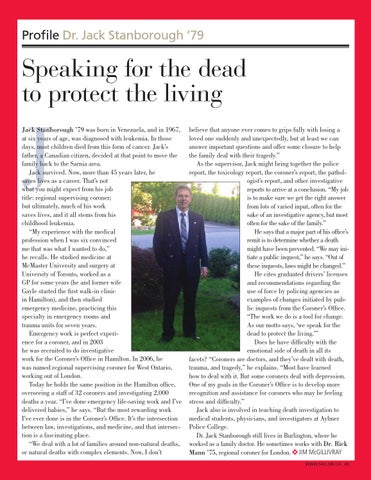
Jack Stanborough ’79 was born in Venezuela, and in 1967, at six years of age, was diagnosed with leukemia. In those days, most children died from this form of cancer. Jack’s father, a Canadian citizen, decided at that point to move the family back to the Sarnia area. Jack survived. Now, more than 45 years later, he saves lives as a career. That’s not what you might expect from his job title: regional supervising coroner; but ultimately, much of his work saves lives, and it all stems from his childhood leukemia. “My experience with the medical profession when I was six convinced me that was what I wanted to do,” he recalls. He studied medicine at McMaster University and surgery at University of Toronto, worked as a GP for some years (he and former wife Gayle started the first walk-in clinic in Hamilton), and then studied emergency medicine, practicing this specialty in emergency rooms and trauma units for seven years. Emergency work is perfect experience for a coroner, and in 2003 he was recruited to do investigative work for the Coroner’s Office in Hamilton. In 2006, he was named regional supervising coroner for West Ontario, working out of London. Today he holds the same position in the Hamilton office, overseeing a staff of 32 coroners and investigating 2,000 deaths a year. “I’ve done emergency life-saving work and I’ve delivered babies,” he says. “But the most rewarding work I’ve ever done is in the Coroner’s Office. It’s the intersection between law, investigations, and medicine, and that intersection is a fascinating place. “We deal with a lot of families around non-natural deaths, or natural deaths with complex elements. Now, I don’t
believe that anyone ever comes to grips fully with losing a loved one suddenly and unexpectedly, but at least we can answer important questions and offer some closure to help the family deal with their tragedy.” As the supervisor, Jack might bring together the police report, the toxicology report, the coroner’s report, the pathologist’s report, and other investigative reports to arrive at a conclusion. “My job is to make sure we get the right answer from lots of varied input, often for the sake of an investigative agency, but most often for the sake of the family.” He says that a major part of his office’s remit is to determine whether a death might have been prevented. “We may initiate a public inquest,” he says. “Out of these inquests, laws might be changed.” He cites graduated drivers’ licenses and recommendations regarding the use of force by policing agencies as examples of changes initiated by public inquests from the Coroner’s Office. “The work we do is a tool for change. As our motto says, ‘we speak for the dead to protect the living.’” Does he have difficulty with the emotional side of death in all its facets? “Coroners are doctors, and they’ve dealt with death, trauma, and tragedy,” he explains. “Most have learned how to deal with it. But some coroners deal with depression. One of my goals in the Coroner’s Office is to develop more recognition and assistance for coroners who may be feeling stress and difficulty.” Jack also is involved in teaching death investigation to medical students, physicians, and investigators at Aylmer Police College. Dr. Jack Stanborough still lives in Burlington, where he worked as a family doctor. He sometimes works with Dr. Rick Mann ’75, regional coroner for London. JIM McGILLIVRAY www.sac.on.ca 41