Serving Queen Anne & Magnolia Since 1919 SEPTEMBER 3, 2025
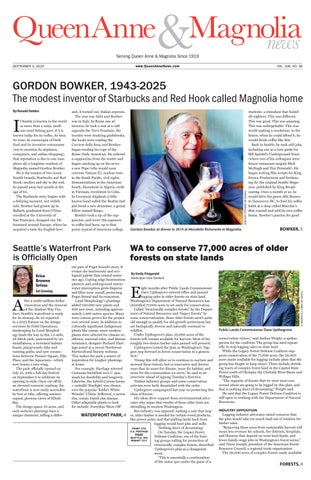
GORDON BOWKER, 1943-2025 The modest inventor of Starbucks and Red Hook called Magnolia home
By Ronald Holden
f Seattle is known in the world
Ias more than a rainy, medium-sized fishing port, if it is known today for its coffee, its beer, its wine, its cornucopia of fresh food and its inventive restaurants (not to mention its airplanes, computers, and online shopping), that reputation is due to one man above all, a longtime resident of Magnolia named Gordon Bowker.
He is the creator of two iconic Seattle brands, Starbucks and Red Hook; modest and shy to the end, he passed away last month at the age of 82.
The Starbucks story begins with a defining moment, not widely told. Bowker had grown up in Ballard, graduated from O'Dea, enrolled at the University of San Francisco, dropped out. He bummed around Europe, where he acquired a taste for English beer
and, it turned out, Italian espresso.
The year was 1962 and Bowker was in Italy. In Rome one afternoon, he took a seat at a café opposite the Trevi Fountain; the tourists were studying guidebooks, the locals were reading the Corriere della Sera, and Bowker began reading his copy of the Rome Daily American. He ordered a cappuccino from the waiter and began catching up on the news: a new Pope (who would soon convene Vatican II), nuclear tests in the South Pacific, civil rights demonstrations in the American South, discontent in Algeria, strife in Vietnam, revolution in Cuba. In Liverpool, England, a little known band called the Beatles had just hired a new drummer, a genial fellow named Ringo.
Bowker took a sip of the cappuccino, and wow! His exposure to coffee had been, up to that point, typical of American college
Seattle’s Waterfront Park is Officially Open

Erica Browne Grivas Get Growing
After a multi-million-dollar renovation and the removal of the Alaskan Way Viaduct, Seattle’s waterfront is ready for its closeup. As we reported in a 2022 feature on the design overseen by Field Operations, landscaping by Land Morphology leads the way in this 1.5-mile, 26-block park, punctuated by art installations, a recreated habitat beach, playgrounds, bike and running paths, and new connections between Pioneer Square, Pike Place, and the Aquarium—which now boasts a new wing.
The park officially opened on July 25, with a full-day festival on September 6 to celebrate its opening in style. Once cut off by an elevated concrete roadway, the waterfront is now easily accessible by foot or bike, offering uninterrupted, glorious views of Elliott Bay.
The design spans 20 acres, and each section’s plantings have a unique character, telling a differ-
ent part of Puget Sound’s story. It evokes the biodiversity and ecological palette that existed centuries ago. Cutting-edge bioretention planters and underground stormwater interception grids disperse and filter toxic runoff, protecting Puget Sound and its ecosystem.
Land Morphology’s plantings added 150,000 new plants and 800 new trees, including approximately 1,400 native species. Many were custom grown for the project over several years. In addition to culturally significant Indigenous plants like camas, more modern plants were selected for climate resilience, seasonal color, and disease resistance, designer Richard Hartlage noted at a recent Northwest Horticultural Society webinar. This makes the park a source of inspiration for tougher plantings at home.
For example, Hartlage selected Camassia leichtlinii over C. quamash for durability and longevity. Likewise, the hybrid Cornus kousa × nuttallii ‘Starlight’ was chosen over the popular ‘Eddie’s White Wonder.’ Ulmus ‘Jefferson’, a newer elm, resists Dutch elm disease. Other adaptable plants to look for include: Forsythia ‘Show Off’
WATERFRONT PARK, 4

students: a stimulant that fueled all-nighters. This was different. This was good. This was amazing. This was unforgettable. This was worth making a resolution: in the future, when he could afford it, he would drink coffee like this.
Back in Seattle, he took odd jobs, including one as a tour guide for Bill Speidel's Underground Tours (where two of his colleagues were future restaurant moguls Mick McHugh and Tim Firnstahl). He began writing film scripts for King Screen Productions and freelancing for the original Seattle Magazine, published by King Broadcasting. Once a month or so, he would drive his green Alfa Romeo to Vancouver, BC, to feed his coffee habit at a shop called Murchie's that roasted and sold its own coffee beans. Bowker's passion for good
WA to conserve 77,000 acres of older forests on state lands
By Emily Fitzgerald Washington State Standard
Eight months after Public Lands Commissioner Dave Upthegrove entered office and paused logging sales in older forests on state land, Washington’s Department of Natural Resources has identified 77,000 acres to set aside for conservation.
Called “structurally complex forests” by the Department of Natural Resources and “legacy forests” by some conservationists, these older forests aren’t quite old enough to qualify for old-growth protections but are biologically diverse and naturally resistant to wildfire.
Under Upthegrove’s plan, 29,000 acres of the forests will remain available for harvest. Most of the roughly two-dozen timber sales paused will proceed.
Upthegrove touted the plan as Washington’s “biggest step forward in forest conservation in a generation.”
“Doing this will allow us to continue to nurture and steward these forests, but in innovative and diverse ways that do more for climate, more for habitat, and more for the communities we serve,” he said in an interview ahead of signing Tuesday’s directive.
Timber industry groups and some conservation activists were both dissatisfied with the order.
Upthegrove campaigned last year on protecting this class of forests.
His ideas drew support from environmental advocates who argue that swaths of these older trees are dwindling in western Washington.
But industry was opposed, making a case that larger, older timber is needed for certain wood products, like power poles, and that pulling lands back from logging would hurt jobs and mills.
‘Nothing short of devastating’
On Tuesday, the Legacy Forest Defense Coalition, one of the leading groups calling for protection of structurally complex forests, described Upthegrove’s plan as a disappointment.
“This is essentially a continuation of the status quo under the guise of a

conservation victory,” said Joshua Wright, a spokesperson for the coalition. The group has sued repeatedly to stop logging sales on state land.
While the Legacy Forest Defense Coalition supports conservation of the 77,000 acres, the 29,000 acres made available for logging include plots that the group has fought to keep intact. These include shrinking tracts of complex forest land in the Capitol State Forest south of Olympia, the Chehalis River Basin and Willapa Hills.
“The majority of forests that we were most concerned about are going to be logged by this plan, and that is nothing short of devastating,” Wright said. He said that the Legacy Forest Defense Coalition is still open to working with the Department of Natural Resources.
INDUSTRY OPPOSITION
Logging industry advocates raised concerns that the plan would take too much land out of rotation for timber sales.
“Removing these acres from sustainable harvest will mean less revenue for schools, fire districts, hospitals, and libraries that depend on trust land funds, and fewer family-wage jobs in Washington’s forest sector,” said Travis Joseph, president of the American Forest Resource Council, a regional trade organization. The 29,000 acres of complex forests made available
BOWKER, 5
PHOTO BY RONALD HOLDEN
Gordon Bowker at dinner in 2014 at Mondello Ristorante in Magnolia.
Public Lands Commissioner Dave Upthegrove
PHOTO BY EMILY FITZGERALD
Sunday Worship at 10am Live Streamed

Twelfth Church of Christ, Scientist
In Person and Online Church Services
All are welcome & warmly invited to join these healing services
For best audio results, please join by clicking on the link from your computer or smartphone and choose “Call Over Internet”
All Zoom Services Meeting ID: 418 806 2637 https://us02web.zoom.us/j/418 806 2637
Sunday Services 11:00am – 12noon Pacific
Wednesday Testimonies 7:30pm – 8:30pm Pacific
Christian Science Quarterly Bible Lessons
Our weekly Bible Lesson Sermon may be found here: https://quarterly.christianscience.com/
Additional Healing Resources: ChristianScience.com CSWashington.com ChristianScienceTwelfthSeattle.com
For additional assistance, please contact us at seattle12cs@gmail.com or 206.283.230 ChristianScienceTwelfthSeattle.com


Savvy Senior: Is Social Security Still Taxable?
By Jim Miller
Dear Savvy Senior,
Do I have to pay taxes on my Social Security retirement benefits? I heard that President Trump’s big, beautiful bill eliminated that. What can you tell me?
About to Retire
Dear About,
No, the new law, better known as the ‘One Big Beautiful Bill Act’ did not eliminate Social Security taxes. It did, however, provide a temporary “senior bonus” deduction (starting in 2025 through 2028) of up to $6,000 that will apply to taxpayers, age 65 and older, who earn up to $75,000 for singles or $150,000 for joint filers. If you earn over that amount, the deduction starts phasing out.
Also note that the senior bonus is a deduction, not a refundable credit, so it will not help lower-earning seniors who owe no income taxes.
WHO OWES SSA TAXES?
Whether or not you’ll be required to pay federal income tax on your Social Security benefits will depend on your income and filing status. About 40 percent of Social Security recipients have total incomes high enough to trigger federal income tax on their benefits.
To figure out if your benefits will be taxable, you’ll need to add up all of your “provisional income,” which includes wages, taxable and non-taxable interest, dividends, pensions and taxable retirement-plan distributions, self-employment, and other taxable income, plus half your annual Social Security benefits, minus certain deductions used in figuring your adjusted gross income.
To help you with the calculations, get a copy of IRS Publication 915 “Social Security and Equivalent Railroad Retirement Benefits,” which provides detailed instructions and worksheets. You can download it at IRS.gov/pub/irs-pdf/p915.pdf or call the IRS at 800-829-3676 and ask them to mail you a free copy.
After you do the calculations, the IRS says that if you’re single and your total income from all of the listed sources is:
• Less than $25,000, your Social Security will not be subject to federal income tax.
• Between $25,000 and $34,000, up to 50 percent of your Social Security benefits will be taxed at your regular income-tax rate.
• More than $34,000, up to 85 percent of your benefits will be taxed.
If you’re married and filing jointly and the total from all sources is:
• Less than $32,000, your Social Security won’t be taxed.
• Between $32,000 and $44,000, up to 50 percent of your Social Security benefits will be taxed.
• More than $44,000, up to 85 percent of your benefits will be taxed.
If you’re married and file a separate return, you probably will pay taxes on your benefits.
You can also find out if any of your benefits are taxable through the IRS online tax tool that asks a series of questions that will help you determine your status. To access this tool, go to IRS.gov/Help/ITA – click on “Social Security or railroad retirement tier I benefits - Are mine taxable?”
To limit potential taxes on your benefits, you’ll need to be cautious when taking distributions from retirement accounts or other sources. In addition to triggering ordinary income tax, a distribution that raises your gross income can bump up the proportion of your Social Security benefits that are subject to taxes.
HOW TO FILE
If you find that part of your Social Security benefits will be taxable, you’ll need to file using Form 1040 or Form 1040-SR. You also need to know that if you do owe taxes, you’ll need to make quarterly estimated tax payments to the IRS, or you can choose to have it automatically withheld from your benefits.
To have it withheld, you’ll need to complete IRS Form W-4V, Voluntary Withholding Request (IRS.gov/pub/irs-pdf/ fw4v.pdf), and file it with your local Social Security office.
STATE TAXATION
In addition to the federal government, nine states – Colorado, Connecticut, Minnesota, Montana, New Mexico, Rhode Island, Utah, Vermont and West Virginia –tax Social Security benefits to some extent too. If you live in one of these states, check with your state tax agency for details.
Send your questions or comments to questions@savvysenior.org, or to Savvy Senior, P.O. Box 5443, Norman, OK 73070.

Back to School! Strategies for students facing challenging classes
Every student takes something unique from their high school experience, and many eventually look back fondly on the years spent in the hallowed halls of their alma maters. High school might be the last step before learning a trade career or serve as four years of preparation for college. Either way, it is important to get good grades.
Continually challenging oneself with coursework can help students get the most out of their academic careers. General level classes are often taken freshman year and honors classes sophomore year. Students may then decide to enroll in advanced placement or dual enrollment classes as an upperclassman. As students continue to push themselves and classes get harder, they may have to revise their approach in order to excel. These guidelines can help students continue to be successful.
Establish a solid foundation. The first step towards success in any class is gaining a solid understanding of the basics, says Stemly Tutoring. If there are gaps in foundational knowledge, assignments and tests can be particularly difficult as the coursework becomes harder. Routinely reviewing previous material and ensuring that the fundamental concepts are mastered is essential.
Practice active learning. Active learning involves engaging with the material in a way that goes beyond passively reading texts. Ideas include formulating questions, quizzing classmates, explaining the material to others as a teacher would, and writing down key words and topics so they are more likely to be remembered.
Focus on time management. In high
school, five or more classes run concurrently during the year. Assignments may have similar due dates, and tests and quizzes may come more frequently. Students will need to master an organizational system and time management strategy that works for them. Students can utilize a day planner as a useful organizational tool. Breaking down long-term assignments into smaller pieces that are easier to manage also can be useful. Smartphone notifications can alert to due dates. Seek help when needed. Students shouldn’t hesitate to ask for help from peers, academic coaches, tutors, or their teachers. Study groups or partnerships with classmates also may be fruitful. Students should not wait until they are falling behind to seek help, as that can make it much more challenging to catch up. Study regularly. Reviewing material frequently and reinforcing knowledge is a smart strategy. Creating visual aids like diagrams or maps can help students understand a subject more fully. Again, this carries back to mastering the fundamentals. Looking back on previous lessons may help students with current ones. Don’t forget to find balance and prioritize self-care. Academics are important, but so is mastering a balance between schoolwork and other activities. Without balance, a student may experience burnout, stress and additional symptoms that can impede students ability to do well in school.
High school coursework gets more difficult as the years pass and students challenge themselves. Certain strategies can help students navigate increasingly challenging coursework.
Phone and Internet Discounts Available to CenturyLink Customers
The Washington Utilities and Transportation Commission designated CenturyLink as an Eligible Telecommunications Carrier within its service area for universal service purposes. CenturyLink’s basic local service rates for residential voice lines are $32.00 per month and business services are $48.50 per month. Specific rates will be provided upon request.
CenturyLink participates in the Lifeline program, which makes residential telephone or qualifying broadband service more affordable to eligible lowincome individuals and families. Eligible customers may qualify for Lifeline discounts of $5.25/month for voice or bundled voice service or $9.25/ month for qualifying broadband or broadband bundles. Residents who live on federally recognized Tribal Lands may qualify for additional Tribal benefits if they participate in certain additional federal eligibility programs. The Lifeline discount is available for only one telephone or qualifying broadband service per household, which can be either a wireline or wireless service. Broadband speeds must be at least 25 Mbps download and 3 Mbps upload to qualify.
A household is defined as any individual or group of individuals who live together at the same address and share income and expenses. Services are not transferable, and only eligible consumers may enroll in these programs. Consumers who willfully make false statements to obtain these discounts can be punished by fine or imprisonment and can be barred from these programs.
If you live in a CenturyLink service area, visit https://www.centurylink.com/ aboutus/community/community-development/lifeline.html for additional information about applying for these programs or call 1-800-201-4099 with questions.