SOUTH SIDE WEEKLY FROM THE EDITORS
The South Side Weekly is an independent non-profit newspaper by and for the South Side of Chicago. We provide high-quality, critical arts and public interest coverage, and equip and develop journalists, artists, photographers, and mediamakers of all backgrounds.
Volume 12, Issue 23
Interim
Editor-in-Chief Adam Przybyl
Investigations Editor Jim Daley
Immigration Project
Editor Alma Campos
Senior Editors Martha Bayne
Christopher Good Olivia Stovicek
Jocelyn Martinez-Rosales
Community Builder Chima Ikoro
Editor Emeritus Jacqueline Serrato
Public Meetings Editor Scott Pemberton
Art Director Shane Tolentino
Research Editor: Ellie Gilbert-Bair
Fact Checkers: Bridget Craig
Patrick Edwards
Zara Norman
Kateleen Quiles
Susie Xu
Layout Editor Tony Zralka
Publisher Malik Jackson
Office Manager Mary Leonard
Advertising Manager Susan Malone
The Weekly publishes online weekly and in print every other Thursday. We seek contributions from all over the city.
Send submissions, story ideas, comments, or questions to editor@southsideweekly.com or mail to:
South Side Weekly
6100 S. Blackstone Ave. Chicago, IL 60637
For advertising inquiries, please contact: Susan Malone (773) 358-3129 or email: malone@southsideweekly.com
For general inquiries, please call: (773) 643-8533
Cover by Julia O'Brien
What’s the 311 on City Services?
In a recent Facebook post along with a photo, a member of the Rogers Park News Group wrote: “$17 million spent on bike lanes that will not be used for over 6 months” in a post of a photo of what appears to be a bike lane completely covered by snow— as cars drive down cleared roads in the background. Seemingly unbeknownst to the original poster, this situation could be addressed with more than social media complaints. You can express your grievances directly to the city, and even monitor their swiftness to resolve it.
311 is your direct line to ensuring city services are being put to use. It’s a nonemergency line that “serves as the point of entry for residents, business owners and visitors” to access information and, more importantly, file service requests (aka complaints). This is your greatest defense against the threat of uncleared snow and ice, and it’s relatively easy to navigate. You can request ice and snow removal from city streets, protected bike lanes, and sidewalks. Whoever is “in charge” of a building, be it landlord, property owner, or property manager, is usually responsible for snow removal on the sidewalks and walkways by their building. However, if a sidewalk has not been shoveled or salted within fifteen hours of snowfall, you can submit a 311 request for that as well.
The wait time for an operator is usually short; they’ll have you describe the situation you’re reporting and give them the address or closest intersection. The operator will ask if you’d like to leave any personal information, such as your name, phone number or email address. While this is optional, it is helpful in case the city may have follow up questions about your service request. If you leave your number or email, you’ll receive a service number that you can use to check the status of your request, but if you remain anonymous you can request the service number from the operator, or search your request by address at 311.chicago.gov. You can also file a request directly through that website, or on the CHI311 mobile app. If you want to be even more helpful, you can follow up if you notice your request is still unresolved after some time.
South Siders, we want you to know that you can call 311 for almost anything, and you should. If 311 cannot assist you, they will try to direct you toward who can, such as your superintendent's office or the state non-emergency line. Many Chicagoans, especially those living in disenfranchised neighborhoods, have become accustomed to unfinished, unmanaged, and un-maintenanced conditions. The typical response is to just groan and move on while rhetorically questioning who holds the responsibility of changing things. But for most things, the City of Chicago does assume the responsibility, and your taxes pay for the departments who that onus lies on.
Stray cats, potholes, abandoned construction projects and materials, streetlight outage, weird smells, polluted vacant lots, garbage left behind on trash day—the list is endless and, for some, surprising. Do you want to do a clean up with your local community group? The city will loan you the tools. Do you want a tree planted in front of your house? The Bureau of Forestry has you covered. Just call 311.
Aside from service requests, you can also call 311 to request information about events, parades, and festivals, explore library services, get information on rent or utility bill assistance, find out what police district you live in and when the next beat meeting is, find your ward and alderman, request shelter services, receive information about homelessness prevention, and more.
You can even request the removal of objects placed in parking spots—a common practice Chicagoans use to claim dibs on spaces they’ve cleared in front of their homes after heavy or consistent snowfall. We can’t guarantee that challenging dibs is a good idea, but if your neighbor has claimed seven parking spots and you don’t want to get caught moving their chairs…you know who to call (anonymously).
To learn more about 311 City Services, visit 311.chicago.gov.
The Weekly wants to know about your experience using 311! Please take a moment to fill out our short survey here: bit.ly/SSW311survey
IN THIS ISSUE
raided south shore building tenants ordered to leave
Tenants are fighting their sudden eviction after a federal raid.
caeli kean 4 in immigration protest cases, feds keep striking out
Many of the Justice Department’s efforts to prosecute mass deportation protesters have fallen apart.
dave byrnes 5
fraudsters target immigrants seeking legal help
In Illinois, immigrants have lost thousands of dollars to notarios offering legal assistance they’re not qualified to provide.
alma campos and max blaisdell 7
inmigrantes en busca de apoyo legal caen en manos de estafadores
En Illinois, los inmigrantes han perdido miles de dólares a manos de notarios que ofrecen asistencia legal para la que no están cualificados.
alma campos y max blaisdell 12
rudy de anda’s chicago chapter
With an upcoming show at Thalia Hall this month, the seasoned musician looks back.
jocelyn martinez-rosales 17
la villita holiday gift guide
These are some of the shops in Little Village you should check out when buying gifts this holiday season. south side weekly staff 18 the day they took jesus
Scenes from the Broadview ICE Protest Safety Zone
nick merlock jackson 21 ‘my dogs wouldn’t even lick it’ Insiders describe meals provided at Cook County Jail as gross and unhealthy, and some go hungry.
harley pomper 26
pilsen murals and ukrainian mosaics teach us about artistic survival
Two communities are learning what makes public art endure.
wendy wei 29
south side sports roundup
The latest results and news from the Chicago sports world.
malachi hayes 33
public meetings report
A recap of select open meetings at the local, county, and state level.
scott pemberton and documenters 34

Raided South Shore Building Tenants Ordered to Leave
Tenants were notified the day before Thanksgiving that they must vacate by December 12, even as freezing temperatures and failing infrastructure make it nearly impossible to move.
BY CAELI KEAN
This story was originally published December 4 and has been updated to include new information from a court hearing on December 8 and a subsequent press conference.
Tenants of the newly unionized 7500 South Shore building that was raided by federal agents in September called an emergency press conference on December 1 after receiving a court order to vacate the building by Friday, December 12.
On September 30, federal agents descended on the building in a late-night raid, detaining families and children. Subsequent reporting exposed the building’s substandard conditions such as broken elevators, standing water, mold, and chronic code violations that tenants had been reporting for years. The incident galvanized residents to organize, eventually forming a union to demand transparency from the court-appointed receiver, Friedman Communities, and accountability from city officials.
Update: On December 8 a Cook County judge declined to extend the December 12 vacate date during a hearing on Monday, saying the building is unsafe and uninhabitable. After the hearing, members of the 7500 South Shore Tenants Union held a press conference outside the building, criticizing what they described as inadequate relocation assistance and inconsistent communication from the court-appointed receiver, Friedman Communities.
In a press conference last week, Travaris Ivy, a resident since 2023, had spent the night with relatives over Thanksgiving. The next day, he “just happened to walk in and see a note posted up on the wall saying that we have to get the hell out of the building.”
On November 20, Wells Fargo Bank filed an emergency motion to set and enforce the December 12 vacate date, which
was granted by Judge Debra A. Seaton on November 24. Two days later, tenants received a notice to vacate on or before December 12, giving residents only sixteen days to move out. Darren Hightower, who has lived in the building for two years, said that the receiver, Friedman Communities, “sent someone over to the building to hand out these papers to random people and hung one up in the halls.”
Infiniti Gant, an organizer with Southside Together Organizing for Power (STOP), said Judge Seaton’s decision was not announced or made public. While the tenants held a press conference announcing they formed a union last Monday, “they were having a meeting in court and deciding that people in this building need to be kicked out,” Gant said.
Days after Chicago experienced the snowiest November day on record, members of the tenant union and organizers gathered outside the building in 19-degree weather.
“It’s freezing. It’s so cold; there is no heat in the building,” Gant said.
Tenants expressed their outrage at the insufficient notice and the unlivable conditions. In 2025 alone, the building
failed eight annual inspections, one conservation complaint inspection, and was cited for forty-four code violations. These included failure to maintain elevator equipment in safe and working condition, broken gas meters, absence of hardwired carbon monoxide detectors, broken emergency phones, and more.
Not only have conditions over the past two years been unlivable for tenants, who have gone without heat and electricity for weeks on end, but residents said the building’s standing water and broken elevators make it nearly impossible for the thirty-seven remaining tenants to move out. “There’s elderly and disabled people that stay in this building,” Ivy said. “They can’t even move around. So how are they supposed to move around without even having no access to elevators? They’re literally trapped in this building.”
In the notice to vacate, Friedman Communities claimed it would provide tenants with housing relocation options that “are offered as suggestions only and do not guarantee availability or acceptance,” support services, and move-out assistance “upon the signing of a lease termination
agreement and completion of move-out.” Friedman Communities also printed in the notice that representatives would “be at the property to answer questions and provide additional move-out and relocation support.”
Gant said that Friedman Communities has not responded to the tenants union’s request to meet.
Union representatives said that Friedman Communities has not responded to any of their demands for repairs, security, local relocation within South Shore, or relocation assistance.
A hearing has not yet been scheduled to revisit the vacate order, and it remains unclear whether the city will intervene before the deadline.
“So right now, we have made our demands about the meeting with Friedman,” Gant said. “We’ve also made our demands about the maintenance of the building, the money, the relocation, the time that they need, and we have not heard anything.”
Gant said the union has been in talks with Mayor Brandon Johnson’s office, demanding the mayor immediately direct the Corporation Counsel to file an emergency motion requesting a later moveout date. The union is waiting to hear what concrete action the mayor plans to take in response to their demands.
During a press conference on Tuesday, Johnson said his office is “working overtime with the organizers of these tenants to ensure that they have a place of comfort and a place they can afford and feel good about.”
The mayor’s office and Friedman Communities did not respond to requests for comment. ¬
Caeli Kean (she/they) is a Nairobi-raised, South Shore-based freelance photographer and community organizer.
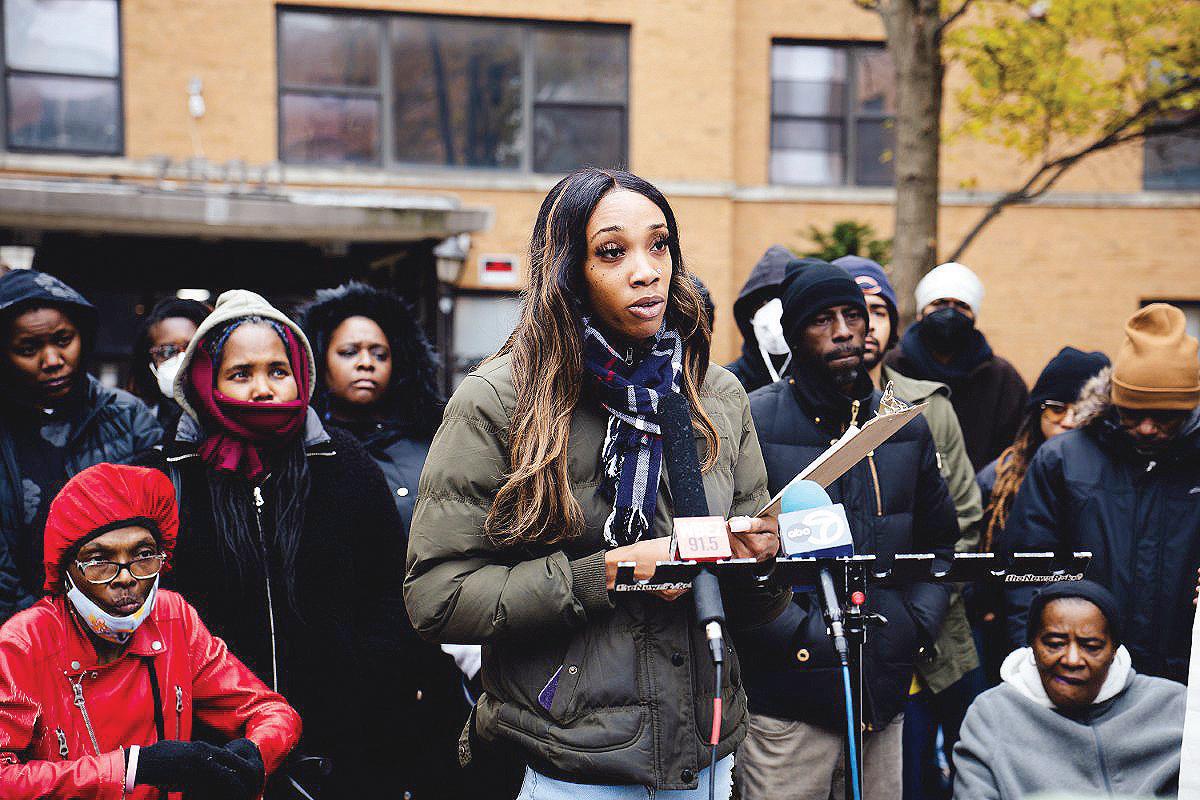
Resident Mashawnda Price addresses the press at the official launch of 7500 South Shore Tenants Union on Nov 24, 2025.
Photo by Caeli Kean
In Immigration Protest Cases, Feds Keep Striking Out
The Justice Department has aggressively prosecuted those who protest its mass deportation campaigns, but many of those prosecutions have fallen apart.
BY DAVE BYRNES
Mr. Briggs, you’re free to go," U.S. Magistrate Judge Gabriel Fuentes said in his courtroom in Chicago on the morning of November 20. He had just dismissed the assault case against Dana Briggs, a seventy-year-old veteran who was arrested while protesting outside the ICE facility in Broadview, Illinois on September 27.
The government initially charged Briggs with felony assault on a law enforcement official (specifically, a Border Patrol agent) but would eventually downgrade his charge to a misdemeanor. And on the morning of November 20, federal prosecutors moved to dismiss.
With a bang of his gavel, Fuentes obliged.
Briggs was one of five people the government pursued criminal cases against in the aftermath of the September 27 protest. The group also included an intellectually disabled Black man named Paul Ivery who was convinced to waive his right to remain silent while he was in federal custody without a lawyer present. All five cases were eventually tossed out of court.
But that’s just a piece of the Justice Department’s losing streak in Chicago and around the country, as protests continue to mount against the Trump administration’s mass deportation campaign.

In the Chicago area, criminal complaints against at least nine Midway Blitz-related defendants have been thrown out since October, when some of the first cases were heard.
“As the United States Attorney has
stated repeatedly in his public comments, the U.S. Attorney’s Office is constantly evaluating new facts and information relating to cases and investigations arising
out of Operation Midway Blitz, the largest ever law enforcement surge in the Northern District of Illinois,” Assistant U.S. Attorney Joseph Fitzpatrick said
in a prepared statement on the matter. “This continuous review process applies to all matters—whether charged or under investigation.”
Federal agents are silhouetted outside the Broadview ICE facility on September 27, 2025.
Photo by Paul Goyette
A similar trend has played out in California. The Los Angeles Times reported at the start of December that federal prosecutors in the Los Angeles area have charged seventy-one people with assault on a federal officer so far this year, with twenty-one cases ending in dismissals or acquittals. Few of the remaining cases related to immigration protests have thus far resulted in convictions. The Weekly was able to independently verify four guilty pleas out of the LA area, three of which, according to court records, were the result of deals struck with prosecutors. In two trials that took place in September and October, California juries acquitted two people accused of misdemeanor assault on federal officers. Multiple cases are set for trial in 2026.
A federal jury in Los Angeles County acquitted Brayan Ramos-Brito, the defendant in the case that went to trial in September, of striking a Border Patrol agent in June—despite Border Patrol Chief Greg Bovino testifying he witnessed it happen. Video presented to the jury reportedly did not corroborate Bovino’s testimony.
A jury in Washington, D.C. similarly acquitted former Justice Department employee Sean Dunn last month on a misdemeanor assault charge stemming from his much-memed throwing of a Subway sandwich at a Border Patrol agent in August.
Here in Chicago, the feds charged Marimar Martinez, along with Anthony Santos Ruiz, for allegedly blocking in and striking a Border Patrol vehicle in Brighton Park on October 4. Martinez’s attorney, Chris Parente, criticized federal prosecutors’ rush to charge her.
District Judge Georgia Alexakis dismissed the high-profile case on November 20 after defense raised numerous issues challenging the prosecution in court. Border Patrol agent Charles Exum shot Martinez during the October 4 incident, leaving her with wounds that were visible during a court appearance a few days later. Parente claimed video showed Exum telling Martinez “do something, bitch,” before shooting her, and evidence was later released that showed he bragged about the shooting in text messages. Parente
also said Exum took the vehicle Martinez allegedly struck to Maine before defense counsel had a chance to examine it.
“Because you’re moving at this quick speed for some reason, you’re just charging people and changing their lives before you actually check the veracity of the claims, and that’s not how the Department of Justice is supposed to act, in my opinion,” Parente said.
Before the problems with Martinez’s and Santos Ruiz’s case came out at court, a grand jury indicted the pair. A grand jury is a group of jurors the government convenes to determine if there’s enough evidence to proceed with a criminal case. Federal prosecutors don’t have to present all the available evidence in a case to a grand jury, only the evidence they think will sway the jurors to issue an indictment.
In a separate case, a grand jury refused to indict Ray Collins and Jocelyne Robledo, who also faced criminal charges over the September 27 protest at Broadview.
“It is very rare that a grand jury will refuse to indict when a prosecutor comes before them and recommends charges. It’s just so uncommon,” said Alexa Van Brunt, attorney and policy director for the MacArthur Justice Center in Chicago. “And the fact this is happening not just in Chicago regularly but in other cities regularly, it’s just evidence to the fact that I think this Department of Justice has lost credibility with the general public.”
With so many cases falling apart, particularly in Chicago, the court itself has questioned why the government is pursuing them so aggressively.
“The Court cannot help but note just how unusual and possibly unprecedented it is for the U.S. Attorney’s Office in this district to charge so hastily that it either could not obtain the indictment in the grand jury or was forced to dismiss upon a conclusion that the case is not provable, in repeated cases of a similar nature,” Judge Fuentes wrote in a court memo following the dismissal of Briggs’ case.
The judge made his comments while setting aside “the extraordinary judicial determinations that DHS sworn declarations are unreliable, that the candor of its agents is open to question, and that sworn testimony of its CBP chief
contained knowing falsehoods,” the memo reads.
Parente and Van Brunt attributed the aggressive prosecution to pressure from the Trump administration, which has made mass deportation a key policy initiative. U.S. Attorney General Pam Bondi has made a point of threatening federal prosecution against those who oppose deportation actions.
“Anyone who threatens or assaults our federal officers will be arrested and charged federally, not in some liberal state court,” Bondi said in a video statement on X (formerly Twitter) on September 27.
In a separate Justice Department memo Bondi issued September 29, she instructed U.S. attorneys in Oregon and the Chicago area to charge “every person suspected of threatening or assaulting a federal law enforcement officer or interfering with federal law enforcement operations” with “the highest provable offense available under the law.”
Another LA Times story from July indicated U.S. Attorney Bilal Essayli, the Trump-appointed acting head of the Central California DOJ office and former Republican State Assembly member, has been feeling the pressure himself— reportedly “screaming” at a subordinate prosecutor and telling him to secure more indictments, per Bondi’s directions.
Regardless of pressure from above, government attorneys are theoretically expected to prosecute cases responsibly and not subject people to criminal proceedings unnecessarily. The U.S. Justice Manual states that “evidence sufficient to sustain a conviction is required under Rule 29(a) of the Federal Rules of Criminal Procedure, to avoid a judgment of acquittal.”
“Moreover, both as a matter of fundamental fairness and in the interest of the efficient administration of justice, no prosecution should be initiated against any person unless the attorney for the government believes that the admissible evidence is sufficient to obtain and sustain a guilty verdict by an unbiased trier of fact,” the manual continues.
Fuentes, in his Briggs memo, commended the U.S. Attorney’s Office (USAO) in Chicago for “doing the right thing” in not objecting to the dismissal.
Federal prosecutors in Chicago are
still pursuing criminal charges against Juan Espinoza Martinez, who is accused of placing a bounty on Greg Bovino. They are also pursuing charges against the “Broadview Six,” a group including Oak Park Trustee Brian Straw, local Democratic Committeeman Michael Rabbitt, Chicago 40th Ward Chief of Staff (and Cook County Board candidate) Catherine Sharp, Illinois congressional candidate Kat Abughazaleh, and two others in connection with a September 26 protest at the Broadview ICE facility.
Parente, a former federal prosecutor himself, was hesitant to criticise the individual attorneys working in the Chicago USAO. He commended the head U.S. Attorney for the Chicago area, Andrew Boutros, for moving to dismiss Martinez’s case in November.
“[Boutros is] getting it right… when he’s dismissing the Martinez case and these other cases, it’s because he recognizes there’s huge problems,” Parente said. “I just wish they would go back to the system of investigating first.” ¬
Dave Byrnes is a Chicago-born independent journalist covering the Trump administration’s anti-immigrant blitz. He lives in Lincoln Square, but is a lifelong White Sox fan.
Fraudsters Target Immigrants Seeking Legal Help
In Illinois, immigrants have lost thousands of dollars to notarios offering legal assistance they’re not qualified to provide—as well as other impostors. Nationally, the figure is at least $1.2 million.
BY ALMA CAMPOS AND MAX BLAISDELL
This article was produced in partnership with the nonprofit newsroom Type Investigations, with support from the Wayne Barrett Project.
CHICAGO — When the Venezuelan woman arrived in the city in December 2023 with her three children, she was looking for stability and a path to legal status. A friend referred her to a man who claimed he could handle asylum applications. Trusting him, she paid him $500 to file paperwork for herself and her children.
Only later did the woman, who spoke to the South Side Weekly and Type Investigations on the condition of anonymity because of her immigration status, discover that the asylum application had been mishandled, leaving her unable to obtain a work permit.
“When it was time to get the work permit, it turned out that the asylum application he submitted was wrong,” she said. “Very, very wrong.”
Unable to work legally, she has sometimes taken under-the-table jobs to support her family. And instead of the stability and peace of mind that might have come from quickly obtaining a work permit, the woman said the precarity of her situation has caused her a great deal of stress.
“I’m a mother responsible for three children, I’m on my own, and it’s affected me a lot economically,” she said.
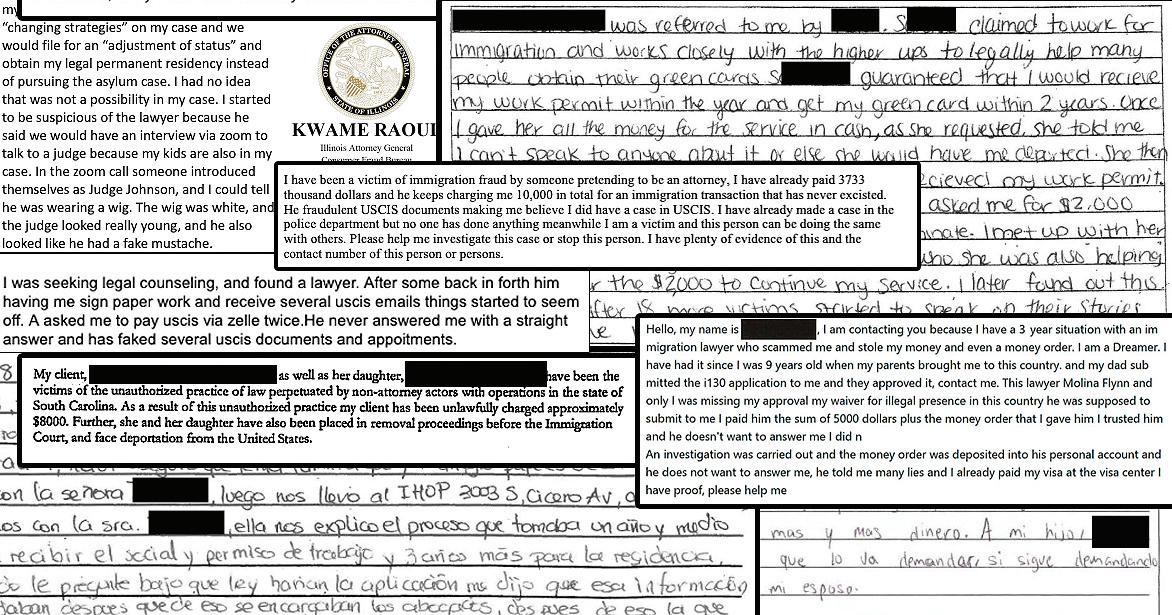
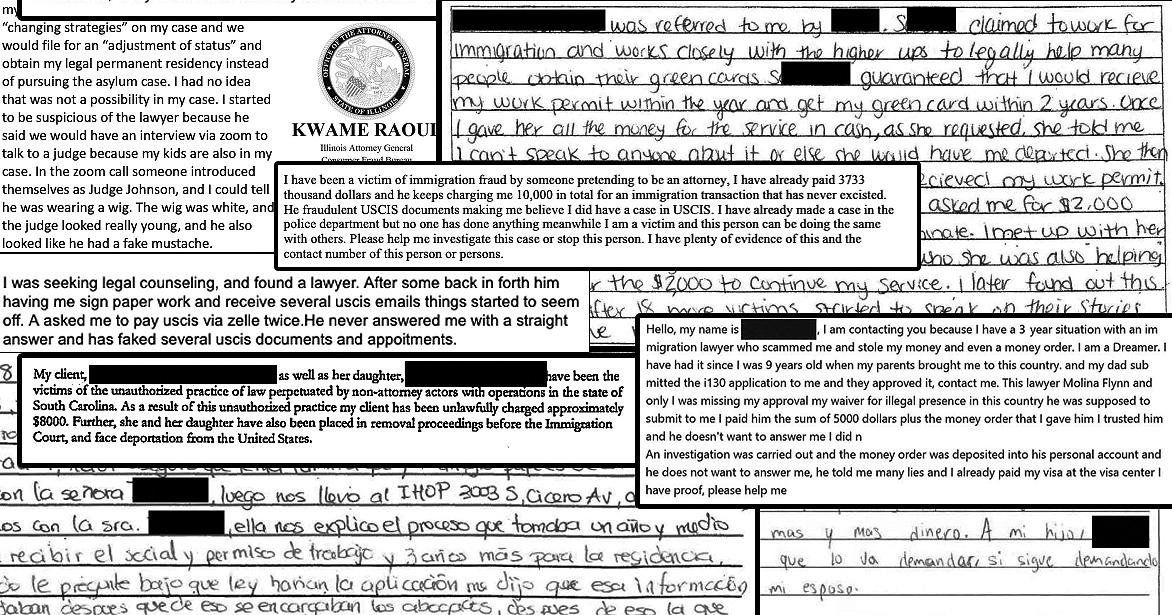
In recent years, immigrants have filed hundreds of complaints alleging they were defrauded. Pictured documents were obtained from Attorneys General in South Carolina, Texas, Washington, Rhode Island, Missouri, and Illinois.
In a months-long investigation, the Weekly and Type Investigations found that immigrants seeking a legal path to residency or citizenship must navigate a confusing landscape of immigrationservices providers. Some businesses that are otherwise legitimate tax-preparers or notary publics can misrepresent what services they’re legally allowed to offer, skirting the line between chatting about immigration options and offering legal advice they’re not licensed to provide. And scammers can abscond with victims’
money after failing to provide promised services they weren’t authorized to perform—or even threaten immigrants to extract money from them. Enforcement is inconsistent from one state to the next, and fraudsters who rack up complaints sometimes relocate or rename their businesses to avoid accountability.
Michael Wildes, managing partner at Wildes & Weinberg, P.C., a major immigration law firm in New York
City, said while it may seem that filling out immigration forms is an innocuous job that can be performed by nonattorneys, when notarios give people bad, inconsistent, or outdated advice with regards to which status to apply for with U.S. Citizenship and Immigration Services (USCIS), the forms they submit “can never be wiped off.”
“A person can never say, ‘I didn't know what I did.’ You ultimately have
Photo by Paco Alvarez
responsibility,” Wildes said. “Ignorance of the law and making a mistake or choosing the wrong professional stays with you in the immigration space.”
This type of fraud is pervasive in part because of a misconception that notarios, or notaries, in the U.S. are lawyers, as is the case in many Latin American countries. In Mexico, for instance, a notary public must have a law degree, spend time working for another notary public, and pass a rigorous exam. Highly accredited, such Mexican notarios are able to offer legal advice and a wide array of legal services.
In the U.S., by contrast, notary publics are only allowed to notarize documents and signatures, transcribe responses, or translate the instructions, questions, or answers on government forms.
While many scams are tied to notarios, they are not the only bad actors. Some people present themselves as trustworthy acquaintances who claim to know how to navigate the immigration system. Increasingly, fraud also happens remotely, through phone calls, social media, or messaging apps, where scammers impersonate police or immigration officials to demand money.
Since 2015, dozens of people in Illinois have filed complaints with the state attorney general alleging they were defrauded in immigration cases, with losses totaling nearly $200,000, according to records obtained by the Weekly and Type Investigations from the AG’s office.
More than half of that amount was attributed to two women from Chicago and Melrose Park, IL. According to ten complaints, they targeted people from 2022 to 2023, allegedly charging between $6,000 and $25,000 for assistance with green card applications—and sometimes warning victims that if they spoke about their practices, they risked deportation.
Several complaints indicate that one of the women falsely claimed to work for immigration authorities, and knew some of the immigration “higher ups,” relying on word-of-mouth referrals to find new clients. In some cases, one would refer people directly to the other, or friends and family members would connect individuals to them.
One 2023 complaint described how
one of the individuals was introduced to a victim through a personal referral and presented herself as someone who “worked closely with immigration” to secure green cards. The scammer “guaranteed that I would receive my work permit within the year and get my green card within two years once I gave her all the money for the service in cash,” the complaint states.
“She told me I couldn’t speak to anyone about it or she would have me deported. She then disappeared for about a year and I never received my work permit. In July, she called me to set up a meeting and demanded $2,000 more or else my green card process would terminate. I met her at a McDonald’s with my brother-in-law, who she was also
helping, and gave her the money.”
The Illinois Attorney General’s Office declined to answer questions about the status of these complaints or whether the office had taken any action in response to them.
Blurring the line between information and advice
“Some of these notarios partner with licensed attorneys,” said Gina Amato Lough, the directing attorney of Public Counsel’s Immigrants’ Rights Project in Los Angeles. “So what they’ll do is take the person’s money, do all the paperwork, but then, of course, they can’t show up to court. So they’ll partner with a licensed attorney who will then show up to court and do the hearing.”
However, this model can make it difficult for clients to understand when the work crosses the line from legitimate clerical help—the kind of thing that paralegals in law firms do all the time, for example—into the unauthorized practice of law.
“Paralegals will do consultations, that's not a problem. They'll do intakes, but it's under the supervision of an attorney,” Amato Lough said.
Immigration service providers who give legal advice without a license risk injunctions, fines, criminal charges, or consumer fraud penalties, or criminal charges under state law, and the attorney general can seek to suspend or revoke a business’s authority to operate. For clients,
Credit: Jinny Kim
the stakes are higher: They may lose thousands of dollars, face deportation or permanent bars from relief if the wrong forms are filed, unknowingly commit perjury, and lose valuable time in their cases.
In Franklin Park, a suburb of Chicago, Servicios Leyva advertises itself as offering assistance with immigration cases and tax preparation. Though the fine print on the company’s website notes that it is not a law firm and cannot provide legal advice, it can sometimes be difficult for clients to understand the distinction between simply offering information and providing legal guidance—especially Spanish-speaking immigrants with little knowledge of the U.S. legal system. “We are honest and up front and help you through your immigration process towards your path to citizenship,” Servicios Leyva’s website states.
Weekly reporters visited three such businesses in the Chicago area in order to understand how they operate. (The businesses are not connected with the two women from Chicago and Melrose Park.)
He recommended starting with an I-130 petition for family sponsorship, which he said he would prepare himself, as well as an Affidavit of Support. In total, he estimated the entire process would cost around $7,000, spread out over several years. Cadena is not an immigration attorney.
Posing as prospective clients, we brought specific information about María, a real person, who was seeking guidance on how to become a U.S. resident.
On a summer weekday, we spoke to a secretary-assistant at Servicios Leyva who radiated warmth and calm, and listened closely to the details shared. She outlined how María could possibly become a legal resident through a trámite consular and a waiver since she is married to a U.S. citizen, and estimated the process would stretch over four years.
The woman, who is not an attorney, said that she or her colleague could handle all the paperwork themselves, without the need for a lawyer. She did hand over the business card of a lawyer to call in case of emergencies, such as if María were to be detained or needed to appear in immigration court.
She asked detailed questions about María’s immigration history, including whether she had ever been deported, and gave us a list of documents to bring in to start the case, including photos and a marriage certificate.
Because María had entered the United States without authorization, the woman said she would also need to apply for a waiver of unlawful presence, which could add another three years to the process. She quoted the government fee for the waiver at $795, while Servicios Leyva’s service fee would be $950, bringing the total to $3,410 in fees to both USCIS and Servicios Leyva.
Providing legal guidance about an immigration case falls outside the bounds of what notaries are allowed to do under Illinois state law. According to the Illinois Notary Public Act, notaries who are not attorneys or Department of Justice-accredited representatives are prohibited from providing immigration legal services or offering advice that requires legal judgment. Immigration Services Providers must be registered with the state attorney general. They are allowed to perform only very limited tasks: They can hand out legal materials and blank forms, type or file paperwork exactly as instructed by the client, and
The consular processing would take about a year, she explained. For that, she said the USCIS fee was $675, and Servicios Leyva would charge $990 to prepare and file the paperwork—a total of $1,665.
serve documents on other parties. But they cannot advise which forms to use, recommend what kind of immigration relief to pursue, or provide any other legal advice. Immigration service providers in Chicago must also obtain a license from the city’s Department of Business Affairs and Consumer Protection (BACP). The city’s rules for the type of services these businesses can provide are similarly restrictive.
Federal authorities make a similar point: USCIS guidance states that only licensed attorneys and DOJ-accredited representatives, not notarios, may give immigration legal advice. In some cases, law students and law school graduates can do the same.
Representatives of Servicios Leyva did not respond to a request for comment.
At Agencia Y Notaria Cadena in Chicago’s Back of the Yards neighborhood, the owner’s son provided his father’s cell phone number to a Weekly reporter seeking help for María. In a call a few days later, Roger Cadena, the owner, said that while a lawyer would handle the waiver portion of the case, he could prepare the initial paperwork himself, and outlined a multistep immigration process.
“We help people,” Cadena said in a follow-up call with a Weekly reporter in November. “We’re licensed to do immigration.” Agencia Y Notaria Cadena is registered as an immigration service provider with the city. But like other such businesses, it may not offer legal advice. In a subsequent email, Cadena said that as a notary public, he could not handle the case directly, and recommended consulting with an attorney. “I was giving you information on my opinion (not advice) on how the process goes,” he said. The conversation, he said, was intended simply to gather information about the case. “I have to know what my possible client situation is to see if I can offer limited immigration services,” he said. “Any additional services or questions you would have to consult with an attorney.”
A similar story played out at the offices of Dávila Tax Services in Little Village, a predominantly Mexican neighborhood on Chicago’s South Side, where the waiting room’s walls were adorned with flyers advertising passport photos, tax preparation, and immigration services. Prospective clients holding numbered slips quietly waited for their turn to speak to Jesús Dávila Jr., who founded the legal-services business 38 years ago and is its president.
In his office, Dávila explained that María might need a waiver, estimated how long she would have to remain in Mexico, and predicted that the process would take three to four years. He also quoted a flat fee of $7,500 for the case. However, he noted that he wasn’t a lawyer and that an attorney in his office, Helen Lesczynski, would be responsible for the case.
In a later phone call with a Weekly reporter, Lesczynski said Dávila had provided “information, not advice,” and denied that the business had acted inappropriately. Dávila “often meets with my Spanish speaking potential clients and
L.A. attorney Gina Amato Lough (left) and her client María Gutierrez Aragón, who was defrauded of tens of thousands of dollars over a decade. Photo provided
tells them a brief summary of the process and pricing structure,” Lesczynski said in a subsequent email.
Immigration raids could worsen the problem
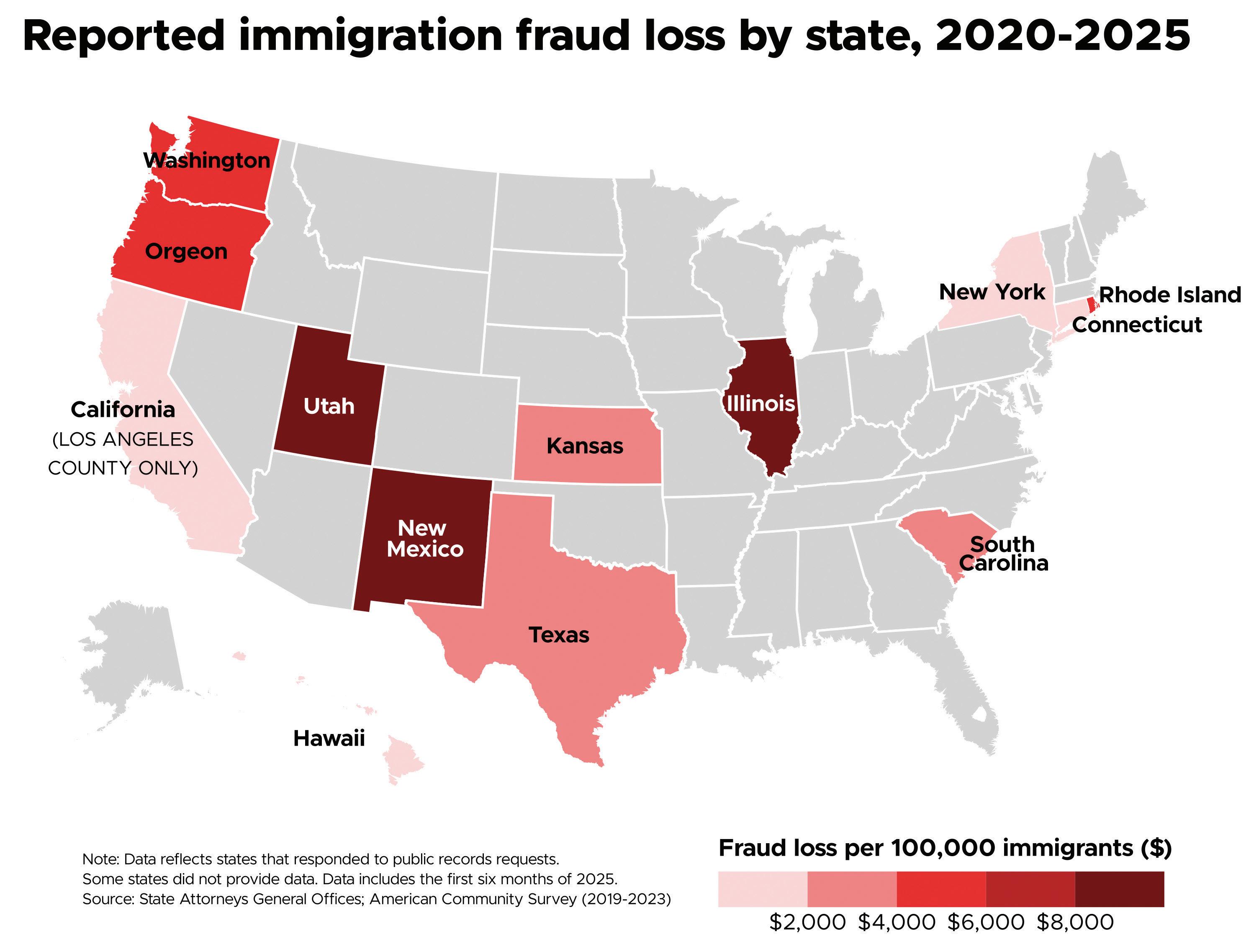
Immigration-services fraud is not limited to Illinois. The Weekly and Type Investigations submitted public records requests to state attorneys general in all 50 states to understand the scope of the problem. We found nearly 170 instances of immigration fraud since 2020 in complaints and police reports from 14 states. The other states denied our requests or did not have responsive records.
The records show that hundreds of people across the country claim to have fallen victim to immigration legal services fraud, allegedly losing at least $800,000 in the process. In some cases, individuals said the scammers jeopardized their asylum or immigration cases—risking deportation proceedings.
Data from state attorneys general does not capture the full scope of the problem. In Los Angeles alone, more than 300 complaints of this type of fraud have been filed with the county’s Department of Consumer and Business Affairs since 2012. Victims reported losing more than $400,000.
These findings may be impacted by how welcoming various states are to immigrants. A 2022 study found that in areas that have strong social safety nets and more communitybased organizations and experienced immigration lawyers, immigrants are more likely to come forward with accusations of fraud.
Fear, lack of familiarity with the U.S. immigration process, and the acute need for affordable immigration services all make immigrants susceptible to fraud, experts say. And immigration raids by federal agents are likely to exacerbate the problem, as victims may be hesitant to seek help from law enforcement agencies.
“With the aggressiveness of ICE and the apprehension that people have to come out and be public—these notarios are bottom feeders, and they make something bad worse,” Wildes said.
Sometimes, notarios defraud people in immigrant communities by trading on
the names and reputations of upstanding organizations. The American Bar Association does not represent clients in court. But Adonia Simpson, deputy director of policy and pro bono at the ABA’s Commission on Immigration, said that more than a dozen people have contacted the organization since President Donald Trump took office in January, claiming that the ABA had agreed to represent them in immigration proceedings.
“We get the paperwork and it’s contracts with our logo and our mailing or D.C. address,” Simpson said. “Individuals are paying thousands of dollars, and essentially, these bad actors are disappearing.”
believed the organization still worked there.
“They are scamming vulnerable people out of a lot of money and putting their lives at risk, especially under this administration,” she wrote in the complaint.
In Houston, Texas, a woman alleged that in 2023 she paid $6,000 to a local immigration services provider who promised her full legal representation in her asylum case but never delivered. According to her complaint to the Texas attorney general’s office, the provider claimed to work with attorneys and assured her that her court filings, work permit and Social Security application would be handled. But no lawyer ever
“She told me I couldn’t speak to anyone about it or she would have me deported. She then disappeared for about a year and I never received my work permit. In July, she called me to set up a meeting and demanded $2,000 more or else my green card process would terminate. I met her at a McDonald’s with my brother-in-law, who she was also helping, and gave her the money.”
— A complaint describing how a scammer defrauded a woman in the Chicago area in 2023
In New Mexico in 2020, a Catholic Charities worker told authorities she repeatedly heard about two individuals posing as legal service providers near Santa Fe, charging immigrants thousands of dollars to file paperwork they were not qualified to handle. One woman paid several thousand dollars that year for an application that was doomed from the start, only to be denied and placed at high risk of deportation, according to a complaint filed to the state’s attorney general. The staffer added that one of the alleged scammers operated out of an office that formerly housed Catholic Charities, luring clients who mistakenly
Live, or Facebook.
Some victims even received fake receipts and tracking numbers that looked like they came from USCIS, which made the scams more convincing.
“Immigration sends a letter,” Estrada said. “They’re not going to text you; they’re not going to call you, let alone ask you for money.”
One victim, a 31-year-old undocumented Chicago resident from Oaxaca, Mexico, lost more than $700— all his savings—to scammers posing as police. He asked to remain anonymous because of his immigration status. He told the Weekly and Type Investigations that he doesn’t know how the scammers found his phone number or knew his immigration status. But the calls began in the early afternoon of June 12, 2024 and continued until almost 11:00 p.m. At first, the scammers extracted small bits of information. Then, they said there was a warrant for the man’s arrest, and threatened him with deportation if he didn’t pay them.
“They had already instilled fear in me,” he said. “At that point, I couldn’t control myself anymore.”
The scam left him in a monthslong depression that stretched until November. It wasn’t until he learned that his U-visa application, which he had filed in 2022, had been accepted and a work permit was on the way that he began to feel hope again.
“I would work for a bit and then… just sleep. I stopped doing anything, I didn’t care about anything anymore, it was just sleep. And sometimes I’d just think...that’s it.”
appeared on behalf of the woman, and her asylum application had never been filed, leaving her at risk of deportation.
“I am a victim of notary fraud,” the complainant wrote. The provider could not be reached for comment.
The uncertainty around the law can leave immigrants susceptible to other scams as well. Gwendolyn Estrada, the director of legal services at the Chicago nonprofit Latinos Progresando, said scams have evolved with newer technologies and social media, making them harder for people to detect. She said recent cases involved people being targeted through WhatsApp, TikTok
Enforcement is inconsistent
Amato Lough said one of the most frustrating realities she’s witnessed is law enforcement’s reluctance to act. One of her clients, María Gutierrez Aragón, was an immigrant from Oaxaca, Mexico, who was manipulated by a trusted family acquaintance. The notario, Fidel Marquez Cortes, defrauded Gutiérrez Aragón of tens of thousands of dollars over the course of a decade.
Gutiérrez Aragón explained that the fraud began when she suffered domestic violence from her long-time partner, an experience that left her vulnerable and
searching for safety. Marquez Cortes stepped in by presenting himself as a trusted “legal representative” who could quickly fix her immigration status, she said. He devised various schemes to defraud Gutiérrez Aragón, she said, including threats of taking her children. Eventually, he started stalking her, Gutiérrez Aragón alleged.
Gutiérrez Aragón contacted the Los Angeles Police Department in 2011, but she and Amato Lough say they had to pressure the police to take a report. A judge eventually ordered Marquez Cortes to pay restitution of $66,000 in restitution and serve one year in county jail if he completed the payments, or two years in state prison if he failed to do so. Within weeks, Marquez Cortés had fled to Mexico. The Mexican authorities later arrested him, but he has not been extradited to the United States.
Gutiérrez Aragón’s case illustrates both the scale of financial devastation and the difficulty of holding bad actors accountable. Scammers are “able to operate with impunity because there is such a lack of enforcement against notario fraud,” Amato Lough said.
Law enforcement’s reluctance and lack of resources make prosecution rare, even when victims provide receipts or multiple testimonies, she said. The public records we reviewed also revealed that authorities across the United States deal with this problem unevenly. In some states, such as Utah and Texas, law enforcement agencies have undertaken criminal investigations into notario fraud. In others, it’s unclear what, if any, action was taken after complaints were filed.
The Illinois attorney general’s office said it reviews every consumer complaint and provides recommendations for next steps, including calling the police or pursuing the matter in small claims court. If individuals feel that a lawyer has acted inappropriately, they can also file a grievance with the Attorney Registration and Disciplinary Commission, which can send cease-and-desist letters to alleged perpetrators.
In Chicago, individuals can also file complaints with the Department of Business Affairs and Consumer Protection. Public records indicate that, between 2019 and 2024, BACP issued fines to two businesses, and one
individual affiliated with a third, for alleged violations of city laws related to immigration services.
BACP also said it combats notario fraud through investigations and its “Be Informed. Be Protected” campaign, which includes a series of informational flyers.
One of the flyers, available online in English, Spanish, Arabic, Korean, and Polish, spells out consumer rights and warns immigrants that notarios are not attorneys and cannot provide legal advice. It explains that immigration service providers must give clients written contracts, disclose all costs up front, return documents when work is complete, and allow clients to cancel agreements within 72 hours. The flyer also cautions against overcharging, noting the maximum fee for filling out a government form is $75, and directs consumers to report fraud through the city’s 311 system.
But it remains unclear where, or even if, those flyers are posted in neighborhoods most likely to be affected by notario fraud.
Sometimes, state officials conduct rigorous investigations and involve law enforcement to bust notario fraud schemes or use lawsuits to win the victims restitution. In Washington, the attorney general’s office won nearly $230,000 in 2023 after filing a state lawsuit for victims of a Seattle business preying on Brazilian immigrants. In 2022, law enforcement agents in Utah interviewed more than 31 victims of two different immigration fraud schemes before they ultimately nabbed the alleged perpetrators. That same year, a Chicago woman, Aracelia Domínguez, was convicted of stealing nearly $100,000 from victims by posing as an immigration attorney.
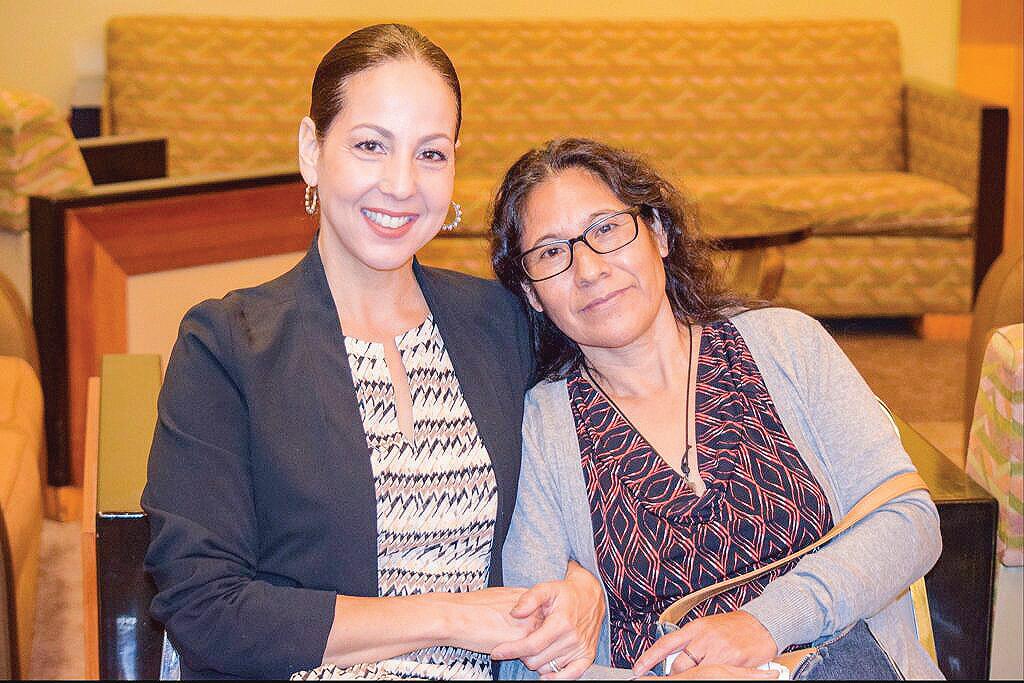
Sisters Norma Sereño Martínez and Erika Mesa, who paid Domínguez nearly $8,000 to handle Martínez’s residency case, said that despite learning about the conviction, they never really got closure. The fraud caused them emotional as well as financial losses, and when they initially reported it to police, officers were unhelpful. At one point, they attempted to visit Domínguez in prison to get some answers or an apology, but were turned away.
“The only two things I wanted to ask were, ‘Why did you defraud me? And
what did I ever do to you?’” Martínez said. “If you needed money, you could have asked me. I would have helped you. But outright theft like this—that is unforgivable.”
Wildes, the immigration attorney, who is also the mayor of Englewood, New Jersey, and a former federal prosecutor, said that public officials should do what they can to raise awareness about notario fraud and prosecute people who take advantage of immigrants.
He advised that immigrants should make sure anyone they’re seeking legal assistance from has a license to practice and “that there should be an immediate flag that you're being taken advantage of” if they have another third-party lawyer sign off on the paperwork without ever having personally met with the attorney.
“Be careful who your representative is,” he said. “When it comes to lawyers and doctors, they have to go with the best, because you have one shot to do this.”
More than a year and a half into her life in Chicago, the Venezuelan woman who lost $500 to scammers is trying to
get her case back on track with the help of a pro bono attorney. She said her only goal is to secure legal status in the U.S. so she can give her children “a good future, so they can study here.”
She warned others in the immigrant community not to put their faith in notarios
“People should really get proper advice first, before starting their case,” she said. “Because when you come to a new country, you don’t know how things work, the laws, and you let yourself be guided by the first things people tell you.” ¬
Alma Campos is the Weekly’s immigration reporter and project editor. Max Blaisdell is a fellow with the Invisible Institute, a staff writer for the Hyde Park Herald, and an investigative reporter for South Side Weekly. Jinny Kim, a data reporter and graduate student studying computer science and public policy at the University of Chicago, created the national map of immigration fraud.

Inmigrantes en busca de apoyo legal caen en manos de estafadores
En Illinois, los inmigrantes han perdido miles de dólares a manos de notarios que ofrecen asistencia legal para la que no están cualificados, así como de otros impostores. A nivel nacional, la cifra asciende a al menos $1.2 millones.
POR ALMA CAMPOS Y MAX BLAISDELL TRADUCIDO POR: GISELA OROZCO
Este reportaje fue realizado en colaboración con la sala de redacción sin fines de lucro Type Investigations, con el apoyo del Wayne Barrett Project.
CHICAGO — Cuando la mujer venezolana llegó a la ciudad en diciembre de 2023 con sus tres hijos, buscaba estabilidad y una vía para mejorar su situación. Un amigo la recomendó a un hombre que afirmaba poder gestionar solicitudes de asilo. Confiando en él, le pagó $500 para que presentara la documentación de ella y de sus hijos.
Sólo más tarde, la mujer, que habló con South Side Weekly y Type Investigations, bajo condición de anonimato debido a su estatus migratorio, descubrió que su solicitud de asilo había sido mal gestionada, lo que le impidió obtener un permiso de trabajo.
“Cuando llegó el momento de obtener el permiso de trabajo, resultó que la solicitud de asilo que él presentó era incorrecta”, dijo. “Muy, muy incorrecta”.
Al no poder trabajar legalmente, a veces ha aceptado trabajos clandestinos para mantener a su familia. Y en lugar de la estabilidad y la tranquilidad que pudo haber obtenido al obtener rápidamente un permiso de trabajo, la mujer señaló que la precariedad de su situación le ha causado mucho estrés.
“Soy madre responsable de tres hijos; estoy sola y esto me ha afectado mucho económicamente”, destacó.

Dávila Tax Services es uno de los numerosos negocios en La Villita, Chicago, que ofrecen asistencia con solicitudes de inmigración.
En una investigación realizada durante meses, el Weekly y Type Investigations descubrieron que los inmigrantes que buscan una vía legal para
obtener la residencia o la ciudadanía deben navegar por un panorama confuso de proveedores de servicios de inmigración. Algunos negocios, que por lo demás son
preparadores de impuestos o notarios públicos legítimos, pueden tergiversar los servicios que están legalmente autorizados a ofrecer, eludiendo la línea entre hablar
Foto por Marc Monaghan
sobre opciones de inmigración y ofrecer asesoramiento legal para el que no tiene licencia. Y los estafadores pueden fugarse con el dinero de las víctimas tras no prestar los servicios prometidos, no estar autorizados para ofrecerlos o incluso amenazar a los inmigrantes con sacarles dinero. La aplicación de la ley es inconsistente de un estado a otro, y los estafadores que acumulan quejas a veces reubican o renombran sus negocios para evitar rendir cuentas.
Michael Wildes, socio director de Wildes & Weinberg, P.C., un importante bufete de abogados especializado en inmigración de la ciudad de Nueva York, afirmó que, si bien puede parecer que llenar formularios de inmigración es una tarea sencilla que puede realizar cualquier persona sin ser abogado, cuando los notarios brindan asesoramiento incorrecto, inconsistente o desactualizado sobre el estatus migratorio que deben solicitar ante el Servicio de Ciudadanía e Inmigración de Estados Unidos (USCIS), los formularios que presentan “nunca podrán ser borrados”.
“Una persona nunca puede decir: ‘No sabía lo que hacía’. En última instancia, la responsabilidad recae sobre ti”, afirmó Wildes. "El desconocimiento de la ley, cometer un error o la elección del profesional equivocado lo acompañan en el ámbito migratorio”.
Este tipo de fraude es generalizado, en parte, debido a la idea errónea de que los notarios en Estados Unidos son abogados, como en muchos países latinoamericanos. Por ejemplo, en México, un notario público debe contar con un título en derecho, trabajar para otro notario público y aprobar un examen riguroso. Altamente acreditados, estos notarios mexicanos pueden ofrecer asesoría legal y una amplia variedad de servicios jurídicos.
En cambio, en Estados Unidos, los notarios públicos sólo pueden certificar documentos y firmas, transcribir respuestas o traducir instrucciones, traducir preguntas o respuestas en formularios gubernamentales.
Si bien muchas estafas están vinculadas a notarios, no son los únicos actores maliciosos. Algunas personas se presentan como conocidos de confianza
que afirman saber cómo funciona el sistema de inmigración. Cada vez más, el fraude también ocurre a distancia, a través de llamadas telefónicas, redes sociales o aplicaciones de mensajería, donde los estafadores se hacen pasar por policías o funcionarios de inmigración para exigir dinero.
Desde 2015, en Illinois docenas de personas han presentado denuncias ante el fiscal general del estado alegando haber sido defraudadas en casos de inmigración, con pérdidas que ascienden a casi $200,000, según los registros obtenidos por el Weekly y Type Investigations de la oficina del fiscal general.
Más de la mitad de esa cantidad se atribuyó a dos mujeres de Chicago y de Melrose Park, Illinois. Según diez denuncias, entre 2022 y 2023 se enfocaron en personas, supuestamente cobrando entre $6,000 y $25,000 por asistencia con las solicitudes de residencia permanente (“green card”), y en ocasiones advirtiendo a las víctimas que si hablaban sobre sus prácticas, se arriesgaban a ser deportadas.
Varias denuncias indican que una de las mujeres afirmó falsamente trabajar para las autoridades de inmigración y conocer a algunos de los altos mandos de inmigración, recurriendo a recomendaciones de boca en boca para encontrar nuevos clientes. En algunos casos, una de ellas recomendaba a la otra directamente, o amigos y familiares las conectaban entre sí.
Una denuncia de 2023 describió cómo una de las personas conoció a una víctima a través de una recomendación personal y se presentó como alguien que “colaboraba estrechamente con inmigración” para obtener la residencia permanente para personas.
En una denuncia, una persona afirmó que la estafadora “garantizó que recibiría mi permiso de trabajo en un año y mi residencia permanente en dos años una vez que le entregara todo el dinero del servicio en efectivo”.
“Me dijo que no podía hablar con nadie al respecto o haría que me deportaran. Luego desapareció durante casi un año y nunca recibí mi permiso de trabajo. En julio, me llamó para programar una cita y me exigió $2,000 más o, de lo contrario, mi trámite de
residencia permanente se cancelaría. Me reuní con ella en un McDonald’s con mi cuñado, a quien también ayudaba, y le di el dinero”, destaca la denuncia.
La Fiscalía General de Illinois se negó a responder preguntas sobre el estado de estas quejas o si la oficina había tomado alguna medida al respecto.
Cuando se confunde la información con la asesoría
“Algunos de estos notarios se asocian con abogados con licencia”, dijo Gina Amato Lough, abogada directora del Proyecto de Derechos de los Inmigrantes de Public Counsel en Los Ángeles. “Lo que hacen es tomar el dinero de la persona, hacer todo el papeleo, pero luego, por supuesto, no pueden presentarse en la corte. Así que se asocian con un abogado con licencia que sí se presentará en la corte y realizará la audiencia”.
Sin embargo, este modelo puede dificultar que los clientes comprendan cuándo el trabajo trasciende la línea de la asistencia administrativa legítima —por ejemplo, el tipo de trabajo que los asistentes legales en los bufetes de abogados realizan constantemente— y se convierte en un ejercicio no autorizado de la abogacía.
“Los asistentes legales realizarán consultas, eso no es un problema. Se encargarán de la recepción de casos, pero siempre bajo la supervisión de un abogado”, afirmó Amato Lough.
Los proveedores de servicios de inmigración que brindan asesoramiento legal sin la licencia correspondiente se arriesgan a recibir órdenes judiciales, multas, cargos penales o sanciones por fraude al consumidor, o incluso cargos penales según la ley estatal, y el fiscal general puede solicitar la suspensión o revocación de la autorización para operar del negocio. Para los clientes, las consecuencias son aún mayores: pueden perder miles de dólares, enfrentarse a la deportación o a la imposibilidad permanente de obtener beneficios migratorios si se presentan formularios incorrectos, cometer perjurio sin saberlo y perder tiempo valioso en sus casos.
En Franklin Park, un suburbio de Chicago, Servicios Leyva se anuncia
ofreciendo asistencia en casos de inmigración y preparación de impuestos. Si bien la letra pequeña en el sitio web de la empresa indica que no es un bufete de abogados y no puede brindar asesoramiento legal, a veces puede ser difícil para los clientes comprender la diferencia entre simplemente ofrecer información y brindar orientación legal, especialmente para inmigrantes que hablan español y que tienen poco conocimiento del sistema legal estadounidense. “Somos honestos y directos, y le ayudamos en su proceso de inmigración hacia su camino hacia la ciudadanía”, afirma el sitio web de Servicios Leyva.
Los reporteros de El Weekly visitaron tres de estos negocios en el área de Chicago para comprender cómo operan. (Los negocios no tienen relación con las dos mujeres de Chicago y Melrose Park). Haciéndonos pasar por posibles clientes, les presentamos información específica sobre María, una persona real que buscaba orientación sobre cómo obtener la residencia estadounidense.
Un día de entre semana durante el verano, hablamos con una secretaria asistente de Servicios Leyva que irradiaba calidez y tranquilidad, y escuchó atentamente los detalles compartidos. Nos explicó cómo María podría obtener la residencia legal mediante un trámite consular y una exención, dado que está casada con un ciudadano estadounidense, y estimó que el proceso duraría cuatro años.
La mujer, que no es abogada, comentó que ella o su colega podrían encargarse de todo el papeleo por sí solas, sin necesidad de un abogado. Nos entregó la tarjeta de presentación de un abogado para llamar en caso de emergencia, como en el caso de que María fuera detenida o tuviera que comparecer ante una corte de inmigración.
Luego hizo preguntas detalladas sobre el historial migratorio de María, incluyendo si alguna vez había sido deportada, y nos dio una lista de documentos para traer para iniciar el caso, incluyendo fotos y un certificado de matrimonio.
El trámite consular tardaría aproximadamente un año, explicó. Para
ello, indicó que la tarifa del USCIS era de $675 y que Servicios Leyva cobraría $990 por preparar y presentar la documentación, dando un total de $1,665.
Debido a que María había ingresado a Estados Unidos sin autorización, la mujer dijo que también tendría que solicitar una exención por presencia ilegal una vez aprobada la petición. Ese trámite, explicó, tardaría otros tres años. Cotizó la tarifa gubernamental para la exención en $795, mientras que la tarifa por servicio de Leyva sería de $950, lo que eleva el total a $3,410 en honorarios tanto para USCIS como para Servicios Leyva.
Brindar asesoramiento legal sobre un caso de inmigración queda fuera del alcance de las funciones de los notarios según la ley estatal de Illinois. Según la Ley de Notarios Públicos de Illinois, los notarios que no sean abogados o representantes acreditados por el Departamento de Justicia (DOJ) tienen prohibido prestar servicios legales de inmigración u ofrecer asesoramiento que requiera un dictamen judicial. Los proveedores de servicios de inmigración deben estar registrados ante el fiscal general del estado. Solo pueden realizar tareas muy limitadas: pueden entregar materiales legales y formularios en blanco, mecanografiar o presentar documentos exactamente como lo indique el cliente y notificar documentos a otras partes. Sin embargo, no pueden recomendar qué formularios usar, qué tipo de ayuda migratoria solicitar ni brindar ningún otro tipo de asesoramiento legal. Los proveedores de servicios de inmigración en Chicago también deben obtener una licencia del Departamento de Asuntos Comerciales y Protección al Consumidor (BACP) de la Municipalidad. Las reglas de la Municipalidad sobre el tipo de servicios que pueden prestar estas empresas son igualmente restrictivas. Las autoridades federales plantean un punto similar: la guía del USCIS establece que sólo los abogados con licencia y los representantes acreditados por el Departamento de Justicia, no los notarios, pueden brindar asesoramiento legal de inmigración. En algunos casos, los estudiantes de derecho y los graduados de las facultades de derecho pueden hacer lo mismo.
Los representantes de Servicios Leyva no respondieron a las solicitudes de comentarios.
En la Agencia y Notaria Cadena, en el barrio de Las Empacadoras de Chicago, el hijo del dueño proporcionó el número de celular de su papá a una reportera del Weekly que buscaba ayuda para María. En una llamada realizada unos días después, Rogelio Cadena, el dueño, dijo que si bien un abogado se encargaría de la parte del caso relacionada con la exención, él mismo podría preparar la documentación inicial y describió un proceso de inmigración de varios pasos. Recomendó comenzar con una petición I-130 de patrocinio familiar, que dijo que prepararía él mismo, así como una Declaración Jurada de Apoyo. En total, calculó que todo el proceso costaría aproximadamente $7,000, distribuidos a lo largo de varios años. Cadena no es abogado de inmigración.
“Ayudamos a la gente”, dijo Cadena en una llamada de seguimiento con una reportera del Weekly realizada en noviembre. “Tenemos licencia para trabajar en asuntos de inmigración”. La Agencia y Notaria Cadena está registrada como proveedor de servicios de inmigración en la Municipalidad. Sin embargo, al igual que otras empresas similares, es posible que no ofrezca asesoramiento legal.
En un correo electrónico posterior, Cadena explicó que, como notario público, no podía manejar el caso directamente y recomendó consultar con un abogado. “Les estaba dando mi opinión (no un consejo) sobre cómo se desarrolla el proceso”, destacó. La conversación, explicó, tenía como único objetivo recopilar información sobre el caso. “Necesito saber cuál es la situación posible de mi cliente para ver si puedo ofrecer servicios de inmigración limitados”, dijo. “Cualquier servicio o pregunta adicional debería consultarla con un abogado”.
Una historia similar sucedió en las oficinas de Dávila Tax Services en La Villita, un vecindario predominantemente mexicano del lado sur de Chicago, donde las paredes de la sala de espera estaban adornadas con volantes que anunciaban fotos de pasaporte, preparación de impuestos y servicios de inmigración.
Los clientes potenciales, con sus comprobantes numerados, esperaban en silencio su turno para hablar con Jesús Dávila Jr., quien fundó la empresa de servicios legales hace 38 años y es su presidente.
En su oficina, Dávila explicó que María podría necesitar un perdón, calculó cuánto tiempo tendría que permanecer en México y predijo que el proceso tomaría de tres a cuatro años. Ofreció una tarifa fija de $7,500 para el caso. Sin embargo, señaló que no era abogado y que una abogada de su oficina, Helen Lesczynski, se encargaría del caso.
En una llamada telefónica posterior con una reportera del Weekly, Lesczynski afirmó que Dávila había proporcionado “información, no asesoramiento” y negó que la empresa hubiera actuado de manera inapropiada. Dávila “con frecuencia se reúne con mis clientes potenciales de habla hispana y les cuenta un breve resumen del proceso y la estructura de precios”, dijo Lesczynski en un correo electrónico posterior.
Las redadas de inmigración podrían agravar el problema
El fraude en los servicios de inmigración no se limita a Illinois. El Weekly y Type Investigations presentaron solicitudes de registros públicos a los fiscales generales estatales de los 50 estados para comprender la magnitud del problema. Encontramos casi 170 casos de fraude migratorio desde 2020 en denuncias e informes policiales de 14 estados. Los demás estados denegaron nuestras solicitudes o no contaban con registros que las respaldaran.
Los registros muestran que cientos de personas en todo el país afirman haber sido víctimas de fraude en servicios legales de inmigración, perdiendo supuestamente al menos $800,000 en el proceso. En algunos casos, las personas afirmaron que los estafadores pusieron en riesgo sus casos de asilo o de inmigración, arriesgándolos a un proceso de deportación.
Los datos de los fiscales generales estatales no reflejan la magnitud total del problema. Sólo en Los Ángeles, se han presentado más de 300 denuncias de
este tipo de fraude ante el Departamento de Asuntos del Consumidor y Negocios del condado desde 2012. Las víctimas reportaron pérdidas superiores a $400,000.
Estos hallazgos podrían verse afectados por la receptividad que los estados brindan a los inmigrantes. Un estudio de 2022 reveló que en zonas con sólidas redes de seguridad social, organizaciones comunitarias y abogados de inmigración con experiencia, los inmigrantes son más propensos a presentar acusaciones de fraude.
El miedo, la falta de familiaridad con el proceso de inmigración estadounidense y la gran necesidad de servicios de inmigración asequibles hacen que los inmigrantes sean susceptibles al fraude, según los expertos. Además, es probable que las redadas de inmigración realizadas por agentes federales agraven el problema, ya que las víctimas pueden dudar en buscar ayuda de las fuerzas del orden.
“Con la agresividad de ICE (Servicio de Inmigración y Control de Aduanas) y la aprensión que sienten las personas al salir a la luz pública, estos notarios son oportunistas y empeoran las cosas”, afirmó Wildes.
En ocasiones, los notarios defraudan a personas en comunidades inmigrantes explotando el nombre y la reputación de organizaciones respetables. La American Bar Association (ABA) no ofrece asesoramiento legal ni representa a clientes ante las cortes. Pero Adonia Simpson, subdirectora de políticas y pro bono de la Comisión de Inmigración de la ABA, dijo que más de una docena de personas se han comunicado con la organización desde que el presidente Donald Trump asumió el cargo en enero, alegando que la ABA había acordado representarlos en los procedimientos de inmigración.
“Recibimos la documentación, que consiste en contratos con nuestro logotipo y nuestra dirección postal o de Washington D.C.”, destacó Simpson. “Hay personas que pagan miles de dólares y, en esencia, estos estafadores están desapareciendo”.
En Nuevo México, en 2020, una trabajadora de Caridades Católicas declaró a las autoridades que había oído
hablar repetidamente de dos individuos que se hacían pasar por proveedores de servicios legales cerca de Santa Fe y cobraban a inmigrantes miles de dólares por presentar documentos que no estaban cualificados para gestionar. Ese año una mujer pagó varios miles de dólares por una solicitud que estaba destinada a ser rechazada desde el principio, sólo para ser denegada y puesta en alto riesgo de deportación, según una denuncia presentada ante el fiscal general del estado. La trabajadora añadió que uno de los presuntos estafadores operaba desde una oficina que anteriormente albergaba Caridades Católicas, atrayendo a clientes que creían erróneamente que la organización seguía operando allí.
“Están estafando a personas vulnerables con una gran cantidad de dinero y poniendo sus vidas en riesgo, especialmente bajo este gobierno”, escribió en la denuncia.
En Houston, Texas, una mujer alegó que en 2023 pagó $6,000 a un proveedor local de servicios de inmigración que le prometió representación legal completa en su caso de asilo, pero nunca cumplió. Según su denuncia ante la fiscalía general de Texas, el proveedor afirmó trabajar con abogados y le aseguró que sus trámites judiciales, su permiso de trabajo y su solicitud de Seguro Social serían gestionados. Sin embargo, ningún abogado se presentó en su nombre y su solicitud de asilo nunca fue presentada, lo que la exponía al riesgo de deportación.
“Soy víctima de fraude notarial”, escribió la denunciante. No se pudo contactar al proveedor para obtener comentarios.
La incertidumbre en torno a la ley también puede dejar a los inmigrantes vulnerables a otras estafas. Gwendolyn Estrada, directora de servicios legales de Latinos Progresando, organización sin fines de lucro de Chicago, explicó que las estafas han evolucionado con las nuevas tecnologías y las redes sociales, lo que dificulta su detección. Comentó que casos recientes involucraron a personas que fueron víctimas de fraude a través de WhatsApp, TikTok Live o Facebook.
Algunas víctimas incluso recibieron recibos falsos y números de seguimiento que parecían provenir del USCIS, lo
En los últimos años, inmigrantes han presentado cientos de denuncias alegando que fueron víctimas de fraude. Los documentos en la imagen fueron obtenidos de las Fiscalías Generales de Carolina del Sur, Texas, Washington, Rhode Island, Misuri e Illinois. Foto por Paco Alvarez
que hacía que las estafas resultaran más convincentes.
“Inmigración te envía una carta”, destacó Estrada. “No te van a enviar un mensaje de texto; no te van a llamar y mucho menos te van a pedir dinero”.
Una víctima, un residente indocumentado de Chicago de 31 años de edad, originario de Oaxaca, México, perdió más de $700 —todos sus ahorros— a manos de estafadores que se hicieron pasar por policías. Pidió permanecer en el anonimato debido a su estatus migratorio. Le dijo a Weekly y Type Investigations que desconoce cómo los estafadores encontraron su número de teléfono o cómo conocían su estatus migratorio. Sin embargo, las llamadas comenzaron a primera hora de la tarde del 12 de junio de 2024 y continuaron hasta casi las 11:00 p.m. Al principio, los estafadores le extrajeron pequeños fragmentos de información. Luego, le dijeron que había una orden de arresto contra el hombre y lo amenazaron con la deportación si no les pagaba.
“Ya me habían infundido miedo”, dijo. “En ese momento, ya no pude controlarme”.
La estafa lo sumió en una depresión que duró meses hasta noviembre. No fue hasta que se enteró de que su solicitud de visa U, que había presentado en 2022, había sido aceptada y que su permiso de trabajo estaba en camino, que volvió a sentir esperanza.
“Trabajaba un rato y luego… sólo dormía. Ya no hacía nada, ya nada me importaba, sólo dormía. Y a veces pensaba… ya no más”.
La aplicación de la ley es inconsistente
Amato Lough dijo que una de las realidades más frustrantes que ha presenciado es la reticencia de las fuerzas del orden a actuar. Una de sus clientas, María Gutiérrez Aragón, una inmigrante de Oaxaca, México, fue manipulada por un conocido de confianza de su familia. El notario, Fidel Márquez Cortés, defraudó a Gutiérrez Aragón por docenas de miles de dólares a lo largo de una década.
Gutiérrez Aragón explicó que el fraude comenzó cuando sufrió violencia doméstica por parte de su pareja de muchos años, una experiencia que la dejó vulnerable y en busca de
seguridad. Márquez Cortés intervino presentándose como un “representante legal” de confianza que podría solucionar rápidamente su situación migratoria. Elaboró varios esquemas para defraudar a Gutiérrez Aragón, incluyendo amenazas de quitarle a sus hijos. Con el tiempo, comenzó a acosarla.
Gutiérrez Aragón contactó al Departamento de Policía de Los Ángeles en 2011, pero ella y Amato Lough afirman que tuvieron que presionar a la policía para que tomara una denuncia. Un juez finalmente ordenó a Márquez Cortés que pagara $66,000 en restitución y cumpliera un año en la cárcel del condado si completaba los pagos, o dos años en una prisión estatal si no lo hacía. Pero en cuestión de semanas, Márquez Cortés huyó a México. Las autoridades mexicanas lo arrestaron posteriormente, pero no ha sido extraditado a Estados Unidos.
El caso de Gutiérrez Aragón ilustra tanto la magnitud de la devastación financiera como la dificultad de responsabilizar a los delincuentes. Los estafadores “pueden operar con impunidad debido a la falta de aplicación
de la ley contra el fraude notarial”, destacó Amato Lough.
La renuencia de las fuerzas del orden y la falta de recursos hacen que el enjuiciamiento sea poco frecuente, incluso cuando las víctimas proporcionan recibos o múltiples testimonios, afirmó. Los registros públicos que revisamos también revelaron que las autoridades en todo Estados Unidos abordan este problema de manera desigual. En algunos estados, como Utah y Texas, las fuerzas del orden han llevado a cabo investigaciones penales sobre fraude notarial. En otros, no está claro qué medidas se tomaron, si es que se tomó alguna, tras la presentación de las denuncias.
La fiscalía general de Illinois afirmó que revisa todas las denuncias de los consumidores y ofrece recomendaciones sobre los siguientes pasos, como llamar a la policía o llevar el asunto ante una corte de reclamos menores. Si las personas consideran que un abogado ha actuado de forma inapropiada, también pueden presentar una queja ante la Comisión de Registro y Disciplina de Abogados, que puede enviar cartas de cese y desistimiento a los presuntos responsables.
En Chicago, las personas también pueden presentar denuncias ante el BACP. Los registros públicos indican que, entre 2019 y 2024, el BACP impuso multas a dos empresas y a una persona afiliada a una tercera, por presuntas infracciones de las leyes municipales relacionadas con los servicios de inmigración.
El BACP también afirmó que combate el fraude notarial mediante investigaciones y su campaña “Infórmate. Protégete”, que incluye una serie de folletos informativos.
Uno de los folletos, disponible en línea en inglés, español, árabe, coreano y polaco, detalla los derechos del consumidor y advierte a los inmigrantes de que los notarios no son abogados ni pueden brindar asesoramiento legal. Y explica que los proveedores de servicios de inmigración deben entregar a sus clientes contratos por escrito, informarles todos los costos por adelantado, devolver los documentos una vez finalizado el trabajo y permitirles cancelar los acuerdos dentro de las 72 horas. El folleto también advierte contra los cobros excesivos,
señalando que la tarifa máxima por completar un formulario gubernamental es de $75 e indica a los consumidores que denuncien el fraude a través del sistema 311 de la Municipalidad.
Sin embargo, aún no está claro dónde, o siquiera, se publican estos folletos en los vecindarios con mayor probabilidad de verse afectados por el fraude notarial.
En ocasiones, los funcionarios estatales realizan investigaciones rigurosas e involucran a las fuerzas del orden para desmantelar esquemas de fraude notarial, o presentan demandas para obtener la restitución a las víctimas. En 2023, en Washington, la fiscalía general obtuvo casi $230,000 tras presentar una demanda estatal en nombre de las víctimas de un negocio de Seattle que se aprovechaba de inmigrantes brasileños. En 2022, agentes del orden público en Utah entrevistaron a más de 31 víctimas de dos fraudes migratorios distintos antes de atrapar a los presuntos responsables.
Ese mismo año, Aracelia Domínguez, una mujer de Chicago, fue condenada por robar casi $100,000 a las víctimas haciéndose pasar por abogada de inmigración.
Las hermanas Norma Sereño Martínez y Erika Mesa, quienes le pagaron a Domínguez casi $8,000 para que se encargara del caso de residencia de Sereño Martínez, comentaron que, a pesar de enterarse de la condena, nunca lograron cerrar el capítulo. El fraude les causó pérdidas emocionales y económicas, y cuando lo denunciaron inicialmente ante la policía, los agentes no las ayudaron. En un momento dado, intentaron visitar a Domínguez en prisión para obtener respuestas o una disculpa, pero sus solicitudes fueron rechazadas.
“Las dos únicas cosas que quería preguntarle eran: ‘¿Por qué me defraudaste?’ ¿Y qué te hice?’”, dijo Martínez. Si necesitabas dinero, pudiste habérmelo pedido. Te habría ayudado. Pero un robo descarado como este es imperdonable”.
Wildes, el abogado de inmigración, quien también es alcalde de Englewood, Nueva Jersey, y exfiscal federal, dijo que los funcionarios públicos deberían hacer todo lo posible por crear conciencia sobre el fraude de los notarios y enjuiciar a
quienes se aprovechan de los inmigrantes.
Aconsejó a los inmigrantes que se aseguraran de que cualquier persona a la que recurrieran para obtener asistencia legal tuviera licencia para ejercer y que “debería de haber una señal inmediata de que te están aprovechándose” si un abogado externo firma la documentación sin haber conocido nunca al cliente.”
“Tengan cuidado con quién es su representante”, destacó. “Cuando se trata de abogados y médicos, deben elegir a los mejores, porque sólo tienen una oportunidad”.
Tras más de un año y medio viviendo en Chicago, la venezolana que perdió $500 a manos de estafadores intenta reencaminar su caso con la ayuda de un abogado pro bono. Dijo que su única meta es asegurar un estatus legal en Estados Unidos para poder darles a sus hijos “un buen futuro, para que puedan estudiar aquí”.
Advirtió a otros miembros de la
comunidad inmigrante que no confiaran en los notarios.
“La gente debería buscar asesoramiento adecuado antes de iniciar su caso”, señaló. “Porque cuando llegas a un nuevo país, no sabes cómo funcionan las cosas y las leyes, y te dejas guiar por lo primero que te dice la gente”. ¬

Rudy De Anda’s Chicago Chapter
With
an upcoming show at Thalia this month, the seasoned musician looks back.
BY JOCELYN MARTINEZ-ROSALES
Pilsen-based musical artist Rudy De Anda is getting ready for his last show of the year, which will be at the historic Thalia Hall on December 19. The night will double as his fourth appearance at the venue and a celebration of his fifth year in the city.
“I feel like Chicago will be this huge stamp on my life,” De Anda said, reflecting on the past half decade. “It’s crazy to talk now five years into this chapter, but it’s straight up a chapter now.”
De Anda packed up and drove across the country from Long Beach, California during the COVID pandemic and after the completion of his first project, Tender Epoch, a thirteen-track Chicano psychedelic soul debut album. These days, he refers to it as his “ticket to leave” California.
It wasn’t long until De Anda established roots in Pilsen and started booking shows. His first performance as a Chicago resident was at Empty Bottle with Combo Chimbita. Next, he opened for Chicano Batman at Concord. His third show, with Thee Sacred Souls at Lincoln Hall, began to get De Anda locally noticed.
“I remember [Thee Sacred Souls] finished and then people were trying to clap for them to do an encore,” De Anda said, recalling the end of the Lincoln Hall show. “You could ask [my ex], she wouldn’t be salty enough not to admit that she witnessed this too. But they took so long to come out for an encore that people eventually started chanting ‘Rudy.’”
For De Anda, it was a “W moment,” the kind of unofficial Chicago inauguration you can’t plan for.
“I think by then, people were like, ‘All right, who is this?’”

painted fingernails and Converse covered in band names. At an age when many are in search of identity, he found refuge in music. He and his friends really didn’t know how to play any instruments, but they wanted and needed to start a band. Their first performance was at a local pizza joint.
“I think I still have one of the flyers, which is crazy,” he said. “It’s just a little piece of printer paper. We were called Cromlech.
Not long after that, life shifted again. When his family moved to Las Vegas at the end of high school, he became determined to make his way back to Long Beach. Once he did, he threw himself into the Wild Pack of Canaries, a project he now describes as “Rudy De Anda 1.0.” His real solo era wouldn’t arrive until Colemine reached out in 2018.
“On Some Anthropology Shit”
“I feel like it just kind of proves that I can do whatever the fuck I want,” he said.
De Anda is working on some more cumbia-esque tracks for his LP slated for the coming year, also under Colemine, which he describes as a “match made in heaven.” Like De Anda, the label places a strong emphasis on physical media releases. He is stoked to share that the new cumbia tracks were produced in Little Village, the midwest mecca of sonideros since the early 1990s.
“It gives me goosebumps thinking when I release that, no matter what happens, I’m gonna have some type of musical representation of La Villita—on some anthropology shit.”
In 1992, the Rodney King uprisings lasted five days in Los Angeles, sparking mass mobilization in the liberation movement. Protesters against police brutality destroyed property—and caught in the crossfire was De Anda’s childhood home in Compton.
“I say, ‘burn it all down,’” De Anda said. “I was just a casualty of a bigger problem.”
The apartment his family lived in caught on fire, forcing them to relocate to Long Beach. De Anda believes this move was what led him to a path in music as it brought him closer to the music scene.
“My uncle’s girlfriend [told] my grandma she was taking me to the movies, but she took me to some DIY shows when I was twelve. And I feel like that’s really what sealed it,” he said.
De Anda’s coming-of-age chapter would be mixed with teenage angst,
Since his debut album, Tender Epoch, De Anda has released a second fulllength album with Colemine, titled Closet Botanist (2023). The LP stays true to his ability to merge retro influences with contemporary sounds. De Anda’s music is characterized by subtly funky elements and a blend of Spanish and English lyricism, all infused with a sense of Chicano romanticism.
On a recent collaboration with San Francisco cumbia duo El Grupo Gallardo, De Anda taps into tropical cumbia with the singles “Quiere Sabor” and “Puerta Dorada,” released this past October. More recently, he shifted to a darker palette with “Mi Amparo,” his lateNovember release with local post-punk band Nothing But Silence. “Mi Amparo” is a romantic, atmospheric track that blends De Anda’s signature psychedelic flair with soft, acoustic textures.
And while Chicago is home for now, De Anda said he’s caught the travel bug. Freshly back from his Gulf of Mexico Tour this past fall, where he hit new stops in Guatemala, the wanderlust artist teases the potential of intimate acoustic shows in Chile this spring. He’s also toying with the idea of eventually relocating to Mexico or even Spain. For De Anda, traveling goes hand in hand with creation, as each place lends inspiration. Still, he credits Chicago for loosening his approach to music and expanding his sense of what a song can be for a community.
“Just be a little more loose, you know? And sometimes people just want to dance and they just want to be at a barbecue and listen to [1992 house music anthem] ‘Follow Me,’” he said. “I didn't get that when I first moved here, but now it’s like, I wouldn’t have it any other way.” ¬
Jocelyn Martinez-Rosales is a Mexican American independent journalist from Belmont Cragin committed to telling stories from communities of color through a social justice lens. She is also a senior editor at the Weekly.
“Burn It All Down”
Rudy De Anda is photographed in the Pilsen neighborhood of Chicago.
Photo by Fernando Ruiz | @ferny_773
La Villita Holiday Gift Guide
BY SOUTH SIDE WEEKLY STAFF ILLUSTRATIONS BY LILLY SUNDSBAK
High profile border patrol and immigration agents may have largely moved on since “Operation Midway Blitz” wrapped up its campaign of terror in midNovember, but that doesn’t mean life for Chicago’s 600,000 immigrants and their communities is back to normal. Since the arrival of Greg Bovino and his agents in September, commercial activity in immigrant neighborhoods has been down as much as 70 percent. In majority Latine communites like La Villita, workers have been frightened to go to their jobs and families have been scared to do their shopping, for fear of being targeted by immigration raids. Add in the impact of recent heavy snowfalls and businesses are hurting across the city.
For all these reasons our gift guide this year is a guide to celebrating the holidays La Villita style. Here you’ll find tips on where to get the best cakes, piñatas, cowboy shirts and traditional gabanes and sarapes. There’s even a trolley to carry you from shop to shop so you don’t have to get your boots wet dashing through the snow. Shopping local is the
best way to keep our Chicago diverse and strong, and to ensure that it remains a welcoming city for years to come.
Holiday Trolley
Take a ride–an aventón–along 26th Street as you do your Christmas shopping.
The trolley is adorned with Christmas decor and sometimes includes a real-life “grinch.” It’s meant to encourage people to shop local by facilitating transportation that doesn’t cost a cent and can bring joy to kids to boot.
In the trolley’s second year, thirtyseven storefronts are participating in the promotional effort, which is sponsored by the Little Village Chamber of Commerce in collaboration with Special Service Area #25. Their kick-off event included pan dulce and hot beverages for all riders.
On December weekends only, two trolleys are in service that drive under the Bienvenidos arch and make stops at every CTA #60 bus stop between California and Kostner avenues. Check the chamber website for a map and list of businesses.
El Aventón Navideño “is our way
of uplifting the heart of Little Village during a time when our small businesses need us most,” said executive director Jennifer Aguilar. “We’re creating even more opportunities for families to shop, dine, and explore 26th Street without the stress of parking.”
Whether you’re looking to take the perfect Christmas portrait, are scavenging for a gift, or are looking for a date activity, why not hop on the trolley before year’s end?
littlevillagechamber.org
Jerga sweaters and gabanes
In one of the most dynamic shops on Cermak—a La Villita business corridor that has weathered the pandemic, rising rents, and most recently, ICE and border patrol abductions—you can find Mexican artesanías, traditional apparel, and cultural party supplies.
May Expressions’ specialties are their gabanes (aka ponchos) and the woven sweaters commonly referred to in English as Baja, bohemian, Rasta, hippie,


or surf hoodies.
This particular vendor imports their garments from Tlaxcala, a state near Mexico City. Located in Contla de Juan Cuamatzi, the Arte Textil Netzahualcóyotl workshop, where they’re produced, doubles as a community center where the craft is passed down.
The making of gabanes, sarapes and jerga sweaters—as they’re really called— is done on weaving looms, according to May Expressions. They add that the Netzahualcóyotl family strives to keep pre-Hispanic designs alive while adapting them to modern times.
You’ll find a large selection of color combinations, and even Bears, Sox, and Cubs-inspired designs. There’s nothing more comforting than throwing one of these on when it’s freezing outside or as you watch the game.
May Expressions, 2855 W. Cermak Rd. (773) 801-0114.


Bombon
In La Villita’s flagship store, Bombon is where people pick up the cakes that carry them through the year such as birthdays, quinceañeras, graduations, and everything in between. In winter, the shop also offers holiday desserts and breads, especially the Rosca de Reyes: a ring-shaped sweet bread traditionally eaten in Mexico on January 6 to celebrate Three Kings Day. It’s topped with candied fruit and hides a small baby Jesus figurine inside. Whoever finds it in their slice is expected to host a party on February 2.
The tradition is passed down through generations, whether or not they observe the religious aspect. Bombon’s rosca is firm, softly textured, never too sweet. They take advance orders, and they deliver.
They also sell flan, fruitcakes, tres leches cakes, chocoflan, and other desserts that fit naturally onto a holiday table. It’s something to bring when you want to offer something slightly outside the usual. Everything is baked from scratch by a family with decades of practice, one of whom is a pastry chef trained in Paris. Most whole cakes run $35–$70, depending on size and flavor; individual pastries are typically $3–$6.
Bombon, 3834 W. 26th St. bomboncakes. com. Order through Instagram @ bomboncakeschicago or by calling (312) 912-5077.
Ceasar’s Music of Illinois
Ceasar’s Music becomes your own under the sight of sprawling colors, textures, and potential sound just waiting to be brought to life as you step into this
instrument store on 26th street. Formerly in the Discount Mall, after fifteen years the shop moved to its current location where it’s been for the past three years.
This music shop opens an entryway to endless possibilities with its diverse array of instruments, equipment, accessories, and services. Ceasar’s carries wind, brass, strings, percussions and more, offering contemporary styles and electric options while still boasting tried and true favorites for old school instrumentalists.
Beyond instruments, explore tech fit for at home enjoyment or full scale productions. Here you’ll find speakers, lighting, sound boards, and consoles at varying complexities and price points.
Cesar’s also provides repairs for many of its offerings, maintenance on equipment and instruments, replacement parts and fresh accessories for seasoned gear that needs a new look.
Although the in-store experience is worth bearing the cold, you can shop their inventory online as well.
Ceasar's Music of Illinois, 3407 W 26th St. ceasarsmusic.com, (773) 319-6372.
Numero Group
Founded in 2003, The Numero Group is a Chicago-based archival record label that takes obscure or initially unsuccessful


musical releases from the 20th century and reissues or repackages them into new albums and physical products. While Numero also has offices in Los Angeles and London, their flagship record store, just off of 26th St, is the only place in the world to physically browse all of Numero’s catalogue.
Over the years, Numero has released vinyl box sets for 1970s rock band Blondie, 1990s slowcore Duster, and new age artist Laraaji, as well as many Chicago artists, such as Pastor T.L. Barrett, a South Side preacher who recorded gospel music in the 1970s, and 90 Day Men, a 2000s indie rock band.
Numero’s compilation albums include Purple Snow, a collection of 70s funk bands that forecasted The Minneapolis Sound; Basement Beehive, sounds from underground girl groups from the 1960s; and Acid Nightmares, which captures the vibes of the LSDfueled 60s. On their website, Numero staff have curated a number of Spotify playlists if you want to listen before you buy, and the store also features board games and other merchandise.
Just make sure to plan your trip carefully—the record store is only open on some Fridays, so call or check their Instagram for details.
Numero Group, 2533 S Troy St. Open some Fridays, 12-6pm; closed all other days. (773) 522-5007. Instagram: @thenumerogroup ¬


FEED YOUR MIND, BODY & SOUL
AKARAMA Foundation | 6220 S. Ingleside Avenue
December 11 | 9:30–11:30 a.m
MATHER + SILVER FOX CAFÉ POP-UP
Martin Luther King Community Center 4314 S. Cottage Grove Avenue
December 12 | 12:00–2:30 p.m.
WELLNESS AT THE COV
New Covenant Missionary Baptist Church | 754 E. 77th Street
Mondays–Thursdays | 9:30 a.m.–2:00 p.m.
Register today! Anyone 55+ is welcome to join for our





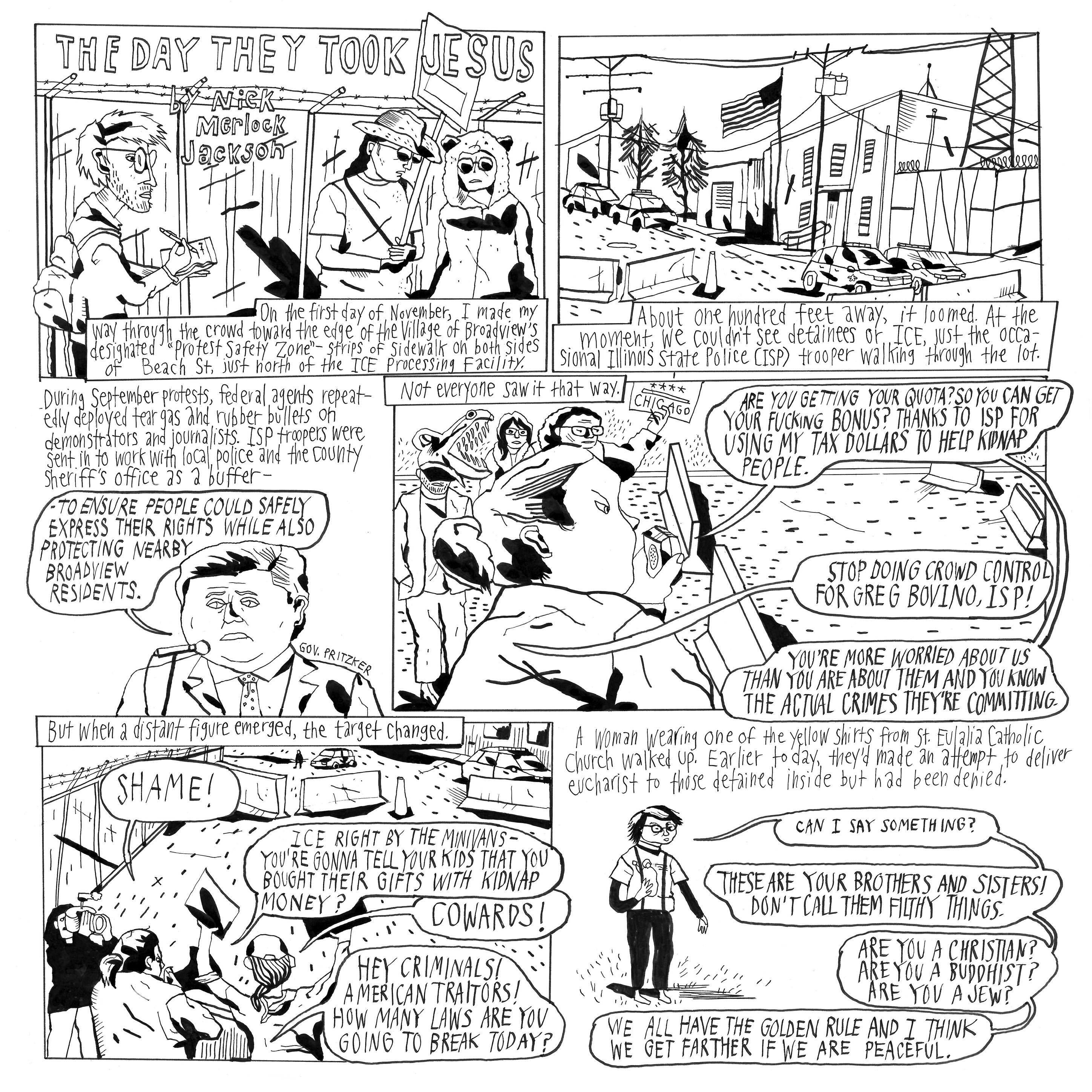
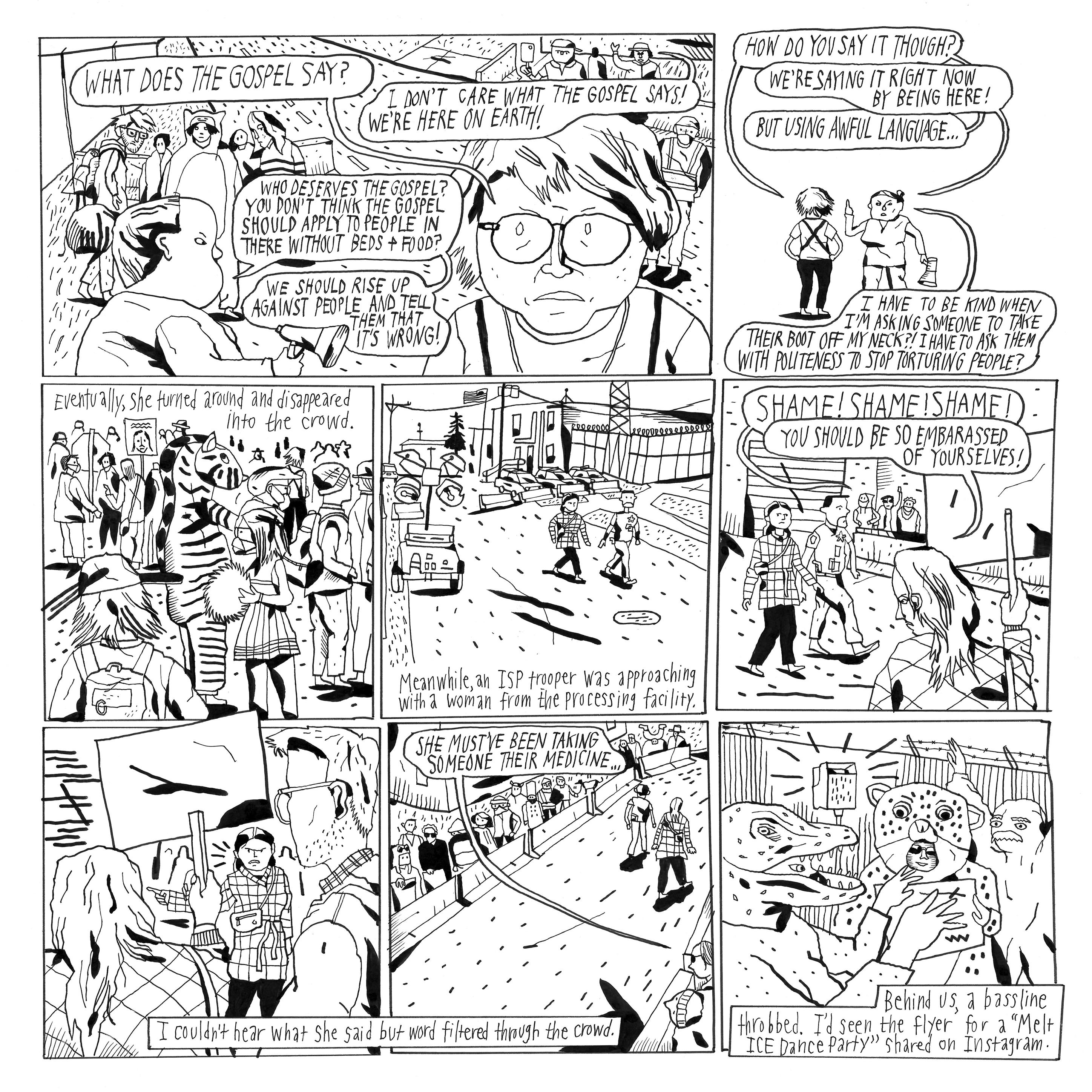
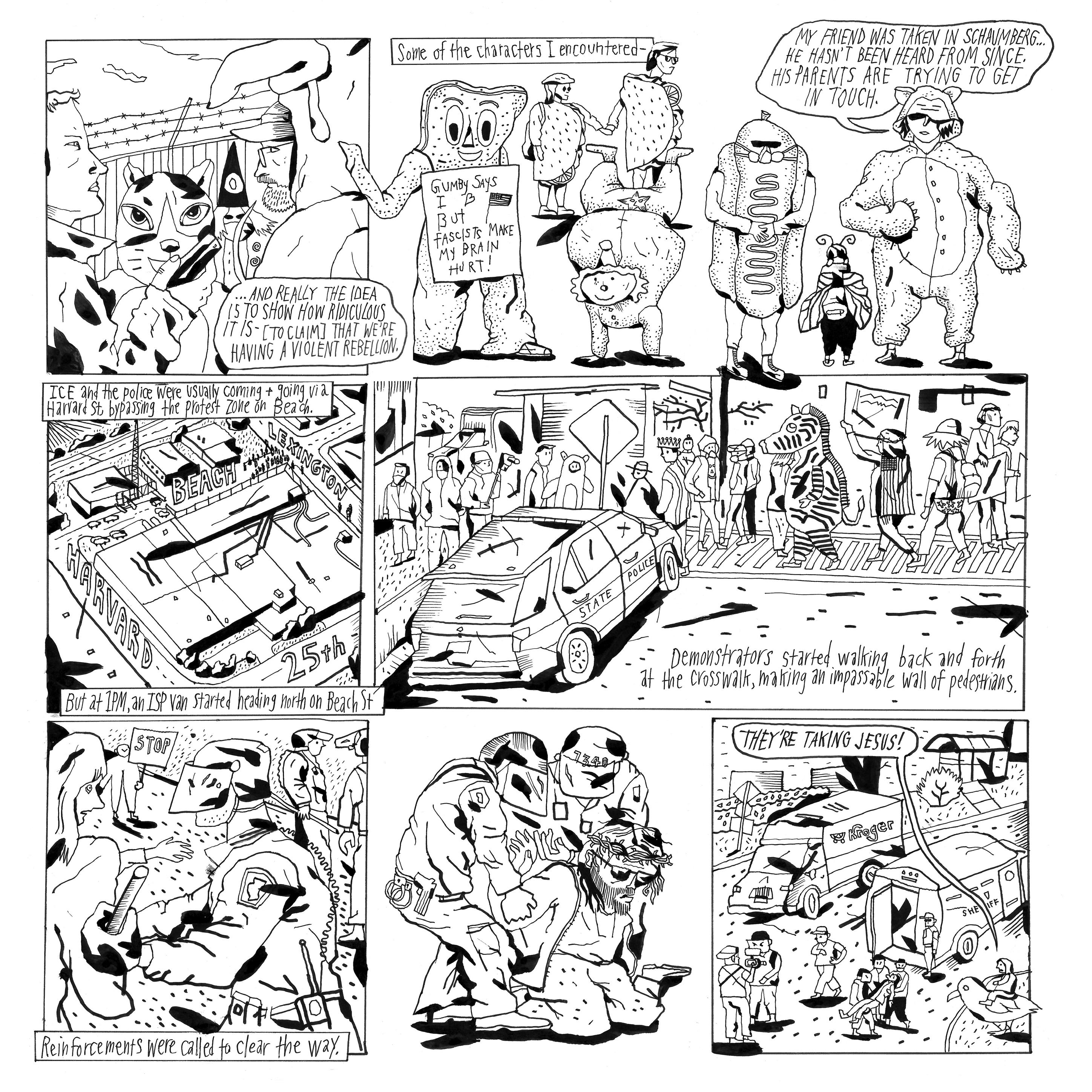
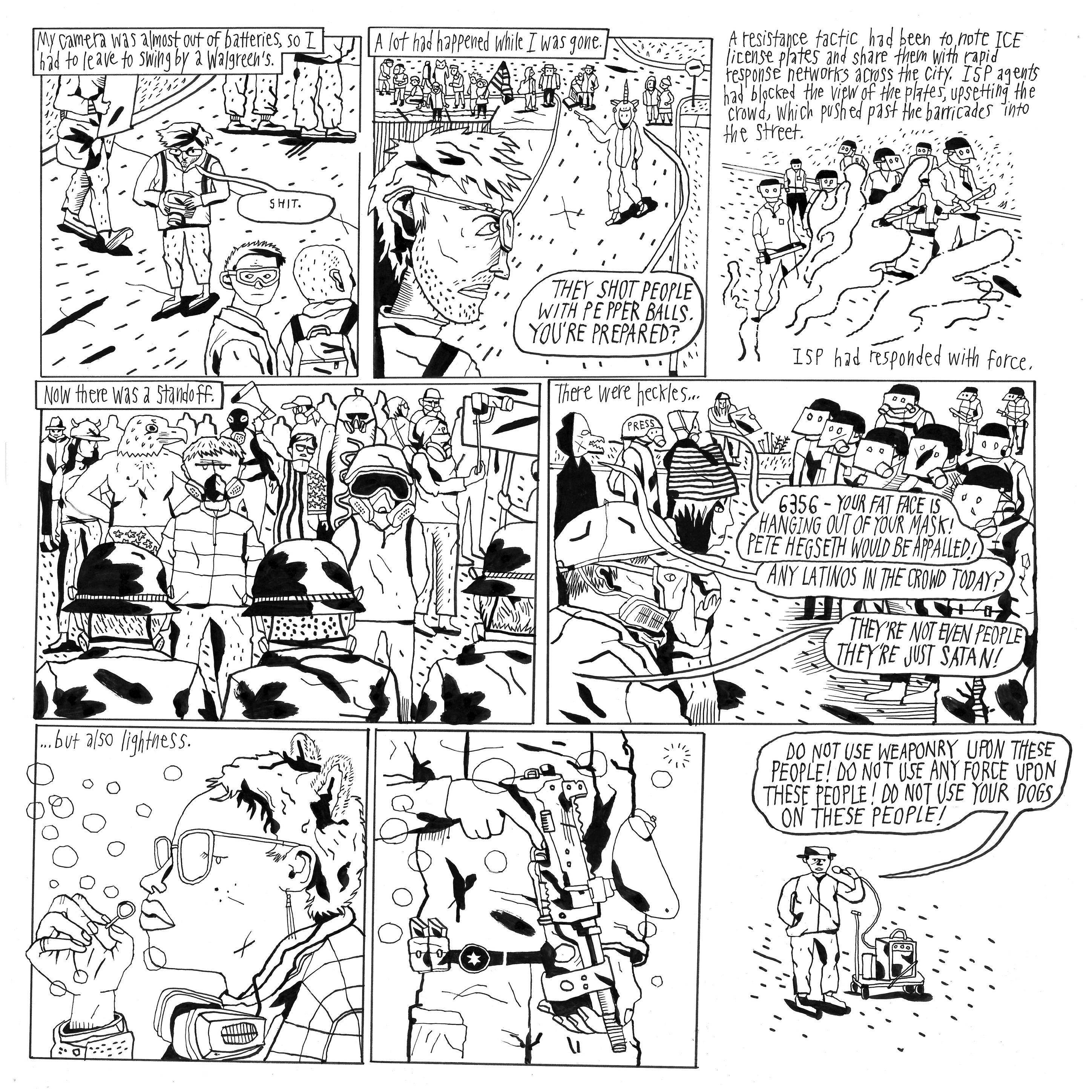
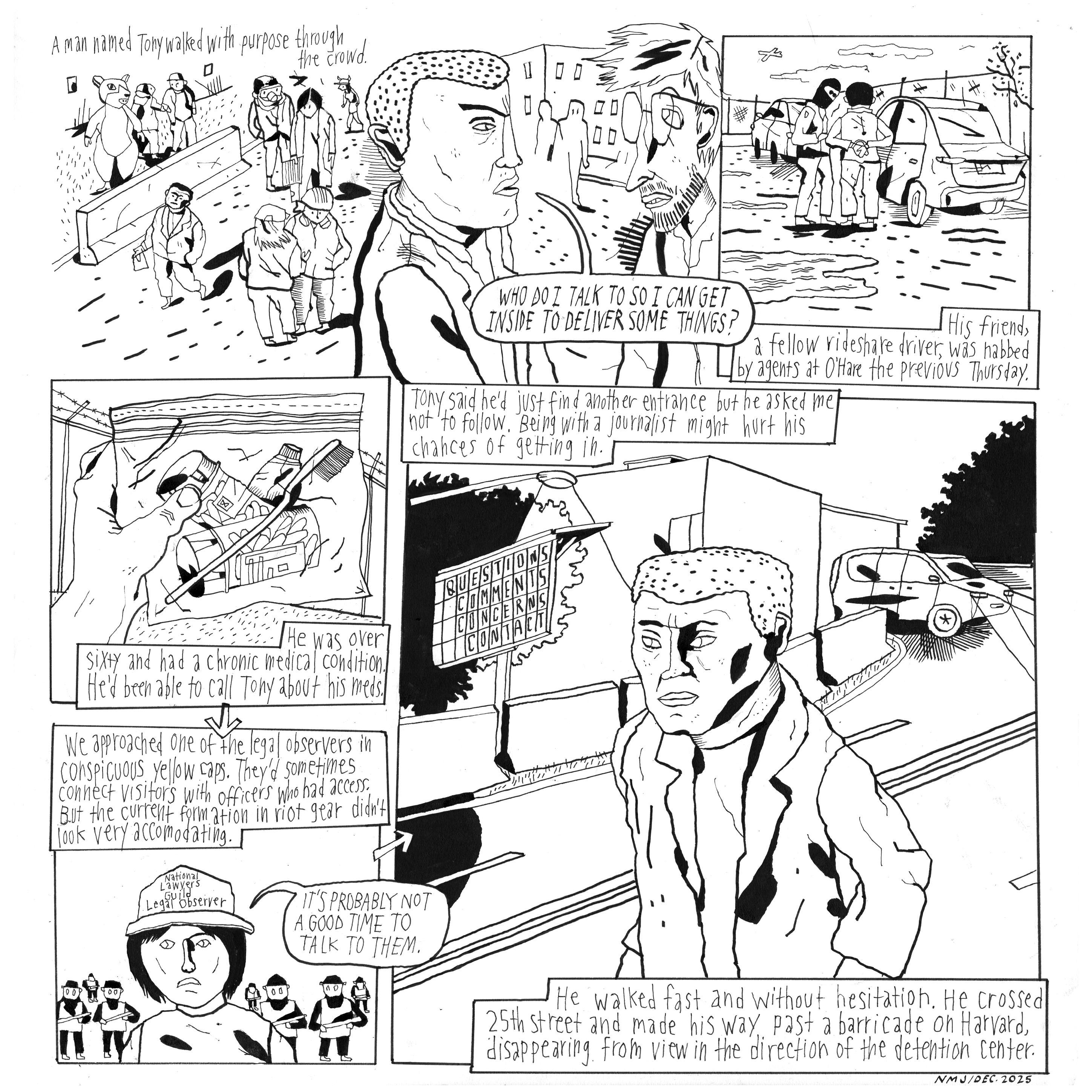

‘My Dogs Wouldn’t Even Lick It’
Insiders describe meals provided at Cook County Jail as gross and unhealthy, and some go hungry.
BY HARLEY POMPER
Doing Time investigates the daily life of people navigating court and jail. We focus on Cook County, home to the country’s largest single-site jail, and the courts that order people’s release or jailing. Readers of this series will hear from insiders, formerly incarcerated people, loved ones, policy experts, and government actors to establish the forces that shape the everyday experience of doing time.
Some names have been changed to protect insiders.
You get hungry and you get desperate. You don’t care about nothing else.”
Patrick* has been incarcerated at Cook County Jail for more than a decade while awaiting trial. In that time, he has seen people go hungry and has gone hungry himself.
“I heard people tying their stomach with a line, like ripping a sheet and tying their stomach up. I done heard people putting toothpaste inside some tissue and then swallowing that,” Patrick said. “I done heard people just drinking a whole lot of water. I did that before a few times.”
At Cook County Jail, access to sufficient high quality food marks a central challenge for many incarcerated people, especially those who have been in the jail for years. Insiders have two options for food: eat the meals provided by the Cook County Department of Corrections (CCDOC) or buy food from the commissary. In interviews with the Weekly, insiders said that the food provided by
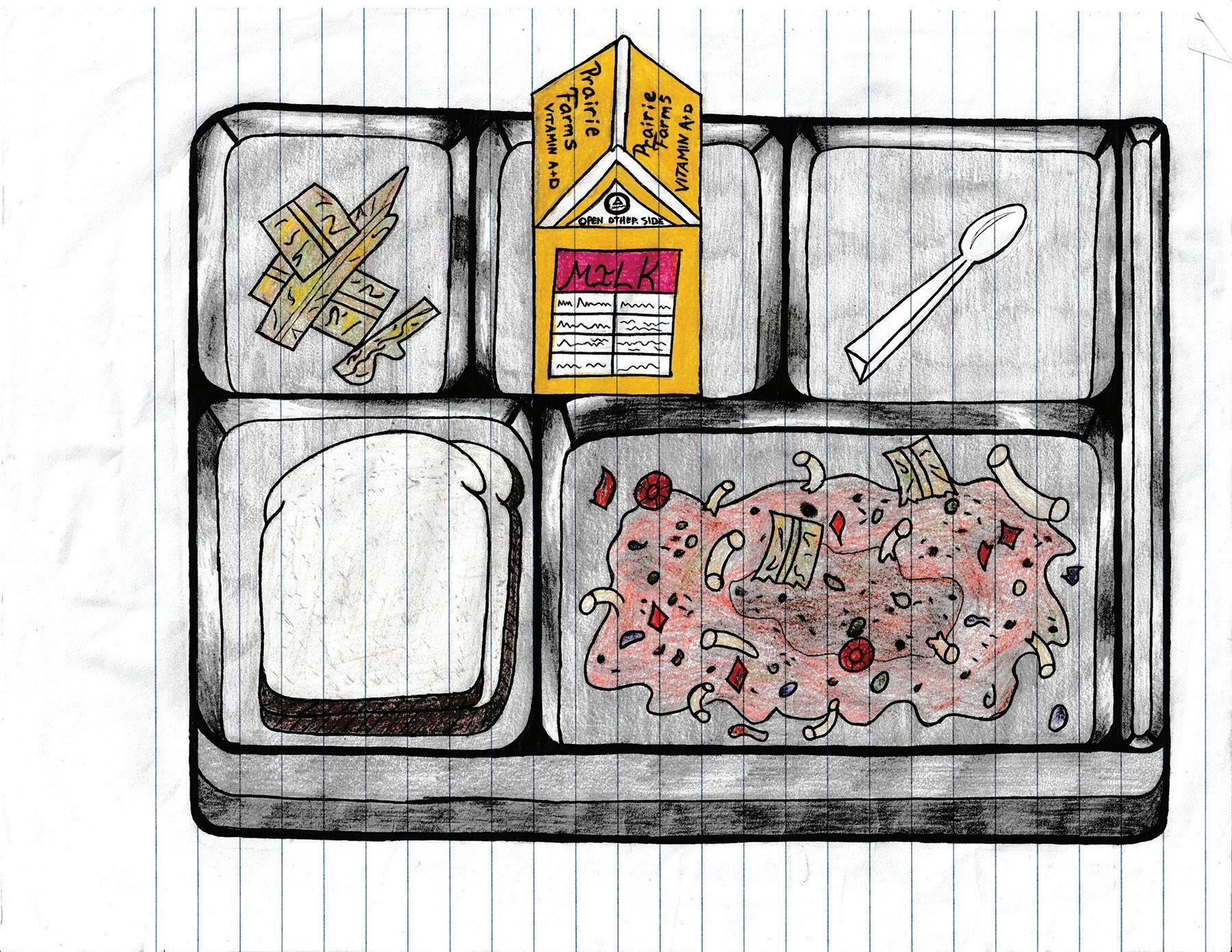
This is a drawing of the dinner tray completed by an insider. Two other insiders added their own caption: “This drawing is a perfect illustration of the abominations they are serving as food here in Cook County Jail. To have to eat this every day is a horrible experience and a disgrace…The meat/protein/slop slash food is brown/gray in color and has no flavor at all. Downright bland and damn near spoiled. Just terrible. My dogs wouldn’t even lick it.”
CCDOC is frequently unappealing, low in nutritional value, and doesn’t keep them from going hungry, while commissary items are prohibitively expensive.
“Meals at CCDOC are designed by a dietician to ensure the required daily nutritional values are met,” reads one of just a few sentences in an Inmate Information Handbook that describe insiders’ rights and expectations regarding food. The ingredients for CCDOC meals are supplied by a vendor and then largely
assembled and cooked by incarcerated kitchen workers. In addition to their standard menu, CCDOC has eleven menus it offers for detainees based on dietary restrictions, from halal to vegetarian to gluten-free.
“They give us a whole lot of bread. We get like, twelve slices of bread a day,” said Charles*, who’s been incarcerated since 2019. “A slop at night. Sometimes we get lucky and get a hamburger patty.”
A sample CCDOC menu from
November 2024, obtained by the Weekly via a Freedom of Information Act (FOIA) request, illustrates Charles’ point. Across the week’s twenty-one meals, split across breakfast, lunch, and dinner each day, there are almost no servings of fresh fruit and vegetables. The Weekly estimates that almost a fourth of the calories come from wheat bread alone.
According to CCDOC’s vendor contract, the daily calorie counts of their provided meals fall between 2,300 and 2,500. Recommended calorie intake depends on the person, but the U.S. Department of Agriculture’s (USDA) Dietary Guidelines for Americans notes that nineteen-to thirty-year-old men, who make up a majority of the jail’s population, need 2,400–3,000 calories per day.
Calories only tell part of the story. Across the week, insiders got around eight cups of vegetables or fruit, but less than four of those cups have the potential to be fresh fruit or vegetables. The USDA recommends at least thirty-five cups of fresh fruits and vegetables every week.
Dr. Sera Young is an applied nutritional anthropologist who studies undernutrition in global, low-resource environments. When looking at the menu, she described being “particularly concerned about fiber and just the calorie density itself. And it’s not counterbalanced by the possibility of physical exertion, which has got to be leading only to more feelings of frustration and violence.”
People with money sent by family and friends have a second option: the commissary. Some supplement or entirely
replace their meals with commissary items.
Both because commissary items are expensive and commissary spending is restricted, it can be impractical for many incarcerated people to adequately supplement their diet. Based on the commissary list from 2023 (the most recent year audited by the Cook County Inspector General), items like a pouch of chicken and pouch of chili cost $6.49 and $4.39, respectively.
“What they’ll do is they’ll make the food real nasty, and then they’ll make the price so high on the commissary,” said Anthony*, who has been incarcerated pretrial for fourteen years. He also noted that insiders cannot spend more than $100 in commissary in a week. “So I order ten bags of chips, [...] give two, three of them away. That’s $20. You only get to spend 100 bucks, give or take. Now, if you thought you were gonna buy meals to make, good luck with that.”
In an email, a Cook County Sheriff’s Office (CCSO) spokesperson wrote that the current weekly limit on commissary spending is $125, and is in place to prevent food hoarding and extortion.

A bologna sandwich brought outside the facility by a man just released from incarceration who had been experiencing food insecurity. Included in the meal kit is between two to four slices of bologna and four slices of white bread.
the company in 2022 for nearly $42.7 million. In May of this year, the Board voted to extend the contract by one year for $13.6 million, to a total of $56.3 million. In an email, a CCSO spokesperson wrote that just under $45 million of that had been spent by October 2025.
“The meat/protein/slop slash food is brown/gray in color and has no flavor at all. Downright bland and damn near spoiled. Just terrible. My dogs wouldn’t even lick it.” - an insider describing the provided meals at Cook County Jail
Responsibility for the choice and quality of food served at the Jail falls under the CCSO, which administers CCDOC and the preparation and distribution of the food, and the Cook County Board of Commissioners, which allocates the budget and approves contracts with suppliers.
Since 2020, the County has contracted with CBM Premier–Summit Food Service Joint Venture, a South Dakota company that provides food for correctional facilities across the country. Summit has been subject to numerous complaints across the country, including insufficient portions and lack of fresh produce. The seventeen-member County Board approved a three-year contract with
Warren*, who spent time at the jail before and after 2020, said the food used to be better. “They used to give us a little honey bun on the breakfast trays. They used to give us danishes, pop tarts, stuff like that,” Warren said. “They really hustling us.”
Summit Food Service LLC is the vendor for commissary and sells directly to insiders. According to a 2017 press release, Summit, which is part of catering business Elior Group, acquired CBM in 2017, though the CCSO spokesperson wrote the food and commissary contracts were with separate entities. Summit did not respond to questions.
The County tacks on a commission of between 41-44 percent to each
When the commissary vendor contract was put to a vote by the Board of Commissioners in June 2020, Commissioner Kevin Morrison (15th District) noted that while he is “never opposed to any revenue generating items that come before this board,” he pointed out that it’s difficult for incarcerated people to generate the income to pay for commissary and asked whether the county had considered “for the sale of these items to just be at wholesale instead of the county generating revenue off these items.” In response, Jane Gubser, executive director of programs at the CCSO, called commissary a “privilege” that enables incarcerated people to enact their “preferences,” naming food and reading glasses as examples.
commissary item in order to generate revenue that goes into an ‘Inmate Welfare Fund,’ which covers resources ranging from food service repairs to sign language interpretation. From December 2022 to November 2023, the Jail made $9.1 million in commissary sales, of which over $5 million went to Summit and $3.7 million went to the fund. Of that, only $2.6 million was spent that fiscal year.
Though lack of access to quality food can be difficult regardless of time spent inside, people incarcerated for multiple years speak to the diet wearing on them over time. Vincent* has been incarcerated since February of 2024 and spoke to health concerns he has about the diet. “For breakfast today, we got two slices of the bread. There was an old butter packet in it, and one little packet of peanut butter and two little packets of jelly,” he said. “If
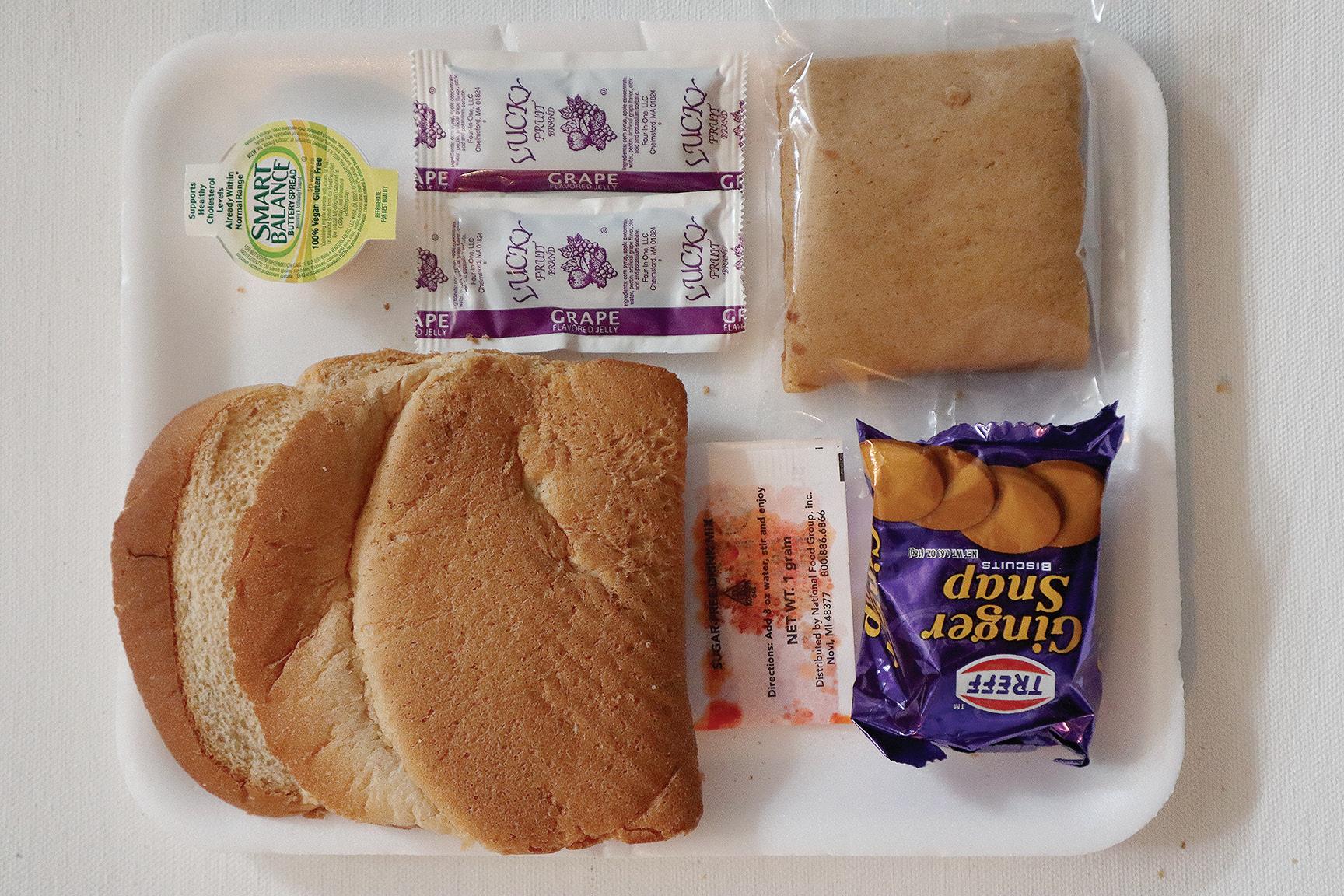
Photo by Harley Pomper
A breakfast tray from the Jail. Included are two slices of bread, a koolaid packet, two ginger snaps, a “breakfast square,” two packets of grape jelly, and a butter packet. At the time this photo was taken, the tray had been open for a year and remained well-preserved.
Photo by Harley Pomper
you don’t have sugar diabetes, and you stay here, you might have sugar diabetes, because everything is sugar, sugar, sugar. We don’t get no fruits and vegetables.”
Beyond the nutritional issues with the CCDOC provided meals, insiders describe the food quality itself being poor. When asked the texture of the lunch meat served up to five times per week, Anthony answered simply: “Pig ears.”
Vincent explained that people inside find ways to make the food more edible. A person he shared a cell with hung the lunch meat in his cell, “and in two days, it turned into what looks like beef jerky.”
“People get creative though. They make it happen,” Patrick said. “They find a way to make it taste better and put it together, yes, and wolf it down as best as possible.”
As insiders struggle with the quality and nutritional value of the food, some of them go hungry—from not wanting to eat the food, or even despite eating it. Food insecurity can lead to tensions and conflict in the jail.
“They start stealing. Start stealing, start robbing people and shit. Tying

A sample meal menu for Cook County Jail, obtained from a contract between Cook County Government, Cook County Sheriff’s Office, and CBM Premier-Summit Food Service Joint Venture.
people up and shit,” Patrick said.
“A two-year-old can eat [the tray] by itself and still be hungry,” Warren said. “So that resolves us to go eat our commissary. With other people who ain’t

got that, they go in the garbage and stuff like that.” When he sees people resorting to the garbage, “I’ll just tell them, like, you ain’t got to do that. Man, you can have my tray.” ¬
Harley Pomper is a PhD student in social work at the University of Chicago. They organize across jail walls to report on carceral injustices and political repression.






Pilsen Murals and Ukrainian Mosaics Teach Us About Artistic Survival
As funding cuts threaten Pilsen’s murals and war destroys Ukrainian mosaics, two communities are learning what makes public art endure.
BY WENDY WEI
This reporting was supported by the International Women’s Media Foundation’s Women on the Ground: Reporting from Ukraine’s Unseen Frontlines Initiative, in partnership with the Howard G. Buffett Foundation. Tetiana Burianova contributed reporting.
In 1968, amid nationwide anti-war and civil rights movements, Chicano artist Mario Castillo picked up his paintbrush and headed to the Urban Progress Center on 19th and Halsted. The two-story building’s side wall had been exposed by the demolition of the one next door, creating yet another blank brick canvas as the city razed ‘blighted’ buildings in the name of urban renewal.
That same year in Kyiv, then the capital of a Soviet-ruled Ukraine, artist Ivan Lytovchenko was also staring at a wall. He would soon begin working on the first of six eight-story-tall mosaics that would adorn a row of residential buildings lining Peremohy (‘Victory’) Avenue, as commissioned by the Communist Party of Ukraine.
During the 1960s and ’70s, Chicano muralists and Ukrainian mosaicists were turning public space into colossal works of art. Through symbols, motifs, and colors drawn from folklore, artists used largescale images as identity statements during a time when their cultural heritage faced suppression. Fifty years later, their stories have lessons for Chicago artists struggling to preserve expression in the face of federal defunding and threats to freedom of speech.
When Diana Solis was twelve, she watched Castillo and his crew paint his mural, Metafísica (Peace), widely considered

the first Chicano outdoor mural in the United States. Patterned forms recalling feathered serpent Quetzalcoatl, Los Ojos de Dios, Indigenous motifs from the Pacific Northwest, and well-used paisley, peace sign and yin-yang symbols float in negative space around an orb as if to fertilize the central “egg” of peace.
“You have to realize that the murals were not just like ‘let’s do mere decoration.’ The murals were also a sign of protest, a protest against the Vietnam war,” Solis said, now sixty-nine and an established multidisciplinary artist in Pilsen.
In 1968 alone, the US government spent $699 billion dollars (adjusted to 2024 dollars) on the Vietnam War, while domestic conditions languished for many, such as Mexican American communities living through low-wage farm labor under poor conditions, police brutality and harassment, and cultural erasure in schools and media. The term “Chicano” (once a derogatory term) became a self-chosen identity for many, including muralists like Castillo, who had a sense of pride in their Mexican roots and their American experience.
Castillo, a graduate of the School of the Art Institute of Chicago, was the first to apply Mexican muralist traditions to contemporary Chicano activism in America. He worked without much funding (what was funded came directly from Pilsen residents as opposed to a corporation or organization) and without any government approval.
“They would paint what they felt and what they knew. [And] that was going to be a protest and resiliency against forms of oppression,” Solis said. “It was a form
Natalia Lytovchenko in the Kyiv-based studio of her late father, Ivan Lytovchenko, a prominent Ukrainian decorative and monumental artist prolific from the 1950s until his death in 1996. Photo by Wendy Wei
of organizing done by the everyday and regular person.”
Though she was trained and first worked as a professional photographer, Solis pivoted to creating public art in her later career because it felt like a more democratic way of working.
“In public art, you have these larger displays of art that people would walk by, sit by, around the corner from their house,” she said.
A large-scale mural also needs to be a group effort. Like Castillo, Solis recruited teenagers from the neighborhood and paid them to help construct the works.
The original Metafisica no longer exists. A few years after its completion, someone cut a window and door into the wall, and eventually it was sandblasted completely, going the way of many public art works that succumb to graffiti, demolitions, or the natural elements. But its legacy is seen in the work of Pilsen artists today. Solis’ upcoming work in El Paso Community Garden is the Pilsen Latina Legacies pavilion monument, designed in collaboration with the community and Teresa Magaña, Hinda

Seif, and Deliliah Salgado. When the sun shines on the awning, a pattern hits the ground resembling Mexican paper cuts papel picado
While the Chicano murals were personal expressions, the political climate of the Soviet Union forced Ukrainian monumental artists to align with state agendas.
During Soviet rule of Ukraine from 1922 to 1991, the political control of arts and culture was violent. In 1924, Ukrainian painter and monumentalist Mykhailo Boychuk opened an art studio in Kyiv after studying in Vienna and Paris. But the Communist regime deemed his formalist
style, which drew from Ukrainian folk art, an obstacle to Soviet identity.
“The Soviet Union [was] trying to erase all cultural identity of Ukraine”" said Yevgen Nikiforov, a documentary photographer who has catalogued over 5,000 Soviet-era mosaics in Ukraine.
By the 1930s, almost all artists from Boychuk’s school, including himself, were executed in a wave known as the “Executed Renaissance.” Monumental art subsequently disappeared from Ukraine until the 1960s, when huge amounts of public money were spent to brighten up the hastily constructed sprawl of gray, monotonous housing blocks known as ‘khrushchevkas,’ named after Soviet leader Nikita Khrushchev’s policy to end a severe housing shortage.
The Soviet government poured money into mosaics—images made from thousands of small pieces of stone, tile, and glass. Mosaics have been embedded in Ukrainian culture for centuries; during the Byzantine Empire’s rule of the region, they glittered from the domes of Eastern Orthodox cathedrals. The Soviets liked

Street view of mosaic panels titled "The history of Kyiv" decorating the facades of apartments on Peremogy avenue in Kyiv, created by Ivan Lytovchenko, Volodymyr Pryadka, Ernest Kotkov, Valeriy Lamakh.
Photo by Wendy Wei
mosaics for their durability. Unlike paint, state propaganda made from mosaics wouldn’t fade or chip during the brutal winters.
During the 1960s, state-funded artists received prestigious commissions, steady employment, studios, and apartments. In exchange, they submitted every proposal for approval. Approved commissions followed hard rules: no religious themes, no capitalist imagery, no abstraction or anything non-representational. Everything had to celebrate Communist ideals of optimism, labor, collective spirit, science, and industry.
During this period, Ivan Lytovchenko, born 1921, created technically masterful state-commissioned mosaics across Ukraine, and found subtle ways to embed Ukrainian folk motifs within approved designs. The medium itself offered flexibility—mosaics’ pixelated form, made of thousands of rough pieces, lent itself to geometric abstraction.
“When you work with such hard material as stones, there is space for some experiments,” Nikiforov explained, pointing to an almost-abstract mosaic from the 1970s in his book Decommunized: Ukrainian Soviet Mosaics. Communist authorities, he said, still considered that mosaic close enough to socialist realism.
The Soviets allowed some Ukrainian heroes, like the 19th-century poet Taras Shevchenko, to be depicted because they could be reframed as fighters for the working class.
But it was a dangerous game. Rebellious artists who expressed Ukrainian nationalist identity—known as ‘Sixtiers’ (Shistdesiatnyky)—were labeled enemies of the people and arrested, sometimes killed.
These monuments all required a team of architects, steel makers, smalti makers, illustrators, and scaffolding. Soviet rules prohibited crediting individual artists, and works were presented as collective efforts.
“Can you imagine [cutting] glass? This is a very hard job,” said Natalia Lytovchenko, Lytovchenko’s daughter and also an accomplished monumental artist.
Despite expensive materials, technical standardization, and physical durability, the mosaics didn’t resonate with communities the way Pilsen’s murals did. Nikiforov himself walked past six of Kyiv’s largest mosaics daily during his university years

and never noticed them.
“Probably it’s their destiny to be like part of this white noise of the city, covered with advertisements,” he said.
Over time, many mosaics have fallen into disrepair. When Russia annexed Crimea in 2014, the Ukrainian government passed a “decommunization law” which called for removal of all remaining Soviet symbols and monuments. Some have been pulled apart by Ukrainians resentful of reminders of Soviet times, which was marked by mass starvation, political persecution, and suppression of Ukrainian identity.
For Nikiforov, Ukrainian identity during those years defies simple narratives. “It’s not only a mosaic, it’s not only propaganda, but art of Ukrainian artists firstly,” he said. He dedicated his book to proving that these mosaics are a valuable, interwoven part of Ukrainian culture.
Since Russia’s full-scale invasion of Ukraine in 2022, the question of what these mosaics mean has become even more
charged.
It’s unknown how many of Lytovchenko’s and Natalia’s own mosaics are still standing. Several are now in Russian-controlled territory and subject to near-constant airstrikes and drone attacks. Due to Russia’s restriction of internet and mobile access, it’s difficult for information to get in or out.
Yet something unexpected happened in Mariupol that heartened Nikiforov. Russian forces shelled a restaurant and badly damaged the 1967 mosaic work of Alla Horska, a Sixtier and dissident who was allegedly murdered by the KGB. It was titled Boryviter and depicts a falcon in flight. The Ukrainian group ROZETKA created a replica to display in Kyiv’s central square. Over a thousand fragments of a second copy were also sold to fundraise for the dream of someday restoring the original artwork in a liberated Mariupol, which has been Russian-occupied since 2022.
When faced with total loss and threats to Ukrainian identity, more Ukrainians

have begun valuing these art pieces as expressions and keepers of their identity.
Even when originals are destroyed, people revive them in other ways, teaching the techniques to new generations as Solis and Natalia do, recreating them in another mural, or documenting them for digital archives like Nikiforov.
For decades, Natalia has protected and championed her father’s surviving works and sketches, exhibiting them throughout the world, including in the United States. Today, she teaches at Boychuk Academy (Mykhailo Boychuk Kyiv State Academy of Decorative and Applied Arts and Design), named after the same founder who was executed. Her curriculum is old school: students start with studying and copying the Byzantine masters.
“We have to study a lot of Ukrainian [ornamentation] and you receive a lot of information. [Eventually] you wouldn’t need to have to copy this. You’ll have it inside, in your heart,” Lytovchenko said. She is hoping the war ends soon so that Ukraine can begin reconstruction, which she believes will create more jobs for her students.
In Pilsen, Metafisica may be gone, but the numerous newer murals still stand.
“[Murals are] still happening. We’re still strong in terms of creating culture and venerating our culture and commemorating our culture through murals in Pilsen,” said Solis.
That momentum is being tested. The Trump administration has cut funding to progressive arts organizations, including Chicago’s Department of Cultural Affairs and Special Events, and intensified immigration enforcement in communities like Pilsen. Solis recognizes what’s at stake, but chooses to not stay silent.
“If we stop or tend to hole ourselves up in our studios to be safe and not say anything about what’s happening, it’s still going to affect us,” Solis said. “If we decide we’re not going to say anything and just go along with it, then it’s really going to disappear.” ¬
Wendy Wei is an independent journalist and audio producer covering migration and interracial solidarity. She is the Investigative Project on Race & Equity’s training coordinator.
The large-scale mural El Abrazo (The Embrace) in El Paso Community Garden, a communitydriven project led by Diana Solis, Eric J. Garcia, and Katia Perez-Fuentes, and completed with support from local high school apprentices and volunteers.
Photo by Diana Solis
Diana Solis shows architectural renderings of her upcoming public pavilion design “Pilsen Latina Legacies” for El Paso Community Garden.
CLASSIFIED Section





BY MALACHI HAYES
Welcome to the South Side Sports Roundup! Check back every month for the latest news and updates on everything South Side sports fans need to know.

The optimist’s view: A brighter 2026 is on the horizon in South Side sports
2025 is nearly in the books, and for once, there’s an argument that things are on the upswing. The bar is low. There hasn’t been a lot to like about sports on the South Side over the last decade or two. Since the White Sox and Bears made championship appearances within sixteen months of each other between 2005 and 2007, those two teams have a combined 4-11 record in the postseason, with only the 2010 Bears advancing past the first round. The Chicago Sky gave us our biggest bright spot with their joyous run to a 2021 WNBA championship, but they’ve nonetheless had a winning record in just two of their last eight full seasons. DePaul basketball, now based on the South Side at Wintrust Arena, remains bleak.
Still, 2025 was a little different from previous disappointing seasons. A year after bottoming out and setting the MLB’s all-time loss record, the White Sox saw a promising young core materialize. The Bears, of course, have arrived well ahead of schedule, and have a chance to secure their first playoff appearance in five years.
So we’ll still keep close tabs on our Bears and Sox and Sky, because as bad as things have been for most of recent memory, we truly believe the news you read and the things you need to know will be more positive sooner rather than later.

Bears remain in playoff position despite loss to Packers
The Bears are not who we thought they were. Unlike the 2006 Super Bowl squad that prompted former Arizona head coach Dennis Green to furiously spit out the now-iconic postgame declaration (“The Bears are who we thought they were!”) this year’s team had little in the way of expectations. These Bears weren’t supposed to be this good, sitting on a conference-leading 9-3 record entering last Sunday’s showdown with the Packers at Lambeau Field. Not yet, anyway.
The Bears lost that game, falling 2821 on a freezing cold day in northern Wisconsin. While the outcome was disappointing, it was their first defeat since October 26. After five straight wins, three of which required an improbable comeback in the final two minutes, the breaks were due to go the other way sooner or later.
Even if they couldn’t pull it off again, they played the Packers tough. The vibes around the team are still positive, unlike most of the other twenty-nine losses to Green Bay (against just five wins) they’ve suffered since 2009.
The Bears’ record sits at 9-4 with four games remaining. Only twice in team history—the legendary 1985 and ’86 Super Bowl shufflers—have they won 14 or more games in a season. They’ve reached the 13-win mark twice, in 2001 and 2006, and went to the Super Bowl in the latter year. They most recently peaked at 12 wins in 2018, when their season ended on kicker Cody Parkey’s infamous “double doink” in the first round of the
playoffs.
This coming Sunday’s game against the perpetually woeful Cleveland Browns is a critical chance to get to just one win shy of the 11-win plateau it may take to reach the playoffs. It’s shaping up to be one of the most exciting finishes to a season in recent memory. Matchups with the Packers, San Francisco 49ers, and Detroit Lions to conclude the campaign have the potential to entirely shape the NFC playoff picture.

The Bulls are who we thought they were
A surprising 6-1 start to the season had Bulls fans thinking that things might finally be different. Just read what we had to say in last month’s check-in.
A little more than a month later, they’ve dropped 13 of 16 games, and fans have settled back into the familiar feeling that nothing ever changes. The refrains are mostly things we’ve heard before, including this from longtime Bulls fan Zach Deitz.
“[It’s] more of the same. I wasn’t fooled by the 5-0 start… Any other team would have fired [team President] Arturas Karnisovas by now.”
Deitz, like many Bulls fans, has simply learned to accept the mediocre-or-worse place the team is constantly occupying in the NBA landscape.
“It’s sad and claustrophobic as a fan,” Deitz continued. “I want to say I’m apathetic, but in reality I’m just more assured in my own beliefs [about the team], because I knew this would happen.”
The Bulls sit 9-14 on the season after taking their seventh consecutive loss on Sunday, falling 123-91 in blowout fashion
to the Golden State Warriors. It was their lowest offensive output of the season by a double-digit margin. But offense typically hasn’t been an issue. Eight Bulls starters are averaging double digits points per game. And yet again, as has often been the case this season, defense was their downfall. They’re twenty-seventh out of thirty NBA teams in total points allowed per game, and they also rank at or near the bottom of the league in steals and blocks.
A problematic lack of size is partly the culprit behind their ranking in blocks, and has also contributed to the Bulls getting killed in the rebounding department, ranking twenty-fifth in the league in that category. They’re the only team in the NBA that doesn’t have a single player listed as taller than 6’9”, and it shows.
The South Side does have at least one thing to be proud of in Morgan Park alumnus Ayo Dosunmu, who has taken his game to a new level with a career-highs of 15.2 points per game and 47.5% from deep, and more than 51% overall. Dosunmu also starred for three years at the University of Illinois Champaign-Urbana, where he was named an All-American in 2021. The same year, he led the Illini to their first NCAA Tournament #1 seed since 2005, though they were ultimately upset by the North Side’s own Loyola Ramblers in the second round.
Fans had better enjoy watching him now, however. He’s in the final year of his contract, and he’s due to command a whole lot more in free agency than the three-year, $21 million deal he’s finishing up now.
The Bulls only play in Chicago twice between now and Christmas, a two-game set against Cleveland and New Orleans on December 14 and 17.
Malachi Hayes is a Bridgeport-based writer and South Side native.
Illustrations by Kristel Becares
Public Meetings Report
illustration by Holley Appold/South Side Weekly

A recap of select open meetings at the local, county, and state level.
BY SCOTT PEMBERTON AND DOCUMENTERS
November 13
At the Chicago City Council Budget Hearing on Independent Offices & Regulatory Agencies, council members reviewed funding possibilities for a gender-based violence (GBV) initiative. The Mayor’s Office of Gender-Based Violence Response states that GBV “disproportionately impacts women of color, indigenous women, transgender individuals and LGBTQIA+ individuals, immigrants, and people with disabilities.” The office also describes GBV as a “human rights violation,” a “public health crisis,” and “a form of discrimination.” Money for the GBV initiative was to come from a revival of the city’s head tax, also called a community safety surcharge, but funding is in jeopardy after the City Council rejected the mayor’s proposed 2026 budget. About twenty-five percent of funds for the GBV office—$3.5 million—was to come from the surcharge. The tax was also intended to support violence reduction and intervention, youth employment, victim support programs, and trauma-informed training, according to Budget Director Annette Guzman. “Chicago needs to think more about, how do we grow our way out of the situation that we're in, versus the taxes,” said Alderman Nicole Lee (11th Ward), who supports violence reduction services. Other Council members are also on the record as opposing the funding cuts: "I will do whatever is necessary to fulfill the full budget ask made by the task force,” said Alderman Daniel La Spata (1st Ward). “I will not enter into a 2026 that costs the lives of more women. That is a moral calculation that I refuse to make."
November 18
At their meeting, the Chicago Public Library (CPL) Board of Trustees heard several staff presentations. Chris Brown, the library’s commissioner, told the board that the library’s goals for 2026 are more civic engagement, more safety interventions, and more partnerships with the mayor’s office. Library staff presented on finance, programming, and partnerships. They shared news that the “Jump Into Reading” youth literacy program is now offered in Spanish; the “Teen Winter Challenge” gives high school students the opportunity to present artwork for a $200 prize; the “Reading Set” program allows patrons to check out as many as twelve books at once; and the “Storytelling for Community Healing” initiative, which supports incarcerated individuals and those impacted by incarceration, is one of three such programs in the country to receive and American Library Association grant. CPL has responded to ICE presence by offering “Know Your Rights” sessions and handing out palm cards. They are piloting an emergency communications effort to send mass texts to library staff. The first public commenter called for repairs and improvement to the Gage Park branch, 2807 West 55th Street, including better computers, more books, and more space, in part to provide the primarily Latino community a safe space. A second commenter said more tax money is needed because “libraries play an essential role” in controlling the spread of misinformation. A Whitney Young High School senior, who said she has been a CPL intern for four years, argued for the library to take advantage of teen suggestions when choosing literature materials.
November 20
At their meeting, the Regional Transportation Authority (RTA) Board of Directors celebrated the passage of SB2111 in October. The bill overhauls transit governance, mainly affecting the Chicago area, by replacing the RTA with the new Northern Illinois Transit Authority (NITA) and, for the time being, resolves a projected budget shortfall.It will take effect in about six months, on June 1, 2026. NITA is designed to assume policy and operations responsibility for the RTA, the Chicago Transit Authority (CTA), and Pace, whose boards will now perform advisory roles. Revenue will come, in part, from an RTA sales tax increase of 0.25 percent and by placing motor fuel tax funds under Public Transportation Fund management. Planned changes include implementing a common fare system, standardizing regional performance expectations across the agencies, and improving safety and assistance, which is being spearheaded by a new transit ambassador program. The “People Over Parking Act” included in the bill prevents local jurisdictions from requiring minimum parking standards for developments within a half mile of transit rail stations and bus hubs, or near corridors with high transit frequency, explains the Metropolitan Planning Council website. An amendment allows side-by-side bicycle riding, riding against traffic on one-way streets, and rolling through stop signs if intersections are clear.
At its meeting, the Chicago Plan Commission approved rezoning to accommodate a new community recreation center in North Lawndale, estimated to cost $38 million. It would serve residents of all ages in North and South Lawndale with a host of recreational activities, such as kickball. With parking for 105 vehicles, the center is set to include two indoor turf fields, five full-sized basketball courts, a wrestling studio, a multipurpose room, and other services. The schedule calls for construction to begin in the summer of 2026 and be completed in the fall of 2027. The Commission also reviewed a presentation about the Central Area Plan 2045, the city’s 20-year roadmap for equitable growth downtown. The Central Area Plan (CAP) was adopted by the Plan Commission in November to improve “downtown housing, transportation, economic development, arts and culture and other vital issues,” according to the CAP website. The plan’s development was “coordinated by the Department of Planning and Development and sister agencies and guided by community input through a two-year planning process.” An update to the City’s 2003 Central Area Plan, the site notes that the CAP draws on “previous planning goals and accomplishments, including the City’s 2009 Central Area Action Plan and 2021 Central City Recovery Roadmap.” The Commission also approved an updated athletic complex for DePaul University.
At a meeting that included an executive session, the Metropolitan Water Reclamation District (MWRD) Board of Commissioners discussed a November 18 propane gas explosion at Legion Park, which is located in the 3100 block of Bryn Mawr Ave. Media were not admitted to the executive session. The explosion occurred the day after the neighborhood’s monthly cleanup of the park. Firefighters responded just after noon and extinguished a fire caused by the explosion. No injuries were reported. Neighborhood residents living near the park told WGN News that they have been advocating for the unhoused people living in an encampment and raising concerns about the danger of fires. “This encampment is not safe and poses significant danger to both its residents, nearby neighbors, and first responders,” said Alderman Samantha Nugent (39th Ward) in a prepared statement. “With winter approaching, the risk of more fires will only grow. The City of Chicago needs to secure appropriate housing for its residents and close this encampment immediately.” The Park District prohibits open fires and propane gas tanks, fining violators up to $500. The MWRD’s mission, according to its website, is to “protect the health and safety of the public in its service area, protect the quality of the water supply source (Lake Michigan), improve the quality of water in watercourses in its service area, protect businesses and homes from flood damages, and manage water as a vital resource for its service area.” The Commissioners also accepted an award on behalf of the water reclamation district from the Association of Environmental & Engineering Geologists.
This information was collected and curated by the Weekly in large part using reporting from City Bureau’s Documenters at documenters.org.