Poker
While I was playing in Bellagio’s Five-Star World Poker Classic $1,000 buy-in, pot-limit Hold’em tournament in December 2002, the following series of hands unfolded. Two off the button, with the blinds at $100-$200, I opened the pot for $600 of my remaining $900 with K-9. Max Stearn, holding 10-10, just called in the small blind, because he was afraid to re-raise and possibly run into a big hand in the big blind. I don’t blame Max for just calling at this point in the hand; after all, it looked like he was going to get my last $300 in any case.
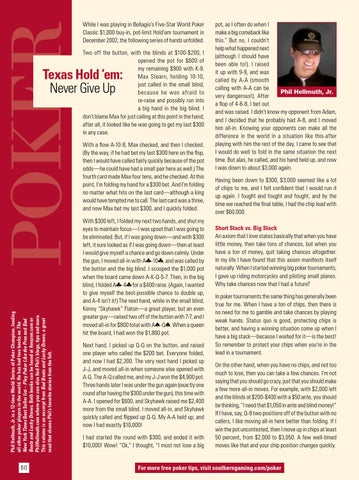
Phil Hellmuth, Jr. is a 12-time World Series of Poker Champion, leading all other poker players in the world. He has had two books on The New York Times Best Seller list – Play Poker Like the Pros and Bad Beats and Lucky Draws. Both books can be found at Amazon.com or PhilHellmuth.com where you can also find Phil’s blogs, tips and more. This column is an excerpt from Bad Beats and Lucky Draws, a great read that shares Phil’s favorite stories from the felt.
Texas Hold ’em: Never Give Up
60
With a flow A-10-8, Max checked, and then I checked. (By the way, if he had bet my last $300 here on the flop, then I would have called fairly quickly because of the pot odds—he could have had a small pair here as well.) The fourth card made Max four tens, and he checked. At this point, I’m folding my hand for a $300 bet. And I’m folding no matter what hits on the last card—although a king would have tempted me to call. The last card was a three, and now Max bet my last $300, and I quickly folded. With $300 left, I folded my next two hands, and shut my eyes to maintain focus—I was upset that I was going to be eliminated. But, if I was going down—and with $300 left, it sure looked as if I was going down—then at least I would give myself a chance and go down calmly. Under the gun, I moved all-in with A♣ -10 ♣, and was called by the button and the big blind. I scooped the $1,000 pot when the board came down A-K-Q-5-7. Then, in the big blind, I folded A♣ -4 ♣ for a $400 raise. (Again, I wanted to give myself the best-possible chance to double up, and A-4 isn’t it!) The next hand, while in the small blind, Kenny “Skyhawk” Flaton—a great player, but an even greater guy—raised two off of the button with 7-7, and I moved all-in for $800 total with A♠-Q♠. When a queen hit the board, I had won the $1,800 pot. Next hand, I picked up Q-Q on the button, and raised one player who called the $200 bet. Everyone folded, and now I had $2,300. The very next hand I picked up J-J, and moved all-in when someone else opened with A-Q. The A-Q called me, and my J-J won the $4,900 pot. Three hands later I was under the gun again (exactly one round after having the $300 under the gun), this time with A-A. I opened for $600, and Skyhawk raised me $2,400 more from the small blind. I moved all-in, and Skyhawk quickly called and flipped up Q-Q. My A-A held up, and now I had exactly $10,000! I had started the round with $300, and ended it with $10,000! Wow! “Ok,” I thought, “I must not lose a big
pot, as I often do when I make a big comeback like this.” But no, I couldn’t help what happened next (although I should have been able to!). I raised it up with 9-9, and was called by A-A (smooth calling with A-A can be Phil Hellmuth, Jr. very dangerous!). After a flop of 4-6-8, I bet out and was raised. I didn’t know my opponent from Adam, and I decided that he probably had A-8, and I moved him all-in. Knowing your opponents can make all the difference in the world in a situation like this-after playing with him the rest of the day, I came to see that I would do well to fold in the same situation the next time. But alas, he called, and his hand held up, and now I was down to about $3,000 again. Having been down to $300, $3,000 seemed like a lot of chips to me, and I felt confident that I would run it up again. I fought and fought and fought, and by the time we reached the final table, I had the chip lead with over $60,000. Short Stack vs. Big Stack An axiom that I love states basically that when you have little money, then take tons of chances, but when you have a ton of money, quit taking chances altogether. In my life I have found that this axiom manifests itself naturally: When I started winning big poker tournaments, I gave up riding motorcycles and piloting small planes. Why take chances now that I had a future? In poker tournaments the same thing has generally been true for me. When I have a ton of chips, then there is no need for me to gamble and take chances by playing weak hands. Status quo is good, protecting chips is better, and having a winning situation come up when I have a big stack—because I waited for it—is the best! So remember to protect your chips when you’re in the lead in a tournament. On the other hand, when you have no chips, and not too much to lose, then you can take a few chances. I’m not saying that you should go crazy, just that you should make a few more all-in moves. For example, with $2,000 left and the blinds at $200-$400 with a $50 ante, you should be thinking, “I need that $1,050 in ante and blind money!” If I have, say, Q-9 two positions off of the button with no callers, I like moving all-in here better than folding. If I win the pot uncontested, then I move up in chips at least 50 percent, from $2,000 to $3,050. A few well-timed moves like that and your chip position changes quickly.
For more free poker tips, visit southerngaming.com/poker