Blueprint

AtSouth Australia Police (SAPOL) our people are our strength. This is clearly evident in this issue of Blueprint with stories celebrating the achievements of our people, whether it be overcoming adversity, showing extreme courage, or demonstrating an unwavering commitment to the community.
For Constables Elisabeth Pergoleto and Nathan Cranwell, being awarded the Police Bravery Medal is an incredible honour – but not as important as still being here to tell their inspirational tale of survival. Responding to a domestic violence incident in Port Augusta, Constable Pergoleto was struck by an offender wielding a samurai sword. Despite her life-threatening injuries, Constable Pergoleto, along with Constable Cranwell, displayed tremendous courage to safely apprehend the offender with their lives in peril.
Wol Door knows danger all too well, fleeing his war-ravaged South Sudan homeland and enduring
five years of extreme hardship in a Kenyan refugee camp before arriving in Australia in 2004, just weeks after turning 17. He has embraced his new life, becoming a prosecuting solicitor at SAPOL where each day he aims to make the community safer. Senior Constable First Class Omomo Omo-Irefo has also made the most of her new life in Australia after arriving from Nigeria in 2004 to continue her studies. A chance encounter at Pooraka Police Station in 2009 saw her embark on a new pathway, resulting in a rewarding and impactful policing career.
Also making a difference is Senior Sergeant First Class Sharon WalkerRoberts, who, for nearly 20 years, has been at the forefront of family and domestic violence and victim management in South Australia. We explore her decorated career and highlight her many achievements.
In this issue we delve into the disturbing trend of 3D-printed firearms and focus on SAPOL’s leading role in implementing the state’s new knife crime laws. On a lighter note, we show unbridled enthusiasm about a South Australian icon and community favourite – our majestic police greys, with a team profile on the Mounted Operations Unit.
• MATHEW RODDA
Our people:
Omomo Omo-Irefo
Staff profile:
Sharon Walker-Roberts
ISSN 1448-1855
Editor: Mathew Rodda
Writers: Mathew Rodda and Sonja Viduka
Editorial team: Mathew Rodda, Nigel Hunt and Chief Superintendent Robert Papworth.
Designed by: Chris Prunier, TMA Web
Printed by: Newstyle Print
Photos: Andrew Challen, Brant Cummings (ABC News), Ali Martin, Andrew O’Connor, Brevet Sergeant Amy Porter, Alex Robertson, Monika Setka, City of Tea Tree Gully Council, Reynella Cricket Club, Shutterstock, South Australian Police Historical Society. Blueprint is produced by SAPOL’s Marketing and Communications Unit, Police Headquarters, GPO Box 1539, Adelaide 5001. Internal postcode: 120 Tel: 08 732 23294 Email: dlpolicegazette@police.sa.gov.au
Views and opinions expressed by contributors within this publication are not necessarily those of South Australia Police, the Commissioner of Police or the Government of South Australia. Article ideas, photographs and other contributions are welcome from every SAPOL employee.
First Nations people are warned this publication may contain images of, or references to, people that have died.
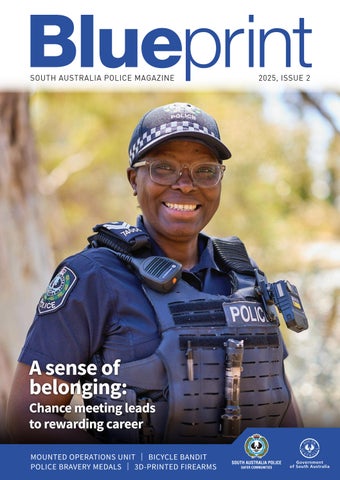
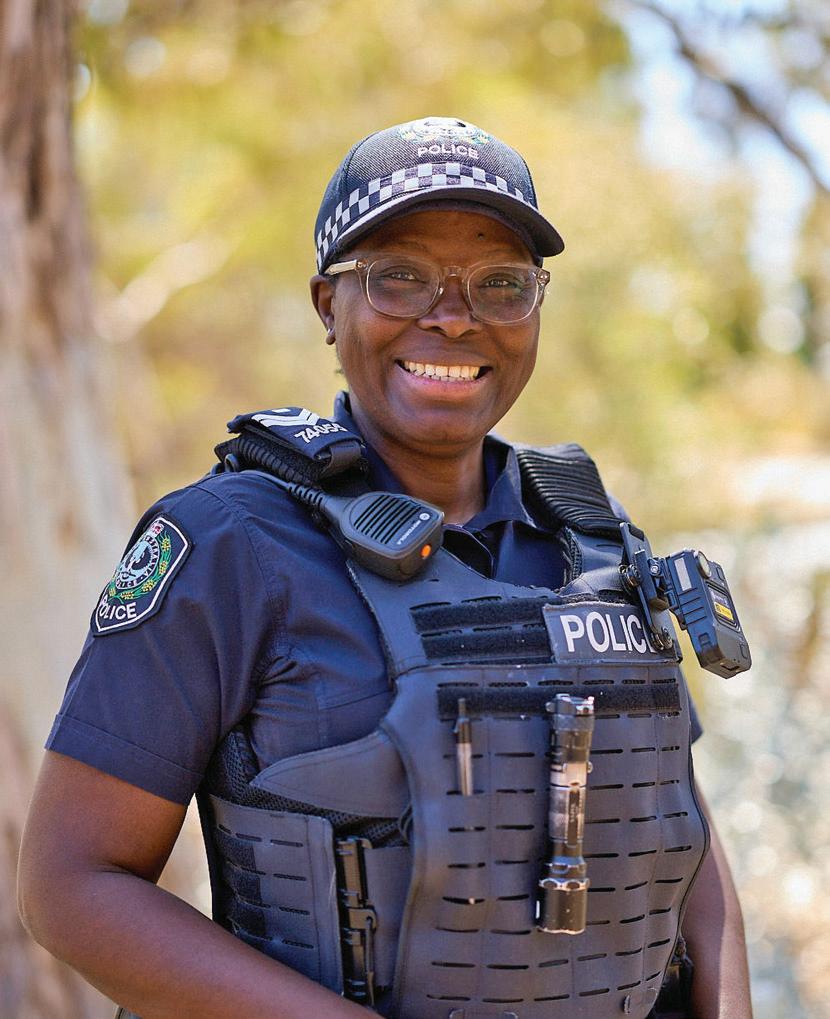
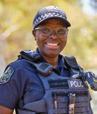
COVER Senior Constable First Class Omomo Omo-Irefo. Photo: Alex Robertson.
I have been able to secure funding for additional staff, equipment and facilities that are essential to maintain police services not just now, but well into the future.
Each day our people strive to ensure safer communities across the state. Their dedication, diligence and tenacity ensure we maintain service delivery under increasing demands on police.
This emphasises the need for South Australia Police (SAPOL) to be well-resourced and equipped, and I am pleased that my ongoing negotiations with the State Government have resulted in significant investment in SAPOL. I have been able to secure funding for additional staff, equipment and facilities that are essential to maintain police services not just now, but well into the future.
The State Government’s recent budget has committed $240 million over the next four years, which includes provision for 326 additional sworn officers, including an extra 33 motorcycle patrol officers. We are also funded for a further 98 Police Security Officers (PSO), 20 more civilian positions and the considerable expansion of the
Mental Health Co-responder initiative that has already started relieving pressure on frontline police. Further budget measures include the provision of new pistols, $7.5 million a year for our capital program, and a commitment for a range of road safety initiatives. Ongoing funding has also been provided to continue our accelerated recruitment efforts and the increased number of recruit and PSO courses at the Police Academy.
Recruits will be joining at the right time, as we continue building a more connected, capable, and future-ready SAPOL through our Mobile Workforce Program. Our mobility transformation is well under way, with SAPOL partnering with Telstra to deliver and support mobile devices across the organisation, and the Samsung Galaxy S25 chosen as the new personal device to be rolled out to SAPOL members. This device will deliver real, tangible benefits for our people. It is integral to our long-term vision of a connected and digitally empowered SAPOL, with our workforce equipped and supported by in-car, in-field and in-office solutions. This is a big change for SAPOL, and
like any transformation, it will take time. But it’s a change that will empower us all to work smarter, respond faster, and stay better connected – to each other and to the community we serve.
Connecting with the community is one of the hallmarks of country policing. SAPOL has always prided itself on its immersive role in regional communities and its strong ability to deliver positive outcomes. In recent years, rapid population growth in regional areas has seen increasing service demands as community needs evolve. The Regional Policing Model (RPM) is our strategic response. Developed through extensive consultation and data analysis, the RPM aims to deliver a consistent, adaptable and communityfocused policing framework aligned with our vision of ‘Safer Communities’, while reflecting the realities of regional service delivery.
The RPM is already shaping the future of regional policing. In July this year, we renamed all seven Local Service Areas to Regions. We also approved 41 new frontline positions for Regions, including Family Violence Intervention Officers and Volume Crime Teams. This will be crucial in curtailing rising frontline
pressures, especially in domestic abuse and serious offending.
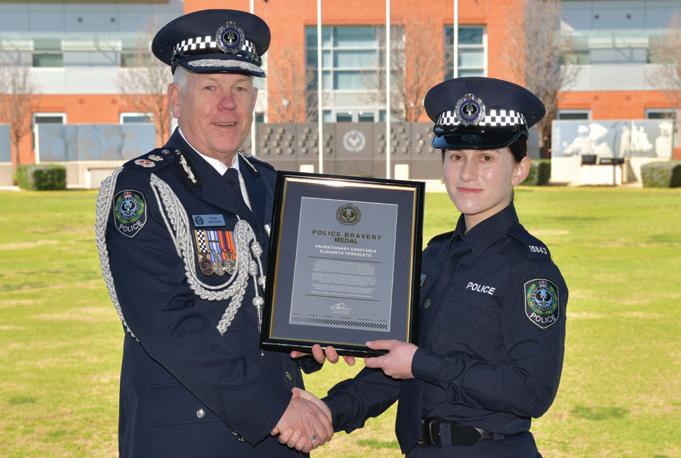
Constables Elisabeth Pergoleto and Nathan Cranwell are astutely aware of the challenges faced by regional frontline police. Recently, the Far North Region officers were each awarded a Police Bravery Medal for their courageous actions during an incident in Port Augusta in December 2024. Although suffering serious injuries after being struck multiple times by a samurai sword, Elisabeth joined Nathan in safely resolving the situation despite the extreme stress and threat to their lives. I am immensely proud of them and congratulate them on their well-deserved medals.
I also commend Assistant Commissioner Ian Parrott, Superintendent Craig Wall and Detective Senior Sergeant Rebecca Hughes who were all worthy recipients of the Australian Police Medal in this year’s King’s Birthday Honours List. Each of them has served SAPOL with distinction over a prolonged period.
•
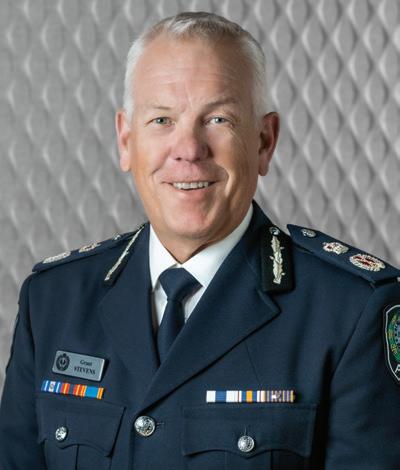
GRANT STEVENS COMMISSIONER
Commissioner's foreword
COURAGE IN THE FACE OF DANGER
Elisabeth Pergoleto always knew she wanted to wear the uniform. Growing up, she admired the police officers in her community – their presence, their purpose, their quiet strength. She imagined one day being one of them.
This article contains content that some readers may find distressing. Reader discretion is advised.
Butwhat she didn’t imagine was that just months into her dream career, she would be thrown into a situation no training could fully prepare her for – a domestic violence callout that would nearly cost her the full use of her hand and ultimately earn her one of the highest honours in the force.
Constable Pergoleto and her partner Constable Nathan Cranwell were awarded Police Bravery Medals in recognition of their composure and courage under extreme risk during a December 2024 call-out – an incident that left Constable Pergoleto with a nearly severed thumb. At the time, she had only been on the job for nine months, having graduated earlier that year from the South Australia Police Academy.
She and Constable Cranwell were dispatched to a domestic violence incident
in Port Augusta, unaware of the life-threatening danger that awaited them. When they arrived at the scene, it was initially unclear where the situation was unfolding. They soon identified a unit at the address, and Constable Cranwell moved to secure the entrance, deploying his OC spray.
Constable Pergoleto continued towards the unit.
“As I approached, I saw two men struggling – one of them was the offender,” she said.
She instinctively drew her OC spray but quickly switched to her taser. In that split second, the offender charged at her, holding what looked like a metal pole. She managed to deploy her taser before feeling a blow to her chest – and then the pain in her hand.
“I looked down and saw blood. I could see bone,” Constable Pergoleto said.
The offender was holding
a samurai sword. Her thumb had been nearly severed.
“I didn’t realise how bad it was until afterward; I could see Nathan was yelling at the offender, but I could not hear anything. It was like everything had gone silent,” she said.
Constable Cranwell acted quickly to try and de-escalate the situation.
“I remember pleading with him to put the sword down, because I was fearful that he was going to force me to take his life,” he said.
Standing behind the offender, with firearm raised, Constable Pergoleto saw him drop the sword. Moments later, a police fleet arrived, driven by Constable Liam Luke. Constable Cranwell forced the offender to the ground and handcuffed him.
Despite the injury, Constable Pergoleto maintained her composure until back up arrived.
“I was scared,” she admits.
“I knew I was in significant danger, but I wasn’t thinking about my own life. I was focused on doing what we had to do to bring the situation under control.”
Constable Pergoleto remains deeply grateful to both men.
“I am so thankful for Nathan. He challenged a violent offender, who was presenting an immediate risk to his own safety. His response and judgement allowed the offender to be arrested as safely as possible,” she said.
Constable Luke provided steady support in the difficult hours that followed.
“Liam stayed with me, keeping me calm until I went into surgery. In one of the most traumatic moments in my life, I was not left to face it alone,” Constable Pergoleto said.
Another officer, Senior Constable First Class Glen
I remember pleading with him to put the sword down, because I was fearful that he was going to force me to take his life.
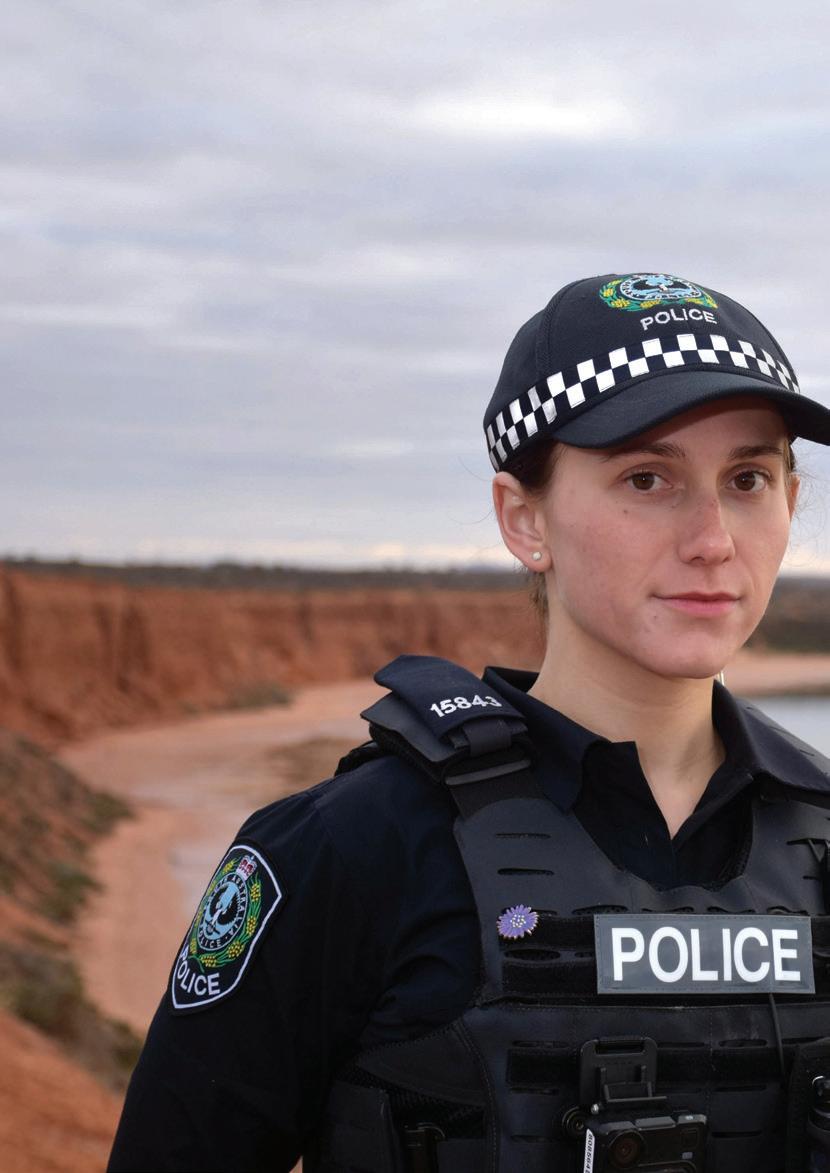
Constable Elisabeth Pergoleto.
Photo: Brevet Sergeant Amy Porter.
Robbins, played a critical role in her survival.
“When he arrived, he gave me his belt for a tourniquet for my arm. When SA Ambulance Service were delayed, Glen drove me urgently to hospital. Without Glen’s quick thinking, I do not believe I would be here today,” Constable Pergoleto said.
“It was only after the situation was in hand and the offender arrested that the reality started to set in – and I felt myself go into shock.”
Constable Pergoleto was later airlifted to Royal Adelaide Hospital where surgeons were able to reattach her thumb.
The next few months were a haze of pain, physiotherapy, and slow, stubborn recovery.
“I returned to light duties in mid-February,” she said.
“But regaining strength and dexterity in my arm and hand has taken much longer.”
The road to healing – both physical and psychological –has been long.
“My physical recovery is still ongoing,” Constable Pergoleto said.
“It will continue for some time. But from the start, I focused on being consistent with my rehabilitation, with the goal of returning to operational duties.”
A TRIUMPHANT RETURN
That milestone was reached in May this year, when Constable Pergoleto was cleared to return to full operational duties.
“That was a big moment,” she said.
“Not just physically, but emotionally.”
The courageous officer credits the unwavering support of her team and the broader SAPOL community for helping her through.
“There wasn’t a day that went by where I didn’t receive a message, a phone call, or a visit to check on my spirits and keep me company,” she said.
“That camaraderie – it’s what gets you through.”
Constable Pergoleto remembers vividly the wave of officers who arrived at the
scene the morning of the incident.
“They weren’t just from general patrols – they came from everywhere. That kind of response showed just how strong the bond is between officers. It’s something that really reveals itself in times of crisis,” she said.
Constable Cranwell, too, remembers the fear.
“I most definitely feared this man was going to take my life,” he said.
“He made an attempt on my partner, and I knew without a doubt we had to act.”
Constable Cranwell feels honoured to receive the Police Bravery Medal.
“In all honesty, I was just doing my job – and trying to make sure my partner got home safely. I am incredibly honoured to receive this medal and stand beside Lis after such a dark day in our careers,” he said.
“Receiving this medal does stir up emotions – pride, of course, but it also brings back memories of the incident we went through.”
Constable Cranwell said
the incident has changed his approach to policing.
“I now know that things can escalate from one to 1000 in a moment. And now having seen what one of the outcomes can be, I am more hypersensitive and hypervigilant,” he said.
Despite the trauma, Constable Pergoleto says the experience hasn’t altered her belief in her profession – nor her determination to serve. If anything, it has deepened it.
“When I applied to become a police officer, I knew the job could be dangerous and unpredictable,” she said.
“But I still wanted to be part of the incredible role officers play within our community.
“It’s been a good reminder that any incident can present significant risks, and that it’s important to stay focused and vigilant.
“But if I were faced with the same set of circumstances, I cannot see myself responding any differently.”
Words: Sonja Viduka
Commissioner Grant Stevens congratulates Constable Elisabeth Pergoleto on receiving her Police Bravery Medal. Photo: Andrew Challen.
We just wanted to create an inclusive and supportive environment where players with intellectual and physical disabilities could pursue their love of cricket.
CREATING A LEVEL PLAYING FIELD
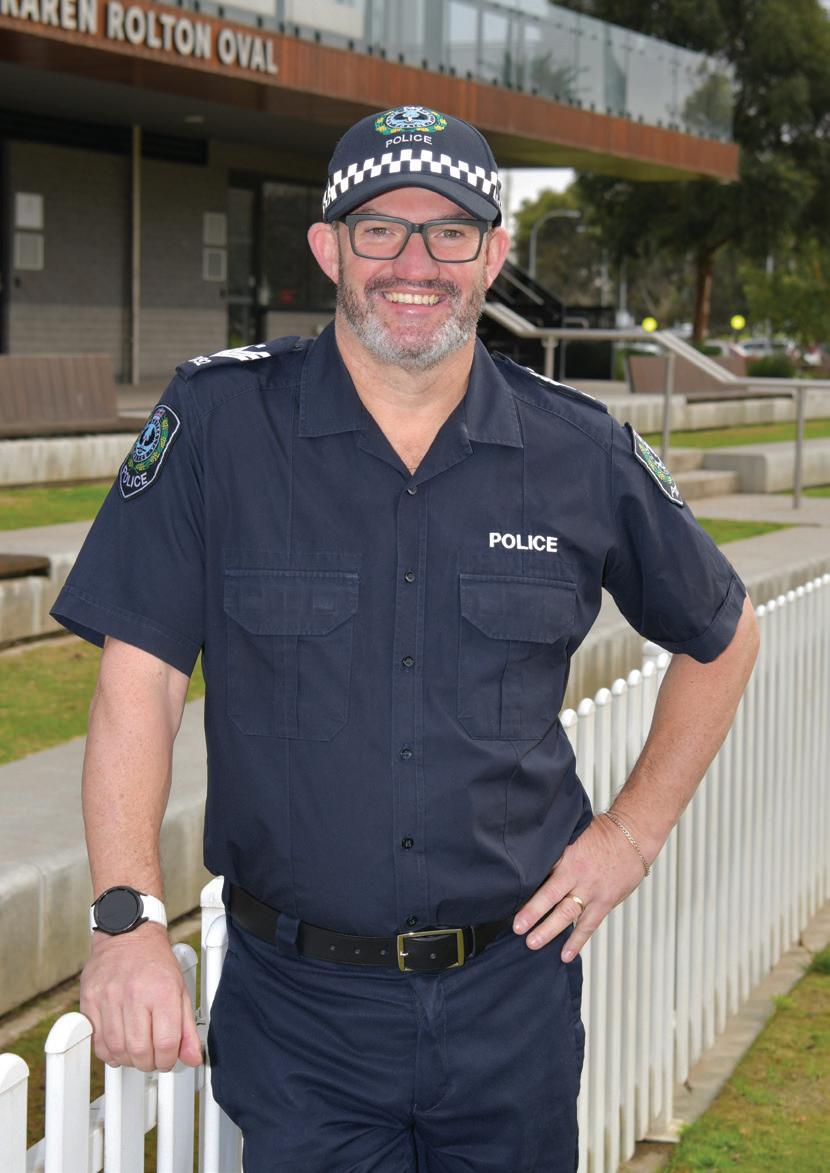
Senior Sergeant First Class James Niederer.
Photo: Andrew Challen.
> OUR PEOPLE: JAMES NIEDERER AND SIMON NAPPA
Every parent wants their child to feel like they belong.
Sergeant First Class James Niederer is
no different.
In2013 his then 14-year-old son Callum, who had been diagnosed with autism at three years of age, expressed a desire to join his brother Josh, two years his junior, on the field for Reynella Cricket Club. Callum found the cricket training too hard and fast and asked his parents, “Why can’t there be a cricket
program for kids like me?”
Sergeant First Class Niederer and his wife Jenni searched across the state for an all-inclusive cricket program for Callum but to their surprise found nothing.
This provided the catalyst for change, with the couple establishing an all abilities cricket program at Reynella Cricket Club, where Sergeant First Class Niederer was already an accredited coach who had led various junior teams.
With a strong desire to deliver skills-based cricket training, the pioneering duo rustled up half a dozen plastic
bats, a few balls and some training drills, and away they went.
“The first year was quite basic and loose. I was the coach, Jenni sorted the admin and Josh assisted with training,” Sergeant First Class Niederer said.
“We just wanted to create an inclusive and supportive environment where players with intellectual and physical disabilities could pursue their love of cricket.”
Over the past decade, Reynella All Abilities Cricket has evolved into something else entirely. What started out with four children, including
Callum, now attracts more than 25 participants across the program’s three levels – five to 12-year-olds, 13 to 16-year-olds, and an open-age team which began in the 2022-23 season and now competes against four other teams in the Adelaide Inclusive Cricket League.
“Having a league team provides a valuable pathway from junior to senior cricket,” Sergeant First Class Niederer said.
“Reynella Cricket Club have been amazing with their support for the inclusive team. The players are treated the same as those in the
They inspire me. They have such a great spirit and enthusiasm for the game, which makes coming to training each week a pleasure.
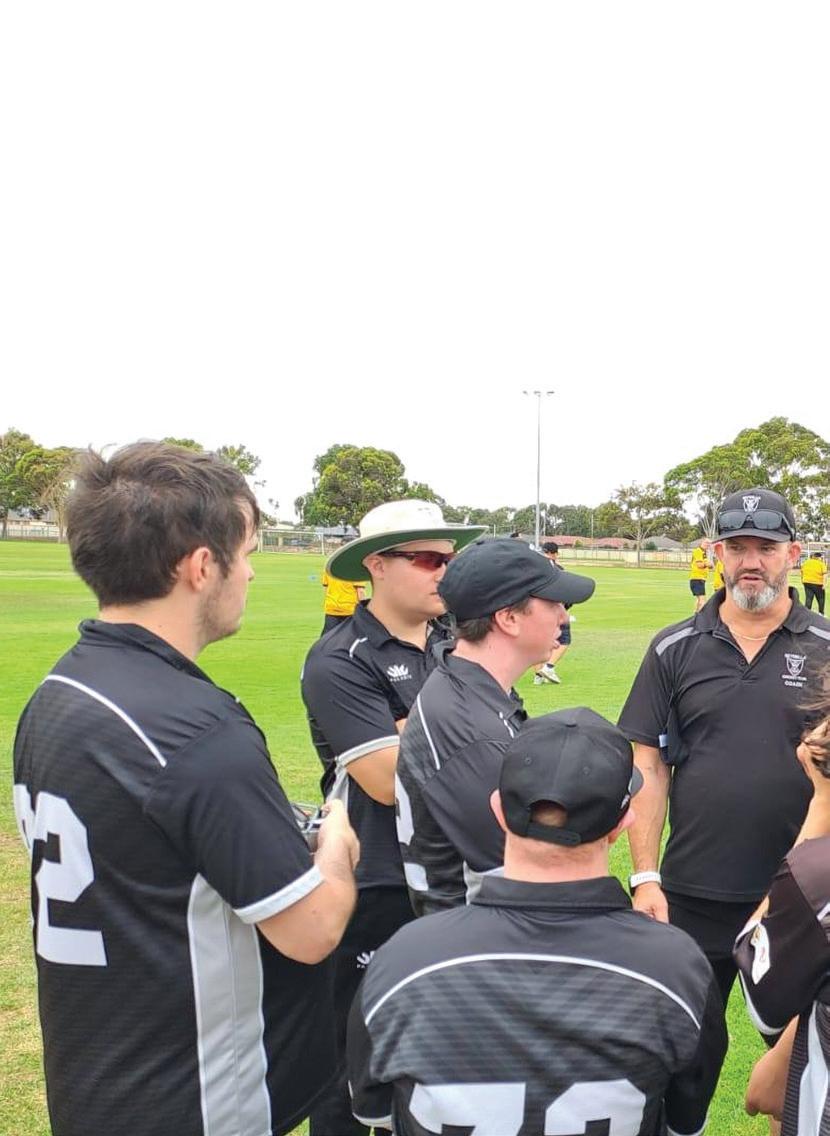
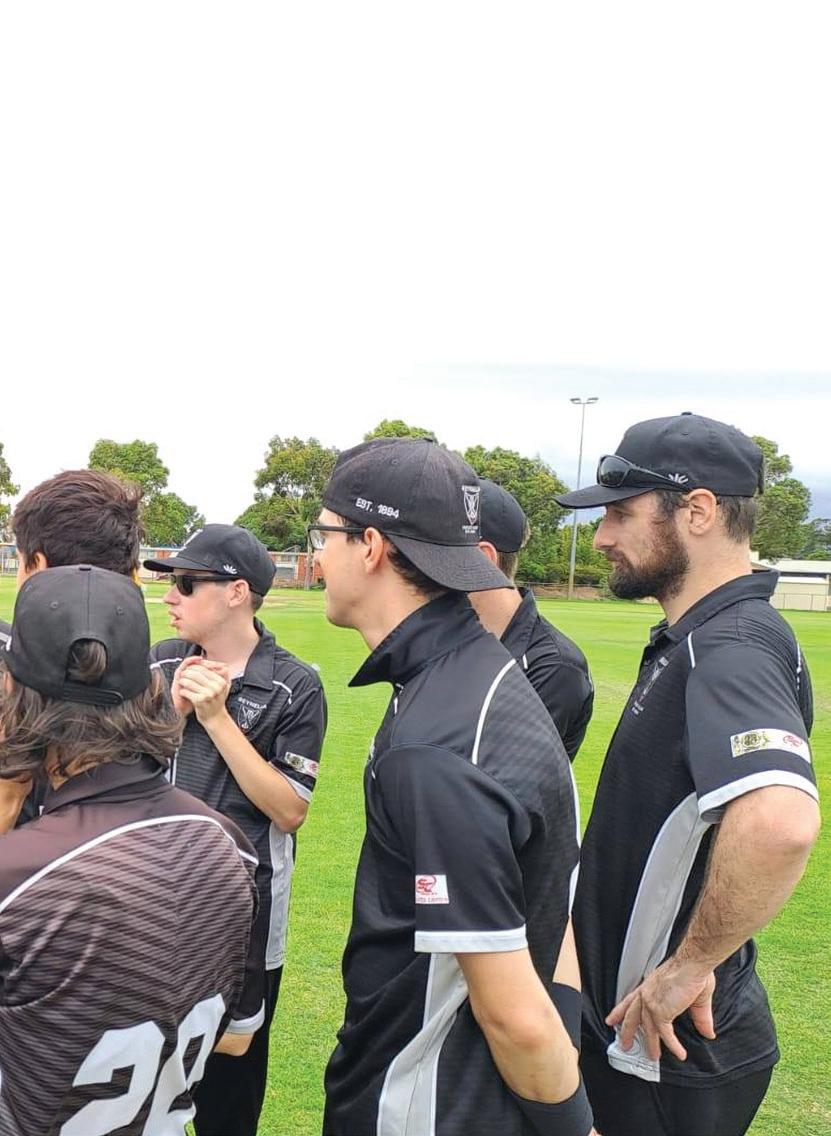
Senior Sergeant First Class James Niederer covers tactics with the all abilities cricket team.
Photo: Reynella Cricket Club.
club’s five senior men’s and two senior women’s teams. Players really feel like they’re an important part of the club.
“It’s extremely rewarding to see the inclusive cricket program mix in seamlessly with the mainstream.”
The open-age league team has tasted victory only once in its first three seasons, but for participants it’s the opportunity to play the game they love that provides the winning feeling.
“We find out the scores at the end as there is no scoreboard during the game,”
Sergeant First Class Niederer said.
“There are 20 overs per innings and a different scoring system. Batters can’t get out unless they’ve faced at least three balls.
“The team is mixed gender and features players with autism, Down syndrome and severe anxiety. We also have a member who is colour blind, so the ball gets changed to pink whenever he bats or bowls.”
Going above and beyond to foster inclusive pathways for cricketers living with a disability saw James and Jenni recognised by Cricket Australia in 2019 as ‘Community Champions’.
Four years later their passion and dedication were honoured at the HELP Awards where they won the ‘Community Sport’ category.
“Both awards were a surprise,” Sergeant First Class Niederer said.
“We don’t do this for recognition, however it’s nice for us and the club to be acknowledged. You sit back and think, we’ve done something special here.
“It’s been an absolute team effort. Our son Josh has been heavily involved since day one, and is now the inclusive programs director, so we were thrilled when
he won Young Leader of the Year at last year’s National Community Cricket Awards.”
While recognition is appreciated, it’s the enjoyment of the program’s participants that gives Sergeant First Class Niederer the greatest reward.
“They inspire me. They have such a great spirit and enthusiasm for the game, which makes coming to training each week a pleasure,” he said.
“Seeing them running around with smiles on their faces brings you back to what cricket is all about.”
Making his mark
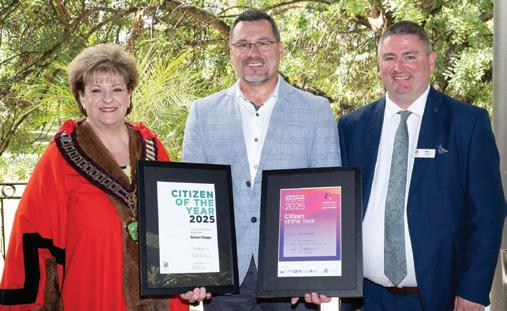
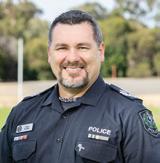
Thisyear’s Australia Day was a proud moment for Senior Sergeant Simon Nappa. Receiving the award for Outstanding Citizen of the Year from the City of Tea Tree Gully, it was a time for him to reflect on the remarkable impact he had made over the past three years as coach of the Tea Tree Gully District Football Club men’s inclusive team.
“I was extremely humbled by the award. I prefer to stay out of the limelight, but it was great recognition for all that we’ve achieved with the inclusive team,” Senior Sergeant Nappa said.
In 2022, Tea Tree Gully District Football Club made its debut in the SANFL Inclusive League – a sevenclub competition for males with disability aged 15 years and over. Club committee member and Northern District employee Cazz Allen asked Senior Sergeant Nappa to become the inaugural coach, and together they established the team.
The coaching stint continued Senior Sergeant Nappa’s long-term involvement with Tea Tree Gully, where he has been a coach, team manager and committee member since
2009, when his son Mitch first played junior football at the club. The role with the inclusive team was a cause close to his heart, with his adult daughter Briana experiencing her own challenges with intellectual and physical disabilities.
“My daughter has an acquired brain injury, so I have a strong awareness of people with disadvantages in life,” Senior Sergeant Nappa said.
“The thought that I could contribute to providing a safe, fun and friendly environment for men to play the sport they love drove me to volunteer as coach.”
The early days of the team presented coaching challenges that even greats such as Leigh Matthews and Kevin Sheedy would struggle with. Some players had never
played football therefore their skill level was minimal.
“I had to start from a basic level. Initially our two training sessions each week were all about running and getting the players’ fitness up, and then we introduced footballs so they could develop their skills,” Senior Sergeant Nappa said.
“The team won two games in each of its first two seasons and one in the third, however the development shown by our players has been great.
“In our second season we had three players win awards for their performances in specific rounds, and one took home a whole-of-season award.
“While it’s great to experience success, our number one goal is to have fun.”
After three years coaching the men’s inclusive team, the highly respected mentor handed over the reins to his assistant coach for the 2025 season so he could spend more time watching his son’s football.
“I loved my time as their coach,” Senior Sergeant Nappa said.
“Our coaching team has established a positive culture that promotes inclusion and
has provided the players with the opportunity to make the transition from sideline supporter to being a real football player.”
For Senior Sergeant Nappa, coaching the inclusive team was a joy, not an obligation, and his selflessness inspired many. His unwavering dedication and support have ensured that a group of men with disabilities have achieved their dream of playing football.
“The players have inspired me by showing how they tackle life head-on and rarely complain, unless it’s about doing sprints at training,” he said.
“I have coached players with a range of conditions, from common intellectual disabilities like autism and cerebral palsy, to those experiencing a brain injury, delayed learning ability, high anxiety or depression.
“Some of the players come from disadvantaged backgrounds, where families have just abandoned them. A few of them come to training and games with a paid carer.
“All of them have been embraced by the club and its members and have become club favourites by getting involved in various events.”
The popular ex-coach is now content to watch from the sidelines, as his former team strives to climb the SANFL Inclusive League ladder.
“It’s rewarding to see the players’ continual development, both as footballers relishing their opportunity to play the game they love, and as people who are now feeling more included in a positive club environment,” Senior Sergeant Nappa said.
Words: Mathew Rodda
Senior Sergeant Simon Nappa receives his award from Mayor Marijka Ryan and CEO Ryan McMahon.
Photo: City of Tea Tree Gully Council.
TAKING THE REINS
Imposing yet endearing, and recognised as a state heritage icon, the ‘police greys’ – the distinctive grey horses of South Australia Police (SAPOL) – are a muchloved part of the community. They play a vital role within the Mounted Operations Unit, continuing a proud tradition of providing a strong, visible policing presence across the state.
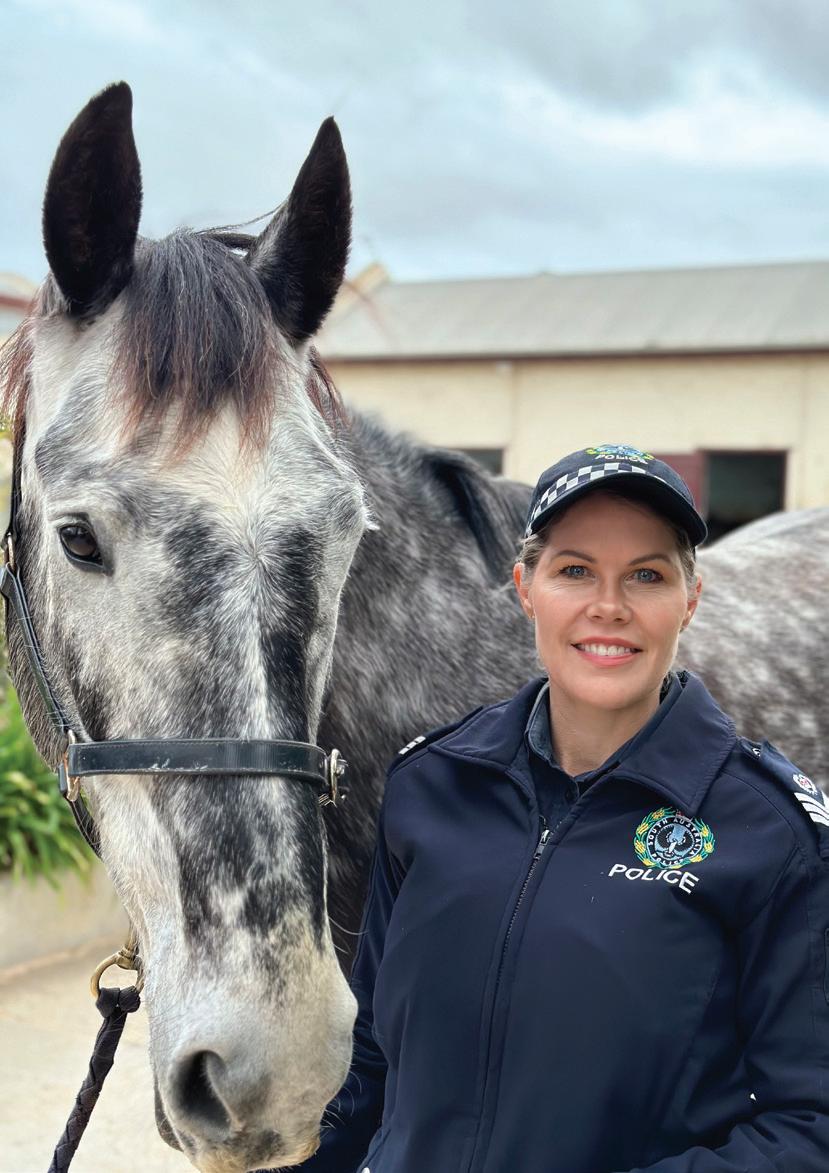
Senior Sergeant First Class Kelly-Anne Taylor with Police Horse Grange. Photo: Ali Martin.
The unit’s 32 horses are all greys, making SAPOL unique amongst the world’s policing jurisdictions. Besides being grey, to join the unit each horse must be at least 16 hands high (163 cm from ground to the base of their ‘wither’ or neck) and have a placid temperament. Horses are sourced from all over the country and are generally a mixture of Percheron or Clydesdale crossed with Thoroughbred or similar.
The gentle giants, ranging in age from 18 months to 22 years, work with a team of 38, comprising 23 sworn officers and 15 non-sworn support staff, led by Operations Manager, Senior Sergeant First Class (SS1C) Kelly-Anne Taylor. The 10-year veteran of Mounted Operations believes the unit serves a crucial role.
“We go wherever a highly visible policing presence is required, from night patrols in the city to major events and various policing operations,” she said.
“If there’s a high volume of people and a need for public reassurance, we’ll be there.
“Our horses and riders are often deployed to assist in searches for property or missing people and to maintain public order. While the unit’s core function is operational patrols, we also perform ceremonial functions such as police graduations and ANZAC Day ceremonies.”
Mounted police have been a mainstay of SAPOL since its establishment in 1838 when 10 mounted constables comprised half of the inaugural force. Mounted policing reached its peak in the 1920s with about 250 horses, before declining in number due to the rise of motorised transport. Today the Mounted Operations Unit remains a valued component of modern policing, blending tradition with contemporary law enforcement.
“Mounted Operations has evolved to become a specialist support resource for SAPOL,” SS1C Taylor said.
“Our greys are an asset when it comes to crowd control. The rider sits about
three metres from the ground, so they have a great vantage point for assessing danger and assisting foot patrols.
“The sheer size of the horses makes them effective at managing large groups of people. They are also invaluable for searches as they can traverse terrain that’s not suitable for vehicles or motorbikes and can often pick up on minute sounds inaudible to the rider.
“The greys are also a great community engagement tool, with their majestic nature often breaking down any perceived barriers between police and the public.”
Mounted Operations continues to undergo change, with last year’s relocation from Thebarton Barracks –its home for 107 years – to a brand-new complex at Gepps Cross, supplemented by the purpose-built City Staging facility. SS1C Taylor says the team is embracing the new locations after overcoming initial challenges.
“Both Gepps Cross and City Staging provide modern state-of-the-art facilities focusing on the horses’ wellbeing and allowing the development of police horses into the future,” she said.
“We have brought some of the old Barracks with us to our new home, with the Gepps Cross building incorporating the original troughs and stable walls, with historical pieces decorated throughout.
“The City Staging facility features office space, 12 stables and a round yard to support the unit’s operational capabilities. It has been wellreceived by our members and allowed them to continue delivering a high-visibility presence in the city.”
UNBRIDLED ENTHUSIASM
For Brevet Sergeant Sophie Heinrich, joining Mounted Operations Unit nearly two years ago was the realisation of a personal goal. After graduating in 2016 she went on a country policing odyssey, serving in Whyalla, Ceduna
and Yalata, and gaining valuable experience in oneperson stations at Wudinna, Cummins, Coffin Bay and Tumby Bay.
Brevet Sergeant Heinrich also spent considerable time based in Port Lincoln, where her roles included local region reliever, Family Violence Intervention Officer, and a secondment to Criminal Investigation Branch as an investigator after completing the Detective Training Course. This experience has provided a solid grounding for the move into her dream role.
“I joined SAPOL with the goal of becoming a Mounted Operations officer,” Brevet Sergeant Heinrich said.
“From the get-go, I took every opportunity possible to gain as much experience and training that exposed me to a diverse range of policing areas before joining Mounted Operations Unit.
“I now get to work in an area that combines both my passion for horsemanship and being a police officer.”
Having a role that is both diverse and challenging is something Brevet Sergeant Heinrich savours.
“There is no such thing as a standard shift. It can be unpredictable, with members needing to be flexible and adaptive to change, often at short notice,” she said.
“We could be scheduled for patrol or a ceremonial event but then arrive at work and discover that we need to travel to anywhere across the state for a search and rescue deployment, which is a role I enjoy as I get to spend long days working with my horse.
“Every day is different. We get to play an important role in the bigger picture of policing and serious crime by assisting in searches for missing people and evidence relating to murders, firearms and drugs.
“The following day we could be attending the footy, patrolling Hindley Street and helping the foot crews with arrests and crowd management. By day three, we could be attending a school to introduce students
to our horses and educate them about policing.”
Like all her sworn colleagues, Brevet Sergeant Heinrich successfully completed the Basic Rider Course before applying for a role in the unit.
“Even as an experienced rider, I prepared for the course by having around 10 training sessions with an ex-training Sergeant from Mounted Operations,” she said.
“In your first 12 months in the unit you need to complete and pass a training program comprising both academic and physical components. You then receive an increase in rank to Brevet Sergeant.
“To maintain your qualification status, all members are required to sit and pass a riding test every 12 months.
“We spend many hours with our greys each week undertaking thoroughly planned training to hone the discipline and skills required.”
Unlike in Dog Operations Unit, members are not allocated a specific animal as their working partner, however riders still have their personal favourites.
“It’s common for riders to have a regular patrol horse plus a young horse they are developing and training,” Brevet Sergeant Heinrich said.
“My favourite patrol horse is General. He is 12 years old and stands at 18.2 hands high, making him our largest horse. He also weighs in around 870 kilograms.”
The sheer enormity of the equine members may be daunting for some, but Brevet Sergeant Heinrich enjoys the physically demanding nature of her role. She is also embracing the recent move and new facilities.
“I am excited for the future of Mounted Operations Unit, enjoying our ‘new normal’ and love doing what I think is the best job in SAPOL,” she said.
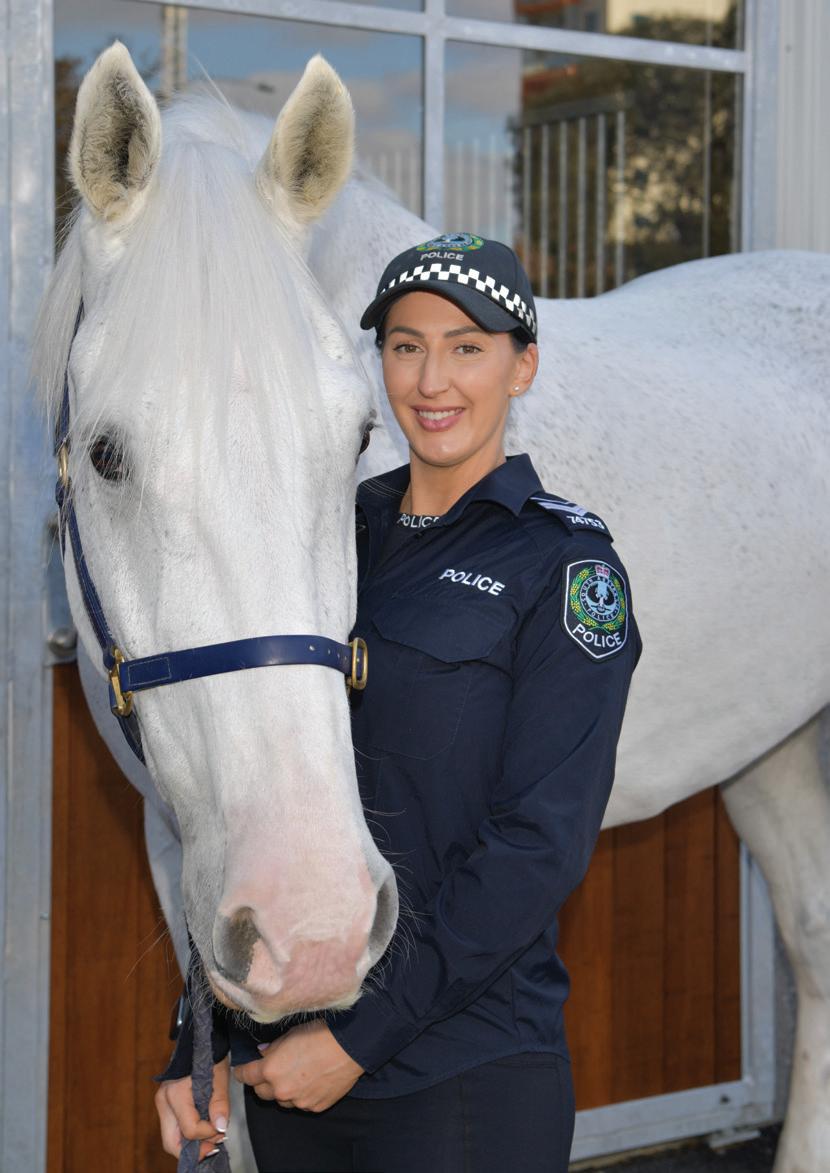
I now get to work in an area that combines both my passion for horsemanship and being a police officer.
Brevet Sergeant Sophie Heinrich with Police Horse General.
Photo: Andrew Challen.
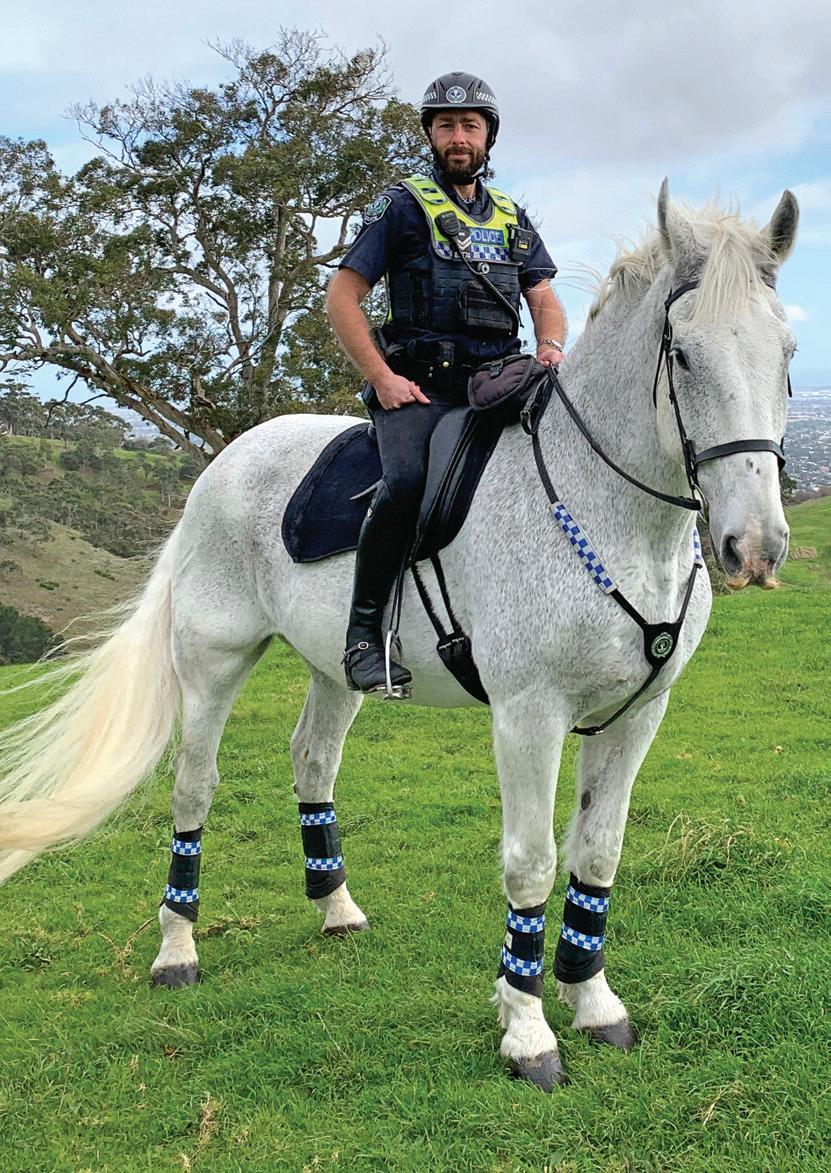
While the physical nature of the job was appealing, it was the unit’s strong reputation as one of the best in the country that really attracted me.
Brevet Sergeant Ryan Rigano with the much-loved late Police Horse Vulcan.
Photo: Monika Setka.
No
easy ride
Apassionfor horses is not a pre-requisite for a long and successful career in Mounted Operations Unit, as Brevet Sergeant Ryan Rigano can attest to. Prior to joining the team in 2018, he spent the previous decade working in Criminal Investigation Branch (CIB) roles at Holden Hill, Port Adelaide and Operation Mandrake.
“I am quite unique due to my detective background,” Brevet Sergeant Rigano said.
“If someone had told me a couple of years before I joined that ‘one day you’ll ride horses for a living’ I would have laughed in their face.
“But I remember turning 40, and thinking about Mounted Operations offering dynamic, specialised roles, requiring a high degree of physicality.
“I then attended an information seminar and watched videos of horses moving through crowds, breaking up fights, and forming protective barricades around foot patrols. Once I saw that I was hooked and didn’t want to work anywhere else.”
For Brevet Sergeant Rigano, it was an opportunity to once again be part of an elite squad, a feeling he yearned for from his time competing in martial arts.
“In my late teens and early 20s I regularly travelled the country representing the South Australian team in state and national level martial arts tournaments, but later in life I began to miss it,” he said.
“While the physical nature of the job was appealing, it was the unit’s strong reputation as one of the best in the country that really attracted me.”
Brevet Sergeant Rigano’s desire for a Mounted Operations career saw him take extensive private riding lessons, with his martial arts background helping with strength, flexibility and balance. He progressed quickly, going from knowing nothing about horses to winning a position in the unit.
Despite having minimal horse-riding experience, Brevet Sergeant Rigano achieved the coveted public order rider qualification in only 15 months, something he is immensely proud of. His natural aptitude as a rider and horseman has seen him allocated some of the more challenging horses to work with.
“I regularly work with horses that would not normally be allocated to someone who does not possess lifelong horse-riding experience. This is incredibly humbling for me,” Brevet Sergeant Rigano said.
A case in point is Brevet Sergeant Rigano’s primary patrol partner of the past three years, Police Horse Banjo, a 15-year-old Clydesdale/Thoroughbred cross.
“Banjo wasn’t quick to absorb his initial training due to an unfortunate background before the unit acquired him,” he said.
“Some thought he would never make it, but his previous rider, Sergeant Tim Stacey, invested a lot of time and effort to bring him up to standard.
“The additional progress that I’ve been able to make with Banjo over the last three years is my proudest achievement in my time here.
“Banjo has gone from being nervous around, and
untrusting of people, to being one of the most likeable horses in the unit. His development has been the result of a lot of time, effort and patience.”
Brevet Sergeant Rigano and Banjo are often seen supporting general duties members in the city on Friday and Saturday nights, and at major sporting events and concerts. During day shifts Brevet Sergeant Rigano joins colleagues in training and working the horses.
“Our horses need regular exercise, or their condition and their training can regress – so giving them regular and quality work is a big part of the role,” he said.
“I cannot imagine another unit of SAPOL investing as much time and energy into training as what we do.”
The training for both horses and riders is often put to the test during missing person searches in some of the farthest-reaches of the state.
“I have seen remote parts of South Australia that I never knew existed,” Brevet Sergeant Rigano said.
“Remote search deployments are always an adventure, but they are often arduous and exhausting. We face many challenges in being self-sufficient in remote and arid locations.
“Our training and preparation are major reasons for the strong reputation Mounted Operations has built as a specialist search and rescue asset.”

Words: Mathew Rodda
I believe that no matter what your role in this life is, you should make some kind of impact.
A SENSE OF BELONGING
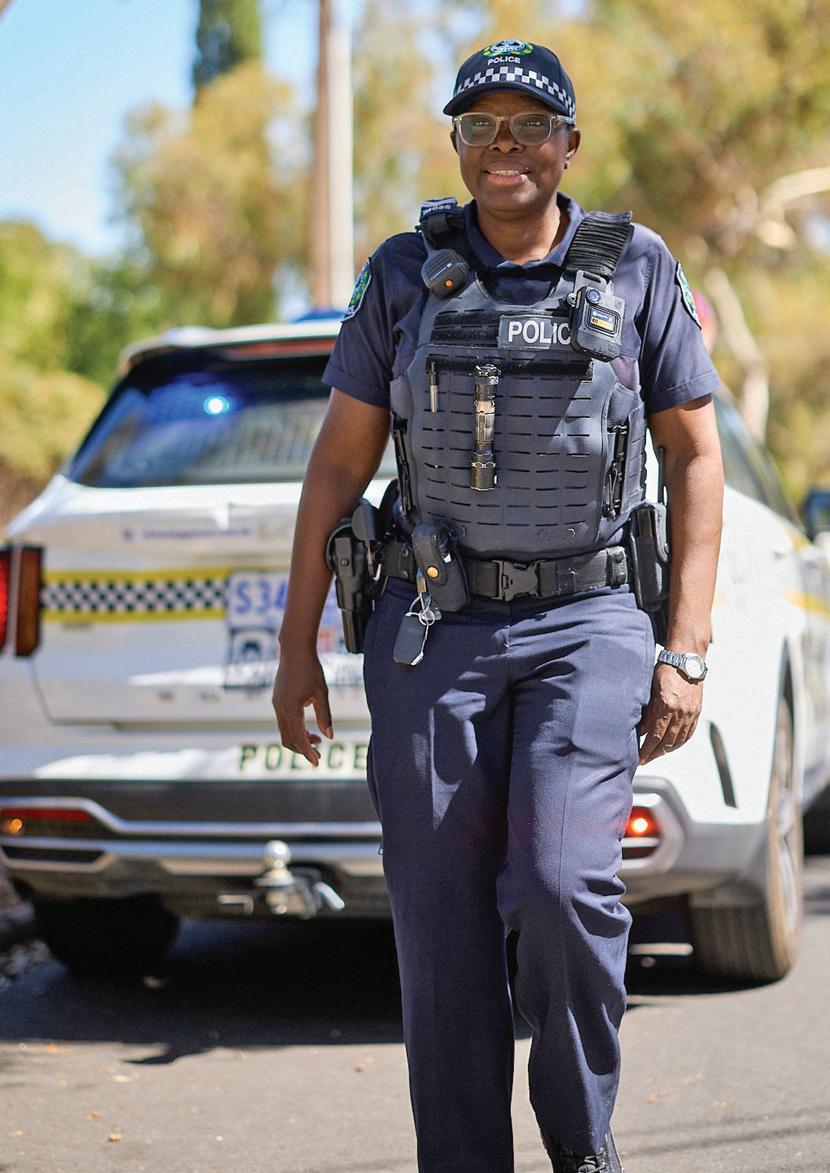
Senior Constable First Class Omomo Omo-Irefo.
Photo: Alex Robertson.
For many police officers, joining South Australia Police (SAPOL) is the realisation of a lifelong ambition or the fulfilment of a career objective, but for Senior Constable First Class (SC1C) Omomo Omo-Irefo it was fate.
Inearly 2009 she attended Pooraka Police Station for personal business but ended up leaving the station with a new career plan.
“I interacted with a very nice Senior Constable who was able to convince me to consider a policing career,” SC1C Omo-Irefo said.
“He even went as far as providing the application form to me on the spot. That to me was service delivery – he delivered a service I did not even realise I needed.”
Five years earlier, SC1C Omo-Irefo had made the move from Nigeria to Adelaide to pursue a Master of Business Administration in Finance, having previously gained an accounting degree and working in auditing and reinsurance roles in her homeland.
Until her career-defining meeting at Pooraka Police Station, SC1C Omo-Irefo had been toiling away in hospitality and accounts roles. In December 2010 she left that behind and embarked on a new and exciting policing career after becoming the first African-born woman to graduate from the Fort Largs Police Academy.
After working in general patrols for several years, SC1C Omo-Irefo joined the Missing Persons team in Western District in 2018. It’s a role she still enjoys doing today.
“As a missing persons officer I manage and conduct
investigations to locate anyone within the district that has been reported missing,” she said.
“In my role, I wear various hats – I can be a counsellor, a parent, a confidant, a comforter and so much more.
“As with life itself, my role is never predictable. Some days begin straightforward and appear routine but end up becoming a life-changing experience, whereas you can have the best of days where everything goes according to script.”
SC1C Omo-Irefo loves how her role exposes her to new learning opportunities each day.
“It has allowed me to view things from a different lens and appreciate people and situations more,” she said.
“I am continually learning more about myself while also discovering how to manage different types of human behaviour.
“My role has also given me the chance to understand how things work in other fields outside of missing persons.”
With a zest for life and a passion for policing, SC1C Omo-Irefo is a great role model for aspiring police officers. She is currently starring in the latest ‘You Belong in Blue’ recruitment campaign, where she is making a positive impact.
“I believe that no matter what your role in this life is, you should make some kind of impact. It does not matter how little or how great it may be,” she said.
“I hope that my being in SAPOL has had some form of impact on at least one person. If we all affect one life positively, then I believe the world will become a much better place to live in.”
While happy to be seen as a role model for people of African background, SC1C Omo-Irefo wants to be an inspiration for all.
“I hold my Nigerian heritage and culture quite close to my heart, however
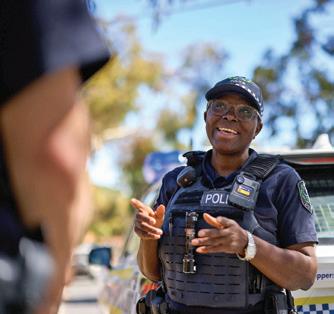
I see myself as human first and as such I want to be regarded as a role model to anyone around me of any background,” she said.
“I love my cultural background and values and want everyone to share this.
“We all have something to offer, and all have different experiences to share. A combination of our diversity can create fantastic outcomes.
“Every individual is unique in their own way, and this can only be seen by others when they step up to get counted.”
Stepping up is something that SC1C Omo-Irefo has embraced outside of work, with her friendly nature and calm confidence making her a natural leader among Adelaide’s Nigerian community.
“I have twice been the vice president of the Nigerian Association of South Australia, and I have also been heavily involved in assisting in community activities,” she said.
“I am now actively involved in Edo Community of South Australia, a subgroup of the Nigerian Association, but most of my time outside of work revolves around my two children.”
It is family that underpins SC1C Omo-Irefo’s values and
success in life.
“My driving force has always been the home I was brought up in and my family. Family means a great deal to me,” she said.
“I believe growing up in a loving and caring environment contributed a great deal in moulding me as a person.
“My parents always led by example and instilled values in me that I have grown to live by. I am now striving to do the same with my own children.”
SC1C Omo-Irefo has never regretted her decision to forego an accounting career to pursue policing.
“I believe that I still have plenty ahead of me. As long as I’m breathing, I will continue to learn to do better than my now,” she said.
“Today is just the beginning of my tomorrow.”
Words: Mathew Rodda
A LASTING IMPACT
Every police officer says they have that one job that stays with them – this was mine.
It was the air disaster that sent shockwaves through South Australia. On 31 May 2000, Whyalla Airlines Flight 904 crashed into Spencer Gulf, killing all eight people on board.
Theaircraft – a twin-engine Piper Navajo Chieftain –had departed Adelaide at 6.23 pm, but its scheduled arrival time of 7.10 pm came and went. Families of the victims waited expectedly at Whyalla Airport for their loved ones to arrive, oblivious to the tragedy that was unfolding.
At 6.56 pm, 21-yearold pilot Ben Mackiewicz commenced descent into Whyalla as normal, but just five minutes later he made a mayday call, telling the operator both engines had failed and that he would be forced to ditch into the ocean. Seconds after the call the plane nosedived into the Spencer Gulf at more than 200 km/h, plunging into the sea 19 kilometres southeast of Whyalla, leaving no survivors.
The memories of what remains one of the state’s deadliest aviation incidents are still vivid for Senior Sergeant Susan O’Connor 25 years later. The then Senior Constable was a Field Intelligence Officer based in Whyalla at the time. The tragedy became a pivotal moment in her career.
“Every police officer says they have that one job that stays with them – this was mine. It still breaks my heart when I think about it,” a visibly emotional Senior Sergeant O’Connor said.
“It was such a significant event at the time and definitely impacted me and how I police.”
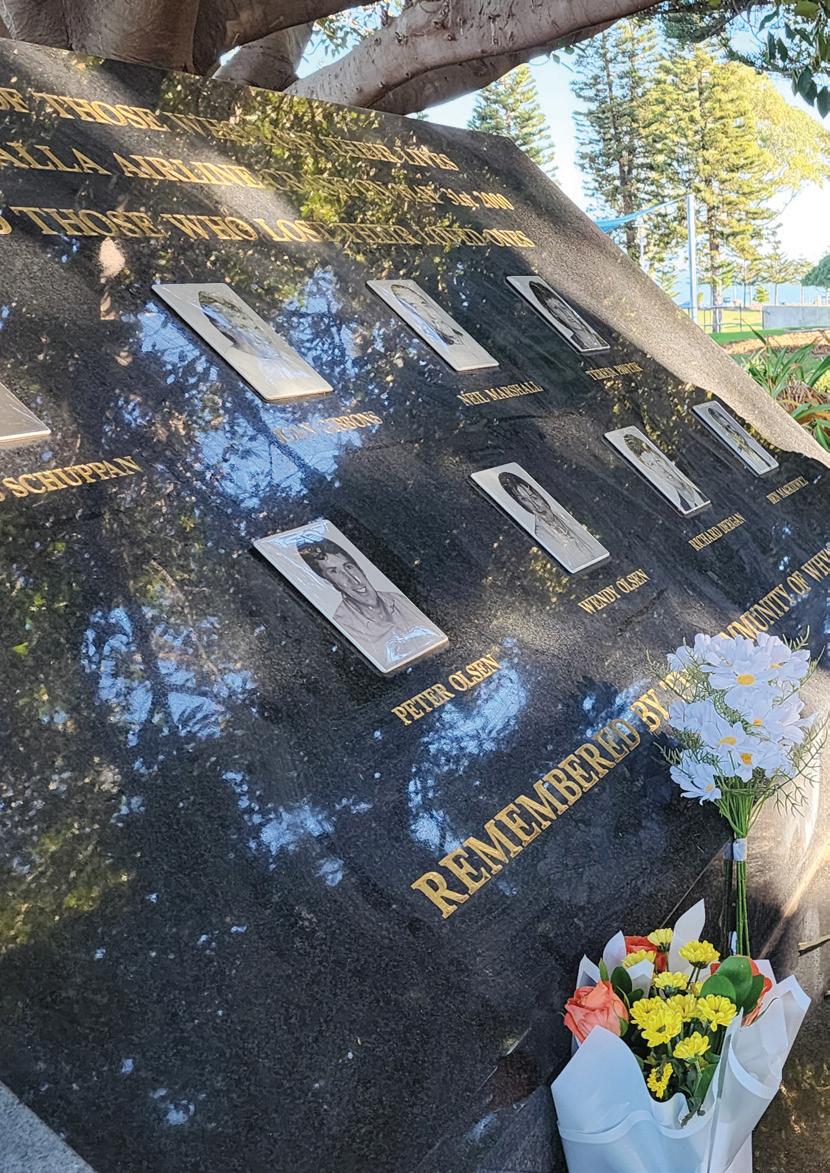
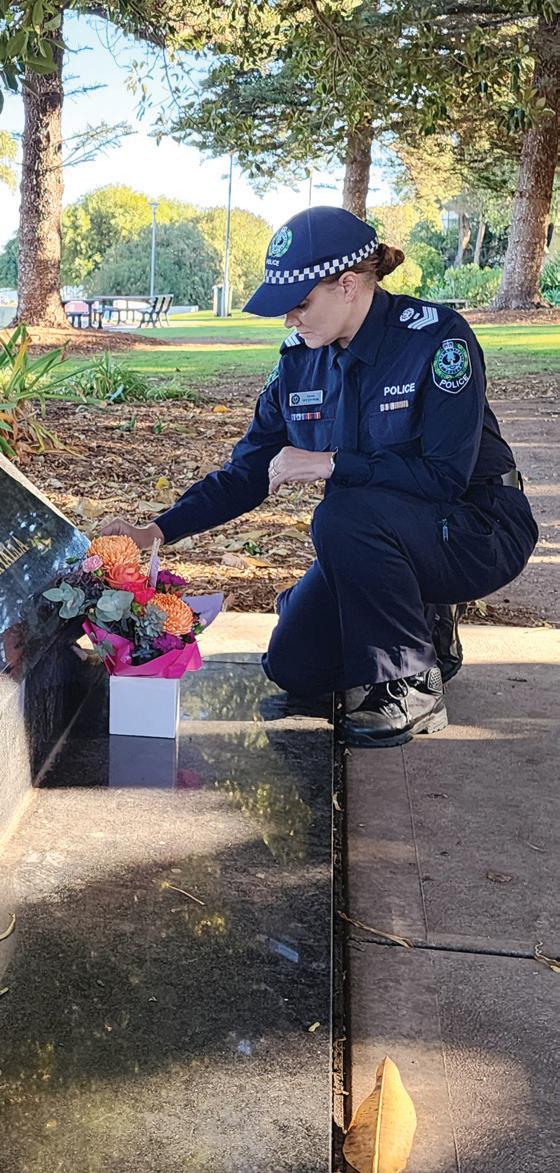
Senior Sergeant Susan O’Connor at the memorial for victims of the Whyalla Airlines Flight 904 crash.
Photo: Andrew O’Connor.
Six years into her SAPOL career, Senior Sergeant O’Connor and her husband, and then fellow police officer, Andy moved to Whyalla in 1997. Two years later, Andy left SAPOL to become a paramedic. Their roles would intertwine on that fateful night in May 2000.
On the night the crash occurred an exercise for a plane crash was going to be held in Cowell, just over 100 kilometres from Whyalla.
“Around 7 pm Andy went to the shed to grab dive gear and said ‘a plane has gone down’. I replied, ‘it’s just an exercise’, and he then left,” Senior Sergeant O’Connor said.
“When I woke the next morning for day shift, Andy wasn’t home. I turned on the TV and the major news was about a plane crash in Whyalla – I thought the world had gone mad for reporting on an exercise.
“I arrived at work and walked into the meal room at Whyalla Police Station and it was full of families crying and watching the news on TV. I didn’t know who they were or why they were there.”
Amongst the commotion, Senior Sergeant O’Connor was informed that she would
be the acting Victim Contact Officer for the day, despite never having any previous experience or training in the role.
“I introduced myself to the crash victims’ families and didn’t leave their side until around three o’clock the next morning,” she said.
“In the first few days I was counselling families about how to grieve the loss of their loved ones and trying to answer all of their questions about the crash. It was challenging as I was in my mid-late 20s, newly married and had never experienced a traumatic event in my life until then.”
The difficulty of Senior Sergeant O’Connor’s role was compounded by the prolonged search for the victims and the plane wreckage. The bodies of Cleve couple Peter and Wendy Olsen were recovered hours after the crash, but locating the other six victims proved challenging, with the darkness and depth of the water, and conflicting opinions on where to look adding complexity.
“Families grew frustrated and angry as the search went on,” Senior Sergeant O’Connor said.
“I worked closely with my
“There’s still no explanation for why his body was never located. In the video of the underwater crash, everyone is still strapped in their seats –I have played that video in my head over a million times.”
Senior Sergeant O’Connor bonded with Marie, with their shared experience forging a strong friendship over the past 25 years.
“Chris and Marie’s daughter Emma turned 10 while we were searching for her father’s body, so I hosted a birthday party for her at the local surf lifesaving club,”
Senior Sergeant O’Connor said.
supervisor, Chief Inspector Terry Harbour and remember being in his office on day five of the search and him becoming emotional, saying that he can’t tell the families again today that we haven’t found the plane. We needed to find it to bring closure for the families.
“The incident was affecting everyone, including CIB, crime scene investigators, sea squadron, patrols, and all those involved in the widescale search. No-one had a roadmap about how to deal with this.”
SEARCH UNCOVERS MORE GRIEF
Whyalla Airlines Flight 904 was eventually located on the sea bed, five days after the crash, with the twisted wreckage raised from the water on 9 June 2000. The remains of pilot Ben Mackiewicz were located inside, along with those of passengers Richard Deegan, Teresa Pawlik, Neil Marshall and Joan Gibbons. Chris Schuppan was the only body never found.
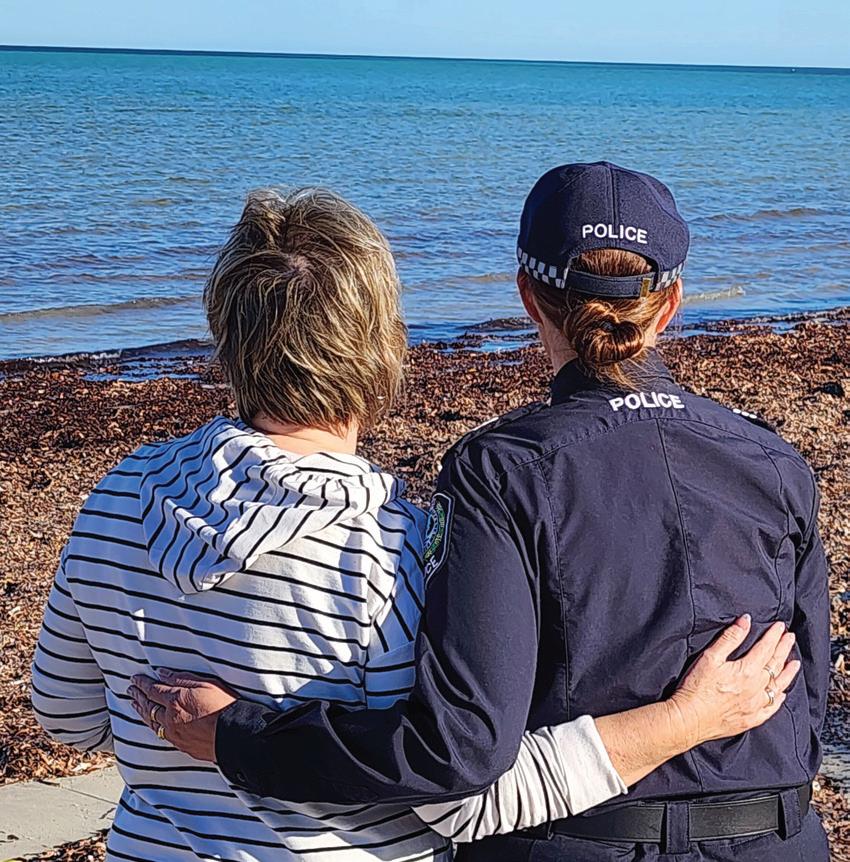
“My most vivid and worst memory is telling Marie Schuppan that we hadn’t found her husband Chris,” Senior Sergeant O’Connor said.
“A few weeks after the plane crash I went on a sixweek honeymoon in Europe, but I was still making calls home from phone boxes to check on Marie and the other families.
“It was challenging being on a long plane flight to Europe after the Whyalla Airlines incident. I don’t do well on flights and still get very anxious when flying.”
In the aftermath of the crash investigation, Senior Sergeant O’Connor received heartfelt thank you cards from crash victims’ families, many of whom she still remains in touch with.
“You don’t necessarily understand the impact you have on people when dealing with a traumatic incident,” she said.
“Friendships with victim families are a constant reminder that their loved one is not here.
“Marie and I would never have met and had this strong friendship if Chris hadn’t died.”
For Mrs Schuppan, the Whyalla Airlines crash turned her life upside down, with the sudden loss of a loving husband and devoted father devastating her family.
“We never got to say goodbye to Chris or lay him to rest. After 25 years I still wake up every morning with the same thoughts and feelings that I had back on 1 June 2000. There is no closure,” she said.
Mrs Schuppan is appreciative of the role Senior Sergeant O’Connor played in her darkest days and beyond.
“From the very beginning Sue was always there, trying to answer the questions that I was constantly throwing at her,” she said.
“Sue became an integral part of my life, and I looked to her for answers, help and unconditional support. And she gave it.
“Her support and presence in not only my life but my two daughters’ lives is
immeasurable. I cannot express how thankful I am for everything she has done for us and how much she means to us all.
“I will always call her one of my nearest and dearest. She definitely went truly beyond her role, and I will be forever grateful.”
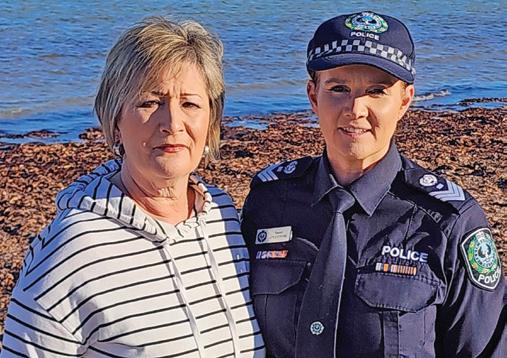
On 31 May this year Mrs Schuppan joined Senior Sergeant O’Connor and families of the other seven victims on the Whyalla foreshore to remember their lives. Each year on that date
loved ones gather at 7 pm at the memorial which was erected on the foreshore shortly after the crash.
“For me it was a time for reflection, not only about those who lost their lives, but also the actual incident and its aftermath, which remains etched in the minds of many who were involved,” Senior Sergeant O’Connor said.
“The plane crash was a devastating event, however I think I was able to make a positive difference to victims’ families, who are always in

my mind.
“My incident response role could have destroyed some people, and at times I thought it would destroy me as it was a lot to take on as a relatively young and inexperienced officer.
“But it made me realise I’m good at that type of work and explains why I’ve ended up working in road safety.”
My most vivid and worst memory is telling Marie Schuppan that we hadn’t found her husband Chris.
Words: Mathew Rodda
THIS PHOTO and OPPOSITE PAGE: Senior Sergeant Susan O’Connor and Marie Schuppan on the Whyalla foreshore 25 years after the tragic incident. Photo: Andrew O’Connor
Despite being in the role for 17 years, I’ve never lost the passion as it’s quite diverse and has enabled me to achieve some unique things.

MAKING A REAL DIFFERENCE
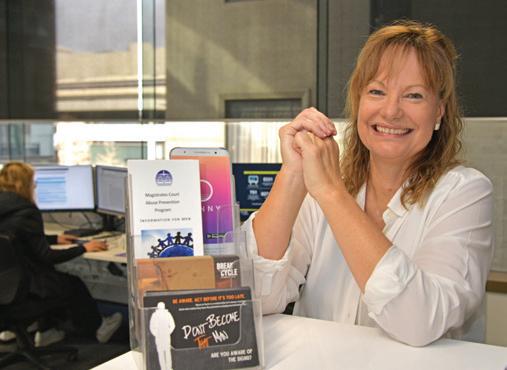
Senior Sergeant First Class Sharon Walker-Roberts.
Photo: Andrew Challen.

For the best part of two decades, Senior Sergeant First Class (SS1C) Sharon WalkerRoberts has been at the forefront of family and domestic violence and victim management in South Australia.
Widely respected for her expertise in these challenging areas, she continues to show empathy and support for vulnerable victims while driving change, having been pivotal in a range of initiatives that have delivered tangible benefits to both police and the community.
In 2008, SS1C WalkerRoberts became the Victim Policy State Coordinator, heading up Victim Policy Section. Now as the Manager of the Policy and Training Unit in Family and Domestic Violence Section, she is still performing the same leadership role but in an area of policing that has grown exponentially and become increasingly complex and demanding.
“This role has definitely been a career highlight,”
SS1C Walker-Roberts said.
“It has allowed me to work in a field I enjoy, alongside great people both within SAPOL and across external agencies.
“It’s a personally rewarding job that I still find interesting. No two days are ever the same, and there are always new challenges to deal with.
“Despite being in the role for 17 years, I’ve never lost the passion as it’s quite diverse and has enabled me to achieve some unique things.”
The valued leader’s first taste of this line of policing was back in 1996 when she joined the six-member Child and Family Investigation Unit based at Sturt Police Station
“I was always interested in working in family and domestic violence but at the time there were only three metropolitan units, so opportunities were limited,” SS1C Walker-Roberts said.
“Throughout my eight years in the unit my colleagues inspired me with their ability to listen to victims and be patient, while showing sympathy and empathy.
“I learnt from them and tried to be like them. This helped me achieve some great outcomes for victims, with these lessons underpinning the way I’ve worked and interacted with people ever since.”
A DESIRE TO ACHIEVE MORE
Despite her strong affinity for helping others and protecting the vulnerable, a policing career was not front of mind for SS1C Walker-Roberts when she first ventured into the workforce.
“After finishing Year 12 I worked for the National Bank for a couple of years, but this became boring rather quickly,” she said.
“At the time a couple of people in my softball team were police officers and I thought their job sounded exciting.
“I spoke to my dad about becoming a police officer, but he just laughed at me and said, ‘I don’t think you’d get into the police force’. I then thought, ‘I’ll show you’.”
Armed with this steely resolve, SS1C Walker-Roberts embarked on the 12-month cadet course in 1984. After graduating she was posted to Speed Detection at Thebarton Barracks for around six months before a three-year stint on patrols in Region B. Then it was on to Unley Police Station before leaving SAPOL in 1991 to have the first of her four children.
“Back then there was no paid time off to have children, and there were no part-time options. I decided to leave SAPOL to return to university at that time,” SS1C WalkerRoberts said.
“However, I quickly missed it, and I returned to SAPOL in 1994, completing a bridging course at the Police Academy to become a sworn officer again.”
SS1C Walker-Roberts resumed police life at Transit Section before the aforementioned move to the Child and Family Investigation Unit. Her next assignment was more unconventional, with a random phone call in 2002 from Commander Dean Angus leading to a two-year stint in Industrial Relations Branch as a member of the Enterprise Bargaining (EB) team.
“I knew nothing about enterprise bargaining but the Commander wanted someone with links to the frontline who could find out what they wanted from the next EB agreement,” SS1C WalkerRoberts said.
Keen to return to victim support, SS1C WalkerRoberts spent a year as a Victim Policy Sergeant in State Crime Prevention Branch under the leadership of then Superintendent, and now Deputy Commissioner, Linda Williams, before being once again seconded to Industrial Relations to work on the next EB agreement.
“I really enjoyed working on the two EB agreements as we did some amazing work which resulted in significant pay rises for police,” she said.
“That role was one of the high points of my policing career.”
ON THE FRONTLINE OF CHANGE
After a stint in Corporate Policy Unit, SS1C WalkerRoberts was appointed Victim Policy State Coordinator, setting in motion an extensive period of sustained excellence and notable achievements that continues to this day.
She has performed her challenging and multifaceted role with aplomb, taking on the responsibility for researching, developing, implementing and evaluating effective strategies relating to
domestic and family violence, child protection, and victim of crime issues. Her job has continued to evolve over the years, with the oversight of intervention orders and interagency collaborations such as the Domestic Violence Disclosure Scheme, the Family Safety Framework and the development of the multi-agency hubs, each bringing a little bit of revolution to the response to family and domestic violence in South Australia.
“I have gained great fulfilment from introducing initiatives that make it easier for frontline police or have proven to be more helpful for victims,” SS1C WalkerRoberts said.
“It’s been rewarding to get involved at the beginning of significant reforms and seeing them through to fruition, such as when intervention orders went national.
“It was a massive undertaking, with SAPOL heavily involved in getting police jurisdictions, courts and Attorney-General departments across the country together to implement the national changes. I found it really interesting, but it wasn’t easy.”
The development and implementation of the Domestic Violence Disclosure Scheme in 2018 is another proud achievement.
“Being involved in developing and establishing this ground-breaking program and then watching it grow and become successful and be recognised as a world leader of good practice has been fantastic,” SS1C WalkerRoberts said.
“I initially thought the scheme would be unnecessary as we already had information sharing guidelines in place, however I was proven wrong very early on.
“The scheme is a great example of collaborative work and early intervention that has made a huge difference to many victims.”
SS1C Walker-Roberts played a leading role in the establishment of the Family Safety Meeting Framework, an inter-agency forum which protects high-risk victims of domestic violence. She was also integral in implementing the Family Law Information Sharing Program, which ensures the Family Court has relevant information about domestic violence and child protection matters from the first court hearing. Outside
corporate level.
“I don’t like conflict. I’ve been successful in my role as I work well with others and see other people’s perspectives – I don’t always agree but I respect them.”
This is particularly the case in her work with government agencies and domestic violence services across the state.
“They have a range of different views on victim management and policing. I acknowledge that we all have different roles to play in striving for the same outcome,” SS1C WalkerRoberts said.
of SAPOL, she made a strong contribution to the community as a board member for Women’s Safety Services SA – a role she left in 2024 after 15 years.
With an extensive career punctuated with achievements and underlined by the respect of her peers and the community, it was no surprise to see the esteemed leader’s name on the Queen’s Birthday Honours List in 2021, as a well-deserved recipient of the Australian Police Medal (APM).
“I found the APM to be lovely acknowledgement of the work that I’ve done,” SS1C Walker-Roberts said.
“It was great encouragement to keep on going with what I do and persist when obstacles are put in my path.”
The APM was a validation of SS1C Walker-Roberts’ approach to her role and the qualities she embodies.
“I’m a good listener and empathetic. I try to be supportive but also realistic about what police can achieve for a victim in terms of justice and healing,” she said.
“I can be stubborn and persistent, but I’m also patient. I’m happy to work through the processes to get initiatives done at the
“I think my own inherent personality traits make me better at what I do than other types of policing. Issuing traffic infringement notices was never my strong point as I always felt sorry for the person I was fining despite the potential road safety consequences.
“When helping a victim of violence, you feel like you’re directly doing some good.”
SS1C Walker-Roberts takes great pride in all that she has achieved but doesn’t see herself as a trailblazer for women in policing.
“I see myself as more of a role model, particularly through my leadership and mentoring of staff and supporting them to pursue their own career journey,” she said.
“I’m proud of my career. When I started off as a frontline patrol officer, I never thought this is where I would end up.
“The fact that I’ve stayed in my current role for so long shows how it’s continued to be challenging and interesting. I look back at my career and think I have made a positive difference.
“I still enjoy policing –the friends, colleagues, a common purpose and a sense of belonging to something special. It was that way when I joined and still is.”
Words: Mathew Rodda
Senior Sergeant First Class Sharon Walker-Roberts. Photo: Andrew Challen.
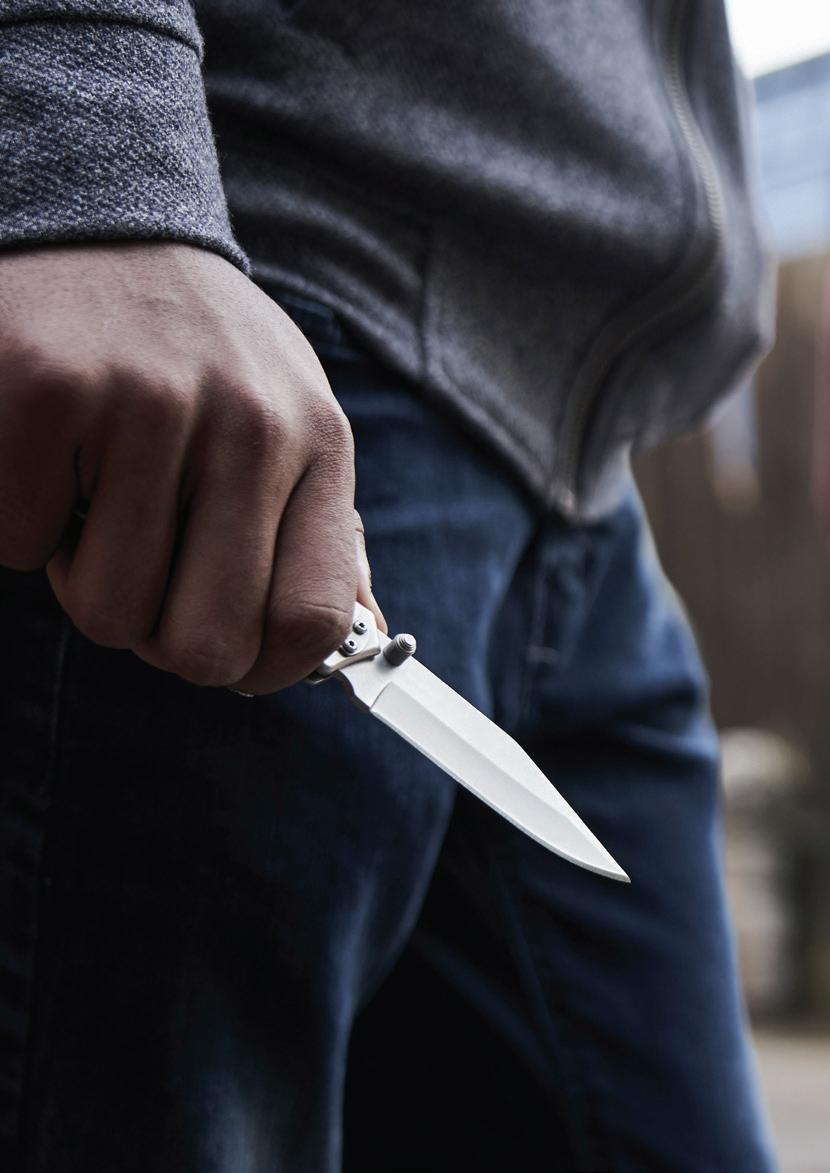
The new laws ban children under the age of 18 years from buying dangerous knives under any circumstances.

A NEW WEAPON TO CUT KNIFE CRIME
Knife crime is a growing concern across the country, evoking fear in the community and posing challenges for authorities.
South Australia is leading the way in tackling this issue by implementing strict new knife laws which have been hailed as the toughest in the nation.
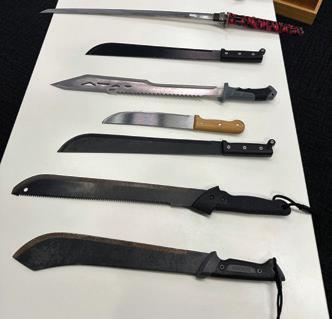
Introduced on 1 July, the new laws ban children under the age of 18 years from buying dangerous knives under any circumstances, raising the age of purchase from 16 years. Additionally, machetes and swords are now classified as prohibited weapons, making it an offence to manufacture, sell, distribute, supply or deal in, or use or possess these weapons. Those breaking the law could face a maximum penalty of $20 000 – or two-years’ imprisonment.
Assistant Commissioner (AC) Narelle Kameniar from Operations Support Service welcomes the changes which
are central to phase two of the knife crime law reforms.
“Raising the age of sale from 16 to 18 will proactively disrupt knife crime and help reduce the number of weapons getting into the hands of young people,” she said.
“This is supported by the creation of a new criminal offence for supplying a knife to a minor, where the supplier either knew or should have known the knife would be used to commit an offence.
“Phase two also expands the existing offences involving the possession, carriage and use of knives
or other offensive weapons at schools and public places to now apply to broader educational facilities, ranging from childcare centres and preschools, to schools, universities, TAFE campuses, and places of worship.”
Between 1 July 2025 and 30 September 2025, people in possession of prohibited weapons were able to surrender them anonymously at police stations across the state. Operation Surrender saw a total of 3508 weapons handed in, including 1653 machetes and 1170 swords, with an average of 38 weapons surrendered per day. People also dropped off
We have more than 3500 dangerous weapons now safely out of our homes, streets, and communities.
OPPOSITE PAGE: Knives seized by police. Photo: Supplied.
daggers, bayonets and ninja stars despite these not being part of the surrender period.
“Police welcome the community response, with so many people surrendering swords, machetes and other knives in a safe manner,”
AC Kameniar said.
“We have more than 3500 dangerous weapons now safely out of our homes, streets, and communities.
“We encourage anyone still holding on to prohibited weapons to surrender them safely without delay, however they will now be required to provide their personal particulars and can no longer surrender these weapons anonymously.
“Some exemptions apply, such as when the weapons are family heirlooms, belong to a collector, used for religious purposes, or are lawful and recognised for entertainment, sport or recreation.”
The tough new laws build upon the first round of reforms which came into effect on 12 March 2025. This gave police stronger powers to conduct metal detector searches in public places, including public transport hubs, shopping centre precincts and on public transport. It also allows police, under certain conditions, to request that a person leave a declared area, and to use necessary and reasonable force to remove the person from the area where necessary. It is now an offence if a person remains
or re-enters the area within 24 hours.
“The new search powers mean more edged weapons will be located, allowing police to seize knives and other dangerous weapons before offences are committed,” AC Kameniar said.
“We have recently announced a range of declared shopping precincts across the Adelaide metropolitan area where police will conduct metal detector searches on any person or their property.
“Police have already used these laws to seize several dangerous weapons.
“SAPOL will continue to review the risk profile of a range of sites and assess whether they need to become declared areas to ensure community safety.”
CUTTING NO CORNERS IN CRACKDOWN
A serious incident at a Melbourne shopping centre on 25 May 2025, in which around 10 people from two rival gangs engaged in a “machete brawl”, heightened the awareness of knife crime and its danger to the community. This compelled the South Australian Government, with the full support of SAPOL, to fasttrack stage two of its strict knife crime law reforms.
“Over the past three years in South Australia there has been an increase in people being detected with a knife, however not all of these
cases saw the knife used or displayed in a threatening manner,” AC Kameniar said.
“In some cases, it may be that the knife was being carried on the person.
“Regardless of the intent or legitimacy for carrying a knife, recent events both locally and interstate emphasise the urgent need to crack down on potential knife crime.”
There have been several incidents involving knives this year. In June two men were arrested and charged after a teenage boy was seriously injured in a machete attack in a city apartment. In the same month a machete-wielding woman was arrested after allegedly robbing a service station in Port Adelaide. In July, five young males were arrested after police seized machetes and an imitation firearm resulting from an incident at South Brighton.

The first two stages of reforms under the Summary Offences(KnivesandOther Weapons)AmendmentAct 2025 are aimed at minimising the risk of such knife crime, with a third and final stage to be implemented at a future date.
“Stage three will require retailers to securely store particular knives and display notices where knives are sold,” AC Kameniar said.
“These measures are a significant step forward, and the result of extensive consultation with the public, SAPOL, the AttorneyGeneral’s Department and government agencies.
“This comprehensive package of reforms ensures the state’s knife crime laws are tough, effective, and give police the tools they need to keep our community safe.”
You can find out more about the knife crime reforms at www.police.sa.gov. au/services-and-events/ firearms-and-weapons/ changes-to-knife-laws. For details on declared shopping precincts, visit www.police. sa.gov.au/your-safety/ declared-public-events-andplaces.

Words: Mathew Rodda
UNMASKING THE BICYCLE BANDIT
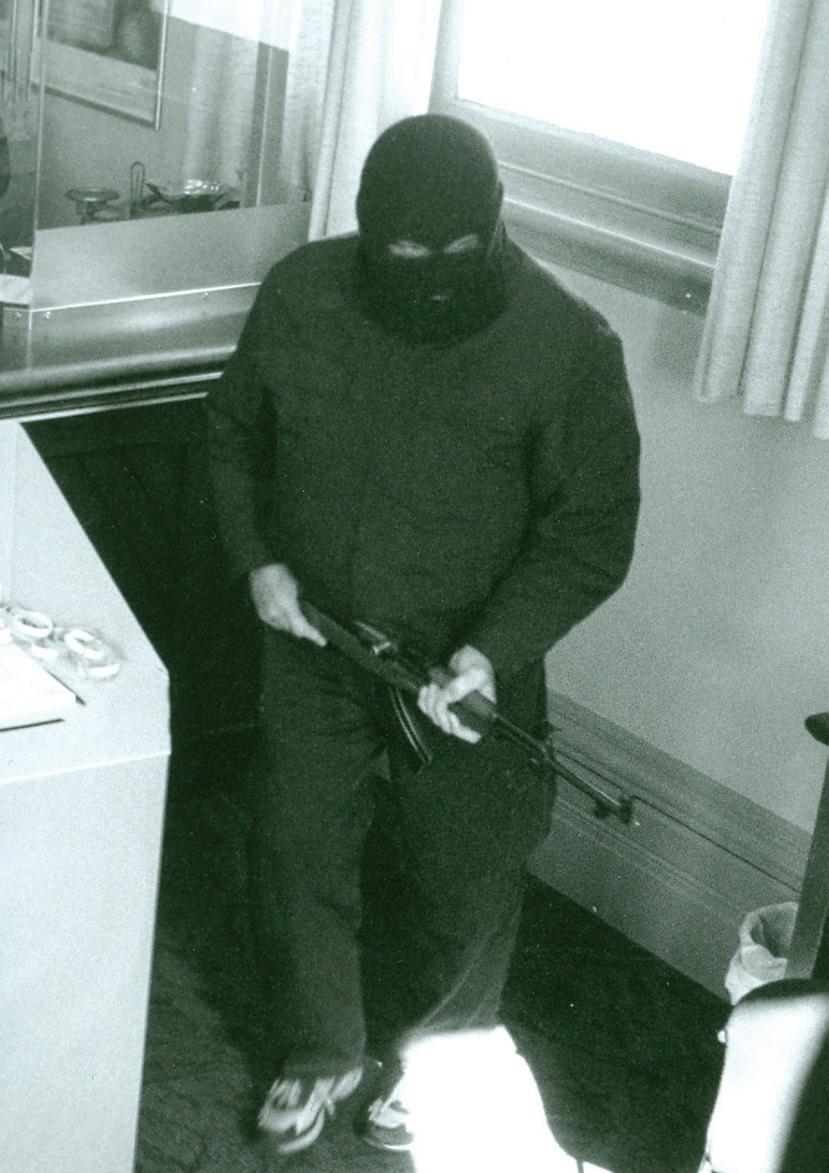
For 10 years a mysterious lone offender subjected bank tellers to a reign of terror as he committed bank heists across usually quiet towns in the Adelaide Hills.
OPPOSITE PAGE: Robbing various country banks during his decadelong reign of terror. Photos: Supplied.
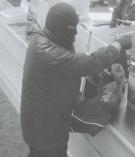
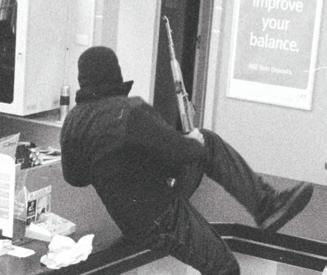
The ‘Bicycle Bandit’ during a hold-up at the ANZ branch in Balaklava in 2008.
Clad in a balaclava, he would lob a bag onto the counter, menacingly point his rifle at the bank teller and forcefully demand they fill the bag with bundles of cash. Leaving behind shocked and terrified staff, he would stroll out of the branch and flee on a bicycle or in a nearby getaway vehicle.
Labelled by the media as the ‘Bicycle Bandit’ for his simple and effective getaway transport used in his first four bank robberies, the notorious offender repeated the same style of hold-up 11 times from 2004-2014. He stole $358 967 from 10 robberies, leaving empty-handed only once.
The Bicycle Bandit first struck at the ANZ branch in Mannum on 21 May 2004, with his final hold-up on 4 September 2014 at Bank SA in Mount Pleasant – his third heist at that branch. In each of his 11 crimes he used the same Chinese SKK assault rifle, discharging it on one occasion (in his final robbery) when he fired rounds into a locked door to gain access after a bank teller activated the security screens.
While victims endured emotional trauma and psychological injury in the aftermath of his crimes, the Bicycle Bandit’s identity remained a mystery despite vital DNA evidence being left at two crime scenes. In a 2005 hold-up at Mount Pleasant, he left DNA on bicycle handlebars. Three years later during a robbery of ANZ in Balaklava, the masked offender was confronted by a police officer, and in the process of fleeing, cut himself on a fence, leaving behind a valuable blood splatter. This moment would eventually lead to the culprit being identified and arrested 15 years later.
At the time the infamous criminal’s DNA was repeatedly run through the national criminal database without ever finding a match. Police also had a voice recording of the offender from a Mount Pleasant hold-up in
June 2007 – a bank worker was on the phone to Telstra when the Bicycle Bandit stormed into the branch and threatened the teller.
These clues failed to solve the mystery, with more than 200 police spending thousands of hours investigating, interviewing and eliminating around 400 potential suspects as the baffling search continued. Despite years of investigational efforts by Operation Coy, a task force established in 2004 to investigate the Bicycle Bandit series, his identity remained unknown.
THE PERFECT MATCH
In 2019, Detective Brevet Sergeant Adrian Moulds became the case officer for Operation Coy. He had an affiliation with the case, with the goal to one day work on it.
“Prior to joining South Australia Police (SAPOL) I conducted a case study on the Bicycle Bandit at university and then in 2009 I was on patrols the day he struck at Bank SA Willunga,” he said.
“That day my patrol partner and I moved to a static traffic point at Blackwood in the unlikely event he drove past. There was always an ambition to work on this case, and I joined Serious and Organised Crime Branch in 2018 with the hope of having a crack.”
Detective Brevet Sergeant Moulds persevered with the investigation, pursuing the application of an emerging investigative tool known as Forensic Investigative Genetic Genealogy (FIGG). This was notable at the time as the technique had been successfully used in the United States to unmask the ‘Golden State Killer’.
“FIGG is a revolutionary intelligence tool that combines DNA analysis with traditional genealogy to help solve violent crimes and identify unknown human remains,” Detective Brevet Sergeant Moulds said.
“Following approvals and


DNA analysis, it involves uploading the offender’s genetic information to a law enforcement specific consumer database and genealogical research (family tree building) to identify potential persons of interest.”
Armed with the DNA samples taken from two of the robberies, Detective Brevet Sergeant Moulds began his search for the elusive breakthrough.
“One of our top search results was a distant third cousin overseas,” he said.
“We then used this relationship to build family trees back to the early 1800s, which ultimately led us into
South Australia. Through this process Kym Allen Parsons was identified as our suspect.
“The family tree building process took just six days.”
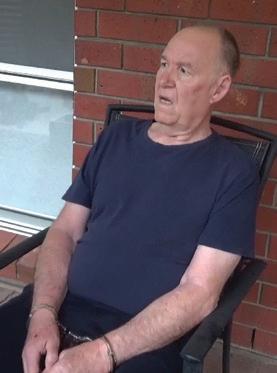
According to Detective Brevet Sergeant Moulds, 73-year-old Parsons was, as investigators had always expected a ‘ghost’ as little was known about him and he had minimal prior interactions with police.
“We began investigating Parsons as a strong person of interest, and as he ticked a lot of boxes from a criminal profiling perspective as well as things we knew about the offender, he very quickly became our suspect,” he said
“He matched the physical and age description of the Bicycle Bandit, had previously lived in the Adelaide Hills region, and once owned or had access to the same vehicle models as described by witnesses leaving the scenes.
“Parsons was a police officer for a very short time and then became a firefighter with 35 years’ service before retiring as a station officer.”
A covert sample of DNA was obtained from Parsons. The result was a positive match to the offender.
“Receiving that result was a special moment. It was the culmination of two decades of teamwork, dedication and a commitment to unmasking the Bicycle Bandit,” Detective Brevet Sergeant Moulds said.
“Over the course of this investigation we had around 200 of our members who either responded, assisted or investigated robberies in this crime series.
“Most importantly we knew what this unmasking would
mean to the many victims and their families”.
PUTTING THE BRAKES ON THE BICYCLE BANDIT
Police methodically planned for the safe arrest of Parsons.
On 15 October 2023 they pounced, arresting Parsons without incident in the backyard of his recently purchased seaside residence at O’Sullivan Beach.
“He seemed shocked and never saw it coming. You could see the resignation on his face,” Detective Brevet Sergeant Moulds said.
“He later told us he knew this day would come, but at this late stage of his life with declining health we don’t believe he thought it was actually going to happen before he died.”
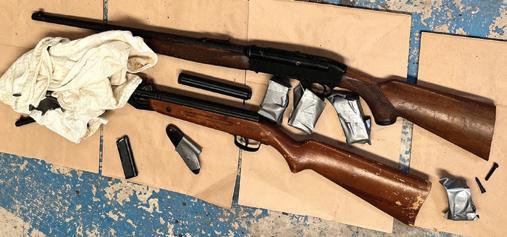
Upon searching Parsons’ home, police found the SKK assault rifle used in each of the bank heists plus over 5000 rounds of ammunition
“Parsons tested us about how much we knew about specific robberies. He discussed his obsession with true crime, particularly bank robberies and heists. We learnt from his manifesto that he had a strong interest in methodical planning including escape routes and contingencies.
“His attitude certainly changed during the interview when we advised him the SKK assault rifle had been located hidden in his shed. He also admitted to previously burying firearms and ammunition.”
Investigators found Parsons had refined and evolved his offending over his decadelong crime spree.
“He changed up aspects of his planning and execution and also applied ‘verbal staging’ during robberies to misguide investigators,” Detective Brevet Sergeant Moulds said.
“Parsons was aware of FIGG being used to identify offenders, having learnt about it by closely following the Golden State Killer case.”
A GAME PLAN FOR JUSTICE
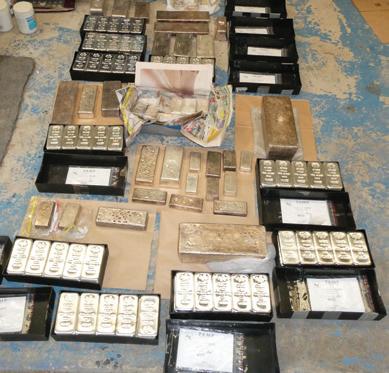
and eight other firearms. Crucially, the assault rifle matched to cartridges left behind after Parsons discharged his firearm during his final robbery at Mount Pleasant in 2014. Police also located a balaclava, taser, true crime books and even his own authored survivalist manifesto and crime-based fiction stories.
After living a life of anonymity for nearly 20 years, the notorious Bicycle Bandit had finally been unmasked. Parsons participated in a police interview that lasted more than five hours.
“He enjoyed every moment of the interview. He had fantasised about that day for a long time,” Detective Brevet Sergeant Moulds said.
“We had planned for that and provided him an opportunity to tell his story. It was a bit of a game for him. He made partial admissions during the interview but denied being the Bicycle Bandit.
Parsons was charged with 10 aggravated robberies and one attempted aggravated robbery. In April 2024 he pleaded not guilty to his crimes in the Supreme Court, with a trial set for February 2025. A strategy was initiated which resulted in Parsons deciding to plead guilty to all charges, forfeit the total money he stole and provide the victims with an opportunity to read their impact statements to him in court.
“Unmasking Parsons through the application of FIGG was the first stage but as an investigation team we are equally as proud of the strategy which followed his arrest,” Detective Brevet Sergeant Moulds said.
“This strategy resulted in Parsons making a decision which was to plead guilty to all counts, forfeit every cent he stole and be imprisoned.”
On 24 June 2024, Parsons was given a 35-year sentence with a non-parole period of 28 years, with Supreme
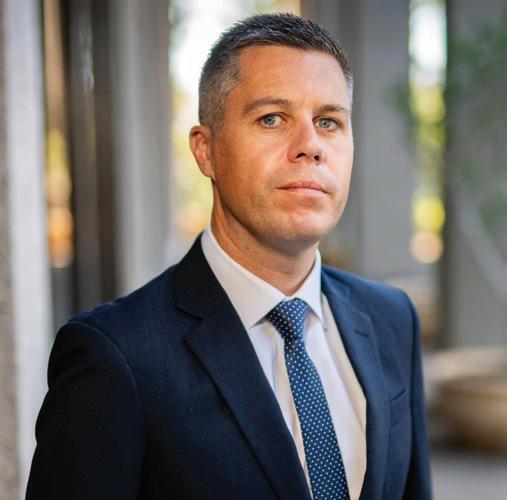
Detective Brevet
Sergeant Adrian Moulds.
Photo: Brant Cummings, ABC News.
Court judge Sandi McDonald describing his offending as “morally reprehensible”.
Just two days later, Parsons died in custody after being granted access to South Australia’s Voluntary Assisted Dying program. Shortly after his arrest, it became known that Parsons had terminal cancer, with a medical report confirming he had less than 12 months to live. During court proceedings, the court heard that Parsons had been battling cancer since 2007 and had committed five of the robberies while he was unwell.
Despite Parsons finally facing justice with his death imminent, Detective Brevet Sergeant Moulds was satisfied with the court outcome.
“Our goal was for Parsons to be held accountable for his terrifying crimes and achieve a positive outcome for the victims and their families,” he said.
“Before his death Parsons admitted that planning and carrying out armed robberies made him ‘feel alive’ but make no mistake about it, he never wanted to be unmasked or admit to his crimes.”
The sentencing generated many emotions for Detective Brevet Sergeant Moulds and members of the final

Operation Coy investigation team – Inspector Danny Gillan and Detective Brevet Sergeants Julie Hawker and Robert Armstrong – who were instrumental in ending the two-decade hunt for the fugitive and seeing justice served for the many victims of his sustained reign of terror.
“The arrest and outcomes were rewarding for everyone who had worked on this case, but more importantly we hope it provided a degree of
comfort and closure to the many victims and their families,” Detective Brevet Sergeant Moulds said.
“We thank them for their strength and support, and acknowledge that while the case may be closed, they will forever be affected by their traumatic experiences.”
The successful outcome also highlighted the power of FIGG and its potential as a ‘game changer’ for investigators.
“This was the first time FIGG was applied to a case in SAPOL and one of the first to be successfully applied in Australia to a criminal case,” Detective Brevet Sergeant Moulds said.
“There is now an opportunity for SAPOL to continue building a FIGG capability and solve more of our cold case investigations.”
Words: Mathew Rodda
Kym Parsons after his arrest.
200 kg of silver bullion located and seized by police.
Firearms found at Parsons’ home, including the SKK assault rifle (top image). Photos: Supplied.
HOLDING COURT
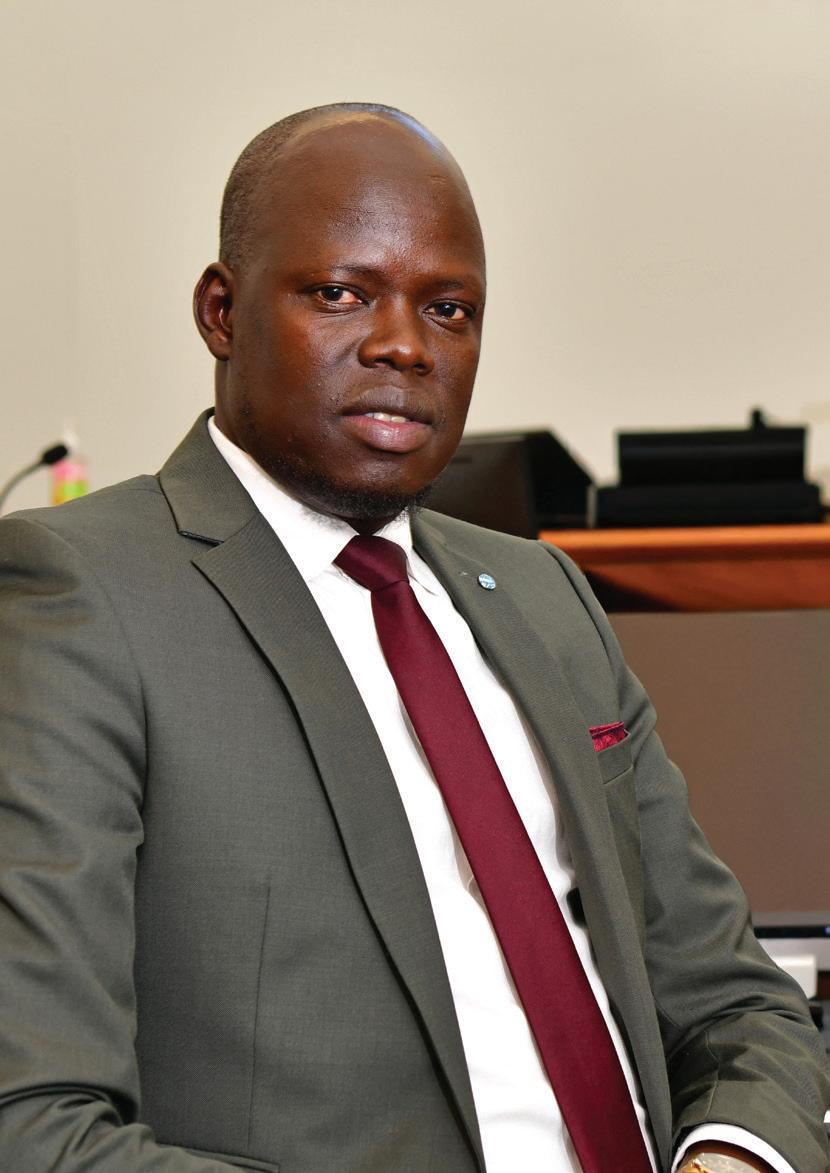
Prosecuting solicitor Wol Door in Port Adelaide Magistrates Court.
Photo: Andrew Challen.
The first time Wol Door saw an AK-47, he was barely tall enough to look over the barrel.
He learned how to take one apart and put it back together long before his 10th birthday – thanks to lessons passed down from his older brothers, all of whom had already been recruited into
the rebel army in their warravaged homeland of South Sudan.
Wol’s earliest memories are not of classrooms or playgrounds, but of armed soldiers and families fleeing for safety. Rebel forces routinely swept through villages, recruiting boys –sometimes luring families with promises of schooling, often taking them by force.
The lawlessness of the world he grew up in stands
in stark contrast to his life now in Australia, where he upholds the law as a prosecuting solicitor in the South Australian courts. His caseload spans everything from domestic violence to traffic offences.
Wol was born in a small Catholic village in the city of Kuajok in South Sudan in 1987, four years into a brutal civil war.
“I was born into a war,” he says plainly.
“By the time I was 10, all my brothers had been recruited.
“Most of the young boys in the village were recruited,

Wol’s earliest memories are not of classrooms or playgrounds, but of armed soldiers and families fleeing for safety.
some were killed. My little cousin who was way younger than me, he got recruited. He ended up getting killed in 2013.
“My family – my mother and big brothers – decided the only way to protect me was to send me away.”
That decision led him to a refugee camp in northern Kenya, a move funded by his family selling cows. The journey was long and treacherous but arriving at the camp did not mean the end of hardship. The makeshift settlement sat on open desert, where the temperature could reach 45 degrees by midmorning.
Wol describes the life in the settlement as “hell on earth”.
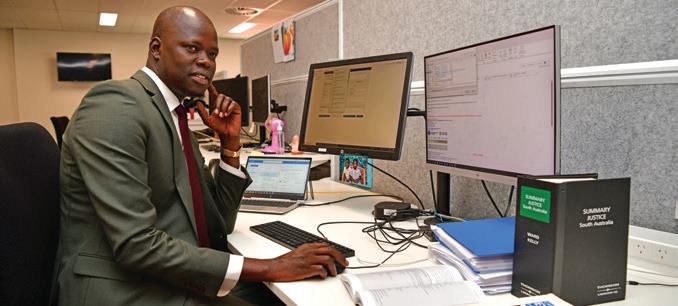
Dust storms swept through without warning. Food came in the form of United Nations rations – flour, oil, some grains – meant to last a week but often gone in two days. Camp inhabitants pooled resources to get by.
“People had to come together to live in a group, and that is how they rationed it to last at least for a few days,” Wol said.
There were other threats: outbreaks of disease claimed lives quickly when medical care was scarce.
“Security was a very big problem. There was a nomadic community called Turkana, they were extremely hostile, they kept raiding people at night, and a lot of people were killed by them,” Wol recalls.
“It was hard. We tried to sleep during the day because it was too hot. In the evenings, when it cooled down, we’d play soccer. That was our escape.
“I have seen it all, but being a young person there, if I got to play, if I got to eat and go to school, that’s all that kept me going.”
A NEW COUNTRY, A NEW START
After five years in the refugee camp, good news finally arrived: Wol, his uncle and younger cousin had been accepted to migrate to Australia, thanks to Gabriel Machok Malual, a relative
already settled there who acted as their sponsor.
“It’s life-changing news that you get – one of the best news I have ever received,” Wol said.
In October 2004, just a few weeks after his 17th birthday, Wol arrived in Adelaide with his uncle and younger cousin.
They all crammed into their sponsor’s two-bedroom apartment in Findon until they were able to settle in their own place. They were also assisted by the Catholic church and other local charities.
Soon after arriving, Wol was accepted to St John’s Grammar School, on a scholarship where he completed years 11 and 12.
The transition to Australian schooling was not without challenges – learning in a new language, adjusting to different expectations – but he threw himself into it, fully aware, even at that young age, of the chance he had been given to better his own life, and the lives of family members left behind.
While studying for his final years of high school, Wol worked part-time to send money back to family members still in South Sudan. He was able to help bring those family members to Australia and help them settle.
He was later recognised for his efforts, being named runner-up in the ‘2016 Young South Australian of the Year
Award’ for his role in helping many family members migrate and build a future in Australia.
A CHANGE OF COURSE
Wol’s initial plan was to become a doctor. During a school summit, however, he entered a mock trial competition. It was a turning point.
“I had to play every role – witness, prosecutor, defence,” he said.
“From that day, I changed my focus, and I knew that I wanted to pursue a career in law, and I put all my focus on that.”
After finishing high school, Wol enrolled at the University of South Australia to study commercial and business law (graduating in 2015), later transferring to Charles Darwin University to complete his Bachelor of Laws.
The years of study were demanding, especially while continuing to work at Coles to support himself and family members in South Sudan.
After graduating with a law degree, Wol held roles at the Legal Services Commission of South Australia and SA Health before joining SAPOL in early 2024, as a prosecuting solicitor – the culmination of nearly two decades of perseverance.
Today, the 38 year old’s caseload covers a wide
spectrum. As a prosecuting solicitor, his job is to present cases on behalf of the community, ensuring the court has the facts it needs to make decisions in line with the law.
“If I walk out of court knowing I’ve helped make the community safer – even in a small way – that’s a good day,” Wol said.
GROUNDED BY FAMILY
For all the demands of his role, Wol makes sure weekends are set aside for his two young boys, aged three and five.
“I use the weekend to stay with the kids – they are pretty much attached to me. Monday to Friday I go to work, I come home with the work on my head, and the weekend is the only opportunity I get to spend with my sons,” he said.
He also often visits at his local Sudanese community centre in Adelaide – talking with community members, playing cards, and offering guidance drawn from his own life.
“I’m a person that could be a role model for the people behind me, and the people in the community who can see what I’m doing, and to my own kids,” Wol said.
“The experience in the refugee camp taught me that yes, you could be at the lower end today, but if you
Wol Door at work in Port Adelaide Prosecution Unit.
OPPOSITE PAGE: Outside Port Adelaide Magistrates Court. Photos: Andrew Challen.
keep pushing, if you don’t give up, then you could get to wherever you wanted to be.”
In keeping with his culture’s tradition of family responsibility and mutual support, Wol sends money each month to South Sudan to help his mother and support five nephews and nieces. His contributions cover their education, food and medicines.
Among them is a nephew studying medicine and surgery, whom Wol has committed to supporting through medical school.
“As soon as I get paid, the next day my money’s gone,” he says with a smile.
But if you can help, what else do you have to do?”
Wol says he feels fortunate to be in a country full of opportunities – and with that comes a duty to share what he has.
“That is part of the family: the older one looks after the younger one. The fortunate one, that has an opportunity to make something, must give to the other family members. Culturally, it is a duty of care that we live by,” he said.
THE PERSPECTIVE THAT DRIVES HIM
Two decades on from his arrival in Australia, Wol has
never taken the opportunities he’s been given in his adopted home for granted.
“I came from a place where there was almost no chance for education,” he said.
“Here, you are surrounded by opportunity. If you don’t take it, what excuse do you have?”
That outlook informs not only his work but also his deep sense of duty. In his mind, the role of a prosecuting solicitor is more than a job; it is a responsibility to uphold fairness, protect the public, and honour the community’s trust.
“I want to be in a place where I can go home at the
end of the day knowing I’ve made a real contribution,” Wol said.
“I’m pretty happy with my advocacy in court, I walk out of court knowing I have done my part to protect the community.
“That’s the only way people of migrant background, who’ve been given the chance to come here, and have been supported can give back – to stand on your own two feet and give something back to the community.”
Words: Sonja Viduka
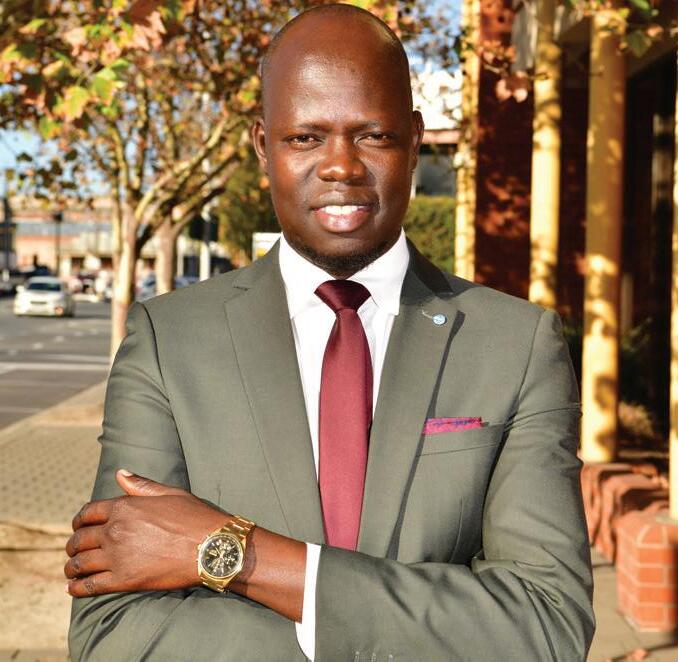
If I walk out of court knowing I’ve helped make the community safer – even in a small way –that’s a good day.

TAKING AIM AT A NEW TARGET
Brevet Sergeant Mark Jamieson holding a 3D-printed firearm.
Photo: Andrew Challen.
In 2013 American gun rights activist Cody Wilson designed the first three-dimensional (3D) printed handgun, which he christened ‘The Liberator’. The designs for the weapon, made of 15 plastic parts and a nail for the firing pin, were posted online, heralding the beginning of an alarming trend, with the quality and range of 3D guns greatly improving and expanding over the ensuing 12 years.
3Dprivately made firearms (PMF) are considered a high priority threat for Australian law enforcement agencies. The weapons are cheap and easy to make, with designs having advanced rapidly in recent years.
“They are now considered to be an effective weapon of choice for illicit use –from backyard operators through to serious and organised crime groups,” said the Officer in Charge of Firearms Branch, Detective Superintendent Lauren Leverington.
“3D-printed firearms can be made almost or entirely of plastic and are in most cases completely untraceable. Emerging technologies present new challenges for
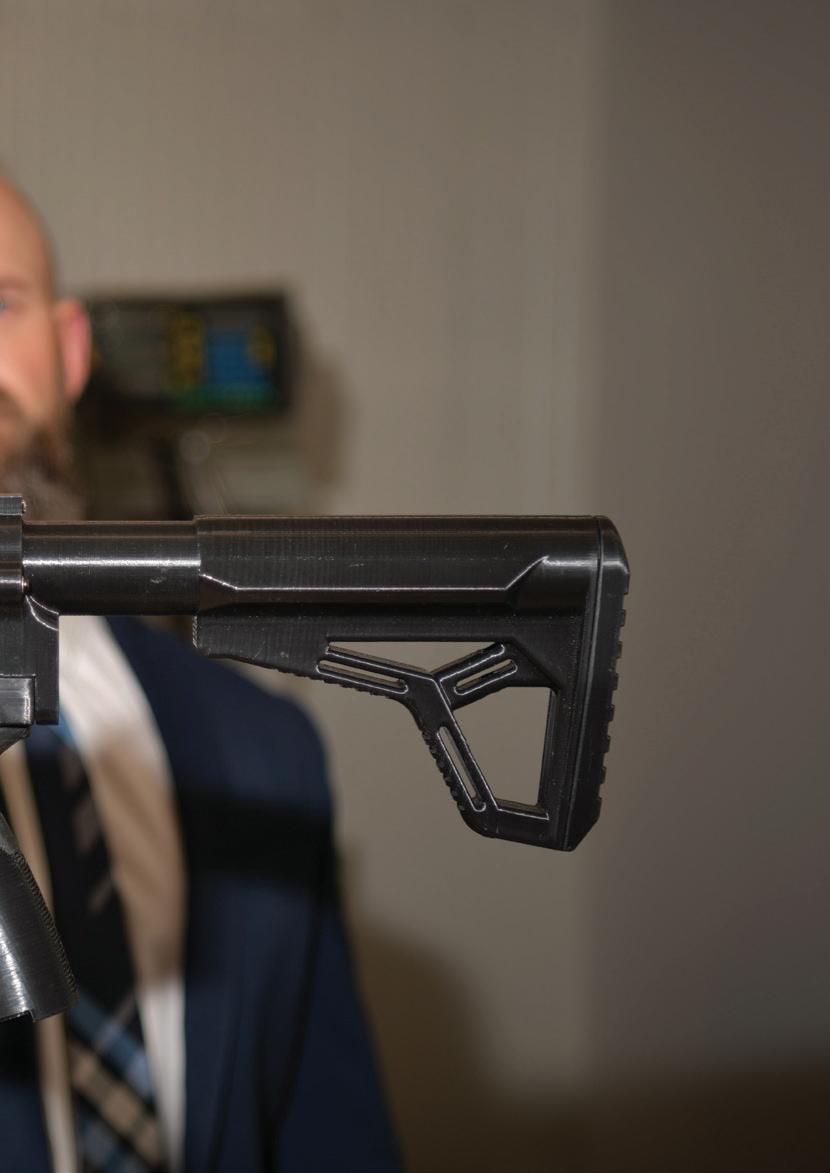
3D-printed firearms can be made almost or entirely of plastic and are in most cases completely untraceable.
law enforcement; however, we are constantly evolving to meet them head-on.
“These guns pose an unprecedented risk to public safety as they circumvent established regulations designed to limit access to firearms.”
The rapid advancement of 3D printing technology has enabled individuals with the capability and intent to unlawfully manufacture firearms within the privacy of their own homes. An entire firearm can be made using a 3D printer or electronic milling machine, by following a Computer Aided Design (CAD) file, or blueprint that can be found online, similar to a dress pattern. Others use a hybrid model, which combines traditional gun parts such as a barrel with 3D-printed material. The weapon is manufactured in stages, with each part of the gun printed separately and assembled manually.
Detective Inspector Nathan Schollar from Firearms Branch says this can all be produced using most off-the-shelf 3D printers priced between $500 and $2000.
“3D printing has evolved to become relatively cheap, easily accessible, and with the use of online blueprints, guns can be produced at a low cost, in any location by an unskilled operator,” he said.
“The technology has advanced sufficiently that it’s now difficult to tell the difference between a PMF and a traditional firearm in many instances.
“3D-printed firearms are no longer seen as being novice or a niche like they were a decade ago.”
This illegal manufacturing trend is not limited to organised crime; individuals acting alone are also engaging in this activity.
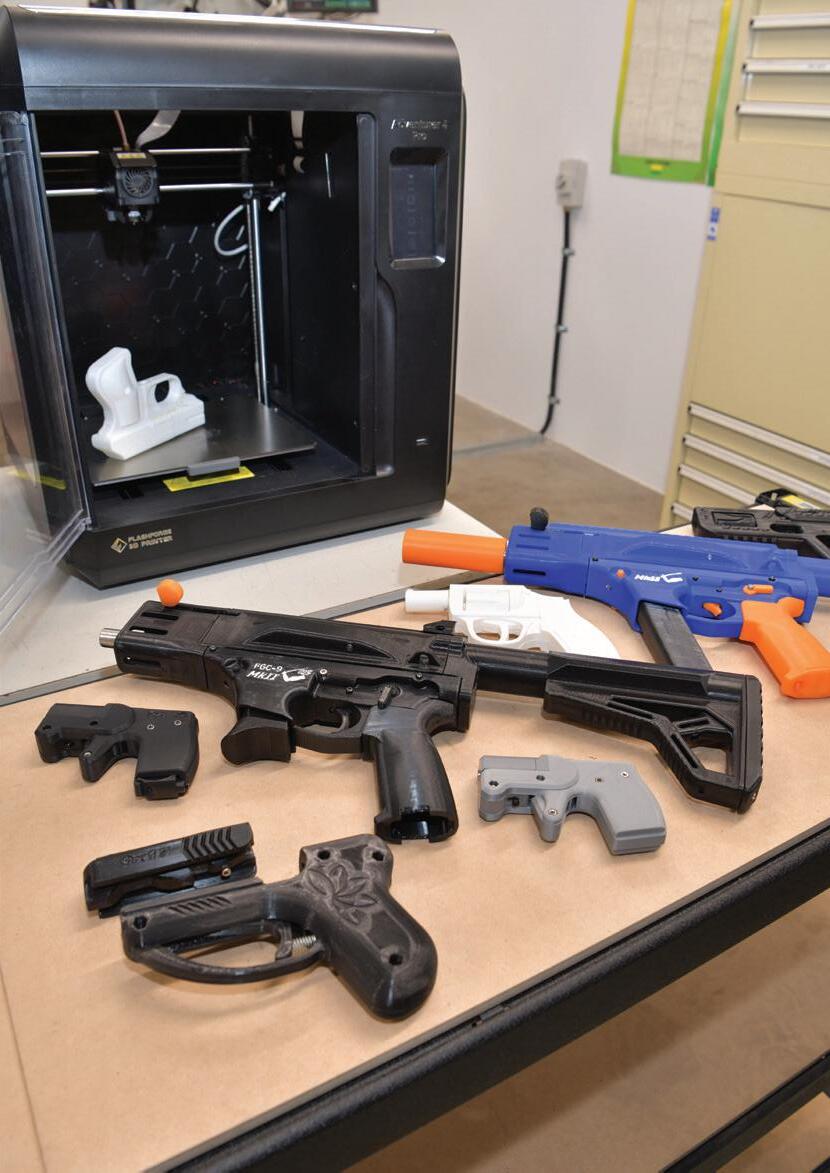
In recent years police jurisdictions across Australia have seen an increase in the number of 3D-printed firearms seized, along with the printers used to manufacture them.
A range of seized 3D-printed firearms in front of a 3D printer.
Photo: Andrew Challen.
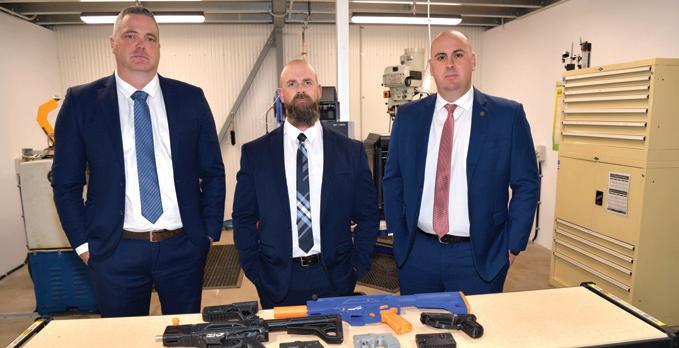
“We know there are firearm enthusiasts that are seeing what they can make on their 3D printer, however they need to understand that they’re not a hobbyist or a tinkerer,” Inspector Schollar said.
“Undertaking this dangerous activity makes them a criminal.”
In recent years police jurisdictions across Australia have seen an increase in the number of 3D-printed firearms seized, along with the printers used to manufacture them. Locally, SAPOL members have been involved in 31 incidents involving seizure of 76 3D-printed firearms and more than 145 firearm parts from May 2020 (when data was first collected) until August 2025.
It is predicted that homemade guns will soon overtake illicit weapon imports and become the most prevalent stream of firearms in Australia. The rising number of these weapons in the community elevates the risk to police officers’ safety.
“A 3D-printed firearm may not exhibit the same manufacturing marks or identifiers, making it harder for officers to determine whether a weapon is functional or safe,” Inspector Schollar said.
“Concerningly, a 3D
PMF can resemble a toy gun or another item, such as a smartphone, in an attempt to conceal its actual functionality.
“Firearms Branch is producing training materials to upskill the workforce in the current operational environment to improve frontline awareness and operational safety.”
TRIGGERING NEW LAWS
In 1996 Martin Bryant killed 35 people and wounded 23 others at Port Arthur. This tragedy saw the Australian Government undertake significant reforms to gun laws. The emergence of dangerous 3D-printed firearms now threatens to undermine Australia’s strict gun control laws.
Legislation across Australian jurisdictions is inconsistent, with no uniformity covering 3D-printed firearms and their digital blueprints.
“South Australia, along with New South Wales and Tasmania are the only jurisdictions to have progressed legislation regarding 3D firearm blueprints with any impetus,” Inspector Schollar said.
“The South Australian Parliament recently passed
the Firearms (Digital Blueprints for 3D Printing)
Amendment Bill 2024 which prohibits the possession of digital blueprints to manufacture 3D-printed firearms, parts, or sound moderators.
“This legislation, which will go live early next year, will see individuals found in possession of such blueprints face up to 15 years in prison.
“It is an important step in dealing with this new threat and evolving technology.”
Firearms Branch continues to work closely with state and Commonwealth partners in the National Illicit Firearms Working Group, formerly Operation Athena, to target the trafficking and use of illicit firearms in Australia. Late last year, Branch members attended the group’s threeday symposium in Melbourne to collaboratively share intelligence and address the challenges posed by 3D PMFs.
“Learnings taken from this event are pivotal for understanding the current operational environment and vital for developing and strengthening SAPOL’s response to the threat,” Inspector Schollar said.
“Proactivity is critical to address the threats posed by 3D-printed weapons in our community – the
implementation of effective controls will play a significant role to ensure public safety.”
The collaborative relationship with interstate colleagues is also seen in 3D PMF investigations, which are considered crimes without borders.
“States and territories are vulnerable to illicit 3D-printed firearms being smuggled across borders with increasing ease, exacerbating the existing challenges of combating organised crime and threats to community safety,” Inspector Schollar said.
“State and national law enforcement agencies are actively implementing new processes and procedures to prevent 3D PMFs from bypassing traditional security screening measures.
“The potential for PMFs to enter the hands of organised crime, terrorist or right-wing factions directly undermines public safety.
“We need to remain vigilant, while working collectively and contributing to stronger legislation to ensure we effectively deal with this emerging threat.”
Words: Mathew Rodda
Firearms Branch members, Senior Sergeant First Class
Dan Cahill, Brevet Sergeant Mark Jamieson and Detective
Inspector Nathan Schollar.
Photo: Andrew Challen.
A POSITIVE CONNECTION
Over the past decade
Senior Constable First Class (SC1C) Glen Robbins has become an intrinsic part of the Port Augusta community, earning the trust and respect of locals and making a positive impact.
SC1C Robbins’ strong commitment and engaging approach within the Far North Region was recognised earlier this year with a Premier’s Excellence Award, with the popular officer a well-deserved winner in the individual category for ‘Connecting Communities’.
The community stalwart was humbled by the honour.
“I was surprised to be nominated and even more surprised to win. There were some fantastic candidates for the award, so to win it feels quite special,” SC1C Robbins said.
“I think the award is a great endorsement of the work I do, but also a reflection on the people who have come before me and who have supported my journey.”
As a member of Port Augusta’s bicycle patrol, SC1C Robbins plays a key role in managing antisocial behaviour and ensuring public safety. His culturally sensitive approach fosters trust with Indigenous communities and supports vulnerable individuals.
“I’ve been in Port Augusta for 10 years now and being
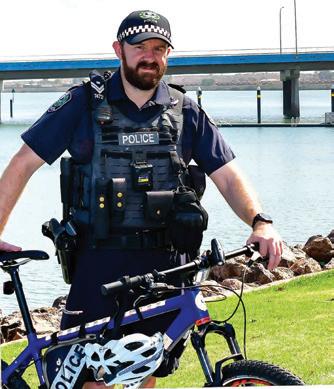
part of the community is a big thing for people. There can be a high turnover, so being consistently there for the community has been great,” he said.
“I enjoy supporting those in need in the community who may come down from other areas of the state and require that extra support.”
SC1C Robbins believes it’s vital to have a positive relationship with vulnerable people in the local community.
“We encounter vulnerable people on a daily basis, so we need to have an element of trust with them so that they’re actually willing to engage and seek the help they need,” he said.
“My extensive period in Port Augusta has definitely helped in building respect with people, particularly local Indigenous communities.”
During his time in Port Augusta, SC1C Robbins has mainly worked in a general duties capacity responding to taskings. He has previously been attached to tactical teams within Port Augusta and helped relieve in neighbouring towns such as Coober Pedy, Amata and Mimili.
“I enjoy being on the road and being an extra resource for patrols in Port Augusta to utilise,” SC1C Robbins said.
“Working in the Far North Region is great, as you can be a major part of the community and build meaningful connections.
“When you have a win, you can see the results and see how you’ve actually managed to help some people.”
The award-winning officer is now relishing his time in bicycle patrols, having spent
the bulk of his shifts on two wheels over the past couple of years.
“I love the role because it’s very responsive and allows me to engage with community members on a much more personal level,” SC1C Robbins said.
“I’m out in the community daily and don’t have the barrier of a car window to hinder that kind of contact.
“It can also be demanding as my role predominantly relates to antisocial behaviour and people exhibiting challenging behaviours, particularly with substance addictions. Being on a bike can make you a bit vulnerable compared to being in a car but it does make me more approachable.”
Outside of his community policing role, SC1C Robbins is a ‘run leader’ for the Indigenous Marathon Foundation runners and walkers group in Port Augusta. This involves two sessions a week helping to coach and mentor people in getting active. He also plays a significant role in organising a charity football match every year in honour of the late Community Constable Bradley Amos, a colleague he proudly worked alongside for six years.
“The event initially started as a fundraiser for a local football player who had suffered a significant neck injury during a game,” SC1C Robbins said.
“Bradley played in that first game. His passing was a huge loss to our community, so holding a football match in his honour seemed like the right thing to do.”
The annual charity match sees the South Augusta All
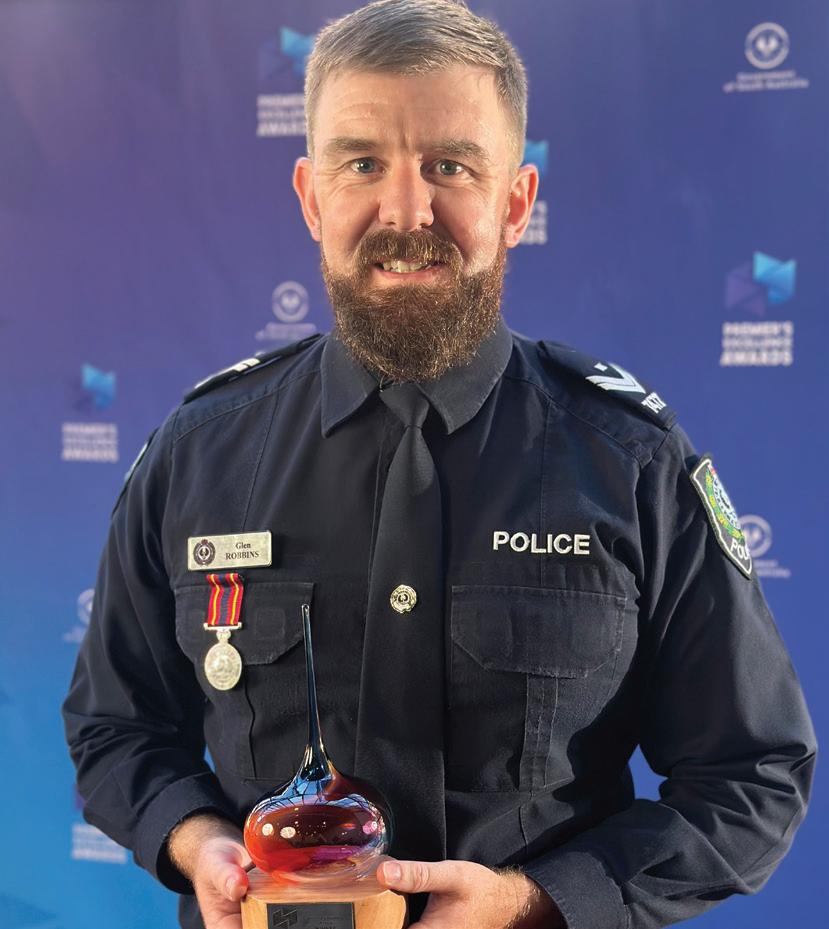
Stars compete against an emergency services team for the coveted Bradley Amos Shield.
“It takes a bit of work to organise the event and attract players, but it’s been a huge success, and we’ve raised significant funds for the Heart
Foundation and the National Breast Cancer Foundation, two charities that were important to Bradley and his family.”
While the Premier’s Excellence Award is fitting acknowledgement of a job well done, SC1C Robbins is
reluctant to take all the credit as he continues to deliver positive outcomes for the local community.
“I’m not doing what I do for the recognition, but it is nice to be recognised,” he said.
“It reflects well on the Far North Region, and as much
as this is an individual award, it is a testament to the people who have helped me become the police officer that I am.”
Words: Mathew Rodda
OPPOSITE PAGE: The award winner on bicycle patrol in Port Augusta.
Photo: Andrew Challen.
Senior Constable First Class Glen Robbins with his prestigious Premier’s Excellence Award.
Photo: Ali Martin.
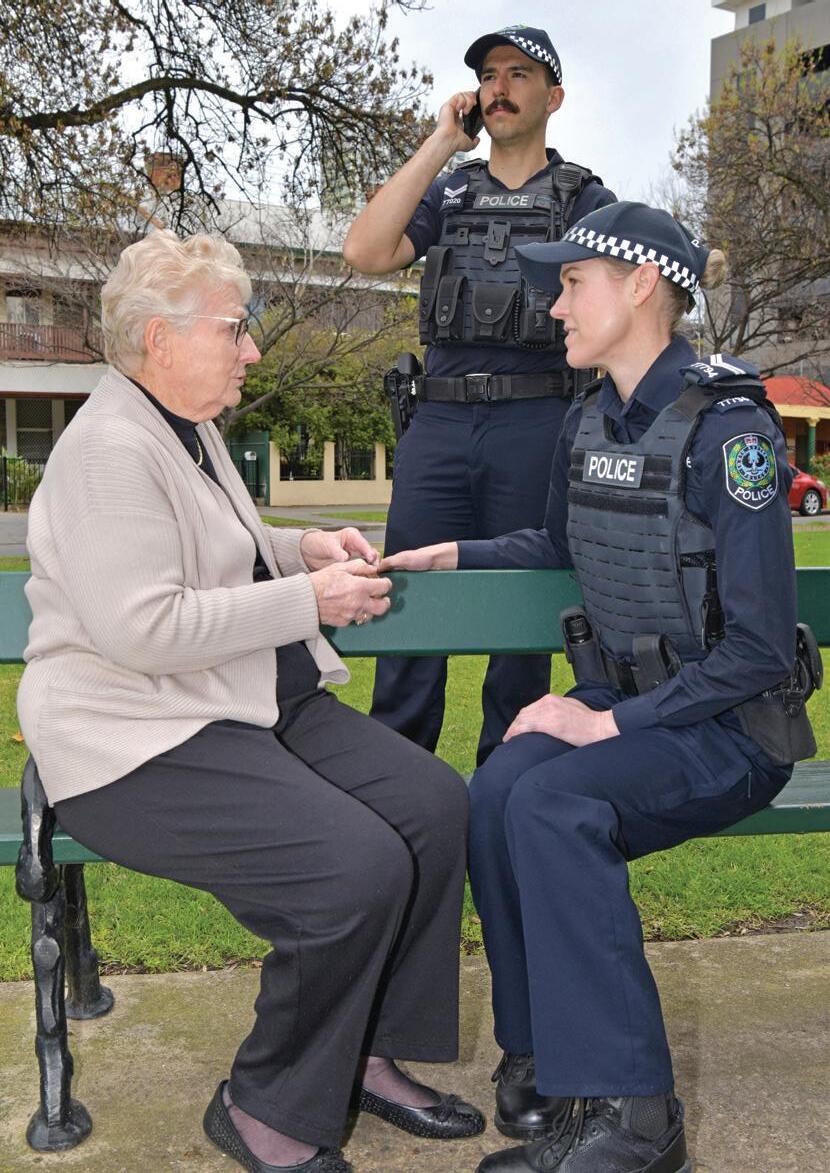
IN SAFE HANDS
In South Australia there are an estimated 35 000 people living with dementia, a condition that adversely affects one’s mood, memory, thinking and behaviour. With two in three people with dementia believed to be living in the community, it presents a challenge to police in providing the appropriate response and support.
Aninnovative new approach is now making a positive difference. South Australia Police (SAPOL) has partnered with Dementia Support Australia (DSA) to create a police-only 24-hour helpline to better support people living with dementia.
The emergency services priority helpline provides fasttracked assistance to police when dealing with community members exhibiting high-risk behaviour, who may seem lost or disorientated.
Mental Health Operations Support Unit Supervisor, Sergeant Peter Benn, welcomes this new initiative.
“If the person is a DSA client, SAPOL and DSA will work together to ensure they can return them to their homes and loved ones,” he said.
“Helpline staff may also provide advice on behaviour management and effective ways to engage with a person who appears to have dementia.”
Since activation in February this year, more than 20 calls have been made to the helpline, with the number expected to grow as police become aware of the new helpline.
“Police are well-trained to respond to mental health incidents, however, in cases where the individual has dementia, this may require a change in focus and response,” Sergeant Benn said.
“This new helpline will expedite a response and provide accelerated access to information for police, which will aid them in returning people with dementia home safely.”
Emergency services priority helpline cards have been distributed to police in metropolitan and regional areas. A mandatory SAPOL online training course has also been produced for police, introducing the new helpline and outlining steps for recognising and responding to people living with dementia.
Acting Assistant Commissioner, Metropolitan
Operations Service, John De Candia believes the training package better equips officers to deal with challenging situations.
“This has certainly assisted officers to understand the differences between someone experiencing a mental health episode and someone exhibiting signs of dementia, such as confusion and disorientation,” he said.
“By having the training package and the dedicated helpline number, we can provide a better service to the community, and more importantly to those people living with dementia.
“Each call to the helpline represents a situation where we may not have taken that person to an emergency department or called the ambulance service, and instead safely resolved the situation.”
DSA, funded by the Australian Government, provides services to improve quality of life of people living with dementia, including where they are experiencing Behaviours and Psychological Symptoms of Dementia (BPSD).
BPSD refers to a range of non-cognitive symptoms that people living with dementia may experience including aggression, delusions,
agitation, depression, vocalisations, disinhibition and night-time behavioural disturbances.
DSA spokeswoman Marie Alford said the rising incidence of dementia is having an impact on carers, their families, the health system and residential aged care homes.
“I congratulate SAPOL for being the first law enforcement jurisdiction to implement the helpline and training and recognise the need for its frontline officers to be equipped to respond to situations where people living with dementia are experiencing BPSD,” she said.
“People living with dementia-experiencing behaviours can come to the attention of police and it’s important these situations are managed without unnecessary escalation.”
Berri-based Probationary Constable Melanie Erlandsen recently contacted the helpline to access support for a stage four dementia patient who had just moved to the Riverland to live with her son.
“The elderly female patient had attended the Berri Police Station on multiple occasions asking for assistance due to her and her son struggling to cope with her diagnosis and lucidity,” Probationary
Constable Erlandsen said.
“The female had limited assistance in place for her and due to this, tensions were escalating at home.
“DSA were very helpful and were a great knowledge base.”
DSA set up a profile for the female to report all ongoing interactions with her and her son, including future police interactions.
“They provided me with information packages to pass on to the son, to assist with appropriately managing his mother’s symptoms,” Probationary Constable Erlandsen said.
“DSA is now waiting for the son to provide the necessary consents so that his mother can receive suitable support services.”
While the emergency services priority helpline number is not being publicly advertised, members of the public may call the alternative Dementia Australia
Support 24-hour helpline on 1800 699 799.
For more information about dementia and resources, visit: www.dementia.com.au
Words: Mathew Rodda
Senior Constable First Class Liam Bennett and Senior Constable Kate Walker using the helpline to assist community members. Photos: Andrew Challen.
Moments in Time
A SHINING STAR
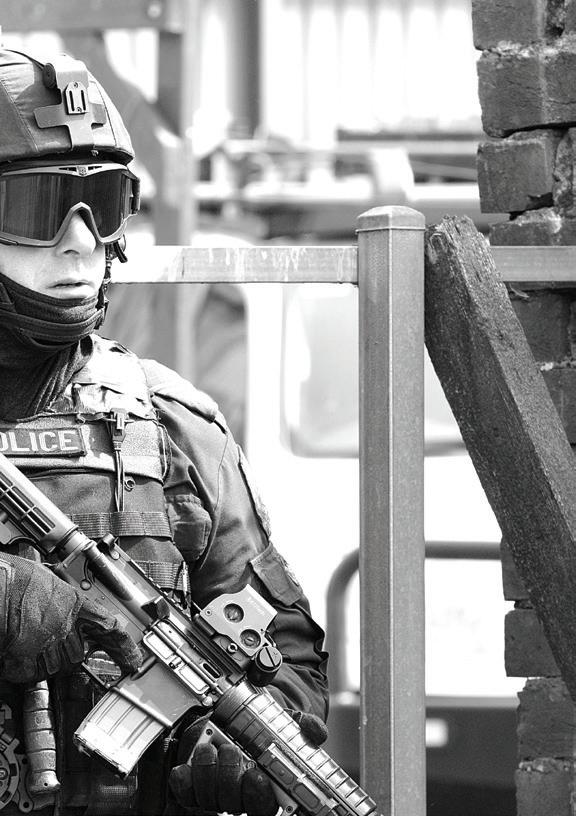

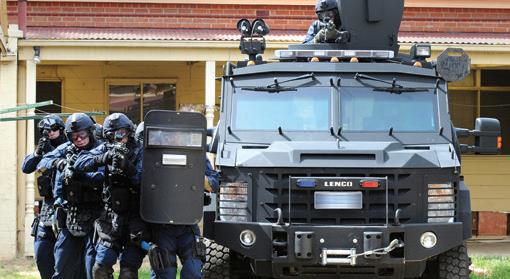
South Australia Police’s Special Tasks and Rescue (STAR) Operations was forged in the aftermath of one of Australia’s earliest domestic terror incidents.
In February 1978, a bomb hidden in a rubbish bin outside the Hilton Hotel in Sydney tragically killed two garbage collectors and a police officer during a Heads of Government meeting.
The attack shocked the nation and highlighted the urgent need for a specialist response capability. Later that year, on 30 November 1978, SAPOL officially formed STAR Force –bringing together the Armed Offenders Apprehension Group, the original Task Force and other emergency units.
From its inception, STAR Operations was tasked with responding to the most dangerous and unpredictable situations: sieges, hostage scenarios, armed offenders and counter-terrorism threats.
Over time, its role expanded to encompass high-risk policing, search and rescue, dignitary protection and civil disorder response. STAR Operations quickly developed a reputation for professionalism and readiness, becoming the unit of choice whenever South Australians faced critical incidents. Technological advances have reshaped STAR Operations’ methods. Equipment such as night vision, thermal imaging, ballistic protection and remotely piloted drones have enhanced safety and effectiveness. These
innovations allow the elite team to manage both highrisk and low-risk takings, balancing tactical precision with community protection.
Today, STAR Operations personnel are trained across a broad spectrum of skills, from explosive breaching and sniper operations to field search, control and rescue coordination.
The statistics speak for themselves. In the past financial year alone, STAR Operations handled 65 high-risk tasks, 1527 land and marine search and rescue operations, 452 low-risk patrol assistance requests and 307 dignitary protection duties. The demand for its expertise reflects STAR Operations’ enduring role as a cornerstone of public safety in South Australia.
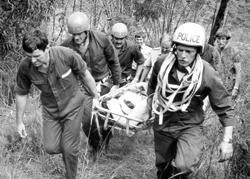
Despite evolving challenges, the unit’s mission remains constant: to reduce the incidence and fear of crime by safely resolving high-risk and specialist situations. STAR Operations continues to embody its guiding vision – delivering professional, highly trained, and rapid responses that protect lives and support frontline police.
Words: Sonja Viduka





RIGHT (clockwise): STAR Operations members with the Bearcat vehicle in 2014; conducting a training exercise in 2010; rescuing an injured bushwalker in 1980; responding to an incident in 2009.
Photos: SAPOL and South Australian Police Historical Society.