Project Assessment Report on NDC Alignment in Saint Lucia 2024
Produced by: Department of Sustainable Development - Ministry of Education, Sustainable Development, Innovation, Science, Technology and Vocational Training
Acronyms
ACE ActionforClimateEmpowerment
CA ClimateAnalytics
CAEP ClimateActionEnhancementPackage
CCAP ClimateChangeAdaptationPolicy
DSD DepartmentofSustainableDevelopment
EnGenDER EnablingGender-ResponsiveDisasterRecovery,ClimateandEnvironmental ResilienceintheCaribbean
GCF GreenClimateFund
GEF GlobalEnvironmentFacility
GGGI GlobalGreenGrowthInstitute
GHG GreenhouseGas
GOSL GovernmentofSaintLucia
IPCC IntergovernmentalPanelonClimateChange
MRV Monitoring,ReportingandVerification
MTDS MediumTermDevelopmentStrategy
NAP NationalAdaptationPlan
NCCC NationalClimateChangeCommittee
NDA NationalDesignatedAuthority
NDC NationallyDeterminedContribution
NDCP NDCPartnership
NDCPP NationalDeterminedContributionPartnershipPlan
OECS OrganisationofEasternCaribbeanStates
PA ParisAgreement
SASAP SectoralAdaptationStrategyandActionPlan
SDGs SustainableDevelopmentGoals
SIDAR SmallIslandDevelopingStatesCapacityandResilienceProject
SIDS SmallIslandDevelopingState
UNFCCC UnitedNationsFrameworkConventiononClimateChange
WRI WorldResourcesInstitute
ExecutiveSummary
Saint Lucia is a member of the NDC Partnership, an international non-governmental organization committed to enhancing action on climate. Through the Partnership, Saint Lucia developed its NDC Partnership Plan (NDC PP) in 2018, which was then approved by the Cabinet of Ministers in 2019. The NDCPP provides a snapshot of ongoing national projects that seek to achieve the implementation of the Saint Lucia’s Updated Nationally Determined Contribution (NDC), submitted to the United Nations Framework Convention on Climate Change (UNFCCC) in 2021.
A total of sixty-four (64) projects have been entered into the Partnership Plan and are being monitored by the Department of Sustainable Development. These projects are arranged according to four (4) outcomes, as derived from the NDCPP.
Firstly, the report briefly explored of the elements of the Updated NDC: mitigation, adaptation and loss and damage to set the foundation for how the projects were assessed throughout the report. Secondly, the policy landscape was described to provide context to implementation of these projects. While the policies were described, the discussions were general with regard to mitigation and adaptation and how they are supported in Saint Lucia. Project alignment was not done to the policies as the NDCPP is project- and output- specific, with no tracking of policy implementation.
Finally, a mapping exercise was done for the twenty-eight (28) mitigation focused projects, thirtyone (31) adaptation focused projects and five (5) cross-sectoral projects. This mapping showed general alignment of the commitments of the Updated NDC to the projects, inclusive of alignment with gender equality and youth inclusion. This alignment process allowed for the identification of gaps in project implementation for all projects
Finally,thereportwrappedupwithafewhigh-levelrecommendationstoenhanceproject implementationandbetteralignprojectstothemainelementsoftheUpdatedNDC.
IntroductionandBackground
This paper provides an initial analysis of major projects being implemented by the GovernmentofSaintLucia(GOSL)andtheiralignmentwiththecommitmentsoftheUpdated NationalDeterminedContribution(NDC)1 completedin2020andsubmittedtotheUnited NationsFrameworkConventiononClimateChange(UNFCCC)inJanuary2021.TheUNFCCC, adoptedin1992andineffectsince1994,wasestablishedasaguideforcountriestoacton climatechange.Theover-archingobjectiveoftheUNFCCCistopreventdangeroushumanmadeinterferenceontheclimatesystembystabilizinggreenhousegas(GHG)concentrations intheatmosphereinatimethatallowsforecosystemstoadaptanddevelopmenttooccur sustainably. Saint Lucia, along with 197 other countries, have signed on to the UNFCCC, committingtoimplementactionsthatreducetheirGHGs.
Signatories to the Convention meet yearly to review progress and adopt subsequent decisionstofurtherguideaction,followingthelatestavailablescience.Themostrecentand consequentialdecisionoftheUNFCCCoccurredatits21stmeeting–theadoptionoftheParis Agreement(PA).
ThePAisalegallybindingagreementonthe196countriesthatarePartytoitanditsmain aimistostrengthentheglobalresponsetothethreatofclimatechangebykeepingaglobal temperaturerisethiscenturywellbelow2degreesCelsiusabovepre-industriallevelsand topursueeffortstolimitthetemperatureincreaseevenfurtherto1.5degreesCelsius.
Each Party to the agreement presents its commitment to the cause, outlining proposed climateactionsintheirNDC. NDCsarecountries'self-definednationalclimatepledgesunder thePAthatoutlineeffortsbyeachcountrytoreducegreenhousegasemissionsandadaptto theimpactsofclimatechange. AccordingtoArticle4,paragraph2ofthePA,eachPartyis required to prepare, maintain and communicate their post-2020 climate actions (NDCs) everyfiveyearstotheUNFCCCsecretariat
SaintLuciasubmitteditsIntendedNDCtoUNFCCCinNovember2015.InSeptember2019, Saint Lucia requested support from the NDC Partnership (NDCP) under its ClimateAction EnhancementPackage(CAEP)todevelopitsupdatedNationallyDeterminedContribution. This support was provided by the Organization of Eastern Caribbean States (OECS), the
1 Updated Nationally Determined Contribution
World Resources Institute (WRI), Climate Analytics (CA), and the Global Green Growth Institute(GGGI)andallowedforthearticulationofupdatedcommitmentsthroughamultistakeholder consultative process. The final document was approved by the Cabinet of Ministers in 2021 and submitted to the UNFCCC on January 27, 2021. This updated submissionreflectedanincreaseinambitioninmitigation,adaptationandlossanddamage components.
AlthoughaSmallIslandDevelopingState(SIDS),SaintLuciahasadvancedactionsinseveral sectorstomeetitsclimategoals.Theseactionsincludeprojects,policydevelopment,passage oflegislationandregionalandinternationalcooperationonfinancing.Oneexampleofaction in 2016, wastheapplication ofmembership intotheNDCP. TheNDCPwasestablishedto facilitatecollaborationbetweencountrygovernments,internationalinstitutions,non-state actors,andotherpartnerstoprovidetimelysupportforacceleratedclimateaction.
ThroughsupportfromtheNDCP,SaintLuciadevelopedanNDCPartnershipPlan(NDCPP). This plan complements the current Monitoring, Reporting and Verification (MRV) system, aids in the mobilization of climate finance, and provides a singular location for tracking progressonNDCaction.Theprojectsbeinganalyzedinthisreportarethoseprojectsentered intheNDCPPofSaintLucia.
DescriptionofUpdatedNDCanditsTargets
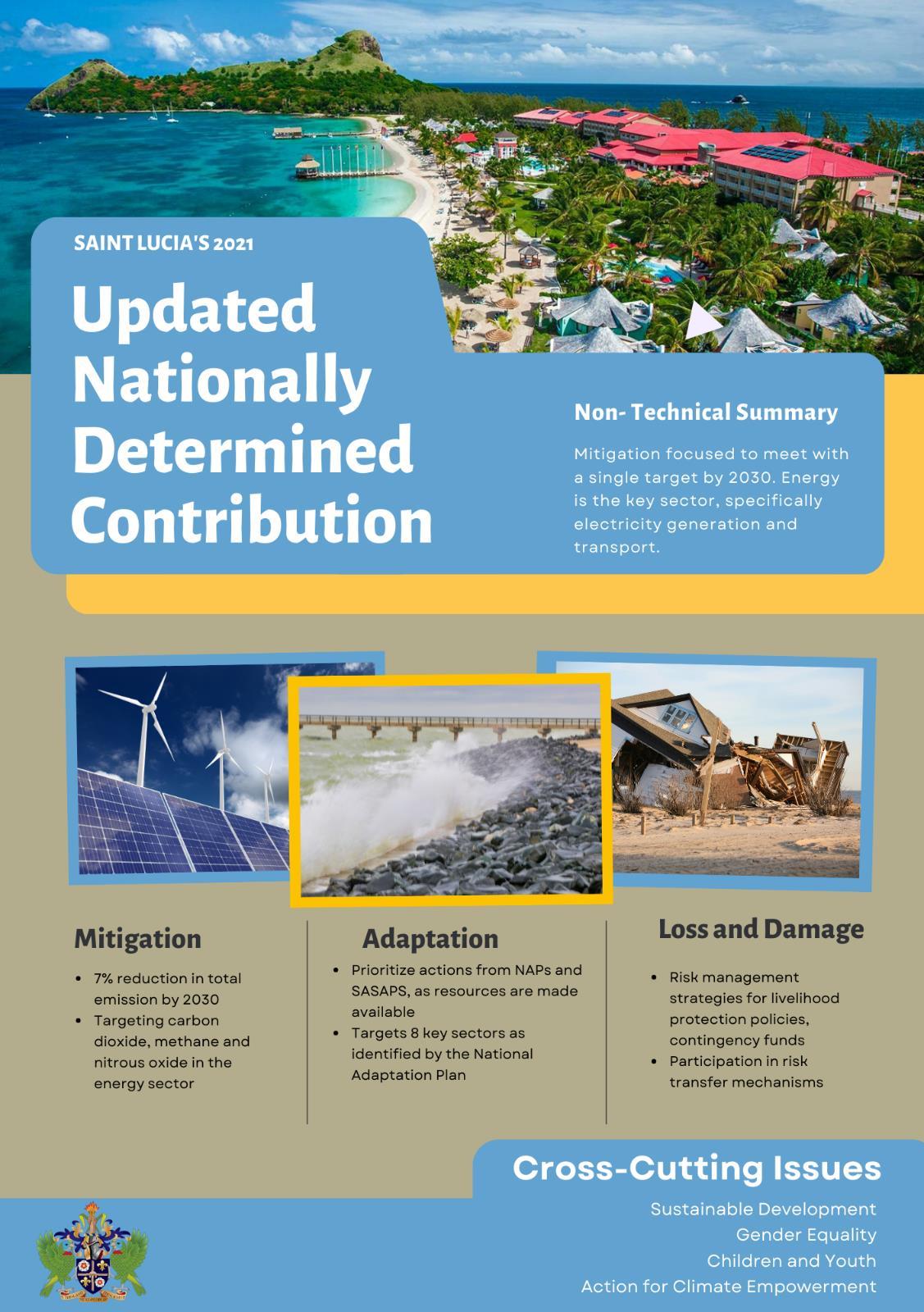
Saint Lucia’s Updated NDC provides a range of ambitious actions to contribute to the reduction of global greenhouse gas emissions, while adapting to the impacts of climate change,withprovisionsforlossanddamage.TheUpdatedNDChasthreemainfocusareas: 1) Mitigation; 2) Adaptation; and 3) Loss and Damage. These areas are further complementedbyfourcrosscuttingelements:1)ActiononClimateEmpowerment(ACE);2) ChildrenandYouth;3)GenderEquality;and4)SustainableDevelopment
AllcommitmentswithintheUpdatedNDCareconditionalonthereceiptoffinancialsupport, especiallyasthecountryisaSIDSandisdisproportionatelyaffectedbyexternalshocksand vulnerable to the adverse impacts of climatic events, as stated in the PA Preamble; “Recognize the specific needs and special circumstances of developing country Parties, especially those that are particularly vulnerable to the adverse effects of climate change, as providedforintheConvention”
TheupdatedNDChasonetarget,asspecifiedwithinthemitigationfocusarea.Thistarget, alongwithallothercommitmentsisacontinuationandexpansionofeffortslistedinthefirst NDCtomeetthetargetsfor2025and2030.
ThespecificcommitmentswithinthevariousfocusareasoftheupdatedNDCarepresented below:
Mitigation
All actions under this section are focused on reducing emissions of three (3) greenhouse gases:CarbonDioxide,Methane,andNitrousOxide.Thetargetofallmitigationactionisto reduce 37 GgCO2e of greenhouse gas emissions by 2030, as compared to 2010 emission levels. This translates into a 7% reduction in total emissions when compared to the 2010 levelsanda20GgCO2eincreasefromthe2015commitmentof17GgCO2e.
ThetargetexpressedintheNDCissector-wideandcoversactionintheenergysectoronly. InthecaseoftheUpdatedNDC,theenergysector,ascoveredbytheIntergovernmentalPanel onClimateChange(IPCC)referstoelectricitygenerationandtransportation.
Adaptation
The adaptation commitments of the NDC are enshrined in the National Adaptation Plan (NAP) process and further supported by the various Sectoral Adaptation Strategies and
Action Plans (SASAPs). The NDC committed to prioritizing cross-sectoral and sectoral adaptationmeasuresforeightkeysectorsanda‘limitstoadaptation’thematicarea,based onavailablefunding.Theeightkeysectorsdeemedmostvulnerabletoclimateimpactsby stakeholdersinclude1)Agriculture;2)Education;3)Fisheries;4)Health;5)Infrastructure and Spatial Planning; 6) Resilient Ecosystems (previously referred to as natural resource management; 7) Tourism; and 8) Water, all identified through the iterative assessment of sectoralandcross-sectoraladaptationneeds.
At the time of publishing the Updated NDC, SASAPs were created for the Resilient Ecosystems, Agriculture, Fisheries, and Water sectors. The updated NDC articulated a commitment to further identify key sectors and track progress on actions and projects as guidedbyaMonitoringandEvaluationPlan,basedonavailablefunding.
While this focus area does not contain specific targets for measuring progress, the NAP process has a monitoring and evaluation strategy that supported a progress report on progressinachievingthevariousoutcomesoftheNAPanditsrespectiveSASAPs.
Loss
andDamage
Saint Lucia recognizes that every sector is at risk of experiencing loss and damage, and internationalsupportisrequiredtoaddresstheserisks.TheupdatedNDC,consistentwith the limits to adaptation Chapter 15 of the NAP, reiterates several comprehensive risk managementstrategiesthatwouldrequirefundingtoavert,minimizeandaddresslossand damage associated with the adverse effects of climate change. These strategies include livelihood protection policies that would help individuals recover from damages after extreme weather events, the development of contingency funds for climate impacts, and supportandprotectionforindividualswhoaredisplacedinternally,acrossborders,andin hostcommunities.
Participationinrisktransfermechanisms,suchastheCaribbeanCatastropheRiskInsurance Facility–SegregatedPortfolioFacility,isalsoapriorityinthisupdatedNDCtoensurethe countrycanrespondtolossesanddamagescausedbyclimatechange.
Cross-CuttingAreas
1) ActionforClimateEmpowerment(ACE)
The updated NDC contains the ACE commitment across all focus areas in the NDC to empower all members of society to be engaged and to engage in climate action through climatechangeeducationandpublicawareness,training,publicparticipation,publicaccess toinformationandinternationalcooperation.Focuswillbeplacedonthemostvulnerable groups,includingchildren,youth,theelderlyandpeoplelivingwithdisabilities.
2) ChildrenandYouth
The updated NDC commits to ensuring the involvement of children and youth, including thosewithdisabilities,inthedecision-makingprocessonclimatechangeissues,atboththe nationalandinternationallevels.Othercommitmentsincludeincreasingaccesstoadequate resilient educational infrastructure, through a 20% reduction in energy consumption, throughrenewableenergy,and16%reductionofGHGemissionsthroughenergyefficiency measures.
3)
GenderEquality
Saint Lucia will continue to mainstream gender equality in national climate change considerations and national strategic planning and programming across government actions. The Enabling Gender-Responsive Disaster Recovery, Climate and Environmental Resilience in the Caribbean (EnGenDER) Project will be the starting point for greater integration of gender in climate change. One specific commitment is the sectoral gender assessmentsofselected sectorsanddevelopingguidelinesforthedevelopmentofgenderresponsiveSASAPs.
4)
SustainableDevelopment
As adaptation actions are implemented, Saint Lucia has committed to link development outcomes with the 2030 Agenda for Sustainable Development, with an emphasisonthose outcomesthatfocusonresiliencybuildingamongvulnerablegroups2.Thesocialco-benefits of mitigation will also be explored through a holistic and multi-sectoral approach to lowcarbon development and climate resilience, which encompasses education, health, food security,waterandsanitation,housingandsocialprotection,inlinewiththethenMedium-
2 SDG Goals: 12, 13, 14 and 15 aligned to Strategic Pillar 2 of the MTDS 2020-2023: Adaptation for Environmental Sustainability, climate change and disaster vulnerability reduction and SDG 7, aligned to Strategic Pillar 5 of the MTDS 2020-2023: Infrastructure, connectivity and energy – key for growth and competitiveness.
Term Development Strategy (MTDS) 2020-2023 – a strategy that seeks to accentuate the interconnected nature of development planning by ensuring economic, social and environmental considerations are incorporated and mainstreamed into Saint Lucia’s nationalplanningframework
PolicyOverview
National-levelpolicyguidancealignedtotheclimatecommitmentsofSaintLuciahasbeen articulatedfortheAdaptationandMitigationsectionsoftheNDC.Thesepoliciesaredrafted bytherespectiveleadsectoragencies,withinputfromvariousmulti-stakeholdergroupings, beforebeingsubmittedtotheCabinetofMinistersforapproval.Ideally,thesepolicieswould then be translated into strategic action plans, complete with monitoring and evaluation frameworks,alongwithaplanformobilizingfinance.
AsimplereviewofthepolicylandscapethataidstheachievementofNDCCommitmentshas shownamoreextensiveproductionandelaborationofadaptationprioritiesandactions,as opposedtomitigationprioritiesandactions.Thisfocusonadaptationiswellplacedwhen examinedunderthelensoftotalemissionsversustheinherentvulnerabilityoftheislandto the adverse impacts of climate change. This, however, does not limit the ambition of mitigationactionofSaintLucia,astheislandrecognizesitsroleintheglobalfighttoaddress climatechange.Whilethepolicylandscapeiscurrentlymoreskewedtoadaptationefforts, it must be noted that the NDC of Saint Lucia is mitigation-focused, with several pieces of mitigationlegislationandpolicydocumentsunderreviewanddevelopment.
AdaptationPolicyOverview
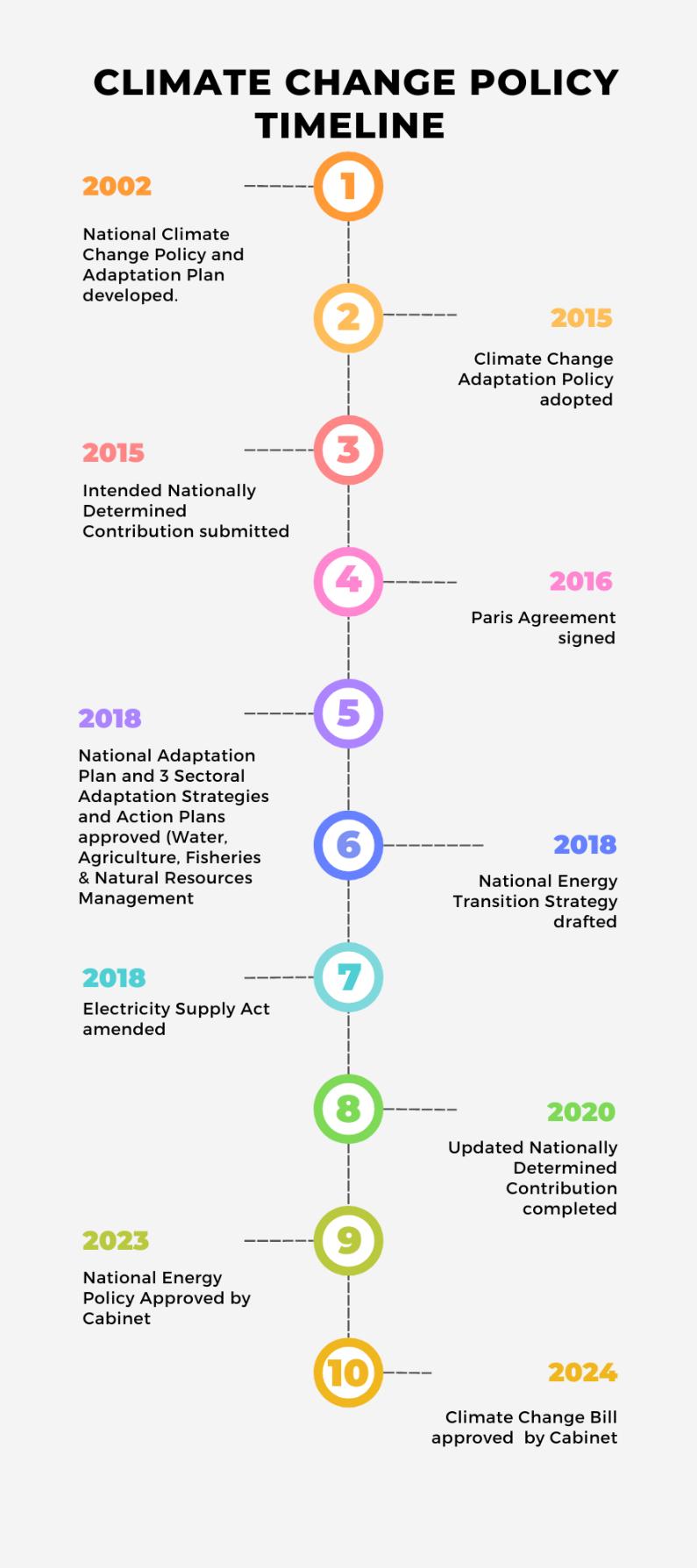
In 2002, Saint Lucia developed a National Climate Change Policy and Adaptation Plan (NCCPAP)toprovidenationalguidancetoaddresstheshort,mediumandlong-termeffects ofclimatechange.Thispolicywasthefirstofitskindintheregionandshowedtheleadership of the island in addressing climate change. The NCCPAP was revised in 2011 and was transformedandapprovedin2015astheClimateChangeAdaptationPolicy(CCAP),asitis referredtotoday.
ThetransitionofNCCPAPtoCCAPrecognizedthebenefitsofamulti-stakeholderapproach torespondingtoclimatechange.ItalsobuiltontheprinciplesandelementsoftheNCCPAP, including a cross-sectoral approach to adaptation. The CCAP is used as a framework for addressingadaptationacrossallsectorsthroughtheinterconnectedprocessesoffacilitation, financingandimplementation.TheimplementationofadaptationprojectsinSaintLuciais thereforewellinformedbytheseprinciples,and,inpractice,hasseenmultipleengagements acrossgovernment,civilsocietyandprivatesectortoachievethecommitmentsoftheNDC.
In2017,aftertheapprovaloftheCCAPin2015,SaintLuciabeganthedevelopmentofaNAP. The NAP is recognized as a 10-year process to address climate change-related risks and developmentprioritiesin an integrated and coordinated manner3. The NAP outlines eight (8)prioritysectorsforaction.ActionswithinthesesectorshavebeenreferencedintheNDC asclimatecommitments,basedontheavailabilityofmobilizedfunds.Theeight(8)priority sectors–water,fisheries,agriculture,health,resilientecosystem,(terrestrialandmarine)4 , tourism, educationandinfrastructureand spatialplanning, entailatotalofthree-hundred and nine (309) adaptation measures that were developed through a consultative process involvinggovernment,privatesectorandcivilsocietystakeholdersfromarangeofsectors. Whenimplemented,themeasureswillleadtotheimplementationofclimateadaptationand risk reduction actions critical to safeguarding Saint Lucia’s socioeconomic and environmental systems, while enhancing the enabling environment for climate-related adaptationandriskreductionacrossdevelopmentsectors.
Four (4) of the eight (8) sectors are further complemented with Sectoral Adaptation Strategies and Action Plans (SASAPs) that further elaborate on the measures in the NAP whileprovidinganinitialsetofconceptnotesforpotentialprojectactionsinthesectors.The conceptnotesincludedrepresentaninitialsetofprojectsasthedevelopmentoftheconcept notesisusuallycompletedbasedon theavailabilityofinternalresources,suchasrelevant staff,andassuchdonotinherentlynecessarilyrepresentthetopprioritiesforfundingwithin theNAP
Complementary to the NAP, and supporting its implementation, are the Communications Strategy, Monitoring and Evaluation plan, Private Sector Engagement Strategy, Climate FinancingStrategyandaClimateChangeResearchPolicyandStrategy.TheCCAP,NAPand SASAPs, together with the complementary instruments, provide a conducive environment foradaptationactioninSaintLucia. Whilethisreportdoesnotofferacomprehensivereview ofnationalprojectswithfurtheralignmenttothesekeypolicyinstruments,thissectionhas beenincludedtoprovideanoverviewofthesupportingpolicythatguidesadaptationaction,
3 NAP 2018 – 2028, Foreword.
4 Formerly called Natural Resources
ensuringalllevelsofsocietyareinvolvedinclimateaction,akeycommitmentintheUpdated NDCofSaintLucia.
MitigationPolicyOverview
TheUpdatedNDCprovidestwosectorsformitigation–electricitygenerationandtransport. While two different sectors, mitigation action is guided by the National Energy Transition Strategy (NETS) and the National Energy Policy (2023-2030) as the overarching policy instruments. The other key mitigation policy documents include 1) the draft Integrated ResourceandResiliencyPlan(IIRP),and2)theElectricitySupplyAct. InOctober2023,the Cabinet of Ministers approved the 2023-2030 National Energy Policy (NEP). The overall visionofthePolicyisamodern,sustainableenergysectorfocusedonenergysecurity,cost minimization,andlocalenfranchisement.TheNEPhassevengoals:
1. Ensure a secure, reliable, affordable, transparent, greener, and resilient electricity sector;
2. Decarbonizethermalapplications;
3. Makereductioninenergyintensityakeydriverofdecarbonization;
4. Decarbonizethetransportsector;
5. Ensureasafe,reliableandaffordablesupplyofpetroleumproductsandtheirefficient andenvironmentallysafestorage,handling,anduse;
6. Ensurethathuman,technicalandinstitutionalcapacitiesarealignedwiththeneeds oftheenergy sectorand policyobjectives, byintegratingsocialand genderaspects intoenergysectordevelopment;and,
7. Facilitateaccesstofinancingforrenewableenergyandenergyefficiency.
8. To guide the achievement of the NEP, an accompanying action plan has also been prepared.Thisplanoutlinesthegovernanceframework,amonitoringandevaluation plan,andariskanalysisfortheNEP.
TheNETSsupportsthesegoalsbyoutliningtheprocessforachievinganenergytransition, alongwithapotentialenergymixtomeetnationalenergyneeds.TheElectricitySupplyAct wasamendedin2016toallowfortheproductionofelectricityfromrenewablesourcesand iscurrentlybeingrevisedtoprovideforthegenerationofelectricityfromrenewableenergy sourcesbyIndependentPowerProviders(IPP).Recentupdatesallowedforthegeneration ofenergyfromsolarpanelsupto5kWHforresidentialuseand25kWHforcommercialuses.
TheinitialdraftIntegratedResourcePlan (IRP), complementary to the National EnergyPolicyof2010, examined arange of scenarios for energy mixes to provide options with the best financial implications for implementation in Saint Lucia. This is also being updated to respond to changes in national priorities and climate change commitments. Collectively, these documents highlight theprocess,framework,optionsandlegal mandate to generate electricity from renewable energy sources, as the island strives to reduce the reliance on fossil fuels, with a resulting decrease in GHG emissions.
NDCProjectAlignment
Thissectionofthereportwillprovideageneralanalysisonthealignmentofnationalprojects tothethreeFocusAreasoftheupdatedNDC(mitigation,adaptationandlossanddamage). The projects have been disaggregated by sector and NDC Focus Area, while showing correlationtogenderequalityandinclusionofchildrenandyouth.
Table 1 belowshowstheframeworkusedtocompletethisalignment. Eachfocusareaofthe NDC has been disaggregated by commitment type to show specifically where the projects aremostalignedandthoseareaswhereworkisbeingdoneacrossthecountry.
NDC Focus Area Commitment Scope Initiative Name Additional Scope Gender Equality Children and Youth
Mitigation ReduceGHG emissionsinthe energysectorby 7%,relativeto 2010levels Energy Efficiency Electricity Generation Efficient Transportation
Adaptation5 Reduce Vulnerability Vulnerability Reduction Build Resilience Resiliency Building 6 Loss and Damage IdentifyClimate Risk ClimateRisk Livelihood Protection Livelihood Contingency Fund Development Contingency Fund Supportand Protectionof displaced persons Relocation
Table 1: NDC Project Alignment Template
5 Projects assessed under this commitment will be aligned to the eight (8) climate priority sectors identified in the NAP, as the NDC does not identify a specific commitment for these actions.
6 Areas in italics included here as themes, alignment will be according to climate priority sectors.
Table2:MitigationSectorProjects–EfficientTransport
Mitigation ReduceGHG emissionsin theenergy sectorby7%, relativeto 2010levels Efficient Transport
FeasibilityStudyforTransportation
ElectrificationandVariable RenewableEnergy(VRE)/Energy
StorageIntegrationforaResilient
NationalElectricalGridforthe CountryofSaintLucia
Supportingtheimplementationof NDCsintheCaribbean–transforming thetransportandenergysectors towardsalow-carbonandclimateresilientfuture(NDC-TEC)
SupportingtheShifttoElectric MobilityinSaintLucia-(GEF7EV Project)
MillenniumHighwayandWestCoast RoadReconstructionProject
FormulationandApprovalofSaint Lucia'sTransportPolicyandAction Plan
Table3:MitigationSectorProjects–
andenactmentofEnergy EfficiencyBill
ofRegionalEnergy EfficiencyBuildingCodes
ofMandatoryEnergy StandardsforAppliances
ofBordelais
trainingforarchitects, planners,constructorsonenergy consumptionof/inbuildings
Table4:MitigationSectorProjects–
PVPlant-VieuxFort
ReduceGHG
in theenergy sectorby7% by2030
Table5:AdaptationSectorProjects–Water
Adaptation
Prioritization ofActions Across8 Sectorsto reduceriskand impactsof climatechange Water
GEFCReW+:AnintegratedApproachto WaterandWastewaterManagementusing InnovativeSolutionsandPromoting Financing
MechanismsintheWiderCaribbeanRegion
ConsultancyServicesforPreparationof DesignsforCheckingDamsAndRiverbank StabilizationforVieuxFortRiverand CapacityBuildingforHydrometric Monitoring
StrengtheningInstitutionalCapacitiesin theApplicationofNuclearTechnology (IAEA)
DevelopmentofSpecificationsforan IntegrationSolutionforHydroMeteorologicalDataandInformation
DisseminationfortheGovernmentofSaint Lucia.
ReviewandUpdateoftheNationalWater Policyof2004
EnhancingClimateResiliencein CARIFORUMCountries.BuildingClimate
ResilienceintheWaterSectorinSaintLucia
MainstreamingClimateResilienceinto WaterSectorPlanning,Developmentand OperationsinSaintLucia
Stated
Table6:AdaptationSectorProjects–Fisheries
NDC Focus Area
Adaptation
Prioritization ofActions Across8 Sectorsto reducerisk andimpacts ofclimate change Fisheries
“BE-CLME+”:PromotingNationalBlue EconomyPrioritiesThroughMarine SpatialPlanningintheCaribbeanLarge MarineEcosystemPlus NoneStated Yes Yes
IncreasingtheClimateChange
ResilienceandPublicAwarenessofthe PointeSableEnvironmentalProtection AreaandPigeonIslandNational LandmarkEcosystems
ProtectingandRestoringtheOcean’s NaturalCapital,BuildingResilience andSupportingRegion-wide InvestmentsforSustainableBlue Socio-EconomicDevelopment (PROCARIBE+)
TheProjectforImprovingNational SargassumManagementCapacitiesin theCaribbean
ImprovingtheCapacityoftheFisheries SectorinSaintLuciatoenhance resiliencetoClimateChange
ImprovingMarineManagementand SustainabilityofSeamossFarming alongSaintLucia’sSouthEastCoast
Stated Yes Yes
Stated None Stated
BlueBio-Trade:PromotingSustainable LivelihoodsandConservationof MarineBiodiversity NoneStated Yes
Table7:AdaptationSectorProjects–Agriculture(FisheriesCont’d)
Fisheries
Adaptation
Prioritization ofActions
Across8 Sectorsto reducerisk andimpacts ofclimate change
Agriculture
EnhancingtheEffectiveManagement withinthepointSableEnvironmental ProtectedArea(PSEPA)tosupport livelihoodsandBiodiversity
ImplementingtheSaintLuciaFisheries SASAP
CaribbeanBlueEconomyFinancing Project(BluEFin)
UnleashingtheBlueEconomy
DevelopingSustainableSeamossfarming methodsinSaintLucia
BuildingResilienceforAdaptationto ClimateChangeandClimate VulnerabilitiesinAgricultureinSaint Lucia
SustainableAgricultureintheCaribbean Project
EnhancementoftheEfficiencyof Production-DistributionSupplyChainof FruitandVegetableSectorinSt.Lucia (Phase2)-SevenCropsProjects
Table8:AdaptationSectorProjects–ResilientEcosystems
Adaptation Prioritization ofActions Across8 Sectorsto reducerisk andimpactsof climatechange Resilient Ecosystem
IntegratedEcosystemManagementand RestorationofForestsontheSouth-EastCoast ofSaintLucia
StrengtheningAccessandBenefit-Sharing (ABS)PoliciesandInstitutionalFrameworks throughDemonstrableModelsinSaintLucia
GlobalBiodiversityFrameworkEarlyAction Support(GBF-EAS)
RegionalProjectforImplementingBiosafety FrameworksintheCaribbeanSub-Region
SaintLuciaMarineLitterManagementAction Plan
NaturalResourceManagementoftheNorthEastCoast
GEF8IntegratedProgram-BlueGreenIslands
OperationCoastalResilience:Innovative FinancingforNature-basedSolutionsthat SupportClimate-resilientCoastal CommunitiesintheCaribbean
EnhancingSaintLucia'sNationalAdaptation Plan(NAP)ProcessThroughtheElaborationof SectorStrategiesandActionPlans,a StrengthenedEvidenceBase,andImproved PrivateSectorEngagement
Table9:Cross-SectoralProjects
Adaptation
Adaptation and Mitigation
Prioritization ofActions Across8 Sectorsto reducerisk andimpactsof climatechange Education, Tourism, Infrastructure andSpatial Planning
Prioritization ofActions Across8 Sectorsto reducerisk andimpactsof climatechange and Reduce GHG Emissionsin theenergy sectorby7% by2030
Allten(10) climate priority sectors
Infrastructure andSpatial Planning, Energy, Transport
Technicalassistancetosupportinstitutional strengtheningofSaintLucia'sClimateChange FinancingFramework
Adaptation and Mitigation Multi-Sectoral
TechnicalAssistancetoEnhancethe UnderstandingoftheUpdatedNDCand AcceleratingtheAchievementofits Commitments
ClimateResilientUrban
Mobilizinginternationalclimatefinanceand privateinvestmentsforlow-carbon developmentinSaintLucia
Gaps
1) TrackingofEmissionsReductionPotential
MostoftheenergyprojectsenteredintheNDCPPclearlyoutlinetherenewableenergytarget ofthevariousprojects.However,thereisnotaclearidentificationofavoidedemissionsor emissions reductions to be expected during and after their completion. This lack of data reducestheabilityoftheGOSLtoaccuratelymonitortheachievementoftheNDCTargetset outintheupdatedNDC.Throughdialoguewithstakeholders,itwasnotedthatthislackof emissionsreductiondatainprojectdesigncouldpotentiallybeduetothelimitedknowledge oftechnicalofficersincalculatingthisfigure.
2) RepositoryforEnergyData
The second gap that can hinder implementation of the Updated NDC Commitments is the absence of a National Energy Repository or Energy Information Website. Saint Lucia does notcurrentlyhaveanenergyrepository,noracentralcoordinatingmechanismtosupport the collection of energy data. The absence of this repository hinders decision making, increasesthebarriersofinformationaccesstostakeholdersandreducestheabilityofenergy sectoragenciestoproperlymanageandsupportthedevelopmentofprojectsinthesector.
3) NationalTransportSectorTargetsorOverarchingPolicy
Currently,therearenotargets,noroverarchingpolicyforthetransportsector,bothinthe Updated NDC and in the institutional framework executing transport sector projects. As a majorsectorutilizingfossil-fuel,theabsenceofpolicyguidancecouldresultinafragmented approach to action, with sector agencies creating action plans and projects without an indicationofhowitcontributestothenationalclimatecommitments.Thepolicyvoid could also hamper resource mobilization efforts as projects can only indicate the energy generation target from the NDC, without an ability to demonstrate national ownership in response efforts. Finally, this lack of policy can result in inconsistent efforts from stakeholderswhenaddressingemissionsreductioninthesector.
4) EvidenceofInclusionofYouth
Fromtheprojectsanalyzed, it wasnoted thatthese projectshavebeendeveloped and are beingimplementedbydifferentagenciesacrossGOSL.Unfortunately,theseprojectshavea fragmented approach to the inclusion of youth and children during their developmental stages, While the National Climate Change Committee (NCCC), established since 1998, includes youth as members; where they attend and participate in meetings, support the development and reviewofpolicies, thereis limited evidenceofhowyouthareintricately involvedinprojectdevelopmentandimplementationoutsideofthisbody Notwithstanding, some projects do include youths and children and how they would be impacted by the projectimplementation.
5) InefficienttranslationofNDCTargetsintopolicy SaintLucia’sUpdatedNDCcurrentlyhasonesectorwidetarget;however,thistargethasnot beenfurtherdevelopedintoanactionplanwiththerequisiteprojectproposalstoindicate howthetargetwillbeachieved.Thisgapmakestrackingofprogresstedious,withmultiple agencies doing isolated projects with no indication of how progress is being achieved, measured or sustained. While the mitigation focus area of the Updated NDC has been specified, there are no specific commitments and targets for adaptation under the NAP. Further, other than Chapter 15 of the NAP, no overarching specific policy or strategy has beendevelopedforlossanddamage.
6) LimitedTrackingandMainstreamingofLossandDamageelements
Fromthereviewprocesscompleted,itwasnotedthatalmostnoneoftheprojectscontain elementstorecordormonitoranylossanddamageoccurrences.Thisgapinpracticedoes notaugerwellformakingthecaseofdamagesexperiencedasaresultofextremeclimatic events.Datacollectionandanalysisonlossanddamageactionsontheislandishinderedby thelackof policyortargetsat theprojectlevel. Thisgap limitstheapplication oftheNDC commitmentsandthedevelopmentofprojectstoachieveit.
Recommendations
1) CapacityDevelopmentforAssessingEmissionsReduction
To allow for the tracking of greenhouse emissions, reduced by the implementation of projects,wherepossible,thekeymethodologiesandindicatorsneedtobeintegratedfrom the time of project design. Capacity in terms of training and institutional strengthening is therefore recommended for project developers and technical staff of the agencies responsible for energy, transport and climate change to ensure ownership of the project developmentprocess.
This will allow for the inclusion of emissions reduction potential data in project design. Technical personnel would be better equipped to estimate reduction potential of projects andcoursecorrecttoensurealignmentwiththeNDCtarget.Thiswillenhancethereporting capabilities of agencies, while ensuring systems are developed to better monitor the achievementoftheNDCCommitments.
2) IntegrationofNDCTargetsintoBudgetaryandPolicyDevelopmentProcesses
To support the successful implementation of the NDC commitment, high-level mainstreaming of NDC targets is recommended. This includes inclusion in the budget circular to ensure all public sector agencies highlight, where applicable, project alignment withNDCtargets.Itwasnotedthatseveraloftheprojectsassessedforthisreportdidnot definitively indicate how the achievement of their project outcomes aligns with national climatecommitments.
Integration of targets at the budgeting and policy levels could lead to the development of specificimplementationmechanismse.g.investmentplansandprojectpipelinesthatalign directlywiththetargetsintheNDC.AnexampleofthispracticeisBelizethathasdeveloped specific NDC targets which are then translated into the NDC Implementation Plan7 and further operationalized through the Climate Finance Strategy8. These specific targets are thenintegratedintoprojectsduringtheplanningstage.
7 Belize NDC Implementation Plan
8 Belize Climate Finance Strategy
Thisintegrationallowsforeasiertrackingofprogress,whileenhancingthetransparencyand clarityofreportscompleted.
3) DevelopmentofanEnergyDataRepository
An energy repository is a centralized location for information from the energy sector, including a listing of all energy sources, energy consumption data, energy sector projects, energypoliciesetc.Itisrecommendedthatapublicrepositorybecommissioned,designed andlaunched,toincreasedataaccessforallstakeholders.Thisrepositorycouldcontainall applicablepolicies,laws,regulatorydocumentsetc.thatguidethewaythesectorisarranged, itcouldalsocontainactualenergyconsumptionpatternsoftheisland,completewithimport andexportfiguresoffossilfuels.Ideally,itwillalsoincludedataandanalyticaltoolsthatcan guidethedevelopmentandutilizationoftherenewableenergyresourcesontheisland.
Considering the size and location of the Caribbean, a regional energy repository is also recommended–eitherattheOECSlevelorCARICOM.Aregionalrepositorywillallowforthe advancementofregionalenergyprojects.Thedevelopmentofregionalprojectscanprovide a greater investment case for Caribbean SIDS, reducing risk and increasing mitigation potential.
Examples of energy databases can be found in Ghana9, the Pacific region via the Pacific Regional Data Repository (PRDR for SE4ALL)10 and the Asia-Pacific Region via the Asia PacificEnergyPortal11.ThesethreeexamplesfromdevelopingcountriesandSIDSshowhow datacanbearrangedfromacountrylevelorregionallytosuittheneedsofthecountries.
Thedevelopmentandupdateofthisrepositorywillprovideadecision-makingtool,where potential investors caneasily access information to guide the future development of their investments and students can readily access information for research and analysis. It is hoped that through the establishment of this energy repository, future reporting to the UNFCCC also becomes more transparent, withthe verification of databeing done through therepository.
9 Ghana Energy Database System
10 Pacific Regional Data Repository (PRDR for SE4ALL)
11 Asia Pacific Energy Portal
4) DevelopmentofLossandDamagedatacollectionmethodologies
As the international process moves to operationalize the Loss and Damage Fund, it is recommendedthatdatacollectionmethods,toolsandspecialistsbedevelopedandassigned toensureSaintLuciacanmakethecaseofLossandDamageduetoextremeclimateevents. It would be beneficial to integrate this system into existing data collection systems for disaster-related events, as some of the key areas may already be covered by existing practices.
Conclusion
Saint Lucia has pioneered several key climate change policy instruments that have establishedaclearframeworkforactionbyarangeofstakeholders.Whilethepolicieshave been well articulated for several sectors, the implementation and monitoring of projects withintheseclimateprioritysectorsareatrisk,partiallyduetodesignflaws,exacerbatedby humanresourceandcapacityconstraints,reducingtheefficacyoftheirresultsinaddressing theoverarchingclimatechangecommitments.
Itwasnotedthatadaptationremainsatoppriorityfortheisland,andprojectswithinthis sector are usually well articulated with clear connections to the policy objectives and outcomes. However, projects that support the achievement of mitigation commitments require the translation of mitigation targets into agency programmes and project design. Thereisarecognizedcapacitygapinexecutingthistranslation,butkeyrecommendations outlinehowtrainingandcapacitybuildingcanbegintoaddressthisissue.
The involvement of children and youth, while commendable, still requires greater mainstreaming into national policy to guide the method of engaging these stakeholder groupings.
SaintLuciahasbeenalongstandingleaderinclimateactionintheCaribbean,championing the case of loss and damage, while implementing impactful projects resulting in lasting change.TherecentlyenactedClimateChangeActof2024offersanopportunitytocontinue thisleadershiprole,whilepotentiallycreatinganavenueforenhancedactioninaccelerating theimplementationoftheNDCTargets.