Simple System Horse Feeds | The Scoop Magazine | Issue 12 | Autumn / Winter 2025
The Equine Caring for
Coping with a
Shortage
Simple System
HORSE FEEDS
Issue 12
Autumn / Winter 2025
Contact Us
Simple System Horse Feeds, Symonds Farm, Newmarket Road, Risby, Bury St Edmunds, Suffolk, IP28 6RE 01284 810 043 sales@simplesystem.co.uk www.simplesystem.co.uk
Feed Advice
01728 604 008 info@simplesystem.co.uk
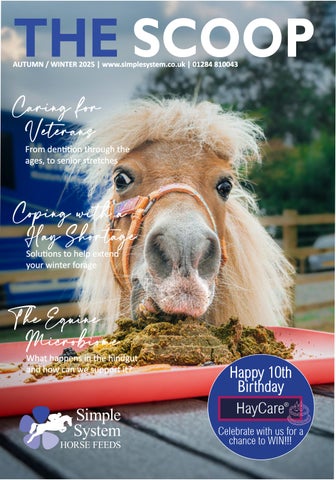
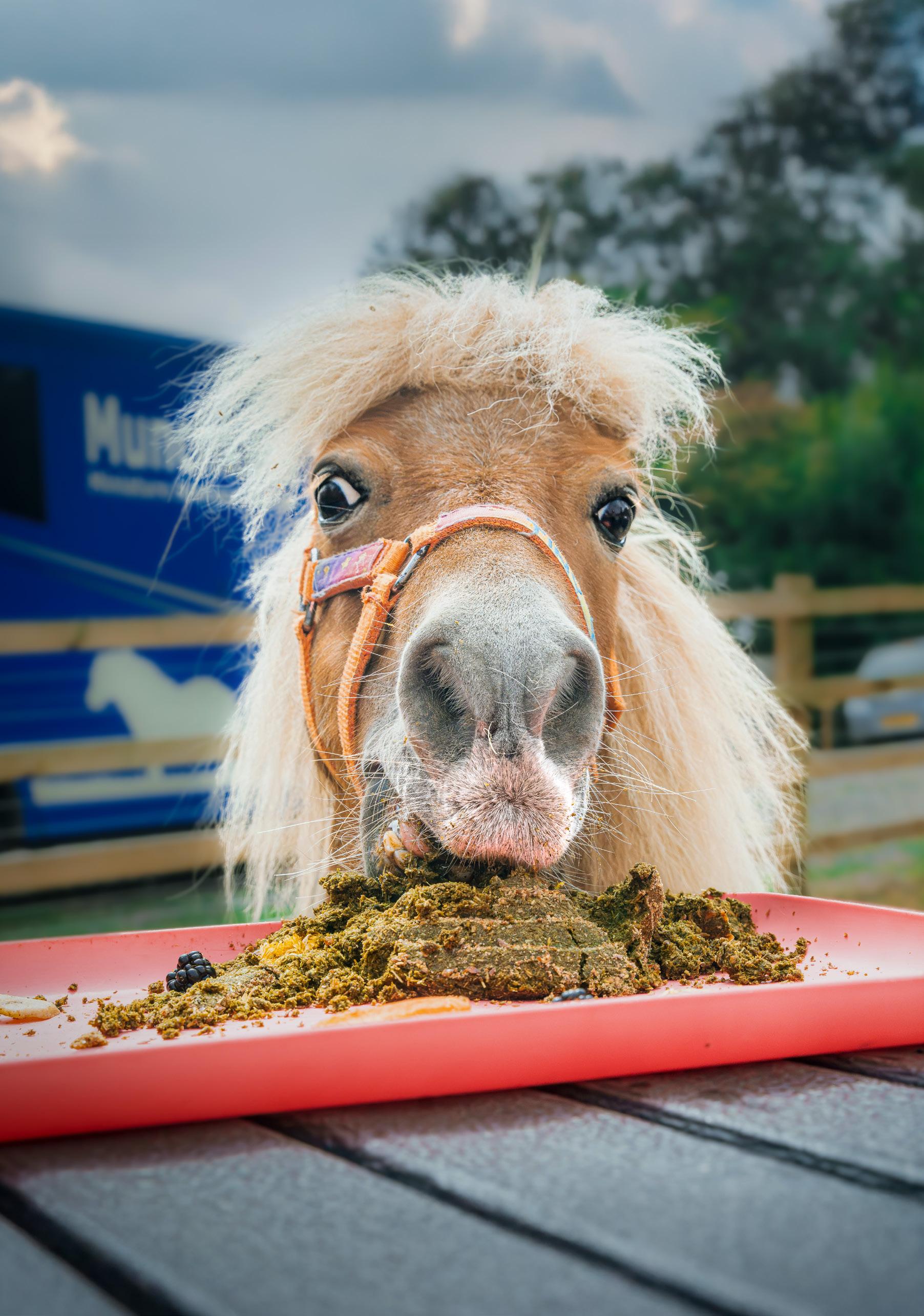
Cover Photo
Tim, Head Reporter at Munchkins Miniature
Shetland Rescue, with his HayCare® Birthday Cake
Photo credit: Lucas Barribal
About Simple System
Simple System Horse Feeds is an independent, family owned feed company based in rural Suffolk. The company was founded in 1996 with the aim of producing natural and nutritious feeds that horses were designed to eat. The entire range is free from cereals, molasses, pulses, soya, preservatives and additives.
WELCOME
The (many) summer heatwaves may be a distant memory, but the full effects are yet to be seen. We’ve had reports of low hay yields across the country, which is concerning for us all. Supplies may be stretched this winter, but fortunately, Simple System forages can help. Read our article ‘Coping with a Hay Shortage’, on page 6.
Senior horses may require some extra care this season. From simple stretches you can replicate at the yard (page 10), to understanding ‘Dentition through the Ages’ (page 8), we hope to help keep your older horses happy and healthy through the winter.
We’ve been preparing for a celebration as our highly popular feed, HayCare®, turns 10 in November! Help us celebrate by making your own birthday cake, that is suitable for seniors of course (find the recipe on page 16), and we have an exciting giveaway for all of our HayCare® customers (page 31).
CONTENTS
Page 4: News & Updates
Page 6: Coping with a Hay Shortage
Page 8: Dentition Through the Ages
Page 10 : Simple Stretches for Senior Horses
Page 12: A Life Changing Ride
Page 14: Why Horses Require Low Sugar & Starch
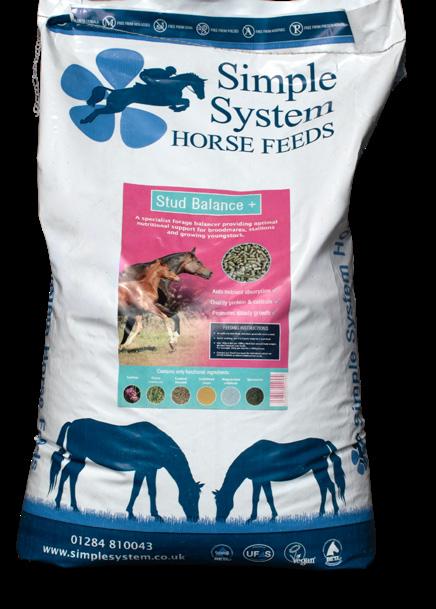
We haven’t forgotten our more youthful equine partners in this edition. In fact we have a new feed for them! Stud Balance +® is a specialist forage balancer to provide optimal nutritional support for broodmares, stallions and growing youngstock. You’ll be able to pick up a sample at Your Horse Live - find us at stand M720 in the marquee.
The team and I hope to see you out and about in person at our various events in the coming weeks (more info on page 4). If we happen to miss you, may I take the opportinity to wish you and your horses a wonderful winter. If you need us at all, we’ll be here to help with feeding advice and management suggestions. Please feel welcome to get in touch on 01728 604 008.
Melody Ashcroft
Page 16: Tim’s Diary and Make a HayCare Cake
Page 20: Winter Hoof CareTips from the Farrier’s Forge
Page 22: The Equine Microbiome
Page 24: Stockist Spotlight
Page 28: Working with Nature for Winter Weight Loss
Page 30: Feed Room Fun and a chance to WIN!!!
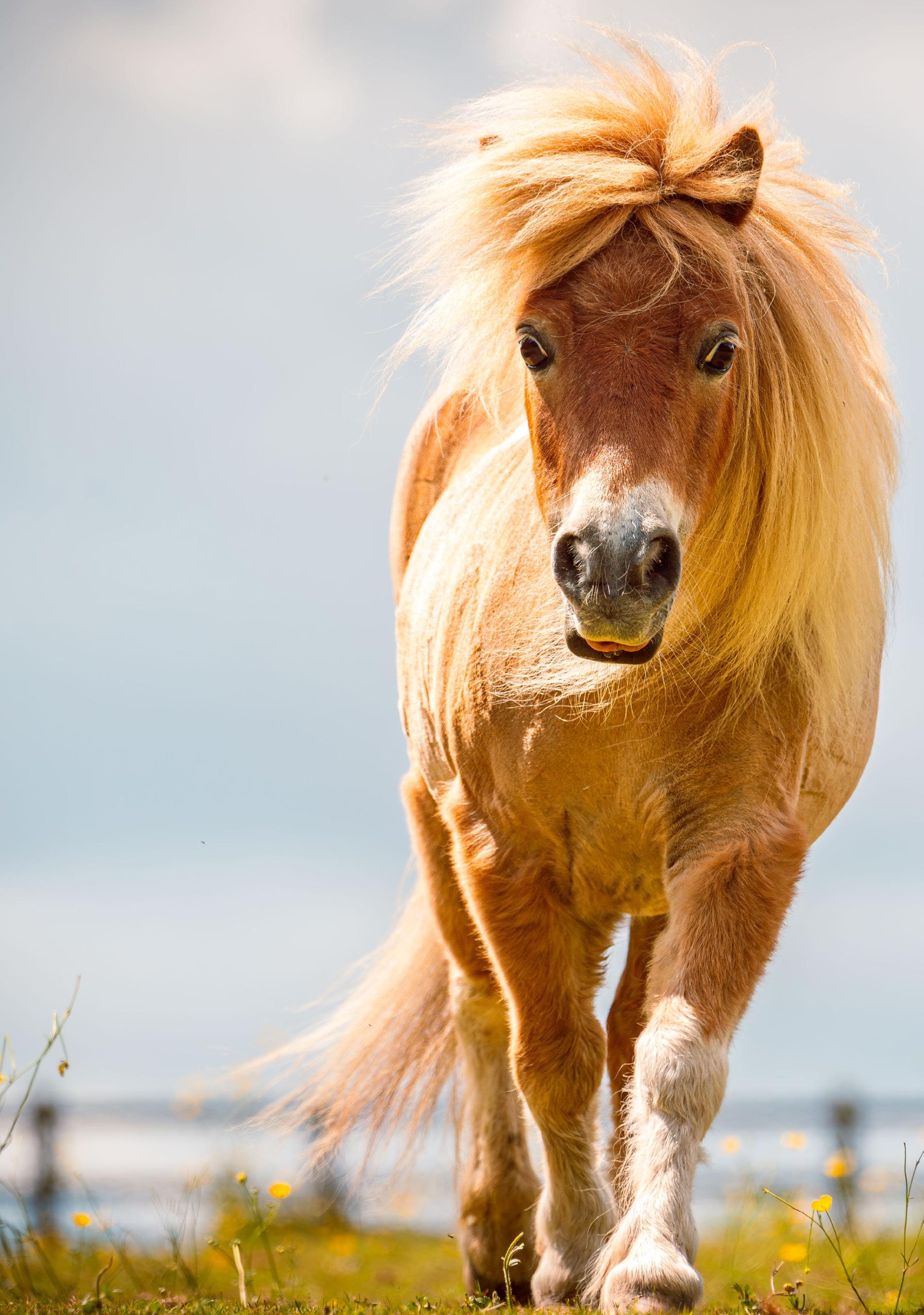
Meet our Cover Star...
Tim, also known as Tiny Tim, is a miniature Shetland pony with a superpower - the ability to win over the affections of anyone he meets! He is cheeky, charming and very, very cute.
He is now 20 years old and he came to take up residence at Munchkins Miniature Horse Rescue after his owner could no longer care for him.
At just 6 years old, he was diagnosed with Cushing’s disease (PPID) and he had a rare reaction to the prescribed medication - he almost died.
To keep him looking and feeling tip-top, Tim requires very careful management. Alongside Cushing’s, he struggles to maintain his weight. Despite these challenges, Tim is thriving. He is a much loved pony at Munchkins and he knows it!
Tim is always the first to greet the humans, and his playful nature never fails to bring a smile.
Tim’s Feeds...
News &
UPDATES
UPCOMING EVENTS...
We’re looking forward to being ‘out in the wild’ at various shows and events this winter. Whether you’re a stockist, existing or future customer, we’d love to chat with you in person.
Here’s where you can find us...
BETA International (28th -29th September)
NEC Birmingham, B40 1NT www.beta-int.com
Find us in the ‘Feed Hub’ where we will be available to discuss our unique feeding system and leading product range with trade customers, existing and future. Our Nutrition Manager, Ellen Lincoln BSc. (Hons), MSc., will be discussing ‘Appropriate Feeding for an Ageing Population’ on stage at 13.30 on the Monday.
Your Horse Live (7th -9th November)
NAEC, Stoneleigh Park, CV8 2LZ www.yourhorse.co.uk
PACKAGING UPDATE...
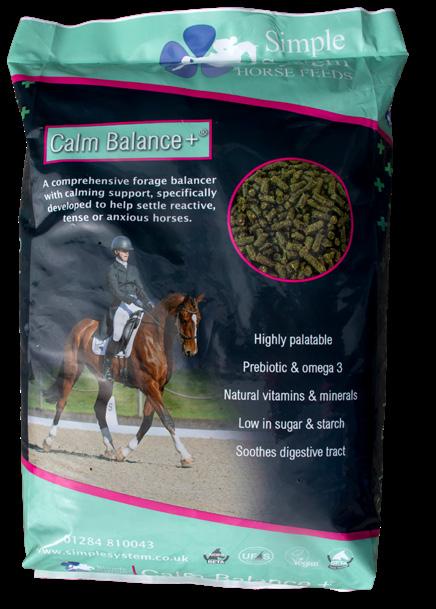
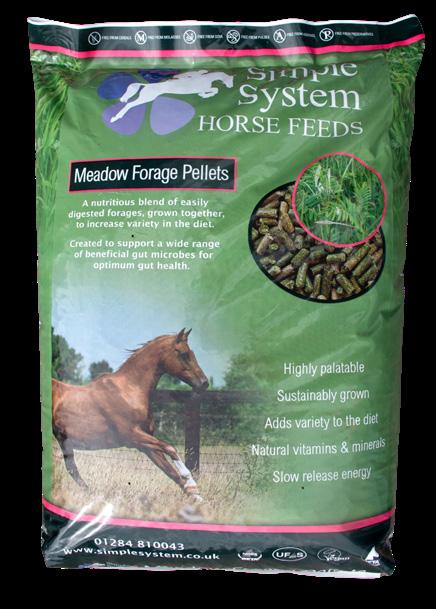
We’ve freshened up the look of three of our feeds! Whilst the feed inside the bag remains unchanged, Calm Balance +®, Meadow Forage Pellets and Veteran Balance +® all have an updated look.
We’re heading back to our favourite customer event of the year. We’ll have a brand new feed, the Christmas Range and we’ll be celebrating a very special Birthday!
QUALIFICATION CONGRATULATIONS...
Long-standing supported rider, Georgie Wood, has recently been awarded her Masters degree in Veterinary Physiotherapy.
Huge congratulations from all at Simple System on such a fantastic achievement.
Turn to page 10 where Georgie shares some simple stretches that you can try at the yard.
OUR FESTIVE FAVOURITES ARE BACK...
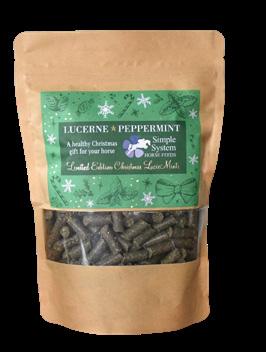
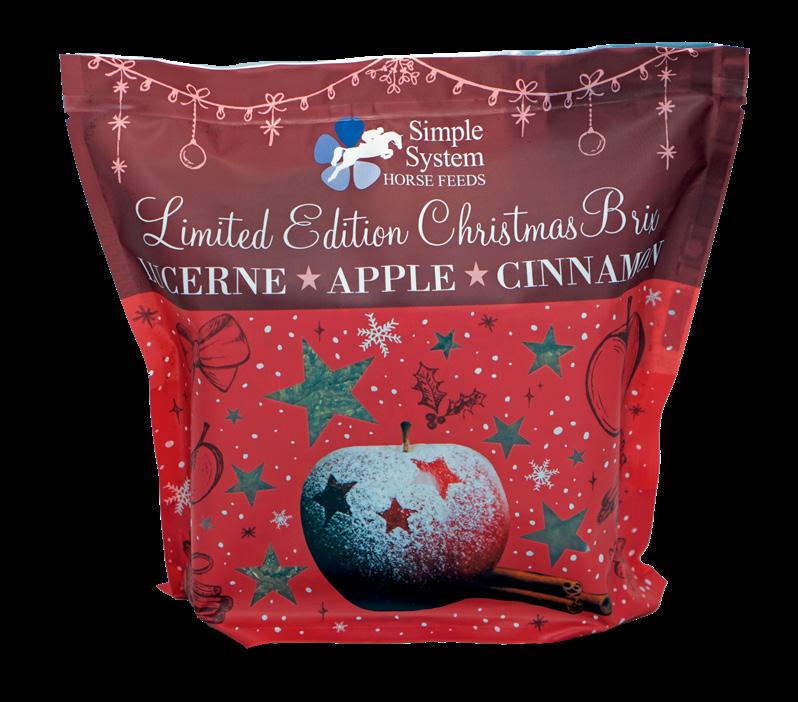
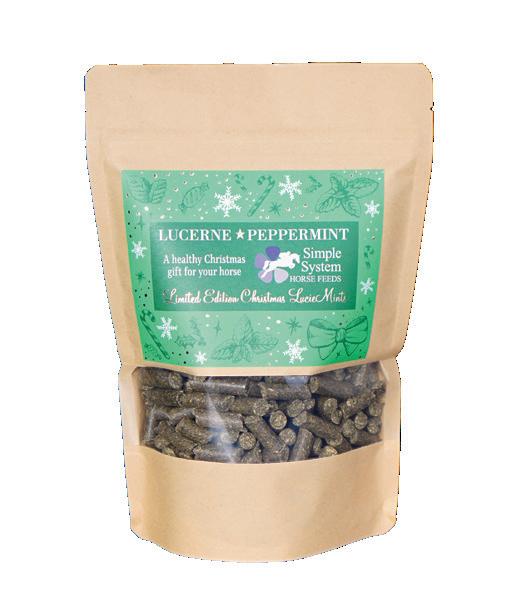
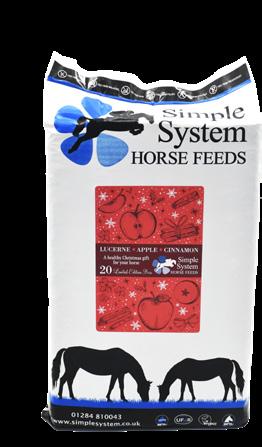
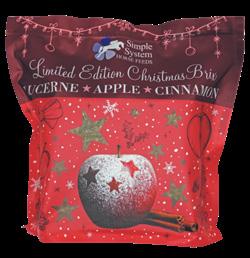
The Christmas range has returned. Choose from Christmas Brix - our lucerne Brix with apple and cinnamon, and our Christmas Lucie®Mints - with a smell like candy canes only made from nothing but lucerne and peppermint, this healthy alternative is ideal for all horse types.
This range is limited edition, so please don’t leave it too late to treat your horse this Christmas.
Order online, or find your local stockist at www.simplesystem.co.uk.
HAPPY BIRTHDAY HAYCARE GIVEAWAY!!!
The UK’s most popular hay replacer, HayCare®, is 10 years old this November!
To celebrate, we’re giving 10 people the chance to WIN 10 bags of HayCare® each.
For information on how to enter, turn to page 31.
INDUSTRY AWARD FINALISTS...
We are thrilled to be finalists for two British Equestrian Trade Association (BETA) awards this year.
The ‘Nutritional Helpline of the Year Award’ is a special award - not only as it recognises Simple System’s Feed Line amongst the best advisors in the industry, but because the nominations are made by our customers.
The second award is ‘Trade Supplier of the Year Award’ - which recognises outstanding products, service and support to the equestrian trade.
We wish to pass on our sincere thanks to all who have been kind enough to nominate us - customers and stockists alike.
A BRAND NEW BALANCER...
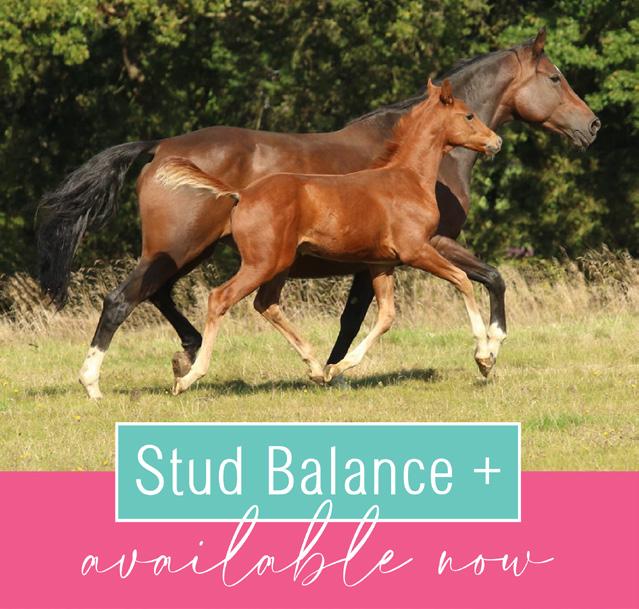
Our customer trials are complete and we are pleased to confirm that Stud Balance +® is now available to purchase.
This specialist forage balancer provides optimal nutritional support for broodmares, stallions and growing youngstock.
Find a stockist, or order online for free delivery at www.simplesystem.co.uk.
NEW STOCKISTS...
We’re delighted to have welcomed lots of new stockists recently. Here are just a handful who have recently joined the Simple System stockist family...
Farmingtons | Wisbech, PE14
Groomz Equestrian Products | Newcastle, ST5
Manor Farm Feed & Bedding | West Kirby, CA48
Poynton Equestrian Supplies | Poynton, SK10
Sidcup Equestrian Supples | Sidcup, DA14
Thomas Irving’s | Chesterfield, S41
To find your closest retailer head to www.simplesystem.co.uk, click ‘Stockists’ at the top of the page, and enter your postcode.
Please ensure you place your order by Tuesday 16th December to guarantee delivery before Christmas.
Our office and warehouse will be closed on the following dates:
January 1st
Orders can be placed throughout the Christmas period at www.simplesystem.co.uk
Coping with a
With forage yields reported to be down by up to 50% this year, hay may well be in short supply this winter.
The best hay for most horses is well made meadow hay. This has a range of species in it, often wildflowers as well as different grasses. Ideally, it will have been made without being rained on and baled when completely dry –87% dry matter or more means it will keep and store well, without going mouldy.
Other types of hay are grown as a crop, part of a sustainable rotation, and are made from one or a few species of grass. Timothy, Cocksfoot and fescue grasses tend to be well suited to horses. Ryegrass is often best avoided as it can cause issues for some who are intolerant to it. Ryegrass can also have higher sugar levels, so it is unsuitable for a number of horses, especially good doers.
It is always worth having your hay analysed so you can gain a good idea of its feed value. Simple System offer a hay analysis service which includes free interpretation from the Feed Line.
Good hay means less short feed is needed so can be a worthwhile investment. Similar criteria apply to haylage, which may have higher overall feed values as it is usually harvested at a slightly earlier stage, and is baled and wrapped with a greater moisture content than hay.
Hay shortages and horses’ differing requirements may mean you will need to look to provide alternatives to hay this winter season.
Chopped forages can be an ideal way to replace some of the hay ration. Look for those with quality fibre, and avoid those that contain straw, including ‘‘Nutritionally Improved Straw’’ (NIS).
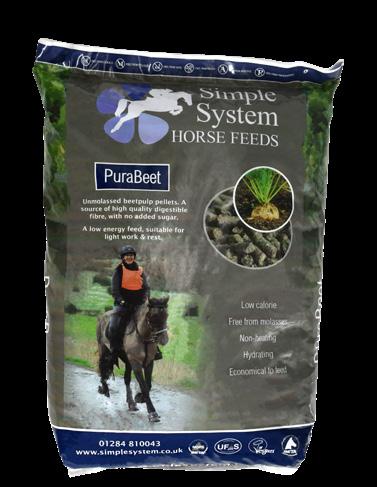
For older horses and for those who struggle to chew due to dental issues, chops or chaffs are best avoided altogether. They will need a soaked bulk feed that does not need so much chewing. HayCare® is the obvious and best choice with its nutrition levels likened to good quality, high fibre hay, but PuraBeet can also be used to replace some of the hay ration. We suggest you can feed up to 0.5% of the horse’s ideal weight in dry weight of this cost-effective fibre feed. For an average 500kg horse, this amounts to 2.5 kg dry weight a day, which when soaked will make 5 times its volume of palatable mash.
Lucie®Fibre Cubes offer an alternative forage type (great for the gut microbes) with very low sugar and starch levels. They are well suited to good doers and those prone to laminitis.
Horses with higher requirements could have Blue Bag Grass Pellets, again fed soaked as a mash. These are a Timothy grass pellet with nutrition likened to summer grazing.
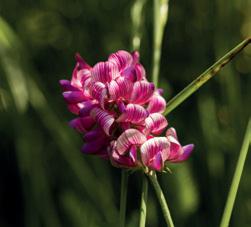
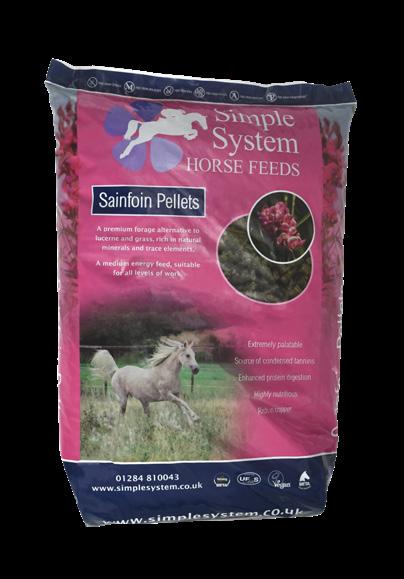
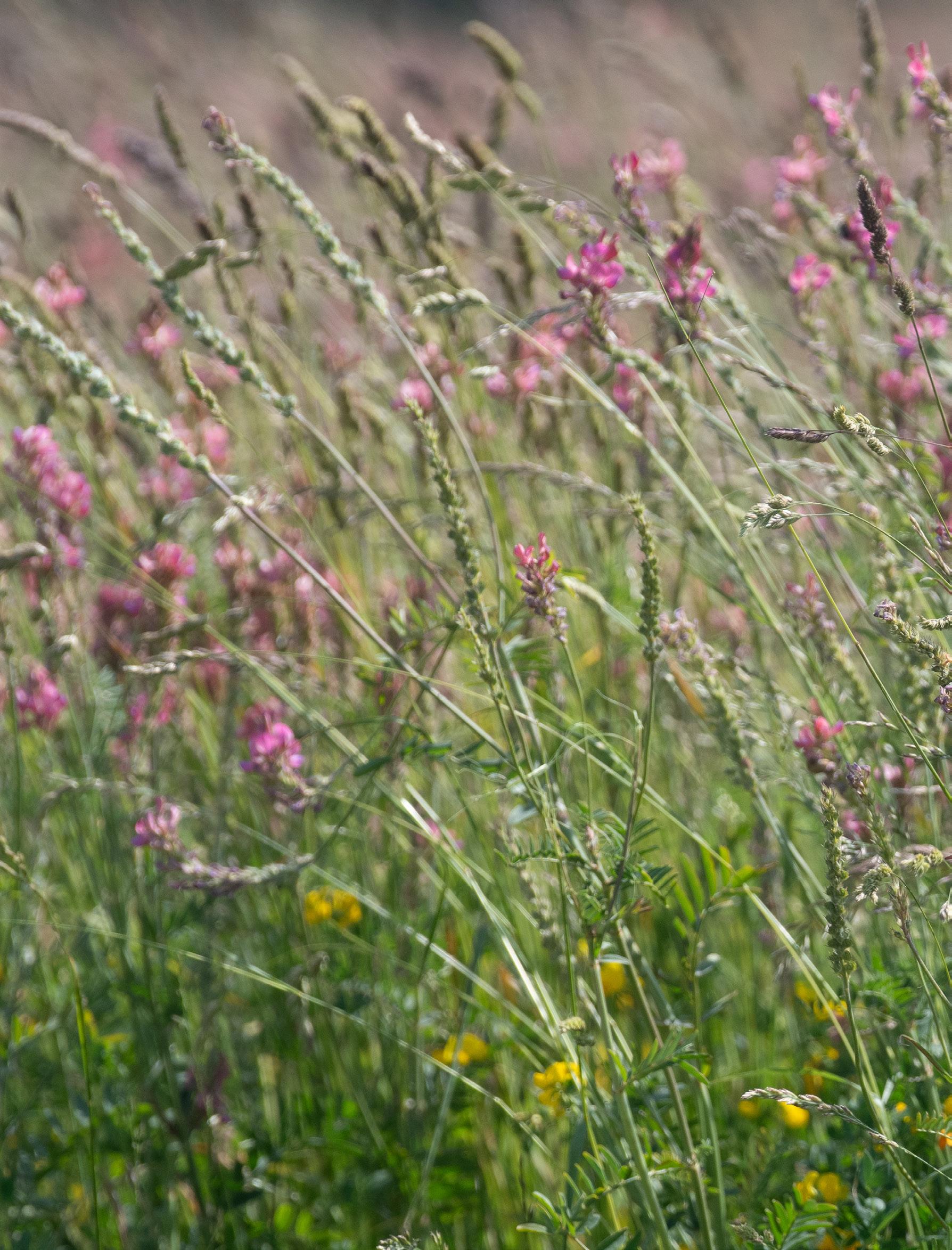
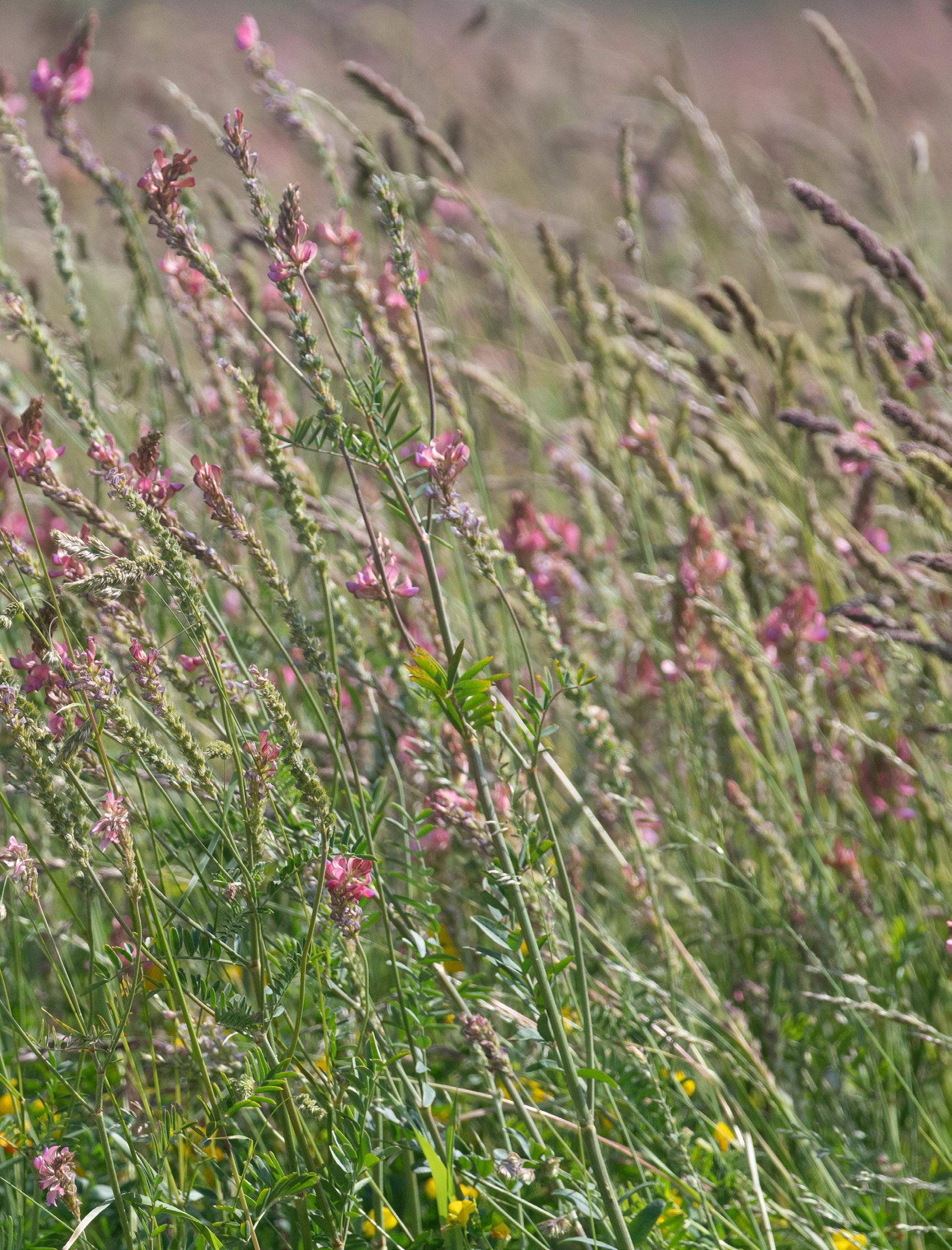
If you’re looking to offer forage variety, Sainfoin Pellets are ideal. They offer higher nutrition levels than hay, so if you wish to feed in replacing quantities we would suggest diluting with HayCare® or PuraBeet. A ratio of 1/3 Sainfoin Pellets, to 2/3 HayCare® or PuraBeet is suitable for the majority of horses.
Shortage
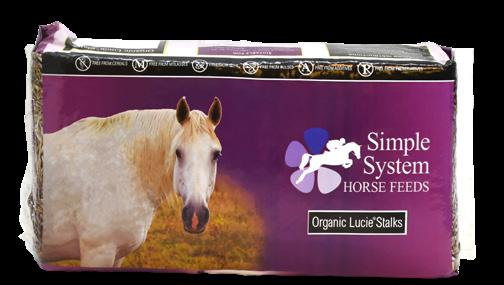
For horses with sound dentition, Organic Lucie® Stalks provide a good time-consuming chew and they are low in calories so they can be well utilised for good doers. They can be fed dampened in a tub or mixed with the hay in the net or hay feeder - helping to prolong the hay supply.
Timothy Chop is another good alternative, being made from nothing but mature Timothy grass. Again, this can be mixed in with hay, or offered alongside.
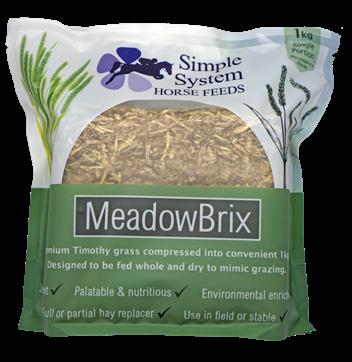
For a hay replacer with a difference, Simple System Brix provide enrichment as well as forage. Available in either grass, lucerne or sainfoin, these compressed forage blocks replace approximately 1kg of hay. They are fed whole from the ground, for the horse to gnaw on, so a different way of feeding which is greatly enjoyed – but good teeth are essential for chewing.
Hay is such a good winter feed for horses and is excellent value, but not only must it be available, it must be suitable. Poor hay which is dusty, mouldy or low feed value, can be harmful. Older horses will find hay increasingly difficult to eat. No horse should be fed unsuitable hay, but fortunately, there are plenty of alternatives.
For individual feeding advice to suit your horse’s requirements, contact the Feed Line on 01728 604 008 or email info@simplesystem.co.uk.
for Replacing Hay
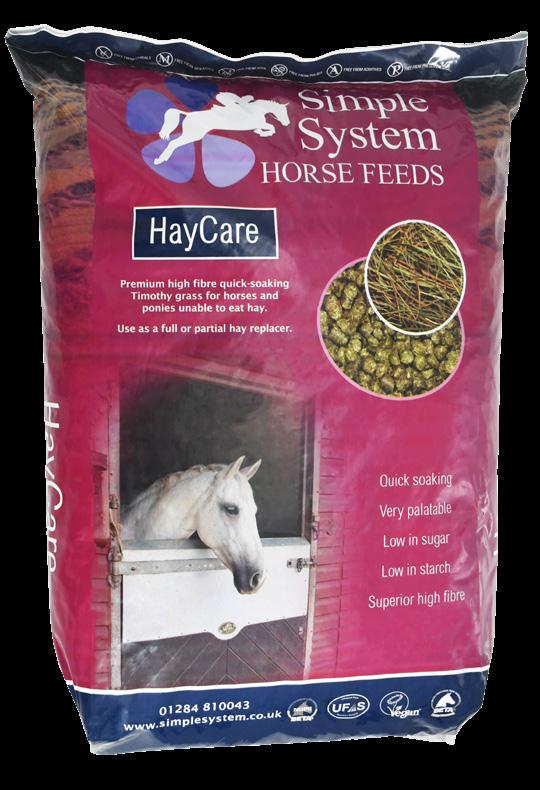
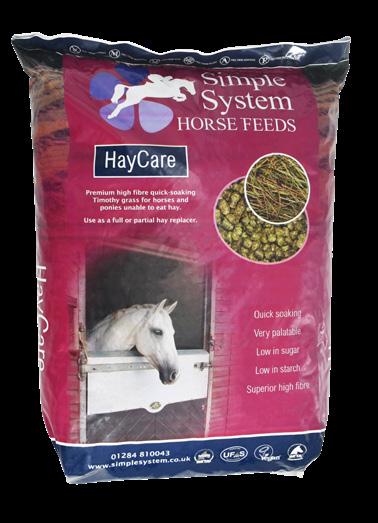
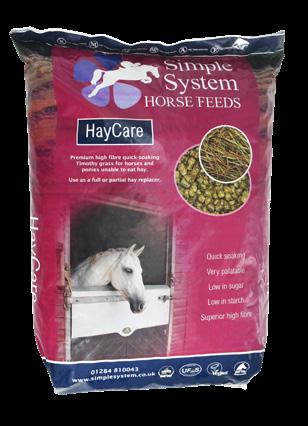
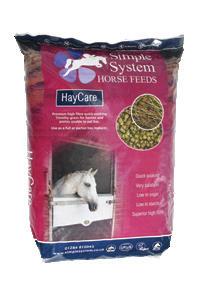
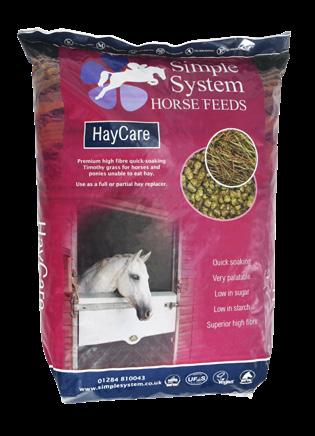
HayCare®
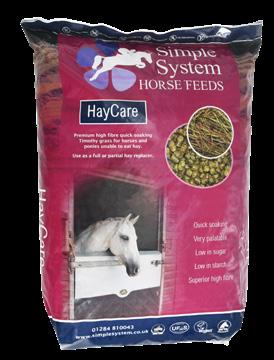
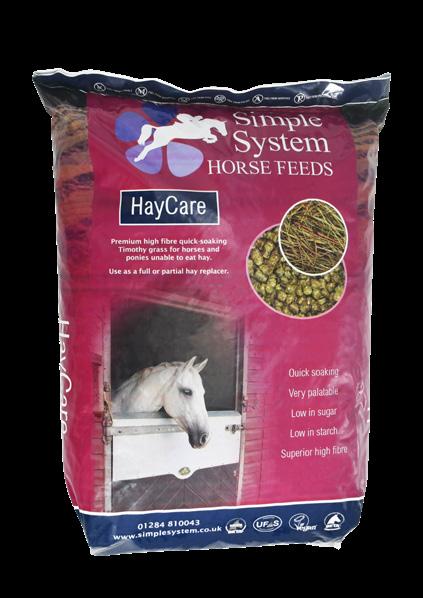
The best choice as a direct replacement for hay. Nutritionally, it is likened to feeding good quality, high fibre hay - only in a different form.
HayCare® is suitable for all horses, including veterans, those prone to metabolic issues and those who struggle to adequately chew hay.
PuraBeet
This unmolassed beetpulp is a cost-effective fibre feed, which can be used to replace part of the usual hay ration.
Feed up to 0.5% (dry weight before soaking) of the horse’s ideal weight per day .
MeadowBrix
Often fed for enrichment purposes, MeadowBrix are equally useful for replacing hay.
Each single forage block provides the equivalent of around 1kg of hay.
Organic Lucie®Stalks
An ideal feed for extending eating time, this lucerne chop offers superior high fibre, plus low sugar and starch levels.
Mix into haynets or feeders, or place a tub in the stable and dampen.
Contact the Feed Line for free advice and to find the very best feed for your horse’s individual needs.
01728 604 008
info@simplesystem.co.uk
DENTITION
Clark | Specialist Feed Advisor | abi@simplesystem.co.uk
Foal
(Baby teeth in pink)
2 years
5 years
10 years
20 years
Horses’ teeth change throughout their lives - they are continually growing and continually wearing, as they chew and grind their grazing and forage. This means that regular checks from a suitably qualified Equine Dental Technician or vet are recommended - even when horses are not yet in work, or once they have retired.
As foals, the first teeth begin to erupt from just one to two weeks after birth. By the time they reach 9 months old, most will have a full set of 24 teeth.
Just like people, foals have ‘baby teeth’, as depicted in the illustration to the left. These teeth are replaced by adult teeth usually between the ages of 3 and 5.
When the adult teeth erupt, they dislodge the first teeth, which are also known as caps. Whilst this is happening it can make chewing very uncomfortable, especially long fibre forages (such as hay) and short grazing that is being eaten close to ground level. This is one of the main causes of sudden loss of condition in otherwise healthy youngsters. Offering soaked feeds and hay replacers like HayCare® will be far easier for the youngster to manage and so ought to help them maintain or regain condition.
Whilst dental checks are recommended at least once a year, youngsters (and older horses) may require more frequent checks. If you have any concerns about your horse’s body condition or if they are having difficulty chewing, do contact your vet or EDT.
Once the adult teeth have come in at around 5, the teeth continue to change both on the surface and importantly, below it.
Abi
Through the Ages
By the time the horse has reached the age of 15 to 16, dental issues are very common. Some can be minimised with regular dental care in earlier life, and appropriate feeding also has a part to play. Peripheral caries (or cavities in human terms) for example, are deemed less likely to occur when horses have low sugar, low starch diets.
On the surface, two frequently seen issues are wear of the crown (grinding surface) and diastema (gaps between the teeth).
Diastema are problematic as food can become compacted and trapped, causing painful inflammation of the gums and peridontal tissue - even leading to infection in some cases. Your EDT or vet will advise of any treatment required, which may range from flushing and washing to widening the gaps themselves. From a feeding perspective, we suggest avoiding chops or chaffs in the diet as these can cause irritation. Instead, opt for soaked forages.
When the horse has reached their early 20’s it is likely that the rate of wear on the crown is more than the rate of eruption. Their teeth are wearing out. This can make chewing forage difficult and you may notice that they are quidding hay. This suggests it is time to offer an alternative forage to replace hay - HayCare® being the obvious choice as it is nutritionally likened to good quality high fibre hay, yet it is in an easier to manage format when fed soaked.
Finally, the (quite literal) root cause of weight loss in many older horses comes from beneath the gums. As horses age, the roots of their teeth become more shallow in the jaw - a result of the continual growth (eruptions) of the teeth during their lifetime. This can lead to the teeth themselves being less stable, making chewing uncomfortable. Again, offering an easier to eat soaked hay replacer is recommended.
If you are not sure that your horse requires a hay replacer, there are some key signs to look out for. Your horse may display one, or several of the following...
- Dropping more hay or feed than usual.
- Quidding hay into partially chewed ‘balls’.
- Unexplained weight loss.
- Changes to their droppings - e.g. becoming notably more loose, fewer droppings, or noting the presence of longer fibres.
- Chewing with one side of the mouth.
- Reluctance to eat hay or haylage.
- Colic.
If you are seeing any of the signs listed above, we suggest consulting with your vet. When introducing a hay replacer, as with all dietary changes, do so gradually over a week or so. It is important to note that an insufficient intake of forage can increase the risk of digestive issues, including colic. Hay replacers need to be fed in hay-replacing quantities. For example, if you wish to replace 6kg of hay, you will need to use 6kg dry weight of hay replacer.
How to Prepare HayCare...
1. Add the same dry weight as the hay you are replacing in a tub. This one is 30L.
2. Add 2.5 times the volume of water and leave to soak.
3. When the water has been absorbed and no hard lumps remain, HayCare ® is ready to feed.
Simple Stretches for
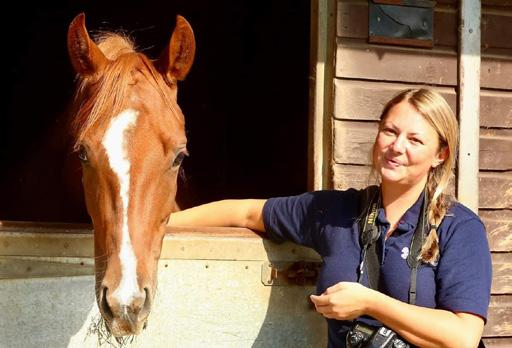
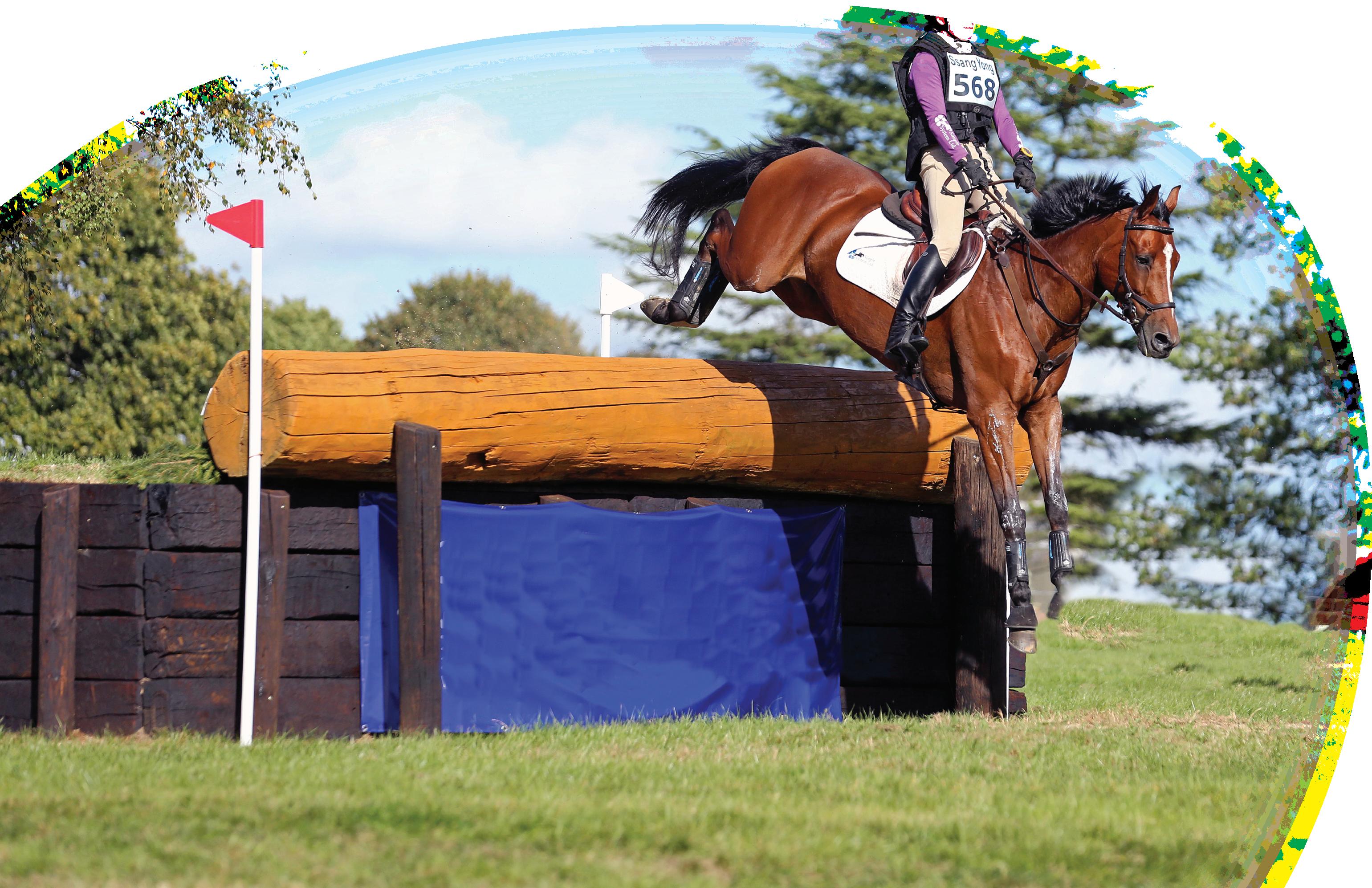
Simple System supported rider and Veterinary Physiotherapist, Georgie Wood, demonstrates some simple stretches that you can repeat at the yard, with her 26 year old Coco
For Tightness around the Shoulder...
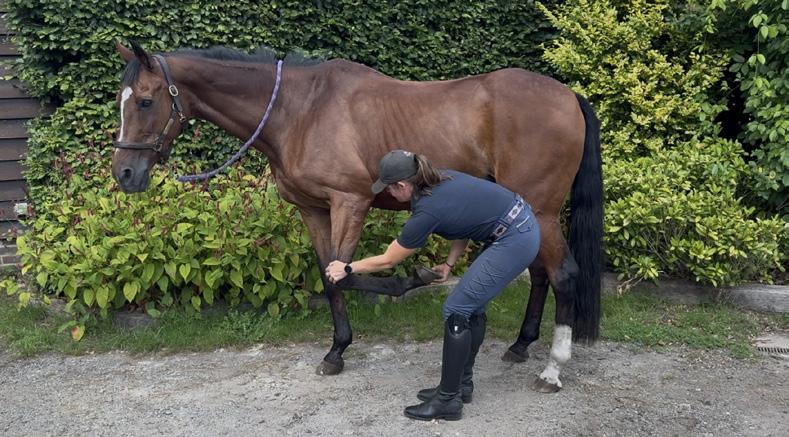
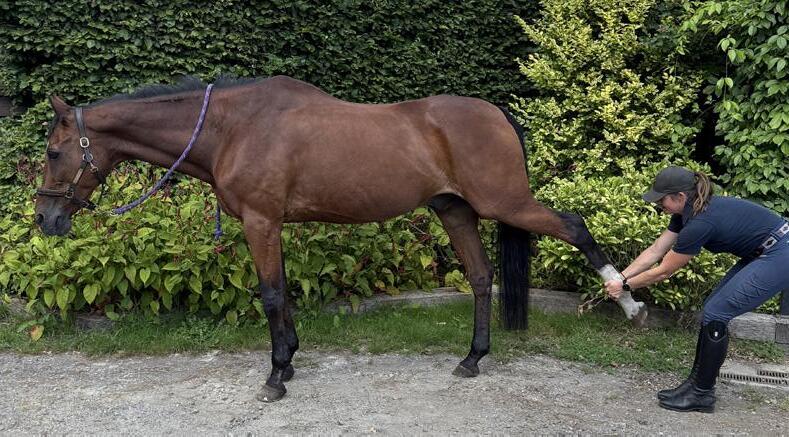
Forelimb retraction. Lift the horse’s leg and bend their knee to 90 degrees. Facing the horse, have one hand supporting the lower limb and place the other on the front of the knee, gently pushing the leg backwards. Hold for 10 seconds.
For Engaging the Core...
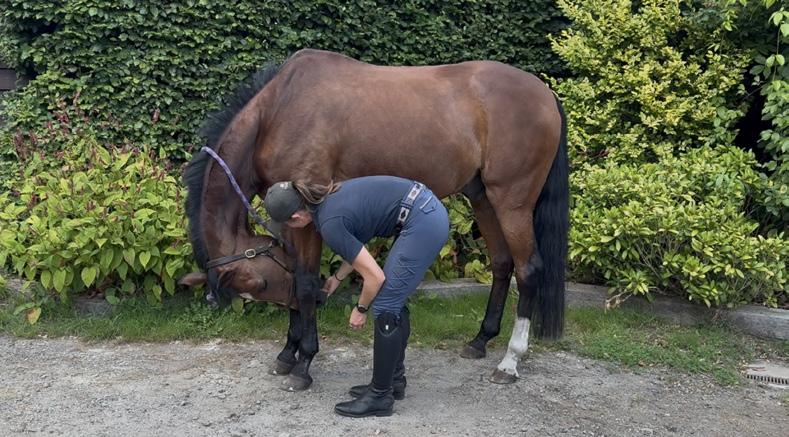
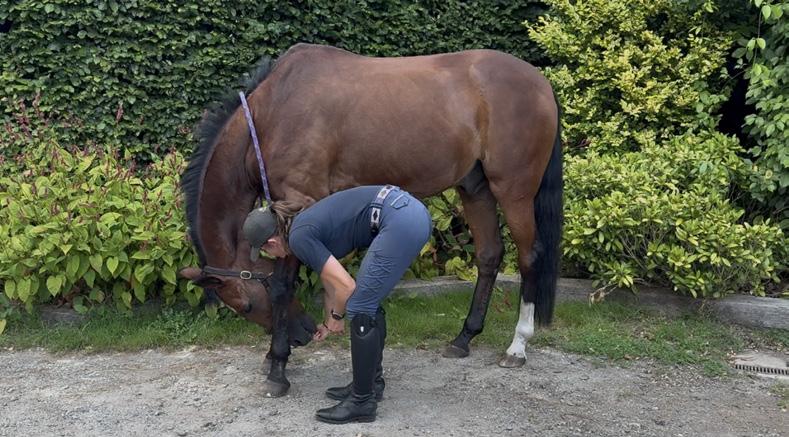
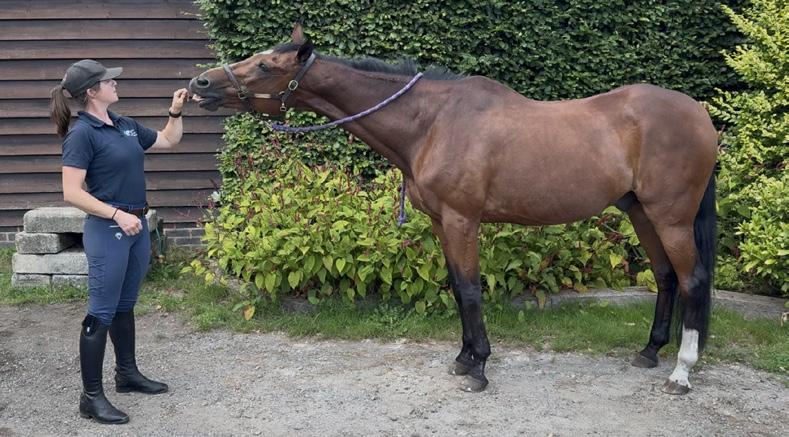
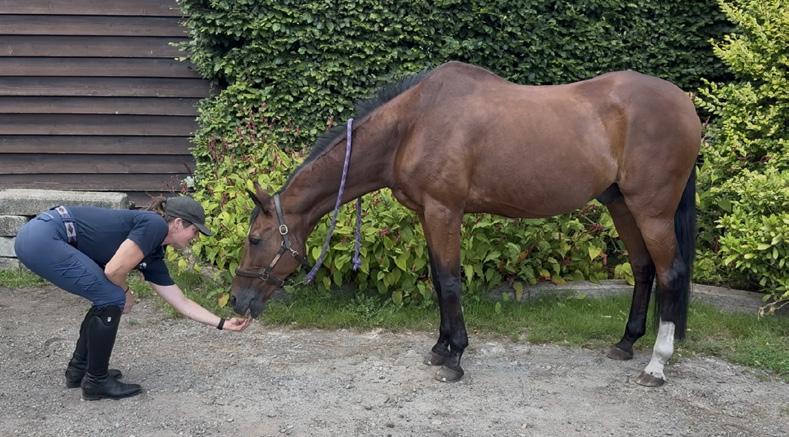
Core engagement stretch between knees. Ask the horse to follow a treat out in front of them and then take it down to between the knees. Hold there for 10 seconds.
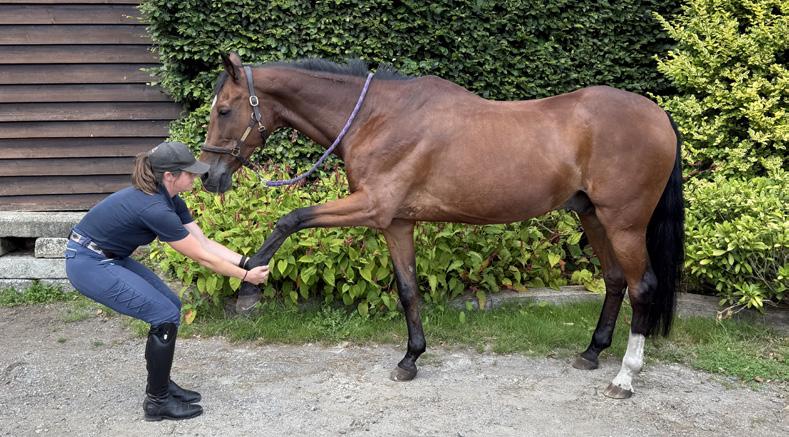
Forelimb protraction. Lift the horse’s forelimb and with both hands under the fetlock stretch the horse’s leg out in front of them. Hold for 10 seconds.
Core engagement stretch between fetlocks. As per the instructions to the left, but you take the treat to between the fetlocks. Again, hold for 10 seconds.
Our Pick of Feeds for Senior Horses...
HayCare®
With nutrition likened to good quality, high fibre hay, HayCare ® is ideal for older horses who can no longer chew hay well.
Feed soaked as a mash year round, and in the winter try adding warm water to make it extra appetising!
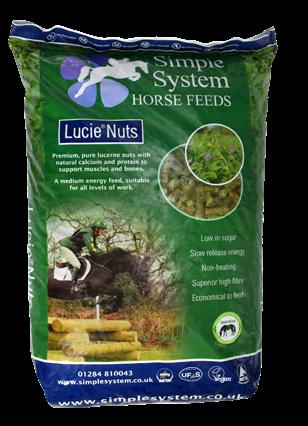
Lucie®Nuts
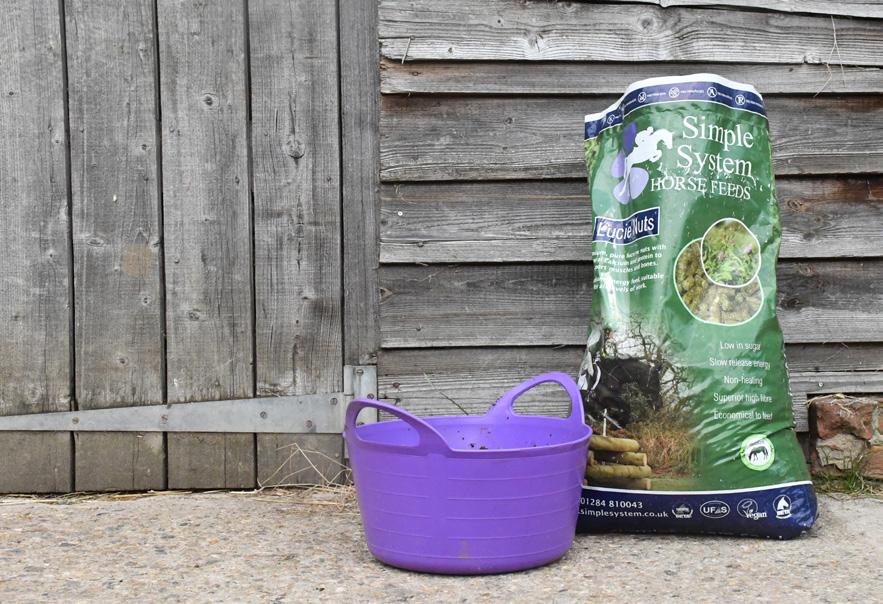
An ideal (and economical) manger feed for all ages, including veterans. Naturally high in quality protein and calcium, yet low in sugar and starch. This feed supports muscles, bones and the digestive system.
Senior Horses
TIP: Georgie uses Lucie®Mints as a training aid to help encourage Coco to stretch
For Tightness around the Hindlimbs...
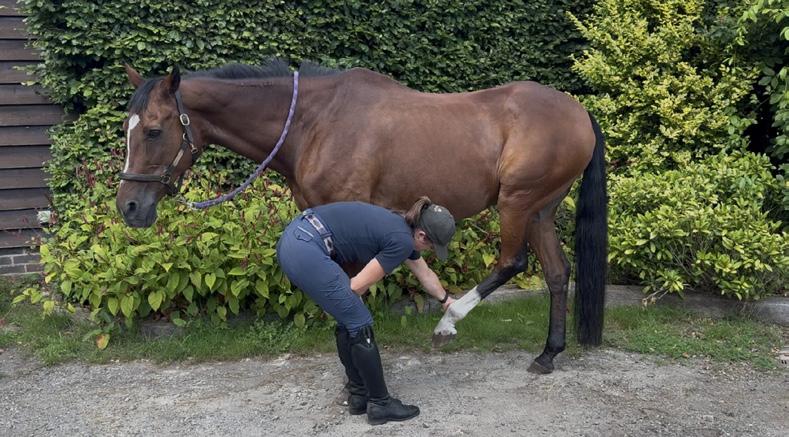
Hindlimb protraction. Facing the back of the horse, place your hands around the pastern and gently (the slower you do this the more they will relax) take the limb forward, aiming the hind toe towards the heel of the front foot. Hold for 10 seconds.
Hindlimb retraction. Pick up the hind leg and then face the front of the horse with your hands round the front of the fetlock. Stretch the limb out behind the horse - often they will then take the stretch right out themselves through their whole body!
For Tightness around the Neck & Poll...
Neck stretch up and out. Ask the horse to keep their feet still and then move the treat up and out as far as they can go. Hold for a few seconds.
Neck stretch down and out. Keep their feet still and move the treat out and down in front of them. Again, hold for a few seconds.
To shop directly online, or to find a stockist, visit www.simplesystem.co.uk
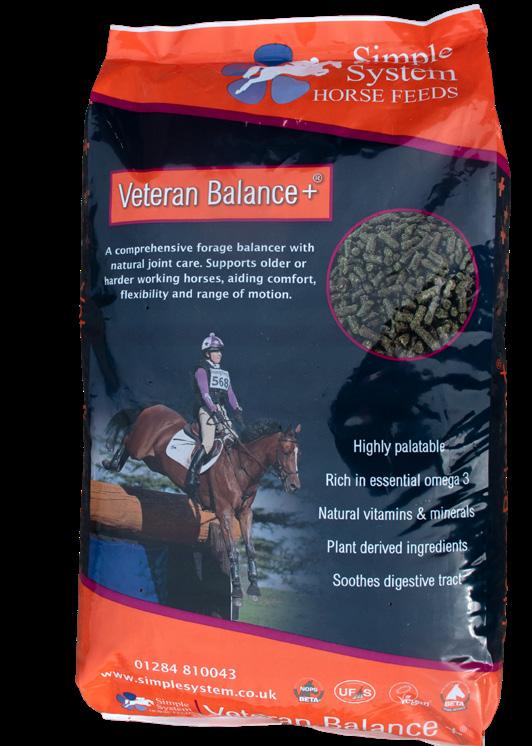
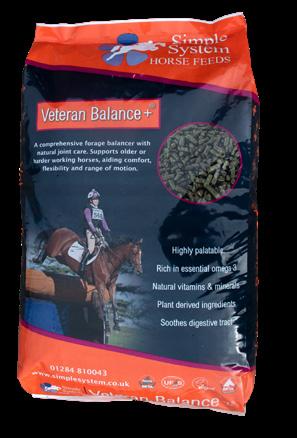
Veteran Balance +®
This forage balancer offers a top-up of vitamins and minerals, plus natural joint and digestive support.
Pelleted for convenience and very palatable. Suitable for disguising medication, as well as for fussy eaters.
FlexiBalance
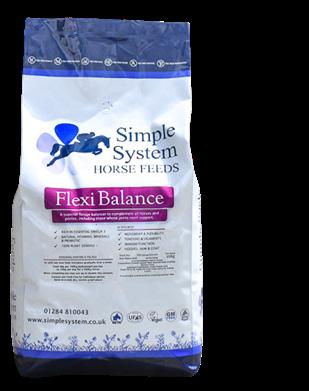
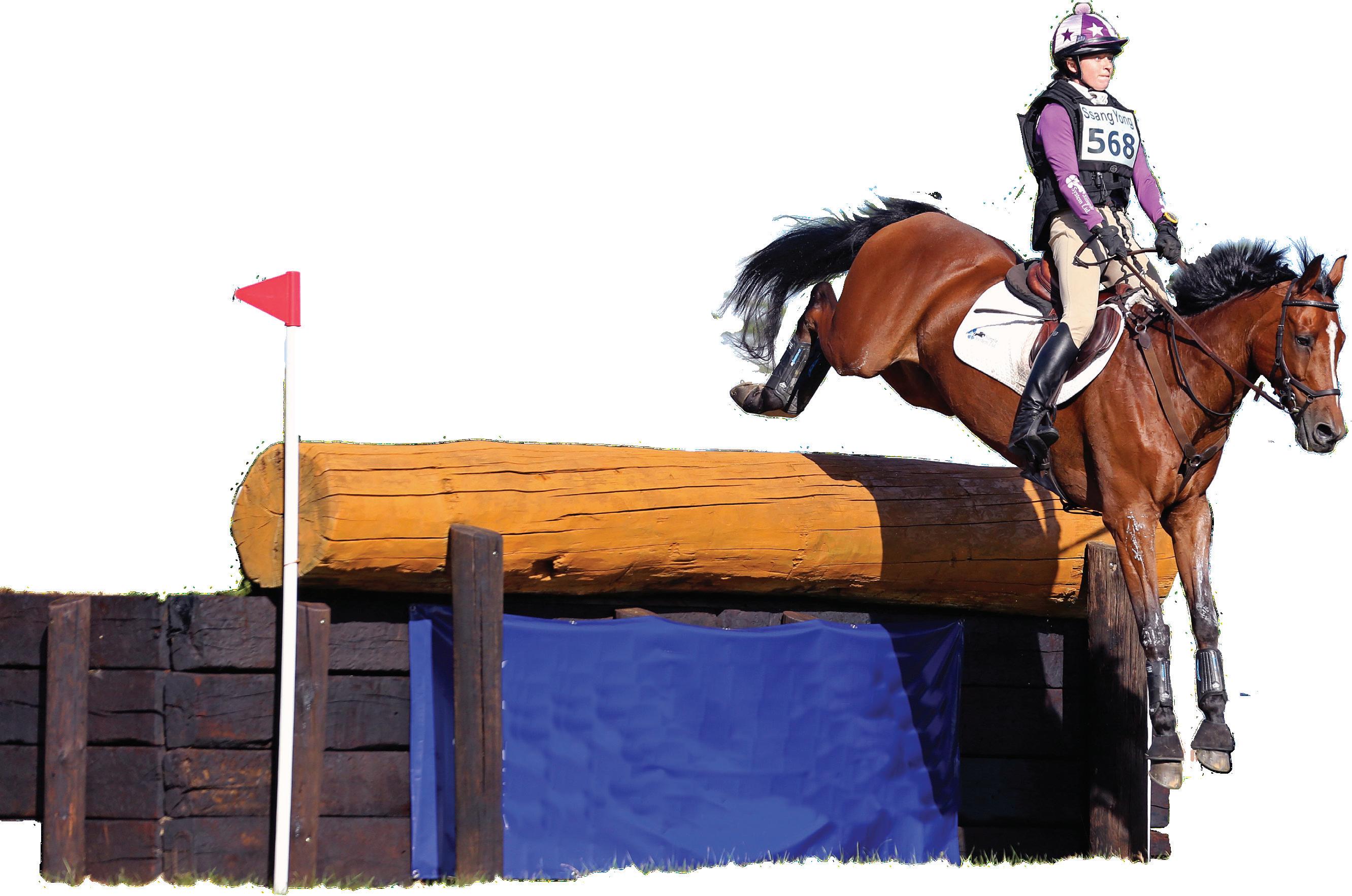
A favourite feed for former show jumper, Coco (pictured above). FlexiBalance is a forage balancer that is also useful for supporting tendons, ligaments and joints.
Jane van Lennep BSc., MSc., BHSI (SM Cert), NPSD Director of Nutrition | info@simplesystem.co.uk
To Rug or
There can be a lot of pressure to buy a complete wardrobe of rugs for our horses but is this really necessary? Horses have two main lines of defence against the winter chill: one is a layer of fat accumulated during the summer and the other is a thick winter coat.
During the winter fat will (or should be) gradually used up. A layer of fat is like wearing an anorak! As the fat is used, the fatsoluble vitamins stored in it are also released. These are vitamins A, D, E and K.
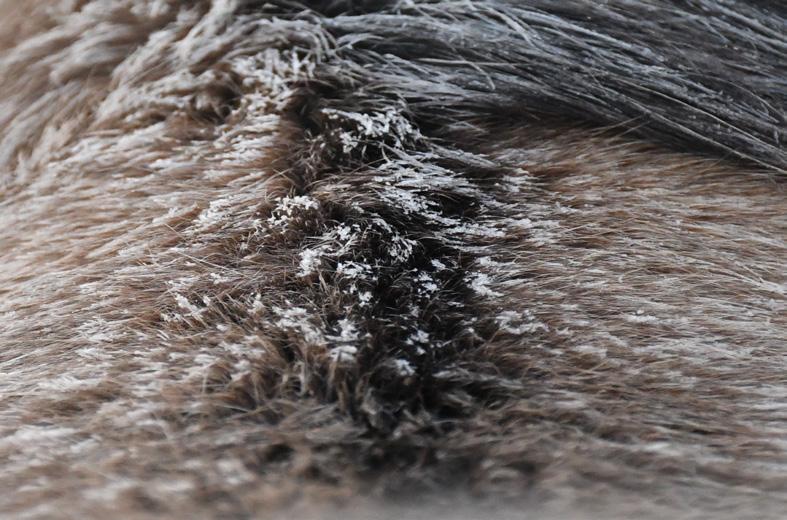
The horse’s winter coat is an amazing bit of kit. There is a dense underlayer that is a really good insulator. Long, shiny guard hairs shed rain. Each hair has a tiny muscle attached which will fluff up the coat when it is cold to add even more insulation – just as birds fluff up their feathers to trap a layer of air in frosty weather.
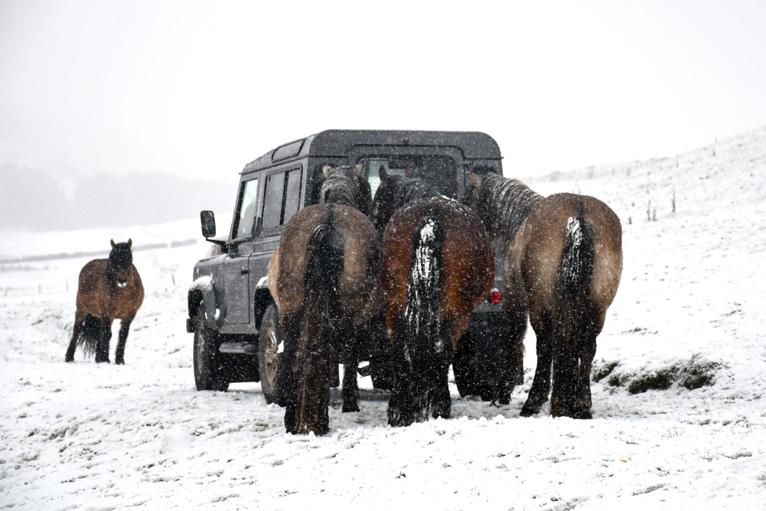
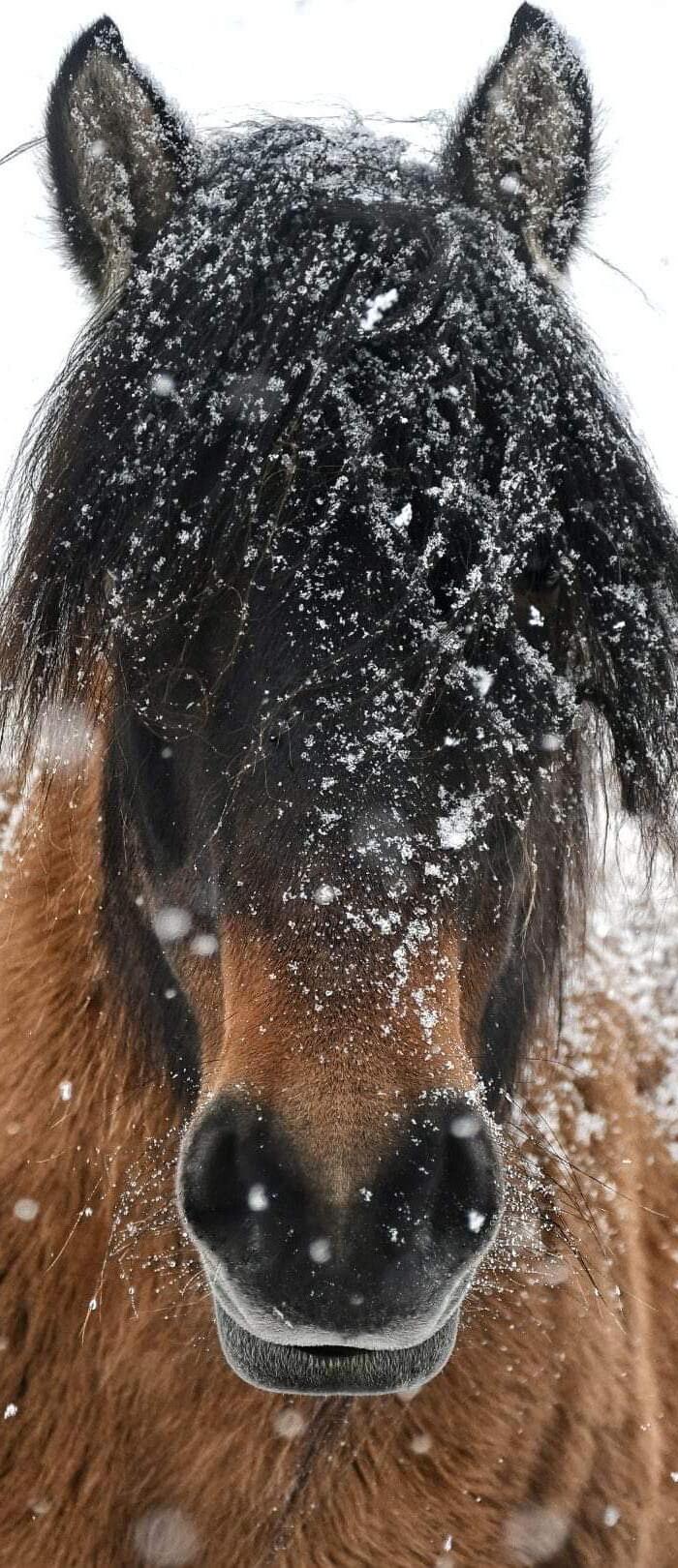
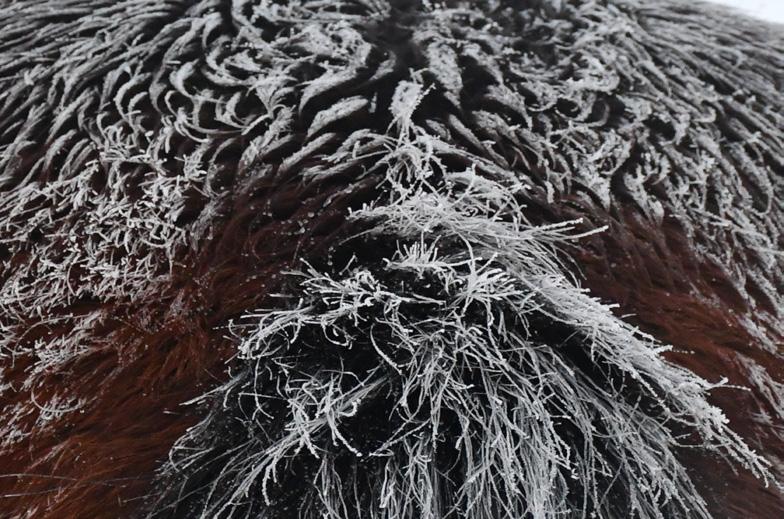
Horses can thrive in very cold conditions. They evolved in the relatively dry, semi-desert conditions of the central Eurasian plateau. If it is windy, they turn their backs to the wind, clamp their tails to insulate their bottoms and the tail hairs spread out to shield their hindquarters. Horses act like weathervanes – they will always tell you where the wind is coming from! This winter coat is so good an insulator that snow and frost will remain on the horse’s back.
A fluffed up coat traps air for extra insulation
Not to Rug?
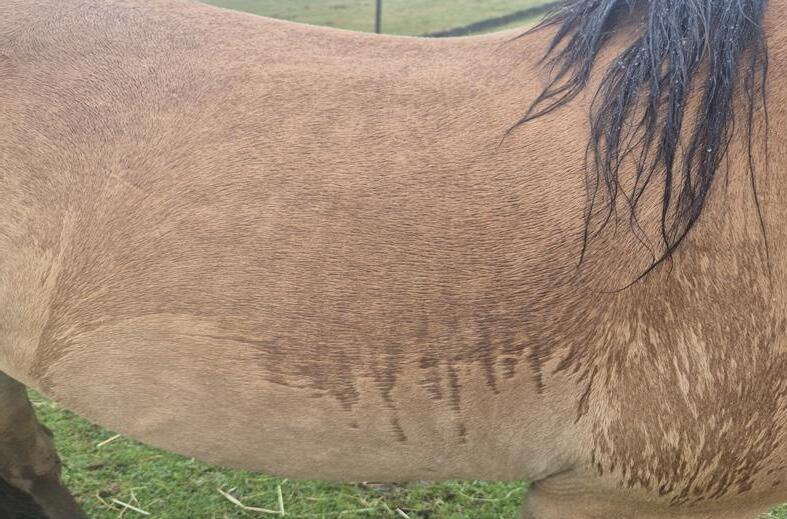
Rain can be tolerated well, albeit not so well if very prolonged, except for native breeds that have had long enough to adapt to our somewhat soggy winters. Eyes are protected due their shape and direction of the hair; thick manes take rainwater away from necks and shoulders; the guard hairs on the body direct rain to run off, keeping the belly dry; feathers on the fetlocks act like drain downpipes, taking water away from the pasterns and heels. Waterproofing is taken care of with the natural grease in the undercoat.
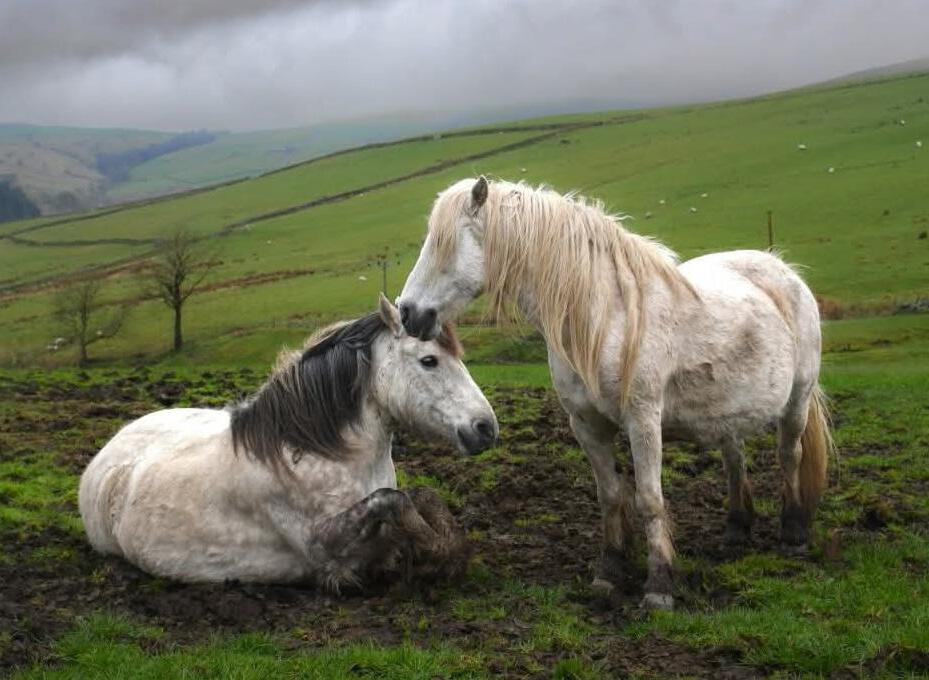
Horses love to roll in the mud. A group will share the same mud patch, sharing their group identity as well as putting on a layer of earth that will act as an additional layer of insulation and keep the wind out of their coats. Grey horses seem to roll the most. Maybe it is good camouflage when a white coat is an obvious signal to a predator.
So is a rug neeeded? Probably not if your horse has a layer of fat and some natural shelter from the wind prevailing at the time. If your horse is worked and sweats excessively, you may feel moved to clip them. Remove only what is needed to make the horse comfortable. Depending on the horse, you may then need to use a rug, but if your horse is very fat, bear in mind that they are already wearing a good anorak!
We do not want our horses to suffer or get hypothermia, but being a bit chilly is not a disease. A cold but healthy horse will move around more, eat more (eating is heating) and keep close to their friends to share some mutual warmth. Interestingly, a horse that is not shivering in the field may start to shiver when tied up or stabled, just showing how effective movement is. Signs your horse may benefit from a rug include shivering, being hesitant to move, losing too much weight and reluctance to move away from shelter to graze or eat hay.
Losing weight over winter is natural and beneficial as it is thought to be protective against metabolic disease and the risk of laminitis. Mother Nature provides well for horses in the winter, so work with her for a happier horse and a happier you!
Grey ponies enjoying the mud patch
A clamped tail protects from the wind
Guard hairs direct rain away from the belly
A Life Changing Ride
Simple System rider, Georgie Wood, has been ramping up her fitness training ahead of the BHS Charity race, which is set to take place at Newbury on 6th November. Here she tells us why she feels so lucky to have secured a place, and why supporting the BHS is so important...
‘‘I have been working towards passing the Jockey Fitness Test in September—an essential milestone before I can take part in the British Horse Society Charity Race. The test includes:
- Exercise ball leg repetitions (20 and hold for 3 minutes).
- Plank (4 minutes).
- Elastic band push to a metronome (4 minutes).
- Wobble cushion squats (4 minutes).
- Leg raisers to a metronome (4 minutes).
- Press up position and hold (1.5 minutes)
- Wattbike test (3 minutes).
To help with the warm up (and fundraising!) I’ve completed two ‘horseless’ races: ‘The Studland Swim Run’, which included 2000m of sea swimming and an 8.5k run, and ‘The Serpent Trail Ultra 50k’. Perfect practice!
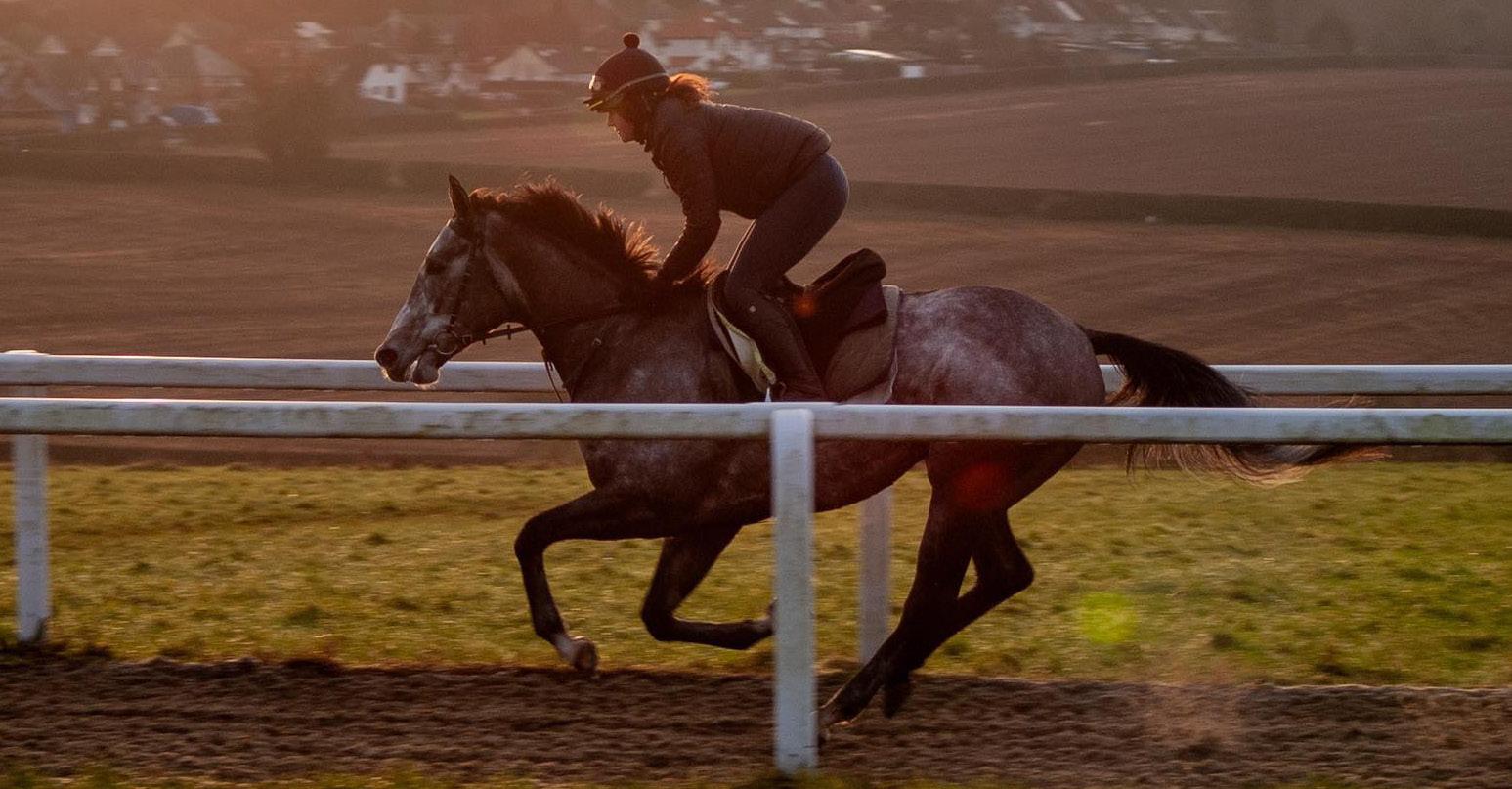
For the past two years, I’ve been riding out three lots each morning for a local trainer, giving me invaluable time in a very different saddle to the eventing and show jumping ones I’m used to. In a normal week my days start early - with a 5:15am alarm from Monday to Saturday. I arrive on the race yard by 6am, ready to pull out the first lot. By 9am, I’m back at my yard to care for and ride my own horses before heading out to freelance ride, teach, and train.
Evenings are spent teaching at a fantastic local riding school, where I have the chance to inspire the next generation of equestrians.
Weekends bring a change of pace. On Saturdays, I play for and captain my local hockey team, and on Sundays I compete my own horses or those I ride for clients. It’s full-on, but incredibly rewarding, and the variety keeps me sharp and motivated.
I was inspired to take part in the charity race after falling completely in love with the racehorses I work with. When the opportunity arose to ride in a real race on the turf at Newbury, I knew it was something I couldn’t pass up. It’s a personal challenge that pushes me outside my comfort zone - and an incredible chance to raise money for a charity that means so much to me and the wider equestrian world: The British Horse Society (BHS).
The BHS has played a major part in my career, and their work spans everything from rider safety and access to bridleways to welfare and education. Their ‘Changing Lives Through Horses’ programme has a particularly special place in my heart - I’ve seen first-hand how it transforms young people’s lives through the power of horses. I feel proud to be fundraising in support of their mission and the future of our industry.’’
To follow Georgie’s ride and her fundraising activities, follow ‘Georgie Wood Equestrian’ on Facebook and Instagram.
Why Horses Require
Ellen Lincoln BSc. (Hons) MSc. | Nutrition Manager | ellen@simplesystem.co.uk
Owners of metabolic horses (those with Equine Metabolic Syndrome [EMS], Insulin Dysregulation [ID], Pituitary Pars Intermedia Dysfunction [PPID]) and those prone to laminitis, are well versed in keeping the diet low in sugar and starch. Most will work towards a cut off of 10% combined sugar and starch, often referred to as the Non-Structural Carbohydrate or NSC level, although many try to achieve levels lower still.
The perhaps fortunate owners of those not affected by metabolic issues may let this ruling pass them by, but at Simple System, we feel that no horse has evolved to thrive on a high starch or sugary diet and that keeping NSC levels low for all horses might be a wise decision – with a variety of benefits!
An understanding of digestive physiology explains why horses haven’t evolved to thrive on a high starch diet… Unlike humans, the horse’s saliva does not contain sufficient amylase - the enzyme that breaks down starch into sugar molecules and the reason bread tastes sweet if you keep chewing it. This means that in the horse, starch is not “pre-digested” before entering the stomach and relies on the stomach acid and enzymes present here to break it down. The horse’s stomach is also small relative to their overall size. This means they have limited physical ability to digest starch but also limited chemical ability too, due to the lack of amylase in their saliva and low levels of amylase in general.
These limitations require starch levels in the diet to be kept low and starchy meals to be kept small, hence the age-old rule of feeding “little and often” but also allowing for breaks between feeding and work.
Undigested starch that passes into the hindgut will undergo rapid fermentation, lowering the pH level, disrupting the hindgut microbiome and potentially leading to digestive issues, ranging from general discomfort and gassiness to colic, hindgut dysbiosis or even triggering laminitis.
But surely poorer doers need all the help they can get? Keeping starch intake low for poorer doing horses means you can safely feed generous meals, helping keep your routine simple - negating the need for multiple smaller meals through the day - but still ensuring they get adequate nutrition and physical intake.
We may typically recommend that a poor doing 500kg horse needs at least 3kg (dry weight before soaking) of Lucie®Nuts per day - Lucie®Nuts being made from nothing but lucerne which is naturally low in sugar and starch. Giving them this all in one go would be no different for them digestively than giving them 3kg of hay – but will likely be a lot more nutritious.
You couldn’t safely feed cereal feeds in these quantities and, due to their limited ability to digest them, often feeding more of a starchy cereal based feed doesn’t successfully promote weight gain.
Lucie®Nuts
An ideal option for those needing to gain or maintain condition, yet they are low in sugar and starch.
Learn more here
Low Sugar & Starch
What about competition horses, surely they need energy from somewhere?… Feeding competition horses on a low starch diet means you can feed right up until the moment you get on board. This helps line the stomach to protect against acid splash and work related ulcers, staves off hunger pangs to improve concentration, and supplies a direct energy source. This process we call Target Feeding. Target Feeding allows you to quite literally put fuel in the tank beforehand without compromising the horse digestively. You can also feed immediately after work to aid recovery, and the use of soaked mashes such as SimplyComplete will also aid rehydration.
Travel is a major risk factor for gastric ulcers. Travelling is unavoidable for many competition horses but by keeping starch levels low in the diet, you are at least controlling and reducing dietary related risk factors.
… and keeping starch low may even benefit their energy metabolism! During work it is important to keep metabolism off the anaerobic glucose pathway, as this results in the formation of lactic acid and heat in the muscles, too much of which can trigger muscular discomfort or even exertional rhabdomyolysis - a tying-up episode.
If we can instead keep them on aerobic pathways, using free fatty acids as fuel (produced by the breakdown of fibre in the hindgut), lactic acid and heat are less likely to be produced in the muscles and the risk of discomfort is greatly reduced.
Energy released from the breakdown of fibre in the hindgut is also a more slowly released form of energy. We typically refer to Simple System Horse Feeds as being “non-heating” for this very reason. People find their horses have appropriate energy levels but that they sustain them more evenly: avoiding those typically hot first few moments and then the slump in energy which follows.
This tends to happen with more conventional feeds where quick release energy from molasses and cereal starch is metabolised and used up much faster.
Low sugar and starch intake can also benefit youngsters…Growing foals and youngstock are best fed a low sugar and starch diet to reduce the heating effects these fast release energy sources can have, but also to avoid rapid growth and development which can cause future joint issues such as Osteochondritis Dissecans (OCD). Forage fed yearlings can grow as well as their cereal fed counterparts (Ringmark et al. 2013) whilst reducing starch levels and increasing fat and fibre content results in improved handleability and inquisitiveness in weanlings (Nicol et al. 2005).
… and will look after their teeth into adulthood. High sugar intake from molassed feeds can also negatively affect our horses’ teeth –just as children are warned by the dentist to not eat too many sweets or drink sugary fizzy drinks, equine dentists are seeing an increasing number of dental caries that are often linked to the feeding of molassed and starchy feeds.
In summary... Whilst a low sugar and starch diet may be more commonly associated with overweight traditional and native ponies, considering the horse’s digestive physiology and how these nutrients may affect them energetically, enables us to begin to understand that keeping NSC levels low might be a good idea for all our equines!
References: Ringmark et al.2013 Growth, training response and health in Standardbred yearlings fed a forage-only diet.
Nicol et al. 2005 The effects of diet and weaning method on the behaviour of young horses.
Tim’s Diary
A Special Birthday Edition
Hay folks!
It’s Tim here from Munchkins Miniature Shetland Rescue (famous for the “Tim’s Daily Diaries’’ on our Facebook page) with an extra special diary for you. My fame is spreading the word and I wanted to tell everyone about the amazing Simple System HayCare fibre nuts we use in abundance at Munchkins Miniature Shetland Rescue in Devon. The kind people at Simple System horse feeds contacted me directly as they wanted to share my review (on behalf of all of the 56 ponies at Munchkins!) of their HayCare feed to help them celebrate the feed’s10th anniversary in November 2025, so here goes....
It has been noted that all of our rescue ponies at Munchkins HQ are fed HayCare as it is very palatable, low in sugar and starch and, combined with the high fibre levels, is very close to the natural forage diet of ponies, and can help to keep us healthy. This amazing feed is very tasty and all of my pony friends, including me, I enjoy it very much.
The feed is very versatile and even some of our older herd members that are dentally challenged can enjoy it as a soaked mash. It is served in slow feeders so it is not eaten too quickly to keep their tummies happy too. It can be used as a complete hay replacer which is very useful to those of us who are dentally challenged and cannot live on grass due to metabolic issues.
Due to the amount of soaked mash we need to use at Munchkins we have had to find novel ways of feeding it. Those of you that follow my diaries may have seen photos of our more arthritic herd members eating the mash from clean wheelbarrows to save them having to bend too far down! We really do try to think of everything, but were helped with this idea by one of the cheeky youngsters ‘licking out the barrow’ after the delivery of the slow feeders to the oldies herd for breakfast. We do have dedicated ‘mash barrows’ all colour coded.
The use of “mashes” or soaked cubes is also a very good way to ensure we all stay well hydrated during the winter as sometimes we don’t want to drink very cold water, but with a tasty sloppy fibre mash on handwhich can be warmed with a kettle of water - we are all well provided for.
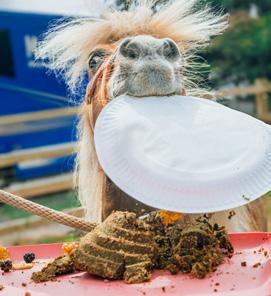
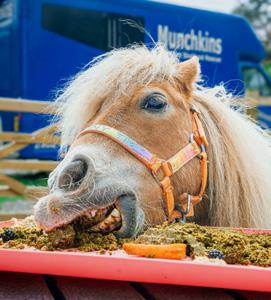
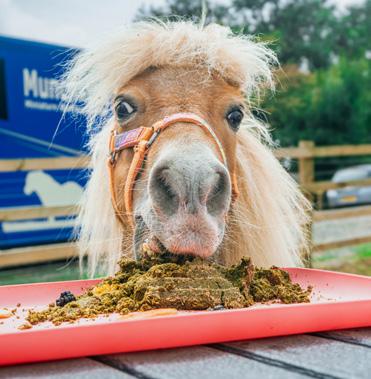
I hope you have all enjoyed my ramblings about our favourite food! Here’s some photos of me with a tasty HayCare cake – recipe is below!
Tim, Munchkins Head Reporter
Follow Tim’s Diary, or get to know more about Munchkins Miniature Shetland Rescue (Registered Charity 1160509) at www.mini-munchkins.org or find them on Facebook @munchkinsponies
Ingredients...
- HayCare®
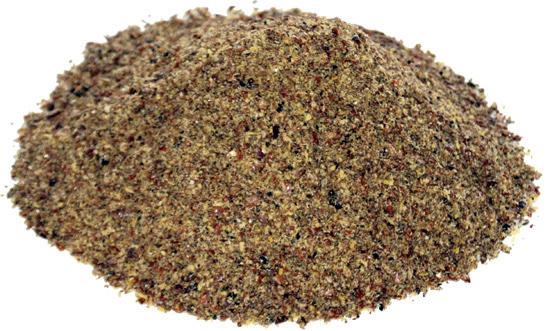
- Instant Linseed
- Carrot
- Apple
Special Equipment...
- A mould such as a jelly mould or round mixing bowl.
Method...
1.. Place 2 cups of HayCare® into the mould and add 5 cups of water.
2. Leave to soak until free from hard lumps.
TIP: Using hot water really speeds up soaking times.
3. Grate the carrot and apple.
4. Turn the HayCare® cake out of the mould into a suitable feed bucket.
5. Decorate with grated carrot and apple. For an extra ‘sparkle’, sprinkle with Instant Linseed.
Trusted by Vets...
‘‘This is Rosie who has been known to be ‘colicky’ post general anaesthetic. She was fed HayCare as a hay replacer whilst she was recovering after surgery.’’
Clarendon Equine Vets
Did you know?
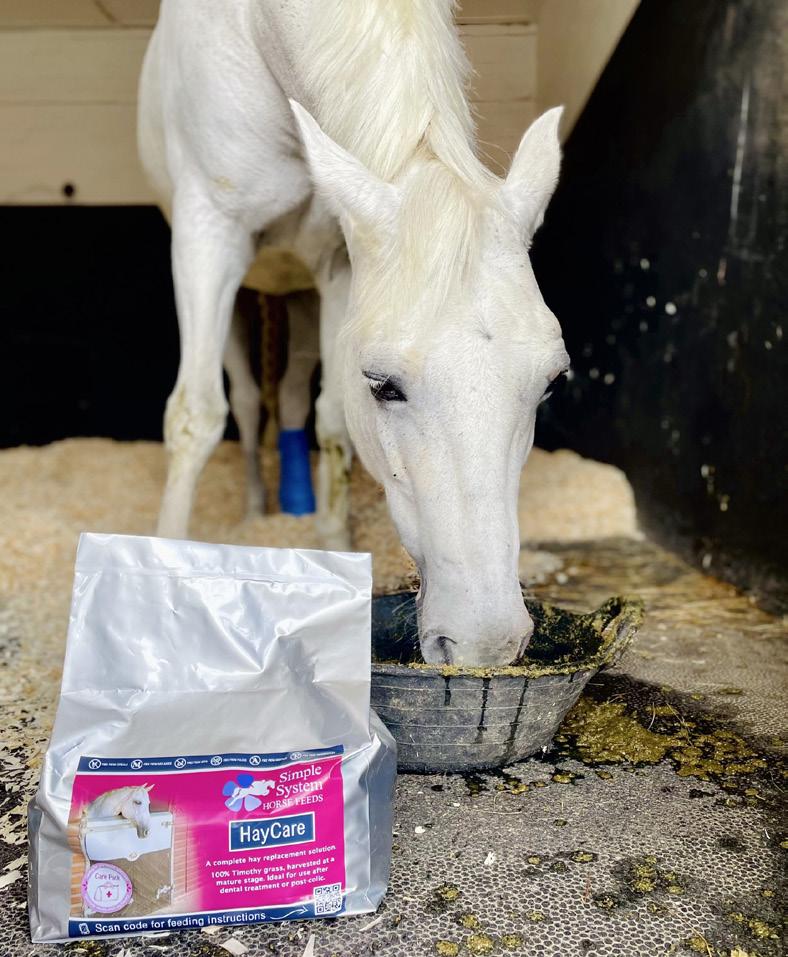
Simple System Horse Feeds offer Care Packs.
Created for equine professionals to help horses when they need it the most, Care Packs are convenienty sized packs of our Timothy grass hay replacer, HayCare®, used to support horses post-colic, post-dental treatment and post-surgery.
‘‘My vet is so pleased with him’’
‘‘I just wanted to update you on how well my old boy, Blue is looking on Simple System feeds.
I am getting lots of comments from people on the yard saying how well he is looking. He absolutely loves his HayCare and he has been putting on weight ever since.
My vet is so pleased with him and I’ve been telling everyone how good the feed is.
They are free of charge for vets and EDT’s and are a goodwill gesture for the client. If you’d like your vet to carry Care Packs, they can order by scanning the QR code to the left, or by emailing sales@simplesystem.co.uk. Before
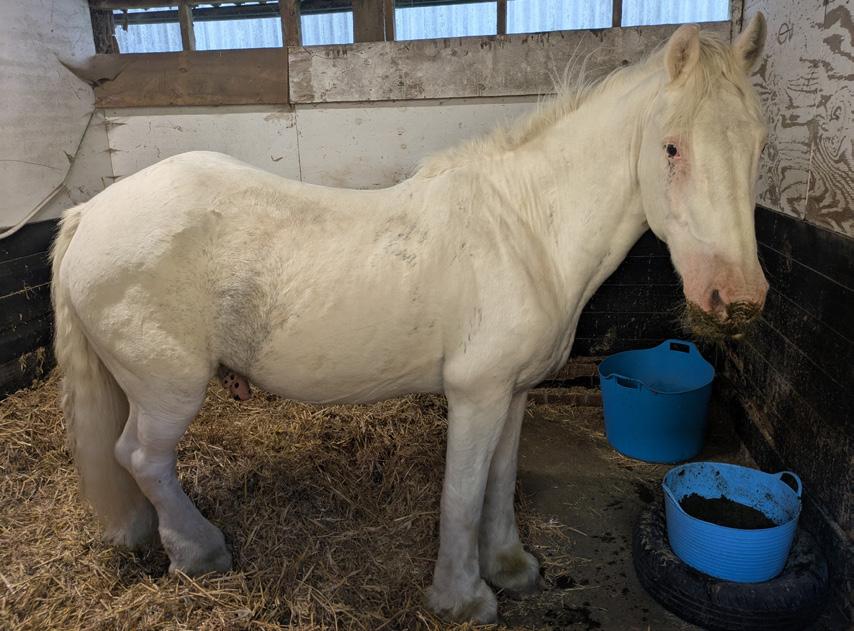
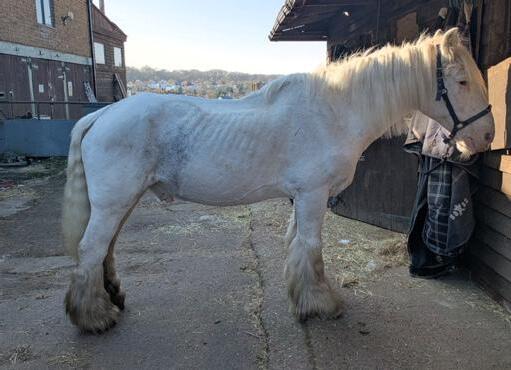
Blue’s Feed Plan...
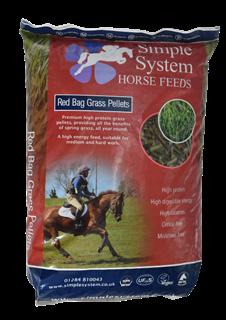
Red Bag Grass Pellets
A high nutrient grass pellet, grown specifically for Simple System. Providing the benefits of spring grass, year round.
A natural blend created from only plant derived ingredients, for those needing joint support.
You have always been so helpful and the customer service from the team is excellent.’’
Sally White
Simple System Customer
HayCare®
A direct replacement for hay, HayCare® is fed soaked in generous quantities for Blue to graze uponjust as if he were eating hay.
Weaning Foals
When is it the Right Time?
Although it is deemed traditional to wean a foal at 6 months old, this is actually too early. The foal’s gut microbes are not fully up and running until the foal is around 7.5 months old. These ‘good gut bugs’ that make up the microbiome are vitally important not only for gut health, but for immunity, cognitive function, metabolism and even behaviour*.
To help provide the very best start for your youngster, delay weaning until the foal is 7.5 months - or older if the mare is in good health and condition. If she is in foal again, this next foal is not making heavy demands on her until the last trimester of pregnancy so she can continue to nurse without compromising her health. In nature, weaning may not take place until the spring, when we would consider the foal to be a yearling. Later weaning reduces the risk of seperation anxiety developing, leads to less stress for the mare and foal, and reduces weight loss associated with weaning.
It is important to note that the mare will need additional feeding whilst she nurses, especially so during the autumn and winter. If the mare is looking thin, it is most likely that she is not being fed sufficiently.
With Simple System feeds there is no limit to individual meal size, so you are able to increase the size or number of the mare’s bucket feeds to help her maintain condition. She will also require a top-up of quality protein and nutrients in the form of a forage balancer, such as new Stud Balance +®.
If your mare is typically rather a poor doer, you can also look to increase the calorie density of her feeds utilising Red Bag Grass Pellets, which are nutritionally likened to spring grazing, and TopGain, a nutrient rich top-up feed.
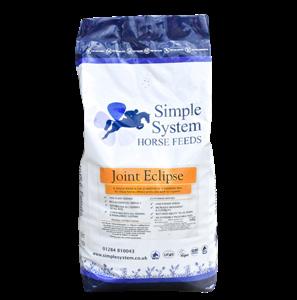
Weaned foals also need a nutritious diet and if they have been sharing their dam’s feed, this will enable them to get used to their bucket feed. They often do well on the same diet as their dams, Lucie®Nuts, Red Bag Grass Pellets and Stud Balance +® for example. You can also give their gut microbes additional support with a course of Eclipse Recovery - a tonic feed based on wildflower forages.
For more specific feeding advice for your mare and foal, contact the Feed Line on 01728 604 008 or by email to info@simplesystem.co.uk.
*Learn more about the equine microbiome on pages 24 & 25.
Introducing Stud Balance +
This specialist forage balancer is a new addition to the Simple System range. Created to provide optimal nutritional support for broodmares, stallions and youngstock, it is an ideal choice pre and post weaning.
Feed with their usual Simple System soaked feeds to provide a top-up of quality protein and calcium, to aid nutrient absorption and to help promote steady growth.
Visit www.simplesystem.co.uk to learn more, find a stockist, or place an order for free delivery to your home or yard.
ChristmasBrix and Christmas LucieMints are back for a limited time only! These festive treats make excellent gifts.
Available to purchase for direct delivery, via stockists or at Your Horse Live.
WINTER HOOF CARE TIPS
In the equestrian world there may be no truer phrase than ‘‘no foot, no horse’’. To help our horses stay foot sound this winter, we quizzed Kaine Seddon DipWCF.
What are the most common issues you see during winter? I will see abscesses week in week out during the winter. They can be a painful problem for horses. Thrush is another common issue year round, but it is usually more prevalent during winter.
Why do horses get hoof abscesses? A hoof abscess is formed when bacteria is trapped in the hoof, leading to a build up of pus (dead white blood cells) within the hoof capsule. There are many things that can cause bacteria to penetrate the hoof; a small stone trapped in the white line, standing on a sharp object, or even a chip or crack in the hoof.
How do you know if a horse has an asbscess? Hoof abscesses can be very painful and only a vet can make a diagnosis, so if you suspect an abscess, please give your vet a call straight away.
Our pick of Feeds...
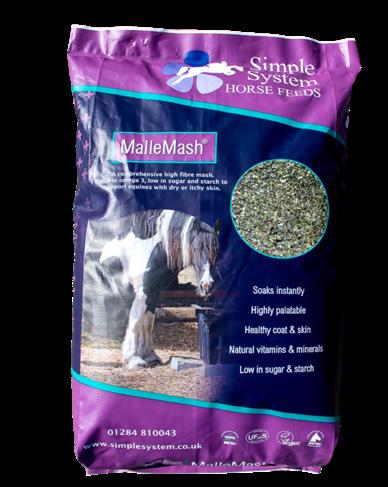
MalleMash®
A ‘one bag’ feed which is very popular for cobs and feathered breeds.
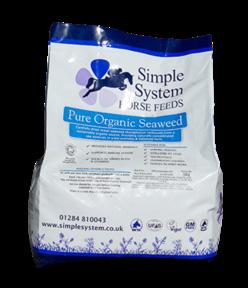
Pure Organic Seaweed
A natural source of amino acids and vitamins for promoting strong hooves.
Christmas Brix
Useful for feeding whilst waiting for the farrier to arrive.
Feed from the ground for a tasty, enriching chew.
£4.50 each, £45 for 12, or £45 for an economy bag of 20.
Signs that your horse may have an abscess are: reluctance to bear weight on one particular foot, sudden onset of lameness, which can be anything from mild to severe, and a notably warm hoof.
Once diagnosed, the vet will suggest the best method of treatment. This can include wet poulticing to help draw out the infection through the bottom of the hoof, and in some cases the vet may ask the farrier to pare away a small area of the hoof to help encourage drainage.
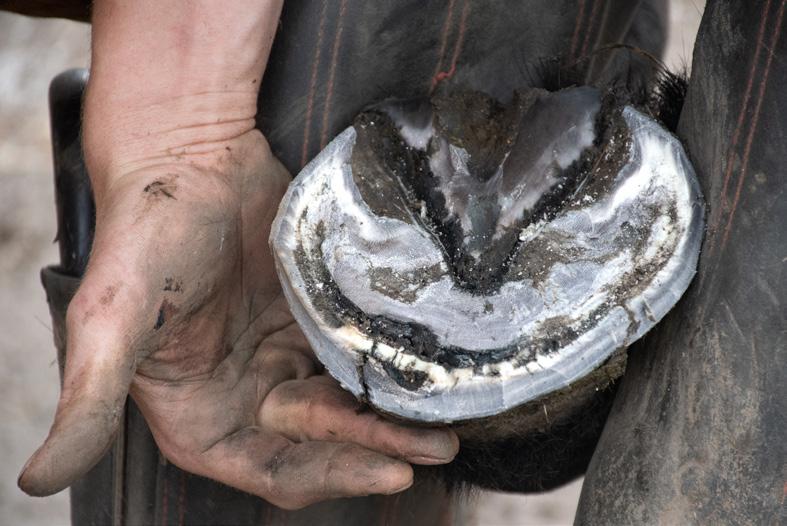
Can you spot what may have caused the abscess in this hoof?
How can we help prevent hoof abscesses? Good hoof hygeine is important. Pick the feet out daily and keep them washed and cleaneven if they are outkept in the field.
How do you become your farrier’s
Being a ‘farrier’s friend’ is never a bad thingespecially if you have a horse who has form for losing a shoe the night before a competition!
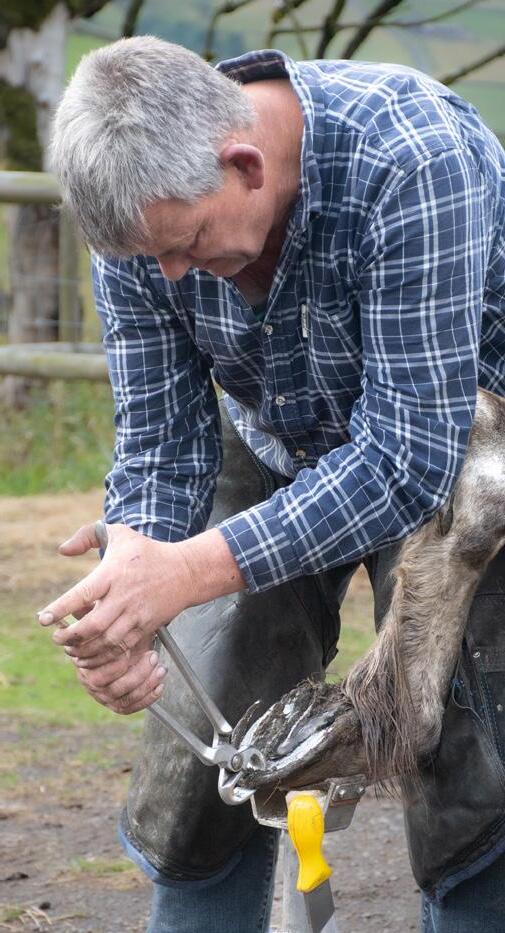
Award winning, Lancashire based farrier, Gareth Holt DipWCF, tells us the most important things to help keep your farrier happy this winter...
Before your visit...
- If your horse has any issues or training needs, discuss them and make a suitable plan, which may include enlisting another professional like your vet. Getting things right first time can save time, money and most importantly - minimise stress for you and your horse.
- Bring any outkept horses into a safe, sheltered space, like a stable or barn. This helps your busy farrier to keep the day’s diary running to time.
From the Farrier’s Forge...
Warm water with some Organic Cider Vinegar is ideal for washing hooves as it has anti-bacterial properties. Once clean, inspect each hoof carefully. Check for any chips, cracks or bruising and pay extra attention to the white line as this is where the majority of abscesses occur.
Applying hoof oil to clean, dry hooves can be beneficial. Apply underneath the hoof, as well as to the exterior hoof wall. This keeps the hoof moisturised and can prevent cracking as well as helping to repel water and dirt.
You also mentioned thrush... Yes, thrush can be very common. It again is a bacterial issue and it can be more prevalent during the wetter months. Wet, muddy pasture is a prime culprit, so ensure turned out horses have somewhere dry to stand.
Horses that spend more time stabled can also be prone to thrush. Wet or soiled bedding is a prime breeding ground for the bacteria. Also, when movement is restricted (i.e. spending longer periods standing in the stable), there is less wear on the hoof, affecting blood flow to the feet, making the horse more prone to infection.
favourite client?
- Ensure your horse’s legs are clean, dry and free from slippery creams or lotions. If these are required they can be re-applied after your visit.
- Offer your horse something to eat. A hungry horse is likely to be distracted and so may not stand well for the farrier.
Providing hay, a forage block (Simple System Brix), or a bucket of soaked feed like HayCare® or PuraBeet, helps them to feel fuller. It can help a nervous horse feel happier / more relaxed.
How can you tell if your horse has thrush?
The smell! Thrush has a foul smelling black discharge that comes from the frog, and this discharge can often be seen in the collateral groove. The frog itself can also become soft and the sole can become chalky - although this doesn’t happen in every case.
Can thrush be prevented or managed?
Thrush is an anaerobic bacteria that thrives when there is little to no air flow. Exposing the bacteria to the air by keeping the feet well picked out is essential.
Are there any other common problems you deal with during winter? Not a hoof problem, but one that farriers are seeing more are leg problems like mud fever, mallenders, sallenders and CPL. Each of these conditions can be painful for the horse and so can make trimming and shoeing more difficult. If your horse is prone to any of these conditions, make sure your farrier is aware so they can make a plan with you, and your vet if necessary, to help keep them comfortable.
A snippet of advice for all horse owners?
Most issues can be avoided by inspecting and cleaning hooves daily and keeping to your regular farrier appointments.
During your visit...
- When presenting your horse for trimming, do so on a flat level surface. This allows your horse to stand with their weight evenly distributed. This means your farrier can properly assess each hoof so it can be trimmed and balanced correctly.
- If your horse doesn’t stand well for the farrier, tell them so they can work with you. A scratch of the withers here or a food reward there, can go a long way to gaining your horse’s trust.
- The most important thing to remember is farriers are actually a bit like horses. They usually like treats. Keep them well topped-up with coffee and cake.
If you really want to leave the very best impression, a [vegan] bacon butty is always appreciated!
Gareth Holt DipWCF
Ellen Lincoln BSc. (Hons), MSc. Nutrition Manager | ellen@simplesystem.co.uk
What do we mean by the term ‘equine microbiome’? Our horse’s digestive tract is home to a vast ecosystem made up of trillions of microorganisms; bacteria, fungi, viruses, archaea and protozoa which we collectively refer to as the microbiome. These organisms exist throughout the entire digestive tract but as it is the main site of fibre digestion, when we talk about the equine microbiome we would almost always be referring to the hindgut microbiome specifically.
In the hindgut, ‘good’ bacteria ferment and break down fibre into volatile fatty acids - a major energy source for horses, supporting their daily functional requirements but also their work or use as breeding stock. The organisms present also break down feed and forage into other vital nutrients, producing the horse’s B-group Vitamins and Vitamin K.
In addition to digestion, the microbiome plays a major role in immune response and can impact metabolism, cognitive function and even behaviour. An imbalanced microbiome can impact our horses not only digestively but also their health and behaviour.
What do we mean when we say the hindgut is imbalanced? An abundance of ‘good’ bacteria essentially reduces the space available for ‘bad’ bacteria to develop, helping keep out infection and disease. The hindgut is considered imbalanced when there are too few good gut bugs left to function effectively, which might present in various ways over time or, when bad bacteria have rapidly proliferated, often causing more acute issues. The bad bacteria associated with IBS, Crohn’s disease and other bowel disorders in humans, are the same bad bacteria we see in imbalanced equine microbiomes - although the good gut bugs are quite different.
Equine
What does a healthy microbiome look like?
Each horse’s microbiome is as unique as a fingerprint. Whilst there is a small group of core bacteria found in every horse, the exact population breakdown can vary significantly.
This makes it almost impossible to say what the perfect microbiome looks like in terms of species numbers and research into this is still in its infancy. The wide variation, even between horses, may explain why some horses are more prone to colic, illness or metabolic issues - though we can’t say for certain just yet.
A healthy equine microbiome in general is one that is diverse and populated with a wide range of predominantly good bacteria. Horses with hindgut issues don’t have fewer microorganisms, they just don’t have enough of the right sort. With advancing age, there is a trend towards reduced diversity, but there is not a loss in numerical terms.
How can we support the hindgut microbiome? The microbiome develops in response to diet with organisms developing on an “as required’’ basis depending on what the horse is fed. The specificity of each organism and what they break down and digest, means that introducing new feeds too quickly, when the right organisms to break it down aren’t yet established, can have a negative impact on the ecosystem as a whole.
Previously fed feed or forage should also be reduced slowly to help phase out the microorganisms that are no longer required, or, required to a lesser extent. Having too many or too few of the necessary organisms for digestion causes these imbalances and potential health issues. In the case of rapid feed or management changes, this can result in colic.
MICROBIOME
Feeding the horse “as nature intended” on a high, or better still, a solely forage diet, encourages more of the good bacteria to develop. Feeding a wider variety of forages further increases species richness in the hindgut which is linked to overall health and strength of the microbiome. This has direct efect on improving the health of the animal. In contrast, minimal forage intake with a high intake of cereal grains would not promote good species richness and would favour the bad acid producing bacteria.
Grazing and hay is often made up of a limited number of grass species, especially in areas that are overgrazed and where over time, weaker, native species have been outcompeted. For those lucky enough to have their own land it may be worth re-seeding or overseeding with a diverse meadow grass mix, or trying to source a forage that contains multiple grass types – ryegrass free of course.
Access to hedgerows or verges should be encouraged (where safe and in the absence of poisonous plants) as leafy, stemmy and fibrous or more woody plants are highly beneficial for hindgut health.
In the feed bowl, choose different forage types for their chop and their pellet and offer forage types other than grass, such as sainfoin or lucerne. This helps increase diversity in the diet and in turn, the microbiome. Eclipse Recovery can also be a great addition to the diet. As the name suggests, it was created to support the immune system and recovery. This natural tonic is based on wildflower forages and is high in the metabolites of microbial fermentation.
Is it just feed that impacts the microbiome?
No - whilst feed plays a major role, housing, medication, environment and stress all have the potential to impact the microbiome. The microbiome is also in part determined by genetics and can even be affected by birthing method. The issues we see in adult life may have been impacted by complications during foaling or, more likely, early weaning. Leaving their dam before the hindgut microbiome is well established, which in some cases can take 9 months or more, may be detrimental to digestive function, immune strength and even behaviour, in years to come.
A take home message…
In these still relatively early years of research and knowledge development a lot of what we know is assumed or extrapolated from small studies, even sometimes conducted on other species. What we are becoming more and more aware of though is that hindgut health can directly impact our horse’s health and that feeding a varied forage diet is a great start point in strengthening and supporting this vital ecosystem.
Feeding sainfoin or lucerne helps increase variety in the diet to support the microbiome
Frank, from Emily Watts Equestrian, enjoying Sainfoin & Shine as part of his Simple System diet.
Local Stockists
Five Minutes with Junior Jockey, Lily Pett
Trojan Equine Supplies have been keeping customers in Carmarthen stocked with Simple System feeds since 2017.
We caught up with event rider Lily - the 14 year old daughter of store and stud owners, Amy and Jonathan - as we’d heard about Lily’s incredible eventing season.
Tell us a little about yourself... I started riding at age 4 on my family’s stud farm, where I have been lucky to grow up. My favourite thing to do when I’m not competing is to spend time relaxing with the ponies. You’ll often find me sitting in the stable or field.
And of course, we want to know about your ponies... I have three wonderful ponies:
- Snabo Star (Joey), a 13 year old, 138cm Connemara gelding who loves to be the centre of attention - and to eat everything!
Joey is my main competition horse. We love eventing together and, like all our horses, he is fed Simple System feeds. Joey has Red Bag Grass Pellets, Sainfoin Pellets and Veteran Balance +®
- The Longhouse Blue Pascal (Ash), a 15 year old, 143cm Welsh part-bred mare who has been with me for 4 years. Ash is a very sweet and loveable mare. She loves attention and is the perfect pony to have fun with, in and out of the saddle. Ash is fed Red Bag Grass Pellets, Lucie®Nuts and Veteran Balance + ® .
- Tigger, a new addition to the team. He is a 158cm Irish Sports Horse gelding, and he is just 4 years old. He has only just been backed. I am really looking forward to producing him slowly over the next 12 months. Tigger has a diet of Sainfoin & Shine and Calm Balance +®
You’ve had a phenomenal eventing season –what are your secrets? It’s been such a great season. The best show of my life so far was the BD Combined training qualifiers. I won 3 out of 3 classes. It was AMAZING!
Stockist & Supported Rider Partnership
Simple System stockist, Stanah Horse Feeds from Thornton-Clevleys, have partnered with Simple System Supported Rider, Rebecca Duke of The Balanced Horse. Rebecca’s focus is on encouraging better knowledge about equine well-being, longevity and the correct way of going.
Rebecca’s horse, Finn, has a range of needs including; PSSM1, RER and a previous history of ulcers and Rebecca aims to share their not so straightforward journey together openly and honestly. Rebecca also has a youngster, Moomin, who is growing into a fine horsewith the help of Simple System of course!
Stanah stock a whole range of feeds including Rebecca’s choice of feeds: MeadowBrix, HayCare®, Timothy Chop, Blue Bag Grass Pellets and Instant Linseed, alongside popular choices such as Lucie®Nuts and MalleMash® If you’re local to Stanah, be sure to call in!
Rebecca & Finn of ‘The Balanced Horse’.
Credit: Fine Photography by Georgia-Emily
in the Spotlight
When it comes to secrets, I don’t think I have any. I work hard with my ponies and have help from my parents. Dad coaches me and I have regular group lessons. Mum looks after the ponies too, she gives them regular massage treatments. We treat them like horses so that they are happy and healthy.
How do you feel when you’re about to compete? I love competing and I enjoy ‘away’ shows; I love staying in the lorry, spending time with my ponies, watching my team mates and other competitors - especially in classes I aim to enter in the future.
Do you feed the ponies differently at a show? We always travel with a bucket of water with PuraBeet in to encourage them to drink. This works really well. They are also Target Fed with Red Bag Grass Pellets before and after shows. There can be lots of waiting around at an event, so we also use Brix to keep them occupied. Especially when stabled.
To find a stockist, scan the code or visit www.simplesystem.co.uk
Can you share any ‘top tips’ for other young riders? My tips would be:
1. Plan. Make a plan of which big shows you would like to aim for and work backwards from there.
2. Prepare. Be prepared by having a coaching, work and health schedule - for you as well as your pony.
3. Be dedicated. There may be times where you miss out on other things to stick to your training. Ride as often as you can, but vary the work you do and be ready to work through problems, even when it’s hard. Challenges are there to be overcome.
4. Train over compete. We don’t do lots of competitions, probably two a month for each pony. Also, we never train at a show, everything is done before.
5. Have Fun. Make sure you and your pony enjoy what you do. Competing should be exciting.
If you’re a stockist with a story to tell, get in touch by emailing melody@simplesystem.co.uk
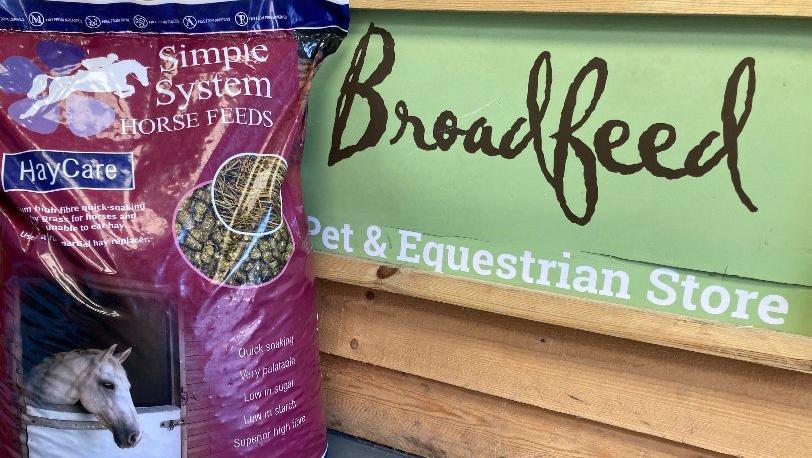
Broadfeed Hit the Button for Hay Alternatives
Tunbridge Wells retailer, Broadfeed, are a family run business that’s leading the way in providing hay alternatives...
‘‘Due to the dry spring, our hay harvest has been low. We were concerned our customers would face a difficult winter. Not only horse owners, but those with small animals, such as rabbits and with small holdings.’’ Says manager, Charlie Bloom.
‘‘It was important to us to provide them with hay replacement options of high quality and ease of use. Simple System feeds absolutely fit the bill.’’
Broadfeed carry an excellent range - that is not just suitable for horses.
For small animals such as rabbits and guinea pigs, look to our Timothy grass feeds, HayCare®, MeadowBrix and Timothy Chop.
Working with Nature
In the wild, with unrestricted access to pasture, horses would spend the summer “stocking up” by eating nutritious grass - and plenty of it - to aid them in building a thick coat and laying down excess weight, even fat pads to sustain them through the winter.
Through the winter, when resources became harder to find under snowfall, the grass was lower in nutrition and the weather was harsher, these excess fat stores would be burnt off for energy, allowing them to still function, flee and survive.
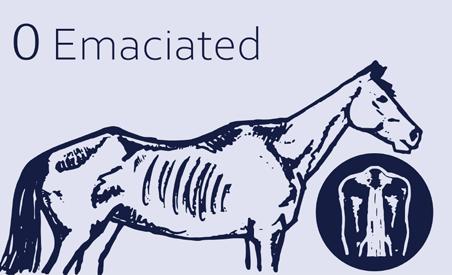
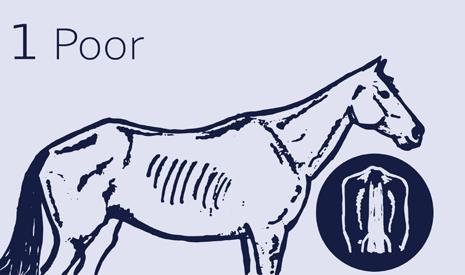
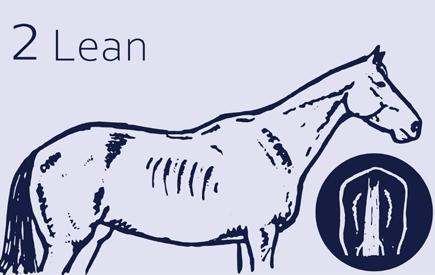
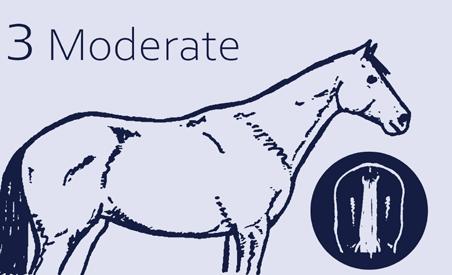
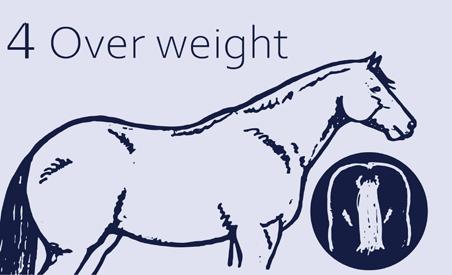
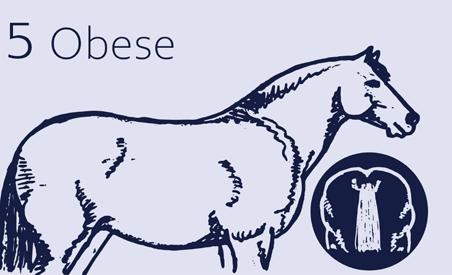
This might mean their Body Condition Score (BCS) would fluctuate by 1-2 points on a 1-5 scale: entering the winter around a 4/5, classified as overweight and coming out of the winter much leaner, even as low as a 2/5, classified as underweight. The rich spring grass would quickly help them get back up to a good or healthy BCS (around a 3/5) and them being overweight would have only been short lived. This sometimes quite stark fluctuation in BCS is very natural in wild horses, a normal cyclical process mirroring weather conditions and grass nutrition levels.
However, now that horses are extensively managed, kept indoors during harsh weather, given less opportunity to move in winter and along with the invention of rugs and concentrate feeds, this natural weight loss pattern is rarely seen. Horses that go into the winter in a fat body condition, come out of the winter still fat. Consuming spring grass on top of this tips them into obesity, increases the risk of metabolic issues and laminitis.
Regular monitoring of BCS through the year helps us plan ahead. A horse that is fat in
Body Condition Score...
autumn is less of a concern than it may be at other times of year, but the winter needs to be used to advantage to slim them down.
What can you do to promote seasonal weight loss in a modern management system? The first major change to make is to allow them to get cold. Burning fat to keep warm is a highly effective weight loss tool. Horses have a wide thermoneutral zone - the range of temperatures within which maintaining core body temperature is “easy” without shivering or sweating. For healthy adult horses, this zone typically falls between 5°C and 25°C. In humans, this comfort zone is between 25°C and 30°C meaning we feel the cold a lot sooner than horses do.
You could argue that most horses may not need rugging in winter, though rugging requirements vary by age, health status or breed type. Use only a light sheet if absolutely necessary to keep the worst of the weather off when turned out and do not rug overnight when stabled. If you only ride at weekends in winter, then it won’t matter if they get a bit muddy midweek! You can also consider clipping – even just a trace clip on the chest and neck can help expose a little more skin to the elements.
Avoid overfeeding of both hay and bucket feed. Good doers in general and those on a weight loss programme need to consume around 2% of their ideal bodyweight per day in dry matter. This incorporates a suitable reduction without over restricting and placing them into starvation mode, whereby the body holds onto fat reserves rather than burning them for energy.
for Winter Weight Loss
If your horse should weigh 450kg, they need to consume 9kg of dry matter per day. If they are stabled for 50% of the time, you can crudely assume they will need 4.5kg of dry matter when stabled. In the bucket feed, opt for high fibre, low calorie chops to add bulk, or a soaked forage pellet for older, dentally challenged horses with a quality forage balancer. This should be all they require.
As much as you can, increase the frequency, duration or intensity of exercise. You might not have the time (or daylight) to hack out or put in a schooling session, but getting them out of the stable in-hand is better than them standing in the stable not expending energy –you don’t even need to groom all the mud off for in-hand work.
Try to increase movement in their day-to-day life. Turn out as much as you can and use longer, narrower fields. Space supplementary forage further apart too, this will mean they move around more than if turned out in a square field with a single hay pile.
In the stable, split feed and forage into multiple nets/piles/bowls and again space these out so they cannot stand in one place eating until it is gone. This ability to pick between different feeding stations also mimics natural browsing and grazing behaviours, increasing enrichment and making feed and forage last longer.
It is also important to appreciate what a healthy body condition looks like and accepting that losing weight in winter is very normal – and to be encouraged. Horses should not look thin or poor, but they should also not be fat and well covered year-round.
This can slow metabolic rate, put excess strain on their joints and increase the risk of developing EMS, insulin resistance and laminitis.
If a horse has been on a strict diet and has had overly restricted food, when food or grazing is available, their rate of consumption will increase. On restricted grazing, they can eat as much in 12 hours as they did previously with 24/7 access to grazing. Then, their intake can increase to double their needs, 5% or even more, of ideal bodyweight. We all know how hard it can be to manage good doers, but starving them really, truly, is never the answer. It helps to work with ideal bodyweight as this is a constant, as is the gut, unlike actual bodyweight, which can fluctuate.
Aiming for them to come out of the winter at around a 2.5/5 Body Condition Score is ideal – if they are dipping below this then do increase feeding sooner, but otherwise you can wait for the better grass and warmer weather to do its job.
On the flipside of this, it is worth mentioning that if you have a horse already coming into winter lean, they are going to need increased feeding and even ad-lib forage so that they do not lose even more – this is especially important to monitor in older, dentally challenged horses who may be less able to manage hay.
If you’d like to discuss your horse’s dietary needs this winter, contact the Simple System Feed Line on 01728 604 008, or get in touch via email to info@simplesystem.co.uk.
Feed Room Fun
Hint - all of the answers can be found by reading the
Quick Crossword
3. Volcanoes and teeth have these in common (9)
4. A type of grass and a Gentleman’s name (7)
6. This garden bird can be a smelly problem! (6)
Across Down
1. Found in the hindgut, field or on your dinner plate - albeit with a variation in spelling (6)
2. Part of the horse or a type of vote (4) 5. It’s this popular feed’s Birthday! (6)
Make a Match
1. The maximum suggested NSC level for a metabolic horse (%)
2. The lower level of a horse’s thermoneutral temperature range (°C)
3. The upper level of a horse’s thermoneutral temperature range (°C)
4. The amount of HayCare, dry weight before soaking required to replace a 4kg hay net (kg)
5. The minimum dry weight of forage a horse needs per day when on a weight loss diet (%)
Can you match the statement with the correct answer?