










DBy Patrick Moody Henry Mayo Newhall Hospital
uring these shorter winter days you’re more likely to find yourself driving after dark. Whether you’re headed home from work, going out for the evening or taking a trip, be extra careful driving when the sun is down. HERE’S WHY:
Your range of vision at night is only about 250 feet with your headlights on — about 500 feet with the high beams.
Your peripheral vision and depth perception aren’t as good.
You can be momentarily blinded by another driver’s bright headlights.
During evening rush hour, drivers may be more impatient, which may lead to mistakes or aggressive driving.
Drivers who are impaired by alcohol are more likely to be on the road at night. FROM DUSK TILL DAWN
Safe habits — and the right equipment — can help you stay safe if you’re on the road after sunset. These tips from the American Optometric Association and other experts can help steer you right.
Maintain a clean machine. Keep the windshield and rear window clear of dirt and smudges. Replace your wipers if they are leaving streaks. And don’t forget to clean the headlight coverings.
Optimize lighting. High beams can double your range of vision, giving you more time to react to hazards on the road ahead. Use them anytime you’re alone on the road. But take care to switch back to your regular headlights when a car is approaching or when you’re behind another car. And remember, high beams won’t help on foggy nights — they can make visibility worse.
Protect your vision. Dim your dashboard lights to reduce glare, and use the nighttime setting on your rearview mirror to dim headlight glare from behind you. Blink often to keep your eyes from becoming too dry. If you wear glasses, keep them clean and make sure your prescription is current. If you’re having trouble seeing at night, let your eye doctor know.
Slow down. Reducing your speed allows
you more time to react to something in the road. If roads aren’t well lit, drive at a speed that lets you react to what you see in your headlights — not the road beyond.
Stay alert. Get at least seven hours of sleep per night. Try to travel during times when you’re normally awake. Pull over for a nap if you start drifting out of your lane. Avoid looking at your phone and other distractions.
BLINDED BY THE LIGHT?
High beams may help you steer clear of road hazards, but they can dazzle other drivers. If someone’s brights are blinding you:
Ease off the gas.
Don’t look directly into the oncoming lights. Focus on the right side of the road, and use the lane markers to help you stay safely in your lane.
The good news? The days are starting to get longer!
BY KEN KELLER SCVBJ Contributing Writer
Every Sunday during the NFL season, millions tune in to watch teams battle for victory. Beyond the touchdowns and tackles, these games offer powerful lessons for business leaders. Success on the field may mirror success in the boardroom, and the parallels are too good to ignore.

Here are four insights from the NFL that can help you lead your organization to win when it matters most.
NFL teams spend countless hours studying playbooks, analyzing opponents, and practicing scenarios. The game is often won long before kickoff. Coaches know that preparation creates confidence and confidence drives execution. Business leaders should take notes. Market research, strategic planning and team alignment aren’t optional; they’re the foundation of success. When preparation becomes a habit, execution feels effortless. If your team is scrambling during the “game,” it’s a sign you didn’t prepare enough before it started.
No NFL game goes exactly as planned. Injuries happen, weather changes, and unexpected plays unfold. The best coaches and quarterbacks adjust quickly, turning adversity into opportunity.
In business, adaptability is equally critical. Market conditions shift. Competitors launch surprise moves. Customer needs evolve. Leaders who pivot decisively, without losing sight of the bigger picture, keep their organizations competitive. Ask yourself: When the unexpected happens, does your team freeze or flex?
Special Teams rarely get the spotlight, but they often decide the outcome of a game. A blocked punt, a perfect onside kick, or a clutch field goal can flip momentum instantly. These units succeed because they master precision, preparation, and adaptability.
In business, the same principle applies:

small, specialized units and overlooked details often determine whether you win or lose.
Field Position = Market Position: Special Teams fight for every yard because starting position matters. In business, your “field position” is your market presence. Are you investing in visibility and reputation, so your team starts ahead of the competition?
Specialized Roles Drive Impact: Special Teams players aren’t generalists— they’re specialists trained for specific scenarios. Do you have niche experts who can handle unique challenges like compliance, crisis management, or rapid innovation?
Hidden Plays Win Games: Fake punts and surprise onside kicks catch opponents off guard. In business, creative tactics—unexpected partnerships, bold pricing strategies—can create gamechanging opportunities.
Most CEOs obsess over “offense” (sales) and “defense” (cost control) but ignore their Special Teams, the small, strategic moves that shift momentum. That’s why many companies lose winnable games.
In the playoffs, every game is win-orgo-home. No second chances. No excuses. In business, we rarely face that level of urgency … until we do. A sudden death moment for a company might be losing a major client, the departure of a key
employee, cash flow shortfalls, or failing to adapt to a market shift.
NFL coaches don’t just pick plays; they evaluate talent relentlessly. They know who thrives under pressure, who cracks, and who can execute when the clock is ticking. In business, many leaders assume their “players” will rise to the occasion without ever testing them. That’s a mistake.
Three questions to consider:
Depth Charts Matter: Do you know your top performers and your backups, when the stakes are high?
Game Plans Are Situational: Are you adjusting your strategy when the market shifts, or running the same plays every quarter?
Pressure Reveals Character: How do you prepare your team for high-stakes moments before they happen?
NFL games remind us that leadership is about preparation, adaptability, and attention to detail. They also teach us that pressure reveals character and that the smallest plays can make the biggest difference.
So, as you enjoy the next game, ask yourself:
If my business faced sudden death tomorrow, who would I put on the field and would they win?

BY DREW ALTMAN
For the Business Journal
Forecasting the year ahead in health policy is always treacherous, because events intervene and screw up even the best predictions. I am sure lobbyists already have a full agenda of actions Congress might take that will affect the interests they represent. In health care, even pinprick changes in legislation can move billions of dollars. But my working theory is that the sharp partisan divide in Congress, and possibly even sharper disagreement on health care policy, can produce only small-ball actions on health next year. Plus, it’s an election year, when we don’t usually see major legislation. So, what should you watch for that will really matter for people, policy, and politics?
First and foremost is the role that health care affordability will play in the midterms. Assuming there is no deal on the enhanced ACA tax credits, spiking premium payments in the Marketplaces will become the national symbol for voters of concerns about their health care bills. Bad as the problem will be on its own, the public will feel it is much worse as media coverage and Democrats (as a political strategy) give far more people than directly experience the problem the impression that their premium payments could be doubling too, capitalizing on the very real concerns people have about affordability throughout the health system. Many polls will start to show that outof-pocket payments for health care run even with, or eclipse, the cost of food and utilities as an economic concern. Democrats will prosecute the issue to the fullest, and Republicans will generally try to shift the subject and fight on other issues. Health care affordability will be in the spotlight, but how important it is as a vote-and-turnout driver remains to be determined.
Second, again assuming there’s no deal on the tax credits, we’ll see how enrollees actually respond in the Marketplaces. What share of the 24 million enrollees switch to cheaper high-deductible plans? Who are they? What is the impact of doing that on their financial security and health-seeking behavior? What happens to older and sicker enrollees who need better, more comprehensive coverage? How many millions choose to be uninsured in 2026 and who are they? What happens to the uninsured rate in the U.S.?
Third, states that have expanded Medicaid will be gearing up for Medicaid work requirements, which kick-in in 2027. Red states may be looking for flexibility to implement the toughest possible requirements and reduce their Medicaid rolls and spending. Blue states will be looking for nooks and crannies in the law and the rules to lessen the impact in the hopes that Democrats seize control again in 2028 and reverse the requirements.
Having implemented state welfare work requirements myself, I know there is always some ability to shade implementation one way or the other depending on the goals of a state. In our case in New Jersey, we had little interest in kicking people off welfare (and into homelessness or deep poverty, which we’d also have to address), but we did have a big interest in providing job training, childcare, transportation, and a pathway to jobs.
Fourth, after years of moderate increases (not as people experience it, but as we experts quantify these things), health costs will increase more sharply again. Employer premium increases may not touch double digits but could come close.
The average cost of a family policy for employers could approach $30,000. It’s likely that cost sharing and deductibles
will rise again after plateauing for several years. Cost pressures may lead to action in Congress on such measures as site-neutral payment for hospitals or restrictions on PBMs.
Employers and public payers are increasingly skittish about the costs of GLP-1s for weight loss. It’s possible GLP1s could turn from today’s dilemma to a technology-diffusion success story of sorts. Costs are coming down, pills are on the horizon, and payers are developing more sensible guidelines for their initial and long-term use.
In a country where the dam breaks on every effective new medical technology and it’s rapidly disseminated at high costs, GLP-1s could emerge as a more balanced and sensible example of technology diffusion, albeit, like most new medical technologies, still one that increases costs.
Fifth, the Trump administration has put pressure on drug prices through a variety of initiatives. Probably the most important is Medicare drug price negotiations, which began in the Biden years, but together they are putting pressure on drug prices.
Sensing where the public is, President Trump has helped engineer a shift in the geopolitics of health care in which drug companies are no longer the NRA of health care and mostly untouchable (he obviously has not tried to engineer the same change for the NRA).
Still, retail drug spending is only 9% of overall health spending (16% for employers) and there is growing awareness that hospitals gobble up the single largest share of the health care dollar.
Proposals to cap hospital prices or put hospitals on a budget seem to be coming back into fashion again but are non-starters with Republicans in charge, as of course is single payer. For 2026, See HEALTHCARE, page 15

BY ONDRÉ SELTZER PRESIDENT & CEO OF THE SANTA CLARITA VALLEY ECONOMIC DEVELOPMENT CORPORATION
The Santa Clarita Valley (SCV) is entering a year of significant momentum, driven by a fundamental principle that every business leader recognizes: capacity opens doors to opportunity. When a region offers modern sites, flexible spaces, and a steady pipeline of future development, companies find it easier to expand, relocate, hire, and invest with confidence. What makes this moment particularly exciting is that much of the upcoming growth hinges on increased capacity — specifically, the commercial and industrial spaces essential for job creation, new investments, and fostering the next wave of local success stories.
The SCV has approximately 18 million square feet in its commercial and industrial development pipeline, with 5.8 million square feet approved and 11.6 million square feet awaiting approval as of last September (2025 Economic Outlook Book). That pipeline translates into real opportunity for employers looking to expand operations, modernize facilities, or establish a first footprint in Los Angeles County.
Several projects highlight what’s ahead. Recent approvals advancing FivePoint’s Entrada South and Valencia Commerce Center represent a significant step forward for SCV’s longterm economic capacity by supporting new housing choices and expanding the commercial and industrial pipeline that employers need to locate, expand, and remain competitive. The Santa Clarita Commerce Center’s four new industrial/warehouse buildings, totaling 430,407 square feet, were completed in August 2025 and are now available. The proposed Honor Ranch project in the I-5 corridor represents another major step forward, with plans for 1.5 million square feet of non-residential space, including a significant industrial business park component, as well as life sciences offices, R&D, and retail. And projects like Princessa Crossroads, planned at 1.5 million square feet of business park and commercial space, underscore how new mixed-use and employment centers can strengthen our economy and create quality jobs closer to home.
This growth is being matched by local performance. Employers like DrinkPAK continued to
scale locally, adding their seventh facility in the Valley in 2025, and companies such as Element U.S. Space & Defense recently expanded their advanced testing capabilities in their longoperating Canyon Country site, reinforcing our aerospace and defense cluster. SCVEDC’s role is to keep this progress moving: supporting business expansion, helping projects navigate
the path from concept to construction, and ensuring Santa Clarita Valley stays competitive, community-driven, and ready for what’s next. If your company is considering its next move, whether that involves expanding, acquiring premises, hiring new staff, or investing in the SCV, our team is here to help.

Janitorial Supplies & Equipment & Breakroom Supplies


















For more than a century, the Santa Clarita Valley Chamber of Commerce has served as a cornerstone of regional economic leadership, business advocacy, and community connection. This year’s Annual Awards + Installation proudly continues that legacy, marking 103 years of honoring the individuals, organizations, and enterprises that help shape the Santa Clarita Valley’s economic strength and vitality.
Widely regarded as one of the most prestigious business events in the region, the Awards + Installation brings together business executives, entrepreneurs, nonprofit leaders, and public officials for an evening dedicated to celebration, connection, and inspiration. In addition to recognizing excellence across multiple sectors, the celebration also formally installs the Chamber’s incoming Board of Directors, reinforcing the organization’s ongoing commitment to leadership, collaboration, and progress.
Each year, the Chamber recognizes outstanding achievement across signature award categories through a rigorous nomination and review process. These honorees exemplify leadership, innovation, service, and a deep commitment to the Santa Clarita Valley. The Chamber extends its heartfelt congratulations to each of the following distinguished recipients.
Congratulations to Property Management Professionals, named Business of the Year for their exceptional performance, leadership, and meaningful engagement in the community. Their commitment to professionalism, operational excellence, and community stewardship has made a lasting impact on the local economy and set a high standard for business leadership in the Santa Clarita Valley.
The Chamber proudly recognizes Thermal Horizons Yoga and Wellness Center for embodying the true spirit of entrepreneurship. Through innovation, creativity, and a bold vision for holistic wellness, this organization has introduced new ideas and meaningful services that enhance both individual wellbeing and the broader community.
Congratulations to Koegle Law Group, APC, recipient of the Rising Star Award. This honor celebrates emerging excellence, and Koegle Law Group has quickly distinguished itself through professional integrity, strong leadership, and a growing presence within the Santa Clarita business community.
The Santa Clarita Valley Historical Society is honored for its dedication to preserving the region’s rich history while educating and engaging the community. Their work strengthens cultural awareness and ensures that Santa Clarita’s legacy continues to be honored for generations to come.
The Chamber is proud to honor Pam Ingram with the Cheri Fleming Heart of the Community Award. This recognition celebrates her unwavering dedication, compassion, and leadership, reflecting the very heart of what it means to serve and uplift the community.
Congratulations to Frank Oviedo, Assistant City Manager for the City of Santa Clarita. His steadfast commitment to public service, collaborative leadership, and long standing contributions to the City have played a vital role in strengthening the relationship between government, business, and the community at large.
The Chamber is honored to present the Lifetime Achievement Award to Greg McWilliams, recognizing a career defined by exceptional leadership, lasting impact, and unwavering dedication to the Santa Clarita Valley. His contributions have left an enduring legacy, influencing generations of leaders and helping shape the region’s business and civic landscape.
Founded in 1923, the Santa Clarita Valley Chamber of Commerce has grown alongside the region it serves, navigating economic change while remaining a steadfast advocate for business and community advancement. The Annual Awards + Installation stands as one of the Chamber’s longest standing traditions, serving as both a reflection of its history and a vision for the future.
Each honoree represents the very best of the Santa Clarita Valley. Leadership rooted in service, innovation driven by purpose, and resilience that strengthens the entire community. This event is more than an awards ceremony. It is a celebration of collective success and a reminder of what can be achieved when a community comes together.
As the Chamber installs its new Board of Directors, the Awards + Installation also marks the beginning of a new chapter focused on economic growth, workforce development, advocacy, and strong community partnerships.
The Santa Clarita Valley Chamber of Commerce warmly invites the entire business community to join us in celebrating our honorees, honoring our 103 year legacy, and looking ahead to a vibrant future together.
California Institute of the Arts
6:00 PM to 9:00 PM
For sponsorship opportunities, tickets, and event information, visit scvchamber.com or email hello@scvchamber.com .

We’re thrilled to invite you to join us in celebrating the exciting new businesses opening in our community! Each grand opening is not just a milestone for these businesses but also a chance for all of us to come together and support our local economy.
From marking special occasions to recognizing remarkable achievements, we feel honored to share in your celebrations. Our grand opening and ribbon-cutting events are FREE and open to everyone to attend! It’s a wonderful opportunity to connect with fellow community members, meet the passionate individuals behind these new ventures, and explore what they have to offer.
Let’s show our support and make these celebrations unforgettable! Bring your friends and family, and let’s celebrate the growth and vibrancy of our community together. We can’t wait to see you there!
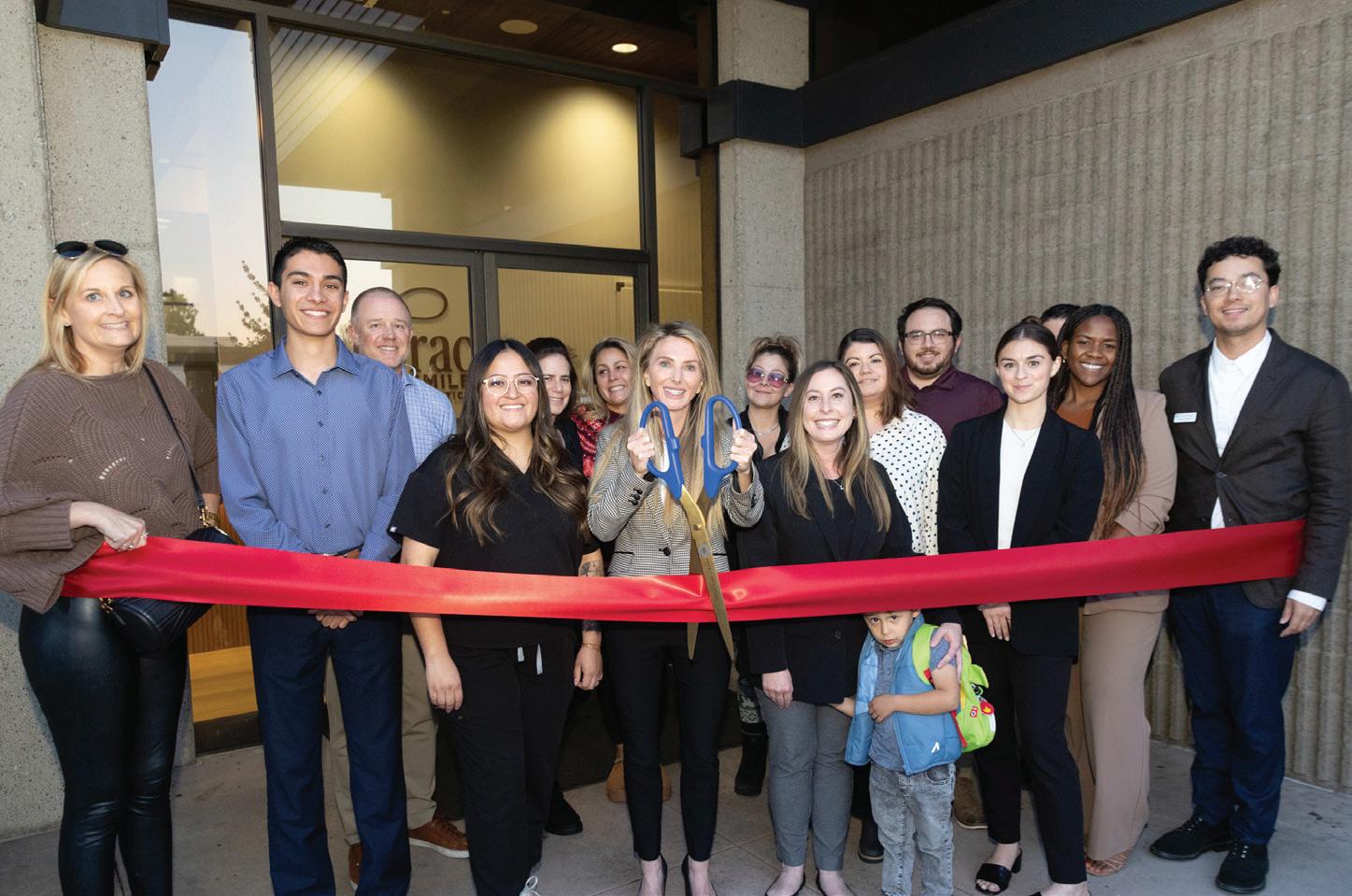
Congratulations to Embrace Your Smile on your grand opening in December. Go visit them at 23453 Lyons Ave, Valencia. Thank you to everyone who came out to celebrate and support them. Photo credit: Bellamani Photography
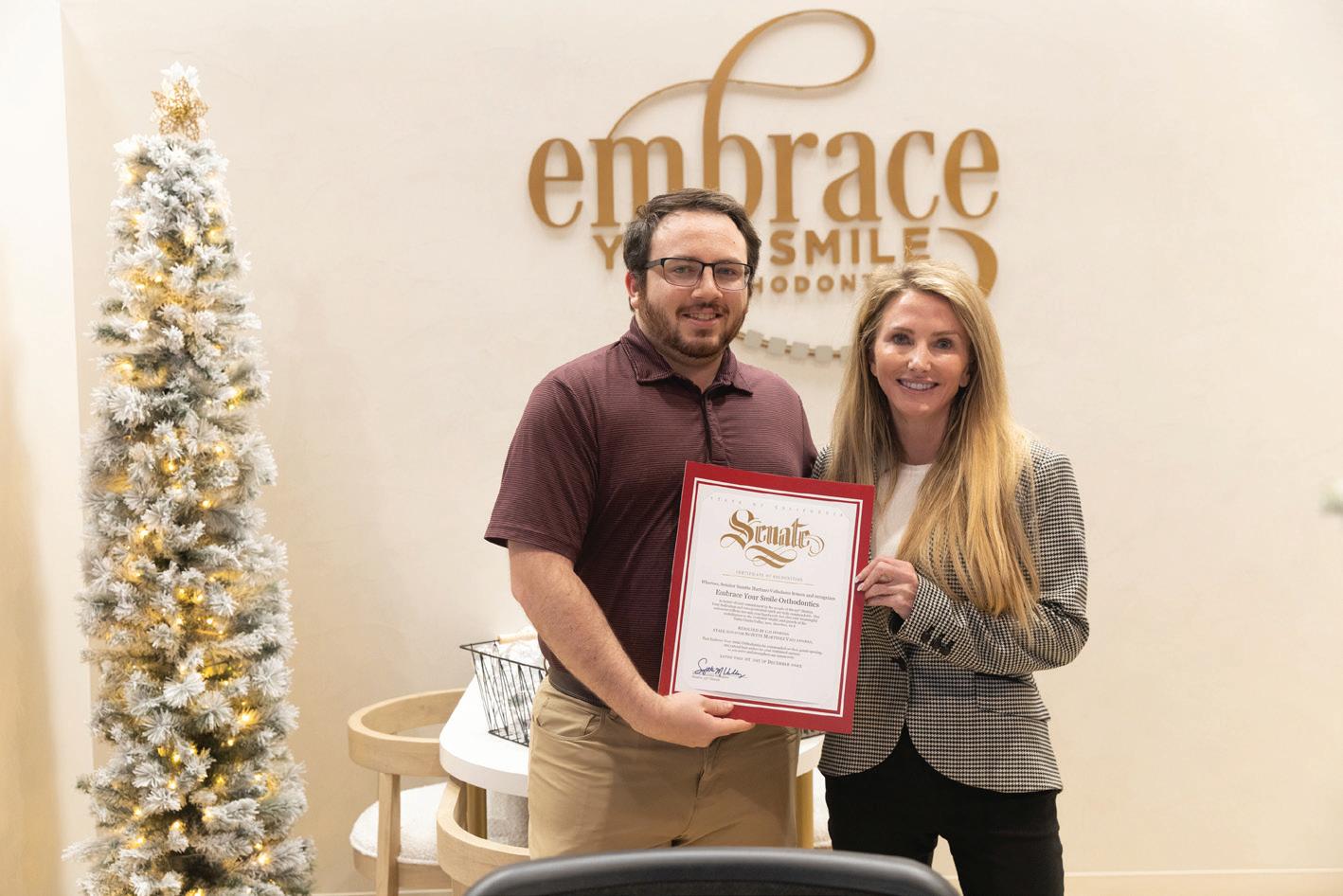
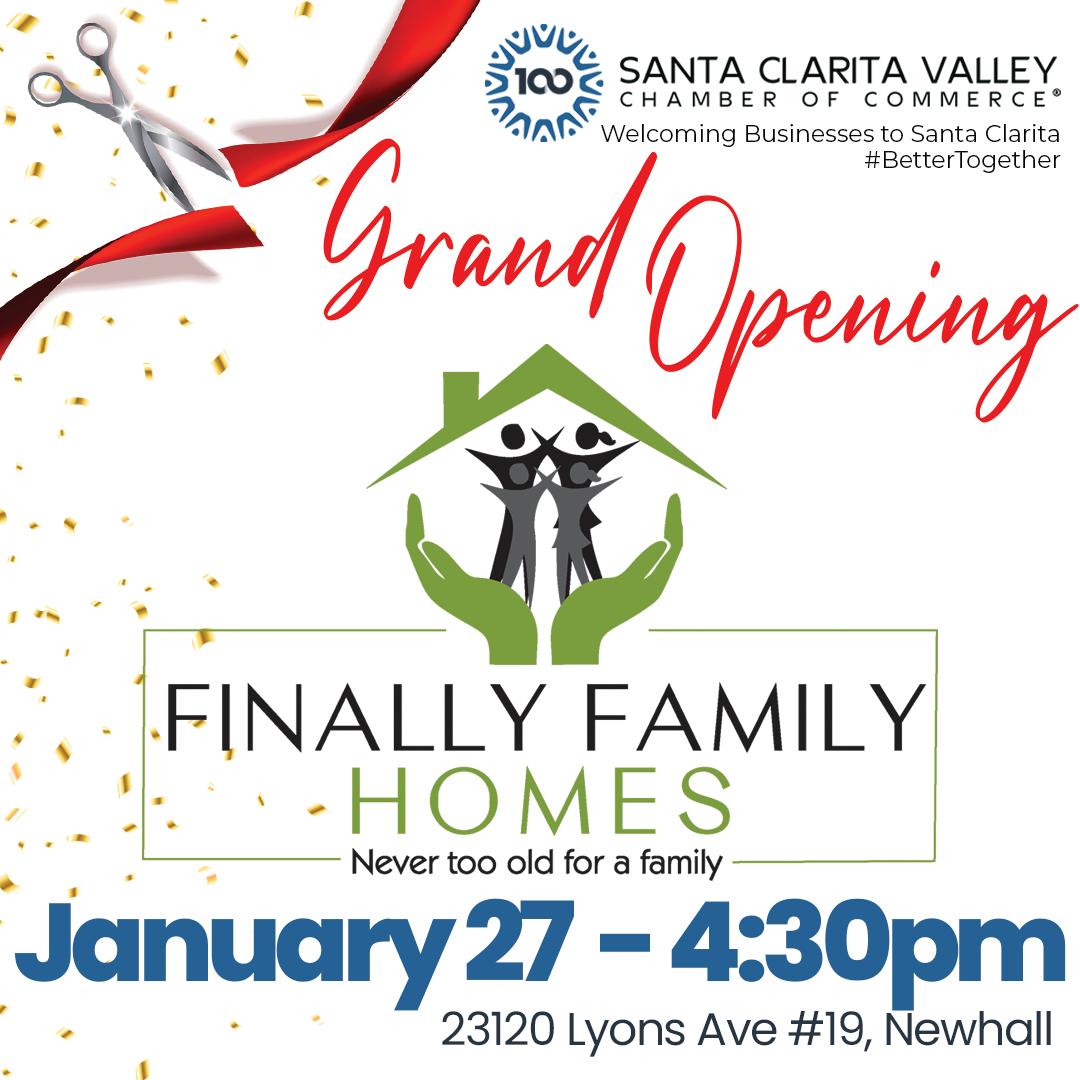
Mark your calendars and come be part of the excitement as new businesses open their doors right here in our community! These grand openings are more than ribbon cuttings — they’re celebrations of growth, local spirit, and fresh beginnings.
Everyone is welcome to join the festivities, connect with fellow community members, and show support for the entrepreneurs investing in the Santa Clarita Valley.
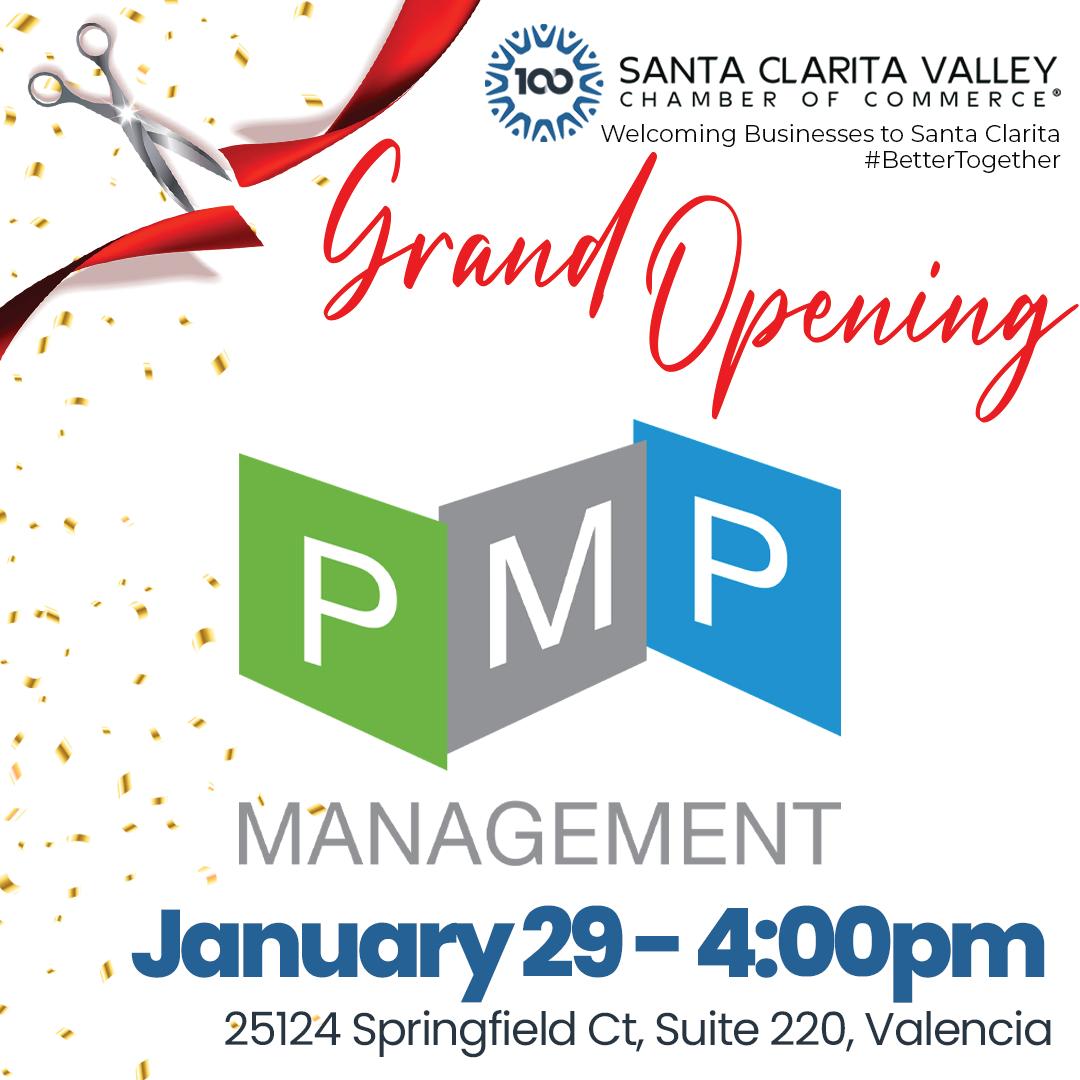
Whether you’re launching a brand-new business or celebrating an important anniversary, we’d love to celebrate you with a memorable ribbon cutting ceremony.
This is the perfect opportunity to showcase your business, connect with fellow entrepreneurs, and celebrate your hard work and success.
Email us at hello@scvchamber.com to learn more about how we can assist in organizing your ribbon cutting or grand opening.
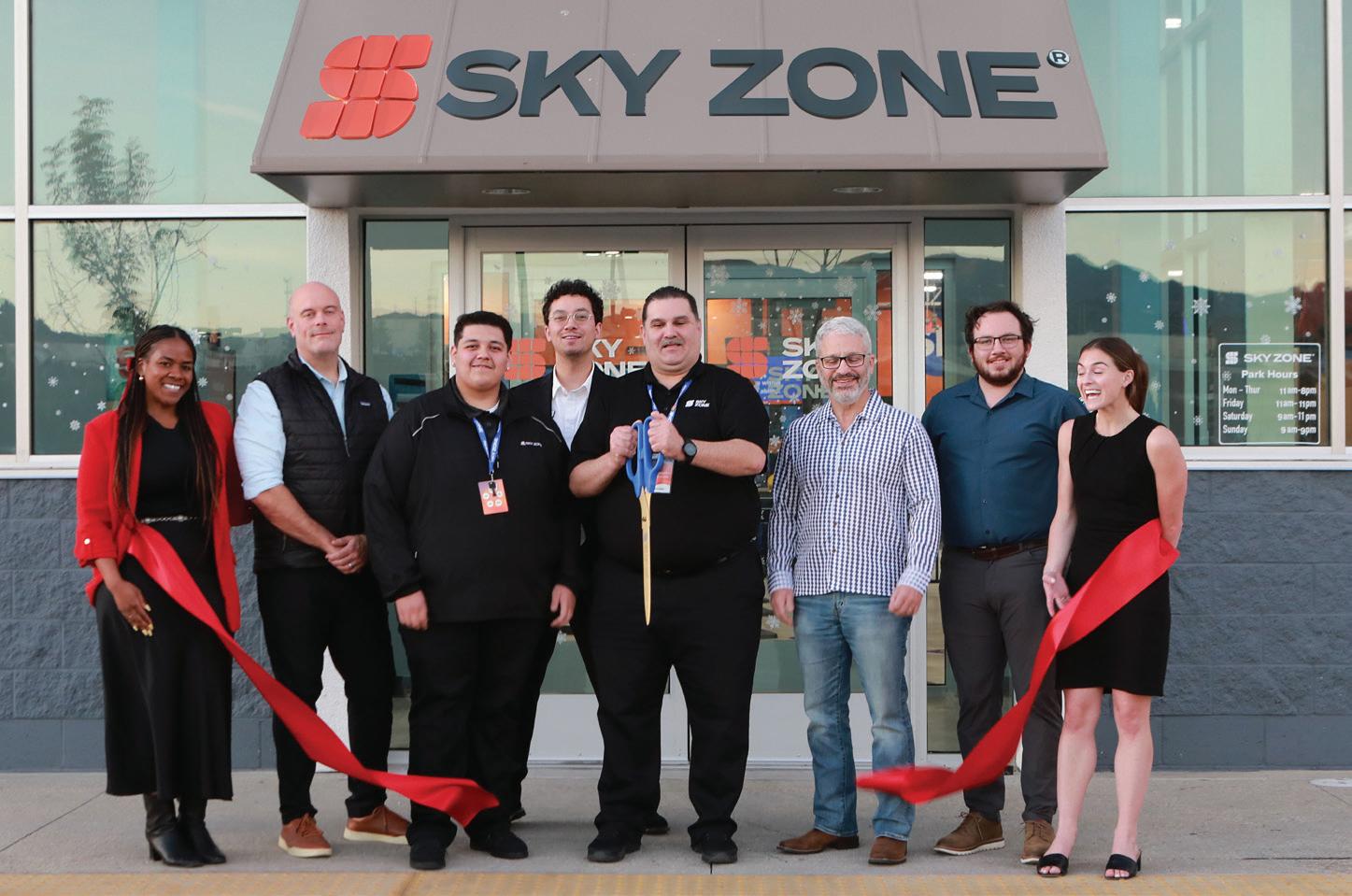
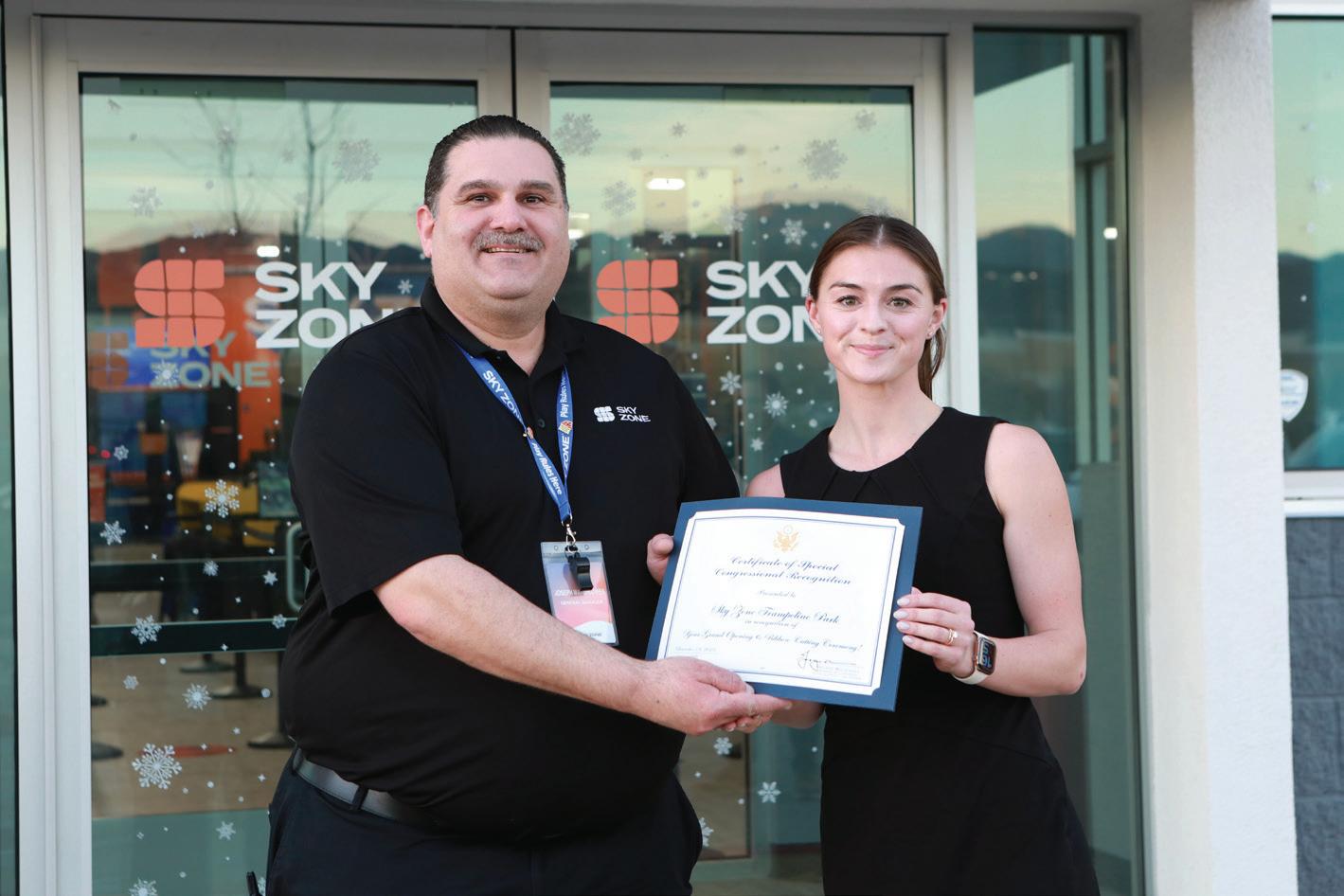
Congratulations to Sky Zone Trampoline Park on your grand opening in December. Go visit them at 26573 Carl Boyer Dr., Santa Clarita. Thank you to everyone who came out to celebrate and support them. Photo credit: Joie de Vivre Photographie
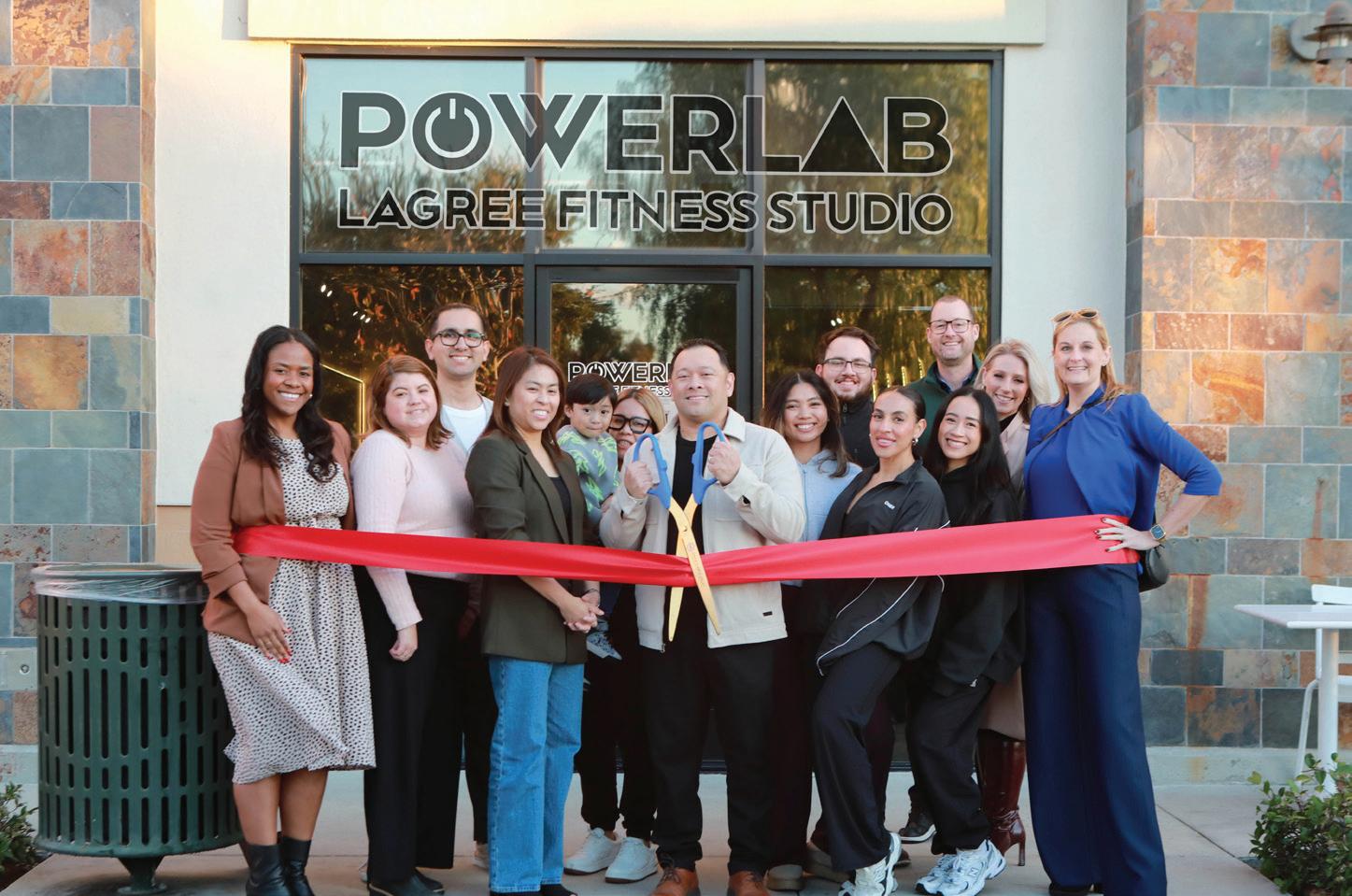
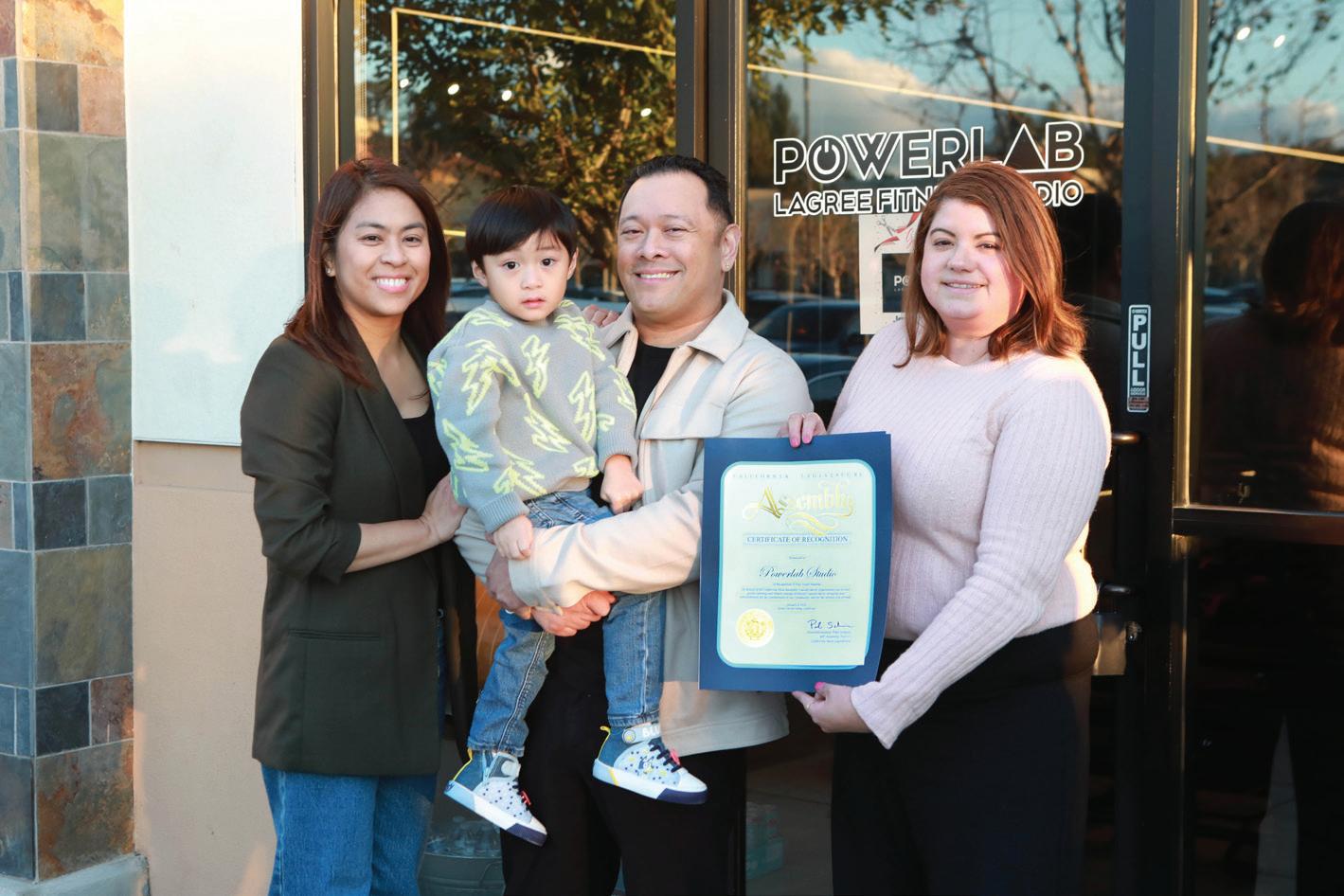
Congratulations to Powerlab Studio on your grand opening in January. Go visit them at 28110 Newhall Ranch Rd., Valencia. Thank you to everyone who came out to celebrate and support them.
Photo credit: Joie de Vivre Photographie

To view our full calendar and event details go to www.SCVChamber.com or scan the QR Code below.


BY PERRY SMITH SCV Business Journal Editor
There’s been plenty more to talk about in the Santa Clarita Valley these days, from new mall announcements to big housing developments to changes for Bouquet Canyon Road.

A source familiar with the situation indicated that Round 1 is coming to the Valencia Town Center with the signing of a lease.
Round 1 has signed a lease for a twostory location that’s also expected to include a bowling alley, according to the person with knowledge of the deal.
In January, the city of Santa Clarita found out it was getting sued over the Wiley Canyon Project’s approval.
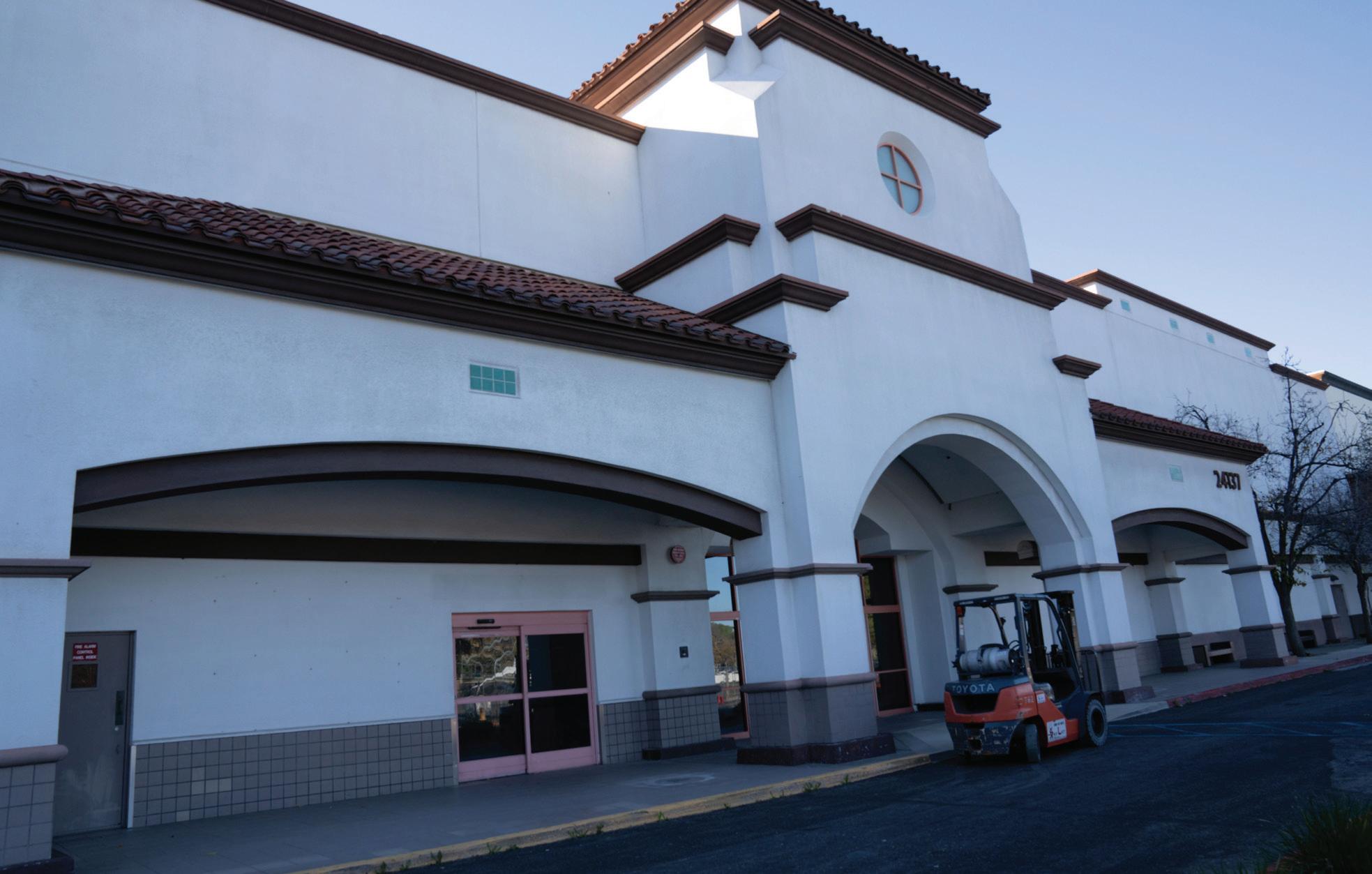
The plan made for the former Smiser Mule Ranch calls for 232 condos in twostory buildings, and 120 senior assistedliving units to be built west of Wiley Canyon Road, between Calgrove Boulevard and Hawkbryn Avenue.
The senior units are coming via a 140,000-square-foot facility, which would also have 9,000 square feet, or less than a quarter-acre, of commercial space
That approval, according to the writ seeking injunctive relief, “followed a flawed administrative process” that violated the state’s environmental, planning and zoning laws, as well as the city’s own municipal code.
Speaking of the running of a city, the number-crunchers at Santa Clarita City Hall have some good news to report in the annual midyear budget picture: The city now expects to receive nearly $5 million more than it anticipated when the budget was approved.
The largest adjustment, according to Houston’s report on the agenda for the council’s Tuesday meeting, is “a $5.7 million interfund transfer from the Self Insurance Fund as a result of excess workers’ compensation reserves based on the most recent actuarial report.”
Houston said there was no major factor in the determination to move the reserves from the fund other than “it’s something that we’ve been monitoring
for a while,” and that the city was confident it could move out the reserves.
There also was additional revenue being anticipated due to stronger-thanexpected car sales, Houston said. The revenue is now expected to be up $2.6 million for sales tax and $200,000 for property tax due to higher growth than anticipated.
Change is inevitalble, as fans of the The Original Saugus Cafe found out over the last month, and could still be taking place over there.
The owners of the property at 25861 Railroad Ave., which has been home to The Original Saugus Cafe since 1952, announced recently that new management would be restarting operations there in mid-January.
The family that has been operating The Original Saugus Cafe didn’t have a problem with new management restarting cafe operations in the same space, but they said that, as owners of the Saugus Cafe business and name, they should be compensated for their part of the business and its legacy, which stretches back nearly 140 years.
A plan more than 30 years in the making for thousands of homes in the NorthLake community of Castaic is near-
ing another public hearing with the Los Angeles County Regional Planning Commission, based on a legal notice published near the end of December.
The public hearing notice involved a development of 3,150 homes on nearly 800 acres east of Interstate 5, west of Castaic Lake and north of Castaic.
Phase 1 of the plan calls for 2,295 homes, including: 288 single-family units on approximately 41 acres; 1,341 multifamily units on approximately 107 acres; 345 senior multi-family units on approximately 49 acres; 315 affordable units; and six market-rate live/work units, which is part of about 20 acres of commercial use.
The rest of the land, referred to as Phase 2, would be developed with 855 single-family homes, 386 acres of parks, trails and open space, 23 acres of school uses and 36 acres of associated roadway and infrastructure improvements, according to the notice.
L.A. County officials posted “Recirculated Portions of the Draft Supplemental (Environmental Impact Report)” for the “Northlake Specific Plan” in April, and this week published a hearing notice that revised draft EIR is final and will be discussed at a Jan. 28 public hearing.
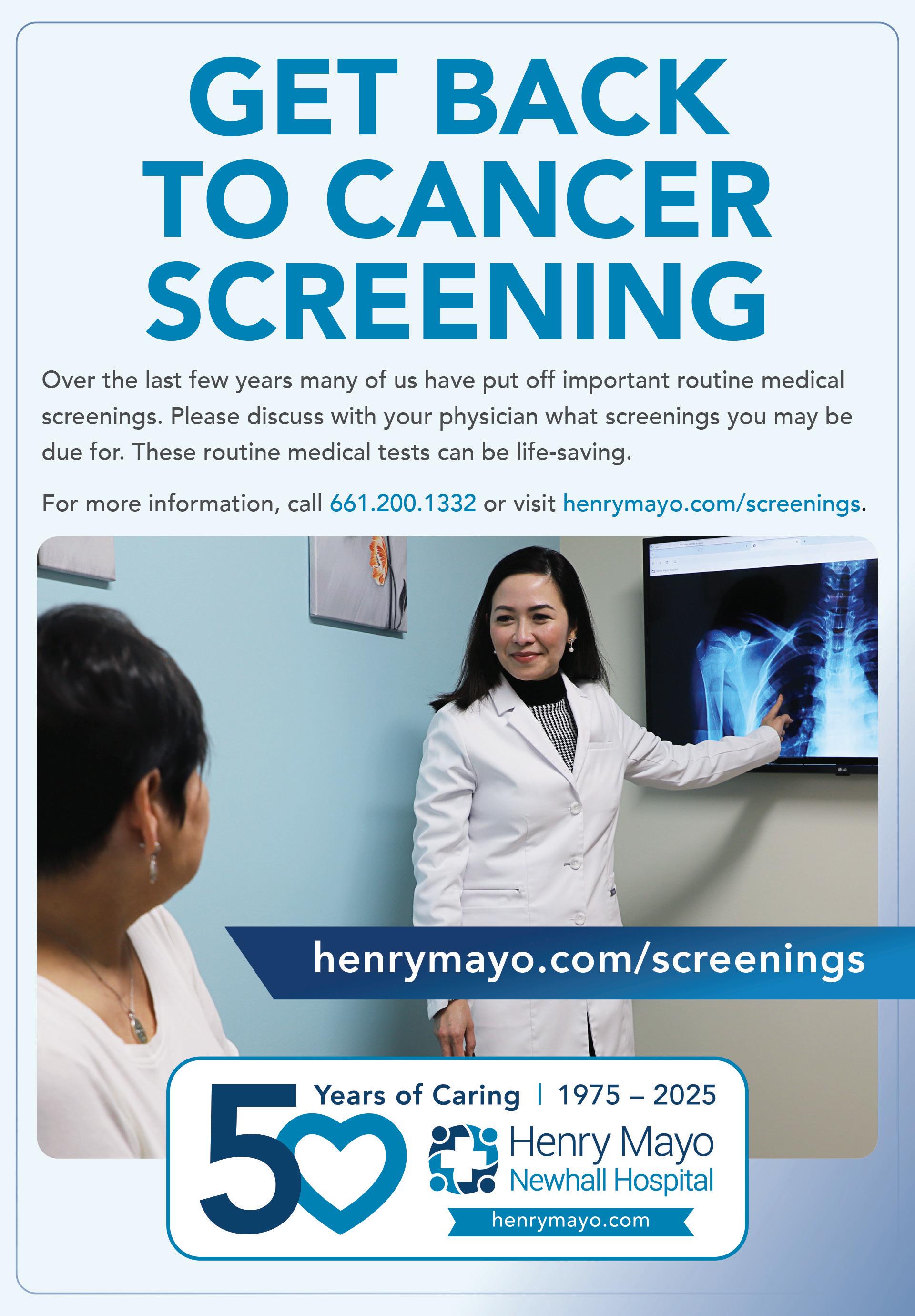
As you set New Year’s resolutions, add one that takes just minutes and can make a real difference: protect your skin and get suspicious spots checked. Skin cancer is prevalent, but when caught early, it’s also highly treatable. Here are 10 facts and tips to start the year smarter about prevention and options.
1. About 9,500 Americans are diagnosed with skin cancer every day, with more than 3 million new cases recorded yearly nationwide.
2. There are more cases of skin cancer in the U.S. each year than all other cancers combined, and at least 1 in 5 Americans will develop skin cancer by age 70.
3. The incidence of skin cancer is rising faster than that of any other cancer, making prevention and early detection more important than ever.
4. UV damage happens year-round, even when it’s cold. UVB rays, the leading cause of sunburn, peak in summer, but they can still damage skin in winter, especially at high altitudes and around reflective surfaces like snow, water, and sand. UVA rays are present all year and can penetrate clouds and glass, so it’s
Continued from page 7
we can therefore look generally for greater attention being paid to hospital prices and possibly greater action at the state level, where several states have established hospital cost targets with varying degrees of teeth.
Sixth, people (and providers) really do hate prior authorization review. Will the administration’s voluntary effort to work with industry to streamline and pare back prior authorization result in any concrete relief for patients when it kicks in this year?
Voluntary health care industry efforts have generally disappointed, as did the now-forgotten but once infamous industry Voluntary Ef-
possible to damage your skin while indoors or in the car.
5. The most common risk factors for non-melanoma skin cancer, including basal cell and squamous cell carcinoma, are:
• Lighter colored skin
• Advanced age
• Lots of ultraviolet (UV) light exposure over one’s lifetime
• Frequent sunburns
• Use of tanning beds
• Previous case of skin cancer
• Long-term or severe skin injury or inflammation
• Weakened immune system
6. U.S. veterans are nearly three times more likely to develop skin cancer than the general population.
7. Black and Hispanic individuals tend to have poorer prognoses and survival rates when they receive a skin cancer diagnosis. Each year, nearly 1-in-4 Hispanic adults and 1-in-10 Black adults experience at least one sunburn, showing that no skin tone is immune to damage from the sun.
8. The traditional treatment, Mohs surgery, dates to the 1930s and involves re-
fort (“the VE”) to reduce costs that was mounted to fend off Jimmy Carter’s aggressive cost-containment plan. The jury is out.
Seventh, four in 10 Americans say they identify in some way with the MAHA agenda. We’ll learn more in the coming year about which tenets of this loose movement have staying power. Everyone is for exercise and for healthier food for kids (although I do still miss those Hostess Cupcakes and Twinkies that I had as a kid). But people who have serious illnesses may grow tired of the central MAHA notion that they are personally responsible for disease and may increasingly make the connection between their own need for medical care and cuts in Medicaid and ACA
peated use of a scalpel to remove suspect tissue layer by layer. It can be a good option for some, though it may result in scarring and, in some cases, reconstructive repair.
9. There is a Medicare-covered nonsurgical alternative treatment available, called Image-Guided Superficial Radiation Therapy, also known as IGSRT or GentleCure. Patients who are not good surgical candidates, or those who wish to avoid the pain, recovery time, or cosmetic issues often associated with surgery, may prefer a proven noninvasive alternative.
10. GentleCure uses FDA-cleared technology and is supported by clinical research. Documented outcomes include a success rate exceeding 99%, with more than 125,000 patients treated in dermatology practices nationwide. Of patients surveyed, more than 99% said they were happy with their treatment decision and would recommend GentleCure to a friend or loved one.
More information is available at GentleCure.com. (NewsUSA)
coverage.
There is some overlap between MAHA and the anti-vax movement. Another thing to watch: will vaccination rates continue to decline as the administration chips away at universal vaccination and trust in vaccines?
Eighth, AI obviously already means a lot for physicians, researchers, hospitals, insurance companies and investors, with profound implications in some areas of medicine already, such as radiology. But when will AI start having real meaning for the things people care about most: their costs and their ability to navigate the health system?
The implications and practical applications for consumers receive far less attention, as generally does the relatively
low level of trust in AI consumers start with. Possibly, 2026 will be the year when attention shifts more seriously to the consumer side of AI in health.
All told, it will be a big year ahead in health policy. And this list only just scratches the surface. There’s also Mifepristone, and family planning, HIV, CDC, NIH and FDA, and CMS waivers and CMMI, the Medicare Advantage wars that never end, and price transparency, and more. But there probably won’t be a lot of significant action in Congress. Still, every incremental change is a big fight in health care, and hard won, and in a hyper-partisan Congress, 2026 will be no different.
As the largest provider of comprehensive radiation services in the greater Los Angeles area, City of Hope® leads the way in bringing tomorrow’s therapies to patients today. It’s the first National Cancer Institute-designated comprehensive cancer center program in California to be awarded the American Society for Radiation Oncology Accreditation Program of Excellence, which recognizes a commitment to patient safety and high-quality radiation therapy, and the only nationally accredited network in Southern California.
In addition to exceptional treatment options, our teams include supportive care service providers who partner with patients and their primary health care team to ease physical, emotional, spiritual and practical challenges they may experience during and after treatment. Our approach is designed to expand patients’ expedited access to leading-edge,
Facey Medical Group — Canyon Country
Facey Medical Group — Copper Hill
personalized radiation oncology care in a convenient setting with a signature boutique experience, targeted specifically to Southern California. City of Hope also understands the outside needs of its patients and their families, providing WiFi and free parking for all appointments.
Across its community locations in Southern California, City of Hope’s world-class experts provide specialized radiation oncology services and leadingedge technologies, bringing treatment for a broad range of cancer diagnoses closer to home. Having skilled professionals in the community ensures timely care, and City of Hope makes consultations available within 24 hours of initial contact.
14550 Soledad Canyon Road, Canyon Country, 91387 • (661) 250-5200 www.providence.org/locations/facey/facey-medical-group
27924 Seco Canyon Road, Santa Clarita, 91350 • (661) 513-2100 www.providence.org/locations/facey/facey-medical-group
Henry Mayo Newhall Hospital 23845 McBean Parkway, Valencia, 91355 • (661) 200-2000 • www.henrymayo.com
Providence Holy Cross Health Center 26357 McBean Parkway, Santa Clarita, 91355 • (661) 288-5900 • www.providence.org
Samuel Dixon Canyon Country Health Center 27225 Camp Plenty Road, Suite 4, Canyon Country, 91351 • (661) 424-1220 • www.sdfhc.org
Samuel Dixon Newhall Health Center 23772 Newhall Avenue, Newhall, 91321 • (661) 291-1777 • www.sdfhc.org
Samuel Dixon Valencia Behavioral Health 25115 Avenue Stanford, #A103, Valencia, 91355 • (661) 468-7405 • www.sdfhc.org
Kaiser Permanente Santa Clarita Medical Offices 1 27107 Tourney Road, Santa Clarita, 91355 • (833) 574-2273 • healthy.kaiserpermanente.org
Kaiser Permanente Santa Clarita Medical Offices 2 26877 Tourney Road, Santa Clarita, 91355 • (833) 574-2273 • healthy.kaiserpermanente.org
UCLA Health Santa Clarita Primary & Specialty Care 25775 McBean Parkway, Suites 115A, 202 & 215, Valencia, 91355 • (661) 753-5464 • www.uclahealth.org
UCLA Health Tourney Road Primary & Specialty Care 27235 Tourney Road, Suite 2500, Valencia, 91355 • (661) 253-5851 • www.uclahealth.org
Patients visiting City of Hope for radiation are treated by a team of experts who take a whole-patient approach to care, offering access to state-of-the-art services and technologies, including imageguided radiotherapy, intensity modulated radiation therapy, volumetric modulated arc therapy, stereotactic body radiotherapy, stereotactic ablative radiotherapy, stereotactic radiosurgery, adaptive radiation therapy, brachytherapy, electron therapy and other forms of radiation. Through a versatile variety of approaches, clinicians aim to maximize the destruction of cancer cells while sparing nearby healthy tissue, resulting in less invasive and less painful treatment, faster healing and a shorter recovery time. For more information visit cityofhope. org or call our Santa Clarita Radiation Oncology site: 26357 McBean Parkway, Suite 150, Santa Clarita, CA 91355, 661.259.2990.
Adult Primary Care, Pediatrics, Radiology, Laboratory, Behavioral Health, Vision Services, Rheumatology
Adult Primary Care, Pediatrics, Radiology, Laboratory
Cancer Care, Heart and Vascular Care, Breast Health Services
Providence Holy Cross Imaging Center, Urgent Care Center, Cancer Physician Office, Providence Rehabilitation Services
Diabetes Prevention Program, Cancer Detection and Prevention, Women's Health, Chronic Disease Management
Diabetes Prevention Program, Cancer Detection and Prevention, Women's Health, Chronic Disease Management
Mental/Behavioral Health Counseling
Allergy, Dermatology, Obstetrics/Gynecology (Ob-Gyn), Physical Therapy
Endocrinology, Infectious Disease, Opthalmology, Nephrology
Internal Medicine, Cardiology, Endocrinology, Pulmonary & Critical Care Medicine
Pediatric Neurosurgery, Cancer Treatment, Cardiac Imaging, Head and Neck Surgery
Thursday, January 15: VIA After Five
360 Executive Suites
25101 The Old Road, Valencia. 5:30 p.m. - 7:30 p.m.
Friday, January 23: Get to Know VIA Breakfast
360 Executive Suites
25101 The Old road, Valencia, 8:30 a.m. – 10:00 a.m.
Valley

By Mark Shramek, VIA Chairman of the Board, 2026
It is a profound honor to serve as the new Chairman of the Board for the Valley Industry Association. When I look across our membership, I don’t just see business owners and executives—I see the architects of the Santa Clarita Valley’s economy. VIA has long been a cornerstone of this region’s success, and I am grateful for the opportunity to help guide its next chapter.
Before looking ahead, it is important to recognize the strong foundation on which we are building. My predecessor, Selina Thomas, was truly a force of nature for VIA. Her leadership— particularly throughout the 2024 term— emphasized resilience, collaboration, and unity at a time when those qualities mattered most. Selina demonstrated that when Santa Clarita Valley businesses come together, they don’t simply weather challenges—they lead. I am deeply appreciative of her dedication and the high standard she has set.
As I step into this role, my focus is clear: growth. Not growth for its own sake, but strategic, measurable expansion that benefits VIA, our member businesses, and the Santa Clarita Valley as a whole. VIA is more than a legislative advocate or a business resource—we are a growth engine for this region.
A key component of that growth strategy is strengthening synergy across our local business ecosystem. That begins with deepening our partnership with JCI Santa Clarita. The talent, innovation, and energy within the Junior Chamber represent the future of our industry. By aligning VIA’s experience with JCI’s

forward-looking perspective, we can help ensure that the next generation of leaders builds their careers—and their companies—right here in the SCV.
We will also continue to deepen our relationships with local nonprofit organizations. The nonprofit sector plays a critical role in our local economy, and by aligning their missions with our business resources, we create a stronger, more connected community. When businesses and nonprofits collaborate effectively, the entire valley prospers.
Growth also means focusing on tangible results for our members. VIA is the premier B2B organization in the Santa Clarita Valley, and I want to expand how intentionally we create revenue-generating opportunities. Moving forward, our networking platforms—such as VIA After Five and Cocktails and Conversations— will continue to evolve into high-impact environments where meaningful connections translate into real business outcomes.
My goal is for VIA to be a primary revenue driver for our members. That means facilitating the kinds of introductions and conversations that lead to direct contracts, new vendor relationships, and expanded market share. Simply put, if you are doing business in the Santa Clarita Valley, the most profitable seat should be at a VIA table.
The Santa Clarita Valley is a unique ecosystem where industry and community are deeply intertwined. Together, we have the opportunity to build on more than 40 years of success and push VIA into a new era of growth and prosperity. I am ready to get to work, eager to hear new ideas, and committed to helping this association—and our members—grow like never before. Thank you for your trust, and I look forward to making this a landmark year for the Valley Industry Association.
By: Selina Thomas, VIA Chairwoman of the Board, 2024/2025

As I conclude my two-year term as Chairwoman of the Valley Industry Association (VIA), I do so with immense gratitude, pride, and confidence in the organization’s future. Serving in this role has been one of the most meaningful chapters of my professional life. I stepped into the position with deep respect for VIA’s legacy—and I leave it with even greater admiration for what we have accomplished together.
At the heart of VIA’s success is strong, consistent leadership. First and foremost, I extend my sincere thanks to Kathy Norris, our CEO and President. Her unwavering guidance, steady vision, and tireless commitment to the organization are extraordinary. Kathy’s leadership behind the scenes and her partnership throughout my tenure made every achievement possible. VIA is stronger because of her dedication, and I am deeply grateful for her support.
I am equally thankful to our Board of Directors. Leadership is never a solo effort, and this board exemplified what collaborative governance should look like. Their belief in me, willingness to challenge ideas, and commitment to showing up with purpose fostered a culture rooted in respect, collaboration, and shared vision. It is a board culture I am incredibly proud of and one that will serve VIA well for years to come.
To the broader business community of the Santa Clarita Valley, thank you for your trust and engagement. Your partnership reinforced why VIA remains
the benchmark for business advocacy in our region. Together, we strengthened relationships with city, state, and legislative partners and elevated the collective voice of business. Over the past two years, VIA was not merely active—we were intentional, visible, and impactful.
Among our many accomplishments, one initiative stands out as especially meaningful: Connecting to Success (CTS). This program reflects VIA at its best— bridging education, workforce development, and business leadership to create tangible pathways and real opportunity for students in the Santa Clarita Valley. I am incredibly proud of CTS and will continue to champion its growth. Many members of our business community generously served as facilitators, lending their time and expertise, and for that, the board and I are sincerely grateful.
Another milestone during my tenure was welcoming JCI onto VIA’s Board of Directors. This step represents thoughtful succession planning in action—bringing emerging leaders who reflect excellence into established leadership roles to ensure continuity, innovation, and long-term organizational strength.
On a personal note, I am deeply thankful to my daughters for their constant encouragement throughout my time as Chairwoman. One of my daughters, known professionally as Maddie the Dog Maven, is also a proud VIA member and a thriving business owner. Watching her grow her business within this community has been especially meaningful and serves as a powerful reminder of why organizations like VIA matter so much.
As I look ahead to new opportunities and chapters, I will always reflect fondly on my time serving as Chairwoman of the Valley Industry Association. VIA’s mission, its people, and its impact will continue to inspire me, and I remain committed to supporting its success in any way I can.
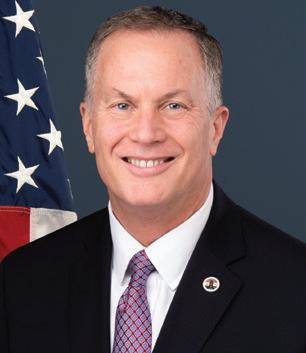
BY JEFF PRANG Los Angeles County Assessor
This month I want to take a moment of your time to visit about a specific property tax savings program my office offers that is just waiting to reduce your budget and now it’s easier than ever before to apply.
We do manage several programs for seniors, veterans, people with disabilities and non-profits, resulting in $836 million in tax savings for property owners last year alone.
Since 1974, the state’s Constitution has tried to give homeowners financial relief against the high cost of housing through the Homeowners’ Exemption (HOX) that can automatically reduce your assessed tax burden by $7,000, if the home is your primary residence as of Jan. 1. That translates to an actual reduction of $70 to a homeowner’s tax bill. And all the homeowner has to do is fill out the application at assessor.lacounty.gov and they are good to go.
Moreover, the deadline to receive the full benefit this year fast approaches as it is Feb. 15, but even if you miss it, please file anyway as you will get it prorated this year and the full amount the following years.
In fact, now our new e-File service allows property owners to apply for the Homeowners’ Exemption online, eliminating the need to mail us a physical form. Furthermore, homeowners need only apply once in order to receive these savings each year. The saving’s continue until a change (such as a sale) is recorded.
I do understand that the $70 exemption taken off the property tax bill is entirely inadequate in providing any relief for the California homeowner. We cannot forget that the property tax bill also includes local bond debts and fee assessments, including water and school districts that have nothing to do with assessed value of the home under Proposition 13.
It’s also important to remember that when the Homeowners’ Exemption was created in 1972 and then formally en-

Homeowners’ Exemption (HOX) can automatically reduce your assessed tax burden by $7,000, if the home is your primary residence as of Jan. 1. The deadline for full benefit is Feb. 15. ©ADOBESTOCK
acted in 1974, the median sales price for a single family home was about $34,000 statewide. The median sales price of a home statewide now is about $900,000, according to the California Association of Realtors.
Yes, obviously it is long overdue for an increase to the Homeowners’ Exemption. As a hypothetical example, if the state Legislature increased the current homeowners’ exemption from $7,000 to $25,000 for everybody and perhaps even up to $500,000 for qualified low-income homeowners, that translates into a savings of $250 for all and $5,000 for those qualifying low-income homeowners.
I encourage our state Legislature to study this issue and increase the Homeowners’ Exemption, even modestly. At a minimum, they should attach an escalator clause that will keep the Homeowners’ Exemption in line with inflation.
Having said that and at the current savings of $70, nearly one in three homeowners in Los Angeles County still do not take advantage of this program, leaving $40 million unclaimed each year. Across the County, an additional 435,000 families can be saving on their tax bills.
The Homeowners’ Exemption is even more important than ever before because of Proposition 19. Prop. 19 has changed the rules that apply to transfers between parents and children or in some
cases, even grandparents to grandchildren. Prop. 19 abolishes transfers of any property not being used as a primary residence. It also eliminates the current parent-to-child and grandparent-tograndchild exemption in cases where the child or grandchild does not use the inherited property as their principal residence, such as using a property as a rental house or a second home. However and this is most important: The child receiving the home has one year from the date of transfer to acquire the Homeowners’ Exemption, if the parent did not have it at the time of the transfer. If the home does not have the Homeowners’ Exemption, the children will not receive the tax benefit, and they could be stuck with a huge property tax increase.
For more information on Prop. 19 or other tax savings programs, visit assessor.lacounty.gov or call 213-974-3211.
For more information about the Assessor’s Office and its tax-saving programs, visit assessor.lacounty.gov. Prang leads the largest local public property assessment agency in the nation. His office of about 1,400 appraisers and support staff work to create an accurate and timely property Assessment Roll.
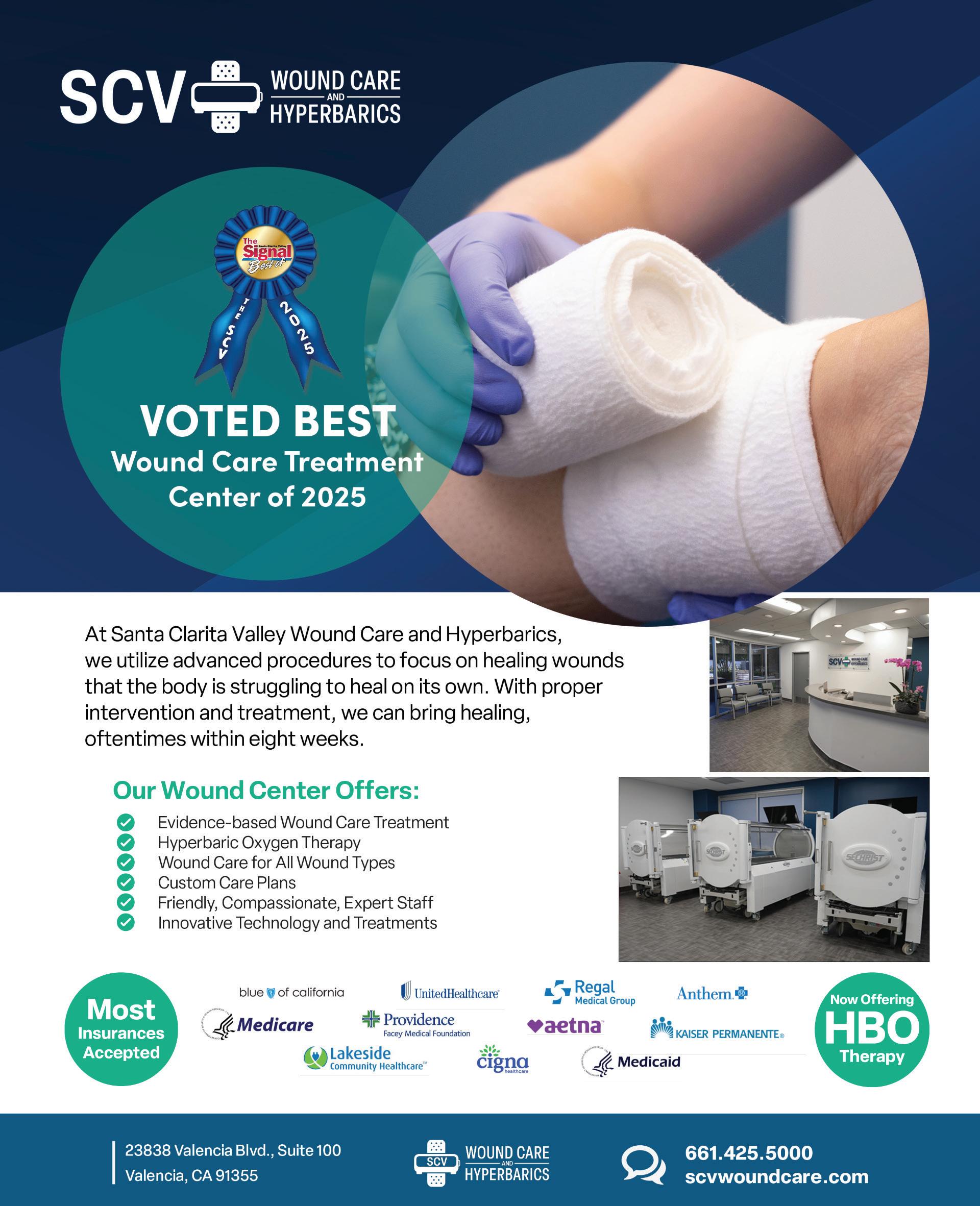
For patients living with a wound that just won’t heal — and for physicians searching for a trusted partner — advanced wound care can make the difference between prolonged suffering and true recovery.
SCV Wound Care & Hyperbarics was established to bring hospital-level wound expertise and hyperbaric oxygen therapy to the Santa Clarita Valley community. Their mission is simple: identify why a wound isn’t healing, apply evidence-based therapies, and help patients return to their lives as quickly and safely as possible.
Chronic wounds are rarely just a surface issue. Conditions such as diabetes, vascular disease, pressure injuries, radiation damage, or postsurgical complications often impair the body’s ability to heal. Without specialized intervention, these wounds can linger for months — or

years — raising the risk of infection, hospitalization, and even limb loss.
SCV Wound Care & Hyperbarics takes a root-cause approach. Every patient receives a comprehensive evaluation that considers circulation, infection, nutrition, pressure, and systemic health factors. Treatment plans are individualized and may include advanced wound therapies, offloading strategies, vascular coordination, and hyperbaric oxygen therapy (HBOT) — a powerful modality that increases oxygen delivery to damaged tissue, accelerates healing, and supports infection control in appropriate cases.
For patients, this means
coordinated care under one roof, with a team that understands how overwhelming chronic wounds can be. Appointments are focused, education is clear, and progress is tracked closely. Many patients experience measurable improvement within weeks, not months.
For referring physicians, SCV offers something equally important: collaboration and accountability. The clinic works closely with primary care providers, surgeons, podiatrists, and specialists to ensure continuity of care. Detailed documentation, timely updates, and clear return-to-care plans help referring providers stay informed and confident that
their patients are receiving guideline-driven treatment. Whether the goal is to heal a stubborn diabetic foot ulcer, manage a complex postsurgical wound, or evaluate a patient for hyperbaric oxygen therapy, SCV Wound Care & Hyperbarics serves a an extension of the physician’s care team — not a replacement.
When wounds don’t heal, the consequences extend far beyond the skin. With the right expertise and the right partnership, healing is possible.
Referrals and self-referrals are welcome. Early intervention can change outcomes — and SCV Wound Care & Hyperbarics is here to help. SCV Wound Care and Hyperbarics is located at 23838 Valencia Blvd., Valencia, 91355. (661.) 4265000. scvwoundcare.com
Southland
EDD labor
still pending*
BY DAVID WALKER Southland Regional Association of Realtors
The largest organization for local Realtors chalked up a slowdown in the market numbers to seasonal factors, as well as another significant factor — uncertainty about the future of the economy, according to a recent report.
A total of 143 single-family homes and 56 condominiums changed owners during November in the Santa Clarita Valley, totals that were down compared to a year ago, the Southland Regional Association of Realtors reported in December.
Compared to the figures for the same month in 2024, local home sales were off 19.7% while condominium-closed escrows fell 13.8%.
“Part of the decline is due to typical seasonal forces that see sales and activity wane as the holidays and the end of the year approach,” said Anthony Bedgood, President of the 10,000-member Southland Regional Association of Realtors. “Part of the slowdown is also due to uncertainty over the direction of the economy.”
“We finally have a decent supply of homes listed for sale. Interest rates now are at their lowest level since last December, and sellers often are open to compromise on prices,” Bedgood said. “Yet sales that close escrow take longer and are more complicated.”
The median price of homes that changed owners last month came in at $845,000, up 1.2% from a year ago. The condo median price was $540,000, down 3.7%.
“While following seasonal declines due to the holidays and weather, the inventory of condominiums for sale in Santa Clarita remained high during November,” said Valerie Biletsky, the SRAR’s Chief Executive Officer. “This year we saw condo listings soar to new heights. In fact, condo active listings for the entire year were the highest in six years.”
The Association reported 258 active condo listings at the end of November. That was up 28.4% from November 2024 and marked the 22nd consecutive month that condo active listings increased by double digits.
Similarly, active listings of single-family homes increased every month since February 2024 with active home listings reported in November the first month to come in below year ago totals. The 435 active listing were down 4.8% compared to the prior year
The 101 pending home sales reported at the end of the month were down 28% year-over-year. Condo pending sales fell 26% with 40 open escrows.
SRAR’s Income-to-Loan guide for November found that an income of $136,750 was needed to qualify for an 80% loan of $432,000 on a Santa Clarita Valley median-priced condominium of $540,000. With the national average interest rate of 6.34% during November — the lowest since December 2024’s 6.31% and well below the 7.79% of October 2023 — the income needed to qualify decreased 2.5% from a year ago. The monthly PITI — principle, interest, taxes and insurance payments — came to $3,419.
Valencia was by far the most active market in the month of November, with 206 active listings and 61 escrows closed.
Canyon Country was second with 129 active listings and 60 closed escrows.
Looking at the statewide and national pictures also reveals some interesting trends.
The statewide data reveals that property owners’ tenure is at an all-time high
for a number of reasons.
“Homeowners holding onto their properties longer before selling because: low rate on current mortgage; low property taxes; capital gains hit; where can I afford to go?; remodel and stay,” according to the California Association of Realtors.
At the same time, the number of listings on the market countywide hit a seven-year high.
Nationally, the numbers look better in November.
Pending home sales in November jumped by 3.3% from the prior month and 2.6% year over year, according to the National Association of Realtors’ Pending Home Sales Report.
“Month-over-month and year-overyear pending home sales rose in the Northeast, Midwest, South and West,” according to the NAR in December.
“Homebuyer momentum is building. The data shows the strongest performance of the year after accounting for seasonal factors, and the best performance in nearly three years, dating back to February 2023,” said NAR Chief Economist Lawrence Yun. “Improving housing affordability–driven by lower mortgage rates and wage growth rising faster than home prices–is helping buyers test the market. More inventory choices compared to last year are also attracting more buyers to the market.”
New year, new goals — and for many Santa Clarita families and business owners, that means getting organized, getting protected, and making sure nothing important is left to chance.
Thompson Von Tungeln has been serving the Santa Clarita Valley since 1977, helping people protect what they’ve built through smart legal planning, business and tax strategy, and experienced representation in court — all under one roof.
For some clients, that starts with a family plan — a trust, a will, and powers of attorney that make sure their children are cared for, their assets avoid probate, and their wishes are honored if something unexpected happens.
For others, it’s their busi-
ness. Whether you’re forming a company, buying or selling a location, bringing in a partner, or planning for the future, the way a business is structured — and taxed — can make a big difference over time. We help business owners make decisions today that protect them tomorrow.
And sometimes, even with good planning, disputes happen. Contracts break down. You have an accident or have to deal with a problem tenant. Trusts are challenged. When legal problems come up, you don’t want to rely on an unknown or inexperienced attorney who doesn’t know your situation — you want an established firm with a track record of service and success that can step in to help resolve your problem.


That’s what makes Thompson Von Tungeln different. We bring estate planning, business and tax law, and civil litigation together so our clients don’t feel like a hot potato jumping from office to office when life gets complicated.
If you own a home, a business, or meaningful assets,
the right legal plan now can save your family time, money, and stress later.
Call (661) 945-5868 or visit www.TrustTVT.com to schedule your free initial consultation.
Start the new year with clarity, protection, and the right legal team on your side.












BY PAUL BUTLER SCVBJ Contributing Writer
I’m a raving fan of professional organizations and believe that if you have any interest in commerce, you should be affiliated with at least one. Regardless of whether you’re a business owner, an employee, or even retired, I believe a professional organization can be incredibly valuable.
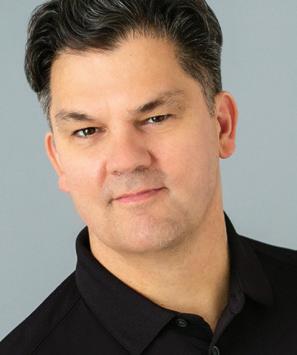
I’ve found that there are two types of professional organizations — general and trade-specific. Two examples of general professional organizations locally here in Santa Clarita are our Chamber of Commerce and the Valley Industry Association, or VIA.
A trade-specific organization is exactly what the name suggests — an entity centered around one specific industry. Our business focuses on staff training and leadership development, and two professional organizations in our field are the Association for Talent Development or ATD, and the Professionals in Human Resources Association or PIHRA.
With regard to the leadership of professional organizations, I’ve noticed that some are tremendously well run and others, not so much. The former category has websites that work and events that engage. The latter have broken website links that lead nowhere and only list events that have already passed.
Within well-run professional organizations, they always seem to be on top of their game, proactively providing opportunities to engage their members and, therefore, attract new ones. Well-run professional organizations are both dynamically effective and efficiently managed.
Conversely, I’ve observed — and subsequently unsubscribed from—other organizations that seem stuck in the past and achieve little more than providing a job for one person to sit at the top and do very little. Poorly run organizations are ineffective and inefficient and, in my opinion, do a disservice to their remaining members.
As nonprofit entities, professional organizations are required to have a board

of directors. I’ve noticed that there are two types of board members — those who sit and those who serve. You’ll often hear people say they “sit on a board,” but I’m always much more attentive when I hear someone say they “serve on a board.” There’s a big difference between “sitting” and “serving.”
Interestingly, I’ve noticed a direct correlation between what I’d deem to be a well-run organization and a spirit of service within its board of directors. Conversely, poorly run organizations seem to attract — and carry — a bunch of dead wood who just sit on the board, rarely show up, and accomplish very little.
Let’s now turn our attention to those who participate within professional organizations. I’ve noticed through my networking that there are three types of affiliates — the Passive, the Proactive and the Pedestrian.
The Passive member does pay for membership, but they seem interested only in what they can get rather than what they can give. The Passives do attend the organization’s events, but they listen very little and simply try to hand out as many business cards as possible, hoping some will stick.
The Proactive member goes “Plus One,” meaning they often volunteer to serve in some capacity rather than just be served as a member. Their “Plus One” may take the form of serving on a committee, being an ambassador, or even becoming a
board member.
Proactivists listen more than they speak at events and, due to the Law of Reciprocity, often attract more business because of their genuine interest in helping others.
The Pedestrian strolls the sidewalk but never actually commits to becoming a member of the professional organization — they pay the “non-member” price in more ways than one. Their windowshopping keeps them on the outside, and what they don’t realize is that it’s much better to be inside the store with everyone else.
Well-run professional organizations tend to attract Proactive people, and any Pedestrians walking by soon realize it’s better to cross the street and come inside. Sadly, I’ve seen that poorly run professional organizations often attract Passives and have many Pedestrians wandering around aimlessly.
In summary, regardless of whether you’re a business owner, an employee, or retired, I’d encourage you to join a wellrun professional organization, commit to going “Plus One” as a member, and seek to serve in some capacity.
Paul Butler is a Santa Clarita resident and a client partner with Newleaf Training and Development of Valencia (new leaftd.com). For questions or comments, email Butler at paul.butler@newleaftd. com.

News from The Signal newspaper (voted number one news source the last eight years) at the top of every hour with national and business news mixed in.
Local and national talk and entertainment shows on politics, crime, medical, home improvement, fashion, financial, parenting, pets, Hollywood and more!
• Daily Buzz: M-F 6-9am, 6-9pm
• Paws & Order: Mon. 12pm, Sat. 6pm
• Boomer Rebellion: Mon. 12:30pm, Sat. 6:30pm
• Sports Buzz: Tue. 12pm, Sat. 7pm
• Buzz on the Street: Wed. 12pm, Sat. 4pm
• Voices of Santa Clarita: Thur. 12pm, Sat. 10am
• The Mark Mosley Show: Fri. 12pm, Sat. 5pm
• Dr. Asa: M-F 4-6pm, Sat. 2-4pm
• In the Trenches: Sun. 7am
• Grace Baptist Services: Sun. 8am
• Todd Starnes: M-F 9am-12pm
• Kevin Jackson: M-F 2-4pm
• Advice Line: M-F 9-11pm
Sports, Crime, Comedy, Financial, Pets, Hollywood, Cold Logic, When Radio Was, Law Enforcement Talk, Garden Club, Eat Drink Smoke, Tech It Out, Animals Today, Intelligent Medicine, The Money Pit, Car Dr., Around the House, Radio Dad, BBQ Radio, Veterans Chronicles, Whispers in the Dark, Boomerology, Movies, Passport Momma, Among Monsters, and Watchdog on Wall Street.
Lexus of Valencia
Action Family Counseling
Law Offices of Owen, Patterson and Owen
Grace Baptist Church
City of Santa Clarita
Environmental Services A Royal Suite SCV Water City of Santa Clarita
Santa Clarita Smiles
Wm. S. Hart School District Chumash Casino Resort SCVi/iLead Schools
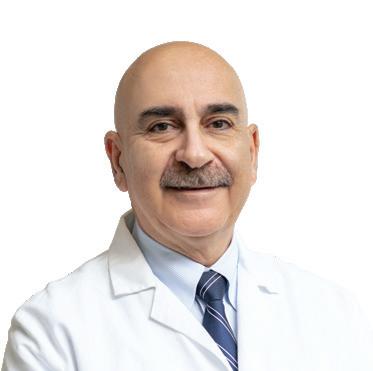

George Hajjar, M.D., FACP Medical Oncologist and Hematologist
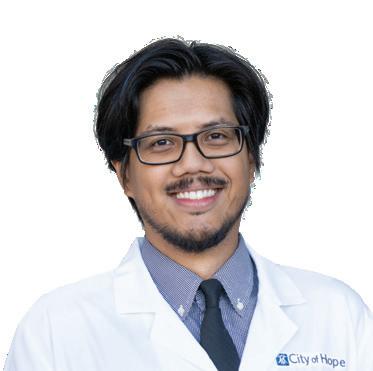
Vincent L. Mendiola, M.D., M.P.H., M.S. Medical Oncologist and Hematologist
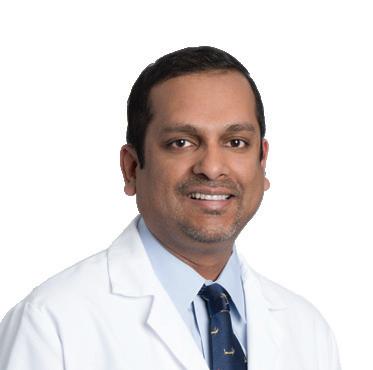
Thomas P. Joseph, M.D.
Medical Oncologist and Hematologist
Nina Desai Cote, M.D.
Radiation Oncologist
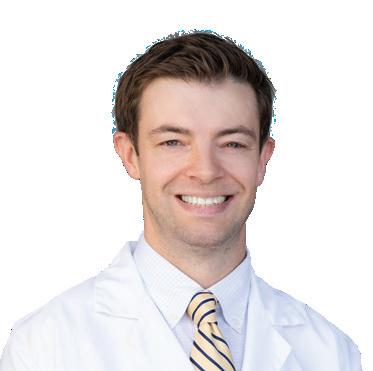
Aaron
Scott, M.D. Surgical Oncologist

Heather Player, M.D.
Surgical Oncologist and Breast Surgeon
City of Hope has pioneered breakthroughs in compassionate care and leading-edge research for over a century. Santa Clarita residents can access this nationally recognized expertise at two convenient locations just minutes apart.
Our Santa Clarita centers bring together specialists in medical oncology, surgical oncology and radiation oncology, all working as one team focused on you. In our infusion suite, chemotherapy-certified nurses provide chemotherapy and other infusions in a comfortable, supportive setting. We treat most solid cancers, including urologic, breast, lung and colon, as well as hematologic cancers. Patients also have access to lab services, clinical trials and the latest innovations in care.
At our radiation oncology center, you’ll find nationally recognized expertise backed by the American Society for Radiation Oncology’s highest accreditation for patient safety and quality care. City of Hope was the first National Cancer Institute-designated cancer center in California to earn this accreditation. Specialists like Dr. Caitlin Gomez use targeted approaches for maximum effectiveness while protecting healthy tissue. The radiation oncology office also treats conditions such as benign brain tumors and osteoarthritis.
Both locations accept a wide array of insurance plans and offer free parking and Wi-Fi. And because your physicians live and work in the community, you’ll find expert care and neighborly compassion, together at City of Hope Santa Clarita.
City of Hope Santa Clarita
23823 Valencia Blvd., Suite 250
Santa Clarita, CA 91355
661.799.1999
cityofhope.org/santa-clarita
City of Hope
Santa Clarita Radiation Oncology
26357 McBean Parkway, Suite 150
Santa Clarita, CA 91355
661.259.2990
cityofhope.org/santa-clarita-radiation-oncology
Pursuing cancer cures at the speed of life. cityofhope.org
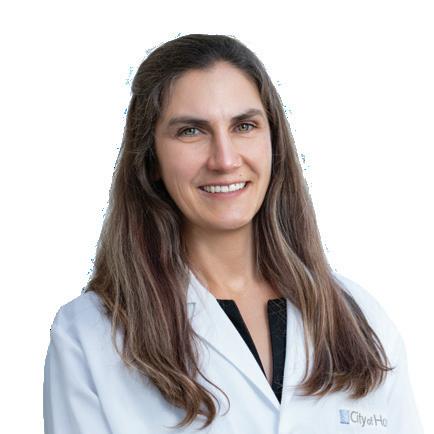
“Our
patients don’t just get treatment; they
get a dedicated team focused on their well-being every step of the way.”
—Caitlin Gomez, M.D.
Radiation Oncologist, Santa Clarita Radiation Oncology