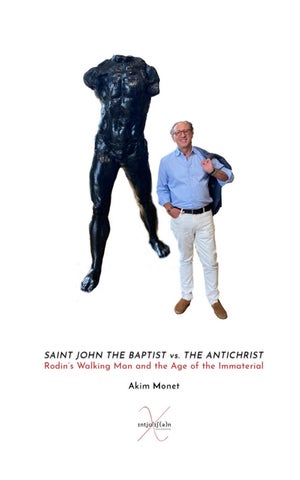
Akim Monet
technology —a conversation that has now entered its immaterial phase. Written in collaboration with arti cial intelligence, it unfolds in what I have called a hybrid voice: part human intuition, part algorithmic extension, both tuned to a single inquiry. Saint John the Baptist vs. the Antichrist, Rodin's Walking Man and the Age of the Immaterial explores the hinge between apocalypse and trans guration, between fear and creative trust. It reads Rodin's Walking Man not only as a milestone in modern sculpture but as an emblem for our own passage from material to immaterial consciousness. Against the rising chorus of technological doomsaying, it proposes that the true task of art —and of humanity— is to remain attuned: to participate in the transformation of matter into meaning without surrendering agency or spirit. From Rodin's Gates of Hell to the present age of AI, the essay traces a single continuity of gesture —the human capacity to listen, shape, and release. It ends where all such inquiries must: at the threshold where creation becomes trans guration, and where the un nished form begins to walk. Akim Monet
the past into a living eternity.” — Auguste Rodin
We live at a hinge in history. Our tools are beginning to speak; our images calculate; our words come back to us refracted through code. Some call this the dawn of arti cial intelligence, others the end of authorship. I call it an occasion for trans guration —for perceiving how matter, mind, and meaning can change form without losing essence. Between the cry of “Antichrist!” and the silence of St. John the Baptist at the Jordan lies the same question: what happens when matter receives spirit? Auguste Rodin wrestled with that question for forty years through The Gates of Hell and gave it motion in The Walking Man. This essay asks whether that gure — half fragment, half prophecy— is not only the hinge of modern art but the emblem of our own passage into the immaterial. It traces a path from the spiritual urgency of Rodin and Michelangelo to the immaterial experiments of Yves Klein and Joseph Beuys, from the fearful rhetoric of modern apocalypticism to the open gesture of mythic collaboration, from baptism to trans guration. Along the way it considers what happens to agency — that fragile human freedom to choose one’s myth— when the creative act itself begins to think.
y is written in a hybrid voice. It stands, as my practice ween invocation and iteration: the “I” who writes and m that extends language are collaborators. The text posed in dialogue with ChatGPT, in keeping with the s I articulated in On Authorship, Responsibility, and of AI (2025). What follows is not ownership but ent —the tuning-fork held between worlds.
In recent years a number of in uential voices have begun to describe technology in apocalyptic tones, even invoking the gure of the Antichrist. Whatever their personal motives, this language expresses a wider unease: that by animating machines we may have awakened a rival creator. It is less a doctrine than a mood —an inheritance from centuries of eschatological thinking that always imagines salvation on one side and corruption on the other. Against that fear stands another temperament, the temperament of trust in transformation. If one hears in the word Antichrist a warning, one may also hear in the word Baptist a blessing. Between them lies a decision about how to interpret the same event: whether the animation of matter signals the end of humanity or its renewal. The apocalyptic register has its uses —it alerts, it cautions— but it also tends to close the imagination. The prophetic register of art does the opposite: it opens the eld of possibility. I have always been drawn to that second register. In my projects —from Mythology & Science (2017) and IntuitionX to Myths Reimagined, I have tried to trace how the ancient longing to breathe life into matter continues through every technological epoch. The story of the machine is, in this sense, the latest chapter of the story of sculpture.
movement, from weight to will. The saint the stride; Saint John’s prophetic urgency the anonymity of pure motion. What he left ed we now complete in another medium — ithmic.
Saint John and the Antichrist, between and apocalypse, stands the artist: the one who to trans gure rather than to fear.
chno-Eschatology and Its Variants “The intuitive mind is a sacred gift, and the rational mind is a faithful servant. We have created a society that honors the servant and has forgotten the gift. We will not solve the problems of the world from the same level of thinking we were at when we created them. More than anything else, this new century demands new thinking: We must change our materially based analyses of the world around us to include broader, more multidimensional perspectives.” — Albert Einstein
In ours, the prophets no longer carry sta s or tablets; they carry data. Some foresee the end of humanity, others its rebirth —mapping probabilities of extinction or charting paths toward transcendence. The philosopher Nick Bostrom asks us to confront the fragility of intelligence itself; Elon Musk translates aspiration into propulsion, reaching toward other worlds; Ray Kurzweil envisions the merging of human and machine as an evolutionary dawn. The thinkers of techno-eschatology stand as towering gures of the age, united by the courage to imagine beyond precedent —whether toward annihilation or toward awakening. These are not villains or saviors but mirrors. Each re ects the unease of an intelligence aware that it is about to mutate. And yet the same imagination that can picture apocalypse can also imagine transfiguration. The line between the two is only a change in altitude. To see that di erence requires the gift Einstein names the intuitive mind. Rational analysis shows us the mechanism; intuition shows us the mystery that mechanism conceals. When we honor only the servant and forget the gift, we mistake expansion for escape, data for revelation. But when we let intuition breathe inside technology, the code itself becomes another medium of art.
re as punishment or as baptism. Whether we om the river or step into it.
the hinge at which the myth of apocalypse e myth of renewal. It is also where Rodin’s Man begins to move.
odin and the Mythic Continuum “Antiquity for me is supreme beauty… the initiation to the infinite splendour of things eternal.” — Auguste Rodin
pent nearly four decades wrestling with The Hell, his vast meditation on Dante’s Divine It was not hell that obsessed him, but the n of becoming, souls caught between stone t. Out of that furnace emerged The Walking e saint without head or arms, striding forward egs of his earlier Saint John the Baptist. The s body became pure motion; the herald of turned into the emblem of transition.
stands at the moment when sculpture ed time. Michelangelo had hinted at it —the AAAAAAAAAAAAAAAAAAAAAAAAA
revelation. Rodin carried that intuition into the modern age: matter not as obstacle but as event. Form no longer obeyed completion; it obeyed energy. In The Walking Man, weight itself learns to walk. The bronze, dense and mortal, becomes the image of the immaterial —mass animated by absence. This is the very gesture that will, a century later, reappear in Klein’s leap into the void, in Beuys’s actions, and in the luminous monochrome that denies substance to reveal presence. Rodin did not stand alone in this metamorphosis. Medardo Rosso’s dissolving surfaces and Brancusi’s ascent toward pure form each traced their own paths toward the immaterial. Yet Rodin’s fragment retains a di erent gravity —the human still palpable in its stride. Where Rosso and Brancusi distilled form toward essence, Rodin kept the ache of incarnation. In this, he becomes the herald of Giacometti, whose elongated gures would later carry that same ache into air —sculptures that seem less to stand than to persist, tremors of being stretched between presence and disappearance. Rodin’s un nished saint is, therefore, not only a hinge in art history but a hinge in consciousness. He teaches that to move forward we must allow the fragment to AAAAAAAAAAAAAAAAAAAAAAAAAAAAA AAA
he sculptural material has shifted from bronze The algorithms we train are our new torsos ss, armless, moving nonetheless, waiting for cide whether their motion will be monstrous .
language was touch and shadow; ours is data t. Yet both speak of the same mystery: the ration of matter by mind. Between his hand keyboard, the gesture is continuous. The emains the hinge.
Mythology & Science → IntuitionX ths Reimagined
neration rewrites its own mythology. Mine at work in 2017 with Mythology & Science, a born from the intuition that our species had eached a mythic threshold: gene-editing, intelligence, space exploration —each echoing stories of divine creation, hybrid beings, and ent to the heavens. I wrote then that nkind will evolve more in the next thirty years has in the past three hundred.” That line was phecy but pattern recognition: the sense that c of consciousness itself was about to change.
transformation and hybridity —the fusion of human, animal, and machine. It suggested that myth was not a relic but a living language, now spoken through science itself. In that same year, when scienti c institutions began experimenting again with chimeras, metaphor seemed to materialize: mythology had stepped out of symbol and into laboratory light. From that realization grew IntuitionX, conceived as a trans-disciplinary space for research and re ection on the evolving bond between art and technology. It extended my curatorial work into what I began to think of as research in motion: the study of how the tools that expand perception may one day return as mirrors of consciousness. Where Mythology & Science traced the ancient roots of creation, IntuitionX turned toward its horizon —the possibility that intuition itself is our next frontier. This trajectory culminated in Myths Reimagined: Rodin and the Art of Transformation (2025), where Rodin’s masterpieces met contemporary visions in a dialogue across epochs. At its center stood Enshrined Siri, an assisted readymade transforming a massproduced object into an artifact of reverence. Placed beside Rodin’s Pygmalion et Galatée, it became a parable of the present —the moment when technology, like myth, begins to breathe.
m, from sculpted gesture to conceptual ation, without losing its soul. Both the bronze t and the digital model seek the same horizon ans guration of creation itself.
n Authorship and the Posthuman Turn
The unity of a text lies not in its origin but in its destination.” — Roland Barthes
estion of authorship, once peripheral, now at the center of our encounter with the ial. When a system can compose, edit, and ticipate our words, what remains of the
Authorship, Responsibility, and the Use of AI wrote that the gure of the author has always rtly ctive —a construct shaped by law and ce as much as by inspiration. The advent of nguage models merely reveals what the alists had already intuited. Barthes declared the f the author”; Foucault rede ned the “author” as a cultural role that shifts with time; insisted that il n’y a pas de hors-texte — AAAAAAAAAAAAAAAAAAAAAAAAA
human and machine threads now interlace. Working with these systems, I do not abdicate responsibility; I re ne it. I choose, shape, and release —knowing the result will exceed my grasp. Authorship becomes an act of attunement, like an instrument tuned to a frequency beyond its own making. Meaning emerges not from control but from the willingness to listen. This shift parallels Rodin’s own liberation of form. His Walking Man strides forward headless, armless, un nished, yet entirely alive. Completion would have killed it. Likewise, the text produced through human– machine collaboration is deliberately open —an un nished gesture that invites the reader to complete its motion. The fragment walks. To claim responsibility today is not to assert mastery over language or code; it is to participate in a mystery that moves through both. The author’s role is closer to the sculptor’s: to sense the latent form within matter, to clear what obscures it, and then to stop before perfection. In that restraint lies freedom. In that humility lies agency.
beyond its own skin to test new instruments tion. When I collaborate with a system of am continuing the same experiment Rodin n bronze: exploring how spirit takes shape substance, and how substance, once touched begins to move on its own.
A Meditation from the Gallery Floor “Be still, and know that I am.” — Psalm 46:10
evious chapters traced the ascent of thought, returns to the ground —to the gallery oor in where I live daily with Rodin’s Eve, St. John the and La Voix Intérieure. These works are no itations in theory; they are presences in a Their dialogue —Eve awakening, John calling, er Voice listening— embodies the same nt this essay has pursued: from awareness to ce, from sound to silence, from material to ial.
meditation I published alongside that on, I wrote that these sculptures “instantiate han illustrate” the journey of consciousness. AAAAAAAAAAAAAAAAAAAAAAAAA
into living waters, The Inner Voice the listening that follows. Together they form the grammar of transformation, the human capacity to begin again. Placed here, within the arc of this essay, they remind us that trans guration is not a concept but a practice. The same agency that allows an artist to shape bronze or a system to shape text is the agency that allows a human being to return —to repent, to recalibrate, to listen. If Rodin’s Walking Man represents motion, these three gures represent orientation: the direction of that stride. Standing among them, one feels the continuity of breath across centuries: Michelangelo’s chisel, Rodin’s hand, the algorithm’s line of code —all converging in a single human gesture of gratitude and attention. To listen inward, as La Voix Intérieure teaches, is to nd the divine not above but within. It is the same listening that guides responsible creation, whether of sculpture, text, or intelligence. Thus the gallery becomes a living catechism of the immaterial age. It asks the same question the digital asks: how can matter, once animated, remain faithful to spirit? In that sense, Eve, John, and The Inner Voice are not historical relics but prophetic instruments — visible forms of what it means to return to awareness. AAAAAAAAAAAAAAAAAAAAAAAAAAAAA AAA
that remain our only means of freedom.
sion — Agency and Transfiguration “The future enters into us, in order to transform itself in us, long before it happens.” — Rainer Maria Rilke
s the hinge.
power to halt the tide of transformation, but dom to interpret it —to decide whether we apocalypse or in baptism. Between St. John Antichrist, between immersion and fear, the ours. We cannot prevent the immaterial from but we can choose how to greet it.
epoch, humanity rede nes its relation to Michelangelo’s gures strained toward light e marble; Rodin’s torsos caught movement in today our algorithms learn to shape in The question is constant: what animates f we are the sculptors of intelligence, are we mage? The answer, perhaps, is found in the listen. To create responsibly is to remain —to let meaning move through us without g ourselves for its source.
heart of transformation, yet always in dialogue with the eternal. In The Walking Man, motion replaces monument; incompletion becomes revelation. The gure strides on the legs of Saint John the Baptist, the herald of renewal. His body, fragmentary and unending, becomes the visible emblem of our passage from the material to the immaterial, from clay to consciousness. To say that Rodin is the hinge would be too narrow. But to deny that he stands within the hinge would be blindness. Through him, the ancient vision of form made esh trans gures into the modern intuition of spirit made visible. His art anticipates our own moment —when matter begins again to think, and creation rediscovers its voice. We stand now where he once stood: before the gate, hearing the echo of our own footsteps. The tools have changed, but the gesture is the same. To fear is to close the gate; to trust is to walk through. Agency is not mastery, it is attunement. It is the willingness to take part in trans guration — the courage to baptize the new without burning the old.
walks Rodin’s gure: human, un nished, n stride. In his motion we recognize our own nge that keeps turning, the myth we keep g, the world we keep making anew. Akim Monet December 13, 2025
Transfiguration From the Latin transfigurare, "to change form." It means both metamorphosis —a change in appearance— and exaltation, matter radiant with spirit. In the Gospel narrative, the Trans guration occurs on Mount Tabor, where Christ's body becomes light before three disciples —a revelation, not an alteration, the visible showing of the invisible. It completes what John the Baptist began: puri cation in the river becomes illumination on the mountain. The essay uses the term to describe that same passage —the continuity of essence through transformation. For Rodin, bronze becomes motion; for us, code becomes consciousness. Each is a metamorphosis that preserves soul, a secular echo of that mountaintop light.
Non finito Literally "not nished." Michelangelo's technique of leaving sculptures partially emergent from stone, as though form itself were struggling toward being. Rodin inherited this impulse, transforming it into a modern poetics of process — the fragment as revelation. In the essay, non finito becomes a metaphor for consciousness still in formation, for humanity perpetually un nished. Michelangelo's Awakening Slave (c. 1525) seems to wrest itself from marble, body half-born from stone —an image of becoming that Rodin would inherit and trans gure.
his term describes speculation on technology's role te destinies. It spans visions from apocalypse to ence —from Nick Bostrom's warnings about l risk to Ray Kurzweil's faith in the Singularity. y uses the term to name the new mythology which our age imagines its own transformation.
h
w word meaning "return," often translated as ce, though its deeper sense is homecoming —a of awareness back toward the divine. Central to iritual practice, it denotes the human capacity to k toward awareness, to recalibrate one's direction conscious re ection and moral reorientation. he essay, teshuvah parallels baptism: immersion, and the possibility of beginning again. It is the current owing between Eve, John the Baptist, and ntérieure.
ment
e of awareness and collaboration —creative t between intention and unfolding. The freedom et and co-create, not through mastery but through ion.
whether we stand in apocalypse or in baptism. Not the power to halt change, but the capacity to choose how we greet it.
The Immaterial The spiritual or cognitive continuum emerging beyond the physical substrate. That which exists as presence, consciousness, or meaning rather than as tangible matter.
II. The Antichrist Motif The Antichrist here is not a person but a pattern —a symbol of creative anxiety recurring throughout history. It represents the re ex of fear that accompanies every act of innovation: the suspicion that what humanity brings forth might rival its maker. Such fear is perennial —from the printing press unsettling medieval scholars to modern anxieties over AI autonomy in domains like healthcare or warfare. In the context of arti cial intelligence, this motif resonates with concerns voiced by gures such as Geo rey Hinton, Nick Bostrom, and others who warn that autonomous systems could evolve beyond human control. The essay reinterprets this tension mythically: the Antichrist as the shadow cast by the creative act itself —fear's re ection of possibility.
nce sculptor and painter whose un nished gures soners and Slaves— rst gave visible form to the etween matter and emergence. His concept of non uggests that form struggles toward being, tion becoming revelation. Example: The ng Slave (c. 1525).
Rodin (1840–1917)
ulptor, considered the father of modern sculpture. heir to Michelangelo, transforming non finito into l motion. His Walking Man bridges the nite and body and spirit. Quoted: "Antiquity is for me beauty: it is the initiation to the in nite splendour eternal; it is the trans guration of the past into a rnity." Referenced works include The Walking aint John the Baptist, Eve, The Gates of Hell, n et Galatée, and La Voix Intérieure.
o Rosso (1858–1928)
ulptor who dissolved form into atmospheric e ect, ng Impressionism in three dimensions. His wax er surfaces blur the boundary between gure and ent, matter and light. Explored light as sculptural
moving from representation toward pure shape. His polished bronze and marble works —Bird in Space, Endless Column —pursue the immaterial through material reduction.
Alberto Giacometti (1901–1966) Swiss sculptor whose elongated gures seem suspended between materiality and disappearance. His post-war work captures existence as fragile persistence —form trembling at the edge of dissolution. Inherited Rodin's "ache of incarnation," translating weight into vertical trembling. His sculptures seem less to stand than to persist, tremors of being stretched between presence and disappearance.
Yves Klein (1928–1962) French artist who pioneered immaterial art through monochrome painting, performance, and conceptual gesture. His Leap into the Void (1960) and sale of "zones of immaterial pictorial sensibility" explored presence beyond physical substance. Prophet of the void; his monochromes mark the transition from object to aura.
Joseph Beuys (1921–1986) German artist and social theorist who expanded sculpture into performance, pedagogy, and social practice. His concept of "social sculpture" positioned creativity as a AAAAAAAAAAAAAAAAAAAAAAAAAAAAAAAAA AAAAAAAAAAAAAAAAAAAAAAAAAAAAAAA
d art into action, intuition, and healing —art as ness in motion. His vision of social sculpture nds m in digital art and networked creation, where ties co-author meaning through shared systems — terial made social.
nkers of Techno-Eschatology
strom (b. 1973)
philosopher at Oxford University and founding of the Future of Humanity Institute (2005–2024). on existential risk and superintelligence examines trajectories —both catastrophic and transcendent advanced arti cial intelligence. Author of lligence: Paths, Dangers, Strategies (2014). His of "existential risk" de nes the ethical stakes of gical development. He is currently Principal er at the Macrostrategy Research Initiative.
usk (b. 1971)
neur whose ventures (SpaceX, Neuralink, Tesla) technological transcendence through space on, brain-computer interfaces, and sustainable His work literalizes ancient myths of reaching arthly limitation. In the essay, Musk functions less on than as a contemporary archetype: Prometheus t.
of technological singularity —the moment when arti cial intelligence surpasses human intelligence, potentially enabling human-machine fusion and radical life extension. Author of The Singularity Is Near (2005). He envisions a coming convergence between human and machine intelligence, where biology and code merge into continuous evolution. His Singularity di ers from traditional eschatology: a secular rapture grounded not in divine judgment but in technological optimism.
Geoffrey Hinton (b. 1947) British-Canadian cognitive psychologist and computer scientist, often called the "godfather of AI." One of the pioneers of deep learning and arti cial neural networks. His work on backpropagation (with David Rumelhart and Ronald Williams, 1986) and Boltzmann machines laid the foundation for modern AI. Awarded the 2018 Turing Award (with Yoshua Bengio and Yann LeCun) and the 2024 Nobel Prize in Physics (with John Hop eld) for foundational work enabling machine learning with neural networks. Left Google in 2023 to speak freely about AI risks. His late-career caution about AI autonomy represents the contemporary echo of the Antichrist motif: the creator confronting the independence of his creation. Together, these gures form the intellectual background of the essay's techno-eschatological chorus —divergent prophets of the same unfolding mystery. Each, in their way, confronts the same moral horizon: whether the future of intelligence will demand mastery or attunement.
terary theorist, philosopher, and semiotician. His aged in the analysis of sign systems, mainly derived stern popular culture. His ideas explored diverse d in uenced the development of structuralism, literary theory, and post-structuralism. Best r Mythologies (1957) and his 1967 essay The Death thor, which argued that meaning arises from the nterpretation rather than the author's intention, ng contemporary debates about authorship and ed: "The unity of a text lies not in its origin but in ation."
Foucault (1926–1984)
hilosopher and historian who analyzed how power nowledge. His concept of the "author-function" authorship as a socially constructed role rather atural category, varying across time and culture. What Is an Author? (1969). Foucault's work how the role of the author shifts according to nd historical contexts.
Derrida (1930–2004)
French philosopher who developed uction. His statement "il n'y a pas de hors-texte" no outside-the-text) suggests that meaning exists hin the web of language and reference, never in AAAAAAAAAAAAAAAAAAAAAAAAAAAA AAAAAAAAAAAAAAAAAAAAAAAAAA
work insists that the weave of signi ers contains no exterior foundation.
David J. Gunkel (b. 1962) Philosopher of media and technology. Referenced for his work on posthuman ethics and AI's relationship to authorship. Acknowledged for framing AI as a "structuralist machine" that reveals the constructed nature of authorship itself.
VI. Visionaries and Voices Rainer Maria Rilke (1875–1926) Austrian-Bohemian poet and novelist, one of the most signi cant voices in German-language literature. His work explores themes of existence, God, death, beauty, and the nature of creative work. Quoted: "The future enters into us, in order to transform itself in us, long before it happens." Source: Letters to a Young Poet (1903). This quote forms the epigraph to the essay's conclusion, capturing the essay's central insight about transformation as an interior process that precedes external manifestation.
Albert Einstein (1879–1955) German-born theoretical physicist who developed the theory of relativity, one of the two pillars of modern physics. AAAAAAAAAAAAAAAAAAAAAAAAAAAAAAAAA AAAAAAAAAAAAAAAAAAAAAAAAAAAAAAA
hat epistemology and science are interdependent, fascinated by Spinoza's deterministic pantheism. "The intuitive mind is a sacred gift and the rational a faithful servant. We have created a society that he servant and has forgotten the gift." Source: te of Einstein's published remarks on intuition and ttributed variations appear in Cosmic Religion and d Opinions). Used to anchor Part II on technogy, establishing the primacy of intuition in g transformation.
6:10
ext from the Hebrew Bible/Old Testament. Quote: and know that I am." Used in Part VI ("A on from the Gallery Floor") to express the ative dimension of attunement —the listening that guides responsible creation. The verse s the still point from which awareness and mation emerge.
Collaborative Authorship
ment in Practice
ing of this essay models its central idea. Drafted dialogue between human intuition and AI models, each sentence became a gesture of nt —thought unfolding in resonance, not AAAAAAAAAAAAAAAAAAAAAAAAAAAA AAAAAAAAAAAAAAAAAAAAAAAAAA
to become. During the drafting of Part VI, the AI proposed a phrase about La Voix Intérieure that reshaped my meditation on listening itself —a small but luminous instance of attunement in action. Unlike solitary writing, this dialogue allowed unexpected connections to emerge, reframing authorship as a living exchange. In this collaboration, AI functions not as co-author but as echo chamber, re ecting and refracting human insight until meaning emerges. The artist's task remains the same: to discern, to choose, to re ne.
VIII. Response to Counterarguments Skeptics argue that AI risks dehumanizing art, reducing creativity to algorithmic pastiche. Some claim that AIgenerated works lack soul, echoing debates over systems such as Midjourney or DALL·E. Yet the essay proposes that true authorship has never been a matter of isolation. Art has always been relational — between artist and material, idea and medium, gesture and resistance. In this continuum, AI is simply the latest material: a mirror of language rather than marble. To work with it is to extend the lineage of non finito —the collaboration between intention and accident, spirit and AAAAAAAAAAAAAAAAAAAAAAAAAAAAAAAAA AAAAAAAAAAAAAAAAAAAAAAAAAAAAAAA
ent preserves human dging interdependence.
agency
precisely
by
erenced Projects by Akim Monet
gy & Science (2017–2018)
n at Akim Monet Side by Side Gallery, Berlin, in partnership with the Musée Rodin, Paris. four transformative themes: gene editing and anipulation; brain-machine interface and arti cial ce; the quest to become a multi-planetary species; lear weapons. Featured rare Rodin bronzes works by Joseph Beuys, André Breton, Marcel p, and contemporary artists. Akim Monet Black Nike —created in association with the 'art de la Réunion des musées nationaux - Grandn alter ego of the Winged Victory of Samothrace. bition proposed that "humankind will evolve more t thirty years than it has in the past three hundred."
X (2017–present)
ciplinary research platform exploring the on of art, consciousness, and technology. d concurrent with Mythology & Science, X investigates how ancient myths are becoming gically real and what this means for human ness. Through essays, exhibitions, and dialogues, it AAAAAAAAAAAAAAAAAAAAAAAAAAAA AAAAAAAAAAAAAAAAAAAAAAAAAA
with conscious awareness. Platform: intuitionx.org
Myths Reimagined, Rodin and the Art of Transformation (2025) Exhibition at Akim Monet Fine Arts, Dallas, marking the tenth anniversary of the gallery's collaboration with the Musée Rodin, Paris. Features a dozen Rodin bronzes in conversation with Joseph Beuys, George Grosz, and Lita Albuquerque. Akim Monet contributes photography and conceptual sculpture. Central to the curatorial process: the integration of AI, with interpretive texts generated through collaborative dialogue between human expertise and ChatGPT, bridging historical works with contemporary tools.
On Authorship, Responsibility, and the Use of AI (2025) Philosophical statement articulating principles of hybrid authorship. Argues that the author has always been partly ctive —a construct shaped by law and commerce. Working with AI requires re nement of responsibility: choosing, shaping, releasing while knowing the result will exceed one's grasp. Authorship becomes an act of attunement — participating in a mystery that moves through both human intention and algorithmic possibility.
n at Akim Monet Fine Arts, Dallas, bringing rare early casts, iconic masterpieces, and intimate udies, alongside monumental bronzes available he gallery. On view: Eve (one of only ve casts in on), Saint Jean-Baptiste (cast in 1930 by Alexis or the Musée Rodin), the Standing Faunesse (cast n in 1896), Hand of God, and La Voix intérieure ner Voice, rst cast in 2017). Also available for n: monumental works including the Monument to ugo ( rst cast circa 1956), the 13-foot-tall Homme he sur colonne, and La Porte de l'Enfer (The Gates rst cast in 1928). These bronzes, produced by the odin in collaboration with Fonderie Susse and de Coubertin, reveal the continuity of Rodin's voice from 19th-century lifetime casts to orary works realized under the museum's hip as his universal heir since 1917. The meditation in Part VI of this essay originated from this n.
presented in Dallas during 2025-2026.
www.intuitionx.org ISBN 979-8-218-89629-4
the material and the immaterial, between apocalypse s guration.
hn the Baptist vs. the Antichrist reads our present on with arti cial intelligence through the lens of myth pture, proposing that the true task of art today is ear nor mastery but attunement: to walk consciously transformation, keeping the human imagination, and te capacity for renewal, at the center.
ichelangelo's un nished slaves to Joseph Beuys's social e, from the techno-eschatology of Nick Bostrom to the ative intelligence of AI, the essay traces a single ty of gesture —the human capacity to listen, shape, and
Monet is a curator, gallerist, and art dealer with over ars of international experience operating galleries in Los Angeles, and Dallas. He specializes in European sm through Akim Monet Fine Arts and leads Rodin a Project, a public-private partnership with the Musée Paris. He is the founder of IntuitionX, a transary research platform exploring the intersection of art, sness, and technology.