A SPECIAL SECTION OF
SUMMER ISSUE 2014
YMCA helps Willett battle COPD By CARLEA SCHULER
CNA staff writer cschuler@crestonnews.com
Darwin Willett, 68, was diagnosed with COPD in February 2012. At that time, breathing was so difficult he struggled to blow his nose. Today, Willett is exercising and his health has improved to the point where he can run two miles in 30 minutes. COPD, or chronic obstructive pulmonary disease, is a progressive disease that makes it difficult to breathe. When Willett was a child, he was prone to catching pneumonia. He served in the Navy where he worked with asbestos and was a smoker for 40
years. All of the above increased his risk of COPD. Willett grew up in Murray. He went into the Navy in June of 1964, and was honorably discharged after four years. He then worked for Iowa Southern Utilities, which is now Alliant Energy, for 40 years. He retired at age 62. Since the disease is progressive, it never goes awway. Usually people with COPD get worse over time. This is not the case for Willett.
Please see COPD, Page 2
Page 2c— Creston News Advertiser — Wednesday, June 18, 2014
COPD: Continued from Page 1
A specialist in Des Moines told Willett to walk for an hour a day, three times a week. Willett began to walk outside and joined the Southern Prairie YMCA in the fall of 2012 to walk indoors. “Instead of just going for a walk, I would time my laps and try to push myself a little more,” Willett said. Willett described himself as goal-oriented. He set goals for himself to walk further or move at a quicker speed. He started attending Silver Sneaker classes at the YMCA later in the fall. After about three months, he switched into Pilates, a more strenuous exercise class. “The instructors were great because they wouldn’t point me out,” Willett said. “They wouldn’t be like ‘Hey Darwin, don’t do this quite so hard.’ They were very good.” However, Willett pushed himself too hard during Pilates, and became sick again in the winter of 2013. His doctor gave him a tool to measure his heart rate while exercising. “I told myself I am going to start watching what I eat, and I’m going to lose some weight,” Willett said. Willett started working with Dana Dodge, a certi-
fied personal trainer at the YMCA, around October 2013. They worked together for 12 weeks with the goal of Willett being able to exercise on his own at home. “I showed him how to incorporate resistance training into his workout and how to do interval training to improve his core strength,” Dodge said. Dodge told Willett he could eat what he wanted, so long as he exercised enough to get the calories off. Since January, Willett has lost 27 pounds. “People have to want to make the change,” Dodge said. “I just give them the tools, and they have to want to do it. Applause goes out to him for doing it.” Willett said his diet has improved, but he still likes to splurge occasionally. His wife Cheryl has been supportive. They enjoy eating fish and salads. Willett now takes a class led by Dodge called Senior Walking and Balance twice a week. She taught him that balance stems from the core. Willett also power walks, runs, does situps, planks and other exercises on his own. “I feel better, and I am better,” Willett said. “I get more oxygen, I have more energy and my mind is bet-
Retirement Options Are you interested... in a Fixed Rate of Interest? Would you like your money to work harder for YOU? As an Independent Agent we will search for the company that provides the features and options you desire. Since rates are constantly changing please call to check current rates.
Chuck Taylor LUTCF
TAYLOR FINANCIAL
641-782-4848 • www.tayfin.com
CNA photo by CARLEA SCHULER
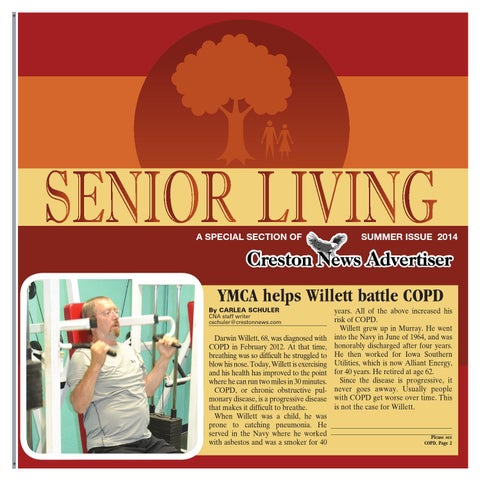
Darwin Willett of Creston pushes weight on the leg press Friday at the Southern Prairie YMCA. Willett has been exercising at the YMCA since fall of 2012.
ter and quicker.” As much as Willett likes exercising, he does not let it consume his whole life. In his spare time, he likes to be with family, do Sudoku puzzles, play pool, go camping, as well as exercise. He has two daughters
and five grandchildren. In the future, Willett wants to continue to push himself to exercise. He is considering leading a class at the YMCA someday. “I don’t want to live to exercise,” Willett said. “I want to exercise to live.”
IT’S NOT JUST KID’S STUFF
“Friends You Can Depend On”
641-782-6555
Bruce Pearson, Funeral Director
www.pearsonfuneralhomes.com
Need a break from caring for a loved one? “Our Care Brightens Lives”
ACTIVE OLDER ADULTS Active Older Adult programming at the Y is vibrant and dynamic with a variety of opportunities to match the interest of members. And our instructors make it fun! To keep physically active, there are a wide range of group exercise classes to choose from including Tai Chi, Silver Sneakers and water exercise classes. Pick up a schedule today and give one a try!
SOUTHERN PRAIRIE YMCA
1201 W Townline, Creston 641-782-9622 www.southernprairieymca.com
“Let our family help yours!”
Afton Care Center offers Respite Care Services on both an hourly and daily rate. Contact us at 347-8416 and ask for Jacqi or Brad.
Afton Care Center
Phone: 641-347-8416 • Fax: 641-347-5497 E-mail: aftoncarecenter@iowatelecom.net www.aftoncarecenter.com
Creston News Advertiser — Wednesday, June 18, 2014 — Page 3c
Caution and common sense: keys to staying safe online ■ Stay ahead of cybercriminals: use caution and common sense online
(BPT) — Due to the explosion of online transactions, social media and mobile technology, cybercrime can happen almost anywhere at any time. The good news is that it doesn’t take a computer genius to protect yourself from cyber criminals who are running scams or seeking to steal your identity. Cyber criminals victimized 71 million people in the United States in 2012, according to the electronic security company Symantec. The problem has become so bad, FBI Director Robert Muller expects cybercrime to eventually overtake both terrorism and counter intel-
ligence as his agency’s No. 1 crime-fighting priority. “Cybercrime has become a national plague that can damage us all,” said Don Culpepper, who specializes in family safety and security at Fireman’s Fund. “But much of the time it’s our own online behavior that opens us up to crime.” By refraining from giving out personal information, you can keep your accounts and identity safe from fraud and theft. Never give out any personal information via email, the telephone or through the mail unless you are 100 percent certain that the person or organization you’re dealing with is legitimate and you have initiated the contact. “Trust your instincts and if something sounds too good to be true, it probably
is, Culpepper said. Tips for staying cyber secure: • Provision your home Wi-Fi router with a highlevel encrypted firewall and make it undiscoverable. • Monitor you children’s social network and mobile computing activity, and stay up-to-date on privacy settings.
• Make certain that you’re adequately insured to withstand a loss. • Use sophisticated passwords and update them regularly. Still, there are times when even savvy Internet users can be vulnerable to crime. Fake pop-up alerts that claim your computer has been hacked or is infected
with a virus direct you to third-party websites that ask for personal information or direct you to download an actual piece of malware — a program that runs through your computer looking for personal information to send back to the criminals. Many of these programs look legitimate. If you’re not familiar with the program, simply close it without clicking on any links. Once criminals have this information, they are able to do all sorts of damage — obtain identification and apply for jobs in your name, access bank accounts, open utility accounts and even take out loans. It is very difficult to stop the damage, but here are steps to take immediately upon discovering fraud. • Monitor your credit re-
port and place a fraud alert on your file with one of the three major credit reporting agencies: Equifax, TransUnion or Experian. • Close accounts you suspect have been tampered with or opened fraudulently. • File a complaint with the Federal Trade Commission. • Create a police report. In addition, many insurance companies offer policies that can help you recover from the ravages of identity theft. “While it seems like cybercriminals are always one step ahead of our security counter measures, there are things we can do to stay safe,” Culpepper said. “Use common sense, stay alert and regularly install and update the security software on your computers and mobile devices.”
High Efficiency Laundry Center • Wash and dry a full load in just 60 minutes • Dry clothes more precisely, reducing wrinkles with DrySense™ Technology. • Cleaner, fresher laundry using advanced rinse technology that incorporates a Fresh Water Rinse.
FFLE2022MW
B
oyd Appliance Center Inc.
220 N. Pine • Uptown Creston, IA • (641) 782-2163
Selling Amana, KitchenAid, Maytag, Frigidaire, Electrolux, Speed Queen and Traeger Grills
Servicing most makes and models ~ Locally Owned and Operated Weekdays: 8:30-5:30 • Saturdays: 9:00-12:00
Page 4c— Creston News Advertiser — Wednesday, June 18, 2014
Summer do’s and don’ts for hearing aid wearers (BPT) — Summer is almost here. Many people look forward to this season because it gives them the opportunity to indulge in activities requiring warm, sunny days, like boating, swimming, hiking and traveling. Wearing hearing aids shouldn’t keep you from enjoying yourself, but it is important to remember exposure to high heat can damage their outer casings and interior components. Therefore, whether you plan to spend your days basking in the sun by the beach or pool, or visiting exotic destinations, you should prepare to keep your hearing aids safe and functioning. Avoid extreme temperature changes The plastic outer shells of hearing aids can melt if exposed directly to intense sunlight for long periods or in extreme heat, such as inside a car parked in a sweltering outdoor lot. Conversely, your hearing aids’ inner workings are more at risk from significant changes in temperature rather than heat or sun exposure specifically. This is because moisture condenses within the hearing aid as you go from a cool, air-conditioned environment into the hot outdoors, especially if you go
back and forth repeatedly. As for hearing aid batteries, they are likely to fail if exposed to high heat for more than a short amount of time. Here are three “don’ts” and one “do” for protecting your hearing aids from excessive heat: • Don’t leave hearing aids lying out in direct sunlight • Don’t leave hearing aids locked in a glove box or sitting on the dashboard • Don’t wear hearing aids into tanning booths or under a sunlamp • Do store hearing aid batteries in a cool, dry place Sunscreen: good for you, not so much your hearing aids While it is important to protect your skin from the sun’s rays, you could inadvertently damage your hearing aids by doing so. Sunscreen lotions and sprays can clog vents and damage other components. So: • Do make sure you take care when applying sunscreen to your face, neck and ears • Do put on sunscreen before you put in your hearing aids The difference between “waterproof” and “waterresistance” matters You may have water-
resistant hearing aids but understand this does not mean they can be submerged in the ocean or a pool. Water-resistant hearing aids help if you’re perspiring in the summer sun. However, if you jump into a lake wearing them, water will get inside through the microphone or other vents and they will be ruined. Truly waterproof hearing aids are IP68 certified, meaning there will be no seepage or damage even after being completely submerged in liquid. Visit www.HearingAids.com for more information. Keep in mind: • Don’t wear non-waterproof hearing aids if you’re going swimming, speed boating, or anywhere else where it is likely they will get drenched • Do make sure you know whether your hearing aids are waterproof or water-resistant • Do invest in a hearing aid dryer or dehumidifier to avoid ear infections and component damage in nonwaterproof hearing aids The skies are friendly for hearing aid wearers Before you get on a plane, you should know that hearing aids sometimes set off metal detectors during security screenings. Don’t panic - you can let the Transportation
Place your classified ad using our website 24 hours a day • 7 days a week
www.crestonnewsadvertiser.com Go under classifieds to place an ad
Security Administration (TSA) agent know verbally or by using a downloadable TSA Notification Card that you wear hearing aids before setting off any alarms. The good news is hearing aids can be scanned without fear of damage. Once you board your flight, Federal Aviation Administration (FAA) guidelines exempt hearing aids from the “turn off all electronic devices” mandate. So: • Don’t turn them off during your flight, as you might miss important information shared by the pilot or flight attendants
• Do feel free to wear hearing aids through body scanners or send them through X-ray in a carryon Hitting the road with hearing aids Whether you’re going on a day trip or cross-country adventure, save yourself time and worry by assembling a kit for your hearing aids well in advance. Just remember: • Do bring extra batteries or a charger • Do bring spare tubes and filters • Do include a dryer and cleaning equipment • Do include a card with the name/number of a lo-
cal hearing aid provider, in case of emergency • Do pack a storage case This summer enjoy listening to crickets chirping while you sit by a campfire, the laughter of kids playing at the beach, or the sound of that mai tai sliding up through your straw as you lounge poolside. Just follow these simple do’s and don’ts to make sure your hearing aids keep up with your summertime lifestyle.
Rehab to Home
Creston Occupational Therapy Addition • Professional outpatient therapy services • Outpatient and short-term inpatient therapy services • Beautiful private rooms • New spacious therapy gym OPENING • New private entrance FALL 2014 • New spa tub suite • New nurses’ station
Creston Nursing & Rehab Center A Care Initiatives facility 1001 Cottonwood, Creston, IA 641-782-8511 www.careinitiatives.org
■ Tips to improve your health, safety and outcome
(BPT) – More than 50 million surgeries occur every year and patient safety is always the top priority for surgeons or physician anesthesiologists involved in medical care. If you’re scheduled for surgery and have weeks or even months to prepare, important actions to improve your health, such as exercising and eating right, can help make surgery as safe as possible. They will also decrease your chances of complications and help you get back on your feet faster. “Surgery is usually the solution to a problem, whether to replace a painful knee or repair a hernia, but there are always risks,” said Dr. Jane C.K. Fitch, president of the American Society of Anesthesiologists (ASA). “Physician anesthesiologists, surgeons and other medical special-
Creston News Advertiser — Wednesday, June 18, 2014 — Page 5c
Shape up for surgery ists work with patients before, during and after surgery to help ensure a successful outcome.Patients can take control of their own health by having critical conversations with their physicians and getting healthy before surgery.” So, what can you do to get yourself in shape for surgery? The ASA suggests patients follow these tips: • Eat healthy: Adjusting your diet to include healthier choices in the weeks leading up to your surgery can help you become stronger and recover quicker. If you have a loss of appetite or recently lost weight without trying, be sure to tell your doctor, who might suggest you see a registered dietitian. The dietitian may prescribe a nutritional supplement to boost your immune system, help prevent infections and shorten your stay in the hospital. • Stop smoking: Among the many reasons to kick
the habit is that smoking and anesthesia — which you’ll need during surgery — don’t mix. If you smoke, your heart and lungs are compromised and don’t function at full capacity. You are also far more likely to suffer breathing and lung-related complications during surgery and are more likely to need a ventilator after surgery. By quitting smoking before surgery, you’ll not only decrease the likelihood of these risks, but you’re also less likely to have a wound infection, heart attack or other complication. • Boost your breathing: Taking deep breaths on a spirometer — a simple device that helps you exercise your lungs and improve their function — is a routine activity after most surgeries. Doing these exercises before surgery can help strengthen your lungs so you’re less likely to develop pneumonia. • Control your blood sugar: People with diabetes
whose blood sugar (glucose) is not controlled, are more likely to suffer potentially fatal complications following surgery. If you have diabetes, make sure your blood sugar is controlled. If you don’t, your immune system may be weaker, making you more vulnerable to pneumonia and other infections. Controlling your blood sugar will help you heal faster and you’ll likely spend less time recovering in the hospital. • Disclose medication use: Prior to surgery, be sure to tell your surgeon and physician anesthesiologist what vitamins, supplements, as well as prescription and over-the-counter medications you are taking. You may need to stop taking some of them until after your surgery because they make your blood less likely to clot and increase the risk of bleeding. The long list of risky medications includes blood thinners such as aspirin, pain relievers such as ibuprofen and common supplements such as St. John’s wort and vitamins C and E. Do not stop taking any supplements or medications without asking your physician first. • Get (or stay) active: If you exercise, keep it up, and if you don’t, try to responsibly increase your activity level in the weeks before surgery. The sooner you begin to move around after surgery, the less likely you are to develop blood clots and pneumonia. Consider getting into an exercise program - it can reduce complications and shorten hospital stays. • Reduce consumption of alcoholic beverages: People who have more than two alcoholic drinks a day are more likely to suffer com-
plications after surgery than light drinkers and those who drink heavily are more than twice as likely to suffer complications that can result in death. Heavy drinkers are also much more likely to get an infection after surgery, have difficulty breathing, and be admitted to the intensive care unit than nondrinkers. Be your own advocate by following ASA’s tips for im-
proving your health, safety and surgical outcomes. For more information about being prepared for surgery and anesthesia, visit www.asahq. org.
E-mail the CNA’s
KYLE WILSON
kwilson@ crestonnews.com
Convenience — and your —
Prescriptions
When you are under the weather, don’t forget...we
Deliver FREE of charge! Or use our...
Drive-Thru Service Or we can even
your prescription!
“Always accurate, quality prescriptions ...we’ll always make time for you!
405 S. Sumner — Creston —
641-782-6558 Jeff Longstat, R.Ph. • Wayne “Skip” Carlson, R.Ph. • Taryn Thompson, Pharm D. Mon-Fri 8:30am-5:30pm • Sat 8:30am-1pm
Page 6c— Creston News Advertiser — Wednesday, June 18, 2014
Is your handbag prepared to help save your life? ■ Why aspirin is the ultimate handbag essential
(BPT) — Did you know that nearly 300,000 women in the U.S. have heart attacks each year? Yet, most women’s handbags are better prepared to manage a broken nail (55 percent) or bad hair day (36 percent) than a heart attack (17 percent). Bayer HealthCare, the makers of Bayer(R) Aspirin, and WomenHeart: The National Coalition for Women with Heart Disease join together on a national campaign, Handbags & Hearts, that urges women to carry aspirin in their handbags — the one item they do not leave home without — at all times to be prepared for a sudden heart attack. Help spread the word about heart attack preparedness, as knowing what to do in the moment could be the difference between life and death. “As a cardiologist, I see women everyday who aren’t aware of the unique symptoms women often experience or what to do if they suspect they are having a heart attack. I urge all women to equip themselves with the knowledge they need to save their own lives,” said Tracy Stevens, MD, FACC, Medical Director of the Saint Luke’s Mid America Heart Institute’s Muriel I. Kauffman Women’s Heart Center and member of the WomenHeart Scientific Advisory Council. “Make sure you carry aspirin in your handbag every day to be better prepared for a sudden heart attack.” A survey, conducted by Wakefield Research on be-
half of Bayer HealthCare, revealed that 61 percent of women feel they are likely to have a heart attack in their lifetime, yet 93 percent don’t have knowledge of each of the different heart attack symptoms women often experience. When taken during a heart attack as directed by a doctor, aspirin has been shown to reduce the risk of death — by 23 percent — and lessen the damaging effects on the heart muscle. Less than a quarter of those surveyed said they carry aspirin in their handbag. Ladies — what are you waiting for? Put your heart health front and center today by following this quick and easy advice from Dr. Stevens: • Take the time to learn the specific signs of heart attack in women. In an online survey of 1,000 women, most had limited knowledge of heart attack symptoms different to them such as nausea (43 percent) and cold sweats (36 percent). Trust your gut - if something doesn’t seem right, don’t delay. • If you suspect a heart attack, calling 911 and chewing or crushing and swallowing aspirin as directed by a physician can be life-saving. • Be proactive about your heart health; commit to discussing your heart health with your doctor at your next physical to help identify your coronary risks and put a plan in place to address those risks - before you have a heart attack. Seventy-one percent of women did not discuss their heart health at their last doctor visit. Visit www.HandbagsAndHearts.com to learn the signs and symptoms of heart attack.
Brown bagging potentially leads to $1 million retirement nest egg (BPT) — Here’s a $1 million idea: making breakfast and lunch at home every day instead of dining out can potentially yield seven figures in retirement savings. “Many of us never think twice about how much we really spend on expenses such as dining out, the interest we pay on credit cards, or even cable channels that we no longer watch,” Elaine Sarsynski, executive vice president of MassMutual Retirement Services. “If you track your expenses and think about what you really need, many of us can find money to save and invest.” Farnoosh Torabi, bestselling author and financial planning coach recommends several personal and household expenses to examine for potential savings: • Reign in big expenses. If your monthly rent or mortgage is more than 25 percent of your take-home pay, look at ways to reduce this big
expense. If you have a mortgage, refinancing might be an option. Renters can sometimes renegotiate a lower rent as good tenants are hard to find. • Trim smaller costs. Brown bagging is one way to save. Track all your expenses to determine where else you might cut back. It’s amazing how extra expenses such as $3 lattes can add up. • Stick to cash. Using cash instead of credit can save you up to 20 percent. • Attack high-interest debt. Credit cards typically represent the most expensive debt so pay off this debt as soon as possible. When you’re debt free, continue paying the same monthly amount to your retirement plan instead. • Get professional tax help. If you’re middle-aged or older, rely on a certified public accountant to make sure you’re taking advantage of all of the various tax credits and deductions that come
from having children, owning a home or contributing to IRA. Put your tax savings or rebate in your retirement account. • Dump unnecessary baggage. As we get older, we tend to accumulate more things than we need or can reasonably use. Consider saving by downsizing to a smaller home, selling an extra car you no longer use, and clearing out your basement, garage or attic by selling unneeded household items in a tag sale. • Cut the cable. Re-examine your roster of cable TV channels; you may find you are paying premium prices for channels you rarely watch. • Spend time rather than
money. It’s always tempting to spoil grandkids, nieces and nephews with gifts. You can save money by cutting back on the presents and giving the kids what they really want: your time and attention. For more information about planning your retirement, go to www.RetireSmart.com.
NO PAPER?
If you fail to receive your carrier-delivered Creston News Advertiser by 5:00 p.m. call your carrier or call 782-2141 before 7:00 p.m.
Deposit checks by phone...it’s a snap!
Mobile Banking just got easier! Your check will go to the bank but you don’t have to! Visit www.fnbcreston.com/mobiledeposit to learn more about the convenience of mobile deposit today!
Powers Funeral Homes Creston 782-7036 Afton 347-8725 www.powersfh.com
Helping bring out the stories. Member FDIC
Creston News Advertiser — Wednesday, June 18, 2014 — Page 7c
Easy ways to create a home sweet vacation rental home
(BPT) – After a bitter winter, summer is finally within sight and many Americans are getting into full vacation planning mode. If you’re planning a family getaway or a trip with a large group of friends, it’s a great opportunity to explore staying at a vacation rental. These are often an affordable alternative to booking multiple hotel rooms for larger groups, and access to the additional space and kitchen facilities can be very advantageous. Follow these tips to find the best deals and locations: • Start early: Many travelers begin planning their summer vacations right after the new year - but it’s not too late now. For the largest selection of rental homes, start several months before you plan to travel and look for early booking discounts. • Location, location, location: Book properties further away from popular
tourist attractions. Proximity typically comes with a price, so look for places that are away from the tourist hot spots. Cities like Orlando can be quite affordable when staying just a stone’s throw away from the major theme parks and can more than make up for the distance in pricing. • Consider an off-thebeaten-path destination: You can find plenty of destinations that offer great activities and cost significantly less if you don’t limit your search to major cities and beach locales. Deep in the Ozarks, Branson, Mo. becomes a summer playground with a plethora of outdoor adventures, as well as over 100 live entertainment options. Outside of Phoenix, Scottsdale, Ariz. is much more than just a golfer’s paradise, offering a vibrant nightlife scene and plenty of shopping in a historic downtown. Tips for the stay: • Obtain a list of all amenities included in your
rental from the property owner or manager prior to your stay. You’ll want to know if you should plan to bring extra towels, a specialty cooking utensil or beach chairs for example. Owners should have a detailed list what’s on hand and the quantity of items that they provide such as hand soap and toilet paper. • Vacation rentals located in condo communities often have planned daily activities for guests of all ages. These may include family movie nights, scavenger hunts, cooking classes, water aerobics and guest social functions. Obtain a schedule in advance of your stay to plan out your vacation time wisely and take advantage of free entertainment. While the hope is that you’re out enjoying the scenery and local attractions while you’re using a vacation rental, you’ll also want to be entertained while in the property. Pack your favorite movies, games and even toys if you’re traveling with children to make
it as much like home as possible while also enjoying the comforts of someone else’s
home. For the latest vacation rental deals in the U.S., Ca-
ribbean and Latin America, check out these offerings from Hotels.com.
600 Sheldon • Creston, IA • Ph: 782-8417 Hours: M-F 8am-7pm ~ Sat 8am-4pm CLOSED Sunday
For all your prescriptions, plus... • Blood Pressure Screening • “Free” Mailing • Cholesterol Screenings • “Free” Delivery • Vaccinations: • Drive-up Shingles • Private Medication Pneumonia Consultation Flu • MTM Services
Page 8c— Creston News Advertiser — Wednesday, June 18, 2014
Centenarians reveal their secrets to a long, happy life (BPT) — One hundred years ago, the average American’s life expectancy was between 50 and 60 years, and so the estimated 53,000 centenarians in the United States today have lived much longer than most of their contemporaries. Perhaps that is why a new survey shows that these 100-year-olds feel “blessed” (36 percent), “happy” (31 percent) and “surprised” (12 percent) to have lived so long. Not one reports feeling sad or burdened; only 3 percent say they feel lonely. For the past nine years, UnitedHealthcare has conducted a survey of 100 100-year-olds to gain insight into their lives. For its most recent 100@100 survey, the company also polled 65-year-old baby boomers to examine how
the attitudes and lifestyles of people entering their retirement years compare to those who hit that same age 35 years ago. According to the study, one thing both groups agreed on is that they feel younger than their years. On average, the centenarians surveyed said they feel just 83 years old, while 65-year-old baby boomers said they feel 55 years old. “It’s encouraging that older Americans feel more youthful than the number of candles on their birthday cake might suggest,” said Rhonda Randall, D.O., chief medical officer of UnitedHealthcare Retiree Solutions. “By looking at how they are living their daily lives, we can glean important insights about the keys to staying healthy and
feeling vibrant as we age.” The following are some of the secrets to healthy aging, as revealed by the 100@100 survey. Secret 1: Keep up with exercise. Despite their age, cen-
tenarians stay active: more than half walk or hike and nearly a third do strengthtraining exercises. Some even run outdoors or play team sports every week (4 percent). Exercise is an important part of boomers’
lifestyle as well. Nearly 3 in 4 walk or hike each week, 37 percent do strength-training exercises and 13 percent run outdoors or play team sports. Secret 2: Get preventive care to stay healthy. Older Americans are taking the saying “an ounce of prevention equals a pound of cure” to heart by keeping up with preventive health care services to stay well. Nearly 9 in 10 get an annual exam (87 percent of centenarians and 89 percent of baby boomers) with their primary care physician, and the majority also report getting eye exams regularly (71 percent of centenarians and 76 percent of baby boomers). Secret 3: Maintain a positive attitude. Both centenarians and
baby boomers say maintaining their physical health and a positive attitude are equally important to successful aging (66 percent and 81 percent, respectively). In fact, 82 percent of centenarians say laughing/having a sense of humor is important to healthy aging. Perhaps the most important lesson revealed in the 100@100 survey findings is that living a long, healthy life is about more than just genetics. Daily habits and lifestyle choices can make a difference not only in how long people live but also in how they feel as they age. For more information on how to stay healthy beyond 65, visit www.nihseniorhealth.gov. For complete 100@100 survey results, visit the news room on UHC.com.
Whirlpool 4 Piece Stainless Kitchen Package
$2956
SAVE $227
MSRP $3176
Cook Video & Appliance — Financing Available with Qualified Credit —
Hwy. 34 East • Creston • 641-782-5112 Mon-Fri 8:30am - 5:30pm • Sat 8:30am - 2pm
Whirlpool Side-by-Side Refrigerator (WRS325FDAM)
Whirlpool Electric Range
Whirlpool Dishwasher
Whirlpool Over-the-Range Microwave (WMH31017AS)
(WFE525C0BS)
• Accu-Chill Temperature Management • SteamClean System • TimeSavor Convection Cooking • Humidity Controlled Drawer System
(WDT710PAYM)
• Resource - Efficient Wash System • Quiet Partner II Sound Package
• 1,000 Watts Cooking Power • 2 Stage Cooking