


By MARTHA BLUM mblum@shawmedia.com
MADISON, Wis. — The goal of the Building a Better Cow project is to improve dairy cow productivity, profitability and wellness.
“This project is focused on building a better cow using 3D imaging for phenotyping of conformation traits,” said Jeffrey Bewley, executive director of genetic programs and innovation for the Holstein Association USA.
“Artificial intelligence is changing a lot of things in our world and a lot of things in the dairy industry,” he said during a presentation at the Knowledge Nook held at the World Dairy Expo. “I am very excited about what is coming.”
Conformation, Bewley said, has an important impact on the lifetime performance of an animal.
“We did a study a few years ago where we compared classification scores and individual linear traits to lifetime performance,” he said. “What we saw was lifetime production increased in each classification score category.”
For example, Bewley said, cows that got a score of 85 to 89 in their first lactation produced about 30,000 pounds more milk than cows that were lacking in conformation.
“So, conformation does matter for selection of animals within the dairy breed,” the executive director said.
“We think everything is in place — the tools, technology and the need to


transition how we look at evaluating cow conformation,” he said. “We have spent the last couple of years developing an innovative solution designed to advance cow conformation evaluation into a revolutionary era.”
The Holstein association had applied for a patent for the Building a Better Cow system.
“The goals of our project are to conduct conformation trait evaluation reliably and consistently and also record some management traits like body condition score and some locomotion indicators,” Bewley said. “This stationary system is primarily targeted at large dairy farms to supplement, but not replace classifications.”
The system uses three time-of-flight cameras that are strategically placed in the exit alley from the milking parlor. The cameras provide high resolution 3D images of each cow as it passes through the system.
“At the current time, we are measuring 26 traits, including body condition score, a few locomotion indicators and all of our linear traits,” Bewley said.
Time-of-flight cameras measure the depth across an object by calculating the time it takes for the light to get to the object and back to the camera.
“Unlike conventional cameras, these provide us with more accurate informa-
tion about the object we’re looking at,” Bewley said.
“We capture 3D images of the cow as she leaves the parlor, we use artificial intelligence through techniques of machine learning to process the information from that image, and then we calculate the traits using basic principles of geometry,” he explained.
“After we calculate those traits, we deliver the traits in a spreadsheet format to integrate the data into herd management software,” he said.
One camera is positioned above the cow, one is behind the cow to get udder traits and the third camera points at the side of the cow.
The first prototype of the Building a Better Cow system was installed at Western Kentucky University.
“We have two other systems out there — one is on a 2,200-cow dairy milking three times a day and the third system is at a 600-cow dairy also milking three times per day,” Bewley said.
The Holstein board has been actively engaged with this project from the start.
“I think that’s one of the things that makes this unique — our board has helped design the parameters,” Bewley said. “And provided us many good insights to make this something we think will be useful.”
For body traits, the system measures standard traits such as stature, body


depth and chest width.
“We have multiple th-ings we’re looking at for feet and legs,” Bewley said. “With the rear camera we can look at udder width, front and rear teat placement.”
“We’ve taken a little different approach for locomotion because we want to be able to understand the difference in movement and how we could bring this into new traits to describe how animals move,” he said. “We are not looking at mobility in terms of if she is lame or not, but how the animal moves.”
For example, there are multiple gait measurements.
“Instead of just a locomotion score, we are looking at swinging in or swinging out behavior,” Bewley said. “And tracking behavior to see if the rear foot lands in the same place as the front foot when the cow is walking.”
The Holstein association is also considering additional traits.
“Right now, I have a list of about 110 traits that we could measure on a cow,” the executive director said. “We think there’s a lot of potential for adding new traits, but for a while it’s going to be 26 traits.”
Although the primary focus for the system has been for Holstein cows, Bewley said, there is potential for it to be extended to other dairy breeds as well as for beef breeds.
“Another area I have a lot excitement for is thinking about how we can use this data to do more predictive analytics by combining the data we get from the imaging system with genomic data and milk data,” he said.
“So, we can do a better job of predicting things like longevity, lameness risk and lifetime profitability to change how we make decisions about individual cows.”
As the Building a Better Cow system continues through the research and development phase, Bewley said, the plan is to install it on additional farms in 2026.
“We hope to be ready to sell this system in 2027 or 2028,” he said.
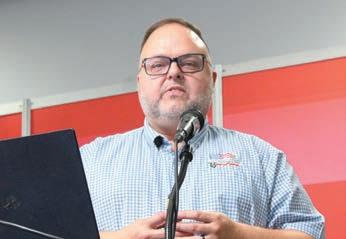
AGRINEWS PHOTO/MARTHA BLUM Je rey Bewley, executive director of genetic programs and innovation for the Holstein Association USA, discusses the Building a Better Cow project at the World Dairy Expo.








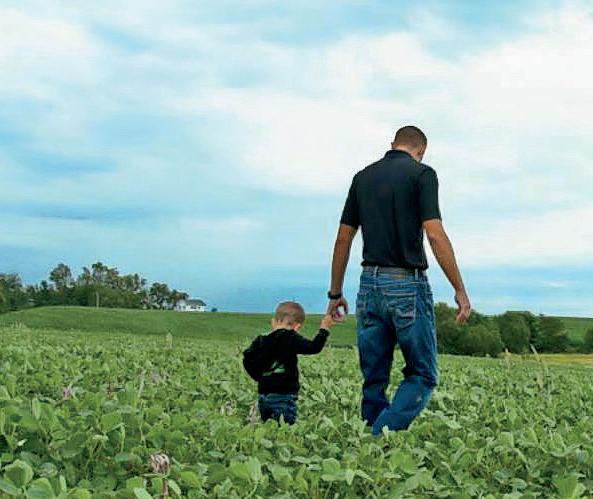
Farmer Owen Gohlke was able to increase the moisture level of his stored soybeans by four percentage points last year through rehydration, resulting in a $7,000 increase in revenue.
ASSUMPTION, Ill. — Every year, farmers lose bushels and profits because their soybeans are harvested with moisture levels below the market standard of 13%.
The latest grain bin technologies can help prevent leaving money on the table because the soybeans are too dry.
Alan Lockwood, GSI grain conditioning product manager, said when farmers harvest soybeans, the moisture content can be lower than ideal, sometimes as low as 9%.
“Dry soybeans weigh less, and since they’re sold by weight, that’s a straight hit to their paycheck,” he said.


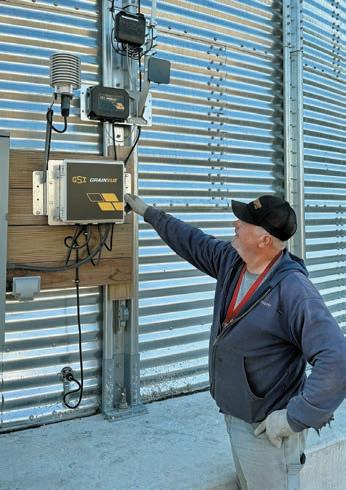
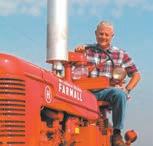
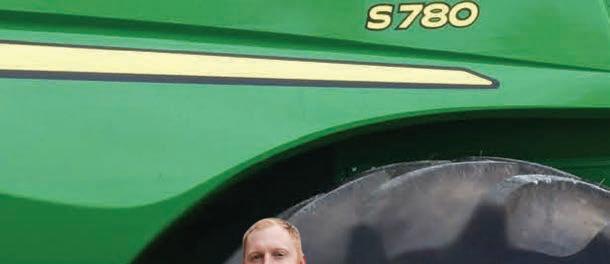
Owen Gohlke, owner of GoldKey Farms in Belle Plaine in south-central Minnesota, began using GrainVue for soybean rehydration in 2024. He stored his soybeans at 8.8% moisture, and they averaged 12.8% when he delivered them to the grain elevator.
“I picked up an extra four points, which was equivalent to 700 bushels,” he said. “That meant $7,000 more revenue based on last year’s soybean prices. I’m really pleased with it.”
Gohlke said he’s an early adopter of new farming technologies.


For example, if a farmer harvests 50,000 bushels at 9% moisture instead of 13%, that’s roughly a 4% weight difference, which translates to approximately 2,000 bushels lost. At $10 per bushel, that’s more than $20,000 in missed revenue.
However, Lockwood said GSI’s GrainVue system can help recover some of those lost dollars by rehydrating beans in the bin.
GrainVue automates grain conditioning and provides remote access to bin status, including using humidity to restore soybeans to market-standard moisture levels safely.
“The system constantly monitors the outside air’s equilibrium moisture content and only runs the fans when the conditions are ideal for moisture gain,” Lockwood explained.
“There’s no guesswork, no over-hydrating and no wasted electricity. Farmers choose their target moisture, and the system works around the clock, quietly and efficiently, to help them achieve it,” he said.
“The issue with soybeans is always getting them to the right moisture. You never get a perfect 13% out of the field or the bin, so I wanted to try GrainVue,” he said.
Gohlke noted that the system’s 24/7 remote access is also a significant benefit.
“I really like the ability to see bin statistics and manage the rehydration process, be it from a smartphone, laptop or desktop,” he said.
Gohlke’s dealer, Central United Cooperative, worked with him on setting up GrainVue.
“We’re seeing growing interest from our customers in soybean rehydration,” said Steve Heldt, construction supervisor and product sales manager for the co-op.
“It’s catching on because any time a grower can put a little more money in their pocket, it’s very intriguing. Adding moisture basically makes money, because water is weight.”
GrainVue can be installed in new grain bins or retrofitted to existing ones.















Extension
Notebook
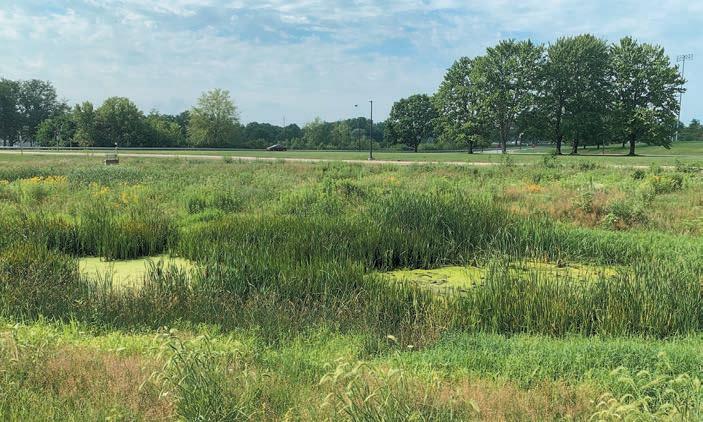
Every farmer knows the challenge of managing water and nutrients; constructed wetlands are a tool that can help protect yields and improve water quality simultaneously. Wetlands, as defined by the U.S. Environmental Protection Agency, are areas where water covers the soil or remains at or near the surface year-round or seasonally, including the growing period. These ecosystems take many forms and are shaped by their hydrology, water chemistry, soil type, and the vegetation they support. Among the various wetland types, constructed wetlands play an important role in agriculture and have become a recognized edge-of-field conservation practice.
Constructed wetlands are intentionally designed and built to serve a specific purpose, often mimicking the functions of natural wetlands. Unlike
restored wetlands, which aim to bring back a wetland that once existed on the landscape, constructed wetlands are entirely new systems designed to treat tile-drained water. Within the Illinois Nutrient Loss Reduction Strategy, constructed wetlands are tracked as part of statewide conservation progress.
One of the most valuable services wetlands provide is the protection of local water quality. In agricultural settings, constructed wetlands are often sited at tile drainage outlets, where they can receive water from fields ranging from 30 to 200 acres. These wetlands act as natural filtration systems. While aquatic plants take up some nitrate, most nitrate removal occurs through microbial processes: bacteria in the wetland convert nitrate into nitrogen gas, a form that is released back into the atmosphere. According to Jill Kostel of The Wetlands Initiative, well-designed and appropriately sized constructed wetlands can remove at least 50% and up to 90% of nitrate-nitrogen from tile-drained water — making them one of the most effective edge-of-field practices.
If parts of your field flood year after year and hurt your bottom line, they might be good candidates for a wetland. Enrolling these acres in conservation easement programs, such as those offered by USDA-NRCS, can turn unproductive land into a long-term conservation asset. Other cost-share programs, offered through government and non-government organizations,





costs. These programs enable landowners to install a constructed wetland economically while providing ongoing environmental benefits, including reduced nutrient levels and improved wildlife habitats.
Beyond water quality improvements, wetlands offer critical ecological value. They support a wide range of wildlife and pollinators, contributing to greater biodiversity across the landscape. When located in places accessible to the public, wetlands also create opportunities for recreation and outdoor enjoyment, allowing visitors to observe wildlife, engage in nature-based activities, and gain a deeper appreciation for wetland ecosystems.
Installing a constructed wetland requires careful planning and consideration. The practice may remove some land from production, and potential sites must meet specific technical criteria related to hydrology and soils. The initial establishment period can also take time as wetland vegetation becomes rooted and functional. Despite this, constructed wetlands generally require minimal maintenance once established. Farmers and landowners also note that pollinators and wildlife, such as monarch butterflies, often return to these areas surprisingly quickly, adding additional value to the landscape.
Interest in wetlands extends beyond agriculture. Some advocacy organizations in Illinois, such as the Sierra Club, view agricultural conservation practices like constructed wetlands as a practical opportunity for collaboration between agricultural producers and point-source facilities, including wastewater treatment plants. The Sierra Club’s Illinois Chapter considers constructed wetlands a cost-effective strategy for both farmers and municipal facilities working to meet nutrient reduction goals outlined in local Nutrient Assessment and Reduction Plans. By diverting and treating water through shared wetland systems, wastewater treatment plants can reduce costs, and farmers gain a conservation practice that enhances their land.
Looking for more details on how wetlands fit into your conservation plan? NLRS podcast episodes 69–72 cover a range of topics, including installation insights, easement programs, and farmer experiences. These episodes can be accessed at go.illinois. edu/NLRSPodcast.
Rachel Curry is a University of Illinois Extension agricultural and agribusiness educator and is part of Illinois Extension’s Nutrient Loss Reduction Strategy implementation team.