SHALHEVET HIGH SCHOOL • Los Angeles, CA January 2017 • Tevet 5777 • Vol. 17, Issue 2 shalhevetboilingpoint.com
Students react to enforcement of anti-party policy
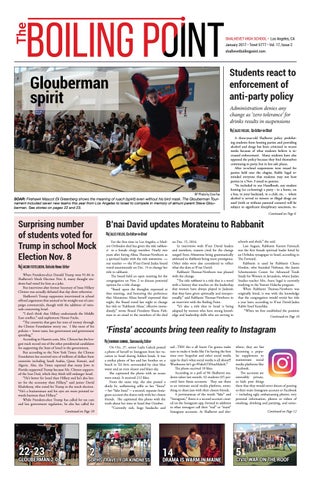
Glouberman spirit
Administration denies any change as ‘zero tolerance’ for drinks results in suspensions By ALEC FIELDS, Co-Editor-in-Chief
BP Photo by Ezra Fax SOAR: Firehawk Mascot Eli Greenberg shows the meaning of ruach (spirit) even without his bird mask. The Glouberman Tournament included seven new teams this year from Los Angeles to Israel to compete in memory of almuni parent Steve Glouberman. See stories on pages 22 and 23.
A three-year-old Shalhevet policy prohibiting students from hosting parties and providing alcohol and drugs has been criticized in recent weeks because of what students believe is increased enforcement. Many students have also opposed the policy because they find themselves continuing to party, but in less safe places. After in-school suspensions were issued for parties held over the chagim, Rabbi Segal reminded everyone that students may not host parties in a Nov. 3 email to parents. “As included in our Handbook, any student hosting (or co-hosting) a party - in a home, on a bus, in your backyard, in a club, etc. - where alcohol is served to minors or illegal drugs are used (with or without parental consent) will be subject to significant disciplinary sanctions, inContinued on Page 6
Surprising number of students voted for Trump in school Mock Election Nov. 8 By Jacob Feitelberg, Outside News Editor When President-elect Donald Trump won 91-84 in Shalhevet’s Mock Election Nov. 8, many thought students had voted for him as a joke. But interviews after former Secretary of State Hillary Clinton was actually defeated that day show otherwise. Shalhevet’s Trump supporters interviewed in school offered arguments that seemed to be straight out of campaign commercials, though with the addition of rationale concerning Israel. “I don’t think that Hillary understands the Middle East conflict,” said sophomore Honor Fuchs. “The countries that gave her tons of money through the Clinton Foundation worry me. I like most of his policies – lower taxes, less government and government spending.” According to Haaretz.com, Mrs. Clinton has the longest track record out of the other presidential candidates for supporting the State of Israel in the government. But according to the New York Times, the Clinton Foundation has received tens of millions of dollars from countries including Saudi Arabia, Qatar, Kuwait, and Algeria. Also, the Times reported that many Jews in Florida supported Trump because Ms. Clinton supported the Iran Deal, which they think will endanger Israel. “He’s better for Israel than Hillary and he’s also better for the economy than Hillary,” said junior David Khakshooy, who voted for Trump in the mock election. “He’s a businessman and his eyes are more pointed towards business than Hillary.” While President-elect Trump has called for tax cuts and less government regulation, he also has called for Continued on Page 10
22-23
GLOUBERMAN 2.0
2
B’nai David updates Morateinu to Rabbanit By ALEC FIELDS, Co-Editor-in-Chief For the first time in Los Angeles, a Modern Orthodox shul has given the title rabbanit to a female clergy member. Nearly two years after hiring Alissa Thomas-Newborn as a spiritual leader with the title morateinu — our teacher — the B’nai-David Judea board voted unanimously on Dec. 14 to change her title to rabbanit. The board held an open meeting for the congregation on Nov. 2 to discuss potential options for a title change. “Based upon the thoughts expressed at that meeting, and honoring the preference that Morateinu Alissa herself expressed that night, the Board voted last night to change her title to ‘Rabbanit Alissa,’ effective immediately,” wrote Board President Shana Fishman in an email to the members of the shul
on Dec. 15, 2016. In interviews with B’nai David leaders and members, reasons cited for the change ranged from Morateinu being grammatically awkward to Rabbanit being more prestigious. Other titles were also considered to reflect what she does at B’nai David. Rabbanit Thomas-Newborn was pleased with the change. “The title rabbanit is a title that is a word with a history that touches on the leadership that women have always played in Judaism that they have given spiritually and interpersonally,” said Rabbanit Thomas-Newborn in an interview with the Boiling Point. “It’s also a title that in Israel is being adapted by women who have strong knowledge and leadership skills who are serving in
schools and shuls,” she said. Last August, Rabbanit Karmit Feintuch was the first female spiritual leader hired by an Orthdox synagogue in Israel, according to The Forward. Rabbanit is used by Rabbanit Chana Henkin, who founded Nishmat, the Jeanie Schottenstein Center for Advanced Torah Study for Women in Jerusalem, where Judaic Studies teacher Mrs. Atara Segal is currently studying in the Yoetzet Halacha program. When Rabbanit Thomas-Newborn was originally hired, it was with the knowledge that the congregation would revisit her title a year later, according to B’nai David-Judea Rabbi Yosef Kanefsky. “When we first established the position Continued on Page 16
‘Finsta’ accounts bring teen reality to Instagram By HANNAH JANNOL, Community Editor On Oct. 27, senior Layla Galeck posted a photo of herself to Instagram from her vacation to Israel during Sukkot break. It was a smiley photo of her and her brother on a beach in Tel Aviv, surrounded by clear blue water and an even clearer and bluer sky. She captioned the photo with an ocean wave emoji. It received 212 likes. From the same trip, she also posted a dimly lit, unflattering selfie to her “finsta” -- her “fake Insta” -- a second, separate Instagram account she shares only with her closest friends. She captioned this photo with the truth about her time in Israel that October. “Currently sick, huge headache and
SOPHS TRAVEL FOR KINDNESS
sad...TBH tho u all know I’m gonna make sure to make it looks like I’m having the best time over Snapchat and other social media apps bc that’s what social media is all about!!! Woohoooo let’s go #FakeItTilYouMakeIt.” The photo received 10 likes. According to a poll of 96 Shalhevet students taken last month, 43 students (45 percent) have finsta accounts. They use them as an intimate social media platform, something to share just with their closest friends. A portmanteau of the words “fake” and “Instagram,” finsta is a second account created on the Instagram app, formed in addition to what teenagers call their “real” or “main” Instagram accounts. At Shalhevet and else-
14
DRAMA IS WARM IN MAINE
where, they are fast becoming a popular supplement to mainstream social media platforms like Facebook. The accounts are ostensibly private, so kids post things there that they would never dream of posting to their main Instagram account or Facebook -- including ugly, embarrassing photos, very personal information, photos or videos of smoking, drinking and partying, and someContinued on Page 12
5
CIVIL WAR ON THE ROOF
2
The Boiling Point • January 2017 • Community
Sophomores’ four days in Arizona mark first-ever Chesed trip By EVA SUISSA, Staff Columnist
Students travel for sports, debate, oring pictures of robotics, journalism and choir – so why lighthouses. A day later, not chesed – acts of service and kindness? That question was answered when the sophomores at the entire 10th grade traveled by bus volunteered to Phoenix, Ariz., and visited retire- the Phoenix Hement homes, homeless shelters, an area brew Academy. synagogue and other places Wednes- There, Shalheday through Sunday, Nov. 30 through vet’s teens were flocked by kids Dec. 4. Sophomores could choose among half their size for various activities each day. Over the competing weekend, they visited a thrift store, a a kick at a socgardening area, an Orthodox Jewish el- cer ball, giving kids piggy-backementary school and an art festival. “The goal... was to provide a trip rides next to the that took everyone out of their comfort monkey bars, or zone, and out of their city, and out of creating rainbow made their bubble, and introduce them to jellyfish new ways of looking at chesed,” said Mrs. from yarn in the Sarah Leah Gormin, new chesed coordi- art room. “The teachers nator and initiator of this trip with help from NCSY, an Orthodox Jewish youth were just overPLAY: Sophomores spent the second day of their four-day Chesed trip group she has been involved in for five whelmed with exvolunteering at Pheoinix Hebrew Academy. citement that we years. Sophomore Sharon Khalil said it felt were there,” said like more than just community service. Mrs. Gormin. Also on the trip at various times both the giver and the receiver. Before Shabbat, Rabbi Yagil Tsaidi “It didn’t feel like we were helping Abbi Sentchuk shared with her a were Judaics Studies Principal Reb them, it just felt like we were having a led a reflection in nature. story about a little girl in one of the Noam Weissman, Student Activities good time,” said Shahomeless shelters who wanted a pillow Coordinator Raizie Weissman, General ron. for Christmas, teaching a powerful les- Studies Principal Mr. Weslow; Judaics At the Kivel CamStudies teachers Rabbi Derek Gormin son to Kira Faerstain. pus of Care retirement “That made me realize how grate- and Ilana Wilner; and rakezet Carolyn “[The homeless shelters] made me realize how home, residents like ful I really am, and how much I really Tsaidi. grateful I really am, and how much I really have. Eunice — a petite lady After 25-minute laser tagging seshave,” said Kira. “Now I see it, and I Now I see it, and I never really did before.” with warm eyes and a sions, students lined up for refreshing never really did before.” --Kira Faerstein, 10th Grade white pixie cut — were Aside from chesed, the sophomores ice cream, relaxed in groups or played happy to have students also enjoyed evening activities, includ- in the arcade. spend a couple of hours Maybe it was carefree and inforing laser tag and a Kings-vs.-Coyotes with them. mal moments like these that enhanced hockey game. Surrounded by the calm of the desAlthough the students initially At laser tagging, students were greet- the whole experience of the trip and seemed hesitant to engage with the resi- ert, students shared their thoughts on ed with neon lights from the arcade and put students in the right mood to perdents, by the end of their visit they were the chesed they experienced together. an ice cream shop with a misspelled sign form chesed. Bailey Mendelson spoke about the reading “Ice Creamry.” laughing over games like Scrabble, or Another one of those moments was having personal conversations while col- importance of its being enjoyable for
CALENDAR
JAN
5th-7th: JSPA
ts a e b a Macc
FEB
3rd-4th: SCHOOL WIDE SHABBATON 13th-24th: SCHOLAR IN RESIDENCE PROFESSOR ARON AMIT 20th: PRESIDENT’S DAY (NO SCHOOL) 27th: ROSH CHODESH ADAR
Proceeds will benefit the arts at shalhevet high school
in E V I L NGELES
16th: MARTIN LUTHER KING DAY PROGRAM (SCHOOL IS OPEN) 23rd-30th: SEMESTER BREAK
BP Photo by Katia Surpin on the bus back to Shalhevet. A few hours in, the bus broke down — turning an ordinary seven-hour bus ride into a 12-and- a-half-hour adventure. It could have been an ordeal, but some students said it actually added to the trip. Students were either singing along with a ukulele, talking, or sleeping. Many said later that they had formed connections with people they’d hardly spoken to before. “For five hours [during the delay], we were all in one place together, just hanging out,” said Kira Faerstain.
LOS A
t
ation):
(LIST in form
nsors
lowing spo
o the fol hank you t
ILY DRAZIN FAM y Feder Famil LA elle Karen Mich Y LEWIS FAMIL armacy Ph e in Mickey F mily a Poltorak f
Y SCHOEN FAMIL mily schwartz fa y toczek famil Y IL M WEINER FA
co-chairs:
l & Gina raphae KAren halaszi
Sunday, January 8th 2017
THE WHOLE COMMUNITY IS INVITED TO JOIN Us FOR AN EVENING OF FOOD, FUN AND MUSIC!
TICKETS
Adults - $36 Children 4 and under - no charge Shalhevet Alumni (UNDER 25) - $25 Children 18 and under - $18
for reservations go to:
www.shalhevet.org/maccabeats MORE ON THE WEB: Flat tire causes long delay on chesed trip Divrei Torah for Chanukah Rabbi Lieberman to leave YULA Readers respond to gay inclusion stories VIDEO: Glouberman Tournament 2016 VIDEO: Shalhevet holds Mock Elections
IN THIS ISSUE: Community: 1 - 7 Outside News: 8 - 10 Features: 11 -13 Arts: 14-15 Torah: 16-17 Opinion: 18 - 20 Sports: 21-24
The Boiling Point • January 2017 • Community
3
Agenda says it will bring election rules, Constitution to Town Hall When normal days aren’t normal, there’s a problem By MICHA THAU, Staff Columnist “What now?” I ask as I rub my eyes and check my phone to see the ever-so-common Shalhevet good morning greeting, “Special Schedule.” Five minutes shaved off of every period one day, 10 the next or even entire classes sent to the chopping block for a multitude of reasons I find difficult to fathom. In the month of November alone we had a basketball tournament, a music video filming, parent-teacher conferences, a teacher in-service day and a domestic violence assembly, all of which required missed class time. In fact, despite a spoken promise not to cancel any periods for the Glouberman Tournament, first period on Friday, Nov. 11, was cut. This is in addition to an already twoday break for Thanksgiving and parent teacher conferences. For Shalhevet, these events – each of them understandable on its own – come on top the Jewish calendar in general. Most years, either September or October, or in some cases a mixture of both, are challenged with a large cluster of holidays that cancel school. Around eight or nine days for Sukkot, I am not arguing to cancel vacations or two for Rosh special school days. Rather, I am pointing Hashanah, out that the administration must be more one for Yom frugal in deciding what is valuable enough Kippur and a half day to miss class for. for the fast of Gedalia, all of which together significantly strip away our class time. This year, October included a whopping low of six school days, three of which were cut short due to fasts and holiday preparation. Traditionally, November has been the month that allows school to resume and assume a normal, quiet and uninterrupted series of normal school days. This year however, November was home to endless stream of special schedules and consequently morphed into a month that rivaled September and October. The second semester offers similar scheduling hurdles in the Jewish calendar – Purim and the fast of Esther; Pesach, Lag B’Omer, Yom Hashoah, Yom Ha’atzmaut and Yom Hazikaron – and Presidents’ Day, Memorial Day, Senior Ditch Day and Color War, which last year was two days long. I am not arguing to cancel vacations or special school days. Rather, I am pointing out that the administration must be more frugal in deciding what is valuable enough to miss class for. This is not just for the sake of our students, who struggle with a schedule that may place their tests weeks after they have learned the material, but also for the sake of our teachers. My experience has been that teachers don’t always receive much prior notice as to when their classes may be shortened or cancelled. Last year, in a first-time breach of tradition, teachers were not even told when Color War would be, leaving tests scheduled far in advance, homework assignments and project due dates to the will of the wind. Late last year, after a grueling week of nonstop special schedules, I saw on my Schoology calendar a notification that Monday would be “a normal day of school.” I was shocked, it had actually come to the point where we had to schedule a normal day of school because such a day had become so rare when in reality it should be the most common. I think it is our duty to start carefully examining what requires a special schedule and what extra programs need to be cut in the name of compassion and, ultimately, our greater education. Most of our vacations are necessary for religious reasons, so we have to be very careful about the rest. Maybe Advisory can be used for grade-wide assemblies. Maybe we can take a closer look at how much time certain activities take. The Rosh Chodesh schedule for example, even with its longer davening, provides students with a longer break than necessary. Moreover, school publicity should not ever be used again as a valid reason to miss class as it was on Nov. 21 for the shooting of the music video, no matter how beautifully that video comes out. And teachers need to be apprised of these programs weeks, not hours or even days, in advance when possible, as last-minute test changes are fair neither to them nor the student body. If nearly every day is special, then no day is. It has come to a point where special schedules cause eyes to roll not just among the faculty but among the student body as well. For the sake of our education, it is vital that we can all wake up in the morning and be pretty confident that it will probably be a “normal” day at Shalhevet.
QUESTIONS: The Agenda Committee met Dec. 12 in Room 204. The committee, which decides Town Hall topics, has decided to take up the question of whether the Just Community Constitution should be thrown out.
By ZEV KENT, Senior Editor
BP Photo by Natalia Shabtay
The Agenda Committee decided last month to devote the make the constitution and feel really good about ourselves first Town Hall after December break to discussing if and and be really self-congratulatory, but the point is to have a how the school’s Just Community Constitution will be community that cares about the Just Community.” used in the future. The room was split almost evenly over whether the Last August, the Committee decided that the Consti- Constitution was an issue that should be brought before tution wouldn’t be high up on its list of priorities, though the student body or not. After a lengthy and heated disthe document had been found in June after being missing cussion, the committee decided that a Town Hall was necfor about two years. essary. It was found in the middle of the spring Just CommuWhile the Just Community Constitution may or may nity election campaign, not have much of an effect on and contained provithe daily lives of Shalhevet sions some of which students, there are two periIt has to start from us. If we start amending the Conwere being followed and ods of time when it becomes stitution now, the school will take it more seriously. others ignored. especially relevant: fall and But at its meeting --Rosie Wolkind, Agenda Representative spring election seasons. Nov. 28, the group deThree of the past four Just cided to bring it up early Community elections have in 2017. Agenda Chair featured some sort of controBennett Schneier said versy. that at the very least, the Two years ago, then-juTown Hall would tackle procedures for elections. nior Will Bernstein ’16 attempted to create a political par“Certainly before the election there will be established ty to run with for Agenda Chair. The constitutionality of rules that will be decided, I hope, in a Town Hall forum,” this was questioned and before both the Agenda and Fairsaid Bennett in an interview Nov. 30. ness committees, and ultimately the Fairness Committee The Nov. 28 meeting was contentious and divided, did not allow it. with disagreement over whether the Constitution matLast year, then-sophomore Rosie Wolkind ran for tered at all. In the end, members decided by consensus to Agenda Chair. This was the first time in Shalhevet’s hisbring the topic to Town Hall, hoping to address publicly a tory that a rising junior had run for Agenda Chair and, range of issues covered by the Constitution. as it turned out when the Constitution was found, clearly Most notably, three recent Just Community elections unconstitutional. The Constituation states that the Agenhave been controversial: the 2016 and 2015 elections for da Chair must be a senior, but Rosie was allowed to run Agenda officers, and 12th-grade Fairness representative regardless. elections this fall. This year, there were 12th-grade representative elecQuestions arose about vote counting, publicly an- tions for the Fairness Committee, something that was nouncing vote totals, who could run, and whether candi- required by the Constitution but hadn’t been seen at Shaldates could run as members of a political party. hevet for at least the past four years. Eleventh-grade representative Rosie Wolkind was the But the Fairness Chairs – not the students in the grade one who brought the subject up. – picked the winners, and that was unconstitutional too, “It has to start from us,” said Rosie. “If we start amend- according to most readings of the document. ing the Constitution In an interview with the now, the school will take Boiling Point after the Nov. it more seriously.” 28 meeting, Bennett said I don’t know if we’re going to codify something in a Alec Fields, reprethere would be no questions Constitutional way, but just in terms of process – sentative for Grade 12, about this year’s elections, what is allowed, what is not allowed – is gonna be said the Constitution is pledging there would be rules an issue that belongs to, and guidelines in place that decided in a democratic way. and should be addressed --Bennett Schneier, Agenda Chair will have been decided, he by, the entire Just Comhopes, in Town Hall. Whethmunity. er they take the form outlined “Even though we in the current Constitution haven’t used it, doesn’t remains to be seen. mean it’s not important,” said Alec. “It’s the foundation of “I don’t know if we’re going to codify something in a our school… Deciding whether we should throw it away Constitutional way,” Bennett said, “but just in terms of isn’t a decision that we as the Agenda Committee have the process – what is allowed, what is not allowed – is gonna power to make.” be decided in a democratic way.” That began a 10-minute conversation about what He also said the Town Hall planned for after winter should be done about the document. Many perspectives break to discuss the Constitution would most likely feawere brought up, including the question of whether stu- ture a discussion of whether to keep or get rid of it. dents would appreciate the discussion. When asked if the Agenda Committee has a plan “How much do people actually care?” asked 10th- should the student body decide to throw away the Constigrade representative Talia Gill. tution, Bennett replied, “Not at the moment.” Bennett said the Constitution is not important at the “One step at a time,” said Agenda Vice Chair Isaac moment and the Agenda Committee has more important Goor during the committee’s next meeting, Dec. 5. “We things to deal with. haven’t dealt with Part A. We’re not gonna deal with Part “What’s the certainty that they don’t forget about it B.” again in the next four years?” asked Bennett. “We can
4
The Boiling Point • January 2017 • Community
Mock Trial team advances to final four in LA County By Nomi Willis, Staff Writer The cases are always fictitious and deFirehawks almost won this year’s counsigned so that the prosecution and defense ty-wide mock trial competition, making it having equal chances of proving their side. to the final four of 99 teams and defeating This year’s case was called People v. AwSanta Monica High School in their first-ever brey. The fictional defendant, Cameron advance to the semi-finals. Awbrey, is accused of the human traffickShalhevet went on to lose Nov. 28 to ing of Lin Stark. According to Lin Stark, Chaminade College Preparatory School of Cameron underpaid him for his work as a Canoga Park in a contest held at Los Angeles chef and trapped him in his apartment. But Superior Court downtown. Chaminade had Cameron said he was just trying to help Lin won the county competition last year. with his career and never meant to cause Although the loss flustered many of the any harm. team members, getting as far as they did in Talya and Alex became the other memthe annual event was an achievement, espebers’ go-to advisors. cially because they did not have an attorney “It’s two teenage girls leading a whole for a coach. team,” said Alex. “We’re not experts at all. “I think a lot of these teams rely on those You take on a lot of responsibility, but it’s lawyers to kind of help them,” said history been a really great experience.” teacher Mr. William Reusch, who coaches Instead of run-throughs of the entire the Mock Trial team. ”And our kids know trial, which were hard to schedule, the capthat they don’t have any help in me, so they tains gave personalized advice to each team gotta figure it out on their own.” member. His own role, he said, involves driving On their way to the second round Nov. the van, setting up transportation, collecting COURTHOUSE: Lawyer Zack Hirschhorn practices his direct exam7, team members were reciting their lines, money, helping with some ideas and taking going over procedure and spouting lawyer notes. ination of witness Nicholas Fields before third round of competition. jargon like it was their first language. Once “That makes them into better leaders,” Mr. Reusch said. “It’s easier on me, and it’s BP Photo by Ma’ayan Waldman inside the courtroom, when everyone was settled, the judge called the trial into session better for the team.” 10 for each role in the trial (lawyers, defendants, two years of experience The annual competition is sponsored by the etc.), judged by professionals in the legal field. The on Valley Torah’s team before she transferred to with the flags of the United States and California non-profit Constitutional Rights Foundation, Firehawks’ scores for the first, second and third Shalhevet. Alex Reich, Maya Golan, Maayan hanging on either side of the room and the seal of and many schools have attorneys as coaches for rounds were 244, 301 and 284, respectively. Waldman, Ariel Cohen, and Sam and Zack California overhead. Mock lawyers for Shalhevet and faced an oppotheir teams. Shalhe“I think we Hirschhorn are each in their third or fourth year nent, Marymount High School, whose students vet’s team was led by moved on so far on the team. senior captains Talya When it comes to legal precedents and how Team members traveled downtown on differ- had family members in attendance -- along with because we’re all Ohana and Alex Rejust so dedicated ent weekdays, sometimes multiple times a week, two coaches, one of whom was an attorney. to read a case and stuff, they just figure it all When the trial was over, the judge and two ich. and we wanted throughout the month of November. Dressed in out themselves Although this it so badly,” said suits, ties and heels, they were regularly seen gath- scorers gave comments to both teams, and each -- Mr. William Reusch, Coach season was ShalheTalya. “Alex and I ered in the cafeteria around mincha time waiting team gave a Most Valuable Player award to someone on the other team. Marymount chose Shalhevet’s first time in the coming into this for their rides. semifinals, ShalheThe group successfully completed four unde- vet junior Ariel Cohen, who played the defendant decided our numLin Stark. vet made it to the ber one goal was to feated rounds. quarterfinals, or final eight, in 2008, according to move on because we wanted to make Shalhevet Mock Trial competitions focus on a single case then-assistant coach, Mr. Chris Buckley. the entire season, with members arguing for the history.” Only undefeated teams advance from one level She added that this year’s team had a lot of ex- prosecution or defense and playing roles ranging to the next. Points are awarded on a scale of 1 to perience. Talya is in her second year and also had from witnesses, lawyers, timekeeper and bailiff.
Student project gives homeless a chance to show their world By MA’Ayan Waldman, Co-Editor-in-Chief Junior Rosie Wolkind was scrolling through Facebook last July the Homeless (PATH) to figure out which homeless encampments and shelters to visit. when an article caught her attention. Their goal is to distribute 80 cameras total, although they both Jason Williamson, a pastor in Spartanburg, South Carolina, had handed out 100 cameras to homeless people there, 46 of which said that they expect less than half of the cameras back. Shalhevet were returned, and he displayed the 700 photographs collected at a donated all of the cameras, and Samy’s Camera on Fairfax Avenue has said it would develphotography exhibition. op the pictures free of Rosie’s awe immediately translated into action, charge, the girls said. and with advice from then-Chesed Coordinator It is for them to show: ‘I did this, I made Rosie and Maia had Ruthie Skaist, she partnered with fellow junior Maia this, and people like it.’ distributed 31 by late-DeZelkha, who is head of the Photography Club. Tocember and had collected gether, they mapped out a plan for their own rendi-- Maia Zelkha, 11th Grade four in return. tion of Pastor Williamson’s project. The girls also assem“People who are homeless are some of the most bled kits of Chapstick, creatively underestimated and underrepresented toothbrushes and other people in our society,” said Maia. “This project gives supplies to give to homeless individuals upon receiving the camerpeople a platform to help their own cause.” Titled “Exposure,” Rosie and Maia’s project aims to empower as back. They’re keeping track of camera recipients’ names, phone homeless people in Los Angeles by providing them with a creative numbers if they have cell phones, and any special requests they have outlet – disposable cameras – to capture unique moments in their for their care kits. Although the project is still under way, Rosie and Maia’s experilives. “We tend to think of the homeless as a population, and not ences travelling downtown and interacting with the homeless have as individual people,” said Rosie, “individual people who look at already been rewarding, both said. Rosie said that while some of the homeless individuals refused the sunset and think it’s beautiful. Who can look at someone’s eyes and say, ‘Wow. They’re beautiful. I wish I could keep a memento or were reluctant to accept the cameras, others were impressed by the girls’ endeavor. of that.’” One man said this could be a great way to start The girls also hope collecting footage for a documentary he plans to creit will educate the comate, Rosie told the Boiling Point. In fact, he was so munity about the growWe want to expose people to how such a excited that he requested a second camera. ing problem of homeRosie and Maia received two grants for their projlessness in Los Angeles. huge population of Los Angeles is living. ect, one from the Jewish Federation for $1,500, and According to a report -- Rosie Wolkind, 11th Grade the other a $500 Disney Summer of Service Grant from the U.S. Departthrough the Youth Service America (YSA) organizament of Housing and tion. The YSA website says the grant is designated for Urban Development, “young people, ages 5-18, who are making a differhomelessness affects over 500,000 people nationally – 80,000, or about one in six, in ence in their communities.” They hope to display the best photos in a photo gallery at school Los Angeles. “We don’t know what it likes to literally be living meal-to-meal or elsewhere, tentatively in late February. At the gallery, they said, and to be living in a tent your entire life,” said Rosie. “We want photos will be auctioned off and the money will go to PATH. “We think it’s going to be hard to pick 40 out of all the amazing to expose people to how such a huge population of Los Angeles is photos we are going to get,” said Maia. living.” Rosie and Maia hope that the photos will allow homeless indiTo start the project, Rosie and Maia contacted People Assisting
viduals to express themselves through an artistic medium. “It’s what they want to show the world,” said Rosie. “It’s who they are, what they do, who they’re with. Anything and everything.” Maia expressed a similar sentiment. “It is for them to show: ‘I did this, I made this, and people like it.” Ruthie Skaist is proud of what the girls have accomplished. “Even if they kept it very simply as getting back photographs and stories with those photos, that’s already really meaningful,” said Ruthie. “No matter what, they already stepped outside their box a little bit just by doing this and by making connections with people that they probably normally wouldn’t.”
UNSEEN: Residents of a homeless encampment under a freeway downtown received disposable cameras from Shalhevet students. BP Courtesy of Maia Zeklha
The Boiling Point • January 2017 • Community
5
Shalhevet, YULA, Valley Torah agree to cut Admissions spending By Hannah Jannol, Community Editor and Gabby Grunfeld, Staff Writer They also gave out backpacks at the boys’ Open House and and missions programs for prospective female students -- a major “difHoping to stop what they called an “admissions arms race,” the heads of school of Shalhevet, YULA Boys, YULA Girls and Valley laptop covers at the girls’ school, as they did last year, but this year ference in machinery” between recruiting boys and girls, as Rabbi Lieberman put it. Rabbi Emerson could not be reached for comTorah have agreed to decrease spending on recruitment of new stu- sprung for less pricey options and found a better deal, he said. Shalhevet promised to spend half of what it had spent in the ment. dents. But Rabbi Lieberman said he signed the letter anyway, because In a letter signed by the four heads of school and e-mailed to past on food. Rabbi Segal said Admissions events gradually had bethe Shalhevet community Nov. 4, they said they would scale back come more and more elaborate until without realizing it, they were of the bigger messages of working together for the community. The initiative was a chance for all the schools to examine their budgets. “resources, be it in money, staff, or time, in the pursuit of incoming taking too much time and effort. “Let’s be wise and careful with our money, money is hard to “I’m not suggesting being frugal,” Rabbi Segal said in an interstudents.” “We are pleased to announce to you that all of us, as Heads of view. “I actually think thoughtful spending should go up in many come by,” Rabbi Lieberman. For now at least, the detente is working on an honor code. School, have, in working together, jointly committed to enhancing ways at schools to improve the quality of the education, the quality “We talked about a list of standardized rules,” said Rabbi Seof our functioning as a school, but this seemed our recruitment processes by gal. “But ... because of the time crunch and the desire to respect to be somewhat wasteful.” lowering expenses whenever Shalhevet has cut its overall Admissions each school’s process for decision-making around these things, we possible, and focusing the adThis particular committee that started with Rabbi budget by 34 percent, and its Admissions-spe- kicked that can down the road a little bit. We just kind of all agreed, missions process on substance Segal convening has a certain beauty to it...It cific food budget by 50 percent, according to kind of like a handshake deal, to lower expenses.” rather than flash,” the letter brings people together under different issues. Shoshana Yarmus, a prospective eighth grader from Emek Rabbi Segal and Admissions Director Natalie stated. There’s a broader message in here, which is unity Hebrew Academy who is looking at both YULA and Shalhevet, Weiss. Rabbi Segal said the spendand working together with other heads of schools. According to Ms. Weiss, last year’s Shalhevet enjoyed the less extravagant admissions event during her student ing was a strain on school re--Rabbi Lieberman Fall Open House, which is held every Novem- visitor day on Dec. 8. souraces and that “frills” dis“I like events like this because I get to experience what it’s like to ber, featured a $1,000 candy bar and desserts tracted from the actual goal of that cost $2,000, in addition to catering from have a regular day at Shalhevet,” Shoshana said after Town Hall that Admissions. day. “Honestly I didn’t pay attention to [the food].” “I think we’re distracting people from what they should be LA Burger Bar. Rabbi Segal and Rabbi Stulberger both said the cutbacks would Open House used LA Burger Bar again this year, but spent only thinking about,” Rabbi Segal said in an interview. “I don’t want to be a good way to weed out students and families who are interested tell people what to make a decision based on, but at Shalhevet we $500 on desserts and appetizers, she said. Both Rabbi Segal and Ms. Weiss said Shalhevet’s best admis- in the glitz and glamor of a school, and not its educational philosdecide based on the school, based on the educational experience, sions programs are the student visit days and Winterm -- Sunday ophies or missions. not based on the frills.” Rabbi Stulberger said that because of this, the cutbacks will acThe agreement by Rabbi Segal, Rabbi Dov Emerson of YULA sample meetings of Shalhevet co-curriculars -- which are also the Boys, Rabbi Abraham Lieberman of YULA Girls and Rabbi Avro- most inexpensive. These events only require the modest price of tually help, not hurt, Valley Torah. “I think that helps us, because if a parent chooses another school hom Stulberger at Valley Torah came out of a meeting at Fish Grill, pizza and salad, which means the budget for Shalhevet’s most imbecause they’re fancier, then I’m not sure if in the long run that kid portant admissions events will not be cut. where the four have been meeting on occasion for two years now. The spending was perhaps more surprising since tuition is dif- would have been better off by us anyway,” Rabbi Stulberger told the “This particular committee that started with Rabbi Segal convening has a certain beauty to it,” said Rabbi Lieberman. “It brings ficult for so many in Jewish private schools. Full tuition people together under different issues. There’s a broader message at the four schools averages around $31,000 per student in here, which is unity and working together with other heads of per year. Rabbi Lieberman said YULA Girls s did not cut back schools.” Rabbi Stulberger of Valley Torah said the bigger idea behind the as much as the other schools in the compact, because initiative is that schools should not have a “Come to me, come to they had been spending much less to begin with. “I honestly did not know exactly how much money me, come to me” approach to admissions. “The idea that every kid belongs in every school and we all just we were spending on food for example, but when I saw rush for the same kid is a mistake,” Rabbi Stulberger said. “We it I thought ‘Oh my gosh, we better cut this back,’” said shouldn’t be rushing to every kid, there are different schools with Rabbi Lieberman. “But when I looked at the figures [of different strengths, and the real message is that the kid who would the other schools], I thought, ‘Oh, we did not spend that thrive in this environment, whether it’s Valley Torah, YULA, or much money to start with.’” By offering less swag and using their in-house caterer Shalhevet, that’s where they should go.” To meet this goal, Valley Torah has cut its overall admissions in YULA Girls’ kitchen to make food for Open House, BUFFET: Parents and students filled their plates budget by about a third, Rabbi Stulberger said. At last year’s ad- they were saving already money other schools were not, at this year’s less expensive Open House. he said. missions Open House, they hired a caterer. This year, he said, they This contrasted the most with YULA Boys, whose eliminated the caterer and saved almost $7,000 on food between events frequently featured much more meat than the adthe high school’s girls’ and boys’ campuses. BP Photo by Lucy Fried
Civil War reenactors bring 19th-century culture to life on the roof By JACOB JOSEPH LEFKOWITZ BROOKS, Staff Writer The Civil War is one of the most influential and important events in American history, but studies show not many people know enough about this monumental event. According to a 2015 survey conducted by the American Council for Trustees and Alumni, only half the American public could correctly identify when the Civil War took place, and just 18 percent knew the Emancipation Proclamation meant slaves were free in areas still in rebellion. It is the goal of civil war re-enactors to teach people these lessons. To begin their presentation, the re-enactors and Mr. Harris marched onto the rooftop turf to a surprised audience of students eating lunch. Acting in character, Capt. Kelsey began by explaining his and Cpl. Weston’s uniforms. He showed the students everything a soldier had to carry on his back: rifles with bayonets, pistols, swords, bedding, toothbrush, pocket knife used for cutlery, ration bags, blanket, tents, tallow candles, sewing kit and every small utility that a soldier would need. He explained things in colorful detail. A soldier carried his toothbrush in his hat and used it to clean both his teeth and his dishes. The bayonet has a triangular shape to make it easier to pull out of the enemy’s bodies and cause maximum damage. The Civil War was known for being parORDERS: Students from all grades lined up in military ticularly bloody, with formation on the rooftop turf Nov. 9, reenacting roles gruesome wounds and in a South Carolina regiment during the Civil War. no real medicine to treat them. After the explaBP Photo by Katia Surpin
With a South Carolina Civil War battle flag waving high above them, rifles stowed on shoulders and intense drumming in the background, Shalhevet students marched in unison across the rooftop turf at lunchtime Nov. 9. Their leaders were “Captain” Larry Kelsey and his son, “Corporal” Weston Kelsey – Civil War reenactors who belong to a group dedicated to presenting an accurate portrayal of the famed South Carolina unit known as the Hampton Legion. From 1861 to 1865, the Hampton Legion fought for the Confederacy in most of the battles in the Eastern Theater of the Civil War. The Kelseys were introduced as and spoke from their role-playing titles. Father and son in real life, they were invited by History teacher Dr. Keith Harris as part of his SAS Civil War class. Since 1974, the legion’s “Company G” has been one of the premiere living history organizations in Southern California, Dr. Harris said. “These guys are so authentic and they do it exactly right,” Dr. Harris said, “and I think the kids have a better appreciation of what a Civil War soldier would have had to endure on a daily basis.”
Michelle Greenberg said she now had a visual nation was finished, the re-enactors and Mr. Harpicture of the war. ris slipped away. “When learning history, it’s hard to find Then, after a brief wait, they suddenly reappeared marching towards the crowd. With them something tangible to help your understanding were Adam Ritz and Judaic Studies teacher Rabbi of something that happened so long ago” said senior Michelle Greenberg. “So by seeing what the David Block dressed in Civil War costumes. “Looks like we captured a prisoner boy,” Dr. war, the weapons, food, and things they took with them helped me visualize what the time during Harris said, as the students let out a laugh. the Civil War was actually The student like.” observers were Seeing what the war, the weapons, food, Mr. Kelsey said people then directed to and things they took with them helped me have different reasons for line up across the visualize what the time during the Civil War getting involved in Civil lawn with Adam was actually like. War reenactment. Some and Rabbi Block at the head. Nomi -- Michelle Greenberg, 12th Grade like the “theatrics,” he said, and others just love Willis stood at the history. center holding the “Then there’s people company flag high who want to set the rein the air. They were then instructed to march around cord straight, especially with the internet and the the lawn, beads of sweat rolling down their faces movies being made,” Mr. Kelsey said. “Some of as they realized that the soldiers had to do this for the movies are ridiculous, and the movie producers should be a little more careful in what they days at a time. After this was completed, Mr. Kelsey answered portray. You know every Southerner didn’t own a slave, and that all Northerners did not march into question from the students. “Can you show us the rebel yell?” junior Dan- the South to free the slaves.” Dr. Harris said the lesson was more effective iel Lorell asked with a smile of anticipation.The re-enactors swiftly picked up their guns and let than reading. “I thought it would be a really great idea to out a loud shrill, sounding like a wounded anihave the kids line up in the heat and march around mal. “They take great pride in the authenticity of the way authentic civil war soldiers would,” he every detail of their presentation,” said Dr. Harris. said, “I thought it would be really good for them “From clothing to weaponry, even to their food..” to learn how a Civil War soldier would eat and SAS Civil War students said they had learned camp, and the things they would have with them, so they could have a more authentic experience a lot. “In class when we talk about people, we learn that goes beyond just what you can read about.” On the roof, he told the students that the proabout their accomplishments and the decisions they made in battle,” said senior Ezra Hess. “The gram would be seen again. “Ladies and gentleman this is a Shalhevet first reenactment, on the other hand, gave a different perspective that we couldn’t get by someone de- and it won’t be the last,” he said. scribing it to us.”
6
The Boiling Point • January 2017 • Community
Students react to enforcement of anti-party policy Administration denies any change as ‘zero tolerance’ for drinks results in suspensions Continued from Page 1 “That’s my fear sometimes, that I will be in cer- year have not been punished, as far as the Boiling gerous alcocluding, but not limited to, suspension or expulhol is and tain settings and everybody else is going to be do- Point has been able to determine. sion,” wrote Rabbi Segal. But students who have been hosting parties at inform us of Rabbi Segal and Reb Weissman also explained ing one thing that I’m not doing,” said Alex. “As a high schooler, a teenager, which alcohol was seen have received in-school the halakhthe policy in a ic and legal that’s a very hard thing to do suspensions or worse. Town Hall on Reb Weissman did not dispute that difference. and health and I don’t like to put myself that day while reWhile he did not condone any type of drinking, r a m i f i c a in those situations. minding everyone We’re part of Judaism. Judaism was a mately, [conse“It’s not impossible to go he said that every situation is different and the tions – they should. But ultithat there would revolution against society and Shalhevet sober, but you kind of feel “consequence will look different based on a variety quences] should not be under their jurisdiction.” be disciplinary In his email, Rabbi Segal called partying “one is a willingness to rebel against the like you’re the odd one out,” of things.” actions for anyof [Shalhevet’s] only zero-tolerance issues” and “It’s an incredibly non-nuanced view to he added. “You’re one who hosted norms. We’re an aspirational school and say that because a student doesn’t ‘get in asked parents to share some of the responsibility. kind of sitting a party during I believe in being aspirational. “Alcohol and drugs result in very poor decision trouble’ for drinking off campus or ‘get on the sideline the Glouberman - Reb Noam Wiessman, Principal and making and put our in trouble’ for having tournament, Nov. kids at risk of serismoking mariconversations 10-13. ous injury,” wrote It’s not impossible to go sober, but you juana off campus listening to A Boiling Rabbi Segal. “It has therefore there’s people’s drunk Point poll of 73 kind of feel like you’re the odd one out. happened and, inevnot a conseupperclassmen found that 58.4% of seniors and problems.” You’re kind of sitting on the sideline itably, will happen quence,” said In an interview, another senior 36% of juniors “strongly disagreed” or “disagreed” and having conversations listening to again. So stop allowReb Weissman. with the policy. 23% of seniors and 48% of ju- said she goes to more non-Shalhevet ing it to happen. “What we do niors “strongly agreed” or “agreed” while 19% of parties now because there are fewer people’s drunk problems. is whenever we Shalhevet parties. seniors and 16% of juniors were “indifferent.” - Alex Silberstien 12th Grade Stop sending your kids to parties withfind out there are “If I’m not going to go to ShalheSenior Bennett Schneier disagrees with the out checking to make students who policy because he does not think it stops students vet parties then I’ll go to non-Shalsure a parent is home are drinking hevet parties,” she continued, from attending parties. and vigilant.” or who “The school treats partying like it’s something “Because it’s high school. I He also said “party culture” makes it difficult are smoking, we have our that’s preventable, but I think the reality of the sit- go out.” approach to educa- for students who do not want to drink. uation is that it’s inevitable,” said Bennett. “Many parents, myself included, do not want tion, which is “I think kids are going to find a way to parthe authorita- our children involved in a party-culture or at a ty and the way Shalhevet students party” is bettive approach: place where alcohol is served to minors,” wrote ter, said Bennett, because it’s “in an insular place, l t h o u g h ‘Come with me, Rabbi Segal. “Imagine how many teens feel when where for the most part where people care about “p a r t i e s” lets’ have a con- they are told they can’t be a part of socializing with each other without kids coming from Beverly, are explicversation about their classmates because the environment isn’t from Valley Torah – from all these places” where itly prohibthe implications safe.” they’re not personally known. ited, the Warning: drinking alcohol while Junior Rosie Wolkind supports the policy for and the downBut Principal Reb Noam Weissman said that Handbook sides and the real that reason. whatever is happening in teen culture at large, and rule are pregnant has been proven to cause “It’s the school’s job to protect the students dangers of drinkShalhevet needs to be different. unclear as birth difects, do not handle heavy ing, and smoking and this is their way of doing that,” said Rosie. “I just don’t believe in those norms,” Reb to whethmachines under the influence of marijuana or do- “Kids can disagree about how they’re doing it, but Weissman said. “I don’t believe one needs to drink er hosting alcohhol, do not drive under the I think we have to understand that their intening drugs.’” or smoke in order to have fun. I’ve seen it in my a smaller, influence of alcohol. Still, hosting tions are good and they’re trying to protect their own life, I’ve seen it in my own life growing up i n f o r m a l is a different, he kids from drinking and hurting themselves in that and I’ve seen it from my parents. gathering way.” said. “I don’t believe that, and what Shalhevet does of a few Do not drink if you are a a Shalhe“If a student is it always rebels against the norms. We’re part of f r i e n d s vet student. Any student hosting (or is facilitating that Judaism. Judaism was a revolution against society with alcoco-hosting) a party - in a home, on a within the school, and Shalhevet is a willingness to rebel against the hol and-or lthough the policy has been in the handbus, in your backyard, in a club, etc. then they’re maknorms. We’re an aspirational school and I believe drugs is disbook for three years, 81 percent of seniors - where alcohol is served to minors ing sure other and 48 percent of juniors think it is being more in being aspirational.” allowed. people can ben- strongly enforced now than in years past while Reb Weissman disagreed with the notion that it R e b or illegal drugs are used (with or efit from it, then 12.5 percent of seniors and 40 percent of juniors was being enforced more strongly this year. We i s s m a n without parental consent) will be that’s different are unsure. “That’s just false,” said Reb Weissman. “That’s was not subject to significant disciplinary from the simple a factually incorrect statement. [It’s] cause you’re vague, howSome believe the approach needs to be changed. sanctions, including, but not limited act of smoking older now, this rule is more applicable. Last year ever. “The school cannot condone partying, I’m not to, suspension or expulsion and drinking and saying they should do that,” said Bennett. “Maybe kids felt like this and two years ago kids felt like “Accordwe make that something of a blind eye, turn the other cheek I this.” ing to the distinction,” said would say something of that sort.” policy it’s Reb Weissman. An anonymous 11th grader in the poll thinks enior Layla Galeck opposes the policy be- not wise to “So if we find out Shalhevet has to accept the fact that students will make that cause she thinks it won’t work as hoped. that a student is drink and help them be safe. “For sure less parties are being hosted by Shal- c h o i c e , ” hosting, providReb “The ‘just say no to drinking and parties’ aphevet students, but that doesn’t mean that drug said ing or distributing, proach likens to when sex education was abstiand alcohol consumption by Shalhevet students Weissman. “We’re Photo Illustration By Honor Fuchs we’re not going to bury nence education, ‘just say no,’” that person wrote. is now going down,” said Layla. “If anything, it’s not going to conour heads in the sand. “Kids are still doing it, but they aren’t being safe rising and it’s being done more discreetly in more done student drinkWe’re not going to do that.” about it, so it is even more risky. I think the school sketchy settings, in places where it’s really not ing. We’re just not.” Students who disagree believe Shalhevet should needs to have an alcohol education program that The policy in the handbook emailed by Rabbi safe.” Since the Glouberman tournament, 48 percent Segal only specifies anything that is a “party” and not be able to rule on matters outside of the con- teaches kids how to drink responsibly, the short fines of the school. term and long term affects of drinking alcohol, of seniors and 16 percent of juniors said they had does not define it. “It isn’t the role of the school to enforce the the dangers of binge drinking, and how to spot an Since the Glouberman tournament, 63 percent attended Shalhevet parties (hosted by a Shalhevet student) where “alcohol and/or drugs were pres- of seniors and 24 percent of juniors said they had law because they are not police,” said senior Jonah alcohol overdose.” Last year Shalhevet brought in a speaker from ent,” the poll found. Meanwhile, 50 percent of seen “alcohol and-or drugs at a gathering of Shal- Kaye. “They don’t prosecute us for speeding in our Beit Teshuva to speak about that, but there had seniors and 24 percent of juniors said they had at- hevet students that was not formally called been no alcohol education as of Dec. 22. tended non-Shalhevet parties with alcohol and-or a ‘party’” at the home of a Shalhevet student. However, two separate alcohol education asdrugs present” during that period. “I think there’s a blurry line between semblies have been planned for February, accordAn anonymous senior in the poll said the new By enrocding this rule on students who something recognized as a party or a preing to school counselor Rachel Hecht. enforcement policy was making matters worse. “There is definitely plans, for both school-wide “This year there are people who go to parties game or a kickback or whatever it is,” said a would not otherwise go to these parprogramming and individual programming that outside of the homes of Shalhevet students get senior who did not give his or her name. “A ties, they are pushing kids to do worse. will be taking place during Advisory,” said Ms. [drunk] every weekend to a point of throwing up gathering that wouldn’t be informal is with Anonymous, 12th grade Hecht. By enforcing this rule on students who every week,” said the senior. “By enforcing this a couple close friends, you’re in control of would not otherwise go to these parties, they are rule on students who would not otherwise go to everything. It’s nothing serious, nothing intended to be out there for everyone.” pushing kids to do worse these parties, they are pushing kids to do worse.” Another question is whether being Senior Alex Silberstein, who thinks the policy should not be strictly enforced, occasionally drunk, as opposed to permitting the presence of cars. That’s not their job. “I think the school has every prerogative to chooses not to go out because he knows there will alcohol, is punishable. Students who have been caught drunk but did not host parties over the last chastise us and tell us how detrimental and danbe too much alcohol.
A
A
S
The Boiling Point • January 2017 • Community
7
Departing executive director leaves legacy of elegance By Ariella Sassover, Staff Writer As your mind drifts from your monotonous years, yet in that short time she has become the math class, you peer at the ceiling and notice nu- undeclared interior designer of the building, and merous long, bulky pipes and exposed air vents is why the new building stands today looking the hovering above you. While shifting your gaze way it does. When asked why the pipes remain exposed, towards the whiteboard walls, you wonder who decided upon this industrial theme. The pow- she explained an interesting concept: studies done erhouse woman behind all that creativity, Shal- show that open ceilings and exposed ducts trighevet’s Executive Director Mrs. Robyn Lewis, is ger creative juices and innovation in a workspace. Aside from letting go of her position on Dethat, Mrs. cember 23rd to become Executive Lewis and the Director of Beth Jacob. What she When I heard student voices rising up through architect of leaves behind is a legacy that canthe stairwell it brought tears to my eyes. I was the building, not be easily filled. worried that the warmth of the other building Chris Ward “I am very proud of the way wouldn’t be replicated, but it stayed here. both liked the building turned out,” Mrs. Lewis said. “I am not leaving be-- Robyn Lewis, Outgoing Executive Director the modern industrial cause I don’t love it here, there aesthetic. will always be a place in my heart Additionally, for Shalhevet. Now I get to be a normal parent here, and become involved that by leaving the beams open it wasn’t necessary to build such thick walls, and that made it the best way.” Mrs. Lewis’s eldest son Josh is in ninth grade decision pragmatically. Her favorite hidden piece of the building is a this year at Shalhevet, and her daughter Hannah is in eighth grade at Gindi Maimonides Academy beautiful graffiti design, without a specific mesalong with her youngest son Jacob in fifth grade. sage, drawn on one of the beams in the small Beit Both children will likely attend Shalhevet for high Midrash above the windows. It was completed while construction was still underway, and unschool as well. fortunately in order to preserve “ Pe o p l e the holiness of the Beit Midrash are always it was covered up with drywall. going to be Robyn claims that if that room amazed at this When I heard student voices rising up through were an ordinary classroom she building bethe stairwell it brought tears to my eyes. I was would have left it exposed. cause Robyn worried that the warmth of the other building If Robyn could change one actually put wouldn’t be replicated, but it stayed here. thing in the building, she would it together” -- Robyn Lewis, Outgoing Executive Director make the Gill beit midrash bigremarked Regger, and the grass area smaller. istrar Lili EinThe only space in the school alhori. “The that can house the entire student thing that Robyn brought to this place was a lot of class. body is the gym, but every time it is used for an With her decoration and her eye for color and event flooring must to be put down. If the beit midrash were expanded it would allow for the taste, the school always looked stunning.” Mrs. Lewis has worked here for merely 5 school to gather in one “holy” room.
FAREWELL: Executive Director for four years, builder of the new building and administrative legacy Robyn Lewis is leaving to work for Beth Jacob.
Rabbi Segal believes “Robyn’s contributions go far beyond the beautiful building. While her meticulous attention to detail in the construction is a huge part of her legacy, what we will miss most is Robyn’s quiet dedication to making sure that our teachers and administrators had the tools and resources to do what they do best.” Lili confirms that Robyn did much more than simply decorating the building, as she was an essential part of organizing the Shalhevet finances. “She was involved in jobs as small as fundraising for the alumni event to fundraising for the Poland Israel Trip,” expressed Lili
BP Photo By Ezra Fax
Mrs. Lewis is going to greatly miss the students and faculty members at Shalhevet. “When I heard student voices rising up through the stairwell it brought tears to my eyes. I was worried that the warmth of the other building wouldn’t be replicated, but it stayed here.” Robyn will surely be missed after her departure, but hopefully at her new job at Beth Jacob she’ll be close enough to Shalhevet to stop in and see whether her legacy survives.
New executive director has background in corporate law By Ma’ayan Waldman, Co-Editor-in-Chief Ms. Sarah Emerson Helfand, former Cedars-Sinai senior Medical Center development officer and the sister of Rabbi Dov Emerson, the Head of School at YULA Boys High School, has taken over for Ms. Robyn Lewis as Executive Director. Her husband, Rabbi Avi Helfand, teaches a class about religious freedom in America at both Shalhevet at YULA. After working in a variety of different fields, Ms. Emerson said, she is happy but not surprised that both she and her brother ended up in Jewish education. “I think it makes a lot of sense that we’re both in this line of work, just based on how we grew up and the values and priorities we saw our parents and grandparents have,” said Ms. Emerson, who comes from a large family that is strongly involved in the Jewish community in Memphis, Tenn. “Shalhevet and YULA are both excellent educational institutions,” said Ms. Emerson, “and the city is lucky to have both of them, and I’m just excited to work here.” After graduating from Margolin Hebrew Academy and Feinstone Yeshiva of the South, spent a year in Israel at Michlala College for Women in Jerusalem, Ms. Emerson earned a BA from Stern College for Women in New York City. She then earned a JD from NYU School of Law and worked as
NEW: Ms. Sarah Emerson, sho has taken over as of this week, is the sister of YULA Boys’ head of school.
translates directly over,” Ms. Emerson said. a corporate tax attorney at Milbank Tweed Hadley and McCloy. Ms. Emerson said all of her educational and work experiences After working as a lawyer for three years, Ms. Emerson decided that she needed a change in her lifestyle and she worked as the YU have built her as a professional, even if her current role does not Beren Campus Director for the Yeshiva University Center for the require something like corporate tax knowledge. “While I am not using the actual corporate tax knowledge that Jewish Future. In that position, she ran a women’s leadership development program and created the professional development courses I have- which granted at this point is outdated and don’t come to me for tax advice,” Ms. Emerson for GPATS, a masters for Advanced Gemara at jokingly added, “it really built me Stern. as a professional in terms of working Six years ago, Ms. Emerson moved with her I think it makes a lot of sense that we’re both in in a large organization, attention to husband and kids to Los Angeles, where she exthis line of work, just based on how we grew up detail, working on big things, workperienced her first foray into nonprofit manageand the values and priorities we saw our parents ing on little things, learning to be all ment, working independently as the inaugural and grandparents have. hands on deck, and no task is too West Coast Regional Director for YU. small, no task is too large.” However, working long distance for YU in -- Sarah Emerson, Executive Director She started work alongside Mrs. New York City proved difficult and it was then Lewis Nov. 17, 12 days before the when she applied for a job at Cedars. annual Trustees Dinner, and will beMost recently, Ms. Emerson was a senior development officer at Cedars-Sinai Medical Center, where she gin working solo in January. “It was really great because I was able to jump in and just help focused on campaign management and board and leadership dewhere I could,” she said. “Questions would come up and it was velopment. “It was hard to leave Cedars because I really loved work- great to immediately be able to help and add value.” Even with her busy work life, Ms. Emerson still finds time to ing there,” she said. “But I thought this was such a great opportunity to really just have a great pursue hobbies such as reading World War II historical fiction novleadership position in the els, exercising, and exploring unique cultural opportunities around Jewish community in Shal- Los Angeles with her kids on weekends. She also enjoys baking challah before Shabbat each week, athevet, which is a school that I think is just awesome, and tending a weekly shiur, and managing LA Shuls, an email list-serve amongst 1,100 community members that she founded. work with great people.” If anyone were to ask Ms. Emerson for class suggestions in colDespite the obvious differences in staff size at Shalhe- lege or graduate school, her answer might come as a surprise. “I think the most important class anyone can ever take in their vet and Cedars, Ms. Emerson said that many of the skills lives is basic income tax,” she said. “I just think it’s a fascinating she used at Cedars are useful course and really very formative for your life. I know a lot of what I know from that class. I always think back to that class.” for her role at Shalhevet. In her mentorship from Robyn, Ms. Emerson has learned every“My experience at Cedars – running this campaign, thing from what a day at work looks like to different issues- both working on that team that short term and long term- that come up. “It’s been a great way to ease into a role like this, knowing that I ran huge dinners, huge galas, working on smaller gifts and have a lot of support,” she said. “In the last five years, Robyn has led larger gifts, kind of strategiz- this team, really professionalized a lot of aspects of the school and ing from the top- all of that gotten it to a really great place,” she said, “and now it’s just about the next chapter.” BP Photo By Honor Fuchs
8
The Boiling Point • January 2017 • Outside News
Outside News
JANUARY 2017
Alumni say U Chicago is safe even without ‘safe spaces’
New policy emphasizing unfettered discussion has apparently brought more publicity than visible change By Abby Blumofe, Staff Writer Last summer, the University of Chicago sent they’ve spent at the school. “Because I wasn’t here [before the policy out a letter to incoming freshmen telling them not to expect their professors to warn them that change], I can’t really tell how the school is difan upcoming topic could trigger anxiety, flash- ferent,” said Daniel. “But it hasn’t changed anybacks or other problems. Students would also thing, according to the upperclassmen.” Everything else, except perhaps for the school’s not be allowed leave a lecture and meet at a “safe public image, has space” when they feel the topic at remained the hand is uncomfortable. same, they said. Instead, they were told, proAmong the students there are lots of Safe spaces or fessors will teach the material they ideas that can be talked about. It’s the areas to go when consider appropriate. general culture of the school, very and individual But the result apparently has progressive. or group feels not been too jarring so far, the alumni said. -- David Lorell ‘15 uncomfortable are still present “There aren’t any closet lunatics on campus orgascreaming what they want,” said David Lorell ‘15, currently attending his first year nized by clubs and Student Council instead of by the school administration. there. “The students seem civil.” The letter’s intent was not to ban safe spacTrigger warnings, according to Shalhevet Director of College Counseling Aviva Walls, are es and trigger warnings, according to Geoffrey warnings given in many universities when pro- Stone, chair of the University’s Committee on fessors are about to discuss material that may Freedom of Expression, but rather was about the provoke traumatic memories or anxiety in some administration not wanting the students to shy away from class and instead be open to classes students. Safe spaces, she explained, are designated and listen to certain subjects they normally would rooms where members of particular groups can avoid. “The right thing to do is empower the stugo in the case of “micro-aggressions,” which are dents, help them understand how to fight, comslightly biased but not derogatory statements. Both have become increasingly common on bat and respond, not to insulate them from things college campuses and in some high schools as they will have to face later,” Prof. Stone said in an well, though not at Shalhevet. Shalhevet did host interview with the Chicago Tribune last summer. Daniel and David believe that overall, the a Town Hall on the topic a couple weeks after the University of Chicago does not differ drastically Chicago letter was sent out. David Lorell and fellow alumnus Daniel in terms of policy from other colleges. It’s just Steinberg, also ’15, are both freshmen there and that it is now known for supporting unimpeded shared what they know based on the little time speech and may draw in more media and students
VALUES: Alumni David Lorell, left, and Daniel Steinberg, freshmen at the University interested in those values. David of Chicago, say the openness there reminds added that some of those values them of Shalhevet. remind him of Shalhevet. “Shalhevet and University of Chicago are very similar,” said David, who is the older brother of junior Daniel Lorell. “Among the students there are lots of ideas that can be talked about. It’s the general culture of the school, very progressive.” U. Chicago’s new policy was the subject of an October Town Hall. Junior Maya Schechter said she liked it. “As college students we need to be prepared for the world outside college,” said Maya. “The world can be a harsh place, and if you have all these safe spaces in college you won’t be prepared for the outside world.” The conversation during Town Hall bounced around from questioning whether people should be BP Photo Courtesy of Daniel Steinberg able to say whatever they want to Meanwhile, and despite the media attention whether everything or anything coming its way, the University of Chicago would should be censored at all. “It’s absolutely true that the mark of education like to end the discussion. When the Boiling and who you are is your ability to hold an opinion Point asked to interview Dean of Students John in your mind that you disagree with,” said Judaic Jay Ellison about the controversy, he replied this Studies teacher Rabbi David Stein that day. “We way: “I am not speaking with people outside of our have Town Hall so we can be exposed to these ideas. We do better when we know opinions that campus about this since my letter was written to, aren’t our own. There’s a difference between at- and intended only for, our students.” Dean Ellison wrote in an email. tacking a person and attacking a person’s ideas.”
Dem convention star Khan tells LA Muslims to plan, not panic, about Trump American history has shown minorities can be secure if they fight for their rights under U.S. Constitution, he says By Hannah Jannol, Community Editor Khizr Khan, who achieved fame when he reprimanded then-presidential candidate Donald Trump at the 2016 Democratic National Convention, told a worried audience of Southern California Muslims last week that they need not fear for their safety under President-elect Donald Trump. “There is the Judiciary branch, the Supreme Court -- it will take years before anything is implemented,” said Mr. Khan, who famously waved his copy of the U.S. Constitution before a television audience of millions at the
rights, as suffragists did in the early 20th century, and African Americans did in the days of Martin Luther King Jr. “No one is going to serve you your rights on a silver platter,” Mr. Khan told the audience. Mr. Khan’s son, Army Capt. Humayun Khan, was killed in 2004 in Iraq, and it was as parents of a Muslim war hero that his parents, Khizr and Ghazala, were invited to speak on the last night of the Democratic convention. Forty Muslims and a few friends gathered at the Long Beach Convention Center to hear him on Sunday, Dec. 11. Also at the convention, Mr. Khan told then-candidate Donald Trump to look in the Constitution for the words “liberty” and “equal protection of law.” “Donald Trump consistently smears the character of Muslims,” Mr. Khan said in August. “He disrespects other minorities -- women, judges, even his own party leadership. He vows to build walls and ban us from BP Photo By Hannah Jannol this country.”
Democratic National Convention last summer. “I want us to have faith in the system that we have, that is why I speak ad nauseum.” In his hour-long talk, which was a part of the annual conference of the Muslim Public Affairs Council, Mr. Khan emphasized due process and impressed upon the audience that Muslim Americans, Hispanic Americans, and others targeted by Mr. Trump should “hearten themselves.” But he believes new minorities in America will have to fight for their
CRISIS: Khizr Khan says that many American Muslims including himself feel disconnected from society after the election and need that connection again.
Those comments triggered Trump again. And that’s where I am, I need to attack Mr. Khan and his wife on that connection.” She said that Mr. Khan’s words of Twitter. The modest crowd at Long wisdom and inspiration grounded her Beach looked to the recently famed to her religion and community. Tahil Sharma, who was born to Pakistani-born attorney for advice in light of their fears about the presi- Sikh and Hindu parents, called Mr. dent-elect. Mr. Khan focused on edu- Khan “uncle” when he posed his quescating and stamping out what he calls tion during the remaining 10 minutes of the talk. “Uncle” is a well-known ti“the politics of fear.” In his Virginia legal practice, he tle of respect and admiration for elders said, many children of immigrants among South Asian people. Mr. Sharma asked how Muslims have come to him concerned that their parents will be randomly deported, or and minorities across varying cultures, religions and religious denominations detained by immigration officials. could reconcile to He tells “fight for the justice them that that requires a lot of such a thing No one is going to serve you your rights energy?” is “impossion a silver platter, Mr. Khan replied ble, illegal, -- Mr. Khizr Khan that the groups must and that is overcome their differunconstituences, and that “our tional.” The Creator has created us message was inspiring for many who felt their faith, all equally.” In his closing remarks, Mr. Khan whether America or the fate of their religion, was faltering in light of the admitted that the Democratic party has a lot to fix in terms of leadership, as election. “I think it’s been a uniting thing, well as rebuilding and rising from the the post-election has brought us to- ashes of its recent defeat. Before everygether,” said Farzana Rashid, a young one gathered for a group photo, Khan Muslim woman from the Glendale told the crowd -- some just barely old Muslim community who attended the enough to vote and some not -- to not be partisan, admitting he voted for Retalk. “But some of us feel confused, and publican president Ronald Reagan in are having an identity crisis, and need the 1980s. people to bring them the connection
The Boiling Point •January 2017 • Outside News
Table Talk
9
News to Help You Schmooze
Predicting heart failure with ‘bananas’at Cedars-Sinai
Israel leaves UNESCO after vote denies Jewish ties to land
By TYLER EKAIREB, Staff Writer
By BENJAMIN ZAGHI, Opinion Editor
Researchers at Cedars-Sinai Heart Institute have found a protein that may help doctors predict heart failure, and are working to make their process mainstream. Senior Seiji Shaw’s father, Dr. Robin Shaw, specializes in heart failure and lead the research which began at University of California, San Francisco (UCSF). “This little molecule plays a significant role in disease and in the strength of contraction during a heartbeat,” Dr. Shaw told Discoveries Magazine. He and his associates in San Francisco conducted a study involving 180 patients, and found significant evidence to back his claims. Levels of BIN1, or the “banana protein,” as it is known informally for its shape, drop by half during heart failure. Reduced BIN1 in the bloodstream is indicative of heart disease in the future. “A blood test for BIN1 does a beautiful job of detecting the disease,” Dr. Shaw said in Discoveries. The researchers are seeking FDA approval, which they hope will make this blood test
ubiquitous in the hands of all doctors. “We are looking at a two-to-four-year time scale,” Dr. Shaw told the Boiling Point via email. Though the study targeted patients known to have heart problems, Dr. Shaw believes that it can be used to help people who have not been previously diagnosed. “It is very likely that the blood test will pick up failing hearts in asymptomatic people,” he wrote, “which means that it can help diagnose heart failure in patients who do not know that they have a heart problem.” Now based at Cedars-Sinai, the group is currently investigating the prospect of supplementing patients that are lacking sufficient levels of BIN1 as a treatment.
BP Graphic By Zev Kupferman
Israel suspended its ties with UNESCO Oct. 13, a day after the organization issued a resolution saying Jews do not have a connection with the Old City of Jerusalem and the Western Wall. According to timesofisrael.com the resolution by the United Nations Educational, Scientific and Cultural Organization, says the organization “strongly condemns the escalating Israeli aggressions and illegal measures against the freedom of worship and Muslims’ access to their Holy Site Al-Aqsa Mosque.” It also states that the Jews have no connection to Jerusalem’s holy sites. Twenty-four countries voted in favor, six opposed it, BP Graphic By Ezra Fax and 26 abstained. Among the countries that were in favor were Algeria, Egypt, Lebanon, Morocco, Oman, Qatar and Sudan. Countries opposed were the U.S., Germany, United Kingdom, Netherlands, Lithuania and Estonia. Israel immediately condemned the vote and suspended cooperation with UNESCO. According to Jerusalem Post the effects of the suspension were that “there will be no meetings with UNESCO officials, cooperation in international conference or professional cooperation with the organization.” According to portal.unesco.org UNESCO’s aim is to, “contributes to peace and security in the world, by promoting collaboration among nations.” Some examples of what UNESCO does are developing an education system and promoting freedom of expression internationally, although specifics are hard to find on its website. UNESCO Director-General Irina Bokova was
not happy with the resolution’s wording, saying that Jewish ties to the site were being denied or downplayed. “The heritage of Jerusalem is indivisible, and each of its communities has a right to the explicit recognition of their history and relationship with the city,” said Ms. Bokova in a statement Oct. 14, according to the New York Times. “To deny, conceal or erase any of the Jewish, Christian or Muslim traditions undermines the integrity of the site.” Prime Minister Netanyahu agreed. “To say that Israel has no connection to the Temple and the Western Wall is like saying that China is not connected to the Great Wall of China or the Egypt has no connection to the pyramids,” said Prime Minister Benyamin Netanyahu, according to jns. org. “I believe that historical truth is more powerful and this truth will prevail.” According to livescience.com, the 41-section resolution was misunderstood because its purpose was to declare “the importance of the Old City of Jerusalem and its Walls for the three monotheistic religions,” and not to delegitimize the connection the Jewish people have to the old city and temple mount. Many believe UNESCO is on the side of the Arabs and is trying to devalue the connection that Jews have with the temple, since the “board refers to the mount by its Islamic name, “Al-Haram al-Sharrif ”” “With this absurd decision, UNESCO has lost what legitimacy it once had,” said Prime Minister Benyamin Netanyahu according to dailymail. co.uk.
Marijuana is now legal in California, but probably not for you Smokers must be 21 years old, and driving under the influence will bring a DUI By CLARA SANDLER, Sports Editor
BP Drawing By Shannon Asiss
Proposition 64, which passed 56 percent to 43 percent in California, made recreational marijuana use legal for anyone 21 and older. So it’s not legal for Shalhevet students. But when you’re 21, you’ll be allowed to smoke in your home or a private business, and not in public. Driving while under the influence of marijuana will result in a DUI. There will be two taxes on it: one on the cultivation and one on the retail price. Scientists have been working on a breathalyzer test, similar to that for alcohol, for marijuana. But meanwhile, the California Vehicle Code states that drivers can be charged with Driving Under the Influence (DUI) if their mental state or judgement are impaired to the point where they are driving unsafely.
According to the California State Board of Equalization, a new 15 percent sales tax on cannabis sales will take effect beginning Jan. 1, 2018. A $9.25-per-dry-weightounce of marijuana flower and $2.75-perdry-weight-ounce of marijuana leaves will be imposed on the cultivators. Right now, the average marijuana price for high quality marijuana in California is $248.26 per ounce, but in Colorado – where it’s been legal since 2012 – it’s only $7 cheaper at $241.96 per ounce, according to priceofweed.com. It will be sold in grams, quarters and ounces. While Californians can now legally grow and participate in marijuana usage, there is no way to legally obtain it yet, and there won’t be until 2018. For now, con-
sumers still must have a medical reason to acquire it. According to drugabuse.gov, 16.4 percent of teenagers 12 to 17 have smoked marijuana in their life, and 7.4 percent have done so in the past month. But 52.6 percent of teenagers 18 to 25 have smoked marijuana in their life, and 19.6% of them did it in the past month. In Colorado, one in five teens say that they used marijuana in the past month. California was not the only state that legalized marijuana this year. Nevada, Massachusetts and Maine also legalized it for recreational use, and Florida, Arkansas, North Dakota and Montana legalized it for medical use.
10
The Boiling Point • January 2017 • Outside News
Excitement, then tears behind the scenes at Clinton headquarters Shalhevet alumna working beside national leaders in Brooklyn felt highs and lows of campaign’s last weeks By Rachel metzger, Staff Writer While America was busy reading articles, scanning polls or freaking out about the 2016 presidential campaign, Yael Rabin -- Shalhevet class of 2010 -was working long hours as a volunteer for Hillary for America. Right before Yom Kippur, Yael got a job in the campaign’s Community Unit at its national headquarters in Brooklyn, N.Y. About an hour’s subway ride away from where she lives on Manhattan’s Upper West Side, she was working there side-by-side with the leaders of former Secretary of State Hillary Clinton’s campaign. She said the job was incredibly time-consuming. Being shomer Shabbat (Sabbath-observant) meant that she had a lot of trouble on Fridays, when she had to rush home. “Politicians -- they never sleep, especially in the month of the election,” Yael said. But it was worth it for Yael, who said that she always knew that she wanted to work in politics, and specifically political communication. After Shalhevet and then seminary at Midreshet Lindenbaum in Jerusalem, she majored in History and Judaic Studies at New York’s Binghamton University. She had some experience from working on Israeli foreign policy in Los Angeles as an assistant in the office of then-Consul General David Siegel. After a long search, a family friend who had done some work for former President Bill Clinton found a campaign position that fit exactly what she wanted. At the headquarters, Yael’s job con-
sisted mainly of tracking and sending out clips – news stories published in print or online – of interest to the campaign’s various coalitions, including Jewish, Muslim, LGBT and Asian Americans. She had Google alerts set up for each of those groups so that whenever a related article was published, she would send it to her super-
At around 12:30 [a.m.], I sat down on the floor and just burst into tears. -- Yael Rabin ‘10
visor, who would then send it to the appropriate person for responses such as inclusion in campaign addresses. “Clips are really important, especially in today’s news world, because the candidate and the team need to know what’s being reported and said about the candidate and the issues,” Yael said in an interview with the Boiling Point. She also occasionally wrote press releases and prepared talking points for surrogates who met with members of the news media. She also transcribed speeches and interviews that were either online or in articles, which she mentioned was a main function of a communications volunteer. Mrs. Clinton’s e-mail problems consumed much time and attention in the office. She described the increasing flare-ups of email leaks and investigations as “frustrating,” saying that the
news was always on and she and her coworkers were constantly checking Twitter. Eyes were glued to screens for multiple hours, with everyone constantly watching for new information. Because she started her job just after the second debate, she watched that one at home. But for the third and final debate between Secretary Clinton and Mr. Trump, Yael was at headquarters. Yael said it was incredibly fun to watch, but that the people in the room were very serious. Watching the debate, she and her coworkers felt Mrs. Clinton’s drive and passion and felt inspired. “We thought Hillary did great, but we knew people who supported Donald Trump thought he did great too,” Yael said. As the campaign drew to a close, Yael and the other workers at Hillary for America were feeling confident. They felt their candidate would truly, as her one of her campaign slogans said, “break the glass ceiling” – meaning she would become the first-ever female president of the United States. On the night of the election, Yael was helping out by manning the stairs at the Javits Center in New York, where the victory celebration was going to be held. She didn’t know what was going on because she was working. When she realized Trump might win, she was surprised and scared. “At around 12:30 [a.m.], I sat down on the floor and just burst into tears,” Yael said. Although there was a depressed
feeling all around the room, she said, there was still a sense of togetherness. “Everyone was in it together,” she said. “This woman I didn’t even know who had worked on the campaign tried to console me.” The next day, Yael went back to the office. She described the aura of the office as that of a shiva house for the week that followed. She said there was a lot of hugging and tears, and everyone was devastated and absolutely shocked. Yael said she still learned a lot and was really impacted by the campaign, and that it inspired her to continue work in politics. Before this year, Yael had been registered as a Republican for a long time,
but she realized that she could not support Donald Trump in 2016. She said that while all her views were not all liberal, she felt that Hillary Clinton was the better choice for president. And she had some advice for current Shalhevet students -- both those who are interested in politics and those who aren’t. She said it’s important to expand your world view and always stay open to new ideas. “Read different types of newspapers and articles,” Yael said. “It’s really important to understand both sides and where they’re coming from.” She also said it’s important to gain a good understanding of your own view, and not only those of your parents or friends.
UNITED: Yael described how the election brought everyone in the headquarters together. She said that a lot of people were hugging and crying together the day after the election. BP Photo Courtesy Of Yael Rabin
Surprising many, more students voted for Trump in school Mock Election Nov. 8 Continued from Page 1 massive spending on infrastructure, that I believe in equal rights for men five times more than Mrs. Clinton’s and women.” Junior Elana Czuker said she preproposals, according to The Atlantic ma.gazine He says he’ll pay for it be- ferred Mr. Trump’s plans for domestic cause the country will undergo such an policies and that Hillary’s track record economic boom that taxes will come made her unfit to be president. “To reelect someone who has failed pouring in. Though many economists disagree the American people would be dumb,” and have criticized Trump’s tax plans, said Elana. “I like that he says that he is junior Aaron Silverstein said that he going to make inner cities safer. I like mainly voted for Trump because Mrs. that he says it is going to make it illegal Clinton’s domestic policies would be for immigrants to enter the state. I like that he is going to lower taxes.” worse. Elana also brought up the 2012 “Hillary … would raise minimum wage and create many re g u l a t i o n s People who vote for Hillary just because she’s a which would woman are ignorantly being sexist. harm the economy -- Maya Schechter, 11th Grade and jobs,” said Aaron. “A n o t h e r four years of a Democratic presidency would just attack on the U.S. in continue Obama’s legacy of expanded Consulate Benghazi, Libgovernment.” Junior Maya Schechter said she ya, which took when voted for Trump more because of her place distrust of Ms. Clinton than because of Mrs. Clinton was Secretary Trump’s policies. “She seems very fake and I don’t of State. “She left trust her to be the leader of the free world,” said Maya. “I don’t respect Americans to die,” Elana said. what she represents.” Mrs. Clinton Even though President-elect Trump has been accused of grabbing women was Secretary of without their consent and has said State during the lewd things about women, Maya said 2012 attacks on that she made her decision not based the American emon what they do on their own, but bassy in Benghazi. what they will do for the United States. However, accord“People who vote for Hillary just ing to Politifact, because she’s a woman are ignorantly there were eight being sexist,” Maya said. “I consider investigations myself a feminist for the simple reason of her conduct
on Benghazi – most controlled by Republicans – and while they thought State Department procedures should be improved, none found any wrongdoing by Mrs. Clinton. Other students said that they followed their parent’s political standings. “I don’t really have a reason for voting for Trump other than I don’t trust Hillary and my dad voted for him,” s a i d junior Hila
Machmali. Junior Ben Mashiach agreed. “Weighing the costs of how horrible Hillary is and who my parents believe is better for Jews and for the country, I voted for Trump,” said Ben. Evidence that some might have voted without actually favoring Mr. Trump came from junior Daniel Lorell. Daniel said he was influenced the last-minute FBI case investigation Hillary Clinton’s email scandal by FBI Director James Comey.
To reelect someone who has failed the American people would be dumb. -- Elana Czuker, 11th Grade
businessman, he could come in like an auditor and see what policies the government has and could change that... As for the president-elect’s controversial comments about women, Muslims and Mexican-Americans, Ms. Gruenbaum was not bothered. “For me it was part of his humanness,” she said. “It is something you or I might say at the dinner table one Friday night.”
But he also stressed that he might have voted differently if it I’m not sure I would was the achave kept my vote the way tual election instead of a I did, not because of the mock elec- actual election but because tion. of his stance on climate
change and the sciences.
“It was more -- Daniel Lorell, 11th Grade of a gut reaction thing,” said Daniel. “It wasn’t really high stakes. “I think the recent FBI reprobe into her emails -- that was probably the most influencing factor,” he said. “Although I’m not sure I would have kept my vote the way I did, not because of the actual election but because of his stance on climate change and the sciences.” Teachers and staff did not vote in the mock election, but many students had assumed faculty had mostly supported Clinton. Associate Director of College Counseling Ms. Lisa Gruenbaum said she voted for Donald Trump in the actual election, because she appreciated that he was new to the political scene. “I liked his perspective as someone who hasn’t had their entire career BP Photos By Honor Fuchs in the government,” said Ms. Gruenbaum. “I thought with his skills as a
The Boiling Point • January 2017 • Features
FEatures
11
JANUARY 2017
How to get yourself to do your homework And other tips for focusing your way to health, happiness and getting stuff done on time By Aidel Townsley, staff writer
I
just don’t have any motivation to start my homework. Once I start, it’s easy to finish.” A commonly heard phrase in the halls of Shalhevet, and why wouldn’t it be? Shalhevet students spend approximately 42.5 hours a week in school for around 273 days of attendance. This does not include the co-curriculars, ranging from choir to robotics, that most students participate in. And then there’s homework. The hardest part is feeling like the subject is uninteresting and that education is a forced part of life that you never asked for. How do you begin to want to work hard and apply yourself when there is no interest in the subject? Here are some suggestions to help guide your motivation.
I
magine your deathbed. The first step is to reflect on your life and goals in a very serious manner. Sit in a quiet comfortable place and imagine being on your deathbed. What do you want that to look like? Are you accomplished in your profession and in your social life? Are you surrounded by family? Where do you live? It might sound like a rather dramatic exercise, but if you do it often, it can become a simple, non-threatening routine for starting your homework. If those deathbed goals would not be influenced by your grades, maybe it is more important to guide your intense focus on other parts of your life, and spend most of your energy motivating yourself to accomplish other goals. But remember people do not live in a vacuum. Perhaps your grades are important because you want your parents to be proud of your accomplishments in school, or playing college football is contingent upon maintaining a grade point average. Any of these reasons is valid and can provide motivation to open your textbook.
relaxing individual muscles from your toes up, to eating a snack with intense focus. Two of my personal favorites are focusing on thoughts and ideas in the moment and telling others why they are appreciated. I’m not sure why it works, but I have tried it, and the more I practice, the easier it is to switch between tasks without distraction and with intense focus. I guess the more time you spend being mindful and internalizing, the easier it is to stay present or focused, because you practice exactly that in these exercises.
G
et a planner: Another way to remain on task is to rank distractions by level of importance. For example, your teacher emailing you is on the list of things to respond to when doing homework, but a snapchat is not. Once that is done you already know when ind your grit: Also useful to start your to allow the distraction or ignore it. The other homework it is what author Thomas side of this is prioritizing what you say yes to. Frank calls “mental grit,” the ability to soldier on Productivity is impossible even when you “do when you try to do absolutely not feel like it.” It is important to know that the more you try everything. It is important to He points out that to change your stressed or unhappy emotions (or learn to say no. feelings cannot change ignore your desire to watch television when you get When thinking about our options. Often we home), the easier and less painful it will get. multitasking and time effilet our negative feelciency, a planner is absolutely ings affect our actions crucial to helping you plan that then affect our out your many tasks in a time feelings, which can be effective manner. Write out a negative cycle when every appointment, practice, test and activity, we allow our negative feelings to convince us to and review your planner every night so that there do things that are not in our best interest and are no surprises. This makes it is easy to complete that make us unhappy. assignments before their due dates so there is Try hard to break the cycle. It is important more time later if a teacher springs a last minute to know that the more you try to change your assignment on you. stressed or unhappy emotions (or ignore your Remember to make use of free periods or desire to watch television when you get home), other parts of your school day to complete work the easier and less painful it will get. in advance, but try to avoid using them to do ry mindfulness to stay focused: Turning homework last minute. If you have properly planned your schedto homework requires shutting out the ule, nothing should have to be completed last external, and mindfulness provides a way to minute. practice starting a task with focus and intention. Really, go purchase a planner. Along with This is key when switching between studying for school assignments, it is also a great place to Tanach and doing math homework, or starting keep track of habits or month goals. Also, if you homework after soccer practice. commit to a social event on your calendar it is Many view mindfulness as a difficult exercise important to participate in those events as well. akin to meditation, but it doesn’t have to be. It Additionally, if you do not complete everyis often an exercise in self-awareness. Exercises be anything from lying down and tightening and thing on your planner, you still have an ability
F
T
BP Drawing by Maya Rosen
W
to see how accountable you were for what you atch your time: If you feel like you are wanted to do. taking too long or not getting enough eed your brain. Another way to complete done, time yourself and reflect on whether you tasks efficiently is to do them when you actually needed that much time to complete the are well fed and have slept. Work is much easier task. Perhaps you do need to plan for that much and faster because there will be fewer mistakes to time for certain tasks – or perhaps you need correct. more. Make sure there is protein in your diet, and follow a consistent sleep schedule. hen all else fails, O –T- A. So what Take breaks every 30 minutes to drink water do you do when all plans go wrong? and relax. Any information you want to rememMy favorite method is the O-T-A: observe, ber should be learned in the beginning of your think, and attack. homework and reviewed at the end. Observe what went wrong. Was it external? Do not go to sleep directly after homework. Was it a problem with planning? Leave brushing your teeth until after homework. Think of a way to solve your problem. It is This will help a skill that is hard to learn, but you retain you can always ask for help and what you research what others have done studied the to fix similar issues. When thinking about multitasking and time next morning Attack the issue head-on efficiency, a planner is absolutely crucial to helping when you with your solution. you plan out your many tasks in a time effective wake up. manner. Write out every appointment, practice, test ven when high school and activity, and review your planner every night so now ends, life does not, and that there are no surprises. your there will always be stresses study style: If – and most probably a heavy you can only workload. Learn to handle it learn a language with flash cards, make them in now by developing your mind, body and spiradvance and use what works for you. Do not use it, and for the rest of your life, homework – and others’ methods that do not help you. many other things – will become easier to start, Organize your space. If everything has a and faster to finish. proper place then you will not waste time searching for things. BP Photos By Tara Chriki
F
W
K
E
12
The Boiling Point • January 2017 • Features
5
REALITY CHECK:
So-called different
More and more students are using second Instagram accounts, shared only with close friends, to esca Continued from Page 1 times even semi-nudes. hese posts deliberately contrast with T the quality selfies, artsy
landscapes, and generally flattering photos that are The truth is I never typically found on main her. All I knew about Instagram accounts and her were the things or Facebook. other people told “It’s like that saying, me and I made a ‘A drunk person’s acpreemptive judgetions are a sober person’s ment [and] I hate thoughts’ -- you know, myself for doing like what they wish they that. could say,” said junior Maya Schechter. “This is kinda of like that. “This is all the stuff I want to post but because it’s not acceptable or it’s not like what everyone else is posting, I don’t post it to my main. But I can put it on my finsta.” Students who have finstas say they feel relieved after posting, say, a long rant or a personal post. Junior Maia Zelkha, who often posts to her finsta multiple times a day, described the trend as “an online photo-journal.” “Finstas are people’s journals that they’re showing to people, because it’s not just partying and drugs,” said Maia. “People actually make very personal posts in their finstas...a lot of how they’re feeling. It’s allowing yourself to be vulnerable.” This online environment of controlled vulnerability creates a certain feeling of unbottling emotions and struggles, students said -- perhaps not unlike the feeling people get when speaking to a therapist. A senior girl who did not want to reveal her name posted in October about someone in the community who had died last year in a car accident.
“The truth is I never knew [her]...,” said the post, which got 11 likes. “All I knew about her were the things other people told me and I made a preemptive judgment on the person she was before I even knew her and I hate myself for doing that. “I hate that it’s so common for this situation to happen nowadays,” the post continued. “It hit me so hard when she passed away because I realized what I had done wrong and I would never have the chance to get to know the wonderful characteristics that all of her friends and family miss so much. I wish I could apologize and learn who she was really. In her memory, I promise to work on myself. To never judge a person before I truly understand who they are. I wish I knew that before.” n main, or typical, Instagram accounts, teens compete with their O photos for quality and a good appearance.
On finstas, they may compete to see who can have the longest rant, the most embarrassing photo, the wildest photo from a party, or even the best semi-nude. Half of Shalhevet students who have finstas said they’d posted something inappropriate that they would not post to their main account. However, 82 percent reported seeing something they considered inappropriate on someone else’s finsta (not necessarily belonging to someone at Shalhevet). Videos and pictures of students smoking and drinking or holding an alcoholic beverage were among the most common types of inap-
propriate posts students said they had seen. Even more common, according to an optional comment section on the poll, were pictures that were mostly or partially unclothed. One anonymous girl who posts such images said it is because of the ostensible privacy a finsta grants. “Family and friends and random people follow my main account, which stops me from posting pictures of me that look good but aren’t so ‘appropriate,’” she wrote. A girl who did not want her name used in this article posted a photo in which she was nude, but because she was sitting down with her knees bent and pressed against her chest, her shoulders, legs and long hair dominated the photo, which actually revealed little else. She captioned the image: “I HATE clothes they can all burn... God I hate it, I just wanna be in my natural form.” “If you ever take a picture of yourself that you really like, and nothing is completely showing, it’s nice to post a picture like that and get the likes and comments and feel good about yourself, you know?” she said. Maia Zelkha said the posts other people make to their finstas are almost predictable on Sunday mornings, after parties the night before. She said it can even get competitive. “It’s repetitive sometimes,” said Maia, who follows finstas of friends at several different schools. “It’s always posts about how they’re so hung over from last night, or posts that say ‘Oh my God what happened last night?’ and it’s every Sunday morning. People posting snapchats to their finstas of them partying with vodka. Your finsta is almost a way to outdo people in
This is all the stuff I want to post but because it’s not acceptable or it’s not like what everyone else is posting. I don’t post it to my main. But I can put it on my finsta. - Maya Schechter, 11th grade
how experienced you are.” n the poll, most students said they had started their finstas because their friends I had one, and or it seemed fun and they want-
ed a place to post rants, funny photos, or personal information that they couldn’t post to Facebook or their main Instagram account. But once students made their finstas, they entered a social media game with entirely different rules than the ones for mainstream social media accounts like Facebook or real Instagrams. For one thing, finstas are always on Instagram’s “private” setting, meaning if you Currently sick hu want to see someone’s headache and sa finsta, he or she must TBH tho, u all kno accept your follow reI’m gonna make quest. This game of sure to make it follow requests poses a look like I’m havin dilemma to teens. Stuthe best time ove dents want their finsta Snapchat and oth followers to be mostly social media app close friends so they bc that’s what soc can post what they media is all abou want, but students might feel awkward declining someone’s follow request. Rejecting someone’s “follow” request on your finsta is essentially the social media version of telling them “You can’t sit with us” at lunch. According to the poll, finsta accounts have between 30 to 60 followers on average, whereas main Instagram accounts usually have between 300 and 400. “The exclusiveness is a fundamental part of the finsta, but I feel like it’s more damaging than it makes anyone feel good,” Maya Schechter said. “It’s become very elitist, exclu-
Not as private as you think: Finsta posts are permanent, shar By HANNAH JANNOL, Community Editor Because finstas are always set by the user to be on finsta’s private setting, they are also sometimes referred to as “private accounts,” or “privates.” However, these accounts are no more private than a main Instagram account or a public Facebook. Finsta posts can be shown to anyone, and even screenshotted and passed around through text messages. In a poll taken last month of 97 Shalhevet students, one 12th-grade boy said he had not made a finsta because he was worried his followers would show other people his posts. He is right to be concerned. “When people are posting things online, you have to approach it as always public and permanent,” said Dr. Eli Sha-
piro, an educational consultant who has been speaking for a decade on a broad range of topics from cyberbullying, to substance abuse to internet safety. Just because a finsta account cannot be accessed easily does not mean it cannot be accessed at all. Dr. Shapiro says most companies do a cursory background check of potential employees, but more corporate jobs may hire research companies on retainer. By connecting your e-mail account to the rest of the worldwide web, these private companies can find a lot more than just what is on your public Facebook. Finstas can also be subpoenaed by the police, if the content of the post could be perceived as illicit. What could be cause
for a legal request cannot be exactly defined, because those things are on a case by case basis. “If it’s a 16-year-old holding a red cup at a party and it looks like it could be alcohol, this is a tricky situation,” wrote cyber safety expert Lori Getz, who spoke at school last year on the topic of sexual consent. “It’s very difficult to prove that what was inside that cup is actually alcohol,” she said. But “if the 16-year-old is holding a bottle of beer that is clearly labeled, then there may be an opportunity for investigation.” According to Instagram’s privacy policy -- which you click “agree” to whenever
you start an account -- the company “may access, preserve and share your information in response to a legal request (like a search warrant, court order or subpoena) if we have a good faith belief that the law requires us to do so.” The explanation appears in a section of the policy titled “Responding to legal requests and preventing harm.” Posts are forever. Even if someone deletes a post of drinking underage, doing drugs, or something else that is in direct violation of the law, Instagram and legal authorities can still see it. In the privacy policy, Instagram also writes that your information “...may be stored and processed in the United States or any other country
in which Ins filiates or Se maintain faci “By regis using the Se sent to the formation to any other co Instagram, i Service Prov facilities and disclosure o about you,” t Instagram your informa nation or dea “Instagram
The Boiling Point • January 2017• Features
13
‘finsta’ accounts bring a view of teen life to Instagram
ape from having to look picture-perfect in cyber-public.
sive, cliquey...it turns this fun thing into this exclusive club: you can’t follow my account, you are not in this, you can’t be a part of this, you don’t know me, we’re not friends. That’s what it says when it says ‘pending’ a month later, and it really hurts.” Maya said she now accepts almost everyone who requests her finsta, which currently has a follower count of 150. But accepting everyone comes at a cost. Maya said that since her follower count went up, she has deleted some of her more personal or embarrassing posts, and posts less to her finsta account. uge More recently, ad... this problem has reow sulted in a new solution: a third Instagram acount -- a “private finsta,” “super private” or “super finsta,” as ng they are being called by the teenager ers creating them. her Like finstas in general, this solups tion isn’t confined to Shalhevet. cial “As more people made finstas ut!!! it kind of became a social convention where you just followed everyone’s finsta regardless of whether or not you were friends,” said Ariel Frig-Levinson, a junior at Milken Community High School. “But my finsta was meant for me to post private stuff...So I ended up making a super private, which I only let 20 people follow, and it’s where I actually talk about my life. “Honestly, if I’m friends with you, you’ll get accepted to my finsta, but my private finsta is for my closest best friends,” said Ariel. With his private finsta, he can reach all of his closest friends at once, he said, even if they’re in different social groups from one another.
Names of finsta and private finsta may be puns of real account names, or references to a real name or a personal trait. One junior boy who likes buying inexpensive clothing named his finsta “costco.couture.” students who do finsta, four had never heard Ofnotthehave53aShalhevet
On my real Instagram and Facebook, I’m posting all these photos where I’m having the best time ever, and sometimes I’m not. - Layla Galeck, 12th grade the term before, 80 percent did not want one, some had other reasons for not having a finsta account and three students had had one and deleted it. “It created drama when you didn’t accept people,” a freshman girl said. “It’s unnecessary to pretend to be someone else on your main.” Most students who did not want one wrote that they felt it was either unnecessary or too time-consuming considering all the other social media accounts teenagers have to be on top of. Of the students who have a finsta, 87 percent were female, and most of the students who did not have a finsta were male, the poll reported. Boys made up 55 percent of the people who did not have a finsta. Most of them said they did not have one because it’s unnecessary when they already have a main account. Junior Daniel Lorell said he originally made a finsta to satirize traditional finstas, but lost interest in the idea. Since then, he only uses his main account. “I see no need -- I would post anything I wanted to post on my main account,” Daniel
said, echoing the thoughts of the majority of boys at Shalhevet who do not have finstas. Girls with finstas think boys are less likely to have them because there is less pressure on guys to look perfect on their main account. But it would seem that for many teens, finsta fills a need -- a need to rebel against all the norms of social media, and to fight against the pressure they feel to look perfect all the time. eenagers have probably always looked for ways to express their truest fears, T feelings and secrets, their most vulnerable
points and unflattering moments -- ironically, making “fake Instagram” posts more real, and “real Instagram” posts essentially fake. “My finsta is really an insight into my real life, on my real Instagram and Facebook I’m posting all these photos where I’m having the best time ever, and sometimes I’m not,” said senior Layla Galeck. “I let my close friends follow my finsta, and show I’m having a terrible time right now, but I’ll make it funny and post an ugly photo with a rant in the caption. It’s real.” “We are I HATE clothes, all are trying they can all burn... to portray this I just wanna be in person that’s my natural form. really not us,” Layla continued. “We’re all trying to make our lives look perfect and flawless, and none of our lives are actually like that. It’s just to impress people.”
reable and retrievable, like anything on the Internet
stagram, its AfInstagram, its Affiliates, or its Service ervice Providers ilities.” Providers may retain information ... stering for and and User Content for a commercially ervice you contransfer of inreasonable time for backup, archival, o the U.S. or to and/or audit purposes. ountry in which its Affiliates or --Instagram Privacy Policy viders maintain d the use and Providers may retain information (includof information ing your profile information) and User the policy states. m also clearly warns they keeps Content for a commercially reasonable ation, even following “termi- time for backup, archival, and/or audit purposes,” the contract says in a portion activation of your account.” m, its Affiliates, or its Service of the Privacy Policy called “Your Choices
About Your Information.” Security and legality aside, students should think before they post. “It’s not just about law enforcement and legality, it’s about your digital footprint,” Dr. Shapiro said. “What are you putting out there and how is it shaping others’ perception of you? The reality is people save things if they can, he said. Dr. Shapiro put finstas in context of the recent presidential election, in which a decade-old video of Trump making sexual comments resurfaced, as did private e-mails of Hillary Clinton, obtained by Wikileaks apparently received from Russian hackers. “Comments you made 10 to 15 years
ago can come back to haunt you,” Dr. Shapiro warned. This illusion of privacy, combined with what Dr. Shapiro said is called “online disinhibition,” in which people are much more impulsive online, means they should start being more thoughtful and deliberative then they post. “If you want to use a finsta in order to make your circle a little bit smaller that’s fine,” Ms. Getz wrote in an email to the Boiling Point. “Just remember that you are trusting these people to now control the information you have provided.” Because of this, she does not consider finsta accounts to be private. “If we define the word private as con-
trol, meaning that you can control who sees what, who knows what, how much they see and how much they know, then we have to ask ourselves do we control the information once we’ve posted it? The answer is simply no.” This is true of all social media, both experts said. “There’s a whole trend of anonymous social media, where there’s the perception of anonymity,” said Dr. Shapiro. “In some cases it’s more real than in other cases, but even in completely anonymous spaces like Yik Yak, or Whisper the actual user can be traced by police or other legal authorities through the IP Address, there is nothing truly private.”
Page Design By Abbi Sentchuk
14
Arts & Culture
JANUARY 2017
Feeling distant and close in ‘Almost, Maine’ By Nomi Willis, Staff Writer
Enveloped in an awkward silence, Amin Lari and Neima Fax sat in character on a wooden bench together. Their stage characters, Pete and Ginette, had just exchanged their first “I love you’s,” and Pete begins to describe people’s relationships to one another using a snowball as a model of the earth. When sitting next to someone, you can say you are either the closest or the farthest from them, depending on which way around the snowball you measure. This beautifully crafted and delivered image in the prologue to Drama’s fall mainstage production, Almost, Maine, captured the essence of the small town where it takes place, and set the scene for an hour-long exploration of self, relationships, and environment. Even in the smallest “almost” town, you can avoid someone and feel distant, IN CHARACTER: Sophomore Donna Grunfeld measuring the long way around the snowball, or and junior Noah Mermelstein look to the sky for you can seek them out and have a close relationanswers to their marital problems in Almost, Maine. ship, measuring the short way around the snowball. BP Photo By Gina Long Written by John Cariani, desolate but warm. cheeks of playgoers. Although it may be contrary Almost, Maine, is comprised The people living in to play etiquette, at least at one performance of nine vignettes, that all take the unorganized ter- audience members let out booming “aww”s and The play carried a mystical tone place at nine p.m. one everitory fit perfectly. “ooh”s throughout the production. ning in the fictional town of throughout, with a stage effect of the Their quirky charSome of the storylines were easily relatable, Almost, in the frosty state of acter traits are not Northern Lights overhead making such as running into an ex at a restaurant, where Maine. While each smaller mainstream, just as Hannah Merritt and Adam Ritz displayed auplay has a separate romanticcharacters and audience feel small Almost is not main- thentic tension as characters who had dated in the comedy storyline, they are beneath beauties and mysteries stream enough to be past. Ariel Urman appeared throughout the scene strung together by references a legal township. as a waitress, emphasizing the awkwardness of the of the universe. to each other’s characters in Directed b drama pair’s non-date. the town. teacher Emily Chase, Others were more imaginative, like confessing The play carried a mystical the production had a perfect balance between reyour love to a stranger thinking he’s a long-lost tone throughout, with a stage effect of the Northlatability, exaggeration, and humor. At one moex-boyfriend as Gabrielle Lasry did to an attentive ern Lights overhead making characters and audience members feel small beneath beauties and ment the audience was overcome with laughter, Ethan Mayouhas. Shana Lunzer and Will Kasdan mysteries of the universe. The town of Almost is and the next moment tears were glinting on the played a couple considering a breakup in which
each demanded the love given to the other back in physical form. Adam Ritz and Aviva Katz, playing Steve and Marvalyn respectively, presented a scene where Steve appears to be hit in the head with an ironing board by Marvalyn. The stage combat technique was abrupt, hilarious and so realistic that many audience members wondered if Adam had really been hurt, being hit again and again with an ironing board. Noah Mermelstein and Donna Grunfeld, playing Phil and Marci, portrayed a married couple who went ice skating to rekindle their dimmed love. Phil is forgetful and under pressure from his job, and Marci misses him and doesn’t want to feel lonely anymore. Their tireless squabble had the crowd urging a reconciliation, hoping for a happy ending. Each vignette had some type of romantic plot, often exaggerated, which made the student crowd unable to suppress their own emotions, hence the aww’s and ooh’s. The transitions between vignettes -- artfully executed by stage manager Elianna Meltzer -- allowed enough time for viewers to unpack their thoughts about the scene to their neighbor, while keeping them hooked and waiting patiently for the next portion of the play. Almost, Maine was a true interactive experience that made even the most reserved person laugh, cry and connect to the characters. Deep emotion, friendship, and relationships were not limited to the onstage snowball of Almost. Shalhevet Drama’s production was a communal harbor for cast and audience alike, bringing together students, teachers, administrators and family members through the mystical beauty of theatre.
The Boiling Point • January 2017 • Arts & Culture
Movie Reviews
15
‘Edge of 17’ breaks ground but is not groundbreaking By Hannah Jannol, Community Editor The New York Times said it took teenage movies to a “higher place.” Time Magazine applauded how perceptively it “dealt with teenage sex, and maybe even with sex in general.” And the Atlantic called it an “instant teen classic.” But The Edge of Seventeen, while a charming coming-of-age movie, actually failed when it came to everything it’s being so widely praised for. These mass media reviewers abandoned their usual standards – or maybe are just unable to recognize what’s real versus what’s fake when it comes to the lives of teens. For one, the movie, written and directed by Kelly Fremon Craig, featured four main characters, all of whom are too attractive and too old to be playing teenagers. Hayden Szeto, who plays the main character’s love interest, Erwin, is over 30, and it shows. In a scene where he goes swimming, his hyper-muscular physique would have been fit for a Calvin Klein or protein powder ad. Teenagers are just not capable of developing that
slew of cliches. Nadine laments to her new conkind of figure in their high school years. fidante -- her history teacher Mr. Bruner, played Hailee Steinfeld, who plays Nadine, the by Woody Harrelson -- that she is an “old soul” movie’s protagonist, is actually 19. Though not who likes old music and old movies, and thereoutrageously older than “the edge of 17,” Ms. fore cannot relate to any of the emoji-obsessed Steinfeld is too attractive and too fashionably and social media-addicted kids at her school. She dressed for a girl who is supposed to be an outinternet-stalks her crush, Nick, (Alexander Calcast in her high school. Donning pleated plaid vert), and then mini skirts, sheer black tights, and while ditching brand-name sneakers, if Nadine school acciwalked off set into an actual high For the most part, Nadine is just dentally sends school, she would find herself to be another protagonist in another offbeat him a salacious the center of constant compliments and embarrassfrom other girls. sad girl movie, but she still offers some ing Facebook In this and many other ways, new and true themes about the identity message. The Edge of Seventeen zigzags struggles of adolescence. When Nick between its goal to be fresh and sees the mesgroundbreaking and its retreat sage, he texts from this aspiration. Through the Nadine to meet, but when they do he tries to use of marketing cliches, worn-out character have sex with her despite her visible discomfort. tropes and a routine script, it ultimately underThis scene was uncomfortable for the audience, mines what credibility it could have otherwise but was probably the most realistically teenage claimed as a picture of teenage life today. and important part of the movie. Instead of the Nadine, suffering from the death of normal kicking and screaming typically shown in her beloved father, sexual assault scenes, this one was a good demonmust deal with stration of California’s “yes means yes” law, and being the sad and could easily be a part of real sex ed curriculums friendless counterexplaining the concept. part to her golden The rule, enacted in 2014, offers a definition boy brother, of what it looks like for someone to agree or not Adrian (played by to agree to sex. The latter may include kicking Blake Jenner), as and screaming “no,” but non-consensual sex can well as the open also be the absence of a clear “yes” -- as in the antipathy of her scene with Nick and Nadine. mother (Kyra Nadine tries to kiss him again, resulting in a Sedgwick). When Nadine catches her repeat of the previous situation. When she says she just wants to get to know him, he tells her he only friend, Krista “should have listened to [his] friends.” Though (Haley Lu Richviewers are mentally screaming at Nadine to ardson), in bed leave, it’s not uncommon for a lonely and conwith her brother, fused teenage girl to bargain her sexuality, desires her life takes an even deeper down- and dignity with a guy who she has been pining for for months. turn. And so does So Nick is not Nadine’s ultimate love interthe movie. est, but Erwin -- played by Hayden Szeto -- is. The script Erwin is a sweet, lovable nice guy, a common launches into a
trope. But following the movie’s pattern, there’s a dark side to the familiar: his parents are dreadfully wealthy yet absent from his life for months at a time. From watching trailers and advertising for this movie, you would have no idea that this interesting character exists in the plot, let alone holds such a significant part of it. Interestingly enough, Hayden Szeto is also the only actor of color in the entire movie. It’s another example of how the film seesaws between antiquated cliches and progressive breakthroughs. While most American comingof-age movies feature a good-looking, all white cast, this one could at least boast one Asian actor, and he plays an important role. But the fact that he was not at all in any of the marketing of the film is both suspect and cliche. So for the most part, Nadine is just another protagonist in another offbeat sad girl movie, but she still offers some new and true themes about the identity struggles of adolescence. Her persona perfectly exemplifies the ironic dissonance teenagers experience between narcissism and low self-esteem. Nadine tells her brother that a twisted part of her thinks she’s better than everyone else because she’s the only one with “real problems.” But earlier in the movie, while resting her head on a toilet seat bowl from drunk-vomiting, she confesses that she has come to the unfortunate realization that she’s “gotta spend the rest of my life with myself.” The Edge of Seventeen provides a glimpse of hope for the future of teenage films, but it still falls short. In the future, filmmakers trying to create something legitimately relatable to young audiences should feature a more diverse, not to mention younger and less made-up, cast, and hold on to the more nuanced struggles and truths of teenagehood The Edge of Seventeen courageously offers.
‘Denial’ maps a journey through lies on the road to truth By Jacob Joseph Lefkowitz Brooks, Staff Writer “No holes, no Holocaust,” shout newspaper headlines that historian Deborah Lipstadt reads as she jogs through the streets of London. Reading the specious phrase, she stumbles. It is clear that she grasps how easily a well-phrased opinion can replace history. The year is 2000, and the catchy “No holes” headline refers to a fallacy perpetrated by an infamous Holocaust denier named David Irving. Irving claims that since the holes in the Auschwitz gas chambers into which cyanide pellets were dropped have never been found, they never existed and therefore there actually were no gas chambers. Based on the famous British court case of 2000, Denial is the story of the legal battle that followed between Lipstadt, an American historian and Holocaust scholar played by Rachel Weisz, and Irving, an English Holocaust denier
David Hare (The Hours, 2003), Denial provides played by Timothy Spall. In her book, titled an in-depth depiction of a gripping legal battle Denying the Holocaust: The Growing Assault on with many riveting moments. But it’s not a Truth and Memory, Lipstadt said Irving was less typical courtroom drama with surprising revelathan a reputable historian, and that he had mistions on which everything construed facts to prove turns. his desired conclusions. Rather, Jackson presIrving then sued her and ents the film in a compelher publisher, Penguin Edge of 17 provides a glimpse of hope ling documentary style. Books, for libel. for the future of teenage films, but it Characters speak believThe film delivers a ably in almost mundane, powerful and relevant still falls short. sometimes awkward conlesson for today, when versations. The dialogue it seems that facts and seems unprepared and opinions have somehow honest, and is appropriate to the film’s subject become interchangeable. For anyone concerned and its depiction of the search for truth. with the Holocaust or anti-semitism, the film A key element of the story is the fact that also presents a realistic look into an important it takes place in England. If the suit had been piece of history. filed in the United States, under U.S. law Irving Directed by Mick Jackson (The Bodyguard, would have had to prove that Lipstadt’s book 1992, Temple Grandin, 2010) with screenplay by hurt his reputation. But in Britain, it’s the reverse: Lipstadt and her team of lawyers had to prove that Irving deserved what she wrote – that he had misconstrued historical facts to support his anti-Semitic beliefs and admiration of Hitler, and also that the Holocaust itself did in fact happen. The film shows in unsettling detail that unequivocal evidence is not easy to find. Jackson avoids the conventional melodrama where you might expect it. The outspoken and passionate Lipstadt must be convinced by her lawyers that neither she nor the many survivors who wish to testify can take the stand. Finally she sees that Irving must not be given a chance to distract attention by attacking and humiliating
witnesses. Instead, the defense works to finds inconsistencies in Irving’s texts to defeat him, presenting evidence of racist and anti-semitic beliefs from more than 20 years of his journal entries. After this, the judge asks a chilling question: “if he’s a racist, can’t he still be a valid historian?” Lipstadt’s lawyer, Richard Rampton (played by Tom Wilkinson), responds that there is no factual justification for denial of the Holocaust, so the only way to suggest it didn’t happen it is to manipulate facts, thereby reaching a conclusion that supports the author’s racist agenda. This is an important idea because it reminds us that we must question the source of where we get our information and must into account their beliefs. The film thus shows that while slogans like “No holes, no Holocaust” are simple and easy to digest, figuring out what is actually true, on the other hand, is time-consuming and very challenging. Which doesn’t mean it can’t be done. In one somber scene, Lipstadt and her legal team visit Auschwitz. Director Jackson lets the chilling facts that the team finds there and the stark reality of the surroundings speak for themselves. Jackson’s documentary style in Denial lets the trial stand as evidence much the same way that Auschwitz does, helping to emphasize the many important lessons that the film delivers — perhaps most importantly, that while the fight for truth is not always exciting, it is a fight that is vital to society. In these challenging times it is a lesson that we cannot ignore.
16
Torah
JANUARY 2017
Leaders of two banches of Modern Orthodox face off at Shalhevet Institute, but sparks don’t quite fly By ZEV KENT, Senior Editor Despite its title, “Disagreement Without Division” turned out to have very little disagreement. Rabbi Jeremy Weider and Rabbi Asher Lopatin came to speak at a Shalhevet Institute event Dec. 22, and with one exception, agreed on just about everything that came up. The exception had to do with whether being Modern Orthodox meant to challenge but then obey, or to challenge and look for ways to innovate. Judaic Studies teacher and Institute director Rabbi Ari Schwarzberg moderated the discussion between Rabbi Weider, the Rosh Yeshiva of the Rabbi Isaac Elchanan Theological Seminary (RIETS) – Yeshiva University’s rabbinical school – and Rabbi Lopatin, the president of Yeshivat Chovevei Torah Rabbinical School faced off in the Beit Midrash before an audience of about 140.
was noted at the event by Rabbi Schwarzberg towards the end of the program. “The two people who are speaking to one anRabbi Weider spoke first and compared to- other actually seem to be far more in consonance day’s religious disputes to when God tested Abra- and agreement with one another than they actuham, asking him to sacrifice his son Isaac – a story ally disagree with one another,” Rabbi Schwarzknown as the akeida. berg said. “The approach that I personally adopt is that Many had expected to hear a fiery debate beone is certainly entitled to question,” said Rabbi tween the Weider. “One is entwo rabbis titled to challenge. about the But the lesson of practice of When you look at them, they’re seen as very the akeida… is at Modern the end of the day different people who believe in very different Orthodoxy. one has to obey. H o w e v e r, things. But when they actually started talking to “One can have R a b b i a lot of questions each other, there was very little actual disagreeSchwarzand be troubled by berg said ment. They didn’t seem like they disagreed on that a lot of issues, but before the nonetheless, the much. discussion mark of someone began that --Isaac Goor, 12th grade who is a God-fearthat was er, someone who not the puris an eved Hashem pose. [servant of God] is “We’re trying to take what is done here in the that an eved obeys.” school every day, and that is create a Torah educaRabbi Lopatin responded by saying that the tion that is meaningful and that is done through core of Modern Orthodoxy is not to “obey.” the prism of discourse,” said Rabbi Schwarzberg. “Really, I think the idea in general is lookHe went on to quote the ninth chapter of Koing at the outside world, listening,” said Rabbi helet, or Ecclesiastes. Lopatin. “Yes we might reject parts of the outside “The goal here is… quoting the ninth perek world, but let’s listen. Let’s think about it, and of Kohelet: ‘The words of the wise are spoken rather than that being a threat to our Judaism… with gentleness,’” Rabbi Schwarzberg said. “… that is something that is going to allow us to Hopefully this will model the gentleness of Torah come up with new understandings that we want scholars.” in our Judaism.” Beyond that, Rabbi Weider and Rabbi LopaEach rabbi was given 10 minutes for opentin both agreed on most of what was discussed. ing remarks discussing “who they are, and perThe discussion continued for an hour and a half. haps who they are not,” Rabbi Schwarzberg an“When you look at them, they’re seen as very nounced. Following that, each rabbi was given different people who believe in very different five minutes to respond, and then the floor was things,” said senior Isaac Goor, who attended the opened up to questions from Rabbi Schwarzberg event. “But when they actually started talking to and the audience. each other, there was very little actual disagreeRabbi Weider offered “a proxy for a brief ment. They didn’t seem like they disagreed on description of what Orthodoxy, and specifically that much.” Modern Orthodoxy, means to me.” The agreement between the two speakers “Judaism has been… and must continue to
DIVISION: Rabbi Jeremy Wieder, left, and Rabbi Asher Lopatin agreed on most topics, but disagreed as to whether outdated laws must be challenged but obeyed or considered for innovation.
cult… ask, is this what chazal [the great rabbis of the past] really wanted? Is this what the Shulchan Aruch is really saying?” But the “hot-button issues” that Rabbi Weider mentioned – including homosexuality and women’s roles in Judaism – were also discussed. Rabbi Schwarzberg ended the evening by asking the two rabbis whether they thought that, given how much they agree, there is a schism within Modern Orthodoxy after all. They agreed: yes. Rabbi Weider said that there were two issues that create a schism: partnership minyanim – Orthodox services where women perform some roles traditionally filled by men
be… countercultural,” said Rabbi Weider. “To be countercultural, you have to be two things. Firstly, you have to be cultural, which means you have to be part and parcel of a particular culture. Certainly our community finds itself in the center of western culture. “But at the same time one has to be ‘counter.’ One has to reject some of the cherished values and sacred cows. In effect we have to be… ger v’toshav, a stranger, and yet at the same time we are a citizen in this broader Western community.” Rabbi Weider went on to say that while there are many halachik issues that seem to be dividing the Jewish community, the real threats to Modern Orthodoxy are not these “hot-button issues” but economic issues and apathy. “One only needs to spend a lot of time with a fair number of young people, high school students, and apathy towards, maybe everything in life, but certainly Torah, I think is the most challenging problem,” said Rabbi Weider. “I think the apathy is a product of spiritual shallowness, which sometimes is a problem in our community, a lack of passion for avodat Hashem [service of God], a lack of a sense of walking constantly in the presence of the Divine.” Rabbi Lopatin used his 10 minutes to describe Modern Orthodoxy with a different emphasis. “Modern Orthodoxy should be looking over your right shoulder… but also looking over your left shoulder and wondering what’s going on in the world around us,” said Rabbi Lopatin. “Basically, Modern Orthodoxy is the traditional, believing in our Torah, believing in the obligation, and at the same time, being sensitive to the world around us and not being afraid of that.” He stressed the importance of chidush, or innovation. Saying that there must be a balance between the aron, which represents the tradition, and the menorah, which represents new ideas. “There will be new understandings of the Torah in every generation, and that is what we are supposed to seek out,” Rabbi Lopatin said. “And when there’s something that bothers us in the Torah, in our halacha, and we find it diffi-
BP Photo By Honor Fuchs
– and the question of Torah misinai, which is the idea that the everything in the Torah was told by God to Moshe at Mt. Sinai and is equally eternal, binding and true. He said he himself could not pray at a partnership minyan. “I think it is schismatic by its nature,” Rabbi Weider said. “…I think it’s representative, to me, of what I perceive sometimes as not a careful approach to halacha.” He said Orthodox Jews must believe that God commanded the entire Torah, because otherwise there are certain aspects of our halachik observance that become wrong. “If you don’t believe that God commanded the halachik system in total, then many of our practices that are troubling become immoral.” Rabbi Lopatin agreed with Rabbi Weider on the question of Torah misinai, so there seemed to be no schism there. “I agree with you that to be Orthodox, you have to believe in Torah misinai,” said Rabbi Lopatin. “If you don’t believe that, you can be a wonderful person, but you’re not Orthodox.” But Rabbi Lopatin said that idea did not mean there should be no disagreement. “I embrace the rough and tumble of debate,” said Rabbi Lopatin. “Let’s have good back-andforth. I’d like it to be respectful, ideally, but most important is lets have a conversation… If you have an opinion, say it, and let’s all talk together and have that free market of ideas.” Outside the Shalhevet Beit Midrash, however, the most visible schism in Modern Orthodoxy may be that the main Orthodox rabbinical group, the Rabbinical Council of America, accepts graduates of RIETS but not of Yeshivat Chovevei Torah as member rabbis. According to The Forward, Chovevei applied for members in the RCA in 2006, then withdrew its application after learning it would be rejected. So there was at least some disagreement. Whether there was also division was still a matter of – debate.
The Boiling Point • January 2017 • Torah
17
B’nai David updates Morateinu’s title to Rabbanit Shul had planned to revisit title;‘rabbanit’ was chosen because it is used by prominent female scholars Continued from Page 1 that Morateinu Alissa was ultimately hired for, we decided on two things simultaneously,” said Rabbi Kanefsky in an interview. “One, that the person’s title would be Morateinu and two, that a year after the person begins we would revisit the question of titles.” Mrs. Fishman attributed the delayed discussion of the title to a busy board schedule and a change in leadership. “I think it was just change of president,” said Mrs. Fishman. “Nothing I can think of other than it took a little longer for us to get it on the calendar and finish the conversation.” About 40 congregants came to voice their opinions at the open board meeting — even though it was the same night as Game Seven of the World Series, according to B’nai-David member and Shalhevet parent Julie Fax. “There were a lot of people,” said Mrs. Fax, the mother of students Ezra and Neima Fax, in an interview last week. “It was an open discussion of what would be the best discussion of Morateinu Alissa’s accomplishments, her education, and what she means to our community, while at the same time not jeopardizing our position in the community by not pushing things in one direction or another.” Mrs. Fishman thought it was necessary to hear everyone’s voice. TITLED: As a spiritual leader of B’nai David-Judea Con“We really wanted to make sure that if we gregation, Rabbanit Alissa Thomas-Newborn regularly were going to make a change it was because gives divrei Torah from the shul’s bima. people wanted us to make a change,” Mrs. Fishman said. “The original hiring of Rabbanit Alissa was a little controversial,” she continued. “You’re hiring a female spiritual leader. It was important “What was most important to me was that then and it is important now that people have they felt like this is a new thing that we’re doing, buy-in, that they respect her position and respect and maharat is the yeshiva where these women it would be the right fit for our community and are being trained, and we should call them maha- something that would also be a part of the greater her personally.” Outside of B’nai David, that controversy is rat because that’s the most respectful thing to call community,” said Rabbanit Thomas-Newborn. likely to continue. Rabbi Elazar Muskin of Young them,” said Mrs. Fax. “A lot of people felt strong- “A variety of titles are being used throughout Israel of Century City declined to comment and ly that that was what most represented what she’s the world at this point. I think it depends on the community you’re in and what’s the right fit for Rabbi Kalman Topp of Beth Jacob could not be accomplished in becoming ordained.” both the person with the title and the community Maharat is the name of the yeshiva where Rabreached for comment. Rabbi Muskin did not offer an opinion one banit Thomas-Newborn was ordained and stands that person’s working in or the institution that way or the other, saying it was a B’nai David mat- for manhiga, hilchanit, Toranit, meaning spiritual person is working in.” Harry Nelson, a 15-year B’nai-David member leader, teacher of Torah, expert in Halacha. ter. and father of Shalhevet students Ami and Noa, “I feel maharat is a made-up word and is a “I’m not commenting,” said Rabbi Muskin. Shalhevet senior Leon Levy, who attends compromised word and I personally did not said rabbanit is a “powerful” title. “The title has really changed in meaning and Congregation Mogen David, thought that the like maharat,” said Mrs. Fax. we have many examples of women who may have Mrs. Fax said rabba, the female version of title change was problematic. become rabbanit because they were married to rabbi, was also mentioned, because it was so “I think closely related rabbis, but have turned the title into a formal it’s wrong to to “rabbi,” but recognition of their leadership,” said Mr. Nelson. go above the We have many examples of women who may that it was not “I frankly think that that’s been a part of the rabboundaries of considered se- banit title for a long time. the commu- have become rabbanit because they were married “I think it’s a title with dignity and a title riously because nity along with Ms. Thomas- that commands respect, and above all a title that changing the to rabbis, but have turned the title into a formal Newborn did people really understand, that really resonates, in roles of women recognition of their leadership. not want to a way that some of the newer titles can’t because in Judaism,” --Harry Nelson, B’nai David congregant be called that, they don’t have as much of a mesora [tradition] said Leon. “It and also pos- behind them.” puts the rest of Mrs. Fax mentioned Rabbanit Henkin. sibly because the community “Already for a long time in Israel it has been people thought who doesn’t do it politically reclaimed by women who are actually scholars, so this in an awkyou have someone like Rabbanit Chana Henkin dangerous. ward positon. who is … a scholar recognized by many people In a speech at B’nai David on June 4, 2015, “Rabbi Topp and Rabbi Muskin are in the and an innovator in Jewish education, and she’s Chief Rabbi of Efrat Shlomo Riskin who is conmost awkward position,” Leon said. “I think they disagree with it too, but they don’t want to say sidered a Modern Orthodox authority said that always been known as Rabbanit Henkin,” said it because they’ll lose congregants. It makes our women should be spiritual leaders, but cannot Mrs. Fax. focus of synagogues, of Judaism, be about now have the title rabba. Junior Maia Zelkha, a member of B’nai-Da“I’ll say a word about the elephant in the the rights of people as opposed to just Torah and prayer. It brings too much politics to Judaism that room: the name I do not use is rabbi or rabba,” vid, thinks that the new title is appropriate. “I think that there is no reason that she should said Rabbi Riskin. “The rabbi is expected to read isn’t needed.” not be called rabbanit,” said Maia. “She has a ton the Torah and very often to serve as the cantor of In 2015, Yeshivat Maharat graduate Ramie of experience, she’s very learned and knowledgethe congregation…This I do not believe women Smith turned down a teaching position at Shalable and respectable.” hevet because she was told she would not be able can do halakhically.” Sophomore Lily Drazin agreed. to use a clergy title, such as maharat. “She was doing so much for the shul, and she Rabbanit Thomas-Newborn also preAt that time, Agudath Israel spokesman Rabbi was basically a rabbi and doing pretty much evferred rabbanit because Yeshivat Maharat apAvi Shafran told The Boiling Point that mahaerything Rabbi Kanefsky was doing except for a proves of it. rat was an improper title. “Yeshivat Maharat is an institution that few things,” said Lily. “I think it’s important that “The maharat title is universally and correctly gives s’micha, but does not give titles,” said Rab- they gave her the title rabbanit because it carries understood as a ruse, instituted when the original banit Thomas-Newborn. “They fully support a lot of importance to it, and she’s a really imporrabbah proffered by an ‘Open Orthodox’ leader was roundly condemned,” said Rabbi Shafran in a variety of titles, rabbanit being one of them, tant person in the shul.” In an interview with the Boiling Point Dec. 8, so we were in consultation with them and I am 2015. extraordinarily grateful to Yeshiva Maharat’s in- B’nai David Rabbi Yosef Kanefsky said that his main problem was that morateinu translates to Other options considered by B’nai David volvement.” At the same time, she wanted her congre- “our teacher.” included maharat, rabba, and keeping morateinu. “It’s imperfect because it’s grammatically awk“A lot of people really liked maharat because gants to be comfortable with what they would ward,” said Rabbi Kanefsky. “In other words, call her.
BP Photo By Neima Fax
when Alissa has to introduce herself to someone and say ‘Hello, I am Morateinu,’ just grammatically it doesn’t make any sense.” Shalhevet Judaic studies teacher Rabbi Ari Schwarzberg agreed. “I think the title morateinu was cumbersome and uncomfortable for some frankly by its unfamiliarity, and rabbanit is a familiar title and its recognizable, people know what it means,” said Rabbi Schwarzberg. Rabbanit Thomas-Newborn’s role includes doing “whatever a clergy member should do,” according to Mrs. Fishman. “I love giving drashas and teaching shiurim,” or classes, said Rabbanit ThomasNewborn. ” I love pastoral care, I love counseling people, such a privilege to be with people during b’ezrat Hashem, the good times in life, and chas v’shalom, in times that are much harder. “I just love the work I do in the shul.” Many community members appreciate having a female clergy member. “It adds another dimension to the leadership in the community,” said Mr. Nelson. “I’m a father of two sons and two daughters and I think it’s very important to have, not only for my daughters, but especially for my daughters to see that women can play very public leadership roles in Jewish communal life. “It filled a hole and have I heard from many friends whether it’s been going through grieving or any very challenging life process, it just brings a different perspective.” Sophomore Bailey Mendelson agrees that it is important for the shul to have a female spiritual leader. “I think in our time a woman who knows as much as a rabbi is needed,” said Bailey. “She is the one who represents the women. She is showing women are capable of doing as much as a rabbi came.” Rabbi Schwarzberg found it “admirable” that B’nai-David was willing to change her title. “Some people don’t like to recognize that a mistake was made or there is another way of doing things and this is a new process,” said Rabbi Schwarzberg. “There’s no doubt that in 10, 15, 20 years from now when this becomes a little more normal, or when I think it will become more of the norm, it will be a title the Jewish people are familiar with, but whenever you’re a pioneer, whenever you’re doing something new, it’s going to take some time.”
18
The Boiling Point • January 2017 • Opinion
Opinion
JANUARY 2017
EDITORIALS
Leaders of four high schools show how it should be done By The Boiling point editorial board Clothes are for sale. Cars are too. But enrollment slots in schools are most definitely not. Shalhevet’s increasing applicant pool each year has led to a gradual increase in spending, potentially distracting from the school’s important qualities with gourmet food at events and elaborate giveaways. A similar problem had arisen at other local Jewish schools as well. At Valley Torah, a lot of money was previously spent on laptop covers and backpacks for prospective students. At YULA Boys, admissions spending went toward meat and other expensive foods for Open House. But luckily, someone -- or rather four some-
ones -- spotted it. We full-heartedly commend the heads of Shalhevet, YULA, and Valley Torah for their recent initiative to collectively reduce budgeting for admissions and recruitment. Even more so, we are pleased to see community leaders working together on common problems. It turns out that despite their hashkafic differences -- that is, differences in religious practice and interpretation -- and sports rivalries, the heads of the four major yeshiva high schools in Los Angeles -- Shalhevet, YULA Boys, YULA Girls and Valley Torah -- have been meeting up together on occasion for the past two years, at the
initiative of our Head of School Rabbi Ari Segal. The Admissions detente is just one example of endeavors the four have pursued. They’ve also agreed to send out acceptance letters to eighth-graders at the same time, to reduce the competitiveness and pressure of having to respond to one school before hearing from another. Our leaders have begun the process of overcoming differences and focusing in on what matters -- in this case, the qualities of their schools, rather than flamboyant marketing strategies. We congratulate them and hope this is only the beginning of change these meetings will yield.
Fake instagram accounts can’t escape teen realities By The Boiling point editorial board Finstas, or ‘fake’ Instagram accounts, can be an innocent way to share funny moments in school, ugly selfies, and cute throwback pictures. But when a finsta becomes an outlet for oversharing, venting or being flat-out inappropriate -as is often the case -- what started out innocently can take an ugly turn. First, it will probably bring you the opposite of what you need. Yes, your closest friends may also be your finsta followers, but when you share something important on a post that is one of many on their feed, the fleeting reward of likes or comments will not substitute for the more real help and commiseration you could get in person, one-on-one. Second, finstas ironically are causing the same social hurt they were designed to overcome. In many social circles, finstas have created a new sort of competition -- not for who can look the best in a picture with their friends at the mall, but
The Boiling Point Co-Editors-in-Chief Alec Fields Ma’ayan Waldman Senior Editor Zev Kent Community Editor Hannah Jannol
Chief Layout Editor Abbi Sentchuk
who can be the funniest, who can have the best rants, and even who can be the least appropriate. And people who are turned down as finsta connections feel more isolated than before. Finally, a finsta page is still a reflection of who you are and what you value. So while being inappropriate is what is trendy, socially acceptable or even expected, letting go of boundaries and standards you hold elsewhere creates a different image that may be harder to shake than you think. Internet posts can always be screen-shotted, shared, and kept. If your goal with a dramatic post is to get actual advice or comfort, then why not approach friends, parents, or even a therapist in a setting where you can get real live support? Compared with a double tap on a picture, dialogue forces our friends to think harder, reach deeper and empathize with us while trying to help.
Pacemaker Finalist 2015, 2014, 2012 Online Pacemaker Finalist 2015 Story of the Year Awards 2014, 2012, 2011, 2010 All-American 2009, 2012, 2014
Torah Editor Nicole Soussana
Deputy Photo Editor Honor Fuchs
Opinion Editor Benny Zaghi
Advertising Editor Rebecca Sentchuk
Features Editor Zev Kent
Graphic Design Editor Zev Kupferman
Arts & Culture Editor Web Editor-in-Chief Lucy Fried Jordan Levine Sports Editor Clara Sandler
Faculty Adviser Mrs. Joelle Keene
Simon J. Rockower Awards 2013, 2014, 2015
International First Place Award 2014, 2012, 2011 First Place Awards in Jewish Scholastic Journalism
Photo Editor Ezra Fax
Make us your homepage
National Scholastic Press Association
Layout Editors Honor Fuchs Tara Chriki Maya Miro Noa Segal
Outside News Editor Jacob Feitelberg
If you would not normally feel comfortable cursing, making a joke about drinking or talking about the nasty argument you had with your mom last night on Facebook or in the school hallways, then you probably shouldn’t do so on a finsta. Finstas can be a lot of fun to maintain and follow. And it is possible that the looser expectations of a finsta make those accounts a step closer to actually portraying the user’s persona than a main account does. That in and of itself is commendable. But putting yourself out there and being vulnerable and real is hard enough as a teenager. In the digital age where everything is public, don’t let any machine become a substitute for a friend. And just as with any other social media account, think before you post. It’s worth it.
2014 and 2013
National Award Winner 2007-2014
Gold Crown Award 2013, 2014, 2015 Gold Circle Awards 2011-2014 Columbia Scholastic Press Association
THE BOILING POINT is the student-produced newspaper of Shalhevet High School and is published 6-8 times yearly. Unsigned ditorials represent the majority view of the members of the Editorial Board, which consists of the Editor-in-Chief, Deputy Editor-In-Chief, Managing Editor, Senior Editor, Web Editor, Opinion Editor, Community Editor and Faculty Advisor. The Boiling Point welcomes submissions for signed editorials from members of the Shalhevet Community, and the final decision about print-
ing them is made by the Editorial Board. Letters to the Editor may be submitted via e-mail to shalhevetboilingpoint@gmail.com. The Boiling Point reserves the right to edit letters and opinion submissions and all become the property of The Boiling Point. Signed editorials and advertisements in The Boiling Point purchased by third-party organizations do not necessarily reflect the opinions of the Editorial Board or The Boiling Point as a whole. For information on advertising, please
write to Advertising Editor Rebecca Sentchuk at b.sentchuk@gmail.com The Boiling Point encourages readers to inform the newspaper regarding any possible factual errors found in print or online by emailing us as at shalhevetboilingpoint@gmail.com. When appropriate, we will fix the story online, and correct the error on Page 2 or on this page in the next print edition.
Anonymous sources are only used in The Boiling Point as a last resort, as without one’s name attached to a quote, a person may share views that are driven by a personal agenda or are not necessarily truthful. Sometimes, however, the only way people are willing to share information is if they can speak off the record. Otherwise, they may be
held back by a fear of challenging authority figures or a commonly held opinion. Thus, The Boiling Point uses anonymous sources only when all four of these conditions are met: -The quote is critical to the story and the story is critical to the newspaper. -Information provided by anonymous source
cannot be attained in any other way. -Any facts presented by the interviewee have been verified by at least three other people. -Faculty adviser Mrs. Joelle Keene knows the identities of the anonymous source(s).
shalhevet boilingpoint. com
When we know it, you’ll know it.
The Boiling Point • January 2017 • Opinion
19
TWO BOILING POINTS OF VIEW:
Will the new party crackdown work? Yes: Over time, it will change school culture By ZACK HIRSCHHORN, 11th Grade This is the way rule-breaking is normally handled at Shalhevet: A student breaks a rule, or does something not okay, and the administration finds out. They call that student into their office and they talk about the issue and what the student did wrong. Because Shalhevet is all about learning and moral development, there is normally no consequence. However, what happens when students keep on abusing and breaking a certainty rule? The administration is forced to create and enforce consequences to deter students from breaking that rule. This is what happened with dress code, and this is now what is happening with the new partying policy. Some people have been outraged over the fact that this year the administration has made a big deal about their new policy, which basically states that anyone who throws a party with drugs or alcohol will be suspended. This consequence is completely justified because the administration has tried the first approach (discussion with little consequence), and it hasn’t worked. This policy was not added to the student handbook this year, rather it has always been there, with suspension as a consequence. The only difference is that this year, the administration decided to enforce the consequence strictly and actually suspend those who host a party. And they have been doing this. The administration understands that underage drinking (which normally happens at parties) is dangerous and also common at Shalhevet, and that despite their discouragement, people were still throwing parties. They needed to do something to stop it, so they decided to finally enforce their rule. I have heard two main arguments against this change. The first is that if the school actually cared for our safety they would also punish anyone who drank at all, not just those who hosted or distributed. However, it is impossible to punish everyone who drinks. There is no way for the administration to actually track down everyone who actually got drunk on a Saturday night. In addition, if someone really wanted to get drunk, they could, and no policy could ever prevent it. Instead, this policy is aimed at the people who don’t care that much. Administration wants those people, when deciding what to do on a Saturday night, to choose something besides going to a party. The second argument I’ve heard is that this new policy will not stop drinking, but it will cause Shalhevet students to go to bigger and more dangerous parties thrown by students at other schools. There are two problems with this argument. One is that it assumes that if Shalhevet parties stop, people will still actively seek out other parties to go to and get drunk at. But Shalhevet can only control Shalhevet students, and stopping Shalhevet parties will decrease the number of students who go to parties. Even if it doesn’t stop all drinking and partying, some Shalhevet students – maybe a lot – either won’t be invited to another party or won’t feel the need to go. Moreover, while this policy may cause some students to go to other parties in the short term, in the long term this policy will rid Shalhevet of its dangerous party culture, which is really the long-term goal. Current upperclassmen, who started school when this policy was loosely enforced, don’t really think of throwing a party as such a bad thing. Shalhevet hasn’t really taken it very seriously before, and it is culturally accepted. However, by the time current freshmen graduate, having lived their entire Shalhevet lives with this enforcement, the culture will have changed to the point where going to a party is not simply a regular part of the Shalhevet Experience, and drinking is frowned upon. Some people think this policy means the end of fun, but that is simply not true. It doesn’t mean you can’t have friends over on a Saturday night, it just means you won’t have alcohol there. It doesn’t mean you can’t have a birthday party with music, dancing, or a DJ; it just means you won’t get smashed at the same time. When that’s the norm, Shalhevet party culture will be just as strong, and safer, for everyone.
No: It made sense for tournament, but it won’t improve safety By RAMI GRUMAN, 11th Grade In advance of the Steve Glouberman tournament, the Shalhevet administration announced that it would be cracking down on partying. At Town Hall Nov. 3 in front of the full student body, Rabbi Segal announced that anybody caught hosting a gathering of students in which drugs or alcohol were present, or supplying said drugs or alcohol, would be subject to suspension or expulsion. Although he clarified that Shalhevet students were forbidden at all times to engage in such conduct, Rabbi Segal emphasized that the rules would be more strictly enforced during the Glouberman Tournament, when 250 athletes and coaches would be visiting from around the U.S. and from Israel. While this policy gives the illusion of protecting students from harm, student safety is, in fact, neither the goal nor the likely outcome. What led the administration to enact this policy when it did was its public image. The dangers of alcohol do not become magnified when a group of Jewish schools decide to get together and play basketball. The likelihood of a party being held in the community might increase, but consuming alcohol at such a party would be no more dangerous than doing so at another party at a different time. What does, however, become more vulnerable during the Glouberman Tournament is Shalhevet’s reputation. Imagine the damage that would be done if schools on the East Coast discovered that their students used the Glouberman Tournament as an opportunity to get smashed with Shalhevet kids, or that Shalhevet students had provided alcohol to visitors. How would Shalhevet become regarded by its fellow Modern Orthodox institutions? Preserving the school’s image is not an unworthy goal. Requesting that students alter their behavior for one weekend for the sake of Shalhevet’s reputation would not have been too onerous of a demand. But even a proponent of the policy must admit that the administration could have been more honest in presenting it. That said, what is its likely effect? The policy will not actually discourage students from the dangers of alcoholic escapades. First, it does not actually discourage, or even prohibit, the use of drugs of alcohol. It only prohibits hosting and providing. From a safety standpoint, this means the policy relies on students’ inability to find a source of drugs or alcohol elsewhere, an unlikely prospect. If anything, the policy encourages students to attend parties in more dubious settings and acquire drugs or alcohol from more dubious providers. Since sanctioning use would be infeasible and unenforceable – being nearly impossible to prove – the administration should focus on or creating rules and precautions that will actually work. Disaster does not necessarily occur at a party at which drugs or alcohol are present. While certainly not ideal, these substances are most dangerous when accompanied by other things, such as driving while drunk. in small amounts, they are hardly a hazard to one’s health. It would serve student safety far better for the administration to stress avoiding legitimately dangerous alcohol use than to attempt to decry it unilaterally. Students used to drinking at parties will simply not be receptive to a message to end all teenage alcohol consumption. But they may be willing to heed a plea for moderation. That is the message that the school should be sending, or, at least, the one it should begin with, and emphasize above all others before attempting to move on to more ambitions reforms. What th e administration has done instead is craft a policy for an ideal world and an ideal high school that does not exist. If it really wishes to promote student safety – which, despite what I said above, I do believe the administration cares about – then it will have to admit certain things about its students and its ability to control them, and craft a policy to limit, not eliminate, the dangers of alcohol and partying. BP Photo Illustration By Ezra Fax and Tara Chriki Logo by Gabe Silverstein
20
The Boiling Point • January 2017 • Opinion
Civil war era holds a mirror to today In many ways, the struggles and frictions of the Civil War are not so distant from today’s By Hannah Jannol, Community Editor On Nov. 9, just a day after the election of Donald Trump, students across all grades gathered on the third-floor turf to hear American Civil War re-enactors. Yet for the American Revolution, the Seven Years’ War, and other major battles in the American History curriculum, there were -- and generally are -- no reenactors. The company that came to Shalhevet has been a major livinghistory organization since 1974. Civil War re-enacting has been a trend since 1864, according to the New York Times. This is not arbitrary. Clearly, there is something distinctly iconic and relevant about the Civil War. It seems to be not an event that history has closed the book on, but rather a festering wound with which America continues to cope. The American Civil War is frequently referred to as the Second American Revolution. Strife over racial tension, African Americans’ role in America, their gaining of rights and -- most relevant to today -- the conflict between urban liberals and rural, traditional conservatives was remarkably prophetic of today’s political scene. In 2017, we are in what many are calling the Third American Revolution. Many members of what has recently been dubbed the “alt-right” complain about a disconnect between traditional farmers and blue-collar factory workers on the one hand, and white-collar, liberal city slickers trying to tell them what to do -“carpetbaggers,” as they were called in the 1860s -- on the other. The alt-right movement, which exults in President-elect Trump’s iconoclastic attack on the “elitism” of time-honored Republicans as he fills his presidential cabinet with non-bureaucratic businessmen just like himself, displays a spirit not dissimilar to that of the anti-government and separatist Confederacy. And like today, the last few years of the antebellum era were a period filled with liberal social progress ranging from prison and education reform to women’s suffrage and abolitionism -- developments which enflamed secessionist views. Today, third-wave feminism and its terms such as “rape culture,” “safe spaces” and “microaggression” have recently entered the mainstream lexicon. The fact that mass incarceration of black men and student loan debt became a main-stage issue in the presidential debates this year showed a stride to the left, to social
progress, to change -- or so we thought. It seems to have had the same counterintuitive effect as 150 years ago. The African American community’s miraculous but still unfulfilled fight to emerge from slave to civilian is a permanent stain on American history. Today’s textbooks have extensive chapters on the Civil Rights movement of the 1960s; unfortunately, textbooks in the future will likely feature even more extensive coverage of police brutality toward unarmed black men and racial profiling which came to a head during protests in Ferguson, Mo., in 2014. What makes the Civil War so special, and popular among re-enactors, is this contemporary resonance. Other wars, such as the Hundred Years’ War, the Seven Years’ War and the War of 1812, by comparison seem like foolish, dull skirmishes about outdated issues like succession to the throne, minor trade restrictions and power struggles between rising nation-states. But just because there are no muskets, amputations or bayonets doesn’t mean we are not in a Civil War. The truth is, we are. It may be a hard pill to swallow that the shameful battles of a distant century so perfectly capture the zeitgeist of 2016’s America. But they do. Who needs re-enactors to recreate the Civil War when its major themes manifest in our daily lives anyway, without costumes, props and pseudonyms? We must face that partisan conflict, something George Washington warned against over 200 years ago, along with racial and social class divides are as difficult now as they were in 1862. The recent election reminds us, therefore, that history repeats itself. Long ago, angry white Confederates felt they were in the right, and that Northerners were in the wrong. In retrospect, all realized that the racist Southerners were mistaken. It is possible that 30 or 50 years down the line we, as a country, will regret the election of Trump. Maybe even sooner. But Trump supporters are not entirely at fault. Elitist, condescending and thoughtless liberals who mocked Confederates and who ridicule Trump supporters now do not grasp the true power of an unrecognized majority. Even though the conservatives in the Civil War did not win the battle, their ideas and anger
BP Photo By Katia Surpin have been grumbling beneath the surface ever since. And so 150 years later, they have become the victors. We need not make the same mistakes our predecessors made. Let us not divide across state or county lines, or clash on the basis of our ballots. Instead, we should listen to each other, so that one region won’t try to unexpectedly secede -- so that we can try to reach a common ground, to talk it out instead of voting it out. Who wins will always go back and forth, but by speaking to each other more, we can influence each other more, and perhaps the gaps to bridge won’t be so wide.
Knesset Israel Congregation of Beverlywood Jason Weiner, Rabbi 2364 Robertson Blvd. (between David Ave. & 24th St.)
February Shabbat Morning Speaker Series Educating Jews in Los Angeles February 4 – Rabbi Aaron Lerner, Executive Director – Hillel at UCLA “The Other Crisis on Campus: How a Broken Pipeline of Jewish Education and Inspiration Affects Jewish Life and Israel in College” February 11 – Rabbi Ari Segal, Head of School – Shalhevet High School “The College Conundrum – Teaching Kids to Engage the World Without Losing Themselves” February 18 – Sara Smith, Doctoral Candidate in Education and Jewish Studies – NYU “Shul With a School: The History of Non-Orthodox Day Schools in Los Angeles” Davening at 9:00 a.m.; Speech at 11:00 a.m. Congratulations to our Rabbi, Jason Weiner, Senior Rabbi and Manager of Spiritual Care – Cedars-Sinai Medical Center – upon becoming President of the Board of Rabbis of Southern California
21
Sports
JANUARY 2017 By NICHOLAS FIELDS, Staff Writer Crosstown rivals Shalhevet and YULA met in a different kind of basketball competition on Saturday night, Nov. 26, when their alumni faced off in separate men’s and women’s games in the Shalhevet gym to raise money for community organizations. With about 300 fans in attendance, the game raised around $3,000. Shalhevet beat YULA in both the women’s games. In the first game, for alumnae 30 years and older, the former Firehawks won 16-8 behind leading scorer Adina Rohatiner, class of 2002. Among girls 29 and younger, former Shalhevet stars Sigal Spitzer ‘15 and Nicole Newman ‘16 led the Firehawks to win of 23-14, with Sigal scoring 10 points to lead the team. In the men’s game, YULA beat Shalhevet 74-55. Former Panther Daniel Muller also won the three-point competition and received a $100 Bloomingdales gift card as a prize. Shalhevet alumnus Alex Fleshner ’09, who organized the event, said the money would be divided among four organizations: the Glouberman Tournament, the #Hope4Adam cause, and the Shalhevet and YULA Israel advocacy clubs.
By Nicholas Fields, Staff Writer
Alumni game unites old rivals
BP Photo By Nissa Kreitenberg
Girls flag football season shrinks to just four games Team ends 2-2 after Loma Linda meet conflicted with chagim and YULA Girls didn’t play this year By TOBEY LEE, Staff Writer The girls flag football team has played a mere four games in their three-month season this fall. The team usually plays seven or eight games in a season, but this year, challenges ranging from other teams’ cancellations to the timing of the High Holidays have limited game opportunities. In particular, the dates of Sukkot meant they had to miss the annual Loma Linda tournament, which was held the weekend of Oct 21. They normally play three or four games at the Loma Linda Tournament, a majority of their season. Players say the lack of games has made it harder to win the ones they actually had. “We’re a little rusty every time we go out, and in practice our coaches try to put us in game-like situations time,” said sophomore wide-receiver Talia Gill, “but it really hasn’t been so successful.” The team lost to LA Adventist 6-0 twice and beat Harkham Gaon twice. According to sophomore Bailey Mendelson, there are currently no more games scheduled. Talia said the lack of games is also due to the fact that the team is not part of an organized league. That’s because most leagues play on Shabbat, and there aren’t many girls flag football teams in the area to begin with. “We would have to travel two-plus hours to every game, so that wasn’t plausible,” said Talia. “Because of that we organize games with teams like in our proximity that we c a n play.” They also lost the opportunity to play the YULA Panthers. A game between the two crosstown rivals had
been scheduled for LACES on Nov. 3, but the Panthers were forced to cancel because they were unable to form a team. Linebacker and co-captain Rayna Wasserman said that game would have been a highlight of the year. “It’s definitely disappointing,” said Rayna. “It’s a game we look forward to all season because most of the girls on our team are friends with them. They’re in our community, so it’s fun playing against them.” Last year, the Firehawks defeated the Panthers for at least the fourth year in a row. The score was 20-2. Sophomore cornerback Talia Abel thought they would have won again.
Despite Ryan really stepping up and making a really concerted effort, it just hasn’t been a great response from the schools that we normally play. --Coach Tommy Cannon
“I think we could have [won], because we do have a streak against them,” said Talia. Attempts to reach YULA’s athletic director were unsuccessful. Shalhevet’s team is led this year by coaches David Ouaknine and Tommy Cannon, who took over two years ago after the departure of founding coach Mr. Christopher Buckley. Coach Cannon said aside from the scheduling problem with Loma Linda, schools who are normally good competition for the girls declined
READY: Sophomore Bailey Mendelson and senior Michelle Greenberg prepare to face the Harkham Gaon flag football in one of the two games against them this year. invites from Athletic Director Ryan Coleman to coordinate a game. “Despite Ryan really stepping up and making a really concerted effort, it just hasn’t been a great response from the schools that we normally play or the one’s that we’ve reached out to from previous seasons,” said Coach Cannon. “Schools are just not responding and/or not having a team readily available to play us.” Additionally, the Loma Linda tournament affects the girls’ flag football team more than the boys’ team. For the boys, it is a nice addition to a 10-11 game season, but for the girls, it constitutes the majority of their games. In its four games —two wins and two loses— the Firehawks’ defense played well throughout the season. Freshman Maital Hiller has had seven interceptions, including one that sent the LA Adventist game into overtime. Sophomore Bailey Mendelson has led the team with a difference-making 10 sacks. Bailey attributed her success to the entire defensive line’s effort. “It’s not only me,” said Bailey. “It’s also the rest of the defensive team. We all work together
BP Photo By Ezra Fax to get these sacks.” Even though the offense did not produce in the first two games, they improved in the last two games, getting the needed two victories against Harkham Gaon. Running back Nicole Miles scored three touchdowns and Maital Hiller scored five touchdowns in the two games, while cornerback Talia Abel and Michaela Somekh added two defensive touchdowns. Players and coaches say this year’s season has been a positive experience. Maital said she loves the positivity and energy throughout the team. “Each practice and game are very enjoyable, and I am looking forward to having a lot of fun throughout the rest of the season,” said Maital. Coach Cannon said that he is proud of the girls for their hard work throughout the season. “It’s been great,” said Coach Cannon. “It’s been something that I wouldn’t turn down for anything. I enjoy the time I get to spend with these young ladies, mature not just as players, but as young ladies.”
22
The Boiling Point • January 2017 • Sports
Different teams, same spirit as Glouberman Tournament recaptures four days in November By CLARA SANDLER, Sports Editor The Steve Glouberman Basketball ways. On the Firehawk boys’ team, senior Tournament came back last month, upending the school schedule with point guard Eytan Rosenman was infour days of basketball, blasting music, jured in the second game of the tournament, breaking his clavicle while broadcasting and ruach (spirit). Shalhevet’s Lady Firehawks, who running for a loose ball when someone won the tournament last year, came in on the other team was also running for second in the girls’ tournament over- the ball. Eytan had surgery on Monday, all, ultimately losing to Yeshiva High Nov. 14, after the tournament, and is School of Boca Raton, Fla. The Shalhevet boys’ team came in to be out until mid February. “It was very hard to not be out fifth, upon losing to MTA and Valley Torah, despite going 2-0 on the first there with my team,” Eytan said. “It’s day of the tournament. The Frisch my senior year, my last year to be playCougars of Paramus, N.J. won the ing. I’m working to get back.” In the second year of the tournamen’s championship. Frisch, which came in fourth last year, beat Salanter- ment – which honors the memory of Akiva-Riverdale (SAR) of New York. Age may have been The Glouberman tournament isn’t just a factor for Shalhevet. a fun and competitive way for Jewish Seven of the 13 players on the Firehawk girls boys and girls across the country to team are underclassbond on the court. It’s also a weekend men. “I think last year of building long-lasting friendships with [we won] because the kids we wouldn’t usually see. players that were get--Asher Dauer, 10th Grade ting the most playing time were returning members,” said Lady Firehawks captain Liora Rabizadeh. Steve Glouberman, z”l, father of three “We had better chemistry and better Shalhevet alumni and a longtime basexperience, and that gave us a little bit ketball player himself – venues, teams and new events were added. of an advantage.” Several teams who had played last This year, new players – including star freshmen Maital Hiller and Kiku year did not return. Among the not Shaw -- were on the court almost al- returning teams was last year’s winner,
the Heschel Heat of New York City, which defeated YULA to win the 2015 boys’ championship. Shalhevet boys took third place last year, defeating Frisch after having lost to YULA in the semifinals. Teams from Berman of Rockville, Md., De Toledo from West Hills, and Akiva of Southfield, Mich., also did not return, but Frisch came back, along with YULA, SAR, and TABC of Teaneck, N.J. “We tried to find teams that really wanted to come to this tournament and identified with the goals of the tournament,” Reb Weissman said “We found a really good group of teams. We tried to invite the teams that are going to really want to be part of our culture.” New boys teams came from MTA of New York City, Valley Torah of Valley Village and North Shore Hebrew Academy of Great Neck, N.Y. New girls teams were from High School of Boca Raton, Fla., and North Shore of Great Neck. In addition, there were both boys and girls teams from the Elitzur Petach-Tikvah club near Tel Aviv. Once again this year, a majority of games were scheduled on Shalhevet’s Reich Family Basketball Court. But overflow games took place at two new locations – the JEM Center, about three miles away on Santa Monica Boulevard in Beverly Hills, and Pan Pacific Park, near the Grove – instead
of the Westside JCC. Shalhevet’s Nicole Miles and MTA’s Eli Greenberg won the Steve Glouberman awards for their respective genders. This award honors the values and middot that the tournament represents, and is voted on by coaches. all the
YULA. Frisch’s Samuel Fishman and Boca Raton’s Emma Frank won the MVPs in the tournament this year. “The Glouberman tournament isn’t just a fun and competitive way for Jewish boys and girls across the country to bond on the court,” said sophomore shooting guard and small forward Asher Dauer. “It’s also a weekend of building long-lasting friendships with kids we wouldn’t usually see.” Again this year, the tournament was organized mostly by Director of Student Life Mrs. Raizie Weissman. Among her responsibilities was arranging housing for 250 players with Shalhevet families. “It’s such a great time for kids from the East Coast, West Coast, and Israel to come together and bond over basketball,” said Raizie in an interview. “It’s also in memory of Steve Glouberman who was an amazing man, and hopefully this will foster a lot of love for sportsmanship, bonding, and Jewish values.”
The tournament honors the memory of Shalhevet alumni parent Steve Glouberman z”l, who died in 2015 after a long struggle with cancer. His children Leah ‘11, and twins Jeremy and Rachel ’15, all played Firehawk sports, and Mr. Glouberman had played basketball for BP Photo by Emma Mackler
Lady Firehawks finish second in 41-40 loss to Boca Storm By nicholas fields, Staff Writer The Lady Firehawks once again made it to the championship game in the annual Steve Glouberman Basketball Tournament this year, but lost to Katz Yeshiva High School of Boca Raton after defeating nearly every other team in the tournament. With a pumped-up overflow crowd in the gym, the KYHS Storm took the lead early, outscoring Shalhevet 21-20 in the first half. The game was extremely close, and Shalhevet was winning 41- 40 with only three minutes remaining. But the Storm pulled away in the final two minutes to win the game 51-46. Lizzie Adler, a freshman guard on KYHS, had only positive things to say about Shalhevet’s performance. “They played with a lot of passion and heart, PASS: Freshman Kiku Shaw prepares to throw the ball to a teamwere really fun to play against, and were a great mate in a game against the Frisch Cougars, their first of the tourcompetition,” said Lizzie. nament. Shalhevet lost, but beat Frisch in semi-finals. Shalhevet players said they’d learned a lot from the series and expected to do better as the BP Photo By Honor Fuchs season heats up. After that, they were able to beat the YULA the tournament, the North Shore Stars of Great “We didn’t get the results we wanted, but Panthers and enter the semifinals against Frisch, Neck, N.Y. Shalhevet trailed for most of the we’re content,” said senior point guard Nicole winning 42-27. But they couldn’t finish, and lost game, then came back but couldn’t finish, and Miles. lost 41-40. to KYHS Storm in the championships. The Glouberman tournament Nov. 9 - 13 The Firehawks then went on to to play YULA The first game was preseason for for the Lady Fire- in the first round of elimination and took a big the Firehawks and hawks was against lead early, 19-2. They won 42-25 to enter into they had not had We didn’t get the results we wanted, but arguably their big- the semifinals, where they would have another much experience gest rival – the chance to play Frisch. we’re content. playing together. Coach Flava agreed with Liora that losing Frisch Cougars, Still, they went into -- Nicole Miles, point guard who they defeated helped. it hoping for back“We got a little bit more comfortable with last year to win to-back titles. the Glouberman each other, and our chemistry got a little better,” They had a championship and Coach Flava said. rough start, going The Frisch game was on Saturday night, and who they would face again this year as well. 0-2 in the seeding round. That made them the The crowd was among the tournament’s parents, students and friends all showed up to fourth seed, and they faced an uphill battle to largest, as many Shalhevet students attended watch the rematch. Unfortunately for Shalhevet, get back into the tournament. to watch the rematch. The Cougars came back they had to start the semi-final with a techni“I think losing was one of best things that from trailing 18-11 in the third quarter, and beat cal foul, imposed by Shalhevet administration, could have happened to us, because it showed us because all but one Firehawk had been late to the Firehawks 37-26. what we were doing wrong,” said senior captain The Firehawks then lost to a new team in davening at Beth Jacob on Saturday morning. and guard Liora Rabizadeh.
It was a close game throughout, with Shalhevet up only 27-24 in the fourth quarter. But the Lady Firehawks pulled off the win to beat the Cougars 38-29 in the semifinals. Maital scored 13 points in the game, eight in the fourth quarter. “Winning the game on Saturday night was very not shocking, but more of an accomplishment for us as a team,” said Liora. That set up the championship game against the KYHS Storm. The Storm had won every game by at least 14 points in the tournament so far. But now they were facing their toughest opponent yet in the Lady Firehawks as they were the defending champions. This was the first time the Firehawks would play Storm this tournament. The Storm took the lead early, outscoring Shalhevet 21-20 in the first half. Broadcast live on TheCube.com with Boiling Point announcers, the game was close throughout. Shahevet was winning 41- 40 with only three minutes remaining. But the Storm pulled away in the final two minutes to win 51-46. In a postgame interview, KYHS Coach Lindsay Beers said that defense was key to the victory. “Our intensity on defense just kept us in the game,” Coach Beers said. High scorers for the Firehawks were senior Loren Edry with 44 total points over four games; Liora Rabizadeh with 39, and freshman Maital Hiller with 35 total points. Coach Flava said the Firehawks knew what they needed to do better to succeed after the tournament. “We need to take care of the little things,” he said. Since the tournament, the girls have gone 1-3 and are optimistic for the season ahead of them. “The team looks great, and we have a good season ahead of us,” said Maital. Sports Editor Clara Sandler contributed to this story.
The Boiling Point • January 2017 • Sports
Boys finish fifth at Glouberman but regroup to win Milken
23
By Jacob joseph lefkowitz-brooks, Staff Writer Improvement was a main topic for the Firehawks after the Steve Glouberman Tournament last month. Dealt a crushing and unexpected defeat at the hands of MTA in their first bracketed game, they finished in fifth place overall in the second annual Shalhevethosted event. But once Glouberman was over, everything changed. By mid-December, the Firehawks were champions of the Milken Classic Tournament, which hosts eight local teams. “Going into the [Milken] tournament we knew we had won back to back to back titles and we knew we had something to prove,” said senior forward Edan Sokol. “We knew everyone was out to get us, and I think that we showed up and played the game as capable as we could, and won.” That went a long ways toward solving the sting of losing badly at Glouberman. Players said they accomplished it by becoming personally closer. “I think the team is finally starting to like each other, as opposed to Glouberman where were a team but none of us were on the same page,” said senior captain Eitan Halpert in December. “We started eating lunch together and we all hang out now,” Eitan said. “Every day we keep getting closer and closer. And that definitely impacts us on the court. The Glouberman Tournament – the second-ever invitational contest held in Shalhevet’s gymand nearby sports venues – came first. Playing on their home court before an enthusiastic afternoon crowd, the Firehawks had their first matchup against the TABC Storm of Bergen County New Jersey. Though it was early in the season, the Firehawks had entered the contest with high hopes. Last year, the boys finished third; this year they had hoped to win it all. “The expectations were we were going to win it,” said Edan. “We thought we were the best team there.” But it was the first time this group had competed together, and after winning the first two games, they faltered,
EFFORT: Shalhevet’s Sammy Ellenhorn leaps over TABC defense in Game 4 Nov. 10. The Firehawks won, 44-22.
losing to MTA of New York City. They Aryeh Halpert. The Firehawks were led by sophowould go on to lose to Valley Torah as more guard Zach Muller, who scored well. The game was tight throughout. 16 points and paced the team to an But after a controversial foul call with eight-point lead at the end of the seconds left, the TABC coach was hit first quarter. But in the second, MTA with two technical fouls which ended came back with a furious run and led at halftime up giving Shal28-25. In the hevet the close win 44-42. The expectations were we were going third quarter, MTA’s Aryeh “I thought to win [Glouberman]. We thought H a l p e r t we were very drained three sloppy and we were the best team there. three-pointdidn’t play -- Edan Sokol, Forward ers and the well at all,” score was 42said Firehawk 38 for MTA. Coach Ryan T h e Coleman. We didn’t play team basketball, didn’t buy fourth quarter was a true battle, with only a combined 18 points scored. Eiin on defense.” In the second game, Shalhevet tan Halpert drained a three to give the faced off against Elitzur Petach-Tik- team the lead for the first time since vah, the first Israeli team to play at the second quarter with 5:50 left. The game then went scoreless unGlouberman. Shalhevet blew them til MTA’s Josh Klein made a pull-up out 62-40. After going 2-0 in the preliminary jumper with 2:48 left. MTA would rounds, the Firehawks were ranked the hold the close lead to the very end. The 2nd seed. They went on to face the sev- final score was 50-47. “That’s why you play basketball,” enth-seeded MTA, led by point guard Eli Grunberg and shooting guard said MTA Coach Shmuel Goldis in an
BP Photo By Ezra Fax
interview after the game. “The game could have gone either way, but luckily we came out on top.” After this tough loss, many of the Firehawks were downcast and Coach Coleman was disappointed. “I don’t think we could have played any worse,” Coach Coleman said at the time. “We didn’t play as a team, didn’t play hard, didn’t execute. I didn’t coach well. We lost as a team.” Eitan Halpert had scored 25 points – a Firehawk tournament high. “[Eitan] scored a lot of points but turned the ball over way too many times,” Coach Coleman said. “He kept us in the game with his offense though.” Next, Shalhevet played the Valley Torah Wolfpack and their star junior shooting guard, Ryan Turrel. The winner of this game would get a chance to play in the consolation game for third place. It was close throughout and very physical, but Shalhevet couldn’t win that one either. Many fouls were incurred by both teams. But Valley Torah’s Turrel dominated, the Firehawks and scored 35 points in the game.
Going into the fourth quarter Shalhevet had the lead, but it quickly dwindled and the Firehawks lost 6151. “We can’t blame anyone but ourselves,” Edan Sokol said. High scorers for the tournament were Eitan Halpert with 61 points over four games; and Edan Sokol and sophomore Zack Muller with 48 each. The message that the team had much to improve on was echoed by many on the team. “We’re not as good as we thought we were,” Coach Coleman said in an interview after the tournament. “We’re not functioning as a unit, we’re functioning as a bunch of individuals.” Principal Reb Noam Weissman had a more positive outlook. “It’s the beginning of their season, and … it’s going to be a very special one.” Reb. Weissman said after their last game. And once Glouberman was over, indeed everything changed. At Milken, the Firehawks were faced with a tough challenge as they would have to play Valley Torah once again. This time, they won 59-37, holding Ryan Turrell to only 16 points on Nov. 29. “I think we were mentally prepared to play that game,” Coach Coleman said. “When we played them in the Glouberman tournament, our kids were distraught that they had lost the day before and essentially had been eliminated from the tournament.” Playing resiliently throughout their games, they would eventually defeat Mary Star in the finals at Milken 6758 to win the tournament. “At the beginning of our season, there was no way we could have done that,” said Eitan Halpert. The players hope the trend continues all the way to the Red Sarachek Tournament at Yeshiva University in March, always a highlight of the Firehawk basketball year, and also in the California Interscholastic Federation (CIF) games before that. “Hopefully we can go and win Sarachek,” said Edon Sokol. “But right now we’re focusing on CIF.”
Sports Editor Clara Sandler contributed to this story.
Elitzur team didn’t need wins to warm up Glouberman Israeli coach says different style of play made tournament a challenge By benjamin zaghi, Opinion Editor & Clara sandler, Sports Editor They may not have won any games, but Elitzur Petah-Tikva, an Israeli club team, made history coming to Shalhevet’s second annual Steve Glouberman basketball tournament, making it an international contest instead of a national one. Petah Tikvah, a city about six miles east of Tel Aviv, and its Elitzur club sent two teams: a girls team whose players’ ages ranged from 14 to 18, and a boys team of 17- and 18-year-olds. According to Manager Shai Glickstein, this was the first time an Israeli club team had gone abroad to play in a tournament. Mr. Glickstein said the Israeli players expected it to be very competitive, even knowing they would have to adapt to unfamiliar American high school level rules. Still, they were surprised by the American style of play. “Our girls, their level is not so high, so we knew from the beginning that it would be very difficult for us,” said Mr. Glickstein in a telephone interview from Israel. “But … the boys, we play in the second league in Israel for youth, and
Above-average players -- usually because of their height, Mr. Glickstein said -- join club teams further away from home in order to get better. Elitzur competes in a league that consists of other basketball club teams that represent cities. Different basketball rules in Israel include a shorter three-point line and a 24-second shot clock instead of 35, and they play four 10-minute quarters rather than four eight-minute quarters. We built a connection with other kids. “Our goal coming in Of course we usually know just the the tournament is to take it one step at a time and try Israeli. Our kids haven’t played in the our best to win,” said Mr. past against other kids from abroad. Glickstein. “We have an - Shai Glickstein, Elitzur Manager important goal to create a dialogue between our players on the team.” After the tournament, league games this year in Israel so far, he felt that they accomplished that. “We built a connection with other he said. Unlike in the United States, in Is- kids,” said Mr. Glickstein. “Of course rael most sports and physical activities we usually know just the Israeli. Our are played outside of school, causing kids haven’t played in the past against the creation of many club teams and other kids from abroad. We very, very [much] enjoyed it.” lack of school teams. Both the boys and girls teams went Most Israeli basketball players play in the clubs near where they live. 0-4 in the Steve Glouberman tournawe thought we’d be better….. The basketball [they found at the tournament] is very different and aggressive, and it took us time to get adjusted.” The boys’ club team won its league championship last year, and took third place in its regional youth league, according to Mr. Glickstein. The girls’ club team, playing in a very competitive league, is 0-2 in
doesn’t matter if they were good or ment, but their enbad–it brought diversity from another ergy at Shalhevet was country.” felt in other ways. Mr. Glickstein hopes that Elitzur“Perhaps the most Petah Tikvah is invited back next year. emotional moment “If they invite us, we would love [in the tournament] for to come,” he said. me so far was when the Israeli teams and Shalhevet stood in a circle, arm and arm and sang Hatikvah together before the game,” Principal Reb Noam Weissman said in a community-wide email. Sophomore Netanel Sadeghi is happy that the team came from Israel. “I think it was good to have them at BP Photo By Katia Surpin ShalheJUMP: Elitzur faced off against TABC on Nov. 10, vet,” he and lost 48-31. They went 0-4 in the tournament. said. “It
24
The Boiling Point • January 2017 • Sports
For Firehawks hoping to play in college, application season has its own rules Kent’s Calls Bandwagoners miss the point of fandom By Zev kent Senior Editor What do you do when your team starts losing? Do you remain loyal or do you abandon ship? Fans across the country have been confronted with this question as football and basketball teams either perform better or worse than they did last year. In football, the Dallas Cowboys, who finished off last year with a record of 4-12, are currently 13-3, tied for the best record in the NFL. The Carolina Panthers finished off last year with a league best record of 15-1 and are now 6-10 and last in their division. The Oakland Raiders went 7-9 last year, and are now 11-3, tied for second in the league. In the NBA, the Golden State Warriors have created what some have called a “super team,” taking the team with best record in NBA history -- 73-9 last year -- and adding Kevin Durant, one of the best players in the league. They currently have the best record in basketball, 30-5. In ever-changing leagues full of talent that moves towards the highest bidders, how is a fan supposed to stick with one team? How can someone who loves to watch an entertaining football game stay true if they can’t score more than two touchdowns in a game? “Bandwagon-ing” is a phenomenon in sports
Flipping from team to team, following the superstars and the talent, does not make you a fan of a team. It makes you a fan of ... being happy.
fandom where a fan will start rooting for a team with a winning record solely because it is winning. I’ve been a lifelong Boston sports fan. Ever since I could remember, I’ve rooted for the Patriots, Celtics, and Red Sox. Some of my earliest memories are watching the Red Sox break the “Curse of the Bambino” and winning the World Series in 2004 for the first time in 86 years. Being a fan of a specific sports team doesn’t mean loving a player or even enjoying a game. Being a fan means wearing your team’s logo with pride, screaming at the television when they win or lose, and never abandoning them. I root for the New England Patriots. I don’t root for Tom Brady or Bill Belicheck. I don’t root for their Super Bowl rings. I don’t root for their winning record. I root for the team. Recently, there has been a rise in fandom for the Cowboys and Raiders in the NFL and the Warriors in the NBA as well as a drop in fandom for the Panthers. Most people attribute this to fans hopping on or off the bandwagon. This issue hit home for a lot of Shalhevet students a few years ago when the Lakers started losing. They had dominated the league for the previous decade, and when they started losing, the Clippers’ fan base expanded. A lot of lifelong Lakers fans were outraged when people switched. Hopping on the bandwagon is the epitome of betrayal for a sports fan. True sports fans stick with their team through thick and thin. Flipping from team to team, following the superstars and the talent, does not make you a fan of a team. It makes you a fan of watching high-scoring, exciting games where you will end up being happy. To all the bandwagoners who are rooting on the Cowboys, Raiders or Warriors for the first time: please don’t call yourself a Cowboys, Raiders or Warriors fan. Please call yourself what you are: a fan of sports, of winning and being happy. And to all those Browns, Jaguars and 76ers fans, thank you for sticking with your team in the face of heartbreak and frustration. You are true fans of your teams and you show all of us what it means to be a sports fan.
By David Edwards, Staff Writer
A
s Shalhevet’s seniors watch for their college admission emails this year, their classmate Nathan Benyowitz faces a different kind of waiting game. While others are wondering about dorm life, food and science departments, Nathan is wondering which tennis team he’ll play on. The college recruitment process for athletes is now in full swing. “I’m constantly checking my emails, checking the recruitment websites to see if anyone has committed to any schools that I possibly want to go to, because a certain amount of schools only have a certain amount of spots per year,” said Nathan, who would like to attend either University of Delaware or San Diego State University. “It takes a lot out of me,” Nathan said. FOREHAND: Senior Nathan Benyowtiz, ranked in the top 80 for Californians Nathan and his fellow seniors Eli Green18 and under , is being recruited to play sports for D-I teams. berg, Edan Sokol and Sammy Ellenhorn are four of over seven million high school athletes who’d like to play competitive sports in BP Photo Courtesy of Nathan Benyowitz college. Out of all those athletes, fewer than offer more scholarships to athletes, have better facilities and 500,000 will be able to compete in NCAA sports. larger budgets, and also compete in the major sports conferences These numbers make the college recruitment process ex- in college sports such as the Big Ten, ACC, SEC, and Pac-12. tremely competitive, with some students starting the application Division II schools are mostly smaller than D-I schools, ofprocess as early as freshman year. fer fewer scholarships, have smaller budgets, and do not have as As seniors, they may spend hours making phone calls, send- many broadcasting deals as D-I. ing in resumes, emailing Division III schools are more academic coaches and doing whatever and not allowed to offer athletic scholarships, they can to stand out from the and according to PrepScholar.com, are focused crowd. I’m basically an un-official member more on the athletes’ playing, rather than ac“Most of the recruiting revenue through college sport enof the team for the 36 hours I am cumulating processes for athletes are very tertainment. different,” said Ms. Chelsea there. Firehawk basketball power forward Sammy Braun, who works one-on-one Ellenhorn applying to a few D-III schools, – Nathan Benyowitz, 12th Grade including isCalifornia with soccer players at some of Lutheran University, Shalhevet’s feeder schools. Chapman University and Occidental College. Ms. Braun played on “I’m really excited,” said Sammy. “I’m just UCLA women’s soccer team sort of happy for wherever I can play, because I when it won a championship. She remembered her recruitment just like playing basketball.” vividly and said she and her teammates compared notes. One of Sammy’s teammates, Edan Sokol, is applying to a few “I can tell you that we all had different experiences,” Ms. D-I schools, hoping to be a “preferred walk-on” – a player inBraun said. vited to the team without a scholarship – for Boston University. Not only does the process vary person by person, but it also His application process is similar to Nathan’s and could land differs depending on the sport, the college-level division, and him a spot on a major team. But it comes without a guarantee the end goal of the student athlete, Ms. Braun said. Nathan, Eli, of playing time, according to Athletic Director and Firehawk Edan and Sammy are not doing the same things, and have not basketball coach Ryan Coleman. followed similar paths. Edan said Coach Coleman had helped him get noticed. Typically, after calls are made and emails sent, students go on “He put us in a lot of big tournaments,” said Edan, including unofficial visits where they are shown the university, meet the the West Valley Tip-off Classic and the Ventura Classic and Centeam and the coach, and get a sense of what the school is like. tury High School Classic, “and some coaches go to that to spot Then, if a particular school shows interest in a player, he or out talent. I’ve played in some showcases because of Ryan also.” she is invited for an official visit. Official visits offer a more intiShalhevet’s female athletes have not played intercollegiate mate and scheduled experience, with more time spent with the sports, as far as the Boiling Point has been able to determine. coaches and team, and they are mostly paid for by the school. Former Firehawk basketball star Sigal Spitzer ’15 said she conNathan discovered his love for tennis when he was only four sidered it but could not find a shomer Shabbat team at a univeryears old. Since then he has won many competitions and is now sity she wanted to attend. ranked top 80 in California for his age bracket. She does participate in intramural basketball at the UniverSo far, he has had official visits to Lafayette College and Uni- sity of Pennsylvania. versity of Connecticut this year. “I’m basically an un-official member of the team for the 36 ne thing Shalhevet’s athletes do have in common with hours I am there,” Nathan said. “The school pays for everything, their fellow seniors is a plan to stop in Israel for a year except for my flight.” on their way to whatever comes next. Other athletes use a program called the National Collegiate While they are there, both Nathan and Eli hope to play their Scouting Association, or NCSA, a college recruitment service sports. Eli hopes to find gap year a program in Israel where he that promises to “verify” student athletes, confirming that they can play soccer as well as learn in yeshiva. Nathan said it would meet certain standards and getting them noticed by coaches. add another dimension to his sports life. Firehawk soccer team captain Eli Greenberg “It’s sharing my tenis using NCSA to contact coaches and get invited nis with my homeland to soccer tryout days. Since Eli has school but no more, not necessarily “club” experience, it’s harder for college coaches playing professionally,” I’m really excited. I’m just sort of to judge his potential, whatever it might say on Nathan said. happy for wherever I can play, behis resume, so the NCSA endorsement helps. And though their Eli, who plays goalkeeper, spent Sunday, Dec. application process may cause I just like playing basketball. 20, trying out for coaches at UC Santa Barbara, be different, Shalhevet’s -- Sammy Ellenhorn, 12th Grade and in October did the same at UC Davis. athletes share with their “Within the first two weeks of having my classmates one of the profile completed, I had five or six messages from most defining emotions coaches – that’s pretty good,” said Eli. He said of senior year: suspense. it might have happened even without NCSA, but not as early At least one Shalhevet alumnus has had success at the Diviin the year. sion I level – JoJo Fallas, class of 2013, who is a varsity basketball “NCSA also put my profile out for other coaches to reach starter for Cornell. out to me,” Eli said, including schools seeking goalkeepers on Getting his acceptance, he said, was “pretty special.” the East Coast. “It’s something I will remember for the rest of my life,” said JoJo, who has been scoring an average of six points per game at nother factor for would-be college athletes is what Cornell this year. NCAA Division a college plays in. Nathan Benyowitz “It was the combination of a lot of work and a long process is applying to only Division I schools, one of which is the Uni- that felt like it would never end, so it was a very fulfilling time.” versity of Delaware. Division I, or “D-I”, schools are usually the largest schools,
O
A