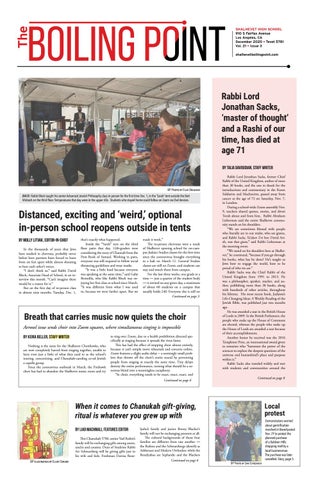
SHALHEVET HIGH SCHOOL 910 S Fairfax Avenue Los Angeles, CA December 2020 • Tevet 5781 Vol. 21 • Issue 3 shalhevetboilingpoint.com
Rabbi Lord Jonathan Sacks, ‘master of thought’ and a Rashi of our time, has died at age 71 By Talia Davoudian, STAFF WRITER
BP Photo by Ellie Orlanski BACK: Rabbi Block taught his senior Advanced Jewish Philosophy class in person for the first time Dec. 1, in the ‘Sarah’ tent outside the Beit Midrash on the third floor. Temperatures that day were in the upper 60s. Students who stayed home could follow on Zoom via Owl devices.
Distanced, exciting and ‘weird,’ optional in-person school reopens outside in tents By Molly Litvak, Editor-in-Chief In the thousands of years that Jews have studied in chevruta, probably never before have partners been forced to learn from six feet apart while almost shouting to hear each other’s voices. “I don’t think so,” said Rabbi David Block, Associate Head of School, in an interview this month. “Can’t imagine there would be a reason for it.” But on the first day of in-person class in almost nine months, Tuesday, Dec. 1,
that’s exactly what happened. Inside the “Sarah” tent on the third floor patio that day, 12th-graders were considering the story of Channah from the First Book of Samuel. Working in pairs, everyone was still required to follow social distancing guidelines and wear masks. “It was a little hard because everyone was speaking at the same time,” said Gaby Bentolila, who like Rabbi Block was enjoying her first class at school since March. “It was different from what I was used to, because we were farther apart. But we
made it work.” The in-person chevrutas were a result of Shalhevet opening school for on-campus Judaics Studies classes for the first time since the coronavirus brought everything to a halt on March 12. General Studies classes are still on Zoom, and students can stay and watch them from campus. For the last three weeks, one grade at a time — just a quarter of the student body — is invited on any given day, a maximum of about 60 students on a campus that usually holds 240. Everyone else is still on Continued on page 3
Breath that carries music now quiets the choir Aerosol issue sends choir into Zoom squares, where simultaneous singing is impossible By Keira Beller, Staff Writer Nothing is the same for the Shalhevet Choirhawks, who are now completely barred from singing together, unable to have even just a little of what they used to as the school’s touring, concertizing, and Chanukah-caroling co-ed Jewish a capella group. Since the coronavirus outbreak in March, the Firehawk choir has had to abandon the Shalhevet music room and try
to sing over Zoom, due to a health prohibition directed specifically at singing because it spreads the virus faster. This has had the effect of stopping choir almost entirely, because it can’t simply move rehearsals and concerts online. Zoom features a slight audio delay -- a seemingly small problem that throws off the choir’s entire sound by preventing people from singing at exactly the same time. Tiny delays destroy the entire performance, turning what should be a sonorous blend into a meaningless cacaphony. “In choir, everything needs to be exact, exact, exact, and Continued on page 6
Rabbi Lord Jonathan Sacks, former Chief Rabbi of the United Kingdom, author of more than 30 books, and the one to thank for the introductions and commentary in the Koren Siddurim and Machzorim, passed away from cancer at the age of 72 on Saturday, Nov. 7, in London. During a school-wide Zoom assembly Nov. 9, teachers shared quotes, stories, and divrei Torah about and from him. Rabbi Abraham Lieberman said the entire Shalhevet community stands on his shoulders. “We are sometimes blessed with people who literally are in our midst, who are giants, and Rabbi Sacks, Ya’akov Zvi ben David Arieh, was that giant,” said Rabbi Lieberman at the morning event. “We stand on his shoulders here at Shalhevet,” he continued, “because if you go through his books, what has he done? He’s taught us Jews how to engage the world, how to be proud of who we are.” Rabbi Sacks was the Chief Rabbi of the United Kingdom from 1991 to 2013. He was a philosopher, speaker, teacher, and author, publishing more than 30 books, along with hundreds of other articles, throughout his lifetime. His most recent book, Judaism’s Life-Changing Ideas: A Weekly Reading of the Jewish Bible, was published just two months ago. He was awarded a seat in the British House of Lords in 2009. In the British Parliament, the people who make up the House of Commons are elected, whereas the people who make up the House of Lords are awarded a seat because of their accomplishments. Another honor he received was the 2016 Templeton Prize, an international award given to someone who “harnesses the power of the sciences to explore the deepest questions of the universe and humankind’s place and purpose within it.” Rabbi Sacks also traveled widely and met with students and communities around the Continued on page 8
When it comes to Chanukah gift-giving, ritual is whatever you grew up with By LIAD MACHMALI, Features editor This Chanukah 5780, senior Yael Rubin’s family will be exchanging gifts among aunts, uncles and cousins. Dean of Students Rabbi Ari Schwarzberg will be giving gifts just to his wife and kids. Freshman Davina BeneBP Illustration by Elliot Serure
Local protest
lyahu’s family and junior Benny Blacher’s family will not be exchanging presents at all. The cultural backgrounds of those four families are different from one another — the Rubins and the Schwarzbergs identify as Ashkenazi and Modern Orthodox; while the Benelyahus are Sephardic and the Blachers Continued on page 6
BP Photo by Sam Elyaszadeh
Demonstrators worried about gentrification marched in Beverlywood Nov. 29 to protest the planned purchase of a Baldwin Hills shopping mall by a local businessman. The purchase was later cancelled. Story, page 5.
2
The Boiling Point • December 2020 • Community
School stays open but Open House is cancelled as Mayor Garcetti issues new orders to fight Covid-19 By Benjamin Gamson, News Editor As Covid cases hit another all-time high in LA County Dec. 3, Shalhevet cancelled its second open house for prospective students until further notice as well as a Kabbalat Shabbat event, school officials confirmed. An email sent to student volunteers on Dec. 3 by Director of Institutional Advancement Mrs. Cheryl Wolf and Dean of Student Life Dr. Johnny Ravenshanas said the reason was Mayor Garcetti’s new Targeted Safer-at-Home Order announced Dec. 2. “Unfortunately, due to the rise in COVID cases and precautionary measures taken by the city, we will be canceling our open this upcoming Sunday until further notice,” the email stated. Dr. Noam Drazin, president of Shalhevet’s board, confirmed the cancellation Dec. 4 and said an admissions Kabbalat Shabbat scheduled Dec. 4 had been cancelled as well. “Open House and Kabbalat Shabbat programs were cancelled due to the rise in cases and in abundance of caution,’ as well as staying in line with the latest restrictions on activity,” Dr. Drazin wrote in an email to the Boiling Point Dec. 4. New coronavirus infections in Los Angeles County on Dec. 3 numbered 7,854, which was the highest number of daily cases so far in the pandemic at the time, according to County of Los Angeles Public Health. But on Dec. 17, ICU capacity in Southern California was at 0% and daily new coronavirus cases were at 14,418. In a press release Nov. 27, following a five-day average of more than 4,500 new cases per day, a new county order was announced outlining “Additional Safety Modifications.” It specifically exempted schools that were already operating. “All schools and day camps remain open adhering to re-opening protocols. K-12 Schools and Day Camps with an outbreak (3 cases or more over 14 days) should close for 14 days.” Also on Dec. 3, an email sent to Shalhevet families said that optional in-person Judaic Studies classes and General Studies classes on Zoom would continue. “Yesterday, Mayor Garcetti issued updated stay-at-home orders,” wrote Associate Head of School Rabbi David Block. “Please note that the activities and programs that we are running at Shalhevet are excluded from the new order as it relates to religious worship, day camps and schools.” Mayor Garcetti’s new order exempted educational institu-
BP Photo by Ellie Orlanski
BP Photo by Benjamin Gamson CANCELLED: Prospective students and their families arrived in the foyer Nov. 22 at the first of three Open Houses that had been scheduled for this admission season. tions who “comply with all applicable protocols set forth by the State of California and the Los Angeles County Department of Public Health.” Also this week, Gov. Gavin Newsom announced a Regional Stay-At-Home Order in “regions where ICU capacity fall below 15%.” This order would last three weeks and permit schools that are already open to stay open. “Sectors that will remain open when a region is placed into
the Regional Stay-At-Home, “ Gov. Newsom said in a tweet. “include schools that are already open” along with “critical infrastructure,” restaurants for take-out and delivery, and places of worship adhering to outdoor and distancing guidelines. Places of worship are also exempted from the Dec. 2 order signed by Mayor Garcetti.
Chesed Committee changes course to follow school constitution Mistaken election is nullified when actual Town Hall-approved policy is found; new committee members are appointed by alumni proved by the Just Community on May 24, 2019. After Kate objected, the new 2020-21 committee was in fact In a possible turning point for the Shalhevet democracy, a appointed by just-graduated seniors Nicole Klausner and Noa summer election for representatives to this year’s Chesed Com- Nelson, both of the class of 2020. Winners of the summer elecmittee was nullified before school started this year, after it was de- tion, which had 17 candidates — five freshmen, five juniors and termined that it went contrary to procedures established by vote seven sophomores — were never announced. “As per the original proposal that said that new members of the of the Just Community. The election was held June 18, after graduation and when the Chesed committee had to be appointed by graduating members 2019-20 school year had ended, although because of Covid-19 of the last committee, these members were appointed by Nicole Klausner and Noa Nelson,” said Kate in an interview on June 22. fewer students than usual had left town. The 2019 policy established a new committee to oversee chesed School officials apparently weren’t sure what the policy said. But when Agenda Chair Kate Orlanski told them and said that it (community service) after complaints had been voiced about how the school’s administration had set requirements and what kinds was important to follow it, they agreed. That policy, which had established the committee a year ear- of activities counted. It put a student-dominated committee in charge, and further lier, says that Chesed Committee members replacing graduating seniors should be appointed by the outgoing members. It was ap- said that when senior committee members graduate, they should appoint their own replacements. That was all clear -- but meanwhile, the committee’s new adviser, Mrs. Malkie Hametz, had been given an incorrect copy of the policy. Her copy -- an earlier draft of the policy, never voted on -- said it was up to the committee’s faculty adviser to decide how to fill the seats. When summer arrived, Mrs. Hametz wanted to plan ahead for this year and so she needed a full committee. Thinking she herself was in charge, she decided to hold an election.The document she was shown said she could choose new members however she liked, so she decided to hold an election.. On May 17, she posted on Schoology requesting applications for this year’s Chesed Committee, and set an election Then, in a second constitutional glitch, the Fairness Committee — which under a policy passed last year now runs all school elections — was not invited to participate in this process. Both this year’s and last year’s Fairness Co-chairs told the Boiling Point that they were not consulted. Instead, according to interviews with participants, a meeting was held June 12 of Mrs. Hametz, Kate, and school leaders Rabbi BP Archive Photo by Niema Fax ‘20 Ari Schwarzberg, Rabbi David Block and Dr. Johnny Ravanshenas. No Fairness Committee members were present. CHESED: Students collected for the Phillipines with Mr. Reusch fort the Lynn project in June 2018. At the meeting, Kate was asked to run the Chesed election with Mrs. Hametz. According to Kate, there was no copy of the
By Benjamin Gamson, News Editor
approved Chesed policy at the meeting. In fact, it wasn’t clear whether anyone at school this year had a copy of the actual policy. The Boiling Point received one from one of its authors, alumnus Ari Schalcht ‘20, on May 19, but it was not posted on the Just Community website. (It is now.) The election toook place June 18, when students received links telling them to vote for their chesed representatives for this year. A few hours after it ended, the Boiling Point showed Kate the policy that Ari Schlacht had sent. The next day, she confirmed that that was the one that had passed. Kate then forwarded the correct policy to Mrs. Hametz. Now there was a problem: should officials disregard the election which they had held and nullify its results? Or disregard the decision of the Just Community who voted to pass a proposal giving the power to appoint students to the committee to the graduating seniors? On June 21, Kate explained the situation on Schoology. “There were two versions of last year’s Chesed Proposal circulating amongst students and admin, and unfortunately, as a result of this, we held a Chesed Committee election that was a violation of the authentic proposal (which has now been published on the Just Community website),” Kate wrote. “Of course, we have decided that despite the already-had-election, we must uphold the proposal that the student body voted on to pass last year, and cannot base the members of the Chesed Committee entirely off of the results of the election.” Nicole and Noa got to decide after all. “They chose from the candidates who had run, who they knew were interested,” said Mrs. Hametz, who said she also showed them the election’s results, which never were published. New Chesed Committee members this year are sophomore Olivia Fishman, junior Zoe Amzalag, and senior Jordan Simon. Mrs. Hametz said she was glad to follow the Just Community rules, even though it meant changing course. “I respect the Just Community and I respect the proposals that are brought to Town Hall,” Mrs. Hametz said in an interview. “And together as a team, we felt like the only proper channel for us to follow would be to follow what was written out in the proposal.”
The Boiling Point • December 2020 • Community
3
Distanced, exciting and ‘weird,’ in-person school reopens outside continued from page 1 Zoom. Seniors went first. Classes were held outdoors in tents and the temperature was mostly in the upper 60s — chilly for Los Angeles. And though smiles were not visible through their masks, students could definitely be seen smiling with their eyes — sometimes known as “smizing” (the first syllable rhymes with “eyes”). “Being back at school today is definitely great,” said junior Rayna Kent on the second day, Wednesday, as she relaxed on the turf between classes. “It’s nice to see all my friends and teachers and have classes in person. But it’s also really weird, and it’s been since March since we’ve been here — so I’m definitely getting used to it.” School officials told the Boiling Point the move to in-person education was made possible by a ruling in a lawsuit filed by religious schools -- including Yavneh, Maimonedes, Toras Emes and two Christian schools -- against the state of California. Called Samuel A. Fryer Yavneh Academy et al. v. Gavin Newsom, it wsa decided on Oct. 28 by Judge John A. Kronstadt, who ruled that schools in California could resume in-person religious instruction. That meant Shalhevet could expand its on-campus activities from after-school co-curricular “camp” and once-a-week morning davening to in-person Judaic and Hebrew classes and davening for whoever is present. On the first day, 31 seniors out of 45 were on campus, each attending in-person 12th-grade Jewish Philosophy with either Rabbi Block, Rabbi Abraham Lieberman or Rabbi Yitzhak Etshalom, during A block from 8:35 am to 9:15 am. Rabbi Block, who is Associate Head of School, said he hadn’t realized how much he missed teaching in person. “There is some energy in the classroom — seeing students, having them do chevruta work, in-person,” Rabbi Block said. “Obviously social distanced, there’s something that’s intangible,
that’s hard to account for.” Room-sized white tents stretched out across the roof, each labeled with the names of Jewish forefathers and foremothers: Yitzchak, Leah, Rachel, Avraham and Sarah. On the “Sarah” tent — where Rabbi Block taught his class — there are plastic window panes, allowing people to look inside. In-person attendance was optional. Every classroom tent had an OWL, a 360-degree video camera with microphone that picks up visuals and sound from the classroom so students on Zoom can get a fuller learning experience. That made it possible for students to follow from home. Still, those who opted to stay home also had a different experience from previous weeks of online school. Senior Mimi Czuker said it was more challenging to learn when everyone else was on campus. “It was a little bit of a struggle for me,” Mimi said. “It makes you feel very cut off because everyone is there but you.” Mimi said she stayed home because she and her family wanted to be cautious. She said it must have been hard for her teacher to pay attention to people in person and on Zoom at the same time, and also the setup was such that at least on the first day, she was mostly seeing his back. “It’s not a fun feeling to have to know that everybody is having a much better experience,” Mimi said. “It’s very different when you’re being taught in person and you’re able to create connections with each other with teachers. So being on a screen really cuts that off.” Gaby Bentolila found it easier to pay attention in person. “My first class was very fun and more interactive than being on Zoom,” Gaby said.“I learned so much more because I wasn’t distracted by my surroundings. I didn’t have my phone with me and I wasn’t distracted by people in my house, I was very focused into the classroom.” Sophomore Talya Kukurudz said she was enjoying the
BP Photo by Ellie Orlanski WATCH: Seniors Zoomed into General Studies classes on campus in ‘cohorts.’
strangeness of it all. “It feels a little weird, the situation we’re in, but I think it’s a really great idea,” said Talya. “I think the fact we have masks and shields and everything, I think it’s okay, and I think it’s safe.” Sophomore Hannah Nili, whose first day back was on Thursday, also enjoyed it. “My experience overall was great,” said Han‘It feels a little weird, the nah. “Seeing friends, gosituation we’re in, but I think ing to in person classes, it’s a really great idea. I think and moving to different places on campus made the fact we have masks and it feel like life was normal shields and everything, I think again.” Desks were six feet it’s okay and I think it’s safe..’ apart in all tents with hand sanitizer and wipes — Talya Kukurudz, 11th grade on each. Some tents also had plexiglass dividers surrounding desks. After A block, in-person davening was held in the Avraham and Sarah tents for around 40 minutes. According to Rabbi Block, the Shalhevet Medical Task Force said students shouldn’t be allowed to use the school siddurim, so students used their phones or personal siddurim to daven. Once davening ended, there was a breakfast spread available for students on the turf, consisting of various fruity yogurts with granola, cookies and Nutella snacks. After Judaics Studies, most students opted to stay on campus for the rest of their classes, which they viewed on Zoom in two other tents that had been set up for that purpose in the parking lot. The school day ended at 2:10 pm. For that, they were divided into four “cohorts,” which were assigned to specific tents, to avoid too many gathering in the same tent at once, which might interfere with social-distancing guidelines. At first, seniors all stayed in their cohorts while attending online school. Most wore headphones, and those who didn’t segregated themselves so others wouldn’t hear their classes. Throughout the day, some students could be seen playing arcade-type basketball and volleyball games near the bathrooms on the roof, while others tossed a ball around or made Tiktoks. In one of the tents, students screen-mirrored a basketball game on the TV and gathered round, socially-distanced, to watch it. Students also walked around together in small groups, occasionally sitting down at desks or on the turf. Because they were not allowed to congregate in the building, they used the roof and parking lot areas to hang out while not in classes. Inside classes, seniors encountered wifi issues and complained of choppy connections. Personal computers ran out of power and charging cords had to find outlets. Unlike in past years when the paid lunch option on Friday was pizza slices from a few large boxes, during the lunch break on Dec. 1 there were individual boxes each with four slices of pizza available for everyone, free of charge. Rabbi Block, whose first-of-the-year in-person class had 17 students present and seven watching on Zoom, said there was room for improvement. “There are some things here and there that we need to continue to tweak,” Rabbi Block said, including “creating more safe hangout spaces so that when students don’t have class they can either go to their cohort tent or go to another safe space.” He said there would be a faculty check-in after the school day ended to see how they can improve, and they are planning on having a similar check-in with students. But overall, he thought things had gone well. “Thank God we have a great outdoor space to allow this to work, and it seemed like there were great vibes,” he said. “There was really good energy in the building today.”
New receptionist Sarah Cardenas brings love of people – and the Dodgers Former receptionist Rachelle Carmony has moved to Maine to be near family and become more involved in religion By Gabriella Gomperts, 11th Grade Watching over school comings and goings from the entryway of the building’s three-story lobby is Sarah Cardenas, the new receptionist. And though there are fewer people than usual, she says her favorite part of the job is interaction. “I’m a people person, so I know that I’m on the daily dealing with people,” Ms. Cardenas said in an interview. Originally from the San Gabriel Valley, Ms. Cardenas has lived in California her whole life and is a die-hard Dodger’s fan. She grew up in a house with 11 siblings. “I was introduced to sports at a very young age,” wrote Ms. Cardenas in an email. “My first game I attended was a Dodger game and I was only 2 years old. I’m a sports junkie…. football, basketball, hockey to name a few.” Her favorite baseball player is Dodger outfielder and first-baseman Cody Bellinger. Pandemic restrictions this summer meant fans could only watch baseball games from afar,. But Shalhevet’s new receptionist approves. “The cardboard cutout fans are weird, but it’s better than not having anything in the stands,” Cardenas said.
Ms. Cardenas previously served as receptionist at Yavneh Hebrew Academy in Hancock Park, one of Shalhevet’s feeder schools. “So I’m already familiar with the atmosphere, and I love it,” she said. “Through that experience, I learned a lot about this interesting religion and enjoyed getting to know the Jewish family.” At Shalhevet, she hopes she can be a welcoming face for all. “I just want the students to feel comfortable asking me for anything,” she said. “That’s basically my role here, which is that I will be dealing with kids on the daily, so I would want them to feel comfortable enough to come and approach me and ask me anything. “I’m excited for things to go back to normal and being able to see kids coming in and out of the school,” she added. Meanwhile, last year’s receptionist, Ms. Rachelle Carmony, left Los Angeles and moved to Maine to be near family, she said. She also plans to become more involved in her religion, Catholicism. “There is a deep Jewish root to Catholic prayer and tradition,” Ms. Carmony wrote in an email. “The spirituality at Shalhevet really helped me in my study of Sacred Scripture.” Ms. Carmony also said she was grateful for the opportunity to “share such a wonderfully inspirational academic year” and added that she “can’t imagine a better place to work than Shalhevet.”
“It has been incredibly inspiring for me to witness your virtuous behavior, pious prayer, and scholarship,” Ms. Carmony wrote. “If more schools were like Shalhevet, the world would be a better place.”
BP Photo by Ellie Orlanski
Sarah Cardenas previously worked as receptionist at Yavneh Hebrew Academy in Hancock Park.
The Boiling Point • December 2020 • Community
4 Medical Task Force works to steer school through changing pandemic Team of parents who are also doctors -- two with county Health Department -- has guided administrators since March individual roles, and that decisions are made with state and county Covid-19 safety guidelines in mind. “The guidelines are pretty straightforward, but when there’s some complexity we get involved,” Dr. Drazin said. “If there’s a difference of opinion in decisions being made, we go to an informal voting process” -- that is, they meet over Zoom. At one such meeting, on Nov. 15 the group made a last-minute decision to cancel reopening on-campus classes, which had been set for two days later.
By Juliet Wiener, Staff writer
When Sarah Emerson, Shalhevet’s Chief Operating Officer, first came to the school four years ago, she never imagined that fending off a deadly disease would be part of her job description. At that time, her title was CEO, or Chief Executive Officer. Two-plus years ago, it was changed to COO, or Chief Operating Officer -- just in time. The Medical Task Force also added a second Schools all around the country had to Covid-oriented committee, this one called the Shalquickly reassess in-person learning and safety hevet Health Team, which conducts contact tracing when Covid hit last March. At Shalhevet, that and checks in with students about potential virus meant completely reevaluating how school exposure, officials said. operates, and Sarah Emerson became the one School guidance counselor Ms. Ester R’bibo is tasked with this job. one of the team’s members, offering her perspective “Rolling with the punches, taking evon the pandemic’s mental toll on students as well as erything day by day,” is how Ms. Emerson who’s friends with who. described what she’s been doing since then, “The main role of the [health] task force is mainsaying that is what works best in times of untaining people safely being on the school grounds, certainty. In her current role, she’s overseen so taking contact tracing courses and talking to stueverything from making plexiglass desk didents about possible exposure if that were to come BP Photo by Ellie Orlanski viders to evaluating air flow in different classup,” Ms. R’bibo said in an interview. rooms. VIRTUAL: As seen from home via Zoom, Rabbi Ari Schwarzberg taught a hybrid “Because of the relationship I have with students, And for medical decisions -- including class Dec. 1 in the Yaakov tent, using Owl technology so some can learn at home. if things were to spread I would be able to say, ‘Okay, when and how to allow students back at I kind of know this person is friends with this group school -- she established an official Medical of people’ and would be able to see who I might need Task Force, composed of doctors, adminisposing the teacher’s work room and other spaces, breaking down trators and the school’s board president, also a doctor, who would walls between classrooms, and adding plexiglass partitions around to reach out to first based on that.” There was one Shalhevet student who tested positive for make all major Covid-related decisions during these unprecedented each desk to reduce air flow between students. Covid-19 (and was asked to quarantine for two weeks), but accordtimes. In addition, Ms. Emerson arranged detailed air flow analysis to “We quickly realized that we needed some help navigating what determine which spaces were well ventilated, and installed new air ing to Dr. Drazin that person was not on campus while contagious, so no contact tracing was needed. was becoming the Covid 19 crisis,” Ms. Emerson told the Boiling filters to reduce the flow of possibly infectious particles. Contact tracing may become important later in the year if -- as Point in September. The Shalhevet Medical Task Force is led by Dr. Zach Rubin and By the middle of summer, Ms. Emerson began preparing for the Task Force anticipates -- there are more Covid cases on campus. Dr. Julie Higashi, both Shalhevet parents who are also infectious pandemic pandemonium that the 2020-21 school year might bring. So far, things have been running smoothly. While several other disease specialists at the Los Angeles County Department of Public First, Shalhevet administration decided to host pilot optional Health. Dr. Higashi heads the county’s tuberculosis control efforts, in-person enrichment classes in June and July -- the first time stu- Jewish schools have needed to close because of case outbreaks, as of while Dr. Rubin served as chairperson of the Healthcare Outreach dents had been on-campus since March -- with the Task Force’s Dec. 16 there has been no outbreak of Covid cases at Shalhevet that would necessitate the school’s shutting down. The county health Unit, established in 2003 to monitor the outbreak of SARS -- a approval. virus from the same family as Covid-19. It turned out to be a test run for fall. Ms. Emerson said there department defines an outbreak as three or more connected cases. That doesn’t mean Ms. Emerson’s job has calmed down. Pre-panDr. Rubin is the father of seniors Yael and Akiva Rubin, and Dr. were no new cases of Covid among the enrichment students, so the demic, she worried about having enough prep time to effectively get Higashi is the mother of freshman Tomomi Shaw, as well as alumni Task Force decided to move forward with what it dubbed “Camp ready for Shalhevet meetings and events; now she faces the difficulty Seiji ‘19 and Kiku Shaw ‘20. Firehawks.” Using the state’s permission for day camps to operate, Also on the committee from the start has been Dr. Noam Dra- Camp Firehawks has offered after-school co-curricular activities of not being able to plan in advance at all, as the pandemic brings so much daily unpredictability. zin, an oncologist on staff at Cedars-Sinai Medical Center who is since September. She said she copes by expecting the unexpected. president of Shalhevet’s board. He is also father to junior Marlee Then -- after a delay caused by a spike in local infections in “I love solving things,” Ms. Emerson said. “I hear problems and Drazin and alumni Jennie ‘14 and Lily Drazin ‘19. November -- actual Judaic Studies classes opened on campus, one Head of School Rabbi Ari Segal, Associate Head of School Rab- grade at a time, on Dec. 2. Since that time, the daily countywide I immediately go into solution mode. I always bring a thorough bi David Block, and Principal Mr. Daniel Weslow are also on the case rate has risen from 5,987 (Dec. 2) to 22,422, (Dec. 16). Media nature to my job, and so if I’m investigating our insurance plan and Task Force as administrators of the school, as is Ms. Emerson. reports said one in every 80 residents was experiencing active infec- I want to be exhaustive in my research, then I’m going to be just as exhaustive in my research for hand sanitizer.” This group put Shalhevet’s first Covid protocols into place. To tions, the Health Department said. But as thorough as she is, and as careful and influential as the the community, it became best known for community webinars But Shalhevet has remained open. Medical Task Force may be, none of them are fully in control of about how the pandemic was unfolding, and later for its email up“Although numbers remain high in Los Angeles, our Medical dates, advisories and advice. Task Force continues to feel quite comfortable with continuing our what happens with Covid at school. For example, Dr. Drazin said Camp Firehawks and on-campus Its first major decision was to shut down school in March. on-campus education this coming week with all the same safety “We really tried to keep the school open as long as we could measures and procedures that we’ve already adopted,” stated an ad- learning do present potential Covid spreading danger -- but they also can teach students Covid-19 safety etiquette, such as proper while maintaining a safe environment and working within accepted ministration email sent Dec. 6. public health protocols,” Mrs. Emerson said. “We ultimately made That is exactly what Dr. Drazin, the board president, sees as the mask-wearing technique and social distancing. “As long as our students are doing that and the communities a decision with this Task Force to shut down school physically and Task Force’s role. that they belong to are doing that, then I think we have a very good to move online.” “It is really to provide the administration with the medical and After that there were not many decisions needing to be made, scientific support to allow the school to operate in this environment chance of staying open,” Dr. Drazin said. “The problem is that there are lots of people that aren’t,” he said. as there was no in-person interaction. So the Task Force was mostly safely,” Dr. Drazin said. “I live in Beverlywood and I see a number of kids on the street who dormant until mid-July, she said, when it began to consider reopenWith campus adapted to pandemic protocols and now open, the ing the school. It also compiled a FAQ sheet and an education and Task Force mainly functions to “address any questions that come up are not wearing masks and not socially distancing. It doesn’t bode safety plan that was made available to parents and students on the on a daily basis,” Dr. Drazin said -- from how to organize on-cam- well for a lot of schools that are eventually going to probably end up Shalhevet website. pus programming to what to do if someone is exposed to Covid-19. with significant numbers of cases.” Steps were taken to make room for social distancing, by repurHe said the members work collaboratively, rather than having
First confirmed Covid case in Shalhevet student this year is contained By MOLLY LITVAK, EDITOR-IN-Chief Shalhevet’s first confirmed Covid-19 case of the school year was announced in an email sent out Oct. 19 by Chief Operating Officer Sarah Emerson to parents of 10th- and 11th-graders. The student tested positive that day after being exposed to family members who had contracted the virus as well. His case was announced to the school because just five days before being tested, he took the PSAT with 10th- and 11th -graders. In the email, the parents were told that a student had tested positive, but had not been on campus while infectious. Also, students took the PSAT while wearing masks at desks spaced apart. Officials said no one else who took the test became ill. For the student himself, it was a frightening surprise. He became ill but not seriously and has since returned to school. “It was just kind of surreal,” said the student, who asked to remain anonymous, in an interview. “It felt crazy to me that it happened, because I had been so careful for so many months. We just got really unlucky in getting it. Part of it was fear for my whole family, because we’re sick.” According to the student, he had been practicing social distanc-
ing guidelines since the beginning of the pandemic. He said he had hung out with a friend once, but that they had been six feet apart with masks. He had not eaten out or ventured much from his house. Further, the student reported only having gone to Camp Firehawks once, and had never attended in-person davening. Interviewed while still ill, he said he felt like he had a “bad cold.” “Sometimes I feel really tired, sometimes my head hurts, but mostly it’s not that bad,” he said. “My first symptom was a stuffy nose, and I kind of started feeling it Sunday night and then Monday morning I felt super congested.” The email from Ms. Emerson said that students who took the PSAT would still be allowed on-campus and regular after-school activities would continue. “The student was not on campus while infectious, and therefore, the Medical Task Force recommends that Camp Firehawks and Shalhevet programming continue as normal,” she wrote. “Since there has not been a COVID exposure on Shalhevet campus, no quarantine is indicated...” “An exposure is within six feet for longer than 15 minutes with a Covid-positive patient.” It was the first time the school had announced student
COVID-19 cases, but he was not the first student to test positive. Ms. Emerson said that over the summer and last spring there were no on-campus activities, so the school was not monitoring whether or not students had contracted the virus. The student who became ill told the Boiling Point no member of his family had prolonged symptoms or had been admitted to the hospital. He also thinks his family contracted the virus through their housekeeper. He has been attending in-person school since it opened, since he now has antibodies against Covid-19. He said it was “weird” now to know he most likely will not contract it even during the current spike in cases. “Since I was so cautious before, it’s really hard to kind of realize that I don’t have to worry about it so much anymore,” he said. The student also said he was unsure of exactly what guidelines they should be adhering to since recovered patients don’t know the extent of their immunity. “There’s also the fact that there’s so little information on how long the immunity lasts,” he said.“[It] makes it even more weird because I just don’t know what I’m supposed to be doing, how I’m supposed to be acting in general right now.”
5
Outside News
DECEMBER 2020
NEIGHBORS: Above and below, protestors marched peacefully from Circle Park on Sunday, Nov. 29. Some residents complained that they were frightening people.
Protest fights purchase by Beverlywood developer in Baldwin Hills Demonstration argues investment by local businessman would harm Crenshaw neighborhood; deal is later called off By Benjamin Gamson, News Editor
BP Photos by Sam Elyaszadeh
About 45 peaceful protesters gathered at Circle Park in Beverlywood Nov. 29 to protest a planned purchase of the Baldwin Hills Crenshaw Plaza mall by Asher Abehsera, a real estate developer who lives on Sawyer Street. Activists with the group Downtown Crenshaw, which hopes to purchase and redevelop the mall itself, marched from Circle Park to Mr. Abehsera’s house waving signs and chanting. They wanted the shopping center’s ownership to remain in the Black community, arguing that it would cause gentrification and would hurt the neighborhood. “He’s coming in our community, disrupting the Black and brown community of Crenshaw, and since we’re here we will make it uncomfortable for him,” said Kim Yergan, a protester interviewed at the demonstration by the Youtube channel WYSIWYG-TV. “Because once he takes over the Crenshaw mall, then he’s gonna displace most of the residents in the Crenshaw community and the prices are gonna get higher. So it’s the beginning of gentrification, and we can’t let that happen,” As they marched, the protestors shouted chants including, “Gentrifier you can’t hide, we can see your greedy side,” and “Fight, fight, fight, housing is a human right.”
Mr. Abehsera is CEO of the real estate company LIVWRK, which had successfully bid for the mall along with a New York-based partner company, DFH Partners. According to some media reports LVWRK has ties with Jared Kushner, president Trump’s advisor. But Mr. Kushner does not appear as a principle or in any other capacity on the websites of LIVWRK or DFH. Mr. Abehsera himself could not be reached for comment, but some neighbors defended him. “He has a right to buy whatever he wants to buy -- this is America,” said Rabbi Moshe Parry, also interviewed on WYSIWYG-TV during the demonstration. “He has a right to outbid whoever he wants to outbid... It’s not going to hurt them, it’s going to help them bring jobs, industry, goods, services, it’s just going to help.” During the march, vehicles from the Los Angeles Police Department and private Beverlywood security companies blocked access to Sawyer Street. At least three LAPD vehicles were present during the protest. Department officials told WYSIWYG-TV that they expected a counter demonstration, but it appeared that only a few neighbors came to the area, some complaining that the marchers were frightening women and children and others defending Mr. Abehsera’s mall purchase. Baldwin Hills Crenshaw Plaza has 869,000 square feet and is located in the Los Angeles neighborhood of Baldwin Hills, which is just east of Culver City on the other side of Kenneth Hahn State Park and La Cienega Boulevard. The mall has has a movie theatre, restaurants, and stores including Macy’s and Forever 21. On Dec. 11, Downtown Crenshaw announced the deal with LIVWRK and DFH had been terminated. “This is a tremendous Black community victory and testament to the power of the people,” said Niki Okuk, chair of Downtown Crenshaw, in a statement. “Downtown Crenshaw stood up and defeated... an unqualified outof-town Trump-Kushner development partner, who sought to do harm to our beloved Crenshaw.”
Page design by Ellie Orlanski
Pres.-elect Biden nominates Calif. Attorney General Xavier Beccerra as Secretary of Health and Human Services. Gov. Newsom will now appoint a replacement for Becerra as well as Vice President- Elect Harris.
Dec. 7
Nobel Prize-winning singer-songwriter Bob Dylan sells the publishing rights to his music catalog to Universal Music Group for an estimated $300 million.
Dec. 10
President Trump says Morocco will normalize relations with Israel, becoming the fourth Arab nation to join the Abraham Accords along with UAE, Bahrain, and Sudan.
Nov. 3
By Benjamin Gamson, News Editor
Pfizer and Biontech announce that their revoluationary vaccine is more than 90 percent effective in preventing Covid-19. Cases in California begin to rise.
December
Dec.6
November
MEANWHILE...
Nov. 24
Nov. 7 Nov. 9
Election Day. Major news networks do not name a winner in presidential race because of too many outstanding ballots in swing states.
AP, CNN, MSNBC, Fox News and others all call the election for Biden. He and Harris give outdoor victory speeches in Wilmington, Del.
Pfizer’s Covid vaccine becomes the first approved by FDA for emergency use in the U.S. and the first MRNA vaccine approved for human use.
On the same day that a nurse in N.Y. becomes the first in the U.S. to receive a coronavirus vaccine outside of a clinical trial, U.S. Covid deaths pass 300,000.
Dec. 8
Dec. 15 Dec. 11
Georgia begins its third count of ballots as requested by Trump. Biden again wins the state, by a little more than 12,000 votes.
Moderna’s vaccine is authorized for emergency use in U.S. ; Los Angeles ICUs are 100% capacity.
Supreme Court unanimously denies Trump request to block certification of Pennsylvania’s results.
Supreme Court declines to hear case brought by Texas challenging the outcomes in Michigan, Wisconsin, Georgia and Pennsylvania, ruling that one state cannot challenge the election decisions of another.
Dec. 14
Dec. 18
Electoral College meets and officially elects Joe Biden, cementing his win by a vote of 306 - 232, -- the exact margin by which Trump defeated Hillary Clinton in 2016. Mitch McConnell acknowldeges Biden and Harris’s victory and congratulates them.
6
The Boiling Point • December 2020 • Special Report
Chanukah 5780 When it comes to Chanukah gift-giving, the ritual is whatever you grew up with Continued from page 1 are Ashkenazi and Conservative. Most years, Yael’s family comes together with her aunts and uncles to exchange gifts each night of Chanukah (though they will not this year because of Covid). But she knows not everybody celebrates it in that way. “My family is more traditional with gifts, but I know some of my friends’ families do potlucks and different things instead,” said Yael. “I think every family has dif- ferent traditions. It depends on the specific family, and if they are really into Chanukah or giving gifts.” It turns out Yael is right. A Boiling Point survey of Shalhevet students and rabbis revealed that the practice of gift-giving on Chanukah has less to do with whatever religious background students identify with, and instead has much more to do with the customs of each family. Rabbi Ari Schwarzberg, Dean of Students and Director of the Shalhevet Institute, said he’s passing the tradition that he grew up with to his three sons, Simon, Lev and Boaz. “As a parent now, we learn a lot from the way we were raised,” said Rabbi Schwarzberg. “I try to engage my kids in the story of Chanukah, we’ll play dreidel, sing, and give gifts.” Benny Blacher received gifts for Chanukah as a child but hasn’t since fifth grade. He was one of several in the survey who said presents depend on the children’s age. “All the kids in my class were getting gifts for Chanukah so me and my brother would say, ‘Mom, Dad, why aren’t you treating us the same,’” Benny said. “But then when we passed fifth grade our parents stopped giving us gifts. “How I interpret it is that they don’t want to copy Christmas in terms of giving your kid a gift on the holiday and there’s nowhere in the Torah that says to give your child a gift, so my parents just thought this isn’t what the holiday is supposed to be about and they stopped doing it.” Junior Nooria Kerendian is Sephardic and her family normally doesn’t get gifts for each other on Chanukah. “We don’t normally do Chanukah gifts but me and my siblings are always like, ‘everyone at school or every Ashkenaz gets gifts’, so we’ve been trying to start that tradition,” Nooria said. “I just think that It’s not in, I don’t know if it’s Persian or Sephardi, but it’s just not in our tradition to give gifts. I’ve asked my mom and she said it’s tradition to give money or gold coins, but gifts were never a thing.” According to the website Chabad.org, there is no Biblical text, including the Talmud, that mentions anything about gift-giving on Chanukah. For Sephardim, gift-giving on Chanukah never used to be a common ritual. According to an article in the Times of Israel, rather than giving dreidels or presents to kids on Chanukah, Sephardi Jews used dreidels to confuse the Greek and Syrian soldiers who had prohibited Jewish practices. On the other hand, according to an article on Surf Iran, an Iranian travel and cultural website, Persian Jews traditionally give candles to their children as gifts. And like Ashkenazim, they
also celebrate by eating latkes and sufganiyot and reciting the story of the oil that lasted eight days, the website said. In the past, Jews living in America only gave gifts to one another on Purim, But according to Dr. Jonathan Sarna, Professor of American Jewish History at Brandeis University, there was a transition from gift-giving on Purim to Chanukah in the 19th century. As Christmas became a holiday in America and a popular time for consumerism, he said, the custom turned into one that imitates the exchange of gifts on Christmas. Rabbi Schwarzberg said there is no association between Chanukah and gift-giving in the Gemara, and that it is a tradition adopted from outside of Judaism. But he thinks it can be a good way to engage children in the holiday. “Gift-giving is something imported from the Western world and the world of Christmas, but I think it’s wonderful,” Rabbi Schwarzberg said. “Rambam talks about how among all holidays we should give gifts and engage children with treats, so I think it’s something that has a relevance to all holidays. “If you want people to enjoy something, especially people that are younger, you want to create a positive association with it. Why not associate Chanukah and a moment of Jewish pride and Jewish celebration with gift-giving?” Dean of Student Life Dr. Jonathan Ravanshenas is Sephardic and would occasionally get one big gift as a child. He also practices his family’s other customs -- including singing -- with his children, Nava, Aharon and Levi. “I do give gifts to my own kids,” Dr. Ravanshenas said. “We give one every night. They appreciate any gift. When they’re older it might not be as many. “I adopted a lot of my family’s minhagim,” or customs, he said. “I love singing with my kids and we always do it together. The concept is to do it as a family.” Dr. Ravanshenas connected gift-giving with the meaning of Chanukah. “It’s all about bringing light,” Dr. Ravanshenas said. “So sometimes small things showing you are thinking about another person does that. “I think this concept, especially now during the times of Covid, of bringing light in the darkness, is important,” he said. “I know a lot of people think it’s related to Christmas time and stuff like that, but I look at it as the opposite, where it’s Kislev.” Others connect gift-giving to Christmas, however. Junior Kevin Cohen is Sephardic and gift-giving was never a tradition for his family, even as a child. If his family gives gifts, it is money. “They’re just not really into the whole Chanukah-gifts thing,” Kevin said. “They think it’s more of a Christmas thing. “I remember one of my friends got an Apple watch for Chanukah and I was like, ‘Okay that’s cool, I don’t get Chanukah gifts.’ It’s a pretty boring Chanukah. All the American people have their things but the Persians, from my point of view, don’t give as many gifts. It might be a cultural thing, an American cultural
BP Dr aw thing.” ings by E ll iot Seru re Freshman Davina Benelyahu is Sephardic and her family does not formally give gifts to one another. But she plans exchanges with her friends. “If we are going shopping my mom will say, ‘Oh, I’ll get you that for Chanukah,’ but we don’t wrap up a gift and give it to each other,” Davina said. But she did when she was younger. “When you’re younger your parents want to have fun with you,” she said, “and when you’re older, you can get gifts, but you’re more mature and it’s not such a playful thing.” Sophomore Asher Taxon, who is Ashkenazi, has had a similar experience. “This may be a maturity thing,” said Asher. “It’s more important to spend time with your family rather than buy each other gifts. We usually get presents that we’ve been wanting or something that we thought would be nice.” Sophomore Maddie Bollag is Ashkenazi and always gets gifts on Chanukah. “Usually we’ll do a really small gift every night or we can choose one big gift for the whole Chanukah,” said Maddie. “My dad is Ashkenaz and he said he would never get gifts on Chanukah. Usually my Sephardic friends get more gifts.” Freshman Elishai Khoobian is Sephardic and his family gets gifts based on what they ask for. This year he is asking for shoes. “My parents don’t really care about the gifts,” Elishai said. “They ask me what I want and I just tell them, it’s not something with a lot of effort.”
At least in the Shalhevet community, gift-giving on Chanukah does not seem to be unique to any Jewish denomination or group. Rather -- as with many Jewish practices -- the tradition truly depends on the customs of parents’ parents. It may have evolved through centuries of living amidst celebrations of Christmas, or in the case of more recent immigrants, amidst Jews who at this point associate presents with Chanukah. Is there a danger, then, that Chanukah -- perhaps like Christmas -- could become too commercialized? “I guess the problem can happen if the holiday only becomes associated with gift-giving, as opposed to the Chanukiah and the story itself,” Rabbi Schwarzberg said. “Then it’s become too distant from the actual meaning of the holiday. But in my experience, I think it only enhances what people know about the holiday.” Editor-in-Chief Molly Litvak contributed to this story.
‘This concept, especially now during the times of Covid, of bringing light in the darkness is important. I know a lot of people think it’s related to Christmas time and stuff like that, but I look at it as the opposite, where it’s Kislev.’ -- Dr. Johnny Ravanshenas, Dean of Student Life
The Boiling Point • December 2020 • Special Report
More than the miracle of the oil BP Drawing by Sara Adatto
By Amalia Zucker, 9th Grade
O
f all Jewish holidays, Chanukah is one of the most well-known to non-Jews. Holidays like Yom Kippur, Purim, and Sukkot seem to go unnoticed, but Chanukah is different, perhaps because it’s easy to lump it in with Christmas. Stick a fake menorah or a dreidel at the edge of the abundance of Christmas decorations and add “and Chanukah!” to the end of a Merry Christmas banner, and move on, satisfied with your inclusivity. Chanukah is also included in marketing with the other winter holidays. No other holidays, except maybe for Passover, are given this treatment. This should be a good thing. The Torah tells us persumei nissa — to publicize the miracle of the Chanukah story. And so we light the menorah in our windows, for all to see. Well, you might say, isn’t society doing that for us? If things such as Chanukah cards and dreidel balloons are
things you may find at your local Ralphs or as though it’s a miracle. The oil represents Target, doesn’t that mean we’ve successfully the concept that everything is given to us as a gift from Hashem, and thus nothing publicized the miracle of Chanukah, or at should be taken for granted. In “publicizing least started to? the miracle,” we are spreading the concept Not exactly. of gratitude and telling people to see the A very surface-level idea of Chanukah wonder and beauty in each little thing. has been presented to the world thus far. This is one of the things persumei nissa It’s recognized as a Jewish holiday and is means in a modern context. It’s not just widely seen, but the secular world has yet to publicize the to understand its meaning — miracle of the lights and maybe that’s because we that stayed lit for ourselves are so focused on one The oil represents the concept the Maccabees. It’s particular miracle that we’ve that everything is given to us failed to publicize the larger to publicize the very as a gift from Hashem, and message that the oil sends. existence of miracles thus nothing should be taken – to spread the idea We light the menorah bethat each and every cause the miracle of Chanukah for granted. thing is a miracle in is, on a base level, the miracle of and of itself. It’s our a menorah’s oil lasting for eight job as Jewish people days rather than one. But Chanukah is also a much deeper representation to push past the shallow and secular version of both Chanukah and Judaism that’s on of Judaism: it isn’t just about the miracle of the oil. It’s about the value we as Jewish display for the rest of the world to see. people place on each thing just because of its existence. It’s about treating everything
7
8
Torah
december 2020
Rabbi Lord Jonathan Sacks, ‘master of thought’ and a Rashi of our time, has died at age 71 infuse this school with and try to pass on to you. “They are deeply accessible words, world, including in Los Anthey are profound words, and I know geles, where he spoke to area that they’ve had a small part in shapstudents at Harkham Hillel ing your own Jewish identity Hebrew Academy and Young He said Rabbi Sacks’ Jewish misIsrael of North Beverly Hills. sion was a mission to the entire world. At an event in 2014, “What is the point of religion — then-Shalhevet junior Marwhat is the point of being a Jew?” go Feuer asked Rabbi Sacks Rabbi Schwarzberg said. “It is abwhether he thought it was solutely to make the world a better morally acceptable for people place.” in one group to have, by birth, Judaic Studies teacher Dr. Sheimore inherent potential than la Keiter said being the chief Rabbi people from other groups. meant Rabbi Sacks was supposed to According to a Boiling represent all of the Jews living there. Point story at the time, the rab“But the reality of it was…he repbi replied that all people have resented Judaism — not just to Entheir chosen roles to play withgland but really to the world,” said in the world. Dr. Keiter. “Judaism is God’s rejection She said Rabbi Sacks was considof empire,” Rabbi Sacks said. ered “the Queen’s rabbi,” and that “In an empire, everyone is exPrince Charles would ask him for pected to be the same.” BP Archive Photo by Goldie Fields ‘15 advice. According to Rabbi LeiberLOCAL: Rabbi Sacks, whose teachings are spread throughout the LaHav curriculum, made many trips to Los “The reason he did this was beman, though he knew halacha Angeles, including to Hillel Hebrew Academy, above, in February 2014. cause the universal truths that Rabbi very well Rabbi Sacks did not Sacks stood for were so apparent, his serve as a posek, or someone wisdom was so apparent,” said Dr. who makes halachic decisions. ticated. Keiter. “And that wisdom came from Torah.” “His job was the ba’al machsheva,” or master of thought, “He lived in our world,” Rabbi Stein said in an interview She said that on the Shabbat morning of Princess Diana’s Rabbi Lieberman said at the assembly Nov. 9. with the Boiling Point, “and the ideas that he had were not just funeral in 1997, Rabbi Sacks stepped out of shul to pay his “He was the thinker, the philosopher, whose impact, in the for the smartest people, they weren’t just for the best people. respects as the funeral procession passed by. long run, is so much greater. Thank God that we live in a generThey were for everyone… It’s one of those things that marked “There he was, representing Judaism and representing kavod ation that got to know him, study him. And here at Shalhevet, his greatness.” habriot — representing that respect for all of humanity,” said how lucky we are that we are able to carry on his legacy.” Rabbi Stein, who also is Interim Director of Judaic StudDr. Keiter. “And in my mind, that’s what he represented and Rabbi Sacks’ writings are included all throughout the Laies, said Rabbi Sacks reminded him of a verse from Tehillim continues to represent until this day.” HaV curriculum, the Talmud curriculum published in 2011 (Psalms), No. 119, verse 162: Sas anokhi al im’ratekha, k’motzei that was developed at Shalhevet and is used in cities around rav salal, which means “I rejoice in your promise like one who Rabbi Sacks had been treated twice for cancer earlier in the world. finds great treasure.” his lifetime–once in his thirties, again in his fifties — before it An excerpt from “‘I’m so happy,’ or ‘I’m so excited for your words,” finally took his life last month. Rabbi Sacks’ CreRabbi Stein said, “because it’s like finding a treasure. I Judaic Studies teacher Rabbi Yagil Tsaidi told the assembly ativity and Innoalways feel that way about Rabbi Sacks. that Rabbi Sacks was once asked why he did not mention or use vation in Halakh, ‘He was the thinker, the philosopher, “It’s like, oh my gosh, what a beautiful perspective his sicknesses in any of his writing, as other rabbis and scholars about the meaning whose impact, in the long run, is so — that really helps me better understand this story, or have done. of lo ba-shamayim this Chumashm or this sugiyah, or myself.” According to Rabbi Tsaidi, Rabbi Sacks replied that his fahi in Deuteronomy, much greater. Thank God that we live ther was his role model, and although he did not have much is included in the in a generation that got to know him, At the Zoom assembly, a 2010 video was shown of a Jewish education, he had a very strong belief in Hashem. first chapter of the study him.’ of Rabbi Sacks describing what it means to be Jewish. When his father was in the hospital, he put his trust in God and ninth-grade LaHav In the video, published by the media archive JInsider, knew that if it was time for him to pass or if he was still needed curriculum. The -Rabbi Abraham Lieberman, Rabbi Sacks says that every person is writing the next in this world, the decision was up to God. phrase expresses the chapter — “your individual chapter” — in a book that Rabbi Sacks took on this mindset. idea that the details Judaic Studies has been passed down from generation “I felt that if Hashem of Jewish law and to generation by his or her ancestors. needs me up there, thank you practice should be set “If they put their faith in their chilvery much for my time down by the people and not dren to keep the book going, then they have ‘He lived in our world, and the ideas that here. I’ve enjoyed every day by God. all put their faith in me,” Rabbi Sacks said on he had were not just for the smartest and feel very blessed. And if The verse, Devarim 30:12, states: “It is not in heaven, that the video. he wants me to stay, and there you should say, ‘Who will go up to heaven for us, and get it for He said these “books” together comprise the people, they weren’t just for the best is still work for me to do, then us so that we may hear it and observe it? story of the Jewish people as whole. people.’ he is going to be part of the “Lo ba-shamayim hi is not an intrinsically revolutionary doc“To be a Jew is to be part of the most re-Rabbi David Stein, refua and I put my trust in trine; if anything, it is a conservative one,” Rabbi Sacks wrote. markable story ever lived by any people.” said “It places pesak [decision] firmly in the context of interpretaJudaic Studies him,” Rabbi Sacks continued Rabbi Sacks, “Covering more countries, more to answer. tion and consensus.” adverse circumstances, more triumphs and Rabbi David Block, assoRabbi Lieberman said that Shalhevet is very lucky to have tragedies, than any other story. And then the ciate head of school, closed the assembly with a way to take the LaHav curriculum and compared Rabbi Sacks to Rashi, sudden realization that every one of us has their chapter to write action. the great medieval commentator, because people are learning in that story and hand the book on.” “It’s important that one of the ways in which we commemRashi’s commentary every day. Earlier, Dean of Students Rabbi Ari Schwarzberg opened orate someone is to take one of their midot, one of their charJudaic Studies teacher Rabbi David Stein, who co-wrote the the assembly by saying Rabbi Sacks embodied Shalhevet’s valacteristics,” Rabbi Block said, “and adopt it ourselves and bring LaHav curriculum, said he included so many of Rabbi Sacks’ ues and beliefs. it into the world that way. And that way, we keep that person writings partly because he was such an important leader and “Rabbi Sacks is a guiding light,” Rabbi Schwarzberg said, alive.” also because he wrote things in a way that is clear yet sophis“a model of the aspirational values that we as teachers try to Continued from page 1
Opinion Managing Editor Sarah Feuer
News Editor Benjamin Gamson Life and Features Editor Liad Machmali Digital Media Editor Eli Weiss Layout Editors Zoe Miller Tehilla Fishman Ezra Helfand Amalia Abecassis Faculty Adviser Mrs. Joelle Keene The Boiling Point is the student-produced newspaper of Shalhevet High School and a public forum for the students and the community. Unsigned editorials represent the majority view of the members of the Editorial Board, which consists of the Editor-in-Chief, Managing Editor, Executive Editor, News Editor, Life and Features Editor, Digital Media Editor and the faculty advisor. We welcome submissions for signed editorials from members of the Shalhevet Community, and the final decision about printing them is made by the Editorial Board. Letters to the Editor may be submitted via e-mail to shalhevetboilingpoint@gmail.com. The Boiling Point reserves the right to edit letters and opinion submissions and all become the property of The Boiling Point. Signed opinion articles and advertisements in The Boiling Point do not necessarily reflect the opinions of the Editorial Board or The Boiling Point as a whole. To advertise, please contact orlanskiellie@gmail.com Corrections: The Boiling Point encourages readers to inform the newspaper of any possible factual errors found in print or online by emailing us as at shalhevetboilingpoint@gmail.com. When appropriate, we will fix the story online, and correct the error on Page 2 or on this page in the next print edition. Policies on conflict of interest and the use of anonymous sources can be viewed at shalhevetboilingpoint.com under the “Policies” tab. Sweepstakes Awards, 2016, 2018 Blue and Gold Comprehensive Writing Award 2016 National Award Winners 2007-2019 International First Place Award 2011-2016 George Gallup Award - 2019
Story of the Year Awards 2010, 2011, 2012, 2014, 2020 All-American 2009, 2012, 2014 Design of the Year Awards 2017, 2019, 2020 Full list of awards on our website
Awards in Jewish Scholastic Journalism 2013 - 2020
Crown Awards 2013-2021 Gold Circle Awards 2011-2020 Columbia Scholastic Press Association
risk? The Boiling Point Editorial Board is, as are many, a bit surprised that the school opened for This month and especially this week, media in-person learning when it did—just as the cases reports about Covid in Los Angeles County have began to surge. However, it is not particularly offered a long menu of worst-ever statistics. On surprising that Shalhevet decided to open. After average, almost two people are dying of Covid all, we believe most would agree that learning every hour. ICU beds are at maximum capacity over Zoom is not nearly as effective as in-person with zero beds left, and while hospitals may be learning, and that there is able to expand this through a value to honoring what emergency measures, 700 parents pay to have their chilnew Covid patients are being dren attend Shalhevet, as well admitted every day right now as a value to being able to see compared to 300 per day in friends—who we previously late November -- and DPH would see every day—at least believes that number could on a somewhat regular basis, reach 1,400 admissions per after not being able to see day by New Year’s Eve. them for months. Even if bed capacity can So, do we think the school be increased, they add, extra should be open for in-perdoctors and nurses can’t be son learning? Sure. Sure is found because surges are hapnot the same as an emphatic pening all over the country yes. There is obviously some and staff are needed where degree of irresponsibility and they are. ICU beds are also danger associated with openneeded for non-COVID-reing school. But then again, lated conditions like heart there is some irresponsibility attacks and cancer. and danger in going anywhere According to the Boiling these days. No one is obligatPoint’s most recent Covid BP Illustration by Elliot Serure ed to attend in-person school. Tracker that surveyed 145 It is simply an option. people: 23 people, or 15.9%, had been exposed This doesn’t mean everyone should have the to the virus and three had contracted it, 2.1%. option to go wherever. There are safety standards Ten had Covid cases in their homes -- 6.9% set in place for school. There should be safety -- while 34, or 23.4%, know someone who has standards in any place that is open. Of course tested positive. Twenty-seven out of the 145 these protocols are not going to be effective -- almost a fifth -- said they knew someone who 100% of the time and going anywhere in person had died from Covid-19. will carry a risk that some people want to take And yet, people are less afraid now to go out and others don’t. than they were in the beginning of coronavirus. We are not making a freedom argument. In the beginning it was this new disease that peoRather, we believe that school is already open and ple were afraid of, but now since we have already there are benefits to going in person. Everyone, gotten through dark stages of it once, people feel including ourselves, going to school in person is that it is safer to go out now and have a less fearbeing slightly irresponsible because we could opt ful mindset when leaving their home. into Zoom-only school. But a majority of the EdSo -- what is our responsibility? Having been itorial Board believes the pros of in-person school given both freedom and privilege, is there a right outweigh the possible detriments. The school isn’t or wrong way to behave in this unprecedented situation? When given the opportunity to resume going to close. It’s simply up to the student body a more interactive and productive form of school, to decide if they’d like to attend. should our administration take it? Is it worth the
By the Boiling Point Editorial Board
Executive Editor Ellie Orlanski
Online Pacemaker & Finalist Awards 2018, 2020 Pacemaker Finalist 2012, 2014, 2015, 2018 Online Pacemaker Finalist 2015, 2017, 2020
EDITORIALS
Open school: Not yes, but ... sure
Editor-in-Chief Molly Litvak
National Scholastic Press Association
9
Simon J. Rockower Awards 2013, 2014, 2015, 2016, 2017, 2018, 2019, 2020
Presidential poll of juniors
Who took this picture? This image on pages 4 and 5 of the Special Election Edition had an incorrect photo credit. The correct photo credit is labeled at right. The Boiling Point regrets the error. BP Photo by Maia Lefferman
In the Special Election Edition issue, the graphic describing support for the presidential candidates incorrectly depicted the results for the 11th grade. President-elect Biden, who received 53.3% of the vote, should have been represented with a majority -- and blue -- piece of the pie, while President Trump, who received 36.7%, should have had the smaller slice and been in red. The corrected chart can be seen at right. The Boiling Point regrets the error.
corrections Art kits The story about student art kits on Page 8 of the October print edition had an error in the headline. There were art kits for every student taking art, not for every student.The Boiling Point regrets the error.
10
ARTS & Culture
December 2020
Same breath that carries the music now quiets the choir Social distancing sends choir into Zoom squares, where simultaneous singing is impossible BP Illustration By Sara Adatto Continued from page 1
listening to a recording and having the sec- members’ cellphone-made voice recordings tion leader sing it while the others follow on together, assisted by his sister Rachel and juZoom has a little, tiny delay, so if we all mute. Each member will then record their nior Wolf Paskowitz. All three are learning try to sing together on Zoom, it sounds su- respective parts alone. as they go. per off,” said the group’s director, Ms. Joelle “You don’t have a face-to-face interac“The difficulty was sort of just trying to Keene. “Part of my job is to hold everybody tion,” said Choirhawk bass Joey Blumofe, line everything up -- an issue I discovered together, and that’s physically impossible on who is a co-president of the group. “It’s not recently when my computer crashed and I Zoom.” just the actual voices. It’s the lost all of my progress,” The root of the problem is microscopic body language, it’s the sense said Joey. “But when I water droplets called “aerosols” that can car- of the group as a whole singput all of the clips in, ry the virus, and that a person emits when ing together as one big voice. they ended up perfectly ‘When whooping cough spread projecting their voice. And so when you’re physilined up as they originally in Shalhevet, it started in Choir Dr. Julie Higashi, a public health expert cally separated by a screen, were.” -- six people in Choir got it,. for L.A. County and leader of Shalhevet’s it definitely feels a lot more In early November, And there were a lot of studies Medical Task Force, said one of the earliest isolated.” Joey played an edit of the saying that singing, especially “super-spreader” Covid outbreaks happened Gone is the bond they choir’s combined voicin groups, in a secluded area at a Seattle-area choir practice last March, normally feel while singing es singing one of “The and even outside, spreads when 52 singers out of 61 in attendance together and hanging out Bones.” Hearing them all viruses way faster than talking caught Covid-19 from just one who was in- during rehearsals. together for the first time because you’re using so much fected. Two died. “I got to see people in-perwas an emotional experimore energy and so much more “Singing is a well-known activity for son, that’s what I loved about ence for them. breath.’ producing aerosols extremely efficiently,” choir -- the in-person aspect But it’s a long process, wrote Dr. Higashi in an email reply to Boil- of it -- and not having that is and the group didn’t man-- Danielle Finn, ing Point questions. “The experience in Se- really hard for all of us,” said age to finish new music Choirhawk tenor, 11th grade attle … is evidence enough that choir is, un- junior Andrew Petlak, the in time for Chanukah. fortunately, an extremely high-risk activity.” choir’s beat-boxer. Instead of a concert, EmTuberculosis and pertussis have also The three freshmen in this ily Klausner and Noah been spread by singing, she said. year’s group have still never experienced Masliah made a combined video of “The Junior Danielle Finn, a Choirhawk ten- being part of the group sound, except on a Best Part,” by Daniel Caesar and H.E.R., or, said she understands the prohibition rough-draft recording of a song the group and Danielle Finn performed her original because of an experience she had in ninth is trying to learn -- “The Bones,” by Maren song, “Some Day.” Ms. Keene posted them grade when pertussis, or whooping cough, Morris. on Schoology, and they received 38 likes. spread throughout Shalhevet, concentrating “Nothing can really re-create the harRehearsals are shorter now and the in choir. monization that you hear in the choir,” said group is smaller -- 12 instead of last year’s “When whooping cough spread in Shal- ninth-grade soprano Rachel Blumofe, Joey’s 18 -- and attendance is less consistent. But hevet, it started in choir,” said Danielle, who sister. a dedicated core of Choirhawks is already herself was the fifth case at “Whenever I’d looking ahead. the time, the Boiling Point go to my brothSophomore soprano Ella Ashkenazi is reported. “And there were er’s performances, committed to the group effort and said this ‘Everything that human beings are a lot of studies saying that it would give me experience is strengthening the bonds beinvolved in has its own chemistry and singing, especially in groups, chills just listening tween the choir members. its own magic. Ours comes from the in a secluded area and even to their beautiful “I want to be part of the choir during emotion that comes when you make outside, spreads viruses way voices and how they this time to keep it on track so we have all sound together.’ faster than talking, because all just matched up of the parts and people we need in order -- Ms. Joelle Keene, choir director you’re using so much more with each other.” to make it the best we can,” Ella said. “To energy and so much more According to know we can come back from this in the fubreath. So it wouldn’t be Ms. Keene, this sep- ture when we’re together in-person -- it will smart for us to be in-person.” arateness changes the experience. kind of just make us even stronger.” “Everything that human beings are inDanielle also finds the Choirhawks moBecause of all this, the in-person har- volved in has its own chemistry and its own tivated and in good spirits. monization that members describe as “mag- magic,” Ms. Keene said, “Ours comes from “I’m so proud of us, honestly, because the ical” is out of the Choirhawks’ reach. They the emotion that comes when you make fact that- for the most part- people come to can’t meet in person due to the virus, and sound together.” every practice and they show up and they’re they can’t sing together over Zoom due to not like, ‘debbie-downers,’ everyone honestthe delay. After Covid sent everyone home last ly makes the most of it,” Danielle said. At online practices on Zoom, the singers spring, the choir was able to make group “It’s like super cool to see that, because I warm up from their computers with their videos with singers in individual Zoom- know that people are, like, really struggling microphones muted. They can only hear like boxes. Since it was March, they already during this time,” she said. “And that fact one another one at a time. knew most of the music, the group was that they still come and they still try is super L a t e r , they divide into breakout larger, and three then-seniors had previous cool.” rooms by section to video or computer expertise. learn their parts by This year, Joey Blumofe is editing the
Middle school carpool opened door to classic rock By Molly Litvak, Editor-in-Chief I was a Taylor Swift-obsessed and Brandy Melville-wearing middle-schooler when I was first introduced to classic rock. In seventh grade, my dad would take me and my brother Avi to school every morning. With each drive, he became more and more frustrated listening to the newest hits I played on the radio. One day in fall of 2016, he reached his breaking point. “That’s it,” Dad said as I jammed out to Avril Lavigne’s “What the Hell” for the millionth time.“I’m going to show you some real music.” After that, he dedicated each day in the following weeks to a different artist. At first, I tuned out most of the music, wishing I could instead ride with my friends whose parents let them play whatever they wanted. Old music was simply not for me. That is, until the artist of the day was Billy Joel. That morning was already off to a unique start. The typical cloudless Los Angeles skies turned grey and rain started to pour. Avi and I filed into my dad’s dark blue Toyota Camry and I slumped over in the passenger’s seat, already excited to see my friends and not paying attention to whatever music Dad was queuing up. As soon as “Movin ‘Out” started playing, however, my ears perked up. The saxophone blasting out of the speaker, combined with the guitar, piano, drums — I loved it immediately. Before long, I found myself bobbing my head along to the rhythm and realized the lyrics weren’t half bad. Scratch that, they were actually pretty great. My dad looked over and beamed. When the song ended, I asked him to play it again. And again after that. From that point moving forward, I opened myself up to the music my dad liked that I had always tuned out. I discovered many great bands and musicians that year and in the years following, and classic rock is now my favorite genre of music. Billy Joel’s “Movin ‘Out” not only inspired my current taste in music, its lyrics are also incredibly powerful for me. When I hear Joel sing “Mama if that’s movin’ up, Then I’m.. movin’ out,” I imagine myself moving out and making a life for myself in New York City, a place I’ve always wanted to live and where Billy Joel himself grew up. Five years have passed since that rainy morning drive, and now I’m the one insisting on playing classic rock in the car — occasionally songs even my dad doesn’t know.
BP
Gr aph
ic
By
Ezr aH
elf an
d
11
Features
DECEMBER 2020
Liad Machmali, Features and Culture Editor Meet this year’s freshmen! Here’s a look into the personal lives and thoughts of the newcomers you don’t mix with regularly on campus. Inspired by the famous “Humans of New York” blog, which
is celebrating its 10th year and now has more than 4 million followers, Humans of Ninth Grade presents portraits of our ninth-graders in their own words, as structured from interview transcripts by their classmates in the freshman Journalism course. There are more posted on the Boiling Point website and there will be more to come over the course of the year. Welcome to the minds of the class of 2024!
Liv Kessous: Cotton candy dreams By Talia Davoudian, STAFF WRITER I’ve always wanted to make cotton candy -- like when I go to the carnival as a kid or anything, it’s just kind of been something I want to do. I was just scrolling on Tiktok, like a normal person does, and I found this girl who created her own business. She was actually kind of popular on just selling cotton candy. I was like really into it. So the first time I made cotton candy was I think about two months ago. I was
just bored in quarantine, I was like, ‘You know what? Let’s just make some cotton candy.’ I got inspired by that and called Sam [Wannon], who is my co-business owner, and we came up all the logos and everything in one night. We made it and I was not as happy with it as I wanted, because it was really small. So then I got an actual machine and the machine is super cool and I’m obsessed with it. We make our bases from scratch, which is food coloring, sugar and flavoring, that
you pour into the machine that eventually will meltdown and then fluff up into like this fluffy mixture. So you take a cone, which is a cone-shaped stick I guess, and you just swirl it over the top. I definitely learned different ways to spin the cotton candy because it’s kind of tricky, and also to take it off the cone to package it. The more you go along, it’s easier to kinda see which ways work. It kind of just takes some of the stress away. I forget about everything while I make it. It’s kind of soothing. BP Photo by Sam Wannon
Zane Mendelson: A book called Jinx By Joshua Gamson, staff writer I’m writing a book called Jinx. It’s about this guy who lost his mom and denies that she’s actually dead and because of it, he is put into a mental institution, and throughout the book, it’s him breaking out of the mental institution and overcoming the troubles of him believing that his mom isn’t dead, and like realizing that he really has to move on. I probably started to like writing in first or second grade. We did those little tiny writing assignments -- even if it was just, like, what are you thankful for, I just got to put words on a page and I think that’s really when I fell in love with it -- when I could realize there was another
way besides speaking to express how I was feeling, what I was thinking. When Mr. Forrester sent out the email about National Novel Writing Month, I checked it out and I really loved it, so I stuck with it. The book is definitely the most physically and mentally challenging thing that I have ever done. We have to write a certain amount of words every day which is just super, super hard. Sometimes you lose inspiration along the way, and I have -- many, many different times. It’s a really good thing to do in case I want to have a future in writing, and even next year if I do this challenge I’ll have really good experience, so I really, I really enjoy this. But it’s definitely a very hard thing to do.
Tomomi Shaw: The thrill of the chase By Yalee Schwartz, 9th grade BP Photo by Debi Pomerantz PERSEVERANCE: Zane says writing a book is hard but also enjoyable.
Zachary Slomovic: End of an allergy by MAOR SHAHAM, 9th grade Around January of 2019 I was at Maimonides and I had some sort of bread that had peanut oil on it -- since two months after that, I have been doing treatment on my nut allergies and every day. Twice a day, I eat two things that I’m allergic to, to make me more tolerant. My body is built to hate it -- when i eat it i want to just gag and i don’t think I’ll ever eat it -- but it relieves me of the fear of going into a restaurant and not being able to order, or having to carry around this big red thing that everyone
thinks is a pencil case all the time. It has worked insanely well, much more than we thought it was going to. Now every day I eat two peanuts along with about 20 other varieties of nuts. The doctor said I should be clear of it before my next birthday, which is mid-September. I haven’t been able to try new food for the past two years just in case it causes something and screws the whole treatment up. And it wouldn’t be fun to restart. So I will definitely be able to change things up, which I’m excited about.
SPIN: In her home, Liv Kessous fulfilled an order for her business, Bon-Bon Cotton Candy, on Dec. 7.
I started soccer at the age of five on a recreational team in San Francisco called the Shooting Stars. I had a sister and brother that played and my dad always took us to the park. Then I started playing at club level and I knew that that was a sport that I wanted to do for the rest of my life. In fourth grade I moved to Los Angeles and I played at a regular AYSO recreational league. I love soccer because I’m an aggressive player, and I like the feeling of having to be aggressive. I played basketball for a year and I couldn’t do some things I was used to doing in soccer. So being aggressive, I felt I could be a little more aggressive. Also, just the thrill of sprinting downfield and with the ball by your feet, and like you pass it or you shoot -- it’s just -- I like that thrill of the chase.
BP Photo by Maor Shaham CONSISTENT: Zach eats two nuts a day to build up his resistance.
BP Photo by Tomomi Shaw PASSION: Tomomi started playing soccer as a kindergartner in San Francisco.
12
Sports
DECEMBER 2020
CHAMPIONS! With fall in the air, Dodger bats and relievers bring the series home By Jack Metzger, Staff Writer It took 32 long years. It took eight straight NL West division titles. It took three trips to the World Series in the past four years. But your Los Angeles Dodgers are now World Champions, with a 3-1 defeat of the Tampa Bay Rays in Game 6. Tuesday, Oct. 27, 2020 will be a date remembered by all Dodger fans for years and years to come. The World Series, the ultimate prize in all of baseball, is what all fans want to see their teams achieve. The Dodgers had many chances over the past years to win it all, but had not been able to reach the goal. One year, the World Series was taken from them when the Houston Astros used illegal sign-stealing techniques to win games and the championship. The next, the Boston Red Sox were also found to be cheating and beat the Dodgers in the World Series. This year, however, was different. With Clayton Kershaw able to pitch two great games, the team’s hot offense putting up many runs, and most importantly, their not having given up after that rough Game 4 loss, the Dodgers were finally able to push all of that behind them and win the World Series for the first time since 1988. In Game 6, the Dodgers didn’t start their scoring until the sixth inning, when Austin Barnes scored on a wild pitch and Mookie Betts scored on a fielder’s choice. By that time, though, the Rays had already put up one run, a home run from Randy Arozarena in the first inning. Of course all great stories start with the lows. The low point of this game for the Dodgers was that first inning — that run, and everything accomplished by Rays pitcher Blake Snell. It would be wrong to continue this article without mentioning Arozarena and all he has done this postseason. Arozarena broke many different records this postseason. With 10 home runs and 29 hits in the last four weeks — both postseason records — he will undoubtedly be counted as having one of the best postseasons ever by a single player.
How we got here
Now to Snell. Snell was pitching one of the best games he has ever pitched. After five innings, he had given up only one baserunner and had struck out nine batters. Those are stats that barely show up on the stat sheet. He proceeded to get one out in the 6th inning, and then gave up a single. This is where the game turned. Kevin Cash, the Rays’ manager, came out to the mound and took Snell out of the ballgame, in a move that has been widely criticized from that moment to this. But Snell this season has struggled against batters when they face him for the third time, and with that statistic, Cash chose to go to his bullpen to finish the game. Statistically, pitchers usually do worse when pitching the third time through the order, which is very prominent nowadays since baseball is revolved around statistics. With one runner on base and Snell out of the game, the Dodgers were now able to get things going. Batting against Nick Anderson. Betts hit a double down the left field line to advance Barnes to third base. With Barnes leading off of third, Anderson threw a wild pitch and Barnes made it home. Corey Seager followed with a hit to the first baseman, Ji-Man Choi, who threw home to try to get Betts out. But Betts beat the throw and scored with ease. The lead was then 2-1 and it seemed as if the Dodgers finally had their momentum. Pitching-wise, the Dodgers for this game completely relied on their bullpen — this is a new strategy in which teams use relievers for the entirety of the game, and the starting reliever is called an “opener.” The idea is for each pitcher to pitch only briefly, giving teams an advantage because the opposing team’s batters won’t face the same pitcher twice. Dodger reliever Tony Gonsolin started the game going oneand-two-thirds innings. The bullpen combined for 7 ⅓ innings with 12 strikeouts and only allowing two hits. Their bullpen completely shut down the Rays lineup. Betts would then hit a home run in the 8th inning to make
NLCS GAME 7 — Dodgers move on to World Series for third time in 4 years
First was the National League Championship Series, then six games in Texas against Tampa Bay.
Oct. 18: Game 7 between the Atlanta Braves and the Los Angeles Dodgers was all about different types of comebacks. The Dodgers named their starter for Game 7 very late and their decision made history, pitching rookie star Dustin May.
This time, a season of dominance ended a 32-year drought as the Dodgers defeated the Tampa Bay Rays in six games and won the MLB’s World Championship. the score 3-1. Julio Urias came in with two outs in the 7th inning and stayed for the rest of the game. Urias allowed no base runners throughout his appearance, striking out four batters. As he threw his final pitch, a fastball on the inside of the plate, he threw his fist in the air and hugged his catcher, Austin Barnes. Everyone else came into the dog pile and celebrated. One person who was missing from the pile — at first — was Dodger slugger and third-baseman Justin Turner, who had been pulled from the game just before the seventh inning after officials learned he’d tested positive for Covid-19. With that news he went into quarantine and watched the rest of the game from a solitary room. He was alone through the presentation of trophies, but eventually he came out onto the field and posed for pictures. On Nov. 6, he apologized for having potentially exposed others, and explained that he’d been given permission to go out to be photographed on the field with his wife but was swept up into the emotional moment by others on the field. MLB officials announced he would not be disciplined for what happened. So many players on the Dodgers deserved this championship after years of defeat. The World Series MVP award went to Corey Seager, who had a batting average of .400 during this series with two home runs. Most importantly was Clayton Kershaw. The future Hall-ofFamer finally was able to add a World Series to his career awards. And so did the Dodger fans, who’ve been winning for years but never, in three-plus decades, had won it all.
WORLD SERIES GAME 3 — Beuhler leads 6-2 win Oct. 23: Again, the winner of Game 3 was the first team to score. This time, the Dodgers started the scoring early and never let up. Like all Dodgetober fans, I did not watch this game and got caught up after Havdalah by watching highlights.
AUGUST:Mookie Betts hit a home run against San Diego Aug. 13, one of 16 he scored in the regular season this year.
WORLD S. GAME 1 — Kershaw, Betts carry Dodgers to 8-3 win Oct. 20: The Los Angeles Dodgers didn’t lose any momentum from the ending of the last series into the World Series, dominating the entire Game 1 as the Covid-shortened, cardboard-cutout 2020 baseball season begins its final stretch. Entering their second straight series before live fans at Globe Life Field in Arlington, Tex., the players faced the Tampa Bay Rays for the first time this year. Each team started one of its aces.
Photo: dodgerblue.com
Page design By Sarah Feuer
Oct. 21: The Rays got out to an early lead and just like in the regular season - when they scored first they won 81.5% of the time - they held onto it and tied up the 2020 World Series against the Los Angeles Dodgers 1 game to 1. Their former Cy Young winner, Blake Snell, started on the mound and was dominant for the majority of his start. He no-hit the Los Angeles Dodgers through four-and-two-thirds innings.
Oct. 25: The Dodgers started off strong with a run in the first and kept this up against Tyler Glasnow, the Rays’ starter, until he was taken out of the game. As the night rolled into Arlington, Tex., on Sunday, the Dodgers were just getting started.
WORLD SERIES GAME 4 — A game that can barely be described Oct. 24: Shock, agony and an actual racing heartbeat combined in a crazy ending to Game 4 that allowed the Tampa Bay Rays to tie up the series in their attempt to become World Champions. After a back-and-forth eight innings, the Dodgers entered the bottom of the ninth with a one-run lead. After getting a single and a walk, with two outs and two strikes the Rays managed a crazy walk-off that blew all fans’ minds. -- Jack Metzger
Read individual stories on each game at Shalhevetboilingpoint.com/BASEBALL
WORLD SERIES GAME 2 — Tampa Bay evens up the series, wins 6-4
WORLD SERIES GAME 5 — Kershaw continues dominance