SHALHEVET HIGH SCHOOL • Los Angeles, CA May 2018 • Iyar 5778 • Vol. 18, Issue 5 shalhevetboilingpoint.com
MONUMENT: SAS Civil War students survey the battlefield from the General John Reynolds monument on McPherson Ridge in Gettysburg National Military Park in Pennsylvania. Students called parts of the trip emotional and ‘life-changing.’ History teacher Dr. Keith Harris, pointing, explained the scene.
BP Photo by Rabbi David Block
Gettysburg, 2018
BP Photo by Kate Orlanski
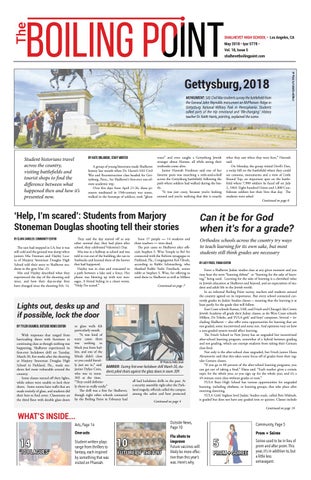
Student historians travel across the country, visiting battlefields and tourist shops to find the difference between what happened then and how it’s presented now.
By Kate Orlanski, Staff Writer A group of young historians made Shalhevet history last month when Dr. Harris’s SAS Civil War and Reconstruction class headed for Gettysburg, Penn., for Shalhevet’s first-ever out-ofstate academic trip. Over five days from April 21-26, these pioneers meditated in 19th-century war zones, walked in the footsteps of soldiers, took “ghost
tours” and even taught a Gettysburg Jewish stranger about Haman, all while seeing their textbooks come alive. Junior Hannah Friedman said one of her favorite parts was marching a mile-and-a-half across the Gettysburg battlefield, following the path where soldiers had walked during the battle. “It was just crazy, because you’re looking around and you’re realizing that this is exactly
‘Help, I’m scared’: Students from Marjory Stoneman Douglas shooting tell their stories By CLara Sandler. Community Editor The rain had stopped in LA, but it was still cold and the ground was damp when juniors Mia Freeman and Hayley Licata of Marjory Stoneman Douglas High School told their story to Shalhevet students in the gym Mar. 23. Mia and Hayley described what they experienced the day of the shooting and since, and how their day-to-day lives have changed since the shooting Feb. 14.
They said the day started off as any other normal day; they had plans after school, they celebrated Valentine’s Day. Mia was in a hallway at school and was told to run out of the building; she ran to Starbucks and learned there of the horror that had happened. Hayley was in class and evacuated to a path between a lake and a fence. Her phone was blowing up with text messages. A friend hiding in a closet wrote, “Help I’m scared.”
Soon 17 people — 14 students and three teachers — were dead. The pair came to Shalhevet after officials Stephen S. Wise Temple in Bel Air connected with the Reform synagogue in Parkland, Fla., Congregation Kol Tikvah, according to Rabbi Schwarzberg, who thanked Rabbi Yoshi Zweiback, senior rabbi at Stephen S. Wise, for offering to send them to Shalhevet as well as Milken Continued on page 7
Lights out, desks up and if possible, lock the door By Tyler Ekaireb, Outside News Editor With responses that ranged from barricading doors with furniture to continuing class as though nothing was happening, Shalhevet experienced its first-ever lockdown drill on Tuesday, March 20, five weeks after the shooting at Marjory Stoneman Douglas High School in Parkland, Fla., made students feel more vulnerable around the country. Some classes turned off their lights, while others were unable to lock their doors. Some rooms have walls that are made entirely of glass, and students did their best to find cover. Classrooms on the third floor with double glass doors
or glass walls felt particularly unsafe. “It was kind of scary cause there was nothing to block you from bullets, and one of the blinds didn’t close so you could literalBP Photo by Molly Litvak ly just see in,” said BARRIER: During first-ever lockdown drill March 20, stujunior Dylan Corn, dents piled chairs against the glass doors in room 309. who was in room 303 at the time. all had lockdown drills in the past. At “They could definitea security assembly right after the Parkly shoot us really easily.” The drill was a first for Shalhevet, land tragedy, officials called the campus though eight other schools contacted among the safest and best protected by the Boiling Point in February had
Continued on page 4
One-acts
‘10 PLAGUES’
Orthodox schools across the country try ways to teach learning for its own sake, but most students still think grades are necessary by LUCY FRIED, TORAH EDITOR Enter a Shalhevet Judaic studies class at any given moment and you may hear the term “learning lishma” or “learning for the sake of learning,” being used. Learning for the sake of learning is a cherished value in Jewish education at Shalhevet and beyond, and an expectation of student and adult life in the Jewish world. In an informal Boiling Point survey, teachers and students around the country agreed on its importance. But every school contacted currently grades its Judaic Studies classes -- meaning that the learning is at least partly for the grade that will follow. East Coast schools Ramaz, SAR, and Frisch and Chicago’s Ida Crown Jewish Academy all grade their Judaic classes, as do West Coast schools Milken, De Toledo, and YULA girls’ and boys’ campuses. Several -- including Shalhevet -- also offer extra opportunities for learning that are not graded, some incentivized and some not. And opinions vary on how a non-graded system would affect learning. The Frisch School in New Jersey has an ungraded but incentivized after-school learning program, somewhat of a hybrid between grading and not grading, which can exempt students from taking their Gemara class final. Not only is the after-school class ungraded, but Frisch junior Elana Abramovitz said that this takes some focus off of grades from their regular Gemara classes. “If you go to 80 percent of the after-school learning programs, you can get out of taking a final,” Elana said. “Each teacher gives a certain topic for the whole year, so you sign up for the whole year, and it’s a 45-minute extra class without grades or tests.” YULA Boys High School has various opportunities for ungraded learning, including chaburas, or learning groups, that take place after morning davening. YULA Girls’ highest level Judaic Studies track, called Beit Midrash, is graded but does not have any graded tests or quizzes. Classes include
Outside News, Page 10
Arts, Page 16 Student-written plays range from thrillers to fantasy, each inspired by something that was visited on Pharoah.
Can it be for God when it’s for a grade?
Continued on page 16
WHAT’S INSIDE...
14
what they saw when they were here,” Hannah said. On Monday, the group visited Devil’s Den, a rocky hill on the battlefield where they could see cannons, monuments and a view of Little Round Top, an important spot on the battlefield where 7,900 soldiers hs faced off on July 2, 1863. Eight hundred Union and 1,800 Confederate soldiers lost their lives that day. The students were asked Continued on page 6
10
FUTURE OF THE FLU
Flu shots to improve Future vaccines will likely be more effective than this year’s was. Here’s why.
Community, Page 5
5
PROM + SOIREE
Prom + Soiree Soiree used to be in lieu of prom and after prom. This year, it’s in addition to, but a little less extravagant.
2 Gathered on the roof, school becomes a giant choir celebrating Israel’s 70th birthday in the style of Koolulam The Boiling Point • May 2018 • Community
BY Jacob Joseph Lefkowitz Brooks, Features Editor In under an hour on a sunny Yom Ha’atzmaut morning, choir teacher Mrs. Joelle Keene was able to turn an unorganized gathering of 140 students into a full-on musical group. It was an effort to celebrate Israel’s 70th birthday April 19 by doing something they do there, and it succeeded beyond organizers’ dreams. Inspired by Koolulam, an Israeli group that teaches gatherings of thousands of people to sing a song, the students had gathered on the third floor’s outdoor turf to single “One Day” by Matisyahu. “The kids at Shalhevet are really enthusiastic,” said Mrs. Keene. “So you put together their natural enthusiasm with their love of Israel and their love of music, I would have really had to screw up for it not to have succeeded.” The whole school was present, which that day meant about 140 students, teachers and staff, who were split up into three sections: boys, low-pitched girls and high-pitched girls. They went through and practiced each note until they knew the whole song. Leading the performance with Mrs. Keene were most of the Choirhawks and an assembled band made up of sophomores Kiku Shaw on keyboard and Mitchell Hoenig on acoustic guitar, junior Adira Waldman on bass, senior Daniel Ornstein on djembe drums,and Rabbi David Block on electric guitar. After the final performance of the song, the group erupted into cheers and started dancing, followed by wild musical celebrating which freshman Tomer Azrad DJed. The idea was originally thought of by Judaic Studies teachers Rabbi Ari Schwarzberg and Ms. Ilana Wilner, who is also Student Activities Director. They contacted Mrs. Keene along with students who played instruments and asked if they wanted to be part of the event. “They didn’t have to sell me on it,” Mrs. Keene said, adding that she didn’t know about Koolulam until Rabbi Schwarzberg sent her a video. “As soon as I saw it I knew this is the best thing you could do at Shalhevet.”
BP Photo by Neima Fax TOGETHER: Shalhevet celebrated Yom Haatzmaut April 19 by following Israel’s latest music craze of mass singing events. With boys on one side and girls on the other, Choirhawks director Ms. Joelle Keene taught everyone how to sing Matisyahu’s ‘One Day’ in three-part harmony, backed by Mitchell Hoenig, Adira Waldman, Kiku Shaw, Daniel Ornstein and Rabbi Block. Evan Rubel, Rabbi Schwarzberg and Rabbi Segal led the boys.
Mrs. Keene taught the song to the choir just the day before. ing sophomore tenor Evan Rubel, who at the last minute jumped She said they learned the harmony parts and other details in about onto the band platform and led the boys group; and Judaic Studies faculty and administrators who she said “channelled the energy of 40 minutes. Many of them already knew the song. the junior boys,” who were constantly engaged The band only started practicing that morning. But and started shouting and celebrating whenever Kiku was pleased with how it turned out. they got a note right. “We had to all learn our parts separately and ‘It exceeded my “We started by watching videos of it in Heonly had so long to go through the song before evbrew classes and it was really cool to see,” said expectations 100 eryone came,” said Kiku. “It was crazy, but I’d say junior Jonathan Fishman. “So when they told it was a feeling of excitement and relief; it was hontimes over.... When us we were doing one, all of my friends and I estly really amazing to all be able to play the song as our school comes were really excited, and it ended up being awewell as we did without practicing with each other, some.” together, great and it also was very relieving to know that we were Mrs. Keene also gave a lot of credit to the able to pull through it.” things happen.’ song, written by Matisyhu and the SmeezingMany, including Rabbi Schwarzberg himself, - Rabbi Ari tons, a now-defunct group of three songwriters had been skeptical of the success of the undertakSchwarzberg and producers made up of Philip Lawrence, Ari ing. Levine and Bruno Mars. “Oh my God, it exceeded my expectations 100 “I got a lot of help,” said Mrs. Keene. “The times over,” said Rabbi Schwarzberg. “I thought most help I got was from the song. It’s a great there was a 20 percent chance it would be mildly successful…. Mrs. Keene was unbelievable and the students were song. My hat is off to Matisyahu.” Director of Technology Nick Parsons filmed the event using awesome. When our school comes together, great things BP Photo by Nick Parsons a camera as well as a drone hovering overhead. With help from happen.” OVERHEAD: Tech director Nick Parsons sent a drone overhead to film the crowd. Mrs. Keene credited the band; the choir members includ- sophomore Ari Schlacht, the school released an official video that night.
Calendar
Sat, May 19th Erev Shavuot may 20-21st Shavuot, No school Mon, May 28th Memorial day, no school
june Sun, June 3rd Graduation Wed, June 6th Annual Gala Thurs, June 7th Last day of Classes June 11-14th Finals Week
MORE ON THE WEB: VIDEO: All-school rooftop ‘Koolulam’ on Yom Haatzmaut VIDEO: Survivors of Parkland, Fla., shooting speak at Shalhevet VIDEO: Walkout March 14 in memory of victims Parkland shooting PHOTOS: Slide show of SAS class trip to Gettysburg Civil War site PHOTOS: Slideshow of One-Acts SPECIAL FEATURE: Scan this QR code to download the BP app!
T
KO
CK
Sun, May 13th yom yerushalayim
Community, Pages 1 - 7 Outside News, Pages 8 - 10 Features, Pages 11 - 13 Arts, Pages 14 - 15 Torah, Pages 16 - 18 Opinion, Pages 19 - 21 Sports, Pages 22 - 24
FOOD
U
May 8-23rd Poland Israel Experience
E
R
R
May
SH
IN THIS ISSUE:
Est.
1990
T A C O ALA-CARTE
FREE DRINK WITH EVERY BURRITO PURCHASED! SHOW THIS COUPON. VALID FOR ONE DRINK.
Visit us on Saturday nights on the corner of Pico & Roxbury! Like Taco-Ala-Carte on Facebook for latest news and locations! Have us cater your party or event! 310 553 8804
camp naim.com AMAZING ADVENTURE TO
COSTA RICA
Join us for an extraordinary, summer experience! Boys Program: 25 June - 22 July, 2018 Girls Progam: 2 - 22 July, 2018
The Boiling Point • May 2018 • Community
3
New schedule for next year to include ‘flex’ period Dismissal time stays the same, class time and Town Hall are reduced, MAP and SWAP are gone and schoolwide lunch is restored By Clara Sandler, Community Editor A completely new schedule is coming next year, with a threetimes-a-week flexible time slot for advisory, club meetings, office hours and extra SAS and AP class meetings, officials confirmed yesterday. The new schedule was created by Dean of Academic Affairs Aviva Walls and Director of Curriculum and Instruction Dr. William Walton. It was shared with members of the Agenda Committee and some other students before Passover break, and Ms. Walls shared it with the Boiling Point late this afternoon. Not all details of the schedule are yet final, Ms. Walls said, but in its current working version, the new “flex period” would be offered Mondays, Tuesdays and Thursdays and be 40 to 45 minutes long, depending on the day. Town Hall would use the flex period on Wednesday, and school ends too early on Fridays to have room for it. Class periods in the plan are 55 minutes instead of the current 58 minutes long, and Town Hall would be shortened by 15 minutes, to 45 minutes instead of an hour. Dismissal times are not changed. General Studies Principal Mr. Daniel Weslow said the idea was to give students more free time. “We have highly motivated and amazing students who often find themselves burning it on both ends with respect to school work, co-curriculars and community environments,” Mr. Weslow said in an interview. However, the flex period will also be available to honors or advanced classes whose teachers can convince administrators they Source: Aviva Walls need it. Lunch classes are a long-standing tradition at Shalhevet, UNIFIED: Most classes will be 55 minutes long, and makeups and meetings should be easier to arrange. All grades will be on same schedule. with some students missing lunch several times a week and having no time to meet with teachers or take makeup exams. Since the flex period is an attempt to fix that problem, Dr. Wal- same lunch periods as well. And math will meet only as often as then moved to a faculty meeting and a faculty survey,” he said. ton said academic use of Flex period would be limited and based other core classes. Ms. Walls and Dr. Walton then reviewed the data and then on a teacher’s previously demonstrated need for it -- and scheduled Lunch will start 40 minutes later than it is now and last 50 “met with elected Just Community officials to get more feedback.” by the school. He also said a teacher who wants to use a Flex peri- minutes, according to Dr. Walton. That would mean that there are The new schedule, he said, is “something that we feel can meet od would have to ask the administration, which would determine usually three classes plus Flex in the morning and just three classes the needs of our growing school programs and provide more opwhen and how often the extra class can meet. portunities for students to connect with teachers and each other in in the afternoon. “The period is supposed to be flexible and designed to be used Agenda Vice Chair Talia Gill said she was “a little apprehensive” a formal and informal capacity, in the best way possible,” Dr. Walton said. “So this provides the opportunity to have a flex period,” said about Town Hall moving to Wednesdays. The plan an“It gives us one less day to plan Town Hall,” Mr. Weslow, “to have a common lunch, and we went through a nounced today also said Talia, “because we rarely end up planning thoughtful process where we went through multiple stakeholders Mr. Weslow said one impetus was the eliminates the twoand finalized with enough time to look at course offerings for next a week before, because of prior commitments.” complicated lunch schedule caused by year-old MAP and She said announcements would be made at a year and to reduce conflicts.” SWAP periods for Geometry and Precalculus teacher Ms. Jennifer Kong liked the new Tuesday schoolwide Mincha instead of takMAP, which made it hard for clubs to ninth- and 10th-grading time from Town Hall, to compensate for the MAP period and is going to miss it. meet. Minor adjustments this year “I could cover more than before and if we’re meeting four times ers. MAP is an intershorter meeting proved insufficient. changeable midday Even though details still need to be sorted a week, we can keep the momentum going,” Ms. Kong said. But Talia predicted people would get used to it. time slot for Math, out, a version of this schedule will go into effect “It will be weird at first, just like the MAP schedule was weird at Arts and PE, while next year, officials said. SWAP was originally school-wide appointment period, though this Mr. Weslow said one impetus was the complicated lunch sched- first,” she said. “It might get initial dislike because it’s different, but year only for ninth- and 10th-graders. Math classes now meet every ule caused by MAP, which made it hard for clubs to meet. Minor I’m confident it will be beneficial in the long run.” day, instead of two or three days a week like other courses. adjustments this year proved insufficient. In the new plan, all grades are on the same schedule, with the “We started with conversations with the Ed Lead Team and
Led by Ms. Crincoli’s ninth grade class, latest ‘cleanse’ is unplugging Another student of Ms. Crincoli, Layla Dauer, said that it was researchers have found that reducing social media usage can help harder than she expected and she felt as if she was missing out on you sleep better. what her friends were doing and what was going on in the world. “It’s proven that the blue light from phones and tablets wakes But she also said that it was refreshing to not be obsessed with up the brain making it difficult to wind down and fall asleep,” the In a city that is full of people working to live healthier lifestyles, knowing, and to just be present. article says. there’s nothing unusual about going on a cleanse. “I first thought the cleanse would be easy,” said And of course, limiting social media usage may also force peoNow some ninth-graders at Shalhevet are applyLayla, “but it was much harder than I expected. I’m ple to interact with other people in their lives, and actually dimining this method to their lives in social media. ‘‘It was much hardso used to automatically tapping on Instagram to see ish feelings of FOMO, the fear of missing out. The idea was inspired by a March class discuser than I expectwhat’s going on with my friends outside of school sion following a journal prompt where the class ed. I’m so used and when I couldn’t, I felt like I was missing out. discussed how addictive social media is. In reto automatically But, at the same time, it was sponse, the class created the social media cleanse tapping on Instarefreshing.” as a way to relieve themselves of this pressure. gram to see what’s Social media cleanses The rules for the cleanse were to delete one goingon with my have now become a culturapp of social media -- not the account --` such friends ... But at al fad. Celebrities like Selena as Snapchat, Instagram, and Facebook from their the same time, it Gomez, Kendall Jenner and phones. was refreshing.’ Justin Bieber have been known “The social media cleanse is a pledge to give -Layla Dauer, to go offline in order to live life up one social media app -- not even all of them 9th grade without a screen. -- just one for a set amount of time,” said English Another example is that teacher Ms. Michelle Crincoli in an interview. students delete social media Each student chose one app to delete -- ideally during tense times in their the most addictive one -- on a Tuesday and was not to redownload high school or college careers -- for finals it until Friday morning. Eighty-five percent of the class decided to week, SATs or college application season, for take part. The goal was simply to experience life more fully, and recognize example. “I found social media to be extremely the power each person gives to social media. distracting while studying and doing home“At first I was hesitant to do it,” said freshman Noa Ablin, who work,” said junior Jamie Berman who deletgave up Snapchat. “It was really hard at the beginning, but then I found a lot of free time because all I normally do is scroll and scroll. ed social media on her own. “I weighed the BP Photo by Neima Fax Then, throughout the next week I totally forgot about it. I didn’t benefits and detriments of using it at all, and decided it would be for the best to just delete feel like I needed it anymore.” PHONE: SophomoreShayna Shusterman shows social media is still alive and well in But when she re-downloaded it, she resumed her normal social Instagram and Facebook.” the second floor hallway. But some are opting in to get off of social media for while. According to British newssource Express, media habits, she said.
By Clara Sandler, Community Editor and Sadie Toczek, Lifestyles Editor
4
The Boiling Point • May 2018 • Community
Posters of women for Black History Month are vandalized By Lucy Fried, Torah Editor One Friday morning, junior Honor Fuchs discovered that posters she had hung up throughout the second floor hallway in honor of Black History Month had been tampered with. With the help of English and film teacher Ms. Michelle Crincoli, Honor had designed and put up 24 posters featuring African-American women in history whom she found inspiring, as well as fun facts about each one. Included were former first lady Michelle Obama, Olympic gymnast Gabby Douglas, civil rights activist Ruby Bridges, and author Andrea Lorde. The posters had the words “National Women’s Month” on them, but on each one, the “Wo” was crossed out. Honor noticed this Feb. 16. “I wanted to sort of educate the students about black women that I thought were heroic and made a difference in history that a lot of people didn’t know about,” Honor said. “I felt like disappointed in our school community. Like, what the heck?” Honor took to Schoology. “If you did this disgusting act to peeve me, congratulations, I’m peeved,” Honor wrote in her post. “Personally I am embarrassed for this school that prides itself on its mentchy students, yet posters of black, female American he‘We learn in class roes were vandalized. We learn that it is a sin to in class that it is a sin to speak ill speak ill of the dead, of the dead, yet a student at this yet a student at this Modern Orthodox institution Modern Orthodox vandalized posters celebrating the dead.” institution vandalized It turned out that the stuposters celebrating dent was not trying to anger the dead.’ Honor or attack women or AfHonor Fuchs, rican-Americans at all. He was, he said, trying to add black men 11th Grade to the mix. The student, who did not want his name used in this article, admitted to crossing out the “Wo’s,” and in an interview with the Boiling Point, expressed regret. He said that he did it because he felt that there was a lack of black male representation in the display. He also expected to earn laughs from his friends. “I saw these posters, and I was just thinking, where are the black males?” said the student. “I think black women are great and they can do things I can’t, but I was just being selfish and thinking about having a good time and making my friends laugh.” He said he had learned from Honor’s reaction. “I saw Honor’s Schoology post, and I realized that while it seemed like such a small action, it symbolized bigger things,” he said.
“Looking back, I just have to be more careful. Now I’m realizing that someone had genuine feelings, and the fact that I did this to them triggered those feelings, so I feel bad about that.” Students and teachers disagreed on whether the student’s vandalism also represented a cultural shift at school. Ms. Crincoli said it seemed to be symbolic of America’s current political state. “I was upset that something so positive had a negative ending,” Ms. Crincoli said. “I really don’t know why someone would do that because it’s honestly such Photo by Neima Fax an innocent thing that [Honor] did. REMEMBRANCE: At top left corner of poster, the “Wo” is crossed out in “Women of “I think it shows that there’s a division Black History.” It was one of several that were vandalized in second-floor hallways. in American society, and maybe we have to have a lot more conversations about gender and race and all those things that guys to be talking about this stuff and we want to learn how to deal are sometimes hard to talk about but important to talk about.” with it.” Judaic Studies teacher Rabbi Ari Schwarzberg agreed, and said Honor said that the vandalism coincides with what she feels is a that the diversity in opinion was a good thing. “lack of menschlichkheit” -- respect and kindness. “We may have more students now who are resistant to certain “I feel like there’s been a shift in our school with just a general ideas that some people categorize under the liberal banner than lack of understanding of other people’s opinions,” she said. “I feel when I started at this school and maybe even than we had four or like the school is just trying to engage us in conversations about five years ago,” Rabbi Schwarzberg said. “To me that’s a wonderful women of color and sexual harassment, and some people refuse to thing, and it shows that Shalhevet can house many different per- do that.” spectives.” Rabbi Schwarzberg said Shalhevet is acting appropriately in He added that while the crossing out of the “Wo” was terrible, promoting respectful disagreement. it might not be indicative of anything about Shalhevet’s culture. “I think we’ve had several really great Town Halls that have dealt “I don’t think that the people who did this are angry fanatics with political and heated topics in against anything that stands for women’s empowerment or fema way that was really representative inism,” Rabbi Schwarzberg said. “We need to be mature enough of the just community,” he said. “I ‘I saw the posters, and I was just an have a macroscopic lens, and to not isolate an incident that’s really enjoyed Honor’s post. Now thinking, where are the black probably related to 3 or 10 students.” would it be better if there was no males? I think black women are In her Schoology post, Honor said that the posters would vandalism, absolutely, but the way great and they can do things I stay up on the walls despite being vandalized. in which we’re responding in these can’t, but I was just being selfish “These posters are still hanging (except for the few that were moments is I think exactly what and thinking about having a good thrown out by individuals who did so on their own choosing) we’re supposed to do.” time and making my friends because they contain important information about women that He said the school probably made a change in this county,” Honor wrote on Feb. 16 at 10:18 laugh.’ could do a better job in commua.m. “I would encourage all to read them.” nicating a zero-tolerance policy - Unnamed student who crossed The posters stayed up until March 1, she said. for more harmful bullying of any out the ‘wo’s’ Rabbi Schwarzberg said that the growth in diversity in opinkind. ion at Shalhevet provides additional challenges that the school “What I think we might need must adapt to. to make more clearly, and I don’t “We now as a school need to figure out how we relate to one know if we haven’t already, is that anything that is damaging both another when we disagree with one another,” he said. “Our school emotionally and physically to someone else is at a zero tolerance,” is not immune to what’s going on in society, our school dafka re- Rabbi Schwarzberg said. sponds to what’s happening outside and we bring that into the discourse of the school which I think is a good thing. We want you
Lockdown drill was lights out, desks up and if possible, lock the door
BP Photo by Zoey Botnick
LOCKDOWN: Rabbi Schwarzberg’s class hid behind a mechitza in the Beit Midrash during lockdown drill March 20. continued from page 1 in the state, thanks to armed guards, a heavy iron gate and other measures. And despite the lack of uniformity during the lockdown exercise, school officials deemed it a success. “No emergency is going to play out exactly like you scripted it,” said Executive Director Sarah Emerson an interview a few days later. “The lack of uniformity depending on what they did actually speaks to creativity and quick and fast thinking, and people come up with different solutions.” The main purpose of this drill, Ms. Emerson said, was for the security team to discover which rooms needed additional equipment or instructions. In the meantime, “if there were problems in a classroom, they thought quickly on their feet,” she said. “Not all actions have to be uniform, and that’s not what we’re looking for,” Ms. Emerson said. “We want [students and faculty] to react with safety in mind.”
She said officials conducted a “post-lockdown debrief,” including a faculty survey to ascertain the successes and failures of the school security situation. “We’re going to be using those responses to figure out next steps in terms of both physical needs of the building and creating our next level of training for students and faculty,” Ms. Emerson said. On March 20, the exercise began around 11 a.m. with a coded message, broadcast over the school intercom, instructing a “Mr. Jones” to go to the cafeteria. Teachers knew this meant they should stage a lockdown in their classrooms, but students did not. “The students were not told the code word in advance because that’s how our security team wanted to set up this drill,” said Ms. Emerson. She said in the future, students would be informed and receive guidelines on how to proceed. Though she said this was meant to engender a sense of urgency, not recognizing the cryptic codeword left some feeling unprepared and potentially in danger. “Our teacher told us what was happening but I didn’t know what was going on,” said Dylan. “I heard there was gonna be a drill, but who is this person [Mr. Jones] going downstairs?” In their ignorance, students drew their own conclusions. “We heard the ‘Mr. Jones’ thing and were like who is Mr. Jones?” said junior Donna Grunfeld. “We honestly thought that it was a new teacher, because we always have a new teacher.” “None of us knew this was a lockdown drill -- the doors don’t lock,” she continued. “The students should have been informed that it was going to happen. What happens if the teacher isn’t there? What happens if a student gets shot?” But even without any preparation for the drill, other students felt somewhat safe in their own classrooms. Senior Elie Helfand was in Ms. Michelle Crincoli’s English class in Room 205. “We felt we were pretty safe and quiet, but [the class next door] was so loud that it was actually insane,” said Elie, adding, “We had an inefficient way of locking the door. You had to open the door to lock it.” Although Ms. Crincoli successfully locked the door, she said it would likely be more difficult in a real lockdown.
“I don’t know if that door thing would work if it was a real emergency and I was scared,” Ms. Crincoli said. Some rooms did not have any locking mechanism, forcing some teachers to improvise, many using emergency backpacks that hang near the doorway. “I was in room 304 and it did not have the backpack to lock the doors from the inside,” said Rabbi Ari Schwarzberg. “I put the siddur cart in from of the door, but I didn’t think that the doors open from the outside so it didn’t make a difference.” Teachers in rooms with glass doors hastily barricaded them with furniture. One was Mr. Eric Smith, who was teaching in room 307. “Mr. Smith started telling us to get up and go to the corner while he and a couple other guys stacked some chairs in front of the door and window,” said freshman Gaby Bentolila. Students who were not in a classroom at the start of the drill had no way to know what was going on. Some teachers called them into their rooms, and some did not. “I was walking in the hall and talking to a friend and then we heard the announcement [about ‘Mr. Jones’],” said senior Daniel Ornstein. “I didn’t think anything of it. “[Science teacher Dr. Elizabeth] Basheer called us into her classroom and we were confused. I thought we were in trouble until she locked the door.” Junior Daniel Medovoy was in the hallway getting his Hebrew book at the time of the drill. “The lockdown drill started and Rabbi Stein ran out of the teachers lounge and told me to come in,” said Daniel. “They put me in the back of the room and they gave me Coca-Cola and it was fun.” Although he enjoyed the experience, Daniel felt unaware throughout the process. “I had no idea what was going on and I didn’t hear it that well, and I only realized that there was a lockdown drill when Rabbi Stein came out.” The administration and security team had told students a drill was coming, though not when, at a the security assembly. Ms. Emerson said the administration plans to conduct more and will continue to refine its security protocols.
The Boiling Point •May 2018 • Community
Best of both worlds: Prom and Soirée for senior class By Jacob Joseph Lefkowitz Brooks, Features Editor Senior Soirée, originally an alternative to prom, is a supplement -- at least for now. In a change from the administration’s previous stance, the school will provide a soiree for the senior class even though students have decided to hold a prom on their own, officials confirmed. The soiree has not yet been scheduled, but the prom is set for June 19. For several years, Shalhevet has offered the senior class the choice to have “soiree,” a school-funded event which last year included a dinner at Herzog Winery, a two-hour yacht trip and an overnight stay at a resort, as an alternative to a prom if students agreed not to have one. Last year’s class accepted that offer in a vote made by a show of hands in front of teachers. Some prom supporters at the time claimed they had been therefore pressured into voting for Soiree. This year however, the class voted 35-22 Nov. 22 in favor of prom instead, using anonymous note cards. But some students said they would not attend, and in February, senior class presidents Tali Schlacht and Danielle Mandel asked the administration to change soiree so more people would favor it. Since there has only been one Soiree, they argued, seniors had just one example to base their vote on, and they proposed changes that would make this year’s Soiree drastically different. “What we have turned Soiree into is a big bar mitzvah party for our entire grade,” said Danielle. The seniors had to vote again on whether they wanted to have the additional Soiree, but they did not vote on specifics. “I think the first time we voted it was a little bit misunderstood, and that’s why the vote didn’t work out,” said fellow senior Hila Machmali, who joined them in the discussion. “We started to realize that members of our grade would not come if we had a prom, and that’s just not how we want to end off the year.” Meanwhile, the school’s view of Soirée seems to have shifted from its being a preventative measure to an experience in addition to prom. “We thought that after a number of years spent in Jewish day school — whether it was just high school, middle school -- that ending their time here with all the values we’ve learned and all of the Torah that we’ve learned and all the incredible Jewish values that have been part of their education -- to end on a party that in many ways is antithetical to that was not the right note to strike,”
5
Rabbi Segal said in an interview last month. He also said that if the grade were to have a prom, it should be after graduation, and that is what is planned. Graduation is June 3. “They should be graduates of the school and then they’re on their own ... if they want to do it,” Rabbi Segal said. “That’s how we feel.” Seniors said officials have agreed to most of the proposed changes to the original Soiree plan. “They’ve been cooperative with pretty much about anything we want,” said Tali Schlacht. So far the administration has accepted having co-ed busses, dancing separated by gender but BP Photo by Ezra Fax without a mechitzah (separation BOTH: At last year’s Senior Soiree, students opted to take separate girls’ and barrier between genders), and not boys’ buses. This year’s buses will be co-ed. There will also be a prom. having teachers dance. All but $4,000 of last year’s something that you’re calling prom because that’s something they $14,000 Soiree budget was paid for by the school. Students paid $75 per student. Rabbi Segal said do in the movies, that’s what other people do. That to me is honestthe administration would subsidize the event this year as well, but ly not who our students are.” Rabbi Segal believes that prom and soiree have some things in what percent depends on what the students want. common, and that one is better than the other. Meanwhile, Danielle Mandel said the prom would be the same “They’re obviously two sides of a different coin, from my peras in previous years, and would include an after-prom. The after-prom is where problems with alcohol have occurred in the past. spective,” said Rabbi Segal. “One is a great way to end your high “It will take place at a student’s house for pictures and dinner, school career, and one’s one that I don’t think is a healthy way and then we will be taking party buses to the after-prom venue,” but is a time-honored tradition, and I think some people confuse time-honored tradition with good idea.” Danielle said. Senior Ben Mashiach thinks that prom has positives. Non-seniors will be invited to the after-prom. “Girls and guys can both feel special and dress up fancy, and While the prom is not being actively fought back against like have a nice meal and like it’s a cool transition to like being an now, both Rabbi Segal and Just Community adviser Rabbi Ari adult I guess,” Ben said. Schwarzberg still have concerns about it. But Rabbi Schwarzberg cautioned that offering both prom and “What always bothers me about prom is the make-believe, almost fake or fraudulent aspect to it,” said Rabbi Schwarzberg. “All Soiree would not necessarily be the policy going forward. “This is not a bylaw of Shalhevet,” said Rabbi Schwarzberg. “I of a sudden 18-year-olds are buying these dresses -- and I hate the don’t think we have that yet. I honestly don’t know. financial responsibility to it -- dresses that people rarely wear or ever wear and feeling the need to put on this show… and have
Boiling Point wins its first Pacemaker, sixth Gold Crown By Sivan Karz, Staff Writer
March, for last year’s print paper and this year’s website. Current Editor-in-Chief Hannah JanThe Boiling Point has won 17 awards for writ- nol said sincerity was a big factor of the Boiling ing, online production and layout so far this year, Point’s accomplishments. “We push for a really high caliber of quality capped by its first Pacemaker award from the Naand journalistic integrity at The Boiling Point, tional Scholastic Press Association. Although it had been nominated for both the and I think that’s really evident in the layout of online and print Pacemakers a total of six times our pages and level of our writing,” said Hannah. The Boiling Point also earned CSPA’s Gold in the past, it had never won until last month, when it won one of 22 Online Pacemakers given Medal with All-Columbian Honors, the highnationwide at NSPA’s annual spring convention est ranking given in the organization’s Medalist Critique program, which is a multi-page, scored in San Francisco. The paper and its staff this year also won top analysis of the entire year’s work.Judges are anonawards from the Columbia Scholastic Press Asso- ymous but write long comments relating to dozciation (CSPA) -- including their sixth consecu- ens of journalistic standards. “The courage and relentless pursuit of the tive Gold Crown Award -- along with Quill and Scroll International Honorary Journalism Society truth in telling the stories of the Shalhevet community by the Boiling Point staff is both amazing and the Jewish Scholastic Press Association. According to Ms. Amber Billings, NSPA’s and inspiring,” the judge wrote this year. “It is evident that the staff always demonstrates Communications Director, the Pacemaker is given in six categories: online, newspaper, yearbook, professionalism in handling its interactions with magazine and broadcast. She said there were 202 the admin of the school and with the community. The Boiling Point is ... an exemplar example of entries in the online category. Judges considered the website’s coverage and what a school newspaper can be.” Quill and Scroll winners, announced April content, quality of writing and reporting, leader10, were Hannah Jannol, ship, design, photography and graphics, Aidel Townsley, Jacob Joas well as interactive outreach with read‘The fact that the school seph Lefkowitz Brooks, and ers and how frequently it was updated. four junior girls -- Lucy encourages kids to ask Deputy Web Editor Gilad Spitzer Fried, Jordana Glouberman, said it had been a team effort, led also questions, I think our Talia Abel and Katia Surpin by Web Editor-in-Chief Hila Machmali. students minds are -- who together covered the “Hila and I worked really hard to developing in the direction 11th-grade chesed trip to post all the new content that was coming Houston last fall. in,” Gilad said, “and our writers worked of inquisitiveness… I think In Quill and Scroll’s really hard to constantly come out with the result of that is that our 2018 International Writing, news whenever possible in order for us stories are thorough’ Photo and Multimedia Conto post stories every day.” test, there are “Sweepstakes” - Mrs. Keene In March, the Boiling Point won its awards for the top three stosixth consecutive CSPA Gold Crown in ries internationally in varithe hybrid category, for schools publishous categories. ing news both in online and in print. Hannah Jannol won the third-place SweepOut of 1,100 entries for crowns, Boiling Point stakes award in the Profile Writing category for was one of 17 to win in that category. The Gold Crown was awarded at CSPA’s her story titled “Three Languages on the Menu? annual conference at Columbia University in Baruch Hashem!”
BP Photo by Joelle Keene
WINNERS: BP editors with the Gold Crown at CSPA conference in New York. Opinion Editor Aidel Townsley won an Honorable Mention in the Editorial category for “Bring the ‘covenant’ to Town Hall,” about how changes should be made in Just Community rules.. Sophomore Jacob Joseph Lefkowitz Brooks won an Honorable Mention in the Review Writing category for his story describing -- and defending -- the new apartment complex called The Vinz. And the four juniors won Honorable Mention in Multimedia Storytelling “With hammers and heart, juniors help rebuild Houston on chesed trip.” Earlier this year, Boiling Point writers won story and design awards from NSPA, which has the fewest categories, making its awards somewhat harder to win. They are given in the fall for previous year’s work. Abbi Sentchuk, Zev Kupferman and Honor Fuchs won fourth place in the Design of the Year contest in the centerspread category for a set of three stories called “Houses Divided,” about student opinions of the 2016 presidential candidates. Fifth place in the NSPA Story of the Year for Editorials went to alumni Alec Fields and Maayan Waldman ‘17 for “When Hate Comes to Visit,” about struggles among BP editors when
the Westboro Baptist Church came to protest. CSPA also gave individual story prizes -called Gold Circle awards -- last fall. Hannah Jannol won the second place Gold Circle award in in-depth news, as well as a third place in cultural features, for her story on the common “finsta” accounts, which she said “bring a different view of teen life to Instagram.” Sports Editor Tobey Lee won a Story of the Year Certificate of Merit in Sports News for his report on the Firehawks basketball loss to Milken in the CIF division championships last year. And Alec Fields won a second place in news writing for “School makes LGBT inclusion official policy, hoping to set an example for Modern Orthodox schools.” Faculty adviser Mrs. Joelle Keene attributed the success to Shalhevet’s educational philosophy. “The fact that the school encourages kids to ask questions -- I think our students minds are developing in the direction of inquisitiveness, and not just taking things at face value but wanting to understand what goes on underneath,” Mrs. Keene said. “I think the result of that is that our stories are thorough.”
6
The Boiling Point •May 2018 • Community
New Dean of Student Life leads focuses on unity and ‘value added’ nesota. In Los Angeles, he learns at LINK Kollel. Dr. Ravanshenas has worked at eight The last name of Shalhevet’s new Dean of Student Life, Dr. Jonny Ravanshenas, is hard to pro- other institutions, including schools serving underprivileged children in Innounce, but it’s a good name for him. Pronounced ra-VAN-she-nas, it means psy- glewood while working on his doctorate, chologist in Farsi, which fits, because his doctor- and most recently as Assistant Head of School and Head of the Judaic Departate is in Educational Psychology, from USC. A father of three and a lover of snowboarding, ment at Kabbalah Children’s Academy Dr. Ravanshenas has been Dean of Student Life earlier this year. Earlier, he worked at Hillel, Beth since January, taking over the work of former Student Life Director Mrs. Raizie Weissman along Jacob, Magen David, Young Israel of BP Photo by Emma Mackler Century City and camps in the LA area, with other duties. EDUCATED: Dr. Ravanshenas holds degrees from UCLA and USC, is studying to receive s’micha as well. “The goal for this year is to oversee stu- including Camp Hillel and MJ Sports Camp. dent life and to see what added value Why so many jobs by I can add to each program,” Dr. Ravchology and maybe a Judaics class. on middot, or personal comportment. at his age of 34? anshenas said. In Great Neck, snowboarding was possible They were very into the reasons and con‘As long as you’re “Hard work, and I am pasHe was born and raised in Great without driving multiple hours to the mountains, sciousness behind the things we do,” Dr. Ravenmaking an impact, sionate about what I do -- and reNeck, N.Y., and moved at age 11 and he later traveled to snowboard in Aspen, shans said. as long as you’re ally, Hashem,” he said, thanking to Los Angeles, where he attended Colo. But he hasn’t snowboarded in years because, Dr. Ravanshenas has not any classes of his inserting yourself in God for his success. Harkham Hillel Academy and then he said, “life got busy” own yet except for a mini-mester called Sephardic “I’m working for the Jewish the Jewish commuYULA High School. He then studied Dr. Ravanshenas snowboards in Aspen, Colo., Halacha. He also took over Rabbi Tsaidi’s ninthcommunity and that’s all that nity, that’s all that applied child development at UCLA, and has not snowboarded for the last two years grade Foundations of Judaism class last month matters,” he said. “Achdut, unity. matters to me.’ then spent a year in between college because “life gets busy,” he said, but plans on when Rabbi Tsaidi went out on medical leave. As long as you’re making an imand graduate school at Yeshivat Ohr --Dr. Ravanshenas teaching snowboarding to his kids some days. Freshman Hannah Berman is in the Foundapact, as long as you’re inserting Sameach in Jerusalem. His children are four, three, and eight months tions of Judaism class and is really enjoying the yourself in the Jewish community, He earned an MBA from USC old and he hopes to teach them how to snowclass and learning from Dr. Ravanshenas. that’s all that matters to me.” concurrently with his Ed.D. in edboard one day. For now, enjoys rooting for the “He’s really understanding and really really He said sees especially a lot of similarities beucational psychology. And he now is working USC Trojans. nice,” she said. “Even if you’re not behaving in the on obtaining s’micha (rabbinic ordination) at a tween Shalhevet and Kabbalah Children’s Acade- moment he knows you’re a good kid.” program called Machon L’Hora Ah based in Min- my, especially in their love of Torah and emphasis Next year, he is going to teach Positive Psy-
By Clara Sandler, Community Editor
Gettysburg 2018: On battlefield, comparing today’s sites to history able to walk to the top of the monument, gaining access to a view of the whole park. “Just to be there with everyone and just reflect to go off by themselves for half an hour and and look back on the entire battle was really crazy “meditate on the events that took place there,” and really really meaningful,” said Gabby. according to Dr. Harris. And although the trip was planned to be very “We’re all by ourselves and you can just educational and informative, it also had fun motake in the sights and the sounds,” Dr. Harris ments. said. “It was kind of quiet, and everybody just According to Adam Ritz, one was at an obgot to reflect on that.” servation tower, where they encountered anothWhile many co-curriculars go on trips to er group of students. Among them was a boy compete, play sports, hear speakers or sing, this wearing a shirt that said “Haman” with a slash is the first time a class took a trip just to learn. through it. The Shalhevet students decided to The class trip was optional, and 14 out of 22 talk to him and asked if he was Jewish. students in the class elected to go. The boy said he was, and was one of only two To learn more about the lives of the citizens Jews in his school district, and he also was not of Gettysburg during the battle, the group visentirely sure what the shirt meant. The Shalhevet ited the house of Jenni Wade, who was caught students proceeded to try to explain to him what in the crossfire July 3, while making biscuits. it meant. She was hit in the back and became the only “I thought it was pretty funny that we found civilian to die at Gettysburg. one of two Jewish kids in all of Gettysburg,” said “We got to see what her life was like and Adam. how she helped the soldiers, and how it was Dr. Harris said the schedule was busy but was detrimental to her in the end,” said Gabby. planned in a way that changes could be made if “Just to really experience that on a whole new desired. level was just really life-changing.” “I would go to the kids, and I would say ‘We The students also explored area’s present-day could do this, or we could do this. What do you commercial aspects, seeking to understand think?” he said. “If the class dynamic is really how the war was being represented through the taking a lot out of monument dedication speechhundreds of monuments spread throughout es, then we will pour gas on that fire, or if the the park today. BP Photo by Honor Fuchs class is really interested in military minutiae, I Students said they talked about how the BATTLEGROUND: In Pennsylvania, History teacher Dr. Keith Harris explained the scene at the monument to Union could do that as well.” war is portrayed to the public more than about He said the students’ favorites included the the specifics of the war. Major General John Buford, who chose the site for the battle of Gettysburg, recognizing its strategic importance. monuments, big troop movements and stories Being a tourist hotspot, Gettysburg’s econabout individual soldiers. omy thrives off gift shops and touring com“What I learned in class was very different to what I saw on Dr. Harris first had the idea for the trip in panies, and Shalhevet visitors took a close look at how the area’s story was being told. Students were instructed to the battlefield,” said junior Mikey Khatan. “I learned that it was so 2001, when he went on a similar trip as a UCLA undergraduate. “I decided that visiting a sight of historical significance ...made scavenge the gift shops and observe what was being sold there, as gruesome and brutal, but everything we saw on the battlefield was things that I read and learned in books and in the classroom really well as taking what’s known as a “ghost tour,” which takes visitors to so beautiful, and I couldn’t imagine it being that way.” They also visited attractions such as the Gettysburg Cyclorama, come alive in new and engaging ways,” said Dr. Harris in an interplaces that claim to have paranormal activity or history. “We went on a ghost tour ourselves, to see what are they trying McPherson’s Ridge, the Gettysburg Visitors Center, the Virginia view with the Boiling Point. He said proposed it to the administration last year when he beto feed you, what kind of information,” said junior Adam Ritz. “It’s State Monument. They also met with area historians and guides. At the end of each day, the group came together and discussed gan teaching at Shalhevet, and it came together this year after about all about feeding the consumer, and its super interesting.” What they learned, they said, was the monuments are more and reflected on what they had learned that day. Topics ranged from nine months of planning. Before they went, the class spent about “Memory and the Union War – What Monuments Say and What two weeks prior to the trip learning about the battle at Gettysburg. about the soldiers’ experience and less about the war itself. Dr. Harris plans on continuing the trip for his future classes. They found that both sides of the war -- the Confederacy and They Don’t Say” to “To Disengage or Not to Disengage?” “We were on the battlefield from nine to five everyday, which All attendees contacted by the Boiling Point said that they would the Union -- were presented equally at all attractions. In order to get a full understanding of the dynamic of the battle, it was necessary to was really intense and a lot of walking, but at the same time, we got recommend the trip to future students. to go home and we got to unpack it all and discuss it,” said junior “I think everyone should want to try and go on it, just because analyze the monuments to see what truly happened. of how much fun it was,” said Adam Ritz. “We would be out in the “Looking at the battlefield, you would have no idea what hap- Gabby Grunfeld. “You learn something in the textbook, you see pictures, but battlefield, we would have eight- to nine-hour days… Then at night pened,” said senior Shana Lunzer. “You wouldn’t know who the sides were, you wouldn’t know that it was a Union versus Confeder- when you actually get on the battlefield and you actually look we would have time to chill, have fun and relax.” After an educational and immersive five days at the battlefield, acy thing, you wouldnt know that it was the Civil War… there were through the town, it’s such a different and meaningful experience because it feels really real.” the group arrived back in Los Angeles as the first participants of just tons of monuments everywhere.” Another monument the students visited was the Pennsylvania what may become a new option for future Shalhevet students. The group learned that almost all attractions in Gettysburg are State Memorial, the biggest one on the battlefield. The group was catering towards tourists, and will tell them anything for a profit. Continued from Page 1
The Boiling Point •May 2018 • Commnity
7
When the story isn’t normal, journalism isn’t either Journalists from Marjory Stoneman Douglas High School tell CSPA how they covered shooting that killed 17 The other two are “Healing” and “Our Story,” which is devoted to news and followup about the shooting itself. Kyra Parrow, editor of the Aerie Yearbook, took photos of the vigil. She said when she showed up In the wake of the shooting that killed 17 students at Marjory Stoneman Douglas High School in Parkland, Fla., last month, the school’s student journalists found themselves breaching the norms of at the park, “there was so much media.” She said there were cameras in everyone’s faces, and she needed to take a different approach. journalism to cover the event. “I know I didn’t want that to be me,” she said, referring to the outside news media. “I wanted to Ten of them spoke to a standing-room-only audience last week at the Columbia Scholastic Press Association (CSPA) annual student journalism conference in Alfred Lerner Hall at Columbia Universi- capture the beauty of the vigil.” She added that photographing the story helped her cope. ty. From a distance, they all seemed like regular student journalists. At the beginning they introduced She said that before Feb. 14, this year’s yearbook was expected to be 428 pages. Her adviser said themselves and spoke about an in-depth piece they’d published on vaping, which they joked about getthey had planned to print on March 9. That of course changed, and they now have a yearbook which ting in trouble for -- a common plight among is set to be 449 pages. They added individual pages high school reporters, including those at the for each of the 17 victims, as well as coverage of the Boiling Point. memorials and other aftermath. But as they spoke about covering the But another plan for the yearbook did not gunning down of 14 students and three change. Aerie yearbook starts planning the next teachers on Feb. 14, it became clear that year’s issue at the end of each school year. At the they were both wholly unlike other student end of the 2016-17 school year, they unknowingly journalists, and at the same time in many picked the theme “As One” for 2017-18. Their facways very similar to the other teenagers in ulty adviser said when she revealed the theme to the the room. faculty in a meeting after the shooting, there was Typically, journalists are discouraged an audible gasp from nearly everyone in the room. from interviewing people who are too close Several of the students said their advisers had to them. But in this case, students profiled helped them cope with the shooting, and served as victims with friends and family who were sources of strength and hope when the reporting beclose to the reporter. came tough. The feeling was mutual. “We let kids with the most connections “We are in awe of their strength and talents,” tell these stories,” their faculty adviser , Mrs. Mrs. Falkowski said of her students. “We were high Melissa Falkowski, said. “When people are school journalists, but we never had to do anything in a raw, emotional state, they trust the peolike this.” ple they know.” After they spoke, the 10 students and two facSix of the staff members on stage were ulty members took audience questions. There were working on victim profiles. three editors-in-chief, two of the newspaper and one “I’m trying to balance being a survivor of the yearbook. There were one more editor, five and being a journalist,” an editor said. “I sophomore staff writers and one junior advertising want to do justice, but I don’t want to mess BP Photo by Neima Fax editor. it up.” AWARD: Newspaper and Yearbook staff of Marjory Stoneman Douglas High School in Parkland, Fla., accept a Gold The first question came from a student named The advertising editor, Mady Kravitz, Crown Award from CSPA March 16 in New York City. An audience of about 1,200 students and advisers, including staff Jackson from Marcus High School in Texas. He said she was honored to be profiling former of the Boiling Point, gave them a standing ovation. asked about how the students maintained compoAthletic Director Chris Hixon, whose widsure in the face of right-wing and alt-right criticism ow she has not spoken with yet because the of their coverage, as well as their support for gun reporter does not feel ready. control. After the shooting, many conspiracy theories surfaced, claiming some students were paid crisis “You have to stay strong for someone who went through more than you,” she said. Faced with a catastrophic event, the teenagers who staff The Eagle Eye newspaper and website and actors. An editor responded saying it was hard to notice sometimes because there is so much support. She Aerie yearbook said they did not follow many conventions in news coverage. The yearbook and newspaper have also begun sharing their work, even though that is unusual and is able to tell herself the conspiracy theorists and deniers are wrong. “The fact is that people died, and we were there, and we have something to say about it,” she said. the two platforms are very different. The adviser said it is too difficult for two different reporters to Mr. Sullivan awarded the students with a hybrid Gold Crown award, the highest prize a student “have to re-live this.” CSPA’s executive director, Edmund Sullivan, said it was “fascinating” that the two publications have publication can receive from CSPA. It’s the same award the Boiling Point received -- for news sources in print and online -- and Mr. Sullivan said the Florida students and their advisers had planned on collaborated. “It may say something about future of student journalism, it’s really two different faces of journal- attending the convention before the shooting took place. The yearbook adviser, Ms. Sarah Lerner, said that before the event the school’s population had been ism,” Mr. Sullivan said. The Eagle Eye’s opinion section usually offers two opposing op-eds on the same topic. But for their growing, and was expected to exceed 3,500 students in the 2018-2019 school year. In an interview with The Boiling Point, Mr. Sullivan said The Eagle Eye had “scooped all other fourth-quarter issue, which is set to focus on the political aftermath of the shooting, there will be no journalists in the world.” “con” presented on the issue of gun control. “Other media flew in, took a few looks,” he said. “But the students doggedly covered everything and Speaking to more than 1200 students and advisers, they offered advice on covering tragedies with had more information than anyone else. journalistic integrity. “That is what online publishing does,” he added. “It knocks down the walls of a high school, because “When you’re in the emotion of it, it’s hard to make a decision,” faculty adviser to the newspaper student journalists aren’t held to monthly printing schedules anymore, so they can publish on demand Melissa Falkowski said. She recommended setting a fair and journalistic policy in advance. Her voice began to crack when she spoke about their coverage of the vigil the day after the attack. just as real journalists do, which shows student journalists are real journalists.” Mr. Sullivan added that he found it extremely impressive how the students had risen to the occasion Though the students were emotional, she told them it was their responsibility to not only participate and reported the entire thing. in the event, but to tell the story. “I think their story needs to be told by them,” he said. “Truly I think they are the face of high school The students also added new sections to their website, under the umbrella of “MSD Strong.” One journalism right at this moment.” subcategory is “Extraordinary Acts,” and covers heroic things people did during the shooting or after.
By hannah jannol, editor-in-chief
Students from Florida school shooting tell their stories continued from page 1 Community and De Toledo Jewish high schools. They were in town for the March for Our Lives event the next day, for which more than 1,000 Stoneman Douglas students fanned out over the U.S. to try to mobilize the nation to fight for gun control and stricter high school security. Hundreds of thousands of people marched under that banner around the world, according to media reports. In Parkland, school has now resumed and people do show up to school, the girls said, but only some teachers teach. Everyone is struggling to move on. “Some of our teachers are trying to teach, slowly,” said Hayley. “A lot of teachers are destroyed by what happened, so nothing much is happening except for some tests
more young people can vote soonsometimes.” They said they were speaking er. The assembly concluded with around the country because they Shalhevet junior Eliana Cohen pernever want this to happen again. forming her origi“Prayers and nal song about the thoughts only do ‘Some of our Parkland tragedy. so much, we need Called “Together action and politeachers are as One,” the song cy,” Hayley said. trying to teach, is about how stuAfter the girls slowly. A lot of dents can try and answered questeachers are demake sense of the tions from Shalstroyed by what situation. hevet students happened.’ “How do you and faculty, the -Hayley Licata, expect me to move room was adMSD High School on, to be strong, dressed by Mr. when all this is Nick Melvoin, happening?” Elivice president of the LAUSD school board. He de- ana sang. “How do you expect me scribed the district’s efforts to make to live life, to love life, without schools safer and to get teenagers my best friends by my side?” Afterwards, students were disinvolved. One effort he mentioned was to lower the voting age so that missed to davening and breakfast.
BP Photo by Neima Fax
SURVIVORS: Hayley Licata and Mia Freeman told their story to Shalhevet, Milken and De Toldeo high schools in the same day before attending the March For Our Lives in Los Angeles.
8
Outside News May 2018
MEANWHILE... FEBRUARY
18th
Walkout remembers MSD victims Songs and psalms in parking lot were voluntary but school-sanctioned
Following rocket launches from Gaza and an explosive at the border that wounded soldiers, Israel struck 18 Hamas targets, including weapons stores and training sites.
MARCH 17th
19th
30th
The public learned that data from 87 million Facebook users had been compromised through a third party and were possibly used in the 2016 election. Uber halted autonomous vehicle testing after a pedestrian was killed by one of its vehicles in Arizona. In what they are calling a ‘Great March of Return,’ Gazans have been storming their border with Israel each Friday, some using tactics like burning tires or flying kites equipped with flaming containers of fuel. Israel has responded with force, and at least 45 demonstrators have been killed and 5,500 wounded, media reports say.
APRIL
9th
17th
17th
The FBI coordinated raids of the home, office and hotel room of President Trump’s personal lawyer, Michael Cohen, in connection with allegations of illegal campaign contributions from Cohen and possible Russian collusion. By a vote of 5-4, the Supreme Court repealed a section of law that allowed for the deportation of non-citizens convicted of certain crimes. Israel detected the formation of an Iranian air force in Syria and said it would destroy it should they attack Israel.
By Tyler ekaireb, outside news editor
BP Photo by Ellie Orlanski
MOURNING: About 90 students, teachers and staff left class March 14 to honor victims of the Parkland, Fla., school shooting. Gun control, controversial on Schoology, was not part of the discussion. “As an institution, we don’t take sides in political things,” Rabbi Block said later in an interview. “We are an educational institution, Students and faculty sitting in a large circle mourned the lives lost and we try to educate, we don’t try to become a political entity. As in the Parkland, Fla., shooting, joining students across the U.S. in a such we thought it would be inappropriate to officially participate in classroom walkout one month to the day after 17 were gunned down the walkout, because that’s way too politically charged.” Students and teachers gathered outside in a circle, first singing slow at Marjory Stoneman Douglas High School. On March 14 at 10 a.m., roughly 90 students and teachers gath- songs, then listening to students and teachers who wanted to speak, ered in the parking lot to mourn the victims. Students and faculty then saying tehillim (psalms) led by Rabbi David Stein. They sang sang songs and tehillim (psalms), staying inside the campus as they again while walking back inside. Speakers included Jewish History and SAS Psychology teacher Ms. remembered people they’d never known. Tove Sunshine. Those who attended found it moving and meaningful. “This wasn’t just for the lives that were lost tragically,” Ms. Sun“It was cloudy as everyone walked down the stairs to gather in the shine said. “It is also a call for the end of this. We cannot wait for parking lot,” said senior Maia Zelkha in an interview later. “But I noticed the clouds began to part and the sun begin to shine on everyone, another shooting to say no more. We need to put an end now.” Junior Jackie Faerstain felt it was inspirational and right as we began to sing and honor their lives.” important to make a stance. The 90 present represented about half the school “This wasn’t just for the “Right when it turned 10 A.M. everyone walked that was on campus that day. Members of the varsity lives that were lost tragdownstairs and we gathered in the parking lot,” said basketball team were in New York for Sarachek, editors Jackie. “Everyone was sitting in silence, then we sang ically. It is also a call for of the Boiling Point were in New York for CSPA, and some slow shira. It was beautiful and inspiring.” most of the robotics team was Pomona for competition. the end of this. We cannot Students and teachers who did not take part in Freshman Noa Silberstein had been the first to sugwait for another shooting the walkout said they felt the focus had moved from gest a Shalhevet walkout, posting a message on Schoolto say no more. We need mourning the victims to a protesting in favor of gun ogy March 12 at 7:40 p.m. to put an end now.” control. “Hi everyone. for those who don’t know, a walkout Students and teachers who did not take part in the will be taking place in schools all over America this walkout had reasons ranging from having a class to - Mrs. Tove Sunshine, Wednesday at 10 am,” she wrote. “This act is to stand teach to feeling the focus had moved from mourning up for school safety and commemorate those who were Jewish history teacher the victims to a protesting in favor of gun control. lost in the Florida shooting. everyone is encouraged to Science teacher Mr. Pavel Lieb stayed behind to join!!!!” proctor his students taking a unit test in Chemistry. She was not sure how people would react. “I was disappointed to not participate in a walkout, but unfortu“I was nervous that people would disagree with the stance I took nately I had to walk a very fine line between doing my job as a teacher on Schoology,” said Noa in an interview later. “But then I talked with and supporting my students in taking political action,” Mr. Lieb said. people and I was encouraged to spread this message at Shalhevet.” He said was more than willing to accommodate students who Her post received 33 likes. But it also started some heated discussion about whether Shalhevet should take a stance or not. Some wanted to partake in both the walkout and the exam, and said students could take the test in parts so they could be involved in the walkout. students found it unnecessary. “I totally support the idea of taking up political action in order “I read the post how do you protest school safety, but what does to minimize the presence of weapons in our society,” he added. “It is that even do,” wrote sophomore Noah Hertzberg on Schoology. After nine comments on Noa’s post, Rabbi David Block, director gut-wrenching to see one gun-related tragedy taking place after anof Judaic Studies, stepped in and posted at 8:04 p.m. and announced other.” English teacher Mr. Eric Smith stayed behind in class to teach the that there would be singing in the parking lot at the walkout time, remaining students who decided to stay back. organized by the school. “About 14 of my students participated,” said Mr. Smith. “However, “While the walkout is meant to honor the victims, it is also a call I still had to accommodate the four students who decided to not.” to congress to pass stricter gun control laws,” Rabbi Block wrote. “We Noah Hertzberg, who is in Mr. Smith’s class, said the class contindeeply want to honor the victims and we never want to sit idly by, but our policy, as an institution, is not to take any particular political side ued as before. “I think the walkout is used to push an agenda, not mourn the or to officially advocate for any political stance.” lives, but I think Shalhevet did a good job keeping the balance.” said Teachers were told not to punish students who left class to particiNoah. “We just stayed in class and carried on.” pate. No one marched outside on Fairfax Avenue.
By Shayna Becker, Staff Writer
Rabbi Block said he would participate himself, to mourn the lives lost.
The Boiling Point • May 2018 • Outside News
At AIPAC conference, Netanyahu was ‘like a friend’
9
Israeli Prime Minister appeared in person at this year’s conference in Washington, D.C. lobbied for four days. Aside from Netanyahu, they heard from speakers including Vice President Mike Pence and United States U.N. Ambassador Nikki Haley. They also met with congresspeople and engaged in pro-Israel discussion with other conference attendees. All of Shalhevet’s delegates had received full or partial scholarships in exchange for having gone to 12 one-hour sessions training sessions in advance, designed to help them get the most out of what the experience. The group arrived in Washington D.C. Sunday morning after a redeye motzei Shabbat, and immediately got to work. The conference’s first general session, where all AIPAC attendees gathered to hear remarks, started at 8 a.m.. Throughout the day, there were various breakout sessions which students could choose to attend, ranging from discussions BP Photo by Gilad Spitzer about current events in Israel, Syria, Iran and the greater Middle East to CROWD: Israeli Prime Minister Netanyahu, visible onstage and on screens around the convention hall March 6, Israeli-Palestinian relations and the role of Israel in the world. addressed 18,000 delegates, including 22 from Shalhevet. “I learned how the U.S.- Israel relationship is really important for continued. “There are those who talk about boyBy Kate Orlanski, Staff Writer Israel’s existence, and what students cotting Israel? We’ll boycott them.” on campus can do to help,” said Jordan. “There Multiple students described Netanyahu’s were 18,000 other people of all different backFor Shalhevet’s delegates to this year’s AIPAC Policy Conference in Washington, D.C., an ap- speech as the highlight of the trip. grounds who were there for the same cause, which “He was very enthusiastic and intriguing,” was to protect our homeland.” pearance by Israeli Prime Minister Benjamin Nesaid freshman Jordan Simon. “He got me intertanyahu was doubly special. The sessions continued the next day, and the Whereas last year he merely appeared on vid- ested in what he was saying and how advanced constant rotation added to an energetic atmoeo, this year Netanyahu came in person. And in Israel was with technology and innovation.” sphere. Sophomore Anna Weiss praised the Prime person, the Shalhevet students found him engagShalhevet’s AIPAC group — which was Minister’s speaking style. ing and inspiring. comprised of 19 students and three chaperones “He was very, very personable,” said Anna. “It including Head of School Rabbi Ari Segal, also “You remember people talked about Israel’s isolation?” the prime minister asked in his March felt like he talked to you — he wasn’t talking at had private meetings with Congress members, 6 address to at the conference, which was held in you. It was like you were his friend, you were part arranged by parents of students attending the Washington’s Walter E. Washington Convention of his family.” conference. Eighteen-thousand people were gathered in Center. “You remember that? Israel’s isolation? One of these was a meeting with Congress“Pretty soon, the countries that don’t have re- the nation’s capital that weekend, among them man Brad Schneider (D-Ill.). The group met with lations with us, they’re going to be isolated,” he 22 Shalhevet students who listened, learned and him for half an hour, discussing his relationship
Table Talk News to Help You Schmooze
Netanyahu accused of corruption him to stop a plan to expand the paper. As a result, police searched the computer and phone of Ari Harrow, Investigations into Israeli Prime Minister Benja- Netanyahu’s former chief of staff, and found tapes of min Netanyahu and his wife Sara have led to three conversations between Netanyahu and Yediot Aharosuggested charges of bribery and corruption against not’s publisher, Arnon Mozes. In the tapes, Mr. Mozes the couple. These accusations could lead to the Prime and Prime Minister Netanyahu discussed the exchange Minister being indicted, and if he was convicted, he of positive news coverage for financial benefits, according to media reports. could face jail time. The third active case is All involve some type called Case 4000 and is similar of alleged bribery. The first to Case 2000. In this case, the case, known as “Case 1000,” Prime Minister allegedly gave alleges the prime minister regulatory benefits worth up accepted almost $300,000 to $280 million to a telecomworth of gifts such as cigars munications company named and champagne from film Bezeq. In exchange, Prime producer Arnon Milchan Minister Netanyahu would reand businessman James ceive positive media coverage. Packer, media reports say. On March 2, Prime MinisIn return, Mr. Netter and Mrs. Netanyahu were anyahu allegedly agreed to pmo.gov.il lobby for a law that would Prime Minister and Mrs. Netanyahu in March. questioned separately for five hours by the police regarding make the tax holiday longer Case 4000. In a Facebook vidfor returning to Israel from eo posted the same day, Prime abroad, and also lobbied then-U.S. Secretary of State John Kerry to extend Mr. Minister Netanyahu denied the charges. Less than a month before the questioning, the poMilchan’s U.S. visa. In Case 2000, Prime Minister Netanyahu is ac- lice had requested that Prime Minister Netanyahu be cused of receiving positive coverage from the Israeli indicted, which can only happen if Israel’s Attorney newspaper Yediot Aharonot in exchange for using his General Avichai Mandelbilt decides to press charges office to hinder the expansion of a competing newspa- against the prime minister. The Attorney General has not yet decided if he will press charges and it could per named Israel Haymon. Las Vegas businessman Sheldon Adelson, who be a while before he does, according to media reports. owns Israel Haymon and is a friend of Netanyahu’s, told Israeli police that the prime minister had asked
By Nicholas Fields, Arts & Culture Editor
with Israel and AIPAC. Later they met with Ms. Halie Soifer, who is the national security advisor to Sen. Kamala Harris (D-Calif.). According to Admissions Director Natalie Weiss, who was one of the chaperones, Ms. Soifer spoke about her job and her background. Students asked questions about her views, and she said she strongly supports the two-state solution and is worried about President Trump’s approach to the region. The group also got the opportunity to take a tour of the United States Capitol building at night. Though still recovering from jet lag, they mustered their energy and took the tour, and interviews from the Boiling Point found that this was the favorite part of the trip for multiple attendees. “Nobody else was there,” said senior Rosie Wolkind. “It was really awesome.” They returned to their hotel around 1:30 a.m., and were greeted with ice cream before readying for another busy day just a few hours later. They later attended a lobbying workshop, where they received some brief training in how to effectively lobby — in preparation for Tuesday, when all 18,000 attendees gathered on Capitol Hill to meet with their senators and representatives to discuss AIPAC’s legislative goals. “My favorite part about the trip was how you had 18,000 Jews from all across the world, coming together and fighting for one problem, no matter what side of the aisle they were on,” said Rosie. Shalhevet students took advantage of another parent-made arrangement to meet with pro-Israel congressman Paul Cook (R-Calif.). They asked questions about his pro-Israel experience, and lobbied him to vote in favor of certain legislation that they supported. “It was really great to be alone with him in his office, and have just us as an audience as opposed to being among 200 adults,” said Ms. Weiss. “It’s really inspiring, to hear from all these people and seeing what can I be doing now or in a few years as a student at a college,” said senior Aviva Katz. “You get to see an example of how people can be making a difference in small or big ways.”
New tax plan includes benefits private school benefits By Jacob Feitelberg, Deputy Editor-in-chief The 2017 Tax Cuts and Jobs Act, which passed the House and Senate Dec. 20, could make paying for private school easier for families who have a 529 savings plan. These plans, called “qualified tuition plans,” are a type of savings account run by state or other approved agencies that irs.gov were created to encourage people to save pay more for school, families without 529 for college. Money that is put into such an plans -- families who can’t afford to save that account is invested in mutual funds, and much will not experience any benefit from whatever is accumulated through the fund is this part of the new tax plan. not subject to tax. Only money that is withSome have said that this provision maindrawn for reasons unrelated to education is ly benefits the wealthy. Six percent of chilsubject to tax. dren in families with an income of $50,000 Under the old tax law, 529 plans were or less attend private school, while 24 peronly for higher education, but starting this cent of children in families with an income year, they may be used for K-12 education of $200,000 or more attend private school, as well. according to citylab.com. The maximum withdrawal for elementaThe most common reason for students ry or high school studies unto attend private school rather der the new law is $10,000 than public is religion, with 80 per year. A family that percent of private school stuput in an initial deposit of dents attending a religiously-af$100,000 could save around filiated school. $1,000 more in taxes each Shalhevet Executive Diyear. rector Sarah Emerson said the According to the New school would work with any York Times, high schools parents who wanted to pay with around the country will a 529 plan, but that the school face a choice in how to did not have any specific plans respond. While some Full text of tax plan to react to this part of the new families will be able to tax law.
10
The Boiling Point • May 2018 • Outside News
New DNA method may mean a much more helpful flu shot By Molly Litvak, Staff Writer
antibodies that will recognize and attack it in the future. Doctors can produce the virus in large quantities in chicken eggs since they have discovered it grows especially well in them. This year’s influenza vaccine might have been a bust, but a new “The vaccine itself is actually the proteins from the surface of the faster vaccine-manufacturing technology may soon make it possible to produce vaccines that are much more likely to match the flu virus,” he said. “Your immune system reacts against those surface proteins with the virus and produces antibodies, so that when you strain circulating in a particular year. This year, the main strain was a type of H3N2, which is a ver- get exposed to the real virus, you actually have some pre-formed sion of influenza A, and it was especially harsh. But, the vaccine was antibodies against the strain.” These “pre-formed antibodies” are what make you immune. If only 25 percent effective nationwide. the virus attacks, the previously formed antibodies swing into acThe reason was that scientists had to decide -- that is, guess -almost a year before flu season what varieties of flu virus would tion, multiply quickly and fight it off. A newer method makes something called a “recombinant” vacactually be circulating this year, in order to have enough time to cine. The United States Centers for Disease Control (CDC) deproduce the vaccine in millions of doses. And they guessed wrong. But according to Dr. Julie Higashi, an infectious disease spe- scribe it this way: “Manufacturers isolate a certain protein from a naturally occurcialist working in the Bureau of Disease Control in the Los Angeles ring (“wild type”) recommended vaccine viPublic Health Department, a new rus ... These proteins are then combined with type of vaccine created through portions of another virus that grows well in DNA technology takes only takes insect cells. This “recombinant” vaccine virus only two months to make, comis then mixed with insect cells and allowed to pared to six months for vaccine replicate. The flu ... protein is then harvested the usual way, grown in chicken from these cells and purified.” eggs. Today, Dr. Rubin said, companies make According to Dr. Zachary Ruvaccines both ways. The DNA method was bin, an infectious disease specialonly recently approved by the U.S. Food and ist at UCLA, it can take as long as Drug Administration (FDA). nine months to develop the egg“The chicken egg kind is the traditional based vaccine. way of making influenza vaccine,” Dr. Rubin With a shorter lead time, offisaid, “and the recombinant way is a newer cials will be able to make a much way that’s actually more efficient and quicker, better guess as to which types of but has only been FDA-approved for the last flu will be infecting Northern four or five years or so, so it probably only Hemisphere populations. makes a minority of the vaccines.” “The pharmaceutical comDr. Rubin believes that once more compapanies can wait until the flu seanies can use the DNA method, most vaccines son actually hits in the Southern will be made using it instead. Hemisphere, and make a vaccine Another reason manufacturers have that is based upon the latest American Egg Board not stopped using the egg-based techstrains circulating in the populanique is that more investment would be tion, ” Dr. Higashi said, “rather OBSOLETE? Flu vaccines made in eggs take six months required to change the manufacturing. than start production almost a to produce. New technology using DNA instead is much But Dr. Higashi believes that eventually year before flu season, using last faster, meaning agencies can choose which strains to the recombinant vaccine will be the main year’s flu viruses.” target closer to when the disease arrives. method, or eventually replace the egg based So far, the new technology vaccine. has been approved only for peo“I think the recombinant vaccine is the ple ages 18 to 49. Dr. Higashi believes this is because they only ran a clinical trial that tested the vaccine in that age range. If true, future for flu vaccines - but the FDA approval right now is only for 18-49 year olds,” she said in an email interview with the Boiling approval for other age ranges is likely to come soon. To understand this past year’s influenza vaccine effectiveness -- Point. “There was a study published, however, last year that showed or ineffectiveness -- one has to understand how vaccines are made. the recombinant vaccine was effective in > 50 year olds.” Dr. Higashi also mentioned that the overall process of replicatDr. Rubin explained the chicken egg method. “They inoculate” -- that is, inject -- “chicken eggs with influen- ing the egg vaccines can lower the efficacy of the vaccine, while za,” Dr. Rubin said, “and then manufacturers kill the influenza virus recombinant techniques do not. “It will take a little time for the studies to be done to show and they take the proteins out of the eggs, and then one egg makes efficacy and then FDA approval,” she said, “and then I think retwo doses of vaccine.” In other words, a way your body can fight a virus is if your body combinant vaccines are a little more expensive to produce. That has already developed immunity towards it. This is done by inject- being said, the cost savings related to a more effective vaccine would ing some of the viral proteins into your body -- enough to create probably make up for the increase in cost.”
This year’s weak vaccines were made using both techniques. Right now, scientists at the FDA and other agencies are investigating the causes of the low effectiveness of this past year’s vaccines, hoping to develop better ones in years to come. But at the same time, the agency is already working on the vaccine for the flu season of 2018-19. So is the World Health Organization (WHO), based in Geneva, Switzerland. In fact, the WHO has already announced its recommendations for the vaccine for next year in the Northern Hemisphere. WHO scientists believe the next vaccine should include: “A/Michigan/45/2015 (H1N1)pdm09-like virus; an A/Singapore/INFIMH-16-0019/2016 (H3N2)-like virus; a B/Colorado/06/2017-like virus (B/Victoria/2/87 lineage); and a B/ Phuket/3073/2013-like virus (B/Yamagata/16/88 lineage),” it states on the organization’s website. “It is recommended that the influenza B virus component of trivalent vaccines for use in the 2018-2019 northern hemisphere influenza season be a B/Colorado/06/2017-like virus of the B/Victoria/2/87-lineage.” The FDA has not yet made its decision, but in a press release announced that officials had discussed this at their annual advisory committee meeting March. 1. Nothing new had been posted as of late April. “The upcoming FDA advisory committee meeting will determine if these recommendations should also apply for the U.S,” the FDA stated before they met. “Following that meeting, the FDA will also work to apply all the knowledge that we gain from this year’s flu season to ensure that the best possible vaccines are available next season.” Even using current techniques, officials are hoping next year the vaccine will be a better match for whatever strain of flu is going around. According to Dr. Minghsun Liu, who specializes in infectious diseases in the Venice area of Los Angeles, a lot more information will come out after the season, when doctors and researchers look back at this year’s epidemic and analyze it. This year, he said, doctors couldn’t fully see it coming. “My impression is that the only way that people saw this wave coming this bad was the [flu’s] winter season in the Southern Hemisphere,” said Dr. Liu. “Because the summer here is the winter there, they saw that the flu was actually worse than usual.” Dr. Michael Farzam, a general practitioner in Los Angeles, doesn’t think it will work, because Southern Hemisphere information arrives too late to be useful for the Northern Hemisphere vaccines. “We get our data from New Zealand and Australia because they have their flu seasons first,” He said, “Before it comes to the Northern Hemisphere, we can predict on some levels what the flu strains are gonna be like or what’s circulating, but at that point the flu vaccines are already developed.” However, if Dr. Higashi is right and the recombinant vaccine will allow for manufacturers to be able to make the vaccine after having already received the information from the Southern Hemisphere, then eventually, this problem can be overcome.
Flu shot was helpful this year even at 25 percent effectiveness By Molly Litvak, Staff Writer The flu season was active this year long after it peaked, and illnesses was widespread through the country with an unusually low vaccine effectiveness of 25 percent. Officials said the main influenza strain this year was exceptionally harsh, and combined with the low vaccine effectiveness to create the worst flu season in years. Biology teacher Dr. Elizabeth Basheer suffered from the flu during the semester break in January even though she had acquired the shot. “I’ve studied a lot of biology and I know that vaccines, especially flu vaccines, don’t always work because the flu virus tends to mutate,” Dr. Basheer said. “I knew that there would be only a certain probability that it would help, and so I was disappointed that it didn’t work this year, but I wasn’t so surprised.” Beginning last November, a type of influenza A known as H3N2 virus was the main strain active in the U.S., accounting for 69 percent of cases, according to the U.S. Centers for Disease Control (CDC) in Atlanta. The CDC said the 2017-18 vaccine’s effectiveness against H3N2 was 25 percent in the U.S., 17 percent in Canada; and 10 percent in Australia. But that low number is not as surprising as it sounds. According to Dr. Julie Higashi, an infectious disease specialist at the Los Angeles County Health Department and mother of sophomore Kiku Shaw, the spread of the flu is very unpredictable. “That’s the thing about influenza,” Dr. Higashi said. “Basically what people do in devising the flu vaccine is to look at the previous season flu influenza and guess which mix of antigens or flu strains to include in next year’s vaccine. “It could just be that particularly for some reason, the match between last year’s group of flu viruses and what’s actually causing the most flues this season wasn’t that great.” Dr. Higashi said even when the vaccine doesn’t quite match the influenza strain, if a vaccinated person gets sick it can greatly reduce the severity of the person’s illness. The CDC acknowledges this as well. Further, the flu shot is one of the safest vaccines to get.
BP Photo By Hannah Jannol BETTER: Science teacher Dr. Elizabeth Basheer received this year’s flu shot and got a mild case of the illness. “It wasn’t super bad,” she said, “but it wasn’t apples and sunrises and, you know, candy.” “Often people who get the flu vaccine, even if they get sick, they will have a much less intense episode of influenza,” Dr. Higashi said. “So that’s another reason why you want to get the flu vaccine.” That was apparently the experience of Dr. Basheer’s experience. She had it for about four days, compared to the average one to two weeks that is typical for a bout of the flu -- especially this year. “I’d say it was medium,” Dr. Basheer said said. “It wasn’t super bad but it wasn’t apples and sunrises and, you know, candy.” But though even an ineffective vaccine can lower the severity of flu symptoms, fewer than half of Americans are usually immunized. People’s reasons for not becoming vaccinated vary from a fear of needles to a general lack of concern. Officials at the CDC and those who advocate for immunization blame fears and myths, as well as a belief that the flu shot wouldn’t help them. In a poll of 40 Shalhevet students and teachers on Feb. 26, 16 had been immunized and 24 had not. Of those who were
not vaccinated, the reasons ranged from those whose parents were against it to those who forgot, to those who were just too lazy or didn’t get around to it. Shalhevet sophomore Evan Rubel, who was not vaccinated and did not get the flu, actually researched before deciding whether or not to get the shot. “I did some general research,” said Evan, “and I found that the CDC found that the strains that were in the injections that were being distributed and given out to people, didn’t account for the strains that were infecting the most people. “So I just thought it wouldn’t be an effective thing to do. That’s basically my reasoning.” While the vaccines’ effectiveness this year was low for H3N2, it was higher for the other flu viruses and strains circulating in 201718, including H1N1 and influenza B. The CDC found that this year’s vaccine had a 67 percent effectiveness against H1N1 and a 42 percent effectiveness against influenza B strains. The overall effectiveness rate of the flu shot against any influenza strain this year was 36 percent. Meanwhile, another problem made flu shots especially useful this year: medicine used to lessen flu symptoms was in short supply. The antiviral drug called Tamiflu -- the brand name of Oseltamivir, which can treat symptoms of influenza if taken within 72 hours of first experiencing flu symptoms -- was in short supply because of Hurricane Maria in Puerto Rico. According to Dr. Higashi, part of the drug’s manufacturing takes place on that island, which was mostly destroyed in that storm. So some victims of the flu couldn’t get it even if it was prescribed for them, because people with asthma or some sort of disability -- who were more likely to develop serious complications from the flu -had a higher priority. For all of these reasons, even though she got the flu, Dr. Basheer said she would continue to be vaccinated every year, along with her husband and children. “Other times that I have been vaccinated, I didn’t get the flu,” she explained.
11
The Boiling Point • May 2018 • Features
features
MAY 2018
Skirball’s ‘Visions and Values’ exhibit is a journey through all of Jewry across all of time at exhibit By Abby Blumofe, Staff Writer It should not have been surprising to find each room opening onto another at an exhibit that promised to cover the span of all of Jewish history, culture and religion. And yet it was, because each room by itself was so full artifacts and experiences that made Jewish history come alive. From paintings and jewelry to a fully built synagogue where visitors can sit and pray, the Skirball Cultural Center’s Visions and Values exhibition is a wideranging, immersive experience where you can view jugs from Biblical times or try on clothes to dress like an immigrant to America. The purpose of the exhibit, which is a permanent installation is to illuminate the struggles and achievements of the Jewish people over 4,000 years. Galleries have titles such as Beginnings, Daily Life, Sacred Time, Life Cycle, Sacred Space, Passage to America, The Holocaust and Israel. The entrance gallery hints at this breadth, displaying ancient artifacts including water jugs like those used in biblical times, an intricately decorated Torah, maps representing the Jewish people’s various journeys and ritual objects from many times and places. Beyond that -- like Jewish life itself -- the exhibit is not exactly organized. Inside glass display cases are donated heirlooms and artifacts. The rest of the galleries are replications of what Jewish life looked like and how the Jewish people got to where they currently are as a people. The sections are not arranged according to chronology or theme, and a visitor might peruse a section on Jewish weddings and then walk into Jewish holidays. While there is no set order to the rooms, some exhibits are only accessible through other rooms that you must go through first — for example, a hallway with different rooms to each side, and at the end, what used to be a synagogue called “Hamat Tiberias” in Israel. Crumbling stone floors and walls from the third century fill the exhibit. This makes some rooms feel seem to
mitzvahs, and births. The walls are lined with mannequins wearing elaborate wedding dresses, and photos of what a Jewish wedding looks like. Nearby is a room that depicts Jews’ migration to America.A suitcase is full of clothing and objects like those of the early 1900s, when Jews first began to arrive in large numbers in America. Visitors are allowed to try on these clothes and hold replicas of old candlesticks, a menorah, a tallit bag, and period pants and shirts. In the middle of the migration section is a giant model of one arm of the Statue of Liberty. At the end of her hand, visitors can enter the Holocaust portion of the exhibit. “Jude” stars and parts of the Nuremberg laws are on display near the entrance to the Holocaust room. There is a curved hallway that is almost pitch black, aside from the light from the entrance. Along the wall are six faces representing the six million Jews who perished. Past the faces is a memorial candle that leads to the rest of the Holocaust area Liberty: Jewish freedom in America is honored in of the exhibit. this Statue of Liberty chanukiah. The end of the Holocaust exhibit leads to the room about Israel. This allows for a meaningful transition from a tragedy to a yad, or pointer. On the right, there are Jewish triumph. benches for praying. Visitors can sit on In spite of the many, many choices at the benches and experience being in a Visions and Values, there’s only one way synagogue. to leave the exhibit, and that is through Behind this section is an explanation the “Israel” section, which is filled with of all of the Jewish holidays, including colorful and bright Shabbat; all of pictures of the the explanations modern-day state. are accompaA visitor can decide to By the exit, there are nied by related turn right or left, or outside, screens on each of artifacts or ritual so depending on one’s path, the walls showing objects. there are many ways to expevideos of life as a These two rience it. This, too, reflects Jew in Israel and life galleries are the path of the Jewish people as a Jew in America. designed to teach in general, and of every indiBefore coming visitors about the vidual Jew. to this exhibit, I everyday life of expected a lot less Jews and make than what was there. the depictions as Shalhevet students know today’s Judaism realistic as possible, as is another nearby pretty well, but much money and care room on Jewish weddings, bar and bat was put into creating a space to portray the everyday life of Jews prior to our current time period. Even a period as recent as the Holocaust is something we study in terms of numbers and events, but we often are not able to actually picture what life was like for ordinary Jewish people at that time. Vision and Values at the Skirball takes all of Jewish history and brings everything together, and organizes it in such an interactive way. When planning your visit, be sure to leave yourself several hours so you can explore all of the rooms -- even the ones about today. Seeing them through the lens of the past they, too, illuminate a chapter of our people’s struggles and achievements. be at a start or ending point, but really there is no beginning or end to Visions and Values. A visitor can decide to turn right or left, or outside, so depending on one’s path, there are many ways to experience it. This, too, reflects the path of the Jewish people in general, and of every individual Jew. One of the largest exhibits is a room on synagogues. A large replica of a generic shul presents a two real Torahs, a bimah, and an open scroll with a
BP Photos By Abby Blumofe
ART: The exhibit displays various paintings and artifacts pertaining to the history of the Jewish people.
ENTIRE STORE under $45
*excludes Bandolier
1460 S.Robertson Blvd, Los Angeles, CA 90035 310-777-6700
@KarenMichelleLA www.KarenMichelle.com
12
The Boiling Point • May 2018 • Features
Getting her “It was too hard to concentrate,” Mr. Weslow said. “I would hear the audio but drift off and focus on other things. Now I do voice [dictation] for emails and near majority of Shalhevet students -- 107 out of 250 this year -- live text messages and save them as drafts and send them out at home after checking in Beverlywood or Pico-Robertson, an average of about one-and-a-half them over. I also call and check in on my mom and family, talk to friends, so miles from school. The second most common student location is Beverly Hills, when I get home I can be present and check out from tech.” He says he was distracted because there are so many other things on his with 43 Shalhevet homes there. Living in these locations means a commute mind, like improving General Studies, improving student relationships. of under 15 or 20 minutes to Shalhevet. Thirty-eight students live the same “My mind wanders, it’s really going through the list of things I need to do distance away or closer, in the Miracle Mile, Carthay Circle, Beverly Grove, and want to improve upon.” Hancock Park or West Hollywood areas. Though this may sound stressful -- having an automatic two to three hours But a small group of students and staff live far away, with 15 homes in a day of just sitting and thinking about productivity -- Mr. Weslow says it’s the San Fernando Valley, two each in Westchester, Venice and Brentwood, and therapeutic and gives him time to reflect. one each in Glendale, Bel Air and the canyons. Their commutes When he isn’t making phone calls or thinking about pedarange from about 45 minutes to more than an hour-and-a-half. gogy, he is listening to Jay Z, Prince, Lil Jack Johnson, some Several studies have found that Los Angeles has the most ‘‘’I’ve gotten early 2000s tunes, Don Carlos, Bob Marley, relaxation music congested streets. One study is by Inrix, a company that specialhomework done and Frank Sinatra. izes in connected car services and transportation analytics, which in the car. But “I don’t always find it therapeutic,” he added. “Sometimes reported in February that L.A.’s traffic congestion has been the for some reason, on those long days it can be frustrating when it takes an hour worst in the world for the last six years. Of course, everyone at my mind is not to get to the freeway. I try to make the best of it because I love Shalhevet can attest to that fact, but only some sit through it for focused.’ my students -- it doesn’t matter how far away I am, I care approximately two hours everyday. -daniel lorell, deeply for every student and what we’re doing, and our goals Senior Daniel Lorell spends approximately two hours per day 12th grade and steps we’re taking toward accomplishing them.” in the car, commuting from Westchester near LAX. He wakes up
By Hannah Jannol, Editor-In-Chief
A
at seven in the morning and arrives at school at eight. It takes a little over an hour for him to get home. His dad used to drive him in the morning, but now Daniel takes Uber both ways. “I would not say I like my commute,” Daniel said. “Because it’s frustrating to just stare at cars not moving in front of you, and you just want to get home after school whether it’s do to homework or sleep. It’s aggravating to be sitting and not moving.” In the car he listens to music or podcasts, which he says he likes, but it doesn’t make up for the lost time. “I’ve gotten some homework done in the car,” Daniel said. “But for some reason my mind is not focused.” He says he has turned in assignments late more frequently than students who do not have a long commute and that he would have been able to get more done in high school had he lived closer to Shalhevet.
G
eneral Studies Principal Mr. Daniel Weslow lives in Fillmore, and has perhaps the farthest and most brutal commute of anyone who works or studies at the school. Fillmore is approximately 56 miles away, being farther north than Simi Valley. In the morning, he wakes up either at around 4:15 a.m. and arrives at school at 6:30 a.m., or at 5:15 a.m. and arrives at 7:15 a.m. Mr. Weslow said it takes him 50 minutes to get to the city in the morning. If he leaves school at eight or 9 p.m., it takes him one hour to get home, but if he leaves before six p.m. it can take two to three hours. He tries to leave earlier, even though it takes much longer, because it means more time he can spend with his family. He said when he first came to Shalhevet he tried listening to audio books, but it wasn’t practical.
S
tudies have shown that commuting long distances is linked to obesity, depression, lack of cardiovascular health and lower rates of physical exercise. Those who commute by driving are even more susceptible to these negative side effects. Commuting long distances by bicycle, public transportation, or Uber can still cause health problems, but are less likely and less severe than for those who drive themselves to and from work alone. Being left alone with one’s thoughts for hours a day, often turning angry and despondent in the face of road closures, backed-up streets and watching the sky turn from light to dark would make anyone depressed. Daniel Lorell says he knows these statistics to be true. “Commuting gives you less time for the things you have to do,” he said. “And therefore you have less time for the things you want to do. When you think about it, when eight hours is for school, two hours is for commuting, you’re not left with a whole lot of time before you have to get to bed.” For Daniel, his commute has meant less time for exercise, sleep, leisure and hobbies. But there are some upsides to commuting. Alumnus Alex Silberstein ‘17 wrote in a college application essay about commuting betweenAbout 23 Shalhevet students wake up earlier than everyone else, get home later and still try to manage the same co-curricular schedule and course load as other students. Some do so successfully -- but it comes at a cost. Many sacrifice sleep, socializing, physical activity and leisure time in order to attend Shalhevet and keep up with time-consuming activities as Shalhevet and Sherman Oaks. “A high school driver’s experience usually consists of a few Spotify playlists, some Apple Music, and sometimes even the radio,” Alex wrote. “To most,
time alone in the ca tion. But I view my Canyon as sacred tim “Instead of listen what’s going on in something I deeply Looking back on el, Alex sees his com “The experience in some ways,” Alex I’d take that extra ho He also said lear taught him managem “Waking up at 6 from school on Laur ply put, my days we “Looking back, easier if I lived in th tage from all of my
A
lex’s younge She has been middle school at M have her license yet, by junior Donna Gru ing up at six a.m. sin “It was really h “When I was young could go to bed at e earlier, I do my hom time I have free tim With being a me partment, she does n of sleep. “I’ve stayed up u on days I have a co-c wake up at six next year they encourage when I’m going to d Noa has thought hevet. “It would be so friends a ton more, at school I could eas team.” One upside to he Shalhevet bubble,” dents often run into
re
The Boiling Point • May 2018 • Features
PURPLE LINE WILL HELP COMMUTERS TO SHALHEVET -- IN 2023 What’s it like to live an hour away from school? about two dozen shalhevet students make the trek every day, and most do their share of co-curriculars as well.
C
ommutes are common in large cities, but the problem in Los Angeles is perhaps exacerbated due to its lagging public transportation system. Boston, New York City and Chicago have efficient and complex systems of speedy subways which sidestep traffic. At the same time, these public transportation systems have been breaking down due to delays, overcrowding, and lack of funding and investment. Still, however unpredictable, these systems keep the streets moving in metropolises. But Los Angeles is extremely spread out, with major metropolitan neighborhoods spanning from Silverlake all the way to Santa Monica, and many residents commuting into those areas from as far as Thousand Oaks or Hawthorne. There are only six Metro lines, and none of them yet directly connect students in the Valley to Shalhevet’s niche between Carthay Center and Miracle Mile. Buses operate at the whim of LA traffic, making them not ideal. Still, some students take a combination of buses and subways to get home. Senior Aviva Katz, who has the experience of commuting from the Valley as well as living in Pico-Robertson, says the two lives are very different. Her younger sister and mother moved to Pico Robertson this year from Sherman Oaks. When she lived in the Valley and she did not have a ride home, Aviva would er sister, freshman Noa Silberstein, faces this commute now. spend an hour-and-a-half or more to get home by bus, which she said she did a n doing it for a long time, having attended elementary and few times a week throughout high school. First, she would hop on the 217 local bus that has a stop right outMaimonides Academy. She does not side Shalhevet, at Fairfax and 8th. That took her to the underground , so she is driven to and from school ‘‘’I’ve stayed up subway station on Hollywood Blvd. She then took the Red Line subunfeld. Noa says she has been wakuntil one in the way to the last stop, Burbank and Lankershim. From there, her parnce she was five years old. morning or midnight ents would pick her up or she would take another bus to her house. hard to get out of bed,” said Noa. on days I have a Now that she can get home in 10 to 20 minutes, she says she can ger I didn’t have much to do, so I co-curricular after stay after school to participate in co-curriculars much more, and has eight. Now I try to get to sleep a lot school. I wake up at been getting more sleep. She says that while there were benefits to mework during free periods or anysix next morning.’ living in the Valley -- having a community she knew and more living me.” -Noa Silberstein, space for example -- she would take living in the city any day over ember of choir and the Drama de9th grade Valley Village. not always get seven or eight hours
ar can be dull and is tolerated better with musical stimulalong commute to school through the windy roads of Laurel me. ning to music, I prefer quiet. I clear my head and reflect on my life. Time alone in the car has proven therapeutic and cherish. ” n the experience from his gap year at Yeshivat Oraita in Isrammute as having been both positive and negative. e of commuting from the Valley was really formative for me x said in a phone interview from his gap year in Israel. “But our of sleep and shorter car ride 10 out of 10 times.” rning how to wake up early and have a regimented schedule ment and self-discipline. 6 a.m. every morning was dreadful,” he added. “Rides back rel Canyon at the climax of rush hour were agonizing. Simere really long. I think my high school experience would have been much he city. I was essentially working at an hour-long disadvanpeers, both in the morning and in the afternoon.”
until one in the morning or midnight curricular after school,” she said. “I t morning...At the beginning of the e you to do a bunch of stuff but I have to think about rides, do all my homework, all of that.” t about what her life would be like if she lived near Shal-
different,” she said. “I would be able to hang out with my I wouldn’t have to do work always at school. If I was sick sily go home. I would also do Model UN and join the swim
er commute, she said, is that she is able to “get out of the meaning, away from the Pico-Robertson area where stuone another.
A
viva said there were times when she was upset with her parents for not moving to the city earlier, but she understands where they were coming from, given the difference in housing costs in the city. For her adult life, she says she is not sure about what she would place more value on -- living expensively near work or cheaply but hours away. But Daniel Lorell said he would be willing to commute in his adult life, despite the drawbacks. “It’s something I’m used to, so it’s not something I can’t handle,” said Daniel. “As important as a short commute is, living somewhere you don’t like for the purpose of work is not something I would do.” Students are not sure if it has been worth it. “That’s kind of impossible to answer,” Daniel said. “I have no idea what it would have been like if I hadn’t gone to Shalhevet.”
By Hannah Jannol, Editor-In-Chief Los Angeles County has seven subways, and though they run from Long Beach through Santa Monica to Downtown Los Angeles and the San Fernando Valley, they still do not help the students commuting from Venice or Westwood or the Valley to Shalhevet. There are hundreds of street buses, but they are known to be unreliable, crowded and slow due to traffic. Seniors Aviva Katz and Rami Gruman have commuted by public transportation to the Valley. They take Metro’s 217 local bus from Shalhevet at 8th and Fairfax to the Red Line subway on Hollywood and Highland, which goes to North Hollywood. From there they can get a ride home or take another bus. There are no direct bus routes from Shalhevet to any of the areas long distance commuters live in. However, a new extension of the Purple Line subway will likely help students commuting from the Valley, Westwood, Century City and some parts of Beverly Hills. The Purple Line -- the construction project that has been snarling traffic on Wilshire Boulevard near Shalhevet for the last several years -- currently only has eight stops, running from Wilshire/ Western in Koreatown to Union Station in Downtown Los Angeles. But new stations near Shalhevet -- Wilshire/La Brea, Wilshire/Fairfax, Wilshire/La Cienega -- are to be completed by 2023. The stops at Wilshire/Rodeo and Century City/Constellation are expected to be completed in 2025. The completion dates of stops at Westwood/UCLA and Westwood/VA Hospital are still unknown. The extended line will help students from the Valley, who will be able to board the Purple Line at Wilshire and Fairfax, take it to the Wilshire/Vermont stop which crosses with the Red Line, and then take the Red Line to the station in North Hollywood. The Purple Line will replace the 217 Metro bus, which moves at the will of street traffic and has unpredictable arrival times. Students who live near UCLA and surrounding areas will one day be able to take the Purple Line straight to Shalhevet, along with students who live near the stops in Century City and Beverly Hills.
Graphics by Zev Kupferman and Maya Vaakil Page design by Noa Segal and Maya Miro
13
14
Arts & Culture May 2018
From thrillers to fantasy to modern-day issues, student one-acts put new spin on old story in ‘The 10 Plagues’ BY AIDEL TOWNSLEY, OPINION EDITOR An adolescent frog recites a sonnet about wanting to sing to wild frogs, away from her pet shop tank. The idea of the exodus as a tale of escape from different kinds of “enslavement” – and the ingenuity, in this case, of a connection to Pharoah’s plague of the frogs -- were seen throughout the appropriately-timed April run of The 10 Plagues, this year’s festival of one-acts presented by Shalhevet Drama. Written by students last fall, the five plays and two short films were mentored by outside playwriting instructor Mickey Birnbaum, and performed and directed by students with the help of juniors Isabella Hoffman, stage manager, and Netanel Sadeghi, video and sound operator, along with Drama director Ms. Emily Chase and professional set designers. Together they were not only enjoyable, but the many disparate elements, media and styles kept my attention. I was held rapt by the performances. The acting, staging, and plots were superb. Also, in a world where TV shows Photos by Gina Long longer than 20 minutes are rare, the fast-paced ACTS: From left: Noa Silberstein as an adolescent frog interacts with her parents; Ariel Urman and Dylan Corn; Donna Grunfeld plays a detective interand action-filled performance was perfect for a rogating Amin Lari, playing cult leader; Neima Fax and Adam Ritz play a struggling married couple who has just found out that she is pregnant. teenage attention span. Particularly memorable was “Jenny,” written -- called Locust Bug -- shuts down all devices. As the characters a story about revenge with twists and turns as to who the villain by Hannah Jannol and directed by Adam Ritz, slowly put down their phones and change from text-speak into was, and although the plot was sometimes confusing, the treacherwith freshman Noa Silberstein in the title role. It told the very full sentences, comedic scenes of children passing around concrete ous and cold-blooded nature of business sharks was clear and comedic tale of a teenaged frog named Jenny who wants to leave things like balls with complete wonder and incompetence created riveting. Senior Amin Lari played a vengeful tech mogul, while her cage and explore the swamp and the world of frogs so she can a feeling of simpleness and humor. Daniel Medavoy played a man with big pockets and an even bigfind an audience as a ribbeting musician. Toward the end of the film, the Locust bug is destroyed and ger personality. Her adoptive “parents” -- actually pet shop owners, played almost everyone goes back onto his or her own technology. But “Secrets,” shown next, was written by sophomores Amy Cohen by sophomores Dylan Corn and Ariel Urman -- worry about Evie likes the real world without her phone and meets a man who and Yishai Thau and directed by senior Shana Lunzer. It presented how she’ll survive without them, depicting teenagers’ changing feels the same, way. “What’s your name?” she asks. It’s Adam – a relationship struggling under the burden of a rift in love. The relationships with their parents before they leave the nest. Though perhaps implying that humanity needs to start over. This Biblically stage direction was dynamic in an otherwise simple scene, with thoroughly comedic, Jenny also offered creative tie-in to the themed narrative, connected to the plague of locusts through the Neima Fax as the wife and Adam Ritz as the husband cleaning plague of frogs. virus’s name, tackled a very modern topic and was cute without up a trail of stuff he had left strewn over their living room, And it also struck a serious note since being preachy – it seemed like something I would see on my own while she explains his faults in a huff. Both actors credibly the pet shop owners, who are a married ‘The Names’ took a hard social media accounts. expressed their characters’ complex emotions. couple, fight, and Jenny is what’s keeplook at the criminal jus“Primal Instincts,” written by Donna Grunfeld and directed by Ultimately this tale of struggle between spouses could ing them together. Noa stole the show Amin Lari, was the most dramatic and emotional play of the set. It have been improved by a more convincing romantic connectice system -- and those with her comedic timing and poignant was about two queens, Nayea and Scarlex, played by Shana Lunzer tion, which was obviously not allowed because of Shalhevet’s contention that a family cannot not only who oppose it -- through and Hannah Merritt respectively, who disagree about how to rule rule against males and females touching. Although this gripe be tied together with a (symbolic) frog. the relationship between their newly aligned kingdoms. Choreographed fighting scenes is small, it was very obvious when the actors had to stand The set was a large, leafy, “tank” -- lovely a jailed cult-leading were both professional and intense. Though their philosophies diffar away from each other when overjoyed by the wife’s reveal and relevant to the seniors I was watchvigilante and a detective fer, both of these empowered women displayed complex yet strong that she is pregnant. I would hope for future plays exploring ing the play with, all preparing to leave interviewing him. natures, rare in writing and in depictions of women. Nayea thinks close female-male relationships that less obvious workShalhevet for a bigger world. it is best to strike first, while Scarlex believes that waiting for war arounds to this rule could be found. I was also not too sure The program opened with a playful to break out is a better way to maintain peace. what the play’s connection to the 10 plagues was. short film, “Fire and Ice,” by sophomore Their opposing worldviews come to head in a twist where NaAnother kind of relationship was explored in “The Names,” Sabrina Jahan, about a sentient fire and ice and their union during yea’s daughter is accidently killed in an attempted written by Amin Lari and directed by Shana Lunzer. the plague of hail, I was struck by its modern feel. assassination of Scarlex’ daughter. Nayea’s pain was This one-act took a hard look at the criminal justice The first live play presented was “Four Little Monkeys,” writA digital backdrop excruciatingly real and well-acted by Shana Lunzer, system -- and those who oppose it -- through the ten by sophomore Gabrielle Lasry and directed by junior Hannah allowed each one-act whose icy character nevertheless wants what is best relationship between a jailed cult-leading vigilante Merritt. It started out with a bang, quite literally, when a seemto seem transported for those she loves and will protect them with her and a detective trying to uncover where his supportingly jolly group of wealthy investors is interrupted by a flicker to its proper setting life. Not only was I impressed by the modern take ers were hiding. Senior Amin Lari played the cult of lights, a bang and the sudden death of one of them, played by on conflict in royalty, but the acting and costumes leader, Harry, while junior Donna Grunfeld played without a lot of freshman Hannah Potorak. of side characters -- a slave played by Anna Weiss the detective. This And Then There Were None-style play represented the time between plays and a daughter played by Aviva Katz -- bolstered The script used the audience as supposed students plague of blood; the actual executioner, played by freshman that would take an a fantastical and unique world that still seemed watching the detective demonstrate how a tough Rebecca Cohen, has poisoned the others’ blood-red wine. It was audience out of the believable. suspect should be interviewed -- and then, in a plot experience. The relation of this one-act to the 10 plagues turn, it turned out these “students” were Harry’s supwas supposed to be to the plague of wild animals porters trying to break him free. Amin’s menacing yet -- using Nayea’s argument that humans are savage charming character offered comedic relief and I was animals at heart. But I thought the connection of Nayea’s dead honestly conflicted about who was really the moral guardian -first-born would have sent a cleaner message. Harry or the detective. A side character, a guard played by Albert Overall, this year’s spring one-acts were both captivating and Gordon, was convincingly opaque in his double-crossing role. innovative. Transitions between the plays were seamless; a digital When the lights go out so Harry can escape his handcuffs, backdrop allowed each one-act to seem transported to its proper Harry commands the detective not to move -- reminding of us of setting without a lot of time between plays that would take an the Midrash that during the plague of darkness Egyptians were audience out of the experience. The clean set designs, music and afraid to move, out of fear that God would strike them down. I choreography were all improvements that gave the performance thought this tie-in was genius, because as it would be natural for a professional appeal. cult leader to narcissistically compare of himself to God. From the technological incorporations to modern themes like “The Locust Bug” -- the program’s second short film, by Talia flying the coop, to the flaws in our justice system and the struggles Abel and Jordana Glouberman -- was a perfect comedic break SPAR: Adam Ritz, Shana Lunzer and Donna Grunfeld that all leaders face no matter their gender, they were meaningful, from these very intense dramas. Starring Hannah Poltorak as Evie, in ‘‘Primal Instincts’ in the Wildfire Theatre last month. relevant and appealing. the film explores smartphone addiction when a technology virus
The Boiling Point • May 2018 • Arts & Culture
15
On a stage in East Hollywood, Rabbi Bouskila’s journey comes together on stage in Potok’s ‘The Chosen’ By Hannah Jannol, Editor-in-Chief When Judaic Studies teacher Rabbi Daniel Bouskila was 12 years old, he aspired to be an actor. With a father in the entertainment industry as a wardrobe specialist, Rabbi Bouskila easily found an agent and headshots. His first audition was for a role as an Arab prince in The Six Million Dollar Man. He did not get the part. Instead, Tony-award winning actor Barry Miller did. Later on, Mr. Miller played the role of Reuven Malter -- the son of a Modern Orthodox rabbi and professor -- in the movie adaptation of Chaim Potok’s The Chosen. Even though Barry Miller stole his part of the Arab prince, Rabbi Bouskila said Miller’s Reuven Malter had a big impact on him when he was in high school at YULA, and later in yeshiva. Reuven’s modernity presents a challenge to the character of Danny Saunders, son of the ultra-Orthodox, Reb Saunders. The two become an unlikely duo after Danny hits Reuven in the eye during a heated baseball game. Thus began a journey for Rabbi Bouskila that has come full circle more than once, most recently with a new production of The Chosen in East Hollywood, with which he has been closely involved. Rabbi Bouskila says he grew up in “in a world full of Reb Saunders,” his Hollywood aspirations notwithstanding. Though he always loved studying Talmud, he thought he could never become a rabbi because having a big white beard and being Hasidic did not appeal to him. So Reuven Malter’s critical, modern approach to Jewish texts inspired him -- even though Miller had stolen his first role. Then about 10 years ago, Rabbi Bouskila saw Barry Miller in a coffee shop. He approached him and told him how much he admired his work, especially in The Chosen. He also told him about missing out on the part as an Arab prince. The actor asked Rabbi Bouskila if he ever ended up pursuing an acting career. Rabbi Bouskila said, “No, I did what you did in The Chosen. I became a modern rabbi.” “You’re much better off than me,” Miller replied. This story came together again this year when The Fountain Theatre in East Hollywood ran the on-stage adaptation of The Chosen, and Rabbi Bouskila helped direct the scenes involving Talmud study; he also contributed approximately 15 boxes of his Judaica books to the set. He knew the first actor who played Reb Saunders, Alan Blumenfeld, because Blumenfeld had played Shylock in The Merchant of Venice. Some say Shylock was a Sephardic Jew, so Rabbi Bouskila helped the actor incorporate some of that into his role. In The Chosen, Rabbi Bouskila directed a lot of the scenes of Rabbi Saunders, played at first by Alan Blumenfeld and now by Steve Green. In particular, he helped with the scenes where he was teaching gematria, which interprets Hebrew words to have religious meaning based on the numerical value of the words’ letters. “He was being too professorial,” Rabbi Bouskila said of Mr. Blumenfeld, in an interview at school. “A rebbe is not like a Talmud teacher, he’s not a professor, he’s a spiritual leader. He has to constantly be drawing from Heaven, like it’s prophecy -- he’s not conveying information, he’s inspiring people with these beautiful words of wisdom.” Indeed, at a recent performance of the new production, the actor’s Reb Saunders did frequently look to the sky, then back to his son or the congregation, nearly chanting his sermons or thoughts as though he was praying. Rabbi Bouskila joked about being a Sephardic rabbi teaching actors how to sound Yiddish. The scenes involving Talmud study were also revamped under
Photo by Ed Krieger
LEARN: Steve Green as Reb Saunders, right, studies Tractate Yevamot with Sam Mandel as Reuven Malter in ‘The Chosen.’ Both actors received coaching from Judaic Studies teacher Rabbi Daniel Bouskila, who has a special connection with the play. Rabbi Bouskila’s direction. He read passages to the cast so they could hear the rhythm of halacha, Jewish law, which has a distinct chant when read aloud. In one scene, Reuven Malter, Danny Saunders and Rabbi Saunders are studying tractate Yevamot. On stage, they are open to the actual page in a book of Talmud that Rabbi Bouskila lent them. He said they even put sticky notes on the right page so “the scene is taking place on the real page of Talmud.” He said he was prompted to donate books when he looked at the set. The stage is split in two: one side is the library of Rabbi Saunders, and the other side is the library of Reb Malter. Rabbi Saunders’ side is filled with books of Talmud and other traditional books. Reb Malter’s side is filled with modern analysis of texts, as well as books on Zionism, something to which the Saunders crowd is vehemently opposed. The book selections visually convey the philosophical and religious differences between Danny and Reuven; between insular, traditional Judaism, and modern Judaism. Danny and Reuven frequently walk back and forth across the stage, a metaphor for how their friendship puts them in both worlds. “The library is in your face, and it’s almost like a character in the show,” Rabbi Bouskila said. It also begs the question: Can those two worlds co-exist in real life, as they do so literally on stage? At the time of the book’s publication in the 1960s, this question of how to live a Jewish life and how to study Judaism in America was roiling the Jewish community. Now, the division is set in stone with the Modern Orthodox movement, in which texts are acceptably studied through a more critical lens and secular subjects are embraced, having its own synagogues, rabbinical schools and yeshivot. But of course, the theme of polarization is timeless, still prevalent in today’s world. “Can different truths co-exist?” Rabbi Bouskila said. “Could Trump voters and Hillary voters coexist in a family, in a classroom,
in a relationship? Could Hasidic Jews and IDF soldiers coexist in an IDF unit?” So it was perfect that two Shalhevet English classes, General Studies Principal Mr. Daniel Weslow’s 10th-grade American Literature class and Ms. Na’amit Nagel’s SAS Jewish Literature class, attended a showing of the play together on Feb. 26. The production was supposed to end in March, but it sold out, so the theatre extended it to the end of May, and there is a chance it could go into June. Rabbi Bouskila is still drawn to it. “I have gone to see the show four or five times,” Rabbi Bouskila said. “But I was really thrilled to see Shalhevet students there. I thought, this play was made for Shalhevet, with all the debates we have on modernity and philosophy and Zionism.” For Rabbi Bouskila, this might be just the beginning. He has begun helping direct a new play called The Immigrant, which has the same director, Simon Levy, as The Chosen. He appreciates the theatre world in a different way from the screen world. “I see stage as a medium that has a medium to send messages and educate,” he said. “TV and film is too polished for my taste. Theater is more raw and has a personal message. The people in theater are very different and more to my personal philosophy and way of looking at the world. So I’m actually thrilled to be doing it in this context.” With one foot in the entertainment world, and one foot in the rabbinic world, he might better off than if he had gotten the part as the Arab prince. “The entertainment industry is a very challenging on a personal level on your family,” he said, recalling his father’s experiences in the entertainment world. “I’m happier in this way,” Rabbi Bouskila said. “When Barry said, ‘You’re better off,’ I think he knew what he was talking about.”
Music room finally sounds like one BY NICHOLAS FIELDS, ARTS & CULTURE EDITOR After three years in the new building, classroom 308 -- the Jonny and Brigitte Schoen Music Room -- has finally been reconstituted into a proper practice venue for the Choirhawks, while still serving as a classroom during most of the day. Improvements started last summer, when a carpet and a new piano were added to the room, and were completed in January with two levels of chair-deep platform risers that
had been requested by choir director Mrs. Joelle Keene. The risers were built by Shalhevet maintenance staff Jose Flores and Diego Augustin Sanchez. Together they greatly improved the acoustics in the room, and the risers enable choir members to see and hear Mrs. Keene’s direction, according to Choirhawk soprano Noa Kligfeld. Previously the choir had practiced in other rooms, because the piano in the music room was so out of tune, ac-
cording to senior and bass section leader Daniel Lorell. Despite repeated efforts to repair the donated baby grand, the instrument was broken beyond repair and was replaced by a used Yamaha upright piano, according to Executive Director Sarah Emerson. The choir now regularly rehearses in the new music room, though it often goes down to the foyer at the end of practice because of the even more beautiful acoustics there, according to Mrs. Keene.
BP Photo by Zoey Botnick
Renovation: Risers, a carpet and a new piano were added to the music room over the past year. The choir practices there twice a week, and singers report they can see and hear better.
16
Torah may 2018
Can it be for God when it’s for a grade? Orthodox schools across the country try ways to teach learning for its own sake, but most students still think grades are necessary Continued from page 1 Gemara and Chumash, as well as Nakh (Nevi’im and Ketuvim, or Prophets and Writings) for juniors and Halacha (Jewish law) for seniors. “It’s learning lishma for the most part,” YULA junior Elli Steinlauf said of the Beit Midrash program. “You kind of have to be a little bit more driven because it’s more for yourself and it’s less learning for the test.” Shalhevet’s non-graded Judaic Studies class, the Advanced Gemara Shiur (AGS), is mandatory for students in the advanced Judaic Studies track. AGS meets either two or three times per week during the breakfast period, depending on the grade level. In addition to AGS, Shalhevet offers Beit Midrash Chabura (BMC). These are ungraded learning sessions that meet twice a week after school and offer both Talmud and Tanakh tracks. “Daven, Breakfast, Learn,” or DBL, led by various faculty members, is also offered to students on some Sunday mornings. All are entirely voluntary. Senior Tali Schlacht, a member of BMC Tanakh and Talmud, says the key to these programs is that the students who participate in them are self-selected and are motivated even without grades. “There’s no tests, no homework, no anything, and we’re just like going through the Gemara, or we’ll get some snacks -- totally learning lishma,” said Tali. “We’re still learning a lot, and it doesn’t take away from the learning if we don’t have grades.” Salanter Akiba Riverdale (SAR) Academy offers multiple afterschool learning opportunities with incentives similar to Frisch’s. Its after-school program, Itim, meets twice a week and exempts students from taking their Gemara final. “A lot of people go to learn after school, but a lot of people probably go for the incentive also,” SAR sophomore Arianne Roshwalb said. SAR also offers Mishmar once a month, which comes with the incentive of having a grade of 100 percent averaged into students’ Gemara course grades. “If you do Itim and Mishmar you can choose -- either you don’t need to take your Gemara final or you can get a 100 averaged into your Gemara grade,” Arianne said. Neither Ida Crown nor Ramaz in Manhattan offer non-graded Judaic Studies options. But both schools have Jewish-related clubs in which there is some learning. Miriam Krupka, Tanakh department chair of Ramaz, said that grading Judaic Studies is important in maintaining the classes’ value. “Kids feel pride in their grades and they feel pride in the investment that they put in a class that manifests itself on a test,” Ms. Krupka said. “So it’s a good thing that they want to do well in Judaic Studies, they want to do well on a test. It would almost be taking away that opportunity and that feeling of investment if we were to take away grades.” However, she said that the presence of grades is not meant to extract from the importance of learning lishma. “It’s far more important to us that they enjoy the class than that they get a good grade,” she said. “So that’s the messaging we give, even though we maintain the evaluation.” While many students agree that grading Judaic Studies classes is important, they’re not necessarily happy about it. Shalhevet sophomore Maya Tochner said grading detracts from her enjoyment of learning. “I think that when Judaic Studies classes are graded, it makes it a lot harder to enjoy the classes, ” Maya said. “Instead of being excited
BP Photo by Zoey Botnick
LISHMA: Sophomore Mitchell Hoenig is in Advanced Gemara Shiur, where students learn Gemara two hours a week without being graded.
BP Photo By zoey botnick
FOCUSED: Sophomore Kikuyo Shaw took notes during Rabbi David Block’s Gemara class last fall. All schools surveyed grade their Judaic Studies, classes, but some, including Shalhevet, offer additional Judaic learning with different or no incentives. and engaged about the material, people become just stressed out sake of learning,” Frisch’s Elana Abramovitz said. “But in a school, if classes were never tested it would just be a joke, and that’s like half and are waiting for the next assessment.” Arianne Roshwalb of SAR said that having tests and grades in our day wasted.” But that does not mean the effort to promote learning lishma Gemara class does not motivate people to enjoy learning. “I have a Gemara test coming up, and for the past two weeks in should cease even within the parameters of having grades. Six years ago, in order to ensure that students weren’t enrolling Gemera, we aren’t really paying attention to what she is teaching and the values,” Arianne said. “We just keep saying, ‘Oh is this in the Advanced Judaic track to take advantage of grading benefits, Shalhevet administration stopped giving the classes the GPA boost gonna be on the test, is this gonna be on the test?’” that all other honor and Shalhevet Advanced Studies Ida Crown junior Adam Koenig said that (SAS) classes receive. although it may contradict learning lishma, Shalhevet is alone in this policy. Ida Crown, grades are necessary. Ramaz, Frisch, and both YULA boys and girls pro“If it’s not graded no one’s gonna care,” If it’s not graded, no vide GPA boosts for their honors Judaic studies. Adam said. “If it is graded, people get annoyed one’s gonna care. If it “We didn’t want the students to go into the at that because they just wanna learn Torah. I is graded, people get advanced Judaic program in order to boost their don’t really know what the solution is.” chances of getting into X university…” former prinShalhevet senior Daniel Ornstein, who is annoyed at that because cipal Dr. Noam Weissman said in an interview earlinot in the advanced Judaic track, agreed that they just wanna learn er this year. “We wanted the students to be enjoying grades are necessary, except for AGS students. Torah. I don’t really know the advanced program because they wanted to enjoy “For AGS, it works because those are the themselves, regardless of the GPA boost.” students that chose to do it,” Daniel said. “But what the solution is. But that strikes students as unfair. Junior Adam for the Judaic classes where everyone is obliRitz, a member of the advanced Judaic track, thinks gated, you can’t not grade the students that are -- Adam Koenig, Ida Crown that these classes should receive a GPA boost to reintrinsically motivated and grade the students ward students’ hard work. that are motivated by grades. You can’t pick and High School, Chicago “If [advanced] Judaic classes are to be graded, choose like that, so that’s why you have to just then they should go towards our GPA because it’s a say grades for everyone.” numerical representation of our achievements,” said But Nomi Willis, a junior in AGS, said the absence of grades sometimes causes indifference rather than in- Adam, “and I feel like if we obtain a certain achievement and we conquer a class, then it should be going to our overall GPA and creased motivation -- even in motivated students. “It’s supposed to be that you join AGS because you want to have grade.” two extra hours a week where you’re just learning Gemara to learn Whether Judaic classes are graded or not, all who were interGemara,” Nomi said. “Something that I’ve noticed in my AGS class is we’re not viewed agreed that learning -- lishma or not -- was important. Shalhevet Judaic Studies teacher Rabbi Abraham Lieberman, focused on the actual material,” Nomi said. “We aren’t as serious about learning the Gemara that we’re learning in AGS as we are in who was previously Head of School at YULA Girls high school, our regular Advanced Talmud class, and I think that that’s really said that learning Torah -- both shebek’tav, the written Torah, and interesting because when we have no extrinsic motivation, or what sheba’alpeh, the oral Torah -- is a crucial aspect of Jewish life. “All of education is important, we should know everything,” it’s supposed to be, we’re really not that serious.” Rabbi Lieberman said. “General studies, science, mathematics, are Judaic Studies teacher Rabbi Ari Schwarzberg agreed that stu- surely super important. But at the end of the day, as much as those dents are less serious about learning without the motivation of the things are important, as Jews, and to live our lives as Jews, we need to know our heritage, we need to know our history, we need to grade in AGS. “Without the grade, you don’t have students going home at know our text, and Torah -- both she’bectav and she’baalpeh.” No one disagreed. night and reviewing,” Rabbi Schwarzberg said. “They feel like,‘It’s “It is important to learn Torah and study Judaic subjects because no big deal if I don’t follow along or don’t feel the same commitit connects us with our past,” YULA sophomore Gavi Gershov said. ment.’” This concern seems to be a reason that many students and teach- “We learn about our heritage which allows us to live better lives.” Staff columnist Eva Suissa contributed to this story. ers believe that classes, regardless of their religious significance, must be traditionally graded. “In theory, it would be nice if we were all just learning for the
The Boiling Point • May 2018 • Torah
Girls-only course covers Torah view of modesty and intimacy
17
by HANNAH JANNOL, EDITOR-IN-CHIEF The Girls’ Lounge mini-mester, as the title might suggest, is the only all-female mini-mester, offered to seniors during their last two months of high school. Led by Judaic Studies faculty Ms. Ilana Wilner and Rabba Ramie Smith, the one-month course delves into halacha that apply primarily to women -- tzniut, or modesty; shomer negiyah, laws about physical contact between unmarried women and men; and the laws of niddah and the mikvah, which address marital intimacy. Most of the senior girls came into the class with a vague understanding of these concepts. But many said they left feeling empowered by their new knowledge on topics which apply to them. “I liked how it was discussion based and we talk about how this stuff affects our modern lives,” said senior Tali Schlacht, who took the course dur first rotation. “It’s not just ‘this is the halacha and that’s what it is.’” Tali said the unit on modesty made her realize tzniut is not about being silent. “That empowered me a lot because that happens to me all the time,” she said. “Sometimes I think I’ll just be humble and not say anything, but now I realize adding my thoguht to a class discussion can add value.” Judaics Studies teacher Ms. Wilner created the curriculum. She said she thinks there is a gap in Talmud curricula for women’s halacha. She said, “how can we balance putting ourselves out there with being Tznuah and caring about Halacha?”
RELEVANT: Judaic Studies teacher Ms. Ilana Wilner, right, and Rabba Ramie Smith, center, described laws of marriage to seniors girls.
BP Photo By Neima Fax
BP illustration by Zev Kupferman
senior mini-mesters
Mini-mesters have been an institution at Shalhevet for fourr years now, designed to combat “seniori-
tis,” a supposed lack of intrinsic motivation that occurs during the last semester of 12th grade. All three senior Judaic courses -- Talmud, Tanakh and Jewish Philosophy -- are replaced by short courses called
mini-mesters, which are made up of two electives in the third quarter, two in the fourth, and a Holocaust education that spans the entire term.
The mini-mester program is run by Rabbi Ari Schwarzberg, who chooses these courses by finding top-
ics that have not been taught at Shalhevet and that he feels are important for students to know.
--Aidel Townsley, Opinion Editor
Through Christianity and Islam, minimester looks at ‘Abrahamic’ religion through a wider lens by AIDEL TOWNSLEY, OPINION EDITOR The World Religions minimester is an opportunity to learn differently about a subject Shalhevet students already spend a lot of time on: religion, including Judaism. “Unlike when we learned in Jewish History class when we are really just focusing on the role of Christianity or Islam when it’s connected to Judaism, we’re trying to really look at it from how its founded and how they see it,” said senior Aviva Katz. “Like when we were asked, who is the first Muslim, we all said ‘Muhammad’ and [the teacher] said ‘They would say Avraham.’” Taught by Ms. Sheila Keiter, World Religions looks at the three “Abrahamic” religions -- Islam, Judaism and Christianity -- both separately and together. The course aims for students to understand the relationship of these three religions, while giving each religion a space to exist as a separate faith entity. Like Islam, which considers Avraham a prophet, Christianity also descends from Judaism, and claims that Jesus descended from King David in order to have been the proper messiah. Ms. Keiter says that by understanding what Christianity is, one can define oneself as something different. “We study Judaism in school in depth, we are looking at texts, we are looking at halachot [Jewish laws] under a microscope,” Ms. Keiter said. So in the class, she said, “we pull back and kind of see it from an outsider’s perspective. I really want these students to think about these religions, including Judaism, in a broader way.” The course goes through the origins of Judaism and its evolution under the early rabbis; the later emergence of Christianity and its continuation the era of early Christian writers and beyond; and Islam during and immediately after the life of Muhammad. There is some overlap and some going back and forth in time, but mostly each religion’s foundations are explained on their own.
As Ms. Keiter explains the history, she says she will later explain the rituals. Students in the class said they chose it for its uniqueness and because especially as Jews, they wanted a scholarly understanding of all the major Western religions. “We covered a lot of material,” said Tyler Ekaireb. “We began with Judaism, and even though we’ve spent all of our high school careers learning about Judaism, it was interesting to learn about it from an academic lens.” Students are learning how major parts of Rabbinic literature, such as the Talmud, were written at the same time as the New Testament, and how each influenced the other. Ms. Keiter is a Jewish Studies doctoral student at UCLA and has been a teaching assistant in the Abrahamic Religions course there three times. “When we look at rabbinic literature, it is aware of what Christianity is doing, they are conscious of each other,” Ms. Keiter said. “Are [the rabbis] rejecting certain ideas because they are associated with Christianity or embracing them because it is something they like?” There is disagreement in Christianity as to the importance of the Tanach, which they call the Old Testament, as many see Jesus as the son or vessel of God and not part of the covenant of Abraham. But it is still considered an “Abrahamic” religion because of its Jewish origin and inclusion of Tanach among its sacred texts. Rabbi Schwarzberg, who studied religions in the Divinity School at Harvard, arranged the class and for Ms. Keiter to teach it. He said a course like this has value at a Jewish school, even though it shouldn’t be required. “It’s not an obligation of Jewish education,” Rabbi Schwarzberg said, “but … our students should go out of Shalhevet with some basic understanding of the relationship of Judaism and the other Abrahamic faiths.”
In contentious classroom, seeking out a definition of anti-semitism the arguments building up to it I think would have made it better.” As a child, Dr. Lekht lived in the Soviet Union No, this is not a mini-mester on how to be antisemitic. Dr. Naya Lekht, a visiting professor at Cal in what is now Ukraine. She never experienced RusState Long Beach and a research scholar at the Jew- sian anti-Semitism herself, leaving when she was just ish studies center at UCLA, is currently teaching the six years old. But she heard about it a lot from her second rotation of a mini-mester on various kinds of parents. “She was very literate in that,” said Daniel. anti-Semitism through history. Students were convinced by some but not all of Perhaps surprisingly, it’s also a course on what it what she said. means to be Jewish, and also on how what might seem A political cartoon that many in the class agreed anti-semitic to one person might not be to another. “My students gave me all types of interesting an- was anti-semitism showed a previous Prime Minister swers of what it means to be Jewish, but nobody said of Israel holding a bloodied baby with the word Gaza anything about Israel,” said Dr. Lekht. “If something on the baby. But a Black Lives Matter statement that Israel practiced “systematic discrimination and is anti-Israel, then is it not anti-semitic then?” Interesting has often meant contrary. Most of the has maintained a military occupation of Palestine for students have disagreed with Dr. Lekht on whether decades” was not considered anti-semitic by many in various examples of cartoons or writing were anti- the class. “I don’t know if there was enough of a why insemitic. “There were many instances,” said Daniel Lorell, volved,” said Daniel. “It was more of how it manifestwho was in the first rotation, “in which the class ed itself. I suppose because there isn’t really an answer unanimously or nearly unanimously that a certain as to why, but an exploration into that at least.” Sam Hirschhorn, who is in the second rotation, piece of artwork, poster, piece of legislation, speech which was critical of Israel or its policy, but not neces- had a different experiencee. Sam said that this time around, Dr. Lekht started sarily of Judaism. But, the instruction was otherwise.” the course by asking the students to define what it For example, most of the students said that they did not think that Israel represented all Jews, but Dr. means to be Jewish so that they can better define what anti-Semitism is. He said he really appreciated studyLekht disagreed. Dr. Lekht also ing the subject. argued that at the very least, Is“During Jewish Hisrael represented Jews in the eyes tory, we studied antiA political cartoon that the class agreed of non-Jews. semitism a little, but we Dr. Lekht said that she is was anti-semitism showed a previous never really went deeply teaching the second rotation prime minister of Israel holding a bloodinto it, so I think it’s differently because of feedback interesting to go deeply ied baby with the word ‘Gaza’ on the baby. from the first. into the origins and the “Instead of beginning with But a Black Lives Matter statement that Isdifferent types.” what is anti-semitism, we are rael practiced ‘systemaitic discrimination The experience has having a long discussion about been eye-opening for and has maintained a military occupation what it means to be Jewish,” the teacher as well. said Dr. Lekht. of Palestine for decades’ was not consid“It’s something I’ve Even though students in ered anti-semitic by many in the class. been working on for the first rotation disagreed with a long time -- it’s both De. Lekht in many ideas, they personal and professtill enjoyed learning a different sional for me,” Dr. Lekht said. “But it was challenging viewpoint. “It was nice learning a new perspective,” said se- because I had to recalibrate, rethink what my teachnior Jonah Sanders. “I never really thought about ing goals are and what my philosophical and ideologianti-Semitism in that context before. She definitely cal goals are. “I’m hoping that the students got something out had a lot of beliefs that a lot of people didn’t agree of it because… at the end of the day that’s really the with, but it was interesting to talk critically about an most important thing, that your students feel that issue that is really current in life.” Minimesters last each three weeks each, and stu- they’ve left with some sort of impression or knowldents take three at a time. However, last rotation, edge or something to enhance their life and to look at schedule conflicts including Sarachek, the Robotics life a little bit differently.” competition, and the Model Congress Trip, reduced the number of times the class met. “We really rushed through it...,” said Jonah. “Learning more of the history and learning more of
by jacob feitelberg, deputy editor-in-chief
18
The Boiling Point • May 2018 • Torah
Teachers using ‘daf aleph’ give students a chance to check in welcoming vibe and he utilizes the debrief to help us all wake up and get focused for class.” Over last school year the faculty received training from Ayeka, a When reading the Talmud it is easy to notice that the book company that focuses on “soulful education.” opens with daph bet, page two. But rather than a typographical de“One of the things that they would say is before your cision, teachers at Shalhevet believe that there is a deeper meaning, begin teaching is to let your students know where you’re and one that can be explored to make learning better. “The idea of daf aleph is that the first thing, before you can learn, at and find out where they’re at,” said Rabbi Block. “We spent a lot of time working as a group to learn is you have to be present,” explained Rabbi David Block, mashgiach from each other about how best to create opruchani and Jewish Studies director. “You have to bring yourself to the Gemara. So daf aleph is basically where you are at… And once portunities for reflection for students, create meaning you yourself are there, then you can start learning.” for students beJudaic Studies teacher Rabba Ramie yond the daf bet Smith said different people don’t begin their -- the content that learning on the same page. ‘Everyone has a differwe’re teaching,” said “Everyone has a different beginning,” said Rabbi Stein. ent beginning, and the Rabba Smith,“and the reason that there isn’t a T h e daf aleph is because that beginning isn’t writreason that there isn’t idea was ten down. It’s not the same for everyone, and a [page 1] is because first inso we’re hoping to explore with students the t r o d u c ed that beginning isn’t idea of new beginning, the idea of discovering to former your roots.” written down. It’s not Dr.Noam Weissman by Rav Judah This philosophy is gaining traction in Juthe same for everyMischel, the Executive Director at daics classes throughout Shalhevet. one.’ Camp HASC and an annual scholarRabbi Block’s classes, and also Rabbi Ari in-residence at Shalhevet, according -Rabba Ramie Smith Schwarzberg’s, often begin with a checking-in to Rabbi Schwarzberg. Dr Weissman then session, when students are free to share how introduced it to the school, according to Rabbi they are feeling. Block. Sophomore Sabrina Jahan enjoys this opWhile there are various implementations of this philosophy portunity, which usually lasts for about five minutes.. “I appreciate having a space where we are free to share our feel- throughout the school, the biggest was during the 2018 schoolwide ings and what’s going on with us at the time,” said Sabrina. “I do shabbaton. Before the trip, students were instructed to fill out a sheet in think it’s important that no one is pressured into sharing.” the style of a page of Gemara describing themselves in five charSophomore Eliana Mizrahi appreciates the effort Rabbi Schwaracteristics. zberg puts in. “The idea there was that we can grow and gain the most from “He actually wants to know how we all are doing and how evour learning and our experience -- at any point of our life but erything is going for us in our daily lives,” said Eliana. “He has a
By Jacob Joseph Lefkowitz Brooks, features editor
certainly in high school -- by knowing ourselves really well,” said Rabbi Schwarzberg. “In school we’re doing so much learning and so much work, let’s have the shabbaton spend time on the daf aleph parts of who we are.” That Shabbat, Rabba Smith continued the theme with a dvar Torah that touched on origin stories and how past experiences lead us to where we are. Daily school is not a shabbaton, and there is not always time for extra discussion, teachers said. Rabbi David Stein said there has to be a balance with content. “There is learning that BP illustration by Neima Fax has to happen,” said Rabbi Stein. “It’s always true that if you just make it about ‘let’s just sit and reflect together’ and you never actually open up daf bet and start learning the Gemara itself and actually get in to what the content is, then you’re missing something. “And obviously if you are only talking about content, and you’re not allowing the opportunity for students to connect it to create meaning from it, you’re also missing something. So the challenge is always balancing between those. It’s not like we only have to do af aleph, there’s a whole rest of the book that you have to learn about.” Still, Rabbi Block said the faculty was working on trying to make daf aleph a more official part of the curriculum, meaning next year’s Gemara classes again will not always start on the second page.
Dvar Torah: Goodness is a commandment, not an option BY SHARON KHALIL, 11TH GRADE
BP illustration by Caroline Edry
Recently in my Tanach class with Rabbi Schwarzberg, we debated the following question: Is not doing good, while not being bad, a sin? We were discussing this in the context of the story of S’dom, a city God intended to destroy for its people’s sins. Most people are familiar with the story of Avraham and welcoming three strangers into his home, but many are not very familiar with the narrative that follows. Three angels arrive at the city of S’dom, and Lot is quick and eager to invite them to stay in his home. The people of S’dom then come and say to Lot, “Where are the men who came to you tonight? Bring them to us and we will get to know them.” What does “get to know them” mean? The Hebrew in the verse is v’ned’a otam. Rashi, the Ibn Ezra and Rashbam all interpret this to mean rape or
sodomy. The Ramban, however, takes a different approach, saying that the sin of S’dom was actually the people’s failure to help the needy, poor and vulnerable. Ramban’s interpretation implies that not doing the righteous thing is as bad as or worse than doing that bad act, or at least it warrants the same response from God. At first I thought this couldn’t be true. How could God wipe out a city just because they kept to themselves? Surely they must have done something terrible. Thinking about this, I noticed a possible answer in Parshat Kedoshim. In Kedoshim, Hashem lists a number of mitzvot for Bnei Yisrael to take upon themselves, several of which have to do with chesed, or acts of kindness. God says you should not stand idly by the blood of your neighbor and you should love your neighbor as you love yourself. When we are kids we are taught that all these things are good deeds that we should do. They are mitzvot, and a mitzvah is a good deed. But a mitzvah really holds so much more strength.
A mitzvah is a commandment from God, and in Parshat Kedoshim God explicitly commands us to help others and be kind to them. This establishes that doing the right thing or being charitable is not just something that is preferable, it is something you ought to do. So the people of S’dom may not have been terrible for allowing others to hurt, but they definitely weren’t innocent either. A person may do everything right halachically - keep Shabbat, keep kosher, daven three times a day, and so on - but still not be a religious person. Such a person forgets that kindness, too, is a commandment, and it is one that is so important. You have to remember the purpose and meaning behind your actions, to help other people and to be the best person that you can in actions towards others. This principle runs throughout the Torah, in Bereishit and Vayikra and every place in between. It is a cornerstone of our understanding of God’s will, and of our religion.
Great taste and freshness guaranteed!
19
Opinion
EDITORIALS
Not everyone lives in Beverlywood By the BP Editorial Board
Not all Shalhevet students live in Beverlywood, or even “the city.” In fact, a good number of students live in the San Fernando Valley, near the beach or even near the airport. These students are expected to be in school at the same time and manage the same workloads, even though they live as much as three times as far from 910 South Fairfax. This is a challenge for students. They have to leave their houses extra early to get to school on time, and they get home later because of their commutes. And that does not account for wanting to participate in co-curricular activities that require them to stay even later. People live these “remote” areas for various reasons. Some families cannot afford the housing prices in Beverlywood, while some like their distant neighborhoods or shuls. Frankly, it would
if you were planning on saying yes if they asked you. Then there’s what the school can do. Shalhevet’s administration could work actively to help carpools, putting parents in touch with others who live nearby, perhaps publishing a list of families by neighborhood, or at least having a database parents could call in and access by request. Everyone should do what they can, because these students are in our community too. And by the way -- they don’t mind coming to visit you on weekends because they are already used to the commute. But at least once in a while, it would be nice for you to visit them where they live, too. And if you happen to be in their area randomly, let them know, because even if it’s a surprise visit, they would probably appreciate it.
be irresponsible if as an institution, Shalhevet only catered to students from Beverlywood, PicoRobertson and Beverly Hills. Shalhevet, a school that prides itself on diversity in opinion should pride itself on the diversity in where its student body lives. And that means it should do what it can to make the full Shalhevet education possible for students who live farther afield. Students who live in these areas need to be helped out. This is partly the responsibility of students and families themselves. If you live in the same area as someone else and they need a ride home, give them one if you can. In addition, if there’s a school function happening in Beverlywood over Shabbat or chag, if you live there you should invite someone who lives far to stay with you. Those who live outside of the area usually feel awkward asking, so go the extra mile and invite them yourself -- especially
Just Community takes a step in the right direction By the BP Editorial Board Dead. That’s the word a lot of people use to describe the Just Community and its three branches. But in a rare and admirable feat of liveliness and action, the Agenda Committee recently proposed a referendum to allow three Student Activities Committee co-chairs, instead of two, and to have two vice chairs, as opposed to one as in previous years. It’s impressive that the committee used their weekly discussions and influence to put something positive forward to the student body. Even better, they are letting students vote on it. At the recent Agenda Chair debate, the democracy-atShalhevet was a question posed to candidates. Is our democracy false? Is the Just Community just
Editor-in-Chief Hannah Jannol
The Boiling Point Sweepstakes Awards, 2016, 2018 Blue and Gold Comprehensive Writing Award 2016
Awards in Jewish Scholastic Journalism 2013, 2014, 2016, 2017, 2018
National Award Winners 2007-2018 International First Place Award 2011-2016
National Scholastic Press Association Online Pacemaker Award 2018 Pacemaker Finalist 2012, 2014, 2015, 2018 Online Pacemaker Finalist 2015, 2017
Simon J. Rockower Awards 2013, 2014, 2015, 2016, 2017, 2018
Story of the Year Awards 2010, 2011, 2012, 2014 All-American 2009, 2012, 2014
But it has become a rare occurrence for the Agenda Committee to propose a new policy for student government elections. In the past, a lack of policy -- or a policy enacted unilaterally by administration -- have caused controversy and upset, as in the 2015-16 school year when a sophomore ran to be Agenda Chair during her junior, not senior, year. In contrast, this year’s committee put up a procedural referendum that could improve the future of the Just Community, a precedent that will add some order to the annual election season. The Editorial Board hopes current candidates and future representatives take a few notes from the way the referendum was proposed, listened to and brought to the community.
symbolic of an ideal, not a reality? The fact that the Agenda Committee advanced an idea in a democratic and welcoming way shows democracy is and could be a reality at Shalhevet. Even better, the referendum was brought to Agenda by the three SAC co-chair candidates, Maya Miro, Abbi Sentchuck and Isaac Kahtan. The Committee heard its constituents, and made itself a platform for students to actualize their ideas and desires. Agenda is often accused of the opposite, but here they did not sleep on an important request. This does mean the Editorial Board endorses the referendum. Whether it’s a good idea to increase the numbers of officers leading committees is a complicated one. More hands on deck can be helpful, or too many cooks can spoil the broth.
Gold Crown Award 2013, 2014, 2015, 2016, 2017, 2018 Gold Circle Awards 2011-2018 Columbia Scholastic Press Association
Deputy Editor-In-Chief Jacob Feitelberg
Managing Editor Noa Segal
Community Editor Clara Sandler
Chief Layout Editor Maya Miro
Outside News Editor Tyler Ekaireb Torah Editor Lucy Fried
Layout Editors Ellie Orlanski Sara Feuer Honor Fuchs
Opinion Editor Aidel Townsley
Graphic Design Editor Zev Kupferman
Features Editor Jacob Joseph Lefkowitz Brooks
Website Editor-in-Chief Hila Machmali
Arts & Culture Editor Nicholas Fields
Deputy Web Editor-in-Chief Gilad Spitzer
Sports Editor Tobey Lee
Photography Editors Neima Fax Zoey Botnick Alyssa Wallack
Faculty Adviser Mrs. Joelle Keene
The Boiling Point is the student-produced newspaper of Shalhevet High School and a public forum for the students and the community. Unsigned editorials represent the majority view of the members of the Editorial Board, which consists of the Editor-in-Chief, Managing Editor, Deputy Editor-in-Chief, Web Editor, Community Editor and Faculty Advisor. We welcome submissions for signed editorials from members of the Shalhevet Community, and the final decision about printing them is made by the Editorial Board. Letters to the Editor may be submitted via e-mail to shalhevetboilingpoint@gmail.com. The Boiling Point reserves the right to edit letters and opinion submissions and all become the property of The Boiling Point. Signed opinion articles and advertisements in The Boiling Point purchased by third parties do not necessarily reflect the opinions of the Editorial Board or The Boiling Point as a whole. To advertise, please contact the Advertising Editor at 2019.j.fishman@shalhevet.org. The Boiling Point encourages readers to inform the newspaper of any possible factual errors found in print or online by emailing us as at shalhevetboilingpoint@gmail.com. When appropriate, we will fix the story online, and correct the error on Page 2 or on this page in the next print edition. Policies on conflict of interest and the use of anonymous sources can be viewed at shalhevetboilingpoint.com under the “About” tab.
20
The Boiling Point • May 2018 • Opinion
TWO BOILING POINTS OF VIEW:
Should Judaics classes be graded? No: Grades undermine spiritual growth and connection
Yes: Our experience in Judaic classes must be as active
By Eliezer Lasry, 12th grade
By Aidel Townsley, opinion editor
Grades were implemented as a standardized system to compare students’ academic intelligence and work ethic. In an ideal world, we wouldn’t have grades, because everyone is different and should be. There might be evaluations and assess‘The current policy ments to encourage learning, but the main value of grading is for ease of comparison, especially for college admission decisions. undermines spiriSince many colleges do not consider Judaic Studies courses when tual growth and the evaluating Shalhevet students, why grade them? Assigning a grade to a person’s Torah learning defeats the intrinsic motivation purpose of Jewish practice and creates obstacles for forming a meaningful connection with the religion. Instead, grading Judaic that Shalhevet tries Studies courses inevitably leads students to view Jewish learning so hard to develop in as something stress-inducing, and consequently damages any intrinsic motivation towards religious learning that they may have. its students.’ As soon as students are graded for their performance in Judaic Studies courses, their goal shifts from connecting to God and Judaism to getting a 4.0 GPA. And for those who are currently not interested in living a Jewish life, adding grades only discourages them from thinking of their Talmud and Tanakh classes as anything more than a hassle. In addition, grades cause stress, giving Judaic Studies courses a negative undertone in their minds. Many studies show this can prevent students from internalizing what they seem to learn. Everyone agrees that we should encourage students to learn Torah lishma -- a Jewish value translated to mean learning Torah “for its own sake.” The real reason Jewish schools teach Tanakh and Gemara is to guide students in how to live their lives in accordance with the Torah. Students’ reasons to learn Tanakh and Gemara should be the same: to live life abiding by the Torah’s values. Some say that grades motivate students who would not otherwise be as committed to their Judaic Studies courses. They worry that without grades, some students would consider their Judaic Studies a joke to such an extent that they might not even show up. But we learn in AP Psychology that giving external rewards for intrinsically motivated behavior can actually hinder a person’s motivation in the future. This is explained in Myers’ Psychology for AP, and is called the overjustification effect. So by grading Judaic courses, Shalhevet is jeopardizing the internal motivation many students have to study Torah and Judaism on their own. Almost everyone at Shalhevet, both students and faculty, would agree that grading davening, even in theory, is ridiculous. One’s prayers to God are based on a unique connection that individuals experience in different ways. It is both counter-intuitive and counter-productive to quantitatively grade any type of religious study or practice. Just as Shalhevet does not grade davening, so too it should not grade Judaic Studies. The current policy undermines spiritual growth and the intrinsic motivation that Shalhevet tries so hard to develop in its students. Judaic learning should be uplifting, but grades cause undue stress. Reconsidering this system is necessary to turn what is unfortunately viewed by students as an inconvenience into an opportunity to grow as a Jew.
School days at Shalhevet are packed full with learning, tests, and the formidable grading. The pressure to perform well in classes and succeed remains steady throughout high school (barring senioritis.) Our dual curriculum makes the school day especially long, with less Doing something time than other schools to focus on General Studies. Are students reright for the wrong sponsible or even capable of remaining intrinsically motivated in every class? No. So how can students excel in their studies? reasons is still The answer to this problem is simple: grades. We are graded on desirable. In the case of attendance, participation, and retention, a very compelling system of Judaic Studies, perhaps extrinsic rewards. Grading is a necessary response to human nature, and all classes at Shalhevet, including Judaic ones, should be graded. it can even change the The idea that Judaism is an area of study that Shalhevet students trajectory of a person’s must be excited about is actually harmful. Although Shalhevet students life towards greater are usually bright and engaged, we are still children and should not have the pressure to decide whether or not to go to class. The idea engagement in Judaism. that we should show up to Judaic classes when we have three upcoming tests in General Studies classes insults our ability and desire to prioritize. It’s true that we attend co-curriculars without the incentive of grades. We do this because we are passionate about them, whether it is choir, sports, Model Congress or the Boiling Point. We are opting into those programs out of personal joy. Judaic Studies are expected of us because of our parents’ values. Also, if we are attending school to better our knowledge, we must review all learning and make it our own. Knowing we’ll be graded changes the nature of our experience in the class from passive to active. We might complete assignments even if they were not graded, but the time and effort put into them would diminish and so would our ownership of the material. In addition, sometimes our extrinsic motivations have a positive outcome. When we are inclined to push ourselves into Honors Judaic classes, or work harder to receive good grades, we might start out doing so for a GPA boost, but end up with a rich background and excitement for a topic previously found unengaging. Doing something right for the wrong reasons is still desirable. In the case of Judaic Studies, perhaps it can even change the trajectory of a person’s life towards greater engagement in Judaism. It is not surprising that only a handful of students come to Shalhevet with an intrinsic joy in Torah learning. The same is true of most subjects; some would take math all day, others history or art. Judaic Studies likewise cannot be the inherent interest of everyone. For students who do have a natural passion for Judaic classes, there are many options at Shalhevet, including some that are not graded. There’s an after-school Judaic learning program called Beit Midrash Chabura and an earlymorning program with Rabbi Lieberman, and a Sunday morning learning program where parents learn with their children. AGS Talmud class meets for two extra hours a week during breakfast. Except for AGS Talmud, none of these are graded because they are extracurricular activities for students who find joy in Judaic learning. They give Shalhevet students a place without grading pressure to learn Torah for its own sake -- l’shma -- which all agree is desirable . Some Judaic teachers grade differently than General Studies teachers do, to alleviate some of the pressure of succeeding in their class. Dr. Weissman gives A’s, B’s, and “Not Yet’s,” the Not Yet grade meaning that the student must make up the assignment for a better grade. A more lenient grading system still retains the benefits of grading, holding us accountable for our success in the classroom. Some argue that it’s impossible or wrong to grade a person’s connection to God or desire for Torah learning, but that is not what Judaic classes are basing their grades on. No matter their level of interest, all students are graded on their attendance and graded assignments, as in any class. In addition, Judaic Studies, unlike davening, is not necessarily a religious experience. Talmud classes are offered in many universities and are studied by Jews and non-Jews alike. Shalhevet grades Judaic studies for good reason. As a school that pushes us to do our best -- with the motto, “rebelling against low expectations” -- we can overcome the difficulty of the graded dual curriculum because we know the importance of what we are learning in Judaic classes. Grading does not detract from the spirit of love of Judaism in Shalhevet. Rather, by fully incorporating Judaism into our academic experience, our community proves how much we value Torah learning.
Photos By Alyssa Wallack Page Desgin by Maya Miro
The Boiling Point • May 2018 • Opinion
21
TWO BOILING POINTS OF VIEW:
Which side has the facts in gun control debate? Those who feel the effects of gun violence understand the issue best.
Emotion will not solve America’s gun violence problem
By Hannah Jannol, Editor-in-Chief
By Sam RUbonowitz, 10th grade
On March 14, millions marched in schools and communities around the U.S. to protest gun violence. In Los Angeles, some posters had slogans like: “NRA: Blood is on your hands!” “AR-15s are murder machines” and “I am 12. I shouldn’t have to protest for my safety.” The posters had a dramatic and emotional tone -- as they should have, since the issue of school shootings is dramatic and emotional. Those worried about gun rights have come to oppose the “March for Our Lives” movement because it advocates for gun control. But gun control does not mean the banning of all guns everywhere. The 40 or so marchers I spoke to in Los Angeles said they were marching for “sensible” gun control, or at the very least better enforcement of the existing security laws, something that could have prevented Nikolas Cruz from opening fire on Marjory Stoneman Douglas High School Feb. 14. While my sample size is small, no posters said anything about banning all guns -- just AR-15s, school shootings and the NRA. “Sensible” gun control meant different things to different people, but no one mentioned a national ban of all guns. Most echoed the sentiments of Parkland survivor Emma Gonzalez, who has become a face of the movement. In an op-ed for Teen Vogue, Emma wrote: “We need to digitize gun-sales records, mandate universal background checks, close gunshow loopholes and ban straw-man purchases, ban high-capacity Even George Washingmagazines, and push for a comprehensive assault weapons ban with an extensive buyback system.” ton, the father of “logical” Straw-man purchases occur when someone buys a gun for American freedoms, probsomeone who is not allowed to have one due to a criminal record or ably felt deeply oppressed mental illness. by the British motherland. Opponents of those measures worry that revoking some guns would provide the impetus for more gun control. But there is no way Feelings and visceral to predict this, and the “If you give them an inch they’ll take a mile” emotions are a valid thing adage often comes from a place of irrational fear. In 1971, the voting to bring to the table. age was decreased from 21 to 18, and while some likely worried “What’s next -- 10-year-olds voting?” that never happened. Oh and by the way, bestiality has not been legalized since since gay marriage has. Though a ban on AR-15s and bump stocks wouldn’t definitively end gun violence, it would prevent some gun violence, and would show that our government is serious about preventing shootings. According to The Washington Post, banning assault style weapons would specifically prevent gun massacres. During the assault weapons ban of 1994-2004, there was a drop in deaths and incidents. Certainly, the gun laws currently in place should be actually enforced. If they had been, maybe the Parkland shooting would not have even happened. If it’s your life that’s saved, even though you never know, you’re glad. A second issue people have with the movement is that it was founded and continues to thrive as a group motivated by emotion -- specifically, the trauma of survivors and sadness of those who were close to victims. But the people who survived these shootings have every right to voice their opinions on gun control because they are the ones who actually understand the effects of lax gun control:15-year-olds attending 17 funerals in one week. More to the point, they contribute a perspective which for the rest of us is not a lived experience. Even George Washington, the father of “logical” American freedoms, probably felt deeply oppressed by the British motherland. Feelings and visceral emotions are a valid thing to bring to the table. Of course, facts should not be left out of the equation. Basing arguments solely on feelings is dangerous. Decisions based on no facts or real information often distort the truth and lead people in the wrong direction. But what Gonzalez called for in her Teen Vogue piece was not an emotional distortion of reality. Following the recommendations she proposed would actually prevent some violence, by preventing illegal or problematic gun purchases. What survivors want is not a tyrannous stripping of liberties. It bears repeating: they want more security surrounding the purchase of guns, universal background checks, closing gun-show loopholes and banning high-capacity magazines. That’s what they say. That’s what they mean. Really, the issue does not have to be so partisan. Both sides have shown support for proper enforcement of current gun laws, as well as taking action through hiring guidance counselors and security professionals in schools. Both sides want to see an end to gun violence, or at least I hope they do. This issue is visceral and politicized, so it is easy to imagine a great distance between the right and left. But for once in American politics, both sides have similar goals and routes of action, so instead of calling one another dishonest and manipulative, why not unite on this issue in a -- as many have been putting it -- “sensible” manner?
“It is reason, and not passion, which must guide our deliberations, guide our debate, and guide our decision.” - Barbara Jordan On Friday, March 23, Mia Freeman and Hayley Licata, survivors of the shooting at Marjory Stoneman Douglas High, spoke to Shalhevet about their experiences during and after the school attack. Touched by the message of students and survivors like them, many are looking for ways to ensure that massacres of children do not happen again. Often, their solution is strict gun control. In this debate, many advocates of gun control do not have logic and truth on their side so they compensate by employing emotion to gain the advantage. This obfuscates the real issues at hand and causes the debate to be led solely by anger and grief. There are places for emotion, but not when it comes at the expense of reason. This was made clear just days after the Parkland shooting when two Stoneman Douglas students, Emma Gonzalez and David Hogg, spoke on CNN denouncing pro-Second Amendment politicians. They claimed that if these politicians continue to accept “blood money” from the National Rifle Association then “they are against the children” and are “taking money from child murderers.” Leaders of news media who favor gun control would not make these kinds of accusations themselves, so they instead use these children as a platform to appeal to the public’s emotional disposition. And when people use logical arguments to debate these children’s radical political views, they risk being called callous and immoral because they “dare argue with a mass shooting survivor.” Being a mass shooting survivor only gives one the sick feeling of seeing death by gun and begs an opposing debater to be considerate and empathetic. But it does not automatically imbue one with knowledge of the Second Amendment, or guns and their value to society. The sad reality is that the emotions aroused by the Parkland shooting are being used to abolish one of our most fundamental American freedoms, the right to bear arms. Anti-gun campaigners will tell you that they don’t want to take away your guns, that they are proSecond Amendment. But the lack of logic in the policies they are pushing proves otherwise. They say the AR-15 (ArmaLite Rifle, not “assault rifle” or “automatic rifle”) is “too much gun,” claiming that there is no reason for any civilian to own one. In reality, it is an efficient and easy-touse firearm that offers a significant and desperately needed advantage over an assailant. They say that banning the AR-15 will eliminate or reduce violence. But doing so will only leave the common folk without the ability to effectively thwart an attacker, which defeats the exact purpose of the The sad reality Second Amendment. is that the emotions They also call AR-15’s “assault rifles” and “weapons of war”, basing aroused by the these claims on the gun’s tactical look and cosmetic similarities to Parkland shooting are weapons of war. AR-15’s are actually the civilian version of the M16 assault rifle used by the U.S. armed forces. Note: civilian version. They being used to abolish have the same semi-automatic capabilities as those of civilian handguns one of our most funand lack the rapid-fire machine gun qualities of fully automatic assault damental American rifles, which have been highly regulated since 1934. The fully automatfreedoms, the right to ic military M16 has an effective rate of fire at 150 to 200 rounds per bear arms. minute, compared to only 45 rpm for the semi-automatic AR-15. On top of that, according to data from The Guardian, only 3.55 percent of gun homicides in America are from rifles—and the AR-15 is only a subset of those rifles. And according to data I’ve extrapolated from the FBI and Mother Jones, mass shootings only account for about 0.4 percent of firearm homicides, and rifles, let alone “assault rifles”, are only a small percentage of those mass shooting deaths. If the goal is to reduce firearm deaths, it won’t be accomplished through arbitrary bannings of guns like the AR-15. The push to ban a weapon that only amounts to a tiny percentage of gun deaths can only be explained by the fact that its supporters really believe all firearms should be banned. They know that they would never get a ban all at once, so they work toward it one small legislative measure at a time. Banning assault weapons like the AR-15 is merely a symbolic ploy meant to accustom the people to the eventual confiscation of all their firearms. The issue of gun violence is real. There are too many deaths. But it is an extremely complicated topic and can only be addressed once gun haters end their exploitation of feelings and misinformation to push radical policy. These partisans must stop clouding their emotional argument under a veil of artificial logic and presenting it as reasonable. Emotion has appropriate applications, and in this debate, sensitivity to the victims of such violence must be paramount. But policy must always be founded in sound logic and reason. Only then we will be able to come together as a nation and create a safer America for all.
22
Sports MAY 2018
Golf team struggles but Wiesel makes CIF contest “We didn’t play up to our potential,” said Aaron. “We were doing better in a practice rounds, The golf team recently finished its season, los- but towards the end we started doing a little beting its last match to Vistamar of El Segundo. If it ter, so I’m optimistic about next year.” In high school golf, players play half of what had won the game, it would have forced a league championship game, but since Vistamar was just the professionals usually play -- nine holes, comabove Shalhevet in league rankings, the Vikings pared to 18 for the pros. Adam Ritz said that was because of how long it made CIF and the Firehawks ended their takes to play golf. An season. even par for nine holes Most high school sports field from 'We didn't play up to our is about 35 shots, he five to 11 players on the court or field at a potential.' said. time. But in golf, there are only four scorHe also said that ing players. The four main players on this - Aaron Wiesel, 11th Grade there is a range of year’s Firehawk team were juniors Adam scores among players. Ritz, Michael Soussana and Aaron Wiesel Shalhevet’s best and sophomore Gilad Spitzer. There were score was Aaron Wiesel’s even par, but Gilad said also five alternates, including three seniors, one there was a match when a golfer from Westmark junior and one freshman. However, in addition to contributing to their School in Encino shot four under. (In golf, the respective teams, each of the four scoring players lower the score, the better. Players try to get the earns an individual score, which counts in a sepa- ball into the hole in as few shots as possible, so rate individual competition, player-vs.-player. they strive for a lower number of shot attempts.) But most of the players aren’t at that level. That means that even if a player has a score that “There are also really a lot of kids who are doesn’t count for a team’s score, how they did over shooting max score,” said Adam. “We have a ‘max nine holes goes on a personal scorecard, and the player can make the CIF playoffs representing the double bogey’ rule every hole, which is I believe about 54 where we normally play, which is at team. Firehawks junior Aaron Wiesel made the CIF Rancho Park.” Though Adam thought he had had an off seacompetition that way, based on his personal score, scoring in the top four or five of all players in the son, he is confident about next year. “We didn’t show up when we needed to, Mulholland League. but mark my word, next year we are going Aaron said he expects to take CIF,” Adam said. to play 18 holes in 'We didn't show up But the end of the season was bitter. the individual playoff when we needed to, but Not only did they lose, but they lost to their match, which is schedmark my word, next biggest competitor, Vistamar. The past two uled for May 7 in Ojai. years, the Firehawks lost by one stroke to For the rest of the year we are going to the Vikings, but this year, they lost by much team, the 2018 season take CIF.' more. was a disappointment. - Adam Ritz, 11th Grade Aaron said he didn’t know how much “This golf season they lost by. was a bit of a rough sea“I don’t have [the] exact score, but it was son,” said Adam. “Two a huge loss,” he said. of the four scoring players this season weren’t But there were some good moments, too, esso on their game, me being one of them… We lacked a lot of practice time... overall, it wasn’t pecially from Aaron Wiesel. One week, he put up the best individual score of golfing the Mulholgreat.” However, he said there had been individual land League had ever seen, shooting 35 shots in 9 improvement from Gilad Spitzer and good play holes. On top of that, he is going to CIF for the from Aaron Wiesel, whose best match was an second straight year.
By Tobey Lee, Sports Editor
BP Photo by Gilad Spitzer SWING: Aaron Wiesel practices at Rancho Park Golf Course Driving Range before Shalhevet's match on April 11
even par.
Tennis team ends season with no coach, no matches By Tobey Lee, Sports Editor For the third time in the past four years, Shalhevet’s tennis team does not have a coach. And this year, it also has no games scheduled. The team has practiced a few times, and team members were confident that upperclassmen would run practice and make things flow. However, the team did not have any scheduled matches, even though they had a team ready to play. The team had 12 players, including eight seniors and four juniors, according to its Schoology page. Along with golf, tennis is a co-ed sport, so there are four girls and eight boys on the team. Dean of Student Life Jonny Ravanshenas didn’t say exactly what happened, but said that the administration would revamp the program for next year. He said the team was “going through extenuating circumstances.” “It’s unfortunate that we cannot have this program this year, but we are working on strengthening it to ensure that the program will be better in the future,” Dr. Ravanshenas said. He also said the admin-
istration was trying its best to fix the program, and feels really bad about the fact that there are no games. Nathan Benyowitz ‘17 was the coach of the tennis team from the 2015-16 until he graduated last year. He is now playing Division 1 tennis at the University of Delaware. In Nathan’s last year, the team pulled off victories against Milken, De Toledo, and New Roads, according to MaxPreps. com, an online source for results of high school sporting events. Junior Ariella Sassover said that not having a professional coach was somewhat nice. “Last year was really fun,” said Ari. “It was really nice, it was super chill… It was a nice relief to be on the tennis team where it was just kids, just to like be together, bond.” But without Nathan, there were no games scheuled at all. In March, senior Arman Marghzar said that there hadn’t been much playing time alloted for the team, saying they were trying to get the school to get them matches. He said players would be willing to compete even on short notice. “It’s already midway through the season,” Arman
said at the time. “We’ve had a couple practices already.” The team had practice on April 24, however, it did not go well without a coach, said Arman. “It’s all up to the school if we’re able to schedule matches versus other schools,” Arman said. Arman said working with Nathan had been good experience for everyone. "It's unfortunate that we “He’s like a remarkable leader,” Arman said. “To me, cannot have this program he was like a mentor. He was a this year, but we are huge part to the team last year. Already in the first practice I working on strengthening could tell it was so much harder Nathan.” it to ensure that the pro- without Junior Leor Kaminski said gram will be better in the that without Nathan, upperclassmen would need to step up future," and try to fill his role. “The captains on the team -- Dr. Jonny Ravenshenas would decide the lineups and decide who would play, we would obviously try and get as many people to play that can,” said Leor. But that wasn’t necessary, because the season ended without any matches at all.
The Boiling Point • May 2018 • Sports
Clara's Calls
In a harder bracket and without its coach present, Firehawks finish fifth at Galbut
23
By Tobey Lee, Sports Editor
Getting lost in the game in times of loss By Clara Sandler, Community Editor While basketball is definitely not my favorite sport, I do identify as a Laker fan. Being a Laker fan is usually easy, but in recent years, it has been difficult to have hope for an organization that really seems so helpless. Going into the playoffs, I did not have a team that I was particularly rooting for. I knew that I absolutely would not root for the Boston Celtics (for obvious reasons), but I also knew that I absolutely would root for the Boston Celtics over the Houston Rockets, whom I despise for a number of irrelevant reasons. But in the last week, I found the team I am rooting for. I am rooting for the San Antonio Spurs. And that’s for a very simple reason: I really like Gregg Popovich. Mr. Popovich, colloquially known as “Pop” is beloved by all sports fans because he has a really wonderful way of dealing with the press. He is always cracks a joke, even if the Spurs lose. Last week, Pop lost his wife, Erin, of 40 years. They have two children together and her sudden death brought a darkness that is uncommon this time of year in the basketball world. Instead of worrying about coaching, Pop had to plan his wife’s funeral and take time off to grieve. This is the second time in two years that someone participating in playoff basketball experienced an unspeakable tragedy. Last year, Isaiah Thomas, who is currently on the Lakers but was on the Celtics last year, lost his sister, Chyna, in a car accident. Thomas chose to continue playing basketball, and on what would have been his sister’s 23rd birthday, he scored 53 points. Thomas and the Celtics did not advance to the finals last season, but his eerie individual success cannot be overlooked. Pop and Thomas were supposed to be in the middle of one of the most exciting times of their lives, but it turned to one of the most difficult. So what happens when tragedy strikes? Should sports and all other enjoyment stop? Or do we need the sports to remind us that life goes on and that while your pain will not diminish, you can still have a happy life? Every year on the anniversary of the Boston Marathon bombing, I get concerned. I get concerned that there will be another copy-cat. I am concerned that the people who just want to run will get unreasonably attacked. But life is short and unpredictable and tragedy strikes when you are most unprepared for it. We cannot just shut ourselves out and worry or mourn alone. One of the most beautiful parts of Judaism is the idea of the shiva, or mourning period, where for seven days people keep you company in a dark time. Pop has decided to take some time off, and that is totally his right. But what is so impressive is that he is not retiring. He is not closing himself off. If the Spurs overcome this 3-1 deficit, you better believe that he will be back coaching against the Warriors or the second round team. Thomas decided to go play basketball. He honored his sister by being extremely successful in her memory. People are still running the Boston Marathon. Americans have not let themselves get consumed by fear. And even in difficult times in my life, I have always been able to turn to sports to distract me and even warm my heart. Sports are an outlet for people to distress and get out of the craziness in their own lives. And it should not be an outlet limited to viewers, but participants deserve the same ability to lose themselves in sports when life gets rough. In the midst of a tragedy, I have always felt supported by my friends, family and even sports. We must always remember that sports are a past-time that is always there to cheer fans up. So this playoff season, as I root for the Spurs and root against the Rockets, I hope that we can all get lost in the fun and enjoy the game.
The Lady Firehawks finished fifth at the Hyman P. Galbut Tournament, which was held at Hebrew Academy of Miami March 7 - 10. Last year, they finished second in the tournament, just behind the Katz Yeshiva High School Storm of Boca Raton, Fla. A harder bracket meant facing Katz, now their most feared enemy, in an earlier round, which along with jet lag and not having their head coach present were cited as reasons for the poorer showing. In their last five meetings, the Firehawks have lost to the Storm every time. Team captain Loren Edry said the girls are usually filled with jitters before they play Boca. “I think we just get nervous,” said Loren, a BP Photo Courtesy of Ms. Ilana Wilner senior who plays forward. “Since they did beat CATCH: Junior Talia Gill gets a pass from sophomore Maital Hiller at the Hyman P. Galbut Tournament. us like probably four times now, we have that like on the top of our head now while we’re They also did not have time to practice. horrible, but they lost because they didn’t proplaying. Our only goal is to like crush them, duce enough on offense. She also said outside They also wanted to explore the city of Miami, when in reality we should be focusing on how which included going to South Beach. shooting from Boca was strong. we actually play on the court.” Loren said it was hard not having their Whatever its cause, the loss to Boca made Other reasons offered ranged from jet lag head coach with them on the trip. Coach Rethings harder for the rest of the tournament. to lack of energy to not having their head “The bracket that we were placed in was mer missed the tournament because his father coach, Jeff Remer, with them on the trip due more challenging compared to other years and was ill. Assistant coach David Bitron headed to an illness in his family. ... that resulted in us not getting such a good the team instead, and Athletic Director and The girls finished 3-2 at the tournament, boys basketball coach Ryan Coleman was seeding,” said Maital. with wins against Columbus Torah Academy After the game against Boca, the Fire- there as well. of Ohio, Hillel New Jersey in “It was just harder for us to… run plays hawks played Ida Crown Monmouth County, N.J., and of Chicago, and lost in and just get everything coordinated,” Loren Rochelle Zell in Chicago, Ill. said. 'Our only goal is to like overtime. They won their first two Although the girls did not win the tournaKikuyo also said that crush them, when in realgames, but then lost to Boca in they weren’t on top of ment, they were very glad they went. ity we should be focusing games that determined seed“We had an amazing time in Miami,” said their game even in the ing. on how we actually play on Loren.”Also we met a lot of girls from other first two outings. Sophomore guard Kikuyo “I’ll be honest with teams and it was good competition.” the court.' Shaw blamed sloppy passing. Maital thinks next year will be better. you, we didn’t play our -Loren Edry, 12th grade “Honestly, we had too “We’re going to be working hard off-seabest at all,” Kikuyo said, many turnovers,” said Kikuyo. “We were lethargic, we son and hope for the best,” said Maital. Sophomore guard Maital “Our chemistry is much better now,” she just couldn’t connect Hiller said it came down to free throws. passes, but we were like exhausted because of added. “I’m really excited for the Steve Glou“We were neck-and-neck with them until berman Tournament. We just know how to our red-eye flight.” around the third quarter, and I think that we The team had landed in Miami at 5 a.m., play the game better. Our defense strengthjust lost it off the free throws,” said the star and then had a game 15-and-a-half hours lat- ened, as well as our offense.” sophomore. er, at 8:30 that night. The next morning, they Maital said the Firehawks’ defense was not played at 8 a.m.
Swim team competes at local YULA tournament While there are multiple Jewish basketball tournaments that day schools can participate in in the span of one year, other sports teams don’t usually play in such competitions, and when they do, they’re maybe once a year. This year, the Lady Firehawks Swim and Volleyball teams competed against other Jewish schools in the YULA Girls Swim and Volleyball Tournament from April 26 to 28. Other teams in the tournament were Ma’ayanot Yeshiva High School of Teaneck, N.J., Frisch School of Paramus, N.J., and Los Angeles’ De Toledo High School and YULA Girls High School. Swim events were held at UCLA and Santa Monica Community College, while volleyball games were played at the Westside JCC. YULA won both the swim and volleyball
tournaments. But four Firehawk swimmers won their races: freshman Noa Ablin, sophomore Elianna Kupferman, and juniors Abby Blumofe and Lucy Fried, according to sophomore swim team member Maya Tochner. Meanwhile, the volleyball team lost four games. Some players on the team weren’t originally on the roster, but played just for the tournament in order to create a full team. After the games were played, all teams celebrated Shabbat together, with davening at Beth Jacob, Kiddush lunch at YULA Girls High School, and learning and hanging out throughout the day. After Shabbat, the volleyball championship game was held, crowning YULA as the
MARK: Firehawk feet breaking the water at UCLA's North Pool during last month's tournament. BP Photo by Zoey Botnick
champion. Shortly after, a closing ceremony ended the tournament. - Tobey Lee, Sports Editor
Soccer team defeats YULA for the first time in nearly a decade
WIN: The Firehawks celebrated a victory against YULA at Schnitzly.
BP Photo Coutesy of Josh WeindlinG
Short and sweet, Shalhevet’s soccer season lasted from around December to late February which gave way to 5 losses, 1 tie, and 6 wins - including beating YULA, something that hasn’t happened in a 6-7 years. Shalhevet and YULA have been known to be extremely competitive with each other. “We had prepared to that game for so long. It was on our minds from the beginning of the season and when we did it (beat YULA), it felt surreal,” said Junior Amir Maman. Shalhevet players such as Sam Hirschhorn, Josh Weindling, and Amir maman say this was their biggest accomplishment, and that it felt “amazing” and “surreal”. Apparently, end results from games between them in the past few years had been extremely close. According to senior Sam Hirshhorn, their winning was a culmination of all their hard work. - Molly Litvak, Staff Writer
24
The Boiling Point • May 2018 • Sports
Firehawks victorious at Sarachek against 'Goliath' Valley Torah Wolfpack, led by Muller, Remer, Zaghi For only the second time in school history, Shalhevet wins Tier I championship, overcoming tough defense and tall players Turell hit an early jumper to give the Wolfpack the lead. Muller then made one of two free throws for the Firehawks, and redeemed himself by getting an and-one on the next possession. After It seemed improbable, nearly impossible. The Firehawks were loshitting the free throw, the game was knotted up at 50. ing 29-14 at the half, and victory was slipping farther and farther Turell was then fouled, and made one of two. away. Valley Torah, it seemed, had completely shut them down. The Firehawks now had the ball but could not get past the giganBut in the locker room, Coach Ryan Coleman gave his team a tic Valley Torah squad. Coach Coleman had to call two consecutive simple message, and it stuck with them throughout the second half. timeouts to talk it over with his team. After Asher Dauer hit one of “I told them we were down 15 points already, you’ve got nothing two free throws, the game was tied at 51. to lose, might as well just let it fly,” Coach Coleman told The Boiling Now Valley Torah had the ball and an opportunity to win the Point later. game. However, Ben Mashiach grasped a defensive rebound after a And that seemed to be enough, as the Firehawks came back to Valley Torah miss. Shalhevet had the ball with 21 seconds left. win the Tier I Sarachek Championship against the Valley Torah Ze’ev Remer was then fouled and sent to the line. The pressure Wolfpack, 53-51, March 19 before a packed crowd in the Max Stern was immense -- just 2.5 Athletic Center at Yeshiva seconds left to the game, University in New York, a ninth-grader with the and at least two-thirds of whole championship in the school watching either his first-year hands. in person or via broadcast He said he was nerin the gym at Shalhevet. vous before the free The Firehawks took the throws. game to overtime and got “I had a little bit of the win after one last defennerves in me,” Ze’ev said sive stop. in an interview, “knowIt was only the second ing that this was to make time in Shalhevet history or break the game. But I that the team had won Sarknew I had two shots. achek, the oldest, most fa“I’ve made a million mous and most prestigious free throws in my life, so Orthodox tournament. It it wasn’t anything differis named after Bernard Sarent,” he said. achek, who coached at YU Ze’ev hit both free from 1940 to 1969. Yeshiva throws, and the FireUniversity has been deemed hawks were up 53-51. “the birthplace of modern The stands went wild -basketball,” as Sarachek but there were still 2.5 himself had strong ballseconds to go. handling skills. Valley Torah called The last time the Firea timeout to draw up a hawks won was in 2013, play. and this year’s championWolfpack sophomore ship was only the second in Yonah Hammi attemptschool history. ed to throw a Hail Mary Junior guard Zack pass to a teammate. But Muller, who scored 28 it was stolen by the lastpoints, was named the tourminute hero of the game, nament’s MVP. that same Ze’ev. Zack said that the reason BP Photo By Hila Machmali Ze’ev held the ball, he caught fire in the second VICTORIOUS: The Firehawks celebrated their Sarachek victory with Athletic Director Ryan Coleman and Head of School Rabbi Ari Segal at Yeshiva University March 19. and the Firehawks were half was the memory of the Sarachek champions. two prior championship Ryan Turell said that losses. in the second half it was hard for the Wolfpack to stop Shalhevet, “It was really just remembering the past two years that I’ve been best players on the court going at it. specifically Zack Muller. Zack stepped back, went up for the shot, and showed Ryan who on both teams, and we lost in both championship games,” Zack said. “We had a little trouble stopping some of the guys,” Ryan told was boss. The Firehawks were up four, 41-37. “I didn’t want to go down… without a fight.” Zack could not be stopped. On the Firehawks’ next offensive pos- the Boiling Point last night. “Muller went off, he played sensational.” Coach Coleman also said that it helped having been in a similar Turell also gave a shoutout to Ze’ev Remer, saying that stepping situation earlier in the year, as the Firehawks were down 12 at half- session, he drove in the lane. Even though he was smothered by the up as a freshman is “tough.” gigantic Valley Torah players, he managed to air the ball, bank it off time against Valley Torah Feb. 3. That time, they came back and He also said that his team got into foul trouble, which restricted the glass, and get fouled. won 56-52. Even Coach Coleman was surprised. The Firehawks fans were go- them from playing aggressively. Ryan was still proud. Shalhevet senior classes follow an unofficial tra“We stuck together the whole tournament, we were a family the ing berserk. dition of attending the tournament, and almost the whole tournament… I’m just proud of everybody,” he said. “Zack’s performance was a little bit eye-opening,” the entire class was there cheering for their Firehawks, exThroughout the He also said that playing with the Altit twins was awesome. coach said. cept for the seniors on the Robotics team, which had a “They’re great guys, great personalities, great teammates… obviThen a technical foul was called on Nadav Altit for tournament at the same time as Sarachek. first quarter, talking back to the refs. But Turell hit two free throws, ously they’re pretty talented… all in all, amazing,” he said. Head of School Rabbi Ari Segal and Judaic Studies the likelihood Coach Coleman said the Wolfpack had indeed been tough to cutting the lead to 4. teachers Rabbi Abraham Lieberman and Rabbi Yagil guard Nadav and Nimrod Altit. Then, the Wolfpack stole the ball from Ze'ev and Tsaidi were also there, along with plenty of parents of a Firehawk “The strategy was to guard the twins and not let them score, and had an open lane towards the basket. Ze'ev then saved and many alumni. The whole community had eyes on victory seemed the Firehawks from giving up an easy guard Turell with multiple people at the same time and the Firehawks. not guard number 2 or number 3 at all,” he said. “It felt two points by knocking the ball out of But throughout the first quarter, the likelihood of dim. like a five-on-three game to me.” 'We had a little bounds. Valley Torah now had the ball a victory seemed dim. In the second quarter, the FireSenior Benny Zaghi guarded Ryan Turell throughout at their own basket. hawks were down 20-6, and were struggling to guard trouble stopping the majority of the game, using what he called a ‘T deAn easy layup for the Wolfpack cut the three best players on Valley Torah: Ryan Turell and fense.” the lead down to two. A questionable shot clock some of the guys. the Israeli twins Nimrod and Nadav Altit. “Specifically with Turell, it was a T defense,” he said. violation on the Firehawks gave the Wolfpack an All three are not only dedicated and skilled, but are 6’6" or taller. Muller went off, “If I guard him just by myself… we would have Ze’ev Before the game, Macslive.com, the YU Macabees’ and Sarachek’s opportunity to tie the game. guard somebody who isn’t that much of a threat offenThe Wolfpack gave the ball to none other than he played sensaofficial website, called the Wolfpack’s semi-finals win over Magen Dasively and always have my back when Turell would blow Ryan Turell. Even though he was double teamed, vid of Brooklyn “Goliath Defeats David." tional.' by.” he managed to use his height and make the shot. Coach Coleman said that the Firehawks were in fact slow to react He then explained that if the Valley Torah players set The score was tied. to what the Wolfpack gave them on defense. -- Ryan Turrell, a screen for Turell, the Shalhevet defenders would “blitz” The Firehawks had a last-chance shot from "Offensively, in the first half I probably should have called a timeWolfpack forward the screen, sending both Turell’s defender and the screenAsher Dauer, but he just missed. For the first time out in hindsight, and made some adjustments," he said. At the halfer’s defender on Turell. since 2015, the Sarachek Tier I Championship was time buzzer, the score was 29-15, Valley Torah. It worked. In the end, the Firehawks’ combination of But from the very beginning of the second half, the Firehawks going into overtime. hard work, strategy, determination and dedication preCoach Ryan said that from then on, his stratwere hot. After a quick jumper from Zack, freshman Ze’ev Remer hit vailed. Turell was held to 21 points and the Altits to seven (Nadav) egy was to not settle for outside shots. a layup and drew a foul. After hitting the free throw, Ze’ev had cut and three (Nimrod). Zack Muller had earned 28 points, and Ze’ev “We were just trying to attack the basket, we were trying to do the lead to 10. Another play by Zack and a layup from senior Ben Mashiach cut whatever we could to get to the rim, and not settle for outside shots,” Remer -- still in ninth grade -- was second with 11. Goliath proved a tough competitor, but not as tough as Shalhethe deficit to seven. Then, after an offensive foul on the Wolfpack, Coach Coleman said. “Because in that point of the game when you’re vet’s three Z’s: Zack, Ze’ev, and Zaghi. that tired those are probably not going to fall.” Zack went for a three, made the shot, and then was fouled, giving To start off the overtime period, the Wolfpack received the tip. him the opportunity for a rare four-point play. He made the free
By Tobey Lee, Sports Editor
throw and the crowd went nuts, both in New York and back at Shalhevet. It's impressive enough for a player to hit from three-point range, but to make the shot while being fouled rarely happens. To end the third quarter, the Firehawks had gone on a 21-6 run, which tied the game at 35. At the beginning of the fourth, the Firehawks had their first lead. Zack hit two free throws, and the Firehawks were up 37-35. With around six minutes remaining in regular play, the Firehawks were up by four. But the Wolfpack would not back down. Ryan Turell got an and-one layup, but missed the free throw. Then Zack, being guarded by Ryan Turell, stepped up for the Firehawks. It was mano e mano, Muller vs. Turell; arguably the two