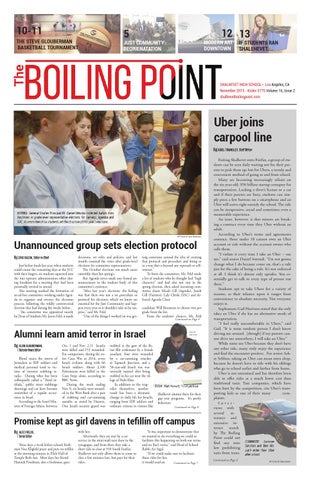
10-11
12 13
5
THE STEVE GLOUBERMAN BASKETBALL TOURNAMENT
MODERN ART DOWNTOWN
JUST COMMUNITY REORIENATATION
IF STUDENTS RAN SHALEHEVET....
SHALHEVET HIGH SCHOOL • Los Angeles, CA November 2015 - Kislev 5775 Volume 16, Issue 2 shalhevetboilingpoint.com
Uber joins carpool line By AIDEL TOWNSLEY, Staff Writer
VOTING: General Studies Principal Mr. Daniel Weslow collected ballots from freshmen in grade-level representative elections for Fairness, Agenda and SAC. A committee of six students set the structure of this year’s elections.
BP Photo By Gaby Benelyahu
Unannounced group sets election protocol By ERIC BAZAK, Editor-in-Chief Just before finals last year, when students could count the remaining days at the JCC with their fingers, six students squeezed into the tiny upstairs administration office during breakfast for a meeting they had been personally invited to attend. This meeting marked the formation of an ad-hoc committee, working under Agenda to organize and oversee the elections process, following the wildly controversial election that had during the weeks before. The committee was appointed mostly by Dean of Students Mr. Jason Feld, it made
decisions, set rules and policies, and last month counted the votes after grade-level elections for committee representatives. The October elections ran much more smoothly than last spring’s. But Agenda never made any formal announcement to the student body of this committee’s existence. “After last year’s elections, the feeling was that there was not a set procedure or protocol for elections, which we know are essential for the Just Community and happen every year so it shouldn’t take us by surprise,” said Mr. Feld. “One of the things I worked on was get-
ting consensus around the idea of creating that protocol and procedure and doing so in a way that is beyond any reproach or selfinterest.” To form the committee, Mr. Feld made a list of students who he thought had “high character” and had also not run in the spring election, then asked incoming committee chairs Micah Gill (Agenda), Jonah Gill (Fairness), Laly Chriki (SAC) and defeated Agenda Chair candidate Will Bernstein to choose two per grade from the list. From the students’ choices, Mr. Feld Continued on Page 4
Alumni learn amid terror in Israel By ELON GLOUBERMAN, Outside News Editor
Blood stains the streets of Jerusalem as IDF soldiers and medical personal tend to victims of terrorist stabbing attacks. During what has been colloquially called a “Third intifada,” public street stabbings shootings and car have become somewhat of a regular occurrence in Israel. According to the Israel Ministry of Foreign Affairs, between
Oct. 1 and Nov. 2,11 Israelis were killed and 153 wounded. For comparison, during the entire Gaza War in 2014, seven Israeli civilians along with 66 Israeli soldiers. About 2,100 Palestinians were killed in the Gaza Strip, alone, according to BBC News. During the week ending Nov. 8, six Israelis were wounded in the West Bank after a pair of stabbing and car-ramming assaults, as stated by Haaretz. One Israeli security guard was
Photo By Sam Cohen
stabbed at the gate of the Beitar Illit settlement by a female assailant, four were wounded by a car-ramming attacker at Tapuach Junction, and a 50-year-old Israeli was was seriously injured after being stabbed in his car near the village of Nabi Elias. In addition to the tragGUSH: Mati Hurwitz ‘15 in yeshiva. edies themselves, another result has been a dramatic Shalhevet alumni there for their change in daily life for Israelis, gap year programs. It’s partly ranging from IDF soldiers and behaviors ordinary citizens to visitors like Continued on Page 8
Promise kept as girl davens in tefillin off campus By ALEC FIELDS, Torah Editor
Three days a week before school, freshman Noa Kligfeld prays and puts on tefillin at the morning minyan in Pilch Hall of Temple Beth Am. Most days her friend Hannah Friedman, also a freshman, goes
with her. Afterwards, they are met by a car service in the mini-mall next door to the synagogue, and from there they take a short ride to class at 910 South Fairfax. Shalhevet not only allows them to come to class a few minutes late, but pays for their rides.
“It was important to demonstrate that we wanted to do everything we could to facilitate this happening on both our terms and on [her] terms,” said Head of School Rabbi Ari Segal. “If we could make sure to facilitate those rides for her, it would send an Continued on Page 7
Exiting Shalhevet onto Fairfax, a group of students can be seen daily waiting not for their parents to pick them up, but for Ubers, a trendy and convenient method of going to and from school. Many are becoming increasingly reliant on the six-year-old, $50 billion startup comapny for transportation. Lacking a diver’s license or a car and if their parents are busy, students can simply press a few buttons on a smartphone and an Uber will arrive right outside the school. The ride can be inexpensive, social and sometimes even a memorable experience. An issue, however, is that minors are breaking a contract every time they Uber without an adult. According to Uber’s terms and agreements contract, those under 18 cannot own an Uber account or ride without the account owner who calls them. “I violate it every time I take an Uber -- sue me,” said senior Daniel Soroudi. “I’m not gonna change what I do because come on, that’s a rule just for the sake of being a rule. It’s not enforced at all. I think it’s almost only upsides. You essentially get to talk to every type of person out there.” Students opt to take Ubers for a variety of reasons, as their reliance upon it ranges from convenience to absolute necessity. Not everyone enjoys it. Sophomore Gail Harrison stated that she only takes an Uber if she has no alternative mode of transportation. “I feel really uncomfortable in Ubers,” said Gail. “It is some random person I don’t know driving me around, [though] if my parents cannot drive me somewhere, I will take an Uber.” While some use Uber because they don’t have any other ride, many truly enjoy the experience and find the encounter positive. For senior Asher Sebban, taking an Uber can mean extra sleep, because he doesn’t have to ride with his siblings who go to school earlier and farther from home. Uber is not unionized and has therefore been able to offer rides at a much lower cost than traditional taxis. Taxi companies, which have been hurt by the competition, cite Uber’s transporting kids as one of their many complaints. Interviews with several attorneys and extensive internet search by The Boiling Point could not find any state COMMUTE: Summer law prohibiting Gershon and Ben Mosiach enter their Uber taxis from trans- after school. Continued on Page 2
BP Photo By Dana Alkoby
The Boiling Point • November 2015 • Community
2 BANNED: Ubers are no longer permitted in the school parking lot, so carpool line is only parents and friends.
Now trending: Uber joins carpool line while students disregard legal contracts Continued from Page 1
BP Photo By Katia Surpin
porting children. But in contracts – of taxi companies as comfort and danger of being driven around by a stranger well as Uber -- the restriction on minors is very explicit. is a pivotal concern of many who have ridden in Ubers. “The Service is not available for use by persons under “The downside is that sometimes it takes too long to the age of 18,” states Uber’s contract in a section called find an uber in the area,” Asher said. “Then, the Uber “User Requirements and Conduct.” “You may not autho- sometimes is late or is waiting in the wrong location or rize third parties to use your Account, and you may not makes a wrong turn. It’s also uncomfortable to sit in a allow persons under the age of 18 to receive transporta- car with a person you’ve never met before right after you tion or logistics services from Third Party Providers unless wake up in the morning, or after a long day at school.” they are accompanied by you.” Gail said she finds it hard to relax in the male-dominated transportation service. Only 14 percent of U.S. Uber explains the reasons on its website. “The Company cares about the safety of children,” the Uber drivers are female, according to Forbes. “I would feel more comfortable if it was a woman drivcompany states. “Because our Services are not directed toward minors, no one under 18 ing, but I’ve never actually had a womare allowed to register with or an Uber driver,” Gail said. The benefits are that Uber is a safe and conBut nationwide, only two percent of use the Services.” That means students who call venient way to travel about. I’m never stuck all taxi drivers are female, according to International Women’s Day magazine, and ride in Ubers are violating without a ride home or to school. the contract. Students inter-Asher Sebbban, 12th Grade meaning a female driver is much more viewed said they hadn’t read the likely to be driving an Uber than a cab. fine print. Websites associated with the taxi But they said the would still industry publicize assault accusations use Uber because of its many benefits, citing benefits in- against Uber drivers, while news media and social media cluding budgeting, being able to manage time through report on passengers attacking drivers. A spokesman for quick transactions, and its constant availability. the Taxicab, Limousine and Paratransit Association deTeachers feel the same way. scribed some of the differences between Ubers and taxis. “What I love about Uber is you can see where your car “A taxicab company has to meet a certain threshold is, how far away they are, [and] if they get lost you can of regulations,” spokesman John Boit told the Washington Post. “Those regulations cost money. Of course the track the car,” said English teacher Ms. Na’amit Nagel. Ms. Nagel considers Uber safe because of the “star” rat- industry is concerned that other companies are allowed ing system that comes with each offered ride. to come in and not play by any of the rules that the taxi “You know how many stars [the drivers] have, so you industry has had to abide by for decades.” can turn people down,” she said. “It’s also good that you Gail said she finds it hard to relax in the male-domcan send your E.T.A. to a family member so they can fol- inated transportation service. Only 14 percent of U.S. low you, and [for children] your parents can actually fol- Uber drivers are female, according to Forbes. low your car. In certain ways it’s safer than taxis because “I would feel more comfortable if it was a woman drivyou can be monitored.” ing, but I’ve never actually had a woman Uber driver,” Daniel Soroudi said there were also financial benefits. Gail said. “Uber is so cheap that it’s almost as much as gas would But nationwide, only 2 percent of all taxi drivers are cost,” Daniel said. “The amount of time saved for every- female, according to Internaone else makes it definitely worth it.” Nonetheless, the dis-
25-jan. 3 Winter Break
c Choirhawks con
1
22 Asara B’tevet
14
a Shalhevet Dram cts Festival of One A
6-14
Area Tour
ert - 5 pm
3-6
Channuka
Decemb6, 1e7, 2r0, 21
Choirhawks Bay
28 Alumni Dinner
an Steve Glouberm ament Basketball Tourn
eak
End of First Quar
26-29
Thanksgiving Br
13
ter
11
12-15
Veterans Day
November
tional Women’s Day magazine, meaning a female driver is much more likely to be driving an Uber than a cab. Students said most Uber drivers, however, are friendly and many enjoy their encounters with them. Among Asher’s many Uber drives he has had was an “accent-off” with a impressionist and a “stand-up comedy routine stand-off” with a stand-up comedian, though his conversations have turned serious at times, with a debate about Iran and the Middle East with a foreign driver. He also once met an aspiring musician and kept in contact to possibly collaborate. Ms. Nagel once met a fellow English professor who became an Uber driver to find inspiration and material for a novel by meeting new people and having conversations. When the Shalhevet administration learned that students are not supposed to Uber without a parent, their reaction to this previously unknown information was to research it. Just last year, the school had sent some kids in Ubers from the JCC to B’nai David and Young Israel of Century City during a heat wave, when classes were meeting in various synagogues and students needed to get from one to the other. Registrar Lili Einalhori took immediate action after learning about the contract language, which could leave the school liable if there was an accident. “I was not aware of it and I think the administration themselves were not aware of this,” Ms. Einalhori said. “So what we did is, now we have instructed our security booth that no Uber car can pick up or drop off in our lot – even if they are picking up an adult, because we are not going to question it, we are just going to not allow them on site. They will have to be picked up outside.” She said there would be an exception for staff member Daniel Schwartz, who is over 18 and physically disabled.
The Boiling Point • November 2015 • Community COLUMN THREE
3
Mystery power failure caused blackout “The building started getting really hot, and I couldn’t focus,” said sophomore Josh Forman. Although the blackout provided some interruption to the It was approximately 11 AM on Friday, Oct. 23, and students in Dr. Yoss’s ninth grade World History class were shocked as they natural flow of a Shalhevet Friday, many found positives in the checked their iPads and saw that their wifi connections had failed. experience. Despite the lack of air conditioning and light in the Soon after, the lights flickered off, and thus began a blackout that classrooms and it being “so hard for students to concentrate,” math lasted 2.5 hours and tested the patience of the students and facul- teacher Ms. Jennifer Kong said that “the room was bright enough, ty. Shalhevet Facilities Manager Lili Einalhori quickly determined and the students were really cooperative.” Additionally, many classes opted to learn outdoors due to the that it was an outside problem, not something in the school itself. But a week later, the Los Angeles Department of Water and heat inside. Art teacher Ms. Roen Salem took her class outside to draw at the third-floor Power had still not deterlunch tables. “It was so mined the cause. DWP beautiful outside, and the spokesman Albert Rodriclouds formed a shin and guez said that the outage, we all thought it was like which affected about 7,700 God was there,” Ms. Salem customers, was still under said. investigation. In an interInitially, the power outview with the Boiling Point age initiated sleuthing by Oct. 30, Mr. Rodriguez said Mrs. Einalhori and Conit was most likely the result troller Errol Briggs. The of equipment failure caused two performed required by high winds. However, checks both inside and outweather records surveyed by side the building, attemptthe Boiling Point showed no ing to locate the cause of winds in Los Angeles that the blackout. day. “We noticed that the A 17-hour DWP outDWP electric panel outside age affected almost 10,000 in the parking lot was out, customers Oct. 10, for exBP Photo By Jordan Levine which indicated that this ample. That one was caused by a cable that was damaged SUNLIGHT: Mrs. Nagels’s junior English class continued to learn with- was an outside problem and not an inside problem,” said by extreme heat and high de- out any electricity by moving class to rooftop turf. Ms. Einalhori. mand, according to KCBS. They then contacted According to the Los Angeles Times, 15,000 DWP customers lost power Sept. 10 during a DWP numerous times for updates, and after being told various possibilities of when the power would return, they were given the heatwave. This blackout was relatively small by DWP standards. “The majority affected lasted only an hour and a half, and then final estimate of 7:30 p.m. Surprisingly, the lights came back on they were able to turn the power back on,” said Mr. Rodriguez at 1:32 p.m, met by sighs of relief from students as the air condi. But at Shalhevet, it lasted much longer. During the blackout, tioning began to kick in soon after. At 2:24 p.m., the rooms still bathrooms and a portion of the second-floor hallway turned dark. remained relatively warm with the Beit Midrash being 74 degrees. Head of School Rabbi Ari Segal said the only adjustment he But most classrooms and open areas remained bright enough for had to make was opening his office door during some meetings. learning. “It didn’t affect my day too much,” Rabbi Segal said. However, Students brought their cell phones into the bathrooms to use as flashlights, and Mrs. Raelyn Bieda’s 12 noon PE class was exempt Rabbi Segal offered appreciation for the unity that it brought. “I from changing into their uniforms due to the pitch blackness that did love hearing the students and faculty simultaneously cheer enveloped the bathroom. Usually air-conditioned classrooms were when the power came back on, that was great,” he said. now said to be “disgusting,” “stuffy” and “difficult to focus in.”
By Lucy fried, Staff Writer
They should, or we should? By J.M. SCHNITZER, 12th Grade Having finally attained the multi-million dollar building of our dreams, it is to be expected that the overwhelming majority of Shalhevet students and parents are enthusiastic about the endless possibilities that the building holds, including hosting sporting events and spacious learning environments, and having a place to finally call home. The product of three different buildings in three years, I feel like a nomadic high school student who has experienced the now-forgotten outdoor Sports Court, the taming of the previously unused Annex building, and the heat wave of 2014 in the Jewish Community Center. When I entered the new building for the first time almost two months ago and encountered the seemingly endless spiral staircase and welcoming rooftop hangout, my jaw dropped right down to the can’t-miss Shalhevet flame stenciled into the polished concrete floor of the foyer. But a surprising trend has manifested itself this school year, one that could have been predicted months before any student had seen the new structure. I call it the “They Should Have…” phenomenon. When the first pictures of the gymnasium space became public, students and parents alike complained how the administration “should have” set aside a bigger space, for they couldn’t possibly compete athletically in a space so small. After climbing the full distance of the threestory-tall twisting staircase which serves as the nucleus of the entire building, people panted about how the school leaders “should have” avoided such an architectural disaster. People continuously gripe about how “they should have” factored in the allegedly unbearable heat of the water-saving artificial turf on the roof. Finally, exactly a year after a student-wide strike nearly occurred with the rising fall temperatures that afflicted the air-conditionless Jewish Community Center, the better part of the student body, myself included, is now whining about how the new building’s overly competent air conditioner is causing classrooms to feel somewhat chilly. The “They Should Have” problem is becoming increasingly prevalent, and paints us as spoiled and entitled students who are never satisfied, no matter how large the gift. In an age when the upgrade is always available, it comes as no surprise that the Shalhevet family is not immune to dissatisfaction. When we purchase iPhones, we are always anticipating the release of the newer, better models. With iPads, Kindles, Notebooks, iPhones, Galaxies, Macs, Surface Pros and a myriad of other devices dominating our market, we have so much to choose from, so many ways to fill our gluttonous and largely unsatisfied appetites. If one toy fails, there is another right behind it waiting its turn to please us. And our developed longing for instant gratification doesn’t apply only to purchasing state-of-the-art products. Having an infinite number of capable gadgets at our disposal with which to look up whatever question we have at any given time reinforces our expectation of instant gratification. If I order a shirt from Amazon and I don’t like the color when it arrives, I am one click away from ordering a new one that I like more. Many of us are not as self-reliant as we think; when we want dinner, money, or assistance with our homework, help is just a phone call away. I am as guilty of falling victim to instant gratification as the next guy (or girl), and I am certainly not stressing complacency when things legitimately bother us. But there is a right way to make change. Instead of harping uselessly to no one in particular about the air conditioning, we should meet with the administration to determine the ideal temperature the student body feels is most conducive to a successful learning environment. We shouldn’t just complain to each other and sit back and bite our tongues, We should make our voices heard in a constructive manner. We should try to eliminate the me-me-me culture and see the big picture. Our new building is a miracle, with years of planning leading to its erection, and it is up to us to decide if we will make the most of our opportunities or criticize it’s trivial flaws. Instead of what “They Should Have” done, why not ask “What We Must” do?
Sugar cereal breakfast bites the dust By EVA SUISSA, Staff Writer The sugar content is going down at Shalhevet. This year, instead of sweetened morning cereals like Frosted Flakes and Fruit Loops, Shalhevet has introduced healthier choices like fresh fruit, yogurt and almonds. Now, when students gather after davening for breakfast at the buffet in the kitchen area, they’re likely to see fresh fruit or yogurt, or toast with sunflower seed butter, or protein bars, apples and hard-boiled eggs – though not on the same day. Breakfast used to be cereal and milk. Shalhevet Executive Director Ms. Robyn Lewis, who organized the new program, said the goal is to encourage a healthier lifestyle. “The easiest way to go, and the cheapest way to go, is sugary cereals,” Ms. Lewis said. “But the truth is that’s not healthy, it’s not good for our students, and that’s not what we want to be teaching our students.” The idea for a new breakfast came this year when Mrs. Joleen Julis, a clinical nutritionist and mother of sophomore Maia Julis, invited Head of School Rabbi Ari Segal to an event at her home about healthy eating. The lecture intrigued Rabbi Segal, who brought the idea to Ms. Lewis. “We’ve always wanted to have a healthier breakfast,” Ms. Lewis said. “We just didn’t really know how to go about doing it, and what to provide.” After meeting with Mrs. Julis, the pair put a plan together. Over the course of a week, offerings now are fresh fruit, yogurt, almonds, granola, toast with sunflower seed butter or jam or cream cheese, protein bars, apples and hard-boiled eggs. So far, reaction from students has been
mixed. Most boys say they miss the cereal, a broader array of choices, she hopes the while girls are more divided. Others com- program will have a more positive impact. The change is part of a growing national plain that it runs out too soon. “I do like that they have fruit as an trend. According to an August 2015 report option, and yogurt, because, I mean, it is in The New York Times, over the past 10 better to have a healthy option, because I years the country has seen a significant indon’t usually eat fruit in the morning,” said crease in the number of schools that serve freshman Hannah Merritt. “When I have fruit and vegetables. But it does have one drawback: it’s it in front of me, I’ll take it.” Sophomore Maya Rosen likes it most more expensive. Ms. Lewis said it costs about three times as much as the cereals of the time. “Some days it’s good, but the choices served in the past. Because the school didn’t want to are very limited and sometimes it runs charge the students for that increased cost, out,” said Maya. it had to find a sponsor. They found one, Junior Bennett Schneier is less pleased. “Not everyday I’m feeling jam on with the family who originated the idea: toast, but everyday I am down for cereal,” said Bennett. “Instead of Whole Grain Chex cereal, give me the Fruity Pebbles.” Most days after breakfast, not much food is left. Fruit, sliced bread, granola and vanilla yogurt usually run out. That means less waste on leftovers, but students arriving after regular minyan complain the early-bird Hashkama students have eaten all the good stuff. “I’m a big dude, and it’s not as much food as last year,” said junior BP Photo By Gaby Benelyahu Isaac Goor. “Tuesdays and Thursdays are actually the most pathetic thing FUEL: Hashkama students take breakfast I’ve seen in my life. It’s bread, sun but- from the new, healthier selection. Items ter and jam. It’s quite sad.” available on different days include almonds, Shalhevet tried a similar but more Greek yogurt, fruit and protein bars. limited approach to a healthier breakfast two years ago, by moving from sugary cereals to less sugary cereals. Instead of brands like Frosted Flakes and The Julis family. “There should be a huge amount of Fruit Loops, they offered brands like Raisin gratitude from the student population Bran and Cheerios. According to Ms. Lewis, the plan both to the Julises and to the school,” said didn’t work because it was too limited and Ms. Lewis. many students simply chose to stop eating the breakfast altogether. This time, with
The Boiling Point • November 2015 • Community
4
No clapping, but all candidates heard in smoother elections By SHARON KHALIL, Staff Writer
For the first time in grade-wide representative elections, students were told to listen quietly and were not permitted to applaud, except for the seniors who were on a retreat and did not receive the instruction. Students split up by grade during Town Hall Oct. 15 to hear two-minute speeches from their peers on why they were the best candidates for Agenda, Fairness or SAC committee grade-level representatives. At school assemblies, administrators preceded the speeches by saying that the elections should not be a popularity contest. “I hope the candidates and the people voting for them know this is not the debate club,” said Dean of Students Mr. Jason Feld, addressing sophomores in the Beit Midrash. “We are looking for people who can take care of the details.” Cheering was allowed only for candidates who were running unopposed, so no votes would be affected by how much applause there was. Also, voting was held right when the speeches finished, so there was little time to find out who others were voting for or to campaign. Freshmen gathered in the gym, sophomores in the Beit Midrash, juniors in the theater. Seniors were away on a retreat and heard candidate speeches in the Beit Knesset a few days later. Sophomore Arman Marghzar told his classmates he’d be fearless if elected to the Fairness committee, which works to resolve disputes among students or between students and teachers or administrators. “Will you be scared to take Dr. Yoss to Fairness? Hell ya!” said Arman, referring to history teacher Dr. Michael Yoss. “Will you be scared to talk to me and I will take Dr. Yoss to Fairness? Hell no.” Junior Noah Suissa urged voters to elect him to Agenda because he’d be a great leader. “I am Town Hall,” said Noah. “I’ve been Town Hall. I think Town Hall.” Sophomore Sam Hirschhorn said he’d speak for sophomores before the Agenda Committee whether he was elected or not.
“I will write your proposals for you out of good will even if I don’t get elected as a sign of good will,” said Sam. And Ariella Sassover, running for freshman Agenda representative, spiced up her speech with a rhyme. “I am a very good listener and very approachable,” said Ariella. “You won’t be sorry if you vote for Ari.” There were many differences from the election last June, when a special Town Hall for candidate speeches wasn’t long enough for everyone to be heard, and students who hadn’t voted were invited to vote later and in some cases voted by phone. This time, voting took place right after the speeches. Ballots were handed out by General Studies Principal Mr. Daniel Weslow, Dean of Students Mr. Jason Feld, and Rabbi Ari Schwarzberg in the rooms where the speeches were made. In previous elections, ballots were handed out by Agenda and Fairness representatives and voting took place at lunch. In most of the sessions the tone was quiet and serious. In the Beit Midrash, Ilan Bouskila spoke about how Town Hall can get tedious and said he would help sophomores make propositions. He and Sam Hirschhorn won the tenth grade elections.
I hope the candidates and the people voting for them know this is not the debate club. -Mr. Feld, Dean of Students
Running for Fairness, Jordan Fields said students should not be afraid to bring cases involving teachers to the committee, saying that teachers would respect them, not resent them, if they did. He and Arman Marghzar were elected. The ninth grade saw six candidates competing for two spots on Agenda. Noa Kligfeld and Talia Gill were the winners. Talia said a representative should not only speak at every Town Hall, but listen to what others have to say as well.
INTERACTIVE: Four candidates for junior class Agenda representative answered questions from their classmates on a panel in the Wildfire Theater. BP Photo By Gaby Benelyahu
“I’m also going to represent those of you who aren’t quite as eager to share your opinions.” Talia said. Noa Kligfeld said it was important for grade-level reps to represent different kinds of students. “In order to create a kind of community where everyone feels at home, what we really need is a mixture of two voices,” said Noa in her speech. “The loud and the quiet.” Nicole Soussana and Noah Suissa won the 11th grade Agenda election. Nicole said she was dedicated and organized and would do things to the best of her ability. The 12th grade gathered on the morning of Oct. 19, in the Beit Knesset. Not all seniors could make it due to meetings and those who didn’t took a few minutes to vote the next day. One winning candidate was Will Bernstein, who made a strong showing in last spring’s run for Agenda Chair but lost to Micah Gill. This time, he won. “I’m sure you’re all familiar with how important the Just Community is to me,” Will said before the voting. He spoke about a step by step process that should be followed to make sure a proposal is done within a certain period of time.
BP Graphic By Gabe Silverstein
The other winner was Eric Bazak, who said grade-level representatives should take a bigger role on the Agenda Committee. “I think that the reps should actually start bearing more responsibility,” said Eric. Will and Eric won their election. An election committee convened by Mr. Feld counted votes at lunch on Oct. 20 and Agenda Chair Micah Gill announced the results on Schoology at 9:30pm that night. Staff writers Eytan Kent and Aidel Townsley, Sports Editor Zev Kent, and Deputy Editor-inChief Rose Lipner contributed to this story.
Unannounced committee of six students set election protocol Continued from Page 1
fecting voting decisions,” Micah said. Agenda handled logistics like holding speeches and casting votes. “We’ve only had three months to work together as a committee,” said Will Kasdan. “So far, we’ve counted the ballots for the rep elections. In the future, we will work to maintain and upkeep the elections.” What the group was trying to avoid was what happened in May, when ambitious efforts to change things ended up causing a lot of discord. A group decided to form a political party, called Maaseh, by looking for candidates to run as an all-or-nothing slate. But it was too close to election day and Fairness decided that candidates had to run on their own, though they could share positions and a platform. Then, last year’s Fairness Chair Goldie Fields sought 100 percent voter turnout by contacting novoting students and taking their votes
over the phone. This decision was hotly disputed because she is the sister of Alec Fields, who won the race for Agenda vice chair by just two votes and whom voters over the phone may have felt more inclined to vote for since they told their picks to Goldie. The Boiling Point also sparked controversy when Agenda disclosed to editors the vote totals for some winning and losing candidates for the first time, and Boiling Point immediately published those numbers. After receiving pushback from administration and some students, faculty advisor Mrs. Joelle Keene decided to delete that information from the story. Though all this was unprecedented, Mr. Feld said that election guidelines have always been unclear and inconsistent. Although the Agenda Committee could have set new concrete guidelines itself, Mr. Feld felt it would be more efficient to have a sub-committee do the leg-work for Agenda and focus strictly on elections.
“In theory you don’t need this committee,” Mr. Feld said. “[But] in reality, as long as I’ve been here, no one is quite sure how elections work. “The date of the elections seems to be pretty arbitrary,” he said. “Sometimes seniors are here, sometimes they are not here. Last year they didn’t even have the ability to hold a public debate for the candidates due to time constraints. All of that should be worked out if we are going to have a healthy, functioning Just Community.” Mr. Feld also said the committee would be a good way of involving more people in student government. Micah Gill, who dealt with the elections issue as one of his first tasks as Agenda Chair, said that the committee would help. “They are there to keep all elections as impartial, objective, and transparent as possible and to have a body that can take accountability for what happens,” Micah said. “The idea is that it is an entire entity that is totally objective. It is not an incumbent or a new person. There really aren’t any biases. It’s a different committee that can observe with a thirdparty eye.” The existence and role of the election committee were not mentioned during Just Community Reorientation meetings in September, and as of Nov. 10, it had not been mentioned at Town Hall either, or in the election assemblies each grade held before voting on committee BP Photo By Gaby Benelyahu
then chose Mark Miller, Hannah Diamond, Noah Suissa, Will Kasdan, Benny Zaghi and Rose Lipner to serve. Topics the committee tackled included things like election-related dates, campaign guidelines, official requirements to be on the ballot, voting eligibility, tallying ballots, how to announce winners, and what election results to release publicly and not to release, along with ensuring candidates have enough time to debate. Mr. Feld initiated an e-mail chain over the summer and half the members met in October to discuss policies for the representative elections. “I felt honored to be chosen for the committee,” said Mark Miller, who has never run for Just Community office. “I was excited because it allowed me to make a lasting impact on my school.” Given the work they were doing, Agenda asked them to collect, count and recount the votes for the rep elections. They also recommended that Agenda revert back to only publishing the names of winning candidates, and not the number of votes each candidate received. The committee did not, however, set the new policy of not allowing applause after candidate speeches. Agenda Secretary Rosie Wolkind said Mr. Feld initiated that policy himself. But Micah, who was away for the senior retreat during that decision, said it was a good way to make the elections more fair and objective. “We adopted this policy to prevent any external reasons from af-
representatives. But Mr. Feld said he wanted people to know about the committee and does not know why Agenda has not mentioned it yet. “I don’t see any reason why it should be secretive,” said Mr. Feld. “I don’t think it’s intentionally secretive. I hope that people on the committee get the credit that they are due.” Micah explained why the idea was not brought up in Town Hall. “At the time the idea was to get it done as effectively and quickly as possible,” Micah said. “Bringing the vote to the entire student body would delay the entire process. But it may go to the entire body within the next school year.” While it may have been more transparent to disclose information about the committee, Agenda is not obligated to, because matters of elections are dealt by the student government. Mr. Feld said having people who had never run for office across grades was a good way of reaching a wider consensus. He also said that once the committee accomplishes its goal of establishing protocols and procedures, it will disassemble. He plans to dissolve it after Agenda formally adopts election rules and guidelines, which would then be announced to the Just Community and amended to the student handbook. The group initially expected to send its report to Agenda by Oct. 2, he said, but their tenure was been extended due to a hectic early school year.
The Boiling Point • November 2015 • Community
5
Ten hours in 10 days reintroduce the Just Community
COLLABORATION: Student leaders run sessions devoted to re-learning crucical Just Community principles and developing policies for the “common good.” BP Photo By Ezra Fax
By MAAYAN WALDMAN, Community Editor
for critiquing possible ideas. Groups then applied the decision-making skills to policy issues in the school. Common good. Community. Proposals. Parallel thinking. “It was very Socratic,” said freshman Ayala Chocron. “Everyone These words bounced off the new Shalhevet walls during the first two weeks of school, as 10 hours of class time were devoted was able to give their own points and no one had to be worried to learning about and analyzing one of Shalhevet’s most unusual about holding anything back.” Some proposals from the reorientation are already in effect. characteristics: the Just Community. Students missed one period -- and once, two periods – of class Others, Agenda chair Micah Gill said at the first Town Hall, will per day as student leaders and teachers taught everyone new skills undergo an experimental period in the coming weeks. At the first Town Hall, a week and a half into school, Micah and vocabulary, along with Lawrence Kohlberg’s stages of moral deopened the floor for feedback on the reorientation and presented velopment. “Like anything you’re doing that’s important,” said Head of the new proposals regarding dress code and tefillah. The dress code proposals included forming a dress code comSchool Rabbi Ari Segal, “you need to revisit it, strengthen it, and mittee and creating a system in which a number of students are evaluate if it’s working in the way it is supposed to.” Interviews suggested that upperclassmen didn’t enjoy it as much assigned other students to watch and make sure they are in dress as freshman and sophomores did. But everyone -- including teach- code. (See related story). Tefillah proposals included having a ers, who were eager to get their classes cell phone basket in each minyan, with going -- agreed that the Just Community You need to be reminded about it so many student volunteers enforcing the use of was in need of a tune-up. the baskets and allowing students to read “It’s been fascinating,” said freshman times to actually be thinking about it. books about davening if they felt trouble Clara Sandler. “I really now understand -Laly Chriki, 12th Grade connecting directly with prayer. what the Just Community that I’ve been However, these two policies were only hearing about is. “ adopted in the main minyan. It was the latest in a string of Just The cell phone basket is only used when Dean of Students Mr. Community reorientations that the school has held over the years, though scheduled differently. Divided into seven sections that met Jason Feld is at the minyan, said sophomore Michelle Greenberg, a in various places around the school, they learned how to resolve regular attendee of the main minyan. But she said that even when problems like the lack of student initiative to clean up after meals Mr. Feld is not there, the students are careful not to go on their phones. by using specific methods of brainstorming and group processing. When the series was over, upperclassmen described the meetings By the first Town Hall Sept. 11, students had come up with five specific proposals to deal with actual controversies facing the school: with words like “useless” and “boring,” but they participated fully nonetheless. dress code and davening policies. “For the seniors, I don’t know if it was that helpful,” said senior For the 10 meetings, school was divided into seven groups, each led by students and teachers and meeting in a designated location, Derek Orenshein. “But the seniors’ being there had an impact on either the cafeteria, gym, Beit Knesset, Beit Midrash, Wildfire The- the freshman. We gave them ideas; we helped them realize what the Just Community was about. Even though it wasn’t helping us, we ater, theater stage, or the art room. The first sessions were about Kohlberg’s stages of moral develop- were helping them.” . A number of freshmen said the process gave them a fresh underment, which teach that the simplest motivation for doing something is to avoid punishment, while the highest level of decision- standing of what the Just Community is. But some were confused making is thinking of how the decision will affect the “common at first. “Even though we’ve done this so many times, I still don’t really good” of the community. In a workshop on parallel thinking, students learned to break know what the Just Community is,” said freshman Noah Altman. That sparked disagreement within his group until senior Laly down problem-solving into concrete stages represented by different colored hats. The “green hat” stage, for example, involves brain- Chriki, one of the leaders, clarified what the sessions were all about. “What we’re trying to do is answer Noah’s question,” Laly said. storming solutions to a given problem, while the black hat stage is
“We’re talking a lot about the common good, but now that’s what you’re thinking about. You need to be reminded about it so many times to actually be thinking about it.” Most teachers were initially frustrated that one or more of their classes would be missed for the programming, but eventually they saw its value. Ms. Tove Sunshine, who has five history and social science classes this year, thought the extra work was worth it. “It was incredibly stressful,” said Ms. Sunshine. “I was teaching a double load because I was teaching those sessions. But I felt it was getting off on a foot that made clear what our values are.” New General Studies Principal Mr. Daniel Weslow said he understood. “As much as that first week was grueling for students and faculty because it’s a new school year and we were taking time out of classes,” said Mr. Weslow said, “it was powerful in the sense that everyone was engaged in some capacity. “This process was vital to ensuring that everybody had a shared language regarding and around the Just Community.” The last time something was done in a similar light was in 2009, when the school was divided up into groups led by seniors and two full days were devoted to discussing the Just Community. “I think it’s perfect timing that they’re doing this now,” said music teacher Mrs. Joelle Keene, who has worked at Shalhevet since 2004, “but it’s not the first time. It seems to me that the school just needs to be reinvigorated once in a while.” When founding Head of School Dr. Jerry Friedman – a student of Lawrence Kohlberg -- was in charge, all new faculty had to come in a week earlier than the rest of the faculty to have a week of Just Community training, Mrs. Keene said. There are no plans to do anything as intense as the reorientation again this year, but Mr. Weslow said there would probably be “checkups” throughout the year, and in future years, to ensure that this is not a “one-and-done thing.” “We all get busy but one of the things that we need to remember to do is an inventory on how things are progressing,” Mr. Weslow said. The reorientation was planned over the summer with Dr. Steve Bailey, a researcher, author, and consultant in Jewish Education who co-founded Shalhevet with Dr. Friedman. Dr. Bailey led a weeklong Just Community training for faculty and staff. Using many concepts and techniques he introduced, Judaic Studies teacher Rabbi Ari Schwarzberg and Dean of Students Mr. Jason Feld took lead in preparing the curriculum for the programs.
Senior fundraiser auctions off parking spot By ABBY BLUMOFFE, Staff Writer One lucky senior doesn’t have to park off campus for the next two months. A recent fundraiser for the senior trip auctioned off one parking space in the already crowded teachers’ parking lot to licensed juniors and seniors. Nicole Newman, who happened to purchase the most tickets of those who bought, told the Boiling Point that her win was like killing two birds with one stone. “I knew the money was basically going to support the Poland-Israel experience,” she said. “Why not get a good spot in the process?” Her spot will last for two months and then there will be another raffle. Before the lottery Nicole used street parking. According to senior class president Rachel Sentchuck, the raffle raised $220. Nicole spent $60 -- thinking at the time that the spot
was for the whole year. The tickets were one for $5, but there were deals such as five for $35 and 10 for $60. At a dramatic drawing in the gym during Town Hall, Rachel declared Nicole as the winner. Several students gave her a standing ovation and cheered her name. Rachel told the Boiling Point that the school administration was on board with the raffle even though its own parking is limited. There are 47 regular spots and two handicapped. According to Facilities Manager Lili Einalhori, there are around 11 people from administration, offices and custodial staff who are parked in the lot from 8 a.m. to 5 p.m. The rest of the faculty comes and goes because teachers have varied schedules and take one another’s spots once they leave. Mrs. Einalhori said once construction is finished on the apartment complex being built next door, Shalhevet’s former student parking lot across Fairfax- now being used for the builder’s trucks
BP Photo By Gabby Benelyahu
WINNER: Senior Nicole Newman poses next to her prize, a spot for a month in the on-campus staff parking lot. and trailers - will again be available to students. “I think its a great idea and great fundraiser,” Mrs. Einalhori said. “I’m very proud of the kids who thought of it.”
6
Torah
The Boiling Point • November 2015 • Torah
NOVEMBER 2015
School gathers to celebrate newly completed Torah By NICOLE SOUSSANA, Staff Writer Shalhevet celebrated its first-ever Hachnasat Sefer Torah Oct. 29, with lively dancing and singing in the gym to welcome a newly completed scroll donated by the family of freshman Eytan and junior Zev Kent. A Hachnasat Sefer Torah is a ceremony to begin using a new Torah scroll, and the Kent family decided to commission this one’s writing and donation to Shalhevet in memory of Mrs. Stacy Kent’s parents, Herb and Rita Reznikoff. “It was really important to Ranon and I to choose something to memorialize my parents that really reflected what was important to them,” said Mrs. Kent, Zev and Eytan’s mother. “Having a Torah at the school that our kids attend, that our sons can lain from and that our daughters can learn from, is something I feel would make them very happy.” The celebration began at 8 a.m. Thursday morning with an introductory speech and dvar Torah given by Head of School Rabbi Ari Segal. Then the crowd of faculty, students and friends and family of the Kents watched as Pico-Robertson sofer Ron-
nie Siegar penned the last three words. A video camera followed Mr. Siegar writing the last three words of Devarim -- l’einei BP Photo By Gaby Benelyahu kol Yisrael, “in the eyes DANCE: Students celebrate with new Torah donated by Stacey Kent (center) and family after watching scribe Ronnie Siegar pen the last three words. of all Israel” -- projected onto the gym’s front wall as the crowd read the standard portion from Parshat girls on one side of the gym and boys ence,” said senior Derek Orenshein. “ watched in silence and anticipation. Vayera, as read weekly on Mondays on the other, students and teachers [It] gave us a certain appreciation for The scribe used black ink and quill and Thursdays according to the Parsha alike sang, danced and jumped around, the work it takes to actually write the rather than a standard pen, as required of the week. switching turns holding the newly Torah.” by Jewish law. Rabbi Segal thanked the Kents for Although slightly nervous, Zev said completed scroll. At first the Torah “It was very powerful to see a Torah he was happy to be given such an im- was on the boy’s side of the mechitzah their donation. being completed,” said freshman Ka- portant role. He read the story of Avra- (divider), but later in the celebration it “It says incredible amounts about tia Surpin. “It’s ham welcom- was brought into the crowd of danc- the values a family has when they something you choose to give a Sefer Torah,” said ing in the three ing girls. only get to see Judaic Studies teacher Morah Atara Rabbi Segal. angels into his It was very powerful to see a Torah once, if at all, in Mrs. Kent described the imporhome, display- Segal compared the celebration to that your life.” As being completed. It’s something ing the Mitzvah of Simchat Torah, proud of the level of tance and value of establishing deeply he completed you only get to see once, if at all, in of hachnasat or- student participation and spirit exhib- meaningful roots, which she hopes the the scroll, the Torah her family donated can provide ited during the ceremony. chim. your life. room burst into “It was so beautiful,” Ms. Segal to the students of Shalhevet. “It was really -- Katia Surpin, 9th Grade dancing and The new Torah’s cover has a black cool to be able said. “It was very exciting for me and song, followed to welcome a I loved how much the students were background and red writing – school by Shacharit, colors – and says: In loving memory new Sefer Torah into it.” morning prayers. Students had only positive feed- of Rita and Herb Reznikoff z”l, 2015, to Shalhevet, and I felt honored to be After the completion of the Torah, able to read from it for the first time,” back after seeing the work of a Torah 5775, By their children and grandchildavening began and junior Zev Kent Zev said. dren. scribe. became the first person to read from “It was an eye-opening experiThen came more dancing. With the the Torah donated by his parents. He
Dvar Torah: Why can’t I eat those doughnuts? By NICOLE SOUSSANA, Staff Writer
You know those awesome days at school where the administration gives us Krispy Kreme Doughnuts? Or the delicious, crunchy, and toasted cream cheese bagels the basketball team sells during breakfast? When I have to explain to my friends why I cannot eat these things, it is very difficult, because I hardly understand the reason myself. When I say that I keep halav Yisrael, I am saying I only consume kosher dairy products that were under constant rabbinic supervision while being produced. You can tell when something is halav Yisrael because it would say so next to the Kosher Dairy symbol. So where did the concept of halav Yisrael come from? Why decide to keep this extra stringency to begin with? I decided to research the question myself. When learning the original sources regarding the laws of halav Yisrael, it seemed clear that there should be no exceptions to this stringency in the laws of kashrut. In Tractate Avodah Zara 2:6, there is a long list of foods belonging to other nations that Jews are forbidden to eat but from which they may derive benefit. This list includes foods such as bread, oil and forms of fish. In addition, the Mishnah states that milk made by a non-Jew while a Jew is not watching is forbidden. The Gemara (Avodah Zara 35b) explains it by assuming that we are concerned that unsupervised non-Jews could claim that milk from a treif (non-kosher) animal came from a kosher
one. It then asks why are we so worried about confusing kosher and non-kosher milk, since after all, they have different colors and can be easily distinguished; we would know if a non-Jew switched their contents. The Gemara clarifies that we would have no way to know if someone mixed treif milk into the kosher milk. This is the rationale behind the laws of halav Yisrael. The Shulhan Arukh, written in the 16th century, expounds on the laws of halav Yisrael by clarifying what constitutes Jewish supervision. It says a Jew can sit outside while a non-Jew milks the animal inside so long as he knows the non-Jew does not have any nonkosher animals in his cattle. However, if the Jew knows that the non-Jew has a non-kosher
So where did the concept of halav Yisrael come from? Why decide to keep this extra stringency to begin with? I decided to research the question myself.
animal among his cattle, he may only sit outside if the non-Jew knows that when the Jew stands up he will be able to see him. This is permitted because the non-Jew will fear the possibility of the Jew standing up and therefore he will not mix the milks. The Pri Hadash, a commentator on the Shulhan Arukh, went further, ruling that if there are no milkable non-kosher animals in
the local area, then it is okay to drink milk that has not been supervised by a Jew. Although this seems a reasonable extension of the Shulhan Arukh, the majority of poskim disagreed with the Pri Hadash and declared that despite there being no non-kosher animals in the vicinity, the laws of halav Yisrael should still be strictly followed. But in America, Rabbi Moshe Feinstein – one the leading poskim of the 20th century -- cited the leniency of the Pri Hadash and applied its logic to modern times. He stated that companies nowadays that make milk are under supervision of the government, and that if they were caught mixing milk, their businesses would be shut down. This is very similar to the Shulhan Arukh in which the Jew is allowed to sit because the non-Jew will fear that he will stand and see him mixing milks. So too, the company is too scared to mix milks because if they are caught, they could lose their business and many people will be unemployed. Rav Moshe adds a legal principle: if you know something to be 100 percent true, it is as if you witnessed it. Since legal regulations allow us to know for certain that the milk is composed only of milk from a kosher animal, it is as if a Jew has witnessed the milking. He therefore concludes that halav nokhri, milked by a non-Jew, is permitted. It is on this basis that most kashrut-observing Jews – including the halachic deciders at Shalhevet – can eat Krispy Kremes and Oreos. But Rav Moshe added that one who chooses to only consume halav Yisrael may do so and it is not considered yuhara, halakhic
arrogance. And so despite the leniency, R. Moshe Feinstein himself only consumed halav Yisrael products as he mentioned at the end of his commentary. After learning all these sources in depth, I still do not believe that there is a set conclusion. It seems that keeping the stringencies of halav Yisrael is accepted, and so is relying on the leniencies of R. Moshe Feinstein. There is not just one correct path and either way, one’s opinion will be respected by the Jewish community. What does this have to do with me at Shalhevet? I think the reason I don’t eat Krispy Kreme Doughnuts or the students’ bagels with cream cheese is that I found value in learning about the halachot. Throughout the entire process, I felt my personal stringency not hindered, but rather strengthened. So for now I’ll be sticking with Munchie’s ice cream, Cafè Elite donuts, and bagels from La Brea Bagel. Although some teenagers may think otherwise, halav Yisrael food is pretty good!
BP Illustration By Noa Segal
The Boiling Point • November 2015 • Torah
School upholds promise as two girls daven off campus Continued on Page 7
important message to her and also to us about the value we place on helping a student do this.” Two years after a vigorous Town Hall debate and community discussion about the possibility of girls enrolling in Shalhevet who wanted to pray wearing tefillin, the hypothetical situation has now arisen. Rabbi Segal ultimately decided against letting girls wear tefillin at school, explaining in November of 2013 that “in order to maintain [Shalhevet’s] diversity, there will be times when something might be technically permitted but not wise to allow.” He also said that he would let such students skip davening at school and pray at a synagogue of their choice. “[I would] offer her the opportunity to put them on at a nearby synagogue or to put them on at home and then come to school to receive the best Judaic education in Los Angeles,” said Rabbi Segal shortly after making his decision two years ago. That’s what Noa expected when she applied, and that’s the policy that met her when she ar-
I like being in an egalitarian place where men and women are considered equal...Where I am considered to count, where I matter, and where if there’s nine people and I’m the 10th, we have a minyan. -- Noa Kligfeld, 9th Grade rived. Both she and Hannah are graduates of Pressman Academy, which is Temple Beth Am’s K-8 day school. They were encouraged there to wear tallit and tefillin every day. “I like being in an egalitarian place where men and women are considered equal, where if I wanted to lead I could, if I wanted to read Torah I could,” said Noa in an interview. “Where I am considered to count, where I matter, and where if there’s nine people and I’m the 10th, we have
7
a minyan.” The timing is tricky. Temple Beth Am’s egalitarian minyan begins at 7:30 a.m. and Shalhevet starts at 8, so the girls daven and dash to school, often arriving after their first-period classes have begun. They use the car service HopSkipDrive which is a more expensive version of Uber, designed for kids. According to the company’s website, a single ride is $20, or $12 per ride if a 50-ride package is purchased. “In terms of the background checks, it’s a bit more thorough,” Rabbi Segal said of HopSkipDrive. “It’s a little bit more expensive, but you know, if I can be safer and make sure the background checks are more thorough, I’d rather do that.” Noa had always planned to wear tefillin when she became a bat mitzvah, and was encouraged to do so while attending middle school. “The way I’ve always grown up thinking about Judaism is that there’s no difference between guys and girls when BP Photo By Alec fields it comes to halacha and we’re totally WRAP: Shalhevet student Noa Kligfeld (not pictured) wears tefillin at this egalitarian Temple Beth-Am minyan. equal,” Noa said in an interview. Hannah went to Pressman too and wants to go there that I would allow because he tarian minyan at Shalhevet. has led davening and read from the Torah, al“I wanted to find a way to accommodate and wants to be in an egalitarian minyan? Absolutely. though she does not wear tefillin. support [her] desire to put on tefillin while also If we had out of 220 students everyone going to “My whole life I grew up with that environhonoring and respecting the Orthodox norms at their own minyanim, that wouldn’t work.” ment,” Hannah said. “I don’t put on tallis or tefilRabbi Segal also said that he might let a stuShalhevet,” said Rabbi Segal. “At this point I delin, but I like to be in an egalitarian minyan.” cided girls are not going to be wearing tefillin at dent go to a different type of minyan. Since they do not want to miss too much class, “If there was a good reason … it can be somethe school.” Noa and Hannah attend Girls Singing Minyan But Noa and Hannah may not be the last one who really feels strongly that they want to go at Shalhevet twice a week, where Noa does not to ask to attend a minyan outside of Shalhevet. to a minyan that’s chassidish,” said Rabbi Segal. wear tefillin. Sophomore Amin Lari has expressed interest in “I’d be happy to talk to them about it and then “It’s too complicated,” Noa said. “I miss a few joining the Beth Am minyan, though he has not see if we can facilitate it.” minutes of class in the mornings, and it’s annoyFor now, though, it’s just Noa and Hannah. decided whether or not he will ask Rabbi Segal. ing to do that and I don’t want to do that every “I just like their way of prayer better,” said In spite of Rabbi Segal’s ruling out an egalitarian day. Amin. “From what I remember at Pressman, it minyan at school, Noa said she appreciates what “I do wish there was a way for me to wear he is doing. She also seems to understand his reawas louder and everybody was involved.” them everyday, but I’m also happy with the comRabbi Segal was not sure what he would do, soning exactly as he does. promise that we made.” “The school really wanted to let me be a Jew though he was open to the idea. Although it would be less expensive for Shal“There’s no blanket answer,” Rabbi Segal said. in the way I wanted to be a Jew while also staying hevet and more convenient for the girls, Rabbi “Do I imagine that there could be a boy who true to the school’s Orthodox values,” she said. Segal said again that he would not allow an egali-
Need help writing your college essay? High School Journalism with Judaism in Mind
Want to perfect your supplementary essay?
3rd Annual Jewish Scholastic Journalism Conference and Shabbaton in Los Angeles Feb. 25-28 2016
Looking to improve your writing skills?
For information and registration, visit jewishscholasticpress.org
Lynn Rohatiner 310.562.7778 zalissue@gmail.com
Sponsors:
8
Outside News NOVEMBER 2015
Alumni in tense atmosphere amid terror attacks in Israel Continued from Page 1
and partly feelings. Alumna Alexa Fishman ’15 who attends Midreshet Lindembaum in the Talpiyot neighborhood of Jerusalem, said she no longer feels safe. “I don’t,” Alexa said in an interview. “It has become this thing where we racial profile everyone we see. We’re always paranoid, and if we see someone coming toward us in the street, we cross the street.” Alumna Goldie Fields ‘15, who attends Kivunim, a program which is based in Jerusalem but visits Jewish communities in other countries, said she is not allowed to go to certain areas. “Normally, if there wouldn’t have been attacks, we could go out freely in Jerusalem and do what we want,” Goldie said. “[Now] there are only a few places we can go to, and we have to be careful about it.” Goldie and her classmates, including Nicole Feder, Sara Sobolev and Daniel Steinberg, all ’15, are not allowed to use buses or public railway services. Instead, they must either call a private taxi service or walk, if the distance is not too far. And a trip to Turkey was cancelled; the group will go to Greece instead. Most observers say the recent attacks are a result of Palestinians’ fear that Israel will change the status quo of the Temple Mount, where the Al Aqsa Mosque and Dome of the Rock Muslim holy sites are located. While those sanctuaries have been sealed off to non-Muslim prayer since 1967, a group of religious Jews ascended the mount during the High Holidays, and Jewish politicians have visited the site, among them Agriculture Ministers Uri Ariel,who supports the right of Jews to pray on the Temple Mount, and Knesset member Moti Yogev, according to Times of Israel. As Palestinian anger has risen and civilians have become targets, yeshivas and seminaries have reacted, as have the IDF and universities. Shabbatonim have been cancelled and students have not been allowed to visit certain cities or use public transportation. In Tel Aviv, at Bar Ilan University, Shalhevet alumnus Adam Kaufler ‘15 is not permitted to leave the small neighborhood of Ramat Efal where he lives. The restriction was lifted about a week after the first stabbings, however, and as of now students need consent only to visit Jerusalem or Judea and Samaria (the West Bank). In Alon Shvut near Efrat, Mati Hurwitz ‘15 attends Yeshivat Har Etzion, which has been on lockdown since the initial attacks, though students now may leave the campus with permission from a counselor. “I think that the word ‘lockdown’ makes people more afraid than they need to be,” said Mati in an interview. “I’m not afraid of this really small chance of getting injured. I’m not trying to minimize any of the tragedies that happened, but I’m just not living in fear. If you live in fear you let them win.” Although he understands why his school has taken measures to make sure that the kids are safe, he’s bothered by the fact that they leave very little freedom to leave campus, especially on Fridays. “I’d go to Jerusalem, I’d go hang out with friends, I’d coach my friend’s football team, go to the shuk [market] and buy stuff before Shabbat,” Mati said. “Because Gush is a little far away, a little re-
uation because they’re taking soldiers and commanders from the armies to guard bus stops, or anywhere there is a dense population of people in order to stop stabbing attacks.” But Saul also credits Israel for doing whatever it can to protect its citizens. He explains that the fact that soldiers who should be stationed near Syria are protecting citizens on buses demonstrates how far Israel goes to ensure the safety of its people. “Without a doubt, 100 percent I feel safe,” Saul said. “I have always felt safe here. My unit is just as relaxed as always and we joke around just the same as we did before the attacks started happening.” Alumnus Daniel Bain ’08 also lives in Israel, though he is not officially a citizen of the country. He lives in Givat Shmuel and commutes to Tel Aviv for work during the week at a startup doing marketing and Search Engine Optimization (SEO). “The main change in my daily routine is that I try to not use my phone or listen to music when I am walking to or waiting for a bus,” said Daniel in a phone interview. “There’s a conscious effort to not let it affect our daily lives, but people are still more cautious and aware of their surroundings than usual.” He says that some days are worse than others, and if there is an attack on any given day, Israelis are a bit saddened, but have become so accustomed to the heavy flow of attacks. He said the attacks have made times a little tense, but his day-to-day schedule has not been affected. “The atmosphere is still somewhat tense, but life goes on,” Daniel said. “The mood at the office can be a little somber each time the news breaks, but overall Israelis are very resilient. Unfortunately, this is something they have PROTECT: Since September, alumnus Saul Rothman ‘11 has experience with and have just gotten used to living with, been guarding Israeli bus stations instead of the border. but they don’t let it get in the way of living normal lives.” The worst days for Daniel are when attacks occur in Raanana, where his parents and brothers live. Courtesy of Saul Rothman “There was one day where there were I think five atmoved from everything, it’s just a change of atmosphere, which is tacks before noon, including a bus shooting in Jerusalem very necessary after a long day of learning.” and two stabbings in Raanana near where my family lives,” Daniel Changes of the opposite variety have come to the IDF, where said. ““First thing I did was called my family to make sure everyone soldiers are being sent into more dangerous areas to protect the was okay and reiterated to everyone to be careful and alert. After population. Alumnus Saul Rothman ‘11, brother of senior Noah that, there’s not much more you can do.” Rothman, serves in the Golani Brigade. The latest wave of violence started Sept. 27 when protestors on Saul was taken out of his army training program to guard bus the Temple Mount and barricaded themselves there, according to stations, mainly in Jerusalem and places with dense populations, Israel Ministry of Foreign Affairs. Israeli police countered with stun looking out for people who might be planning a terror or stabbing grenades and tear gas, and even charged the Temple Mount to stop attack. some of the violence. “We were in the middle of an anti-terror course, and they took Several Israelis were injured and many Palestinians were arrestus out of it and we have been doing duty on buses in Jerusalem for ed. Since the Temple Mount is such an important religious site for the past few weeks,” Saul said in an interview with Boiling Point. Palestinians, wider unrest was set off with more riots throughout Is“So they gave us a course to teach us really fast. When we see rael and multiple stabbings and attacks during the last few months, someone that we think is suspicious, we take them aside and we’ll starting in September. question them, look for signs in their body language and search Alexa, Goldie, Adam and Mati all said that even though they them. Usually they are easy to spot.” are there at a dangerous time, they were still glad they were there. Saul is frustrated because the army extended his Golani training “I’m still enjoying myself, but not nearly as much as before this an extra month, and believes he is playing the role of a policeman, was happening,” Alexa said. “I’m kind of used to being carefree and not an IDF soldier. fun and independent and doing your own thing, but now you have “The problem is that we’re not trained to interrogate people as to think twice about every plan you make and places you go.” policemen, we’re trained for war,” said Saul, “It’s a really bad sit-
Two victims of West Bank shooting had ties to LA Jewish community By MARK MILLER, Staff Writer Two victims of the recent low-tech violence in Israel had connections to the Shalhevet community. Rabbi Eitam and Naama Henkin z”l were the son and daughter-in-law of Rabbanit Chana Henkin, founder of the Nishmat women’s learning center and the Yoetzet Halacha program, which has a strong presence in the Modern Orthodox Jewish community of Los Angeles. The couple was murdered by two Palestinians as they drove home from a class reunion to Neria in the West Bank. It happened on Oct. 1, early in the current wave of Palestinian-Israeli violence, and was particularly shocking because their four children were in the car when they were killed. Rabbanit Henkin, who has spoken in local synagogues, is a pioneer in advanced Jewish learning for women. Her Yoetzet Halacha program trains women with the rigor necessary for graduates to serve as advisors to women on religious dimensions of women’s health. One of its graduates, Shoshana Samuels, has spoken at Shalhevet several times, most recently on Nov. 5, about the biblical
basis for the role of women as religious advisors. Rena Kanefsky, a member of B’nai David Judea Congregation on Pico Boulevard, knew the victims from her gap year learning at Nishmat from 2007-08. Naama and Eitam Henkin were her dorm parents at Nishmat, and Rena grew especially close to Naama. “She taught us Israeli songs, we baked, we hung out,” Rena said. “She was the person we could talk to, and complain to if we had issues.” She remembers Mrs. Henkin for her warmth and kind heart. “She was very kind, calm, and patient,” she said. “She was always walking around with her kids. She was exactly the image of what you would want a young mom to be, full of life and love.” Many in the Los Angeles Jewish community feel indirectly connected to Rabbanit Henkin because they benefit from the advice they receive from Yoatzot who visit the community. makes periodic visits to Los Angeles to advise the local community, whose interest in this service has dramatically increased. “When I first started, I would get a couple questions a month, and that has expanded to about 15 questions a month,” Ms. Samuels said. “Women consistently tell me how relieved
they are to have a Yoetzet to advise them.” She said she first started coming to LA as a Yoetzet Halacha in 2010, after Rabbanit Henkin told her that the LA community was very interested in having a female religious advisor on Jewish family life, especially for women who might be uncomfortable seeking advice from a Rabbi. “She sort of sat me down and said ‘I think you could do this… And if you go a few times a year, there would still be a sense of a presence and relationship between the community and the yoetzet,’” Ms. Samuels said. “And that’s what happened.” After the murders, Rabbanit Henkin said she would personally take on the care of her four orphaned grandchildren. Ms. Samuels has also spoken at Shalhevet twice about issues of sexuality in Judaism. Rena Kanefsky said that after the murder of Naama and Eitam Henkin, the LA Jewish community has considered several ways to honor their lives, including by translating Eitam’s books into English, or holding a learning event. B’nai David and other organizations have raised more than $3000 to help the family of the victims.
The Boiling Point • November 2015 • Outside News
9
Last Jews in Syria rescued in plastic bags, Israeli media say
Table Talk
News to Help You Schmooze
Water found on Mars After decades of research and exploration, on Sept. 28 NASA was able to confirm that there is liquid water flowing in Mars. Scientists gave an hour-long news conference about it which was broadcast around the world. BP illustration by Maya Rosen “Mars is not the dry, arid planet that we thought of in the past,” said NASA’s planetary science division director, Jim Green, at the news conference. “Liquid water has been found on Mars.” Using data sent by various Mars exploration vehicles, scientists were able to detect signs of hydrated minerals on slopes using an imaging spectrometer. In 2011, they saw streaks that seemed to flow over time, darkening during warm seasons and fading in the cooler seasons. It seemed unlikely to be water since Mars is so cold, so they called the streaks “recurring slope lineae.” But, using spectrometers, they recently determined that it was water, flowing only when the Martian temperature is above -23 degrees Celsius, or 9.4 degrees Farenheit. “The water can run in such frigid conditions because the salts lower the freezing point of water, keeping it liquid far below zero degrees centigrade,” said Alfred McEwen, a planetary geologist at the University of Arizona, according to the website of The Guardian, a prominent newspaper in London. Researchers believe that the water on the slopes came from underground ice or from an aquifer, an underground layer of water-bearing permeable rock. The discovery of water on Mars has led to speculation about whether humans can live there. The planet’s weather conditions are as brutal as Antarctica’s. There is a very low pressure atmosphere that is unsurvivable without suits, and three times as much solar radiation as on the International Space Station, according to Wikipedia. Some worry that thoughts of colonizing Mars might lead people to have a more casual attitude about polluting, or otherwise ruining, Earth. But scientists who support colonization on Mars now wonder whether water could be drawn up from underneath Mars’s surface. Some believe the liquid water could also be broken down into hydrogen and oxygen, and the oxygen would used for living units, according to Mars One, a website devoted to settling Mars. - Benny Zaghi, Staff Writer
Last week the IDF Special Forces rescued the last few Jews from the historical community in Aleppo, Syria. Amidst an intense civil war between three fronts -- the regime of Syrian President Bashar Al-Assad, the terrorist group ISIS, and Syrian opposition forces -- the IDF successfully evacuated the last Jewish family in Syria on November 7, and relocated the family to a refugee camp near the Turkish border from which it then moved to Ashkelon. According to Israelnationalnews.com, the mission was top-secret and was planned months in advanced. The IDF located the family with the help of American-Israeli businessman Moti Kahana, who reached out to the Jewish family with hopes of moving them to safety. Aleppo had a thriving Jewish community for thousands of years, although TimesofIsrael.com has reported that most Jews had left by the early 1990s. The family, whose name has not been released, feared leaving their country, believing they would be captured. To make matters worse, there were reports that ISIS was closing in on the family, according to The Jewish Chronicle, the largest Jewish newspaper in
England. Upon reaching the family’s home, IDF soldiers instructed the family members to hide in bags in a waiting minibus, where they would then be driven to Turkey, said the Israel National News report. These migrants join at least four million refugees who have left Syria since the start of the country’s civil war in 2011. The earliest refugees left Syria in May of that year, when an estimated 300 people crossed the Syrian border into Turkey. Four years later, Syria has lost 20 percent of its pre-war population, causing a refugee crisis that has challenged Turkey, Jordan, and Europe, becoming a political issue there and elsewhere. The war started in May 2011, after a harsh government response to a civilian demonstration. During the war, Assad used chemical weapons small and untrained opposition militias. ISIS joined the fight shortly after and now controls the northwest parts of the country. Government control is limited to the western border, while rebel forces are scattered. - Will Kasdan, Staff Writer BP illustration by Maya Rosen
The Boiling Point • November 2015 • Special Coverage
10
THE
STEVE
GLOUBERMAN BASKETBALL TOURNAMENT
By ZEV KENT, Sports Editor
W
While basketball has always been important to Shalhevet, this year it aims for a new level entirely as the school prepares to host the first-ever Steve Glouberman Basketball Tournament in the new gym of the new building. Games will take place both at school and in the JCC from Thursday, Nov. 12, through Sunday the 15th, and a Shabbaton is planned for the 14 participating teams. Schools from New York, New Jersey, Michigan and Maryland will be represented along with local rivals YULA and De Toledo (formerly New Community Jewish High School). The tournament is named in honor of Steve Glouberman, who passed away last January. Steve was the father of three Shalhevet alumni – Leah, class of 2013, and Jeremy and Rachel, class of ‘15. Their mother, Mrs. Flora Glouberman, says Steve loved sports, especially basketball. “I kind of feel like it’s the perfect way to honor him,” said Mrs. Glouberman in an interview. “Steve believed in competition, working with a team, never giving up, being a fighter, so I think it’s very important for his memory.” Head of School Rabbi Ari Rabbi Segal said the tournament was honoring someone very special. “We are thrilled to be able to memorialize Steve in this way, as he loved basketball and loved the idea of Jewish teenagers being together in this kind of way,” Rabbi Segal said. In an interview, Rabbi Segal said the tournament also aimed to build connections with the Jewish community. “The opportunity for sport to transcend philosophical and ideological differences is exactly what we hope to achieve this weekend,” said Rabbi Segal in an email to the community. “Of course we look forward to breaking the seal on our new gym with spirited competition. More important, however, we look forward to fostering a genuine sense of communal achdus [unity] and to build connection that will last a long time.” There will be two separate tournaments; one made up of eight boys’ teams, and the other comprised of six girls’ teams. Participating boys teams are Shalhevet, YULA, and De Toledo from Los Angeles, Frisch from Paramus, N.J. Salanter Akiba Riverdale Academy (SAR) from Riverdale, N.Y., Torah Academy of Bergen County (TABC) from Teaneck,
N.J., Abraham Joshua Heschel School from New York City, and Berman Hebrew Academy from Rockville, Md.. Shalhevet, YULA, Heschel, Frisch and Berman will be participating in the girls’ tournament, along with and Akiva Hebrew Day School from Southfield, Mich. The event is a West Coast first for Jewish basketball. In years past, the only tournament for Jewish high schools to compete in was the Red Sarachek Tournament, run by Yeshiva University in New York. Shalhevet won the Sarachek championship in 2013 and will compete again this year. But there will be several differences from Sarachek. First of all, Firehawk Athletic Director Mr. Eli Schiff said that while Sarachek teams come into the tournament with a predetermined ranking, at the Glouberman Tournament, Shalhevet administrators will decide how to rank the teams on the first day in Los Angeles, based on that day’s play. “We are going to take into account who played, how well, and possibly pre-tournament [expectations],” said Mr. Schiff. “Rabbi Segal, [Principal Reb] Noam Weissman and a few other people will sit down and determine the rankings.” Rabbi Segal said it was fair to worry about bias, so others would also be involved, though he declined to say whom. “There will be a seeding committee including non-Shalhevet staff members who will help determine the seeding,” said Rabbi Segal. Reb Noam said that it was “confidential, but an outside third party” would determine the rankings. The tournament’s second day, Friday, Nov. 13, will start actual tournament games and the teams will play according to rank, officials said. For the boys, the top seed will play the No. 8 seed, the No. 2 seed will play the No. 7 seed, the No. 3 seed will play the No. 6 seed, and the No. 4 seed will play the No. 5 seed. Because the girls only have six teams, the top two seeds will not play in the first round of the tournament, and seeds 3 and 6 will play each other, along with seeds 4 and 5. Following the seeding games, if a team loses, it will be out of the running for the championship and will only be able to play in consolation games with other teams who’ve lost, to determine what place each team ends up in. In between games, officials have planned threepoint contests for both male and female players so they can show off their basketball shooting skills.
A second difference between Sarachek and Glouberman tournaments Sarachek is only for boys. A third is that Shalhevet will host a full Shabbat program along with the tournament. “This won’t be in a university setting, but a high school setting with a great Shabbaton feel to it,” said Reb Noam. Organizers have planned Friday night davening and dinner at Bnai David Judea for the teams, followed by a dessert reception for the community. Saturday davening and lunch for the teams has been arranged at Beth Jacob Congregation, with a Se’udat Shelishit at the home of Shalhevet students Alex and Ben Reich. Reb Noam said that the tournament would offer a chance for the local community to become better connected. “Sometimes in Los Angeles, we don’t have so many opportunities to meet Jews from other cities,” said Reb Noam. “This is a great opportunity for students both within Los Angeles and outside to get together and to get to know one another.” Shabbat ends at 5:30 Saturday night and the tournament will resume one hour later back at Shalhevet and the JCC. But perhaps the biggest difference of all is that YU’s Sarachek is backed by a 6,438-student university, whereas the Glouberman is being backed by a 227-student high school. That means there has been a large-scale, community-wide effort to make it happen, one that will continue throughout the weekend. Many students and much of Shalhevet’s staff have been involved. “Families from every shul and school are hosting,” said Shalhevet Director of Development Mrs. Claire Benyowitz, who is coordinating much of it. “It has been amazing to see the community step up and come together.” None of the out-of-town players are staying in hotels. Mrs. Benyowitz has arranged housing with local families. “We have had to house over 160 people,” said Mrs. Benyowitz. “It has been a major undertaking as we wanted to make sure that everyone had a bed and was not on the floor. Also we wanted to keep everyone in the Beverlywood area. “All the administration at the school have had to work in every type of logistics,” she continued, “from security, cleaning crew, setting up all the rooms and gym as well as putting together a great Shabbaton, as well as working the school schedule.” Another organizational effort is broadcasting the games, According to Mr. Schiff, there will be no broadcasts of JCC games because the Internet there
is too slow. But Technology Director Mr. Y Frankel has set up a live video feed from the sc gym, so every game at Shalhevet will be broa live via Internet around the country. There will be five cameras at Shalhevet str ing through shalhevetboilingpoint.com, and Boiling Point will provide play-by-play repo and color commentary for most on-campus ga In addition to the administration and The ing Point, about 60 Shalhevet student volun will be doing things like selling snacks, kee score, keeping statistics of the games, and run social media.
Considering the lack of professional sup the greatest accomplishment of the Glouber tournament may be its existence. “There have always been ideas,” said Reb W man. “Coming up with ideas isn’t hard. Im menting them is. “We’ve always said let’s do a basketball tou ment in LA. The idea has been there, as have m ideas, but we decided to execute it now. We s with Flora and thought of a great way to h Steve’s memory.” Mrs. Glouberman said the tournam would be very meaningful for her amily. “Steve was an athlete, he played baske on the YULA team, and I met him that w she said. “He loved sports, and loved to w his kids play in any games they were in.” The Glouberman children played on six hawks sports teams. Leah played basketball and football, Jeremy played baseball, basketball, flag football and Rachel played volleyball. “My dad loved that we all played sports,” Jeremy. “He would try to come home from early to come and watch us play whatever spo were playing that day. He loved seeing us hav and enjoy something that he enjoyed to do w he was younger.” When Mr. Glouberman passed away af long battle with cancer, Shalhevet hired busses canceled a day of school so students could at his funeral. “The whole Shalhevet community was a and beyond kind to us and supportive of us, it was really important to me personally,” said Glouberman. “Steve and I both have such a lov Shalhevet and what it gave our kids and the c munity.” Mrs. Glouberman said it was Rabbi Segal came up with the idea of naming the tournam for him. “I went to Rabbi Segal and told him I’d to do something to honor him,” said Mrs. G berman. “He said they were thinking of doi tournament and he thought it would be a pe match. We can teach his legacy to other people continue his name through something that is fun and exciting.”
How to follow the games, at school and beyond Two out of the four days of the Steve Glouberman Memorial Basketball Tournament are school days, so will Shalhevet students be able to watch? Yes and no. When Shalhevet played in the Sarachek tournament in New York last spring, a screen was put up in the auditorium for kids to watch games during lunch and free periods. With the Glouberman games being right in
the building, administrators expect a major pull to watch during class. And that’s a good thing, said Principal Reb Noam Weissman. “We want the excitement of the tournament to affect the whole school,” said Reb Noam. “But when Shalhevet games are not being played, students and teachers will work together to make sure class goes on.” To address this concern and also have as many fans as possible present to cheer, all of the Firehawks’ games are being scheduled during nonclass time, and the bell schedule hs been adjust-
ed. All of Shalhevet’s play-in games to determine their seeding have been scheduled for during Town Hall period, lunch, or after school, and Town Hall has been cancelled. That means that except for the first day, the only Shalhevet game students will have to miss for class is one on Friday. That doesn’t mean all Firehawk games will all be held in the new building, however. Half will be played in the gym of the JCC. “Fortunately the community has been very welcoming to this tournament,” said Athletic Director Mr. Eli Schiff. “We have to thank many
different schools that are letting us use their time in the JCC gym for the tournament. I don’t think we could’ve run the tournament without them.” If you can’t be there in person, games played at Shalhevet will also be shown by live video feed on the Boiling Point website, shalhevetboilingpoint.com. Play-by-play, color commentary and interviews will be provided by the new staff of BPLive, supplemented by Judaic Studies teacher Rabbi Ari Schwarzberg. The broadcasts will also be reported for viewing later. — Zev Kent
The Boiling Point • November 2015 • Special Coverage
11
Yossie chool adcast
reamd The orting ames. Boilnteers eping nning
pport, rman
Weissmple-
Bottom left: Steve Glouberman playinng basketball for YULA in 1986 | Above: Steve with his son Jeremy, Shalhevet Class of 2015
SHALHEVET Los Angeles, CA
urnamany spoke honor
Noah Schechter Frisch
YULA
Los Angeles, CA
We are all just very excited...We know there is incredible talent in this tournament.
ment
etball way,” watch
Fired flag , and
HESCHEL New York City, NY
FRISCH
” said work ort we ve fun when
fter a s and ttend
above , and Mrs. ve for com-
Paramus, NJ
AKIVA
Southfield, MI
TABC
We’ve been working hard for the past couple of weeks, couple months and I
Teaneck, NJ
l who ment
want Glouing a erfect e and s very
Etai Bernstein De Toledo
BERMAN Rockville, MD
DE TOLEDO
Nicole Newman Shalhevet
West Hills, CA
SAR
Riverdale, NY
I think the biggest competition is ourselves, making sure we bring it all to the table.
Page design by Gabe Silverstein and Michelle Hirschhorn
12
Arts & Culture
NOVEMBER 2015
FUTURISTIC: Crowds enter the avant-garde Broad Museum, next to Disney Hall in downtown L.A.
BP Photo By Katia Surpin
On Bunker Hill, another art museum and another Broad quite a contrast in early October with the hot, sweaty, crowded lines outside. The lobby is a kind of cave -- the soft, gray plastered walls At 10:30 a.m., half an hour before the doors open, a line of 200 have no corners, and create a calm allure to the entrance. ticketholders and a standby line of 60 walk-ins brave the L.A. heat Guests are greeted by a legion of curators happy to answer all or to see the newest addition to the city’s arts scene, The Broad mu- any questions. The Broad museum’s app -- “The Broad” -- is easy to seum, which opened Sept. 20 on a corner across the street from the download with the free Wifi offered to all visitors. Walt Disney Concert Hall, Dorothy Chandler Pavilion, the ColTo the immediate left is one of the museum’s more popular burn School and MOCA. pieces, Yayoi Kusama’s Infinity Mirrored Room. Punch your phone Eli and Edythe Broad’s newest institution – the second mod- number into a screen and receive a text with a designated time to ern art pavilion in Los Angeles to bear their name – still sees 200 come down to wait in a quick line for entry. people with tickets per half-hour time slot, along with hundreds Sure enough, the walls are all mirrors, which infinitely reflect more who come in through the standby one another with dozens of multi-colored line. Despite the surplus of visitors, the LED lights hanging from the ceiling. Each wait for the “walk-in” line is usually no viewer has 45 seconds to stand alone on a Its location puts it at the nexus of the city’s more than 20 minutes, and access should small “dock” at the front of the space, carebe easier later in the year. ful not to step out onto the rest of the floor, most important cultural institutions. Just seven years after opening the which is covered in a layer of ankle-deep Broad Contemporary Art Museum at water, which also reflects the LED lights. LACMA, the pair have housed 2,000 The room is a small simulation of being in more works from their collection in a new $140 million, 120,000 cosmic, infinite and transcendent space. square foot museum designed by the New York firm Diller Scofidio If you want to catch this planetary experience, come before 2 + Renfro (DS+R). p.m. The machine has a limit, which for the past few weeks has been From the outside, the building is a futuristic white “veil,” which reached by early afternoon. is opaque aside from a single eye-like glass window the museum is Past this installation are the first few of the museum’s exhibit calling an “oculus.” The oculus lets light into “Oculus Hall,” which rooms, this one containing most of the modern pieces, ranging will be used for different events and speakers. from the 1980’s to the early 21st century. These rooms represent Inside, an assortment by 200 different artists is presented on a conclusion to the chronological pictorial history of American the first and third floors for viewing. The second floor, called “The culture from the middle of the 20th century to 2015, which the Vault,” holds works that will eventually will be put out on view in museum accomplishes. a rotation. At their entrance is a quote from Eli Broad: “I like the fact that The comfortable, air-conditioned interior of the building was art reflects what’s happening in the world, how artists see the world”
By Hannah Jannol, Staff Writer
By Hannah Jannol, Staff Writer The new Broad Museum is not the Broads’ first contribution to the arts and probably won’t be the last. According to Forbes, Eli Broad is among the 200 most wealthy people in the US.. With millions earned heading two Fortune 500 companies, he has created his own foundation while also generously supporting LA Opera, MOCA, Disney Hall and the Colburn School, as well as Jewish causes.
Born to Jewish immigrants from Lithuania, Mr. Broad embodies a rags-to-riches story that turns from being the CEO of the two Fortune 500 companies — KB Homes and SunAmerica — to retiring in his 60s to a career of what he calls “venture philanthropy.” He and his wife, Edythe, married for 57 years, formed their foundation in the 1960s. “Our philanthropy is not simply writing a check and giving,” Mr. Broad told CNBC in 2012. . “It’s really what I call ‘venture philanthropy’… And the idea is we are investing, and we are
facebook.com/Broad
Eli Broad: Rags-to-riches philanthropist
-- a good summary of the collection. The museum’s more prestigious works appear after a ride up a glass cylinder elevator, or a trek up stairs in a gray, dimly-lit tunnel. The light at the end of the tunnel is the building’s third floor, which from left to right, presents an artistic history of the U.S., beginning in the 1950s and ‘60s and ending with pieces from this year. Originals of iconic art pieces such as Andy Warhol’s Campbell’s soup cans, Marilyn Monroe and Elvis commence the aesthetic journey through America post-World War II. In the next room are canvas paintings and drawings by Edward Ruscha. Boss, 1961, is timeless despite being a commentary on a colloquial trend of the ‘50s in when people said things are “boss” when they’re cool. Millennials were squatting in front of the painting last month in commanding poses and facial expressions, noting how much of a boss they are for their social media followers. In the middle of the third floor is Tulips, 1999-2004, by Jeff Koons. Shipped in from Germany, the 205-inch piece is the focal point of a large room which addresses America’s political climate. One thought-provoking Keith Haring work depicts a pig vomiting money-green liquid which produces small creatures sucking the pig dry, illustrating the artist’s negative view of capitalism. In addition to the building and the art, the Broads provided an underground three-level parking structure. The Broad Museum will no doubt attract many art lovers for years to come. Its location puts it at the nexus of the city’s most important cultural institutions -- an area that is especially familiar to any Shalhevet student who has taken Ms. Joelle Keene’s Music Appreciation class. All the historic Bunker Hill sights featured in her unit on the urban renewal of downtown can be found near The Broad, which will likely be added to her curriculum.
investing for a return… “In the arts, it’s trying to get a much bigger audience. [We] try to educate a broad public on what the arts mean and how they fit in society. So we don’t just write checks –we work hard at it.” Aside from basically creatEli and Edythe Broad harmonic, Anti-Defamation League and ing the LA art scene, he has also B’nai B’rith, and gave a $100,000 grant to donated to the American Jewish Committee, American Friends of the Israel Phil- Friends of Israel Arts.
Drama prepares for one-acts in new theater By rOSE LIPNER, Deputy Editor-in-Chief sadie toczeck, Staff Writer In some ways, this fall brings a re-birth to Shalhevet’s drama department. After a year with no theater at all, when it adapted by using rented or improvised spaces, the group opens its first season in the new building with one-acts in the fall instead of in the spring, and the school’s first-ever musical after Pesach. The new Wildfire Theater is located behind the auditorium. It will use the auditorium’s stage – separated from the gym by the familiar whitemetal roll-up curtain -- and the black-walled Hashkama davening room for the audience. Tiered rows of chairs will be rented for the performances, which are set for Dec. 17, 20 and 21. “There’s a large stage with the possibility of
good lighting and audio-visual effects,” said drama teacher Ms. Emily Chase. “It’s much newer and cleaner than our old, dilapidated space.” There are still some things the drama department has yet to figure out. “We don’t know if we’ll put in permanent seats or find ‘flex’ seating,” said Ms. Chase. Ms. Chase has not announced what musical the group will perform, but said the switch to one-acts in the fall makes the musical possible. She’s looking for one at the right level of musical difficulty, with a meaningful theme and that is an adaptation of something famous. “A musical requires more preparation, so I chose to reverse the order,” said Ms. Chase. As always, the Festival of One-Acts will present five original plays by Shalhevet students, this year centered around the theme of forging identi-
ties. Genres will vary from sci-fi thrillers to comedy. The drama department also hired theater professionals to work with the cast and crew, including a stand-up comedy expert a set, light and video designer, and a professional stage manager. “It takes a lot of experts to pull toBP Photo By Gabby Benelyahu gether a strong evening of theater,” said Ms. Chase. DEVISING: Ezra Fax, Eitan Schramm and Tania Bohbot work “Going Out the Door,” by sopho- with Ms. Chase to produce two of the five one-act plays. more Aviva Katz, is about a religious girl trying to convince her mom to let her go “Behind Her Mask,” by freshman Donna to college despite their family ideals. Grunfeld, is about facing one’s inner demons. Ju“The Anomaly,” by senior Eitan Schramm, is niors Bennett Schnier and Alex Silberstein wrote a sci-fi thriller that focuses on a futuristic agency “The Untitled Comedy,” a comedy, and “Art For that detects anomalies in different universes to Art’s Sake” is by junior Tania Bohbot. protect the timeline.
13
FEATURES NOVEMBER 2015
NEW COLUMN
TEACHER TALES: Mr. William Reusch to Sheila, who was born in the Philippines, Mr. Reusch With 600 kids in his high school graduating class and teachers seeks difference. (They have a BP Photo By Katia Surpin who did not know his name, Will Reusch found his school experi- son, William Reusch IV, nickCHALLENGE: Mr. Reusch teaches Shalhevet’s US History class. He previously taught at inner-city schools. ence in Bethlehem, Penn., to be discouraging. He planned to be a named Beau to prevent family police officer. confusion). the curve. “I did not make the connection between school and my lifeIn his previous teaching Here, he said, privilege itself is a challenge — a challenge to long happiness,” said Mr. Reusch, who teaches American Histo- positions, Mr. Reusch faced the difficulty of classroom management ry and Government and Economics at Shalhevet. and students who entered his classroom lacking the basics. Some, make the most of it and make a difference themselves. “It is important to be aware of your privilege,” Mr. Reusch said. His parents had emphasized the importance of working in a for example, were not familiar with Abraham Lincoln. “Understanding the other side is really important. I would never field that benefits the greater community, as well as the value of They also resided in poor and unsafe neighborhoods. Six or sevwant students here to be anti-Zionist, but I think that the idea of diversity. So he enrolled in Penn State en were shot — two of them died University expecting to study law en— while he was their teacher, due challenging beliefs that you’ve been told from your first days is an forcement. But on his first day of colto gang membership, robbery and important part of growing up, and I think that is a tough thing.” “It is important to be aware of your privilege. He was somewhat surprised to find that affluence carries preslege, his professor spoke about the posimple bad luck, he said. understanding the other side is really important.” lice purely in terms of the power they Mr. Reusch visited one of these sures of its own. “You are in this situation where you feel like you have all these -Mr. William Reusch wielded — not the justice they were students, who was in a coma after opportunities,” Mr. Reusch said. “You think that that would be less charged to uphold — prompting Mr. being shot in the head, at the hospressure, but often times it is more.” Reusch to change his major. pital. Mr. Reusch advises students not to limit themselves or focus He began to consider whether he He did not, however, decide to solely on what college they want to go to. might make a bigger difference as a teacher, offering students a attend the funerals. “I felt awkward going to a funeral — I wasn’t “Kids are so concerned with the end game,” he said, “but if you more meaningful experience than he had in high school. close to the family,” he said. “I felt like I was trying to get this expe“I figured I would get to the criminals before rather than after,” rience. It was a self-righteous feeling and I didn’t feel comfortable are shooting for the goal, you miss the whole journey.” And recalling the lesson that he learned from his parents about Mr. Reusch said in a Boiling Point interview. “I want to get to peo- with it.” helping others, he said the journey should be worthy of students’ ple headed down a criminal or destructive path, and change their The overarching challenge of his previous jobs, he said, was “gettrajectory.” ting kids to understand that school is going to help them and is the advantages — pressure or not. “I think that you have almost unlimited opportunity, and I Since then, Mr. Reusch has worked toward this ideal at an eclec- easiest path to happiness and success.” think that it is such a gift,” said Mr. Reusch. “I would hate to see tic group of schools, including a predominately African-American At Shalhevet, he has encountered new and different challenges. school, an all-Hispanic school and now the Modern Orthodox Mr. Reusch says that because of their solid educational foundation, it squandered.”
By Hannah Diamond, 11th grade
Shalhevet. Surrounded by a diverse group of friends and married
the students require a lot of content, pushing him to stay ahead of
BP Photos By Gabby Benelyahu
IF I RAN SHALHEVET...
We know Shalhevet's awesome... But what would you change if you could? We asked some students and here's what they said. By ROSE LIPNER, Deputy Editor-in-Chief Eva Suissa, Staff Writer
“The biggest problem with Shalhevet?
“If I could change one thing, I would
Grades. If I ran Shalhevet, I’d
change the name of our school to ‘Hog-
replace A’s and B’s with only smiley
stickers and “Good Job” stickers. No
one would know which sticker is bet-
“If I ran Shalhevet, I
more learning driven, academic envi-
ers to fit my binders and
would have deeper lock-
ter to get. It would create a much
make art an optional class
ronment and root out all the fakers.”
for freshman, like navi or
-Henry Wineberg, 12th grade
Jewish history. I would also
warts School of Witchcraft and Wizardry,’ because why not?”
-Daniel Soroudi, 12th grade
“I would have school start later, shorten lunch, but end at the same time.”
-Noah Suissa, 11th grade
keep the air condition un-
der control-- it’s so cold in “If I ran Shalhevet I would put more recycling bins in the school and tell the student(s) to only
put recyclables in them. And to
not put recyclables in the trash bins.”
this building! Lastly, I would
“I would let students
rooms, and have locker rooms
- Shir Zahavi,
make more space in classand a student lounge.”
-Donna Grunfeld, 9th grade
teach once a week.” 12th grade
-Honor Fuchs, 9th grade
“(I would change the) break-
“I would have a longer
sugar cereal,”
. Maybe a vending
fast and make there be
-Bennet Schnier, 11th grade
break after Mincha . . machine!? (With) ice
cream and cold drinks.”
-Kira Faerstain, 9th grade
“I would take the owls off of the roof. They scare me.”
-Boaz Willis, 12th grade
14
Opinion
EDITORIALS
Bring election planning out from behind closed doors By The Boiling point editorial board
There is no doubt that over the past year elections have caused conflict and ruckus among the Shalhevet student body. Starting with the unprecedented proposal to run last year’s committee chair elections with party-like coalitions instead of every man for himself, continuing with the famous Feld v. Dano Fairness case, the publishing of candidate vote totals, and now the unpublicized election committee, we at the Boiling Point feel that something needs to be said. Obviously rules are needed. But the rule-making for elections needs to be transparent to the student body, and the student body should be involved every step of the way in working it out. One of the main controversies that arose last year was the forming of coalitions. Agenda rejected them saying there had been no time to debate and approve them. Someone needs to decide how that will be handled this year. Next was the race for Agenda Vice Chair between Alec Fields, Bennett Schneier and Eric Bazak, which Alec won. Agenda decid-
ed to release some vote totals, and Alec had only won by two votes. It turned out that his sister, then-Fairness Chair Goldie Fields, was in charge of whipping in votes and personally telephoned the last 10 or so non-voters, asking among other things whether they would like to give their vote to Bennett, Eric or Alec. Any student who has taken AP Psychology could tell you what kind of advantage this gave to her brother, however inadvertent. If the Boiling Point hadn’t published vote totals, this wrong and unfair vote-collecting event might have never been brought to light. After these events, Mr. Feld put together a small subcommittee – one which was never publicized – to advise Agenda on solving these problems. The committee was chosen in a multi-layered process from a list of students who Mr. Feld thought had “high character.” This group -- Mark Miller, Hannah Diamond, Noah Suissa, Rose Lipner, Will Kasdan and Benny Zaghi -- set the rules for last month’s election for committee reps, on its own, without even the Agenda Committee helping. Among other things, it decided that
candidate vote totals would not be released. We at the Boiling Point feel that all of this is wrong, and transparency is needed when it comes to elections. It is important for the Boiling Point to publish candidate vote totals, because in certain situations, that is the only way to know whether the election was fair. Furthermore, regarding the ad-hoc election committee, how we run elections is the job of the Just Community to decide, not six students from a list handpicked by an administrator. Going around the constitution of Shalhevet, and going around the respected and well-reputed Town Hall system, to decide on something as big as elections is a direct breach of the Just Community, the Shalhevet student body and Kohlberg moral development, and a huge offense to our entire system at Shalhevet. Most important, we should not assume this could never happen again and just let it go. We must take this into account, look forward, and with the entire student body and respect for the Just Community, amend the constitution and make changes that the entire school feels are necessary.
Girls and tefillin: Courage, expense and precedent By The Boiling point editorial board
Town Hall debates and curricula about women donning tefillin paid off this year when a freshman girl asked for permission to wear tefillin in the mornings. Two years ago, Rabbi Segal ruled that he would allow such girls to skip school Shacharit so that they can daven in a separate minyan. He stayed true to his word when he granted that exact privilege to the freshman this year.
The Boiling Point
Permitting that student, along with another who does not wear tefillin, to daven at Temple Beth Am’s egalitarian minyan and come to school late is a major, courageous and wise step taken by our school. It affirms our pluralistic values while holding on to the Modern Orthodox beliefs and practices that we teach. It also backs up our belief tangibly, by paying for their transportation. Though the amount is not large,
we wonder about the precedent. If this becomes an ongoing expense -- and especially if it grows, with more students attending off-campus minyans for other reasons -- it can add up to amounts that could provide scholarships, help students pay for trips or sponsor a Shabbaton. Rabbi Segal has indicated he would consider other students davening at alternative locations – more respect for pluralism, which we applaud. But eventually, the
National Scholastic Press Association Pacemaker Finalist 2015, 2014, 2012 Online Pacemaker Finalist 2015
Editor-in-Chief Eric Bazak
Managing Editor Michelle Hirschhorn
Deputy Editor-in-Chief Rose Lipner
Senior Editor Noah Rothman
Community Editor Maayan Waldman
Chief Layout Editor Michelle Hirschhorn
Outside News Editor Elon Glouberman
Layout Editors Noa Segal Gabe Silverstein Abbi Sentchuk
Torah Editor Alec Fields Opinion Editor Noah Rothman Features Editor Rose Lipner Arts & Culture Editor Mati Davis Sports Editor Zev Kent
2015 The Boiling Point
Photography Editor Gaby Benelyahu Advertising Editor Rebecca Sentchuk Graphic Design Editor Gabe Silverstein Website Editor-in-Chief Jordan Levine Faculty Adviser Mrs. Joelle Keene
expense could skyrocket. Perhaps letting Shalhevet girls wear tefillin and come to school late is enough of a statement. Of course, the school could allow girls to wear tefillin in our minyanim, or offer a separate minyan for those who wanted to pray in an egalitarian setting. But there are still some major Town Hall debates and curricula developments needed before that becomes a plausible option.
Story of the Year Awards 2014, 2012, 2011, 2010 All-American 2009, 2012, 2014
Simon J. Rockower Awards 2013, 2014, 2015
American Jewish Press Association 2015 Simon Rockower Award for Excellence in Jewish Journalism
Second Place
International First Place Award 2014, 2012, 2011 First Place Awards in Jewish Scholastic Journalism
Live stream of Glouberman Games Nov. 12 -15
National Award Winner 2007-2014
Gold Crown Award 2013, 2014, 2015 Gold Circle Awards 2011-2014 Columbia Scholastic Press Association
2014 and 2013
The Boiling Point is the student-produced newspaper of Shalhevet High School and is published 6-8 times yearly. Unsigned ditorials represent the majority view of the members of the Editorial Board, which consists of the Editor-in-Chief, Deputy Editor-In-Chief, Managing Editor, Senior Editor, Web Editor, Opinion Editor, Community Editor and Faculty Advisor. The Boiling Point welcomes submissions for signed editorials from members of the Shalhevet Community, and the final decision about print-
ing them is made by the Editorial Board. Letters to the Editor may be submitted via e-mail to shalhevetboilingpoint@gmail.com. The Boiling Point reserves the right to edit letters and opinion submissions and all become the property of The Boiling Point. Signed editorials and advertisements in The Boiling Point purchased by third-party organizations do not necessarily reflect the opinions of the Editorial Board or The Boiling Point as a whole. For information on advertising, please
write to Advertising Editor Rebecca Sentchuk at b.sentchuk@gmail.com The Boiling Point encourages readers to inform the newspaper regarding any possible factual errors found in print or online by emailing us as at shalhevetboilingpoint@gmail.com. When appropriate, we will fix the story online, and correct the error on Page 2 or on this page in the next print edition.
shalhevet boilingpoint. com
When we know it, you’ll know it.
The Boiling Point • November 2015 • Opinion
15 TWO BOILING POINTS OF VIEW:
Is it kosher to read during davening? Yes: An ideal alternative for the disconnected
No: Even though it’s hard, we have to pray By Noah Rothman, Senior Editor
Flipping through the first pages of Quest for Authenticity: The Thought of Reb Simhah Bunim during Ashrei at first felt a bit strange. In most Modern Orthodox schools, if my Artscroll was closed and I was channeling out the sounds of the chazan to concentrate on a book about the Przysucha branch of Hasidism, I’d be doing it wrong. But my initial wariness quickly faded once I saw how beneficial Shalhevet’s new policy -- allowing students read Jewish books during davening -- is for me and many other students. Contrary to what some feared, this new policy -- approved along with other davening innovations during out Just Community reorientation -- does not lower our school’s overall religious observance or harm the spirit of prayer. It raises it, by removing the main source of interference: noise from students who choose not to daven. This means the period between 9:05 and 9:40 a.m. can be more productive and meaningful for all those students who for whatever reason do not pray. It also makes perfect sense for our school, where students are meant to find inspiration from within rather than teachers coercing them to connect. Essentially, the new policy allows any student to spend davening reading an administration-approved book pertaining to Judaism. The approved books are historical, scholarly or prayer-related. Boys are still required to put their tefillin on and everyone must stand when it is time to stand, but readers can be fully immersed in their book throughout all of davening. Other davening innovations include a cellphone box at the front and a policy that asks the first students who enter the Beit Midrash to sit in the back rows, presumably since they are the students who are most likely to pray. In some ways, the new policy isn’t really new. The policy at our school has always been that nobody is required to utter a single word of prayer. Shalhevet does not believe in forcing students to pray, since that leads to an artificial relationship to davening and God. In my opinion, better to have one day of truly meaningful prayer than 30 insincere ones. Everyone is obligated to be at davening, of course, in order to fulfill the mitzvah of tefillin (for boys), support the common good, and have the chance to experience those rare, transcendent tefilot. But since the actual davening is not mandatory, many students, who either opt to never daven or are not in the mood to pray on a particular day, must sit quietly for 35 minutes straight. In the past, this has naturally led to increased amounts of talking during services, an eisur or violation we have all committed. When students converse during this time, moreover, they ultimately disrupt the flow of davening. Those davening in the back rows have difficulty keeping up with the chazan when students sitting beside them are exchanging thoughts about how the Lakers will do this year. From a halachik perspective, the new policy is thus an improvement. First of all, it prevents the aveira (sin) of talking during tefilah. This new policy is directed towards those who do not daven, a group I am part of more than half the time. Nearly everyone would struggle sitting silently for so long everyday with nothing to pass the time. Reading a Judaic-pertinent book has absolutely saved me from the temptation of talking during davening. Some may wonder about the halachik implications of students -- especially a boy wearing tefillin -- rea+ding a book while everyone else is praying. But I cannot fathom how reading a spiritual book would be viewed as halachikly worse than staring into space and twiddling one’s thumbs for half an hour, and I can objectively claim it is halachikly more favorable than talking. For the individual, this option presents another means of being spiritually productive during this time. The permitted books are not class-related or necessarily the most fascinating reads, but they are intellectually stimulating and allow the reader to remain connected to Judaism during this interval of time. I personally still say Shema and the Shmoneh Esreh, the two core prayers we say daily. I do not have to pick and choose between davening or reading, but can balance the two. Though others may feel differently, I feel my Shmoneh Esraeh is more meaningful now, as opposed to when I’d daven the entire time and feel a bit worn out by Shmoneh Esreh. Now, with a significant dent made on this book, I no longer feel hesitant in tuning out the chazan for the first half of davening. It may not be what other Modern Orthodox schools would do, but since when has that deterred us at Shalhevet?
At this year’s very first Town Hall, after the Just Community sessions had adjourned, the Agenda Committee brought forth an idea for davening. The idea was that students would have the option, if they liked, to select a book pre-approved by the Administration and read it during davening, as an alternative to actually praying. The plan was adopted and is now in force, but I personally oppose it. I understand trying to get kids to be connected to davening in any way possible, but taking a siddur out of someone’s hand is not the way to do it. For me this is a tough stand to take, because I can see my 9th- and 10th-grade self pushing for an alternative to the normal way in which Jews have practiced Judaism for 3,000 years. But still. The first area where I see this being a problem is in the area of fulfilling commandments and obligations in the morning. Shalhevet holds itself as a Modern Orthodox institution, where students are expected to daven twice a day at school, Shacharit and Mincha, and are given the benefit of the doubt that they will daven Maariv at home. The same goes for Friday afternoons – school lets out early and students are given the benefit of the doubt that they will daven Mincha, Kabbalat Shabbat and Maariv later that night. Those are also the expectations on all school-sponsored trips. On trips over Shabbat, students take part in all prayer services. Is the new reading policy something that Shalhevet is ready to expand to school trips? On the school-wide Shabbaton, will there be an issue if 35 kids are reading Lonely Man of Faith by Rav Soloveitchik? Or is that something that we are prepared to see – students no longer davening on Shabbat away from home, when we are supposed to be representing Modern Orthodox Jews in more public and unfamiliar places. Male students are required to put on tefillin every day at school. Once you have your tefillin on, you are then supposed to at least say the Shema. I personally don’t think it is okay for boys to miss out on the basic mitzvah of saying tefillot and putting on tefillin, which is a commandment from the Torah itself. If Shalhevet wanted to introduce a minyan where boys said the very basics of tefillah, then sat in a room for 30 minutes and read, that would be different. But entirely throwing out davening, even on a voluntary basis and even in favor of reading something religiously worthwhile, is not what a Modern Orthodox high school should be doing. Now I am going to use an argument that is easy and used a lot, but makes sense here. When students sign up for Shalhevet, whether coming from never having heard the Aleph-Bet song or transferring out of MBY, they are choosing to attend an institution that prides itself on teaching what it means to be a Modern Orthodox Jew. In short, that includes davening. It is obviously okay to struggle within Judaism and it can be very tough to learn how to connect to one’s own prayer, but throwing out davening is not the way to solve that. I personally didn’t appreciate davening so much until I learned about it in the 11th-grade Lahav curriculum with Rabbi Stein. Maybe more education about davening is needed, or maybe the 11th-grade Lahav should be introduced in 9th grade, before we turn to allowing students to not daven during Shacharit. BP Photo By Gabby Benelyahu
By ERIC BAZAK, Editor-in-Chief
Letter to the Editor:
Thanks for opening the doors, we won’t let you down Dear Boiling Point Editorial Board, While Ikar called the JCC home for many years, some members of Ikar disliked the building. Personally, I enjoyed gathering at a place so embedded in the traditions of American Jewry. It’s easy to see how for Shalhevet students, staff, and faculty, the time spent at the JCC was burdensome. I thank you for the wonderful comportment I witnessed among Shalhevet students when I was at the JCC during school hours, despite the many annoyances. My family and I were astonished to hear that Ikar was moving
its community gatherings to Shalhevet. We had only two weeks notice that our High Holy Days would be spent in an unfamiliar space. Like the Shalhevet students, we Ikar members had to adjust quicky to a new normal. Many of our childern had been named at the Westside JCC and had B’nai Mitzvot there. We had said Mourner’s Kaddish for many loved ones there as well. Immediately Shalhevet was a welcoming place. We have found our way into prayer at Shalhevet, and are able to worship with a much greater sense of security than we did at the JCC. I and many of our members have been concerned about the impact our use of the space would have on the “new” feeling of the
building. I am sure that the new Shalhevet building represents a major accomplishment for the school and, as much as possible, hope that Ikar’s use of your building can bring some positive results for Shalhevet as it does for us. I am writing this to let the Editorial Board know that we will do our best to warm the space with the lifecycle events and holidays we observe at Shalhevet. I am very thankful to the students and staff who are willing to share their space. John Crooks, Ikar member, Los Angeles
The Boiling Point • November 2015 • Opinion
16 POLITICS: From left, Republican candidates Rand Paul,, Mike Huckabee, Marco Rubio and Ted Cruz were among 11 candidates duking it out during the GOP debate Sept. 16. Below right, senior Nicole Newman with her favorite, Senator Marco Rubio of Florida.
Two rows away from Rubio at the GOP debate Photos By Nicole Newman
By nICOLE nEWMAN, 12th Grade Upon seeing me on television during the CNN Republican primary debate Sept. 16, my family and friends bombarded me with questions about whether the stage was really that hot, as all of the candidates seemed to be sweating. While I affirmed their assumptions as to the extreme heat, the room temperature was not the most important part of my experience. At the GOP debate in Simi Valley at the Reagan Library, not only did I sit in the second row during the 5 pm event for the bottom four candidates in polls, but the former governor of California, Arnold Schwarzenegger, sat next to me in the audience for a few minutes. Both during the breaks and at the conclusion of the debate, I was able to engage with the candidates. More specifically, I was given a brief opportunity to speak with Ted Cruz, Mike Huckabee, Rand Paul, Rick Santorum, Bobby Jindal, George Pataki and Marco Rubio. Likewise, I was able to meet and network with many powerful people who were the heads of newspapers and close associates of the candidates. Surrounded by such distinguished individuals, I felt blessed to be in that position. As expected, there was much commotion and few commercial breaks throughout the debate, which inhibited me from diving into deep political exchanges with the candidates. My interactions consisted mostly of a quick photo and an exchange of a few words like, “We appreciate your support for Israel, Senator.” Still, the stage was relatively small, with only 100 to 200 people in attendance. Therefore, I was able to see the candidates and talk to them during commercial breaks. While I looked forward to seeing all of the candidates, I was most excited to see Sen. Marco Rubio of Florida. Ever since I met him last year at the American
Israel Public Affairs Committee (AIPAC) and heard he might run for president, I have been an avid supporter. Although I do not agree with all of his polices, his stances on immigration policy, Israel, taxes, and overall foreign policy align with that of my own. These encompass my core issues. Therefore, Rubio’s vision for “The New American Century” is one that I support. After the debate, I was able to meet Sen. Rubio and tell him. Looking me straight in the eye, with a sincere smile on his face, he said he was very appreciative and proud that a young American Jew was so passionate about his campaign. This display of encouragement made me feel like I had made a difference, and that my voice mattered. I felt honored that a young 17-year-old girl, too young to even vote, was able to tell a presidential candidate that his support of Israel was vital. At the end of our brief conversation, he gave me the mug that he used during the debate, and I now keep it in my room. I was also able to speak with to the son of Dr. Ben Carson, Rhoeyce Carson. He seemed kind and very open to discussion. My father and I once again brought up the issue of Israel, and emphasized that his father’s support to Israel is both vital and appreciated. My father also talked to the young man about the medical field. While I am reluctant to discuss Donald Trump, his presence was definitely felt throughout the debate. The audience seemed to believe that Trump was both talented and knowledgeable. This
may be partially due to the fact that Trump is provocative, as the debate consisted of three hours of policy discussion, and Trump brought a light energy. He made the three hours bearable, for both people watching at home and those in attendance. He also received far more press than any other candidate at the debate. I do not see him as a viable candidate, and I believe that he is making a mockery of our political system and drawing undue attention towards himself. But there was some benefit to Trump’s presence, as this was the most watched debate in CNN history, and I think Trump played a great part in that. All in all, attending the debate was an incredible experience. I was able to see the initial phase of American electoral system at work by witnessing a live presidential debate, talking to candidates and discussing issues with important people. Collectively, this was the best night of my life, despite the heat radiating off of the stage.
17
Sports NOVEMBER 2015
One coach plus three teams equals plenty of victories gram.” This is also Coach Ryan’s second year leading In just his second year with Shalhevet, Coach Ryan Coleman is the baseball team. Last serving as head coach for three separate Firehawk sports teams, fol- year, he led them to eight wins, including their first lowing Colin Jamerson’s basketball resignation on Sep. 17. He now juggles basketball -- a big-time commitment spanning victory against the YULA much of the year -- with his other two responsibilities, flag football Panthers since 2008. BP Photo By Ezea Fax “Coach Ryan is someand baseball, which have seasons in fall and spring respectively. GAME TIME: Coach Ryan Coleman explains a play to football captain Jacob Dauer on the sideline during a break. Managing different sports simultaneously, however, is nothing body I look up to,” senior baseball player Josh Joffee new for the coach. Coaching three teams has allowed Coach Ryan to familiarize “I feel like I’ve been playing and coaching multiple sports my said. “The baseball team himself more with Shalhevet students, especially those who play entire life,” said Coach Coleman, who players know as Coach Ryan. is like family and we treat him with the respect that he deserves.” Mr. Schiff said Coach Ryan and the school will decide at the for him in two or even three sports. Senior Seffi Arnan, one of two “I like variety, and basketball is probably my first passion so I’d always find enough time for that.” Football season, well underway by end of the year whether they will continue the current situation, students who play for him in all three sports, said he was happy to play under him in so many activities. The other student to play all the time Coach Ryan was promoted in basketball, was the new ex- according to Mr. Schiff. “We’d have to see how this year goes and take it from there,” three sports is senior Elon Glouberman. perience for him this year. The flag football team was undefeated in “I like it a lot, he’s a great coach and a great person,” Seffi said. league play for the second consecutive year, capping off the season he said. “If both Ryan and the school feel like the current situation “I now get to know him better. He knows a lot in every sport he with a 15-14 victory in the Coastal League championship game . works, I’d love to keep Ryan on as the coach for all three.” For college Coach Ryan attended Sacramento State University, coaches in and manages his time well.” Last year, the flag football team was led by former math and science Coach Ryan also mentioned that he coaches each team uniquely teacher Mr. Christopher Buckley. After Mr. Buckley’s resignation which offered him an athletic scholarship to play basketball, and last year and parent Charlie Weisel’s brief stint as interim coach, the he was also invited to play on the baseball team . A groin injury he depending on the team’s skill level and the sport. “The football team more than any other team I let them run school gave the nod to Coach Coleman at the start of suffered in the beginning of basketball season prevented him from themselves and police each other and hold each other accountable playing either sport. After graduating, this year. and make it their team since they were so successful last year and I like variety, and basketball is probably my first he had been training and coaching “He’s a great coach, he really knows what he’s doing,” defensive football captain Kian passion, so I’d always find enough time for that. sports, mainly basketball, for 11 years. I tried to not get in the way of a god thing,” he said. “Basketball He coached at Calabasas High School needs more guidance, strategy and adjustments during the game, Marghzar said. “He puts a lot of faith in the -Coach Ryan Coleman for 5 years, followed by Newbury High and baseball is more trying to impress upon them a certain way that leaders on this team to facilitate and perform School, and then worked at a company the game should be played. I stress that time after time in practice their best. He already has a good relationship with the school and the players like him a lot, so it makes sense that which trains professional athletes and kids, mainly teaching basket- so by the time it gets to the game it became instinct for them to play that way and play aggressively.” ball, baseball, and beach volleyball. the school hired him for football too.” What Coach Ryan loves most about working at Shalhevet is the A commonality he uses with all sports is giving the players freeA sports junkie, Coach Coleman stated he mainly learned about respect he receives from students. football from watching NFL games on television. But that did not dom to lead the team during games. “My favorite part is the level of respect that the kids give,” “I really try with high school kids, especially on the varsity level, stop Mr. Schiff from believing that Coach Coleman was knowledga t to empower them and let it be their team,” he said. “I try to guide he said. “ When comparing it to coaching able enough to head the football team. Calabasas, you see a level of respect and “He has an extensive background in many sports, including them in the right direction but let them run the team. If I see they football,” Mr. Schiff said. “He holds conditioning practices for pro- don’t do something right I’ll interject, but for the most part I try to discipline at Shalhevet that definitely reflects the job that the community fessional athletes, and we felt he would enhance the football pro- let the kids run it as much as I can.” and parents do in raising the kids.”
By ERIC BAZAK,
Editor-in-Chief
Unexpected challenge for basketball as Coach Colin resigns Most people were shocked after hearing the news that Coach Colin Jamerson resigned as head basketball coach, but Coach Ryan saw it coming weeks before he quit. He and Coach Jamerson, who led Shalhevet to its first Sarachek win back in 2013, have known each other since 2011 through their work at Calabasas High School, where they run teams and a youth program together. Coach Jamerson confided with his colleague about his inclination to leave, wanting to ensure that Coach Ryan would be ready and
able to step up. It didn’t hurt that Coach Coleman had been the assistant varsity basketball coach last year, so he was already familiar with the Firehawk style of play. Although Coach Ryan does not know for sure why Coach Jamerson departed, he speculates it had to do with personal reasons. “I don’t really know his exact reason why he left, I don’t think anyone does,” Coach Coleman said. “But the commute is hard, he’s a single parent, and he feels a little guilty for not spending enough time with his daughter.”
A main concern for him stepping up as head coach was integrating the new position into his already hectic schedule, as he now coaches three Shalhevet sports. Though that may seem like too much to handle, no schedule conflicts currently exist. “Basketball and football take place in different seasons, as does baseball,” said Athletic Director Eli Schiff. “Football is a fall sport, basketball is a winter sport and baseball is a spring sport. There is no reason they should interfere with one another.
“And because I have a gym this year, I can schedule basketball practices around the other seasons’ practices or games.” Football practices were Sundays and Wednesday, and games mostly took place on Tuesdays and Thursdays. The football season ended Nov. 5, when the Firehawks won the championship game. Basketball practices are Sundays, Mondays, and Wednesdays, as Coach Coleman scheduled around the two sports so they did not conflict once basketball practices began in October.
In a transition year, Girls Volleyball heads into postseason By CLARA SANDLER,
The game that they struggled the most was when they played Wiseburn Da-Vinci Oct. 16. Shalhevet lost all three The Firehawk girls’ volleyball team rounds, and was only able to score 12 is in a transition stage and had a lospoints in round 1, 14 in round 2, and 21 ing record this year, but improved as in round 3. the year went on and are headed to Over the course of the seathe playoffs after placing third in the son, Coach Mike Sweet said he taught the Coastal League. basics and tried to get players ready to face Overall, they have a won teams that play at a faster pace. five matches and lost seven, whereas “I’ve sped up the practices and shortlast year the team went 6-3. But team ened them so that hopefully they’ll be captain Natacha Chowaiki thinks they prepared when they play teams that run a Photo Courtesy of MJ Glever did pretty well under the circumstancfaster paced game,” Coach Sweet said. SPIKE: Natacha Chowaiki scores a point against Pacific Lutheran. es. Varsity and junior varsity teams have “Now our team is mostly freshbeen practicing together so they adjust to Lutheran, Summit View West and Pacific Hills. man and sophomores,” said Natacha. the more competitive high school scene. Their best game was Oct. 19 against “They’re improving at every practice.” “I played volleyball for Maimonides for The team lost its final game against YULA Summit View West. The Firehawks won all three two years, but it was at a way different level,” said Nov. 7, 3-0. Earlier it played Ambassador, Wise- rounds, and limited the Wildcats to 10 points in freshman varsity player Ariella Sassover. “High burn-Da Vinci, Environmental Charter, Pacific round 1, 6 in round 2, and 9 in round 3. school volleyball is a lot more advanced than midStaff Writer
dle school volleyball.” Senior Sariel Elkaim said the group had developed some teamwork and players learned from each other. “We’ve all come together and made a better team in general because new players learn different skills from teams they were on before,” said Sariel. Coach Sweet said he was happy with the progress the girls made this season, particularly in “reacting instead of overthinking.” ““What we’ve changed recently is high intensity practices and a lot of rallies,” It’s worked well, we’ve done better since I made this change,” Coach Sweet said. The playoff season begins Nov. 10 at University Prep, and because they came in third place in the league, the Firehawks still have a chance of coming first in the Coastal League. That would be quite the finish after a season full of ups and downs.
The Boiling Point • November 2015 • Sports
18
Kian’s Calls
RIVALRY: Junior Rayna Wasserman runs towards the end zone on Oct. 12
Lady Firehawks trounce YULA 20-0 in flag football rivalry game at LACES Photo Courtesy of MJ Glever
By CLARA SANDLER, Staff Writer An intense girls’ flag football game with two touchdowns by junior Nicole Miles led to a blow-out of the rival YULA Panthers 20-0 Oct. 12 on the Firehawks’ home field at LACES. Coaches David Ouaknine and Tommy Cannon, who took over last year after the unexpected departure of founding team coach Christopher Buckley, led the team to success. “Last year when we played YULA, we thought that we were going to come out there scoring touchdowns left and right,” said Nicole, who plays halfback and running back. “It was our first time playing with our new coaches and YULA kept scoring, and we were nervous and we were too confident. “When I scored a touchdown this year, I thought the same thing — don’t be too confident. Just because you get one doesn’t mean you’re going to win.” But they won. The game had a defensive first half, though Shalhevet exploded in the second half with contributions from players on both defense and offense and from all grades. In the first half, juniors Sarah Yadegari and Michelle Greenberg made great catches, and their classmate Rayna Wasserman caught
an interception that prevented a touchdown by the Panthers. With all of this defensive action, YULA did not score — but neither did Shalhevet. Just as the second half began, Nicole — who was celebrating her 16th birthday that day — scored a 30-yard touchdown to put the first points on the board. She ran the 30 yards at top speed and after she scored, her teammates affectionately began to sing “Happy Birthday.” That started an onslaught of plays that eventually led to the win. The team missed the extra point for that touchdown, but it did not matter because YULA never managed to score. The Panthers had hoped to do better. “I watched last year’s game and learned from my mistakes and I expected it to be last year’s game,” said Panther quarterback Esther Dahan during an interview at halftime. “I was obviously nervous before the game started, but last year we were similar teams.” Shalhevet sophomore Sarina Finn and freshman Talia Abel both made defensive stops that prevented YULA from running the field and getting very far. Then, defender Michelle Greenberg scored a defensive touchdown by recovering a fumble in the end zone. “I saw that they left the snap, and I went
for the ball and didn’t even realize that I was in the end-zone,” Michelle said. “When the referees called touchdown, I was so happy! I never thought I was going to get a touchdown, I’m on defense!” Nicole scored the extra point, and the Firehawks were leading 13-0. Senior and team co-captain Rachel Sentchuk kicked a touchback, which eventually led to a turnover to the Firehawks and another 15-yard run touchdown by Nicole Miles. Junior Alex Reich scored the extra point, and the score was 20-0. Rachel had another touchback, and Talia nearly caught an interception, but the tail end of the game was not nearly as exciting and was quite uneventful. Shalhevet quarterback Lindsay Schacht and co-captain Rachel Sentchuk credited Nicole’s touchdowns with the win. “I think that this was our most evenly matched game,” Rachel said. “We just have more experience than them.” Coach Ouaknine attributed the win to teamwork, “The team exceeded my expectations today,” Coach Cannon said. “Our birthday girl, Nicole, and Alex — specifically our defensive line, our defensive team in general — they played exceptionally well.”
In 24-19 thriller, Firehawks outlast YULA By EYTAN KENT, Staff Writer
A rivalry game that Shalhevet expected to dominate ended up being one of the toughest of the season, as the boys flag football team narrowly defeated YULA 24-19 Oct. 21 on the home field at LACES. The team kept its undefeated streak alive in spite of two key players being out with injuries. Still, it blamed itself for how hard it was. “We came into the game too cocky and we underestimated them,” said coach Ryan Coleman in a post-game interview. “The team in a rivalry game that brings the most heart and energy wins, regardless of record.” YULA started out strong, and first half was close until at the end of the half Shalhevet pulled ahead by two touchdowns. Then in the second half, the Panthers pulled ahead of the Firehawks. But with a few big defensive stops, the Firehawks came out victorious. The first touchdown in the game came in the first quarter when Shalhevet quarterback Jacob Dauer threw a deep touchdown to freshman Zack Muller. During the second quarter, senior Kian Margzahr returned an
interception for a touchdown to force a fourth down. He swatted game, but we got lucky on one the ball down, which prevented return and we pulled out with make the Firehawks’ lead 12-0. the win.” At the end of the second YULA from scoring. Two Firehawk stars missed The Panthers had one more quarter, YULA drove down the field and scored with four sec- chance. With 17 seconds left in the game. Cornerback Seffie Aronds left, cutting the Firehawks’ the game, YULA had the ball on non was out with a back injury, lead to six points. Senior Micah a fourth-and-short, which would and wide receiver Eitan Halpert had an injured ankle.The playGill returned the kickoff for a be the outcome of the game. YULA decided to throw the ers who substituted were not the touchdown to make the lead 12 ball, even though their running same. points again at the half. “Naturally their lack of expeIn the third quarter, the Pan- game had been working for thers scored a touchdown that them. Firehawk linebacker Al- rience threw us off a little bit and brought the score to 18-12 Shal- exander Wiesel batted the ball we didn’t have as much chemistry as we wanted hevet. That’s when the too,” said Jacob. trouble really began. Eitan was inTo start the fourth, jured Oct. 12 at a YULA drove down the basketball practice. field and scored, giving He made a layup the Panthers their first and when he came lead of the night, 19-18. down, his ankle felt Shalhevet had to score very uncomfortable. again to win. Seffie was hurt Oct. With two minutes 18 while playing on left in the game, Jacob another flag football ran the ball into the end team. zone to score the winPhoto Courtesy of MJ Glever Both Eitan and ning touchdown. But DEFENSE: Firehawks prepare for matchup with YULA. Seffie returned to YULA was still playing play for the Firewell. hawks for the Loma “I didn’t think my touchdown was going to be the down and won the game for Linda tournament Oct. 23- 25. The Firehwaks’ record in the Shalhevet. game winner,” Jacob said later. The game was a nail bitter, tournament was 2-2, snapping YULA drove down the field their winning streak but leaving and with less than 30 seconds close all the way until the end. “By expectation, rivalries are them still undefeated in league left still had 30 yards to go to supposed to be dogfights,” said play. score a touchdown. Shalhevet cornerback Eli Micah. “I didn’t have the best Greenberg made a huge stop to game, Jacob didn’t have the best
College football: Year of the Running Back By KIAN MARGHZAR, Staff Columnist College football continues to grow in participation and in viewing. The National Championship last year set an ESPN record for the most viewed program in the channels’s history. Also, despite recent reports of brain damage to former football players, the sport still attracts the country’s best athletes. High school football prospects are still being recruited by top schools, and know scholarships and possibly money in the NFL await them. This year’s batch of college running backs is so good that they are taking a lot of the Heisman attention away from quarterbacks. The last running back to win the Heisman trophy -- given to the “most outstanding player in college football in the United States whose performance best exhibits the pursuit of excellence with integrity” -- was Mark Ingram in 2009, but that was the only one this entire century. Not only that, but since 2011, there have been a total of four running backs in the top five for Heisman voting. That means that out of the 16 best college football athletes in the past four years, only a quarter were running backs. The majority were quarterbacks, which is why most experts consider the Heisman is a quarterback award. This year has a completely different story to tell. The man leading all the hype this year is Heisman favorite Leonard Fournette of Louisiana State. This man among boys has already become the first ever LSU Tiger to rush for 200 yards in three consecutive games. He’s carrying an LSU team with no elite QB to one of the best records in the best division – the Southeastern Conference (SEC) – and a top 10 rank in the AP Poll. Fournette is putting up crazy numbers for a sophomore: 16 touchdowns and 7.1 yards per carry for 1,383 yards in the season. His 6-1, 230-pound frame allows him to run around and through defenses, which will make for highlights all year long. Another elite running back this year is Florida State’s Dalvin Cook. Although his Seminoles are out of contention for the College Football Playoff, he still goes all out every game. His numbers speak for themselves: through nine games, 1,231 rushing yards, with 8.3 yards per attempt, and 12 touchdowns. A key reason that the SEC is still the best conference is yet another running back, Alabama junior Derrick Henry. Through 9 games, Henry has 1,254 yards, 5.8 yards per carry, and 17 touchdowns. The last running back to look at this year is Ohio State’s Ezekiel Elliot. You might remember him as the man who carried (no pun intended) the No. 4 Buckeyes to the national championship last year. In the last three games of the season, playing in the Big 10 final and the college football playoff (the best of the best), Elliot ran for a total of 676 yards and 8 touchdowns. Well, this guy is now a junior and holds even higher expectations. The Buckeyes haven’t lost a game yet and Elliot is a main factor for their impressive season. In nine games, Elliot has rushed for 1,244 yards and 14 touchdowns. His great performance this year has blunted some of the negative attention his team received this year due to its quarterback problem. Although Ohio State’s original starting QB, Braxton Miller, was activated as a WR, the Buckeyes still had two other QB’s worthy of the staring job. Those two QB’s J.T. Barrett and Cardale Jones, unorthodoxly both played in a dual quarterback system. However, almost Ohio State Coach named Barrettt the starting quarterback, JT was suspended for a game for suspicion of a DUI. Numbers-wise these guys are all qualified to get the coveted award, but what about team-wise? Well, we will just have to wait and see how the college football season unfolds. But who has the time to wait?! The Call Heisman voting: LSU RB Leonard Fournette TCU QB Trevone Boykin Alabama RB Derrick Henry Baylor WR Corey Coleman Ohio St. RB Ezekiel Elliot
The Boiling Point • November 2015 • Sports
19
The Boiling Point • November 2015 • Sports
20
BACK TO BACK: Firehawk flag football wins again in Coastal League By ZEV Kent, Sports Editor NATHAN BENYOWITZ, 11th Grade Helped by a controversial play near the end of the game, the Shalhevet Firehawks boys Flag Football team defeated AGBU of Winnetka 1514 Nov. 5 at Crossroads Field, to complete their second straight undefeated league season and win the championship of the Coastal League. The game had been close all throughout and Shalhevet had fallen behind, then made a fourthquarter comeback. But in the last minutes of the game, AGBU threatened to score, and running back Micah Gill faced a choice: whether to let the Titans catch a running pass to win the game, or commit a foul and hope not to be caught. “If I hadn’t pulled the jersey, the game would’ve been over,” said Micah the next day. “I knew even if the ref called that on me, it would be better than giving up a touchdown.” So he held onto an AGBU’s wide receiver’s jersey, preventing him from catching the ball and scoring a goal that would likely have given the game to the Titans. “If you ask me now if I held it, I completely did hold him,” said Micah. “But it was a calculated risk. I knew if he got away the game would be over, and I had a chance of getting away with the hold, so I would do that 10 times out of 10.” It was a dramatic ending to the team’s third season, one which the Firehawks had dominated, though they lost some games in the Loma Linda tournament against much larger schools. In the Coastal League, they won every time, besting Vistamar in the semi-finals Nov. 3, 27 - 7. Two nights later, they again took home the championship plaque for the second year in a row, this time led by new coach Ryan Coleman. Once again, the championship was played on the home field of Crossroads School in Santa Monica. The excitement of the game had started hours before the 6:30 kickoff time. During Town Hall, senior center Noah Rothman led a pep rally for the championship game. Quarterback Jacob Dauer said the schoolwide attention meant a lot. “The pep rally really helped,” said Jacob in a pregame interview. “I can’t wait for the fans to come and cheer us on.” Defensive lineman Edan Sokol expected the game to be tough. “It’s going to be a physical game -- we better be ready,” Edan said. “But I am an animal, so nothing scares me.” Coach Ryan Coleman, who was not at the pep rally, was feeling relaxed and confident before the
game began. “Hungry,” said Coach Ryan in an interview. “I am relaxed and confident that if our guys play the way that they are capable of playing that we will take care of business.” AGBU also felt pumped. AGBU stands for Armenian General Benevolent Union, and the school’s full name is AGBU ManoogianDemirdjian School. “I am feeling pretty good,” AGBU Coach Jack Keshishian told The Boiling Point prior to the game. “It’s been a good season and I am really proud of my kids.” Senior captain Vayk Voskian was also prepared. “I am pretty hyped up,” said Vayk. “I am happy with my team and happy to be in the championship game.” The air was unusually crisp at 60 degrees and people had taken out their rarely worn winter coats. Head of School Rabbi Ari Segal finally got to wear the snow jacket given to him last year by the Finance Club. But the Firehawks got off to a rough start. Quarterback Jacob Dauer threw an interception on the first play and AGBU scored a touchdown. Edan Sokol soon forced a safety, giving Shalhevet two points and the ball. Shalhevet was down 6-2, but after a defensive stop and an offensive drive, the Firehawks were back in scoring position when Jacob threw a touchdown to wide receiver Eitan Halpert. Leading 8-6 with about two minutes left in the half, Firehawk cornerback Seffi Arnan made a huge defensive stop on the fourth down with a minute left in the half, securing Shalhevet a halftime lead. Halfway through the third quarter, AGBU scored a touchdown off a Hail Mary pass that gave AGBU a 12-8 lead. AGBU Coach Keshishian told the Titans to go for the two-point conversion, which they converted off a tipped ball by Shalhevet linebacker Sammy Ellenhorn, bringing AGBU’s lead up to 6. But things improved for the Firehawks at the end of the third quarter. Shalhevet’s offense was in the red zone and the fans on the sidelines
were going crazy with cries of “Lets go, Firehawks lets go!” As the fourth quarter began, Shalhevet had a second down in the red zone. The Firehawks did not score, but fans and the team never lost hope. At this point AGBU fans started to chant, “I believe that we will win!” – feeling confident now that their team had won the game. But then, with about three minutes left to play, Shalhevet started driving and Firehawk nation started roaring. BP Photos By Katia Surpin Jacob Dauer capitalized on this opportunity, CHAMPIONS: Firehawks play their hearts out in a comeback win against AGBU to win their second Flag Football championship in a row. throwing to Eitan for his second touchdown, tying the game at 14-14 with with 50 seconds left and AGBU had to go for it. about 1:45 remaining. Sammy Ellenhorn and Micah Gill made the Jacob then found Seffi in the back of the end final stops and the Firehawks prevailed as Coastal zone on the extra point to take a 15-14 lead. League back-to-back champions. But with about 1:30 left in the game, AGBU After the game Coach Ryan – who will coach started to drive. Sammy Ellenhorn and Micah basketball and baseball later this season -- was jumped up in the air and deflected an incoming emotional, telling his team how proud he was. pass. It was then that Micah grabbed the Titan’s “As for the seniors that only play football, I’m jersey, unnoticed by the ref. going to miss you guys,” said Coach Coleman. Micah said that he did not consider what he “But for the seniors that either play baseball or did to be cheating because the actions of the refer- basketball, let’s go get two more championships!” ee, and human error, are always part of the game. Despite the loss, AGBU’s coach Jack KeshIn the third quarter, he noted, the opposite ishian was proud, too. had happened. Firehawk linebacker Kian Mar“Coming in from last year finishing in last, to ghzar was called for a defensive hold while try- coming in second this year and having a chance at ing to pull a Titan’s flag. The player’s jersey was the title, I am very proud of my kids,” said Coach untucked so it looked like Kian reached for the Keshishian. jersey when in fact he had not. Micah Gill tried to describe his feelings as the “I was furious because I’ve been making that game ended. play for two years and the refs haven’t called [any“Unbelievable, almost at a loss of words,” thing], and they called it in the most important said Micah. “From start to finish that game was game of the season,” said Kian. “That almost cost a grinder. Our offense got the job done, but our us the game. defense won us the game tonight.” “The rule that I’ve been playing for the past Or perhaps more accurately – as in any game – two years was if it’s clear that you’re going for the the offense, the defense and the referees. flag, the call shouldn’t be made.” Two defensive stops later it was fourth down