The ICISA INSIDER Publication of the International Credit Insurance & Surety Association
Volume 15 | April 2020
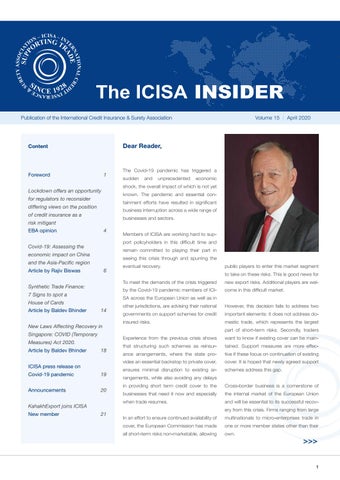
Dear Reader,
Content
Foreword 1 Lockdown offers an opportunity for regulators to reconsider
The Covid-19 pandemic has triggered a sudden
and
unprecedented
economic
shock, the overall impact of which is not yet known. The pandemic and essential containment efforts have resulted in significant
differing views on the position
business interruption across a wide range of
of credit insurance as a
businesses and sectors.
risk mitigant EBA opinion 4
Members of ICISA are working hard to support policyholders in this difficult time and
Covid-19: Assessing the
remain committed to playing their part in
economic impact on China
seeing this crisis through and spurring the
and the Asia-Pacific region Article by Rajiv Biswas 6 Synthetic Trade Finance: 7 Signs to spot a
eventual recovery.
public players to enter this market segment to take on these risks. This is good news for
To meet the demands of the crisis triggered
new export risks. Additional players are wel-
by the Covid-19 pandemic members of ICI-
come in this difficult market.
SA across the European Union as well as in
House of Cards Article by Baldev Bhinder 14 New Laws Affecting Recovery in Singapore: COVID (Temporary Measures) Act 2020. Article by Baldev Bhinder 18 ICISA press release on Covid-19 pandemic
19
Announcements
20
KahakhExport joins ICISA New member 21
other jurisdictions, are advising their national
However, this decision fails to address two
governments on support schemes for credit
important elements: it does not address do-
insured risks.
mestic trade, which represents the largest part of short-term risks. Secondly, traders
Experience from the previous crisis shows
want to know if existing cover can be main-
that structuring such schemes as reinsur-
tained. Support measures are more effec-
ance arrangements, where the state pro-
tive if these focus on continuation of existing
vides an essential backstop to private cover,
cover. It is hoped that newly agreed support
ensures minimal disruption to existing ar-
schemes address this gap.
rangements, while also avoiding any delays in providing short term credit cover to the
Cross-border business is a cornerstone of
businesses that need it now and especially
the internal market of the European Union
when trade resumes.
and will be essential to its successful recovery from this crisis. Firms ranging from large
In an effort to ensure continued availability of
multinationals to micro-enterprises trade in
cover, the European Commission has made
one or more member states other than their
all short-term risks non-marketable, allowing
own.
>>> 1
The ICISA INSIDER | April 2020 | FOREWORD
>>> It is therefore hoped that approaches to
Governments will determine to what extent
support schemes within the European Union
credit insurance is vital to trade and to their
are closely coordinated and harmonised. A
economy and subsequently, what priority is
patchwork of different schemes is a costly
given to these support schemes.
administrative burden for traders and may lead to the possibility of arbitrage between
Governments that recognize credit insurance
schemes in a time when their attention is
as an efficient instrument for their economic
rightly focused on limiting the effects of the
support package are currently working with
crisis on their company.
credit insurers to set up support schemes that include measures aimed at preserving
In a few countries outside of the EU credit in-
buyers’ ability to pay when trading resumes.
surers are also engaging with their resp. governments on setting up support schemes. A
The credit insurance industry is ready to join
low penetration level of credit insurance in
public efforts to combat the consequences
those markets may make discussions dif-
of the Covid-19 crisis, by working together
ficult, as governments may be less familiar
with governments to keep trade going.
with the key role played by credit insurance in facilitating trade. This crisis is an opportu-
Robert Nijhout, Executive Director
nity to help these governments understand that support schemes that recognise credit insurance as an essential trade instrument are part of the solution.
The ICISA Insider
Editorial Information
How to get a free Subscription
For suggestions and announcements,
If you would like to be added to the dis-
please contact:
tribution list of The ICISA Insider, please
Raluca Ezaru (editor)
send a message to secretariat@icisa.org.
T +31 (0)20 - 625 4115 Raluca.Ezaru@icisa.org
2
Join over 3600 other industry experts in the ICISA group on LinkedIn.
INFORMATION | April 2020 | The ICISA INSIDER
By the International Credit Insurance & Surety Association
A Guide to Trade Credit Insurance A practical and accessable industry-wide reference on Trade Credit Insurance, written by a team of industry experts. This compact volume is a practical guide for anyone interested in Trade Credit Insurance. The International Credit Insurance & Surety Association (ICISA) presents an approachable but detailed guide written collaboratively by carefully selected industry experts. The guide describes the ‘lifeline’ of the credit insurance product, from the initial application stage to the expiration phase of the policy, including practical use aspects for credit managers. The volume offers compact information on the history of trade, the need for protection against trade credit risks, and solutions offered by credit insurance providers. The focus is on short
Key selling points
term credit, including whole turnover policies and single risk
• Collaboration of a diverse group of experts from top
policies.
organizations around the world • Written in an approachable style, accessible to the
Readership
non-specialist
Suitable for anyone interested in Trade Credit Insurance,
• Includes extended glossary of key terminology
from credit managers to policymakers.
• Includes a list of relevant resources for further reading
Contents
About the Author(s) / Editor(s)
Foreword; Introduction; Disclaimer; 1. What is trade?; 2.
The International Credit Insurance & Surety Association
What is trade credit insurance?; 3. Product types; 4. Risk
(ICISA) brings together the world’s leading companies
types; 5. Typical set-up of a trade credit insurance contract;
providing trade credit insurance and surety bonds.
6. Premium, the price for cover; 7. Day-to-day policy man-
ICISA promotes technical excellence, industry innova-
agement; 8. Buyer risk underwriting in trade credit insur-
tion and product integrity, as well as addressing business
ance; 9. Debt collection; 10. Imminent loss and indemnifica-
challenges generated by new legislation.
tion; 11. Renewal, expiry, termination of a policy; 12. Single risk business; 13. The single risk insurance market: Private and public players; 14. Reinsurance of Trade Credit Insurance; Trade Credit Insurance resources; Glossary of trade credit terminology
Where to order my copy To order a copy of the book ‘A Guide to Trade Credit Insurance’, please visit www.amazon.com.
3
The ICISA INSIDER | April 2020 | ARTICLE
EBA opinion
Lockdown offers an opportunity for regulators to reconsider differing views on the position of credit insurance as a risk mitigant The Covid-19 pandemic has impacted the plans of organisations of all shapes and sizes, forcing delay, deferment or outright cancellation of projects. These unprecedented events have forced attention away from business-as-usual activities towards specific actions intended to mitigate the worst effects of the pandemic, but they have also provided an opportunity to reflect and reconsider. While this is true for businesses and individuals outside of their immediate actions to mitigate the pandemic, regulators too have an opportunity to pause and reconsider. In financial services, regulators and standard setters at
Capital Standard (ICS) 2.0 Similarly and review the timing of
domestic and international levels have made the welcome
implementation for the recently agreed Holistic Framework
decision to reduce the number of requests for information
for the mitigation of systemic risk. Similarly, the IASB also
they make of the industry at this time. This is intended to
reported it would defer the effective date of IFRS17 until 1
facilitate firms in focusing their attention on maintaining
January 2023.
core services for clients and consumers, as well as taking the necessary steps they require to meet their regular pru-
Firms which have followed the long story of Basel III’s devel-
dential and other supervisory requirements during a crisis.
opment and delayed implementation will not be surprised
Linked to these has also been the decision by authorities to
to hear that the Basel Committee has taken a similarly wel-
defer the implementation of new rules or standards.
come decision to their peers and deferred the implementation of the new standards until 1 January 2023. This pause
“ Firms are taking steps to meet their regular prudential and other supervisory requirements during a crisis.”
is intended to provide firms with the necessary breathing space to focus on more immediate concerns relating to the pandemic. However, it also provides regulators around the world with the chance to consider further their own implementation of the standard. Indeed, the question of how the standard will be interpreted and applied in different jurisdictions, and in particular, where variation in approaches may arise is of critical importance to the business affected by the rule changes. For the EU,
For example, in March we saw the announcement from EI-
this includes how the standards can be fit with the Acquis
OPA that it was extending the deadline of the Holistic Im-
and where deviation from the framework may be required
pact Assessment for the 2020 Solvency II Review by two
or warranted.
months, to 1 June 2020. Later that same month, the IAIS
4
announced it would adjust the timelines for the data col-
At the same time as preparing for implementation, the Euro-
lection exercise as part of the introduction of International
pean Banking Authority (EBA) has also undertaken a related
INTERVIEW | April 2020 | The ICISA INSIDER
review of the Internal Ratings Based (IRB) approach. The
made the insurance sector highly stable and resilient, even
EBA noted that it received a large amount of feedback as
during economic crises. This data, which was recently pro-
part of this consultation on the treatment of credit insur-
vided to the EBA, also suggests that they may be justified
ance. Given the prioritisation of policyholder protection in
in revisiting this topic and that there is sound justification for
Solvency II over other creditors, it had been argued that the
a lower LGD where a bank holds a credit insurance policy
Basel framework in a European context would inadequately
as opposed to being another kind of creditor to the insurer.
account for the role of credit insurance as a risk mitigation tool due to the same LGD being applied where a bank is a
While such a reconsideration would normally not be practi-
policyholder or is a creditor of an insurer.
cal, particularly where further delays in implementation of the Basel III framework would be undesirable, the neces-
“ Data gathered by a number of industry bodies, including ICISA covering a periÂod of 30 years, confirms that the evolving prudential rules in Europe culminating in the current Solvency II regime, have
sary pause in the implementation period stemming from Covid-19 pandemic creates such an opportunity. This time could be used to reconsider the available data on this topic and enable further discussion between the EBA and the industry and ideally lead to a more accurate reflection of credit insurance as a risk mitigation tool in the evolving prudential framework for banks.
made the insurance sector highly stable and resilient.� This situation appears to create a tension between the prudential regimes for banks and insurers. Data gathered by a number of industry bodies, including ICISA covering a period of 30 years, confirms that the evolving prudential rules in Europe culminating in the current Solvency II regime, have
5
The ICISA INSIDER | April 2020 | ARTICLE
By Rajiv Biswas, Asia-Pacific Chief Economist, IHS Markit
Covid-19: Assessing the economic impact on China and the Asia-Pacific region The novel coronavirus—officially named COVID-19 by
The number of confirmed cases is thus now already 15
the World Health Organization (WHO)—and its rapid es-
times greater than the total number of SARS cases re-
calation have heightened concerns about the economic
corded in mainland China during that epidemic in 2003
damage to the Chinese economy as well as to the rest of
(5,327 persons according to the WHO).
the Asia-Pacific region. The escalation of new Covid-19
By Rajiv Biswas, Asia-Pacific Chief Economist, IHS Markit cases in a number of other Asia-Pacific countries, includ-
Mainland China has responded to the crisis by taking
ing South Korea and Japan, as well as in other coun-
strong measures to limit the spread of the new coro-
navirus strain, including a lockdown of many cities in Covid-19: Assessing the economic impact on China and the Asiahave also increased fears that the Covid-19 epidemic Hubei province. A total lockdown has been imposed on Pacific region may become more protracted and widespread, creating movements in and out of the provincial capital of Wutries worldwide, including in Europe and the Middle East,
wider global economic shockwaves. han, a megacity of around 11 million people, where the Summary The novel coronavirus—officially named COVID-19 by the World Health Organization (WHO)—and its rapid coronavirus is believed to have originated and where escalation have heightened concerns about the economic damage to the Chinese economy as well as to the Escalation of the COVID-19 epidemic the vast majority of cases are recorded. rest of the Asia-Pacific region. The escalation of new Covid-19 cases in a number of other Asia-Pacific The outbreak of the COVID-19 epidemic in China in countries, including South Korea and Japan, as well as in other countries worldwide, including in Europe and January 2020 has developed into a major economic Disruption to China’s economic output the Middle East, have also increased fears that the Covid-19 epidemic may become more protracted and shock to the Chinese economy and the broader Asiawidespread, creating wider global economic shockwaves.
The virus has already caused significant negative shock
Pacific region. According to the WHO, the total number
waves in the Chinese economy, affecting retail trade,
of confirmed coronavirus cases in China had reached
tourism, and transport. In addition to restricting public
Escalation of the COVID-19 epidemic
80,174 on 2nd March 2020. This estimate includes transport movements in and out of certain badly imThe outbreak of the COVID-19 epidemic in China in January 2020 has developed into a major economic shock to the Chinese economy and the broader Asia-Pacific region. According to the WHO, the total number of both laboratory-confirmed and clinically diagnosed (only pacted cities such as Wuhan, China has also banned all confirmed coronavirus cases in China had reached 80,174 on 2nd March 2020. This estimate includes both applicable to Hubei province) cases. group-tourism travel sales by travel agencies in China laboratory-confirmed and clinically diagnosed (only applicable to Hubei province) cases.
The number of confirmed cases is thus now already 15 times greater than the total number of SARS cases for travel both within and outside of China, effective recorded in mainland China during that epidemic in 2003 (5,327 persons according to the WHO).
Covid-19 Cases in China
Jan-Feb 2020 Source: UN WHO *lab confirmed until 16th Feb, all diagnosis after
29th January 30th January 31st January 3rd February 4th February 5th February 6th February 7th February 8th February 9th February 10th February 11th February 12th February 13th February 14th February 15th February 16th February 17th February 18th February 19th February 20th February 21st February 22nd February 23rd February 24th February 25th February 26th February 27th February 28th February 29th February 1st March 2nd March
90000 80000 70000 60000 50000 40000 30000 20000 10000 0
6
ARTICLE | April 2020 | The ICISA INSIDER
Book Title Emerging Markets Megatrends
Author Rajiv Biswas
Copyright 2018
Publisher Palgrave Macmillan
eBook ISBN 978-3-319-78123-5
Hardcover ISBN 978-3-319-78122-8 h t t p s : / / w w w. a m a z o n . c o m / Emerging-Markets-MegatrendsRajiv-Biswas/dp/3319781227
from 27 January. Chinese consumer spending has also
Supply chain disruptions due to the extended closure of
been hit hard, with retail stores, restaurants, entertain-
Chinese plants producing auto parts have also begun to
ment, tourism, and aviation badly affected
thwart auto production in other territories. Hyundai Motor Co has temporarily closed some car production lines
Furthermore, China’s State Council extended the Lunar
in South Korea, and Nissan has temporarily closed its
New Year holiday period, originally scheduled from 24
operations in Kyushu, Japan, because of supply chain
to 30 January, until 10 February 2020. Although offices
disruptions of auto parts from China.
and factories have been gradually reopening in most provinces starting 10 February, reopenings have been
In the retail sector, several multinational firms had an-
delayed even further in some of the worst-affected
nounced closures of some operations in mainland Chi-
provinces.
na because of the epidemic. Starbucks had announced that more than half of its 4,300 stores in China would
A key industrial sector that has been badly hit by the
be temporarily closed during early February, while Ap-
delayed restart of manufacturing production is the au-
ple had announced that all its retail stores in China
tomotive sector. More than 80% of China’s automotive
have been temporarily closed. Sweden’s IKEA also an-
production is located in the provinces affected by the
nounced it would close all its stores in China tempo-
epidemic and resulting shutdowns. IHS Markit automo-
rarily. With consumption spending having become the
tive experts have undertaken an initial analysis of the
most important growth driver for the Chinese economy
potential near-term impact on China’s auto production
in recent years, a key near-term risk is from the nega-
(“Coronavirus initial impact on light vehicle production”,
tive impact on consumer confidence if the coronavirus
IHS Markit AutoInsight, 10 February 2020), and assess
epidemic is not soon brought under control.
that, despite the restart of many plants on 10 February, these facilities will not reach full operational capacity
Financial stress to Chinese firms, particularly small to
until the third week after their reopening. This reflects
medium enterprises in the private sector, is an increas-
issues relating to labor force shortages, mainly resulting
ing concern, as revenue streams have been badly im-
from delayed return to work by migrant workers who
pacted during recent weeks. Highly leveraged firms
must undergo quarantine periods when returning from
could face particular difficulties as a result of the severe
their home provinces.
dislocation of business activity during Q1 2020.
7
Singapore, Italy, Germany, France and Iran. While temperature-screening measures are being international airports globally, their effectiveness is uncertain since the coronavirus is conta The ICISA INSIDER | April 2020 | ARTICLE significant symptoms emerge. Article by Rajiv Biswas, Asia-Pacific Chief Economist, IHS Markit
Global Novel Coronavirus Cases to 2nd March Number of persons Source: UNWHO
In In dia do ne sia
UK
US A
I Si ran ng ap o Ge re rm an y Vi et na m Fr an c Th e ai la n Au d st ra M lia al ay sia
So ut h
Ko re a Ita ly Ja pa n
4500 4000 3500 3000 2500 2000 1500 1000 500 0
Governments in the APAC region are continuing to roll out new defensive measures to limit t Economic impactof the virus. Many nations have completely banned the entry of visitors from China, including on the Asia-Pacific region Globally, the number of confirmed coronavirus cases reIndonesia, Singapore, and New Zealand. Some APAC countries have put in place more limited In the past two decades, the rapid economic growth of ported outside mainland China had reached 8,774 as of China has made it atravel from China, including Malaysia and Thailand. key export market for many Asia2nd March 2020, with cases having been identified in Pacific nations. However, China’s growing importance in many parts of the world, including South Korea, Japan, Asia-Pacific trade and investment flows has also created Singapore, Italy, Germany, France and Iran. While tem considerable vulnerability for the Asia-Pacific region to
perature-screening measures are being implemented in
this type of unpredictable “black swan” event.
international airports globally, their effectiveness is un-
certain since the coronavirus is contagious even before
“ Data gathered by a number of industry bodies, including ICISA covering a period of 30 years, confirms that the evolving prudential rules in Europe culminating in the current Solvency II regime, have made the insurance sector highly stable and resilient.”
significant symptoms emerge. Governments in the APAC region are continuing to roll out new defensive measures to limit the transmission of the virus. Many nations have completely banned the entry of visitors from China, including Australia, India, Indonesia, Singapore, and New Zealand. Some APAC countries have put in place more limited restrictions on travel from China, including Malaysia and Thailand. Besides the severe implications for travel and tourism globally, the economic implications of the coronavirus epidemic primarily relate to the key role mainland China
With many COVID-19 cases already detected outside
plays in the global economy today—as an export desti-
China, this outbreak is particularly concerning as it has
nation for many markets/products and as a key supplier
occurred during the Chinese Lunar New Year season,
and intermediary in many global supply chains. Due to the
when millions of Chinese tourists were traveling within
rapid rise of exports from many Asia-Pacific economies
China and to many popular Asian tourist destinations,
to mainland China, any significant slowdown in Chinese
such as Thailand, Vietnam, Japan, Singapore, and South
economic growth will have negative transmission effects
Korea.
to the rest of the APAC region. Among these, Hong Kong SAR, Australia, Taiwan, South Korea and Japan have the
8
ARTICLE | April 2020 | The ICISA INSIDER
Mainland Chinese Outbound Tourist Spending USD billion Source: UNWTO 300 250 200 150 100
down of worst-affected cities and protracted shutdown
50 0
of offices and plants in these areas, persist through end2002
2010
2015
2018
February, and that work only progressively returns to
highest of total exports into the mainland Chinese millions ofshare visitors Source: UNWTO
6
in the first quarter of 2020 and remains depressed in the second because of continued disruptions and weak con-
to a slowdown in APAC economic growth.
fidence levels, before recovering gradually in the second half of 2020 and into 2021.
Other economies standing to lose from the economic
Mainland Chinese Outbound Tourist Spending impact of the epidemic are energyand commodity-producing markets,Source: for whomUNWTO China is a main end market. USD billion
In this severe scenario, mainland China’s economy would face a hard landing in 2020, with real GDP growth pro-
4 300
jected to slow to 4.2% in 2020, albeit it would rebound
2 250 0 200
throughout February in this scenario. Due to the escalat-
market, and therefore are potentially the most vulnerable
10 8
grant workers’ return to work are also assumed to occur ing epidemic, Chinese private consumption falls sharply
Mainland Chinese Tourism to Asia, 2018 12
normal starting in March. Substantial disruptions to mi-
Thailand
Japan
IHS Markit Global Link Model coronavirus scenario
strongly in 2021 after the epidemic ends, growing at a
To assess the impact of a protracted and severe novel
pace of 7.1%. The 2020 annual growth figure in the sce-
coronavirus epidemic, the IHS Markit international eco-
nario is 1.6 percentage points below the 2020 growth for
Vietnam South Korea Singapore
Malaysia
Cambodia
nomics modelling team used the IHS Markit Global Link
China that was forecast by IHS Markit before the coro150 Macro-Industry Model of the World Economy to model navirus outbreak. 100 the economic shock waves from a more protracted epi 50 demic. The scenario assumes mainland China’s strongThe negative impact on the global economy from such a Besides the severe implications for travel and tourism globally, the economic implications of the coronavirus est measures to control the epidemic, such as the locksevere shock to the mainland Chinese economy will be epidemic primarily relate to the key role mainland China plays in the global economy today—as an export 0 destination for many markets/products and as a key supplier and intermediary in many global supply chains. much greater today than during the SARS epidemic in 2002 2010 2015 2018 Due to the rapid rise of exports from many Asia-Pacific economies to mainland China, any significant 2002–03. Mainland China’s economy was the sixth largslowdown in Chinese economic growth will have negative transmission effects to the rest of the APAC region. Among these, Hong Kong SAR, Australia, Taiwan, South Korea and Japan have the highest share of total est in the world in 2002, accounting for 4.2% of world exports into the mainland Chinese market, and therefore are potentially the most vulnerable to a slowdown GDP; it is now the second-largest economy in the world, in APAC economic growth. Mainland Chinese Tourism to Asia, 2018 accounting for 16.3% of world GDP. China’s impact on Other economies standing to lose from the economic impact of the epidemic are energy- and commoditymillions of visitors Source: UNWTO the world economy is also much larger now than durproducing markets, for whom China is a main end market. 12 ing the SARS outbreak, meaning the slowdown in Chinese growth would be a more significant drag on global
10
growth. In 2002, China contributed 23% of world GDP
8
growth, while in 2019 China contributed an estimated
6
38% of the world’s growth.
4
The negative shock waves to the rest of APAC from
2 0
mainland China’s hard landing in 2020 would be severe, as many APAC territories are heavily reliant on China as Thailand
Japan
Vietnam South Korea Singapore
Malaysia
Cambodia
a key export market for goods and services. Tourism
Besides the severe implications for travel and tourism globally, the economic implications of the coronavirus
9
The ICISA INSIDER | April 2020 | ARTICLE
Article by Rajiv Biswas, Asia-Pacific Chief Economist, IHS Markit
would be one of the key transmission channels for this
energy prices magnify the shocks for the producers of
negative economic shock, due to the high dependency
these commodities.
of many APAC markets on tourism visits from mainland China. Other transmission channels include supply chain
At the other end of the spectrum, Asia’s other emerging
linkages within APAC, and falling import demand for ma-
markets giant, India, would be relatively little affected, as
jor commodities like coal, oil, and base metals from the
the Indian economy is still heavily reliant on the domestic
world’s largest customer of those products.
rural sector, and exports to China still account for a relatively low share of overall GDP.
In the IHS Markit severe coronavirus scenario, real GDP growth in the APAC region would be lowered 0.8 per-
At the global level, real GDP growth in the severe COV-
centage point in 2020. However, APAC regional growth
ID-19 epidemic scenario is 0.8 percentage point lower
would also rebound in 2021 after the epidemic ends,
than baseline in the first quarter of 2020 and 0.3 percent-
growing at a pace of 0.8 percentage point above the
age point below the baseline for 2020. The economies
baseline forecast in 2021 as real GDP returns to “normal”
most impacted after APAC are those in the Middle East
in the first quarter.
and North Africa region, primarily because of the lower volumes of energy exports to China and lower energy
“ The economies most impacted after APAC are those in the Middle East and North Africa region.”
prices. Another region hurt is Latin America; China is its main customer of key commodity exports. Real GDP growth is not significantly impacted in the US or Europe, as the reduction in exports to mainland China and the rest of APAC in the first half of 2020 is offset by lower imports from mainland China, and by the slight positive effect of lower energy prices on purchasing power.
Vulnerability of the Asia-Pacific tourism and aviation industries While the worst-hit market would be China, which is
Among the sectors most vulnerable to the coronavirus
the epicenter of the epidemic, large negative economic
epidemic besides autos and parts are the Asia-Pacific
impacts would be felt in many other APAC economies,
travel and tourism sectors. Since the 2003 SARS crisis,
with Singapore, Thailand, Australia, and Malaysia being
outbound international tourism visits from China to the
among the worst-hit nations.
rest of the world have boomed, so the risks of a global SARS-like virus epidemic spreading rapidly globally
The economy of Hong Kong SAR would also be par-
have become even more severe.
ticularly badly hit in 2020 because of its close economic
10
integration with mainland China through trade and tour-
In 2003, mainland China’s per capita GDP was only
ism flows. Australia would suffer from lower coal and
USD1,260 per person, whereas by 2018, its GDP per
other basic commodity exports, as well by weaker ex-
capita rose to USD9,700 per person. The rapid rise in
ports of manufactured goods to mainland China and
household incomes in China has triggered a boom in
other markets in the region. The falling commodity and
Chinese tourism visits abroad, which have risen from 20
ARTICLE | April 2020 | The ICISA INSIDER
million in 2003 to 150 million in 2018. Consequently, the vulnerability of many Asia-Pacific economies to a slowdown in Chinese tourism visits has increased significantly in the past two decades.
Tokyo Summer Olympics in July–August 2020, if the virus has not been contained by early summer 2020. • Chinese tourism travel is also a key pillar for Vietnam’s tourism industry, with total Chinese tourism arrivals having reached 5 million in 2018, accounting for one-
The decision of the Chinese government to suspend all
third of total international visits.
Chinese group tours, combined with severe restrictions
• For Singapore, mainland Chinese tourism visits have
being put in place on visitors from mainland China by
become a major part of the tourism economy, with
many Asian governments, is already resulting in signifi-
3.6 million mainland Chinese tourist visits in 2019, ac-
cant economic impacts on the Asia-Pacific travel and
counting for around 18% of total international tourist
tourism industry. The cancellation of flights to mainland
visits. The tourism sector is an important part of the
China by many international airlines also contributes to
Singapore, economy, accounting for an estimated 4%
the downturn.
of Singapore’s GDP. • Chinese tourism has also been growing rapidly in the
Among the markets most directly impaired by the travel bans are Thailand, Japan, Vietnam, Singapore, the Phil-
Philippines and accounted for an estimated 20% of total international tourism visits in 2019.
ippines, Malaysia, Australia, and Hong Kong SAR.
• Chinese tourist visits to Malaysia reached 2.9 million in
Thailand has been one of the most notable beneficiaries
• China has also become the largest source market
of the boom in Chinese tourism, with total annual Chi-
for international tourist visits to Australia, accounting
nese tourist visits there having risen from 2.7 million in
for 1.4 million visits in the 2018–19 financial year or
2012 to 11.0 million in 2019. Chinese tourism spending
around 15% of total international tourist visits.
2018 or around 11% of total international tourist visits.
in Thailand was estimated to have reached USD18 billion in 2019, amounting to more than 25% of total in-
Meanwhile, the government of the Hong Kong SAR has
ternational tourism spending in Thailand. Direct tourism
announced severe new restrictions on incoming travel
spending accounts for an estimated 12% of Thai GDP,
from mainland China that began 28 January 2020. These
with Chinese tourism having played an increasingly im-
measures include the suspension of high-speed rail and
portant role in underpinning the Thai tourism economy.
other rail services and a large reduction in total airline
Tourism and Sports Minister Phiphat Ratchakitprakarn
flights between Hong Kong SAR and mainland China.
has stated that Thai tourism revenue could be 50 billion baht lower if mainland China maintains its restrictions on
For the Hong Kong SAR economy, which was already
group tours for a period of three months.
badly hit in 2019 by the damage done to its tourism and
retail sectors by the political protests, mainland Chinese
• Chinese tourism has also become increasingly impor-
tourism visits have collapsed in February 2020 following
tant for Japan’s tourism industry, with total Chinese
the decision by the Hong Kong SAR government to put
tourist visits to Japan having reached 9.6 million in
travel restrictions on mainland Chinese tourist visitors.
2019, accounting for 30% of total foreign tourist visits.
Consequently, the impact of the coronavirus epidemic on
A key concern for Japan is also the potential risk the
mainland China will further increase the negative shocks
COVID-19 virus poses to tourism visits related to the
to the Hong Kong SAR economy in the near term, with
11
The ICISA INSIDER | April 2020 | ARTICLE
the economy expected to remain in recession in 2020
With China having become the world’s largest importer
for a second consecutive year.
of crude oil, the softening of oil demand in China has resulted in Brent crude oil prices falling to USD55 per
The commercial aviation industry is also vulnerable to
barrel by 14 February 2020. This decline follows the
the impact of the new restrictions on Chinese tourism
spike in Brent crude oil prices above USD70 per barrel
abroad, with initial indications that the regulatory restric-
in early January. Then, prices spiked due to concerns
tions on group travel will remain in place for at least a
about geopolitical risks to oil supply after the US drone
couple of months, depending on how the epidemic
strike that killed Iran’s Major General Qasem Soleimani
evolves in coming weeks. Due to the boom in Chinese
on 3 January 2020 and the Iranian counterstrike with
international tourism in recent years, many Asian air-
the launch of more than a dozen ballistic missiles on 8
lines had ramped up their direct flights between major
January against US military and coalition forces in Iraq.
Chinese cities and many popular Asian destinations. Air
The IHS Markit February energy market outlook fore-
travel on these routes will inevitably be hit hard, at least
sees Brent oil prices dipping for a time below USD50/
in the short term, by the new travel restrictions.
barrel in March and April, before recovering.
Many international airlines have either completely sus-
Iron ore prices have also fallen sharply because of the
pended their flights to mainland Chinese cities or se-
extended shutdown of industrial production in China,
verely restricted their flight schedules. Among Asian air-
declining from USD94 per ton in late January to USD81
lines, Lion Air Group has announced that it will suspend
per ton by 10 February. The IHS Markit Materials Price
all flights to China from 1 February 2020. Jetstar Asia
Index (MPI) dropped a sharp 6.2% in the week to 7
has announced the temporary suspension of services to
February and is down by around 10% since the end
Hefei, Guiyang, and Xuzhou until the end of March 2020.
of 2019.
Impact on global commodities
Near-term outlook
The slump in economic activity in China in early 2020
The rapidly escalating COVID-19 epidemic poses a
has become a significant negative shock to commodi-
significant downside risk to the near-term Asia-Pacific
ties demand in the near term, because of the impor-
economic outlook in 2020, particularly if the epidemic
tance of Chinese imports in overall international trade
continues to spread across mainland China and if cases
for many commodities, including oil, iron ore, and base
in other Asia-Pacific economies escalate further in com-
metals.
ing weeks. A key risk to regional trade is from the trans-
The impact of the coronavirus is also an instant demand
mission effects to the Asia-Pacific supply chain as Chi-
shock for oil markets. Latest estimates by IHS Markit
nese economic growth momentum softens in the first
show China’s oil demand down 2.9 million barrels per
half of 2020, since mainland China is by far the largest
day (MMb/d) in February compared with a year earlier.
economy in the Asia-Pacific region.
For the entire first quarter of 2020, global demand is es-
12
timated to be 1.7 MMb/d less than a year earlier—the
Several service sector industries in the Asia-Pacific re-
first quarterly demand decline since 2009. This result is
gion, notably tourism and travel, are expected to be se-
also more than double the 600,000 b/d additional pro-
verely hit, as Chinese outbound tourism slumps sharply
duction cut proposed by the Vienna Alliance’s advisory.
in coming months. The retail trade, restaurants, and
ARTICLE | April 2020 | The ICISA INSIDER
entertainment sectors are also highly vulnerable to a
and India, as well as to other major emerging markets
downturn in consumer confidence, as consumers be-
manufacturing hubs, notably Brazil and Mexico. As oc-
come more apprehensive about coronavirus contagion
curred during the US-China trade war when high US
risks. However, online sales, which have already been
tariffs on Chinese goods triggered trade diversion, the
growing very rapidly in many Asian economies dur-
protracted shutdown of Chinese factories will also en-
ing recent years, notably in China, are expected to be
courage global manufacturers to increase production
strongly boosted while the epidemic persists.
from their plants in other manufacturing hubs worldwide while Chinese output is disrupted.
For many global multinationals, the severe disruption of China’s industrial output during February has highlighted the vulnerability of their global supply chains to excessive reliance on China. The experience of the coronavirus epidemic will likely further accelerate efforts over the medium-term by global firms to diversify their supply chains to other manufacturing hubs in Southeast and South Asia, including Vietnam, Thailand, Indonesia
Rajiv Biswas is the Asia-Pacific Chief Economist for IHS Markit.
The ICISA INSIDER | April 2020 | ARTICLE
By Baldev Bhinder, Managing Director of Blackstone & Gold LLC
dev Bhinder, Managing Director of Blackstone & Gold LLC
Synthetic Trade Finance: Synthetic Trade Finance: 7 Signs to spot a House of Cards 7 Signs to spot a House of Cards
year or so, a high-profile case involving astronomical losses reminds us of the stark reality of the g business. A business that hasEvery long moved pure shipment goods from producer would now be familiar with the cautionary year orbeyond so, a the high-profile case of involving Underwriters d user. A business that is now highly leveraged on liquidity through the creation of synthetic or coverage being sought by traders solely astronomical losses reminds us of the stark reality of tale of insurance mirror trade flows. A businessthe operating on paperAdocuments multiple trading business. business thatthat haslay longsusceptible moved totoobtain financing – a means to an end of accessing ing. Statistics will proudly boast that international trade is valued in the trillions of dollars beyond the pure shipment of goods from producer liquidity. each Banks take an exceeding amount of comfort if a but how much of this sum is synthetic is open to debate. year, leveraged a trading company once to end user. A business that isEvery now highly trade is credit insured, treating the policies akin to guarg revenues in the billions of dollars, topples over and in the post-mortem, we find a antees. bewildering on liquidity through the creation of synthetic or even Insurers, focussed on the credit assessment of of trade documents that have been rolled, flipped or rotated between parties while the mirror trade flows. buyers are too far removed from the transaction to unlying goods are long gone. When the trade is deconstructed by specialist lawyers like myself, derstand questionable signs in the trade flow. Credit intimes what emerges from the smoke is a parallel world of synthetic structures, double financing A business operating on paper documents that lay sussurance and modern trade finance do not sit neatly with udulent documents. ceptible to multiple financing. Statistics will proudly boast
each other. And the shrewd trader knows this.
international trade istale valued in the trillions of dollarsbeing sought by rwriters would now be familiarthat with the cautionary of insurance coverage yearto but of this sum is synthetic is open With an increasingly connected world wiping out arbirs solely to obtain financing – aeach means anhow endmuch of accessing liquidity. Banks take an exceeding to debate. Every year, athe trading company driving trage opportunities on price margins, traders have turned nt of comfort if a trade is credit insured, treating policies akinonce to guarantees. Insurers, thetoo billions of dollars, topples over and in the to to synthetic trades to create liquidity. Passing documents sed on the credit assessment ofrevenues buyers inare far removed from the transaction understand onable signs in the trade flow.post-mortem, Credit insurance anda modern trade not sitfor neatly with we find bewildering flowfinance of trade do docuan easy margin is just the tip of the incentive, the real other. And the shrewd trader knows ments this. that have been rolled, flipped or rotated between reward comes with access to financing and hence liquidparties while the underlying goods are long gone. When
ity for a 60-90 day period. The trader may leverage such
an increasingly connected world wiping out arbitrage opportunities on price margins, traders the trade is deconstructed by specialist lawyers like liquidity for another transaction over a 30-60 day period: turned to synthetic trades to create liquidity. Passing documents for an easy margin is just the myself, sometimes what emerges from the smoke is a the house of cards gets bigger with such circular trades the incentive, the real reward comes with access to financing and hence liquidity for a 60-90 parallel world of synthetic structures, double financing or (see: Diagram A). eriod. The trader may leverage such liquidity for another transaction over a 30-60 day period: fraudulent documents. ouse of cards gets bigger with such circular trades (see: Diagram A). In a voyage between West Africa or South America to
Asia (which consumes a significant proportion of global commodities), a trader has several weeks to “roll” its title Physical Trade A
14 weeks voyage
documents. With a warehouse receipt, the lead time is E
months. As long as the title documents are returned before final delivery to its final buyer, no one is the wiser of this synthetic sub-trade. The opportunity and indeed the reward to multiple finance the same cargo, couldn’t be
D
Synthetic Trade
B
greater. Revenue is booked across the string of buyers, banking lines utilized – everyone is a winner in this game of musical chairs. As long as the music keeps playing. But every now and then the music stops because there
C
is a liquidity crunch and the house of cards built on smaller synthetic trades can collapse in spectacular fashion with billions of dollars lost in a short time. In the pursuit
Diagram A: Circular Trade
Diagram A: Circular Trade
of liquidity, synthetic trades makes it difficult to reconcile the document flow with the physical flow which gives rise
oyage between West Africa or South America to Asia (which consumes a significant proportion bal commodities), a trader has several weeks to “roll” its title documents. With a warehouse 14
actual voyage but with different buyers. By the time, this “mirror” trade is detected, the cargo is often untraceable or consumed leaving different banks to the realisation| that allICISA financed the ARTICLE April they 2020 have | The INSIDER same cargo. (see: Diagram B)
Actual
Phantom
A
E
H
D
B
F
Buyer D + Buyer H Related Companies
G
C
Diagram B: Mirror Trade
Diagram B: Mirror Trade
Trade environment documents are circulated to create Having to the fraud perfectflourishes conditions in for an multiple financing. where With fake tutional large trading houses or tradeliquidity. finance banks to give analysed trade flows in arbitration cases, there are three aspects of international trade that lend itself title documents, a phantom trade can be created in parthese documents a veneer of legitimacy. It is basic human toallel trade and which every underwriter indeed bank operational should know). first to afraud real trade using the same details of an(and actual psychology – if a tradestaff involves receiving titleThe documents isvoyage that credit positions can be monetized in international trades through the “rolling” of title but with different buyers. By the time, this “mirthrough well known trading houses or banks, they must documents. Without the a central lenders no assurance thatand the cargoalike hastake notcomfort been in ror” trade is detected, cargo isrepository, often untraceable or have be legitimate. Financiers insurers double financed. documents like bills continuecoming to exist in physical consumed leavingSecond, different title banks to the realisation thatof lading the documents outpredominantly of an institution but not enough paper form. A “negotiable” bill of lading often used in trade effectively operates as a blank bearer they have all financed the same cargo. (see: Diagram B) scrutiny is placed on how the documents entered the insticheque as the buyer’s name will be deliberately left empty to facilitate negotiation to any third party. tution in the first place. Inserting a small trading company Physical possession ofananenvironment original bill of lading shouldbetween in theory holder a right to the Trade fraud flourishes in where documents two give large the trading houses in a trade flow goods serves to described on the documents. In practice however, goods can easily be discharged and untraceable are circulated to create liquidity. Having analysed trade flows divert the inquiry away from the source of the documents. even while the bank on aspects to an original bill. Third, needs to be string of traders with in arbitration cases, thereholds are three of international The there smoke and mirrors are a now in place. fragmented information can be undermanipulated easily, each pair of hands it passes through trade that lend itself to tradegaps. fraud As andbills which every increases the risk of fraud. Add to that the market of using this freight forwarders to move cargo, writer (and indeed bank operational staff should know). Thepractice Understanding background is now essential for any who in turn issue their own “house bills”. Now there are multiple bills in play involving the same cargo. first is that credit positions can be monetized in international underwriter in the credit business. Sometimes, the best trades through the “rolling” of title documents. Without a
business an underwriter can do is the business that is not
central repository, lenders have no assurance that the car-
underwritten. With the context that insurance is now be-
go has not been double financed. Second, title documents
ing used as a means of generating liquidity in international
like bills of lading continue to exist predominantly in physical
trade, the ability to spot a dubious or risky transaction could
paper form. A “negotiable” bill of lading often used in trade
not be more vital.
effectively operates as a blank bearer cheque as the buyer’s name will be deliberately left empty to facilitate negotiation
After years of analysing trade flows, here are 7 red flags to
to any third party. Physical possession of an original bill of
look out for:
lading should in theory give the holder a right to the goods described on the documents. In practice however, goods
1. The Conduit Trader
can easily be discharged and untraceable even while the
Who is the conduit trader? There is no one particular give
bank holds on to an original bill. Third, there needs to be
away but a combination of signs may suggest a trade is
a string of traders with fragmented information gaps. As
not in the business of physical cargo. The conduit trader
bills can be manipulated easily, each pair of hands it passes
is not a product specialist – it may trade steel today and
through increases the risk of fraud. Add to that the market
oil palm tomorrow and then cashew nuts the day after. It’s
practice of using freight forwarders to move cargo, who in
spike in revenue in a short period may be telling. It may
turn issue their own “house bills”. Now there are multiple
claim to trade $100 million tons of coal from Indonesian
bills in play involving the same cargo. But the masterstroke
when the country only exports $25 million. It will not know
comes in channelling fraudulent documents through insti-
what type of carrier is needed to carry specific products
15
The ICISA INSIDER | April 2020 | ARTICLE
or the average voyage time of the trade route. Put simply,
5. Discrepant Documents
it will not know the operational aspects of physical trading
I am often approached to determine whether a bill of lading
which increases the probability of its role being a conduit
is fake or forged. This is a notoriously difficult task to un-
for shuffling paper documents – a set up that can be done
dertake conclusively but the suite of documents presented
with just a handful of staff and a small office space in the
for payment contain representations that could and should
trading hubs of Singapore, Dubai or Switzerland to get ac-
be tested. For example, a certificate of origin is typically
cess financing.
presented alongside the bill of lading. It should state the name of the exporter who in turn would have arranged for
2. Credit Insurance
customs clearance and possibly shipping of the cargo. This
Credit insurance serves a critical function in international
can be verified with the exporter.
trade. However, where an insured is unable to convince a bank to finance it without credit insurance, it raises issues
6. Transaction Due Diligence
on the inherent credibility of the transaction. Credit insurers
A combination of factors operate in tandem to lull a party
now have the unenviable task of understanding the trans-
into taking its eye off the transaction due diligence. Maybe
action beyond just the credit worthiness of the buyer.
it’s the pressure of onboarding new business, or the huge margins promised. It could also very well be the phenom-
3. Unrealistic Margins
enal growth of a trader or that its trading relationship with
It may seem simple enough but in today’s world of trading,
its counterpart has been existing for years without default.
if a trader is confident of pulling off unusually big margins or
Perhaps with credit insurance coverage in place, there isn’t
an opportunity for a once in a lifetime undervalued cargo,
too much need to scrutinize the transaction itself. This is
then perhaps there is some truth in the old adage that if it
how suspicious trading structures are onboarded. Why is a
is too good to be true than it probably isn’t. Traders who
small trader placed between two large trading houses that
borrow at higher interest rates do make we wonder which
are already in business with each other? Who made the
commodity type is able to generate such margins purely on
introductions or originated the deal structure? Can each
a price arbitrage.
party in the string of trades justify why it is involved in the trade? These questions which I often ask when things go
4. High Sea Sales
wrong, would be better placed at the due diligence stage
High Sea Sales are a common practice of international
of an on-boarding.
trade where goods are bought and sold while on the water.
16
Such practices however create challenges to a party seek-
7. Copy BLs
ing to verify the authenticity of the trade as the seller of the
Finally, in a world where original bills can be manipulated
cargo is essentially asking a buyer to believe its bills of lad-
and forged with relative ease, it surprises me how willing
ing, i.e., the blank cheque, passed to it from another seller
banks and traders are to use copies of bills rather than to
is legitimate. Without visibility on the exporter who loaded
insist on the originals. Copy bills are an easy but risky solu-
the cargo onto the vessel, there are too many gaps in the
tion where original bills cannot be couriered to the numer-
trade chain and no guarantee that the cargo exist or has
ous parties in the chain on time. The obvious refrain is trust
not already been financed by someone else.
– parties trust that a trader that presents a copy bill will back
2020or | The ICISA INSIDER I am often approached to determine whether a bill ofARTICLE lading | isApril fake forged. This is a not difficult task to undertake conclusively but the suite of documents presented for payment representations that could and should be tested. For example, a certificate of origin is presented alongside the bill of lading. It should state the name of the exporter who in turn wo ofThis Credit arranged for customs clearance and possibly shippingCatalogue of the cargo. can be verified w Insurance Terminology exporter.
6. Transaction Due Diligence
A combination of factors operate in tandem to lull a party into taking its eye off the transac diligence. Maybe it’s the pressure of onboarding new business, or the huge margins promised also very well be the phenomenal growth of a trader or that its trading relationship counterpart has been existing for years without default. Perhaps with credit insurance cov it. So the world’s largest trading houses and banks routinely The new English edition of place, there isn’t toofrommuch need to scrutinize the transaction itself. This is how suspicious funnel copy bills in their systems their trusted counterthe catalogue is available. parts. The problem that few have stopped to ponder structures areis onboarded. Why is aif small trader placed between two large trading houses their institutional counterparts could have also been duped It can be downloaded from the already in business with each other? Who made the introductions or originated the deal st in this merry-go-round of bills. ICISA website Can each party in the string of trades justify why it is involved in the (www.icisa.org). trade? These questions A house, even that of cards, is not built overnight. Lenders a hard copy,stage please often ask when things go wrong, would be better placedToatorder the due diligence of an on-b and insurers typically see their pyramid structure but miss the numerous other pyramids which form the foundation of
7.the Copy house. BLs
send an email to secretariat@ icisa.org
Finally, in a world where original bills can be manipulated and forged with relative ease, it s Baldev Bhinder is the Managing Director of Blackstone & me how willing banks and traders are to use copies of bills rather than to insist on the origina Gold LLC, a specialist commodities and international trade bills arein Singapore. an easy but risky solution where original bills cannot be couriered to the numerous p law firm the chain on time. The obvious refrain is trust – parties trust that a trader that presents a cop Baldev has worked on numerous international trade arback it. So the world’s largest trading houses and banks routinely funnel copy bills in their bitrations, trade fraud investigations and credit insurance disputes and is trusted lauded for hiscounterparts. arbitration capabilities by the problem is that few have stopped to ponder if their inst from their The Legal 500, Who’s Who Legal and Benchmark Litigation. counterparts could have also been duped in this merry-go-round of bills. Recently, he held an webinar on the topic,
A which house, can beeven watchedthat here: of cards, is not built overnight. Lenders and insurers typically see their https://www.youtube.com/watch?v=Cgh-71itECs structure but miss the numerous other pyramids which form the foundation of the house. You can reach Baldev Bhinder at baldevbhinder@blackstonegold.com
Baldev Bhinder is the Managing Director of Blackstone & Go specialist commodities and international trade law firm in Sing CATALOGUE OF CREDIT INSURANCE TERMINOLOGY
Baldev has worked on numerous international trade arbitration fraud investigations and credit insurance disputes and is laude arbitration capabilities by the Legal 500, Who’s Who Le Benchmark Litigation. English edition
Recently, he held an webinar on the topic, which can be watch here: https://www.youtube.com/watch?v=Cgh-71itECs 2942_ICISA_Dictionary_UK_V6.indd 1
02-02-17 12:53
17
You can reach Baldev Bhinder at baldevbhinder@blackstonego
The ICISA INSIDER | April 2020 | ARTICLE
By Baldev Bhinder, Managing Director of Blackstone & Gold LLC
New Laws Affecting Recovery in Singapore: COVID (Temporary Measures) Act 2020.
dealing with non-performance arising from COVID-19. The Act
I am often approached to determine difficult task to undertake conclusive tion/ Bankruptcy representations that could and shou Statutory demands are typically issuedpresented as a precursor to winding-up alongside the billorof lading. bankruptcy proceedings for debts. Statutory demands for aclearance statuarranged forprovide customs and tory period of 21 days for a debt to be repaid or compromised and in the exporter.
covers various aspects affecting both procedural and substantive
event the debt remains outstanding, a statutory demand then acts as evi-
rights when enforcing specific contracts. This update focuses on
dence of a presumption of an inability to pay debts when due – the thresh-
3 key aspects that are relevant to insurers.
old required for commencing liquidationAorcombination bankruptcy proceedings. of factors
The COVID (Temporary Measures) Act was passed in Singapore on 8 April 2020 and is expected to come into force later in April 2020. The Act takes the unprecedented step of intervening in private contracts to give commercial parties some breathing space when
(1) Temporary Relief for Scheduled Contracts The Act provides temporary relief in the form of a moratorium against enforcement of contracts and related security. The Act is intended to span a period of 6 months in the first instance (which may be extended). Application: It provides for temporary relief for 5 specific types of contracts covering; loans to SMEs, construction & performance bonds, tourism & events related, landlord-tenancy issues and hire-purchase agreements. This category may be extended by the Minister. Time Period: The Act covers obligations that have accrued from 1 Feb 2020 and does not extend to contracts entered into post 25 March 2020. Threshold: The Act applies to obligations under the specific types of contracts within the specified time period that have been materially affected by the COVID-19 virus. Trigger: To apply for the protection of the Act, a party needs to fulfil the criteria above and notify its counterparty that it’s obligations are affected
(3) Changes to Timelines & Monetary Thresholds for Liquida-
6. Transaction Due Diligence
operate in ta diligence. Maybe it’s the pressure of o The Act changes the minimum debt sizealso to S$60,000 and be S$100,000 for very well the phenomenal counterpart existing starting insolvency depending on whether the debtor has is anbeen individual or for yea place, there isn’t too much corporate. More importantly, the time period for a statutory demand has need to s structures are onboarded. Why is a s been extended from 21 days to 180 days. already in business with each other? Can each party in the string of trades Comments often asknot when things wrong, woul (a) The temporary relief provisions of the Act do extinguish or go amend substantive rights. For example, interests will BLs continue to accrue on 7. Copy debts, instalments, rent payments continue to run during the mora-
Finally, in a world where original bills me how willing banks and traders are narrow caveat that applies to construction contracts. bills are an easy but risky solution whe (b) The Act also does not prohibit the commencement of international the chain on time. The obvious refrain arbitration proceedings although this may be less applicable for inback it. So the world’s largest trading surers pursuing debt recoveries through subrogation or otherwise. from their trusted counterparts. The p (c) The Act however creates a disjunct for insurers contractually obliged counterparts could have also been du torium. These substantive rights are not extinguished save for the
to pay claims after a waiting period of 6 months who would then ef-
by COVID-19. If there is a dispute as to whether a party is entitled to
A house, that due of cards, fectively be without a right of recourse againsteven the debtor to the
is not bu structure but miss the numerous othe
protection under the Act, the matter is referred to an Assessor whose
moratorium.
decision is final and non-appealable. Effect: If the conditions are satisfied, then enforcement action by way of court action, insolvency or domestic arbitration alongside enforcement
Baldev BHINDER
procedures in Singapore cannot be brought for the period of the Act.
baldevbhinder@blackstonegold.com
(2) Construction Contracts & Performance Bonds
Baldev Bhinder is the Managing Direc-
Due to the high value of construction contracts in Singapore, the Act
tor of BlackStone & Gold, a special-
affects substantive rights in construction contracts over and above the
ist energy & commodities law firm in
temporary relief provisions in Point 1. In particular, apart from the restric-
Singapore specializing in international
tions on calling on performance bonds, the Act introduces a substantive
trade. He is an expert in trade disputes, fraud investigation and insurance
defence to delay in construction contracts impacted by COVID-19. Ex-
claims and is ranked by Legal 500, Who’s Who Legal and Benchmark
traordinarily, this means that damages or liquidated damages for obliga-
Litigation. Baldev has also been selected as an Assessor under the COVID
tions affected by COVID-19 under the Act, are thereby extinguished for
(Temporary Measures) Act 2020 by the Ministry of Law.
the period of the Act.
18
Baldev speciali
Baldev fraud in arbitrat Benchm
Recent here: h
You can
PRESS RELEASE | April 2020 | The ICISA INSIDER
ICISA press release on public economic support schemes against the backdrop of Covid19 Amsterdam 31 March 2020 – In a position paper,
Cross-border business is a cornerstone of the internal mar-
members of the International Credit Insurance and
ket of the European Union and will be essential to its suc-
Surety Association (ICISA) call for a coordinated
cessful recovery from this crisis. Firms ranging from large
approach to support schemes across the European
multinational firms to the micro-enterprises are engaged in
Union to meet the demands of the crisis triggered by
business between one or more member states. As a result,
the Covid-19 pandemic.
it is essential that approaches to support schemes within the European Union are closely coordinated and harmo-
The Covid-19 pandemic has triggered a sudden and sig-
nised to avoid unnecessary and costly administrative bur-
nificant economic shock, the overall impact of which is not
den and the possibility of arbitrage which differences in ap-
yet known. The pandemic and essential containment efforts
proaches across the EU may lead to.
have already resulted in significant business interruption across a wide range of businesses and sectors.
Members of ICISA are working hard to support policyholders in this difficult time and remain committed to playing
Experience from previous crises, including the 2008 finan-
their part in seeing this crisis through and spurring the even-
cial crisis, has shown that structuring such schemes as
tual recovery.
reinsurance arrangements where the state provides an essential backstop to private cover ensures minimal disruption to existing arrangements, while also avoiding any delays in providing short term credit to the businesses that need it.
Thank you China I&G for the face masks! The ICISA secretariat would like to express its gratitude to ICISA member China Investment & Guarantee Co. Ltd. for their generous donation of face masks. Thanks is given to China I&G’s Chairman Mr. LAN Ruda and President
A special word of thanks is given to HE Jia from the China I&G Board
Mr. DUAN Wenwu for this kind and very helpful gesture.
Office for the support in making this possible.
The masks were distributed to care homes in Amsterdam, where there
Rob Nijhout
is a great shortage of protective face covering. They were received with great relief by staff at these facilities. On behalf of all of them, Thank You!
19
The ICISA INSIDER | April 2020 | APPOINTMENTS & ANNOUNCEMENTS
David Capdevila appointed Chief Executive Officer of Atradius David took up the appointment of CEO in January 2020, following Isidoro Unda who stepped down after 12 years in the role. For David Capdevila the appointment marks
David Capdevila said: “I am honored with this
a return to Atradius where he had previously
appointment and pleased to come back to At-
held the position of Chief Market Officer and
radius. Atradius is a successful and professional
was a member of the Management Board be-
organisation that works like an orchestra to de-
tween 2010 and 2013. David began working
liver the level of service our customers expect
with Grupo Catalana Occidente in 1992 (parent
and at the same time produce the level of results
company to Atradius) and was also previously
we are committed to.”
the CEO of Crédito y Caución 2006-2013. David was CEO of Plus Ultra Seguros immediately
David has a degree in Actuarial Economics from
prior to his current appointment.
the University of Barcelona and an MBA from IESE Business School in Barcelona.
The Chairman of Grupo Catalana Occidente, José María Serra said David’s appointment would help further “boost the positioning of Atradius as a global credit insurer”. David Capdevila
Gordon Cessford appointed Atradius Regional Director of North America Gordon was appointed to the position of Regional Director of Atradius Trade Credit Insurance North America in October 2019.
As Regional Director, Gordon will continue
Andreas Tesch, Chief Market Officer of Atra-
developing growth and retention initiatives
dius said: “Atradius is delighted to welcome
for North America, while overseeing business
Gordon to the North American team. He
activities throughout the United States, Can-
brings a wealth of knowledge and experience
ada and Mexico. Previously Atradius Com-
to the position but, more importantly, he is
mercial Director in Hong Kong, overseeing
the right fit for the culture we have so faithfully
operations in the Asia Pacific Region, Gordon
built.”
has worked in the credit insurance industry for more than 20 years.
Gordon Cessford
20
NEW MEMBER | April 2020 | The ICISA INSIDER
KazakhExport joins ICISA ICISA is honoured to welcome KazakhExport as member to the Association and are pleased to share their expectations of being a member of ICISA. Export Insurance Company KazakhExport JSC (part of
They emphasize the importance of discussing how pan-
Baiterek NMH JSC) is a subordinate organization of the
demic COVID-19, lowering of oil prices, and in whole world
Ministry of Trade and Integration of the Republic of Kazakh-
crisis will influence insurance companies, including in par-
stan for non-primary goods and services export promotion.
ticular specialized in financial and credit risks.
The mission of Export Insurance Company KazakhExport JSC is to support the rise in exports of non-primary goods,
KazakhExport looks forward to contributing to ICISA’s Asia
works, and services in priority sectors of the economy and
Committee: “We consider it possible to join the Committee
to develop the practice of financial-insurance and non-
for Asia, since our company is located in Kazakhstan, and
financial support of Kazakhstan enterprises. Kazakhstan
many of our clients are actively entering the Chinese mar-
products are exported to Azerbaijan, Armenia, Belarus,
kets. It is important for us to understand and take into ac-
Germany, Georgia, Italy, China, Kyrgyzstan, Mongolia, Rus-
count all the opportunities, threats and risks that may arise
sia, Tajikistan, Turkmenistan, Uzbekistan, and Japan.
in this region. The platform of this Committee is most suitable for personal meetings and discussions of such issues. ”
“ We believe that with membership in ICISA KazakhExport acquires one more place for interchange of experience and information, as well as opportunities to extend fields of cooperation.”
Looking at the current global situation, KazakhExport is proud of the help offered in the crisis: “The situation with the coronavirus pandemic has become a real test of strength for the world economy. Almost all small and medium enterprises and many large companies in Kazakhstan found themselves in difficult conditions. At the same time, with the transition to remote labor organization, KazakhExport managed not only to save all business processes, but also to increase the efficiency of interaction with customers, since the solution of many issues has moved to the online field.”
Asked about their willingness to join ICISA, KazakhExport highlighted that “ICISA for us is an opportunity to effectively
More information on KazakhExport can be found on
interact with partners on a common online dialogue plat-
their website www.keg.kz.
form, because under the auspices of the Association there are various companies with different histories, experience and tools in credit insurance, which will be useful to us. In addition, membership in the Association implies constant access to the best professional knowledge, attending trainings and seminars.”
21
The ICISA INSIDER | April 2020 |
ICISA Members
Landor Associates Via Tortona 37 Milan I-20144 Italy Tel. +39 02 764517.1
cdp sace - Pantone® C Date - Data 25.11.16
Company - Cliente CDP Group
Artwork - Esecutivo 01_sace_PANTC.ai
Country - Paese ITALIA
Implementation - Esecutivista KN
So ware Adobe Illustrator CC
Recommended colours - Colori raccomandati Pantone 199 C
Pantone 281 C
-
-
-
-
-
-
Note Text
Il presente documento è un esecutivo. La stampa laser forniti insieme al presente documento in base fornisce un'indicazione del posizionamento dei colori, all'art. L. 22-4 del codice della proprietà intellettuale. ma in nessun caso si deve fare riferimento per la verifica Sul CD-Rom allegato troverete anche una versione dei colori di stampa. I caratteri tipografici non vengono del documento in outline.
Approval signature - Firma per approvazione
ICISA Herengracht 473
Phone +31 (0)20 625 4115
1017 BS Amsterdam
secretariat@icisa.org
the Netherlands
www.icisa.org
Registered Number: 64391736