
What is Leave No Trace?
Leave No Trace is an Outdoor Ethics Education Programme designed to promote and inspire responsible outdoor recreation through education, research and partnerships.
As increasing numbers of people seek the beauty and exhilaration of outdoor travel and recreation, our collective mark on the environment and its natural processes increases. Litter, water pollution, disturbance of vegetation, wildlife, livestock and other people are all indicators of the need to develop a national ethic that protects both natural and cultural heritage. Techniques designed to minimise the environmental and social impacts in these areas are incorporated in and promo ed by the national Leave No Trace education programme as the following seven principles:
Princ·ples of Leave No Trace
1. Plan Ah ad and Prepare
2. Be Considerate of Others
3. Respect Farm Animals and Wildlife
4. Travel and Camp on Durable Surfaces
5. Leave What You Find
6. Dispose of Waste Properly
7. Minimise the Effects of Fire
Practising a Leave No Trace ethic is very simplemake it hard for others to see or hear you and LEAVE NO TRACE of your visit.
Outdoor Skills and Ethics
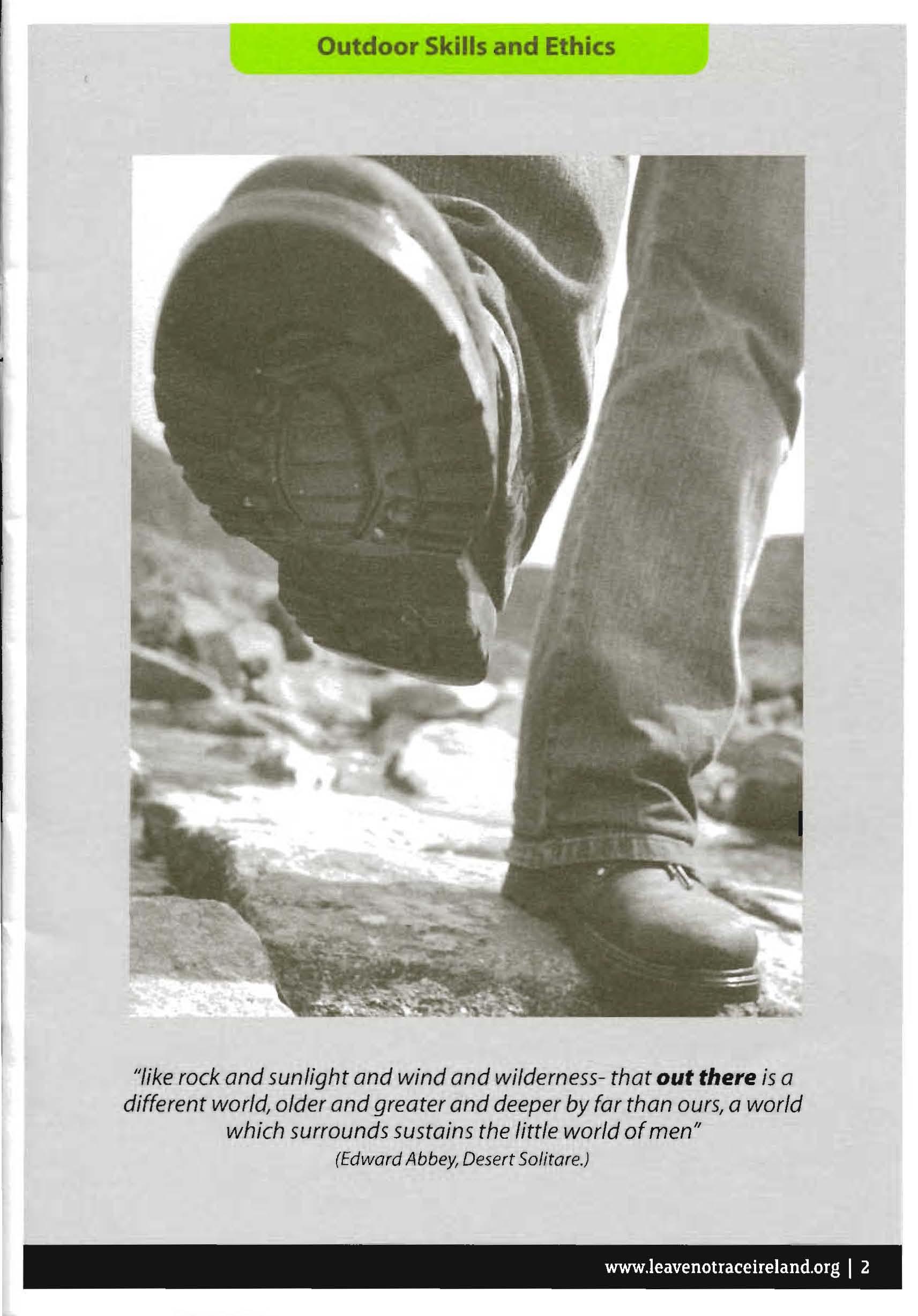
"like rock and sunlight and wind and wilderness- that out there is a different world, older and greater and deeper by far than ours, a world which surrounds sustains the little world of men"
(Edward Abbey, Desert Solitare.)
Why Leave No Trace?
Ireland is a most fortunate place and Irish people, on the whole, are a most fortunate people. We enjoy an enviable quality of life in addition to inhabiting a land which is endowed with a richness of unspoilt natural beauty that has had a strong influence on the cultural features which have developed over centuries through continuing habitation and use and which has inspired literary imaginations since ancient times. Ireland's landscape is characterised by its spectacular coastal scenery, its magnificent mountain landscapes, expanses of bog land and pastoral lowlands, dissected by rivers and lakes.
It could be said that the extraordinary diversity and outstanding quality of the Irish landscape is one of Ireland's most important natural resources and is the focus of much of this century's biggest growth industry - tourism.
Given that increasing pressure on our natural heritage from recreational use is a fact, it is timely that we have a national system which will ensure that visitors to our countryside - whether they are Irish or visitors from abroad - travel with care
As towns and cities grow and populations encroach upon surrounding countryside, it is critical that we endeavour to maintain our natural and cultural heritage in its original state. Leave No Trace Ireland promotes and inspires responsible outdoor recreation through education, research and partnerships. The programme strives to build awareness, appreciation and respect for our natural and cultural heritage and is dedicated to creating a nationally recognised and accepted outdoor ethic that promotes personal responsibility. It encourages all outdoor enthusiasts to play
their part to maintain lands used by the public for the benefit of fragile ecosystems and future generations.
People enjoy the outdoors in myriad ways. We explore on foot, kayak, horseback, mountain bikes and boats to name a few. More of us are pushing our sports to greater extremes and into remoter parts of the natural world everyday. Our experiences are personally satisfying but they can have a negative impact on the environments we visit and the animals we observe.
Ireland's natural environments and cultural heritage are diverse and beautiful.They can also be fragile. Displaced wildlife, eroded soils, trampled vegetation and polluted waters are just some of the results linked directly to recreational activities or just simply, human presence. Public education and awareness of minimal impact skills through the Leave No Trace Skills and Ethics programme could prevent considerable damage in the future. Educated local communities can minimise their day-to-day impacts. Visitors will learn to reduce their cumulative impacts so as not to diminish the integrity of the local cultural and natural heritage.
At the heart of Leave No Trace are seven principles for reducing the damage caused by outdoor activities. However, Leave No Trace concepts can be applied anywhere - in our uplands and lowlands, in urban parks, or in our own backyards.
Why Leave No Trace?
Leave No Trace principles and practices extend a sensitivity and hospitality to other visitors to the outdoors, to culturally significant sites and to the natural environment.They are based on an abiding respect for nature, culture and people. The information for each of the seven principles is recommended as a guide to minimise the impact of your visits to the natural and cultural heritage areas of Ireland.
Leave No Trace depends more on attitude and awareness than on rules and regulations. Minimum impact travel and outdoor recreation
practices must be flexible and tempered by judgement and experience.Techniques are continually evolving and improving.The general rule is to consider the variables of each area in terms of culture, wildlife, vegetation, soil, climate and use that it receives. Then, use this information to determine which recommended practices to apply.
This respect, coupled with good judgment and awareness, will allow you to apply the principles to your own unique circumstances. We can respect and protect the places and wildlife that inspire us in Ireland and beyond.
"We can be ethical only in relation to something we can see, feel, understand, love, or otherwise have faith in." (Aldo Leopold)
Plan Ahead and Prepare
"Prior planning prevents poor performance." (Anonymous) "Good planning is living the experience in advance." (Sir Edmund Hiffary)
Plan ahead by considering your goals. Prepare by gathering local information, communicating expectations and acquiring the technical skills, first aid knowledge and equipment to make the trip a success.
Be Informed
8efore starting your trip into the countryside. take time to learn about the area you will be visiting. Don't rely on old gUidebooks, maps or hearsay. Check with land management agencies, local authorities, regional tourism offices or local clubs specific to your activity prior to your visit. For example, Natura 2000 designated areas [SACs (Special Areas of Conservation) to protect habitats and species, SPAs (Special Protection Areas) designated under the 1979 Birds Directive. form Natura 2000) may be off-limits to mechanised modes of travel or certain types of activities and events. Permits may be required.
Let others know your planned route, make sure you have the right maps and a compass, check for updates on the latest trail conditions and come prepared with the right gear to pack out whatever waste you might create. It's also your responsibility to know where private lands are and to obtain permission before using them. Respect all closures and signage.
Educate Yourself by Asking First
Know the regulations and special concerns for any area that you visit. As every outdoor area and activity is unique, environmental concerns may vary from area to area. Learn how to Leave No Trace wherever you go. Organisers of outdoor events have extra responsibilities. Look realistically at the capacity
of the local facilities. Is there adequate carparking for your group so that gateways. forest entrances and narrow roads are not blocked, or narrow roads are not made impassable as the emergency services,land managers and local residents need access at all times. Seek and follow local advice where necessary. Consult with the relevant authorities (National Parks & Wildlife Service, Local Authorities) to establish environmental and social concerns for the area. If they do not approve or support your proposal, look elsewhere or revise aspects of the event.
Plan For Your Group
The area in which you choose to travel should renect the skill level and objectives of your group. For example, people expect some noise and commotion around picnic areas and developed recreation sites. In natural/cultural heritage areas, visitors want to experience the surroundings without these distractions.
Group Size
Group size will vary whether people are hiking with friends, family or organised groups. Each of these experiences seeks a sense of remoteness, so it is important to remember that even a larger group should choose to mimic the style of small groups to reduce both ecological and social impacts. Large groups make others feel a sense of crowding and have a disproportionate impact on the experience of the people they encounter. Researchers have found that most users, given the choice, preferred meeting ten groups of two to one group of twenty. Regardless of the size of your group and the purpose of your outing. the practice of Leave No Trace techniques requires care and forethought.
Plan Ahead and Prepare
If you are planning for a large group, try to include enough experienced leaders so the group can be divided to walk in smaller groups, ideally between 4-6, and if possible,camp separately. Large and less knowledgeable groups are best accommodated in areas where there are already developed trails and campsites.
Schedule Your Trip to Avoid Times of High Use
Visits to popular destinations during peak use periods, such as holidays and weekends, are often fraught with traffic, crowding, delays and conflicts with other groups. Instead, try to visit at other times, such as midweek, for a less crowded and more enjoyable experience, or, explore out-of-theway places. Avoid travel when environmental conditions, such as after periods of heavy rain, make recreation Impacts more likely to be severe.
Use Proper Gear
Prepare for extreme weather, hazards and emergencies. Rnd out about the area and what to expect by obtaining and studying maps and getting local hazard Information from landowners, local clubs and agencIes. If camping near the coast, find an appropriate campsite above the high tide level. Pack a camp stove and fuel, a pot, matches, a signal mirror and whistle or fluorescent vest. Always carry a good map, compass (know how to use it) and plenty of food, water, a hot drink and warm clothing.
Equipment that keeps us safe can also reduce impacts to our surroundings. A camp stove, which provides a qUick meal without charring a single stone, is a prime example. In muddy areaswhere we might want to step on track-side vegetation to keep our feet dry-gaiters or weatherproof boots let us forge ahead without getting wet. Footwear will dry overnight, plants may take years to recover. If camping, bringing
collapsible water carrying containers give you the flexibility of choosing to camp in appropriate minimal Impact sites.
Plan Your Meals
Adequate food can be essential to the success of a trip, but it's a mistake to bring too much. AVOid waste management by planning meals to avoid leftovers. Package food in reusable containers or plastic bags. Get rid of wrappers and heavy packaging in advance, so you won't be tempted to leave them behind.
Develop the Skills
Know the skills and gear that are needed for your chosen activity. Learn from an experienced friend, take a course, or hire a competent guide. Make sure that first aid, navigation and self-rescue are part of your training, and be sure you're in adequate physical shape for the trip. Learn as much as you can about your destination and how to have fun there while staying safe and protecting the land. Have an up-to-date weather forecast and know the time of dusk.
Take Responsibility
Getting lost has important implications for you, the people who attempt to find you and the landscape. Significant impacts to the environment can result from rescue operations that involve vehicles or large numbers of people. Take responsibility for your own safety by practising self-awareness, caution and good judgment. Minimise risk by planning a trip that matches your skills and expectations. Be prepared to rescue yourself from tough situations. Be a competent navigator. Always carry a map and know where you are at all times. Do not build calms or deface rocks or trees to mark your way. Flagging should also be avoided. If flagging is absolutely necessary, be sure to remove it before leaving the area.
Be Considerate of Others
"We simply need wild country available to us, even if we never do more than drive to its edge and look in ... For it can be a means of reassuring ourselves of our sanity as creatures, as part of a geography of hope." (Wallace Stegner)
Today, we must consider the rights of landowners as well as share the outdoors with people of all recreational persuasions. There is simply not enough country for every category of enthusiast to have exclusive use of land, mountains, trails, lakes, rivers and campgrounds, yet the subject of outdoor"etiquette" is often neglected. We're reluctant to examine our personal behaviours,least of all in our countryside where, to many, a sense of freedom is paramount.
Respect Your Hosts, Local Communities and their Livelihood
In Ireland, all land is owned by somebody and you use that land with the goodwill of the owner (including land owned by the State), and not as a statutory right. Throughout Irish history, land and its ownership has been a highly emotive issue, made the more complex by the cultural importance of the concept of land owning when the Land Acts of the late 19th and early 20th centuries allowed for the land to be owned, maybe for the first time in many cases, by those who actually farmed and lived in it.
Rural landowners have a long tradition of providing reasonable access for people to enjoy countryside pursuits such as hill walking, fishing, shooting, rock climbing, hunting, picnicking and other recreational uses. Most landowners do not object to recreational users crossing their land, but appreciate being asked. For those who do not want to permit access, please respect their wishes.
• Rural Country Roads: Travelling along Irish cou ntry roads presents some of the most beautiful scenery seen anywhere in the world. While Irish country roads don't carry the volume of traffic found on main roads, it is nevertheless important to stay alert to their own peculiarities and dangers.
Reduce your speed to ensure you can deal with unexpected eventualities such as meeting oncoming traffic on narrow bends, people walking or animals on the road.
• Be Patient: Livestock - being driven or loosecan be encountered on country roads. If you encounter livestock on the road - yield - by pulling into the side of the road and stopping your car to let the animals pass you so as not to 'spook'them and reduce the risk of damage to yourself, your bicycle or your car. Sometimes country roads can be partially blocked for short periods for the loading/unloading of livestock or other products or you may encounter slow moving machinerytractors, harvesters, etc. which use rural country roads to access land. Be patient as they are normally travelling a short distance and usually pull in when possible to let you pass.
• Car Parking: Be considerate when parking. Park safely, with particular regard to allowing for entry to property. Remember that farmers, wildlife rangers and land managers work at weekends and may need access for machinery, and emergency services may need a wide space to pass or turn into a gateway.
Be Considerate of Others
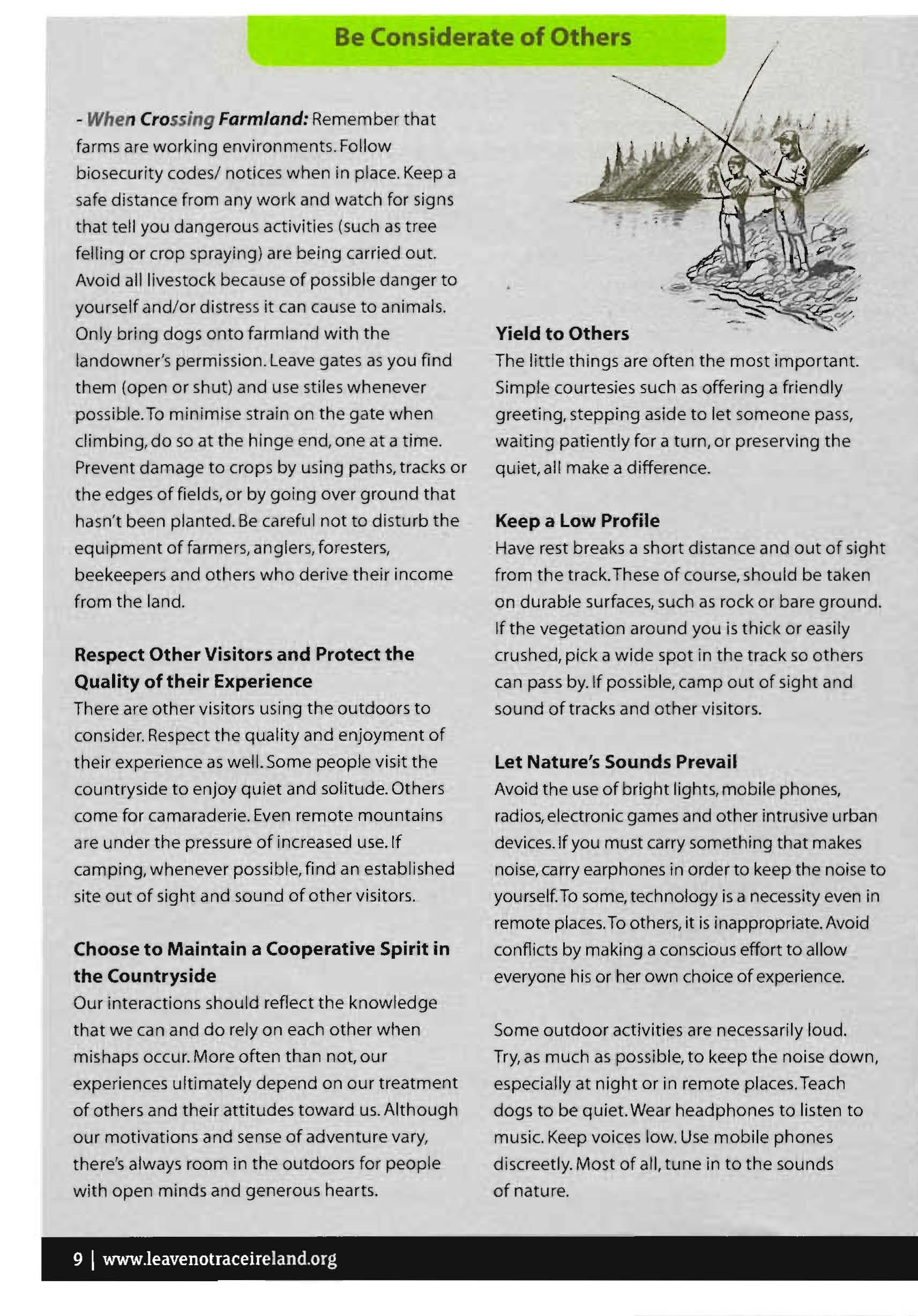
- When Crossing Farmland: Remember that farms are working environments. Follow biosecurity codes/ notices when in place. Keep a safe distance from any work and watch for signs that tell you dangerous activities (such as tree felling or crop spraying) are being carried out. Avoid all livestock because of possible danger to yourself and/or distress it can cause to animals. Only bring dogs onto farmland with the landowner's permission. Leave gates as you find them (open or shut) and use stiles whenever possible. To minimise strain on the gate when climbing, do so at the hinge end, one at a time. Prevent damage to crops by using paths, tracks or the edges of fields, or by going over ground that hasn't been planted. Be careful not to disturb the equipment of farmers, anglers, foresters, beekeepers and others who derive their income from the land.
Respect Other Visitors and Protect the Quality of their Experience
There are other visitors using the outdoors to consider. Respect the quality and enjoyment of their experience as well. Some people visit the countryside to enjoy quiet and solitude. Others come for camaraderie. Even remote mountains are under the pressure of increased use. If camping, whenever possible, find an established site out of sight and sound of other visitors.
Choose to Maintain a Cooperative Spirit in the Countryside
Our interactions should reflect the knowledge that we can and do rely on each other when mishaps occur. More often than not, our experiences ultimately depend on our treatment of others and their attitudes toward us. Although our motivations and sense of adventure vary, there's always room in the outdoors for people with open minds and generous hearts.
Yield to Others
The little things are often the most important. Simple courtesies such as offering a friendly greeting, stepping aside to let someone pass, waiting patiently for a turn, or preserving the quiet, all make a difference.
Keep a Low Profile
Have rest breaks a short distance and out of sight from the track. These of course, should be taken on durable surfaces, such as rock or bare ground. If the vegetation around you is thick or easily crushed, pick a wide spot in the track so others can pass by. If possible, camp out of sight and sound of tracks and other visitors.
Let Nature's Sounds Prevail
Avoid the use of bright lights, mobile phones, radios, electronic games and other intrusive urban devices. If you must carry something that makes noise, carry earphones in order to keep the noise to yourself. To some, technology is a necessity even in remote places. To others, it is inappropriate. Avoid conflicts by making a conscious effort to allow everyone his or her own choice of experience.
Some outdoor activities are necessarily loud. Try, as much as possible, to keep the noise down, especially at night or in remote places. Teach dogs to be quiet. Wear headphones to listen to music. Keep voices low. Use mobile phones discreetly. Most of all, tune in to the sounds of nature.
Respect Farm Animals and Wildlife
"The stark truth is, if we want wild animals, we have to make sacrifices."
(Colin rudge, Wildlife Conservation)
Wildlife
Encounters with wildlife inspire tall tales and long moments of wonder. Unfortunately, wildlife around the world faces threats from loss and fragmentation of habitat, invasive species, pollution, over-exploitation, poaching and disease. Protected lands offer a last refuge from some, but not all, of these problems. Consequently, wild animals and marine life need recreators who will promote their survival rather than add to the difficulties they already face.
We know that animals respond to people in different ways. Some species adapt readily to humans in their domain, resume their normal behaviours and may have become "habituated." Other animals flee from humans, abandoning their you!'lg or critical habitat. Still others are attracted and endangered by human food and rubbish.
As outdoor recreation is dispersed over large areas and at all times of the year, its impacts on wildlife can be equally as disruptive. All species are to some extent, affected by people visiting their habitats. We are responsible for coexisting peacefully with wildlife.
Observe from a Distance
Always watch or photograph animals from a safe distance to avoid startling them or forcing them to flee. Do not follow or approach them. Bring binoculars, spotting scopes and telephoto lenses to watch Wildlife. Back away if animals react to your presence.
To leave the area, move away from the animal even if you must detour from your intended travel direction. You have more options In your movements than animals do. Treat them generously. Avoid quick movements and direct eye contact, which may be interpreted as aggression. Don't disturb wildlife (I.e. by shouting to get their attention) to get a better photo. If animals are on the move, stay out of their line of travel. Travel quietly.
Adult behaviours can influence the relationship of children to the natural world. Show respect and restraint by teaching children not to approach, pet or feed livestock or wildlife. Always keep children in immediate sight. Don't encircle, crowd. tease or attempt to pick up a wild animal. This could cause young animals to be abandoned by their parents if they are removed or touched by well-meaning people. Notify the local land manager if you do find an injured animal or one in trouble
Avoid Sensitive Times and Habitats
Consider the seasonal stresses that wildlife face. In some situations, avoid their habitats for your safety and the animals: Birds, during breeding season, may leave their nests permanently or fail to incubate their eggs properly if they are disturbed too often.
Marine animals are very vulnerable to human disturbances. Disturbances to breeding seal populations may cause them to abandon their efforts. Mussels, barnacles, urchins and starfish can easily be destroyed by a single footstep.
Respect Farm Animals and Wildlife
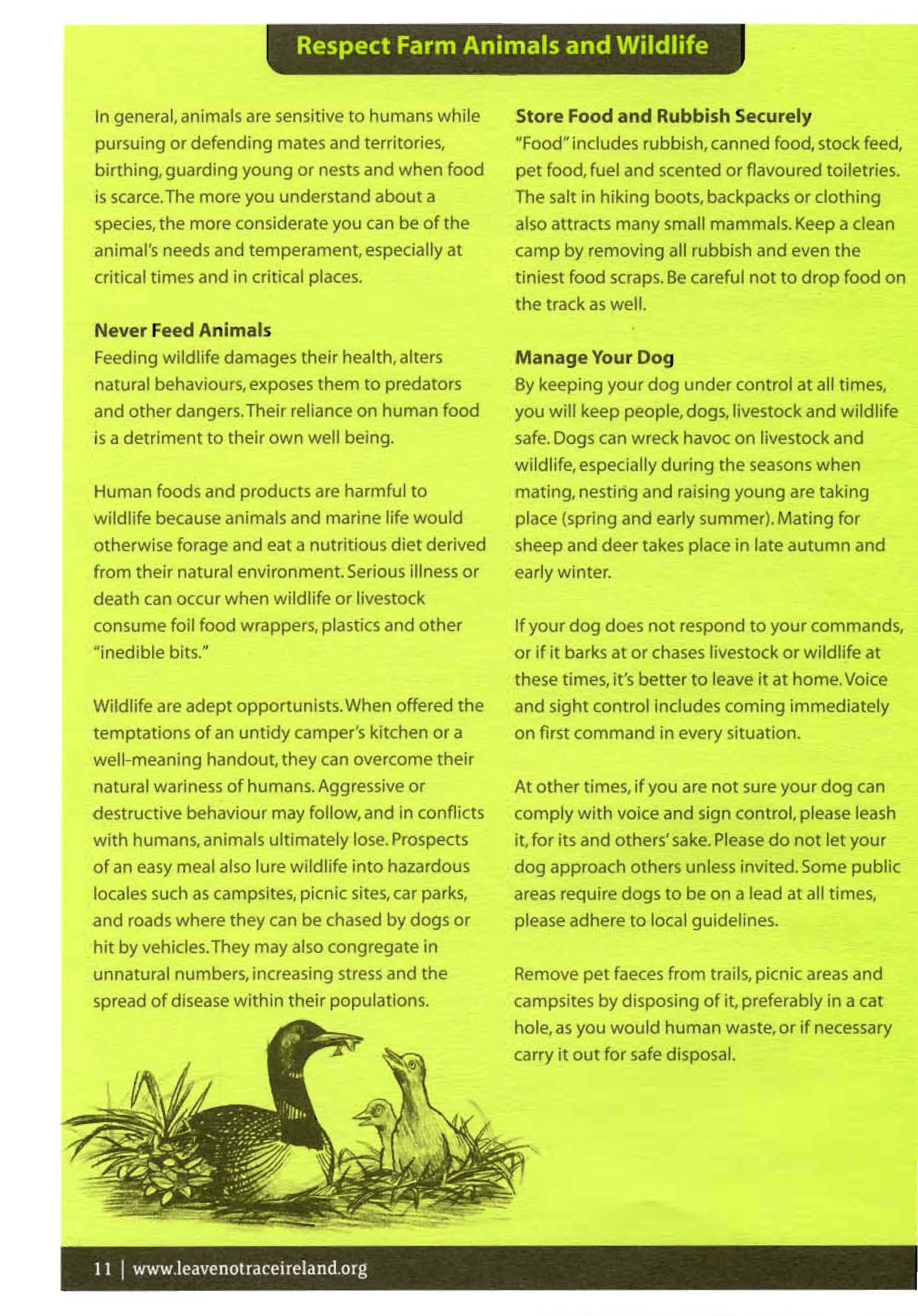
In general, animals are sensitive to humans while pursuing or defending mates and territories, birthing, guarding young or nests and when food is scarce. The more you understand about a species, the more considerate you can be of the animal's needs and temperament, especially at critical times and in critical places.
Never Feed Animals
Feeding wildlife damages their health, alters natural behaviours, exposes them to predators and other dangers. Their reliance on human food is a detriment to their own well being.
Human foods and products are harmful to wildlife because animals and marine life would otherwise forage and eat a nutritious diet derived from their natural environment. Serious illness or death can occur when wildlife or livestock consume foil food wrappers, plastics and other "inedible bits."
Wildlife are adept opportunists. When offered the temptations of an untidy camper's kitchen or a well-meaning handout, they can overcome their natural wariness of humans. Aggressive or destructive behaviour may follow,and in conflicts with humans, animals ultimately lose. Prospects of an easy meal also lure wildlife into hazardous locales such as campsites, picnic sites, car parks, and roads where they can be chased by dogs or hit by vehicles. They may also congregate in unnatural numbers, increasing stress and the spread of disease within their populations.
Store Food and Rubbish
Securely "Food" indudes rubbish, canned food, stock feed, pet food, fuel and scented or flavoured toiletries. The salt in hiking boots, backpacks or clothing also attracts many small mammals. Keep a clean camp by removing all rubbish and even the tiniest food scraps. Be careful not to drop food on the track as well.
Manage Your Dog
By keeping your dog under control at all times, you will keep people, dogs, livestock and wildlife safe. Dogs can wreck havoc on livestock and wildlife, especially during the seasons when mating, nesting and raising young are taking place (spring and early summer). Mating for sheep and deer takes place in late autumn and early winter.
If your dog does not respond to your commands, or if it barks at or chases livestock or wildlife at these times, it's better to leave it at home. Voice and sight control Includes coming immediately on first command in every situation.
At other times, if you are not sure your dog can comply with voice and sign control, please leash it, for its and others' sake. Please do not let your dog approach others unless invited. Some public areas require dogs to be on a lead at all times, please adhere to local guidelines.
Remove pet faeces from trails, picnic areas and campsites by disposing of it, preferably in a cat hole.as you would human waste, or if necessary carry it out for safe disposal.
Travel and Camp on Durable Ground
"We
shall not cease from exploration, and the end of all our exploring will be to arrive where we started and know the place for the first time." (T.S. Elliot)
"The notion that [outdoor] recreation has no environmental impacts is no longer tenable." (Curtis H. Flather and H. Ken Cordell)
What effect does a footstep have? The answer is, it depends. A footstep means different things to a young tree and meadow grass, to blanket bog and fragile soil, to a gravelly river bank and forest moss. Unfortunately, trampling causes vegetation damage and soil erosion in virtually every environment. Recovery that takes a year in some environments might take 25 years in others. Other impacts are also possible. Most soils contain animals that live or feed on decaying plants. Trampling destroys habitat for insects, earthworms, molluscs,as well as the fungi that fertilise the soil and help make re-growth possible. Vegetation protects underlying soils. Once plant growth is destroyed, erosion can continue with or without further use.
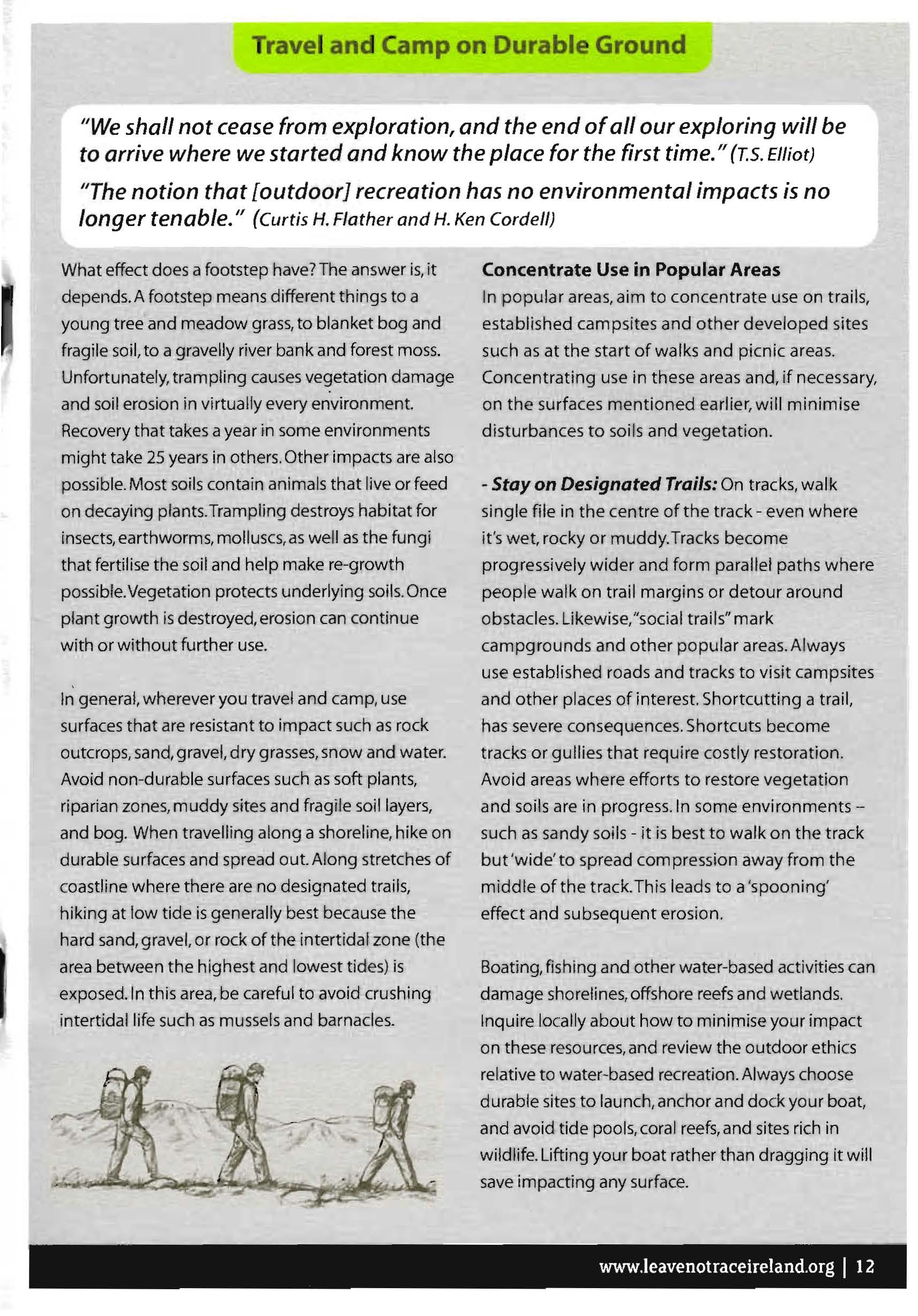
In general, wherever you travel and camp, use surfaces that are resistant to impact such as rock outcrops, sand, gravel. dry grasses, snow and water. Avoid non-durable surfaces such as soft plants, riparian zones, muddy sites and fragile soil layers, and bog. When travelling along a shoreline, hike on durable surfaces and spread out. Along stretches of coastline where there are no designated trails, hiking at low tide is generally best because the hard sand, gravel, or rock of the intertidal zone (the area between the highest and lowest tides) is exposed. In this area, be careful to avoid crushing intertidal life such as mussels and barnacles.
Concentrate Use in Popular Areas
In popular areas, aim to concentrate use on trails, established campsites and other developed sites such as at the start of walks and picnic areas. Concentrating use in these areas and, if necessary, on the surfaces mentioned earlier, will minimise disturbances to soils and vegetation.
- Stay on Designated Trails:
On tracks, walk single file in the centre of the track - even where it's wet, rocky or muddy. Tracks become progressively wider and form parallel paths where people walk on trail margins or detour around obstacles. Likewise,"social trails" mark campgrounds and other popular areas. Always use established roads and tracks to visit campsites and other places of interest. Shortcutting a trail, has severe consequences. Shortcuts become tracks or gullies that require costly restoration. Avoid areas where efforts to restore vegetation and soils are in progress. In some environments such as sandy soils - it is best to walk on the track but 'wide' to spread com pression away from the middle of the track. This leads to a 'spooning' effect and subsequent erosion.
Boating, fishing and other water-based activities can damage shorelines, offshore reefs and wetlands. Inquire locally about how to minimise your impact on these resources, and review the outdoor ethics relative to water-based recreation. Always choose durable sites to launch, anchor and dock your boat, and avoid tide pools, coral reefs, and sites rich in wildlife. Lifting your boat rather than dragging it will save impacting any surface.
Travel and Camp on Durable Ground
- Use Established Campsites: Choose a wellestablished campsite that's big enough for your group. Some popular areas have officially designated campsites, shelters or platforms. Use of these amenities can reduce damage to surrounding vegetation and other natural features.
Where campsites are not formally designated, look for and use sites where the ground cover is already worn away. Tents, packs, gear and the kitchen area should be concentrated in one area on previously compacted, naturally resistant, or reinforced surfaces. This approach protects surrounding vegetation and prevents development of "satellite" sites.
Also consider your visual impact on other users or wildlife. Take advantage of opportunities to tuck your tent out of view behind natural screening such as trees or rocks.
Good Campsites are Found, Not Made
What makes the perfect campsite? Aesthetics, safety, privacy and comfort are all measures of a desirable campsite. However, securing such amenities does not entail a major remodelling effort. Look for a level spot rather than creating one. Bring lightweight furniture and conveniences along to eliminate the desire to build them onsite.
Camp stoves, mattresses, tables, chairs and lanterns are readily available and pack in and out with ease. Trees are often damaged near campsites. Take care not to break off branches while securing your tent. Place a stuff sack or other material under ropes or where padding is necessary to protect bark.
Disperse Use in Pristine Areas
Pristine areas are those that see little human traffic. They are places where there are few, if any trails and no established campsites. They feel truly wild. To prevent the spread of tracks and campsites and protect the wildness we seek in pristine areas, it is especially important to practise Leave No Trace techniques.
If you would like to travel off-trail where no established routes, trails or campsites exist. use the most durable surfaces such as rock, snow and ice, gravel, sand, and navigable water. Dry grasses and sedges (which resemble grasses) are also naturally durable due to their hardy root structures, flexible stems and faster growth rates. Stick to existing tracks where soils are not prone to erosion, rare species aren't present, or vegetation grows slowly. Surprisingly, some of the most sensitive plants and animals grow in the toughest places like sandy soils and rocky ledges.
Avoid Creating Tracks and Campsites
In general, spread out when walking across vegetation. If each person takes a slightly different route, a distinct track is less likely to form because no single plant receives multiple footfalls. Walking single file is acceptable where there is little chance of trampling plants.
- Walking: Off-track travel may not be appropriate in some areas. Endangered species may only grow where off-track walkers and climbers are the most serious threat to its survival. If you absolutely must travel through fragile terrain, try to place your footsteps in the least destructive locations and encourage your companions to step in exactly the same spots.
Travel and Camp on Durable Ground
Be careful to avoid fragile vegetation, such as broad-leaf flowering plants, tree seedlings, woody stemmed plants, mosses and lichens. Try to choose a route that minimises damage to sensitive plants by walking on rocks, bare ground or skirting around fragile places. Gravel is an example of a very durable surface and can sometimes be found along streams and seashores. Leaf litter and dry grasses also make good choices for travel. On the coast, take care not to walk on or through sand dunes. In general, they have fragile vegetation and a slow recovery period. Stick to the intertidal zone especially on durable sandy beaches.
- Campsites: Select the most durable camping location possible-or keep travelling until one is found. In pristine areas, pre-existing camping spots, even those that are lightly used, should be left alone to recover. In popular areas it is better to use a site that is already impacted rather than creating new traces. Before unpacking your tent, look for obvious bird nesting activity and other signs of animals. Choose an area that seems safe, free of wildlife and well suited to low-impact camping. Look for a large rock slab, a gravelled area or other equally durable space to locate your kitchen and sleeping area. Concentrate your activities on this surface whenever possible to protect more fragile areas. If necessary, reserve less durable ground for your sleeping area.
On the coast, it is preferable, if weather and tides permit, to camp on the shoreline especially if it is a sand or gravel beach.
In pristine areas, impacts can often be avoided by staying only one night. In these areas, vary your route to water, to the "toilet" and to sleeping areas to prevent tracks from forming. In general, manage your activity to avoid harming the natural features of the site, especially those that
do not regenerate or do so very slowly-such as lichens and trees.
Protecting Fresh Water Resources
While sand and gravel bars along large rivers or the sea are durable surfaces that may be suitable for low-impact camping, vegetated lakeshores and the banks of small streams are fragile and easily eroded.
Plants and animals also congregate at these water sources, so camp at least 30 metres (approx. 70 adult steps) away. By distancing camps from water we are less likely to inadvertently pollute them.
Even designated sites or shelters can be too close to tracks or water because of terrain limitations or a long history of use. Usually, continued use of such sites is preferable to the creation of new ones.
Breaking Camp
Before departing, naturalise and disguise the site by replacing any rocks or sticks you may have moved. Re-cover scuffed-up areas with leaf litter or other natural materials.
Fluff up matted grass and make the place less obvious as a campsite. As long as overall visitor use is very low, the site will retain its best qualities. Ideally, no trails or campsites will be created if visitors disperse their activities. This extra effort will help hide any indication that you camped there and make it less likely that other users will camp in the same spot. By taking time and care, we will succeed in protecting our natural heritage and ensure a positive wilderness experience for those who may follow.
Leave What you Find
"The earth, like the sun, like the air, belongs to everyone-and to no one."
(Edward Abbey)
People visit natural areas for many reasons, among them to explore nature's mysteries and surprises. When we leave rocks, shells, plants, feathers, fossils, artifacts and other objects of interest as we find them, we pass the gih of discovery on to those who follow. I t's the missing elements of our favourite places that disturb us the most."Leave What You Find" means retaining the special qualities of both our natural and built heritage areas - for the long term.
Conserve the Past
Archeological and historical artifacts such as old walls, holy wells, old mine workings and hilltop cairns are reminders of the rich human history of the landscape and belong to all people for all time. Structures, dwellings and artifacts should not be disturbed. Observe, but do not disturb them.
Leave Natural Objects Undisturbed
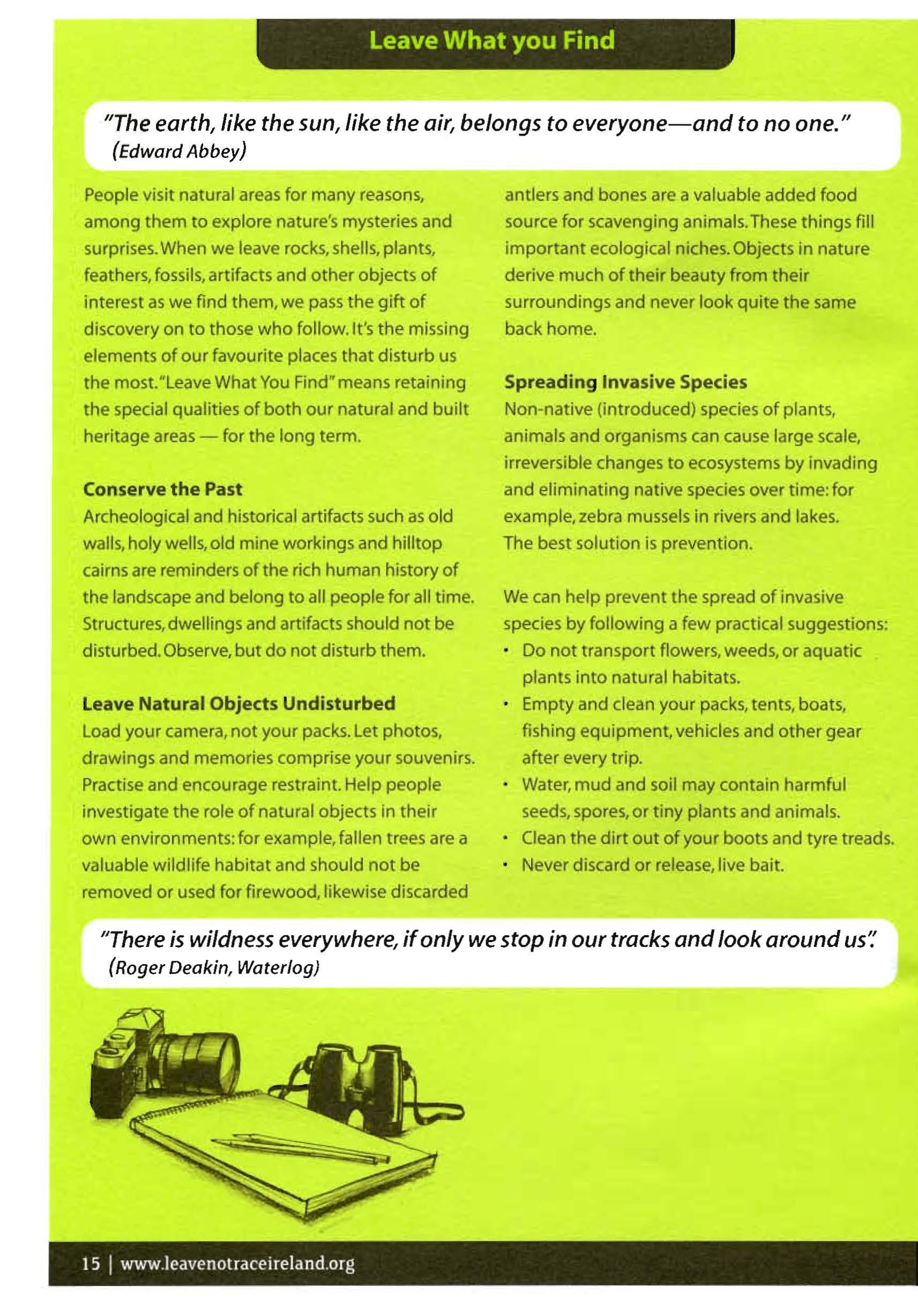
Load your camera, not your packs. Let photos, drawings and memories comprise your souvenirs. Practise and encourage restraint. Help people investigate the role of natural objects in their own environments: for example, fallen trees are a valuable wildlife habitat and should not be removed or used for firewood, likewise discarded
antlers and bones are a valuable added food source for scavenging animals. These things fill important ecological niches. Objects In nature derive much of their beauty from their surroundings and never look quite the same back home.
Spreading Invasive Species
Non-native (Introduced) species of plants, animals and organisms can cause large scale, irreversible changes to ecosystems by invading and eliminating native species over time; for example, zebra mussels in rivers and lakes. The best solution Is prevention.
We can help prevent the spread of invasive species by following a few practical suggestions; Do not transport flowers, weeds, or aquatic plants into natural habitats.
Empty and clean your packs, tents, boats, fishing equipment, vehicles and other gear aher every trip.
Water, mud and soil may contain harmful seeds, spores, or tiny plants and animals. Clean the dirt out of your boots and tyre treads. Never discard or release, live bait.
"There is wildness everywhere, if only we stop in our tracks and look around us': (Roger Deakin, Waterlog)
Dispose of
aste Properly
Waste
"Leave No Waste': Anyone who uses land for recreation has a responsibility to clean up before he or she leaves. Inspect your rest areas and campsite for rubbish or spilled foods. Pack out all rubbish and kitchen waste, including leftover food.
Plan meals to avoid generating messy, smelly rubbish. Pack out all waste - don't count on a fire
to dispose of it. Rubbish that is half-burned or
buried will attract animals and make a site unattractive to other visitors.
Overlooked rubbish is litter and litter is not only ugly - it can also be deadly. Animals scavenging a meal from a tasty smelling morsel can ingest bits of dropped food packaging thus damaging their digestive system. Plastic ringos and bags kill shorebirds, turtles and other marine mammals. Fishing lines, lures and nets can ensnare or injure wildlife so be careful not to leave any behind.
Pack plastic bags to carry your rubbish out (and maybe someone else's). Before moving on from a camp or resting place, search the area for "micro-garbage" such as bits of food and rubbish, including cigarette butts, chewing gum, and organic litter such as tea bags, orange peel, banana skin, apple core or egg and nut shell.
Good Sanitation Practice
• Human Waste: "Where's the toilet?" is an
important question, especially in the outdoors. Proper disposal of human waste is perhaps the most significant impact we can have on the outdoors. Where there is no toilet per se, answering the call involves a little pre-planning, some initiative and a bit of creativity. The four objectives of proper human waste disposal are:
• Avoid polluting water sources.
• Minimise contact with insects and animals.
• Maximise decomposition.
• Minimise the chances of social impacts.
Poo in the outdoors is natural, every animal does it and there's lots of it around. Increased visitation and exploration by humans can significantly add to the amount of waste left to be broken down.
Animal and human waste in the outdoors has the potential to reduce water quality, increase the spread of illnesses such as Giardia and Hepatitis and cause unpleasant experiences for those who follow. The way in which we treat our waste disposal is potentially significant not only for other outdoor users but, more importantly for wildlife which depend upon water sources. Wherever soils are thin or sparse, rainstorms can flush these wastes and other pollutants directly into water sources. Remember you are always downstream of somebody else!
- Facilities/Toilets: Whenever possible, take time to locate and use toilets for human waste disposal.
- Cat Holes: If no facilities are available, deposit solid human waste in "cat holes" dug 20 - 25 cm deep and at least 30 metres (70 adult steps) from tracks, water-bodies, camps and watercourses.To promote decomposition, choose a site in organic soil, rather than deep sandy mineral soil. Bring a trowel to dig the hole, and gently remove a plug of sod containing roots and soil and carefully put it aside. After use, and before replacing the plug of sod, mix some soil into the faeces to promote decomposition. Replace the plug and disguise the hole by lightly tramping down around the edges. Then "naturalise" the site by scattering leaf litter and disguise it well after use. The microbes
Dispose of Waste Properly
found in soil will break down faeces and the pathogens they contain.
Human waste should not be deposited under rocks because it will decompose slowly there and may wash into water sources after heavy rain. Good cat hole sites isolate waste from water sources such as lakes, streams, ravines and other visitors. Whenever possible, use a remote location during the day's travel to help prevent high concentrations of cat holes near campsites or high use picnic areas/car parks.
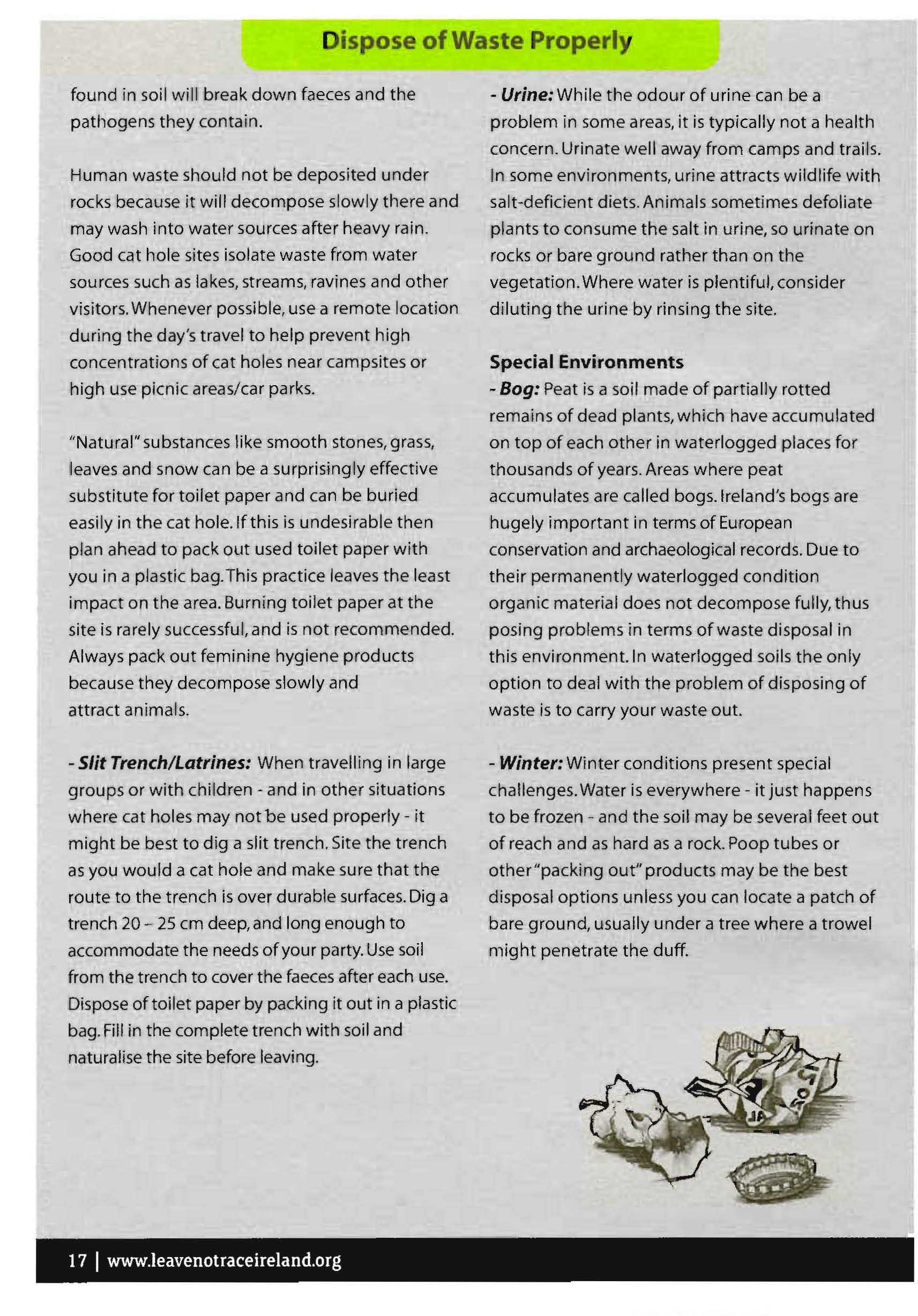
"Natural" substances like smooth stones, grass, Ileaves and snow can be a surprisingly effective substitute for toilet paper and can be buried easily in the cat hole. If this is undesirable then plan ahead to pack out used toilet paper with you in a plastic bag. This practice leaves the least impact on the area. Burning toilet paper at the site is rarely successful, and is not recommended. Always pack out feminine hygiene products because they decompose slowly and attract animals.
- Slit Trench/Latrines: When travelling in large groups or with children - and in other situations where cat holes may not be used properly - it might be best to dig a slit trench. Site the trench as you would a cat hole and make sure that the route to the trench is over durable surfaces. Dig a trench 20 - 25 cm deep, and long enough to accommodate the needs of your party. Use soil from the trench to cover the faeces after each use. Dispose of toilet paper by packing it out in a plastic bag. Fill in the complete trench with soil and naturalise the site before leaving.
- Urine: While the odour of urine can be a problem in some areas, it is typically not a health concern. Urinate well away from camps and trails. In some environments, urine attracts wildlife with salt-deficient diets. Animals sometimes defoliate plants to consume the salt in urine, so urinate on rocks or bare ground rather than on the vegetation. Where water is plentiful, consider diluting the urine by rinsing the site.
Special Environments
- Bog: Peat is a soil made of partially rotted remains of dead plants, which have accumulated on top of each other in waterlogged places for thousands of years. Areas where peat accumulates are called bogs. Ireland's bogs are hugely important in terms of European conservation and archaeological records. Due to their permanently waterlogged condition organic material does not decompose fully, thus posing problems in terms of waste disposal in this environment. In waterlogged soils the only option to deal with the problem of disposing of waste is to carry your waste out.
- Winter: Winter conditions present special challenges. Water is everywhere - it just happens to be frozen - and the soil may be several feet out of reach and as hard as a rock. Poop tubes or other"packing out" products may be the best disposal options unless you can locate a patch of bare ground, usually under a tree where a trowel might penetrate the duff.
Dispose of Waste Properly
- Sea Coastline: The vast and dynamic ocean, rich in bacteria, is generally viewed as an acceptable environment for small-scale human waste decomposition. Wave and current action qUickly break down the faeces into small pieces, which are then further broken down by the bacterial life in the sea. If performed properly, sea dispersal will leave no signs along the coastline for the next visitor to encounter.
- River Corridors and Canals: Carrying a portable toilet has become a standard practice on many waterways and may be required. At the conclusion of a trip, the toilet's holding tank is flushed out at a caravan or boat dump station. The station delivers the waste and toilet paper to a local authority sewage treatment plant. The dumping of solid human waste in landfills is usually illegal. While on a river, be sure to site the toilet on a durable spot where no new trails will be created to reach it.
Dishwashing
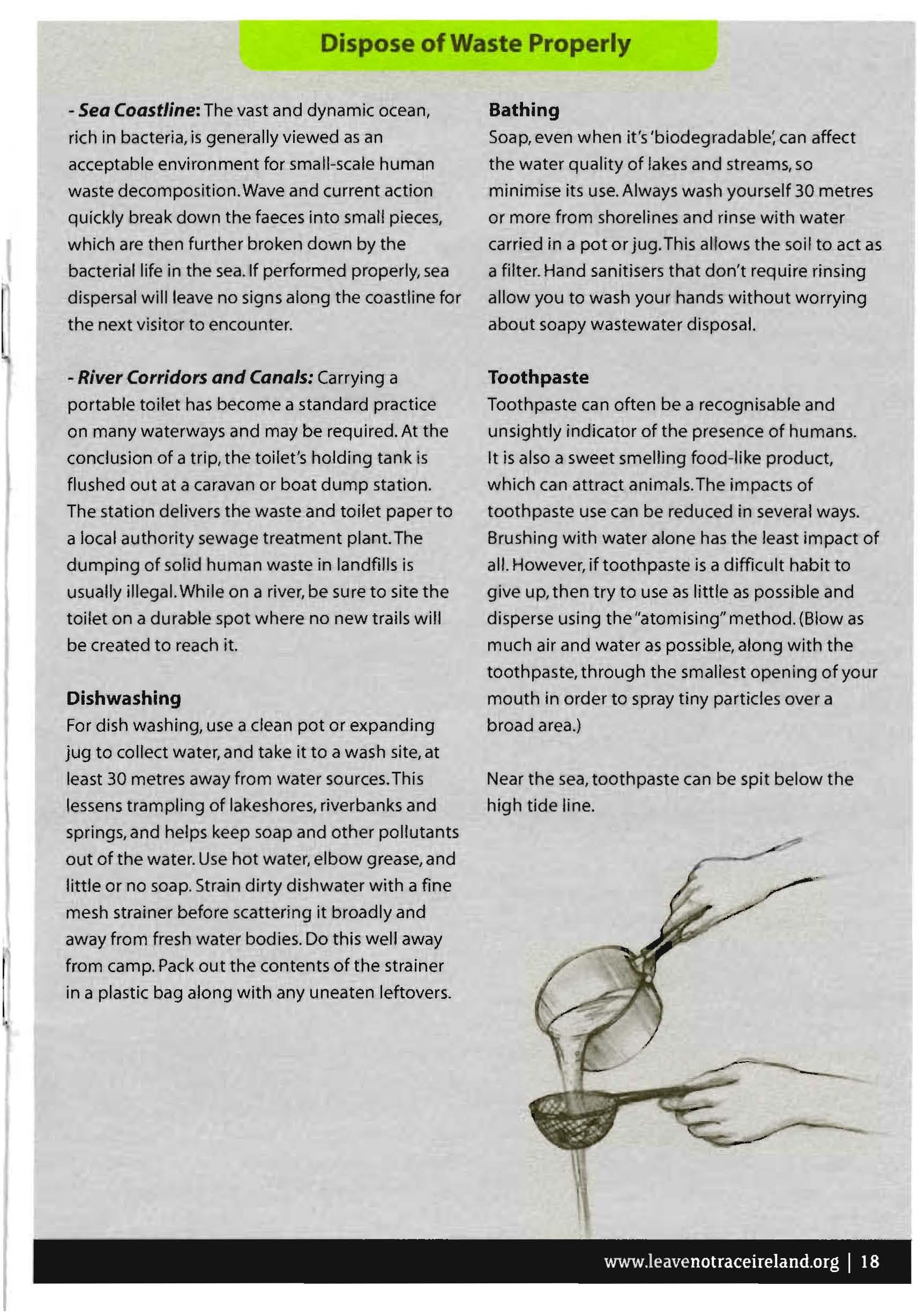
For dish washing, use a clean pot or expanding jug to collect water, and take it to a wash site, at least 30 metres away from water sources. This lessens trampling of lakeshores, riverbanks and springs, and helps keep soap and other pollutants out of the water. Use hot water, elbow grease, and little or no soap. Strain dirty dishwater with a fine mesh strainer before scattering it broadly and away from fresh water bodies. Do this well away from camp. Pack out the contents of the strainer in a plastic bag along with any uneaten leftovers.
Bathing
Soap, even when it's 'biodegradable: can affect the water quality of lakes and streams, so minimise its use. Always wash yourself 30 metres or more from shorelines and rinse with water carried in a pot or jug. This allows the soil to act as a filter. Hand sanitisers that don't require rinsing allow you to wash your hands without worrying about soapy wastewater disposal.
Toothpaste
Toothpaste can often be a recognisable and unsightly indicator of the presence of humans. It is also a sweet smelling food-like product, which can attract animals. The impacts of toothpaste use can be reduced in several ways. Brushing with water alone has the least impact of all. However, if toothpaste is a difficult habit to give up, then try to use as little as possible and disperse using the"atomising"method. (Blow as much air and water as possible, along with the toothpaste, through the smallest opening of your mouth in order to spray tiny particles over a broad area.)
Near the sea, toothpaste can be spit below the high tide line.
Minimise the Effects of Fire
"In gaining the lovely and the usable, we have given up the incomparable. If (Wallace Stegner)
Rres can cause lasting impacts and can be devastating to forests, natural habitats, wildlife and property. Many of these fires are either carelessly or accidentally set by uninformed campers and travellers. Setting controlled fires requires a permit from National Parks &Wildlife Service and is a practice and science of experienced land managers and is based on weather, sources of ignition, and fuel.
Along with the destructive nature of fire, the natural appearance of many recreation areas has been compromised by the careless use of campfires and the demand for firewood. Campfires are beautiful by night. But the enormous rings of soot-scarred rocksoverflowing with ashes, partly burned logs, food and rubbish -are unsightly by day.
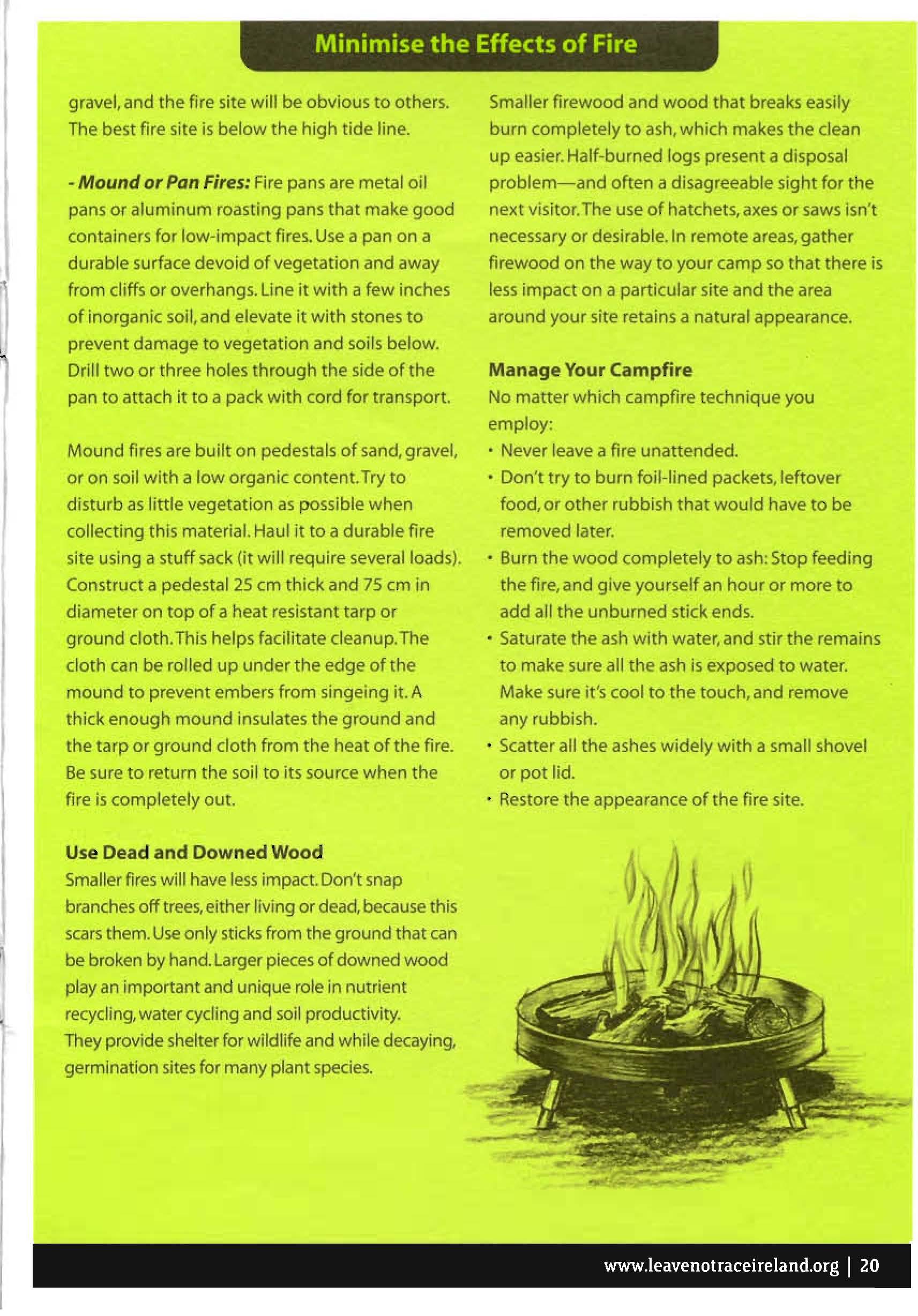
Many lasting impacts associated with campfires can be avoided by using lightweight stoves, fire pans, mound fires and other Leave No Trace techniques.
Check Local Regulations and Conditions
It may be prohibited to build a campfire in some areas. National Parks, protected areas and forestry plantations may have complete fire bans. Check with local land managers whether building a campfire is permitted.
Use a Stove
The safest way to be prepared for all situations is to use a stove. As well, carry a pot, matches and sufficient fuel to cook all meals. Build fires only when all of the conditions are right - the danger of fire is low, downed and dead wood is plentiful, and there is sufficient time to prepare the fire site, burn all the wood to cold ash, and clean up.
Fires are inappropriate In fragile environments and/or where plant growth is extremely slow. Sadly, wood that has taken years to grow has often been burnt for a few short minutes, just for the sake of entertainment.
Build a Minimum Impact Fire
Consider whether a fire makes good sense at your picnic or campsite.
If a campfire is important to you:
• First we should question ourselves as to whether the wood we are using comes from a sustainable yield.
• Ask about pertinent regulations and campfire management techniques.
• Judge the wind, weather, location and wood availability. Decide whether it's safe and responsible to build a campfire.
• In places where there are no fire rings or grates, bring a fire pan or set aside time to build a mound fire.
• Have a trowel or small shovel and a container for saturating the ashes with water.
- Use an Established Fire Ring: If you camp near an existing rock ring, use ft instead of building a new one.The most inviting fire rings are of a reasonable size and free of excess ashes, halfburned wood and trash. Leave a fire ring that encourages others who want a fire to use it.
- Beach Fires: A gravel bar or beach campfire is made by excavating a shallow depressIon in the sand or gravel along the shorelines of seas or large rivers. Make sure to remove all the ash, and scatter it before refilling the depression. if left in place, the ash will "float" through the sand or
Minimise the Effects of Fire
gravel, and the fi re site will be obvious to others. The best fire site is below the high tide line.
• Mound or Pan Fires: Fire pans are metal oil pans Of aluminum roasting pans that make good containers for low-Impact fires. Use a pan on a durable surface devoid of vegetation and away from cliffs or overhangs. Line it with a few inches of inorganic soil, and elevate it with stones to prevent damage to vegetation and soils below. Drill two or three holes through the side of the pan to attach it to a pack with cord for transport.
Mound fires are built on pedestals of sand, gravel, or on soil with a low organic content. Try to disturb as little vegetation as possible when collecting this material. Haul it to a durable fire site using a stuff sack (it will require several loads). Construct a pedestal 2S cm thick and 7S cm in diameter on top of a heat resistant tarp or ground doth. This helps facilitate c1eanup.The doth can be rolled up under the edge of the mound to prevent embers from singeing it. A thick enough mound insulates the ground and the tarp or ground cloth from the heat of the fire. Be sure to return the soil to its source when the fire is completely out.
Use Dead and Downed Wood
Smaller fires will have less impact. Don't snap branches off trees, either living or dead, because this scars them. Use only sticks from the ground that can be broken by hand. Larger pieces of downed wood play an important and unique role in nutrient recycling, water cycling and soil productivity. They provide shelter for wildlife and while decaying, germination sites for many plant speCies.
Smaller firewood and wood that breaks easily burn completely to ash, which makes the clean up easier. Half-burned logs present a disposal problem-and ohen a disagreeable sight for the next visitor. The use of hatchets, axes or saws isn't necessary or desirable. In remote areas, gather firewood on the way to your camp so that there is less impact on a particular site and the area around your site retains a natural appearance.
Manage Your Campfire
No matter which campfire technique you employ:
• Never leave a fire unattended.
• Don't try to burn foil-lined packets, leftover food, or other rubbish that would have to be removed later.
• Burn the wood completely to ash: Stop feeding the fire, and give yourself an hour or more to add all the unburned stick ends.
• Saturate the ash with water, and stir the remains to make sure all the ash is exposed to water. Make sure it's cool to the touch, and remove any rubbish.
o Scatter all the ashes Widely with a small shovel or pot lid.
o Restore the appearance of the fire site.
A Few Terms Defined
Established campsite: Campsite made obvious by unvegetated ground or a "barren core."
Invasive species:
Inorganic soil:
Pristine:
Cairn:
Duff:
Habituated:
Naturalise:
Riparian Habitat:
Switchback:
Endangered species:
Social paths/tracks:
Trail:
NATURA 2000 AND SPAs
Plant or animal that is not native to this country and that can aggressively out-compete native species.
Soil that consists primarily of minerals with little or no plant and animal remains.
A place where signs of human impacts are absent or difficult to detect.
A mound of stones erected as a landmark.
Decaying leaves and branches covering a forest floor.
Animals that are comfortable in the presence of humans and have become accustomed to frequenting developed areas, campsites, trails or roadsides.
To restore a site to its previous state so that it appears untouched by human use.
The area or zone along or adjacent to rivers, streams, lakes, ponds or other water bodies, dominated by high soil moisture content and influenced by adjacent upland vegetation.
A section of trail forming a zigzag pattern up a steep hillside.
A listing of plants or animals that have experienced a decline in their populations and may face extinction without intervention.
Paths created by travelling on non-durable surfaces between campsites and other sites of interest such as mountain summits.
Trails which are managed and signed! such as National Waymarked Ways, or in forest/mountain/urban parks.
In 1992 the Council of the European Communities adopted the Habitats Directive, on the conservation of natural and semi-natural habitats and species of flora and fauna. The Directive seeks to establish "Natura 2000", a network of protected areas throughout the European Community. It is the responsibility of each member state to designate Special Areas of Conservation (SACs) to protect habitats and species, which, together with the Special Protection Areas (SPAs) designated under the 1979 Birds Directive, form Natura 2000.
In Ireland, the National Parks and Wildlife Service are responsible for designating and monitoring the health of these sites. Certain restrictions may apply to these areas as they represent some of the most sensitive and priority landscapes on a European scale.

www.LNT.org
www.LNT.org.au www.leavenotrace.ca
Soft Paths. National Outdoor Leadership School. Agri-Aware Leaflet. Met Environmental Policy.
The All-Party Oireachtas Committee on the Constitution. Ninth Progress Report. Private Property. 2004. Government of Ireland.
Get Involved
There are a number of ways to become involved with Leave No Trace:
Adopt the Principles - Start to incorporate some of the techniques mentioned in this booklet when out and about in the countryside.
Training - Participate in Leave No Trace Training. Leave No Trace is based on a tiered education programme, with three types of training. For more information on Leave No Trace training please visit the training section on www.leavenotraceireland.org.
Support - Support the organisation by becoming a member or partner of Leave No Trace Ireland. For more information please visit the support section on www.leavenotraceireland.org.
Special thanks go to Leave No Trace Master Educators Ann Fitzpatrick and Katy Egan for their assistance in the production of this booklet. Illustrations by Scott Knauer.
Leave No Trace Ireland's main financial partners are;