A-Z Guide to Scotch
Academic Care
See entries for Reporting, Learning Support and VCE Office
Accounts & Payroll
The Accounts Department is located in the Randall Building. Salaries for permanent staff are generally paid monthly on the 15th, or the business day before the 15th if it falls on a weekend. Salary for casual staff is paid fortnightly. Important contacts for the Accounts Department are as follows:
Payroll – Carolyn Boyd
Email: carolyn.boyd@scotch.vic.edu.au
Phone: (03) 9810 4249
Accounts Payable and Expense Claims – Anita Haratsis
Email: anita.haratsis@scotch.vic.edu.au
Phone: (03) 9810 4257
Forms you may need (including leave request forms, expense claim forms, change of banking details and the like), as well as information on how to access Synweb for payslips, can be found on the MyScotch Staff Portal > Finance
Contact the Accounts Department on accounts@scotch.vic.edu.au or (03) 9810 4120
See also entry for Salary Packaging
After Hours Access
See entry for Security & After Hours Access
Archives
The Archives house Scotch’s history, including past student records, visual records, uniform, trophies, publications and Old Boys’ records. It is located in the Tolson Centre on the north side of Morrison Street and can be contacted on (03) 9810 4470
Assemblies
Junior School
A whole school assembly for Prep to Year 6 boys, run by the Head of Junior School, is held each Monday at 2 05pm in the Junior School Assembly Hall. All staff are to attend.
Year 3-6 boys attend an assembly on Friday, run by the Deputy Head of Junior School, at 2 05pm in the Junior School Assembly Hall.
Junior Primary boys (Prep to Year 2) have an assembly on Wednesday at 2 05pm in the Junior School Assembly Hall.
Senior School
In the Senior School, assemblies are held in the Memorial Hall on Monday and Friday, following period 2, before recess. Teachers wear an academic gown. Teachers who are not a Form Teacher, Head of House, or House Tutor, must attend assembly, and sit on the stage.
Not all year level groups attend both assemblies and a schedule of assemblies and which year levels are present, is provided each week and is available on Canvas. A map of seating plans that show where students in each House/Form should sit can be found on the SS Teachers Staff LMS page>Pastoral Care Structure and Seating Plans on Canvas.
House Tutors and Form Teachers supervise their students in the Memorial Hall assemblies, as do Heads of House. House Tutors and Form Teachers should mark the roll during assembly, noting that many students have music rehearsals at this time. All teaching staff should bring a copy of the School Songs and Hymns to assemblies, a copy of which can be found on Canvas > Senior School Teachers > College Song Book and in the Student Record Book
Attendance Procedures for Students
See also entries for Roll Marking and Timetable
Student attendance is logged on the Student Information System (SIS). Absence/Late explanation codes on SIS are as follows:
0 - No Reason 1 - Family Request – Accepted
- Medical 3 - Family Request - Not Accepted
Explained in Clipboard
- Unexplained in Clipboard
A student may also be marked “E” when on a trip or excursion.
Junior School
Prime responsibility for knowing which students are absent at beginning of day and after lunch lies with the respective classroom teacher. Teachers are required to record attendance for their class electronically by 8.45am and 2.05pm on SIS. Absences are followed up by the appropriate Administration staff.
Senior School
Prime responsibility for knowing which students are absent in each period lies with the respective classroom teacher. Teachers are required to record attendance for each of their classes electronically on the Student Information System (SIS). This task should be completed within 15 minutes of the start of every class. Absences are followed up by the appropriate Head of House, Form Tutor or Form Teacher Students in Years 7-12 entering class after the roll has been marked and submitted are required to obtain a late pass from the appropriate Student Office
Staff Guide to Scotch 12
Any required contact with parents should be made by the Head of House or Form Teacher, not the Classroom Teacher.
Behavioural Expectations for Students
Junior School
Expectations
Members of the school, both as individuals and also in a group, should maintain good manners which they are taught at home and at school.
Among common courtesies customary to our society are:
– Standing up and making way for adults in public.
– Making way for others in public places and on footpaths.
– Politely acknowledging a known adult, thereby showing respect for elders.
– Keeping one’s voice and conversation in public to a tone and to topics which are acceptable to others who are not members of the school.
– Not defacing or damaging walls, furniture or equipment, whether school, private or public.
Everyone has the right to be treated with respect and fairness
We all have a responsibility to:
– be courteous
– address and respond to others in an appropriate manner
– be sensitive to the needs of others
– respect the rights of others who hold views different from one’s own
– develop and live by a set of values which includes compassion, tolerance, concern for individual worth and which is consistent with the Christian Faith.
Everyone has the right to have their personal property respected and secure
Students have the responsibility to:
– name all personal property clearly and keep it in the appropriate place
– not move or borrow another person’s property without that person’s permission
– not steal anything.
We all have a responsibility to keep classrooms, corridors, buildings and grounds free of damage and defacement.
Everyone in the school community has the right to expect all members to behave in a way which upholds the school’s good name
We all have a responsibility to:
– exhibit exemplary behaviour through word, action and dress
– treat all visitors with care, courtesy and respect.
Students have a responsibility to:
– wear the correct uniform at all times
– behave appropriately when in public and when travelling to and from school.
Junior School Code of Conduct
What do you expect of yourself?
That I will represent the School well on all occasions by:
– my behaviour;
– my wearing of the School uniform;
– my respect for others;
– my respect for my learning; and,
– my respect for School property.
What do you expect of others?
I can expect that others will:
– do their best to represent the School well at all times;
– look after and be supportive of me;
– be respectful to me;
– respect my property; and
– respect my right to learn.
Senior School
For information on behavioural expectations and management, see the Record Book and relevant policies on the MyScotch Staff Portal.
Boarding Houses
“The Hill” is home for nearly 160 boarders, staff and their families. Students are allocated into one of three Boarding Houses, known as Arthur Robinson House, McMeckan House, and School House.
For any queries, contact boarding@scotch.vic.edu.au
Building Access
All staff have been provided with an appropriate access pass and a Cyberkey that includes access to all areas necessary for your role. Cyberkeys require updating every seven days, which ensures that your access privileges are up to date. If the Cyberkey has not been updated in the last 7 days, an alarm tone will sound when you try to use it to access any room.
Cyberkey updating locations include:
– Language & Culture Centre - foyer;
– Sir Zelman Cowen Centre - foyer;
– Lithgow Centre - Staff Common Room downstairs and upstairs on “the Bridge”;
Staff Guide to Scotch 14
– Randall Building – in the rear foyer area, outside kitchenette;
– James Forbes Academy – main reception entry;
– Cardinal Building – veranda on the south side;
– Junior School – staffroom;
– Boarders Dining Hall – outside;
– Glenn Centre - Maintenance Department
If you need access to further rooms or buildings, please contact Maintenance to arrange access. Please note approval from your Head of Department is needed before access is given. If the loss of a key or card occurs, the Maintenance Department must be informed immediately. There is a replacement fee ($120) charged for keys.
Canvas
Scotch College uses the learning management system (LMS) Canvas. Canvas is primarily used to access and manage online course learning materials and communicate on skill development and learning achievements. The College currently also uses various courses for important staff information (see also entry for Extras), pastoral care, and extra-curricular activities. Canvas can also integrate with other software such as Microsoft OneNote.
Access Canvas at https://scotch.instructure.com/login/ldap.
For assistance in using Canvas, see Staff LMS Page on the Canvas Dashboard or email the eLearning Coordinators using email LMS_Help_Group@scotch.vic.edu.au
Careers Department
See entry for Future Pathways.
Catering
Catering can be ordered for meetings or events through Chartwells catering portal. Appropriate approval needs to be obtained before ordering and a department code allocated for budget purposes. If you have any queries, please contact Events
Centre for Learning (CFL)
See entry for Learning Support
Chaplains
The Chaplains are ordained Presbyterian ministers. In the Presbyterian tradition, a minister is a teaching elder set aside to help pastorally apply the Bible’s wisdom for all of life and care for the community. At Scotch, the Chaplains are particularly responsible for this theological dimension in the life of our school. Their vision for Scotch is that something of the character of Christ would remain with each boy as they set out in life to serve their families and the world. As a member of staff, if you need someone to talk to, pray with, get pastoral help from or are curious about anything to do with the Christian faith, the Chaplains are here for you.
Classrooms
Junior School
Building Rooms
Classrooms
Harbig Resource Centre
Shergold Building
Montgomery Building
Senior School
Rooms 1 – 20 including German
Learning Support Department
JS Library and ICT
Music and Drama
Gymnasium
Art
Science
Design Tech
PE office
Student toilets
Building Rooms
Glenn Centre
James Forbes Academy
Language & Culture Centre
Lithgow Centre
Main Quadrangle
M1, M2
Media Room
Studios A – D (Art)
Upper Gym
Lower Gym
Swimming Pool
Squash Courts
Drama: D1, D2, D3
Music School
Level 2
Rooms LLS (L2.04), L2.05, L2.06, L2.07, L2.08, L2.09, LK (L2.10)
Level 3
Rooms L3.01, L3.02, L3.03, L3.04, L3.06, L3.07
Centre for Learning (CFL)
Library North (LBN) (Located within the CFL)
Fraser Smith Theatre (FST)
English Department: North side: Rooms E1.13, E1.18, E1.19
Level 1
South side: Rooms E1.08, E1.03, E1.02
Rooms 7, 8, 9, 10, 11, 14, 16, 19, 21, 22, 23, 24, 25
Level 2
Rooms 28, 29, 30, 31, 32, 33, 34, 36, 37, GR, 39, 40, 41, 42, 43, 44, 45
Building Rooms
Old General Science (opposite Keon Cohen)
Sir Zelman Cowan Centre
Spencer Centre for Design Technology
Cleaning
Level 3
GS3 01
Level 1
North side: Rooms S1.01, S1.02, S1.03
South side: Rooms S1.05, S1.06, S1.04E, S1.04W
Level 2
North side: Rooms S2.01, S2.02, S2.03
South side: Rooms S2.04, S2.05, S2.06
Level 3
North side: Rooms S3.01, S3.02, S3.03
South side: Rooms S3.05, S3.06, S3.08
Level 2
Staffroom, T2.01, T2.03
Level 3
T3.01, T3.02
Level 4
T4.01, T4.02, T4.04
Scotch is cleaned daily by a team of contracted cleaners that are managed by the Property Team. Kitchen cleaning products can be obtained through Maintenance. Products available include: surface spray, multipurpose cleaner, dishwasher tablets, insect surface spray, sponges, dishwashing detergent, window cleaner. Other products required, or large orders, may require a department charge code.
Contact Maintenance for Material Safety Data Sheet (MSDS) information for cleaning products.
For urgent cleaning, please contact Maintenance on (03) 9810 4215. If it outside of the Maintenance office hours (7.30am – 3:30pm), please call the duty phone on 0401 776 319.
Co-Curricular
The Programs Department oversees Scotch Explore (SS) and the Services and Activities (SS) commitments for all staff and students. Numerous opportunities exist for staff to contribute to the College’s co-curricular programs.
Junior School
The Junior School co-curricular program will largely consist of activities across Thursday afternoons each week. Activities will incorporate opportunities in the physical, intellectual and creative domains and boys will be given the opportunity to put forward their preferences. This co-curricular model will grow from 2026 with the support of the Junior School Co-Curricular Coordinator.
Senior School
In 2026, the majority of co-curricular programs will run on Wednesday afternoon between 3:30pm and 4:45pm. More detail about the co-curricular offerings can be found in the booklet accessed via the QR Code.
See also entry for Excursion/Incursion Trip Approval Process.
Common Room Association (CRA)
All commencing staff are invited to join the CRA during the induction process. If you decide you would like to join after this time, please contact the relevant President. Contact details are outlined below.
Junior School
The aim of the CRA is to:
– facilitate communication and a closer relationship between teaching staff and the Vice Principal Head of Junior School;
– coordinate staff contribution to the general working of the school; – facilitate broad based social interaction between Teaching and Support and Operations Staff of the school;
– provide the machinery for the formulation of policy on matters affecting the welfare of members; and
– organise election of representatives from the CRA to the Victorian Independent Education Union. The CRA hosts and organises social events throughout the year, including drinks, morning teas, dinners, etc. The CRA also acknowledges special occasions and achievements of staff, and provides flowers or gifts for retiring staff, weddings, babies, deaths, and long service leave. General meetings are held for members as required.
CRA membership fee is $120 per year. Staff need to sign up and Accounts will then be notified to deduct membership fee. Contact the Junior School CRA through the President, Michael Moloney, on michael.moloney@scotch.vic.edu.au
Senior School
The main purpose of the CRA is to encourage a climate of harmonious relations by providing means whereby staff as a whole can contribute to the development of the school’s distinctive features and ethos.
The CRA aims to collaborate with the administration, to encourage and facilitate a sense of camaraderie and collegiality amongst the whole staff, and to provide material, moral and professional support for its members.
The CRA supports Staff Club which hosts drinks on Fridays in the Staff Lounge on the upper level of the Lithgow Centre. The CRA also organises social events throughout the year and acknowledges notable occasions of staff, such as retirements, weddings, babies, and long service leave.
Staff Guide to Scotch 18
General meetings, discussing matters that arise, are held for members once a term, with lunch provided. Contact the Senior School CRA through the President, Tim Byrnes, on tim.byrnes@scotch.vic.edu.au
Communications Department
The Communications Department is located in the Randall Building.
The Scotch Visual Style Guide provides comprehensive information on the use of the Scotch logo, colours and fonts. The style guide may be used internally, as well as by external partners who have approval to use the Scotch logo. Scotch logos may be downloaded from the P:/ drive (All Staff Media / Marketing Toolkit / Style Guide & Logos). Logos were last updated in November 2023.
Scotch-branded templates are available within Word and PowerPoint, by creating a new document and selecting from the templates available within the dedicated Scotch template section (which appear next to the Office templates section when creating a New document).
Please email communications@scotch.vic.edu.au for further information. See also entry for Style Guide
Communications and Publications
Whole School
Scotch Connect
Scotch Connect is a fortnightly newsletter that outlines news and notices relevant to all staff. It is emailed to all staff every Day 1 (Monday) during term and content can be submitted by all staff, due the Friday prior by 10am to scotchconnect@scotch.vic.edu.au.
The Torch
First introduced in Term 3, 2024, The Torch is a weekly newsletter for Scotch parents and staff. It replaced Primary Matters in the Junior School and a Scotch Parents’ Association (SPA) publication by the same name that was sent a few times a year to senior parents. The aim of The Torch is to provide much-needed, regular and timely updates on upcoming activities and events at Scotch. Supporting our “one school” value, The Torch caters to all parents P-12, and provides dedicated sections for Junior Parents, Senior Parents, Whole School Notices, Sports & Cocurricular, Upcoming Events, Health & Wellbeing. The Torch is sent to parents and staff every Thursday afternoon during term time, and is mostly forward-looking in nature. Any staff member can submit notices for The Torch by emailing their submission to communications@scotch.vic.edu.au by 10am Wednesday (for inclusion in the following day’s newsletter).
Great Scot
Great Scot is the official biannual magazine of Scotch College and caters to all members of the Scotch Family – prospective, current and past families. Great Scot endeavours to showcase all the wonderful events and activities that take place at Scotch each day; in class activities, outdoor education programs, future planning for the school, alumni events and activities, reflections on the school’s past and obituaries. Great Scot is published at the end of each semester (June and December), in both print and digital format. All staff members can share ideas for articles to greatscot@scotch.vic.edu.au
The Collegian
The Collegian is the annual Scotch yearbook. The Collegian is developed by the Communications team and distributed to all students and staff in the final week of Term 4.
Junior School Staff Communications
Daily information is uploaded to MyScotch Junior School Staff Portal page by Deputy Head which includes staff notices and staff absences.
Weekly Program
Deputy Head Junior School sends out a weekly program, two weeks in advance, to Junior School staff.
Senior School Staff Communications
Daily Notices
Daily Notices go out on an ad hoc basis through Lithgow Reception and includes relevant information and opportunities for students. Daily Notices are also posted on the Scotch website and are read out at Assemblies on Mondays and Fridays. Entries for the Daily Notices can be sent to notices@scotch.vic.edu.au.
Weekly Program
Each week on a Friday the Director of School Operations sends out a weekly program that outlines events happening in the Senior School. A copy of this can also be found on the SS Teacher Staff LMS page on Canvas at https://scotch.instructure.com/courses/6741.
Contact Officers
The primary role of the Contact Officer is to support employees, listen to their concerns, and provide information about available resolution options. Contact Officers are a ‘first point of contact’ for staff with issues, concerns, and matters relating to discrimination, sexual harassment or victimisation. While many staff will raise these matters directly with their Leader or People and Culture, others will prefer to talk with a Contact Officer.
Contact Officers represent a cross section of staff across the school and play a role in ensuring that staff feel supported, can discuss their concerns, and be informed of options for action. Staff can contact any Contact Officer; they do not have to be from the same area. Staff may bring any issue or concern that they feel is unresolved to a Contact Officer for advice.
Contact Officers actively contribute to a positive and safe workplace.
Current Contact Officers can be found on the MyScotch Staff Portal > Contact Officers and EAP Information
Crisis Management
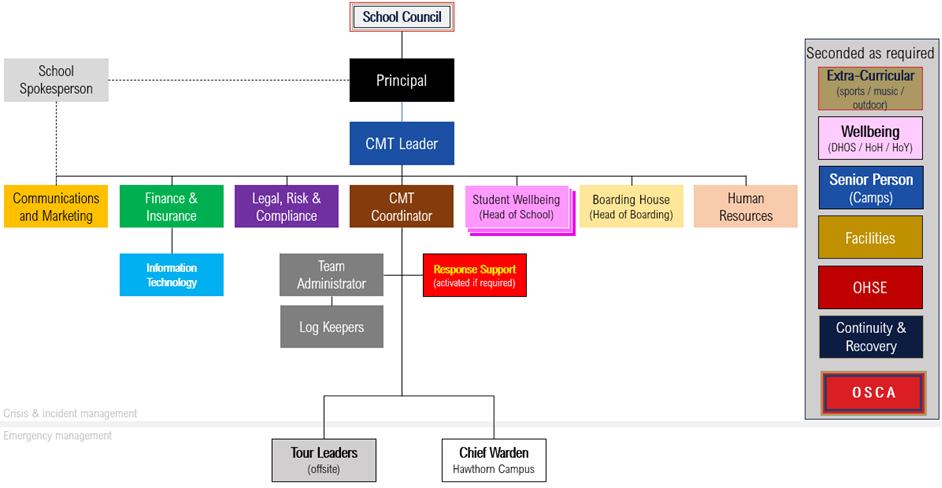
The College has a Crisis Management Plan (CMP) to provide immediate response guidelines to manage a crisis. To support the CMP, the Crisis Management Team (CMT) will come together during emergencies or critical incidents to follow the CMP to ensure the safety and wellbeing of students, staff, and visitors. The Principal is responsible for escalating an incident to a critical incident to initiate the CMP
Department
(Academic) Locations
Junior School
Building Department
Classrooms
Harbig Resource Centre
Shergold Building
Montgomery Building
Senior School
Rooms 1 – 20 including German Learning Support Department
JS Library and ICT
Music and Drama
Gymnasium and Art
Building Department
Glenn Centre
James Forbes Academy
Language & Culture Centre
Lithgow Centre
Art Department
Physical Education Department
Music Department
Drama Department
Language Department
Level 1
English Department
Level 2
Christian Education Department
Commerce Department
History & Classics Department
Maths Department
Building Department
Main Quadrangle
Sir Zelman Cowen Centre
Level 1
Sport Department
Level 2
VCE Office
Level 2
Life Sciences Department
Psychology Department
Level 3
Chemistry Department
Physics Department
Dress Code
For teaching and administration staff, normal business attire is the standard dress expected during the school day Ties are required to be worn by male teachers in Term 2 and 3, but are optional in Term 1 and Term 4.
Branded staff attire can be obtained from The Scotch Shop (eg sports uniform or Operations Staff uniform), if appropriate for your role and approved by your Leader The Scotch Shop is located on the north side of Morrison Street and can be contacted by phone on (03) 9810 5151.
All staff are required to wear their personal Scotch College ID/access card at all times while on campus.
Duties
Each staff member is expected to note their duty (yard duty, before/after school duties, detention) requirements. Duties may be swapped with colleagues by mutual consent. Any changes must be communicated to Junior School Office (Junior School) or Lithgow Reception staff (Senior School)
It is the responsibility of the teacher-on-duty to actively supervise their designated area, which includes moving around the space so that necessary action can be taken across the whole area as required.
Junior School
Yard duty rosters can be found in the Junior School Common Room and on the MyScotch Junior School Staff Portal. Changes are communicated by the Deputy Head of Junior School.
Senior School
Yard duties are contained in each teacher’s timetable. Teaching Staff should check-in with Lithgow Reception either in-person, by phone on (03) 9810 4447, or email to lithgowreception@scotch.vic.edu.au, to confirm that they are commencing their allocated yard duty.
For further information, and a map of duty areas, please see the Yard Duty Handbook which can be found on the SS Teachers Staff LMS page on Canvas
Staff Guide to Scotch 22
eLearning Coordinators
E-learning Coordinators support the needs of the school and staff on the use of technology to enhance teaching and learning. Contact the eLearning Coordinators for help with the LMS (Canvas) on LMS_Help_Group@scotch.vic.edu.au
Emergency Response Procedures
All staff undertake mandatory Emergency Safety Training as part of the induction process. In the event of an evacuation, follow the directions of the wardens in your area, who will be wearing red or yellow vests. Scotch has designated Emergency Assembly Areas, as follows:
Hawthorn site
– Main Oval
– Meares Oval
– Junior School Oval
– Boarders’ Dining Hall lawn
Healesville site
– MC
– Hyde Park
– Bus drop off/pick up area
Cowes-at-Scotch site
– The Parade Ground
– The pergola area near the beach gate
See current Emergency Response Policies and Procedures on the MyScotch Staff Portal.
Employee Assistance Program
The school has an Employee Assistance Program arrangement with Access EAP. Up to three sessions of confidential counselling support is available to staff of the school each year. Give AccessEAP a call on 1800 81 87 28. You can find out further details on the MyScotch Staff Portal > Contact Officers and EAP Information or download their app using the QR code below:
End of Trip Facilities
The following End of Trip Facilities are available around the College.
Junior School
Level 1 - Male and female changerooms with showers
Senior School
Randall Building
Ground Floor - Unisex shower
Lithgow Centre
Ground Floor – Bike storage via ramp between Glenn Centre and Lithgow Centre
Male and female changerooms with showers and lockers – via ramp between Glenn Centre and Lithgow Centre to Basement
James Forbes Academy
Level 2 – Male and female showers opposite the staffroom
Glenn Centre
Swimming pool has male and female changerooms with showers
Level 1 – Male showers
Level 2 – Female showers
Sir Zelman Cowan Centre
Level 2 and 3 - Unisex showers, one per level
Cardinal Pavillion
Male and female changeroom with showers
Events
The Events Department is located on the west side of the Lithgow Centre and can be contacted on (03) 9810 4122 or events@scotch.vic.edu.au Events can assist you to arrange Room Bookings, Catering and to book External Sites Events also manage the Master Calendar which can be viewed by all staff
Excursion/Incursion Trip Approval Process
Junior School
All excursion and incursion plans must be approved by the Junior School Deputy Head and must begin with consultation with the Stage Leader for the classes involved.
Before any trips, excursions or incursions are booked an approval must have been given by the Junior School Deputy Head to investigate and develop the necessary risk management plan, itineraries and communications to staff and parents.
Senior School
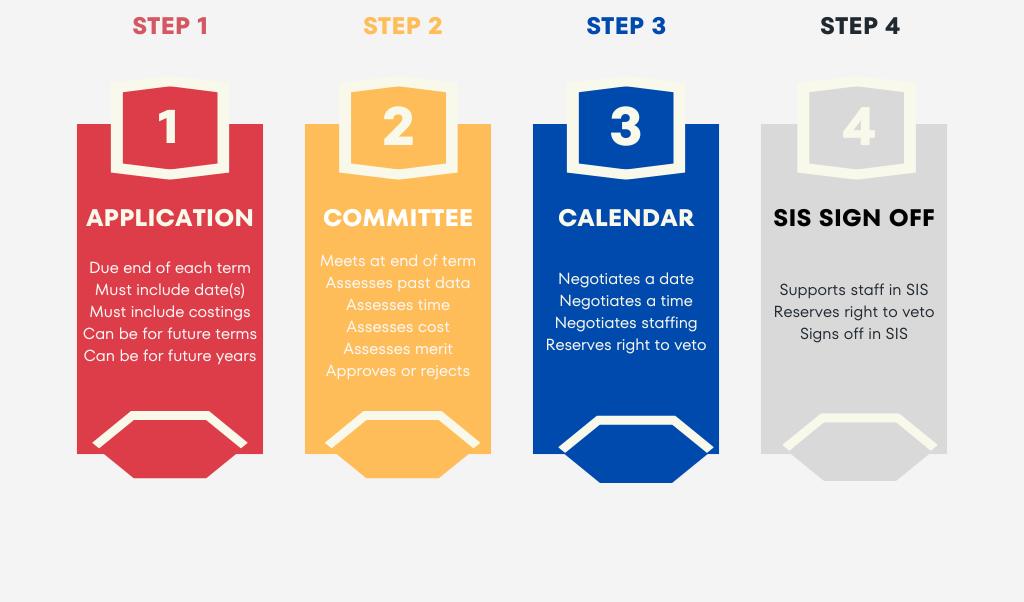
Incursions and excursions both use the same PDF proforma available at this link.
Step 1 Is a conversation with your Head of Department or the Director of Teaching & Learning 7-12
Complete the requisite proforma together and send it to the Director of Teaching & Learning.
Step 2 Director of Teaching & Learning files the application for discussion at the Incursion/Excursion Committee, which meets in the last week of each term.
Step 3 If approved by Committee, the application goes to Operations, who enter it into the calendar. The more flexibility you can provide in terms of dates, the better.
Step 4 Once you’re confirmed as being in the calendar, enter the incursion/excursion into SIS. Director of Co-Curricular can help ensure your risk assessment is compliant.
Please note that incursions/excursions do not rollover on the Master Calendar from one year to the next, and deadlines at the top of the proforma must be observed to provide adequate time for administration.
See also entry for Co-Curricular
Expense Claims
See entry for Accounts & Payroll and Expenses Policy on the MyScotch Staff Portal.
External Sites
Scotch has the following sites available to book for camps through Events
Scotch-at-Cowes
Associated with Scotch College boys from 1911, leased by Scotch from 1955 and finally purchased in 1989, Scotch-at-Cowes has long been a special place to Scotch students and is used for camps throughout the year The property sits on the beachfront at Cowes, Phillips Island, and can accommodate around 75 students and 12 teachers. A handbook for this property can be sourced through Events
Healesville
With history dating back to 1928, the property at Healesville now totals 193 acres and is used for camps and provides an opportunity for outdoor and recreational activities to be offered to boys of various ages Students can camp in tents at the site, with a mess hall and amenities block nearby. Elliott Lodge provides accommodation for up to 8 teaching staff and Cherry Wilson Hut has two classrooms. A handbook for this property can be sourced through Events
"Fairhaven Frontiers" at Mallacoota
Purchased in 2023 and sprawling across 175 acres, “Fairhaven” at Mallacoota will become a world-class Outdoor Education facility and is anticipated to be in use by 2029. For more information, see https://www.scotch.vic.edu.au/fairhaven/
Extras
Junior School
If you are a teacher and will be absent for the day, you are required to prepare work for your class/es during your absence and instructions must be emailed to Deputy Head and Junior School office. Emergency staff will be provided with a computer if required and Teachers are able to save work to SharePoint which can then be accessed by Emergency Staff. Any work saved to SharePoint must be accompanied by clear instructions and timetables.
Senior School
Leaving Extras
If you are a teacher and will be absent for the day, you are required to prepare work for all classes during your absence and this must be uploaded to the Extras SharePoint, accessed via SS Teachers Staff LMS page on Canvas > Emergency Rosters and Setting Extras, by 7.30am.
Covering Extras
A roster is drawn up each term which has teachers allocated to cover possible absences each period of the cycle. Each day these are distributed by email indicating teachers who are required to cover extra classes. While attempts are made to use the periods allocated and foreshadowed in the roster, extras can be assigned to any teacher available if needed. Please check the list carefully for your name.
Always check Extras SharePoint for work left by the absent teacher if covering an Extra.
Fee Concessions
Permanent staff should make contact with the Director of Admissions regarding the possibility of a place for their son(s)
A fee concession on Scotch secondary fees may be available for sons of permanent staff members. Staff should contact the Finance Manager to find out further details.
First Nations Scholarship Program and Tiwi College Partnership
With the support of the Scotch Family via the Scotch College Foundation, the Australian Indigenous Education Foundation and the federal government, the First Nations Scholarship Program at Scotch allows the College to welcome up to 12 First Nations students on academic and boarding scholarships each year.
Over the last 20 years, the First Nations Scholarship Program has become an important part of Scotch College life. The first scholarship students came from the Tiwi Islands and Darwin, because of a relationship forged with Tiwi College commencing in 1996. In more recent years, the College has built relationships with indigenous communities closer to home and many of our current scholarship students come from Victoria.
The College has a formal partnership with Tiwi College which has led to the establishment of genuine, deeprooted and ongoing friendships between Scotch boys and their Tiwi peers, as well as among educators at both schools. This regular contact has had a strong, positive impact on the Scotch Family’s understanding of indigenous Australia.
Boys from Tiwi College visit the College annually, billeting with Scotch families and forming lasting relationships. Similarly, Scotch boys are welcomed into the life of the Tiwi Islands, both on football tours and cultural exchanges. Boys who have visited the Tiwi Islands describe the experience as truly life-changing, helping them to develop a deeper understanding of Australia’s history, and the potential for our shared future.
Future Pathways
Located in the Language & Culture Centre, the Future Pathways Counsellors offer professional guidance to boys, helping them develop a deeper understanding of themselves, the world of work, and their options for courses and careers. This involves assistance in selecting subjects, tertiary courses, and other post-school pathways. Course and careers resources are available via the Scotch website and at the Future Pathways Hub, where the boys can explore a wealth of information about both local and global opportunities.
Future Pathways also run a range of programs through the pastoral curriculum to help boys explore different career pathways and understand the job application process. Each Future Pathways Counsellor is allocated a number of House groups to ensure a through-line of support throughout their journey at Scotch.
Contact Future Pathways at careers@scotch.vic.edu.au
Governance
See entry for Scotch College Council
Health Services
The school employs nursing and first aid staff under the supervision of the Health Services and Nursing Manager. A permanent presence is maintained during term times at the Health Centre, located in the Boarding precinct on the eastern side of the James Forbes Academy. During school days nurses also maintain a presence in the Senior and Junior Schools and oversee the provision of first aid and emergency medical support for Saturday sport on campus.
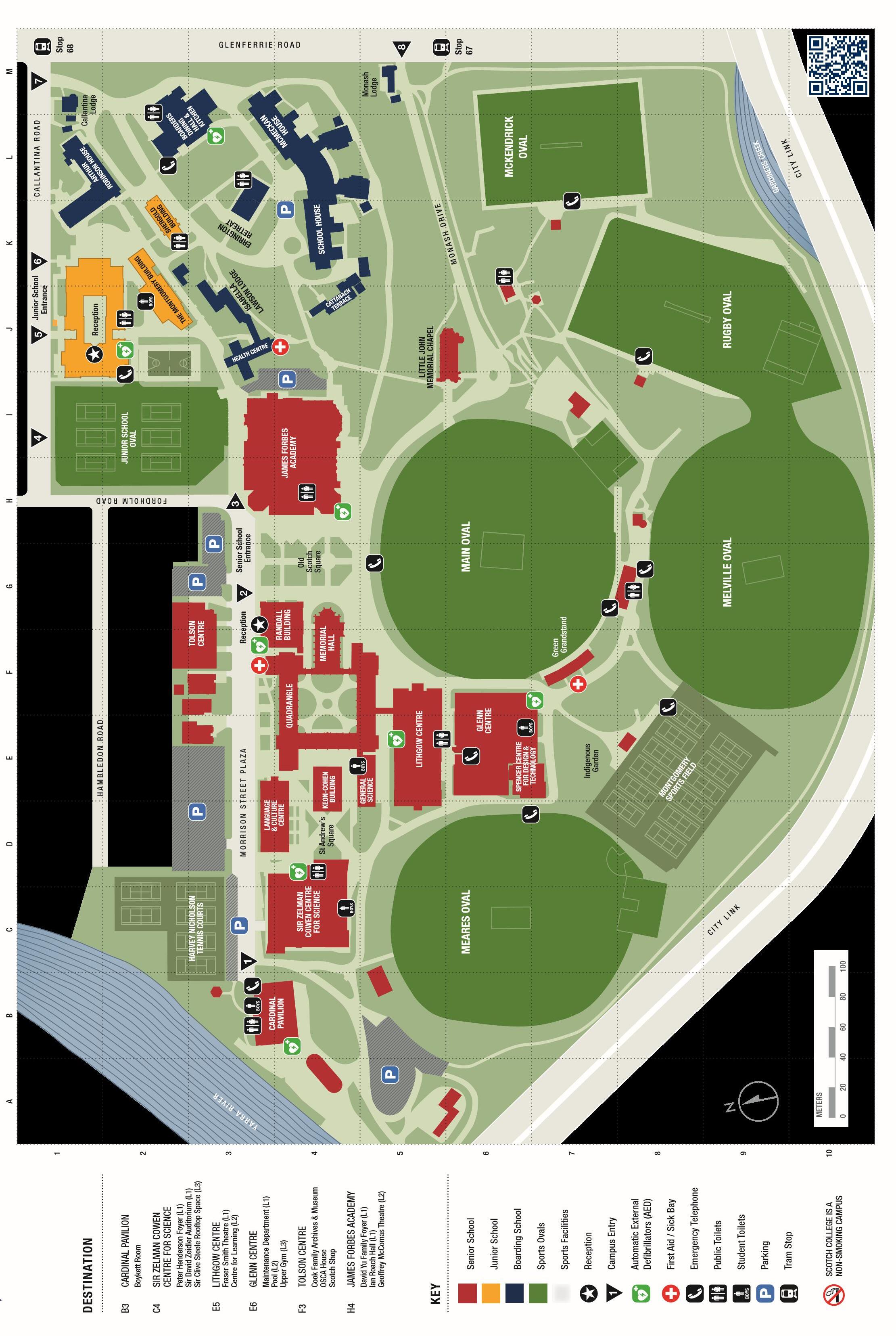
Defibrillator Cabinets with EpiPens are located around the College, in the Boarders’ Health Centre, all three Boarding Houses and in the Dining Hall. For specific locations of the Defibrillator Cabinets, see Map on page 57 and search for the green icon shown below:
Contact the Heath Centre on (03) 9810 4220 or the Duty Nurse on 0418 568 331.
House System
Junior School
All boys in Years Prep-6 are allocated to one of four houses. The four houses are:
Bradshaw House was named after the second Principal of the Junior School, Mr D F M Bradshaw. Mr Bradshaw was an Old Boy of Scotch, who became Principal of Haileybury College in 1954 and later Minister of St Stephen’s Presbyterian Church, Surrey Hills.
Campbell House remembers Mr C H Campbell who taught on the staff of the Junior School before beginning a long and successful career in the Senior School. Mr Campbell retired from the position of Vice Principal in 1967.
Healey House honours the name of Mr C O Healey, a more recent Principal of Scotch College. Mr Healey retired in 1975 after guiding the school through a period of change and uncertainty which affected all sections of society.
Waller House commemorates the name of the Principal of the first Junior School at Hawthorn. Mr A J Waller supervised the first year of the school in Glen House in 1916 and a further 27 years in the present building.
Senior School
Year 7 and 8 boys are placed in Forms which is led by the Form Teacher. The Year 7s are taught by a team of teachers of which the Form Teacher is lead and responsible for the academic care of the boys in their group. The boys progress to Year 8 with the same Form Teacher, however, they are taught by a larger range of teachers and do not stay with their Form in each academic class. The Form is designated by the Year level number and the initials of the Form Teacher.
All boys in Years 9-12 are allocated to one of twelve houses. The twelve houses are:
Ronald Sydney BOND was a member of staff from 1946 until 1985. He served as CO of the Cadet Unit and as a Head of House/Year for many years. He was Vice-Principal from 1968 until his retirement in 1985
DAVIDSON (DN)
White
EGGLESTON (EN)
Orange
FIELD (FD)
Brown
FLEMING (FG)
Aqua
FORBES (FS)
Purple
GILRAY (GY)
Yellow
LAWSON (LN)
Red
LITTLEJOHN (LJ)
Black
MONASH (MH)
Royal Blue
MORRISON (MN)
Green
SELBY SMITH (SS)
Sky Blue
Ewen McCulloch DAVIDSON was a champion athlete and sportsman while a student at Scotch. He was a member of staff from 1931-1973. He was Sportsmaster and also served as Secretary of the APS from 1945-1978
Allen John Michael EGGLESTON was another champion sportsman while attending Scotch as a student. He was a member of staff from 1958-1987 and was Vice-Principal on his retirement
Kenneth Frederick FIELD was appointed as Bursar in 1953. He served the school with distinction until his retirement in 1985
Frank Alexander FLEMING was a student at Scotch before returning as a member of staff from 1930-1963. He had roles as CO of the Cadet Unit and Housemaster of Arthur Robinson House before his appointment as Vice-Principal
The Reverend James FORBES was the minister of Scots Church in Melbourne. He is the founder of the College, but died two months before it opened its doors in 1851
Colin Macdonald GILRAY was the fourth Principal of Scotch. He arrived in 1934 and presided over the school’s centenary celebrations in 1951. He retired in 1953
Robert LAWSON was born in Scotland and became the first Principal of Scotch College. He resigned in 1856
William Still LITTLEJOHN was Principal from 1904 until his death in 1933. It was during his term as Principal that Scotch moved from East Melbourne to Hawthorn
Sir John MONASH was Co-Dux of Scotch in 1881. His career as an engineer and soldier made him arguably Scotch College’s most famous Old Boy. He laid the foundation stone of the Memorial Hall
Alexander MORRISON was the second Principal of the school and arrived in 1857. He served for a remarkable 47 years until his death in 1903
Richard SELBY SMITH was Principal from 1953 until 1964. He resigned to become Professor of Education at Monash University
For further information see entry on Pastoral Care.
You can find a list of current Senior School Heads of House, Tutors and Form Teachers on the SS Teachers Staff LMS page>Pastoral Care Structure and Seating Plans on Canvas
ICT Resources & Support
Student Information System (SIS)
– Contains staff and student demographics and a range of organisational information including timetables, class lists, previous year’s academic reports, learning profiles, staff Professional Learning records, room allocations, sport lists, sport reports, student contact information
– Contains academic page, learning profile and medical information/alerts for individual boys
– Contains general organisational information e.g. excursion forms
Synergetic
– Contains People and Culture data, including staff positions
– Manages our admissions data including information on future families and students
– Manages staff wages
– Used to manage financial data, including department budgets
Learning Management System (Canvas)
– Contains learning resources for students (eg homework, resources, revision sheets, internet links). An individual page for each class is available for posting such material
– Includes details of co-curricular activities (information for sport, results, schedules, rehearsals)
– This also contains a range of teacher resources managed by Heads of Department
MyScotch Staff Portal
– A secure site available to staff, students, and parents, accessed through MyScotch Staff Portal or College website
– Links on this site include student email, staff email (for home access), library, policies, communications
Microsoft Office 365 (O365)
– Individual OneDrive’s are made available for staff to store Scotch documents
– Teams and SharePoint groups are set up for staff departments to work in collaboration
– Email addresses are made available to email, manage calendars, and book rooms
Clipboard
Clipboard is an online platform used to manage student co-curricular activities, including attendance. Support and training for Clipboard is available through ICT Services and the relevant program coordinators.
Printing
– Secure printing is available on print devices
– Large or specialist jobs should be sent directly to the Print Room by emailing printroom@scotch.vic.edu.au Please request a Print Request Form from the Print Room for complex requests.
Tech Support
–
Hours: Monday – Friday, 8.00 am – 4.30 pm
– Email: techsupport@scotch.vic.edu.au
– Phone: 9810 4411
–
Location: Level 1, Sir Zelman Cowen Centre
The Igloo
The Igloo is where students collect Snowsports clothes and equipment. It is located at 5 Morrison Street, near Lost Property.
Incident, Near Miss, or Hazard Reporting
To report a Safeguarding Incident or an Incident, Near Miss or Hazard, staff should use the yellow icon on their Desktop to lodge a report (see icon below).
You can also use the below QR code to report an Incident, Near Miss or Hazard:
Insurance
All insurance matters and claims are handled by the Finance Manager. Any incidents that are likely to result in a claim or a loss to the school should be reported as soon as possible.
Junior School Parents’ Association (JSPA)
See entry for Scotch Parents’ Association.
Learning Management System (LMS)
See entry for Canvas
Learning Support
Junior School
The Learning Support Department is situated near Junior School Reception and comprises a range of spaces designed for small group learning supplementary to classroom programs. The Learning Support team work collaboratively with the Junior School teaching staff to provide tiered levels of support or
Staff Guide to Scotch
enrichment to students identified through assessment and observation. In addition to academic support programs, Games Club and social skills support is offered through the Learning Support department.
Supported by the Stage Leader team, where classroom teachers have concerns about students’ academic progress or responsiveness to instruction, they are encouraged to raise these for monitoring with the Learning Support department. If concerns or lack of progress persist after monitoring and a period of relevant intervention, classroom teachers can complete a Learning Support Referral Form for review by the Director of Learning Support to consider the process of engagement with allied health professionals and/or specific diagnostic assessments.
Students with diagnosed learning disabilities may be supported through an Individual Learning Plan which is prepared by classroom teachers in conjunction with the relevant Learning Support staff member and assigned case manager. Where students have diagnosed learning disabilities and relevant assessments, summary information and learning profiles are available through the Student Information System (SIS). Students with learning profiles are supported by Learning Support staff.
In conjunction with classroom teaching staff – and specialist teaching staff where relevant – the Learning Support staff are responsible for either advising on or administering appropriate accommodations for assessments. The Learning Support staff implement and oversee special provisions for NAPLAN assessments in collaboration with the Director of Teaching & Learning (P – 6).
Senior School
The Centre for Learning (CFL) in the Senior School is situated in the upper level of the Lithgow Centre and offers a flexible learning environment providing formal and informal opportunities for students to gather. Academic support, library services, extension studies meetings and a before and after school tutoring program operate from the CFL.
Teachers who have concerns about the academic progress of students in their classes can complete a CFL Referral Form and forward it to the Head of CFL to organise the process of investigation into warranted support or specific diagnostic assessments. The CFL Referral Form can be found on the SS Teaching Staff LMS page on Canvas.
Students with diagnosed learning disabilities may be working on an Individual Learning Plan which is prepared by the subject teachers in conjunction with the relevant CFL year level case manager. All CFL documentation can be found on the CFL Canvas course. Students learning profiles are available through the Student Information System (SIS). Students with learning profiles are supported by CFL year level case managers in the senior school.
Spaces are booked for specific academic and interest-based activities and meetings across each week and regular lunch-time clubs including Games Club and Literature Club are hosted by CFL staff. Individual tutoring for boys in Years 11 and 12 is provided by arrangement. CFL teaching staff are available before school and at lunch time to work with students on study skills, general organisation and academic assistance, and are also involved in the wider tutoring program which is provided by a range of subject teachers from Monday to Thursday afternoons.
Students can access department specific teachers for academic tutoring before and after school and during lunch times. The Academic Support Timetable can be found on the SS Teaching Staff LMS page on Canvas
Two bookable classrooms are available for teachers undertaking reading or research activities and more flexible spaces are available for boys seeking quiet, private study. During lunch time, one classroom is reserved as a Year 12 shared study area.
The academic support staff are responsible for administering alternative testing and examination settings in the CFL spaces and special provisions are implemented and monitored for eligible students in formal assessments and final examinations. The CFL is used as separate space to administer key VCE assessments including the General Achievement Test (GAT) and the VCE English examination.
Leave
Leave requests should be directed as outlined below. It is best practice to copy your Leader into any correspondence regarding leave.
Junior School
Contact Process PRE
Personal Leave
(Sick / Carer’s)
Bereavement Leave
Long Service Leave
ON THE DAY
Personal leave
(Sick / Carer’s)
Bereavement Leave
Email: jsteacherabsences@scotch.vic.edu.au
Email: jsteacherabsences@scotch.vic.edu.au
Phone: (03) 9810 5178
Complete Microsoft Form: https://forms.office.com/r/1nppB nJ1KX
Teachers must prepare work for all classes during any absence and this must be emailed or uploaded to SharePoint by 7:30am. For further information, see entry for Extras
Send email or call.
Every effort should be made to make such contact before 7:30am on the day of your absence. Receipt of emails and messages will be acknowledged as soon as possible. Teachers must prepare work for all classes during any absence and this must be emailed or uploaded to SharePoint by 7:30am. For further information, see entry for Extras.
Teachers should confirm that jsteacherabsences@scotch.vic.edu.au is aware of any planned absences (eg Long Service Leave, Professional Learning, excursions).
Senior School
Contact
The Principal: scott.marsh@scotch.vic.edu.au
Process
Send email.
Long Service Leave
IN ADVANCE
Personal leave (sick / carer’s)
Bereavement leave
Copy to: rebecca.imer@scotch.vic.edu.au
Email: SSTeacherAbsences@scotch.vic.edu.au
ON THE DAY
Personal leave (sick / carer’s)
Bereavement leave
Email: SSTeacherAbsences@scotch.vic.edu.au
Phone: (03) 9810 5126
Send email.
Teachers must prepare work for all classes during any absence and this must be uploaded to the Extras SharePoint by 7:30am. For further information, see entry for Extras
Send email or call.
Every effort should be made to make such contact before 7:30am on the day of your absence. Receipt of emails will be acknowledged as soon as possible. Teachers must prepare work for all classes during any absence and this must be uploaded to the Extras SharePoint by 7:30am. For further information, see entry for Extras
Teachers should confirm that SSTeacherAbsences@scotch.vic.edu.au is aware of any planned absences (eg Long Service Leave, Professional Learning, excursions).
If teaching staff need to leave the campus during the day they should inform the following people either by phone or email:
Junior School
Executive Assistant to the Vice Principal Head of Junior School
Email: kerry.arthurs@scotch.vic.edu.au
Phone: (03) 9810 4224
Senior School
Executive Assistant to the Vice Principals
Email: josephine.forkin@scotch.vic.edu.au OR
Phone: (03) 9810 4253
Lithgow Reception
Email: lithgowreception@scotch.vic.edu.au
Phone: (03) 9810 4447
Support & Operations
Contact
The Principal: scott.marsh@scotch.vic.edu.au
Long Service Leave
Annual leave
IN ADVANCE
Personal leave (sick / carer’s)
Bereavement leave
ON THE DAY
Personal leave (sick / carer’s)
Bereavement leave
Library
Junior School
Copy to: rebecca.imer@scotch.vic.edu.au
Email: Leader Copy to: rebecca.imer@scotch.vic.edu.au
Email: Leader
Copy to: supportandoperationsabsentee@scotch.vic.edu.au
Process
Send Leave form by email
Email: supportandoperationsabsentee@scotch.vic.edu.au
Phone: (03) 9810 4201
Email or call
This comprises an information area that includes a comprehensive print library, comprising non-fiction and fiction material, and a high tech computing facility.
Literature Collection
A quiet reading and teaching area provides access to the school’s fiction material.
Non Fiction Resources
A range of resources are available to students for information gathering.
ICT Lab
A lab of computers provide for whole class teaching of computer information literacy skills and ICT skills and knowledge. The emphasis is on teaching the boys how to manipulate technological tools to gain information, to visualise thinking and to communicate their ideas by creating their own multimedia projects and presentations. The aim of the work in this area is to complement classroom programs. Cyber safety considerations are also covered in these lessons.
Senior School
The Senior School Library is housed in the Centre for Learning, Lithgow Centre and has a large collection of books - young adult, senior fiction, non-fiction and graphic novels.
The following online resources are available to staff:
– Databases - including EBSCO, Informit, Jstor, Artstor, Loeb, Choice, Drama Online, Oxford resources;
– Ebooks – Academic E-Book Collection, Cambridge Ancient History Resources, Wheelers eBooks & audiobooks;
– Newspapers – EBSCO Australia/New Zealand Reference Centre, Newsbank, Echo;
– Encyclopedias – World Book, Britannica School, Grove Music Online;
– Video – Clickview, Informit TV News;
– Referencing Tools – SLASA for Yrs 7-9, Refworks for Yrs 10-12;
– A-Z list of databases https://scotch-vic.libguides.com/az.php
Find more information about the resources and how to access them here
Maintenance
The Maintenance Department is located on the lower south side of the Glenn Centre and operates from 7:30am – 4:30pm Monday to Fridays. The maintenance team comprises a range of tradespeople and general hands. Requests for assistance from the Maintenance Department are dealt with on a priority basis, with safety matters and teaching spaces being given the highest priority. Maintenance can also be contacted for matters relating to cleaning and security. Contact the Maintenance Department on (03) 9810 4215 or maintenance@scotch.vic.edu.au
Master Calendar
All staff can view the Master Calendar in Outlook which shows all events and bookings across the school. To add the calendar to your Outlook, right click on Shared Calendars, select Add Calendar from Address Book and search for “Master Calendar”.
Meetings
A number of staff meetings occur across the year, including Senior School and Junior School staff meetings that are compulsory for teaching staff and optional for Support and Operations Staff. Additional meetings will be determined by role and communicated by your Team Leader, for example Department Meeting, Form Teacher Meeting, Heads of House Meeting, Stage Team Meeting.
Meeting Rooms
There are bookable meeting rooms and spaces around the school that can be booked using the Outlook calendar for the respective room or through Events by emailing events@scotch.vic.edu.au. Please note there are some rooms that can only be booked through Events, due to access or other issues, and these are outlined below. If catering is required, the booking must go through Events. See also entry for Catering and Events
Junior School
– Ramsay Room
– Junior School Assembly Hall
Senior School
Lithgow Centre
CFL Meeting Room
Lithgow Conference Room
North Study Meeting Room
Harkness Room – E1.14 English Dep.
ICT Services Meeting Room
Sir Clive Steele Rooftop Space
Morning tea
Junior School
Morning tea of sandwiches, fruit, sweet biscuits, tea and coffee is available every morning in the Junior School Staff Room from 10.15am for all Junior School staff.
Senior School
Morning tea of sweet and savoury biscuits, tea and coffee is available every morning in the staff Common Room from 10.00am.
Every Wednesday there is a catered morning tea at 10:50am in the Common Room, located in the Lithgow Centre, at which the Principal and members of the CRA Executive may communicate with staff. It is expected that all teaching staff attend. It is optional for Support and Operations Staff to attend, but they are warmly invited.
Museum
The Museum houses a display of Scotch’s history with explanatory panels and timelines, artefacts, and rolling footage of Scotch dating back to 1930. It is in the Tolson Centre and is open to the public from 9.00am to 5 00pm daily during term times. Teaching staff are encouraged to contact the Archivist on (03) 9810 4470 about having their classes use it for lessons on Scotch’s history or for other ways in which it could support learning in specific subjects.
Old Scotch Collegians’ Association (OSCA)
OSCA is managed by a Council of twelve, with the OSCA staff based at OSCA House in the Tolson Centre. The Association, which was formally established in 1913, is instrumental in enabling the College’s wide network of Old Boys and their families to stay connected with the College and each other by way of the “Cardinal Thread”.
OSCA’s program enables past Scotch students to ‘keep in touch’ and engaged with each other through a wide range of sporting, cultural, career, well-being, and social interactions. Through the Old Boys’ engagement, the College’s heritage and development continues to be nurtured.
For more information about OSCA, see the website or contact scott.montgomery@scotch.vic.edu.au.
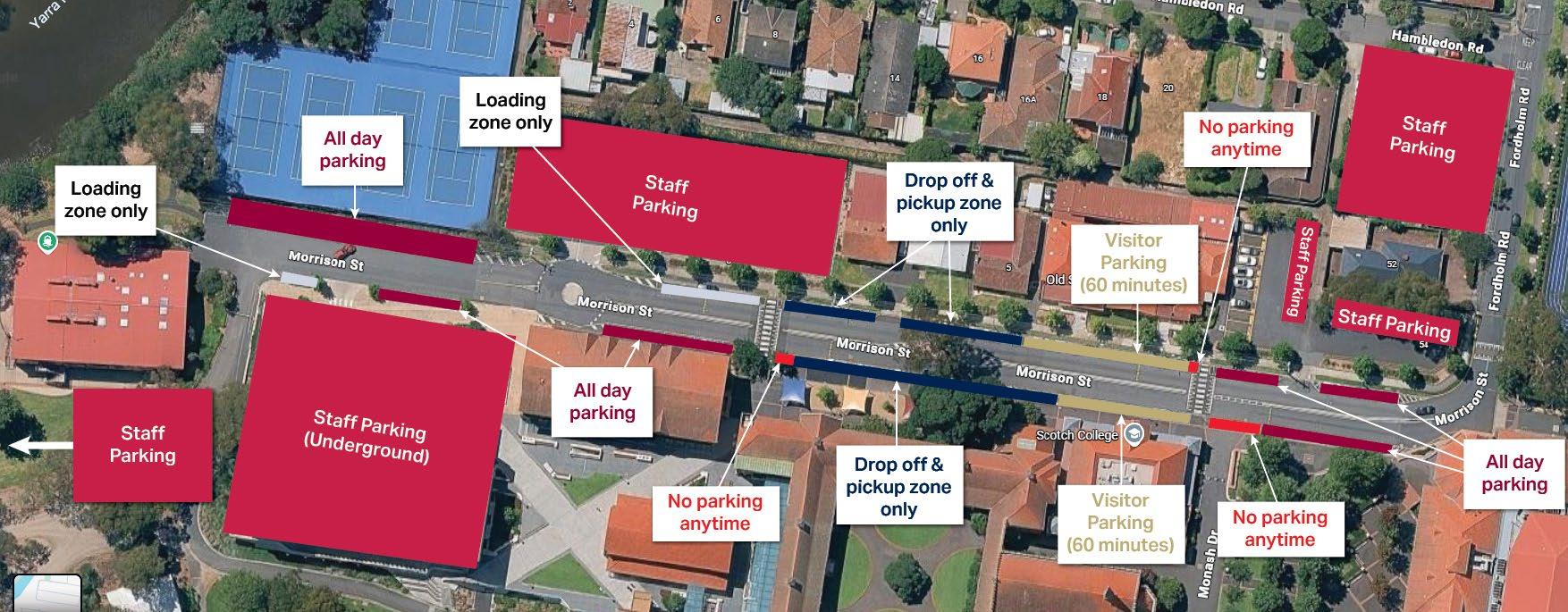
Parking
The image below shows Morrison Street, with staff parking coloured pale blue.
There is underground parking for staff under the Sir Zelman Cohen Centre and further parking by the Yarra River through the gate before you reach the Cardinal Pavillion. Swipe your Scotch College ID/access pass for access to parking in these locations.
Arriving by 8am makes finding a park easier, but there is always parking available by the Yarra River. Parent traffic also increases greatly after 8am, which can mean it takes a lot longer to get into the College
If you have any trouble gaining access with your access pass, please contact Maintenance
If you need to arrange access through the boom gates for deliveries, please arrange a time through the Maintenance Department. Please note that there is no access provided at the following times for student safety reasons:
– 10.35-11.15am
– 12.40-1.45pm
– 3.10-3.30pm
In the Junior School, the procedures to be followed in seeking assistance for any boy should generally fit in with the following structure.
Class Teacher
The first point of contact as the person responsible for any boy should be informed of unsatisfactory behaviour or difficulties of any kind and must be consulted before action is taken on major problems or advised of action taken on minor or routine matters.
Pastoral Care
Junior School
The class teacher deals directly with any minor or routine matter speaking with the boy or imposing sanctions. Parents may be contacted. In cases of more major ongoing difficulties, the Stage Leader should be consulted before further action is taken. Specialist teachers should consult with class teachers if problems are being experienced with any boy and advise of action taken on minor matters. In every case, a Record of Contact is to be completed and distributed as advised.
Stage Leaders and/or Director of Junior Primary or Deputy Head
Should be consulted by the class teacher, or in special instances by a specialist teacher, on more major or ongoing discipline or pastoral care problems.
Learning Support Unit
When ongoing treatment or guidance is sought, or when assessment and/or referral is considered necessary.
When it is considered necessary to make further contact with parents.
Head
of Junior School
Is the final point of contact when normal processes have been followed. Any teacher is, however, encouraged to seek advice at any time or suggest action which may be taken and should keep the Head of Junior School informed of ongoing difficulties being experienced by or with any boy. At all stages in the discipline and pastoral care process, it is essential that records of action taken be kept.
Pastoral Care Expectations
Boys are expected to use all areas around the College sensibly with due regard to others. Games should be appropriate to the area concerned and care should be taken with garden areas and overall cleanliness. Boys will be encouraged to take pride in the grounds and be interested in keeping the outside playground as attractive as possible. In particular, the following should be noted:
– Boys should remain within designated Junior School areas unless moving to other parts of the campus for classes or with the permission of a teacher
– Class or other groups of boys should not proceed to Senior School areas unless moving to other parts of the campus for classes or with the permission of a teacher
– Class or other groups of boys should not proceed to Senior School areas unless with a teacher. Individuals or small groups may, however, do so with permission if on official school business
– Upstairs balconies, locker areas, change rooms, stairways and passageways are regarded as inside areas and must not be used as play space or eating areas
– The front entrance area and front pathways may be used by boys but these too, are not areas for active play
– The courtyard and breezeway area are available for quiet activities. Ball games and running are not permitted
– In all areas of the grounds, care must be taken to protect garden areas, place rubbish carefully in bins and generally care for the environment
– On no account should boys climb on fences, brick walls, seats, garden boxes or balcony and other barricades
– The Atrium is a calm play area and pupils engaged in active play should be asked to move elsewhere.
Senior School
At Scotch College, relationships are of primary importance. We greatly value the relationships between our students, staff, and families. Every teacher is responsible for pastoral care, in that we prioritise relational learning; establishing relationships with students enhances a safe and supportive learning environment.
Our teachers work with our students in the classroom, many have a pastoral role, and they are also involved with Services, Sport and camps, trips and tours, where they are able to develop a strong rapport with a range of students over many years.
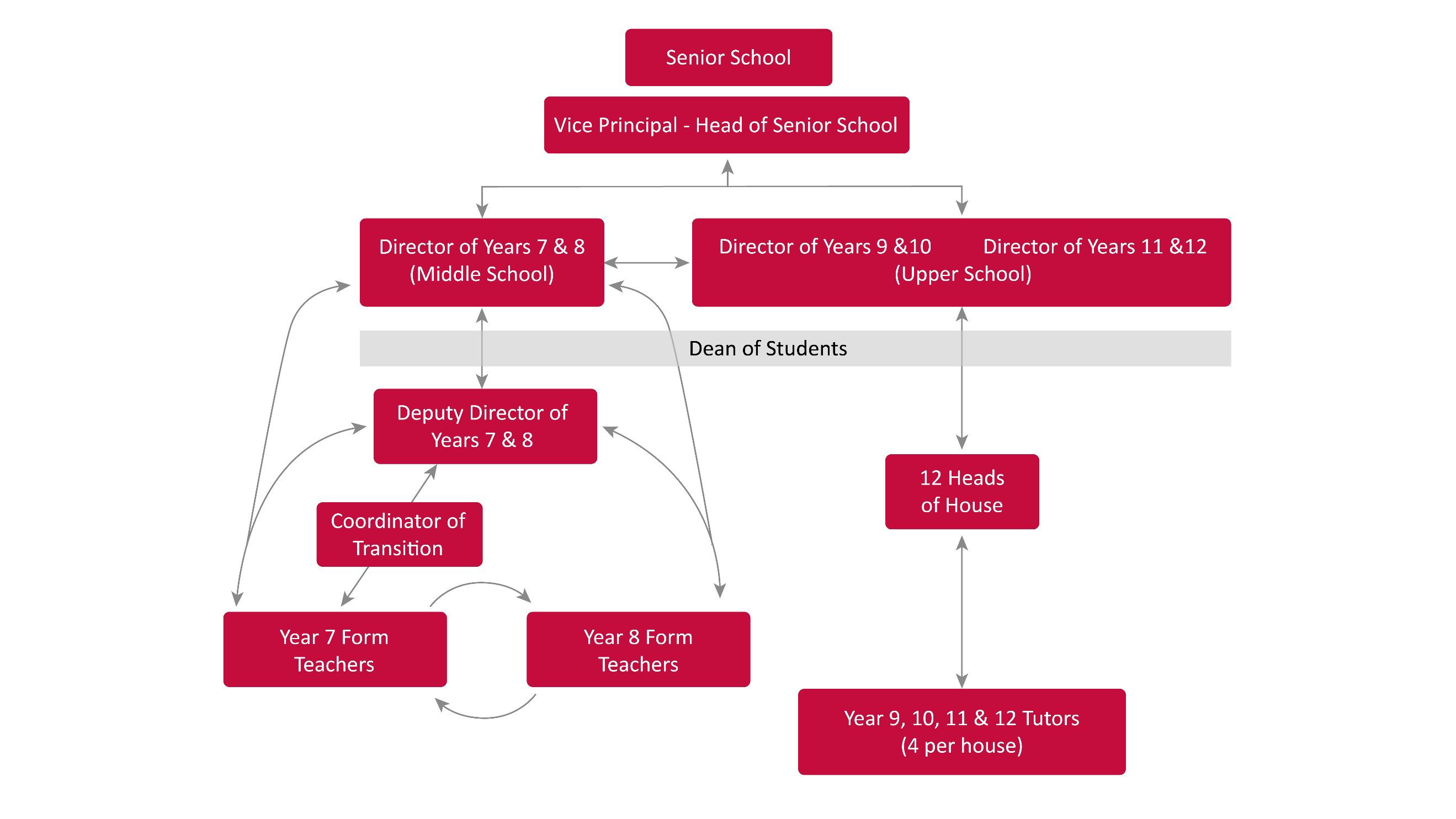
The teacher primarily responsible for monitoring the boys’ wellbeing, development, and progress, is their Form Teacher if they are in Year 7 and 8, or their Head of House if they are in Year 9-12. The Form Teacher is with their Form for both Year 7 and 8 and Heads of House are supported by House Tutors at each level, who often “move up” with their group through year 9-12. As such, Form Teachers, Tutors, and Heads of House get to know the boys in their care, and their families, very well.
The Form Teachers and Heads of House are the first point of contact for students and parents. Should a teacher have a concern about student management, academic progress, executive functioning, or other social/emotional behaviour, please initially contact these staff members to discuss. It is also possible to speak with our school psychologists.
The Directors of Year 7/8, 9/10 and 11/12, oversee all students in these year levels and manage the Form Teachers and Heads of House. Matters may be escalated to them by a Form Teacher or a Head of House, particularly if it involves a group of students across Forms or Houses or is of significance The Director of Year 7/8 is supported a Deputy who supports the Form Teachers when matters are escalated from teachers, particularly when matters are across Forms.
Students in the Boarding House are cared for by the Head of their Boarding House, who is assisted by a Deputy Head of House and several residential staff. The Head of Boarding oversees these Boarding Houses and all of the Boarders’ wellbeing and development. The Heads of Boarding often work with the staff in the day school, to manage student issues that arise.
Our school psychologists work with our pastoral teachers and Boarding staff, to provide support and advice where necessary.
The Dean of Students oversees pastoral programs from Year 7-12, in liaison with the Directors of Year. They also manage the student leadership programs.
The Vice Principal, Head of Senior School oversees student management and care from Year 7-12.
Pastoral Care Programs
Junior School
Two key pastoral structures in the Junior School are that of the House System and the SOS program. Both mechanisms offer vertical grouping across Prep to Year 6 and provide different layers of pastoral support outside of the classrooms and normal curriculum. See House System above.
Our SOS (Serving Others at Scotch) Program is a program that fits within the house structure. Groups consisting of boys from all year levels meet three to four times per term to tackle a specific service challenge. The service challenges focus on service for each other at school, service within the Scotch community, service within the local and regional community, service nationally and service internationally.
Senior School
An overview of each term is provided to pastoral staff (Year 7-8 Form Teachers and Year 9-12 House Tutors and Heads of House). A break down each week, of pastoral care resources and lesson plans for each year level is also distributed In addition, there are programs and resources from the Future Pathways team and the VCE Office from time to time. Staff work through these lessons, PowerPoints, and resources, in the designated tutor times. In addition, there are guest speakers and events throughout the year, which support our students in their growth and development, for example, a Respectful Relationships Day which occurs jointly with MLC in Year 10. We also provide parent education opportunities throughout the year and regularly feature wellbeing material for parents in the Torch newsletter.
People & Culture
The People and Culture Department is in the Randall Building and handles all matters relating to recruitment, staff management and leave. Contact People & Culture using the email peopleandculture@scotch.vic.edu.au
Pigeonholes
Pigeonholes are provided to staff on commencement and are located around the College in the following locations:
–
Junior School teaching staff pigeonholes are located in the back room of the JS Staff Common Room;
– Administrative department pigeonholes are in the Randall Building next to Reception;
– Senior School teaching staff pigeonholes are primarily on “the Bridge” on Level 2 of the Lithgow Centre;
– A small number of Academic Department and Executive pigeonholes are located on the ground floor of the Lithgow Centre next to Lithgow Reception.
For enquiries regarding pigeonholes, please contact the Executive Assistant to the Vice Principals on (03) 9810 4253.
Policies
It is the responsibility of every Scotch staff member to read and familiarise themselves with the school’s policies. A full list of the policies can be found on the MyScotch Staff Portal as follows:
–
Junior School Teaching Staff > Administration > Policies
– Senior School Teaching Staff > Administration > Policies
– Operational & Support Staff > Policies
A number of key policies are highlighted below.
Anaphylaxis
Anaphylaxis is a severe, rapidly progressive allergic reaction that occurs after exposure to an allergen which is life threatening. It is important to remember that minimisation of the risk of anaphylaxis is everyone’s responsibility. The College requires staff to participate in twice yearly briefings/demonstrations to comply with Ministerial Order 706. On-site physical copies of ASCIA Anaphylaxis Management Plan and the Students Individual Management Plans and personal adrenaline auto-injectors are maintained at:
Junior School – Junior School First Aid area (includes extra unassigned general use adrenaline autoinjectors), at Junior School Reception.
Senior School - Senior School First Aid Room (Quad) (includes extra unassigned general use adrenaline auto-injectors)
EpiPens are located in all Defibrillator Cabinets located around the campus and in Boarders Health Centre, Three Boarding Houses and Dining Hall.
See the full Anaphylaxis policy on the MyScotch Staff Portal.
Child Safety and Wellbeing Code of Conduct
This policy outlines the College’s expectations in relation to the personal and professional conduct of all Scotch College staff. Please see details of the Child Safety and Wellbeing Code of Conduct on the MyScotch Staff Portal
Privacy
The College is bound by and supports the Australian Privacy Principles. See details of our Privacy Policy for information on how we handle your personal information on the MyScotch Staff Portal
Safeguarding
To report a Safeguarding Incident, use the yellow icon on your Desktop to lodge a report (see icon):
Scotch College takes its commitment to safeguarding the students in our care very seriously. Below is an extract from the school’s Safeguarding Commitment Statement incorporated within the Safeguarding Children and Young People Policy document (Appendix 1). New staff are expected to familiarise themselves with the Safeguarding Children and Young people Policy, the Child Safety Code of Conduct, the Safeguarding Reporting Policy and the Incident Management Policy.
All Scotch personnel are required to understand the important responsibility they have, to:
– protect children and young people from all forms of abuse, bullying and exploitation by people within the school’s operations and services;
– be alert to incidents of child abuse and neglect occurring outside the scope of our operations and services, that may have an impact on the children and young people for whom we provide a service; and,
– create and maintain a child-safe culture that is understood, endorsed and put into action by all the individuals who work for, volunteer or access our programs and services.
The Scotch College safeguarding policies have been adopted by the school and ratified by the School Council. They articulate our commitment to the safeguarding of children, protecting them from abuse and neglect.
Safeguarding Scotch involves every member of our community: all members of staff, all visitors and volunteers, and all students and their families. It is important for staff to make a formal report of an incident where they believe a child or young person’s safety has been compromised. Completing an incident report is facilitated through an online system accessible through an icon appearing on all staff issued computers.
See details of the College’s Safeguarding policies on the MyScotch Staff Portal
Psychologists
The Senior School Psychologists are located in the Health Centre in the Main Quadrangle and provide guidance and counselling to students, as well as support their parents and teachers to foster the student’s psychological health. All Senior School students can access support from the psychologists. It is focused primarily on school-based issues. Referrals to the psychologists are made through key pastoral staff, such as Form Teachers and Heads of House.
The Junior School also has a psychologist available for Junior School students. All staff are able to refer pupils for support from the psychologist. This would involve a conversation with the psychologist and any other relevant pastoral staff and must involve receiving consent from the parents.
Meetings with the psychologists are confidential and information from these sessions is not accessible to staff outside the psychologists It may be deemed appropriate, on occasion, for the psychologist to liaise with pastoral staff. In almost all cases, any information that is shared is done so with the knowledge and consent of the student/parent. There are instances, however, where the psychologist is bound, by law, to share information with others even without the student’s consent. This is very rare and includes situations when a serious crime has been committed, there is serious risk of harm to self or others, or there has been a subpoena served to present documents to Court.
The psychologists also assist the school in providing Professional Learning to staff and presentations to the students to address the developmental needs and psychological health of students. The psychologists can also direct students and parents to resources, people and services within the school, as well as in the wider community.
Printing
See ICT Resources & Support.
Professional Learning
Scotch values and encourages the professional growth of its staff. Professional learning is the most powerful and the sustainable lever we have for continuing to improve education and impact student learning. Research tells us that transformational professional learning shifts our beliefs as well as our behaviours, and is best when:
– Embedded (and sustained over time)
– Together (in community with others)
– Purposeful and focused (keeps the ends in view)
– Engages our professional and personal identity (Knowledge, practice and identity, belief and behaviours)
– Research-informed
– Considers the mechanism for delivery not just the knowledge to be acquired
The College will provide numerous formal, internal opportunities for engaging in professional learning through IIlumine, its professional growth program (which includes Thursday afternoons for teaching staff and Professional Development Days for all staff), as well as external opportunities eg. Conferences and Network Gatherings. Staff are also encouraged to engage in personal informal professional learning eg. Personal reading, professional dialogue. More information about the opportunities available to staff are shared with staff directly.
Requesting professional learning
All staff (teaching, support and operational staff) should request and apply for professional learning using the application process on the Student Information System (SIS).
Staff should discuss their requests with their Leader first, with consideration given to individual, team and school goals and priorities, as well as funding and time-release This includes VCE marking. Final approval will come from the Head of People, Research & Professional Growth.
Further information can be found by reading the Staff Professional Development Guidelines available through the MyScotch Staff Portal
Purchasing
For any stationery needs, please place orders through the Support and Operations Staff in your department, who will have access to purchasing through the school’s preferred provider. Any purchases made will need to be approved by your Leader, or Head of Department, and sent to Accounts with an appropriate department charge code. See Stationery Supplies for further information.
For larger and capital items, please see the Purchasing and Procurement Policy or contact the Finance Manager.
Heads of Department should be aware of the Minor Capital Works Policy and can speak to the Finance Manager for a copy of the policy or for further information.
Reception
Junior School reception can be contacted on (03) 9810 4236 or email juniorschool@scotch.vic.edu.au.
Scotch’s main reception is located in the Randall Building in the Senior School, on the south side of Morrison Street, and can be contacted on (03) 9810 4321 (or dial 9 internally), or email scotch@scotch.vic.edu.au
Reporting
Junior School
Reporting to parents is an ongoing process through informal discussions, or more formally through Parent/Teacher Interviews (Term 1 and Term 3) and written reports (Term 2 and Term 4).
Comparative reports are available on request for semester reports for Years 1 - 6. Requests should be directed to the Director of Teaching & Learning P-6.
Senior School
Formal reporting to students and parents occurs throughout the year as per the schedule below. Publication of reports is managed by the Director of Academic Care. Completion and Reporting dates for each year can be found on the SS Teaching Staff LMS page on Canvas
Parent teacher interviews are conducted in person for all students in Year 7 – 12 in Term 1 and online for all students in years 7 – 12 in Term 3.
Unit 3 and 4 School Assessed Coursework (SAC) outcomes are communicated to students and parents via the subject’s Canvas page.
Semester Reporting Description Completed
Interim Reports For internal use only to help monitor students new to the school or to identify boys who may be at academic risk. Not for publication to parents.
Progress Reports Published to students and parents on the website in Semester One and Semester Two.
Term 1
Term 2 – All year levels
Term 3 – Years 11 and 12
Term 4 – Years 7 - 10
Semester Reporting Description
Descriptors include students; Performance, Homework effort, Use of class time, Approach to learning, Response to feedback
Reflective Statements
Parent Teacher
Interviews
Subject Reports
Completed by students following Semester Progress Reports. Students are asked to respond to a series of questions, the responses are then reviewed by their Form Teacher or Tutor and published to their parents via the website.
Parent teacher interviews are conducted in person in Term 1 and online in Term 3
Subject Reports including both written comments and grades for subject tasks are published to students and parents via the website at the end of each semester
Completed
–
Term 1 – All year levels
Term 3 – All year levels
Term 2 – All year levels
Term 4 – All year levels
Comparative Reports
Examination Results
Unit 3 Statement of SAC Results
Comparative reports for Year 7-10 are published with the Subject reports each semester. Boys' performances in each subject are ranked into four bands of equal size, with Band 4 representing the highest level of achievement.
Published to students and parents via the website at the end of each semester where applicable.
Published to students and parents via the website at, includes students Unit 3 SAC scores for each subject as well as the cohorts Max and Med Unit 3 SAC scores
Term 3 – Students undertaking Unit 3
Pastoral Reporting
Semester Reporting Description
Form / House / Boarding / Music Reports
Year 12
Statement of Record
Published to students and parents via the MyScotch Staff Portal at the end of each semester. Completed by Form Teacher / Tutor and Head of House. It communicates a student’s personal growth, social interactions, academic interests, school involvement, leadership performance, areas for improvement, contributions to the school, music involvement.
Published to students and parents via the website, this statement outlines the VCE subjects studied, participation in sports, services, activities, and music groups, any school colours awarded, and includes comments from the Tutor and / or Head of House, highlighting the student’s achievements and contributions.
Completed
Term 4 – Year 12
Roll Marking
See also entries for Timetable and Attendance Procedures for Students.
Junior School
Teachers should ensure that the roll is marked on the Student Information System by 9.30am.
At 10.30am, any student marked “Absent” and “Unexplained” will trigger a text message to parents with a request for them to contact the school.
Boys who arrive after 8.25am will logged in the Late book and the attendance roll will be adjusted.
At the discretion of the Deputy Head, an email may be sent to parents after three or more occasions of lateness.
Should a boy be required to leave, or arrive after classes have commenced, they need to report directly to the Junior School Office in order that he be signed ‘in’ or ‘out’.
Senior School
Teachers should ensure that the roll is marked on the Student Information System (SIS) at the start of every period, within the first 15 minutes. If a student arrives late to class, please ensure they have a red Late Slip with them which indicates that they have signed in at the appropriate student office (Years 7-8 from the Middle School Office and Years 9-12 from Lithgow Reception).
At 10.30am, any student marked “Absent” and “Unexplained” will trigger a text message to parents with a request for them to contact the school.
Staff should move to their classes on the warning bell with a view to commencing teaching on the second bell. Students are also required to be at class and ready to start work on the second bell.
Room Bookings
Room bookings can be made through the relevant Outlook calendar for the desired room or through Events Speak to Events about an appropriate space for your meeting or event. See also entry for Meeting Rooms
Salary Packaging
There are opportunities for salary packaging for permanent Scotch staff. Details can be found on the MyScotch Staff Portal > Finance
Scotch College Council
The Scotch College Council is the governing body of the College. Incorporated as a public company, limited by guarantee, it also has permission from the Attorney General to omit the word ‘Limited’ from its name.
The Council is composed of 17 members, five nominated by the Presbyterian Church of Victoria, five nominated by the Old Scotch Collegians’ Association (OSCA) and seven others nominated by the Council and drawn from across the School community. The School Council is responsible for running the College and has primary responsibility for child protection.
Scotch College Foundation
Founded in 1973 and based in the north-western corner of the Randall Building, the Foundation is responsible for raising funds for school facilities and student support including scholarships and bursaries. The buildings and facilities, and the site itself are almost entirely the direct result of the generosity of Scotch families and Old Boys who have gone before.
Through the Foundation’s various scholarship funds philanthropy has also opened the gates to a Scotch education for many boys who would not otherwise be able to attend the College.
A number of staff support the Foundation, and all staff are encouraged to consider supporting any of the Foundation’s various projects Contact the Foundation on (03) 9810 4300.
Scotch Parents' Association (SPA)
The Scotch Parents’ Association (SPA) is a vibrant community group run by an elected committee of approximately 16 volunteers, chosen annually. Serving as the umbrella for all parent groups including the Junior School Parents’ Association (JSPA), Boarding Parents’ Association (BPA), Auxiliaries, Clubs, and Year Level groups the SPA plays a central role in fostering engagement and connection. Regular meetings are held each term, and all families are warmly encouraged to attend to learn more about school activities and opportunities to get involved. Details about the various clubs and auxiliaries can be found in The Torch Major events hosted by the SPA include the Mother’s Day Lunch, Year Level Drinks, and Family Day. For further information, please email spa@scotch.vic.edu.au
The Scotch Shop (Uniform Shop)
Located in the Tolson Centre on campus, the Scotch Shop provides the School community with a full-service school uniform retail experience, supported by an online ordering platform.
During standard operating times the Scotch Shop will be open six days a week, catering for all our day boys, boarders and staff.
For more information and current operating hours, see https://www.scotch.vic.edu.au/admissions/the-scotchshop/
Security & After Hours Access
The College has engaged an external security provider who patrols the school after 6pm on weekdays, weekends and on public holidays or school holidays. All staff should ensure they notify the Guard if attending the College at these times. Please include the time you arrive and how long you intend to be on site in this communication and be sure to re-lock any doors that you open. The exception to this requirement is in the case of a planned event on the premises.
The Guard should also be contacted if you observe any suspicious behaviour, incidents, or have urgent maintenance or property matters outside of the Maintenance Department’s normal hours.
Maintenance Department – Hours of Operation
Maintenance hours
Monday – Friday 7.30am – 4.30pm 9810 4215
Saturday 7.00am – 3.00pm 9810 4215 or 0401 776 319
Out of normal hours
Monday – Friday 4:30pm- 2:30am 0401 776 319
Weekends 3.00pm Saturday- 3am Monday 0401 776 319
School closure periods and public holiday weekends
Long weekends Friday 4.30pm – Tuesday 6:00am 0401 776 319
Easter Good Friday – Easter Monday 0401 776 319
Christmas Closure 24 December – 1 January 0401 776 319
The Guard’s contact number is 0401 776 319. This number is monitored 24/7 for assistance outside of school normal hours for calls, however text messages are only monitored within the times above. In an emergency, call 000 for Police or Ambulance assistance.
Senior Leadership Team (SLT)
The Senior Leadership Team serves as a vital conduit between school executive and staff, promoting clear communication, alignment of priorities, and collaborative decision-making. Their role is pivotal in representing staff perspectives, championing initiatives, and acting as a strong voice within the school community to drive progress and uphold the school’s vision
Sport
The Scotch sports programme is an important part of the boys’ experience at Scotch. The school values the connection formed between boys and staff in these programmes.
All Teaching Staff and some Support and Operations Staff are expected to attend Family Day in Term 3 held on a Saturday.
Staff who require the Scotch branded sport uniform for Saturday Sport can contact the Scotch Shop on (03) 9810 5151. See also entry for The Scotch Shop and Dress Code
Junior School
Year 5 and 6 teachers, along with some Specialist staff, will be involved with Wednesday afternoon interschool sport and before/after school training on Tuesdays or Thursdays.
There are no Saturday sport commitments.
Senior School
Boys are required to participate in summer and winter sports season, while spring sport is compulsory for Year 7 & 8. Staff are required to be involved in a sport
Staff may claim expenses for any required travel and parking. See Expense Policy on the MyScotch Staff Portal for further information
Stationery Supplies
See also entry for Purchasing.
Junior School
Junior School staff should discuss stationery items with their Stage Leaders or the Junior School office.
Senior School
A cupboard of basic stationery items has been set up for Senior School staff and is located in the photocopier room upstairs in the Lithgow Centre, which contains the following items: pens, pencils, whiteboard markers, whiteboard cleaner, whiteboard erasers, sticky notes, paperclips, foldback clips, map pins, paper fasteners, graph paper, exam paper, tissues, rubber bands, staples, glue sticks and sticky tape.
Envelopes can be obtained from Reception or through one of the Student Offices.
For all other stationery needs, please order through the Support and Operations Staff in your department, who will have access to purchasing through the school’s preferred provider. Any purchases made will need to be approved by your Leader, or Head of Department, and sent to Accounts with an appropriate department charge code. If you have any queries regarding stationery supplies, please contact People and Culture.
Student Leadership
Junior School
Student leadership in the Junior School is centred on service in action. Towards the end of 2023 the student leadership model in Year 6 was reviewed and the ‘Service Team’ model was born.
Junior School retained a Junior School Captain and Vice-Captain, both of whom are elected through a process involving student and staff votes. It gives all boys in the cohort the opportunity to put themselves forward through video application. A short-list is formed and each selected presents to the school in an assembly. The successful candidates are announced at the prize giving ceremony at the end of the year.
The Service Team model includes all boys in Year 6. Each boy gives a list of preferences for the team he wishes to be a part of. Teams include Sports, Music, Wellbeing, Social Justice, Library, Language and Culture. Each team is led by a Junior School staff member and the groups are guided through the year to engage in action and service. Boys are monitored by the Year 6 teaching team and all staff across the Junior School to determine whether their action and efforts are worthy of recognition as an official ‘School Leader’. Periodic reviews determine successful boys and school leader badges are awarded in assembly accordingly.
Senior School
At Scotch we believe that influencing others for the best of all is at the centre of leadership. While everyday there are decisions made that require leadership, there are some formal positions within the school that allow students to develop their skills in leadership as they serve their community.
Leadership Criteria
The following is a generic list of criteria to be used within the process of appointing leaders within the school community. These can be supplemented with criteria specific to the activity in which leadership positions are being decided.
– Providing a positive role model, respecting and promoting the values of the College through words and action;
– Possessing the ability to work within the group but with the strength of character to stand up against peers when needed;
– Ability to relate to all personality types and age groups, displaying a nurturing and caring disposition;
– Having the imagination and strength to challenge those things that need challenging, and possessing the drive, energy and commitment to influence change as appropriate
Process for determining Leadership positions
Whilst some flexibility exists as to the process to determine leadership positions within the school community, the following should be part of the process:
– Boys involved in the process to determine a particular leadership position are informed of criteria for specific leadership position;
– Boys and staff associated with the activity, as determined by the Teacher in Charge of the process, will be consulted as to their preferred leader;
– The Staff member(s) responsible for activity use the results of 2 as a guide to determine leadership positions;
– The leadership positions are ratified by the Principal, or his delegate, before the announcement of leadership positions.
Year 10 Peer Mentors
In Year 10 students can apply to be Peer Mentors, working with a small group of Year 7s to help them settle in to life at Scotch.
Year 11 Peer Leaders
In Year 11 students can apply to be Peer Leaders, helping run clubs, discussion groups and supervising lunchtime activities with middle school boys.
Prefect and School Officer
In Year 12 students can apply to be a Prefect and/or a School Officer. Typically, there are around 25 Prefects who, as well as undertaking supervisory duties around the school, work within a portfolio of their choice.
House Captains make up 12 of the Prefect team. Other leadership positions in the Senior School include sport captains, captains of Music and Drama and leaders in Cadets.
School Officers are those students who seek to serve their school through assisting staff in duties and other projects.
School Captain and School Vice-Captain
The School Vice-Captain is appointed from the Prefects.
The School Captain is a returning student from the previous class, who has applied for the position. The role of the School Captain is varied but includes engagement with boys through attendance at Year 7 camps at Cowes, involvement in classes and co-curricular activities and organising the Prefect team. They also work with OSCA and the Scotch Foundation. They provide a valuable link between the staff and the student body and ultimately serve as an excellent role model.
Student Information System (SIS)
See entry for ICT Resources & Support
Student Offices
Junior School
Prep – Year 6
Senior School
Years 7 – 8
Years 9 – 12
Years 9 – 12
(Student attendance and yard duty check-in)
Junior School Office
Phone: (03) 9810 4224
Email: juniorschool@scotch.vic.edu.au
Middle School Office (located in the Main Quadrangle) Phone: (03) 9810 4485
Email: middleschoolreceptionscotch.vic.edu.au
Upper School Office (located in the Language & Culture Centre)
Phone: (03) 9810 4407
Email: upperschooloffice@scotch.vic.edu.au
Lithgow Reception
Phone: (03) 9810 4447
Email: lithgowreception@scotch.vic.edu.au
Student Record Book
Junior School
The red Communication Book contains dates, cycle days, school events and other useful student information for Junior School boys and parents.
Senior School
The red Student Record Book for students includes athletics days, school event dates, our expectations of students and policies relating to them and school songs required for Assemblies.
Style Guide
The Scotch Visual Style Guide provides comprehensive information on the use of the Scotch logo, colours and fonts. The style guide may be used internally, as well as by external partners who have approval to use the Scotch logo. Scotch logos may be downloaded from the P:/ drive (All Staff / Year / Marketing, Logos & Publications / Style Guide & Logos). Logos were last updated in November 2023.
Scotch-branded templates are available within Word and PowerPoint, by creating a new document and selecting from the templates available within the dedicated Scotch template section (which appear next to the Office templates section when creating a New document).
Please email marketing@scotch.vic.edu.au or communications@scotch.vic.edu.au for further information.
See also entry for Marketing
Subject Selection
Senior School
Students submit their subject choices for the following year at the beginning of Term 3 each year. Any changes of subjects throughout the year are managed through Heads of House and Form Teachers and sent to the Director of Academic Care using the Subject Change Form which can be found on the Senior School Canvas
Supervision of Students
Staff are reminded of the importance of our duty of care towards our students. This duty is non-delegable. It requires staff to actively supervise students in their care; so teachers must not leave a class unattended. We are also required to actively supervise students on yard duty, and to always minimise potential harm to students.
See Student Supervision Policy for further information https://portal.scotch.vic.edu.au/media/426342/POL.SDC.6%20Student%20Supervision.pdf
The Swap Shop
The Senior School Swap Shop is run by the Scotch Parents' Association (SPA), and sells both donated and consigned items labelled as “pre-owned”.
Pre-owned uniforms can be purchased from the Swap Shop at 5 Morrison Street. For guaranteed personalised service from Swap Shop staff, it is advised that you visit the Swap Shop during its advertised opening times.
Sales of pre-owned clothing are processed via parent’s accounts.
The Swap Shop Auxiliary donates part of the proceeds generated by pre-owned sales to help support a range of school projects.
For more information and current operating hours, see https://www.scotch.vic.edu.au/admissions/the-scotchshop/the-swap-shop/
Synergetic
See entry for ICT Resources & Support.
Tech Support
Tech Support is located on the ground floor of the Sir Zelman Cowen Centre and is open Monday – Friday, 8.00 am – 4.30 pm If you need technical assistance, contact Tech Support on techsupport@scotch.vic.edu.au or (03) 9810 4411
See entry for ICT Resources & Support for further information
Term Dates
A list of current and future Term Dates can be found on the Scotch website at: https://www.scotch.vic.edu.au/calendar-events/term-dates/
Timetable
Junior School 8.25
Senior School
8.30 – 9.20 Period 1
9.20 – 10.10 Period 2
10.10 – 10.40 Tutor / Assembly
10.40 – 11.10 Recess
11.10 – 12.00 Period 3
12.00 – 12.50 Period 4
12.50 – 1.40 Lunch
1.40 – 2.30 Period 5
2.30 – 3.20 Period 6
Please note: Monday lunchtime is reserved for student Christian Fellowship
Trips & Excursions
Trips and Excursions form an important addition to the College’s academic and extra-curricular programs.
Junior School
Junior School trips and excursions need to be approved by Stage Leader, approved by Deputy Head of Junior School and uploaded to SIS by Kerry Arthurs for parent consent.
Senior School
Any Trip and Excursion must go through a formal approval process, which starts with applications being made to the Vice-Principal Teaching and Learning on the Student Information System. The Director of Teaching and Learning, and Director of Programs then support the pre-departure processes in the lead-up to the Trip or Excursion taking place. Further information about the processes associated with Trips and Excursions can be gained by speaking with the Director of Teaching and Learning or Director of Programs
Find further information on SS Staff Teaching LMS page on Canvas > Incursions and Excursions
Tuck Shop
Junior School
Located at the bottom of the Montgomery Building, the Junior School Tuckshop is run by Chartwells. Staff can purchase food using credit card or staff card.
Senior School
Located in the Keon Cohen Dining Hall in St Andrews Square, the Tuck Shop is run by Chartwells. Meals, snacks and drinks are available for purchase, using credit/debit card or your staff card. Funds can be placed on your staff card or are otherwise taken out of your pay once a month. See your payslip for details of the charges or view your purchase history through the MyScotch Staff Portal.
Staff Guide to Scotch 55
Uniform Shop
See entry for The Scotch Shop.
VCE Office
The VCE Office is located in Room 38, on the upper level of the Main Quadrangle. Students enrolled in a Unit 3-4 subject who have special provisions may sit their SACs in the VCE Office under the supervision of the VCE Office staff. The VCE Office also manages the Victorian Curriculum and Assessment Authority VASS database for VCE student information and results entry, organises the GAT and end of year exams, and disseminates results data analysis.
Contact the VCE Office on email vceoffice@scotch.vic.edu.au or (03) 9810 4263.
Wellbeing
Kaminsky Family Gym
Staff are welcome to use the Kaminsky Family Gym in the Glenn Centre, which includes a weights room and stationary bikes, at set times, which will be communicated by the Director of Sport at the start of each term
The guidelines for use are as follows:
– Staff Induction: staff must attend an induction to be able to use the gym and follow the rules and expectations outlined
– Swipe card upon entry
– There must be a minimum of two people in the gym when training. No conditioning coaches are present at sessions
– Record Attendance -Staff folder located on seats on right side of the room
MacFarland Swimming Pool
Staff may use the school’s swimming pool in the Glenn Centre at specified times, as communicated by People and Culture at the start of each term. Male and female changerooms and showers are available for staff.
Yoga classes
Details of yoga, meditation and relaxation classes are communicated to staff by People and Culture at the start of each term.
Workstation
To ensure your workstation is set-up ergonomically, please feel free to undertake our Workstation Ergonomic Self Assessment using the QR code below:
See also entries for Meeting Rooms and Department (Academic) Locations.
Staff Guide to Scotch