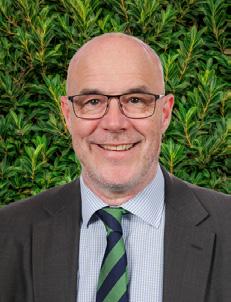
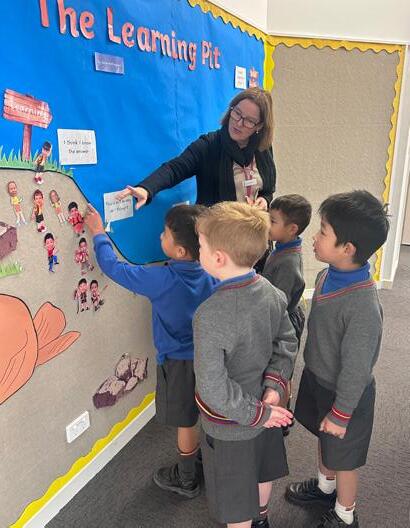
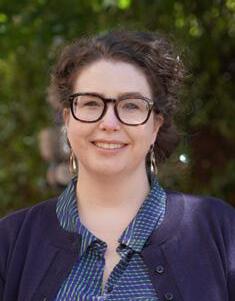
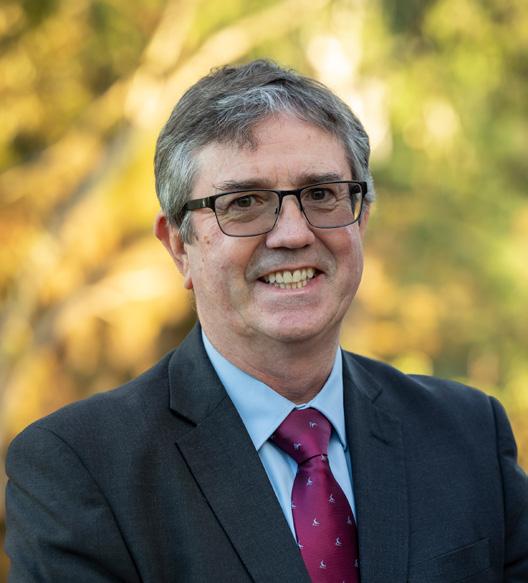
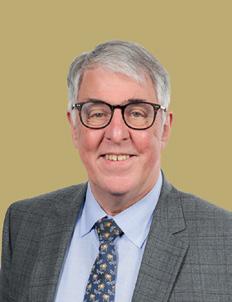
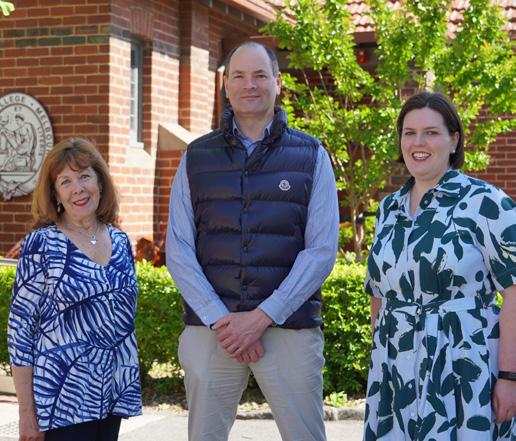
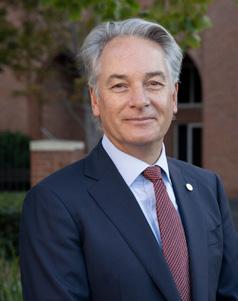
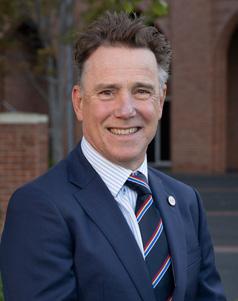
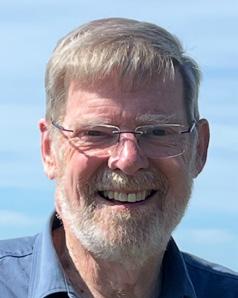
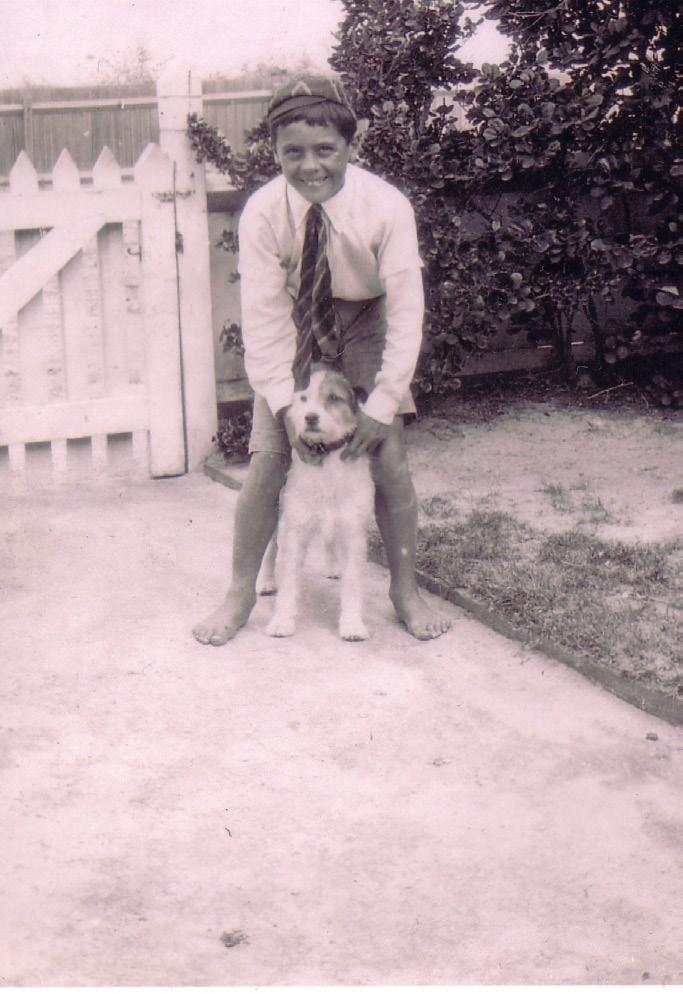
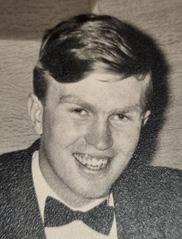
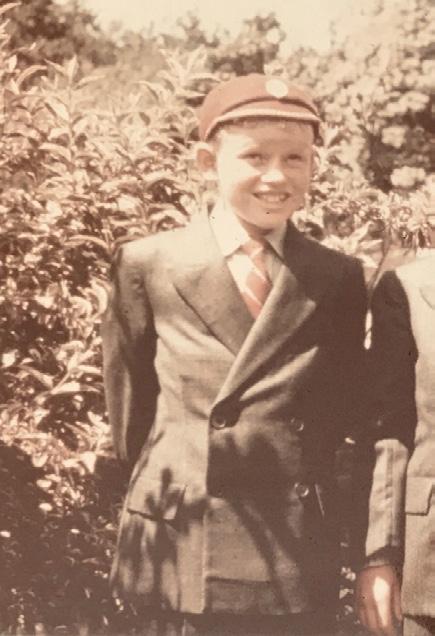
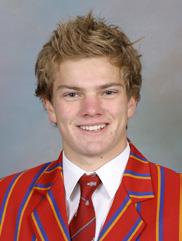
Hear from our Chairman Mr Hamish Tadgell, Principal Dr Scott Marsh and School Chaplain Rev Dr Doug Campbell
10 NEWS
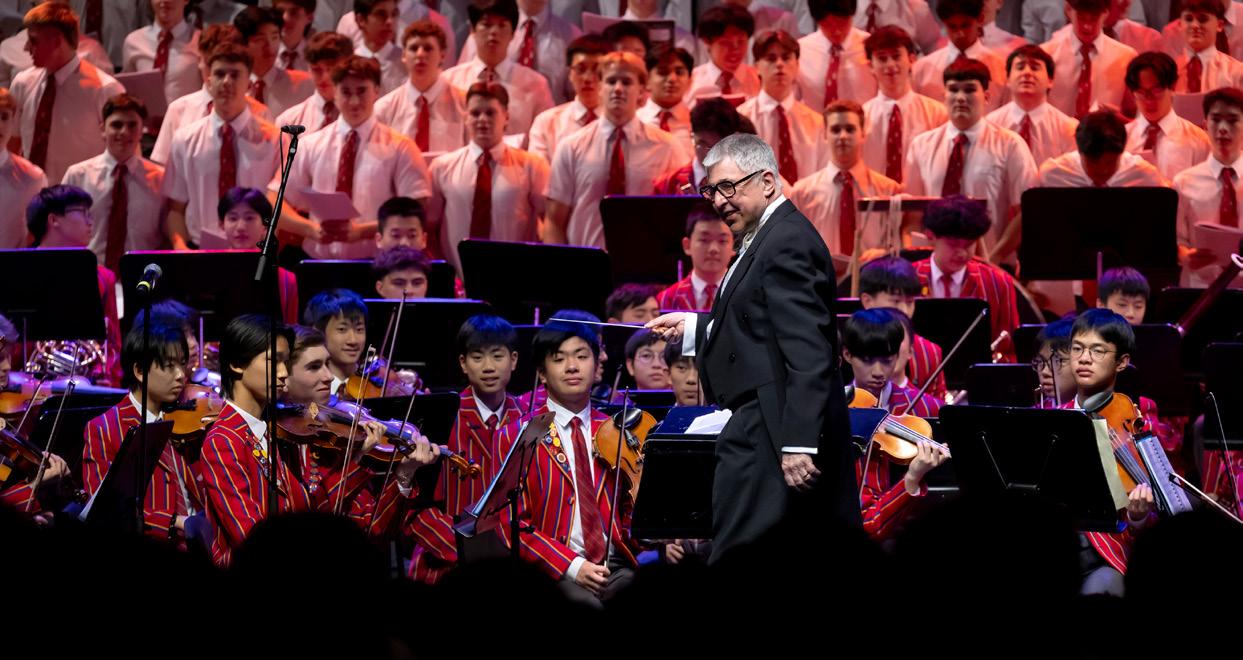
Catch up on 2025 highlights, farewell Director of Music Dr John Ferguson and Bursar Ross Congleton and discover what's in store for the future of Scotch.
28 AROUND THE GROUNDS
Explore daily life on and off campus, and hear from some of our great staff members.
40 THE ARTS
Delve into the visual, dramatic and melodic side of Scotch College.
48 SPORT
Look back on a wonderfully successful semester of sporting achievements including and meet some of our supportive parent auxiliary groups.
54 BOARDING
Learn about our regional boarding students and the lives they lead back home.
58 FOUNDATION
Take a look at the impactful work of the Scotch Foundation.
62 OSCA NEWS
Catch up with our Old Boys and find out where they are now.
80 OSCA CLUBS
Discover what the OSCA Clubs have been up to this year.
86 OSCA EVENTS
Revisit some of the great events held for the Scotch Family during 2025.
92 ARCHIVES
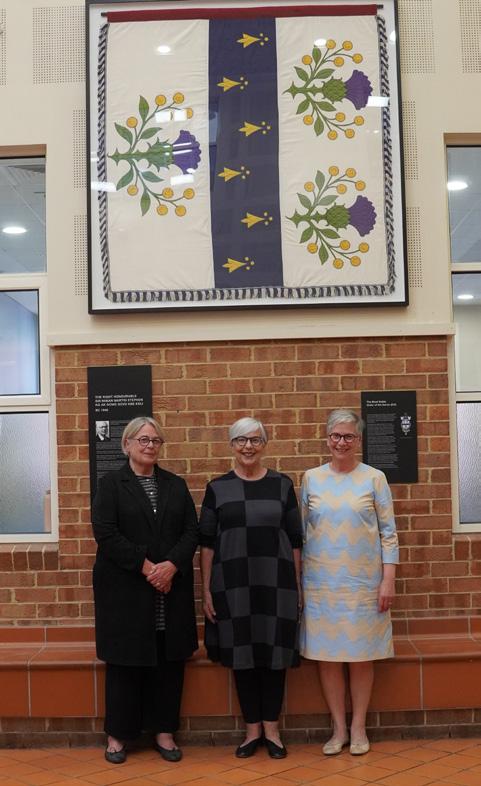
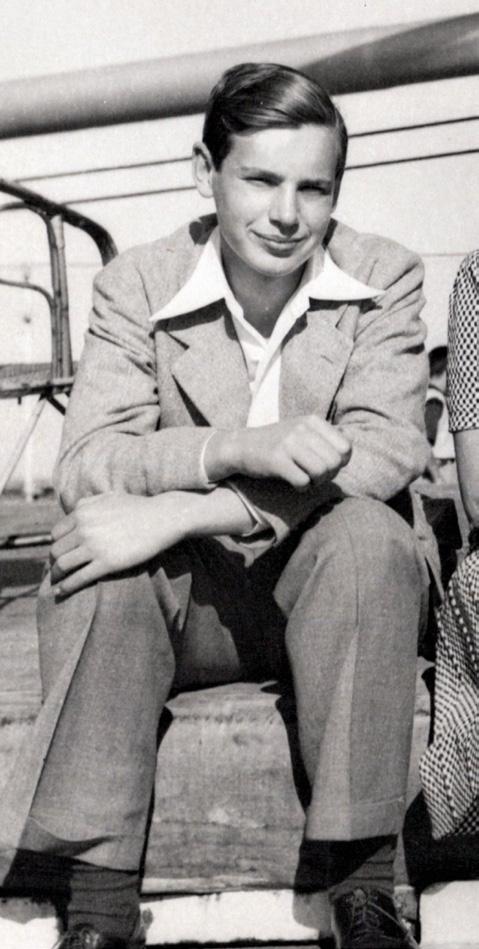
Learn more about the history of Sir Ninian Stephen and his Order of the Garter banner which now hangs in the Lithgow Building.
175 years of learning and leadership
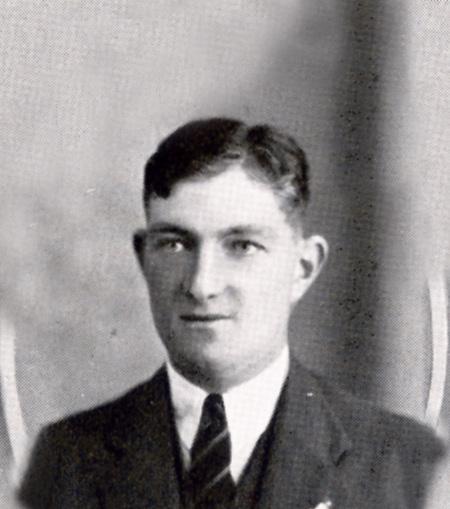
Mr Hamish Tadgell (‘85) SCHOOL COUNCIL CHAIRMAN
In 2026 Scotch College will celebrate 175 years since its founding and 100 years since the first boys began at Hawthorn in the Junior School in 1916. As the oldest surviving secondary school in Victoria, Scotch predates the founding of The University of Melbourne, The Supreme Court of Victoria and The Victorian Parliament. It stands as an enduring institution in the life of our city, state and nation.
These looming milestones call us to reflect on the importance of institutions in our community, and the reasons for Scotch’s longevity and achievements.
Public, cultural and educational institutions play a critical role as foundations of society and community. At their core, they bring people together through a common thread of values and provide a source of societal cohesion. Yet to remain relevant and enduring, they also need to be dynamic and receptive to changing circumstances while upholding the principles upon which they were built.
In an era defined by rapid change, where trust in many institutions is declining and under attack, stable contemporary civic institutions – especially schools – remain as important as ever. Schools carry the responsibility of not only educating future generations but teaching and instilling values of decency, civic responsibility and community.
Schools also play an important role in nurturing and sustaining traditions and allowing the legacies and lessons of the past to be handed on between generations. In doing so, they offer a sense of belonging, identity and purpose.
One of Scotch’s defining strengths is the distinctive balance between its Christian and Scottish roots, and its deep traditions and progressive thinking. The College’s founding father, The Reverend James Forbes, unashamedly modelled the College in the Scottish educational and religious tradition. However, he was also prepared to discard the ‘old system’ of teaching if it merely conveyed knowledge. For him, understanding had to accompany knowledge, and the cultivation of moral character was essential.
Even in those early days, Scotch demonstrated a preparedness to innovate and focus on providing a high-quality holistic education – one that prepared young men to be responsible citizens, capable of serving and contributing to the emerging community of early Melbourne.
Other factors in Scotch’s success lie in its egalitarian approach and the leadership and generosity of its Old Boys and the ‘Scotch Family’. From the outset, Scotch welcomed boys from a wider social and religious background than many schools, and this diversity has been an enduring strength.
Along the way, Scotch has embraced and discarded things as it has deemed necessary. Each of its ten Principals has built on the foundations of their predecessors, imparting their own leadership and method to mould the College into what it is today. Sport began in the 1860’s under Morrison and Houses were established in 1917 – initially for competition but later in supporting pastoral care. Extra-curricular activities became widespread under Littlejohn in the 1920’s and music and drama grew more serious under Gilray in the 1930’s, with the school pipe band founded after World War Two. The singing of Scottish songs became an established part of School life with the centenary celebrations in 1951 and the school embraced computing and technology in the 1980’s under Donaldson.
In A Deepening Roar, written at the time of the College’s 150th anniversary, it was observed that “Scotch has thrived by constantly changing. While it strongly asserts its long-standing traditions, it has shown a capacity to adapt to new circumstances and to respond to the evolving community values”.
This spirit of continuity and renewal is evident across the College campus today and equally in both its academic and co-curricular programs. Innovative offerings in science, technology, and enterprise sit comfortably beside the School’s long-standing strengths in literature, music, and sport. Under our current Principal, Dr Marsh, the focus on “forming enlightened learners of good character’’ and recent purchase of Fairhaven at Mallacoota, designed to support an immersive and transformative outdoor education program for Year 9 boys, is the latest chapter in the College’s commitment to evolving a rounded and rewarding education.
Scotch has always looked outward, and its success lies in good part on the fact that its history does not constrain its future; rather, it provides the foundation from which new ideas and approaches can confidently grow. As we look ahead, we do so with the knowledge that the best way to honour our history is to build upon it confidently, while remaining committed to equipping young men with the academic, cultural, moral, and civic capability to contribute positively to society so they can live productive, purposeful, and fulfilling lives.
Scan to read an update on the School Council
The next chapter begins
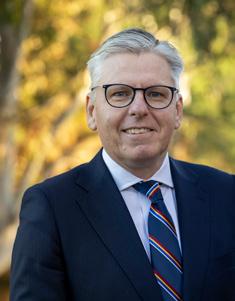
Dr Scott Marsh
PRINCIPAL
In preparing to write this article, I was interested to learn that the word legacy comes from the Latin word “legatus,” meaning “ambassador” or “envoy”. Initially, its meaning drew on the idea of sending a body of people on a mission. Using this definition, I am instantly drawn to people who have been ambassadors for Scotch, people who have been on a mission to ensure this great school continues to impact our world for good.
The list is near endless of ‘Scotchies’ who have left an indelible legacy. However, I would like to very briefly highlight one name synonymous with Scotch – the surname Robinson.
Scotch owes great debt to Michael Robinson (‘55) who served faithfully in so many roles including Chair of Council. Significantly, Michael followed the legacy left by his Grandfather Sir Arthur Robinson (1887), also Chair of Council. Perhaps known affectionately to our boarding fraternity as ‘A. Rob House’, Sir Arthur Robinson assisted in the purchase of Scotch’s Hawthorn campus in 1915, and from 1919 he chaired the committee that raised the money needed to build the Senior School at Hawthorn.
Over our history we have observed significant milestones where our ambassadors have sent Scotch on a mission. In 1850 Reverend James Forbes was authorised to write to the Free Church of Scotland (in Scotland) asking it to send out a teacher to start a secondary school. In 1915, we had a new mission to purchase land in Hawthorn, a decision benefitting thousands of Scotchies since. Over a century later, in 2023, the Scotch Council purchased property at Mallacoota, a property that has a mission to transform the lives of our boys – this will be the legacy of Fairhaven.
Since the purchase of this property, many have stated that they believed a remote, residential outdoor education program was the missing piece of the Scotch jigsaw. Given our 175-year legacy, it is
perhaps important to ask the question ‘why now’? Why pursue this mission now in our journey?
I have written previously about today’s narrow purposes of education. One can be forgiven for thinking that schooling today is essentially an activity where we train students to fulfill tasks relevant for the continued growth of our economy. Perhaps this is why Kristjansson asks “why do so many students enter school as ‘originals’ but leave as ‘copies’? Why is so much of schooling preoccupied with preparing students for a life of tests rather than the tests of life”?
At Fairhaven, our boys will be exposed to the tests of life. In addition to their usual classroom studies, our boys will experience life on the land, they will be responsible for their day-to-day living, cooking, cleaning, and ensuring there is enough wood to provide heating and hot running water. Through challenges in the outdoors, the boys will learn resilience, the importance of teamwork and community and ultimately, be engaged in experiences that will seek to prepare them for the tests of life.
I recently finished reading ‘Comfort Crises’ by Michael Easter. The central thesis of this book, that is supported by significant research, connects much of societies' mental and physical decline to our modern lifestyles where essentially, we do everything possible to exclude discomfort from our lives. In offering so many examples of how we might
do better, Easter notes the importance of ‘rites of passage’ for our young people and specifically the three stages that shape this important pathway, namely, (1) Separation (2) Transition (3) Incorporation.
Very simply, Fairhaven will provide a time of ‘separation’. Here, boys will move from the comfort of the known to the unknown.
They will learn that they can and must be responsible for themselves and start to enjoy the privileges of freedom with responsibility. In being away from home, the Fairhaven program will provide experiences for the boys to ‘transition’ into young men.
Importantly, our program will be intentional in building a language for our boys to consider what it means to be a man, and the important life skill and adult reality of personal responsibility.
Finally, in returning to Scotch, a range of significant symbols and experiences will ‘incorporate’ our young men back into the Scotch Family.
Scholars in the field of flourishing have largely reached consensus that education for flourishing must include the following:
• Fulfil students’ potential for competence, relationships, self-efficacy and intrinsic engagement;
• Be fun and stimulate flow and wonder;
• Aim at the essential goods of truth, understanding, knowledge, good judgement and self-governance;
• Take place within learning environments of co-operation, warmth and trust.
The experience at Fairhaven will seek to provide the right environment to develop the traits, habits and qualities that will enable our boys to flourish. Significantly, the serene setting of Fairhaven with its natural beauty, will provide the perfect context for our boys to appreciate beauty, pursue goodness, and discern truth.
As the 10th Principal of Scotch, I am thankful to the current ambassadors leading the Fairhaven mission. Fairhaven’s legacy will be one of transformed lives. Fairhaven will become a sacred place where boys grow into young men of good character, ready to shape a better future.
References
1. Kristjansson, K (2020). Flourishing as the aim of education: A neoAristotelian view (p.1).
Routledge: New York.
2. Easter, M (202). Comfort Crises: Embrace Discomfort to reclaim Your Wild, Happy, Healthy Self. Rodale Books, New York.
3. Kristjansson, K (2020). Flourishing as the aim of education: A neoAristotelian view (p.31).
Routledge: New York.
Rehumanising humans in an age of AI
Artificial Intelligence isn’t human, but we are. So, what does it mean to be human in an age of AI? That is the question that School Chaplain Rev Dr Doug Campbell reflects on as he examines how we can find ourselves, and others, through God in a world that is increasingly connected via screens, yet disconnected in person.
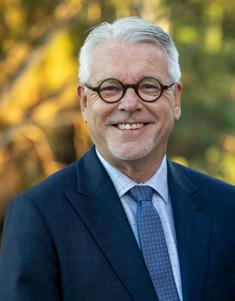
Rev Dr Doug Campbell SCHOOL CHAPLAIN
In the early 1990s, a planning manager at the University of Edinburgh informed me of the plans to open up a centre for Artificial Intelligence. This visionary explained about the future of computers and the power of AI. It sounded to this Luddite like science fiction. I was doubtful and too easily dismissive.
In 2018, the University of Edinburgh opened the £40 million Bayes Centre for Data Science and Artificial Intelligence. Science fiction has become science fact. The centre is named after the Rev Thomas Bayes (c.1701-1761), a statistician, philosopher, and minister who came to Edinburgh to study logic and theology in 1719. Bayes is famous for Bayes’ Theorem, which has been enormously influential in probability theory and statistics, and many consider it to be a foundation of modern-day machine learning, one of the key methods used in Data Science and Artificial Intelligence.
Artificial Intelligence is making an impact on almost every sphere of life and learning. At Scotch we need to reflect afresh on how we teach our boys but to get them to reflect and think deeply on issues and life so that they might build a sound foundation for living and for training up future generations.
Considering all these technological advances, one of the most pressing questions we face is ‘what does it mean to be human?’ While 20th century proponents cheered the apparent death of God, their philosophy consequently dismantled the notion of human nature and human exceptionalism. If God is dead, then it follows that people are no longer made in God’s image with no distinct human nature and no ultimate purpose. As a result, humans have no intrinsic worth and are reduced to mere commodities to be bought and sold.
Our 21st century technological age, however, has ushered into an increasingly disembodied world. In it, actual physical interpersonal engagement has been seriously reduced. Without talking to a real person, our meals are ordered online and are dropped off at our door by some anonymous driver. Social media platforms have universalised disembodied social interaction. We no longer see the individuals with whom we interact in the online world as truly human and real people. Instead, people have become disembodied ideas or statements that can be readily dismissed out of hand or viciously attacked without a second thought. The direct consequence of this disembodiment is that we then dehumanise the flesh and blood individuals we encounter in the world.
Scotch College’s values are respect, responsibility, and reverence which are grounded in our Christian heritage and reinforced in the Scottish Enlightenment.
King David’s song in Psalm 8 reads –
When I consider your heavens, the work of your fingers, the moon and the stars, which you have set in place, what is mankind that you are mindful of them, human beings that you care for them?
After considering the vastness of the moon and the stars (think how many more stars he could have witnessed with just a pair of binoculars!) David is convinced with the marvellous truth that in God’s cosmos, the Almighty still pays attention to and is concerned for men and women, his image bearers. His exclamation ‘What is man?’ reveals his baffled wonder and perplexed joy! Only the condescension of God can hold together astronomical vastness and individual concern. God, who has created the cosmos, has stooped down and told us of his love for us and reassured us of our eternal value and worth. We truly matter to Him. God’s valuation and love of humans is observed supremely in the form of his Son, Jesus Christ, in true flesh and blood. He is truly God and truly Man. Embodied.
Psalm 8 begins and ends with an invitation - ‘Lord, our Lord, how majestic is your name in all the earth!’ When we learn to delight over God’s splendour and majesty and adore him, we are profoundly changed. We come to realise who we truly are in the eyes of God, and we begin to recognise the inherent and eternal worth of all human beings around us. When we take him seriously then it should result in a desire to seek the wellbeing of others.
Bayes may be best known for his theorem and contribution to science. However, interestingly he also wrote a book on Divine Benevolence (1731). In it he showed how God’s love worked for the happiness and wellbeing of his people. Like David before him, Bayes worshipped the Creator and marvelled at his continued interest in his people. In our AI world we need to take seriously and reverence God our Creator so that we might cherish more our fellow men and women.
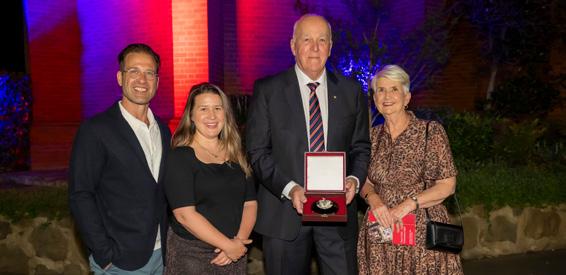
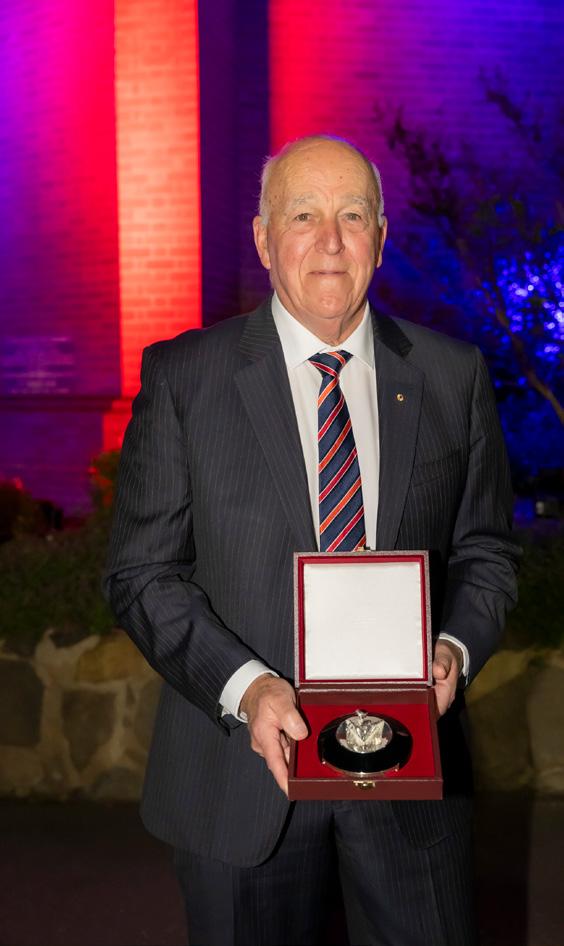
David Crawford AO (‘61), 17 January 1944 - 5 December 2024
Sweet style
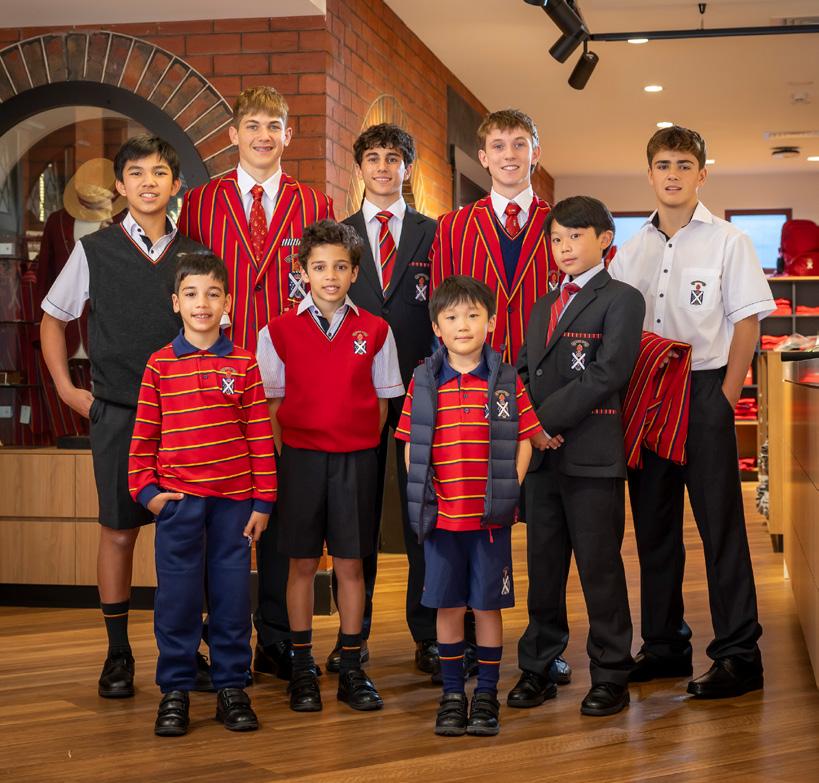
It’s time to bring the Candy Coat into a new era. After almost 24 months of thoughtful deliberation, the long-awaited relaunch of the Scotch College Academic Uniform has been completed.
For 175 years, Scotch has epitomised tradition, excellence, and community. Throughout much of the first century of its history, the academic uniform evolved in response to the changing times and the needs of its students. However, over the past 50 years, the academic uniform has hardly changed at all.
In the beginning there was no need for a uniform. There were few schools in Melbourne and Scotch is not known to have competed in sport before 1858. Regular competition became common from the 1870s and Scotch eventually wore the blue and white of the cross of St Andrew. However, three fellow Public School opponents, Geelong and Melbourne Grammar Schools and Wesley College, also used combinations of blue and white.
At the 24 June 1886 football match against Geelong College (which then wore dark blue and white), Scotch wore cardinal socks: the first appearance of our now iconic red colour.
Dr Scott Marsh, Principal, has been in support of the changes since day one.
“
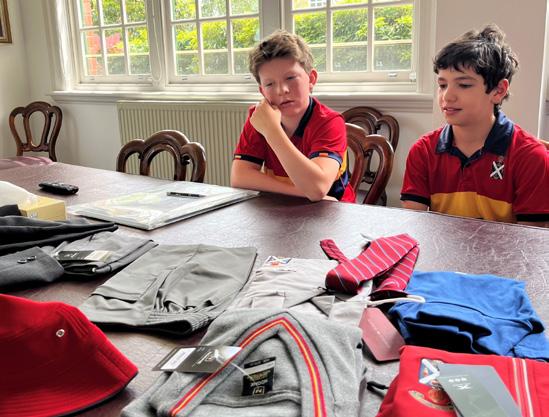
Early on in 2023 two Year 10 boys made an appointment to come and see me and said ‘Dr Marsh, we think more students should be wearing the Candy Coat’, and that’s how it all started.
”
Drawing inspiration from the successful sports uniform revamp in 2020, a diverse Academic Uniform Committee was formed, comprising of students, staff, parents, and Old Boys. Over two years this group met regularly with a single-minded focus: to reimagine our academic uniform as contemporary, practical, and reflective of our shared values. Students were regularly invited to provide feedback and truly make the uniform their own.
The design process has been a collaborative effort, led by Tim Shearer (‘85), Head of Advancement, in partnership with noted schoolwear designer Jonathan Ward.
To help families adapt to the change, a two-year changeover period will be in place. This will allow ample time for planning and purchasing new uniform items. For those items that are built to last beyond three years, parents might consider continuing to make purchases at the Swap Shop, conveniently located next to the Scotch Shop and open on Wednesday mornings during term time. Additionally, a recycling strategy is being developed to responsibly manage the replaced uniforms.
Some superseded items, such as woollen jumpers, will be recycled into 175th Anniversary scarves and blankets. Other items will be recycled into insulation.
The project team has been consistently mindful of sustainability goals and the ethical sourcing of materials and items. Only reputable suppliers with certified environmental practices have been commissioned and lowimpact dyes and recyclable packaging have been used.
A key motivation for improving the materials was to increase comfort for the boys. “It’s important that it looks great and feels great and can be comfortable for each and every boy to choose what feels good to them” says Katrina Brennan, Head of Senior School.
Nick (Year 11) is excited to increase the pride shown by boys wearing the uniform. “I love that we can wear the Candy Coat from Year 9 through to Year 12. It’s such a great colour and almost a waste not having it worn by more”. “It makes the school a lot more colourful than it was before” agrees Thomas (Year 9).
Some of the biggest changes include no longer requiring a tie to be worn in Terms 1 and 4 and giving boys the option to wear shorts or long pants year-round. Plus, alongside seeing more red in the candy coat, there’s now greater variety in jumper colours between Junior and Senior School.
“The red jumper is so good, it’s the best jumper that we’ve had in decades” confirms Canice (Year 6). On the other hand, Julian (Year 3) is all about the newfound freedom. “I like it because I can run faster, and when I play basketball my arms can move more freely.”
As we roll out this uniform over the next two years we hope that our boys feel proud to wear it. In the words of Dr Marsh, “Wearing the uniform well says ‘I’m part of something bigger than myself, I’m part of the Scotch Family’”.
Check out the full 175 Uniform Collection here
Facing the future– using AI safely
Artificial intelligence is no longer confined to laboratories or science fiction. It now speaks, reasons, and produces content that feels distinctly human. Yet behind the fascination lies a pressing question: how do we prepare ourselves and our students to navigate a world increasingly shaped by these systems?
In 2023, Figure AI unveiled its first humanoid robot powered by generative artificial intelligence (AI). In a now viral clip, the robot demonstrated its ability to engage in speechto-speech reasoning, providing justification for and an assessment of its actions. The company has (as of 9 October) released their 3rd generation robot and while it is a powerful glimpse into the future of AI, it also raises questions about the potential impact and ethics of machines that can mimic human thought and communication.
So, what exactly is Artificial Intelligence? At its simplest, AI refers to computer systems that can perform tasks traditionally requiring human intelligence, such as speech recognition, decision-making, translation between languages, or visual perception (Australian Government, 2023). Generative AI, a subset of this field, uses vast datasets to produce new content, from essays to artwork, based on patterns it has learned. Tools like ChatGPT and Copilot are examples of generative AI in action, built on large language models trained to predict and produce human-like responses.
But as AI becomes more embedded in our lives, the question isn’t just what it is, it’s how we engage with it, and this is particularly important given the growing ubiquity of these technologies. This is where Critical AI Literacy becomes essential. Defined as the ability to critically analyse and engage with AI systems by understanding their technical foundations, societal implications, and embedded power structures, critical AI literacy also involves recognising AI’s limitations, biases, and environmental impact (Roe, Perkins and Furze, 2025).
At Scotch College, we’ve begun to wrestle with these questions and to develop this literacy. On 18 August, during our Tech Savvy Professional Learning Day, staff had the privilege of hearing from Leon Furze - academic, consultant, and author - who specialises in the implications of generative AI in education. Leon challenged us to not merely learn about AI, but with, through, without, and even against it (Furze, 2025). And to do the same for our students.
Leon’s presentation offered an introduction to generative AI, tracing its evolution from predictive text to complex systems capable of deep research and even video generation. He highlighted the ethical concerns baked into these technologies, such as bias in training data, underrepresentation of marginalised groups, environmental costs, and copyright issues to name a few.
These insights have profound implications for education. As generative AI becomes more mature and capable, able to complete research tasks in minutes or generate virtual avatars, questions of authenticity, assessment, and pedagogy come to the fore. What matters now is not just how students find information, but what they do with it.
At Scotch, we recognise the need to engage with AI, not flee or ignore it. This means equipping staff and students with the tools to think critically, ethically, and creatively about these technologies. It means understanding the models we use, the processes and organisations behind them, and the context in which they operate. As we move forward, our challenge is to ensure that AI serves education, not the other way around.
Dr Caitlin Munday Head of People, Research & Professional Growth
References
Australian Government (2023). An introduction to artificial intelligence. Retrieved 27 October 2025, from https://www. cyber.gov.au/businessgovernment/secure-design/ artificial-intelligence/anintroduction-to-artificialintelligence
Furze, L. (2025). About, With, Through, Without, Against: Five Ways to Learn AI. Retrieved 27 October 2025, from https:// leonfurze.com/2025/08/12/ about-with-throughwithout-against-five-waysto-learn-ai/
Roe, J, Perkins, M and Furze, L. (2025). Reflecting Reality, Amplifying Bias? Using Metaphors to Teach Critical AI Literacy. Journal of Interactive Media in Education, 2025(1): 18, pp. 1–15.
Counting
down to 175
In its 175-year history, Scotch College has welcomed over tens of thousands of students, parents, staff and siblings through its gates. It’s a staggering number, one that represents thousands of lives, choices, friendships and ideas which have shaped the Scotch Family into what it is today.
In 2026, Scotch College will celebrate its 175th anniversary. Founded on 6 October 1851 by Reverend James Forbes as “The Melbourne Academy,” the school has grown from humble beginnings on Spring Street to become a thriving, well-loved, educational institution.
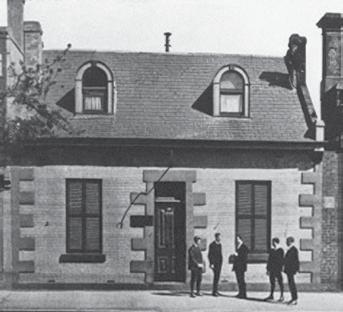
Above: Spring Street, 1851
Here at Scotch we don’t do things by halves, and with so many years behind us our anniversaries have become quarter-century occasions. As Victoria’s oldest secondary school, we are excited to mark this milestone with the Scotch Family through a year-long program of events and celebrations.
Tim Shearer, Head of Advancement, has led the 175th Anniversary Committee in their plans for the year. “The Committee has taken a “less is more” approach to the celebrations, ensuring each event is meaningful, memorable, and distinctly Scotch. Across the year, 12 major events will build on beloved traditions such as the Foundation Day Concert, Family Day, and the OSCA Annual Dinner” Tim says.
The boys will be at the centre
of the celebrations all year, taking part in everything from aerial photos forming the number 175, to a proposed 175-minute sports game and a Prep to Year 12 flyer
race over 175 metres. Senior students, especially those in Year 12, will play an active role in helping to plan the celebrations too.
One of the highlights of the year will be the 175th Anniversary Gala Ball on Saturday 28 February 2026, an evening that is shaping up to be truly memorable for parents and staff. Several surprises are in store for us, organised by the planning committee, and the night will feature several lively performances. A gala such as this is hoped to become a biennial tradition at the school.
There’s plenty more for the wider community too. The annual Parent Information Sessions, held at the beginning of the year, are being reimagined, and a rare whole-school assembly will provide a momentous occasion for the boys to discover the history of the school and receive commemorative badges. Sports fans can look forward to a bigger-than-ever CordnerEggleston Cup, to be held on Scotch grounds in 2026, complete with pre-game performances and tributes to past players, and the Boarders’ Parents’ Association have a special family picnic event organised.
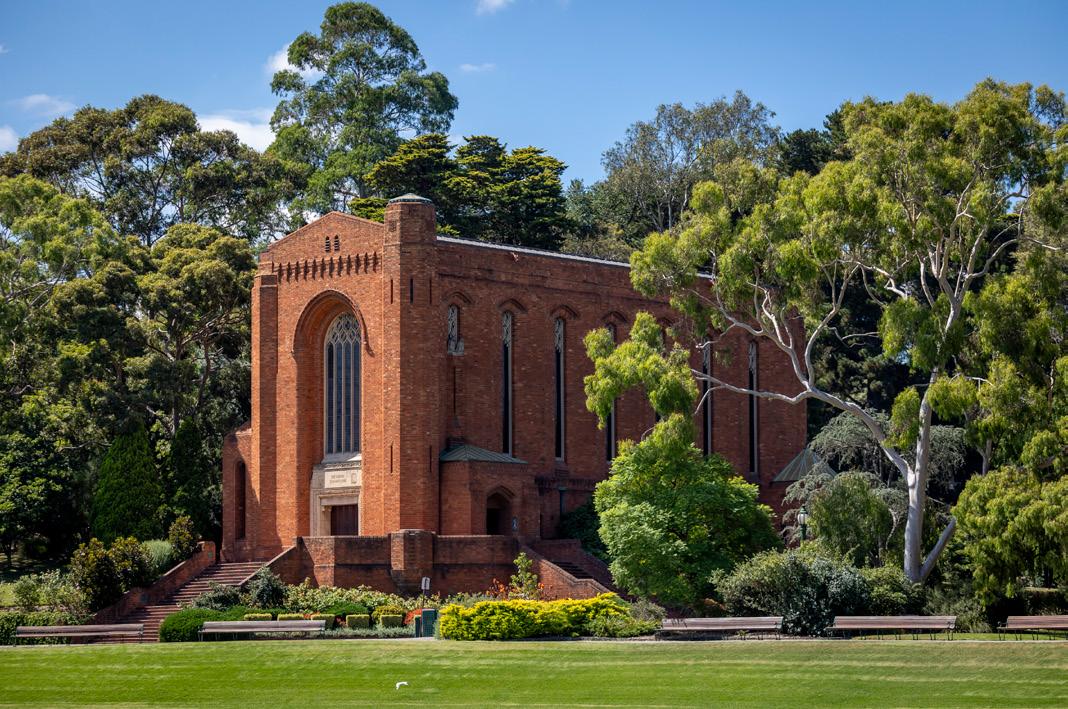
“Outside of events themselves, we have plenty of other features planned to memorialise the occasion. The 175th Anniversary History Trail will feature plaques and QR codes at key sites across campus, highlighting iconic buildings such as Memorial Hall, Littlejohn Chapel, and the James Forbes Academy, offering a glimpse into the school’s architectural and cultural heritage. Scotch will also unveil the Forbes Statue and Centenary Gates, part of a broader fundraising campaign to both develop and restore key parts of our history,” shares Tim.
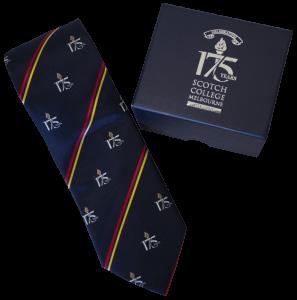
And of course, the year will commence with many boys in our new Academic Uniform, the 175 Collection, a contemporised and evolved version of the academic uniform boys have worn for decades. We will also have a range of commemorative merchandise available for the community to purchase at the Scotch Shop and via the Foundation. Keep an eye on the Scotch website for event details, booking options, and a rich dose of history to enjoy.
We warmly invite you to join us next year to celebrate both our history and our present. Over the last 174 years, across 2025 and into 2026 and beyond, we commemorate everything Scotch has been, and everything it is becoming. The decisions we make today are intentional, shaped by 175 years of experience and guided by the legacy we hope to leave for the next 175.
These items and more are now available for purchase at the Scotch Shop and online!
Forming men of good character beyond the classroom
At Scotch College, education is more than academic excellence; it is also about developing young men of good character, committed to shaping a better future. Focusing on our values; respect, responsibility and reverence, we aim to inspire our students to be thoughtful, resilient, and respectful individuals.
Katrina Brennan VICE PRINCIPAL HEAD OF SENIOR
SCHOOL
While the classroom remains a vital space for intellectual growth, our commitment to character formation extends far beyond textbooks and timetables. Through a suite of targeted pastoral programs, we nurture emotional intelligence, ethical decisionmaking, and personal responsibility; qualities essential for thriving in life, not just school.
Building inner strength – Years 7 and 8
During Years 7 and 8, our boys work through the materials and resources of The Resilience Project, whereby students engage with practical strategies to cultivate gratitude, empathy, and mindfulness. These pillars form the foundation of emotional wellbeing, helping boys navigate challenges with composure and optimism. Whether reflecting in journals or participating in guided discussions, students learn that resilience isn’t just about bouncing back; it is about growing through adversity.
“I didn’t realise how powerful gratitude could be until I started writing it down every day.
It’s changed how I see things.” – Year 8 student
Navigating drugs and alcohol with integrity – Years 7 to 10
Our Futures was developed by researchers based at the Matilda Centre for Research in Mental Health and Substance Use at the University of Sydney and co-designed with teachers, curriculum experts, and high school students. Each course is based on cognitive behaviour and social influence theory and is mapped to the Australian and state curricula.
In the Our Futures program, students confront the realities of drug and alcohol use with honesty and clarity. Grounded in evidence-based education and open dialogue, the program empowers boys to make informed, values-driven choices. It’s not about scare tactics. It is about equipping students with the tools to protect their health, uphold their integrity, and support their peers.
Cultivating connection and understanding consent – Year 10
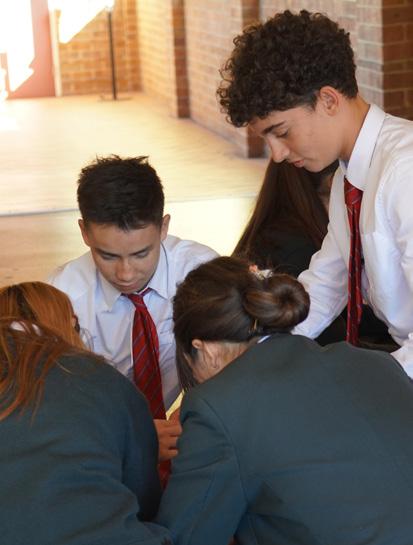
Respectful Relationships is a cornerstone of our character education, and this year’s joint workshop with Methodist Ladies’ College brought the topic of consent into sharp, meaningful focus. Through mixedschool sessions, students engaged in open dialogue, scenario-based learning, and facilitated discussions that unpacked the complexities of consent, communication, and mutual respect.
The day emphasised that consent is not a one-time conversation, but an ongoing, active process rooted in empathy, clarity, and respect. Students explored how power dynamics, social pressures, and digital communication can complicate consent, and learned strategies to navigate these challenges with integrity.
“Hearing the girls’ perspectives made me realise how important it is to listen, not just assume.” – Year 10 student
“It was uncomfortable at times, but in a good way. It made me think about how I act and what I say.” –Year 10 student
The collaboration with MLC fostered mutual understanding and challenged stereotypes, reinforcing that respectful relationships are built on shared values and open minds.
Emotional intelligence in action – Years 7 to 10
The Toolbox program gives students the language and strategies to understand and manage their emotions. From identifying stress triggers to practising self-regulation, boys develop the emotional literacy needed to thrive in school, sport, and social life. These skills are not just reactive, they are proactive, forming the bedrock of leadership, empathy, and self-awareness.
A voice of strength and self-worth – Year 9
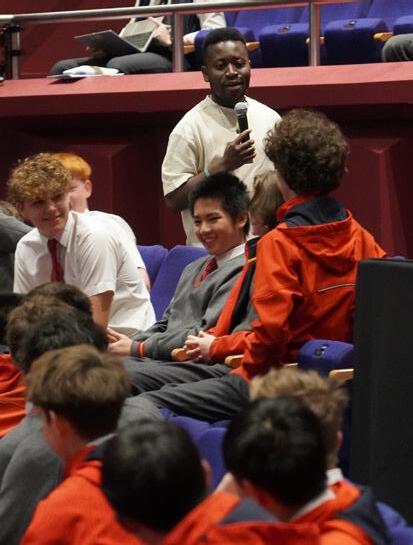
At Scotch we believe that character is shaped not only by curriculum, but by connection and few speakers connect more powerfully with young men than Eric Agyeman.
Eric is a nationally recognised youth advocate, author, and motivational speaker whose journey from adversity to empowerment resonates deeply with teenage boys. Born in Ghana and raised in Melbourne, Eric faced bullying, identity struggles, and mental health challenges throughout his youth. His story now fuels his mission to help young people discover their self-worth and make courageous choices.
This semester, our Year 9 cohort had the privilege of engaging with Eric through a keynote session followed by a dynamic workshop series that blended storytelling, reflection, and practical strategies for emotional wellbeing and respectful relationships.
Through interactive exercises and open dialogue Eric challenged them to think critically about the way they speak to themselves and others, and to recognise the power of empathy and vulnerability.
“It was the first time I’ve heard someone say it’s okay to cry and still be strong. That really stuck with me.”
As we continue our mission to form men of character at Scotch College, voices like Eric’s help illuminate the path. These programs are embedded in pastoral care, co-curricular life, and everyday interactions. They reflect our belief that the true measure of a young man lies not just in his academic achievements, but in how he treats others, responds to adversity, and contributes to his community. In shaping men of character, we honour the legacy of Scotch College while preparing our students for a future that demands courage, kindness, and conviction.
Expanding on a connection30-year
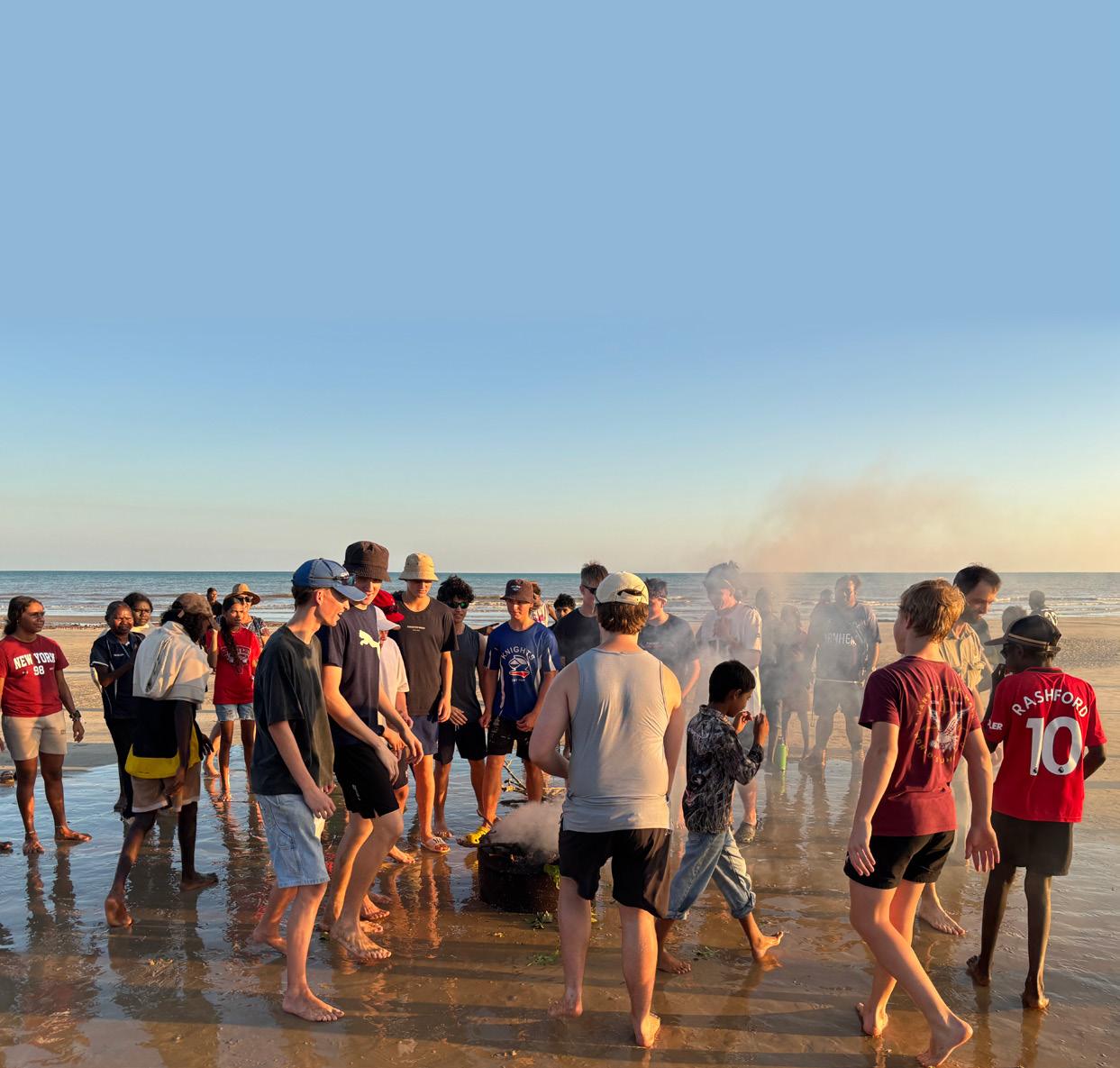
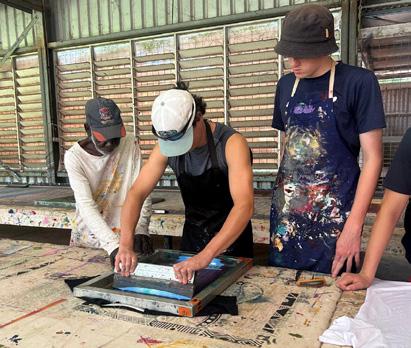
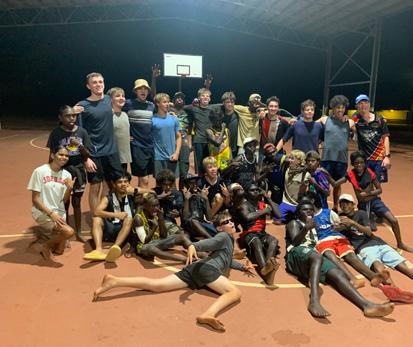
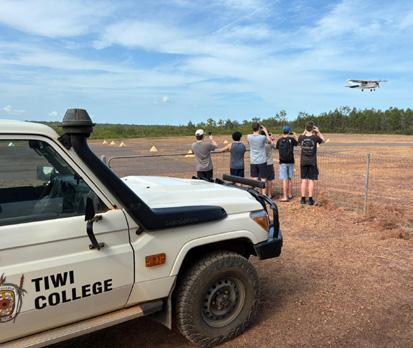
Scotch’s connection with the Tiwi Islands has become a staple aspect of Scotch College’s identity over the past three decades. What began in 1996 as a modest AFL trip has steadily grown into a rich partnership, one that continues to benefit both communities in meaningful ways.
Rob Smith, Head of Indigenous Education, has been deeply involved in the building of this partnership.
“Since 1996, the AFL trip has run every second year and remains a strong tradition. Tiwi College was officially established in 2008 and built from the ground up,” Rob explained. Since then, the partnership has grown significantly. In addition to the biennial AFL trip, Scotch boys have been visiting Tiwi annually for the past 15 years. “I took a group of Year 10 boys earlier this year, and another group of Year 11s in September. So it’s now two trips each year, plus the AFL trip every second year,” he said.
The relationship has never been one-sided, and for the past decade groups of Tiwi students have also visited Scotch, experiencing life in Melbourne through stays with Scotch families.
“This year, I believe we brought down about 10 or 11 Tiwi boys. They were billeted by Year 9 parents and stayed for a week. It’s a ‘Learn About Melbourne’ trip. They visit places like the aquarium, the zoo, some footy clubs,” Rob said. “While they’re here on campus some of our Junior School teachers have been teaching them basic literacy skills. These are kids who are 13 years old and, in some cases, can’t spell ‘cat.’ We start from the very basics.” Looking ahead, there are plans to expand even further. “We’re hoping to bring a group of girls for the first time soon. The girls have missed out for a long time, so we’re working hard to include them now.”
The partnership gained new momentum when the Yadha Muru Foundation, a federal government–backed initiative that pairs city schools with rural Indigenous schools, officially joined Tiwi and Scotch forces. “Together, we have been granted $1.2 million for this year and next,” Rob said, “and we collaborate closely with Tiwi College on how to use the funds. For example, we’ve just purchased 70 laptops for the Tiwi students.”
The funding also supports curriculum development, staff exchanges, vocational training, and wellbeing. “One of our Junior School staff members might spend the entire first semester next year at Tiwi College, helping their teachers with literacy strategies we use here,” Rob explained. “Our psychologist, Nick Clark, has also spent a week up there offering his expertise and will return.”
While resources and funding matter, Rob emphasises that the trips themselves can be a deeply impactful experiences for our boys. “They’re exposed to a community that, for many of them, feels like a third-world environment, something they didn’t even realise existed within Australia. And they respond incredibly well,” he said.
“I remember asking them after one visit, ‘What did you get out of today?’
One boy simply said, ‘I’m very lucky.’”
Our boys are encouraged to immerse themselves in the local culture, practising traditional dances, learning about the Tiwi language, and understanding the history of the
islands which were separated from mainland Australia around 10,000 to 11,000 years ago. It’s a deeply isolated and unique community and gives Scotch boys the firsthand opportunity to learn about and appreciate other cultures.
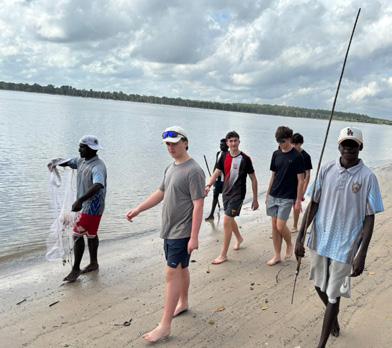
Charlie (Year 10) attended the trip in early 2025. “The most memorable part was our first full day on the island. We went out to a beach to hunt for bait to catch barramundi later. As we walked, I chatted with a Tiwi young man. it turned out to be one of the most interesting conversations I’ve had in a long time. He spoke about places he wanted to see, things he hoped to do, and the people on the island. That conversation was my first real insight into life and culture on Tiwi.”
“On the second night, as we headed back to our rooms, we were given a generous spread of snacks completely unprompted. Later, we learned this was a core part of Tiwi culture, sharing without expecting anything in return, even without being asked. I found that amazing. It’s one thing to share with friends and family, but to offer so freely to people you met just yesterday, that’s real kindness.”
“To any students thinking of going next year, I’d strongly encourage you to apply. The experience opened my eyes to the reality that Australia isn’t perfect. Some communities live in conditions that feel worlds apart. Before I went, I was told it wouldn’t feel like a part of Australia, and I didn’t believe it until I saw it for myself.”
For some, the impression is so lasting that they return after Year 12 to volunteer, spending anywhere from a few weeks to an entire year up there. “They help in classrooms, drive vehicles, and support the community in all sorts of ways,” Rob shared.
It’s a very rewarding community to be a part of, and the Scotch Family are very lucky to be met with a warm reception time and time again. “The people are the friendliest you’ll ever meet, so welcoming. Of course, the community faces challenges ranging from addiction and alcohol abuse to youth mental health crises, but we’re working to break that cycle and rebuild. It’s a tough job, but I find it incredibly stimulating and rewarding. I wouldn’t still be involved after all these years if I didn’t.”
Red Army returns
to the track
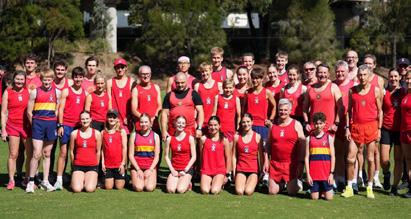
The pursuit of excellence is not confined to classrooms or sports fields at Scotch, it’s embedded in the relationships that shape our boys into men of character. In 2025, the revival of the Athletics Auxiliary became a powerful example of how parent-led initiatives can transform the spirit of a school.
Hamish Lindeman (‘90), a parent of two Scotch boys with a third starting next year, stood at the APS Athletics Final last year and noticed something missing.
“Scotch had basically zero presence,” he recalled.
“Other schools had marquees, stalls, and cheering squads. Scotch parents came, watched their boys compete, and went home. It was disappointing. There was no Red Army. No community.”
That moment sparked an inspired group of parents to rebuild the Athletics Auxiliary from scratch. With no blueprint, no expectations, and no legacy to inherit.
They met with Stuart Powell, Teacher in Charge of Athletics and Director of Sport, to ensure it was something that Stuey wanted. “We needed to know we could help and make a difference.” Stuart welcomed the initiative, and together they set clear goals: support the boys, support the coaches and teachers, and rebuild the sense of community.
From zero visibility, Scotch became the most prominent school at every athletics meet. The Red Army returned in full force featuring marquees, signage, tables, and nutritionist-approved food. It was so well received that other schools were noticed filming for inspiration. “We got there early, got the best spot, and made sure we were visible and present,” Hamish said. “Year 7 boys came up saying, ‘I didn’t realise this was catered for.’”
The Auxiliary also hosted a welcome BBQ for 130 new Year 7 athletes, giving them a warm and memorable introduction to the program. They launched a WhatsApp group with over 250 members, easing the communication burden on teachers and ensuring parents had timely answers and updates. Pins were designed and awarded to athletes who made the APS Finals team, a tradition long present in other sports but new to athletics.
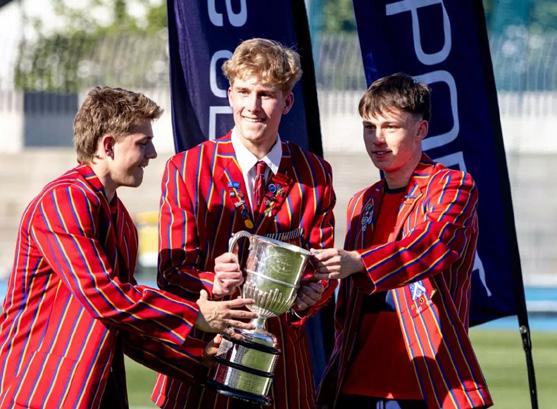
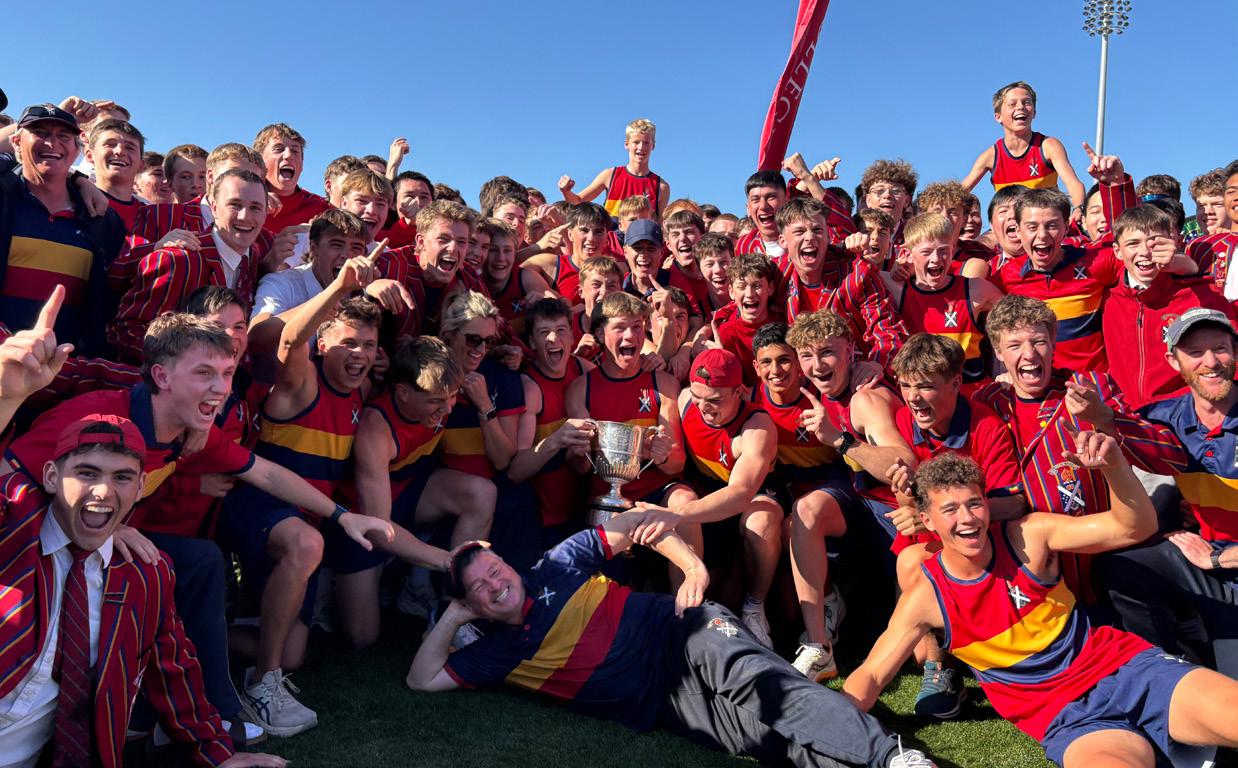
At the end of the 2025 season Scotch won its first APS Athletics Premiership in 47 years.
While the athletes and coaches deserve full credit for their performance, the Auxiliary’s role in creating a supportive, energised environment cannot be overlooked.
“Most pleasing,” Hamish said, “was seeing the community grow. Parents whose sons don’t even do athletics came to APS Athletics Day and said it was the best day. They’ll be back next year.”
Head of Clubs and Auxiliaries, Jason Andrew (’90), believes this is what happens when parents step forward as partners in the Scotch journey. The Scotch Parents Association (SPA) oversees 22 clubs and auxiliaries, each supporting different aspects of school life, from sport and music to boarding and faith. In his report to the SPA AGM, he shared statistics that over 250 volunteers, including 181 committee members, delivered 68 events attended by more than 7,000 people in 2025.
These groups embody Scotch’s values of Respect, Responsibility, and Reverence. They build connection and belonging, enhance student experiences, and model the character we hope to instil in every boy.
Jason is sure the Athletics Auxiliary revival is a case study in what’s possible. It shows that even from a standing start, a small group of committed parents can reignite school spirit, support student wellbeing, and create lasting traditions.
As Hamish reflected, “My boys used to finish their races and come chat with me. Now they go straight into the Red Army to cheer on their teammates. They love being part of it.
We’re building a team spirit, a sense of belonging, a community.”
At the recent Scotch Parents Association AGM, Dr Marsh expressed heartfelt gratitude to our parent volunteers for their passion and commitment. “I’ve always believed that when parents are actively involved in their child’s education, it directly correlates with improved outcomes, and the research supports that,” he shared. “Your investment in your child’s journey has a powerful ripple effect.”
Dr Marsh reflected on the many interactions he’s had with SPA members and auxiliary volunteers throughout the year.
“I love people, relationships, and community. That’s what continues to bring me joy in this role, the daily connection with so many wonderful individuals.” “It’s lovely to be here with you. Thank you for all that you do.”
Knowledge-rich learning
Claire Stubbings DIRECTOR OF LEARNING P-6
As we pursue our purpose of forming enlightened learners of good character, we aim to advance our boys’ learning with a view to the future whilst still acknowledging our past. Scotch College was founded on the ideals of the Scottish Enlightenment and the central tenet that education can and should be transformative – equipping young people with the means to not only take control of their own lives but with the capacity and motivation to contribute meaningfully to their communities.
Key thinkers within the Enlightenment championed the idea that education should be accessible to all, and that knowledge and reason could elevate not only the individual but broader society ( Hanley, 2011).
These beliefs continue to guide our educational philosophy today, reflecting their lasting impact as we respond to the current context and prepare our boys effectively for the world beyond the school gates. One of our strategic aspirations, to advance learning that appreciates beauty, pursues goodness and discerns truth, guides us to cultivate learners who are not only curious about the world around them but are effectively equipped to engage with this world. We nurture young boys into men who are not only knowledgeable but can apply knowledge meaningfully, who are not only capable but purposeful.
Some 170 years onwards from our foundation, what does the development of knowledge and reason look like in the current context?
The founding ideals of Scotch can be seen as reflected in our prioritising high expectations, valuing explicit instruction, and the rigorous, cumulative development of knowledge.
We believe in the importance of continuously fostering a knowledge-rich curriculum which ensures that boys are not just learning isolated facts or generic skills, but are building a deep, coherent understanding of the world
around them. This empowers boys to become more effective learners by providing them with the tools to think critically, solve problems, and express themselves clearly. It also supports equity – ensuring that all boys, regardless of their starting point, have access to learning experiences that build deep, connected knowledge across disciplines.
Research demonstrates that programs reflecting knowledge-rich curricula are a key characteristic of high-performing education systems (AERO, 2024) and positive student outcomes.
For boys in the Junior School, developing connected knowledge begins with strong literacy foundations. Our literacy programs are developed with this in mind, focusing on explicit, systematic instruction from boys’ initial introduction to formal learning in Prep through to Year 6. The Prep program builds phonological awareness –understanding of letter-sound connections – a foundation on which to build boys’ early reading skills. From this initial foundation, boys progress through year level programs which systematically develop boys’ reading fluency, vocabulary through morphological and etymological study, and attendant comprehension strategies to effectively draw meaning from what they read.
Reading comprehension is not developed in isolation, rather, reading is a complex cognitive process interconnected with boys’ background knowledge (Lemov, Driggs & Woolway, 2016). Effective reading comprehension is dependent on a reader’s ability to make sense of text by connecting it to what they already know.
Research has reliably shown that along with vocabulary, depth of background knowledge is a strong predictor of reading comprehension and in fact, essential for students to ‘make sense’ of what they read ( Hirsch, 2003; Such, 2021).
A knowledge-rich curriculum plays a pivotal role in fostering deep reading comprehension. We know that students learn best when they are effectively supported to systematically acquire, rehearse and retain knowledge, connecting new information to prior understanding (AERO, 2024, Rosenshine, 2012). The more knowledge students acquire and connections they make, the deeper their comprehension and the stronger and more accessible their background knowledge (Rosenshine, 2012).
Effective instruction in a knowledge-rich curriculum requires explicit teaching, modelling, guided practice and rich discussion to make complex ideas accessible. We want our boys to engage with challenging texts and sophisticated ideas with confidence and develop our programs to both enable this – supporting boys to move from limited experience and isolated ideas to connected conceptual understandings, enabling them to construct knowledge meaningfully (Hattie, 2012). By ensuring our boys have the knowledge base and instructional support to persist through challenging learning, they emerge as confident, capable thinkers. Through a rich, interconnected curriculum developed from the foundation of systematic literacy instruction, and by supporting boys through the challenges of deep learning, we honour the legacy of Scotch’s founding ideals and ensure that their education is rigorous, inclusive, and transformative.
References:
Australian Education Research Organisation. (2024). A knowledge-rich approach to curriculum design. https://www. edresearch.edu.au/ research/research-reports/ knowledge-rich-approachcurriculum-design
Hanley, R. P. (2011). Educational theory and the social vision of the Scottish Enlightenment. Oxford Review of Education, 37(5), 587–602. https://www.jstor. org/stable/23119457
Hattie, J. (2012). Visible learning for teachers: Maximizing impact on learning. Routledge. Hirsch, E. D., Jr. (2003). Reading comprehension requires knowledge of the words and the world: Scientific insights into the fourth-grade slump and the nation’s stagnant comprehension scores. American Educator, 27, 10–29.
Lemov, D., Driggs, C., & Woolway, E. (2016) Reading reconsidered: A practical guide to rigorous literacy instruction. Jossey-Bass
Rosenshine, B. (2012). Principles of instruction: Research-based strategies that all teachers should know. American Educator, 36(1), 12–19.
Such, C. (2021). The art and science of teaching primary reading. Sage Publications
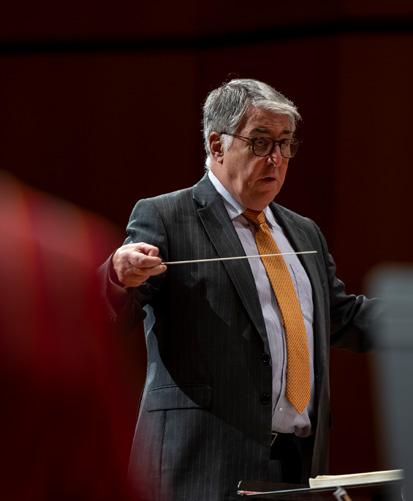
John Ferguson was born in London and worked as a Musical Director for theatres, brass bands, choirs, and television networks TSW and Thames before moving to Australia. He studied conducting with Dr Roy Truby, Robert Rosen, Myer Fredman and Barry Bignell, holds a Master’s in Conducting from the Victorian College of the Arts, and a PhD from the University of Melbourne. His career and contributions to music, both in Australia and abroad, are remarkable.
Appointed Director of Music at Scotch College in 1991, John has had an impact and staff and students alike:
man music The the
“When I appointed John Ferguson as Director of Music, I hoped he would continue a longstanding culture of high quality music education at Scotch. Little did I imagine the extent to which he would develop the music program in all dimensions - engaging thousands of boys of all abilities in lessons and ensembles; attracting a committed and highly competent teaching staff; providing numerous opportunities for performance at Scotch and across the world; and contributing thoughtfully and carefully to the design of the James Forbes Academy. A life-long learner himself, John’s passion for challenge and high expectations ensured that boys had the opportunity to grow in all aspects of musicianship. From chamber ensembles through to the symphony orchestra, the many resulting concerts have brought joy to audience members and a well-deserved sense of achievement to performers - my hopes have been fully exceeded.”
Dr Gordon Donaldson
AM, Former School Principal
“I have had the pleasure of working alongside John for over 35 years, and in that time, I’ve watched him transform the Music Department into the vibrant, multi-faceted program it is today. He built a team of dedicated and inspiring musician-educators, and was uncompromising in his pursuit of excellence. John’s vision was even instrumental in designing the incredible building that is the James Forbes Academy.
Under his leadership, the Ensemble and Chamber Music programs flourished. He tirelessly created opportunities for students to shine, from local eisteddfods and festivals to international tours and music exchanges. The department’s diverse range of genres and the sheer number of students enrolled in instrumental lessons are a testament to the incredible foundation John built over his 36-year tenure.
One of the most valuable hallmarks of John’s teaching was his refusal to compromise on repertoire; he consistently challenged the Symphony Orchestra with complete, professional versions of major works, including a full symphony each year and numerous concerto opportunities for budding soloists.”
Megan
Philip, Head of Woodwind
and Bands
“The impact John Ferguson has had on Scotch College during his long and distinguished tenure as Director of Music is best measured by the reaction of the boys themselves at John’s final Foundation Day concert at Hamer Hall when they had the chance to show just how much he means to them. They know first-hand how important Scotch’s music program under John’s visionary leadership has been to their whole school experience and indeed their lives. What they learn from striving for mastery on their instruments and working together in large and small ensembles on real music with dedicated and expert teachers cannot be overestimated. John’s emphasis on highest quality, in all areas, and willingness to think outside the box (responsible for my own peripheral involvement at Scotch for the last decade or so) means that his legacy is an exceptional music school, nurturing lucky cohorts of seriously high-achieving musicians who will pay it forward in their professional and civic lives for the greater good, whatever their eventual careers. Thanks to John, future generations will continue to enjoy Ian Roach Hall, one of the finest purpose-built concert halls anywhere. I will personally always be grateful to John for his deep understanding of the place of music in any civilised society and therefore its vital importance in the education of our youth.”
Wilma Smith, Former Concert Master of MSO & Scotch Arts Program (Artist in Residence)
“Looking back on my time at Scotch, it’s hard to overstate what an immense impact John Ferguson had on my musical upbringing. He not only encouraged me to grow as a performer, but also gave me the opportunity to write and compose, planting the seeds of what would become my career. After university, he went so far as to offer me a casual position, continuing to nurture and support me as I found my feet. What stood out most, though, was his unwavering belief that I was destined for something greater in the world of music ever since my first day in Year 7. That wholehearted faith gave me the confidence to pursue paths I may never have dared on my own. As he now retires, I’m deeply grateful — not just for his teaching, but for the way he saw, believed in, and championed the musician I could become.
Nick Buc (‘99), Composer, Conductor, Arranger & Former Scotch Music Captain
The comments from colleagues and former students make it abundantly clear that John Ferguson has made an enormous contribution to Scotch College’s music program, building a vibrant and high-achieving department that has enriched the lives of countless students and the broader community.
Through his visionary leadership, unwavering commitment to excellence, and personal support for young musicians, John has left an enduring legacy. We wish him all the very best for the future as he embarks on the next chapter of his journey.
Dr Scott Marsh, Principal
A balancing act
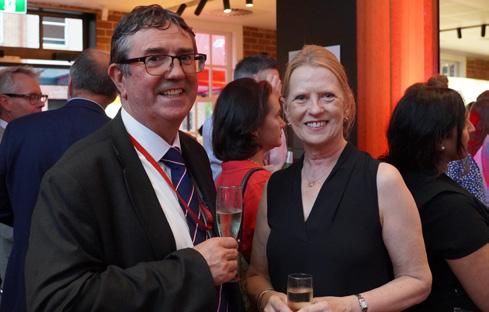
Ross Congleton played a vital role within the Scotch Family as the school Bursar between 2005 and 2025. Previously he was Business Manager at Melbourne Girls Grammar. Ross received a Bachelor of Business ( Accountancy ) degree from RMIT University and a Graduate Diploma of Finance from RMIT University. As Ross departs, leaving a prosperous legacy behind, we wanted to share a few testimonies which say a lot about his character:
“On picking me, Lee and the girls up from Tullamarine in July 2008 when we arrived to take up the role, Ross said, with something like relief, ‘we have a Principal’.
I don’t know what he said as we departed 14 years later, but throughout that time, and the joys, celebrations, trials and routines of school life, he was loyal, good humoured and a ready, generous source of calm, considered advice.
Perhaps his greatest gift was introducing us to Rosemary, who, in addition to offering useful HR thoughts, brought wit, fun and laughter to gatherings, both formal and those more relaxed.
Ross loved his school and wanted the best for it. As Bursar and secretary to School Council, a big part of this came through managing monies, being at the fulcrum for the flow of information and arrangements for major building works and offering support to both principal and School Council. The quality of buildings constructed during his tenure owes much to his patience, diligence and gentle but firm diplomacy in herding the cats.
As Principal, it was a great support that he applied a similar approach when dealing with the myriad of regulatory bodies.
Entering his office, I’d generally find Ross emersed in a spreadsheet or on the phone politely dealing with a testing call. He managed the numbers, and dollars behind them, with great care and respect for the responsibilities of office. I’m not sure I ever fully understood his explanations of depreciation, and the relationship of cash, asset and income, and eventually came to accept it was a place for acceptance rather than understanding.
Ross’s eyes would light up when talking about time at Mount Martha. His stories painted a vivid picture of happy family times by the Bay with Rosemary, Hugh and Tom. It clearly conjured fonder memories for Ross than the town bearing his name in the north of England that he visited as a young man and later returned to with his sons only to suffer disappointment.
On penning these words, I Googled Congleton. Seems nice to me and I can only presume he got soft with the years.
Throughout my time in the chair, Ross was respected and highly regarded across the Scotch community: staff, boys – current and ‘Old’ – parents, and Foundation and Council members.
He has a welcoming, helpful manner. There was a kindness to his engagement and dealings with non-teaching staff, for whom he had particular responsibility, that was clearly much appreciated. He was open, approachable and keen to help.
Ross and Rosemary, the Battys thank you for both your professional support and friendship. We wish you well for the quieter times ahead, hoping the winds of travel carry you our way.”
Tom Batty, Former School Principal
“Ross’ contribution to Scotch has been profound and meaningful. Whether it be overseeing the school’s significant building program, monitoring departmental and recurrent budgets, overseeing the purchase of external properties, or working with the non-teaching staff to ensure the best possible facilities, grounds and equipment. Ross’ financial acumen, eye for details and hard work ensured that the school remained financially secure and that the facilities and programs that were delivered were of greatest benefit to the boys. Ross also played a significant role in the dealings with old boys who had experienced abuse, treating those that had suffered abuse with dignity and empathy.
As a member of the School Executive, Ross’ extraordinary knowledge of the school, his common-sense approach and his encouraging and supportive nature, were very much in evidence.
Ross was a key player in the school’s journey ‘from good to great.’ All this was done with modesty, good grace, without thought of reward or kudos, and a strong understanding of the education process.
On a personal note, I take this opportunity to thank Ross for the support, encouragement and wise counsel he gave me during my time in the chair.
Having spent half his life at Scotch, be it as student or employee, it is indeed the case that Scotch blood runs through his veins. Ross’ impact on the school that he loves will be evident for many years to come, and on behalf of the generations of Scotch boys, staff, and parents that have, and will benefit from Ross’ commitment, hard work, and sound financial practices, I thank him for all he has given to the School, and wish him and his wife Rosemary all the best as he begins a well-earned retirement.”
Rob
McLaren, Former Vice Principal
Ross demonstrated exceptional commitment and service to Scotch, earning the respect and gratitude of staff, students, and the wider school community.
His financial expertise, thoughtful leadership, and supportive approach have been instrumental in guiding the school through significant developments and challenges.
Personally, I am deeply appreciative of Ross’s tremendous support when I began in 2023, which made a meaningful difference to my transition.
As he embarks on a well-deserved retirement, we thank Ross for his unwavering dedication and wish him and Rosemary every happiness in the years ahead.
Dr Scott Marsh, Principal
Fairhaven Frontiers
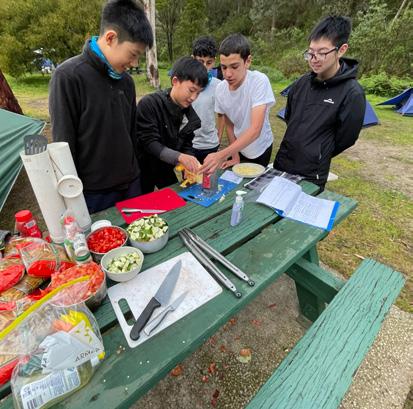
In September, eighteen students had the honour to be the first Scotch students at Scotch’s new Fairhaven property. The trip proved to be an eye-opening experience for the boys on the hardships the Mallacoota community has faced, and how our new campus will develop and enrich the future Year 9s involved.
Over the course of six days, through many activities, we learnt the history of Mallacoota, explored its flora and fauna, visited Fairhaven, in addition to developing our teamwork, skills and personalities.
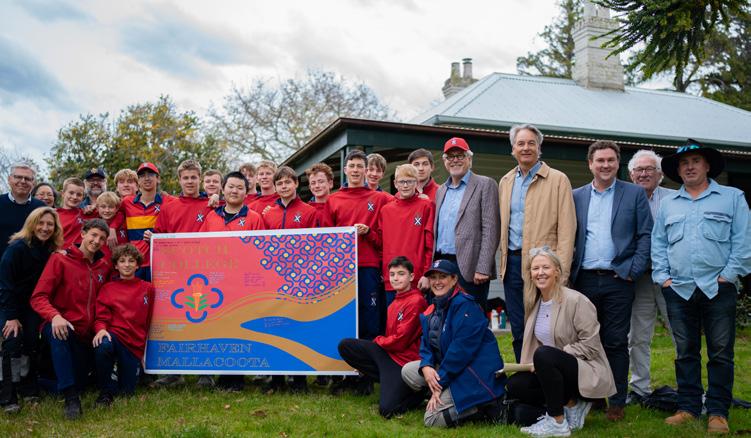
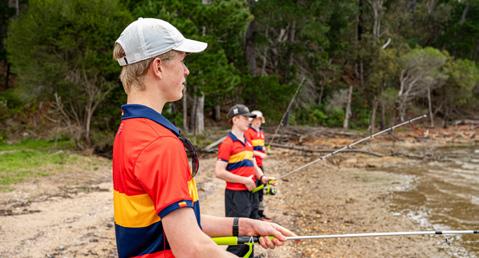
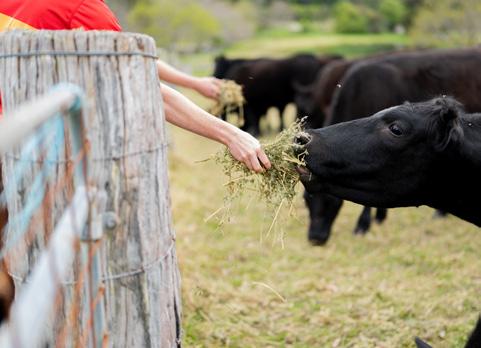
I personally very much enjoyed the World War II Bunker Museum that we had the opportunity to visit on the Monday. The willingness of our guides to teach, extend and entertain us left all involved knowing much more about the war and how it affected Australia. Similarly, our visit to the Bastion Point Rockpools on the Wednesday was very enjoyable, and we found many different species of plants and animals, as well as enjoying some time playing by the beach. But the foremost highlight was, of course, our day trip to Fairhaven on the Tuesday. Being able to be the first to explore what will surely become a favourite term for the future Year 9s involved was truly special, and we partook in fishing, feeding the cows, clearing debris and playing games together. In addition to this, we had a chance to talk to Dr Marsh and several other members of the board, which proved to be a great experience to grasp new perspectives, ask questions to Old Scotch Collegians, and understand the future of the campus.
Not only did we enjoy many fun activities, but we were able to find out more about ourselves. I made many new friends over the course of the camp and learnt how to better respond to the challenges that arose, better interact with people I am not familiar with, and how to better take risks and put myself out there. I learnt that working in a team is not just about others hearing what you have to say, but about you hearing what others have to say, allowing for greater comprehension and a better end result.
I believe we all learnt a lot from our six-day trip to Mallacoota and Fairhaven. We left a permanent memory at the campus, but at the same time, it left a permanent memory on us. We were able to make new friends, interact with the people of Mallacoota, and learn about both the past and the future of the town and the campus. Our time in Mallacoota and Fairhaven laid a foundation not only for the future of the campus, but for our own growth as students and young men.
Carl (Year 9)
Between the shelves
Exploring life in our Junior School library
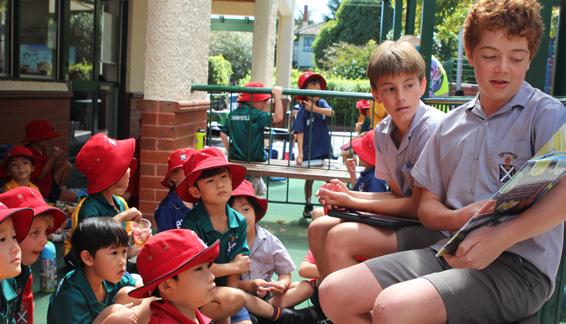
If you come across boys lounging with books on a balcony, others busily creating a quiz, and Peter Hitchener reading a story aloud – chances are you’ve found yourself in Scotch’s Junior School Library. Overseeing it all is Amy Rogers, Head of Library, whose goal is simple: to help every boy discover the joy of reading. “The energy in here is high,” Amy says. “They do so much reading. They just love it.”
Every class from Prep to Year 6 enjoys a weekly 50-minute library lesson. These sessions typically begin with group reading, perhaps a few beautifully illustrated picture books or a couple of chapters from a novel for older students. Amy also incorporates digital tools like Storybox Library, where a huge repertoire of well-known voices such as Peter Hitchener and Emma Watkins read aloud to the boys.
Then comes the exploration and borrowing.
“The structure is usually always the same, even with the upper primary classes,” Amy explains. “We read aloud as a class for about 15 minutes, then spend another five to ten minutes exploring something new. It could be a non-fiction topic, a recommended reading list, or sometimes there’s just a batch of new books to look through.”
While there’s no expectation to borrow, there is an expectation to try something new.
“I often ask them why we choose from a curated selection, and they always say, ‘So we might be introduced to something we wouldn’t usually read,’ which is spot on,” says Amy.
Fantasy, sports biographies, and graphic novels are all popular picks, but as Amy says, “They honestly love a bit of everything, and we definitely don’t want them just focused on one thing.”
Outside of class time, the library remains a hive of activity during lunch breaks, with chess matches, drawing, and quiet reading happening side by side. The outdoor balcony has become a popular spot on sunny days too, with new sofas providing a comfortable space for silent reading.
A well-oiled library program like this one relies on strong foundations, and librarian Deb Parkinson provides exactly that. Since 2009, she has been the backbone of the Scotch junior library, bringing expertise on cataloguing and book management. She undertakes all the issuing, returns, shelving, book cataloguing, covering and collection maintenance. It’s behind the scenes work like this that keeps the library in tip-top shape.
The library itself is a work of love. Renovated between lockdowns, it transformed from a traditional, old-fashioned room into a modern, flexible learning space.
“
There’s nothing we would really change at all,” Amy says. “Lots of other schools come to see this as an example of best practice. ”
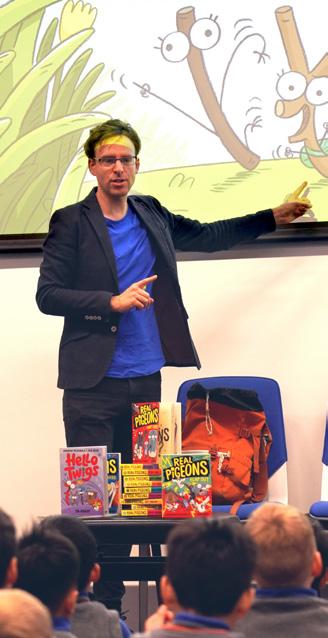
Book Week is a highlight of the library calendar, bringing authors and performers into the space. This year, students met Andrew McDonald, author of Real Pigeons, and illustrator Zeno Sworder, whose mature picture books explore complex themes.
Another standout event is the annual Book Fair, a mini pop-up bookstore where boys and parents can browse new titles.
The library is also a centre for leadership and initiative. The Year 6 Library Service Team, now in its second year, encourages students to take ownership of the space. This year, the team has grown to its largest yet, with around 13 boys involved.
“At lunchtimes, they sometimes read to the junior primary children. They’ve come up with great ideas like running book drives to donate books to those in need, or hosting quizzes to promote the library at assembly. Sometimes, they just come in to help the library staff,” Amy says.
“They played an active role during Book Fair and Book Week, interacting with parents and helping younger boys choose books. They operated the EFTPOS machine, calculated prices, and managed transactions. It was really lovely,” says Amy.
Amy believes the library’s role goes far beyond reading. Through literature, students develop empathy, explore different perspectives, and learn about the world beyond Scotch.
“Books can teach you so much,” she says. “They offer different perspectives on life, right from when they’re little. So many values, and all our character education topics, can always come back to a book”.
“I like to think my collection is as good as it could ever be. I take great pride in curating a diverse and exciting range of books,” says Amy. “Even after working here since 2018, I still come across books I’ve never seen before!”
AROUND THE GROUNDS
Behind the scenes at Scotch
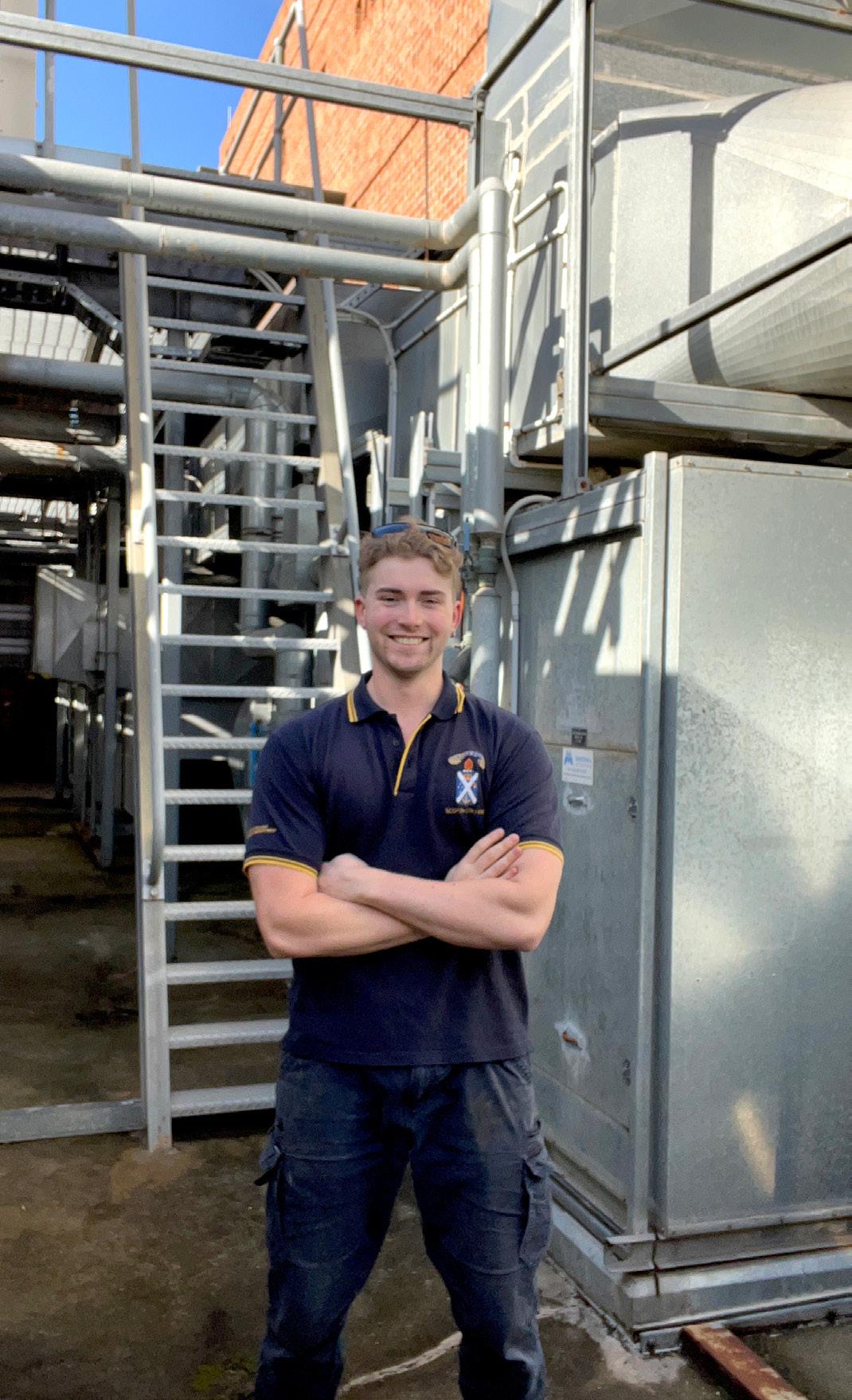
Sam Assender first met with Scotch life in his teenage years, arriving alongside his father School Chaplain David Assender, and graduating in 2019. Since then, he’s worn many hats across the school, contributed to a number of roles, and today is a valued member of the maintenance team. We sat down with Sam to chat all things Scotch.
Could you share a bit about your background before coming to Scotch?
I moved to Scotch with my dad and joined the boarding family around 14 years ago. So before Scotch, around the age of 10, you could say I had an extensive background in playing with Lego and riding my bike.
Can you tell us about your role and the activities you’ve been involved in at Scotch?
After graduating in 2019, I started my employment in the Cadet Unit as support staff. This developed into managing the Queue Store and Field Store back when Transport and Logistics managed that area. I was then poached by Maintenance and converted into General Hand, and after a few years of that, I was given the opportunity to start a plumbing apprenticeship under Colin Daniel. Together, we look after all things plumbing and air conditioning. Naturally, we’re also in the business of catch and release, generally on call for possums in roofs and confronting unwanted walk-ins on campus.
What constitutes some of the highlights of your week?
I would love to say that I only do it for the satisfaction of helping others and the love of the game, but I would be lying. Kim the Nurse and Sarah the Maintenance Office Manager are two of the best bakers you would ever meet, and I have to say the cakes and sweets that get sent down to Maintenance are what keep me motivated for sure.
What sorts of hobbies do you have outside of work?
I don’t know whether to call it a chore or a hobby, but I do spend a fair amount of time exercising in the Scotch Gym. But my main passion would have to be working on my car. I own a 1998 Toyota Supra painted orange like Fast and Furious, and I love it to bits.
Everyone loves a good story, so are there any particular anecdotes or memories that you could share with us?
You definitely see a different side of the school working in the support departments.
I’ve made lots of memories, like crawling around in the Chapel’s dungeon or walking around on top of Memorial Hall. But nothing amazes me more than the ingenuity of boys past and present—there are a few rites of passage I have come across around the school!
The Scotchgreat outdoors
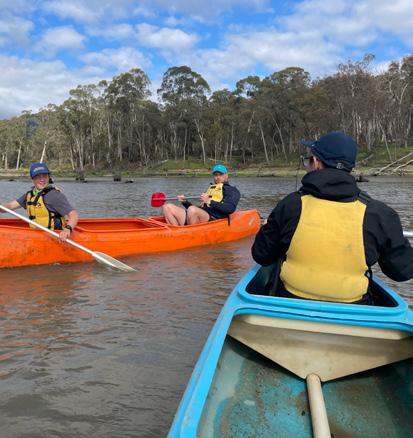
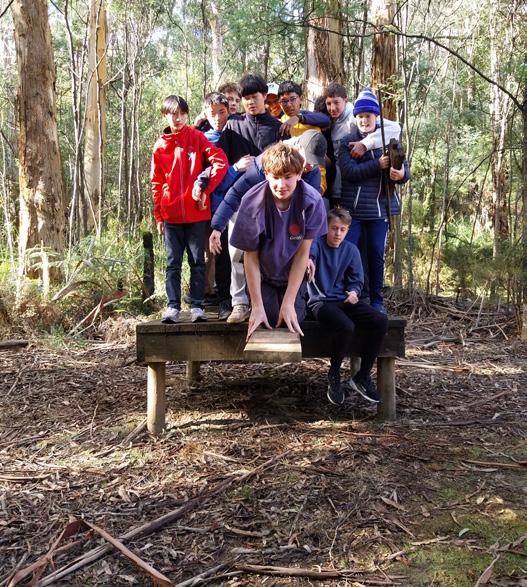
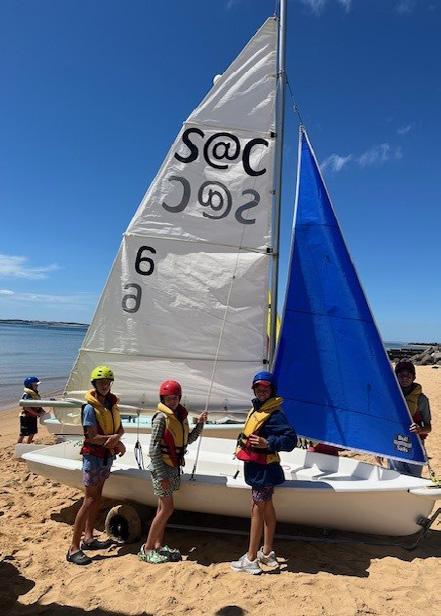
Scotch is fortunate to have not one, but several campuses that take our boys beyond the grounds of Hawthorn. For our students in Years 7-9, bushland in Healesville and the coastal stretches of Cowes and Mallacoota play host to their Outdoor Education programs.
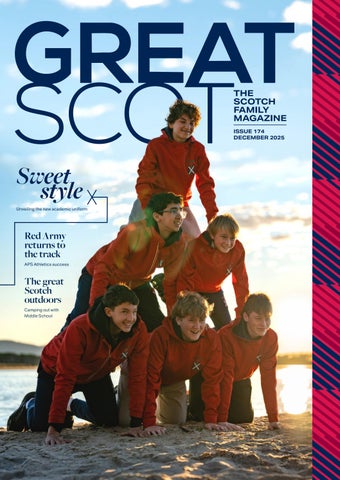
Our newest campus at Fairhaven took its first cohort of Year 9 boys under its wing in September. This inaugural visit, although shorter than what is to come, marked the beginning of what will soon shape integral part of the Year 9 experience – a multi-month outdoor education program designed to immerse and challenge students in the great outdoors.
“Eighteen students had the honour to be the first Scotch students at Scotch’s new Fairhaven property,” said Carl Fitzgerald (Year 9). “The trip proved to be an eye-opening experience for the boys on the hardships the Mallacoota community has faced, and how our new campus will develop and enrich the future Year 9s involved.”
Across six days, the boys learnt the history of Mallacoota, explored its flora and fauna, and ventured beyond the property’s border, including a visit to the WWII Bunker Museum and discovering marine life at Bastion Point Rockpools.
“Being able to be the first to explore what will surely become a favourite term for the future Year 9s involved was truly special,” Carl said. “We partook in fishing, feeding the cows, clearing debris and playing games together.”
“ I made many new friends over the course of the camp and learnt how to better respond to challenges, better interact with people I am not familiar with, and how to take risks and put myself out there. ”
“We left a permanent memory at the campus, but at the same time, it left a permanent memory on us,” Carl said.
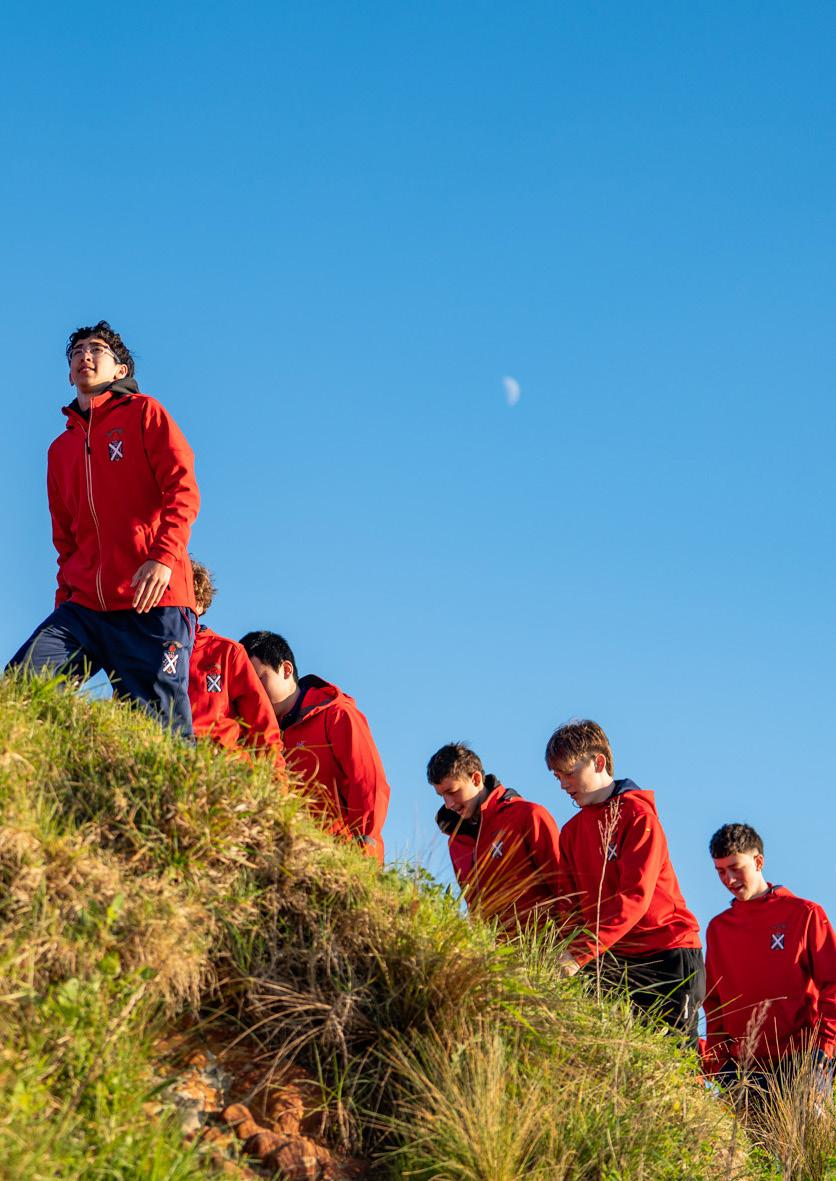
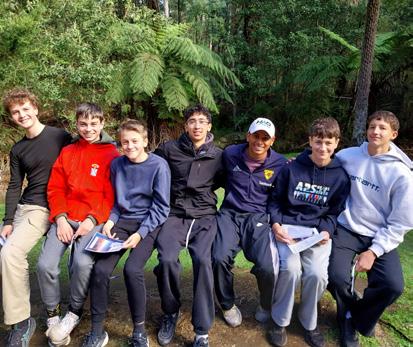
For many years, Year 9s have also gathered at Elliott Lodge in Healesville, a peaceful retreat nestled on 80 hectares along Chum Creek. Surrounded by forest and birdlife, the lodge provides a space for boys to pause, disconnect and reflect on who they are becoming.
“One of the first things we did was a rainforest walk,” said William Frost (Year 9). “This was a chance to slow down, enjoy the scenery, and see
the natural beauty of the area,” William said. “At the end of the retreat, we hiked to the top of Mount St Leonards for a commissioning ceremony. It was a unique way to finish the camp and left us with something meaningful to reflect on.”
“Overall, the retreat taught me how important it is to spend time with family and mates, and how these shared experiences help strengthen our connections,” William said.
Further south on the shores of Phillip Island, the Scotch-at-Cowes campus is a highlight for Year 7 boys early in the year. With many students new to the school, the camp offers valuable time to settle in, get to know one another and begin to form friendships.
“Year 7 camp was an exhilarating experience for all the boys,” wrote Archer Close (Year 7). “The food throughout the camp was absolutely delicious and activities were so fun and exhilarating… sailing, the Koala Sanctuary… it was an excellent opportunity to make and build new friendships.”
Students threw themselves into every challenge at Cowes. Harry Tatkovic (Year 7) recalled, “The high wire was an adrenaline-filled obstacle course placed 10 metres up in the sky filled with acrophobia and awesomeness!”
There were quieter moments too, spotting baby koalas on the nature walk and witnessing the breathtaking sight of shearwater birds returning from their 16,000-kilometre migration.
“An even better part of the nature walk was that the weather was so perfect,” Harry said, “creating a sunset so perfect to contrast to the black silhouettes of the birds in the night sky.”
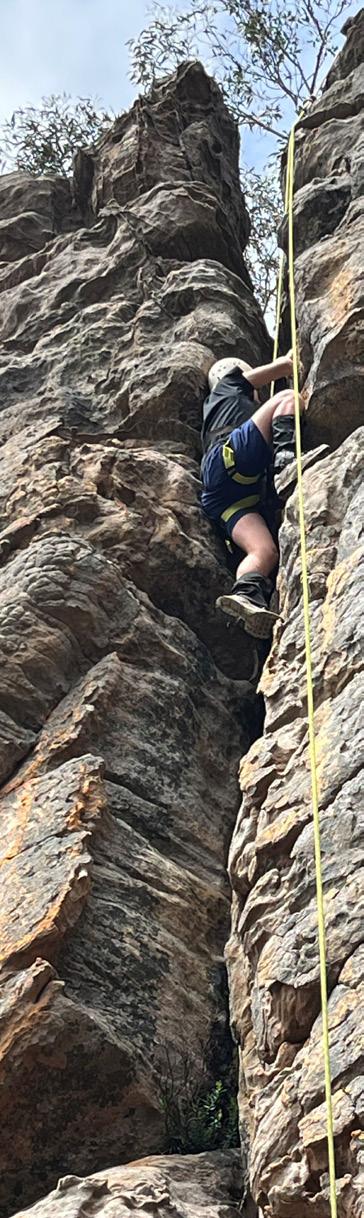
Boys in Year 8 ventured slightly further afield and into the Strathbogie Ranges, the Grampians and Gembrook. The program, held in October, offers a challenge-by-choice program for students to opt into a challenge that suits them best.
“The Year 8 Outdoor Learning Program presented a challenging yet exciting time to get out of the classroom and a refreshing break from the usual routine,” said Tom Perks (Year 8). “All students on Camp One, which I was on, went to the Strathbogie Ranges. We were faced with many new challenges that pushed us out of our comfort zone, such as sailing on the beautiful Nillahcootie Lake and mountain biking over the hilly terrain.”
“The food, which is always a focal point for everyone at camp, was cooked by ourselves and built a sense of togetherness amongst our group,” Tom said. “The memories of this camp remain with us because it was a significant time with our friends and the wonderful Victorian landscape.”
And the winner is… Gilray!
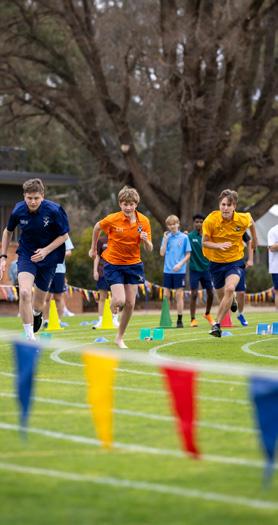
Term 3 was a big one for House spirit, featuring a number of events across the calendar. While House events contribute to the race for the coveted Cock House title, they’re just as much about encouraging boys to step outside their comfort zones, to step up, try something unfamiliar, and back their House in the process.
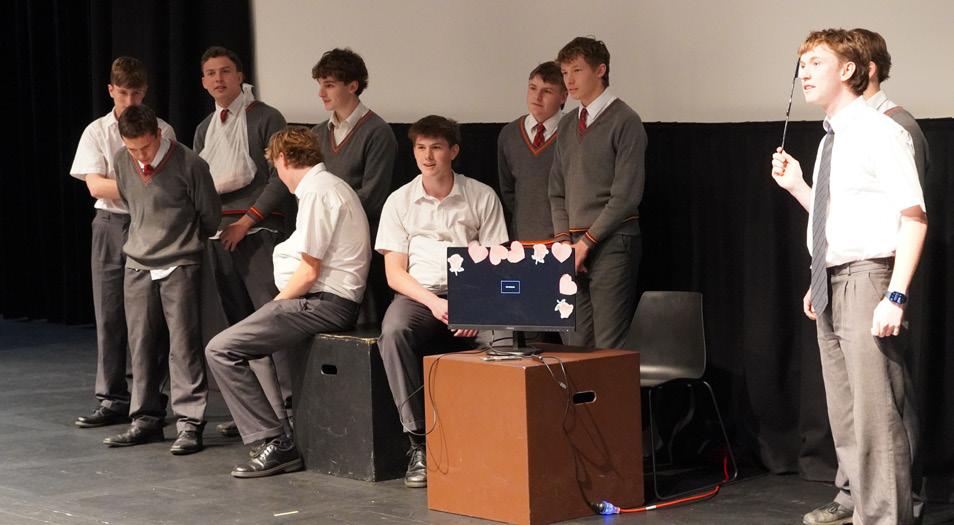
Public Speaking
This year’s Public Speaking competitions showcased the outstanding speaking talent at Scotch. Each speech was based on a famous quote from a historical figure, inspiring boys from Years 7 to 12 to explore themes of love, collective responsibility, and what makes a life worthwhile.
“We saw a great display of presentation ability,” said Blake (Year 12). “Many of the top competitors enhanced their speeches with their speaking styles and energy. It was a great series of competitions that really showed a bright future for Public Speaking at Scotch.”
Congratulations to Bond House who took out first place overall.
House Science Quiz
Mid-August brought the return of the biennial House Science Quiz: a fast-paced, high-stakes test of knowledge in physics, chemistry, and biology. Each House fielded teams of twelve boys (six from Years 9–10 and six from Years 11–12), with questions projected onto the main screen in the Boykett Room.
“I really enjoy science because it explains the why’s and how’s of the world. The quiz is a great opportunity to collaborate with like-minded peers while testing our knowledge (and speed!) against the other Houses,” said Luke (Year 11). “It can be nerve-racking and exciting, but most of all rewarding. Field has now won both times I’ve competed!”
Julian (Year 11) agreed that the event was both “fun and challenging,” noting Field’s strong performance across all year levels to take home the win.
“
“The next round is 2027, so if you’re scientifically inclined, start getting a team together!
”
Winter Sports Day
One of the more anticipated events on the calendar, Winter Sports Day once again delivered a mix of sport, teamwork, and House pride, particularly for winners of the day, Gilray..
“As always, Winter Sports Day is a day most, if not all, boys look forward to. A day of sport, laughter, and fun,” said Noah (Year 11). “One thing I appreciate most is the bonding and time spent with other year levels.
The day allows boys to work towards a common goal while also building future conversations and new connections.”
House Chess
Strategy and concentration took centre stage during the House Chess competition. For some, it was a step outside their comfort zone.
“I did not see myself as an avid chess player, I still don’t,” said Eton (Year 9). “But when Mr McNeill reached out I knew it was desperate times, so I couldn’t turn it down. Despite the tight match (not really…), I ended up falling short, but that paled in comparison to the pride I felt in contributing to my House. Truly a great experience.”
In the end, Selby Smith made all the right moves and delivered checkmate in the competition.
House Drama
Creativity and courage took the spotlight in House Drama, where students stepped onto the stage to perform. This year’s competition invited bold storytelling around the theme of Five Deadly Sins: Pride, Greed, Envy, Gluttony, and Sloth. Each House was challenged to interpret the sins symbolically, literally, or metaphorically.
“Before I put my hand up, I didn’t think I was a drama type of guy,” said Jono (Year 11). “Making my debut was an exciting experience. Playing a teacher meant I had to show authority and confidence and it was special to build bonds with others I didn’t know that well. That was one of the best bits.”
For William (Year 11), the experience was both creative and community-building: “House Drama strengthened my leadership skills and gave me the opportunity to connect with other Monash boys who share a passion for drama and music. It encouraged interaction across multiple year levels and helped establish a supportive drama community within the House.”
House Athletics
House Athletics closed out the term with a full day of competition on the Scotch Main Oval, as students and families turned out in force for Family Day, one of the year’s most anticipated community events.
Family Day sets apart from many other House events in scale alone, with almost every Senior School student taking to the track or field in at least one event.
Luckily the weather was on our side this year, and by the end of a fast-paced program Gilray had once again claimed top honours, sealing both the Athletics title and solidifying their victory as Cock House for 2025.
Theoflanguageteaching
Cherry Wu is one of Scotch’s brilliant language teachers, having taught here for over a decade now. Since joining the School in 2010, she’s become a familiar face across campus. Read on to hear more about Cherry’s Scotch experiences!
Could you tell us a bit about yourself?
It is hard to believe, but this year marks my 15th year teaching at Scotch College.
At the end of 2009, after completing my Master of Teaching internship at Ivanhoe Girls’ Grammar School, I flew back to China to spend the Lunar New Year with my family. But just as I was unpacking my bags and settling in, my internship mentor, Ms Dai, emailed me about a teaching opportunity at Scotch College starting in early 2010.
So, I booked a flight, repacked my bags, and once again said goodbye to my family. There I was on New Year’s Eve, sitting alone in the departure hall, watching people sharing dumplings on TV and shedding a few tears, not realizing what an amazing opportunity was waiting for me half a world away in Melbourne.
Six hours after landing, I found myself sitting in an interview with Vice Principal Mr Savage, LOTE Coordinator Mrs Tarran, and Head of Chinese, Dr Xu. Under the stress and fatigue, I must have spoken incredibly fast, made some overly dramatic gestures, and probably even blurted out some very unfiltered “truths.” Funnily enough, it was one of those “flaws” that must have struck a chord with Mr Savage, because the very next day he personally called to tell me I’d be starting at Scotch the following Tuesday.
What roles have you been involved with at Scotch?
Like most teachers at Scotch, my role has not merely been teaching Chinese from Years 7 to 12, co-curricular activities have been a large part of my time at Scotch including supervising basketball, table tennis, swimming, diving, Junior Chinese Club, Chinese Debating as well as after school care.
In response to requests from parents, I started in 2011 the Junior Chinese Club—a one-hour weekly program for Grade 4 to 6 students. These very eager boys learnt Chinese through games, songs, videos; and explored Chinese culture through ‘traditional paper cutting’, ‘calligraphy’, ‘printing’; and of course, the very popular martial arts. After two years, the program evolved into a service opportunity for senior students, with Year 11 volunteers helping younger students each year. Their quick wit, patience, and humour always worked like magic to keep the juniors engaged.
Among all the sports, diving stands out to me— it combines strength, skill, and grace. Every summer, I have the privilege of watching our Victorian divers launch, twist, and slice through the water. It may be a niche sport, but it truly feels like “the sport of elites.” Ever since I tried the three-metre springboard at Scotch, I’ve made it a tradition to set myself a new “fear-conquering” challenge every year. Fishing, skiing, rock climbing, windsurfing, etc... I’m grateful that Scotch has given me countless opportunities to experience so many “firsts” alongside my students.
What do you enjoy doing outside of work?
Reading has always been my biggest passion. I even volunteered in libraries as a student in China, and they remain my favourite place to spend free time. But as the Chinese proverb goes:
“
Reading ten
thousand books
is not as good as traveling ten thousand miles.
”
Travel takes up much of my holidays. Unlike my younger days of “checklist-style tourism,” I now value the people I meet along the way—they often give me the most eyeopening insights.
Everyone loves a good story, are there any particular anecdotes or memories that you could share with us?
I like to keep a few “magic tricks” up my sleeve, usually only revealed after students graduate. For example, my Year
7s are always curious how I manage to control the lights in L2.06 with a single snap of my fingers. Well, here’s the secret:
There’s
an old Chinese
saying: It takes ten years to grow a tree, but a hundred years to nurture a person.
”
What motivates you?
At a historic school like Scotch, I often feel that I’m part of a centuries-long practice of shaping futures with care. Every student is unique, so my work never feels repetitive, and every day brings unexpected but rewarding challenges.
Even after years of teaching, new challenges would still arise. Often, I find myself translating conversations between the school and families. And when I witnessed the struggles of students, in particular the Chinese Australian students who were struggling with anxiety and stress, I sometimes felt powerless. That’s why I completed psychology courses, which equipped me with the skills to help them.
Step 1. Turn off the lights and play a compelling video.
Step 2. Turn the lights back on, assign tasks, and get students writing.
Step 3. About 30 seconds later, the energy-saving system automatically turns the lights off again. That’s when you count to three, snap your fingers within one metre of the projector, and voilà—the timing (and the dramatic pose) makes it work every time.
Dr John Ferguson DIRECTOR OF MUSIC
Finale
The Foundation Day Concert is one of the most significant events in the Scotch College calendar. It celebrates the founding of the school, and first appeared in 1911, celebrating Scotch’s Diamond Jubilee. Naturally, there have been some remarkable concerts since, notably the concert at the Rod Laver Arena in 2001 celebrating the 150th anniversary. But this year’s concert was unique for its own reasons.
I was initially uncomfortable about writing a review of a concert that I was closely involved in, but it does at least give me an opportunity to credit the staff and boys involved.
The concert opened as always with David Stanhope’s outstanding arrangement of Advance Australia Fair, written for the 2000 Sydney Olympics, then, following the College Anthem and 40 Years On, the orchestra performed Beethoven’s concerto for violin, cello and piano, popularly referred to as the ‘Beethoven Triple’. Whilst the violin and piano parts were performed magnificently by Year 11s Scot and William, it is the cello part, performed by Jun (Year 9), that is particularly demanding, mainly because it is so high. The performance was outstanding, and the orchestra then showed off, performing Bernstein’s virtuosic overture to Candide with colourful aplomb!
One feature of this year’s concert was the contrasting nature of the repertoire chosen by the various conductors. Amazing Grace contrasted with Ghost Train. The Chamber Choir’s other work was The Lion Sleeps Tonight which not only contrasted with the Whitacre musically, but practically turned into a dance routine! In a similar vein, the College Choir contrasted Fauré’s sublime Cantique de Jean Racince with Chattanooga Choo Choo! The Show Band, under Chris Farrands’ meticulous direction performed the very contemporary Hot House by Tadd Dameron, followed by the ever-popular Spain by Chick Corea. There were notable solos in the Show Band bracket from Matthew (Year 12), Aaryan (Year 10), Rohan (Year 10), Ben (Year 12), and Atupuha (Year 12).
As I often do I sat in the audience with the boys after the interval until it was my turn to return to the stage. This allowed me to enjoy the choirs and Show Band, and also to appreciate the work of Harry Potocnik from the Percussion department.
Harry directs the highly disciplined and excellent Drumline, and they performed two contrasting works: Street Beat by David Reeves and Leopard by Harry himself. Another composer from the staff is the Head of Pipes and Drums, Mark Saul. Mark has an international reputation as a composer in the world of Pipes and Drums, and his remarkable work, The Black Cuillins, showed why. The band played superbly, and, unusually, included some strings. Military Band followed with Kupka and Castilo’s So Very Hard to Go followed by Rod Temperton’s Thriller ‘Milband’ (as it’s affectionally known), trained by David Musk, played the best I have heard them in years.
Of course, the main feature of the Foundation Day Concert, is the tradition, established in 1911, of the school uniting in song. I must confess, as it was my last FDC, I decided to ‘recycle’ some songs that had proved popular in the past (rather than orchestrate new songs that might never be used again!). Brother, Can You Spare a Dime and O Fortuna (from Carmina Burana by Orff) are always popular with the boys, as is the African-American Spiritual Fantasia that I wrote some years ago. However, one that I didn’t write – merely adapted – was a truncated adaption of the last movement of Beethoven’s 9th Symphony. The orchestra parts remained unchanged from the original, but the choral parts obviously had to be adapted (we don’t have females!).
The other work was A Scottish Medley that I wrote in 2012, at the request of Dr David Kemp, Chairman of Council at the time. It was this work that included Loch Lomond, and at rehearsals the following year, the boys kept singing it. I finally relented and said that I’d put it in the concert (just Loch Lomond – not the whole medley) if they learnt the rest of the music for that year. They did, so I did! It became so popular that it became an official school song and is now in the record book. The medley includes some solo sections, and Maxwell (Year 11) and Richard (Year 12) both sang beautifully, as did the Year 12 Cardinals: Richard, Joshua, Witter, Matthew, Austen and Andy. The boys from Years 10 to 12 sang the medley with gusto, concluding with the unforgettable song from The Proclaimers: I’m Gonna Be (I will walk 500 miles).
Being my final one, I was honoured and touched when the Principal, Dr Scott Marsh gave a very generous tribute to my 35 years as Director of Music. I was also delighted with the tribute on behalf of the boys from Thomas (Captain of Music, Year 12), and from Amberley Bremner’s words on behalf of the music staff. However, it was a musical tribute from Xavier Tang (‘22) who sang I’ve got a Little List from Mikado by Gilbert and Sullivan, with words suitably adapted, accompanied by the orchestra and conducted by Ben Castle, that was a real surprise. I have no idea how that got rehearsed!
Naturally, it was an unforgettable and humbling moment to receive a standing ovation from the entire Hamer Hall. However, it has been an immense privilege to work with an exceptional and dedicated music staff, and to be entrusted by so many parents with the musical education of their sons that is a real honour. There is much to treasure, but it is the memory of some exceptional performances from boys across the years that I can’t forget, and I hope you’ll remember. Thank you all.
Dr John Ferguson Director of Music
Blasting
to the back80’s
From 22 to 24 May, a group of Year 9 and 10 Scotch boys joined forces with Strathcona Girls Grammar to stage The Venetian Twins , a vibrant reimagining of the classic Commedia Dell’Arte tale, now set in the neon glow of the 1980s.
“The Venetian Twins”, written in 1747, is a classic Italian comedy inspired by the lively and improvisational tradition of Commedia dell’Arte. This theatrical form, which flourished in Italy from the 16th to 18th centuries, featured stock characters, physical comedy, spontaneous scenes (Lazzi) and improvised dialogue. At its core, “The Venetian Twins” is a tale of mistaken identities and almost non-stop confusion. It is also an inherently playful and vibrant piece, full of life and love.
Year 9 boys Jasper and Charlie were two members of the cast, taking to the stage as Tommy and Officer Murtaugh respectively.
“For the boys involved, it was a chance to step beyond the classroom and into the bright lights of the stage, discovering the energy and camaraderie of the performing arts. Working closely with our Strathcona counterparts, we built friendships, sharpened our acting and public-speaking skills, and embraced the joy of storytelling” said Jasper and Charlie.
Director and Drama Teacher Adam Somes had one foot in the wings and the other firmly planted back in the 80s. “This production was a true love letter to the era. The performance was a genuine reflection of what the 80s meant to myself and so many others, including its fashion, hair, games, movies and music,” he said.
“It was packed with pop-culture nods, big hair and a soundtrack brimming with bodacious beats. ”
“This production was more than just a nostalgic tribute to a legendary decade, it was a celebration of creativity, collaboration and courage” they said.
School productions offer students the opportunity to immerse themselves in theatre life. Each show brings students together to work on a collaborative, creative project, and gives our boys the opportunity to participate both on stage or behind the scenes, equally important roles!
“I remain deeply grateful to the outstanding team of students and staff who poured their energy and creativity into bringing this almost 250-year-old play to life. Since joining the Scotch College community in 2023, I’ve been consistently inspired by the dedication, talent and joy that fuel our Drama program. This production was a true collaborative triumph, made even richer through our partnership with the remarkable students and staff from Strathcona Girls Grammar. It was a true gift to work alongside another school that shares the Scotch College love of theatre and commitment to storytelling,” Adam said.
A huge ‘well done’ goes out to all students who graced the stage and the wings. In the words of Jasper and Charlie, “It was an experience that reminded us of the power of teamwork, self-expression and a good dose of eighties spirit. Totally radical!”
An unexpected reality
Each year, the Principal’s Acquisitive Art Prize invites Scotch’s senior students to share their artistic voice, and to experiment, reflect, and showcase their creativity across a range of media.
Pac-me, Roger (Year 7)
A self-portrait with the interpretation of me focusing and being engulfed by a video game, in this case Pac-Man. This demonstrates the connection between the physical world of reality, and the digital world of fantasy and imagination.
The contest encourages artistic expression across various mediums like painting, sculpture, digital media, and photography. Each year, the exhibition is headlined by a central theme. This year’s theme, “An Unexpected Reality,” invited students to challenge perception and explore the tension between imagination and truth through their chosen medium. Winning students received art supply vouchers valued at $250 and $500 to support their ongoing creative practice.
The 2025 exhibition was assessed by a panel of three judges, including Principal Dr Scott Marsh and Old Scotch Collegian Christopher Jewitt (’05).
Based locally in Melbourne, Jewitt is a multidisciplinary artist whose work captures the beauty and chaos of the everyday. His paintings layer familiar objects in bursts of colour and scribbled movement, playful, tactile, and full of energy. His distinctive approach, hovering between abstraction and figuration, recalls the spontaneity of childhood doodles while inviting complex interpretations.
“It was a privilege to serve as a judge for the Scotch Senior School Principal’s Art Prize,” Jewitt said. “The range of creativity, technical skill, and personal expression shown was truly impressive. It was inspiring to see how each student conveyed their unique perspective, making the judging process both challenging and rewarding. Congratulations to the winners for 2025.”
Reflecting on the exhibition, Head of Art, Yudha Scholes, praised the courage and authenticity of the students’ work.
“I am always impressed by the bravery of our young artists in their willingness to put such personal creations on display for their peers and teachers to contemplate,” he said. “As Neil DeGrasse Tyson says, the magic is in their ability to raise their unique personal expressions to an Art.”
This year, the Senior School prize was awarded to Arthur (Year 11) for his artwork “Springlocked”, the Middle School prize was awarded to Roger (Year 7) for his artwork “Pac-me”, and People’s Choice Award went to Harris (Year 11) for his photograph named “Veins of the Morning”.
Springlocked, Arthur (Year 11)
It is not often one is killed by their own harrowing creations, but when they are, it is sometimes poetic. Consumed by anger, vitriol, and an insatiable bloodthirst, the man in the suit feels what he himself has inflicted upon others; the pain and suffering multiplied by the memories of his actions, depicted through the glint of his now mechanical eye. The originally fun, yellow bunny, meant to bring joy and excitement has been corrupted by the mouldy green, stained with
crimson blood, now putrefying the innocence of what was with the wickedness of what is. A man brought down by his own actions, the shock is evident in his expression. A man who thought himself impenetrable, playing with the powers of a god, now lays in his own blood, his freedom and his hubris taken down alongside him, as he remains isolated in the dark room; no amount of screaming can atone for his sins.
Veins of the Morning, Harris (Year 11)
Captured moments before dawn broke fully over the hills, Veins of the Morning reveals a surreal and almost cinematic landscape bathed in golden fog and filtered sunlight. What initially appears to be a digitally altered image is, in fact, a real photograph — a natural spectacle that defies
expectations. Shot from above, the image offers a painterly view of a world we seldom see from this perspective. This unexpected interplay between shadow, mist, and sunlight captures a game-like, magical reality.
In the company of artists
From Prep to Year 12, art at Scotch is meaningfully planned to extend beyond the typical classroom. One compelling addition is regularly opening our classroom doors to practising artists and inviting them to share their craft with our boys. These artists in residence initiatives gives boys the firsthand opportunity to watch an expert transform ideas and techniques into a finished product.
Every two years, the Junior School welcomes an artist into their classrooms for several sessions to lead handson projects, thanks to the generous support of the Ken Fields Fund. Many of these artists have brought tools, materials and unique machinery for the students to interact with, items that ordinarily may not be found in the classroom. Past residents have included Pamela Irving, Vipoo Srivilasa, Jackie Jackson, and Adrian Ward, whose silver sculptures still sit out in the Junior School yard.
This year, multidisciplinary artist Elizabeth Armstrong has been working with students from Prep to Year 6. With more than 30 years’ experience in schools and expertise in felt-making, clay, watercolour, and ink, Elizabeth brings an experimental, collaborative approach to the classroom. Throughout Term 3, she spent several sessions in the Junior School, guiding Prep boys as they repurposed used paper towels into textured artworks, helping Grade 2 students explore line and paper techniques, and leading Grade 3 classes in creating stormy skies and rainbows for a Noah’s Ark theme. Other year levels turned their attention to animals, wood patterns, and natural elements. Many of these works have since gone with Elizabeth to her studio, where she is collaging the boys’ creations into a largescale ark installation filled with animals, flowers, fish, and underwater scenes. The final artwork, which will represent work from every year level, is due to be displayed at the
Meanwhile, the Senior School has also been treated to visiting artists. Through Scotch’s growing partnership with the Monash University Museum of Art (MUMA), Year 8 students worked with marine biologist-turned-artist Vera Möller. Möller guided students in using collage materials and clay to explore the marine life of the Mornington Peninsula, encouraging them to see how small elements can combine into larger ecosystems. Their clay sculptures were ultimately displayed within an infinity mirrored box at the Family Day art exhibition, creating an immersive installation where “micro” worlds expanded into a “macro” environment.
In June, 2021 Archibald Prize–winning portraitist Peter Wegner also spent time with various Senior School art classes. Best known for his Centenarians project, Wegner has painted countless prominent Australians, including Scotch’s own Reverend Bill Morgan, our oldest Old Boy. In fact, five of his centenarian subjects are Scotch alumni.
During his visit, Wegner sketched a student live in class before encouraging boys to turn the pencil on themselves, using mirrors to study their own features.
Yudha Scholes, Head of Art says “The opportunity for our students to engage with these renowned artists is a blessing in our busy curriculum. They demonstrate an extraordinary attention to detail and the tenacity to pursue their dreams, which gives them an infectious combination of contentment and curiosity. Or as the boys would say, they bring ‘aura’!”
SCRUM ON THE SIDELINES
“All the talent in the world won’t get you anywhere without your teammates.” While that phrase is often used to describe the players themselves, it also captures the spirit of teamwork that defines Scotch Rugby, a program strengthened by the support of parents and families through the Scrum Club.
The Scrum Club began in the mid-1990s when a small group of mothers gathered at games to provide food and raise funds for rugby tours. They called themselves the Scotch College Rugby Union Mothers, or SCRUM. Over time, the group evolved into a structured parent-run auxiliary, formally known as the Scotch College Rugby Union Members Club.
The club works in partnership with the school to build community and connection, aiming to create an inclusive and welcoming environment for players and families alike. Its purpose is to support the school in developing rugby across all year levels, nurturing both skill and character while reflecting the sport’s core values of integrity, passion, solidarity, discipline, and above all, respect.
Today, the committee oversees a wide range of initiatives including fundraising, tour support and equipment coordination, alongside off-season training, player development, and post-match BBQs. It also runs events such as the Season Launch, assists families with year-level carb-loading dinners, and coordinates the annual Scotch v Melbourne Grammar Derby, where players, families, and alumni gather to celebrate the code.
“The parent culture at Scotch Rugby is one of generosity, good humour, and shared pride,” said parent Lara Bliss. “It makes every weekend feel like gathering with family rather than a parenting task.”
“The boys were led by Head Coach Eric Tom, whose care for them went well beyond the pitch,” Lara said. “His pastoral care was the standout for me this season.”
Mid-year, we ran a school holiday program that provided senior boys with a much-needed forum for connection and momentum through the break. “We coordinated with Opens coaches Eric Tom and Luke Rooney, and Scotch strength and conditioning coach Kemble Edelsten, using rugby skills and conditioning as the foundation to support the boys after a challenging Term 2. The boys returned in Term 3 stronger and more united than ever,” Lara said.
For Lara, part of rugby’s appeal lies in its inclusivity and technical complexity. “Each position requires a distinct skill set and body type, so a wide range of boys can find their place on a team. The fifteenth player on the field matters just as much as the first,” she said. “That equality builds trust and accountability, both in sport and in life, and fosters a genuinely inclusive environment within the school community.”
A unique ritual within Rugby at Scotch has been the awarding of caps to players on their first appearance in the 1st XV.
“It’s a recently introduced tradition which symbolises achievement, pride, and a connection to a program that develops integrity, humility, and perseverance both on and off the field”, says Claire Jones, another Scrum Club mother.
A deeply meaningful moment in 2025 was the creation of the Ed Millear Award, established in memory of a former Melbourne Grammar player who faced Scotch in his final game in 2024. With Ed’s parents in attendance, the award was introduced by Dave McAndrew following the conclusion of the Scotch v Melbourne Grammar School Derby. The award recognises sportsmanship, humility, respect, and camaraderie. “The award now stands as a lasting symbol of Scotch Rugby’s belief that character and connection matter more than competition, and of the shared history of rugby between the two schools”, Lara shared.
“My favourite thing about rugby at Scotch is the lack of ego, even among the squad’s greatest players,” Lara said. “It’s inclusive and humble, and I think that helps the boys model values that build exceptional men.”
For many families, the transformation rugby brings extends well beyond the field. “If you asked my boys, they’d tell you rugby has shaped some of their best memories and closest friendships,” Lara said. “It’s where they’ve felt included, valued, and respected.”
This season also marks the farewell of Richard Bayliss, Teacherin-Charge of Rugby for many years. “No one has displayed a greater emotional connection to the code or to his role than Baylo,” Lara said. “The boys and their parents will really miss him in this role, and we hope he’ll continue to support the teams from the sidelines.”
The season was indeed an encouraging one. Claire says “As a parent, watching the boys throughout this past season has been incredibly rewarding. It has delivered a thrilling year of hard-fought matches, teamwork, and unwavering determination, culminating in the 1st XV achieving the best win–loss record in over a decade. There have been several great moments this year, winning back the Colin Bell Trophy with the win over Melbourne Grammar and in the final game, when Scotch secured a dramatic last-minute try to defeat ladder-leaders Haileybury.
Looking ahead, the Scrum Club hopes to see the program continue to grow while remaining grounded in inclusion and humility. The Club looks forward to seeing the development of a leadership role overseeing long-term player and team development, helping Scotch regain its position as a leader in school rugby across Victoria, as it was in the 1980s and 90s.
Game,
match set,
When Lewis (Year 10) first picked up a tennis racquet at six years old, it was all about joining in with his older brother Brodie. Brodie, eight years older than Lewis, was starting to play tournaments at the time and inspired Lewis to join in. Tennis has always been a bond between the two brothers. “We even made a mini dirt tennis court out in the bush where we live, and we spent hours and hours on that court,” Lewis recalled. “I loved it from the start.”
Lewis’s growth as a player has been deeply influenced by playing junior tennis for his home club at Castlemaine, representing Loddon Campaspe in Country Victorian regional competition and his former coaches, Anthony Zafiris, Aidan Fitzgerald and Ian Goolagong.
“I’m also very proud to be a part of the Evonne Goolagong Foundation,” Lewis said. “As well as the tennis, it’s a big part of my Indigenous culture and there are a lot of cultural learnings and activities that we take part in, like listening to talks from Cathy Freeman and Ash Barty.” The Foundation is run by seven-time Grand Slam winner, Evonne Goolagong and her husband Roger Cawley. I feel very lucky to have known Aunty Evonne and Roger. They want you to be an even better person off the court”
Since joining Scotch College, Lewis has been playing First Tennis, under the guidance of Scotch head coach and former pro player, Joseph Sirianni. This year, Lewis was selected as a 2025 John Fitzgerald Kooyong Foundation scholar. “As a Foundation scholarship player, I’ve been very lucky to train each week at Kooyong with great coaches, including my current coach David Bidmeade, and to be part of squads with some of the best junior players in the state,” he says.
Earlier this year, Lewis was awarded the Barry Barton Award, an honour that recognises sportsmanship and development in a Country Victorian player. “It was special to receive the award alongside a top female player from Geelong because it can be harder for us growing up in regional areas, to get the same highperformance opportunities,” he explained.
Since moving into boarding life at Scotch College, Lewis has found a strong sense of community. “It was easier than I thought once I got through the first week,” he says. “I have made some really good friends and had a very smooth transition from my old school.”
A typical week for Lewis is packed with training, competition, and school sport: from Kooyong squad sessions on Mondays, Wednesdays, and Fridays, to private coaching, APS football or tennis, and Pennant on the weekends. He’s no stranger to hard work and it shows in his results.
Lewis has twice won the National Indigenous 14u Singles Title in Darwin, and last summer claimed the Victorian Schoolboys Under 18 Singles Championship. “Playing alongside Brodie in 2024 to win the Tennis Victoria Grade 5 Men’s Pennant Premiership was also a particularly special moment” he shared.
More recently, Lewis competed in the 18u Showdown at the National Indigenous Tennis Championships in Darwin, managing to place fifth nationally while playing with a shoulder strain.
Looking to the future, Lewis has his sights set on professional tennis and is hoping it may take him down the U.S. college pathway. Beyond the court, he is interested in pursuing sports science or studying something creative like graphic design.
Lewis is keen to inspire others who are just starting their journey in tennis. His advice is simple:
“
Remember every tennis player started off as a beginner at some stage. Just keep having the love for the game, don’t lose that love and passion. ”
A year in motion
This year in Junior School Physical Education, students across all year levels have engaged in a diverse and exciting program designed to develop their skills, teamwork, and love for physical activity.
In the Junior years, the focus has been on learning and refining a range of gross motor skills through fun, inclusive, and developmentally appropriate activities. Students have built confidence in fundamental movement skills such as running, jumping, throwing, and catching, which form the foundation for success in more structured sports and games as they progress through the school. Lessons have emphasised cooperation, spatial awareness, and resilience, helping students to develop both physically and socially within a supportive environment.
In the Upper Primary years, students have explored a range of major games through units based on Invasion, Striking and Fielding, and Net and Wall games. These units have included modified versions of sports such as basketball, soccer, teeball, and tennis, providing opportunities for students to build tactical understanding and apply their skills in competitive and collaborative settings. The focus has been on developing game sense, strategic decision-making, and teamwork — essential qualities that extend beyond the sporting field.
Throughout the year, students have also taken part in several House sporting events, which continue to be highlights of the school calendar. The enthusiasm and house spirit shown during Rapid Fire Cricket, Swimming, Cross Country, Football, and Family Day were outstanding, with friendly competition and great sportsmanship on display. Congratulations go to all students from Bradshaw, Campbell, Healy, and Waller for their participation and effort across these events. A special mention must go to James Hall, who broke a long-standing school record in the 800m on Family Day, running an exceptional time of 2:16:55, surpassing the previous record set in 2019 — an incredible achievement that inspired the entire school community.
Another memorable moment was the Cordner Eggleston Cup against Melbourne Grammar, which has now become an annual primary football fixture. The team represented the school with pride and determination, narrowly missing victory in a tightly contested match.
Finally, the visit from Scots College in Sydney provided an exciting opportunity for interschool competition and camaraderie. Students competed across Cricket, Tennis, Water Polo, and Basketball, showcasing their skills and school spirit while forging connections with peers from another leading school.
Overall, 2025 has been a year full of energy, growth, and memorable achievements both in Physical Education and across the sporting program.
Raised on the land
For generations, boys from farming families have been an integral part of Scotch’s boarding community. Their stories speak of resilience, independence, and a deep connection to the land; qualities that shape who they are and enrich life on the Hill.
Life on the land
Across Victoria and New South Wales, Scotch families run diverse operations. For example, the Thring family manage a beef and potato enterprise on the coast, producing hormone-free beef for export. Stuart (Year 9) loves surfing at Port Fairy and playing golf at Warrnambool when he’s home, but he’s equally at ease helping with cattle and crops. “Can’t get much better than a good steak with potatoes,” his mum jokes.
In Mildura, the Fergusons combine citrus farming with an irrigation business. Their boys, Jed (Year 9) and Kade (Year 12), grew up water skiing on the Murray and riding motorbikes before heading to Scotch.
“There’s always plenty to do,” says Peta, “The boys have grown up helping on the farm and in the business, learning the value of hard work and teamwork from a young age.”
The Frost family at Blighty runs a mixed irrigated farm and freight business. William (Year 9) spends holidays driving tractors, shifting sheep, and carting hay with road
trains. “The first thing I do when I get home is hop on my motorbike,” he says. Mum Sonia talks about what a great help William is during the busy season, “[he] is now a very capable farm hand … shifting sheep, feeding hay, spot-spraying in the buggy, chopping firewood, stacking hay, and tractor work.”
At Oaklands, the Nixons are fifthgeneration farmers growing cereals and corn. Harry (Year 8) helps with grain testing and sheep work during holidays, then swaps boots for skis when the family heads to the river for camping and water sports. “We hope giving Harry and our girls the opportunity of an excellent education means they’ll bring innovative ideas back to the farm,” says his mum.
The Wiltons run a beef cattle property near Holbrook. Reuben (Year 10) talks about calf marking and installing a rain gauge at School House, a small but meaningful reminder of home. “Collecting rainfall is part of life on the farm,” his mum explains. “It’s lovely that he wanted to keep that ritual going.”
“ Farm life teaches resilience and initiative - qualities that thrive on the Hill. ”
Life on the Hill
Boarding life offers structure and community, but also plenty of variety. Stuart has thrown himself into football and cricket, while William loves rowing and footy. Harry has tried sports he’d never played before, like volleyball and water polo. Reuben combines APS sport with music, continuing his passion for drums.
Weekends bring activities from snow trips to go-karting, and friendships that feel like family. “We’ve watched our boys flourish,” says Peta. “They’ve grown in confidence, maturity, and independence.” Families also love the chance to reconnect at rowing regattas, APS matches, and events like Family Day.
The Nixon family share how “the support from Scotch staff and the wider community has been outstanding”. They say it has helped both Harry and their family navigate the change and give him the space to adjust and grow; “the chance to spread his wings beyond the farm, learn from exceptional teachers, access first-class facilities, and connect with students from diverse backgrounds.”
“
We've watched our boys flourish in confidence and independence. ”
What farming boys bring
Parents agree that farm life shapes boys in ways that complement Scotch’s values. Independence, practical thinking, and a grounded confidence are hallmarks of their upbringing. They’re used to responsibility and teamwork and often become quiet leaders in the boarding house.
“Life on the farm teaches resilience, initiative, and teamwork from an early age - lessons that translate perfectly into the Scotch environment,” Sonia shares. “We believe the hands-on, “get on with it” mindset of farm kids brings valuable balance and perspective to city-based learning.”
Hailing from the slopes of southern New South Wales, the Reynolds family recognise how wide the gap can be between city and country life, noting that some boys have never experienced a farm at all. Hugh (Year 11) previously boarded more locally in Wagga Wagga in Years 7 and 8, but Scotch provided an opportunity for him to explore new subjects, sports and extra-curricular activities that wouldn’t have been possible back home.
Scotch “needs its rural kids,” says Hugh’s mum Andrea, “It gives city kids the opportunity to meet rural kids, and even visit the family farm as their friendships develop”.
Since starting at Scotch two years ago, Hugh has strengthened ties with other rural families and found the perfect balance between farm life and a school that understands and values country kids.
“As a rural family, it is the hardest thing to send your child away from home”, says Andrea. “Scotch has eased the loss as there is always excellent communication and support from the boarding house, the Parent’s Association and Hugh’s Head of House in the day school”.
Families hope Scotch will continue to strengthen its ties with rural communities and are excited about initiatives like Fairhaven, which are seen as opportunities to connect Scotch’s values with the outdoors and reinforce skills of resilience, teamwork, and environmental stewardship.
For these families, boarding at Scotch is just a piece of the puzzle towards building young men who carry the best of both worlds: country values and a world-class learning experience.
“
Collecting rainfall is part of life on the farm and now Reuben does it at School House. ”
The power of many
The Scotch College Advancement model, encompassing Admissions, Alumni, Foundation, and Archives and Museum, remains instrumental in shaping both the present and future of the school. A unified and strategic approach to community engagement, supported by representation on the Executive Leadership Team, enables the effective delivery of key institutional outcomes.
A prime example of this collaborative spirit is the academic uniform relaunch project, which was led by the Head of Advancement, Tim Shearer. Throughout the initiative, members of the Scotch Family, past and present, were actively and meaningfully involved, ensuring the project reflected the values and heritage of the school while delivering a contemporary outcome for present and future students.
Admissions
Scotch’s Admissions team remains committed to enrolling students who reflect the School’s values and aspirations. Following key process refinements in 2023, a comprehensive strategy now guides intake across general, boarding (domestic and international), and scholarship students. This strategy aligns with the Lighting the Way Strategic Plan and focuses on governance, policy, communications, and resourcing to ensure every boy thrives in our inclusive and dynamic learning environment.
Left: Mary Ng, Libby Glover, Rosemary Atcheson, Christine Shearer
Alumni
October marked the transition of 250 Year 12 students into the Old Scotch Collegians’ Association (OSCA), a bittersweet milestone celebrated through cherished traditions. OSCA, founded in 1913, fosters lifelong connections through over 40 annual events, 25 affiliated clubs, and initiatives like the OSCA Podcast and Young Old Boys mentoring. OSCA House, part of the Tolson Centre, offers a welcoming space for Old Boys to reconnect and engage with the Scotch Family.
Foundation
The Scotch College Foundation continues to champion egalitarian education, raising over $3 million in 2025 to support scholarships, facilities, and special 175th Anniversary projects. These include heritage gates, a bronze statue of Reverend James Forbes, restoration of Principal Robert Lawson’s monument, and a campus-wide heritage trail. The Foundation’s enduring impact ensures Scotch remains accessible, future-ready, and deeply rooted in community generosity.
Archives & Museum
Scotch’s Archives and Museum bring history to life, enriching student learning and community research. From Junior School explorations of time to VCE writing inspiration, the collection supports educational outcomes and fosters a deeper understanding of Scotch’s evolving legacy. It also serves historians, biographers, and families seeking to connect with the past.
Left: Vikki O'Neill, Paul Mishura, Rachel Dix
Left: Shell Shi, Scott Montgomery ('85), Caroline Taylor, Will Martin ('24)
Left: Sandra Dick, Tim Shearer ('85), Rebecca Mortimer
From the President
Paul Aberdeen (‘86) FOUNDATION PRESIDENT
As Scotch College approaches its remarkable 175th anniversary in 2026, the Scotch College Foundation continues to play a pivotal role in supporting the school’s enduring legacy and future ambitions.
Although formally established just 52 years ago—as the first Foundation of its kind among Australian independent schools— fundraising has been woven into the fabric of Scotch’s evolution since its earliest days. One of the most transformative campaigns led to the acquisition and development of our beloved Hawthorn campus—a legacy that continues to shape generations.
Currently, as the school undertakes its comprehensive Master Planning process, the Foundation finds itself in a strategic holding pattern. Yet behind the scenes, significant groundwork is underway to ensure we are poised for action the moment the plan is finalised.
To prepare for the next chapter, the Foundation has engaged renowned fundraising consultants Marts & Lundy to guide our capital campaign planning. We are presently in the pre-campaign assessment phase, during which key stakeholders are being interviewed. Their insights will help shape a campaign strategy aligned with the School’s vision and the philanthropic appetite of our community. Once the Master Plan is completed in mid-2026, Marts & Lundy will conduct a Feasibility Study to evaluate donor interest across the proposed projects and programs.
Despite this preparatory phase, fundraising efforts have remained strong throughout the year. Over $3 million has been raised to support a range of initiatives, including a special $500,000 campaign to deliver a suite of 175th anniversary gifts to Scotch. These include:
• The installation of heritage gates at the corner of Callantina and Glenferrie Roads
• A commissioned bronze statue honouring our founder, the Reverend James Forbes
• Restoration of the monument of inaugural Principal Robert Lawson at Ballarat Central Cemetery
• A heritage trail celebrating Scotch’s rich history across the Hawthorn campus
• In addition, ongoing support continues for both the Building Fund and the Scholarship Fund, ensuring Scotch remains accessible and future-ready.
As we prepare to celebrate this extraordinary milestone in 2026, the Foundation is also gearing up for what promises to be the most significant fundraising campaign since the school’s relocation to Hawthorn in the early 1900s. As always, we will turn to the Scotch Family—whose generosity and vision have shaped our past—to help create extraordinary opportunities for those who will shape our future.
MFoundation stories
Robert Brian Alexander (Brian) Noack was born on 12 August 1930 at Stratford and boarded at Scotch in Arthur Robinson House from 1944 to 1947, becoming an ARH Prefect in 1947.
Following a Gas and Fuel Corporation cadetship he rose through the ranks of Australian Synthetic Rubber and then at gas company CIG before moving to Newcastle, New South Wales. He was a technical manager and general manager at the Newcastle Herald from 1975 to 1993. His son Michael attended Scotch from 1971 to 1975. Brian died on 27 September 2022.
Brian has left a most generous and appreciated bequest worth $300,000 to a half Boarding Scholarship. The photos show Brian and Joan Noack marrying in the Littlejohn Chapel on 31 August 1955. They are being married by Brian’s father, Presbyterian Minister Rev Robert Noack.
rs Gwen Head, a cherished member of the Scotch Family, recently celebrated her 100th birthday. In honour of her late husband, Dr Alan Head AO (‘42), Gwen has generously established a scholarship in his name.
Dr Alan Kenneth Head AO FRS FAA (’42) was born on 10 August 1925 and grew up in challenging times following his father’s death in 1932 and the effect of the Great Depression on the family’s news agency. He boarded at Scotch in Arthur Robinson House from 1941 to 1942 on a Senior Entrance Scholarship. He was Dux of Scotch in 1942.
Alan became a brilliant mathematical physicist who is renowned for his theory of fatigue in the aluminium alloys used in jet
aeroplanes, resulting in safer air travel for all. He worked at the CSIRO from 1948 until retirement in 1990, having been its Chief Research Scientist in the Materials Division since 1987. In 1991
Alan received the Order of Australia and in 1988 he became one of seven Scotch boys (thus far) to be honoured with Fellowship of the Royal Society.
Alan died on 9 January 2010.
To mark Gwen’s 100th birthday, Bequest Manager Sandra Dick knitted 100 beanies using Gwen’s own wool, gifting them to Gwen’s chosen charity, Our Village.
Our common thread is the Cardinal Thread
From
the OSCA Executive Director
Scott Montgomery (‘85) OSCA EXECUTIVE DIRECTOR
I was introduced to the world of OSCA through my old schoolmate, Tim Shearer (’85). At the time, I wasn’t really enjoying my position at a big corporate company and felt a change was coming. Tim spoke about our old school and the connection with its alumni community. I thought it would be a fun way to get involved back at ‘school’ and connect with other alumni, yet I had no idea about the impact that it would have on the world around me and how it would impact me as a professional. I learned about alumni relations, attended a reunion, and really enjoyed catching up with alumni at the East Glen chapter lunch (one for the oldies!). These were great alumni experiences that opened my eyes to the advancement profession. Tim spoke to me about the opportunity to serve as an OSCA Executive Director and I applied.
Fast-forward 13-plus years, I have seen our work in the alumni space grow and mature. Highlights for me have included developing programs to engage YOBS and support their careers, working with dedicated volunteers, managing the growth of social media platforms to reach larger audiences, working with dedicated Scotch staff, and looking at our events through a global lens.
Bringing our alumni together through events and supporting them wherever I can has been the most rewarding part of my time with OSCA. We want our events to be engaging, informative, social, and supportive of the school’s pillars, values, and initiatives. I hope they have some fun and reconnect with old friends as well. I love contributing to Great Scot and seeing our alumni doing great things for the wider community and sharing their stories.
I have run into several alumni who work for various institutions across the country. They always greet me with equal enthusiasm and an opportunity to reminisce about our school. This always reminds me of how important my engagement experience was in my own development and how these connections can be meaningful even after many years.
I have been fortunate to meet thousands of alumni throughout my 13 years working for OSCA, especially those from the class of ’85 and across the world, from London to as far as Glen Iris!
The common thread among them that I see is the passion for their old school and the desire to connect. The advancement field is unique, engaging our Scotch Family, where our alumni come to connect, network, and serve as resources for their peers. The connections and generosity in our community are assets for OSCA and Scotch. We look forward to welcoming returning and first-time attendees to OSCA events in 2026, where we will celebrate the school’s 175th year and continue to be a warm and inviting association that is the envy of many from around the globe.
On a personal note, I have once again taken on the role of Coach of the Old Scotch Football Club’s Stars women’s 2nd XVIII, a role I highly enjoy. The team started the season off on a very strong note and went on to win the premiership.
Elsewhere in OSCA clubland, the Old Scotch Music and Drama Club is in the early stages of preparing its 2025 production, Come from Away It’s a musical based on events in the Newfoundland town of Gander during the week following the 9/11 attacks, when planes carrying 7,000 passengers were ordered to land unexpectedly at Gander airport. The musical has enjoyed considerable success on Broadway, the West End and in Australia, and it will be intriguing to experience OSMaD’s take on it.
In the second half of 2025, OSCA hosted a ‘gathering of the clans’, inviting all OSCA clubs to send representatives. This meeting offered a chance to share ideas, raise concerns, and contribute to OSCA’s early strategic planning.
Top : VAFA Premiers Old Scotch Football Club Stars Reserves team
Bottom: A visit to Whitten Oval with Bill Morgan ('34) and John Morgan ('69) to see Sam Darcy ('21).
Keeping our eyes on the future
From the OSCA President
Matthew Guthridge (‘91) OSCA PRESIDENT
For over a century, the Old Scotch Collegians’ Association (OSCA) has helped Old Boys and their families stay connected to the School and each other through a rich mix of sporting, cultural, career, and social events.
In the past year, OSCA hosted more than 40 events across Victoria, interstate, and overseas, including reunions, luncheons, golf days, and flagship gatherings like the Annual Dinner and Business Networking Breakfast. These events continue to foster lifelong connections among Old Boys worldwide.
We’re grateful to Executive Director Scott Montgomery (’85) and his team – Caroline Taylor, Shell Shi, and Will Martin (’24) –for their tireless work, and to Ed Meggitt (’87) and the Events Committee for their leadership.
2025 has been a year of renewal and transition, with OSCA focused on shaping its future. Central to our refreshed strategy is the Cardinal Thread, the deep, intangible connection that unites the Scotch Family and fosters lifelong belonging. This enduring bond defines our community and guides our path forward.
Our new five-year strategic plan, Towards 2030, was developed in close alignment with the School’s Lighting the Way strategy. Our vision is clear: to be one of the most valued school alumni organisations. When a membership is valued, members feel that their participation and contributions are appreciated – not only by OSCA, but by each other. This is especially true
of the volunteers who contribute to the running of our Scotch Family events, Clubs and Auxiliaries, and whose efforts form the backbone of our community. We are enormously grateful for their contributions.
As part of our strategy refresh, OSCA has updated its purpose and defined three strategic goals:
1. Engage and Unite the Scotch Family
OSCA continues to deliver flagship events like the Annual Dinner, which this year received some of our most positive feedback yet. But engagement goes beyond events. Over the past five years, OSCA has built a strong digital presence through social media and podcasts, with our Young Old Boys (YOBs) playing a key role in growing our online community. Looking ahead, we’ll work closely with the school to enhance the experience of Old Boy families as their sons enter and graduate from Scotch. We aim to recognise those who choose Scotch for their children and ensure their boys benefit from OSCA membership upon graduation.
2. Foster the Development of Young Old Boys
OSCA has long supported career development for Old Boys. We’re partnering with the School to provide mentors for senior students and speakers for Careers Night. We’re now expanding this role by working with the YOBs Committee to deliver a robust program of professional networking and career development for younger Old Boys (within five years of graduation). Together, the YOBs and the School are also supporting a major initiative focused on psychological health and wellbeing, designed to build the resilience of senior students and the capabilities of boys to support one another during difficult times.
3. Support the School’s Purpose and Aspirations
OSCA plays a vital role in school governance, contributing leaders to the School Council and acting as a trusted sounding board for Principal Dr Scott Marsh and Chairman Hamish Tadgell (’85). We advocate for Old Boys’ interests and ensure their voices are heard in decisions shaping the school’s future. Our partnership with the school and Council has opened new avenues for collaboration. The launch of the school’s Lighting the Way strategy was a milestone, and its priorities will continue to shape OSCA’s focus. We look forward to working hand-in-hand to strengthen the Scotch Family and support the school’s aspirations.
As I enter my second year as OSCA President in 2026, our focus will shift toward executing the ambitious Towards 2030 agenda while continuing to deliver the high-quality events and support OSCA is known for.
Next year, we’ll celebrate Scotch College’s 175th anniversary—a milestone that will unite the entire Scotch Family in reflection and celebration. We also welcome two new Councillors: Charles Blennerhassett (’96) and Rob Bruce (’88), who joined at the November 2025 AGM. Their energy and perspective will be invaluable.
At the same time, we farewell two long-serving Councillors, Stephen Webster (’73) and Chris McArthur (’81), whose contributions to OSCA have been invaluable. Chris, a key member of the Governance, Finance and Risk Committee, will continue serving on the School Council. Stephen, a former OSCA President and committee chair, will remain engaged as a co-opted member of the Clubs Committee. We thank them both for their outstanding service.
These transitions highlight OSCA’s commitment to succession planning – ensuring we attract and support leaders who evolve the organisation and contribute meaningfully.
Leadership at OSCA is about stewardship, service, and strengthening the Cardinal Thread that binds our community.
Final Reflections
OSCA’s strength lies in its people – our volunteers, Old Boys, and our relationships with the School and Scotch Family. As we look to the future, we remain committed to deepening connections, supporting the School, and honouring the legacy of those who came before us.
Thank you for your continued support. As we move into 2026, we do so with optimism, energy, and a clear strategic direction. We look forward to working with you all in the year ahead.
Left: Matt Guthridge (’91) with former OSCA Presidents at this year’s OSCA Annual Dinner (left to right) Stephen Webster (’73), Andrew Wilson (’78), John Jeffreys (’69), Matt Guthridge (’91), Doug Lording (’63) Right: Northeast Branch lunch stalwarts pictured (Left to right) including Peter Turnley (’58), John Vroland (’85), Ken Jasper (’55), David Tennent (’57)
Follow RAAC on instagram for more @raac_collective
Doing it again
The RAAC Art club opened their second exhibition of contemporary art in October at Ladder Art Space in Kew.
What a hoot it was! This time around the group was expanded to include artists from throughout the Scotch community, including the regular young and emerging old boy artists, their partners, friends and family. Even a handful of teachers showed their stuff!
It is so important for the creative members of the Scotch Family to come together and feel the support of the community, show their inventiveness and connect with like minded souls. The atmosphere was vibrant and celebratory. Highlights of the event were the announcement of the Ben Shearer Acquisitive Art Prize, this time awarded to Fergus Kimber for his beautiful landscape painting, as well as a raffle of several donated artworks to raise funds to help pay for the exhibition space.
Special thanks to OSCA for once again supporting us as the major sponsor and financing the exhibition, Scotch Foundation for supporting the prize and Theodore Dryden (‘21) for curating the show.
All artworks are available for sale through the gallery website until January 2026.
Yudha Scholes Head of Art
Left: Winner of the Ben Shearer Acquisitive Art Prize, Fergus Kimber (‘18), in front of his painting, Brighton Bend
A little haggis never goes astray
On Friday 30 May, the traditional Scotch bagpipes were greeting guests of the OSCA Annual Dinner to the tune of ‘Amazing Grace’.
After OSCA President, Dr Matthew Guthridge (’91) thanked attendees and organisers, the traditional ‘calling of the years’ left Brian Hawdon ('52), at 90 years of age, as the eldest Old Scotch Boy standing, joking that it was “way past [his] bed time”. The Reverend Bill Morgan (’34) also made a video appearance reminding everyone to “thank God for the time you have had together”. OSCA Chaplain, Reverend Graham Bradbeer delivered Grace, then relayed a lively and humorous delivery of Robert Burns’ poem ‘To a Haggis’, joking along the way that he “bumped into a St Kevin’s clan and gave them a good old Presbyterian beating”, reflecting on how Haggis reflects “our contribution to the world of cuisine!”.
Our Guest of Honour, Mr Russell Howcroft (’83), who co-hosts Melbourne’s number one breakfast radio program, ‘3AW Breakfast with Ross & Russ” and is a panellist on ABC’s ‘Gruen’, shared a plethora of anecdotes from his time at Scotch, before switching to a few of his more serious views, ranging from the use of AI.
his agency celebrating immigration on Australia Day in the 80s, the power of ‘yes’, thanking his parents for sending him to Scotch and how it is a “privilege to be part of this clan”.
After some banter concerning students’ haircuts and the NSW State of Origin, Scotch Principal, Dr Scott Marsh, shared the Scotch College Strategic Plan, explaining how the “formation of good men, is what a school should be about” and how “character formation is what Scotch is all about and always has been”. He then discussed the notion of “post-truth” since “truth is important to decipher right and wrong”, before mentioning how the school’s new project in Fairhaven will be a sanctuary “getting boys to explore awe and wonder”.
As has become custom, Dr Scott Marsh rewrote the lyrics to a popular song, this time Billy Joel’s “Piano Man”, accompanied by school captain Emmanuel Dela Cruz (’24) and also took time to thank Dr John Ferguson for his OSCA contributions.
School song favourites were sang, including ‘Loch Lomond’ and ‘Auld Lang Syne’. Thanks go out to the OSCA Events Committee, the Master of Ceremonies, Brendan Ferguson (’00) and OSCA Staff, Scott Montgomery (’85), Caroline Taylor, Shell Shi and Will Martin (’24) for organising such a lovely evening, full of stories, laughter and haggis!
Beauty and the… Bible?
On Sunday 28 September this year, I retired from parish ministry. I was gifted five volumes of the Saint John’s Bible, completing my set of seven. The Saint John’s Bible, commissioned by a Benedictine monastery in Minnesota, was the first handwritten and illuminated Bible since printing was invented. Its creation was entrusted to Donald Jackson, official calligrapher to the Crown. He and his team produced a magnificent manuscript in seven volumes, combining ancient artistry with modern insight.
The Proverbs remind us: “Charm is deceptive, and beauty is fleeting; but a person who fears the Lord is to be praised.” Time has a way of teaching this truth gently. Outward beauty fades, but the beauty of a gentle spirit, a faithful heart, or a gracious word shines more brightly with the passing years. Beauty can corrupt when we try to possess it, but God does something astonishing: He redeems beauty through love.
I first encountered this edition of the Bible at the International Meeting of the Society of Biblical Literature at King’s College, London in 2011. To celebrate the 400th anniversary of the King James Version of the Bible the welcome was held in Westminster Abbey, and the chamber where the 1643 Westminster Assembly met was opened to delegates. How fitting that in the same place where theology was argued and defined, those same sacred texts now shimmer with gold leaf and light, the illuminations shedding interpretive light on the Scriptures — the Word of God made beautifully radiant by the work of human hands, a reminder that truth and creativity belong together.
The Bible’s first chapter is filled with delight: “God saw that it was good.” The Hebrew word for good carries the sense of harmony, richness, and beauty. Creation is not simply functional; it is radiant with divine joy. Every bird call, every starry, starry night, every act of kindness reflects something of the Creator’s loveliness. Life itself — even in its ordinary patterns — is “charged with the grandeur of God,” as Gerard Manley Hopkins exquisitely expresses it.
The beautiful cadences of the Bible are wise about the misuse of beauty. The fruit in Eden was “pleasing to the eye,” yet it brought sorrow. King David’s gaze upon Bathsheba turned beauty into betrayal. The problem is not beauty itself, but what happens when we worship beauty or seek to possess it.
Isaiah’s prophecy about the coming Messiah says, “He had no beauty or majesty to attract us to Him.” Yet on the cross, disfigured and despised, Jesus reveals the most profound beauty of all — the beauty of self-giving love. Amazing grace transforms ugliness into beauty. The splendour of God’s mercy shines through suffering and brings healing to the world. The same prophet promises that God will give His people “a crown of beauty instead of ashes.”
Through Christ’s resurrection, what was marred is being remade. Every healed relationship, every act of generosity, every work of art that points to goodness becomes part of this restoration. In the end beauty is made complete. The New Jerusalem, “prepared as a bride adorned for her husband” speaks of a radiant new creation — the work of God’s hands established forever.
Even forty years on we may age beautifully. When we speak gently, create thoughtfully, or forgive freely, we participate in God’s artistry. The world says beauty fades, but Scripture says it deepens. The lines of age can become lines of grace; the wear of life can polish the soul. For the beauty that lasts is not lost youth, but love made perfect — the radiance of God reflected in human hands and hearts.
Graham Bradbeer
OSCA Chaplain
Graham Bradbeer
OSCA Chaplain
Looking at the world as a glass half-full
Former Federal Treasurer the Hon Josh Frydenberg provided a unique world view as the eloquent guest speaker at the OSCA Collegians’ Lunch at Kooyong Tennis Club, held on Friday 19 September.
Josh was Treasurer of Australia and Deputy Leader of the Liberal Party from 2018 to 2022. He was also MP for Kooyong from 2010 to 2022. After leaving politics, Josh became Chairman of the Australian arm of investment bank, Goldman Sachs. He had returned from an overseas business trip the day before the OSCA Collegians' lunch.
Josh has a ‘glass half-full’ view when it comes to the state of the world in 2025. He spoke in detail about the world economy, and the two major conflicts afflicting the world – the Russian invasion of Ukraine and the Middle East situation following the horrific Hamas attacks on Israel on 7 October when 1200 people were killed and 251 were taken hostage.
Josh’s forthright views on these conflicts emphasised to the 24 OSCA Collegians present at the lunch that his strong and able leadership is very much missed on the Australian political scene.
A feature of Josh’s address was the affection and admiration he feels towards illustrious Old Scotch Collegians, such as Sir John Monash, Sir Zelman Cowen, the Hon Dr David Kemp AC, former Senator Rod Kemp and Michael Robinson AO. They all had a meaningful influence on Josh as he grew in stature in public life.
Josh spoke of his friendship as a young man with Sir Zelman Cowen and his family, and how he had been a welcome visitor to the Cowen home for many a breakfast.
The OSCA Collegians is an OSCA-affiliated club which exists to support OSCA itself, so that the Association can continue and improve in its important work for the Old Scotch community. For more information, contact the OSCA Collegians’ Secretary, John Jeffreys (’69) on 0417 007 007, or jjeff007@bigpond.net.au.
Scotch Weddings
On Saturday 20 September 2025, Jason Adam (‘17) and Anna Rutherford were married in Littlejohn Memorial Chapel by Rev David Assender. Jason is the son of Timothy (‘90) and Janine Adam. Anna is the daughter of Catherine and Nicholas Rutherford. Also present were Jason’s uncle David (‘91) and wife Catherine Adam who were married in the same chapel, and their son Lucas Adam (‘26).
Doug Lording AM receives Perelberg award
Associate Professor Doug Lording AM (’64) has been named the 2025 recipient of the prestigious Perelberg Award, recognising his extraordinary contributions to medicine and men’s health. A proud Scotch Old Boy, Doug’s career reflects decades of dedication to endocrinology and andrology, the science of hormones and male health.
Doug joined Scotch in 1960 at the equivalent of Year 9 and quickly embraced the opportunities before him. By Year 12, he was a Probationer, a member of the premiership 1964 1st XI cricket team and a member of the 1962-64 1st Basketball teams, becoming its 1964 Vice-Captain. He was also 1964 Vice-Captain of Morrison House and a Cadet Under Officer leading the medical platoon. These formative years shaped a lifelong commitment to leadership and service.
He spent 42 years at Cabrini Hospital, including 15 years as Medical Director, during which time he established the now flourishing Cabrini Research Institute.
The Perelberg Award honours Doug’s lifelong dedication to improving lives through medical innovation, education, and advocacy. It also celebrates the Scotch spirit embodied by Ashley Perelberg (’92), in whose memory the award was established after his tragic passing at age 18. Each year since 1993, the award has recognised an Old Boy who demonstrates “exemplary Scotch Spirit.” Recipients receive a silver sculpture inspired by Ashley’s love of the Scotch-at-Cowes summer camps, a reminder of the enduring bonds of our community.
Doug’s achievements reflect the qualities Scotch strives to nurture: leadership, service, and enduring Scotch spirit. Congratulations, Doug, on this well-deserved honour.
Scotch in the water
The Scotch spirit travelled a long way in 2025. Two Old Scotch Collegians, Guy Farrow (’82) and Rob Woodhouse (’82), alongside former teacher Ryan Nolan, showed that a Scotch swimming education can last a lifetime.
At the World Aquatics Masters Championships in Singapore this August, Ryan pieced together a meet to remember. He claimed bronze in the 160–199 combinedage medley relay and secured a top 10 finish in the 40–44 years 50m backstroke. Equally as satisfying were two personal milestones that would have eclipsed his 18-yearold self: 25.33 for freestyle and 27.08 for butterfly. Ryan’s message to former Scotch swimmers he once coached is simple and heartfelt: “Come back. The community, the structure, and the joy of racing are all still there.”
Guy Farrow (OSC) was equally impressive in the 60–64 years 100m freestyle, capturing the World Championship title in 58.58. It was a race built on control and conviction — a measured opening 50 followed by a ruthless closing lap that sealed the result. He also claimed a top 10 finish in the 50m freestyle.
Outside of the pool and jumping into the ocean, Rob Woodhouse (OSC) completed the Oceans Seven in July by conquering Japan’s Tsugaru Strait in 11 hours and 50 minutes. He called it the hardest swim of his life. The crossing demanded calm decisions, 30-minute feeds, and a stubborn cadence as tides and cold water pushed the line longer than the map. That effort closed a three-year campaign across the classic channels: English, Gibraltar, North, Catalina, Molokaˋi, Cook, and Tsugaru. He finished the set at 59 years of age, missing the fastest cumulativetime mark by only two hours and ten minutes, a remarkable margin given the conditions.
Rob, who leads the sport he loves as CEO of Swimming Australia, was the 38th person in history to complete the Oceans Seven – a feat achieved by only 42 people worldwide to date. To put that into perspective, just 46 climbers have scaled all of the world’s 8,000-metre peaks. It’s an exclusive group, and one that reflects Rob’s remarkable determination.
Scotch’s first supercentenarian
Rev. William ‘Bill’ Morgan (’34)
When John Nicol (1884) celebrated his 100th birthday on 16 April 1968 he was Scotch’s first known centenarian. Since then, 56 other Old Boys have been known to have reached that magic milestone, although only seven of them did so before 2001.
One of those centenarians has gone to the next level. On 23 October 2025, the Rev. Bill Morgan became Scotch’s first known supercentenarian, the description given to a person who reaches 110 years of age. Bill, though, is super in more than just years, but also in personality, his incredible memory, spirituality and for his thoughtful, meaningful advice.
Born at 28 Hotham Street, Footscray on 23 October 1915, Bill was the third of five boys, all of whom attended Scotch. The second boy, John, died the year after Bill started at Scotch on 5 June 1923. John was only 13. In contrast, the fifth boy, Keith, died at 92. Bill rowed in the 1933 and 1934 1st VIIIs, played in the 1934 1st XVIII and captained the 1935 1st XV. He was 1934 and 1935
Captain of Morrison House, a 1934 Prefect, and 1935 School Captain. Bill’s son John attended Scotch from 1962 to 1970.
Inspired by his schoolboy rugby, Bill played rugby for Footscray and also for Victoria. As a result of a talk at Scotch by a visiting religious British naval commodore, Bill felt the call to became a Presbyterian Minister. He was ordained on 26 April 1944 and was Moderator of the Presbyterian Church of Victoria for 1971-72. He later became a Uniting Church Minister, and he continues to conduct services at his nursing home. On his visits to Scotch Bill always has words of wisdom for current Scotchies, some of them based on lessons in life that he learned as a Scotch boy.
A passionate Footscray (now Western Bulldogs) Football Club supporter, Bill was nine when the club joined the VFL (now AFL) and at the age of 100 he was the oldest spectator at the MCG for its 2016 premiership game.
Bill is Victoria’s oldest living man, Australia’s second oldest living man, and believed by gerontologists to be Australia’s ninth oldest living person. He is only three years younger than the world’s oldest living man and is one of only hundreds of living supercentenarians in the world.
At 110 years old, Bill can give an unscripted grace that is relevant to any occasion, stand up for brief periods, answer questions about the 1920s and 1930s with detailed responses and can remember names like few who are generations younger than him. He is truly a Scotch treasure.
Happy 110th birthday Bill!
Opposite page:
Top: (back) Anna Marsh, OSCA Executive Director Scott Montgomery, Bequest Manager Sandra Dick, (front) School Captain Manny Dela Cruz, Bill Morgan, Principal Dr Scott Marsh
Bottom: A circa 1933 photo of the surviving Morgan brothers in their Scotch blazers including (left to right) Neil, Keith, Jim and Bill Morgan.
Designing a global life
What they're doing now– John Rieusset ( ’94 )
John grew up in Kew and attended Scotch College from 1989 to 1994. His brothers Jeffrey (‘95), Michael (‘96) and Sam (‘97) also attended the school.
During Year 12, he took a subject called The City in History, taught by Mrs Anne Coleman, in which the class studied the history of New York City and Florence in detail, including the history of the politics and the architecture of both cities. John told Great Scot: “Mrs Coleman’s passion for history was very inspiring. I visited both cities later in life and was amazed by how much I remembered from her class.”
His favourite extra-curricular activity was Sea Scouts: “Each year Sea Scouts held an annual camp, generously hosted by the Boykett family in their charming sandstone Victorian holiday house in Portsea. We pitched tents in the back garden and spent several days sailing Couta boats, swimming and generally trying to stay out of mischief. The highlight of the annual camp was an evening concert. Around thirty sea scouts would gather in the loungeroom
and listen to our Sea Scouts’ Masters sing songs, recite poetry and share inspiring stories from their collective travels and adventures abroad. On one occasion Mr Baillieu played his vast collection of harmonicas and recounted his experiences of living in Switzerland and learning German, which I found intriguing. His stories inspired me to seek out similar experiences later in life.”
After leaving Scotch, John undertook a Bachelor of Technology (Industrial Design) Hons at Monash University, where he specialised in the design of electronic devices. Upon graduating, similar to many of his peers, he travelled to London and landed a job working as a product designer. John recounts: “One of the highlights of my time in London was attending the OSCA Annual London Dinner at The Caledonian Club in Belgravia. “
After a year John undertook a Master of Applied Commerce (Marketing) at the University of Melbourne while working in a marketing role at the Australian headquarters of the multinational German technology company Siemens.
He was then offered a transfer in the picturesque town of Zug, set on a beautiful lake in Switzerland, where he embraced the Swiss outdoor lifestyle – regularly skiing in Engelberg, mountain bike riding and hiking glaciers. He held a global program management role and later worked as a management consultant.
After 4 years, John worked for Swedish technology company ABB where he held various leadership positions in marketing, key account management and sales, including as the country head of digital technologies.
From 2022 to 2023, he completed a Postgraduate Diploma in Strategy and Innovation at the University of Oxford, graduating with Distinction.” Oxford was a magical place where I soaked up the history” John recalls, “I regularly attend University of Oxford alumni events in Melbourne.”
He currently works as a strategy manager for the Electrification & Automation business unit of Siemens Australia.
In addition to his busy schedule, John finds time to volunteer as a board member at the Swedish Australian Chamber of Commerce and chair its Melbourne Chapter board, growing the membership and hosting many business networking and cultural events.
Honing back to Scotch, John let us know that the family connection to the school is still enduring with his three nephews booked in to attend Scotch from Year 7 in the coming years. He pointed out that: “the great grandfather of my nephew Fred Rieusset attended Scotch when the school was located in East Melbourne.”
Reflecting on how Scotch helped shape his life, John explained with great detail the lasting effects:
“Attending Scotch influenced my life in many positive ways. Most importantly, the opportunity to undertake such a vast array of school activities inspired me to connect with my passions, such as living in other countries, learning new languages and seeking to make a positive difference through volunteering. I also have an extensive network of school friends, many of whom I catch up with on a regular basis.”
He also added: “In terms of my career, the opportunity to participate in such a broad range of extra-curricular activities provided a strong foundation to learn about various styles of leadership and teamwork in a variety of contexts such as cadets, participating in team sports or being involved in various school plays with St Catherines. Something that I personally appreciated was the opportunity to be exposed to so many inspiring role models, whether that was learning about the accomplishments of famous Old Boy Sir John Monash during the annual ANZAC Day Service, hearing from notable Old Boys during school assemblies in the ‘Mem Hall’ or simply being inspired by our teachers. Having so many reference points to draw upon has provided me with the confidence to set goals in life and pursue them with purpose.”
Revolutionising cycling in Dubai
What they're doing now – Nicholas Brooks ( ’95 )
Nicholas studied at RMIT for BAppSci - Sport Science Degree. He was a Junior 1st Rowing Coach at St Catherine’s School for several years, followed by a short stint at Ruyton Girls’ School achieving some wins at the Head of School Girls Regatta.
Following some time at Philip Murphy (Vintage Cellars) Toorak, he was then employed by the familyowned national company, Domaine Wine Shippers, focusing on wines from Burgundy, in addition to an excellent mix of European and Australian wineries. As Nicholas mentioned, his “real wine knowledge developed here”.
Dubai was on the horizon in 2006 and he chose to complete his Victorian Real Estate license in light of the real estate boom which was happening there. As a result, in partnership, Nicholas ended up codeveloping the first real estate auction company in the United Arab Emirates.
Following the Global Financial Crisis, he found himself falling back into the wine industry at Maritime and Mercantile International, one of the only two liquor companies in Dubai. His role was in the Wine Buying team looking after the US, Germany, Australian, Loire Valley regions across the 16 countries that MMI had wine distribution in (including Maldives, Seychelles, Thailand, Oman, Sri Lanka, UAE and others). This included the pre-selection team for Emirates Airlines.
In addition to his professional responsibilities, in 2007, being an avid cyclist from his Melbourne days, since, as Nicholas coins it, “no one really cycled and it was weird to ride a bike if you were not a ‘worker’”, Nicholas ended up co-founding Cycle Safe Dubai, the original Dubai Community Cycling group which is still active today and the reason for the Al Qudra Cycling Track.
Having developed a large cycling community, he set up Revolution Cycles the third bike shop in UAE. He helped create the Al Qudra Cycling Track (Guinness World Record Holder) with HH Sheikh Mohammed. To this date, it is the longest unbroken cycling track in the world.
With his business partner, he created the first cycling challenge ‘Spinney’s Dubai 92’ and first UAE ‘UCI Grand Fondo’ race, both still going today 15 years on and part of the qualification for the UCI Grand Fondo Tour in Lorne, Victoria (held in October).
As a result of his passion for cycling, Nicholas explained to us one of his proudest achievements:
“I have held a personal Guinness World Record for the Longest Continuous Cycling Class, over 31 hours which I completed in September 2022.”
More recently Nicholas started a business in the health/wellness sector, launching SUNBLOK, a solid sunscreen produced locally in UAE and he is also involved in the amazing Phygital Games which takes place in December this year.
Nicholas is married to Elsa who comes from South Africa and they have an 8-year-old daughter Savannah. They were engaged over the North Pole in 2015 and married in 2016 in Dubai. Elsa is a successful businesswoman with a PR & Comms agency having offices in UAE, UK, Saudi Arabia.
“It’s been a mix of events and happenings but each turn has created better opportunities.”
Clubs
OLD SCOTCH BOWLS CLUB
The Old Scotch Bowls Club has officially launched its new season, bringing together Scotch College past students and other members of the greater Scotch Family for another exciting year of camaraderie and Competition.
The Clun competes in the prestigious APS Past Students Association Competition, facing off against teams representing all the major Melbourne APS schools, as well as Royal Melbourne Golf Club bowlers and the private West Brighton Club.
Membership at Old Scotch is growing strongly, with the club welcoming both men and women from the Scotch College Community. Importantly members of other bowling clubs who have a Scotch College connection are also warmly invited to join Old Scotch as a second club.
Our matches are held on Wednesdays from 11.00am to 2.00pm and do not clash with weekend competitions, making it an excellent
way to enjoy midweek sport and socialising with a friendly group of like-minded people.
Games are played at the outstanding MCC rinks in Hawthorn conveniently located close to Scotch College.
New bowlers are particularly encouraged to get involved. No prior experience is needed – Old Scotch has an accredited VGA coach who provides free expert tuition and even loan equipment to help beginners get started. It’s a friendly supportive environment where everyone can learn the game at their own pace.
Bowls is a wonderful way to stay active, make new friends, and enjoy some friendly competition. Vacancies are available now and for more information about joining Old Scotch Bowls Club please contact myself or team manager Roger Tallent on 0455 513 137 for further details.
David Tennent (‘57) President, Old Scotch Bowls Club
CONCORDIS CHAMBER CHOIR
It’s been another exciting year of musicmaking for Concordis Chamber Choir, marked by creative collaborations and memorable performances. Formed in 2001 as a group of school leavers, today Concordis are a dynamic community of singers from across Melbourne, united by a shared love of choral singing and musical excellence.
This year, Concordis presented its mid-year concert Luna at Collingwood Town Hall; an evocative program exploring light, reflection and renewal through song. In July, the choir was thrilled to join Orchestra Victoria at Hamer Hall for Indie Symphony II, a celebration of music from beloved indie video games including Baldur’s Gate 3 and Hades II. August saw another highlight when Concordis performed under the iconic dome of the State Library of Victoria as part of Now or Never, Melbourne’s new festival of art, sound and technology; singing to an audience of more than 2,000 attendees.
Looking ahead, Concordis is delighted to be performing at the Australian National Choral Association’s Choralfest in Geelong next year, alongside choirs and conductors from across the country.
Before the year ends, audiences can catch Concordis in Gather ; a concert celebrating the joy of making music together; on Sunday 30 November. Tickets are available at concordis. org.au. Singers interested in auditioning for the ensemble in 2026 are also warmly invited to get in touch via the website.
Opposite (top): Concordis Chamber Choir performing with Orchestra Victoria at Hamer Hall as part of Indie Symphony II. Credit: Casey Horsfield
Opposite (bottom): Concordis Chamber Choir performing at the State Library of Victoria as part of Now or Never Festival. Credit: Andrew Lee
OLD SCOTCH ATHLETICS CLUB
Cross Country season saw Old Scotch athletes compete around the city, Victoria, interstate and the world.
Old Scotch competed in the APSOC series with many notable achievements and highlights. In the Jamieson 5km held around the school, the men’s first team saw off a strong Old Xav’s team for the win while the 2nds came in third. The women’s team also came in second. A few weeks later the OS Men’s 1sts came in second around the Tan in the Dyson Relay.
Individual highlights include Luke (Year 11) who won the Williamson 5km, while Elliot (Year 8) won the handicap, and Lachlan Stewart ('21) won the hilly Churchill Park 6km. With so many young athletes competing throughout the season the future looks good.
In July, Tom Bowers and Ben Beischer ('19) represented Australia in the half marathon at the World University Games, held in Bochum, Germany. The race was held at Kemnader See, a demanding course set beside a lake made even more challenging by the humidity and varied pacing. The race featured close to 50 athletes from over 20 countries. Tom placed 13th and Ben 14th. The Australian team narrowly missed the bronze medal by just six seconds.
OLD SCOTCH WINE AND FOOD CLUB
An Old Boy Heathcote delight. On a cold winter’s night in June, over 50 members of the Old Scotch Wine & Food Club gathered at the Toorak RSL to enjoy the wines of Ian “Bomber” Rathjen (‘75) and Daryl Rathjen (‘81), from Whistling Eagle Estate and Hennings Winery.
Daryl and Bomber regaled us of old stories in the boarding house and their times at Scotch, while guests tasted magnificent Grenache and Shiraz from their wineries.
The Wine and Food club has regular dinners and tastings that cater for all members of the Scotch family by providing food and wines experiences in a convivial atmosphere. For more information about the club, please contact the President Brendan Herron: oswfc@outlook.com
Tom Bowers had a season to remember. He finished 3rd in the Ballarat Half Marathon (with Ben Beischer finishing in a very impressive 4th); 3rd in the 15km State Road Championships in Ballarat, and was crowned Victorian Half Marathon Champion in Burnley.
At the Australian Cross Country Championships in Ballarat, James (Year 6) won the U-13 3km race while John (Year 7) was first Victorian home in 6th in the u-14 3km. On this same day, Rory Vial ('24) was 14th in the u-20 mens.
On the 31st August, Connor Merigan was the 10th Australian over the line (43rd overall) in an incredible 2:24.53 in his debut Marathon in Sydney. Connor’s marathon is the 5th quickest marathon ever for an Old Scotch Athletic Club member!
At Scotch Family Day, Megan Rees held off a fast-finishing Hugh Gundlach to win the Ewan MacDonald 800m handicap.
In September at the World Championship in Tokyo, OSAC member Vanessa Wilson was the first Australian home in 38th place in a time of 2:39.17. A quite amazing achievement for an athlete who fits in training while working as a teacher and raising a family.
The great thing about Cross Country is that we have male and female athletes from Junior School right through to retirees competing together for the club. While many of us do not reach the standards of our teammates, we share and enjoy the journey together. So, whether chasing personal bests or just wanting to keep fit, dust off your runners and join us next season.
OLD SCOTCH FOOTBALL CLUB
Back to back women’s senior premierships and an inaugural women’s reserves flag and men’s teams again featuring at finals time
200 Old Scotch Football Club members gathered for the second consecutive year celebrating another very successful season, at Lakeside Pavillion, Albert Park on Saturday 4 October for the Best and Fairest Gala Ball, to acknowledge the two women’s premiers, our senior men making their first back to back grand final appearances (following 2024’s drought breaking premiership) since 1997-98 and to congratulate the award winners.
The club across the grades, in the post COVID era, has now appeared in 12 grand finals for 5 premierships and have increased our team count to 8 with the advent of a Women’s U19 team, This effort reflects well on all concerned in particular President Will Strange (’07) who steps down after three years in the chair (for 10 grand finals and 4 flags) and someone who brought a commitment to club wide cohesion as a hallmark of his efforts to advancing the organisation. Will hands over the reins to Foundation Chairman and long term major sponsor and supporter Angus McQueen (’91), someone who has a 30+ year association with the club, effectively as he exited the school gates. He is also someone who has always maintained a strong association with the broader Scotch community and will ensure the safe hands we have been in, will continue to be the case.
To better describe outgoing President Will Strange’s impact on the club, former President David McLeery (’86) offered the following:
Will Strange’s time as President of the Old Scotch Football Club will be remembered for far more than just results on the field. Through Will’s leadership, his encouragement to “get good people around you and back yourself,” reflected the way he empowered coaches, players, and volunteers to be their best, even in the face of challenges.
The 2024 premierships for both Women & Men in the Premier Divisions, was a moment for the ages, but it was the hugs on the sidelines, quiet words of wisdom, and the joy Will found in others’ successes that defines his legacy.
What set Will apart was his ability to listen deeply though lead through actions. He understood that the heart of a football club beats strongest not just in results, but in everyday acts of leadership, mentorship, and care. The connections Will fostered among the Cardinals are the foundation upon which the club can keep building— creating an inspirational environment where every young man and woman can thrive, enjoy their footy, and form lifelong bonds.
As Will steps away from the presidency, the Cardinal community feels immense gratitude. His legacy will live on as the baton hands over to others. Will is a true Cardinal through and through.
Highlights of the Gala Ball included recognition of Men’s senior skipper Andrew Jelbart (‘11), joining the 200 club, Charlie Cormack (’17) taking out the Men’s 1st XVIII best
and fairest for the second consecutive season. Four time flag winner and now premiership captain Katie Hunter-Scott won her first Women’s 1st XVIII best and fairest. Veteran club communication manager and former 1858 president Steve Blenheim and Men’s 4th XVIII captain, Tom Edney (’15) won the prestigious best club person trophies. Captain of the school 1st XVII from 2024 Tom Farrer won three awards on the night in his first year in senior ranks. Premiership winning coaches Dean Anderson and a very grateful and privileged Scott Montgomery (’85 and OSCA Executive Director) were able to give due recognition to all those associated with the cause, as the club toasted our victors and all other team’s trophy winners.
It was a night to remember, with the two premiership teams joining together on stage for a group photo, being a particular highlight. 2026 will bring further challenges and we will again strive to build on this successful era.
Club awards
Best Club Person Off-Field ( Bryan Gibbs Distinguished Service Award ) – Steve Blenheim
Best Club Person On-Field (John Anderson Distinguished Service Award ) – Tom Edney (’15)
Men’s 1st XVIII
1st Best and Fairest - Charlie Cormack (’17); 2nd Best and Fairest – Sam Grant ; 3rd Best and Fairest – Henry Brown (’21); Coaches’ Award – Alex Noblet , Best Finals Player Award – Angus Jones; Encouragement Award ( Ian McKinley Trophy ) –Tom Farrer (’24); Sacrificial Acts Award ( Manson Russel Award ) – Brodie Easton; Team Player of the Year Award ( Ewen Davidson Award ) – Andrew Jelbart (’11); Club Leading Goalkicker ( Bill Pearson Award ) – Will Taylor (’20): 47
Women’s 1st XVIII
1st Best and Fairest – Katie Hunter-Scott; 2nd Best and Fairest – Mia Cowan; 3rd Best and Fairest –Grace Johnson; Coaches’ Award – Eloise Defina; Best Finals Player Award (Equal) - Jordan Mifsud and Em Tassiopoulos; Encouragement Award –Zara Fodor; Leading Goalkicker – Mia Cowan
Men’s 2nd XVIII
1st Best and Fairest – Hugh Byrne-Jones (’21), 2nd Best and Fairest – Charlie Schilling (’17), 3rd Best and Fairest – Fraser Morrisby (’18)
Women’s 2nd XVIII
1st Best and Fairest - Georgie Kerr, 2nd Best and Fairest – Katie Kerr, Equal 3rd Best and Fairest –Liv Arundel, Anna Boreham and Eve Uittenbosch
Men’s Under 19
Equal 1st Best and Fairest – George Coldwell (‘24) and Matt Mayes (’23), 3rd Best and Fairest – Tom Farrer (’24)
Men’s 3rd XVIII
1st Best and Fairest – Corey Sewell, 2nd Best and Fairest – James Wiseman, Equal 3rd Best and Fairest – Ed Furey (’11) and John Stavris (‘12)
Men’s Sharks
1st Best and Fairest – Will Taylor (’20), 2nd Best and Fairest – Angus Oliphant (’20), 3rd Best and Fairest – Ed Findlay ('21)
Andrew Toop
General Manager, Old Scotch Football Club
OLD SCOTCH MUSIC AND DRAMA CLUB
4-13 December
Come From Away tells the true story of how the small town of Gander, Newfoundland, welcomed the world when it became the unexpected host to thousands of stranded passengers on September 11, 2001. After 38 planes were diverted to Gander’s airstrip, the isolated community welcomed the travellers, overcoming cultural and language barriers with music, open bars, and a sense of global solidarity.
With staging as never seen before, this telling of Come From Away focused on the experience of September 11 as we see it 24 years on – through archival footage of the event. With heart, and love, and connection at the centre and as the moral, OSMaD warmly thanks the production team and cast for the care they took with this all too true story.
Find out more at: osmad.com.au/come-from-away-2025
The Production Team
Director & Choreographer: Daragh Wills
Music Director: David Barrell (‘11)
Production Manager: Caitlin Lamont & Matthew Nutley
Technical Director: Peter Vergahen
Stage Manager: Em Beggs
2026
As we eagerly anticipate celebrating 175 years of Scotch College, we have some very special plans lined up for the 2026 OSMaD Season. In a Company expansion of sorts, we are seeking volunteers from within the Scotch Community for roles in marketing management, financial management, and construction and design, in addition to usual creative roles.
We are always interested in new faces joining our family. Stay tuned for some exciting 2026 Season announcements.
OLD SCOTCH BUSHWALKING CLUB
40 years on – Try 80!
One of Scotch’s school songs starts ‘40 years on…’and compares how we were when we were at Scotch with what we are like 40 years on – “shorter in breath, as in memory long”, etc.
Well how about 80 years on from our birth!
At the recent Marysville weekend, of the 32 bushwalkers present, 10 are over 80 – and still walking. What a great achievement. And, of course, there may well be several other members of our club who are over 80, but were not on the walk and were not counted.
Walking has always been one of the greatest ways to exercise and stay young. Clearly, we all should keep walking for as long as we can.
To plagiarise George Bernard Shaw: “You don’t give up bushwalking because you grow old – you grow old because you give up bushwalking”.
Graham Stanley
SCAN TO GET INVOLVED
OLD SCOTCH SOCCER CLUB
2025 was a year of positive changes, triumphs, and learnings for Old Scotch Soccer Club.
Under new coach Joe Reed, the Seniors fielded a young, ambitious squad in Football Victoria State League 1. Led by Captain Sam Shearer, highlights included defeating league champions Malvern City FC and securing their spot in the league for 2026. The team gained invaluable experience and maturity, setting them up for greater success next year.
The Reserves also had a solid season, finishing mid-table with 33 goals. Thank you to coach Lucas Morrey and to Fabian Stranges for stepping in during the year. It was great to see the close relationship formed between many of the Reserves and Seniors players.
The Women’s team, coached by club legend Jon Beamish, built on last year’s foundation with a nearly unchanged squad and seven new additions. Doubling their points tally from 2024, they finished third on the ladder and were the second-highest scoring team in the league with 52 goals. Though disappointed to miss promotion, their improvement and team chemistry were outstanding. With such momentum, OSSC is now considering launching a second women’s team in 2026, a testament to their growth and success.
It was a competitive year for the Sunday teams. The Blues finished seventh with 30 goals, while the Golds finished eighth. Despite having one of the strongest defences in the league, conceding just 28 goals, the Golds struggled to convert chances. Coach Alex Waddell and the club remain proud of the team’s defensive record and will look to turn more draws into wins next season.
The Over 35s competed in Bayside Division 2 for the first time after their 2024 promotion, finishing sixth with an impressive 46 goals. The team will look to build on this momentum and aim for Division 1 in 2026.
Longstanding Seniors Captain and Old Boy Sam Shearer (‘11) stepped down at season’s end. Captain since 2014, Sam’s leadership, technical ability, and unwavering commitment have driven the Seniors’ success and the Club’s growth over the past decade.
On 25 October 2025, the Club held its annual Presentation Night in the Boykett Room. Attended by over 100 players and supporters, it was a very successful evening made possible by OSCA’s and the Scotch Event team’s help. As part of the celebrations, the Club recognised the legendary careers and legacies of Captain Sam Shearer and Jon Beamish (who retired from Senior Men’s football in 2024 as the greatest goal scorer in OSSC history) by presenting them with OSSC jerseys bearing their numbers, #7 for Sam and #9 for Jon. Thank you for everything, Sam and Jon.
The club extends huge thanks to its members, volunteers, and sponsors and looks forward to continuing these partnerships in 2026 and beyond. Current and past students, families, and friends are warmly invited to join as supporters or players. Scotch Old Boys can enjoy 50% off registration fees in their first year.
For enquiries about joining, supporting, or sponsoring the club, contact committee@ossc.com.au.
Jason Choi (‘07) Old Scotch Soccer Club
Left: Captain Sam Shearer (Class of 2011) taking a free kick Below: OSSC Women’s team
THE 2025 MELBOURNE TARTAN FESTIVAL
A Celebration of Scottish Heritage Down Under
Pipes, Kilts, and Community Spirit Take Centre Stage in the Heart of Melbourne
Every July, Melbourne transforms into a vibrant stage for Scottish culture, music, dance, and heritage as the city hosts the annual Melbourne Tartan Festival. The 2025 festival promised to be bigger and brighter than ever and didn’t disappoint, weaving together tradition and innovation for a truly memorable celebration. Whether they had Scottish ancestry or simply a love of bagpipes and ceilidhs, this event delighted Melburnians and visitors alike.
Festival Highlights:
The 2025 Melbourne Tartan Festival took place at multiple venues throughout July, providing a vibrant celebration of Scottish culture. Attendees enjoyed a diverse program packed with events such as Piping, Highland Dancing, lively Ceilidh dances, whisky tasting sessions, concerts, handson workshops, engaging lectures, and traditional Burns Suppers. The festival offered something for everyone, creating a lively atmosphere and bringing a true taste of Scotland to Melbourne.
Melbourne Tartan Day Parade
The festival’s signature event, The Melbourne Tartan Day Parade, is a vibrant annual celebration held on Collins Street in the heart of Melbourne. Collins Street comes alive with the colourful sight of a massed pipe band in full regalia, dancers performing traditional Highland reels on the terrace of the Old Treasury and Clan participants donning kilts and carrying their Clan banners. Spectators lining the footpath enjoy the stirring sounds of bagpipes and drums echoing between the historic buildings as they make their way down to Regent Place and The Westin Melbourne forecourt for a massed Highland Fling finale.
The Big Melbourne Kilt Run on The Tan – Sunday 15th March 2026
Melbourne Tartan Festival is hosting a vibrant and unique new community event in March 2026. The Big Melbourne Kilt Run on The Tan is a fun run event to raise awareness of heart health. Heart disease remains Australia’s biggest killer, tragically claiming 48 lives every day according to the Heart Foundtion.
That’s why we’re raising funds for the Heart Foundation, and we warmly invite you to join us in supporting this vital cause.
Set against the scenic backdrop of the Royal Botanic Gardens, participants are encouraged to embrace the spirit of fun and camaraderie, while enjoying a healthy outdoor activity. This will be a memorable annual day out for both serious runners and those looking for some light-hearted competition.
Whether you’re aiming for a personal best or simply soaking up the festive vibes, the Big Melbourne Kilt Run on The Tan will be a standout event on Melbourne’s annual running calendar and will help to raise community heart health awareness.
Supported by the Victorian Scottish Heritage Cultural Foundation, in collaboration with the Heart Foundation.
For more information: https://www. melbournetartanfestival.com.au/the-bigmelbourne-kilt-run
VSHCF
The VSHCF seeks your support Your donation to the VSHCF will play a vital role in supporting School Music Awards, nurturing the talents of young pipers and drummers, and assisting a wide range of Highland Dance, Gaelic language, Highland Games and Victorian Scottish community groups. Donations of $2 and over are tax deductible in Australia https://www.vshcf.com.au
Events
OSCA hosted the annual Business Networking Breakfast at Zinc, Federation Square, bringing together the Scotch Family for a dynamic and insightful event.
AUGUST 2025
We were delighted to welcome Justin Rodski (’99) and Chris Hume (’85) as our panelists, with Matt Guthridge (’91) leading the discussion with Scott Montgomery (’85) as master of ceremonies.
Guests also included Year 11 students and their mentors as part of the Scotch Future Pathways program.
The conversation explored the powerful influence of AI technology on athlete performance and how it’s reshaping the broader business of sport. From broadcast media strategy to the value of sponsorship and investment, the discussion highlighted the exciting evolution of the sporting landscape—both on and off the field.
Members of the Scotch Family gathered in London at the East India Club. A wonderful evening of connection and Scotch Spirit, highlighted by a strong turnout of Young Old Boys. We were delighted to have as our special guest Dr Joseph Morrow- Rt Hon Lord Lyon King of Arms who shared some amazing stories about his duties for the Royal family.
Guests were welcomed by Jack Otter (’13) with updates from home by Scott Montgomery (’85) and Hamish Tadgell (’85) Chairman of Scotch College.
Year 12
Father and Son Breakfast
5 SEPTEMBER 2025
A wonderful morning spent with the Class of 2025, their fathers, and a sprinkling of grandfathers who gathered at the Kooyong Tennis club for breakfast. OSCA’s Scott Montgomery (’85) hosted the proceedings and gave an insight into the network and opportunities beyond the Monash gates. Special guest, Peter Montgomery (’87) a member of the Victorian Police force, told a tale or two on life on the beat and advice on entering the community at large.
Scotch Family Bendigo Dinner
FRIDAY 1 AUGUST 2025
We gathered for the annual Scotch Family Bendigo dinner at Mackenzie Hall in the heart of town. We were delighted to welcome Principal Dr Scott Marsh who provided an update on Scotch along with Mark Maughan (’80) who gave a heartfelt toast to his old school. The boarders from the Class of 1980 had a wonderful night and it was a great reunion for them.
Scotch Family
New York Dinner
19 SEPTEMBER 2025
Old Boys came together in New York for the Scotch Family New York dinner at Little Ruby’s. An outstanding night! Old Boys from peer years 1978 to 2023 gathered to share stories and reflect on their experiences living in New York. Thanks to Wes Cronin (’04) for organizing this event. If you are interested in attending future gatherings in New York, get in contact with Wes via the NY page in OSCANet.
Scotch Family
Bellarine Lunch
SUNDAY 26 OCTOBER
Members of the Scotch Family Bellarine gathered for their annual lunch at the Queenscliff Bowling Club.
Scotch Family
Sydney Drinks
7 AUGUST 2025
OSCA hosted the Scotch Family Sydney Drinks at the Royal Hotel in Paddington. The night was attended by Old Boys from the Class of 1964 all the way through to the Class of 2021. It was terrific to see so many familiar faces.
A special thank you to Dr Scott Marsh for joining us and sharing an insightful update on all things Scotch, including the exciting Mallacoota project and the School’s strategic direction.
Scotch Family
North East Lunch
SUNDAY 5 OCTOBER
OSCA hosted the annual Scotch Family North East Victoria Lunch at the picturesque All Saints Winery in Wahgunyah. Attendees enjoyed a delicious lunch paired with matching wines, thoughtfully presented by Nick Brown ('97). We were honoured to welcome Senator the Honorable Bridget McKenzie as our guest speaker. Bridget, who serves as Shadow Minister for Infrastructure, Transport and Regional
Development, and the Leader of the Nationals in the Senate, shared reflections on her life in politics and serving her electorate.
A heartfelt thank you to Ken Jasper ('55), President of the OSCA North East Victoria Branch, for his outstanding coordination of this memorable event.
Class of 2025
OCTOBER 2025
The Valedictory Dinner, hosted by OSCA on behalf of the school, was a night to remember; a celebration of resilience, unity, and pride. This exceptional group of young men has shown maturity, compassion, and strength throughout their final year, and the evening reflected all they have accomplished together.
Held at Centrepiece, the dinner brought families, staff, and students together for an evening steeped in tradition. The sound of the Scotch Pipes and Drums filled the room, followed by the ceremonial Address to a Haggis, delivered with theatrical flair.
One of the most cherished moments came when the mums
joined their boys on the dance floor; a tradition that stays with everyone in attendance forever. It was a fitting way to mark the close of their Scotch years and celebrate the support that has carried them through.
Speeches looked back on the challenges and triumphs of the past year, highlighting the resilience and character that define this cohort. With exams now behind them, the Class of 2025 is enjoying a well-earned holiday before stepping into the next chapter of their lives.
The Valedictory Dinner was not only a farewell, but a celebration of Scotch spirit and the bonds that will last long after school days are over.
CLASS OF 1975
Class of 1975 Reunion
7 NOVEMBER 2025
It was terrific to welcome back to Scotch the Class of 1975 to celebrate their 50 Year Reunion The evening began with a school tour, visiting Memorial Hall and some of the new facilities at Scotch.
It was a terrific night filled with plenty of stories, laughter and singing some of the old school songs with gusto!
Thank you to those who travelled from rural Victoria, interstate and London - a huge effort.
The organizing committee (Scott McKay, Andrew Cameron, John Simpson, Steven Spicer, David Bowden, Mick Richards) did a great job rallying their mates with 91 attending.
Sir Ninian Stephen’s banner finds a new home
The life of one of Scotch’s greatest sons may inspire others to follow his example
On Wednesday 15 October 2025 Sir Ninian’s family including three of his five daughters - Mary, Sarah and Jane – and Sir Ninian’s great grandson Harry Hume (Year 12) presented Scotch with his Order of the Garter banner, which hangs in the atrium of the Lithgow Centre.
With no choice of their own, some boys often attend Scotch briefly yet can make a remarkable contribution to the world. Perhaps the best example of that is the Right Honourable Sir Ninian Martin Stephen KG AK GCMG GCVO KBE KStJ.
Born at Nuffield, England, on 15 June 1923, Ninian was schooled in Scotland, England and Switzerland. To escape the war, his mother took him to Australia in 1940, where he did Year 12 that year at Scotch. After a childhood of change, Scotch gave Ninian the perfect introduction to Australia, anchoring him in his new home. Among his new friends was Frederick Katz (SC 1939-40), a Jewish refugee from Cologne, Germany. At the end of 1940 another Scotch friend let Ninian know about a job at a law firm, setting him on his career path.
Ninian served in the AIF (1942-46) in New Guinea, New Britain and Borneo and was commissioned a lieutenant.
Admitted to practice (1949), Ninian graduated LLB (1950) and practised as a solicitor until joining the Bar (1952). One of Australia’s leading constitutional and commercial barristers, he was appointed a QC (1966). Ninan served as a Victorian Supreme Court judge from 30 June 1970 to 29 February 1972 before becoming Scotch’s third High Court justice, serving it from 1 March 1972 to 11 May 1982.
On 29 July 1982 Ninian, on the advice of Old Melburnian Prime Minister Malcolm Fraser, became Scotch’s second Governor-General. In 1985 he presented traditional owners with title deeds to the-then Uluru National Park.
Ninian worked well with both sides of politics, with Prime Minister Bob Hawke extending his term, which ended on 16 February 1989.
Ninian was the inaugural Australian Ambassador for the Environment (1989-92). In 1992 Ninian chaired Northern Ireland peace talks between the British and Irish governments. A founding judge of International Tribunals for war crimes in the former Yugoslavia and Rwanda (199397), Ninian headed a 1998 UN mission to Cambodia that led to Khmer Rouge leaders being tried for genocide, and a 2001 International Labour Organization investigation into forced labour in Burma.
Knighted KBE (1972), in 1982 Ninian was appointed AK, GCMG, GCVO and KStJ and France awarded him the Legion d’Honneur (1993).
Sir Ninian’s appointment to the Order of the Garter (KG) following the personal decision of Queen Elizabeth II to honour his work in public office was announced on 23 April 1994. Proclaimed by King Edward III in 1348, the Order of the Garter is the most senior British Order of Chivalry.
Full members of the Order are limited to the Sovereign, the Prince of Wales, and no more than 24 Companion members, who hold the title until their death. Until then, their heraldic crests and banners are displayed in the Royal Family’s St George’s Chapel at Windsor Castle in England. Sir Ninian died at South Yarra on 29 October 2017, ending an extraordinary life of service.
His Order of the Garter banner was given to his family, who decided that there was no more fitting place for it to reside than Scotch.
Paul Mishura School Archivist
Top left: (left to right): Jane Kinsman, Mary Stephen and Sarah Stephen.
Far left: Stephen on board the ship Remo enroute to Australia, 1940.
Left: Sir Ninian's great grandson Harry.
The 25 oldest known living Old Boys
The youngest Scotch boy is Xinyi Zhang b. 26 April 2020 - 104 years, six months and three days younger than the oldest known living Old Boy
(as of 5 December 2025)
1. Rev. William Morgan, b. 23 October 1915. 1935 School Captain. Aged 110
2. Maurice Smith, b. 15 November 1923. Aged 102
3. Dr Trevor Percival Telfer, b. 7 August 1924. Aged 101
4. Herbert Neil Kelly, b. 10 November 1924. Aged 101
5. Donald Albert Howarth, b. 26 December 1924. Aged 100
6. Bruce McKenzie Crowl, b. 1 September 1925. Aged 100
7. Rex Jenkins, b. 22 April 1926
8. Douglas Skinner Anderson, b. 5 May 1926
9. Donald James Little, b. 18 June 1926
10. Dr Robert Ian Gillies, b. 10 October 1926. 1944 Prefect
11. Dr David Malcolm McLaren, b. 10 October 1926. 1943 Prefect
12. John Arthur Pickworth MBE, b. 18 December 1926
13. Geoffrey Miller Robertson, b. 18 January 1927
14. Douglas William Johnstone Aitchison, b. 22 April 1927
15. Leslie Thomas Marshall, b. 12 July 1927
16. Frank Edward Gibson, b. 2 August 1927
17. Benjamin Ogle, b. 3 November 1927
18. Colin Kingston McIntosh, b. 3 December 1927
19. Yusuke Murakami, b. 8 December 1927
20. Rev. David Charles Stuart Smith, b. 8 January 1928
21. Dr William Noel Gordge, b. 15 January 1928
22. Ian David Joseph, b. 28 January 1928
23. Keith Lloyd Garlick, b. 5 February 1928
24. William Graeme Philip AM, 1947 School Captain, b. 20 June 1928
25. Charles Henry Morris OAM, b. 1 July 1928
Top: (left to right): Bill Morgan in a Class Captain photo beside Harold Oxley, 1933. Bottom: Arthur Atkins as a Scotch cadet, 1935.
25 oldest
Old Boys
Above: Frank Stuckey as a Scotchie. Top: Portrait of William Howden, 1922.
Obituaries
Deaths of Old Boys or former staff members of which Scotch is aware are listed here.
Obituaries for the names in italics below appear on the following pages of this edition.
DEATHS
ALTSON, David Julius (’49). Born 15 February 1931, SC 1938-48, died 10 October 2025
ANDREWS, Roderick James Gordon (’57). Born 9 May 1940, SC 1953-56, died 4 September 2025
BAILEY, Anthony John (’50). Born 31 January 1934, SC 1946-49, died 25 March 2025
BALDING, Graeme Maides (’53). Born 6 February 1937, SC 1949-53, died 21 July 2025
BALL , Kenneth John (Council 1980-86). Born 18 June 1928, died 18 October 2025
BARNETT OBE, Thomas Edwin (’52). Born 30 July 1935, SC 1941-52, died 19 June 2025
BAYSTON, Hamish Brian (’82). Born 25 December 1965, SC 1971-79, died 23 August 2025
BELLAIR, Dr David Thomas (’60). Born 6b November 1942, SC 1955-60, died 18 October 2025
BISHOP, Lorin Phillip (’66). Born 28 July 1949, SC 1962-66, died 24 November 2024 at Perth, Western Australia
BREARLEY, Geoffrey Stewart (’49). Born 2 June 1932, SC 1946-48, died 4 November 2025
BUCHANAN, Richard Harvey (’63). Born 20 September 1946, SC 1955-63, died 6 May 2025
BUCHANAN, Robert (’64). Born 25 March 1947, SC 1955-58, died 2 September 2025
For the school’s full obituary policy, scan here
Enquiries are welcome about Great Scot obituaries. Please contact the Scotch Archivist Paul Mishura on 9810 4470 or paul.mishura@scotch.vic.edu.au.
Tributes and photographs should be emailed to Paul: paul.mishura@scotch.vic.edu.au, or mailed to:
BULLEY, Maxwell Thomas (’44). Born 12 January 1927, SC 1939-43, died 14 November 2025
BYRNE, Timothy Franklin (’82). Born 17 January 1965, SC 1971-82, died 1 July 2025
CAIRNS, Ian Dreghorn (’50). Born 13 September 1932, SC 1942-50, died 3 November 2025
CANDY, Bruce Henry (’61). Born 13 June 1943, SC 1956-61, died 4 November 2025
CLAVERDON-JONES, Richard Malcolm (’79). Born 23 February 1962, SC 1974-79, died 18 September 2025
CLAYTON, Bruce Melville (’46). Born 17 February 1929, SC 1943-44, died 26 August 2025
CROOK, Peter Leonard (Staff 1967-2001). Born 24 May 1939, died 1 September 2025
CROSBY, David Franklin (’46). Born 12 January 1930, SC 1941-47, died 24 July 2024
DARBY, Hugh Phillips (’49). Born 15 April 1932, SC 1938-49, died 10 September 2025 at Cooma, New South Wales
DAVEY, Geoffrey Forbes (’49). Born 8 December 1932, SC 1944-48, died 26 November 2024
DIAMOND, David Alan (’59). Born 21 September 1942, SC 1954-59, died 20 July 2025
DONALDSON, Ewen Morgan (’52). Born 12 July 1935, SC 1947-50, died 27 October 2025
EDDY, Ian Henry MacKenzie (’48). Born 4 November 1930, SC 1942-47, died 8 September 2025
EDGAR, Angus Michael (’81). Born 4 August 1964, SC 1970-73, died 5 October 2025
ELDER, David Aitchison (’54). Born 24 April 1937, SC 1949-53, died 25 June 2024 at Griffith, New South Wales
ELEK, Kathleen Mary (Staff 2007-24). Born 1 April 1964, died 25 August 2025
ELDRIGE, James Arthur (’52). Born 17 December 1935, SC 1945-52, died 14 August 2025
EVANS, John Charles (’60). Born 27 September 1942, SC 1952-60, died 7 July 2025
EWERT, Geoffrey James (’55). Born 7 December 1937, SC 1951-54, died 29 October 2025
FEATHERSTONE (nee Butler), Ruth Alison (Staff 1953-60). Born 6 March 1937, died 13 June 2025 at Perth, Western Australia
GALE, Robert Henry (’52). Born 22 May 1934, SC 1944-52, died 6 July 2025
GELDER, Ian Watson (’48). Born 26 February 1931, SC 1943-47, died 18 February 2025 in New South Wales
GILFILLAN, John Fraser (’52). Born 13 November 1935, SC 1947-53, died 5 May 2025 in New South Wales
GILLAN, John Richard Paton (’54). Born 8 August 1936, SC 1947-54, died 8 September 2025
GLAZEBROOK AM, Thomas Morland (’43). Born 7 May 1926, SC 1940-43, died 31 August 2025
GOLDMAN, Dr Lutz Rudi (’46). Born 30 June 1929, SC 1940-47, died 16 August 2025
GOUDY, Graham Dewar (’47). Born 30 May 1930, SC 1945-47, died 29 January 2025
GRALEY, Adrian Maddren (’43). Born 29 July 1926, SC 1942-43, died 15 September 2025 at Glenorchy, Tasmania
GRIMWADE, George Andrew Bruce (’05). Born 9 October 1987, SC 2005, died 5 November 2025
HADAWAY, Lance Neville (’60). Born 27 April 1943, SC 1955-59, died 22 April 2025
HARRIS RFD, Graham McDonald (’54). Born 29 August 1937, SC 1951-55, died 4 August 2025
HEARN, John Meares (’53). Born 27 December 1934, SC 1941-52, died 20 November 2025
HORMAN, Peter John (’51). Born 4 May 1934, SC 1946-51, died 3 December 2025
HOSKING, Andrew Peter (’81). Born 26 May 1963, SC 1979-81, died 7 August 2025
HUNTER, Bruce Hardy (’49). Born 1 August 1931, SC 1942-48, died 15 June 2025 in Western Australia
INGLIS, Ian Elliott (’56). Born 30 December 1939, SC 1954-56, died 14 July 2025
JACK, Russell Callam (’42). Born 13 January 1925, SC 1939-40, died 15 August 2025
JOHNSON, Dr Douglas Gavin (’55). Born 26 July 1938, SC 1950-56, died 5 November 2025
KEATING, Russell Picken (’64). Born 4 November 1946, SC 1956-65, died 18 July 2025
LAZARUS, Barry Lewis (’65). Born 1 March 1948, SC 1958-64, died 13 June 2025
LESLIE, Robert Alexander (’47). Born 11 June 1930, SC 1944-47, died 19 October 2025
LONDON, James Haigh Christian (’62). Born 16 August 1945, SC 1953-60, died 28 July 2024 at Mackay, Queensland.
MACDONALD, Struan Rainy (’63). Born 27 October 1946, SC 1956-64, died 10 March 2025
MACNAUGHTAN, Malcolm James (’57). Born 12 March 1939, SC 1953-55, died 24 September 2025 in Queensland
MARTIN (nee Ford), Sylvia Anne (Staff 1998-2015). Born 7 April 1943, died 4 July 2025
McDONOUGH (nee Laird), Margaret Ann (Staff 2006-25). Born 30 September 1956, died 8 September 2025
McILRAITH, James Lyle (’10). Born 23 July 1992, SC 2003-08, died 23 August 2025
McINTOSH, Christopher James Lougher (’74). Born 18 February 1956, SC 1969-74, died 31 August 2025
McKENZIE, John Conway (’76). Born 29 October 1959, SC 1970-75, died 30 May 2025
McKNIGHT, Graham Ralph (’56). Born 20 February 1939, SC 1947-56, died 13 October 2025
McLELLAN, Ian Graham (’49). Born 17 January 1933, SC 1946-50, died 25 November 2024 in Queensland
McWHINNIE, Noel Robert Inglis (’54). Born 25 December 1936, SC 1950-53, Staff 1973-84, died 15 May 2025
MENTOR, James Edward (’04). Born 16 October 1986, SC 1999-2004, died 10 June 2025
MORRISON, Reginald Ross (’53). Born 12 December 1934, SC 1945-50, d. 27 November 2025 at Bilgola Plateau, New South Wales
MULLER, Charles Russell (’54). Born 16 March 1936, SC 1949-53, died 18 May 2025
MUNRO, Eric Ross Hamilton (’50). Born 4 September 1933, SC 1945-49, died 6 November 2025
MUNRO, Malcolm Hamilton (’56). Born 3 April 1939, SC 1947-56, died 23 July 2025
MURRAY, Ian David (’56). Born 13 March 1939, SC 1947-52, died 6 November 2025
NAPTHINE, Simon Meredith (’65). Born 9 September 1947, SC 1959-64, died 15 August 2025
NICHOL, Owen James (’45). Born 25 April 1928, SC 1942-44, died 10 August 2025
NOWELL, Richard Newlyn (’60). Born 24 January 1943, SC 1949-59, died 2 October 2025
NUNAN, Desmond John (’57). Born 27 May 1940, SC 1952-58, died 24 June 2025
PERMEZEL, Neil Louis (’55). Born 21 May 1938, SC 1952-54, died 5 November 2025
PETHARD, David Dexter (’58). Born 11 February 1942, SC 1951-59, died 27 July 2025
PONTON, Kenneth Ronald (’62). Born 2 February 1945, SC 1959-62, died 27 November 2025
POULTER, Sydney James Haylock (’59). Born 5 July 1941, SC 1954-58, died 16 October 2025
PUGH, Rev. William Gordon (’50). Born 8 May 1933, SC 1947-51, died 29 July 2025
PULVERMAN, Leon Maurice (’50). Born 17 June 1931, SC 1943-48, died 14 March 2024
RADFORD AM, Professor Anthony James (’53). Born 7 May 1937, SC 1948-54, died 25 April 2025 at Adelaide, South Australia
REDDROP, Jack Norman (’20). Born 30 December 2002, SC 2015-20, died 11 August 2025
ROBERTSON, Alasdair Duncan (’69). Born 30 October 1951, SC 1964-69, died 24 July 2025
ROBIN, Michael Paul (’62). Born 30 October 1943, SC 1953-61, died 14 December 2024
SALT, Peter John (Staff 1994-2000). Born 12 April 1948, died 18 November 2025
SCAMBLER, John McEwin (’56). Born 12 August 1939, SC 1949-57, died 18 July 2025
SCOTT, Douglas George (’51). Born 31 December 1934, SC 1944-51, died 21 October 2025
SCOTT, John Balfour (’64). Born 9 November 1946, SC 1958-64, died 18 August 2025
SCOTT, Stuart William (’56). Born 17 October 1938, SC 1953-54, died 24 December 2024
SEARLE, Graeme John (’62). Born 24 April 1944, SC 1957-61, died 4 September 2025 at Mount Barker, South Australia
SENNITT, Douglas Keith (’55). Born 25 November 1937, SC 1949-55, died 20 June 2025
SHARPE OAM, Ian Stuart (’52). Born 12 December 1935, SC 1947-50, died 18 September 2025
SMITH, Dr Geoffrey Raymond (’55). Born 29 July 1938, SC 1946-55, died 2 August 2025
SMITH QC, Hon. Thomas Harrison (56). Born 5 August 1939, SC 1946-57, died 7 June 2025
SPINKS, John Francis (’67). Born 27 March 1949, SC 1961-67, died 30 November 2024
STARKEY (nee Langford), Marjorie Elizabeth Stuart (Staff 1978-91). Born 2 October 1926, died 7 September 2025
STEPHENS, Robert John (’61). Born 14 October 1944, SC 1958-61, died 22 March 2025 at Wellington, New Zealand
STERN, Werner Raymond (’49). Born 13 January 1932, SC 1942-50, died 16 June 2025
STEWART, Murray Alexander (’46). Born 6 March 1928, SC 1942, died 16 June 2025
STUART, Rev Alan Fyfe (’42). Born 24 July 1926, SC 1940-41, died 19 July 2025
THOMSON AM, Professor John Alexander (’51). Born 14 July 1934, SC 1947-51, died 13 September 2025 at Eastwood, New South Wales
TUTT, Barry Meredith (’49). Born 4 January 1933, SC 1945-46, died 10 September 2024 in Queensland
TWEEDDALE, Alistair John Cerda (’51). Born 22 October 1934, SC 1945-52, died 28 November 2025
WICKS, Dr William Geoffrey (’41). Born 11 November 1924, SC 1938-42, died 15 August 2025
WILCOX, Charles Ptolemy (’25). Born 18 May 2007, SC 2022-25, died 18 June 2025
WILLIAMS, Geoffrey Ian (’54). Born 8 June 1937, SC 1949-53, died 13 August 2025
WILLS (later HENSHER-WILLS), John Barnes (’85). Born 23 March 1967, SC 1977-85, died 21 November 2025
WILSON, Andrew (’52). Born 4 June 1936, SC 1941-43, died 10 August 2025
WISHART, Robert Wilbur (’41). Born 7 May 1924, SC 1939-42, died 8 June 2025
WITTNER, Arnold (’45). Born 14 February 1928, SC 1945, died 22 July 2025
WOOD, William John (’27). Born 13 December 2008, SC 2015-24, died 9 October 2025
WOOTTON, Dr Raymond Olney (’45). Born 14 December 1927, SC 1941-45, died 10 November 2025
YELLAND, Mervyn Douglas (’63). Born 9 November 1945, SC 1960-64, died 25 October 2025 on Bribie Island, Queensland
ZERBE, Douglas Roland (’43). Born 13 January 1926, SC 1940-43, died 15 November 2025
HADAWAY,
Lance Neville ( ‘60 )
Lance’s eldest son, Nik, wrote:
Lance was born on 27 April 1943 at Richmond, the son of Douglas and Hazel Eileen (nee Smith) Hadaway. Growing up in Walsh Street, Deepdene, he had a gate in his back fence into Camberwell Grammar School, which he attended to complete his primary schooling from 1948 to 1954.
Lance attended Scotch from 1955 to 1959 as a member of Monash House. He was a great sprinter, and his reports showed an aptitude for sport. Lance played rugby at Scotch and was both a Scout and a Cadet. As a Cadet Lance would catch the tram to school in uniform, carrying his Lee Enfield .303 rifle – a story he would later enjoy telling his family in the context of a very different world.
On 19 November 1966 Lance married Jean Elizabeth Patton at Scotch. They had two sons, Nicholas (born in 1969) and Jonathon (born 14.3.1972, died 14.8.2006 at Ramstein Airforce Base, Germany), who both became ‘Weller’ boys like their father. Lance was father-in-law to Katherine Hadaway and grandfather to Sebastian and Alexander.
He worked as a senior executive in training, first in the plastics industry and then in the furniture industry.
Lance remarried on 28 September 1991 at Olinda to Jennifer Thorpe.
An avid sailor and classic car racer, he retired to Dover, Tasmania with Jenny, and his Standard Poodles so he could race and sail - a lot! Lance circumnavigated Tasmania on his Swanson 27 yacht. He restored three Triumphs and was a regular at Sandown Raceway in Victoria and then at Baskerville Raceway in Tasmania. He was still racing his 1960 TR3A when he was 80. ‘The oldest man in the oldest car’ was his claim to fame. After he raced, he would often say, ‘Just the best fun you can have sitting down!’
Lance died on 22 April 2025 at Dover, Tasmania, after a very short and acute illness. He is survived by his wife Jennifer and son Nicholas and his family.
Sail on in Triumph, Dad.
LAZARUS,
Barry Lewis ( ’65 ) Barry’s family wrote:
Barry was born on 1 March 1948 at Sydney, New South Wales, the son of military intelligence officer Albert Lewis Lazarus and his wife Joyce McNaughton. He spent his early years as an ‘army brat, attending 13 schools before settling in Melbourne. Barry attended Scotch from 1958 to 1964, initially as a boarder and later as a member of Lawson-MacFarland House. He embraced all aspects of Scotch life and the spirit of the Old Scotch Collegians as he rowed, swam, played tennis and was involved at Scotch at Cowes. Barry was a Cadet and a member of the Military Band in addition to being a member of the Ski Club.
After leaving leaving Scotch, Barry worked as a jackaroo with Australian Estates and then in marketing at Mobilco. He later started a travel agency in Elsternwick.
On 30 March 1974 Barry married Jackalyn Armytage Molesworth at Christ Church Anglican Church, South Yarra. They had a daughter, Georgie, and then moved to Noosa, Queensland, where their son James was born.
Barry spent the next 50 years at Noosa, where he was commercially successful in building a consumer manufacturing company best known in supermarkets around Australia for BinKill - a product designed to control insects from inside wheelie bins. It eventually had global sales.
A keen hobby pilot and aviation enthusiast, Barry loved travelling and entertaining school friends and their families including Boyce Pizzey, Bill Newton and Gordon Glenn during their holidays in Noosa. Remembered for his humour, generosity and enduring pride in being a Scotch Collegian (his blazer still proudly hangs in his office) Barry drew immense joy from friendships forged at Scotch.
Barry died on 13 June 2025 at the Epworth Hospital, East Melbourne while receiving treatment for myeloma.
He leaves behind cherished memories with his wife Jackie, children Georgie and James, his grandchildren Goldie, Humphrey, Louie and George and many friends.
MACDONALD,
Struan Rainy ( ‘63 )
Struan’s brother David (’65) wrote:
Struan was born on 27 October 1946 at Grafton, New South Wales, the son of Dr Ronald Rainy Macdonald OBE (born 11.10.1914, SC 1927-31, died 26.1.1994) and Louise Hamilton Paterson. Boarding at Scotch (1956-64) from Coffs Harbour
in McMeckan (1956-59) and Arthur Robinson House (1960-64, 1964 Prefect) he was in Littlejohn House and the Chapel choir. The brother of Sally Heerey and Jane Dear, Scotch relatives were David (SC 1956-65), great nephew Nick Heerey (SC 2019-24), uncle Harry Rainy Macdonald (born 6.1.1913, SC 1925-30, died 16.3.1996), grandfather Harry Rainy Macdonald (born 3.12.1876, SC 1884-93, died 28.8.1936) and great uncles John George (born 3.8.1875, SC 1884-93, died 12.2.1944) and Aeneas Sage Duncan Macdonald (b. 2.9.1880, SC 1893-97, died 17.8.1946).
Introducing boarders to roller skating (1957), Struan enjoyed tennis, rugby and cadets. Sailing was his passion, mastering those skills in a ‘Moth’ on Sawtell’s Bonville Creek (1956) and later a ‘Trailer-Sailer’ on Gippsland Lakes. Struan supported the Tigers.
An inaugural Whitley College resident, Struan graduated in Law from Melbourne University on 14 August 1971. Following practising in Melbourne and London and marrying Victorian lawyer Ann Scurry on 15 May 1975 at St Andrew’s Anglican
MENTOR,
James Edward ( ‘04 )
James’s parents, Paul and Deirdre wrote: James (known as Jimmy) was born at Malvern on 16 October 1986, the eldest child and only son of Paul Mentor and Deirdre O’Neill. After attending Caulfield Grammar School (1992-98), James entered Scotch in Year 7 in 1999, following in the footsteps of his uncle, Ward O’Neill (SC 1969) and his great-greatgrandfather, Robert George Fulton Muir (born 30.10.1856, entered SC 1871, died 5.6.1915).
A member of Fleming House, James made many long-lasting friendships at Scotch. It stimulated his deep love of sport, politics and travel. Highlights included representing Scotch in rugby and cricket, meeting Prime Minister John Howard during a Canberra excursion led by Bruce Brown and Ron Anderson, a 2000 exchange to Kingswood Oxford School in Hartford, Connecticut, and the 2002 trek to Everest Base Camp.
Completing Year 12 in 2004, James undertook a BA at Monash University, majoring in politics. Active in student politics, he then worked with politicians and industry bodies at both State and Commonwealth levels in positions which utilised his extensive knowledge of government and political processes. At the time of his death, James was an adviser to Senator Raff Ciccone.
On 9 June 2025, James joined his old Scotch friend, Tristan Foenander (‘04), to watch the Collingwood-Melbourne game
Church, Sonning Common (near London), they took over Bob Holt’s (SC 1929-32) Ringwood legal practice, renaming it Holt & Macdonald. Struan was a local Rotary member. Ron Frederick (SC 1962-65) headed their Mitcham office. Ann was Victoria’s Deputy Magistrate before breast cancer claimed her on 15 September 1998. Struan retired on 30 June 2000.
With a Melbourne base near Toorak station but living on Bells Beach acreage, he became a CFA volunteer and entertained family and friends including ‘Easter’, ‘Enoch’s Point’ and ‘Beatty Avenue’ groups. He loved Irish Wolfhounds, his bitser ‘Berty’ and standard Poodle ‘Jemima’, walking them in any weather with guests before offering his latest culinary discoveries and wines.
Struan did bicycle tours in France and Australia with his sister Sally and Alvis car rallies with brother David.
Struan succumbed to Crohn’s Disease (diagnosed in 1963) and related issues, dying on 10 March 2025 at Malvern, survived by his siblings, their eight children and 16 grandchildren.
at the MCG. Before the game started, James collapsed and was taken by ambulance to the Alfred Hospital, Prahran, where it was determined that a pulmonary embolism had led to cardiac failure. James died in the intensive care unit the following day.
James’s funeral was held on 26 June, fittingly in the Members’ Dining Room at the MCC, of which he was a very proud member. Approximately 350 mourners attended, including many old Scotch friends. Tommy Kluckow (‘23), from the Old Scotch Pipes and Drums, piped Highland Cathedral at the conclusion of the service.
James was widely respected as a very warm, generous, trustworthy and principled friend and colleague, which was reflected in moving tributes delivered by Senator Ciccone in the Senate, and by members from both sides of politics in the Victorian Parliament, many of whom had known him since his days in student politics.
RADFORD AM,
Professor Anthony James Tony’s son Dr Mark Radford wrote: Tony was born at St George’s Hospital, Kew on 7 May 1937 to Scotch teacher Paul Radford, and Winifred Kent Hughes. He attended The Hutchins School (194647) and boarded at Scotch in McMeckan (1948) and School Houses (1949-54). Tony performed in plays, was assistant librarian, curated Scotch’s Museum and did Scouts. He competed in the 1953 (winning) and 1954 Athletics teams, the 1st XV (1952-53) and the premiership 1954 1st XVIII. He was a School House Prefect (1953-54) and a 1954 School Prefect.
Anthony graduated in Medicine from Adelaide University in 1960, achieving academic honours alongside sporting Blues in rugby and athletics. On 31 December 1960 he married Robin Burnard at St Columba’s Anglican Church, Hawthorn, sharing a deep intellectual partnership, commitment to service and love of adventure. They raised Mark, David, and Sarah, being blessed with nine grandchildren and seven greatgrandchildren.
Tony and Robin spent a decade of transformative work in PNG, where he was lecturer, physician, surgeon and medical superintendent in remote and challenging settings. Tony’s innovative approach to rural medical education and health system development inspired his lifetime’s global service.
Postgraduate studies at Liverpool, Edinburgh, and Harvard earned Tony high distinctions and membership in the Royal Colleges of Physicians in London, Edinburgh and Australia. Tony became Flinders University’s Foundation Professor of Primary Care and Community Medicine (1975), building Australia’s then-most comprehensive program of undergraduate general practice and public health education, elevating formerly-marginalised disciplines in academic medicine.
Tony worked with the World Health
Organization, UNICEF, the World Bank, Save the Children, and faith-based NGOs. He led medical missions to post-tsunami Aceh, war-torn East Timor, and Thai Cambodian border refugee camps. His commitment to Australian Indigenous health was matched by pioneering efforts in aged and palliative care.
Tony’s more than 250 publications and several books included Singsings, Sutures & Sorcery and Have Stethoscope, Will Travel, chronicling his medical service in PNG and rural Australia. He developed postgraduate programs for international health and founded IntermedSA to train health professionals in resource-limited settings. The Anthony Radford Oration and a University of South Australia refugee student grant in his and Robin’s names support these goals.
In 2019 Tony received the AM ‘for significant service to medicine, education, and global health’ but was most at home on a PNG medical patrol, in a refugee camp, or giving his own blood mid-surgery to save a patient’s life.
Grounded in faith and family, Tony was an Anglican lay reader, contributed to interfaith dialogue, and championed spiritual health in medicine.
In retirement Tony was a rural locum GP, speaker, consultant and mentor. He travelled widely, and loved photography, birdlife, natural history and storytelling.
Tony died on 25 April 2025 at Calvary Adelaide Hospital, South Australia.
SCAMBLER,
John McEwin ( ‘56 )
John’s daughter, Kate Frost, wrote: John was born on 12 August 1939 at the Epworth Hospital, Richmond, the son of Harry McEwin Scambler (born 4.8.1910, SC 1923-26, died 25.7.1998) and Valerie Isabelle Carter. He was a day boy and boarder at Scotch from 1949 to 1957.
John was 1950 Form Captain of IIIc, played in the 1951 Junior School football team, swam in the Swimming team (195357) and although he did not play in the 1st XV, John trained with the State rugby squad in 1963.
Also at Scotch were John’s brother David Ian Scambler (born 12.7.1943, SC 1951-61, died 11.8.2007), uncle Donald John Scambler (born 12.8.1920, SC 1935-36, died 8.12.2003), nephew Robert Scambler (SC 1980-91) and great nephew Mac Foote (SC 2014-23).
John graduated from Melbourne University with a Bachelor of Commerce in 1961. From 1962 he worked as a trainee bond dealer for institutional clients at stockbroker Ian Potter & Co.
In 1959 John had been called up for five years of National Service in the Army. He had three months’ basic training at Puckapunyal early that year, but National Service was suspended in November.
A keen surf boat rower at the Point Leo Club, John’s enthusiasm and powerful build saw him quickly promoted into the Senior A Crew: one of Victoria’s best. He famously broke an oar during one rapid start!
On 29 September 1965 John married Jenny Loughrey at Scotch. They had David and Kate, and grandchildren Thomas, William and Harry Scambler, and Annabelle and Rosie Frost.
John left Ian Potter & Co in 1971 and joined Sydney stockbroking firm Jackson, Graham, Moore & Partners’ Melbourne office. He went on to have a successful career in finance, working with stockbroking house Ord Minett, Advance Bank and St George Bank.
On 19 January 1985 John married Louise Olga Lenehan at Wollongong, New South Wales. They resided in Mosman for 40 years, later acquiring a rural property near Little Hartley in the Blue Mountains which they loved to visit, and travelled extensively within Australia and overseas.
John died on 18 July 2025 at the Royal North Shore Hospital, St Leonards, New South Wales.
SCOTT,
Stuart William ( ‘56 ) Stuart’s daughter, Jan Hays, wrote: Born at Korumburra on 17 October 1938, the son of William Nutter Scott (born 26.6.1899, SC 1915-17, died 1.5.1985) and Winifred Jean Hollins, Stuart attended Kongwak State School and Wonthaggi High School (1951-52) before boarding at Scotch in Arthur Robinson House from 1953 to 1954. By his own admission, Stuart was not especially academic and left Scotch in Year 10 but greatly valued the life experiences and friendships it gave him. He retained his Scotch cap until donating it to the Archives in 2020.
Among many relatives at Scotch were his brother Richard John Scott (born 20.10.1931, SC 1946-48, died 9.12.2018), uncles John Frederick Russell Scott (born 2.6.1907, SC 1921-22, died 2.4.2003) and Alfred Leslie Scott (born 7.9.1909, SC 1923-26, died 22 June 1984), sons Russell Malcolm Scott (born 30.4.1964, SC 1978-80, died 1.10.2004) and Peter (SC 1984-86), and his grandson, Ben Hays (SC 2009-14).
Returning from Scotch to ‘Caroola’, the family’s Kongwak dairy farm, Stuart later took it over from his father, remaining there until 1995 when his youngest son, Peter, assumed responsibility for it.
Stuart met Joan Margaret Wilson when he joined the local Young Farmers. They married at Scotch on 30 March 1960. In addition to their sons, they had two daughters, Chris and Jan.
Sport was always central in Stuart’s life. In his younger years, he played tennis and football, before moving to cricket and then golf. Stuart was involved in the community, serving on the primary school council, the local livestock co-operative, and the football club. Stuart joined the local Freemasons in 1967 and, in 1996, was a member of the Victorian Grand Lodge (Country) team.
Though he rarely complained, Stuart faced significant health challenges over
the years. He lived with asthma; he was color blind and in later years macular degeneration caused deteriorating eyesight. He survived two bouts of cancer, but these ultimately took a toll on his health. Stuart remained on his property at Inverloch where he continued breeding beef cattle until his final days. He spent two weeks in palliative care at the Wonthaggi Hospital where he died on 24 December 2024.
SMITH AM QC, Thomas Harrison ( ‘56 )
Tim’s family wrote:
Known as Tim to distinguish him from his father, he was born on 5 August 1939 at home at Grong Grong Court, Toorak, the son of Thomas Weetman and Agnes Mary (nee Harrison) Smith. Tim attended Scotch from 1946 to 1957, receiving a 1952 Council scholarship.
Among other Scotch relatives were his great grandfather Ernest Harrison (born 1856, SC 1865-71, died 23.3.1937) and great-great uncles Horace Washington Harrison (born 3.3.1848, SC 1857-64, died 9.2.1869) and John Arthur Harrison (born circa 1850, SC 1865-68, died 31.7.1897).
Tim’s great-great uncle Henry Colden Antill Harrison and Harrison’s cousin Thomas Wentworth Wills were founders of Australian Rules Football.
A 1951 Junior School Prefect and Junior School Tennis Captain, Tim and close friend Tony Staley won Scotch’s Junior Doubles Tennis Championship. Tim did shot put in the 1957 2nd Athletics team.
Tim learned the bagpipes and was 1956 and 1957 Pipe Major, proudly being the Lone Piper one ANZAC Day. He fondly remembered ‘Danny’ Macpherson, Pipe
Major of the-then Cadet Band, Latin teacher ‘Chesty’ Bond and economics teacher Frank Nankervis.
Tim graduated in Arts and Law (Hons) from Melbourne University, spending five years at Ormond. He became a barrister in 1965 after reading with Sir Ninian Stephen (’40).
On 23 December 1967 Tim married Angela Margaret Elizabeth Talbot at Heidelberg’s St John’s Anglican Church. They met playing squash at Melbourne University and had two sons and a daughter.
A barrister until 1980, Tim was appointed Australian Law Reform Commissioner, overseeing federal evidence law reform for seven years. Appointed QC (1986), Tim was a County Court Judge (1988-90) and Supreme Court Judge (1990-2009) until compulsory retirement.
In 2006, with sister Anne Mancini and Race Mathews, Tim established The Accountability Round Table, a nonpartisan group dedicated to improving accountability, transparency, ethical behaviour and democratic processes in government. He chaired it in retirement until 2018, when he was diagnosed with Alzheimer’s.
Commissioned by the Australian Collaboration to write about corruption, Tim’s 2010 essay was sent to all Australian politicians.
Tim and Angela visited many countries. Apart from politics, Tim’s interests included being a keen surfer, deep-sea diver, skier, squash player, golfer, pianist, bag piper, clarinetist, tenor, opera lover, chess player, stamp collector, bird call expert, propagator of lemon clivias and gardener.
In 2018 Tim received the AM for services to the Judiciary and the Law and the leadership of The Accountability Round Table.
Tim entered Faversham House’s Assisted Memory Unit in 2022 but whistled with apparent contentment until the day before he died.
A peaceful and good-mannered man, Tim enjoyed 78 very productive years. He was a very proud father, and grandfather of six who enjoyed family holidays.
Tim died on 7 June 2025 at Faversham House, Canterbury.
SPINKS, John Francis ( ‘67 )
John’s brother, Murray (’69) wrote:
John was born at Richmond on 27 March 1949, the son of Francis Laurens Spinks (born 6.12.1923, SC 1937-39, died 25.2.2006). Also known as ‘Fred’ or ‘Hands’, John attended Scotch from 1961 to 1967 as a member of Gilray House. He was a 1967 Probationer and Prefect. Other Scotch relatives include his son James (SC 1992-2000), brother Murray (SC 1964-70) and uncles Ronald Frederick Spinks (born 22.3.1928, SC 1942-44, died 1.1.2005) and Geoff Spinks (SC 1946-47).
Gifted with a strong physique and athletic talent John was among the best school sportsmen of his era. He was a dominant centre half-forward in the 1st XVIII (1965, 1966 premiership, 1967 Vice-Captain). John also played cricket but excelled in Athletics with his long jump feats, becoming legendary as a member of every Athletics team from 1962 to 1967.
John set the Under-16 APS long jump record of 6.63 metres in 1964, and the Under-17 APS record in 1965 (7 metres).
Huge crowds alongside the long jump run-up and pit area would cheer him on at competitions. John was 1967 Captain of Athletics and came second in the Australian Under-19 competition.
John was also a Scout and a trumpet player. After school, John’s goal was to achieve success in business.
John’s business supplied surf wear apparel and accessories. Beginning it in New Zealand, he returned to Australia in 1976 and successfully produced quality products at an affordable price, bringing many new consumers into the market. Throughout, John continued to run, enjoyed golf, gym and body surfing. He loved the Melbourne Demons.
In 2010, following discussions with school friend Andrew Fairley, John’s new business designed and supplied accessories for zoos, aquariums and tourist markets. Covid affected the developing business, and then John was diagnosed with amyloidosis.
John was incredibly proud of his children Janine, Anna-Lisa, James and five grandchildren. He was a wonderful brother to Di and Murray. All who knew John remember him for being extremely positive, approaching life (and his difficult illness) with his unique mix of optimism, generosity and humour. John died at Windsor on 30 November 2024.
He is sadly missed.
STERN, Werner Raymond ( ‘49 ) Werner’s son, Andrew (’82), wrote: Werner was born on 13 January 1932 at Krefeld, Germany, the second son of Ernst and Gertrud (nee Leyser) Stern. His family migrated to Australia in 1939 as war refugees. Werner attended Scotch from 1942 to 1950, as did his brother Kurt Douglas Stern (born 24.4.1927, SC 1942-44, died
13.11.2010) and sons Peter (SC 197279) and Andrew (SC 1973-82).
A good footballer, Werner played in the 1st XVIII (1948-50) as 1949 ViceCaptain and 1950 Captain. He was a member of the 1946 Athletics team. On his own admission, Werner was an average cricketer, coming through the 4th and 5th XIs to captain the 1950 3rd XI.
Werner was a 1949 Probationer and Prefect. He was 1950 Vice-Captain of Gardiner House and Scotch’s 1950 ViceCaptain under Captain Tom Crow.
Academically, Werner did quite well, although he recalled asking his Commerce teacher, Harold Blenkiron, whether a forthcoming examination had choice of questions. Blenkiron responded, “There will be an excellent choice, you can either answer the questions or not answer them!”
Werner graduated in Law from Melbourne University. He played football and captained the University Blacks in A Grade, playing for the Victorian Amateur team on several occasions, before retiring aged 23 to focus on his legal career. Werner had a private legal practice in Melbourne’s CBD until retiring in his late 60s.
On 30 October 1958 Werner married Pamela Lea Diamond at Temple Beth Israel, St Kilda. Besides their sons, they had a daughter, Robyn. Sadly, their 49-year marriage ended with her death on 7 July 2008. Werner later had Peta Maureen Hunter as his partner until his death.
In retirement Werner spent most of his time at Mount Martha but maintained strong friendships with classmates, in particular Dick Oliver (‘49), who was a lifelong friend, along with their families.
Werner was a very passionate Old Scotch Collegian, grateful for the opportunities that Scotch gave him. He regularly attended OSCA Annual dinners until his late 80s.
Enjoying very good health until just before his 93rd birthday, Werner then moved into Benton’s Lodge, Mornington, where he died on 16 June 2025.
WILCOX, Charles Ptolemy ( ’25 )
Born at Heidelberg on 18 May 2007, Charlie was an incredible young man with a bright future ahead of him. His friends, teachers, family and the Scotch Family will always cherish his memory and miss him dearly. In 2022 Charlie joined Scotch and was a friendly, joyful and warm student. His brother Henry (SC 201921), great grandfather Garfield James Manning (born 10.11.1912, SC 1922-26, died 30.5.2005) and great-great uncle Harold Edwin Manning (born 22.8.1910, SC 1922-26, died 11.4.1993) were also at Scotch.
WICKS, Dr William Geoffrey ( ‘41 ) Geoff’s stepdaughter, Jo Webb, wrote:
Geoff was born on 11 November 1924 at Canterbury, the second of three children of Clarence William Briton and Thelma Theodora (nee Anderson) Wicks.
Growing up in Surrey Hills, Geoff attended Canterbury State School and then Mont Albert Central School for Grades 7 and 8. He won a full Junior Entrance Scholarship to attend Scotch from 1938 to 1942.
Geoff recalled, “I enjoyed Scotch and all it had to offer. While I participated in sport, I was no Don Bradman.” Also at Scotch were his cousins James Andrew Kenneth Wicks (born 27.4.1920, SC 193436, died 28.9.1989) and Donald Fredrick Wicks (born 5.9.1922, SC 1937-39, died 23.7.1999).
In 1951 Geoff graduated from Medicine at Melbourne University and was appointed to the RAAF’s Medical Branch as a Flight Lieutenant. He worked at Melbourne’s Alfred Hospital (1952-53) before undertaking locum positions. In 1955 Geoff went to England to study Obstetrics and Gynaecology, working at hospitals including at Nottingham, Belfast and London and in 1958 received his Membership of the Royal College of Obstetrics.
On returning in 1959, Geoff undertook a locum at Mornington’s Main Street clinic, where he met a physiotherapist and young widow, Mrs June Edna (nee Roberts) Chatfield. They married on 7 April 1961 at Mount Eliza’s Church of St James the Less, and Geoff became ‘Dad’ to June’s three children. Their marriage ended with June’s death on 7 April 2018.
After working as a GP, in 1977 Geoff became the Mornington Peninsula’s first obstetrician and gynaecologist. Geoff semi-retired in 2000 but assisted operations until officially retiring around 2004. Doctors and nurses who said they “had the privilege of working with Geoff”, helped him celebrate his 100th birthday, at which time he was still driving.
Geoff became involved in the local community and enjoyed tennis and travelling. He played tennis into his early 90s, replacing “running with cunningness”. Geoff said, “family and staying active are the keys to a long life”. He lived at home until two months before his death at Mornington on 15 August 2025. Geoff is survived by three stepchildren, their 11 children and 30 grandchildren.
Charlie was training at an elite level in ice dance and was an important part of the ice- skating community. His memorial was held at the Icehouse on 26 June 2025.
A consummate performer, Charlie was at home on the ice and on the Scotch stage. Charlie was a narrator in the Year 9 and 10 play, Puffs in 2022, played the lead role of Cornelius in The Matchmaker in 2023 and was a member of the ensemble in Urinetown in 2024 and this year he was cast in the Senior production of The Visit. Charlie was the Vice-Captain of Drama in 2025, and he was a supportive and encouraging leader. As an actor, he had outstanding stage presence, capacity for pathos and wonderful comic timing.
He was a brilliant creative thinker and a joy to have in the classroom. A much-loved member of Forbes House, Charlie was known for his energy, keen participation, and House spirit. Charlie was always one of the first to volunteer to represent the House in everything from Public Speaking to House Swimming, Athletics, Drama and the various sports days. He was a friendly face in the House room who would often engage with boys from younger year levels, all of whom looked up to him. Charlie died on 18 June 2025.