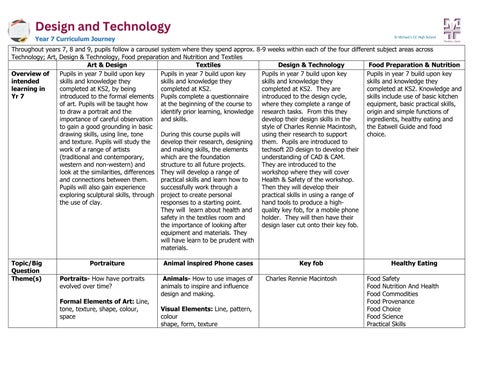


Throughout years 7, 8 and 9, pupils follow a carousel system where they spend approx. 8-9 weeks within each of the four different subject areas across Technology; Art, Design & Technology, Food preparation and Nutrition and Textiles Art & Design Textiles Design & Technology Food Preparation & Nutrition Overview of intended learning in Yr 7
Pupils in year 7 build upon key skills and knowledge they completed at KS2, by being introduced to the formal elements of art. Pupils will be taught how to draw a portrait and the importance of careful observation to gain a good grounding in basic drawing skills, using line, tone and texture. Pupils will study the work of a range of artists (traditional and contemporary, western and non-western) and look at the similarities, differences and connections between them. Pupils will also gain experience exploring sculptural skills, through the use of clay.
Pupils in year 7 build upon key skills and knowledge they completed at KS2. Pupils complete a questionnaire at the beginning of the course to identify prior learning, knowledge and skills.
During this course pupils will develop their research, designing and making skills, the elements which are the foundation structure to all future projects. They will develop a range of practical skills and learn how to successfully work through a project to create personal responses to a starting point. They will learn about health and safety in the textiles room and the importance of looking after equipment and materials. They will have learn to be prudent with materials.
Pupils in year 7 build upon key skills and knowledge they completed at KS2. They are introduced to the design cycle, where they complete a range of research tasks. From this they develop their design skills in the style of Charles Rennie Macintosh, using their research to support them. Pupils are introduced to techsoft 2D design to develop their understanding of CAD & CAM. They are introduced to the workshop where they will cover Health & Safety of the workshop. Then they will develop their practical skills in using a range of hand tools to produce a highquality key fob, for a mobile phone holder. They will then have their design laser cut onto their key fob.
Pupils in year 7 build upon key skills and knowledge they completed at KS2. Knowledge and skills include use of basic kitchen equipment, basic practical skills, origin and simple functions of ingredients, healthy eating and the Eatwell Guide and food choice.
Theme(s) Portraits- How have portraits evolved over time?
Formal Elements of Art: Line, tone, texture, shape, colour, space
Animals- How to use images of animals to inspire and influence design and making.
Visual Elements: Line, pattern, colour shape, form, texture Charles Rennie Macintosh
Safety Food Nutrition And Health Food Commodities
Food Provenance
Food Choice
Food Science
Practical Skills
Artistic skills and techniques-
Picasso
Key Knowledge

• Explore artists and the portraits they have painted
• Learn how to think like an artist.
• Use a range of different materials – grades of pencils, felt pens (waterbased) and the variety of nibs widths
• Principles working safely during practical lessons.
• Observational drawing of one of their peers to learn the principles of proportion, symmetry, using a pencil with sensitivity.
• Explore the use of line and discover the many ways that line can be used to create pattern and texture
• Explore the work of other artists/cultures/will respond and make visual connections with their work – using artists’ work as a starting point.
• Explore and experience working with clay –learning different decorative techniques –joining pieces of clay, process of firing.
Artistic skills and techniquesClare Youngs
• Learning about the style of work and working methods of the artist Clare Youngs.
• How to present research creatively
• How to develop design ideas and draw to scale.
• How to make paper patterns
• How to cut fabric accurately
• How to use fabric prudently.
• How to work safely.
• How to sew a range of stitches including straight stitch, whip stitch, back stitch and blanket stitch.
• How to thread a needle and tie a secure knot.
• How to sew one piece of fabric to another, applique.
• How to build up layers to fabric to create details.
• How to create fine details, for example using beads to show the light in the eyes
• How to sew beads, sequins and buttons securely.
• To learn about the design cycle
• Learn about different types of research – Product Analysis and Mood board
• To understand the style of Charles Rennie Macintosh
• How to measure a product correctly and to use these measurements to develop a product
• The importance of accuracy
• How to create a working drawing.
• Introduction to CAD and CAM
• To develop knowledge of the material area of Timbers
• How to develop design ideas in the style of Charles Rennie Macintosh
• Introduction on how to use Techsoft 2D design
• Principles of working safely in the workshop.
• To develop knowledge and understanding of a range of hand tools and the Pillar drill
• To develop knowledge and understanding of different CAM processes that can be achieved using the laser cutter
Food Safety
Where do bacteria come from?
Food, Nutrition And Health
Why do we eat food?
The Eatwell Guide
Nutritional needs of different groups of people
Nutritional analysis
Food Commodities
Fruit
Potatoes and vegetables (vitamin A, C and fibre)
Food Provenance
Using seasonal food, grown food and food miles
Food Choice
Food labelling, traffic light labelling and allergens
Sensory evaluation
Food Science
Enzymic browning investigation
Coagulation, dextrinisation, caramelisation and gelatinisation. Raising agents – mechanical
Practical skills
Producing mainly basic skilled, savoury dishes
• Experience learning in Art, Craft and Design that involves increasing levels of challenge, risk taking and unpredictable outcomes.
• Health and safety awareness when handling different tools/working with different media
Key Skills Materials:
• pencils (different grades)
• pens (fine liner and a range of different nibs)
• clay Techniques:
• Shading
• descriptive line drawing
• creating patterns with mark making
• clay – rolling, incising, joining pieces together.
• Researching artist’s work
• Presenting research
• Developing ideas through drawings and annotations
• Drawing to scale
• Drawing paper patterns
• Cutting fabric accurately
• Cutting fabric prudently
• Layering fabrics to create details.
• Pinning fabrics
• Sewing fabrics together
• Sewing beads, sequins and buttons.
• Caring for equipment
• Working safely in a practical room.
• Health and safety awareness when handling a range of different hand tools
• Developing ideas through drawings and annotations
• Drawing to scale
• Developing technical drawing skills – Isometric
• Creating the CAD file for the laser (CAM)
• Marking of measurements onto wooden baton, using the correct equipment
• Using the following hand / machine tools correctly & safely:
Try Square and rule Tenon Saw Coping saw Using a range of files
Use of the Pillar Drill Selection and use of glass paper
Practical Skills
• Knife skills
• Preparing fruits and vegetables
• Marinade
• Weigh and measure
• Water based methods of cooking
• Using the grill
• Using the oven
• Make a dough
• Test for readiness
• Presenting attractively and portion control
Assessment Assessment ONE- Knowledge checkpoint

Self-portrait using pencil tonal shading
Assessment TWO- Learning review
Composite task-
• Successfully draw a portrait of one of peers
• Picasso Line drawing
• Clay piece inspired by the work of Picasso
Assessment ONE- Knowledge checkpoint
Research and design development.
Assessment TWO- Learning review
Composite taskFinal making of the phone cover and practical skills.
Assessment ONE- Knowledge checkpoint
Research and Design Development
Assessment TWO- Learning review
Composite taskFinal Outcome
• Working safely and correctly in the workshop
• Accuracy of key fob
• Overall quality of final key fob
Assessment ONE- Knowledge checkpoint
Food investigation- Enzymic browning
Assessment TWO- Learning review
Composite task- Practical
• Knowledge of how to apply practical skills
• Work safely and hygienically in a confident manner
• Choose and work with a range of equipment with confidence
• Independently follow a recipe
Careers Visit to St Michael’s KS4 Art, Textiles and technology exhibition.

Personal and Spiritual Development

Discussion on different careers
possibilities- Artist, Illustrator, Graphic designer.
Creativity- having the opportunity to flourish with their own creative thinking and skills.
Curiosity- New skills and techniques, Explore a range of artists from different cultures and countries.
Focus is resilience and endurance
For example: Chuck Closeresilience
Visit to St Michael’s KS4 Art, Textiles and Technology exhibition.
Designer/ Artist – Clare Youngs
Creativity and the creative process.
Curiosity to learn new techniques and skills. To learn about the career of a contemporary, successful designer and artist.
Resilience to keep improving and developing work even when finding a task difficult.
Visti to St Michael’s KS4 Art, Textiles and technology exhibition.
Product Designers, Graphic designers, CAD Technician, Exhibition designers, Brand developer.
Careers in the Creative Industry
Christian Values – Creativity, endurance, resilience, Character Attributes – curiosity, respectful, reflective
Spirituality features in design and technology as it provides the platform for children to create artefacts that reflect their personal beliefs, values and experiences. Through designing and creating products, children can express their
Food Inspector, Dietician, Sports Nutritionist, Food Technologist, Nutritionist, Farming, Baker, Sensory Evaluator, Food Preparation Worker, Chef
Healthy Living Careers
Christian Values – creativity, compassion, hope, stewardship Character Attributes – curiosity
Spirituality – If we create for a higher purpose we develop spiritually. For example when considering special dietary needs of others when choosing ingredients and making dishes.
Any other key information KS3 Art Club
An opportunity to help make scenery and props for the school production.
Textiles Club
An opportunity to help make costumes for the school production.
spirituality and explore their connection with nature, other people and their own emotions.
An opportunity to help make scenery and props for the school production.