NCLAWYERSWEEKLY.COM Part of the
VOLUME 34 NUMBER 14 ■
network
JULY 4, 2022 ■ $8.50
BEING FLEXIBLE
Gov. Cooper makes judicial appointments ■ BY JASON THOMAS jthomas@scbiznews.com
in a recent phone interview. Instead, attorneys got creative and found a way to change all their processes. Clients would pull up in the parking lot, call the office to say they were downstairs, and their lawyers would take their closing packages to their car window and hand them over, along with their phone number to call if they have questions, Strickland said. “It was the wildest thing to see,” he said. “It was just lawyers down there with clipboards helping people purchase $500,000 homes while sitting in their cars.” Now, two years later, Ragsdale Liggett and other firms are finding
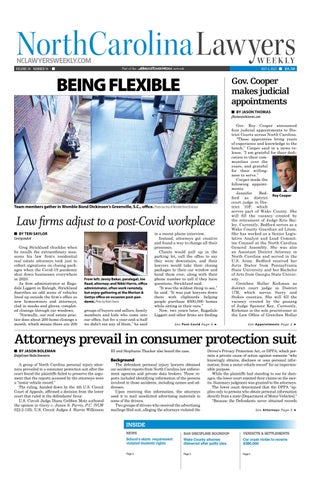
Gov. Roy Cooper announced four judicial appointments to District Courts across North Carolina. “These appointees bring years of experience and knowledge to the bench,” Cooper said in a news release. “I am grateful for their dedication to their communities over the years, and grateful for their willingness to serve.” Cooper made the following appointments: Jennifer BedRoy Cooper ford as district court judge in District 10F, which serves part of Wake County. She will fill the vacancy created by the retirement of Judge Kris Bailey. Currently, Bedford serves as a Wake County Guardian ad Litem. She has worked as a Senior Legislative Analyst and Lead Committee Counsel at the North Carolina General Assembly. She was also an Assistant District Attorney in North Carolina and served in the U.S. Army. Bedford received her Juris Doctor from Pennsylvania State University and her Bachelor of Arts from Georgia State University. Gretchen Hollar Kirkman as district court judge in District 17B, which serves Surry and Stokes counties. She will fill the vacancy created by the passing of Judge Spencer Key. Currently, Kirkman is the sole practitioner at the Law Office of Gretchen Hollar
S e e Po s t - Cov i d P a g e 6 ►
See Appointments Page 3 ►
Team members gather in Womble Bond Dickinson’s Greenville, S.C., office. Photo courtesy of Womble Bond Dickinson
Law firms adjust to a post-Covid workplace ■ BY TERI SAYLOR Correspondent Greg Strickland chuckles when he recalls the extraordinary measures his law firm’s residential real estate attorneys took just to collect signatures on closing packages when the Covid-19 pandemic shut down businesses everywhere in 2020. As firm administrator at Ragsdale Liggett in Raleigh, Strickland describes an odd scene of vehicles lined up outside the firm’s office as new homeowners and attorneys, clad in masks and gloves, completed closings through car windows. “Normally, our real estate practice does about 200 home closings a month, which means there are 200
From left: Jenny Baker, paralegal; Joe Raad, attorney; and Nikki Harris, office administrator, often work remotely, but enjoy gathering at the Morton & Gettys office on occasion post-pandemic. Photo by Robin Owens
groups of buyers and sellers, family members and kids who come into our office, but for a year-and-a-half we didn’t see any of them,” he said
Attorneys prevail in consumer protection suit ■ BY JASON BOLEMAN BridgeTower Media Newswires A group of North Carolina personal injury attorneys prevailed in a consumer protection suit after the court found the plaintiffs failed to preserve the argument that the reports accessed by the attorneys were a “motor vehicle record.” The ruling, handed down by the 4th U.S. Circuit Court of Appeals, affirmed a decision from the lower court that ruled in the defendants’ favor. U.S. Circuit Judge Diana Gribbon Motz authored the opinion in Garey v. James S. Farrin, P.C. (VLW 022-2-135). U.S. Circuit Judges J. Harvie Wilkinson
III and Stephanie Thacker also heard the case.
Background
The defendant personal injury lawyers obtained car accident reports from North Carolina law enforcement agencies and private data brokers. These reports included identifying information of the persons involved in those accidents, including names and addresses. Upon receiving this information, the attorneys used it to mail unsolicited advertising materials to some of the drivers. Two groups of drivers who received the advertising mailings filed suit, alleging the attorneys violated the
Driver’s Privacy Protection Act, or DPPA, which permits a private cause of action against someone “who knowingly obtains, discloses or uses personal information, from a motor vehicle record” for an impermissible purpose. While the plaintiffs had standing to sue for damages, the lower court rejected their claims on the merits. Summary judgment was granted to the attorneys. The lower court determined that the DPPA “applies only to persons who obtain personal information directly from a state [Department of Motor Vehicles].” “Because the Defendants never obtained records S e e At t o r n e y s P a g e 5 ►
INSIDE NEWS
BAR DISCIPLINE ROUNDUP
VERDICTS & SETTLEMENTS
School’s skirts requirement violated students’ rights
Wake County attorney disbarred after guilty plea
Car crash victim to receive $380,000
Page 2
Page 2
Page 5
2 / NEWS
N O R T H C A R O L I N A L A W Y E R S W E E K LY I Ju ly 4, 2022
4th Circuit: Skirt requirement violated rights ■ BY CORREY E. STEPHENSON BridgeTower Media Newswires A public charter school violated the Equal Protection Clause of the Fourteenth Amendment when it required female students to wear skirts to school based on the view that girls are “fragile vessels” deserving of “gentle” treatment by boys, the en banc 4th U.S. Circuit Court of Appeals has ruled, affirming summary judgment in favor of female students. A public charter school in Brunswick County, Charter Day School (CDS) educates male and female students in kindergarten through the eighth grade. The school was incorporated in 1999 and obtained a charter from the state of North Carolina in 2000. Enrollment at CDS is open to all students who are eligible to attend North Carolina public schools. CDS receives 95% of its funding from federal, state, and local governmental authorities. After applying for its charter, CDS entered into a “charter school management contract” with Roger Bacon Academy, Inc. (RBA), a for-profit corporation. Under the terms of the management agreement, RBA is responsible for the day-to-day operations of CDS. Since its inception, CDS has emphasized “traditional values.” As part of this educational philosophy, CDS implemented a dress code to “instill discipline and keep order” among students. Among other requirements, female students are required to wear a “skirt,” “jumper,” or “skort.” A student’s failure to comply with the dress code requirements may result in disciplinary action. In 2015, Bonnie Peltier, the mother of a female kindergarten student at CDS, objected to the skirts requirement. She was told that the dress code was part of an effort to “preserve chivalry and respect” among the students. Chivalry, she was told, is “a code of conduct where women are treated, they’re regarded as a fragile vessel that men are supposed to take care of and honor.” Peltier and two other CDS parents filed suit on behalf of their female children against CDS, members of its Board and RBA alleging violations of the Equal Protection Clause and Title IX. They asserted that the skirts requirements is a sex-based classification rooted in gender stereotypes that discriminates against them based on their gender. On cross-motions for summary judgment, the U.S. District Court sided with the plaintiff on the Equal Protection claim but reached a different conclusion regarding the Title IX claim. A panel of the 4th Circuit reversed on both claims before the full court vacated that decision to hear the case en banc. In a decision joined by 10 of the 16 judges, Senior Judge Barbara Milano Keenan affirmed summary judgment in favor of the plaintiffs on the Equal Protection claim and reversed and remanded for further proceedings on the Title IX claim. “CDS, a public school under North Carolina law, is a state actor for purposes of Section 1983 and the Equal Protection Clause,” she wrote. “By implementing the skirts requirement based on blatant gender stereotypes about the ‘proper place’ for girls and women in society, CDS has acted in clear violation of the Equal Protection
Clause. We further hold that sex-based dress codes like the skirts requirement, when imposed by covered entities, are subject to review under the anti-discrimination provisions of Title IX.”
Clothed with the authority of state law
Beginning with the Equal Protection claim, Keenan focused on whether CDS and RBA constituted state actors. While CDS argued that charter schools are merely private entities fulfilling contracts with the state, the plaintiffs countered that they qualified as state actors by operating schools designated as “public” and open to all students. Keenan agreed. “The statutory framework of the North Carolina charter school system compels the conclusion that the state has delegated to charter school operators like CDS part of the state’s constitutional duty to provide free, universal elementary and secondary education,” she wrote. “The state bears ‘an affirmative obligation’ under the state constitution to educate North Carolina’s students and partially has ‘delegated that function’ to charter school operators, who have carried out the state’s obligation by virtue of their charters with the state.” CDS implemented the skirts requirement as part of the school’s educational mission, she added, exercising the power possessed by virtue of state law and made possible only because the school is clothed with the authority of state law. “Under these circumstances, we will not permit North Carolina to delegate its educational responsibility to a charter school operator that is insulated from the constitutional accountability borne by other North Carolina schools,” Keenan wrote. She reached a different result with respect to RBA, however. Unlike CDS, “RBA has no direct relationship with the state and is not a party to the charter agreement between CDS and North Carolina,” she said. “In working for CDS, rather than for the state of North Carolina, RBA’s actions are more attenuated from the state than those of CDS, the entity authorized by the state to operate one of its public schools.” Turning to the merits of Equal Protection claim, Keenan had little trouble finding that the skirts requirement failed to satisfy intermediate scrutiny, despite CDS’ argument that the dress code as a whole was intended to help instill discipline and keep order. “CDS does not attempt to disguise the true, and improper, rationale behind its differential treatment of girls, which plainly does not serve an important government interest,” she said. “It is difficult to imagine a clearer example of a rationale based on impermissible gender stereotypes. On their face, the justifications proffered by CDS ‘rest on nothing more than conventional notions about the proper station in society for males and females.’ … [W]e hold that the skirts requirement fails intermediate scrutiny and facially violates the Equal Protection Clause.”
Title IX claim considered on remand
The U.S. District Court held that Title IX categorically does not apply to sex-based dress codes because the Department of Education rescinded
an earlier regulation governing such policies. But Keenan disagreed, finding that the unambiguous language of Title IX prohibiting discrimination based on sex encompasses sex-based dress codes and thus, no deference was necessary for the Department’s regulatory decision. Title IX is a broadly written general prohibition on discrimination, followed by specific, narrow exceptions, limiting the statute to the exceptions set forth, she said. “If Congress had intended to exclude sex-based dress codes from the broad reach of Title IX, Congress would have designated such policies along with the other enumerated exceptions,” Keenan said. “But … dress codes are not included in the exceptions listed in the statute. We thus hold that Congress intended that sexspecific dress codes imposed by covered entities be subject to the general prohibition against discrimination in Title IX.” She remanded the claim for consideration by the District Court, clarifying that to prevail under Title IX, the plaintiffs must show that “(1) they were excluded from participation in an education program or activity, denied the benefits of this education, or otherwise subjected to discrimination because of their sex; and (2) the challenged action caused them harm, which may include ‘emotional and dignitary harm.’” Judge James Andrew Wynn wrote a concurring opinion joined by Judges Diana Gribbon Motz, Stephanie D. Thacker, Pamela A. Harris and Senior Judge Keenan, while Senior Judge Keenan authored her own concurring opinion joined by Judge Thacker. In addition, Judge A. Marvin Quattlebaum, Jr. wrote an opinion dissenting in part and concurring in part – joined by Judges Julius N. Richardson and Allison Jones Rushing – in which Judges J. Harvie Wilkinson III, Paul V. Niemeyer and G. Steven Agee joined dissenting in part.
Judge Wilkinson authored a dissenting opinion joined by Judges Niemeyer and Agee.
Charter schools on notice
Aaron Streett of Baker Botts in Houston, who represented CDS, said in a statement that he respectfully disagreed with the majority’s opinion. “As the six dissenting judges explain, the majority opinion contradicts Supreme Court precedent on state action and splits with every other circuit to consider the issue,” he said. “Treating charter schools exactly the same as traditional public schools limits the ability of parents to choose the best education for their children.” Jeanette Doran, president and general counsel of the North Carolina Institute for Constitutional Law in Raleigh, agreed. “The Fourth Circuit majority got this one wrong and the consequences will be borne by schoolchildren and their parents,” she said. Not surprisingly, Galen L. Sherwin, senior staff attorney with the ACLU Women’s Rights Project, who argued on behalf of the plaintiffs, had a different reaction to the decision, calling it “a victory for North Carolina’s students attending public charter schools.” The decision “should put charter schools across the country on notice that they must follow the same rules as traditional public schools when it comes to guaranteeing students’ equal educational opportunities,” she said. “As the opinion recognizes, dress codes that enforce different rules based on students’ sex reinforce oldfashioned conventions of how girls should dress, and signal that girls are not equal to boys. These discriminatory gender stereotypes are harmful and have no place in our public schools.” The 103-page decision is Peltier v. Charter Day School. The full text of the opinion is available online at nclawyersweekly.com.
BAR DISCIPLINE
ROUNDUP Attorney: R. Cherry Stokes Location: Wake County Bar membership: Admitted in 1972; disbarred in 1987; readmitted in 1993 Disciplinary action: Disbarment, effective Oct. 31 Background: On Nov. 22, 2021, the North Carolina State Bar filed a formal complaint against Stokes, alleging, among other things, that he was convicted of eight counts of felonious injury by vehicle. Stokes’s conduct constitutes grounds for discipline as follows: a) Pursuant to N.C. Gen. Stat. 84-28(b)(1), in that Stokes’s guilty plea to eight counts of felonious injury by vehicle in violation of N.C. Gen Stat. 20-141.4(a3), he has been convicted of criminal offenses showing professional unfitness; an b) Pursuant to N.C. Gen. Stat. 84-28(b)(2) in that Stokes violated the Rules of Professional Conduct, including Rule 8.4(b). Stokes has indicated his consent to disbarment by filing an affidavit of surrender with the Disciplinary Hearing Commission. Attorney: Perry Mastromichalis Location: Wake County
Bar membership: Member since 1986 D i s c i p l i n a r y a c t i o n: Fo u r- ye a r suspension Background: By printing his former friend’s (now deceased) name to an insurance policy application to obtain insurance coverage on a vehicle, knowing the vehicle was titled in his former friend’s name and knowing he did not have authority to do so, Mastromichalis committed misdemeanor common law forger, an act that reflects adversely on his honesty, trustworthiness, or fitness as a lawyer in violation of Rule 8.4(b), and engaged in conduct involving dishonestly, fraud, deceit, or misrepresentation that reflects adversely on his fitness as a lawyer in violation of Rule 8.4(c); and by maintaining that he told an insurance agent that his friend was deceased by submitting a confidant’s affidavit with is response, Mastromichalis submitted a false statement of material fact in connection with a disciplinary matter in violation of Rule 8.1(b), and engage din conduct involving dishonesty, fraud, deceit or misrepresentation that reflects adversely on his fitness as a lawyer in violation of Rule 8.4(c).
NEWS / 3
N O R T H C A R O L I N A L A W Y E R S W E E K LY I July 4, 2022
APPOINTMENTS / C o nt inu e d f r o m 1 ►
Kirkman, PLLC. Previously, she served as District Court Judge for District 17B and an attorney at the Law Office of Sarah Stevens. She received her Juris Doctor from Wake Forest University School of Law and her Bachelor of Arts from the University of North Carolina at Chapel Hill. Matthew Rupp as district court
Governor promotes judges
judge in District 24, which serves Avery, Madison, Mitchell, Watauga and Yancey counties. He will fill the vacancy created by the retirement of Judge Larry Leake. Rupp is currently a Partner at Angle, Rupp and Rupp, Attorneys at Law. Previously, he was an Assistant District Attorney in the District Attorney’s Office for the 35th Prosecutorial District and the 26th Prosecutorial District. His prior
experience also includes serving as counsel for the House Committee on Ways and Means and Counselor to the Inspector General. He received his Juris Doctor from Duke University School of Law and his Bachelor of Arts from the University of Notre Dame. Shante’ Burke-Hayer as district court judge in District 26, which serves part of Mecklenburg County. She will fill the va-
cant seat formerly held by Judge Kimberly Best. Burke-Hayer is currently Managing Attorney at Burke-Hayer Law Firm, PLLC. Previously, Burke was Of Counsel - Attorney at Hunt Law, PLLC, and a Legal Analyst at Wells Fargo. She received her Juris Doctor from the Charlotte School of Law and her Bachelor of Arts from the University of North Carolina at Charlotte.
Feds have exclusive in rem jurisdiction over seized cash ■ BY CORREY E. STEPHENSON BridgeTower Media Newswires A bag with $16,761 in cash seized by state police and turned over to federal officers could not be recovered in a state court action, a panel of the North Carolina Court of Appeals has ruled, as the federal court has exclusive in rem jurisdiction. On Nov. 15, 2020, officers of the Mooresville Police Department (MPD) discovered a vehicle in a hotel parking lot matching the description of a vehicle by night shift officers. The vehicle contained $16,761 in cash in a plastic bag in the center console, which the MPD seized. Jermaine Lydell Sanders, who was renting the vehicle and inside the hotel, fled upon seeing the officers. A few days later, he filed a motion against the Town of Mooresville and the MPD, seeking a return of the cash, arguing that the seizure was unlawful. While the motion was under consideration in Iredell County District Court, an officer of the U.S. Department of Homeland Security (DHS) informed the MPD that because Sanders was being investigated for money laundering under 18 U.S.C. § 1956, the DHS was “adopting the case.” On Nov. 23, 2020, the MPD relinquished the currency to the DHS. In the meantime, the trial court granted the motion. When Sanders reached out to the MPD, they indicated that they could not return the cash due to its transfer to the feds. In response, the trial court entered another order, ruling that the failure of the town and the MPD to comply with the November order was willful and holding the defendants in civil contempt. The town and MPD filed a petition for writ of certiorari, asking the Court of Appeals to consider the trial court’s orders. Reversing and remanding, the appellate panel found the trial court lacked jurisdiction over the case in a unanimous opinion authored by Judge Hunter Murphy. “Judicial proceedings pertaining to criminal seizures of personal property in North Carolina are based on in personam, not in rem, jurisdiction,” he wrote. “These proceedings differ from federal civil forfeiture proceedings, which are based on in rem jurisdiction. For this reason, where a federal court adopts a seizure of property by North Carolina law enforcement, federal courts assume exclusive, in rem jurisdiction over the seizure, as no state-level in rem jurisdiction exists to take priority over the federal exercise of in rem jurisdiction; the ordinary rule prioritizing the in rem jurisdiction of the first in time to exercise it does not apply unless
A panel of the North Carolina Court of Appeals has ruled that a big with nearly $17,000 in cash seized by state police and turned over to federal officials could not be recovered in a state court action. DepositPhotos
in rem jurisdiction exists in the first place. Here, where the trial court issued orders purporting to exercise in rem jurisdiction, it erred.”
Exclusive federal jurisdiction
Mooresville and the MPD argued that the trial court lacked in rem jurisdiction and therefore erred in issuing the challenged orders because it was prevented from interfering with the federal courts’ exclusive in rem jurisdiction. In rem jurisdiction is a specialized form of personal jurisdiction, Murphy explained, and its existence or nonexistence is of great import, as a court assuming in rem jurisdiction precludes the subsequent exercise of in rem jurisdiction by all other courts. Contrary to its assertions, the trial court never exercised in rem jurisdiction over the seized currency, he said. “Unlike the federal government, North Carolina does not have a general purpose civil forfeiture statute,” he wrote. “The statute applicable to this case is N.C.G.S. § 90-112, which provides, in relevant part, for the criminal forfeiture of ‘[a]ll money … which [is] acquired, used, or intended for use, in selling, purchasing, manufacturing, compounding, processing, delivering, importing, or exporting a controlled substance … .’” While federal civil forfeiture is an action against the property itself, North Carolina does not employ this conceptual framework, Murphy said. Instead, criminal forfeiture proceedings take place under the purview of a defendant’s criminal trial. In a 2002 Court of Appeals decision, State v. Hill, the panel held
that criminal forfeiture proceedings “are categorically predicated upon in personam jurisdiction – one of the many distinguishing factors between North Carolina’s criminal forfeiture proceedings and the in rem proceedings associated with civil forfeiture,” he wrote. “Here, where [Sanders’] currency was taken from the vehicle pursuant to N.C.G.S. § 90-112, we are bound by our decision in Hill to hold that any challenge to that forfeiture would have necessarily been predicated on in personam jurisdiction, not in rem jurisdiction.”
‘Hamstrung by Hill’
As the trial court never exercised
in rem jurisdiction, it erred in any legal conclusion in the challenged orders premised on the exercise of in rem jurisdiction, Murphy said. “In Hill, we held that ‘[o]nce a federal agency has adopted a local seizure, a party may not attempt to thwart the forfeiture by collateral attack in our courts, for at that point exclusive original jurisdiction is vested in the federal court,’” he said. This proposition – that in rem jurisdiction attached due to the actions of law enforcement – stands in clear opposition to a 1935 U.S. Supreme Court decision in Penn General Cas. Co. v. Pennsylvania ex rel. Schnader, where the justices held that “the court first assuming jurisdiction over the property,” and not the executive agents, “may maintain and exercise [in rem] jurisdiction to the exclusion of the other.” However, “as we are without power to override our prior holdings, Hill remains in effect until such time as it may be corrected by our Supreme Court,” Murphy said. “Accordingly, under Hill, the November Order was issued by a court without in rem jurisdiction; and, as [the] subsequent orders were premised on the validity of the November Order, those orders are void.” Writing that the panel was “hamstrung by Hill,” he vacated the trial court’s orders and remanded for further proceedings. Maria T. Perry of Perry Legal Services in Durham represented Sanders. She did not respond to a request for comment on the decision. Neither did Raleigh attorney Steven A. Bader of Cranfill Sumner, who represented the Town of Mooresville and the MPD. The 12-page decision is State v. Sanders. The full text of the opinion is available online at nclawyersweekly.com.
Established Jacksonville, NC law firm is seeking an attorney to handle Plaintiff’s personal injury and general civil litigation. Ideal candidate has 3-5 years of litigation experience, a strong work ethic and strong written and verbal communication skills. Compensation is negotiable and includes salary and a bonus based on individual and firm performances as well as benefits. This position provides opportunity for growth with a busy firm located in coastal North Carolina.
Please send resume to raw@warlicklaw.com
4 / NEWS
N O R T H C A R O L I N A L A W Y E R S W E E K LY I Ju ly 4, 2022
COA washes away utility’s attempt to intervene in environmental dispute ■ BY CORREY E. STEPHENSON BridgeTower Media Newswires A public utility seeking to intervene in an environmental action brought by the state against The Chemours Co. waited too long to file its motion, a unanimous panel of the North Carolina Court of Appeals has ruled, affirming denial. Chemours owns the Fayetteville Works facility, a chemical manufacturing plant adjacent to the Cape Fear River in Bladen County. Chemours produces per- and polyfluoroalkyl substances (PFAS) at the facility, which discharges water into the Cape Fear River through multiple avenues. Cape Fear Public Utility Authority (CFPUA), a public utility authority which provides potable water to residents of New Hanover County and the City of Wilmington, owns and operates a raw water intake on the Cape Fear River downstream of the facility. On Sept. 7, 2017, the state, through the Department of Environmental Quality (DEQ), filed a complaint against Chemours alleging violations of multiple water quality laws and regulations based on discharges of PFAS from the facility into groundwater and the Cape Fear River. The following month, CFPUA followed suit with its own complaint against Chemours in federal court. The utility also filed a motion to intervene in the suit brought by the state, but withdrew the motion in November 2017 after the parties stipulated that the state would provide notice and comment procedures “with respect to any proposed settlement between” Chemours and the state. In November 2018, the state published notice of a proposed consent order with Chemours and commenced a public comment period. In a public comment, CFPUA argued that the proposal was “fundamentally flawed in a number of important respects,” and again moved to intervene in the case. While the motion was still pending, the trial court entered the consent order on Feb. 25, 2019. The order – which did not release Chemours from any liability to third parties – required the company to establish a plan for a reduction in the discharge of PFAS from the facility. The plan became a proposed addendum to the consent order. In response, CFPUA filed a renewed and amended motion to intervene, again asserting that the order (and the addendum) did not adequately address its concerns about PFAS discharges. Denying the motion to intervene, the trial court entered the addendum to the consent order. CFPUA appealed. In an opinion authored by Judge Allegra Collins, the appellate panel affirmed, finding the motion to intervene untimely. “[T]he trial court’s unchallenged findings of fact demonstrate that CFPUA has long been aware of this litigation, made comments on multiple instances, and conferred with DEQ on several occasions,” she wrote. “Additionally, CFPUA’s argument that the state’s conduct impeded its ability to apprehend the need to intervene is undercut by CFPUA’s repeated assertions, beginning early in the proceed-
"Helping lawyers practice better, more efficiently, and more profitably." ■ PUBLISHER Liz Irwin lirwin@bridgetowermedia.com ■ EDITOR Jason Thomas jthomas@scbiznews.com EDITORIAL Heath Hamacher, Reporter hhamacher@nclawyersweekly.com Scott Baughman, Digital Media Manager sbaughman@mecktimes.com
A public utility seeking to intervene in an environmental action brought by the state waited too long to file its motion, a Court of Appeals panel ruled. DepositPhotos
ings, that the state failed to adequately protect CFPUA’s interests.”
Concern for relitigation
Timeliness is the threshold question to be considered in any motion for intervention, Collins explained, and a trial court must consider: “(1) the status of the case, (2) the possibility of unfairness or prejudice to the existing parties, (3) the reason for the delay in moving for intervention, (4) the resulting prejudice to the applicant if the motion is denied, and (5) any unusual circumstances.” CFPUA argued that the consent order was not a final judgment, so it did not constitute a judgment for purposes of the first factor of the intervention analysis. Collins disagreed. Although the consent order required the parties develop and implement a plan for toxicity studies of certain PFAS, “these provisions envision approval and enforcement by the trial court [and] do not obviate the Consent Order’s resolution of the State’s claims and therefore do not diminish the Consent Order’s effect as a final judgment,” she said. “Under the release of claims in the Consent Order, there is to be no further adjudication of the merits of the State’s claims.” Given the status of the case, the trial court properly required CFPUA to “demonstrate ‘extraordinary and unusual circumstances’ or a ‘strong showing of entitlement and justification’ for intervention.” Turning to the possibility of unfairness or prejudice, Collins noted the trial court’s concern with relitigation of numerous matters if CFPUA were allowed to intervene. “The trial court did not abuse its discretion by concluding that CFPUA’s intervention ‘would be highly prejudicial to the existing parties’ and this factor weighed against the timeliness of CFPUA’s intervention,” she wrote. CFPUA countered that its motion was filed in response to the addendum, which it said did not protect its interests. But the utility alleged that DEQ had failed to adequately represent its interests on multiple instances prior to that point, Collins said, in a comment on the initial proposal in September 2019, at a meeting with DEQ that same month, as part of a revised proposal for compliance and at a subsequent meeting in July 2020. Similarly, CFPUA’s argument that changed circumstances led to its final motion to intervene failed to sway the court. “Contrary to CFPUA’s argument that changed circumstances justified
its delay, the record indicates that CFPUA had a longstanding concern that implementation of the Consent Order would not reduce PFAS levels in the Cape Fear River to its satisfaction,” Collins said, citing language in the CFPUA’s complaint against Chemours and its second motion to intervene.
No unusual circumstances
As for the fourth factor, prejudice to the party seeking to intervene, Collins found it also weighed heavily against the timeliness of CFPUA’s intervention. Most significantly, the utility has its own pending litigation against Chemours and the consent order does not in any way impair its efforts to vindicate its interests in that case. Further, CFPUA did not challenge the trial court’s findings that the consent order contains numerous provisions to substantially reduce PFAS discharges and emissions to the environment from ongoing operations at the facility and the addendum requires measures to substantially reduce PFAS loading to surface water from historic sources, including contaminated groundwater and soils. Finally, Collins found no unusual circumstances warranted granting the motion to intervene. Both the consent order and addendum were publicly noticed, allowing CFPUA and other members of the public a chance to be heard on both documents prior to entry by the court. She rejected CFPUA’s position that DEQ made it more difficult for the utility to apprehend the need to intervene, reiterating the comments filed by CFPUA and its multiple meetings with DEQ. “The trial court did not abuse its discretion in concluding that the unusual circumstances cited by CFPUA are ‘unrelated to its long delay and are irrelevant to its failure to timely move for intervention,’ and to the contrary, ‘there are unusual circumstances that warrant denying CFPUA’s’” motion to intervene as untimely, Collins concluded. Joseph A. Ponzi of Brooks, Pierce, McLendon, Humphrey & Leonard in Greensboro, who represented CFPUA, did not respond to a request for comment. Neither did the Office of the Attorney General nor Charlotte attorney R. Steven DeGeorge of Robinson, Bradshaw & Hinson, who represented Chemours. The 27-page decision is State v. The Chemours Company. The full text of the opinion is available online at nclawyersweekly.com.
■ ADVERTISING Sheila Batie-Jones, Advertising Account Executive sbatie-jones@nclawyersweekly.com ■ ACCOUNTING & ADMINISTRATIVE Michael McArthur, Business Manager mmcarthur@bridgetowermedia.com ■ CIRCULATION Disa Ehrler, Audience Development Manager dehrler@bridgetowermedia.com Circulation: 1-877-615-9536 service@bridgetowermedia.com ■ PRODUCTION & OPERATIONS Bradley Redmond, Director of Production Ryan O’Shea, Production Supervisor John Reno, Production Specialist ©2022 BridgeTower Media. Material published in North Carolina Lawyers Weekly is compiled at substantial expense and is for the sole and exclusive use of purchasers and subscribers. The material may not be republished, resold, recorded, or used in any manner, in whole or in part, without the publisher’s explicit consent. Any infringement will be subject to legal redress. Established 1988 919-829-9333 • 1-800-876-5297 Charlotte office: 130 North McDowell Street, Unit B, Charlotte, NC 28204 (704) 377-6221 • (704) 377-4258 fax: www.nclawyersweekly.com For subscription questions 1-877-615-9536 service@bridgetowermedia.com
North Carolina Lawyers Weekly [ISSN10411747] [USPS 002-904] is published biweekly every other Monday with General Statewide Circulation for $410.36 per year by North Carolina Lawyers Weekly, 130 North McDowell Street, Unit B, Charlotte, NC 28204 Periodicals postage paid at Charlotte, North Carolina 28228-9998. POSTMASTER: Electronic Service Requested. Send address changes to: North Carolina Lawyers Weekly, Subscription Services, P.O. Box 1051, Williamsport, PA, 17703-9940 North Carolina Lawyers Weekly is a publication of BridgeTower Media, 222 South Ninth Street, Suite 900, Minneapolis, MN 55402.
VERDICTS & SETTLEMENTS / 5
N O R T H C A R O L I N A L A W Y E R S W E E K LY I July 4, 2022
Car crash victim to receive $380,000 ■ BY DAVID BAUGHER A Colorado woman will receive $380,000 in connection with a car accident that broke her arm. “It was a claim of bodily injury based on the negligence of the defendant,” said attorney Gary Clemmons of Chesnutt & Clemmons. Clemmons’ firm represented the unidentified plaintiff in the matter in relation to a Morehead City crash in which the defendant allegedly ran a stoplight. “She had the green light, pulled out and got hit on the driver’s side,” he said. Names in the matter were kept confidential under the terms of the settlement. Clemmons said that much of the case revolved around damages and insurance questions rather than liability. “There were no affirmative defenses of contributory negligence or anything like that. Negligence was pretty much admitted,” he said. “The only issue in the case became ‘what was the value?’” A trio of insurance policies were at stake. Clemmons said the liability carrier did not put up any resistance since the figures involved were clearly in excess of the limits. However, there were two UIM policies from different states, one of which did engage in some dispute.
SETTLEMENT REPORT – PERSONAL INJURY
Amount: $380,000 Injuries alleged: Non-union fracture of the left arm Case name: Confidential Venue: Carteret County Civil Superior Court Case No.: Confidential Date of settlement: January 2022 Special damages: $36,380.23 healthcare expenses/$1,383.21 emergency travel expenses Most helpful experts: Kavi Sachar, Vail, Colo., (orthopedic) Insurance carrier: Confidential Attorney for plaintiff and their firm: Gary Clemmons, Chesnutt & Clemmons, (New Bern, NC) Attorney for defendant and their firm: Confidential “I was just happy that she recovered,” he noted. “I always worry about people where the older you get, the body does not heal as fast as a young person’s would.”
Attorneys prevail in consumer suit
ATTORNEYS / C o nt inu e d f r o m 1 ►
from a DMV, the court concluded that their ‘conduct thus falls outside the ambit of the DPPA, and they are entitled to judgment as a matter of law,’” Motz wrote, summarizing the lower court’s ruling.
Analysis
“They put up a limited fight on a coverage issue but once that issue was resolved, they dumped the money,” he said. “It was interesting because she had UIM coverage on a Colorado policy and then she had UIM coverage on a North Carolina policy.” That led to questions of which policy came first. Clemmons said that ultimately, it was the Colorado insurer. “They tendered the limits and the other policy came after,” he said. Clemmons listed damages in the 2019 T-bone collision as a little more than $36,000 however he noted that this was only the paid amount. “The law in North Carolina is reasonable and necessary health care expenses under rule 414,” he said. The case was resolved by agreement among the parties without mediation. Clemmons said that, since the woman treated mostly in Colorado, a trial would have involved some degree of travel expense to fly out and take depositions had it gone to a courtroom. “Considering the delay and the cost, I think we did very well,” he said. “Carteret County juries are pretty conservative so I think we got more than a jury would give her.” He described his client and her husband, both of whom were in their 70s, as wonderful people and noted that she made a good recovery.
Citing recent court decisions — including TransUnion LLC v. Ramirez from the U.S. Supreme Court — Motz said the plaintiffs had Article III standing to bring a suit. In TransUnion, the Supreme Court held that plaintiffs proceeding under a statutory cause of action can establish an injury by “identif[ying] a close historical or common-law analogue for their asserted injury” that courts have traditionally provided a remedy for.” In the Garey case, the plaintiffs were found to have standing by the district court because of alleged harms related to the invasion of privacy, “which has long provided a basis for recovery at common law.” However, the 4th Circuit agreed with the district court decision to reject the plaintiffs’ request for injunctive relief because they did not adequately allege the defendants were currently
obtaining their information. “Under the theory of the case, the obtaining of their personal information is a fait accompli; the Garey Plaintiffs were already in car accidents, and the Defendants already obtained the relevant accident reports,” Motz wrote. The judge added that this information could be procured in the future if a plaintiff were involved in another car accident, if another accident report was created by North Carolina law enforcement and if a defendant obtained this report. “But that mere possibility is hardly the kind of non-speculative, imminent danger that can support injunctive relief,” she noted. As for the merits, Motz wrote that “the parties seek to present several complex questions of first impression in this Circuit,” including if a driver’s license is a “motor vehicle record” and if the DPPA applies to records outside of a state DMV. “But those questions must be answered another day,” Motz wrote, “for we affirm the district court on… much narrower ground.” The judge said the plaintiffs “do not allege that the Defendants obtained any of the Plaintiff’s personal information ‘from’ any of the sources that
they argue constitute ‘motor vehicle record[s].’” Under the DPPA, a defendant must have obtained personal information “from a motor vehicle record” to be civilly liable under the act. The DPPA defines a “motor vehicle record” as “any record that pertains to a motor vehicle operator’s permit, motor vehicle title, motor vehicle registration, or identification card issued by a department of motor vehicles.” The plaintiffs contended that, since the crash report’s address field indicates whether the address matches the one on the driver’s license, the information appeared in a motor vehicle record. But Motz disagreed. “[T]he legislative history clarifies the plain text: the DPPA imposes civil liability only on a defendant who obtains personal information from a motor vehicle record, but not on a defendant who merely obtains personal information that can be linked back to such a record,” she explained. Motz pointed out there was no assertion that the attorneys accessed a DMV database, as the accident reports are not records kept by the state DMV. Rather, the attorneys obtained the reports either from local law enforce-
ment agencies or private data brokers. The judge said the plaintiffs failed to preserve their argument that the accident report itself was a “record that pertains to a motor vehicle operator’s permit.” As such, it was not considered. This specific issue is “a difficult question” with split decisions across the courts, Motz noted, adding that, at the district court, the plaintiffs “not only failed to preserve this argument, but affirmatively disavowed it before the district court.” “Considering arguments in a civil case for the first time on appeal requires an extraordinarily compelling reason to do so,” Motz wrote. “Here, the procedural history provides extraordinarily compelling reasons not to do so.” The judge concluded that the district court “correctly held that the Plaintiffs have standing to seek damages, but not prospective relief” and that, on the merits, the court must affirm the district court’s decision in favor of the defendants. “The Defendants obtained the Plaintiffs’ personal information from accident reports — but the Plaintiffs failed to preserve the argument that those accident reports are ‘motor vehicle record[s],’” Motz said.
MEDIATION TRAINING Approved by the Dispute Resolution Commission and the NC CLE Board!
MEDIATION, INC. MEDIATION, INC. MEDIATION, INC. MEDIATION, INC. MEDIATION, INC. MEDIATION, INC. MEDIATION, INC. MEDIATION, INC. MEDIATION, INC. MEDIATION, INC. MEDIATION, INC. MEDIATION, INC. MEDIATION, INC. MEDIATION, INC.
Superior Court Mediation Training
Superior Court Mediation Training
AUGUST 8 - 12, 2022 CHARLOTTE, NC
OCTOBER 24 - 28, 2022 RALEIGH, NC
Andy Little, Lead Instructor For more information, please contact us at:
1-888-842-6157 or info@MediationIncNC.com Visit our web site at www.MediationIncNC.com
6 / NEWS
N O R T H C A R O L I N A L A W Y E R S W E E K LY I Ju ly 4, 2022
POST-COVID / Being flexible key to post-Covid workspaces C o nt inu e d f r o m 1 ►
their way to a new normal, no longer resorting to drive-by document signings and other extraordinary measures to keep their clients satisfied. Yet, among all the pivoting, converting, shifting and social distancing, many firms have discovered a silver lining and have learned that some of the desperate measures they took during the pandemic led to new and better ways to operate. Among the most popular new office protocols is the work-at-home or hybrid office arrangement, made possible through cloud computing and virtual meeting platforms like Zoom, Slack and WebEx, according to Camille Stell, president and CEO of Lawyers Mutual Consulting & Services of Raleigh. “Thanks to online meeting platforms, attorneys found they are no longer tethered to their offices and can work from anywhere,” she said in a phone interview. Technology enabling people to work remotely, coupled with a strong job market, has caused people to rethink where, how, and why they work, Stell wrote in an article for the Carolina Paralegal News. “Employees expect flexibility from their employers,” she wrote. “Today, we have collaboration tools that allow us to stay in touch, and our business results will prove our employees are productive.” The myriad of user-friendly digital tools has in some ways leveled the playing fields for law firms, large and small. Ragsdale Liggett, a smaller firm, with 27 attorneys embraced technology as a lifeline during the pandemic and is relying on it today. “Cloud-based systems and online document management are two of the most important technology changes that have promoted a workfrom-anywhere situation for us,” Strickland said. The five attorneys and staff at New Direction Family Law are back to their pre-pandemic lives. While they are fully functional in their Raleigh office, they are keeping the hybrid work option open because they learned that working at home was not a stretch, said Jennifer Bordeaux, director of public relations. They have had digital systems in place since before the pandemic. “We’ve always had laptops, and our systems are all cloud-based, which makes it easy for our folks to work remotely when they have to,” Bordeaux said. Virtual meeting platforms have been a big plus for her firm, which handles divorces, child custody disputes, domestic violence and other family law matters. Zoom is the platform of choice for mediations, and Bordeaux can’t imagine life without the efficiencies the use of WebEx created for scheduling calendar calls. “Using WebEx for the calendar calls is much easier, better, and time-saving than having all the attorneys appear in court in person to find out when they are going to appear for their cases,” she said. While any law firm would embrace systems that make work more efficient and less costly for attorneys, it’s really the clients that matter. At NC Planning, a small Raleigh firm with four attorneys, clients
Womble Bond Dickinson (US) LLP Chair & CEO Betty Temple (right) and Greenville Partner Michael Bogle. Photo courtesy of Womble Bond Dickinson
dictate how they want to interact with their attorneys, said Cameron Heinsohn, director of business development. During the pandemic, the firm, which focuses on financial and estate planning faced specific challenges for serving clients that typically value face-to-face contact with their legal team, she said. Still, a sector of their client base appreciates the ability to conduct their business virtually. And for some clients, that ability has led them to take care of important tasks they’ve put on the back burner for years. “Because we are either advising clients on their own personal business or on their estate plan or walking them through the loss of a loved one, some prefer a more personal approach,” Heinsohn said. “We also have busy clients who have had estate planning on their to-do list for along time and the ability to meet with us online makes it more convenient for them to cross that item off their list.” McGuireWoods, a global law firm with over 200 attorneys working in its Raleigh and Charlotte offices, had just moved into new office space in Raleigh two months before pandemic lockdowns started in 2020. In addition to creating flexible systems, some law firms have designed their office spaces to accommodate social distancing, making their environments safe for attorneys, staff and clients to meet oneon-one or in small group settings. McGuireWoods’ new offices occupy 41,375 square feet on two floors in the new FNB Building in downtown Raleigh, says managing partner Mary Nash Rusher. “We have been trying to have an open house, and every time we start planning, there’s a new Covid spike,” Rusher said. “It’s been over two years and we still haven’t had our open house.” While the firm could not have predicted the pandemic, the new offices showcase a modern, open floorplan, which has helped with social distancing. “We have a strong estate planning practice and many of our clients are elderly,” Rusher said. “And when we have people in the office signing wills, we can use the largest room available and spread everyone
out.” Robin Owens, chief operating officer at Morton & Gettys in Rock Hill remembers meeting with her colleagues on a Sunday afternoon in March 2020 figuring out how they were going to respond to the pandemic as schools and businesses began shutting down. A small firm with 14 attorneys, the office wasn’t set up for employees to work remotely. “We had a couple of people who had laptops, but by and large, everyone was still using a desktop computer, and our software was on local servers,” she said. The firm was already in the process of seeking out a system for practice management and accounting, so sparked by stay-home orders, they moved quickly to cloud-based software, and today, two years later, the firm offers a more flexible workplace. Everyone at the firm has embraced the changes. “We are no longer buying new desktop computers, and as they get to the end of their lifespan, we are replacing them with laptops,” she said. “I really do think the pandemic forced us to take some necessary steps that we ultimately would have taken anyway, because it has created a better employee environment because it gives them flexibility to work when they are not in the office.” Today, most of the attorneys and staff like the new hybrid work arrangement, including Owens, who appreciates the convenience flexibility brings. “We have found if someone has a cold, if they fall and break an ankle or if they have a sick child at home, they don’t have to worry about trying to navigate into the office, and they can just work at home,” she said. “That has been a great thing for our working parents.” And over time, Owens has noticed a subtle evolution in the firm’s culture. “I think there’s more acceptance now of people working remotely while staying productive and engaged,” she said. “Still, many of our staff and attorneys enjoy coming to the office to work on most days because we missed each other during the pandemic.” Stell has found that firm culture
is important, but so is flexibility and adaptability. “Rather than lament the old ways, define what is important about your firm culture,” she said. “Is the collegiality? Is the open-door policy? None of these things have to change.” At large firms, like McGuireWoods with multiple offices, firm culture is relationship driven, both internally and externally, regardless of the platform, Rusher said. She also notes a striking difference in how generational differences factor into the post-pandemic office culture. “Those of us who have been working in the profession for a long time often wonder how you can create a culture without being together in person for some significant amount of time,” she said. But when she views the way younger attorneys communicate, she notices a shift that bodes well for the future. “Our younger lawyers are much more used to communicating by text and email and on videos, and now that our firm has had to learn to communicate that way too, we believe are going to be more competitive in attracting smart young talent,” Rusher said. Betty Temple, chair and CEO of Womble Bond Dickenson-US also credits her firm’s increasingly flexible workplace with the ability to attract the best and the brightest. “Our philosophy has been to find solutions that work best for team members, rather than ‘one-size-fitsall’ approaches,” she said. “We are in a highly competitive market for top talent, and the firms that are willing to work with team members on their work-life needs are far better positioned to recruit and retain the best people.” Womble Bond Dickinson, with offices across the United States and the U.K., employs over 300 attorneys in its North Carolina and South Carolina offices. Temple believes that a positive work environment is both more productive and successful and credits the pandemic for reinforcing that belief. “If you hire good people, trust them and empower them to make decisions, they will go above and beyond for your firm and its clients,” Temple said. And the same is true for smaller firm. Despite the challenges the pandemic and its related shutdowns have caused, companies with a strong culture which are intentional about nurturing connections will persevere, Heinsohn said. “Companies with a good culture and good team willing to proactively work for their customers and clients and care about each other are going to prevail, regardless of whether your interactions with teammates and clients are in person or visa zoom,” she said. “Genuine caring always shows through.” At Morton and Gettys where the climb to a more flexible approach to work was a little steeper than others, Owens credits the pandemic with pushing change. “We needed to change, we found ways to change, and we learned we could be much more flexible than we ever thought possible,” she said. “I also think we learned if we could get through the pandemic, we could get through just about anything.”
OPINION DIGESTS / 7
N O R T H C A R O L I N A L A W Y E R S W E E K LY I July 4, 2022
Opinions Civil Rights Equal Protection – Schools & School Boards – Charter School – Dress Code A charter school, to which the State of North Carolina has delegated some of its responsibility to educate the state’s children and which receives government funding, is a state actor subject to the 14th Amendment. The charter school’s requirement that its female students wear skirts violates their rights under the Equal Protection clause. We affirm the district court’s rulings that the school – but not its management company –is a state actor that violated plaintiffs’ equal protection rights. We vacate the district court’s ruling that Title IX does not apply in this case. The North Carolina legislature has specified that “charter schools are public schools and that the employees of charter schools are public school employees.” G.S. § 115C218.90(a)(4). Thus, under the plain language of these statutes, as a matter of state law, charter schools in North Carolina are public institu-
tions. The statutory framework of the North Carolina charter school system also compels the conclusion that the state has delegated to charter school operators like defendant Charter Say School, Inc. (CDS) part of the state’s constitutional duty to provide free, universal elementary and secondary education. The Supreme Court has held that such a delegation of a state’s responsibility renders a private entity a state actor. The fact that students are not compelled to attend CDS and have the option of attending a traditional public school does not bear on the question whether CDS is a state actor. No public school in North Carolina can violate the constitutional rights of its students. The public-school operator at issue here, CDS, implemented a dress code requiring its female students to wear skirts as part of the school’s educational mission, exercising the power possessed by virtue of state law and made possible only because the school is clothed with the authority of state law. Under these circumstances, we will not permit
North Carolina to delegate its educational responsibility to a charter school operator that is insulated from the constitutional accountability borne by other North Carolina public schools. However, in working for CDS, rather than for the State of North Carolina, the actions of the defendant-management company, Roger Bacon Academy, Inc. (RBA), are more attenuated from the state than those of CDS. We therefore conclude that RBA’s actions implementing the skirts requirement are not fairly attributable to the state. The skirts requirement is not supported by any important governmental objective. According to Baker Mitchell, the founder of CDS, the requirement for girls to wear skirts was part of CDS’ effort “to preserve chivalry and respect among young women and men.” Mitchell elaborated that chivalry is “a code of conduct where women are . . . regarded as a fragile vessel that men are supposed to take care of and honor.” Mitchell explained that in implementing the skirts requirement, CDS sought to “treat [girls] . . . more gently than boys.” CDS’ board members agreed
with these stated objectives, including CDS’ goal of fostering “traditional roles” for boys and girls. On their face, the justifications proffered by CDS rest on nothing more than conventional notions about the proper station in society for males and females. In the absence of any important governmental objective supporting CDS’ skirts requirement, we hold that the skirts requirement fails intermediate scrutiny and facially violates the Equal Protection Clause.
Title IX
RBA receives 90 percent of its funding from the four schools operated by CDS, Inc., which in turn receive nearly all their funding from public sources, including the federal government. RBA concedes that CDS uses its federal funding “in part to compensate RBA for services rendered under” the management agreement between CDS and RBA. We hold that RBA, as a recipient of federal funds through an intermediary, is subject to the requirements of Title IX. See Page 8 ►
The insider’s guide to selling a law practice, transferring ownership, and designing a great Life After Law, written by two of the top authorities in succession planning.
“
Practical. Readable. Motivating. “Designing a Succession Plan” is an invaluable resource and planning guide. Solo and small firm partners will be especially interested in the sections on valuing and selling a law firm. All lawyers will appreciate the practical, expert advice outlining the options that await lawyers in this next phase. — Joan H. Feldman, Editor/Publisher, Attorney at Work
Learn more and see additional resources at
WWW.DESIGNINGASUCCESSIONPLAN.COM
HELPING LEGAL PROFESSIONALS EVOLVE AND THRIVE
WWW.LAWYERSMUTUALCONSULTING.COM
1.800.662.8843
8 / OPINION DIGESTS C o nt inu e d f r o m 7 ►
Title IX provides, “No person in the United States shall, on the basis of sex, be excluded from participation in, be denied the benefits of, or be subjected to discrimination under any education program or activity receiving Federal financial assistance.” 20 U.S.C. § 1681(a). Based on the plain language and structure of the statute, we conclude that Title IX unambiguously encompasses sex-based dress codes promulgated by covered entities. Because we conclude that the statute unambiguously covers such sex-based dress codes, we do not defer to the U.S. Department of Education’s rescission of its regulation applicable to such policies. Affirmed in part, vacated in part and remanded.
Concurrence
(Wynn, J.) The second dissent’s policy arguments must be rejected. The second dissent’s borderline insulting insinuations regarding historically black colleges and universities do not support its flawed parade-ofhorribles argument. And contrary to the second dissent’s insinuations, the specter of parental choice is not a trump card that gives North Carolina public schools license to practice unconstitutional discrimination.
Concurrence
(Keenan, J.) According to defendants, because girls at CDS “succeed” in academic and extracurricular activities, the skirts requirement is harmless in its effect on CDS’ students. It is irrelevant how well these students performed despite carrying the burden of unequal treatment. We cannot excuse discrimination because its victims are resilient enough to persist in the face of such unequal treatment.
Dissent
(Quattlebaum, J.) In deciding that a private operator of a North Carolina charter school is a state actor, the majority misconstrues and ignores guidance from the Supreme Court and all of our sister circuits that have addressed either the same or very similar issues.
joined in part by Harvie Wilkinson, Paul Niemeyer & Steven Agee, JJ., dissenting) (Harvie Wilkinson, J., joined by Paul Niemeyer & Steven Agee, JJ., dissenting separately) No. 20-1001. Appealed from USDC at Wilmington, N.C. (Malcolm Howard, S.J.) Aaron Michael Streett, Mark Little and Travis Gray for appellants/cross-appellees; Galen Leigh Sherwin, Ria Tabacco Mar, Jennesa Calvo-Friedman, Louise Melling, Amy Lynn Katz, Irena Como and Jonathan Sasser for appellees/cross-appellants; Jeanette Doran, Paul Stam, Daniel Gibson, Brian Matsui, Aaron Rauh, Alice O’Brien, Eric Harrington, Rebecca Yates, Verlyn Chesson-Porte, Emily Martin, Neena Chaudhry, Sunu Chandy, Adaku Onyeka-Crawford, Courtney Dankworth, Jayme Jonat, Nina Kanovitch Schiffer, Kristen Clarke and Christopher Brook for amici curiae. 4th Cir.
Criminal Practice Appellate Jurisdiction – Writ of Certiorari – Motion to Suppress & Guilty Plea Even though defendant pled guilty without preserving his right to appeal the denial of his motion to suppress, the Court of Appeals has discretion to consider defendant’s petition for a writ of certiorari. We vacate and remand the Court of Appeals’ decision to the contrary, and we overrule State v. Pimental, 153 N.C. App. 69, disc. review denied, 356 N.C. 442 (2002), State v. Harris, 243 N.C. App. 137 (2015), and any other Court of Appeals decisions that incorrectly hold or imply that the Court of Appeals lacks jurisdiction or authority to issue a writ of certiorari in similar circumstances, or which suggest that N.C. R. App. P. 21 limits its jurisdiction or authority to do so. State v. Killette (Lawyers Weekly No 010-063-22, 9 pp.) (Robin Hudson, J.) (Philip Berger, J., not participating) Appealed from Johnston County Superior Court (Thomas Lock, J.) On discretionary review from the Court of Appeals. 2022-NCSC-80
Real Property
Dissent
(Wilkinson, J.) The majority seeks to expand the concept of state action and the reach of Title IX to a point that will drape a pall of orthodoxy over charter schools and shift educational choice and diversity into reverse. To say that the federal government may prescribe student dress codes for the untold thousands of schools in the 50 states is to say that little lies beyond its competence, even where its directives themselves come clothed in ambiguity. To hold otherwise is to allow the inevitable momentum toward federal hegemony to surge onward. I would return this case to the district court with directions that it be dismissed. Peltier v. Charter Day School (Lawyers Weekly No. 001-080-22, 103 pp.) (Barbara Milano Keenan, S.J.) (James Wynn, J., joined by Diana Gribbon Motz, Stephanie Thacker, Pamela Harris, JJ., & Barbara Milano Keenan, S.J., concurring) (Barbara Milano Keenan, S.J. & Stephanie Thacker, J., concurring separately) (Marvin Quattlebaum, J., joined by Julius Richardson & Allison Jones Rushing, JJ., and
Restrictions – Solar Panels – First Impression – ARC Decision Since the decision by plaintiff’s architectural review committee (ARC) has the effect of prohibiting defendants from installing solar panels on their roof, the ARC decision violates G.S. § 22B-20. The defendant-homeowners are entitled to a declaratory judgment in their favor. We reverse summary judgment for plaintiff and remand for further proceedings. With certain exceptions, § 22B20(b) says “any deed restriction, covenant, or similar binding agreement . . . that would prohibit, or have the effect of prohibiting, the installation of” solar panels is void. Subsection (c) allows regulation of the location of solar panels if the deed, covenant or agreement “does not have the effect of preventing the reasonable use” of a solar panel. Subsection (d) allows a deed, covenant or agreement to prohibit the placement of solar panels on surfaces that would allow them to be viewed from “areas open to common or public access.” The declaration of plaintiff’s subdivision does not mention solar pan-
N O R T H C A R O L I N A L A W Y E R S W E E K LY I Ju ly 4, 2022
els. The declaration does provide for an ARC with discretion to approve or deny improvements. Defendants installed solar panels on their south-facing roof, which also faces the street. The ARC demanded that defendants remove the solar panels or move them to the back of the house. Because moving the panels to the back of the house would significantly reduce the energy generated by the panels, defendants refused. The trial court and Court of Appeals agreed with the ARC. Defendants appeal, and we reverse. By its plain terms, § 22B-20(b) applies not just to “any deed restriction, covenant, or similar binding agreement that runs with the land that would prohibit . . . the installation of a solar collector” but also to “any deed restriction, covenant, or similar binding agreement that runs with the land that would . . . have the effect of prohibiting[ ] the installation of a solar collector.” Based on the plain and unambiguous meaning of subsection (b), the ARC’s restriction of the use of solar panels under provisions of article XI of the subdivision’s declaration is void unless there is some exception, because even though the declaration does not expressly prohibit the installation solar panels, the provisions of article XI of the declaration which treat the installation of solar panels as an “improvement” subject to aesthetic regulation by the ARC effectively prohibit their installation. Accordingly, under § 22B-20(b), the restriction is prohibited unless there is some exception. Subsection (c) provides one exception for a “deed restriction, covenant, or similar binding agreement [that] does not have the effect of preventing the reasonable use of a solar collector for a residential property.” Here, the restriction at issue prevents the reasonable use of solar panels, so the exception contained in subsection (c) would not apply. Subsection (d) provides another exception, which permits a “deed restriction, covenant, or similar binding agreement that runs with the land that would prohibit the location of solar collectors as described in subsection (b) of this section that are visible by a person on the ground” subject to certain restrictions. By its plain terms, subsection (d) applies only to such restrictions “that would prohibit” solar panels as described in subsection (b). Subsection (d) also does not apply here because while it provides an exception to subsection (b) allowing restrictions to prevent the installation of solar panels in certain locations, that subsection applies only to restrictions “that would prohibit” the installation of solar panels. The language describing restrictions that “have the effect” of prohibiting such installation in subsections (b) and (c) is not contained in subsection (d). The Court of Appeals erred in declining to give the words of subsection (d) their plain and definite meaning and by reading the subsection to apply also to restrictions that “have the effect” of prohibiting the installation of solar panels based on sources outside the text. The Court of Appeals necessarily also erred in concluding that the restriction at issue here satisfies subsection (d), because as previously noted, the declaration does not expressly prohibit the installation of solar panels in any manner. Reversed and remanded.
Dissent
(Morgan, J.) G.S. § 22B-20(b) starts
with the phrase, “Except as provided in subsection (d). . . .” Therefore, subsection (b) yields to the operation of subsection (d). Because defendants’ solar panels can be seen from the road in front of the home and cannot be shielded, the ARC could require the panels’ removal.
Dissent
(Berger, J.) Because a decision of the ARC is not a “deed restriction, covenant or similar binding agreement,” such a decision does not violate § 22B-20. Even if an ARC decision were covered under subsection (b), subsection (d) would allow the ARC to require the solar panels’ removal in this case. Lastly, even if the majority’s application of subsections (b) and (d) were correct, the appropriate remedy would be to remand to the trial court for a determination of whether subsection (c) applies. Belmont Association, Inc. v. Farwig (Lawyers Weekly No. 010-064-22, 27 pp.) (Robin Hudson, J.) (Michael Morgan, J. & Philip Berger, J. – joined by Paul Newby, C.J. – dissenting separately) Appealed from Wake County Superior Court (Graham Shirley, J.) On appeal from the Court of Appeals. 2022-NCSC-64
Domestic Relations Parent & Child – Termination of Parental Rights – Insufficient Findings After physically assaulting the petitioner-mother at a Bojangles restaurant in the presence of the parties’ children, the respondent-father was convicted of assault on a female and he lost his visitation rights. In denying the mother’s petition to terminate the father’s parental rights on the basis of willful abandonment, the trial court found that the father had made progress on his case plan, but the findings do not relate to the relevant time period – the six months preceding the filing of the petition. Completion of the plan would have allowed the father to move to reinstate visitation, but the trial court’s findings are insufficient to allow us to decide whether defendant’s acts or omissions during the six months preceding the filing of the petition were willful. We vacate the trial court’s order denying the petition, and we remand for the entry of further findings and conclusions. In re B.F.N. (Lawyers Weekly No, 010-065-22, 15 pp.) (Robin Hudson, J.) Appealed from Sampson County District Court (William Sutton, J.) Gregory Griffin for petitioner; Jeffrey Miller for respondent. 2022-NCSC-68
Criminal Practice Murder & Armed Robbery – Circumstantial Evidence – Motion to Dismiss The state showed that, contrary to his claim that he had remained home on the night of the victim’s murder, cell phone records placed defendant in the area of the victim’s home and at a drug dealer’s home that night. The state also showed that the victim carried a lot of cash, that his wallet was missing when his body was discovered, and that defendant constantly borrowed money, had promised to pay his employer $300 the day after the murder, sought a charSee Page 9 ►
OPINION DIGESTS / 9
N O R T H C A R O L I N A L A W Y E R S W E E K LY I July 4, 2022
C o nt inu e d f r o m 8 ►
ity’s help paying his three-monthspast-due electricity bill on the day after the murder, and yet was able to direct his girlfriend to $3,000 in cash soon after the murder so she could pay a bail bondsman. Although the state’s evidence against defendant was circumstantial, it was sufficient to go to the jury. We reverse the Court of Appeals’ decision, which reversed the trial court’s denial of defendant’s motion to dismiss. We remand to the Court of Appeals for consideration of defendant’s argument that the trial court erred in denying his motion for a mistrial. Viewing the evidence in the light most favorable to the state, the evidence supports a reasonable inference that defendant took the $3,000 from the victim. Defendant contends that the money could have belonged to him originally and not to the victim because defendant “dealt only in cash and received cash payments directly from customers.” The possibility of an inference supporting defendant’s innocence, however, does not view the evidence in the light most favorable to the state. Moreover, the evidence shows defendant lacked legitimate financial resources. He earned only $300 to $400 per week from his work. He owed more than $2,000 in court and probation fees. He consistently borrowed money from other people, including the victim. Defendant visited his drug dealer’s home three times on the night of the murder. On the first visit, he only had $20, and he used it to buy drugs. When he returned several hours later, he had “a whole handful of bills.” Defendant knew the exact location of $3,000 in cash – in a trashcan, in a McDonald’s bag, rolled up inside a glove – yet he chose not to use that money to pay his power bill or to repay his boss. The victim was known to carry a lot of cash. The morning after the murder, his daughter, April, was expecting the victim to come to her home to give her money. Investigators never found the victim’s wallet nor any money in his trailer. Contrary to defendant’s statement, the evidence shows that defendant did not stay at home on the night of the murder but rather was in the vicinity of the victim’s home and made multiple trips to buy drugs. Moreover, when investigators manually searched defendant’s phone, most of the call log and text message history had been deleted. In the light most favorable to the state, defendant’s actions demonstrate that he lied to police and attempted to conceal the events of the night, both of which are substantial evidence of defendant’s guilty conscience. In addition, when April called Terry’s Auto Sales – where defendant and the victim had worked together – in the early morning after the murder to ask about her father, defendant told her that the victim “isn’t F-ing here anymore,” indicating that defendant knew the victim was not returning. This statement occurred before anyone had discovered the victim’s body. Finally, there were no signs of forced entry at the victim’s trailer, suggesting that the victim allowed the assailant to enter because he knew the victim. Substantial evidence supports
the reasonable inference that defendant was the person who went to the victim’s trailer, murdered him, and took $3,000. Accordingly, the trial court did not err by denying defendant’s motion to dismiss. Reversed and remanded.
Dissent
(Hudson, J.) Nothing – other than mere conjecture – connects the $3,000 from the glove to the victim. While April testified that she was expecting to receive money from the victim the morning followed his death, she did not say how much money she was expecting or whether it would be in $100 bills like the money from the glove. The evidence shows that the victim would give or lend out $20 or $30 at a time, that he did not usually carry large amounts of cash and tended to do so only in the past when he owned a car lot and went to car sales, that there was no evidence that he was planning to attend such a sale around the time of his death, and that there was no evidence he kept large amounts of money in $100 denominations on his person or in his trailer at any time. The majority’s attempted inferences to the contrary are sheer conjecture. Because defendant’s cell phone did not have GPS, the state used cell-tower data to estimate his whereabouts on the night of the murder. The cell tower which connected defendant’s calls served not only the victim’s trailer, but also the drug dealer’s house and defendant’s workplace. There is nothing about the cell tower information that permits the inference that defendant went to both the drug dealer’s house and the victim’s trailer. Finally, none of the forensic evidence collected from the bloody crime scene connects defendant to the crime. State v. Dover (Lawyers Weekly No. 010-066-22, 37 pp.) (Paul Newby, C.J.) (Robin Hudson, J., joined by Anita Earls, J., dissenting) Appealed from Rowan County Superior Court (Richard Gottlieb, J.) On appeal from the Court of Appeals. Benjamin Szany for the state; Marilyn Ozer for defendant. 2022-NCSC-76
Public Utilities Ratemaking – Coal Ash Cleanup – Recovery Costs – Prior Decisions Faced with a Utilities Commission order that requires it to amortize its coal ash cleanup costs over ten years (rather than the five years it requested) and that denies its request to be allowed to earn a return on the unamortized balance of its coal ash-related costs, the respondent-power company complains that the Commission should have followed its own precedents. However, Commission decisions do not have res judicata or collateral estoppel effects. Furthermore, in the two main cases cited by the power company, one clearly stated it was not precedential because it was based on a stipulation and the other was partially reversed on appeal. We affirm the Utilities Commission’s order. In addition, the Commission’s order in this case demonstrated a thorough consideration of the record evidence, adequately explained the reasons for the decision that the Commission did make, and reflected a ratemaking treatment of the relevant costs that failed to track the proposals made by either the power company or the Public Staff. The Commission’s order contains a detailed summary of the circumstances surrounding the power company’s incurrence of the coal ash-related costs and an explanation of the reasons that it had questions concerning the extent to which the power company had acted prudently, which
included the nature and extent of the exceedances associated with groundwater contaminants related to the company’s coal ash storage facilities, instances of late and deficient groundwater monitoring, and the company’s decision to ignore a recommendation for the construction of a dry waste disposal facility at a particular site. In addition, the Commission highlighted the risks inherent in certain of the decisions that the company had made with respect to the relevant coal ash-related costs, including the fact that, prior to enactment of the “Hazardous and Solid Waste Management System—Disposal of Coal Combustion Residuals from Electric Utilities” rule, 80 Fed. Reg. 21301, the company had deemed unlined ponds to be a permanent storage solution for coal ash and had planned to close its existing wet storage facilities in place, an approach that would have allowed the continued leaching of coal combustion residuals into the groundwater. Affirmed.
Dissent
(Barringer, J.) While I agree with much of the majority’s discussion of this case, I cannot accept its holding that the Commission did not even need to acknowledge the two Duke Energy (Duke) cases relied upon by respondent when respondent requested a rate increase. Under general tenets of administrative law, an agency’s failure to explain a departure from recent, applicable past decisions when they were brought to its S e e P a g e 10 ►
INSPIRE THE PROFESSION. I N N O VAT E T H E P R A C T I C E . I M PA C T T H E W O R L D.
Administrative Escheated Property Recovery – Check Negotiation – Owner’s Attorney-inFact We affirm the ruling of our Court of Appeals (Petitioner is in the business of helping owners retrieve their unclaimed property from the state. Under G.S. § 116B-78(d) of the Unclaimed Property Act, one who contracts to assist an owner in retrieving unclaimed property from the state “shall not be authorized to negotiate the check made payable to the owner.” Though petitioner has the power of attorney of its customers, it may not deposit checks it receives from the state, even into a trust account from which it pays its customers (less petitioner’s agreed-upon fee).). Fund Holder Reports, LLC v. North Carolina Department of State Treasurer (Lawyers Weekly No. 010-06722, 1 p.) (Per Curiam) (Michael Morgan, J., not participating) Appealed from Wake County Superior Court (Vinston Rozier, J.) On appeal from the Court of Appeals. Daniel Gibson for petitioner; Ryan Park, Marc Sneed, Luke Morgan and Samuel Magaram for respondent. N.C. App.
At Liberty University School of Law, we provide unparalleled skills training to produce practice-ready graduates who will become lawyers of distinction. We promote a culture that cultivates both integrity and high ethical standards to ensure our graduates are ready to lead in their communities.
Three consecutive years of high bar passage rate for first-time takers:
95% (2018)
92% (2019)
92%
(July-Oct. 2020)
� LawCareer@liberty.edu � (434) 592-6068 � Liberty.edu/Law /LibertyUniversityLaw
10 / OPINION DIGESTS C o nt inu e d f r o m 9 ►
attention is arbitrary and capricious. North Carolina administrative law should be no different. Otherwise, an agency can treat two similarly situated entities differently without having to directly explain why. Such arbitrary and capricious decision-making will only serve to undermine trust in our government. The matter should be remanded. State ex rel. Utilities Commission v. Virginia Electric & Power Co. (Lawyers Weekly No. 010-068-22, 58 pp.) (Samuel Ervin, J.) (Tamara Barringer, J., joined by Paul Newby, C.J. & Philip Berger, J., dissenting) Appealed from the Utilities Commission. Diane Downey, Lucy Edmondson, Nadia Luhr, Robert Josey, Munashe Magarira and Margaret Force for appellees; Mary Lynn Grigg, Mark Anderson, Dixon Snukals, Nicholas Dantonio and Bradley Kutrow for appellant. 2022-NCSC-75
Real Property Sale Contract – Attorney’s Fee – Earnest Money & Due Diligence Fee – Appeals The parties’ real estate sale contract was “evidence of indebtedness” within the meaning of G.S. § 6-21.2. Therefore, when the defendant-buyer breached the contract by failing to pay the earnest money and due diligence fees required by the contract, and when the plaintiff-seller sued to collect those fees, the seller could seek attorney’s fees as provided for in the contract. Moreover, because defendant appealed the magistrate’s judgment in plaintiff’s favor, plaintiff’s award of attorney’s fees was not limited to 15 percent of the balance owed. We affirm the Court of Appeals decision, which upheld the $13,067.70 award of attorney’s fees to plaintiff. The parties’ contract obligated the defendant-buyer to pay $2,500 in earnest money and a $2,000 due diligence fee. Defendant failed to pay either. In the event of litigation, the contract required the losing party to pay the winning party’s reasonable attorney’s fees. Plaintiff sued and was awarded damages and attorney’s fees. Defendant appeals the award of attorney’s fees. G.S. § 6-21.2 authorizes an award of attorney’s fees if provided for in a “note, conditional sale contract or other evidence of indebtedness.” In Stillwell Enters., Inc. v. Interstate Equip. Co., 300 N.C. 286 (1980), this court determined that the term “evidence of indebtedness” as used in G.S. § 6-21.2 refers to any printed or written instrument, signed or otherwise executed by the obligors, which evidences on its face a legally enforceable obligation to pay money. The parties’ real estate sale contract constituted an “evidence of indebtedness” for purposes of § 6-21.2. As the Court of Appeals recognized, the parties’ Offer to Purchase and Contract was signed by both parties and, on its face, evidences a legally enforceable obligation that defendant pay the plaintiff both the due diligence fee and the earnest money deposit. There has been no assertion that the contract represents anything less than an arm’s length transaction consummated by mutual agreement between the parties. In light of this set of circumstances, there is no reason for treating the attorney’s fees provision contained in the Offer
to Purchase and Contract as anything other than an “evidence of indebtedness” that is enforceable pursuant to § 6-21.2. Defendant cites Forsyth Mun. Alcoholic Beverage Control Bd. v. Folds, 117 N.C. App. 232 (1994), which said that “we know of no basis in North Carolina law for the allowance of attorney’s fees in a dispute arising out of a contract for the sale of real property, as is involved in this case. Therefore, on the basis of those well-settled principles, we reverse the judgment of the trial court insofar as it allowed attorney’s fees to the plaintiffs . . . .” This decision does not purport to alter the definition of an “evidence of indebtedness” set out in Stillwell, nor does it address claims for the recovery of specific fees of the sort that are at issue in this case. Folds does not support defendant’s argument that § 6-21.2 has no application outside the context of a commercial agreement. Finally, the trial court did not err in awarding $13,067.70 in attorney’s fees to plaintiff given that the relevant fees were incurred in the course of defending the judgment that plaintiff had initially received from the magistrate. It would not have been economically feasible for plaintiff to continue to defend the judgment that she had obtained before the magistrate if the trial court lacked the authority to award attorney’s fees in connection with the proceedings before the district court, with a contrary determination necessarily placing plaintiff in the position of either incurring legal fees in excess of the judgment amount in order to defend it or abandoning her attempts to seek relief based upon defendant’s breaches of contract. As a result, in light of the general principle enunciated by the Court of Appeals in City Fin. Co. of Goldsboro v. Boykin, 86 N.C. App. 446 (1987), and upheld by this court in Gray v. N.C. Ins. Underwriting Ass’n, 352 N.C. 61 (2000), the trial court did not err by awarding plaintiff $13,067.70 in attorney’s fees. Affirmed.
Dissent
(Berger, J.) Relying on Stillwell, the Court of Appeals has held that there is “no basis in North Carolina law for the allowance of attorney’s fees in a dispute arising out of a contract for the sale of real property.” Folds. Thus, § 6-21.2 is not applicable to this case and recovery of attorney’s fees is not permitted by the statute. The majority contends that “Stillwell reflects a much more expansive interpretation of the relevant statutory language” to include any written “evidence of indebtedness.” This interpretation would allow collection of attorney’s fees for any case in which there is written evidence of a legally enforceable debt. This determination runs counter to this court’s stated goal in Stillwell to interpret the statute based on the legislature’s purpose in enacting the law and its subsequent determination that the statute’s purpose was to supplement laws intended to govern commercial transactions. Even assuming that recovery of attorney’s fees was allowable here, § 6-21.2(2) would limit plaintiff’s recovery to 15 percent. Since the parties’ contract expressly ties attorney’s fees to the $2,500 earnest money deposit, § 6-21.2(2) limits plaintiff’s attorney’s fee award to 15 percent of the earnest money deposit, or $375. Reynolds-Douglass v. Terhark (Lawyers Weekly No. 010-069-22, 35 pp.) (Samuel Ervin, J.) (Philip Berg-
N O R T H C A R O L I N A L A W Y E R S W E E K LY I Ju ly 4, 2022
er, J., joined by Tamara Barringer, J., dissenting) Appealed from Wake County District Court (Ned Mangum, J.) David Omer for plaintiff; Michael Lord for defendant. 2022-NCSC-74
Domestic Relations Parent & Child – Termination of Parental Rights – Neglect – Likelihood of Repetition Even if concerns related to the domestic violence in which the respondent-mother was ensnared had not helped precipitate the initial adjudication of “Marco” as neglected, those concerns could still support a determination that future neglect was likely if Marko were returned to respondent’s care. In any event, domestic violence-related concerns did contribute to Marco’s adjudication of neglect given that he was taken into DSS custody after an incident of domestic violence. We affirm the termination of respondent’s parental rights. Respondent’s case plan included completing a psychological evaluation and following “any and all recommendations,” obtaining and maintaining stable housing and verifiable employment, and submitting to random drug screens as requested. Respondent failed to consistently address her mental health needs throughout the time Marco was in foster care and continued to struggle with mental health issues at the time of the termination hearing. As a result, the trial court’s findings reflect that respondent – who suffered from post-traumatic stress disorder, intermittent explosive disorder, major depressive disorder, generalized anxiety disorder, cannabis use disorder, unspecified housing or economic problem, other problem related to employment, academic or educational problems, and unspecified problem related to social environment – had failed to adequately address the mental health problems that contributed to Marco’s placement in foster care. Similarly, respondent failed to maintain safe and suitable housing or verifiable employment for any significant portion of the time after Marco’s removal from her home. In addition, respondent’s continued struggles with domestic violence had caused her to lose employment and independent housing within six months of the termination hearing. Finally, respondent failed to submit to several requested drug screens in accordance with the requirements of her case plan. For all of these reasons, the trial court’s order refutes respondent’s contention that she had made reasonable progress in satisfying the requirements of her case plan as of the date of the termination hearing. In re M.K. (Lawyers Weekly No, 010-070-22, 39 pp.) (Samuel Ervin, J.) Appealed from New Hanover County District Court (J.H. Corpening, J.) Jane Thompson for petitioner; Stephanie Gumm for guardian ad litem; Benjamin Kull for respondent. 2022NCSC-71
Domestic Relations Parent & Child – Termination of Parental Rights – Abandonment – Child Support The respondent-mother knew that (1) the petitioner-stepmother had sole custody of “Amy” and (2) the child
support being garnished from respondent’s wages was going instead to Amy’s incarcerated father; nevertheless, respondent failed to do anything to ensure that the monies she was paying were going to support Amy. In fact, the father admitted that he spent the money on himself. The trial court could consider this factor in determining whether respondent had abandoned Amy. We affirm the termination of respondent’s parental rights. The record indicates that Amy continuously resided with petitioner – whether with or without the father – for at least five and a half years, clearly exceeding the two-year requirement to give her standing to seek the termination of respondent’s parental rights under G.S. § 7B1103(a)(5). Respondent testified that, although she knew her child support was going to Amy’s father, she believed the father was giving the money to petitioner. Nevertheless, the trial court properly considered the fact that respondent allowed her garnished wages for the support of Amy to be directed to the father rather than to petitioner when respondent knew petitioner had sole custody of Amy. Despite respondent’s required compliance with the trial court’s mandated wage garnishment in order to guarantee respondent’s payment of child support, nonetheless this consistency of payment of child support funds which was known by respondent to be directed by the trial court to the father rather than to petitioner neither mandatorily qualifies this development as favorable for respondent, nor mandatorily disqualifies it as unfavorable for respondent, in the trial court’s determination of the existence of the ground of abandonment. These aspects, combined with the trial court’s evaluation of respondent’s testimony at the adjudication hearing regarding her assumption that the father was passing along to petitioner the child support payments which he was receiving and the trial court’s assessment of the father’s testimony at the adjudication hearing that he used the child support payments for his own benefit rather than the support of the juvenile, were all proper for the trial court to include in its considerations in determining the existence of the ground of abandonment. Affirmed.
Concurrence
(Earls, J.) Our precedents require that we acknowledge respondent’s payment of child support as cutting against, rather than supporting, the issue of respondent’s abandonment of Amy. I do not agree with the majority that respondent’s awareness that her child support payments, which were paid pursuant to a court order and directly garnished from her wages, went to Amy’s father and not directly to petitioner, are evidence of her abandonment of Amy. The trial court’s order includes a “Finding of Fact” that “[r]espondent had an affirmative duty to do something, and her failure to do so is further evidence forsaking her parental responsibilities.” This is not a “fact,” nor is it an accurate statement of the law. Rather, our case law establishes that petitioner has the burden of proving, for the ground of abandonment, that respondent “willfully neglect[ed] to lend support or maintenance,” among other things. Respondent had an affirmative S e e P a g e 11 ►
OPINION DIGESTS / 11
N O R T H C A R O L I N A L A W Y E R S W E E K LY I July 4, 2022
parole. Montgomery v. Louisiana, 577 U.S. 190, 195 (2016). On a matter of first impression, we are asked whether a combination of sentences, which will keep defendant imprisoned without the possibility of parole until he is 60 years old, violates the Eighth Amendment to the U.S. Constitution and N.C. Const. art. I, § 27. We conclude that juvenile offenders who have received sentences of life imprisonment with the possibility for parole, while not guaranteed parole at any point during their respective terms of incarceration, nonetheless must have the opportunity to seek an early release afforded by the prospect of parole after serving no more than 40 years of incarceration. Despite the violence of defendant’s crimes, the trial court determined that he was not incorrigible or irredeemable. On appeal, defendant makes an argument concerns a question not yet directly addressed by the U.S. Supreme Court or by this court: whether the effect of the imposition of active consecutive sentences of incarceration, each of which includes the possibility of parole, can be construed to operate to constitute a de facto sentence of life imprisonment without any meaningful opportunity to seek parole. As viewed in this particular case, where a sentencing court (1) found that a juvenile offender was not incorrigible and irredeemable, and (2) thereby imposed multiple sentences, each of which offers defendant an opportunity for parole, but (3) the sentences are decreed by the sentencing court to run consecutively so as to
C o nt inu e d f r o m 10 ►
duty to comply with the court order regarding payment of child support, which she did. She did not have “an affirmative legal duty to do something” more. The fact of her consistent child support payments does not bar the ultimate conclusion of abandonment here, but the majority errs in failing to acknowledge that this factor weighed in respondent’s favor. In re A.A. (Lawyers Weekly No. 010-071-22, 30 pp.) (Michael Morgan, J.) (Anita Earls, J., concurring) Appealed from Surry County District Court (Marion Boone, J.) James Freeman for petitioner; no brief for guardian ad litem; Peter Wood for respondent. 2022-NCSC-66
Criminal Practice Sentencing – Juvenile – Constitutional – Murder & Rape – Parole Eligibility – First Impression Considering U.S. Supreme Court precedent on the sentencing of juveniles and also considering the life expectancy of juveniles, the court determines that juveniles who are not incorrigible or irredeemable should be eligible for parole after 40 years of imprisonment. We reverse and remand the Court of Appeals’ decision, which upheld consecutive sentences pursuant to which defendant would not be eligible for parole for 45 years. Only those minors who are deemed permanently incorrigible or irredeemable may be sentenced to life without
afford defendant the opportunity to seek parole only after defendant has served a minimum of 45 years of incarceration, should the trial court be legally considered to have rendered a sentence of life imprisonment without the possibility of parole to the juvenile defendant in violation of constitutional protections? A review of applicable precedent makes it clear that a juvenile offender such as defendant who has been expressly excluded by the sentencer from the rare group of juvenile offenders who can be considered incorrigible and permanently irredeemable at the time of sentencing may not be sentenced to a term of life in prison without the possibility of parole. We hold that a juvenile offender’s opportunity for parole, in light of the sentencing authority’s determination that the defendant is neither incorrigible nor irredeemable but is instead worthy to have a chance for release to parole, must be an opportunity which is realistic, meaningful, and achievable. We do not regard a custodial period of 50 years or more prior to a juvenile offender’s eligibility for parole to constitute a meaningful opportunity for a defendant to seek release, given that most juvenile offenders will not achieve such longevity. Accordingly, this court establishes the quantum of 40 years of incarceration as the point in time at which a juvenile offender who has not been deemed to be incorrigible or irredeemable by a trial court, and who is serving a sentence of life imprisonment with the possibility of parole, is eligible to seek release pursuant to parole provisions. This conclusion
merely eliminates the creation of an unconstitutional de facto life without the possibility of parole sentence for a redeemable juvenile offender who was given a life with the possibility of parole sentence, and does so by instituting a uniform and ascertainable juncture which is reasonably calculated and which is reasonably achievable by redeemable juvenile offenders. Here, defendant would be eligible for release from prison would be upon his attainment of the age of 55 years and six months. The expected amount of remaining life expectancy which defendant would possess after his earliest possible release from prison to parole would be 21.1 years of life, according to the mortality tables of this state. To compel defendant to serve a term of incarceration in excess of 40 years upon the trial court’s determination that defendant is neither incorrigible nor irredeemable, would unconstitutionally constitute a de facto life sentence. Accordingly, we reverse the decision of the Court of Appeals as to the issue before us. Reversed and remanded.
Dissent
(Berger, J.) The majority inserts mandatory parole eligibility after 40 years for violent juveniles convicted of multiple crimes into our state’s structured sentencing scheme. Because a state is not required to guarantee eventual freedom to a juvenile offender convicted of a nonhomicide crime, defendant’s consecutive S e e P a g e 12 ►
More than 60 attorneys have been recognized by the National Academy of Distinguished Neutrals for
Excellence in the field of Alternative Dispute Resolution
James L. Conner II Raleigh (919) 313-4571
Sarah V. Corley Asheville (828) 232-2800
William A. Eagles Greensboro (336) 433-9980
Sherman Lee Criner Wilmington (910) 251-0004
Melinda Evans Chapel Hill (919) 593-5167
Lynn G. Gullick Greensboro (336) 686-4336
Kate Deiter-Maradei Raleigh (919) 400-4087
Paul T. Flick Raleigh (919) 809-7346
Jonathan Harkavy Greensboro (336) 370-4200
Dailey J. Derr Durham (919) 419-1265
William H. Freeman Winston-Salem (336) 722-8872
Scott C. Hart New Bern (252) 633-3131
Michael W. Drye Asheville (828) 298-1484
Marshall A. Gallop Jr. Rocky Mount (252) 937-2200
Patricia L. Holland Raleigh (984) 232-8014
Thomas C. Duncan Greensboro (336) 274-7243
Ellen R. Gelbin Winston-Salem (336) 945-0214
Joseph T. Howell Raleigh (919) 365-6000
Anne Duvoisin Blowing Rock (828) 295-7469
Henry W. Gorham Emerald Isle (919) 805-5003
Wayne P. Huckel Charlotte (704) 333-0073
For a FULL roster of ADR attorneys and to check AVAILABLE DATES online visit www.NCMediators.org/dateselector and select your case criteria The NC Academy is the local chapter of the National Academy of Distinguished Neutrals, a nationwide association of mediators and arbitrators who have substantial experience in the resolution of commercial and civil disputes. All members have been recognized for their accomplishments through the Academy’s peer nomination system and extensive attorney-client review process. Membership is by invitation only and is limited to individuals who devote a substantial percentage of professional efforts to ADR practice. To access our FREE National Directory, please visit www.NADN.org/directory and select your preferred state.
12 / OPINION DIGESTS C o nt inu e d f r o m 11 ►
sentences resulting in parole eligibility do not run afoul of the Eighth Amendment or our traditional approach under N.C. Const. art. I, § 27. There is no requirement that a juvenile convicted of multiple violent crimes, including homicide, be guaranteed release. The majority, however, expands straightforward language from an “opportunity to obtain release” to an “opportunity to seek parole . . . early enough in the defendant’s life such that he can experience a meaningful life outside of prison.” The trial court appropriately considered defendant’s individual circumstances in sentencing him to consecutive terms of imprisonment. The trial court, in its discretion, determined that imposition of consecutive sentences was appropriate for this defendant. The resulting sentences imposed are not in conflict with the U.S. Constitution, Supreme Court precedent, or the law of this state and should be upheld. State v. Conner (Lawyers Weekly No. 010-072-22, 70 pp.) (Michael Morgan, J.) (Philip Berger, J., joined by Paul Newby, C.J. & Tamara Barringer, J., dissenting) Appealed from Columbus County Superior Court (Michael Stone, J) On appeal from the Court of Appeals. Kimberly Callahan for the state; David Andrews for defendant; Lisa Grafstein, Susan Pollitt, Luke Woollard, Christopher Henney, Emily Gibson and Margaret Teich for amici curiae. 2022-NCSC-79
Domestic Relations Parent & Child – Termination of Parental Rights – Insufficient Notice & Proof Where the trial court terminated the respondent-father’s parental rights on grounds that were not mentioned in the motion to terminate his parental rights, and where neither the evidence nor the trial court’s findings support termination on the grounds actually alleged in the motion, the trial court erred in terminating respondent’s parental rights. We reverse the termination of respondent’s parental rights. DSS filed a motion to terminate respondent’s parental rights based on willful failure to pay support under G.S. § 7B-1111(a)(3) and on dependency (§ 7B-1111(a)(6)). However, the trial court terminated respondent’s parental rights based on neglect (§ 7B1111(a)(1)), willfully leaving “Dana” in foster care for more than a year without making adequate progress (§ 7B-1111(a)(2)) and willful abandonment (§ 7B-1111(a)(7)). The termination motion did not even contain a bare recitation of the statutory grounds for termination pursuant to § 7B-1111(a)(1) or (2). The motion to terminate parental rights was insufficient to provide notice to respondent that his parental rights were subject to termination for neglect or for willful failure to make reasonable progress pursuant to § 7B1111(a)(1) or (2). We reject the guardian ad litem’s argument that respondent waived appellate review based on his failure to raise the issue below. Grounds for termination pursuant to § 7B-1111(a)(1) and (2) appear for the first time in the trial court’s written order. Although the notice did recite the grounds for termination pursuant to § 7B-1111(a)(7), abandonment was alleged only with respect to Dana’s
mother, who is not a party to this appeal. Consequently, the trial court’s findings of fact and conclusions of law that respondent abandoned Dana were erroneous. With respect to the grounds actually alleged, the trial court made insufficient findings to support termination of respondent’s parental rights. As to the willful failure to support, the trial court did find that respondent was able to work and had not paid consistent support for Dana, but it made no findings regarding the cost of care for Dana or concerning respondent’s ability to pay. As to dependency, the trial court did not address the availability of an alternative childcare arrangement. Reversed. In re D.R.J. (Lawyers Weekly No. 010-073-22, 20 pp.) (Michael Morgan, J.) Appealed from Avery County District Court (Hal Harrison, J.) Stephen Schoeberle for petitioner; Matthew Wunsche for guardian ad litem; Jacky Brammer for respondent. 2022NCSC-69
Tort/Negligence Assault & Battery – Public Official Immunity – Malice – Traffic Infraction In the light most favorable to the non-movant plaintiff, the forecasted evidence shows that an armed person (a plainclothes police officer) in an unmarked vehicle pulled into plaintiff’s driveway after plaintiff arrived home and was already out of his car. When plaintiff ignored the defendantofficer’s order to get back in his car, the officer body-slammed plaintiff into the back of his car, handcuffed him very tightly, refused to loosen the handcuffs when asked, left him handcuffed in front of his neighbors for 20-25 minutes, and said plaintiff wouldn’t be “in this situation” if he had obeyed the officer’s command. There is a jury question as to whether the officer acted with malice, so he was not entitled to summary judgment on the affirmative defense of public official immunity. We affirm the Court of Appeals’ decision, which upheld the trial court’s denial of the officer’s motion for summary judgment as to the claims against him in his individual capacity. Plaintiff had crossed a double yellow line in order to – lawfully, he believed – pass a slow-moving vehicle. According to plaintiff, he did not notice any vehicle following him, any blue lights or sirens, or – when the officer pulled into his driveway – the police badge on the officer’s belt. A law enforcement officer may use only such force as is necessary to overcome any resistance, properly discharge his duties, prevent escape and effect an arrest of an individual who the officer reasonably believes has committed a criminal offense. The defendant-officer admitted that the unarmed plaintiff did not resist arrest, threaten him or try to evade the arrest. Although the officer’s testimony creates a disputed issue of material fact, his is not the version of events that is determinative on summary judgment. Affirmed.
Dissent
(Berger, J.) While plaintiff’s single reference in his deposition to being body slammed may not be patently false, it appears to be baseless in fact in that it runs counter to his step-by-
N O R T H C A R O L I N A L A W Y E R S W E E K LY I Ju ly 4, 2022
step testimony as to the officer’s actions. According to plaintiff, the officer had one hand on plaintiff’s wrist and the other on plaintiff’s upper back. It defies common sense that from this position the officer lifted plaintiff’s body off the ground and then hurled him onto the trunk of plaintiff’s vehicle, without any other part of the officer’s body making contact with plaintiff. In addition, plaintiff testified that he suffered no harm, perceived, or otherwise, from the officer placing him on the trunk of his vehicle. The only purported harm that plaintiff experienced during the entire encounter was related to the tightness of the handcuffs, not due to a body slam. Plaintiff has not produced the competent and substantial evidence necessary to carry his heavy burden to forecast specific facts constituting malice, and the officer is entitled to judgment as a matter of law. To hold otherwise would effectively eliminate public official immunity for law enforcement officers and expose them to personal liability for every encounter in which an arrest is made. Unfortunately, the majority does just that, and being a law enforcement officer in North Carolina just became even more challenging. Bartley v. City of High Point (Lawyers Weekly No. 010-074-22, 32 pp.) (Anita Earls, J.) (Philip Berger, J., joined by Paul Newby, C.J. & Tamara Barringer, J., dissenting) Appealed from Guilford County Superior Court (Eric Morgan, J.) Seth Cohen for plaintiff; David Woodard and Brett Carpenter for defendant. 2022NCSC-63
Criminal Practice Sentencing – Juvenile – Constitutional – 2 Murders – Parole Eligibility Considering U.S. Supreme Court Eighth Amendment jurisprudence on the sentencing of juveniles as well as our state constitution’s additional protections, the court determines that juveniles who are not incorrigible or irredeemable should be eligible for parole after 40 years of imprisonment. We modify and affirm the decision of the Court of Appeals. On 7 August 2001, defendant, then age 17, participated in the killing of a man and his pregnant girlfriend, At the time he was indicted, juveniles were still subject to the death penalty, and the state indicated its intent to try defendant capitally. Defendant pleaded guilty to various charges including two counts of first-degree murder, for which he was ordered to serve two consecutive sentences of life without parole. After the U.S. Supreme Court decided Miller v. Alabama, 567 U.S. 460 (2012), the trial court conducted a resentencing hearing, during which the court expressly found that defendant was “neither incorrigible nor irredeemable.” Nevertheless, the trial court ordered defendant to serve two consecutive sentences of life with the possibility of parole. Each of these sentences requires defendant to serve 25 years in prison before becoming eligible for parole. As a result, defendant must serve 50 years in prison before initially becoming parole eligible at the age of 67. As the Court of Appeals correctly held, under the precedents before it at the time defendant’s appeal was decided, the Eighth Amendment prohibited the imposition of a sentence
of life without parole on a juvenile who, like defendant, was found to be “neither incorrigible nor irredeemable.” After the Court of Appeals issued its opinion in this case, the U.S. Supreme Court decided Jones v. Mississippi, 141 S. Ct. 1307 (2021). On its face, aspects of Jones could be viewed as conflicting with, and thus implicitly overruling, aspects of Miller and Montgomery v. Louisiana, 577 U.S. 190 (2016). The state argues that Jones could be read to suggest that the Eighth Amendment permits courts to sentence any juvenile homicide offender to life without parole, as long as the sentencing court does so in an exercise of its discretion having considered the defendant’s youth. However, Jones makes clear that the Supreme Court intended only to reject an effort to append a new procedural requirement to Miller’s and Montgomery’s substantive constitutional rule; the Court did not intend to retreat from the substantive constitutional rule articulated in those cases. Consistent with Miller, Montgomery, and Jones, we conclude that the Eighth Amendment categorically prohibits a sentencing court from sentencing any juvenile to life without parole if the sentencing court has found the juvenile to be “neither incorrigible nor irredeemable.” A sentence of 50 years before parole eligibility is akin to a de facto sentence of life without parole within the meaning of the Eighth Amendment. Allowing a juvenile the opportunity to be released on parole only after spending 50 years in prison denies the defendant the right to reenter the community in any meaningful way. While the Eighth Amendment prohibits punishment that is “cruel and unusual”, N.C. Const. art. I, § 27 prohibits punishment that is “cruel or unusual.” We hold that art. I, § 27 offers protections distinct from and broader than those provided under the Eighth Amendment. Accordingly, we also hold that defendant’s sentence is unconstitutional under art. I, § 27, regardless of whether or not his sentence violates the Eighth Amendment. State v. Green, 348 N.C. 588 (1998), in which a defendant who was convicted of a first-degree sexual offense he committed at age 13 challenged his sentence of life imprisonment, observed that “this Court historically has analyzed cruel and/or unusual punishment claims by criminal defendants the same under both the federal and state constitutions.” In Green, we stated that an interest in the “protection of law-abiding citizens from their predators, regardless of the predators’ ages, is on the ascendancy in our state and nation.” Green’s reasoning is starkly inconsistent with contemporary understandings of adolescence which have been recognized by this court. We conclude today that Green’s time has passed; our emerging science-based understanding of childhood development necessitates abandoning its reasoning. Art. I, § 27 need not be interpreted in lockstep with the Eighth Amendment. Considering our state constitution’s goals of reforming offenders, art. XI, § 2, and nurturing children’s potential, art. 1, § 15 and art. IX, § 1, we hold that sentencing a juvenile who can be rehabilitated to life withS e e P a g e 13 ►
OPINION DIGESTS / 13
N O R T H C A R O L I N A L A W Y E R S W E E K LY I July 4, 2022
C o nt inu e d f r o m 12 ►
out parole is cruel within the meaning of art. I, § 27. We identify 40 years as the threshold distinguishing a permissible sentence from an impermissible de facto life without parole sentence for juveniles not found to be irredeemable, based upon our understanding of the minimum amount of time necessary to assure most juvenile offenders are afforded a genuine opportunity to demonstrate they have been rehabilitated and, if released, to establish a meaningful life outside prison. We remand to the trial court with instructions to enter two concurrent sentences of life with parole. Modified and affirmed.
Dissent
(Newby, C.J.) As Jones made clear, the Supreme Court’s decisions in Graham v. Florida, 560 U.S. 48 (2010), Roper v. Simmons, 543 U.S. 551 (2005), and Miller answered limited questions, and at most, stood for the proposition that age is a factor which a trial court should be permitted to consider when sentencing a juvenile defendant. The trial court thus exercised the exact type of judgment that Miller
requires. The trial court, which had the benefit of hearing of defendant’s progress during his roughly 17 years of incarceration, determined that defendant could likely be rehabilitated, chose to impose consecutive sentences to account for the multiple cold-blooded murders for which defendant was responsible. Under Supreme Court precedents, such a discretionary decision is constitutionally permissible. Moreover, this court has expressly declined to adopt a reading of art. I, § 27 that would provide broader protection than the Eighth Amendment. The majority today places itself in the General Assembly’s criminal justice policymaking role and strips trial courts of their discretionary sentencing authority. State v. Kelliher (Lawyers Weekly No. 010-075-22, 99 pp.) (Anita Earls, J.) (Paul Newby, C.J., joined by Philip Berger & Tamara Barringer, JJ., dissenting) Appealed from Cumberland County Superior Court (Carl Fox, J.) Kimberly Callahan for the state; Kathryn VandenBerg for defendant; Lisa Grafstein, Susan Pollitt, Luke Wollard, Christopher Heaney, Emily Gibson and Margaret Teich for amici curiae. 2022-NCSC-77
Domestic Relations Parent & Child – Termination of Parental Rights – Attorneys – Ineffective Assistance Claim Considering the respondent-mother’s failure to complete any element of her case plan, she has not shown that a different result would have been reached in the absence of errors by her trial counsel. We affirm the trial court’s termination of respondent’s parental rights. Respondent’s continued criminal activity and her failure to complete her case plan when not incarcerated for the entirety of the case supports a determination of likelihood of future neglect. Further, while recognizing the potential limitations of incarceration, our precedent does not excuse parents who are incarcerated from showing interest in the child’s welfare by whatever means available, and requires parents to do what they can to exhibit the required level of concern for their children. Thus, we are not convinced that respondent’s periods of incarceration should excuse her from failing to provide any gifts, notes, letters, necessities, or financial support to her children for almost two years.
The trial court’s conclusion that a ground for termination existed pursuant to G.S. § 7B-1111(a)(1) is sufficient to support termination of respondent’s parental rights. Ineffective Assistance Given the binding findings of fact before us, we agree with the trial court that respondent failed to put forward evidence to meet her burden to show that there is a reasonable probability that, but for counsel’s errors, there would have been a different result in the proceedings. Respondent testified that throughout the case, her trial counsel called or emailed her back every time she reached out by phone or email and that they would discuss what she could do to see her children, what she could do to get visitation, and what she could do to get her parental rights back. She testified that her trial counsel communicated with her at least 26 times throughout the length of the case. She further testified that she had met with the social worker and signed the case plan and knew what she was supposed to do for her plan without discussing it with her trial counsel. As S e e P a g e 14 ►
LAWYER TO LAWYER / Directory
COMMERCIAL & CONSTRUCTION LITIGATION John P. Marshall
Your business partner. Tough Times Require Trusted Lawyers
• All Chapters of Bankruptcy
Alternatives •• All Chapters to of Bankruptcies Bankruptcy Receivershipsto Bankruptcies •• Alternatives • Receiverships
106 S. McLewean Street P.O. Box 3169 Kinston, NC 28502-3169 252.527.8000 x245 Fax: 252.527.8128 jmarshall@whiteandallen.com
Serving Eastern NC 252.633.1930 www.olivercheek.com
Helping People Is What We Do.
Mesothelioma & Lung Cancer Serious Personal Injury Tractor Trailer Collisions Workers’ Compensation Defective Medical Devices Harmful Drugs & Products Medical Malpractice
We are always grateful for referrals and value our co-counsel relationships. Call John Alan Jones or Forest Horne to discuss a possible relationship at (800) 662-1234. All inquiries held in the strictest confidence. MartinandJones.com 800.662.1234
Serving all of North Carolina with offices in Raleigh, Durham and Wilmington.
14 / OPINION DIGESTS C o nt inu e d f r o m 13 ►
found by the trial court, respondent understood her case plan, but respondent did not complete any element of her case plan and, during the pendency of the case, was both convicted of new criminal charges and violated her probation. On the record before us, respondent is not entitled to relief from the trial court’s termination-of-parentalrights order on the basis of ineffective assistance of counsel. Affirmed.
Dissent
(Earls, J.) There is no real dispute that respondent did not receive adequate representation during the proceedings involving her children. Respondent was in and out of jail throughout these proceedings. On numerous occasions, the trial court issued a writ to bring respondent to court to participate in hearings, but she was not brought to court. Counsel did not vigorously defend respondent’s interests in her absence. Instead, at the final permanency planning hearing, another hearing respondent was not brought to court to attend, respondent’s attorney informed the court that he “had not had any recent contact from his client,” so he “consented to the Court receiving the court report and moving forward without his presence” because “he had another matter in another courtroom.” Counsel did not file a responsive pleading to DSS’s motion to terminate respondent’s parental rights, even though respondent mailed the court a handwritten note stating that she wanted to “stop the termination process of my parental rights.” At the termination hearing, counsel asked two questions of DSS’s sole witness but otherwise offered no defense and made no argument on respondent-mother’s behalf. Under these circumstances, I cannot agree with the majority that respondent’s ineffective assistance of counsel claim should be denied for failure to show prejudice. Although there is a paucity of evidence in the record indicating how respondent could have rebutted the grounds for termination found by the trial court, counsel’s prolonged, repeated failure to adequately represent respondent at every stage of these proceedings fatally undermined their validity as a mechanism for determining “the truth.” Therefore, I would hold that respondent has demonstrated prejudice because she has shown that counsel’s errors were so serious as to deprive the defendant of a fair hearing. I would reverse the order terminating respondent’s parental rights and remand for further proceedings. In re B.B. (Lawyers Weekly No. 010-076-22, 44 pp.) (Tamara Barringer, J.) (Anita Earls, J., dissenting) Appealed from Burke County District Court (Wesley Barkley, J.) Amanda Perez for petitioner; Olabisi Ofunniyin and Thomas Griffin for guardian ad litem; Michael Spivey for respondent. 2022-NCSC-67
Tort/Negligence Negligent Hiring – Home Health Aide – Criminal Background Check Viewed in the light most favorable to plaintiffs, the evidence showed a nexus between the injury to plaintiffs, who are an elderly infirm couple
that contracted with the defendantcompany to provide them a personal care aide in their home, and the employment relationship between defendant and the aide, whom the company sent into plaintiffs’ home. The employee was inadequately screened and supervised, being placed in a position of opportunity to commit crimes against vulnerable plaintiffs after her employer suspected her of stealing from plaintiffs. The Court of Appeals erred by reversing the judgment in favor of plaintiffs and by remanding for entry of a judgment notwithstanding the verdict in favor of defendant.
Background
In the light most favorable to plaintiffs, the evidence at trial showed the following. Plaintiffs contracted with defendant after being assured that defendant conducted criminal background checks on its aides. Defendant conducted an inadequate background check on its employee, Deitra Clark, before sending her into plaintiffs’ home. The company that provided the background check stated on its website that its services cannot be used to conduct background checks for employees or applicants. The results of the check revealed only a superior court criminal case number. In fact, Clark’s criminal background included charges of communicating threats and contempt of court. A check would also have revealed that Clark had no driver’s license. Clark lied on her employment application about her criminal background and her status as a licensed driver. Plaintiffs suspected that Clark stole money from them, they so informed defendant, and defendant’s investigation led it to believe Clark had stolen the missing money. Defendant promised that Clark would not be sent back to plaintiffs’ home, but eventually she was sent back to plaintiffs. Subsequently, Clark orchestrated a home invasion and robbery of plaintiffs. Clark pleaded guilty to first-degree burglary and seconddegree kidnapping for her conduct.
Discussion
The Court of Appeals concluded that according to Little v. Omega Meats I, Inc., 171 N.C. App. 583, 615 S.E.2d 45 (2005), “three specific elements . . . must be proven [by a plaintiff] in order to show that an employer had a duty to protect a third party from its employee’s negligent or intentional acts committed outside of the scope of the employment.” Specifically, (1) the employee and the plaintiff must have been in places where each had a right to be when the wrongful act occurred; (2) the plaintiff must have met the employee, when the wrongful act occurred, as a direct result of the employment; and (3) the employer must have received some benefit, even if only potential or indirect, from the meeting of the employee and the plaintiff that resulted in the plaintiff’s injury. The Little court considered these factors, in the absence of existing North Carolina law, in determining whether there is a sufficient nexus between the employment relationship and the injury, but it did not adopt a requirement that all three factors be proven. Thus, the Court of Appeals in this case erred by reading Little to have “identified three specific elements that must be proven,”
N O R T H C A R O L I N A L A W Y E R S W E E K LY I Ju ly 4, 2022
and by declining “to hold employers liable for the acts of their employees under the doctrine of negligent hiring or retention when any one of these three factors was not proven.” The Court of Appeals further erred by holding that the trial court erred by denying defendant’s motions for directed verdict and judgment notwithstanding the verdict. The defendant employer assigned the intentional tortfeasor employee to work for the plaintiffs inside plaintiffs’ home. Thus, defendant employer participated in the meeting between the intentional tortfeasor employee and the plaintiffs and gained financially from their continued meeting. When viewed in the light most favorable to plaintiffs, the intentional tortfeasor employee also injured plaintiffs by disclosing and using the intel she gained through her employment to orchestrate a robbery at the intentional tortfeasor employee’s place of employment, plaintiffs’ home. When the evidence is viewed in the light most favorable to plaintiffs, the intentional tortfeasor employee was skilled at her work but incompetent to work for vulnerable customers in the customers’ home without supervision by another. Evidence concerning the falsities in Clark’s employment application, defendant’s belief that she committed the prior thefts, and the particulars of her criminal background support the inference that defendant knew or should have known of Clark’s incompetence for her assignment to plaintiffs’ home. Evidence also supports the foreseeability of the injury to plaintiffs from such incompetence. Defendant knew or should have known (1) that Clark was under financial strain on account of child support enforcement letters it had received and (2) that Clark might retaliate against plaintiffs for disclosing the prior thefts. Thus, a person of ordinary prudence could have reasonably foreseen that as a result of defendant’s negligent hiring, the home invasion and robbery or some similar injurious result was probable and that the trauma from such event would injure plaintiffs. Finally, the trial court did not err in denying defendant’s requested jury instruction because the requested jury instruction, Pattern Jury Instruction 640.42 (Employment Relationship – Liability of Employer for Negligence in Hiring Supervision or Retention of an Employee) was not an accurate statement of the law. While the Little factors are relevant in assessing whether an employer has a legal duty to a third party for its employee’s intentional torts, Little did not hold that they “must” be proven by the plaintiff. Moreover, here, the incompetence at issue is Clark’s dishonesty and propensity to steal and break the law. Thus, the requested instruction would not have been proper in this case. Reversed.
Dissent
(Newby, C.J.) The trial court’s failure to give a negligent hiring instruction prejudiced defendant such that defendant is entitled to a new trial. Accordingly, I concur in part and dissent in part.
Dissent
(Berger, J.) Today’s opinion increases the business community’s exposure to liability for the inten-
tional and unforeseeable acts of their employees. Defendant did not and could not have reasonably anticipated that Clark would orchestrate a home invasion and armed robbery against one of defendant’s clients. Keith v. Health-Pro Home Care Services, Inc. (Lawyers Weekly No. 010-077-22, 50 pp.) (Tamara Barringer, J.) (Paul Newby, C.J., concurring in part & dissenting in part) (Philip Berger, J., dissenting) Appealed from Pitt County Superior Court (Marvin Blount, J.) On appeal from the Court of Appeals. Jeremy Wilson, Alex Dale and Christopher Edwards for plaintiffs; Duane Jones, Michael Rothrock and Linda Stephens for defendant; Heather Whitaker Goldstein, Troy Shelton, Vernon Sumwalt, David Stradley, Jonathan Hall, Emily Poe and Steven Wilson for amici curiae. 2022NCSC-72
Civil Practice Personal Jurisdiction – Contract – Substantial Connection Where (1) the California defendant intentionally solicited a company that it knew to be based on North Carolina and sought a service provider to maintain and repair point-of-sale equipment through that solicitation; (2) as a result of that solicitation, the parties entered into a three-year contract; (3) defendant took responsibility for installing replacement parts on-site from inventory shipped from plaintiff’s North Carolina depot and for returning defective equipment back to plaintiff’s depot; and (4) the contract required that any written notice be directed to plaintiff’s office in North Carolina (a term defendant says it complied with when sending a termination notice), the undisputed facts concerning the contemplated future consequences, the terms of the contract and the parties’ actual course of dealing all support a determination that the parties’ contract had a substantial connection with the State of North Carolina. We affirm the trial court’s denial of defendant’s motion to dismiss for lack of personal jurisdiction. Even though contract negotiations took place outside of North Carolina, and even though defendant did not come to or perform any services in North Carolina, physical presence in North Carolina is not a prerequisite to jurisdiction. Toshiba Global Commerce Solutions, Inc. v. Smart & Final Stores LLC (Lawyers Weekly No. 010-07822, 20 pp.) (Tamara Barringer, J.) Appealed from Durham County Superior Court (Adam Conrad, J.) Erik Zimmerman, Edward Hennessey, Matthew Sawchak, Benjamin DeCelle and Kenneth Hammer for plaintiff; Paul Sun and Kelly Margolis Dagger for defendant. 2022NCSC-81
Civil Practice Judges – Retirement – Entry of Judgment – Presumption of Regularity – First Impression – Domestic Relations – Termination of Parental Rights In this termination-of-parentalrights (TPR) case, the presiding judge retired before entering the S e e P a g e 15 ►
OPINION DIGESTS / 15
N O R T H C A R O L I N A L A W Y E R S W E E K LY I July 4, 2022
C o nt inu e d f r o m 14 ►
TPR order, and the order was signed by the chief district court judge instead. On this issue of first impression, we hold that the chief judge’s signing of the retired judge’s order is entitled to a presumption of regularity and that respondent has failed to rebut the presumption. We affirm the order terminating respondent’s parental rights. N.C. R. Civ. P. 52(a)(1) provides, “In all actions tried upon the facts without a jury . . . the court shall find the facts specially and state separately its conclusions of law thereon and direct the entry of the appropriate judgment.” N.C. R. Civ. P. 63 provides, “If by reason of . . . retirement . . . a judge before whom an action has been tried or a hearing has been held is unable to perform the duties to be performed by the court under these rules after a verdict is returned or a trial or hearing is otherwise concluded, then those duties, including entry of judgment, may be performed[] . . . [i]n actions in the district court, by the chief judge of the district. . . .” However, “[i]f the substituted judge is satisfied that he or she cannot perform those duties because the judge did not preside at the trial or hearing or for any other reason, the judge may, in the judge’s discretion, grant a new trial or hearing.” Rule 63. This court has interpreted Rules 52 and 63 together to provide that a substitute judge cannot find facts or state conclusions of law in a matter over which he or she did not preside. Conversely, and respondent concedes, if now-retired Judge Jeanie Houston made the findings of fact and conclusions of law that appear in the order before retiring and Chief Judge David Byrd did nothing more than put his signature on the order and enter it ministerially, the order is valid. Though this court has not previously addressed whether the presumption of regularity applies to the specific action of a chief judge signing and entering an order with findings of fact and conclusions made by a retired judge, after careful review, we hold that it does. This court’s precedent supports applying the presumption of regularity to this case because the action in question – the chief judge’s signing and entering of the order – was administrative and ministerial. Respondent failed to provide any evidence that Chief Judge Byrd improperly signed the order. Nor can respondent argue that such evidence was unavailable because the announcement occurred off the record. N.C. R. App. P. 9(c)(1) provides an express avenue to include off-the-record evidence in the record on appeal. Respondent chose not to pursue this option. As a result, respondent failed to meet her burden, and the presumption of regularity was unrebutted. The order includes a statement that “[f]indings of fact, conclusions of law, and decretal announced in chambers on the 28th day of August 2020 by the Honorable Jeanie R. Houston.” This unchallenged finding is supported by the presumption of regularity which respondent has failed to rebut. Based on this finding, Chief Judge Byrd’s signature and entry of the order was an exclusively administerial and ministerial action, which meets the legal requirements of Rules 52 and 63.
Therefore, respondent has failed to prove that the order was a nullity. Affirmed.
Dissent
(Hudson, J.) The August 2020 hearing transcript indicates that Judge Houston made a few oral findings, took the case under advisement, and planned on convening a subsequent meeting for further conversation. However, there is no record of that meeting or of any findings or conclusions made therein, or at any point before Judge Houston’s December 2020 retirement. Chief Judge Byrd’s February 2021 written order summarily states that its findings and conclusions were made at an August 2020 meeting but in fact directly contradicts some of the initial findings announced at the hearing. The February 2021 order also states that it was signed “administratively and ministerially,” but the record’s gaps indicate otherwise. The majority’s improper application of a “presumption of regularity” contorts a de novo review of a legal conclusion into a much more deferential standard, allowing the substitute judge’s mere recitation of the “administrative and ministerial” requirement to patch significant holes in the record. Likewise, the majority erroneously determines that Chief Judge Byrd’s factual finding regarding the 28 August 2020 in-chambers meeting is unchallenged and therefore binding, when in fact respondent’s entire appeal is implicitly and explicitly founded on challenging that finding. Through both errors, the majority’s analysis turns this case on its head, determining that respondent has provided insufficient evidence of irregularity when in fact this lack of evidence is precisely what respondent challenges and what renders the record so irregular in the first place. In so doing, the majority improperly applies a presumption of regularity to justify the entry of the order by the chief judge, who had not heard the evidence. Because no party to this action argued for or even mentioned a presumption of regularity, and because Rules 52, 58, and 63 set forth the procedure and foundational principles of our analysis, I respectfully dissent. In re E.D.H. (Lawyers Weekly No. 010-079-22, 38 pp.) (Tamara Barringer, J.) (Robin Hudson, J., joined by Michael Morgan & Anita Earls, JJ., dissenting) Appealed from Wilkes County District Court (David Byrd, J.) Erika Leigh Hamby for petitioner; Mitchell Armbruster for guardian ad litem; Peter Wood for respondent. 2022-NCSC-70
Civil Practice Interlocutory Appeals – Summary Judgment Denial – Bare Assertions In support of its interlocutory appeal of the trial court’s order on cross-motions for summary judgment, plaintiff makes bare assertions that (1) the interlocutory order affects a substantial right because the trial court “erroneously denied” its partial summary judgment motion on various claims and (2) the order in effect determines the action and prevents a judgment from which an appeal might be taken because “[t]he denial of summary judgment prevents entry of a final order on those claims from which [plaintiff] might appeal.” These bare
assertions are clearly not sufficient to satisfy an appellant’s burden to present appropriate grounds for an interlocutory appeal of right. Appeal dismissed. KNC Technologies, LLC v. Tutton (Lawyers Weekly No. 010-08022, 3 pp.) (Tamara Barringer, J.) Appealed from Davidson County Superior Court (Gregory McGuire, J.) Matthew Georgitis, Alexander Turner and Matthew Van Sickle for plaintiff; Stuart Punger for defendants. 2022-NCSC-73
gan, JJ., dissenting) Appealed from Craven County Superior Court (Charles Henry, J.) On appeal and discretionary review from the Court of Appeals. Kristine Ricketts for the state; Paul Smith for defendant. 2022-NCSC-78
Criminal Practice
On the defendant-father’s motion to modify the parties’ original custody order, the trial court abused its discretion by bifurcating the hearing, admitting evidence only as to changed circumstances, and refusing to allow defendant to present evidence as to the child’s best interests. We vacate the order denying defendant’s motion and remand for a hearing at which the parties shall have the opportunity to present evidence regarding how the changes in circumstances have affected – or have not affected – the best interest of the child, either negatively or positively. The original custody order in this case was entered when the child was one year old. He is now ten years old. The trial court recounted several changes: he had started school and was receiving speech therapy and tutoring in math and reading, he had been diagnosed with ADD and been prescribed medication to treat it, both parties had remarried and plaintiff had additional children. There is no question that many changes in circumstances had occurred. These changes are typically the types of changes which may be considered as substantial changes and can support a modification of custody. The trial court abused its discretion by not allowing defendant to present best-interest evidence. In particular, the trial court appears to have based these rulings on a misapprehension of the law which led to a strict bifurcation of the evidence allowed in the two stages of the hearing. Defendant should have been allowed to present his contentions and evidence addressing both changed circumstances and best interests as part of his case-in-chief because both are part of the requirements to modify a child custody order. Vacated and remanded. Cash v. Cash (Lawyers Weekly No. 011-141-22, 23 pp.) (Donna Stroud, C.J.) Appealed from Cabarrus County District Court (Juanita Boger-Allen, J.) Michelle Connell and Kip Nelson for plaintiff; Richard Johnson for defendant. 2022-NCCOA-403
Search & Seizure – Search Warrant Execution – ‘Occupant’ Where (1) law enforcement officers were executing a warrant to search defendant’s residence, (2) defendant was 60 yards away outside his grandfather’s house, and (3) defendant was a known drug dealer with a history of gun violence who had a direct line of sight to the residence to be searched and the officers on scene, defendant was an “occupant” within the immediate vicinity of the residence being searched because defendant was close enough to the search that he had access to the residence and could have posed a real threat to the officers and to the efficacy of the search. We reverse the Court of Appeals, which reversed the trial court’s denial of defendant’s motion to suppress. Since defendant was an occupant, he could be patted down for weapons. During the pat-down, a deputy could see a plastic baggie in defendant’s pocket, and he felt a large lump associated with that baggie. Based on his training and experience and the search of defendant’s residence for contraband, the trial court determined that the deputy reasonably and immediately concluded that the plastic baggie in defendant’s pocket contained narcotics. Thus, the seizure of the plastic baggie was permitted, and the search of defendant was constitutional.
Concurrence
(Barringer, J.) The deputy had reasonable suspicion under Terry v. Ohio, 392 U.S. 1 (1968), to search defendant, rendering the discovery of the evidence lawful. Therefore, I would not reach whether the deputy lawfully detained defendant under Michigan v. Summers, 452 U.S. 692 (1981), and Bailey v. United States, 568 U.S. 186 (2013).
Dissent
(Earls, J.) The majority functionally collapses Summers and Bailey into Terry, eliding a crucial analytical distinction that safeguards every individual’s constitutional right to be free from unreasonable intrusions. Defendant did nothing to menace or threaten the officers who were executing the search warrant, nor did he in any way attempt to interfere with their actions. Accordingly, he was not an “occupant” within the meaning of Summers. State v. Tripp (Lawyers Weekly No. 010-081-22, 40 pp.) (Philip Berger, J.) (Tamara Barringer, J., concurring in part & concurring in the result) (Anita Earls, J., joined by Robin Hudson & Michael Mor-
Domestic Relations Parent & Child – Custody Modification Motion – Bifurcation – Best Interests Evidence
Civil Practice Ex Parte Order – Criminal Investigations Records – Non-Parties – Interlocutory Appeal Plaintiff, who alleges she was sexually abused at defendants’ facility, sought and obtained an ex parte order for the release of criminal investigations of sex abuse by defendants’ employees in the counties surrounding the facility. Since the records were sought from non-parties, defendants have not shown that any substantial right of theirs will be lost S e e P a g e 16 ►
16 / OPINION DIGESTS C o nt inu e d f r o m 15 ►
absent an immediate appeal of the ex parte order. We dismiss defendants’ interlocutory appeal. Plaintiff moved for production of the criminal investigation records pursuant to G.S. § 132-1.4, which allows for the release of such records pursuant to a court order. She did not give notice to defendants when she scheduled the motion for hearing, and the trial court granted the motion in an ex parte order. Defendants immediately appealed this interlocutory order. After a court has obtained jurisdiction in a cause through the service of original process, a party has no constitutional right to demand notice of further proceedings in the cause. Before plaintiff could serve any written discovery requests, defendants filed a motion to stay discovery pending the outcome of their motions to dismiss. Plaintiff was left with the choice to proceed without discovery or to file the contested motion seeking alternative means of locating evidence to support her claims. Under these facts, no statute or constitutional provision requires plaintiff to provide prior notice to defendants for a hearing seeking criminal records of non-joined third parties from public entities, and which may affect defendants’ prior employees, who are not joined as parties herein. Defendants do not have standing to challenge the motion in this case because they are not the real party in interest. G.S. § 132-1.4(a) includes no restrictions on the trial court’s power and discretion to release criminal investigation records, nor assert any right or requirement of prior notice to non-parties. Further, defendants have not shown they are “aggrieved” parties to merit immediate review. The writ of supersedeas, which stayed the trial court’s order, remains unaffected by the dismissal of this interlocutory appeal. Appeal dismissed.
Dissent
(Stroud, C.J.) The trial court’s actions raised due process concerns by granting plaintiff’s motion without hearing or prior notice to defendant and ordering various government entities, including police departments and DSS, to turn over a broad range of documents regarding investigations of abuse of minors without any notice or an opportunity to be heard. Since the trial court entered an ex parte order without notice to defendants and thereby implicated their due process rights, defendants have demonstrated a substantial right sufficient to allow us to hear their appeal from an interlocutory order. Plaintiff was entitled to seek production of records, but she was not entitled to do so without following statutory procedures and without notice to defendants—because defendants are parties to this case, not because information in records is about defendants. Furthermore, ex parte hearings are allowed only in specific circumstances, none of which plaintiff has identified here. In Jane Doe I v. Swannanoa Valley Youth Development Center, 163 N.C. App. 136, 592 S.E.2d 715 (2004), this court found an appeal “affect[ed] a substantial right” where the defendants challenged an order compelling discovery on the grounds it
would lead to the release of “juvenile records, social services records, [and] law enforcement records” in violation of statutes requiring a court order to release those records, including G.S. §§ 7B-2901(b) and 132-1.4, both of which are at issue here. Given defendants here are asserting the same statutory privilege this court determined implicated a substantial right before, defendants’ appeal here also involves a substantial right. In Jane Doe I, § 7B-2901(b) was silent on whether a party in litigation who did not hold those records could assert the protection afforded by § 7B-2901(b). Despite the statute not stating they held the statutory protection, the defendants in Jane Doe 1 had a substantial right based on asserting such protection, and similar reasoning applies here. Although the current statute does not say defendants hold the statutory privilege, they can still claim a substantial right by asserting such protection. Turning to the merits, I would hold the trial court erred because § 7B-2901(b)(2) explicitly requires notification to DSS and in camera review of any records which may be released, and that did not occur here. Finally, the writ of supersedeas in this case recognizes that it only applies while this appeal is pending; it says the ex parte order on appeal “is hereby stayed pending the outcome of petitioner’s [defendants’] appeal to this Court.” Fore v. Western North Carolina Conference of the United Methodist Church (Lawyers Weekly No. 011-142-22, 27 pp.) (John Tyson, J.) (Donna Stroud, C.J., dissenting) Appealed from Mecklenburg County Superior Court (Lisa Bell, J.) Richard Serbin and Matthew White for plaintiff; Kelly Hughes, Ashley Cuttino, Lorin Lapidus, Gray Wilson and Martin Warf for defendants. 2022-NCCOA-404
Domestic Relations Equitable Distribution – Reopened Evidence – Sua Sponte – 401(k) PostSeparation Passive Gains Although neither party offered a case or statute that specifically addresses whether a trial court may sua sponte reopen the evidence in a civil proceeding prior to the entry of judgment absent a motion by a party or agreement by the parties, we see no reason to distinguish between a trial court reopening evidence on its own initiative and a trial court reopening evidence upon a party’s motion. A trial court has discretion to permit the introduction of additional evidence after a party has rested. At the equitable distribution trial, when the pro se defendant raised the issue of post-separation gains in plaintiff’s 401(k), the trial court told her they would return to the issue. Where the court did not in fact return to that issue, the trial court did not abuse its discretion in reopening the evidence to receive information as to the dateof-trial value of plaintiff’s 401(k). Nevertheless, where the evidence in the record on appeal does not support several of the trial court’s findings of fact, we remand for further proceedings. After receiving additional evidence, the trial court found that (1) without notice to defendant, plaintiff had withdrawn the entirety of the funds from his 401(k) account;
N O R T H C A R O L I N A L A W Y E R S W E E K LY I Ju ly 4, 2022
(2) three weeks prior to trial, there was $34,000 more in the account than its date-of-separation value; and (3) plaintiff made no postseparation deposits to the account. These findings are not supported by evidence in the record on appeal. We remand this matter to the trial court. On remand, the trial court may hold an evidentiary hearing and, in its discretion, admit additional evidence as to these findings. Shropshire v. Shropshire (Lawyers Weekly No. 011-143-22, 20 pp.) (Jeffery Carpenter, J.) Appealed from Mecklenburg County District Court (Tracy Hewett, J.) Richard Johnson for plaintiff; Kalyn Simmons, Brice Bratcher and Jeremy Adams and Sheyenne Shropshire, pro se, for defendant. 2022-NCCOA-411
Domestic Relations Parent & Child – Guardianship – Visitation – Release from Prison The trial court found that (1) it had been difficult for “Ryan’s” maternal grandmother to work with his paternal great-aunt and greatuncle (the “Turners”) on custody matters; (2) when the grandmother was told DSS was recommending that she and the Turners be Ryan’s joint guardians, she said she would pray for the Turners to die; and (3) there have ongoing concerns about the grandmother’s mental health. The trial court’s findings support its conclusion that placement with the Turners was in Ryan’s best interest. However, we remand for consideration of the issue of visitation upon the respondent-Mother’s release from prison. Although the trial court found that it was not in Ryan’s best interest to have visitation with Mother while she was in prison, the trial court made no findings regarding her visitation rights after she was released from prison, despite the fact that her release was imminent. We are mindful of that fact that Mother’s projected release date will have long passed by the date of this opinion. Therefore, we remand to the trial court for further findings of fact regarding visitation between Mother and Ryan and an appropriate visitation schedule. In making the determination regarding an appropriate visitation schedule, the trial court may conduct a new hearing in order to examine the current circumstances of Ryan and Mother to determine what schedule is in the best interests of Ryan. In re R.J.P. (Lawyers Weekly No. 011-144-22, 23 pp.) (April Wood, J.) Appealed from Alamance County District Court (Kathryn Overby, J.) Jamie Hamlett for petitioner; Adam Setzer for guardian ad litem; Anné Wright for respondent. 2022-NCCOA-407
Domestic Relations Parent & Child – Termination of Parental Rights – Failure to Pay for Care – In-Kind Contributions The trial court acknowledged that the respondent-parents had provided “in kind” contributions
in the form of clothing, toys, diapers, etc., during their visits with “Lilly,” but the court found that there was no agreement in place that these items would offset respondents’ support obligation. It was not error for the trial court to acknowledge these gifts but to also determine that they did not qualify as court-ordered financial support payments for Lilly’s care. We affirm the termination of respondents’ parental rights. The respondent-mother cites In re J.A.E.W., 375 N.C. 112, 846 S.E.2d 268 (2020), for the proposition that a trial court is required to consider “in kind” contributions as a form of support. However, In re J.A.E.W. contains no such holding. This argument is premised upon one sentence, “[The respondent father] also did not buy [the juvenile] clothing or other necessities while she was in foster care.” In context, this statement simply reinforces the undisputed fact that the respondent father in that case failed to make any form of child support payment and failed to make any other contribution to the care of his child while she was in DSS custody. The In re J.A.E.W. decision does not require a trial court to consider items or gifts as a form of support. The dispositional order in this case indicates that the matter was heard by Judge Fred Wilkins, but the order is signed “F. Wilkins by Bradley Reid Allen 6/1/21.” Judge Allen did not sign the order in his own name, he signed it on behalf of Judge Wilkins, over a signature block with Judge Wilkins’s name typed below. There is no indication in the record that Judge Allen made any substantive determinations in this case, and the written judgment is consistent with Judge Wilkins’s oral rendering of judgment. Judge Allen signing the order on behalf of Judge Wilkins was a ministerial act consistent with the plain language of N.C. R. Civ. P. 63. In re L.M.B. (Lawyers Weekly No. 011-145-22, 18 pp.) (Fred Gore, J.) Appealed from Alamance County District Court (Frederick Wilkins, J.) Robert Ewing and Kimberly Connor Benton for respondents; Jamie Hamlett for petitioner; Matthew Wunsche for guardian ad litem. 2022-NCCOA-406
Domestic Relations Parent & Child – Interlocutory Order – Parenting Coordinator – Frivolous Appeal The order on appeal merely denied the plaintiff-father’s motion to dismiss the defendant-mother’s motion for appointment of a parenting coordinator; it was plainly interlocutory, as was pointed out to plaintiff on several occasions. We dismiss plaintiff’s appeal and tax both plaintiff and his counsel with the double the costs of this appeal, as well as the attorney fees defendant incurred in the defense of this appeal. Shebalin v. Shebalin (Lawyers Weekly No. 011-146-22, 9 pp.) (John Arrowood, J.) Appealed from Durham County District Court (David Hall, J.) Stephanie Horton for plaintiff; Jonathan McGirt for defendant. 2022-NCCOA-410