ARPA CHILD CARE
American Rescue Plan Act Early Child Care Initiative for Santa Barbara County
Rebuilding Better for Santa Barbara County’s Children and Families
In the wake of the COVID-19 pandemic, Santa Barbara County’s early care and education system faced deep disruptions — closed classrooms, lost workforce, and a critical shortage of infant and toddler care.
Recognizing that a strong child care infrastructure is essential to the region’s economic recovery and long-term resilience, the Santa Barbara Foundation launched a bold, equity-driven response.
With implementation led by Children’s Resource & Referral of Santa Barbara County (CRR) and the Santa Barbara County Education Office’s Child Care Planning Council (CCPC) — and with funding support from the County of Santa Barbara and First 5 Santa Barbara County — this initiative turned a moment of crisis into a movement for long-term change.
Funded by a $1.125 million investment through the American Rescue Plan Act (ARPA), the initiative — implemented from 2023 to 2025 — prioritized communities historically underserved by the child care system. It supported new and expanding programs, strengthened the early childhood workforce, and laid the foundation for sustainable infrastructure.
The results you will read in this report are a testament to what’s possible when public funding is paired with community-rooted leadership and a shared commitment to equity.
What began as a pandemic recovery effort has evolved into a broader movement to reimagine child care as essential infrastructure — central to family well-being, workforce participation, and community vitality.
The pages that follow share both the numbers and the stories behind this impact. This report is not only a snapshot of what we’ve accomplished — it’s a call to action to continue investing in a more resilient, equitable, and accessible child care system for all.
In community,
Jackie Carrera President & CEO, Santa Barbara Foundation
Acknowledgements
This work was made possible through the partnership, leadership, and dedication of the organizations and individuals who worked tirelessly to stabilize and strengthen Santa Barbara County’s child care system.

Special thanks to Eileen Monahan Consulting for developing the suite of planning tools for this initiative.
Challenges Facing Child Care During the Pandemic
When the COVID-19 pandemic hit in 2020, Santa Barbara County’s child care sector was already struggling with long-standing structural barriers. The crisis only deepened these issues, threatening the stability of the sector and the well-being of families who rely on care to work, study, and thrive.
Existing Shortages Worsened
• Even before the pandemic, Santa Barbara County only had licensed capacity for 25% of all children aged 0–5 — with the gap most severe for infants and toddlers.
• Nearly 60% of working parents lived in areas where child care was either unavailable or unaffordable.
• Family-based, in-home child care providers (FCCs) — a crucial provider type — had declined by 48% over the previous decade, erasing critical access points for low-income families and rural communities.
Financial Instability
• Most providers operated on razorthin margins and could not survive a prolonged closure or enrollment drop.
• The subsidy system didn’t reflect true costs — leaving programs underfunded and unable to grow.
Why It Matters
Facilities and Zoning Barriers
• Providers struggled with zoning restrictions, building codes, permitting delays, and lack of affordable physical space, making it difficult to open or expand programs.
• Many jurisdictions had unclear or outdated land use policies, preventing new child care facilities from being established where demand was high.
Workforce Burnout and Attrition
• The child care workforce — overwhelmingly women and disproportionately women of color — faced:
• Low wages (often below $15/hr.)
• Limited benefits
• High burnout and turnover
• During the pandemic, many educators left the field entirely due to health risks, caregiving responsibilities, or inability to sustain operations.
Santa Barbara County faced a child care infrastructure crisis — not just of supply, but of systems. These barriers disproportionately impacted working families, essential workers, and communities of color — exacerbating inequality at a time of national emergency.
This is the landscape into which the ARPA Child Care Recovery Initiative was launched, with the aim of stabilizing, rebuilding, and reimagining what’s possible.
ARPA Impact by the Numbers
The results shown below reflect the impact and accomplishments achieved during the ARPAfunded Child Care Sector Recovery & Stabilization initiative (2023–2025).
1,599
new licensed infant and toddler child care spaces were created — a 540% increase over the original grant goal
98
new licensed family-based, in-home childcare providers were trained, licensed, and opened businesses
240
educators completed professional development training
104 with infant/toddler specialization
325,265
in grants to childcare providers supported facility start-up, expansion, and conversion
50
Childcare providers graduated from Women’s Economic Venture’s 10-week Business of Care sustainability course
A suite of planning resources:
Planning for Child Care Report, Child Care Facilities Needs Assessment, and the Facilities Master Plan + Toolkit now serve as a roadmap for future investment and policy change. (See page 8 for more information.)
Growing Access Across Santa Barbara County
While the child care crisis is countywide, the challenges — and opportunities — look different in each community. Through strategic investments and close collaboration with local partners, the ARPA Child Care Recovery Initiative helped expand licensed child care access in every region of the county, with a focus on areas with the highest unmet need. Using a combination of funding, technical assistance, and provider coaching, this initiative supported the launch and expansion of new programs in urban centers, rural communities, and historically underserved neighborhoods.
Infant/Toddler Slots Created by City
Beyond the Numbers: Countywide Transformation in Child Care
Access
The impact of this initiative cannot be measured by numbers alone. It is felt in the daily lives of working families, in the professional growth of early educators, and in the long-term strength of communities across Santa Barbara County.
Strengthening Our Communities:
When child care is accessible and affordable, families thrive. Through this work, parents were able to return to work, go back to school, or simply breathe easier knowing their children were in safe, nurturing, developmentally appropriate environments — often in their own neighborhoods.
Empowering Women and Caregivers:
The majority of child care providers in Santa Barbara County are women, many of them women of color. Through ARPA-funded business training, facility upgrades, licensing support, and workforce development, dozens of providers turned their caregiving work into sustainable, thriving small businesses.
“We didn’t just recover. We reimagined what was possible.”
— Jacqui Banta, Chief Operating Officer, Children’s Resource and Referral
“This support helped me open my doors and care for babies in my own home. It’s more than a job — it’s a purpose.”
— Maria L., Family-based, in-home child care provider in Santa Maria
Building a Lasting Infrastructure:
This work was not just about short-term recovery. It laid the foundation for a stronger, more equitable early care and education system. Through planning efforts, policy advocacy, and infrastructure investments, Santa Barbara County now has a roadmap for how to meet child care needs for years to come.
Collaboration at Every Level:
The impact of this initiative was made possible by deep cross-sector collaboration — between philanthropy, county agencies, nonprofit leaders, and the providers who know their communities best. Together, we turned one-time federal recovery dollars into a model for long-term, systems-level change.
Child
Care Facilities
Master Plan + Toolkit
The ARPA-funded investments created a powerful proof of concept — showing what’s possible when child care is treated as critical infrastructure.
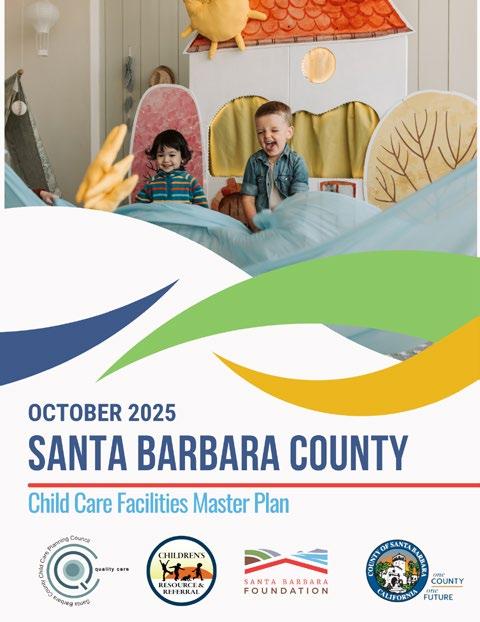
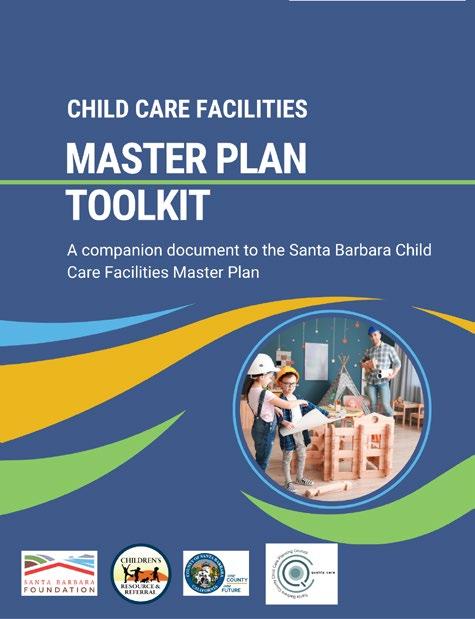
To carry this momentum forward, Santa Barbara County has developed its firstever Child Care Facilities Master Plan and Toolkit — a set of strategic, data-driven resources designed to guide long-term systems change.
This plan is the result of two years of deep engagement with providers, planners, funders, parents, and public officials.
Together, these tools provide a roadmap for action — backed by data, shaped by community insight, and aligned with countywide equity goals.


Why It Matters
• Facilities are the Foundation: No child care expansion can happen without the physical spaces to support it. This plan identifies where the needs are greatest and what types of investments are required to meet them.
• Equity Drives the Strategy: The plan prioritizes historically under-resourced communities and addresses the barriers faced by family child care providers, immigrant families, and rural areas.
• Data Meets Vision: With GIS heatmaps, cost modeling, and city-by-city analysis, the plan turns data into action — and shows elected leaders exactly where support is needed most.
• Actionable Tools for Cities & Partners: The companion Toolkit equips cities, school districts, and developers with zoning guides, facility design standards, and funding strategies to move quickly and effectively.
Now is the time to use these tools to:
• Allocate public land and capital funding for child care facilities
• Streamline local permitting and zoning processes
Sustaining Our Progress, Building Our Future
The investments made through ARPA were not just about emergency recovery — they were about planting seeds for a stronger, more resilient child care system in Santa Barbara County. We’ve seen what’s possible when we center equity, invest in community-rooted solutions, and work collaboratively across sectors. However, this work is just beginning.
To ensure all families — regardless of ZIP code, income level, or immigration status — have access to affordable, high-quality child care, we must build on this momentum with bold leadership, sustained funding, and systemic change.
Next Steps
• Fund Facilities Expansion: Secure dedicated public and private capital funding to build, expand, or renovate child care facilities.
• Support the Workforce: Expand career pathways, training, and compensation for early educators, especially bilingual and bicultural providers, to strengthen retention.
• Streamline Licensing & Permitting: Coordinate with local jurisdictions to simplify and align zoning, permitting, and licensing processes.
• Champion Mixed Delivery Systems: Ensure investments support both center-based and family child care models.
• Center Equity: Prioritize support for underserved communities, low-income and Spanish-speaking households, and those in child care deserts.
• Make It a Policy Priority: Encourage local jurisdictions and philanthropic partners to treat child care as essential infrastructure.
A Message to Policymakers, Funders & Community Leaders:
The creation of 1,599 new infant/toddler child care spaces shows what is possible when public funding meets community leadership. Every dollar invested in child care yields lasting returns for our future prosperity. You have a vital role to play. With bold vision and aligned action, we can ensure every child and working family in Santa Barbara County has the opportunity to thrive. To do so, we must treat child care as essential infrastructure — critical to our economy, our workforce, and the well-being of our communities.
Invest in children. Build up our workforce. Make child care a cornerstone of our future.