Urban development is about multiple interactions that continuously shape a territory. These might be articulated or not. This book is the first of a series of volumes in which I highlight certain actions in which I’ve been part of for contributing to the development of some cities or countries. These actions are just small bricks I’ve put into a not only a physical building, but also into a social, economic, environmental, political and demographical one within a society. It’s about flashes of urbanity that the marvelous and unique teams I worked with show to the world.
Every project, every study and every proposal exposed here are unique and have a sense by themselves, so as their linkage to the strategies set to improve the city. I give a good will that what’s written here and in the next volumes of the book Urbanita is made with excellence, honesty and a great teamwork that makes it possible. I’m excited to share my work with the world since it is the put-into-practice of my greatest passion: Urbanism.
Acknowledgements
Being grateful is something I’ve strengthened over the past few years. I believe it is important to recognize those situations and people that contribute to my happiness and my learning. Without them, I wouldn’t be where I am. I thank God first for being the director of my live orchestra, without Him my live wouldn’t be harmonious.
1
Family
To those with whom I share my genes: you’ve been essential all
my live. This year I moved to another city, and you came to visit me. My name changed this year too and you supported me. You have never let me down and always give me the best, not less. In my family there are architects, engineers, merchants, doctors and adventurers. That spark that has made you big in what you do is the same spark that burns inside me.
2
Friends
I recognize it, I’m surrounded by a lot of people. I love all of them,
although not all are my friends. My friends are those who have been there for me, I learn from them, we laugh together, drink wine together celebrating victories and they lift me up when I’m down. They inspire me and I seek to inspire them too. To you, I know I can count on you whenever, I thank you for your friendship.
3 Mentores
Those who looked into my eyes taught me a lesson. Your lessons
transformed my life, my way of seeing cities and my skills as an urbanist. They led me, directly or indirectly, towards understanding the best practices for doing things.
I didn’t have any experience, but you trusted me and treated me as an equal. You involved me in all your projects and made me part of your work team. Color Urbano is tattooed on my soul. As well as the outsider style that represents us.
From you I learned that the community is the main actor that transform cities, and it is we, the urbanists, who must work with them to make their dreams come true. Your influence has reached high levels and with your support my own city took a great leap towards beauty
www.ahof.ch
You are not an urban planner, but you are the most exemplary person I know. People first, you taught me. From you I learned to value the small details of life and to make fun of any situation. 90% of what you told me was not in words, but in actions. Excuses don’t go with you, now with me neither
https://www.linkedin.com/in/raul-marino/
Inputs and outputs, everything works this way. This, and more teachings, you left me as your university student. Sustainability is fundamental for any urban process. Thanks to you I have understood the academic and scientific world, which I previously viewed with tedium. I appreciate your trust in me to be part of your projects.
Arq. Jaime Andrés Cardona
Anton Hofstetter
Arq. Raúl Marino
Arq. John Octavio Ortiz
Projects (p. 8) - Those projects that I have led, co-led and in which I have participated with a highly important role during 2021 and 2022
Proposals (p. 18) - Those proposals (academic, on this occasion) to transform a territory
Research (p. 24) - Those outstanding studies that I have done within an academic framework
““Thus, we can agree that the idea of the right to the city does not arise primarily from various intellectual fascinations and fashions (...) but from the streets, from the neighborhoods, like a cry of oppressed people in desperate times.””
- David Harvey, 2012
PROJECTS
“I love contributing to my neighborhood. I feel like I played a leading role in it”
Jefte Mercado
Neighbourhood resident & Project collaborator
Location
Bucaramanga, Colombia - Lagos del Cacique Neighbourhood
Revitalisation of Las Mojarras Lake area
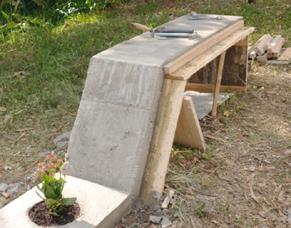
The project arose from an initiative of the community of Lagos del Cacique, of which I am part, co-led with Jefte Mercado, a neighbourhood resident. It sought to take advantage of a green space belonging to the Las Mojarras Park where many walkers stopped to observe the dammed lake, representative for having two crocodiles at the time, and its variety of species such as turtles, mojarras (fish), iguanas and opossums. This sector was in detriment due to garbage pollution, illegal fishing, insecurity and lack of continuous maintenance of the lake. It was proposed, in the first instance, to take advantage of the potential of this public space by placing urban furniture such as benches, garbage cans, bird and iguana feeders, and signage. All the furniture was designed and made by volunteers. Likewise, plant species donated by the Autonomous Corporation for the Defense of the Bucaramanga Plateau (CDMB) were planted and the periodic cleaning of this green area was ensured by the Bucaramanga Cleaning Company (EMAB).
Beneficiaries
Team
Volunteers and architecture students
Execution time
3 weeks Neighbourhood community
Client Scale
Links
Strengths
The lake is a natural attraction for the residents of the neighborhood. The installed benches are useful to people who stop to enjoy the space.
Today, there are important advances in security for the sector due to the permanent monitoring of the space by the Lagos del Cacique Security Front. However, the urban furniture made of wood (signage and feeders) is completely deteriorated and/or was stolen.
There are stairs that give access to an unbuilt path, belonging to a project left halfway by the entity in charge from the park. This generates insecurity due to the ease of crime escaping.
Due to the construction of a new metropolitanscale park at less than 1km, there is an increase in the number of visitors to the neighborhood who find this an alternative public space to which they can resort.
The regional entity that is in charge of the park, does not have a clear (much less prioritized) program for the development of the park with coverage of the lake. The setup of the place and its access continues to allow for criminal activities.
“Es un sueño hecho realidad. Son los primeros murales de la ruta de Trekkin Urbano, muy significativos”
Omar Bermúdez
Miembro de Explora BGA
(Turismo Comunitario en la comuna 14 - Morrorico)
Location
Bucaramanga, Colombia
- San Francisco Neighbourhood - Albania Neighbourhood
Type
Client
Urbanismo táctico Color Tour
The Color Tour project was led by Corporación Arte, Cultura y Ciudad, and the Color Urbano team within the framework of the lines “Made in Bucaramanga - Popular Culture BGA” of the Municipal Institute of Culture and Tourism of Bucaramanga (IMCT)
Municipal Institute of Culture and Tourism
Beneficiaries
Comunidad de ambos barrios
Team
Architects, engineers, artists, social workers and community
Execution time
3 months
Scale
Municipal City program
Links
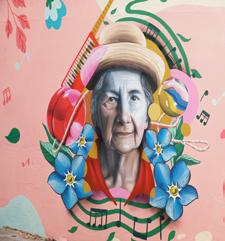
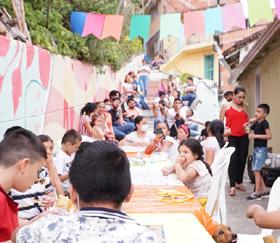
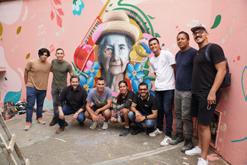
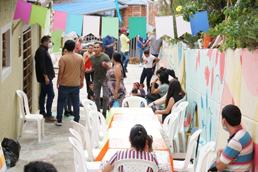
With this project, two Priority Tourist Development Zones were developed in the Municipality of Bucaramanga: one in the Albania neighborhood, in comuna 14 (Morrorico) and another in the San Francisco neighborhood, in comuna 3. In the first zone, two murals were painted collaborating with the community of comuna 14 and its tourism and cultural groups, (Explora BGA) whose participatory dynamics were based on identifying and extracting the cultural insignia of the comuna and empowering locals to co-create the mural designs and their subsequent painting. The presence of the IMCT Community Tourism team was essential for the development of the project, since a process had been carried out with the community that produced a transversal territorial diagnosis of the neighborhoods of comuna 14, as well as the formation of an urban trekking tourist route.
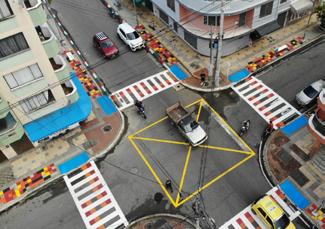
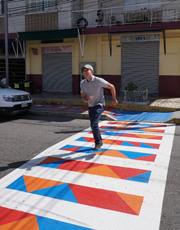
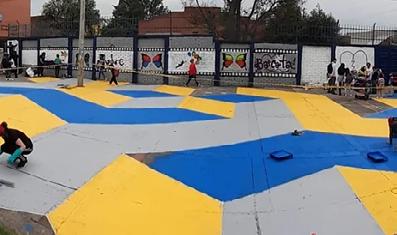
For San Francisco, a tactical urbanism was carried out with emphasis on the application of color on the sidewalks of carrera 22 between streets 19 and 21, and painting of crosswalks in the area where carrera 22 intersects with the three streets. The color intervention sought to implement a strategy of safe crossings, through the implementation of crosswalks, and dynamic crossings, by adding color between the white spaces of each crosswalk.
Strengths
The commitment of and community appropriation with artistic interventions. They participated in every stage of the production process.
Weaknesses Threats
In San Francisco there are a variety of initiatives to transform the sector with private financing, although it is not possible to reach an agreement between the inhabitants and merchants of the sector to execute them.
Opportunities
The consolidation of Bucaramanga as a fashionable tourist destination for footwear and leather goods positions the San Francisco sector as the largest reference. The growth of community tourism in the country’s main cities attracts a greater flow of tourists to Morrorico
The terrain of threat from natural phenomena on which Morrorico sits makes the territory vulnerable.
“What a nice project, thank you for Tunal II the opportunity to collaborate”
Sarah Muñoz De Felipe
Urban Management and Development Student
Urbanismo táctico Tunal II
Location
Bogotá, Colombia
- El Tunal II Neighbourhood
Type
Client
Arts District Institute
Beneficiaries
Neighbourhood community and Centro Integral José María Córdoba School
Team
Urban Mapping Agency, Hablemos de Ciudad and Urban Management and Development Students
Execution time
1 month
Scale
Local City program
Links
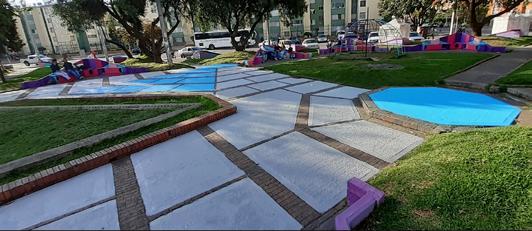
The space went through a process of re-imagination towards new narratives that allow a more enjoyable appropriation from the community. Likewise, the contiguity of the park to the school promotes the interaction of young people with public space
The tactical urbanism carried out in the Tunal II park sought to redefine the public space of the sector, which had problems of insecurity, lack of appropriation and lack of attractiveness for the children’s population and the community in general. The initiative was carried out within the framework of the Second Edition of the Brave Arts Festival of the District Secretariat of Habitat and IDARTES. The design of the proposal was carried out by the Urban Mapping Agency, in conjunction with the community, which expressed their opinions through an online survey that collected information about the colors, concept and elements that they wanted to see in the floor paint of the park. Likewise, workshops on urban imaginaries were held in the school next to the park and information campaigns on environmental conservation initiatives such as digester bales in the green public space. A co-creation methodology was followed with the community in search of appropriate expressions and tactics (actions) to intervene in the space and express in it, through different artistic and environmental interventions, the sense of identity and appropriation of the space by the community. community. The requalification of public space versus the private public space of closed complexes will be of vital importance, promoting the integration of these spaces with the urban structure and the social fabric present in the area, especially with vulnerable groups such as children, women, older adults, people with disabilities and LGBTI population.
(Marino, 2022)
The lack of good lighting coverage at night promotes a perception of insecurity towards this space.
There is a bet of the District on the improvement of public spaces on a local scale through low-cost artistic interventions. Likewise, the space has large spots for holding fairs that promote local businesses
The presence of closed residential complexes in the sector is a threat to relationship of the community with public space due to the marginalization of inhabitants, increasing the perception of insecurity and stigmatization towards public parks
“We were creating a culture so that people understood respect for pedestrians and zebras. It is cool to be able to start creating this culture that little by little will evolve.”
Manuel Galán
Participant
Location
Bucaramanga, Colombia
- Cabecera neighbourhood
- Mejoras Públicas neighbourhood
Type
Client
Crosswalks BGA
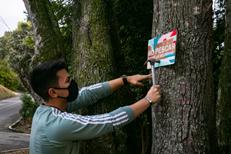
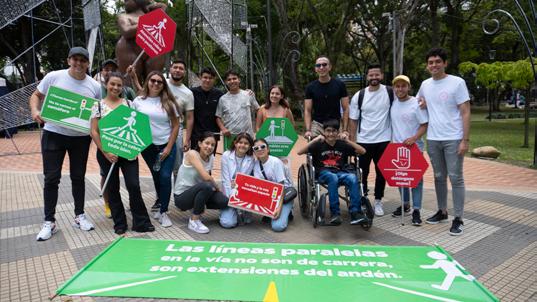
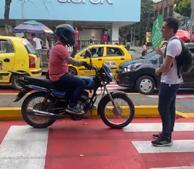
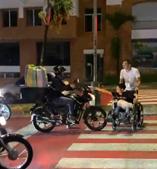
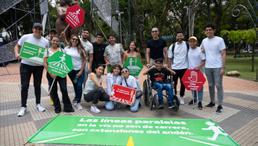
Crosswalks BGA campaign was co-led with nonprofit Alive, with support from the audiovisual company Amazing, and consisted of three activations in which we became mobility agents for a day, carried out in three critical mobility points in Bucaramanga. When the traffic light was red, for a period of 30 minutes, the volunteers showed posters, banners and traffic signs with messages that the community suggested to us through an open survey that we shared on our social media. A child in a wheelchair was passed through the crosswalk to raise awareness among drivers about how important it is to leave the pedestrian crossing clear.
Municipal Institute of Culture and Tourism
Beneficiaries
Conductores y peatones
Team
Fundación Alive, voluntarios
Execution time
7 días
Scale
Local City program
Links
Strengths
The volunteers of the activities developed a big appropriation for the signage. The drivers of the vehicles (offenders) corrected their attitudes with good will when asked respectfully. The dynamics of the activity were well received by citizens.
The activity turned out to be a success in controlling mobility for a day and giving a clear message to drivers and pedestrians about how important road culture is in a city. Many people that did infractions, upon receiving the message, acted almost immediately to correct this attitude.
Weaknesses Threats
Insulting attitudes towards offenders, promoted by multiple actors influential in the city, promote division and disrespect among citizens and do not contribute to improving the problem.
Opportunities
It is important that this dynamic continues for at least a year and that the audiovisual content related to the initiatives goes viral. Many people are willing to collaborate with the cause and there is institutional will to continue taking corrective measures to promote road culture
The lack of respect for authority and/or traffic devices is an attitude present in the four municipalities of the Area. Metropolitan.
PROPOSALS
Plaza Pinilla
Re-Design
Barrancabermeja, Santander
Available here (Spanish version Only)
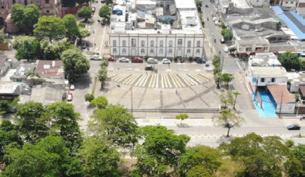
Luis Pinilla Rueda Square is an emblematic space for the city of Barrancabermeja, the oil capital of Colombia located in the Middle Magdalena sub-region, in the center of the country.
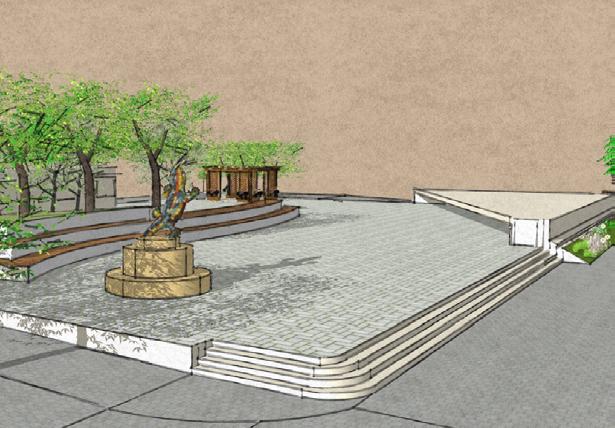
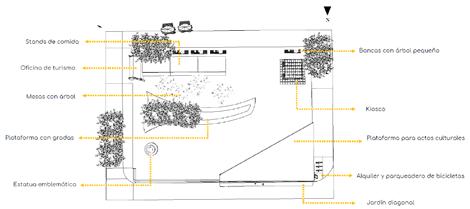
Without being an architect, I had the opportunity to propose design elements for Plaza Pinilla, behind the Barrancabermeja Mayor’s Office, that take advantage of the opportunities of the territory. As an academic exercise, a diagnosis was first carried out in which the problems and opportunities of the plaza were identified, to finally offer a design that incorporated certain
essential elements to be taken into account when designing this plaza. The food stands, tables with a tree in the middle, a platform with stands, a platform for cultural events, benches with trees, paving stones that absorb heat and water, a diagonal garden, a kiosk and a place where you can rent and park bicycles are the elements proposed to be incorporated into the plaza. Finally, the tourism office represents a potential site for finding out information related to cultural activities and the tourist agenda in the district.
Re-inhabiting the Pacífico
Tumaco, Nariño
Available online (Spanish version Only)
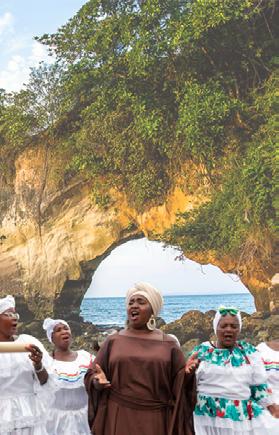
The Colombian Pacific region is characterized by its diversity, not only in species and ecosystems, but also in culture and gastronomy. The municipality of Tumaco has broad virtues with development potential. However, there are a variety of problems that have hindered the territory’s sustained growth.
In this academic work, presented to the sociologist and urban planner Armando Durán, the vulnerability of the territory is characterized in terms of natural phenomena and disputes, as well as its potential. In this way, and following a series of development theories (such as
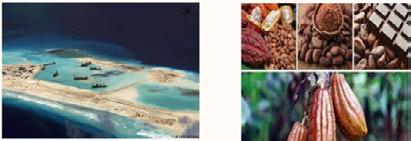
endogenous development, ethnodevelopment, sustainable development, among others), a development approach was proposed for this municipality bordering Ecuador in which its growth is aimed at resolving socioeconomic inequalities with the following two drivers: artificial islets and agroindustry.
The development of new planned islets is relevant as a risk mitigation and opportunity for socioeconomic regeneration, as it will allow solving problems associated with the risk of tsunamis, earthquakes and liquefaction; while new direct job opportunities appear in the construction of the islets and indirect with the potential presence of commercial establishments
erected on the new land. This would work if, and only if, an offer of technical knowledge is ensured to the Tumaco population around multiple fields of territorial transformation and advice from professionals and experts mainly in the development of gastronomic businesses, hired by public-private actor Cámara de Comercio de Tumaco, to support the consolidation of new sustainable business models.
Agroindustry consists of the development of new productive activities on agricultural land and its industrialization. A product of great value and quality in Tumaco is cocoa, which has demonstrated its ability to be sustainable in an international framework. Cocoa can be planted, harvested and industrially transformed into products suitable for consumption, essential in international markets. By having a port, the municipality has the physical accessibility to export it directly to other countries in the Pacific. It is extremely necessary to begin the agroindustrial dynamic with trade agreements that promote the improvement of the quality of life of producer families as long as the oldest have a decent pension and the youngest have quality education that expands their freedoms.
Research
Layer-mapping - City Centre
Bucaramanga, Santander City Centre
Available here (Spanish version Only)
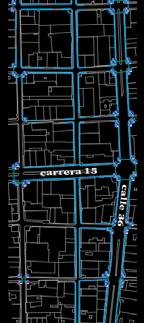
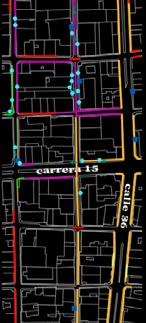
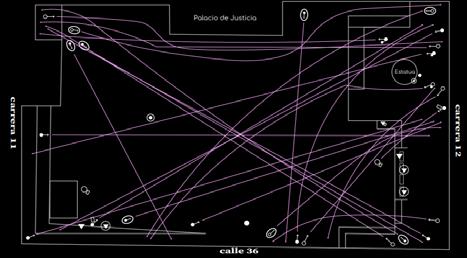
A cartography and analysis exercise was proposed in which various components of a territory were addressed and delimited by a street as a central axis and a block at each side of it, including all its other streets. This territory was called Urban Transect and it is the area to study, no more, no less. They are used as a laboratory to explore these issues.
Urban morphology is the study of urban spatial form: the assembly of buildings and public spaces that make up the city. A map is the graphic representation of a territory and is made according to the need for representation required by the information you wish to transmit. In this way, the analysis of the city can be carried out
in more coordinated and agile ways, because the data distributed in an illustrated space such as the map provides a better understanding of the territory to make interpretations and thus draw more accurate conclusions on specific topics. In urban design, layers often include building footprints, size and types of public spaces, surveillance, uses, functions, infrastructure, movement networks, densities, street life and character.
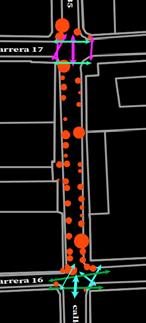
The study area was visited several times during the exercise, in order to map different layers of data resulting from the field exercise. This data collection took place quantitatively with an application called CounterPoint, which allows counting from any mobile device by simply
pressing touch buttons that record a specific data in the counts. The counting of activities was also done through this mobile application, however, a paper template and a pencil were used to trace the flows made by the users of the public space. To analyze morphological data, national databases such as DANE were consulted and the data of the most recent diagnosis of the municipality of Bucaramanga was investigated
through the accountability of the administration for the period 2016 - 2019. To analyze the urban interfaces and public space (accessibility, signage) a video was taken of both sides of each street within the transect and then the information was generated through the processing of data extracted from the videos. For the qualitative data of the sensations, georeferenced annotations were taken of what was experienced in each street
of the transect while the routes were made to compile the other information. Finally, Adobe Illustrator and Qgis software were used to map and illustrate.
Water-sensitive Cities
I large cities present an exponential growth that has not been seen before. By 2050, according to the UN, 68% of the world’s population will live in some urban area (Around 6.68 billion people). Particularly in Colombia, the urban population by 2050 will be 47 million people, a little less than the current total population of the country (DANE, 2018). The data above implies that urban systems must be reviewed, not only to find existing problems and their possible solutions, but also the opportunities to adapt to changes to generate resilience in cities. With this
in mind, we seek to identify the shortcomings of urban systems and identify opportunities for improvement.
In this sense, we seek to have a clear idea of how to improve the city’s systems through the implementation of sustainable and broadly environmentally friendly technologies. One of these technologies is Sustainable Urban Drainage Systems (SUDS), used to collect rainwater in cities, cleaning it, storing it and redistributing it, expecting to take advantage of it for later uses within the city.
This research aims to characterize some urban systems associated with the provision of water
Bogotá, Bucaramanga, Cartagena Project leader
Arq. Raúl Marino
in public space and its operation in three Colombian cities with different altitude, climate, and urban morphology: Bogotá, Bucaramanga and Cartagena. Likewise, a characterization of 3 ideal scenarios was made for the location of sustainable urban drainage systems in each study city. For each city, a space of an informal nature was chosen, one of mixed use and a consolidated public space that is part of the public space structure.
Color Urbano team in 2021
Opening dinner event organised in Albania neighbourhood next to the new mural we made
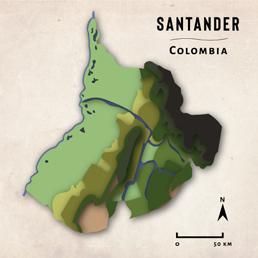
Santander’s department altitude map without conventions
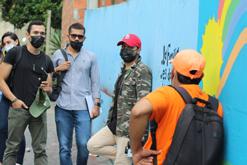
Volunteers (civic culture agents) from Crosswalks BGA campaign
Design team of the mural made in Comuna 14
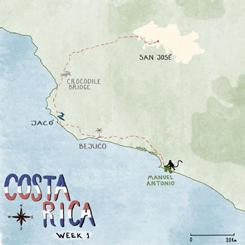
Trajectory of the week 1 of my trip to Costa Rica in 2021