SAND Journal Willibald-Alexis-Str. 16 10965 Berlin Germany info@sandjournal.com www.sandjournal.com Connect with us for news and events: Facebook: SAND Journal Twitter: @sandjournal Instagram: @sandjournalberlin ISSN 2191-429X Copyright © SAND Journal, May 2019 All authors, translators, and artists retain their copyrights to the respective works.
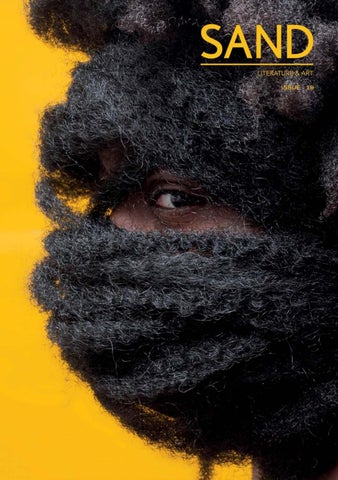
SAND e.V. is a registered nonprofit association (gemeinnütziger Verein) under German law. Designed by Bárbara Fonseca Printed in Latvia by Jelgavas Tipografija on Cyclus 90g paper Fonts: Spectral by Production Type, Sporting Grotesque by Lucas Le Bihan Cover image: “Hair Vigilante” by Vicky Charles Quotes from song lyrics contained in “Editor’s Note,” “Citizen!,” and “Lashes” fall under fair use according to German copyright law. Attributions for the relevant quotations are as follows: “Somewhere” written by Leonard Bernstein and Stephen Sondheim for West Side Story (1957). “Wave of Mutilation” first performed by The Pixies (1989), written by Black Francis. “Little Animals” first performed by The Ravonettes (2003), written by Sune Rose Wagner. “Night Drive” first performed by Jimmy Eat World (2004), written by Jim Adkins. “Mr Brightside” first performed by The Killers (2003), written by Brandon Flowers. “Soft” first performed by Kings of Leon (2004), written by Caleb Followill. “All Cats Are Grey” first performed by The Cure (1981), written by Laurence Tolhurst, Simon Gallup, and Robert Smith. “Disorder” first performed by Joy Division (1979), written by Bernard Sumner, Peter Hook, Ian Curtis, and Stephen Morris.
2
Editor’s Note
Out of Place JAKE SCHNEIDER
“All my distances point to home” — King Llanza
→ 96
From “Somewhere,” West Side Story
In this apprehensive time, the conversation keeps returning to who belongs where. In December, a multilingual poster appeared in my local Berlin U-Bahn station, courtesy of our newly renamed “Homeland” Ministry, with the tagline: “Your Country! Your Future! Now!” The former Interior Ministry was advertising a program that pays people to leave their homes in Germany and return to other “homelands.” So much for Willkommenskultur. After seven years here, I thought I already was in my country, living my future – right now. In February, Fatma Aydemir and Hengameh Yaghoobifarah released a brilliant volume of essays by a dozen prominent members of German society – who are also members of religious, ethnic, and/or sexual minorities often omitted from the national narrative.
Edito r’ s No te
The book’s German title means “Your Homeland Is Our Nightmare,” and it is dedicated, with deliberate ambiguity, to “us.” Out of their shared sense of doom, both the Homeland Ministry and its naysayers drew lines between us and you, changing the subject from diversity to place. The widespread impulse to sort like with like goes both ways. It’s not the sole province of nativists barricading their birthplaces against newcomers, who they fear could displace or “replace” them. For their own part, outliers often wall themselves in: a turtle-like defense mechanism. When I’m traveling, I find it comforting to walk into a synagogue or gay bar and to know the tunes by heart. The comforts of coming home to eccentric Berlin are less specific but no less palpable. So many of “us” supposed anomalies grew up imagining a more welcoming enclave, a zone of elseness populated by sore thumbs just like ourselves: maybe a queer mecca, an artists’ colony, or an ancestral land where our faces and names would blend into the citizenry. Then again, enclave dreams recreate the same segregation that gave us our original loneliness-in-a-crowd. They simply leave out someone else. This issue is loaded with incongruities we would be tempted to label “out of place.” Sore thumbs and misfits, hermits and dreamers, immigrants and local-born loners. Yet to say that they exist at the margins is, once again, to restrict their worlds to one page. Perhaps “out of place” doesn’t mean “in the wrong place,” after all. Perhaps it’s an invitation to leave “place” altogether, to set aside the quilt of geography and find another pattern, another set of connecting threads. Here are a few isolated examples from the issue: A ham-radio hobbyist explores their identity in Germany; some of the neighbors are tuned, tragically, to another frequency. →
40
A Bangladeshi-American essayist ponders the intersections of sex, culture, and religion.
→
→
84
A poetically censored report from Mexico gives us clues about a disastrous wrong-place/wrong-time scenario.
→
→
37
A young American man shuts himself in his bedroom for years, culturally appropriating a Japanese epidemic of self-seclusion. →
10
In a poem inspired by an article from The Journal of Molecular Biology, the surname “Okazaki” becomes a recurring genetic fragment whose function we cannot immediately place.
→
81
In another unknown dimension, we struggle to classify an “electric nosferatu.”
→
→
→
In a pharaonic, otherworldly realm, we’re the outsiders. → 47,
121 61, 120
A Brexit-era Briton explores a free-trade zone peppered with borderless brand names.
→
→
→
49
And on the cover, Vicky Charles wraps her hair around her face, locking eyes with us through her self-imposed cage. • •
What unites SAND #19 is a sense of dissonance and disconnection, whether in Greenland, Nigeria, or Iran. The place is beside the point. As usual, we haven’t announced a theme in advance – the anomalies just fell into place – so some of the works we selected might relate to this theme more than others. By that logic, the exceptions are “out of singularities. “Even on this roof, the grass trembles / in the wind” (→27). The grass has found higher ground. It isn’t going anywhere, and neither are we.
Ja k e S ch n eid er
place” themselves. Let us appreciate all of it, the universals and the
8
Carlo Andre CRTL+
+DEL
40
Florian Wacker trans. Rachel McNicholl MOUSE
10 22
Luke Muyskens ENDLESS SOAK
trans. Rebecca Ruth Gould
MOURNING THE BIRTH OF IMAGE
27
Rosaire Appel MATHEMATICAL WEATHER
trans. Rebecca Ruth Gould Kayvan Tahmasebian
WILD GRASS
48
Candice Nembhard
49
Christian Brookland
57 58
PEACHES
THE IDEA OF PERMANENCE
SUNSTROKE
CITIZEN!
Rosaire Appel WEATHER
Trace Howard DePass NEW AMERICAN CONSTITUTION (TERMS & CONDITIONS)
SOMETIMES THEY FALL FROM
61
Lisa López Smith
Marc Cohen THE INTELLIGENCE OF THE EARTH
FROM THE AYOTZINAPA INVESTIGATION REPORT
39
Marc Cohen
Jeffrey Gibbs
THE SKY
37
47
Bijan Elahi
&
28
Lindsay Costello
Bijan Elahi
& Kayvan Tahmasebian
26
46
62
Rowen Foster DON’T KNOW WHAT TO
Uma Menon
DO WITH VIOLENCE SO
SPOKEN LANGUAGE
I PICK AT MY LIP
64
Art Section VICKY CHARLES
118
Hussain Ahmed MAGHRIB
SARA ANSTIS AVANTIKA KHANNA HENRY CURCHOD
119
Marie Lundquist trans. Kristina Andersson Bicher
81
Kanika Agrawal
UNTITLED
from OKAZAKI FRAGMENTS
84
Marina Reza
96
King Llanza
120
Marc Cohen
121
Andriana Minou
SUNSET DANCE
LASHES
AN ANNIVERSARY
4TH OF NOVEMBER
97
Joshua Bohnsack
107
msw
123
MY SECOND ENCOUNTER WITH ABANDONMENT
LAZY EYE
ALLUP IN MY DREAMS, #1
Alyssa Ripley
124
Arianna Reiche
132
Marta Helm
NOTHING MACHINE
(FEATURING OCTAVIA BUTLER)
109
Rosaire Appel
110
Helena Granstrรถm
TOOLING AROUND THE KEYS
trans. Saskia Vogel WHAT ONCE WAS
POEMS ARE LOCATIONS
Fic t io n
Endless Soak LUKE MUYSKENS
twenty-five women. one man. five thousand bottles of champagne. There are no cameras. The girls face a dense, velveteen block of red. It doesn’t matter. Aliyah, Alex, Amberlee, Anne, Becky, Beverlee, Cari, Celine, Elisa, Jayne, Jessie, Kelly R., Kelly T., LaTonya, Liz, Martzia, Molly L., Molly R., Nicole, Penelope, Renee, Samantha, Sarah, Sara, Veronica, and Zara matter, their eyeshadow is of consequence, their dresses have weight. the next seven weeks will be spent here, in our wine country estate, where these twenty-five girls will vie for the eyes and seed of one purebred hunk. and who better to mediate than yours truly? Ty’s voice is strong and luxurious, like an oak door. His suit is Italian or French and his imposition on the world is welcome. Who better, truly? i am ready to separate cat fights and, if necessary, punish our contestants with a playful spanking or two. he delivers a charming wink. all kidding aside, we’re here to find love. aren’t we, ladies? The ones who aren’t caught preening give dutiful nods. Ty is momentarily overwhelmed by the collective glamour of these women. As a unit, they embody the verve, glitz, and polish to which all girls aspire. His eye is trained, however, to recognize defects. Small scars and blackheads fighting through foundation make the presentation of their bodies pornographic. this season’s hunk is special. some variety of doctor/marketing manager/entrepreneur whose enamel we have inspected and whose parents’ pedigree we guarantee. girls, you have so much
10
11 to lose this time. you cannot afford to let your posture go slack. The lights are hot, they blind, the candles burn, the torches burn. ladies and gentlemen, welcome to the bachelor. Fans everywhere admire Ty’s grace and poise. While the twenty-five women sweat and grind their teeth, Ty moves with the fluidity of something more natural and confident, a jet stream. The universal envy for his ease gathers in the atmosphere, condenses into rain, and pours on every nation. • •
Night. Morning. Ty folds his shirt and places it in a wicker basket. He steps out of his sweatpants and puts them on top. Covering himself with a small towel, he walks from his bedroom into the bathroom. Onsen cannot be fully accomplished outside a bathhouse, but Ty replicates the Japanese ritual to the extent he can, performing kakeyu in the shower by pouring hot water over his body with a measuring cup, something like a short prayer. He then climbs into the steaming bath. Water quiets his body, dissipating the static and stress in his joints. Uniformity, he sinks. Underwater, sense is limited to thumping noises and broad pressure on his skin. Ty dries himself with a warm towel, dresses, and returns to his room, which remains unchanged. Afternoon. Evening. Night. Morning. Afternoon. Evening. Night. Morning. Afternoon. Evening. Night. Morning. Afternoon. • •
ty? His mother, Edna. how are you doing today? A response is not expected. She is magnificent, an institution of culture and care who deserves a progeny, not a polyp. your groceries are in the bathroom. Pause. i got you some mochi from whole foods. green tea flavor. i read about it online. enjoy,
E n dles s S o a k
ty. please. The door choking her voice is impermeable, less of a portal than a continuation of the wall. It has not been opened in three years. Ty hasn’t crossed its threshold in four. Edna delivers his groceries through the bathroom, which has openings into both his room and the hall. i’m going to work now. i’ll be at the university if you need anything. A professor, an intellectual at the helm of her field with him, a useless skin tag on her legacy. Do her coworkers know? Ty assumes shame, omission. i tried the mochi. it’s good. please have some, ty. The window seems a more possible escape than the door. It’s occasionally opened to the air twelve stories over the park’s brain-crushing streets when Ty finds his energy focused and forward. goodbye. He cracks open the world and tries to find something, anything, within himself. • •
In the bathroom, Ty opens the bag his mother left and pulls out chicken stock, soy sauce, Top Ramen, sliced pork, baby spinach, eggs, dried nori, and shallots. In the medicine cabinet he finds garlic powder, ginger powder, chili powder, and five spice. The bathtub holds an electric cooking pot, in which he combines the stock, soy sauce, and seasoning. He adds pork, egg, and vegetables. Once everything has cooked, Ty tastes. No. It’s not the same, it must be the same. Sugar. He adds sugar and relaxes. The same, every day, the same, one meal at four, always. He will not eat the mochi. • •
below them is a pool of mud. they must cross the monkey bars while our audience pelts them with eggs. Ty commands a group of goonish Midwesterners who’ve won sweepstakes. They wait with fistfuls of eggs and yellow smiles, unexamined
12
13 bodies peppered with age spots and acne. The show’s participants, in contrast, are hyperaware of their myriad shortcomings. For this challenge, the girls are dressed in glittering bikinis that show off their augmented figures. The group has been whittled down to Aliyah, Alex, Beverlee, Cari, Celine, Kelly R., Kelly T., Martzia, Molly L., Nicole, Samantha, Veronica, and Zara. They shiver, nipples protruding from layers of foam and Lycra, pointing across the mud to where the bachelor lounges with a daiquiri. after this challenge, the girls will accompany our bachelor on a group date. here’s the catch – they won’t have an opportunity to clean themselves before. the girls who fall into mud will visit d’alonso’s, a five-star italian eatery, looking like pigs in slop. Ty stands in between, pleasantly realized. Only within this fantasy can he find something resembling stasis. • •
A blink is the first withdrawal, an almost immeasurably minute cloak under which you’re free from the persecution of sense and socialization. Some consider the eyes windows to the inner life, but since an early age, Ty has found them to be portals, passageways, and the eyelids their doors. The same way he toddled around the house closing every cupboard and shutter, he sat through dinner, church, school, and television commercials with his eyes shut. These small moments alone were an introduction to more total isolation. Time-consuming shits, walks along the lakeshore, evenings in his bedroom. Once, when Ty was an early teen, he didn’t leave his room for a twenty-four hour period. He found it could be done. Withdrawal offered its full then more, then he was swallowed, then now. • •
L uk e M uy sk ens
mouth, and years later, one day became two, then five, then a month,
E n dles s S o a k
Ty's avatar leaps from behind a bunker and sprints toward the ops. Headshot, headshot, headshot, headshot, to the neck, to the chest, headshot, kill streak. hikiki69 is on fire! get ʼem, bro! Endorphins bubble through Ty’s spine. to the fuckin’ dome. His headset microphone is deactivated. It’s not that Ty can’t speak – he fills the day with little vocal aphorisms, narrations – it’s that his voice has become not a tool but a compulsion serving only himself, and its volume has diminished to where he can barely be heard. After a close call in PlayerUnknown’s Battlegrounds, he’ll sometimes make an audible sound of relief. That’s all. to the north! dude to the north! get his ass, hikiki! Change guns, sniper. Fire, reload, fire, reload, fire, reload, fire, reload. Got him. Ty is playing alongside Florida high schoolers against a team from Japan, a country that makes more sense to him. He regularly consumes anime, manga, and hentai. In high school, Ty excelled at judo, and he sometimes wears his white judogi in the morning. And, of course, Japan is home to a million compatriots – the hikikomori, confined to their rooms like Ty. The knowledge of others, a neural network of brains with similar insufficiencies elsewhere in the world, has kept Ty alive. Their message boards and newsletters are a method of deferring blame. One does not point fingers at the dead during an epidemic. kill
him! Japanese players come on the mic and chatter. 地獄へようこそ!
私はあなたのお尻を殺すつも りです! They swarm, neutralizing half the American team in moments. Ty hides in a bombed-out building. They spot him. 誰かがその dōtei を殺す! Ty only knows a handful of words picked up through osmosis, one of which is dōtei – a male
virgin. 彼を殺せ! 彼を殺せ! Their tone is playful and competitive, but Ty feels a pang. Sex and romance seem, to him, like unifying elements of life that are unfamiliar to him. Unlike the mundane experiences he’s missing, he imagines sex holds answers. Why else would everyone talk about it so much? Though he’s not technically a virgin – there was a short-lived fling his sophomore year of high school with a commanding senior – Ty is involuntarily celibate
14
and feels the word “virgin” encapsulates him. These Japanese kids have lifted a rock to watch him squirm like a pill bug. He is gunned down and chooses not to respawn. hikiki69! what’s wrong with your dumb ass? For a moment, Ty forgets where he is. The room is incidental. A crushing. • •
Ty’s fortitude of will allows his situation. Someone weaker might not withstand the monotony of meals, the frigidity of a captive body, and the spooling and unspooling of time that occurs in limitation. Hikiki are not agoraphobes. They are motivated by futility and annihilation. A regimen is critical, and as part of this, Ty only allows himself to masturbate once a week. The internet being a bottomless pit filled primarily with porn, disappearing in it would be easier than putting on a hat. With a towel and a bottle of lotion nearby, Ty steadies himself. First, he opens his email. from: edna.williams@uchicago. edu. subject: a proposition. She rarely contacts him like this. Changing mental gears, Ty clicks. dear ty, you’ve made the bathroom into such a lovely spa. i hear you soaking for hours. sometimes i worry, but mostly i’m happy you have something to do. so i’m making you an offer – i will buy you an indoor hot tub. find one you like on amazon. Ty is filled with effervescence. A real spa could bring the peace he craves. True onsen. in return, i want you to see a specialist. she practices emdr – eye movement desensitization and reprocessing. it works wonders. feel free to research
• •
L uk e M uy sk ens
on your own. love, mom.
E n dles s S o a k
He’s in a chair, lit from the side in blue, electrodes taped to his chest and forehead. Behind him is darkness filled with the static electricity of bodies. Opposite him are Aliyah, Cari, Kelly T., Molly L., Samantha, and Zara, electrodes fixed to breasts almost popping from tube tops. The lights turn pink and rise to reveal a room of squinting eyes, and in front of them, Ty, wearing an immaculate suit hewn by Tom Ford himself. He smiles. ladies and gentlemen. welcome to the hour of judgement. the hour of truth. There are murmurs. Speculation. Who will expose and embarrass themselves? What skeletons will they find? As always, Ty is not the focal point. They’re here for these girls, their desperation, the bachelor’s oblivious, gleaming abdomen. The host is simply a reference point of normalcy to compare against these maniacs. our bachelor will now interview the contestants about their families, romantic history, criminal records, fetishes, murderous impulses, physical abnormalities, and pets. if he can stomach what he unearths, they stay. Ty turns to the audience. Men, women, and those in-between only here for carnage. Why does Ty place himself in these shoes, this suit? Grace? Power? No. He’s delivering the gift of entertainment. before we begin, i have a special treat for those in our studio audience. each of you will be going home today with a brand-new sundance kingston luxury hot tub! The room explodes with enthusiasm, hands clattering, teeth beaming. Ty brings them down with a gentle smile. The role of a host is service – something Ty was born for. • •
you aren’t required to speak while the machine is activated. just look for your target and allow your mind to move freely. i’ll stop the machine after a few min-
16
17 utes and check in. how does that sound? Ty nods and squirms on the edge of the tub. They’re in his bathroom, an antechamber less precious than his bedroom, and still the intrusion pries apart his comfort. The specialist flips a switch and the nodule in Ty’s left hand clicks, like those small rubber domes you flip inside out. The right one clicks, then back to the left. Deep inside his brain is an empty suitcase. He’s trying to fill it with a target defined by the specialist – his early bouts of isolation, more than four years ago. Ty sees himself meandering through each day without spine or regimen, shuffling, drawing, crying, bored, dying, and regenerating. The clicking stops. ty? what did you find? Before speaking, Ty tries to plan the volume of his voice. Still it comes out far too quiet. not much. just regular stuff. no trauma? nothing like that. things are better now. how do those early days affect your life now? not having anything to do taught me how to do nothing, I think. The therapist sucks her teeth. She reactivates the machine. Ty returns to his internal search. She wants to find some awful happening that shocked him into isolation. She won’t like the truth – that no such event exists. maybe you’ve blocked it out? no, I don’t think so. He digs in earnest. He wants to change, maybe. were you beaten? molested? attacked? There is nothing to put inside that suitcase, it remains empty. If there were something to put inside he would – he wants that weight, that accompaniment, but there is nothing to block or protect himself from, nothing but air. • •
Before the workers come, Ty constructs a temporary wall of blankets access to both sides of the wall between his bedroom and bathroom, Edna had explained via email. He used a whole roll of tape to fix the blankets to plaster, yet the prospect of his wall coming down fills
L uk e M uy sk ens
to cordon off a corner of his bedroom. For installation, they’ll need
E n dles s S o a k
Ty with palpitations. Recovering from the specialist’s intrusion had taken hours of onsen and she was only in the bathroom. When the men come, the sound of their exertions penetrates the barrier. Water rippling, pouring, screws and hammers, a drill. Ty worries they’re fucking up his bathroom. Where, then, will he practice onsen? Where will he prepare meals? From their voices, he counts only two men. Ty leans against the wall to hear. gimme the crescent wrench. you got a tile knife? Ty is drawn to the bass and resonance of their voices. He leans a little too far and the blankets pull down. no. Ty feels penetrated, a foreign object inside his body. The men look. They look at him, two men looking at him, looking. Before panic can collect into anything of substance, one speaks. i thought you was shia labeouf for a second there, bro. • •
He will not do it for his mother, though her kindness and patience are appreciated. He will not do it for his own happiness, because his mind and body are begging him not to. Ty will leave his apartment for one reason – he is beginning to want, for the first time in years, an audience to his life, a witness. Not the scrutiny or interrogation of the specialist. Something more like the hot tub delivery men. They didn’t want to dig, they wanted only to see him. Ty is still roiling with pleasure from the case of mistaken identity. He has no illusion of potential – he’s already purchased tickets for Avengers: Infinity War at Harper Theater and will not be required to interact with anyone but a machine. Fifteen minutes to walk there, twenty minutes of previews, two hours and forty minutes of actual film, and fifteen minutes to walk back. A quick three and a half hours of being seen, no more. Ty puts on jeans that are surely out of style, a Neon Genesis Evangelion shirt, and chunky Airwalk shoes. Feeling the need for more walls, more barriers, he dons an unseasonably warm coat.
18
19 Good enough. The door is still too much so Ty leaves through the bathroom. The sparkling, boiling, untouched hot tub will be his reward upon returning. He steps through the door, a movement which for him has incredible weight, a gigaton. After four years in the hole, that step is more than pulling teeth – it’s pulling bones. The walk to Harper Theater is not so bad. He puts on headphones and blasts through. excuse me sir, can i bother you for— got good weed, good weed— morning, son— who this nerd think he is?— watch your step. A storm of sensation and proclamation scraping against his brain, taking away its protective coating, and then it’s over, and then he’s there, slumped into a scratchy plush seat before an expanse of white, waiting. The movie begins. Ty is here, doing this. The screen is unbelievably large – were they always this large? – encompassing more than his entire bedroom. Stars and heroes populate its immense space as the action begins: this is the asgardian refugee vessel. we are under assault. Ty wants to watch the movie but his mind is buzzing with thrill; he has envisioned this moment for years. A monumental accomplishment. A villain speaks to him from the screen: you may think this is suffering. no. it is salvation. universal scales tipped toward balance because of your sacrifice. smile, for even— The sound cuts out. Heroes and villains fight in silence. What is happening? The theater lights go up. Ty sinks into his seat. Exposed. Other moviegoers look at each other in confusion. Still fixed on the screen, Ty feels someone in the next row turn and look at him. The lights are not meant to be on now. He is not meant to be seen. ladies and gentlemen, we are experiencing technical difficulties. Technical difficulties? This can't be happening. Not in this moment. we apologize for the inoffice. No. It was not supposed to be this way. Order the ticket, walk to the theater, see the movie, walk home. There was a plan. Ty’s mouth has gone dry. His muscles are rigid. Box office? Refund? The
L uk e M uy sk ens
convenience. your tickets will be refunded at the box
E n dles s S o a k
others are getting up and trickling to the exit but Ty cannot move. Maybe, if he waits long enough, the movie will restart or another will begin. Waiting is something he can imagine. Something he can manage. He remains in his seat for a long time, long enough to lose track, until it’s clear there will be no more movies. Nothing will ever happen. And still he waits. • •
tonight, only two remain. kelly t. and zara compete for the devotion of our handsome bachelor. they have come so far this season – through arguments, fights, and two attempted poisonings – all for a shot at true love. by the end of this six-hour special, one will receive a rose, and – fingers crossed – live happily ever after. The monologue plays in Ty’s head as he soaks. Powerful jets massage his shoulders and back, working away the lactic acid buildup from the stress of his excursion. The temperature is a tropical 102 degrees and he will never leave. Kelly T. looks stunning in a Rosie Assoulin gown, yellow and lace framing her exquisite Pilates body. Zara looks a little ridiculous in an Alexander McQueen ruffled mesh gown, spilling out of her doll-like dress. Kelly trembles in adorable, anxious anticipation while Zara is more poised than a captain, eyes like Adamantium. Ty has no horse in the game – he’s a professional. Whoever wins, there will be another season, a fresh batch of girls will arrive, the contestant will be replaced, and the mansion will be remodeled. The only constant in this game is Ty, the dependable host. For twenty-five seasons he has ushered these fascinating specimens, and he’ll continue to do so until the world burns or the public loses interest. He sinks under, letting the uniformity of water encapsulate his skin. Ty cannot think of a single bad thing that has ever happened underwater. He opens his eyes. The room is a blue
20
21 blur, all sound is his breath, there is no smell. He is enclosed and can think of only one reason to surface. The oxygen in his lungs is expiring. as always, i’m ty williams, your dashing host. welcome to the bachelor. He fights, but it must be done. Ty
L uk e M uy sk ens
breaks the surface and breathes.
Ro s a ire A p p e l , " M a t hem at i cal Weat h er, " 2 0 1 8
26
Po et r y
27
BIJAN ELAHI TRANSLATED FROM THE PERSIAN BY REBECCA RUTH GOULD & KAVYAN TAHMASEBIAN
Wild Grass In memory of green it is green. Never say it is green. The grass greens to say it can green. Never say it greens. Never in the ruins. Never in the garden. Never say it’s trapped, never say it’s free. Even on this roof, the grass trembles in the wind. Wild grass is wild grass. Otherwise, it’s nameless.
Fic t io n
Sometimes They Fall From the Sky JEFFREY GIBBS
Anxiously, she watches the two men in wolf masks confer in front of the Burger King where she first tried to call her blind date, Aram. They scan the street, their animal heads moving in unison, snouts lifted slightly up. It’s like they’re trying to catch the scent of the fading electromagnetic waves. The masks are overly large and the features exaggerated in the manner of anime characters, but they are covered in real fur, coarse and brown, and there’s a white screen over the eye holes. Both men are slim and wear black pants with black jackets over silk dress shirts. One sports a thin black tie, the other leaves his shirt open at the collar to reveal a hairy chest. Her gaze follows them in growing alarm as they walk up the street and pause one more time in front of the ATM where she withdrew cash and texted: “Where R U?” The masked men head toward the Mavi Jeans store from which she’d sent her final frustrated “I’m outta here in 5,” and now she’s almost certain they’re coming for her. From there, they will look across to where she’s sipping coffee out of a to-go cup on the patio of one of the new hipster cafés, the five minutes not quite up. They will see her watching them, smell her fear, and know. She quietly grabs her purse, walks out the door, and ducks down a side street next to the café.
28
29 Istiklal Avenue is crowded today. Middle Eastern tourists pour in and out of the storefronts, their arms overloaded with bags labeled Gap and Zara and LC Waikiki. The malls were empty for a long time after the bombing. Locals were too afraid to leave their homes. Now the shoppers come in droves from overseas. She found Aram on Tinder late last night. It must have been after 2 a.m. when she finally surrendered to her insomnia and climbed out of bed. She’d been tossing and turning, arguing in her head with one of her male students at the university who had asked why she was staying in Istanbul. He himself had just secured a visa to the UK and he wanted her to know that when he didn’t show up in class it was because he had escaped – not that he had disappeared. “You’re just an expat,” he’d said, “Go already. You’ve no reason to stay except a paycheck.” A paycheck and my entire life, she thought. Her accidental decade-long career, the ten different apartments, the ex-husband and friendships and failed dates and two miscarriages, and the day-to-day moments that had accumulated like a mason’s stones, building houses and blocks and cities of memory. There was a gravity here that kept her rooted. And besides, at the signing of her last contract, her manager had told her she had nothing to worry about as long as she kept her nose clean. They’re not after foreigners. That’s what she told the student in the end. “I don’t do anything that matters. They’re not after foreigners.” The street ends at a gaming store, veering either right into a passage of secondhand bookstores or left beneath a banner advertising “International Shopping Week!” She stands in front of the shop window and feigns interest in the ceramic statues of dragons and aliens and wizards on display there, turning her head slightly until she can see the café she’s just left barely visible at the other end. The men in masks are crossing from the Mavi Jeans store toward where she’d been sitting. It’s then she realizes she’s still clutching her phone. She looks down at the screen in alarm – the red flame of the Tinder icon
S ometi mes T hey F al l F ro m th e S k y
is at the top of her feed. She taps the WhatsApp speech bubble, still no response from Aram. “Fuck,” she says, and hurriedly switches it off. The screen goes black. Will that be enough? I’ve got to get rid of this phone, she thinks. His profile had immediately caught her eye. Unable to fall back to sleep, she’d gone out on her balcony, taking a beer in defiance of the curfews and bans. The windows of the neighboring buildings were all dark, though she knew that didn’t mean no one was watching. The cameras on the cornices of the building moved as she did – she heard them aim at her, humming – but she’d poured the beer into a used McDonald’s cup so it would not be obvious what it was. She flipped through her messages – nothing new – skimmed her Facebook feed, then switched over to Tinder. His picture popped up third – a balding, bearded, athletic young man in a Hawaiian shirt. He was grinning boyishly and holding up a photo of the President, one of those official portraits with the waving red flag in the background, clipped from a poster or maybe from one of the oversized patriotic magazines handed out door to door by the Party women. He had defaced the President’s face, adding black-marker horns and a caveman unibrow. The bearded man’s name was Aram, and he had written, “I still dare. Want to dare with me?” in three languages – Turkish, Kurdish and English. It was like he’d spoken directly to her mood. Impulsively, she swiped right, and a notification popped up to let her know that he’d also liked her. She winds past the used bookstores, emerging at the other end of the passage and heading left. She walks quickly but tries not to look like she’s walking quickly. She thinks the vendors might notice and turn her in. She hangs a right down a large crowded alley. The left side is closed off with a wall of corrugated sheet metal and scrap wood covered in construction signs – they’re converting another old theater into something else – the right side is jammed with cafés and restaurants. The bang and clamor of jackhammers and drills make
30
31 all the diners shout. Toward the end of the alley, where it’s slightly quieter, she kneels and finds a gap between the metal and wood. She sweeps her eyes over the cafés, but no one seems to be watching. Quickly, she wedges her phone into the gap and stands, brushing the dust off her jeans. She starts to leave but then takes out her house key and scratches a small x in the wood where her phone is hidden. It had cost her over a thousand lira. Maybe they won’t find it after all. Maybe in a few days or a week, the danger will pass and she can come back and get it – if no one else finds it first. Or if it doesn’t rain, she thinks, quickening her steps, Or a street kid doesn’t steal it, or they don’t knock the wall down. She takes a right down another alley, then left at the end, then right again, winding her way downhill to lose herself in Beyoğlu’s endless backstreets. Can they track her without her phone? Everyone says they can, but it sounds paranoid, and she doesn’t want to succumb to the panic she feels poised at the center of her chest like a hand over her heart, waiting to squeeze. She’d sent him back a picture last night at 3 a.m. – the monitoring of the net would be the most lax then, she’d reasoned. She went to the bathroom to take it – there were no windows – and put on her white tank top to reveal her graceful brown neck and a hint of cleavage. She held up a vandalized picture of her own creation – something improvised on the fly – a photo of the President from one of the newspapers. She’d used a pen to draw a blue penis dangling in front of his mouth and scribbled across his forehead, “I still dare.” At the time, the only thing she’d worried about was that it was too explicit and would give the wrong message to the guy. Stupid, she berates herself now. Stupid, stupid, stupid. She imagines the faces of the patriotic boy-trolls, lit by their green LCD, taking screenshots of her makeshift artwork and forwarding spring to life. She’s so lost in this vision that she doesn’t notice the tall young man texting in the middle of the street. She crashes right
J ef fr ey Gi bbs
them to some ominous central command where figures in shadows
S ometi mes T hey F al l F ro m th e S k y
into him, the phone slipping from his long fingers and clattering over the pavement. “Çok pardon,” she mumbles. “I’m so sorry. Is it…?” They both squat down at the same time. Their fingers touch and she jerks her hand back. He grabs his phone and inspects it. “Not a scratch,” he says. “That screen protector was worth the money.” He’s at least ten years younger than her. His voice is deep and resonant. They stay crouched, smiling nervously at each other. He shows her the undamaged screen and winks. Perfect teeth, a long jaw covered in stubble. His wavy black hair is gelled on top of his head like some kind of elegant confection. She likes his smell – something about it makes her blush. He’s wearing a black concert tee of a Turkish band called Duman. Peeking out of the frayed collar she sees a tattoo arching up his slim neck – the head of a horse with a flock of pencil-thin birds flying toward his Adam’s apple. He notices her gaze. “In the old days,” he says, “they’d paint pictures like this on rocks or trees to mark where they left their valuables.” “Oh,” she says, nodding, and starts to stand. He puts a hand on her arm. The heat of it sends tingles over her skin. “But there was never anyone left to go back and find them,” he continues. “It’s all still there, waiting to be taken.” The pupils in his dark eyes seem to expand – perfect black circles reflect her own face. She notices a red light blinking on his phone. She glances down and sees the words “terror alert.” “Again, sorry,” she says. “I wasn’t looking.” He lets go and taps his phone. The red light goes away, and they both stand. “Don’t worry about it.” He gives her a wink and then waves. “Stay safe.” As he walks away, she wonders, “Now why would he say that?” She steps in front of an abandoned ramshackle Greek house – one
32
33 of the few left intact. It’s a crumbling wooden skeleton of what was once a glamorous mansion, standing four stories tall – a slender building with filigree and gingerbread railing. Its former courtyard is closed off from the street with a brick wall covered in shards of stained glass. Bramble, weeds, and street garbage thrown in from the street fill the garden, and right in the middle stands a persimmon tree. Swells of orange fruit crowd the bare black branches. Imagine, she thinks, it’s still alive in there after all these years. There seems to be something between the street and house, something besides the wall, an invisible barrier like aquarium glass that holds everything in – the older time and history, the somber dignity of the ruined facade, the quiet abandonment of the shadowed rooms and bright autumn fruit. The house calms her, somehow, and so she sits down at a döner shop across the way to decide what to do. “A chicken wrap and a Coke,” she tells the teenage boy who approaches her table. It’s a rickety plastic fold-out that wobbles when she puts her purse on it. The boy shoves a broken piece of wood under one leg to keep it steady and murmurs an apology. The moustached man in white who tends the rotisseries of meat says he’s sorry too, then orders the boy to bring her a complimentary tea. Is this the best idea? Sitting so close to where she ditched her phone? Her first thought is that they will expect her to put as much distance between herself and the evidence as possible, so this might be the smartest place to hide. A Turkish friend had said that the other day at lunch, “Don’t run. Just find a crowd and try to blend in.” The men in the masks are just boys right out of high school, apparently, loyal stooges too stupid to think much about strategy. They’ve played too many video games and long for car chases and shootouts on the street. But what if they’ve gotten her picture from Aram’s phone? The boy sets a tea down in front of her and a small plastic bowl of “Your wrap will be up soon,” he says. Her heart is pounding. As long as you keep your nose clean, she
J ef fr ey Gi bbs
sugar. He also gives her the Coke.
S ometi mes T hey F al l F ro m th e S k y
thinks. Why had she so deliberately put herself at risk by responding to someone as blatantly obvious as Aram? The feeling had been building for years – that feeling they all felt, of being caged in – and she’d wanted to strike a blow, however small and personal. But now they had him, and they will take everyone he’s contacted. Or maybe she’s jumping the gun and they haven’t gotten him yet at all. Maybe they’re going to catch him by tracking her. Or maybe it’s her they want. He was just a ruse, a setup, and she’d sent that damn picture, which they’ll use as an excuse to parade her in front of the news cameras as a perverse foreign terrorist. Or maybe it’s because of something else she’s done. Something careless, something she didn’t know was illegal or something newly banned. Did they overhear her conversation with the student yesterday? Would that matter? She watches the people pass in front of her – groups of young boys smoking cigarettes in one hand and flipping prayer beads with the other, pairs of schoolgirls walking arm in arm, middle-aged women loaded down with groceries, a group of Kurdish musicians hurrying toward the main street. The rich shoppers don’t seem to come down these back streets where a different Istanbul still hangs on. Everything seems so mundane and rundown, the same as it’s been for decades. A movement catches her eye, like a shadow of wings crossing the sun. Her gaze falls on the ruins of the Greek house. The roof is gone on the right side and the third floor is missing the back wall. The two front windows look like the eye sockets of a skull, long emptied – the bleached bones of a murder victim found among the weeds of a deserted field. The silhouette of a grandfather clock stands like a sentinel in the frame of the window on the right, lit from behind by a white sky. On the second floor the windows are black, the panes cracked and coated with dust. The ones on the ground floor are boarded up, blindfolded, and a doorway stands between them without a door. It looks like a gaping mouth. She notices a gate in the brick wall. Had there been one before? It’s rusted and open to the street.
34
35 She sips her tea and her stomach growls. She turns around to check on the progress of her wrap but the shop is now empty. The meat still sizzles over the fire, the refrigerator with the drinks still hums, but the boy and the man at the rotisserie have both disappeared. There’s a short hallway in the back of the shop, painted all white. A door at the end has a sign that says “Employees Only.” Have they gone in there? When she turns back around there’s something different about the house, something liquid, as if it has all been painted secretly on a curtain and she’s caught a ripple moving through as the wind passes by. The clock on the third floor is gone. On the first floor, from the window on the right, she sees a long leg kick out one of the boards. Fragments of wood splinter onto the ground until there’s room enough for a man to emerge into what was once the front garden. He’s slim, wearing black pants and a black jacket and the wolf mask over his face. From the black doorway comes the one with the collar open at the throat. He casually steps out sideways and pirouettes to face where she sits, as if completing a dance step. He offers a little bow and then the two of them move forward to stand on either side of the persimmon tree. They regard one another from across the narrow street – she and the men in the masks. The people passing between them quickly thin out – they have learned when to disappear – until the space between the ruined house and the döner shop is completely emptied and ready. “I’m sorry,” she whispers. She knows everything she has touched will be implicated. Her landlord, the university, her ex-husband, the student she talked to yesterday who might still escape, even the boy and the man at the döner shop – all in an instant. Their footsteps are steady and rhythmic, the soles crunching first on glass and pieces of pavement and into the store.
J ef fr ey Gi bbs
plastic and then moving like a slow, thudding heartbeat across the
S ometi mes T hey F al l F ro m th e S k y
The white screens across the eyeholes of the wolf heads flicker as they close in on her. She sees a dream from many weeks before appear on their surface: it’s winter. She’s in a taxi driving along a ridge that overlooks the Bosphorus. The driver stops at a traffic light and she notices a park on the right with a small lake; a flock of swans waddling away from the water towards the taxi. One by one, they spread their wings and rise into the air. “Look,” the taxi driver says. But as the birds fly over the road something seems to jerk them down. She knows it’s the ponderous weight of their own bodies. She remembers reading about it somewhere. “It’s a sign!” the taxi driver says. “No,” she says. “Sometimes swans do this. I saw it in an article somewhere. Sometimes they fall from the sky and no one knows why.” One of the birds slams into the windshield, shattering the glass.
36
Jef fr ey G ibb s
And then the screens go white, and it’s just their eyes.
Po e tr y
37
LISA LÓPEZ SMITH TRANSLATED FROM THE SPANISH BY THE POET
From the Ayotzinapa Investigation Report criminal operate within the borders of the State of Guerrero. In addition, it should be noted that within the preliminary investigation number consider the Social Representation of the Federation, filling the exdasghadl;akj;d;jdl;fd;l;dfklklal;kkdl;dfl;d;lf’’ds’f’ldpl[ disappearance of the social leaders of Iguala de la Independencia, Guerrero and particularly that is based on a over the kidnapping of MARIA DE LOS ANGELES PINEDA VILLA it was announced were members of the PGR / SEIDO / UEIDMS / 871/2014, se encuentra en calidad de indiciada C. MARIA DE LOS ANGELES PINEDA VILLA for the crime of kidna committed against students in the Municipality of Ayotzinapa in the State of Guerrero; being one of the people who also investigated in the is a relationship of events, among the preliminary inquiries under blicinistry, attached to the Unit specialized in Investigation of Crieived the declaration of the witness with identity key “X” who he said he knew ;ljk;akdgMorelos opinion on the subject of Criminology in which it was concluded that derived from the intervention in the Cocula landfill, based on the observation of the place, a - initiate the preliminary investigation AP / PGR / SEIDO / 439/2014 dated June 12, 4 by the lawyer Ignacio Quinainst Whoever Is Responsible for the commission of the crime of Organized Crime, the receipt of the the preliminary investigation number HID / SC / 01/0758aggrieved Nicolás Mend Homicide, toda vez que de la misma se desprende la participación al parecer deng, by virtue of the agreement of October 17, 2014 issue, by which criminal action was tona, Rafael Bandera
Po e t ry
LINDSAY COSTELLO
Peaches Between them a type of drowning. A distance measured in carpeting Or The furry halo around a peach, or That grey film of moving, seeing from a light place To a dark place. Squinting. That distance. I waited in the ash-glow staring At a lizard chasing itself, or nothing, As screams rattled the windows. My father once convinced me that Money lived in the ceiling. Quarters mostly, nested in plaster, Warm children. I stood on a chair and reached for them.
47
M a rc C o he n, " T h e I dea of P erman en ce, " 2 0 1 8
Vi
A
C y ck
tik n a v
s e l r ha Sara A nstis
a
Hen
nn a h K
a
ry C urch od
Vicky C h a r l e s , " D e e p C on di t i on , " 2 0 1 8
I don’t remember my hair in its natural state as a child. I didn’t discover my natural curl pattern until I was eighteen. Since then, I’ve learned to embrace my natural hair and I feel the need to show the beauty of black hair everywhere I go. I express myself through it, it is my crown, and it is what gives me my black girl magic. The strength of my kinky curls cannot be touched or criticized by anyone. My hair is no longer
64
a secret identity, but part of who I really am.
65
78
79
H e n r y Curchod, installation shot, "Bring Me the Sweat o f G abri el a Sabat i n i , " Ch i n a Heights G allery, 2018
H e n r y C u r c h o d , " S a n s s eri f pi l l ows , " 2 0 1 8
80
81
P o e tr y
KANIKA AGRAWAL
Okazaki Fragments
from
I
Okazaki died. Okazaki lives. Okazaki was. Okazaki is. Is Okazaki Okazaki sans Okazaki? Is Okazaki now in nonrelation to Okazaki? Is Okazaki okay?
Po e t ry
MARTA HELM
Poems are Locations & there. are even porns about losing lovers to circumstance in Heaven.
132
133
Contributors KANIKA AGRAWAL
is an Indian citizen and longtime “tempor-
ary alien� in the US. She studied Biology at MIT, where she came to love restriction enzymes and fluorescent labels, and earned an MFA in Writing from Columbia and a PhD in English from the University of Denver. Her work appears or is forthcoming in Best American Experimental Writing 2020, Black Warrior Review, filling Station, Foglifter, and various SFF publications. HUSSAIN AHMED
is a Nigerian writer and environmentalist. His
poems are featured or forthcoming in Prairie Schooner, The Cincinnati Review, The Journal, Magma, and elsewhere. CARLO ANDRE was born in Peru, raised in Miami, and served as a
combat medic during Operation Iraqi Freedom. He studied English in Florida and is presently working on a first collection of poetry about war and the queer immigrant experience. SARA ANSTIS
was raised on a small island off the Canadian west
coast and draws and lives wherever she finds good light. Her images, installations and collaborative writing and curation projects take shape through an intuitive exploration of memories and pleasure. In her soft pastel drawings, unruly figures can be found engaging in scenes of revelry and living tender moments within landscapes built from imagination. ROSAIRE APPEL
is based in New York City and is a text/image
artist who uses analog as well as digital materials. Her subject is, basically, visual language. She has a long practice of asemic writing
(writing with no semantic value) and is now exploring sound though energetic mark-making. Her output includes drawings, prints and many books in both limited and unlimited editions. KRISTINA ANDERSSON BICHER
is a poet, essayist, and trans-
lator living in New York City. Her poems have been published in Ploughshares, Hayden’s Ferry Review, Plume, Denver Quarterly, Narrative, Painted Bride Quarterly, and others. Her essays and profiles have appeared in The Atlantic, The Rumpus, and Columbia Journal, with translations in the Harvard Review, Brooklyn Rail, and Tupelo Quarterly. She is the author of the poetry collection She-Giant in the Land of HereWe-Go-Again, due out from MadHat Press in Autumn 2019, and Just Now Alive (Finishing Line Press, 2014). She holds an MFA from Sarah Lawrence College. JOSHUA BOHNSACK is a fiction editor for TriQuarterly, an editor
for Long Day Press, and an MFA candidate at Northwestern University. He is the author of Shift Drink (Spork Press 2019) and his work has appeared in The Rumpus, Hobart, Queen Mob’s Teahouse, and others. He lives in Chicago where he works as a bookseller. CHRISTIAN BROOKLAND started writting in 2012. Since then he
has divided his time between Germany and the UK, and has contributed poetry and fiction to Ambit Magazine, 3:AM Magazine, and Ink, Sweat & Tears. He has just finished his first novel, The Last Mountain. VICKY CHARLES
is based in New York and has a BFA in Photog-
raphy from SUNY New Paltz. Her work consists of self-portraits that deal with issues about black identity, the body, and relationships with oneself. Vicky achieves her visual effects in camera with such procedures as staged studio work and double exposures. Her photography expresses itself without words, but by showing.
134
135 MARC S. COHEN
is an artist, writer, and musician born in the
United States and currently residing in Toronto, Canada. His artwork dwells on existentially topical themes like alienation, dislocation, and the construction of selfhood in a shifting semantic landscape. LINDSAY COSTELLO
is a multimedia artist, poet, and art writ-
er from Portland, Oregon. She received her BFA in Textiles from the Oregon College of Art and Craft in 2017 and has published two chapbooks, So What if I’m Unfolding? in 2017 and Bloomswelling in 2018. Her poetry can be read in SUSAN, Pom Pom, and Rue Scribe, among other places. Her critical writing is found at 60 Inch Center and Art Practical. She is a visual arts editor for Inklette Magazine, an Assistant Poetry Editor for Digging Press, and founded soft surface, a digital poetry journal, residency, and bookshop. HENRY CURCHOD
was born in 1992 in San Francisco, and is a
Sydney-based artist working in painting and drawing. His practice promotes a playful perspective of the modern human condition, characterised by organic figuration interacting with surreal architectural spaces. Often with dark or satirical undertones, the works present a fascination with the nuance of human gesture and its delicate intrinsic symbolism. TRACE HOWARD DEPASS
is the author of Self-portrait as the
space between us (PANK Books, 2018) and editor of Scholastic’s Best Teen Writing of 2017. He was the 2016 Teen Poet Laureate for the Borough of Queens. His work has been featured on television and radio – BET Next Level, Billboard, Blavity, and NPR’s The Takeaway – and in print – Anomalous Press, Entropy, Platypus Press, Split This Rock, The Other Side of Violet, and the Voices of the East Coast anthology. DePass is a 2018 Teaching Artist Project & Poets House Fellow. He serves as a creative director for SouthSide Thrives and a program coordinator at the Climate Museum.
BIJAN ELAHI
(1945–2010) was the preeminent hermit-poet of Per-
sian modernism. A major influence on contemporary Iranian poetry, his poetics is distinguished by a diversity of style and registers, as well as by its intertextual engagement with a wide range of world literatures. His poems establish poetry as vision experienced within the nuances of a language that constantly exiles itself. The Iranian poet Yadollah Royaee describes Elahi's poetry as, “the tomorrow of our poetry today; a tomorrow coming from distant pasts.” ROWEN FOSTER
was born in Houston, Texas, and is currently
based in Dallas. She studied sculpture and creative writing at the Kansas City Art Institute. She has exhibited work in Houston, Dallas, Kansas City, and Ruse, Bulgaria. Her poetry can be found in Sprung Formal and I Wagered Deep On The Run Of Six Rats To See Which Would Catch The First Fire (Thrice Publishing, 2018). JEFFREY GIBBS
grew up in rural Florida. He received his MFA
from the University of Arizona and has had short stories, essays, reviews, and poems published in The Boston Review, 3:AM Magazine, and Diagram. He has worked in Turkey as a writer and teacher for eleven years. “Sometimes They Fall From the Sky” is part of a series of short stories set in Istanbul. Other pieces in this series have appeared in Eclectica, A Minor, Word Riot, The Opiate, Big Truths Little Fiction, and Entropy. He keeps a travel/culture blog on his experiences in Turkey at istanbulgibbs.blogspot.com. REBECCA RUTH GOULD is a writer and translator from Persian,
Russian, and Georgian. Her first book is Writers and Rebels: The Literature of Insurgency in the Caucasus (Yale University Press), and she is the translator of After Tomorrow the Days Disappear: Ghazals and Other Poems of Hasan Sijzi of Delhi (Northwestern University Press, 2016) and The Death of Bagrat Zakharych and other Stories by Vazha-Pshavela (Paper & Ink, 2019). Her poem “Grocery Shopping” was a finalist for
136
137 the Luminaire Award for Best Poetry in 2017, and she is a Pushcart Prize nominee. She teaches at the University of Birmingham. HELENA GRANSTRÖM is an author with a background in physics
and mathematics. She debuted in 2008, and has since then published several books on topics such as technology, nature, pregnancy, and cosmology. Granström’s writing takes place in the borderland between novel and literary essay, and she is currently working on a highly personal essay on the “many worlds” interpretation of quantum mechanics. MARTA HELM
is an interdisciplinary avatar that has operated as a
composer, a band, a poet, a critic, and an artist. You can find them as Jordan Amadi Martin, Nitram Nadroj, @MartaHelmExists, @brokensocialqueen, and @derrickisalive. They are the author of the book/ tape S.O.S: Some Oscillations Suck! Collected Poetic Rock Criticism with Translations in Morse Code. Their work has been featured in The Felt, GO Magazine, She Shreds Magazine, Tom Tom Magazine, Third Coast, and more. You can find their music and their work in general at cargocollective.com/jordanamadimartin. AVANTIKA KHANNA relates her identity to the countries she was
raised in, her brown skin, oranges, drawings, and found objects. She graduated from the School of the Art Institute of Chicago with a BFA degree this past spring, and is currently setting up her practice in Berlin. As a materially-driven artist, her collection of objects teaches her about the ways in which she can transcend beyond her own identity politics in order to find belonging and comfort in any place in which she finds herself. KING LLANZA
is a writer from the Philippines. His writings navi-
gate ecological imagery and personal queer experiences. He is currently taking an MSc degree in Environmental Science and Ecosystem Management, while finishing his first collection of ecopoems.
MARIE LUNDQUIST
was born in Sweden in 1950 and is the ac-
claimed author of 11 books of poetry and prose as well as plays written for radio. In addition to writing and translating, she has worked as a librarian and a teacher. Lundquist has received numerous awards and honors, including Sveriges Radios Lyrikpris (2002), stipendium from the Svenska Akademien (2007), De Nios Lyrikpris (2008) and the Aspenströmpriset (2015). RACHEL MCNICHOLL
is a freelance translator and editor based
in Dublin, Ireland. Her translations have appeared in journals and anthologies including The Stinging Fly, Manoa, No Man’s Land, Best European Fiction, and The Short Story Project. Book-length translations include short stories by Austrian writer Nadja Spiegel, sometimes i lie and sometimes i don’t (Dalkey Archive Press, 2015) and Lebanese-German writer Pierre Jarawan’s novel The Storyteller, co-translated with Sinéad Crowe (World Editions, forthcoming 2019). Rachel was a recipient of a PEN America PEN/Heim Translation Fund Grant in 2016, and of an Arts Council (Ireland) literature bursary in 2014. UMA MENON
is a fifteen-year-old student and writer from Win-
ter Park, Florida. Her writing has appeared or is forthcoming in the Huffington Post, Ms. Magazine, IRIS, and The Rumpus, among others. Her first chapbook was published with Zoetic Press in January 2019. Uma is the recipient of the Lee Bennett Hopkins Award for her first-place poetry in the state of Florida and she was named National Winner of National Poetry Quarterly’s High School Poetry Contest. Uma is also a nationally-ranked debater and an activist for marginalized groups. ANDRIANA MINOU
is a writer and musician based in London.
Her writing has been published in several anthologies and literary journals in Greece, the UK, Canada, and the US. She has published three books in Greek with Strange Days Books. Her experimental
138
139 novella, Hypnotic Labyrinth, was published by Verbivoracious Press, and her latest book, The Fabulous Dead, is under publication by Kernpunkt Press in New York. She also writes librettos, song lyrics, and texts for performances that have been presented around the world. andrianaminou.com. LUKE MUYSKENS’s
writing has appeared most recently in Arts &
Letters, New Madrid, Hopkins Review, Cutbank, New American Writing, and Howling Up to the Sky: The Opioid Epidemic, an anthology from Pact Press. He has work forthcoming from descant and Fugue. He earned an MFA from Queens University of Charlotte, and was a Tin House Scholar for the 2018 Summer Workshop under Lesley Nneka Arimah. CANDICE NEMBHARD
is a Birmingham-born writer, poet, and
artist based in Berlin. She is the founder of the Afro-European archive The Black Borough and co-founder of writers’ and artists’ collective Poet & Prophetess. Through writing and performance, she addresses the Black Caribbean diaspora, queer identities, and race relations. ARIANNA REICHE
is an American writer based in London. Her
short fiction has been published by Popshot, Ambit Magazine, and Lighthouse Journal. Her nonfiction and features have appeared in Vice, New Scientist, and Vogue International. She won first prize in Glimmer Train’s 2017 Fiction Open, and is represented by Curtis Brown UK. MARINA REZA,
born in Dhaka, Bangladesh, and raised in New
York City, graduated from Wesleyan University in 2013. Her writing has appeared or is forthcoming in Newtown Literary Journal, Bone Bouquet, Having A Whiskey Coke With You, First Times: A Collection of Stories, and Künstler Künstlerin. She can be found at marinareza.com.
ALYSSA RIPLEY
is an undergraduate student at the University
of Missouri, where she will graduate with a bachelor’s degree in English next May. Her work has appeared in the university’s literary magazine EPIC, as well as Tilde, Sky Island Journal, and Levee Magazine. When she isn’t writing or studying, she is working at a small daycare with kids who make her life exceptionally bright. LISA LÓPEZ SMITH
lives and writes from her home in central
Mexico. When not wrangling kids or goats or rescue dogs, you can probably find her riding her bike. Recent and forthcoming publications include Coal Hill Review, Rise Up Review, Lacuna, The Esthetic Apostle, Rat's Ass Review, Tilde, and Mothers Always Write. KAYVAN TAHMASEBIAN is a poet, translator, and literary critic.
His poetry has appeared in Notre Dame Review, The Hawaiʻi Review, Salt Hill, and Lunch Ticket. His co-translations of Elahi have appeared in Tin House, Poetry Wales, Waxwing, Acumen Literary Journal, The McNeese Review, Two Lines, and The Kenyon Review. His co-translated volume, High Tide of the Eyes: Poems by Bijan Elahi, is forthcoming with The Operating System in 2019. SASKIA VOGEL
was born and raised in Los Angeles and now
lives in its sister city, Berlin, where she works as a writer and Swedish-to-English literary translator. She has written on the themes of gender, power, and sexuality for publications such as Granta, The White Review, Sight & Sound, The Offing, and The Quietus. Her translations include work by leading Swedish female authors, such as Katrine Marçal, Karolina Ramqvist, and the modernist eroticist Rut Hillarp. Her debut novel, Permission, was published by Dialogue Books in 2019.
140
141 FLORIAN WACKER
was born in Stuttgart, Germany. He is a writ-
er and website designer who originally trained in remedial education and later studied at the German Literature Institute in Leipzig. His publications include one collection of short stories Albuquerque (mairisch Verlag, 2014), two novels, and a play. florianwacker.de MARCUS SCOTT WILLIAMS
is an artist and writer from Kan-
sas City, Missouri, living in New York City. His work is predicated on themes such as the creation of comfortable spaces, memory, and radical vulnerability. He is the author of Sparse Black Whimsy: A Memoir (2fast2house, 2017) and has attended workshops at Cave Canem and Winter Tangerine. He has received a fellowship from the Saltonstall Arts Colony, and his ultimate goal is to take care of his friends and family.
C R ED IT S
Edi t o r i n Ch i e f
J A K E S CH N E I D ER
M a na g i ng E d i t or
S I M O N E O ’ D O N OVAN M AT T H EW D E E RY
Edi t o r i a l C o o r di n at or Fiction Editors
A S H L E Y M O O R E , JENNIFER NEAL,
MELISSA RICHER Poetry Editors Art Editor
N ATA LIE M A RIKO , C RI STA SI GLI N
R UH I PA R M A R A M I N
No nf i c t i o n E d i t or Design
S U S A N N A F O R R EST
B ÁR B A RA F O N S ECA
Web Ed i tor
S A RA H CO U GH LA N
C o m m un i c a t i o ns & O u t reach
L I E K E K ESSELS, RUBY
M A S O N , D A S O M YA N G Ev e n t s C o o r d i n at ors
J O E Y B A H L S EN, ÖZGECAN
K E S I C I - AYO U B I Ve r e i n C o o r d i na t or Readers
C H R I S T I N A W E GENER
S U S A N G R A U N K E , L I E KE KESSELS,
A N N A L I N E T S K Y , S I M O N E O ’ DONOVAN, C I N D Y J U YO U N G O K V i s i t i n g P r o je ct Week
A L E X A N D R A GUNN, STACEY
LU I , ROS A LI N D PE RRE T T
143
Can’t get enough SAND? Subscribe or order back issues at sandjournal.com/get-a-copy SAND Online sandjournal.com •
Exclusive interviews with writers, artists, SAND editors, and figures from the literary community
•
Supplementary materials about each issue and our events
•
Literary playlists
•
Profiles in transnational publishing
•
More on writing, art, and Berlin
Follow us on social media For literary news, Berlin events, and online features @sandjournal @sandjournalberlin Newsletter Sign up on our website footer for irregular updates. Support SAND sandjournal.com/donate Submit to SAND sandjournal.com/submit-your-work
We’re always looking for collaborations,
Poetry, Fiction, Flash, Nonfiction, Visual Art
guest posts, invitations, and bookstores.
Submission periods: November–January, May–July
144
Contact us
info@sandjournal.com